
Lumberton City Zoning Code
ARTICLE XIX
SCREENING AND TREES8
Editor's note— Ord. No. 928, adopted Jan. 20, 1987, amended the Code by providing a new Art. XIX, §§ 35-304—35-311, 35-314—35-317, to read as herein set out. Former Art. XIX, § 35-304, pertaining to screening and trees, derived from Ord. No. 813, § 1, adopted June 3, 1985.
Sec. 35-304. - Council findings concerning the need for screening requirements.
The council finds that:
(1)
Screening between two lots lessens the transmission from one lot to another of noise, dust, and glare.
(2)
Screening can lessen the visual pollution that may otherwise occur within an urbanized area. Even minimal screening can provide an impression of separation of spaces, and more extensive screening can shield entirely one use from the visual assault of an adjacent use.
(3)
Screening can establish a greater sense of privacy from visual or physical intrusion, the degree of privacy varying with the intensity of the screening.
(4)
The provisions of this part are necessary to safeguard the public health, safety and welfare.
(Ord. No. 928, 1-12-87; Ord. No. 2021.06.02 , 6-9-21)
Sec. 35-305. - General screening standard.
Every development shall provide sufficient screening so that:
(1)
Neighboring properties are shielded from any adverse external effects of that development;
(2)
The development is shielded from the negative impacts of adjacent uses such as streets or railroads.
(Ord. No. 928, 1-12-87; Ord. No. 2021.06.02 , 6-9-21)
Sec. 35-306. - Compliance with screening standard.
(a)
The table set forth in section 35-308, in conjunction with the explanations in section 35-307 concerning the types of screens, establishes screening requirements that, presumptively, satisfy the general standards established in section 35-305. However, this table is only intended to establish a presumption and should be flexibly administered in accordance with section 35-309.
(b)
The numerical designations contained in the table of screening requirements (section 35-308) are keyed to the table of permissible uses (section 35-146), and the letter designations refer to types of screening as described in section 35-307. This table indicates the type of screening that is presumptively required between two uses. Where such screening is required, only one of the two adjoining uses is responsible for installing the screening. The use assigned this responsibility is referred to as the "burdened" use in section 35-308, and the other use is the "benefitted" use. To determine which of two adjoining uses is required to install the screening, find the use classification number of one of the adjoining uses in the burdened use column and follow that column across the page to its intersection with the use classification number in the benefitted use column that corresponds to the other adjoining use. If the intersecting square contains a letter, then the use whose classification number is in the burdened column is responsible for installing that level of screening. If the intersecting square does not contain a letter, then begin the process again, starting this time in the burdened column with the other adjoining use.
(c)
If, when the analysis described in paragraph (b) is performed, the burdened use is an existing use but the required screening is not in place, then this lack of screening shall constitute a nonconforming situation, subject to all the provisions of article VIII of this chapter.
(d)
Notwithstanding any other provision of this chapter, a multifamily development shall be required at the time of construction, to install any screening that is required between it and adjacent existing uses according to the table set forth in section 35-308, regardless of whether, in relation to such other uses, the multifamily development is the benefitted or burdened use.
(e)
Notwithstanding any other provisions of this chapter, any use, other than a use within the 1.110 use classification in the table of permissible uses established upon property which has a nonresidential zoning classification shall, at the time of construction, install a Type "A" opaque screen as described in section 35-307 between it and adjacent vacant property which has a residential zoning classification.
(f)
[Reserved.]
(g)
Unless a use within the 11.000 use classification in the Table of Permissible Uses is required to install screening in accordance with the Table of Screening Requirements set forth in section 35-305, said 11.000 use shall, at the time of development, install a Type "A" opaque screen as described in section 35-307 between it and adjacent property.
(Ord. No. 928, 1-12-87; Ord. No. 1029, 4-18-88; Ord. No. 1135, 6-19-89; Ord. No. 2021.06.02 , 6-9-21)
Sec. 35-307. - Descriptions of screens.
The following three basic types of screens are hereby established and are used as the basis for the table of screening requirements set forth in section 35-308:
(1)
Opaque screen, type "A". A screen that is opaque from the ground to a height of at least eight feet. An opaque screen is intended to exclude completely all visual contact between uses and to create a strong impression of spacial separation. The opaque screen may be composed of a wall, fence, landscaped earth berm, planted vegetation, or existing vegetation. Compliance of planted vegetative screens or natural vegetation will be judged on the basis of the average mature height and density of foliage of the subject species or field observation of existing vegetation. The screen must be opaque in all seasons of the year. Suggested planting patterns that will achieve this standard are included in appendix D [which is on file in the office of the city clerk].
(2)
Broken screen, type "B". A screen composed of intermittent visual obstructions from the ground to a height of at least eight feet. The broken screen is intended to create the impression of a separation of spaces without necessarily eliminating visual contact between the spaces. It may be composed of a wall, fence, landscaped earth berm, planted vegetation, or existing vegetation. Compliance of planted vegetative screens or natural vegetation will be judged on the basis of the average mature height and density of foliage of the subject species, or field observation of existing vegetation. No opening between opaque portions of the screen shall exceed eight feet. The opaque portion of the screen must be opaque in all seasons of the year, while the unobstructed openings may contain deciduous plants. Suggested planting patterns that will achieve this standard are included in appendix D [which is on file in the office of the city clerk].
(3)
Opaque screen, type "C." A screen that is opaque to a height of at least eight feet. An opaque screen is intended to exclude completely all visual contact between uses and to create a strong impression of spacial separation. The opaque screen may be composed of a wall, fence or earth berm.
(Ord. No. 928, 1-12-87; Ord. No. 1264, 1-28-91; Ord. No. 2021.06.02 , 6-9-21)
Sec. 35-308. - Table of screening requirements.
[The table of screening requirements is also on file and available for inspection in the office of the city clerk.]
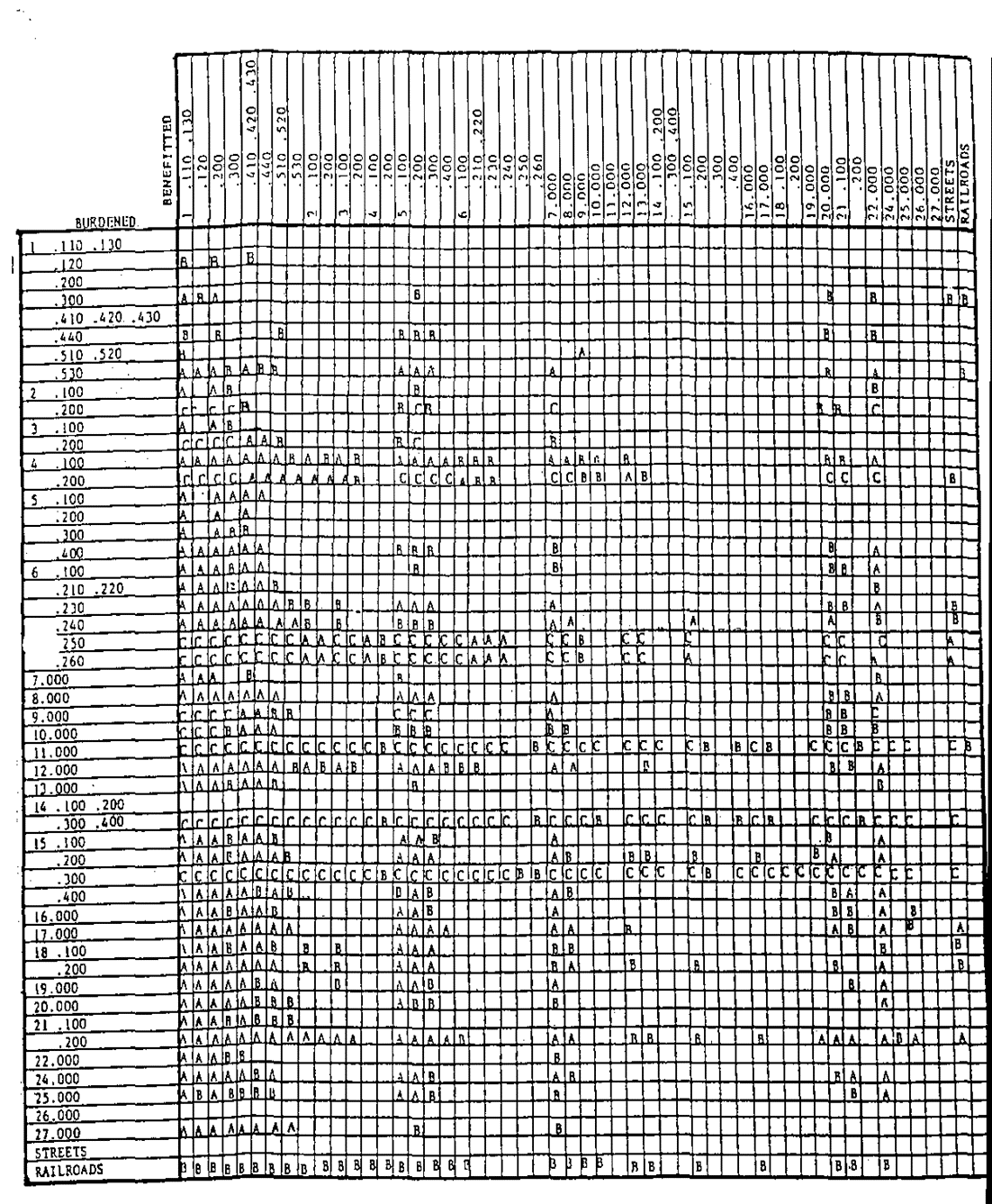
(Ord. No. 928, 1-12-87; Ord. No. 2021.06.02 , 6-9-21)
Sec. 35-309. - Flexibility in administration required.
(a)
The council recognizes that because of the wide variety of types of developments and the relationships between them, it is neither possible nor prudent to establish inflexible screening requirements. Therefore, as provided in section 35-306, the permit-issuing authority may permit deviations from the presumptive requirements of section 35-108 and may require either more intensive or less intensive screening whenever it finds such deviations are more likely to satisfy the standard set forth in section 35-305 without imposing unnecessary costs on the developer.
(b)
Without limiting the generality of paragraph (a), the permit-issuing authority may modify the presumptive requirements for:
(1)
Commercial developments located adjacent to residential uses in business zoning districts;
(2)
Commercial uses located adjacent to other commercial uses within the same zoning district;
(3)
Uses located within planned unit developments, or planned residential developments.
(c)
Whenever the permit-issuing authority allows or requires a deviation from the presumptive requirements set forth in section 35-308, it shall enter on the face of the permit the screening requirement that it imposes to meet the standard set forth in section 35-305 and the reasons for allowing or requiring the deviation.
(d)
If the permit-issuing authority concludes, based upon information it receives in the consideration of a specific development proposal, that a presumption established by section 35-308 is erroneous, it shall initiate a request for an amendment to the table of screening requirements in accordance with the procedures set forth in article XX.
(Ord. No. 928, 1-12-87; Ord. No. 2021.06.02 , 6-9-21)
Sec. 35-310. - Combination uses.
(a)
In determining the screening requirements that apply between a combination use and another use, the permit-issuing authority shall proceed as if the principal uses that comprise the combination use were not combined and reach its determination accordingly, relying on the table set forth in section 35-308, interpreted in the light of section 35-309.
(b)
When two or more principal uses are combined to create a combination use, screening shall not be required between the composite principal uses unless they are clearly separated physically and screening is determined to be necessary to satisfy the standard set forth in section 35-305.
(Ord. No. 928, 1-12-87; Ord. No. 2021.06.02 , 6-9-21)
Sec. 35-311. - Subdivisions.
When undeveloped land is subdivided and undeveloped lots only are sold, the subdivider shall not be required to install any screening. Screening shall be required, if at all, only when the lots are developed, and the responsibility for installing such screening shall be determined in accordance with the other requirements of division 1 of this chapter.
(Ord. No. 928, 1-12-87; Ord. No. 2021.06.02 , 6-9-21)
Sec. 35-312. - Recyclable materials storage areas alone or in conjunction with another principal use.
(a)
It is the intent of this section of the land use ordinance that all new and existing development be in compliance with these requirements to the maximum practicable extent. The council recognizes that because of the wide variety of types of real property and development and the relationships between them, it is neither possible nor prudent to establish inflexible fencing and/or screening requirements. Therefore, the permit issuing authority may permit deviations from the presumptive requirements of subsection (b) of this section and may require less intensive fencing and/or screening whenever:
(1)
The permit issuing authority finds such deviations are more likely to satisfy the standards set forth below; and/or
(2)
Given the configuration of the property and historic patterns of development and use of the property, strict compliance with the standards set forth below is not possible.
(b)
To permit in those districts listed under section 35-149, Table of permissible uses, an outdoor storage yard for recyclable materials which are to be reprocessed on-site or transported to other locations for recycling and reclamation, provided that the following standards are met:
(1)
There is a plan for shipping or reprocessing each class of recyclable material regularly, such that the size of the storage yard is minimized in relationship to the amount of recyclable material estimated to be received.
(2)
No pile of stored material shall exceed the height of the screening fence or landscaping. Height is to be calculated in the following manner:
a.
The natural ground elevation to the highest point of the stack or pile of recyclable material.
(3)
The storage area is enclosed by an enclosed fence or solid wall except along that portion of a lot boundary adjacent to railway tracks where a loading area exists. The closed fence or solid wall shall be two inches taller than the tallest pile of material as calculated in subsection (2) above. No closed fence or wall shall be shorter than six feet nor taller than 12 feet in height. The closed fence or solid wall shall comply with the following requirements:
a.
Closed wood fences shall be constructed using one inch or greater in nominal size thickness wood or pre-fabricated panels approved by the land use administrator and must contain a preservative treatment with a minimum retention of 0.4 pounds per cubic foot above ground and in ground 0.6 pounds per cubic foot; or contain equivalent natural preservative characteristics.
(4)
As an alternative to subsection (3) immediately above, and with the approval of the land use administrator, storage areas may be surrounded by an opaque screen of plants which will reach at least six feet in height within three planting seasons. Such a screen shall meet the requirements of subsection 35-307(1), Opaque screen type "A". The plantings shall be as close to the property line as reasonably possible. Whenever possible, the screen shall be planted between the property and/or right-of-way line and the objects to be screened and/or any chain link or other non-opaque fences on the property.
(5)
The facility contains adequate measures to control windblown stored material.
(6)
No part of the storage yard is located within 400 feet of a residential zoning district, or the lot line of a dwelling, congregate care or congregate living structure.
(7)
A plan is approved by the city for permanent soil erosion control devices.
(8)
Off-street parking shall be provided in accordance with section 35-291.
(9)
The outdoor storage yard shall comply with all applicable state and federal regulations.
(10)
The impact of the storage yard, including its size, equipment and machinery used, hours of operation, and appearance, will not be injurious to property or improvements in the affected area.
(c)
Whenever the permit issuing authority allows or requires a deviation from the presumptive requirements set forth in subsection (b) above, it shall enter on the face of the permit the fencing and/or screening requirement that it imposes to meet the standard set forth in subsection (b) above and the reasons for allowing or requiring the deviation.
(Ord. No. 1690, 9-28-98; Ord. No. 2021.06.02 , 6-9-21)
Sec. 35-314. - Council findings and declaration of policy on shade trees.
(a)
The council finds that:
(1)
Trees are proven producers of oxygen, a necessary element for human survival;
(2)
Trees appreciably reduce the ever-increasing, environmentally dangerous carbon dioxide content of the air and play a vital role in purifying the air we breathe;
(3)
Trees precipitate dust and other particulate air-borne pollutants from the air and create temporary conditions of narcosis allowing air-borne pollutants to settle to the ground;
(4)
Trees transpire considerable amounts of water each day and thereby purify the air much like the air-washer devices used on commercial air conditioning systems;
(5)
Trees have an important role in neutralizing waste water passing through the ground from the surface to ground water tables and lower aquifers;
(6)
Trees, through their root systems, stabilize the ground water tables and play an important and effective part in soil conservation, erosion control and flood control;
(7)
Trees are an invaluable physical, aesthetic and psychological counterpoint to the urban setting, making urban life more comfortable by providing shade and cooling the air and land, reducing noise levels and glare and breaking and monotony of human developments on the land, particularly parking areas; and
(8)
For the reasons indicated in subsection (7), trees have an important impact on the desirability of land and, consequently, on property values.
(b)
Based upon the findings set forth in paragraph (a), the council declares that it is not only desirable but essential to the health, safety, and welfare of all persons living or working within the city's planning jurisdiction, present and future, to protect certain existing trees and, under the circumstances set forth in this chapter, to require the planting of new trees in certain types of developments.
(Ord. No. 928, 1-12-87; Ord. No. 2021.06.02 , 6-9-21)
Sec. 35-315. - Required trees long dedicated streets.
Along both sides of all newly created streets with respect to which an offer of dedication is required to be made by this chapter, the developer shall either plant or retain sufficient trees so that, between the paved portion of the street and a line running parallel to and 50 feet from the centerline of the street, there is for every 50 feet of street frontage at least an average of one deciduous tree that has or will have when fully mature a trunk at least 12 inches in diameter. When trees are planted by the developer pursuant to this section, the developer shall choose trees that meet the standards set forth in appendix E [which is on file in the office of the city clerk.]
(Ord. No. 928, 1-12-87; Ord. No. 2021.06.02 , 6-9-21)
Sec. 35-316. - Retention and protection of large trees.
(a)
Every development shall retain all existing trees 18 inches in diameter or more unless the retention of such trees would unreasonably burden the development.
(b)
No excavation or other subsurface disturbance may be undertaken within the drip line of any tree 18 inches in diameter or more, and no impervious surface (including, but not limited to, paving or buildings) may be located within 12.5 feet (measured from the center of the trunk) of any tree 18 inches in diameter or more unless compliance with this paragraph would unreasonably burden the development. For purposes of this paragraph, a drip line is defined as a perimeter formed by the points farthest away from the trunk of a tree where precipitation falling from the branches of that tree lands on the ground.
(c)
The retention or protection of trees 18 inches in diameter or more as provided in paragraphs (a) and (b) unreasonably burdens a development if, to accomplish such retention or protection, the desired location of improvements on a lot or the proposed activities on a lot would have to be substantially altered, and such alteration would work an unreasonable hardship upon the developer, or if the reasonable development of the lot results in substantial alterations to the tree's environment, the effect of which would require the severe pruning of the tree and thereby destroy its aesthetic and environmental qualities.
(d)
If space that would otherwise be devoted to parking cannot be so used because of the requirements of paragraphs (a) or (b), and, as a result, the parking requirements set forth in article XVIII cannot be satisfied, the number of required spaces may be reduced by the number of spaces "lost" because of the provisions of paragraphs (a) and (b), up to a maximum of 15 percent of the required spaces.
(Ord. No. 928, 1-12-87; Ord. No. 1356, 8-24-92; Ord. No. 2021.06.02 , 6-9-21)
Sec. 35-317. - Shade trees in parking areas.
(a)
Vehicle accommodation areas (VAA). Areas accessible to vehicular traffic on a regular basis, and which have an improved surface such as asphalt, brick or concrete pavement. Examples include but are not limited to driveways and parking lots. For the purposes of this section only areas that are not accessible on a regular basis to the general public and are not visible from a public right-of-way shall not be included as VAA. Airport runways and aircraft tarmacs shall not be included as VAA.
(1)
Vehicle accommodation areas that are required to be paved by section 35-295 must be shaded by large-maturing trees (either retained or planted by the developer) that have or will have when fully mature a trunk at least 12 inches in diameter. When trees are planted by the developer to satisfy the requirements of this subsection, the developer shall choose trees that both meet the standards and are listed in appendix D [on file in the office of the city clerk].
(2)
Each tree of the type described in subsection (1) shall be presumed to shade a circular area based on the diameter of the tree at breast height (dbh) based on the following table:
Minimum width of any tree planting area is ten feet. If trees of more than one DBH are used, a weighted average of the total required number of trees of the respective sizes versus the percentage of coverage shall be installed. A maximum of 50 percent of all required shade trees may be planted along perimeter at a two to one ratio.
(3)
Vehicle accommodation areas shall be laid out and detailed to prevent vehicles from striking trees. Vehicles will be presumed to have a body overhang of three feet, six inches.
(b)
Vehicle display/service areas (VDSA). An area where manufactured homes, motor vehicles, motor homes, boats and trailers are displayed for sale or parked while awaiting customer pickup.
(1)
Vehicle display/service areas that are required to be paved by section 35-295 must be shaded by large-maturing trees (either retained or planted by the developer) that have or will have when fully mature a trunk at least 12 inches in diameter. When trees are planted by the developer to satisfy the requirements of this subsection, the developer shall choose trees that meet the standards set forth in appendix D [on file in the office of the city clerk].
(2)
Each tree of the type described in subsection (1) shall comply with the requirements of subsection (a)(2) above. Dwarf shrubbery may be utilized in lieu of shade trees on the basis of substituting four dwarf shrubberies for one shade tree. Such substitution shall not exceed 50 percent of tree requirements.
(3)
VDSA shall be laid out and detailed to prevent vehicles from striking trees. Vehicles will be presumed to have a body overhang of three feet, six inches.
(4)
Up to three trees of any sizes may be retained or planted together, provided that the spacing requirements of subsection (a)(2) are met.
(Ord. No. 928, 1-12-98; Ord. No. 1629, 9-8-97; Ord. No. 2021.06.02 , 6-9-21)

