Lyman City Zoning Code
ARTICLE VII
BUFFERYARDS
Sec. 701.- Purpose.
The purpose of the bufferyard is to improve compatibility and minimize nuisances between adjacent land uses. The bufferyard offers several options, each of which will buffer to an equivalent degree by varying distance [setback and/or density (mass)].
Sec. 702. - Location.
Bufferyards shall be located on the outer perimeter of a lot, extending to the lot boundary lines. Bufferyards shall not be located on any portion of an existing public or private right-of-way.
Sec. 703. - Determination of Bufferyard Requirements.
To determine the bufferyard required between two adjacent parcels, the following procedure shall be followed:
A.
Identify from Article IV whether the proposed use/district requires a bufferyard;
B.
Identify the proposed land use;
C.
Identify the use of lands adjacent to the proposed use; and
D.
Determine the bufferyard required on each boundary or segment thereof for the proposed land use by referring to the Table 3 of Bufferyard Requirements and Illustrations contained herein which specify the bufferyard options required between a proposed use and the existing adjacent uses.
Sec. 704. - Responsibility for Bufferyard/Screening.
When a use is the first to develop on two adjacent vacant parcels, the first use shall provide the buffer, specified by the Table of Bufferyards Requirements for vacant land.
The second use to develop shall at the time it develops, provide all additional plant material structures and/or land necessary to provide the total bufferyard required between the two uses, as specified by the Table of Bufferyard Requirements.
Sec. 705. - Bufferyard Specifications.
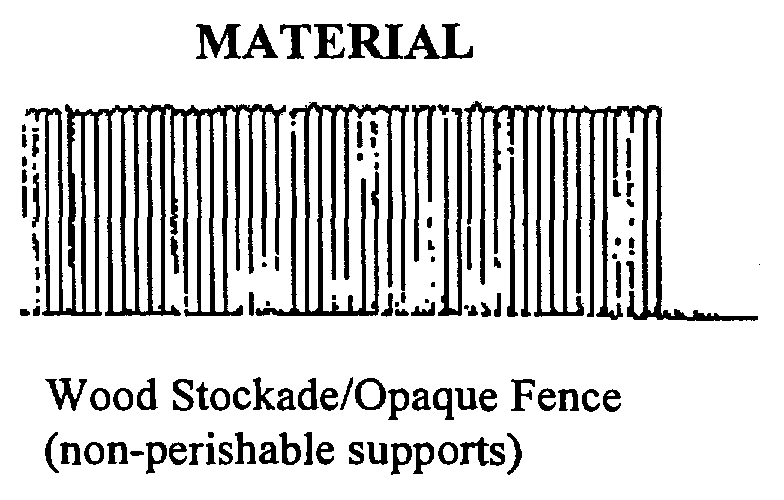
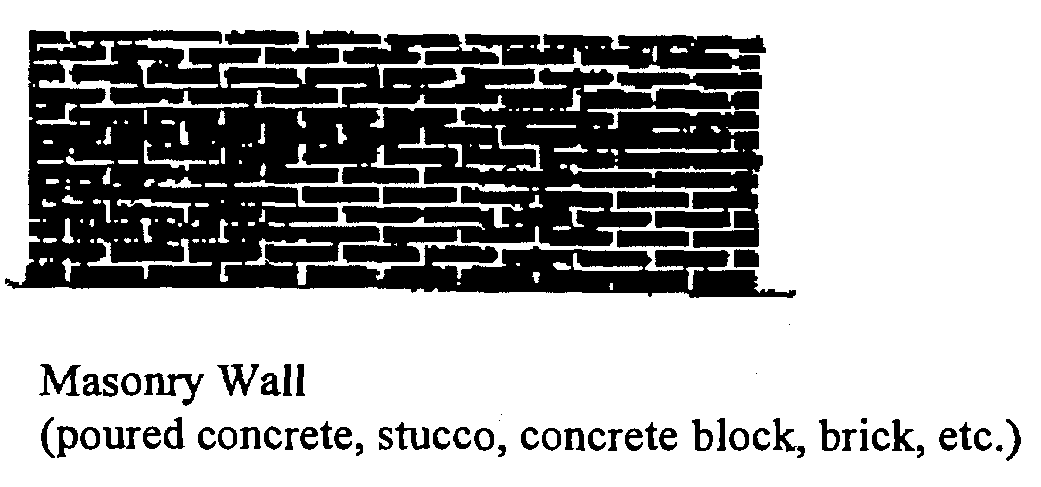
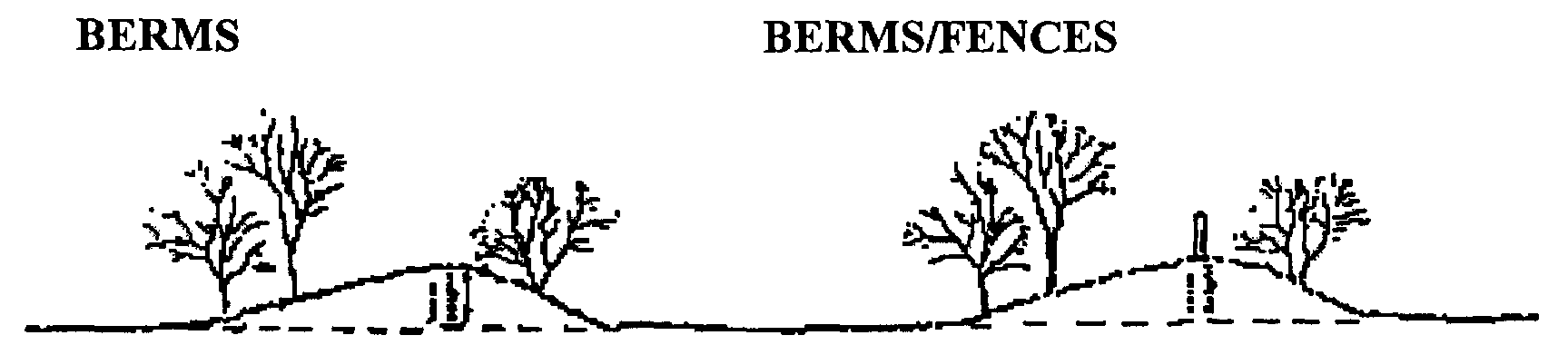
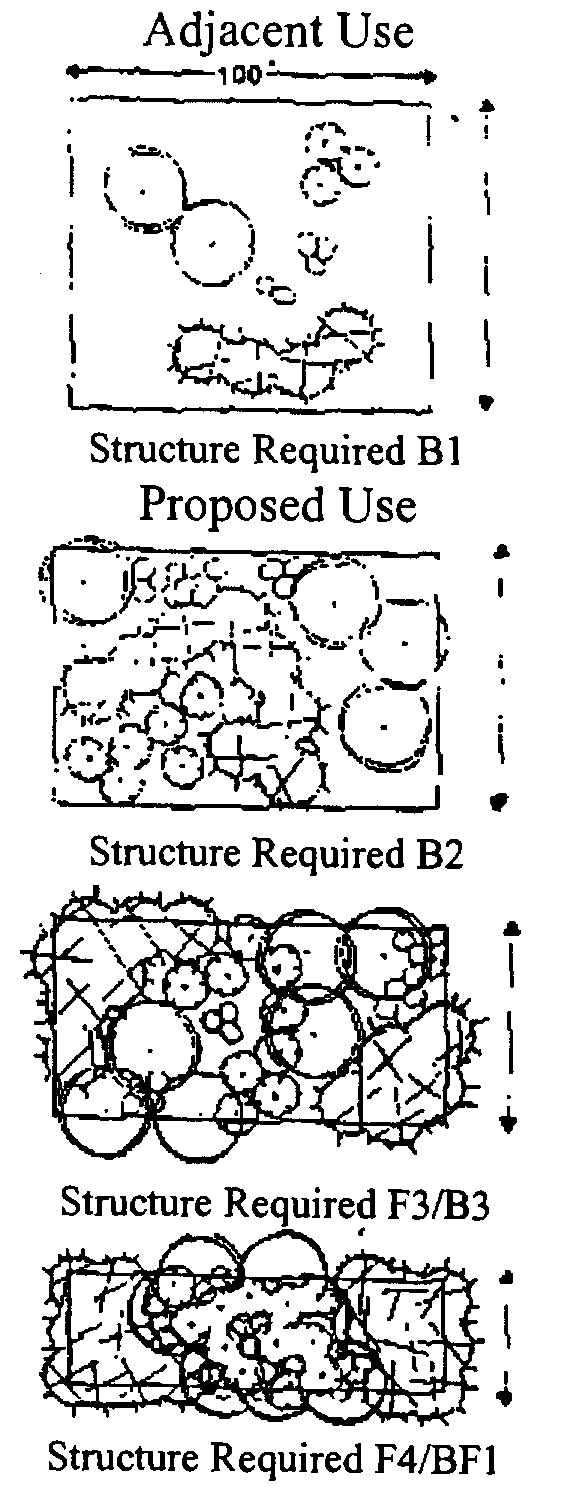
The attached illustrations specify the type and quantity of plant materials required by each bufferyard. The requirements are stated in terms of width of the bufferyard and the number of plants required per 100 feet of bufferyard. The requirements of a bufferyard may be met by any of the options illustrated. The "plant unit multiplier" is a factor by which the basic number of plant materials required for a particular bufferyard is determined when there is a change in the width of that yard. Each illustration depicts the total bufferyard required between two uses. Whenever a wall, fence, or berm is required within a bufferyard, these are shown as "structures" in the illustrations wherein their respective specifications also are shown.
The exact placement of required plants shall be the decision of the developer except that evergreen (or conifer) plants shall be planted in clusters rather than singly in order to maximize their chances of survival and increase screening capabilities.
All bufferyards shall be seeded with lawn grass or have a suitable ground cover.
Sec. 706. - Minimum Plant Size.
Plants shall be sized according to the following Table of Minimum Plant Sizes to insure buffering and screening at the time of installation. Where the Bufferyard Illustrations indicate a mass or line of plants parallel to the length of the property line, the plant materials shall be sufficiently sized to insure obscurity at the time of installation. However, seeding plants may be used where berms or structures are required as part of the bufferyard.
Sec. 707. - Bufferyard Substitutions.
Any existing healthy, well-formed plant materials which are greater than or equal to the recommended buffer and which otherwise satisfy the requirements of this section may be counted towards satisfying all such requirements.
Structures, where required, may be substituted with approval of the Planning Commission.
Sec. 708. - Use of Bufferyards.
A bufferyard may be used for passive recreation; however, no plant material may be removed and such use shall not be a nuisance to abutting properties.
Sec. 709. - Containers and Dumpsters/Outdoor Utility Equipment.
All exterior dumpsters or exterior garbage containers (excluding containers or groups of containers with a combined capacity of less than six cubic yards) shall be screened on all but one side by an F3 or F4 fence or wall, intensive landscaping, or other suitable opaque enclosure. The average height of the enclosure shall be one (1) foot more than the height of the container but shall not be required to exceed eight (8) feet in height. The open side shall not be visible from the street.
Sec. 710. - Fences and Walls Zoning Requirements for all Residential Districts and Commercial/Industrial Districts.
A.
Height:
Residential Districts; fence and wall height shall not exceed five (5) feet in front yards and six (6) feet and one-half (½) inches in all other locations. Single-Family and duplex properties abutting a commercial or industrial zoned property may erect a fence or wall up to eight (8) feet in height.
Commercial/Industrial Districts; Fence and walls to be a minimum of six (6) feet in height and not to exceed eight (8) feet in height. Fences and walls to be measured from finished grade of abutting properties. Kindergarten, pre-school, nursery, daycare for adults and children center, a five (5) foot wall or chain link fence shall be constructed around any play area.
B.
Location:
All portions of the fence or wall and footings to be completely within the property lines. Where fences or walls are applicable to bufferyards, they shall be established along the inside line of the bufferyard, toward the proposed use.
C.
Finish:
All fences and walls must have the finished side facing adjoining property. Except interior fences facing abutting properties where an existing fence or wall, on the abutting property, prevents the erection of the fence with the finished side facing out. This exception only applies to that portion of the proposed fence which is affected by an existing fence or wall, preventing the fence installer from constructing the fence with the finished side out.
D.
Surrounding Swimming Pools:
Fencing around swimming pools, hot tubs and spas containing water more than twenty-four (24) inches in depth shall be completely surrounded by a fence or barrier not less than forty-eight (48) inches in height above the finished ground level measured from the side of the barrier away from the pool. Gates and doors in such barriers shall be self-closing and self-latching. Latching device is to be a minimum of fifty-four (54) inches above the bottom of the gate. Exception: Spas or hot tubs with a safety cover that complies with the ASTM F 1346 shall be exempt from the provisions of this section.
E.
Prohibited:
Barbed wire, razor wire or electrified wires in all residential districts.
F.
Foreign Trade Zone (FTZ) Cargo and Security Standards and Specifications:
Businesses participating in and doing business in association with FTZ requirements, are required to conform to FTZ standards and specifications in relation to perimeter fencing and security measures. Such as, but not limited to: Minimum fence height of eight (8) feet, nine-gauge, two-inch mesh chain link, including a two-foot barbed wire properly spaced and angled outward.
(Ord. No. 07132020B, 8-10-2020; Ord. No. 02142022E, 3-14-2022; Ord. No. 02132023B, 3-13-2023)
Editor's note— Ord. No. 07132020B, adopted Aug. 10, 2020 amended § 710 and in doing so changed the title of said section from "Appearance of Fences and Walls" to "Fences and Walls Zoning Requirements for all Residential Districts and Commercial/Industrial Districts," as set out herein.
Sec. 711. - Berms.
Where required, berms may be located anywhere within the bufferyard, provided they parallel the property line.
Sec. 712. - Required Maintenance.
The maintenance of required bufferyards shall be the responsibility of the property owner. All such yards shall be properly maintained so as to assure continued buffering. Failure to do so is a violation of this ordinance, and may be remedied in the manner prescribed for other violations.

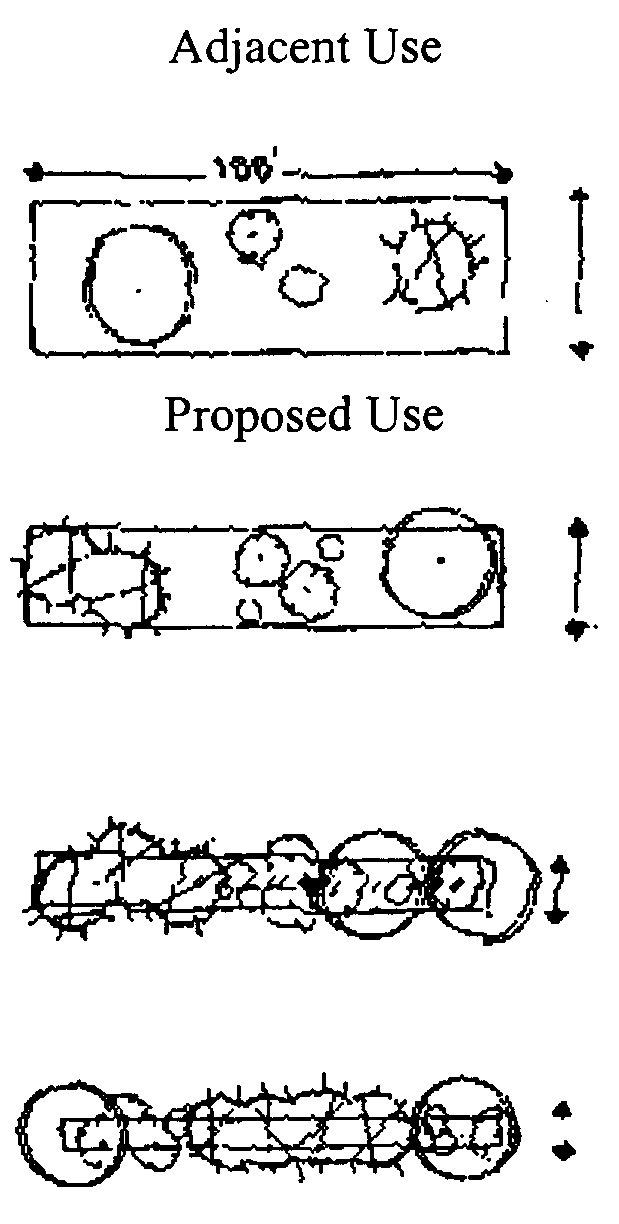

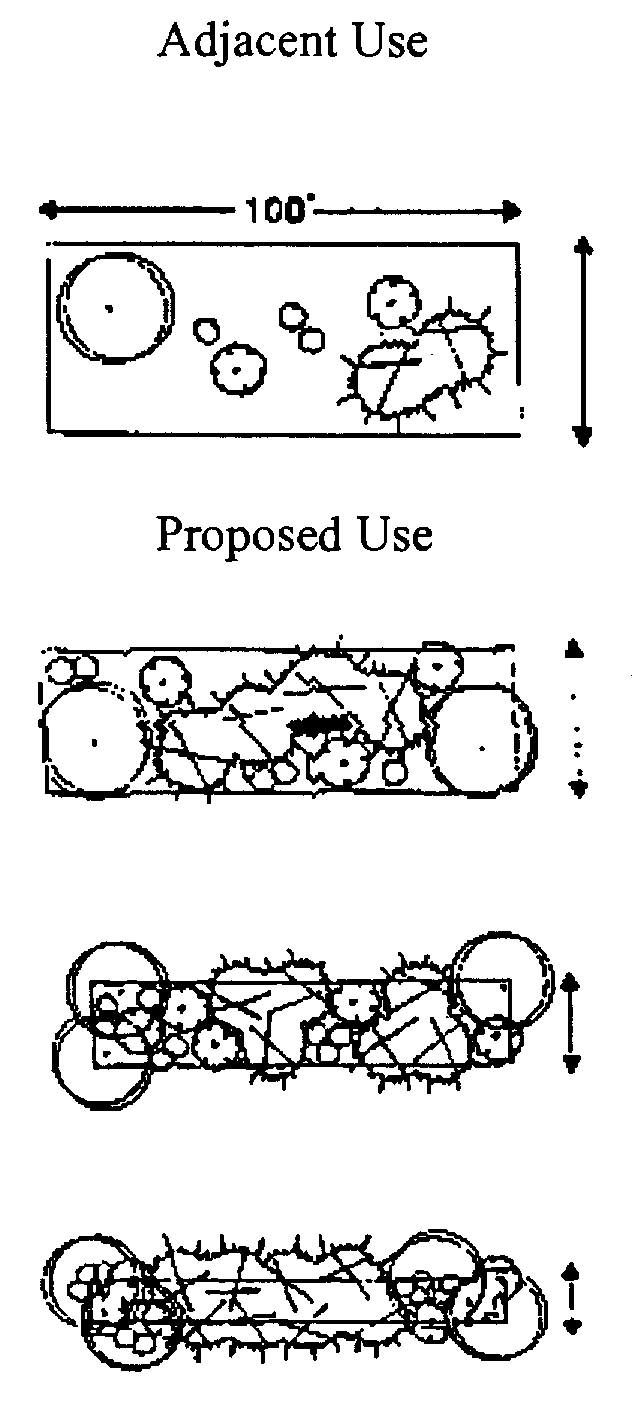

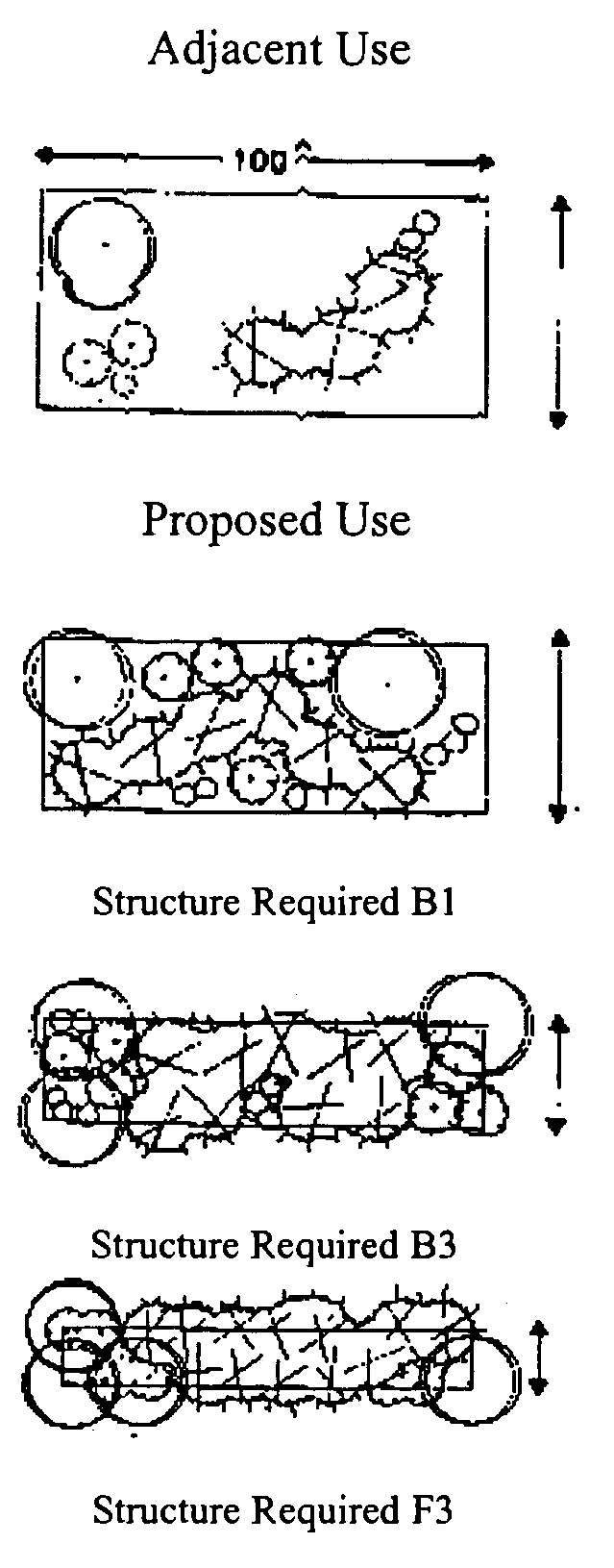

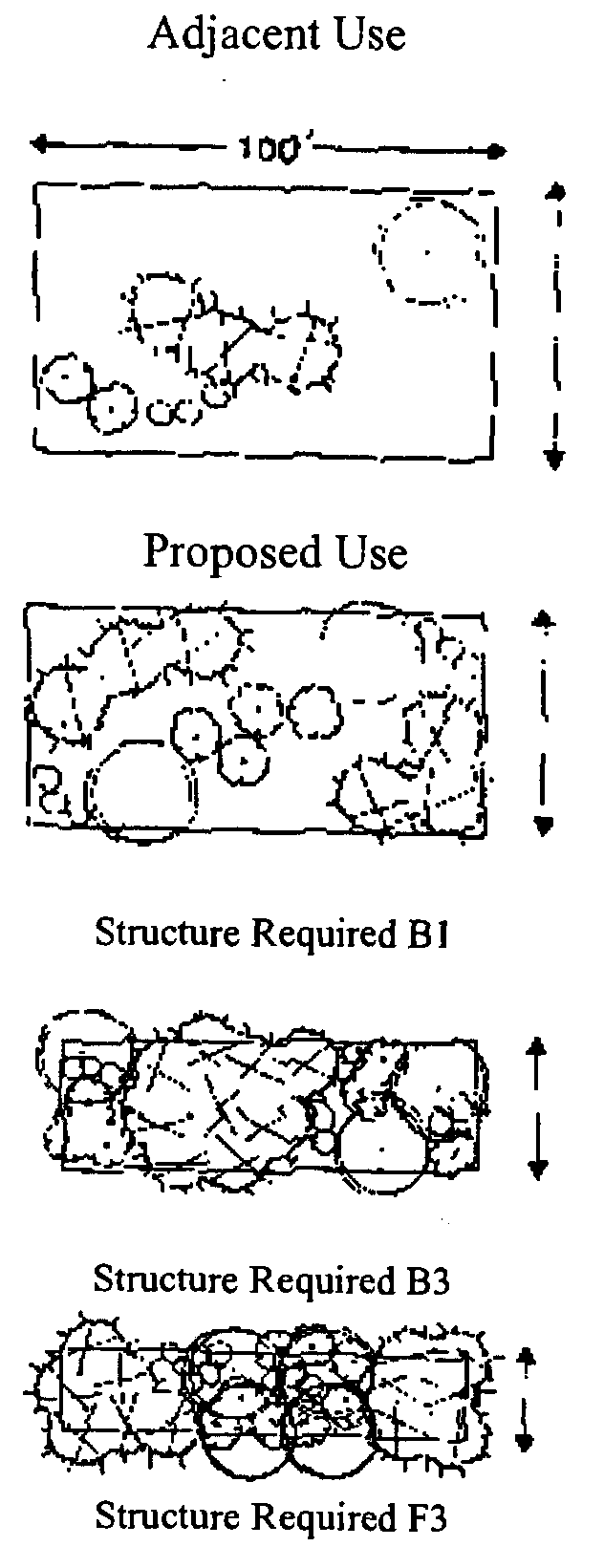

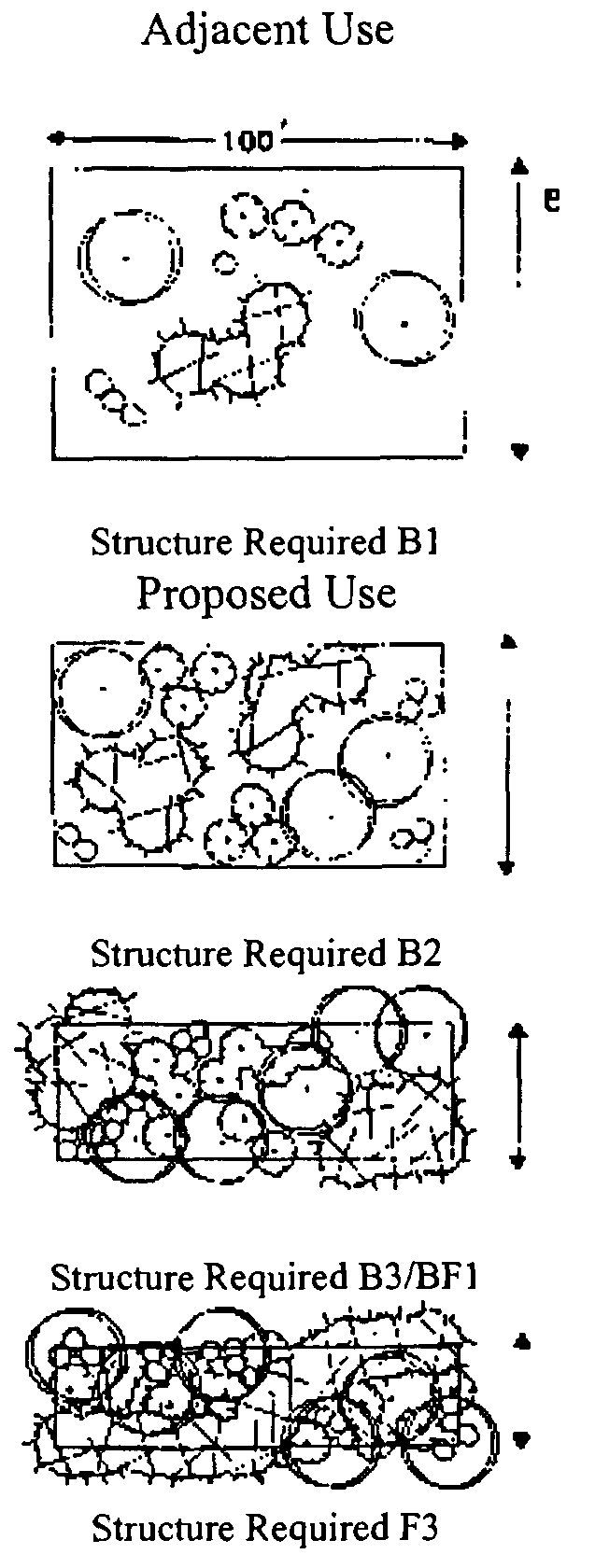

Legend
If the value is 0, then no bufferyard is required.
For any other value, the number refers to the class of the bufferyard required.
*F.A.R. refers to the floor area ratio.
Note. Uses not generally included in one of the above shall be assigned by the administrative
official to one of the bufferyard categories illustrated by the ordinance, as appropriate
to the scale and intensity of the proposed.
Structure Illustrations