
Macomb Township City Zoning Code
ARTICLE XXV
TRADITIONAL NEIGHBORHOOD DEVELOPMENT DISTRICT1
Editor's note— Ord. No. 10-75, § 1, adopted June 12, 2024, repealed the former Art. XXV, §§ 10-2501—10.2518, Apps. A—K, and enacted a new Art. XXV as set out herein. The former Art. XXV pertained to Traditional Neighborhood Development Code and derived from Ord. No. 10-43, adopted July 27, 2011; and Ord. No. 10-60, § 1, adopted April 13, 2016.
Sec. 10.2501.- Intent.
The Traditional Neighborhood Development (TND) District is established to implement the Macomb Town Center (MTC) Master Plan. The TND District provides specific regulations to achieve the following:
A.
To develop a pedestrian-oriented environment with traditional residential neighborhoods and a traditional town center with buildings containing neighborhood commercial, residential, civic, and office uses.
B.
To calm traffic, thereby creating a more pedestrian-friendly environment and preventing a clustering of auto-oriented uses.
C.
To regulate building height and placement to achieve appropriate scale along streets.
D.
To establish clear controls on building form and placement to frame a well-defined public realm comprised of human-scale streets, neighborhoods, and public spaces, all of which contribute to creating a safe, comfortable, and livable environment.
(Ord. No. 10-75, § 1, 6-12-24)
Sec. 10.2502. - General Provisions.
A.
The TND District is applicable to the MTC, as identified on the Future Land Use map within the Macomb Township Master Plan. All development, land use, and construction, reconstruction, alteration, or erection of any structure within the MTC shall be subject to the provisions of this Article.
B.
The Town Center Regulating Plan and Thoroughfare Master Plan shall define specific development zoning categories (hereinafter called "zones"), for all specified areas within the TND District. Deviations from Town Center Regulating Plan and Thoroughfare Master Plan shall not be allowed.
C.
Plans that have received final Township approval prior to the date of this amendment that contain deviations from code requirements shall be considered legally non-conforming.
D.
All capitalized terms are defined in the Definition of Terms in Appendix A.
E.
Where conflicts occur, the health and safety provisions of the Macomb Township Building and Fire Codes shall take precedence.
F.
Where conflicts occur, the provisions of the Americans with Disabilities Act (ADA) and/or the Michigan Barrier Free Code shall prevail.
G.
Where the provisions of this Article conflict with other provisions of the Macomb Township Zoning Ordinance or the Macomb Township Code of Ordinances, the provisions of this Article shall prevail.
(Ord. No. 10-75, § 1, 6-12-24)
Sec. 10.2503. - Development Zones.
All property in the MTC shall be included in a Neighborhood Edge, Neighborhood General, Neighborhood Center, Core Downtown or Rural Preserve development Zone as described in Section 10.2508 below and as located and mapped on the Town Center Regulating Plan and Thoroughfare Master Plan.
A.
The residential neighborhood zones in the MTC support a quiet family residential setting, intended to create a pedestrian-oriented neighborhood with conveniently accessible parks and neighborhood services. These zones are as follows:
1.
Neighborhood Edge (NE) zone.
2.
Neighborhood General (NG) zone.
3.
Neighborhood Center (NC) zone.
B.
The Core Downtown (CD) zone creates a traditional, small town development character and enhances a pedestrian-oriented environment. The zone accommodates a mix of retail stores, offices, entertainment, public spaces, civic uses, residential uses and related activities that mutually support and serve the needs of the community. The intent of this zone is to encourage a lively social environment and economically viable downtown with a wide variety of uses in a pedestrian-oriented and unified setting with shared parking.
C.
Open Space zones include two (2) categories of undeveloped space as follows:
1.
The Rural Preserve (RP) zone. The RP zone is an undeveloped area with concentrations of natural features that justifies the use as natural preservation and passive recreation. These zones may include detention basins if approved by the Township.
2.
Common Space. The MTC was designed such that each neighborhood contains open space, parks, squares, and greens distributed throughout the neighborhood. These common spaces are not depicted on the Town Center Regulating Plan, but are instead shown on approved development plans.
(Ord. No. 10-75, § 1, 6-12-24)
Sec. 10.2505. - Schedule of Land Use.
The following legend applies to Section 10.2505 Schedule of Land Use.
P = Principal Use
S = Special Land Use
- = Prohibited
Table 1. Schedule of Land Use.
(Ord. No. 10-75, § 1, 6-12-24)
Sec. 10.2506. - Dimensional Requirements.
A.
Neighborhood Edge Zone.
1.
Principal Building Placement Requirements.
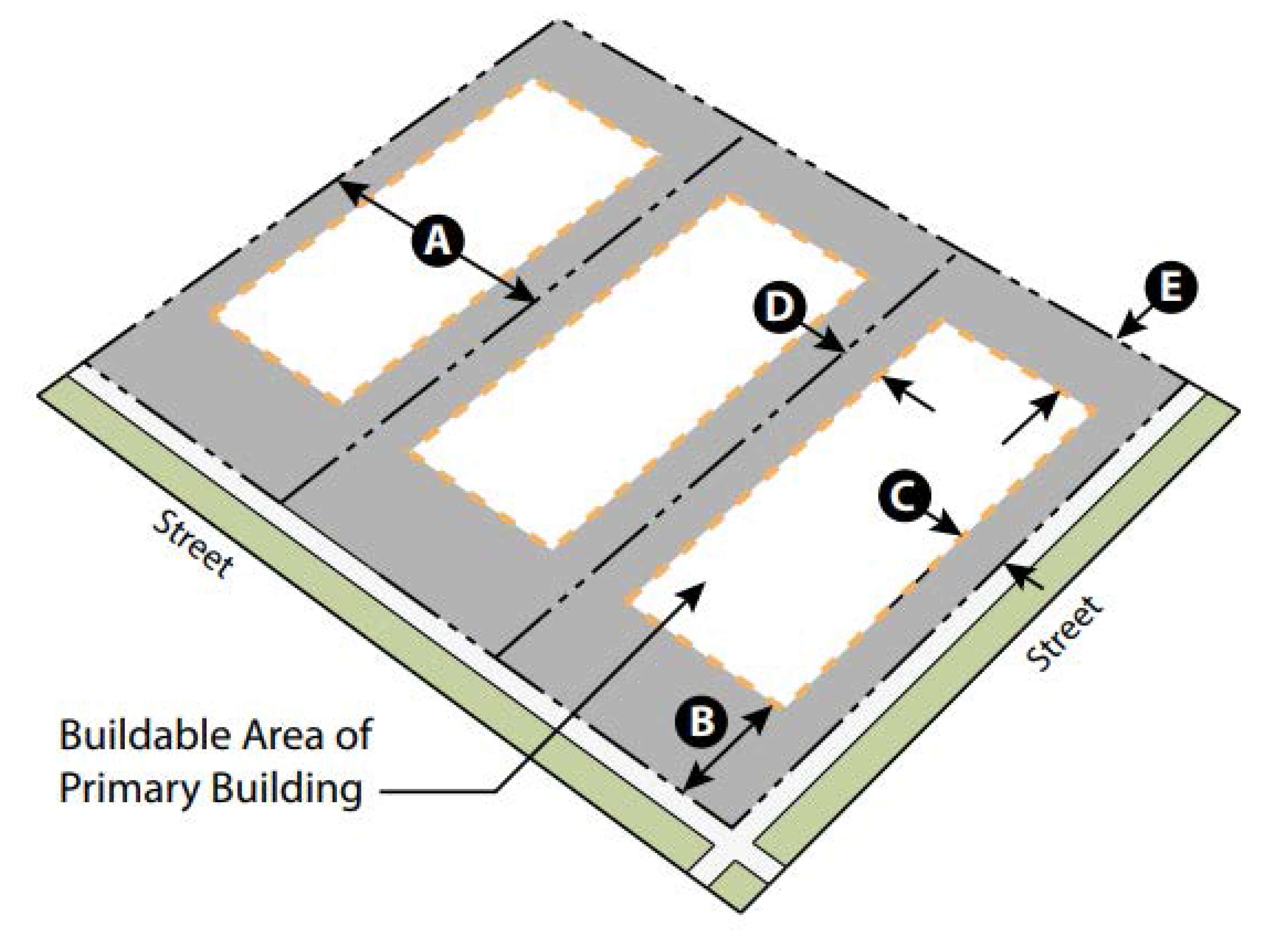
| Standard | Requirement | ||
|---|---|---|---|
| Lot or Unit Width 1 |  |
Minimum 70 ft.
Maximum 85 feet. | |
| Lot or Unit Coverage | Maximum 35%. | ||
| Hard Surface Coverage | Maximum 50%. | ||
| Build-to/Setback Lines | Front Yard Build-To Line |  | 24 feet. |
| Street-Side Build-To Line |  | 24 feet. | |
| Side Yard Setback |  | Minimum 7 ½ feet. | |
| Rear Yard Setback |  | Minimum 30 feet. | |
1 Corner unit must have additional 20 feet in width.
Figure 1. Neighborhood Edge Principal Building Placement
2.
Building Form and Components.
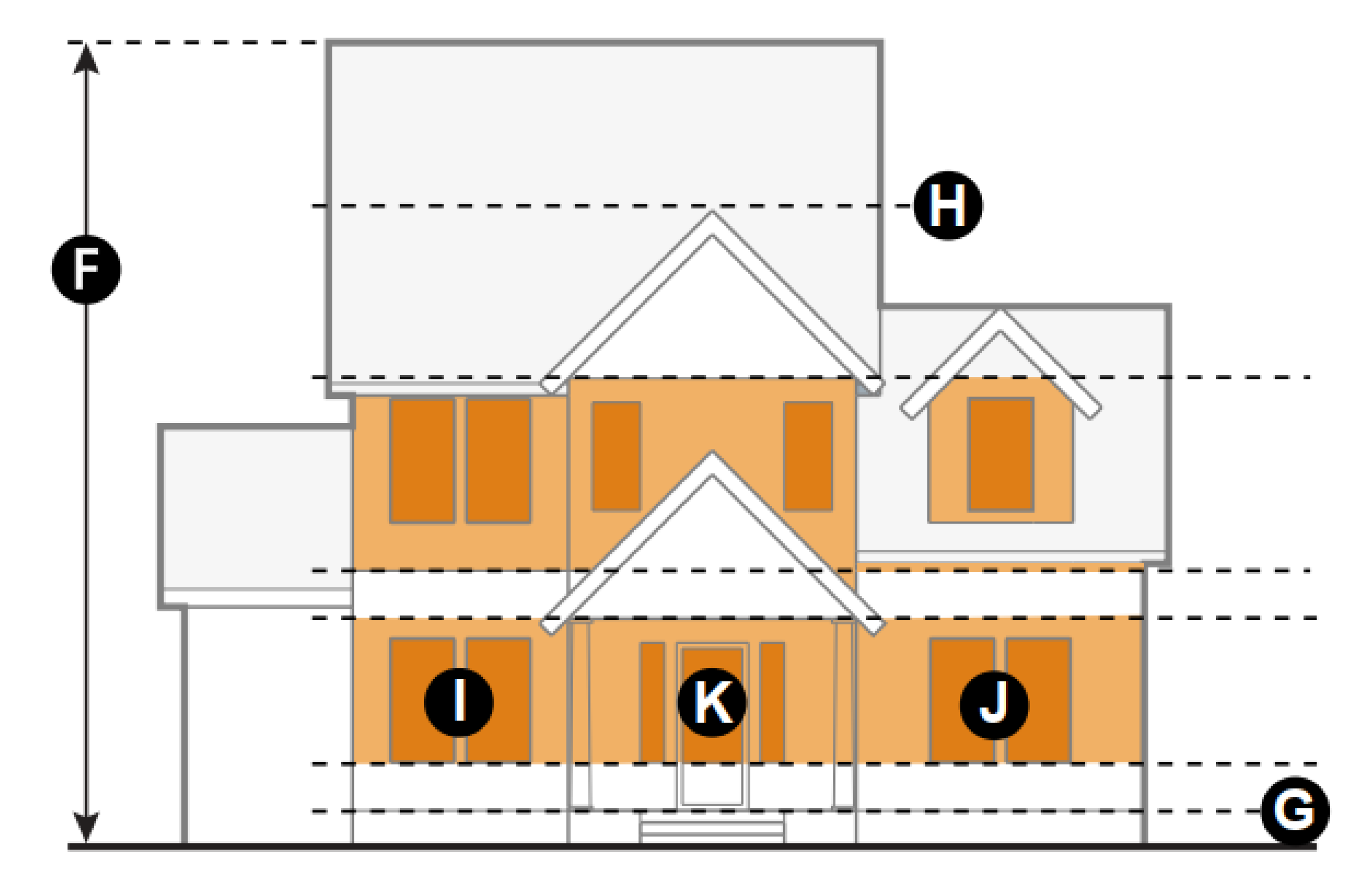
| Standard | Requirement | ||
|---|---|---|---|
| Building Placement | Façade | Orient parallel to the street. | |
| Building Height | Height |  |
No minimum requirement.
Maximum 30 feet. |
| Ground Floor Elevation |  | 2 feet—4 feet above grade with a maximum height of 6 feet above grade of the lowest curb on the adjacent street. Walkout basements are prohibited. | |
| Roof Pitch | Pitched Roof |  |
Minimum - 4:12.
Maximum - 12:12. |
| Floor Area | Detached Single-Family Residence | Minimum 1,600 square feet. | |
| Architectural Projections | Eaves and Awnings | Maximum projection - 2 feet into any yard. | |
| Bay/Bow Windows | Maximum projection - 2 feet into any yard. | ||
| Balconies | Maximum projection - 8 feet into any yard. | ||
| ADA Compliant ramps | May project into any yard. | ||
| Façades | Building Design | See Section 10.2507 of this Article. | |
| Windows |  | Street Facing Façade - 10%—30% required transparency. | |
| Non-Street Facing Façade - Minimum 5% required transparency. Minimum of 2 separate windows excluding windows in doors of any type or windows providing transparency into basement. | |||
 | Windows facing street must be taller than they are wide. | ||
| Entrances |  | At least 1 usable door facing front unit line. | |
| Attached Garages | Front-facing garage can occupy a maximum 55% of façade width. Garage door minimum transparency - 10%. If garage is at or within 4 feet of the front façade of the house, (not including the porch), see required architectural features in Sec. 10.2507 B. | ||
| Front façade of an attached garage must be setback a minimum of 8 feet behind the front of a porch. In no instance shall this façade be closer to the street than the front façade of the principal dwelling. | |||
| The portion of a 3-car front facing garage greater than 24 feet in width shall be set back at least 2 feet from the main garage façade. | |||
| Residential Front Porch (Required) | Porch Size - Single-Family |
Minimum depth - 8 feet.
Minimum width - 8 feet. If a house has a 3-car garage, minimum width shall be 10 feet. | |
| Height Above Grade |  | 2 feet - 4 feet above grade with a maximum height of 6 feet above grade of the lowest curb on the adjacent street. | |
| Architectural Projections of Porches | Maximum projection - 8 feet into a front yard. | ||
| Design | Porches must be unenclosed, covered, and include a 36-inch-tall decorative railing. | ||
Figure 2. Neighborhood Edge Building Form and Components.
3.
Site Development.
1 Swimming pools and spas shall meet the requirements of such as adopted in the Macomb Township Code of Ordinances and Zoning Ordinance and the relevant International Swimming Pool and Spa Code.
4.
Detached Accessory Buildings and Structures.
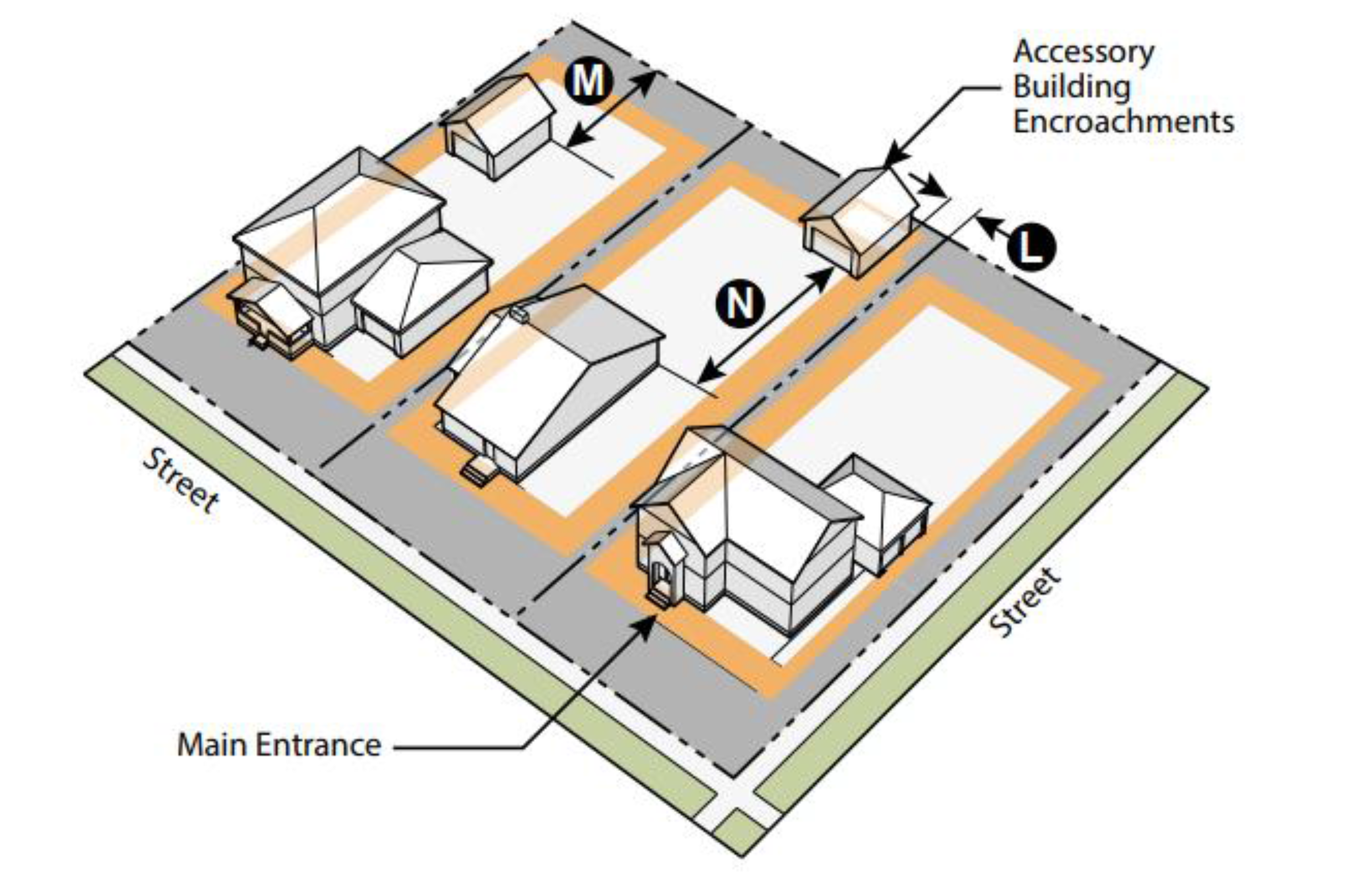
| Standard | Requirement | |||
|---|---|---|---|---|
| All Detached Buildings 1 | Side Setback |  | Minimum 5 feet. | |
| Rear Setback |  | Minimum 5 feet. | ||
| Separation Distance Between Buildings |  | Minimum 8 feet. | ||
| Building Materials and Colors | Complement principal building 2 . | |||
| Detached Garages 3 | Maximum Number Per Unit | 1 3 . | ||
| Location | Side or rear yard. | |||
| Front Setback | Side-facing | In line with front façade or any greater distance from front property line. | ||
| Front-facing | Minimum 20 feet from front of porch. | |||
| Height | Maximum 15 feet unless combined with Ancillary Dwelling where 20 feet is allowed. | |||
| Floor area |
Maximum 900 square feet.
Maximum 600 square feet when a 2 nd story ancillary dwelling is constructed. | |||
| Garage Door | If oriented toward front unit line, garage doors must have minimum 10% transparency. | |||
| Ancillary Dwellings 4,5 | Maximum Number Per Unit | 1. | ||
| Location | Rear yard. | |||
| Height | Maximum 20 feet combined with detached garage. | |||
| Floor Area | Maximum 800 square feet. | |||
| Other Accessory Structures | Maximum Number Per Unit | 1. | ||
| Location | Rear yard. | |||
| Height | Maximum 10 feet. | |||
| Floor area | Maximum 150 square feet. | |||
1 No unit shall have more than three (3) total buildings or structures or any combination including principal structure.
2 The Town Center Committee (TCC) will resolve any dispute if materials and colors cannot be agreed upon as complementary.
3 No unit shall have more than one (1) garage attached or detached.
4 An Ancillary Dwelling shall only be constructed above a detached garage in the rear yard if approved by the TCC. The combined height shall not exceed 20 feet.
5 An Ancillary Dwelling is considered a separate accessory building/structure in terms of this ordinance.
Figure 3. Neighborhood Edge Detached Accessory Buildings and Structures.
Unless specifically called out in this Article, all developments shall comply with Section 10.0311 Yard and lot area requirements for side yard setback requirements.
B.
Neighborhood General Zone.
1.
Single-Family Principal Building Placement Requirements.
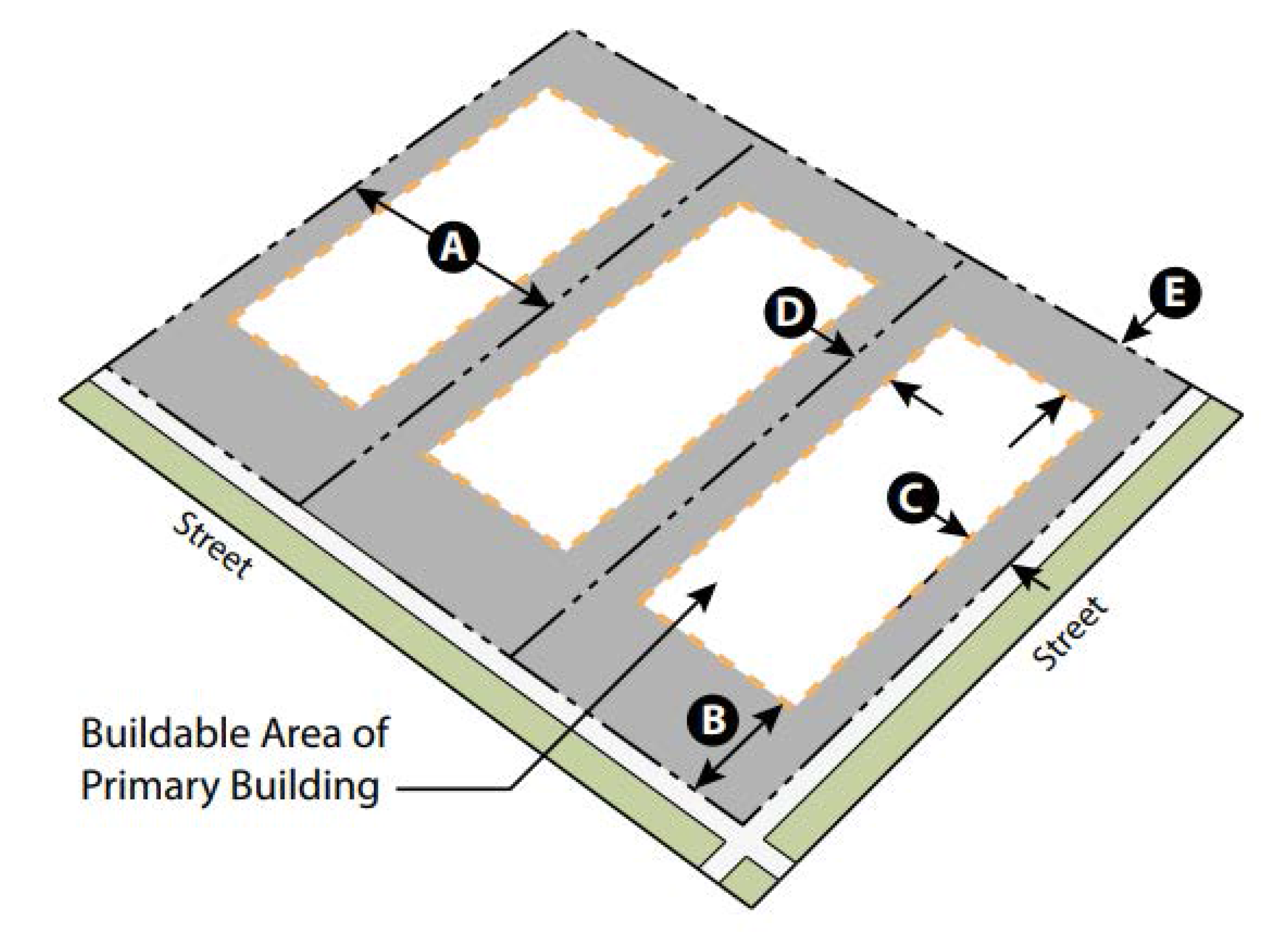
| Standard | Requirement | ||
|---|---|---|---|
| Lot or Unit Width 1 |  |
Minimum - 50 feet.
Maximum - 70 feet. | |
| Lot or Unit Coverage | 60% Maximum. | ||
| Hard Surface Coverage | 60% Maximum. | ||
| Build-to/Setback Lines | Front Yard Build-To Line |  | 20 feet. |
| Street-Side Build-To Line |  | 20 feet. | |
| Side Yard Setback |  | Minimum 6 feet. | |
| Rear Yard Setback |  | Minimum 25 feet. | |
1 Corner unit must have additional 20 feet in width.
Figure 4. Neighborhood General Single-Family Principal Building Placement.
2.
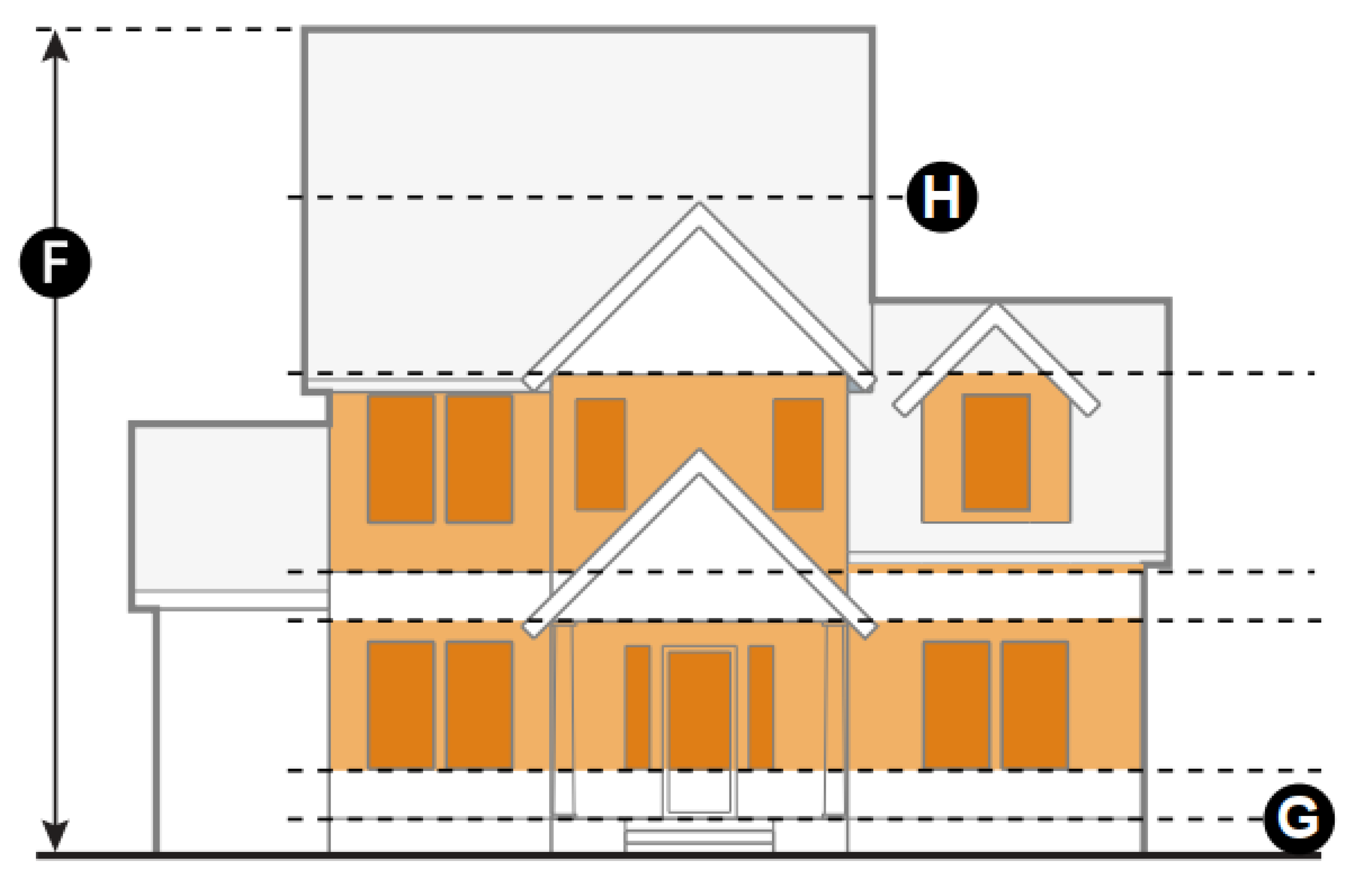
Single-Family Principal Building Form.
| Standard | Requirement | ||
|---|---|---|---|
| Building Placement | Façade | Orient parallel to the street. | |
| Building Height | Height |  |
No minimum requirement.
Maximum 30 feet. |
| Ground Floor Elevation |  | 2 feet—4 feet above grade with a maximum height of 6 feet above grade of the adjacent street. Walkout basements are prohibited. | |
| Roof Pitch | Pitched Roof |  |
Minimum - 4:12.
Maximum - 12:12. |
| Floor Area | Minimum 1,200 square feet. | ||
Figure 5. Neighborhood General Single-Family Principal Building Form.
3.
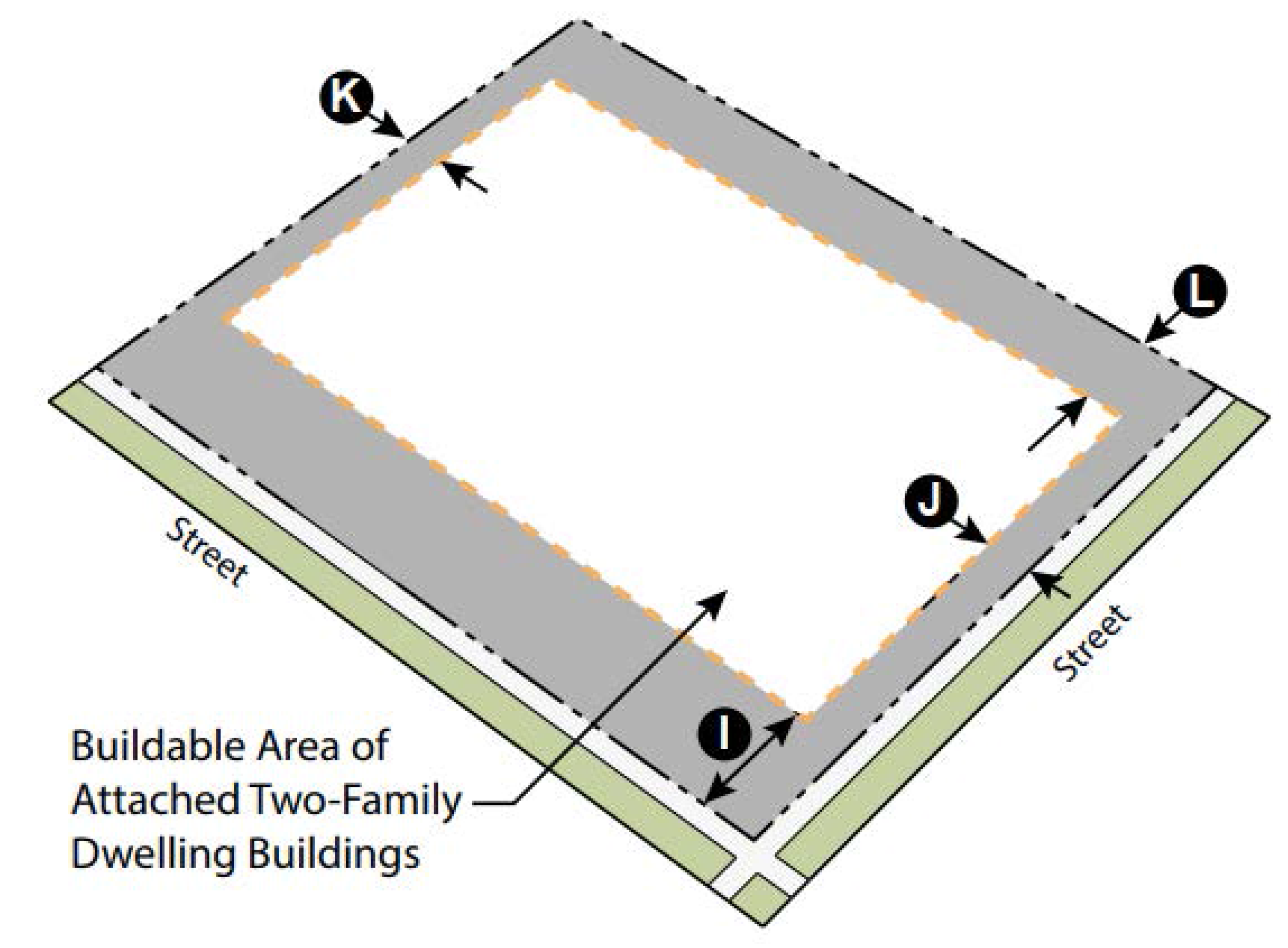
Attached Two-Family Dwelling Building Placement Requirements.
| Standard | Requirement | ||
|---|---|---|---|
| Lot or Unit Width | No Requirement. | ||
| Lot or Unit Coverage | No Requirement. | ||
| Build-to/Setback Lines | Front Yard Build-To Line |  | 20 feet. |
| Street-Side Build-To Line |  | 20 feet. | |
| Side Yard Setback |  | Minimum 6 feet. | |
| Rear Yard Setback |  | Minimum 25 feet. | |
| Distance Between Buildings 1 | Side to Side | 15 feet. | |
| Side to Rear | 30 feet. | ||
| Rear to Rear | 50 feet. | ||
1 Distance between buildings applies to traditional condominium development.
Figure 6. Neighborhood General Attached Two-Family Dwelling Building Placement Requirements.
4.
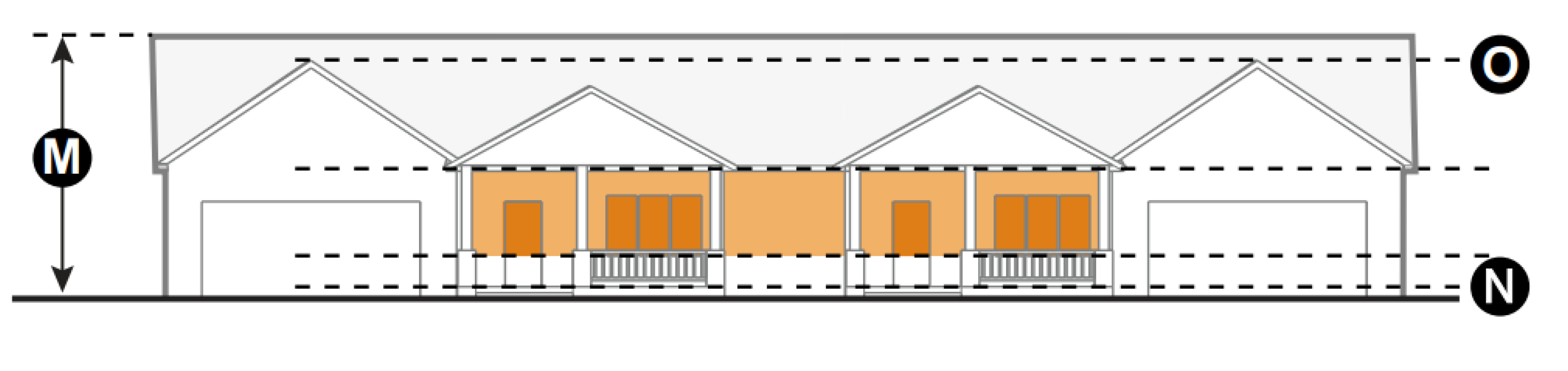
Attached Two-Family Dwelling Building Form.
| Standard | Requirement | ||
|---|---|---|---|
| Building Placement | Façade | Orient parallel to the street. | |
| Building Height | Height |  |
No minimum requirement.
Maximum 30 feet. |
| Ground Floor Elevation |  |
2 feet—4 feet above grade with a maximum height of 6 feet above grade of the adjacent
street.
Walkout basements are prohibited. | |
| Roof Pitch | Pitched Roof |  |
Minimum - 4:12.
Maximum - 12:12. |
| Floor Area | Two-Family Dwelling | Minimum 1,200 square feet per dwelling unit. | |
Figure 7. Neighborhood General Single-Family Principal Building Form.
5.
Detached Single-Family and Attached Two-Family Dwelling Building Components.
6.
Site Development.
7.
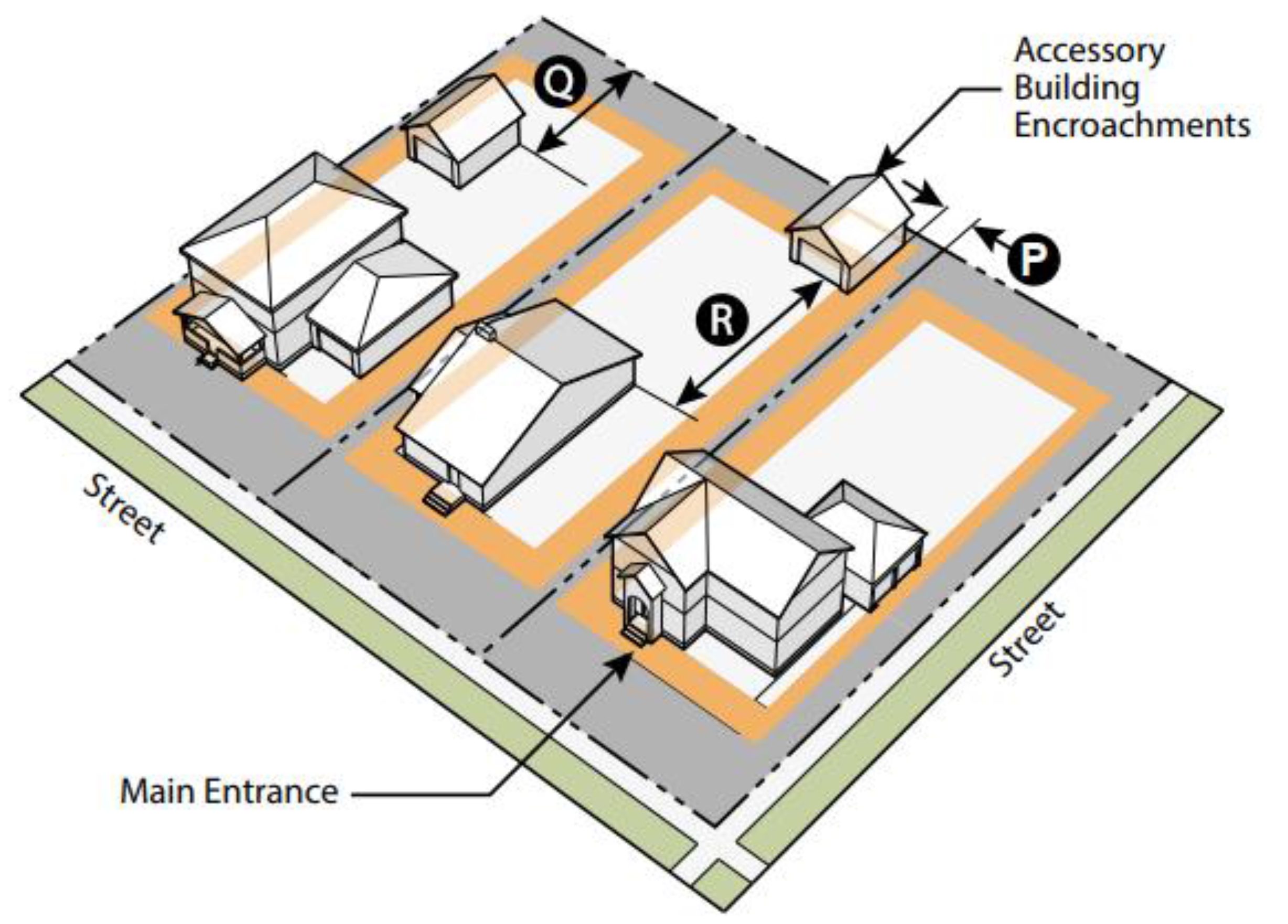
Detached Accessory Buildings and Structures for Single-Family Homes.
| Standard | Requirement | |||
|---|---|---|---|---|
|
All Detached
Buildings 1 | Side Setback |  | Minimum 3 feet. | |
| Rear Setback |  | Minimum 3 feet. | ||
| Separation Distance Between Buildings |  | Minimum 8 feet. | ||
| Building Materials and Colors | Complement principal building 2 . | |||
| Detached Garages 3 | Maximum Number Per Unit | 1 4 . | ||
| Location | Side or rear yard. | |||
| Front Setback | Side-facing | In line with front façade or any greater distance from front property line. | ||
| Front-facing | Minimum 20 feet from front of porch. | |||
| Height | Maximum 15 feet unless combined with Ancillary Dwelling where 20 feet is allowed. | |||
| Floor Area | Maximum 800 square feet. | |||
| Garage Door | If oriented toward front unit line, garage doors must have minimum 10% transparency. | |||
| Ancillary Dwellings 4,5 | Maximum number per unit | 1. | ||
| Location | Rear yard. | |||
| Height | Maximum 20 feet combined with detached garage. | |||
| Floor area | Maximum 800 square feet. | |||
| Other Accessory Structures | Maximum Number Per Unit | 1. | ||
| Location | Rear yard. | |||
| Height | Maximum 10 feet. | |||
| Floor Area | Maximum 150 square feet. | |||
1 No unit shall have more than three (3) total buildings or structures or any combination including principal structure.
2 The Town Center Committee (TCC) will resolve any dispute if materials and colors cannot be agreed upon as complementary.
3 No unit shall have more than one (1) garage attached or detached.
4 An Ancillary Dwelling shall only be combined above a detached garage in the rear yard if approved by the TCC and the combined height shall not exceed twenty (20) feet.
5 An Ancillary Dwelling is considered a separate accessory building/structure in terms of this ordinance.
Figure 8. Neighborhood General Single-Family Principal Building Form.
Unless specifically called out in this Article, all developments shall comply with Section 10.0311 Yard and lot area requirements for side yard setback requirements.
C.
Neighborhood Center Zone.
1.
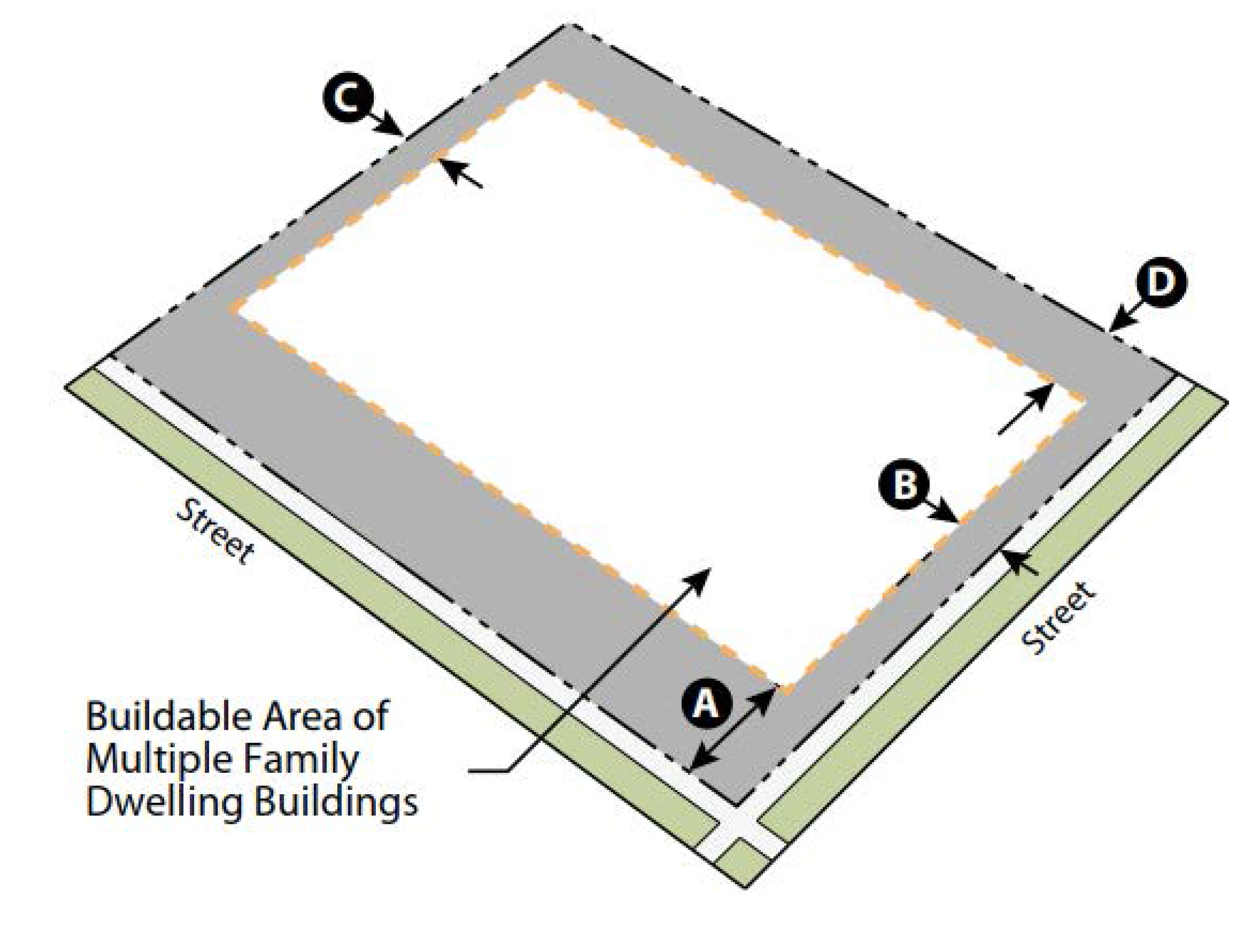
Principal Building Placement Requirements.
| Standard | Requirement | ||
|---|---|---|---|
| Lot or Unit Width | No Requirement. | ||
| Lot or Unit Coverage | No Requirement. | ||
| Build-to/Setback Lines | Front Yard Build-To Line |  | 6 feet or 12 feet. |
| Street-Side Build-To Line |  | 6 feet or 12 feet. | |
| Side Yard Setback |  | Minimum 4 feet. | |
| Rear Yard Setback |  | Minimum 25 feet unless adjacent to single-family uses or zones, then 35 feet. | |
| Distance Between Buildings | Side to Side | 15 feet. | |
| Side to Rear | 30 feet. | ||
| Rear to Rear | 50 feet. | ||
Figure 9. Neighborhood Center Principal Building Placement.
2.
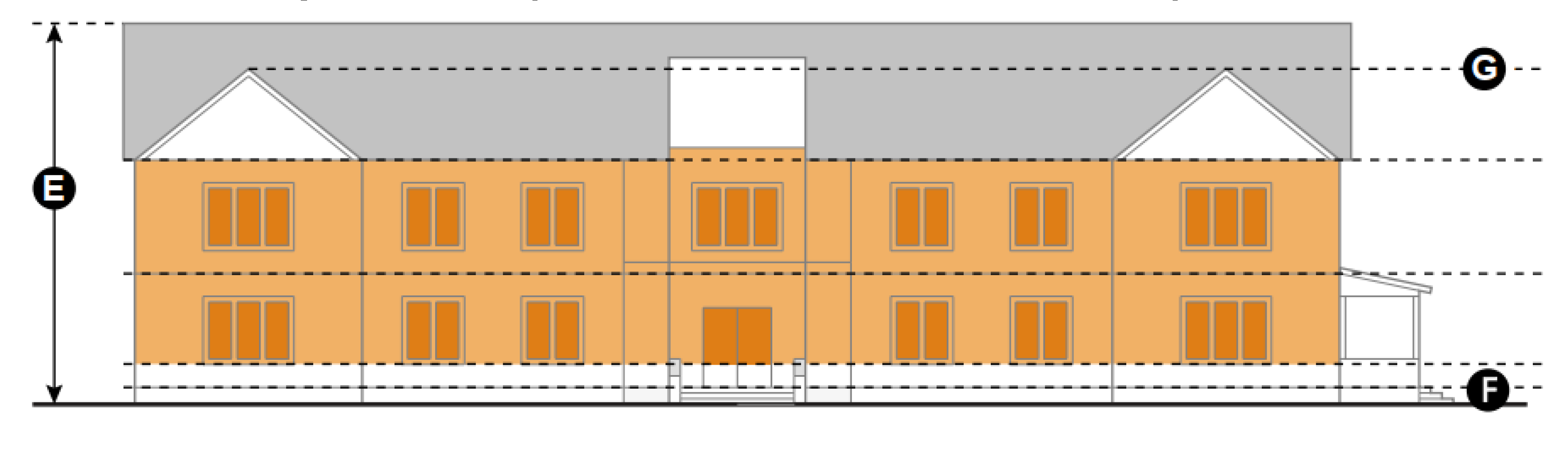
Building Form.
| Standard | Requirement | |||
|---|---|---|---|---|
|
Building
Placement | Façade | Orient parallel to the street. | ||
|
Building
Height | Height |  |
Minimum - 2 stories.
Maximum - 35 feet. | |
| Ground Floor Elevation |  | 2 feet—7 feet above grade. | ||
| Roof Pitch | Pitched Roof |  |
Minimum 4:12.
Maximum 12:12. | |
| Floor Area | Three or more dwelling units | 1 bedroom unit | Minimum 800 square feet. | |
| 2-bedroom unit | Minimum 1,000 square feet. | |||
| 3 or more bedroom unit | Minimum 1,200 square feet. | |||
Figure 10. Neighborhood Center Principal Building Form.
3.
Building Components.
1 Front-facing attached garages are not permitted along Macomb Street or Plattsburg Street.
4.
Site Development.
Unless specifically called out in this Article, all developments shall comply with Section 10.0311 Yard and lot area requirements for side yard setback requirements.
D.
Core Downtown.
1.
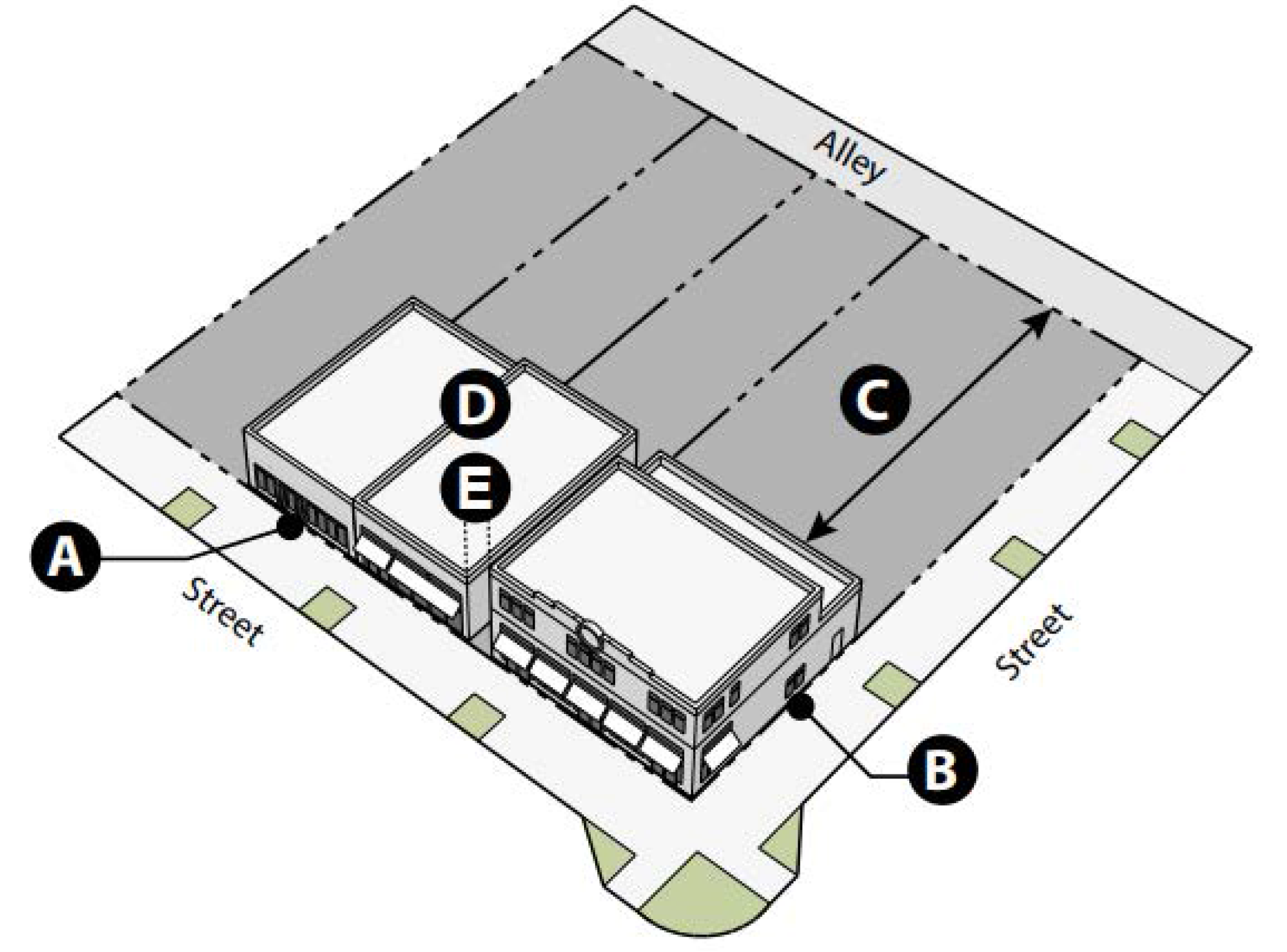
Principal Building Placement Requirements.
| Standard | Requirement | ||
|---|---|---|---|
| Lot or Unit Width | No requirement. | ||
| Lot or Unit Coverage | No requirement. | ||
| Build-to/Setback Lines | Front Yard Build-To Line |  | 0 feet or 6 feet. |
| Street-Side Build-To Line |  | 0 feet or 6 feet. | |
| Rear Yard Setback |  | Minimum - 20 feet where adjacent to a site zoned NE, NG, or NC. | |
| Side Yard Setback |  |
Minimum - 0 feet where adjacent to another CD zoned site.
Minimum - 10 feet where adjacent to a site zoned NE, NG, or NC. | |
| Separation Distance Between Buildings (If Separated) |  | 18 feet with internal circulation provided (alley/arcade). | |
Figure 11. Core Downtown Principal Building Placement.
2.
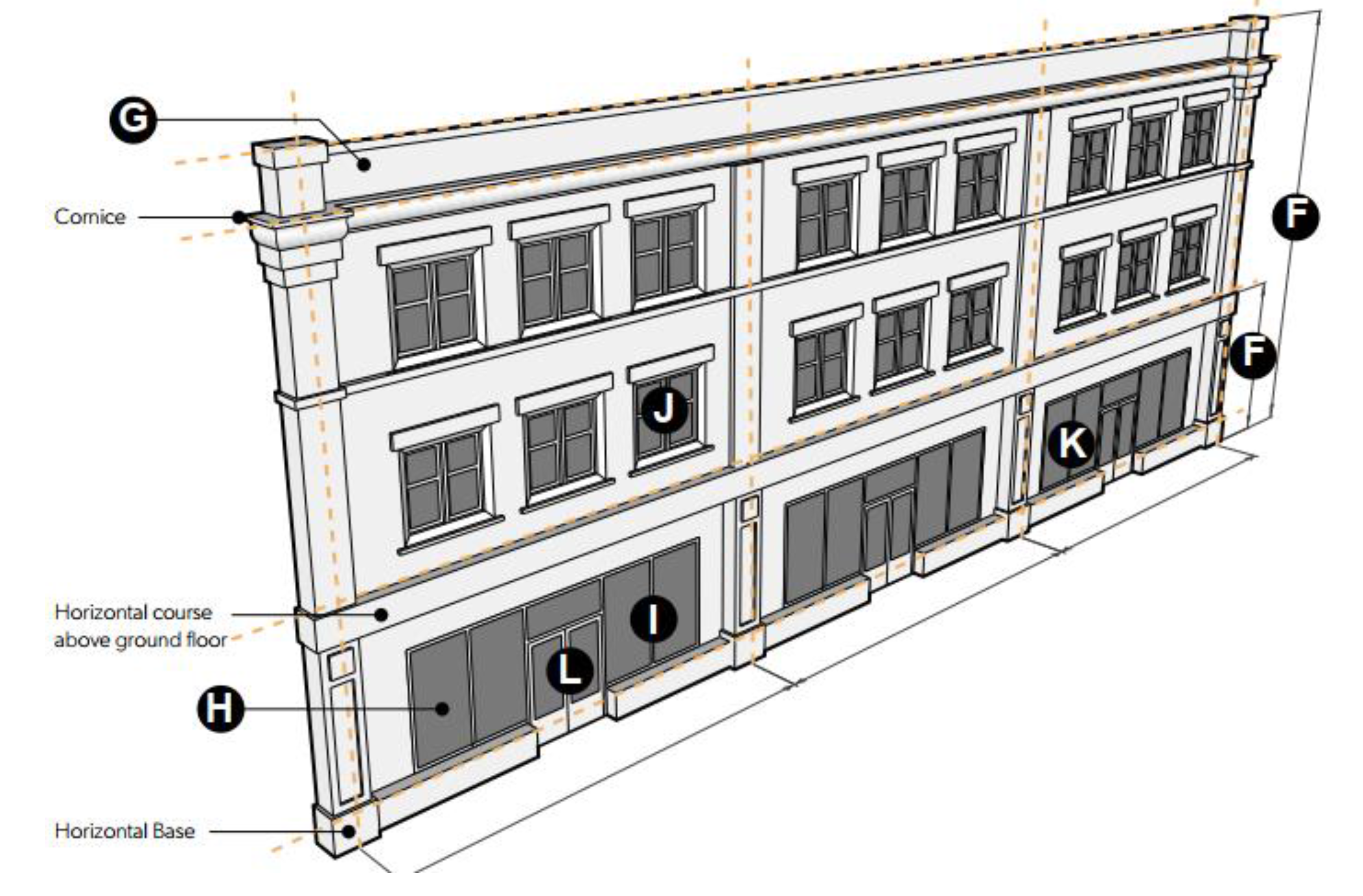
Building Form.
| Standard | Requirement | |||
|---|---|---|---|---|
| Building Placement | Façade | Orient parallel to the street. | ||
| Building Height | Height 1 |  |
Maximum - 36 feet and 3 stories.
Minimum - 24 feet and 2 stories. | |
| Ground Floor | Height |  | Maximum 16 feet 6 inches. | |
| Elevation | At grade. | |||
| Roof Pitch | Pitched Roof |
Minimum - 4:12.
Maximum - 12:12. | ||
| Flat Roof |  |
Parapet wall required.
Minimum height - 42 inches. Maximum height - 60 inches. | ||
| Unit Floor Area | Three or more dwelling units | Studio Apt. | Minimum 600 square feet. | |
| 1 bedroom unit | Minimum 800 square feet. | |||
| 2-bedroom unit | Minimum 1,000 square feet. | |||
| 3-bedroom unit | Minimum 1,200 square feet. | |||
1 A 4thstory with a flat roof may be allowed for buildings fronting on Broughton Road if approved by the Town Center Committee (TCC). The 4thstory must be set back a minimum of 10 feet from the face of any front façade, and the building's total height may not exceed 45 feet. This scenario would require a parapet wall on the 3rdstory and would not allow a parapet wall or any roof top equipment on the 4thstory. A deviation for this shall not be granted.
Figure 12. Core Downtown Building Form.
3.
Building Components.
| Standard | Requirement | ||
|---|---|---|---|
| Architectural Projections | Eaves and Awnings | Maximum projection - 2 feet into any yard. | |
| Bay/Bow Windows | Maximum projection - 2 feet into any yard. | ||
| Balconies | Maximum projection - 8 feet into any yard. | ||
| Porches | Maximum projection - 8 feet into a front yard. | ||
| ADA Compliant ramps | May project into any yard. | ||
| Façades | Building Design | See Section 10.2507 of this Article. | |
 | Ground floor - integrally designed as storefronts with windows, doorways and sign panels. | ||
 | Windows or recesses must be provided for every 30 feet of the façade. | ||
| Windows |  | Ground floor transparency: 60%—75% | |
 | Upper floor transparency: 33%—60% | ||
 | Windows facing street must be taller than they are wide. | ||
| Entrances |  | Minimum 1 usable entry door facing the front street or unit line. At minimum, 1 recessed entry must be provided for every 50 feet of the façade. | |
4.
Site Layout
(Ord. No. 10-75, § 1, 6-12-24; Ord. No. 10-77, § 1, 4-9-25)
Sec. 10.2507. - Building Design Standards.
A.
Purpose. These guidelines are intended to foster a consistent image for the MTC that will distinguish it as a special place. The goal of these standards is to encourage buildings to relate to one another, building by building and site by site by incorporating design principles. This term does not define a particular style or time period but is generally understood to embody architectural characteristics and elements of previous styles or time periods. These standards also reduce homogeneity in adjacent one- or two-family dwellings and serve to reduce the prominence of garage doors where an attached garage is located at or near the front of one-family dwellings and two-family dwellings.
B.
Residential Building Design Standards.
1.
One- or Two-Family Dwellings:
a.
Front Façade Building Materials. Durable building materials that provide an attractive, quality appearance shall be used on the building exterior, such as brick, wood, cement board siding or a combination thereof.
b.
Accent Building Materials. Use of EIFS (synthetic stucco), narrow plank vinyl of at least 0.044 inches in thickness and metal siding shall be used only for accent details or on side or rear walls not visible from adjacent roadway(s). Accent details shall not exceed 10 percent (10%) of a street-facing façade for detached single-family buildings and 15 percent (15%) for two-family buildings. Deviations shall not exceed 20 percent (20%).
c.
Side and Rear Façade Building Materials. Durable building materials that provide an attractive, quality appearance shall be used on the building exterior, such as brick, wood, cement board siding or a combination thereof. Use of EIFS (synthetic stucco), narrow plank vinyl of at least 0.044 inches in thickness and metal siding shall be allowed but shall not exceed 70 percent (70%) of the façade not including the area taken by the windows.
d.
Windows. Windows on the front façade shall be taller than they are wide. The TCC has the ability to approve varying proportions provided the spirit and intent of the TND is preserved.
e.
Colors. A minimum of two (2) colors must be used on the principal building.
f.
Architectural Design Features. The principal structure must exhibit architectural design features as required below (see Appendix C for graphical representations of these design features):
Primary Features - Select a minimum of two (2) features:
• Bay or Bow window
• Dormer(s) with window
• Gable on porch roof
• Incised corners
• Stone or masonry base on all four (4) sides
• Tower or turret
• Wrap-around porch
Secondary Features - Select a minimum of two (2) features:
• Dentil molding
• Gable ornamentation or eave brackets
• Oculus or transom windows
• Patterned siding
• Porch skirt matching building base
• Quoin
• Roof ornamentation (i.e. finial, rail or cupola)
• Two (2) or more façade cladding materials
g.
Non-duplication. At least one (1) of the two (2) required primary features and one (1) of the two (2) secondary features selected for a residential structure must be different from any adjacent structure (see Section 10.2507 B.h. of this ordinance). Additionally, colors must differ from structure to structure to avoid homogeneity.
h.
Front-facing garages located within four (4) feet of a front façade are considered part of the principal structure façade and must continue use of the same architectural features.
i.
Rooflines of street-facing façades must be broken by a different pitch, elevation, or front-back alignment.
2.
Multi-Family Dwellings:
a.
Building Materials. Durable building materials that provide an attractive, quality appearance shall be used on the building exterior, such as brick, wood, cement board siding or a combination thereof. Use of EIFS (synthetic stucco), narrow plank vinyl of at least 0.044 inches in thickness and metal siding shall be used only for accent details or on side or rear walls not visible from adjacent roadway(s). Accent details shall not exceed 15 percent (15%) of a street-facing façade. Deviations shall not exceed 20 percent (20%).
b.
Windows. Windows on the front façade shall be taller than they are wide. The TCC has the ability to approve varying proportions provided the spirit and intent of the TND is preserved.
c.
Rooflines must be broken by a different pitch, elevation, or front-back alignment every three (3) units in width along the street and alley façades.
C.
Civic Building Design Standards.
1.
Intent. Civic buildings such as religious institutions, schools and municipal buildings often embody a unique function, character, and role as social and cultural anchors of the MTC. These buildings are evaluated based on qualitative standards rather than rigid requirements.
2.
Standards. Reasonable flexibility in design shall be permitted for civic buildings that achieve the following:
a.
Setbacks. Buildings may be setback farther than prescribed for other buildings but shall be located to relate to adjacent public squares and the street.
b.
Mass. Civic buildings may be massed as required to achieve the desired character. Civic building entrances should be located where they achieve prominence, either at the terminus of a street or vista.
c.
Height. Civic building appurtenances may be permitted to exceed the maximum height, pursuant to Section 10.0311 B.1. of this ordinance.
d.
Architecture. Building design should embody the type of civic building proposed. Quality building materials, building relief, and ornamental elements should be incorporated to provide the type of monumental structures desired in the MTC.
e.
Exceptions. Historically significant buildings and structures, as determined by the TCC, may be located, or relocated within the MTC while still preserving their original façade.
D.
Commercial and Mixed-Use Building Design Standards.
1.
Form. Buildings must be of compatible form, scale, detail, proportion, material, color, and texture to the established or desired character without any single building becoming visually prominent through flamboyance, irregular form or marked differentiation of materials.
2.
Transitional Architectural Elements.
a.
The ground and upper floors of a multi-story building should be clearly distinguished from one another, which can be accomplished by a storefront cornice line that also contains a consistent band for signage.
b.
The base of a building should be clearly defined by elevating windows above grade and installing a base panel below such windows.
3.
Building Materials. Durable building materials that provide an attractive, quality appearance should be used on the building exterior, such as brick, decorative masonry block, wood, cement board siding or a combination thereof. Use of EIFS (synthetic stucco), narrow plank vinyl, and metal siding shall not be used on commercial or mixed-use buildings. No deviations shall be granted for this requirement.
(Ord. No. 10-75, § 1, 6-12-24)
Sec. 10.2508. - Open Space Zones.
A.
Rural Preserve (RP) Zone.
1.
Rural Preserve (RP) zones shall be located as shown on a Regulating Plan except boundaries may be adjusted to preserve existing wetlands and/or woodlands. Justification for adjustments shall be based on developer funded surveys/studies and/or as more accurate documentation becomes available. Adjustments shall only be approved by the TCC.
2.
RP zones shall be preserved in a natural state; any proposed improvements shall be subject to the regulations of this Article.
3.
Ownership and maintenance of RP zones shall be transferred to either a condominium association (private) or a governmental authority (public) as may be established by the Township.
4.
A RP zone will include a system of integrated pathways and natural areas. During the development review process, the Township may require construction of non-motorized pathways needed to complete the system or to connect to adjacent sites, public spaces, or destinations.
B.
Common Space.
1.
The MTC was designed such that each neighborhood contains open space, parks, squares, and greens distributed throughout the neighborhood.
2.
A minimum of three percent (3%) of the gross site area shall be permanently designated as open space, parks, squares, and greens in addition to the RP zones.
3.
Open space, parks, squares, and greens may range in size from one-quarter (0.25) acres to two (2) acres.
4.
All home sites must be within six hundred sixty (660) feet of a dedicated open space, park, square, or green. Deviations shall not be granted for anything exceeding seven hundred fifty (750) feet.
5.
Where the open space, parks, squares, and greens overlap property lines, developments shall make every effort to align such boundaries and intersecting streets to existing development. Where none exist, the location shall conform to that prescribed on Town Center Regulating Plan and Thoroughfare Master Plan if applicable.
(Ord. No. 10-75, § 1, 6-12-24)
Sec. 10.2509. - Application and Review Procedures.
A.
Required Reviews.
1.
Development of Property.
a.
Approval of development plans shall be processed as described in this Section.
b.
Where applicable, developments shall also be subject to Chapter 17, Land Division Regulations of the Macomb Township Code of Ordinances. Where applicable, plans shall be subject to Special Land Use Standards as set forth in the Macomb Township Zoning Ordinance.
2.
Construction. Construction on individual parcels, units or sites shall follow the Macomb Township Code of Ordinances and the process as prescribed by the Township Building Department. Where Site Plan review is required (i.e. for construction of commercial structures), it shall be reviewed according to Macomb Township's Site Plan review process.
B.
Submittal Requirements for Development of Property. Applications shall be submitted in the form required by the Township Planning Department. A Site Plan or Site Condominium Subdivision Plan shall be prepared according to the requirements set forth in Chapter 17, Land Division Regulations of the Macomb Township Code of Ordinances and Section 10.2403 of this ordinance. At a minimum, the following must be provided:
Table 2. Submittal Requirements for Development of Property.
C.
Town Center Committee. Pursuant to this Article, a Town Center Committee (TCC) is created. The TCC is established to review, regulate, enforce, and recommend approval or denial of all applications for the MTC to the Township Board as provided for herein. The TCC shall consist of the following members or their designee:
1.
Township Planner.
2.
Township Engineer.
3.
Township DPW Director.
4.
Township Building Official.
5.
Township Fire Chief.
The TCC may ask attendance of legal counsel, Township Assessor, planning consultant, engineering consultant or other expertise to aid in a decision. Such person or entity shall not have a vote.
D.
Review Process. Pursuant to the zoning authority conferred within the Zoning Ordinance, plans shall be reviewed by the TCC and approved by the Township Board. Applications shall be reviewed in the following steps:
1.
Request for Pre-application Review. Prior to a formal application submittal, the applicant shall request, in writing, a Pre-Application review with the TCC. The applicant will be provided with general feedback regarding the site layout, configuration, and general compliance with the requirements in this Article.
2.
Application Administrative Review. Before action is taken on an application by TCC or Township Board, the application shall be reviewed by the Township Planning Department to determine compliance with the requirements of this Article.
a.
The Township Planning Department, upon receipt of a complete application, shall provide the complete submittal to each TCC member for review. The Township Assessor, legal counsel and consultants may be asked to provide comment and recommendation.
b.
Applications receiving positive recommendations from all TCC members shall be advanced to a TCC meeting.
c.
Applications not receiving positive recommendations shall be returned to the applicant, along with a summary of compliance deficiencies, and/or direction to amend the plans.
3.
Application TCC and Township Board Review.
a.
Upon receipt of a recommendation from the TCC, the Township Board shall consider the application at its next regular meeting.
The TCC shall make a recommendation to the Macomb Township Board as to whether an application meets applicable regulations.
b.
The Township Board shall either reject the application and give its reasons in writing or grant approval of the application with or without conditions.
Approval shall be valid for two (2) years. If a construction permit has not been obtained within two (2) years from the date of Township Board approval, it shall become null and void unless renewed or extended by specific Township Board action. If the time period expires before an extension has been granted, a new application for review may be required before any permits can be issued.
4.
Engineering Plan Review and Approval, Site Development Bond, and Pre-Construction Meeting.
a.
Following Township Board approval, the developer may proceed with submitting engineering plans to the Township Engineer for engineering plan review and approval.
b.
Upon approval of the engineering plans, the developer shall post the required site development bond per Section 14-83 of Division 2, Article III, Chapter 14: Planning of the Macomb Township Code of Ordinances and schedule a preconstruction meeting with the Township Department of Public Works.
c.
If required, a master deed shall be submitted to the Planning Department for review and approval by the Township Attorney, Township Assessor and Township Engineer. Once approved, the master deed may be filed and recorded with Macomb County Register of Deeds.
A copy of the recorded master deed shall be provided to the Township Planning Department for review and confirmation that the recorded version matches the approved version. If it is determined that inconsistencies between the documents exist, a master deed amendment shall be required.
5.
Construction of Site Improvements; Issuance of Building Permits.
a.
Construction of site improvements. After approval of the engineering plans, and submittal and acceptance of the site development bond, the developer may apply for permits to construct the site improvements by the Township Department of Public Works.
b.
The site development bond may be released by the Township Engineer once the required improvements for the entire development or phase in question have been completed and accepted according to the approved Site Plan/Site Condominium Subdivision Plan and approved engineering plan.
c.
Issuance of building permits.
1)
Building or construction permits may be issued for individual units within a site condominium after the following:
1.
The master deed for the condominium has been recorded.
2.
All site improvements have been completed to the Township's satisfaction and the site development bond is released in full.
2)
Building or construction permits may be issued for developments that are approved under the Site Plan process once the developer has been issued a permit to construct site improvements by the Township Department of Public Works.
(Ord. No. 10-75, § 1, 6-12-24)
Sec. 10.2510. - Deviations from Regulations and Plan Changes and Revisions.
A.
Deviations from MTC Regulations. Deviations from the requirements of this Article may be requested from the TCC as follows:
1.
A request for a deviation must be submitted in writing and accompanied by a Site Plan, Site Condominium Subdivision Plan or Plot Plan that clearly shows the requested deviation. A narrative shall be submitted stating all of the following:
a.
The requested deviation preserves the purpose and intent of the MTC;
b.
The requested deviation is necessary to improve site circulation, preserve natural features, or to provide for a higher standard of landscaping or architecture;
c.
The requested deviation is necessitated by a condition related to the site, rather than simply as a means to reduce costs or as a matter of general convenience.
B.
Major Change to Approved Site Plan/Site Condominium Subdivision Plan. Requests for a major change, as defined below, to an approved Site Plan/Site Condominium Subdivision Plan must be submitted to the TCC for its review and recommendation to the Township Board. Upon receipt of the revised plan and appropriate fees, the Planning Department shall forward the application to the TCC. The TCC shall review the changes which have been made to the plan and make a recommendation to the Township Board. If approved, the Township Planning Department shall distribute the revised plan to all appropriate departments. A major change shall consist of any of the following:
1.
A change in the use or character of the development;
2.
A change in the density of dwelling units or the mix of land uses;
3.
A change to any traffic circulation;
4.
A change of more than five percent (5%) in approved open space;
5.
A significant departure from the overall intent of the plan for the MTC;
6.
A change that does not meet the requirements of a Technical Change as outlined in section 10.2403 C.2.
C.
Minor Change to Approved Site Plan/Site Condominium Subdivision Plan. Minor changes to an approved Site Plan/Site Condominium Subdivision Plan that meet the requirements of a Technical Change as outlined in section 10.2403 C.2. of this ordinance, may be approved by following the process of as outlined in this same Section.
D.
Appeals. The Township Zoning Board of Appeals shall not have jurisdiction to reverse or vary any standard of this Article.
(Ord. No. 10-75, § 1, 6-12-24)
Sec. 10.2511. - Lighting Requirements.
Lighting shall meet the requirements set forth in Section 10.0340 of this ordinance and Section 17-162 of Chapter 17 of the Macomb Township Code of Ordinances.
(Ord. No. 10-75, § 1, 6-12-24)
Sec. 10.2512. - Thoroughfare Requirements.
A.
The Town Center Regulating Plan and Thoroughfare Master Plan defines the location of thoroughfares. The location, connection, and alignment for every thoroughfare shall be consistent with the Town Center Regulating Plan and Thoroughfare Master Plan except that a thoroughfare location may be adjusted by no more than one hundred (100) feet in either direction to accommodate existing site conditions such as a watercourse, wetlands, and woodlands. Modifications to the thoroughfare plan are subject to approval of the Township Board.
B.
A thoroughfare, local street, rear alley, or rear lane shall provide vehicular access to every parcel and/or unit. These may be public or private.
C.
Thoroughfares, alleys, and local streets shall be constructed with a six-inch curb face.
D.
All developments must be accessed by way of a public or private right-of-way or an ingress/egress easement as determined by the Township Engineer.
(Ord. No. 10-75, § 1, 6-12-24)
Sec. 10.2513. - Landscaping and Screening Requirements.
A.
Landscaping and screening shall meet the requirements set forth in Sections 10.0351 and 10.0323 of this ordinance. Any commercial use adjacent to a single-family residential use shall be required to construct a six-foot high decorative masonry wall and shall meet the requirements set forth in Section 10.0344 of this ordinance; however, an eight-foot greenbelt may be substituted if approved by the TCC.
B.
The location of a trash enclosure shall meet the requirements as set forth in Section 10.1505 of this Ordinance. Any indoor trash area shall be approved by the TCC.
C.
Roof screening shall be provided as per Section 10.1006 N of this ordinance.
(Ord. No. 10-75, § 1, 6-12-24)
Sec. 10.2514. - Parking Requirements.
Parking shall meet the requirements set forth in Section 10.0323 of this ordinance and the following additional standards:
A.
Parking Area Design Requirements. Non-residential or multi-use parking areas shall be designed according to the following requirements:
1.
Location. Parking lots shall be located at the rear of a building. Where visible from a thoroughfare, it shall be screened in accordance with Sections 10.0323 and 10.0351 of this ordinance.
2.
Cross-Connections. Adjacent parking lots shall interconnect, and curb cuts shall be shared when feasible.
3.
Shared Parking. Where day/night or weekday/holiday schedules allow parking spaces to be used by more than one (1) building and/or use, parking requirements may be reduced by ten percent (10%) to fifty percent (50%). The amount of reduction shall be based on a parking analysis provided by the applicant and approved by the TCC. The TCC shall make a recommendation to the Township Board, who shall have final authority.
4.
On-street Parking. On-street parking within seven hundred fifty (750) feet from the building entrance may be considered toward fulfilling the parking requirement of a use.
5.
No recreational boats or recreational vehicles such as, but not limited to, motor homes, cycles, off road type vehicles, ski-doos, wave runners, sleds, airplanes or gliders, or trailer or vehicles for carrying said boats and recreational vehicles, shall be permitted to be parked or stored in a private or public residential driveway for more than twenty-four (24) hours, unless a rear yard alley is present. In such cases, the driveway may be used for such parking.
6.
Design Requirements. Parking lots shall be designed according to the requirements of the Macomb Township Zoning Ordinance and Code of Ordinances.
7.
Tandem Parking. Tandem parking, located within and in front of a garage associated with a private residential unit, may be used to satisfy the parking requirements of that unit. Tandem parking is expressly prohibited in all other instances.
(Ord. No. 10-75, § 1, 6-12-24)
APPENDIX A. - DEFINITION OF TERMS
The definitions herein shall take precedence over such others where the TND Code is applicable.
Alley. A narrow service to the rear of buildings providing service areas, parking access, and utility easements. Alleys, as they are used by trucks and must accommodate dumpsters, should be paved from building face to building face, with drainage by inverted crown at the center.
Accessory Building. A subordinate building or structure on the same unit, or part of the main building, occupied by or devoted exclusively to an accessory use. An accessory use, building or structure shall not be allowed without the initial construction of a principle building or use. An accessory use or building shall not be allowed as the only use on the property.
Accessory Structure. See Accessory Building.
Ancillary Dwelling. A smaller, independent residential dwelling unit located on the same unit as a stand-alone (i.e. detached) single-family home. Ancillary dwellings are only permitted above detached garages and must be approved by the TCC.
Architectural Feature. A style, design, detail, and general arrangement of outer surfaces of a building or structure that represent a time or region and that, if altered or removed, would affect the character of the external appearance of the building or structure.
Arcade. A space between two (2) buildings, covered or uncovered, that allows pedestrian navigation from the store front to the rear where parking is typically located, and may include seating.
Milford, Michigan Rochester, Michigan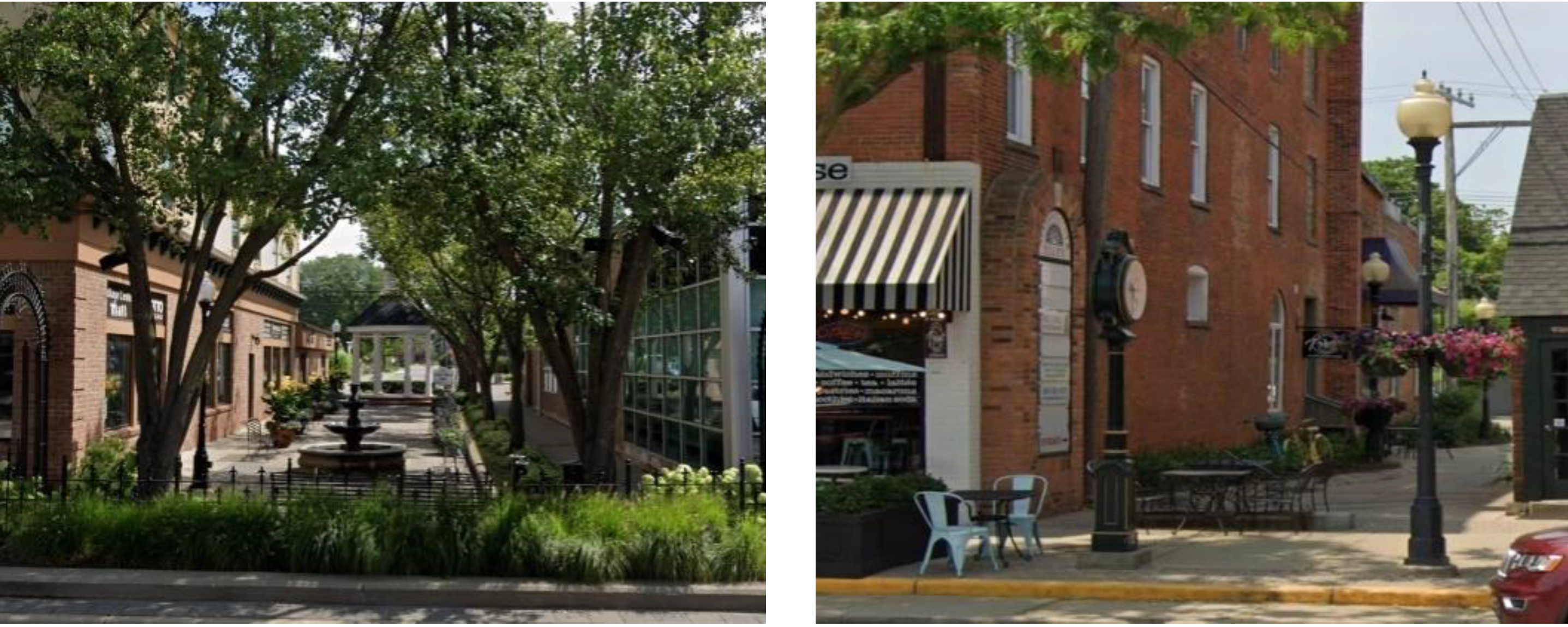
Rochester, Michigan East Lansing, Michigan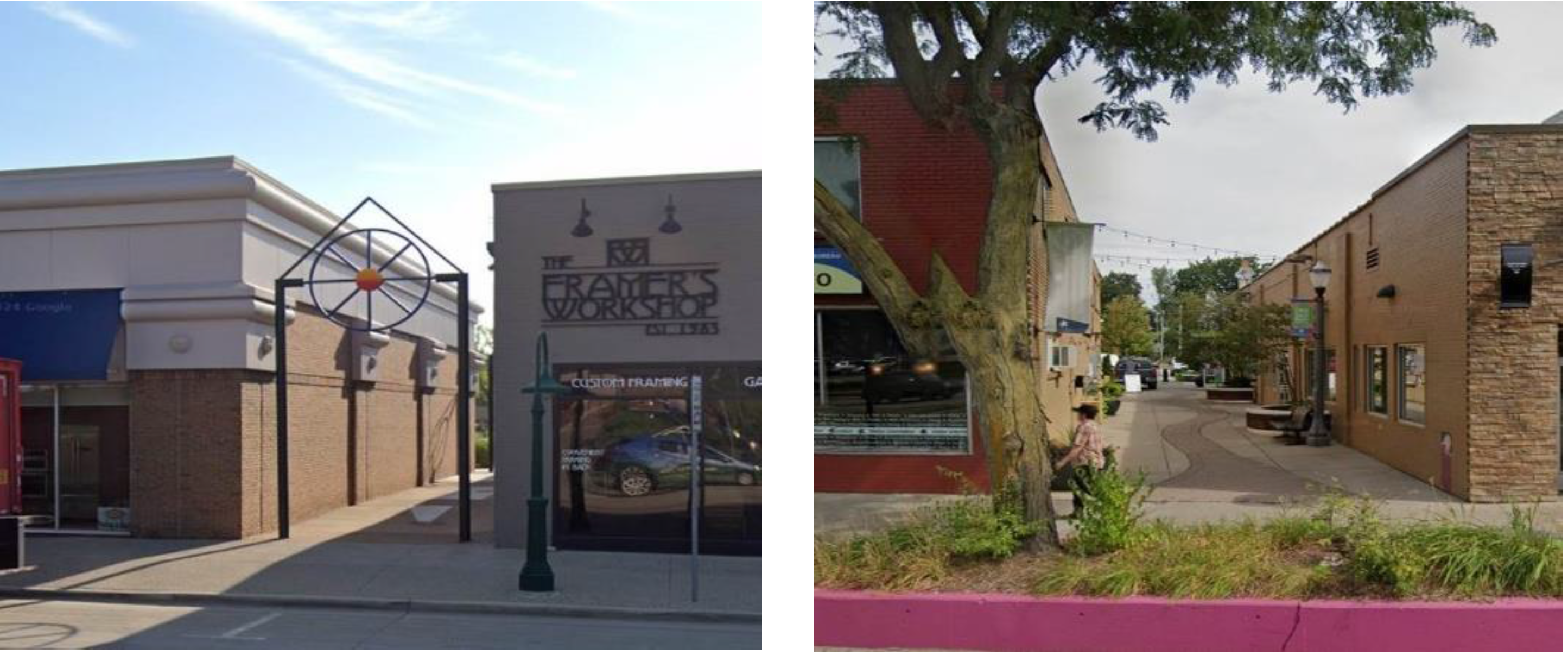
Attached Two-Family Dwelling. See Dwelling, Two-Family.
Awning. A raised covering used for decorative or protective purposes.
Bed and Breakfast. An establishment (such as an inn) offering lodging and breakfast.
Building. A structure having a roof supported by columns or walls, either permanent or temporary, located on a parcel, either above or below grade, which is designed primarily for the shelter or enclosure of persons, animals or property of any kind and includes those erected or constructed on site, pre-built modular units and pre-manufactured or pre-cut structures to be assembled on site.
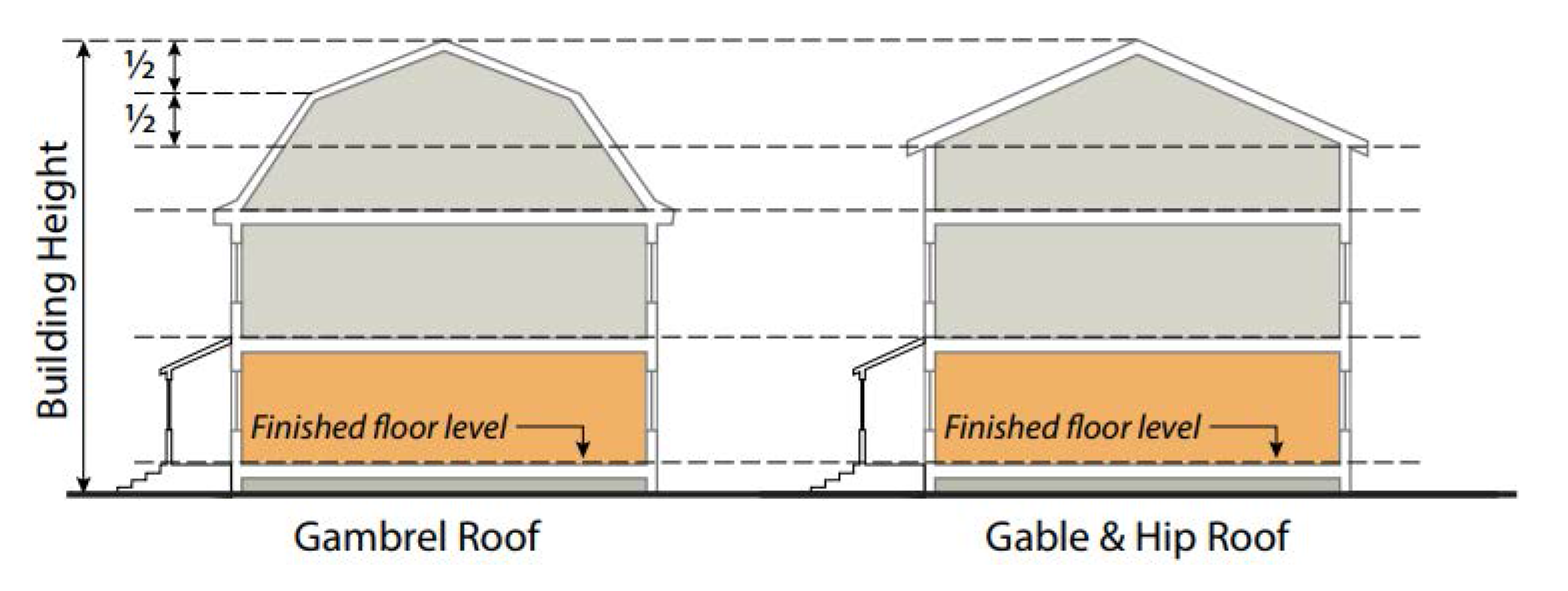
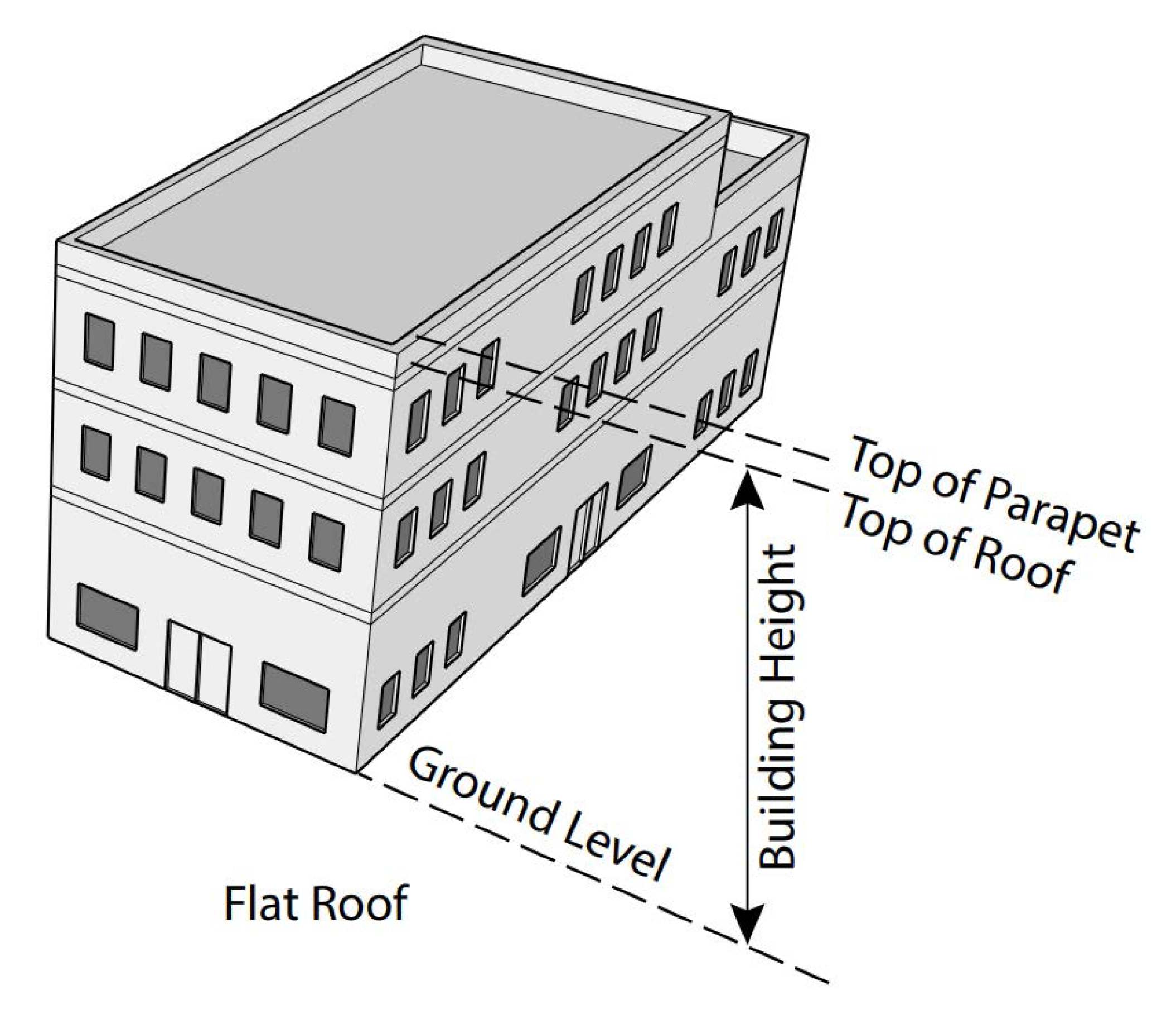
Building Height.The vertical distance measured from the ground level adjoining the building to the highest point of the roof surface if a flat roof, to the deck line of mansard roofs, and to mean height level between eaves and ridge of gable, hip and gambrel roofs.
Building Site. A buildable envelope surrounded by a limited common easement, usually part of a site condominium development.
Build-To Line. A mandatory distance separating either a right-of-way or an easement from any street-fronting façade.
Civic Building. A building functioning communally and open to public use and assembly.
Commercial Building. A single or mixed-use building with retail, food service, and/or office uses required throughout the first floor. Office space and/or residential uses may occupy the upper floors of mixed-use commercial buildings. The majority of the parking is required to be located to the rear of the building linked with pedestrian passageways to the front street.
Single Use Buildings. Commercial buildings without residential use on upper floors.
Mixed-Use Buildings. Commercial buildings with residential use on upper floors.
Common Space (CS). Areas that are owned and maintained by a public or private association or entity and may or may not be landscaped. See Public Space.
Green. An area that is reserved for natural environments where passive recreation and pedestrian uses may occur.
Open Space. An area that is not developed with buildings but are typically maintained and passive and pedestrian uses are intended. Amenities may include, but are not limited to, small natural environments, plant and water features, public art, seating areas, walkways, etc.
Park. An area where active and/or passive recreational and pedestrian uses are intended. Amenities may include, but are not limited to, small natural environments, plant and water features, playground areas, public art, seating areas, trails, walkways, etc.
Square. An area that is generally rectangular and typically bordered by building frontages and/or thoroughfares.
Core Downtown (CD). A zone providing for larger scale commercial and retail than allowed in the Neighborhood Center. This usually will include an anchor tenant, a pharmacy and/or grocery store and other associated uses.
Cornice. A molded and projecting horizontal element of an architectural composition projecting a minimum of two (2) inches.
Detached Building. A building, typically an accessory building, that is physically separated from the principal building on a property. See Accessory Building.
Detached Garage. A structure that is physically separated from the principal building on a property. See Garage 2-Car, Garage 3-Car and Accessory Building.
Development Plan. A dimensioned plan drawn to scale that indicates details of the proposed land development, including the site layout, positioning of buildings and structures, property access, building designs and landscaping.
Deviation. A request to vary from the Traditional Neighborhood Development district to the Town Center Committee. When granted by the Town Center Committee, the owner of a property is allowed to use the land in a manner not otherwise permitted by the Traditional Neighborhood Development district.
Driveway, Residential. A piece of privately owned and maintained property which is used for vehicular traffic, but which is not opened for, or normally used by, the public.
Duplex. See Dwelling, Two-Family.
Dwelling. A building or portion thereof which is occupied wholly as the home, residence or sleeping place of one or more human beings, either permanently or transiently and in compliance with all provisions of Section 10.0332 of this Ordinance. See subcategory definitions below.
One-Family. A building designed and arranged as a dwelling pursuant to this Ordinance and containing one (1) dwelling unit for one (1) family only and in compliance with all provisions of Section 10.0332 of this Ordinance.
Two-Family. A building designed and arranged as a dwelling pursuant to this Ordinance and containing two (2) dwelling units for one (1) family only and in compliance with all provisions of Section 10.0332 of this Ordinance. Commonly referred to as duplex, or attached two-family.
Multi-Family. A building designed and arranged as a dwelling pursuant to this Ordinance containing three (3) or more dwelling units and conforming in all other respects to the standards set forth in Section 10.0332 of this ordinance.
Easement, Ingress/Egress. A legal means of public access for the purposes of entering and exiting a property where a public right-of-way is not available.
Elevation. The vertical surface of a building that usually does not face a street, but still subject to height and setback restrictions. The elevation is different than a Façade. See Façade, Front, Façade, Side and Façade, Rear.
Façade, Front. The elevations of a building which front a thoroughfare or private drive and are usually set parallel to a frontage line. Façades are subject to architectural standards, frontage standards, as well as height restrictions. A corner building shall have a minimum of two (2) façades. The façade is the entire width of the front building wall of the principal structure, not including porches, or other projections, but may include recessed areas and attached garages.
Façade, Side. The elevations of a building extending the full width of the structure, including modulations, that is closest to and most nearly parallels the side unit line. Any façade adjacent to a thoroughfare or private drive shall be considered a front façade.
Façade, Rear. The elevations of a building extending the full width of the structure, including modulations, that is closest to and most nearly parallels the rear unit line. Any façade adjacent to a thoroughfare or private drive shall be considered a front façade.
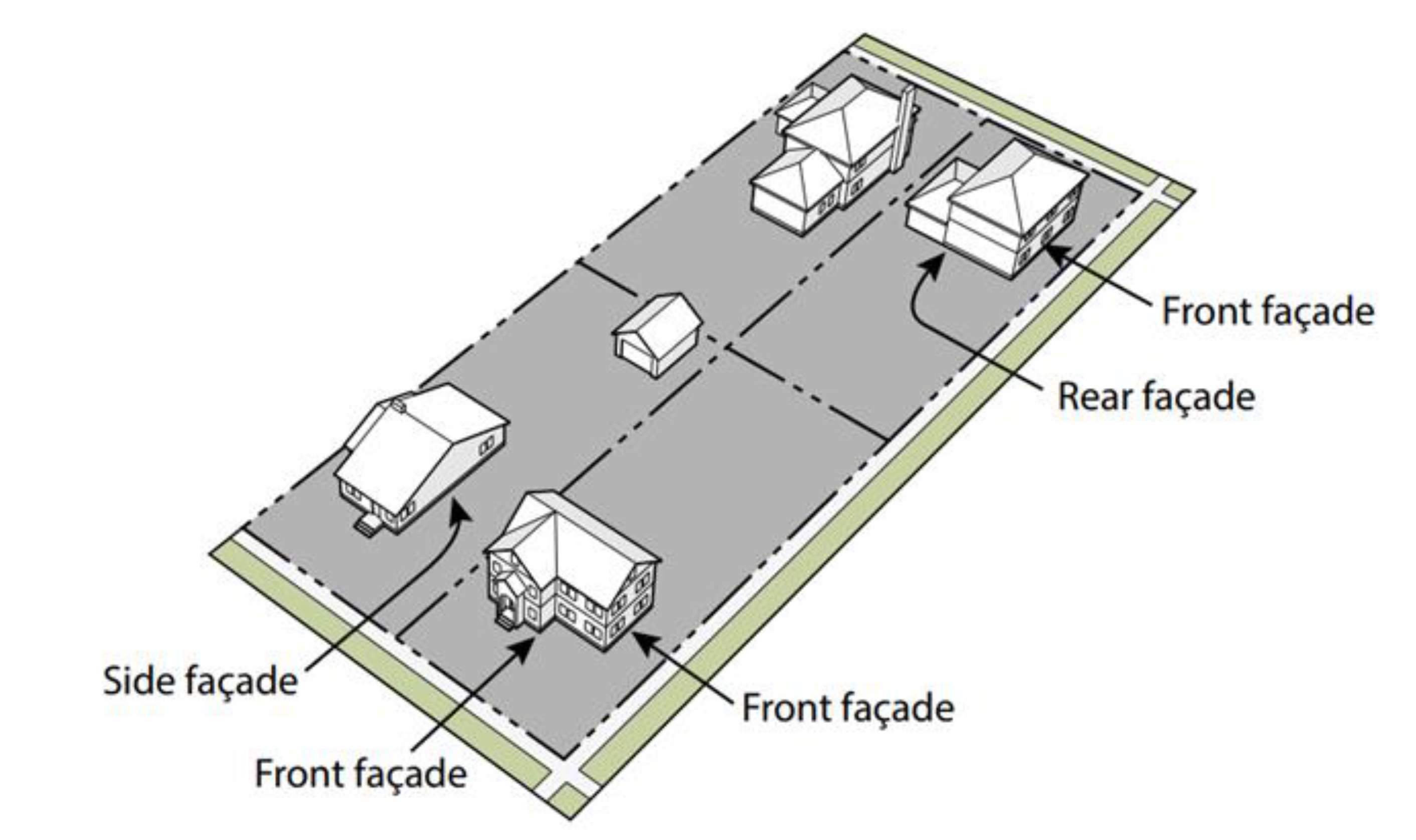
Frontage. The portion of a private property between the façade of a building and a unit line that runs along a thoroughfare right-of-way, public open space boundary, or ingress/egress easement.
Frontage Line. The lot or unit lines which coincide with a thoroughfare right-of-way, public open space boundary, or ingress/egress easement.
Front Setback. The distance between the frontage line and a façade. This distance is given as a minimum or a requirement (a build-to line). Open porches, balconies, chimneys, and bay/bow windows are permitted to encroach into the front setback, but in no case encroach on a thoroughfare right-of-way or ingress/egress easement.
Garage. An accessory building, attached or detached, designed or used for the storage of motor driven vehicles owned and used by the occupants of the building to which it is accessory.
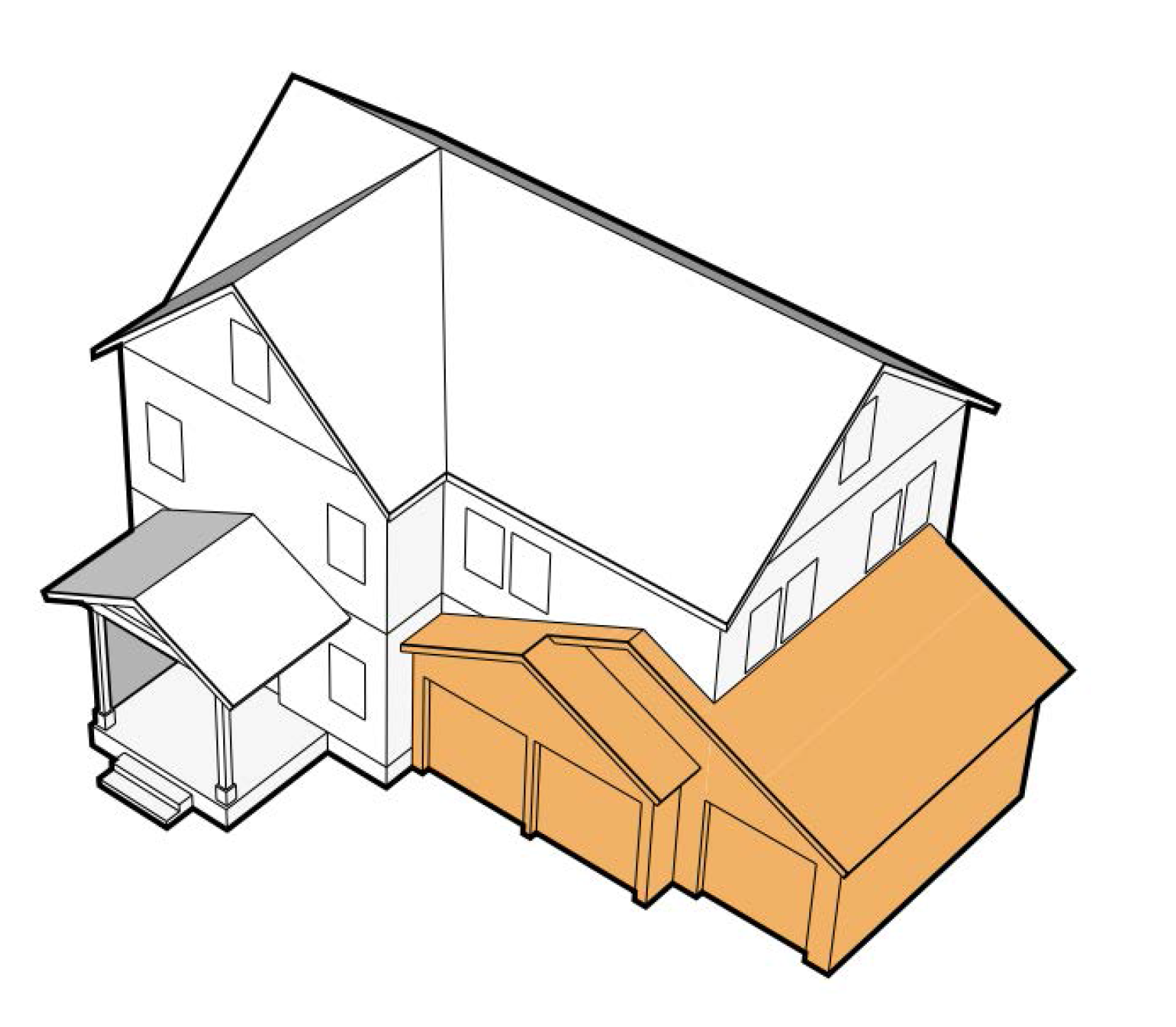
Garage, two-car. An accessory structure that has a maximum of twenty-four (24) feet in width as measured from exterior wall to exterior wall.
Garage, three-car. An accessory structure that has a measurement greater than twenty-four (24) feet in width as measured from exterior wall to exterior wall regardless of the size of the garage door opening or how many garage door openings exist. Any façade area beyond twenty-four (24) feet shall be subject to all requirements of a three-car garage including setbacks and architectural requirements.
Hard Surface Coverage. A surface that has been compacted or covered with a layer of material so that it is highly resistant to infiltration by water. It includes surfaces such as most conventionally surfaced streets, roofs, sidewalks, parking lots and other similar improvements and structures.
Home Occupation. Premises used for the transaction of business or the supply of professional services excluding medical and dental. Home occupations shall be limited to the following: architect, artist, broker, consultant, dressmaker, draftsman, engineer, interior decorator, lawyer, manufacturer's agent, notary public, teacher (excluding group instruction), and other similar occupations as the TCC shall conditionally approve. Such use shall not simultaneously employ more than two (2) persons, one (1) of which shall reside on the property.
House. A single-family dwelling on a separate unit, possibly with an accessory building. Garages are either recessed from the front façade or are located in the rear yard. Garages may be accessed by rear lanes.
Lodging. Premises available for short-term human habitation, including daily and weekly letting.
Lot. A measured portion of a parcel or tract of land, which is described and fixed in a recorded plat or has an individual legal description.
Lot or Unit Coverage. The ground area occupied by a building excluding unenclosed porches, arcades, and projecting balconies and bays/bows.
Lot or Unit Line. The boundary which legally and geometrically describes the edge of a site See Frontage Line.
Lot or Unit Width. The dimension of the front lot or unit line between the side setback lines.
Neighborhood Center (NC). A geographical zone as identified on the Regulating Plan. This zone is the more dense, primarily mixed-use zone.
Neighborhood Edge (NE). A geographical zone as identified on the Regulating Plan. This zone is the least dense residential zone of the neighborhood.
Neighborhood General (NG). A geographical zone as identified on the Regulating Plan. This zone is the generalized zone of the neighborhood, mixed in function, but principally residential.
Office Use. Premises available for the transaction of general business, including professional and information services but excluding medical, dental, retail sales and artisan activity.
Parapet. A continuous horizontal projection for the majority of a façade. The parapet, like the eave, is a designated location for the measure of building height.
Pathway. A pedestrian way providing access into or through a park or natural area and typically connected to a sidewalk system. A pathway may be constructed with a hard or porous surface, depending on the intended user.
Porch. An unairconditioned roofed structure attached to a dwelling unit. All or a portion of a front porch may incorporate a ramp for handicap access.
Public Space. An open space owned and maintained by the government for the use and/or service of the general public. See Common Space.
Regulating Plan. A plan that shows geographical locations where different building form and use standards apply.
Residential Use. Premises available for long-term human habitation by means of ownership and rental but excluding short-term letting of less than a month's duration. See Dwelling.
Retail. Premises available for the commercial sale of merchandise and prepared foods.
Rural Preserve (RP) Zone. The sector with noteworthy concentrations of natural features that justify preservation. They serve as passive areas for recreation, leisure, and nature preservation.
Setback. The mandatory distance between a lot line or site condominium unit line and a façade. See Façade, Front, Façade, Side and Façade, Rear.
Site Plan. SeeDevelopment Plan.
Story. A habitable level within a building to control maximum building height and prevent loft retrofits. That portion of a building included between the surface of any floor and the surface of the floor next above it, or the space between such floor and the ceiling next above it.
Story Height. A habitable area level within a building serving to define the building height. The floor to ceiling height shall be limited to fourteen (14) feet. Basements that are less than half the distance from the basement finish floor to the first finish floor shall not constitute an additional story.
Structure. Anything constructed or erected with a fixed location on the ground, or attached to something having a fixed location on the ground. Among other things, structures including buildings, walls, and fences.
Unit. A measured portion of a site condominium subdivision development held privately, intended for the purposes of building.
Yard. The portions of a lot or unit which, following the prescriptions of the unit and building standards, remain free of structures except permitted encroachments.
(Ord. No. 10-75, § 1, 6-12-24)

