
Madeira Beach City Zoning Code
ARTICLE VI
- SUPPLEMENTARY DISTRICT REGULATIONS
DIVISION 3. - LANDSCAPE FENCES, GATES, HEDGES, AND WALLS[4]
Editor's note— Ord. No. 2019-17, § 1, adopted Oct. 8, 2019, in effect repealed div. 3, §§ 110-446—110-453, and enacted a new division, §§ 110-446—110-448, as set out herein. The former division pertained to similar subject matter and derived from the Code of 1983, § 20-504(A), (C)—(H); Ord. No. 918, § 2, 12-7-99; Ord. No. 1149, § 1, 4-14-09; and Ord. No. 2018-02, § 2, 4-10-18.
DIVISION 4. - ACCESSORY STRUCTURES[5]
Editor's note—Ord. No. 2024-02, § 1, adopted June 12, 2024, repealed the former Div. 4, §§ 110-471—110-485, and enacted a new Div. 4 as set out herein. The former Div. 4 pertained to similar subject matter and derived from Code 1983, §§ 20-505(A)—(O); Ord. No. 918, § 3, 12-7-99; and Ord. No. 2022-12, §§ 1, 2, adopted May 11, 2022.
DIVISION 5. - GLARE AND LIGHTING[6]
Editor's note— Ord. No. 2019-12, § 1, adopted June 11, 2019, in effect repealed div. 5, §§ 110-501—110-509, and enacted a new div. 5, §§ 110-501—110-508, as set out herein. The former division pertained to similar subject matter and derived from the Code of 1983, §§ 20-603(A)—20-603(E), 20-603(F)(1)—20-603(F)(3), and 20-603(G).
DIVISION 6. - ALCOHOLIC BEVERAGES[7]
Cross reference— Conformity of alcoholic beverage regulations with zoning code, § 6-5.
DIVISION 12. - TELECOMMUNICATION ANTENNAS AND TOWERS[8]
State Law reference— Amateur radio antennas, F.S. § 166.0435.
DIVISION 13. - ADULT ENTERTAINMENT USES[9]
Cross reference— Businesses, ch. 18.
Sec. 110-416.- Nonconforming lot regulations—Existing lots of record.
A single-family dwelling and customary accessory structures may be erected, occupied and used on nonconforming lots of record as of the effective date of the ordinance from which this section was derived, when the lot is not in continuous frontage with other lots of the same ownership. This applies to all lots in any R-1 and R-2 district.
(Code 1983, § 20-501(A))
Sec. 110-417. - Same—Availability of adjacent vacant land; combination of contiguous nonconforming lots in same ownership.
No structure shall be erected on any nonconforming lot if the owner of such lot owns adjoining vacant land, which through their combination would create a conforming lot.
(Code 1983, § 20-501(A)(1))
Sec. 110-418. - Same—Combination of two or more nonconforming lots of record.
(a)
With the adoption of the ordinance from which this section was derived, two or more nonconforming lots of record, in single ownership and with continuous frontage shall be considered a single zoning lot and a permit shall only be issued when the lot area and lot width requirements for the district in which the lots are located are satisfied.
(b)
All nonconforming lots or lots created by the combination of two or more nonconforming lots shall comply with the full setback requirements and land coverage for all appropriate districts.
(Code 1983, § 20-501(A)(2))
Sec. 110-419. - Same—Side yards.
No structure shall be constructed on any nonconforming lot unless it shall have a minimum side yard of five feet, or a minimum side yard of ten feet where adjacent to any street, but in no case may the normally required side setback be decreased more than the nonconformity in lot width. (Also consult section 110-428.)
(Code 1983, § 20-501(A)(3))
Sec. 110-420. - Same—Front and rear yards.
No structure shall be constructed on a nonconforming lot unless it shall have a front yard conforming to the minimum required for the district in which the lot is located, and a rear yard of not less than 15 percent of the depth of the lot, however, in no case may the normally required rear setback be decreased more than the nonconformity in lot depth.
YARD ILLUSTRATIONS
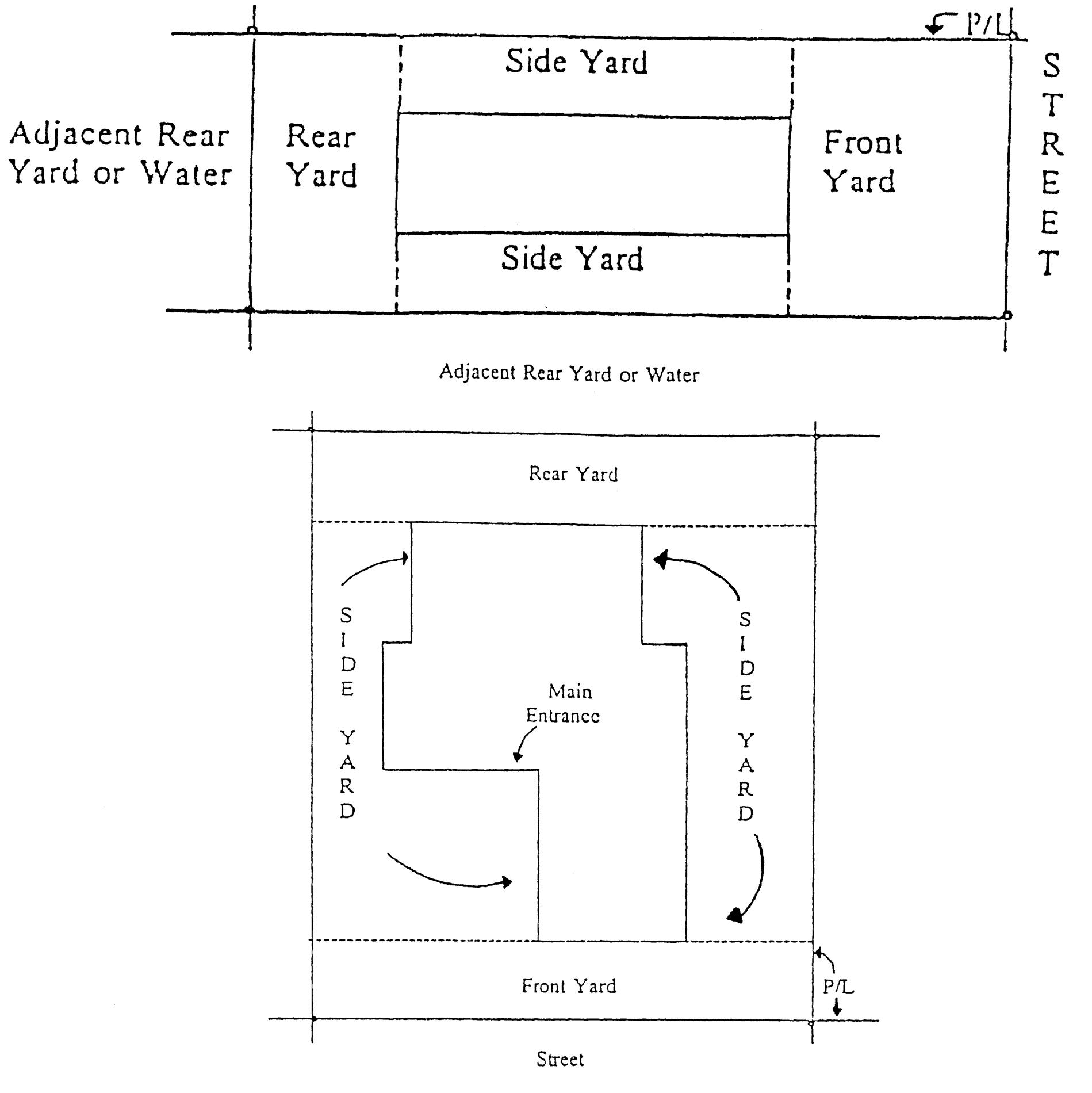
Yard Illustrations
(Code 1983, § 20-501(A)(4), (5))
Sec. 110-421. - Lot width.
The minimum lot width of any lot is the distance measured in the mean direction of the front and rear lot line from the midpoint of one side line to the midpoint of the opposite side line.
(Code 1983, § 20-501(B))
Sec. 110-422. - Lot depth.
The depth of the lot is the distance measured in the mean direction of the side lines of the lot from the midpoint of the front lot line to the midpoint of the opposite mean rear line of the lot.
(Code 1983, § 20-501(C))
Sec. 110-423. - Intersection visibility.
(a)
At all street intersections no obstruction to vision (other than an existing building, post, column, or tree) exceeding 36 inches in height above the established grade of the street at the property line shall be erected or maintained on any lot within the triangle formed by the street lot lines of such lot and a line drawn between the points along such street lot lines 25 feet distant from their point of intersection.
(b)
It shall be unlawful for the owner or person in charge of any lot, parcel or piece of land within the city to allow any obstruction to vision in the triangle formed by the lines of two intersecting streets, or street and an alley, and a line joining points on such lines 30 feet distant from their point of intersection by permitting any vegetation to grow or be maintained between the heights of three feet and ten feet above the grade of the centerline of the intersection, or by constructing or maintaining any fence or other structure which by constructing or maintaining any fence or other structure which constitutes an obstruction to view within the triangle.
(Code 1983, §§ 17-101, 20-501(A))
Sec. 110-424. - Required area or space cannot be reduced.
The area or dimension of any lot, yard, parking area, or other space shall not be reduced to less than the minimum required by the land development regulations except as provided in the land development regulations; and, if already less than the minimum required by the land development regulations, such area or dimension may be continued, but shall not be further reduced.
(Code 1983, § 20-501(E))
Sec. 110-425. - Maximum coverage.
Land coverage by principal and accessory buildings or structures on each lot shall not be greater than is permitted in the district as set forth within schedule of use, lot, yard and bulk regulations, where such principal and accessory buildings are located. Lot coverage shall be figured from the line where the building wall meets the grade or the support columns reach the grade.
(Code 1983, § 20-502)
Sec. 110-426. - Miscellaneous lot regulations.
(a)
Structure prohibited. No structures shall be erected or constructed beyond the established setback line or over the waters of Boca Ciega Bay, except for docks. The type of such dock permitted is as set forth within schedule of use, lot, yard and bulk regulations for the district in which such structure is located.
(b)
Docks.
(1)
Residential. Necessary services such as electricity or water are considered as part of a dock; however, no business activity of any kind or any building (structure) shall be permitted on a residential dock.
(2)
Commercial. May include services such as electricity and water, commercial activities such as the sale of gas, oil and bait, and an enclosure not more than four feet in height for the storage of supplies. No other building (structure) shall be permitted.
(c)
Lot excavation. No person, firm or corporation shall strip, excavate or otherwise remove soil, sand, shale, or gravel for sale, or for use other than on the premises from which the such soil, sand, shale or gravel shall be taken, except in connection with the construction or alteration of a building or swimming pool on such premises and excavation or grading incident thereto.
(Code 1983, § 20-510)
Sec. 110-427. - Yard regulations—Open sky requirements.
(a)
Every part of a required yard (see appropriate section of schedule of use, lot, yard and bulk regulations) must be open to the sky unobstructed, except as otherwise permitted in this Code. The following may encroach into the minimum yard requirements of each lot, provided the required permits have been obtained:
(1)
Roof overhangs not exceeding three feet;
(2)
Rear yard second floor and above balconies not exceeding four feet;
(3)
Belt courses and ornamental features shall not project more than four inches from the building wall;
(4)
Awnings and canopies not exceeding three feet;
(5)
Arbors and trellises may be placed in the required front or side yard at least ten feet from the property line;
(6)
Flag poles may be placed in any required yard at least ten feet from any property line;
(7)
Garden ornaments, including, but not limited to, decorative columns, fountains and birdbaths, which are permanently affixed to the ground may be placed in a required yard at least five feet from any property line;
(8)
Handicapped ramps, including vertical guardrails, meeting the requirements of the Florida Accessibility Code for Building Construction, may be placed in any required yard at least five feet from the property line;
(9)
Recreation and children's playground equipment permanently affixed to the ground, excluding skateboard ramps, may be placed:
a.
In a non-waterfront rear yard at least ten feet from the property line;
b.
In a waterfront rear yard at least 20 feet from the property line;
An enclosed clubhouse and elevated structures shall not be considered recreation and children playground equipment;
(10)
Light posts not to exceed six feet in height may be placed in a required front yard at least ten feet from the property line; and shall be in compliance with section 110-502;
(11)
Ancillary equipment such as: filters and pumps for swimming pools and spas, lawn irrigation pumps and propane gas tanks may be placed in the required side yard setback by 50 percent of the required side yard distance;
(12)
Chimneys, attached to the dwelling, may be placed three feet into the required setback; and
(13)
Walkways and paths may encroach into the minimum yard requirement so long as they stay within the ISR requirements.
(b)
Permitted to encroach into the required yard setbacks and exempt from permitting.
(1)
Temporary holiday displays or patriotic displays may be placed within any yard setback;
(2)
Mailboxes installed in conformance with U.S. Postal Regulations, if not permitted on the residential structure by the U.S. Postal Service;
(3)
Recreation and children's playground equipment, not permanently affixed to the ground; and
(4)
Garden ornaments, not permanently affixed to the ground.
(c)
Prohibited. The following are specifically prohibited in the front setback of any lot or parcel of land:
(1)
Portable or temporary structures having structural framing members which do not meet or exceed the applicable wind loads of Chapter 16, Florida Building Code are prohibited from all yards.
(2)
Clothesline or clothesline poles are prohibited in the front yard.
(3)
Tents, except as approved for a special event under chapter 42 are prohibited in all yards.
(d)
Any structures permitted in this section to encroach into a minimum yard shall be so permitted notwithstanding any contrary requirement or provision found within chapter 110, article VI, division 4.
(Code 1983, § 20-503(A); Ord. No. 1155, § 1, 8-11-09; Ord. No. 2022-13, § 1, 5-11-22)
Sec. 110-428. - Same—Side yard of corner lot.
Any corner lot shall have a side yard that is a minimum of ten feet, along the street side and an interior side setback to meet the minimum required by the district. (Also consult section 110-418.)
(Code 1983, § 20-503(B); Ord. No. 2018-17, § 1, 1-8-19)
Sec. 110-429. - Same—Transition yard requirements.
(a)
Front yard. Where a residential (R) district abuts a nonresidential district, there shall be provided in the nonresidential district for a distance of 50 feet from the district boundary line along the same street a front yard at least equal in depth to that required in the residential district.
(b)
Side or rear yard. Where the side or rear yard in a residential district abuts a side or rear yard in a nonresidential district, there shall be provided along such abutting line or lines, a side or rear yard at least equal in depth to that required in the residential district. In no case, however, shall the abutting side yard or abutting rear yard of the nonresidential district be less than 15 feet.
(Code 1983, § 20-503(C))
Sec. 110-430. - Height regulations.
(a)
General application. No building or structure shall have a greater number of stories, nor have an aggregate height greater than is permitted in the district in which such building or structure is located, except as noted in this subsection (b) of this section.
(b)
Permitted exception to height regulations. Chimneys, cooling towers, elevators, bulkheads, fire towers, stairways, protective railings, gas tanks, steeples, water towers, ornamental towers or spires, amateur radio towers or necessary mechanical appurtenances, may be erected as to their height in accordance with existing or hereafter adopted ordinances of the municipality, provided no tower other than a church spire or such noncommunication tower of a public building shall exceed 20 feet above the maximum allowable building height limit or 20 feet above the main building roof if the roof is below the maximum allowable building height. For reasons of architectural aesthetics the owner may appeal to the local planning agency, and if the architectural design is endorsed by the local planning agency, the owner may petition the special magistrate for a variance from the 20-foot height limitation. No tower shall be used as a place of habitation.
(Code 1983, § 20-506; Ord. No. 1050, § 13, 8-9-05; Ord. No. 1071, § 3, 2-28-06)
Sec. 110-446.- Applicability of division.
This division applies to all fences, hedges, and walls that are not specifically exempted from this division. This division does not apply to seawalls (see chapter 14, article V of this Code for regulations on seawalls).
(1)
Definitions. The following terms and phrases used in this division have the following meanings.
Building line means the line established by the setback required by the zoning district in which the lot is located, beyond which a building must not extend, except as specifically provided by this Code or approved variance from this Code. If the furthest vertical structural member of the primary structure on the subject property, or the abutting neighbor's shared property line to the proposed fence extends further than the established setback required by the zoning district, then that furthest vertical structural member shall apply as the building line.
Chain-link fence means an open fence consisting of a woven mesh of thick steel wire having a uniform diamond-shaped pattern.
Grade means a reference plane representing the average of finished ground level along the exterior edge of the higher side of the fence, hedge, or wall.
Hedge means any installation or placement of plants, structural elements, feature art, ornaments or objects that together form a row, boundary or screen that extends more than three feet before a break (open space) of at least three feet horizontally and six feet vertically. Hedges can be installed in conjunction with or in lieu of fences, except those fences required by the Florida Building Code, and must meet the same height restrictions as fences and walls except in the rear yard where the natural plant material of the hedge may be allowed to grow to natural height.
Picket fence means an open fence consisting of pickets or pales attached to horizontal stringers between upright posts.
Post means a sturdy vertical component placed into the ground to support a fence. Posts for residential use cannot be greater than five inches wide and posts for non-residential uses cannot be greater than eight inches wide. Posts may extend three inches above the restricted fence height.
Sand fence means an artificial barrier of evenly spaced wooden slats or synthetic fabric erected perpendicular to the prevailing wind and supported by posts.
Wall means a non-bearing landscape wall.
(2)
Building permits required. All fences and walls except temporary construction fencing must comply with established building permit procedures.
(3)
Design. All fences and walls on each property must have reasonably complementary or uniform design and materials.
(4)
Openings. Openings in any fence must not allow passage of a four-inch diameter (102 mm) sphere unless spacing is greater than 12 inches for decorative fences not required by Florida Building Code.
(5)
Open fences. When a fence is required to be open, the following criteria must be met. Openings between vertical or horizontal members shall not be less than three inches and no greater than four inches. Horizontal members, other than the top and bottom horizontal members which cannot be greater than six inches wide, cannot be greater than two and one-half inches wide. Vertical members, other than posts which cannot be greater than six inches wide, cannot be greater than three and one-half inches wide. Permitted open fences include chain-link and picket fences.
(6)
Materials. Fences and walls must be constructed of traditional building materials including brick, stone, stucco over concrete block, finished concrete, metal, vinyl, wood (natural, stained, or painted), and composite products manufactured specifically for fences and walls. Non-traditional materials, such as tires, mufflers, hubcaps, etc. are prohibited. Chain-link and other wire fences are not permitted in front yards.
(7)
Finished sides. Fences and walls must be constructed to present a finished side to all adjoining lots and abutting rights-of-way.
(8)
Maintenance. After construction, fences and walls must be maintained with original components and remain substantially vertical to serve their function and aesthetic purposes. Structural integrity must be maintained to prevent a danger of destruction or flight during high winds. Hedges must be maintained at or below the maximum height permitted.
(9)
Dangerous structures. Barbed wire, spire tips, sharp objects, or electrically charged fences or walls are prohibited.
(Ord. No. 2019-17, § 1, 10-8-19; Ord. No. 2021-17, § 1, 9-8-21; Ord. No. 2022-05, § 1, 4-13-22; Ord. No. 2024-08, § 1, 8-14-24)
Sec. 110-447. - Location and height of fences, hedges, and walls.
(a)
Setbacks. Except as otherwise permitted or required by this Code, fences and walls are prohibited:
(1)
Within any right-of-way or street easement, or closer than three feet to any sidewalk or bike path,
(2)
Closer to the Gulf of Mexico than the County Coastal Construction Control Line,
(3)
Closer to the Gulf of Mexico than 18 feet landward of an existing seawall,
(4)
Closer than five feet to the mean high-water line along waterbodies, including canals, except a fence or wall may be permitted immediately landward of, or on top of, an existing seawall,
(5)
Within the intersection visibility triangle as specified in section 110-423 unless three feet in height or less.
(b)
Height. Height is measured from the average grade elevation along the entire length of the fence, hedge, or wall.
(1)
Front yards. From the required front building line to the right-of-way, all walls, solid fences, and hedges must not exceed three feet. Open fences, must not exceed four feet. Chain-link and other wire fences are not permitted in front yards.
(2)
Side yards. From the required front building line to the required rear building line, all fences, hedges, and walls must not exceed six feet.
(3)
Rear yards facing water. From the required rear building line to the rear property line, all walls and solid fences abutting or facing waterbodies must not exceed three feet. Open fences must not exceed four feet. Fences up to six feet are permitted adjacent to sewage lift stations, city pocket parks, and along residential property lines that are adjacent to commercial uses. When deemed necessary by the permitting authority to ensure life-safety and security however, a six-foot high solid or open fencing may be allowed or required in the site plan review process for commercial and institutional uses. In rear yards facing the Gulf of Mexico, open and sand fences must not exceed four feet and fencing that is wrought iron in appearance must not exceed six feet.
(4)
Sand fences. Sand fences may be approved by temporary permits and must be removed when the director determines that sea oats have established a permanent vegetative screen. Permitted sand fences must be accompanied by no less than three rows of one-gallon container sea oats planted seaward of and along the entire length of the sand fence. Each sea oat planting must be no more than 12 inches apart, on-center, and rows separated by no more than 12 inches.
(5)
Rear yards not facing water. From the required rear building line to the rear property line, all fences and walls not abutting or facing waterbodies must not exceed six feet.
(c)
Swimming pool fence.
(1)
Every outdoor swimming pool, outdoor spa and outdoor permanent wading pool shall be completely surrounded by an appropriate fence not less than four feet in height for all pools, commercial and residential. A building, existing wall or screen enclosure may be used as a part of such enclosure. Fences are not required to be installed parallel to the seawall for properties directly abutting waterbodies.
(2)
For rear yards facing an open water body with a swimming pool, the required swimming pool fence must be four feet in height and must, at a minimum, have the highest foot of the fence constructed as an open fence in compliance with section 110-446(5) (i.e. three-foot solid fence with one-foot lattice).
(3)
All gates or doors opening through such enclosure shall be of self-closing and self-latching construction and shall be designed to permit locking. The releasing device for the latch shall be located no less than 54 inches from the bottom of the gate, the device release mechanism may be located on either side of the gate and so placed that it cannot be reached by a young child over the top or through any opening or gap from the outside.
(Ord. No. 2019-17, § 1, 10-8-19; Ord. No. 2021-17, § 1, 9-8-21; Ord. No. 2024-08, § 1, 8-14-24)
Sec. 110-448. - Gates required.
All fences, hedges, and walls must provide gates or openings to allow passage through the side yard from the front yard to the rear yard, with a minimum opening of 29 inches.
(Ord. No. 2019-17, § 1, 10-8-19)
Sec. 110-449. - Nonconformities.
Any legally nonconforming fences, gates, hedges, or walls must be brought into conformance once any maintenance requiring a permit on the fence is done.
(Ord. No. 2024-08, § 1, 8-14-24)
Sec. 110-471.- Applicability of division.
This division applies to all open and enclosed accessory structures that are not specifically exempt from this division.
(Ord. No. 2024-02, § 1, 6-12-24)
Sec. 110-472. - Definitions
The following terms and phrases used in this division have the following meanings.
Accessory structure is a subordinate structure(s), the use of which is incidental to that of the principal structure and located on the same lot therewith.
Enclosed accessory structure means a structure with walls on all sides (e.g. a shed for outdoor equipment) and a roof.
Height is measured from the average grade at the base of the accessory structure.
Open accessory structure means an accessory structure containing three or more open sides between posts (e.g. gazebo, tiki hut, or chickees) and a roof. Open accessory structures are measured for area and setbacks from the outermost point of any roof overhang.
Outdoor kitchen may only contain counterspace, grill, sink, and miniature refrigerator.
(Ord. No. 2024-02, § 1, 6-12-24)
Sec. 110-473. - Building permits required.
Building permits are required for the construction or placement of all accessory structures. Chickees constructed by the Miccosukee Tribe of Indians of Florida, or the Seminole Tribe of Florida are exempt from the Florida Building Code, but must obtain a building permit for planning and zoning purposes and include a copy of the tribal member identification. As used in this paragraph, the term "chickee" means an open-sided wooden hut that has a thatched roof of palm or palmetto or other traditional materials, and that does not incorporate any mechanical, electrical, plumbing, or other non-wood features.
(Ord. No. 2024-02, § 1, 6-12-24)
Sec. 110-474. - Maintenance of accessory structures.
After construction, all accessory structures must be maintained and remain substantially vertical to serve their function and aesthetic purposes. Structural integrity must be maintained to prevent the danger of destruction or flight during high winds.
(Ord. No. 2024-02, § 1, 6-12-24)
Sec. 110-475. - Excluded from permitting.
(1)
Outdoor storage containers not to exceed four feet long by four feet wide by three feet tall.
(2)
Removable sunshades provided that any pole is ten feet from any property line and the pole does not exceed six feet in height.
(Ord. No. 2024-02, § 1, 6-12-24)
Sec. 110-476. - R-1, single-family residential zones.
Accessory structures may not be located in front yards in R-1, single-family residential zones.
(1)
Lots not on water. For lots not on water in R-1, single-family residential zones, accessory structures may be located in side or rear yards but must provide a minimum of two and one-half-foot setback to allow for vegetation control.
(2)
Lots on water. For lots on water in R-1, single-family residential zones, accessory structures may be located in side or rear yards. If the accessory structure is located in a side yard, a minimum of two and one-half-foot side setback must be provided. If the accessory structure is located in the rear yard, a minimum of a seven-foot side setback and 12-foot rear setback must be provided, so not to interfere with seawall tiebacks.
(Ord. No. 2024-02, § 1, 6-12-24)
Sec. 110-477. - R-2, low density multifamily residential zones.
Accessory structures may not be located in front yards in R-2, low density multifamily residential zones.
(1)
Lots not on water. For lots not on water in R-2, low density multifamily residential zones, accessory structures may be located in side or rear yards but must provide a minimum of two and one-half-foot setback to allow for vegetation control.
(2)
Lots on water. For lots on water in R-2, low density multifamily residential zones, accessory structures may be located in side or rear yards. If the accessory structure is located in a side yard, a minimum of two and one-half-foot side setback must be provided. If the accessory structure is located in the rear yard a minimum of a five-foot side setback and 12-foot rear setback must be provided, so not to interfere with seawall tiebacks.
(Ord. No. 2024-02, § 1, 6-12-24)
Sec. 110-478. - R-3, medium density multifamily residential zones.
Accessory structures (except carports) may not be located in front yards in R-3, medium density multifamily residential zones.
(1)
Lots not on water. For lots not on water in R-3, medium density multifamily residential zones, accessory structures (except carports) may be located in side yard, but must provide a five-foot minimum side setback. If the accessory structure is located in the rear yard, a minimum of two-foot setback must be provided to allow for vegetation control.
(2)
Lots on water. Accessory structures (except carports) on lots on water in R-3, medium density multifamily residential zones must provide the same setbacks as are required for the principal structure.
(3)
Carports in the R-3, medium density multifamily residential zones may be located in the front or side yard and must provide a five-foot side yard setback and ten-foot front yard setback.
(4)
The accessory structure must meet the intersection visibility requirement.
(Ord. No. 2024-02, § 1, 6-12-24)
Sec. 110-479. - C-1, John's Pass village activity center zoning district.
Accessory structures in John's Pass village activity center are regulated by character district.
(1)
Commercial core and traditional village district.
a.
Accessory structures may not be located in the front or side yard and must provide the same setback as required for the principal structure.
(2)
Boardwalk district.
a.
Accessory structures may not be located in front yard and must provide the same setback as required for the principal structure.
(3)
John's Pass resort, transitional, and low intensity mixed use districts.
a.
Lots not on water. Accessory structures may not be located in the front yard and must provide a five-foot side and rear setback.
b.
Lots on water. Accessory structures must provide the same setbacks as are required for the principal structure.
(Ord. No. 2024-02, § 1, 6-12-24; Ord. No. 2025-10, § 1, 4-2-25)
Editor's note— Ord. No. 2025-10, § 1, adopted April 2, 2025, amended the title of § 110-479 to read as herein set out. The former § 110-479 title pertained to C-1, tourist commercial zones.
Sec. 110-480. - Reserved.
Editor's note— Ord. No. 2025-10, § 2, adopted April 2, 2025, repealed § 110-480, which pertained to C-2, John's Pass marine commercial zone and derived from Ord. No. 2024-02, § 1, adopted June 12, 2024.
Sec. 110-481. - C-3, retail commercial zones.
Accessory structures may not be located in front yards in C-3, retail commercial zones. Accessory structures in C-3, retail commercial zones must provide the same side and rear setbacks as are required for the principal structure.
(Ord. No. 2024-02, § 1, 6-12-24)
Sec. 110-482. - C-4, marine commercial zones.
Accessory structures may not be located in front yards in C-4, marine commercial zones. Accessory structures in C-4, marine commercial zones must provide a ten-foot side and rear setback. Accessory structures for working waterfronts or marina uses, which are required by federal or state regulations to be immediately proximate to the waters edge, are permitted within the required setback. Property owners must show documentation from the federal or state regulating board to permit accessory structures within the required setback.
(Ord. No. 2024-02, § 1, 6-12-24)
Sec. 110-483. - P/SP, public-semi public zones.
There are no restrictions regarding accessory structures in P/SP, public-semi public zones. Accessory structures in P/SP, public-semi public zones must be consistent with site plan approval.
(Ord. No. 2024-02, § 1, 6-12-24)
Sec. 110-484. - Maximum size and quantity in R-1, R-2 and R-3 zones.
(1)
Single-family use: Single-family structures may only have one enclosed and one open accessory structure. The maximum size for an enclosed accessory structure is eight feet wide by ten feet long by ten feet high. The total maximum size for all open accessory structures on the property is four percent of the total land area of the lot. The maximum height for an open accessory structure is 14 feet.
(2)
Duplex and multifamily use: Duplex and multifamily structures may only have two enclosed accessory structures, and one open accessory structure for every two dwelling units. The maximum size for an enclosed accessory structure is ten feet wide by eight feet long by ten feet high. The total maximum size for all open accessory structures on the property is four percent of the total land area of the lot. The maximum height for an open accessory structure is 14 feet.
(3)
Temporary lodging use: Temporary lodging structures may only have two enclosed accessory structures, and no limitation on the amount of open accessory structures. The maximum size for an enclosed accessory structure is eight feet wide by ten feet long by ten feet high. The total maximum size for all open accessory structures on the property is four percent of the total land area of the lot. The maximum height for an open accessory structure is 14 feet.
(4)
The maximum size of a carport in the R-3, medium density multifamily residential zone for single family structures, is 20 feet wide by 22 feet long by ten feet high. For single family structures, there may not be more than one carport. The limit to the number of carport structure for duplex, multifamily, and temporary lodging structures will be regulated by parking requirements and the site plan approval process.
(Ord. No. 2024-02, § 1, 6-12-24)
Sec. 110-485. - Maximum size and quantity in C-1, C-3 and C-4 zoning districts.
The maximum size for an enclosed accessory structure is eight feet wide by 12 feet long by ten feet high. Properties may only have two enclosed and two open accessory structures. The total maximum size for all open accessory structures on the property is four percent of the total land area of the lot. The maximum height for an open accessory structure is 20 feet. Accessory structures for working waterfronts or marina uses, which are required by federal, or state regulations do not count towards the number of structures and may exceed the maximum size with documentation that the additional size is required to maintain compliance.
(Ord. No. 2024-02, § 1, 6-12-24; Ord. No. 2025-10, § 3, 4-2-25)
Sec. 110-486. - Lot coverage.
The area covered by accessory structures shall be included in the allowable lot coverage.
(Ord. No. 2024-02, § 1, 6-12-24)
Sec. 110-487. - Tiedowns.
All accessory structures must have tiedowns per the Florida Building Code. This also applies to all accessory type structures in place before the passage of the ordinance from which this section was derived.
(Ord. No. 2024-02, § 1, 6-12-24)
Sec. 110-488. - Placement.
An accessory type structure may not be placed forward of the front entrance of the principal structure. In no case shall an accessory type structure be placed closer to any lot line adjacent to a street than provided for the principal structure nor closer than 18 feet to any seawall on the Gulf of Mexico.
(Ord. No. 2024-02, § 1, 6-12-24)
Sec. 110-489. - Prohibited accessory structures.
Manufactured housing, mobile homes, semi-trailers and other motor vehicles shall not be permitted to be used as storage buildings or other such uses.
(Ord. No. 2024-02, § 1, 6-12-24)
Sec. 110-490. - Construction trailers.
Construction trailers may only be on site if a building permit is issued, and construction must begin within 30 days of the construction trailer placement. Trailers must be removed within 30 days after a certificate of occupancy is issued. Construction trailers are allowed five feet from any property line and must meet intersection visibility requirements in section 110-423. Construction trailers must be removed from site during any named storm event or anchored per the current Florida Building Code. Temporary buildings or sheds used exclusively for construction purposes are exempt from the Florida Building Code but must retain a building permit.
(Ord. No. 2024-02, § 1, 6-12-24)
Sec. 110-491. - Outdoor kitchens.
Outdoor kitchens must follow the setbacks for open accessory structures provided in this division, the countertop structure cannot exceed a height of 36 inches from grade and cannot be larger than 50 square feet in area. The outdoor kitchen must be permanent and meet requirements in section 94-140. If the outdoor kitchen contains a sink, it must be connected to a sewer line with an in-line isolation valve. Electricity must be isolated with disconnects from the primary structure. Plumbing lines must have back flow prevention. Any sewer, electrical or plumbing must be shut off during any named storm event.
(Ord. No. 2024-02, § 1, 6-12-24)
Sec. 110-501.- Purpose.
(a)
This division is intended to protect nesting sea turtles and sea turtle hatchlings from the adverse effects of artificial lighting, provide overall improvement in nesting habitat degraded by artificial lighting, and to increase successful nesting activity and production of hatchlings on the city's beaches.
(b)
This division is intended to assure that all new development and existing developments construct, erect or maintain outdoor lighting that does not cast glare onto offsite property or beaches.
(c)
Lights mandated by Federal regulations (e.g., Federal Aviation Administration) for illuminating obstructions in navigable airspace and lights required by the U.S. Coast Guard for boat navigation are exempt from the provisions of this section provided such lights have been reviewed and approved in accordance with requirements of the Federal Endangered Species Act.
(Ord. No. 2019-12, § 1, 6-11-19)
Sec. 110-502. - Definitions.
Artificial light or artificial lighting means the light emanating from a manmade point source of light (see point source of light, below).
Beach refers to the zone of unconsolidated material that is contiguous with the waters of the Gulf of Mexico and extends landward from the mean low water line to the place where there is marked change in material or physiographic form, or to the line of permanent vegetation (usually the effective limit of storm waves).
Candela means the basic, international unit for measuring luminous intensity.
Coastal construction control line. The line established by the state pursuant to Florida Statutes § 161.053, and recorded in the official records of the community, which defines that portion of the beach-dune system subject to severe fluctuations based on a 100-year storm surge, storm waves or other predictable weather conditions.
Directly illuminated means illuminated by one or more point sources of light directly visible to an observer standing on the beach.
Dune means a mound, bluff or ridge of loose sediment, usually sand-sized sediment, lying upland of the beach and deposited by any natural or artificial mechanism, which may be bare or covered by vegetation and is subject to fluctuations in configuration and location. In the absence of a discernable dune, the seaward boundary of a dune will be deemed to be the line of native vegetation.
FWC means Florida Fish and Wildlife Conservation Commission.
Frontal dune refers to the first natural or human-made mound of sand which is located immediately landward of the beach.
Full cut-off fixture means a fixture with a flat, horizontally oriented lens and opaque sides that does not permit light distribution above a horizontal plane located at the bottom of the fixture.
Hatchling means any individual of a species of sea turtle, within or outside of a nest, which has recently hatched from an egg.
Indirectly illuminated means something is illuminated by one or more point sources of light not directly visible to an observer standing on the beach.
Lamp means the source of light within the luminaire.
LED means Light Emitting Diodes.
Light fixture means the device that holds the point source of light.
Long wavelength means light with wavelengths greater than 580 nanometers.
Lumen means a unit of light output or flux, equal to the amount of light flow from one candela through a unit solid angle.
Luminaire means a complete unit that artificially produces and distributes light. An artificial light source, including fixture, ballast, mounting, and lamp(s).
Nest means an area where sea turtle eggs have been naturally deposited or subsequently relocated by an authorized permittee of the Florida Fish and Wildlife Conservation Commission.
Nesting habitat means the beach, frontal dune, and those portions of the primary dune accessible to sea turtles.
Point source of light means a manmade source emanating light. When a lamp is contained within a translucent fixture, the entire fixture shall be considered the point source of light.
Pole lighting means a lighting fixture set on a base or pole which raises the source of the light higher than 48 inches off the ground.
Primary dune means a significant dune which has sufficient vegetation, height, and alongshore continuity to offer protective value to upland properties. The primary dune may be separated from the frontal dune by an interdunal trough; however the primary dune may be considered the frontal dune if located immediately landward of the beach.
Sea turtle or marine turtle means any marine-dwelling reptile of the families Cheloniidae or Dermochelyidae found in Florida waters or using the beach as nesting habitat, including the species: Caretta caretta (loggerhead), Chelonia mydas (green), Dermochelys coriacea (leatherback), Eretmochelys imbricata (hawksbill), and Lepidochelys kempi (Kemp's ridley). For purpose of this rule, sea turtle is synonymous with marine turtle.
Sea turtle conservation zone means:
(1)
All beach areas; and
(2)
All properties adjacent to Gulf Boulevard and Gulf Lane; and
(3)
Including Gulf Boulevard and Gulf Lane in the City of Madeira Beach.
Shield means an opaque, non-reflective covering, canopy or other such device fitted over a light source that blocks the light source from being observed from the beach and prevents the light from illuminating the beach.
Skyglow means an increase in light levels in the sky above natural ambient levels.
Tinted glass means a tinted glass treated to achieve an industry-approved, inside-to-outside light transmittance value of 45 percent or less.
Turtle nesting season means the period from May 1 through October 31 of each year, or until all sea turtle nests are no longer present on the beach, whichever is later.
Up-lighting means lighting fixtures that are directed upward, usually onto objects (flags, monuments, signs, buildings, landscape, etc.).
Wildlife lighting means an artificial lighting that minimizes the potential for negative effects to the nocturnal behaviors of nesting and hatchling sea turtles and other wildlife the following criteria apply:
(1)
The light source is mounted as low to the ground or floor as possible through the use of fixtures such as, low-mounted wall fixtures, low bollards, and ground-level fixtures;
(2)
The lumens emitted by the light source are the minimal required for the intended application;
(3)
The light source is contained within a full cut-off or fully shielded fixture such that no light is broadcast above a horizontal plane and the point source of light and any reflective surfaces of the fixture are not directly visible from the beach;
(4)
Lamps emit only long-wavelength light (greater than 580 nanometers or longer and absent wavelengths below 580 nanometers) without the use of filters, gels, or lenses.
(5)
Luminaires, light fixtures, lamps, and other light sources that have been certified as meeting the criteria of wildlife lighting can be found on the joint Florida Fish and Wildlife Conservation Commission website.
(Ord. No. 2019-12, § 1, 6-11-19)
Sec. 110-503. - Restriction on outdoor lighting.
No person or business may construct, erect or maintain any outdoor lighting or outdoor lighting fixtures which casts glare upon offsite property or beaches. For the purpose of this section, outdoor lighting and outdoor lighting fixtures shall be considered to cast glare on the property of another if any part of the light bulb or light emitting apparatus, whether incandescent or fluorescent, is visible from the property of another.
(Ord. No. 2019-12, § 1, 6-11-19)
Sec. 110-504. - General standards within the sea turtle conservation zone.
All exterior artificial lighting within the sea turtle conservation zone shall comply with the following standards.
(1)
The point source of light or any reflective surface of the light fixture shall not be directly visible from the beach; and
(2)
The light shall not directly or indirectly illuminate any portion of the beach or dune system seaward of the crest of the primary dune; and
(3)
The light shall not cumulatively illuminate any portion of the beach or dune system seaward of the crest of the primary dune; and
(4)
Light sources that do not meet the specified standards and are visible from the beach shall be turned off from sunset each night until sunrise each morning during the period from May 1 to October 31 of each year, or until all sea turtle nests are no longer present on the beach, whichever is later.
(Ord. No. 2019-12, § 1, 6-11-19)
Sec. 110-505. - Lighting within the sea turtle conservation zone.
In order to provide protection for nesting marine turtles and their hatchlings, the city adopts all the following standards for artificial light sources.
In order to obtain a permit for development within the sea turtle conservation zone, the property owner shall submit construction documents indicating the manner in which all development will comply in all respects with the standards provided in this section. Detailed project lighting plans shall be submitted to the city showing the location of all exterior light sources relative to adjacent nesting habitat. The plans must identify the location, number and type of lighting to be used for all fixtures. A letter from the FWC showing approval of the project lighting plan may be submitted in lieu of the lighting plan if such approval is a requirement for sited development.
(1)
Unless otherwise exempt herein, only wildlife lighting as described in section 110-502 shall be used for all exterior applications; and
(2)
Up-lighting, floodlights, spotlights or any type of lighting that contributes to skyglow and are visible from the beach are prohibited; and
(3)
All exterior ceiling mounted fixtures, including recessed fixtures are prohibited, including light kits on ceiling fans; and
(4)
Exterior lights used expressively for safety or security purposed shall comply with all of the standards in this section; and
(5)
The following measures shall be taken to reduce or eliminate the negative effects of existing exterior artificial lighting:
a.
Reposition fixtures so that the point source of light or any reflective surface of the light fixture is no longer visible from the beach;
b.
Replace fixtures having an exposed light source with fixtures containing recessed lighting sources or shields;
c.
Replace traditional light bulbs with wildlife lighting;
d.
Replace nondirectional fixtures with directional fixtures that point down and away from the beach; or
e.
Turn off lights not meeting the specified standards during sea turtle season from sunset each night until sunrise each morning.
(6)
Pole-mounted lights shall only be used for those applications where mounting the lights at lower elevations cannot practicably achieve the required foot candles to conform to state and/or federal regulations (e.g., parking and pool deck areas). Where used, these fixtures and lamps shall be installed at the lowest elevation practicable in meeting the required standards but no higher than 25 feet above the ground and shall not be visible from the beach. Pole-mounted lights shall not be used for pathway or access area lighting.
a.
Turn off pole-mounted lights from sea turtle season from sunset each night until sunrise each morning.
b.
For lights that are required to remain on between sunset to sunrise during sea turtle season due to state and/or federal regulations and are visible from the beach shall conform to wildlife lighting standards.
(7)
Open-air parking area lighting shall comply with all of the standards in this section. Only wildlife lighting shall be used in parking areas within line-of-sight of the beach. In addition such lighting shall be:
a.
Set on a base which raises the source of light no higher than 48 inches off the ground; and
b.
Positioned or shielded so that the light is cast downward and the source of light or any reflective surface of the light fixture is not visible from the beach and does not directly or indirectly illuminate the beach; and
c.
Vehicular lighting, parking area lighting, and roadway lighting shall be shielded from the beach through the use of ground-level barriers. Ground-level barriers shall not interfere with marine turtle nesting or hatchling emergence, or cause short-term or long-term damage to the beach system.
(8)
Parking areas and roadways, including any paved or unpaved areas upon which motorized vehicles will park or operate, shall be designed an located to prevent vehicular headlights from directly or indirectly illuminating the beach.
(9)
Lighting of dune walkovers and elevated crossovers to the beach is prohibited under Florida Administrative Code (Chapter 62B-34, General Activities Seaward of the Coastal Construction Control Line).
(10)
Landscape lighting shall be designed in accordance with wildlife lighting.
(11)
Lighting from stairwells, elevator shafts, enclosed parking garages, windows or other openings that is visible from the beach shall comply with the wildlife lighting standard.
(12)
Signs shall be sited on the landward side of structures, when possible. Signs that must be placed on the seaward side of structures shall be positioned, when possible, such that they are not in line-of-sight of the beach and shall be mounted perpendicular to the beach. All signs shall be externally illuminated from above (downward) with full cut-off luminaires. If placement of signs within line-of-site of the beach is unavoidable, long-wavelength lighting, such as amber or red LED lamps must meet specifications of the wildlife lighting standards must be used.
(13)
Tinted glass at 45 percent transmittance or less shall be installed on all windows and glass doors of single or multi-story structures.
(14)
Utility leased lighting including parking, area, "yard" or security lights, shall comply in all respects with the general standards imposed for lighting in section 110-504.
(15)
Outdoor light fixtures producing light directly by the combustion of fossil fuels (e.g., kerosene lanterns, gas lamps) shall be allowed provided such fixtures are not within line-of-sight of the beach, are top shielded, and are not open torches.
(Ord. No. 2019-12, § 1, 6-11-19)
Sec. 110-506. - Public owned lighting.
Street lights, lighting at parks, and other publicly owned beach access areas shall be in compliance with the following:
(1)
Whenever possible, street lights shall be located so that they will not illuminate the beach.
(2)
Lights at parks or other public beach access points must comply with the general standards in section 110-504, all lamps must have wildlife lighting, or shall not be utilized during sea turtle season or turned off from sunset each night until sunrise each morning.
(Ord. No. 2019-12, § 1, 6-11-19)
Sec. 110-507. - Temporary lighting.
For the purpose of this section, any outdoor lighting or outdoor lighting fixture erected or maintained in excess of 30 days shall not be considered temporary. All temporary lighting shall comply with all of the general standards listed in section 110-504 and shall be mounted no more than eight feet above the ground.
Temporary lighting of construction sites, if not otherwise prohibited under FAC 62B-33, shall be restricted to the minimal number of lights necessary to conform to state and/or federal safety regulations (e.g., OSHA). These lights are exempt of this division, but shall comply with all of the general standards listed in section 110-504 and shall be mounted no more than eight feet above the ground and must be turned off during sea turtle season from sunset each night until sunrise each morning.
(Ord. No. 2019-12, § 1, 6-11-19)
Sec. 110-508. - Violations.
In addition to the penalties provided in the Code, the board of commissioners is hereby authorized to institute any appropriate action or proceeding, including a suit for injunctive relief, in order to prevent or abate violations of this division.
(Ord. No. 2019-12, § 1, 6-11-19)
Sec. 110-526.- Definitions.
The following words, terms and phrases when used in this division, shall have the meanings ascribed to them in this section, except where the context clearly indicates a different meaning:
Alcoholic beverage means the same as defined in Florida Statutes § 561.01 (2024).
Beer means the same as defined in Florida Statutes § 563.01 (2024).
Establishment means a building or other structure within which business is conducted on a regular basis.
Liquor means the same as defined in Florida Statutes § 565.01 (2024).
Sale of alcoholic beverages means both sale for the purpose of on the premises consumption and package sales unless the context clearly indicates otherwise.
Wine means the same as defined in Florida Statutes § 564.01 (2024).
(Code 1983, § 20-1202; Ord. No. 972, § 3, 9-24-02; Ord. No. 2025-11, § 1, 4-2-25)
Cross reference— Definitions generally, § 1-2.
Sec. 110-527. - Classifications.
(a)
Package store, beer and wine. A package store, beer and wine, is an establishment where beer and wine are sold in sealed containers only for consumption off the premises.
(b)
Retail store, beer and wine. A retail store, beer and wine, is an establishment where beer and wine are sold in sealed containers only for consumption off the premises and more than 50 percent of the establishment's gross sales are attributable to the sale of nonalcoholic items.
(c)
Package store, beer, wine and liquor. A package store, beer, wine and liquor, is an establishment where beer, wine and liquor are sold in sealed containers only for consumption off the premises.
(d)
Restaurants. A restaurant is an establishment where beer, or beer and wine, or beer, wine and liquor are sold for consumption on the premises, or for consumption on the premises and package sales, in connection with a restaurant business wherein the combined gross sales of the business operation are more than 60 percent attributable to the sale of food and nonalcoholic items.
(e)
Bar. A bar is an establishment where beer, or beer and wine, or beer, wine and liquor are sold for consumption on the premises, or for consumption on the premises and package sales.
(f)
Club. A club is an establishment which is a chartered club where beer, wine and liquor are sold or offered to members for consumption on the premises only and such beer, wine and liquor cannot be sold over the counter to nonclub members.
(g)
Charter boats. A charter boat is a vessel primarily engaged in the business of taking passengers for hire where beer, or beer and wine, or beer, wine and liquor are sold for consumption while the vessel is engaged in the transportation of passengers and more than 50 percent of the business income is derived from the sale of nonalcoholic items or the transportation of passengers.
(Code 1983, § 20-1203; Ord. No. 972, § 3, 9-24-02)
Sec. 110-528. - Prohibition.
No premises shall be used, nor a use or occupancy permit issued for the sale of alcoholic beverages, for package sales, or for on the premises consumption, unless approved by the board of commissioners pursuant to the provisions of the land development regulations. All applications under the land development regulations shall be considered at a regular meeting of the board of commissioners.
(Code 1983, § 20-1201; Ord. No. 972, § 3, 9-24-02)
Sec. 110-529. - Conformity with city zoning code.
(a)
No application for permission to use premises for the sale of alcoholic beverages shall be granted unless the property which is subject to the application is within a zoning district under the city zoning code which permits such uses.
(b)
No application for permission to use vessels for the sale of alcoholic beverages shall be granted unless the property to which the boat is docked and from which it boards and unloads passengers is within a zoning district under the city zoning code which permits such use.
(Code 1983, § 20-1204; Ord. No. 972, § 3, 9-24-02)
Sec. 110-530. - Alcoholic beverage districts, restrictions and distance requirements.
(a)
R-1 and R-2 zoning districts. No premises shall be used, nor shall a use and occupancy permit be issued for the sale of alcoholic beverages in any district zoned R-1 or R-2 within the city.
(b)
R-3 zoning district. Only restaurant establishments shall be allowed as defined in section 110-527 shall be allowed in any district zoned R-3 within the city.
(c)
C-1, John's Pass village activity center zoning district.
(1)
Classification permitted.
a.
Traditional village, boardwalk, commercial core, and the east side of Gulf Boulevard transitional character districts: Package stores (beer and wine, retail stores (beer and wine), package stores (beer, wine and liquor), restaurants, bars and clubs are permitted.
b.
John's Pass resort, low intensity mixed use, and the west side of Gulf Boulevard transitional character districts: Only restaurants, as defined in section 110-527, establishments shall be permitted.
(2)
Distance requirements. Except as otherwise provided, no establishment classified as a package store (beer and wine), package store (beer, wine and liquor), club or a bar shall be located within 500 feet of property occupied by an established church, synagogue, temple or place of religious worship, public or private school operated for the instruction of minors, or youth recreation (community) center. The distance provisions shall not apply to restaurants. Furthermore, the distance provision shall not apply to bars or clubs within a hotel of 50 rooms or more.
(3)
Measurement of distance. The distance set forth in subsection (c)(2) shall be a straight-line distance from the property line occupied by the enumerated uses in subsection (c)(2) and the property line to be occupied by the establishment applying for permission to sell alcoholic beverages.
(d)
C-3, and C-4 zoning districts.
(1)
Classifications permitted. Package stores (beer and wine, retail stores (beer and wine), package stores (beer, wine and liquor), restaurants, bars and clubs shall be permitted in C-3 and C-4 zoning districts.
(2)
Distance requirements. Except as otherwise provided, no establishment classified as a package store (beer and wine), package store (beer, wine and liquor), club or a bar shall be located within 500 feet of property occupied by an established church, synagogue, temple or place of religious worship, public or private school operated for the instruction of minors, or youth recreation (community) center. The distance provisions shall not apply to restaurants. Further the distance provision shall not apply to bars or clubs within a hotel of 50 rooms or more.
(3)
Measurement of distance. The distance set forth in subsection (d)(2) shall be a straight-line distance from the property line occupied by the enumerated uses in subsection (d)(2) and the property line to be occupied by the establishment applying for permission to sell alcoholic beverages.
(e)
PD zoning district.
(1)
Properties that are rezoned to the PD zoning district have the same restrictions for alcoholic beverages as the zoning district prior to rezoning to PD zoning district unless otherwise specified at the time of PD zoning adoption.
(Code 1983, § 20-1205; Ord. No. 972, § 3, 9-24-02; Ord. No. 2025-11, § 1, 4-2-25)
Sec. 110-531. - Application for zoning of lot for sale of alcoholic beverages.
Whenever any owner, lessee or tenant desires to have any lot, plot or tract of land zoned for the sale of alcoholic beverages, such a person shall complete and file their application form with the city manager or their designee, which application shall contain the following:
(1)
The name and address of the applicant, and the owner's written approval if property ownership is other than the applicant. The name and address of the owner of the alcoholic beverage license, if any.
(2)
The legal description or survey of property describing the portion of the lot, plot or tract of land to be utilized for the sale of alcoholic beverages.
(3)
A site plan shall be submitted with the application which shall show the proposed building location, size and height, off-street parking facilities and ingress and egress from adjoining streets. The applicant shall also submit a frontal (street side) elevation or an architectural rendering or recent photograph of the main structure.
(4)
Applications for package stores (beer and wine), package stores (beer, wine and liquor), clubs, and bars, requires a signed certificate and drawing prepared by a state registered engineer or land surveyor depicting the location of an established church, synagogue, temple or place of religious worship, public or private school operated for the instruction of minors, and youth recreation (community) centers within 500 feet. The drawing shall carry the following certification:
"This is to certify that all the measurements are in compliance with the provisions of this Code and are true and accurate portrayals of all actual distances."
(5)
The alcoholic beverage classification desired for the lot, plot or tract shall be one of the classifications set forth in section 110-527.
(6)
Payment of the non-refundable application fee listed in the fees and collection procedure manual.
(7)
At the time of application, the applicant shall address in writing the five factors enumerated in section 110-532.
(Code 1983, § 20-1206; Ord. No. 972, § 3, 9-24-02; Ord. No. 2023-10, § 1, 6-14-23; Ord. No. 2025-11, § 1, 4-2-25)
Sec. 110-532. - Consideration of alcoholic beverage application.
When considering the alcoholic beverage application, the board of commissioners shall consider the following factors:
(1)
The extent to which the location and the extent to which the proposed alcoholic beverage request will adversely affect the character of the existing neighborhood.
(2)
The extent to which traffic generated as a result of the location of the proposed alcoholic beverage request will create congestion or present a safety hazard.
(3)
Whether or not the proposed use is compatible with the particular location for which it is proposed.
(4)
Whether or not the proposed use will adversely affect the public safety.
(5)
No application for review under this section shall be considered until the applicant has paid in full any outstanding charges, fees, interest, fines or penalties owed by the applicant to the city under any section of the Code.
(Code 1983, § 20-1207; Ord. No. 972, § 3, 9-24-02)
Sec. 110-533. - Reconsideration of alcoholic beverage zoning.
(a)
A similar application for alcoholic beverage zoning denied by the board of commissioners shall not be resubmitted for reconsideration by the board of commissioners within 12 months of the date of the final action on the previous application unless the applicant demonstrates to the board of commissioners that substantial changes have occurred in the property or in the area adjacent to the subject site which would have a bearing on the consideration of the alcoholic beverage zoning of the site.
(b)
In the event any applicant shall desire reconsideration under subsection (a) of this section, the applicant shall submit their application for such alcoholic beverage zoning to the city manager or their designee in the usual manner and pay the application fee listed in the fees and collection procedure manual. If, in the judgment of the board of commissioners, substantial changes have occurred, the board of commissioners shall then set the application for public hearing. In the event of a negative finding by the board of commissioners, the application will not be heard.
(c)
An application for alcoholic beverage zoning of lesser intensity will not be deemed a similar application as stated in subsection (a) of this section and such application can be made at any time.
(Code 1983, § 20-1208; Ord. No. 972, § 3, 9-24-02; Ord. No. 2023-10, § 2, 6-14-23; Ord. No. 2025-11, § 1, 4-2-25)
Sec. 110-534. - Change of alcoholic beverage zoning.
(a)
Properties that are alcoholic beverage zoned cannot change the alcoholic beverage classification to a license providing greater intensity nor provide a change in the nature or use of the property to a different alcoholic zoning classification, nor enlarge the area for the sale of alcoholic beverages without filing a new petition for alcoholic beverage zoning with the board of commissioners in accordance with the requirements contained in this division.
(b)
The city manager or their designee may approve, approve with conditions, or deny alcoholic beverage zoned classification that provides for an alcoholic beverage license of lesser intensity or a reduction in the area used for the sale of alcoholic beverages; when the business establishment already holds an alcoholic beverage license approved by the board of commissioners. The city manager or their designee shall consider the following factors in the decision:
(1)
The extent to which the location and the extent to which the proposed alcoholic beverage request will adversely affect the character of the existing neighborhood.
(2)
The extent to which traffic generated as a result of the location of the proposed alcoholic beverage request will create congestion or present a safety hazard.
(3)
Whether or not the proposed use is compatible with the particular location for which it is proposed.
(4)
Whether or not the proposed use will adversely affect the public safety.
(5)
No application for review under this section shall be considered until the applicant has paid in full any outstanding charges, fees, interest, fines or penalties owed by the applicant to the city under any section of the Code.
If the requesting party is in disagreement with the decision reached by the city manager or their designee, an appeal to the board of commissioners is available; and the board of commissioners' decision shall be binding.
(Code 1983, § 20-1209; Ord. No. 972, § 3, 9-24-02; Ord. No. 2025-11, § 1, 4-2-25)
Sec. 110-535. - Expansion of alcoholic beverage zoning.
Properties that are alcoholic beverage zoned cannot be expanded more than ten percent over the original approved square footage or approved seating count, whichever is more restrictive without filing a new petition for alcoholic beverage zoning in accordance with the requirements contained in this division. An applicant applying for an expansion that does not require a new petition for alcoholic beverage zoning shall provide a revised site plan showing the expansion. The site plan shall show that the expansion meets all applicable sections of the Madeira Beach Code of Ordinances.
(Code 1983, § 20-1210; Ord. No. 972, § 3, 9-24-02; Ord. No. 2025-11, § 1, 4-2-25)
Sec. 110-536. - Existing wet zone of properties.
Properties on which the sale of intoxicating beverages are permitted under any ordinance of the city existing on the effective date of the ordinance from which the land development regulations derived, and which become nonconforming uses by the Code shall be subject to the provisions of the land development regulations pertaining to nonconforming uses.
(Code 1983, § 20-1211; Ord. No. 972, § 3, 9-24-02; Ord. No. 2025-11, § 1, 4-2-25)
Sec. 110-537. - Revocation of alcoholic beverage zoning.
Any alcoholic beverage zoning may be revoked by the board of commissioners upon finding a violation of the land development regulations, loss of state license, or the failure to conduct the sale of alcoholic beverages for any six-month period as demonstrated by not having a valid city occupational license for such use during this six-month period. Any such action shall only be taken after conducting a hearing in the same manner as for the original application. In addition, affected property owners and/or operators shall be notified by certified mail, return receipt requested, which shall be transmitted at least 15 days prior to the scheduled public hearing date.
(Code 1983, § 20-1212; Ord. No. 972, § 3, 9-24-02; Ord. No. 2025-11, § 1, 4-2-25)
Sec. 110-538. - Record keeping and reporting requirements.
Establishments classified as retail stores (beer and wine) or restaurants shall maintain books and records reflecting the gross sale of food and nonalcoholic items and the gross sale of alcoholic beverages and shall provide such books and records to the city within 30 days upon request. Failure to keep the books and records required in this section shall be adequate grounds for the board of commissioners to revoke the alcoholic beverage zoning classification of the property upon which the business operates.
(Code 1983, § 20-1213; Ord. No. 972, § 3, 9-24-02; Ord. No. 2025-11, § 1, 4-2-25)
Sec. 110-539. - Application processing and fees.
(a)
When and at such time as the application has been accepted, the city clerk shall notify abutting property owners within 300 feet of the property, setting forth the time, date and place of the application consideration by the board of commissioners. This notice will be 15 days prior to the regular meeting of the board of commissioners. Notice shall also be posted on the property itself in the same manner. Failure to notify all of the abutting property owners as shown on the records of the county property appraiser office shall not constitute grounds for re-advertising, conducting additional meetings, and shall not affect any action or proceeding on the application for alcoholic beverage sales.
(b)
The city manager or their designee is authorized to charge the application fee listed in the fees and collection procedure manual for processing the application.
(Code 1983, § 20-1214; Ord. No. 972, § 3, 9-24-02; Ord. No. 2023-10, § 3, 6-14-23; Ord. No. 2025-11, § 1, 4-2-25)
Sec. 110-540. - Grandfathering business establishments engaged in the sale of alcoholic beverages.
(a)
The business establishments engaged in the sale of alcoholic beverages, or for which applications have been filed with the city for permits to engage in the sale of alcoholic beverages, in areas permitted by ordinances existing at the time of the passage of the ordinance from which this chapter is derived where such areas or business establishments do not meet the qualifications of section 110-530 shall be such areas or business established and to continue so long as the occupational license is renewed for each fiscal year (October 1 through September 30) and the state alcoholic beverage license is renewed on a continuous basis from the time of initial approval of the license.
(b)
Nothing contained in this section shall be construed to allow any establishment holding a license prior to adoption of the ordinance from which this chapter is derived to change the type of license without meeting all ordinance requirements in effect at the time of the application for a new type of license.
(Ord. No. 972, § 3, 9-24-02)
Sec. 110-556.- Compliance with division.
No garage sales, including but not limited to, patio sales, porch sales, yard sales, carport sales, flea markets or rummage sales, shall be conducted in residential areas of the city unless the conditions in this division are met in the conduct of such sale. All such sales shall be Limited in time to daylight hours.
(Code 1983, §§ 12-139(A)(1), 20-1009)
Sec. 110-557. - Sales on consecutive days; duration; display of goods.
Sales lasting more than one day shall be held on consecutive days, and no sale shall exceed three days. No goods shall be on public display except during the hours of the sale.
(Code 1983, § 12-139(A)(2))
Sec. 110-558. - Limitation on number of sales.
All such sales shall be restricted to not more than three such sales per address during any one calendar year.
(Code 1983, § 12-139(A)(3))
Sec. 110-559. - Signs.
Two temporary signs, not more than four square feet, shall be permitted indicating where the sale is to be conducted. No sign shall be exhibited except during the authorized hours of the sale. No signs will be affixed to utility poles, trees or posts within the city rights-of-way or placed on public property in violation of the city's sign ordinance.
(Code 1983, § 12-139(A)(4))
Sec. 110-560. - Written authorization of sale.
When any city code enforcement officer observes a garage sale in progress he shall cause a written authorization to be made setting forth the full name of the person conducting the sale and the dates of the sale.
(Code 1983, § 12-139(B))
Sec. 110-576.- Compliance with division.
Permitted home occupations operated in any dwelling unit may be operated only if they comply with all of the conditions in this division.
(Code 1983, § 20-607)
Sec. 110-577. - Where permitted.
Home occupations are permitted within a single dwelling unit or in a building or other structure necessary to a dwelling unit and only by the person maintaining a dwelling therein. Not more than one additional person shall be employed in the home occupation.
(Code 1983, § 20-607(1))
Sec. 110-578. - Evidence of use.
A home occupation shall not display or create outside the building any evidence of the home occupation, except that one nonflashing sign mounted flat against the building or nonflashing window sign having an area of not more than two square feet shall be permitted on each street front of the lot on which the dwelling is situated.
(Code 1983, § 20-607(2))
Sec. 110-579. - Permitted uses.
A home occupation includes not more than one of the following uses, provided that such uses are clearly incidental and secondary to the use of the dwelling unit for residential purposes:
(1)
Professional offices, including lawyer, engineer, architect, but not including a medical or dental office.
(2)
Custom dressmaking, seamster, milliner.
(3)
Artist or musician.
(4)
Tutoring for not more than one student at a time.
(5)
All other permitted occupations that are conducted off the residential property or entirely within the home and does not generate customer or delivery traffic to the home.
(Code 1983, § 20-607(3))
Sec. 110-580. - Payment of outstanding charges, fees, interest, etc.
No application for review under this division shall be considered until the applicant has paid in full any outstanding charges, fees, interest, fines or penalties owed by the applicant to the city under any section of the Code.
(Code 1983, § 20-607(4))
Sec. 110-716.- Permitted; requirements.
Swimming pools are permitted accessory structures to residential or nonresidential uses, provided that the requirements in this division are met. In addition to swimming pools, spas shall also meet the requirements of this division.
(Code 1983, § 20-610)
Sec. 110-717. - Location.
Swimming pools may be located within side, rear or corner yards but shall not be allowed in front yards in R-1 and R-2 zoned districts. A swimming pool which projects above the finish grade more than one foot shall not be permitted in any yard that fronts on an open water body. Spas adjoining swimming pools and decorative features such as waterfalls, which project above the finish grade more than 36 inches shall not be permitted in any yard which fronts on an open body of water.
(Code 1983, § 20-610(1); Ord. No. 1091, § 1(Exh. A), 9-26-06)
Sec. 110-718. - Site coverage.
A pool constructed in accordance with this division and which does not protrude more than one foot above finish grade surrounding the pool shall not be included in determining the percentage of lot coverage. A swimming pool which does project above finish grade more than one foot shall be included in determining the percentage of lot coverage.
(Code 1983, § 20-610(2))
Sec. 110-719. - Fencing.
All swimming pools shall be enclosed with a screen enclosure or a fence or wall having a minimum height of four feet and in compliance with the provisions of article VI, division 3 of this chapter. The fence, wall or door to the screen enclosure shall be equipped with a self-closing and self-latching gate which operates from the interior of the swimming pool area only.
(Code 1983, § 20-610(3))
Sec. 110-720. - Setbacks.
(a)
A swimming pool shall be constructed in such a manner as to meet the following minimum setbacks, as measured from the water's edge.
Structure: 5 feet.
Side: 5 feet.
Rear, not on water: 5 feet.
Rear, Boca Ciega Bay: 12 feet or greater, so as not to interfere with seawall tiebacks. Pools may be located within the required rear yard setback provided a minimum setback of eight feet is maintained from the rear property line. Prior to issuance of a permit, a signed and sealed certification from an engineer, registered in the State of Florida, must be submitted stating that the proposed swimming pool will not affect the integrity or functioning of the seawall or its deadmen.
Rear, Gulf of Mexico: landward of the county coastal construction control line.
(b)
The water's edge shall not be located any closer than ten feet horizontally or vertically to any overhead electrical power line.
(c)
In no case shall a pool be located on any easement.
(d)
Screen enclosures must be constructed to meet the setbacks of the principal structure as required for the appropriate zoning district.
(Code 1983, § 20-610(4); Ord. No. 933, § 1, 10-17-00; Ord. No. 1038, § 1(Exh. A), 4-12-05)
Sec. 110-721. - Patios; lighting; design.
(a)
If a patio is provided adjacent to or surrounding the swimming pool it shall be designed as to be self-draining away from that pool and comply with the provisions of chapter 106, article II, landscaping, for maximum permeable surfaces and chapter 98, article II for protection of soil and water resources.
(b)
Any artificial light used to illuminate the premises shall be directed away from adjacent properties and streets to comply with the provisions of article VI, division 5 of this chapter, outdoor lighting.
(c)
All in-ground swimming pools and similar structures shall be designed and sealed by a registered engineer of the state. The in-ground swimming pool or similar structure shall comply with all Code provisions of the city and state laws.
(d)
A patio or paved deck which projects above the finish grade more than one foot shall not be permitted in any yard that fronts on an open water body. A patio that has a vertical height greater than 12 inches shall not be approved unless an analyses prepared by a qualified and registered design professional demonstrates no new offsite runoff, in which case, patios may not project above finish grade more than three feet.
(Code 1983, § 20-610(5); Ord. No. 2019-09, § 1, 6-11-19)
Sec. 110-940.- Intent
With the approval of Florida Constitutional Amendment #2 (Use of Marijuana for Debilitating Medical Conditions), the city commission believes it is in the best interest of the citizens of Madeira Beach to ban medical marijuana treatment center dispensing facilities from being located with the city of Madeira Beach, because there are significant safety and security issues that exist for any establishment involved in the dispensing of medical marijuana, because they maintain large drug inventories and are compelled to conduct business in cash, and because their activities have not yet been sanctioned by federal law. Further, such businesses are inherently attractive targets for criminals, and it is therefore essential that the city prohibit such facilities to protect businesses and the community, to protect and advance the public health, safety and welfare, and to prevent the creation of attractive nuisances. The prohibition of medical marijuana treatment center dispensing facilities contained herein shall be enforced, unless preempted by state law or regulations.
(Ord. No. 2017-09, § 2, 11-14-17)
Editor's note— Ord. No. 2017-09, § 2, adopted Nov. 14, 2017, repealed § 110-940 and enacted a new § 110-940, as set out herein. The former § 110-940 pertained to medical marijuana dispensaries and derived from Ord. No. 2015-03, § 3, adopted Feb. 24, 2015.
Sec. 110-941. - Prohibition.
Medical marijuana treatment center dispensing facilities as defined in Florida Statutes ch. 381 are prohibited from siting, locating, opening or operating within the incorporated limits of the city of Madeira Beach, Florida, as may be amended from time to time through annexation.
(Ord. No. 2017-09, § 2, 11-14-17)
Sec. 110-942. - Enforcement.
Sec. 110-943. - Area embraced
The regulations of this division shall be solely applicable to, and extend to, all properties, facilities, buildings or uses solely located within the city limits of the city of Madeira Beach.
(Ord. No. 2017-09, § 2, 11-14-17)
Sec. 110-947.- Residential amenities rentals prohibited.
(a)
The owner or authorized agent of an owner of a residential property is prohibited from renting or leasing, or listing on any online marketplace for rent or lease, any amenity, feature, or structure, other than a dwelling, detached dwelling, dwelling units or accessory dwellings, appurtenant to or associated with such residential property, regardless of the purpose or length of time of said rental or lease.
(b)
For purposes of this section, the words "amenity, feature, or structure" includes, but is not limited to, sheds, garages, driveways, rooftops, attics, pools, spas, saunas, putting greens, sports courts, gardens, gazebos, or front, rear or side yards.
(Ord. No. 2023-13, § 1, 6-14-23)
Editor's note— Ord. No. 2023-13, § 1, adopted June 14, 2023, set out provisions intended for use as § 110-610. For purposes of classification, and at the editor's discretion, these provisions have been included as § 110-947.
Sec. 110-596. - Location generally.
Outdoor storage areas as a special exception use shall not be located within 200 feet from the nearest residential district and the operation thereof shall be governed by the provisions of this division and any other conditions as may be required by the special magistrate to protect the public health, safety, comfort, convenience and general welfare and especially with regard to abutting properties and the occupants thereof.
(Code 1983, § 20-608; Ord. No. 2017-03, § 6, 3-7-17)
Sec. 110-597. - Inflammable and explosive materials.
No highly inflammable or explosive liquids, solids or gases shall be stored in bulk above ground.
(Code 1983, § 20-608(1))
Sec. 110-598. - Fencing and setbacks.
All outdoor storage facilities shall be enclosed by a fence or wall adequate to conceal such facilities and the contents thereof from adjacent property. Such walls and fences shall be located not less than the existing legal setback and shall be located not less than 25 feet from any public street.
(Code 1983, § 20-608(2))
Sec. 110-599. - Deposit of wastes.
No materials or wastes shall be deposited on any premises in such form or manner that they may be transferred off such premises by natural causes or forces.
(Code 1983, § 20-608(3))
Sec. 110-600. - Hazardous materials.
All materials or wastes which might cause fumes or dust or which constitutes a fire or other hazard or which may be edible by or attractive to rodents or insects shall be stored outdoors only in enclosed containers.
(Code 1983, § 20-608(4))
Sec. 110-601. - Payment of outstanding charges, fees, interest, etc.
No application for review under this section shall be considered until the applicant has paid in full any outstanding charges, fees, interest, fines or penalties owed by the applicant to the city under any section of the Code.
(Code 1983, § 20-608(5))
Sec. 110-621. - Conditions for parking and storage generally.
(a)
Any owner of a recreational vehicle or private pleasure craft may park or store such vehicles within the city subject to the conditions in this division.
(b)
Parking of any commercial equipment on any lot which is zoned as residential (R-1, R-2) is strictly prohibited.
(c)
Trailers up to and including one ton will be allowed in a residential neighborhood provided that the contents are covered and not clearly visible from the street. No commercial signage will be permitted on the trailer.
(Code 1983, § 20-609(A); Ord. No. 918, § 5, 12-7-99)
Sec. 110-622. - Parking on corner lots.
Parking in front yards or side yards on corner lots shall be restricted to an improved surface made of asphalt, concrete, bricks, pavement block, packed gravel or an equivalent durable and dustless surface which must be approved by the building official. No parking of any recreational vehicle, private pleasure craft, commercial vehicle, trailer or personal storage unit is permitted within five feet of the curb edge of a street, except boat trailers which shall not extend beyond any curb line or sidewalk.
(Code 1983, § 20-609(A)(1); Ord. No. 918, § 5, 12-7-99)
Sec. 110-623. - Parking in front yard.
One recreational vehicle or private pleasure craft not to exceed 24 feet, or a separate boat trailer, is permitted in the front yard of any zoning lot, provided it complies with all other appropriate requirements.
(Code 1983, § 20-609(A)(2))
Sec. 110-624. - Registration; title.
Recreational vehicles, private pleasure craft or boat trailers must have a current registration and be titled in the name of the property owner or resident where the unit is parked.
(Code 1983, § 20-609(A)(3))
Sec. 110-625. - Temporary parking.
Temporary parking of any size recreational vehicle or private pleasure craft is permitted for up to 48 hours for loading and unloading, twice monthly. A no fee permit is available from the city to extend the temporary visitor parking up to ten days, twice yearly.
(Code 1983, § 20-609(A)(4))
Sec. 110-626. - Commercial vessels prohibited in residential yards.
Commercial vessels are not permitted in any yard of residentially zoned property.
(Code 1983, § 20-609(A)(5))
Sec. 110-627. - Obstructing ingress and egress.
No recreational vehicles, private pleasure craft or boat trailer shall be parked within six feet of any space obstructing any door, window or other opening of a dwelling which provides light, air, entrance to or exit from a dwelling necessary to or serving significantly the health, safety, and general welfare of the occupants of such property.
(Code 1983, § 20-609(A)(6))
Sec. 110-628. - Nighttime parking on street prohibited.
Recreational vehicles, private pleasure craft, and commercial equipment are not permitted to be parked on city streets or on any non-paved surface of city-owned property between the hours of 11:00 p.m. and 7:00 a.m.
(Code 1983, § 20-609(A)(7); Ord. No. 918, § 5, 12-7-99; Ord. No. 966, § 1, 4-9-02)
Sec. 110-629. - Parking on rear yards on water; exception.
Parking of any vehicle or equipment is not permitted within rear yards on water except for small recreational vehicles or private pleasure craft which do not exceed three feet in height and private pleasure craft when provisions have been made to place the craft directly into the water from its place of parking.
(Code 1983, § 20-609(A)(8))
Sec. 110-630. - Exceptions.
The following are excepted from the application of this division:
(1)
Any vessel stored on permanently installed davits or tied or moored to a dock or slip.
(2)
Personal vehicles, pick-up trucks, one ton or less, and passenger and utility vans.
(3)
Commercial equipment owned or leased by commercial businesses when such equipment is parked or stored on the licensed premises.
(4)
Commercial equipment parked in a residential neighborhood while in the process of loading and unloading goods or merchandise.
(5)
Commercial equipment parked on construction sites having a current building permit if used in the normal course of conducting construction business on the site.
(6)
Vehicles parked in hotel, motel and motor lodge parking lots.
(7)
Campers, commercial equipment, private pleasure craft or boat trailers if garaged, parked or stored in an enclosed and roofed structure.
(Code 1983, § 20-609(B); Ord. No. 918, § 5, 12-7-99)
Sec. 110-631. - Use for living purposes.
Recreational vehicles, private pleasure craft, portable storage units or commercial equipment permitted under this division will not be used for living or sleeping purposes while parked or stored within the city.
(Code 1983, § 20-609(C); Ord. No. 918, § 5, 12-7-99)
Sec. 110-632. - Parking at municipal marina and permitted businesses.
The parking of recreational vehicles, private pleasure craft or commercial equipment prohibited under this division shall be allowed at properly licensed, zoned and permitted businesses.
(Code 1983, § 20-609(D))
Sec. 110-633. - Portable storage units.
Portable storage units (PSU) are subject to the following conditions:
(1)
A PSU shall not exceed eight feet in width, 16 feet in length, and nine feet in height.
(2)
A PSU shall be placed either on the driveway, approved parking area, or in the buildable portion of the lot and shall not be placed in the street, alley or right-of-way, except as provided for in this section.
(3)
When physical limitations of the property prevent locating the PSU within the areas designated above, the city manager or his designee may approve the placement of the PSU in a right-of-way, street or alley. The following conditions shall govern approval of placement of the PSU in a right-of-way, street, or alley:
a.
The PSU may only be placed within an area approved for parking;
b.
The street or alley shall be adjacent to the property using the PSU and no sale(s) may be conducted from a PSU in these locations;
c.
The PSU shall have safety reflectors on all sides of the container facing oncoming traffic;
d.
The PSU shall be removed within 72 hours of the placement, or the city may have the PSU removed at the owner's expense;
e.
The placement of the PSU shall not create any unsafe condition; and
f.
Any other restriction deemed necessary by the city manager or his designee to avoid creating a threat to the safety of persons and property.
(4)
The PSU shall not exceed the following duration of stay. A "use" shall mean the delivery and pick-up of the PSU. Uses shall be non-consecutive:
Residential use: A maximum of ten calendar days per use, with a maximum of two uses per dwelling unit per calendar year.
Nonresidential use: A maximum of ten calendar days per use, with a maximum of two uses per calendar year per each nonresidential unit on a property.
(5)
The PSU shall have clearly posted on the exterior of the unit, the name, current phone number, and address of the company providing the PSU, and the date the PSU was placed on the site.
(6)
The PSU shall be locked and secured by the owner or tenant of the unit or property at all times when loading or unloading is not taking place. Storage of hazardous materials is prohibited.
(7)
PSU's placed on construction sites having a current building permit if used in the normal course of conducting construction business on the site.
(8)
If the National Weather Advisory Service, or other qualified weather advisory service identifies weather conditions which are predicted to include winds of 75 miles per hour or greater, every PSU shall be removed from all properties at least 24 hours prior to the predicted onset of such winds or as soon as reasonably possible if less notice is provided. Removal of a PSU under the provisions of this subsection shall not be considered a "use."
(Ord. No. 918, § 5, 12-7-99)
Sec. 110-666. - Compliance with site plan review and subdivision.
All multifamily, (see article II of this chapter) hotel, motel, townhouses, motor lodge and all commercial and mixed occupancy structures within the C-1, C-2, C-3, C-4, R-2, or R-3 districts shall be subject to the requirements and procedures of article II of this chapter regarding site plan review as well as this subdivision.
(Code 1983, § 20-605(A); Ord. No. 1050, § 14, 8-9-05)
Sec. 110-667. - Calculation of coverage for certain lots.
For lots located in R-3 district seaward (west) of Gulf Lane from 129th Avenue to 135th Avenue and for lots seaward of Gulf Boulevard from 135th Avenue to 155th Avenue area. Coverage shall be calculated to the mean high water line as determined by survey within the six-month period previous to requesting a building permit.
(Code 1983, § 20-605(B))
Sec. 110-668. - Guidelines for review of proposed development.
The requirements and guidelines in sections 110-669 through 110-671 shall also be utilized by the local planning agency in reviewing a proposed development.
(Code 1983, § 20-605(C); Ord. No. 1050, § 14, 8-9-05)
Sec. 110-669. - Off-street parking.
(a)
All provisions and requirements of article VII of this chapter shall apply. Parking within the principal structure is permitted and, in fact, encouraged. A garage floor depressed below the finished grade is permitted provided all design and construction requirements for such facilities within a floodprone area are met, as set forth within the applicable codes and ordinances adopted by the city.
(b)
Levels of parking within the structure shall not count toward the calculation of stories, however, the total height of the structure, including any parking levels, shall not exceed the height limitation as measured in feet.
(c)
Up to 20 percent of any floor area devoted to parking may be utilized for nonliving permitted or accessory uses, such as utility or recreation for use by dwelling unit occupants, provided, however, that such nonliving area is located above the 100-year flood elevation.
(Code 1983, § 20-605(C)(1))
Sec. 110-670. - Landscaping/green area.
(a)
One of the purposes of the development controls is to encourage the provision of adequate landscaping/green area in R-3 zones west of Gulf Boulevard. A minimum of ten percent of that portion of the lot located east of the county coastal construction control line as established by the state shall be designated for and maintained as landscaped green area in side and front yards.
(b)
In R-3 zones west of Gulf Boulevard, the green area in side yards shall provide a clear "view area" between three feet and ten feet in height; i.e. bushes or shrubs shall not exceed three feet in height and trees shall be trimmed below ten feet in height. Such landscaped areas may include passive recreation facilities provided, however, that the "view area" is not obstructed.
(c)
In all zones except R-1, all off-street parking areas not contained within the building structure shall have a minimum of ten percent landscaped green area.
(d)
All landscaped areas shall be provided with an adequate water supply.
(Code 1983, § 20-605(C)(2))
Sec. 110-671. - Pedestrian access.
(a)
In the R-3 zones, west of Gulf Boulevard a pedestrian access easement for use by the general public between the public right-of-way (Gulf Boulevard) and the Gulf of Mexico shall be required in perpetuity and filed in the office of the county clerk of circuit court unless an easement for pedestrian access is available within 300 feet of the property seeking site plan approval. This easement may be relocated with the permission of the board of commissioners. Such access easement, if required, shall be at least five feet in width, paved to the county coastal construction control line and maintained by the grantor or successor in accordance with reasonable specifications established by the city.
(b)
In all districts, separate pedestrian access between the public right-of-way and the main entrance of the principal structure may be required. If required, such access shall be denoted and separated from vehicular access i.e. horizontal separation or different surface treatment.
(Code 1983, § 20-605(C)(3))
Sec. 110-672. - Payment of outstanding charges, fees, interest, etc.
No applicant for review under this subdivision shall be considered until the applicant has paid in full any outstanding charges, fees, interest, fines or penalties owed by the applicant to the city under any section of the Code.
(Code 1983, § 20-605(D))
Sec. 110-691. - General standards.
To encourage and facilitate attractive design of townhouses, the following general set of standards shall be used by the local planning agency in reviewing plans for such development.
(Code 1983, § 20-606; Ord. No. 1050, § 15, 8-9-05)
Sec. 110-692. - Total lot coverage.
The total lot coverage shall not exceed the maximum permitted in the district as set forth in the schedule of lot, yard and bulk regulations of this chapter.
(Code 1983, § 20-606(1))
Sec. 110-693. - Minimum lot depth; area; maximum lot coverage for building grouping.
The minimum lot depth shall be 80 feet, the minimum lot width shall be 100 feet, the minimum lot area shall be 12,000 square feet and the maximum lot coverage shall be 50 percent for the building grouping.
(Code 1983, § 20-606(2))
Sec. 110-694. - Lot and building width; maximum coverage for individual lot.
The minimum individual lot and building width, if applicable, shall be 25 feet and the maximum coverage for an individual lot shall be 50 percent.
(Code 1983, § 20-606(3))
Sec. 110-695. - Maximum number; interconnection prohibited.
No less than four nor more than six townhouses totalling a maximum of 150 feet in length shall be located within a building group. No interconnection or vertical overlapping between individual dwelling units shall be permitted.
(Code 1983, § 20-606(4))
Sec. 110-696. - Access easement.
Each individual townhouse will be provided access to the rear lot by a minimum unobstructed easement of 13 feet provided along the rear of the property from the abutting street.
(Code 1983, § 20-606(5))
Sec. 110-697. - Payment of outstanding charges, fees, interest, etc.
No application for review under this subdivision shall be considered until the applicant has paid in full any outstanding charges, fees, interest, fines or penalties owed by the applicant to the city under any section of the Code.
(Code 1983, § 20-606(6))
Sec. 110-741. - Removal of abandoned antennas and towers.
(a)
Whenever use of a wireless antenna or tower has been discontinued for a period of six months or whenever public and/or private utilities serving the facility have been discontinued for a period of six months the tower shall be considered abandoned. Upon written demand by the city, the owner of an abandoned tower or antenna shall remove such tower or antenna within 60 days. Failure to do so shall constitute a violation of the Code. Upon notification to remove a tower or antenna, pursuant hereto, any previously granted special permit will terminate. Determination of the date of abandonment shall be made by the city, and the owner or user of the tower or antenna shall be permitted to provide evidence of its continued use to avoid a determination of abandonment.
(b)
Whenever a tower or antenna is abandoned, but not removed or demolished as required herewith, the city may remove or demolish the tower or antenna and place a lien on the property for the cost thereof, in accordance with the procedures for abatement of a nuisance set for in the Code, pertaining to nuisances. Such lien shall be collected as provided by law, shall be superior to all other liens except taxes, and shall include all costs of collection, including reasonable attorney fees incurred through all appellate proceedings.
(Code 1983, § 20-512(C))
Sec. 110-742. - Reimbursement of expenses.
The applicant shall provide for reimbursement of all expenses incurred by the city, deemed necessary by the city manager or his/her designee, to review and process a wireless telecommunication antenna(s) or tower(s) application.
Expenses may include, but are not limited to any technical, engineering, planning, landscaping, surveying, legal or architectural services, and advertising.
Within 30 days of the date of receipt of any invoice for such services, the applicant shall reimburse the city for such costs. Failure by the applicant to make such reimbursement when due shall delay the release of a development permit, until paid.
(Code 1983, § 20-512(D); Ord. No. 1050, § 16, 8-9-05; Ord. No. 1072, § 7, 3-28-06)
Sec. 110-761. - Purpose.
The purpose of this subdivision is to establish general guidelines for the siting of antennas. The goals of this subdivision are to utilize existing structures for locating antennas instead of constructing towers; to encourage the design and construction of antennas which minimize adverse visual impacts and to enhance the ability of providers of telecommunication services to provide such services within the city effectively and efficiently.
(Code 1983, § 20-512(A)(1))
Sec. 110-762. - Applicability.
Antennas installed and maintained in accordance with this subdivision are exempt from the height limitation for building and structures set forth elsewhere in the city Code. The requirements set forth in this subdivision shall govern the height of antennas. The installation of an antenna on a building which is nonconforming in terms of current height limitations shall not be deemed to constitute the expansion of a nonconforming use. Amateur radio antennas operated by a federally licensed amateur radio station operator are exempt from the provisions of this subdivision. Home satellite dishes are considered a residential accessory use and are exempt from the requirements of this subdivision and are governed by subdivision III of this division.
(Code 1983, § 20-512(A)(2))
Sec. 110-763. - Siting criteria and height restrictions.
In order to be eligible to obtain a permit to construct an antenna, the proposed location must have a multifamily, public/semi-public or commercial office land use classification, and an R-3 or C-4 zoning classification. Antennas may be installed on existing buildings that are 40 feet in height or greater, provided the antenna is no more than ten feet in height above the highest roof line of the existing building structure.
(Code 1983, § 20-512(A)(3))
Sec. 110-764. - Permit required.
A permit shall be required to erect, alter and/or relocate any antenna and/or supporting structures. Antennas and supporting structures may be located in a public right-of-way or on public property only on prior express written agreement executed by the user and the city. Such agreement may provide for, among other things, the payment of permit fees and/or for franchise fees to be paid annually to the city.
(Code 1983, § 20-512(A)(4))
Sec. 110-765. - Design criteria.
In addition to receipt of a complete application, signed and sealed engineered drawings, and any additional documentation as required and approved by the building official, the plans for the site shall comply with the following:
(1)
Antennas and supporting apparatus, including but not limited to electrical and mechanical equipment must be of a neutral, nonglare color or finish that is identical to, or closely compatible with the color of the supporting structure so as to make the antenna and related equipment as unobtrusive as possible. No lighting shall be permitted unless required by the Federal Aviation Administration.
(2)
No antenna shall be used for advertising of any type. The placement of signs, other than warning signs, is prohibited. A nameplate with the owner and/or user's 24-hour emergency telephone number shall be provided and located as approved by the building official.
(3)
Applicants shall provide acceptable proof that the proposed antenna do not exceed radiation standards of the Federal Communications Commission.
(4)
Applicants shall include a description of the geographic service area for each proposed antenna.
(5)
Applicant's proposed antenna shall not cause electromagnetic interference with or be interfered with by other antennas.
(6)
All antennas shall utilize camouflage techniques to the greatest extent possible.
(Code 1983, § 20-512(A)(5))
Sec. 110-766. - Federal requirements and safety standards.
(a)
All antennas must meet current standards and regulations of the Federal Aviation Administration, the Federal Communications Commission, and any other agency of the federal government with authority to regulate towers and antennas. If such standards are changed, the owners of the antennas governed by this subdivision shall bring such antennas into compliance with the revised stands and regulations within six months of the effective date of such standards and regulations, unless a more stringent compliance schedule is mandated by the controlling federal agency. Failure to bring antennas into compliance with such revised standards and regulations shall constitute grounds for removal of the antenna at the owners expense.
(b)
Antennas must be constructed, installed, and maintained in accordance with the Standard Building Code, the land development regulations of the city, and in addition, must meet the standards set forth in ANSI/TIA/EIA-222-F-1996 Structural Standards for Antenna Supporting Structures with all amendments. If upon inspection, the city building official at any time finds that the structural integrity of an antenna constitutes a danger to persons on property, the owner of the antenna shall be given verbal and/or written notice to make the antenna structurally sound in accordance with the standards set forth in the applicable codes within a period of time determined by the city building official.
(Code 1983, § 20-512(A)(6))
Sec. 110-786. - Application of subdivision.
This subdivision shall apply to both satellite dish antennas and conventional receive only communication antennas.
(Code 1983, § 20-511(A))
Sec. 110-787. - Defined.
Satellite dish antennas are defined as all parabolic or spherical antennas which receive both audio and video transmissions from orbiting satellites or other devices. All antennas are considered structures and shall be installed in accordance with provisions of applicable building codes.
(Code 1983, § 20-511(A)(1))
Cross reference— Definitions generally, § 1-2.
Sec. 110-788. - General regulations.
(a)
No advertising or signage of any type is permitted on an antenna.
(b)
The maximum size or major dimension of a satellite dish antenna shall be limited to 12 feet in diameter and shall be of a web or mesh type construction. Non-web or non-mesh type satellite antennas equal to or less than 24 inches in diameter are permitted.
(c)
The height of an antenna shall be the total maximum distance to which it is capable of being raised, and shall be measured from the finish grade adjacent to the structure to the highest point of the antenna.
(d)
The maximum height of a ground-mounted satellite dish antenna, including base, shall be 15 feet. The overall height of pole and roof mounted antennas shall not exceed the maximum height restriction of the applicable zoning district. The height measurement shall include both the antenna and any base or fixture upon which it is constructed.
(e)
Pole mounted or pad mounted antennas must comply with setback regulations for principal structures except that pole and pad antennas may be located in any part of the side or rear yard, not on water. Pole and pad antennas may not be located forward of the main entrance to the principal structure. Pole and pad antennas must comply with the wind loading requirements of the Standard Building Code.
(f)
Satellite dish antennas may be installed on the roof of buildings, provided they are web or mesh type and comply with the wind loading requirements of the Standard Building Code.
(g)
All satellite dish antennas will require appropriate building permits and shall comply with the various wind, electrical and safety codes.
(h)
Satellite antennas shall be nonreflective and their color shall blend in with the surroundings.
(Code 1983, § 20-511(A)(2)—(9))
Sec. 110-789. - Regulations for R-1, single-family residential and R-2, low density multifamily residential zone.
(a)
Satellite dish antennas shall only be installed as an accessory to the principal permitted use as defined in the provisions of article V of this chapter for the appropriate zoning district. An antenna shall not be utilized for any off-site commercial purpose.
(b)
The placement of satellite dish antennas shall be limited to one antenna per zoning lot and must be placed on the same lot as the principal structure.
(Code 1983, § 20-511(B))
Sec. 110-790. - Regulations for R-3, multifamily residential and C-1, C-2, C-3 and C-4, commercial zones.
(a)
Satellite dish antennas shall only be installed as an accessory to the principal permitted use as defined in article V of this chapter for the appropriate zoning district. An antenna shall not be utilized for any off-site commercial purposes. Franchised cablevision companies are excluded from the provisions of this section providing site plan approval has been received from the local planning agency.
(b)
Satellite dish antennas shall be limited to two antennas per zoning lot.
(Code 1983, § 20-511(C); Ord. No. 1050, § 17, 8-9-05)
Sec. 110-791. - Variances.
Variances to the requirements of this subdivision shall only be authorized by the special magistrate according to its procedures as outlined in this Code. However, the special magistrate shall not be authorized to grant variance requests which would allow the installation of an antenna in the required front or corner yards. In addition, the applicant must clearly demonstrate that the requirements of this subdivision mandate a location of the antenna such that the reception is severely restricted or impaired.
(Code 1983, § 20-511(D); Ord. No. 1050, § 17, 8-9-05; Ord. No. 1071, § 3, 2-28-06)
Sec. 110-792. - Grandfathering.
Antennas legally in existence prior to the adoption of the ordinance from which this subdivision was derived shall be considered "grandfathered" and may remain unless relocated or replaced. If a grandfathered antenna is replaced or relocated it must comply with current Code requirements. Reconstruction or repair of an antenna which has been damaged to any extent of more than 51 percent of the current replacement value shall be considered a replacement and must meet the requirements of this Code.
(Code 1983, § 20-511(E))
Sec. 110-811. - Technically suitable locations required; special permit and conditions for construction.
(a)
No towers, supporting equipment and/or facility shall be erected, altered or relocated within the city unless the applicant demonstrates that no technically suitable location is available on any existing tower, structure, or building.
(b)
Upon the demonstration of substantial need in order to provide service, towers, supporting equipment and/or facilities will be considered and may only be approved, through a special permit granted by the board of commissioners, as an accessory use within the C-4, marine commercial or the P-SP, public semi-public zoning districts. As a condition of issuing a permit to construct and operate a tower in the city, the applicant is required to allow co-location until such tower has reached full antenna capacity; under no condition until an existing tower has three users will a permit for any other tower be issued; but in no event fewer than two additional antennas for two additional providers. If approved the applicant must obtain a permit from the building official. Applications for such permit shall be submitted on forms provided by the city.
(Code 1983, § 20-512(B)(1))
Sec. 110-812. - Permit requirement; agreement.
A permit shall be required to erect, alter and/or relocate any towers and/or supporting structures. Towers and supporting structures may be located in a public right-of-way or on public property only on the prior express written agreement executed by the user and the city. Such agreement may provide for, among other things, the payment of permit fees and/or for franchise fees to be paid annually to the city.
(Code 1983, § 20-512(B)(1))
Sec. 110-813. - Height and design criteria; site plan review.
All applications for tower permits shall be subject to the height restrictions and design criteria of article VI, division 12, subdivisions I, II and IV of this chapter along with the site plan review and approval of the board of commissioners.
(Code 1983, § 20-512(B)(3))
Sec. 110-814. - Demonstration of insufficiency of existing towers.
Any application for a permit to construct a tower within the city shall demonstrate that no existing tower, structure, or buildings can accommodate the applicant's proposed antenna.
(Code 1983, § 20-512(B)(4))
Sec. 110-815. - Location; permit.
(a)
No towers, supporting equipment and/or facility may be located in or within 300 feet of land in an R-1, single-family residential, R-2, low density multifamily residential, an R-3, medium density multifamily residential or a C-3, retail commercial zoning district.
(b)
No towers or supporting equipment shall be erected, altered or relocated within the city without first obtaining a permit from the building official. Applications for such permit shall be submitted on forms provided by the city.
(Code 1983, § 20-512(B)(2))
Sec. 110-816. - Proximity to other towers.
No tower shall be located within 500 feet of any other tower regardless of whether or not the other tower is located within the city.
(Code 1983, § 20-512(B)(5))
Sec. 110-817. - Use of public right-of-way.
No antenna or supporting equipment shall be placed in any public right-of-way without an express written agreement with the public entity owning or controlling such right-of-way.
(Code 1983, § 20-512(B)(6))
Sec. 110-818. - Prohibited on residential property.
No tower shall be permitted on any property having a land use designation of residential as set for the in the land development regulations of the city.
(Code 1983, § 20-512(B)(7))
Sec. 110-819. - Application; design and construction criteria.
All applications for a tower permit shall comply with the following:
(1)
Towers shall be designed, constructed and finished in such a manner and color as to blend into the surrounding area and buildings. The purpose of such design is to camouflage the tower and render the tower as indiscernible as practical. Towers may be camouflaged to appear like, among other things, flag poles, mast, steeples or bell towers;
(2)
Towers shall be designed, constructed and located for required shared use. Tower height shall not exceed 160 feet, and shall provide for, at a minimum, two additional users. Height of towers shall be consistent with the proposed location area. Approval shall be based on the following criteria:
a.
A visible line of sight analysis demonstrating minimal impact on surrounding properties.
b.
The extent of camouflage techniques utilized making tower and supporting structures as inconspicuous as possible.
c.
The effects on public's interest, health, safety, and welfare.
(3)
Engineering requirements. An applicant is required to submit plans and specifications for all towers. Such plans and specifications shall be prepared, signed, and sealed by an engineer licensed by the state;
(4)
Towers shall be constructed using a monopole design;
(5)
Towers, all supporting equipment, and facilities, located above ground, shall meet the minimum setback requirements for buildings set forth in the article V of this chapter for the particular zoning district in which the towers are located;
(6)
Towers, all supporting equipment, and facilities located above ground, shall have a landscape buffer so that the base of the tower, supporting equipment, and facilities shall be screened from any public right-of-way, private street, residential use, adjacent use and residential zoning district. The landscape buffer shall be preapproved by the city during its site plan review;
(7)
Equipment whether mobile or immobile, not used in direct support of the tower, antennas or facility structure shall not be stored or parked on the site unless the equipment is necessary for repairs to the telecommunication facility and such repairs are being made using such equipment;
(8)
No tower shall be used for advertising of any type, and the placements of signs thereon, other than emergency and warning signs is strictly prohibited;
(9)
All tower permit applications shall include a description of the geographical land areas served by each antenna proposed for such tower;
(10)
Towers shall meet all requirements of the zoning district in which the towers are located, except and to the extent such requirements are in conflict with this article.
(Code 1983, § 20-512(B)(8))
Sec. 110-836. - Purpose.
The intent of the board of commissioners in adopting the adult entertainment establishment regulation ordinance is to establish reasonable and uniform regulations that will protect the health, peace, safety, and general welfare of the citizens of the city. The provisions of this division, acting alone or together with other applicable ordinances of the city, have neither the purpose nor effect of imposing a limitation or restriction on the content of any communicative materials, including adult material. Similarly, it is not the intent nor effect of this division to restrict or deny access by adults to adult materials or expression protected by the First Amendment, or to deny access by distributors and exhibitors of adult uses to their intended market.
(Code 1983, § 20-601(B))
Sec. 110-837. - Legislative findings.
(a)
The concerns raised in the recitals above are hereby incorporated by reference.
(b)
The concerns raised in the findings incorporated by reference in subsection (a) of this section raise substantial governmental concerns.
(c)
Adult entertainment establishments have operational characteristics which should be reasonably regulated in order to protect those substantial governmental concerns.
(Code 1983, § 20-601(C))
Sec. 110-838. - Regulation of obscenity and massage establishments subject to state law.
It is not the intent of this division to legislate with respect to matters of:
(1)
Obscenity. Matters relating to obscenity are regulated by state law, including F.S. ch. 847.
(2)
Massage establishments. Matters relating to massage establishments are regulated by state agency, and by state law, F.S. ch. 480.
(Code 1983, § 20-601(D))
Sec. 110-839. - Exterior portions and signage.
(a)
It shall be unlawful for an owner or operator of an adult entertainment establishment to allow the merchandise or activities of the establishment to be visible from any point outside the adult entertainment establishment.
(b)
It shall be unlawful for the owner or operator of an adult entertainment establishment to allow the exterior portions of the adult entertainment establishment to have flashing lights, or any words, lettering, photographs, silhouettes, drawings, or pictorial representations of any manner except to the extent permitted by the provisions of this division.
(c)
It shall be unlawful for the owner or operator of an adult entertainment establishment to allow the exterior portions of the adult entertainment establishment to be inconsistent or incompatible with the residential or nonresidential structures in the zoning district in which the adult entertainment establishment is located.
(d)
Signs shall not contain any flashing lights and shall contain no photographs, silhouettes, drawings or pictorial representation of any manner. This division shall supplement but not supersede the sign requirements of the Code.
(Code 1983, § 20-601(I))
Sec. 110-840. - Reimbursement of expenses.
The applicant shall provide for reimbursement of all expenses incurred by the city, deemed necessary by the city manager or his/her designee, to review and process an adult entertainment use application.
Expenses may include, but are not limited to any technical, engineering, planning, landscaping, surveying, legal or architectural services, and advertising.
Within 30 days of the date of receipt of any invoice for such services, the applicant shall reimburse the city for such costs. Failure by the applicant to make such reimbursement when due shall delay the issuance of a certificate of occupancy for the business.
(Ord. No. 1072, § 8, 3-28-06)
Sec. 110-841. - Minors prohibited.
It shall be a violation of this division for an operator of an adult entertainment establishment, regardless of whether it is licensed under this division, to knowingly, or with reason to know, permit, suffer or allow:
(1)
Admittance to the adult entertainment establishment of a person under 18 years of age;
(2)
A person under 18 years of age to remain at the adult entertainment establishment;
(3)
A person under 18 years of age to purchase goods or services at the adult entertainment establishment; or
(4)
A person to work at the adult entertainment establishment as an employee who is under 21 years of age.
(Ord. No. 2025-07, § 1, 3-12-25)
Sec. 110-856. - Required.
No adult entertainment establishment shall be allowed to commence or continue to operate without first obtaining a valid adult entertainment establishment permit. Any business entity or person desiring to locate, operate or continue operation of any adult entertainment establishment, shall be required to obtain an adult entertainment establishment permit from the city manager or his designee before the establishment or commencement of business as an adult entertainment establishment. Adult entertainment establishments which have been established or have commenced business at their existing locations prior to the effective date of the ordinance from which this division was derived shall be required to obtain an adult entertainment establishment permit from the city manager or his designee within 90 days of the effective date of the ordinance from which this division was derived.
(Code 1983, § 20-601(F)(1))
Sec. 110-857. - Application information.
In order to obtain an adult entertainment establishment permit, the applicant shall provide, in addition to a fee determined by the board of commissioners which shall be reasonably calculated to cover the costs of administering the permitting requirements, the following information:
(1)
Name, mailing address and telephone number.
(2)
Street address and legal description of the property containing the proposed or existing adult entertainment establishment.
(3)
A site plan of the proposed establishment. Unless a site plan is required by some other section of the Code, a professionally prepared diagram in the nature of any engineer's or architect's blueprint shall not be required. However, each site plan should be oriented to the north or to some designated street or object and shall be drawn to a designated scale or with marked dimensions sufficient to display the various dimensions of the site, including the property dimensions, building sizes, locations and sizes of the portions of the building containing the adult entertainment establishment, impervious surfaces and landscaping. Multi-tenant buildings shall display interior and exterior locations and sizes of the areas proposed to be occupied by all facets of the adult business use, and all setbacks from property lines and the types of uses by the tenants of all other spaces in the building.
(4)
Known location of any schools within approximately 500 feet of the proposed or existing adult entertainment establishment location for which the adult entertainment establishment permit is being sought.
(5)
Known location of any churches, child care facilities, public parks, public beach, or residential uses or other existing or proposed adult entertainment establishments within approximately 300 feet of the proposed or existing adult entertainment establishment location for which the adult entertainment establishment permit is being sought.
(6)
If the applicant's proposed location is the location of an already established adult entertainment establishment, the date of commencement of operations as an adult entertainment establishment including documentation of commencement, if available.
(7)
If the applicant is not the record owner of the subject parcel, the application must include a letter, with the notarized signature of the record owner, purporting to be the record owner, and stating that the applicant is authorized to seek an adult entertainment establishment permit for the subject parcel.
(Code 1983, § 20-601(F)(2))
Sec. 110-858. - Inspection; issuance of certificate of compliance or noncompliance; extension of time.
Upon receipt of a completed application, the city manager or his designee shall inspect the proposed location of the adult entertainment establishment and, within 21 days, issue a certificate of compliance or noncompliance. The city manager or his designee may extend that period of time at the request of the applicant for purposes of clarification of issues raised by the inspection, but in no event for an additional period of time in excess of 21 calendar days.
(Code 1983, § 20-601(F)(3))
Sec. 110-859. - Certification of noncompliance.
(a)
Where it is found that the location proposed in the application does not meet the distance requirements of this division or the location requirements of this division or the location is one where a valid adult entertainment establishment exists or is one where a valid use permit or valid certification of compliance has been issued for another adult entertainment establishment, the location of which is within the distance requirements of this division from the proposed location, the city manager shall issue a certification of noncompliance. The applicant shall be notified of the certification of noncompliance of the proposed location with the locational requirements of this division by first class mail.
(b)
Upon receipt of the certificate of noncompliance the applicant may appeal the certification of noncompliance to the special magistrate by filing a written notice of appeal with the city manager within ten days which shall include the fee established by the board of commissioners for such appeals. The appeal shall be processed according to the provisions of the Code regarding appeals to the board of commissioners.
(Code 1983, § 20-601(F)(3)(a); Ord. No. 2017-03, § 7, 3-7-17)
Sec. 110-860. - Certification of compliance.
(a)
Where it is found that the applicant's proposed location meets the distance requirements of this division and where no valid adult entertainment establishment exists or where no valid adult entertainment establishment permit or valid certification of compliance has been issued for another adult use, the location of which is within the distance requirements of this division from the proposed location, the applicant shall be notified, by first class mail, of the certification of compliance of the proposed location with the locational requirements of this division.
(b)
The applicant shall have 20 business days from the date of the certificate of compliance to obtain a preliminary adult entertainment establishment permit, which must be signed by the city manager. Failure to obtain the preliminary adult entertainment establishment permit within this time period invalidates the certification of compliance and the applicant must reapply.
(Code 1983, § 20-601(F)(3)(b))
Sec. 110-861. - Conflicting applications.
(a)
The city recognizes the potential of creating nonconformities by granting adult entertainment establishment permits that conflict. It also recognizes the potential of creating nonconformities by granting permits to the uses described in subsections 110-927(1) and (2) and section 110-928. The city manager shall develop a system for tracking potentially conflicting applications and for ranking them by date and time of application/date of establishment.
(b)
Between two applications being processed at the same time which individually qualify under this division but would violate the locational requirements if both were to receive permits, this application which was completed and received by the city manager at the earliest date shall be notified that the proposed location has been certified in compliance pursuant to the provisions of this division. The applicant of the conflicting application shall be notified of that application's certification of noncompliance pursuant to the provisions of this division with a notation that the noncompliance was due to the earlier submittal of a conflicting application.
(c)
Any application who has received a certification of noncompliance pursuant to the provisions of this subsection may use the prior application date in a resubmission for the purposes of establishing priority if the certificate of noncompliance was issued no more than seven months prior to the date of resubmitting a completed application. Otherwise the applicant must reapply.
(Code 1983, § 20-601(F)(3)(c))
Sec. 110-862. - Term of permits; extension and renewal; revocation.
(a)
The preliminary adult entertainment establishment permit shall be valid for a period of six months after issuance during which time the applicant's adult entertainment establishment must commence business. The validity of such preliminary adult entertainment establishment permit may be extended by the city manager one time for 90 days for good cause. Any decision to deny such an extension may be appealed to the board of commissioners by filing a written notice of appeal with the city manager within ten days which shall include the fee established by the board of commissioners for such appeals. The appeal shall be processed pursuant to the provisions of the Code regarding appeals to the board of commissioners. If the board of commissioners grants the appeal, the extension shall run from the date of expiration of the permit.
(b)
Once the applicant commences business, the applicant must obtain a permanent adult entertainment establishment permit.
(c)
Adult entertainment establishment permits must be renewed annually by October 1 and shall expire on September 30 of each year. The adult entertainment establishment permit shall remain valid unless it expires or unless the business is voluntarily discontinued for a period of 30 days or more. The adult entertainment establishment permit is not a local business tax receipt and the receipt of the adult entertainment establishment permit shall not relieve the adult entertainment establishment from obtaining a local business tax receipt. Failure to obtain an adult entertainment establishment permit by October 1 of each year will subject the permittee to a penalty of ten percent of the permit fee per each month of delinquency.
(d)
Decisions by the city manager to revoke an otherwise valid adult entertainment establishment permit for voluntary discontinuance may be appealed to the board of commissioners by filing a written notice of appeal with the city manager within ten days which shall include the fee established by board of commissioners. The appeal shall be processed according to the provisions of the Code regarding appeals to the board of commissioners.
(Code 1983, § 20-601(F)(4); Ord. No. 1111, § 7, 5-8-07)
Sec. 110-881. - Request for variance; scheduling of hearing.
(a)
If a proposed use is in violation of the locational requirements of this division the applicant may file with the city manager a written request for a variance from the locational restriction. If an applicant has received a certification of noncompliance because the location of the proposed adult entertainment establishment is in violation of the locational requirements of this division, then the applicant may file with the city manager a written request for a variance from the locational restrictions. Such requests shall be accompanied by the fee established by board of commissioners. Filing of such a request not later than ten calendar days after receiving notice of the certification of noncompliance shall preserve the pending status of the application for purposes of the review of conflicting applications. If the written request is filed more than ten calendar days after receiving such notice, then the date of filing such request shall be used for the purposes of the review of conflicting applications.
(b)
If a written request is filed with the city manager, a public hearing before the special magistrate shall be scheduled to consider the request for a variance. The city manager shall schedule a date for the hearing to be held within 60 days from the date the written request is received.
(Code 1983, § 20-601(H)(1), (2); Ord. No. 2017-03, § 8, 3-7-17; Ord. No. 2019-15, § 1, 7-9-19)
Sec. 110-882. - Public hearing; notice; findings.
(a)
The special magistrate shall hear and consider evidence offered by any interested person in a public hearing scheduled with public notice. Public notice shall be given pursuant to the requirements for variance requests to the board of adjustment and shall include property owners of record as shown by the tax rolls of the property appraiser within 300 feet of the proposed location.
(b)
The special magistrate may, in its discretion, grant a variance, with reasonable conditions, from the locational restrictions of this division if it makes the following findings:
(1)
That a sufficient physical barrier separates the use for which a variance is being sought from the land use or adult entertainment establishment which has caused the use not to be in compliance with the distance requirements of this division, so as to substantially fulfill the purpose of the distance requirements in effectively buffering the non-adult entertainment establishment. Such physical barriers include, but are not limited to, limited access streets or highways, major streets, walls, buildings or other structures, natural or manmade waterways, or that the actual distances between the buildings is sufficiently in excess of the distance requirement. Where the adult entertainment establishment was legally in existence upon the effective date of the ordinance from which this division was derived, the board of adjustment may also consider the history of the site including criminal activity in the area and compliance with city codes, the length it has been at that location and other economic considerations.
(2)
That the strict application of the provisions of this division will work an undue hardship unique to the applicant for a particular location.
(3)
That all other applicable provisions of this division and the codes and ordinances of the city will be observed.
(Code 1983, § 20-601(H)(3), (4); Ord. No. 2017-03, § 9, 3-7-17; Ord. No. 2019-15, § 1, 7-9-19)
Sec. 110-883. - Distance requirements.
No variance to the distance requirement between two adult entertainment establishments may be granted.
(Code 1983, § 20-601(H)(5); Ord No. 2019-15, § 1, 7-9-19)
Sec. 110-884. - Criteria to be considered.
The criteria set forth in this subdivision shall be the only criteria applied by the special magistrate in considering variances under this division.
(Code 1983, § 20-601(H)(6); Ord. No. 2017-03, § 10, 3-7-17; Ord. No. 2019-15, § 1, 7-9-19)
Editor's note— Ord. No. 2017-03, § 10, adopted March 7, 2017, amended § 110-884 and in so doing changed the title of said section from "Criteria to be considered; vote of board of adjustment" to "Criteria to be considered," as set out herein.
Sec. 110-885. - Time restriction on reapplication for exemption.
Sec. 110-886. - Variance specific to locational restrictions.
Sec. 110-906. - Continuation of nonconforming adult entertainment establishments.
Adult entertainment establishments which have been established at their existing locations prior to the effective date of the ordinance from which this division was derived, and which are not in conformity with the locational requirements of this section, may continue to operate for one year after the effective date of the ordinance from which this division was derived unless terminated sooner for any reason including failure to obtain a valid adult entertainment establishment permit or voluntarily discontinued for a period of 30 days or more. Such nonconforming adult entertainment establishments shall not be increased, enlarged, extended or altered except that the use may be changed to a conforming use. After the one year period, a nonconforming adult entertainment establishment shall be regarded as operating in violation of this division.
(Code 1983, § 20-601(G)(1))
Sec. 110-907. - Establishment first continually operating considered conforming.
If two or more adult entertainment establishments are within 300 feet of one another, but otherwise in a permissible location, the adult entertainment establishment which first began continual operation at the particular location is the conforming use and the later-established adult entertainment establishment is nonconforming.
(Code 1983, § 20-601(G)(2))
Sec. 110-908. - Alternate enforcement period.
In the event that a court of competent jurisdiction determines that, as applied to a particular nonconforming adult entertainment establishment, the one-year period for attaining conforming status is unenforceable, then a two-year period shall apply.
(Code 1983, § 20-601(G)(3))
Sec. 110-926. - Permitted zoning districts.
An adult entertainment establishment shall only be allowed in the city in a C-3, retail commercial or C-4, marine commercial zoning district.
(Code 1983, § 20-601(E)(1))
Sec. 110-927. - Relation to other uses.
No adult entertainment establishment may be located within 300 feet of any of the following uses which are legally in existence or have received legal authority to locate on a lot or parcel:
(1)
Any property within the R-1, R-2, R-3 or public/semi-public zoning districts, any property designated as recreation/open space, preservation or public/semi-public on the city future land use map.
(2)
Any church, child care facility, public park or public beach.
(Code 1983, § 20-601(E)(2))
Sec. 110-928. - Distance from schools.
No adult entertainment establishment may be located within 500 feet of any school which is legally in existence or has received legal authority to locate on a lot or parcel.
(Code 1983, § 20-601(E)(3))
Sec. 110-929. - Distance from other adult entertainment establishment.
No adult entertainment establishment may be located within 300 feet of any other adult entertainment establishment which is legally in existence or has received legal authority to locate on a lot or parcel.
(Code 1983, § 20-601(E)(4))
Sec. 110-930. - Location of certain uses near adult entertainment establishments prohibited.
Neither the zoning or land use districts listed in subsection 110-927(1), nor any of the uses listed in subsection 110-927(2), may be located within 300 feet of any adult entertainment establishment which is legally in existence or has received legal authority to locate on a lot or site. No school may be located within 500 feet of any adult entertainment establishment which is legally in existence or has received legal authority to locate on a lot or site. Such legal authority shall be presumed where there is a valid certificate of compliance or adult entertainment establishment permit for the adult entertainment establishment on a lot or site.
(Code 1983, § 20-601(E)(5))
Sec. 110-931. - Measurement of distance.
The distance requirements under sections 110-927 through 110-930 shall be measured along a straight line from the nearest property line within a residential district or public/semi-public district or the nearest property line of a church, school, child care facility, public park, or public beach.
(Code 1983, § 20-601(E)(6))
Sec. 110-932. - Scope of authority; limitations.
Nothing in this division shall be construed to permit the operation of any business or the performance of any activity prohibited under any other part of this division, state or county law or other ordinances of the city. Additionally, nothing in this division shall be construed to authorize, allow or permit the establishment of any business, the performance of any activity, or the possession of any item, which is obscene under the judicially established definition of obscenity.
(Code 1983, § 20-601(E)(7))

