
Madeira Beach City Zoning Code
ARTICLE VII
OFF-STREET PARKING AND LOADING10
Cross reference— Stopping, standing and parking generally, § 66-51 et seq.
Sec. 110-951. - Intent.
It is the intent of this article to:
(1)
Encourage the appropriate location of off-street parking and off-street loading to provide the needed levels of service to the city;
(2)
Avoid undue congestion on the streets, to protect the capacity of the street system to move traffic;
(3)
Avoid unnecessary conflicts between vehicles and pedestrians;
(4)
Encourage the use and preserve and enhance the designated pedestrian activity areas within the city; and
(5)
Facilitate access from streets to off-street parking lots and structures.
(Code 1983, § 20-602(A))
Sec. 110-952. - Applicability.
The provisions of this article shall apply to all development within the city commencing with the effective date of the ordinance from which the land development regulations were derived. The provisions of this section shall apply to redevelopment or amendments to existing development approvals as follows:
(1)
Nonresidential development. A change in the permitted use of nonresidential property, building or structure or the conversion of an existing residential use to a nonresidential use shall require that the total parking requirement for the new use be met. An increase in total floor area of a building or structure shall require that the total parking requirement, based upon the existing floor area of structure and the increased floor area be met.
(2)
Residential development. Changes to approved development plans which result in an increase in the number of dwelling units shall include provisions for the total parking requirement specified in this article.
(3)
Status of prior approvals. Projects with approved development plans prior to the date of the ordinance from which the land development regulations were derived must meet all parking requirements in effect at the time of the development plan approval. However, should the development plan be amended or expire, the total parking requirements shall be met as stated in this article.
(Code 1983, § 20-602(B))
Sec. 110-953. - Maintenance.
(a)
Generally. All off-street parking areas shall be well maintained, free of potholes, debris, weeds, broken curbs and broken wheel stops, clearly striped, and with all lighting in working condition.
(1)
Pervious concrete must be clear of debris to maintain the effectiveness of the pervious concrete. Clogging from debris prevents storm water from infiltrating through the pervious concrete and can cause flooding. Clogging occurs due to grass clippings, mulch, sand, and topsoil on the concrete.
(b)
Exception. Where alternative surface materials have been approved by the building official and striping is inappropriate, this requirement may be waived by the city manager or designee.
(Code 1983, § 20-602(C); Ord. No. 2019-20, § 1, 10-8-19)
Sec. 110-954. - Special parking areas.
(a)
This section provides for safe and efficient parking while recognizing the unique conditions in these redeveloping areas. Some internal capture of vehicle trips results from the mixture of commercial uses in close proximity. This capture combined with the public on-street parking improvements allows a reduced off-street parking requirement for comparable uses in conventional zoning districts.
(1)
Madeira Way Town Center Parking Area shall include all property bounded by Gulf Boulevard, 154th Avenue, 149th Avenue, and the Intracoastal Waterway and zoned C-3, C-4, R-3 and PD.
(2)
John's Pass Village Parking Area shall include all property bounded by John's Pass Channel, Gulf Boulevard, 131st Avenue, Pelican Lane and East End Lane; and zoned PD, C-1 and C-2.
(b)
The minimum number of parking spaces provided by a principal use in a designated special parking area shall be equal to 50 percent of the minimum off-street vehicle parking spaces required in section 110-971.
(Ord. No. 1099, § 1(Exh. A), 11-28-06)
Editor's note— Ord. No. 1099, § 1(Exh. A), adopted November 28, 2006, added a new § 110-954, and subsequently renumbered the former § 110-954 as 110-955. See note at § 110-955.
Sec. 110-955. - Methods of providing required parking.
(a)
Required off-street parking facilities shall be located on the same zoning lot as the use they are intended to serve. However, required off-street parking facilities may be on a different zoning lot as the use the parking facilities are intended to serve if the applicant for an off-site parking facility demonstrates to the city:
(1)
Practical difficulties prevent the location of the parking facilities on the same zoning lot.
(2)
A safe, pedestrian route exists, or will be provided, for the safety of pedestrians traveling between the premises and the off-site parking facilities.
(3)
That the parking meets all other requirements of this Code.
(b)
The approval by the city of the off-site parking facility shall be provided in conjunction with development order and shall require an agreement for use of the specified parking spaces between the applicant and owner of said parking:
(1)
The land comprising the parking facilities shall not be disposed of or otherwise committed of except in conjunction with approved site plans for both the dependent uses and the parking, so long as the facilities are required;
(2)
The owner(s) agrees to bear the expense of recording the agreement and agrees that the agreement shall bind their heirs, successors and assigns; and the owner(s) shall agree to be responsible for the cost of any pedestrian safety devices or improvements. The written agreement shall be voided by the city if other off-street facilities are provided in accordance with these regulations.
(3)
The use being served by the off-street parking shall be a permitted principal use in the zoning district within which the zoning lot containing such parking is located.
(4)
The off-street parking shall not be located in an R-l or R-2 zoning district.
(5)
The off-street parking shall be located within 300 feet walking distance of a public entrance to the structure or land area containing the use for which such spaces are required. Special parking areas, as identified in section 110-954 may establish off-street parking anywhere within the same identified geographical area. A safe, direct, attractive, lighted and convenient pedestrian route shall be provided between the off-street parking and the use being served.
(6)
The owner of the shared parking must demonstrate to the satisfaction of the development review staff that remaining parking is adequate to meet standard required for all uses on site, or that the spaces can be shared due to differences in peak park times.
(Ord. No. 1099, § 1(Exh. A), 11-28-06; Ord. No. 2019-20, § 1, 10-8-19)
Editor's note— Ord. No. 1099, § 1(Exh. A), adopted November 28, 2006, redesignated the former § 110-954 as § 110-955, and subsequently amended § 110-955 in its entirety to read as herein set out. Formerly, § 110-954 pertained to methods of required parking, and derived from the Code of 1983, § 20-602(D).
Sec. 110-956. - Shared parking facilities.
(a)
Two or more non-residential uses located on the same or separate zoning lots may provide for shared parking facilities, upon receiving the approval of the city manager or his/her designee. The applicant shall demonstrate to the satisfaction of the city manager or his/her designee that the uses upon the zoning lot(s) are able to share the same parking spaces because their parking demands occur at different times (for example if one use operates during evenings or weekdays only). The applicant shall be required to demonstrate to the city manager or his/her designee that the type of uses(s) indicates that the periods of usage will not overlap or be concurrent and that a reduction in the total number required off-street parking spaces is justified. The applicant shall submit documentation supporting the request for shared parking spaces that shall, at a minimum, include:
(1)
The uses proposed to share parking and the number of parking spaces required for those uses by this article;
(2)
The location and number of parking spaces that are being shared including a legal description of the property upon which the uses are located and upon which the shared parking spaces are located;
(3)
An analysis showing that peak parking times of uses occur at different times and that parking area(s) will have a sufficient number of parking spaces to meet the minimum anticipated demands of all uses sharing the joint parking area(s); and
(4)
If the shared parking spaces are location off-site then the applicant shall also demonstrate that a safe pedestrian route exists, or will be provided, for the safety of pedestrians traveling between the premises and the off-site parking facilities.
(b)
The approval by the city manager or his/her designee shall be documented as a shared parking agreement between the city and the applicant(s) in a form acceptable to the city attorney and which:
(1)
Provides access to the shared parking spaces for all uses identified;
(2)
Requires the processing of an amendment to the parking agreement for any substitution of uses not identified;
(3)
Requires the owner(s) to bear the expense of recording the parking agreement and agree that the parking agreement shall bind their heirs, successors and assigns;
(4)
Requires the parking agreement to be recorded in the public records of the clerk of the circuit court of Pinellas County prior to the issuance of the first building permit or certificate of occupancy for the project and may be voided by the city if other off-street facilities are provided in accordance with these regulations; and
(5)
Requires the termination of the parking agreement in the event of a violation of any of the following; a provision of this Code, any condition of a related development approval, of any term of condition contained in the agreement, upon provision of reasonable notice to the property owner.
(c)
A second type of shared parking facility may be requested for two or more non-residential uses located on separate zoning lots, upon receiving the approval of the city manager or his or her designee. Instead of demonstrating justification for a reduction in the total number of required off-street parking spaces as required in subsection (a), the applicant shall demonstrate to the satisfaction of the city manager or his or her designee that the total number of such parking spaces, when combined or used together, shall not be fewer than the sum of the requirements computed separately. The applicant shall submit documentation supporting the request for the shared parking spaces that shall, at a minimum, include: the data required in subsections (a)(1), (2) and (4). The approval by the city manager or his or her designee shall be documented as a shared parking agreement between the city and the applicant(s) in a form acceptable to the city attorney and which shall address the matters enumerated in subsection (b).
(Ord. No. 1099, § 1(Exh. A), 11-28-06)
Secs. 110-957—110-970. - Reserved.
_____
Sec. 110-971. - Number of spaces.
(a)
Except as specified in section 110-954, the number of required off-street parking spaces shall be as set forth in this section. The required number of parking spaces for those uses not specifically listed in the following schedule shall be determined by the community development director on the basis of similarity of its parking space requirements with one or more of the uses listed or on the basis of substantive data from a recognized authority (e.g., the Institute of Transportation Engineers).
TABLE OF REQUIRED PARKING SPACES
(b)
The required number of offstreet parking spaces shall be offset, if applicable, by credits as set forth in this subsection.
(1)
Bicycle. There shall be a credit of one parking space for every bicycle stall provided, up to a total of three credits.
(2)
Boating. There shall be a credit of one parking space for every on-site customer boat slip provided.
Visitor (or customer) boat slips will relieve motor vehicle parking on a 1:1 ratio. Slips must be reserved as patron parking in order to qualify for a parking credit.
(3)
Motorcycle/scooter. Motorcycle and scooter parking may substitute for required parking spaces for nonresidential uses. Existing parking may be converted to take advantage of this provision. Motorcycle and scooter parking may substitute for up to four automobile spaces or five percent of the required parking spaces, whichever is less. Motorcycle and scooter parking spaces shall measure at least four feet in width by eight feet in length.
(4)
Hotel buildings with mixed use. Full hotel required parking must be met with 50 percent of required parking for ancillary use.
(Code 1983, § 20-602(E); Ord. No. 959, § 1, 10-14-03; Ord. No. 1099, § 1(Exh. A), 11-28-06; Ord. No. 2019-20, § 1, 10-8-19)
Sec. 110-972. - Calculation of parking requirements related to number of seats.
When parking requirements relate to the number of seats and seating is in the form of undivided pews, benches or the like, 20 linear inches shall be construed to equal one seat. The parking requirements relate to moveable seating and auditoriums and other assembly halls, ten square feet of a net floor area shall be construed to equal one seat, except as otherwise provided in this article. Net floor area is the actual area occupied by seating and related aisles and shall not include accessory unoccupied areas or the thickness of walls.
(Code 1983, § 20-602(F))
Sec. 110-973. - Off-street parking space standards, regular car off-street parking layout.
The off-street parking space standards and regular car off-street parking layout are as follows:
TABLE 1—REGULAR CAR PARKING
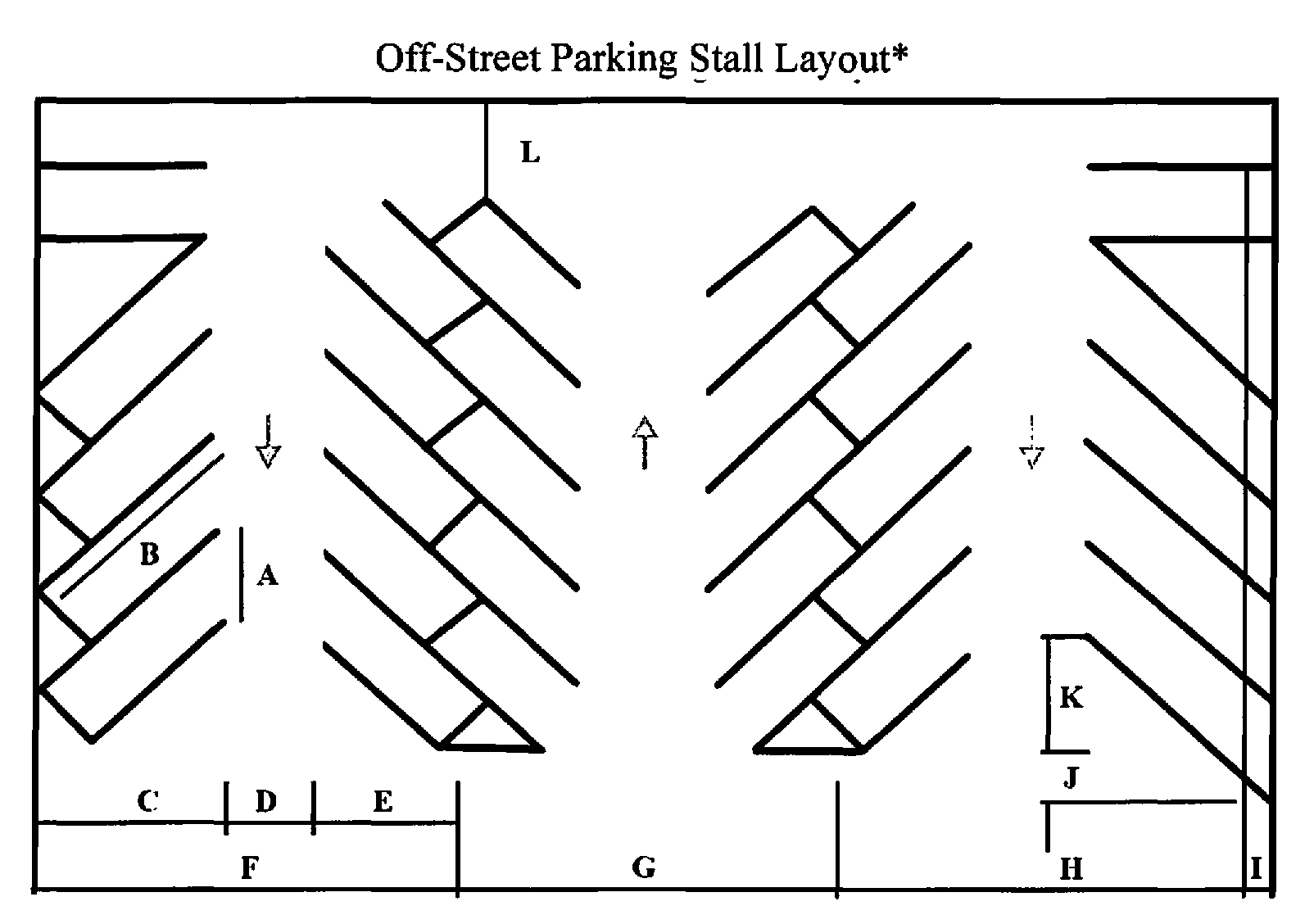
*Design for motorcycle and tandem parking as approved in site plan review process.
(Code 1983, § 20-602(G); Ord. No. 2019-20, § 1, 10-8-19)
_____
Sec. 110-974. - Compact car, valet, and tandem parking requirements and stall layout.
(a)
Compact car requirements and stall layout.
(1)
Parking for compact cars may be provided for up to 20 percent of the required parking and shall be located only at the outer perimeter of the parking area.
(2)
Compact car parking may be provided for only nonresidential land uses.
(3)
Compact car parking may be provided only for parking areas that have ten or more spaces.
(4)
For 90-degree compact parking the minimum stall width shall be eight feet and the minimum stall length shall be 16 feet. There need be no provision for bumper overhang for compact parking.
(5)
Compact car parking must be designated as being for the exclusive use of compact cars through the use of signs or pavement markings.
(6)
The overall design of compact car parking must be reviewed and approved by the building and zoning official.
(7)
Parking layout for eight-foot parking stalls, at various angles, are shown in Table 2.
TABLE 2—COMPACT CAR PARKING
(b)
Valet parking.
(1)
Requirement. No person shall operate a valet parking service utilizing public property without a valid valet business license issued by the city. All valet parking services shall operate in conjunction with a permitted use. The valet parking operator shall not allow passengers to load or unload within traffic lanes or parking spaces that are open to traffic.
(2)
Exemption. Occasional valet parking service provided at a private residence or in connection with a charitable or fundraising activity are exempt from the requirements of this article, but may be subject to other restrictions.
(3)
Content of application. The application for valet parking shall, at a minimum, contain a site plan showing the detail of the valet parking service, including, but not limited to, size, shape, and location of the valet parking area, the size, shape, location and support of any signage including a picture or diagram of the signage, the proposed hours of operation, and the size, shape, location and design of any stand or other equipment proposed to be used. The site plan must show the circulation of traffic within and surrounding the site. The plan shall be drawn to scale.
(c)
Tandem parking. Tandem parking shall mean a space where one automobile parks behind another, so that one automobile must be moved before the other can be accessed. Accessible parking spaces shall not be used for tandem parking spaces. Tandem parking shall only be used for valet approved parking and managed and directed facility parking with site plan approval.
(Code 1983, § 20-602(H); Ord. No. 2019-20, § 1, 10-8-19)
_____
Sec. 110-975. - Parking spaces for persons who have disabilities.
Accessible parking spaces for disabled persons shall be provided in the following manner:
(1)
Number.
a.
The number of accessible parking spaces for disabled persons shall be as follow:
b.
One in every eight accessible spaces, but not less than one, shall be served by an access aisle 96 inches wide minimum and shall be designated "van accessible."
(2)
Spaces at hospital or physical rehabilitation center. A minimum of four spaces shall be provided at a hospital or physical rehabilitation center.
(3)
Size. Diagonal or perpendicular spaces for the disabled shall be a minimum of 12 feet wide. Parking access aisles must be no less than five feet wide, except as provided in subsection (1)b. and must be part of an accessible route to the building or facility entrance. Access aisles must be placed adjacent to accessible parking spaces; however, two accessible parking spaces may share a common access aisle. The access aisle must be striped diagonally to designate it as a no-parking zone.
(4)
Access. All spaces for the disabled shall be provided with a curb cut or curb ramp to a pathway, a minimum of 44 inches wide to provide access to the building served and shall be located so that users will not be compelled to wheel behind parked vehicles. The grades will comply with Florida Statutes ch. 553 "Building Construction Standards," Part II, accessibility by handicapped persons.
(5)
Location. Disabled parking spaces shall be located immediately adjacent to the building to be served.
(6)
Marking. Each such parking space must be prominently outlined with blue paint and must be repainted when necessary, to be clearly distinguishable as a parking space designated for persons who have disabilities and must be posted with a permanent above-grade sign of a color and design approved by the department of transportation, which is placed on and at a distance of 84 inches above the ground to the bottom of the sign and which bears the international symbol of accessibility and the caption "Parking by Disabled Permit Only." Signs erected after October 1, 1996 must indicate the penalty for illegal use of the space.
(Code 1983, § 20-602(I); Ord. No. 1153, § 1, 6-9-09)
Editor's note— Ord. No. 1153, § 1, adopted June 9, 2009, changed the title of section 110-975 from "Handicapped parking" to "Parking spaces for persons who have disabilities."
Sec. 110-976. - General material requirements.
(a)
Except for single- and two-family dwellings, every off-street parking area shall be surfaced with asphaltic or portland cement concrete, or equivalent improvement so as to provide a durable surface. The building and zoning official may review alternative materials that will achieve equivalency.
(b)
All off-street parking lots shall be graded and drained so as to dispose of all surface water accumulated within the area in accordance with the county and city design standards, in accordance with chapter 98, article II.
(Code 1983, § 20-602(J))
Sec. 110-977. - Lighting.
If provided, lighting shall be directed away from public streets, beach areas and residential areas and shall not be a hazard for or distraction to motorists traveling on a street, in accordance with article VI, division 5 of this chapter.
(Code 1983, § 20-602(K))
Sec. 110-996. - Required.
(a)
Every use requiring the receipt or distribution by vehicles of materials and merchandise shall have one or more loading berths and other space for standing, loading and unloading on the same or joint premises in accordance with the requirements of Table 3. Loading space shall be sufficient to allow normal loading and unloading operations of a kind and magnitude appropriate to the property served. Loading spaces shall not be used for the storage of vehicles or materials or to meet off-street parking requirements or in conducting the use.
(b)
Requirements in Table 3 shall apply to new structures or additions and shall not permit any existing structure to be nonconforming for lack of off-street loading.
TABLE 3—OFF-STREET LOADING
REQUIREMENTS
(Code 1983, § 20-602(L))
Sec. 110-997. - Determination of unlisted uses.
For any land use which is not listed in Table 3 of section 110-996, the building and zoning official, upon review of the proposed use, shall specify the required number of loading spaces to be provided, using generally accepted traffic engineering practices and standards.
(Code 1983, § 20-602(M))
Sec. 110-998. - Off-street loading space standards.
All off-street loading spaces shall meet the following standards:
(1)
Off-street loading spaces shall meet, be located and arranged so that a semi-trailer truck (WB 50 class) shall be able to gain access to and use such spaces by means of one continuous parking maneuver.
(2)
Loading space shall observe the minimum street and interior setbacks established for structures.
(3)
All loading space and maneuvering space shall be surfaced with an all-weather material which shall be maintained in a safe, sanitary and neat condition.
(4)
No loading space shall be located so that a vehicle using such space intrudes on or hinders the use of travel lanes, walkways, public or private streets, or adjacent properties.
(5)
Each required off-street loading space shall have a minimum width of 12 feet and a minimum vertical clearance of 16 feet above finished grade of the space. The length shall be a minimum 30 feet for delivery vehicles and 60 feet for semi-trailers.
(Code 1983, § 20-602(N))

