
Maggie Valley City Zoning Code
CHAPTER 155
APPEARANCE STANDARDS AND DESIGN REVIEW
155.01 INTENT AND PURPOSE
The Town of Maggie Valley recognizes that new construction built to proper standards is important to residents, businesses, and industries. Maggie Valley desires architectural styles and developments that build upon and uphold the existing mountain character and natural setting of the town and believes that well-designed and well-maintained development is in the best interest of all residents and businesses. It is the intent of this Chapter to establish appearance standards and design review procedures for the planning jurisdiction of the Town of Maggie Valley. The purposes of this Chapter are as follows:
- Provide design criteria for well-built commercial and multi-family construction through the use of appropriate architectural elements and site development;
- Improve community appearance by requiring the use of suitable exterior colors and building materials;
- Preserve and enhance the Town’s natural environment, aesthetic integrity, and unique character;
- Support tourism and stimulate local economic development;
- Preserve private property values and maintain a high quality of life;
- Prevent and reduce soil erosion;
- Reduce the hazards of flooding and storm water runoff;
- Provide shade and thereby reduce heat levels associated with pavement, conserve energy, and improve air quality;
- To increase natural buffers and thereby reduce the effects of wind and noise;
- Protect the overall health, safety, and general welfare of the public.
155.02 DEFINITIONS
Accent color. A single finish color which is used on a building, in the least proportion of all colors used, not to exceed 5% of the façade area.
Building. Any structure built for the support, shelter or enclosure of persons, animals, chattels, or property of any kind.
Building element. An exterior wall, roof, or site wall which is manmade and constructed. Design theme. Individual architectural components of a building or multiple buildings that share a pattern of similar features, colors, shapes, materials, scales, and overall design style. Words such as "compatible," "context" or "harmonious" refer to elements sharing the same design theme.
Exterior walls. The vertical or nearly vertical planes which form the exterior envelope of a building
Façade. The face of a building.
Field color. A single stain or exterior finish color which is used most extensively in a building’s visible façade.
Flat roof. The external covering of a building having a 2(v):12(h) slope or less.
Human scale. Having dimensions, proportions, and other physical characteristics that are easily understood, manipulated, and experienced by people.
Pitched roof. The external covering of a building having a slope greater than 2(v):12(h). Roof area. A single, unbroken, contiguous plane measured perpendicular to slope.
Site walls. Retaining walls, screen walls or other vertical or nearly vertical planes which occur on a property but are not part of the exterior envelope of a building.
Structure. That which is built or constructed, an edifice or building of any kind or any piece of work artificially built up or composed of parts combined together in some definite manner.
Trim color. A single color which is used on a building’s trim, lesser in proportion to the Field Color.
155.03 APPLICABILITY
- These standards shall apply to all new construction, expansions and/or additions of 50% or more of the previously existing gross floor area or 50% of an existing building’s tax value. Changes to exterior building elements and facades for multifamily and nonresidential development less than 50% of tax value will apply only to the specific change.
- Single-family detached residential uses and individual duplexes are exempt from this Chapter, as are changes considered regular maintenance and repairs to existing multi-family and nonresidential buildings. Maintenance and repair is defined as those changes that are considered upkeep and do not change the architectural appearance of the building or involve the complete repainting or refinishing of a building’s exterior elements.
155.04 PROCEDURES FOR REVIEW
- An Appearance Certificate is required for all development subject to the provisions of this Chapter. All such certificates shall be issued by the Town Planner prior to the start of any new construction or expansion projects subject to this Chapter.
- Prior to the preparation of final architectural or engineered drawings and plans, for any building or structure to which this Chapter is applicable, which shall be prepared by a Registered Land Surveyor, Professional Engineer, Registered Landscape Architect, or licensed Architect, the property owner or his/her representative shall schedule a preliminary meeting with the Town Planner. The purpose of the preliminary meeting is to offer the applicant an opportunity to obtain advice and technical assistance from the Town, to acquaint the applicant with the review process in general, and to help facilitate the subsequent preparation and approval of any required plans prior to expending significant resources.
- Application for design review on forms furnished by the Town; such application shall include the applicant’s and owner’s names, mailing addresses, location and legal description of the property and such other information as deemed necessary by the Town Planner;
- Site plan showing the areas devoted to buildings, parking, and landscaping treatment;
- Elevation drawings of the front, side, and rear of the building or structure illustrating the building’s appearance and treatment. Exterior materials and colors shall be included on the drawings or in a separate list;
- Landscaping plan depicting locations, size and names of plant material as included within the Town’s landscaping requirements;
- Material and color samples as well as other supportive information, such as photographs of existing site conditions, shall be required if deemed necessary by the Town Planner in order to clarify the application.
- It is the responsibility of the applicant to produce sufficient evidence demonstrating that the design principles, guidelines, and procedures specified in the Chapter will be met.
- At the request of the Town Planner, or applicant, the Planning Board may review proposed developments and make design recommendations to the applicant before a final determination for approval or disapproval is made by the Town Planner.
- Prior to issuance of a building permit for a building or structure to which this Chapter is applicable, the Town Planner shall determine that the plans submitted for the building permit are congruent with those approved by the applicant’s Appearance Certificate.
- Prior to any change in building design, remodeling, or alteration of a building or structure as to the exterior character, the property owner or his/her representative shall obtain the approval of the Town Planner and repainting of a building shall be approved by the Town Planner.
- The decision of the Town Planner shall be noted on two copies of the plans. One (1) copy shall be retained by the Planning Department and one (1) copy shall be returned to the owner and applicant.
- Noncompliance with any approved site plans shall be grounds for stopping work on the project or for the denial of the certificate of occupancy.
- The development, building or structure which has been granted a Appearance Certificate through the procedures established in this Chapter and has been constructed to adopted appearance standards shall be maintained by the owners or the person in possession of the property upon which the building or structure is located.
- Such approval as is granted by the Town Planner shall become effective immediately. Approval shall be valid for a period of one (1) year from the date of approval by the Town Planner. Extensions may be granted by the Town Planner provided such extension is requested prior to the date of expiration. Applications which have been disapproved by the Town Planner may be reconsidered upon revision and resubmittal by the applicant in accordance with the requirements of this Chapter. Appeal of the Town Planner’s decision in granting/denying issuance of an Appearance Certificate may be made in accordance with Section 155.08 of this Chapter.
155.05 DESIGN GUIDELINES
In consideration of all applications for design review and approval, the Town Planner shall take into account the proposal’s level of compliance with the following criteria:
- Compatibility and context. All development subject to this Chapter shall be compatible with the established architectural character of the Town by using a design that is complementary to existing Town architectural styles, designs, and forms. Compatibility shall be achieved through techniques such as the repetition of roof lines, the use of similar proportions in building mass and outdoor spaces, similar relationships to the street, similar window and door patterns, and the use of building materials that have color, shades, and textures similar to those existing in the immediate area of the proposed development. Development shall be harmonious with surrounding landscapes and buildings.
- Frontage, orientation, and facades. The building shall be oriented so that a principal or primary facade faces each street on which the building fronts. Continuous flat facades are prohibited.
- Setbacks. All proposed developments must comply with the setbacks in the underlying zoning district.
- Building materials. Materials shall be selected for suitability to the mountain architectural style. For the village character of Maggie Valley, this means using natural and traditional materials such as wood and native stone. All sides of a building should relate to each other. The front should not look substantially different from the other sides. The number of different materials on exterior finishes should be limited. For the front elevation, or façade, on all new commercial and multi-family developments, the following standards apply:

Acceptable:- Materials native to mountain area
- Wood siding (painted, stained, or weathered)
- Wood shingles/shakes
- Native stone
- True log construction
- Log siding
- Exposed wood structural members
- Related trims
- Cultured stone (faux stone)
- Bark siding
- Brick (the brick shall be of consistent color and of the wood mold type, no blends)
- Stucco, for two (2) feet above grade only, or allowed as an accent for areas of detail
- All ASTM approved board, per State Fire Code Where materials change there should be a change in wall plane or some architectural device to give sense of transition
- Stucco, as an entire wall exterior finish
- Mix of materials unrelated to architectural form/structure
- Preformed metal siding
- Exposed or painted concrete block
- Vinyl siding
- Artificial brick
- Reconstituted or manufactured wood materials
- Synthetic stucco
- T1-11 siding (plywood)
- Split face block
- Non-ASTM approved board
- Scale and massing. Scale and proportion should reflect local traditions of mountain buildings. They should be oriented to the characteristic, simple residential buildings of Maggie Valley. Texture of roof and wall finishes shall provide a scale or reference point for the pedestrian in proximity to the structure.
Acceptable:- Residential scale
- Structures using rectangular configurations
- Use of architectural elements (windows, stairs, etc.) to break up large masses of buildings
- Pedestrian-oriented scale
- Covered walkways
- Canopies
- Building with a mass more than 40% of total lot size
- Solid walls and blank exteriors
- Height. 45 foot maximum height as measured from the average natural grade to top of the roofline. Existing contours shall be provided on plot or site plans as part of the zoning permit application.
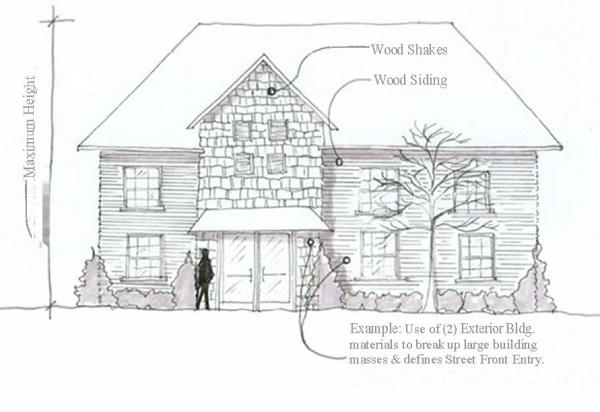
- Articulation to avoid monotony. Use architectural elements to break up large masses of buildings. Monotony of design in single or multiple building projects shall be avoided by varying architectural detail and building form through use of articulation.

- Individual storefronts. If several storefronts are located in one building, the individual storefronts shall be unified in all exterior design elements, such as mass, window and door placement, color, materials, and signage while, at the same time, varying the look and providing distinctiveness from storefront to storefront.
- Signage and awnings. All developments subject to the provisions of this Chapter must also comply with Chapter 157 of the UDO, Signs.
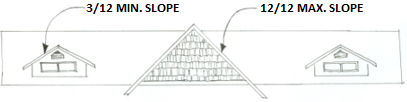
- Pitched roofs. Roofs are a major visible element and shall be compatible with both the building’s and neighboring buildings’ architectural style. Similarities in roof type create a visual continuity in the streetscape and neighborhood. Roof shape, color, and texture should be coordinated with the treatment of the building’s perimeter walls. Roofs with more than one plane, and containing dormers, add variety to a building and break-up its size. The appearance of flat roofs shall be prevented through the use of parapet walls and other architectural elements. Flat roofs utilizing such architectural elements and parapets are acceptable for buildings having an area of greater than 15,000 square feet.
Acceptable:- Roof pitches with 3/12 to 12/12 slope
- Large overhangs (minimum one (1) foot)

- Fascia eight (8) inches minimum and/or exposed rafter tails

- Gable or hip roofs
- Large roof areas should have more than one plane and be broken up with dormers
- Roof pitches over porches and ancillary structures should be in keeping with principal building (minimum 4/12)
- Grouping together of utility structures (vents, ducts,) and painted to match adjacent building surface
- Exposed gutters and downspouts painted to match or complement adjacent roof or wall material
- Earth tone colors for roof materials
- Traditional roof materials such as: Wood shakes, slate, metal fiberglass shingles
- Same materials on all principal parts of the roof
- Asphalt composition shingles (artificial slate)
- All rooftop mechanical and electrical equipment shall be screened from the view of streets and adjacent property.
- Roof pitches with 3/12 to 12/12 slope
- Permitted colors. Colors shall be natural and subdued (earth tones) and shall blend in well with the natural surroundings. Natural stains or paints that reflect the colors of natural materials should be dominant on large areas such as building facades and elevations. Openings and entryways should be clearly expressed with changes of texture or color. Trim color shall refer to any or all buildings trim elements (such as eaves, soffits, overhangs, fascias, windows, sills, gutters). Principal building and trim colors are subject to review, including for repainting an existing building. If the color for repainting matches the previously permitted color, then no additional permit will be required. The repainting of a building shall be approved by Town Planner. The Town of Maggie Valley Design Review and Appearance Standards offers the following recommendations for exterior color: Color requirements for predominant color design are reviewed for compatibility with the Mountain Vernacular Palette which includes earth tones. Accent color designs (i.e. black, dark blue, grays) may be used on a limited basis as part of an architectural motif as approved by the Town Planner.
- Parking and loading zones. All new or newly expanded developments subject to the design review provisions in this Chapter shall comply with the minimum parking requirements of the underlying zoning district. All parking spaces required by this Chapter shall be marked or designated by painted lines or an equivalent in a paved parking lot, and by some permanent, fixed markers in unpaved lots. Additionally, developments with the following uses shall supply the following number of off-street parking spaces:Every applicable building or structure shall provide space for the loading and unloading of vehicles off the street or public alley. Such space shall have access to an alley or, if there is no alley, to a street. For the purpose of this section an off-street loading space shall have minimum dimensions of twelve (12) feet by forty (40) feet and an overhead clearance of fourteen (14) feet in height above the alley or street grade.
Shopping Center 3/1000 sq. ft. Retail Sales 1/333 sq. ft. Restaurant 1/3 seats or 1/100 sq. ft. Take-out Rest. 1/2 seats or 1/80 sq. ft. Medical/Dental office 3.5/1000 sq. ft. Veterinary 1.5/1000 sq. ft. or 1/4 employees Hotel/Motel/Inn 1/room and 1/2 employee Multi-family 1.5/unit - Screened utilities, trash containment, buffering, and fencing. It is the intent of this section to provide for visual screens and or buffers between trash container and dumpster locations and all street rights-of-way and adjoining properties. Trash containers and dumpsters shall not be located in the front yard of any property where practical and shall be screened from view on all sides. Fencing, facing street corridors shall consist of natural materials such as wood and/or stone being complemented by appropriate landscaping to break up the length and solidity of fencing. Metal fencing of any type is not permissible. Where chain link is deemed necessary for security purposes and/or dumpster screening, such fencing must be completely concealed by evergreen plant material. Chain link with plastic insets of natural earth tone color is acceptable for the screening of dumpsters.

- Sufficient lighting. The purpose of this provision is to regulate the intensity of exterior lighting. The intent is to prevent light from commercial developments from excessively illuminating the property in question, other properties, neighboring properties, or the night sky.
- Landscaping and streetscaping. Landscaping for any new development requiring six (6) parking spaces or more shall be designed to meet the requirements of this section utilizing the criteria set forth in Section 155.05A. Single family residential uses and properties are exempt. A landscaping plan, preferably prepared by a registered architect, landscape architect or professional landscaper, incorporating the requirements of this section shall be submitted along with an application for a zoning permit for any use subject to this Chapter. The landscape plan shall be reviewed and approved by the Town Planner during the design review process. The landscaping plan, in addition to all other site plan requirements, shall include the following:
- Existing and proposed landscaping, including but not limited to,
- the location, species, and height of new trees and shrubbery;
- the location and dimensions of planting areas;
- the dimensions of the entire parking or paved area;
- the location and height of fences or walls
- The number, location, species, and size of existing trees between the principal building and the public street right-of-way which are to be maintained and preserved for credit; the size is to be measured by taking the circumference of the tree at approximately four and one-half (4 1/2) feet above the grade.

- The location and description of any barriers to be erected to protect any vegetation from damage both during and after construction.
- Clear edging shall be provided between landscaped areas and pedestrian/vehicle areas.
- Existing and proposed landscaping, including but not limited to,
- Pedestrian and bicycle amenities. All developments subject to the provisions of this Chapter with building coverage of 40,000 square feet or more must provide sidewalks and bicycle racks adequate to serve the proposal as determined by the Town Planner.
155.06 REQUIRED YARD DESIGN
- Street yard. A planting yard, comprised of a strip of land containing landscaping materials, shall be located along and parallel to any adjacent public street, or streets. The street yard is located on private property and not within the street right-of-way.
- The minimum width of the street yard cannot be less than seven feet and the average width shall be at least ten feet.
- No street tree can be planted more than 35 feet from the edge of the right-of-way to count as a street tree.
- For street yards, one (1) large shade tree (expected height of 35 feet at maturity) is required for every fifty (50) feet of linear street frontage of the lot minus the width of driveways and access points.
- Ornamental trees (expected height of 25 feet upon maturity) may be used in place of shade trees at the rate of one (1) for every thirty (30) feet. Due to above ground utilities; the Town may require the use of ornamental trees in place of large shade trees.
- Trees may be clustered with a minimum spacing of 15 feet and a maximum spacing of 75 feet. Trees do not need to be spaced evenly.
- Shrubbery, ground cover, and other planting materials shall be used to complement the tree plantings.
- No area of the street yard may be exposed soil, but instead shall be covered with vegetation, whether grass or shrubbery. The only area that shall remain uncovered is the six-foot radius surrounding the trunk of any tree; however, this area shall be mulched.
- Inclusion of existing trees in the landscape design is encouraged.
- Parking lot yard. The purpose of parking lot yards is to provide attractive views from roads and adjacent properties, provide shade to reduce the heat generated by impervious surfaces, reduce glare from parking lots, and to help filter exhaust from vehicles. All parking shall provide and maintain landscaped planting areas within the interior of or adjacent to the parking area or both. Parking areas shall be broken up with landscaping and should be screened by hedges, trees, planted berms, shrubs, or walls. Landscaped planting areas are to be located within or adjacent to the parking area as landscaped islands, at the end of parking bays, inside medians, or between rows of cars. This section applies to parking lots with six (6) or more parking spaces.
- Parking bays shall be broken up with landscaped islands or medians to avoid long monotonous rows of parking; no more than ten (10) spaces shall be located in one continuous row.
- Parking lots shall provide a minimum 10% net area of landscaping/green space on the interior or exterior of parking lots.
- All trees and shrubs are to be planted within a landscaped planting area not less than 200 square feet in area.
- There shall be one large shade tree within 60’ of every parking space.
- There shall be one shrub for every three hundred (300) square feet of total parking area. Shrubs shall be eighteen (18) inches tall at planting and reach a minimum height of thirty (30) inches in three years. No more than 45 percent (45%) may be deciduous.
- Medium deciduous trees shall be a minimum caliper of 1 inch.
- Large deciduous trees shall be a minimum caliper of 2.5 inches or greater when planted.

- Buffer yard. The purpose of the buffer yard is to provide a transitional area between uses that may differ in development intensity and density. Where a commercial, office or institutional (nonresidential) proposed use abuts an existing residential use or residential zoning district, the developer is required to provide a vegetative buffer yard between the residential and proposed uses.
- The buffer yard shall be accomplished through the use of densely planted landscaping that would provide complete visual separation within 3 years of planting, or a combination of shrubs and a six-foot fence constructed of masonry or pressure-treated lumber.
- Evergreen trees required for screening shall be a minimum of 5 feet in height at planting.
- The buffer yard between nonresidential and residential uses shall be 8’ in width.
- No such buffer shall extend nearer to a street right-of-way line than the established building line of the adjoining residential lot.
- No buildings or parking areas may encroach within the buffer yard.
- Existing vegetation. Existing vegetation, other than exotic, non-native species, may count toward meeting the requirements of this section when such vegetation is in good condition, is properly protected during development, and helps to further the purpose of the district. Existing vegetation that is used to meet the standards of this section shall be maintained or replaced if it dies during the first year after the completion of the development.
- New plant material. Regionally grown and native species of plants are encouraged. New plant material shall complement and be integrated with existing site vegetation and all other natural site features. Plantings should be grouped together or clustered as opposed to thin linear patterns.
155.07 PLANNING BOARD REVIEW
When requested by the Town Planner or the applicant, the Planning Board shall review applications and advise the Town Planner in regards to satisfaction of design guidelines. It is the responsibility of the applicant to submit adequate material on which the Board may make a determination as to the compliance of the proposed development with the terms of this Chapter. The Board, after reviewing submitted materials, shall render an advisory opinion on the appropriateness of the proposed spirit, intent, and provisions.
155.08 CHANGES TO BUILDING DESIGN AND COLOR
A building or structure which has been constructed, installed, or occupied in accordance with these provisions may be removed or demolished, but site plans may not be further modified before or after construction, installation, or occupancy without the review and approval of the Town Planner. The passage of time shall not remove this requirement for review and approval if changes in design, including color, are desired or proposed, for any building within the Town which is subject to these provisions.
155.09 APPEALS
Decisions by the Town Planner regarding the issuance of an Appearance Certificate are subject to review by the Town of Maggie Valley Board of Adjustment, following that Board’s rules of procedure. Should an applicant wish to appeal the Board of Adjustment’s decision, the appeal must be filed with the Haywood County Superior Court within 30 days after the Board’s decision.

