
Maple Plain City Zoning Code
PART 4
- ZONING DISTRICTS
Sec. 10-533. - Official map.
The City is divided into use districts as shown on the accompanying map entitled "Official Zoning Map of Maple Plain, Minnesota," which is hereby made a part of this article.
(Code 1980, § 16.01; Code 2015, § 153.020; Ord. No. 265, 5-29-2012)
Sec. 10-534. - Zoning district boundaries.
The boundaries of districts are the centerlines of streets; the centerlines of alleys; the rear lot lines where there are not alleys; and the side lines of recorded lots or designated distances where land is unplatted.
(Code 1980, § 16.02; Code 2015, § 153.021)
Sec. 10-535. - Predatory offender residency restrictions.
(a)
Purpose, findings and intent. The purpose of this section is to provide regulations of general applicability for property throughout the City in order to protect the health, safety, and welfare of the community and its residents. The City finds that improperly supported predatory offenders present a significant threat to the public safety of the community, especially children, females, and vulnerable populations. The cost of predatory offender victimization to society as a whole, while not precisely calculable, is substantial. The intent of this section is to provide residency opportunities within the City where predatory offender residency can safely be established subject to the limitations of this Code.
(b)
Definitions. The following words, terms and phrases, when used in this section, shall have the meanings ascribed to them in this subsection, except where the context clearly indicates a different meaning:
Licensed child care center means a child care center currently licensed by the applicable county or the state.
Permanent residence means any a place where the person abides, lodges, or resides for 14 or more consecutive days.
Predatory offender means any person who has been designated a Level II or Level III predatory offender under the provisions of Minn. Stats. § 244.052 or any successor statute, or any similar statute from another state in which that person's risk assessment indicates a moderate or high risk of re-offense.
Public playground means a City-owned, improved park or other outdoor area designed, equipped, and set aside primarily for children's play.
School zone means any property owned, leased, or controlled by a school district or an organization operating a nonpublic school, as defined in Minn. Stats. § 123B.41, subd. 9, where an elementary, middle, or secondary school, secondary vocational center or other school providing educational services in grade one through grade 12 is located, or used for educational purposes, or where extracurricular or cocurricular activities are regularly provided.
Temporary residence means a place where a person abides, lodges, or resides for a period of 14 or more days in the aggregate during any calendar year and which is not the person's permanent address, or a place where the person routinely abides, lodges, or resides for a period of four or more consecutive or non-consecutive days in any month which is not the person's permanent residence.
(c)
Prohibited conduct.
(1)
Prohibited location of residence. It is unlawful for any predatory offender to establish permanent or temporary residence:
a.
Within 750 feet of any school zone;
b.
Within 750 feet of any licensed child care center;
c.
Within 750 feet of any children's recreation area;
(2)
Distance measurement. For the purpose of determining the minimum distance separation required by this section, the requirement shall be measured by following a straight line from the outer property line of the permanent or temporary residence of the predatory offender to the nearest outer property line of the protected property.
(3)
Property owner responsibilities. It is unlawful for a property owner to knowingly let or rent any place, structure or part thereof, trailer or other conveyance, with the knowledge that it will be used as a permanent or temporary residence in violation of subsection (c)(1) of this section.
(d)
Exceptions. A person shall not be found in violation of this section if any of the following apply:
(1)
The predatory offender established the permanent or temporary residence and reported and registered the residence pursuant to Minn. Stats. §§ 243.166 and 243.167, or any successor statute, prior to the effective date of the ordinance from which this section is derived.
(2)
The school zone, licensed day care center, or public playground within 750 feet of the predatory offender's permanent or temporary residence was opened or started after the person established such residence and reported and registered the residence pursuant to Minn. Stats. §§ 243.166 and 243.167, or any successor statute.
(3)
The predatory offender is under the age of 18 years and the residence is the primary residence of the predatory offender's parent or court appointed caregiver.
(4)
A property owner who has formally initiated the eviction process and is diligently pursuing the eviction of a predatory offender in violation of subsection (c)(1) of this section.
(e)
Enforcement. Any violation of this section shall be a violation and enforced in accordance with section 10-455.
(Ord. No. 289, § 1(153.0212), 3-27-2017)
Sec. 10-536. - Uses not provided for within zoning districts.
Whenever in any zoning district a use is neither specifically permitted nor denied, the use shall be considered prohibited. In such case, the City Council, the Planning Commission, or a property owner may request a study by the City to determine if the use is acceptable and if so what zoning district would be most appropriate and the determination as to conditions and standards relating to development of the use. The City Council and/or Planning Commission upon receipt of the staff study may initiate an amendment to this article to provide for the particular use under consideration or may find that the use is not compatible for development within the City.
(Code 1980, § 16.03; Code 2015, § 153.022)
Sec. 10-537. - District classifications.
The following district classifications are hereby established within the City:
(1)
"O" Open Space/Floodplain;
(2)
"R-1" Single-Family;
(3)
"R-2" Single- and Two-Family;
(4)
"R-2A" Single-Family;
(5)
"R-3" Multiple-Family;
(6)
"MU" Mixed-Use;
(7)
Design guidelines, under separate document;
(8)
"I" General Industrial;
(9)
"O-P" Office Park; and
(Code 1980, § 16.04; Code 2015, § 153.023; Ord. No. 232, 4-13-2009)
Sec. 10-538. - "O" Open Space Protection/Floodplain District.
(a)
Intent. This district is intended to protect areas which should not be developed due to flooding, soils, topography, or should be maintained in agricultural state until the time as development is feasible.
(b)
Permitted uses. The following uses have a low flood damage potential and do not obstruct flood flows or are agricultural in nature. These uses shall be permitted within the open space protection/floodplain district to the extent that they are not prohibited by any other code and provided they do not require structures, fill, or storage of materials or equipment.
(1)
Agricultural uses such as general farming, pasture, grazing, forestry, sod farming, and wild crop harvesting;
(2)
Industrial-commercial uses such as parking areas and airport landing strips;
(3)
Private and public recreational uses such as golf courses, tennis courts, driving ranges, archery ranges, picnic grounds, boat launching ramps, swimming areas, parks, wildlife and nature preserves, game farms, shooting preserves, target ranges, trap and skeet ranges, hunting and fishing areas, and single or multiple purpose recreational trails; and
(4)
All other uses and all uses that require structures, fill, or storage of materials or equipment shall be prohibited.
(c)
Floodplain maps. Upon completion of the Flood Insurance Study by the Federal Insurance Administration for the City the maps contained therein shall be utilized for boundary definitions. Until that time the floodplain boundaries will be determined by data available to the Department of Natural Resources (DNR) and by the flood hazard boundary map prepared by the Federal Insurance Administration.
(d)
Notification to the Department of Natural Resources. Amendments, rezonings, variances, and conditional use permits shall be reviewed in accordance with part 7 of this article, sections 10-546 and 10-580. The review shall also require notification to the DNR and to the local watershed district prior to adoption or approval of any request.
(Code 1980, § 16.05; Code 2015, § 153.024; Ord. No. 327, § 1, 4-29-2024)
Sec. 10-539. - "R-1" Single-Family Residential District.
(a)
Intent. It is the intent of this district to limit certain areas specifically for the development of single dwellings in the community; to provide reasonable standards for the development; to avoid overcrowding; and to prohibit the use of land which would be incompatible with or detrimental to the essential residential character of the district.
(b)
Permitted uses. The following uses are permitted in the "R-1" district:
(1)
Single-family dwellings;
(2)
Group homes by conditional use permit;
(3)
Public parks and playgrounds;
(4)
Essential services; and
(5)
Agriculture other than the raising and keeping of livestock.
(c)
Permitted uses and accessory buildings. The following uses and accessory buildings are permitted in the "R-1" district:
(1)
Private garages, parking spaces, and carports for passenger cars, trucks, recreational vehicles, and equipment;
(2)
Swimming pools and tennis courts;
(3)
Tool houses and similar buildings for storage of domestic equipment and non-commercial recreational equipment;
(4)
Boarding and renting of rooms to not more than two persons;
(5)
Planned unit developments. Residential planned unit developments are regulated by section 10-546.
(d)
Conditional uses. No structure or land may be used for the following uses except by conditional use permit and in accordance to Section 10-482.
(1)
Schools, churches, community centers, libraries, golf courses, parks, and recreational buildings, subject to the following:
a.
Parking areas shall not be situated in required front, side, or rear yards;
b.
Side and rear yards shall not be less than 50 feet in width or depth, of which at least 25 feet adjacent to the lot line shall be maintained as a planning buffer zone; and
c.
Side and rear yards abutting commercial or industrial zones shall not be less than 30 feet, of which at least 15 feet adjacent to the lot line shall be planted, landscaped, and maintained as a buffer zone;
(2)
Assisted Living Facility.
a.
Minimum lot size 2.5 acres.
b.
Maximum assembly size within the facility or outdoors shall not be more than 50 non-residents and employees. Large assemblies (greater than 50 people), open houses and or public events and gatherings shall be individually considered and approved by the City Council. Application for these events shall be made a minimum of 45 days prior to the event.
c.
Site plan in compliance with Section 153.04 is required. All improvements must be constructed and maintained in compliance with the approved site plan, the approved City resolution, and all applicable local, state, and federal rules and regulations.
d.
The facility and its operation must be current, at all times, with any required local, state, and federal permits and licenses.
e.
Use of the facility shall not be injurious or create a nuisance to adjoining neighborhoods.
f.
Assisted living facilities which include dementia care can be approved by the City Council as a part of the initial conditional use permit or by a conditional use permit addendum.
g.
City Council may impose additional conditions.
(e)
Area requirements. The following area requirements apply to the "R-1" district:
(1)
Single-family:
a.
12,000 square feet minimum;
b.
In the case of a lot of record existing at the time of passage of the ordinance from which this article is derived, 10,000 square feet minimum; and
c.
A minimum of 1,100 square feet per residential unit.
(f)
Lot width. The following lot width requirements apply to the "R-1" district:
(1)
Single-family: 80 feet minimum.
(g)
Yard and setback requirements. The following yard and setback requirements apply to the "R-1" district:
(1)
Front yard:
a.
35 feet minimum; and
b.
Where adjacent structures within the same block have front setbacks different from those required, the front yard minimum setback shall be the average of the adjacent structures. If there is only one adjacent structure, the front yard minimum setback shall be the average of the required setback and the setback of the adjacent structure. In no case shall the minimum front yard setback requirement exceed 35 feet.
(2)
Side yards: Interior lots shall provide a side yard on each side of the dwelling of ten feet except as follows:
a.
For lots platted prior to the adoption of the ordinance from which this article is derived having a lot width from 60 feet to 80 feet, each side yard shall be ten percent of the lot width, in no case less than six feet; and
b.
On a corner lot, the width of the side yard on the street side shall not be less than 18 feet (to the minimum front yard depth required), provided this does not reduce the buildable width of a corner lot to less than 20 feet.
(3)
Rear yard: a minimum of 25 feet or 25 percent of the lot depth, whichever is less.
(4)
Driveways: All driveways located in this district shall have a five-foot minimum setback from the property line.
(Code 1980, § 16.06; Code 2015, § 153.025; Ord. No. 209, 6-12-2006; Ord. No. 284, § 1, 2-22-2016; Ord. No. 294, § 2, 3-26-2018)
Sec. 10-540. - "R-2" Single- and Two-Family Residential District.
(a)
Intent. It is the intent of this district to permit the development of single- and two-family dwellings in the community on relatively small lots; to provide reasonable standards for the development; to avoid overcrowding; and to prohibit the use of the land which would be incompatible with or detrimental to the essential residential character of the district.
(b)
Permitted uses. The following uses are permitted in the "R-2" district:
(1)
Single- and two-family dwellings;
(2)
Public parks and playgrounds;
(3)
Essential services; and
(4)
Agriculture other than the raising and keeping of livestock.
(c)
Permitted uses and accessory buildings. The following uses and accessory buildings are permitted in the "R-2" district:
(1)
Private garages, parking spaces, and carports for passenger cars, trucks, recreational vehicles, and equipment;
(2)
Swimming pools and tennis courts;
(3)
Tool houses and similar buildings for storage of domestic equipment and non-commercial recreational equipment; and
(4)
Boarding and renting of rooms to not more than two persons.
(d)
Conditional uses. The following uses shall require a conditional use permit based on the procedures and conditions set forth in section 10-482:
(1)
New wireless support structures for small wireless facilities.
(2)
Group homes.
(e)
Area requirements. The following area requirements apply to the "R-2" district:
(1)
Single-family: 10,000 square feet minimum;
(2)
Two-family dwelling: 15,000 square feet minimum; and
(3)
A minimum of 800 square feet per residential unit.
(f)
Lot width. The following lot width requirements apply to the "R-2" district:
(1)
Single-family: 75 feet minimum; and
(2)
Two-family: 120 feet minimum.
(g)
Yard and setback requirements. The following yard and setback requirements apply to the "R-2" district:
(1)
Front yard:
a.
35 feet minimum; and
b.
Where adjacent structures within the same block have front setbacks different from those required, the front yard minimum setback shall be the average of the adjacent structures. If there is only one adjacent structure, the front yard minimum setback shall be the average of the required setback and the setback of the adjacent structure. In no case shall the minimum front yard setback requirement exceed 35 feet.
(2)
Side yards: Interior lots shall provide a side yard on each side of the dwelling of ten feet except as follows:
a.
For lots platted prior to the adoption of the ordinance from which this article is derived having a lot width from 60 feet to 80 feet, each side yard shall be ten percent of the lot width, in no case less than six feet; and
b.
On a corner lot, the width of the side yard on the street side shall be not less than 18 feet (two the minimum front yard depth required), provided this does not reduce the buildable width of a corner lot to less than 20 feet.
(3)
Rear yard: a minimum of 25 feet or 25 percent of the lot depth, whichever is less.
(4)
Driveways: All driveways located in this district shall have a five-foot minimum setback from the property line.
(h)
Scope and intent for manufactures houses.
(1)
The City recognizes that manufactured houses on permanent foundations within the City would provide many residents with safe and affordable housing. The City desires to make manufactured housing available to its residents and to create a market for manufactured housing without injuring property adjacent to the housing. It is the purpose of this article to permit manufactured housing while preserving and protecting desired architectural and aesthetic characteristics of housing within the City, and to protect the health, safety, and welfare of the residents of the City.
(2)
The City authorizes the placement of manufactured houses in the "R-2" Single- and Two-Family Residential District if the manufactured houses comply with the following conditions:
a.
The manufactured houses shall comply with all other zoning regulations for the zone in which it is located.
b.
The manufactured houses shall be placed on the same type of permanent foundation as required of other homes within the "R-2" zoning district.
c.
No manufactured house shall have a ground floor area of less than 800 square feet.
d.
No manufactured house shall have a width of less than 24 feet at its narrowest point.
e.
A building permit and other required permits shall be obtained for the manufactured housing.
(Code 1980, § 16.07; Code 2015, § 153.026; Ord. No. 209, 6-12-2006; Ord. No. 294, § 3, 3-26-2018)
Sec. 10-541. - "R-2A" Single-Family Residential District.
(a)
Intent. It is the intent of this district to provide for single-family dwellings and multiple-family dwelling unit structures (two to four unit building or townhomes), and directly related complementary uses within the City.
(b)
Permitted uses. The following uses are permitted in the "R-2A" district:
(1)
All permitted uses as allowed in an "R-2" Single- and Two-Family Residential District, subject to the respective requirements.
(2)
Multiple-family dwelling units, patio homes, townhouses, and any other structures housing more than two families but not more than four families.
(c)
Permitted uses and accessory buildings. The following uses and accessory buildings are permitted in the "R-2A" district: all permitted and accessory uses as allowed in an "R-2" Single- and Two-Family Residential District.
(d)
Conditional uses. The following uses shall require a conditional use permit based on the procedures and conditions set forth in section 10-482:
(1)
Residential planned unit developments and townhouses regulated by part 6 of this article.
(2)
New wireless support structures for small wireless facilities.
(e)
Area requirements. The following area requirements apply to the "R-2A" district:
(1)
Single- and two-family dwellings shall meet the area requirements of the "R-2" district.
(2)
Three-unit family dwellings shall provide a minimum base lot of 18,000 square feet.
(3)
Four-unit family dwellings shall provide a minimum base lot of 20,000 square feet.
(f)
Lot width. The following lot width requirements apply to the "R-2A" district:
(1)
One unit and two unit dwellings: 80 feet minimum.
(2)
Three unit and four unit dwellings: 120 feet minimum.
(g)
Yard and setback requirements. The following yard and setback requirements apply to the "R-2A" district:
(1)
Front yard:
a.
35 feet minimum; and
b.
Where adjacent structures within the same block have front setbacks different from those required, the front yard minimum setback shall be the average of the adjacent structures. If there is only one adjacent structure, the front yard minimum setback shall be the average of the required setback and the setback of the adjacent structure. In no case shall the minimum front yard setback requirement exceed 35 feet.
(2)
Side yards:
a.
Interior lots shall provide a side yard on each side of the structure of ten feet or one-half the building height, whichever is greater.
b.
On a corner lot the side yard on the street side shall not be less than 25 feet.
c.
Residential unit lots containing duplexes or townhouses may be subdivided along the common wall in a zero lot line arrangement, provided:
1.
The combined area of the base lot and individual unit lots contains the required amount of lot area per dwelling unit as prescribed elsewhere in this section.
2.
Unit lots shall meet all required setbacks from the boundaries of the base lot.
3.
Any shared wall facing on a zero side lot line is a structural wall capable of providing protection from fire, noise, and visual encroachment.
(3)
Rear yard: a minimum of 25 feet shall be required.
(h)
Lot coverage. No buildings, including accessory buildings, shall occupy more than 20 percent of the lot area.
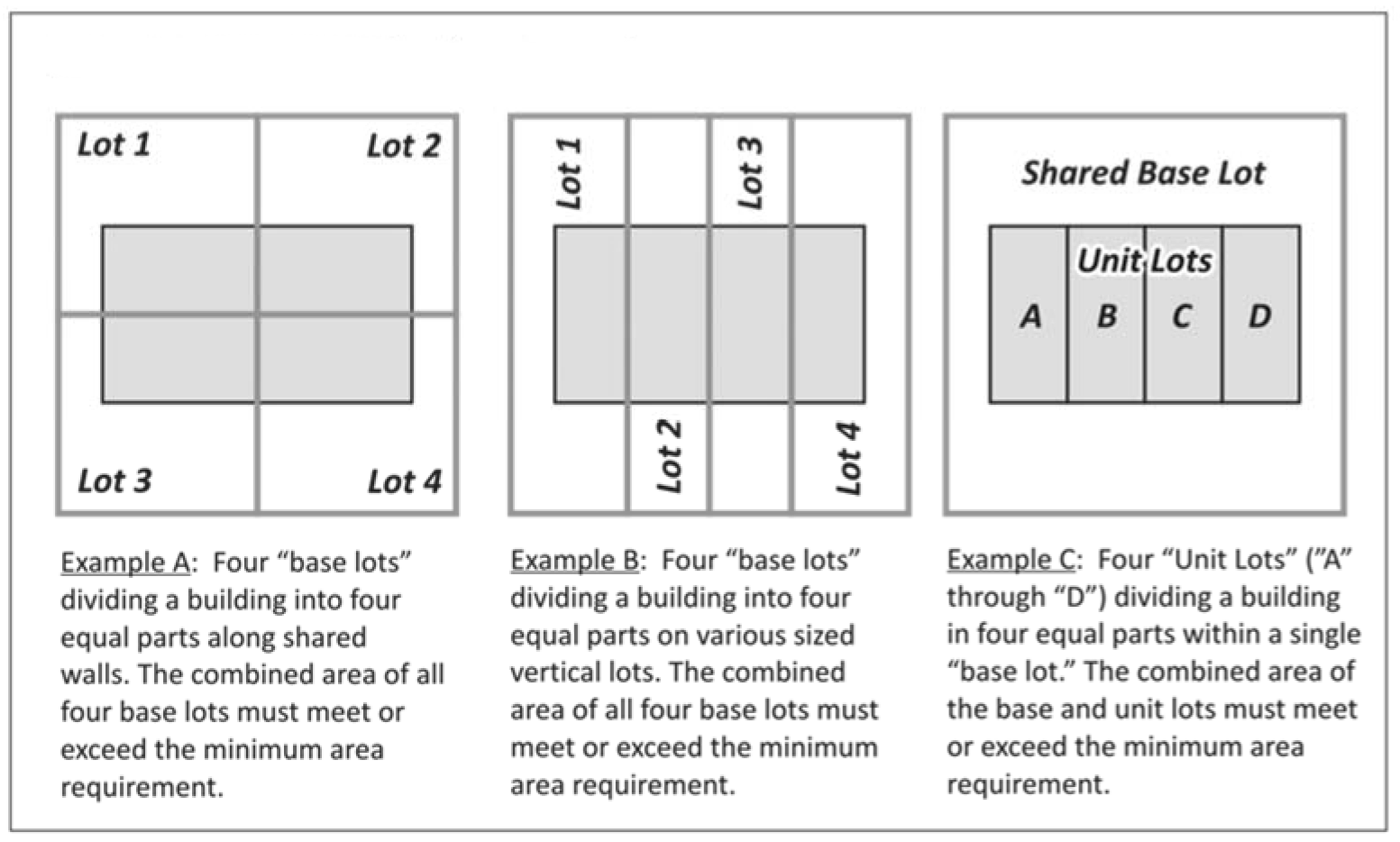
Examples of Zero Lot Line Arrangements
(i)
Planned unit developments. Any application for a planned unit development in the "R-2A" zoning district shall follow and be subject to the requirements of section 10-546. Any approved planned unit development requires the subject property to be rezoned to "PUD-R2A" Single-Family Planned Unit Development Residential District. The zoning governing the subject property shall be the requirements and conditions of the "R-2A" zoning district as expressly modified by the approved plans and agreement with the City.
(Code 2015, § 153.027; Ord. No. 264, 5-29-2012; Ord. No. 294, § 4, 3-26-2018)
Sec. 10-542. - "R-3" Multiple-Family Residential District.
(a)
Intent. It is the intent of this district to provide for multiple-family dwelling unit structures and directly related complementary uses with the City.
(b)
Permitted uses. The following uses are permitted in the "R-3" district:
(1)
All permitted uses as allowed in an "R-2" Single- and Two-Family Residential District, subject to the respective requirements;
(2)
Multiple-family dwelling units, patio homes, townhouses, and any other structure housing more than two families;
(3)
Boardinghouses and roominghouses; and
(4)
Nursing homes, rest homes, board homes and care homes.
(c)
Permitted uses and accessory buildings. The following uses and accessory buildings are permitted in the "R-3" district:
(1)
All permitted accessory uses as allowed in an "R-2" Single- and Two-Family Residential District, provided that any structures or use are located ten feet from any residential district, 25 feet from any side street line or alley, or 25 feet from the property line adjoining a commercial or industrial zoning district; and
(2)
Off-street loading and parking.
(d)
Conditional uses. The following uses shall require a conditional use permit based on the procedures and conditions set forth in section 10-482:
(1)
Residential planned unit developments and townhouses regulated by division 6 of this article.
(2)
New wireless support structures for small wireless facilities.
(e)
Area requirements. The following area requirements apply to the "R-3" district:
(1)
Single- and two-family dwellings shall meet the area requirements of the "R-2" district.
(2)
Multiple-family dwellings shall provide a minimum of 18,000 square feet or 2,500 square feet per unit, whichever is greater.
(f)
Lot width. The following lot width requirements apply to the "R-3" district: 120 feet minimum.
(g)
Yard and setback requirements. The following yard and setback requirements apply to the "R-3" district:
(1)
Front yard:
a.
35 feet minimum; and
b.
Where adjacent structures within the same block have front setbacks different from those required, the front yard minimum setback shall be the average of the adjacent structures. If there is only one adjacent structure, the front yard minimum setback shall be the average of the required setback and the setback of the adjacent structure. In no case shall the minimum front yard setback requirement exceed 35 feet.
(2)
Side yards:
a.
Interior lots shall provide a side yard on each side of the structure of ten feet or to the building height, whichever is greater.
b.
On a corner lot the side yard on the street side shall not be less than 25 feet.
(3)
Rear yard: a minimum of 25 feet shall be required.
(4)
Distance between buildings: No principal building shall be closer than 50 feet to any other principal building on the lot.
(h)
Lot coverage. No buildings, including accessory buildings, shall occupy more than 20 percent of the lot area.
(Code 1980, § 16.08; Code 2015, § 153.028; Ord. No. 294, § 5, 3-26-2018)
Sec. 10-543. - "MU" Mixed-Use District.
(a)
Intent.
(1)
The purpose of the mixed-use district is to provide an area for compact, mixed-use development that will be compatible through a combination of careful planning and urban design and investments. The mixture of land uses within the district is essential to create a vibrant community. The district will include three sub-districts: the Gateway (MU-G), the Downtown (MU-D) and Budd/Highway 12 (MU-B). The sub-districts will contribute to the overall uniqueness of smaller areas while creating a consistent character throughout the community.
(2)
All three sub-districts will include careful consideration for placement of building edges, treatment of buildings, parking, landscaping and pedestrian spaces. Further definition and regulation of these areas will be achieved through the implementation of the design guidelines which specifically address the design and character requirements for any development within any of the sub-districts and mixed-use areas. The standards in this article are intended to implement and effectuate the principles and relationships established in the City design guidelines, and the City's comprehensive plan, which will be carried out through specific standards related to site planning, signage, architecture, building materials and landscaping.
(3)
The MU district is divided into three sub-districts: MU-G, MU-D and MU-B, as depicted on the official zoning map.
(b)
Permitted uses. Within any MU district, no structure or land may be used except for one or more of the following uses. An "X" designation indicates which district the use is allowed in. If the use is not identified with an "X," then the use is not permitted within the district. The following list is not meant to be all encompassing, but all uses not identified on this list shall be subject to review by City staff and must be identified as similar in use to other listed, permitted or conditional uses, otherwise the use shall be deemed not permitted. Any dispute of staff's decision shall be brought before the City Council upon written request to be submitted to City staff to be placed on the next available agenda.
*Single-family homes are permitted uses within the mixed-use districts when constructed on a lot where a single-family home exists. All single-family homes in the mixed-use districts are subject to the requirements of the "R-1" zoning district.
(c)
Permitted accessory uses. Within any MU district, the following uses shall be permitted accessory uses:
(1)
Any incidental repair or processing necessary to conduct a permitted principal use as long as it occurs indoors and does not occupy more than 30 percent of the gross floor area of the principal building;
(2)
Buildings temporarily located for purposes of construction on the premises for a period not to exceed the time necessary to complete the construction;
(3)
Outdoor seating of no more than 12 seats when demonstrated that they do not create a public safety hazard; and
(4)
Utility cabinets less than 12 square feet.
(d)
Conditional uses. No structure or land may be used for the following uses except by conditional use permit and in accordance with section 10-482:
(1)
Antennas mounted on an existing structure. If integrated architecturally into the design of the building, exceeding three feet above the highest point of a structure.
(2)
Auto sales.
a.
Only within the MU-B district;
b.
Parking area and buildings must be set back 40 feet and adequately screened/buffered from adjacent residential land shown in the comprehensive plan;
c.
Public address system shall not be audible from any residential parcels; and
d.
Access is prohibited from a local street unless approved by the City.
(3)
Automobile fuel services.
a.
Only within the MU-G and MU-B districts;
b.
Stacking at the pumps shall not interfere with internal circulation patterns or parking areas;
c.
Stacking area shall be screened from adjacent residential parcels;
d.
No unlicensed or inoperable vehicles shall be stored on the premises;
e.
No repair, assembly or disassembly of vehicles;
f.
Canopy lighting must be recessed with flat lenses; and
g.
Shall be located more than 200 feet from a school, church, hospital or meeting place with a capacity of more than 50 persons. This distance can be reduced if mitigation measures are taken to the satisfaction of the City Council.
(4)
Automobile repair or storage.
a.
Only within the MU-B district;
b.
Unlicensed or inoperable vehicles shall be stored inside or within an approved area that is adequately screened;
c.
Repair, assembly or disassembly of vehicles must be done indoors, except minor servicing;
d.
No sales or display of vehicles, unless under a separate conditional use permit;
e.
Parking and buildings must be set back 50 feet from any residential districts as noted in the comprehensive plan unless an adequate screening of views, noise and light plan is approved by the City; and
f.
Shall be located more than 200 feet from a school, church, hospital or meeting place with a capacity of more than 50 persons. This distance can be reduced if mitigation measures are taken to the satisfaction of the City Council.
(5)
Auction houses.
a.
Only within the MU-B district;
b.
Public address system shall be designed to minimize audible sound from any residential parcels in compliance to City noise ordinances (section 10-605);
c.
No outdoor storage or sales unless within a designated area and screened from residential parcels;
d.
Designated parking area that does not interfere with internal circulation or access in or out of the site; and
e.
Access shall not be allowed from a local street unless approved by the City.
(6)
Car washes.
a.
Only within the MU-G and MU-B districts;
b.
Stacking of vehicles shall not interfere with the internal circulation of vehicles or impact the ingress/egress of the site;
c.
Operations of the car wash or speaker system shall be designed to minimize audible sound from any residential parcels in compliance to City noise ordinances (section 10-605);
d.
Shall not be adjacent to low-density residential parcels as shown in the comprehensive plan unless screening provisions are approved by the City Council; and
e.
Access shall not be from a local street unless approved by the City.
(7)
Churches and other places of religious assemble. Provided that the principal structure and any accessory structures used for assembly shall be located at least 50 feet from any lot line adjacent to a residential building. This subsection shall apply even if the religious use does not occupy the entire structure.
(8)
Drive-through or drive-in lanes.
a.
Only within the MU-G and MU-B districts, except governmental uses in the MU-D district;
b.
Drive-through lanes are not permitted in the front yard;
c.
Adequate stacking distance shall be provided as determined by the City Engineer, which does not interfere with other driving areas, parking spaces or sidewalks;
d.
Electronic speaker devices and service window address systems shall be designed to minimize audible sound from any residential parcels in compliance to City noise ordinances (section 10-605);
e.
Screening shall be provided of automobile headlights in the drive-through lane to windows and doors of adjacent uses;
f.
A bypass lane shall be provided for each drive-through use, allowing cars to leave the drive-through lane from the stacking area;
g.
Within the MU-D district, there shall be no more than one drive-through lane serving a governmental building or use; and
h.
Within the MU-G and MU-B districts, there shall be no more than four drive-through or drive-in lanes serving a given area.
(9)
Essential service structures, such as lift stations, utility meters and power substations.
a.
Color and screening shall be compatible to surrounding uses; and
b.
Approval is required from regulating agencies for placement and construction of the structure and accessory service lines such as, right-of-way permits, utility permits and the like.
(10)
Hotels and motels.
a.
Must be within the MU-G or MU-B districts;
b.
Shall not be located next to low-density residential parcels as identified in the comprehensive plan unless adequately screened to minimize sight and sound;
c.
Must demonstrate that it would not negatively impact traffic to surrounding roads; and
d.
Access is prohibited from a local street unless approved by the City.
(11)
Public transportation terminals.
a.
Shall not be located next to low-density residential parcels as identified in the comprehensive plan unless adequately screened to minimize sight and sound;
b.
Must demonstrate that it would not negatively impact traffic to surrounding roads;
c.
Access is prohibited from a local street unless approved by the City;
d.
Site and building plans subject to section 10-479; and
e.
Must demonstrate its connectivity to the City's business areas.
(12)
Small breweries and brewpubs.
a.
Must have a taproom;
b.
Must demonstrate that it has adequate parking to accommodate the proposed use;
c.
Must demonstrate that it will not negatively impact traffic to surrounding roads or intersections;
d.
All permits and licensing must be approved before operating the business;
e.
The building shall not be located within 200 feet of property zoned R-1 or R-2, unless part of an approved master plan. The City may reduce separation requirements if the following is provided:
1.
Landscaping and berming to shield the building;
2.
Parking lots placed away from the residential parcels; and
3.
Lighting plan that complies to all applicable standards.
(13)
Taverns, private clubs and lodges.
a.
Must demonstrate that it would not negatively impact traffic to surrounding roads or intersections;
b.
All permits and licensing must be approved before operating the business;
c.
Shall not be located within 200 feet of low-density residential properties or adjacent to any residential property, unless part of an approved master plan. The City may reduce separation requirements if the following is provided:
1.
Landscaping and berming to shield the restaurant;
2.
Parking lots placed away from the residential parcels; and
3.
Lighting plan that is unobtrusive to surrounding uses.
(14)
Theaters, convention halls.
a.
An approved traffic plan showing that the site can effectively serve the patrons and does not impact surrounding streets or intersections;
b.
Shall not be adjacent to a residential parcel as shown within the comprehensive plan; and
c.
Provisions to ensure that light and sound does not negatively impact surrounding land uses.
(15)
Expansion of nonconforming uses. Nonconforming buildings, services and/or densities may be expanded up to ten percent, provided that this expansion is consistent with the zoning that existed prior to the effective date of the ordinance from which this article is derived. Expansion of nonconforming uses by more than ten percent is not allowed, unless such expansion brings the entire site into compliance with the zoning standards and design guidelines.
(16)
Lower-potency hemp edible retailer.
a.
Must be licensed by the state.
b.
Must be registered under city ordinance.
c.
Must meet the cannabis business buffer.
d.
Must not exceed the lower-potency hemp edible retailer limit.
e.
Only allowed in the MU-G, Mixed Use-Gateway.
(e)
Interim uses.
(1)
Accessory structures.
a.
Comply with the yard setbacks as noted in this article.
b.
Be constructed out of same or compatible material as the principal use.
c.
Must be associated specifically for the principal use and not used for activities other than that needed to support the principal use.
(2)
Bed and breakfast.
a.
Only within the MU-D district except for two City-wide allowed under chapter 6, article VI.
b.
Per the requirements of chapter 6, article VI.
(3)
Exterior light poles, light fixtures or other light sources over 16 feet above the ground. Light fixtures style shall also be consistent with those standards identified in the City design guidelines.
(4)
Outdoor seating consisting of more than 12 seats within the public right-of-way or public open space for a permitted or conditional use, provided that:
a.
A sidewalk area at least six feet wide is maintained free of seating in the area.
b.
An outdoor seating plan is prepared for and approved by the City Council on the recommendation of staff, the Planning Commission and Fire Marshal to ensure that the plan would not compromise public health, safety or welfare of the residents. The plan may also include seasonal, temporary landscaping and features such as planter boxes, hanging baskets, low partitions, roped off areas and other approved elements.
(5)
Uses allowed in other MU districts.
a.
Must meet the general purpose of the subject district as described in the comprehensive plan and design guidelines.
b.
The City finds sufficient reasons that the use is appropriate for the subject district and that it does not negatively impact the goals of the approved district.
c.
Must submit an approved operational plan detailing the business management and operations.
d.
Subject to one-year review.
(f)
Lot area, lot width and yard requirements. The following lot requirements shall apply to properties located within the three sub-districts except for existing single-family homes. Lots containing a single-family home will be subject to the R-1 district standards for purposes relating to the use, expansion, improvements, accessory structures or replacement of the existing home. The averaging for front yard setback, as allowed in the R-1 district, is only permitted when the neighboring structures are residential homes. Improvements to the home shall be subject to the performance standards of this section.
(1)
Lot area and lot width. For all properties located within the mixed-use district, a minimum lot area shall be required to ensure health and safety of residents. The following lot area requirements shall apply to each sub-district:
(2)
Yard requirements and setbacks.
a.
Principal structure setbacks and standards.
1.
Generally.
2.
The following standards shall also apply to all sub-districts, except where noted, and shall further clarify the lot requirements:
(i)
On lots fronting TH Highway 12, there shall be a 50-foot setback from the right-of-way. The City recognizes that there are several existing situations that may warrant a reduced setback as determined through a variance request;
(ii)
On lots with more than one street frontage, the build-to line shall apply on each side fronting a street unless determined by City staff that only a single street should be considered as the front; and
(iii)
At least the first floor shall meet the front yard setback maximum requirements.
b.
Accessory structure setbacks. Accessory structures require a conditional use permit per this article. All accessory structures shall be located behind the front line of the principal structure.
*Must meet all fire code specifications.
c.
Parking setbacks and standards.
1.
Parking setbacks. The following parking requirements shall be established. All parking bays shall be located, whenever possible, to the rear of a structure and shall not be visible from main roads and thoroughfares. Vegetation and berms may be used to help buffer parking areas from visibility when site constraints make it infeasible to locate parking behind a structure. When a shared parking lot is approved, no setback variances are required.
2.
Parking standards for bays, drive aisles and other paved areas. The following standards shall also apply to parking bays, drive aisles and other paved areas within the sub-districts:
(i)
Fencing of parking areas. Wherever a surface parking area faces a street frontage, such frontage shall be screened with a decorative wall, railing, hedge or a combination of these elements, to a minimum height of three feet and a maximum height of 4½ feet above the level of the parking lot, at the yard setback line.
(ii)
Drive-through or drive-in lanes. Drive-through or drive-in lanes are not allowed within the setback line or in front of any building; they must be located to the side or rear of a building. This does not pertain to driveways.
(iii)
Fences or hedgings. Parking lots, drive-through lanes and driveways must be screened by a fence or vegetative hedge when adjacent to residential properties.
d.
Building heights.
1.
Building height defined. The term "building height" is defined as the vertical distance from the average elevation of the adjoining ground level or the established grade, whichever is lower, to:
(i)
The top of the cornice of a flat roof;
(ii)
The deck line of a mansard roof;
(iii)
A point directly above the highest wall of a shed roof;
(iv)
The uppermost point of a round or other arch-type roof; and
(v)
The mean distance from the eave line to the peak of the highest gable on a pitched or hip roof.
2.
Height limit. The height limit shall meet the intent of the City's design guidelines and comprehensive plan with no height to exceed 35 feet in the MU-D district and 40 feet in the MU-G and MU-B districts.
(g)
Parking requirements. All parking requirements shall meet section 10-636 and this section. The minimum parking requirements shall meet those identified in the zoning district most similar to the proposed dominant use. The following standards shall apply:
(1)
Parallel parking spaces and on-street parking shall be permitted in calculations of overall parking stalls available provided those spaces are available during all business hours and located directly in front of a user;
(2)
A minimum of one parking stall, garage or dedicated space shall be required for each residential unit development. For residential uses, the parking space must be on-site and cannot be shared or combined with other uses; and
(3)
On grade parking is prohibited directly in the front of a building, unless as on-street parking. Parking shall be provided to the side or rear of buildings in mid-block areas.
(h)
Performance standards.
(1)
Generally. Building design and materials shall be consistent with those identified in the City's design guidelines. In addition to those standards, the following shall apply to all MU district areas:
a.
All buildings shall be designed to accomplish the goals and policies of the comprehensive plan and the design guidelines. Building materials shall be attractive in appearance, durable with a permanent finish and of a quality that is consistent with the standards and intent of the design guidelines. Where appropriate, buildings shall carry over materials and colors of adjacent buildings, with the exception of prohibited materials.
b.
All mechanical equipment, whether roof-mounted or ground-mounted, shall be screened from the ground-level view of adjacent properties and public streets, or designed to be compatible with the architectural treatment of the principal building.
c.
All exterior trash enclosures or other accessory structures shall be constructed of complimentary materials and colors as the principal building.
d.
All entrances shall be oriented to a street or public open space and shall be convenient to the street frontage and to on-street and off-street parking serving the use.
(2)
Landscaping.
a.
All land area not occupied by buildings, parking, driveways, sidewalks or other hard surfaces shall be sodded or mulched and landscaped with approved ground cover, flowers, shrubbery or trees;
b.
At least ten percent of the total land area within the perimeter of a private parking and driveway areas having over 40 stalls shall be landscaped. Landscaped areas provided within the setback areas may be credited toward this ten percent landscaping requirement, for up to half of the requirement, or five percent;
c.
Parking lot landscaped islands shall be a minimum of 250 square feet in area and include at least one overstory or evergreen tree meeting the requirements of this article. Landscape islands shall be located, at a minimum, every 30 stalls; and
d.
The landscape plan shall include a full complement of overstory, ornamental trees, evergreens, shrubbery and ground covers which are hardy and appropriate for the locations in which they are planted, and which provide yearround color interest.
(3)
Signage. All signage within the MU district shall adhere to the standards identified in chapter 4, article III, and shall also be consistent with the standards identified in the City's design guidelines.
(4)
Lighting. All light fixtures shall meet the standards identified in the City's design guidelines, as referenced by section 10-574, and light standards, per section 6-2.
(i)
Planned Unit Development. Any application for a Planned Unit Development in the MU-D zoning district shall follow and be subject to the requirements of section 10-546. Any approved Planned Unit Development requires the subject property to be rezoned to PUD-MU-D, Mixed Use Downtown Planned Unit Development. The zoning governing the subject property shall be the requirements and conditions of the MU-D zoning district as expressly modified by the approved plans and agreement with the city.
(Code 2015, § 153.029; Ord. No. 232, 4-13-2009; Ord. No. 249, 9-13-2010; Ord. No. 300, § 2, 1-28-2019; Ord. No. 331, § 1, 11-25-2024; Ord. No. 349, § 1, 2-23-2026)
Sec. 10-544. - "I" General Industrial District.
(a)
Intent. The purpose of the industrial district is to support the types of industrial uses which, because of their nature of products or character of activities, may require separation and/or isolation from residential, commercial and mixed-use districts or other sensitive areas. Such industrial uses result in the creation of products that impose objectionable influences or create noises, vibrations, dust, heat, smoke, odor, and the like.
(b)
Permitted uses. The following uses are permitted in the "I" district:
(1)
Light manufacturing, that includes, but is not limited to, the fabrication or assembly of small products such as optical, electronic, pharmaceutical, medical supplies, and equipment; machine shops, printing and bottling establishments;
(2)
Lumber yards, for the purpose of storing and selling of lumber products plus occasional cutting and finishing services;
(3)
Wholesale business, provided that the business does not participate in retail sales except for products made at the facility or that are directly related to the primary use or product of the business;
(4)
Warehousing and distribution facilities;
(5)
Office campus, minimum of a ten-acre parcel containing an office building that has a separate access to a principal or arterial road;
(6)
Indoor recreational facility;
(7)
Research laboratories;
(8)
Contractor shops, for contractors including plumbing, heating, glazing, painting, paper hanging, roofing, ventilating, electrical, carpentry, welding, landscaping, excavating, and general contracting, including contractor storage of equipment and building materials if enclosed within a building; and
(9)
Essential services, as defined in section 10-453.
(c)
Permitted accessory uses. The following are permitted accessory uses in the "I" district:
(1)
Offices accessory to a principal use, that occupy no more than 40 percent of the gross floor area of the principal building.
(2)
Accessory buildings and structures not exceeding 30 percent of the gross floor area of the principal building. Accessory buildings shall be constructed with materials and color that is compatible with the principal structure. Accessory buildings and structures in excess of 30 percent of the gross floor area of the principal building in existence upon adoption of the ordinance from which this article is derived may continue as permitted uses but may not be expanded.
(3)
Outdoor storage (not open sales lots), provided that:
a.
The storage area is landscaped and screened from view of neighboring uses, residential zoning districts, and public rights-of-way per section 10-602(c) and (d);
b.
The storage area is fenced in a manner approved by the City;
c.
The storage area shall be paved or surfaced (concrete or blacktop) to control dust and erosion, unless determined by the City that a vegetative or alternative low impact development surface is more appropriate in order to reduce hard surface but will maintain water runoff and quality;
d.
All lighting shall be in compliance with the City's light standards identified in section 6-2;
e.
The storage area does not take up parking space or loading space as required for conformity to this section and not in front yards;
f.
The storage area shall not abut property zoned for residential use, including land in another City. Abutting includes across the street. Abutting does not include properties that touch only corner to corner;
g.
The ratio of storage area to building footprint shall not exceed 3:1; and
h.
Storage shall not include material considered hazardous under federal or state environmental law.
(d)
Conditional uses. The following uses shall require a conditional use permit based on the procedures set forth in section 10-482:
(1)
Heavy manufacturing, including, but not limited to, concrete product plants, building materials production and similar uses, provided that:
a.
All applicable Minnesota Pollution Control Agency requirements are satisfactorily met;
b.
Storage areas are landscaped, fenced and screened from view of neighboring uses, abutting residential zoning districts and public rights-of-way in compliance with section 10-602(c) and (d);
c.
Vehicular access points shall create a minimum of conflict with through traffic movement and shall be subject to approval of the City Engineer; and
d.
Provisions acceptable to the City shall be made to control and minimize noise, air and water pollution.
(2)
Recycling and refuse/garbage collection facilities, provided that:
a.
No refuse or garbage shall be stored or in any way disposed of on the site;
b.
Vehicle parking and storage areas are screened from view of neighboring uses, abutting residential zoning districts and public rights-of-way in compliance with section 10-602(c) and (d);
c.
Vehicle parking/storage areas shall be hard surfaced with a bituminous material with curb and gutter to control dust;
d.
The site shall be maintained free of litter and any other undesirable materials and will be cleaned of loose debris on a daily basis;
e.
All inbound and outbound trucks and equipment, excluding employees personal vehicles, shall be restricted to designated routes established by the City, except for times when providing collection service to customers within the City limits; and
f.
Provisions acceptable to the City shall be made to control and minimize noise, air and water pollution.
(3)
Trucking terminals, provided that:
a.
Vehicular access points shall be located along arterial streets and shall be limited and designed and constructed to create a minimum of conflict with through traffic movement;
b.
A drainage system subject to the approval of the City Engineer shall be installed;
c.
Storage areas are landscaped, fenced and screened from view of neighboring uses, abutting residential zoning districts and public rights-of-way in compliance with section 10-602(c) and (d); and
d.
Provisions are made to control and minimize noise, air and water pollution.
(4)
Mini self-storage facilities, provided that:
a.
No buildings shall be located closer than 25 feet to each other to allow for parking, loading, driveway, and fire lanes;
b.
There is no on-premises caretaker dwelling unit provided on the site;
c.
Adequate space is provided for snow storage;
d.
All driveways and parking areas shall be hard (blacktop or concrete) surfaces and adequate turning radius for fire truck maneuverability is to be maintained throughout the site;
e.
Any structures having exposure to an adjacent residential use or public right-of-way, park, or similar public use areas shall be of brick, natural stone, wood, stucco facing material or materials approved by the City that are deemed to be in character with surrounding uses; and
f.
No retailing, wholesaling, manufacturing, repair, or other such activity other than storage is to occur within the mini self-storage, warehousing facility.
(5)
Automobile and truck repair, provided that:
a.
Unlicensed or inoperable vehicles shall be stored inside or within an approved area that is adequately screened;
b.
No sales or display of vehicles, unless under a separate conditional use permit;
c.
Repair, assembly or disassembly of vehicles must be done indoors, except minor servicing; and
d.
Parking and buildings must be set back 50 feet from any residential districts as noted in the comprehensive plan unless an adequate screening of views, noise and light plan is approved by the City.
(6)
Open sales lot, provided that:
a.
The sales lot is landscaped and screened from neighboring residential uses and shall not abut a residential zoning district, including neighboring cities. Abutting does not include properties that touch only corner to corner;
b.
Sales area is paved or surfaced (concrete or blacktop) to control dust and erosion, unless determined by the City that a vegetative or alternative low impact development surface is more appropriate if the sales area will be used temporarily throughout the year or in order to reduce hard surface but maintain water runoff and quality;
c.
All lighting shall be in compliance with the City's light standards identified in section 6-2;
d.
The sales area does not take up parking space or loading space as required for conformity to this section;
e.
The sales area shall be limited to the size, location and times of operation as determined through the conditional use permit; and
f.
Outdoor storage shall not include material considered hazardous under federal or state environmental law.
(7)
Automotive sales, provided that:
a.
Parking area and building has a setback of 40 feet and is adequately screened/buffered from adjacent residential land shown in the comprehensive plan;
b.
The minimum building size for any vehicle sales shall comply with the following standards:
Minimum Building Size for Vehicle Sales/Rental Uses
*Whichever requires the larger building.
c.
All lighting shall be in compliance with section 6-2;
d.
The outside sales and display area shall be hard surfaced;
e.
The outside sales and display area does not utilize parking spaces which are required for conformance with this article;
f.
Vehicular access points shall create a minimum of conflict with through traffic movement and shall be subject to the approval of the City; and
g.
There is a minimum lot area of 22,500 square feet and minimum lot dimensions of 150 feet by 130 feet.
(8)
Antenna towers, provided that:
a.
All antennas and towers shall be in compliance with all state building and electrical code requirements and as applicable shall require related permits. Applications to erect new antennas and/or towers shall be accompanied by any required federal, state, or local agency licenses;
b.
Structural design, mounting and installation of the antenna shall be in compliance with manufacturer's specifications and as may be necessary, as determined by the City Engineer, shall be verified and approved by a professional engineer;
c.
When applicable, written authorization for antenna and/or tower erection shall be provided by the property owner;
d.
Antennas and/or towers shall not be artificially illuminated unless required by law or by a governmental agency to protect the public's health and safety;
e.
If a new tower of 75 feet or greater in height is to be constructed, it shall be designed structurally, electrically, and in all respects, to accommodate both the applicant's antennas and antennas for at least one additional use, including, but not limited to, other personal wireless service communication companies, local police, fire and ambulance companies. Towers shall be designed to allow for future rearrangement of antennas upon the tower and to accept antennas mounted at varying heights;
f.
Towers shall be painted a non-contrasting color consistent with the surrounding area such as blue, gray, brown, or silver or have a galvanized finish to reduce visual impact, unless otherwise required by a governmental agency;
g.
All antennas and towers shall be reasonably posted and secured to protect against trespass, including appropriate measures to prevent unauthorized persons from climbing any tower;
h.
Towers shall comply with all applicable Federal Aviation Administration (FAA) regulations;
i.
All towers, antenna support structures, and related equipment or structures shall be kept and maintained in good condition, order, and repair so as not to menace or endanger the life or property of any person; and
j.
The City shall have authority to enter onto the property upon which a tower is located to inspect the tower for the purpose of determining whether it complies with the state building code and all other construction standards provided by this Code, and federal and state law. The City reserves the right to conduct such inspections at any time, upon reasonable notice to the owner. All expenses related to such inspecting by the City shall be borne by the owner.
(9)
Animal kennels and boarding, provided that:
a.
All animals must be kept inside except when accompanied by an employee within a fenced outdoor walking area; and
b.
A waste management plan acceptable to the City.
(10)
Micro-distilleries, provided that:
a.
They must have a tasting room;
b.
They must demonstrate that it has adequate parking to accommodate the proposed use;
c.
They must demonstrate that it will not negatively impact traffic to surrounding roads or intersections;
d.
All permits and licensing must be approved before operating the business;
e.
The building shall not be located within 200 feet of property zoned R-1 or R-2, unless part of an approved master plan. The City may reduce separation requirements if the following is provided:
1.
Landscaping and berming to shield the building;
2.
Parking lots placed away from the residential parcels; and
3.
Lighting plan that complies to all applicable standards.
(11)
Small breweries, provided that:
a.
They must have a taproom.
b.
They must demonstrate that it has adequate parking to accommodate the proposed use.
c.
They must demonstrate that it will not negatively impact traffic to surrounding roads or intersections.
d.
All permits and licensing must be approved before operating the business.
e.
The building shall not be located within 200 feet of property zoned R-1 or R-2, unless part of an approved master plan. The City may reduce separation requirements if the following is provided:
1.
Landscaping and berming to shield the building;
2.
Parking lots placed away from the residential parcels; and
3.
Lighting plan that complies to all applicable standards.
(12)
Cannabis business, except lower-potency hemp edible retailer.
a.
Must be licensed by the state.
b.
A cannabis retailer or cannabis business with a cannabis business retail endorsement must be registered under city ordinance.
c.
Must meet the cannabis business buffer.
d.
Must not exceed the cannabis business retail limit.
(e)
Lot requirements and setbacks. The following minimum requirements shall be observed in the "I" district subject to additional requirements, exceptions and modifications set forth in this section:
(1)
Lot area: as necessary to meet all setbacks, parking, and yard requirements;
(2)
Lot width: none;
(3)
Yard and setback requirements:
a.
Front yard: 35 feet minimum;
b.
Side yard: 20 feet minimum;
c.
Rear yard: 20 feet minimum; and
d.
Where a property abuts a railroad easement or right-of-way, no side or rear yard shall be required.
(f)
Interim uses. The following interim uses are allowed in the "I" district: excavation site.
(Code 2015, § 153.031; Ord. No. 274, 8-12-2013; Ord. No. 300, § 3, 1-28-2019; Ord. No. 331, § 1, 11-25-2024)
Sec. 10-545. - "O-P" Office Park District.
(a)
Intent. The purpose of this district is to provide an attractive, high quality business park primarily for office, office showroom, research and development businesses. The district is intended to provide a harmonious transition between the industrial land uses to the east and the surrounding residential neighborhoods by consisting of attractive low profile buildings. The office uses allowed in this district are those that conduct their business activities inside with limited retail services. The office park district is intended to be served by a public or private drive along the back of the lots and subject to design standards that have been established within the City's design guidelines.
(b)
Permitted uses. The following uses are permitted in the "O-P" district:
(1)
Office buildings for administrative, executive, professional or other related offices.
(2)
Research and development offices.
(3)
Office showroom.
(4)
Existing single-family residences.
(c)
Accessory uses. The following accessory uses are permitted in the "O-P" district:
(1)
Uses customarily associated with but subordinate to a permitted use, as determined by the City. Outdoor storage or outbuildings are not permitted and shall not be considered an accessory use.
(2)
Outdoor parking of no more than two business trucks that are licensed and operable with a maximum weight of 12,000 pounds gross vehicle weight.
(d)
Conditional uses. Within the office park district, no structure or land shall be used for the following uses except by conditional use permit subject to applicable provision of section 10-482 and the specific standards listed in subsection (r) of this section:
(1)
Financial institutions without drive-up facilities.
(2)
Restaurants and cafeterias incorporated within a principal structure and oriented predominately towards serving the needs of employees of the surrounding area but excluding drive-up and exterior walk-up facilities.
(3)
Businesses associated with office developments and consisting of limited retail activities.
(4)
Public utility facilities.
(e)
Interim uses. The following interim uses are permitted in the "O-P" district:
(1)
Private access. Private accesses until such time when connection to a shared service road is attainable with neighboring properties or an overall district service road system plan is installed.
(2)
Storage, assembly or servicing incidental to the principal use. When the use does not exceed 25 percent of the existing gross floor area nor require exterior modifications of the building and require no outdoor storage. Truck deliveries shall only be permitted when it is evident that they will not detract from the site or adjoining residential area.
(f)
District standards.
(1)
Building height. Structures shall not exceed two stories or 35 feet as defined by the City ordinances.
(2)
Lot coverage.
a.
Maximum lot coverage shall be 60 percent, including building footprint, parking area, driveway, loading and other areas covered by impervious surfaces.
b.
The City may allow greater lot coverage when pervious materials are proposed or other low impact design standards are incorporated into the site.
(3)
Lot area. Lot area shall be as necessary to meet all setback, parking and yard requirements.
(g)
Yard and setback requirements. The following yard and setback requirements apply to the "O-P" district:
(1)
Front: minimum five feet; maximum 15 feet;
(2)
Rear: 30 feet;
(3)
Side: 15 feet;
(4)
Side adjacent an existing residential home: 30 feet;
(5)
Railroad right-of-way: 30 feet;
(6)
Parking: five feet from any lot line. Zero setback when a shared parking agreement exists.
(h)
Existing single-family homes. As a transitional district with several existing single-family homes, the office park district supports the maintenance and improvements of existing homes within the district. Single-family homes existing at the time of the adoption of the office park district will be subject to the setbacks, building height and accessory structure standards as established within the R-1 zoning district. The averaging for front yard setback, as allowed in the R-1 district, is only permitted when the neighboring structures are residential homes.
(i)
Buffer from existing homes.
(1)
To harmoniously incorporate new offices adjacent the existing residential homes within this district the City can require a vegetative or fenced buffer and increase parking setbacks when a proposed parking lot is adjacent an existing home. The added buffering will be determined by the following considerations:
a.
The type of business proposed and the activities to occur adjacent the existing home.
b.
The existing setback of the home from the shared lot line.
c.
Future development of the surrounding area.
d.
Proposed landscape plans.
(2)
The City may reduce the required 30-foot setback if adequate buffering is provided between the proposed use and home.
(j)
Access. By permit from a public body with principal access from a collector street or arterial roadways as designated in the comprehensive plan or a service road specifically designed to accommodate commercial traffic as shown below.
(1)
It is the intent of the City to minimize the number of accesses from County Road 19 by planning for and encouraging a shared access design. Site plans for new development within the office park district will be required to show how the planned future service road will be integrated into the proposed site layout. Construction of the service road on the subject site shall occur at the time of project construction unless other arrangements have been made with the City. Projects that cannot initially accommodate a shared service road can have individual access until such time as connection to a shared road is possible.
(2)
Proposed plans should avoid having access drives adjacent residential lots. Access drives may be placed along adjacent residential properties after consideration of the following items:
a.
There is no other possible location for the drive.
b.
There is appropriate separation of the drive from the adjoining residential home.
c.
There is appropriate screening and buffering of the drive.
d.
The access is part of a future master access plan for the office park district.
(k)
Parking. All parking is to be behind or beside the principal building. Parking beside the building must be screened from view of County Road 19 through the use of plantings, landscaping and/or decorative fencing. All parking is subject to the parking standards of this Code.
(l)
Parking reduction. The required number of parking spaces may be reduced where it can be demonstrated that such reduction is justified due types of uses, joint parking with a use that has offsetting parking demands, or other factors that create a lesser demand on parking needs per section 10-639.
(m)
Building design. Building design and materials shall be consistent with those identified in the City's design guidelines, specifically the Budd Avenue District since both districts are for transitional areas. Where appropriate, buildings shall carry over materials and colors of adjacent buildings.
(n)
Mechanical equipment. All mechanical equipment, roof- or ground-mounted, shall be screened from the ground-level view of adjacent properties and public streets, or be integrated into the architectural treatments of the principal building.
(o)
Trash enclosure. All exterior trash enclosures or other accessory structures shall be constructed of complimentary materials and colors as the principal building.
(p)
Utilities. All utilities including, but not limited to, telephone, electricity, and gas, shall be installed underground.
(q)
Additional services.
(1)
All development shall be subject to the City's site and building plan review requirements.
(2)
All development shall comply with the wetlands and floodplain regulations as overseen by City, state and federal regulations.
(3)
All development shall comply with the City's water resource management plans and subject to review by the watershed district.
(4)
Signs shall be regulated by the City sign ordinances.
(5)
All development shall be subject to future improvements to County Road 19 for a bike trail or streetscape needs.
(r)
Specific standards for conditional uses.
(1)
Restaurants and cafeterias incorporated within a principal structure and oriented predominately towards serving the needs of employees of the surrounding area but excluding drive-up and exterior walk-up facilities.
a.
Hours of operation, including deliveries, shall be limited to 7:00 a.m. to 7:00 p.m.
b.
Parking and traffic circulation must be adequate to accommodate the restaurant or cafeteria and facilitate future shared access or drives.
c.
No separate freestanding signs. Signage for the restaurant must be wall-mounted and within the sign standards for the principal structure.
(2)
Businesses associated with office developments and consisting of limited retail activities.
a.
Hours of operation, including deliveries, shall be determined by the type of use.
b.
Parking and traffic circulation must be adequate to accommodate the business and facilitate future shared access and drives.
c.
No separate freestanding signs. Signage for the business must be wall-mounted and within the sign standards for the principal structure.
d.
Must be within an office building and shall not exceed 15 percent of the gross floor space permitted structure.
(3)
Public utility facilities.
a.
Must be within a public easement or ownership.
b.
Must be adequately screened or harmoniously placed from public view.
(Code 2015, § 153.033; Ord. No. 247, 8-23-2010)
Sec. 10-546. - Planned unit developments.
(a)
Purpose. The purpose of the planned unit development district (PUD), is to provide a comprehensive procedure intended to allow greater flexibility in the development of neighborhoods or commercial areas that would not be possible under a conventional zoning district. The decision to zone property to PUD is a public policy decision for the City Council to make in its legislative capacity.
(b)
Intent. The intent of this section is to provide for all of the following:
(1)
Establish a planned unit development (PUD) zoning district in appropriate settings and situations and to create or maintain a development pattern that complies with the City's comprehensive plan;
(2)
Allow for the mixing of land uses within a development when the mixing of land uses could not otherwise be accomplished under this article;
(3)
Allow for variations to the strict application of the land use regulations in this article in order to improve site design and operation, while at the same time incorporating design elements (e.g., construction materials, landscaping, lighting, and the like) that exceed the City's standards to offset the effect of any variations;
(4)
Promote a more creative and efficient approach to land use within the City, while at the same time protecting and promoting the health, safety, comfort, aesthetics, economic viability, and general welfare of the City;
(5)
Preserve and enhance natural features and open spaces;
(6)
Maintain or improve the efficiency of public streets and utilities; and
(7)
Establish appropriate transitions between differing land uses.
(c)
Stages of development. A planned unit development review is comprised of the following three stages:
(1)
Sketch plan;
(2)
General plan; and
(3)
Final plan.
(d)
Stage review process.
(1)
Sketch plan. The applicant shall submit a rendering of the development along with any other information regarding the land use, including the suggested land use designation appropriate for the development, to the City Administrator and Planner for consideration by the Planning Commission and City Council. The City Planner shall review the sketch and provide brief informal comments and direction for the formal sketch plan application submittal. Upon receipt of all necessary materials, the sketch plan will be presented before the Planning Commission and City Council for consideration. All discussions during the sketch plan review shall be non-binding.
(2)
General plan. Upon completion of the sketch plan, the applicant may then proceed to a general plan of development for consideration by the Planning Commission and City Council.
a.
Preapplication meeting. Prior to the submittal for a general plan for consideration by the Planning Commission, the applicant shall meet with the City Administrator and Planner and other staff as necessary to review the sketch plan and its conformity with the comprehensive plan and applicable zoning ordinances for the affected area, and to determine the submittal requirements.
b.
Staff analysis. Upon receiving a complete application, as determined by staff review, the City Planner shall refer copies of the request to the City staff and other applicable public agencies as needed in order to receive written comments. The City Planner shall instruct the appropriate staff person to:
1.
Coordinate an analysis of the application;
2.
Prepare technical reports; and
3.
Assist in preparing a recommendation to the Planning Commission and/or City Council.
c.
Public hearing notice. Upon completion of staff's analysis, the City Administrator shall set a public hearing date for an upcoming Planning Commission meeting. Notice of the hearing, including a description of the request and the legal description of the property, shall be published in the City's official newspaper at least ten days prior to the hearing. Written notification of the hearing shall also be mailed to all property owners located within 350 feet of the site at least ten days prior to the hearing. Failure of a property owner to receive mailed notice or defects in the notice shall not invalidate the proceedings.
d.
Approval procedure and conditions. Pursuant to state statutes, an application for a PUD shall be approved or denied within 60 days from the date of its official and complete submission unless extended pursuant to statute or a time waiver is granted by the applicant.
e.
Planning Commission consideration. The Planning Commission shall consider the request for a general plan of development and hold a public hearing. The applicant or representatives thereof may appear before the Planning Commission to present information and answer questions concerning the proposed PUD. The Planning Commission shall make a finding of fact and make a recommendation on the actions or conditions relating to the general plan request as they deem necessary to carry out the purpose of this article, comprehensive plan, and City ordinance. The recommendations shall be in writing and accompanied by the report and recommendation of the City staff.
f.
City Council consideration. The City Council shall consider the general plans and recommendations of the Planning Commission and City staff. The Council shall have the option of receiving additional testimony on the matter if they so choose. The Council shall either approve or deny the application; and approval of a PUD shall require passage by a majority vote of the entire City Council. The Council may require plan revisions and may impose conditions upon approval, as deemed necessary to protect the health, safety, and general welfare of the City. If a PUD is denied by the City Council, the reasons for the action shall be recorded in the Council proceedings and transmitted to the applicant.
g.
Application requirements. An application shall be filed with the City Administrator or Planner on an official application form. The application shall be accompanied by a fee established in the City fee schedule. The application shall also be accompanied by detailed written and graphic materials, the number and size as prescribed by the City Planner, fully describing the proposed PUD. A set of mailing labels of all property owners located within 350 feet of the site shall be provided for the public hearing. The application shall be considered as being officially submitted and complete when the applicant has complied with all the specified submittal requirements, as described in this section.
h.
Evaluation criteria. The Planning Commission and City Council shall evaluate the effects of the PUD. The PUD should generally follow the guidelines of the underlying zoning district. The City shall determine additional standards and improvements based on the type and size of the development. This review shall be based upon, but not be limited to, compliance with the City comprehensive plan and provisions of this article. The information and drawings required for the general plan generally consists of the items outlined in sections 10-417 and 10-479. In addition to those requirements, any or all of the following may also be required for review:
1.
Transportation demand management (TDM) program;
2.
Environmental assessment worksheet (EAW); and
3.
Any other materials that the City Council deems appropriate.
i.
Setbacks and building height. The various setback and height regulations of the most closely related conventional zoning district shall be considered presumptively appropriate, but may be departed from to accomplish the purposes described herein.
j.
Integrated design. A PUD shall consist of a harmonious arrangement and selection of land uses in groupings of buildings that are planned and designed as an integrated unit. The integrated design shall include elements such as building orientation and materials, utilities, parking areas, traffic and pedestrian circulation, and open spaces. The design of the public and private improvements shall follow all guidelines established by the City.
k.
Lapse of approval for general plan. Unless otherwise specified by the City Administrator or City Council, as may be applicable, the general plan approval shall become null and void one year after the date of approval. The property owner or applicant shall have the right to submit an application for time extension to be considered by the City Council.
(3)
Final plan. Upon completion of the general plan, the applicant may then proceed to a final plan of development for consideration by the Planning Commission and City Council.
a.
Preapplication meeting. Prior to the submittal for a final plan for consideration by the City Council, the applicant shall meet with the City Administrator and Planner and other staff as necessary to review the general plan resolution conditions, final layout of the development, dedication requirements, subdivision requirements, if applicable, and the final engineering and design plans for all improvements.
b.
Staff analysis. Upon receiving a complete application, as determined by staff review, the City Planner shall refer copies of the request to the City staff and other applicable public agencies as needed in order to receive any final comments or conditions of approval. The City Planner shall instruct the appropriate staff person to:
1.
Coordinate an analysis of the application;
2.
Prepare technical reports; and
3.
Assist in preparing a recommendation to the City Council.
c.
Approval procedure and conditions. Pursuant to state statutes, an application for a PUD shall be approved or denied within 60 days from the date of its official and complete submission unless extended pursuant to statute or a time waiver is granted by the applicant.
d.
City Council consideration. The City Council shall consider the final plan and all previous recommendations of the Planning Commission and City staff. The Council shall have the option of receiving additional testimony on the matter if they so choose. The Council shall either approve or deny the application; and approval of a PUD shall require passage by a majority vote of the entire City Council. The Council may require plan revisions and may impose conditions upon approval, as deemed necessary to protect the health, safety, and general welfare of the City. If a PUD is denied by the City Council, the reasons for the action shall be recorded in the Council proceedings and transmitted to the applicant.
e.
Application requirements. An application shall be filed with the City Administrator or Planner on an official application form. The application shall be accompanied by a fee established by resolution by the City Council as well as all payment for review of the general plan. The application shall also be accompanied by all final documentation, including final development plans, title work, dedication requirements, easements, homeowners' association, operations, and easement agreement, and the like. The application shall be considered as being officially submitted and complete when the applicant has complied with all the specified submittal requirements, as described in this section.
f.
Evaluation criteria. The City Council shall evaluate the findings of the general plan and all final plan documentation. The City shall determine additional standards and improvements based on the type and size of the development. This review shall be based upon, but not be limited to, compliance with the City comprehensive plan and provisions of this article.
(e)
Platting of planned unit development. In the event that a PUD is to be subdivided into lots for the purpose of separate ownership, the PUD shall be platted under the provisions of this article and the related requirements of the county. The preliminary plat shall be processed in conjunction with the general plan and the final plat with the final plan.
(f)
Zoning and land use amendment. An application for a PUD shall be accompanied by an application for either a map zoning amendment, land use amendment, or both. The zoning of the property shall be classified as a PUD with the underlying zoning district hyphenated to illustrate the planned development of the zoning of the property. The application shall follow the process and procedure contained in section 10-481.
(g)
Site improvement performance and guarantee. Final development plans shall be accompanied by a financial guarantee for the improvements in a form acceptable to the City. The City shall review the final development plans and determine the value of the improvements in order to complete a development agreement indicating the conditions of approval and all planned improvements. All necessary agreements shall be agreed upon by the City and applicant prior to final plat approval.
(Code 1980, § 20.01; Code 2015, § 153.095; Ord. No. 215, 7-23-2007; Ord. No. 339, § 4, 11-24-2025)

