
Maple Plain City Zoning Code
PART 6
- DEVELOPMENT PERFORMANCE STANDARDS
Sec. 10-599. - Intent.
The intent of this part is to establish general development performance standards. The regulations provided herein shall apply to residential zoning districts except where special provisions provide otherwise.
(Code 1980, § 18.01; Code 2015, § 153.060; Ord. No. 176, 2-9-1999)
Sec. 10-600. - Accessory buildings.
(a)
All permanent accessory structures shall be located wholly to the rear of the house or main building to which it is incidental, with at least 20 feet of separation between the main building and the accessory buildings. When so placed, the permanent building shall be no less than five feet distant from any lot boundary line other than street line and no less than 35 feet distant from a lot boundary line which is also a street line. Accessory buildings are further limited to not exceed one story in height or 16 feet. The maximum height of a garage door on any accessory building is eight feet. Special circumstance may warrant higher door openings, which may be submitted for special review.
(b)
Garage or other accessory structures which are attached to the house or main structure shall be governed by clearance requirements of the building code which pertain to the main structure.
(c)
No accessory structure, building or improvement shall be installed within any drainage and utility easement irrespective of prescribed structure setbacks.
(d)
In no case shall the door of any structure, building, or improvement, except a fence, be erected or constructed so as to extend beyond any lot line. Eaves cannot extend beyond two feet into the required setbacks.
(e)
The number and size of accessory buildings allowed in all residential districts shall be determined as follows:
(1)
The size of a single permanent accessory building shall not exceed 1,200 square feet.
(2)
Lots having 12,000 square feet or less will be allowed one permanent accessory building.
(3)
Lots having more than 12,000 square feet will be allowed two permanent accessory buildings.
(4)
The combined square footage of all accessory buildings and attached garage on any lot shall not exceed 3,000 square feet.
(f)
Construction materials used for any permanent accessory building must have materials and design compatible with the exterior of the main structure and surrounding environment.
(g)
Building permits are required for all accessory buildings exceeding 120 square feet in size and building construction inspections are required for footing, framing, electrical, and final completion.
(h)
An accessory building shall not be used for human living quarters without a conditional use permit issued by the City Council.
(Code 1980, § 18.02; Code 2015, § 153.061; Ord. No. 176, 2-9-1999; Ord. No. 261, 3-12-2012)
Sec. 10-601. - Temporary structures.
(a)
Only one temporary structure is permitted per property.
(b)
Building permits are required annually for all temporary structures.
(c)
Temporary structures are exempt from the material requirement for permanent accessory buildings, in section 10-600(f).
(d)
If temporary structure are permitted in mixed-use, office, and industrial zoning districts, they may only be used in association with principal use, and not for other activities that are not in support of business-related activities. Temporary structures must meet conditions of uses as defined by mixed-use, office, and industrial zoning districts.
(e)
Setbacks.
(1)
Residential zoning districts.
a.
Five feet from any property line and/or ten feet from the principal dwelling or any permanent accessory building, or be constructed in a manner that meets a one-hour fire rating per state building code.
b.
Properties with site constraints may locate a temporary structure within the property line setbacks provided written permission is obtained by the adjacent property owner and submitted to the City, and provided the fire rating condition is satisfied.
c.
May not be located in front yard or in front of a principal dwelling unit.
(2)
Mixed-use, office, and industrial zoning districts.
a.
Ten feet from any property line and/or 20 feet from the principal dwelling or any permanent accessory building, or be constructed in a manner that meets a one-hour fire rating per the state building code.
b.
Properties with site constraints may locate a temporary structure within the property line setbacks provided written permission is obtained by the adjacent property owner and submitted to the City, and provided the fire rating condition is satisfied.
(f)
In addition to following all applicable sections of this Code and the state building codes, temporary structures must also meet the following criteria:
(1)
Maximum use of 180 days annually from date of permit.
(2)
Used for recreational vehicle or seasonal storage, or special event use.
(3)
Be well maintained and in good condition as determined by the City Building Official.
(4)
Maximum size of 250 square feet for residential properties.
(5)
Included in the total allowable square footage for all accessory buildings, per section 10-600(e)(4).
(g)
One temporary structure per property in use at the time of this Code shall be considered legal, nonconforming uses provided they are registered with the City and properly maintained. Structures out of compliance may be subject to removal, and may be replaced or relocated only under the guidelines established by this Code.
(h)
Permanent use of temporary structures must meet all state building code requirements and the provisions of this section regarding permanent structures.
(i)
Event tents on residential property for the purpose of private functions shall be exempt from this Code. The exemption is limited to a maximum of three days.
(j)
Administrative penalties.
(1)
Any temporary structure, except those that are legal, nonconforming, must be removed in its entirety upon expiration of permit. If, after 180 days, said structure remains, the City shall notify the property owner of the violation and issue a $200.00 administrative penalty. The property owner shall have seven days to comply with the notice. Upon failure to comply with the notice and pay the penalty imposed by this section, the City shall follow the procedures identified in section 1-8. The City reserves the right to certify the unpaid administrative penalty to property taxes.
(2)
Violation of an issued permit per the provisions of section 10-600 may be grounds for denial of future permit applications.
(k)
Opt-out of Minn. Stats. § 462.3593. Pursuant to authority granted by Minn. Stats. § 462.3593, subd. 9, the City opts-out of the requirements of Minn. Stats. § 462.3593, which defines and regulates temporary family health care dwellings.
(Code 2015, § 153.062; Ord. No. 261, 3-12-2012; Ord. No. 285, § 1(153.062), 8-22-2016)
Sec. 10-602. - General fencing, screening, landscaping, and storage.
(a)
Visibility.
(1)
Corner visibility. There shall be a protected area between the rights-of-way lines of intersecting streets and a line joining points on the lines 25 feet distant from their point of intersection, or, in the case of a rounded corner, the point of intersection of the tangents; no structure may be erected and no vegetation planted other than shade trees trimmed up a distance of at least ten feet above the curbline, or a fence may be maintained above a height of three feet above the plane through the curb grades.
(2)
Driveway visibility. Fences and landscape structures shall be set back a minimum of ten feet from the curbline or to the edge of the public right-of-way, whichever is greater.
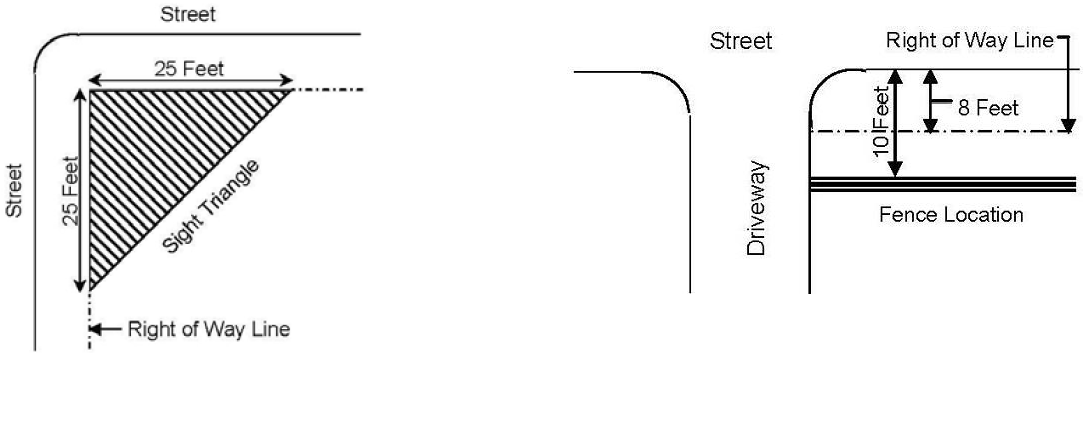
Corner Visibility Driveway Visibility
(b)
Fencing.
(1)
A fence permit is required for all residential fences within the City. A zoning permit is required for all commercial fences within the City. A building permit and other applicable permits will be required in addition to a fence/zoning permit for fences greater than six feet in height. An application for a permit hereunder shall be filed with the City Administrator upon an application form furnished by the City. The permit fee shall be in an amount established in the City fee schedule.
(2)
Fences must be located entirely upon the private property of the person constructing the fence and must be set back from all property boundaries at a distance necessary to allow for maintenance. A fence may be allowed to be located up to the property line, but still entirely upon the property of the person constructing the fence, with the written permission of all adjacent property owners. Property corner irons must be located, exposed, and verified at the time of final inspection, unless deemed unnecessary by the City Administrator.
(3)
Fences must be constructed so that the side containing the framing supports and cross pieces face the interior of the owner's lot.
(4)
No fence shall exceed six feet in height and in the case of grade separation, the height shall be determined on the basis of measurement from the average point between the highest and lowest grade.
(5)
Fencing located in a front yard or in front of the principal dwelling in residential districts may not exceed four feet in height, or three feet as defined under subsection (a) of this section, and must be no greater than 50 percent opacity. A corner property, or property abutting two City streets, shall be determined to have two front yards.
(6)
Barbed wire fences are not allowed and chain link fences must be constructed so that no barbed ends are exposed.
(7)
All in-ground swimming pools must be surrounded by a fence and the pool cannot be filled until a fence that meets requirements is completed and approved.
(8)
No fence may be located within any public rights-of-way.
(9)
Utility and drainage easement, public and private. Fences may be constructed within public and private utility and drainage easement provided that:
a.
The fence and its design are subject to the approval of the City.
b.
The fence shall not impede existing drainage patterns.
c.
Removal of the fence or a portion thereof for the purpose of utilizing the easement shall be at the property owner's expense.
d.
The property owner may be required to obtain the consent of the utility which has facilities within an existing easement.
(c)
Planting strip. In all mixed-use, office, and industrial districts adjacent to residential districts and not divided by streets there shall be provided along the property line a 20-foot-wide planting strip composed of grass, trees, and shrubs. A screening fence may be utilized when approved by the Planning Commission and City Council. The fence shall not exceed eight feet in height nor be less than six feet in height and shall screen no greater than 80 percent opaque.
(d)
Screening. In all light industrial districts, all materials, supplies, merchandise, or other similar materials not on display for direct sale, rental, or lease to the ultimate consumer or user thereof shall be stored within a completely enclosed main building or authorized accessory building or within the confines of an opaque wall or fence not less than six feet high. The storage of the materials in box cars, vans, trucks, trailers, or other similar enclosures is hereby prohibited. The materials shall be stored in a manner which prevent their being deposited on adjacent properties in any manner whatever.
(e)
Landscaping. In all zoning districts the lot area remaining after providing for parking, driveways, loading sidewalks, or other requirements shall be planted and maintained in grass, sodding, shrubs, or other acceptable vegetation of landscaping techniques.
(f)
Exempt. Invisible fences are exempt from requirements except that they may not be placed within public rights-of-way.
(Code 1980, § 18.03; Code 2015, § 153.063; Ord. No. 262, 4-12-2012; Ord. No. 278, 12-8-2014; Ord. No. 339, § 4, 11-24-2025)
Sec. 10-603. - Unplatted property.
(a)
Where land is platted into building lots, no permit shall be issued for any building on the adjoining unplatted land nearer than 75 feet, except by unanimous vote of the Council.
(b)
The open space surrounding any building now existing or hereafter erected shall not be so reduced or diminished, by either enlarging the building or disposing of land, if the resulting clearance or lot area shall become smaller than that required by this article.
(c)
All buildings shall be so placed so that they will not obstruct future streets which may be constructed by the City in conformity with existing streets and according to the systems and standards employed by the City.
(Code 1980, § 18.04; Code 2015, § 153.064)
Sec. 10-604. - Dwelling unit restrictions.
(a)
No basement, except when used as a portion of the living space of the family, cellar, garage, tent, or accessory building shall at any time be used as a residence or dwelling unit, temporarily or permanently. This provision shall not apply to earth sheltered homes or structures.
(b)
No structure of a temporary character, trailer, tent, or shack shall be constructed, placed, or maintained upon the property, except accessory to and during construction of permanent buildings.
(c)
Except in the case of planned unit developments, not more than one principal building shall be located on a lot.
(d)
On a through lot (a lot fronting two parallel streets) or a corner lot, both street lot lines shall be front lot lines for applying yard and parking requirements.
(Code 1980, § 18.05; Code 2015, § 153.065)
Sec. 10-605. - General performance standards.
(a)
All sewage facilities shall be connected to community sewer facilities when available. Where sewers are not constructed or in operation all sewage facilities shall be connected to approved septic tanks and disposal fields. This provision shall not apply to temporary construction sites, or portable units.
(b)
Direct or sky-reflected glare, where from floodlights or from high temperature processes such as combustion or welding, shall not be directed into any adjoining property. The source of lights shall be hooded or controlled in some manner so as not to light adjacent property.
(c)
The emission of smoke by any use shall be in compliance with and regulated by the Minnesota Pollution Control Standards, Minn. R. APC-1-15 and as subsequently expanded, modified, or amended.
(d)
The emission of dust, fly ash, or other particulate matter by any use shall be in compliance with and regulated by the Minnesota Pollution Control Standards, Minn. R. APC-1-15 and as subsequently expanded.
(e)
The emission of odorous matter in the quantity as to be offensive shall not be permitted. The emission of odor by any use shall be in compliance with and regulated by the Minnesota Pollution Control Standards, Minn. R. APC-1-15 and as subsequently expanded.
(f)
All noise shall be muffled so as not to be objectionable due to intermittence, beat frequency, or shrillness and as measured at any property line, and shall not exceed the minimum standards established by the state, Regulations NPC 1, 2, and 4.
(Code 1980, § 18.06; Code 2015, § 153.066; Ord. No. 242, 2-22-2010)
Sec. 10-606. - Height and yard exceptions.
(a)
Chimneys, cooling towers, elevator bulk heads, fire towers, drive-in movie theater screens, grain elevators, silos, equipment houses, stacks, tanks, water towers, pumping towers, radio or television towers, monuments, cupolas, steeples, and mechanical appurtenances pertaining to and necessary to the permitted use of the district in which they are located shall not be included in calculating the height of the principal structure. However, the structures shall be subject to the Minnesota Department of Aeronautics regulations Aero 9 (Criteria for Determining Obstructions to Air Navigation).
(b)
Outside stairways, fire escapes, fire towers, porches, platforms, decks, balconies, boiler flues, and other similar projections shall be considered as part of the building and not allowed as part of the required space for yards, courts, or unoccupied space. However, this provision shall not apply to a fireplace or chimney, not more than eight feet in length and projecting not more than 30 inches into the allowable side yard space. Cornices and eaves may also project into a required open space not more than 30 inches. This shall also not apply to unenclosed porches or other ground level unenclosed projections which may extend into a front or rear yard not more than five feet, or into a side yard not more than three feet.
(Code 1980, § 18.07; Code 2015, § 153.067)
Sec. 10-607. - Nonconforming uses.
(a)
The lawful use of a building or structure existing at the time of the adoption of the ordinance from which this article is derived may be continued although the use does not conform with the district provisions herein.
(b)
A nonconforming use may be extended throughout the building or structure, provided no structural alterations or changes are made therein, except those required by law or code or such as may be required for safety, or such as may be necessary to secure or ensure the continued advantageous use of the building during its natural life.
(c)
(1)
Any nonconformity, including the lawful use or occupation of land or premises existing at the time of the adoption of an additional control under this article, may be continued, including through repair, replacement, restoration, maintenance, or improvement, but not including expansion, unless:
a.
The nonconformity or occupancy is discontinued for a period of more than one year; or
b.
Any nonconforming use is destroyed by fire or other peril to the extent of greater than 50 percent of its market value, and no building permit has been applied for within 180 days of when the property is damaged. In this case, the City may impose reasonable conditions upon a building permit in order to mitigate any newly created impact on adjacent property.
(2)
Any subsequent use of occupancy of the land or premises shall be a conforming use or occupancy. The City may, by ordinance, permit an expansion or impose upon nonconformities reasonable regulations to prevent and abate nuisances and to protect the public health, welfare, or safety. This subsection does not prohibit the City from enforcing an ordinance that applies to adults-only bookstores, adults-only theaters, or similar adults-only businesses, as defined by ordinance.
(3)
Notwithstanding subsection (c)(1) of this section, the City shall regulate the repair, replacement, maintenance, improvement, or expansion of nonconforming uses and structures in floodplain areas to the extent necessary to maintain eligibility in the National Flood Insurance Program and not increase flood damage potential or increase the degree of obstruction to flood flows in the floodway.
(d)
A nonconforming use cannot be changed to a comparable nonconforming use. Whenever a nonconforming use has been changed to a conforming use or to a use permitted in a district of greater restrictions, it shall not thereafter be changed to a nonconforming use of less restricted district.
(e)
In the event that a nonconforming use of any building or building and land is discontinued for a period of two years, the use of the same shall conform thereafter to the uses permitted in the district in which it is located.
(f)
Normal maintenance of a building or other structure containing or related to a lawful nonconforming use is permitted, including necessary nonstructural repairs and incidental alterations which do not extend or intensify the nonconforming use.
(g)
Any proposed structure which will, under this article, become nonconforming but for which a building permit has been lawfully granted prior to the effective date of the ordinance from which this article is derived, may be completed in accordance with the approved plans; provided construction is started within 60 days of the effective date of the ordinance from which this article is derived, is not abandoned for a period of more than 120 days and continues to completion within two years. The structure and use shall thereafter be a legally nonconforming structure and use.
(Code 1980, § 18.08; Code 2015, § 153.068)

