
Maplewood City Zoning Code
ARTICLE I
- IN GENERAL
Sec. 44-1. - Short title.
This chapter shall be known as the Maplewood zoning ordinance. The director of community development shall administer this chapter.
(Code 1982, § 36-1)
Sec. 44-2. - Purposes.
This chapter is enacted to promote the health, safety, morals and general welfare of the inhabitants of the city by:
(1)
Lessening congestion in the streets;
(2)
Securing safety from fire, panic and other dangers;
(3)
Providing adequate light and air;
(4)
Preventing the overcrowding of land;
(5)
Avoiding undue concentration of population;
(6)
Facilitating the adequate provision of transportation, water, sewerage, schools, parks and other public requirements;
(7)
Conserving the value of properties; and
(8)
Encouraging the most appropriate use of land.
(Code 1982, § 36-2)
Sec. 44-3. - Scope; applicability to nonconforming structures or uses.
The use of all land and every building or portion of a building erected, altered with respect to height and area, added to, or relocated and every use within a building or use accessory thereto in the city shall be in conformity with this chapter. Any use or building which was legal and in compliance with all provisions of this chapter at the time of establishment or construction, but which became noncompliant with one or more provision(s) upon the subsequent adoption or amendment of this chapter, shall be regarded as nonconforming and subject to the regulations set forth in section 44-12.
(Code 1982, § 36-3; Ord. No. 1043, § I, 12-11-2023)
Sec. 44-4. - Interpretation; conflicts.
The sections of this chapter shall be interpreted to provide the minimum requirements for the public health, safety, comfort, convenience and general welfare. Where any section of this chapter conflicts with any other, the most restrictive requirements shall apply.
(Code 1982, § 36-4)
Sec. 44-5. - Rules of construction.
Unless otherwise expressly stated, the following words and phrases shall be construed throughout this chapter to have the meaning indicated:
(1)
The term "used" shall include the term "arranged," "designed," or "intended to be used."
(2)
The term "building" shall include the term "structure." In residential districts the terms "building" and "structure" shall exclude citizen band radio towers, amateur radio towers, television antennas and flagpoles.
(Code 1982, § 36-5)
Sec. 44-6. - Definitions.
The following words, terms and phrases, when used in this chapter, shall have the meanings ascribed to them in this section, except where the context clearly indicates a different meaning:
Accessory building means a building subordinate to the main building on a lot and used for purposes customarily incidental to those of the main building.
Accessory use means a use subordinate to the primary use of land or a building on a lot and customarily incidental thereto.
Adult day or child care center means a non-residential facility licensed under Minnesota Rules 9503, where the operator is providing care for less than 24 hours at a time. This term includes a day program, drop-in child care program, a night care program, and a school age program. This term also includes a child care center that is accessory to another use and that is intended for use by the employees of the principal uses and their immediate family for more than three hours of care and supervision a day. This term does not include programs operated by a public school for children 33 months or older.
Animal means any animate being, except a human being, which is endowed with the power of voluntary motion, including but not limited to fish, birds, mammals, reptiles and insects.
Animal boarding, shelter, or daycare center means any structure or premises on which more than three dogs or cats over six months of age are temporarily or permanently boarded, including animal daycare/spa/grooming facilities. A portion of the site may be used for associated retail.
Animal veterinary clinic means a facility for the diagnosis, treatment, or hospitalization of small animals, including dogs, cats, rabbits, hamsters, and other animals of a similar nature. The facility may also provide boarding for animals as part of medical services.
Aquaculture means the farming of aquatic organisms such as fish, crustaceans, and mollusks. It involves cultivating freshwater and saltwater aquatic populations under controlled conditions for the production and sale of fish.
Aquaponics means a closed-loop system between plants and fish. It involves cultivating fish and plants in a symbiotic environment for the production and sale of fish and produce.
Assisted living facility means a residential facility licensed by the state which provides services on a regular basis, such as personal services, 24-hour supervision, social activities, and health-related care and services, to individuals who require the assistance, but who do not require the degree of care and treatment that a hospital or skilled nursing facility provides.
Basic structural alteration means any enlargement of a building, whether by extending on any side or by increasing in height, or the moving of a building from one location to another.
Bed and breakfast means transient lodging establishment located in a single-family dwelling unit or other approved building in which guestrooms are rented on a nightly basis for periods of less than a week and where at least one meal is offered in connection with the provision of sleeping accommodations only.
Boardinghouse or lodging house means a building, other than a motel or hotel, where lodging and meals are provided for compensation and by prearrangement for definite periods of not less than 30 consecutive calendar days for three or more persons, but not to exceed 20 persons.
Brewery means a facility that produces beer, ale or other beverages made from malt by fermentation and containing not less than one-half of one percent alcohol by volume.
Building area means the area of a lot that is covered by buildings or as part of a building extended over the lot. Building area shall not include cornices, eaves, gutters, unenclosed decks or patios, or buildings with 120 square feet or less of area.
Building line means the line parallel to the street line at a distance therefrom equal to the depth of the front yard required for the district in which the lot is located. For a lot fronting on a public water, the building line shall include a line parallel to the ordinary high-water level at the required setback therefrom.
Cannabis business has the same meaning as in Minn. Stats. § 342.01, subd. 14.
Cannabis cultivation means a cannabis business with a license or endorsement to grow cannabis plants within the approved amount of space from seed or immature plant to mature plant, harvest cannabis flower from mature plant, package and label immature plants and seedlings and cannabis flower for sale to other cannabis businesses, transport cannabis flower to a cannabis manufacturer located on the same premises, and perform other actions approved by the office.
Cannabis delivery business means a cannabis business with a license or endorsement to purchase cannabis, cannabis products, and hemp products from retailers or cannabis business with retail endorsements for delivery to customers.
Cannabis manufacturing means a cannabis business with a license or endorsement to manufacture cannabis products with processes that involve the compounding, processing, packaging, wholesaling, testing, or treatment of cannabis products.
Cannabis retailer means any person, partnership, firm, corporation, or association, foreign or domestic, with a license or endorsement to sell cannabis product to a consumer.
Cannabis transportation business means a cannabis business with a license or endorsement to transport immature cannabis plants and seedlings, cannabis, cannabis products, and hemp products to and from licensed cannabis businesses.
Cemetery, crematory, or mausoleum means land used or intended to be used exclusively for the burial of the human dead and dedicated for cemetery purposes, including, mausoleums, if operated in connection with and within the boundaries of such cemetery.
Clinic, medical, dental, or health related means any entity that is not a hospital or residence that is used primarily for the provision of outpatient nursing, medical, podiatric, dental, chiropractic, optometric or mental health care and treatment or an entity which is required to be certified under the Department of Health Services in order to receive reimbursement for outpatient health services to clients.
Club, lodge or hall means a nonprofit association of persons who are bona fide members, paying regular dues, and are organized for some common purpose, but not including a group organized solely or primarily to render a service customarily carried on as a commercial enterprise.
Commercial equipment means equipment not normally associated with residential uses or purposes, including but not limited to cement mixers, snowplows, wood chippers, stump grinders, earth-moving equipment or heavy-duty compressors.
Commercial use means a principal use of land or buildings for the sale, lease, rental or trade of products, goods or services.
Community or market garden means a cultivated spaces typically gardened and managed by one or more persons, either on undeveloped lots or on leased lands for private consumption or retail sale.
Conditional use means a land use or development that would not be appropriate generally, but may be allowed with appropriate conditions or restrictions as provided by official controls.
Contractor shop and yard means an establishment and its associated yard used for the repair, maintenance, or storage of a contractor's vehicles, equipment, and materials. It may include the contractor's business office. Contractors include, but are not limited to, plumbing, heating, air conditioning, painting, roofing, carpentry, blacksmith, soldering or welding, electrical, and ventilation.
Continuing care facility means a residential facility or complex which provides a variety of senior living choices, from independent living to long-term care, with a goal of helping residents to age in place.
Covered structure means a structure with a roof.
Day care, family means a dwelling unit where a resident of the dwelling is providing care under Minnesota Rule 9502.
Deck means a horizontal, unenclosed platform with or without attached railings, seats, trellises or other features that are attached or functionally related to a principal use.
Direct to consumer sales means the sale of agricultural products or prepared foods directly from farmers or vendors to consumers including, but not limited to, community supported agriculture, farm stands, farmer's markets.
Dispenser means a device designed to dispense motor fuel which contains the hose nozzle and meter.
Disposal facility means a waste facility permitted by the state pollution control agency for the disposal of waste. A disposal facility shall also include any appurtenant facilities needed to process waste for disposal or transfer to another waste facility.
Distillery means facility that produces ethyl alcohol, hydrated oxide of ethyl, sprits of wine, whiskey, rum, brandy, gin, or other distilled spirits, including all dilutions and mixtures thereof for non-industrial use.
Drive-up food or beverage window, drive through sales and service means an opening in the wall of a building or restaurant designed and intended to be used to provide food and/or beverage sales and/or food and/or beverage service to patrons who remain in their vehicles AND An opening in the wall of a building designed and intended to be used to provide sales and/or service to patrons who remain in their vehicles.
Dwelling, apartment means a building on a lot with side-by-side or stacked dwelling units that typically share a common entrance.
Dwelling, apartment mixed use means a dwelling unit that is within a building that also contains a non-residential use permitted in that district.
Dwelling, double (duplex) means a building on a lot designed and occupied exclusively as a residence for two families.
Dwelling, multiple means a building on a lot, designed exclusively as a residence for three or more families.
Dwelling, single-unit means a detached building on a lot, designed exclusively as a residence for one family.
Dwelling site means a designated location for residential use, including temporary or moveable shelter, such as camping and recreational vehicle sites.
Dwelling, townhouse means a residence for one family that is attached to at least two other residences, each with a private outside entrance and with no one unit or major portion thereof directly above or below the other units
Exterior sale of goods means exterior storage, display, sale, or distribution of goods or materials, but not including a junkyard, salvage automobile, or other wrecking yard, and direct to consumer sales.
Family means one of the following, living together as a single housekeeping unit:
(1)
An individual or a group of persons not to exceed five, who are not related by blood, marriage, foster children, or adoption;
(2)
Two persons related by blood, marriage, foster children, or adoption and not more than three unrelated persons; or
(3)
Three or more persons related by blood, marriage, foster children, or adoption and not more than two unrelated persons.
Farm building means any building used for storing agricultural equipment or farm produce, housing livestock or poultry, and poultry processing, including egg handling, and processing dairy products. The term "farm building" shall not include dwellings.
Financial institution means an establishment where the principal business is the receipt, disbursement, or exchange of funds and currencies, such as banks or credit unions.
Foundation area means the gross horizontal area of the building foundation, including a tuck-under garage, measured from the exterior side of a frost wall or basement wall.
Front line of the dwelling means the longer side of a building that faces a street. If the front wall has an angle, the longest section shall be the front line. The length of parallel sections shall be added together to determine the longest section. On an interior lot, the director of community development may consider the short side of the building to be the front. The director shall base this decision on the design of the house.
Front lot line means the lot line that abuts a street right-of-way line. On a corner lot, the front lot line shall be the line that is most parallel to the front line of the dwelling. If the city determines that the dwelling has no front line or that the line is equally parallel to both lot lines, the property owner shall choose a front lot line.
Front yard setback means the distance between any part of a structure and a street right-of-way line. A corner lot shall have a front yard setback on each street frontage. The front yard setback shall not include eaves, gutters, cornices or chimneys that project no more than two feet into the yard. The front yard setback shall also not include sidewalks, steps, ramps or at-grade patios that have no walls, solid fence or roof.
Funeral home or mortuary means an establishment providing services such as preparing the deceased for burial or cremation and arranging and managing funerals. The facility may include a chapel for the conduct of funeral services and spaces for funeral services and informal gatherings.
Grade means as defined by the Uniform Building Code.
Green space means the area(s) of the site which is not covered by paved surfaces, the principal structure, any accessory structures, and other structures like decks, pools, pergolas, etc. Green space can include landscaping, planting beds, fencing, retaining walls, and similar improvements.
Habitable floor area means residential floor area that meets the Uniform Building Code requirements for ceiling height, light and ventilation.
Health/sports club means an establishment exceeding 20,000 square feet in size which provides physical fitness facilities and services to the public for a fee, including but not limited to; game courts, exercise equipment, exercise areas, running tracks, swimming pools, physical fitness maintenance and weight control services and instructors, locker rooms, saunas and associated retail shop intended for members of the club only.
Heavy commercial vehicle means a vehicle, including trailers, with more than a one-ton nominal rated carrying capacity, including but not limited to the following:
(1)
Tractor trucks, wreckers, backhoes or dump trucks; vehicles and equipment designed or modified for use in any construction, demolition, maintenance or delivery activity; semitrailers; garbage trucks; tank trucks; flatbed trucks; boom or bucket trucks; cattle trucks; trucks carrying or designed to carry explosive or flammable materials, well-drilling equipment, earth-moving equipment; vehicles and equipment used for maintenance, repair, construction or delivery on the premises may be parked at or on the property during the period of work.
(2)
Tractors (road or farm) other than those intended for residential purposes or uses.
(3)
All trailers or towed equipment with a capacity greater than one ton or a gross vehicle weight rating of more than 12,000 pounds.
(4)
All trucks, truck tractors, tractors, semitrailers, vans, or pickup trucks as defined that have a capacity greater than one ton or a gross vehicle weight or maximum gross vehicle weight of more than 12,000 pounds.
(5)
Step vans designed or modified for the transportation of cargo, freight, construction machinery, equipment, materials or implements.
This definition does not include the resident's recreational vehicles.
Height of building means the vertical distance of a building measured from the mean grade level directly in front of the building to the midpoint of a pitched roof and the top of a flat roof. The height of a building shall not include chimneys, spires, towers, rooftop mechanical equipment, elevator penthouses, or similar building projections.
Helistop means a place for one helicopter to land or take off, but does not include fueling or maintenance operations or facilities.
Home garden means a garden within a residential property.
Home occupation means any gainful occupation engaged in by an occupant of a dwelling unit where the occupation is secondary to the main use of the premises as a residence. Such occupation may be conducted within a dwelling unit or accessory structure.
Hotel means a building containing six or more guest rooms in which temporary lodging is offered to guests for compensation, and in which access to and from each room or unit is through interior lobbies, courts, or halls. Additional services such as restaurants, meeting rooms, entertainment, and recreational facilities may also be provided.
Indoor theater means an establishment that has an audience viewing hall or room and a permanent stage for the presentation of live performances by live actors to a live audience in a theater setting. Theaters may include but are not limited to live performances of music, dance, plays and orations. Also includes movie theaters.
Industrial use means the use of land or buildings to produce, manufacture, store or transfer goods, products, commodities or other times.
Livestock raising and handling include horses, cattle, mules, asses, goats, sheep, swine, buffalo, llamas, ostriches, reptiles, genetic hybrids of the foregoing, and other living animals usually kept for agriculture, husbandry, or the production of edible or salable byproducts. this definition shall be expressly construed as having no application to the ownership or disposition of poultry.
Live-work unit means a dwelling unit in combination with a shop, office, studio or other workspace within the same unit, where the resident occupant both lives and works.
Long-term or transitional care facility means a facility that provides meals, lodging, and nursing care to two or more individuals due to illness, age, or infirmity. Long-term care facilities include skilled nursing facilities such as nursing homes, rest homes, boarding care homes, convalescent care, and other transitional care facilities.
Lot means a parcel of land described separately from other parcels of land by a plat, metes and bounds, registered land survey, auditor's plat or other accepted means. The county must record the lot description.
Lot area means the area of a lot, excluding drainage easements, wetlands and land below the ordinary high-water mark of public waters.
Lot of record means any legal parcel of land which is or can be taxed by the county as a separate parcel, without the need for lot division approval by the city.
Lot width means the distance at the building line between side property lines for interior lots and between a side property line and the opposite street right-of-way for corner lots.
Manufactured home means a structure, transportable in one or more sections, which, in the traveling mode, is eight body feet or more in width or 40 body feet or more in length, or, when erected, on site, is 320 or more square feet, and which is built on a permanent chassis and designed to be used as a dwelling with or without a permanent foundation when connected to the required utilities, and includes the plumbing, heating, air conditioning, and electrical systems contained in it, and which complies with the manufactured home building code in Minn. Stat. § 327.31, subd. 6.
Manufactured home park means a parcel of land under single control or ownership which has been developed for the placement of manufactured homes for residential use.
Manufacturing, heavy means an establishment or use of land that manufactures, assembles, or fabricates using processes that generally create odor, noise, vibration, illumination or particulates that may impact surrounding properties. This category shall also include any use of land that needs large outdoor structures or storage that cannot be incorporated into the building. Examples include, but are not limited to the following: large-scale food and bottling operations; lumber, milling and planning facilities; grain milling; gas manufacture, aggregate, concrete, and asphalt plants; foundries, forge shops, and other intensive metal fabrication; and chemical manufacturing.
Manufacturing, light means an establishment or use of land for the assembly or processing of previously processed components or manufactured parts using processes that do not create significant amounts of noise, vibration, illumination, or particulates that may impact surrounding properties. Odors produced on-site shall not negatively affect other businesses or properties in the area. Examples include but are not limited to the following: food; pharmaceuticals; clothes; furniture (where wood is milled off-site); hardware; toys; light sheet metal products; mechanical components; musical instruments; printing; small vehicle assembly; custom shop for making articles or products sold on the premises; and computer software. This shall not include the assembly or processing of fish associated with aquaponics or aquaculture operations.
Market value means the taxable market value as determined by the county assessor's office.
Medical and dental laboratories, not including the manufacture of pharmaceutical or other products for general sales and distribution means a facility involved in scientific research, investigation, testing, or experimentation, but not including manufacture or sale of products, except as incidental to the main purpose of the laboratory.
Micro-unit means a mobile residential dwelling, providing permanent housing within a sacred community that meets the requirements of Minn. Stats. § 327.30.
Mining means the surface or subsurface removal of sand, gravel, rock, industrial minerals, other nonmetallic minerals and peat not regulated under state law.
Motel means a building or group of buildings containing six or more guest rooms in which temporary lodging is offered to guests for compensation, and in which access to and from each room or unit is through an exterior door.
Motor vehicle accessory installation center means a place to install equipment sold on the premises in a motor vehicle.
Motor vehicle maintenance garage means a building for the maintenance or repair of motor vehicles. This definition does not include a motor vehicle accessory installation center or motor vehicle wash.
Motor vehicle major motor fuel station means a retail business engaged in the sale of motor vehicle fuels that has more than three dispensers.
Motor vehicle minor motor fuel station means a retail business engaged in the sale of motor vehicle fuels with a maximum of three dispensers. Fuel dispensers shall be designed to serve only two cars at once.
Motor vehicle wash means a building for washing motor vehicles. This definition does not include the occasional handwashing of vehicles stored in a parking garage.
Nonconforming building or use means a building or a use of land or of a building, existing at the effective date of any section of this chapter, which does not conform with the requirements of such section of this chapter, or a use authorized under article V of this chapter.
On-sale liquor is the sale of alcoholic beverages for consumption on the licensed premises only.
Open space and parks mean properties that are publicly owned which are used or planned as open space or park lands.
Personal service means establishments primarily engaged in providing individual services generally related to personal needs; examples include, but are not limited to: barber and beauty shops, dry cleaning or laundry pick up station, laundromats, permanent make-up studios, tailors, tattoo shops, salons, and photography studio.
Place of amusement, recreation or assembly, other than an indoor theater, indoor athletic activity or itinerant carnival facility operated as a business and which are open to the public for a fee that shall include, but is not limited to, billiard parlors, skating rinks, indoor swimming pools, bowling alleys, arcades, tennis courts, and other similar businesses. Such businesses may also provide a snack bar, alcoholic and non-alcoholic beverage sales, restaurant, retails sales of related items, and other support facilities.
Planned unit developments (PUD) means a type of development characterized by a unified site design, with often two or more principal uses or structures. A PUD may include townhouses, apartments, multiple-use structures such as an apartment with commercial shops, or similar projects. Residential PUDs must have at least five dwelling units or dwelling sites and may include single-dwelling homes. The PUD application, timing and recording process is described under article VII, Rezoning to a planned unit development.
Poultry means domesticated birds in the order of Galliformes (excluding the genus Meleagris) that serve as a source of eggs or meat.
Predominant setback means the setback of the majority of the dwellings on the same side of the same street and within 350 feet of the lot to be built on.
Premises means a tract of land, including any buildings thereon.
Private garage means an accessory building designed or used for the shelter or storage of motor vehicles.
Public parks and playgrounds mean properties that are publicly owned which are used or planned as open space or park lands.
Publishing or printing establishment means a business engaging in the reproduction of written or graphic materials through processes that include the use of volatile organic compounds which are subject to federal or state air emissions regulations.
Rear lot line means the lot line that is opposite and most parallel to the front lot line.
Rear yard setback means the distance between any part of a structure and the rear property line. The rear yard shall not include eaves, gutters, cornices, steps, ramps or chimneys that project no more than two feet into the yard.
Recyclable materials means materials that can be processed for reuse. Such materials include paper, glass, metals, automobile oil, batteries, yard waste, garbage, refuse, water-treatment-plant sludge, concrete or asphalt. Recyclable materials do not include hazardous waste, except when part of an approved household hazardous waste program, animal waste or sewage sludge.
Recycling facility means a place for the collection or processing of recyclable materials brought from another site. A recycling facility shall not include a disposal facility, junkyard or any yard for the storage or disposal of vehicle parts. A recycling facility shall also not include the incidental collection of recyclable materials within a building, the temporary collection of newspapers or cans for fundraising, or reverse vending machines.
Religious institutions means a church, synagogue, mosque, or other religious organization organized under Minn. Stats. Chapter 315.
Residential care, licensed in-home means an in-home residential facility licensed by the state under 144D which provides primarily nonmedical care to individuals who are in need of personal assistance to manage the activities of daily life or for the protection of the individual.
Residential lot line means the lot line of any property with a residential building on it or any property that the city is planning for residential use on its land use plan.
Residential planned unit development means a residential use that is nontransient, and the primary focus of the development is not service oriented. For example, residential apartments, manufactured home parks, residential condominiums, townhouses, cooperatives, single-dwelling homes and multiple dwellings would meet this definition.
Restaurant means an establishment, where food and drink are prepared and served for human consumption, principally within the establishment or for take-out to be consumed off-premises. This does include drive-in restaurant. A restaurant can include a brewpub where beer brewed on premises is sold in addition to food.
Retail means establishments engaged in selling goods or merchandise to the general public for personal or household consumption and rendering services incidental to the sale of the goods; examples include, but are not limited to: grocery, liquor, department, variety, clothing, furniture, antique, gift, drug, hardware, and book stores, news shops, photocopying establishments, flower shops, consignment shops and show rooms for retail. Incidental repair of items sold may be provided on site. Pawn shops and auction halls are not considered general retail.
Retail or commercial rental activities means rental of commercial equipment, including but not limited to scaffolding, skid loaders, party tents, and fork lifts.
Road tractor means any motor vehicle designed or used for drawing other vehicles but having no provision for carrying loads independently or any part of the weight of the load it is drawing.
Roominghouse means any single housekeeping unit in which space is rented, less meals, to persons unrelated to the resident manager or property owner, in excess of the definition of family, as defined in this section.
Sacred community means a residential settlement established on or contiguous to the grounds of a religious institution's primary worship location primarily for the purpose of providing permanent housing for chronically homeless persons, extremely low-income persons, and designated volunteers that meet the requirements of Minn. Stats. § 327.30.
Sale or leasing of new or used motor vehicles means an open area, other than a street, used for the display, sale or rental of new or used motor vehicles in operable condition and where no repair work is done.
Scrap, salvage, or junk yard means any area, lot, land, parcel, building or structure, or part thereof, used for the storage, collection, processing, purchase, sale, salvage or disposal of scrap, waste, reclaimable material or debris.
Semipublic use means the use of land by a private, nonprofit organization to provide a public service that is ordinarily open to persons outside the regular constituency of the organization.
Semitrailer means a vehicle of the trailer type so designed and used in conjunction with a truck tractor that a considerable part of its own weight or that of its load rests upon and is carried by the truck tractor and includes a trailer drawn by a truck tractor semitrailer combination.
Setback means the minimum horizontal distance between any part of a structure, sewage treatment system or other facility and an ordinary high-water level, sewage treatment system, top of a bluff, property line or another structure. Setbacks shall not include eaves, gutters, cornices, steps, chimneys or fireplaces projecting not more than two feet from the principal structure.
Sewage treatment system means a septic tank and soil absorption system or other individual or cluster-type sewage treatment system.
Shoreland planned unit development means a planned unit development (PUD) located within the shoreland overlay district. The shoreland PUD is processed as a conditional use permit, as described under article IX, Shoreland Overlay District, and in compliance with Minn. Rules 6120.3800 as may be amended.
Side lot line means the lot lines that connect the front and rear lot lines.
Side yard setback means the distance between any part of a structure and the side property line. The side yard shall not include eaves, gutters, cornices, steps, ramps or chimneys that project no more than two feet into the yard.
Signs mean any letter, word or symbol, device, poster, picture, statuary, reading matter, or representation in the nature of an advertisement, announcement, message or visual constructed, which is displayed to direct the attention of the public for informative or communicative purposes. Such communication located completely within an enclosed building and not exposed to view from a street shall not be considered a sign.
Specialty food or coffee shop means an establishment whose primary business is the sale of a single specialty type of food or beverage that is not considered a complete meal (e.g., candy, coffee, ice cream) for consumption on or off premises. The sale of other food, beverages, or merchandise is incidental to the sale of the specialty food or beverage.
Street line means the dividing line between a lot and the outside boundary of a public street, road or highway legally open or officially plotted by the city, or between a lot and a private street, road or way over which the owners or tenants of two or more lots held in single or separate ownership have the right-of-way.
Structure means any building or appurtenance constructed or built on the ground or attached to the ground. This does not include aerial or underground utility lines, such as sewer, electric, telephone, telegraph, gas lines, towers, poles or other supporting facilities.
Studio or makerspace means an establishment engaged in the sale, loan, or display of visual works of art. Makerspace is defined as an establishment where hand tools, mechanical tools and electronic tools are shared or individually used for the manufacture of artisan finished products or parts including design, processing, fabrication, assembly, treatment, and packaging of products; as well as the incidental storage, sales and distribution of such products. Typical artisan manufacturing uses include, but are not limited to: electronic goods; food and bakery products in a commercial kitchen; non-alcoholic beverages; printmaking; household appliances; leather products; jewelry and clothing/apparel; metal work; furniture; glass or ceramic production; and paper manufacturing.
Storage and sale of machinery and equipment means the storage and sale of machinery and equipment, including but not limited to trailers, motorcycles, boats, and farm implements.
Storage facility, personal means a building or group of buildings consisting of individual, self-contained units leased to individuals, organizations, or businesses for self-service storage of personal property.
Storage yard means any lot used for the purposes of keeping, in an unroofed area, of any goods, material, merchandise, or vehicles in the same place for more than 24 hours.
Subdivision means the separation of an area, parcel or tract of land into two or more parcels, tracts, lots or long-term leasehold interests for sale, rent or lease.
Supportive commercial uses mean commercial uses that provide services to the primary use, including incidental services, such as restaurants, pharmacies and retail sales which serve primarily the occupants and patrons of the permitted office use, when conducted within the same building.
Trailer means any vehicle designed for carrying property or passengers on its own structure and for being drawn by a motor vehicle, but does not include a trailer drawn by a truck tractor semitrailer combination, or an auxiliary axle on a motor vehicle which carries a portion of the weight of the motor vehicle to which it is attached.
Truck means any motor vehicle designed, used or maintained primarily for the transportation of property or for carrying property other than passengers, except pickup trucks and vans.
Truck tractor means one of the following:
(1)
a motor vehicle designed and used primarily for drawing other vehicles and not constructed to carry a load other than a part of the weight of the vehicle and load drawn; or
(2)
a motor vehicle designed and used primarily for drawing other vehicles used exclusively for transporting motor vehicles or boats and capable of carrying motor vehicles or boats on its own structure.
Trucking yard or terminal means a facility for semitrucks and freight to be temporarily parked or stored (two weeks or less) and transferred from one vehicle or company to another.
Urban farms means large-scale gardening in an urban environment for training or production.
Variance means the same as defined in Minn. Stats. ch. 462.
Vehicle means a device for carrying or conveying persons or property that may be self-propelled or may be propelled, drawn or towed by a self-propelled vehicle.
Warehouse & distribution facility means storage of goods or materials within an enclosed building including packing and crating.
Winery means a processing facility used for the fermenting and processing of fruit juice into wine; or the refermenting of still wine into sparkling wine.
Wholesale business establishments means the selling of goods, equipment and materials by bulk to another business that in turn sells to the final customer.
Yard, front, means the required open space, extending along the street line throughout the full width of the lot, exclusive of overhanging eaves, gutters, cornices, steps and chimneys projecting not more than 18 inches.
Yard, side, means the required open space, extending along the sideline throughout the full depth of the lot, exclusive of overhanging eaves, gutters, cornices, steps and chimneys projecting not more than 18 inches.
(Code 1982, § 36-6; Ord. No. 790, § 1, 5-11-1998; Ord. No. 791, § 1, 8-24-1998; Ord. No. 792, § 1, 11-23-1998; Ord. No. 813, § 2, 5-14-2001; Ord. No. 847, § II, 2-23-2004; Ord. No. 867, § 1, 3-27-2006; Ord. No. 900, § 2, 4-12-2010; Ord. No. 911, § 1, 1-10-2011; Ord. No. 913, § 1, 7-11-2011; Ord. No. 979, § 1, 6-11-2018; Ord. No. 981, § 1, 6-11-2018; Ord. No. 982, § 2, 6-11-2018; Ord. No. 983, § 1, 6-11-2018; Ord. No. 984, § 1, 6-11-2018; Ord. No. 985, § 1, 6-11-2018; Ord. No. 1014, § I, 9-14-2020; Ord. No. 1043, § III, 12-11-2023; Ord. No. 1050, § III, 12- 9-2024)
Cross reference— Definitions generally, § 1-2.
Sec. 44-7. - Remedies cumulative; injunctive relief available.
If any building or structure is erected, constructed, reconstructed, altered, repaired, converted, or maintained or any building, structure or land is used in violation of this chapter or any regulations made pursuant to this chapter, the proper city authorities, in addition to other remedies, may institute any appropriate action or proceedings to prevent such unlawful erection, construction, reconstruction, alteration, repair, conversion, maintenance or use to:
(1)
Restrain, correct or abate such violation;
(2)
Prevent the occupancy of the building, structures or land; or
(3)
Prevent any illegal act, conduct, business, or use in or about such premises.
(Code 1982, § 36-7)
Sec. 44-8. - Violations.
Any person violating a section of this chapter, including violations of conditions established concerning variances or conditional use permits, shall be guilty of a misdemeanor and, upon conviction, shall be punished in accordance with section 1-15. Violations of this chapter can occur whether the city or state requires a permit for a regulated activity. Each day that any violation continues shall constitute a separate violation.
(Code 1982, § 36-8)
Sec. 44-9. - Zoning districts.
(a)
The city is hereby divided into the following zoning districts:
(b)
In addition to the above, the city is divided into the following planned unit development (PUD) districts:
(Code 1982, § 36-9; Ord. No. 840, § 1, 8-25-2003; Ord. No. 890, § 1, 2-23-2009; Ord. No. 911, § 2, 1-10-2011; Ord. No. 1014, § I, 9-14-2020)
Sec. 44-10. - Zoning map.
(a)
Generally. The boundaries of the districts designated in section 44-9 will be shown on a map, and the map is hereby made part of this chapter, which map shall be known as the zoning map of the City of Maplewood. The map shall include any zoning changes recommended by the planning commission and adopted by the city council. The planning commission shall hold a public hearing to consider all zoning map changes and shall make a recommendation about such changes to the city council. The city shall notify all property owners within 500 feet of the proposed zoning map change about the public hearing and shall publish a public hearing notice in the official newspaper at least ten days before the public hearing. All interested persons shall be heard at the hearing or any adjournment thereof. After the hearing, the planning commission shall forward a recommendation to the city council. The city council shall adopt the zoning map and any changes to it; and all notations, references and data shown thereon are hereby incorporated by reference into this chapter and shall be as much a part of this chapter as if all were fully described. The map shall be kept up to date as provided in subsection (c) of this section.
(b)
Adoption. The boundaries of the zoning districts shall be shown on a map, and the map is hereby made part of this chapter. This map shall be known as the official Maplewood zoning map. Changes on the map shall be made within 30 days after the effective date of an amendment approved by the city council. The map shall be kept in the office of the director of community development for public display.
(c)
Maintenance, availability for public inspection. The zoning map shall be kept up to date at all times by the city engineer and shall be available for public inspection at the office of the city clerk at all times.
(d)
Locations of district boundaries. The boundaries between districts on the city zoning map are, unless otherwise indicated, either the centerlines of streets or railroad rights-of-way or such lines extended or lines parallel or perpendicular thereto. Where figures are shown on the zoning map between a street and a district boundary line, they indicate that the district boundary line runs parallel to the street line at a distance therefrom equivalent to the number of feet so indicated, unless otherwise indicated.
(Code 1982, §§ 36-10—36-13; Ord. No. 848, § 4, 7-12-2004)
Sec. 44-11. - OL overlay districts.
(a)
Purpose and intent. The purpose of the OL overlay district is to provide a method whereby the individual characteristics and development needs of specific geographic areas or neighborhoods can be incorporated within a set of zoning regulations which will accommodate the following:
(1)
Match the zoning regulations with the specific needs and problems of the particular area or neighborhood;
(2)
Permit the continuation of existing, underlying, basic zoning districts and their control and distribution of land use;
(3)
Avoid distortion of underlying basic zoning districts through attempts to provide for many individual area or neighborhood requirements; and
(4)
Avoid an undesirable proliferation of zoning districts or subdistricts in order to provide for area or neighborhood differences.
(b)
Establishment; applicability. Procedures for the establishment of OL overlay districts and the applicability of the district are as follows:
(1)
OL districts may be established only in conjunction with other districts. An OL designation shall be combined with whatever other district designation is applicable to the area in which an OL district is established.
(2)
This section shall apply in an OL district, which district shall also be subject to other sections of this chapter, including the sections applicable to the particular district to which the OL district designation is added and combined. However, where conflict between regulations occurs, the regulations specified in this section or in the specific overlay district shall prevail.
(3)
Whenever an OL district is established, any subsequent application to change the district with which the OL district is combined shall not be construed to be an application to eliminate the OL district for the area covered by the application, unless such intent is expressly stated in the application.
(4)
Establishment of and any subsequent modification of the boundaries of any OL district shall be by ordinance amending the zoning map of the city. Such amendment shall comply with the requirements of article VII of this chapter.
(c)
District regulations. In any OL district parcel criteria, property development and use regulations may be established in accordance with the objectives identified in the district's individual purpose and intent. Such regulations shall be structured to implement the purpose and intent of the individual district and shall be applied uniformly to all properties within the district.
(Code 1982, §§ 36-14—36-16)
Sec. 44-12. - Nonconformities
(1)
The purpose of this section is to establish regulations for nonconforming lots, buildings, and uses. It is the intent of this section that all nonconformities shall eventually be brought into conformity.
(2)
Any lawful use, substandard lot, or building existing at the effective date of any section of this chapter may be continued at the size and in the existing manner of operation, as specified in this section.
(3)
Nonconforming uses.
a.
If a nonconforming use of a building or land is voluntarily abandoned and ceases for a continuous period of one year or more, subsequent use of such building or land shall be in conformity with this chapter.
b.
Whenever a nonconforming use of a building or land has been changed to a conforming use, such use shall not thereafter be changed to a nonconforming use.
c.
No nonconforming use shall be extended to displace a conforming use.
d.
The city council may permit, through the issuance of a conditional use permit, as provided in article V of this chapter, the extension of a nonconforming use throughout those parts of a building which were manifestly designed or arranged for such use prior to the date when such use of such building became nonconforming, if no structural alteration, except those required by law, are made.
e.
The substitution of one nonconforming use for another nonconforming use may be permitted by the city council by conditional use permit, as provided in article V of this chapter, provided that such nonconforming use is determined by the city council to be of the same or more restrictive nature as the original nonconforming use. Whenever a nonconforming use of a building or land has been changed to a use of a more restrictive classification or to a conforming use, such use shall not thereafter be changed to a use of a less restricted classification.
(4)
Nonconforming building or structures.
a.
Unless otherwise allowed by this section, normal maintenance and alterations of a nonconforming building or structure is only permitted as long as the there is no expansion to the foundation and/or building volume; the building capacity is not increased; and the nonconformity of the use is not increased. Alterations to improve the livability of nonconforming residential units is allowed provided that it does not increase the number of dwelling units, size of building, or volume of building.
b.
No nonconforming building or structure shall be moved to any other part of the parcel or to another lot unless the movement shall bring the nonconforming building or structure into compliance with the requirements of this chapter.
c.
If a nonconforming building, structure, or use is destroyed by fire or other peril to the extent of greater than 50 percent of its market value and no building permit has been applied for within 180 days from the date the building or structure was damaged, subsequent use of such building or land shall be brought into conformity with the chapter. The city may impose reasonable conditions upon a building permit sought in order to maintain a damaged nonconforming building, structure, or use in order to mitigate any newly created impact upon adjacent property.
d.
A property owner or developer may expand a nonconforming structure or parking lot if the structure or parking lot meets the following conditions:
i.
The zoning regulations permit the use.
ii.
The expansion would meet the minimum setbacks required by this chapter or the setbacks of the existing structure, whichever is less. The expansion shall not exceed the maximum height required by this chapter or the existing height, whichever is taller. To deviate from these requirements, the city may approve a conditional use permit, subject to the standards in this Code.
iii.
The minimum setback from the ordinary high-water level in a shoreland district would be at least the average setback of adjacent residential structures or 50 feet, whichever is greater.
iv.
All portions of the structure would be on the applicant's property.
v.
Runoff from the overhang of the addition would not adversely affect an adjacent property.
(5)
Nonconforming lots.
a.
The city shall allow construction on nonconforming lots that do not meet the size, width, frontage, or depth standards if the lots meet the following requirements:
i.
Since becoming substandard, the lots have always been in separate ownership from abutting lands.
ii.
The lots were of record in the county recorder's office on the effective date of the ordinance from which this section derives.
iii.
There is no evidence that the lots did not meet the official controls in effect when the city approved the lots.
iv.
Any sewage treatment system meets the requirements of this Code.
v.
The zoning regulations would permit the use.
(Code 1982, § 36-17; Ord. No. 867, § 2, 3-27-2006; Ord. No. 1043, § III, 12-11-2023)
Sec. 44-13. - Variances.
The city may grant variances to the requirements of this chapter. All variances must follow the requirements provided in Minnesota State Statutes. The city may approve administrative variances according to article VI of this chapter.
(Code 1982, § 36-18; Ord. No. 916, § 1, 11-28-2011)
Sec. 44-14. - Reductions in lot sizes and site development requirements due to street widening.
Whenever the width of a street right-of-way is increased which causes an abutting lot to be made smaller than the regulations would allow, such lot shall not be considered to be in violation of those governing regulations. Nor shall such a lot be considered to be in violation of other site-related, dimensional or developmental requirements such as building setbacks, parking lot setbacks, number of required parking spaces, freestanding sign setback or similar requirements as determined by the city manager. Appeals of the city manager's decision shall be reviewed by the city council.
These allowances shall apply as long as the subject property complied with lot size and development-related design requirements prior to the street widening.
The minimum setbacks for unimproved lots abutting a street which is widened, shall be calculated to be the setback distance required by ordinance minus the reduction in lot depth caused by the street widening.
(Code 1982, § 36-19; Ord. No. 917, § 1, 11-28-2011)
Editor's note— Ord. No. 917, § 1, adopted Nov. 28, 2011, changed the title of § 44-14 from "Reductions in lot sizes through street widening by condemning authorities; adjustments to lot size requirements of chapter" to "Reductions in lot sizes and site development requirements due to street widening".
Sec. 44-15. - Fees.
Nonrefundable application fees shall be required for the various zoning activities. These fees shall be set from time to time by the council, and a schedule of such fees is on file and available for inspection in city offices.
(Code 1982, § 36-20; Ord. No. 787, § 1, 12-8-1997; Ord. No. 807B, § 1, 11-27-2000; Ord. No. 833, § 1, 11-13-2002; Ord. No. 843, § 1, 11-10-2003; Ord. No. 858, § 1, 12-13-2004; Ord. No. 878, § 1, 11-27-2006)
Sec. 44-16. - Manufactured homes.
Special permits from the city council shall be required for the placing of a manufactured home on a property for temporary use as a dwelling. The temporary use permit shall not exceed 90 days from the date of issuance.
(Code 1982, § 36-21)
Sec. 44-17. - Off-street parking.
(1)
The following uses shall provide additional off-street parking spaces as indicated in Table 44-17-1, unless otherwise authorized by the city council.
Table 44-17-1\Off-Street Parking Requirements
(2)
Existing off-street parking facilities shall not be reduced below the requirements of this subsection. If the use being served by an off-street parking facility change and the demand for off-street parking increases, the city council may require additional parking spaces.
(3)
All parking spaces shall have proper access from a street or alley and shall be located on or near the lot on which such use is situated. In cases where off-street parking facilities are permitted on land other than the same lot as the principal use, such facilities shall be in the same possession as the lot occupied by the use to which the parking facilities are necessary or a written agreement/easement between property owners is recorded with Ramsey County.
(4)
When the parking requirement of a use is not specifically identified in Table 44-17-1, the parking space requirements for a use which is similar shall apply as determined by the community development director. If no similar use is listed, the community development director shall determine the parking space requirements based upon other available references or qualified sources of information to adequately determine parking demand.
(5)
Two or more uses may provide required off-street parking spaces in a common parking facility less than the sum of the spaces required for each use individually, provided such uses are not operated during the same hours. The following conditions must be met for any shared parking use:
a.
The proposed shared parking space is within 500 feet of the use(s) it will serve.
b.
The applicant will show that there is no substantial conflict in the principal operating hours of the two uses for which shared use of off-street parking facilities is proposed.
c.
A properly drawn legal instrument approved by the City Council, executed by the parties concerned, for shared use of off-street parking facilities shall be filed with the City Clerk. Said instrument may be a three party agreement, including the City and all private parties involved. Such instrument shall first be approved by the City Attorney.
(6)
The following standards shall apply to off-street parking for single-unit and double (duplex) residential properties in the RE-40, RE-30, RE-20, F, R-1, R-1S, and R-2 zoning districts:
a.
Vehicle parking in the front yard setback area (the area between the front of the residential structure and the street right-of-way line) of single-unit and double (duplex) residences shall only be on a hard-surface driveway or on improved and designated parking areas. Such a hard surface shall include bituminous, concrete, brick, gravel or crushed rock or another hard surface approved by city staff.
b.
The city prohibits vehicle parking or storage in the front yard on grass, unimproved areas or areas without a hard surface.
c.
Driveways and parking areas shall be at least five feet from a side property line, and parking areas shall not be in the street right-of-way or on other public property.
d.
No owner or operator shall park a vehicle that would block a sidewalk.
e.
All vehicles parked or stored outside on a residential property shall not be abandoned, as defined in Section 18-67, shall have a current license and registration and shall be in operable condition. Also see Sections 18-67 and 18-68.
f.
The total area in the front yard setback area of a single-unit dwelling lot improved for parking and driveway purposes shall not exceed 40 percent of the front yard setback area. The total area in the front yard setback area of a double (duplex) dwelling lot improved for parking and driveway purposes shall not exceed 50 percent of the front yard setback area.
g.
The city may approve an increase in front yard driveway coverage, a different driveway setback or a different driveway surface for a single-unit or double (duplex) dwelling by administrative review of minor construction plans as outlined in Section 2-285. The city may approve an increase in front yard driveway coverage, a different driveway setback or a different driveway surface where such approval would meet the standards required by code for unique circumstances and where the above standards do not fit or where they would create a hardship for the property owner. As part of such an approval, the city may require the property owner or applicant to add screening next to or around the parking area or driveway. The city may require such screening to help hide the parking area and vehicles from the view of adjacent residential properties or from the view from the public street. The property owner or applicant may use a privacy fence, additional landscaping or other means to meet the screening requirement. City staff shall approve and inspect all such screening.
(7)
Parking lots in all districts shall meet the following:
a.
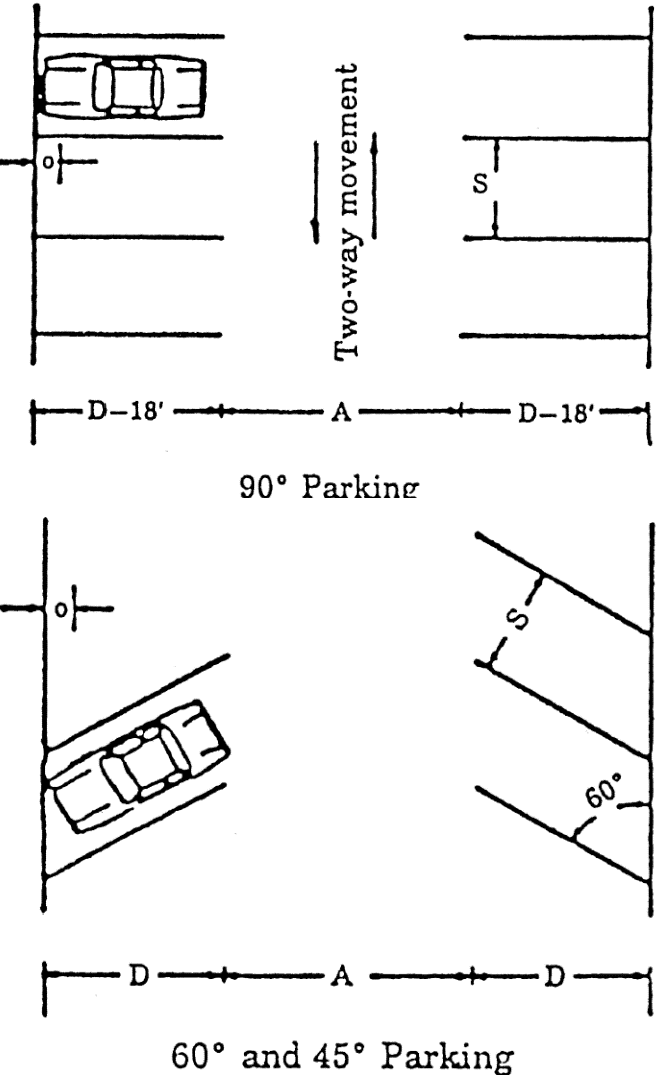
Parking lots shall be designed to meet the minimum standards of Table 44-17-2 Parking Space Dimensions and Figure 44-17-A based on the following definitions:
i.
Customer, high turnover uses shall include shopping centers, retail sales, fast food restaurants, convenience centers and similar uses.
ii.
Customer, low turnover uses shall include offices, industrial schools, churches, research, multiple dwellings, motels, sit-down restaurants and similar uses. Any questions on defining these uses shall be referred to the community design review board for a decision.
iii.
Employee parking with reduced stall widths must be signed for employee parking only.
iv.
Parking stall lengths may be reduced by 2.5 feet for 90-degree parking and two feet for angle parking where the parking space abuts a curb, sidewalk or landscaped area. All overhang (o) areas shall be a hard surface or crushed rock.
Table 44-17-2\Parking Space Dimensions
Illustration 44-17-A
b.
In shopping centers and other large developments, exterior parking closest to the building shall be oriented with the parking drives perpendicular to the building face whenever practicable.
c.
Parking stalls shall not be allowed in front of a building entrance if there is no sidewalk in front of the building entrance.
d.
All parking lots shall have continuous concrete curbing surrounding the exterior perimeter of the parking lot and drives.
i.
Park parking lots, that are not used in the winter, and parking lots having 12 spaces or less are exempt from this requirement, unless required by the city engineer for drainage control.
ii.
The community design review board may waive the curbing requirement when the city engineer has determined that sheet drainage over ground would improve stormwater quality. The community design review board may allow continuous bituminous curbing temporarily on a case-by-case basis, subject to the following conditions:
1.
Bituminous curbing may be permitted for phased or staged developments where an adjacent future development phase would be built that would result in the removal of the curbing.
2.
Bituminous curbing shall not be allowed for more than three years from the time of installation, at which time it must be removed due to the construction of a future phase of development or simply replaced with permanent continuous concrete curbing.
3.
Bituminous curbing shall not be permitted if the city engineer requires concrete curbing for drainage control.
4.
Bituminous curbing that becomes damaged shall be repaired immediately or as soon as the weather permits.
5.
The city may require that the developer provide escrow to cover the replacement of the bituminous curbing with concrete curbing.
e.
All parking lots and associated driveways shall have a surface of bituminous material or concrete and striped parking spaces.
i.
The city council may permit the alternative parking method of reinforced-turf parking when it would meet the following criteria:
1.
When the need for overflow parking is infrequent or limited to occasional parking events.
2.
Where there is already hard-surfaced parking that provides for handicap-accessible parking needs.
3.
Where the turf parking lot would meet setback and screening requirements.
4.
Where the parking need is seasonal (non-winter) so snow plowing is not needed.
5.
Where there would be an environmental benefit due to stormwater management or meeting shoreland/wetland/floodplain ordinance impact needs.
6.
Where the turf-parking plan meets the approval of the city engineer from the standpoint of using proven construction materials engineered for durability and aesthetics.
7.
Where the turf-parking plan meets the approval of the police and fire chief from the standpoint of meeting public safety requirements.
ii.
This parking surface alternative shall not apply to single-unit and double (duplex) dwelling residential properties which are governed under subsection 44-17(6).
f.
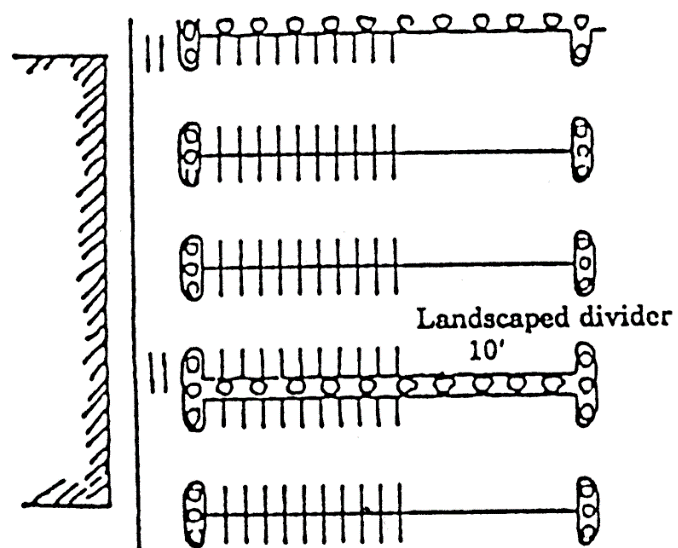
The city may require a ten-foot-wide planter or median strip every three or four parking bays to prevent high speed movement diagonally across the parking lot and to improve esthetics. Refer to Illustration 44-17-B:
Illustration 44-17-B
g.
All parking lots shall be continually and properly maintained.
(Code 1982, § 36-22; Ord. No. 795, § 1, 3-8-1999; Ord. No. 806B, § 1, 9-11-2000; Ord. No. 813, § 3, 5-14-2001; Ord. No. 925, § 1, 7-23-2012; Ord. No. 1043, § I, 12-11-2023)
Sec. 44-18. - Access.
(a)
No dwelling shall be erected or altered in the city unless there is at least 22 feet of access to it from a public street or unless the city council approves a lesser amount. No building shall be erected or altered in the city so as to close the present means of access to an existing dwelling or so as to diminish this means of access.
(b)
Driveway access and design shall be based on article VI of chapter 32 and the standards of the Institute of Transportation Engineers.
(Code 1982, § 36-23)
Sec. 44-19. - Landscaping and screening.
(a)
A landscaped and possible screened area of not less than 20 feet in width shall be provided where:
(1)
A nonresidential use abuts a residentially zoned or planned property.
(2)
A multiple dwelling abuts a property zoned for single or double dwellings.
The community design review board (CDRB) shall require shrubs or trees in this area unless it deems it not appropriate.
(b)
Screening shall be provided where:
(1)
The light from automobile headlights and other sources would be directed into residential windows.
(2)
There would be exterior storage of goods or materials which could annoy or endanger property owners.
(3)
Rooftop equipment would be visible from a residential lot line. Rooftop equipment is defined as mechanical equipment, vents, exhaust hoods, stacks and similar items on top of a building. Rooftop equipment shall not include chimneys, plastic plumbing vents and antennas. The city shall not require screening for single dwellings, double dwellings, manufactured homes or equipment for individual townhouse units. The community design review board may waive the screening requirement for mechanical equipment if it determines that screening would not improve a building's appearance or protect property values. The community design review board may require screening on all sides of rooftop equipment if the premises abuts a residential lot line, not just the side facing the residential lot line. The review board may also require modification of architectural plans for taller parapets or modified roof designs to conceal rooftop equipment no matter where the building is located. The community design review board may also require screening if needed for sound reduction around the equipment. In all instances, rooftop equipment that is visible from any public street or adjoining property shall be painted to match the building. Screening, when required, shall be compatible with the materials and design of the building and subject to staff or design review board approval.
(4)
A parking lot is constructed next to a property that is used or shown on the city's land use plan for single-dwelling or double-dwelling use. The community design review board may waive this requirement if it determines that screening would not be needed or would not protect surrounding property values.
(c)
Screening shall be satisfied by the use of a screening fence, planting screen, berm or combination thereof. If the topography, natural growth of vegetation, permanent buildings, or other barriers meet the standards of subsections (c)(1) and (2) of this section, they may be substituted for all or part of the screening fence or planting screen:
(1)
A planting screen shall consist of evergreen plantings. Trees shall be a minimum of 2½ inches in trunk diameter, two feet above grade. Shrubs may be used in combination with a berm and shall be a minimum of two feet in height. Spacing of trees and shrubs shall be so as to create an 80-percent-opaque screening at least six feet in height.
(2)
Berms shall have mowable side slopes. Slopes greater than 2½ to one may be used if the slopes are stepped with retaining walls. Plant materials resistant to erosion may be substituted for sod when approved by the community design review board.
(3)
Screening fences shall be painted or stained whenever necessary, so as not to fade, chip or discolor. Broken or knocked down fences shall be repaired. Planting screens shall be maintained in a neat and healthy condition. Plantings that have died shall be promptly replaced.
(d)
Screening may be satisfied with a screening fence. A screening fence shall be attractive, compatible with the principal building and surrounding land uses, at least six feet in height, and provide a minimum opaqueness of 80 percent. The city shall require landscaping, including trees and shrubs, with any screening fence unless the community design review board deems it not appropriate.
(e)
Trash container enclosures shall be provided around all trash containers and shall be 100 percent opaque. They shall be protected by concrete-filled steel posts or the equivalent, anchored in the ground at the front corners of the structure. If the enclosure is masonry, the protective posts may be omitted. In all instances, the enclosure must be of a design, material and color compatible with the building and be kept in good repair. A gate that provides 100-percent opaqueness shall be provided. The community design review board may waive any part of this requirement if it finds that the trash container would be hidden from adjacent properties and streets.
(f)
The city may require screening between differing types of land use, such as between commercial and residential uses or between multiple and single dwellings.
(Code 1982, § 36-27; Ord. No. 785, § 1, 11-10-1997)
Sec. 44-20. - Additional design standards.
(a)
All construction and landscaping shall comply with the plans approved by the city.
(b)
The property owners shall maintain their buildings and grounds in at least as good a condition as when originally completed. Maintenance shall include the following:
(1)
Replacing any landscaping shown on the approved plan that dies.
(2)
Picking up all trash and debris from the grounds.
(3)
Removing all noxious weeds.
(4)
Watering the grass, trees and shrubs.
(5)
Repairing any exterior parts of the building that deteriorate or break.
(c)
The developer of any project, other than single or double dwellings, shall do the following:
(1)
Install outdoor lighting according to the following requirements:
a.
Purpose and intent. The purpose and intent of the outdoor lighting code in this subsection is to create minimum standards for the design and installation of all outdoor lighting. This subsection is intended to reduce the problems created by improperly designed and installed outdoor lighting. It is intended to eliminate problems of glare, minimize light trespass and help reduce the energy and financial costs of outdoor lighting by establishing regulations that limit the area that certain outdoor luminaires illuminate. A purpose of the outdoor lighting code is to set standards for outdoor lighting to enhance the reasonable use and enjoyment of all property within the city. It is the intent of the outdoor lighting code to encourage lighting practices that will reduce light pollution by reducing up-light, glare and over lighting.
b.
Definitions. The following words, terms and phrases, when used in this subsection, shall have the meanings ascribed, except where the context clearly indicates a different meaning:
1.
Direct light means light emitted directly from the lamp, off of the reflector or reflector diffuser or through the refractor or diffuser lens of a luminaire.
2.
Fixture means the assembly that houses the lamp and can include all or some of the following parts: housing, mounting bracket, pole socket, lamp holder, ballast, reflector, mirror and/or refractor or lens.
3.
Glare means direct light emitted from a luminaire with an intensity great enough to cause visual discomfort, eye fatigue, a reduction in a viewer's ability to see, or, in extreme cases, momentary blindness.
4.
Lamp means the component of a luminaire that produces the actual light.
5.
Light trespass means light produced by a luminaire that illuminates areas beyond the boundaries of the property on which it is located.
6.
Lumen means a unit of luminous flux. One footcandle is one lumen per square foot. For the purposes of this subsection, the lumen-output values shall be the initial lumen output rating of the lamp.
7.
Luminaire means a complete lighting system and includes a lamp and a fixture.
8.
Outdoor lighting means the illumination of an outside area or object by any manmade device. This includes direct lighting for signs and light emitting from within a sign cabinet or sign structure.
9.
Shielded light means an outdoor luminaire shielded or constructed so that no light rays are emitted by the installed fixture at angles above the horizontal plane of the luminaire's opaque cover or shade.
c.
Control of glare. All luminaires used for outdoor lighting shall be designed and installed to have their lamp, reflector and reflector diffuser concealed from any residential area or public street. Luminaires mounted beneath canopies shall be a flush-mount type so that they do not extend beneath the lower surface of the canopy. Direct lighting used for the purpose of illuminating any sign shall be aimed or shielded to meet this requirement.
d.
Recreational facilities. Lighting of outdoor recreational facilities, such as but not limited to ballfields, tennis courts, soccer fields, hockey or skating rinks, golf courses and golf-ball driving ranges and special event or play areas, shall meet the following conditions:
1.
All fixtures used for such lighting shall be shielded or aimed to comply with this subsection as much as possible and be designed or provided with sharp cutoff capability to minimize up-light, light spillover and glare. This Code recognizes that lighting of recreational facilities may require a certain amount of direct, outward lighting to illuminate a vast area.
2.
Recreational facility lighting is prohibited after 10:30 p.m., unless a later completion time is approved by the city council.
e.
Light pole height maximum. The maximum height allowed for light poles shall be 25 feet as measured from the grade at the base of the light pole to the uppermost part of the luminaire. Taller light poles may be installed to replace existing poles that exceed 25 feet and for athletic field or recreational lighting. The community design review board may allow taller light poles as part of a design review for nonresidential development, based on appropriateness for a specific proposal. Staff may review lighting plans under the "minor construction" provisions of section 2-285.
f.
Photometric plan required. The developer of any recreational, multiple-dwelling or nonresidential development shall submit a photometric plan for review by the city. The director of community development may waive the requirement for a photometric plan if he determines that waiving such a plan would not have a negative impact. A photometric plan shall include the following:
1.
Site and architectural plans indicating the location of the types of luminaires proposed.
2.
A detailed description of the luminaire, including the manufacturer's catalog cuts and drawings including sections.
3.
A drawn plan that illustrates the light spread and footcandle levels of the proposed luminaires.
g.
Light-intensity maximum. Outdoor lighting shall not exceed 0.4 footcandle of light intensity at the property lines on which the outdoor lights are installed.
h.
Light trespass. All outdoor lighting fixtures shall be designed, installed and maintained to prevent light trespass. Outdoor lighting fixtures shall be installed and maintained to prevent direct light from the luminaire from hitting adjacent or nearby residential property. If such condition should occur, the luminaire shall be replaced, redirected or shielded to have its light output controlled to eliminate light trespass or glare.
(2)
Drain all stormwater runoff from impervious surfaces to an underground, on-site stormwater collection system that is connected to a public stormwater system.
(3)
Restore any public right-of-way, adjacent property or property irons disturbed by the construction.
(4)
Install stop signs, handicap signs and building address signs as required by the city.
(5)
Construct parking lots with the following minimum setbacks:
a.
Fifteen feet from a street right-of-way.
b.
Five feet from all other property lines. This setback shall be increased to 20 feet if the adjacent property is used or shown on the city's land use plan for residential use.
(6)
Construct all buildings, except single-family and two-family homes, with the following minimum setbacks:
a.
Thirty feet from a street right-of-way.
b.
Fifty feet from a residential lot line. This setback shall be increased up to 100 feet based on the more restrictive of the following requirements:
1.
Building height: The building setbacks shall be increased two feet for each one foot the building exceeds 25 feet in height.
2.
Exterior wall area: Where an exterior wall faces a residentially zoned property, the wall setback from the residential lot line shall be as follows:
(7)
The city council may approve a conditional use permit to allow an addition within a required setback if:
a.
The required findings in section 44-1097 for a conditional use permit are met.
b.
The setback would be consistent with the setbacks for surrounding properties.
c.
At least 80 percent of the addition would be screened from property that is used or shown on the city's land use plan for residential use.
(8)
Plant trees with the following minimum sizes:
a.
Large deciduous trees, 2½ inches in diameter, balled and burlapped.
b.
Small deciduous (ornamental) trees, 1½ inches in diameter, balled and burlapped.
c.
Evergreen trees, six feet in height.
(9)
Install and maintain an underground lawn irrigation system. The system shall not be directed to spray on public streets or sidewalks. If such irrigation system is automatic or is capable of operating automatically, the system shall be equipped with a rain sensor/detection device to prevent operation when it is raining so as to conserve water. If installation of such system is prohibitively difficult due to terrain or other factors, or is unnecessary due to alternative irrigation provisions or xeriscape arrangements which do not require irrigation, exemption may be granted by the city council on a case-by-case basis, provided suitable alternative irrigation arrangements have been secured by the developer.
(10)
Use low-maintenance materials on buildings.
(11)
Use building materials that are compatible in quality with similar development in the area.
(12)
Locate any bike racks so they do not interfere with vehicular or pedestrian traffic or fire lanes.
(13)
Preserve significant natural features, such as wetlands and large trees, as required in chapter 18, article V, which pertains to environmental protection.
(14)
Provide on-site loading or unloading space where needed so that public streets are not used for this purpose.
(Code 1982, § 36-28; Ord. No. 796, § 1, 4-26-1999; Ord. No. 826, § 1, 4-8-2002)
Sec. 44-21. - Opt-out of Minn. Stats. § 462.3593.
Pursuant to authority granted by Minn. Stats. § 462.3593, subdiv. 9, the City of Maplewood opts out of the requirements of Minn. Stats. § 462.3593.
(Ord. No. 970, § 1, 8-22-2016)
(Ord. No. 1002, § I, 7-8-2019)
Secs. 44-22—44-45. - Reserved.
Editor's note— Ord. No. 1051, § I, adopted Dec. 9, 2024, repealed the former § 44-22 and relocated it to § 2-385. The former § 44-22 pertained to reasonable accommodation and derived from Ord. No. 1002, § I, adopted July 8, 2019.

