
Maplewood City Zoning Code
ARTICLE VIII
- MISSISSIPPI RIVER CORRIDOR CRITICAL AREA
Sec. 44-1191. - Definitions.
Accessory structure means a structure that is accessory to and separate from the principal structure.
Adjacent means having a boundary that physically touches or adjoins.
Biological and ecological functions means the functions of vegetation in stabilizing soils and slopes, retaining and filtering runoff, providing habitat, and recharging groundwater.
Buildable area means the area upon which structures may be placed on a lot or parcel of land and excludes areas needed to meet requirements for setback, rights-of-way, bluff impact zones, historic properties, wetlands, designated floodways, land below the ordinary high water level of public waters, and other unbuildable areas.
Bluff means a natural topographic feature having a slope that rises at least 25 feet where the grade of the slope averages 18 percent or greater, measured over any horizontal distance of 25 feet, from the toe of the slope to the top of the slope. Where the slope begins below the ordinary high water level, the ordinary high water level is the toe of the slope. See Figure 1.
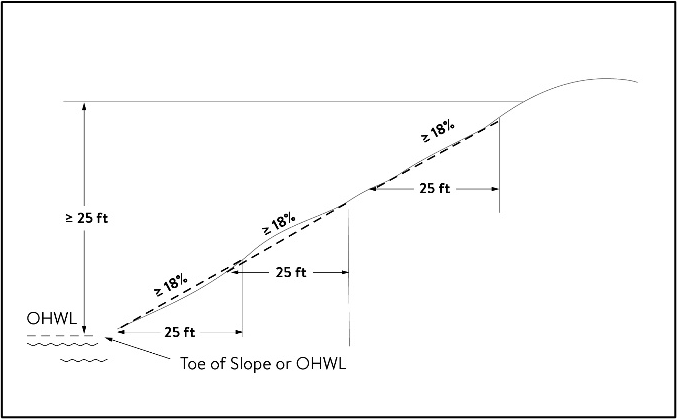
Figure 1. Bluff
Bluff impact zone (BIZ) means a bluff and land located within 20 feet of the bluff. See Figure 2.
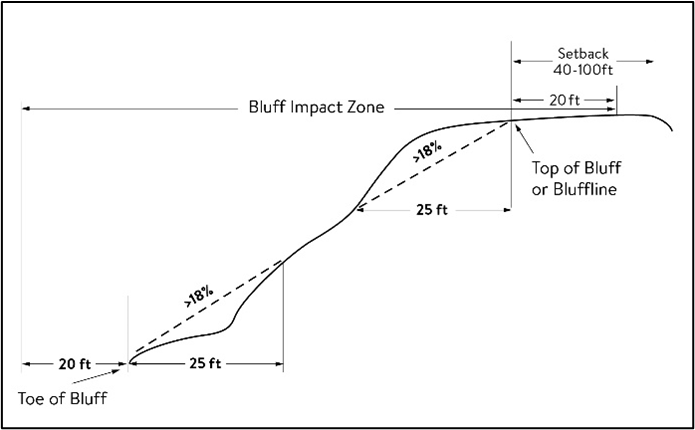
Figure 2. Bluff Impact Zone
Bluffline means a line delineating the top of the bluff. More than one bluff line may be encountered proceeding landward from the river.
Bluff, toe of means a line along the bottom of a bluff, requiring field verification, such that the slope above the line exceeds 18 percent and the slope below the line is 18 percent or less, measured over a horizontal distance of 25 feet.
Bluff, top of means a line along the top of a bluff, requiring field verification, such that the slope below the line exceeds 18 percent and the slope above the line is 18 percent or less, measured over a horizontal distance of 25 feet.
Certificate of compliance means a document written after a compliance inspection, certifying that the development complies with applicable requirements at the time of the inspection.
Commissioner means the commissioner of the Minnesota Department of Natural Resources.
Conditional use has the meaning given under Minn. Stats. chs. 394 and 462.
Deck is a horizontal, unenclosed, aboveground level structure open to the sky, with or without attached railings, seats, trellises, or other features, attached to a principal structure.
Discretionary action means an action under this chapter related to land use that requires a public hearing by local ordinance or statute, such as preliminary plats, final subdivision plats, planned unit developments, conditional use permits, interim use permits, variances, appeals, and rezonings.
Electric power facilities means equipment and associated facilities for generating electric power or devices for converting wind energy to electrical energy as identified and defined under Minnesota Statutes, section 216E.
Essential services means underground or overhead gas, electrical, communications, steam, or water distribution, collection, supply, or disposal systems, including stormwater. Essential services include poles, wires, mains, drains, pipes, conduits, cables, fire alarm boxes, traffic signals, hydrants, navigational structures, aviation safety facilities or other similar equipment and accessories in conjunction with the systems. Essential services does not include buildings, treatment works as defined in Minn. Stats. § 115.01, electric power facilities or transmission services.
Floodplain has the meaning given under Minn. Rules ch. 6120.
Hard-surface trail means a trail surfaced in asphalt, crushed aggregate, or other hard surface, for multi-purpose use, as determined by local, regional, or state agency plans.
Impervious surface means a constructed hard surface that prevents the entry of water into the soil and causes water to run off the surface in greater quantities and at an increased rate of flow than prior to development.
Intensive vegetation clearing means the removal of all or a majority of the trees or shrubs in a contiguous patch, strip, row, or block.
Interim use has the meaning given under Minn. Stats. chs. 394 and 462.
Land alteration means an activity that exposes the soil or changes the topography, drainage, or cross section of the land, excluding gardening or similar minor soil disturbances.
Lot has the meaning given under Minn. Rules ch. 6120.
Lot width means the shortest distance between lot lines measured at both the ordinary high water level and at the required structure setback from the ordinary high water level. See Figure 3.
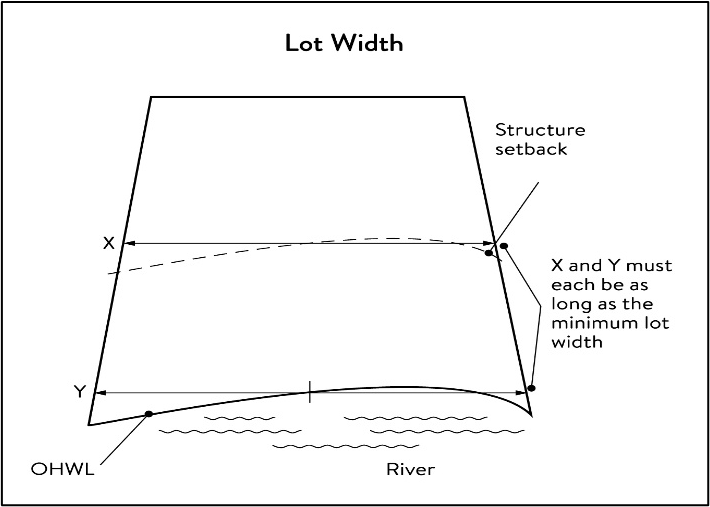
Figure 3. Lot Width
Mississippi River Corridor Critical Area (MRCCA) means the area within the river corridor boundary.
Mississippi River Corridor Critical Area (MRCCA) Plan is a chapter in the Maplewood comprehensive plan.
Natural surface trail means a trail composed of native soil and rock or compacted granular stone, primarily intended for hiking, equestrian, or mountain bike use, as determined by local, regional, or state agency plans.
Natural vegetation means any combination of ground cover, understory, and tree canopy that, while it may have been altered by human activity, continues to stabilize soils, retain and filter runoff, provide habitat, and recharge groundwater.
Nonconformity has the meaning given under Minn. Stats. § 394.22.
Off-premise advertising signs means a sign that directs attention to a product, service, business, or entertainment venue that is not exclusively related to the premises where the sign is located.
Ordinary high water level (OHWL) has the meaning given under Minn. Stats. § 103G.005.
Overlay district means a zoning district applied over one or more previously established zoning districts, establishing additional or stricter standards and criteria for covered properties in addition to those of the underlying zoning district. Overlay districts are often used to protect historic features and natural resources such as shoreland or floodplain.
Parcel has the meaning given under Minn. Stats. § 116G.03.
Patio means an impervious surface located at ground level with no railings and open to the sky.
Picnic shelter means a roofed structure open on all sides, accessory to a recreational use.
Planned unit development (PUD) means a method of land development that merges zoning and subdivision controls, allowing developers to plan and develop a large area as a single entity, characterized by a unified site design, a mix of structure types and land uses, and phasing of development over a number of years. Planned unit development includes any conversion of existing structures and land uses that utilize this method of development.
Plat has the meaning given under Minn. Stats. §§ 505 and 515B.
Primary conservation areas (PCAs) means key resources and features, including bluff impact zones, floodplains, wetlands, gorges, areas of confluence with tributaries, natural drainage routes, unstable soils and bedrock, native plant communities, cultural and historic properties, and significant existing vegetative stands, tree canopies, and other resources identified in local government plans.
Principal structure means the house and attached garage.
Private facilities means private roads, driveways, parking areas, decks, accessory structures, and private signs.
Public facilities means public utilities, public transportation facilities, and public recreational facilities.
Public river corridor views (PRCVs) means views toward the river from public parkland, historic properties, and public overlooks, as well as views toward bluffs from the ordinary high water level of the opposite shore, as seen during the summer months and documented in the MRCCA plan/chapter of the comprehensive plan.
Public transportation facilities means all transportation facilities provided by federal, state, or local government and dedicated to public use, such as roadways, transit facilities, railroads, and bikeways.
Public utilities means electric power facilities, essential services, and transmission services.
Public waters has the meaning given under Minn. Stats. § 103G.005.
Readily visible means land and development that are easily seen from the ordinary high water level of the opposite shore during summer months.
Resource agency means a federal, state, regional, or local agency that engages in environmental, natural, or cultural resource protection or restoration activities, including planning, implementation, and monitoring.
River corridor boundary is the boundary approved and adopted by the Metropolitan Council under Minn. Stats. § 116G.06, as approved and adopted by the legislature in Minn. Stats. § 116G.15, and as legally described in the State Register, volume 43, pages 508 to 518.
Selective vegetation removal means the removal of isolated individual trees or shrubs that are not in a contiguous patch, strip, row, or block and that does not substantially reduce the tree canopy or understory cover.
Setback means a separation distance measured horizontally.
Subdivision has the meaning given under Minn. Stats. § 462.352.
Steep slope means a natural topographic feature with an average slope of 12 to 18 percent, measured over a horizontal distance equal to or greater than 50 feet; and any slope greater than 18 percent that are not bluffs measured over a horizontal distance equal to or greater than 50 feet.
Stormwater means any surface flow, runoff, and drainage consisting entirely of water in the form of natural precipitation and resulting from such precipitation.
Stormwater management facilities are for the collection, conveyance, treatment, or disposal of stormwater.
Structure means a building, sign, or appurtenance thereto, except for aerial or underground utility lines, such as sewer, electric, telephone, or gas lines, and utility line towers, poles, and other supporting appurtenances.
Variance has the meaning given under Minn. Stats. § 394.22.
Vegetation permit means a grading or separate permit issued by the City of Maplewood to allow intensive vegetation clearing.
Water quality impact zone means the land within 50 feet of a drainage route or land within the wetland buffers required in the wetland ordinance.
Wetland has the meaning given under Minn. Stats. § 103G.005.
Sec. 44-1192. - Statutory authorization.
This Mississippi River Corridor Critical Area (MRCCA) ordinance is adopted pursuant to the authorization and policies contained in Minn. Stats. § 116G, Minn. Rules, pts 6106.0010—6106.0180, and the planning and zoning enabling legislation in Minn. Stats. chs. 462 and 473.
Sec. 44-1193. - Policy.
The Legislature of Minnesota has delegated responsibility to local governments of the state to regulate the subdivision, use and development of designated critical areas and thus preserve and enhance the quality of important historic, cultural, aesthetic values, and natural systems and provide for the wise use of these areas.
Sec. 44-1194. - Generally.
(a)
Jurisdiction. The provisions of this article apply to land within the river corridor boundary as described in the State Register, volume 43, and pages 508 to 519 and shown on the Maplewood zoning map as the MRCCA overlay district.
(b)
Enforcement. The city manager or his or her designee is responsible for the administration and enforcement of this article. Any violation of its provisions or failure to comply with any of its requirements including violations of conditions and safeguards established in connection with grants of variances or conditional uses constitutes a misdemeanor and is punishable as defined by law. Violations of this article can occur regardless of whether or not a permit is required for a regulated activity.
(c)
Severability. If any section, clause, provision, or portion of this article is judged unconstitutional or invalid by a court of competent jurisdiction, the remainder of this article shall not be affected thereby.
(d)
Abrogation and greater restrictions. It is not intended by this article to repeal, abrogate, or impair any existing easements, covenants, or deed restrictions. However, where this article imposes greater restrictions, the provisions of this article shall prevail. All other sections or ordinances inconsistent with this article are hereby repealed to the extent of the inconsistency only.
(e)
Underlying zoning. Uses and standards of underlying zoning districts apply except where standards of this overlay district are more restrictive.
Sec. 44-1195. - Administration.
(a)
Permits. A permit is required for the construction of buildings or building additions (including construction of decks and signs), the installation and/or alteration of sewage treatment systems, intensive vegetation removal, and land alterations.
(b)
Variances. Variances to the requirements under this article may only be granted in accordance with Minn. Stats. § 462.357 and must consider the potential impacts of variances on primary conservation areas, public river corridor views, and other resources identified in the MRCCA plan. In reviewing the variance application, the city council shall:
(1)
Evaluate the impacts to these resources. If negative impacts are found, require conditions to mitigate the impacts that are related to and proportional to the impacts; and
(2)
Make written findings that the variance is consistent with the purpose of this article as follows:
a.
The extent, location and intensity of the variance will be in substantial compliance with the MRCCA plan;
b.
The variance is consistent with the character and management purpose of the MRCCA district in which it is located;
c.
The variance will not be detrimental to PCAs and PRCVs nor will it contribute to negative incremental impacts to PCAs and PRCVs when considered in the context of past, present and reasonable future actions.
(c)
Conditional use permits. All conditional uses required under this article must comply with Minn. Stats. § 462.3595 and must consider the potential impacts on PCAs, PRCVs, and other resources identified in the MRCCA plan. In reviewing the application, the city council shall:
(1)
Evaluate the impacts to these resources and if negative impacts are found, require conditions to mitigate the impacts that are related to and proportional to the impacts; and
(2)
Make written findings that the conditional use is consistent with the purpose of this article as follows.
a.
The extent, location and intensity of the conditional use will be in substantial compliance with the MRCCA plan;
b.
The conditional use is consistent with the character and management purpose of the MRCCA district in which it is located;
c.
The conditional use will not be detrimental to PCAs and PRCVs nor will it contribute to negative incremental impacts to PCAs and PRCVs when considered in the context of past, present and reasonable future actions.
(3)
Conditions of approval. The city council shall evaluate the impacts to PCAs, PRCVs, and other resources identified in the MRCCA plan, and if negative impacts are found, require conditions to mitigate the impacts that are related to and proportional to the impacts. Mitigation may include:
a.
Restoration of vegetation identified as "vegetation restoration priorities" identified in the MRCCA plan.
b.
Preservation of existing vegetation;
c.
Stormwater runoff management;
d.
Reducing impervious surface;
e.
Increasing structure setbacks;
f.
Wetland and drainage route restoration and/or preservation;
g.
Limiting the height of structures;
h.
Modifying structure design to limit visual impacts on PRCVs; and
i.
Other conservation measures.
(d)
Application materials. Applications for permits and discretionary actions required under this article must submit the following information unless the city manager or his or her designee determines that the information is not needed.
(1)
A detailed project description; and
(2)
Scaled maps and plans, dimensional renderings, maintenance agreements, and other materials that identify and describe:
a.
Primary conservation areas;
b.
Public river corridor views;
c.
Buildable area;
d.
Existing and proposed topography and drainage patterns;
e.
Proposed stormwater and erosion and sediment control practices;
f.
Existing and proposed vegetation to be removed and established;
g.
Ordinary high water level, bluff lines, and all required setbacks;
h.
Existing and proposed structures;
i.
Existing and proposed impervious surfaces; and
j.
Existing and proposed subsurface sewage treatment systems.
(e)
Nonconformities.
(1)
All legally established nonconformities as of the date of this article may continue consistent with Minn. Stats. § 462.357, subdivision 1.e.
(2)
New structures erected in conformance with the setback averaging provisions are conforming structures.
(3)
Site alterations and expansion of site alterations that were legally made prior to the effective date of this article are conforming. Site alterations include vegetation, erosion control, stormwater control measures, and other nonstructural site improvements.
(4)
Legally nonconforming principal structures that do not meet the setback requirements may be expanded laterally provided that:
a.
The expansion does not extend into the bluff impact zone or further into the required setback than the building line of the existing principal structure; and
b.
The expanded structure's scale and bulk is consistent with that of the original structure and existing surrounding development.
(f)
Notifications.
(1)
Amendments to this article and to the MRCCA plan must be submitted to the commissioner as provided in Minn. Rules, part 6106.0070, Subp. 3, Items B—I.
(2)
Notice of public hearings for discretionary actions, including conditional and interim use permits, variances, appeals, rezonings, preliminary plats, final subdivision plats, master plans, and PUDs, must be sent to the following entities at least 30 days prior to the hearing:
a.
The commissioner in a format prescribed by the Minnesota Department of Natural Resources;
b.
National park service; and
c.
Where building heights exceed the height limits as part of the conditional use or variance process, adjoining local governments within the MRCCA, including those with overlapping jurisdiction and those across the river.
(3)
Notice of final decisions for actions, including findings of fact, must be sent to the commissioner, the National Park Service, and adjoining local governments within the MRCCA within ten days of the final decision.
(4)
Requests to amend district boundaries must follow the provisions in Minn. Rules, part 6106.0100, Subp. 9, Item C.
(5)
The Minnesota Department of Natural Resources will be notified at time of application submittal of master plans, planned unit developments, and preliminary and final plats.
(g)
Accommodating disabilities. Reasonable accommodations for ramps or other facilities to provide persons with disabilities access to the person's property, as required by the federal Americans with Disabilities Act and the federal Fair Housing Act and as provided by Minn. Rules, ch. 1341, must:
(1)
Comply with the structure setback requirements; or
(2)
If the structure setbacks cannot be complied with, the ramps or other facilities are allowed with an administrative permit provided:
a.
The permit terminates on either a specific date or upon occurrence of a particular event related to the person requiring accommodation; and
b.
Upon expiration of the permit, the ramp or other facilities must be removed.
Sec. 44-1196. - MRCCA district.
(a)
Purpose. The purpose of this section is to establish districts under which building height and structure placement are regulated to protect and enhance the Mississippi River's resources and features consistent with the natural and built character of each district.
(b)
District description and management purpose. The MRCCA in the city is classified as rural and open space (ROS).
(c)
Description. The ROS district is characterized by rural and low-density development patterns and land uses, and includes land that is riparian or visible from the river, as well as large, undeveloped tracts of high ecological and scenic value, floodplain, and undeveloped islands. Many primary conservation areas exist in the district.
(d)
Management purpose. The ROS district must be managed to sustain and restore the rural and natural character of the corridor and to protect and enhance habitat, parks and open space, public river corridor views, and scenic, natural, and historic areas.
(e)
MRCCA district map. The locations and boundaries of the MRCCA district established by this article is shown on the Maplewood zoning map as the MRCCA overlay district which is incorporated herein by reference. The district boundary lines are intended to follow the centerlines of rivers and streams, highways, streets, lot lines, and municipal boundaries; unless a boundary, line is otherwise indicated on the map. Where district boundaries cross unsubdivided property, the district boundary line is determined by use of dimensions or the scale appearing on the map.
Sec. 44-1197. - Special land use provisions.
(a)
Purpose. To identify development standards and considerations for land uses that have the potential to negatively impact primary conservation areas and public river corridor views.
(b)
Underlying zoning. Uses within the MRCCA are generally determined by underlying zoning, with additional provisions for:
(1)
Wireless communication towers. Wireless communication towers require a conditional use permit per Maplewood City Code, art. XI (Commercial Use Antennas and Towers) subject to the following design standards:
a.
The applicant must demonstrate that functional coverage cannot be provided through co-location, a tower at a lower height, or a tower at a location outside of the MRCCA;
b.
The tower must meet the structure setback requirements; and
c.
Placement of the tower must minimize impacts on public river corridor views.
d.
Comply with the general design standards.
Sec. 44-1198. - Structure height and placement.
(a)
Purpose. To establish standards that protect primary conservation areas and public river corridor views from development impacts and ensure that new development is sited consistent with the purpose of the MRCCA.
(b)
Structure height.
(1)
Structures and facilities are limited to 35 feet in height or lower unless identified as exempt.
(2)
In addition to the variance requirements, criteria for considering whether to grant a variance for structures exceeding the height limits must include:
a.
Assessment of the visual impact of the proposed structure on public river corridor views, including views from other communities;
b.
Determination that the proposed structure meets the required bluff setbacks;
c.
Identification and application of techniques to minimize the perceived bulk of the proposed structure, such as:
1.
Placing the long axis of the building perpendicular to the river;
2.
Stepping back of portions of the facade;
3.
Lowering the roof pitch or use of a flat roof;
4.
Using building materials or mitigation techniques that will blend in with the natural surroundings such as green roofs, green walls, or other green and brown building materials;
5.
Narrowing the profile of upper floors of the building; or
6.
Increasing the setbacks of the building from the blufflines;
d.
Identification of techniques for preservation of those view corridors identified in the MRCCA plan; and
e.
Opportunities for creation or enhancement of public river corridor views.
(c)
Structure, impervious surface, and patio placement.
(1)
Impervious surfaces and patios must not be placed in the bluff impact zones.
(2)
Principal and accessory structures:
a.
Must not be placed in the bluff impact zones.
b.
Must maintain:
1.
A 100-foot setback to a bluff line; or
2.
An average setback of the adjoining lots. Where principal structures exist on the adjoining lots on both sides of a proposed building site, the minimum setback may be altered to conform to the average of the adjoining setbacks, if the new structure's scale and bulk bluff ward of the setbacks are consistent with adjoining development. See Figure 4.
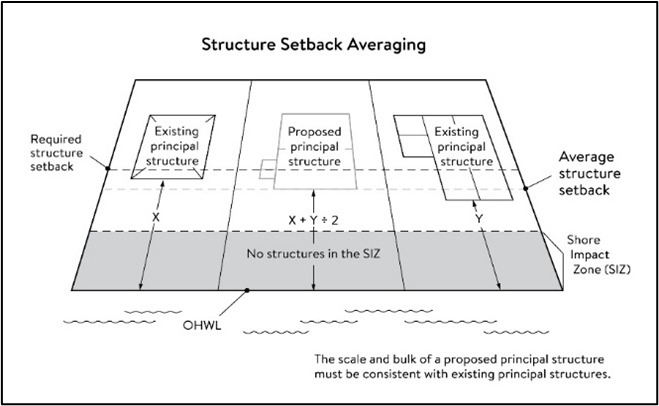
Figure 4. Structure Setback Averaging
c.
Accessory structures under 200 square feet and decks may encroach into the required setbacks without a variance provided that the:
1.
Encroachment does not exceed 15 percent of the required structure setback;
2.
Area of the accessory structure under 200 square feet and decks must not occupy more than 25 percent of the total area between the required setback and the 15 percent using the formula: Required setback depth (feet) x 0.15 x lot width at setback (feet) x 0.25 = maximum total area. See Figure 5.
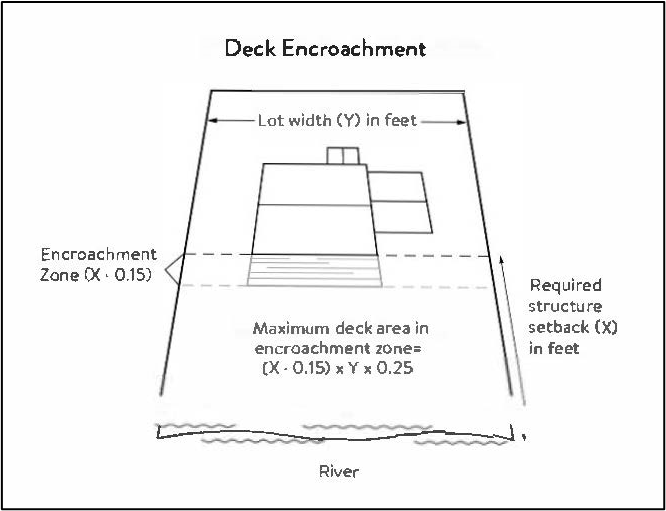
Figure 5. Accessory Structure Under 200 Square Feet and Deck Encroachments
3.
The accessory structure under 200 square feet and the deck does not extend into the bluff impact zone. See Figure 5.
Sec. 44-1199. - Performance standards for private facilities.
(a)
Purpose. To establish design standards for private facilities that are consistent with best management practices and that minimize impacts to primary conservation areas, public river corridor views, and other resources identified in the MRCCA plan.
(b)
General design standards. All private facilities must be developed in accordance with the vegetation management and land alteration requirements.
(c)
Private roads must be designed as follows:
(1)
To take advantage of natural vegetation and topography so that they are not readily visible;
(2)
Comply with the structure setback requirements.
(3)
Not be placed within the bluff impact zone, unless exempt.
(d)
Private access paths must be no more than four feet wide if placed within the bluff impact zone.
Sec. 44-1200. - Performance standards for public facilities.
(a)
Purpose. To establish design standards for public facilities that are consistent with best management practices and that minimize impacts to primary conservation areas, public river corridor views and other resources identified in the MRCCA plan. Public facilities serve the public interest by providing public access to the Mississippi River corridor or require locations in or adjacent to the river corridor and therefore require some degree of flexibility.
(b)
General design standards. All public facilities must be designed and constructed to:
(1)
Minimize visibility of the facility from the river to the extent consistent with the purpose of the facility;
(2)
Comply with the structure placement and height standards, unless exempt;
(3)
Be consistent with the vegetation management standards and the land alteration and stormwater management standards including use of practices identified in Best Practices for Meeting Minnesota Department of Natural Resources General Public Waters Work Permit GP 2004-0001, where applicable;
(4)
Avoid primary conservation areas, unless no alternative exists. If no alternative exists, then disturbance to primary conservation areas must be avoided to the greatest extent practicable, and design and construction must minimize impacts; and
(5)
Minimize disturbance of spawning and nesting times by scheduling construction at times when local fish and wildlife are not spawning or nesting.
(6)
Minimize disturbance during bird migration and nesting times by scheduling construction at times when birds are not migrating or nesting.
(c)
Right-of-way maintenance standards. Right-of-way maintenance must comply with the following standards:
(1)
Vegetation currently in a natural state must be maintained to the extent feasible;
(2)
Where vegetation in a natural state has been removed, native plants must be planted and maintained on the right-of-way; and
(3)
Chemical control of vegetation must be avoided when practicable, but when chemical control is necessary, chemicals used must be in accordance with the regulations and other requirements of all state and federal agencies with authority over the chemical's use.
(d)
Public utilities. Public utilities must comply with the following standards:
(1)
High-voltage transmission lines, wind energy conversion systems greater than five megawatts, and pipelines are regulated according to Minn. Stats. ch. 216E, 216F, and 216G respectively; and
(2)
If overhead placement is necessary, utility facility crossings must minimize visibility of the facility from the river and follow other existing rights-of-way as much as practicable.
(3)
The appearance of structures must be as compatible as practicable with the surrounding area in a natural state with regard to height and width, materials used, and color.
(4)
Wireless communication facilities.
(e)
Public transportation facilities. Public transportation facilities shall comply with structure placement and height standards. Public transportation facilities must be designed and constructed to give priority to:
(1)
Providing scenic overlooks for motorists, bicyclists, and pedestrians;
(2)
Providing safe pedestrian crossings and facilities along the river corridor.
(f)
Public recreational facilities. Public recreational facilities must comply with the following standards:
(1)
Buildings and parking associated with pubic recreational facilities must comply with the structure placement and height standards, unless exempt.
(2)
Roads and driveways associated with public recreational facilities must not be placed in the bluff impact zone unless no other placement alternative exists. If no alternative exists, then design and construction must minimize impacts to erodible soils and slopes and other sensitive resources.
(3)
Trails, access paths, and viewing areas associated with public recreational facilities and providing access to or views of the Mississippi River are allowed within the bluff impact zones if design, construction, and maintenance methods are consistent with the best management practice guidelines in the Minnesota Department of Natural Resources Trail Planning, Design, and Development Guidelines.
a.
Hard-surface trails are not allowed on the face of bluffs with a slope exceeding 30 percent. Natural surface trails are allowed, provided they do not exceed eight feet in width.
b.
Trails, paths, and viewing areas must be designed and constructed to minimize:
1.
Visibility from the river;
2.
Visual impacts on public river corridor views; and
3.
Disturbance to and fragmentation of primary conservation areas.
(g)
Public signs and kiosks for interpretive or directional purposes are allowed in the bluff impact zone, provided they are placed and constructed to minimize disturbance to these areas and avoid visual impacts on public river corridor views. If illuminated, the lighting must be fully shielded and be directed downward.
Sec. 44-1201. - Vegetation management.
(a)
Purpose. To establish standards that sustain and enhance the biological and ecological functions of vegetation; preserve the natural character and topography of the MRCCA; and maintain stability of bluffs and steep slopes and ensure stability of other erosion-prone areas.
(b)
Applicability. This section applies to:
(1)
Areas within wetland buffers required in the wetland ordinance;
(2)
Areas within 50 feet of a natural drainage route;
(3)
Bluff impact zones;
(4)
Areas of native plant communities; and
(5)
Significant existing vegetative stands identified in the MRCCA plan.
(c)
Activities allowed without a vegetation permit.
(1)
Maintenance of existing lawns, landscaping, and gardens;
(2)
Removal of vegetation in emergency situations as determined by the city;
(3)
Right-of-way maintenance for public facilities.
(4)
Selective vegetation removal, provided that vegetative cover remains consistent with the management purpose of the MRCCA district, including removal of:
a.
Vegetation that is dead, diseased, dying, or hazardous;
b.
Vegetation to prevent the spread of diseases or insect pests;
c.
Individual trees and shrubs; and
d.
Invasive non-native species.
e.
Activities allowed with a vegetation permit:
1.
Clearing of vegetation that is dead, diseased, dying, or hazardous;
2.
Clearing to prevent the spread of diseases or insect pests;
3.
Clearing to remove invasive non-native species.
4.
Clearing to prepare for restoration and erosion control management activities consistent with a plan approved by the city.
5.
The minimum necessary for development that is allowed with a building permit or as an exemption.
(e)
General performance standards. The following standards must be met, in addition to a restoration plan, in order to approve a vegetation permit:
(1)
Development is sited to minimize removal of or disturbance to natural vegetation;
(2)
Soil, slope stability, and hydrologic conditions are suitable for the proposed work as determined by the public works director.
(3)
Clearing is the minimum necessary and designed to blend with the natural terrain and minimize visual impacts to public river corridor views and other scenic views;
(4)
Vegetation removal activities are conducted so as to expose the smallest practical area of soil to erosion for the least possible time, and to avoid bird migration and nesting seasons; and
(5)
Any other condition determined necessary to achieve the purpose of this section.
(f)
Prohibited activities. All other intensive vegetation clearing is prohibited.
(g)
Vegetation restoration plan.
(1)
Development of a vegetation restoration plan and reestablishment of natural vegetation is required:
a.
For any vegetation removed with a permit;
b.
Upon failure to comply with any provisions in this section; or
c.
As part of the planning process for subdivisions.
(h)
Restoration plan performance standards.
(1)
Vegetation must be restored in one or more of the following restoration priority areas:
a.
Stabilization of erodible soils. Areas with soils showing signs of erosion, especially on or near the top and bottom of steep slopes and bluffs.
b.
Other approved priority opportunity areas, including priorities identified in the MRCCA plan, if none of the above exist.
(2)
Include vegetation that provides suitable habitat and effective soil stability, runoff retention, and infiltration capability. Vegetation species, composition, density, and diversity must be guided by nearby patches of native plant communities and by the Minnesota Board of Soils and Water Resources Native Vegetation Establishment and Enhancement Guidelines.
(3)
Any highly erodible soils disturbed during removal and/or restoration must be stabilized with deep-rooted vegetation with a high stem density.
(4)
Vegetation removed must be restored with natural native vegetation to the greatest extent practicable. The area (square feet) of the restored vegetation should be similar to that removed to the greatest extent practicable.
(5)
For restoration of removed native plant communities, restored vegetation must also provide biological and ecological function equivalent to the removed native plant communities. The area (square feet) of the restored vegetation should be equivalent to that removed.
(6)
Be prepared by a qualified individual with demonstrable experience and knowledge related to management of natural areas such as natural resource manager or ecologist.
(7)
Include a maintenance plan that includes management provisions for controlling invasive species and replacement of plant loss for three years.
(8)
A certificate of compliance will be issued after the vegetation restoration plan requirements have been satisfied.
Sec. 44-1202. - Land alteration standards and stormwater management.
(a)
Purpose. To establish standards that protect water quality from pollutant loadings of sediment, nutrients, bacteria, and other contaminants; and maintain the stability of bluffs, and other areas prone to erosion.
(b)
Land alteration.
(1)
Within the bluff impact zone, land alteration is prohibited, except for the following, which are allowed by permit.
a.
Erosion control consistent with a plan approved by the local government or resource agency;
b.
The minimum necessary for development that is allowed as an exception; and
c.
Repair and maintenance of existing buildings and facilities.
(2)
Within the water quality impact zone, land alteration that involves more than ten cubic yards of material or affects an area greater than 1,000 square feet requires a permit.
(3)
Construction or replacement retaining walls and other erosion control structures within the bluff impact zone are allowed with a permit provided that:
a.
The retaining walls and other erosion control structures are used only to correct an established erosion problem as determined by the city.
b.
The size and extent of the retaining walls and other erosion control structures are the minimum necessary to correct the erosion problem.
c.
The retaining walls are limited to five feet in height and must be placed a minimum horizontal distance of ten feet apart, unless a professional engineer determines that a larger retaining wall is needed to correct the erosion problem.
(4)
In the bluff impact zone, stormwater management facilities are prohibited except by permit if:
a.
There are no alternatives for stormwater treatment outside the bluff impact zone on the subject site;
b.
The site generating runoff is designed so that the amount of runoff reaching the bluff impact zone is reduced to the greatest extent practicable;
c.
The construction and operation of the facility does not affect slope stability on the subject property or adjacent properties; and
d.
Mitigation based on the best available engineering and geological practices is required and applied to eliminate or minimize the risk of slope failure.
(5)
In the water quality impact zone, development that creates new impervious surface, as allowed by exemption, or fully reconstructs existing impervious surface of more than 10,000 square feet requires a stormwater permit. Multipurpose trails and sidewalks are exempt if there is down gradient vegetation or a filter strip that is at least five feet wide.
(6)
On steep slopes, land alteration is prohibited except for the following, which are allowed by permit.
a.
Erosion control consistent with an erosion control plan approved by the local government.
b.
Essential services with an erosion control plan approved by the local government.
c.
Retaining walls with an erosion control plan approved by the local government.
d.
Repair and maintenance of existing buildings and facilities with an erosion control plan approved by the local government.
e.
Vegetation management.
(7)
In all other areas, stormwater runoff must be directed away from the bluff impact zones or unstable areas.
(c)
Conditions of land alteration permit approval.
(1)
Temporary and permanent erosion and sediment control measures retain sediment onsite consistent with best management practices in the Minnesota Pollution Control Agency Stormwater Manual;
(2)
Natural site topography, soil, and vegetation conditions are used to control runoff and reduce erosion and sedimentation;
(3)
Construction activity is phased when possible;
(4)
All erosion and sediment controls are installed before starting any land disturbance activity;
(5)
Erosion and sediment controls are maintained to ensure effective operation;
(6)
The proposed work is consistent with the vegetation standards; and
(7)
Best management practices for protecting and enhancing ecological and water resources identified in Best Practices for Meeting Minnesota Department of Natural Resources General Public Waters Work Permit GP 2004-0001.
(d)
Compliance with other plans and programs. All development must:
(1)
Be consistent with Minn. Stats. ch. 103B, and local water management plans completed under chapter 8410;
(2)
Meet or exceed the wetland protection standards under Minn. Rules, ch. 8420; and
(3)
Meet or exceed the floodplain management standards under Minn. Rules, chs. 6120.5000—6120.6200
Sec. 44-1203. - Subdivision and land development standards.
(a)
Purpose.
(1)
To protect and enhance the natural and scenic values of the MRCCA during development or redevelopment of the remaining large sites.
(2)
To establish standards for protecting and restoring biological and ecological functions of primary conservation areas on large sites; and
(3)
To encourage restoration of natural vegetation during development or redevelopment of large sites where restoration opportunities have been identified in MRCCA plans.
(b)
Applicability.
(1)
The design standards in this section apply to subdivisions, planned unit developments and master-planned development and redevelopment of land involving 20 or more acres, including smaller individual sites within the following developments that are part of a common plan of development that may be constructed at different times:
a.
Subdivisions;
b.
Planned unit developments; and
c.
Master-planned development and redevelopment of land.
(2)
The following activities are exempt from the requirements of this section:
a.
Minor subdivisions consisting of three or fewer lots;
b.
Minor boundary line corrections;
c.
Resolutions of encroachments;
d.
Additions to existing lots of record;
e.
Placement of essential services; and
(c)
Design standards:
(1)
Fifty percent of the total parcel area must be set aside and designated as a primary conservation area.
(2)
If primary conservation areas exist but do not have natural vegetation (identified as restoration priorities in the MRCCA plan), then a vegetation assessment must be completed to evaluate the unvegetated primary conservation areas and determine whether vegetation restoration is needed.
(3)
If primary conservation areas do not exist on the parcel and portions of the parcel have been identified in the MRCCA plan as a restoration area, vegetation must be restored in the identified areas, and the area must be set aside and designated as protected open space.
(4)
Stormwater treatment areas or other green infrastructure may be used to meet the protected open space requirements if the vegetation provides biological and ecological functions.
(5)
Land dedicated as city or county open space for public parks, or other open space or public facilities may be counted toward the protected open space requirement.
(6)
Protected open space areas must connect open space, natural areas, and recreational areas, where present on adjacent parcels, as much as possible to form an interconnected network.
(7)
Permanent protection of designated open space.
a.
Designated open space areas must be protected through one or more of the following methods:
1.
Public acquisition by a government entity for conservation purposes;
2.
A permanent conservation easement, as provided in Minn. Stats. ch. 84C;
3.
A deed restriction; and
4.
Other arrangements that achieve an equivalent degree of protection.
b.
Permanent protection methods must ensure the long-term management of vegetation to meet its biological and ecological functions, prohibit structures, and prohibit land alteration.
Sec. 44-1204. - Exemptions.
(a)
Purpose. To provide exemptions to structure placement, height and other standards for specific river or water access dependent facilities as provided in Minn. Stats. § 116G.15, subd. 4.
(b)
Applicability.
(1)
Uses and activities not specifically exempted must comply with this section. Uses and activities exempted under the bluff impact zone must comply with the vegetation management and land alteration standards.
(2)
Uses and activities are categorized as:
a.
Exempt - E. This means that the use or activity is allowed;
b.
Exempt if no alternative - (E). This means that the use or activity is allowed only if no alternatives exist; and
c.
Not exempt - N. This means that a use or activity is not exempt and must meet the standards of this section.
(c)
Use and activity exemptions classification.
(1)
General uses and activities.
(2)
Private facilities.
(3)
Public facilities.
(4)
Public recreational facilities.

