
Marble Falls City Zoning Code
ARTICLE 14
DEFINITIONS AND INTERPRETATIONS
Section 14.1.1 - Density
A.
Generally. Density may be measured as gross density or net density, as specified in these regulations.
B.
Gross Density. Gross density is calculated by dividing the number of proposed dwelling units by the total area of the parcel proposed for development.
C.
Net Density. Net density is calculated by dividing the number of proposed dwelling units by the buildable area of the parcel proposed for development.
Section 14.1.2 - Gross Floor Area
A.
Generally. Gross floor area (GFA) is a measurement of the horizontal floor area of a building or structure and is calculated based on the following criteria:
1.
Horizontal square footage is measured from the outside face of all exterior walls.
2.
The gross floor area includes the square footage of each floor level of a building.
3.
Gross floor area does not include areas not habitable or used as dwelling space. This may include, but is not limited to, cellars, basements, attics, covered or uncovered porches, terraces, breezeways, balconies, decks, patios, enclosed storage or mechanical areas, mezzanines, and similar structures.
4.
Protected upper floors of open atriums and foyers shall not be included.
Section 14.1.3 - Height
A.
Buildings. Building height is calculated by measuring the vertical distance from "grade" to the highest point of the coping of a flat roof or the deck line or a mansard roof or to the average height of the highest gable on a pitched or hipped roof, or to the highest point of a structure. The "grade" used to determine building height is the highest pre-development ground surface elevation within the building's footprint. For subdivisions of five acres or more, the finished ground surface elevation resulting from any site development grading shall be used as "grade" for the building height determination. Each building will have an individual grade separate from that of another building.
B.
Other Structures. Structure height is calculated by measuring the vertical distance from the average finished grade around the base of the structure to the highest point on the structure. This measurement applies to:
1.
Structures without roofs (e.g., fences); and
2.
Amateur radio antennae, whether mounted on a roof, the ground, or another structure.
C.
Specialized Building Appurtenances. Specialized building appurtenances are not counted in the calculation of building height provided that:
1.
They project not more than:
a.
Fifteen (15) feet above the highest point on the building for buildings that are two or more stories in height; or
b.
Seven feet above the highest point on the building for buildings that are less than two stories in height.
2.
They occupy not more than 10 percent of the total roof area of the building; and
3.
They are not used for human habitation, nonresidential, or industrial purposes, except as incidental to the operation of the building.
D.
Smokestacks. Smokestacks shall be permitted to a height of ninety (90) feet in the General Industrial (IN) District. In other districts, they are subject to Subsection 14.1.3.C, above.
Section 14.1.4 - Lot Dimensions
A.
Lot Area. Lot area is calculated as the total area within the property lines.
B.
Lot Coverage. Lot coverage is the total horizontal area measurement of all buildings, structures, and improvements.
1.
Buildings and Structures. Measurements for buildings and structures are taken at the main grade level of the principal building or structure and all accessory buildings or structures. All dimensions are measured from the outside face of all exterior walls.
2.
Other Improvements. Other improvements such as driveways, sidewalks, parking lots, pools, and other non-elevated surfaces are taken using the area delineated by the improved hard surface.
C.
Lot Coverage Ratio. Lot coverage ratio is calculated by dividing the lot coverage by the lot area to yield the percentage of the total lot that is covered by some building, structure, or improvement.
D.
Lot Width.
1.
Generally. Lot width is measured from one side lot line to the opposite side lot line at the front setback line. Distance is measured along a horizontal plane and does not follow the topography.
2.
Irregular Lots. Lot width of an irregular lot is measured from one side lot line to the opposite side lot line along the tangent of the curve representing the front building line. The front building line is established by the front setback line or subdivision plat (when the front building line is set back further than the front setback line).
Section 14.1.5 - Open Space Area and Ratio
A.
Generally. Open space area refers to commonly-owned open space (i.e., not located on private lot), and open space ratio refers to the percentage of the total area of the parcel proposed for development that is dedicated toward open space area. The following delineations further define what can or cannot be counted as open space area:
1.
Allowable Open Space Areas. Natural resource protection areas, stormwater management systems, passive recreation areas, bufferyard requirements, required landscape areas, and areas that shall remain undeveloped shall count as open space area.
2.
Prohibited Areas. Areas on private, buildable lots and any commonly-owned open space that is less than 320 contiguous square feet (including landscape areas) shall not count as open space area.
B.
Open Space Ratio Calculation. Open space ratio is calculated by dividing the total amount of commonly-owned open space area on the parcel proposed by development by the total area of the entire parcel proposed for development.
Section 14.1.6 - Setbacks
A.
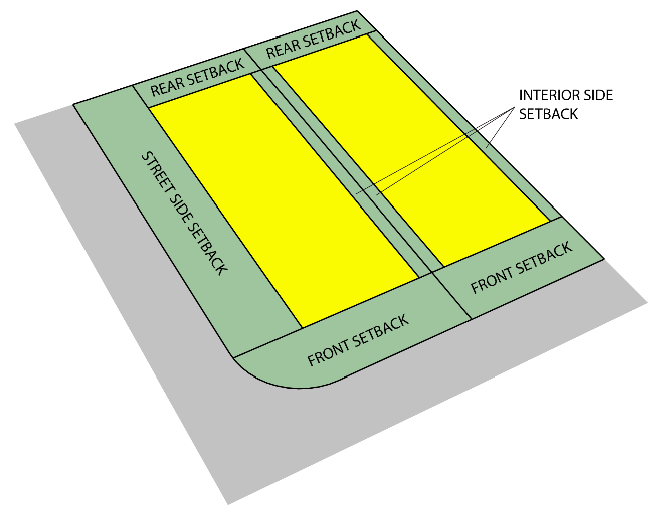
Generally. Setbacks are measured from the lot line towards the center of the lot as provided in this Section. Distance is measured along a horizontal plane and does not follow the topography.
B.
Standard Lots.
1.
Front Setbacks. Front setbacks are measured from the front lot line, which is the lot line that abuts the right-of-way.
2.
Street Side Setbacks. Street side setbacks are measured from the street side lot line, except on corner lots where the front setback extends to the side street and supersedes the street side setback.
3.
Rear Setbacks. Rear setbacks are measured from the rear lot line, except on corner lots, where the street side setback supersedes.
4.
Side Setbacks. Side setbacks are measured from the side lot line.
C.
Odd-Shaped Lots.
1.
Curvilinear Lot Lines. Where lot lines are curvilinear, setbacks shall be measured as offsets from the curvilinear lot line.
2.
Multiple Rear Lot Lines. Where there are multiple rear lot lines, the rear setback is measured as offsets from the multiple rear lot lines.
3.
No Rear Lot Line. Where there is no rear lot line, the rear setback shall be measured as a radial distance from the intersection of side lot lines at the rear of the lot.
4.
Front Lot Line along Arc. Where the front lot line is an arc, the street side setback area is defined as the area behind the front of the building line along the arc of the street.
Section 14.2.1 - Document Usage
A.
Generally. For purposes of interpretation of these regulations, the following rules apply regarding usage of this document.
B.
Titles. Titles of the Articles, Divisions, Sections, and Subsections are intended to facilitate navigation of these regulations. Where there is a conflict between the title of an Article, Division, Section, or Subsection and the regulatory provisions, the regulatory provision shall control.
C.
Internal Cross-References. If a cross-reference is set out within these regulations, the cross-reference shall refer to another part of these regulations unless a separate document is specifically identified in the cross-reference.
D.
Illustrations. The illustrations provided in these regulations are intended to provide a visual example regarding how particular standards are to be applied and are not intended to be a standard in their own right.
1.
Conflicts. Where there is a conflict between the illustration and the text of the regulatory provision, the text of the regulatory provision shall control.
2.
Authorization to Create, Delete, and Modify Illustrations. The Director is authorized to create, delete, and modify illustrations herein, and create, delete, or modify related code references, without an official amendment to these regulatory provisions.
E.
External Cross-References.
1.
Generally. References to external documents and materials are intended to provide for the convenience of the user and facilitate navigation of these regulations. External documents referenced by these regulations exist in their own right and are not part of these regulations unless specifically incorporated by reference or by application.
2.
Reference to State and Federal Statues.
a.
References to the Texas Local Government Code and the United States Code shall be interpreted to mean the most current version of the referenced section at the time the reference is applied.
b.
If a referenced statute of the Texas Local Government Code or United States Code is repealed and replaced by another statute with comparable subject matter, the replacement statute shall control.
c.
If a referenced statute of the Texas Local Government Code or United States Code is repealed and not replaced by another statute, the repealed statute shall control if it is within the statutory authority of the City to effectuate such results, or the application shall be held (and not considered officially filed) for up to 12 weeks for the City to revise these regulations to resolve the reference and establish an appropriate rule or policy.
d.
References to the Texas Local Government Code and the United States Code as the source of authority of administrative rules, such references shall be interpreted to include the rules and statues provided thereunder.
Section 14.2.2 - Interpretation of Words
A.
Generally. For the purposes of these regulations, the words and terms used herein shall be interpreted as follows:
1.
Words used in the present tense include the future tense;
2.
Words used in the singular include the plural and the plural includes the singular, unless the context clearly indicates the contrary;
3.
The term "shall" is always mandatory;
4.
The term "may" is discretionary;
5.
The term "City" shall refer to the City of Marble Falls, "county" shall refer to Burnet County or Blanco County (whichever county the property resides within), "state" shall refer to the State of Texas, and "federal" shall refer to the United States of America, unless otherwise indicated; and
6.
All public officials, bodies, and agencies reference those of the City of Marble Falls, unless otherwise indicated.
B.
Terms and Words Not Expressly Defined. The words, terms, and phrases that are defined in Division 14.3, Definitions, are those having a meaning unique to the purposes of these regulations. All words, terms, and phrases not expressly defined in Division 14.3, Definitions, or otherwise within these regulations, are to be construed in accordance to adopted ordinances, codes, or standards of the City, or according to the customary meaning and usage of such word, term, or phrase.
A—E
- A -
Abandonment means to discontinue a use or activity, excluding temporary or short-term interruptions such as seasonal closures, or due to remodeling, maintenance, or otherwise improving a facility.
Abutting, when referring to lots, parcels or property, is next to and having some portion of a boundary that is coterminous with the parcel proposed for development. Lots or parcels that are separated only by an alley are abutting if their property lines would be shared if they extended to the centerline of the alley.
Access Point means a point of vehicular entry to or exist from a property or lot. See also "Cross Access".
Accessory Building or Structure means a building or structure that is subordinate to the principal building which serves a purpose that is customarily associated with the principal use. Examples of accessory buildings and structures include pergolas, gazebos, storage sheds, and detached residential garages. The phrase "accessory building or structure" does not include a parking structure.
Accessory Dwelling Unit means a separate dwelling unit located in a detached accessory building or as an attached independent unit to the principal dwelling unit. An accessory dwelling unit includes independent living quarters with cooking facilities, sanitation, and sleeping spaces and is limited in size by the standards of these regulations. An accessory dwelling unit may be commonly referred to as "guest home," "granny flat," "garage apartment," mother-in-law suite," etc.
Attached ADU means a unit that is created within or attached to a principal building such that it appears to be an integrated part of it.
One-Story Detached ADU means a detached accessory building that contains an accessory dwelling unit. It may or may not also include a garage or storage area.
Second-Story Detached ADU means an accessory dwelling unit which is located on the second floor of an accessory building. A typical example is a dwelling unit located above a detached garage.
Accessory Use means a use incidental to and customarily associated with a specific principal use located on the same lot or parcel.
Adjacent means "next to" or "closest to" but shall not necessarily mean "touching".
Administrative Approval means an application process for permit or approval whereby the decision is made by an administrative representative of the City, pursuant to Division 11.5, Administrative Permits and Approvals.
Administrative Exception means an allowed variation from the Land Use Regulations but is differentiated from a Zoning Variance as used in these regulations in that, (1) it does not require a finding of an undue hardship, and (2) the approval of an Administrative Exception is specifically provided for and defined by these regulations. Administrative Exceptions are approved administratively, pursuant to Section 11.5.4, Administrative Exception.
Administrative Officers means any officer of the City referred to in these regulations by title, including but not limited to the City Manager, Assistant City Manager, City Secretary, Fire Chief, Police Chief, City Engineer, Director, Director of Public Works, Floodplain Administrator, and Chief Building Official shall be the person so retained in that position by the City, or his or her duly authorized representative. This definition shall also include civil engineering, planning, legal, and financial, traffic engineering and other consultants retained by the City to supplement or support existing City staff, as deemed appropriate by the City.
Agricultural and Ranch Uses means a category of uses that create and preserve areas intended primarily for the raising of animals and crops, and the secondary industries associated with agricultural production and ranching.
Alley means a minor public right-of-way not intended to provide the primary means of access to abutting lots, which is used primarily for vehicular service access to the back or sides of properties that derive primary access from a street. The length of an alley segment is to be measured from the right-of-way lines of the streets from which the alley is provided access, or from the center point of an intersection with another alley which connects to a street. An alley is not the same as a street for purposes of the setback or design requirements of these regulations.
Alluvial Fan Flooding means flooding occurring on the surface of an alluvial fan or similar landform which originates at the apex and is characterized by high-velocity flows; active processes of erosion, sediment transport, and deposition; and unpredictable flow paths.
Alteration means any construction or physical change in the internal arrangement of rooms or the supporting members of a building or structure or change in relative position of buildings or structures on a site, or substantial change in appearance of any building or structure.
Amateur Radio Antennas means an antenna for the private use and enjoyment of an individual holding a valid amateur radio (HAM) license issued by the Federal Communications Communication and not used for any commercial or industrial use.
Amending Plat. See "Plat, Amending Plat".
Amenity means an improvement to be dedicated to the public or to the common ownership of the lot owners of the subdivision that provides an aesthetic, recreational or other benefit, other than those prescribed by these regulations.
Animal Clinic or Services means indoor and outdoor facilities providing temporary medical care and/or overnight housing for the boarding, training, and breeding of domesticated animals. The phrase "animal clinic or services" includes commonly used terms such as kennels and veterinary services.
Animal Raising or Production means the on-site raising and breeding of animals for the purpose of food or the production of food. The phrase "animal raising or production" includes commonly used terms such as:
1.
Ranching, an establishment devoted primarily to the raising, breeding, and managing livestock such as horses, cattle, and sheep, under range conditions.
2.
Poultry Farm, an establishment devoted primarily to the raising of birds such as chickens, ducks, turkeys and other birds for the purpose and harvesting and processing of meat or eggs for food.
3.
Fish Farm, an establishment where fish are artificially bred or cultivated for commercial purposes, such as food or to supply aquariums, or to restock lakes for angling.
4.
Beekeeping, the practice of raising, breeding, or managing bee colonies in order to collect their honey and other products of bee hives, to provide pollination services for local food crops, or to raise bee livestock for other beekeepers.
5.
Dairy Farm, an establishment devoted chiefly to the production of milk or milk products such as butter and cheese.
Annexation means the process by which a City, by ordinance, annexes land into the City limits pursuant to the various processes of Chapter 43, Municipal Annexations, of the Tex. Local Gov't Code and the Home Rule Charter.
Annexation, Voluntary means an annexation initiated by an annexation petition application by the property owner(s) or their authorized representatives. See Section 11.3.1, Annexation (Voluntary).
Antenna means a device used to collect or transmit radio waves, microwaves, or electromagnetic waves.
Apartment, Attached means a multifamily building type that is comprised of five or more independent dwelling units, for individuals and/or families living independently of each other and is located on a single lot. Apartments may be leased, rented, or owned in a condominium style of ownership.
Apartment, Detached means a multifamily development that is comprised of five or more independent dwelling units, for individuals and/or families living independently of each other and is located on a single lot. Apartments may be leased, rented, or owned in a condominium style of ownership. Detached apartment developments are developed in a similar form as attached apartments and provide same community common services including, but not limited to, waste and parking and common amenities.
Apartment, Loft means multifamily residential dwelling units which are housed on the second floor and above of a building where the first floor contains a nonresidential use.
Apex means a point on an alluvial fan or similar landform below which the flow path of the major stream that formed the fan becomes unpredictable and alluvial fan flooding can occur.
Appeal means the process of reviewing a decision of an application that may be requested by a person aggrieved by such decision.
Appeal of Administrative Decision means an appeal by any person, department, board, or bureau of the City affected by a decision of an administrative official acting in the enforcement of these regulations. Appeals of Administrative Decisions are appealed to City Council. See Section 11.6.1, Appeals of Administrative Decisions.
Applicant means a person or entity who submits an application for an approval required by these regulations. An applicant shall be the owner of the property or space for which an application is submitted or shall be an authorized agent or representative of the property owner. May also be referred to as "developer", "subdivider", "owner's agent" or other similar term.
Application means a written request and submission of materials for an approval as required by these regulations.
Application Forms means a collection of forms and checklists created, updated, and managed by the Director.
Approval means the final action granting an application given by the appropriate administrative or governing body specified in Article 11, Administration, as having final approval authority.
Appurtenant Structure means a structure which is on the same parcel of property as the principal structure to be insured and the use of which is incidental to the use of the principal structure. This will be included in the Flood Protection Plan currently in progress as part of the Texas Water Development Board's Flood Protection Planning Grant.
Arborist refers to a person trained in and practicing the cultivation, management, and care for trees, shrubs, and other perennial woody plants.
Area of Future Conditions Flood Hazard means the land area that would be inundated by the one (1) percent annual chance (100-year) flood based on future conditions hydrology.
Area of Shallow Flooding means a designated AO, AH, AR/AO, AR/AH, or VO zone on a community's flood insurance rate map (FIRM) with a one (1) percent or greater annual chance of flooding to an average depth of one (1) to three (3) feet where a clearly defined channel does not exist, where the path of flooding is unpredictable and where velocity flow may be evident. Such flooding is characterized by ponding or sheet flow.
Area of Special Flood Hazard is the land in the floodplain within a community subject to a one (1) percent or greater chance of flooding in any given year. The area may be designated as Zone A on the flood hazard boundary map (FHBM). After detailed rate making has been completed in preparation for publication of the FIRM, Zone A usually is refined into Zones A, AO, AH, A1-30, AE, A99, AR, AR/A1-30, AR/AE, AR/AO, AR/AH, AR/A, VO, V1-30, VE or V.
As-Built Plans means plans and specifications prepared and certified by a registered land surveyor, licensed landscape architect, or licensed engineer, as appropriate to the type of plans, that clearly depict the completed improvements as they were constructed or installed on a lot. Also known as record drawing.
Assistant City Manager means a representative of the City staff appointed by the City Manager, who serves as the assistant to the City Manager and to perform such duties as assigned by the City Manager.
Automobile Repair and Service, Limited means minor repair or replacement services for automobiles, light trucks, motorcycles, trailers, recreational vehicles, and similar noncommercial motor vehicles not exceeding one and one-half ton capacity. Services include engine tune-ups, oil changes and lubrication, wheel alignment or balancing, sales and installation of batteries or tires, transmission, drive train, radiator, fuel, electrical or muffler repairs, servicing of brakes, air conditioning or exhaust systems, incidental upholstering or similar servicing or repairs not part of collision repair and normally not requiring any significant disassembly or overnight on-site storage of vehicles. No outdoor storage of materials such as tires, auto parts, etc. is allowed.
Authorized Representative means any person showing written verification that he or she is acting for and with the knowledge and consent of a property owner.
Average Daily Trips (ADT) means the average number of vehicles or pedestrians passing a specific point in a 24-hour period, normally measured through a year. ADT is the standard measurement for vehicle traffic load on a section of road and is the basis for most decisions regarding transportation planning.
Aviation Facilities, Fixed Wing means facilities designed for the operation of fixed-wing aircraft such as airplanes which use wings to generate lift. The phrase "aviation facilities, fixed wing" includes the necessary landing, parking, servicing, maintenance, fueling and repair of such aircraft.
Aviation Facilities, Rotary Wing means facilities designed for the operation of rotary wing aircraft such as helicopters which use rotor blades that revolve around a mast. The phrase "aviation facility, rotary wing" includes heliports and helistops and includes the necessary landing, parking, servicing, maintenance, fueling and repair of such aircraft.
Awning means an architectural projection, which provides weather protection, identity or decoration, and is wholly supported by the building to which it is attached. It is composed of a lightweight rigid or retractable skeleton structure over which a covering of fabric or other materials is attached.
- B -
Bar or Nightclub means a commercial establishment where the primary purpose is to sell alcoholic beverages for on premises consumption where more than 75 percent of the sales proceeds is for the sale of alcohol beverages and may include dancing and/or musical entertainment. The term "bar or nightclub" may also be called a cocktail lounge, tavern, saloon, cantina, etc. The term "bar or nightclub" is not synonymous with the term "restaurant or food and drink establishment," as the sale of food is a common accessory use to the primary use, as described above.
Base Flood means a flood having a one (1) percent chance of being equaled or exceeded in any given year.
Base Flood Elevation (BFE) means the elevation shown on the flood insurance rate map (FIRM) and found in the accompanying flood insurance study (FIS) for Zones A, AE, AH, A1-A30, AR, V1-V30, or VE that indicates the water surface elevation resulting from the flood that has a one (1) percent chance of equaling or exceeding that level in any given year (also called the base flood).
Basement means any area of the building having its floor subgrade (below ground level) on all sides.
Bed and Breakfast Lodging means an owner-occupied residence or commercial operation that offers sleeping accommodations with up to five (5) bedrooms available for overnight guests and serves breakfasts at no extra cost to its lodgers. A bed-and-breakfast shall not include restaurants, banquet facilities, or similar services.
Bioretention Cell means a low impact development facility that collects and temporarily stores or conveys stormwater runoff and manages it through vertical filtration methods such as infiltration, evaporation, and transpiration.
Bioswale is a vegetated shallow channel that temporarily stores and sometimes stormwater. It is similar to a rain garden, except its design is vertical. Bioswales can be used to convey stormwater, but the primary objective is infiltration and enhancing water quality.
Block means a tract or parcel of land bounded on all sides by streets or other transportation rights-of-way, or by physical boundaries such as waterbodies, water courses, open spaces etc., or any or by a combination thereof. Blocks are typically divided into lots.
Block Length, for a residential subdivision, means the distance measured along the centerline of the street from the intersection centerpoint of one (1) through street to the intersecting centerpoint of another through street. The through street referred to above shall not be a cul-de-sac, an alley, a dead-end street, or a looped street, but shall be a street which clearly has two (2) points of ingress from two (2) different directions. Also known as "street length".
Boat Dock means a fixed or floating structure for docking and storage of boats on the water and affixed to the abutting shoreline and are typically perpendicular to the shoreline.
Boat Dock, Commercial means a dock or boat slips operated as an accessory use to the principal commercial usage of the property to which the commercial boat dock is attached.
Boat Dock, Residential means a noncommercial dock utilized for personal recreation purposes by the owner or occupant of the single-family residence of the property to which the commercial boat dock is attached.
Bond means any form of a surety bond in an amount and form satisfactory to the City.
Breakaway Wall means a wall that is not part of the structural support of the building and is intended through its design and construction to collapse under specific lateral loading forces, without causing damage to the elevated portion of the building or supporting foundation system.
Brewery/Distillery/Winery means an establishment where beer, liquor, or wine is produced on the premises and may include in-house consumption and sale. Food sales or a restaurant may also be included, as well as associated retail sales.
Broadcast Systems refers to systems that transmit communication data over airwaves for public reception by anyone with a receiver tuned to the right signal channel.
Buffer means physical spaces or improvements that physically and visually separate one use or property from an abutting property in order to mitigate the impacts of noise, light, or other nuisance as required by these regulations. Buffers may include but are not limited to open spaces, landscaped areas, fences, walls, berms, or any combination thereof.
Bufferyard means a designated area of land upon which a buffer is installed as required by these regulations.
Build-to Line means the line located a distance from a right-of-way that a portion of a building must be built to.
Buildable Area, also known as "building envelope," means the area of a lot or parcel that is buildable, as determined by setback requirements.
Building means a structure having a roof supported by columns or walls for the shelter, support or enclosure of persons, animals, real property, and business activity.
Building Articulation means a variation or change in the plane of a building wall.
Horizontal Articulation means a variation in the height of a wall surface of a building or structure.
Vertical Articulation means a variation in the depth of a wall surface.
Building Height means the vertical distance measured from "grade" to the highest point of the coping of a flat roof or the deck line or a mansard roof or to the average height of the highest gable on a pitched or hipped roof, or to the highest point of a structure.
Building Official means a representative of the City staff appointed by the City Manager to be the administrator of these regulations as established by Section 11.1.11, Building Official.
Building Setback Line means the line within a property defining the minimum horizontal distance between a building or other structure and the adjacent street right-of-way line, property line, a creek, or some other specific feature. See "Setback".
Business or Trade School means a facility or campus of facilities that provide educational training in business, commerce, language, or other similar activity or occupational pursuit. The term does not include educational activities associated with home enterprises, college/university, or education uses.
Business/Industrial Park District means a nonresidential zoning district intended to support various employment opportunities predominantly related to light manufacturing, light industry, or warehousing. See Section 2.1.1, Zoning Districts Established.
- C -
Caliper means the diameter of a tree measured 12 inches above the ground when planted.
Campground means any property which provides space for transient occupancy and is used, or intended to be used, for the parking or placing of one or more tents, camping trailers, or similar recreational vehicles for a period of 15 days or less.
Canopy means a roof-like structure, often attached to and supported by a building, that provides architectural detail or weather protection over a door, entrance, window, fuel pumps, or outdoor area.
Capital Improvements Program (CIP) means the official proposed schedule, if any, of all future public projects listed together with cost estimates and the anticipated means of financing each project, as adopted by City Council.
Car Wash, Full-Service meansa facility for the washing, waxing, or cleaning of automobiles, recreational vehicles, motorcycles or light duty trucks where the owner of the vehicle does not actually wash the vehicle. The owner either leaves the vehicle and comes back to retrieve it later or the owner waits in a designated area while employees of the car wash facility vacuum, wash, dry, wax, and/or detail the vehicle for a fee.
Car Wash, Self-Service means a facility for the washing, waxing, or cleaning of automobiles, recreational vehicles, motorcycles or light duty trucks where the owner of the vehicle causes the vehicle to become washed. This term includes a wash facility providing automated self-service (drive-through/rollover) wash bays and apparatus in which the vehicle owner inserts money or tokens into a machine, drives the vehicle into the wash bay, and waits in the vehicle while it is being washed and a wash facility providing wand-type self-service (open) wash bays in which the vehicle owner drives the vehicle into the wash bay, gets out of the vehicle, and hand washes the vehicle with a wand-type apparatus by depositing coins or tokens into a machine.
Cellular System means a communication network of several areas (cells) equipped with cellular base stations that receive and transmit data that are interconnected through a central exchange.
Cemetery means a place used for the burial or entombment of the dead, whether intended for a human or animal resting place. The term "cemetery" includes the customary associated uses such as mausoleum and columbarium.
Certificate of Occupancy means a process and permit required prior to the occupancy of a building. Certificates of Occupancy are approved administratively pursuant to Section 11.5.6, Certificate of Occupancy.
Child-care Facility, commonly referred to as "day care," means a facility licensed, certified, or registered by the state to provide assessment, care, training, education, custody, treatment, or supervision for a child who is not related by blood, marriage, or adoption to the owner or operator of the facility, for all or part of the 24-hour day, whether or not the facility is operated for profit or charges for the services it offers. See Texas Human Resources Code, Chapter 42.
Child-care Facility, Day-Care Center means a child-care facility that provides care at a location other than the residence of the director, owner, or operator of the child-care facility for seven or more children under 14 years of age for less than 24 hours a day, but at least two hours a day, three or more days a week, which could include the following:
1.
Before or After-School Programs, establishment providing care before or after, or before and after, the customary school day and during school holidays, for at least two hours a day, three days a week, to children who attend pre-kindergarten through grade six.
2.
School-Age Programs, establishment providing supervision, along with recreation or skills instruction or training, and may provide transportation, before or after the customary school day, for at least two hours a day, three days a week, to children attending pre-kindergarten through grade six. A school-age program may also operate during school holidays, the summer period, or any other time when school is not in session.
See Texas Human Resources Code, Chapter 42.
Child-care Facility, Family Home means a home that provides regular care in the caretaker's own residence for not more than six children under 14 years of age, excluding children who are related to the caretaker, and that provides care after school hours for not more than six additional elementary school children, but the total number of children, including children who are related to the caretaker, does not exceed 12 at any given time. The term does not include a home that provides care exclusively for any number of children who are related to the caretaker. See Texas Human Resources Code, Chapter 42.
Child-care Facility, Residential means a facility licensed or certified by the state that operates for all of the 24-hour day. The term includes general residential operations, foster group homes, foster homes, agency foster group homes, and agency foster homes, which are further defined as follows:
1.
General Residential Operation, a child-care facility that provides care for more than 12 children for 24 hours a day, including facilities known as children's homes, halfway houses, residential treatment centers, emergency shelters, and therapeutic camps.
2.
Foster Group Home, a child-care facility that provides care for 7 to 12 children for 24 hours a day.
3.
Foster Home is a child-care facility that provides care for not more than six children for 24 hours a day.
4.
Agency Foster Group Home, a facility that provides care for seven to 12 children for 24 hours a day, is used only by a licensed child-placing agency and meets department standards.
5.
Agency Foster Home, a facility that provides care for not more than six children for 24 hours a day, is used only by a licensed child-placing agency and meets department standards.
See Chapter 42, of the Tex. Human Resources Code.
City Attorney shall apply only to such attorney, or firm of attorney, that has been specifically employed by the City to assist in legal matters. This term shall also apply if the City retains a person to perform the functions of City Attorney as an official City employee.
City Council means the duly elected governing body of the City of Marble Falls, Texas.
City Engineer shall apply only to such licensed professional engineer, or firm of licensed professional consulting engineers, that has been specifically employed by the City to assist in engineering-related matters. This term shall also apply if the City retains a person to perform the functions of City Engineer as an official City employee.
City Limits means the corporate boundary limits of the City of Marble Falls, Texas.
City Manager means the person holding the position of the City's chief executive officer (e.g., City Manager), as appointed by the City Council, as the term is applicable to the City's form of management (per the City Charter).
City Secretary means the person holding the position to provide clerical and official services for the City Council.
Civic Uses means a category of uses that provides community services to or for the general public.
Cluster Development means a type of development where the residential dwelling units are "clustered" on a portion of the parcel proposed for development in order to allow the remaining portion of the parcel to be used for recreation, open space, or the preservation of natural or sensitive land area.
Co-location, with regards to wireless transmission facilities, refers to the act of sharing a wireless transmission facility with two or more service providers. See Section 4.6.6, Wireless Transmission Facilities/Cell Towers. College/University means an educational institution of higher learning that offers courses of general or specialized study leading to a degree. Typically includes a campus of facilities that may include student housing, offices, athletic facilities, food services, laboratories and other associated facilities that support such a campus.
Columbarium means a structure or building substantially exposed above ground intended to be used for the internment of the cremated remains of a deceased person.
Commercial is a term that describes activities that are nonresidential in nature and generally involve the exchange of goods or services.
Commercial Message means any sign wording, logo, or other similar representation that directly calls attention to a business, product, service, or other commercial activity by expression of a commercial message.
Commercial Mobile Radio Services means a classification of mobile service that is provide for profit, an interconnected service, and available to the public, or the functional equivalent to such mobile service.
Commercial Recreation/Entertainment means a privately established and operated facility that provides indoor or outdoor entertainment, amusement, or recreation for a fee. The phrase "commercial recreation/entertainment" includes, but is not limited to, commonly used terms such as:
1.
Bowling alley, an establishment providing facilities for the sport of bowling.
2.
Movie theater, an indoor facility that provides fixed seating for customers to view motion pictures.
3.
Performance venue, an indoor or outdoor facility that provides fixed seating for customers to view dramatic, comedic, musical, lectures or others live performances including concert halls and amphitheaters.
4.
Dance hall, an establishment offering to the general public facilities for dancing.
5.
Billiards or Pool hall, an establishment providing facilities for playing billiards or cue sports.
6.
Gaming center, an establishment offering facilities for amusement game devices, such as video arcades, pinball machines, LAN gaming centers, laser tag, and similar mechanical and electronic amusement devices.
7.
Skating rink or skate park, an establishment providing facilities for ice skating, roller skating or skate boarding.
8.
Amusement park, an establishment providing various entertainment activities including, but not limited to, miniature golf, go kart tracks, ferris wheels, roller coasters, and/or rock climbing walls.
9.
Golf driving range, an establishment equipped with distance markers, clubs, balls, and tees for practicing long distance golf drives.
10.
Shooting range (indoor only), an establishment that operates an indoor area for the discharge or other use of firearms for recreational shooting.
11.
Garden plot rentals, an establishment providing indoor or outdoor plots for a fee to individuals wanting to plant gardens.
Commercial Stables means a leasing facility intended for the sheltering and care of domestic animals such as horses or mules.
Commercial Uses means a category of uses that include businesses that facilitate the buying and selling of manufactured goods or provide consumer and professional sales and services.
Common Area Amenity means an area held, designed and designated principally for the common use of the owners or occupants of a multifamily, mobile home park, tiny house development, or RV park.
Common Carrier means a company providing mobile or wireless service to the general public.
Communication Facility mean a facility supporting antennas that sends or receives wireless frequency signals, including those mounted on towers, accessory buildings, and ground base equipment.
Communication Service means an establishment primarily engaged in the provision of broadcasting and other information relay services accomplished through the use of electronic and telephonic mechanisms but excludes those classified as major utility facilities. Examples include television, film, or sound recording studios, telecommunication service centers, and telegraph service offices.
Community Assembly/Amenity means an indoor and/or outdoor facility, typically public or non-profit, that provides educational, recreational, social, and/or cultural activities, spaces, or services which are open to the public. The phrase "community assembly/amenity" includes, but is not limited to, commonly used terms such as:
1.
Active outdoor recreation, a publicly owned and operated facility that provides opportunities for active outdoor recreation including, but not limited to, sport fields, tennis courts, swimming pools, skate parks, and similar recreation facilities.
2.
Community center, a publicly owned and operated building or complex typically consisting of one or more meeting or multi-purpose rooms generally open to the public and designed to accommodate and serve significant segments of the community.
3.
Recreation center, a publicly owned and operated building or complex providing recreational facilities such as basketball courts, racquetball courts, game rooms, and general activity rooms. Ongoing child daycare or day nursery is included only as an accessory use to serve the adults while attending the activities offered.
4.
Cultural service, a library, museum, art gallery, or similar non-profit use affording display, preservation and exhibition of objects of permanent interest in one (1) or more of the arts and sciences.
5.
Club or lodge, a use providing meeting, recreational, or social facilities for a non-profit association, primarily for use by members and guests.
6.
Public assembly, a publicly owned or operated facility with the primary purpose of providing indoor and/or outdoor areas such as amphitheaters, auditoriums, stadiums, concert halls, sporting or rodeo arenas, exhibition halls, convention facilities, and fairgrounds for performances, exhibitions, sporting events, or similar attractions. Does not include facilities where the public assembly is not the primary use such as a school site containing an auditorium or sports stadium or a hotel with an event room.
7.
Community garden, a site available to the general public to grow plants, fruit, vegetables, fiber, herbs, and/or flowers for recreational purposes.
8.
Public golf course, a publicly owned and operated facility that provides improved land area for conducting a game of golf and may include a clubhouse, shower/changing facility, driving range, equipment sales, golf cart storage, and similar accessory uses.
Comprehensive Plan shall mean the Comprehensive Plan of the City and adjoining areas as adopted by the City Council, including all its revisions and plan elements (including, but not limited to, the Future Land Use Plan, Thoroughfare Plan, Parks and Open Space Plan, etc.). This plan indicates the general locations recommended for various land uses, transportation routes, public and private buildings, streets, parks, water and wastewater facilities, and other public and private developments and improvements.
Concept Plan means a general plan for the development of property which demonstrates the nature of the parcel proposed for development to evaluate the impacts of the development on abutting uses and compliance with the City's long-range plans. See Section 11.3.5, Concept Plan.
Conditional Use means a use that may be allowed in a specific zoning district subject to:
1.
Standards for the permitted uses;
2.
Use-specific requirements;
3.
Procedural requirements to obtain a Conditional Use Permit; and
4.
Approval of a Conditional Use Permit by the City Council following a public hearing.
See Section 3.1.1.C.4; Section 3.2.1; Section 11.3.4
Conditional Use Permit means a permit required to operate a conditional use, pursuant to conditions identified in Section 3.2.1, Restricted and Conditional Uses. A Conditional Use Permit is granted by City Council pursuant to the procedural requirements established in Section 11.3.4, Conditional Use Permit.
Condominium means a form of real property ownership that combines separate ownership of individual dwelling units within common ownership of other elements such as land or accessory buildings.
Conservation Development means a development where new structures are clustered onto a portion of the development parcel, so that the remainder can be preserved as open space.
Constructed Stormwater Wetland means a manmade, shallow-water ecosystem designed to treat stormwater runoff. They provide flood control benefits by storing water, during which it is treated by vegetation and pollutants settle out, and then slowly releasing it over the next few days.
Construction Plans means the maps or drawings accompanying a plat and showing the specific location and design of public improvements to be installed in the subdivision in accordance with the requirements of the City as a condition of approval of the Preliminary Plat. May also be referred to as "engineering plans".
Contiguous refers to two lots where at least one boundary line or point of one (1) lot touches a boundary line, or lines, or point of another lot.
Continuance means a request to delay or "table" a decision on a completed application.
Contractor Services means an establishment primarily engaged in construction or related activities off-premises. This use includes offices associated with the business and indoor or outdoor storage of supplies, and operable equipment, machinery, and vehicles.
Cottage means a small single-family detached dwelling unit ranging in size from 600 square feet to 899 square feet which is intended for small lots in specified zoning districts.
Covenants, Conditions, and Restrictions means a restriction on the use or development of land, which requires affirmative actions to be performed, that is set forth in a recorded agreement, and that runs with the land.
Critical Feature means an integral and readily identifiable part of a flood protection system, without which the flood protection provided by the entire system would be compromised.
Critical Root Zone (CRZ) means the circular region measured outward from the trunk that corresponds to the drip line of the tree. The Critical Root Zone represents the essential area of roots that must be maintained or protected for the tree's survival.
Crop Production and Sales means the cultivation, harvesting, production, and sales of produce such as vegetables, fruits, trees, and grain or similar crops and the cultivation of plants and trees for commercial distribution. May include on-site farm stands as an accessory use. The phrase "crop production and sales" includes commonly used terms such as:
1.
Crop production, the raising and harvesting of tree crops, row crops or field crops on an agricultural or commercial basis, including incidental packing and processing.
2.
Farming, the growing and commercial use of the usual farm products, vegetables, fruits, trees, and grain and for the raising there of the usual farm animals such as horses, cattle, goats, and sheep.
3.
Greenhouse, green nursery and general gardening, the growing and commercial use of the usual vegetables, fruits, trees and grain.
4.
Horticulture, the growing of horticultural and floricultural specialties, such as flowers, shrubs or trees intended for ornamental or landscaping purposes.
Cross Access means an access point between abutting lots. Also known as inter-parcel cross access.
Crosswalk Way means a public right-of-way between property lines, which provides pedestrian circulation.
Cul-de-sac means a street having only one (1) outlet to another street and terminated on the opposite end by a vehicular turnaround or "bulb". The length of a cul-de-sac is to be measured from the intersection center point of the adjoining through street to the midpoint of the cul-de-sac bulb.
- D -
Day Dock means a boat dock situated parallel to the shoreline and not extending into the waterway to facilitate boat docking parallel to the shoreline.
Dead-End Street means a street, other than a cul-de-sac, with only one (1) outlet.
Deciduous Plat Species/Variety means a plant which defoliates completely in the fall/winter and develops new foliage in the spring.
Decision-Making Body or Authority means the entity that is authorized to finally approve or deny an application for permit or approval required under these regulations.
Dedication means the commitment of property interest from a private entity to a public entity for a public purpose.
Developed Area means the portion of a lot or parcel upon which a building, structure, pavement, or other improvements have been placed.
Developer means a person seeking to construct buildings or structures, or otherwise improve a parcel proposed for development as defined in these regulations.
Development means any manmade change to improved and unimproved real estate, including but not limited to buildings or other structures (including, but not limited to, parking, fencing, pools, and signs), land disturbing activity (including mining, dredging, filling, grading, paving, excavation or drilling operations), or storage of equipment or materials.
Development Approval means any written authorization from a governmental entity that authorizes the commencement of development.
Development Plat. See "Plat, Development Plat".
Diameter Breast Height (DBH) means the diameter of a tree's trunk measured at a height of four and one-half feet above natural grade.
Director means a representative of the City staff appointed by the City Manager, whose duties include the administration and enforcement of these regulations as established in Section 11.1.9, Director.
Director of Public Works means a representative of the City staff appointed by the City Manager, to oversee the Public Works Department, the responsibilities of which include the road system, sewer utility, stormwater system, water utility, and brush pick up.
Downtown District means a primarily nonresidential zoning district intended to serve the general area identified as Downtown on the Future Land Use Plan of the City's Comprehensive Plan. It is envisioned that this area will be developed with a higher intensity urban character. See Section 2.1.1, Zoning Districts Established.
Downtown Residential District means a residential zoning district in Old Town Marble Falls intended to promote infill development and redevelopment of residential uses surrounding the more commercial center identified as Downtown while also preserving the older, and sometimes historic, pattern and character of Old Town Marble Falls. See Section 2.1.1, Zoning Districts Established.
Downtown Transition District means a primarily nonresidential zoning district intended to serve the area surrounding the Downtown District and within the outer edges of the general area identified as Downtown on the Future Land Use Plan of the City's Comprehensive Plan. It is envisioned that this area will be developed with a higher intensity urban character, but not as intense as the Downtown District. See Section 2.1.1, Zoning Districts Established.
Drive Through means a commercial facility where transactions of services, goods, food, or beverages are conducted from a vehicle either parked or in a drive-through lane. May also be referred to as "drive-in" or "drive-up".
Driveway means a surfaced area providing vehicular access from a public street and within a property.
Duplex means a parcel developed with two dwelling units in a single structure. Duplexes are designed exclusively for the use and occupancy of two families living independently of each other.
Dwelling Unit means a residential unit providing complete, independent living facilities for one family, including permanent sleeping, eating, cooking, and sanitation facilities. Also known as "dwelling".
- E -
Easement means an area for restricted use on private property upon which the City or a public utility shall have the right to remove and keep removed all or part of any buildings, fences, trees, shrubs and other improvements or growths which in any way endanger or interfere with the construction, maintenance or efficiency of its respective systems within said easements. The City and public utilities shall, at all times, have the right of ingress and egress to and from and upon easements for the purpose of constructing, reconstructing, inspecting, patrolling, maintaining and adding to or removing all or part of their respective systems without the necessity at any time of procuring the permission of anyone.
Education Facilities means primary and secondary schools focused on full-time educational instruction for students from pre-kindergarten through 12 th grade, including:
1.
Primary Education, a pre-kindergarten, kindergarten, or elementary school.
2.
Secondary Education, a middle school, junior high, or high school.
The phrase "education facilities" typically includes a campus of facilities that may include offices, athletic facilities, food services, laboratories, and other associated facilities that support such a campus. It also includes public, private, and charter schools, as classified by the State of Texas. It does not include or equate to a child-care facility.
Effective Date means the date that these regulations became effective and when individual Articles, Division, or Sections were amended.
Elevated Building means, for insurance purposes, a non-basement building, which has its lowest elevated floor, raised above ground level by foundation walls, shear walls, posts, piers, pilings, or columns.
Encroachment means:
1.
Generally, building or structure or portion thereof that crosses a lot line, building line, or setback line into a setback area, right-of-way, abutting property under separate ownership, or any other area which does not allow for the building or structure.
2.
With regards to floodplain management, encroachment means an addition to or change to the physical condition of a specified type of flood hazard area that results in the blockage, diversion, or displacement of floodwaters.
Engineer means a person duly authorized and licensed under the provisions of the Texas Engineering Practice Act to practice the profession of engineering.
Enhanced Specialized Mobile Radio means a wireless communication system in which numerous mobile or portable transceivers are linked in a network of repeaters.
Escrow means a deposit of cash with the City in accordance with these regulations.
Evergreen Plant Species/Variety means a plant which maintains live foliage year-round and defoliates only once new foliage has formed.
Existing Construction means for the purposes of determining rates, structures for which the "start of construction" commenced before the effective date of the FIRM or before January 1, 1975, for FIRMs effective before that date. "Existing construction" may also be referred to as "existing structures."
Existing Neighborhood Zone means a zoning district, divided into 5 sub-district, intended to protect the established development pattern and character of existing neighborhoods (such as density, lot dimensions, and street pattern) while also providing opportunities for infill development and improvements to existing homes. See Section 2.1.1, Zoning Districts Established.
Extension means a request to extend an application for permit or approval that is subject to expire.
Extraterritorial Jurisdiction (ETJ) means the area of land adjacent to the City Limits which through the authorities provided by state law allows the City to extend some regulatory provisions into the unincorporated area as a means to protect the general health, safety, and welfare of persons residing in and adjacent to the City, and to provide the City with some control over its growth area.
F—J
- F -
Façade mean any face of a building, including front, side, or rear faces.
Façade, Front means the face of a building that is considered the principal entrance to the building.
Fall Zone means the area around a wireless transmission facility or communication facility that has the potential for being damaged in the event that such facility should fall or collapse, including the scattering of equipment debris. See Subsection 4.6.6.F.3.
Family means an individual living alone, or two (2) or more persons related by blood, marriage, or adoption, living together as a single housekeeping unit in a dwelling unit.
Farm and Ranch District means a primarily agricultural zoning district intended to protect the urban fringe from incompatible development and unplanned development by allowing the continuation of farming and ranching activities and remaining rural in character through a large minimum lot size and rural roadway cross-section. See Section 2.1.1, Zoning Districts Established.
Feeder or Feeder/Lateral Line means high voltage supply electric lines carrying more than sixty-nine thousand (69,000) volts that emanate from substations used to distribute power through an area to an unspecified number of customers.
FEMA means the Federal Emergency Management Agency of the U.S. government.
Final Plat. See "Plat, Final Plat".
Fire Chief means the commanding officer of the Marble Falls Fire Rescue.
Flood or Flooding means a general and temporary condition of partial or complete inundation of normally dry land areas from:
1.
The overflow of inland or tidal waters.
2.
The unusual and rapid accumulation or runoff of surface waters from any source.
Flood Elevation Study (also "Flood Insurance Study") means an examination, evaluation and determination of flood hazards and, if appropriate, corresponding water surface elevations, or an examination, evaluation and determination of mudslide (i.e., mudflow) and/or flood-related erosion hazards.
Flood Insurance Rate Map (FIRM) means an official map of a community, on which the Federal Emergency Management Agency has delineated both the special flood hazard areas and the risk premium zones applicable to the community.
Flood Insurance Study (FIS). See "Flood Elevation Study".
Floodplain or Flood-Prone Area means any land area susceptible to being inundated by water from any source (see "Flood").
Floodplain Administrator means a representative of the City staff appointed by the City Manager to administer and implement all floodplain management provisions of these regulations and other appropriate sections of 44 CFR (Emergency Management and Assistance—National Flood Insurance Program Regulations) pertaining to floodplain management. See also Section 11.1.12, Floodplain Administrator, Section 11.3.8, Floodplain Development Variance, and Section 11.5.2, Floodplain Development Permit.
Floodplain Development Permit means an administrative process and permit required for development that encroaches in the floodplain.
Floodplain Development Variance means an appeals process and grant of relief, granted by City Council, from the requirements of Division 5.2, Flood Damage Prevention. See Section 11.3.8, Floodplain Development Variance.
Floodplain Management means the operation of an overall program of corrective and preventive measures for reducing flood damage, including but not limited to emergency preparedness plans, flood control works and floodplain management regulations.
Floodplain Management Regulations means zoning ordinances, subdivision regulations, building codes, health regulations, special purpose ordinances (such as a floodplain ordinance, grading ordinance and erosion control ordinance) and other applications of police power. The term describes such state or local regulations, in any combination thereof, which provide standards for the purpose of flood damage prevention and reduction.
Flood Protection System means those physical structural works for which funds have been authorized, appropriated, and expended and which have been constructed specifically to modify flooding in order to reduce the extent of the area within a community subject to a "special flood hazard" and the extent of the depths of associated flooding. Such a system typically includes hurricane tidal barriers, dams, reservoirs, levees or dikes. Specialized flood modifying works are those constructed in conformance with sound engineering standards.
Floodproofing means any combination of structural and nonstructural additions, changes, or adjustments to structures which reduce or eliminate flood damage to real estate or improved real property, water and sanitary facilities, structures and their contents.
Floodway. See "Regulatory Floodway".
Floor to Area Ratio (FAR) means the ratio of total building floor area to the area of the lot on which it is located. When the allowed FAR is multiplied by the lot area it results in the maximum amount of floor area allowable in a building on that lot.
Food and Drink Establishment (general) means a place where food and beverages are prepared and served to patrons for consumption on-site or off-site and may include live indoor or outdoor entertainment subject to the development standards set out in these regulations. Typical uses include restaurants, both full service and fast food, coffee shops, dinner houses and similar establishments.
Food and Drink Establishment (neighborhood) means a place where food and beverages are prepared and served to patrons for consumption on-site or off-site but does not include outdoor entertainment and does not include drive-through, drive-in or drive-up services. Typical uses include restaurants, both full service and fast food, coffee shops, dinner houses, and similar establishments.
Frontage means the portion of a lot, parcel, or tract that abuts a street right-of-way.
- G -
Game Ranch means a property leased for the commercial recreational purpose of hunting game and animal harvesting.
Garage means the building or structure or part thereof designed, used, or intended for the parking and storage of automobiles.
General Commercial District means a nonresidential zoning district primarily intended for nonresidential development along the City's major thoroughfares in accordance with the vision set out in the Future Land Use Plan of the City's Comprehensive Plan. See Section 2.1.1, Zoning Districts Established.
General Industrial District means a nonresidential zoning district intended for areas of greater intensity than the Business/Industrial Park District. These areas are to provide a range of development opportunities including such uses as manufacturing, fabrication, and/or warehousing.
Governing Body means the City Council of the City of Marble Falls.
Government means federal, state, county or City governing entities. The term "government" could mean an individual entity or a grouping of entities.
Grade means the highest pre-development elevation of the surface of the ground within each proposed or existing building footprint on a lot. Each building shall have separate and individual grade applicable to each building. If permitted site development grading is (was) done in conjunction with subdivision of five acres or more, then the resulting finished ground surface shall be allotted as the surface of the ground for grade determination.
Green Roof means a vegetative layer grown on a rooftop that captures stormwater and reduces runoff.
Gross Floor Area means the total habitable area of every floor of every building or structure on a lot.
Ground Cover means living plant materials that are designed to grow low to the ground, generally maintained at less than two (2) feet in height.
Group Home means a facility or home licensed by the State of Texas to provide shared residential living arrangements for the 24-hour protective care of the mentally or physically impaired, developmentally disabled, or victims of abuse or neglect. The term includes foster homes, congregate living facilities for persons 62 years and older, and maternity homes. This term does not include post-incarceration facilities or facilities for those who are a danger to themselves or others. In addition to the group or community homes described in this code it is the intent of the City to authorize any other group or community home use in residential districts if required by federal or state fair housing requirements.
Guyed Wire Tower means any tower that requires the support of guyed wires anchored into the ground or other surface for support.
- H -
Halfway House means, pursuant to Texas Human Resources Code Section 42.002, a licensed home for inmates on release from more restrictive custodial confinement or initially placed in lieu of such more restrictive custodial confinement, wherein supervision, rehabilitation, and counseling are provided to mainstream residents back into society, enabling them to live independently. Such placement is pursuant to the authority of the State Department of Corrections.
Hazardous Waste Management Facilities means a facility that receives hazardous waste for treatment, storage, or disposal.
Heritage Tree means, for the purposes of these regulations, a Live Oak, Post Oak, Shumard Oak, Bur Oak, Chinquapin Oak, Monterey Oak, Bald Cypress, American Elm, Cedar Elm, Pecan, Walnut, Texas Ash, or Southern Magnolia tree with a diameter breast height (DBH) of 24 inches or greater.
Highest Adjacent Grade means the highest natural elevation of the ground surface prior to construction next to the proposed walls of a structure.
Historic Structure means any structure that is:
1.
Listed individually in the National Register of Historic Places (a listing maintained by the Department of Interior) or preliminarily determined by the Secretary of the Interior as meeting the requirements for individual listing on the National Register;
2.
Certified or preliminarily determined by the Secretary of the Interior as contributing to the historical significance of a registered historic district or a district preliminarily determined by the Secretary to qualify as a registered historic district;
3.
Individually listed on a state inventory of historic places in states with historic preservation programs which have been approved by the Secretary of the Interior; or
4.
Individually listed on a local inventory or historic places in communities with historic preservation programs that have been certified either:
a.
By an approved state program as determined by the Secretary of the Interior; or
b.
Directly by the Secretary of the Interior in states without approved programs.
Home Enterprise means an accessory occupation or business activity for financial gain conducted in whole or part in the principal dwelling unit or accessory building and is clearly incidental and subordinate to the residential use of the property. The phrase "home enterprise" may also be referred to as home based business or home occupation, but does not include "bed and breakfast lodging", short term rentals, or common work-from-home activities such as telecommuting or a personal home office.
Hospital means an institution providing primary health services and medical or surgical care, primarily on an in-patient basis, to persons suffering from illness, disease, injury, and/or other abnormal physical conditions. Services may include out-patient and emergency treatment, diagnostic services, laboratories, rehabilitation services, training or teaching facilities, medical offices, hospital administration, meeting areas, maintenance facilities, staff dormitories, and supportive services for patients, employees, and visitors such as cafeterias and ancillary retail sales. The term "hospital" also includes "general hospital" or a "special hospital," as defined in Texas Health and Safety Code § 241.003, and includes all sub-classifications thereof, as defined in Texas Health and Safety Code § 254.001.
Hotel, Extended Stay means a hotel offering for rent individual guest rooms or suites intended to be used for stays which may exceed thirty (30) consecutive days. Meeting rooms, a clubhouse, and recreational facilities for the use of residents and their guests are permitted and suites may contain complete kitchen facilities.
Hotel/Lodging, Full Service means a building(s) providing transient overnight lodging including four or more guest rooms to the general public for an established rate or fee. Full Service hotels provide internal access to guest rooms, furnish customary hotel services (e.g., linen, maid service, telephone, and the use and upkeep of furniture) and may also provide additional services (e.g., restaurants, meeting rooms, entertainment, personal services, and recreational facilities).
Hotel/Lodging, Limited Service means a building(s) providing transient overnight lodging including four or more guest rooms to the general public for an established rate or fee. Limited Service hotels may provide external access to guest rooms, allowing access directly from the parking areas to each room. A pool, continental or hot bar breakfast eating space and preparation space, fitness room, and limited meeting space may be provided, but use of the facilities shall be limited to registered guests of the facility only. Typical uses include express hotels, extended stay hotels, motels, inns, or hostels.
Hotel/Lodging, Resort means a building(s) providing transient overnight lodging including four or more guest rooms to the general public for an established rate or fee designed as a resort or leisure facility. Due to the scope of the facility, ingress and egress to rooms shall not be restricted to lobby access only, as is required with the full-service hotel. Access by daytime guests is encouraged in addition to lodging guests, who will have access to a variety of amenities within the acreage of the resort. Typical accessory uses may include a spa, conference center, retail facilities, amusement facilities, and indoor and outdoor sports and recreation facilities.
Housing & Services for the Aging means a building or group of buildings providing general living and health care services for the aging. The phrase "housing & services for the aging" includes commonly used terms such as:
1.
Retirement homes, generally refers to residential facility that provides a range of services, amenities, or care for the aging.
2.
Independent living, a residential facility for elderly and aging individuals who can live independently but that can provide assistance to a limited number of services and daily activities as required.
3.
Assisted living, a residential facility that provides assistance for basic activities and necessities, such as nursing care, housekeeping, and prepared meals while emphasizing residents' independence.
4.
Nursing home, a residential facility that provide assistance for basic activities and necessities. Healthcare is emphasized over independent living, and nursing homes are typically staffed with certified healthcare professionals to provide skilled nursing care for residents.
5.
Skilled nursing facility, a residential facility that provides assistance for basic activities and necessities, much like a nursing home, but often provides a broader range of healthcare services and medical options, such as emergency care, rehabilitation services.
6.
Continuum care, a residential facility that provide housing and services at all levels of care, from independent living to assisted living to long- or short-term skilled nursing care, at one location to meet need requirements as they change.
7.
Short-term rehabilitation, a residential facility that provides amenities and services that assist in the recovery from health issues. Length of stay is determined by the health issue and requirements for recovery.
- I -
Impervious Cover means any structure or surfacing that might disallow penetration of water in the ground.
Improvement means any constructed physical feature which is not a natural feature such as but not limited to, a structure, building, fence, gate, landscaping, tree, wall, parking area, etc.
Improvement Agreement means a contract entered into by the applicant and the City, by which the applicant promises to complete the required public improvements within the subdivision or addition within a specified time period following Final Plat approval.
Industrial Services, Heavy means any use that is classified as a "high hazard" occupancy by the City or other governmental entity. The phrase "industrial sales and services, heavy" includes, but is not limited to, such uses as:
1.
Heavy manufacturing, the manufacturing or other industrial processing of products primarily from extracted/raw materials or the bulk storage and handling of such products and materials. Differs from light manufacturing due to the potential impacts on surrounding properties.
2.
Refinery, a processing plant that uses mechanical and chemical means to purify and refine a raw substance to convert it to a more useful product, such as coal, cement, fuel, sugar, petrochemicals, or metals.
3.
Freight management, the management of mobility and access of truck, rail, or air cargo freight.
4.
Any use which will involve a material risk of environmental contamination, explosion, or fire; perceptible ground vibration; excessive noise; emission of objectionable odors; or requires access by rail or more than 10 vehicle trips per day by semi-trailer trucks or similar sized vehicles; or
5.
Primary processing, manufacturing, or repair not otherwise defined in these regulations
Industrial Services, Light means uses that involve assembly, compounding, packaging, or treatment of products from previously prepared materials, with limited outside storage and limited external impacts or risks. The phrase "industrial services, light" includes, but is not limited to, such uses as:
1.
Light manufacturing, the manufacture of predominantly previously prepared materials or finished products, including processing, fabrication, assembly, treatment, and packaging of such products, and storage, sales, and distribution of such products.
2.
Building maintenance services, the provision of maintenance and custodial services to firms rather than individuals. Typical uses include janitorial, landscape maintenance or window cleaning services.
3.
Custom manufacturing, the on-site, indoor production and storage of goods by hand manufacturing which involves only the use of hand tools or mechanical equipment not exceeding two (2) horsepower or a single kiln not exceeding eight (8) kilowatts. The direct sale to consumers of those goods produced on-site is prohibited.
4.
Manufacturing and assembling of electronic components, precision instruments and devices, the manufacturing of electronic components into finished products, including fabrication, assembly, treatment, and packaging of such products.
5.
Office warehouse, office space associated with warehousing of goods and materials associated with a service industry, but not involving manufacturing or production.
6.
Printing, lithography, publishing or similar establishments, an establishment in which the principal business consists of duplicating and printing services using photocopy, blueprint, or offset printing equipment, including publishing, binding, and engraving.
7.
Pharmaceutical manufacturing, the processing or compounding of drugs and other medical and pharmaceutical products.
8.
Communication facilities, establishments primarily engaged in the provision of broadcasting and other information relay services accomplished through the use of electronic and telephonic mechanisms but excludes those classified as major utility facilities. Typical uses include television studios, telecommunication service centers or telegraph service offices.
9.
Data centers, a facility that provides processing, storage, networking, management and the distribution of data within an enterprise.
10.
Canning or bottling of food or beverage for human consumption including brewery and distillery plants.
Industrial Uses means a category of uses that range from light manufacturing and assembly, equipment servicing, storage/freight management to waste related services. Industrialized Housing or modular housing is a residential building that:
1.
Includes the structure's plumbing, heating, air conditioning, and electrical systems and is:
a.
Designed for the occupancy of one or more families;
b.
Constructed in one or more modules or constructed using one or more modular components built at a location other than the permanent site; and
c.
Designed to be used as a permanent residential structure when the module or the modular component is transported to the permanent site and erected or installed on a permanent foundation system.
2.
Industrial housing does not include:
a.
A residential structure that exceeds three stories or 49 feet in height;
b.
Housing constructed of a sectional or panelized system that does not use a modular component; or
c.
A ready-built home constructed in a manner in which the entire living area is contained in a single unit or section at a temporary location for the purpose of selling and moving the home to another location.
See Tex. Occ. Code §1202, Industrialized Housing and Buildings.
Infrastructure means any street, alley, roadway, sidewalks, storm drainage, water and wastewater facilities, utilities, lighting transportation, or any other facility or portion thereof as required by the City.
Irrigation Plan means a plan that graphically depicts a proposed mechanical water system that illustrates the method and means of conveying appropriate water levels to the selected landscape plantings.
- J -
K—O
- K -
Kennel means a commercial establishment that is engaged in the temporary boarding and care services for dogs, cats and similar small domesticated animals (pets). Typical uses include boarding kennels, pet motels, or dog training centers.
- L -
Lake Marble Falls means the water body located on the Colorado River in Burnet County, spanning downstream of Lake LBJ and Wirtz Dam and upstream of Max Starke Dam and Lake Travis.
Land Disturbance means a process and permit required prior to removing any vegetative cover, excavating, filling, or generally disturbing the land.
Land Disturbance Permit means an administrative permit required for parcels proposed for development in the City limits and extraterritorial jurisdiction pursuant to Section 11.5.1, Land Disturbance Permit. The permit is intended to control erosion and sedimentation runoff and protect the natural topography and vegetation of land.
Land Planner means persons, including surveyors or engineers, who possess and can demonstrate a valid proficiency in the planning of residential, nonresidential and other related developments, such proficiency often having been acquired by education in the field of landscape architecture or other specialized planning curriculum, or by actual experience and practice in the field of land planning, and who may be certified as a member of the American Institute of Certified Planners (AICP).
Landscape Architect. See "Registered Landscape Architect".
Landscape Plan means a graphic and written representation of criteria, specifications, and detailed plans to arrange and modify the effects of natural features such as plantings (existing and new), ground and water forms, circulation, walks, irrigation, landscape lighting, erosion control, on-site drainage, and other features.
Landscape Supply/Garden Center means an establishment primarily engaged in the retail sale of trees, shrubs, seeds, fertilizers, pesticides, plants, pots, and other indoor or outdoor planting or gardening materials to the general public. Such establishments typically sell products purchased from others, but may sell some material which they grow themselves. Typical uses include plant nurseries, greenhouses, plant stores, and lawn and garden centers.
Landscaped means an area devoted to or developed predominately with plant material or natural landscape features, including lawn, ground cover, gardens, trees, shrubs and other plant materials; and also including accessory decorative outdoor landscape elements such as pools, fountains, water features, paved or decorated surfaces or rock, stone, brick, block, or similar material (excluding driveways, parking, loading, or storage areas), and sculptural elements, provided that the use of brick, stone, aggregate, or other inorganic materials shall not predominate over the use of plant material.
Landscaped Area means any area of ground that can support vegetative groundcover and other landscaping plant materials that has been set aside for the preservation or installation and maintenance of plant materials. Sidewalks and other impervious surfaces are not considered landscaped areas. For the purposes of these regulations, the landscaped edge and landscaped areas within parking lots are contained within this definition.
Landscaping means the improvement of a section of ground by contouring the land and planting live shrubs, trees, groundcover, and/or flowers.
Lateral Lines means those electric or telephone lines used to distribute services from a feeder line to a single subdivision. These electric lines are normally connected to a feeder line through a sectionalizing device such as a fuse.
Legal Nonconformity means any structure, lot, site, sign, or use that does not meet the requirements of the current regulations or amendment hereto but was legally established on the effective date of these regulations or any effective date of any amendment hereto and has been in regular and continuous use. See also "Nonconformity" and Article 12, Nonconformities.
Landscape Design Professional means an individual currently certified by the Texas Nursery & Landscape Association to practice landscape design.
Large Shrub means a shrub that is intended to provide screening. Large shrubs typically grow to a height of five (5) to six (6) feet high.
LCRA means the Lower Colorado River Authority.
Levee means a manmade structure, usually an earthen embankment, designed and constructed in accordance with sound engineering practices to contain, control, or divert the flow of water so as to provide protection from temporary flooding.
Levee System means a flood protection system which consists of a levee, or levees, and associated structures, such as closure and drainage devices, which are constructed and operated in accordance with sound engineering practices.
Licensed Surveyor means a professional land surveyor registered with and licensed in the State of Texas by the Texas Board of Professional Land Surveying.
Light Industrial Services. See "Industrial Services, Light".
Limits of Construction means the boundary of the area within which all construction activity will occur, as delineated on a Site Development Plan, Site Plan, or Construction Plans.
Live-Work Unit means a structure that provides residential living space and commercial or office use space to be utilized by the resident of the premises.
Loading Space means an area used for loading or unloading of goods from a vehicle in connection with the use of the site on which such space is located. Not to include public streets and rights-of-ways. Also known as loading zone or loading area.
Local Utility Service means services which are necessary to support principal development and involve only minor structures such as lines and poles which are necessary to support principal development.
Lot means a divided or undivided tract or parcel of land having frontage on a public street, and which is, or which may in the future be, offered for sale, conveyance, transfer or improvement; which is designated as a distinct and separate tract; and which is identified by a tract or lot number or symbol in a duly approved subdivision plat which has been properly filed of record at the county. Also known as parcel, tract, or plot.
Lot Area means the area of a lot contained within its boundaries, exclusive of any portion within a public or private street or street right-of-way.
Lot Balancing means a design technique that provides predictable variation in the design of lots which allows a developer greater flexibility in offering multiple house plan options without decreasing overall gross density.
Lot, Corner means a lot located at the junction of two or more streets.
Lot Coverage means the ratio of gross floor area of all buildings, structures, and all areas associated with driveways and parking lots on a lot, to the total lot area, expressed as a percentage.
Lot Depth means the distance between the front lot line and rear lot line, measured at the mid-points of the front and rear lines.
Lot, Flag means a lot located behind another lot connected to the street by an area narrower than the full lot width. Also known as a panhandle lot.
Lot Frontage means the distance between the side lot lines, measured at the point where the side lot lines intersect the street right-of-way. All sides of a lot that abuts a street shall be considered frontage.
Lot, Interior means a lot other than a corner lot.
Lot Line means a line or series of lines bounding a lot as defined herein.
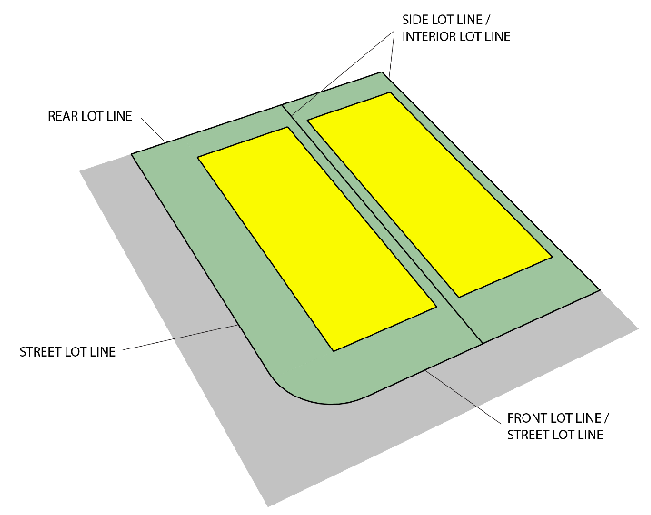
Lot Line, Front means a lot line abutting a public or private street, or access easement. On a corner lot, the shorter lot line abutting public or private street or access easement shall be considered the front lot line. On a through lot, the lot line abutting the public or private street providing the primary access to the lot shall be considered the front lot line. On a flag lot, subdivision plat or parcel map shall designate an interior lot line as a front lot line, or it shall be determined by the Building Official.
Lot Line, Rear means a lot line defined as other than a front or side lot line. In the case of an irregularly shaped lot or a lot bounded by only three (3) lot lines, a line within the lot having a length of ten (10) feet, parallel to and most distant from the front lot line shall be interpreted as the rear lot line for the purpose of determining required yards, setbacks and other provisions of these regulations.
Lot Line, Side means any lot line that is not a front lot line or a rear lot line.
Lot Line, Street means any lot line abutting an existing or dedicated street right-of-way.
Lot of Record means a lot that is part of a subdivision, the plat of which has been recorded in the office of the Burnet County Clerk, or a parcel of land the deed (including metes and bounds description) for which was recorded in the office of either the Burnet County Clerk or the Blanco County Clerk on or before June 27, 2005.
Lot, Through means any lot that is not a corner lot with frontage on two streets which are parallel to each other or within 45 degrees of being parallel to each other.
Lot Width means the distance between the side lot lines, measured at the front setback line.
Low Impact Development (LID) means systems and practices that use or mimic natural processes that result in the infiltration, evapotranspiration or use of stormwater in order to protect water quality and associated aquatic habitat.
Lowest Floor means the lowest floor of the lowest enclosed area (including basement). An unfinished or flood resistant enclosure, usable solely for parking or vehicles, building access or storage in an area other than a basement area is not considered a building's lowest floor, provided that such enclosure is not built so as to render the structure in violation of the applicable non-elevation design requirement of Section 60.3 of the National Flood Insurance Program regulations.
- M -
Manufactured Home, also known as a "HUD-code manufactured home" means:
1.
A structure that is:
a.
Constructed on or after June 15, 1976, according to the rules of the United States Department of Housing and Urban Development;
b.
Built on a permanent chassis;
c.
Designed for use as a dwelling with or without a permanent foundation when the structure is connected to the required utilities;
d.
Transportable in one or more sections; and
e.
In the traveling mode, at least eight body feet in width or at least 40 body feet in length or, when erected on site, at least 320 square feet;
2.
Includes the plumbing, heating, air conditioning, and electrical systems of the home; and
3.
Does not include a recreational vehicle as defined by Chapter 24 of the Code of Federal Regulations, Section 3282.8(g).
See Tex. Occ. Code § 1201, Manufactured Housing.
Manufactured Home Lot or Space means a part of a parcel of land located within a manufactured home park or subdivision designed to meet the minimum provisions set out in these regulations for the placement of a single manufactured home. The two can be distinguished as follows:
Manufactured Home Lot means a part of the parcel within a manufactured home subdivision which is owned in fee simple by the owner of the property.
Manufactured Home Space means an undivided space within a manufactured home park which is established for identification purposes, used to calculate the minimum requirements as set out in these regulations, and is under common ownership.
Manufactured Home Park or Subdivision means a parcel of land providing for the placement of two or more manufactured home lots or spaces, either for rent ("manufactured home park") or for sale ("manufactured home subdivision"). Where established as a single-ownership undivided parcel, manufactured home spaces are used to calculate minimum size requirements pertaining to each home within the park.
Manufactured Home Park or Subdivision, Existing means a manufactured home park or subdivision for which the construction of facilities for servicing the lots on which the manufactured homes are to be affixed (including, at a minimum, the installation of utilities, the construction of streets, and either final site grading or the pouring of concrete pads) is completed before the effective date of the floodplain management regulations adopted by a community.
Manufactured Home Park or Subdivision, Expansion of Existing means the preparation of additional sites by the construction of facilities for servicing the lots on which the manufactured homes are to be affixed (including the installation of utilities, the construction of streets, and either final site grading or the pouring of concrete pads).
Manufactured Home Park or Subdivision, New means a manufactured home park or subdivision for which the construction of facilities for servicing the lots on which the manufactured homes are to be affixed (including at a minimum, the installation of utilities, the construction of streets, and either final site grading or the pouring of concrete pads) is completed on or after the effective date of floodplain management regulations adopted by a community.
Master Planned Community means a land development process permitted by these regulations which promotes the mixture of multiple housing types with neighborhood oriented nonresidential uses. See Section 4.4.2, Master Planned Communities.
Mechanical Equipment means all equipment or devices installed for a primary or accessory use or structure, including, but not limited to, heating and air conditioning equipment, antennas, utility huts, power generating devices, condensers, air ducts, meters, etc., that are located on the site or attached to the exterior (walls or roof) of the building.
Mean Sea Level means, for purposes of the National Flood Insurance Program, the North American Vertical Datum (NAVD) of 1988 or other datum, to which base flood elevations shown on a community's flood insurance rate map are referenced.
Medical Clinic, also referred to as "outpatient clinic", means a facility providing for the examination, diagnosis, consultation, and/or treatment of patients on an outpatient basis, weather by appointment or walk-in basis, with no overnight stay allowed. The term "medical clinic" includes, but is not limited to, urgent care and other specialized forms of medicine not meeting the definition of "Hospital".
Minor Plat. See "Plat, Minor Plat".
Mitigation Replacement Ratio means the calculation of the amount of required tree or monetary compensation for removal of protected or heritage trees.
Mixed Use means the horizontal or vertical mix of residential and nonresidential uses or a mix of nonresidential uses located on the same property.
Mobile Home means a pre-fabricated housing unit built prior to July 15, 1976 that is primarily constructed at an assembly facility and transported to its location for permanent installation. The housing code enacted by the Department of Housing and Urban Development in 1976, renamed mobile homes to manufactured homes. See also "Manufactured Home".
Mobile Service means a radio communication service carried on between mobile stations or receivers and land stations, and by mobile stations communicating among themselves.
Model Homes/Model Apartments and Sales means permanent structures built initially for the intent to showcase exterior and interior features of new homes or apartment structures for sale or lease. Models are designed and built for the eventual conversion to a residential dwelling unit and are located within the subdivision or construction area of the products for sale or lease.
Modular Home. See "Industrialized Housing".
Monopole shall mean a freestanding pole that requires no additional structural support from guyed wires or other appurtenance that may exist between the ground surface and the pole for structural support.
Multifamily means a use whereby three or more dwelling units are located on a single lot or tract under one ownership, and may include condominium form of ownership. The term multifamily includes apartments, triplexes, and fourplexes. The term multifamily does not include bed and breakfast lodging, manufactured housing, single-family detached or attached residential uses, or hotels/lodging.
Multifamily Residential District means a primarily residential zoning district intended to provide areas of even higher density than in the Transitional Residential District. It is tied to an overall development density and is intended to provide an area of transition between the lower density Transitional Residential District and nonresidential districts. See Section 2.1.1, Zoning Districts Established.
Multi-Lot Unified Development means a development that is designed and approved as a cohesive, planned project located on multiple abutting properties established under a single development application such as a Site Development Plan or subdivision plat.
Multi-Use Path, including "Shared-Use Path" or "Side Path", means a path in the public right-of-way that is for the shared use of bicyclists and pedestrians for transportation and recreational purposes.
- N -
Native or Native Plant means any plant species that is indigenous to Central Texas.
Natural Area means an area of naturally grown landscape that is left primarily undisturbed, except for the removal of poison ivy, invasive species, diseased or dead trees, and similar vegetation, and allowing for maintenance of the trees to encourage vigorous growth.
Neighborhood Amenity means a privately established indoor and/or outdoor facility that provides recreational, social, or other types of common spaces, amenities, activities, or services intended specifically for the residents of a particular residential development. The phrase "neighborhood amenity" includes, but is not limited to, commonly used terms such as:
1.
Neighborhood park, an area providing open space for the enjoyment of the residents that may include playgrounds, picnic areas, pavilions, benches, walking trails, and restrooms.
2.
Amenity center, a facility providing gathering or recreational space for the residents that may include a clubhouse, swimming pool, and sport courts (basketball/tennis/volleyball).
3.
Neighborhood garden, a site used for growing plants for food, fiber, herbs, and/or flowers, which is shared and maintained by the residents of the neighborhood.
4.
Residential convenience service, a use or activity conducted as an accessory use to multiple family residential or mobile home park residential use and intended solely for the convenience of residents thereof.
5.
Private golf course, a facility provided for the benefit of the residents of the community but may be open to external memberships, that provides improved land area for conducting a game of golf and may include a clubhouse, shower/changing facility, driving range, equipment sales, golf cart storage, and similar accessory uses.
Neighborhood Commercial District means a nonresidential zoning district intended for nonresidential development that is of an appropriate use, scale, and design that is compatible with abutting or nearby residential development. See Section 2.1.1, Zoning Districts Established.
Neighborhood Residential District means a residential zoning district intended to be the default single-family detached district and suburban in character, with flexible lot size configurations tied to an overall development density. See Section 2.1.1, Zoning Districts Established.
New Construction means, for the purpose of determining insurance rates, structures for which the "start of construction" commenced on or after the effective date of an initial FIRM or after December 31, 1974, whichever is later, and includes any subsequent improvements to such structures. For floodplain management purposes, "new construction" means structures for which the "start of construction" commenced on or after the effective date of a floodplain management regulation adopted by a community and includes any subsequent improvements to such structures.
Nonconformity means any structure, lot, site, sign, or use that does not meet the requirements of these regulations or other local, state, or federal ordinances or technical manuals. In order to be considered a legally nonconforming status, the nonconforming structure, lot, site, sign, or use must have been legally established on the effective date of these regulations or any effective date of any amendment hereto and has been in regular and continuous use. See also "Legal Nonconformity".
Nonconforming Use means a use that is not permitted within the zoning district of the subject property upon which the use is located, including those uses that contain restrictions or require a Conditional Use Permit but lacks such permit or are operating outside the restrictions of such use.
Nonconforming Structure means any structure that does not meet the requirements of these regulations, such as building placement, setback requirements, height limitations, material requirements or articulation, or does not meet any other local ordinances or technical manuals. In Article 12, Nonconformities, the term structure applies to anything constructed or erected on the ground or which is attached to something located on the ground, except signs. This includes, but is not limited to, buildings, telecommunications towers, utility improvements and sheds, and is applicable to all structures regardless of whether they are deemed principal or accessory.
Nonconforming Lot means a lot of record that does not meet the minimum area or dimensional requirements of the zoning district in which the lot is located.
Nonconforming Site means a property with existing site improvements that do not conform to one or more of the regulations of these regulations applicable to the property. Site improvements may include, but not limited to, parking areas, storm drainage facilities, sidewalks, landscaping, screening, and buffers.
Nonresidential means any use, building or structure (or portion of a building or structure) occupied or intended to be occupied, in whole or in part, for a use other than a residential dwelling unit.
- O -
Off-Site Facilities or Improvements means those facilities or improvements that are required to serve a site but that are not located within the boundaries of a plat and are not required to be constructed or improved immediately adjacent to the property to serve the development. These include oversizing for streets, sewer lines, water lines and storm drainage facilities, as well as the excess capacity of facilities such as water storage tanks and wastewater treatment plants available for new development.
Off-Street Parking means an area reserved exclusively for the parking of motor vehicles that is located outside of the public right-of-way.
Office means uses where administrative, business, or professional services are provided. The term "office" includes, but is not limited to, such uses as:
1.
Administrative and business offices, offices of private firms or organizations which are primarily associated with the provision of executive, management or administrative services. Typical uses include administrative offices, and services including real estate, insurance, property management, investment, personnel, travel, secretarial services, telephone answering, photocopy and reproduction, and business offices or public utilities, organizations and associations, or other use classifications when the service rendered is that customarily associated with administrative office services.
2.
Drafting services or quick reproduction services, establishments primarily engaged in such services as surveying, mapping, aerial photography, LiDAR management, hydrographic surveying, and other drafting and reproduction services.
3.
Engineering, architectural and design services, establishment primarily engaged in providing consulting, design, and drafting services for construction projects.
4.
Professional offices, a use providing professional office space for services in the fields of law, architecture, design, engineering, accounting and similar professions.
5.
Real estate offices and sales, a use providing professional office space for services primarily engaged in the sale or lease of real property.
The term "office" does not include the term "Office, Medical" or "Office, Showroom" or "Office, Warehouse" and excludes sale or storage of merchandise on the premises.
Office, Medical means office space used for the examination, diagnosis, consultation, and/or treatment of patients on an outpatient basis, generally by appointment, with no overnight stay allowed. The term "medical office" includes, but is not limited to, health care offices and laboratories supporting the work of physicians, pediatricians, obstetricians, dentists, optometrists, physical therapists, chiropractors, nutritionists, psychiatrists, and other similar health related care and excludes outpatient clinics (e.g., urgent care and other specialized forms of medicine not meeting the definition of "Hospital").
Office, Showroom means office space with both a business office and associated showroom for display of sample goods or services to be delivered or performed off-premises.
Office, Warehouse means office space with both a business office and associated warehouse for storage of materials associated with a service industry, but not involving manufacturing or production.
Official Zoning Map means the map showing the location and boundaries of the zoning districts established by these regulations. The map is entitled "Official Zoning Map of Marble Falls, Texas" and is kept on record with the City.
On-site Facilities or Improvements means the existing or proposed facilities or improvements constructed within the property boundaries of a plat, and the existing or proposed facilities required to be constructed or improved immediately adjacent to the property that are needed to serve a development. Facilities and improvements include, but are not limited to, streets, alleys, water lines, sewer lines, storm drainage facilities, sidewalks, screening devices, and curbs and gutters.
Open Space means the areas of a lot or parcel proposed for development that are set aside to be used for the common use or enjoyment of the residents, patrons, or users of the development.
Ornamental Tree means a tree smaller than a shade tree that is intended to provide screening and aesthetic benefit rather than significant shade.
Outdoor Display means the display of merchandise, goods, or materials that are actively for sale.
Outdoor Storage means the storage of merchandise, goods, or materials that are not actively for sale.
Overlength Street or Alley means a street segment, or a cul-de-sac or alley segment, which exceeds the maximum length allowed by these regulations, as measured along the centerline of the street from the intersection centerpoint of one through street, which shall not be a cul-de-sac or dead-end or looped street, to the intersecting centerpoint of another through street or, in the case of a cul-de-sac, to the midpoint of the cul-de-sac. For an alley segment, the measurement shall be to the right-of-way lines of the streets from which the alley is provided access, including any alley turnouts, or from the centerpoint of an intersection with another alley which connects to a street.
P—T
- P -
Parcel means a legally described area of land.
Parcel Proposed for Development means any legally described parcel of land which is designated by the owner/operator or developer as land to be used or developed as a single unit, or which has been developed as a unit as determined by the Director. Parcels proposed for development oftentimes go through the subdivision process to create individual lots.
Parking, Commercial means an o?-street facility for the parking of vehicles on a temporary basis that may be operated as a business enterprise by charging the public a fee and is not reserved or required to accommodate occupants, clients, customers, or employees of a particular establishment or premises.
Passive Outdoor Recreation means open space areas or parks with limited manipulation of the natural landscape that provide opportunities for passive enjoyment of the natural environment which may include walking/jogging trails, picnic areas, benches, playgrounds, and similar features generating limited traffic demand and lighting.
Pavement Width means the portion of a street that is available for vehicular traffic. Where curbs are used, it is the portion from the back of one curb to the back of the opposite curb.
Pawn Shop means an establishment that is engaged in the business of:
1.
Lending money on the security of pledged goods; or
2.
Purchasing goods on the condition that they may be repurchased by the seller at a fixed price within a fixed period of time.
See Texas Finance Code § 371.003.
Perimeter Street means any existing or planned street which abuts the subdivision or addition to be platted.
Permeable Pavement is a low impact development practice that allows water to drain through it. It is an alternative to traditional impervious pavements used for sidewalks, parking areas, roads, or other impervious ground covers. Must be approved for use by the City Engineer. May also be referred to as pervious cover or surface.
Permit means a license, certificate, approval, registration, consent, permit, contract, or other agreement for construction related to, or provision of, service from a water or wastewater utility owned, operated, or controlled by a regulatory agency, or other form of authorization required by law, rule, regulation, order, or ordinance that a person must obtain to perform an action or initiate, continue, or complete a project for which the permit is sought.
Personal Communication Services or Networks means digital wireless telephone technology such as portable phones, pagers, faxes, and computers.
Personal Services means an establishment or place of business primarily engaged in the provision of frequently or recurrently needed services of a personal nature. Accessory uses may include drive-in or drive-through facilities, which may be further limited in certain zoning districts. The phrase "personal services" includes, but is not limited to, such uses as:
1.
Branch banking and check cashing, a financial institution that is open to the public and engaged in deposit banking, and that performs closely related functions such as making loans, investments, and fiduciary activities, excluding non-depository financial institution or payday lending establishments.
2.
Computer programming and other software services, an establishment providing computer-related services, including sales and repair.
3.
Consumer and small appliance repair services, an establishment providing repair services for small consumer appliances.
4.
Copy centers, parcel service drop-off locations, and mailbox services.
5.
Hair and nail salons, a retail use which provides grooming or cosmetic services to the individual.
6.
Health spas and physical fitness centers, facilities that provide amenities for health and fitness activities, such as fitness gym, gymnasium, indoor sports such as tennis, racquetball, bocce ball, soccer, swimming, or other sports activities.
7.
Laundromat, retail dry cleaning, tailoring, shoe repair, and clothes restoration, establishments primarily engaged in the provision of laundering, dry cleaning or dyeing services other than those classified as clothing restoration.
8.
Music, dance, martial arts, yoga, and other similar instruction, an establishment providing group instruction.
9.
Pet services (not including animal clinics or services), retail sales and grooming of dogs, cats, birds, fish, and similar small animals customarily used as household pets. Typical uses include pet stores, dog bathing and clipping salons or pet grooming shops.
10.
Tattoo parlors, establishments that engage in the business of tattooing and/or branding human beings.
11.
Other weight loss centers, photography studios, driving schools, licensed massage therapy, medical spa, bicycle repair, appliance repair, retail bakeries, and catering.
Personal Wireless Services means wireless communications technology that provides users with the ability to communicate using portable devices not physically interconnected by equipment such as wire or cable.
Permitted Use is a use that is allowed in a specific zoning district.
Person means any individual, association, firm, corporation, governmental agency, political subdivision, or legal entity of any kind.
Planning and Zoning Commission means the Planning and Zoning Commission of the City of Marble Falls, Texas. May be referred to as "P&Z" or "Commission".
Planned Development District means a customizable zoning district, represented through an adopted development plan, per these regulations, which may provide for one or more main uses or structures on a single parcel or contiguous parcels of land, and which permits flexibility related to land uses, dimensional requirements, landscaping, design, and other similar regulations in return for assurances of a comprehensive plan for overall innovation and/or quality of development.
Planter box means an enclosed bioretention system that collects and filters stormwater runoff through vegetation and soil media. Because the system is enclosed, filtered runoff is directed into an underdrain.
Plat means a document, prepared by a registered land surveyor or professional engineer, that depicts the subdivision of land into lots and blocks (and sometimes the combination of land) for the purpose of identifying property. For the purposes of these regulations, the following definitions are included:
Amending Plat means a subdivision plat which includes a plat revision to correct errors or make minor changes to a recorded plat. See Section 11.4.7, Amending Plat.
Development Plat means a plat that is required prior to development of property that meets the requirements of Section 11.4.5, Development Plat.
Final Plat means the official and authentic map of any given subdivision of land prepared from actual field measurement and staking of all identifiable points by a surveyor or engineer, with the subdivision location referenced to a survey corner, and with all boundaries, corners and curves of the land division sufficiently described so that they can be reproduced without additional references. The Final Plat of any lot, tract or parcel of land shall be recorded in the land records of Burnet County, Texas. See Section 11.4.3, Final Plat.
Minor Plat means a subdivision resulting in four or fewer lots, provided that the plat does not require the creation of new streets or the extension of any municipal facilities to serve any lot within the subdivision. Any property to be subdivided using a Minor Plat shall already be served or be able to be served by all required City utilities and services, and all lots will have access from a public street that has already been improved to City standards. Also known as Minor Subdivision. See Section 11.4.4, Minor Plat.
Major Plat means all plats not classified as Minor Plats, including, but not limited to, subdivisions of more than four lots, or any plat that requires the construction of a new street (or portion thereof) or the extension of a municipal facility as required by these regulations or any other City ordinance. Major plat approval shall be in accordance with Section 11.4.2, Preliminary Plat, and Section 11.4.3, Final Plat. Also known as Major Subdivision.
Preliminary Plat means a subdivision plat which is the graphic expression of the proposed overall plan for subdividing, improving and developing a parcel proposed for development, showing the proposed street and lot layout, easements, dedications and other pertinent features, with such notations as are sufficient to substantially identify the general scope and detail of the parcel proposed for development. See Section 11.4.2, Preliminary Plat.
Replat means a subdivision plat which involves the re-subdivision of any part or all of a block or blocks of a previously platted subdivision, addition, lot or tract. See Section 11.4.6, Replat.
Plat Vacation means an instrument declaring that a plat and its dedication be vacated or cancelled and that the land be converted to acreage. An applicant of a Plat Vacation may remove, in whole or partially, subdivisions, dedicated easements, notes, covenants, or restrictions from a plat. See Section 11.4.9, Plat Vacation.
Police Chief means the commanding officer of the Marble Falls Police Department.
Preliminary Plat. See "Plat, Preliminary Plat".
Primary means the basic, fundamental, or most important use, activity, or development of a building or site. For the purposes of these regulations, "primary" is equal to, identical to, and often used interchangeably with "principal".
Primary Architectural Façade means the façade of a building facing a public right-of-way, or the façade that serves as the front façade which has received more elaborate or special architectural treatment.
Principal Building means a building in which a principal use of the parcel or property is conducted.
Principal Structure means a structure in which a principal use of the parcel or property can be associated.
Principal Use means the use which is conducted as the primary activity on the parcel of property.
Private Street means a private vehicular access way, including an alley, that is shared by and that serves two (2) or more lots, which is not dedicated to the public, and which is not publicly maintained.
Prohibited Use means a use that is not allowed in the specified zoning district and in some cases the entire City.
Project means an endeavor over which a regulatory agency exerts its jurisdiction and for which one or more permits are required to initiate, continue, or complete the endeavor.
Projected Side Yard Line means a projection of the side lot line of a waterfront lot/property into the abutting body of water where a boat dock would be located. Utilized to achieve a minimum separation of docks from one another.
Property Line. See "Lot Line".
Property Owner means any person or firm, association, syndicate, general or limited partnership, corporation, trust or other legal entity, or any agent thereof, that has sufficient proprietary interest in the land subject to these regulations. In any event, the term "property owner" shall be restricted to include only the owner(s) or authorized agent(s) of such owner(s), such as a developer. Can also be known as "Applicant" or "Subdivider" or "Developer".
Protected Tree means, for the purposes of these regulations, a Live Oak, Post Oak, Shumard Oak, Bur Oak, Chinquapin Oak, Monterey Oak, Bald Cypress, American Elm, Cedar Elm, Pecan, Walnut, Texas Ash, or Southern Magnolia tree with a diameter breast height (DBH) of 12 inches or greater.
Provisional Housing means a facility providing housing and/or overnight accommodations for groups of people whom will stay for a temporary, intermittent, or transitional period of time. This term includes facilities such as post incarceration facilities, halfway houses, and homeless shelters.
Public Improvement means any improvement, facility, or service together with its associated public site, right-of-way, or easement necessary to provide transportation, drainage, public or private utilities, parks, energy, or similar essential public services and facilities, for which a governmental entity may ultimately assume ownership and the responsibility for operation and maintenance.
Public Service and Emergency Systems means communication systems that are legally required by any governmental agency having jurisdiction.
- Q -
Quadplex means a parcel developed with four dwelling units in a single structure. Quadplexes are designed exclusively for the use and occupancy of four families living independently of each other.
- R -
Rain Garden is a vegetated depression that temporarily stores stormwater runoff. Water is then filtered through the soil media, removing pollutants as it is released. Evaporation and transpiration also occurs with stored water.
Rainwater Harvesting means the practice of capturing and storing stormwater runoff to be used for irrigation and other non-potable uses. Rainwater harvesting systems can range in size and selection of the appropriate system will depend on the development type and goals.
Rain Barrel means a small, above ground storage system that typically holds 100 gallons or less. They are most appropriate for residential developments such as single-family homes or similar buildings.
Cistern means above ground storage systems that have a larger capacity than a rain barrel. They can collect water from larger buildings, such as commercial buildings or a multifamily building.
Underground Storage System means a rainwater harvesting system that collects and stores water in chambers constructed below grade. They can collect from buildings as well as paved areas.
Recreational Vehicle (RV) means a vehicle which is:
1.
Built on a single chassis;
2.
Four hundred (400) square feet or less when measured at the largest horizontal projections;
3.
Designed to be self-propelled or permanently towable by a light duty truck; and
4.
Designed primarily for use as temporary living quarters for recreational, camping, travel, or seasonal use.
Recreational Vehicle Park (RV Park) means a property or parcel of land developed for the use of two or more recreational vehicles in designated spaces.
Registered Landscape Architect (RLA) means an individual currently registered with and licensed by the State of Texas to practice landscape architecture.
Regulatory Floodway means the channel of a river or other watercourse and the adjacent land areas that must be reserved in order to discharge the base flood without cumulatively increasing the water surface elevation more than a designated height.
Rendering Plant means plant that converts packing house waste, kitchen grease, and livestock carcasses into industrial fats and oils (as tallow for soap) and various other products (as fertilizer).
Replat. See "Plat, Replat".
Research and Development means a structure or group of structures used primarily for applied and developmental research, where product testing is an integral part of the operation and goods or products may be manufactured as necessary for testing, evaluation, and test marketing.
Residential means any use, building or structure (or portion of a building or structure) that contain habitable rooms for non-transient occupancy. Residential uses are typically contained within single-family detached, single-family attached, duplex, and multifamily dwelling units. The term "residential" is separate and distinct from "hotel / lodging" and other overnight accommodations.
Residential and Neighborhood Uses means a category of uses that are intended for residential dwellings and related accessory uses.
Restricted Use means a use that is allowed in a specific zoning district subject to standards for the permitted uses and use specific requirements.
Resource Extraction, Subsurface means the extraction of sub-surface mineral products or natural resources including solids, such as coal and ores; liquids, such as crude petroleum; and gases, such as natural gases. Typical extraction uses are quarries, borrow pits, sand and gravel operations, oil and gas extraction, and mining operations and may include milling, such as crushing screening, washing, and floatation; and other preparation customarily done at the extraction site or as part of the extractive activity.
Resource Extraction, Surface means the extraction of surface mineral products or natural resources including solids, such as coal and ores. Typical extraction uses are quarries, borrow pits, sand and gravel operations, and mining operations and may include milling, such as crushing screening, washing, and floatation; and other preparation customarily done at the extraction site or as part of the extractive activity.
Restrictions/Deed Restrictions means easements, servitudes, covenants, conditions, and/or restrictions on property which are set out in a recorded agreement or a plat note that binds subsequent owners and may include restrictions on use or development of land and require payment of dues and other affirmative actions to be performed. Restrictions may be either private agreements between private parties or public restrictions enforceable by the City or other public entities.
Retail Sales, General means the sale of goods directly to a consumer, typically in small quantities and not for wholesale. Accessory uses may include drive-in or drive-through facilities, which may be further limited in certain zoning districts. The phrase "retail sales" includes, but is not limited to, such uses as:
1.
Agricultural sales and services, establishments or places of business engaged in sale (from the premises) of feed, grain, fertilizers, pesticides and similar goods or in the provision of agricultural related services with incidental storage on lots other than where the service is rendered.
2.
Alcohol sales, the retail sale of beer, wine, and/or other alcoholic beverages for off-premises consumption.
3.
Artisan sales, the manufacture and retail sale of hand-crafted wares such as pottery, jewelry, art, and similar products of craftsmanship.
4.
Clothing, clothing accessory, and jewelry stores, the retail sales of clothing, clothing accessories, or jewelry merchandise.
5.
Convenience store (without vehicle gas or fueling station), a retail establishment that sells consumable and non-consumable convenience products for off-premise use or consumption.
6.
Electronics and appliance stores, the retail sales of appliance and other consumer electronics.
7.
Florist, card, and gift shops, the retail sale of gift-related merchandise.
8.
Food sales, establishments or places of business primarily engaged in the retail sale of food or household products for home consumption. Typical uses include groceries, delicatessens, meat markets, retail bakeries, and candy shops.
9.
Furniture and home furnishings stores, retail sales of furniture or home furnishings.
10.
General merchandise stores, retail sale of multiple lines of merchandise.
11.
Hardware stores, plumbing supplies, electrical supplies, lighting stores, retail sales of household goods or services.
12.
Sporting goods, hobby, book, and music stores, retail sales of personal recreational goods, such as books, sporting goods, hobby and crafts, instruments, and similar merchandise.
Retail Sales and Service, Heavy Equipment means:
1.
Construction sales and services, businesses primarily engaged in construction activities and/or the retail or wholesale sale of materials used in the construction of buildings and other structures and excluding those uses classified as vehicle sales, rental, or services. May include incidental storage. Typical uses included building materials stores, tool and equipment rental or sales.
2.
Equipment sales, an establishment primarily engaged in the sale or rental of trucks, tractors, construction equipment, agricultural implements, similar heavy equipment, including incidental storage, maintenance and servicing. Typical uses include truck dealerships, construction equipment dealerships sales establishments.
3.
Equipment repair services, an establishment primarily engaged in the repair of trucks, tractors, construction equipment, agricultural implements and similar heavy equipment. Typical uses include truck repair garages, tractor and farm implement repair services and machine shops, but exclude dismantling or salvage.
Retail Sales and Services, Large Scale means retail sales and service activities which may include exceptionally large floor areas, heavier traffic demand and circulation, partially enclosed structures (e.g., outdoor merchandise). The phrase "retail sales and services, large scale" includes, but is not limited to, such uses as:
1.
Home retail centers, warehouse clubs, and other big box stores; and
2.
Lawn and garden retail centers (not including crop production and sales).
Review means "to read, analyze, assess and, as appropriate, act upon" a development application.
Review Body or Authority means the entity that is authorized to either recommend approval or denial or be the decision-making authority of an application for permit or approval required by these regulations.
Rezoning. See "Zoning Map Amendment".
Right-of-Way means a parcel of land occupied, or intended to be occupied, by a street or alley. Where appropriate, "right-of-way" may include other facilities and utilities such as sidewalks; railroad crossings; electrical, communication, oil and gas facilities, water and sanitary and storm sewer facilities; and any other special use. The use of right-of-way shall also include parkways and medians outside of the paved portion of the street. The usage of the term "right-of-way" for land platting purposes shall mean that every right-of-way hereafter established and shown on a Final Plat is to be separate and distinct from the lots or parcels adjoining such right-of-way and shall not be included within the dimensions or areas of such lots or parcels.
Riverine means relating to, formed by, or resembling a river (including tributaries), stream, brook, etc.
Rural Estate District means a residential zoning district intended to provide the opportunity to develop a large lot subdivision that is rural in character. See Section 2.1.1, Zoning Districts Established.
- S -
Sand Filter means a flow-through treatment system designed to remove particulates and solids from runoff by slowly filtering stormwater through sedimentation and filtration chambers to improve water quality.
Satellite Antenna means an antenna that specifically sends and transmits data within a satellite communications system.
Scrap and Salvage Yard means an establishment where junk, waste, discarded, or salvaged materials are bought, sold, exchanged, stored, baled, packed, disassembled, processed, handled, or recycled such as inoperable vehicles, house materials, appliances, and structural steel equipment. The use does not include the purchase, sale, or storage of used furniture and household equipment.
Secondary is, for the purposes of these regulations, equal to, identical to, and often used interchangeably with "accessory".
Service Lines means those lines used to connect between the utility's system or lateral lines and the end user's meter box.
Setback means the distance between a lot line and a building line.
Setback Area means the open area between building setback lines and lot lines.
Setback, Front means a yard that extends across the full width of the lot between the front lot line and the required front setback line.
Setback, Interior Side means a yard between the principal building and the side line of the lot, extending from the front yard to the rear yard.
Setback, Rear means a yard extending the full width of the lot between the rear lot line and the rear setback line. For a corner lot, the rear yard does not extend beyond the street side setback line.
Setback, Street Side means a yard extending from the front setback line to the rear lot line, located between the side street lot line and the street side setback line.
Setback Line means a line within a lot parallel to and measured from a corresponding lot line, forming the boundary of a required yard and governing the placement of structures and uses on the lot. Also known as "Building Setback Line".
Shade Tree means the largest plants in the landscape which provide overhead structure needed for shading and under which other plants live and grow.
Shopping Center means a group of retail sales and personal services and other similar commercial uses typically grouped and managed as a unit, including food and drink establishments. Shopping centers include an off-street parking lot that collectively serves all of the uses. The phrase "shopping center" does not include out-parcels which may be separated (by lot lines or easements) from the main shopping center.
Shoreline means the line at which the water surface of Lake Marble Falls and the navigable waterways intersect the land at any given time.
Shrub means a self-supporting woody perennial evergreen or deciduous species, characterized by multiple stems and branches contiguous from the base. See also "Large Shrub" and "Small Shrub".
Sight Triangle means the triangular area formed by an invisible diagonal line at the corner of either two intersecting street right-of-way lines, the edge of street lines, the edge of a driveway or combination of two thereof. The sight triangle exists to prevent sight obstruction for motor vehicles, pedestrians, etc. May also be referred to as "street visibility triangle" or "sight distance triangle".
Single-Family Attached means a dwelling unit that is joined to another dwelling unit at one side by a party wall or abutting separate wall and each unit is situated entirely on its own lot.
Single-Family Detached means a dwelling unit located on an individual lot or tract. Single-family detached buildings are separated from other principal dwelling units and are separate and distinct from single-family attached, duplexes or townhouses.
Single-Family Zero Lot Line means a single-family detached dwelling unit, located on an individual lot, that is set on or relatively close to one interior side lot line to create additional side yard area on the opposite side of the unit.
Site Development Plan means a detailed, scaled plan, or set of plans, showing accurately and with complete dimensioning, all of the buildings, structures and uses, and the principal site development features including parking, access, and landscaping and screening, proposed for a specific parcel of land. The Site Development Plan is the basis for site development and is intended to demonstrate compliance with the development standards and other requirements, as applicable, of these regulations. See Section 11.5.3, Site Development Plan.
Small Shrub means a shrub intended as a planting base to provide aesthetic benefit. Small shrubs typically grow to a height of 2 to 4 feet.
Social Service Institution means a multi-functional facility that provides assistance, advocacy, case management, guidance, counseling, or similar services on a daytime care basis to persons requiring rehabilitation assistance or those with limited ability for self-care, but for whom medical care is not a major element. The phrase includes a facility that provides assistance concerning psychological problems, employment, learning, or physical disabilities, and child support issues, but does not include a rescue mission, homeless shelter, or child-care facility.
Special Event Venue means an indoor and/or outdoor facility or site consisting of multi-purpose rooms, outdoor courtyards, or recreational facilities available for rental by the public for the primary intended purpose of hosting social gatherings such as parties, weddings, banquets, corporate meetings or similar group events. Special Event Venue does not include an event room available for rental in a structure housing another primary use where the event room rental is an accessory use to the primary use such as a restaurant or community center.
Special Exception means an exception to certain provisions of these regulations, granted by the City Council, for specifically defined situations and standards, pursuant to Section 11.3.7, Special Exception. Such exception does not constitute a Variance or Waiver, as those terms are defined in these regulations.
Special Flood Hazard Area. See "Area of Special Flood Hazard".
Specialized Building Appurtenances means an accessory or other structure associated with a building and attached to such building. Specialized structures and building appurtenances shall refer to:
1.
Roof structures for the housing of elevators, stairways, tanks, or similar equipment required to operate and maintain a building;
2.
Architectural towers, steeples, flagpoles, ventilating fans, or chimneys;
3.
Smokestacks located in any district other than the General Industrial (IN) District;
4.
Skylights, solar panels, and solar water heaters; and
5.
Satellite dishes and antennae.
Specialized Mobile Radio means a two-way radio system in which two or more mobile/portable wireless transceivers are linked by a single repeater.
Standard Street means a street or road that meets or exceeds the minimum specifications in the City's standard street specifications, and which is constructed to the ultimate configuration for the type of roadway it is designated for on the City's Thoroughfare Plan.
Start of Construction, for other than new construction or substantial improvements under the Coastal Barrier Resources Act (Pub. L. 97-348), means substantial improvement and means the date the Building Permit was issued, provided the actual start of construction, repair, reconstruction, rehabilitation, addition placement, or other improvement was within one hundred eighty (180) days of the permit date. The actual start means either the first placement of permanent construction of a structure on a site, such as the pouring of slab or footings, the installation of piles, the construction of columns, or any work beyond the stage of excavation; or the placement of a manufactured home on a foundation. Permanent construction does not include land preparation, such as clearing, grading and filling; nor does it include the installation of streets and/or walkways; nor does it include excavation for basement, footings, piers or foundations or the erection of temporary forms; nor does it include the installation on the property of accessory buildings, such as garages or sheds not occupied as dwelling units or not part of the main structure. For a substantial improvement, the actual start of construction means the first alteration of any wall, ceiling, floor, or other structural part of a building, whether or not that alteration affects the external dimensions of the building.
Storage, Self means a controlled-access building or group of buildings housing individual storage spaces that are used to house personal property or records. There is no conduct of sales, business or any other activity allowed within the individual storage units. Does not include storage of any hazardous materials. The phrase may also be referred to as convenience storage, mini-storage, or mini-warehouse.
Storage Yard means a facility used almost exclusively for outdoor storage of only operable equipment and construction materials temporarily stored for eventual off-site use. A storage yard is not limited by the outdoor storage limitations of these regulations. The phrase "storage yard" does not include outdoor storage areas that are associated with an on-site industrial use.
Stormwater Management means the mitigation of the hydrologic impacts of lost natural runoff storage by the use of conventional stormwater conveyance systems or Low Impact Development.
Stormwater Runoff means surplus surface water generated by rainfall that does not seep into the earth but flows into storm drains or overland to flowing or stagnant bodies of water.
Street means a right-of-way, whether public or private and however designated, which provides vehicular access to adjacent land. Streets may be of the following categories:
Arterial Street, also known as major thoroughfare or primary thoroughfare, which provides vehicular movement from one neighborhood to another or to distant points within the City, and including freeways or highways leading to other communities.
Collector Streets, also known as feeder streets or secondary thoroughfares, which provide vehicular circulation within neighborhoods, and from local streets to major thoroughfares.
Local Streets, also known as neighborhood streets, which primarily provide direct vehicular access to abutting residential property.
Private Streets are streets which are owned and maintained privately by an individual, homeowners' association, or property owners' association, and which are not dedicated to the public.
Street Classification means the designation of street function established by the Marble Falls Comprehensive Plan.
Street Improvements means any street or thoroughfare, together with all appurtenances required by City regulations to be provided with such street or thoroughfare, and including but not limited to curbs and gutters, walkways (sidewalks), drainage facilities to be situated in the right-of-way for such street or thoroughfare, traffic control devices, street lights and street signs, for which facilities the City will ultimately assume the responsibility for maintenance and operation.
Street Length. See "Block Length".
Street Right-of-Way means the shortest perpendicular distance of a roadway between the lines which delineate the rights-of-way of the street.
Street Yard means that area between the building façade and any lot line along a public street.
Structure means anything constructed or erected which requires a permanent location on, above, or below the ground; or attached to something that has a permanent location on, above, or below the ground (e.g., fences, waste enclosures, signs, kiosks, etc.). A "structure" may sometimes also be a building. For floodplain management purposes, a structure may also include a gas or liquid storage tank that is principally above ground, as well as a manufactured home.
Subdivider means any person or any agent thereof, dividing or proposing to divide land so as to constitute a subdivision as that term is defined herein. In any event, the term "subdivider" shall be restricted to include only the owner, equitable owner or authorized agent of such owner or equitable owner of land sought to be subdivided.
Subdivision means a division or re-division of any tract of land situated within the City's corporate limits or its extraterritorial jurisdiction into two (2) or more parts, lots or sites, for the purpose, whether immediate or future, of sale, division of ownership, or building development. "Subdivision" includes re-subdivisions of land or lots which are part of a previously recorded subdivision.
Subdivision Plat. A general term that shares the meaning of "plat."
Subdivision Sales Office means temporary buildings created for the short-term intention of being used as a sales office for and located within a particular subdivision.
Subdivision Waiver means a grant of relief from the terms of the subdivision regulations, as specified in Section 11.4.8, Subdivision Waiver and Suspension.
Submission Date refers to the date when all necessary forms, fees, plans, information and copies have been submitted to the City.
Substandard Street means an existing street or road that does not meet the minimum specifications in the City's standard street specifications, and which is not constructed to the ultimate configuration for the type of roadway it is designated for on the City's Thoroughfare Plan.
Substantial Damage means damage of any origin sustained by a structure whereby the cost of restoring the structure to it's before damaged condition would equal or exceed fifty (50) percent of the market value of the structure before the damage occurred.
Substantial Improvement means any repair, reconstruction, rehabilitation, addition, or improvement of a structure, the cost of which equals or exceeds fifty (50) percent of the market value of the structure either, (a) before the improvement or repair is started or (b) if the structure has been damaged and is being restored, before the damage occurred. This term includes structures which have incurred "substantial damage", regardless of the actual repair work performed. For the purposes of this definition, substantial improvement is considered to occur when the first alteration of any wall, ceiling, floor, or other structural part of the building commences, whether or not that alteration affects the external dimensions of the structure. The term does not, however, include either: (1) Any project for improvement of a structure to correct existing violations of state or local health, sanitary, or safety code specifications which have been identified by the local code enforcement official and which are the minimum necessary to assure safe living conditions or (2) Any alteration of a "historic structure", provided that the alteration will not preclude the structure's continued designation as a "historic structure."
Succulent Plant means a type of plant that stores water in its leaves and stems and has minimal watering or irrigation requirements. Succulent plants include cacti.
Supermajority means a vote of three-fourths (¾) of the full City Council.
Surveyor means a licensed land surveyor or a registered public land surveyor, as authorized by state statutes to practice the profession of surveying.
Swale Block means installed build ups at intervals along a vegetated swale to allow stormwater to build up in a series of pools, slowing water flow and providing opportunities for vegetated filtration and infiltration.
SWPPP means a Storm Water Pollution Prevention Plan.
- T -
TCEQ means The Texas Commission on Environmental Quality.
TCSS means the City of Marble Falls Technical Construction Standards and Specifications for the construction of subdivision improvements, a copy of which is maintained and available for inspection at City Hall, and which is incorporated herein by reference. The TCSS shall be comprised of the provisions for trenching and backfilling, concrete, water system, sewer system, streets, sidewalks, and driveways, storm drainage, trench safety and the standard details (and as hereby amended) that are in effect at the time of submission of the plat application. The TCSS shall also include any additional provisions or policies the City of Marble Falls implements that pertain to the construction of site improvements such as street, parking lot, driveway and sidewalk paving, storm drainage structures, utility lines and facilities, screening walls/fences, retaining walls, landscaping and irrigation improvements, street lighting or signage, restricted access (gated) entrances to any type of development, and other similar improvements. The City Engineer and the City's Director of Public Works shall have the authority to determine whether or not the engineering plans for any type of site improvement are in conformance with the City's TCSS.
Telecommunications means the transmission, between or among points as specified by the user, of information of the user's choosing, without change in the form or content of the information as sent and received.
Telecommunications Tower means any structure designed and constructed primarily for the purpose of supporting one or more antennas, including self-supporting lattice towers, guy towers, or monopole towers. The term shall include, but will not be limited to, radio and television transmission towers, microwave towers, common-carrier towers, cellular telephone towers, and alternative tower structures.
Television and AM/FM Radio Broadcast Towers mean towers used by television broadcasters to provide over the air signal as mandated by the FCC to television broadcasters to provide free service to those with in-home antennas.
Temporary Improvements mean improvements built and maintained by the property owner that are needed to remedy a circumstance that is temporary in nature, such as a temporary drainage easement or erosion control device, that will be removed upon completion of the subdivision or shortly thereafter.
Text Amendment means a change of the text of these regulations and does not include change or modification to the boundaries of any zoning district. Text amendments are granted by City Council pursuant to the procedural requirements established in Section 11.3.9, Text Amendment.
Tiny House means a detached dwelling unit which contains all of the minimum standards for fitness for human habitation and is between 140 square feet and 599 square feet in size. Tiny houses include a permanent foundation. See Section 4.2.4, Tiny House Development.
Townhouse means a dwelling unit, generally having two or more floors, attached to at least two and no more than five similar dwelling units (townhouse row) arranged in a linear form that are separated by common walls extending from foundation to roof with exposed front and rear walls, with each unit occupying space from ground to roof. Townhouses are situated on individual lots.
Townhouse, Front-Loaded Single-Entry means a townhouse where the garage or required parking space is located on the front or side of the dwelling unit and is accessed from the front or side by a street.
Townhouse, Rear-Loaded means a townhouse where the garage is located in the back of the dwelling unit and is accessed from the rear by an alley, or from a side-street for corner units.
Traffic Impact Analysis (TIA) means an analysis of the effect of traffic generated by a development on the capacity, operations, and safety of the public street and highway system.
Transitional Residential District means a residential zoning district intended to serve as an area of transition between the lower density Neighborhood Residential District and higher density districts. This district is intended to provide an area of higher density and different housing types than in the Neighborhood Residential District, tied to an overall development density. See Section 2.1.1, Zoning Districts Established.
Transportation Facilities means facilities intended for the loading, unloading, and/or interchange of passengers, baggage and incidental freight or package express between modes of transportation, including bus terminals, rail or freight loading and/or unloading areas, and other public forms of transportation.
Tree Mitigation means the process to address the removal of a protected or heritage tree through either the planting of new replacement trees based on a Mitigation Replacement Ratio or paying fees-in-lieu.
Tree Preservation Plan means a plan that graphically depicts the existing trees on a property, denotes their status, and indicates those being preserved and those being proposed for removal.
Tree Survey means a plan that graphically identifies the location, size, and species of all existing protected and heritage trees on a parcel proposed for development.
Triplex means a parcel developed with three dwelling units in a single structure. Triplexes are designed exclusively for the use and occupancy of three families living independently of each other.
Turfgrass means a type of ground cover that consists typically of long narrow leaves on jointed stems. Turfgrass is typically maintained at a low uniform height. Also known as "lawn".
U—Z
- U -
U.S. Army Corps of Engineers means the civil engineering branch of the U.S. government.
Unlicensed Wireless Services means wireless service utilizing unlicensed frequencies.
Use means the purpose or activity for which land or any structure thereon is designed, arranged, or intended, or for which it is occupied or maintained.
Utilities, Local/Neighborhood are publicly-owned facilities or systems that are necessary to support principal development. Minor utilities include pressure mains and transmission lines (underground or overhead) including electrical, cable, natural gas, stormwater, water and wastewater; lift and pump stations; cable television and telephone transmission lines; or similar utility lines; pumping stations; lift stations; and telephone switching facilities (up to 100 square feet gross floor area).
Utilities, Major are publicly- or privately-owned facilities or systems including generation, production, or treatment facilities such as power plants, water treatment plants, wastewater treatment plants (including package treatment plants), or similar utilities; radio and television transmission towers; elevated storage tanks; transmission towers; electric substations; and uses of a similar intensity and public impact.
Utility Easement means an interest in land granted to the City to the public generally and/or to a private utility corporation for installing or maintaining utilities across, over or under private land, together with the right to enter thereon with machinery and vehicles necessary for the maintenance of said utilities.
Utility Service Provider means facilities of any person, firm or corporation providing electric, natural gas, telephone, cable television, fiber optic or any other such item or service for public use approved but not provided by the City of Marble Falls.
Utility Services means facilities of any person, firm or corporation providing electric, natural gas, telephone, cable television, or any other such item or service for public use approved but not provided by the City of Marble Falls.
- V -
Variance. See "Zoning Variance".
Vegetated Filter Strip means a band of vegetation surrounding a waterway that acts as a buffer between the body of water and impervious surface. Vegetated filter strips provide stormwater management and quality benefits through reducing velocity of runoff, promoting infiltration, and removing pollutants by sedimentation and horizontal filtration through vegetation.
Vegetated Swale means a shallow, open grass channels designed to convey runoff while reducing velocity of runoff, promoting infiltration, and removing pollutants by sedimentation and horizontal filtration through vegetation.
Vehicle Gas or Fueling Station means a service station providing on-site retail sales of vehicle fuel (e.g., gasoline, hydrogen, liquefied petroleum gas, compressed natural gas, electric charging station, or similar personal vehicle fuel). The phrase "vehicle gas and fueling station" typically includes convenience stores and accessory uses such as vehicle washing stations and ice dispensers.
Vehicle Sales and Rentals means a place that sells or leases new and used automobiles, trucks, boats, construction equipment, all-terrain vehicles, noncommercial moving trucks, and motorcycles, and where such inventory is stored and/or displayed on-site for any length of time. The phrase "vehicle sales and rentals" may also include accessory uses such as vehicle fueling or charging stations, inventory vehicle washing stations, and general vehicle services. Does not include body shops (e.g., collision repair), paint booths, or reupholstering unless they are approved as principal uses on the same site.
Vehicle Services, major means a place designed, used or intended to be used for the purpose of providing general repair and servicing of all types of motor vehicles, including commercial. Such repair or servicing may include reconditioning of engines, air conditioning systems and transmissions; wrecker service; collision services, including body, frame or fender straightening or repair; painting, undercoating and rust proofing; replacement or repair of brakes, shock absorbers, tires, batteries, mufflers, or upholstery; and other similar services that may require overnight on-site storage of vehicles, excluding dismantling, wrecking, or salvage.
Vehicle Services, minor means any repair that does not require the removal of the engine head or pan, engine transmission, or differentia, incidental body work, rebuilding or reconditioning of engines, framework, welding, and major painting service. Examples of minor services include, but are not limited to, the changing of fluids, tires, batteries, shock absorbers, mufflers, brakes, lights, wipers, inspection, and tinting.
Vested Rights Petition means a request for relief from the standards or requirements of the current land development regulations based on the premises that the applicant has acquired a vested right under previous regulations. See Division 11.7, Vested Rights.
Vine means a plant whose stem requires support and which climbs by tendrils or twining.
Violation means, for flood damage prevention purposes, the failure of a structure or other development to be fully compliant with the community's floodplain management regulations. A structure or other development without the elevation certificate, other certifications, or other evidence of compliance required by this Code or by Sections 60.3(b)(5), (c)(4), (c)(10), (d)(3), (e)(2), (e)(4), or (e)(5) of the National Flood Insurance Program regulations is presumed to be in violation until such time as that documentation is provided.
Voluntary Annexation. See "Annexation, Voluntary".
- W -
Warehouse and Distribution means a facility storing goods, materials, and equipment either within an enclosed building or structure or in containers or terminals for subsequent distribution to off-site wholesalers, retailers, or consumers. The term "warehouse" includes the storage of general freight storage, food, parcels, furniture and appliances but does not include self-storage, wholesale, or warehousing that is accessory to an industrial facility, nor parcel service drop-off locations that are not accessory to a parcel service processing facility. Warehouse includes:
1.
General warehousing and distribution, open-air storage, distribution and handling of materials and equipment.
2.
Limited warehousing and distribution, wholesaling, storage and warehousing services within enclosed structures. Typical moving and storage firms and now retail mail order distribution centers.
Waste Related Services means a use involving the collection, transportation, recycling, or disposal of waste, either on-site or at a transfer station.
Water Surface Elevation means the height, in relation to the North American Vertical Datum (NAVD) of 1988 (or other datum, where specified), of floods of various magnitudes and frequencies in the floodplains of coastal or riverine areas.
Wireless means a method of transmitting and receiving data without direct connection through wires and cables.
Wireless Cable Systems means a method of cable television distribution using wireless technology.
Wireless Service Provider means a company, corporation, alliance, individual, or other legal entity that provides a wireless communication service directly to the public for a fee, or to such classes of users as to be effectively available directly to the public regardless of the facilities used.
Wireless Transmission Facilities means an unstaffed facility for the transmission and reception of radio, microwave, or electromagnetic signals used for commercial communication by a wireless communication service provider. Wireless Transmission Facilities are composed of one or more of the following components: antenna, equipment enclosure, security barrier, and/or communication tower. See Section 4.6.6, Wireless Transmission Facilities.
- X -
- Y -
Yard, Front means the area extending across the full width of a lot that lies between the front lot line and the front line of a building or if there is no principal building, between the front lot line and the required front setback line. A through lot shall have a front yard on each of the opposing streets.
Yard, Side means the area that lies between the front line and rear line of the principal building and the side lot line.
Yard, Rear means the area extending across the full width of the lot between the principal building and the rear lot line.
- Z -
Zoning means a police power measure enacted by a municipality, including the City, in which the community is divided into zoning districts which establishes permitted and special uses and regulations governing lot size, building bulk, placement, and other development standards.
Zoning Board of Adjustments means the board established by the City Council to hear and determine Zoning Variances, and any other powers granted thereto by the State, City Charter, or these regulations. May be referred to as "ZBA".
Zoning District means an area of the City identified with an abbreviated symbol and delineated on the official zoning map. These districts establish the permitted uses and development standards in these defined areas of the City. Zoning districts are established in the following ways:
Base Zoning District is the series of general zoning districts that apply across the whole incorporated City.
Overlay District is a defined set of regulations established for specific areas of the City that are applied in addition to the base zoning district standards.
Special District is a district that establishes separate use and development standards that are established on a case-by-case basis in order to establish a unique development type or address unique characteristics of the property that are otherwise not generally applicable across the City.
Zoning Map. See "Official Zoning Map".
Zoning Map Amendment means a change or modification of the boundaries of any zoning district within the City's Zoning Map. Annexations require a public hearing, notification, and approval by City Council. Also known as a rezoning. See Section 11.3.2, Zoning Map Amendment (Rezoning).
Zoning Variance means a request for relief from the terms of the zoning requirements of these regulations due to a special circumstance applicable to the property, granted by the Zoning Board of Adjustment. Such procedures are in accordance with Chapter 211, Municipal Zoning, and Chapter 213, Municipal Comprehensive Plans, of the Tex. Local Gov't Code. See Section 11.3.6, Zoning Variance.
(Ord. No. 2019-O-05A, § II.I.1—8, 5-21-2019; Ord. No. 2019-O-11D, § II.B, 11-19-2019; Ord. No. 2020-O-03D, § II.B.13., 7-7-2020; Ord. No. 2023-O-10A, § II.A.16, 10-17-2023)

