
Marble Falls City Zoning Code
ARTICLE 4
GENERAL DEVELOPMENT REGULATIONS
Section 4.1.1 - Use of Land and Water, Generally
A.
Generally.
1.
This Article establishes development regulations appropriate to the purpose of each district and to the uses allowed therein.
2.
The use of all land or water, and any buildings or structures located upon the land or water, and the construction, reconstruction, alteration, expansion, or relocation of any building or structure upon the land or water, shall conform to all regulations applicable to the district in which it is located. No land, water, building, or structure shall be used for any purpose or in any manner other than is permitted in the district in which such land, water, building, or structure is located, and in accordance to the provisions of these regulations
3.
All parcels proposed for development must be approved for demonstrating compliance with the density, open space, and applicable setback requirements of this Article; the subdivision requirements of Article 6, Subdivision Design and Land Development; and any other applicable standards of these regulations.
B.
Applicability. This Article applies to all land, water, building, and structure within the City limits of the City of Marble Falls or within its extraterritorial jurisdiction.
C.
Restriction of age of structure moved into or within the city limits. No structure more than five years of age may be moved into the city limits or moved between any properties within the city limits without specific approval from the Planning and Zoning Commission. Structures for which the principal use is primary or secondary educational facilities shall be exempt from this provision.
(Ord. No. 2020-O-03D, § II.B.6., 7-7-2020)
Section 4.1.2 - Lot of Record
A.
Generally. No building or structure shall be erected, or use established, unless upon a lot of record.
B.
Exemption. Lots of record that exist on the effective date of these regulations that do not conform to the lot standards required in this Article shall comply with the provisions set out in Division 12.4, Nonconforming Lots.
Section 4.1.3 - One Single-Family Detached Dwelling per Lot of Record
A.
Generally. Only one principal single-family detached dwelling unit shall be permitted on a lot of record.
B.
Exemption. This Section shall not be construed to prevent the location of more than one single-family detached dwelling under a condominium or alternate form of ownership, provided that the parcel proposed for development is in conformance with Section 4.1.4, Condominiums and Alternative Forms of Ownership.
Section 4.1.4 - Condominiums and Alternative Forms of Ownership
A.
Generally. The standards of this Article apply to the new development, redevelopment, or substantial improvement of residential, nonresidential, and mixed-use lots and buildings and set out a framework as if all development occurred on conventional lots owned in a fee-simple ownership arrangement. However, the standards are not intended to preclude other ownership types including condominiums (i.e., in which the land is owned in common by the owners of the condominium units) or common maintenance communities (i.e., in which fee simple ownership is predominantly limited to the land under the building). The standards set out in this Section are intended to allow such alternative forms of ownership, provided that the parcel proposed for development could be approved pursuant to these regulations using conventional fee-simple ownership arrangements.
B.
Demonstration of Compliance. Alternate forms of ownership will be allowed if it is demonstrated that the proposed pattern of development complies with the density or intensity, lot area, lot width, open space, and setback requirements of these regulations as if it were platted with lots that meet the minimum requirements of this Article and other applicable standards of these regulations. Once demonstration of compliance is determined, the owner/operator may proceed with the applicable provisions of these regulations and the development process which best fits the intended alternative final ownership arrangement of the parcel proposed for development (e.g., condominium plat for condominiums).
Section 4.1.5 - Property Owners' Associations, Covenants, Conditions and Restrictions
A.
Generally. A property owners' association (POA) and a recorded declaration of covenants, conditions, and restrictions (CC&Rs) are required for any new development for which compliance with the standards of these regulations necessitate a continuing obligation to operate, improve, or otherwise maintain common open space, streets or drives, utilities, drainage infrastructure, or some other commonly held land or structure.
B.
Required POA and CC&Rs.
1.
Property Owners' Association. If a POA is required as set out in Subsection 4.1.5.A, above, then the developer, subdivider, or owner/operator shall establish and incorporate the POA which shall bear responsibility of ensuring continual compliance with these regulations.
2.
Covenants, Conditions, and Restrictions. A plat, plat notation, and written CC&Rs are required for any POA for which the compliance of these regulations is required. The CC&Rs shall clearly define the boundary of the property subject to the CC&Rs, restrictions as to what may or may not be done on the property and specify on-going maintenance responsibilities and inspections rights. The CC&Rs shall also specify mandatory and automatic membership of all lot/unit owners; establish required dues to fund operations, insurance, taxes, or maintenance (as may be applicable); and require that all responsibilities are ongoing and perpetual even to successors in title.
3.
Limited Exception. Developments may be approved without the establishment of a POA or CC&Rs provided that common property or on-going maintenance responsibilities are kept under unified ownership and control by a single property owner, developer, or owner/operator. If ownership is transferred to another single authority, such on-going maintenance responsibilities shall also be transferred. Development which is approved using this exception may not be transferred to multiple entities/owners without the establishment of CC&Rs (e.g., transferring maintenance responsibilities for common open space to individual lot owners) without coming into compliance with Subsection 4.1.5.B.1 and Subsection 4.1.5.B.2, above.
C.
Timing and Notation. The POA and CC&Rs shall be established prior to the approval of the first Final Plat for the development. A note shall be added to the plat and any subsequent plats indicating that all lots/units are part of the POA and subject to compliance in accordance with the established CC&Rs.
D.
Perpetual. POAs and CC&Rs established under these regulations shall not be dissolved without the consent of the City Council.
E.
City Review. The City Attorney shall review the POA incorporation documents and CC&Rs as part of the development approval process. The City may withhold approval of a Final Plat until the POA incorporation documents and CC&Rs include the following:
1.
Compliance with the provisions of these regulations or specific conditions of approval;
2.
Details on the POA's roles and responsibilities;
3.
Mandatory and automatic membership;
4.
A mechanism for the payment of dues to the POA;
5.
POA authority to place liens on member properties for unpaid dues or violations; and
6.
Declaration of on-going and perpetual existence.
F.
Enforcement. The City's right of enforcement shall only extend to those matters which are violations of these regulations and the City's other ordinances and regulations. The City is not responsible for intervening between private disputes between the POA and lot/unit owners or between individual lot/unit owners.
Section 4.2.1 - New Residential Development Options and Yield
A.
Intent. The intent of this Division is to establish minimum standards for new residential neighborhoods. As such, the minimum area of development (see Table 4.2.1, Development Options and Yield for New Residential Development, below) shall be the minimum acreage required for the zoning district to provide adequate size for the development of a new neighborhood accounting for a minimum number of residential lots or units while still being able to meet the gross density and open space requirements.
B.
Generally. These standards apply to all subdivision, resubdivisions or any development of new residential lots or units.
C.
Development Yield. New residential developments or subdivisions shall demonstrate compliance with this Section using the entire parcel proposed for development regarding the calculation of gross density and minimum open space area. Multi-phased projects seeking to distribute density or open space on areas outside of the proposed subdivision shall demonstrate compliance by submitting a Concept Plan set out in Section 11.3.5, Concept Plan.
D.
New Residential Development Options.
1.
Development Options. The development options and yield for new residential development are set out in Table 4.2.1, Development Options and Yield for New Residential Development.
2.
Lot and Building Standards. The development options per district set out in Table 4.2.1, Development Options and Yield for New Residential Development, are intended to be used in conjunction with the corresponding lot and building standards set out in Table 4.2.2, Lot and Building Standards for New Residential Development, to determine the appropriate density yield and required standards.
(Ord. No. 2019-O-05A, § II.B.1, 5-21-2019; Ord. No 2020-O-03D, § II.B.7., 7-7-2020)
Section 4.2.2 - New Residential Lot and Building Standards
A.
Generally. Once maximum gross density, minimum open space requirements, and allowable development options are determined for the parcel proposed for development, the individual lot and building standards can be determined using this Section.
B.
New Residential Lot and Building Standards. The lot and building standards of this Section are intended to be used in conjunction with the development options and yield for new residential development as set out in Table 4.2.1, Development Options and Yield for New Residential Development.
Table 4.2.2 Lot and Building Standards for New Residential Development
C.
Lot Balancing. Lot balancing is a design technique that provides predictable variation in the design of lots which allows a developer greater flexibility in offering multiple house plan options without decreasing overall gross density.
1.
Applicability. Lot balancing is allowed in the Neighborhood Residential (NR) district for any single-family detached development option.
2.
Standards.
a.
The lot area and lot width shall be calculated and documented for each lot, and the average shall be equal or greater than the minimum lot area or lot width as required per the total number of residential lots.
b.
The lot area or lot width of any individual lot may not be less than 90 percent of the minimum lot area or lot width as set out in Section 4.2.2, New Residential Lot and Building Standards.
(Ord. No. 2019-O-05A, § II.B.2, 5-21-2019; Ord. No. 2020-O-03D, § II.B.8., 7-7-2020; Ord. No. 2025-O-08C, § 2, 8-5-2025)
Section 4.2.3 - Manufactured Homes
A.
Generally. This Section provides minimum design standards for more affordable housing options while ensuring compatibility with surrounding districts. Manufactured Homes shall comply with the Texas Manufactured Housing Standards Code of the Texas Administrative Code, the standards of this Section, as well as any other applicable standard in these regulations or other City ordinance.
B.
Manufactured Home Building Unit Standards.
1.
Generally.
a.
Use and occupancy of manufactured home units is limited to single-family residential.
b.
All new manufactured homes shall be located in a manufactured home park or subdivision as set out herein, except as otherwise allowed in the ENZ.5 district.
c.
All manufactured home installations shall be reported by the owner or installer to the Texas Department of Housing and Community Affairs as provided by Texas Administrative Code, Title 10, Chapter 80, Texas Manufactured Housing Standards Code, and to the Building Official.
d.
The Building Official shall inspect the installations and shall cooperate with the Texas Department of Labor and Standards in the enforcement of this Section and of said state statute and rules.
2.
Manufactured Home Specifications. All manufactured homes shall meet the following specifications:
a.
Maximum Elevation. The average elevation of a manufactured home frame above ground level shall not exceed four feet, as measured at 90 degrees from the top of the foundation pad to the frame, except when deemed necessary by the Floodplain Administrator.
b.
Skirting. Skirting is required on all manufactured homes installed above grade:
i.
Skirting shall be installed on a concrete footing so there is no visible gap between the finished floor and the ground.
ii.
Skirting shall be constructed of stone, brick, decorative concrete masonry units and shall be compatible in appearance with the manufactured home.
iii.
Skirting shall be installed on all sides of a manufactured home and be a continuous, complete, opaque, and rigid surface that lends permanency to the appearance of the unit and totally screens the crawl space under the unit.
iv.
Skirting shall provide for adequate drainage and ventilation.
v.
Skirting shall not be required for homes which are installed at-grade.
c.
Transportation Apparatus. The wheels, axels, tongue, towing apparatus, and transportation lights shall be removed prior to occupancy of the manufactured home unit.
C.
Manufactured Home Subdivisions.
1.
Use and Occupancy. Only manufactured homes, as permitted by HUD, and related accessory buildings to the manufactured home, in accordance with Subsection 4.2.3.E, Accessory Buildings in Conjunction with a Manufactured Home Unit, shall be allowed to be located on a manufactured home lot.
2.
Conformance Required. The design of a new manufactured home subdivision shall comply with Table 4.2.2, Lot and Building Standards for New Residential Development and all other zoning, subdivision, and other development-related regulations which apply to all new development or redevelopment.
3.
Permanent Foundation Required. All manufactured homes shall be placed on a permanent concrete foundation which provides anchors and tie-downs that secure and stabilize the unit according to the manufacturer's specifications. Such tie-downs shall be installed and maintained in conformance with the Texas Manufactured Housing Standards Code of Title 10, Chapter 80 of the Texas Administrative Code.
4.
Lot Composition. Each lot shall be comprised of not more than one manufactured home.
5.
Utilities. All Manufactured Home Lots and Homes shall be served with sanitary sewer, potable water, and electrical power, which shall be designed and installed in accordance with Section 6.2.8, Utility Services; Section 6.2.9, Water and Wastewater Facility Design; and any other City ordinance or technical manual.
6.
Driveways. Driveways shall be constructed of concrete or hot mix asphaltic concrete or similar material approved by the City Engineer and in conformance with the City's TCSS.
7.
Landscaping. Landscaping of manufactured home lots shall be provided based on the zoning district regulations as established in Division 9.2, Landscaping.
D.
Manufactured Home Parks.
1.
Generally. It is intended these manufactured home parks only serve end users with dwellings suitable for permanent living. This means that each dwelling unit is comprised of suitable facilities for living, eating, sleeping, and sanitation. Since each lot/space is connected to public utilities, the overall development will not include separate bathroom and washroom facilities.
2.
Maximum Area of Development. The maximum area for development is 20 acres.
3.
Site Development Plan. A manufactured home park shall be planned cohesively through a Site Development Plan to apportion spaces, vehicle circulation, common amenities, open space, and supporting facilities.
4.
Conformance Required. Spaces in the manufactured home park can be individually owned in a condominium form of ownership as set out in Section 4.1.4, Condominiums and Alternative Forms of Ownership, or rented as spaces under single ownership. Irrespective of ownership, the development and each space shall comply with the specifications set out in Table 4.2.2, Lot and Building Standards for New Residential Development, this Section, and all other zoning, subdivision, and other development-related regulations which apply to all new development or redevelopment.
5.
Space Composition. A single manufactured home is allowed per space. No unit shall be located closer than 10 feet to another unit.
6.
Foundations and Tie-Downs. All manufactured homes shall be placed on a permanent concrete pad which provides anchors and tie-downs that secure and stabilize the unit according to the manufacturer's specifications. Such tie-downs shall be installed and maintained in conformance with the Texas Manufactured Housing Standards Code of Title 10, Chapter 80 of the Texas Administrative Code.
7.
Site Access. All manufactured home parks shall take access from an arterial or collector street with a driveway width of at least 32 feet wide, back-of-curb to back-of-curb. Driveways shall be constructed of concrete or hot mix asphaltic concrete or similar material approved by the City Engineer.
8.
Each space shall have adequate frontage width on a private street or access drive to allow for loading/unloading maneuvering space.
9.
Community Service Buildings. Manufactured home parks may provide community service buildings that provide direct servicing of its management and to provide for community maintenance. These facilities may include sanitary facilities, storage buildings, or management offices. Such community facilities and service buildings shall be represented on the Site Development Plan and obtain the proper Building Permits pursuant to Article 11, Administration.
10.
Common Area Amenities. Common area amenities for the benefit and enjoyment of the residents shall be required based on the number of dwelling units allotted per the Site Development Plan. The type and number of amenities are established in Section 4.2.8, Common Area Amenities.
11.
Utilities. All spaces/units shall be served with potable water, sanitary sewer, and electrical power, which shall be designed and installed in accordance with Section 6.2.8, Utility Services; and Section 6.2.9, Water and Wastewater Facility Design; and any other City ordinance or technical manual.
12.
Solid Waste Disposal. The manufactured home park shall provide for the collection and disposal of solid waste in the form of either individual or centralized solid waste collection. Solid waste disposal shall conform to the requirements established by the City.
13.
Space Marker. A permanent marker identifying the space number is required to be clearly visible day and night for emergency vehicles.
14.
Landscaping. Landscaping of manufactured home sites shall be provided based on the zoning district regulations as established in Division 9.2, Landscaping.
E.
Accessory Buildings in Conjunction with a Manufactured Home Unit. Accessory buildings may be constructed or placed in conjunction with a manufactured home in accordance with Section 4.6.1, Accessory Buildings and Structures. Additional requirements shall include the following:
1.
Accessory buildings in conjunction with a manufactured home shall require a Building Permit.
2.
Accessory buildings shall not be used as a dwelling unit.
3.
Accessory buildings shall be designed in a manner that will enhance the appearance of the manufactured home park or subdivision.
4.
Accessory buildings shall not obstruct emergency or firefighter access.
5.
Accessory buildings shall not be located outside the building lines.
6.
Accessory buildings may be supplied with electrical utility. Such electrical utility shall be independent of the circuit supplying the manufactured home unit and shall be designed and installed in accordance with Section 6.2.8, Utility Services, and any other City ordinance or technical manual.
Section 4.2.4 - Tiny House Development
A.
Generally. This Section provides minimum design standards for more affordable housing options while ensuring compatibility with surrounding districts. Tiny Houses shall comply with the standards of this Section and the following:
1.
All of the minimum standards for fitness for human habitation;
2.
The adopted International Residential Code (IRC);
3.
The adopted International Energy Conservation Code (IECC); and
4.
The adopted National Electric Code (NEC).
B.
Tiny House Building Unit Standards.
1.
Building Unit Size. The Tiny House shall not be less than 140 square feet or greater than 599 square feet in size.
2.
Minimum Facilities. The Tiny House shall contain not less than a kitchen sink, lavatory, tub or shower, water closet, an adequate supply of both cold and hot water, and the capability of heating and cooling the unit. All water shall be supplied through an approved pipe distribution system connected to an approved water supply.
3.
Ventilation. Every habitable room shall have at least one window or skylight which can be easily opened, or other such device which allows ventilation of the room. At least one window in every habitable room shall meet the minimum egress standards in compliance with the adopted IRC.
4.
Foundation. The Tiny House shall be constructed on a permanent foundation.
5.
Inspections. The Tiny House shall require Building Permits and inspections for compliance with these regulations and the City's adopted codes.
C.
Tiny House Development Design.
1.
Maximum Area of Development. The maximum area for development is 20 acres.
2.
Site Development Plan. A Tiny House Development shall be planned cohesively through a Site Development Plan to apportion lots/units, vehicle circulation, common amenities, open space, and supporting facilities.
3.
Conformance Required. Lots/units in the Tiny House Development can be individually owned in a condominium form of ownership as set out in Section 4.1.4, Condominiums and Alternative Forms of Ownership or rented as spaces under single ownership. Irrespective of ownership, the development and each lot/unit shall comply with the specifications set out in Table 4.2.2, Lot and Building Standards for New Residential Development, this Section, and all other zoning, subdivision, and other development-related regulations which apply to all new development or redevelopment.
4.
Community Service Buildings. Tiny House Developments may provide community service buildings that provide direct servicing of its management and to provide for community maintenance. These facilities may include sanitary facilities, storage buildings, or management offices. Such community facilities and service buildings shall be represented on the Site Development Plan.
5.
Common Area Amenities. Common area amenities for the benefit and enjoyment of the residents shall be required based on the number of dwelling units allotted per the Site Development Plan. The type and number of amenities are established in Section 4.2.8, Common Area Amenities.
6.
Utilities. All units shall be served with potable water, sanitary sewer, and electrical power, which shall be designed and installed in accordance with Section 6.2.8, Utility Services, and Section 6.2.9, Water and Wastewater Facility Design, and any other City ordinance or technical manual.
7.
Solid Waste Disposal. The Tiny House Development shall provide for the collection and disposal of solid waste in the form of either individual or centralized solid waste collection. Solid waste disposal shall conform to the requirements established by the City.
Section 4.2.5 - Industrialized Housing Building Unit Standards
A.
Applicability. This Section applies to single-family and duplex industrialized housing, as defined by and regulated by the Texas Manufactured Housing Standards Act (Article 5221f and 5221f-1, V.A.C.S.) and the Texas Occupations Code Chapter 1202, Industrialized Housing and Buildings.
B.
Generally. Industrialized homes in the City limits are regulated the same as a traditional site-built home. Industrialized homes must meet or exceed all applicable local building codes, zoning and development regulations, and licensing and permitting requirements that pertain to construction of traditional site-built single-family or duplex dwelling units. Industrialized housing is often commonly referred to as modular housing.
C.
Industrialized Housing Design Standards. Per the Texas Occupations Code §1202.253, single-family and duplex industrialized housing shall:
1.
Have a value, after installation of the housing unit as determined by the appraisal district, equal to or greater than the median taxable value for each single-family detached dwelling unit located within 500 feet of the lot on which the industrialized housing is proposed to be located, as determined by the most recent certified tax appraisal roll for the county;
2.
Have exterior siding, roofing, roof pitch, foundation fascia, and fenestration compatible with the single-family dwellings located within 500 feet of the lot on which the industrialized housing is proposed to be located;
3.
Comply with the design standards, building setbacks, side and rear building setbacks, subdivision requirements, landscaping, square footage, and other site requirements applicable to single-family dwellings; and
4.
Be securely fixed to a permanent foundation.
D.
Additional Application Materials. In addition to application materials required for all new residential development, the Building Official shall require the following:
1.
A confirmation that the proposed industrialized housing unit complies with the design standards set out in this Section; and
2.
A complete set of designs, plans, and specifications bearing a stamp of approval Texas Industrialized Building Code Council.
E.
Additional On-Site Inspections. To ensure compliance with design, plans, and specifications, the following on-site inspections are required by the Building Official:
1.
Confirmation that each module or modular component bears an approved decal or insignia by the Texas Department of Licensing and Regulation signifying that each module or modular component has received a post-construction inspection ensuring conformance with state-mandated building codes;
2.
The construction of the foundation system; and
3.
The erection and installation of the modules or modular components on the foundation.
Section 4.2.6 - Special Design Standards for Downtown Residential (DR) District
A.
Generally. The Downtown Residential district design standards provide a voluntary market incentive to replat and construct single-family attached residences and townhouses to create a more semi-urban residential character of development in walkable proximity to the Downtown district. The district standards still allow new duplex, cottage and single-family detached development.
B.
General Development Standards. Set out in Table 4.2.6.A, Downtown Residential Lot and Building Standards, are the lot and building standards for new residential development in the Downtown Residential District.
C.
Market Incentive Development Option. Set out in Table 4.2.6.B, Downtown Residential Market Incentive Development, are the required minimum number of existing 50-foot residential lots needed for aggregation and the proposed development yield after replatting. Alternately, this could be accomplished by aggregating a sufficient number of 30-foot lots which equal the same overall lot width as the aggregated 50-foot lot widths. The minimum lot width standards of Table 4.3.6.A, Downtown Residential Lot and Building Standards, must still be met.
D.
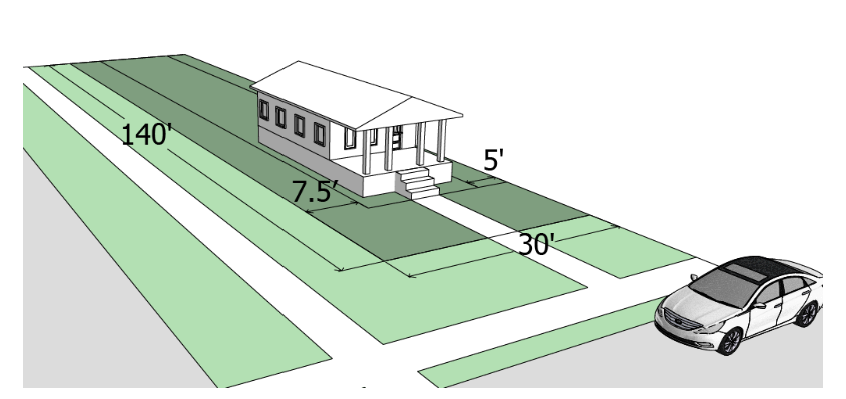
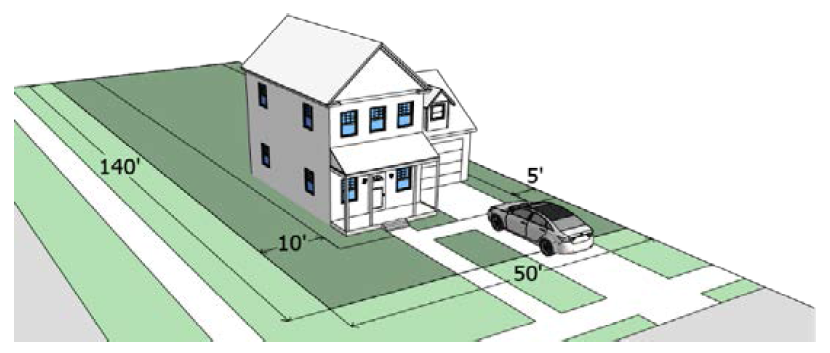
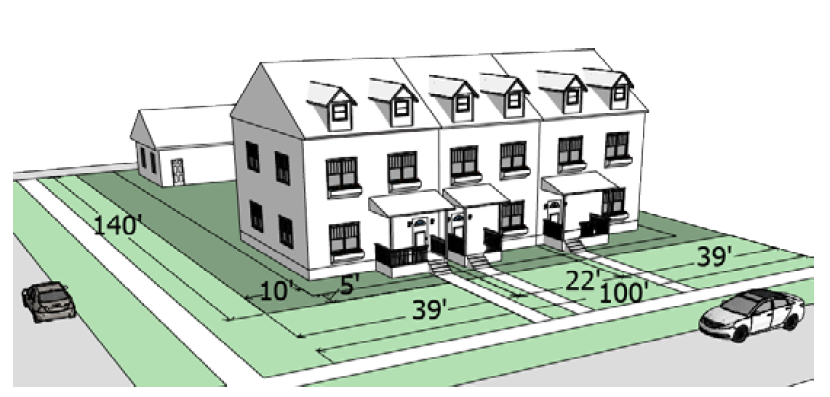
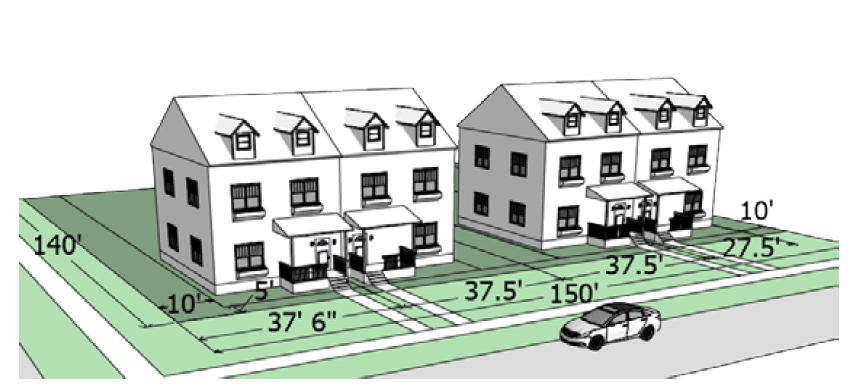
Downtown Residential Illustrative Lot Configurations. Set out in Table 4.2.6.C, Downtown Residential Illustrative Lot Configurations, are illustrative lot configurations depicting the various forms of new development and redevelopment in the Downtown Residential district.
|
Table 4.2.6.C
Downtown Residential Illustrative Lot Configurations | |
|---|---|
| Cottage | Single-Family Detached |
 |  |
| 2 Lot Aggregation/Replatting | 3 Lot Aggregation/Replatting |
 |  |
| 4 Lot Aggregation/Replatting | 5 Lot Aggregation/Replatting |
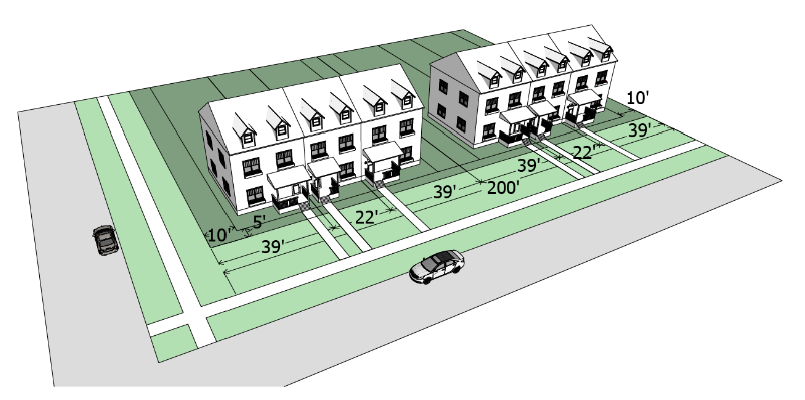 | 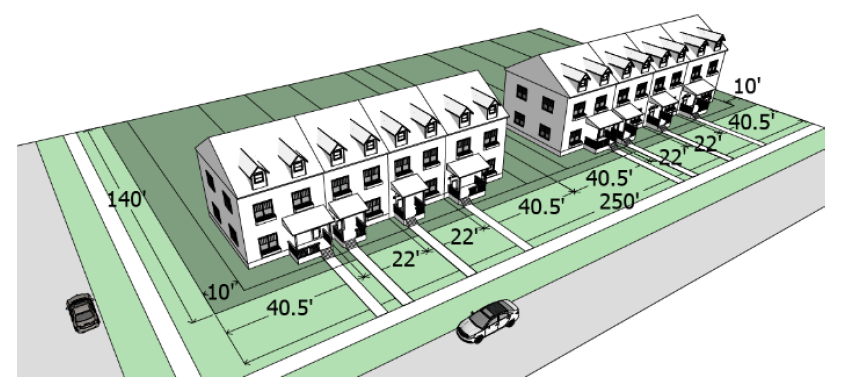 |
| 6 Lot Aggregation/Replatting | |
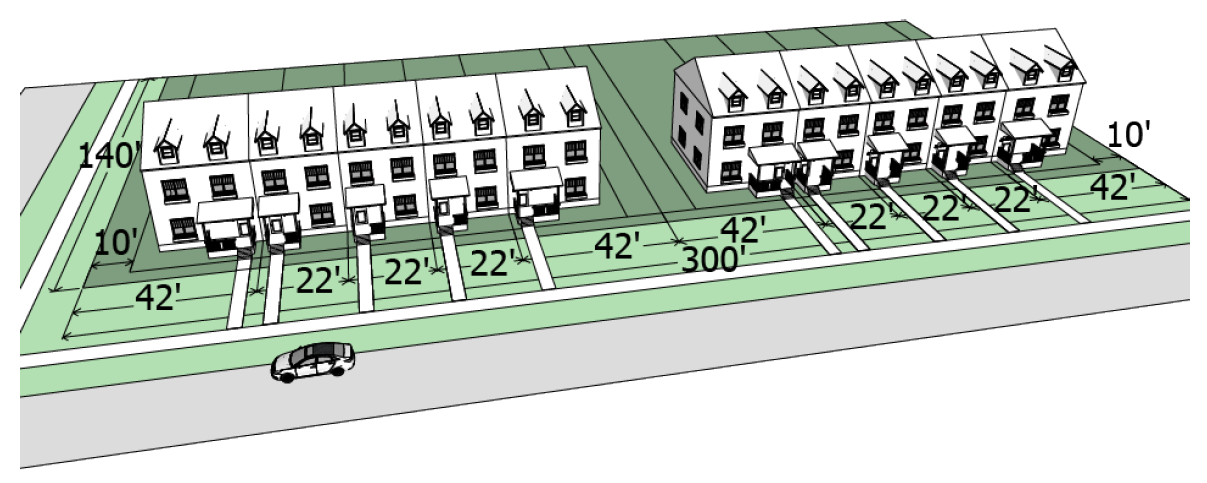 | |
E.
Design Standards. All new development and redevelopment in the Downtown Residential District shall comply with the following minimum design standards:
1.
Front Porches. Front porches are required with all new development and redevelopment. The porch may be enclosed with a screened enclosure but shall not be fully enclosed with walls and windows.
2.
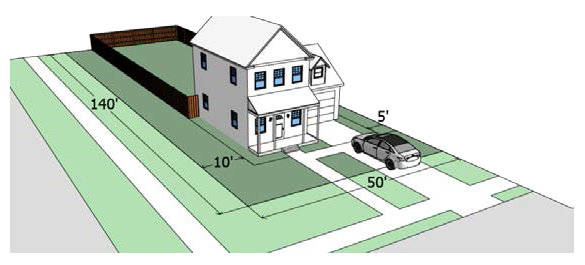
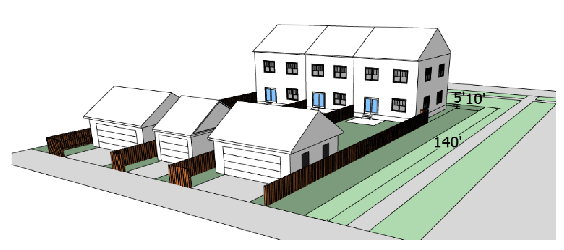
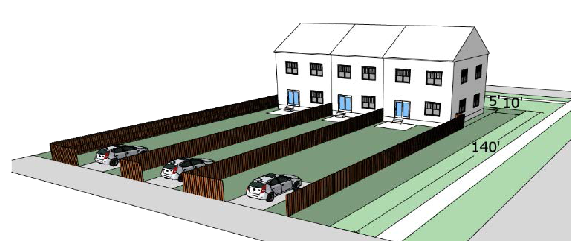
Parking. Set out in Table 4.2.6.D, Downtown Residential Illustrative Parking Configurations, are illustrative parking configurations depicting the various means of parking in the Downtown Residential district. New parking spaces are required as part of new development and redevelopment as set out in this subsection and Article 8, Parking, Loading, Stacking, and Lighting. Parking spaces shall be set out as follows:
a.
Cottages. Parking for new cottages may be accommodated in the street if the existing street pavement width can accommodate on-street parallel parking or if the existing right-of-way width can accommodate the applicant constructing paved parallel parking spaces adjacent the existing street. The Director shall determine the adequacy of existing street pavement or right-of-way widths. If on-street parallel parking cannot be accommodated, the standard on-site parking and associated driveway shall be required in accordance with Article 8, Parking, Loading, Stacking, and Lighting, and Article 7, Access, Driveways and Circulation.
b.
Single-Family Detached, Single-Family Zero Lot Line, Single-Family Attached or Duplex Units. Parking for new single-family detached, single-family zero lot line, single-family attached or duplex units must be set back at least 25 feet from the public sidewalk and meet the pavement and dimensional standards of Article 8, Parking, Loading, Stacking, and Lighting.
c.
Townhouse Units. Parking for new townhouse units shall be provided in the rear-yard in accordance with Article 8, Parking, Loading, Stacking, and Lighting, with paved alley access.
d.
Triplex, Quadplex, and Apartment Development. Parking for new triplex, quadplex, or apartment development may be located in the front yard provided that the parking area is set back at least 25 feet from the public sidewalk and meets pavement and dimensional standards of Article 8, Parking, Loading, Stacking, and Lighting. Parking may be in the side or rear yard with access taken from a side street or paved alley.
|
Table 4.2.6.D
Downtown Residential Illustrative Parking Configurations | |
|---|---|
| Cottage—On-Street Parking | Single-Family Detached—Front Access Driveway/Garage |
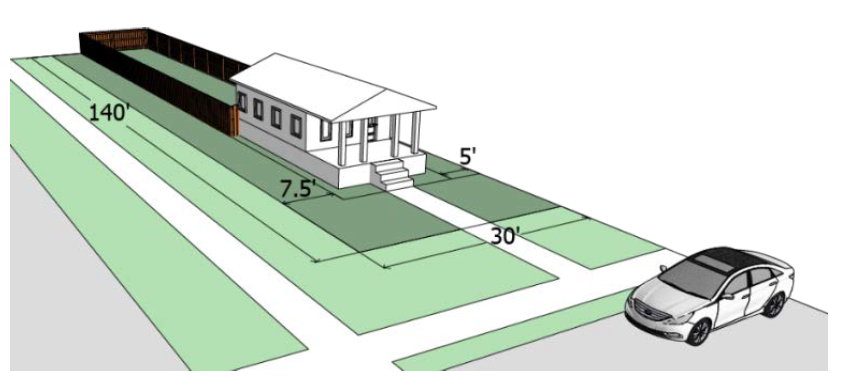 |  |
| Townhouse—Rear Access Parking Spaces | Townhouse—Rear Access Garage |
 |  |
3.
Sidewalks. All new development and redevelopment in the Downtown Residential district shall install a five-foot sidewalk in the public right-of-way along all local streets.
4.
Trees. One street tree shall be provided per lot for new development and redevelopment. The tree shall be located in the front yard and irrigated.
(Ord. No. 2019-O-05A, § II.B.4, 5, 5-21-2019; Ord. No. 2020-O-03D, § II.B.9., 7-7-2020)
Section 4.2.7 - Special Design Standards for Existing Neighborhood Zone (ENZ) District
A.
Generally.
1.
Applicability. These development design standards apply to all new development, redevelopment, substantial improvements, and expansion of development in the Existing Neighborhood Zone (ENZ) district and the associated sub-districts set out in this Section.
2.
Conformity. All existing residential lots and buildings are "conforming" provided that they were "conforming" on the effective date of these regulations with respect to:
a.
Buildings. Height and setbacks; or
b.
Lots. Lot width and lot area.
3.
Nonconformity. This Section does not imply conformity in the following situations:
a.
Buildings. Buildings which were constructed without, or in violation of, a required permit; or
b.
Lots. Lots which were originally platted as conforming, but later subdivided into nonconforming lots by a metes and bounds description.
4.
Nonresidential Uses.
a.
All lawfully permitted nonresidential uses shall be considered legal nonconforming and may be continued provided that they were constructed and are operated in conformance with their original development approval and permit.
b.
Expansions, substantial improvement, and redevelopment of existing nonresidential uses shall be in conformance with Table 4.2.7.A and all applicable provisions of these regulations.
c.
New nonresidential development on a parcel proposed for development with an ENZ District shall be required to be rezoned, as set out in Section 11.3.2, Zoning Map Amendment (Rezoning).
B.
Existing Neighborhood Zone Framework. The individual sub-districts are based on the standards which were in effect at their time of development. Applications for development approval in these sub-districts shall be reviewed against the general development standards prior to consideration of the alternative development standards as set out below:
1.
General Development Standards. Expansions, substantial improvement, and redevelopment of existing residential lots and buildings; subdivisions; and new development shall first be subject to the general development standards set out in Table 4.2.7.A, Existing Neighborhood Zones General Lot and Building Standards, in Subsection 4.2.7.C, below.
2.
Alternative Development Standards. Modifications to existing buildings which involve an encroachment into a required setback, as set out in Table 4.2.7.A, Existing Neighborhood Zones General Lot and Building Standards, shall next be evaluated using the alternate development standards set out in Subsection 4.2.7.D, below.
C.
General Development Standards. The general development standards for each sub-district are set out in Table 4.2.7.A, Existing Neighborhood Zones General Lot and Building Standards.
D.
Alternate Development Standards. The alternate development standards for each sub-district are set out in Table 4.2.7.B, Existing Neighborhood Zones Alternate Lot and Building Standards.
(Ord. No. 2019-O-05A, § II.B.6, 5-21-2019; Ord. No. 2020-O-03D, § II.B.10., 7-7-2020; Ord. No. 2021-O-07B, § II.A.1., 7-20-2021)
Section 4.2.8 - Common Area Amenities
A.
Generally. Common area amenities shall be provided by the developer for the benefit and enjoyment of the residents of apartments, manufactured home parks, RV parks and tiny house developments. This amenity area(s) is required independently of any other requirements of these regulations. Common area amenities, dependent on the type and design of the amenity, may count towards the minimum open space requirement, as set out in Table 4.2.1, New Residential Development Options and Yield. Timing for phased construction of amenities shall be determined at the time of Site Development Plan.
B.
Amenities Standards.
1.
Required Amenities. The developer shall provide the number of common area amenities as identified in Table 4.2.8.A, Common Area Amenities Required per Dwelling Unit, and as selected from those listed in Table 4.2.8.B, Common Area Amenity Types.
2.
Location and Design.
a.
The common area amenity shall be located and designed to serve the dwellings within the development. All playground equipment and related recreational improvements must be of commercial quality and approved by City.
b.
Amenities located in the 100-year floodplain shall be replaced on site if damaged during a flood event.
3.
Construction, Operation and Maintenance. The amenity area shall be privately constructed by the developer and maintained and operated by a property owners' association as set out in Section 4.1.5, Property Owners' Associations, Covenants, Conditions and Restrictions, or the management company, as applicable.
Section 4.2.9 - Accessory Dwelling Units (ADUs)
A.
Generally. Accessory dwelling units (ADUs) are permitted as set out in this Section.
B.
Types of ADUs. For the purposes of these regulations, there are three types of ADUs:
1.
Attached ADU. Attached ADUs are units that are created within or attached to a principal building such that they appear to be an integrated part of it.
2.
One-Story Detached ADU. One-story detached ADUs are detached accessory buildings that contain an accessory dwelling unit. They may or may not also include a garage or storage area.
3.
Second Story Detached ADU. Second story detached ADUs are an accessory dwelling unit which is located on the second floor of an accessory building. A typical example is a dwelling unit located above a detached garage.
C.
Where Permitted. Accessory dwelling units are allowed in zoning districts as provided in Table 4.2.9, Accessory Dwelling Unit Types by Zoning District. ADUs are not allowed in zoning districts that are not listed in the table. ADUs are only allowed as an accessory dwelling unit where the principal building is a detached single-family building and occupied as a residence.
D.
General Design Standards for All Accessory Dwelling Units.
1.
Building Permit and Inspection Required. Construction and occupancy of ADUs shall adhere to the requirements and process of developing any new building or structure as established in Article 11, Administration, including obtaining a Building Permit and Certificate of Occupancy.
2.
Lot Standards. The development of an ADU shall conform to the applicable zoning district standards established in Table 4.2.2, Lot and Building Standards for New Residential Development, unless otherwise stated in this Section.
3.
Number of Accessory Dwelling Units. No lot shall contain more than one ADU.
4.
Parking for ADUs.
a.
In addition to the parking requirements for the principal building, one off-street parking space shall be provided for the ADU.
b.
Use of tandem parking to meet this requirement is allowed; however, only one tandem space is allowed per lot.
5.
Required Usable Outdoor Area. Lots that are developed with ADUs shall include a useable outdoor area of at least 1,100 square feet.
6.
Utilities. ADUs shall remain on the same electric and water meters as the principal building.
7.
Prohibited ADUs. The use of a manufactured home, recreational vehicle, or tiny house as an accessory dwelling unit is prohibited.
E.
Supplemental Standards for Attached ADUs.
1.
Area. Attached ADUs shall not occupy more than 25 percent of the total square footage of the principal building.
2.
Setbacks Requirements for Attached ADUs. Setbacks for attached ADUs shall be the same as the principal building.
3.
Additional Design Standards of Attached ADUs.
a.
Attached ADUs which include an addition to the principal building shall match the appearance of the principal building, including design, color, exterior cladding, and roofing materials, and shall not be readily apparent as a separate dwelling unit.
b.
Exterior doors which provide direct access to the attached ADU shall be located and designed in a manner that is typical for secondary access to a single-family detached building.
F.
Supplemental Standards for One-Story Detached ADUs.
1.
Area. The floor area of a one-story detached ADU shall not exceed the lesser of the following:
a.
Twenty-five percent of the gross floor area of the principal building; or
b.
Seven and one-half percent of the lot area;
c.
The maximum accessory structure size allowed per Section 4.6.1, Accessory Buildings and Structures.
d.
Exception. In the FR, RE and ENZ.1 Districts, a one-story detached ADU shall not exceed 33 percent of the gross floor area of the principal building, or 1,200 square feet, whichever is smaller.
2.
Setback Requirements for One-Story Detached ADUs. One-story detached ADUs shall be set back from the property line as follows:
a.
Front, Street Side, Interior Side. Same as principal building.
b.
Rear. Same as principal building; or five feet where an alley abuts the rear lot line.
3.
Height. The height of a one-story detached ADU shall not exceed:
a.
Nine feet to the wall plate; and
b.
Twenty feet to the ridge.
4.
Additional Design Standards for One-Story Detached ADUs.
a.
The one-story detached ADU shall match the appearance of the principal building, including design, color, exterior cladding, and roofing materials.
b.
One-story detached ADUs shall be spaced at least 10 feet from the principal building.
G.
Supplemental Standards for Second Story Detached ADUs.
1.
Area. Same as Subsection 4.2.9.F.1, Area, of this Section.
2.
Setbacks Requirements for Second Story Detached ADUs. Same as principal building.
3.
Height. Same as principal building.
4.
Additional Design Standards for Second Story Detached ADUs.
a.
The first floor of a second story detached ADU shall not include any living space of the ADU.
b.
The second story detached ADU shall match the appearance of the principal building, including design, color, exterior cladding, and roofing material. In the event that the second story ADU is an addition to an existing accessory building not matching the principal building, the entire building shall be brought into compliance.
c.
Second story detached ADUs shall be spaced at least 10 feet from the principal building.
Section 4.2.10 - Single-Family Zero Lot Line Development
A.
Generally.
1.
This Section provides design standards for Single-Family Zero Lot Line developments in addition to the minimum standards of the zoning district in which it is located.
2.
Single-Family Zero Lot Line development must be included in a plat designating the lots for Zero Lot Line development.
B.
Single-Family Zero Lot Line Development Additional Design Standards.
1.
The lot line with the zero-setback requirement shall not be a lot line adjacent to a lot not within the platted development or not otherwise containing or planned for zero-lot line dwellings.
2.
At time of subdivision platting, a perpetual easement, a minimum of five feet in width, is required to be established on any lot line in which the adjacent lot is allowed a zero-setback for the purposes of structural overhang and to allow the adjacent property owner access for maintenance of the structure.
3.
There shall be a minimum separation of ten feet between dwellings.
4.
A masonry wall at least six feet in height shall be constructed on the zero-setback side from the front building line to a point within six feet of the rear property line. Said wall shall be required for any structure which has a setback of less than five feet on the designated zero setback side. This wall may include the main structural wall of the building.
5.
The side of the structure located at or within 3 feet of the property line shall contain no windows or other openings.
6.
The roof eaves on the side of the house with no side setback may project no more than 18 inches over the adjacent property line. The roof eaves on the side of the house with the ten-foot side setback may extend into the required ten-foot side setback on the opposite side of the house a maximum of two feet.
7.
A gutter and down spout shall be required along the zero-setback side to ensure drainage is handled on the owner's property. Rain gutters must be positioned to drain only onto the lot of the house to which they are attached. The gutter system is not included in the calculation of the eave encroachment.
8.
A fireplace, windowsill, box or bay window, or other architectural features not more than ten feet in width may extend a maximum of two feet into the required ten-foot side setback.
9.
No setback shall be required from an interior side lot line for air conditioning or swimming pool equipment or for an uncovered porch or patio.
10.
No structure may extend into a public easement.
(Ord. No. 2019-O-05A, § II.B.3, 5-21-2019; Ord. No. 2020-O-03D, § II.B.11., 7-7-2020)
Editor's note— Ord. No. 2019-O-05A, § II.B.3, adopted May 21, 2019, set out provisions intended for use as App. B, § 4.2.3. Inasmuch as there were already provisions so designated, and at the editor's discretion, these provisions have been included as App. B, § 4.2.10.
Section 4.3.1 - Nonresidential and Mixed-Use Lot and Building Standards
A.
Generally. The development, lot, and building standards set out in Table 4.3.1, Nonresidential and Mixed-Use Development Lot and Building Standards, apply to all new development, redevelopment, substantial improvements, and expansion of all civic, commercial, industrial, and any other nonresidential or mixed-use buildings in all zoning districts.
B.
Nonresidential and Mixed-Use Development Lot and Building Standards.
(Ord. No. 2019-O-05A, § II.B.7, 5-21-2019)
Section 4.3.2 - Nonresidential, Mixed-Use, and Apartment Design Standards
A.
Generally.
1.
Applicability. These development design standards apply to all new development, redevelopment, substantial improvements, and expansion of all civic, commercial, industrial, apartments and any other nonresidential or mixed-use buildings in all zoning districts.
2.
Consistent Façade Standard. The development design standards described herein shall be expressed on all four sides of a building, unless expressly exempt (or modified). Each façade shall be similar in character and design to the other façades.
B.
Building Entrances. Each principal building shall include significant architectural elements to identify the main building entrances. These main entrances must be clearly defined and highly visible.
1.
Entrance Elements. The main entrance of the principal building shall include a sheltered entry which may be comprised of a canopy, portico, arcade, overhangs, or other comparable architectural element.
2.
Supplemental Elements. The area around the main entrance shall also include at least two additional architectural elements. These elements include:
a.
Recesses or projections;
b.
Over-the-door peaked roof forms;
c.
Arches;
d.
Outdoor patios or plazas;
e.
Display windows;
f.
Obviously differentiating architectural detail such as moldings that are integrated in to the building structure and design; or
g.
Planters or wing walls that are integrated into the building and incorporate landscaped areas or places for sitting.
3.
Exemption. Buildings located in the General Industrial (IN) district are not required to meet this standard.
C.
Building Articulation. The design of new buildings shall be subject to the following vertical and horizontal building articulation standards to promote a more interesting and human-scaled façade appearance.
1.
Required Articulation. As set out in Table 4.3.2.A, Horizontal and Vertical Articulation Offset Requirements, the design of all buildings shall include a three-part vertical articulation composition (i.e., a top (or cap), body, and base) and horizontal articulation composition for:
a.
All front and side building facades; and
b.
Rear building façades which face a public right-of-way, a shared drive aisle or parking lot in a multi-lot unified development or shopping center, a park, or residentially zoned property or use.
2.
Supplemental Articulation. In addition to Subsection 4.3.2.C.1, Required Articulation, above, the required building façade shall include at least one recognizable change of texture or materials.
3.
Exemption.
a.
Articulation is not required on buildings in the IN district, except where a building façade faces an arterial-level street and is located within 200 feet of the street.
b.
In the BP district, articulation requirements only apply to the front street facing façade of the principal building.
c.
Articulation is not required in the DN district on side building façades built to the property line where another building does or will abut. Articulation is required when the side building façade faces a public street, residential property, or public park, plaza, or open space.
d.
In all other districts, where there are multiple buildings on one lot, a building façade that is screened from view from the property lines by other buildings may be exempt from providing articulation.
D.
Architectural Elements. All front and side building façades and all rear facades which face a public right-of-way, a shared drive aisle or parking lot in a multi-lot unified development or shopping center, a park, or a residentially zoned property or use shall incorporate architectural elements that visually divide the façade plane. Long, uninterrupted vertical or horizontal wall sections are prohibited. In addition to the building articulation standards set out in this Section, building façades shall not include a blank wall area larger than generally 14 feet tall by 24 feet wide or 300 square feet in area.
1.
Complying with this requirement can be accomplished through the use of:
a.
Repeating distinctive window patterns at intervals less than the articulation interval;
b.
Window(s);
c.
Door(s);
d.
Balconies;
e.
A porch, patio, deck, or covered entry;
f.
A change in the roofline by alternating parapet heights;
g.
A change in building materials that corresponds to a change in building plane;
h.
Lighting fixtures, trellises, trees, or other landscape features;
i.
An awning or canopy; or
j.
Vines or other plantings on wall trellises that cover at least 60 percent of the façade elevation.
2.
Exemption.
a.
This Section does not apply to buildings in the IN district, except where a building façade faces an arterial-level street and is located within 200 feet of the street.
b.
In the BP district, architectural element requirements only apply to street facing façades.
c.
Architectural elements are not required in the DN district on side building façades built to the property line where another building does or will abut. Architectural elements are required when the side building façade faces a public street, residential property, or public park, plaza, or open space.
E.
Building Materials. The exterior façades of all buildings, excluding doors and windows, shall be finished in one or more of the following exterior finish materials, in accordance with Table 4.3.2.B, Building Material Standards.
1.
Types of Exterior Finish Materials:
a.
Class 1 Materials. Exterior finish materials considered Class 1 are comprised of the following:
i.
Brick;
ii.
Natural stone;
iii.
Granite;
iv.
Marble; and
v.
Masonry Veneer (thin brick and engineered stone) placed a minimum of 4 feet above finished grade of the building and above another Class 1 Masonry product.
b.
Class 2 Materials. Exterior finish materials considered Class 2 are comprised of the following:
i.
Architectural concrete masonry units in the following styles:
a)
Split face;
b)
Weathered face;
c)
Sandblasted face; or
d)
Ground face; and
ii.
Portland cement stucco, installed with a weather barrier and wall drainage system.
c.
Class 3 Materials. Exterior finish materials considered Class 3 are comprised of the following:
i.
Exterior Insulation and Finish Systems ("EIFS"), installed with a weather barrier, wall drainage system, and prohibited for the first 10 feet above finished grade of the building;
ii.
Smooth-faced, finished concrete masonry units;
iii.
Fiber cement siding ("Hardie Board"), installed as horizontal lapped siding, in a board-and-batten style vertical installation, or as shingles;
iv.
Synthetic wood material that has the architectural appearance of real wood; and
v.
Embossed or prefinished architectural metal panel (26+ gauge), which has an appearance of masonry or stucco. (applicable only to buildings with a gross floor area greater than 16,000 square feet).
d.
Glass. Windows and doors are excluded from the percentage of materials required. However, a maximum of 60 percent of the ground floor façades and a maximum of 40 percent of the upper floor façades shall be glass, whether window, glass curtain wall, or glass block. Glass shall have a maximum reflectivity of less than 20%.
e.
Tilt-wall. Tilt-wall construction is not restricted as a construction method; however, an exterior finish shall be required in the form of a Class 1, Class 2, or Class 3 material.
f.
Other Materials. Other materials such as wood, prefab metal panels, metal siding, etc. may be used for the remainder of the building façade that is not subject to the material standards, according to Table 4.3.2.B, Building Material Standards.
2.
Building Material Standards. As set out in Table 4.3.2.B, Building Material Standards, each zoning district includes a minimum percentage of the overall building that shall be finished with a masonry product and the amount of the overall building that shall meet the criteria of a Class 1 material. Additionally, the table specifies the limitation of the amount of Class 2 and Class 3 materials that can be used on the building for each zoning district. Each façade subject to the building material requirements shall independently meet the minimum requirements unless otherwise approved by the Director.
3.
Prohibited Exterior Finish Materials: The use of the following materials for exterior walls, siding, or cladding is prohibited for all uses:
a.
Plywood;
b.
Plastic; and
c.
Corrugated Metal.
4.
Approval of Other Exterior Finish Materials.
a.
Generally. Other building materials may be considered as exterior finish materials if it is demonstrated that they have comparable durability, impact resistance, and aesthetic quality as the materials provided by this Section.
b.
Approval Required. The Planning and Zoning Commission must approve other exterior finish materials.
c.
Consistent with Original Building Materials. For existing nonresidential buildings undergoing expansion, the Planning and Zoning Commission may approve materials that are used on the original building, provided that such materials are an integral part of the character of the existing building.
d.
Materials That Support Energy Efficiency and Sustainability.
i.
For buildings designed to achieve a U.S. Green Building Council Leadership in Energy and Environmental Design (USGBC LEED®) certification, the Planning and Zoning Commission may approve materials that qualify for LEED points under both the "energy and atmosphere criteria" and the "materials and resources criteria" of the LEED checklists.
ii.
For buildings designed to achieve the EPA ENERGY STAR certification, the Planning and Zoning Commission may approve materials that substantially improve the energy efficiency of a building compared to materials that are permitted above.
F.
Building Façade Color. Nonresidential or apartment building façades should consist of colors that are consistent with the Texas Hill Country heritage of Marble Falls while also allowing for differentiation of buildings and artistic expression. Class I Masonry shall not be colored with paint, stain, or other coloring application method. Other building façade materials shall predominantly consist of muted, earth tone colors. Primary wall planes facing public streets or parks shall not consist of iridescent, glossy, fluorescent, bright, or "hot" shades of pink, yellow, red, purple, orange or green. Accent colors in limited quantity are not restricted by this Section and shall only be applied to architectural elements. Architectural elements may include but are not limited to, doors, shutters, awnings, window trims, door frames, window sills, cornices, and banding.
G.
Roof Design.
1.
Generally. All buildings shall be constructed with a pitched roof, flat roof, true mansard roof, or any combination thereof.
2.
Flat Roofs.
a.
When using a flat roof, parapet walls are required at a minimum of 30 inches in height and constructed with materials listed in Subsection 4.3.1.E, Building Materials, in a similar style of the building architecture. Buildings in the General Industrial (IN) District are exempt from this requirement, except when facing a Principal Arterial.
b.
Faux mansard roofs are not permitted.
c.
Green roof systems are permitted.
d.
Any material that is permitted by the City's adopted building code is allowed on a flat roof.
3.
Pitched Roof.
a.
Roofing materials used on pitched roofs shall be proven, high-quality, durable materials, and may include:
i.
Architectural shingles;
ii.
Concrete tile;
iii.
Clay tile;
iv.
Slate;
v.
Architectural standing seam metal;
vi.
Building-integrated solar tiles (solar panels that double as roofing material);
vii.
Green roof systems; and
viii.
Other, as approved by the Director.
b.
Overhanging eaves extending a minimum of 18 inches shall be provided on pitched roofs.
4.
Prohibited Roofing and Material. Corrugated or ribbed metal and other roofing materials that are not listed in Subsection 4.3.2.G.3.a, above, are prohibited.
H.
Awnings and Canopies. Awnings and canopies, if constructed, shall meet the following standards:
1.
Placement.
a.
A minimum clearance of eight feet from finished grade to bottom of the awning or canopy is required. Finished height may not exceed 16 feet above finished grade.
b.
Awnings and canopies shall not encroach into a public right-of-way unless otherwise allowed by these regulations.
2.
Materials. Awnings and canopies may be constructed as the same permitted materials as pitched roofs (see Subsection 4.3.2.G.3.a, above), or canvas.
3.
Lighting. Backlighting or internal illumination is prohibited.
4.
Downtown (DN) and Downtown Transition (DT) Districts. See Section 4.3.4.G for awnings and canopies in the Downtown (DN) and Downtown Transition (DT) Districts.
(Ord. No. 2019-O-05A, § III.B.8—12, 5-21-2019)
Section 4.3.3 - Special Design Standards for Neighborhood Commercial (NC) District
A.
Generally. These development design standards apply to all new development, redevelopment, substantial improvements, and expansion of civic, commercial, and industrial developments and any other nonresidential or mixed-use buildings in the Neighborhood Commercial (NC) district. These standards apply in addition to the standards set out in other applicable sections of this Division.
B.
Building Scale in the Neighborhood Commercial (NC) District. Buildings in the Neighborhood Commercial (NC) district shall be limited to a maximum floor to area ratio (FAR) of 0.30. Additionally, buildings within the Neighborhood Commercial (NC) district are limited to one (1) story in height within fifty (50) feet of a residential property.
C.
Parking in the Neighborhood Commercial (NC) District. Required parking spaces shall be placed in the side or rear yard and not between the principal building and the street, except that up to two rows of parking may be placed between the building and the street when located on a collector or arterial level street. The Director may approve parking between the principal building and the street when the property is adjacent to Lake Marble Falls or when properties on both sides are developed commercially with parking between the building and street.
(Ord. No. 2019-O-05A, § III.B.13, 14, 5-21-2019)
Section 4.3.4 - Special Design Standards for Downtown (DN) and Downtown Transition (DT) Districts
A.
Generally. These development design standards apply to all new development, redevelopment, substantial improvements, and expansion of civic, commercial, and apartment developments and any other nonresidential or mixed-use buildings in the Downtown (DN) and Downtown Transition (DT) districts. The DN and DT Districts have specified differences in site and design characteristics, as set out in this Section. These standards apply in addition to the standards set out in Section 4.3.2, Nonresidential, Mixed Use and Apartment Design Standards and other applicable sections of this Division. Buildings must be designed with an urban character at the front property line and front façade.
B.
Special Setbacks in the Downtown (DN) and Downtown Transition (DT) Districts.
1.
Downtown District (DN). A minimum of 80% of any building façade facing a public street shall be built to that property line abutting the street, except as provided in Subsection 4.3.4.B.3, below.
2.
Downtown Transition District (DT). A minimum of 80% of the front building façade shall be built within 10 feet of the front property line, except as provided in Subsection 4.3.4.B.3, below. The setback line may be averaged along the entire block.
3.
Setback Exceptions in either district.
a.
Narrow or Non-Existent Sidewalk. Where there is no sidewalk or an existing public sidewalk that is less than six feet wide, the building must be set back in order to provide the additional space to expand the sidewalk onto the private lot to achieve a minimum of six feet. In such an instance, the build-to line will be located at the edge of the expanded sidewalk on the private lot.
b.
Public Plaza or Outdoor Service Area. Buildings may be set back up to a distance of 20 feet from the build-to line in order to provide a designated public plaza or similar outdoor area according to the following standards:
i.
The public plaza or outdoor service area shall be designated upon development approval and maintained as a publicly accessible space;
ii.
Any service uses that take place in the designated setback area must directly relate to the activity of the primary ground floor use (e.g., outdoor seating for a restaurant, outdoor display area for a retail store, etc.); and
iii.
When the area is not being used as an outdoor service area, it shall remain generally accessible to the public and function as an extension of the public sidewalk environment.
c.
The front build-to requirement shall not be applicable to properties directly adjacent to Lake Marble Falls.
C.
Drive-through or Drive-up Facilities in the DN and DT Districts. No drive-through, drive-up, or drive-in facilities shall be permitted in the Downtown or Downtown Transition districts.
D.
Parking in the DN and DT Districts.
1.
DN and DT Districts. Parking shall be in accordance with Division 8.2, Off-Street Parking, of these regulations.
2.
DT District. On-site parking shall be located behind the principal building and is not allowed between the building line and the street. On-street parking is encouraged but shall only be allowed on local-level streets when it is determined by the Director the existing street pavement width and/or the existing right-of-way width is adequate to accommodate.
3.
The Director may approve parking between the principal building and the street for either district when the property is adjacent to Lake Marble Falls.
E.
Roofs in the Downtown (DN) and Downtown Transition (DT) Districts. Rooflines shall be individually distinguishable with variations of height. Roofs shall relate to the building façade articulations. Pitched-roof building forms facing the street are not permitted, except that the Director may make an exception for buildings less than 1,000 square feet when they are not located on a property line shared with another building.
F.
Balconies in the Downtown (DN) and Downtown Transition (DT) Districts. Balconies in the DN and DT districts shall be in accordance with the following:
1.
Right-of-Way Encroachment. In the DN and DT districts, cantilevered balconies are allowed to encroach into the public right-of-way up to five feet without special approval but shall not extend over street pavement. A minimum 10-foot clearance shall be provided between the balcony and any public sidewalk beneath.
2.
Materials. Balcony railing materials should be consistent with the character of the district. Glass railing or enclosure around a balcony shall not be permitted.
G.
Awnings in the Downtown (DN) and Downtown Transition (DT) Districts. Awnings and canopies in the DN and DT districts shall be in accordance with the following:
1.
Right-of-Way Encroachment. In the DN and DT districts awnings and canopies are allowed to encroach into the public right-of-way without special approval. Awnings and canopies shall not extend further than six feet into the right-of-way and shall not extend over street pavement.
2.
Minimum Clearance. A minimum clearance of eight feet from finished grade to bottom of the awning or canopy is required. If signage will be placed under the awning or canopy, a minimum clearance of ten feet is required.
3.
Extent. Awnings and canopies shall not be closer to the edge of the building than one-foot and shall not cover architectural features. Maximum height of the upper attachment of an awning shall not exceed 16 feet above finished grade.
4.
Materials. Awnings and canopies shall be constructed of proven, high-quality, durable materials, but may not be constructed of corrugated metal or R-Panel.
5.
Support Features. Awnings and canopies in the public right-of-way shall be supported by the building and shall not utilize poles or other ground mounted support features unless the Director determines the right-of-way width and streetscape is such that a minimum 6-foot unimpeded pedestrian walkway can be maintained between the support feature and the street or parking edge.
6.
Lighting. Backlighting or internal illumination is prohibited.
7.
Signage. Logos and writing shall be calculated as signage per Chapter 20 of the City Code.
H.
Construction of Public Improvements. At the time of construction of new buildings along public streets, or major remodel or addition to the street facing façade of an existing building where the cost of the remodel equals or exceeds 30% of the value of the structure, or upon redevelopment of a property, site improvements in the adjacent public right-of-way shall be constructed consistent with the Downtown Master Plan, including sidewalks, curbing, lighting, and street trees. Construction of on-street parking in the right-of-way adjacent to the site shall count towards the parking requirements of this code at a rate of two (2) spaces for each space constructed.
Section 4.3.5 - Alternative Building Design
A.
Purpose. To provide flexibility in the attainment of harmonious building design, an applicant may request an Alternative Building Design using the Administrative Exception process detailed in Section 11.5.4, Administrative Exception. An Alternative Building Design may address requirements within Subsection 4.3.2.C, Building Articulation, Subsection 4.3.2.D, Architectural Elements, and Subsection 4.3.2.E, Building Materials.
B.
Review Criteria. The Director shall consider the following criteria and standards in determining whether to grant an Administrative Exception for an Alternative Building Design:
1.
Whether the design meets the intent of the design standards set forth in these regulations;
2.
Whether the design will produce an aesthetically pleasing building(s) that is comparable to buildings meeting the minimum design standards of these regulations;
3.
The use of alternative materials such as wood, metal, and glass if they are incorporated into an overall architectural design in an appropriate manner;
4.
The locations of building walls in relation to streets;
5.
Whether building walls are significantly screened from view by other buildings on site, natural features, or fencing; and
6.
The successful use of a variety of building elements or design techniques, additional screening or landscaping or other site design features to achieve the same result.
(Ord. No. 2019-O-05A, § III.B.15, 5-21-2019)
Editor's note— Ord. No. 2019-O-05A, § II.B.15, adopted May 21, 2019, set out provisions intended for use as App. B, § 4.3.4. Inasmuch as there were already provisions so designated, and at the editor's discretion, these provisions have been included as App. B, § 4.3.5.
Section 4.4.1 - Generally
A.
As set out in the City's Comprehensive Plan, flexibility is envisioned for well-planned developments that exhibit uniqueness and character and promote a mix of uses as well as multiple housing types and open spaces while ensuring predictability in the built environment. Where many of the zoning districts in these regulations provide definition for individual housing types and their design standards, there exists a need to accommodate large planned developments that integrate multiple, supporting land uses and innovative design techniques to create special places within the community.
B.
Master Planned Communities may be developed as set out in Section 4.4.2, Master Planned Communities, with pre-established flexibility for a mix of residential and nonresidential uses within a single zoning district to be administratively reviewed for approval. Planned Development Districts may be proposed as set out in Section 4.4.3, Planned Development Districts.
Section 4.4.2 - Master Planned Communities
A.
Intent. The intent of the Master Planned Community is to provide predictable flexibility in the development process by allowing expanded development options including mixed housing types and integrated nonresidential mixed-use in a cohesive development.
B.
Generally. A Master Planned Community can only be used for new residential or mixed-use development. The overall parcel proposed for development cannot include existing residential or other development as a means to satisfy the minimum percentage requirements set out below. The percentages are based on the total acreage of the tract(s). The development flexibility per district for a Master Planned Community is set out in Table 4.4.2.A, Master Planned Community Development Flexibility.
C.
Minimum Size. A minimum of 25 acres is required to establish a new Master Planned Community.
D.
Compatibility within Master Planned Communities.
1.
Maximum Gross Density of Master Planned Communities. The maximum gross density shall be calculated as the aggregate of each development option located within the Master Planned Community in accordance with Table 4.2.1, Development Options and Yield for New Residential Development.
2.
Minimum Open Space Area of Master Planned Communities.
a.
The minimum open space area shall be calculated as the aggregate of each development option located within the Master Planned Community in accordance with Table 4.2.1, Development Options and Yield for New Residential Development.
b.
The placement and configuration of the overall minimum open space area within a Master Planned Community does not have to be allocated in association with individual development option areas; provided, however, that it shall be configured in a manner that maximizes proximity and connectivity to all development areas within the Master Planned Community.
3.
Residential Uses. As the master planned communities' framework allows for various lot sizes and housing types, each of the sub-areas shall comply with the following:
a.
Master Planned Development in the Neighborhood Residential (NR) District.
i.
Single-family detached and cottage uses in the NR district shall follow the development standards as set out for the Neighborhood Residential (NR) district in Table 4.2.1, Development Options and Yield for New Residential Development, and Table 4.2.2, Lot and Building Standards for New Residential Development.
ii.
Single-family attached, duplex, townhouse, triplex, quadplex, and loft apartment uses in the NR district shall follow the development standards as set out for the Transitional Residential (TR) district in Table 4.2.1, Development Options and Yield for New Residential Development, and Table 4.2.2, Lot and Building Standards for New Residential Development.
b.
Master Planned Development in the Transitional Residential (TR) District.
i.
Single-family detached, single-family attached, duplex, townhouse, triplex, quadplex, and loft apartment uses in the TR district shall follow the development standards as set out for the Transitional Residential (TR) district in Table 4.2.1, Development Options and Yield for New Residential Development, and Table 4.2.2, Lot and Building Standards for New Residential Development.
c.
Master Planned Development in the Multifamily Residential (MR) District.
i.
Single-family detached, single-family attached, cottage, and duplex uses in the MR district shall follow the development standards as set out for the Transitional Residential (TR) district in Table 4.2.1, Development Options and Yield for New Residential Development, and Table 4.2.2, Lot and Building Standards for New Residential Development.
ii.
Townhouse, triplex, quadplex, apartment, and loft apartment uses in the MR district shall follow the development standards as set out for the Multifamily Residential (MR) district in Table 4.2.1, Development Options and Yield for New Residential Development, and Table 4.2.2, Lot and Building Standards for New Residential Development.
4.
Nonresidential Uses. Nonresidential uses as part of a Master Planned Community are intended to provide the opportunity to develop more complete neighborhoods with an appropriate mix of uses serving the immediate neighborhood. As such, the following standards are necessary to ensure compatibility with the Master Planned Community and nearby areas.
a.
Nonresidential uses shall comply with all applicable standards set out in these regulations, including Section 4.3.1, Nonresidential and Mixed-Use Lot and Building Standards and Section 4.3.2, Nonresidential, Mixed-Use, and Apartment Design Standards. In addition, commercial uses shall also comply with Section 4.3.3, Special Design Standards for Neighborhood Commercial (NC) District.
b.
Nonresidential uses cannot receive a Certificate of Occupancy until a minimum of 25 percent of the residential units associated with the Master Planned Community, or 100 residential units, whichever is lesser, have received a Certificate of Occupancy.
c.
Nonresidential uses shall take access from an arterial or collector street and cannot be located within 500 linear feet from an existing residential building not part of the Master Planned Community.
5.
External Compatibility.
a.
Where a Master Planned Community abuts, is adjacent to, or is located across a street from existing residential uses, the housing types that are nearest or across the street shall be comparable to the existing housing in terms of the housing type, scale, and method of access.
b.
The landscape bufferyard standards of Division 9.3, Buffering, shall be applicable along any property boundaries abutting or adjacent to properties not within the Master Planned Community.
6.
Internal Compatibility. Where a Master Planned Community is comprised of uses which would normally be required in different zoning districts, some development options still warrant separation by a bufferyard to ensure compatibility. Apartment, triplex, and quadplex uses shall provide a Type A bufferyard adjacent to single-family detached, single-family attached, cottage, duplex and townhouse uses within the Master Planned Community. All other uses shall provide a Type B bufferyard adjacent to single-family detached, single-family attached, cottage, duplex, and townhouse uses within the Master Planned Community. Bufferyards shall be in accordance with Table 9.3.1.B, Bufferyard Requirements.
E.
Concept Plan and Development Phasing.
1.
Generally. A parcel proposed for development may be developed in phases, with each phase separately platted. To ensure compliance with overall maximum gross density, minimum open space area, and other requirements, a Concept Plan, as set out in Section 11.3.5, Concept Plan, for the entire parcel proposed for development is required prior to, or concurrent with, the first application for Preliminary Plat approval.
2.
Consistency with Concept Plan. Individual phases of development shall be in accordance with the overall configuration of the Concept Plan to ensure the orderly development of the entire Master Planned Community. This could include such things as temporary alley and street extensions, temporary cul-de-sacs, off-site utility extensions, or modifications to future phases if preliminary phases are not consistent with the overall Concept Plan. A determination of compliance with the Concept Plan shall be made during the platting process of each individual phase of development.
Section 4.4.3 - Planned Development Districts (PDD)
A.
Generally. The Planned Development District is a tool intended to accommodate the planning, design, and development of integrated land uses and densities and facilitate new and innovative development concepts that cannot be accommodated by other zoning districts or development scenarios. To protect against the misuse of the district as a vehicle for variances and exceptions from these regulations, Planned Development Districts should be utilized for innovative developments that cannot be accomplished through other processes and procedures established by these regulations.
B.
Applicability. A Planned Development District may be used to permit new or innovative concepts in land utilization not permitted by other zoning districts in this Code. While greater flexibility is given to allow special conditions or restrictions which would not otherwise allow the development to occur, procedures and standards are established herein to ensure against misuse of increased flexibility.
C.
Planned Development Types. Planned Developments shall be categorized as one of the following:
1.
Conceptual Planned Development Districts. Conceptual Planned Development District applications are allowed for large 50+ acre developments which may require phased development over an extended period of time. Conceptual Planned Development Districts require Concept Plan approval in conjunction with the granting ordinance and Site Development Plan approval prior to commencement of each phase of the development in accordance with the development standards of the Planned Development District ordinance. Conceptual Planned Development Districts do not require the level of detail and specificity of design as the Detailed Planned Developments. The applicant for a 50+ acre development may nevertheless choose to submit a Site Development Plan or a Detailed Planned Development District.
2.
Detailed Planned Development Districts. Detailed Planned Development District applications are required for developments under 50 acres that require the review and approval of a Site Development Plan concurrently with the Planned Development District approval.
D.
Minimum Qualifications of Proposed Planned Development Districts. The following requirements identify the minimum qualifications for a proposed Planned Development District. Additional review criteria are established in Section 11.3.3, Planned Development District Zoning.
1.
The minimum size of a Planned Development District shall be 3 acres, unless located within the boundaries of the original township where the size can be less than 3 acres but not less than 1/2 of a city block (contiguous lots not interrupted by streets, alleys, or other lots).
2.
Conceptual Planned Development Districts shall be a minimum of 50 acres.
3.
Planned Development Districts shall not be permitted in the ENZ Districts.
E.
Components of a Planned Development District Ordinance. A Planned Development ordinance becomes a regulating document and shall contain document components that will regulate land use and development within the Planned Development District. These components shall be comprised of the elements as established in Section 11.3.3, Planned Development District Zoning.
F.
Establishing and Developing a Planned Development District. A Planned Development District is created by ordinance and shall follow the application and approval procedures established in Section 11.3.3, Planned Development District Zoning.
Section 4.5.1 - Lot and Setback Interpretations and Exceptions
A.
Generally. All development shall adhere to the lot size, lot width, lot setback, and building height requirements of these regulations, except as specified in this Section.
B.
Lot Size and Width Exceptions. Minimum lot size and lot width requirements of this Section do not apply to platted lots in which the principal use of the lot is common area, open space, landscape lots, drainage conveyance, access, street median, or public utilities.
C.
Setback Encroachments. No permanent or temporary building, structure, or other constructed element may encroach into a required setback of this Section, except as set out in Table 4.5.1, Permitted Setback Encroachments.
(Ord. No. 2019-O-05A, § III.B.16, 5-21-2019)
Section 4.6.1 - Accessory Buildings and Structures
A.
Generally. The construction and use of accessory buildings and structures, except accessory dwelling units (see Section 4.2.9, Accessory Dwelling Units (ADUs)), are subject to the standards of this Section.
B.
Exemptions. The following accessory structures are customarily located on a property with a principal use, are considered incidental to the principal use, and are exempt from the regulations of this Section.
1.
Fences and walls (see Section 4.6.4, Fences and Walls);
2.
Enclosures for solid waste collection, provided that the enclosure does not include additional storage beyond that needed for solid waste collection; and
3.
Satellite dishes and antennas.
C.
General Standards for All Accessory Buildings and Structures. All accessory building and structures shall be subject to the following standards:
1.
Timing of Construction. No accessory building or structure may be erected on a lot until construction of the principal building or establishment of a principal use has commenced.
2.
Location.
a.
In all zoning districts, accessory buildings and structures shall be located in a rear or side yard and shall meet the required setbacks set out in Section 4.2.2, New Residential Development Lot and Building Standards, or Section 4.3.1, Nonresidential and Mixed-Use Lot and Building Standards, whichever may be applicable; unless excepted as a permitted encroachment in Section 4.5.1, Lot and Setback Interpretations and Exceptions.
b.
Accessory buildings and structures are not allowed in easements unless written permission is given by the easement holder; such permission shall be submitted with the application for a permit.
3.
Design. Accessory buildings and structures shall comply with the provisions set out below and as set out in Table 4.6.1, Accessory Building and Structure Design Standards.
a.
A portable storage shed is considered an accessory structure with regards to the maximum number allowed and maximum combined footprint allowed per Table 4.6.1, however, it is not subject to the side or rear setback requirements of Table 4.6.1 provided that it meets the following:
i.
It is less than or equal to 100 square feet in floor area and less than eight feet in height;
ii.
It is freestanding, moveable, and has no permanent foundation;
iii.
It is setback at least 3 feet from side or rear lot lines;
iv.
It does not contain plumbing or electrical installations; and
v.
It is screened from ground-level view of abutting streets and properties.
b.
Accessory buildings or structures which are structurally attached to the principal building shall conform to all the standards of the principal building, unless exempted by the standards set out in Table 4.5.1, Permitted Setback Encroachments.
c.
Accessory buildings and structures associated with nonresidential, mixed-use or apartment development shall comply with the exterior building material requirements set out in Table 4.3.2.B., Building Material Standards. The accessory building or structure shall be finished with the same materials as the principal structure or use materials that are aesthetically compatible and complementary.
d.
Converted semi-trailers and modular shipping containers can be used as accessory structures in the BP or IN districts, provided that they are used for storage and meet the screening standards set out in Section 4.6.5, Outdoor Storage and Display of Merchandise.
(Ord. No. 2022-O-06A, § II.A.2., 6-7-2022)
Section 4.6.2 - Boat Docks
A.
Purpose. Minimal standards are established for the access and storage of boats on Lake Marble Falls and corresponding waterways to ensure safety, compatibility, and harmony consistent with the following:
1.
To allow access and enjoyment of the water through diverse and creative ways, while providing a basis for safety and compatibility;
2.
To ensure that the size and intensity of structures on Lake Marble Falls and area waterways do not deconstruct from the character of the Lake and area waterways;
3.
To ensure that docks are not excessive in size, storage, or utilization in relation to the size and surface area of Lake Marble Falls and navigable waterways;
4.
To increase safety by providing separation between dock structures and navigable boating access to and from docks; and
5.
To ensure docks have lighting, storage, and utilization consistent with character and operation of the prevailing existing dock inventory that exists in the City.
B.
General Boat Dock Standards. The following are design and construction requirements applicable to all boat docks within the City:
1.
A permit issued by the City is required for the construction, addition, or remodel of any boat docks within the City limit. Maintenance does not require a permit.
2.
All boat dock construction shall comply with the City's adopted building codes.
3.
No boat dock may be permitted or erected on a lot until construction of the principal building or establishment of a principal use has commenced.
4.
All boat dock(s) shall be fixed or anchored to the shoreline of the property for which the primary use is established.
5.
Boat dock length.
a.
Boat docks shall not extend further into Lake Marble Falls than thirty-five feet (35') from the shoreline.
b.
To preserve the navigable area along all adjoining waterways, boat docks shall not extend from the shore further than twenty feet (20') or 20% of the total width of the channel where the dock is proposed; whichever is less. In no instance shall the navigable area be reduced to less than 40 feet.
6.
Fueling facilities and permanent storage of fuel, oil, or other related chemicals shall be prohibited on the boat dock and within any accessory storage constructed upon the dock.
7.
Boat dock enclosures shall be limited to the boat storage area and shall have adequate structural design to allow for inundation of water during high water and/or flood events. Enclosures shall not be allowed any square footage for habitation and any enclosed storage square footage shall be limited to the standards for dock storage area herein.
8.
All boat docks are prohibited from having any living quarters constructed upon or within the structure.
9.
Boat dock(s) are an accessory use to the primary usage of the property or development. Therefore, all boat dock(s) are prohibited from being constructed without a primary building existing or permitted in conjunction with a primary use on the premises to which the dock is fixed/anchored.
10.
All dock lighting shall be full cut-off fixture or dark sky compliant, unless it is related to safety illumination required by law.
11.
Any boat dock(s) that, due to its size or operating characteristics, requires compliance with the Highland Lakes Marina Ordinance must be approved and permitted by LCRA and the City of Marble Falls.
12.
Public boat docks owned or operated by a governmental entity shall be exempt from these standards.
C.
Residential Boat Dock Standards. The following are design and construction requirements applicable to boat docks for single-family residential properties and developments within the City:
1.
Each property is allowed one boat dock. However, each boat dock may include more than one boat slip, provided the overall dimensions of the boat dock do not exceed those prescribed herein.
2.
Residential boat docks shall not:
a.
Exceed 14 feet in finished floor elevation (lower or upper floor height) from the Lake Marble Falls water surface elevation at property; an additional 10 feet is allowed for the addition of a roof structure for second story sundecks;
b.
Exceed 800 square feet in water level deck footprint, excluding boat slips, but including permanent personal watercraft ramps, docks and storage; or
c.
Exceed 50 square feet of enclosed storage on the dock.
3.
Residential boat docks may be covered by a roof or have a second story sundeck, provided a second story sundeck shall not extend beyond the footprint of the first level. Second stories may be covered by a roof structure. The second story roof shall have a pitched roof.
4.
Residential boat docks may be recessed into the shoreline.
5.
Residential boat docks shall be setback a minimum of 10 feet from a projected side yard line, as defined in this code.
6.
Residential day docks are allowed for a linear dock structure, along the shoreline, versus projecting into the water, and thus are subject to the following standards:
a.
Must attach to land/shoreline and not be structurally independent. May project over the water as limited herein.
b.
Be a minimum of 5 feet wide and not wider 20 feet from the shoreline.
c.
Day docks must be a minimum of 20 feet in length and may span up to 80% of the property width. Day docks may be combined with boat dock storage areas in accordance with the standard of this article.
D.
Commercial Boat Dock Standards. The following are design and construction requirements applicable to boat docks for commercial or multifamily lots and developments within the City.
1.
Each property is allowed one boat dock. However, each boat dock may include more than one boat slip, provided the overall dimensions of the boat dock do not exceed those prescribed herein.
2.
Commercial boat docks shall not:
a.
Exceed 18 feet in finished floor elevation (lower or upper floor height) from the Lake Marble Falls water surface elevation at property;
b.
Exceed 1,000 square feet in deck surface area or footprint, excluding boat slips, but including permanent personal watercraft ramps, docks and storage;
c.
Exceed 200 square feet of enclosed storage on the dock; or
d.
Park and sell boats at any time.
3.
Commercial boat docks may be covered by a roof or a second story sundeck, provided a second story sundeck shall not extend beyond the footprint of the first level nor be covered by a roof.
4.
Commercial boat docks may be recessed into the shoreline.
5.
Commercial boat docks shall be setback a minimum of 20 feet from a projected side yard line, as defined in this code.
6.
Commercial day docks are allowed but must be constructed upon the shoreline and not project over the water. Day docks must be a minimum of 20 feet in length and may span up to 100% of the property width. Day docks may be combined with a standard boat dock in accordance with these standards.
7.
Commercial boat docks that do not comply with these standards and provide an alternate design in conjunction with a primary use development plan and is consistent with the purposes stated herein may be considered for approval by the Director or the Planning and Zoning Commission.
(Ord. No. 2022-O-06A, § II.A.3., 6-7-2022)
Section 4.6.3 - Mechanical Equipment and Solid Waste Receptacles
A.
Generally. These standards apply to all new development and redevelopment of nonresidential, apartment; manufactured home parks, RV parks, and tiny house developments; and mixed-use buildings in all zoning districts. The type and location of screening shall be delineated and submitted with the Site Development Plan.
B.
Mechanical Equipment. Mechanical equipment associated with building operations (e.g., HVAC systems, electrical boxes, natural gas meters, etc.) shall be screened as set out in this subsection.
1.
Ground-Level and Building-Mounted Equipment. Mechanical equipment and meters shall be located in the rear or side setback and screened by landscaping, walls, or fences. The screening shall be maintained at least one foot higher than the equipment that is being screened.
2.
Roof-Mounted Equipment. Roof-mounted mechanical equipment shall be screened from ground-level views from abutting properties and abutting rights-of-way by:
a.
Parapet walls with cornice treatments; or
b.
Screening walls that use colors, building materials, or architectural features that are consistent with the design of the principal building.
C.
Solid Waste Collection Receptacles. Solid waste collection receptacles for nonresidential development, specifically dumpsters and other non-rolling receptacles, shall be screened as set out in this subsection.
1.
Location. Solid waste collection receptacles shall be located as follows:
a.
Individual Development. Located behind the front building line on the same lot;
b.
Multi-Lot Unified Development or Shopping Center. Located in a centralized collection area within 500 feet of all uses they are intending to serve.
c.
Alley Access. If the parcel proposed for development has access to an alley, the receptacles shall be accessed from the alley.
2.
Strength of Surface. Solid waste receptacles shall be placed on a reinforced concrete pad.
3.
Size. Solid waste collection areas shall be of adequate size to accommodate one or more solid waste receptacles (for trash and recycling, as may be applicable) that are of sufficient size to serve the intended uses on site. The size may vary depending on the frequency of collection.
4.
Setbacks. All solid waste and/or recycling collection areas shall be set back at least:
a.
Fifteen feet from the lot lines of residential uses that are part of the same development as the parcel proposed for development; and
b.
Thirty feet from the lot lines of residential uses that are not part of the same development as the parcel proposed for development.
5.
Screening.
a.
The receptacle(s) shall be screened by an enclosure using the same building material(s) as the principal building or provide an alternative material that is an equal or better aesthetic design. In the Industrial District, the receptacle does not require screening if located behind a fence or wall.
b.
The minimum height of the enclosure shall be one foot higher than the receptacles being stored.
c.
The receptacles shall be accessed via a gate clad with an opaque fence material with a structural metal frame which remains closed at all times except during collection.
Section 4.6.4 - Fences and Walls
A.
Generally. The requirements of this Section apply to both residential and nonresidential fences and walls constructed for the purposes of screening, privacy, and property protection. These requirements are intended to allow for fence construction in a manner that protects property and the health and safety of people and animals, while ensuring compatibility with, and contribution to, a quality-built environment.
B.
Applicability. This Section shall apply to the following situations within the City limits, except for fences or walls in support of farm or ranch uses:
1.
All new development or redevelopment; or
2.
Where 50 percent or more of an existing fence, wall, or screen is being replaced.
C.
General Standards for all Fences and Walls. All fences and walls within the City limits shall comply with the following, unless otherwise exempted herein:
1.
Permit Required. The construction of a fence or wall shall require a permit.
2.
Street Visibility. Fences and walls shall not be located within the sight visibility triangle.
3.
Easements. Fences and walls authorized by the City to be located within drainage easements shall be designed in a manner to avoid limiting or obstructing the flow of water.
4.
Location, Height, and Setback Requirements. All fences and walls shall comply with the height and setback requirements set out in Table 4.6.4, Location, Fence, and Wall Height and Setback Requirements.
Table 4.6.4 Location, Fence, and Wall Height and Setback Requirements
5.
Materials.
a.
Generally. Materials shall be durable and in character for the use of development it is serving (i.e., residential fencing shall be of a material commonly made and sold for residential fencing or wall construction uses and nonresidential fencing shall be of a material commonly made and sold for quality nonresidiential fencing or wall construction uses).
b.
Materials Allowed. Permitted materials include weather resistant wood species, split rail, PVC/vinyl, wood treated with U.S. Environmental Protection Agency approved preservatives, painted wood, ornamental iron or powder-coated aluminum, brick, stone, or masonry.
c.
Materials Allowed with Limitations.
i.
Barbed-wire fences and electric fences are prohibited in residential districts, except for public utility buildings or wherever the Director finds that such are necessary to address a security interest.
ii.
Chain link fences are prohibited in the front yards in all districts but are permitted in interior side and rear yards that do not abut or directly face a public street. A parcel proposed for development in the IN and BP Districts shall have no limitations on the use of chain link material for fences.
d.
Prohibited Materials. Prohibited fence and wall materials include scrap lumber, plywood, tree branches, tree trunks, sheet metal, plastic, fiberglass sheets, and spikes, nails, or other injurious sharp points on the tops or sides of the fence.
e.
Alternative Fencing Standards. All alternative fencing must be considered by the Director for compliance.
6.
Orientation. The finished side of all fences along front yards, street side yards, and public parks shall face outward toward the abutting right-of-way.
7.
Maintenance.
a.
Fences and walls shall be maintained in an upright position and in good condition.
b.
Fences and walls that are partially destroyed or damaged shall be either completely replaced with a new fence or repaired with the same materials so that its appearance is restored to its prior appearance. New replacement fences require a new fence permit.
c.
Fences that require periodic maintenance, such as natural wood material, shall be cleaned, sealed, or otherwise kept in good condition and appearance.
D.
Special Fences.
1.
Properties Along Highway 2147. Fences and walls constructed on the front property line of lots along State Highway 2147 from U.S. Highway 281 southwest to the City limits that also have Lake Marble Falls access shall be a maximum height of eight feet. The fence or wall must be constructed to have a minimum of 40 percent of the surface area of the fence or wall be stucco, stone, brick, or any combinations thereof and the remaining surface area must be wood, iron or other similar material. The entryway or gate shall have a minimum opening of 15 feet and must be positioned no less than 35 feet from the edge of pavement on State Highway 2147.
2.
Sport Courts and Fields. Fencing for sport courts and fields (e.g., around tennis courts) is permitted but shall not exceed 15 feet.
3.
Swimming Pools. Pool fences around swimming pools shall comply with state standards and the City's adopted building codes.
E.
Residential Subdivision Perimeter Screening. To provide buffer protection and a pleasing, sustainable aesthetic appearance, continuous opaque fence screening shall be required for single-family detached, single-family attached, cottage, duplex, manufactured house, townhouse subdivisions, tiny house developments, manufactured home parks, and RV parks along the perimeter boundary adjacent to a public right-of-way, Arterial, and major collector roadways. All residential subdivision perimeter screening must be approved by the Director.
1.
Screening Standard.
a.
Material. Materials shall consist of brick, stone, stucco, decorative concrete, or other material of similar quality and durability along major collector and arterial roadways.
i.
Along minor collector roadways, materials shall consist of materials allowed along arterial and major collector roadways, but may also consist of wooden picket, vinyl, pre-fab masonry panels mimicking brick or stone, opaque fencing with stone or brick accent columns. Ornamental metal must be used in areas adjacent to common open space to preserve public views.
ii.
Along local roadways, materials may consist of any material in this section, however columns are not required.
iii.
For drainage detention areas, only ornamental iron, or powder-coated aluminum or steel may be utilized.
b.
Wall Height. Each wall shall be a minimum of six (6) feet in height to a maximum of eight (8) feet in height from finished grade.
c.
Column Spacing and Height. Decorative masonry columns shall be located generally every forty (40) feet. Decorative columns, pilasters, stone caps, sculptural elements, and other similar features may exceed the maximum eight-foot wall height by one foot, provided that such taller elements comprise no more than ten (10) percent of the total wall length in elevation view.
2.
Alternative Standard. An alternative screening standard may be considered by the Director if it is demonstrated that it materially complies with the intent of this subsection and that it results in a screening wall that is generally low-maintenance, durable, and of similar aesthetic appearance.
3.
Timing of Compliance. Perimeter screening walls shall be included as part of the Construction Plans and installed prior to final acceptance of the public improvements for the subdivision (or appropriate surety provided, per Article 6, Subdivision Design and Land Development).
(Ord. No. 2019-O-05A, § III.B.17, 5-21-2019; Ord. No. 2020-O-03D, § II.B.12., 7-7-2020; Ord. No. 2025-O-08C, § 2, 8-5-2025)
Section 4.6.5 - Outdoor Storage and Display of Merchandise
A.
Generally. Outdoor storage and display areas are permitted on properties used for nonresidential purposes subject to the standards of this Section.
B.
Applicability. This Section applies to outdoor storage areas of equipment, materials, or goods that are not for sale, and also to outdoor display of merchandise for sale. This Section does not apply to outdoor storage areas needed to support farm or ranch uses or for outdoor residential storage normally associated with residential uses.
C.
Requirements for Outdoor Storage Areas.
1.
Permitted Uses. Outdoor storage areas may be used to store materials, goods, and merchandise associated with the primary use of the site, subject to the following:
a.
Materials, goods, and merchandise shall not be actively for sale.
b.
Vehicles or equipment shall be in working condition and used to support operations of the principal use.
2.
Limited Uses. Vehicles or equipment, in working condition or inoperable, that are temporarily stored for repair, impounding, or similar short-term containment are allowed within a designated outdoor storage area if such activity is directly associated with the principal use.
3.
Prohibited Uses. Outdoor storage areas shall not be used to dispose of waste, vehicles, or machines; store or dispose of hazardous materials; or store or dispose of materials that will create windblown dust or debris or stormwater contaminants.
4.
Location. All outdoor storage areas shall only be located in the buildable area of the rear yard or interior side yard and shall not be located in a required setback, bufferyard, or areas that are required or used for access, parking, loading, stacking, or vehicular circulation.
5.
Height of Outdoor Storage Materials. The maximum height of stored materials shall be one foot below the required screening, except for vehicles or equipment.
6.
Additional Outdoor Storage Requirements. All outdoor storage areas shall comply with the height and setback requirements set out in Table 4.6.5, Additional Outdoor Storage Requirements.
7.
Site Development Plan Required. All outdoor storage areas shall be clearly shown on the Site Development Plan for the property. Where no Site Development Plan exists, all required information shall be shown on a scaled drawing or property survey submitted with the Building Permit or the Certificate of Occupancy.
D.
Requirements for Outdoor Merchandise Display Areas.
1.
Outdoor display areas shall not be located in required bufferyards, sight visibility triangles, easements, street rights-of-way (except for public sidewalks) or areas that are required or used for access, parking, loading, stacking, or vehicular circulation. New display areas may be located in a parking lot but shall not occupy required parking spaces unless otherwise approved by the Director.
2.
If the outdoor display area is located on a public sidewalk, it shall not impede a pedestrian clear zone that shall be a minimum of four feet wide.
3.
Designated outdoor display areas shall be denoted on the Site Development Plan for the property.
Section 4.6.6 - Wireless Transmission Facilities/Cell Towers
A.
Generally. Wireless transmission facilities are permitted in accordance with this Section and Article 3, Land Use.
B.
Applicability. This Section applies to broadcast systems, cellular, commercial mobile radio services, common carrier wireless access exchange services, enhanced specialized mobile radio, personal communication services paging, personal wireless services, public service and emergency systems, specialized mobile radio, tower builder, unlicensed wireless services, and wireless cable systems.
C.
Exceptions. This Section does not apply to the following:
1.
Satellite antennas, amateur radio antennas or television antennas used for residential or household purposes;
2.
Television and AM/FM radio broadcast towers and associated facilities;
3.
Facilities owned and operated by a federally-licensed amateur radio station operator; and
4.
Functionally equivalent services, as specified by Section 704 of the Telecommunications Act of 1996.
5.
Ordinary maintenance of existing telecommunications facilities and support structures, as defined herein, is exempt from permitting requirements.
D.
Application Procedures.
1.
A Conditional Use Permit pursuant to the requirements of Section 11.3.4, Conditional Use Permit, shall be obtained for all new monopole tower wireless transmission facilities.
2.
Wireless transmission facilities co-located or mounted on existing towers, structures or buildings may be approved administratively by the Director without approval of a Conditional Use Permit.
3.
Prior to the construction or installation of any wireless transmission facility tower, building or structure, a Building Permit must be obtained. Wireless transmission facilities must be installed according to the manufacturer's recommendations and under the seal of a professional engineer registered in the State of Texas.
E.
Application Requirements. The Director shall ensure that a completed application has been submitted pursuant to Section 11.2.1, General Application Procedures, and includes the information and materials necessary for the Director, Planning and Zoning Commission, or City Council to render an informed decision.
1.
New Wireless Transmission Facility Tower, Structure, or Building. The following items are required for all applications to construct a new wireless transmission facility tower, structure or building.
a.
Site Development Plan, pursuant to Section 11.5.3, Site Development Plan.
b.
A vicinity map showing abutting properties, land uses, zoning, and roadways within one mile of a proposed wireless transmission facility.
c.
Elevation drawings of the proposed facility showing all antennas, towers, tower heights, structures, existing buildings, walls and/or roofs on which antennas are mounted, equipment buildings/cabinets, fencing, screening, lighting, and other improvements related to the facility showing specific materials, placement and colors.
d.
A narrative report describing the facility and the technical, economic, and other reasons for its design and location, the need for the facility and its role in the network, and describing the capacity of the structure, including the number and type of antennas it can accommodate.
e.
A coverage map and a survey of existing towers including type and location and a statement to demonstrate the need for the new tower and supporting documentation as to why co-location is not possible on an existing tower in the area.
f.
A removal statement stating that should the facility be abandoned or discontinued use, the facility shall be removed at the expense of the owner/operator.
2.
Co-Located or Mounted Wireless Transmission Facilities. The following items are required for all applications for co-located or mounted wireless transmission facilities.
a.
Co-location agreement or lease agreement if co-located with other wireless transmission facilities or mounted on another structure or building. Such agreement shall indicate:
i.
The extent to which all agree to allow co-location of additional wireless transmission facility equipment by other service providers on the applicant's structure or within the same site location on a reasonable and non-discriminatory basis;
ii.
An understanding of maintenance and inspection requirements as required by Subsection 4.6.6.I, Maintenance; and
iii.
An understanding that if the service provider fails to remove the wireless transmission facility upon 60 days of its discontinued use, the responsibility for removal falls upon the landowner, and in the event the wireless transmission facility is not removed within another 60 days, the City may remove the wireless transmission facility and recover the costs associated with such removal from the landowner and place a lien on the property until such costs are paid.
b.
A certification and sealed report from a registered professional engineer stating that all structural components of the wireless transmission facility comply with all applicable codes and regulations. In the case of wireless transmission facility towers, the report should further note the extent to which the tower is designed and/or built to accommodate co-location.
F.
Location Standards.
1.
Generally. Wireless transmission facilities are permitted in all zoning districts subject to the appropriate application approval process outlined in this Section and pursuant to the standards herein.
2.
Location Restrictions.
a.
Wireless transmission facility towers are prohibited in public easements.
b.
Wireless transmission facility towers are prohibited within 1,000 feet of Lake Marble Falls.
3.
Fall Zone. Wireless transmission facility towers should be located in such a manner that if the structure or facility should fall along its longest dimension it will remain within the owned or leased property boundaries of the service provider and will avoid existing structures, existing public streets, and existing utility lines. If a proposed wireless transmission facility tower has a potential for affecting a nearby property or structure upon collapse or scattering of equipment debris, the situation must be addressed by applicant.
G.
Design Standards.
1.
Generally. The following design standards apply to all wireless transmission facilities:
a.
Facilities shall be located and designed to be compatible and blend in with surrounding buildings and existing uses in the area. This may be accomplished through the use of compatible architectural elements such as materials, color, texture, scale and character.
b.
All wireless transmission facilities and associated structures shall comply with applicable state and local building codes.
c.
All lots on which new wireless transmission facilities are located shall have access to a public right-of-way by an access drive constructed of asphalt or concrete. One off-street parking space shall be provided at each freestanding wireless transmission facility tower.
d.
Except as provided herein, all ancillary structures associated with wireless transmission facilities, including but not limited to equipment storage structures or buildings, shall be designed in accordance with the standards of the principal structures in the applicable zoning district, including, but not limited to building height, setback, materials, etc.
e.
To the extent possible, wireless transmission facilities shall be designed and placed on the site in a manner that takes maximum advantage of existing trees, mature vegetation. Such use of existing vegetation may be used as a substitute for or in supplement towards meeting landscaping requirements.
f.
Landscaping and buffering shall be provided in accordance with Article 9, Trees, Landscaping, and Buffering.
g.
All ancillary structures associated with wireless transmission facilities shall be screened in accordance with Section 4.6.3, Mechanical Equipment and Solid Waste Receptacles.
h.
Lighting shall be limited to mandatory safety lighting required by Federal Aviation Administration or Federal Communications Commission.
i.
The use of any portion of a wireless telecommunications facility for signs, with the exception of safety, identification, and notification information as may be required by the FCC or other governmental authority, is prohibited.
2.
Monopole Towers. In addition to the standards of Subsection 4.6.6.G.1, Generally, above, the following design standards apply to monopole towers:
a.
Monopole towers shall be set back at the following distances between the base of the monopole tower and all residential districts:
i.
For towers less than 60 feet: the height of the wireless transmission facility, plus 30 feet;
ii.
For towers over 60 feet and less than 90 feet: one and one-half times the height of the wireless transmission facility;
iii.
For towers over 90 feet and less than 105 feet: two times the height of the wireless transmission facility;
iv.
For towers over 105 feet and less than 120 feet: two and one-half times the height of the wireless transmission facility; or
v.
Three times the height of the wireless transmission facility for towers over 120 feet.
b.
The base of a wireless transmission facility with a tower, including all mechanical equipment and accessory structures, must be completely enclosed by a fence, wall or barrier which limits climbing access to such wireless transmission facility and any supporting systems, lines, wires, buildings or other structures. The base must be fully screened from view of residential structures, residentially zoned properties or public roadways by a substantially opaque screening fence designed and built to provide privacy.
i.
The fence shall be a minimum height of eight feet and consistent in color and character to surrounding structures and properties.
ii.
The fencing shall have no openings, holes or gaps larger than four inches measured in any direction.
iii.
The fencing may contain gates or doors allowing access to the wireless transmission facility and accessory structures for maintenance purposes; such gates or doors shall be kept completely closed and locked except for maintenance purposes and shall be located so that all gates and doors do not intrude into the public right-of-way.
3.
Co-Location Accommodation. All new wireless transmission facilities shall be designed to accommodate both the applicant's antennas and comparable antennas for other users.
a.
Towers less than 120 feet in height shall accommodate antennas for at least one additional user.
b.
Towers greater than 120 feet in height shall accommodate antennas for at least two additional users.
c.
Co-location of wireless transmission facilities are subject to the provisions of Subsection 4.6.6.G.4, Co-Located or Mounted Wireless Transmission Facilities, below.
4.
Co-Located or Mounted Wireless Transmission Facilities. Wireless transmission facilities may co-locate or be mounted on any structure or building provided that they comply with all other standards regarding height requirements; co-location; historic districts, structures or sites; residential structures; residentially zoned property; setbacks and site development, and submittal requirements of these regulations. In addition to the standards of Subsection 4.6.6.G.1 above, the following design standards apply to wireless transmission facilities that are mounted or attached to other structures or buildings:
a.
Where appropriate, mounted or attached wireless transmission facilities shall be disguised as an architectural feature or design element compatible in design, architectural style, and scale of the structure or building.
b.
The mounted wireless transmission facility shall not project more than 10 feet above the roof line or height of the structure and shall not exceed the height limit of the highest permitted structure in the district in which it is located.
c.
Adequate safety measures shall be taken to prevent access of mounted or attached wireless transmission facilities by unauthorized people.
H.
Co-Location Waiver.
1.
Generally. Applicants should cooperate with other service providers in co-locating additional antennas on existing towers and/or structures to the extent that co-location is reasonably economical and technically feasible. An applicant should exercise good faith in co-locating with other providers and sharing the permitted site.
2.
Waiver Request. Upon request of the applicant, the City Council may waive the requirement that new support structures accommodate the co-location of other service providers. The applicant shall show:
a.
Co-location at the site is found to be non-essential to the public interest;
b.
That the construction of a shorter support structure with fewer antennae will promote community compatibility; and
c.
That co-location would cause interference with existing telecommunications facilities, as demonstrated by submitted technical evidence.
3.
Procedures. A waiver of the co-location requirement for new wireless transmission facilities shall be presented to the City Council for their consideration.
4.
Review Criteria. In considering whether to approve a Co-Location Waiver, the City Council shall consider the following criteria:
a.
The appropriateness of the location and design of the wireless transmission facility;
b.
The potential for interference with the enjoyment of the use surrounding properties;
c.
The proposed height of the wireless transmission facility relative to surrounding structures;
d.
The zoning district and the adjoining zoning districts of the property for which the Co-Location Waiver is sought; and
e.
Compliance with City regulations.
I.
Maintenance.
1.
The owner or operator of a wireless transmission facility shall be responsible for the maintenance of the wireless transmission facility and shall maintain all buildings, structures, supporting structures, wires, fences or ground areas used in connection with a wireless transmission facility in a safe condition and in good working order, as required by City building, fire or any other applicable codes, regulations or ordinances or to standards that may be imposed by the City at the time of the granting of a permit. Such maintenance shall include, but not be limited to, maintenance of the paint, landscaping, fencing, equipment enclosure, and structural integrity. If the City finds that the wireless transmission facility is not being properly maintained, the City will notify the owner of the wireless transmission facility of the problem. If the applicant fails to correct the problem within 30 days after being notified, the City may undertake maintenance at the expense of the applicant or revoke the permit, at its sole option.
2.
By applying for a wireless transmission facility permit under this Article, the applicant specifically grants permission to the City, its duly authorized agents, officials, and employees, to enter upon the property for which a permit is sought, after first providing a reasonable attempt to notify a person designated by the applicant, except in the event of an emergency, for the purpose of making all inspections required or authorized to be made under this part of the regulations. The City may require periodic inspections of wireless transmission facilities to ensure structural integrity and other Code compliance. Based upon the result of an inspection, the City may require repair or removal of a wireless transmission facility.
J.
Time Limits. The City shall act within a reasonable period of time to review and recommend requests to place, construct, or modify telecommunications facilities after an application is filed. Unless otherwise agreed between the City and the applicant or provided by state or federal law, reasonable review and action by the City shall take no more than:
1.
Ninety days for wireless co-location applications, and
2.
One hundred fifty days for all other wireless siting applications.

