
Margate City Zoning Code
ARTICLE 7
- ZONING AND DEVELOPMENT REGULATIONS
40.700. - General Provisions.
(A)
Purpose, intent and applicability.
1.
Purpose. The purpose of this article is to provide supplement regulations for permitted uses.
2.
Intent. The intent is to provide standards in as simple and user-friendly manner as possible but still able to achieve development regulation.
3.
Applicability. These standards are applicable to all permitted uses in which these supplemental regulations have been assigned.
40.701. - Accessory Buildings and Structures.
(A)
Sheds and storage buildings.
1.
Twenty-four-inch side and rear setbacks. Structures shall not be permitted in any front or street side setback, or recorded easement.
2.
All single-family and duplex residential lots shall be limited to two (2) sheds and/or storage buildings per unit not to exceed a cumulative maximum size of one hundred forty-four (144) square feet per unit.
3.
All multi-family residential developments shall be limited to two (2) sheds and/or storage buildings not to exceed a cumulative maximum size of eight hundred (800) square feet, and no single shed and/or storage building shall exceed a dimension of forty (40) feet in length and ten (10) feet in width.
4.
Not to exceed eight and one-half (8½) feet in height.
5.
All sheds require a building permit from the Margate Building Department and shall be subject to the requirements of the most recently adopted version of the Florida Building Code at the time of permitting.
(B)
Temporary storage containers. The following regulations are applicable to temporary storage containers:
1.
Shall only be permitted in front setbacks, on a paved driveway, permitted by the Department of Building and Code Services. Any vehicle(s) normally parked at a residence which may become displaced due to a permitted temporary storage container shall find another means to be lawfully parked.
2.
Shall not be placed on any portion of any street, sidewalk, or swale.
3.
Single-family detached dwellings, duplex dwellings, villas, and townhouses shall be limited to a maximum of one (1) temporary storage container at a given residence at any time.
4.
In order to be granted a permit, residents who live within a homeowner's association or condo association must submit written approval of the portable storage container from their association.
5.
The temporary storage container must be removed within seventy-two (72) hours of Department of Building and Code Services having declared the threat of landfall of a hurricane or immediately upon the issuance of a flood warning notification.
6.
The temporary storage container is permitted twice a year only and shall remain a maximum of fifteen (15) calendar days per application.
40.702. - Fences, Walls and Hedges.
(A)
Walls and fences. All walls and fences shall be constructed in accordance with the following regulations with the exception of any standards or deviations approved with a Planned Unit Development or required by the Planned Residential Community (PRC) District development standards. For the purposes of this section any property containing a mixed-use (horizontal or vertical) shall follow the standards for nonresidential properties.
1.
Permitted materials. Aluminum, chain link, concrete block covered with stucco or pre-cast concrete, molded polyethylene composite, polyvinyl chloride (PVC), weather proofed wood, or other material deemed similar by the Development Services Director. Barbed, razor or similar type wire, broken glass, plywood and sheet metal are prohibited.
a.
Chain link exception. Chain link or other similar style fences shall not be permitted within the Corridor, Gateway, and City Center zoning districts, except when used on a temporary basis to secure an active construction site.
b.
Finished side. All fences shall have the finished side facing the outside of the property, with the exception that interior fences abutting properties where an existing fence or wall prevents the erection of the fence, in those cases the finished side may face into the subject property.
c.
Maintenance. All walls and fences shall be maintained in a state of good repair, free of any breaks, discolorations and graffiti and in a safe condition. All wood fences shall have weatherproofing applied.
d.
Gate operation. Gates must operate entirely on the property in which they are installed unless there is an easement that allows access to the adjoining property. Gates are prohibited from operating on any right-of-way.
e.
Setback from a right-of-way or access easement. When any property is developed after the date of the adoption of this Code, any perimeter fence or wall of a development shall be setback a minimum of five (5) feet from any adjacent right-of-way or access easement in an area that is under unified control and ownership. Lots within an existing residential subdivision are exempt from this requirement.
f.
Easements.
i.
When a wall or fence is proposed to be installed in a recorded utility easement the property owner shall provide a notarized affidavit acknowledging that the utility provider will not be responsible in any way for repairs to, or replacement of, any portion of it and that any removal and replacement of this construction necessary for the use of this easement will be done at the property owner's expense. Further understanding that the owner will assume full responsibility for any damage incurred to the utility facilities during the construction.
ii.
When a wall or fence is proposed to be installed in a recorded drainage, canal or lake maintenance easement the property owner shall obtain written permission from the applicable easement holder to install the wall or fence.
g.
Subdivision or common development walls or fences. All subdivision or common development walls and fences shall be constructed in a uniform design, material, pattern and color throughout the length of the same development.
i.
Where one (1) or more lots or lots directly abut the public right-of-way, a uniform plan or design for a wall or fence shall be submitted at the time that a site plan is considered, and the area in which is it placed shall be under unified control and ownership.
ii.
A subsequent development which abuts the same right-of-way which is unseparated by an intersecting street shall conform to the uniform plan for the wall or fence which had been previously submitted to the development review committee. No certificate of occupancy shall be issued prior to the completion of that portion of the wall or fence which has been approved for the lot where development is to take place.
a.
Aluminum picket with decorative concrete posts.
b.
Concrete block with stucco.
c.
Molded Polyethylene Composite.
d.
Pre-cast concrete.
e.
PVC.
f.
A combination of the above.
iii.
Walls and solid fences for a common subdivision or development shall be provided where the rear setback abuts the public right-of-way or access easement, setback a minimum of five (5) feet, and the area in which is it placed shall be under unified control and ownership. Walls and fences shall be constructed only where approved by the Development Review Committee.
iv.
Existing subdivisions. On the lots identified in subsections (a and b) below, only white PVC privacy fencing as depicted in Figure 1, may be installed along the side and rear lot lines.
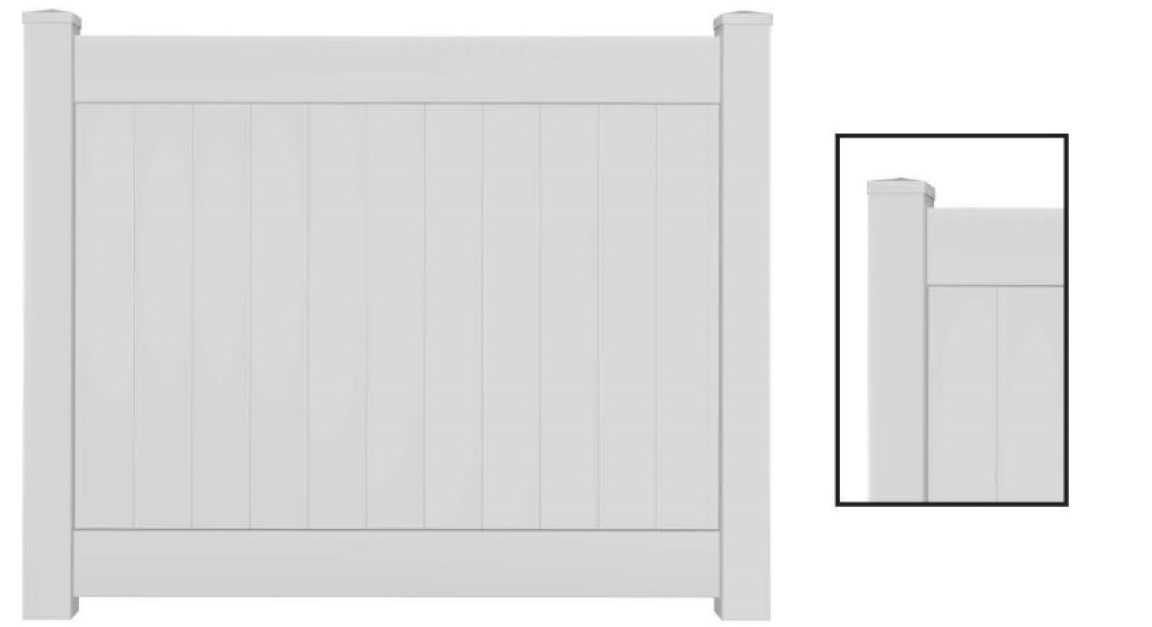
Figure 1
a.
Generally.
Banks Road from NW 32 nd Street to NW 28 th Street
Coral Gate Boulevard from the City limits to the Courtyard Condominiums
Royal Palm Boulevard from NW 57 th Terrace west to the bridge
Royal Palm Boulevard from Rock Island Road east to the bridge
Royal Palm Boulevard from NW 67 Avenue west to NW 78 Avenue
Rock Island Road from the C-14 Canal to Southgate Boulevard
Southgate Boulevard from Rock Island Road west to the City limits
SW 11 th Street from SW 49 th Terrace to State Road 7
b.
Specifically.
2.
Locations. All walls and fences shall only be installed in the following locations:
a.
Single-family attached and detached dwellings.
i.
May be installed along any side and rear lot line.
ii.
Front setbacks. Prohibited in front setbacks. For the purposes of this section, the front setback of a home is considered to be the setback where the home has its primary entrance.
a.
On an irregularly shaped lot, a wall or fence may extend off the front corners of a house so that the wall or fence intersects with the side property line at a ninety-degree angle, and in no instance shall it extend further than the wall of the house closest to the front property line.
b.
In the case of a corner lot, where the primary entrance is angled and faces both streets, the side of the home with the primary driveway shall be considered the front setback.
iii.
Front setback exception. Walls or fences may be located in a front setback on lots on a cul-de-sac that terminate adjacent to roadways classified by Broward County Trafficways Plan Map as arterial roadways.
iv.
Knee walls or planters boxes exception. Knee walls or planters boxes not to exceed two and one-half (2.5) feet in height may be constructed to encroach a maximum of five (5) feet in to a front setback.
b.
Multiple family dwellings.
i.
May be installed along any side and rear lot line.
ii.
Front setback. May be installed with at least ninety (90) per cent see through visibility.
c.
Nonresidential properties.
i.
May be installed along any side and rear lot line.
d.
Outdoor recreational areas and parks.
i.
Within the setbacks allowed by the zoning district of the property.
ii.
Exceptions. Any property owned or operated by the City of Margate or City of Margate CRA is exempt from these provisions.
3.
Heights. All walls and fences shall be measured from the grade of the property in which they are located and only installed to the following maximum height limits:
a.
Single-family attached and detached dwellings.
i.
Six (6) feet.
ii.
Nonresidential use exception. A property developed with a permitted residential use may install a wall or fence to a height not to exceed eight (8) feet along any side or rear property line that is adjacent to or separated by a canal right-of-way less than eighty (80) feet in width, or an alley from a nonresidential use.
b.
Multiple family dwellings.
i.
Four (4) feet in front setbacks.
ii.
Six (6) feet all other allowed locations.
iii.
Nonresidential use exception. A property developed with a permitted residential use may install a wall or fence to a height not to exceed eight (8) feet along any side or rear property line that is adjacent to or separated by a canal right-of-way less than eighty (80) feet in width, or an alley from a nonresidential use.
c.
Nonresidential properties.
i.
Eight (8) feet.
ii.
Required walls. When a nonresidential property is developed, redeveloped, or undergoes a substantial improvement as defined by FEMA regulations, that directly abuts or is separated by a canal right-of-way less than eighty (80) feet in width, or an alley with a permitted residential use, concrete block covered with stucco or pre-cast concrete, eight (8) feet in height shall be installed along any side and/ or rear property line facing or abutting the residential use.
iii.
Connectivity. No fence or wall shall be erected within the Corridor, Gateway, and City Center district that isolates any property, or otherwise inhibits connectivity and the availability of shared parking, with the exception of residential-only developments.
d.
Vacant land or abandoned developed properties. Vacant land or abandoned developed properties may be secured with a fence constructed in the following manner along all property lines:
i.
Split rail ranch style fence constructed out of wood or polyvinyl chloride (PVC) (see Figure 2).
a.
White in color.
b.
No more than three (3) horizontal members.
c.
No more than four (4) feet in height above ground level or the level of an existing berm.
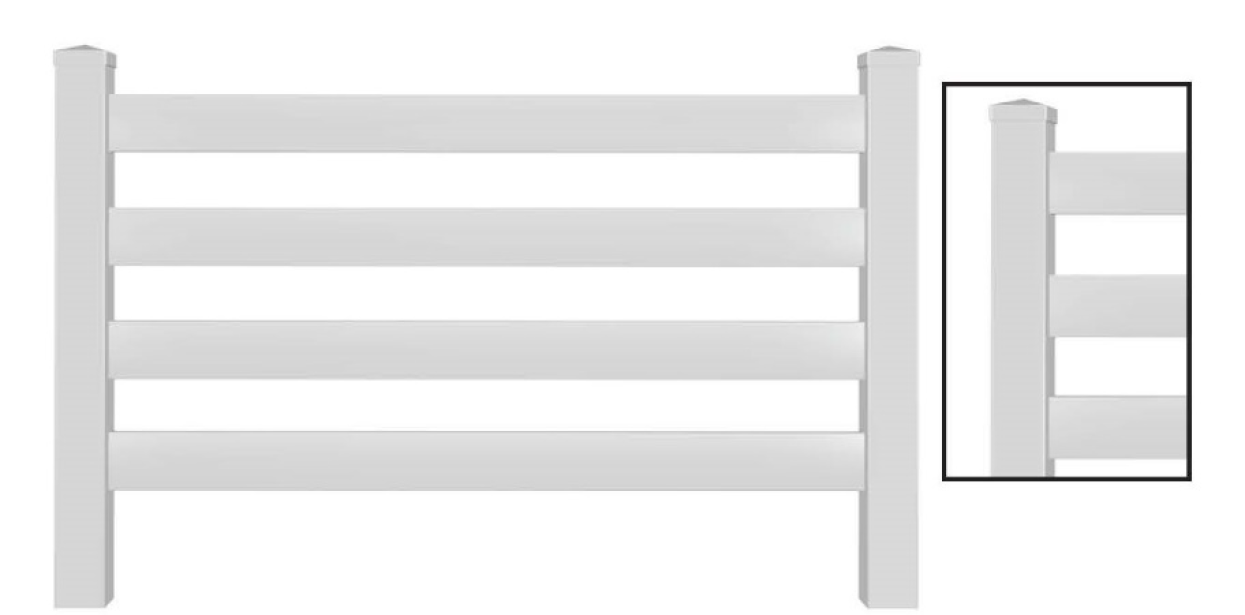
Figure 2
ii.
At driveways, end posts or bollards shall be installed and connected with chain or wire provided any legal access to another property is not blocked.
a.
Bollards are to be painted white or safety yellow.
(B)
Hedges and/or shrubs. Hedges and/or shrubs may be planted and maintained in the following manner unless otherwise prohibited by this Code:
1.
Not to exceed six (6) feet in height along any lot line that is not a front or corner setback.
a.
Multiple family dwellings. Not to exceed four (4) feet in height in front setbacks and corner setbacks unless at least ninety (90) per cent opacity (see-through visibility) is provided.
b.
Abutting nonresidential property or abutting a right-of-way greater than one hundred (100) feet in width exception. In side setbacks (not corner setbacks) and rear setbacks not to exceed ten (10) feet.
2.
Shall be placed no closer than two (2) feet within the lot line and shall be maintained no further than the lot line.
3.
Easements.
a.
When a hedge or shrub is proposed to be installed in a recorded utility easement the property owner shall provide a notarized affidavit acknowledging that the utility provider will not be responsible in any way for repairs to, or replacement of, any portion of it and that any removal and replacement of this construction necessary for the use of this easement will be done at the property owner's expense. Further understanding that the owner will assume full responsibility for any damage incurred to the utility facilities during the construction.
b.
When a hedge or a shrub is proposed to be installed in a recorded drainage, canal or lake maintenance easement the property owner shall obtain permission from the applicable provider to install the wall or fence.
40.703. - Swimming Pools and Screen Enclosures.
(A)
Construction of swimming pools, screen enclosures and safety barriers.
1.
Swimming Pools. All swimming pools in all districts shall be constructed in accordance with the following regulations with the exception of any standards approved with a Planned Unit Development or in the Planned Residential Community District.
2.
Swimming pools shall not be located less than seven and one-half (7½) feet from any side and five (5) feet from rear lot line, measured from the pool structure, providing that no pool or pool enclosure shall be placed within a utility or drainage easement, or closer than five (5) feet to any canal retaining wall, or waterway if no such retaining wall exists.
3.
All pools shall be surrounded by a safety barrier that shall take the form of one (1) of the following: A screened-in patio or an approved wall or fence material.
4.
The safety barrier shall be erected either around the swimming pool or around the premises on which the swimming pool is erected, provided the minimum setbacks as required in this section are met. In either event, it shall enclose the area entirely, prohibiting unrestrained admittance to the enclosed area. Barriers on a frontage abutting a navigable waterway shall be in compliance with the Florida Building Code as may be amended periodically.
5.
Gates shall be equipped with a positive lock so that they shall automatically be in a closed and fastened position at all times and said lock will be at a minimum height per the Florida Building Code as may be amended periodically.
6.
It shall be the responsibility of the owner and/or occupant of the premises upon which the swimming pool has been constructed or is hereafter erected to install and maintain and keep in proper and safe condition with the safety barrier required and erected in accordance with this section.
7.
Swimming pools constructed above ground shall conform to all ordinances governing in-ground swimming pools.
(B)
Screen Enclosures.
1.
Open mesh screening may be placed in a required side or rear setback subject to the limitations below but shall not be placed in a required front or street side setback. A screen enclosure is permitted according to these regulations whether or not it is being used to screen a swimming pool.
2.
Any screen enclosure part of a pool which has a is covered by a roof or enclosed by side walls over five (5) feet in height shall be subject to the limitations on location of a building and shall not be placed in any required setback.
40.704. - Landscaping.
(A)
Objectives. The objectives of these regulations are to beautify the city and improve the quality of life for its citizens by requiring Florida friendly landscaping that will conserve water, soften the hardscape of modern development, provide tree canopy, natural habitat, and shade areas. These objectives further include the maintenance of high-quality air and water resources, the provision of buffer areas between and among various land uses, the preservation of residential property values, the revitalization of existing commercial areas, and the preservation of indigenous vegetation.
(B)
Definitions. All definitions provided herein shall be read in conjunction with those definitions provided in this Chapter of the Code, except that should a conflict exist between the definitions in this section and of this Chapter that are irreconcilable, then as to matters relating to this section, the definitions within this section shall prevail.
For the purpose of this section, the following terms and words shall have the meaning herein prescribed unless the context clearly requires otherwise:
1.
Building. Any structure used for the shelter or enclosure of persons, animals or property of any kind.
2.
Diameter breast height (DBH). The diameter of the trunk of a tree measured at breast height. The DBH of trees with multiple trunks shall be the sum of the individual trunk diameters at breast height. Trees with less than four and one-half (4½) feet of clear trunk shall be measured as the diameter of the largest vertical branch or leader at breast height.
3.
Directly abutting. To share a common property line without any intervening canal or roadway at least fifty (50) feet in width located along said common property line.
4.
Drip line. The peripheral limits of the horizontal crown of a tree spread vertically to the ground; provided, however, that the same shall not be less than a circle with a five-foot radius measured from the center of the tree.
5.
Driveway. A private road connecting a vehicular use area (defined below) to an access easement, right-of-way, private road or another site.
6.
Drought tolerant species. Any plant species that will survive extended periods without rain or supplemental irrigation, while remaining healthy and retaining an acceptable appearance.
7.
Encroachment. Any extension by any part of a vehicle, boat or trailer into a landscaped area.
8.
Florida native species. A native plant species shall be those plant species indigenous to the ecological communities of South Florida, as indicated on lists provided by City of Margate, or that can be scientifically documented to be native to South Florida.
9.
Florida Friendly Landscaping. As defined Under Chapter 373, Florida Statutes (as may be amended from time to time) this addresses landscaping including, but not limited to, planting the right plant in the right place, efficient watering, appropriate fertilization, mulching, attraction of wildlife, responsible management of yard pests, recycling yard waste, reduction of stormwater runoff, and waterfront protections. Additional components of Florida-friendly landscape include planning and design, soil analysis, the uses of solid waste compost, practical use of sod, and proper maintenance.
10.
Ground cover. A planting of low growing plants that covers the ground in place of turf sod and which naturally grows to a height of two and one-half (2½) feet or less.
11.
Hedge. A close planting of shrubs which form a compact, dense, visually opaque, living barrier when mature.
12.
Landscaping. Sod, ground covers, shrubs, vines, accents, hedges, trees, and other decorative forms of live vegetation.
13.
Landscaping element. Nonliving material commonly used in landscaping, including, but not limited to,, statues, walls, fences, trellises, decorative benches, pergolas, arbors, curbing, fountains, ponds, and boulders, etc. However, not synthetic turf. All proposed ponds or water bodies must meet the South Florida Drainage District specification, guidelines and standards.
14.
Mulch. An arsenic-free organic soil covering such as compost, wood chips, bark or straw used to reduce evaporation, prevent erosion, control weeds, enrich the soil, and lower soil temperature for around trees, palms, accents, shrubs and ground covers per code and not to be utilized as mulch beds only.
15.
Nonresidential property. All land that is used for commercial, industrial, and/or community facility uses.
16.
Pervious area. A natural ground surface area that allows the penetration of water.
17.
Right-of-way. Land, usually in a strip, acquired for or devoted to transportation purposes.
18.
Scalping. Cutting lawn grass low so that the stems of the grass blades are exposed due to operator error or improperly maintained equipment.
19.
Shade tree. A category 1 tree as specified in this section.
20.
Shrub. A multi-stemmed woody plant with several permanent stems instead of a single trunk and usually not over ten (10) feet in height.
21.
Site. An area of land consisting of a lot, tract, parcel or other unit of land recorded in the public records, or combinations thereof, and having a common development scheme presented to the city as a single project whether simultaneously or in phases.
22.
Sod or Lawn. A mat layer of living monocotyledonous grass plants such as, but not limited to, Bahia, Bermuda, Centipede, Seaside Paspalum, St Augustine, and Zoysia and their cultivars. However, this definition does not include any type of synthetic/artificial turf.
23.
Synthetic turf. Means a dense and continuous surface of synthetic fibers mounted on a permeable backing and of sufficient density and green color to replicate the appearance of healthy, natural grass.
24.
Tree. Any living, self-supporting, dicotyledonous or monocotyledonous woody perennial plant which has a DBH of no less than three (3) inches at maturity and which normally grows to an overall height of no less than ten (10) feet in southeast Florida.
25.
Vehicular use area. Any area used by vehicles, except public rights-of-way, to include, but not be limited to, areas for parking, display or traverse of any and all types of vehicles, cars, motorcycles, buses, boats, trailers, campers or heavy construction equipment. Also included are areas paved or compacted for outdoor storage, display or sales.
26.
Vine. A plant which produces climbing, meandering stems and which will grow only as tall as their supporting object.
27.
Weed. An uncultivated plant of rapid growth, generally characterized by the production of large quantities of seeds, which tends to overgrow or choke out more desirable plants.
(C)
Application of landscaping code.
1.
No new building or vehicular use area shall be erected or paved, unless in conformity with the regulations specified herein.
2.
The provisions of this landscaping code regarding the installation of new landscaping material (other than replacement landscaping material) shall apply in the following instances:
a.
When any existing building or vehicular use area is expanded, extended, redeveloped, or enlarged; however, single-family homes undergoing driveway expansion or repave shall not be required to install new landscaping at the time of permitting.
b.
For any special exception use application that involves new construction, redevelopment, or substantially redeveloping or reconstructing an existing building.
c.
Any existing affected area related to an application for special exception use within an existing building, other than described above.
d.
Any exterior affected areas related to an application.
3.
The standards for landscaping maintenance shall be applicable to all landscaping within the city regardless of when same was installed.
(D)
Plan required.
1.
A landscaping plan and irrigation plan shall be submitted with every DRC application for site plan approval, or amendment, or special exception, or any other building permit application for a new building, expansion of building, or building permit to substantially redevelop or reconstruct a building or principal structure. Said landscaping plan shall be prepared by a Florida registered landscape architect.
2.
Landscaping plan specifications. Landscaping plans shall be required to be submitted as follows:
a.
The landscaping plan must be drawn to scale and show the location and dimensions of all existing and proposed structures and infrastructure, including, but not limited to, vehicular use areas, driveways, surface water areas, site lighting, walls, fences, gates, signs, transformers, berms, utilities, and fire lanes, zones and hydrants.
b.
The landscaping plan shall indicate the location, size, grade and specifications of all existing and proposed landscaping materials, including common and botanical names, planting instructions, soil and fertilizer requirements, mulch specifications, berm elevations, protective curbs or other devices, existing trees, and the description of any adjacent conditions which affect the landscaping of the subject site. Also, provide planting and staking details including, but not limited to, planting and staking specifications, general notes, and tree protection barricade details.
c.
Plant species and materials shall be selected and located on the plan so that plant groupings are organized by water, light, and soil condition requirements.
d.
An irrigation plan signed and sealed by a State of Florida Registered Landscape Architect for all landscaped areas within the site and adjacent right-of-way or access easement shall be submitted simultaneously with the landscaping plan. Said irrigation plan shall show the source of water, pumps, valves, pipe sizes, rain sensors, head types, locations and spray patterns.
e.
The landscape plan shall also include any trees or landscaping on adjacent properties within twenty-five (25) feet that may impact the landscape plan.
f.
Such other information that may be required to give a complete understanding of the proposed plans.
3.
The Development Services Department shall review the landscaping plan for compliance with the minimum requirements of this code. All landscaping shall be installed pursuant to the landscaping plan as approved by the department of development services before a final certificate of occupancy is issued. Substitutions of comparable plant material are permitted if first approved by the Development Services Department.
4.
Applicable permits for irrigation systems, tree removal, and the planting of trees in a swale must be obtained. Additionally, permits may be required by the City in conjunction with expansions of structures, redevelopment, and new construction as determined by the Development Services Department during site plan approval.
(E)
Materials, installation and irrigation requirements.
1.
Materials:
a.
All required landscaping installed after the effective date of this article shall be drought tolerant and/or Florida Friendly. A minimum of fifty (50) per cent of all required landscaping installed after the effective date of this article shall be South Florida native species. All plant material utilized shall be Florida Fancy or better, as specified by Grades and Standards for Nursery Plants, Parts I and II, Florida Department of Agriculture and Consumer Services, as amended.
b.
Tree size at the time of planting for required trees shall be as follows:
i.
Minimum of twelve (12) feet in height and two (2) inches DBH.
ii.
Palms: Minimum of eight (8) feet of clear trunk or greywood. A grouping of three (3) palms may be substituted for one (1) shade tree, subject to the following:
a.
Washingtonia and Chinese Fan palms must be planted in clusters of three (3) or more at staggered heights. Royal palms and coconut palms shall be only planted in areas that will not be utilized by pedestrian or vehicular traffic.
b.
When grouping palms, each palm shall be spaced no greater than six (6) to twelve (12) feet from the nearest palm in the cluster, depending on the palm species.
c.
Nonresidential, mixed use, and multifamily properties shall not be permitted to substitute palm trees for more than twenty-five (25) per cent of the shade trees required by this section.
d.
A palm with multiple trunks shall be counted as a single palm.
e.
Multi-trunk palms may not be used as a hedge material. This includes but is not limited to such species as Areca palm (Dypsis lutescens), Bamboo palm (Chamaedorea seifrizii), Fishtail palm (Caryota mitis), Lady Palm (Rhapis excelsa), or Lipstick palm (Cyrtostachys renda).
iii.
Tree size requirements shall only be applied to landscaping required through processes outlined in this Code.
iv.
Sabal palmetto/cabbage palm planted after December 20, 2023, do not provide credit toward tree requirements outlined in this Code.
c.
Shrubs and hedges shall be mulched and installed at a minimum of two (2) feet in height after planting. Where hedges are required, shrubs must be planted every (3) feet on centers. Shrubs used for hedges shall be woody, evergreen species.
d.
Ground covers shall be mulched and planted at seventy-five (75) per cent coverage in sufficient quantity as to present a finished appearance and to provide complete coverage within three (3) months.
e.
Lawn areas shall be sodded with St. Augustine Floratam, Palmetto or Bermuda, with the following exceptions except as permitted below:
i.
Shrubs, ground covers, and planting beds may be substituted for any area otherwise required to provide lawns or sod. Landscapes made entirely of rock, mulch, shell, or other similar materials are not permitted.
ii.
Landscape elements may be substituted for up to twenty-five (25) per cent of any area otherwise required to provide lawns or sod.
iii.
Bahia sod is generally prohibited but may be permitted in specific approved retention areas.
iv.
Bare soil is prohibited in any area otherwise required to be sodded.
f.
Plant species listed as prohibited within the South Zone as provided in the University of Florida's Institute of Food and Agricultural Sciences biennial Assessment of Non-Native Plants shall hereby be prohibited from use and installation within the city.
2.
Installation.
a.
All landscaped areas within nonresidential, multifamily, and mixed-use developments shall be protected from vehicular encroachment by curbing or other durable barriers. All shade trees, except palms, installed within six (6) feet of public infrastructure, including, but not limited to, utility lines, sidewalks, curbing, asphalt and paved rights-of-way, shall utilize at least a twenty-four-inch deep root barrier system, structure soil or suspended pavement system as approved by the department of environmental and engineering services. The front of parked vehicles may overhang a protected landscaped area if said area is at least seven (7) feet wide.
b.
Planting holes shall be a minimum of twice the diameter of the root ball or container and shall be free of limerock, rocks, asphalt or other debris. All planting holes shall be backfilled with suitable soil, free of clay, stone, plants, roots, and other debris. The root flare shall be visible at time of planting.
c.
Slow-release general fertilizer shall be applied at the time of planting and contain trace elements iron and manganese in addition to N-P-K. However, fertilizer shall not be applied within ten (10) feet of any body of water.
d.
Trees.
i.
All trees shall be stabilized in a workmanlike manner at the time of planting. The use of nails, wire, rope, or any other method which damages the tree is prohibited. Trees shall remain stabilized until establishment, but in no instance shall a tree remain stabilized for more than twelve (12) months. Trees shall be re-staked in the event of blow over or other failures of the stabilization.
ii.
All proposed Trees and palms shall not be planted under Roof, overhangs, and balconies.
iii.
All proposed Trees and palms within or overhanging pedestrian areas shall have a Clear Trunk at least eight (8) feet in height to allow unobstructed pedestrian movement under or around.
iv.
All proposed tot lots or swimming pools, except for a Single-Family home, shall be required to have a minimum shade requirement of thirty (30) per cent to allow Persons to seek refuge from the sun.
v.
The use of very poisonous, thorny, spiny, deciduous, messy fruit or an aggressive root system Tree or palm shall be reviewed case by case.
vi.
All Trees and palms shall be a minimum of four (4) feet from all underground Utility lines. This distance shall be measured from the root flare at time of planting to the closest locator marks.
vii.
All shade trees shall be installed a minimum of fifteen (15) feet away from light Poles. All small Trees and palms shall be installed a minimum of seven and one-half (7½) feet away from light Poles. This distance shall be measured from the root flare at time of planting. Light fixtures installed in such areas that provide adequate vertical clearance from existing trees/landscaping may be permitted.
viii.
All Trees and palms shall be installed seven and one-half (7½) feet from the front and sides of fire hydrants, and fire department connection (FDC) and four (4) feet from the rear. This distance shall be measured from the root flare at time of planting.
ix.
All proposed multi-trunk Trees shall have a minimum of three (3) trunks with no more than five (5) trunks of equal diameters originating from the ground with angles no less than forty-five (45) degrees and no crossing branches. (The City can require either multi-trunk or single trunk on certain Trees.)
x.
All proposed coconut palms shall be certified to be resistant to lethal yellowing.
xi.
The use of wind tolerant Trees and palms is required due to the high risk of hurricanes in South Florida. Every effort shall be utilized to reduce the risk of damage and liability by utilizing more wind tolerant Landscaping.
e.
Shrubs and Hedges.
i.
Shrubs shall be planted in a manner that prevents branches from touching the Building walls or walkways at time of planting.
ii.
Shrubs shall be installed seven and one-half (7½) feet from the front and sides of fire hydrants, and fire department connection (FDC) and four (4) feet from the rear.
iii.
Planting Shrubs around Trees shall be done in a manner that prevents trunk damage.
iv.
Planting Shrubs in layers shall be done in a manner that promotes plant species diversity and the City's aesthetics with taller Shrubs in the back and shorter Shrubs in the front.
v.
Shrubs shall be multi-stem with a minimum of three (3) stems originating from the ground.
vi.
The use of plant material that can be hazardous to Persons, pets or property shall be reviewed on a case-by-case basis.
vii.
Shrubs shall be a minimum of two (2) feet in height at time of planting, except that half of the shrubs that are part of a layered landscape design may be planted at a height of eighteen (18) inches.
f.
Vines.
i.
Vines used for vertical screening shall be a minimum sixty (60) inches in supported height immediately after planting. The method of Attachment shall be indicated on the Landscape plans. The use of very poisonous, thorny, spiny, deciduous, or messy fruit Vines shall be subject to the approval of the City. Support Structures, including, such as, but not limited to, pergolas, trellises and arbors, require Vines.
g.
Mulching.
i.
Where mulch is applied in landscape areas, it shall be laid so that it is a minimum of three (3) inches thick. Trees in sodded areas shall be mulched under the drip line, except that no mulch shall be laid within six (6) three (3) inches of any tree trunk. Shrubs, groundcovers, and planting beds shall be mulched at the time of planting. Where run off into drains is evident, the city may require a suitable barrier to keep the landscape mulch from going into drains.
h.
Sod.
i.
All sod areas, including, but not limited to,, swales, lake maintenance easements, and Retention Areas, shall be solid St. Augustine Floratam, Palmetto or Bermuda laid on a smooth planting base with tight joints at one hundred (100) per cent coverage at time of planting and cut to fit all Landscape planters and curb areas. Sod shall be green, healthy, clean, and visibly free of weeds, pests, and diseases. Sod areas shall be identified and labeled on the Landscape plans. Seeding and plugs are prohibited.
i.
Setbacks and easements.
i.
Hedges, trees, and palms shall be planted no closer than two (2) feet from any lot line. The planting of hedges, trees, or palms within any easement of record shall be permitted only when written permission is granted by the applicable departments and/or utility companies.
3.
Irrigation.
a.
All landscaping required by this code shall be supplied with water through an underground irrigation system. Said irrigation system shall deliver one hundred (100) per cent coverage and fifty (50) per cent overlap of all landscaping plants, including swale turf sod. Irrigation systems shall not spray upon abutting property, adjoining sidewalks and streets, or any other impervious surfaces.
b.
Trees, shrubs, flowers, and ground covers may be irrigated with low volume drip, micro-spray, or bubbler emitters.
c.
All irrigation systems installed after the effective date of this article shall properly install, maintain, and operate technology that inhibits or interrupts operation of the system during period of sufficient moisture in accordance with Section 373.62, Florida Statutes, as amended. Such technologies include, but are not limited to, rain sensors, also called rain shutoff devices, and soil moisture sensors.
d.
A zone layout plan (minimum scale one (1) inch equals twenty (20) feet).
e.
Indication of water source, valves, pumps, backflow preventers, controllers, main line, lateral lines, sleeves, headtypes, specifications, and spacing.
f.
All irrigation systems utilizing non-potable water shall include a treatment system to prevent rust stains.
g.
An indication of methods used to achieve compliance with University of Florida's The Florida Friendly Landscaping Guide to Plant Selection and Landscape Design as required by F.S. § 373.185, unless provided for herein.
h.
A non-potable water source must be used, if available. A well shall be drilled if the necessary permit can be obtained.
i.
Such other information that may be required to give a complete understanding of the proposed plan.
j.
No irrigation system that draws water from a canal or similar waterway shall be installed such that the irrigation suction line float encroaches further than ten (10) per cent of the width of the canal or waterway where it is located, measured from the canal retaining wall. Where there is no canal retaining wall, the distance shall be measured from the property line unless same is not submerged, in which case the measurement shall be from the average high-water line.
4.
Florida-Friendly Landscaping. Within the City of Margate, the principles of Florida-friendly landscaping shall be incorporated into all landscape designs. These include the following:
a.
Preserving existing native trees and vegetation, if feasible. Where established natural vegetation is incorporated into the landscape design, irrigation of those areas shall not be required.
b.
The plant palette and irrigation system shall be appropriate for site conditions, taking into account that, in some cases, soil improvements can enhance water use efficiency. Drought resistant plants are emphasized.
c.
Plants shall be grouped together by irrigation demand.
d.
The per centage of landscaped area in irrigated high-water use hydrozones shall be minimized. The maximum per centage of irrigated landscape area that may be included in high water use hydrozones, excluding sod, shall not exceed twenty (20) per cent. These high-water use limits shall not apply to landscaped areas requiring large amounts of sod for their primary functions, e.g., ball fields and playgrounds.
e.
Soil improvements are encouraged to improve the soil with organic materials prior to the installation of any irrigation system.
f.
An efficient irrigation system shall be required and designed according to the water needs of the planting groups.
g.
Reclaimed or non-potable water should be used for irrigation if an acceptable source is determined to be available by the City Utilities Department. If such reclaimed water or non-potable water is available from the City to service a site, a local water provider, if different than the City, shall allow such use of reclaimed water, unless prohibited by Statute.
h.
Low impact design principles such as bio-swales, bio-retention areas and other creative stormwater management techniques.
(F)
Required landscaping abutting rights-of-way, visual clearance.
1.
Required landscaping abutting rights-of-way. On the site of a building or vehicular use area directly fronting on a public right-of-way, with the exception of single-family detached dwellings and duplex detached dwellings, there shall be landscaping provided between the site and the right-of-way as follows:
a.
In nonresidential districts, mixed-use and multi-family residential districts, a strip of land at least ten (10) feet in width, adjacent to and parallel with the right-of-way, shall be landscaped. Within said strip there shall be planted at least one (1) shade tree for every forty (40) linear feet of frontage or portion thereof. In addition, a hedge shall be planted within the landscape strip and parallel with the street. All hedges must be planted a minimum of two (2) feet back from any public sidewalk. The remaining area of this strip shall be covered with additional shrubs, ground covers, and/or sod turf.
i.
Mixed-use developments are permitted to encroach into this landscaped area for facilities related pedestrian-friendly amenities.
ii.
Mixed-use developments are permitted to utilize smaller trees in these landscaped areas where a structure abuts the landscaped area.
b.
In mixed-use districts, where developments are required to provide an urban greenway of varying widths based on the size of the abutting roadway. The following provisions shall apply:
i.
An eight-foot-wide planting strip measured from the curb or edge of pavement inward toward the private development, running parallel with the right-of-way shall be provided.
ii.
Within said planting strip, one (1) shade tree shall be planted within a eighty (80) square foot pervious area every thirty (30) linear feet of frontage. Sod, shrubs or ground covers shall fill areas of the pervious area not occupied by the required shade tree.
iii.
Where a substitution for a smaller tree is necessary because of existing overhead utility lines, each category 2 tree shall be planted within a sixty-four (64) square foot pervious area, and each category tree shall be planted within a minimum forty (40) square foot pervious area.
iv.
Palm trees are permitted within the urban greenway but shall not be credited toward the urban greenway tree requirement.
v.
Public amenities requested by the Development Review Committee shall be provided within the planting strip at the time of development, including, but not limited to, paved connections to the right-of-way, benches and other public seating, waste receptacles, bicycle racks or lockers, etc.
c.
Where overhead utilities are pre-existing and in conflict with the installation of required trees, a smaller category of tree may be planted at an increased frequency in lieu of the category 1 shade tree requirement and as follows:
i.
One (1) category 2 tree shall be planted for every twenty-four (24) linear feet of frontage; or
ii.
One (1) category 3 tree shall be planted for every eighteen (18) linear feet of frontage.
2.
Requirements for planting of trees under or adjacent to utilities.
a.
Small trees. Defined as less than twenty (20) feet in height at maturity and may be planted adjacent to, or under, power lines.
b.
Medium trees. Defined as twenty (20) feet to thirty (30) feet in height at maturity, and must have a setback of twenty (20) feet from the crossbar of the power-line poles, as depicted in Exhibit "A."
c.
Large trees. Greater than thirty (30) feet in height at maturity and must have a setback of thirty (30) feet from the crossbars of the power-line pole, as depicted in Exhibit "A."
d.
Small palms. Small palms shall be defined as less than twenty (20) feet in height and can be planted adjacent to, or under, power lines.
e.
Large palms. Large palms shall be defined as greater than twenty (20) feet in height at maturity and shall be planted at the average frond length plus two (2) feet for minimum clearance from the crossbar of the power poles as depicted in Exhibit "A."
Exhibit "A"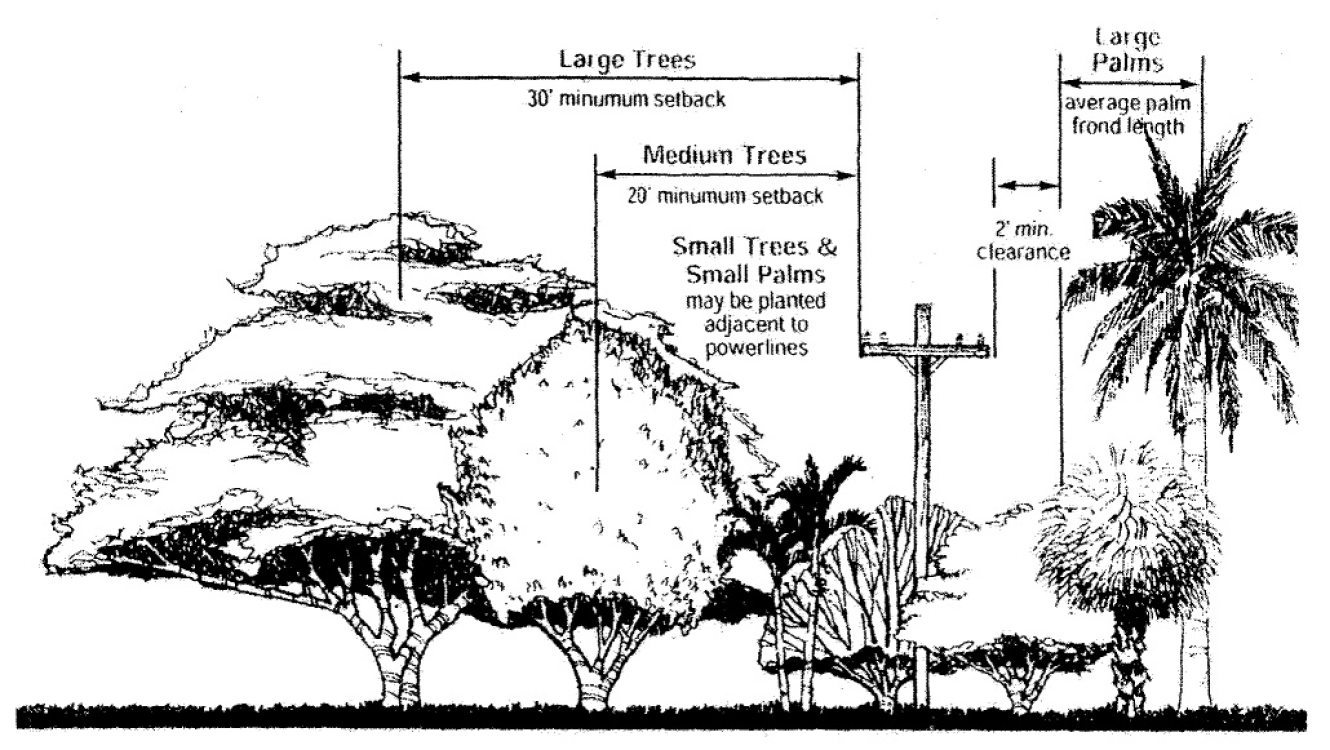
3.
Visual clearance.
a.
Public rights-of-way. When a site abuts the intersection of two (2) public rights-of-way, landscaping shall be maintained within the sight triangle to provide adequate visibility. The public right-of-way sight triangle is the triangular area formed by the chord connecting thirty-five (35) feet from the intersection of the right-of-way lines or tangent extensions thereof. The following provisions shall apply within the sight triangle:
i.
Hedges and any other low-growing vegetation shall be maintained to a maximum height of twenty-four (24) inches.
ii.
Tree limbs shall be properly pruned to provide a minimum of eight (8) feet of vertical clearance.
iii.
When problems with visibility persist due to unique circumstances of the site, such as a road curvature or varying elevations, the property owner may be required to maintain landscaping to a stricter standard or remove certain problematic landscaping.
iv.
The preceding provisions and restrictions shall not apply to single-family detached dwellings or duplex detached dwellings. However, a ten-foot by ten-foot sight triangle is required with sections (a), (b), and (c).
b.
Private driveways. Where a private driveway intersects with a public right-of-way, landscaping shall be maintained within the safety sight triangle to provide adequate visibility. The private driveway site sight triangle is the triangular area formed by the chord connecting twenty-five (25) feet from the intersection of the right-of-way line and a perpendicular line formed by the outer edge of the driveway pavement. The following provisions shall apply within the site sight triangle:
i.
Hedges and any other low-growing vegetation shall be maintained to a maximum height of twenty-four (24) inches.
ii.
Tree limbs shall be properly pruned to provide a minimum of eight (8) feet of vertical clearance.
iii.
When problems with visibility persist due to unique circumstances of the site, such as a road curvature or varying elevations, the property owner may be required to maintain landscaping to a stricter standard or remove certain problematic landscaping.
iv.
The preceding provisions and restrictions shall not apply to single-family detached dwellings or duplex detached dwellings. However, a ten-foot by ten-foot sight triangle is required with sections (a), (b), and (c).
(G)
Required landscaping adjacent to other perimeters.
1.
Abutting properties. All sites of buildings or vehicular use areas, except single-family detached dwellings and duplex detached dwellings, shall provide a perimeter landscape strip not less than five (5) feet in width along parcel lines that do not directly abut a public right-of-way or residential property. Nonresidential developments which abut residential property shall provide the buffer requirements described in this Code. At the time both abutting properties are developed according to these standards, there will be a landscape strip of no less than ten (10) feet in width, both properties considered.
a.
Within the perimeter landscape strip described above, each abutting property shall plant one (1) shade tree along the common property line for every for every seventy-five (75) linear feet or fractional part thereof. Such shade trees shall be located with consideration given to the trees provided by the abutting property, so that adequate spacing is provided between the trees. If overhead utility lines are in conflict with the selection of shade tree species, then right tree right place shall prevail.
b.
The remaining area of the perimeter landscape strip shall be planted with small ornamental trees, shrubs, ground covers, and turf sod. Not more than fifty (50) per cent of the perimeter landscape strip may be sodded.
The provisions of this section shall be modified in the following instances:
i.
Where buildings are located along a common property line, the requirements of this section shall not apply to those portions of the perimeter covered by such buildings.
ii.
Where an agreement to operate abutting properties as a joint parking area or a cross access agreement is in force, the perimeter landscape strip requirements between said properties shall be waived for the portions of the perimeter used for vehicular access until the agreement is terminated.
2.
Property owner responsibility for waterway frontage.
a.
All canals, lakes and retention areas shall be kept clear of any and all bushes, trees, vegetation, or debris of any sort emanating from adjacent banks that interfere with the free flow of water within such canals, lakes and retention areas.
b.
Where tree limbs overhang into a canal right-of-way or over any other body of water, said tree limbs shall be properly pruned to provide a minimum of eight (8) feet of vertical clearance measured from the mean water level or top of sea wall.
c.
The banks adjacent to all canals, lakes and retention areas not containing seawalls shall be cleared, and kept clear, of all Florida Holly, Australian pines, weeds, and other noxious species.
d.
Such banks shall be graded at a slope no steeper than four (4) horizontal to one (1) vertical and shall be covered with sod down to the design water elevation.
(H)
Parking area and pedestrian zone interior landscaping.
1.
Interior landscaping. Interior landscaping shall be located within the vehicular use area subject to the following requirements:
a.
Terminal islands. Landscaped terminal islands of at least eleven (11) feet in width (including curbs) and eighteen (18) feet in length shall be provided at the end of each parking row. All islands of less than eleven (11) feet due to turning radii requirements shall have polyethylene root barriers installed against the full perimeter of the island.
b.
Interior islands. At least one (1) landscaped interior island shall be provided for every ten (10) parking spaces. Interior islands shall measure at least eleven (11) feet in width (including curbs) and eighteen (18) feet in length.
c.
Landscape treatment. All interior planting areas not dedicated to trees, shrubs, or existing vegetation shall be landscaped with sod, ground cover, or other appropriate landscape treatment (no sand, rock, pavement, or base soil). In no instance shall there be less than one (1) shade tree for each landscaped island.
d.
Site lighting and trees. No light poles shall be located within fifteen (15) feet of a canopy tree or within seven and one-half (7½) feet of a palm species or small tree. This distance shall be measured from the root flare at time of planting. All final light pole locations shall be illustrated on planting plans. Light fixtures installed in such areas that provided adequate vertical clearance from existing trees/landscaping may be permitted.
e.
When provided, divider medians shall be a minimum of eleven (11) feet in width, including Type D curbs.
f.
All limerock shall be excavated from interior landscaping areas to a depth of two and one-half (2½) feet and backfilled with the specified planting mix.
g.
There shall be one (1) shade tree and three (3) shrubs per two hundred (200) square feet, or fraction thereof, of interior landscaping in the VUA minus the landscape islands. Trees used shall provide visual and vertical clearance for automobiles, emergency vehicles and service trucks. In addition to the tree requirement, all such areas shall be landscaped with sod, ground covers, and shrubs. Not more than seventy (70) per cent of the parking area interior landscaping may be sodded.
2.
Pedestrian zones. In mixed-use districts, all building frontages not directly abutting a public road shall provide landscaped pedestrian zones immediately adjacent to the building. The pedestrian zones shall provide a sidewalk no less than eight (8) feet in width, and a landscape area no less than four (4) five (5) feet in width lying between the sidewalk and building. The landscape area provided in the pedestrian zone shall accommodate such landscaping materials as groundcovers, shrubs, and small trees and palms. Larger landscaping may be accommodated as the width of the landscaping area increases, if desired by the property owner.
a.
Small street furnishings may be located within the pedestrian zone (including landscaped portions) provided that sidewalks maintain a minimum of five (5) feet of clear path.
b.
The pedestrian zone shall not be required for buildings, or portions thereof, that have dwelling units on the ground floor.
c.
Two (2) adjacent buildings may share a single pedestrian zone by providing a single eight-foot-wide paved sidewalk between the two (2) buildings with a four-foot five (5) feet landscape buffer between the sidewalk and each building.
d.
Portions of a building facade abutting loading spaces and other similar incompatible features are not required to provide a pedestrian zone.
(I)
Dumpster and other screening requirements.
1.
All dumpsters, compactors, and sites containing five (5) or more garbage cans within the city shall be located on a reinforced concrete pad and screened by a durable opaque enclosure that is not less than six (6) feet in height. Said enclosure shall not be made of chain link or any other similar material. Each enclosure shall be equipped with durable gates. A minimum thirty-six-inch tall continuous hedges shall be planted on any side of the enclosure that is visible from the right-of-way or residential property in a planting bed not less than three (3) feet in width.
2.
Previously developed sites that are legally nonconforming with this section shall be required to comply at the time of any DRC application for site plan approval or amendment, or special exception that involves new construction, redevelopment, or substantially redeveloping or reconstructing an existing building.
To achieve the objectives of this section, existing off-street parking facilities may be reduced upon administrative review and approval of a site plan amendment by the Development Review Committee.
3.
All mechanical, utility, or any other equipment installed outside and on the ground shall be screened from all public rights-of-way by a continuous hedge, fence or wall maintained to a height not less than six (6) inches above the height of the installed equipment. The screening material shall be planted or installed within ten (10) feet of the equipment that it was planted intended to screen.
4.
Shopping centers and strip centers shall place litter receptacles along the front walkways of said centers at an interval of two hundred (200) linear feet or a minimum of two (2) per center, whichever is greater. Freestanding commercial buildings shall contain a minimum of one (1) trash receptacle per building.
a.
For the purposes of this section, litter receptacle shall be defined as any container which is made of wood, recycled plastic, metal or stone and is a minimum of thirty (30) gallons in size. Said container shall be provided and usable for the disposal of litter, garbage or trash and same shall be collected and disposed of on a regular basis.
b.
Litter receptacles shall be architecturally compatible with the surrounding development and shall be permanently anchored to the wall or ground to prevent theft and/or vandalism.
c.
For food and beverage drive-through uses, litter receptacles shall also be placed at the exit of drive through lanes to allow for vehicular traffic to utilize receptacles.
(J)
Planting in swales.
1.
Certain species prohibited. The planting of the following types of trees shall be prohibited within or nearby to the non-travelled public rights-of-way (swales, parkways, etc.) of a highway, road, street or any thoroughfare held as public property for public access within the city: the Florida Holly, Ficus, Brazilian Pepper, any tree of the Moraceae family, and any tree or shrub having an excessive root system that is considered undesirable by the City for maintenance of streets, sidewalks and public utilities.
2.
Application required. Anyone planting trees or shrubs within any portion of the non-travelled public rights-of-way (swales, parkways, etc.) within the city shall make written application for said planting to the department of environmental and engineering services, and obtain approval if there are no water mains in the swales. If a tree is planted and has not been approved by the City, it shall be removed by the property owner who planted it if not approved by the City.
3.
Maintenance. Landscaping other than trees and sod shall be maintained to a maximum height of twenty-four (24) inches. Tree limbs shall be properly pruned to ANSI three hundred (300) standards to provide a minimum of eight (8) feet of vertical clearance above grassy areas and adjacent sidewalks, and a minimum of fourteen (14) feet of vertical clearance above adjacent paved roadways. Sod shall be maintained to a maximum height of six (6) inches.
(K)
Minimum landscape requirements for zoning districts. The following are the minimum landscaping requirements for the designated zoning districts:
1.
Sites of Single-family dwellings, and two-family dwellings, and individual RV sites within an RVRP district shall provide the following minimum landscaping on site. However, right trees and right place, site specific trees, and the sustainability of the trees shall take precedence with the selection of the trees required. Not less than fifty (50) per cent of the required landscaping shall be planted in the front half of the lot.
a.
Lawns/Sod. Lawns shall be placed on all areas not covered by buildings, shrubs, ground covers, landscape elements, walks or drives and shall extend to any street pavement edge and to the mean waterline of any abutting lake, canal or waterway.
b.
Trees. Minimum tree requirements shall be based on lot size, as follows:
i.
Canopy area values considered for this section shall be the same as those specified in the table provided in this Code.
ii.
When calculating tree requirements, fractional portions shall be rounded up to the nearest whole tree requirement.
iii.
Lots of fifteen thousand (15,000) square feet or greater shall provide the canopy equivalent of twelve (12) per cent of the gross lot size.
iv.
Lots ranging from six thousand (6,000) to fourteen thousand nine hundred ninety-nine (14,999) square feet or greater shall be required to provide a tree canopy equivalent of ten (10) per cent of the gross lot size.
v.
Lots of five thousand nine hundred ninety-nine (5,999) square feet or less shall provide the canopy equivalent of eight (8) percent of the gross lot size., however, no lot shall provide less than two (2) Category 3 trees and one (1) Category 4 tree.
c.
Shrubs. Every lot shall provide at least one (1) shrub per thousand square feet of gross area, or fractional portion thereof, however, no lot shall provide less than six (6) shrubs.
2.
Multiple family dwelling districts, including, but not limited to, R-3, R-3A, R-3U, PRC, and PUD districts. In addition to any other landscaping required by this Code, each site shall contain a minimum of six (6) shrubs and the canopy equivalent of one (1) category 2 tree per dwelling unit. Lawns shall be placed on all areas not covered by buildings, shrubs, ground covers, landscape elements, walks or drives and shall extend to any abutting street pavement edge and to the mean waterline of any abutting lake, canal, or waterway.
3.
Nonresidential districts.
a.
In cases of nonresidential development or redevelopment, on that portion of the site which is abutting or adjacent to residentially zoned or designated property, the nonresidential property owner shall create a buffer zone along the common property line in order to screen light, noise, traffic and trash from the residential parcel.
b.
The buffer zone is required when a nonresidential site directly abuts a residential site or residential use.
c.
The buffer zone is required when the nonresidential site is separated from a residential site or use by any private roadway, any alley, and/or any roadway classified by the Broward County Trafficways Plan Map as a local road.
d.
The buffer zone is required when the nonresidential site is separated from a residential site or use by a canal or other waterbody that has an average width of less than eighty (80) feet.
e.
The buffer zone requirement does not apply to City parks.
4.
The nonresidential site shall create a twenty-foot-wide unpaved strip along the common property line.
a.
This buffer strip shall provide an eight-foot high unpierced decorative masonry wall, constructed in conformance to applicable building codes and include a decorative, painted or dyed, finished surface on both sides, and maintained in good condition.
b.
Said wall shall be located wholly on the nonresidential site adjacent to the common property line and running its full length. Walls within the same subdivision shall conform to a uniform compatible design and appearance.
c.
One (1) category 1 non-deciduous tree shall be planted for every 25 linear feet of the strip. Trees shall be planted in a staggered pattern, but in no instance shall a tree be permitted to be planted within five (5) feet of the required wall or a paved area.
5.
When the nonresidential site directly abuts the residential site or residential use, the wall shall be contiguous to the property line that separates them.
a.
When the nonresidential site is separated from the residential site or use by a road or waterbody, the wall shall be located along the most inward extent of the buffer zone, so that the buffer trees are provided along the outside of the wall.
6.
Where a structure within a nonresidential development has been permitted without a buffer adjacent to residentially zoned property or use under unified control, prior to development permits being issued on the residential property, it shall be the responsibility of the residential property owner to comply with the following conditions:
a.
The residential site shall provide an eight-foot high unpierced decorative masonry wall, constructed in conformance to applicable building codes and include a decorative painted finish on both sides and maintained in good condition.
b.
Such wall shall be located wholly on the residential site adjacent to the common property line and running its full length. Walls within the same subdivision shall conform to a uniform appearance.
c.
The residential site shall create a twenty-foot wide landscape strip adjacent to the wall within the residential side.
d.
One (1) category 1 non-deciduous tree shall be planted for every twenty-five (25) linear feet of the common property line. Trees shall be planted in a staggered pattern, but in no instance shall a tree be permitted to be planted within five (5) feet of the required wall or a paved area.
e.
This section shall not apply to the installation of additions/alterations to previously permitted residential property.
f.
The buffer zone is required when a nonresidential site built without a conforming buffer is separated from the residential site or use by any private roadway, any alley, and/or any roadway classified by the Broward County Trafficways Plan Map as a local road.
g.
The buffer zone is required when a nonresidential site built without a conforming buffer is separated from a residential site or use by a canal or other waterbody that has an average width of less than eighty (80) feet.
h.
When a nonresidential site directly abuts the residential site or residential use, the wall shall be contiguous to the property line that separates them.
i.
When a nonresidential site is separated from the residential site or use by a road or waterbody, the wall shall be located along the most inward extent of the buffer zone, so that the buffer trees are provided along the outside of the wall.
(L)
Maintenance of landscaping.
1.
Responsible party.
a.
The owner or owners, together with their tenants and individuals or entities legally in control or responsible for real property, shall be jointly and severally responsible for the maintenance of all landscaping existing or which previously had been installed on any developed site which they own or control within the city, including landscaping located within an abutting swale or canal bank.
2.
Requirements.
a.
All landscaping shall be maintained in a healthy and growing condition. Visual evidence of disease or pest damage is unacceptable, and damaged plants shall be treated immediately.
b.
Trees and palms shall be maintained in a healthy and aesthetically pleasing manner, free of pests and disease.
c.
Fruit, nuts, flowers, fronds, and branches that fall from a tree must be removed immediately.
d.
All cuttings not shredded for use as mulch onsite shall be disposed of properly and removed from the site. Grass clippings and other yard waste are not permitted to be disposed of within any storm drain.
e.
All trash container and dumpster areas shall be maintained so as to prevent the runover spillover of refuse.
f.
Walls, fences and curbing shall be maintained free of breaks, decay and stains.
3.
Pruning of Trees.
a.
Proper pruning must be performed in accordance with the American National Standards Institute, ANSI A-300 and Broward County standards, as amended.
b.
All tree pruners which provide services in the city are required to have a valid Broward County tree trimmer license.
c.
Tree limbs found growing into street rights-of-way shall be properly pruned to provide eight (8) feet of vertical clearance above sidewalks and swales, and fourteen (14) feet of vertical clearance above paved roadways.
d.
Tree limbs found growing into a canal right-of-way shall be pruned to provide eight (8) feet of vertical clearance above the mean water level or top of seawall.
e.
Trees, or any other landscaping, located on private property or the swale of a public roadway determined to be obstructing streetlights shall be properly pruned by the property owner, or adjacent property owner to restore light output of the light fixture(s).
f.
Trees, or any other landscaping, determined to be obstructing parking lot lights shall be properly pruned by the property owner to restore the required light output of the light fixture(s).
4.
Tree Pruning exemptions.
a.
The removal of diseased or dead portions of one (1) tree or the removal of an interfering, obstructing or weak branch of a tree such that the result is a tree which is not a threat to public safety or to adjacent property is allowed. Proper pruning to reduce or eliminate interference with or obstruction of streetlights, stop signs or traffic signals is an example of an allowed proper pruning activity; provided tree abuse does not occur.
b.
In emergencies such as floods, hurricanes or other disasters, or in cases which a fallen tree is interrupting service or is limiting access to utility facilities, the requirements for implementing the American National Standards Institute (ANSI A-300) shall not apply to utility companies.
5.
Pruning of shrubs and hedges.
a.
Shrubs and hedges shall be properly pruned to prevent encroachment into any sidewalk, driveway, or roadway.
b.
Shrubs and hedges shall be maintained in a healthy and aesthetically pleasing manner, free of pests and disease.
c.
For all lots, lots of single-family detached dwellings, and duplex detached dwellings, and RV sites, shrubs and hedges shall be pruned as follows: planted along any lot line or within the required yard shall be maintained in a healthy and to a height not exceeding six (6) feet above the established grade.
d.
As an exception to the preceding paragraph, hedges that are not located within a site triangle may be maintained to a height of ten (10) feet above the established grade yards and rear yards abutting nonresidential property or abutting a right-of-way one hundred (100) feet in width or greater.
e.
Shrubs and hedges planted along any plot line or within the required building setbacks shall not exceed six (6) feet in height.
f.
For the purposes of this section areca palms and similar species are not considered hedges.
g.
Shrubs and hedges planted within eight (8) feet of a window shall be maintained to a height below the bottom of the window.
h.
Nonresidential use exception. Shrubs and hedges may be maintained to a height of eight (8) feet along any side or rear property line that is adjacent to or separated by a canal right-of-way less than eighty (80) feet in width, or an alley, from a nonresidential use.
i.
For all nonresidential and mixed-use developments, hedges and shrubs shall be pruned as follows:
i.
Shrubs and hedges planted along or within fifteen (15) feet of a property line adjacent to a roadway shall be maintained to a height of forty-two (42) inches, unless part of a residential buffer. Hedges and shrubs within a sight triangle shall be maintained to a maximum height of twenty-four (24) inches.
ii.
Shrubs and hedges that are part of a residential buffer or planted along or within fifteen (15) feet of an interior property line shall be maintained to a height of six (6) feet.
iii.
Shrubs and hedges planted within or adjacent to a vehicular use area shall be maintained to a height of forty-two (42) inches.
j.
For all multifamily developments, hedges and shrubs shall be pruned as follows:
i.
Shrubs and hedges planted along or within fifteen (15) feet of a property line adjacent to a roadway shall be maintained to a height not less than three (3) feet, but not more than six (6) feet, unless part of a residential buffer. Hedges and shrubs within a sight triangle shall be maintained to a maximum height of twenty-four (24) inches.
ii.
Shrubs and hedges planted along or within fifteen (15) feet of an interior property line shall not exceed six (6) feet in height, unless part of a residential buffer.
iii.
Nonresidential use exception. Shrubs and hedges may be maintained to a maximum height of eight (8) feet along any side or rear property line that is adjacent to or separated by a canal right-of-way less than eighty (80) feet in width, or an alley, from a nonresidential use.
iv.
Shrubs and hedges planted within eight (8) feet of a window shall be maintained to a height below the bottom of the window.
6.
Sod and ground covers mowing, edging, and trimming.
a.
Lawns, sod, and ground covers shall be maintained in a healthy and aesthetically pleasing manner, free of pests and disease.
b.
Sod areas on a developed site shall be mowed to a height that shows no signs of scalping.
c.
No lawn or sod area on a developed site shall be permitted to grow taller than six (6) inches in height.
d.
It shall be unlawful for the owner, occupant, lessee or person in control of any undeveloped land to allow grass or weeds to grow in excess of twelve (12) inches.
e.
All lawns and ground covers shall be trimmed or edged to prevent encroachment onto any adjacent sidewalk, driveway, roadway, curb or other public hardened surface.
7.
Fertilizers, herbicides, and pesticides.
a.
Fertilizers, herbicides, and pesticides shall not be applied within ten (10) feet of any body of water.
b.
Fertilizers, herbicides, and pesticides shall only be applied per the manufacture's label.
c.
All fertilizer, herbicides, and pesticides shall be removed from hard surfaces, in an effort to reduce storm water runoff.
d.
The provisions of this section shall apply to all fertilizer applications within the City of Margate with the following exceptions:
i.
Bona fide farm operations as defined in Florida Right to Farm Act, Section 823.14, F.S., as amended, provided that fertilizers are applied in accordance with the appropriate best management practices manual adopted by the Florida Department of Agriculture and Consumer Services, Office of Agricultural Water Policy for the crop in question; and
ii.
Fertilizer application for golf courses, parks, and athletic fields shall follow the provisions as indicated in Rule 5E-1.003(2)(d), F.A.C., as amended.
iii.
Non-commercial applicators not otherwise required to be certified, such as private citizens on their own residential property, are encouraged to follow the recommendations of the UF/IFAS Extension and UF/IFAS Florida Yards and Neighborhoods program when applying fertilizers.
e.
Licensing and Training of commercial fertilizer or pesticide applicators.
i.
Any commercial fertilizer or pesticide applicator to an urban landscape must be certified by the Department of Agriculture and Consumer Services, in accordance with the NPDES operating permit, pursuant to Section 482.1562, F.S., as amended, in accordance with the NPDES operating permit.
ii.
All commercial and institutional applicators of fertilizer within the City of Margate, shall successfully complete and apply fertilizers in accordance with the six-hour training program in the "Florida-Friendly Best Management Practices for Protection of Water Resources by the Green Industries" offered by the Florida Department of Environmental Protection through the UF/IFAS Extension.
f.
Fertilizer content and application rates.
i.
Fertilizers applied to sod and/or landscape plants within the City of Margate shall be formulated and applied in accordance with requirements and directions provided on the fertilizer bag and by Rule 5E-1.003(2), F.A.C. Nitrogen or phosphorus fertilizer shall only be applied to sod or landscape plants during growth periods, not during dormant periods. These fertilizers shall not be applied except as provided for by the directions on the fertilizer bag unless soil or plant tissue deficiency has been verified by UF/IFAS Extension or another accredited laboratory or test.
g.
Timing of fertilizer application.
i.
In no case shall fertilizers containing nitrogen and/or phosphorus to sod and/or landscape plants during times which a flood, tropical storm, or hurricane watch or warning issued by the National Weather Service is in effect for any portion of Broward County.
h.
Application practices.
i.
Deflector shields are required when fertilizing via rotary spreaders. Deflectors must be positioned such that fertilizer granules are deflected away from all impervious surfaces, fertilizer-free zones and water bodies, including wetlands.
ii.
Fertilizer shall not be applied, spilled or otherwise deposited on any impervious surface.
iii.
Any fertilizer applied, spilled or deposited, either intentionally or accidentally, on any impervious surface shall be immediately and completely removed to the greatest extent practicable.
iv.
Fertilizer released on an impervious surface shall be immediately contained and either legally applied to sod or any other legal site or returned to the original or other appropriate container.
v.
In no case shall fertilizer be washed, swept, or blown off impervious surfaces into stormwater drains, ditches, conveyance, or water bodies.
i.
Pesticide Management.
i.
All landscape applications of pesticides, including "Weed and Feed" products, for hire should be made in accordance with State and Federal Law and with the most current version of the Florida-Friendly Best Management Practices for Protection of Water Resources by the Green Industries, as amended.
ii.
Property owners and managers are encouraged to use an Integrated Pest Management Strategy as currently recommended by the UF/IFAS Extension publications.
iii.
When using pesticides, all label instructions of State and Federal law should be adhered to. The Florida Department of Agriculture and Consumer Services is responsible for enforcement of pesticide laws.
8.
Irrigation Limitations.
a.
Irrigation of landscaping which has been planted in the ground for more than ninety (90) days shall be limited to two (2) days per week, as follows:
i.
Residences and businesses with an odd-numbered street address may water on Wednesdays and/or Saturdays only.
ii.
Residences and business with an even-numbered street address or other locations without an address may water on Thursdays and/or Sundays only.
b.
Irrigation systems shall not apply more than one (1) inch of water per cycle.
c.
Irrigation is not permitted between the hours of 10:00 a.m. and 4:00 p.m.
d.
Irrigation overspray or flooding onto adjacent impervious areas is not permitted.
e.
All wasteful and unnecessary irrigation, including, but not limited to, allowing water to be dispersed without any practical purpose to the water use, allowing water to be dispersed in a grossly inefficient manner, and allowing water to flow through a broken or malfunctioning water delivery or landscape irrigation system is not permitted.
9.
Irrigation Exemptions.
a.
Irrigating any landscaping which has been planted and established for ninety (90) calendar days or less, "new landscaping," shall comply with the following provisions:
i.
New landscaping may be irrigated once on the day it is installed without regard to the listed watering days and times. Irrigation of soil immediately prior to the installation of the new landscaping is allowed without regard to the listed watering days and times.
ii.
A ninety-day establishment period begins on the day new landscaping is installed. The new landscaping shall be installed within a reasonable time from the date of purchase, which may be demonstrated with a dated receipt or invoice.
iii.
Irrigation of new landscaping that has been in place for thirty (30) calendar days or less may be accomplished on Monday, Tuesday, Wednesday, Thursday, Saturday, and/or Sunday, but shall not occur between the hours of 10:00 a.m. and 4:00 p.m.
iv.
Irrigation of new landscaping that has been in place for thirty-one (31) to ninety (90) calendar days may be accomplished on Monday, Wednesday, Thursday, and/or Sunday, but shall not occur between the hours of 10:00 a.m. and 4:00 p.m.
v.
Irrigation of new landscaping is limited to areas containing only new landscaping. An entire zone of an irrigation system shall only be utilized for landscape irrigation under this exemption if the zone in question is for an area that contains at least fifty (50) per cent new landscaping. If a zone contains less than fifty (50) per cent new landscaping, or if the new landscaping is in an area that will not typically be irrigated by an irrigation system, only the individual new plantings are eligible for additional irrigation. Targeted watering may be accomplished by low-volume hand watering by one (1) person, with one (1) hose, fitted with a self-cancelling or automatic shutoff nozzle, or any appropriate method with isolates and waters only the new landscaping.
b.
Agricultural businesses, including plant nurseries.
c.
Irrigation systems supplied with reclaimed water.
d.
Irrigation systems supplied with water captured in a rain barrel or other similar device.
e.
Low-volume hand watering of landscape by one (1) person, with one (1) hose, fitted with a self-cancelling or automatic shutoff nozzle.
f.
Irrigation of athletic play areas which includes golf course fairways, tees, roughs, and greens, and other athletic play surfaces including football, baseball, soccer, polo, tennis, and lawn bowling fields, and rodeo, equestrian and livestock arenas.
g.
Irrigation systems may be operated outside restricted days and/or times for cleaning, maintenance, and repair with an attendant on-site in the area being tested. Landscape irrigation systems may routinely be operated for such purposes no more than once per week, and the run time for any one (1) test should not exceed ten (10) minutes per zone.
h.
Landscape irrigation for the purpose of watering-in fertilizers, insecticides, pesticides, fungicides, and herbicides, where such watering-in is required by the manufacturer, or by federal, state, or local law, shall be allowed under the following conditions:
i.
Such watering-in shall be limited to one (1) application in the absence of specific alternative instructions from the manufacturer; and
ii.
Such watering-in shall be accomplished during normal watering days and times permitted by 40.704(L)(8)(a) unless a professional licensed applicator has posted a temporary sign containing the date of application and the dates of needed watering-in activity.
i.
In the event the South Florida Water Management District, or its successor agency, imposes restrictions on landscape irrigation for new and existing installations which are more restrictive than those imposed by this Code, such as under the declaration of a water shortage or water shortage emergency, the more restrictive regulations shall apply for the applicable duration of the more restrictive regulations.
j.
A licensed contractor who performs work on an automatic landscape irrigation system must test for the correct operation of each device that is intended to inhibit or interrupt the operation of the system during periods of sufficient moisture. If such device or switches are not installed on the system or are not in proper operating condition, the contractor must install new ones or repair the existing ones and confirm that each device or switch is in property operating condition before completing other work on the system.
10.
Irrigation waiver application and appeal process.
a.
A user of an irrigation system affected by this Code may apply for a waiver to the City of Margate Department of Environmental and Engineering Services (DEES). A waiver from specific day or days identified by this section may be granted if strict application of the restrictions would lead to unreasonable or unfair result, provided the applicant demonstrates with particularity that compliance with the schedule will result in substantial economic, health, or other hardship on the applicant, or those the applicant serves. Relief may be granted only upon a determination that such hardship exists, is peculiar to the person or affected property, is not self-imposed, and further demonstrates that granting the waiver would be consistent with the general intent and purpose of this Code.
b.
Examples of qualifying circumstances for a waiver include, but are not limited to:
i.
Two (2) or more properties share a common source of water;
ii.
A public or private water system is experiencing, or anticipates distribution problems;
iii.
Where a user maintains an irrigation system that uses soil moisture sensors with remote monitoring and adjustment capabilities that satisfies the requirements set forth in Section 373.62(7), F.S., as may be amended;
iv.
Where contiguous property is divided into different zones, a waiver may be granted so that each zone may be irrigated on day different than other zones of the property;
v.
Where a user maintains, manages, or owns a nonresidential property, such as a house of worship, market (farmer/flea), where the primary day of use, operation, or attendance for the property coincides with the prescribed water day for the address.
c.
However, no single zone may be irrigated more than two (2) days per week unless a user maintains an irrigation system uses soil moisture sensors.
d.
Applicants utilizing technology (e.g., soil moisture sensor) as justification for waiver are required to provide documentation from a licensed irrigation professional that said technology if is fully functional and its setup meets the requirements of this Code.
e.
Upon receipt of an application for waiver from the requirements of the section DEES shall render a decision on the waiver within fifteen (15) calendar days. Denials of waiver may be appealed to the city manager within fifteen (15) calendar days of the applicant's receipt of the notice of denial. Any notice of denial or subsequent appeal shall be sent by certified mail, return receipt requested.
f.
A waiver application and/or granting a waiver under provisions of this Code shall operate prospectively, shall not stay or abate the enforcement of the provisions of this Code, and shall not affect any prior or pending enforcement actions against the affected person that have been initiated pursuant to the provisions of this Code.
g.
If a waiver is granted, the applicant shall be required to post a notice at each parcel to which the waiver pertains, no later than five (5) days after the waiver is granted. Said notice is subject to approval by city staff but at a minimum, shall be conspicuous and posted such that it is visible from the exterior of any building on the property.
h.
A waiver is invalid if it has expired or if the applicant or its agent violates the terms of the waiver.
i.
Approved waivers shall expire on the date specified on the approval. However, no waiver shall be valid for a term greater than two (2) years.
j.
Application fee. To be acceptable, an application for an irrigation waiver shall be accompanied by a nonrefundable application fee in the following amount, as appropriate:
i.
Initial waiver application or re-application (waivers which have been invalidated per the above or were previously denied are re-applications): one hundred dollars and zero cents ($100.00).
ii.
Renewal of waiver (for renewal applications which have been received by the city prior to the expiration of a currently valid waiver): fifty dollars and zero cents ($50.00).
iii.
Transfer of waiver to a new property owner: fifty dollars and zero cents ($50.00).
k.
Notice to abate. Should the owner or occupant of any area where there has not been compliance with section refuse or neglect to comply with the above subsection, or fail to repair any city improvements, abatement or repair shall be accomplished pursuant to the procedures contained in this Code.
l.
Violations of this chapter shall be enforced pursuant to Section 1-8 of the City Code.
(M)
Synthetic Turf.
1.
Permitted locations. Synthetic Turf may be permitted only as follows:
a.
On Single-Family and Duplex properties within the rear yard between the back of a Structure to the property line or as part of an overall design within a concrete or brick paver vehicular driveway or front walkway, subject to the requirements and procedures set forth in this Section.
b.
Putting Greens. Putting Greens may consist of natural grass or Synthetic Turf. Putting Greens that consist of Synthetic Turf shall comply with the requirements of this Section.
c.
Synthetic Turf for athletic fields and public facilities shall be allowed if reviewed and approved by the Development Services Department.
d.
As shown on an approved landscape plan.
2.
Design standards. Synthetic Turf shall comply with all of the following design standards and shall:
a.
Simulate the appearance of live turf, organic turf, grass, sod or lawn, and shall have a minimum eight-year "no fade" warranty.
b.
Be of a type known as cut pile infill with pile fibers of a minimum height of one and three-quarter (1.75) inches and a maximum height of two and one-half (2.5) inches, except for Putting Greens, which may have a minimum height of one-fourths-inch.
c.
Have a minimum face weight of seventy-five (75) ounces per square yard.
d.
Be manufactured from polyethylene monofilament, dual yarn system, and manufactured in the United States.
e.
Have backing that is permeable.
f.
Be lead free and flame retardant.
3.
Installation standards. Synthetic Turf shall comply with all of the following installation standards and shall:
a.
Be installed in a manner prescribed by the manufacturer.
b.
Be installed over an evenly graded, porous crushed rock aggregate material that is a minimum of three (3) inches in depth.
c.
Be anchored at all edges and seams consistent with the manufacturer's specifications.
d.
Not have visible seams between multiple panels.
e.
Have seams that are joined in a tight and secure manner.
f.
Be a minimum of six (6) feet from a Tree or palm and twelve (12) inches from Hedges, Shrubs or Ground Cover, including the separator.
g.
Have an infill medium consisting of clean silica sand or other mixture, pursuant to the manufacturer's specifications that shall:
i.
Be brushed into the fibers to ensure that the fibers remain in an upright position;
ii.
Provide ballast that will help hold the Synthetic Turf in place; and
iii.
Provide a cushioning effect.
4.
Additional standards. Synthetic Turf shall comply with all of the following additional standards:
a.
Areas of living plant material shall be installed and/or maintained in conjunction with the installation of Synthetic Turf. Living plant material shall be provided per the minimum code requirements. Synthetic Turf shall not be counted towards the minimum required landscaped areas and shall not be considered part of the Pervious Area.
b.
Synthetic Turf shall be separated from planter areas and Tree wells by a concrete mow strip or other barrier with a minimum four-inch thickness to prevent the intrusion of living plant material into the Synthetic Turf.
c.
Irrigation systems proximate to the Synthetic Turf shall be directed so that no Irrigation affects the Synthetic Turf.
d.
Synthetic Turf strips of no more than four (4) inches in width are allowed only as a part of an overall design to enhance a concrete or brick paver vehicular driveway or front walkway for Single-Family or Duplex properties.
e.
Synthetic Turf strips are allowed on Front and only as part of an overall driveway or front walkway design and shall meet all applicable Setback requirements for driveways or front walkways.
5.
Maintenance standards. Synthetic Turf shall comply with all of the following maintenance standards and shall:
a.
Be maintained in an attractive and clean condition, and shall not contain holes, tears, stains, discoloration, seam separations, uplifted surfaces or edges, heat degradation or excessive wear.
b.
Be maintained in a green fadeless condition and free of weeds, Debris, and impressions.
6.
Prohibitions. Except as otherwise allowed in this Section, the following are prohibited:
a.
Synthetic Turf in Public Rights-of-Way or Swales.
b.
Synthetic Turf shall not be used as a screening material where screening is required by the Code.
c.
Synthetic Turf shall not be within a lake maintenance easement or drainage easement.
(N)
Preservation and Protection of Trees.
1.
Legislative findings. The City Commissioner hereby find that trees use their leaf surfaces to trap and filter out ash, dust and pollen in the air, thereby helping to alleviate air pollution; that trees help prevent erosion of the soil, thereby helping to protect the resources of all of the city belonging to the general public; that removal of trees causes increased surface runoff, which contributes to water pollution; that protection of trees increases the value of property, enhances the economic integrity of an area, by providing a camouflage for harsh scenery and softening the outline of masonry, metal and glass, thereby being a part of comprehensive land use planning; that trees slow down forceful wind velocities and cut noise pollution; that the living communities of native trees are a valuable educational and aesthetic natural heritage; and that it is necessary to regulate the cutting, trimming and pruning of trees to help ensure that the health, function and value of these important resources are protected.
2.
Documents incorporated by reference. The following documents, as amended, are adopted as standards and are incorporated into this article by reference: The American National Standards Institute A-300, Tree, Shrub and Other Woody Plant Maintenance—Standard Practices, and Z-133.1, Pruning, Repairing, Maintaining, and Removing Trees, and Cutting Brush—Safety Requirements; Florida Department of Agriculture Division of Plant Industry, Grades and Standards for Nursery Plants; Jim Clark and Nelda Matheny, Trees and Development; Council of Tree and Landscape Appraisers, Guide for Plant Appraisal, Tenth Edition; 2019 Richard Harris, Arboriculture Integrated Management of Landscape Trees, Shrubs and Vines, Second Fourth Edition; Gary W. Watson and E.B. Himelick, Principles and Practices of Planting Trees and Shrubs; Florida Urban Forestry Council, Selecting and Planting Trees for the South Florida Urban Forest; and Florida Power and Light's Plant The Right Tree In the Right Place brochure. South Florida Version; Timothy K. Broschat & Alan W. Meerow, 49 Betrock's Reference Guide to Florida Landscape Plants, Third Printing, 1994; Edward 50 F. Gilman, Trees for Urban and Suburban Landscapes, 1st Edition, 1997; and Dr. 51 George K. Rogers, Landscape Plants For South Florida: A Manual For Gardeners, 52 Landscapers & Homeowners, 1st Edition, 2009; and Florida Invasive Species Council's 53 List of Invasive Plant Species.
3.
Definitions. When a word, term, or phrase is not defined herein, the definitions set forth in this Code and publications recognized as authoritative in the scientific and engineering fields, as applicable, shall apply. Such publications shall include the latest edition of Trees Native to Tropical Florida by Tomlinson; 500 Plants of South Florida by Julia Morton; Dig Manual by the State of Florida; Guide for Plant Appraisal by the Council of Tree and Landscape Appraisers; Trees and Development by Jim Clark and Nelda Matheny; Tree, Shrub and Other Woody Plant Maintenance—Standard Practices by the American National Standards Institute (ANSI A-300); Grades and Standards for Nursery Plants by the Florida Department of Agriculture and Consumer Services. South Florida Version; Timothy K. Broschat & Alan W. Meerow, 49 Betrock's Reference Guide to Florida Landscape Plants,, Third Printing, 1994; Edward 50 F. Gilman, Trees for Urban and Suburban Landscapes, 1st Edition, 1997; and Dr. 51 George K. Rogers, Landscape Plants For South Florida: A Manual For Gardeners, 52 Landscapers & Homeowners, 1st Edition, 2009; and Florida Invasive Species Council's 53 List of Invasive Plant Species (These publications, as amended, are adopted and incorporated into this article by reference.
The following words, phrases, and terms when used in this article shall have the indicated meanings:
a.
Breast height. A height of four and one-half (4½) feet above the natural grade.
b.
Canopy coverage. The areal extent of ground within the drip line of the tree.
c.
DEES. The City of Margate Department of Environmental and Engineering Services.
d.
Destruction of the natural habit of growth. Pruning that causes irreparable damage and permanent disfigurement to a tree such that, even with regrowth, the tree will never regain the original characteristics of its tree species; or pruning which amounts to tree abuse as defined herein that results in the death of the tree.
e.
Developed land. Land upon which permanent, principal building or buildings have been constructed.
f.
Diameter breast height (DBH). The diameter of the trunk of a tree measured at breast height. The DBH of trees with multiple trunks shall be the sum of the individual trunk diameters at breast height. Trees with less than four and one-half (4½) feet of clear trunk shall be measured as the diameter of the largest vertical branch or leader at breast height.
g.
Drip line. The peripheral limits of the horizontal crown of a tree spread vertically to the ground; provided, however, that the same shall not be less than a circle with a five-foot radius measured from the center of the tree.
h.
DSD. The City of Margate Development Services Department.
i.
Effectively destroy. To cause, suffer, allow or permit any act which will cause a tree to die or go into a period of unnatural decline within a period of one (1) year from the date of the act. Acts which may effectively destroy a tree include, but are not limited to, damage inflicted upon the root system by heavy machinery, excessive trimming, changing the natural grade above the root system or around the trunk, damage inflicted on the tree permitting infection or pest infestation, application of herbicides or other chemical agents or intentional fire damage to the tree permitting infection or pest infestation, the infliction of a trunk wound that is fifty (50) per cent or greater of the circumference of the trunk, or the removal of sufficient canopy to cause the unnatural decline of the tree.
j.
Hatrack. To sever the leader or leaders, or to prune a tree by stubbing of mature wood.
k.
Historical tree. A particular tree or group of trees which has historical value because of its unique relationship to the history of the region, state, nation or world as designated by the City Commission.
l.
Horizontal plane. An imaginary line that begins at the base of the live frond petioles.
m.
Land clearing. The clearing of vegetation and soils for the purpose of land development activities. This includes, but is not limited to, construction for buildings, rights-of-way, utility easements, access or drainage ways, parking lots and other structures, rock mining, the control of weeds or the initial clearing of vegetation to enhance property value or agricultural activities that involve the removal of trees as defined by this article.
n.
Mitigation. To compensate for impacts to tree(s).
o.
Nuisance tree. Any of the following tree species:
i.
Metopium toxiferum (Poisonwood).
ii.
Araucaria excelsia (Norfolk Island Pine).
iii.
Leucaena leucocephala (Lead Tree).
iv.
All tree species identified as Category 1 on the Florida Invasive Species Councils List of Invasive Plant Species, as may be amended.
p.
Owner-occupied. A dwelling in a habitable condition occupied by the owner of record, as the owner's primary residence, and holding a valid certificate of occupancy.
q.
Overlift. The removal of the majority of the inner lateral branches and foliage thereby displacing weight and mass to the ends of the branches. The alteration of the tree's live crown ratio may be considered as evidence of overlifting.
r.
Person. Any natural person, individual, owner, operator, public or private corporation, firm, association, joint venture, partnership, municipality, governmental agency, political subdivision, public or private utilities, public officer, responsible party or any other entity whatsoever, or combination thereof, of whatever kind.
s.
Protective barrier. A conspicuously colored fences or like structures constructed of sturdy materials that are at least four (4) feet in height which prevent or obstruct passage.
t.
Prune or trim. To cut away, remove, cut off or cut back parts of a tree.
u.
Remedial action. A corrective action required to offset the impacts of tree abuse, as defined herein.
v.
Removal. To cut down, dig up, destroy, effectively destroy, or the unlicensed relocation of any tree.
w.
Shape. The regular and frequent shearing of outer tree branches, making pruning cuts of one (1) inch in diameter or less, for the purpose of controlling the size and shape of the tree canopy.
x.
Shearing. The cutting of many small-diameter stems of one (1) inch in diameter or less.
y.
Specimen. Any tree which has a DBH of eighteen (18) inches or greater, with the exception of a condition rating of sixty (60) per cent or greater in accordance with the condition rating guidelines as specified in the Guide for Plant Appraisal, as amended except for the following:
i.
Non-native fruit trees that are cultivated or grown for the specific purpose of producing edible fruit, including, but not limited to: mangos, avocados, or citrus.
ii.
Species of the genus Ficus except Ficus Aurea (strangler fig), Ficus Laevigata (short leaf fig), Ficus Rubiginosa (rusty fig or rusty leaf fig), Ficus Jacquinifolia.
iii.
All multi-trunk palms.
iv.
Trees that are in poor condition or form as determined by DEES.
z.
Structure. Anything built or constructed. Examples include, but are not limited to, buildings, trailers, fences, billboards, swimming pools, poles, pipelines, ditches, roads, utility installation, transmission lines, track and advertising signs.
aa.
Substantial deviation. Any proposed modification or modification to a development, a License Permit or a License Permit application which, either individually or cumulatively with other changes, creates a reasonable likelihood of additional environmental impact, as covered by the scope of this article, or any change or proposed change that may result in any impacts on trees not previously reviewed by DEES as covered by the scope of this article.
bb.
Topiary pruning. The practice of pruning a tree into an ornamental shape by pruning branches one (1) inch in diameter or less.
cc.
Tree. Any living, self-supporting, dicotyledonous or monocotyledonous woody perennial plant which has a DBH of no less than one and one-half (1.5) inches and which normally grows to an overall height of no less than ten (10) feet in southeast Florida.
dd.
Tree abuse:
i.
Hatracking a tree; or
ii.
Destroying the natural habit of tree growth; or
iii.
Pruning which leaves stubs or results in a flush cut; or splitting of limb ends; or
iv.
Removing tree bark to the extent that if a line is drawn at any height around the circumference of the tree, over one-third (⅓) of the length of the line falls on portions of the tree where bark no longer remains; or
v.
Using climbing spikes, nails or hooks, except for purposes of total tree removal or as specifically permitted by standards set by the American National Standards Institute, as amended; or
vi.
Pruning that does not conform to standards or recommendations set by the American National Standards Institute, as amended; or
vii.
Pruning of live palm fronds which initiate above the horizontal plane; or
viii.
Overlifting a tree; or
ix.
Shaping a tree.
ee.
Tree canopy. The upper portion of the tree consisting of limbs, branches, and leaves.
ff.
Tree removal License Permit. A written authorization with conditions issued by DEES to remove or relocate a tree.
gg.
Tree survey. A document signed and sealed by a Florida registered land surveyor meeting the requirements of F.S. § 472.025, as amended, which must provide, at a minimum, the following information:
i.
The location, plotted by accurate techniques, of all existing non-nuisance trees;
ii.
The common and scientific name of each tree;
iii.
The DBH of each tree, or if a multiple-trunk tree, the sum DBH for all trunks; and
iv.
Canopy coverage, if required by DEES.
4.
General prohibitions. Unless otherwise authorized by this article, no person shall cause, suffer, permit or allow:
a.
The removal of any historical tree without first obtaining approval from the City Commission to conduct the removal.
b.
The removal of any tree without first obtaining a tree removal license permit from DEES as herein provided.
c.
Tree abuse as defined by this Code.
d.
Any encroachments, excavations, or change of the natural grade within the drip line of a tree unless it can be demonstrated to DEES prior to the commencement of said activity, that the activity will not negatively impact any tree.
e.
Land clearing or the operation of heavy equipment in the vicinity of a tree without placing and maintaining a protective barrier around the drip line of the tree. The protective barrier shall be conspicuous enough and high enough to be seen easily by operators of trucks and other equipment.
f.
The storage or use of materials or equipment within the drip line of any tree, or attachments, other than those of a protective and nondamaging nature, to any tree.
5.
General exemptions.
a.
Emergency conditions. During emergency conditions caused by a hurricane or other natural disaster, the provisions of this article may be suspended by the direction of the city manager.
b.
Nuisance trees. Nuisance trees as defined by this Code are exempt from the prohibitions set forth in this article, as amended provided that no condition is created which poses an imminent threat to public safety or property unacceptable risk. In such cases, the nuisance tree shall be removed to alleviate any threat. Failure to remove said tree after warning from DEES shall constitute a violation of this article.
c.
Tree Risk. The pruning, trimming, removal, or replanting of a tree on residential property is exempt from any notice, application, approval, permit, fee, or mitigation requirements of this article if the property owner possesses documentation from an arborist certified by the International Society of Arboriculture or a Florida licensed landscape architect that the tree presents a danger poses an unacceptable risk to persons or property. This exemption implements and adopts by reference Section 163.045, Florida Statutes, as amended, including, but not limited to the definitions of documentation and residential property, and the standards therein for determining whether a tree poses an unacceptable risk. This exemption does not apply to the exercise of specifically delegated authority for mangrove protection pursuant to Sections 403.9321 through 403.9333, Florida Statutes, as amended.
6.
Tree removal permit requirements and standards.
a.
Permit requirements. Unless otherwise exempted by this article, a person shall obtain a tree removal permit prior to relocating or removing a tree.
b.
Exemptions from Permitting. Unless otherwise prohibited by the Code, the following activities are exempted from the Permitting requirements of this article provided that no nuisance or any condition which adversely affects the environment or public health is created, and provided that the activity does not violate any provisions of the Code, or federal, state, or local government regulations:
i.
Removal of any tree that is hazardous to the extent that its continued existence creates an imminent threat to public safety or property. In order to claim this exemption, the owner of the property must document by photographs or other evidence that such condition(s) existed prior to the removal of the tree.
ii.
Pursuant to Section 163.045, Florida Statutes, as amended, pruning, trimming, removal, or replanting of, or mitigation to, tree on residential property is exempt from any notice, application, approval, permit, fee, or mitigation requirements of this section if the property owner obtains documentation from an arborist certified by the International Society of Arboriculture or a Florida licensed landscape architect that the tree presents a damage to persons or property.
iii.
Removal of trees by all county-licensed nurseries, botanical gardens and commercial grove operations, but only in relation to those trees which are planted and grown for the sale or intended sale to the general public in the ordinary course of the licensed business;
iv.
Removal of trees by all governmental and private nurseries with respect to trees which have been planted and grown for future relocation;
v.
Removal of trees, except historical or specimen trees, by franchised utility companies provided that:
a.
The utility company provides written notice to DEES and the record owner of the property on which the trees proposed to be removed are located of the intent to remove trees; the written notices shall be delivered, at minimum, fifteen (15) calendar days prior to the intended tree removal; and
b.
The utility company can demonstrate to DEES prior to tree removal that:
1.
The tree will cause a continual disruption of service. A specimen palm tree may be removed under this exemption;
2.
The easement or property was in actual use conveying utilities prior to the effective date of this article; and
3.
The threat of service interruption cannot be remedied by tree pruning in accordance with standards as set by the American National Standards Institute, as amended;
vi.
Removal of nuisance trees.
c.
Permit application requirements. A permit application for removing or relocating trees shall be submitted by a property owner or authorized agent of the owner, on DEES approved application form(s).
i.
Tree removal fees. The permit fee, except as otherwise provided, shall be the following:
a.
Initial tree removal permit application fee on developed residential occupied property (nonrefundable) ten dollars and zero cents ($10.00).
b.
Initial tree removal permit application fee on all other property (nonrefundable) fifty dollars and zero cents ($50.00).
c.
Plus, for each tree proposed to be removed or relocated ten dollars and zero cents ($10.00).
d.
No fee shall be charged for trees which are:
1.
Relocated or lie within a utility easement and are required to be removed in order to provide utility service to the property;
2.
Damaging public property and where a notice of violation was issued by the code enforcement division; or
3.
Governmental agencies and applications for tree removals in areas dedicated to public use shall be exempted from permit fees but shall be subject to all other provisions of this section.
ii.
Required application data. The permit application must be accompanied by documents and drawings as required by DEES that describe the proposed activities to be performed in sufficient detail to meet the standards in this article and to clearly identify all potential impacts to the environment and public health. Application data required shall include, but is not limited to:
a.
A map showing the size and location of the site where the licensed activities are to be conducted;
b.
A starting date and duration of the proposed activities;
c.
A brief description of the work to be performed, including a drawing of the proposed work or a certified site plan, as determined by DEES, showing the location of all existing or proposed buildings, structures, and site uses;
d.
For development on undeveloped property or for redevelopment of property, a certified tree survey and site plan of identical scale designating those trees which are proposed to be preserved, relocated, or removed is required. All tree survey(s) or site plan(s) must be prepared by a person(s) qualified to do so under the Laws of Florida;
e.
The legal description of the site.
d.
Permitting standards for tree removal, relocation and replacement.
i.
Any person conducting tree removal activities shall only remove a tree or trees from a site as approved for removal in a DEES tree removal permit.
ii.
Permits shall be issued or denied in accordance with the provisions in this Code.
iii.
The term of a tree removal permit shall be in accordance with the provisions of this Code.
iv.
Damage to any other tree or trees on the site during tree removal activity shall constitute a violation of this article.
v.
An applicant may be eligible to receive a tree removal permit if one (1) of the following criteria is present:
a.
A proposed development cannot be located on the site without tree removal;
b.
The applicant has made every reasonable effort to incorporate existing trees in the development project and to minimize the number of trees removed;
c.
A tree proposed to be removed is of poor quality and condition;
d.
A tree proposed to be removed is obstructing safe vehicular cross visibility;
e.
A tree proposed to be removed is damaging existing improvements;
f.
A tree proposed to be removed is creating ongoing safety problems for existing development; or
g.
A tree proposed to be removed is growing too close in proximity to another tree(s) to permit normal growth and development of the affected tree(s); or
h.
A tree proposed to be removed is inhibiting the use of rooftop photovoltaic solar systems, and pruning the tree does not provide adequate remedy.
vi.
If an application meets the above criteria, DEES will, prior to issuing any tree removal permit, conduct a tree relocation evaluation.
e.
Tree relocation evaluation. For tree relocation, DEES shall make the following evaluations:
i.
A tree which meets the criteria for removal as specified in this section.
ii.
Whether relocation is on the property or off the property, due to lack of available space on the property. Where relocation is to occur onto another property, written authorization from the property owner shall be required.
f.
Tree relocation requirements. Any person conducting tree relocation activities shall:
i.
Not unnecessarily damage any other tree or trees remaining on-site while relocating a tree;
ii.
Relocate a tree so that it will not interfere with existing or proposed utilities, either above or below ground. A relocated tree which may reach a height of thirty (30) feet shall not be placed within twenty (20) feet of an overhead power line or as outlined in Selecting and Planting Trees for the South Florida Urban Forest;
iii.
Relocate a tree to an area with adequate space for root and canopy development;
iv.
Relocate a tree, where practicable, within the City of Margate;
v.
Ensure successful relocation and transplanting of trees by adhering to the following guidelines for transplanting a tree:
a.
Any tree being relocated shall not be unnecessarily damaged during removal, transport or replanting of that tree;
b.
If a tree has a dormant period, it should be transplanted during that time. A tree should not be transplanted during periods of strong, dry winter winds or during droughts;
c.
Adequate space for root and canopy development shall be provided;
d.
Prior to transplanting, the tree shall be root and canopy pruned according to sound arboricultural standards. All crown pruning shall be done in accordance with standards set by the American National Standards Institute, as amended;
e.
During and following transplanting of a tree, the root ball and trunk shall be protected. The root ball must be kept moist at all times;
f.
A transplanted tree shall be braced for at least one (1) year after its relocation; and
g.
A transplanted tree shall be fertilized as appropriate and shall be watered sufficiently until tree growth is re-established.
g.
Tree relocation maintenance/monitoring requirements. Any person conducting tree relocation activities shall:
i.
Maintain the health of a relocated tree for a period of one (1) year from the date of planting; and
ii.
Replace, within sixty (60) calendar days, a relocated tree that dies or is determined by DEES to be effectively destroyed within one (1) year of being relocated. The one-year maintenance period shall begin anew whenever a tree is replaced. For projects that include the relocation of ten (10) or more trees, a ten-per cent mortality allowance will apply. If ninety (90) per cent or more of the relocated trees are determined to be viable after a period of one (1) year, the project shall be considered successful and replacement trees will not be required for the remaining ten (10) per cent of the trees that die or are in a state of decline.
h.
Tree relocation bond requirements.
i.
Bond required. Unless otherwise exempted by this article, any person conducting tree relocation activities involving specimen trees must post a bond to ensure the survival of specimen trees designated for preservation. Said bond shall meet the approval of the city attorney's office and may be in the form of a letter of credit drawn upon banks or savings and loan institutions legally doing business in the State of Florida, cash bonds issued by an insurance company legally doing business in Florida or other acceptable means as approved by the city attorney's office.
ii.
Determination of bond. Determination of the bond amount shall be computed based upon the most current version of the Guide for Plant Appraisal, published by the International Society of Arboriculture.
iii.
Government entities are exempt from bond requirements.
iv.
Release of bonds.
a.
Tree relocation bonds will be released upon successful tree relocation as set forth in this section and written approval by DEES. Bonds involving specimen trees shall be released upon completion of construction activities, if it is determined by DEES that the tree(s) is/are not effectively destroyed.
b.
Bonds may be released by the city when a tree removal permit is transferred. The city may condition the release of the bond upon the posting of a new bond by the subsequent permittee.
v.
Drawing on bonds. If a tree is determined by DEES to be effectively destroyed within one (1) year from the date of relocation, the bond shall be drawn upon and funds will be deposited into the City of Margate Tree Preservation Fund.
i.
Tree replacement in lieu of tree relocation. When it is determined by DEES that tree relocation cannot be accomplished, an applicant shall replace trees pursuant to this section.
j.
Tree replacement requirements.
i.
Tree replacement requirements for nonspecimen trees.
a.
If DEES determines that a removed tree cannot be successfully relocated, said tree shall be replaced to compensate for lost tree canopy coverage.
b.
The following criteria shall be used by DEES to determine the tree replacement requirements:
1.
The tree canopy coverage of a site shall be determined using any combination of the following methods:
1.
Review of aerial photography;
2.
On-site inspection; and/or
3.
Review of a tree survey.
2.
A tree that is successfully relocated pursuant to this section need not be replaced.
3.
Native trees identified in this section must be planted to replace native tree canopy coverage removed.
4.
For tree replacement requirements of one (1) to five (5) trees, a minimum of one (1) species shall be utilized as a replacement tree. For six (6) to ten (10) replacement trees required, a minimum of two (2) species shall be utilized. For eleven (11) to twenty (20) replacement trees required, a minimum of three (3) species shall be utilized. For 21 to 50 replacement trees required, a minimum of four (4) species shall be utilized. For 51 or more replacement trees required, a minimum of five (5) species shall be utilized.
5.
For trees removed pursuant to sections 40.704(N)(6)(f)(v)(a), (b), (c), an additional fifty (50) per cent tree replacement shall be required.
6.
The number of required replacement trees shall be based upon the size of area of impact and the category of replacement trees selected by the applicant. The canopy of the replacement trees at maturity shall at least equal the canopy removed.
The following table shall be used to determine the number of required replacement trees:
ii.
Tree replacement for specimen trees.
a.
A tree appraisal will be performed by DEES to determine the dollar value of any specimen tree approved by DEES for removal pursuant to subsection 40.704(N)(6)(f)(v) of this section. This appraisal shall be pursuant to the Guide for Plant Appraisal, 10th Edition, as may be amended from time to time, by the Council of Tree and Landscape Appraisers.
b.
DEES will then calculate the number of replacement trees required to equal the appraised value of the specimen tree removed. This calculation shall include the purchase price of the replacement tree, plus installation costs. The applicant will be required to compensate the number of replacement trees indicated by DEES for the removal of the specimen tree(s).
iii.
Minimum standards for replacement trees.
a.
All replacement trees shall be a minimum quality of Florida Fancy grade or better, as identified in Grades and Standards, Florida Department of Agriculture;
b.
Only trees listed in appendix 1 (Replacement Tree Species) shall be used as replacement trees. The applicant shall have the option of choosing the category of trees for replacement provided at least fifty (50) per cent of the replacement trees are from category 1 or category 2 with respective size as follows:
1.
Category 1.
1.
Three hundred (300) square feet (for trees greater than or equal to a twelve-foot minimum height)
2.
Three hundred fifty (350) square feet (for trees greater than or equal to a thirteen-foot minimum height)
3.
Four hundred (400) square feet (for trees greater than or equal to a sixteen-foot minimum height)
2.
Category 2.
1.
One hundred fifty (150) square feet (for trees greater than or equal to an eight-foot minimum height)
2.
Two hundred (200) square feet (for trees greater than or equal to a ten-foot minimum height)
3.
Category 3. Minimum of six (6) feet in height at time of planting.
4.
Category 4. For replacement palm trees, a minimum of six (6) feet clear trunk or Greywood at time of planting.
c.
If the minimum tree size is commercially unavailable, smaller trees may be substituted with the approval of DEES. Additional credit may be given for the installation of larger trees, at DEES discretion.
iv.
General requirements for replaced trees. Any person conducting tree replacement activities shall:
a.
Refrain from unnecessarily damaging any other tree or trees remaining on site while planting or preparing the site for any replacement tree(s);
b.
Plant the replacement tree so that it will not interfere with existing or proposed utility lines or cables, either above or below ground. A tree which may reach a height of thirty (30) feet shall not be planted within twenty (20) feet of an overhead power line;
c.
Plant replacement tree species and use installation and maintenance methods that follow xeriscape principles, where practicable;
d.
Plant a replacement tree in an area with adequate space for root and canopy development following Florida Power and Light's Right Tree In The Right Place guidelines;
e.
Where practicable, plant a replacement tree within the municipality from which the original tree was removed; and
f.
Complete tree replacement within six (6) months of the issuance of a DEES tree removal permit unless granted an extension by DEES.
v.
Maintenance/monitoring requirements for replaced trees. Any person conducting tree replacement activities shall:
a.
Maintain the health of a replacement tree for a period of one (1) year from the date of planting;
b.
Replace within sixty (60) calendar days any replaced tree that dies or is determined to be effectively destroyed within one (1) year of being planted, as determined by the city. The one (1) year maintenance period shall begin anew whenever a tree is replaced. For projects that include the planting of one hundred (100) or more replacement trees, a ten (10) per cent mortality allowance will apply. If ninety (90) per cent or more of the replacement trees are determined to be viable after a period of one (1) year, the project shall be considered successful and replacement trees will not be required for the remaining ten (10) per cent of the trees that die or are in a state of decline.
vi.
Remuneration in lieu of tree replacement. If it is determined by DEES that the replacement is not feasible due to lack of available planting space, the following applies:
a.
The person conducting the tree replacement activity shall pay into the City's Tree Preservation Account a replacement contribution in lieu of actual tree replacement;
b.
The replacement contribution will be determined using a schedule for current value of replacement trees plus installation and maintenance as established by the city;
c.
Specimen tree calculations shall be in accordance with subsection 40.7014(Q)(6)(o).
vii.
Tree preservation account.
a.
Purpose. This account shall be used to replace or expand the tree canopy in the city.
b.
Use of monies in account. Monies in the account shall be expended, utilized, and disbursed for the planting of trees and any other ancillary costs associated with the planting of trees on public lands in the city. Ancillary costs shall not exceed twenty (20) per cent of the cost of the particular tree planting project, and shall include landscape design services, irrigation, additional landscaping, and any other items or materials necessary for the proper installation and maintenance of tree planting projects. These monies may also be used to cover the expense of relocation of trees to public lands in City of Margate and the expense of periodically distributing saplings, trees, and applicable landscape materials to the public that increase tree canopy coverage in City of Margate.
7.
Construction and land clearing requirements. Any person engaged in construction or land clearing shall:
a.
General requirements. Any person engaged in construction or land clearing shall:
i.
Clear vegetation within the drip line of trees designated for preservation only by hand or with the use of light rubber-wheeled equipment, which will not damage tree roots; said equipment shall be a maximum of forty-eight (48) inches wide, tire to tire, with a maximum weight of three thousand five hundred (3,500) pounds.
ii.
Utilize retaining walls and drywells to protect any tree to be preserved from severe grade changes.
iii.
Promptly repair any tree designated for preservation pursuant to a tree removal license permit which is damaged during construction by:
a.
Corrective pruning for damage to tree canopy.
b.
Measures such as corrective root pruning, fertilization, and soil enhancements for damage to tree roots.
8.
Tree abuse.
a.
Exemptions from tree abuse. The following are exempt from the prohibition of tree abuse as set forth in this Code:
i.
Topiary pruning when:
a.
The trees are located on owner occupied property developed for detached single family or duplex usage; or;
b.
The trees were not installed to meet minimum landscape requirements and are identified on an approved landscape plan as appropriate for topiary pruning.
ii.
Tree abuse necessary to alleviate a dangerous condition posing an imminent threat to the public or property provided that the threat cannot be remedied by pruning that is not defined as tree abuse; or
iii.
Shaping of trees to protect property, such as buildings and infrastructure, in which there is adequate evidence accepted by DEES that shaping has occurred historically.
b.
Remedial measures for tree abuse. Any person that abuses a tree in violation of this article shall:
i.
Undertake pruning and other remedial action as determined by DEES, not limited to the removal of severely abused trees to protect public safety and property, and corrective pruning to improve the health and form of affected trees. No tree removal license permit is required for the removal of severely abused trees that are removed pursuant to DEES direction.
ii.
Plant replacement trees pursuant to this Code, if the natural habit of growth of the abused tree is destroyed.
9.
Historical trees.
a.
Standards for designation. The City Commission shall only designate as a historical tree a tree or group of trees that meet the following criteria:
i.
The tree is located on historically significant property and is related to a historic event; or
ii.
The tree is uniquely related to the heritage of the City of Margate; or
iii.
The tree is at least thirty-five (35) years old.
b.
Request for designation. The following entities may request that the board City Commission designate a particular tree or group of trees within its jurisdiction as an historical tree:
i.
State, county, municipality or any historical preservation society designated by the City Commission; or
ii.
Any property owner may make a similar request providing the request is for a tree or group of trees located on their own property.
iii.
The request shall be in writing to the City Manager and contain:
a.
The exact location of the tree or trees to be designated as historical.
b.
The name and address of the current owner and affected utilities of the land upon which the tree is located.
c.
The reason(s) for requesting the historical designation.
c.
Consideration by the City Commission. The entity shall request that the City Manager place the request on the City Commission agenda for discussion and vote on the request. When the person requesting this designation is not the property owner, the property owner shall be notified in writing by certified mail of the request and the time, date, and place of the hearing. The City Commission shall then make a determination based on the standards for designation.
APPENDIX 1
CATEGORY 1 TREES
Recommended Trees for Canopy Replacement: Twelve-foot minimum Height, 2.5-inch caliper Replacement Canopy Area Credit: three hundred (300) square feet
Recommended Trees for Canopy Replacement: Thirteen-foot minimum height, 2.5-inch caliper Replacement Canopy Area Credit: three hundred fifty (350) square feet
Recommended Trees for Canopy Replacement: Greater than or equal to sixteen-foot minimum height, 3.0-inch caliper
Replacement Canopy Area Credit: Four hundred (400) Square Feet
CATEGORY 2 TREES
Eight-foot minimum height
Replacement Canopy Area Credit: One hundred fifty (150) square feet
Greater or Equal to Ten-foot minimum Replacement Canopy Area Credit: Two hundred (200) square feet
CATEGORY 3 TREES
Six-foot minimum height for trees
Six-foot clear trunk for palms
Replacement Canopy Area Credit: One hundred (100) square feet
CATEGORY 4
PALMS
Minimum 6-foot clear trunk
Replacement Canopy Area Credit: Fifty (50) square feet
10.
Protection of trees from destruction, damage, etc.
a.
Tree abuse. It shall be unlawful for any person to abuse a tree in violation of this section. In the event a person abuses a tree in violation of this section, the violator shall be responsible to remove the abused tree and replace it as provided for in this section.
b.
Tree replacement. If the natural habit of growth of the tree is destroyed, the violator shall remove the destroyed tree and install a replacement tree, at his expense, pursuant to 40.704(N)(6). The destroyed tree shall be removed if it threatens public safety or property, and the appropriate tree removal permit fee shall apply.
c.
Remedial actions. Remedial actions and replacement required under this section shall be completed within sixty (60) calendar days of notice from the City that such actions are required. The City may require the violator to immediately undertake remedial actions in the event the abused tree is an immediate threat to the public or property.
d.
Protective barriers. During any construction or land development, protective barriers, of specifications approved by the city, shall be placed and maintained around all trees to be retained on the site to prevent their destruction or damage; and the developer shall use every precaution possible to avoid damaging such trees, by preventing the use or storage of materials or equipment, or the contamination of soil with such materials as paint, oil solvents, asphalt, concrete, mortar, etc., within the drip line.
e.
Attachments. No attachments, other than those of a protective or nondamaging nature, shall be attached to any tree except those trees approved by the City to be eliminated and not be retained or relocated.
f.
Nuisance trees. Nothing in this section shall disallow a person from shaping a nuisance tree which may be contrary to the standards of this section.
g.
Responsibility. The owner of the property, tenant, and agent, whether same be an individual, corporation, or other entity shall be responsible in the event that a tree is abused, contrary to this section.
h.
Power lines. Nothing in this section shall read to prohibit the shaping of trees under power lines such that they do not interfere with such power lines and cause a public safety hazard.
11.
Removal of trees on public lands.
a.
No trees shall be removed from any public land, including, but not limited to, street right-of-way and swale areas, without the approval of the City according to this article or any other appropriate sections of the Code.
12.
Designation of administration and enforcement personnel.
a.
The City Manager shall designate City personnel to be responsible for implementing and enforcing the provisions of this section and any pertinent policies of the City commission and shall prescribe the duties thereof.
13.
Preservation as grounds for variance.
a.
The preservation of any tree may be considered as the basis for the granting of a variance from the literal application of the provisions of the City's zoning or subdivision regulations. If, in the determination of the City Manager or his designate, the sole basis for the request for a variance is to preserve any tree which would otherwise have to be removed, he may direct the required variance fee to be waived.
14.
Violations; penalty.
a.
Generally. Any person who violates any provision of this section shall be punished as provided in Section 40.704(N)(6) of this Code, and in accordance with Section 1-8 of the City Code as may be applicable. Each and every "tree", as defined by this section, which shall be damaged, defaced, destroyed or removed in violation of this section shall constitute a separate and distinct violation.
15.
Injunction proceedings authorized.
a.
The City Attorney's office is hereby authorized to seek, in any court of competent jurisdiction, an injunction or restraining order of either a temporary or permanent nature, restraining any person from violating any provision of this article.
16.
Stop work orders.
a.
Whenever any work is being done by a person not in compliance with this article, a Code Compliance officer, as designated in Section 40.704(N)(12), may order that work be stopped and such persons performing such work shall immediately cease such work. The work may not resume until such time as the person is in compliance.
40.705. - Off-street Parking, Loading, and Driveways.
(A)
Off-street parking required.
1.
Every building, use or structure, instituted or erected after the effective date of this chapter shall be provided with off-street parking facilities in accordance with the provisions of this article for the use of occupants, employees, visitors or patrons.
2.
Such off-street parking facilities shall be maintained and continued as an accessory use as long as the main use is continued.
3.
Where a building existed at the effective date of this chapter such building may be modernized, altered or repaired, provided there is no increase in floor area or capacity and there is no change of occupancy use, without providing additional off-street parking facilities.
4.
Where a building or use, which existed at the effective date of this chapter, is enlarged in floor area, volume, capacity, or space occupied, off-street parking facilities as specified herein shall be provided for the additional floor area, volume, capacity or space so created or occupied.
5.
It shall be unlawful for an owner or operator of any building, structure or use affected by this article to discontinue, change or dispense with, or to cause the discontinuance or reduction of the required parking facilities apart from the discontinuance, sale or transfer of such structure or use, without establishing alternative vehicle parking facilities which meet the requirements of this article. It shall be unlawful for any person, firm, or corporation to utilize such building, structure or use without providing the off-street parking facilities to meet the requirements of and be in compliance with this article.
6.
Areas where parking is permitted.
a.
Vehicles may only be parked in parking spaces meeting the design standards of this Code. Parking in drive aisles and loading zones is prohibited.
b.
Exception. Single-family and two-family dwellings
7.
The off-street parking facilities required under this article shall be located on the same lot or parcel of land such facilities are intended to serve, or upon an additional lot of land, the nearest property line of which is located within four hundred (400) feet, airline measurement, of the nearest property line of the premises it is intended to serve. All off-street parking facilities required under this article shall be located on property whereon such off-street parking use is a permissible use and shall be designed, developed and maintained in accordance with all applicable provisions of this Code for Corridor, Gateway, and City Center Districts.
8.
All off-street parking facilities required under this article that are to be provided upon an additional lot of land as hereinbefore provided shall be permitted through the Engineering Department, and requires that the owner of such additional lot of land to be used for off-street parking facilities and the owner of the land intended to be served by such off-street parking facilities enter into a written agreement with the City whereby the land providing the additional parking area shall never be sold or disposed of except in conjunction with the sale of the building or the use which the additional area serves, so long as such parking facilities are required, and said agreement shall be approved by the City Attorney and recorded in the public records of Broward County, Florida, at the expense of the owner, and shall be considered to be a restriction running with the land and shall bind the heirs, successors and assigns of the said owner; provided, that another additional lot or lots complying with the provisions of the zoning ordinance and subject to a recorded agreement as above specified may be substituted for the additional lot of land. Said written agreement may be voided by the City Commission if other provisions are made for off-street parking facilities pursuant to this article. In the case of a new or substitute agreement for the use of a lot of additional land to meet off-street parking requirements, the original or preceding agreement shall be voided by the execution and recording of the new agreement.
9.
Nothing in this article shall be construed to prevent collective provision for, or joint use of, off-street parking facilities for two (2) or more buildings or uses by two (2) or more owners or operations.
10.
In the case of a building occupied by a use which is not permitted as a new use in the district in which such building is located, where major repairs, substantial alterations, or extensions of the use are to be made, no such major repairs, substantial alterations or extensions of use shall be permitted unless and until the off-street parking requirements of this article, for a new use of the type involved, are applied to such existing use and are fully provided for.
11.
Back-out parking. Means a parking lot design which forces vehicles to use a public right-of-way to move in to and out of a parking stall, is prohibited except for where single-family and duplex structures are permitted. Back-out parking facilities are prohibited in all other zoning districts.
(B)
Parking design standards.
1.
Single-family and duplex residential development:
a.
The following minimum requirements shall apply to all single-family dwellings and duplex dwellings. The following minimum requirements shall also apply to any fee-simple townhouse or villa developments which provide off-street parking in the form of driveways, carports, and/or garages when the parking facilities are not located in common area, under the same ownership as the individual unit, and contiguous to or within said unit that the facilities were built to serve:
i.
In order for parking facilities to count toward minimum required parking, said facilities must meet the minimum dimensions as described below.
ii.
A garage shall have minimum interior dimensions of twenty (20) feet deep and twelve (12) feet wide, with a minimum vertical clearance of eight (8) feet. This space shall not be occupied by fixtures such as cabinets, water heaters, laundry appliances, etc.
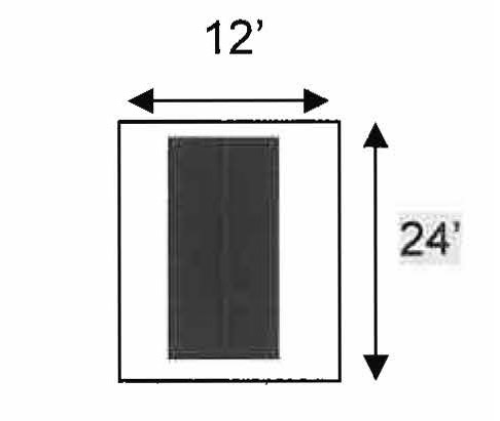
iii.
A carport shall have a minimum dimension of twenty (20) feet deep and ten (10) feet wide, per vehicle, with a minimum vertical clearance of eight (8) feet. This space shall be exclusive of vertical supports and shall not be occupied by storage, equipment, or inoperable vehicles.
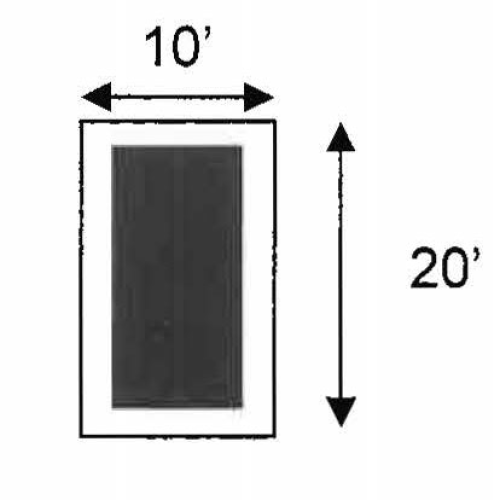
iv.
A single-width driveway shall be a minimum twenty (20) feet deep and nine (9) feet wide for a single vehicle.
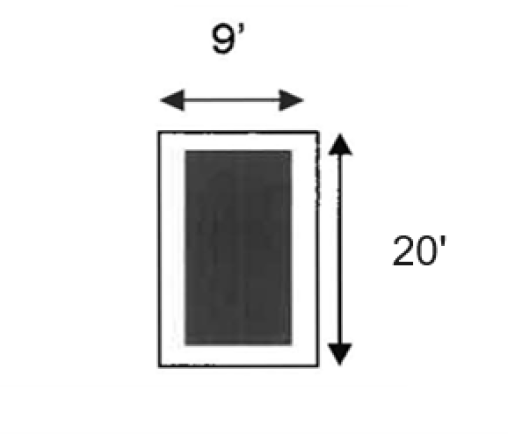
v.
For a driveway where cars are parked side-by-side, the driveway shall be a minimum twenty (20) feet deep and eight (8) feet wide for each vehicle when two (2) cars are parked side-by-side. If the driveway is widened to accommodate more than two (2) vehicles side-by side, the minimum width for each vehicle shall be eight (8) feet six (6) inches.
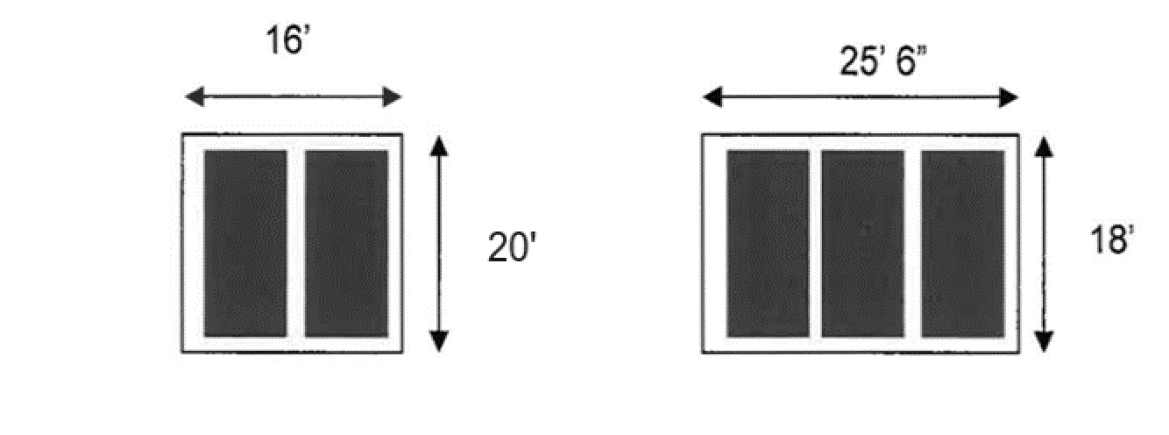
vi.
For a single-width driveway where cars are parked in tandem (front-to-back), the driveway shall be a minimum twenty (20) feet deep and nine (9) feet wide for each vehicle.
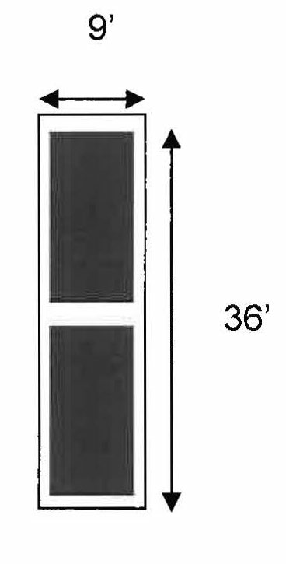
vii.
For a driveway where cars are parked both side-by-side and in tandem, the driveway shall be a minimum twenty (20) feet deep for each vehicle. The minimum width for two (2) side-by-side spaces shall be eight (8) feet for each vehicle. The minimum width for more than two (2) side-by-side spaces shall be eight feet (8) six (6) inches for each vehicle.
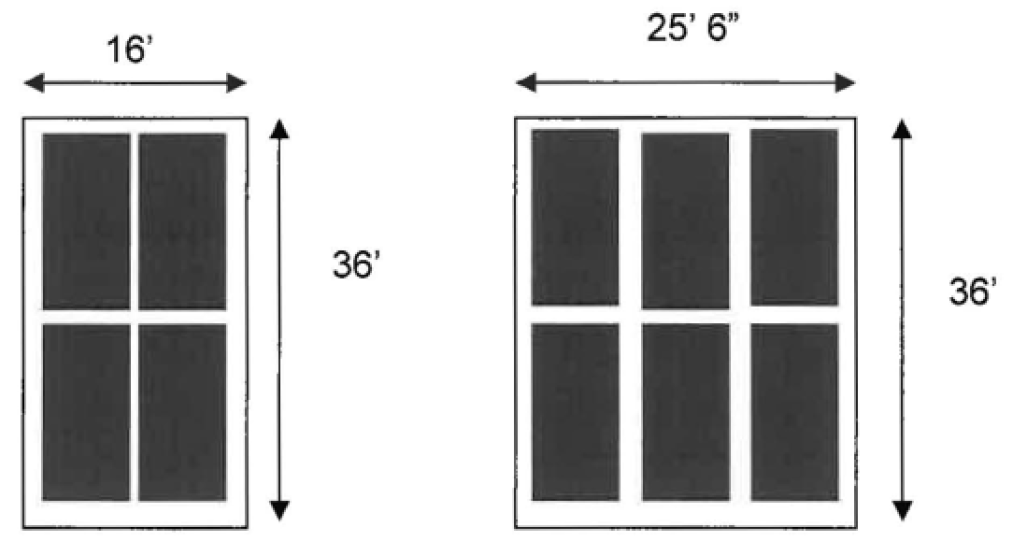
viii.
Where a driveway is curved for circular or turn-in designs, the quantity of parking spaces provided shall be calculated based on a minimum space that is nineteen (19) feet deep by ten (10) feet wide per vehicle, tangent to the arch of the curved portion.
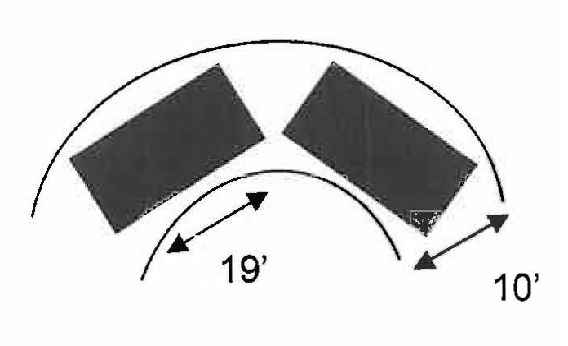
ix.
Fractional measurements do not count toward minimum required parking.
2.
Multi-family and non-residential development:
a.
Each parking space required and provided, pursuant to the provisions of this article, shall be accessible to a street or alley via paved aisle or driveway and shall not be of lesser dimensions than specified in Table P, "Off-Street Parking Standards," provided, however, any fee-simple townhouse or villa developments which provide off-street parking in the form of driveways, carports, and/or garages when the parking facilities are not located in common area, under the same ownership as the individual unit, and contiguous to or within said unit that the facilities were built to serve shall be subject to the design standards of Paragraph A of this section. Driveways leading to parking areas shall not be less than three (3) feet from any building or structure, not less than five (5) feet from any property line, and not less than ten (10) feet from any public street right-of-way. The areas of separation for the driveway shall be landscaped and protected from vehicular encroachment.
b.
For building sites three (3) acres or more in area or three hundred (300) feet or more in depth located on an arterial or urban collector street, parking aisles shall not intersect any access driveway within sixty (60) feet of the right-of-way line of such trafficway or major thoroughfare. For all other building sites, regardless of location, such distance shall be at least twenty-five (25) feet.
c.
Vehicle barriers. Vehicle barriers adjacent to parking spaces are required as follows:
a.
When a parking space abuts sidewalks, outdoor seating areas, walkway café's, walls of a structure, or utility infrastructure bollards meeting the minimum requirements provided by the Department of Environmental Engineering Services shall be provided.
b.
When a parking space abuts a landscape area protective curbing shall be provided.
c.
Exceptions. Bollards do not have to be provided in the following situation.
a.
When parking spaces are abutting sidewalks at least seven (7) feet wide elevated at least six (6) inches.
d.
Wheel stops may be removed from existing parking spaces if in compliance with the above requirements.
ii.
All interlocking ninety-degree parking stalls shall be separated by a curbed landscape median no less than seven (7) feet in width. Parking stalls of less than ninety (90) degrees shall be separated by a curbed median with an average width of seven (7) feet. This requirement shall only apply to new developments and redevelopments within the City.
iii.
No parking stall shall be less than nine (9) feet in width and eighteen (18) feet in length, except that parallel parking stalls shall be no less than nine (9) feet in width and twenty-two (22) feet in length. Any parking stall abutting a curbed landscape area no less than seven (7) feet in width may reduce stall length by two (2) feet.
iv.
No off-street parking area drive-aisle shall be less than twenty-two (22) feet in width for two-way traffic. The following standards shall apply to one-way drive aisles in parking areas:
a.
One-way drive-aisles for thirty-degree angled parking and parallel parking shall be no less than twelve (12) feet in width.
b.
One-way drive aisles for forty-five-degree angled parking shall be no less than thirteen (13) feet in width.
c.
One-way drive aisles for fifty-two and one-half-degree angled parking shall be no less than 15 feet in width.
d.
One-way drive aisles for sixty-degree parking shall be no less than seventeen (17) feet in width.
e.
One-way drive aisles for ninety-degree parking shall be no less than twenty-two (22) feet in width.
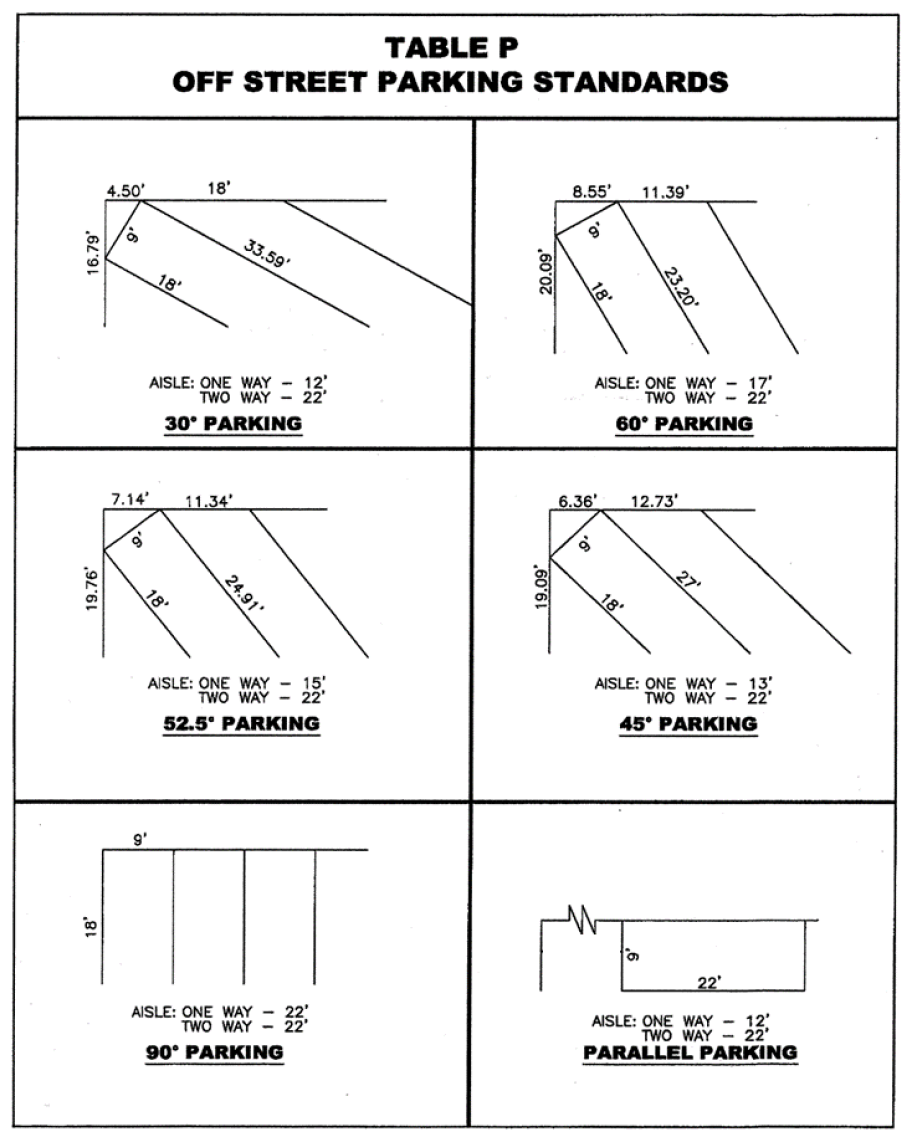
(C)
The required off-street parking facilities shall be identified as to purpose and as to location when not clearly evident from a street or alley. Off-street parking facilities, including access aisles and driveways, shall be surfaced with a minimum of one (1) inch of asphaltic concrete over a six (6)-inch limerock base and maintained in a smooth, well-graded condition.
(D)
All parking facilities required by this article shall be drained so as not to cause any nuisance on adjacent or public property from runoff. Drainage will be provided by the most efficient and practical structure appropriate to the physical conditions of the site. Minimum standards shall be those established by the drainage district having jurisdiction over the area unless standards developed and adopted by this article are more stringent, in which case the more restrictive standards shall apply. A plan for on-site drainage shall be approved by the department of environmental and engineering services prior to the issuance of a building permit.
(E)
It shall be unlawful for an owner or operator of a building or use affected by this article to discontinue, change or dispense with, or to cause the discontinuance or reduction of the required parking facilities apart from the discontinuance, sale or transfer of such structure or use, without establishing alternative vehicle parking facilities which meet the requirements of this article. It shall be unlawful for any person, firm or corporation to utilize such building, structure or use without providing the off-street parking facilities to meet the requirements of and be in compliance with this article.
(F)
Required parking areas, landscaped areas, swales, parkways, traveled rights-of-way, and sidewalks shall not be used for either parking, repair or storage of inoperative or unregistered vehicles, boats or trailers, except in an emergency situation and for not longer than forty-eight (48) hours.
(G)
Lighting standards for off-street parking facilities.
1.
The following lighting standards have been adopted for all off-street parking facilities:
a.
General requirements: The following lighting requirements shall apply to all vehicular use areas and pedestrian areas in non-residential, multi-family, and mixed-use developments.
i.
Required illumination levels for parking lots: The lighting system shall be designed with efficiency, security, quality, and control. The required illumination levels, which are expressed in footcandles (fc), are maintained levels. Maintained levels take into account the luminaires decreased efficiency over time by a factor.
ii.
Required illuminance levels, expressed in footcandles (fc), have been established for two (2) levels of activity designated as level 1 and level 2, based on nighttime traffic and pedestrian activity. Illumination shall be provided from dusk until dawn. The defined levels of activity for facilities are as follows:
Table 1.
Levels of Nighttime Traffic and Pedestrian Activity
The required illuminance levels for the two (2) levels of activity shall be as follows:
Table 2.
Required Maintained Illuminance Levels
iii.
Required illumination levels for garages: The required illuminance levels for each parking garage component shall be as specified in Table 3, below:
Table 3.
Required Maintained Illuminance Levels
iv.
Light sources: All exterior parking lot lighting fixtures must be fully shielded to prevent nuisance lighting.
v.
Mounting-height restrictions: In order to prevent nuisance lighting, pole fixtures within vehicular areas shall be mounted between fifteen (15) feet and twenty-five (25) feet in height. Wall-mounted fixtures shall be mounted at a minimum height of ten (10) feet but shall not be placed on nor extend past the roofline of any structure. Bollard light fixtures may be used to illuminate pedestrian areas.
vi.
Obtrusive light: Obtrusive spill light and up light shall be controlled with the use of efficient luminaires using cut-off optics and shields. Luminaires providing light to any parcel of land adjacent to any residentially zoned parcel of land shall emit no more than one-half (0.5) footcandle of light at the property line of the adjacently zoned parcel, measured horizontally six (6) feet above grade level.
vii.
Tree canopies: Location of light poles in new facilities and substantial rehabilitation of existing facilities shall be such that poles are placed a minimum of twenty (20) feet from the center of the tree. Tree canopies at existing facilities shall be trimmed in accordance with the City of Margate's Property Maintenance and Landscaping codes, in order to allow lighting to reach the parking surface.
viii.
Photometric plans: A photometric plan shall be submitted with every DRC application for a site plan approval or amendment, or special exception use applications that involve new construction, redevelopment, or substantially redeveloping or reconstructing an existing building. Said plan shall clearly and accurately designate the required parking spaces, lighting, access aisles, driveways, adjacent utility poles that provide light to the subject property, and trees (existing and proposed). Such facilities shall be arranged for the convenient access and safety of pedestrians and vehicles. Photometric plans shall delineate footcandle measurements in a grid pattern using ten-foot squares throughout the vehicular use area and measured at grade. Photometric plans shall include light contributions from all sources, including, but not limited to, pole mounted light fixtures, wall-mounted light fixtures, illuminated signs, and adjacent streetlights. For existing sites and structures, an inspection and test of all existing site lighting systems may be performed by a design professional who can certify to the Margate Department of Environmental and Engineering Services that existing site lighting facilities meet the design criteria and meet functional compliance with this Code.
ix.
Inspection: Prior to issuing a certificate of occupancy or certificate of completion for any application required to comply with this section, a design professional shall certify to the Margate Department of Environmental and Engineering Services that the exterior lighting facilities are in compliance with this section.
(H)
Master Parking Plan required for new parking area, Change of use or substantial modification.
1.
Before any building permit or engineering permit for any new parking area, new or change of use, or substantial modification to an existing parking area such as an alteration to vehicle circulation and/or an expansion or reduction of the parking area can be issued, a property owner shall submit a master parking plan to the City for review and approval, as follows:
a.
For single-family or duplex housing, a parking plan shall be submitted with the building permit application for said single-family or duplex unit. The plan shall clearly and accurately designate the required off-street parking spaces.
b.
For building permits involving the change of occupancy group of a building, as described in the Florida Building Code, a detailed parking calculation shall be submitted with the permit application. If this Code does not prescribe a minimum number of parking spaces for a proposed use(s), then a justification for the number of parking spaces provided shall be prepared by qualified traffic engineer or certified planner (AICP) and submitted with the permit application. Any such traffic engineer shall be a professional engineer licensed in the State of Florida. The parking calculation may be approved by staff based on the criteria provided below in Section 40.705(H)(1)(v) of this Code.
c.
For all other uses or improvements described in Paragraph (1), above, a master parking plan shall be submitted by the property owner to the Development Services Department for review and approval by the Development Review Committee (DRC). The plan shall clearly and accurately designate off-street parking spaces, landscape areas, pedestrian access, bicycle parking facilities, parking for disabled people, pedestrian drop off and pick-up areas, dumpster locations, loading zones, all truck turning movements, drainage, lighting, access aisles, driveways, and the relation to the uses or structures these off-street parking facilities are intended to serve as appropriate. If applicable to the subject property or properties, the following parking area features shall be included in the master parking plan: electric vehicle charging stations, fuel pumps, valet parking, vehicle gates, vehicle reservoir areas (queueing), short-term parking such as order online and pick-up at store parking, designated spaces for restaurants with curbside or automobile service where customers consume food in vehicles, reserved parking spaces, hydrants, freestanding signs, and all other accessory structures within the parking area. Such facilities shall be arranged for the convenient access and safety of pedestrians and vehicles.
i.
The master parking plan shall be prepared by a professional engineer licensed in the State of Florida.
ii.
The master parking plan shall provide a detailed parking calculation. If this Code does not prescribe a minimum number of parking spaces for the proposed use(s), then a justification for the number of parking spaces provided shall be prepared by a qualified traffic engineer or certified planner (AICP) and submitted with the master parking plan. Any such traffic engineer shall be a professional engineer licensed in the State of Florida.
iii.
Where shared parking is proposed, the master parking plan shall identify the uses that share the parking and demonstrate the hours of peak demand by each use.
iv.
When an application for a change of use is submitted a previously approved master parking plan may be submitted to the Development Services Director for review with an updated parking calculation and justification for the number of spaces provided. The director may approve the plan or forward it to the DRC for review and approval.
v.
Approval of a proposed master parking plan shall be based on the design standards of the City Code for the various components of the plan. All of the following factors shall be considered in the justification of the number of parking spaces:
a.
The physical constraints of the parking field.
b.
The intensity of the uses on the property.
c.
The use of shared parking.
d.
The availability of and convenient access to transit to the site.
e.
Information from peer-reviewed literature regarding parking generation rates and the reduction of parking demand.
f.
Experience from other sites in the City.
g.
The proposed master parking plan will not create a parking problem due to customers or employees using on-street parking in the neighborhood, and that traffic problems in the neighborhood will not be materially increased.
vi.
The property owner is responsible for making all improvements described in the approved master parking plan prior to the issuance of any temporary certificate of occupancy, certificate of occupancy, or certificate of completion for any application required to comply with this section.
vii.
A master parking plan shall be null and void if a building permit and/or engineering permit has not been issued for the improvements described therein within one (1) year from the date of approval. The date of approval shall be the date an official DRC meeting approved the plan, or in the case of a previously approved master plan, the date of the Development Services director approval.
(I)
Amount of off-street parking. The off-street parking required by this article shall be provided and maintained on the basis of the following minimum requirements:
1.
Dwelling, single-family and two-family:
a.
For single-family and two-family dwellings developed prior to September 5, 2018, including additions thereto and the reconstruction of those properties after catastrophe, the following minimum parking requirements shall apply: Two (2) parking spaces for each dwelling unit. Any combination of indoor garage, carport or driveway parking facilities is to be considered as complying with this section.
b.
For single-family and two-family dwellings developed after September 5, 2018: A minimum of two (2) parking spaces for the first bedroom, plus one (1) additional parking space for each additional bedroom.
i.
Carports with the dimensions of Section 40.705(B) shall count as required parking.
ii.
Single car garages shall have a minimum unobstructed area of twelve (12) feet by twenty (20) feet and not count as a required space.
Commentary: In South Florida, single-car garages are often used for storage instead of parking, given the absence of basements. For this reason, single-car garages do not count toward required parking.
iii.
Two-car garages that have an unobstructed area of minimum twenty (20) feet by twenty (20) feet and may count as one (1) required parking space. Additional garage area that meets the dimensions of Section 40.705(B) may also count towards required parking.
iv.
The number of parking spaces a driveway will provide depends on the dimensions of said driveway, as described in Section 40.705(B) of this Code.
2.
Dwelling, multiple-family:
a.
For multiple-family dwellings developed prior to September 5, 2018, including the reconstruction of those properties after catastrophe, the following minimum parking requirements shall apply:
i.
One (1) parking space for each efficiency.
ii.
A minimum of two (2) parking spaces for each dwelling unit of one (1) or more bedrooms.
iii.
Garages shall not be considered as complying with this section.
iv.
In addition to the above requirements, supplemental guest parking shall be provided on the basis of one (1) space for each five (5) dwelling units.
v.
Housing which is zoned or deed restricted for exclusive use by persons sixty-two (62) years of age or older, one (1) space dwelling unit plus an additional one (1) space for each five (5) dwelling units for guest parking.
b.
For multiple-family dwellings developed after September 5, 2018, including additions to existing developments: A minimum of two (2) parking spaces for each dwelling unit of two (2) bedrooms or less. One (1) additional parking space is required for each additional bedroom.
i.
Guest parking for developments with more than eight (8) units shall be provided at a rate of fifteen (15) per cent.
ii.
Carports with the dimensions of Section 40.705(B) shall count as required parking.
iii.
Single car garages shall have a minimum unobstructed area of twelve (12) feet by twenty (20) feet and not count as a required space.
iv.
Guest parking must be provided on common areas owned by the multifamily development.
Commentary: In South Florida, single-car garages are often used for storage instead of parking, given the absence of basements. For this reason, single-car garages do not count toward required parking.
v.
Two-car garages that have an unobstructed area of minimum twenty (20) feet by twenty (20) feet may count as one (1) required parking space.
vi.
Each parking space within a parking structure, as defined in section 40.201 of this Code, shall count toward required parking provided the parking dimensions satisfy the minimum requirements of Table P provided in this article.
3.
Convalescent homes, nursing homes, retirement homes, and other similar institutions for the care of the aged and infirmed: One (1) parking space for each five (5) beds for patients or inmates, and one (1) parking space for each employee.
4.
Uses not specifically mentioned: The requirements for off-street parking for any residential uses not specifically mentioned in this section shall be the same as provided in this section for the use most similar to the one sought, it being the intent to require all residential uses to provide off-street parking as described above. All non-residential uses shall be required to provide off-street parking, in accordance with an approved Master Parking Plan.
5.
Fractional measurements: When units or measurements determining the number of required off-street parking spaces result in requirements of fractional space, any such fraction shall require a full off-street parking space.
(J)
Parking of commercial vehicles.
1.
Off-street parking facilities supplied by the owner or operator to meet the requirements of this article shall not be used by commercial vehicles owned, operated or used in the business of such owner or operator during regular hours of business.
(K)
Off-street loading.
1.
On the same lot with every structure or use hereafter erected or created, there shall be provided and maintained adequate space for loading and unloading of materials, goods or things and for delivery and shipping, so that vehicles for these services may use this space without encroaching on or interfering with the public use of streets and alleys by pedestrians and vehicles.
2.
Where any structure is enlarged or any use is extended so that the size of the resulting occupancy comes within the scope of this section, the full amount of off-street loading space shall be supplied and maintained for the structure or use in its enlarged or extended size. Where the use of a structure or land or any part thereof is changed to a use requiring off-street loading space under this section, the full amount of off-street loading space shall be supplied and maintained to comply with this section.
3.
For the purposes of this section, an off-street loading space shall be an area at grade level at least twelve (12) feet wide by forty-five (45) feet long with fourteen and one-half-foot vertical clearance. For lots or developments containing an aggregate amount of less than ten thousand (10,000) square feet of Gross Floor Area of Buildings including office buildings and banks, an off-street loading space may be reduced to twelve (12) feet in width by twenty-five (25) feet long. Each off-street loading space shall be directly accessible from a street or alley without crossing or entering any other required off-street loading space and arranged for convenient and safe ingress and egress by motor truck and/or trailer combination. Such loading space shall also be accessible from the interior of any building it is intended to serve.
4.
Off-street loading spaces shall be provided and maintained in accordance with the following schedule:
a.
For each retail store, storage warehouse, wholesale establishment, industrial plant, factory, freight terminal, market, restaurant, funeral home, laundry, dry cleaning establishment or similar use which has an aggregate gross floor area of:
i.
Over ten thousand (10,000) square feet but not over twenty-five thousand (25,000) square feet one (1) space.
ii.
Over twenty-five thousand (25,000) square feet but not over sixty thousand (60,000) square feet two (2) spaces.
iii.
Over sixty thousand (60,000) square feet but not over one hundred twenty thousand (120,000) square feet three (3) spaces.
iv.
Over one hundred twenty thousand (120,000) square feet but not over two hundred thousand (200,000) square feet four (4) spaces.
v.
Over two hundred thousand (200,000) square feet but not over two hundred ninety thousand (290,000) square feet five (5) spaces.
vi.
Plus for each additional ninety thousand (90,000) square feet over two hundred ninety thousand (290,000) square feet or major fraction thereof one (1) space.
b.
For each multiple dwelling or apartment hotel having at least fifty (50) dwelling units but not over one hundred (100) dwelling units: One (1) space.
c.
For each multiple dwelling having over one hundred (100) dwelling units: One (1) space plus one (1) space for each additional one hundred (100) dwelling units or major fraction thereof.
d.
For each auditorium, convention hall, exhibition hall, museum, hotel, office building, sports arena, stadium, hospital, sanitarium, welfare institution or similar use which has an aggregate gross floor area of:
i.
Over twenty thousand (20,000) square feet but not over forty thousand (40,000) square feet one (1) space.
ii.
Plus for each additional sixty thousand (60,000) square feet over forty thousand (40,000) square feet or major fraction thereof: One (1) space.
e.
For any use not specifically mentioned in this section, the requirements for off-street loading for a use which is so mentioned and to which the unmentioned use is similar shall apply.
5.
Off-street loading facilities supplied to meet the needs of one (1) use shall not be considered as meeting the off-street loading needs of any other use.
6.
No parking facilities supplied to meet the required off-street parking facilities for a use shall be utilized for or be deemed to meet the requirements of this article for off-street loading facilities.
7.
Nothing in this section shall prevent the collective, joint or combined provision of off-street loading facilities for two (2) or more buildings or uses, provided that such off-street loading facilities are equal in size and capacity to the combined requirements of the several buildings or uses and are so located and arranged as to be usable thereby.
8.
Plans for buildings or uses requiring off-street loading facilities under the provision of this section shall clearly indicate the location, dimensions, clearances and access of all such required off-street loading facilities.
(L)
Parking spaces for disabled persons.
1.
Parking spaces as for disabled persons shall be provided as required by the Florida Building Code, Accessibility Section 502 as may be amended from time to time shall be designated for use by disabled persons and shall be provided in the immediate vicinity of any building maintained for use by the public, whether said building shall be a public or quasi-public building, or which is a multi-unit residential use.
(M)
Vehicular reservoir areas for drive-through facilities.
1.
All facilities which render goods and/or services directly to patrons within vehicles shall be required to provide reservoir areas for inbound vehicles. The purpose of these areas is to ensure that the vehicles using the facility do not interfere with the flow of vehicular and pedestrian traffic within public rights-of-way, nor interfere with parking circulation or loading within the facility.
2.
Each reservoir area required pursuant to this article shall be a minimum of ten (10) feet wide by twenty (20) feet long and each reservoir area shall not block parking stalls, parking aisles, driveways or pedestrian ways. For the purposes of this section, the space occupied by the vehicle being served by the facility is considered one (1) reservoir area.
3.
The number of reservoir areas required shall be provided and maintained on the basis of the following minimum requirements:
(N)
Escape Lane.
1.
A separate and distinct escape lane shall be provided if necessary to prevent entrapment of vehicles on that portion of the site if no other reasonable point of egress is available other than through the drive-through facility. An escape lane shall not be required if the drive-through lane is designed and located in such a way as to be segregated from the normal Traffic flow of the site and signed appropriately to prevent accidental entry.
2.
Drive-through lanes and escape lanes shall not conflict, or otherwise hamper access, to or from any parking space.
(O)
Driveways. The following regulations shall apply to all driveways constructed or modified after the effective date of this article:
1.
In multifamily residential development, the maximum driveway widths shall be as follows:
a.
65 feet for two-way traffic with a center island.
b.
36 feet for two-way traffic.
c.
14 feet for one-way traffic.
2.
Driveway design standards for single-family attached and detached dwellings. Existing permitted driveways may be reconstructed exactly as they were permitted regardless of these regulations, and any parts may be expanded so long as the new expanded area(s) complies with this section. All portions of any driveway are subject to these limitations:
3.
General standards.
a.
Side setbacks: Eighteen (18) inches.
b.
Rear setback: Five (5) feet.
c.
The width of driveways on the lot may not exceed the maximum width allowed at the frontage.
d.
Between driveway connections on the same lot: twenty (20) feet.
e.
Circular driveways shall have a landscaped area between each connection. The curve of the circular driveway shall be setback at least eight (8) feet at the midpoint between connections.
f.
Driveways may have flares at the point of intersection with the abutting roadway. Flares may be a maximum of five (5) feet in width, and may have a zero (0) setback measured from a straight line extended from the property line to the abutting roadway.
g.
Turn-in or similar design where the driveway turns to be parallel or almost parallel to the adjacent street, eight (8) feet from the adjacent property line.
h.
All driveways shall be located as far away from street intersections as possible.
i.
A driveway may only connect to another driveway in front of a home.
j.
Each driveway must have a hardened driveway approach that is made of concrete, asphalt, or brick paver, and is at least as wide as the driveway is at the property line.
k.
Vehicles are prohibited from driving over curbs and sidewalks that were not designed and built for vehicular traffic.
4.
Frontage. For the purposes of this section, the property owner may designate which frontage is the primary frontage and which is the secondary frontage for the property on which the driveway is located, subject to the undivided local street highway classification map requirements of subsection (5)(b); only one (1) frontage may be considered the primary frontage.
5.
Driveway regulations for lots with fifty-four (54) feet or less street frontage.
a.
Primary frontage: Maximum of two (2) driveways with a maximum total width of twenty-seven (27) feet.
b.
Secondary frontage: If located on an undivided local street, as classified by the Broward County Metropolitan Organization's Broward Highway Functional Classifications Map, may have a maximum of one (1) driveway with a minimum depth of twenty (20) feet entirely on the property, maximum twenty (20) per cent of the width of the frontage, not less than nine (9) feet in width.
6.
Driveway regulations for lots with more than fifty-four (54) feet street frontage.
a.
Primary frontage: Maximum of three (3) driveways with a maximum total width of sixty (60) per cent of the frontage, not less than twenty-seven (27) feet in width.
b.
Secondary frontage: If located on an undivided local street, as classified by the Broward County Metropolitan Organization's Broward Highway Functional Classifications Map, may have a maximum of two (2) driveways with a minimum depth of twenty (20) feet entirely on the properly, maximum twenty (20) per cent of the width of the frontage not less than nine (9) feet in width.
7.
Summary of single-family attached and detached dwellings driveway regulations. The driveway requirements of this section are summarized in the table below:
8.
Driveway design standards for nonresidential and mixed-use development driveway design standards:
a.
Maximum width of forty (40) feet for two-way traffic.
b.
Maximum width of fourteen (14) feet for one-way traffic.
c.
Abutting properties are strongly encouraged to share driveway connections where possible.
d.
When a driveway for the property's only legal access cannot comply with the spacing requirements of this section, a driveway shall be allowed as far as possible from other driveways without the need to apply for a variance, subject to the requirements of the Florida Department of Transportation or Broward County as applicable, and the limitations below. This requirement applies to both vacant and lots being redeveloped.
e.
When a driveway for the property cannot comply with the spacing requirements of this section and has legal access from a nonresidential street or alley or has a cross-access easement with an abutting property, a driveway on that frontage shall be prohibited.
9.
In multifamily nonresidential, and mixed-use districts, the following shall apply:
a.
Maximum of one (1) two-way or two (2) one-way driveways for any street frontage of two hundred (200) feet or less.
b.
Driveways shall be located as far away from street intersections as possible.
c.
Minimum spacing between two-way driveways of two hundred (200) feet from any other driveway.
d.
Minimum spacing for one-way driveways of eighty (80) feet from any other driveway.
10.
All driveways shall be located as far away from street intersections as possible.
11.
Backout parking, i.e. a parking lot design which forces vehicles to use a public right-of-way to maneuver into or out of a parking stall, is prohibited except for one- and two-family sites fronting on local streets. Driveways connecting same are considered to be one-way. This provision is not intended to regulate on-street parking.
40.706. - Signage.
(A)
Statement of purpose. The purpose of this article is to create the framework for a comprehensive and balanced system of sign control, thereby facilitating clear and attractive communication between people and their environment. It is the purpose of this article to control those signs which are intended to communicate to the general public and to authorize the use of signs which are:
1.
Compatible with their surroundings.
2.
Expressive of the identity of individual proprietors or of the community as a whole.
3.
Legible under the circumstances in which they are seen.
4.
Conducive to promoting traffic safety by preventing visual distraction.
5.
Provide for the aesthetic appearance of the community and consistency with architecture.
6.
Effectively and efficiently communicate the intent and nature of the city's business community.
(B)
Definitions. The following words, terms and phrases, when used in this article shall have the meaning ascribed to them in this section, except where the context clearly indicated a different meaning:
1.
Abandoned sign: A sign which no longer correctly directs or exhorts any person, advertises a bona fide business, lessor, owner, product or activity conducted or available on the premises where such sign is displayed.
2.
Address sign: A sign listing at least the numerical prefix of the street address of a building.
3.
Advertising: Any form of public announcement intended to aid, directly or indirectly, in the sale, use or promotion of a product, commodity, service, person, event, activity or entertainment.
4.
Advertising balloon: Any balloon of any size containing a display of advertising.
5.
A-frame sign, portable sign, and sandwich board sign: A moveable sign not secured or attached to the ground, but which is not being carried by an individual, nor moving or animated in any other fashion.
6.
Animated sign: A sign which utilizes motion parts by any means or displays flashing, oscillating or intermittent lights. This also includes the use of animals or humans for advertising purposes.
7.
Announcing sign: A sign announcing a project to be under construction, an intended use of the premises in the immediate future, or change of tenant during build out.
8.
Awning sign: Any sign which is painted, printed, sewed or otherwise attached to the exterior face of an awning.
9.
Banner or pennant sign: A sign having characters, letters or illustrations applied to cloth, paper, flexible plastic, flexible vinyl or fabric of any kind with only such material for backing other than those meeting the definition of a flag.
10.
Bench sign: Any sign painted on or attached to a bench.
11.
Billboard: A sign, including those located on poles, benches, buses, buildings or structures, that is located in the public right-of-way or on private property, utilized for advertising an establishment, an activity, a product, a service or entertainment, which is sold, produced, manufactured, available or furnished at a place other than on the property on which said sign is located.
12.
Blade sign: A small sign, which is suspended from an overhang, canopy, awning, or is suspended from mounting attached directly to the building wall and hangs perpendicular to the building wall.
13.
Blank panel: A single color, individual sign panel with no writing, characters, symbols, letters, numbers or any design of any kind visible or applied or painted on either side of the panel.
14.
Bunting: Any kind of pennant, streamer or other similar fabric or flexible plastic.
15.
Cabinet sign: Any sign, the face of which is enclosed, bordered, or contained within a box-like structure, frame or other device.
16.
Canopy: An ornamental roof-like structure that is not an integral part of the roof, but rather, is appended to the building and extends beyond the building or building line. For purposes of this Code, a roof structure over a gasoline pump or pumps is considered a canopy.
17.
Canopy sign: A sign attached to the face of a canopy or covered structure which projects from, or is supported by a building, when such canopy or covered structure extends beyond the building, building lines, or property line.
18.
Changeable copy sign: A sign that is designed so that characters, letters or illustrations can be changed or rearranged without altering the face or the surface of the sign. This may be done by using flexible or rigid plastic letters, electronic messaging or LED.
19.
City: The City of Margate, Florida.
20.
City manager: The city manager of the City of Margate.
21.
Clubhouse: A common property to a homeowner's or condominium association which includes such community amenities as a swimming pool, meeting place and/or auditorium.
22.
Clubhouse identification sign: A sign identifying its clubhouse.
23.
Community bulletin board sign: A sign displaying information of interest to the general public.
24.
Community identification sign: A sign identifying a community.
25.
Complex: A group or cluster of buildings with a common access from a dedicated roadway.
26.
Directional sign: Any on-premises sign indicating route of travel for reaching the place or use indicated on the sign face.
27.
Directory sign: A sign on which the names and locations of occupants or the use of a building or site are given but not advertising the use in any manner.
28.
Door: An entry equipped with double-pivoted hardware so designed as to cause a semi counter balanced swing action when opening.
29.
Election signs: Any sign which indicates the name, cause or affiliation of any person seeking office or which indicates any issue or referendum question for which an election is scheduled to be held. This includes, but is not limited to, signs advertising candidates, referenda or any campaign information.
30.
Facade: That portion of a building encompassing the area extending in a generally vertical plane from the ground to the highest point of the building or canopy and extending in a horizontal plane between the vertical ends of the structure.
31.
Feather banner sign: A temporary lightweight sign comprised of partial metal or plastic frame, pole, and/or base to which a vinyl, nylon, canvas or polyester fabric sign face is attached. Depending on the shape and type of movement, such signs may also be called a "flutter," "tear drop," "flying," "wing," "bow," "rectangular" banner, etc.
32.
Feature car: One (1) or more automobiles situated on a car lot prominently to highlight product value.
33.
Flag: A sign having characters, letters or illustrations applied or woven into cloth or fabric with only such material for backing which depicts the emblem or insignia of a nation, political subdivision, a corporation or other entity and which is not intended to convey any commercial or noncommercial message.
34.
Frontage, building: The exterior length of a building or portion thereof designated as a single premises parallel to a public right-of-way.
35.
Frontage, street: The length of the property line of any one (1) premises parallel to [and] along a public right-of-way.
36.
Grade: The established average level of ground on a property.
37.
Grand opening event: Celebration of or event commencing the opening of a business, held within sixty (60) days of the issuance of the first local business tax receipt or transfer of a local business tax receipt for the business at a location.
38.
Grand opening ground sign: A temporary sign constructed by the City of Margate and leased to new businesses in order to provide additional roadway visibility during their grand opening.
39.
Grand projecting sign: A sign, other than a wall sign, which is attached to a building or other structure, and extends outward beyond the line of building or structure to which it is attached.
40.
Height of sign: Sign height, as measured from the established grade of the property on which the sign is located or proposed to be located.
41.
Human sign: A person wearing a costume or holding a sign or other demonstration displaying a commercial message.
42.
Identification sign: A sign used to identify a place, location, building or name.
43.
Illuminated sign: A sign with an internally or externally illuminated light source which makes the message on the sign readable.
44.
Illumination, external: An exterior shielded light source such as ground lights, spot lights or other similar lighting that projects the light onto the sign face.
45.
Illumination, internal: A light source concealed or contained within the sign which becomes visible by shining through a translucent surface.
46.
Inflatable sign: A temporary sign, including balloons, larger than twenty-four (24) inches in diameter or height, which is structurally supported through the use of air, helium or other gas to provide structural support, including signs which contain air, helium or other gas in a sealed container or structure and signs which utilize a fan or blower to push air into or through the sign material.
47.
Logo: A symbol, emblem, trademark or graphic device which has been registered or trademarked with the State of Florida or U.S. government and is used as a badge or identity to represent an organization, corporation or business to identify said entities' property or products.
48.
Logotype: The use of a stylized font in a word or words that has been designed to create a unique identity or trademark for an organization, corporation or business and which has been registered with the State of Florida or U.S. government.
49.
Mansard roof: A four (4)-sided gambrel-style hip roof characterized by two (2) slopes on each of its sides with the lower slope, punctured by windows, at a steeper angle than the upper slope.
50.
Model sign: A sign which designates a particular dwelling unit design which is not for sale or rent, but rather represents other units of a similar design that are for sale or rent.
51.
Monument sign: A sign which is attached to a self-supporting structure, has vertical sides from base of the sign face to the ground level, has a sign face that is no more than six (6) inches wider on either side than the sign structure, has a concealed means of support and is not attached or affixed in any way to a building or other structure, and has no clearance between the ground and the bottom of the sign.
52.
Multi-tenant center: Any shopping center, office center or business center in which two (2) or more occupancies abut each other or share common parking facilities or driveways or are otherwise related.
53.
Nameplate sign: A sign indicating the name, and/or profession or address of a person or persons residing on the premises or legally occupying the premises.
54.
Neighborhood block sign: A sign marking the location of a particular neighborhood or subdivision by indicating the name and/or logo of such area.
55.
Nonconforming sign: A sign which was legally constructed and maintained under laws or regulations in effect at the time of construction which does not conform with the provisions of this article.
56.
Nonprofit sale sign: A sign advertising a sale benefiting a city sponsored or a city-based nonprofit organization (i.e., Halloween pumpkin sale, fireworks sale, Christmas tree sale).
57.
Off-premises sign: Any sign that is advertising or indicating the location of a product, service, business or other activity that is located or conducted elsewhere than on the premises on which the sign is located.
58.
On-premises sign: Any sign identifying or advertising a business, person, activity, goods, product or service located on the premises where the sign is installed and maintained.
59.
Opinion sign: A sign which indicates a belief concerning an issue, name, cause, or affiliation which is not scheduled for an election. This includes, but is not limited to, signs advertising political parties, or any political information.
60.
Outdoor public telephone: For purposes of this signage code, any exterior telephone located either freestanding or affixed to a building which is intended for use by the general public. This definition is also to include any structure which is intended for the purpose of supporting said telephone.
61.
Parapet or parapet wall: That portion of the building that rises above the roof level.
62.
Pennants: See "Banner and pennant signs."
63.
Permanent sign: Any sign which, when installed, is intended for permanent use. For the purposes of this chapter [article], any sign with an intended use in excess of twelve (12) months from the date of installation shall be deemed a permanent sign.
64.
Personal gain sign: Any sign advertising for personal gain on residential property; (i.e., a garage, yard or patio sale sign).
65.
Pole sign: A permanent sign erected upon a pole or poles and which is wholly independent of any building or other structure for support.
66.
Portable sign: Any sign not permanently attached to the ground or building.
67.
Premises: A tract of real property in a single ownership which is not divided by a public street or right-of-way.
68.
Project: A group or cluster or buildings with a common access from a dedicated roadway.
69.
Projecting sign: A sign attached to and supported by a building or other structure and which extends at any angle therefrom.
70.
Public hearing sign: A sign announcing the date, time, and location of where an issue of law or fact is brought forth to the decision-making body.
71.
Public interest sign: A noncommercial sign, permanently erected and maintained by the city, county, state, or any agency thereof, to denote the name of any thoroughfare; the route to any city, facility educational institution, public building, park, recreational facility or hospital; to direct and regulate traffic; or, to denote any transportation or transmission company for the safety of the public.
72.
Promotional advertising banner: A sign placed on a permanent pole being used on a rotating basis to provide greater visibility to multi-tenant developments.
73.
Real estate sign: A sign erected by the owner, or his agent, indicating property which is for rent, sale or lease.
74.
Rear identification sign: A sign that is located in the rear portion of the building containing the service or secondary service entrance that is not on the same building side as a customer entrance.
75.
Replaceable tenant panel: An individual sign panel with the name of a single tenant of a multi-tenant complex or the name of the multi-tenant complex for use in a monument sign of a multi-tenant complex where said panel is designed for easy installation into the monument sign's cabinet or frame in the field without any other alteration to any other portion of the monument sign's sign face or structure.
76.
Roof sign: A sign erected over or on the roof, or extending above the roof line, which is dependent upon the roof, parapet or upper walls of any building, or portion thereof, for support.
77.
Sign: A device, structure or representation for visual communication that is used for the purposes of bringing the subject thereof to the attention of the general public. For the purposes of removal, "sign" shall also include all sign structures.
78.
Sign area: The square foot area enclosed by the perimeter of the sign structure. When a sign is composed of individual letters, symbols or logos only, the sign area is the area enclosed by a perimeter line (forming a single rectangle) enclosing all letters, symbols and logos; however, no sign shall have a distance greater than three (3) feet between symbols, logos, letters, or numbers. For monument signs, the square foot area from the ground, excluding first twelve (12) inches, to the maximum height times width is the sign area.
79.
Signage code inspector: A code inspector, a code inspector's designated representative, or any other individual designated by the city manager to enforce the provisions of this signage code.
80.
Sign face: The part of the structure that is intended primarily for or can be utilized for communication purposes. The sign face shall include any area of the sign that is internally illuminated.
81.
Site: A parcel, lot, tract, or other unit of land recorded in the public records of Broward County, or combinations thereof, and having a common development scheme presented to the city as a single project whether simultaneously or in phases.
82.
Snipe sign: A sign which is tacked, nailed, posted, pasted, glued or otherwise attached to trees, poles, wire or wood stakes, or fences, or to other objects with a message appearing thereon.
83.
Special event sign: A sign identifying a temporary event, other than a sale of goods, being held in the city by a city-sponsored, city-based nonprofit organization, or announcing a city-approved promotional activity sponsored by the owner or agent of a property and being located on the site of the event (i.e., a parade, festival).
84.
Structure: That which is built or constructed.
85.
Subdivision identification sign: A sign designating a recorded subdivision, residential complex or neighborhood with definable boundaries.
86.
Symbol: A sign, design, character, or other such representation used to signify a use or activity, rather than an organization or corporation.
87.
Temporary sign: Any sign other than a window sign intended for use not permanent in nature. For the purposes of this chapter [article] any sign with an intended use of twelve (12) months or less shall be deemed a "temporary sign."
88.
Under awning sign or under canopy sign: A horizontal hanging sign that is pedestrian-oriented and is suspended beneath a canopy or awning over a pedestrian walkway and not visible outside the canopy area.
89.
Uniform sign plan: A plan for all signage for properties with more than two (2) businesses utilizing signage. The plan sets forth standards for uniform sign type.
90.
Vehicle sign: Any sign or signs permanently or temporarily affixed to or pained on a transportation vehicle, including, but not limited to, automobiles, trucks, boats, trailers, or campers, for the primary purpose of identification, advertisement, sales, or directing the public to a business, person, event or activity located on the same or another property, or any other premises.
91.
Wall sign: A sign which is affixed to and supported by wall or other enclosure.
92.
Wayfinding sign: An off-premises sign with symbols, text, maps, or other similar graphics that are used to convey location and directions to travelers.
93.
Window: For purposes of this section a window is a set of contiguous panels of glass or other transparent material separated by dividers six (6) inches or smaller.
94.
Window sign, interior: A sign located on the inside of a window or within ten (10) feet of window or enclosed structure which is visible from the exterior through a window or other opening.
95.
Window sign, exterior: A sign affixed or applied to the exterior of a window.
(C)
General requirements for signs in all zoning districts.
1.
All signs shall comply with the construction and installation requirements of the Florida Building Code.
2.
All structural, electrical, and mechanical members utilized in the construction, erection and operation of signs shall be concealed except for vertical supports or other supporting members which are designed and arranged so as to be an integral part of the aesthetic composition of a sign.
3.
Signs shall not utilize more than five (5) colors including a background color. For the purpose of this section, white, black, neutral bronze or the color of the building on which the signs are affixed shall not be considered colors for sign structures. When a logo or logotype is used, the logo or logotype may be comprised of the colors as appropriately registered or trademarked with the State of Florida or U.S. government. White, black, neutral bronze or the color of the building on which signs are affixed shall not be considered.
4.
All wood permitted to be used, whether for new permanent signs, for replacement of existing permanent signs, or for any part thereof, shall be rot and termite resistant, through open-cell preservation methods as specified by the American Wood Preservation Association, or by any other open-cell preservation treatment approved by the building department.
5.
No face jumping or wires visibly connected to individual letters shall be permitted.
6.
Interior angle of V-shaped signs shall be no greater than thirty (30) degrees.
7.
All signs permitted by this Code shall be professionally drawn and constructed.
8.
Location of the sign shall not interfere with public alarms, signals or signs. No sign or support shall be placed in such a position or manner as to obstruct or interfere, either physically or visually, with any fire alarm, police alarm, traffic signal or sign or any devices maintained by or under public authority.
9.
No sign, except interior window signs, shall be constructed of cardboard or any other paper products.
10.
All letters or symbols two (2) inches or larger on permanent identification signs must extrude or intrude into the sign face a minimum of three-eighths (⅜) of an inch. Signs which are nonconforming due to this requirement only shall not be subject to section 40.706(O) of this signage code. The following signs shall be exempt from this requirement:
a.
Window signs;
b.
Replacement tenant panels on multi-tenant monument signs, and cabinet wall signs;
c.
Address signs;
d.
Rear identification signs.
e.
All signs must be installed perpendicular (at a ninety-degree angle) to level earth.
11.
At all intersections of a private driveway with a public right-of-way, no sign, except permitted temporary signs no greater than three (3) feet in height, shall be permitted within the triangular area formed by the chord connecting twenty-five (25) feet from the intersection of the right-of-way line and a perpendicular line formed by the outer edge of the driveway pavement.
12.
At all intersections of public rights-of-way, no sign, except permitted temporary signs no greater than three (3) feet in height, shall be permitted within the triangular area formed by the chord connecting thirty-five (35) feet from the intersection of the right-of-way lines or tangent extensions thereof.
(D)
Required signs. The following signs must be placed where relevant:
1.
Fire lane markings, no smoking, locked doors, blocked, apartment identification, not an exit, warning signs at vehicle fuel stations and others as may be prescribed by the fire marshal.
2.
Handicapped parking signs and other signs in accordance with state requirements.
3.
As a condition for receiving a certificate of occupancy or local business tax receipt, the correct street address shall be permanently placed on the front of the building, storefront or bay and easily recognized at all times. All address signs shall have a minimum of three-inch letters and a maximum of eight-inch letters. Buildings backing on a public right-of-way shall also display an address sign in a conspicuous location. The color of street address letters shall be of opposing contrast to its background. Buildings backing on a public right-of-way shall also display an address sign in a conspicuous location. Additionally, all non-residential buildings shall have an address sign on the rear door.
4.
Public hearing signs. All public hearing items heard by any board, committee or city commission of the City of Margate shall post a public hearing sign as required by Section 40.310 of this Code.
(E)
Residential district permanent signs. The following signs are authorized in all residential districts, including residential areas contained within PUD and PRC, and C, G, CC zones. All signs permitted and approved prior to January 8, 1997, are exempt from the requirements of Section 40.706(O) of this Code but not from the regulations of any other section:
1.
Neighborhood block sign:
a.
Number maximum: One (1) per major neighborhood entrance.
b.
Location: The sign shall be located at the intersection of two (2) roadways.
c.
Setback minimum: Two (2) feet.
d.
Area maximum: Six (6) square feet per each sign.
e.
Height maximum: Seven (7) feet from base of sign.
f.
Lines of copy maximum: Two (2) lines.
2.
Subdivision identification sign:
a.
Number maximum: One (1) monument or two (2) entrance wall signs (if symmetrical to one another) per entrance.
b.
Location: Must be located on common property near said entrances.
c.
Setback minimum: Five (5) feet from right-of-way or placed on subdivision perimeter wall.
d.
Sign copy area maximum: Thirty-two (32) square feet per sign face and an aggregate area of 64 square feet.
e.
Height maximum: Seven and one-half (7½) feet above established grade.
3.
Clubhouse identification sign:
a.
Number maximum: One (1) monument or one (1) entrance wall sign.
b.
Location: Must be located on common property near said entrance.
c.
Setback minimum: Five (5) feet from right-of-way or placed on clubhouse wall.
d.
Sign copy area maximum: Thirty-two (32) square feet per sign copy including border.
e.
Height maximum: Seven and one-half (7½) feet above established grade.
4.
Multifamily identification signs:
a.
Number maximum: One (1) wall sign.
b.
Area maximum: Twenty (20) square feet.
c.
Availability: These signs are available to multifamily buildings greater than five (5) units that are not part of a larger complex.
5.
General information signs:
a.
Area maximum: Four (4) square feet.
b.
Height maximum: Six (6) feet.
c.
No advertising copy.
d.
Signs regulated by state statutes must comply with size, color, copy and other regulations contained the regulating statues.
6.
Directional signs:
a.
Area maximum: Four (4) square feet.
b.
Height maximum: Four (4) feet.
c.
No advertising copy.
7.
Model signs:
a.
Model office lot.
i.
Number maximum: One (1) sign.
ii.
Area maximum: Twenty-four (24) square feet.
b.
Model lot.
i.
Number maximum: One (1) sign on each model lot.
ii.
Area maximum: Eight (8) square feet.
c.
Model directional signs.
i.
Number maximum: Three (3) per development.
ii.
Area maximum: Four (4) square feet per each sign.
d.
Utilization. Model signs may only be utilized while a unit is being actively used as a non-dwelling model. Once the last model is inhabited, signs are no longer permitted at the model office.
(F)
Nonresidential district permanent signs. The following signs are permitted in nonresidential districts as well as business areas of PUD and C, G, CC districts. Any development may have any combination of signs within this section unless otherwise restricted.
1.
Identification monument sign:
a.
Location: Monument signs shall not be permitted within one hundred (100) feet of any other monument sign along the same direction of travel of a right-of-way.
b.
Setback minimum:
i.
Five (5) feet from right-of-way.
ii.
Ten (10) feet from any interior property line.
c.
Area maximum:
i.
Ninety-six (96) square feet for projects with at least eight (8) tenants and one (1) tenant space at least twenty-five thousand (25,000) square feet.
ii.
Seventy-two (72) square feet for all multi-tenant buildings.
iii.
Forty-nine (49) square feet for all single occupant free-standing building.
iv.
The first twelve (12) inches of a monument sign protruding up from the ground shall not be counted toward the total sign area.
d.
Sign face area maximum: Seventy-five (75) per cent of the total sign structure area.
e.
Height maximum:
i.
Thirteen (13) feet above the sidewalk elevation adjacent to the sign for projects with at least eight (8) tenants and one (1) tenant space at least twenty-five thousand (25,000) square feet.
ii.
Ten (10) feet above the sidewalk elevation adjacent to the sign for all other multi-tenant (seventy-two (72) square feet) signs.
iii.
Nine (9) feet above the sidewalk elevation adjacent to the sign for single occupant (forty-nine (49) square feet) signs.
f.
Width maximum: Eight (8) feet.
g.
Address:
i.
All signs must display address of complex in numbers at least six (6) inches high, but not more than twelve (12) inches, located at the top of each side of the monument sign.
ii.
Address shall not be calculated in the total sign face area when located on an area that would not otherwise be calculated as part of the sign face area.
iii.
In addition to the above required address display, the address may also be displayed vertically along the structural side of a monument sign which is perpendicular to a right-of-way.
h.
Landscaping:
i.
A planting bed at least two (2) feet in width shall surround any monument and/or freestanding sign.
ii.
This bed shall contain mulch and ground covers, shall be irrigated, and shall be shown on the site plan and/or any sign permit application for said sign.
iii.
Said ground covers shall be located in the ground, shall not be permitted in a flowerbox or other such device, and shall be maintained to a maximum height of twelve (12) inches.
2.
Main identification wall sign:
a.
Number maximum:
i.
One (1) sign located on a side with right-of-way frontage or frontage on the main circulation route of a multi-tenant shopping center.
ii.
If no frontage as previously listed exists, the occupancy will be allowed one (1) sign.
iii.
One (1) additional sign will be allowed per occupancy if an occupancy has two (2) identical storefronts, one (1) in front and one (1) in rear where both storefronts either have right-of-way frontage or frontage on a main circulation route of a multi-tenant shopping center.
b.
Location: Ground-level occupancy where said occupancy has its own direct customer/client entrance from the exterior of the building.
c.
Area maximum: One (1) square foot per liner foot of building frontage.
i.
In calculating liner feet of building frontage for purposes of determining wall sign size, canopies shall not be included.
d.
Height maximum: Top of facade or wall.
e.
Height minimum: Nine (9) feet.
f.
Lines of copy maximum: Two (2) lines.
g.
Installation restrictions. Signs installed flat on building may not extend over a mansard, signs installed on mansard may not extend over edge of mansard.
3.
Secondary identification wall sign:
a.
Number maximum: One (1) sign per side (other than that on which the main identification wall sign exists) with right-of-way frontage, frontage on the main circulation route of a multi-tenant shopping center, facade facing oncoming traffic on near side of adjacent major roadway or has high visibility from a major roadway and does not conflict with neighboring properties. Signs shall be posted on the wall with said frontage.
b.
Location: Only available for occupancies that are allowed a main identification wall sign. Building rear is excluded from having secondary identification wall sign.
c.
Area maximum: One (1) square foot for each linear foot of building frontage not to exceed size of main identification wall sign.
d.
Height maximum: Top of facade or wall.
e.
Height minimum: Nine (9) feet.
f.
Length maximum: one hundred (100) per cent of main identification wall sign or seventy-five (75) per cent of building frontage whichever is less.
g.
Lines of copy maximum: Two (2) lines.
h.
Installation regulations: Signs installed flat on building may not extend over a mansard, signs installed on mansard may not extend over edge of mansard.
4.
Rear identification sign:
a.
Number maximum: One (1) sign per occupancy.
b.
Location: The sign may be wall mounted and needs to either be located on or within three (3) feet of a service or secondary entrance.
5.
Building identification wall sign:
a.
Number maximum: Two (2) signs per building, based on the limitation of location, below.
b.
Location:
i.
Building frontages facing corridor or regional arterial roadways.
ii.
Installed within five (5) feet of the top of the facade and no less than twenty (20) feet above the established grade.
iii.
Not permitted above the main roofline of a building.
c.
Area maximum: One-half (½) square foot for each linear foot of building frontage not to exceed size of main identification wall sign.
d.
Height maximum: Top of facade or wall.
e.
Length maximum: Fifty (50) per cent of the building frontage on which they are installed.
f.
Letter height:
i.
Twenty-four (24) inches for one- and two-story buildings;
ii.
An additional six (6) inches of letter height shall be permitted for each additional story.
g.
Installation restrictions: Signs installed flat on building may not extend over a mansard, signs installed on mansard may not extend over edge of mansard.
6.
General information signs:
a.
Area maximum: Four (4) square feet.
b.
Height maximum: Six (6) feet.
c.
Property owners may allow the labeling of up to twenty (20) per cent of total parking spaces for individual parking spaces for use by customers or employees of an individual business or group of businesses.
d.
No advertising copy.
e.
Signs regulated by State Statutes must comply with size, color, copy and other regulations contained in the regulating statutes.
7.
Directional signs:
a.
Area maximum: Four (4) square feet.
b.
Height maximum: Four (4) feet.
c.
No advertising copy.
d.
Permitted on properties that have multiple tenants, more than one (1) entrance, a drive-thru facility, or an accessory use available to the public.
e.
Signs regulated by State Statues must comply with size, color, copy and other regulations contained in the regulating statutes.
8.
Under awning and canopy identification sign:
a.
Number maximum: One (1) per establishment (corner storefront may be permitted one (1) per side).
b.
Location: Positioned ninety (90) degrees to facade, rigidly attached, and is centered in the area under the awning or canopy.
c.
Area maximum: Four (4) square feet.
d.
Maximum letter height: Ten (10) inches.
e.
Minimum clearance: Nine (9) feet.
f.
Sign may be internally illuminated provided the sign is "cabinet" in style.
g.
Signs shall not be permitted where blade signs are utilized.
h.
Signs are not subject to the requirements of Section 40.706(C).
i.
Vehicle fuel station signs subject to Section 40.706(I)iii.
9.
Awning sign:
a.
Number maximum: One (1) per establishment.
b.
Location: Awning valance, awning face or awning side.
c.
Area maximum: Fifty (50) per cent of total awning area.
d.
Exemptions: Awning signs are not required to comply with subsection 40.706(C)(10).
10.
Site directory sign:
a.
Number maximum: One (1) per driveway of a multi-building project or multi-tenant property exceeding thirty (30) acres in size.
b.
Location: On a wall or freestanding.
c.
Setback minimum: One hundred (100) feet from the property line.
d.
Area maximum: Total sign area to be no more than thirty-two (32) square feet.
i.
Twelve (12) square feet for complex identification portion.
ii.
Twenty (20) square feet for tenant identification portion.
e.
Height maximum: Eight (8) feet.
f.
Letter height maximum:
i.
Fifteen (15) inches for complex identification portion.
ii.
Five (5) inches for tenant identification portion.
g.
Other copy: No advertising copy.
11.
Building directory sign:
a.
Number maximum:
i.
One (1) per building less than twenty thousand (20,000) square feet.
ii.
Two (2) per building twenty thousand (20,000) square feet or greater.
b.
Location: On building wall.
c.
Area maximum: Total sign area to be no more than ten (10) square feet; sign may not be more than four (4) feet in height.
d.
Letter height maximum: Six (6) inches for building identification.
e.
Other copy: No advertising copy.
f.
Compliance: Signs regulated by State Statues must comply with size, color, copy and other regulations contained in the regulating statutes.
12.
Blade sign:
a.
Number maximum: One (1) per ground-floor occupancy for each thirty (30) feet of building frontage.
i.
Fractional portions shall not be considered for additional blade sign(s).
ii.
Businesses with less than thirty (30) feet of building frontage may install one (1) blade sign per building frontage with a direct customer entrance, provided that no other blade sign is within twenty (20) feet.
b.
Location: Arcade, gallery, shopfront or awning type frontage with a direct entrance for customers.
c.
Area maximum: Six (6) square feet.
13.
Grand projecting sign:
a.
Number maximum: One (1) per ground-floor tenants with at least twenty-five thousand (25,000) square feet of gross area.
b.
Location: Only permitted on building frontages facing corridors or regional arterial roadways.
c.
Area maximum: Forty-five (45) square feet.
d.
Height maximum: Fifteen (15) feet.
i.
No portion of a grand projecting sign shall be installed above twenty-five (25) feet above the established grade.
ii.
Nor shall any grand projecting sign protrude above any roofline.
iii.
Width maximum: Three (3) feet.
e.
Illumination: Signs may be illuminated.
14.
Projecting sign:
a.
Number maximum: One (1) per ground-floor tenant with direct entrance for customers.
b.
Location: Building façade perpendicular to the façade. Not permitted to be installed under an arcade, gallery, or shopfront and awning type frontage overhang.
c.
Area maximum: Six (6) square feet.
d.
Spacing: Signs shall be at least thirty (30) feet from another.
e.
Illumination: Signs shall not be internally illuminated.
(G)
Temporary signs.
1.
General temporary sign regulations.
a.
A maximum of five (5) temporary signs of each type may be displayed per parcel or lot at any one (1) time.
b.
Each sign shall not be displayed for more than twelve (12) consecutive months unless otherwise noted in this section.
c.
Any such sign shall be located wholly on private property and shall have a minimum setback of one (1) foot from the right-of-way for residential areas and five (5) feet from the right-of-way or interior property line for nonresidential areas, unless otherwise noted in this section.
d.
No temporary signs shall exceed six (6) feet in height unless otherwise noted in this section.
2.
The following temporary signs shall be permitted in residential and nonresidential districts.
a.
Residential districts.
i.
Announcing sign:
a.
Number maximum: One (1) per project on-site.
b.
Area maximum: Eight (8) square feet and a maximum of twenty-four (24) square feet for properties exceeding ten (10) acres in size.
c.
An announcing sign may be displayed from the date of site plan approval until the date that the certificate of occupancy is issued, for a length of eighteen (18) months, or for a change in tenant during build out.
d.
If desired, sign may be placed on construction fence.
ii.
Contractor sign:
a.
Number maximum: One (1) per project on site.
b.
Area maximum: Six (6) square feet and a maximum of sixteen (16) square feet for properties exceeding ten (10) acres in size.
c.
Contactor signs may be displayed from the issuance date of a building permit until said permit expires or date of the certificate of occupancy is issued, whichever is less.
d.
If desired, sign may be placed on construction fence.
iii.
Election sign:
a.
Area maximum: Six (6) square feet for single-family, residential; thirty-two (32) square feet for multi-family residential.
b.
Election signs in multi-family areas may be displayed for a maximum of sixty (60) days prior to the election and must be removed within forty-eight (48) hours after.
c.
Each person wishing to post signs in multi-family areas shall provide the city with a list of the locations and descriptions of each sign, a written consent from the property owner of his authorized agent for each sign, and a local address and telephone number at which s/he (the person wishing to post the sign) may be contacted regarding violations or requirements of this subsection.
d.
Property owners, individuals filing for a permit and the party erecting the sign shall each be liable for violation of this subsection.
e.
Election signs may be displayed for a maximum of twelve (12) months within any calendar year for one- and two-family dwelling districts only.
iv.
Opinion sign:
a.
Area maximum: Three (3) square feet.
b.
Opinion signs may be displayed for a maximum of twelve (12) months within any calendar year for one- and two-family dwelling districts only.
v.
Personal gain sign:
a.
Number maximum: One (1) per lot on-site; four (4) off-site provided it is not posted in a public right-of way or on other public property.
b.
Setback minimum: One (1) foot.
c.
Area maximum: Three (3) square feet per face; two (2) face maximum.
d.
Length of display: Maximum forty-five (45) days.
e.
Height maximum: Three (3) feet above grade.
vi.
Grand opening sign:
a.
Number maximum:
i.
One (1) banner per project; and
ii.
One (1) inflatable sign per project; and
iii.
Three (3) feather banner signs per project.
b.
Area maximum:
i.
Sixteen (16) square feet for banner.
ii.
Thirty-five (35) square feet for feather banner.
c.
Location:
i.
Banner sign may only be hung from the front of the building where a local business tax receipt is issued.
ii.
Feather banner(s) and inflatable sign are not permitted in any paved area of a parking lot.
iii.
No grand opening sign shall be permitted to be displayed in a hazardous location or condition.
iv.
Inflatable signs shall be setback from right-of-way at least equal to the height of the inflatable sign.
d.
Height maximum:
i.
Banner may be installed to the roof line or top of parapet of building.
ii.
Feather banners are limited to a maximum overall height of seventeen (17) feet, and a banner height of fourteen (14) feet.
iii.
Inflatable signs are limited to a maximum of twenty-five (25) feet in height.
e.
Length of display:
i.
Sixty (60) consecutive days for banner sign.
ii.
Seven (7) consecutive days for feather banner(s) and inflatable.
f.
Approval of the grand opening signs must be obtained from the Department of Development Services within three hundred sixty-five (365) days of the release of a model unit certificate of occupancy or upon issuance of a new local business tax receipt (LBTR) for an apartment complex.
g.
If inflatable sign, feather banner(s) and grand opening banner sign are to be displayed, the inflatable sign and feather banner(s) must be displayed within the sixty-day time period the banner is displayed.
h.
No advertising of specific products or pricing shall be included on any grand opening sign.
i.
A deposit as specified in the Fee Schedule adopted by Resolution of the City Commission of the City of Margate, Florida, shall be collected to ensure the grand opening signs are removed after the approved display period.
j.
Any grand opening signs found to be displayed after the approved display period shall result in forfeiture of the deposit.
k.
Any grand opening signs found to be installed without approval shall be immediately removed until such time that approval is granted.
3.
Nonresidential districts.
a.
Announcing sign:
i.
Number maximum: One (1) per project on-site.
ii.
Area maximum: Twenty-four (24) square feet.
iii.
An announcing sign may be displayed from the date of site plan approval until the date that the certificate of occupancy is issued, for a length of eighteen (18) months, or for a change in tenant during build out.
iv.
If desired, sign may be placed on construction fence.
b.
Contractor sign:
i.
Number maximum: One (1) per roadway.
ii.
Area maximum: Twenty-four (24) square feet.
iii.
Contactor signs may be displayed from the issuance date of a building permit until said permit expires or date of the certificate of occupancy is issued, whichever is less.
iv.
If desired, sign may be placed on construction fence.
c.
Walkway sign:
i.
Number maximum: One (1) per business with a direct customer entrance from the exterior of the building.
ii.
Area maximum: Six (6) feet.
iii.
Location: Must be located within fifteen (15) feet of the customer entrance and not permitted in any parking lot.
iv.
Width maximum: Not permitted to reduce the walkway to less than five (5) feet in width.
v.
Walkway signs are not permitted on any public sidewalk, except for urban greenways located within the Activity Center.
vi.
The sign must be freestanding. It is not permitted to be tied, or otherwise secures, to any structure or landscaping, etc. for support.
d.
Election sign:
i.
Area maximum: Thirty-two (32) square feet.
ii.
Election signs may be displayed for a maximum of sixty (60) days prior to the election and must be removed within forty-eight (48) hours after.
iii.
Each person wishing to post signs pursuant to this subsection shall provide the city with a list of the locations and descriptions of each sign, a written consent from the property owner of his authorized agent for each sign, and a local address and telephone number at which s/he (the person wishing to post the sign) may be contacted regarding violations or requirements of this subsection.
iv.
Property owners, individuals filing for a permit and the party erecting the sign shall each be liable for violation of this subsection.
e.
Opinion sign:
i.
Area maximum: Thirty-two (32) square feet.
ii.
Opinion signs may be displayed for a maximum of twelve (12) months.
f.
Special event sign:
i.
Area maximum:
a.
Twenty-four (24) square feet for banner or ground sign.
b.
Thirty-five (35) square feet for feather banner.
ii.
Number maximum: One (1) banner or ground sign and three (3) feather banners per street frontage on-site.
iii.
Length of display:
a.
Small events, approved by the DRC, shall be permitted to display event signage for up to fourteen (14) days prior to the event and throughout the duration of the event.
b.
Large events, approved by the city commission, shall be permitted to display event signage for up to thirty (30) days prior to the event and throughout the duration of the event.
c.
All event signage shall be removed upon close of the event.
iv.
Height maximum:
a.
Six (6) feet above grade for ground sign.
b.
Banner may be hung from the front of the building not to exceed roof line or top of parapet of building.
c.
Feather banners are limited to a maximum overall height of seventeen (17) feet, and a banner height of fourteen (14) feet.
g.
Grand opening signs:
i.
Number maximum:
a.
One (1) banner sign per business; and
b.
One (1) grand opening ground sign per roadway frontage of the subject property; and
c.
Three (3) feather banner signs per business; and
d.
One (1) inflatable sign per business.
ii.
Location:
a.
Banner sign may only be hung from the front of the building where business is located.
b.
Feather banner(s) and inflatable sign are not permitted in any paved portion of a parking lot.
c.
No grand opening sign shall be permitted to be displayed in a hazardous location or condition.
d.
Inflatable signs shall be setback from right-of-way at least equal to the height of the inflatable sign.
iii.
Area maximum:
a.
Sixteen (16) square feet for banners on buildings with building frontage up to thirty (30) feet.
b.
An additional one (1) square foot may be added to a banner for each additional two (2) feet of building frontage.
c.
Grand opening ground signs shall contain a 24-square-foot frame pre-constructed by the City of Margate with an eighteen (18) square feet (three (3) feet × six (6) feet) space available on each side for businesses to utilize for personalized copy.
d.
Thirty-five (35) square feet for feather banners.
iv.
Height maximum:
a.
Banner may be installed up to the roof line or top of parapet of building.
b.
Feather banners are limited to a maximum overall height of seventeen (17) feet, and a banner height of fourteen (14) feet.
c.
Inflatable signs are limited to a maximum of twenty-five (25) feet in height.
v.
Length of display:
a.
Banner and grand opening ground sign may be displayed for a maximum of sixty (60) consecutive days.
b.
Feather banner(s) and inflatable sign may be displayed for a maximum of seven (7) consecutive days.
vi.
Approval of the grand opening sign(s) must be obtained from the Department of Development Services within three hundred sixty-five (365) days of the issuance of the first local business tax receipt for a business at a new location, the transfer of an existing business, or the registration of a fictitious name with the Division of Corporations of the Florida Department of State.
vii.
If inflatable sign, grand opening ground sign, feather banner(s), and grand opening banner sign are to be displayed, the inflatable sign, grand opening ground sign, and/or feather banner(s) must be displayed within the sixty-day time period the banner is displayed.
viii.
No advertising of specific products or pricing shall be included on any grand opening sign.
ix.
A deposit as specified in the Fee Schedule adopted by Resolution of the City Commission of the City of Margate, Florida, shall be collected to ensure the banner, inflatable sign, and feather banners are removed after the approved display period.
x.
Any grand opening signs found to be displayed after the approved display period shall result in forfeiture of the deposit.
xi.
Any grand opening signs found to be installed without approval shall be immediately removed until such time that approval is granted.
xii.
A fee as specified in the Fee Schedule adopted by Resolution of the City Commission of the City of Margate, Florida, shall be charged for all rental or preconstructed grand opening ground sign frames. Businesses shall be responsible for providing the City with individualized portion of grand opening ground sign (copy), at their expense.
xiii.
Reopening event banners:
a.
Shall only be approved for a business that is closed for a minimum of ten (10) days for either reorganization, renovation, or as a result of a declared emergency, immediately prior to said reopening.
b.
Shall be subject to all rules and regulations pertaining to grand opening banners, as specified above.
(H)
Supplemental regulations.
1.
Regulations outlined in this section are supplemental and in addition to regulations outlined elsewhere in this Code.
a.
Special signs. The city and/or the Margate Community Redevelopment Agency may erect or authorize to be erected the following signs:
i.
Entrance signs at or near the city limits;
ii.
Community bulletin boards;
iii.
Signs determined to provide for the health, safety and welfare of the community;
iv.
Bench signs and/or bus shelter signs;
v.
Signs displaying the city logo;
vi.
Way-finding signs;
vii.
Identification signs, including monument signs associated with property owned by the City of Margate or the Margate Community Redevelopment Agency.
b.
Changeable copy signs: Signs displaying messages which can be or are intended to be changed by use of removable letters and numerals or electronic copy are permitted to be used only for theaters, playhouses, freestanding places of assembly, freestanding schools, drive-thru establishments, hospitals, banks, drive-thru facilities and vehicle fuel stations, subject to the regulations below:
i.
Electronic messaging:
a.
Signs shall not have any scrolling, flashing or any other animation.
b.
Signs may display more than one (1) message with a minimum of ninety (90) seconds in between message changes.
c.
Message changes must be quick shift. Fading or other similar animations are not permitted.
d.
The electronic messaging portion may not exceed twenty-five (25) per cent of the total sign area.
ii.
Changeable copy signs for theaters or playhouses:
a.
May have changeable copy on a wall sign shall not to exceed seventy-five (75) square feet in area.
b.
Multiple screen theaters may be permitted additional sign area, not to exceed twenty-five (25) square feet per additional screen or theater.
c.
Playhouses may utilize allowable copy area of permittable freestanding signs for changeable copy.
i.
Such signs shall contain only the title of the performance, the Motion Picture Association of American rating, the hours of the performance, and the name of the production company or the name of the major star.
iii.
Changeable copy signs for drive-thru establishments:
a.
May have a single-faced moveable letter sign showing menu or featured items.
b.
Sign must have a transparent protective locked cover and all items of information must be contained within the area under the locked cover.
c.
The sign (combined with the sign structure) may not exceed six (6) feet in height and may not exceed forty-two (42) square feet in area.
d.
The sign must be affixed to a wall of the establishment adjacent to the drive-thru window or located freestanding between the building and drive-thru lane.
e.
The sign face must not be visible from any portion of right-of-way which abuts the establishment.
c.
Vehicle fuel stations: This section shall pertain to all vehicle fuel stations sites including any uses, whether accessory or not, which share the same site.
i.
In calculating linear feet of building frontage for purposes of determining wall sign size, vehicle fuel station canopies shall not be included.
ii.
A company logo not to exceed four (4) square feet shall be permitted on each side of a canopy with street frontage but no wall sign shall be permitted thereon.
iii.
One (1) additional wall sign, not to exceed twenty (20) square feet, shall be permitted on a detached car wash building which is an accessory use to the vehicle fuel service station building.
iv.
One (1) monument sign may be permitted per site. This sign shall comply with all the provisions of Section 40.706(F)(1) identification monument sign except that:
a.
The monument sign shall contain the company name and/or logo and gas prices and may contain the company [name] and/or logo of any other businesses which share the same occupancy.
b.
The sign area of the name(s) and/or logo(s) shall equal one-half (½) the total sign face area and one-half (½) the sign width.
c.
The sign area advertising the price of gasoline may equal one-half (½) the total sign face area and one-half (½) the sign width.
d.
The sign shall not exceed nine (9) feet in height nor forty-nine (49) feet in total area. A maximum of seventy-five (75) per cent of the sign structure shall be used for sign face(s).
e.
The pricing portion of the sign may have changeable copy or electronic messaging changeable copy.
v.
Signs may be placed on gasoline pumps in order to provide information to the public; however such signs may not exceed one and one-half (1½) square feet per sign face with a maximum of two (2) back-to-back faces (total of three (3) square feet in area) per freestanding pump cluster.
vi.
Signs designating a group of pump dispensers as "self-service" or "full-service" shall be no larger than one (1) square foot in area and said signs shall only be placed at the ends of an aisle of pump dispenser units.
vii.
One (1) sign displaying prices shall be required of all establishments selling fuel to power motorized vehicles within the city.
a.
The size of said sign shall be a minimum of twelve (12) square feet.
b.
Said sign shall be prominently placed and readily visible during daylight hours from a passing motor vehicle on at least one (1) abutting street.
c.
The lowest price for at least two (2) grades of gasoline, diesel fuel or other product sold to power motorized vehicles shall be posted.
d.
Unit prices shall be displayed in Arabic numerals no smaller than ten (10) inches high.
e.
If a unit price is in increments of less than one (1) gallon or a unit price is measured in other than gallons, said unit measure shall be clearly displayed in numerals no less than eight (8) inches high on the sign as provided for above.
viii.
The adoption of mandatory regulations regarding gasoline pricing signs by the federal, state or local government shall preempt and govern gasoline pricing signs permitted by the code.
d.
Freestanding schools and places of assembly:
i.
One (1) monument sign, either illuminated or non-illuminated may be permitted. Said monument sign shall comply with all regulations set forth for monument signs in nonresidential districts except that an area of the sign, not to exceed twenty (20) square feet, may contain changeable copy or electronic messaging changeable copy.
ii.
One (1) non-illuminated wall sign may also be permitted provided that it complies with the regulations for a "main identification wall sign" in nonresidential districts.
iii.
Signs in this category permitted and approved prior to January 8, 1997, are exempt from the requirements of section 40.706(O) of this Code but not from the regulations of any other section.
e.
Automatic teller machines (ATM): ATM's are permitted one (1) wall sign for sites with less than two (2) machines and may have up to two (2) wall signs if there are more than two (2) machines on site. Each sign shall not exceed four (4) square feet. An opaque lighted cabinet sign with lighted sign letters is permitted in this instance. The sign shall not be higher than eight (8) feet high and said sign must be adjacent to the machine. Signs in existence prior to the adoption of this Code need not comply with this subsection or section 40.706(C)(10) but must meet all other sections of this Code and any other applicable codes and regulations.
f.
Flags and flagpoles:
i.
No more than three (3) flags of any kind shall be permitted on any parcel or lot.
ii.
Flags must be no greater than forty (40) square feet in area.
iii.
Flags must be set back a minimum of ten (10) feet from the right-of-way and affixed in such a manner so as to comply with all the requirements of the Code of the City of Margate and the South Florida Building Code.
iv.
Flags shall not be flown so that the lowest portion of the flag (irrespective of any pole or mounting) rises above the roofline of the structure to which it is attached or affixed.
v.
Any pole planted or positioned into the ground to which a flag is attached must be permanent and be approved and permitted by the Margate Building Department.
vi.
Flags may not be attached, affixed or flown from any freestanding sign or pole which supports a lighting fixture.
vii.
The maximum height of a flagpole is twenty-five (25) feet.
viii.
No more than two (2) flags may be flown on any one (1) approved and permitted flag pole.
g.
Window signs: The total area of all window signs (interior, exterior and illuminated) may be no greater than twenty-five (25) per cent of the total window area of each frontage, including glass doors.
i.
Interior window signs.
a.
Located within ten (10) feet of the window;
b.
Shall be nonilluminated.
ii.
Exterior window signs:
a.
Signs must be constructed from vinyl;
b.
Signs shall not be applied to or cover any divider between individual panels in a window.
iii.
Illuminated window signs:
a.
Two (2) illuminated (including neon) signs may be permitted per occupied business premises. Signs shall be installed inside of the occupied business premises.
b.
Each sign shall not exceed four (4) square feet in area.
c.
The total area of illuminated signs in the window shall not exceed twenty-five (25) per cent of the total window area per window, and further shall be considered for the total window sign are limitation of twenty-five (25) per cent of the total window area of each frontage, including glass doors, provided above.
d.
No flashing or strobe illumination is permitted.
e.
Illuminated window signs that are not battery operated must have a permanent power source that has been professionally installed and permitted by the Margate Building Department.
iv.
Window lighting. Neon, LED, rope lighting, window outlining or other similar lighting devices are permitted when professionally installed inside of a business. Said lighting shall not count toward limitations of window sign area.
v.
Window transparency. Sunscreening material, such as tint or film, may be applied to nonresidential windows and glass doors, subject to the following limitations:
a.
No sunscreening material may be applied to windows and glass doors at any business premises that has the effect of making said windows or glass doors nontransparent. Suncreening material(s) shall be limited to the solar reflectance and light transmittance limitations provided in F.S. § 316.2953, as amended; and
b.
Sunscreening material shall not count toward window sign coverage, unless said material displays lettering or images.
h.
Real estate signs. Said signs must be maintained in good repair and appearance. The city shall have the right to request replacement of dilapidated signs.
i.
Residential districts:
a.
One (1) sign not to exceed three (3) square feet per sign face two (2) faces permitted), six (6) square feet aggregate.
b.
Sign copy shall include the applicable language, for example, "For Sale," "For Rent," "For Lease," and may contain the name of the owner or representative and a contact phone number.
c.
One (1) additional sign, not to exceed six (6) inches by eighteen (18) inches, may be attached to the approved sign displaying one (1) piece of information, such as "By Appointment Only," "Sold" or "Open." An "Open" or "Open House" sign may be displayed only when the premises are actually available for inspection by a prospective buyer or tenant.
d.
One (1) off-site real estate "Open" sign not to exceed three (3) square feet in area, shall be permitted between the hours of 7:00 a.m. and 7:00 p.m. and only when the premises are actually available for inspection by prospective buyer or tenant.
e.
Undeveloped residential land parcels greater than two (2) acres shall be permitted one (1) non-illuminated freestanding sign not to exceed sixteen (16) square feet per sign face with a maximum of two (2) faces.
ii.
Nonresidential districts:
a.
One (1) window sign in compliance with section 40.706(I)vii. is permitted. If the window on the available bay(s) or storefront(s) has a total area less than twenty-four (24) square feet, one (1) sign, not to exceed six (6) square feet in area may be displayed inside the window.
b.
Undeveloped nonresidential land greater than four (4) acres shall be permitted one (1) non-illuminated freestanding sign not to exceed twenty-four (24) square feet per sign face with a maximum of two (2) faces.
c.
A project with a vacant bay or storefront for sale or rent which is greater than twenty-two thousand five hundred (22,500) square feet in area or greater than fifteen (15) per cent of all square footage in a project is for sale or rent or vacant land under four (4) acres may be permitted one (1) non-illuminated freestanding sign, not to exceed sixteen (16) square feet.
d.
All signs shall include the applicable language, for example "For Sale," "For Rent," "For Lease" or "Available," and may include the name of the owner or representative, a contact phone number, the applicable zoning district and total area of the property or storefront available.
i.
Newspaper racks. Newspaper racks are prohibited from displaying the name, logo or any advertising message of any product or service other than the name and/or logo of the periodical being distributed.
j.
Trash receptacles and dumpsters. Trash receptacles are prohibited from displaying any commercial or noncommercial message of any kind, other than the name and/or phone number of the company servicing said dumpster.
k.
Public telephones. This subsection is to ensure the easy identification of public telephones by the general public in the event of any emergency or crisis. Any sign on an outdoor public telephone must only display the international sign for telephone.
i.
Each telephone is allowed one (1) sign not to exceed one (1) square foot in area per sign face with a maximum of two (2) sign faces for an aggregate of two (2) square feet.
ii.
The sign may be attached to a freestanding phone structure or may be affixed to a wall above a public telephone.
iii.
The sign may be a projecting sign provided that it has a minimum clearance of nine (9) feet, a maximum height of twelve (12) feet, and it does not protrude over a right-of-way.
iv.
This subsection is not intended to regulate any letters or symbols no greater than one-half (½) inch or less in height and/or width on the body of the telephone (not on the telephone structure) which describe instructions for use of the telephone or other information required by state or federal law.
l.
Hospitals.
i.
Hospitals with more than one hundred (100) beds for overnight patient treatment may have one (1) monument sign per building.
a.
Maximum height: Thirteen (13) feet.
b.
Maximum: Eight (8) feet.
c.
Maximum square footage: Ninety-six (96) square feet.
ii.
Signs may also be placed on building sides without roadway frontage provided one hundred (100) per cent of the sign face is visible from a main roadway and said signs conform to all other applicable sections of this Code.
iii.
A hospital must submit a uniform sign plan which shall conform with and be subject to all of the provisions of Uniform Sign Plans of this Code.
m.
Certification and affiliation signs. A business owner in any nonresidential district may with the property owner's permission display up to one (1) nonanimated sign designating its professional certification, seal, symbol, or other historic or generally recognized trade affiliation. Said sign shall not exceed two (2) square feet in area and may only be affixed to the wall of the building where the main customer entrance exists but shall be no higher than the door. This sign may be in addition to other signs permitted by this Code.
n.
Nonresidential holiday decorative signs. Signs of a primarily decorative nature, clearly incidental and customary and commonly associated with any national, local or religious holiday shall be permitted provided that such signs shall be displayed for a period of not more than sixty (60) consecutive days. Such signs may be of any approved type, number, area or illumination and shall be entirely within the boundaries of the lot or premises on which they are erected. Said signs may be painted or applied to the interior or exterior of any window. Said signs shall be subject to the applicable electrical and structural inspection.
o.
Replaceable tenant panels. Cabinet type wall signs and multi-tenant monument signs which allow for the display of up to eight (8) tenants per side of a multi-tenant complex may utilize replaceable tenant panels in said monument sign. These panels may be changed or rotated without the requirement of a permit or inspection by the city. In the event a business listed on a tenant panel(s) of a multi-tenant complex's monument sign closes, leaves or abandons the complex, or in any other way no longer is to be listed on the monument sign, the owner shall replace said tenant panel with a blank panel until such time as a new tenant is listed.
p.
Car dealerships. All car dealerships are subject to the following regulations:
i.
Prohibited from displaying any attention attracting devices as described in Section 40.706(J)(3).
ii.
Permitted to display all industry required tags in vehicle windows;
iii.
Permitted to have "feature cars" based on the following criteria:
a.
Lots with less than one hundred (100) cars are permitted up to one (1) feature car.
b.
Lots with one hundred one (101) to three hundred (300) cars are permitted up to three (3) feature cars.
c.
Lots with three hundred one (301) or more cars are permitted up to five (5) feature cars.
iv.
Shall be permitted to display the sale price of vehicles.
a.
No more than one (1) price sign per vehicle;
b.
May be vinyl decal or printed sign display in windshield area;
c.
May be hung from rear view mirror;
d.
No chalk, paint, marker or similar writing permitted.
q.
Nonresidential decorative lighting. Decorative light strings or light tubes that meet the Underwriters Laboratories standards for commercial grade exterior use may be displayed in all nonresidential zoning districts subject to the following conditions:
i.
Lights may be permitted to be affixed to any tree, hedge, bush, shrub, building facade, column, awning, or any other architectural feature of a building.
ii.
The use of any installation hardware (nails, tacks, screws, etc.) that penetrates the bark of a live tree is strictly prohibited.
iii.
All exterior lights must be permitted by the Margate Building Department prior to installation.
iv.
Prior to issuing lights, a letter a permit for decorative of authorization from the property owner must be submitted with the permit application as well as all inspection and reinspection fees associated with the permit.
v.
All lights shall be professionally installed in accordance with the Florida Building Code, the Florida Fire Prevention Code, and the National Electric Code. All lighting must have a permanent power source that has been professionally installed and independently permitted by the Margate Building Department.
r.
Promotional advertising banners. The purpose of this pilot program is to offer an additional way for businesses in multi-tenant developments to gain greater visibility and increase opportunities for promotion.
i.
General program requirements:
a.
Centers with more than six (6) tenants may install permanent poles to display promotional advertising banners.
b.
One (1) set of poles per one hundred (100) feet is permitted.
c.
The property owner shall submit a site plan of property showing dimensioned location of promotional advertising banners.
d.
Dimensioned drawing, photograph or detailed description of promotional advertising display shall be submitted to the development services department.
e.
Each tenant may display the banner for a maximum of thirty (30) days, up to six (6) times per year.
f.
Banners shall be the appropriate size for the provided poles.
g.
Banners shall not display any pricing.
h.
The permanent pole shall require any applicable permits through the building department.
(I)
Nuisance.
1.
Illumination. No illuminated signs shall face a residential district in such a way that the lighting fixture reflects directly into the residential district at night.
2.
Utility pole signs. No signs shall be affixed or otherwise attached to any public utility pole or structure except pole identification signs as placed by the owning utility, public information signs as placed upon said pole or structure by a governmental entity, or other signs as authorized by the city.
3.
Attention attracting devices. Balloons, flags, pennants, streamers, spinners, tinsel, bunting, neon lights, signs, or other similar devices shall not be applied to any vehicle, boat, equipment, machinery or other stock-in-trade merchandise which is stationary and outdoors, buildings or structure, or strung on wires, or otherwise used on any site except as otherwise permitted in this article.
4.
Angle to ground. All freestanding signs shall be maintained perpendicular (at a ninety-degree angle) to level ground.
(J)
Uniform sign plan.
1.
All projects with more than two (2) tenants and hospitals shall adopt a uniform sign plan, indicating the sign type and size to be utilized for all permanent wall signs on the subject property.
2.
New or revised uniform sign plans shall be submitted by the property owner(s) or their agent to the development services department for review along with the fee as specified in the Fee Schedule adopted by Resolution of the City Commission of the City of Margate, Florida, shall be collected.
3.
Upon adoption of a new or revised uniform sign plan, all signs in the center shall be changed to conform to the new approved criteria within one (1) year from the date of approval of the new or revised plan.
(K)
Improper signs.
1.
Abandoned signs. Any sign advertising a commodity or service previously associated with vacated or abandoned premises or a sign structure no longer displaying a sign advertising a commodity or service currently or previously associated with a premises shall be removed from the premises by the responsible party as defined in Section 40.706(S)(1) no later than sixty (60) days from the time said activity ceases to exist at the premises.
a.
Removal shall include any sign structure and/or foundation.
b.
The facade or property shall be restored to original condition following removal of a sign, sign structure and/or sign foundation pursuant to this section.
c.
In the event that the sign is a cabinet sign in a multi-tenant center, the panel advertising the previous business or use shall be removed and a blank panel shall be installed.
2.
Dangerous or defective signs. No person shall maintain or permit to be maintained on any premises owned or controlled by him any sign which is in a dangerous or defective condition. Any such sign shall be removed or repaired by the owner of the sign or the owner of the premises, or as otherwise provided for in Section 40.706(N).
3.
Unlawful signs. No person shall erect on any premises any signs which does not comply with the provisions of this Code.
4.
Signs without property owners consent. No person shall erect, construct or maintain any sign upon any property or building without the consent of the owner or person entitled to possession of the property or building if any, or their authorized representatives.
(L)
Removal of improper signs.
1.
Types of violations. The city shall cause to be removed any sign that endangers the public safety such as an abandoned, dangerous or defective sign, or an unlawful sign.
2.
Notice. The city shall prepare a notice which states that if the sign is not removed or the violation is not corrected within ten (10) days, the sign shall be removed by the city in accordance with the provisions of this section.
a.
All notices shall be sent by certified mail, return receipt requested.
b.
Any time periods provided in the section shall be deemed to commence on the date of the receipt of the certified mail.
c.
The notice shall be mailed to the owner of the property on which the sign is located as shown on the last tax roll.
d.
The notice shall also be mailed or delivered to the owner of the sign and the occupant of the property.
e.
The notice given by the city shall state not only the remedial action required to be taken, but shall also state that is such action is not taken within the time limits set forth in this article, the cost of correcting the unlawful feature of the sign or removing the sign may be assessed against the property on which the signs is located, together with the additional five (5) per cent for inspection and incidental costs, and an additional ten (10) per cent penalty for the cost of collection and the same shall constitute a lien against the property on which the sign is situated.
f.
The owner of the premises or sign shall also be prosecuted for violating this Code.
(M)
Emergency removal of signs by city.
1.
When it is determined by the city that a sign would cause an imminent danger to the public safety, and contact cannot be made with a sign owner or building owner, the city may remedy the situation by removing or repairing said sign, without providing written notice.
2.
In the event that the city removes a sign, the city shall mail a notice to the owner of said premises as shown by the tax rolls, at the address shown upon the tax rolls, by certified mail, return receipt requested, postage prepaid, notifying such owner that the work has been performed pursuant to this Code, stating the date of performance of the work, the nature of the work, and demanding of payment of the costs thereof (as certified by the city), together with five (5) per cent for the inspection and the other incidental costs in connection therewith. Such notice shall state that if said amount is not paid within thirty (30) days of mailing the notice, it shall become a lien against the property of said owner, describing the same, and will additionally include a ten-per cent penalty for the cost of collection.
3.
Any sign removed by the city pursuant to the provisions of this section shall become the property of the city and may be disposed of in any manner deemed appropriate by the city. The cost of removal of the sign by the city shall be considered a debt owed to the city by the owner of the property and may be recovered in an appropriate court action by the city or by assessment against the property as hereinafter provided. The cost of removal shall include any and all incidental expense incurred by the city in connection with the sign's removal.
(N)
Legal nonconforming signs, nonconforming signs, abandoned signs.
1.
Legal nonconforming signs. Any sign located in city limits which does not conform with the provisions of this Code, is eligible for characterization as a "legal nonconforming" sign provided the sign was covered by a sign permit or variance at the time of installation.
2.
Loss of legal nonconforming status. A legal nonconforming sign shall immediately lose its legal nonconforming designation and shall be immediately brought into compliance with this Code with a new permit secured or said sign shall be removed if:
a.
The sign is altered in any way in structure or copy which tends to or makes the sign less in compliance with the requirements of this Code than it was before the alteration (permitted changes include change of copy in changeable copy signs, changing or rotating of replaceable tenant panels in multi-tenant signs and normal maintenance including changing of face for maintenance provided copy or colors of face are not altered); or
b.
The sign is relocated or moved; or
c.
In the event the sign is damaged, in need of repair, remodeled or reconstructed to the extent that the cost of such repair, remodeling or reconstruction equals fifty (50) per cent or more of the original cost of the sign; or
d.
The sign is replaced or abandoned.
3.
Legal nonconforming sign maintenance and repair. Nothing in this section shall relieve the owner or user of a legal nonconforming sign or owner of the property on which the legal nonconforming sign is located from the provisions of this Code regarding safety, maintenance and repair of signs. However, any repainting, cleaning and other normal maintenance or repair of the sign or sign structure or copy shall not cause the sign to become more nonconforming. If such maintenance causes the sign to be more nonconforming, the sign shall lose its legal nonconforming status.
4.
Amortization. Window signs which are found to be nonconforming to this article shall be altered to conform to the provisions of these regulations no later than November 2, 2018.
(O)
Permitting process.
1.
Permit required. It shall be unlawful for any person to install, alter or cause to be installed or altered within City of Margate, any sign requiring such a permit, whether permanent or temporary, without first having obtained a permit from the city. Said permit shall be issued by the city after determination has been made that all conditions of these regulations have been met.
2.
Permit application. Application for a permit shall be made to the city in writing upon forms provided by the city and shall state the following information:
a.
Name, address and telephone number of the applicant.
b.
Name, address and telephone number of the sign owner and owner of the property upon which the sign is proposed to be installed or affixed.
c.
Location by street number and legal description (tract, block, lot) of the building, structure or lot to which or upon which the sign is proposed to be installed or affixed.
d.
A drawing to scale showing the design of the sign, including dimensions, size, method of attachment, source of illumination, and relationship to any building or structure to which it is, or is proposed to be installed or affixed, or to which it relates.
e.
A fully dimensioned lot plan (or site plan), to scale, indicating the location of the sign relative to property lines, rights-of-way, streets, easements, sidewalks and other buildings or structures on the premises.
f.
Number, size and location of all existing signs on the same building, lot or premises.
g.
Sign copy.
h.
Value of the sign.
i.
Written permission from the owner of the property on which the sign is proposed to be erected.
j.
An elevation of the building on which said sign is to be located showing dimensions of the building and the sign as well as the proposed location of said sign.
k.
If applicable, a copy of the uniform sign plan for the building or center.
3.
Permit fees. As a condition to the issuance of a permit, applications must be accompanied by the applicable fee, in accordance with section 9-21 (buildings - schedule of fees) of the Code of the City of Margate.
4.
Permit issuance. If, upon all applicable final inspections (sign, electrical and/or structural), the city determines that an application is in conformance with the provisions of this chapter [article], the inspector shall cause a written certificate of completion to be issued. Said certificate of completion shall be posted in a conspicuous location within any occupancy displaying signage in such a way that it may be readily inspected by any official of the city. In the event that the sign is permitted to the property owner and not a particular occupancy, the certificate of completion shall be presented to any official requesting such within seventy-two (72) hours. Failure to properly post or produce a certificate of completion in compliance with this section shall be prima facie evidence of failure to meet the requirements of this chapter [article].
(P)
Signs exempt from permit requirements.
1.
The following signs shall be exempt from the permit requirements of this section:
a.
Signs required by federal, state, county and/or municipal agencies.
b.
Temporary window signs. Window signs that are permanently applied or affixed to a window, such as vinyl lettering or decals, require a permit.
c.
Up to five (5) temporary and single-purpose signs, not exceeding six (6) square feet on any residentially zoned property.
d.
Flags allowed under this Code. Flagpoles require a permit.
e.
Nameplate, and building address signs.
f.
Tablets, such as memorials, cornerstones, date of erection, when built into the walls of a building.
g.
Professionally drawn or constructed general information signs, such as trespass signs, private driveway, and no dumping, when such signs do not exceed four (4) square feet in area each, are not illuminated, and do not project over a public right-of-way provided total number of signs on a property or in a complex will not exceed five (5), unless additional signs are required for compliance with state or federal regulations.
h.
Changing of copy in permitted changeable copy signs.
i.
Changing of directory listing in a permitted directory sign provided the size, style, and color of the listing to be changed conforms with the existing lettering on the sign.
j.
Traffic regulatory signs with approval from city engineer.
k.
Special event signs and nonprofit sale signs as allowed in Section 40.706(H)(2)(vii).
l.
Replacement tenant panels as provided in Section 40.706(I)xv.
m.
Promotional advertising banners. Permanent poles for banners require a permit.
n.
Car dealership signs as provided for in Section 40.706(I)xvi.
2.
This exemption in no way waives the requirements of structural and/or safety requirements outlined by these regulations and/or the Florida Building Code.
(Q)
Prohibited signs. The following signs are those signs which shall not be installed or displayed within the city unless specifically identified and permitted in other sections of these regulations:
1.
Abandoned signs.
2.
Advertising balloons or any windborne advertising or attention getting devices except as outlined in Section 40.706(H) and Section 40.706(I)vi.
3.
Flashing signs.
4.
Banner signs except as a temporary grand opening sign or for approved special events, non-profit sales, academic schools or religious institutions (see Section 40.706(H) "temporary signs").
5.
Buntings, balloons and flags other than specifically permitted this article.
6.
Obscene signs.
7.
Off-premises signs and billboards, including off-premises project directional.
8.
Pole signs.
9.
Roof signs (except on a mansard) except where such sign is located on a parapet.
10.
Snipe signs.
11.
Temporary signs and permanent signs (other than public interest signs) placed on any public property (a shopping center parking lot shall not be deemed public property for the purposes of enforcing this section).
12.
Any sign that could be confused with a traffic signal.
13.
Visible neon bulb, LED, or other bare bulb signs or building embellishment (except as provided for in Section 40.706(I)(vii)).
14.
Any sign not permitted by this article.
15.
Signs exceeding the height of a facade.
16.
Vehicle signs when a vehicle displaying a vehicle sign is:
a.
Parked for more than three (3) hours in a twenty-four-hour period within one hundred (100) feet of any public right-of-way; and
b.
Visible from the street right-of-way that the vehicle is within one hundred (100) feet of; and
c.
Not regularly "used in the conduct of the business advertised" on the vehicle (A vehicle used primarily for the purpose of advertising, or for the purpose of providing transportation for owners or employees of the occupancy advertised on the vehicle, shall not be considered a vehicle used in the conduct of business); and
d.
Not parked in the rear of the parking lot or in the rear of the building which contains the business. On properties which do not provide a rear parking area, vehicle signs are parked in parking spaces immediately adjacent to the street right-of-way when other parking spaces are available on the premises, and are displayed in a manner that constitutes a prohibited sign per Section 40.706(R) of this Code.
(This section is not intended to prohibit any form of vehicular signage such as a sign attached to a bus, lettered on a motor vehicle or attached to or displayed from a taxicab which is not consistently used as a stationary sign or advertisement. In the instance where a sign advertising the sale of the vehicle itself on the residential property of the registered owner of the vehicle, said sign shall be considered a personal gain sign and shall be subject to all applicable provisions of such signs on the owner's property. Furthermore vehicles displaying a vehicle sign parked on properties with physical constraints which cannot accommodate location requirements provided for in sections (i)—(iv) above shall be exempt from said requirements.)
17.
Signs projecting horizontally in excess of twelve (12) inches from the structure upon which it is constructed.
18.
Bench or bus shelter signs except those permitted by Section 40.706(I)i.4.
19.
Signs painted directly upon any wall surface or exterior of a door or window.
20.
Signs which are erected upon private property and extend into or above, or are anchored or placed in any portion of the right-of-way of a city street or public sidewalk, except grand projecting signs located in the transit oriented corridor zoning districts.
21.
Signs attached to trees or other vegetative landscaping material.
22.
Signs that emit sound, odor, visible matter or project onto a structure or into the atmosphere any visual image by means of current or future technology including searchlights.
23.
Human signs.
(R)
Enforcement.
1.
Responsible parties. The following parties shall be liable for any violation of this Code:
a.
The individual or entity erecting or displaying a sign contrary to this Code;
b.
The owner of the sign erected or displayed;
c.
The owner of the premises (other than any governmental entity) on which the sign has been unlawfully erected or displayed;
d.
The lessee (if any) of the premises;
e.
The person or entity contracted for erecting or displaying the sign if other than the owner of the sign, and
f.
Any other person or entity in possession of said premises in which the sign has been erected or displayed unlawfully.
2.
Permit revocation. Any permit may be revoked at any time by the city upon a determination by a court of competent jurisdiction or code enforcement action that the sign is not in compliance with the provisions of this Code. Further, if the sign authorized by any permit has not been constructed within the one hundred eighty-day period after the date of issuance of any permit of if there is no request for final inspection within one hundred eighty (180) days of the issuance of the permit then said permit shall automatically be revoked.
3.
Penalty. In addition to revocation of a sign permit, any violation of the provisions of this Code shall be determined to be unlawful and punishable as prescribed in Article 3, Division 6 this Code. Signs installed without a permit or those for which there is no request for final inspection within one hundred eighty (180) days of the issuance of the permit shall also be subject to double fee penalties.
4.
Civil remedies.
a.
Injunction and abatement. The city may initiate injunction or abatement proceedings or other appropriate action in a court of competent jurisdiction against any person who violates or fails to comply with any provision of this Code or the erector, owner or user of an unlawful sign, or the owner of the property on which an unlawful sign is located, to prevent, enjoin, abate or terminate violations of this signage code and/or the erection, use of display of an unlawful sign.
b.
Should the city prevail in any civil action against a violator of this signage code, it shall be entitled to reasonable attorney's fees and all court costs therein.
5.
Assurance of discontinuance. As an additional means of enforcing this Code, the city may accept an assurance of discontinuance of any act or practice deemed in violation of this Code or of any rule or regulation adopted pursuant hereto, from any person engaging in, or who has engaged in, such act or practice.
a.
Any such assurance shall accomplish specify a time limit during which such discontinuance is to be accomplished within ten (10) days of notice.
b.
Failure to perform the forms of any such assurance shall constitute prima facie proof of a violation of this signage code or any rule or regulation adopted pursuant thereto, which makes the alleged act or practice unlawful for the purpose of securing any injunctive relief from a court of competent jurisdiction.
(S)
Waivers.
1.
No sign shall be permitted to be erected or displayed contrary to the provisions of this article unless a waiver is approved by a majority vote of the members of the board of adjustment.
2.
A decision to grant a waiver by the board of adjustment must be in conformance with the following criteria:
a.
There is something unique about the building or site configuration that would cause the signage permitted by this article to be ineffective in identifying a use or structure that would otherwise be entitled to a sign.
b.
The granting of a waiver is not contrary to the intent of the signage code, the aesthetics of the area, or does not create a nuisance or adversely affect any neighboring properties.
c.
Literal enforcement of this article would result in unreasonable and undue hardship upon the petitioner.
3.
Any person may petition the board of adjustment for a waiver of the affecting provisions of this article provided they:
a.
Complete a petition application form as provided by the Development Services Department;
b.
Submit payment to the city in the amount specified by the fee schedule of the Code of the City of Margate;
c.
Prove that the proposed sign meets the criteria laid out above.
4.
Any waiver may be conditioned on requirements deemed necessary in granting said waiver. Variances pursuant to any other code shall not be available for signs (as defined by this Code). Except as provided herein, waivers as provided for in this section shall be heard and appealed pursuant to the procedures contained in the Code of the City of Margate.
5.
Any waiver granted pursuant to this section shall become null and void if a building permit for the approved sign is not applied for within one hundred eighty (180) days of the ruling from the board of adjustment or Margate City Commission. Additionally, said waiver shall become null and void in the event that a permit expires or is revoked.
6.
All signs approved by this waiver process must be constructed and installed as per the information presented to the board of adjustment and/or Margate City Commission both in writing and verbally. Failure to construct a sign per the information presented shall render the waiver null and void and any sign installed in its place shall be immediately removed.
(T)
Savings clause.
1.
If any clause, section, or other part of application of Section 40.706 Signage, shall be held by any court of competent jurisdiction to be unconstitutional or invalid, it is the intent of the City Commission of the City of Margate that such unconstitutional or invalid part or application shall be considered as eliminated and so not affecting the validity of the remaining portions or applications remaining in full force and effect.
40.707. - Sustainability and Green Building Policy.
(A)
Purpose.
1.
The purpose of the City's green building policy is to provide the City with a certified-based green building program. This program will provide sustainable and environmentally friendly practices of construction and design. It shall be the policy of the City to have all new City-owned and operated buildings evaluated by the design professional to the minimum certification level of the USGBC LEED, GBI Green Globes green building certification programs or other equivalent certification program as determined by the City. All renovation projects to City-owned and operated buildings including major renovation involving elements of HVAC renovation, significant envelope modifications and major interior rehabilitation, which meets the USGBC or GBI definition for major renovation, shall be evaluated by the design professional to "certified" status. In order to ensure that City construction projects meet the green building standards, all City construction projects deemed to be eligible for the program shall be registered with the appropriate green building program and the project team, including, but not limited to, the architect, engineer, general contractor, and City agencies responsible for the projects, shall seek certification of registered projects. Design submittals for all such projects shall be reviewed and marked as "credit anticipated" prior to the submission of a petition to the Development Review Committee.
(B)
Green building rating policy.
1.
The LEED and Green Globes rating systems are certification tools. Points shall be awarded to building projects that incorporate the design and construction practices and technologies listed in the appropriate rating system. Applicants shall submit an itemized list with a development application which will demonstrate the individual criteria by which the development intends to meet certification requirements to be reviewed by the DEES department. The project shall be subject to review by a qualified City staff member or third party who has been trained and certified as a LEED accredited professional (LEED AP) or Green Globes professional (GGP). For purposes of the program, "third party" means any person or entity authorized by USGBC or GBI to verify that a project has satisfied any or all of the requirements associated with LEED or GBI standard designated for a particular project. The City must maintain green building components for the life of the building.
40.708. - Rooftop Photovoltaic Solar Systems.
(A)
Intent. The provisions contained herein are intended to promote the health, safety, and general welfare of the citizens by removing barriers to the installation of alternative energy systems and encourage the installation of rooftop photovoltaic solar systems [pursuant to the U.S. Department of Energy Rooftop Solar Challenge Agreement Number DE-EE0005701 ("Go SOLAR - Broward Rooftop Solar Challenge") on buildings and structures within municipal limits. The provisions and exceptions contained herein are limited to web-based applications for pre-approved rooftop photovoltaic solar system installations that utilize the Go SOLAR Broward Rooftop Solar Challenge permitting process.]
(B)
Permitted accessory equipment. Rooftop photovoltaic solar systems shall be deemed permitted accessory equipment to structures in all zoning districts. Nothing contained in this Code, including design standards or guidelines included or referenced herein, shall be deemed to prohibit the installation of rooftop photovoltaic solar systems as accessory equipment to conforming and nonconforming building, including buildings containing nonconforming uses.
(C)
Permits. Prior to the issuance of a permit, the property owner(s) must acknowledge, as part of the permit application, that:
1.
If the property is located in a homeowner's association, condominium association, or otherwise subject to restrictive covenants, the property may be subject to additional regulations or requirements despite the issuance of a permit by the city, provided those same regulations or requirements do not infringe upon a property owner's rights as provided for in F.S. § 163.04; and
2.
The issuing of said permit for a rooftop photovoltaic solar system does not create in the property owner(s), its, his, her, or their successors and assigns in title, or create in the property itself a right to remain free of shadows and/or obstructions to solar energy caused by development adjoining on other property or the growth of any trees or vegetation on other property or the right to prohibit the development on or growth of any trees or vegetation on another property.
(D)
Tree maintenance and removal. To the extent that the city has discretion regarding the removal or relocation of trees, solar access shall be a factor taken into consideration when determining whether and where trees may be removed or relocated. Tree pruning, relocation, or removal shall be conducted in accordance with the provisions of Chapter 23 of the Margate Code of Ordinances.
(E)
Maintenance. The rooftop photovoltaic solar system shall be properly maintained and be kept free from hazards, including, but not limited to, faulty wiring, loose fastenings, being in an unsafe condition or detrimental to public health, safety, or general welfare.
40.709. - Roof Materials for Residential Zoning Districts.
(A)
Intent. The provisions contained herein are intended to maintain and improve property values and the appearance of properties through the installation of quality roofing materials.
(B)
Scope. This section shall be applicable to all residential zoning districts or developments.
(C)
Minimum standards for roof materials.
a.
New construction.
i.
Asphalt shingle, and polyurethane foam on sloped roofs over any finished roofing material are not permitted.
ii.
Roofs shall be constructed of solar roof tile, cement tile, clay tile, metal, wood shingle, or other non-asphaltic-based roof material.
iii.
Single-family attached, semi-attached, and duplex dwellings - Roofing material shall be of the same profile, material, and color hue so as to function as a singular and integrated structure.
iv.
Roofs of multifamily apartments and condominiums will be reviewed for coordination with the overall building design.
b.
Existing construction.
i.
Replacement of existing roofs shall be of the current material or higher quality material (such as from shingle to clay tile or from three-tab shingles to architectural shingles).
ii.
All replacement roof material shall be of the same profile, material, and color hue as the rest of the roof.
iii.
Single-family attached, semi-attached, and duplex dwellings - Roofing material shall be of the same profile, material, and color hue so as to function as a singular and integrated structure.
iv.
Exceptions to this subsection shall only be allowed with an engineer's letter stating it is not structurally possible for all or portions of an existing roof to utilize a particular roof material.
(Ord. No. 2022-1500.655, § 1, 3-2-2022)
40.710. - Purpose, Intent and Applicability.
(A)
Purpose. The purpose of this article is to provide development standards for the specified housing types.
(B)
Intent. The intent is to provide standards that produce quality development with characteristics that help establish a unique sense of place and create vibrant communities.
(C)
Applicability. These standards are applicable to all properties that are being developed or redeveloped with these housing types irrespective of the zoning district in which they are located. Dwellings that are being reconstructed or substantially improved pursuant to FEMA regulations on existing development properties are exempt from mandatory compliance with these standards; they may however be voluntarily used. Where this article conflicts with or overlaps other regulations in the Code, this article shall prevail.
1.
Accessory structures and uses. Shall be regulated by the provision of the ULDC.
40.711. - Single-Family Dwelling.
(A)
Site design criteria. A single-family dwelling development shall meet the following design criteria:
1.
Density. The maximum number of dwelling units permitted per net acre shall be limited by the Future Land Use Plan Map classification where the development is located.
2.
Minimum lot size. The minimum lot size for each dwelling shall be seven thousand five hundred (7,500) gross square feet in area.
a.
Exception. Within a Planned Unit Development (PUD) the minimum lot size for each dwelling shall provide a minimum of seven thousand five hundred (7,500) square gross street feet on average.
3.
Minimum lot width. The minimum lot width for each dwelling site shall be seventy-five (75) feet for interior lots and eighty (80) feet for corner lots.
(B)
Setbacks.
1.
Front setback. Minimum of twenty-five (25) feet.
2.
Rear setback. Minimum of fifteen (15) feet.
3.
Side setbacks.
a.
For corner lots: Shall be minimum fifteen (15) feet from the side property line.
b.
Side setbacks: Minimum side setback shall be seven and one-half (7½) feet.
4.
Additional setback requirements. When any portion of a structure exceeds twenty-two (22) feet in height, that portion of the structure which exceeds twenty-two (22) feet in height shall be set back a minimum of an additional one (1) foot for each foot of height above twenty-two (22) feet.
(C)
Height. The maximum height of a structure shall not exceed thirty-five (35) feet.
(D)
Garages. Vehicular access to all garages shall be from a street or driveway.
1.
Size. A fully enclosed garage of minimum ten (10) feet by twenty (20) feet designed for parking at least one (1) automobile shall be required for each dwelling. This garage space shall not count towards required parking.
2.
Single car garages. No more than fifty (50) per cent of the front facade of a single-story dwelling shall be used for a garage.
3.
Two (2) car garages.
a.
Only permitted on two (2) story dwellings if the total area of garage door surfaces does not exceed thirty (30) per cent of the total front facade area, and if at least one (1) of the following design features is provided on the front façade: porch or balcony a minimum of ten (10) feet in depth, both of which may encroach the front setback by five (5) feet.
(E)
Sidewalk requirements. A single-family dwelling development shall provide the following:
1.
A minimum five-foot wide sidewalk along the full length of each public right-of-way or access easement, excluding an alley.
2.
A minimum three-foot wide sidewalk shall connect the front entrances with the sidewalk along the right-of-way or access easement unless an alternative pedestrian access to the sidewalk is approved by the Development Review Committee.
(F)
Street tree requirements. Street trees shall be planted and maintained along the public right-of-way or access easement abutting the property to provide a canopy effect. The type of street trees may include shade, flowering and palm trees and shall be planted at a minimum height and size in accordance with the requirements of Section 410.704. The location, number, and minimum height of trees shall be determined by the Development Review Committee based on building and site design, separation distance, utility infrastructure and the proposed plan's compatibility to surrounding properties.
(G)
Design. The design of adjacent single-family dwelling shall provide different front elevations in terms of rooflines and entrance design. Where more than five (5) dwellings are contiguous, a minimum of three (3) different front elevation designs shall be provided.
40.712. - Townhouse.
(A)
Definition. For the purposes of this section, a townhouse development shall be defined as three (3) or more attached single family dwelling units where each individual single-family unit and land thereunder is owned in fee simple.
(B)
Site design criteria. A townhouse development shall meet the following site design criteria:
1.
Minimum lot size. The lot upon which the group is located shall contain a minimum area of seven thousand five hundred (7,500) square feet and shall provide an average of two thousand (2,000) square feet per dwelling unit, including driveways and areas held in common ownership.
a.
Exception. Within a Planned Unit Development (PUD) each lot upon which a building group is located shall provide a minimum area of seven thousand five hundred (7,500) square feet on average.
2.
Density. The density is determined by the regulations governing the zoning district where the townhouse development is located.
3.
Group limit. A townhouse group shall be limited to a maximum of eight (8) dwelling units.
a.
A minimum of twenty-five (25) per cent of the townhouse group's front façade shall be set back an additional five (5) from the rest of the front façade.
b.
Attached units may have a common wall or individual sidewalls no higher than the roofline separated by a distance of not more than one (1) inch or as determined reasonable by the Development Review Committee. If individual walls are used, the buildings shall have adequate flashing at the roofline.
4.
Access.
a.
Access for a townhouse development may be via public rights-of-way or private access easements. Easements that provide access for all utilities and for use by owners within the group of townhouses shall be provided.
b.
Each townhouse dwelling unit shall have vehicular access via public right-of-way or private access easement.
c.
Townhouse developments that abut a dedicated alley are encouraged to provide access from the alley, and where none exists are encouraged to provide a dedicated alley.
(C)
Setback Requirements.
1.
Front setback. The minimum front setback shall be twenty-five (25) feet. A five-foot easement along the front property line of the group townhouse development shall be required if the fee simple lot of each unit does not directly abut a public right-of-way or access easement. This easement shall be provided along the front property line of the group development for use by the owners of the group units.
2.
Street side setbacks. A townhouse building abutting two (2) or more public rights-of-way or access easements shall provide a minimum street side setback of twenty (20) feet. A five-foot easement along the street side property line of the group shall be required if the fee simple lot of each unit does not directly abut the public right-of-way or access easement.
3.
Side setback. The side setback shall be a minimum of ten (10) feet from the side property line of the townhouse development. A five-foot easement which extends from front to rear lot lines along a side lot line of the townhouse development not abutting a public right-of-way or access easement shall be required for use by owners within the development. An easement along the side property line of the townhouse development for use by the owners of the units shall be provided.
4.
Rear setback. The rear setback shall be a minimum of twenty (20) feet from the rear property line. A five-foot easement along the rear property line of the townhouse group shall be required if the fee simple lots of each unit does not directly abut a public right-of-way or access easement. An easement along the rear property line of the development for use by the owners of the units within the development shall be provided.
5.
Additional requirements. When any portion of a townhouse abutting the side setback for the development site exceeds twenty-two (22) feet in height, that portion of the structure shall be set back a minimum of an additional one (1) foot for each foot of height above twenty-two (22) feet.
6.
Reduced setback. Townhouse developments that provide for parking or garage access at the rear of units may reduce the front and street side setback requirement to fifteen (15) feet subject to the following:
a.
No individual garages may face the public right-of-way except those townhouse developments located on a corner lot may have one (1) garage with an opening facing toward the right-of-way abutting each street side setback. The garage facing the right-of-way shall be subject to the following requirements:
i.
Garages shall be set back an additional two (2) feet from the principal façade of the building; and
ii.
Townhouse units may be accessed from one (1) two-way driveway or two (2) one-way driveways; and,
b.
Parking shall not be permitted between the townhouse buildings and any public right-of-way; and,
c.
The area between the townhouse building and the public right-of-way shall be landscaped in accordance with the requirements of Section 40.704.
7.
Balconies.
a.
No balcony shall be less than six (6) feet in depth.
b.
A balcony, including a roof over it, may encroach a front or rear setback a maximum of ten (10) feet.
c.
A balcony, including a roof over it, may encroach a side setback a maximum of five (5) feet.
(D)
Glass requirement. A minimum of twenty-five (25) per cent of the area of the front façade shall have transparent glass.
(E)
Entrance requirements. Each dwelling unit facing a public right-of-way other than an alley must have, its own principal entrance, visible from and facing the right-of-way, and shall include the following:
1.
A roofed landing; and
2.
An architectural design and material similar to and integral with the principal structure; and,
3.
A minimum of four (4) linear feet shall be provided between principal entrances; and,
4.
The roofed landing may encroach into the front setback an additional three (3) feet; and,
5.
For individual dwelling units facing more than one (1) right-of-way, only one (1) entrance shall be required.
(F)
Minimum floor area. Each individual dwelling unit shall have a minimum floor area of seven hundred fifty (750) square feet.
(G)
Height. The maximum height shall not exceed forty (40) feet.
(H)
Fence and wall requirements. Fences and walls shall be provided subject to the following:
1.
Seventy-five (75) per cent of all fencing or walls along the front setback of a townhouse development abutting a public right-of-way must be of see-through materials such as vertical bars or picket fence and shall be subject to all other requirements of Section 40.702.
2.
When parking is placed in the rear of the development site, a fence or wall shall be installed between the development site and any neighboring residential property abutting the development site subject to the requirements of Section 40.702.
(I)
Garages. Garages facing public rights-of-way and access easements other than an alley, shall be subject to the following requirements:
1.
Garages shall be limited to a width equivalent to a maximum of fifty (50) per cent of the width of the townhouse unit. The width shall be measured as the linear dimension of the garage that is visible from the street, such as the garage door; and
2.
Garages shall be set back an additional two (2) feet from the principal façade of the building.
3.
As a result of the garage being set back an additional two (2) feet, an area equivalent to the square footage of the recessed garage may be reallocated to the front façade of the building as additional square footage to the living area and may extend into the front setback up to three (3) feet into the setback.
(J)
Driveways. Driveways facing the public rights-of-way or access easements shall be subject to the following criteria:
1.
These driveways shall have a minimum separation of eight (8) feet from the adjacent driveway within the same development for the entire length of the driveway.
2.
The separation of driveways can be reduced to a minimum of four (4) feet in width with the installation of structural soil or other mitigating alternative to allow space for root development of required trees, as reviewed and approved by the Development Review Committee.
3.
The area between the driveways must be a landscaped pervious area with a minimum of one (1) canopy tree appropriate for the planting space and continuous shrub planting.
(K)
Sidewalk requirements. A townhouse development shall provide the following:
1.
A minimum five-foot wide sidewalk along each public right-of-way or access easement abutting the property along the full length of the property line. An alley is excluded from this requirement.
2.
A minimum three-foot wide sidewalk shall connect the front entrances with the sidewalk along the right-of-way or access easement unless an alternative pedestrian access to the sidewalk is approved by the Development Review Committee. The sidewalk shall be a minimum of two (2) feet from any driveway.
(L)
Street tree requirements. Street trees shall be planted and maintained along the public right-of-way or access easement abutting the property to provide a canopy effect. The type of street trees may include shade, flowering and palm trees and shall be planted at a minimum height and size in accordance with the requirements of Section 40.704. The location, number, and minimum height of trees shall be determined by the Development Review Committee based on building and site design, separation distance, utility infrastructure and the proposed plan's compatibility to surrounding properties.
(M)
Maintenance agreement. A townhouse development shall have a recorded maintenance agreement for the common areas and any guest parking.
(N)
Solid waste, yard waste, and recycling requirements. Each townhouse dwelling unit shall have incorporated into the design a designated area to locate containers that meet the requirements of this Code. The size of the containers and alternatives to these requirements may be permitted subject to approval of the Development Review Committee.
(O)
Landscape area requirements.
1.
Individual lots owned in fee simple within a townhouse development are exempt from providing landscape materials in the rear setback except for those areas subject to common easements.
2.
The entire rear setback on an individual lot within an area surrounded by a wall or fence may be covered with pervious pavers.
40.713. - Duplex/Two-Family Dwellings.
(A)
For the purposes of this section, a duplex shall include a building designed for and containing two (2) single-family dwelling units entirely under one (1) roof that are completely separated from each other by one (1) dividing partition common to each unit and with each dwelling unit constructed on a separate lot. A two-family dwelling shall include a building constructed on a single lot that is designed for and contains two (2) single family dwelling units entirely under one (1) roof that are completely separated from each other by one (1) dividing partition common to each unit.
(B)
Lot requirements. The minimum lot size for a duplex or two-family dwelling shall be seven thousand five hundred (7,500) square feet.
1.
Exception. Within a Planned Unit Development (PUD) each lot upon which a building is located shall provide a minimum area of seven thousand five hundred (7,500) square feet on average.
(C)
Density. The density shall be regulated by the zoning district where it is located.
(D)
Setback and height requirements.
1.
Front setback. Minimum of twenty-five (25) feet.
2.
Rear setback. Minimum of fifteen (15) feet.
3.
Side setbacks.
a.
For corner lots: Shall be minimum fifteen (15) feet from the side property line.
b.
Side setbacks abutting another duplex/two (2) family dwelling: Ten (10) feet.
c.
Side setback when abutting any other lot that is not a duplex/two-family dwelling: Fifteen (15) feet.
4.
Additional setback requirements. When any portion of a duplex or two (2) family dwelling exceeds twenty-two (22) feet in height, that portion of the structure which exceeds twenty-two (22) feet in height shall be set back a minimum of an additional one (1) foot for each foot of height above twenty-two (22) feet.
5.
Height. The maximum height of a duplex or two (2) family dwelling shall not exceed thirty-five (35) feet.
6.
Duplexes or two (2) family units that provide for parking or garage access that is solely at the rear of the units may reduce the front setback requirement to fifteen (15) feet and, where applicable, the street side setback to ten (10) feet subject to the following:
a.
No individual garages may face the public right-of-way.
b.
Duplex or two (2) family dwellings may be accessed from one (1) two-way driveway or two (2) one-way driveways.
(E)
Design criteria. A duplex or two-family dwelling shall meet the following site design criteria:
1.
Entrance requirements. Each dwelling unit facing a public right-of-way or private access easement must have its own principal entrance, visible from and facing the right-of-way or access easement, that:
a.
Shall have a roofed landing; and
b.
Shall be of architectural design and material similar to and integral with the principal structure; and
c.
A minimum of four (4) linear feet shall be provided between principal entrances; and
d.
The roofed landing may encroach into the front setback an additional three (3) feet from the building facade; and
e.
For individual dwelling units facing more than one (1) right-of-way or access easement, only one (1) entrance will be required.
2.
Access.
a.
Access for a duplex or two-family dwelling development may be via public rights-of-way or private access easements. Easements that provide access for all utilities and for use by owners within the group of townhouses shall be provided.
b.
Each duplex or two-family dwelling unit shall have vehicular access a public right-of-way or private access easement.
c.
Duplex or two-family dwelling developments that abut a dedicated alley are encouraged to provide access from the alley, and where none exists are encouraged to provide a dedicated alley.
(F)
Fence and wall requirements.
1.
For new construction, seventy-five (75) per cent of all fencing or walls located within the front setback must be of see-through materials such as vertical bars or picket fence and be subject to all other requirements of Section 40.702.
a.
When parking is placed in the rear of the development site, a wall or fence shall be installed between the development site and any neighboring residential property abutting the development site subject to the requirements of Section 40.702.
(G)
Garages. Garages facing a public right-of-way or access easement shall be subject to the following criteria:
1.
Garages shall be limited to a width equivalent to a maximum of fifty (50) per cent of the width of the duplex or two-family dwelling units. The width shall be measured as the linear dimension of the garage that is visible from the street, such as the garage door; and
2.
Garages shall be set back an additional two (2) feet from the furthest projection of the building façade to the property line. An area equivalent to the square footage of the recessed garage may be reallocated to the front facade of the building as additional square footage to the living area and may extend into the front setback up to three (3) feet into the setback.
(H)
Driveways and access easements. Driveways facing a public right-of-way or access easement shall be subject to the following criteria:
1.
These driveways shall have a minimum separation of eight (8) feet from the adjacent driveway within the same development for the entire length of the driveway.
2.
The separation of driveways can be reduced to a minimum of four (4) feet in width with the required installation of structural soil or other mitigating alternative to allow room for root development of required trees, as reviewed and approved by Development Review Committee.
3.
The area between the driveways is to be a landscaped pervious area with a minimum of one (1) canopy tree appropriate for the planting space and continuous shrub planting.
(I)
Sidewalk requirements. A duplex or two-family development shall provide the following:
1.
A minimum five-foot wide sidewalk along the full length of each public right-of-way or access easement excluding an alley.
2.
A minimum three-foot wide sidewalk shall connect the front entrances with the sidewalk along the right-of-way or access easement unless an alternative pedestrian access to the sidewalk is approved by the Development Review Committee.
(J)
Street tree requirements. Street trees shall be planted and maintained along the public right-of-way or access easement abutting the property to provide a canopy effect. The type of street trees may include shade, flowering and palm trees and shall be planted at a minimum height and size in accordance with the requirements of Section 40.704. The location, number, and minimum height of trees shall be determined by the Development Review Committee based on building and site design, separation distance, utility infrastructure and the proposed plan's compatibility to surrounding properties.
(K)
Solid waste, yard waste, and recycling requirements. Each townhouse dwelling unit shall have incorporated into the design a designated area to locate containers that meet the requirements of this Code. The size of the containers and alternatives to these requirements may be permitted subject to approval of the Development Review Committee.
40.714. - Single-Family Dwelling: Zero Lot Line.
(A)
Definition. A zero-lot-line dwelling is a single-family detached unit which, instead of being centered on the lot, has one (1) side placed on one (1) of the side lot lines in order to provide for more open space on the other side of the lot.
(B)
Site design criteria. A single-family dwelling zero-lot-line, herein referred to as zero-lot-line development, shall meet the following design criteria:
1.
Density. The maximum number of dwelling units permitted per net acre shall be limited by the Future Land Use Plan Map classification where the zero-lot-line development is located.
2.
Minimum lot size. The minimum lot size for each dwelling shall be four thousand five hundred (4,500) gross square feet in area.
a.
Exception. Within a Planned Unit Development (PUD) the minimum lot size for each dwelling shall provide a minimum of four thousand five hundred (4,500) square gross street feet on average.
3.
Minimum lot width. The minimum lot width for each dwelling site shall be forty-five (45) feet for interior lots and fifty (50) feet for corner lots.
(C)
Setbacks.
1.
Front setback. Minimum of twenty-five (25) feet.
2.
Rear setback. Minimum of fifteen (15) feet.
3.
Side setbacks.
a.
For corner lots: Shall be minimum fifteen (15) feet from the side property line.
b.
Side setbacks abutting another zero-lot-line lot: Minimum side setback shall be zero (0) for one (1) side of the building, and ten (10) feet for the other side. In no instance shall a zero-lot-line dwelling be located closer than ten (10) feet from another building.
c.
Side setback when abutting a non-zero-lot-line lot: The minimum side setback shall be ten (10) feet.
4.
Additional setback requirements. When any portion of a zero-lot-line structure exceeds twenty-two (22) feet in height, that portion of the structure which exceeds twenty-two (22) feet in height shall be set back a minimum of an additional one (1) foot for each foot of height above twenty-two (22) feet.
(D)
Height. The maximum height of a zero-lot-line structure shall not exceed thirty-five (35) feet.
(E)
Garages. Vehicular access to all garages shall be from a street or driveway.
1.
Size. A fully enclosed garage of minimum ten (10) feet by twenty (20) feet designed for parking at least one (1) automobile shall be required for each zero-lot-line dwelling. This garage space shall not count towards required parking.
2.
Single car garages. No more than fifty (50) per cent of the front facade of a single-story zero-lot-line dwelling shall be used for a garage.
3.
Two (2) car garages.
a.
Only permitted on two (2) story zero-lot-line dwellings if the total area of garage door surfaces does not exceed thirty (30) per cent of the total front facade area, and if at least one (1) of the following design features is provided on the front façade: porch or balcony a minimum of ten (10) feet in depth, both of which may encroach the front setback by five (5) feet.
(F)
Zero side setback building wall requirements. The elevation of the side wall of the zero-lot-line dwelling with a zero (0) side setback shall have the following requirements:
1.
Only clerestory windows or similar transparent openings with a sill height of at least six (6) feet, eight (8) inches above the interior finish floor of each story are permitted. Semi-opaque glass block windows are permitted at any height. The total area of window openings shall not exceed ten (10) per cent of the surface area of the wall.
2.
Roof overhangs may encroach up to eighteen (18) inches over a common property line, if drainage is provided to prevent runoff onto adjacent property. Any gutter or downspout is to be located within this eighteen-inch dimension.
3.
An atrium or other recessed outdoor area may be permitted along the zero-lot-line building wall when a solid wall a minimum eight (8) feet in height is provided that entirely screens the outdoor area.
4.
An easement of four (4) feet shall be provided into the setback abutting the side of the structure on the lot line for use by the owner of the adjacent property for maintenance of the building.
(G)
Sidewalk requirements. A zero-lot line development shall provide the following:
1.
A minimum five-foot wide sidewalk along the full length of each public right-of-way or access easement, excluding an alley.
2.
A minimum three-foot wide sidewalk shall connect the front entrances with the sidewalk along the right-of-way or access easement unless an alternative pedestrian access to the sidewalk is approved by the Development Review Committee.
(H)
Street tree requirements. Street trees shall be planted and maintained along the public right-of-way or access easement abutting the property to provide a canopy effect. The type of street trees may include shade, flowering and palm trees and shall be planted at a minimum height and size in accordance with the requirements of Section 40.704. The location, number, and minimum height of trees shall be determined by the Development Review Committee based on building and site design, separation distance, utility infrastructure and the proposed plan's compatibility to surrounding properties.
(I)
Design. The design of adjacent single-family dwelling zero-lot-line shall provide different front elevations in terms of rooflines and entrance design. Where more than five (5) zero-lot-line dwellings are contiguous, a minimum of three (3) different front elevation designs shall be provided.
40.715. - Single-Family Dwelling, Attached: Cluster.
(A)
For the purposes of this section, a cluster development shall include one (1) or more cluster buildings located on the same development site.
(B)
A cluster building shall include a single residential structure containing three (3) or four (4) dwelling units.
(C)
Site design criteria. A single-family dwelling: cluster, herein referred to as cluster development, shall meet the following design criteria:
1.
Lot requirements. The minimum lot size for a cluster development shall be a minimum one hundred (100) feet in width and one hundred (100) feet in depth and ten thousand (10,000) square feet in area.
a.
Exception. The average lot size for a cluster development within a Planned Unit Development (PUD) shall be a minimum of one hundred (100) feet in width and one hundred (100) feet in depth and ten thousand (10,000) square feet in area.
2.
Density. The density is determined by the Future Land Use Plan Map classification where the cluster development is located.
3.
Access to cluster developments shall meet the following requirements:
a.
Dwelling units within cluster buildings shall have access from a shared driveway or from individual driveways fronting an alley.
b.
Parking facilities and garages for cluster buildings with a facade facing a right-of-way or access easement, other than an alley, shall be provided in the side or rear of the cluster building.
c.
Each dwelling unit shall have vehicular access to right-of-way, access easement, or alley, or parking area serving the group. An easement for all utilities and for use by owners within the group shall be provided.
d.
Those cluster developments located on a corner lot may have one (1) garage with an opening facing toward the right-of-way or access easement abutting each street side setback. The garage facing the right-of-way or access easement shall be subject to the following requirements:
i.
The garage shall be limited to a width equivalent to a maximum of 50 per cent of the width of the dwelling unit. The width shall be measured as the linear dimension of the garage that is visible from the street, such as the garage door; and
ii.
The garage shall be set back an additional two (2) feet from the principal facade of the building or eighteen (18) feet from the property line, whichever is greater.
(D)
Setback requirements. Setbacks shall be measured from the property lines of the development site, as established by the zoning district in which it is located, unless otherwise noted.
1.
Front setback. The front setback of a cluster building abutting a public right-of-way or access easement shall be a minimum of fifteen (15) feet. A five-foot easement along the front property line of the cluster building is required when a fee simple lot within the cluster development does not directly abut the public right-of way or access easement for use by the owners of the units.
2.
Street side setback. A cluster building abutting two (2) or more public rights-of-way or access easements shall provide a minimum street side setback of fifteen (15) feet. A five-foot easement shall be required along the corner property line of the cluster development when a fee simple lot within the cluster development does not directly abut the public right-of-way or access easement for use by the owners of the units.
3.
Side setback. The minimum side setback shall be a minimum of ten (10) feet. A five-foot easement shall be granted along the side property line of the cluster development for use by the owners of the dwelling units in that building.
4.
Rear setback. The minimum rear setback shall be fifteen (15) feet. A five-foot easement shall be provided along the rear property line of the cluster building for use by the owners of the dwelling units in that building.
5.
Interior separations. Buildings within the development shall be separated by a minimum of ten (10) feet from each other.
6.
Additional setbacks.
a.
A minimum of twenty-five (25) per cent of the front facade shall be set back a minimum of an additional five (5) feet from the rest of the front facade.
b.
A minimum of twenty-five (25) per cent of the rear facade shall be set back a minimum of an additional five (5) feet from the rest of the rear facade.
c.
A minimum of twenty-five (25) per cent of an interior facade must be recessed at least two (2) feet.
d.
When any portion of a cluster building abutting the side setback for the development site exceeds twenty-two (22) feet in height, that portion of the structure shall be set back an additional one (1) foot for each foot of height above twenty-two (22) feet.
(E)
Design elements.
1.
A cluster building shall be designed to provide a minimum of twenty-five (25) per cent of the area of the front facade in the form of transparent glass.
(F)
Entrance requirements. Each dwelling unit facing a public right-of-way or access easement, other than an alley, must have its own principal entrance visible from and facing the right-of-way or access easement and shall include the following:
1.
A roofed concrete landing; and
2.
Have the same design and material similar to and integral with the principal structure; and
3.
A minimum of four (4) linear feet shall be provided between principal entrances; and
4.
The roofed landing may encroach into the front setback an additional three (3) feet; and
5.
For individual dwelling units facing more than one (1) right-of-way, only one (1) entrance will be required.
(G)
Minimum floor area. Each individual dwelling unit shall have a minimum floor area of seven hundred fifty (750) square feet.
(H)
Height. The maximum height shall not exceed thirty-five (35) feet.
(I)
Fence and wall requirements.
1.
Seventy-five (75) per cent of all fences or walls within the front setback must be of see through materials such as, but not limited to, vertical bars or picket fence.
2.
A six-foot wall or fence shall be installed between the development site and any neighboring residential property abutting the development.
(J)
Maintenance agreement. A cluster development shall have a recorded maintenance agreement for all common areas and any required guest parking spaces.
(K)
Sidewalk requirements. A cluster development shall provide the following:
1.
A minimum five-foot wide sidewalk along each public street or access easement, excluding alleys, abutting the property along the full length of the front property line.
2.
A minimum three-foot wide sidewalk shall connect the front entrances with the sidewalk along the right-of-way or access easement unless an alternative pedestrian access to the public sidewalk is approved by the department.
(L)
Street tree requirements. Street trees shall be planted and maintained along the public right-of-way or access easement abutting the property to provide a canopy effect. The type of street trees may include shade, flowering and palm trees and shall be planted at a minimum height and size in accordance with the requirements of Section 40.704. The location and number of trees shall be determined by the Development Review Committee based on height, bulk, shadow, mass and design of the structures on the site and the proposed dwelling's compatibility to surrounding properties.
(M)
Solid waste, yard waste, and recycling requirements. Each cluster unit shall have incorporated into the design a designated area to locate containers that meet the requirements of this Code. The size of the containers and alternatives to these requirements may be permitted subject to approval of the Development Review Committee.

