
Marshall Village City Zoning Code
ARTICLE 1
E Conditional Uses
(Revised Ord. 2010-04, May 11, 2010)
13-1-60 Application For Permit
- Permitted Applicant. Any person, firm, corporation, or organization having a freehold interest or a possessory interest entitled to exclusive possession, or a contractual interest that may become a freehold interest or an exclusive possessory interest, and that is specifically enforceable on the land for which a conditional use is sought, may file an application to use such land for one or more of the conditional uses in the zoning district in which such land is located.
- Application Contents. Each application for a conditional use permit shall be made to the Zoning Administrator. The application and associated materials shall be provided in a digital format approved by the Zoning Administrator, with hard copies provided only if and in quantities directed by the Zoning Administrator. Except in cases when the Zoning Administrator issues a waiver based on unique circumstances associated with the development, each application shall include the following:
- A completed conditional use permit application form furnished by the Zoning Administrator.
- A map of the subject property showing all lands for which the conditional use permit is proposed, and all other lands within 100 feet of the boundaries of the subject property, together with the names and addresses of the owners of all lands on said map as the same appear on the current records of the Register of Deeds. Said map shall clearly indicate the current zoning of the subject property and its environs, and the jurisdiction(s) that maintains zoning control. All lot dimensions of the subject property, a graphic scale, and a north arrow shall be provided.
- If the conditional use permit is proposed for only a portion of the subject property, a map, drawn to scale, clearly indicating the portion of the site to which the conditional use permit would apply.
- A written description of the proposed conditional use describing the type, duration, and density of activities, buildings, and structures proposed for the subject property and their general locations (indoors and out); expected number and type of employees and patrons; expected hours of operation; expected traffic volumes including trucking (including vehicle weights/sizes); any likely noise, odors, or vibrations that may be experienced outside the site; whether any hazardous materials would be kept on site and where; proposed timing and phasing for the conditional use; and other unique operational characteristics.
- If site and/or exterior building alterations are proposed or required, site and building plans, drawn to scale, with all alterations clearly marked and labeled. If proposed or required alterations reach the threshold for requiring site plan and design approval under Section 13-1-174, then the applicant shall also file a site plan and design review application for the project meeting applicable requirements in that article.
- Additional information as may be required by the Zoning Administrator to verify compliance with applicable criteria in Sections 13-1-62 and 13-1-63.
- An application fee in accordance with a fee schedule set by the Village Board.
- Complete Application before Scheduling. No application for a conditional use permit shall be placed on any agenda for action, nor any associated public hearing notice submitted for publishing, unless the Zoning Administrator has determined that a complete application has been submitted.
HISTORY
Repealed & Replaced by Ord. 2025-04 on 7/8/2025
Repealed & Replaced by Ord. 2025-04 on 7/8/2025
13-1-61 Review And Action
- Public Hearing. Following acceptance of a complete application, the Zoning Administrator shall schedule a public hearing before the Planning and Zoning Commission to be held within 45 days after acceptance of a complete application (or within an extension of said period requested in writing by the applicant and granted by the Zoning Administrator). Notice of the time, place, and purpose of such hearing shall be given by publication as a Class 2 Notice in conformance with the requirements of Sections 62.23(7)(d) and (de), Wis. Stats. The Zoning Administrator shall also send said notice to the applicant, owners of record of all lands within 100 feet of the boundaries of the subject property, and the clerk of any municipality whose boundaries are within 1,000 feet of any portion of the jurisdiction of this Chapter at least ten (10) days prior to the date of such public hearing. Failure to mail said notice or failure to meet the time requirements herein, provided it is unintentional, shall not invalidate proceedings under this section.
- Review and Action by the Plan Commission. Within 90 days after acceptance of a complete application (or within an extension of said period requested in writing by the applicant and granted by the Zoning Administrator), the Plan shall take final action on the conditional use permit application. Any action to grant the proposed conditional use permit, with or without conditions, requires Plan Commission approval of a resolution by majority vote of the members in attendance. The Commission may grant the conditional use permit as originally proposed, may grant the conditional use permit with conditions or modifications, or may deny approval of the conditional use permit in which case it shall include reasons for denial. The Commission (or Village Board upon any appeal) may impose conditions on the conditional use permit’s duration, include a transfer limitation, or both, and may require written agreements, deed restrictions, easements, or other documents as it deems necessary to assure that any conditions imposed will be satisfied.
- Appeal to the Village Board. An appeal of a decision under subsection (b) may be taken to the Village Board by any person, firm or corporation aggrieved by the decision or by any officer, department, board, or commission of the Village. Such appeal shall be made in writing to the Zoning Administrator within 7 days after the date of the Plan Commission action. In the case of an appeal:
- The Zoning Administrator and Building Inspector shall issue no permits to enable commencement or continuation of building and other activities authorized by the conditional use permit, and shall issue a “stop work” order for any such activities already commenced.
- The Zoning Administrator shall immediately notify the applicant and property owner of the appeal in writing, and shall notify the Village Clerk to schedule the appeal for Village Board consideration.
- The Village Board shall, by resolution, make a final action to grant, with or without conditions, or to deny each application for a conditional use permit on appeal. The Village Board’s determination shall be final and subject to appeal to the circuit court under any procedure authorized by statute.
- Issuance, Recording, and Notice. The Zoning Administrator shall issue to the applicant a copy of the approved conditional use permit within 10 business days following the granting of a conditional use permit. Said permit shall contain identifiable description of the use and subject property, and any specific requirements or conditions of approval. Copies of all such permits shall be maintained in the files of the Zoning Administrator, and may be recorded by the Village against the property and notation of the conditional use permit may be placed on the official zoning map.
- Effect of Denial. No conditional use permit application that has been denied (either wholly or in part) shall be resubmitted for a substantially similar use for a period of 12 months from the date of said order of denial, except on grounds of new evidence or proof of change of factors relative to the review criteria in Section 13-1-62 that are found valid by the Zoning Administrator.
- Termination or Revocation of an Approved Conditional Use Permit. A conditional use permit shall be automatically terminated if the conditional use authorized thereunder is not established and maintained one year following its granting or if the use discontinued for more than one year following its establishment. Any conditional use found not to comply with the terms of this Chapter or the approved conditional use permit, and any modification, alteration, or expansion of any conditional use in violation of the approved conditional use permit, shall be considered a violation of this Chapter and shall be grounds for revocation or modification of said conditional use permit and/or applicable penalties under this Chapter. The procedure to consider revocation or modification of a conditional use permit shall be the same as described for original granting of a conditional use permit.
- Change of Ownership. All requirements of the approved conditional use permit shall be continued regardless of ownership or operation of the subject property or use and shall run with the land, except as otherwise limited by this Chapter or by a specific condition attached to the conditional use permit.
HISTORY
Repealed & Replaced by Ord. 2025-04 on 7/8/2025
Repealed & Replaced by Ord. 2025-04 on 7/8/2025
13-1-62 General Review Criteria
- Substantial Evidence. Any decision to grant or deny the permit must be supported by substantial evidence, as that term is defined in § 62.23(7)(de)1.b., Wis. Stats. Any condition or modification must be related to the purpose of this Chapter, reasonable, measurable to the extent practicable, and based on substantial evidence.
- Agreement on Conditions. If the applicant meets, or agrees to meet, all of the applicable requirements specified in this Chapter and conditions imposed by the Plan Commission, the Plan Commission shall under § 62.23(7)(de)2.a., Wis. Stats., grant the conditional use permit. The Plan Commission may require written agreement from the applicant in a form prescribed by the Village Attorney.
- Required Criteria. To the extent consistent with subsections (a) and (b), no conditional use permit shall be granted unless the Plan Commission finds that the use authorized thereby meets the following criteria, subject to approval conditions as determined necessary:
- Proposed use is consistent with the Comprehensive Plan and this Chapter.
- Proposed use will not result in a substantial or undue adverse impact on nearby property, the character of the neighborhood, environmental factors, traffic, parking, public improvements, public property or rights-of-way, or other matters affecting the public health, safety, or general welfare.
- Proposed use maintains compatibility among land uses, land use intensities, and land use impacts as related to the environs of the subject property.
- Proposed use is located in an area that will be adequately served by, and will not impose an undue burden on, any of the improvements, facilities, utilities, or services provided by public agencies serving the subject property.
- The potential public benefits of the proposed conditional use outweigh potential adverse impacts of the proposed conditional use, after taking into consideration the applicant’s proposal and any requirements recommended by the applicant to ameliorate such impacts.
HISTORY
Repealed & Replaced by Ord. 2025-04 on 7/8/2025
Repealed & Replaced by Ord. 2025-04 on 7/8/2025
13-1-63 Criteria And Performance Standards For Certain Conditional Uses
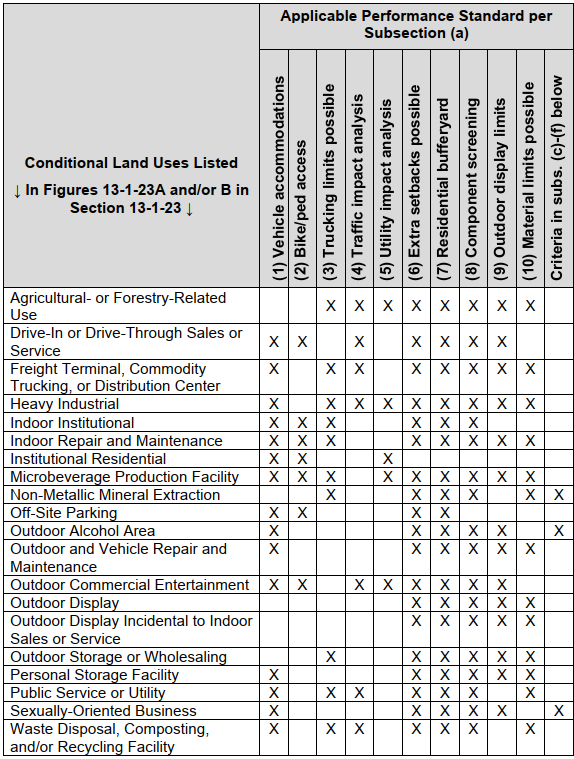
- Conditional Use Performance Standards. Article C Zoning Districts and Article P Definitions list and describe a number of land uses that require a conditional use permit in certain zoning districts. In addition to any standards in Article P, the following is a list of performance standards that may be required of one or more conditional uses if so indicated in subsection (b)/Figure 13-1-63A:
- Vehicle Accommodations. The parking lot shall have direct access to an arterial or collector street, and direct vehicular connections to adjacent parking areas if required by the Plan Commission. Vehicle access shall be designed to accommodate peak on-site traffic volumes without disrupting traffic on public streets or impairing pedestrian safety, through adequate parking lot design and capacity; sufficient access drive entry throat length, width, design, location, and number; and traffic control and wayfinding markings and devices. Landscaped islands or peninsulas shall be spaced within parking lots at intervals no greater than one island per every 20 spaces in that aisle, with each landscaped island or peninsula containing a minimum of 300 square feet in landscaped area.
- Bike/Pedestrian Access. The development shall provide for safe pedestrian and bicycle access to all uses, and connections to existing and planned public pedestrian and bicycle facilities and adjacent properties. Clearly marked pedestrian walkways and crosswalks shall be provided to each primary principal building entrance from public sidewalks/paths and from on-site parking lots. Bicycle parking facilities (e.g., bike loops) shall be provided near such entrance.
- Trucking Limits Possible. The Plan Commission may limit trucking activity to a maximum number of trips per period, type of truck, and/or maximum weight, or may require improvements to off-site roads, where it determines that greater volumes, different types, or greater weights will have an undue negative impact on roads serving the development or on residents, businesses, or other occupants along the route. In the event such limits are applied, any temporary exception for construction of the development, or otherwise not exceeding 30 days in any calendar year, may be approved by the Zoning Administrator.
- Traffic Impact Analysis. Prior to conditional use permit or site and building plan approval, the applicant may be required by the Village Engineer to prepare a traffic impact analysis (TIA). When required, such TIA shall be completed by a transportation engineering consultant and in accordance with TIA Guidelines published by the State of Wisconsin DOT, except as otherwise approved by the Village Engineer. Where the TIA or the Village Engineer’s evaluation of the TIA indicates that a project may cause public roads or intersections to function below an acceptable level of safety or level of service (LOS C, unless otherwise specified by the Village Engineer), the Plan Commission may deny the application, require a reduction in the proposed project, and/or require the applicant to construct and/or pay for required off-site road or intersection improvements to achieve an acceptable level of service or safety in coordination with the transportation agency with jurisdiction.
- Utility Impact Analysis. Prior to conditional use permit or site and building plan approval, the applicant may be required to prepare a public utility impact analysis (UIA). When required, such UIA shall be completed by a civil engineering consultant or utility specialist, and in accordance with best practices in utility system planning. Where the UIA or the Village Engineer’s evaluation of the UIA indicates that a project may cause the municipal water, sanitary sewer, or and/or electrical systems to operate an unacceptable level of service or safety, the Plan Commission may deny the application, require a reduction in the proposed project, and/or require the applicant to construct and/or pay for required off-site utility system improvements to achieve an acceptable level of service or safety in coordination with the utility agency with jurisdiction.
- Extra Setbacks Possible. The Plan Commission may require additional setbacks beyond those indicated in Section 13-1-24 for structures, storage, loading, and/or activity areas. Such additional setbacks may be required from residentially zoned property and/or where the Commission determines that additional setbacks will further compatibility between land uses and their components. No outdoor storage area, service yard, loading dock, exterior work area, and dumpster shall be placed within any minimum front or street side yard setback per the Section 13-1-24.
- Residential Bufferyard. A bufferyard shall be provided along all property borders abutting residentially zoned land, meeting requirements in Section 13-1-129(c)(4).
- Component Screening. All outdoor storage areas, service yards, loading docks, exterior work areas, and dumpsters shall be completely screened from view in all seasons from non-industrial zoned property by any permitted combination of buildings, walls, and/or opaque fencing. Where such areas are visible from residentially zoned land, public park property, or the Maunesha River/Marshall Millpond, landscape plantings shall also be installed on the outsides of such walls or fences. Such walls or fencing may be required to be up to eight feet in height. Chain link fencing with slats or mesh applied is not acceptable except where explicitly approved by the Plan Commission. No such area shall reduce or inhibit the use or number of parking stalls below the minimum requirement under this chapter, or further reduce parking stalls if already below the minimum.
- Outdoor Display Limits. Outdoor display, sales, and/or services shall be allowed only where clearly depicted on the approved site plan; not exceeding 25% of the floor area of the principal use with which they are associated; meeting all applicable accessory building setbacks per Section 13-1-24; not affecting visibility and separated from motor vehicle routes, walkways, and parking spaces; and not allowed for any sexually-oriented business. When outdoor activity ceases, including seasonally, all support furniture and fixtures that support the activity shall be immediately removed. No such area shall reduce or inhibit the use or number of parking stalls below the minimum requirement under this chapter, or further reduce parking stalls if already below the minimum.
- Material Limits Possible. The Plan Commission may limit the on-site holding, storage, movement, processing and/or disposal of materials determined by the Fire Department or other reliable source as hazardous, explosive, highly combustible, malodorous, and/or vermin-attracting. The Village Engineer or Plan Commission may also require a prevention and mitigation plan with a conditional use permit or site plan and design approval application or as a condition of approval, addressing matters such as safe handling of materials, training, and protocol for addressing accidental spills.
- Conditional Uses for which Performance Standards Applicable. Figure 13-1-63A lists, in its rows, certain land uses from Article C Zoning Districts and Article P Definitions that require a conditional use permit where allowed. The same figure, in its columns, enumerates performance standards that may be applicable to one or more of these conditional uses, with reference to the performance standards described in subsection (a) above. If a performance standard is applicable to the particular conditional use, the associated cell is marked with an “X,” with the stricter limit applying in the event of any overlap. Such performance standard may inform materials or components to be included as part of the conditional use permit application, conditions the Plan Commission may apply to the conditional use permit, and/or ongoing requirements to such conditional uses granted a conditional use permit (or amendment to a conditional use permit). Article P Definitions may also include, within the definitions of certain land uses, standards that must be met in addition or regardless of whether a land use is listed as a permitted or conditional land use in Article C Zoning Districts.
- Criteria for Non-metallic Mineral Extraction Uses. Each Non-metallic Mineral Extraction use established or modified after July 8, 2025, shall meet the following criteria:
- Shall be surrounded by a solid fence or evergreen planting screen completely preventing a view from any residentially zoned property or public rights-of-way.
- All buildings, structures, and activity areas shall be located a minimum of 300 feet from all lot lines.
- Rock quarry operations shall be set back at least 1,320 feet from residences on parcels not in the same ownership.
- Shall receive reclamation plan approval from the county prior to the effective date of conditional use permit approval, and shall comply with all county, state, and federal regulations.
- Prior to commencement or expansion of operations, a surety bond, in an amount equivalent to 110% of the costs determined to be associated with said restoration (as determined by a third party selected by the Village), or other security approved by the Village Attorney, shall be filed with the Village by the applicant (subject to approval by the Zoning Administrator), and shall be held by the Village for the purpose of ensuring that the site is restored to its proposed condition.
- Criteria for Communications Towers. Each communications tower use established or modified after July 8, 2025, shall meet the following criteria:
- The application for conditional use permit and site plan approval shall include the requirements of § 66.0404(2)(b), Wis. Stats., in addition to requirements under this Chapter.
- If the intent is to construct a new, freestanding communications tower, the application must include an explanation as to why the applicant chose the proposed location and why the applicant did not choose collocation, including a sworn statement from an individual who has responsibility over the placement of the communications tower attesting that collocation within the applicant’s search ring would not result in the same mobile service functionality, coverage, and capacity; is technically infeasible; or is economically burdensome.
- Each permitted communications tower shall be placed or constructed so it may be utilized for the collocation of antenna arrays to the extent technologically and economically feasible. The holder of a permit under this subsection shall make the collocation sites required hereunder available for the placement of technologically compatible antenna arrays and equipment upon contractual provisions that are standard in the industry and at prevailing market rates allowing the permit holder to recoup the cost of providing collocation sites and a fair investment return.
- Communications towers and associated equipment shall, to the extent possible, match the color of existing facilities and be installed in a fashion to lessen the visual impacts of such installation. Accessory buildings shall meet requirements in the Sections 13-1-24 and 13-1-140.
- A new or amended conditional use permit and site plan shall be required for “substantial modifications” to an existing communications tower, as that term is defined in § 66.0404(1)(s), Wis. Stats. Neither a conditional use permit nor site and building plan approval shall be required for any modification that is not defined as a “substantial modification,” but a building permit is required.
- A conditional use permit shall not be required for collocation on a proposed or existing communications tower, provided the collocation does not result in a “substantial modification,” as that term is defined in § 66.0404(1)(s), Wis. Stats.
- The applicant shall provide a written agreement stating that if the communications tower, antennas, or transmitters are unused for a period exceeding 12 months, the applicant shall remove the tower including all associated equipment upon written request from the Zoning Administrator at no cost to the Village within 60 days of such request.
- The owner of any communications tower shall maintain insurance against liability for personal injury, death, or property damage caused by its maintenance and/or operation.
- In its evaluation of any conditional use permit or site plan approval application for the communications tower, the limitations under the applicable §§ 66.0404(4) and 66.0406(2), Wis. Stats. shall apply.
- Criteria for Outdoor Alcohol Area Uses. Each outdoor alcohol area a use established or modified after July 8, 2025, shall meet the following criteria:
- Maximum allowable area shall not exceed the indoor floor area, unless the facility is not associated with an indoor principal use.
- May be required to be enclosed with a fence, wall, or other barrier.
- May be limited to no outdoor bar or service station, and/or to wait staff service only to patrons seated in the approved outdoor area.
- Shall not open earlier than 7 a.m. or remain open later than 11 p.m. where located within 300 feet of any residential zoning district.
- All applications for conditional use permit shall include operational details and site plan details addressing each of the requirements above in addition to applicable criteria for conditional use permit approval in this Article. Where such use is proposed to include or abut a public right-of-way, parking lot, or driveway, the application shall include details regarding the specific location of street, parking lot, or driveway improvements, and how the activity will be kept off of and separated from the street travel way, parking lot, or driveway.
- No such area shall reduce or inhibit the use or number of parking stalls below the minimum requirement under this chapter, or further reduce parking stalls if already below the minimum.
- Criteria for Sexually-oriented Businesses. Each sexually-oriented business established or modified after July 8, 2025, shall meet the following criteria:
- Shall be located a minimum of 500 feet from any residentially zoned property, any residential or institutional use, or any other sexually-oriented business.
- No outdoor activities aside from vehicle parking shall be permitted.
- Exterior signage shall be in accordance with that permitted for the zoning district within which it is located. In addition, one additional exterior wall sign with an area of 2 square feet stating “Admittance to adults only” shall be placed near or on the customer entrance, along with hours of operation.
- The establishment shall not admit minors on the premise and shall comply with all applicable federal, state, and Village laws and ordinances regulating alcoholic beverages and obscenity.
HISTORY
Repealed & Replaced by Ord. 2025-04 on 7/8/2025
Repealed & Replaced by Ord. 2025-04 on 7/8/2025

