
Marshall Village City Zoning Code
ARTICLE 1
I Performance And Design Standards
(Revised Ord. 2010-04, May 11, 2010)
13-1-120 Article Intent
It is the intent of this Article to use performance and design standards to insure that the community is adequately protected from potential hazardous and nuisance-like effects of particularly nonresidential and multi-family residential uses, buildings, and sites and to address exterior design and appearance of to promote the Village’s goals with respect to land use compatibility, property value, aesthetics, tourism, and quality of life.
Repealed & Replaced by Ord. 2025-04 on 7/8/2025
13-1-121 Noise
No operation or activity shall transmit any noise exceeding 75 decibels (dBA) from 7:00 a.m. to 11:00 p.m. and 70 dBA from 11:00 p.m. to 7:00 a.m. beyond the property line. The following noises are exempt from the regulations: (a) Noises not directly under the control of the property owner. (b) Noises from temporary construction or maintenance activities during daylight hours. (c) Noises from emergency, safety or warning devices. (d) Noises required for snow and ice removal. (e) Noises from vehicular traffic. (f) Noises from organized events permitted by the Village.
Repealed & Replaced by Ord. 2025-04 on 7/8/2025
13-1-122 Vibration
- No operation or activity shall transmit any physical vibration that is above the vibration perception threshold of an individual at or beyond the property line of the source. Vibration perception threshold means the minimum ground- or structure-borne vibrational motion necessary to cause a normal person to be aware of the vibration by such direct means as, but not limited to, sensation by touch or visual observation of moving objects.
- Vibrations not directly under the control of the property user and vibrations from traffic movement on public streets and temporary construction or maintenance activities shall be exempt from the above standard.
Repealed & Replaced by Ord. 2025-04 on 7/8/2025
13-1-123 Glare And Heat
- No direct or sky-reflected glare, whether from floodlights or from temperature processes such as combustion or welding or otherwise, so as to be visible at any lot line shall be permitted. Furthermore, there shall be no transmission of heat or heated air so as to be discernible by a Zoning Administrator at the lot line. Solar energy systems regulated by § 66.0401, Wis. Stats. shall be entitled to the protection of its provisions.
- The standards in this section apply to all land uses and activities, except for glare and heat created through property development and maintenance (such as construction, lawn care, and painting or roofing); by incidental traffic, parking, loading, maintenance, or agricultural operations; and where the sending and receiving parcels are both in the industrial zoning district.
Repealed & Replaced by Ord. 2025-04 on 7/8/2025
13-1-124 Odor
- No odor shall be created for periods exceeding a total of 15 minutes per any day that are detectable by the Zoning Administrator or a designee who is unaffected by background odors such as tobacco or food at the boundary of a property, where said lot abuts or is immediately across a public street from property within any residential zoning district.
- The standards in this section apply to all land uses and activities, except for odors associated with allowable agricultural uses; food preparation and cooking odors emanating from residential land uses and permitted smokehouses; property development and maintenance (such as construction, lawn care, and painting or roofing); fertilizer application, traffic, parking, loading, or maintenance operations; and sanitary sewage treatment plants.
Repealed & Replaced by Ord. 2025-04 on 7/8/2025
13-1-125 Fire And Explosive Hazards
- All activities involving the manufacturing, utilization, processing or storage of inflammable and explosive material shall be provided with adequate safety devices against the hazard of fire and explosion, and with adequate fire-fighting and fire suppression equipment and devices, both that are standard in the industry and consistent with state and federal regulations.
- All materials that range from active to intense burning shall be manufactured, utilized, processed and stored only in completely enclosed buildings which have incombustible exterior walls and an automatic fire extinguishing system.
- No use shall discharge across the boundaries of any property, or through percolation into the subsoil, toxic or noxious material in such concentration as to be detrimental to, or endanger, the public health, safety, comfort, or welfare, or cause injury or damage to the property or business.
- No use shall discharge at any point into any public or private sewage disposal system or stream, or into the ground, any liquid or solid materials except in accordance with state and federal regulations.
Repealed & Replaced by Ord. 2025-04 on 7/8/2025
13-1-126 Air Pollution
- No operation or activity shall emit into the ambient air from any direct or portable source any matter that will affect visibility in excess of the limitations established in state and federal regulations.
- No activity shall emit any fly ash, dust, fumes, vapors, mists or gases in such quantities as to cause soiling or danger to the health of persons, animals, vegetation or property. No activity shall emit any liquid or solid particles in concentrations exceeding 0.3 grains per cubic foot of the conveying gas, nor any color visible smoke equal to or darker than No. 2 on the Ringlemann Chart described in the United Stated Bureau of Mines Information Circular 7718 as revised.
Repealed & Replaced by Ord. 2025-04 on 7/8/2025
13-1-127 Building Design Standards
- Applicability. All new multi-family (3+ unit) residential, mixed use, and non-residential principal buildings and site improvements shall meet the design requirements in this section, with the exception of farm structures such as barns, silos, and grain elevators, regardless building type or design. Expansion and exterior remodeling of existing multi-family (3+ unit) residential, mixed use, and non-residential principal buildings and site improvements shall meet the design requirements in this section to the extent determined practical by the Plan Commission.
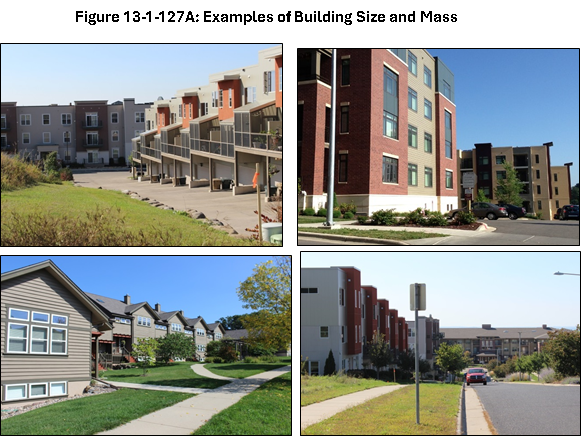
- Building Size and Mass. The size and mass of buildings and structures shall be designed with consideration of the buildings, public ways, and places to which they are visually related (see Figure 13-1-127A for examples). The relative proportion of a building to its neighboring existing buildings, to pedestrians, or to other existing buildings shall be maintained or enhanced when new buildings are built or when existing buildings are altered.
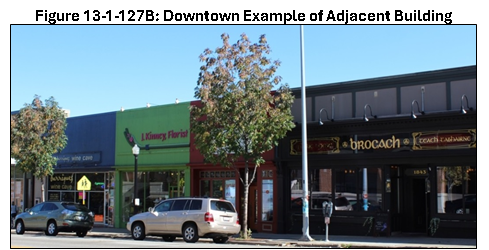
- Building Facade Continuity. Changes in building material, color, and texture shall occur at points related to the massing and overall design concept for the building. Each building shall be visually compatible with the buildings, public ways, and places to which it is visually related in its directional character, whether this is vertical character, horizontal character, or non-directional character. Building facades and appurtenances such as walls, fences, and landscape masses shall, when it is a characteristic of the area, form cohesive walls of enclosures along a street to ensure a favorable relationship with the buildings, public ways, and places to which such elements are visually related (see Figure 13-1-127B for examples in a downtown setting).
- Building Design Proportions.
- The relationship of the width to the height of the front elevation shall be visually compatible with buildings, public ways, and places to which it is visually related.
- The relationship of the width to height of windows shall be visually compatible with buildings, public ways, and places to which the building is visually related.
- The relationship of solids to voids in the front façade of a building shall be visually compatible with buildings, public ways, and places to which it is visually related.
- The relationship of the building to the open space between it and adjoining buildings shall be visually compatible with the buildings, public ways, and places to which it is visually related.
- The relationship of entrances and other projections to sidewalks shall be visually compatible with the buildings, public ways, and places to which it is visually related.
- Building Materials and Colors.
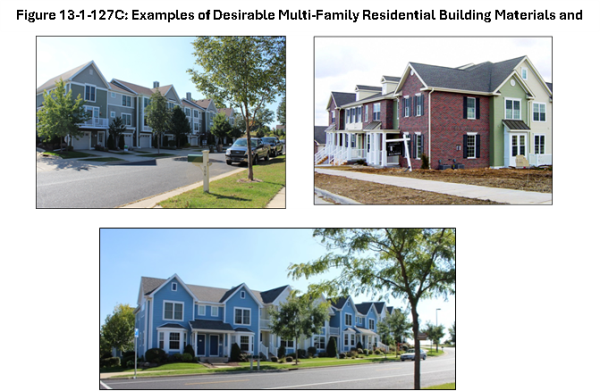
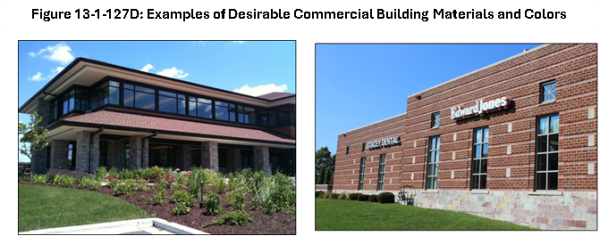
- Materials shall be of a durable, low-maintenance type. Material and color selection shall relate to the prevailing material already used on recently constructed buildings in the area (without creating a monotonous street appearance), or to a different character if identified in the Village’s Comprehensive Plan, and with reference to the examples in Figures 13-1-127C and 13-1-127D
- All public-street facing facades shall have a surface area that is at least 25 percent brick, native stone, tinted and/or textured concrete masonry units, glass, copper panels, stainless steel, brushed nickel, stained natural woods, or other comparable material as approved by the Plan Commission. Natural wood, including treated wood, shall be painted or stained.
- No exposed façade shall be faced with a material that presents an unfinished appearance to the public and surrounding properties. The following exterior construction materials shall not be exposed along front or street side yard facing building facades: non-decorative concrete block, cinder block, or concrete foundation walls (except for the first two feet above grade), non-decorative plywood, chipboard, T1-11, asphaltic siding, vinyl siding less than 0.044 inches of thickness, metal sheets not designed for commercial exterior walls, paneling, and other similarly inferior materials as determined by the Plan Commission.
- Building Design Details.
- Building design features, materials and articulations shall be continued in all sides with visibility from the public and nearby properties.
- Facades exceeding 100 feet in length with no change in material, color, or architectural detailing are prohibited. Facades with an uninterrupted length of 250 feet or more shall employ the use of protruding or intruding exterior walls or roof lines, plus windows or other architectural detailing on the walls or roof, to break up the wall and reduce monotony.
- Building façades should be composed with distinct base, middle, and top elements,
- Multi-family dwellings shall have architectural and trim details such as frieze board, vertical corner trim, drip caps, gable vents, shingles and shakes.
- Commercial service and retail buildings shall be designed to provide human scale, interest, and variety, which shall be accomplished by incorporating at least two of the following techniques:
- Variation in building form, such as recessed or projecting bays, shifts in massing or distinct roof shapes.
- Emphasis on building entries through projecting or recessing forms (e.g., cover entries or columns), details or material differences.
- Variation in materials, material modules, express joints and details, surface relief, and/or texture to break up building forms and walls.
- All heating, ventilating, and air-conditioning equipment shall be designed to be integral with the building architecture and site design and screened from view from public rights-of-way.
- Loading docks and doors shall be designed as integral elements to the building and site, shall not be the dominant visual element from public rights-of-way, and shall be buffered from view from public rights-of-way and residentially zoned properties.
- Other Design Guidelines. Adopted Village plans, including the Comprehensive Plan, Downtown Redevelopment Plan, and Highway 19 Corridor Redevelopment Plan have design criteria that the Plan Commission may also utilize in its review of particular types of development or within indicated geographic areas.
Repealed & Replaced by Ord. 2025-04 on 7/8/2025
13-1-128 Site Design Standards
- Applicability. Same as in Section 13-1-127(a).
- Erosion Control and Stormwater Management. Site development shall meet all drainage, erosion control, and stormwater management requirements of SPS 321.12 and 321.125, Wis. Admin. Code, and of any requirements of Title 15, Chapter 2 of the Code that are made applicable under that chapter to the proposed site adjustments.
- General Site Design. Site development shall include site grading, structure siting, and hard and pervious surfaces that:
- Compared to pre-development conditions, do not materially alter surface water drainage through and from the site (except where advised by the Village Engineer to address an identified problem); substantially increase the rate or volume of stormwater discharge from the site; or transmit mud, soil, mulch, or other visible sediment onto any adjacent property, public right-of-way, or surface water body.
- Do not result in the compromise, degradation, defacement, or obliteration of any shoreline, or include any fill or shoreline enhancement that does not obtain the proper state or federal permit.
- Respect the natural topography of the site and area, while allowing for the creation of earth forms that add interest to the existing topography or screen undesirable views.
- Include a minimum low opening elevation for any new principal building that is two feet above the base flood elevation of any nearby floodplain or rim elevation of any nearby stormwater basin or drainage channel, as verified by the Village Engineer where necessary.
- Minimize the removal of non-invasive mature trees and shrubs without compromising drainage or structure function.
- Allow for the installation and maintenance of groundcover and other landscaping via proper slopes, topsoil maintenance, and otherwise.
- Where required, include retaining walls designed and installed pursuant to best engineering practices (such as those promulgated under the International Building Code or American Society of Civil Engineers (ASCE) 7, “Minimum Design Loads for Buildings and Other Structures”) and with a style, height, and materials compatible with other site improvements.
- Utilities. Site improvements for new and significantly expanded principal buildings shall provide for the undergrounding of public and private utility and communication wiring connecting to the building and site.
- Shorelines. For shoreline stabilization projects, any human-made or formed stabilization materials shall be compatible with the principal building and with other structures on the parcel. Shoreland zoning provisions in Title 13, Chapter 3 of the Code also apply.
- Dumpsters. All commercial trash and recyclable containers and stacks shall be screened from all public rights-of-way and nearby properties through opaque fences, walls, and/or gates of sufficient height to completely screen the materials behind them.
Repealed & Replaced by Ord. 2025-04 on 7/8/2025
13-1-129 Landscaping Standards
- Applicability. Same as in Section 13-1-127(a).
- Generally. Site landscaping shall be designed and implemented to present an attractive street and community appearance (particularly in highly visible and traveled areas), complement existing use and site development on nearby lands, and buffer lower density and/or residential uses nearby.
- Landscape Planting Requirements. Landscaping shall be provided based on the following requirements for street frontages, paved areas, building foundations, buffer yards, and general yard areas. These requirements are additive to each other. By approval of the Plan Commission, required landscaping points may be shifted between areas (e.g., paved areas to building foundations). The point system is described in greater detail in subsection (d) below.
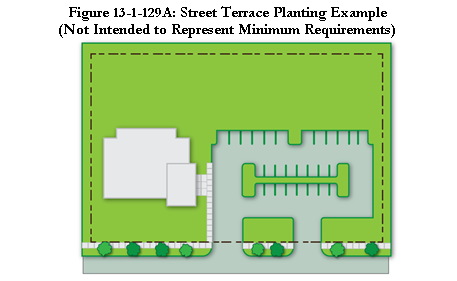
- Street Frontages. The applicant shall plant trees within or near street terraces/boulevards at a rate of one tree per 75 feet or lot, whichever is greater, avoiding visual clearance triangles and utilities. Such trees shall either be planted within the public street terrace, or on adjacent private land within 10 feet of the public street right-of-way where the Village Forester determines that insufficient terrace width or utility conflicts would otherwise result.
- Hard or Gravel Surfaced Areas. Within industrial zoning districts, 100 points of landscaping shall be planted for each 2,500 square feet of all areas covered with a hard, all-weather surface and gravel surface. Within all other zoning districts, 100 points of landscaping shall be planted for each 1,500 square feet of such surfaces. For purposes of this standard, such surfaces do not include rooftops. Such plants shall be installed within landscaped islands, peninsulas, or medians, or within 10 feet of the hard or gravel surfaced area.
- Building Foundations. Within industrial zoning districts, 100 points of landscaping shall be planted for each 75 lineal feet of exterior building wall that is visible from a public right-of-way or residentially zoned property. Within all other zoning districts, 100 points of landscaping shall be planted for each 75 lineal feet of all exterior building walls.
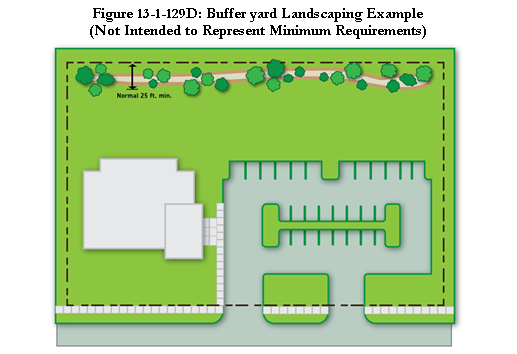
- Buffer Yards. A landscaped buffer yard shall be provided where an industrial, business park, or commercial zoning district abuts a residential zoning district, and for certain conditional uses where specified in Section 13-1-64. Where required, buffer yards shall comply with the following:
- The minimum width shall be 30 feet, unless reduced by the Plan Commission if it determines that a lesser width is both adequate to separate incompatible uses/activities and necessary owing to site constraints.
- No building, vehicle accommodation area other than a bike/pedestrian way, trash storage area, light fixture, sign, or outdoor storage area or structure shall be permitted in a required buffer yard.
- Landscaping shall be selected, positioned, and planted in sufficient quantities to provide an all-season screen within five years of planting and have a minimum height of three feet at time of planting. Such landscaping shall not count towards any street frontage, hard or gravel surfaced area, building foundation, or the general yard area planting requirement of this section.
- The use of a decorative opaque fence or wall, and/or a berm, in lieu of or in addition to the landscaping may be approved, provided the slope of any berm is less than 4:1 and the berm, fence or wall does not interfere with access, utilities, or stormwater management.
- General Yard Areas. Within industrial zoning districts, 100 points of landscaping shall be planted for each 5,000 square feet of total lot area, excluding those areas in a terrace, under a rooftop, within hard and gravel surfaced areas, in a required buffer yard, or being reserved for a future phase of development. Within all other zoning districts, 100 points of landscaping shall be planted for each 3,000 square feet of total lot area, with the same exclusions. Green space areas not used for landscape plantings, other than natural resource protection areas, shall be graded and sodded or seeded with a maintainable seed mix.
- Street Frontages. The applicant shall plant trees within or near street terraces/boulevards at a rate of one tree per 75 feet or lot, whichever is greater, avoiding visual clearance triangles and utilities. Such trees shall either be planted within the public street terrace, or on adjacent private land within 10 feet of the public street right-of-way where the Village Forester determines that insufficient terrace width or utility conflicts would otherwise result.
- Landscaping Points, Minimum Installation Sizes, and Species.
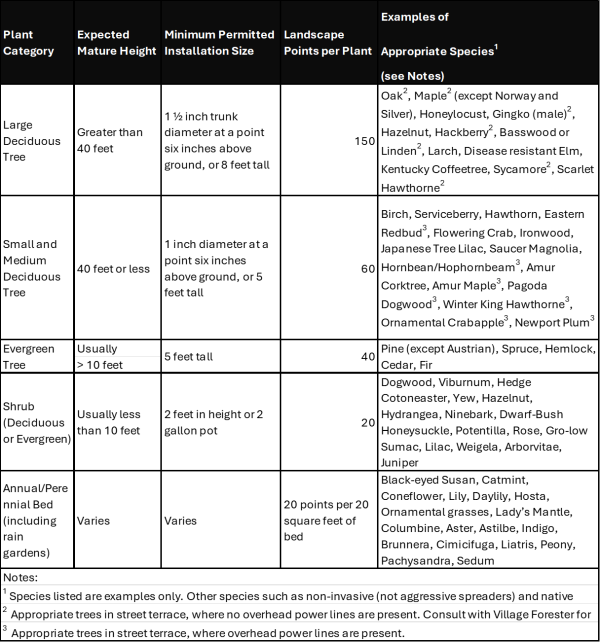
- Most of the above landscaping requirements are expressed in terms of landscape points. Each plant type, below, is worth a certain number of landscape points that can be used to fulfill the landscaping requirements, as provided in Figure 13-1-129F.
- Species examples in this example are provided for the benefit of the applicant, and are in no way all-inclusive. Diversity of vegetation species is recommended, although the selection of a plant palette shall consider new flora that is compatible with the growing and environmental requirements of existing vegetation. Trees or shrubs planted adjacent to roadway rights-of-way and parking lots shall be salt tolerant.
Figure 13-1-129F: Landscaping Points, Minimum Installation Size, and Species Examples
- Credit for Existing Plantings and Other Landscape Design Elements. The applicant shall be afforded credit towards minimum landscape point standards for:
- Existing, non-invasive landscape plantings to be retained and protected with the development of the site, and restoration or reestablishment of native flora, based on the landscape points afforded to each type of existing planting in Figure 13-1-129F.
- Other proposed landscape features, such as sculpture, fountains, or outdoor seating or recreational aesthetically pleasing facilities, with landscape points afforded by the Plan Commission based generally on the cost of such features relative to landscape planting costs.
- Prohibited Species. See Title 6, Chapter 4 of the Code, plus the following:
- Ailanthus (Tree of Heaven)
- Box Elder (acer nuegundo)
- Buckthorn (common): Rhamnus cathartica, Rhamnus frangula (tall hedge)
- Cottonwood (populus deltoids)
- All Ash varieties until Emerald Ash Borer is eradicated
- European White Birch
- Fruit-bearing trees in the terrace or within 10 feet of any paved surface (except: flowering crab, flowering plum, weeping cherry, hawthorn, serviceberry, chokeberry, barberry, hazelnut, holly, snowberry)
- Honeysuckle: Lonicerax-bella, Lonicera marrawi, Lonicera tatarica (except Diervilla lonicera)
- Lombardy Poplar
- Mulberry
- Russian Olive
- Siberian Elm
- Silver Maple (acer saccharinum)
- Walnut
- Willow (except along water edges)
- American Elm (almus american)
- Black Locust (robinia pseudacelia)
- Other weak-wooded or trees which deposit significant number of twigs, seed pods, fruits, nuts or other debris as determined by order of the Village Forester.
- Installation. All landscaping required under this section shall be installed per industry accepted standards and shall be guaranteed by the applicant or the applicant’s contractor for at least one year. Installation shall occur prior to occupancy or commencement of operations, unless doing so would result in unsatisfactory plant survival. In this case, landscaping shall be installed within six months of occupancy or commencement of operations, and the Village may require a performance guarantee, such as a letter of credit or cash deposit, before a certificate of occupancy is granted and until such landscaping is installed according to plan.
- Maintenance. Landscaping required by this section is intended to be a permanent site improvement. As such, all landscaping shall be continually maintained in a live, healthy, safe, and aesthetically pleasing state. Recognizing that over time plants may mature and die or otherwise expire because of natural or unnatural causes, maintenance shall include the removal and replacement of dead or dying plants. Landscaping shall also be subject to applicable maintenance standards within Title 6, Chapter 4 of the Code.
- Landscaping Relative to Public Utilities and Streets.
- Plants located within ten feet of overhead utility wires shall be limited to those with a mature height that is at least five feet less than the height of the wires.
- Trees shall not be located closer than 10 feet and shrubs shall not be located closer than 5 feet to fire hydrants, transformers, or other utility fixtures.
- Planting in utility or other easements is at the risk of the property owner. Any plants that must be removed because of utility work within such easements shall be replaced by the property owner at his or her cost.
- All trees and shrubs shall be located in such a way that they do not obstruct views of vehicle operators and pedestrians at intersections, alleys, driveways, parking lots and sidewalks, and shall otherwise meet the requirements in Section 6-4-9 of the Code.
Repealed & Replaced by Ord. 2025-04 on 7/8/2025
13-1-130 Exterior Lighting Standards
- Applicability. The requirements of this section apply to all exterior lighting and all interior light visible from the exterior on private property, except for lighting within public rights-of-way, lighting located on public property, and/or lighting on communications towers or other similar facilities where required to meet federal and state safety regulations.
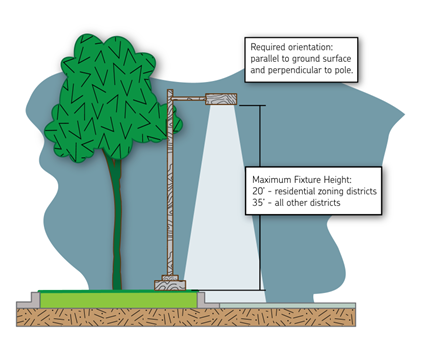
- Orientation of Fixture. All exterior lighting shall be shielded and oriented so the fixture is horizontal to the ground surface, except for fixtures with light output of 2600 lumens or less. No exterior lighting fixture of greater than 2600 lumens output shall be oriented so that the lighting element (or a transparent shield) is visible from a property located within a residential zoning district other than from the property on which the fixture is located, except where required for security and erected by a public agency or on public property and for architectural lighting that focuses all light below the roof line or top of sign. Search lights are prohibited except for any search light deemed necessary by the Federal Aviation Administration or designee.
- Intensity of Illumination.
- In no instance shall the amount of illumination, as measured at the property line, exceed 1.0 footcandle above ambient lighting conditions on a cloudless night within or adjacent to a residential zoning district, and 2.0 footcandles at another other property line.
- The maximum average on-site lighting shall be 4.0 footcandles within or adjacent to residential zoning districts and 8.0 footcandles in all other locations.
- Fixture Heights. The maximum fixture height shall be per Figure 13-1-130A, whether pole or building mounted. The height of foundation, pole, and fixture housing shall be included.
- Fixture Setbacks. No light fixture regulated by this section shall be closer than 3 feet from any lot line.
- Exceptions to Intensity of Illumination and Fixture Height Requirements. The Plan Commission may grant exceptions to the above Intensity of Illumination and/or Fixture Height requirements in one or more of the following circumstances:
- Outdoor recreation use and assembly areas such as athletic fields.
- Gas station pump islands and other uses in which motor vehicles and pedestrians routinely operate in close proximity with one another. Use of recessed canopy lighting to minimize off-site impacts may be required.
- Flashing, Flickering and other Distracting Lighting. Flashing, flickering, moving (such as search spot or search lights), and/or other lighting that may distract motorists is prohibited.
- Nonconforming Lighting. All lighting fixtures existing prior to July 8, 2025, shall be considered as legal conforming structures.
- Special Events Lighting. Any temporary use using exterior lighting that is not in complete compliance with the requirements of this Section shall secure a temporary approval from the Zoning Administrator.
Repealed & Replaced by Ord. 2025-04 on 7/8/2025

