Martinsville City Zoning Code
SECTION VIII
SPECIAL USE PERMITS
A.- Purpose and intent.
The purpose of the special use permit procedures is to provide a means by which to authorize, upon satisfactory review and subject to appropriate conditions, certain specified conditions and uses which, although generally appropriate in the zoning district in which they are specified, have a potentially greater impact on neighboring properties than those uses which are permitted by-right.
The special use procedure is intended to provide the opportunity for the planning commission and city council to:
1.
Review the specific characteristics of the individual proposed uses.
2.
Assess the potential impacts of the proposed uses on surrounding properties and other neighboring land uses.
3.
Better understand any unique circumstances of each proposed land use.
4.
To establish conditions, as may be necessary, to ensure that the use will be compatible with the surrounding area and consistent with the intent and purpose of this ordinance.
B. - Requirements for special use permits.
A use or structure permitted as a special use by the zoning district regulations set forth in this ordinance shall be authorized only upon review by the planning commission and approval of a special use permit by city council. No building permit or certificate of occupancy for a special use or a structure devoted to a special use shall be issued unless a special use permit for such has been approved in accord with the provisions of this section.
C. - General conditions for special uses.
Special use permits may be issued by the city council upon (1) official public notice and hearing as required by law for changes and amendments to this ordinance, and (2) consideration of recommendations from the zoning administrator and planning commission. Such special use permits may be granted by the city council under the following conditions:
1.
The proposed land use shall be:
a.
Consistent with the city's adopted comprehensive plan;
b.
Compliant with the intent and purpose of the zoning district in which the use is proposed to be located; and
c.
Compatible with the character of adjacent properties and the surrounding neighborhood.
2.
The proposed land use shall be adequately served by essential public services such as streets, drainage facilities, fire protection and public water and sewer facilities.
3.
The proposed use shall not result in the destruction, loss, or damage of any feature determined to be of significant ecological, scenic, cultural, or historic importance.
4.
The proposed use shall be designed, sited, and landscaped so that the use will not hinder or discourage the appropriate development or use of adjacent properties and surrounding neighborhoods.
5.
The proposed use, intensity of use, and associated schedule of land use operations shall not create dust, noise, vibration, glare, traffic conditions, environmental disruption, or other externalities that would harm nearby properties, inhibit normal land use and activity functions within the by-right uses allowable in the subject zoning district, or create conditions that are not in line with the city's zoning and comprehensive plan intentions for the area.
D. - Special conditions.
1.
In granting any special use permit, the city council may impose any conditions necessary to assure that the proposed use, its operational characteristics, and schedule of activities will conform to the requirements of this section and will continue to do so for the period in which the special use permit is granted. The city council may take all necessary actions to ensure compliance with the conditions imposed.
2.
The city council may impose reasonable standards as deemed necessary to protect the public interest and welfare. Such standards may include, but need not be limited to:
a.
More restrictive sign and business identity standards.
b.
Additional open space, landscaping, buffer, or screening requirements.
c.
Additional yard requirements.
d.
Special lighting requirements.
e.
Schedule of activities and operations, including time limitations on hours of operation.
f.
Additional off-street parking and loading requirements.
g.
Provision of adequate public facilities and infrastructure, including additional utility, storm drainage and public facility requirements.
h.
Additional right-of-way improvements and public access requirements.
i.
Additional requirements to ensure compatibility with the comprehensive plan and adopted small area plans and corridor plans.
j.
Conditions for renewal, extension, expiration, and/or revocation of special use permit.
3.
The city council may specify time limits or expiration dates for a special use permit, including provisions for periodic review and renewal.
E. - Applications required.
All applications for a special use permit must be accompanied by plans and other supporting information as required by this ordinance. All applications shall be accompanied by the appropriate fee according to the current fee schedule. No application shall be processed until the fee has been paid, which fee is not refundable. The fee must be paid with each application notwithstanding the fact that a prior application pertaining to the same property may have been denied. The fee shall not be charged for an application filed by the city or any of its departments.
F. - Pre-application conference and concept plan.
1.
Requirement for pre-application conference and concept plan.
a.
A pre-application conference shall be conducted between the applicant and the zoning administrator prior to undertaking the formal submission and review process for a special use application. The purpose of the pre-application conference is to identify, understand and anticipate key planning issues, land use activities, and site-related design requirements which may be deemed relevant by the city. The topical areas to be addressed at the pre-application conference are included on the special use permit checklist.
b.
The pre-application conference provides the opportunity for the applicant and the city to assess the specific requirements for a subsequent special use application and to determine which, if any, of the requirements of this section may be waived or amended by the zoning administrator.
c.
A pre-application conference does not negate the requirement for the submission of a concept plan or any other required information or documentation specified in this ordinance.
2.
Pre-application conference objectives. The applicant shall contact the zoning administrator to schedule a pre-application conference. The particular objective of the conference is to review the requirements of the special use permit application and concept plan as well as to discuss other aspects of the applicant's special use proposal, considering the following:
a.
Understanding of the applicant's overall land use vision, business plan and approach to operations to ensure a successful land use activity.
b.
Project location, type and mix of uses, lot configuration and setback, conceptual design, density, physical characteristics and phasing of proposed development.
c.
Compatibility of the proposed development with the city's comprehensive plan, the zoning ordinance, the subdivision ordinance, the stormwater management ordinance, all adopted master facilities plans, the capital improvements program, and plans for development of neighboring properties.
d.
Coordination of transportation improvements with other existing and planned streets within the general area of the proposed development and otherwise in keeping with the provisions of the transportation element of the comprehensive plan and other adopted transportation plans.
e.
Reasonable regulations and provisions uniquely applicable to the proposed development as related to topography, soils, geology, public utility and facilities service, drainage and flood control, transportation, traffic impacts, environmental and historic impact, economic development, and facilitation of the creation of a convenient, attractive and harmonious development.
f.
Coordination of proposed development with applicable ordinances, design guidelines and development criteria.
g.
Other matters related to review of a concept plan.
G. - Concept plan content.
The special use permit application shall be accompanied by five (5) printed copies of the concept plan, which shall include the following information and other items to be addressed on the special use permit check list:
1.
Name, address and telephone number of owner or developer.
2.
Map scale (to be one inch equal not more than thirty (30) feet or as otherwise approved by the zoning administrator, with a maximum sheet size of twenty-four (24) inches by thirty-six (36) inches, and date of plan preparation.
3.
Name, address and telephone number of preparer of concept plan.
4.
Vicinity map.
5.
Current boundary survey of the lot and a north arrow; preparer of survey.
6.
The area of the lot and gross acreage or square footage of area to be developed.
7.
Public frontage improvements; the location of the proposed and existing right-of-way, proposed edge of pavement or curb line, and other public improvements along the frontage of the property.
8.
Size, location and use of existing and proposed buildings.
9.
Location of the proposed transportation and site improvements (including points of site access, utilities, drainage conveyance, building and site signage, buildings, streets, site lighting, driveways and parking areas) and distances from all property lines.
10.
The dimension, height and use of the proposed building improvements.
11.
Limits of clearing and grading.
12.
Existing zoning district (including conditional zoning and proffer agreements) and, if a rezoning is required, the proposed zoning district (including overlay districts, where applicable).
13.
Existing topography and a preliminary grading plan depicting finished contours, with contour intervals of five (5) feet or less.
14.
Proposed location, alignment, easements, and sizing of proposed utility service for potable water, fire protection and sanitary sewer.
15.
Certification in writing from the city that availability and connection to water and sewer are attainable.
16.
Approximate location of wetlands and impacts of the proposed development thereon, with copies of state and federal permit applications and permit approval related to any proposed disturbance to the wetlands.
17.
Approximate location of one hundred-year floodplain boundaries and impacts of the proposed development thereon, employing FEMA mapping where available and for areas where development may encroach upon areas which may be subject to periodic flooding, engineering calculations and mapping for one hundred-year floodplains which have not been mapped by FEMA.
18.
Approximate location of planned stormwater management (SWM) facilities and best management practices (BMP), with emphasis to be placed on low impact development improvements (LID) adhering to Virginia runoff reduction methods (VRRM).
19.
Approximate location of significant geological formations which could impact the proposed development, including significant rock outcrops.
20.
Phasing plan for the proposed development, if the project is to be developed in more than one phase.
21.
References to and location of survey datum, employing the State Plane Coordinate System (specifically indicate State Plane Zone and a NAD coordinate system) and National Mapping Standards accuracy for urban surveys.
The need for the above requirements may be reviewed at the pre-application conference. The zoning administrator may waive certain individual requirements to be included on the special use permit concept plan if the requirement is determined to be unnecessary to:
a.
Determine compliance with applicable provisions of this ordinance;
b.
Evaluate potential impacts on surrounding properties; or
c.
Establish adequate record of the application.
H. - Review procedure.
1.
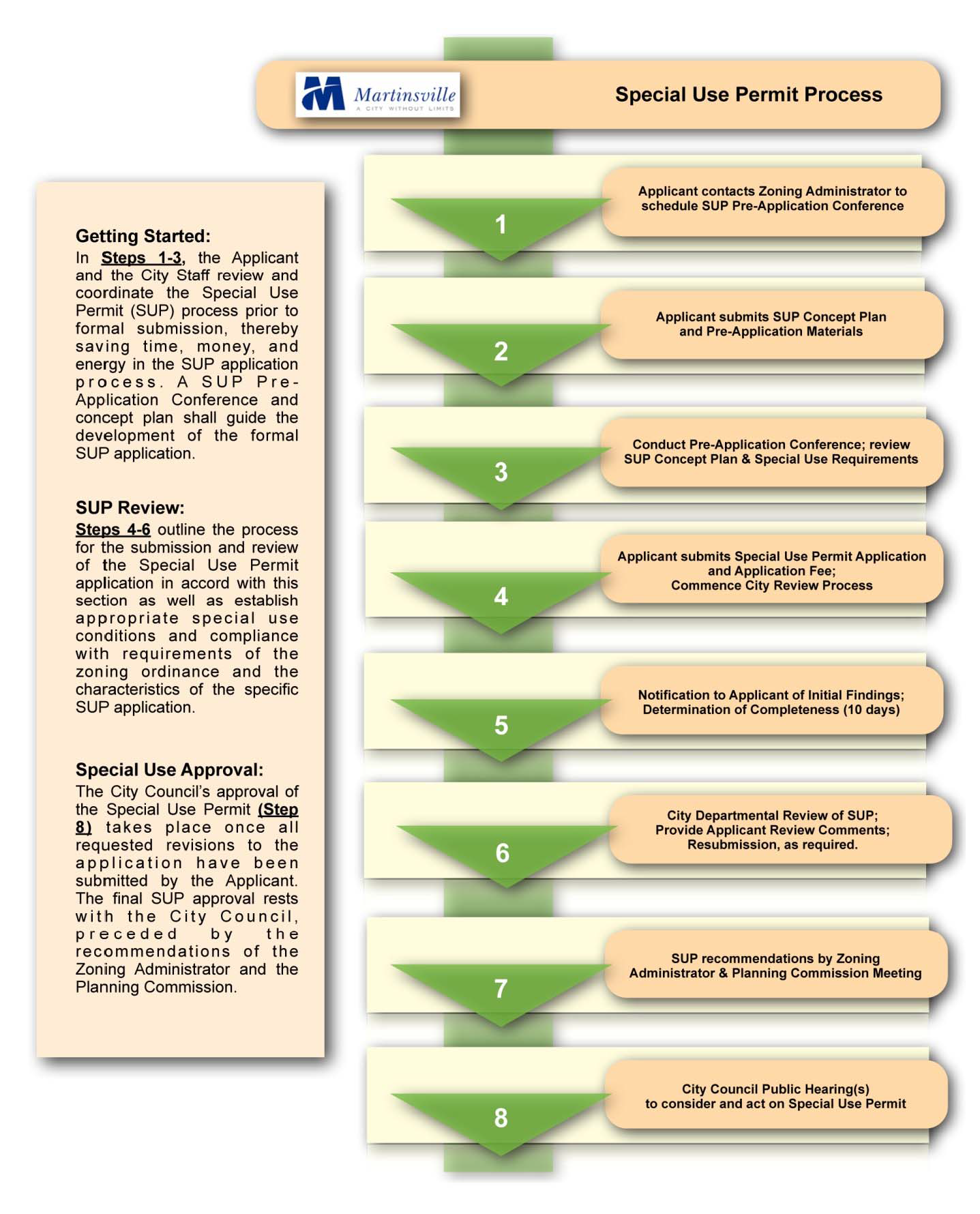
The applicant or authorized representative must participate in a pre-application conference with the zoning administrator before submitting an application for a special use permit. The applicant shall be responsible to schedule pre-application conference, and the meeting date shall be in accord with the published schedule of the zoning administrator.
2.
Following the pre-application conference, the applicant shall submit the special use permit application, the concept plan, the checklist, supporting documents, and fee for the special use permit to the office of the zoning administrator.
3.
The zoning administrator shall review the special use permit application, concept plan, and supporting documentation for completeness within ten (10) business days, and shall notify the contact person in writing if the application is not complete.
4.
Once the application is determined complete, the zoning administrator shall schedule the item for review by the city's plan review committee.
5.
Upon satisfactory review by the plan review committee, the zoning administrator shall schedule the item for the next planning commission agenda.
6.
The zoning administrator, with input from the plan review committee shall:
a.
Prepare the staff report;
b.
Schedule the public hearing by the planning commission;
c.
Provide the required public notifications; and
d.
Forward the application and staff report to the planning commission.
7.
The planning commission shall review the application and provide its recommendation to city council for either approval as submitted, approval with conditions, or denial. Failure of the planning commission to report within one hundred (100) calendar days of the first meeting of the planning commission shall be deemed approved, unless the application has been withdrawn by the applicant prior to the expiration of the time period.
8.
Following the planning commission recommendation, the city staff shall:
a.
Schedule the public hearing on the application with the city council;
b.
Provide the required public notification; and
c.
Forward the application, staff report, and planning commission recommendation to the city council.
9.
Upon receipt of the report and recommendation of the planning commission, the city council shall conduct at least one public hearing and take final action on such application within one hundred (100) calendar days from the date of action by the planning commission.
10.
The city council reviews and decides on the application following a public hearing.
11.
The city council may include special conditions of approval with a special use permit and may also require posting of a performance guarantee.
12.
The applicant shall sign and record a notice of special use, to be recorded in the circuit court of the city. Proof of recording must be submitted to the office of the zoning administrator within thirty (30) calendar days of action or the approval shall become null and void.
13.
The city council may revoke a special use permit for failure to comply with the conditions of approval.
14.
Any use authorized by a special use permit shall commence within two (2) years of the date of approval of the special use permit unless provided otherwise by the city council. Failure to commence use within the timeframe shall render the approval by city council null and void.
I. - Amendments and variations of conditions.
There shall be no amendment, change or variation of any condition created pursuant to the provisions of this section until after a public hearing before city council advertised pursuant to the provisions of the Code of Virginia.