
Maui County Unincorporated
City Zoning Code
City Zoning Code
ARTICLE II
- Comprehensive Zoning Provisions
Chapter 19.06 - DISTRICTS AND BOUNDARIES[3]
Note— The land zoning maps are not listed here because the land zoning maps are changed or amended frequently. Ordinances adopting or amending land zoning maps are adopted or amended in the same manner as other ordinances and by reference to this chapter. As of June 30, 1971, land zoning maps for Kahului and surrounding areas, Wailuku and surrounding areas, Maalaea, Kihei, Makena and surrounding areas, Olowalu and surrounding areas, Lahaina and surrounding areas, Kaanapali and surrounding areas, Pukalani and surrounding areas, Paukukalo and surrounding areas, and Spreckelsville and surrounding areas has been adopted.
Chapter 19.10 - TWO-FAMILY (DUPLEX) DISTRICTS[4]
Editor's note—Ord. No. 4884, § 3, adopted Oct. 5, 2018 changed the title of Ch. 19.10 from "Two-Family (Duplex) District" to "Two-Family (Duplex) Districts."
Chapter 19.14 - HOTEL DISTRICTS[5]
Editor's note— Ord. No. 4103, § 1, adopted in 2014, amended former Ch. 19.14 in its entirety which pertained to similar subject matter and derived from the prior code, § 8-1.7; Ord. No. 2030, § 4, 1991.
Chapter 19.15 - B-CT COUNTRY TOWN BUSINESS DISTRICT[6]
Editor's note— Ord. No. 4153, § 1, adopted in 2014, amended former Ch. 19.15, §§ 19.15.010—19.15.060, in its entirety which pertained to similar subject matter and derived from Ord. No. 1629, § 2, 1987; Ord. No. 2609, § 4, 1997; Ord. No. 3417, § 1, 2006; Ord. No. 3622, § 4, 2009; Ord. No. 3941, § 1, 2006.
Editor's note—Ord. No. 4884, § 4, adopted Oct. 5, 2018 changed the title of Ch. 19.15 from "Country Town Business Districts" to "B-CT Country Town Business District."
Chapter 19.16 - B-1 NEIGHBORHOOD BUSINESS DISTRICT[7]
Editor's note— Ord. No. 4152, § 1, adopted in 2014, amended former Ch. 19.16 in its entirety to read as herein set out. Former Ch. 19.16 pertained to similar subject matter and derived from the prior code, § 8-1; Ord. No. 2609, § 5, 1997; Ord. No. 3622, § 5, 2009; Ord. No. 3941, § 7, 2012.
Chapter 19.18 - B-2 COMMUNITY BUSINESS DISTRICT[8]
Editor's note— Ord. No. 4088, § 7, adopted in 2013, amended former Ch. 19.18, §§ 19.18.010—19.18.050, in its entirety to read as herein set out. Former Ch. 19.18 pertained to similar subject matter and derived from the prior code, § 8.19; Ord. No. 1960, §§ 1, 2, 1990; Ord. No. 2609, § 6, 1997; Ord. No. 3941, § 8, 2012.
Chapter 19.22 - B-R RESORT COMMERCIAL DISTRICT[9]
Editor's note— Ord. No. 4087, § 1, adopted in 2013, amended former Ch. 19.22, §§ 19.22.010—19.22.050, in its entirety to read as herein set out. Former Ch. 19.22 pertained to the same subject matter and derived from § 8-1.11 of the prior code.
Chapter 19.24 - M-1 LIGHT INDUSTRIAL DISTRICT[10]
Editor's note— Sec. 2 of Ord. No. 3975, effective Sept. 24, 2012, amended ch. 19.24 in its entirety to read as herein set out. Former ch. 19.24 pertained to the same subject matter, consisted of §§ 19.24.010—19.24.050; and derived from § 8-1.12 of the prior code.
Chapter 19.26 - M-2 HEAVY INDUSTRIAL DISTRICT[11]
Editor's note— Ord. No. 3976, effective Sept. 24, 2012, amended ch. 19.26 in its entirety to read as herein set out. Former ch. 19.26 pertained to the same subject matter; consisted of §§ 19.26.010—19.26.050; and derived from § 8-1.13 of the prior code.
Chapter 19.27A - PARK DISTRICTS[12]
Editor's note— Ord. No. 4264, §§ 1, 2, adopted in 2015, repealed former Ch. 27, §§ 19.27.010, 19.27.020, in its entirety and enacted a new Ch. 19.27A as herein set out. Former Ch. 19.27 pertained to the Maui Central Park District and derived from Ord. No. 1595, § 1, 1986; Ord. No. 2031, § 4, 1991; Ord. No. 3409, § 1, 2006.
19.04.010 - Title.
A.
This article shall be known as "the Comprehensive Zoning Ordinance."
(Ord. 2031 § 2 (part), 1991: prior code § 8-1.1)
19.04.015 - Purpose and intent.
A.
The purpose and intent of this comprehensive zoning article is to regulate the utilization of land in a manner encouraging orderly development in accordance with the land use directives of the Hawaiʻi Revised Statutes, the revised charter of the County of Maui (1983), as amended, and the general plan and the community plans of the County.
B.
The purpose and intent of this comprehensive zoning article is also to promote and protect the health, safety, and welfare of the people of the County by:
1.
Guiding, controlling, and regulating future growth and development in accordance with the general plan and community plans of the County.
2.
Regulating the location and use of buildings and land adjacent to streets and thoroughfares to lessen the danger and inconvenience to the public caused by undue interference with existing or prospective traffic movements on streets and thoroughfares.
3.
Regulating the location, use, or design of sites and structures in order to minimize adverse effects on surrounding uses, prevent undue concentrations of people, provide for adequate air, light, privacy, and the convenience of access to property, and secure the safety of the public from fire and other dangers.
4.
Encouraging designs that enhance the physical form of the various communities of the County
5.
Stabilizing the value of property.
6.
Encouraging economic development which provides desirable employment and enlarges the tax base.
7.
Promoting the protection of historic areas, cultural resources, and the natural environment.
8.
Encouraging the timeliness of development in conjunction with the provision of public services which include, but are not limited to, police, fire, flood protection, transportation, water, sewerage, drainage, schools, recreational facilities, health facilities, and airports.
C.
The purpose and intent of this comprehensive zoning article is also to provide reasonable development standards which implement the community plans of the County. These standards include, but are not limited to, the location, height, density, massing, size, off-street parking, yard area, open space, density of population, and use of buildings, structures, and lands to be utilized for agricultural, industrial, commercial, residential, or any other purpose.
(Ord. No. 4464, § 6, 2017; Ord. 2031 § 2 (part), 1991)
19.04.020 - Compliance.
A.
Buildings and structures. No building or structure may be erected, structurally enlarged, or maintained unless it complies with this title and the building code of the County.
B.
Subdivisions. No land may be subdivided unless the subdivision complies with this title.
C.
Permitted uses in each district. In the zoning districts, three categories of uses are permitted: principal, accessory, and special. Any use that is not expressly listed as a permitted principal, accessory, or special use is prohibited. Unless otherwise expressly prohibited elsewhere in this title, restricted use lots and the uses otherwise allowed are permitted in all districts.
(Ord. No. 5499, § 2, 2023; Ord. No. 4464, § 7, 2017; Ord. 2031 § 2 (part), 1991: prior code § 8-1.19)
19.04.025 - Roadway lots and restricted use lots.
Minimum lot area, lot width, and lot coverage requirements elsewhere in this title do not apply to roadway lots or restricted use lots within a subdivision.
Roadway lots and restricted use lots are subject to the following:
1.
Roadway lots and restricted use lots shall be designated in the notes section of the final subdivision plat with a description of each lot's intended purpose. Any designation for restricted use lots, except for restricted used lots for roadway purposes, shall be recorded and shall run with the land.
2.
Any lot designated as a roadway lot or restricted use lot shall not be used for any purpose other than a roadway lot or restricted use lot, respectively, unless the lot is consolidated with another lot and the resulting lot complies with the minimum lot area, lot width, and lot coverage requirements elsewhere in this title.
3.
In the agricultural district, any future consolidation concurrent with a subdivision that includes any roadway lot or restricted use lot cannot result in any additional lots above the number that would have been allowed at the time the lot was created by the subdivision, in accordance with sections 19.30A.030.G and 19.30A.040 of this title.
(Ord. No. 4464, § 2, 2017)
19.04.030 - Interpretation and scope.
In the interpretation and application of the same, provisions of this article shall be held to have been enacted for the purpose of promoting the safety, health, convenience and general welfare of the community. It is not intended by this article to interfere with or abrogate or annul any easements, covenants, or other agreements between parties; provided, however, that where this article imposes a greater restriction upon the use of buildings or premises or upon height of buildings or requires larger open spaces than are imposed or required by other ordinances, rules, regulations or easements, covenants, or agreements, the provisions of this article shall govern.
(Prior code § 8-1.25)
19.04.040 - Definitions.
When used in title 19 of this code, unless the context clearly indicates a different meaning, for the purposes of title 19, the following words and terms shall be defined as follows:
"Accessory building" means a portion of the main building or a detached subordinate building located on the same lot, the use of which is appropriate, subordinate and customarily incidental to that of the main building or to the main use of the land.
"Accessory building or structure" means a structure detached from a principal building on the same zoning lot which is customarily incidental and subordinate to the principal building or use and not used for human habitation.
"Accessory dwelling" means an attached or detached dwelling unit which is incidental or subordinate to the main or principal dwelling on a lot.
"Accessory use" means a use of land or of a building or portion thereof which is customarily incidental and subordinate to the principal use of the land or building and located on the same zoning lot as the principal use.
"Administrator" means the person who holds the office of director and/or executive secretary or authorized representative of the appropriate planning commission.
"Agricultural land conservation" means the planting of soil-nourishing plants and trees to achieve soil conservation and environmental benefits, including but not limited to soil nourishment, prevention of soil erosion, improvement of air quality, and habitat restoration.
"Agricultural Lands of Importance to the State of Hawaiʻi (ALISH)" means the agricultural land classification system adopted by the State of Hawaiʻi, board of agriculture. This system identifies those lands of the state which are of agricultural importance, and categorizes them according to specific criteria.
"Agricultural lease" means a contract renting a portion of a lot within the agricultural district for a specified period or for a period determinable at the will of either lessor or lessee in consideration of rent or other compensation.
"Agricultural products" means cultivated or raised plant, animal, or marine life that has been harvested for consumption, including but not limited to coffee; feed and forage; floriculture and nursery products; grain; herbs and roots; sugar cane; fruits and nuts; vegetables and melons; honey; eggs; dairy; cattle, pigs, sheep, poultry; marine life; and fiber for clothing and building material. This does not include processed products.
"Agricultural products processing" means the processing, canning, bottling, packing or packaging of agricultural produce, livestock and forestry products for eventual distribution or consumption.
"Agricultural resources" means all the natural and man-made resources of agricultural production, including the land, soil, water, air, plant communities, watersheds, and natural and physical attributes that together comprise and support agriculture.
"Agriculture" means the production of plant and animal life for food and fiber, and for raw materials for processed products. Agriculture includes but is not limited to fruit, vegetable, and flower growing; forestry; aquaculture; beekeeping; grazing and dairying; and their accompanying services and facilities.
"Alley" means a service right-of-way providing a secondary means of access to abutting property and not intended for general traffic circulation.
"Amusement center" or "entertainment establishment" means any indoor or outdoor establishment where entertainment, either passive or active, is provided for patrons, either as spectators or participants and either independently or in conjunction with any other use. Examples of entertainment include presentations, performances, or activities that include music, dancing, acting, comedy, or other theatrical shows, whether live or recorded; nightclub activities; karaoke; the playing of games such as video games or darts; and other activities provided for the pleasure, diversion, or amusement of patrons.
"Animal and livestock raising" means facilities and activities associated with the breeding and raising of live animals such as dairy cows, poultry, hogs, beef cattle, sheep, horses, bees, dogs, and other domesticated animals. This does not include small-scale animal keeping.
"Animal boarding facility" means a structure or premises where animals are boarded, groomed, bred or trained for commercial gain, including commercial stables and kennels.
"Animal hospital" means a structure or premises where animals are given medical care, and the boarding of animals is limited to short-term care incidental to the hospital use.
"Apartment" or "apartment unit" means one or more rooms with private bath and kitchen facilities comprising an independent self-contained dwelling unit in a building containing three or more dwelling units.
"Apartment hotel" means a building or portion thereof used as a hotel as defined in this chapter and containing the combination of individual guest rooms or suites or rooms with apartments or dwelling units.
"Apartment house" means the same as "dwelling unit, multifamily."
"Assembly area" means facilities with fixed seats or large spaces designed to accommodate temporary seating on a regular basis for gathering for events or open exhibition halls. Examples include theaters, churches, auditoriums, libraries, auctioneer establishments, museums, art galleries, meeting rooms and spectator sports arenas.
"Automobile services" means a facility providing fueling, greasing, lubrication, rental, and cleaning services (including car washing or detailing) for vehicles. Additional services may include, but are not limited to, minor engine repair, such as replacement of spark plugs, batteries and tires; minor repair of engine parts such as fuel pumps, oil pumps and lines, belts, carburetors, brakes, mufflers, and emergency wiring; radiator cleaning and flushing; towing; safety inspections; and motor adjustments not involving repair of head or crankcase. Services not included are tire recapping and regrooving; body work, such as straightening of frames or body parts; steam cleaning; welding; painting; and storage of automobiles not in operating condition.
"Automobile trailer and equipment sales area" means an open area other than a street used for the display, sale or rental of new or used automobiles, trailers, or other equipment, where no repair work is done except minor, incidental repair of automobiles, or trailers to be displayed, to be sold, or to be rented on the premises.
"Automobile wrecking establishment" means the business of dismantling or wrecking of used motor vehicles or trailers.
____________
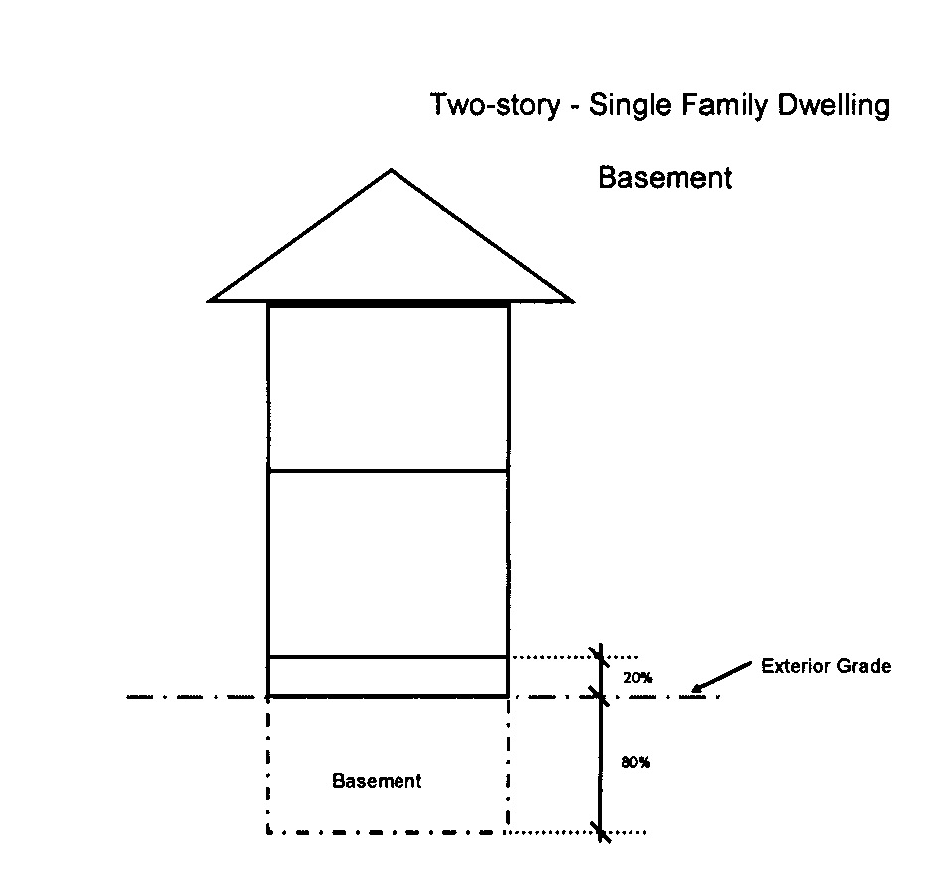
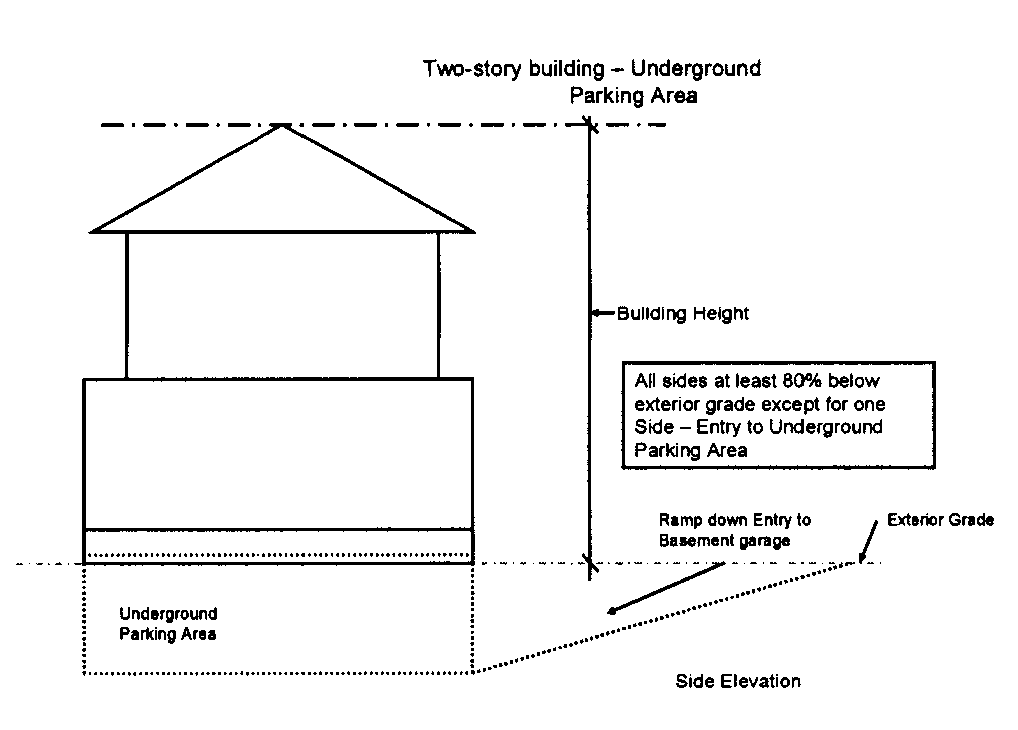
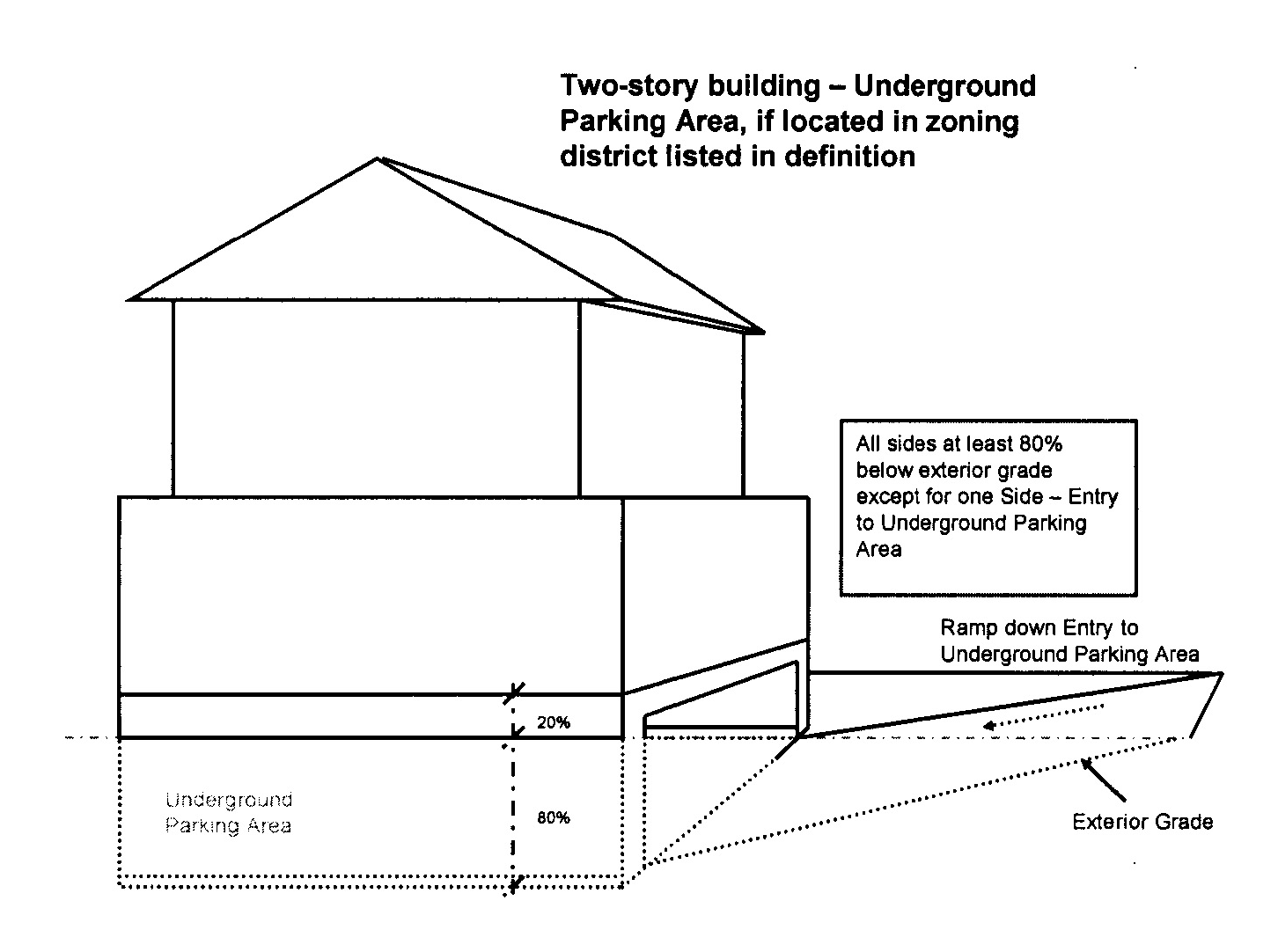
"Basement" means a portion of a building between floor and ceiling, at least 80 percent of which is located below exterior grade on all sides, access to which is exclusively from the floor above.
_____
"Bed and breakfast home" means a use in which overnight accommodations are provided to guests for compensation, for periods of less than one hundred eighty days, in no more than two detached single-family dwelling units, one of which is occupied by the owner-proprietor. Each bed and breakfast home shall include bedrooms, one kitchen, and living areas and shall include no more than six bedrooms for bed and breakfast home use, as specified within the zoning district provisions of this title.
"Block" means a usually rectangular space enclosed by streets and occupied or intended for buildings.
"Boarder" means a person who occupies a bedroom or room as a lodging unit within a dwelling unit, boardinghouse, rooming house, or lodginghouse on a long-term residential basis for a consideration and where meals may be provided by the owner or operator.
"Boardinghouse" means a long-term residential use in a building having not more than five bedrooms where at least one meal may be provided for no more than five persons for compensation.
"Building" means any structure built for the support, shelter, housing, occupancy, storage or enclosure of persons, animals, or property of any kind.
"Building area" means the total area of a zoning lot covered by buildings and covered open areas. The following are not considered building area: (a) open areas covered by eaves and normal overhang of roofs; (b) uncovered entrance platforms, uncovered terraces, and uncovered steps when these features do not themselves constitute enclosures for building areas below them, and do not exceed thirty inches in height; and (c) all weather surfaces.
____________
"Building envelope" means the area enclosed by the three-dimensional exterior surfaces of a building or structure, including any open air areas between the posts, or the posts and walls, that hold up a roof, such as carports and covered decks.
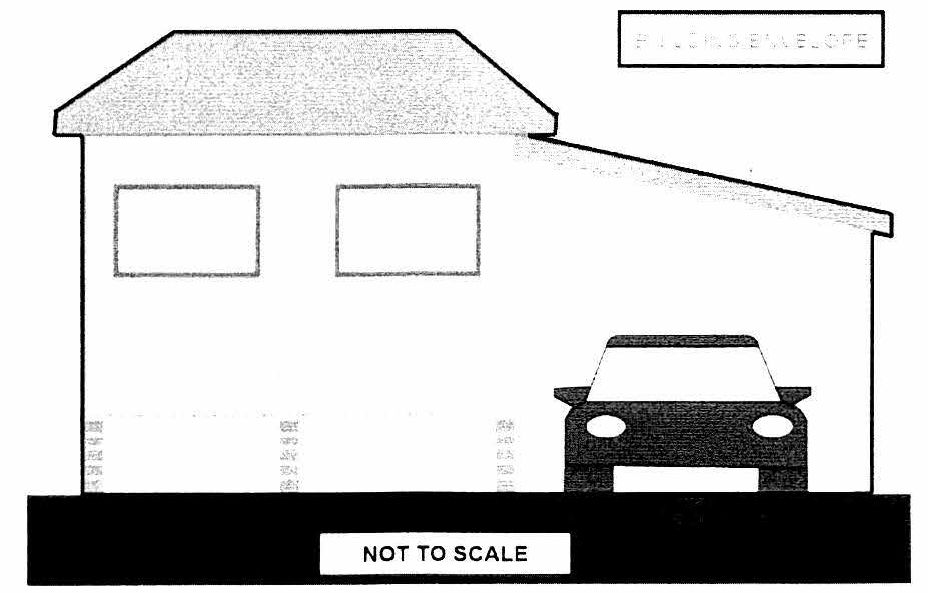
Figure 1 "Building envelope"
____________
"Building height" means the same as "height."
"Bungee jumping" means an activity during which a participant jumps from a height, such as from a building, crane, bridge, or cliff, while connected to an elastic cord.
Bureau of conveyances. Wherever it appears in this article, "bureau of conveyances" includes the bureau of conveyances and the office of the assistant registrar of the land court of the state.
"Campground" means any portion of a zoning lot upon which more than one camping unit is located for occupancy by members of the general public as temporary, recreational, living quarters which may include a bathroom and a kitchen; provided, that a camping unit which is not a recreational vehicle but which contains a bathroom or a kitchen shall be limited to one camping unit per ten acres of land.
Camp, public. "Public camp" means any area or tract of land used or designated to accommodate two or more automobiles, house trailer, or two or more camping parties.
Camp, trailer. "Trailer camp" means the same as "public camp."
"Camping unit" means a tent, recreational vehicle, cabin, lean-to, or other similar structure which provides or is intended to provide temporary living quarters for a person or persons for not more than six consecutive nights within a thirty-day period.
"Canopy tour" means an aerial adventure course that may include beams, bridges, cable traverses, climbing walls, nets, platforms, ropes, swings, seat harnesses, towers, or ziplines that may be installed on or in, or in combination with, trees, poles, portable structures, or buildings, or be part of self-supporting structures.
"Carport" means a roofed structure providing space for the parking or storage of motor vehicles and enclosed on not more than three sides.
"Cemetery" means land used or intended to be used for the burial of the dead and dedicated for cemetery purposes, including columbariums, mausoleums, mortuaries and crematoria; provided it has the approval of the department of health, the commission and the County council when operated in conjunction with and within the boundary of such cemetery.
"Commercial agriculture" means the selling of agricultural products or by-products for monetary consideration with annual gross sales of $2,500 or more.
"Commercial purpose" means the growing, processing, manufacturing, or sale of products or goods or the provision of services for consideration and profit.
"Commission" means the appropriate planning commission of the County.
"Component use" means an individual part or element of land, building, or structure that is utilized differently from other parts or elements.
"County" means the County of Maui of the State of Hawaiʻi.
"Court" means an open, unoccupied space other than a yard on the same lot with a building and bounded on two or more sides by such building or buildings.
Court, apartment. "Apartment court" means one or more multifamily dwellings, occupied on a long-term residential basis, any of which may be more than one story in height and arranged around two or more sides of a court or place from which court or place any dwelling unit therein has its principal means of access. An apartment court shall be deemed to include those multifamily dwellings which contain the principal means of access to any dwelling unit therein from a court or place or side yard.
Court, bungalow. "Bungalow court" means two or more single-family detached dwellings occupied and arranged around one, two or three sides of a court which open onto a street.
Court, tourist. "Tourist court" means a group of attached or detached buildings containing individual living or sleeping units, designed or used temporarily by automobile tourists or transients with garage attached or parking spaces conveniently located to each unit, including auto courts, motels, or motor lodges.
"Cultural resources commission" means the Maui County cultural resources commission.
"Curb grade" means the elevation of the top of the face of the curb as fixed by the County.
"Curb level" means the elevation of the established curb in front of the building measured at the center of such front. Where no curb level has been established, the director of public works and waste management of the County shall establish such curb level or its equivalent for the purpose of this article.
"Day care facility" means a facility where persons are cared for on an intermittent basis, but not continuously over a twenty-four hour period, such as, but not limited to, adult day care, preschools, and day nurseries.
"Day care nursery" means premises where young children are cared for during the day with or without compensation in facilities approved by the appropriate government agencies. "Child care home," "day care center," "day care home," "nursery" and "babysitting services" means the same as "day care nursery" for purposes of title 19.
"Department" means the department of planning.
"Developable area" means the total area, in square feet, of all enclosed living areas of dwellings.
"Director" means the director of the department of planning or the director's authorized representative.
"District" means the applicable district established by the provisions of this article.
"Drive-in restaurant" means a restaurant business where food is served to a person or persons in their automobiles or vehicles.
"Duplex" means the same as "dwelling unit, two-family."
"Dwelling" means the same as "dwelling unit."
Dwelling, apartment house. "Dwelling unit, apartment house" or "apartment house dwelling" means the same as "dwelling unit, multifamily."
Dwelling, multiple-family. "Multiple-family dwelling" means the same as "dwelling unit, multifamily."
Dwelling, single-family. "Single-family dwelling unit" means a building consisting of only one dwelling unit designed for or occupied exclusively by one family.
Dwelling, two-family, or duplex. "Two-family dwelling unit" means a building consisting of only two dwelling units designed exclusively for occupancy by two families living independently of each other.
"Dwelling unit" means a room or group of rooms connected together constituting an independent housekeeping unit for family and containing a single kitchen.
Dwelling unit, multifamily. "Multifamily dwelling unit" means a building or portion thereof which consists of three or more dwelling units and which is designed for occupancy by three or more families living independently of each other.
"Eating and drinking establishments" means a business engaged in the preparation and serving of food and beverages to customers, such as, but not limited to, restaurants, delicatessens, cafes, bars, and nightclubs, and also includes a mobile food truck if the vehicle or trailer is parked on the same lot for more than three consecutive days.
"Educational institutions" means established organizations serving to impart knowledge or skill through systematic instruction, including but not limited to, kindergartens, elementary schools, intermediate schools and colleges supported wholly or in part by public or private funds giving general academic instructions.
Education, general. "General education" means a facility offering a general educational curriculum, such as, but not limited to, kindergartens, elementary, intermediate, and high schools, and colleges and universities.
Education, specialized. "Specialized education" means a facility that offers a specialized educational curriculum, such as, but not limited to, trade and vocational, language, research and learning, music, dance, art, yoga, and martial arts.
"Eleemosynary organization" means an organization which distributes charity or doles out relief.
"Energy systems, small-scale" means energy production facilities which are incidental and subordinate to a principal use which is established on the property. These systems include but are not limited to solar, wind, hydrologic, and biomass systems.
"Family" means an individual living alone or a group of two or more persons related by blood or marriage and their legal issue living together as a single housekeeping unit in a dwelling unit and in which two boarders, unrelated by blood may be living on a long-term residential basis. A family may also be defined as no more than five unrelated persons living together as a single housekeeping unit. In addition, eight or fewer persons who reside in residential facilities monitored and/or licensed by the state pursuant to chapter 46-15.3 of the Hawaiʻi Revised Statutes shall constitute a family. Resident managers, supervisors or operator and operator's family shall not be included in the resident count.
"Farm." For the island of Molokai and all lands of the department of Hawaiian home lands designated for agriculture, "farm" means a lot on which the majority of the land is used for and the predominant activity is agriculture or agricultural land conservation. For the islands of Lanaʻi and Maui, "farm" means a lot on which at least 51 percent of the area of the land that is used for, and the predominant activity is, agriculture or agricultural land conservation. If it is determined by the director that more than 49 percent of the lot is not usable, accessible, or feasible for farming or ranching, then those areas deemed unusable, inaccessible, or infeasible may be excluded, provided that the remainder of the lot is used for the predominant activity of agriculture or agricultural land conservation. For the purpose of this definition, land that is not usable, accessible, or feasible for active agricultural uses must include but is not limited to culturally sensitive areas, slopes steeper than one to one, streams or gulches, areas that are subject to "flood" or "flooding" as defined by section 19.62.030, or land containing earth material that cannot be farmed, provided that final determination is subject to approval of the director.
"Farm dwelling" means a single-family dwelling that is located on and used in connection with a farm.
"Farm labor dwelling." For the island of Molokai and all lands of the department of Hawaiian home lands designated for agriculture, "farm labor dwelling" means a dwelling or lodging unit that is used exclusively by agricultural employees employed full-time or seasonally in the County, and that is located on a farm and is ancillary and secondary to agriculture. For the islands of Lanaʻi and Maui, "farm labor dwelling" means a dwelling unit or lodging unit that is used exclusively by full-time and part-time agricultural employees who hold a residential lease of at least six months, including interns, apprentices, and volunteers, while working on a farm or ranch on which the unit is located. Family members of the agricultural employee may also reside in the farm labor dwelling. Farm labor dwellings located on important agricultural lands are subject to the restrictions set forth under section 205-45.5, Hawaiʻi Revised Statutes. At no time may the farm labor dwelling be used as a short-term rental. The employer must maintain documentation of the agreement between employee and employer at all times and provide the documentation to the director upon request. Farm labor dwellings must be affordable to residents earning 140 percent or less of the County's area median income as established by HUD, irrespective of any tenant's actual income.
"Farmer's market" means the temporary use of a specified land area managed by a single operator who leases space/stalls for the outdoor sales of fresh fruit and produce, meat and fish items, plants and flowers grown, raised or caught within the State of Hawaiʻi, including value added products derived from said products.
"Fence" means an open barrier of posts and wire, wood, chain link or similar material that closes, marks or borders a field, yard or lot and that does not limit, by more than 50 percent, visibility or the flow of air and light.
"Flag lot" means a lot not fronting on or abutting a roadway used for general traffic circulation, where access to the roadway from the lot is by a private right-of-way with a narrow width of 12 feet minimum and 24 feet maximum, where the minimum lot area shall be equal to the lot area of the zone exclusive of the private right-of-way, where the minimum front, side and rear yard requirements of the zone shall be met on the portion excluding the private right-of-way, where there is not more than two adjacent flag lots for each private right-of-way, and where there shall be a minimum distance of at least the minimum lot width in the particular zone between each private right-of-way to more than two adjacent flag lots.
"Floor area" means the roofed area of all floors of a structure measured from the exterior faces of the exterior walls or from the center line of party walls dividing a structure; the floor area of a structure, or portion of the floor area, that is not enclosed by exterior walls shall be the area under the covering, roof, or floor that is supported by posts, columns, partial walls, or similar structural members that define the wall line. Excluded from the floor area are:
1.
Parking structures such as garages and carports, including covered driveways and accessways, porte cocheres, and parking attendant booths.
2.
Attic areas with head room less than 7 feet.
3.
Projections such as sunshade devices and architectural embellishments that are decorative only.
4.
Areas covered by roofing treatment to screen rooftop machinery only.
5.
Areas underneath unsupported roof overhangs or cantilevered building overhangs, provided no portion of the area is enclosed except for a safety railing or wall not exceeding 4 feet in height.
6.
Elevators and vent shafts.
7.
Basements that are used exclusively for storage.
8.
Common walkways and other exterior common areas in multi-family and commercial structures, such as stairways, breezeways, and fire escapes.
9.
Exterior machinery and equipment enclosures such as for laundry, water heaters, air conditioning, and trash receptacles.
See figures below.
_____
FLOOR AREA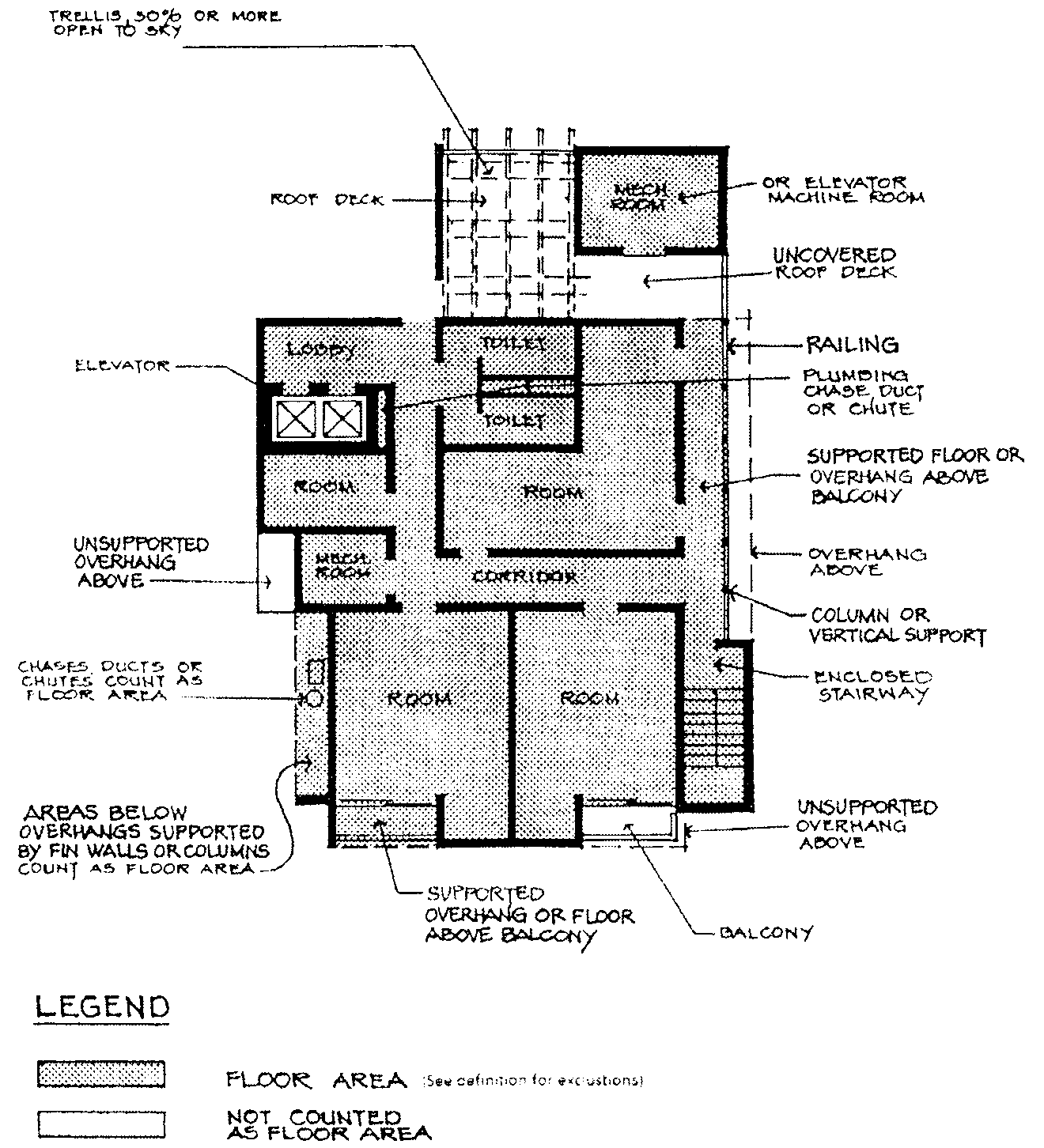
FLOOR AREA (Continued)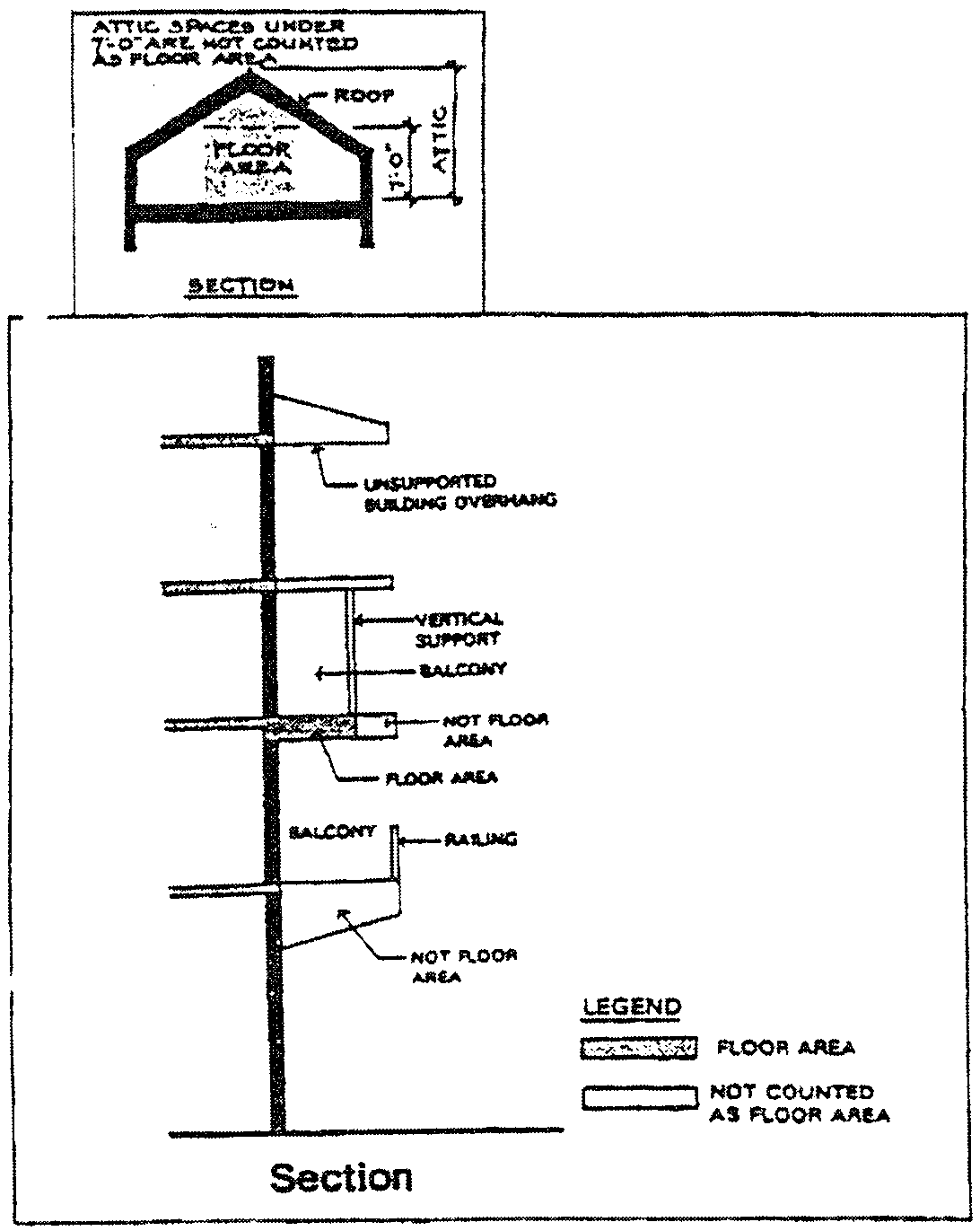
_____
Food and beverage, retail. "Retail food and beverage" means businesses engaged in the retail sale of food and beverage products, such as, but not limited to, supermarkets, convenience stores, bakeries, liquor stores, and catering establishments.
"Frontage" means all the property abutting one side of a street between two intersecting or intercepting streets, or between a street and public or private right-of-way, end of dead end street, or city boundary measured along the street line. An intercepting street shall determine only the boundary of the frontage on the side of the street which it intercepts.
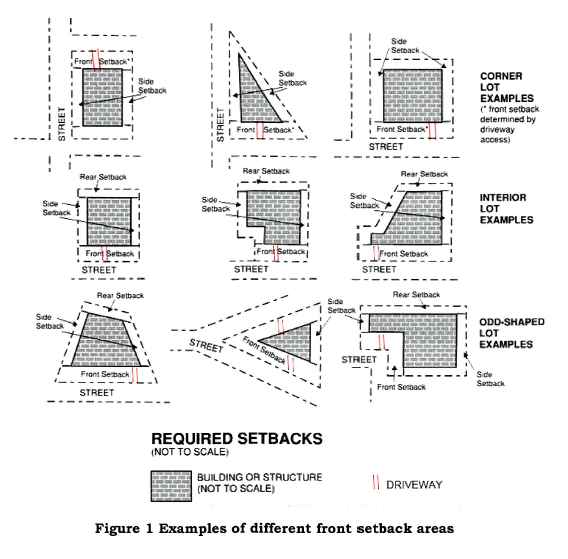
"Front of lot" or "front lot line" means every lot line bordering a public or private street through which a driveway provides access to the "lot area."
"Garage" means a building or portion thereof wherein automobiles or other self-propelled vehicles, or where other such vehicles, are serviced or equipped for operation, repaired, or housed and stored for remuneration, hire or sale.
Garage, private. "Private garage" means a building or a portion of a building, not more than 1,000 square feet in area, in which only motor vehicles used by the tenants of the building or buildings on the premises are parked or kept and which is not a commercial enterprise available to the general public.
Garage, public. "Public garage" means a building or structure, other than a private garage, used for the housing, storage, or care of automobiles or other self-propelled vehicles or where other such vehicles are serviced or equipped for operation, repaired, or housed and stored for remuneration, hire, or sale.
Garage, storage. "Storage garage" means any premises except those described as a private or public garage used exclusively for the storage of self-propelled vehicles.
"General merchandising" means businesses within permanent enclosed facilities engaged in the retail sale or rental of goods, including, but not limited to, retail stores, drugstores, department stores, electronic and communication stores, hardware stores, home furnishing stores, pet stores, garden shops, and equipment rentals.
"General office" means facilities used for the practice of a profession, the conduct of public administration, or the administration of business or industry. Examples include offices for government agencies, non-profit organizations, financial, insurance, and real estate companies, professional practices (except medical and dental), television and radio stations, and data networking facilities.
Grade, finish. "Finish grade" means the final elevation of the ground surface after man-made alterations such as grading, grubbing, filling or excavating have been made on the ground surface.
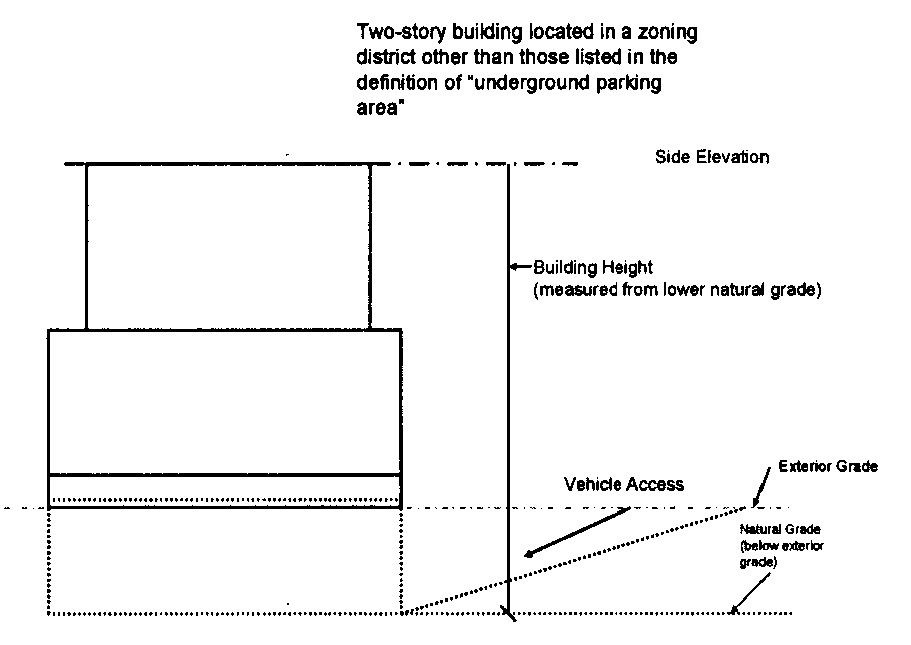
Grade, natural. "Natural grade" means the existing grade or elevation of the ground surface which exists or existed prior to man-made alterations such as grading, grubbing, filling, or excavating.
"Group shelter" means a building which serves as temporary living quarters for a group of persons, who may include, but are not limited to, those who are homeless or who suffer from spousal, child, or substance abuse, or who are physically and mentally handicapped, and wherein counseling services may be provided to these persons.
"Guest" means any person other than the family occupying or hiring a room for living or sleeping purposes.
"Health care facility" means a private or public institution, place, building, or agency located in the County, used, operated, or designed solely to provide medical diagnosis, treatment, nursing, rehabilitative, or preventive care to any person by a health care provider.
"Health care provider" means a physician, osteopathic physician, surgeon, dentist, physician assistant, podiatrist, optometrist, psychologist, nurse, occupational therapist, physical therapist, certified nurse aid, medical assistant, and other health care facility employees or contractors legally authorized to practice medicine and operate within the State.
"Health club" means a facility where people use equipment or space for the purpose of physical exercise.
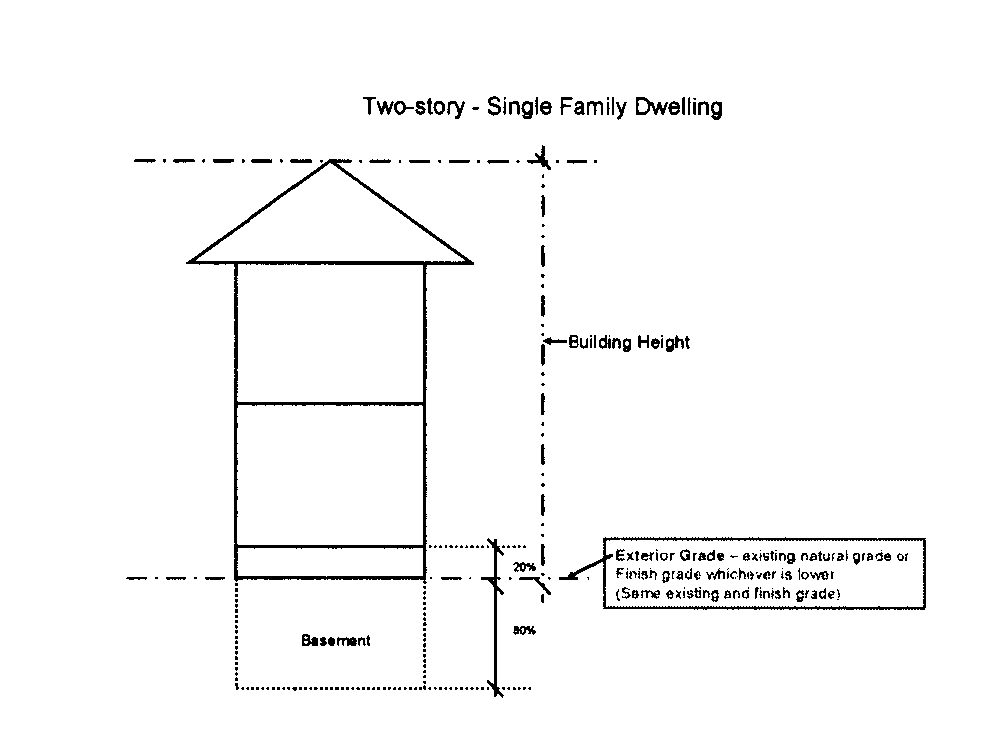
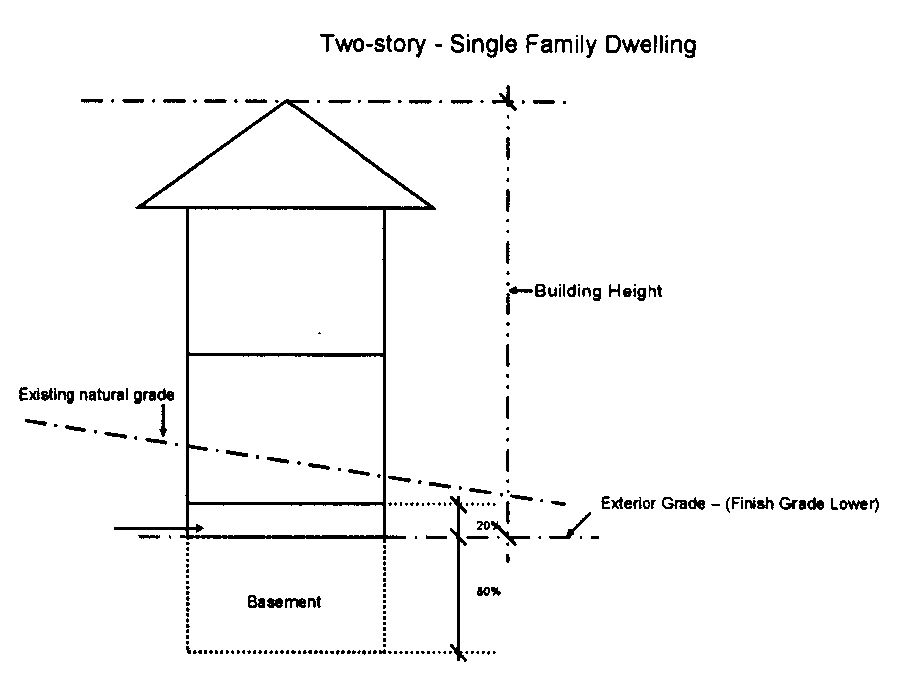
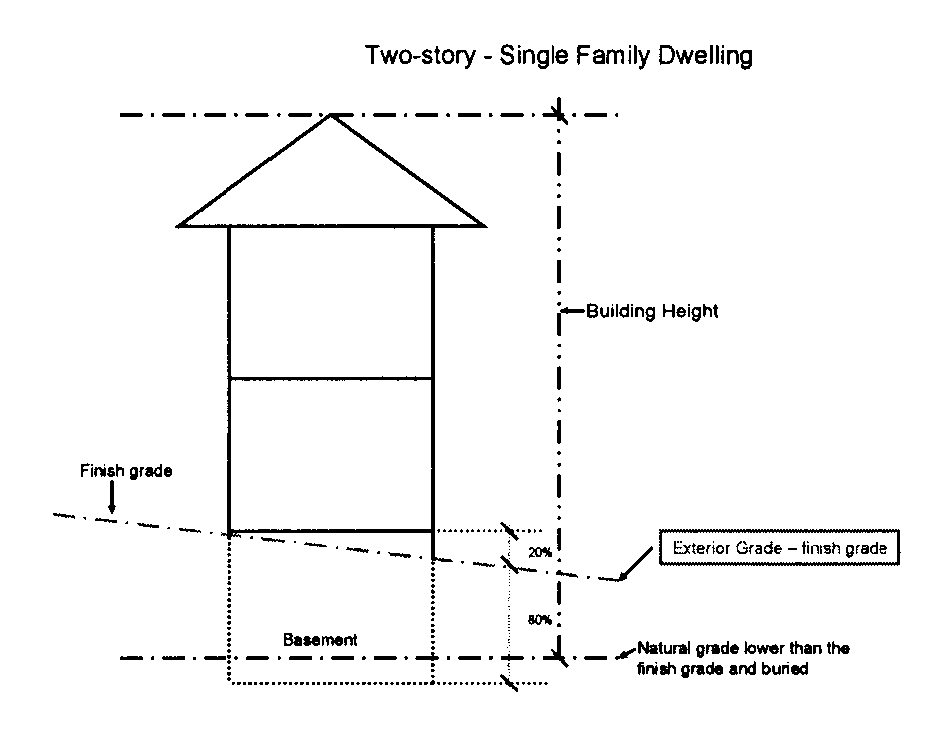
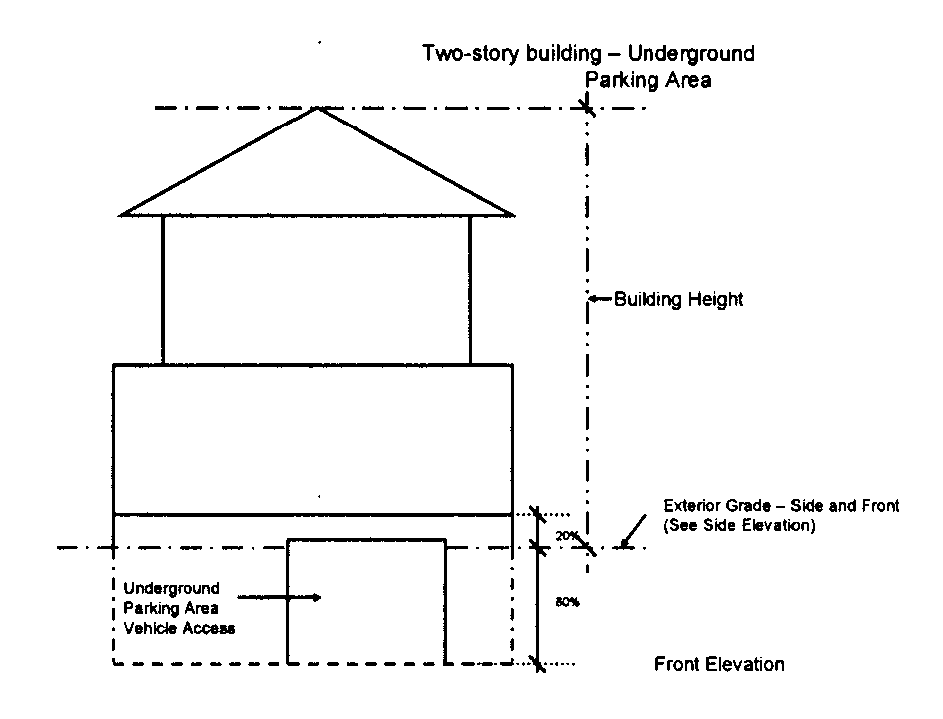
"Height" means the vertical distance measured from a point on the top of a structure to a corresponding point directly below on the natural or finish grade, whichever is lower. Height for buildings with basements shall be measured from the lowest exterior natural or finished grade. Height for buildings with underground parking areas shall be measured from the lowest exterior natural or finished grade, excluding the area used for vehicle access. For structures within projects that received site plan approval in association with a project district phase II approval, step II planned development approval, or final subdivision approval after September 4, 1991, building height shall conform to the elevation as indicated on the approved site plan, which may use finish grade to measure height. For structures within project districts that received phase II approval prior to September 4, 1991, finish grade shall be used to determine height.
_____
Examples of Various Height Measurements:
_____
"Historical building, structure or site" means a building, structure or site identified as historic by the County, state, or federal government.
"Home business" means an enterprise or activity, conducted by the occupant of the dwelling unit where the enterprise or activity takes place and which includes the growing, processing, or manufacturing of a product, or the provision of services, for consideration and profit.
"Home occupation" means an enterprise or activity conducted by the occupant of the dwelling unit wherein the enterprise or activity takes place and which involves either the growing, processing, or manufacturing of product or the provision of services for consideration and profit; provided:
1.
That no person other than a member of the family residing on the premises of the dwelling unit shall be employed by the home occupation;
2.
That no more than 25 percent of the floor area of the dwelling unit shall be used by the home occupation;
3.
That no group instruction classes or group sales meeting shall be permitted on the premises of the dwelling unit;
4.
That no product shall be exchanged by the operator of the home occupation or the operator's agents to any other person on the premises of the dwelling unit for consideration;
5.
That no sign, display, or change in the exterior appearance of the dwelling unit to advertise the home occupation shall be permitted;
6.
That no goods, chattel, materials, supplies, or items of any kind shall be delivered either to or from the premises of the dwelling unit used for a home occupation other than by a vehicle owned by the residents of the dwelling unit and limited to cars, jeeps, vans with a maximum capacity of nine passengers, and four-wheel drives and trucks with a maximum load capacity of three-quarter ton;
7.
That any storage of goods, samples, materials, or objects used in connection with the home occupation shall be stored within the dwelling unit and shall receive the approval of all appropriate governmental agencies;
8.
That clients, patrons, and customers of the home occupation shall be prohibited on the premises except for educational services on a one-to-one pupil-teacher basis so long as such activity is limited to a total of eight persons per day; and
9.
That the following occupations shall not be construed to be a home occupation and therefore shall not be permitted:
a.
The repair, manufacture, processing, or alteration of goods, materials, or objects, except baking, dressmaking, tailoring, and the manufacturing of arts and craft items,
b.
Harboring, training, or raising dogs, cats, birds, horses, or other animals, and
c.
Automobile and/or body fender repairing.
"Hotel" or "motel" means a transient vacation rental, excluding bed and breakfast homes and short-term rental homes.
"Island of Maui" means the districts of Wailuku, Makawao, Lahaina and Hāna as these districts are defined by section 4-1 of the Hawaiʻi Revised Statutes.
"Impervious surface" means a surface covering or pavement of a developed parcel of land that prevents the land's natural ability to absorb and allow rainfall or storm water to infiltrate its surface. Impervious surfaces can include rooftops, walkways, patios, pools, driveways, parking lots, impermeable concrete and asphalt, and any other continuous watertight pavement or covering.
"Joint use" means the development of two or more adjacent zoning lots located in the same zoning district and used a single, unified project or development.
"Joint-use parking" means two or more uses utilizing the same parking space(s).
"Junkyard" means a lot or portion thereof or tract or parcel of land used for the business of storage, keeping or abandonment of junk or waste material or the dismantling, demolition, or abandonment of automobiles or other vehicles or machinery or parts thereof.
"Kennel" means any premises, building or structure in which four or more dogs or cats at least six months old are harbored.
"Kindergarten" means a school for young children of pre-elementary school age with facilities and studies as prescribed by the department of education of the state. "Preschool kindergarten" means the same as "kindergarten" for purposes of title 19.
"Kitchen" means a room, or portion of a room, designed, arranged, intended, or used for cooking or otherwise making food ready for consumption, and within which there may be appliances for the heating, cooking, and storage of food. This definition excludes "kitchenettes."
"Kitchenette" means an area that is internally accessible via an enclosed living area within a dwelling unit, in addition to the kitchen, used for the small-scale preparation and serving of food and beverages that may contain a sink, a refrigerator, and small appliances for the preparation of hot food or beverages, such as countertop appliances and a two-burner range. A kitchenette may not contain a 220-volt electrical outlet or gas appliances.
"Light manufacturing and processing" means enclosed facilities for the production or assembly of products, other than food or agricultural products, involving limited or minor emissions of odors, fumes, noise, vibrations, heat, glare, or electrical interference to the exterior, such as, but not limited to, commercial laundries, laundromats, craft industries, apparel manufacture, and small craft assembly plants.
"Live/work mixed use" or "mixed use" means a combination of one or more dwelling units and one or more non-residential uses other than home occupations, home businesses, and transient accommodations conducted on a single lot in one or more buildings.
"Living quarters" means one or more rooms in a building designed for occupancy by one or more persons for living or sleeping quarters.
"Loading space" means a space or berth or area of land outside the boundaries of a street, alley, or other public right-of-way and situated on the same lot with the building to be served, or contiguous to a group of buildings for the purpose of providing temporary parking of a commercial vehicle while loading or unloading merchandise or materials, and which is readily accessible to vehicular traffic by means of a street, alley, or other appropriate access.
"Lodging house" means a long-term residential use of any building or groups of buildings or portion thereof having no more than nine bedrooms for three or more unrelated persons and meals are provided.
"Lodging unit" means a room or group of rooms connected together, constituting an independent living unit which does not contain any kitchen.
"Long-term residential" or "long-term residential basis" means occupancy of a dwelling unit or lodging unit by an owner, family, lessee, or tenant for one hundred eighty days or more per year.
"Lot" means a parcel of land considered as a unit and enclosed within defined boundaries, or a building site having the required area for certain use, or occupied or intended to be occupied, by a building or group of buildings and accessory buildings in compliance with the requirements in each zone.
Lot, corner. "Corner lot" means a lot situated at the intersection of two or more streets and at an angle of intersection of not more than one hundred thirty-five degrees.
Lot, interior. "Interior lot" means a lot other than a corner lot.
Lot, key. "Lot" or "key lot" means the first interior lot to the rear or a reversed corner lot.
Lot, reversed corner. "Reversed corner lot" means a corner lot, the rear of which abuts upon the side of another lot.
Lot, through. "Through lot" means a lot having frontage on two parallel or approximately parallel streets.
Lot, zoning. See "Zoning lot."
"Lot area" means the total area within the lot lines of a lot, exclusive of portions subject to easements or right-of-way for ingress and egress in favor of other lots or land, but including portions subject to easements for water, sewer, and other public utility purposes.
"Lot coverage" means the area of a lot occupied by all roofed structures, whether open box-type, lath roofs, or fully roofed, including buildings, accessory buildings, carports, garages, lanais, patios, porches, and recreational facilities. Covered walkways, trellis-covered parking and trellis-covered accessory equipment, underground parking when the roof is not more than an average height of thirty-six inches above the adjacent grade, and unroofed structures such as swimming pools, tennis courts, fences, and walls used as fences shall not be included in calculating lot coverage area.
"Lot depth" means the horizontal distance between the front and rear lot lines measured in the mean direction of the side lot lines.
"Lot line" means a line of record bounding a lot which divides one lot from another lot or from a public or private street or any other public space.
Lot line, front. Means the same as "front of lot".
Lot line, rear. "Rear lot line" means a lot line which is opposite and most distant from the front lot line.
Lot line, side. "Side lot line" means any lot boundary line not a front lot line or a rear lot line.
Lot line, zero. "Zero lot line" means a lot line from which there is no building setback.
"Lot width" means the diameter of the largest circle that can be inscribed within the lot lines.
"Maintenance easement" means an area of a parcel of land free of structures reserved to an adjacent parcel of land to allow access to repair and maintain a structure located on the adjacent parcel.
Medical center, major. "Major medical center" means a facility established for in-patient maintenance, observation, medical, dental, and other health care treatment and supervision, or for convalescence of persons afflicted with or suffering from sickness, disease, or injury, such as, but not limited to, hospitals and nursing homes.
Medical center, minor. "Minor medical center" means a facility established to provide medical, surgical, dental, laboratory, and x-ray, or other similar health care services to the general public without overnight accommodations.
"Mobile food truck" means a motorized vehicle or vehicle-towed trailer in which food is cooked or prepared to order and is served to walkup customers, provided that the vehicle or trailer is not on the same lot for more than three consecutive days, in which case the use shall be considered an eating and drinking establishment.
"Motel" means the same as "hotel."
"Nonconforming building or structure" means a building or structure or portion thereof which was previously lawful but which does not comply with the density, yard, setback, or height regulations of the district in which it is located, either on the effective date of the ordinance codified in this article or as a result of any subsequent amendment.
"Nonconforming lot" means a lot, the area, dimensions, or location of which was lawful prior to the adoption, revision, or amendment of the zoning ordinance, but which fails by reason of such adoption, revision, or amendment to conform to the present requirements of the zoning district.
"Nonconforming parking" or "nonconforming loading" means any parking or loading space or parking area, including the space's or area's dimensions and related requirements such as landscaping, that was previously lawful but does not comply with the requirements of this code, on the effective date of the ordinance establishing such requirements or as a result of subsequent amendments.
"Nonconforming uses" means any use of a structure or zoning lot which was previously lawful but which does not conform to the applicable use regulations of the district in which it is located, either on the effective date of the ordinance codified in this article or as a result of any subsequent amendment.
"Nursery school" means an agency engaged in educational work with preschool children. Children enrolled are not necessarily in need of supplemental parental care.
"Occupancy" means the purpose for which a building is used or intended to be used. Change of occupancy is not intended to include change of tenants or ownership.
"Open space" means a zoning lot or portion thereof essentially free of structures or impervious surfaces that serve the purpose of visual relief and buffering from building and structural mass.
"Outdoor recreation" means leisure time activities and areas and accessory structures designed primarily for recreational activity in the open air. Examples of leisure time activities include, but are not limited to, hiking, fishing, hunting, clay shooting, camping, picnicking, equestrian activities, paragliding and hang gliding, skateboarding, rollerblading, and mountain biking. Examples of accessory structures and facilities include, but are not limited to, restrooms, play courts, swimming pools, play arboretums, greenways, botanical gardens, petting zoos, and paint gun and archery ranges. Golf courses are not included.
"Overlay district" means an area where certain additional requirements are superimposed upon a base or underlying zoning district and where the requirements of the base or underlying district may or may not be altered.
"Park" means a tract of land designated and intended to be used for active or passive recreation.
"Parking area" means parking and loading spaces and any associated driveways, lanes, and aisles needed to provide access.
Parking area, public. "Public parking area" means an open area, other than a street or alley, used for the parking of automobiles and available for public use whether free, for compensation, or as an accommodation for clients or customers.
Parking space, automobile. "Automobile parking space" means space within a public parking area or a building, exclusive of driveways, ramps, columns, office and work area for the temporary parking or storage of one automobile.
"Passive land use" means a land use that does not result in a permanent change in the land area on which the use occurs; does not involve or result in the dredging or mining of any material or natural resource on land; does not involve or result in the grading, removing, harvesting, grazing or extraction of any material or natural resource on land, except as part of an allowable agricultural use; and does not involve the construction of any structure, building, or facility on land.
"Person" means a natural person, known or unknown, the person's heirs, executors, administrators or assigns, and also includes a firm, partnership, corporation, society, or association, its or their successors or assigns, or the agent of any of the aforesaid.
"Personal and business services" means establishments that offer specialized goods and services frequently purchased by individual consumers and businesses. Examples include, but are not limited to, barber shops and beauty salons; medical, dental, or similar health care services; massage services; photography laboratories and studios; financial institutions; taxi services; tailor and seamstress services; post office and parcel delivery; travel agencies; laundromats; and printing and duplicating shops.
"Personal services establishment" means any business or commercial activity involving the care of a person or his or her apparel, including, but not limited to, barber shops, beauty shops, garment repair, laundry cleaning, pressing, tailoring, and shoe repair.
"Prime, unique and other important agricultural land" means ALISH land, as identified on ALISH maps dated January 1977, which shall be in the custody of the Maui County department of planning.
"Principal use" means the primary or predominant use of any zoning lot.
"Private agricultural park" means a subdivision of an area of not less than 25 acres within the agricultural district that is restricted to agricultural use and that complies with all requirements and standards as set forth herein for private agricultural parks.
"Production facility, multimedia" means space in an outdoor or indoor area, building, part of a building, for the staging or recording of video or audio productions such as, but not limited to, music, commercials, programs, motion pictures, multi-media or other related activities.
"Property owner" means the person owning the fee title or the person in whose name the legal title to the property appears by deed duly recorded in the office of the bureau of conveyances, or assistant registrar of the land court, or tax office of the County, and the person in possession of the property or building under claim of or exercising actions of ownership over the same for himself or as the executor, administrator, trustee, or guardian of the property.
"Protective buffer" means an area that surrounds wetlands and is established to avoid significant negative biological, physical, or chemical impacts to wetlands.
"Public facility" or "public use" means a use conducted by, or a facility or structure owned or managed by, the government of the United States, the State of Hawaiʻi, or the County of Maui which provides a governmental function, activity, or service for public benefit.
"Quasi-public use" or "quasi-public facility" means a use conducted by, or a facility or structure owned or operated by, a nonprofit, religious, or eleemosynary institution which provides educational, cultural, recreational, religious, or other similar types of public services.
"Rappelling" means a controlled descent off a vertical drop, such as a rock face, by using anchors and rope fixed at a higher point.
Recreation, active. "Active recreation" means leisure time activities, usually of a more formal nature and performed with others, often requiring equipment and facilities, and taking place at prescribed places, sites, or fields.
Recreation, indoor. "Indoor recreation" means facilities under roof, but not necessarily fully enclosed, for recreational activities or amusement, such as, but not limited to, arcades, auditoriums, bowling alleys, racquetball courts, billiard halls, skating rinks, theaters, and health and fitness clubs.
Recreation, open land. "Open land recreation" means public or private recreational use or enjoyment, including, but not limited to, parks, picnic grounds, beaches, beach accesses, greenways and areas for hiking, fishing, hunting, camping, equestrian activities, and other scenic interests, on a parcel or area of land or water which may be improved but which contains no buildings and which is set aside, designated, or reserved for such purposes.
Recreation, passive. "Passive recreation" means leisure time activities other than active recreation, including walking, hiking and picnicking on open land recreation areas.
"Recycling collection center" means a structure or site designated for collection, weighing, temporary storage, and small-scale (low technology) segregation of recyclable materials.
"Redemption center" means a facility that accepts and redeems deposit beverage containers.
"Residential mixed use development" means a building or buildings on individual or contiguous lots that combine general merchandising, general office, personal and business services, and/or other commercial purpose with residential uses that have a minimum area of 30,000 square feet, and are located within a village mixed use district as allowed in a project district, B-2 community business district, B-3 central business district, and B-CT country town business district.
"Residential mixed use project" means a building or buildings on individual or contiguous lots which combine general merchandising, general office, personal and business services, and/or other commercial purpose with residential uses located within a project district, B-2 community business district, B-3 central business district, B-CT country town business district, and M-1 light industrial district.
"Resource extraction" means activities engaged in the exploration, mining and processing of natural deposits of rock, gravel, sand, and topsoil.
"Restricted use lot" means a lot that shall only be used for drainage, open space, bikeway, pedestrian walkway, greenway, landscaping, roadway, or minor utility facility purposes.
"Riding academy" means a structure or premises where horses are boarded and cared for, where instruction in riding, jumping, and showing is offered, and where horses may be hired for riding.
"Rooming house" means the same as "lodging house." "School," "elementary," "intermediate" or "high school" each means an institution of learning which offers instructions in the several branches of learning and study required to be taught in the public school by the department of education of the state.
"SBR" means service business residential.
"SBR mixed-use establishment" means a single structure that may be used for dwelling units and as an SBR service establishment.
"SBR service establishment" means a structure from which neighborhood-scale commercial services are provided to the public from a gross floor area not greater than 2,000 square feet, including display, storage, and accessory areas. SBR service establishments may include business and professional offices, food service establishments, retail establishments in which products are sold to the general public for direct consumption, and other neighborhood—scale commercial uses that are determined by the planning director to be of similar character and use.
"Self-storage" means activities and facilities that provide storage areas or lockers to the general public.
Setback, access. "Access setback area" means the same as front setback area.
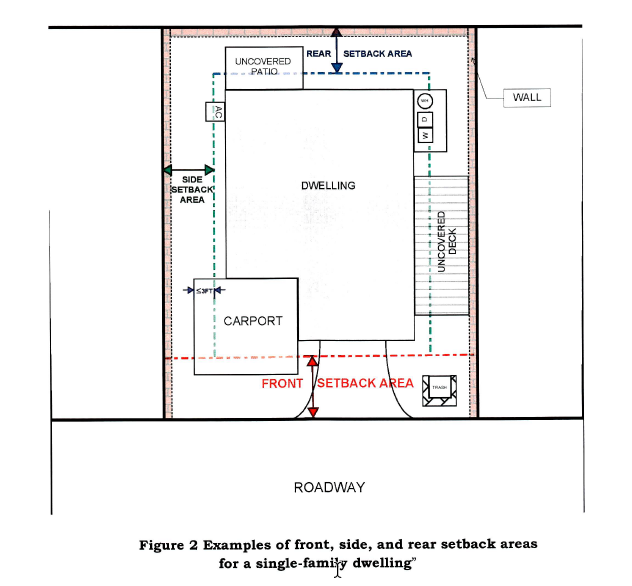
"Setback area" means the area between the setback line established in the applicable zoning district and the lot line, which includes the boundary of public or private streets. The setback area must remain unoccupied and unobstructed from the ground upward by any structure including above or below-ground swimming pools, except as specifically allowed in each zoning district.
Setback area, front. "Front setback area" means a setback area extending inward from the front lot line to the front setback line.
Setback area, rear. "Rear setback area" means a setback area extending inward from the rear lot line to the rear setback line.
Setback area, side. "Side setback area" means a setback area extending inward from the side lot line to the side setback line.
_____
_____
"Setback line" means the line beyond which no wall of a building or structure may project. Each zoning district specifies the distance from a lot line to a setback line.
"Shopping center" means an establishment for a commercial purpose with five or more uses or business entities on a single parcel of land consisting of a minimum of 3 acres of land area or a minimum of 25,000 square feet of floor area, but shall not include residential mixed use developments or projects.
"Short-term rental home" means a residential use in which overnight accommodations are provided to guests for compensation, for periods of less than one hundred eighty days, in no more than two single-family dwelling units, or one single-family dwelling unit and one accessory dwelling unit, excluding bed and breakfast homes. Each short-term rental home shall include bedrooms, one kitchen, and living areas. Each lot containing a short-term rental home shall include no more than two single-family dwelling units, or one single-family dwelling unit and one accessory dwelling unit, used for short-term rental home use, with no more than a total of six bedrooms for short-term rental home use, as specified within the zoning district provisions of this title.
"Small-scale animal-keeping" means the keeping of dogs, cats, birds, rabbits, fowl, and similar type animals for noncommercial and domestic use. This also includes the keeping, grazing, and raising of pigs, goats, chickens, horses, cows, sheep, and similar type animals for noncommercial and domestic use in the agricultural and rural districts.
"Solar energy facilities" means any devices, elements, or substances, or any combination of devices, elements, or substances, that rely upon direct sunlight as an energy source, including those that collect sunlight for use in:
1.
The heating or cooling of a structure or building;
2.
The heating or pumping of water;
3.
Industrial, commercial, or agricultural processes; or
4.
The generation of electricity.
"Special use" means a use which meets the intent and purpose of the zoning district but which requires the review and approval of the appropriate planning commission in order to ensure that any adverse impacts on adjacent uses, structures, or public services and facilities which may be generated by the use can be, and are, mitigated.
Storage, wholesale and distribution. "Wholesale and distribution storage" means activities and facilities for the storage of goods and the bulk sale and distribution of products. Examples include warehouses, freight-forwarding and delivery operations, markets in which products are sold directly by their producers, and construction supply businesses.
"Story" means that portion of a building included between the upper surface of any floor and the upper surface of the floor next above, except that the topmost story shall be that portion of a building included between the upper surface of the topmost floor and the ceiling or roof above. If the finished floor level directly above a basement or cellar is more than 6 feet above grade, such basement or cellar shall be considered a story.
Street, private. "Private street" means open passage land, easement, or right-of-way not less than 12 feet in width suitable or intended for pedestrians and vehicles.
Street, public. "Public street" means a public thoroughfare, including public roads, streets, highways, and easements which are dedicated or deeded to the public for public usage and which affords principal means of access to abutting property.
"Structure" means a combination of materials to form a construction for use, occupancy, or ornamentation whether installed on, above or below the surface of land or water.
"Swap meet or open air market" means the temporary use of a specified land area managed by a single operator who leases space/stalls for the outdoor sales of personal property, crafts, baked goods, produce, meat and fish items, plants and flowers which may or may not have been grown, raised, or caught within the State of Hawaiʻi.
"Tandem parking" or "tandem" means an arrangement of parking spaces such that one or more spaces must be driven across in order to access another space or spaces.
"Time share plan" means any plan or program in which the use, occupancy, or possession of one or more time share units circulates among various persons for less than a one hundred eighty-day period in any year, for any occupant. The time share plan includes both time share ownership plans and time share use plans, as follows:
1.
"Time share ownership plan" means any arrangement whether by tenancy-in-common, sale, deed, or other means where the purchaser receives an ownership interest and the right to use the property for a specific or discernible period by temporal division.
2.
"Time share use plan" means any arrangement, excluding normal hotel operations, whether by membership agreement, lease, rental agreement, license, use agreement, security, or other means, where the purchaser receives a right to use accommodations or facilities, or both, in a time share unit for a specific or discernible period by temporal division, but does not receive an ownership interest.
"Time share unit" means the actual and promised accommodations, and related facilities, which are the subject of a time share plan.
"Transient" or "transients" means any person who owns, rents, or uses a lodging or dwelling unit, or portion of it, for less than one hundred eighty days and whose permanent address for legal purposes is not the lodging or dwelling unit occupied by the person. Any person who uses, possesses, or occupies a property based on an arrangement, schedule, plan, agreement, license, or any other means or scheme where an owner of the property, or member, partner, owner, trustee, or shareholder of the corporate or limited liability entity that owns the property, receives ownership rights or the right to use the property for a period of less than one hundred eighty days. This definition does not apply to family members or nonpaying guests of the family occupying the unit, or to:
1.
Patients or clients in health care facilities.
2.
Health care providers actively engaged in providing medical services within the County.
3.
Full-time students while attending general education classes or programs located in the County.
4.
Employees who receive room or board as part of their salary or compensation for work performed within the County by the employer providing their room or board.
5.
Military personnel while performing military service within the County.
6.
Low-income renters receiving rental assistance from governmental entities whose rental periods are for durations shorter than one hundred eighty days.
7.
Lodging provided by nonprofit corporations or associations for religious, charitable, educational, or marine science research purposes if no rental income is produced.
8.
Temporary workers hired for a period of at least sixty days while working for a conservation organization located in the County. Conservation organization means a nonprofit chartered institution, foundation, or association organized under the laws of the State of Hawaiʻi that was founded for the purpose of promoting wildlife conservation and has established tax exempt status under Internal Revenue Code, section 501C-3, as amended.
"Transient vacation rentals or use" means occupancy of a dwelling or lodging unit by transients for any period of less than one hundred eighty days, excluding bed and breakfast homes and short-term rental homes.
____________
"Underground parking area" means a portion of a building at least 80 percent of which is located below exterior grade on all sides except one used for vehicle access, and which is in one of the following zoning districts: A-1 and A-2 apartment; H-1, H-2, and H-M hotel; B-R resort commercial; B-1, B-2, and B-3 business; M-1 and M-2 industrial; two-family (duplex); airport; and any mixed use, industrial, commercial, multi-family, and business districts within any project district.
____________
"Use" means the purpose for which land or a building is arranged, designed, or intended, or for which either land or a building is or may be occupied or maintained.
Utility facilities, major. "Major utility facilities" means uses or structures which provide utility services which have potential major impact, by virtue of their appearance, noise, size, traffic generation, or other operational characteristics which include, but which are not limited to, forty-six kilovolt transmission substations, power plants, base yards, water and wastewater treatment facilities, but not including private, individual cesspools, septic tanks, or individual household water supplies.
Utility facilities, minor. "Minor utility facilities" means transmission lines used directly in the distribution of utility services that have minor impact on adjacent land uses which include, but which are not limited to, 23 kilovolt transmission substations, vaults, water wells, tanks and distribution equipment, sewage pump stations, and other similar type uses.
"Utility services" means the generation, transmission, or distribution of electricity, gas, or steam; water, irrigation, and sanitary systems used for the collection and disposal of garbage, sewage, and other wastes by means of destroying or processing these materials; transportation systems; and communication or other similar services.
"Utility wall" means a specifically designed and built, free standing wall or a portion of a wall designated to support utility services such as electrical, cable television, or phone service to a property.
"View plane" means open space and significant vistas, particularly toward the ocean, the mountains, or into the valleys.
"Wall" means a constructed solid barrier of concrete, stone, brick, tile, wood, or similar type of material that closes, marks, or borders a field, yard, or lot and that limits visibility and restricts the flow of air and light.
"Wastewater treatment facility" means any building, structure, equipment, piping or related appurtenance which is part of a wastewater utility system.
"Water treatment facility" means any building, structure, equipment, piping or related appurtenance which is part of a water utility system.
"Wet bar" means an area within a dwelling unit used for the preparation and serving of beverages, other than a kitchen or kitchenette, that contains a sink that is one-and-one-half cubic feet or smaller and at least one of the following: refrigeration seven-and-one-half cubic feet or smaller; an ice maker; a small mixing or blending appliance; or a small appliance for the preparation of hot beverages, such as a coffee maker or microwave.
The area cannot qualify as a wet bar if any of the following is also present: a sink larger than one-and-one-half cubic feet; refrigeration larger than seven-and-one-half cubic feet; a 220-volt electrical outlet; a gas or propane service line; a dishwashing machine; a garbage disposal; a range hood, exhaust vent, or similar equipment; a stove, range, or oven; or any other appliance for the heating or cooking of food.
Except as otherwise provided in this title, no more than two wet bars are permitted in a dwelling unit that is less than 5,000 square feet in total floor area. No more than three wet bars are permitted in a dwelling unit that is 5,000 square feet or more in total floor area. A wet bar is prohibited in a bedroom or bathroom.
"Wetland" means those areas that are under normal circumstances (e.g., no filling or introduction of invasive plants) or were inundated or saturated by surface water or groundwater at a frequency and duration sufficient to support—and that under normal circumstances do support—a prevalence of vegetation typically adapted for life in saturated soil conditions. Wetlands generally include swamps, marshes, bogs, and estuarine systems; flowing, intermittent, or ephemeral streams and associated drainages; and similar areas; but do not include agricultural ditches or reservoirs.
"Zipline" means an activity during which a participant traverses from one point to another using a cable or rope line suspended between support structures.
"Zoning lot" means a lot or portion thereof within a single zoning development district, except as permitted under planned development or joint use approval shall be considered and treated as one zoning lot.
(Ord. No. 5832, §§ 2, 5, 2025; Ord. No. 5650, §§ 1, 2, 2024; Ord. No. 5499, § 3—12, 2023; Ord. No. 5474, § 2—4, 2022; Ord. No. 5421, § 2, 2022; Ord. No. 5301, § 2, 2021; Ord. No. 5262, § 2, 2021; Ord. No. 5238, § 2, 2021; Ord. No. 4933, § 1, 2018; Ord. No. 4921, §§ 7—10, 2018; Ord. No. 4464, § 3, 2017; Ord. No. 4380, § 1, 2016; Ord. No. 4315, § 2, 2016; Ord. No. 4246, § 2, 2015; Ord. No. 4168, § 1, 2014; Ord. No. 4088, §§ 1—6, 2013; Ord. No. 4049, § 1, 2013; Ord. No. 4048, § 1, 2013; Ord. No. 4026, § 4, 2013; Ord. No. 3975, § 1, 2012; Ord. No. 3941, § 3, 2012; Ord. No. 3884, §§ 1, 2, 2011; Ord. No. 3848, § 1, 2011; Ord. No. 3824, § 1, 2011; Ord. No. 3681, § 2, 2009; Ord. No. 3662, §§ 1—4, 2009; Ord. No. 3661, § 3, 2009; Ord. No. 3611, § 1, 2008; Ord. 3525 § 1, 2008; Ord. 3364 § 1, 2006; Ord. 3138 § 2, 2003; Ord. 2749 § 2, 1998; Ord. 2628 § 3, 1997: Ord. 2609 § 2, 1997; Ord. 2585 § 3, 1997: Ord. 2583 § 2, 1997; Ord. 2538 § 1, 1997; Ord. 2135 § 3, 1992; Ord. 2052 §§ 1, 2, 1991; Ord. 2031 § 2 (part), 1991: Ord. 2026 §§ 1—4, 1991: Ord. 2012 § 1, 1991; Ord. 1797 §§ 1—6, 1989: Ord. 1629 § 1, 1987: Ord. 1278 §§ 1—3, 1982: Ord. 1134 § 2, 1981: prior code § 8-1.2)
19.04.050 - Fees.
The department may collect fees as set forth in the annual budget to administer this title, such as fees to review and process ministerial and discretionary permit applications, including applications that are reviewed by the department but administered by another agency, including building permit or subdivision applications. Additional fees, as set forth in the annual budget, may also be collected when the director determines that an application fails to meet submittal requirements as provided by law and, therefore, requires additional submittals and further review.
(Ord. No. 4464, § 4, 2017)
19.04.060 - Administrative rules.
The director may adopt administrative rules to implement the provisions of this article.
(Ord. No. 4464, § 5, 2017)
19.06.010 - Districts designated.
1.
The County is divided into the following base zone districts:
A.
Open space districts:
1.
OS-1.
2.
OS-2.
B.
Residential districts:
1.
R-1.
2.
R-2.
3.
R-3.
C.
R-0 zero lot line residential district.
D.
Two-family districts:
1.
D-1.
2.
D-2.
E.
Apartment districts:
1.
A-1.
2.
A-2.
F.
Hotel districts:
1.
H-1.
2.
H-M.
3.
H-2 and hotel.
G.
Business districts:
1.
SBR service.
2.
B-CT country town.
3.
B-1 neighborhood.
4.
B-2 community.
5.
B-3 central.
6.
B-R resort commercial district.
H.
Industrial districts:
1.
M-1 light.
2.
M-2 heavy.
3.
M-3 restricted.
I.
Park districts:
1.
PK.
2.
GC.
J.
Airport district.
K.
Agricultural district.
L.
Rural districts:
1.
RU-0.5.
2.
RU-1.
3.
RU-2.
4.
RU-5.
5.
RU-10.
6.
County rural.
M.
Public/quasi-public districts:
1.
P-1.
2.
P-2.
N.
Kīhei research and technology park district.
O.
Maui research and technology park district.
P.
Napili bay civic improvement district.
Q.
Urban reserve district.
R.
Interim.
S.
Maui County historic districts.
1.
Historic district no. 1 in Lahaina.
2.
Historic district no. 2 in Lahaina.
3.
Historic district no. 3 in Wailuku.
T.
Project districts.
U.
Wailuku Redevelopment Area ("WRA") districts, including:
1.
WRA business/multi-family (currently designated as "Business Multi Family - MRA" on the digital zoning map).
2.
WRA commercial mixed-use. (currently designated as "Commercial Mixed Use - MRA" on the digital zoning map).
3.
WRA multi-family (currently designated as "Multi Family - MRA" on the digital zoning map).
4.
WRA public/quasi-public (currently designated as "Public/Quasi Public - MRA" on the digital zoning map).
5.
WRA residential (currently designated as "Residential - MRA" on the digital zoning map).
2.
The County has the following overlay zone districts:
A.
Wetlands overlay district.
B.
Planned development.
C.
Cluster housing development.
D.
R-0 zero lot line overlay district.
E.
Wellhead protection overlay district.
(Ord. No. 5586, § 1, 2023; Ord. No. 5421, § 6, 2022; Ord. No. 5305, § 3, 2021; Ord. No. 4884, § 1, 2018; Ord. No. 3681, § 3, 2009; Ord. 3138 § 3, 2003: Ord. 2583 § 3, 1997: Ord. 2031 § 3, 1991: prior code § 8-1.3(a))
19.06.020 - Maps.
A.
In accordance with subsection 8-8.3(6) of the revised charter of the County of Maui (1983), as amended, the planning director must prepare and administer the County's zoning maps.
B.
For the islands of Maui, Lāna‘i, and Molokai, one zoning map for each island must be prepared and administered in a digital format, such as within a geographic information system and made available for public use on the County website. The digital zoning maps are incorporated by reference and are located online at the department of planning, implementation division's website at https://www.mauicounty.gov/2159/Digital-Zoning-Map-Update-Project. The most recently adopted digital maps on file, Maui digital zoning map (3), as amended, Lāna‘i digital zoning map (1), and Molokai digital zoning map (1), are in addition to any original "land zoning maps" on file in the office of the county clerk; however, the digital zoning maps must be used to determine zoning boundaries and designations in the event of a conflict. Whenever a change in zoning is approved and the ordinance is filed with the county clerk, the island's digital zoning map must be amended to reflect the change in zoning.
C.
The area of the island of Kaho‘olawe shown on the original map entitled "Land Zoning Map," on file in the office of the county clerk with certified copies being placed on file in the planning department, and the digital zoning maps for the islands of Maui, Lāna‘i, and Molokai, together with all explanatory materials, are part of this title.
(Ord. No. 5363, § 2, 2022; Ord. No. 5299, § 2, 2021; Ord. No. 5113, § 2, 2020; Ord. No. 5006, § 2, 2019; Ord. No. 4883, § 2, 2018; Ord. 1524 § 1, 1986; prior code § 8-1.3(b))
19.06.030 - Interpretation of district boundaries.
With respect to the boundaries of zoning districts in areas subject to the County's zoning authority, the following standards shall apply, unless otherwise specified by ordinance:
A.
The County's electronic zoning maps, if available, shall be used to represent lot lines and boundaries of zoning districts.
B.
The zoning designation for public and private streets shall be the same as for adjacent lots. If a street adjoins two or more zoning districts, the boundaries of each zoning district shall extend to the street's centerline.
C.
Where boundaries of a zoning district are indicated as approximately following a lot line, the boundary line shall be the same as the lot line.
D.
Where the boundary of a zoning district follows a railroad line, the boundary shall be located midway between the main tracks of the railroad line.
E.
Where the boundary of a zoning district follows a stream, watercourse, or other body of water, excluding the Pacific Ocean, the boundary line shall be the centerline of the body of water. Where the boundary of a zoning district follows the Pacific Ocean, the boundary line shall be along the high water mark.
F.
The zoning designation for any area under water, and not included in any zoning district, shall be the same as the immediately adjoining zoning designation. If an area under water adjoins two or more zoning districts, the boundaries of each district shall extend in a straight line until they meet the boundary of another district.
(Ord. No. 4884, § 2, 2018; Prior code § 8-1.3(c))
19.07.010 - Purpose and intent.
The open space zoning district is established to implement the land use policies of the County of Maui; protect and preserve areas with important environmental, scenic, and cultural resources; provide areas for outdoor recreation; direct development away from fragile ecosystems and agricultural areas; retain the spatial identity of existing urban areas and discourage urban sprawl; and manage development in hazardous areas. The open space district is also intended for lands that are removed from the conservation district pursuant to chapter 205, Hawaiʻi Revised Statutes, until such time as the lands are designated into the most appropriate zoning district.
(Ord. 3138 § 4 (part), 2003)
19.07.020 - District categories.
There shall be two categories of open space district to distinguish between passive and active types of land uses. The following criteria shall be used when establishing the OS-1 "Passive" and OS-2 "Active" open space district categories:
Table 19.07.020 District Categories
(Ord. 3138 § 4 (part), 2003)
19.07.030 - Permitted uses.
The following uses shall be permitted within the open space districts subject to the "special conditions":
(Note: "x" means a permitted use in the category. An empty cell indicates that the use is not permitted in that category.)
Table 19.07.030 Permitted Uses
(Ord. 3138 § 4 (part), 2003)
19.07.040 - Development standards.
The development intensity permitted in the two categories of open space district shall be regulated by a combination of the following development standards:
Table 19.07.040 Development Standards
(Ord. 3138 § 4 (part), 2003)
19.07.050 - Dwellings.
Dwellings shall be prohibited. No conditional permit for a dwelling or dwellings shall be granted.
(Ord. 3138 § 4 (part), 2003)
19.07.060 - Site plan conditions.
The director of planning shall review all structures that are permitted pursuant to section 19.07.030 for consistency with the following site plan conditions:
A.
Structures shall be sited to minimize visibility from public roadways and the shoreline;
B.
An adequate buffer shall be provided to protect cultural sites, threatened and endangered species and the ecosystems upon which such species are dependent; and other sensitive environmental resources;
C.
Materials and colors shall blend with the natural landscape;
D.
Structures shall be sited to minimize encroachment onto either the summit of a ridge or other prominent physiographic feature; and
E.
Structures shall be sited or constructed in a manner to avoid or mitigate potential impacts from flooding and other natural hazards.
(Ord. 3138 § 4 (part), 2003)
19.07.070 - Legal uses and structures existing prior to the enactment of the ordinance codified in this chapter.
Legal uses existing at the time of adoption of the ordinance codified in this chapter shall be grandfathered and may continue without having to obtain County special use permits, conditional permits or variances until such time as the use is discontinued for twelve or more consecutive months. Any dwelling or structure that was lawfully constructed prior to the enactment of this ordinance need not acquire a County special use permit, conditional permit or variance and may be repaired and may be reconstructed as permitted by the original building permit(s), and such dwellings or structures may be expanded or modified with a building permit, subject to the other provisions of this chapter and this title and any other provisions of law.
(Ord. 3138 § 4 (part), 2003)
19.08.010 - Generally.
Areas for single-family dwellings are established to provide for harmonious residential neighborhood without the detraction of commercial and industrial activities.
(Prior code § 8-1.4(a))
19.08.020 - Permitted uses.
Within residential districts, the following principal uses and structures are permitted:
A.
Single-family dwellings.
B.
Greenhouses, plant nurseries, and the raising of plants, flowers, fruits, or vegetables for subsistence or commercial purposes; except for retailing or transacting of business on the premises, unless allowed by chapter 19.67.
C.
Parks and playgrounds, noncommercial; certain commercial amusement and refreshment sale activities may be permitted when under supervision of the government agency in charge of the park or playground.
D.
Publicly or privately owned and operated elementary schools, intermediate schools, high schools, and colleges, which may include on-campus dormitories.
E.
Buildings or premises used by the federal, state, or county governments for public purposes.
F.
Accessory uses and structures located on the same lot, the use of which is customary, incidental, usual, and subordinate to that of the main building or to the use of the land. The initiation of accessory uses and the erection of accessory structures are not contingent on the existence, and may be in advance of the main building or use of the land.
G.
Accessory dwellings under chapter 19.35.
H.
Day care nurseries, kindergartens, nursery schools, child care homes, day care homes, day care centers, nurseries, preschool kindergartens, babysitting services, and other like facilities located in private homes used for child care services. These facilities may serve six or fewer children at any one time on lot sizes of less than 7,500 square feet, eight or fewer children at any one time on lot sizes of 7,500 or more but less than 10,000 square feet, or twelve or fewer children at any one time on lot sizes of 10,000 or more square feet, or as otherwise required under chapter 46, Hawaiʻi Revised Statutes.
I.
Bed and breakfast homes subject to chapter 19.64.
J.
Home businesses that meet the requirements of sections 19.67.030 and 19.67.040.
K.
Short-term rental homes subject to chapter 19.65.
L.
Family child care homes, hospice homes, adult residential care homes, and adult family care homes, as required under chapter 46, Hawaiʻi Revised Statutes.
M.
On Maui and Lāna‘i, all dwelling units permitted under this section may also contain one kitchenette and one wet bar, regardless of the dwelling unit's square footage. On Molokai, dwelling units may not contain a kitchenette, but may contain wet bars in accordance with the definition in section 19.04.040.
(Ord. No. 5832, § 6, 2025; Ord. No. 5499, § 13, 2023; Ord. No. 4936, § 4, 2018; Ord. No. 4168, § 3, 2014; Ord. No. 3941, § 4, 2012; Ord. No. 3622, § 1, 2009; Ord. 2628 § 1, 1997; Ord. 2609 § 3, 1997: Ord. 2585 § 1, 1997: Ord. 2030 § 3, 1991: Ord. 1956 § 1, 1990: Ord. 1269 § 6, 1982; prior code § 8-1.4(b))
19.08.030 - Special uses.
The following uses and structures require a County special use permit obtained under section 19.510.070, except that an application for a special use permit may not be denied on the basis of the content of protected expression associated with the proposed use:
A.
Churches, including any accessory buildings such as a parsonage, Sunday school, nursery school, thrift shop, or office, except that subsections 19.510.070(B)(4) and (5) do not apply.
B.
Day care nurseries, kindergartens, nursery schools, child care homes, day care homes, day care centers, nurseries, preschool kindergartens, babysitting services, and other like facilities located in private homes used for child care services serving more than the number of children defined in subsection 19.08.020(H).
C.
Hospitals, if written consent of 75 percent of the property owners within 500 feet of the property has been obtained.
D.
Nursing or convalescent homes and domiciliary facilities operated and maintained to provide nursing or supporting care that do not meet the criteria of subsection 19.08.020(L).
E.
Housing for the aged, operated by governmental or nonprofit organizations if the normal unit density is increased by more than 25 percent.
F.
Housing for low- and moderate-income families, operated by governmental or nonprofit organizations that do not meet the criteria of subsection 19.08.020(L) or if the normal unit density is increased by more than 25 percent.
G.
Public utilities substations that are not and will not be hazardous or a nuisance to the surrounding areas.
H.
Domestic-type businesses in the home that do not meet the definition of home business or home occupation, including group instruction of traditional Hawaiian practices, such as lei making, ukulele classes, hula classes, and lomi, if there will be no detrimental or nuisance effect upon the neighbors, and further, if off-street parking is available to participants.
I.
Home businesses that meet the requirements of sections 19.67.030 and 19.67.050.
J.
Two-family dwelling units or duplexes beyond the density allowed under section 19.08.020, subject to the setback standards in section 19.10.050.
K.
Retail food and beverage establishments, excluding liquor stores of 2,000 square feet or less gross covered floor area.
L.
Modification of the minimum lot area development standard of section 19.08.040 may be reduced to no less than 4,000 square feet, subject to the following requirements:
i.
The project is designed to meet the needs of low, below moderate, or moderate income families, and deed restrictions are recorded to ensure owner-occupancy and the prevention or limitation of speculation.
ii.
Shared use paths crossing through the subdivision are provided for bicycles and pedestrians to connect to adjacent lands on all sides of the project, such as existing shared use paths, roadways, parks, commercial areas, and vacant land that may be developed or further subdivided.
iii.
The commission may increase the impervious surface requirement to no more than 75 percent of the total lot area.
(Ord. No. 5499, § 13, 2023; Ord. No. 4168, § 4, 2014; Ord. 2628 § 2, 1997; Ord. 2585 § 2, 1997; Ord. 1956 § 2, 1990: prior code § 8-1.4(c))
_____
19.08.040 - Development standards, height regulations, and setback lines.
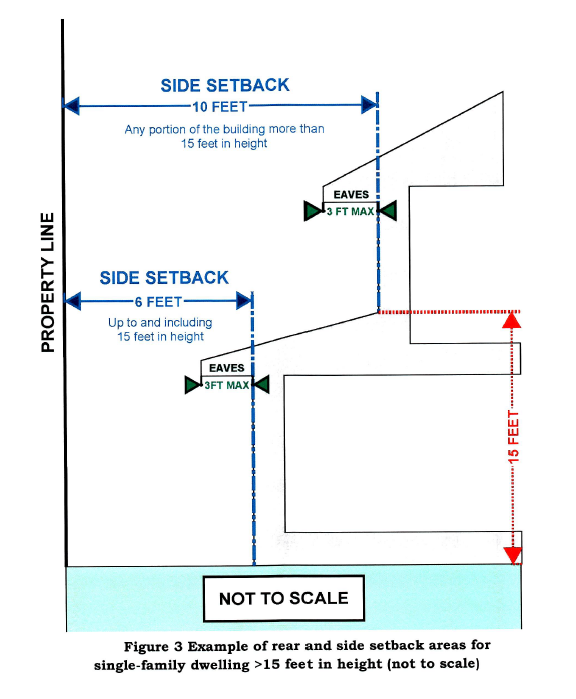
;adv=6;(Ord. No. 5499, § 13, 2023;Ord. 784 § 1, 1974: prior code § 8-1.4(d))
_____
19.08.050 - Permitted structures in the setback area.
(Ord. No. 5499, § 13, 2023; Prior code § 8-1.4(f))
_____
19.08.055 - Kitchenettes; requirements; prohibitions.
A.
Dwelling units with a kitchenette must be occupied on a long-term residential basis only. One additional off-street parking space must be provided for the kitchenette.
B.
Kitchenettes are not permitted in accessory dwelling units.
(Ord. No. 5832, § 3, 2025)
19.08.060 - Reserved.
Editor's note— Ord. No. 5499, § 13, adopted Feb. 17, 20233, repealed § 19.08.060, which pertained to yards and derived from Prior code § 8-1.4(f).
(Ord. No. 5832, § 3, 2025)
19.09.010 - Purpose and intent.
The purpose and intent of the R-O zero lot line residential district is to encourage affordable housing in a district which retains the character of a single-family residential district with cost savings attributable to less street frontage per zoning lot and smaller lot sizes. This chapter applies to all of Maui County except the island of Molokai.
(Ord. 2026 § 5, 1991)
19.09.020 - Change of zoning requirements.
A change of zoning application which requests R-O zero lot line residential district zoning shall be processed pursuant to chapter 19.510 of this code and shall be subject to the following additional requirements:
A.
Submittal With Application. A site plan of the land which is the subject of a change of zoning application for rezoning to R-O zero lot line residential district shall be submitted with the application for a change of zoning. The site plan shall identify the lots which would be created upon the rezoning of the subject land to R-O zero lot line residential district, the zero lot lines of each of these lots, and the location of the structures on each lot. Not less than ten lots shall be identified on the site plan; and
B.
Conditional Zoning Requirement. A change of zoning application which requests R-O zero lot line residential district zoning shall be processed pursuant to section 19.510.050 of this code and shall be subject to the following conditions:
1.
That a site plan which meets the requirements of subsection 19.09.020(A) of this code shall be recorded as provided in section 19.510.050; and
2.
That any development of the subject parcel of land shall conform to the recorded site plan. The subdivision and building plans submitted for approval may deviate from the recorded site plan if the director of public works determines that the deviation is not a substantial deviation. If the director of public works determines that a substantial deviation between the subdivision and building plans submitted for approval and the recorded site plan exists, the applicant shall obtain County council approval of the deviations in order to receive approval of the subdivision and building permit plans by the director of public works.
(Ord. 2026 § 5, 1991)
19.09.030 - Permitted uses.
Within the R-O zero lot line residential district, the following uses shall be permitted:
A.
One single-family dwelling unit per lot;
B.
Accessory buildings and uses that are subordinate and customarily incidental to the single-family dwelling unit including, but not limited to, private garages, carports, utility storage sheds but not including accessory dwellings as defined in chapter 19.35;
C.
Day care nurseries, kindergartens, nursery schools, child care homes, day care homes, day care centers, nurseries, preschool kindergartens, babysitting services, and other like facilities located in dwelling units used for child care services. These facilities shall serve six or fewer children at any one time on lot sizes of less than 7,500 square feet, serving eight or fewer children at any one time on lot sizes or 7,500 or more square feet but less than ten thousand square feet, or serving twelve or fewer children at any one time on lot sizes of 10,000 or more square feet; and
D.
Home occupations.
(Ord. No. 3622, § 2, 2009; Ord. 2648 § 1, 1998: Ord. 2585 § 4, 1997: Ord. 2026 § 5, 1991)
19.09.040 - Special uses.
Within the R-O zero lot line residential district, the following uses shall be permitted only upon the approval of the appropriate planning commission:
A.
Private, noncommercial, recreational amenities which include, but which are not limited to, parks, playgrounds, and community facilities for the use and enjoyment of the R-O zero lot line residential district residents;
B.
Public access ways to beaches, mountains, and historic or other areas of scenic and cultural significance;
C.
Adult day care homes from which residents of the homes provide care for not more than six adults; provided, that such home are approved by the appropriate State of Hawaiʻi agencies; and
D.
Day care nurseries, kindergartens, nursery schools, child care homes, day care homes, day care centers, nurseries, preschool kindergartens, babysitting services, and other like facilities located in dwelling units used for child care services serving more than the number of children defined in section 19.09.030.
(Ord. 2648 § 2, 1998: Ord. 2026 § 5, 1991)
19.09.050 - Height.
No building shall exceed 30 feet in height.
(Ord. 2026 § 5, 1991)
19.09.060 - Lot area.
The lots upon which dwelling units are to be built in the R-O zero lot line residential district shall not be less than 3,000 square feet and not more than 6,000 square feet in area; provided, that smaller lot sizes may be permitted if the total lot area, including easements, is not less than 3,000 square feet.
(Ord. 2026 § 5, 1991)
19.09.070 - Lot width.
No building shall be constructed on a lot with a lot width of less than 35 feet; provided, that the stem of a flag lot shall be excepted from the requirement.
(Ord. 2026 § 5, 1991)
19.09.080 - Setback lines and yard requirements.
A.
Front Setback Line. A lot with frontage which abuts a public street shall have a setback line from the front lot line of 10 feet;
B.
Access Yard Setback Line. There shall be an access yard setback line of 15 feet;
C.
Zero Lot Line. Not more than one zero lot line shall be permitted in accordance with the standards established in this chapter; provided, that one other zero lot line shall be permitted to allow two private garages or carports on two, abutting lots to adjoin;
D.
Setback for Alternating Zero Lot Lines. For lots where a zero lot line of a lot is not adjoined by a zero lot line of an adjacent lot, this adjacent lot shall provide a 10-foot setback line and shall include a 5-foot-wide maintenance easement pursuant to section 19.09.090 of this chapter;
E.
Other Setback Lines. Except for the front setback line, access yard setback line, zero lot lines, and setback for alternating zero lot lines, there shall be setbacks from all other lot lines of not less than 6 feet for a lot upon which a one-story dwelling unit is built and not less than 10 feet for a lot upon which a two-story dwelling unit is built;
F.
Additional Yard. Except for the front setback line and the zero setback lines, there shall be at least one other yard of not less than 225 square feet with a width of 10 feet.
(Ord. 2026 § 5, 1991)
19.09.090 - Design standards.
A.
Staggered Siting of Dwelling Units. Siting of dwelling units shall be staggered not less than 3 feet on adjacent lots; provided, that dwelling units built on adjoining zero lot lines which are designed and constructed together shall be exempt from this requirement;
B.
Two Dwelling Units Located on Same Zero Lot Line. If a dwelling unit is placed against a property line with a zero setback line, a dwelling unit may also be placed on the same zero setback line on the adjacent lot; provided, that the dwelling units are designed and constructed together; and provided, further, that each dwelling unit shall have separate walls designed to support all loads independently of any walls located on the adjacent property;
C.
Dwelling Units Located Adjacent to Other Zoning Districts. No dwelling unit shall be sited on a zero lot line if the adjacent lot is in another zoning district;
D.
Dwelling Units Located on Alternating Zero Lot Line. Dwelling units may be located on alternating lot lines if a zero lot line of a lot is not adjoined by a zero lot line of an adjacent lot; provided, that if a zero lot line of a lot is not adjoined by a zero lot line of an adjacent lot, this adjacent lot shall reserve a maintenance easement for the benefit of the lot with the adjoining zero lot line of not less than 5-foot width from the lot line of this adjacent lot which adjoins the zero lot line of the lot with the dominant tenement identified in this section;
E.
Access. Shared driveway or private street easements shall be noted on a final plat of the property and incorporated into each deed transferring title to the property.
F.
Tandem Parking. Tandem parking to meet parking requirements of this title may be provided on individual lots or on driveways which are for the exclusive use of an individual lot. No parking shall be permitted on sidewalks or maintenance and access easements.
(Ord. 2026 § 5, 1991)
19.10.010 - Purpose and intent.
A duplex district shall provide most of the desirable residential characteristics attributed to single-family districts. It has useful applications as a buffer zone along major streets and bordering neighborhood shopping centers.
(Ord. No. 4077, § 1, 2013; Prior code § 8-1.5(a))
19.10.020 - Permitted uses.
Within the duplex district, no building, structure or premises shall be used and no building or structure shall hereafter be erected, structurally altered, replaced, or enlarged except for one or more of the following uses:
A.
Any use permitted and as regulated in the R-1, R-2 and R-3 single-family districts; and
B.
Two-family dwelling (duplex).
(Ord. No. 4077, § 1, 2013; Prior code § 8-1.5(b))
19.10.030 - Accessory uses and structures.
(Ord. No. 4077, § 1, 2013; Prior code § 8-1.5(c))
19.10.040 - Reserved.
Editor's note— Ord. No. 4077, § 1, adopted Nov. 1, 2013, repealed § 19.10.040, which pertained to area regulations. See also the Code Comparative Table and Disposition List.
19.10.050 - Development standards.
(Ord. No. 4077, § 1, 2013; Prior code § 8-1.5(e))
19.10.060 - Rule making authority.
The director of planning may adopt rules to implement this chapter.
(Ord. No. 4077, § 1, 2013)
19.11.010 - Purpose and intent.
The purpose of the SBR service business residential district is to provide for a mixture of residential and small-scale neighborhood-oriented businesses, adopt standards that preserve unique architectural resources and community design elements, and integrate neighborhood-scale commercial uses with residential uses in a compatible and harmonious manner.
(Ord. No. 3681, § 4, 2009)
19.11.020 - Permitted uses.
The following uses and structures shall be permitted in the SBR service business residential district:
1.
Single-family dwellings;
2.
Duplex dwellings;
3.
Greenhouses, truck gardens, and nurseries;
4.
SBR service establishments;
5.
SBR mixed-use establishments;
6.
Bed and breakfast homes, subject to the provisions of chapter 19.64 of this title; and
7.
Short-term rental homes, subject to the provisions of chapter 19.65 of this title.
(Ord. No. 3941, § 5, 2012; Ord. No. 3681, § 4, 2009)
19.11.030 - Accessory uses and buildings.
The following accessory uses shall be permitted in the SBR service business residential district:
1.
Ohana units subject to chapter 19.35 of this code;
2.
Pools, hot-tubs, and jacuzzi spas;
3.
Fences, walls, patios, decks, and other landscape features;
4.
Garages, porte-cochere, mail boxes, and trash enclosures;
5.
Energy systems, small-scale; and
6.
Subordinate uses and structures that are determined by the planning director to be clearly incidental and customary to the permitted uses in section 19.11.020.
(Ord. No. 3681, § 4, 2009)
19.11.040 - Reserved.
Editor's note— Ord. No. 5473, § 1, adopted Nov. 4, 2022, repealed § 19.11.040, which pertained to special uses and derived from Ord. No. 3681, § 4, adopted in 2009.
19.11.050 - Development standards.
A.
The following development standards shall apply for uses, facilities, and structures in the SBR service business residential district:
B.
Where design guidelines have been formally adopted that apply to property zoned SBR service business residential, the design standards and review procedures set forth in the guidelines shall be applicable. In the event of conflict between the development standards in subsection A of this section and such design guidelines, the design guidelines shall prevail.
(Ord. No. 3681, § 4, 2009)
19.12.010 - Purpose and intent.
A.
The purpose of the apartment districts are to provide higher density housing options than the residential and duplex districts. Multiple-family apartment districts are generally established within or near the urban core of a town to provide residents with access to jobs, services, amenities, and transportation options. Uses within the apartment districts are appropriately located near, and are compatible with, uses in the various business, residential, public/quasi-public, and park districts. Apartment districts can provide a transition between residential districts and business districts.
B.
Apartment districts must consist of two types: A-1 apartment district and A-2 apartment district.
C.
Residential buildings and structures within the apartment district must be occupied on a long term residential basis, except as otherwise allowed by code.
(Ord. No. 5126, § 2, 2020; Ord. No. 4076, § 1, 2013; Ord. 1797 § 7, 1989: prior code § 8-1.6(a))
19.12.020 - Permitted uses.
Within the A-1 and A-2 districts, the following uses are permitted:
A.
Any use permitted in the residential and duplex districts.
B.
Apartment houses.
C.
Boarding houses, rooming houses, and lodging houses.
D.
Bungalow courts.
E.
Apartment courts.
F.
Townhouses.
G.
Transient vacation rentals in buildings and structures meeting all of the following criteria:
1.
The building or structure received a building permit, special management area use permit, or planned development approval that was lawfully issued by and was valid, or is otherwise confirmed to have been lawfully existing, on April 20, 1989.
2.
Transient vacation rental use was legally conducted in any lawfully existing dwelling unit within the building or structure prior to September 24, 2020 as determined by real property tax class or payment of general excise tax and transient accommodations tax.
3.
The number of rooms or units allowed for transient vacation rental use may not increase beyond those allowed for such use as of January 7, 2022. Existing transient vacation rentals may be reconstructed, renovated, or expanded if no new rooms or transient vacation rental units are added.
4.
The property owner or operator holds general excise tax and transient accommodations tax licenses and is current in payment of State and County taxes, fines, or penalties assessed in relation to the transient vacation rental.
5.
The planning director and director of finance must maintain a publicly available list of all transient vacation rental units allowed under this section to the best of the departments' knowledge at the time the list is posted. The list is informational only and is not a confirmation of zoning or allowable uses. Inclusion of a property on the list does not establish any right to operate a transient vacation rental unit, and no person may rely upon the list to establish the right to operate as a transient vacation rental unit. Any interested person must consult the department with respect to any specific property's ability to operate as a transient vacation rental unit.
6.
Advertisements for transient vacation rental use must include the subject property's registration number, which is the subject property's tax map key number, without punctuation marks.
7.
A declaration in accordance with section 19.12.025 must not have been filed.
H.
Bed and breakfast homes, subject to the provisions of chapter 19.64.
I.
Short-term rental homes, subject to the provisions of chapter 19.65.
(Ord. No. 5502, § 3, 2023; Ord. No. 5473, § 2, 2022; Ord. No. 5301, § 3, 2021; Ord. No. 5126, § 3, 2020; Ord. No. 4315, § 3, 2016; Ord. No. 4168, § 5, 2014; Ord. No. 4167, § 2, 2014; Ord. No. 4076, § 1, 2013; Ord. No. 3622, § 3, 2009; Ord. 1797 § 8, 1989: prior code § 8-1.6(b))
19.12.025 - Conversion of real property from transient vacation rental use to long-term residential use.
A.
Owners of property where transient vacation rental use is allowed under subsection 19.12.020(G) may permanently discontinue the use by filing a declaration with the State of Hawaiʻi bureau of conveyances in a form prescribed by the department in accordance with this section.
B.
The declaration must apply to the entire parcel and must be executed by the percentage of property owners as follows:
1.
Island of Lāna‘i: 100 percent.
2.
Island of Maui: 100 percent.
3.
Island of Molokai: 100 percent.
C.
The declaration must state that the owners must use the property for long-term residential use only.
D.
A copy of the draft declaration must be filed with the director by September 1 of any calendar year. Within forty-five days of receipt, the director must review the declaration and determine whether it is complete.
E.
Prior to recording the declaration, property owners are solely responsible for and must update and record any applicable bylaws and covenants, conditions, and restrictions associated with the property consistent with the complete declaration.
F.
After the director determines the draft declaration to be complete, the property owners must file the declaration with the State of Hawaiʻi bureau of conveyances on or before December 31 immediately preceding the assessment year in order to be reclassified for real property tax purposes.
G.
Recordation of the declaration constitutes a permanent forfeiture on the part of the owners, and all successors and assigns, of any right to transient vacation rental, bed and breakfast, or short-term rental home use on the applicable parcel.
H.
The director must notify the department of finance, real property assessment division of the recordation of a declaration permanently converting property from transient vacation rental use to long-term residential use that is determined to be complete.
I.
The director must not accept an application for a short-term rental home permit, bed and breakfast home permit, or conditional permit for transient vacation rental use.
J.
Whenever the provisions or application of this title impose greater restrictions upon the use of land, buildings, or structures than are imposed by any such covenants, conditions, limitations, or restrictions, the provisions and application of this title govern the use of that land, building, or structure.
K.
The director must enforce the failure to abide by the declaration as a violation of this title.
(Ord. No. 5502, § 2, 2023)
19.12.030 - Accessory uses and buildings.
(Ord. No. 4076, § 1, 2013; Prior code § 8-1.6(c))
19.12.040 - Reserved.
Editor's note— Ord. No. 4076, § 1, adopted Nov. 1, 2013, repealed § 19.12.040, which pertained to height regulations. See also the Code Comparative Table and Disposition List.
19.12.050 - Development standards.
(Ord. No. 4076, § 1, 2013; Prior code § 8-1.6(e))
_____
19.12.060 - Rule making authority.
The director of planning may adopt rules to implement this chapter.
(Ord. No. 4076, § 1, 2013; Prior code § 8-1.6(f))
19.12.070 - Reserved.
Editor's note— Ord. No. 4076, § 1, adopted Nov. 1, 2013, repealed § 19.12.070, which pertained to yards. See also the Code Comparative Table and Disposition List.
19.14.010 - Purpose and intent.
A hotel district is a high density multiple-family area bordering business districts or ocean fronts, or both. This district includes public and semi-public institutional and accessory uses.
(Ord. No. 4103, § 1, 2014)
19.14.020 - Permitted uses.
Within hotel districts, the following uses shall be permitted:
A.
Any use permitted in residential and apartment districts;
B.
Hotels;
C.
Apartment-hotels;
D.
Auditoriums and theaters;
E.
Automobile parking lots and buildings;
F.
Bona fide nonprofit clubs and lodges;
G.
Nonprofit museums, libraries, art galleries, and philanthropic institutions; and
H.
Cell or radio antenna attached to an existing building.
(Ord. No. 4103, § 1, 2014)
_____
19.14.030 - Accessory uses and buildings.
(Ord. No. 4103, § 1, 2014)
19.14.040 - Restrictions.
The number of rooms or units allowed for transient vacation rental use may not increase beyond those allowed for such use as of January 7, 2022, unless such new rooms or units are situated landward of the line set at the distance from the certified shoreline to the mapped line for coastal erosion at 3.2 feet of sea level rise, as depicted on the State of Hawaiʻi sea level rise viewer hosted by the pacific islands ocean observing system as of November 4, 2022. For all such new rooms or units, any ground altering activity proposed in culturally sensitive areas as determined by the County archaeologist will be referred to the Maui County cultural resources commission, which may review and comment on the potential impact to historic properties and cultural resources to the State historic preservation division in accordance with Hawaiʻi Revised Statutes chapter 6E.
(Ord. No. 5473, § 3, 2022)
19.14.050 - Development standards.
(Ord. No. 4103, § 1, 2014)
19.14.060 - Rule making authority.
The director of planning may adopt rules to implement this chapter.
(Ord. No. 4103, § 1, 2014)
19.15.010 - Purpose and intent.
A.
The B-CT country town business district is intended to establish development standards for businesses in smaller and/or more remote communities.
B.
It is intended that the unique design character of these business districts be preserved and maintained to promote the "country town" atmosphere of these communities in Maui County.
C.
This B-CT country town business district zoning ordinance establishes the means of implementing various provisions of Maui County community plans. Provisions in such community plans promote retention of certain aspects of the lifestyle that have developed over the years in the commercial areas of small and remote communities throughout Maui County. These communities traditionally feature single-unit retail establishments in separate buildings or units with a shared common wall. Structures, generally, are small in scale, oriented in heights to a pedestrian scale, and rustic in design. These areas differ from larger, modern urban centers that feature shopping centers and business establishments that utilize on-site parking.
Examples of the country town concept are commercial areas of such communities as Makawao-Pukalani-Kula, Paia-Haiku, Hana, Lāna‘i City, and Molokai. Other areas on the fringes of larger urban concentrations, however, may qualify for B-CT country town business district zoning if consistent with the applicable community plan. The decision as to which areas, in detail, are appropriate for this zoning category is dependent on numerous variables and involves both subjective and objective considerations.
(Ord. No. 4153, § 1, 2014)
19.15.020 - Permitted uses.
Within the B-CT country town business district, the following uses shall be permitted:
19.15.025 - Accessory uses.
A.
The following uses, located on the same lot, are deemed accessory, customary, incidental, usual, and necessary to the permitted uses in the B-CT country town business district:
B.
The following uses, located on a nearby lot, are also deemed accessory, customary, incidental, usual, and necessary to the permitted uses in the B-CT country town business district:
(Ord. No. 4153, § 1, 2014)
19.15.030 - Special uses.
The following are special uses in the B-CT country town business district, and approval of the appropriate planning commission must be obtained, upon conformance with the intent of this article and subject to such terms and conditions as may be warranted and required:
(Ord. No. 5473, § 4, 2022; Ord. No. 4153, § 1, 2014)
19.15.040 - Development standards.
The development standards for the B-CT country town business district shall be as follows, unless otherwise specified in adopted design guidelines pursuant to section 19.510.100:
(Ord. No. 4153, § 1, 2014)
19.15.050 - Rule making authority.
The director of planning may adopt rules to implement this chapter.
(Ord. No. 4153, § 1, 2014)
19.16.010 - Purpose and intent.
A B-1 neighborhood business district is one wherein retail businesses or service establishments supply commodities or perform services to meet the daily needs of the neighborhood.
(Ord. No. 4152, § 1, 2014)
____________
19.16.020 - Permitted uses.
Within the B-1 neighborhood business district, the following uses shall be permitted:
(Ord. No. 4152, § 1, 2014)
19.16.030 - Accessory uses.
A.
The following uses located on the same lot, are deemed accessory, customary, incidental, usual, and necessary to the permitted uses in the B-1 neighborhood business district:
B.
The following uses, located on a nearby lot are also deemed accessory, customary, incidental, usual, and necessary to the permitted uses in the B-1 neighborhood business district:
(Ord. No. 4152, § 1, 2014)
19.16.040 - Special uses.
The following are special uses in the B-1 neighborhood business district, and approval of the appropriate planning commission shall be obtained, upon conformance with the intent of this article and subject to such terms and conditions as may be warranted and required:
(Ord. No. 4152, § 1, 2014)
19.16.050 - Development standards.
The development standards in the B-1 neighborhood business district shall be as follows:
(Ord. No. 4152, § 1, 2014)
19.16.060 - Rule making authority.
The director of planning may adopt rules to implement this chapter.
(Ord. No. 4152, § 1, 2014)
19.18.010 - Purpose and intent.
A B-2 community business district is intended to provide all types of goods and services for the community, with the exception of those uses more generally associated with an industrial district, but at a lower intensity of use than in the B-3 central business district.
(Ord. No. 4088, § 7, 2013)
____________
19.18.020 - Permitted uses.
Within the B-2 community business district, the following uses shall be permitted:
(Ord. No. 5473, § 5, 2022; Ord. No. 4088, § 7, 2013)
19.18.030 - Accessory uses.
The following uses, located on the same lot, are deemed accessory, customary, incidental, usual, and necessary to the permitted uses in the B-2 community business district.
(Ord. No. 4088, § 7, 2013)
19.18.040 - Special uses.
The following are special uses in the B-2 community business district, and approval of the appropriate planning commission must be obtained, upon conformance with the intent of this article and subject to such terms and conditions as may be warranted and required:
(Ord. No. 5473, § 6, 2022; Ord. No. 4088, § 7, 2013)
19.18.050 - Development standards.
The development standards in the B-2 community business district are as follows:
(Ord. No. 5372, § 1, 2022; Ord. No. 4088, § 7, 2013)
19.18.060 - Rule making authority.
The director of planning may adopt rules to implement this chapter.
(Ord. No. 4088, § 7, 2013)
19.20.010 - Purpose and intent.
The B-3 central business district permits general business enterprises, particularly financial, governmental, commercial, and professional activities. Its distinguishing feature is the greater height limit permitted in the area. Manufacturing and nuisance industries are excluded from the zone.
(Ord. No. 4141, § 1, 2014)
____________
19.20.020 - Permitted uses.
Within the B-3 central business district, the following uses are permitted:
(Ord. No. 5473, § 7, 2022; Ord. No. 4141, § 1, 2014)
19.20.030 - Accessory uses.
A.
The following uses, located on the same lot, are deemed accessory, customary, incidental, usual, and necessary to the permitted uses in the B-3 central business district:
B.
The following uses, located on a nearby lot, are also deemed accessory, customary, incidental, usual, and necessary to the permitted uses in the B-3 central business district:
(Ord. No. 4141, § 1, 2014)
19.20.040 - Special uses.
The following are special uses in the B-3 central business district, and approval of the appropriate planning commission must be obtained, upon conformance with the intent of this article and subject to such terms and conditions as may be warranted and required:
(Ord. No. 5473, § 8, 2022; Ord. No. 4141, § 1, 2014)
19.20.050 - Development standards.
The development standards in the B-3 central business district are as follows:
(Ord. No. 5372, § 2, 2022; Ord. No. 4141, § 1, 2014)
19.20.060 - Rule making authority.
The director of planning may adopt rules to implement this chapter.
(Ord. No. 4141, § 1, 2014)
19.22.010 - Purpose and intent.
The B-R resort commercial district is intended to provide for commercial activities and services oriented towards the needs of the transient visitor. This district is distinguished from hotel districts in that independent commercial uses are permitted, whereas commercial activities in hotel districts must be accessory to the hotel use.
(Ord. No. 4087, § 1, 2013)
____________
19.22.020 - Permitted uses.
Within the B-R district, the following uses are permitted:
(Ord. No. 5473, § 9, 2022; Ord. No. 4087, § 1, 2013)
19.22.030 - Accessory uses.
The following uses, located on the same lot, are deemed accessory, customary, incidental, usual, and necessary to the permitted uses in the B-R resort commercial district:
(Ord. No. 4087, § 1, 2013)
19.22.040 - Reserved.
Editor's note— Ord. No. 5473, § 10, adopted Nov. 4, 2022, repealed § 19.22.040, which pertained to special uses and derived from Ord. No. 4087, § 1, adopted in 2013.
19.22.050 - Development standards.
The development standards in the B-R resort commercial district shall be as follows:
(Ord. No. 4087, § 1, 2013)
19.22.060 - Rule making authority.
The director of planning may adopt rules to implement this chapter.
(Ord. No. 4087, § 1, 2013)
19.24.010 - Purpose and intent.
The M-1 light industrial district is designed to contain mostly warehousing and distribution types of activity, and permits most compounding, assembly, or treatment of articles or materials with the exception of heavy manufacturing and processing of raw materials. Residential uses are excluded except for dwelling units located in the same building as any non-dwelling permitted use.
(Ord. No. 5126, § 4, 2020; Ord. No. 3975, § 2, 2012)
19.24.020 - Permitted uses.
A.
Within the M-1 light industrial district, no building, structure or premises will be used and no building or structure will be hereafter erected, structurally altered, replaced, or enlarged except for one or more of the following uses:
(Ord. No. 5126, § 5, 2020; Ord. No. 3975, § 2, 2012)
19.24.030 - Accessory uses and structures.
The following uses and structures, located on the same lot, are deemed accessory, customary, incidental, usual and necessary to the above permitted uses in the district:
Uses:
Energy systems small-scale
Fences, walls, patios, decks and other landscape features
Garages, porte-cochere, mailboxes, ground signs, and trash enclosures
Security/watchman or custodian outbuildings
Subordinate uses and structures which are determined the planning director to be clearly incidental and customary to the permitted uses listed herein (Ord. No. 3975, § 2, 2012)
19.24.050 - Development standards.
(Ord. No. 5126, § 6, 2020; Ord. No. 3975, § 2, 2012)
19.24.060 - Rulemaking authority.
The planning director may adopt rules to implement this chapter.
(Ord. No. 3975, § 2, 2012)
19.25.010 - Purpose and intent.
Those uses which include the manufacture, processing, storage or treatment of goods from raw materials are permitted in the M-3 restricted industrial district. The district is intended to include manufacturing and nuisance industries. General retail and office uses are specifically excluded from this district. (Ord. No. 3977, § 1, 2012)
19.25.020 - Permitted uses.
Within the M-3 restricted industrial district, no building, structure, or premises shall be used, and no building or structure hereafter erected, structurally altered, replaced, or enlarged except for one or more of the following uses:
(Ord. No. 3977, § 1, 2012)
19.25.030 - Accessory uses and structures.
The following uses and structures, located on the same lot, are deemed accessory, customary, incidental, usual, and necessary to the above permitted uses in the district:
(Ord. No. 3977, § 2, 2012)
19.25.040 - Special uses.
The following uses and structures shall be permitted in the M-3 restricted industrial district provided a County special use permit, pursuant to section 19.510.070, Maui County Code, has first been obtained.
A.
Vent pipes, fans, chimneys, antennae, and equipment on roofs that exceed 199 feet. (Ord. No. 3977, § 2, 2012)
19.25.050 - Development standards.
(Ord. No. 3977, § 1, 2012)
19.25.060 - Rulemaking authority.
The planning director may adopt rules to implement this chapter.
(Ord. No. 3977, § 1, 2012)
19.26.010 - Purpose and intent.
Those uses which include the manufacture or treatment of goods from raw materials are permitted in the M-2 heavy industrial district. Those uses which are listed under section 19.26.040 cannot be automatically included in the M-2 heavy industrial district because of their hazardous or offensive nature. Provision is made whereby the location and conduct of these uses is subject to review and approval of the commission as conforming to the intent of this title. (Ord. No. 3976, § 1, 2012)
19.26.020 - Permitted uses.
Within the M-2 heavy industrial district, no building, structure or premises will be used and no building or structure will be hereafter erected, structurally altered, replaced, or enlarged except for one or more of the following uses:
(Ord. No. 5126, § 7, 2020; Ord. No. 3976, § 1, 2012)
19.26.030 - Accessory uses and structures.
The following uses and structures, located on the same lot, are deemed accessory, customary, incidental, usual, and necessary to the above permitted uses in the district:
Uses
Energy systems, small-scale
Fences, walls, patios, decks, and other landscape features
Garages, porte-cochere, mailboxes, ground signs, and trash enclosures
Security/watchman or custodian outbuildings
Subordinate uses and structures which are determined by the planning director to be clearly incidental and customary to the permitted uses listed herein
(Ord. No. 3976, § 2, 2012)
19.26.040 - Special uses.
The following uses and structures shall be permitted in the M-2 heavy industrial district provided a County special use permit, pursuant to section 19.510.070, Maui County Code, has first been obtained.
Special Uses
Acetylene gas manufacture or bulk storage
Acid manufacture
Ammonia, bleaching powder or chlorine manufacture
Asphalt manufacture of refueling and asphaltic concrete plant
Blast furnace or coke oven
Cement, lime, gypsum, or plaster of paris manufacture
Crematories
Creosote treatment plants
Explosives manufacture or storage
Fertilizer manufacture
Fish canneries
Garbage, offal or dead animals reduction or dumping
Gas manufacture
Glue manufacture
Petroleum refinery
Quarry or stone mill
Rock, sand, gravel, or earth excavation, crushing or distribution
Saw mill
Slaughter of animals
Stock yard or deeding pens
Tannery or the curing or storage of raw hides
(Ord. No. 3976, § 1, 2012)
19.26.050 - Development standards.
(Ord. No. 5126, § 8, 2020; Ord. No. 3976, § 1, 2012)
19.26.060 - Rulemaking authority.
The planning director may adopt rules to implement this chapter. (Ord. No. 3976, § 1, 2012)
19.27A.010 - Purpose and intent.
The park districts are to preserve and manage lands for passive and active recreational activities through a system of parks suited to the varying recreational needs of the County, to allow for parks that are of differing sizes and uses, and to implement the general plan and community plans of the County and the land use laws of the State.
(Ord. 4264, § 2, 2015)
_____
19.27A.020 - District categories.
There shall be two categories of park districts to distinguish between general park (PK) and golf course (GC) uses:
(Ord. 4264, § 2, 2015)
19.27A.030 - Permitted uses.
Within park districts, the following uses shall be permitted:
(Ord. 4264, § 2, 2015)
19.27A.040 - Accessory uses and structures.
Uses that are incidental or subordinate to, or that occur customarily in conjunction with, a permitted principal use, including the following:
(Ord. 4264, § 2, 2015)
19.27A.050 - Special uses.
The following uses and structures are permitted, except that a County special use permit, pursuant to section 19.510.070 of this title, is required. If a State special use permit is obtained, the County's special use permit requirement is satisfied.
19.27A.060 - Development standards. Development standards for the park districts shall be:
(Ord. 4264, § 2, 2015)
_____
19.27A.070 - Rule-making authority.
The director of planning may adopt rules to implement this chapter.
(Ord. 4264, § 2, 2015)
19.28.010 - Permitted uses.
Within the airport district, no land, building, structure, or any portion of a building or structure may be used, and no building or structure may be erected, constructed, enlarged, or altered, except for the following uses:
A.
Runways, taxiways, cleared safety areas, aircraft parking and loading aprons, terminal buildings, control towers, fire stations, airport maintenance shops and warehouses, landscaped areas, vehicular roads, auto parking lots, service stations, transient auto garages, general merchandising, general offices, personal and business services, eating and drinking establishments, and retail food and beverage operations to serve the traveling public, postal transfer stations, and bases of operations for airport ground transportation.
B.
Offices for passenger reservations, ticketing, flight operations, dispatching and communications, flight kitchens, aircraft maintenance facilities, aircraft servicing facilities, aircraft parking areas, aircraft hangars, air freight facilities and airmail handling facilities.
C.
Facilities for the processing of passengers arriving from foreign and domestic ports by federal agencies, meteorological facilities for the National Weather Service and communication and landing aid facilities for the Federal Aviation Administration.
D.
Aviation fuel storage and dispensing, freight warehouses, refrigeration facilities for handling of perishable air freight, electroplating shops, flying schools, flying clubs, civil air patrol, aircraft charter operations, aircraft sales, aircraft parts sales, aircraft tool distribution, utility relays or distribution, aeronautical radio facilities, facilities for contract maintenance of aircraft component parts, air freight pickup and delivery service, airline catering, u-drive business, tour operators and agencies, cold storage plants, animal or veterinary hospitals or kennels, agriculture (other than animal husbandry, poultry and fowl hatcheries), housing for airport personnel, parks, aircraft tire service, aircraft show rooms, bowling alleys, insurance offices, international terminal services, trade schools, truck terminals, warehouse storage, and loft buildings.
E.
Recreational facilities if permission for such recreational facilities is first obtained from the appropriate planning commission.
F.
Buildings or premises used by the state or County governments for public purposes; except that permission for such buildings or premises on Lāna‘i and Molokai must be first obtained from the appropriate planning commission.
(Ord. No. 5274, § 2, 2021; Prior code § 8-1.14(a))
19.28.020 - Use restriction.
No structure within the airport district may be constructed, erected, altered, or maintained, and no tree may be maintained to a height that would penetrate the imaginary airspace surface established by the state department of transportation.
(Ord. No. 5274, § 3, 2021; Prior code § 8-1.14(b))
19.28.030 - Yards.
A.
Front yard. A lot fronting on a major thoroughfare or boulevard shall have a front yard, hereinafter called "front yard spacing," with a depth of not less than 20 feet from the property or setback line along the thoroughfare or boulevard, which shall be devoted to planting except for portions thereof devoted to vehicle and pedestrian access. "Major thoroughfare or boulevard" means a street having a minimum width of 90 feet.
B.
Side yard. Where the side yard of a lot in the airport district abuts upon the side or rear of a lot in an agricultural, farming, hotel, apartment, duplex or residential district, there shall be a side yard of not less than 10 feet. In all other cases a side yard shall not be required.
C.
Rear yard. In the case where the rear of a lot in the airport district abuts upon the side or rear of a lot in any residential, duplex, agricultural, farming, hotel or apartment district, there shall be a rear yard of not less than 10 feet. In all other cases, a rear yard shall not be required. No accessory building or buildings shall be allowed in the required rear yard of any lot except for off- street parking purposes.
(Prior code § 8-1.14(c))
19.29.010 - Purpose and intent.
A.
Purpose. The purpose of the rural districts is to implement the goals and policies of the Maui County general plan and community plans; to provide low density development which preserves the rural character of certain areas; to allow small-scale agricultural uses and the keeping of animals; and to serve as a transition between standard residential or other urban density development and agricultural lands.
B.
Intent. It is the intent of this chapter to promote proper planning of land use and infrastructure development. Any zoning of lands to a rural zoning district shall be consistent with the rural and open space character of the area; shall have adequate infrastructure and public facilities; and shall be in conformance with Maui County general plan and community plan land use designations.
(Ord. 2583 § 4 (part), 1997)
19.29.020 - District standards.
Except as otherwise provided in this chapter, the following district standards shall apply for uses, facilities, and structures in the rural districts:
DEVELOPMENT STANDARDS
(Ord. No. 3849, § 1, 2011; Ord. 3524 § 1, 2008: Ord. 2583 § 4 (part), 1997)
19.29.030 - Permitted uses.
The following uses and structures are permitted in the RU-0.5, RU-1, RU-2, RU-5, RU-10, and County rural districts if they also conform with all other applicable laws:
A.
Principal uses.
1.
One single-family dwelling per one-half acre in the RU-0.5 and County rural districts; one single-family dwelling per one acre in the RU-1 district; one single-family dwelling per two acres in the RU-2 district; one single-family dwelling per 5 acres in the RU-5 district; and one single-family dwelling per 10 acres in the RU-10 district.
2.
Growing and harvesting of any agricultural or agricultural crop or product, subject to restrictions in this chapter.
3.
Minor utility facilities as defined in section 19.04.040.
4.
Parks for public use, but not including commercial camping, campgrounds, campsites, overnight camps, and other similar uses.
5.
Day care nurseries, kindergartens, nursery schools, child care homes, day care homes, adult day care homes, day care centers, nurseries, preschool kindergartens, babysitting services, and other like facilities located in dwelling units used for child care services. These facilities must serve six or fewer clients at any one time on lot sizes of less than 7,500 square feet, eight or fewer clients at any one time on lot sizes of 7,500 or more but less than 10,000 square feet, or twelve or fewer clients at any one time on lot sizes of 10,000 or more square feet.
6.
Home businesses, subject to chapter 19.67.
7.
On Maui and Lāna‘i, all principal dwelling units permitted under this section may also contain one kitchenette and one wet bar, regardless of the dwelling unit's square footage. On Molokai, dwelling units may not contain a kitchenette, but may contain wet bars in accordance with the definition provided in section 19.04.040.
B.
Accessory uses.
1.
Accessory uses such as garages, carports, barns, greenhouses, gardening sheds, and similar structures that are customarily used in conjunction with, and incidental and subordinate to, a principal use or structure.
2.
The keeping of livestock, hogs, poultry, and fowl and game birds.
3.
Accessory dwellings under chapter 19.35 and chapter 205, Hawaiʻi Revised Statutes.
4.
Small-scale energy systems that are incidental and subordinate to principal uses.
5.
Stands for the purpose of displaying and selling agricultural, floriculture, or farming products, if those products have been produced or grown on the premises, subject to standards in section 19.29.020. Goods produced off-premises are expressly prohibited.
6.
Bed and breakfast homes, subject to chapter 19.64.
7.
Short-term rental homes, subject to chapter 19.65.
(Ord. No. 5832, § 7, 2025; Ord. No. 4936, § 5, 2018; Ord. No. 4168, § 6, 2014; Ord. No. 3941, § 9, 2012; Ord. No. 3849, § 2, 2011; Ord. No. 3622, § 6, 2009; Ord. No. 3611, § 2, 2008; Ord. 3524 § 2, 2008: Ord. 2648 § 3, 1998; Ord. 2583 § 4 (part), 1997)
19.29.040 - Uses permitted with a County special use permit.
The following uses and structures shall be permitted in the RU-0.5, RU-1, RU-2, RU-5, RU-10, and County rural districts, provided a County special use permit, as provided in section 19.510.070 of this title, has first been obtained:
A.
Commercial stables, and riding academies.
B.
Schools, churches and religious institutions, and private clubs and lodges; but not including commercial camping, campgrounds, campsites, overnight camps, and other similar uses.
C.
Cemeteries, crematories, and mausoleums.
D.
Major utility facilities as defined in section 19.04.040 of this title.
E.
Day care nurseries, kindergartens, nursery schools, child care homes, day care homes, adult day care homes, day care centers, nurseries, preschool kindergartens, babysitting services, and other like facilities located in dwelling units used for child care services serving more than the number of children defined in section 19.29.030.
F.
Home businesses, subject to the provisions of chapter 19.67 of this title.
(Ord. No. 4168, § 7, 2014; Ord. No. 3849, § 3, 2011; Ord. 3524 § 3, 2008: Ord. 2648 § 4, 1998; Ord. 2583 § 4 (part), 1997)
19.29.045 - Private restrictions on small-scale agricultural uses and the keeping of animals.
Any private restriction in any deed, agreement of sale, or other conveyance of land recorded in the bureau of conveyances limiting or prohibiting small-scale agricultural uses and the keeping of animals in any rural district is voidable. This section does not apply to any deed, agreement of sale, or other conveyance of land existing prior to the effective date of the ordinance establishing this section.
(Ord. No. 5690, § 1, 2024)
19.29.046 - Kitchenettes; requirements; prohibitions.
A.
Dwelling units with a kitchenette must be occupied on a long-term residential basis only. One additional off-street parking space must be provided for the kitchenette.
B.
Kitchenettes are not permitted in accessory dwelling units.
(Ord. No. 5832, § 4, 2025)
19.29.050 - Exemptions pursuant to State law.
The following shall be exempt from the requirements of this chapter if, or as, provided by Hawaiʻi Revised Statutes:
A.
If provided by statute, for lands legally defined and recognized as hui, kuleana, or similar type of land ownership:
1.
The density restrictions of sections 19.29.030.A.1 and B.3 shall not apply; and
2.
The district standards set forth in section 19.29.020 pertaining to minimum lot area, minimum lot width and minimum yards shall not apply.
B.
As provided by section 205-2(4)(c), Hawaiʻi Revised Statutes, one lot of less than one-half acre, but not less than 18,500 square feet, resulting from a subdivision.
(Ord. 2583 § 4 (part), 1997)
19.29.060 - Rule making authority.
The director may adopt administrative rules to clarify and implement this chapter.
(Ord. 3524 § 4, 2008)
19.30A.010 - Purpose and intent.
A.
Purpose. The purpose of the agricultural district is to:
1.
Implement chapter 205, Hawaiʻi Revised Statutes, and the goals and policies of the Maui County general plan and community plans;
2.
Promote agricultural development;
3.
Preserve and protect agricultural resources; and
4.
Support the agricultural character and components of the County's economy and lifestyle.
B.
Intent. It is the intent of this chapter to:
1.
Reduce the land use conflicts arising from encroachment of nonagricultural uses into agricultural areas;
2.
Mitigate rising property values of farm lands to make agricultural use more economically feasible;
3.
Discourage developing or subdividing lands within the agricultural district for residential uses, thereby preserving agricultural lands and allowing proper planning of land use and infrastructure development;
4.
Discourage establishment of nonagricultural subdivisions;
5.
Ensure that the rezoning of land from the agricultural district shall be open for public debate and in the overall public interest, as evidenced by conformance with the Maui County general plan and community plan land use designations and policies, State land use law, this chapter and good planning practices; and
6.
Notify the public that lands within the agricultural district are used for agricultural purposes. Owners, residents, and other users of such property or neighboring properties may be subjected to inconvenience, discomfort, and the possibility of injury to property and health arising from normal and accepted agricultural practices and operations. Such normal and accepted agricultural practices and operations include but are not limited to noise, odors, dust, smoke, the operation of machinery of any kind, including aircraft, and the storage and disposal of manure. Owners, occupants, and users of such property or neighboring properties shall be prepared to accept such inconveniences, discomfort, and possibility of injury from normal agricultural operations.
(Ord. 2749 § 3 (part), 1998)
19.30A.015 - Definitions.
When used in this chapter, unless the context clearly indicates a different meaning, the following words and terms shall be defined as follows:
"Active agriculture operation" means a commercial or subsistence agricultural, silvicultural, or aquacultural facility or pursuit, including the care and production of livestock and livestock products, poultry and poultry products, apiary products, and plant and animal production for nonfood uses; the planting, cultivating, harvesting, and processing of crops; and the farming or ranching of any plant or animal species in a controlled salt, brackish, or freshwater environment.
"Agricultural food establishment" means a building or structure, owned and operated by a producer, or a mobile food truck or trailer operating on a farm by a producer where the food truck or trailer is located, and permitted under title 11, chapter 50 of the administrative rules of the State department of health, that prepares and serves food at retail using agricultural products grown, raised, or caught in Hawaiʻi, and value-added products produced using agricultural products grown, raised, or caught in Hawaiʻi, with priority given to County-grown, raised, caught, and produced agricultural products and value-added products.
"Agricultural products stand" means a building, structure, structure on wheels, or place that is partially enclosed by walls, at least 25 percent open to the outside when in operation, or a vehicle owned and operated by a producer or a mobile trailer operating on a farm by a producer where the trailer is located, for the display and sale of agricultural products grown, raised, or caught in Hawaiʻi, and value-added products produced using agricultural products grown, raised, or caught in Hawaiʻi, with priority given to County-grown, raised, caught, and produced agricultural products and value-added products.
"Agricultural retail structure" means a fully-enclosed building or structure owned and operated by a single producer for the display and sale of agricultural products grown, raised, or caught in the County, value-added products that were produced using agricultural products grown, raised, or caught in Hawaiʻi, logo items related to the producer's agricultural operations, and other food items.
"Commercial agricultural structure" means an agricultural products stand, farmer's market, agricultural retail structure, or agricultural food establishment.
"Farmer's market" means either:
The temporary use of land that is managed by a single producer who leases space or stalls for the outdoor sale of agricultural products grown, raised, or caught in the County or value-added products that were produced using agricultural products grown, raised, or caught in Hawaiʻi or
A building or structure managed by a single producer who leases space or stalls for the display and direct retail sale of agricultural products grown, raised, or caught in the County or value-added products that were produced using agricultural products grown in Hawaiʻi.
"Logo item" means an item for direct retail sale by a producer that has the producer's business logo permanently affixed to it. Logo items include, but are not limited to, clothing, cups, glasses, stationery, and writing instruments.
"Other food item" means a food item that is neither an agricultural product grown, raised, or caught in the County nor a value-added product that was produced using agricultural products grown, raised, or caught in Hawaiʻi.
"Producer" means an owner, lessee, or licensee of land located within the agricultural district, who is engaged in the growing or production for sale of any agricultural product or value-added products on such land.
"Total floor area" includes areas used for outdoor seating, dining, or retail activities. It does not include areas used for parking or agricultural product production.
"Value-added" refers to a raw agricultural product whose market value has been increased by special manufacturing, marketing, or processing.
(Ord. No. 5834, § 2, 2025; Ord. 4246, § 2, 2015)
19.30A.020 - District criteria.
Agricultural lands that meet at least two of the following criteria should be given the highest priority for retention in the agricultural district:
A.
Agricultural Lands of Importance to the State of Hawaiʻi (ALISH);
B.
Lands not classified by the ALISH system whose agricultural land suitability, based on soil, topographic, and climatic conditions, supports the production of agricultural commodities, including but not limited to coffee, taro, watercress, ginger, orchard and flower crops and nonirrigated pineapple. In addition, these lands shall include lands used for intensive animal husbandry, and lands in agricultural cultivation in five of the ten years immediately preceding the date of approval of this chapter; and
C.
Lands which have 75 percent or more of their boundaries contiguous to lands within the agricultural district.
(Ord. 2749 § 3 (part), 1998)
19.30A.030 - District standards.
Except as otherwise provided in this chapter, the following district standards shall apply for uses, facilities and structures in the agricultural district:
A.
Minimum lot area: 2 acres;
B.
Minimum lot width: 200 feet;
C.
Minimum yard setbacks: front yards, 25 feet; side and rear yards, 15 feet;
D.
Maximum developable area: 10 percent of the total lot area. This restriction shall apply to farm dwellings, but shall not apply to any structure or portion thereof which is used to support agriculture, including but not limited to storage facilities, barns, silos, greenhouses, farm labor dwellings, and stables, and shall not apply to utility facilities as permitted by this chapter;
E.
Maximum height limit: Unless otherwise provided for in this chapter, the maximum height of any dwelling shall be 30 feet, except that vent pipes, fans, chimneys, antennae and solar collectors on roofs shall not exceed 40 feet. Any nondwelling structure such as a barn or silo that is over 35 feet in height shall be set back 1 additional foot for each foot in structure height;
F.
Maximum wall height: Walls shall not exceed 4 feet within the yard setback area as measured from the finished or existing grade, whichever is lower, to the top of the wall as defined herein, except for one utility wall per lot; utility walls shall not exceed 7 feet in height and 7 feet in width, and shall not obstruct sight distance for roadways or driveways. This does not preclude constructing fences on the top of the wall for safety purposes. The director of public works may permit greater heights of walls as needed to retain earth, water, or both for health and safety purposes;
G.
The maximum number of lots that may be created from a lot, or portion thereof, that is in the agricultural district shall be based on the gross area of the subject lot, which for the purposes of this subsection shall be the tax map key parcel as certified by the real property tax division on March 1998, as follows:
For the purposes of this subsection, any lot(s) or portions(s) thereof that is contained entirely within the subject lot, and that is owned by the same persons or related corporate entities as the subject lot, shall be considered a part of the subject lot and shall count towards the maximum number of permitted lots that may be created from the subject lot.
This subsection shall not apply to any lot which received preliminary subdivision approval prior to the effective date of the ordinance codified in this chapter and which receives final subdivision approval after the effective date of said ordinance. The subsequent lots resulting from such subdivision shall be subject to this subsection.
(Ord. No. 4049, § 2, 2013; Ord. 2749 § 3 (part), 1998)
19.30A.040 - Limitations on resubdivision.
A.
At the time of subdivision, the director of public works shall determine the maximum number of lots that can be created based upon the provisions and standards set forth in section 19.30A.030.
B.
The subdivider shall allocate the maximum number of lots that can be created between the original lot and any new lot created as a result of the subdivision.
C.
The allocation of lots shall be recorded with the bureau of conveyances.
D.
No lot, or portion thereof, which is in the agricultural district shall be further subdivided beyond the maximum number of lots permitted pursuant to this chapter and as recorded with the bureau of conveyances, except as provided by subsection 19.30A.040.C.
E.
The following subdivisions shall not reduce the gross "area of lot" or the "maximum number of permitted lots" as provided by subsection 19.030A.030.G:
1.
Any subdivision requested by a public agency or public utility company for a public purpose;
2.
Any consolidation and resubdivision in which no additional developable lots, as defined by section 18.04.123 of this code, are created, so long as this would not result in the potential to create any additional lots than could have been created prior to consolidation and resubdivision;
3.
Any subdivision for purposes of providing an easement exclusively for the protection of sites of cultural and historic significance; greenways; protection of sensitive environmental areas such as wetlands, streams, and endangered species habitat; and easements for public access to shoreline and mountain areas; or
4.
Any subdivision for purposes of providing a roadway easement, roadway lot, or restricted use lot.
F.
If the original lot has been subdivided into the maximum number of lots permitted pursuant to this chapter, additional lots may be created for family members as described in subsections 18.20.280 B.1 and 18.20.280 B.2 of this code, whether or not a deferral of improvements is intended, with the approval of the council; the application for such additional lots shall be processed in the same manner as applications for conditional permits, as provided by chapter 19.40 of this title.
G.
No deed, lease, agreement of sale, mortgage, or other instrument of conveyance shall contain any covenant or clause which restricts, directly or indirectly, the operation of agricultural activities on lands within the agricultural district. This subsection shall not apply to any covenant or clause existing prior to the effective date of the ordinance codified in this chapter.
(Ord. No. 4464, § 8, 2017; Ord. 2749 § 3 (part), 1998)
19.30A.050 - Permitted uses.
A.
The following principal uses and structures are permitted in the agricultural district, subject to compliance with all other applicable laws:
1.
Agriculture.
2.
Agricultural land conservation.
3.
Agricultural parks, in accordance with chapter 171, Hawaiʻi Revised Statutes.
4.
Animal and livestock raising, including animal feed lots, and sales yards.
5.
Private agricultural parks.
6.
Minor utility facilities as defined in section 19.04.040.
7.
Retention, restoration, rehabilitation, or improvement of buildings, sites, or cultural landscapes of historical or archaeological significance; this does not include zipline, canopy, and bungee jumping commercial operations that may be incorporated into the restoration of a historic site, which require a conditional permit under chapter 19.40.
8.
Solar energy facilities, as defined in section 19.04.040, and subject to the restrictions of chapter 205, Hawaiʻi Revised Statutes, that are less than 15 acres, occupy no more than 35 percent of the lot, and are compatible with existing agricultural uses; except that land with soil classified by the land study bureau's detailed land classification as overall (master) productivity rating class D or E need not be compatible with existing agricultural uses.
9.
Composting and co-composting operations, subject to the restrictions of chapter 205, Hawaiʻi Revised Statutes.
B.
The following accessory uses are incidental or subordinate to, or customarily used in conjunction with, a permitted principal use, as follows:
1.
On the island of Molokai, two farm dwellings per lot, one of which must not exceed 1,000 square feet of maximum developable area. On the islands of Lāna‘i and Maui, two farm dwellings per lot, one of which must not exceed 1,500 square feet of developable area.
2.
One farm labor dwelling per five acres of lot area. On the island of Maui, the owner or lessee of the lot must meet at least two of the following three criteria:
a.
Provide proof of at least $35,000 of gross sales of agricultural products per year, for the preceding two consecutive years, for each farm labor dwelling on the lot, as shown by state general excise tax forms and federal form 1040 Schedule F filings.
b.
Provide certification by the department of water supply that agricultural water rates are being paid if the subject lot is served by the County water system.
c.
Provide a farm plan that demonstrates the feasibility of commercial agricultural production.
On the islands of Molokai and Lāna‘i, the owner or lessee of the lot must meet both criteria provided by subsections 19.30A.050(B)(2)(a) and 19.30A.050(B)(2)(b).
3.
A maximum of two commercial agricultural structures per lot, subject to parking requirements of chapter 19.36B.
4.
Storage, wholesale and distribution, including barns; greenhouses; storage facilities for agricultural supplies, products, and irrigation water; farmer's cooperatives; and similar structures customarily associated with one or more of the permitted principal uses or, for the purpose of this section, are associated with agriculture in the County.
5.
Processing of agricultural products, the majority of which are grown in the County.
6.
Energy systems, small-scale.
7.
Small-scale animal-keeping.
8.
Animal hospitals and animal board facilities; if conducted on the island of Molokai, such uses must have been approved by the Molokai planning commission as conforming to the intent of this chapter.
9.
Riding academies; if conducted on the island of Molokai must have been approved by the Molokai planning commission as conforming to the intent of this chapter.
10.
Open land recreation as follows: hiking; noncommercial camping; fishing; hunting; equestrian activities; rodeo arenas; arboretums; greenways; botanical gardens; guided tours that are accessory to principal uses, such as farm or plantation tours, petting zoos, and garden tours, excluding zipline, canopy, and bungee jumping conducted for commercial purposes; hang gliding; paragliding; mountain biking; and accessory restroom facilities. If hiking, fishing, hunting, equestrian activities, rodeo arenas, hang gliding, paragliding, or mountain biking are conducted for commercial purposes on the island of Molokai, such uses must have been approved by the Molokai planning commission as conforming to the intent of this chapter. Open land recreation uses or structures not specifically permitted by this subsection, subsection 19.30A.060(A)(7), or chapter 19.40 are prohibited; certain open land recreation uses or structures may also be required to obtain a special permit in accordance with chapter 205, Hawaiʻi Revised Statutes.
11.
Except on Molokai, bed and breakfast homes permitted under chapter 19.64 that are:
a.
Operated in conjunction with a bona fide agricultural operation that produced $35,000 of gross sales of agricultural products for each of the preceding two years, as shown by state general excise tax forms and federal form 1040 Schedule F filings; or
b.
In compliance with the following criteria, except that the bed and breakfast home is not subject to a condominium property regime in accordance with chapter 514A or chapter 514B, Hawaiʻi Revised Statutes:
i.
The lot was created prior to November 1, 2008.
ii.
The lot is comprised of five acres or less.
iii.
An approved farm plan has been fully implemented and is consistent with chapter 205, Hawaiʻi Revised Statutes; or
c.
Located in sites listed on the State of Hawaiʻi register of historic places or the national register of historic places.
12.
Short-term rental homes permitted under chapter 19.65, except that an approved farm plan has been fully implemented and is consistent with chapter 205, Hawaiʻi Revised Statutes.
13.
Parks for public use, not including golf courses, and not including commercial uses, except when under the supervision of a government agency in charge of parks and playgrounds.
14.
Family child care homes as defined in section 46-15.35(b), Hawaiʻi Revised Statutes, that are registered in accordance with chapter 346, Hawaiʻi Revised Statutes, and located in a legally permitted farm dwelling.
15.
Agricultural tourism on a farm.
a.
Except on Molokai, agricultural tourism activities are permitted as described in this section.
b.
All agricultural tourism activities must be related to and not interfere with the principal farming operations.
c.
Agricultural tourism activities may only operate between 8:00 a.m. and 6:00 p.m.
d.
If active agriculture operations cease for 60 consecutive days or longer, agricultural tourism activities are no longer allowed and are subject to the registration process described in this subsection.
e.
The lot upon which the farm is located must have legal access to a public highway and fire apparatus access roads that must be maintained to support the width and imposed loads of fire apparatus.
f.
All farms on which agricultural tourism activities are conducted must provide the designated number of off-street parking spaces under chapter 19.36B.020.
g.
Agricultural tourism activities a producer may offer include:
i.
Demonstrations, workshops, or presentations relating to agricultural practices and products grown, raised, caught, or produced in Hawaiʻi, with priority given to County-grown, raised, caught, and produced agricultural products and value-added products, including botanical and traditional crafts, such as lei making, kuʻi ʻai, cordage and rope making, saddlery and leatherwork, basketry, weaving, carving, feather work, coffee roasting and tasting, tea processing and brewing, tapa production, honey and beeswax production, cacao processing and tasting, dairying, cheese making, cooking, lāʻau lapaʻau and instruction in the use of medicinal plants, native Hawaiian agricultural practices, and agricultural conservation, innovation, and sustainability.
ii.
Activities that support archaeological, historical, and cultural site preservation, restoration, rehabilitation, or improvement under subsection 19.30A.050(A)(7), including living history demonstrations, site study and mentoring, traditional hale building, tool making, and interpretative demonstrations.
iii.
The sale of agricultural products and non-agricultural commemorative items may be permitted under the commercial agricultural structures requirements of section 19.30A.072.
iv.
Activities related to the indigenous culture's traditions. If representing the indigenous culture's customs and traditions, the department of ʻōiwi resources must be consulted for guidance regarding these activities, the avoidance of misappropriation of the indigenous culture's traditions, and the practice of the activities with respect for the indigenous culture's intellectual property and traditional and ancestral knowledge.
h.
Producers who propose to own or operate an agricultural tourism activity must register the activity with, and obtain approval from, the department. The registration form must include:
i.
The producer's name, address, and contact information.
ii.
The tax map key number of the location of the proposed activity.
iii.
Verification by the department that the producer is the owner, lessee, or licensee of the lot on which the proposed activity is located. If the producer is the lessee or licensee, owner authorization must also be provided. A lessee or licensee must have a verifiable lease with a minimum duration of one year for the portion of the lot upon which the activity is located.
iv.
The type of activity being registered.
v.
Verification by the department of fire and public safety of access from the lot upon which the farm is located to fire apparatus access roads that are maintained to support the width and imposed loads of fire apparatus.
vi.
The signature of the producer, certifying acknowledgment of, and compliance with, the requirements of this chapter and all other applicable laws and regulations.
vii.
Any additional information needed to ensure compliance with this chapter, if requested by the director.
viii.
The director may suspend the producer's registration and disallow continued agricultural tourism activities for three years upon three violations of this chapter.
16.
Other uses that primarily support a permitted principal use; however, the uses must be approved by the appropriate planning commission as conforming to the intent of this chapter.
(Ord. No. 5839, § 2, 2025; Ord. No. 5695, § 2, 2024; Ord. No. 5679, § 1, 2024; Ord. No. 5238, § 3, 2021; Ord. No. 4921, § 11, 2018; Ord. No. 4315, § 4, 2016; Ord. No. 4253, § 2, 2015; Ord. No. 4246, § 4, 2015; Ord. No. 3824, § 2, 2011; Ord. No. 3611, § 3, 2008; Ord. 2749 § 3 (part), 1998)
19.30A.060 - Special uses.
A.
The following uses and structures are permitted in the agricultural district if a special use permit, as provided in section 19.510.070, is obtained; except that if a use described in this section also requires a special permit as provided in chapter 205, Hawaiʻi Revised Statutes, and if the land area of the subject parcel is fifteen acres or less, the special permit shall fulfill the requirements of this section:
1.
Additional farm dwellings beyond those permitted by subsection 19.30A.050(B)(1).
2.
Farm labor dwellings that do not meet the criteria of subsection 19.30A.050(B)(2).
3.
Commercial agricultural structures that do not meet the standards and restrictions of this chapter.
4.
Public and quasi-public institutions that are necessary for agricultural practices.
5.
Major utility facilities as defined in section 19.04.040.
6.
Telecommunications and broadcasting antenna.
7.
Open land recreation uses, structures, or facilities that do not meet the criteria of subsection 19.30A.050(B)(10), including commercial camping, gun or firing ranges, archery ranges, skeet shooting, paint ball, skateboarding, rollerblading, playing fields, rappelling, except rappelling within five hundred feet of a waterfall, and accessory buildings and structures. Certain open land recreation uses or structures may also be required to obtain a special permit as provided in section 205-6, Hawaiʻi Revised Statutes. The following uses or structures are prohibited: airports, heliports, drive-in theaters, country clubs, drag strips, motor sports facilities, golf courses, golf driving ranges; and, on Molokai, commercial zipline, canopy, rappelling, and bungee jumping.
8.
Cemeteries, crematories, and mausoleums.
9.
Churches and religious institutions.
10.
Mining and resource extraction.
11.
Landfills.
12.
Solar energy facilities that are greater than fifteen acres.
B.
Home businesses are permitted when a State special permit, as provided in section 205-6, Hawaiʻi Revised Statutes, is obtained; provided that, the home business shall comply with the provisions of chapter 19.67 of this title, and shall obtain a County special use permit when required by chapter 19.67 of this title.
(Ord. No. 5238, § 4, 2021; Ord. No. 4315, § 5, 2016; Ord. No. 4315, Ord. No. 4246, § 5, 2015; Ord. No. 4168, § 8, 2014; ord. no. 3941, § 10, 2012; ord. no. 3824, § 3, 2011; ord. 2749 § 3 (part), 1998)
19.30A.070 - Private agricultural parks.
Private agricultural parks provide for appropriately sized, functionally configured, and affordable agricultural parcels to support diversified agricultural development. Lots created for the purposes of establishing or expanding a private agricultural park shall not be counted in or as part of the number of lots permitted by subsection 19.30A.030.G. Except as otherwise provided in this chapter, the following requirements and standards shall apply for uses, facilities, and structures in areas designated as private agricultural parks;
A.
Individual lot leases or deeds shall provide that the lots is restricted to agricultural purposes;
B.
Lots within private agricultural parks shall be made available for lease or sale;
C.
No permanent or temporary dwellings or farm dwellings, including trailers and campers, shall be permitted within a private agricultural park, unless the following requirement are met:
1.
A special use permit, pursuant to section 19.510.070, Maui County Code, has been obtained;
2.
The lot on which the dwelling is located is used principally for agriculture, and the occupant of the dwelling provides security or caretaker services for the private agricultural park;
3.
A maximum of one dwelling per lot;
4.
The private agricultural park shall be subject to a maximum density of one dwelling per twenty-five acres of private agricultural park area; and
5.
The dwelling shall be subject to a maximum developable area of seven hundred square feet.
D.
A restrictive covenant excluding dwellings that do not meet the criteria of subsection 19.30A.070.C shall be included in the deed of the lot and run with said lot as long as said lot is within the agricultural district. This restriction shall not prohibit the construction of storage sheds, equipment sheds or other structures appropriate to the agricultural activity carried on within the lot;
E.
Agricultural parks shall not be less than 25 acres in size;
F.
Minimum lot area: 5 acres;
G.
Subdivision requirements, as set forth in the following provisions of Title 18, Maui County Code, shall not apply to private agricultural parks and the lots therein:
1.
18.16.010 to 18.16.180;
2.
18.16.270 to 18.16.310B;
3.
18.16.320;
4.
18.20 to 18.20.090;
5.
18.20.140; and
6.
18.28; and
H.
All requirements set forth herein shall terminate if an area designated as an agricultural park is rezoned to a nonagricultural zoning district.
(Ord. 2749 § 3 (part), 1998)
19.30A.072 - Commercial agricultural structures.
A.
Requirements. All commercial agricultural structures are subject to the following requirements and restrictions:
1.
A commercial agricultural structure may sell agricultural products or value-added products that are not grown, raised, caught or produced on the lot on which the commercial agricultural structure is located, so long as an active agriculture operation is present on the lot where the commercial agriculture structure is located.
2.
A farm plan showing an active agriculture operation shall be provided to the department of planning and its implementation shall be verified before a commercial agricultural structure commences operation. Agricultural products stands that are less than three hundred square feet in total floor area are exempt from this requirement.
B.
Agricultural products stands. An agricultural products stand that is more than 1,000 square feet in total floor area requires a special use permit.
C.
Farmer's markets. All farmer's markets are subject to the following requirements:
1.
A farmer's market that is more than 3,000 square feet in total floor area shall require a special use permit.
2.
All farmer's markets shall operate only during daylight hours.
D.
Agricultural retail structures. Agricultural retail structures are subject to the following requirements:
1.
An agricultural retail structure that is more than 1,000 square feet in total floor area shall require a special use permit.
2.
All agricultural retail structures that serve food shall require a permit as required under title 11, chapter 50 of the rules of the state department of health.
3.
Within an agricultural retail structure, other food items and logo items shall occupy no more than 40 percent of the total floor area.
E.
Agricultural food establishments. All agricultural food establishments are subject to the following requirements:
1.
An agricultural food establishment that is more than 1,000 square feet in total floor area requires a special use permit.
2.
All food must be prepared in accordance with the State department of health rules and regulations.
3.
Mobile food trucks and trailers within the Molokai community plan area require a special use permit.
4.
Within the Hāna community plan area, after twenty-five mobile food trucks or trailers are registered, mobile food trucks or trailers require a special use permit.
F.
Registration. Producers who propose to own or operate a commercial agricultural structure shall register the structure with the department of planning. The registration form shall include the following information:
1.
The name, address, and contact information for the producer.
2.
The tax map key number of the lot on which the proposed commercial agricultural structure is located.
3.
Verification that the producer is the owner, lessee, or licensee of the lot on which the proposed commercial agricultural structure is located. If the producer is the lessee or licensee, authorization of the owner shall also be provided. A lessee or licensee must have a verifiable lease with a minimum duration of one year for the portion of the lot upon which the structure is located, or will be located.
4.
The type of commercial agricultural structure(s) being registered.
5.
The signature of the producer, certifying acknowledgment of and compliance with the requirements of this chapter and all other applicable laws and regulations, including those of the state department of health and the department of public works.
6.
Any additional information requested by the planning director.
G.
Database. The department of planning shall maintain a database of all commercial agricultural structures registered pursuant to this chapter.
H.
Separate registration. Each commercial agricultural structure shall require a separate registration.
I.
Exemption. Agricultural product stands that are three hundred square feet or less in total floor area are exempt from the registration requirements of this section.
J.
Rules. Additional regulation of commercial agricultural structures may be established by administrative rules.
(Ord. No. 5834, §§ 3, 4, 2025; Ord. No. 4246, § 6, 2015)
19.30A.080 - Agricultural leases.
A.
Any landowner may enter into an agricultural lease provided that the following conditions are met:
1.
The principal use of the leased land is agriculture; and
2.
No permanent or temporary dwellings or farm dwellings, including trailers and campers, are constructed on the leased area. This restriction shall not prohibit the construction of storage sheds, equipment sheds or other structures appropriate to the agricultural activity carried on within the lot.
B.
Subdivision requirements, as set forth in Title 18, Maui County Code, shall not apply to agricultural leases.
(Ord. 2749 § 3 (part), 1998)
19.30A.090 - Substandard agricultural lots.
Substandard agricultural lots existing prior to the enactment of the ordinance codified in this chapter shall be subject to the following standards:
A.
Lots less than two acres but equal to or greater than one-half acre shall be subject to the yard and building height standards as set forth for lots of such area in section 19.29.020, Maui County Code, and shall be exempt from the maximum developable area restriction of subsection 19.30A.030.D; and
B.
Lots less than one-half acre shall be subject to the yard and building height standards as set forth for lots of such area in sections 19.08.050 and 19.08.060, Maui County Code, and shall be exempt from the maximum developable area restriction of subsection 19.30A.030.D.
(Ord. 2749 § 3 (part), 1998)
19.30A.100 - Exemptions pursuant to State law.
A.
If provided by Hawaiʻi Revised Statutes, for lands legally defined and recognized as kuleana or similar type of land ownership, such as land commission awards or royal patents, the district standards of section 19.30A.030, and the density restriction of subsection 19.30A.050.B.1, shall not apply.
B.
Affordable housing projects as set forth in chapter 201E, Hawaiʻi Revised Statutes, shall be exempt from the requirements of this chapter.
(Ord. 2749 § 3 (part), 1998)
19.30A.110 - Permits issued prior to the enactment of this ordinance.
State or County special permits, special use permits, conditional permits and variances issued prior to the enactment of the ordinance codified in this chapter shall remain in full force and effect for their duration, and their renewal shall be subject to the provisions of this chapter. Any dwelling or structure that was constructed with a building permit that was approved prior to the enactment of said ordinance need not acquire a County special use permit, conditional permit or variance and may be reconstructed as permitted by the original building permit(s), and such dwellings or structures may be expanded or modified with a building permit, subject to the other provisions of this chapter and this title.
(Ord. 2749 § 3 (part), 1998)
19.30A.120 - Rule-making authority.
The planning director and the director of public works and waste management shall have the authority to adopt rules regarding the administration of this chapter.
(Ord. 2749 § 3 (part), 1998)
19.31.010 - Purpose and intent.
Public/quasi-public districts provide for public, nonprofit, or quasi-public uses.
(Ord. No. 4048, § 2, 2013; Ord. 1597 § 1 (part), 1986)
19.31.020 - Permitted uses.
The following permitted uses are allowed in the P-1 and P-2 public/quasi-public districts:
(Ord. No. 4048, § 2, 2013; Ord. 1597 § 1 (part), 1986)
19.31.030 - Accessory uses and structures.
The following uses and structures, located on the same lot, are deemed accessory, customary, incidental, usual, and necessary to the above permitted uses in the P-1 and P-2 public/quasi-public districts:
(Ord. No. 4048, § 2, 2013)
19.31.040 - Special uses.
Other uses of similar intensity and that are determined to conform to the intent of this title may be permitted by the appropriate planning commission subject to section 19.510.070 of this code.
(Ord. No. 4048, § 2, 2013)
19.31.050 - Development standards.
The development standards in the P-1 and P-2 public/quasi-public districts are as follows:
(Ord. No. 5372, § 3, 2022; Ord. No. 4048, § 2, 2013)
19.31.060 - Rule making authority.
The director of planning may adopt rules to implement this chapter.
(Ord. No. 4048, § 2, 2013)
19.32.010 - Purpose.
In order to encourage desirable design and land use pattern, protect natural environment, minimize traffic congestion, and enhance living and working conditions, it is deemed desirable to provide for tract development of land in planned development.
(Prior code § 8-1.17(a))
19.32.020 - Rules of procedure.
A.
The owner of a parcel of land in State Urban District, three acres or more in size, who is desirous of proceeding with a planned development, shall first apply to the commission in writing, for a step I approval, stating the location, size, and brief description of the planned development; provided, however, that the minimum area for planned development proposed on lands outside the State Urban District shall be ten acres or more in size. The commission shall reject or tentatively approve the step I request.
B.
Upon receipt of the step I tentative approval, the owner shall submit a step II preliminary plan of the development, showing among other things, a preliminary proposal for drainage, streets, utilities, grading, landscaping, open spaces, lots, land uses, recreational and community facilities, buildings and structures, and programming. The commission shall review the step II preliminary plan for conformance with the standards of development in this chapter and reject or tentatively approve the step II preliminary plan.
C.
Upon approval of the step II preliminary plan, the owner shall proceed to prepare a step III unified site and building program which shall include, among other things: construction plans in accordance with title 18; site plan showing grading, landscaping, protected open spaces, location of each building and structure; building plan of each building and structure; and the financing and timing program. The planning director shall review the step III unified site and building program, and shall notify the commission of the planning director's review. The commission may review and take final action on the step III unified site and building program or waive its review and allow the planning director to take final action. Upon approval, the owner may proceed to finalize the planned development.
(Ord. No. 3825, § 1, 2011; Ord. 785 § 1, 1974; prior code § 8-1.17(b))
19.32.030 - Standards of development.
A.
The development shall meet all the construction standards and requirements of the various governmental agencies.
B.
Not less than 20 percent of the total area of the tract shall be common protected open space, integrated with the lot layout and street system in order to maximize its park-like effect. Common protected open space shall mean open space to be owned in common by the individual owners within the development and maintained in open space for their common use and enjoyment.
C.
Each building and structure shall be individually designed by a registered architect to conform with the intent of the planned development.
D.
Landscaping of the entire development, including along streets, within lots and in the open spaces shall be provided.
E.
Adequate recreational and community facilities shall be provided.
F.
Provision shall be made for adequate and continuing management of all open spaces and community facilities to insure proper maintenance and policing. Documents to said effect shall be required.
(Prior code § 8-1.17(c))
19.32.040 - Reduction of lot areas and mixed land uses.
A.
Upon strict compliance with the standards of development, the commission may reduce the minimum lot area, allow greater building densities, and mixed land uses as provided for in this section.
B.
If the development is to be subdivided, the minimum lot size may be reduced by 20 percent from that required for a particular district; except that the minimum lot width shall not be reduced.
C.
In a residential planned development, including duplex districts with a minimum tract area of three acres, combining of no more than three dwelling units in a single structure shall be permitted. Only a single, interior-located common club facility shall be permitted. There shall be no increase in the overall dwelling unit density.
D.
In a residential planned development, including duplex districts with a minimum tract area of ten acres, combining of no more than five dwelling units in a single structure shall be permitted. Two interior-located common club facilities shall be permitted. Overall dwelling unit density may be increased 10 percent.
E.
In a residential planned development, including duplex districts with a minimum tract area of thirty acres, combining of no more than eight dwelling units in a single structure shall be permitted. Four interior-located club or community facilities shall be permitted. Overall dwelling unit density may be increased 15 percent.
F.
Apartment, hotel, business, and industrial planned developments shall be permitted in their respective districts. For planned developments in those districts with a minimum tract area of ten acres, the overall permitted floor area may be increased 10 percent; and for a minimum tract area of thirty acres, the overall permitted floor area may be increased 15 percent.
G.
Overall dwelling unit density shall be determined by dividing the total number of dwelling units by the net land area. Net land area shall be the total lot area minus the area of dedicated streets and other dedicated areas. Base dwelling unit densities, upon which any bonus shall be applied, shall be as follows:
Permitted dwelling unit densities for other zoning districts not specified in this subsection shall be based upon the allowable densities within the districts.
H.
Planned developments proposed on lands including more than one zoning district may permit a mixture of uses, densities and dwelling units; except that the total density and dwelling units of the planned development shall not exceed the combined allowable densities of each of the zones.
I.
Transient vacation rentals are permitted in planned developments, except for developments that have been publicly funded, if:
1.
The planned development received a planned development site plan approval that was lawfully issued by and valid on April 20, 1989, and the land is zoned A-1 or A-2 apartment district; or
2.
The planned development meets all of the following:
a.
The planned development received final approval as provided in this chapter, and at least one unit in the planned development was operating as a vacation rental on or before April 20, 1981.
b.
The planned development is located on parcels with at least some residential district zoning.
c.
The planned development consists of only:
i.
Duplexes or multi-family dwelling units; or
ii.
A combination of single-family dwelling units and duplexes or multi-family dwelling units.
3.
Existing transient vacation rentals may be reconstructed, renovated, or expanded if no new rooms or transient vacation rental units are added.
(Ord. No. 5473, § 11, 2022; Ord. No. 4369, § 2, 2016; Ord. No. 4167, § 3, 2014; Ord. No. 4063, § 1, 2013; Ord. 785 §§ 2 and 3, 1974; prior code § 8-1.17(d))
19.32.050 - Other regulations.
All other regulations shall be the same as those for the particular district in which the planned development is located, unless otherwise specifically provided by the provisions of this article.
(Prior code § 8-1.17(e))
19.33.010 - Purpose.
The intent of this chapter is to provide for the establishment of a research and technology park district pursuant to the findings and recommendations of the general plan and the Kīhei-Mākena community plan as specified in Chapter 2.80 of this code and Ordinance No. 1490, Bill No. 95 (1984).
(Ord. 1541 § 1 (part), 1986)
19.33.020 - Definitions.
Whenever used in this chapter, unless a different meaning clearly appears from the context:
A.
"Application" means a formal request filed by an owner or lessee pursuant to the provisions of this chapter.
B.
"Association" means a group of owners of lots in the research and technology park district (other than the association itself in its capacity as owner of the common area) formed for the purposes set forth in protective covenants, conditions and restrictions.
C.
"CC&Rs" means a document listing protective covenants, conditions and restrictions, which shall be recorded with the Bureau of Conveyances of the state of Hawaiʻi, and apply to the research and technology park and to each lot within the research and technology park district.
D.
"Committee" means the research and technology park technical review committee hereinafter established.
E.
"Design guidelines" means those detailed architectural, engineering, landscaping and/or other design related standards to be applied in the development of a research and technology park which shall be consistent with the performance standards specified herein.
F.
"Enforcing agency" means the fire chief of the department of fire control of the county of Maui or such other person or agency designated by the mayor of the county of Maui.
G.
"Hazardous materials management plan" or "HMMP" means a document prepared and filed in accordance with Sections 19.33.090 and 19.33.130 of this chapter.
H.
"Lessee" means a person holding land situate in the county of Maui pursuant to a recorded lease under which the unexpired remaining term is not less than five years at the time of filing of an application hereunder.
I.
"Occupant" means a person holding record fee simple or leasehold title to land situate in the county of Maui and who has legal occupancy in the property in the research and technology park district.
J.
"Owner" means a person holding record fee simple or leasehold title to land situate in the county of Maui.
K.
"Planning commission" means the planning commission of the county of Maui.
L.
"Planning director" means the director of the department of planning of the county of Maui; also referred to as the "coordinator" pursuant to the provisions of this chapter.
M.
"Public works director" means the director of the department of public works of the county of Maui.
N.
"Research and technology park district" or "research and technology park" or "R&T park" means land specifically designated and zoned for the permitted uses set forth hereinafter in section 19.33.030 of this chapter.
O.
"Uncontrolled discharge" or "uncontrolled release" means any leak, spill or dumping of hazardous materials resulting by accident, any malicious action, or any malfunction, breakdown or circumstance that cannot otherwise be reasonably predicted or prevented by human, mechanical or structural means.
P.
"Urban design review board" means the agency established under Article II, Special Management Area Rules and Regulations of the planning commission of the county of Maui adopted pursuant to Chapter 205A, Hawaiʻi Revised Statutes.
(Ord. 1541 § 1 (part), 1986)
19.33.030 - Permitted uses.
The following uses shall be permitted within the research and technology park district:
A.
Research laboratories and facilities, developmental laboratories and facilities and testing laboratories and facilities;
B.
Manufacture, assembly, testing and repair of components, devices, equipment and systems of an electrical, electronic or electromechanical nature;
C.
Manufacture, testing, repair and assembly of optical devices, equipment and systems;
D.
Manufacture, testing, repair and assembly of testing equipment;
E.
Pharmaceutical, biological, medical and agricultural research and production facilities;
F.
Administrative offices, distribution and warehouse facilities as may be required to support the permitted uses under this section;
G.
Other uses of similar and/or supporting service character may be permitted (e.g., banks, fitness centers, classroom and meeting facilities, restaurants and other support facilities or services catering primarily to the needs of visitors or employees of the R & T park), subject to approval by the planning commission and findings that such uses are consistent with the policies of the Kihei community plan.
(Ord. 1541 § 1 (part), 1986)
19.33.040 - Area regulations.
Within the R & T park, the minimum lot area shall be 2 acres and the minimum lot frontage shall be 250 feet, except for lots fronting on a cul-de-sac where the minimum frontage requirement is equal to one-third the outside circumference of the cul-de-sac bulb.
(Ord. 1541 § 1 (part), 1986)
19.33.050 - Height regulations.
The maximum height of any building shall be limited to three stories and shall not exceed 40 feet.
(Ord. 1541 § 1 (part), 1986)
19.33.060 - Yard setbacks.
The yard spacing for buildings shall be as follows:
A.
Setbacks from parkway, arterial or collector streets: a 60-foot building setback shall be provided from the right-of-way which includes at least a 25-foot landscaped setback between parking area and a public right-of-way.
B.
Front yard setbacks from other than parkway, arterial or collector streets: a 40-foot building setback shall be provided from the right-of-way which includes at least a 20-foot landscaped setback between parking area and a public right-of-way.
C.
Side yard setback: a 40-foot building setback shall be provided from side property lines of which 10 feet is to be landscaped, buffering circulation, storage and parking areas from side property lines.
D.
Rear yard setback: a 40-foot building setback shall be provided from rear property lines of which 10 feet is to be landscaped buffering circulation, storage and parking areas from rear property lines.
(Ord. 1541 § 1 (part), 1986)
19.33.070 - Building coverage.
The maximum site area covered by structures shall not exceed 35 percent of the total lot area.
(Ord. 1541 § 1 (part), 1986)
19.33.080 - Performance standards.
All building construction, alterations, and site improvements shall be prepared, reviewed, and approved in accordance with the design guidelines as approved by the director, and in accordance with section 19.33.120 and the following standards:
A.
Building. The general objective of these standards is to encourage quality architectural and landscape architectural design of all facilities to be constructed within the research and technology park.
1.
All buildings shall be designed to be an integral part of the overall site design concept as presented in the design guidelines.
2.
Building design should address the following: views and vistas; solar orientation and climate control; orientation toward major streets and thoroughfares; the character of neighboring development; and energy conservation.
3.
Design features shall include the following: an entrance drive; landscaped visitor parking areas; visitor entrance and entry plazas; pedestrian plazas and walkways; atriums and interior courts; and building and roof forms.
B.
Landscape planting. A comprehensive landscape planting and irrigation plan shall be prepared for all developments in the research and technology park district. The plan shall be subject to the approval of the director.
Each development shall be buffered by landscaped areas, as follows:
1.
From a parkway, arterial, or collector street right-of-way, a 25-foot-wide landscaped area shall be provided between the parking area and the public right-of-way.
2.
Along the front yard of a property other than that located on a parkway, arterial, or collector street, a 20-foot-wide landscaped area shall be provided between the parking area and the public right-of-way.
3.
Along the side yard of a property, a 10-foot-wide landscaped area shall be provided.
4.
Along the rear yard of a property, a 10-foot-wide landscaped area shall be provided.
The streetscape and project landscape shall be maintained by the project occupants individually or collectively through a landowners' association.
C.
Parking requirements. No parking shall be permitted on the internal streets or fronting half streets of the park. Each development shall provide off-street parking facilities in accordance with the requirements of chapter 19.36B of this code as it relates to industrial or storage uses in the M-1 and M-2 industrial zones, or as may be otherwise provided for in chapter 19.36B of this code. Each development shall incorporate the following:
1.
All parking shall be screened from public roads by earthen mounding or heavy landscaping.
2.
Parking areas shall be integrated with the project's onsite pedestrian circulation system.
3.
Parking areas shall not be permitted on the street side of a structure, except for areas designated as visitor, handicapped, or preferential parking.
D.
Signage for the park and the individual parcel users therein shall conform to the requirements of chapter 16.12 of this code, except for the following provisions:
1.
General research and technology park identification signs at the entry location shall be coordinated with the master landscape planting plan and appropriately sized and illuminated to clearly denote the project name for the passing motorists entering the project.
2.
The name of each business or parcel user in the research and technology park shall be clearly displayed and individually associated with its facilities when viewed from the street. The user's sign shall display the name or symbol of the business only.
3.
There may be one freestanding parcel user sign for each individual parcel's public street frontage. If the property frontage exceeds 300 feet, an additional sign shall be allowed.
4.
Detached business identification signs shall not exceed 32 square feet on each side, and no freestanding sign shall exceed 4 feet in height unless approved by the urban design review board.
5.
Building identification signs shall be limited to displaying the building name or the name of the business occupying the site. Building signs may be mounted to any vertical surface of a building or building-related wall providing such signs appear as an integral part of the architectural concept.
6.
A comprehensive signage plan in conformance with the design guidelines shall be submitted to the urban design review board for review and recommendation to the public works director, who shall approve, approve with conditions, or disapprove the comprehensive signage plan.
E.
Onsite storage and loading.
1.
Unless otherwise approved by the public works director, no materials, supplies or equipment, including trucks and other motor vehicles, shall be stored upon a site except inside a closed building or in an enclosed area.
2.
Provisions shall be made on each site for any necessary vehicle loading or unloading.
3.
No on-street vehicle loading or unloading shall be permitted.
F.
Screening fences and walls may be permitted by the public works director, in accordance with the approved design guidelines.
G.
Access and driveway.
1.
The location and design of access points from public roadways and streets and internal driveways shall conform with requirements of the department of public works.
2.
No direct access onto a state highway shall be permitted from individual lots of the research and technology park.
3.
Landscaping shall be required at all entrances to the park.
H.
Solid waste disposal. No refuse collection areas shall be permitted between a street and the front of the building.
I.
Roof equipment. Equipment pipes and ducts on roof tops shall be screened from view along adjacent public roadways or streets.
J.
Utilities and communication devices.
1.
All onsite utilities, including drainage systems, sewers, gas lines, waterlines, and wires and conduits associated with street lighting, electrical power, telephone, and communication equipment, shall be installed underground.
2.
Antennas, towers, or devices for transmission or reception of any signals or for energy generation shall be located and designed to be as unobtrusive as possible from neighboring lots and the public streets and shall be subject to approval by the public works director, following review and recommendation by the committee.
3.
Lighting shall be required on all internal streets and within all parking lots in the research and technology park.
K.
Grading.
1.
All building pad elevations shall conform to the overall drainage program for the research and technology park project district.
2.
Grading and drainage improvements shall be designed and constructed to minimize adverse dust and runoff impacts on adjacent and downslope properties.
L.
Exterior mechanical equipment. All exterior components of electrical, plumbing, heating, cooling, and ventilating systems should not be visible from adjoining streets, lots, or buildings.
(Ord. No. 4921, § 12, 2018; Ord. 1541 § 1 (part), 1986)
19.33.090 - Environmental controls.
A.
Notwithstanding any other provisions contained in this chapter, no use or activity shall be permitted on any lot or portion of a lot within the research and technology park district, unless conducted in such a manner as not to constitute a nuisance to persons or property situate upon any adjoining lots whether the lots are located within the R&T park or outside of the R&T park. Such prohibited uses shall include, but not be limited to, the following:
1.
Any use, excluding reasonable construction activity, of a lot or building which emits dust, sweepings, dirt or cinders into the atmosphere, or discharges liquid or solid wastes or other matter into any stream, river, waterway, leaching pond, cesspool, injection well or drainage system which may adversely affect the health, safety, comfort of, or intended use of their property by persons within the area;
2.
The discharge of waste or any substance or materials of any kind shall be in compliance with all applicable laws;
3.
The escape or discharge of any fumes, odors, spray, mists, gases, vapors, steam, acids or other substance, toxic and nontoxic, into the atmosphere which discharge may be offensive, detrimental to the health, safety or welfare of any person or may interfere with the comfort of persons within the area or which may be harmful to property or vegetation;
4.
The radiation or discharge of intense glare or heat, or electromagnetic, microwave, ultrasonic, laser or other radiation. Any operation producing intense glare or heat or such other radiation shall be performed only within an enclosed or screened area and then only in such manner that the glare, heat or radiation emitted will not be discernible from any point exterior to the site or lot upon which the operation is conducted;
5.
The presence at any point outside of any lot plane of a sound pressure level of any machine, device or any combination of same, from any individual plant or operation or property, which exceeds a decibel level which causes discomfort or annoyance to adjoining properties or lots, and, in any event, a sound pressure level which exceeds that set forth in the design guidelines;
6.
The vibration of ground which is perceptible without instruments at a point exterior to the lot which is the source of such vibration;
7.
Excessive emissions of smoke, steam or particulate matter (other than emissions caused by compliance with environmental requirements or due to waste control equipment), and visible (outside any building) emissions of smoke or steam which exceed Ringleman No. 1 on the Ringleman Chart of the United States Bureau of Mines (including those arising from disposal of trash and waste materials);
8.
Interference with radio, television or other telecommunication signals.
B.
Enforcement, control and monitoring requirements.
1.
The enforcing agency with technical assistance from the public works director or representative(s) and the committee shall establish such conditions and procedures to control, enforce, limit and monitor any use or activity defined and identified in subsection A of this section and is empowered to promulgate such rules and regulations as shall be necessary to implement the provisions of this chapter. Further, the enforcing agency shall also seek other technical assistance, if appropriate, from federal, state and county agencies as it relates to its duties provided hereinabove.
2.
An effluent monitoring system for determining pH and temperature as an indicator of potential hazardous material shall be installed at the point where a park's effluent enters the main sewer line. Such a system will be designed to monitor on a random, periodic basis and not less than daily. Whenever such devices are provided, they shall be connected to attention-getting visual and/or audible alarms. In addition, random sampling of the contents of the sewer line will be made on at least a monthly basis and analyzed by a private licensed laboratory with reports made to the public works director and the enforcing agency.
3.
Monitoring wells shall be established to provide baseline water quality information throughout the park with a minimum of three wells per each 100 acres. These wells are to be monitored on at least a monthly basis with a report summarizing the results submitted to the public works director and the enforcing agency.
C.
Hazardous materials storage and handling guidelines. Guidelines for hazardous materials storage and handling are specified hereinbelow for the research and technology park which will apply to all lots within the district:
1.
Part I—General.
a.
Purpose. The purpose of these guidelines is to protect the groundwater resources of the state by preventing uncontrolled discharges of hazardous materials into the ground at the research and technology park.
b.
Applicability. These guidelines apply to all owners, lessees and occupants of the research and technology park (R & T park) who engage in the handling, storage and disposal of hazardous materials at the R & T park.
c.
Administration. These guidelines will be implemented and administered by the association of the R & T park. The association will retain a suitably qualified independent engineer, or chemist or other appropriate professional consultant, acceptable to the enforcing agency and in consultation with the committee, with expertise in hazardous materials handling, storage and disposal. The hazardous materials consultant will administer the procedural requirements of these guidelines and ensure that the substantive requirements of these guidelines are complied with. The hazardous materials consultant will be selected based upon experience, knowledge and expertise in the following areas: (i) federal, state and local regulation of hazardous materials; (ii) evaluation of alternative hazardous materials management and disposal strategies; (iii) health and environmental risk assessments; (iv) soil sampling and groundwater monitoring; (v) groundwater flow and contamination modeling; (vi) development of remedial action alternatives and plans; (vii) supervision or implementation of remedial action plans; (viii) facility inspections; and (ix) environmental audits. The association for good cause may remove the hazardous materials consultant on its own volition and shall remove the consultant at the request of the enforcing agency and in consultation with the committee. The hazardous materials consultant will be reimbursed through fees collected from owners, lessees and occupants engaged in hazardous materials storage, handling and disposal and will report to the association and the enforcing agency or other county agency, as so designated by the mayor of the county. The hazardous materials consultant will also provide technical information and assistance to the enforcing agency in terms of the development of rules and regulations, procedures, methods or programs to implement the provisions of section 19.33.090, including, but not limited to, the following: recommended methods and criteria for evaluating an HMMP; recommended technical reference information; recommended procedures and methods for recordkeeping, monitoring, inspection, emergency cleanup and repair and handling and disposal of hazardous waste materials; a recommended training program for personnel of the enforcing agency and other county departments responsible for the implementation of this section; and recommended procedures for interagency consultation and/or coordination in the review and enforcement of an HMMP and in the handling of emergencies and conditions of noncompliance with applicable federal, state or county regulations or the provisions of this section.
d.
Materials regulated.
i.
Controlled materials. The materials regulated by these guidelines will consist of all materials listed as hazardous or extremely hazardous by the state, materials listed by the U.S. Department of Transportation, 49 CFR 172.101, as amended, and the Federal Environmental Protection Agency, 40 CFR Part 302; any materials classified by the National Fire Protection Association (NFPA) as either a flammable liquid, a class II combustible liquid, or a class IIIA combustible liquid; and any materials regulated under the Comprehensive Environmental Response Compensation and Liability Act (CERCLA).
ii.
Exempt materials. These regulations do not apply to the following materials:
(A)
Retail products. Hazardous materials when contained solely in consumer products packaged for distribution to, and use by, the general public; or commercial products used at the facility solely for janitorial or minor maintenance purposes;
(B)
Insignificant quantities. Hazardous materials in quantities demonstrated to the satisfaction of the association's hazardous materials consultant and the enforcing agency to not present a significant actual or potential hazard to public health, safety or welfare and in compliance with the requirements of the state, the U.S. Department of Transportation and the Federal Environmental Protection Agency and as specified in subsection Cldi of this section.
2.
Part II—Limitations on operations and activities.
a.
Intent. The intent of this subdivision is to limit the occupancy of the property to nonhigh water users who so not use a significant quantity and/or variety of hazardous materials and who do not discharge the water into the county sewer system.
b.
Limitations on operation. Owners, lessees and occupants who propose to engage in high water usage operations and processes requiring significant quantities and/or variety of hazardous materials according to state or Federal Environmental Protection Agency regulations will not be permitted to locate at the R&T park unless the user provides an acceptable recycling system approved by the county as provided in subdivision 3 of this subsection.
c.
Limitations on quantities of hazardous materials. At each manufacturing facility, the quantities of hazardous materials permitted to be present onsite at any given time will be limited to volumes which would not necessitate storage in underground tanks, except as set forth in subdivision 4bvii(B) of this subsection.
3.
Part III—Hazardous Materials Management Plan.
a.
Intent. The intent of this subdivision is to provide for the regulation of hazardous materials use by requiring the submittal of a hazardous materials management plan (HMMP) which demonstrates the safe storage, handling and disposal of all hazardous materials.
b.
Applicability. All owners, lessees or occupants proposing to engage in the handling, storage and disposal of hazardous materials are required to submit an HMMP. This requirement does not apply to exempt materials and quantities as provided in subdivision 1 of this subsection.
c.
Contents of an HMMP. Prior to the construction of any buildings, structures or other improvement, owners, lessees and occupants intending to engage in the use of hazardous materials are to submit an HMMP as provided for in section 19.33.130. The proposed HMMP shall include the following information:
i.
General facility site plan. The general facility site plan is to consist of a site plan drawn at a scale of one inch to 20 feet which shows the location of all buildings and structures, loading and outside storage areas, parking lots, internal roads, storm and sewer drains and adjacent land uses. Any other relevant information such as the location of wells, surface water bodies, floodplains and earthquake faults should also be shown on the site plan.
ii.
Storage facility map. The storage facility map is to show the location of each hazardous materials storage facility including all interior and exterior storage facilities, access to such storage facilities, emergency equipment related to each storage facility, and the general purpose of the other areas in the manufacturing facility. The storage facility map shall also indicate the chemical abstract service registry numbers for those hazardous materials listed in 40 CFR 302.4.
The map and registry are intended to provide emergency response personnel with a summary of the key information that they may need on the scene in the event of an emergency.
For tanks, the storage facility map and registry are to indicate the hazardous material contained in the tank by general chemical name, and the capacity limit of the tank.
iii.
Hazardous material inventory. The HMMP is to contain information on each hazardous material stored in a facility (aggregated over all such materials stored in one or more storage facilities) where the aggregate quantity throughout the facility is greater than 500 pounds in weight for solids, greater than 55 gallons for liquids, or greater than 200 cubic feet at standard temperature and pressure (STP) for compressed gases. The HMMP is to contain the aggregate quantity range stored at the facility of each hazardous material. The HMMP shall also include a carcinogen identification form which shall indicate the storage of any quantity of any carcinogen listed in the regulations of federal or state agencies. The enforcing agency shall promulgate rules and regulations to further specify provisions for information, public records, trade secrets, and other appropriate requirements.
iv.
Separation of materials. The HMMP is to contain a description of the methods to be utilized to ensure separation and protection of stored hazardous materials from factors which may cause fire or explosion, or the production of flammable, toxic or poisonous gas or the deterioration of the containments.
v.
Monitoring program. The HMMP is to contain a description and, where appropriate, a design diagram of the location, type and suitability of monitoring methods to be used in each storage facility containing hazardous materials.
vi.
Inspections. The HMMP is to specify the frequency of inspections of storage facilities which will be undertaken by the occupant, as specified in subdivision 5a of this subsection.
vii.
Recordkeeping forms. The HMMP is to contain an inspection check sheet or log to be held by the enforcing agency and by the occupant on the premises to be used in conjunction with routine inspections.
viii.
Emergency equipment and personnel. The HMMP is to describe emergency equipment availability, testing and maintenance, and to identify the emergency response manager.
ix.
Disposal. The HMMP is to include plans for disposal of any solid, liquid or gaseous hazardous material and waste demonstrating that disposal will be in accordance with the applicable laws. To the extent practicable, however, primary emphasis shall be placed on the recycling or reprocessing of any hazardous waste materials to minimize the need for disposal of these materials.
x.
Recycling system. The HMMP is to include plans and specifications of any recycling system and a written description of the uses of the recycled water and types of materials to be recycled.
xi.
Additional information. Additional information may be required for the HMMP where such information is reasonably necessary to ensure against uncontrolled discharges of hazardous materials.
d.
Authority, amendment and review. The enforcing agency shall approve the HMMP and adopt rules and regulations for the review and approval of the HMMP and amendment of an approved HMMP as it relates to any major changes or modifications thereof. An approved HMMP shall be reviewed periodically by the enforcing agency pursuant to its rules and regulations. In any event, the enforcing agency shall not approve an HMMP or a building and site improvement permit shall not be issued for a proposed project in the R & T park that requires more than the minimum quantity of controlled materials, as specified in section 19.33.090(C) (1) (d), or any quantity of an identified carcinogen, until responsible personnel of the enforcing agency are trained to implement the provisions of this section.
4.
Part IV—Storage and containment standards.
a.
Intent. The intent of this subdivision is to specify standards for the proper storage and containment of hazardous materials with the objective of preventing uncontrolled discharges into the ground.
b.
Storage and containment requirements. Primary and secondary levels of containment will be required for all storage facilities intended for the storage of hazardous materials, as specified below:
i.
Primary containment. This is the first level of containment, i.e., the inside portion of that container which comes into immediate contact on its inner surface with the hazardous materials being contained.
(A)
All primary containment must be product-tight, i.e., impervious to the hazardous material which is contained, or is to be contained, so as to prevent seepage of the hazardous material from the primary containment. To be product-tight, the container shall be made of a material that is not subject to physical or chemical deterioration by the hazardous material being contained.
ii.
Secondary containment. This is the level of containment external to and separate from the primary containment.
(A)
All secondary containments are to be constructed of materials of sufficient thickness, density and composition so as not to be structurally weakened as a result of contact with the discharged hazardous materials and so as to be capable of containing hazardous materials discharged from a primary container for a period of time equal to or longer than the maximum anticipated time sufficient to allow recovery of the discharged hazardous material.
(B)
In the case of an installation with one primary container, the secondary containment is to be large enough to contain at least 110 percent of the volume of the primary container.
(C)
In the case of a storage facility with multiple primary containers, the secondary container is to be large enough to contain 150 percent of the volume of the largest primary container placed in it, or 10 percent of the aggregate internal volume of all primary containers in the storage facility, whichever is greater.
(D)
If the storage facility is open to rainfall, then the secondary containment must be able to additionally accommodate the volume of a twenty-four-hour rainfall as determined by a twenty-five-year storm history.
iii.
Separation of materials. Materials that in combination may cause a fire or explosion, or the production of a flammable, toxic or poisonous gas, or the deterioration of a primary or secondary container, shall be separated in both the primary and secondary containment so as to avoid intermixing.
iv.
Overfill protection. Means of overfill protection, as determined by the enforcing agency, may be required for any primary container. This may be an overfill prevention device and/or an attention-getting high-level alarm.
v.
Drainage system. Drainage of precipitation from within a storage facility containing hazardous materials shall be controlled in a manner so as to prevent hazardous materials from being discharged. No drainage system will be approved unless the flow of the drain can be controlled.
vi.
Monitoring capability. All storage facilities intended for the storage of hazardous materials are to be designed and constructed with a monitoring system capable of detecting whether the hazardous material stored in the primary containment has entered the secondary containment. Visual inspection of the primary containment is the preferred method; however, other means of monitoring may be required. Whenever monitoring devices are provided, they shall, where applicable, be connected to attention-getting visual and/or audible alarms.
vii.
Underground storage.
(A)
In order to prevent uncontrolled discharge from underground storage of hazardous materials, underground hazardous material storage tanks will not be permitted at the R&T park.
(B)
The general prohibition against underground storage tanks does not apply to gasoline tanks installed in conjunction with gasoline sales establishments. Such underground gasoline tanks are subject to the storage and containment requirements set forth above; the requirements for secondary containment and monitoring require particular emphasis. Since the secondary containment of underground tanks may be subject to intrusion by water, a means for monitoring for such water infiltration is to be provided.
viii.
Screening of outside storage facilities. Outdoor storage facilities are to be screened from external view and properly secured from unauthorized entry in the manner prescribed by performance standards and other design guidelines for the R & T park.
5.
Part V—Inspection and repair.
a.
Inspections by occupant. Every occupant subject to these guidelines is to provide testing, monitoring and inspections in compliance with the hazardous materials management plan and to maintain records adequate to demonstrate compliance therewith. Such inspections shall be undertaken by a qualified independent engineer, or chemist or appropriate professional consultant acceptable to the association and the enforcing agency. Such inspector may not also be the consultant retained by the association for the purpose of administering these guidelines.
b.
Inspections by the association. The association may conduct inspections, at its discretion, for the purpose of ascertaining compliance with these guidelines. Upon the discovery of any noncompliance, the association shall notify the enforcing agency which shall cause to be corrected any conditions which would constitute any violation of these guidelines or of any other statute, code, rule or regulation affecting the storage of hazardous materials.
c.
Inspections by the enforcing agency. The enforcing agency shall conduct inspections for the purpose of ascertaining compliance with these guidelines on at least an annual basis or more frequently, if determined to be necessary.
d.
Right-of-entry. Whenever necessary for the purpose of investigating or enforcing the provisions of these guidelines, or whenever any duly authorized enforcement officer of a federal, state or county agency has reasonable cause to believe that there exists in any structure or upon any premises any conditions which constitute a violation of these guidelines, the officer may enter such structure or premises at all reasonable times to inspect the same.
e.
Remedial action. Whenever the enforcement officer finds an instance of noncompliance with the approved HMMP or with these guidelines, the occupant responsible will have 10 days to remedy the noncompliance, make any modifications or repairs as required by the enforcement officer and implement appropriate cleanup actions of hazardous materials at the sole expense of the occupant. In addition, an enforcement officer may require an occupant to immediately cease any part of an operation, if determined to be necessary.
The owner's sale/purchase agreement or occupant's lease agreement for the R&T park shall contain specific provisions requiring the owner or occupant to comply with all laws relating to the storage and disposal of hazardous materials, including the provision of this subsection. The agreement shall specify the responsibility for fees and costs arising out of or in connection with the removal or cleanup of hazardous materials or repair, removal or replacement of equipment and storage facilities, in the case of noncompliance with the approved HMMP.
f.
Routine maintenance, repair or replacement.
i.
The occupant will perform routine maintenance, upkeep and minor repairs in a careful and safe manner. No approvals by the association or the county will be required for such routine maintenance and upkeep.
ii.
Any substantial modification or repair of a storage facility other than minor repairs or emergency repairs will require submittal and approval of an amended HMMP which shows such modifications in accordance with subdivision 3 of this subsection prior to the initiation of such work.
iii.
The occupant may make emergency repairs to a storage facility in advance to seeking an additional approval whenever an immediate repair is required to prevent or contain an uncontrolled release or to protect the integrity of the containment. However, within five working days after such emergency repairs have been started, the occupant shall seek approval pursuant to subdivision 3 of this subsection by submitting drawings or other information adequate to describe the repairs to the coordinator.
6.
Part VI—Emergencies.
a.
Uncontrolled Discharge of Hazardous Materials. As soon as any person in charge of a storage facility or responsible for emergency response for a facility has knowledge of any confirmed or unconfirmed uncontrolled discharge of a hazardous material, such person shall take all necessary steps to ensure the discovery and containment and cleanup of such discharge and shall notify the association and the enforcing agency of the occurrence.
b.
Cleanup responsibility. Any occupant responsible for storing the hazardous material shall institute and complete all actions necessary to remedy the effects of any uncontrolled discharge, whether sudden or gradual and shall bear all such costs that are incurred thereof. The enforcing agency may undertake actions to remedy the effects of such uncontrolled discharge itself, if it is determined that it is reasonably necessary under the circumstances to do so. The responsible party shall be liable to reimburse the enforcing agency for all costs incurred in remedying the effects of such uncontrolled release.
c.
Recording. The occurrence of each uncontrolled discharge of hazardous materials and response thereto shall be recorded in the monitoring records of the occupant.
d.
Indemnification. The occupant shall indemnify, hold harmless and defend the association and/or the county against any claim, cause of action, disability, loss, liability, damage, cost of expense, howsoever arising, which occurs by reason of an uncontrolled discharge of hazardous material in connection with the occupant's operations.
e.
Emergency equipment. Emergency equipment shall be provided by the occupant which is reasonable and appropriate for potential emergencies presented by the stored hazardous materials. Such equipment shall be regularly tested and adequately maintained.
f.
Posting of emergency procedures. Simplified emergency procedures shall be posted conspicuously in locations where hazardous materials are stored.
7.
Part VII—Miscellaneous.
a.
Handling hazardous materials.
i.
Dispensing and mixing of hazardous materials must not be done in such a manner as to risk an uncontrolled discharge.
ii.
When hazardous materials are moved into or out of a storage facility, they shall remain in the travel path only for the time reasonably necessary to transport the hazardous material and such movement shall be in a manner which will preclude an uncontrolled discharge.
b.
Disposal of hazardous waste materials. All hazardous solid, liquid or gaseous waste materials shall be disposed of in a safe manner to preclude uncontrolled discharge and be stored in properly secured containers within onsite or off-site facilities, subject to approval by the enforcing agency and as specified in the approved HMMP.
c.
Secured facilities. Access to the storage facilities shall be secured by means of fences and/or locks. The access to the storage facilities shall be kept securely locked when unattended.
d.
Out-of-service storage facilities.
i.
No storage facility shall be abandoned.
ii.
Storage facilities which are temporarily out of service, and are intended to be returned to use, must continue to be monitored and inspected.
iii.
Any storage facility which is not being monitored and inspected in accordance with these guidelines must be closed and/or removed by the occupant in a manner approved by the association.
8.
Part VIII—Technical Assistance. The public works director or representative(s) and the committee shall provide technical assistance to the enforcing agency on all matters relating to this subsection. Further, the enforcing agency shall also seek other technical assistance, if appropriate, from federal, state and county agencies as it relates to the duties provided hereinabove.
(Ord. 1541 § 1 (part), 1986)
19.33.100 - Research and technology park coordinator.
The planning director shall coordinate the submittal and review of all applications relative to development of lands within the research and technology park district, including, but not limited to, zoning, subdivision, construction of improvements and building and site development. The planning director shall be responsible to facilitate the review process, and may establish time limitations and procedures for review not inconsistent with the provisions of this chapter.
(Ord. 1541 § 1 (part), 1986)
19.33.110 - Technical review committee.
The committee shall consist of the managing director, director of planning, director of public works, director of water supply, fire chief, and any other representatives of county, state or federal agencies as designated from time to time by the coordinator. The committee shall be responsible for carrying out the duties enumerated in this chapter, as well as other duties which may be assigned by the coordinator.
(Ord. 1541 § 1 (part), 1986)
19.33.120 - Procedure for subdivision.
The owner or duly authorized agent of a parcel of land within the research and technology park district desiring to subdivide the parcel shall file an application in accordance with the following procedures:
A.
Preliminary Subdivision Approval.
1.
Application for preliminary subdivision approval shall be filed with the coordinator, and include the following information:
a.
A site plan showing vehicular traffic circulation and utility service systems;
b.
A preliminary subdivision plat map;
c.
A topographic map;
d.
A conceptual grading and drainage and erosion control plan;
e.
Design guidelines and CC&Rs, in accordance with section 19.33.080;
f.
Filing fee, in accordance with the Maui County Code;
g.
Other information, as may be required by the planning director.
2.
The planning director shall review the application and determine whether it is complete. Within seven calendar days from the date of receipt of the application, the planning director shall refer the application to the committee and other appropriate government agencies for review and comment; or if the application is incomplete, shall return it to the applicant and specify the additional information required.
3.
Within twenty calendar days from the receipt of a complete application, the coordinator shall forward the application, together with the recommendation of the committee for approval, approval with conditions, or disapproval, to the director of public works.
4.
Within fifteen calendar days from the receipt of the application, the director of public works shall approve, approve with conditions, or disapprove the application for preliminary subdivision approval.
5.
Unless otherwise specifically provided for by law, the general provisions of Title 18 of this code relating to subdivisions, shall apply, consistent with the time requirements provided herein.
B.
Construction Plan Approval. Any application for approval of construction plans in conjunction with a subdivision having received preliminary approval as provided for in subsection A of this section, shall be submitted to the coordinator in accordance with section 19.33.130.
C.
Final Subdivision Approval. All applications for final subdivision approval shall be submitted to the coordinator for review and processing. Within fifteen calendar days, the coordinator shall forward the application to the public works director, together with a recommendation for approval or disapproval. The public works director shall approve or disapprove the request for final subdivision approval within ten calendar days from the receipt of the application.
(Ord. 1541 § 1 (part), 1986)
19.33.130 - Procedure for securing building and site improvement permits.
The owner or lessee of a lot within the research and technology park district, desiring to construct any improvements, or to build, replace, enlarge or modify new or existing structures, where such construction, building, replacement enlargement or modification requires a building, plumbing, electrical or any other type of a permit or approval, shall file an application for such permit or approval with the coordinator.
A.
Application Requirements. The application shall contain the following information:
1.
A final subdivision plat map, if applicable;
2.
A specific development plan, which incorporates the approved design guidelines and also includes, where applicable and required by the coordinator, the following information:
a.
A detailed drainage, grading and soil erosion report and plans,
b.
Landscape planting plan,
c.
Signage plan,
d.
Building plans and specifications,
e.
Solid and liquid waste disposal plan,
f.
Parking and circulation plans,
g.
If applicable, a hazardous materials management plan, as specified in section 19.33.090C,
h.
If applicable, technical plans, specifications, monitoring procedures and other information for the effluent monitoring system and monitoring wells, as specified in section 19.33.090B,
i.
Other pertinent information necessary for permit approval;
3.
If required, permit fees, in accordance with this code.
B.
Procedure.
1.
The coordinator shall review the application and determine whether it is complete. Within seven calendar days from the date of receipt of the application, the coordinator shall refer the application to the committee and, if appropriate, the urban design review board and other government agencies for review and comment; or if the application is incomplete, shall return it to the applicant and specify the additional information required.
2.
Upon acceptance of an application for a proposed project within the R&T park requiring an HMMP, in accordance with section 19.33.090C, the coordinator shall immediately publish notice in a newspaper with state-wide or Maui Island circulation to inform the public that such application has been received by the coordinator for processing.
3.
Within twenty calendar days from the receipt of a complete application, the coordinator shall forward the application, together with the recommendation of the committee and other appropriate government agencies to the director of public works.
4.
Within fifteen calendar days from the receipt of the application, the director of public works shall approve, approve with conditions, or disapprove the application for building or site improvement permit.
(Ord. 1541 § 1 (part), 1986)
19.33.140 - Improvement district program for the construction of off-site improvements.
The construction of off-site improvements for a research and technology park may be financed by improvement district bonds, based on a tax increment funding program or other instrument, in accordance with Title 14 Article 3, Improvement Districts, of this code.
(Ord. 1541 § 1 (part), 1986)
19.33.150 - Limitation.
If the county of Maui adopts an ordinance for county-wide application dealing with hazardous materials storage and handling guidelines, then upon the effective date of such ordinance, part or all of section 19.33.090C of this chapter may be rescinded; provided, however, that the county wide ordinance is not less restrictive than the provisions in this chapter.
(Ord. 1541 § 1 (part), 1986)
19.34.010 - Generally.
Civic improvement districts are authorized and may be established by the planning commission and/or the council for the purpose of encouraging, securing and maintaining the orderly and harmonious appearance, attractiveness and aesthetic development of structures and developments in such districts in order that the most appropriate use and value thereof be determined and protected and that the public health, safety and general welfare be preserved.
(Prior code § 8-1.18(a))
19.34.020 - Precise plan.
A precise plan of any such civic improvement district may be adopted by an ordinance of the council upon the recommendation of the commission, prescribing the area included, together with standards as to design and site locations of building. The standards as to design shall be in conformity with all applicable requirements of the building department of the county and other governmental agencies.
(Prior code § 8-1.18(b))
19.35.010 - Generally.
The limitations and requirements of this chapter shall apply to any accessory dwelling.
A.
Any person who wishes to construct, or in any manner otherwise establish, an accessory dwelling shall apply for a building permit therefor in accordance with this chapter.
B.
All provisions of the County zoning district, or State land use district as the case may be, in which the accessory dwelling is proposed to be constructed shall apply, except the provisions on the number of dwelling units permitted on a lot and except as the provisions of such district may be inconsistent with the provisions applicable to accessory dwellings. To the extent of such inconsistency, if any, the accessory dwelling provisions shall prevail.
C.
The provisions of this chapter shall apply to any zoning district that allows accessory dwellings.
D.
No accessory dwelling shall be used as a bed and breakfast home, short-term rental home, or transient vacation rental.
(Ord. No. 4936, § 2, 2018; Ord. 2135 § 4, 1992: Ord. 2026 § 6, 1991: Ord. 1269 § 7 (part), 1982)
19.35.020 - Maximum gross floor area.
The maximum gross floor area of an accessory dwelling shall be determined as follows:
For purposes of this section, "covered floor area" includes any covered storage; excludes carports, parking spaces, and garages (including areas therein that contain laundry facilities and utility equipment such as water heaters); and covered walkways or landings up to four-feet wide under eaves or overhangs that are not part of an uncovered open deck, patio, lanai, or similar structure.
(Ord. No. 4936, § 2, 2018; Ord. 1269 § 7 (part), 1982)
19.35.030 - Separate entrance.
An accessory dwelling shall have at least one separate entrance.
(Ord. No. 4936, § 2, 2018; Ord. 1269 § 7 (part), 1982)
19.35.040 - No interior connection.
An accessory dwelling shall not have an interior connection to the main dwelling.
(Ord. No. 4936, § 2, 2018; Ord. 1269 § 7 (part), 1982)
19.35.050 - Number of accessory dwellings per lot.
A.
Maui:
1.
No more than one accessory dwelling shall be permitted on any lot that is less than 7,500 square feet.
2.
No more than two accessory dwellings shall be permitted on any lot that is 7,500 square feet or greater.
B.
Molokai: One accessory dwelling shall be permitted on a lot that is 7,500 square feet or greater.
C.
Lāna‘i: One accessory dwelling shall be permitted on a lot that is 7,500 square feet or greater.
(Ord. No. 4936, § 2, 2018; Ord. 1269 § 7 (part), 1982)
19.35.060 - Maximum cumulative area of decks or similar structures.
An accessory dwelling may have decks, walkways, patios, lanais, or similar structures, subject to the following:
A.
Uncovered open decks, walkways, patios, lanais, or similar structures shall not exceed the following respective cumulative total floor areas:
B.
Covered decks, walkways, patios, lanais, or similar structures shall not exceed the following respective cumulative total floor areas:
For the purposes of this subsection, "cumulative floor area" excludes covered walkways or landings up to four feet wide under eaves or overhangs that are not part of a deck, patio, lanai, or similar structure.
(Ord. No. 4936, § 2, 2018; Ord. 1269 § 7 (part), 1982)
19.35.070 - Off-street parking required.
An accessory dwelling shall have a carport, garage, or other off-street parking space to be used by residents of the accessory dwelling. The carport or garage shall not exceed a total floor area of five hundred square feet.
(Ord. No. 4936, § 2, 2018; Ord. 1269 § 7 (part), 1982)
19.35.080 - Driveway.
An accessory dwelling may have a separate driveway from that of the main dwelling, provided that all driveway requirements are met. In addition to any other requirements, a minimum of ten feet between the lot boundary and any building on the property shall be required for such separate driveway.
(Ord. No. 4936, § 2, 2018; Ord. 1269 § 7 (part), 1982)
19.35.090 - Public facilities required.
The following public facilities are required to service the lot:
A.
Adequacy of sewage disposal system. This will be secured in writing from the department of environmental management for public sewage systems and the State of Hawaiʻi department of health for individual wastewater systems and private wastewater treatment works.
B.
Adequacy of fire protection for all lots served by private streets. This will be secured in writing from the department of fire and public safety.
C.
Adequacy of street. The lot must have direct access to a street that meets fire code requirements for fire apparatus access roads.
(Ord. No. 5143, § 1, 2020; Ord. No. 4936, § 2, 2018; Ord. 1269 § 7 (part), 1982)
19.35.100 - Reserved.
Editor's note— Ord. No. 4936, § 2, adopted Dec. 21, 2018, repealed § 19.35.100, which pertained to public facilities clearance and derived from Ord. 1269 § 7 (part), adopted in 1982.
19.36B.010 - Purpose and intent.
The intent of this chapter is to ensure that onsite, off-street parking spaces, parking surfaces, and maneuvering areas are provided in sufficient quantities for each type of land use while maximizing safety and minimizing impacts on adjacent properties and the environment.
(Ord. No. 4921, § 2, 2018)
19.36B.020 - Designated number of off-street parking spaces.
Unless otherwise provided in this chapter, the following minimum numbers of accessible, onsite, off-street facilities for the parking of self-propelled motor vehicles must be provided in connection with the use of any land or the construction, alteration, or improvement of any building or structure. When reviewing a building permit application or proposed change of use, the department must determine whether the applicant must submit a parking and landscaping plan to establish compliance with this chapter. If the department requires a plan, the department will not recommend approval of a building permit application or proposed change of use until it approves the plan and will not approve a certificate of occupancy or final inspection until the applicant has implemented the approved plan. The number of required parking spaces is based on the floor area of each use or component use except where otherwise specified. When calculating the total number of required parking spaces, a fraction less than one-half is disregarded, and a fraction of one-half or more requires one parking space. The following chart establishes the general requirements for accessible, onsite, off-street parking. Compliance with the Americans with Disabilities Act, administered through the State department of health, disability and communications access board, and with State requirements for electric-vehicle parking is also required.
(Ord. No. 5839, § 3, 2025; Ord. No. 5834, § 5, 2025; Ord. No. 5832, § 8, 2025; Ord. No. 4921, § 2, 2018)
19.36B.030 - Designated number of loading spaces.
Loading spaces shall not be located in any public street, alley, or walkway. Each loading space shall be appropriately marked and provided in a readily accessible location within a building or on an exterior paved surface. Loading spaces shall be provided according to the following table for each building or use with a floor area 2,000 square feet or greater within all zoning districts, excluding the dwelling floor area in each building containing one or more dwelling units:
(Ord. No. 4921, § 2, 2018)
19.36B.040 - General requirements for parking areas.
A.
This chapter applies to all off-street parking areas, whether or not required. Every off-street parking area must be maintained to comply with the requirements of this chapter. Parking spaces or areas may be eliminated or reduced only to the extent that the remaining amount conforms to this chapter's requirements. Required parking spaces, aisles, driveways, and lanes, except for those accessory to any type of dwelling, must be for active vehicle parking, meaning that sales, merchandise displays, mobile food trucks, dead storage, repair work, dismantling, or servicing of any kind, including storage of damaged vehicles, must not be conducted in the areas. If required parking spaces for dwellings are used for storage, then alternative required parking must be provided onsite.
B.
B-CT country town business district design guidelines adopted in accordance with chapter 19.15, if any, will prevail over this chapter if there is a conflict.
C.
Historic district parking standards adopted under chapter 19.52, if any, will prevail over this chapter if there is a conflict.
D.
On Lāna‘i, within the boundaries of Fraser Avenue to the west, Lāna‘i Avenue to the east, Seventh Street to the north, and Eighth Street to the south, all permitted uses for the zoning districts within this boundary area are exempt from the parking requirements established in this chapter.
(Ord. No. 5862, § 2, 2025; Ord. No. 4921, § 2, 2018)
19.36B.050 - Location of parking spaces.
Every required off-street parking space shall be located either on the same lot as the use it serves or on a different lot in accordance with section 19.36B.100.
(Ord. No. 4921, § 2, 2018)
19.36B.060 - Size or dimensions of parking spaces.
All parking spaces shall be standard-sized parking spaces. The size of each off-street parking space shall be not less than the following:
(Ord. No. 4921, § 2, 2018)
19.36B.070 - Access and specifications.
A.
Unless otherwise provided by this code, off-street parking, including temporary parking, shall comply with the following specifications:
1.
Every off-street parking space shall be readily accessible from appropriately constructed driveways, lanes, or aisles.
2.
Tandem parking spaces may fulfill the requirements of this chapter only where allowed by sections 19.36B.020 and 19.36B.110(B). Tandem parking is allowed for parking spaces that are not required.
3.
Paved parking areas with five or more parking spaces shall have individually striped spaces, except for single-family dwellings, accessory dwellings, farm dwellings, farm labor dwellings, duplex dwellings, bed and breakfast homes, and short-term rental homes.
4.
Parking spaces shall be arranged so that no ingress to and egress from a parking space shall occur on any street, alley, or walkway; therefore, any parking space shall have a travel distance on the lot of at least 18 feet between any parking space and any street, alley, or walkway, except for single-family dwellings, accessory dwellings, farm dwellings, farm labor dwellings, duplex dwellings, bed and breakfast homes, and short-term rental homes.
5.
Where eight or more spaces are provided on a lot, all vehicles shall enter the street in a forward direction, and a suitable turnaround area no less than 24-feet deep and no narrower than the standard space aisle width, or another comparable configuration, shall be provided.
6.
Parking areas shall be designed with sufficient lane and aisle length to provide safe ingress, egress, and maneuvering. Minimum aisle width required for loading spaces and parking spaces shall be according to the following table:
7.
Each parking space shall be free from obstruction or encroachment, except where allowed by this code. Light poles, columns, and other structures are to be arranged to prevent encroachment into any parking space.
B.
In addition to this chapter's requirements, ingress and egress to the parking area from the street shall be in conformance with standards and requirements of the department of public works.
C.
Parking areas shall be developed and maintained to provide access to adjacent properties and sidewalks, where appropriate and where applicable, to facilitate pedestrian access, improve aesthetics, and promote efficient land use.
(Ord. No. 4921, § 2, 2018)
19.36B.080 - Landscaping.
A.
To provide shade, visual screening, and aesthetics, landscaping shall be provided for all parking areas in all zoning districts, excluding parking areas for single-family dwellings, accessory dwellings, farm dwellings, farm labor dwellings, and duplex dwellings. During review of a building permit application and prior to the issuance of a certificate of occupancy, the department shall require the submittal of a landscape plan that shows compliance with the following landscaping standards:
1.
A planted area with a minimum size of 4-feet wide in the front and 2-feet wide on the sides and rear shall be provided around the area containing parking spaces, loading spaces, and aisles, except where vehicles access the property or where buildings are situated between the parking area and roadways or an adjacent lot.
a.
For visual screening, the planted area shall have appropriate hedge material in linear masses that will reach at least 2 feet in height when mature.
b.
A solid 5-foot-high barrier or wall shall be erected along the abutting portion of the lot line wherever any portion of the planted area abuts a lot with:
i.
Existing adjacent dwelling units, or
ii.
A zoning designation based on chapter 19.08 (residential districts) of this code, 19.09 of this code (R-0 zero-lot line residential district), chapter 19.10 of this code (two-family (duplex) districts), or a project district containing a district or subdistrict with a residential principal permitted use.
iii.
The director may waive the requirement for the barrier or wall to allow a sidewalk between parking areas and adjacent residential properties or if an adjacent residential property is designated for residential mixed use development.
2.
One tree shall be provided in the parking area for every five parking spaces, distributed as evenly as practicable throughout the parking area and appropriately maintained to provide maximum shade to the extent practicable. The Maui County landscape planting plan, as defined in subsection 12.24A.020 of this code, shall be referenced in order to choose appropriate trees, planting methods, and maintenance. The director shall grant the following exceptions upon request and a showing of reasonable cause:
a.
Any parking space that is completely covered by another parking space located directly above it, such as in a parking garage, may be excluded from the count of parking spaces used in determining the number of required trees.
b.
Required trees may be planted elsewhere on the lot if it is not practicable for them to be planted in the parking area, such as when parking spaces are partially covered or when solar or photovoltaic carports are present.
c.
As an alternative means to provide visual relief, if solar or photovoltaic carports are situated in a manner that makes it impracticable to plant the required trees anywhere on the lot, appropriate additional hedge material may be planted elsewhere on the lot in linear masses that will reach at least 4 feet in height when mature.
d.
Modifications recommended by the Maui County arborist committee, pursuant to chapter 12.24A of this code.
3.
Each required tree and landscape planted area shall be maintained to comply with the requirements of this chapter and shall be regularly irrigated by an automated system. If any required tree or landscaping is removed, it shall be replaced by a tree or landscaping of the same species and maturity, or the department may require the submittal of a revised landscape plan.
4.
In addition to any required landscaping, at the parking space terminus of standard-sized non-parallel parking spaces, up to 2 feet of the pavement may be replaced with landscaping as described below:
a.
The area shall be planted with a low-growing ground cover or grass (no trees or hedges) so that the end of a vehicle can extend over the area.
b.
The area shall be located at the same or a lower elevation than the adjacent parking spaces and designed to allow the surface water to flow into this area.
c.
Tire stops or curbs with openings for the passage of water shall be installed on the pavement to protect the ground cover from vehicle tires.
d.
The area shall not satisfy any front, side, or rear landscaping requirements.
5.
To the extent practicable, the landscaping area shall be incorporated into any drainage or storm water management plans to increase recharge and percolation of storm water.
6.
The application for a landscape plan shall include a site plan drawn to scale and shall provide the information as required by the director to show compliance with this title, including lot boundaries, parking area location and dimensions, planted area dimensions, and plant information such as plant species, sizes, quantities, locations, and irrigation details.
_____
B.
The following figures illustrate examples of compliance with this section:
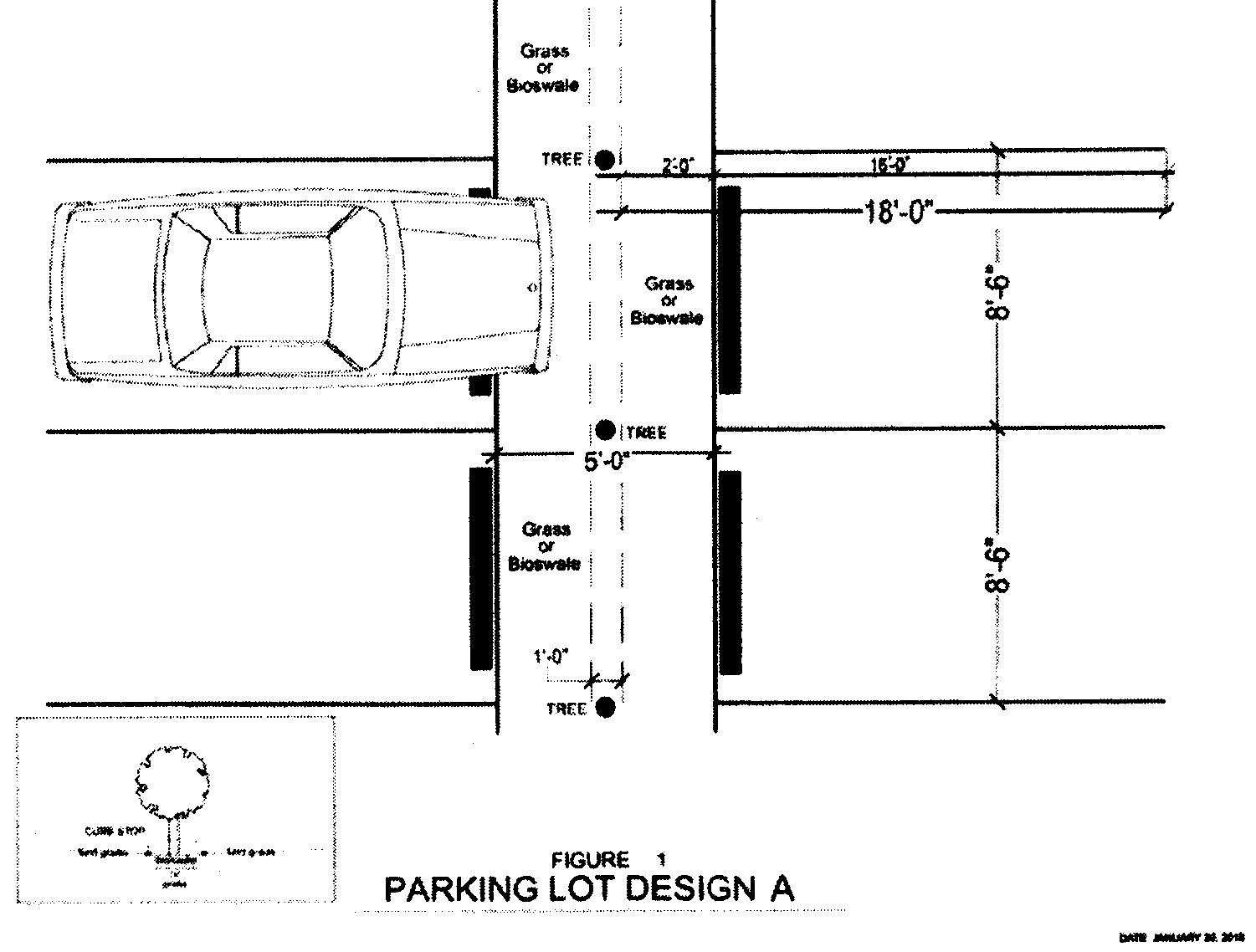
_________________________________
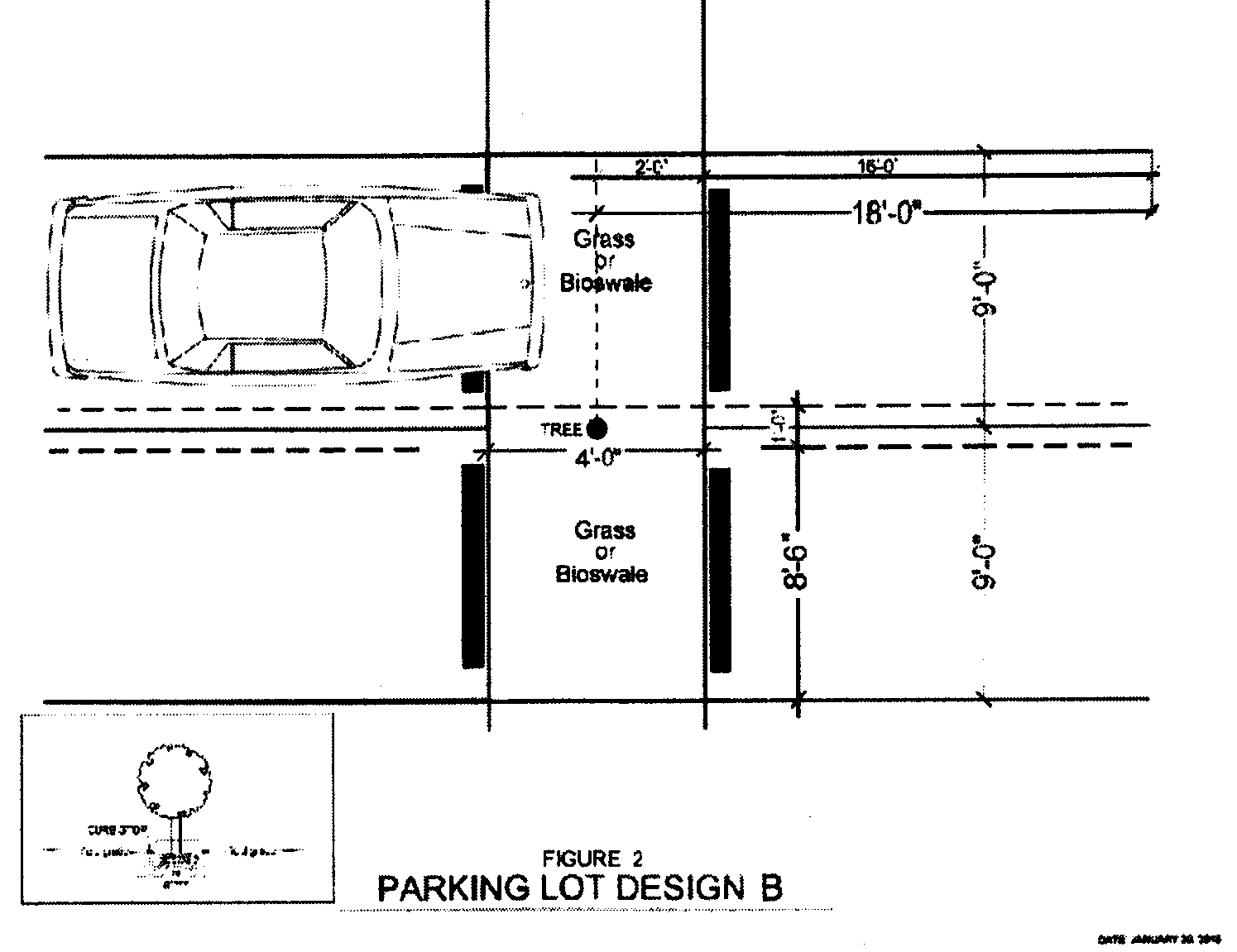
_________________________________
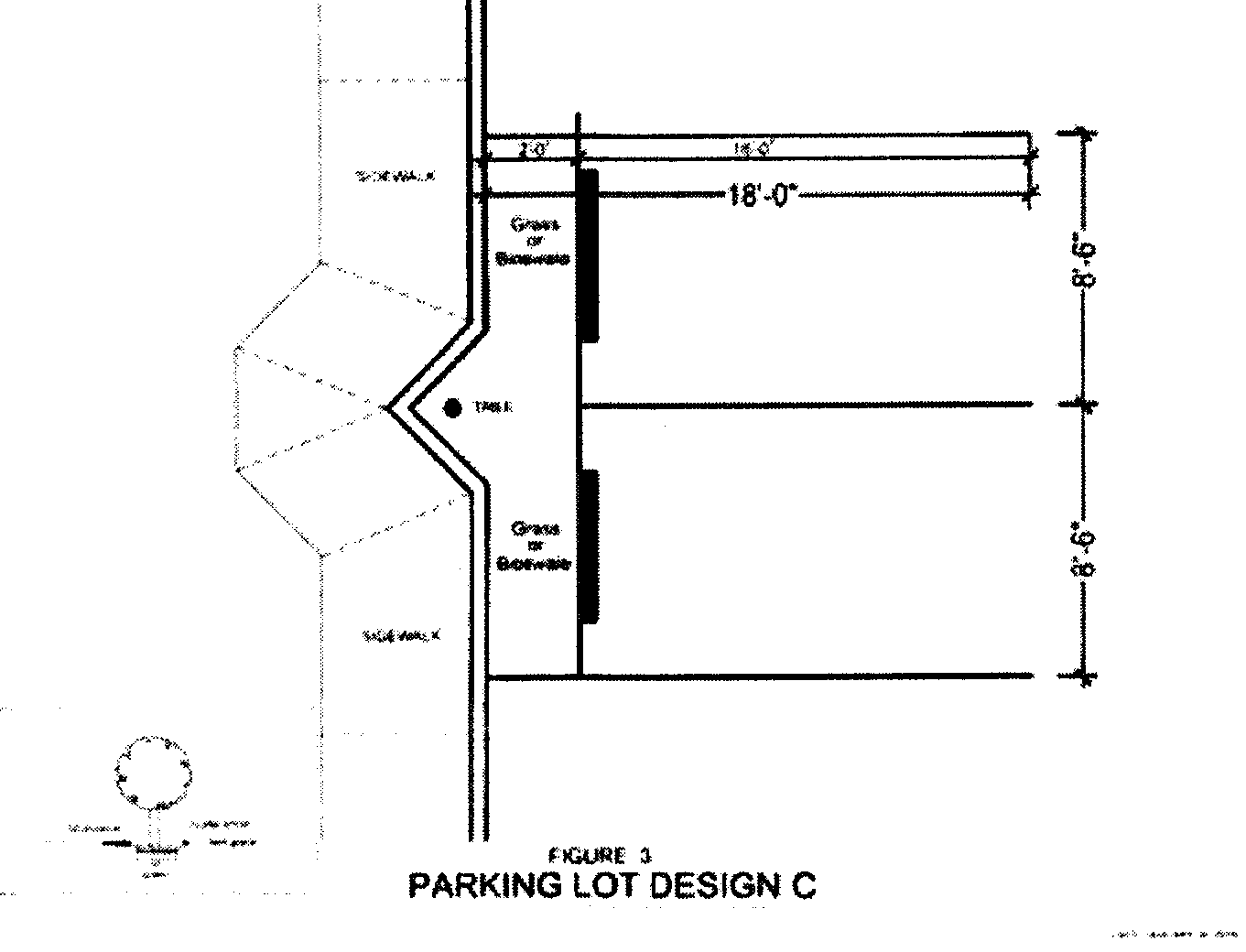
(Ord. No. 4921, § 2, 2018)
_____
19.36B.090 - Paving and other surfaces.
A.
Every required off-street parking space, aisle, driveway, and lane, except for those used for single-family dwellings, accessory dwellings, duplexes, farm dwellings, farm labor dwellings, and commercial agriculture structures, shall be paved with asphaltic or concrete surface. Colored or textured concrete or asphalt paving material may be used to improve aesthetics. Up to 2 feet of the pavement at the parking space terminus of standard-sized non-parallel parking spaces may be replaced with landscaping in accordance with subsection 19.36B.080(A)(4).
B.
After considering frequency of use, the character of the area, surrounding and similar uses, durability, and need for maintenance, the director may allow or require surfaces other than asphalt or concrete, as follows:
1.
Surface material other than asphalt or concrete may be allowed or required if it is consistent with the community plan, zoning district design guidelines, or approved conditional permit, or is in keeping with the character of a historic district or country town.
2.
Up to ten spaces or 50 percent of the provided spaces, whichever is greater, may be located on grass, gravel, concrete mason grid pavers, or other appropriate surface.
3.
In the State conservation district or the County agriculture district, up to 100 percent of the provided spaces may be located on grass, gravel, concrete mason grid pavers, or other appropriate surface.
4.
In Maui County historic districts as set forth in title 19, up to 100 percent of the provided spaces may be located on grass, gravel, concrete mason grid pavers, or other appropriate surface if paving could result in harm to historic properties.
C.
Parking spaces that are not required shall be paved or located on grass, gravel, concrete mason grid pavers, or other appropriate surface, and shall be maintained to comply with the requirements of this chapter.
(Ord. No. 4921, § 2, 2018)
19.36B.100 - Off-site parking.
A.
The director may allow off-site parking for required parking spaces and may allow the designation of parking spaces that may be required in the future, subject to all of the following:
1.
An off-site parking permit application is submitted containing any information required by the director to assess compliance with this title.
2.
The straight-line distance to each of the off-site parking spaces from the benefiting lot's boundary line does not exceed 500 feet.
3.
The area to be used for off-site parking complies with the requirements of this title and is zoned to allow a stand-alone parking lot.
4.
The off-site parking spaces are identified with signs or similar markings as reserved for the users of the benefitting lot.
5.
A unilateral agreement that the off-site parking spaces shall be reserved for the dedicated, exclusive use of the benefiting lot, which shall run with the land and be recorded with the bureau of conveyances.
B.
Off-site parking that is approved as part of a State special permit, County special use permit, or conditional permit does not require director approval. Off-site parking that is approved as part of a special management area use permit does not require director approval, and the location shall be zoned to allow a stand-alone parking lot. Off-street parking for spaces that are not required does not require director approval.
(Ord. No. 4921, § 2, 2018)
19.36B.110 - Parking modification, reduction, or deferral.
A.
For any proposed use, the director may reduce by up to 50 percent the number of the required parking spaces and loading spaces after making a written determination that adequate parking will be reasonably provided. The director shall consider the proposed use, any structures, lot configurations, industry standards, general plan, zoning and state land use designations, historic character and applicable design guidelines in considering the necessity and type of conditions. The director may seek the recommendation of the Molokai planning commission before acting on a request to reduce the number of required parking spaces and loading spaces on Molokai. At least one of the following criteria must be met for the director to determine that parking will be reasonably provided:
1.
The sharing of parking spaces between two or more uses occurs at different times or days.
2.
Duplicate parking is not needed for component accessory uses when parking has already been assessed for a principal use, such as a school that expands its cafeteria.
3.
One of the following is located within 2,500 feet of the proposed use and can provide parking for the proposed use:
a.
A publicly owned off-street parking lot; or
b.
Other parking that is available to the public and is not used to otherwise fulfill the parking requirements of this chapter.
4.
Some employees commute via carpooling or van pooling, and the employer provides transit passes to some employees.
5.
There is nearby transit, pedestrian, or bicycle access and bicycle parking, and safe access is provided for pedestrians.
6.
The provision of required parking would necessitate the removal of mature and aesthetically valuable trees or other unique features of the property.
7.
The use involves senior housing or other facilities for seniors and will not result in typical parking needs.
8.
The parking is required because of an expansion of or change in use, the additional parking cannot be accommodated onsite, and the director determines that the existing parking is adequate.
9.
The use is live/work mixed use where parking may be shared; the spaces required for dwelling use may be applied to the spaces required for business use.
10.
The proposed use is in Lāna‘i City.
B.
Tandem parking may be allowed for all required parking if:
1.
All vehicle parking and retrieval is performed by a valet or attendant at all times, and vehicles can be moved within the lot without entering any street, alley, or walkway; or
2.
All user arrivals and departures are generally simultaneous and vehicle parking and vehicle retrieval is directed by an attendant who is onsite at all arrival and departure times.
C.
Bicycle parking. The number of parking spaces required for non-dwelling uses may be reduced by up to two, at a ratio of one space for each ten provided bicycle parking spaces; provided that each bicycle parking space includes a stationary parking device to adequately secure the bicycle, each bicycle parking space is a minimum of 2 feet in width and is separated from motor vehicle access by at least 5 feet of open area, and bicycle parking spaces are conveniently located and close to the main entrance of a structure.
D.
The director may allow the applicant to defer improvements otherwise required by this chapter, including paving, striping, and landscaping, for up to 50 percent of the required parking spaces and loading spaces. The director may seek the recommendation of the Molokai planning commission before acting on a request to defer improvements on Molokai. The director may impose conditions on the deferral and shall require the following:
1.
Evidence of a parking reserve in the form of a reserved unpaved open space area large enough to meet the balance of the parking requirements in excess of the minimum open space or landscape requirements.
2.
A unilateral agreement, which shall run with the land and be recorded with the bureau of conveyances, to construct the improvements when and if warranted as determined by the director based on evidence of regular use of the reserved parking area or overflow parking on public streets, in fire lanes, or in other areas that are not improved for parking.
3.
Evidence that all required spaces are not needed on a regular basis, such as industry standards or historical records.
(Ord. No. 4921, § 2, 2018)
19.36B.120 - Temporary parking.
A.
For the purpose of this chapter, temporary parking means the providing of parking spaces and areas for a limited period of time, such as temporary employee parking; temporary construction worker parking; temporary displaced parking; and temporary sales offices, bazaars, fairs, festivals, recreation, parties, and sporting events.
B.
After considering the use, duration, potential visual and physical impacts, public health, and public safety, the director must determine if any of the requirements of this chapter may be waived for temporary parking.
C.
In all zoning districts, the director may approve temporary parking on any lot for either a continuous period of up to one hundred eighty days in a twelve-month period, or a total of twelve nonconsecutive days in a twelve-month period. The director may seek the recommendation of the Molokai planning commission before acting on a request to approve temporary parking pursuant to this subsection.
D.
In all zoning districts, the commission may approve temporary parking on any lot for either a continuous period of more than one hundred eighty days in a twelve-month period, or more than a total of twelve nonconsecutive days in a twelve-month period.
E.
Temporary parking for events organized or sponsored by government agencies with associated parking located on government facilities do not require director or commission approval and are allowed.
F.
An applicant for temporary parking must provide relevant information as required by the director or commission, including a detailed description of the event or circumstances, days of parking use, hours of parking use, anticipated parking demand, description of how parking demand will be satisfied, and a description of how the parking area and any improvements to it will ensure public health, public safety, and visual relief.
G.
In all zoning districts, temporary or permanent parking of camper vans, recreational vehicles, trailers, vehicles with pop-up tents, or similar apparatus that are used or rented for commercial transient accommodations is prohibited, unless specifically permitted. Advertising that offers to rent a camper van, recreational vehicle, trailer, or similar apparatus for commercial transient accommodations constitutes prima facie evidence of the operation of the apparatus.
(Ord. No. 5473, § 12, 2022; Ord. No. 4921, § 2, 2018)
19.37.010 - Geographic restrictions.
A.
Except as provided in this chapter, time share units and time share plans are prohibited in all zoning districts. Transient vacation rentals are prohibited in all zoning districts, excluding bed and breakfast homes permitted under chapter 19.64, short-term rental homes permitted under chapter 19.65, transient vacation rental units permitted by a conditional permit under chapter 19.40, transient vacation rentals permitted under chapters 19.12, 19.14, 19.15, 19.18, 19.22, and 19.32, and hotels that are permitted based on the applicable zoning in the comprehensive zoning ordinance.
B.
Existing time share units, time share plans, and transient vacation rentals that were operating in accordance with and under law and were registered in accordance with chapter 514E of the Hawaiʻi Revised Statutes as of the effective date of the ordinance codified in this section, must not be impaired by the provisions of this section; provided that, any time share project operating under law that records in the bureau of conveyances by May 3, 1991, a declaration in a form prescribed by the director will be deemed exempt from this section as long as the project or apartment unit identified by the declaration continues to operate under a lawful time share plan or registration.
C.
New time share units and time share plans are allowed in the hotel district with a conditional permit if the time share units are situated landward of the line set at the distance from the certified shoreline to the mapped line for coastal erosion at 3.2 feet of sea level rise, as depicted on the State of Hawaiʻi sea level rise viewer hosted by the pacific islands ocean observing system as of November 4, 2022. Existing time shares may be reconstructed, renovated, or expanded if no new time share rooms or units are added.
D.
Advertising or marketing that offers a property as a time share unit constitutes prima facie evidence of the operation of a time share unit on the property, and the owner, operator, or lessee of record bears the burden of proof to establish the subject property is being used as a legal time share unit or is not in operation as a time share unit.
(Ord. No. 5474, § 5, 2022; Ord. No. 5473, § 13, 2022; Ord. No. 5126, § 9, 2020; Ord. No. 4167, § 4, 2014; Ord. No. 4063, § 2, 2013; Ord. No. 3941, § 12, 2012; Ord. No. 3681, § 5, 2009; Ord. 1989 § 1, 1991: Ord. 1134 § 3, 1981)
19.38.010 - Purpose and intent.
The purpose and intent of these standards is to create opportunities for a broader range of desirable knowledge based and emerging industries, which will provide highly-skilled and well-paying jobs for Maui residents. As the Maui Research & Technology Park district develops it should utilize the principles of new urbanism and smart growth to create a community of innovation. This includes providing diverse housing options within close proximity of Maui Research & Technology Park employment and the integrating neighborhood-serving retail, civic, and commercial uses in a manner that will encourage bicycling, walking, and public transportation.
(Ord. No. 4347, § 1, 2016)
19.38.020 - Definitions.
The following definitions shall apply to this chapter. Terms not defined below shall have the meanings set forth in section 19.04.040 of this title:
"Dormitory" means a building or group of buildings with group living quarters for a student body or other group associated with educational institution use.
"Dwelling, four-plex" means an apartment house consisting of only four dwelling units designed exclusively for occupancy by four families living independently of each other.
"Dwelling, townhome" means a dwelling sharing a common sidewall with another single family dwelling of similar building type, typically arranged in a row.
"Dwelling, tri-plex" means an apartment house consisting of only three dwelling units designed exclusively for occupancy by three families living independently of each other.
"Education" means an organization or facility that offers educational curriculum or instruction including, but not limited to, kindergartens; elementary, intermediate, and high schools; colleges; universities; and trade, vocational, language, and art schools.
"Flex space" means unfinished building space suitable for combined residential, commercial, and light industrial uses.
"Floor area ratio" means the ratio of gross building floor area to the land area of the lot. The gross floor area includes the floor area of all covered structures on a lot excluding accessory covered parking facilities and covered solar/energy parking facilities.
"Green court" means an arrangement of dwellings around a central green space. The green space is bounded on at least two sides by dwellings and opens onto a street. Individual home lots are relatively compact, with most open area in the shared green space. House lots may include a mix of single family detached dwellings, single family attached dwellings, and multi-family dwellings.
Example of green court configuration:
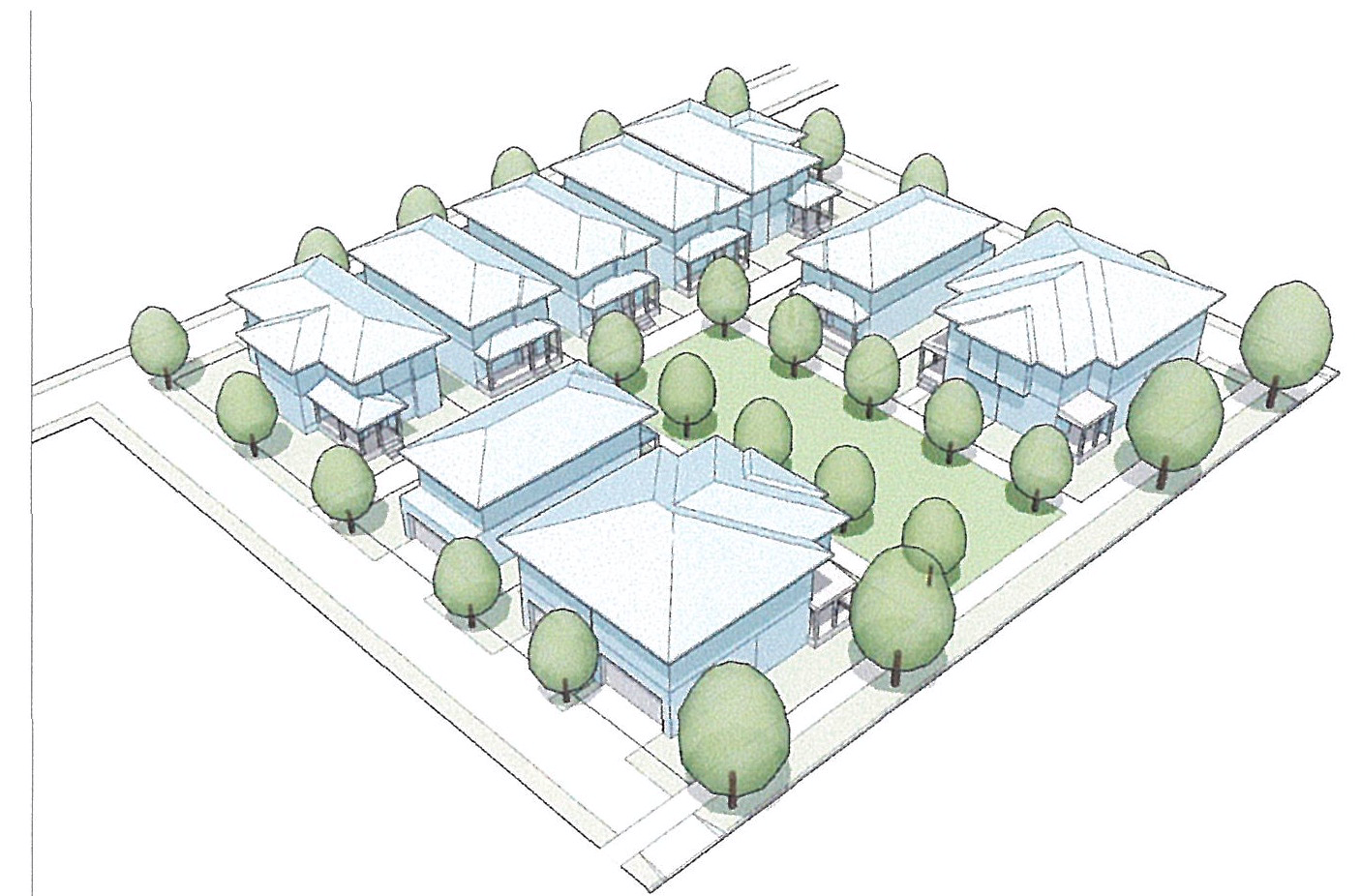
"Home-based business—Maui Research & Technology Park" means an enterprise or activity, conducted by the occupant of the dwelling unit that involves either the growing, processing, or manufacturing of product, or the provision of services, for consideration and profit. Home-based businesses with the Maui Research & Technology Park are subject to the following standards:
1.
No more than two employees, other than residents of the dwelling unit, shall be employed by the home occupation.
2.
No more than 40 percent of the floor area of the dwelling unit shall be used by the home occupation.
3.
Group instruction classes or group sales meetings shall not include more than four persons, excluding employees of the home occupation.
4.
Retail sales shall be limited to products produced by the home-based business.
5.
Signs to advertise the home occupation shall be no larger than 4 square feet and shall be attached to the dwelling unit.
6.
Deliveries and pickups by package services must be done with residential common carriers (including but not limited to the United States Postal Service, United Parcel Service, and Federal Express).
7.
All goods, samples, materials, or objects used by the home-based business shall be stored within the dwelling unit, a garage, or an accessory structure.
8.
The home-based business shall not negatively impact the residential character of the property or neighborhood.
9.
The following activities shall be prohibited:
a.
Harboring, caring, training, or raising dogs, cats, birds, horses, or other animals;
b.
The repair of automobiles and other vehicles with internal combustion engines shall be restricted to no more than two at any time;
c.
Baseyards. For the purpose of this section, "baseyards" means anywhere on a property that has a home-based business where vehicles not in service are stored; and
d.
The repair, manufacturing, processing, or alteration of goods, materials, or objects that results in a detrimental effect or nuisance upon neighbors.
"Knowledge industry" means industries characterized by highly-skilled workers in professional, scientific, and technical services establishments that specialize in performing professional, scientific, and technical activities. Knowledge industries are supported by employees who work primarily with information or who develop and use knowledge in the workplace. Knowledge industry includes a broad spectrum of uses including, but not limited to, biotechnology; computer sciences; manufacturing, assembly, testing, and repair of electrical, electromechanical, and optical components, devices, equipment, and systems; multimedia and art production; pharmaceutical, biological, medical, and agricultural research and production; research, development, testing, and demonstration laboratories and facilities; technology museum and exhibition space; telecommunication and information service centers; and other similar uses and facilities.
"Light industrial and manufacturing" means enclosed facilities for the production or assembly of products involving limited or minor emissions of odor, fumes, noise, vibrations, heat, glare, or electrical interference to the exterior. Light industrial and manufacturing uses are technology or innovation oriented, such as, but not limited to, laboratories, machine shops, and craft industries.
"Lot line, front" or "front lot line" means a line separating the lot from the primary street as identified by the design guidelines.
"Maui Research & Technology Park district" means land specifically designated and zoned for the permitted uses set forth hereinafter in section 19.38.060.
"Office over retail" means a combined use building with office above and ground-floor retail use, including eating and drinking establishments.
"Office/research and development" means an office building used for knowledge and research-based commercial employment or business offices for other allowed uses.
"Professional and administrative offices" means businesses providing professional and administrative services, including, but not limited to accounting, bookkeeping, banking, architecture, design, engineering, advertising, legal representation, and administrative offices.
"Renewable energy systems" means energy production facilities including, but not limited to, solar, wind, hydrologic, and biomass systems.
"Residential over retail use" means a combined residential and retail use of a single-family, two-family, or multi-family dwelling, with a ground-floor retail use, including eating and drinking establishments.
"Retail" means a building or portion thereof used for businesses engaged in the retail sales of goods, including eating and drinking establishments.
(Ord. No. 4347, § 1, 2016)
19.38.030 - Acreage allocations.
The following are established as the acreage allocations for the five districts and roads within the Maui Research & Technology Park:
(Ord. No. 4347, § 1, 2016)
19.38.040 - Controlling plan.
The controlling plan establishes the layout of districts within the Maui Research & Technology Park.
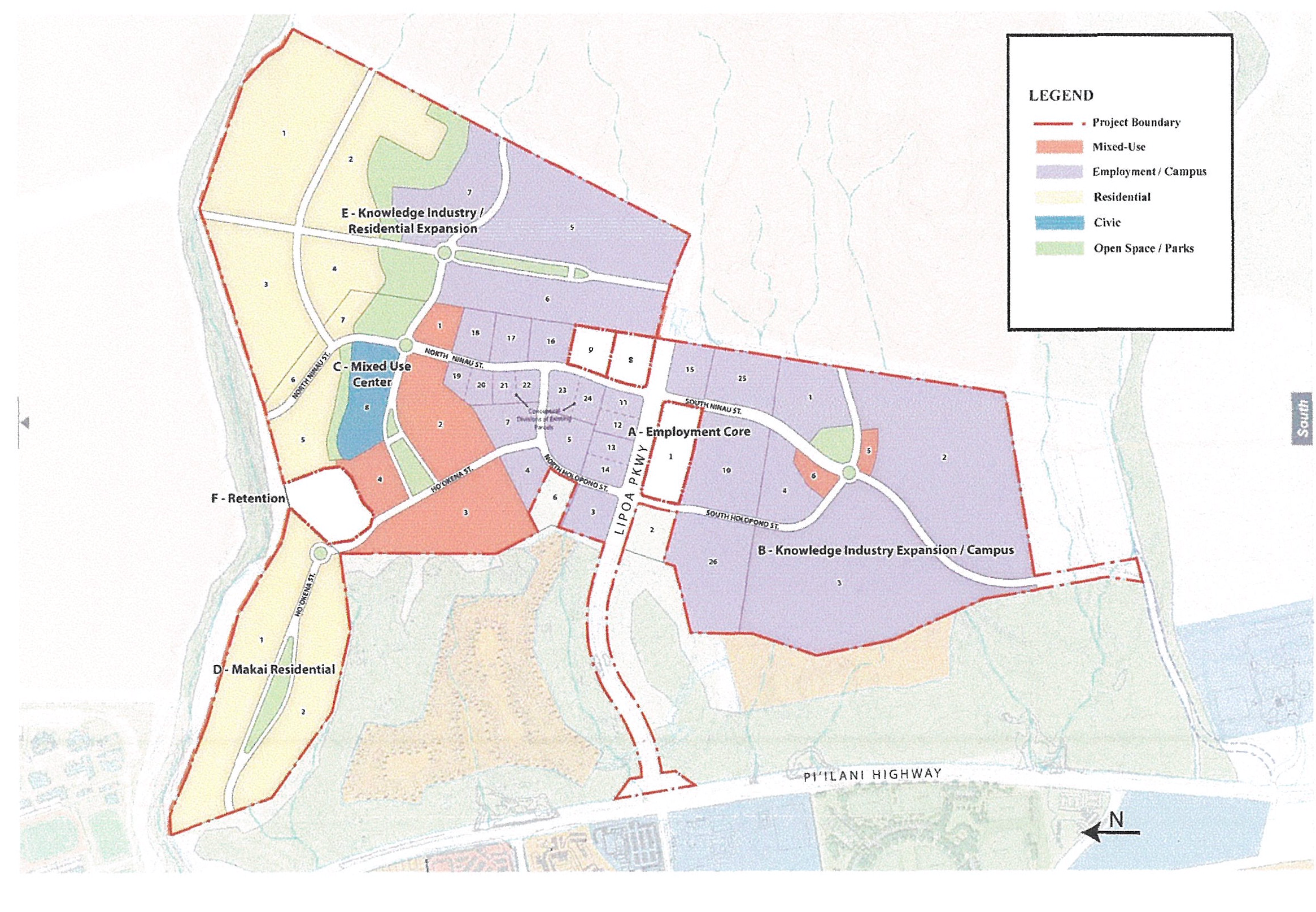
(Ord. No. 4347, § 1, 2016)
19.38.050 - Districts.
A.
Employment/campus district. The purpose of the employment/campus district is to allow for a broad mix of knowledge industry employment uses and incidental supportive uses and provide for a range of lot and building sizes. The district is characterized by small blocks, buildings built on front property lines, and ample pedestrian amenities. The purpose of lands identified as employment/campus in the controlling plan is to accommodate users requiring large contiguous parcels of developable land. Uses in the employment/campus district are predominantly knowledge industry employment uses. Incidental supportive retail, service, office, and civic uses are also allowed. Live/work businesses on flex space lots and housing associated with educational institutions constitute the only residential uses within the employment/campus district.
B.
Mixed-use district. The mixed-use district is a flexible area containing space for incubating new businesses as well as supportive retail, office, civic uses, schools, open space, and residential uses. Neighborhood-serving retail uses, office, flex space, live/work, multi-family buildings with ground-floor retail, and a range of multi-family and single family residences provide for a mix of activity and 24-hour usage of the Maui Research & Technology Park. The mixed-use district is characterized by small blocks, buildings built on front property lines, ample pedestrian amenities and open space, and the district is within walking distance of the surrounding residential and employment/campus districts.
C.
Residential district. The residential district accommodates the largest concentration of residential uses in the Maui Research & Technology Park. A mix of housing types is permitted and encouraged in the residential district including, but not limited to, single family detached, green court, townhome, duplex, tri-plex, four-plex, and apartment complexes. While the residential district is primarily residential in character, a mix of small neighborhood-serving retail uses, office, live/work, and civic uses, such as restaurants, grocery stores, offices, churches, libraries, recreational facilities, and day care centers is permitted. Residential districts are located within walking distance of the mixed-use district.
D.
Civic district. The civic district is intended to allow for a concentration of institutional and civic uses within the Maui Research & Technology Park.
E.
Open space/park district. The open space/park district is intended to provide areas for active and passive recreation, site drainage, water retention, and natural vegetation. Community centers and accessory park structures, such as pavilions, restrooms, play equipment, and utility buildings are the only structures allowed in the open space/park district.
(Ord. No. 4347, § 1, 2016)
19.38.060 - Permitted and accessory uses by district.
(Ord. No. 4347, § 1, 2016)
19.38.070 - Lot types by district.
The following matrix establishes allowed lot types by districts.
*Residential lot types, except flex space, in the employment/campus and civic districts must be associated with a permitted educational institution at the Maui Research & Technology Park and used to house staff, faculty, students, and/or campus visitors of such educational institution.
(Ord. No. 4347, § 1, 2016)
19.38.080 - Development standards.
The following are established as the development standards for each lot type in the Maui Research & Technology Park. Lot-type diagrams are provided for each lot type for illustrative purposes only. The diagrams are examples and shall not restrict building form.
A.
Office/research and development.
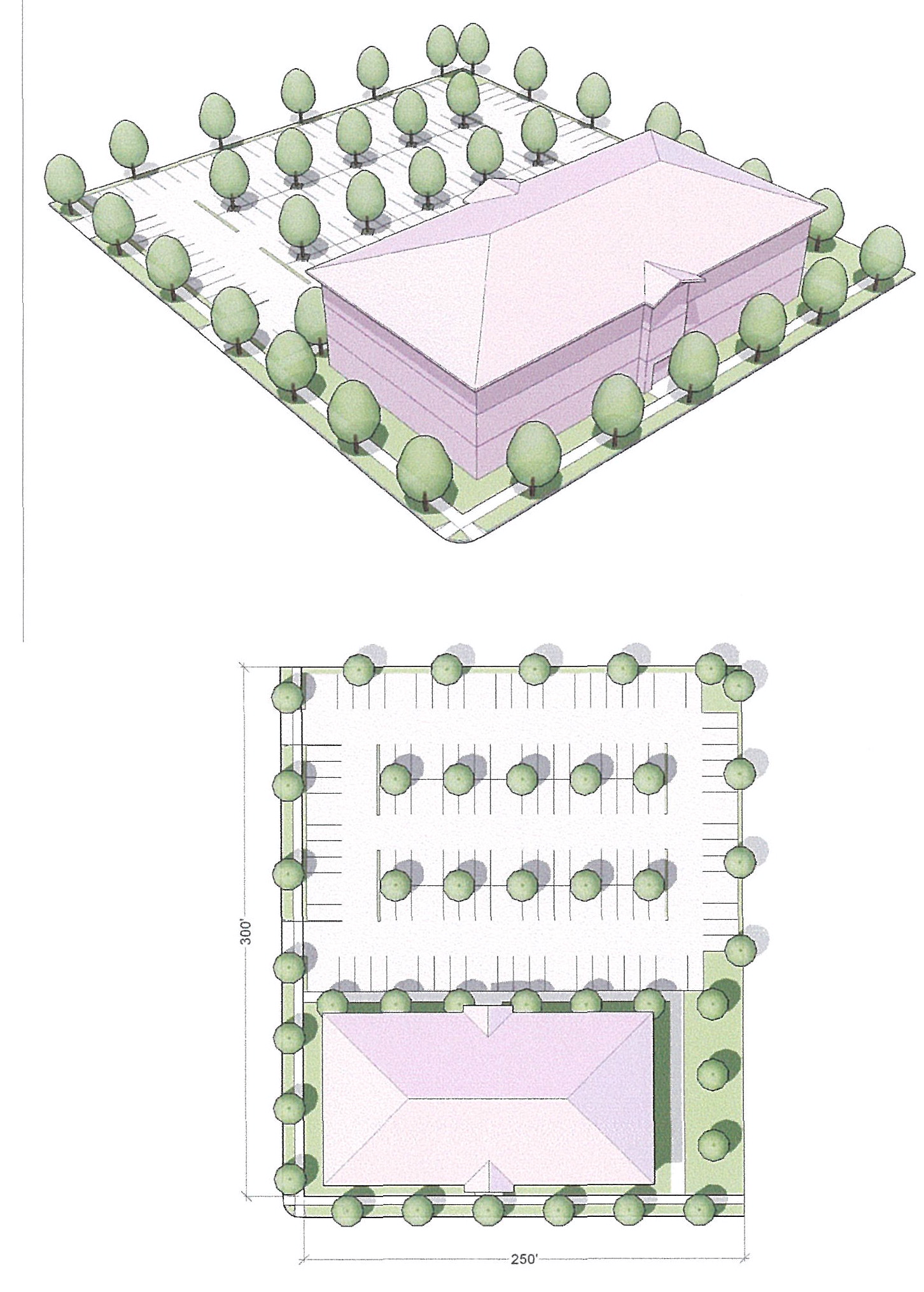
B.
Office over retail.
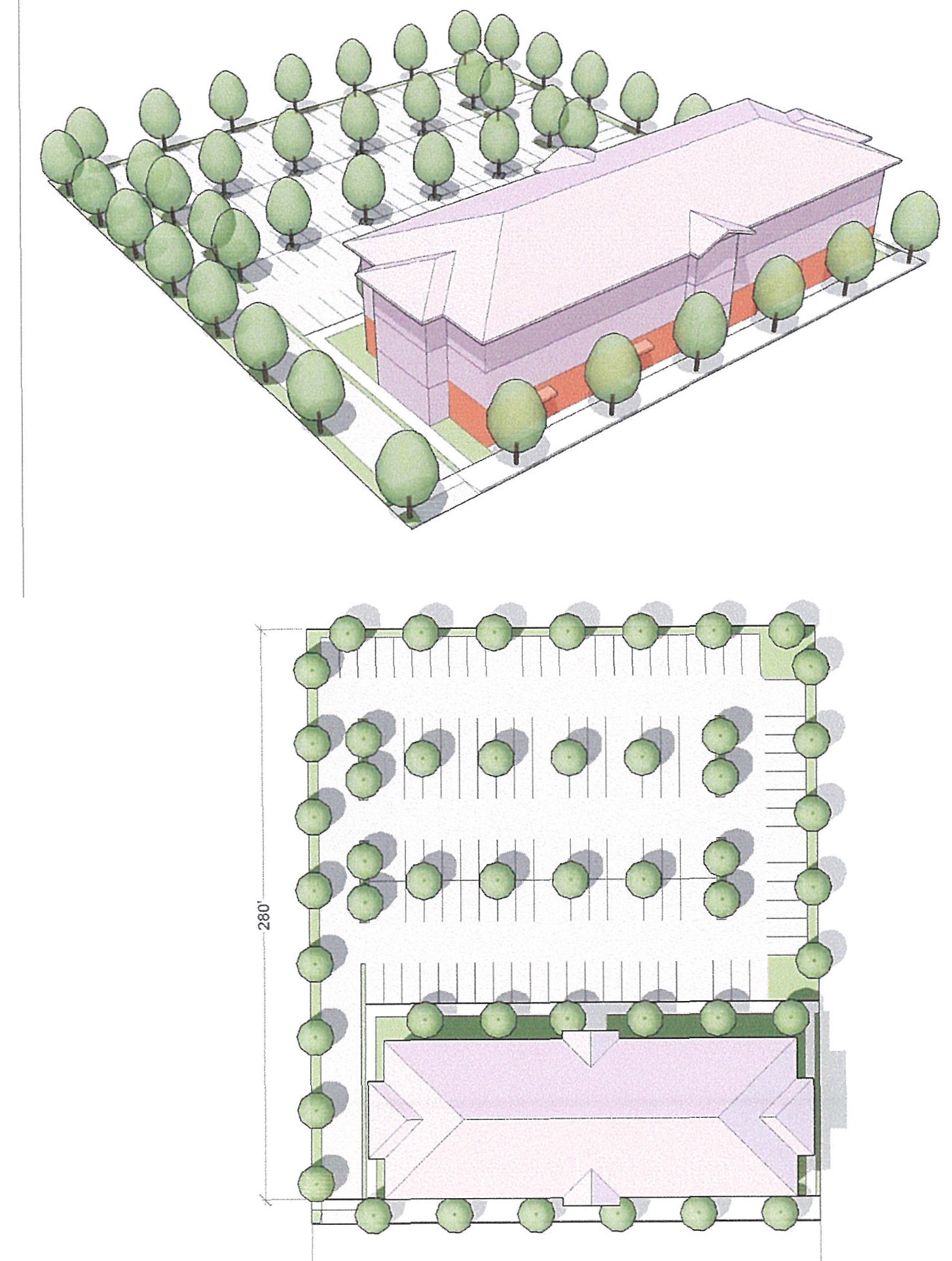
C.
Retail.
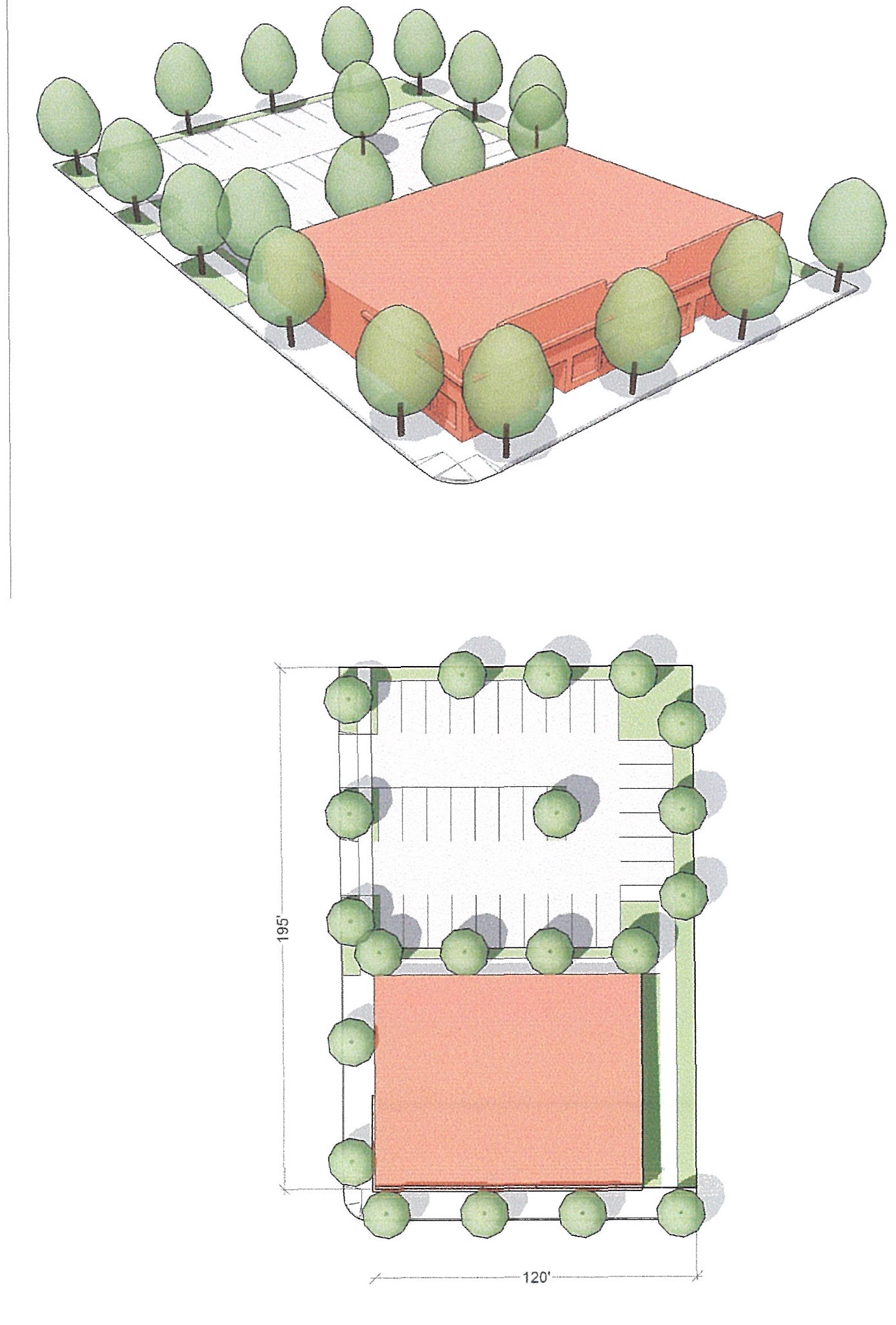
D.
Flex space.
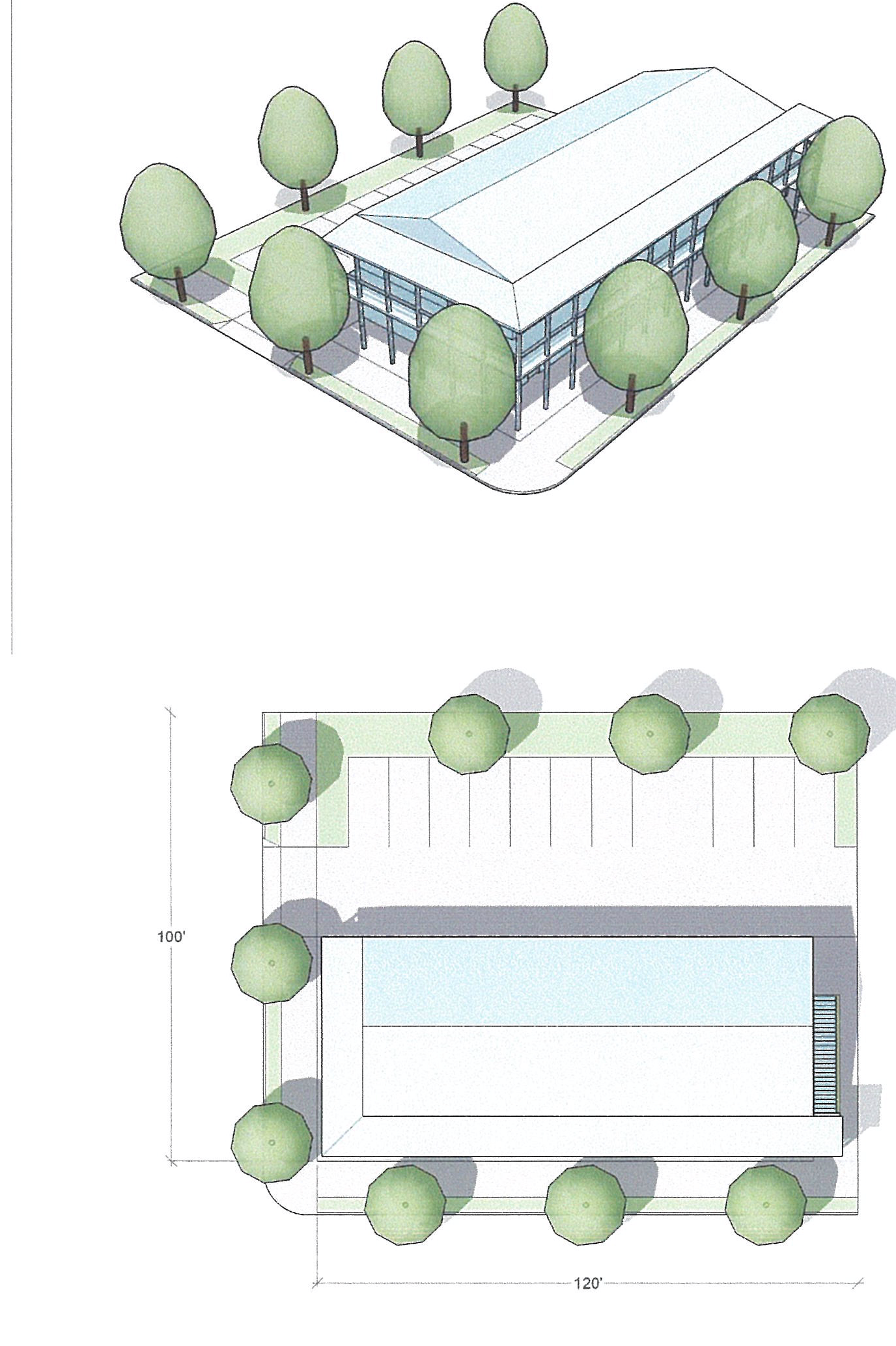
E.
Residential over retail.
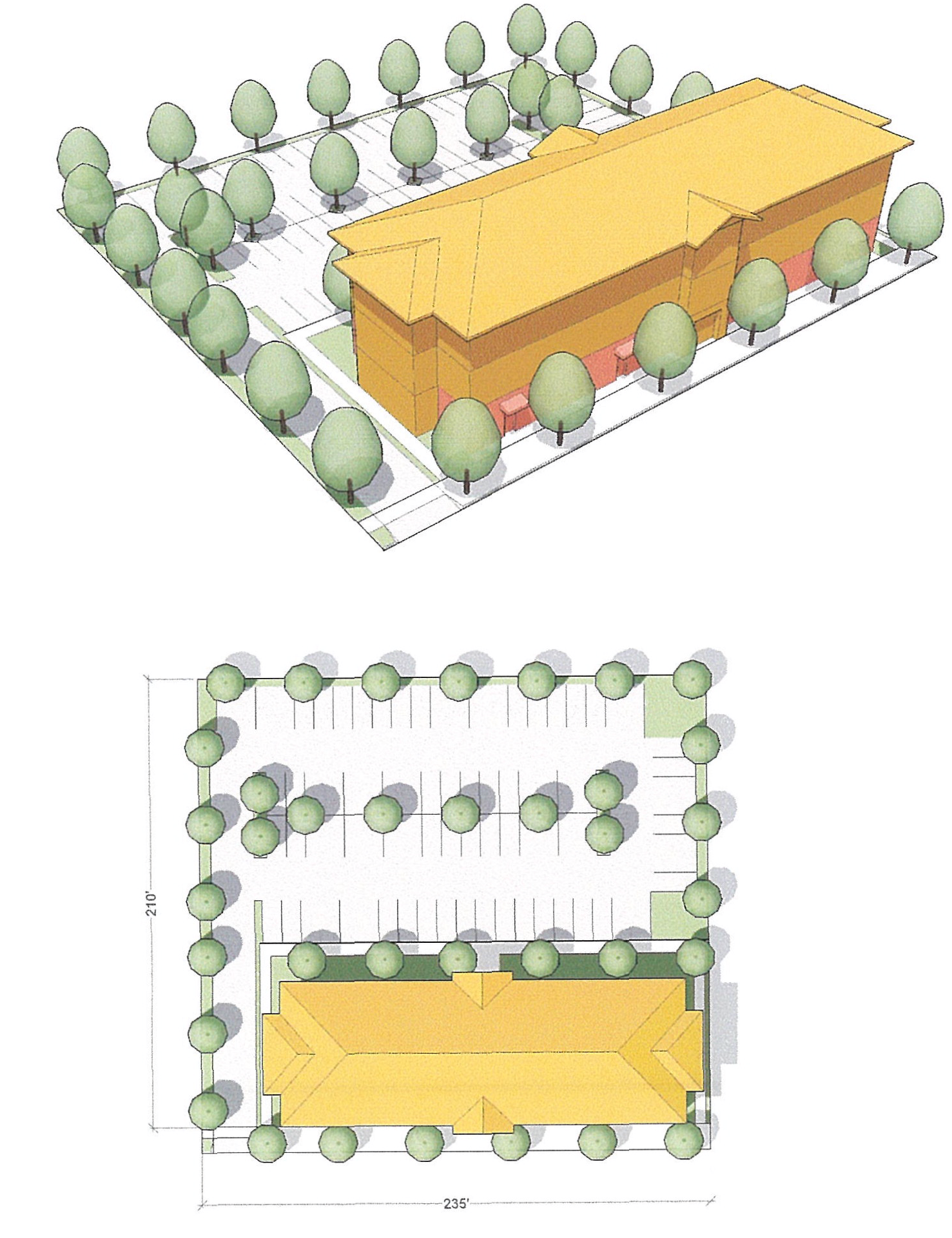
F.
Multi-family.
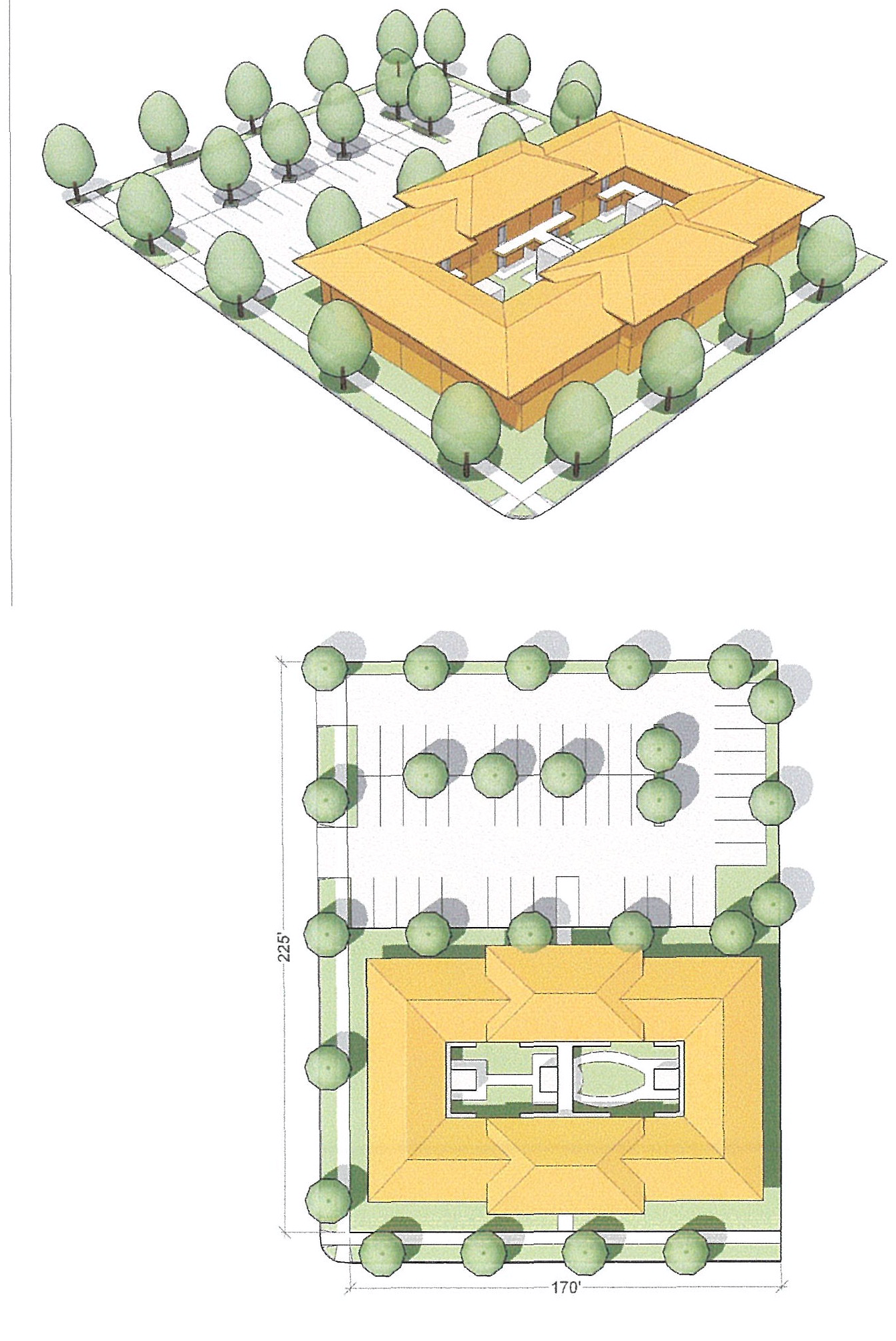
G.
Four-plex.
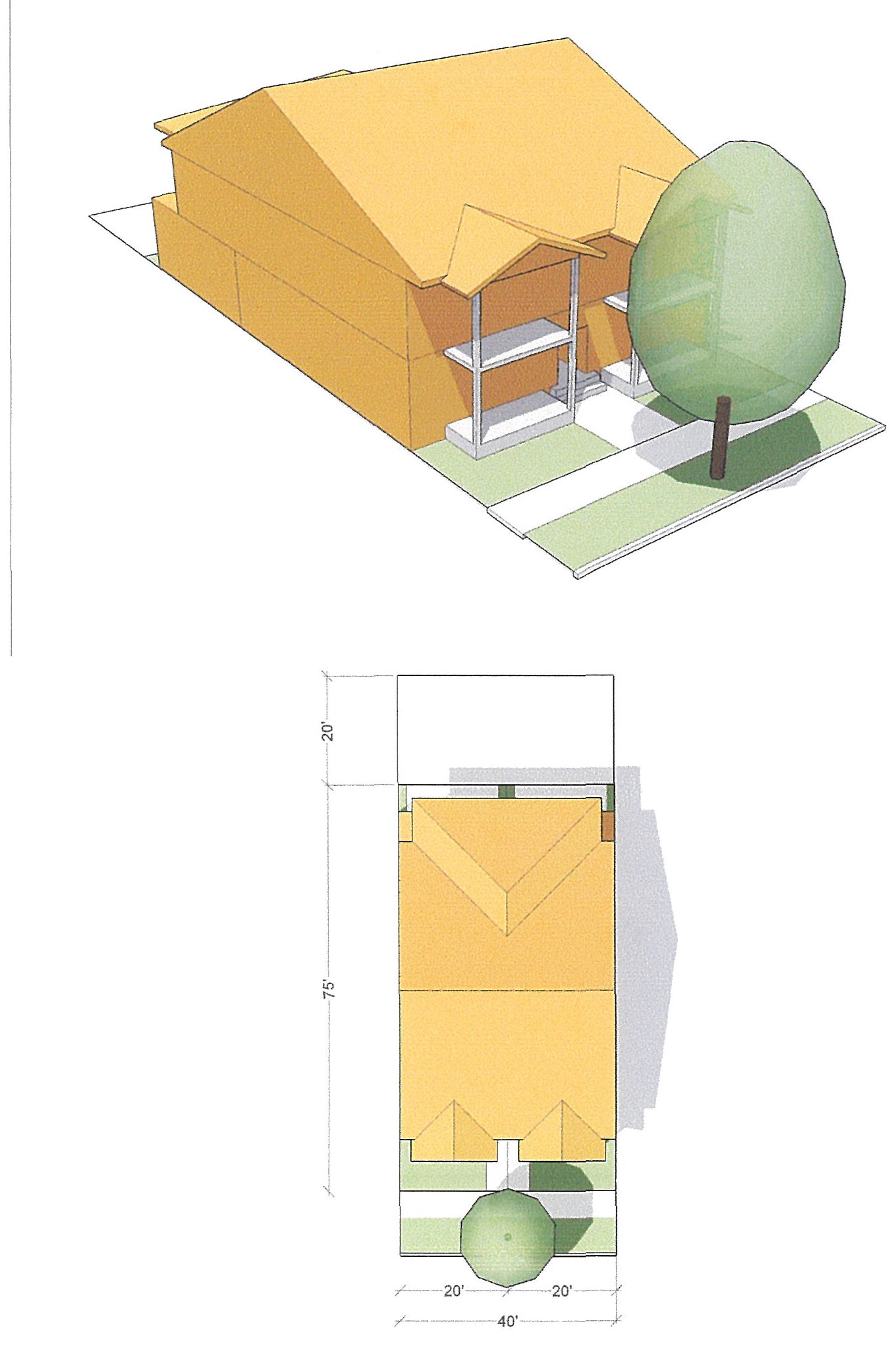
H.
Tri-plex.
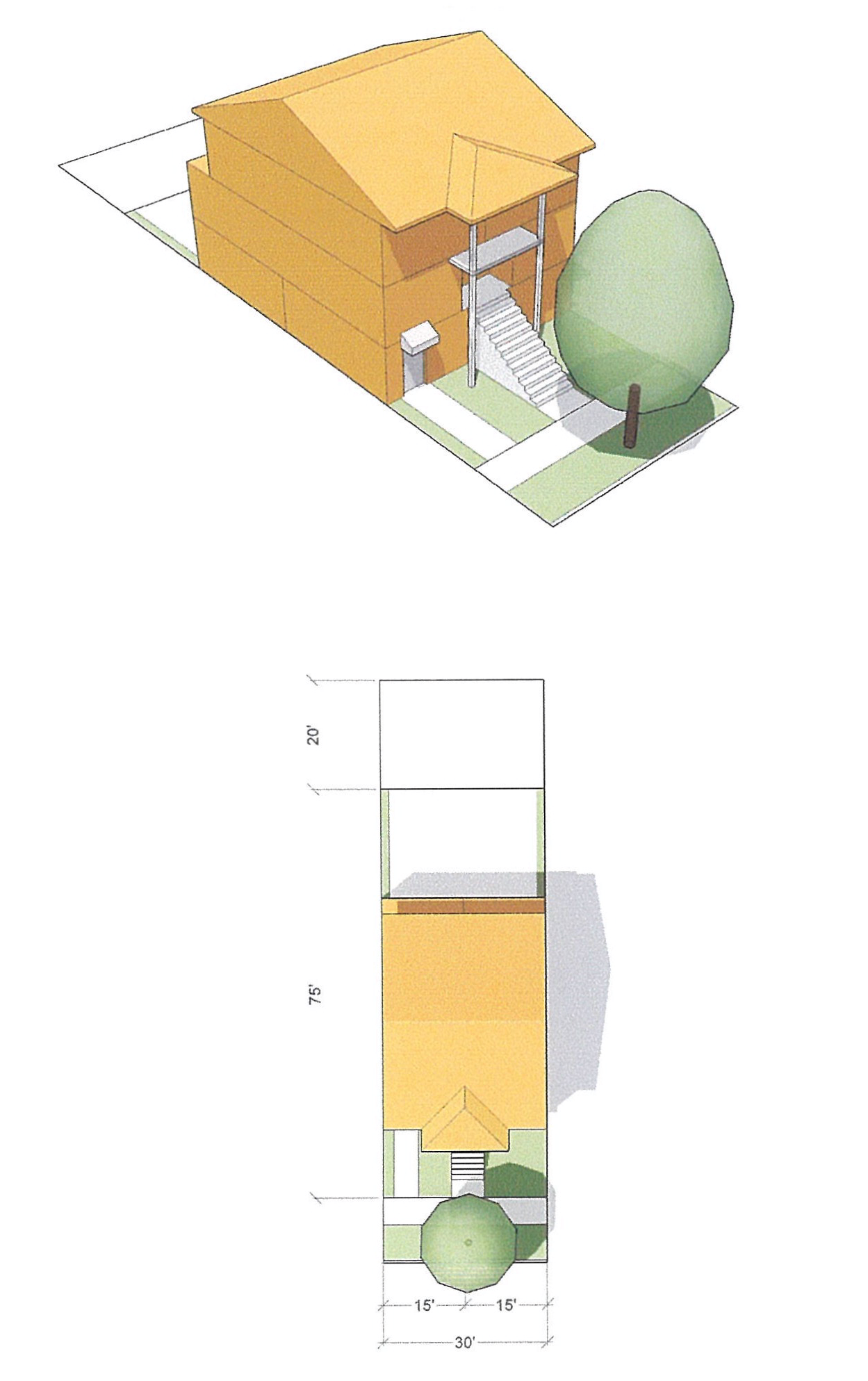
I.
Townhome.
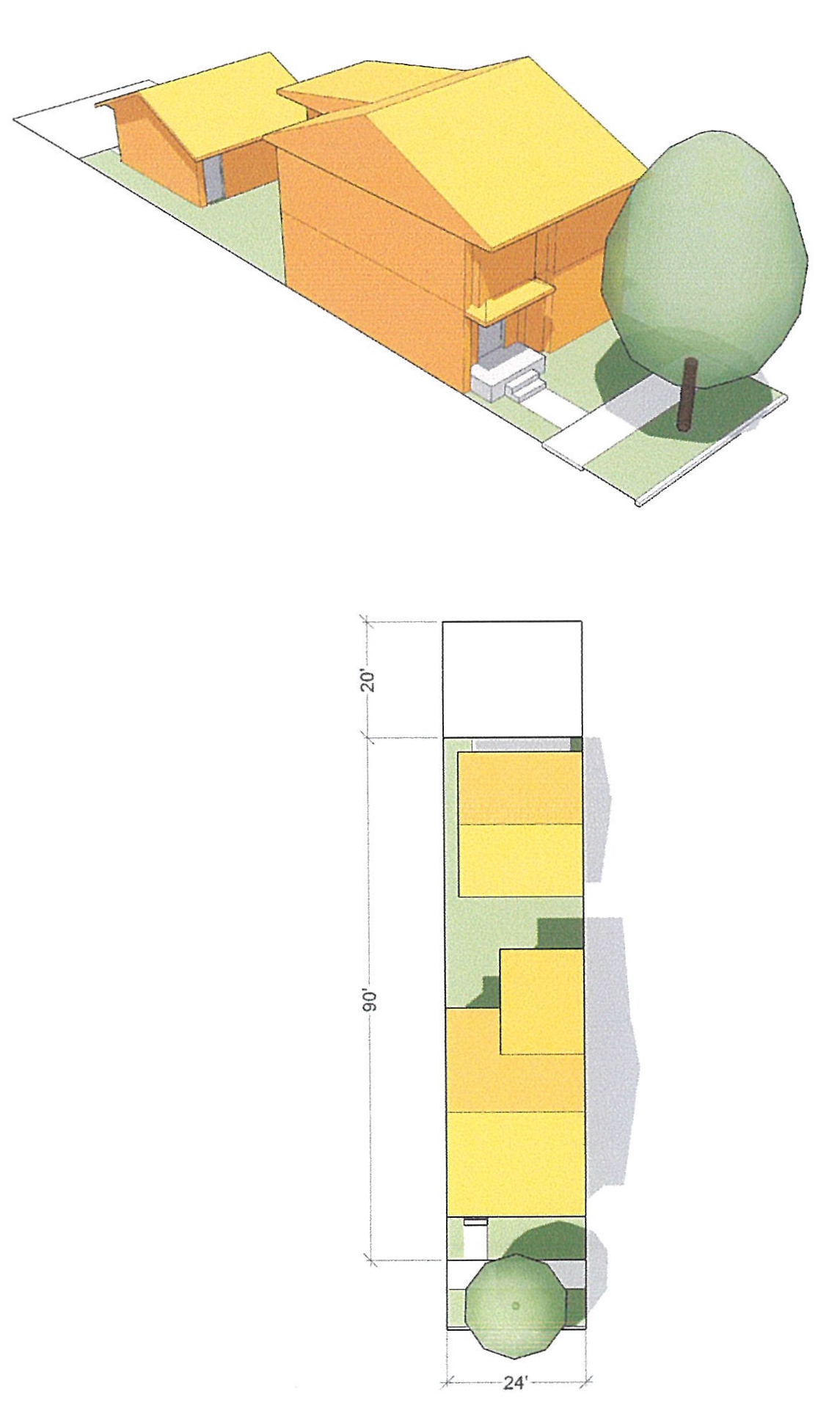
J.
Single family green court.
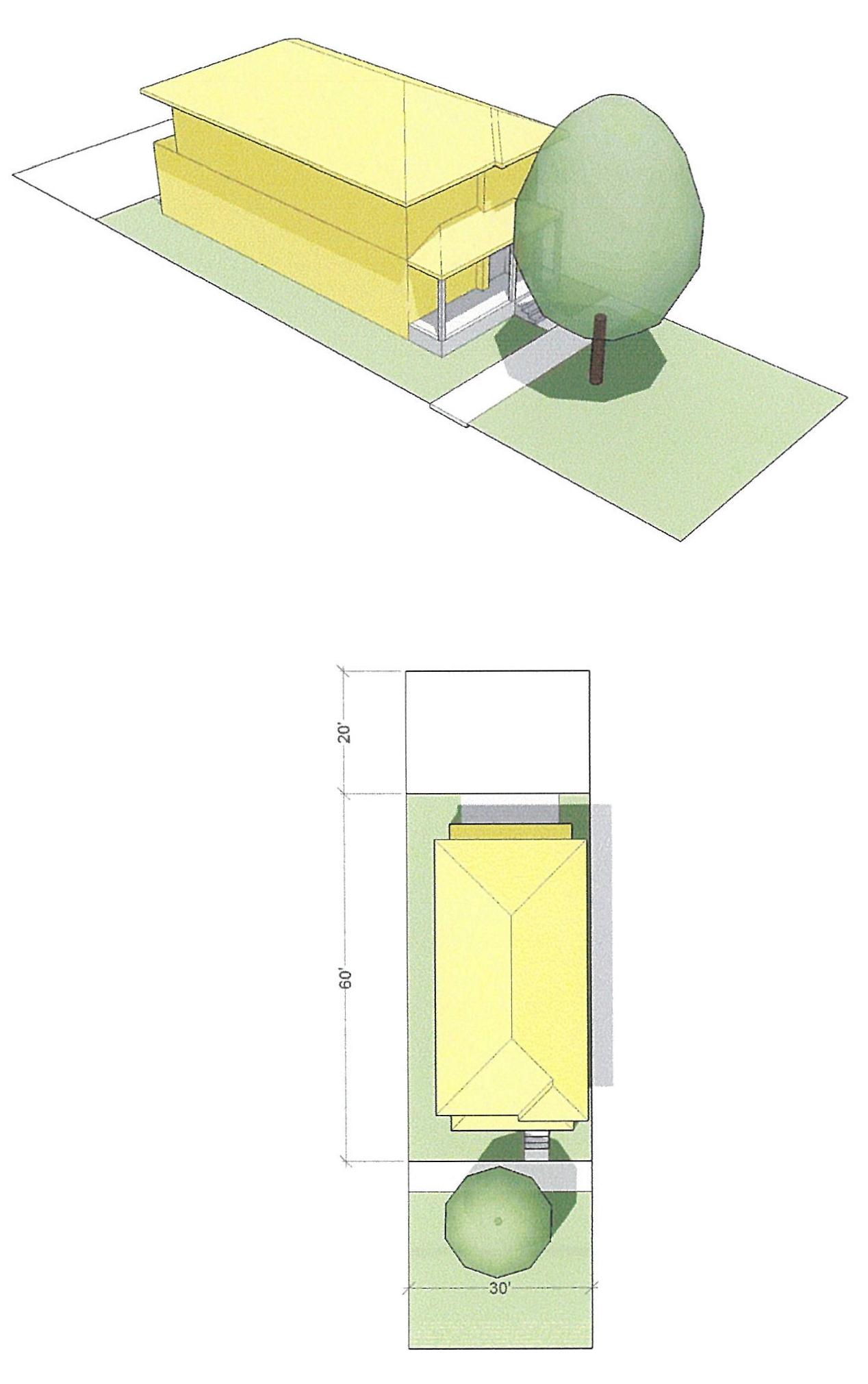
K.
Single family small lot.
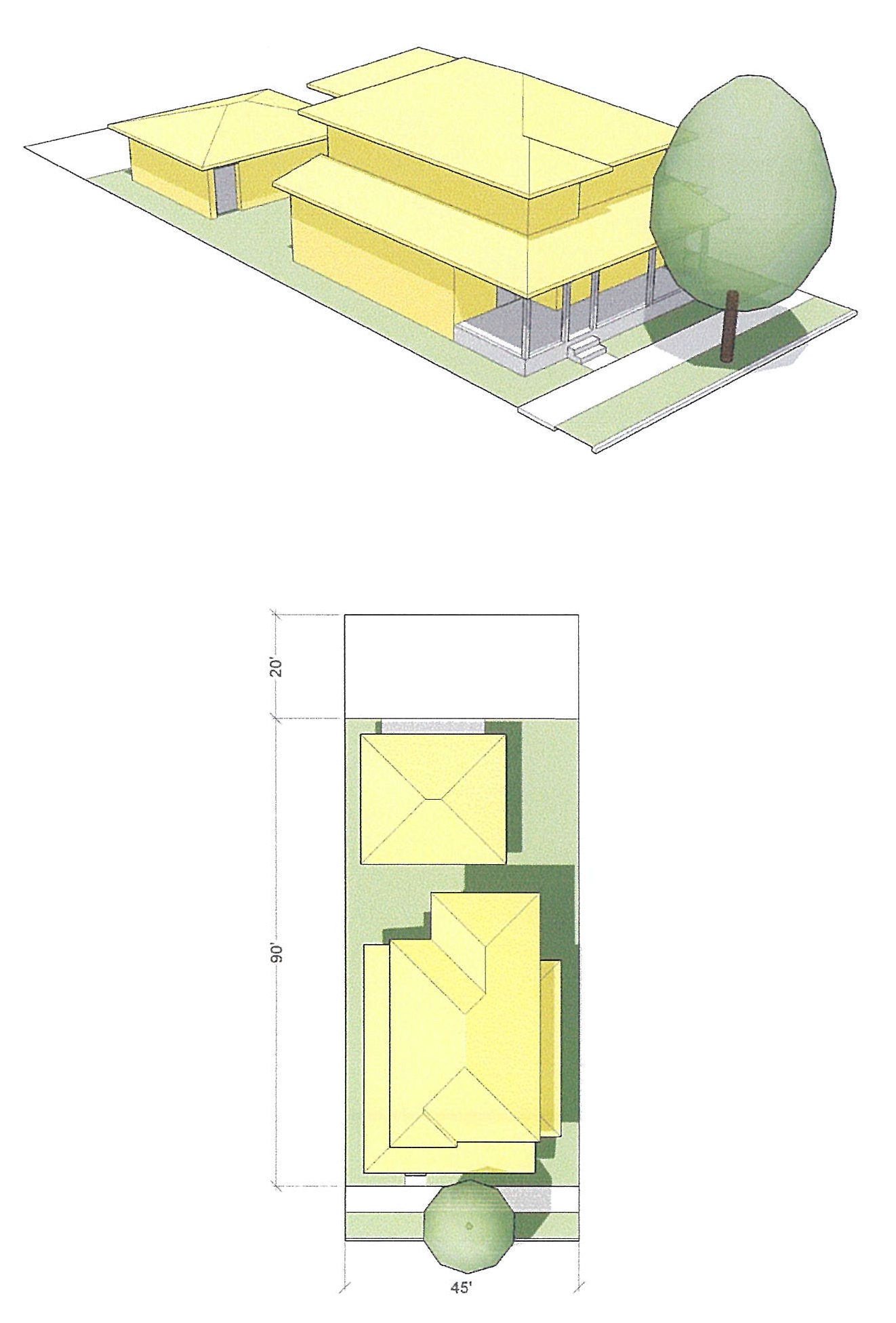
L.
Single family large lot.
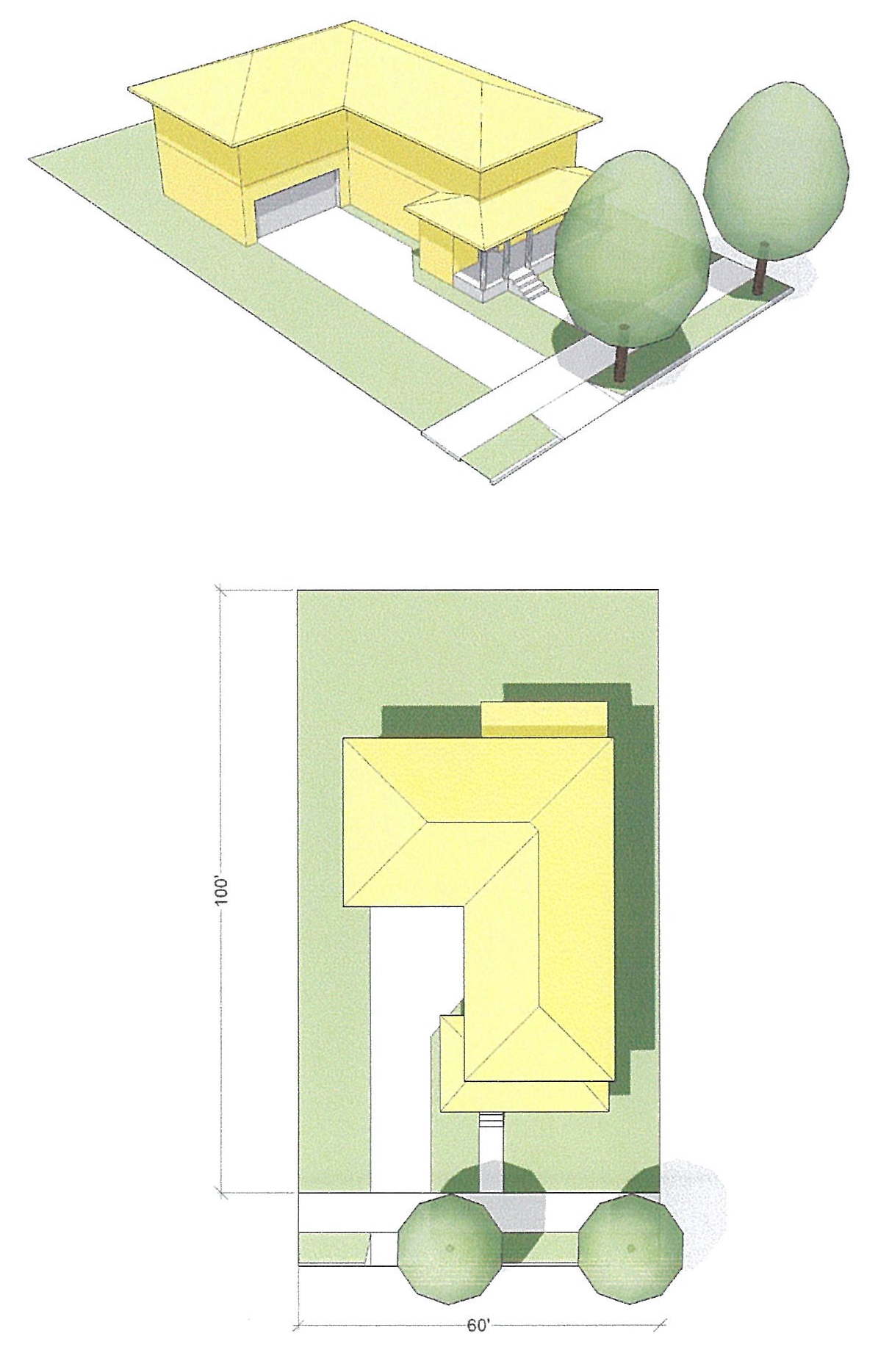
M.
Civic/public.
(Ord. No. 4347, § 1, 2016)
_____
19.38.090 - Additional standards for all districts.
A.
Development caps. No more than 1,250 dwellings or dwelling units, including accessory dwelling units, shall be developed at the Maui Research & Technology Park. No more than 500 hotel rooms may be developed at the Maui Research & Technology Park. The maximum total new non-residential build-up area shall be 2,000,000 square feet, excluding the 180,000 square feet currently existing. The maximum total general merchandising build-up area shall be 100,000 square feet, excluding hotels, eating and drinking establishments, and home-based businesses. The maximum combined general merchandising and eating and drinking establishments build-up area per area for A, B, D, and E, as identified on the controlling plan, shall be 12,000 square feet.
B.
Accessory dwellings. An accessory dwelling may be part of the main dwelling, attached to or above a garage, or a separate building on single family lots. The maximum gross floor area of an accessory dwelling shall be 600 square feet. An accessory dwelling shall have at least one separate entrance and shall not have an interior connection to the main dwelling. No more than one accessory dwelling shall be permitted on a single lot regardless of the size of the lot.
C.
A dwelling or dwelling unit shall not be used for fractional ownership, as short-term rental home, transient vacation rental, time-share unit, or bed and breakfast home.
D.
Height exceptions. Vent pipes, fans, chimneys, antennae, and equipment used for small scale energy systems on roofs shall not exceed 10 feet above the building structure.
E.
Parking requirements. The compact mixed-use land use pattern within the Maui Research & Technology Park fosters more pedestrian and bicycle trips and less automobile trips than other more automobile dependent commercial districts in Maui County. Therefore, chapter 19.36B of this code shall not apply to the Maui Research & Technology Park.
(Ord. No. 4921, § 13, 2018; Ord. No. 4347, § 1, 2016)
19.39.010 - Purpose and intent.
The purpose of this chapter is to adopt zoning standards for properties in the Wailuku Redevelopment Area ("WRA"). This includes areas within the WRA commercial mixed-use district, WRA business/multi-family district, WRA multi-family district, WRA residential district, and WRA public/quasi-public district. This chapter is intended to:
A.
Provide for a flexible and creative approach to development that considers physical, environmental, social, and economic factors in a comprehensive manner.
B.
Provide for and encourage a mix of compatible land uses that create opportunities to live, work, and shop within the WRA.
C.
Facilitate the efficient use of land capitalizing on access to services, reduced reliance on the automobile, enhanced bicycle and pedestrian use, and creative opportunities for the economical preservation and adaptive reuse of existing structures, most notably those that contribute to Wailuku's unique traditional urban character.
D.
Encourage a mixture of retail shops, restaurants, offices, personal and professional services, multi-family and single-family housing, and public-use opportunities within the WRA.
E.
Promote mixed-use development projects, capitalizing on flexible design and development opportunities.
F.
Streamline the permit review process.
G.
Stimulate economic revitalization of the core area of Wailuku Town.
H.
Establish the means of implementing various provisions of the Maui County General Plan, Wailuku-Kahului Community Plan, and Wailuku Redevelopment Plan and Design Guidelines.
I.
Promote cultural districts to encourage the development of walking tours and museums, and placement of statues, cultural art, interpretive signage, and other mediums to impart educational information to residents and visitors.
(Ord. No. 5305, § 2, 2021)
19.39.020 - Definitions and types of uses.
A.
Definitions. The following definitions apply to this chapter. Terms not defined below have the meanings provided in section 19.04.040.
"Accessory use" means a use meeting the following conditions:
1.
It is conducted on the same lot or on a contiguous lot in the same ownership, whether in the same building or within an accessory building or structure, or as an accessory use of land.
2.
It is clearly incidental to and customarily found in connection with the principal use.
3.
It is operated and maintained substantially for the benefit or convenience of the owners, occupants, employees, customers, or visitors to the lot with the principal use.
"Administrative review permit" means a permit required for uses that meet the general purpose and intent of the zoning district but that require administrative review by the planning director, or authorized representative, to mitigate the potential impacts of the use at the proposed location on adjacent uses, the physical setting, and public services.
"Administrative use" means a use that requires an administrative review permit.
"Adult establishment" means businesses or commercial activities primarily restricted to adult customers, including bars, nightclubs, and taverns, and other establishments that dispense alcoholic beverages.
"Automobile services" are as defined in section 19.04.040.
"Balcony" means a platform that projects from the wall of a building and is surrounded by a railing or balustrade.
"Base yard" means a facility or site used for any combination of the following: storage, service, or repair of equipment or vehicles.
"Boarding home" means an establishment with a single kitchen that provides living accommodations for roomers in addition to the resident manager or owner and family, with or without meals, for remuneration or in exchange for services. This does not include uses defined as group living facilities.
"Canopy and other building entrances" means a roof structure such as a canopy, awning, and similar appurtenances constructed of rigid or other material designed to complement the streetscape of the area and extending outward from a building providing a protective shield for doors, windows, and other openings, supported by the building and ground supports directly under the canopy or cantilevered from the building.
"Cultural district" means an area with significance in the established traditions of the Hawaiian culture, retaining components of a traditional lifestyle, and widely recognized as important in maintaining the cultural identity of the community.
"Day care facility" means an establishment where persons who are not members of the family occupying the premises are cared for on an intermittent basis, but not continuously over a twenty-four—hour period, and the operation is monitored or licensed by the State of Hawai‘i. Examples include day nurseries, pre-schools, kindergartens, and adult day care.
"Director of public works" means the director of the County department of public works or the authorized representative of that director.
"Eating and drinking establishment" which excludes "eating establishment, fast food" means a business engaged in preparing and serving food to customers on the premises, including internet cafes and restaurants that dispense alcoholic beverages where dining is a principal activity.
"Eating establishment, fast food" means an establishment, other than a bakery, bake shop, candy store, or ice cream store that provides as a principal use the sale of foods or beverages in a ready-to-consume state, for consumption on or off the premises. Fast-food establishments may have sit-down seating, delivery service, drive-through service, and some outdoor dining, but do not provide dancing, live entertainment, the service of alcoholic beverages, or a bar. A fast food establishment's design or principal method of operation includes two or more of the following characteristics:
1.
Food or beverages are served in edible containers, or in paper, plastic, or other disposable containers. Eating utensils, if provided, are disposable.
2.
The line of food or beverages is limited, and is usually prepared in advance of the customer's order.
3.
Food or beverages are served over a general service counter for the customer to carry to a seating facility within the restaurant, or carry-out off the premises, or to an occupant of a motor vehicle while seated in the vehicle, such as through a drive-through window.
4.
Carry-out sales, including delivery service, constitute over 10 percent of the food service business.
"Education, major" means facilities, typically in a campus setting, that offer a general educational curriculum and have an enrollment capacity for 1,000 or more students. Examples include public and private colleges and intermediate and high schools.
"Education, minor" means facilities offering a general educational curriculum having an enrollment capacity of less than one thousand students. Examples include public and private elementary schools, and small colleges, intermediate schools, and high schools.
"Education, specialized" means a facility that offers a specialized educational curriculum. Examples include vocational, language, business, music, dance and art schools.
"Energy systems, major" means transmission lines and substations.
"Energy systems, minor" means small-scale energy-saving and renewable systems, vent pipes, and fans.
"Entertainment" means businesses or commercial activities involving live entertainment, whether for profit or not for profit, whether open to the public at large or whether entrance is limited by a cover charge or membership requirement. Examples include, facilities offering live music, comedy clubs, street performers, and other similar activities. This excludes adult entertainment, as defined in section 19.85.020, or entertainment that features exotic dancers, strippers, topless entertainers, or other similar activities involving nudity.
"Family" means one of the following:
1.
An individual or persons related by blood, adoption or marriage;
2.
Up to five unrelated persons; or
3.
Up to eight unrelated persons living with a residential manager or supervisor in an adult residential care home, special treatment facility, or similar facility monitored or licensed by the State of Hawai‘i.
"Floor area" means the combined area under roof of all floors of a building measured from the exterior faces of exterior walls or from the centerline of party walls separating portions of a building. Where there are no exterior walls, the floor area is the usable area under the horizontal projection of the roof, including balconies, stairways, or elevator shafts. Excluded from floor area are the following: accessory parking, including driveways and access ways; attic areas with headroom less than seven feet; and basements.
"Floor area ratio" means the total floor area on a lot divided by the total lot area.
"Food, beverage, and merchandise kiosk" means a small, self-contained, portable structure, no larger than six feet wide by ten feet long that is designed as a cart and open at one or more sides, and that is used for the sale of food, beverage, or merchandise such as snack food items, arts and crafts, clothing, newspapers, magazines, and jewelry. Kiosks must not constrain or block safe pedestrian or vehicle traffic.
"Food and beverage retail" means businesses within permanent facilities engaged in the retail sale of food and beverage products. Examples include supermarkets, convenience stores, bake shops, liquor stores, delicatessens serving carry-out only, and catering establishments.
"Food processing" means facilities for the preparation of food products for distribution to retail, wholesale, and eating establishments. Examples include bakeries; refrigerated storage; canning, bottling, and packaging plants; noodle manufacturing; and coffee roasting and grinding.
"Funeral home" means a building used for the preparation of the deceased for burial, the display of the deceased, and rituals connected with or before burial or cremation.
"General merchandising" means businesses within permanent facilities engaged in the retail sale or rental of goods other than food and beverage products. Examples include department stores, drugstores, home furnishing stores, hardware stores, pet stores, garden nurseries, and equipment rental within enclosed buildings, but exclude new and used car lots.
"General office" means facilities used for the practice of a profession, the conduct of public administration, or the administration of a business or industry. Examples include administrative offices for government agencies and financial, insurance, and real estate companies; professional practices, except medical and dental; and television and radio stations.
"Grade" means the site ground elevation of a building or structure before construction or after it has been prepared for construction, according to a grading permit approved under title 20.
"Group living facility" means facilities providing congregate living accommodations, sometimes with care services. Examples include monasteries and convents; group homes for the elderly or disabled; residential counseling centers and shelters for battered children and adults; facilities for those recovering from illness or injury; hospices; and intermediate-care and extended-care nursing homes.
"Home occupation" means an activity intended to produce income that is carried on within a dwelling or on a lot whose principal use is as a dwelling.
"Hotel" means a facility containing lodging units, or dwellings where 50 percent or more of the units are lodging units; and where there is a lobby, clerk's desk, or counter with twenty-four hour services for registration and record-keeping relating to hotel guests.
"Joint lot use" means two or more adjoining lots in the same zoning district that are developed and used for a single, unified project and treated as a single lot for zoning purposes.
"Light manufacturing and processing" means enclosed facilities for the production or assembly of products, other than food or agricultural products, involving limited or minor emissions of odors, fumes, noise, vibrations, heat, glare, or electrical interference to the exterior. Examples include small craft assembly plants and boat building, surfboard making, commercial laundries, carpet cleaning, crafts industries, and apparel manufacturing.
"Lodging unit" means a room or connected rooms constituting an independent living unit that does not contain food preparation facilities. Unless specifically permitted in use regulations for a zoning district, lodging unit may be used as a transient unit, but not as a time-share unit.
"Lot" means a parcel of land considered as a unit and enclosed within defined boundaries, or a building site having the required area for a certain use, or occupied or intended to be occupied by a use in compliance with the requirements of the applicable zoning district.
"Lot area" means the total area within the lot boundaries exclusive of easements and right-of-way for ingress and egress in favor of other lots or land.
"Lot coverage" means the area of a lot covered by all roofed structures, except parking areas, walkways, and accessory equipment covered by trellises that are at least 50 percent open to the sky, and underground parking structures that protrude no more than 3 feet above adjacent grade.
"Maui redevelopment agency director" means the director of the Maui redevelopment agency or the authorized representative of that director, or the director of the department that provides administrative support for the agency if no director has been appointed.
"Maui redevelopment agency use permit" means a permit required for uses that meet the general purpose and intent of the zoning district but that require review by the Maui redevelopment agency to mitigate the potential impacts of that use at the proposed location on adjacent uses, the physical setting, and public services.
"Maui redevelopment use" means a use requiring a Maui redevelopment agency use permit.
"Medical center, major" means a facility established for in-patient maintenance, observation, medical and dental care and supervision, or convalescence of persons afflicted with or suffering from sickness, disease, or injury. Examples include hospitals and nursing homes.
"Medical center, minor" means a facility established to provide medical, surgical, dental, laboratory, x-ray, or other similar health care services to the public without overnight accommodations, excluding substance abuse treatment centers.
"Nonconforming building or structure" means a building or structure or portion of either one that was previously lawful but does not comply with the density, yard, setback, or height regulations of the zoning district in which it is located, either on the effective date of this chapter or following any subsequent amendment.
"Nonconforming lot" means a lot, the area, dimensions, or location that was lawful prior to the adoption, revision, or amendment of the zoning code, but fails by reason of such adoption, revision, or amendment to conform to the present requirements of the zoning district.
"Nonconforming use" means any use of a structure or zoning lot that was previously lawful but does not comply with the applicable use regulations of the zoning district in which it is located, either on the effective date of this chapter or following any subsequent amendment.
"Open space" means an area essentially free of structures.
"Outside open-air dining" means a restaurant or food service establishment with tables, dining facilities, and activities located outside in the open-air on private property, on public property, or on the sidewalk when used in conjunction with a business located within the building or structure located along and adjacent to the open-air dining facility.
"Outside open-air markets" means an outdoor area set aside for the display and sale of products and located on private or public property. Examples include outside farmer's markets, craft fairs, street and sidewalk markets, and other similar activities.
"Outside open-air sidewalk sales" means an outdoor area set aside for the display and sale of products and located on the sidewalk when used in conjunction with a business located within the building or structure located along and adjacent to the sidewalk sales.
"Park" means a tract of land intended for public non-commercial use as an active or passive recreation area, except commercial use may be allowed when conducted under the supervision of the County department of parks and recreation.
"Parking, commercial" means an area of land or a structure used for the storage of vehicles for a fee when the purpose of parking the vehicle is not to support other uses on the same lot.
"Parking, public" means a parking area or facility on private or public property to be used by the public, whether or not fees are involved.
"Personal and business services" means establishments that offer specialized goods and services frequently purchased by individual consumers and businesses. Examples include barber shops and beauty salons; medical, dental, or similar health care services provided by sole practitioners or small group practices; massage services; photography labs and studios; financial institutions with teller windows; tailors; post offices and parcel delivery services; travel agencies; laundromats; and printing and duplicating shops not involving mechanical printing presses.
"Planning director" means the director of the County department of planning or the authorized representative of that director.
"Principal use" means the primary or predominant activity or purpose for which a lot or building is arranged, designed, intended to be used, occupied, or maintained. When listed as a permitted use in a zoning district, a principal use is limited only to the extent stated in the zoning district regulations and in special requirements that may result from the use's location in an overlay design district.
"Public street or right-of-way" means vehicular and pedestrian circulation and access.
"Public works" means an improvement, for public purposes, within a right-of-way, easement, or lot for transportation, drainage, public utilities, or storage of equipment associated with the facility.
"Quasi-public use" means a use operated by a private nonprofit educational, religious, recreational, charitable, or philanthropic institution, such as churches, private schools, and similar institutions, excluding substance abuse treatment centers.
"Radio or television broadcasting station" means an establishment engaged in transmitting audio or visual programs to the public and that consist of facilities such as a studio, transmitter, and antennas.
"Recreation, indoor" means facilities under roof, but not necessarily fully enclosed, for recreational activities. Examples include bowling alleys; gymnasiums; health, massage, and fitness spas; racquetball courts; amusement arcades; enclosed skating rinks; and pool halls, but not including facilities with large seating capacities intended for spectator sports events.
"Recreation, outdoor" means leisure activity areas, and accessory structures and facilities, designed primarily for recreational activity outside in the open-air. Examples of leisure activities include: hiking, fishing, hunting, clay shooting, camping, picnicking, equestrian activities, paragliding and hang gliding, skateboarding, rollerblading, cycling, and mountain biking. Examples of accessory structures and facilities include restrooms, play courts and fields, swimming pools, picnic grounds, tent campgrounds, arboretums, greenways, botanical gardens, petting zoos, and paint-gun and archery ranges; but exclude golf courses, ziplines, or canopy tours.
"Repair, major" means repair activities that are likely to have some impact on the environment and surrounding land uses by virtue of their size, appearance, noise generation, traffic generation, or operational characteristics. Examples include boat cleaning and repair; electrical, gasoline, and diesel motor repair and rebuilding; furniture repair; industrial machinery and equipment repair; heavy vehicle repair; and automobile body and fender repair.
"Repair, minor" means repair activities that have minor impacts on surrounding land uses and can be compatibly located with other businesses. Examples include: interior upholstery repair and repainting of automobiles and motorized bicycles within enclosed buildings; non-motorized bicycle repair; household appliance repair, except those with gasoline engines; production and repair of eye glasses, hearing aids, and prosthetic devices; clothing and shoe repair; and watch, clock, and jewelry repair.
"Shopping center" means a group of retail stores and service establishments developed under a single or unified project concept on one or more zoning lots, with five or more uses on a single parcel of land and a minimum of 25,000 square feet of floor area.
"Storage, wholesale, and distribution" means activities and facilities for the storage of goods and the bulk sale and distribution of products. Examples include warehouses, freight-forwarding and delivery operations, post office and parcel delivery services, farm implement sales, self-storage lockers, markets where products are sold directly by their producers, construction supply businesses, and lumber yards.
"Structure" means anything above grade, including buildings, constructed or erected with a fixed location on the ground, or requiring a fixed location on the ground, or attached to something having or requiring a fixed location on the ground.
"Telecommunication and broadcasting tower or antenna" means a self-supporting lattice, guyed pole, or monopole structure designed or intended to support wireless telecommunications and related facilities, including wireless antenna or towers constructed for the location of transmission or related equipment for the provision of commercial mobile radio or broadcasting services.
"Wailuku redevelopment area" means an area containing approximately 68 acres centrally located within Wailuku, that includes the blocks surrounding the Vineyard-Market Street intersections, and the housing areas west of Church Street to High Street and north of Vineyard Street to the Wailuku River and Happy Valley.
"Yard setback" means a set area that is bounded on at least one side by a lot boundary and measured at right angles from the lot boundary or that is unobstructed by any structure, except as specifically permitted.
B.
Types of uses and interpretation of use terms.
1.
Types. For purposes of this chapter, there are four types of uses: principal use, accessory use, administrative use, and Maui redevelopment agency use. Except as provided in the section below, no use is permitted in a WRA district unless it is included within the definition of the terms listed and is identified as a principal use or accessory use; meets all criteria identified for the use; and if it requires an administrative review permit or a Maui redevelopment agency permit, the applicable permit is obtained and all conditions are complied with.
2.
Interpretation of terms. If a proposed use does not appear in the list of terms or within the definitions of those terms or is not defined in this chapter, the planning director will review the proposed use and, based upon the characteristics of the use, determine which listed or defined use is equivalent to that proposed; so long as such use is consistent with the purpose and intent of the applicable zoning district and land use designation, and the objectives and policies of the general plan and community plan provisions of the County and the Wailuku redevelopment area plan.
(Ord. No. 5305, § 2, 2021)
19.39.030 - WRA commercial mixed-use district.
A.
Purpose and intent. The purpose of the WRA commercial mixed-use district is to create a mixed-use commercial area to strengthen and enliven the core of Wailuku and its environs. New development should be pedestrian-oriented with buildings close to and oriented to the sidewalks of the public streets, and compatible with the traditional architectural character and building heights of the district. The urban design of public spaces should emphasize an aggressive urban landscape planting program and the design of more visually attractive streetscapes. The district allows for a full range of retail, service, and business uses within a local or regional market area, intermixed with arts, entertainment, and multi-family and single-family residential uses, to create a lively and aesthetically pleasing environment where people can live, work, dine, access services, and be entertained within a compact area.
B.
Permitted uses.
C.
Development standards.
(Ord. No. 5305, § 2, 2021)
19.39.040 - WRA business/multi-family district.
A.
Purpose and intent. The purpose of the WRA business/multi-family district is to promote development that combines commercial and housing uses in a single building, where businesses are located on the ground floor and housing on the upper stories, or that provides for a mixture of commercial and housing uses on a single lot or within a compact neighborhood setting. The district should establish land use patterns that facilitate pedestrian modes of travel, provide a buffer between busy streets and residential neighborhoods, and provide new housing opportunities in Wailuku. Development should be pedestrian-oriented with buildings close to and facing the public sidewalk, especially at corners. The focus of nonresidential uses should be on locally-oriented retail, service, and office uses. The urban design of public spaces should emphasize an aggressive urban landscape planting program and the design of more visually attractive streetscapes.
B.
Permitted uses.
C.
Development standards.
(Ord. No. 5305, § 2, 2021)
19.39.050 - WRA multi-family district.
A.
Purpose and intent. The WRA multi-family district is primarily to support a concentration of single-family and multi-family residential uses, intermixed with parks, and limited commercial uses within walking distance of the commercial core of Wailuku. The district allows for development that combines commercial and housing uses in a single building where businesses are located on the ground floor and housing on the upper stories. Smaller sized bed and breakfast accommodations are also allowed in the district. The urban design of public spaces should emphasize an aggressive urban landscape planting program and the design of more visually attractive streetscapes.
B.
Permitted uses.
C.
Development standards.
(Ord. No. 5305, § 2, 2021)
19.39.060 - WRA residential district.
A.
Purpose and intent. The purpose of the WRA residential district is to provide a harmonious neighborhood setting for single-family dwellings in a higher density environment within walking distance to the business core of Wailuku. The district should promote a wide range of choices in the type, size, design, and price of housing, and facilitate safe pedestrian and bicycle travel to improve the character of the residential area. The urban design of public spaces should emphasize an aggressive urban landscape planting program and the design of more visually attractive streetscapes.
B.
Permitted uses.
C.
Development standards.
(Ord. No. 5305, § 2, 2021)
19.39.070 - WRA public/quasi-public district.
A.
Purpose and intent. The purpose of the WRA public/quasi-public district is to provide areas for public and quasi-public facilities, buildings, and other uses of a non-commercial nature that serve the general community. The district may be applied to both public and private lands. The urban design of public spaces should emphasize an aggressive urban landscape planting program and the design of more visually attractive streetscapes.
B.
Permitted uses.
C.
Development standards.
(Ord. No. 5305, § 2, 2021)
19.39.080 - General requirements.
A.
Purpose and applicability.
1.
The purpose of this section is to establish appropriate standards for the location, design, and operation of certain land uses that may affect adjacent properties, the neighborhood, or the community, to avoid their creating problems and hazards, and to ensure their consistency with the general plan of the County.
2.
Applicability of standards. All land uses listed in this section must conform to the minimum standards established by this section and all other applicable requirements of this chapter.
B.
Specified uses abutting a WRA residential or WRA multi-family district.
1.
The following uses must maintain a 6-foot high solid masonry wall on any property line adjoining a WRA residential or WRA multi-family district:
a.
Automobile services.
b.
Education, specialized.
c.
Medical center, minor.
d.
Park.
e.
Parking, commercial.
f.
Parking, public.
g.
Police and fire substations.
h.
Storage, wholesale, and distribution.
2.
Automobile services. The fuel pump island must be located at least 75 feet from the property line of any lot in a WRA residential, multi-family, or public/quasi-public district.
3.
Education, specialized. All buildings, parking lots, and common activity areas, such as outdoor dining, playgrounds, tot lots, and similar facilities must be located at least 10 feet from the property line.
4.
Park. All active recreation areas, such as playgrounds, play courts, and similar facilities must be located at least 10 feet from the property line of any lot in a WRA residential or multi-family district.
C.
Food, beverage, and merchandise kiosks. Food, beverage, and merchandise kiosks are subject to the following conditions:
1.
The use is compatible with the aesthetics, site, urban design, and architectural character of the neighborhood.
2.
No permanent fixtures, facilities, or encroachments are affixed to the sidewalk, except for required utilities.
3.
No permanent fixtures are installed within a public street or right-of-way.
4.
No advertising signage is placed on any encroaching item, except the kiosk itself.
5.
The sidewalk is clean and free from litter, food products, and other items.
6.
No outdoor speakers are installed.
7.
At least 3 feet from the edge of curb along the sidewalk is free from obstructions and the use does not impede pedestrian or vehicle access or circulation.
8.
All sales activity is confined to the inside of the kiosk.
D.
Day care facility. Day care facilities within the WRA residential district are allowed to serve six or fewer children at any one time on lot sizes less than 7,500 square feet; eight or fewer children at any one time on lot sizes less than 10,000 square feet; and twelve or fewer children at any one time on lot sizes of 10,000 or more square feet.
E.
Dwelling, accessory. A maximum of two accessory dwellings per lot subject to size limitations provided in chapter 19.35.
F.
Home occupation.
1.
WRA commercial mixed-use and business/multi-family districts. Home occupation activities must take place within completely enclosed buildings. Noise, odor, and other emission levels must not impact neighboring property owners or users.
2.
WRA residential and multi-family districts. A home occupation is an accessory use so must be located and conducted in a manner that the average neighbor, under normal circumstances, would not be aware of its existence. The standards for home occupation activities in this section are to ensure compatibility with other permitted uses and with the residential character of the neighborhood. The home occupation must clearly be secondary or incidental in relation to the residential use of the main dwelling. Home occupation activities must comply with the following requirements:
a.
No employee other than a resident of the dwelling.
b.
The peace, quiet, and dignity of the neighborhood is not be disturbed by electrical interference, dust, noise, smell, smoke, or traffic generated by the use.
c.
No mechanical equipment is used, except what is normally used within a residential dwelling.
d.
No more than 25 percent of floor area is used for the home occupation.
e.
No on-site group instruction, sales meetings, or sale of merchandise.
f.
No sign, display, or change in the exterior of the dwelling to advertise the home occupation.
g.
All materials and supplies are stored within the dwelling.
h.
No clients or customers on the premises, except for one-to-one pupil-teacher sessions limited to eight pupils per day.
i.
No on-site sheltering, training, or raising of animals for commercial purposes.
G.
Outside open-air dining. Outside open-air dining is subject to the following conditions:
1.
No permanent fixtures, facilities, or encroachments are affixed to the sidewalk or installed within the public right-of-way.
2.
No advertising signage is placed on any encroaching structure, except for a kiosk.
3.
The sidewalk is clean and free from litter, food products, and other debris.
4.
The activity is accessory to a restaurant or kiosk located adjacent to the principal use.
5.
At least 3 feet from the edge of curb along the sidewalk is free from obstructions and the use does not impede pedestrian access or circulation.
6.
No outdoor speakers are installed.
7.
Outdoor dining areas must not be used after 11:30 p.m.
8.
Outdoor dining capacity must not increase the total seating capacity of the restaurant without adequate mitigation of the increased parking demand.
H.
Outside open-air markets. Open-air markets are subject to the following conditions:
1.
No permanent fixtures, facilities, or encroachments are affixed to the sidewalk or installed within the public right-of-way.
2.
No advertising signage is placed on any encroaching structure, except at the entrance to the market.
3.
The sidewalk is clean and free from litter, food products, and other debris.
4.
At least 3 feet from the edge of curb along the sidewalk is free from obstructions and the use does not impede pedestrian access or circulation.
I.
Outside open-air sidewalk sales. Outside open-air sidewalk sales are subject to the following conditions:
1.
No permanent fixtures, facilities or encroachments are affixed to the sidewalk or installed within the public right-of-way.
2.
No advertising signage is placed on any encroaching structure.
3.
The sidewalk is clean and free from litter, food products, and other debris.
4.
At least 3 feet from the edge of curb along the sidewalk is free from obstructions and the use does not impede pedestrian access or circulation.
5.
During special events, each open-air sidewalk vendor may be limited in location, sales, and duration of time by the Maui redevelopment agency.
(Ord. No. 5305, § 2, 2021)
19.39.090 - Building height.
A.
Height measurement. The height of a building or structure is the vertical distance from natural or finished grade, whichever is lower, to the highest point of the parapet coping of a flat roof on all exterior walls, or to the deck line of a mansard roof, or the average height of the highest gable of a pitched or hipped roof. The height of other structures is the vertical distance from natural or finished grade, whichever is lower, to the highest point of the structure.
B.
Exceptions from building or structure height. The following structures and associated screening are exempt from zoning district height limits under the specified restrictions:
1.
Vent pipes, fans, roof access stairwells, and structures housing rooftop machinery, such as elevators and air conditioning, not to exceed 12 feet above the governing height limit.
2.
Chimneys.
3.
Safety railings not to exceed 42 inches above the governing height limit.
4.
Spires and flagpoles.
5.
Any energy-savings device, including heat pumps and solar collectors, not to exceed 5 feet above the governing height limit.
6.
Construction and improvements on building sites with special conditions, as provided in subsection 19.39.090(D).
C.
Height of boundary fences and retaining walls. Unless specified otherwise in this chapter, boundary fences and walls must not exceed a height of 4 feet above existing grade in the front yard for all zoning districts. Retaining walls containing a fill within required yards must not exceed a height of 6 feet, measured from existing grade to the top of the wall along the exposed face of the wall. Heights of terraced walls or combinations of retaining walls must be measured combining all walls located in the required yard. The director of public works may adjust the maximum height of the retaining wall on a finding that additional height is necessary to retain earth, water, or both for health and safety purposes. The director of public works may impose reasonable conditions when granting this additional height, such as type of materials and colors, landscape planting, terracing, and setbacks and offsets, as may be necessary to maintain the general character of the area.
D.
Height adjustments for special site conditions. The director of public works may adjust the building height envelope under the following conditions, so long as the adjustment is consistent with the purpose and intent of the applicable zoning district:
1.
To permit reasonable building design on a site where unusual natural deviations in grade occur.
2.
To allow up to 5 feet of additional height for dwellings on building sites with slopes of 40 percent or more on lots where there are no reasonable alternative building sites with less slope.
3.
To allow up to 5 feet of additional height for buildings in the residential and multi-family districts where the floor level is required to be elevated above the design flood level as defined in chapter 16.29.
(Ord. No. 5603, § 6, 2024; Ord. No. 5305, § 2, 2021)
19.39.100 - Lots.
A.
Lots in two zoning districts. The following will apply to lots within two or more zoning district categories:
1.
For a use common to the zoning district categories, boundary lines may be ignored for the purpose of yard and height requirements.
2.
For uses not common to the zoning district categories, yard and height regulations of each zoning district apply from the lot lines on the portions of the lot lying within that district category.
3.
Where a lot lies in two zoning districts and a permitted use is common to both districts, but the floor area ratios differ, the floor area ratio (FAR) is calculated by the following formula, where:
a.
A = FAR for total parcel in most intense district.
b.
B = FAR for total parcel in least intense district.
c.
C = Area of parcel in most intense district.
d.
FAR = ((A - B) × C / Total lot area) + B.
B.
Joint lot use. Two or more adjoining lots may be used and developed as a joint lot use if the following conditions are met:
1.
The owners, duly authorized agents of the owner, or duly authorized agents of the lessees holding leases with a minimum of thirty years remaining in the terms, of the adjoining lots must submit to the planning director an agreement that binds them and their successors in title and lease, individually and collectively, to maintaining the pattern of development proposed in such a way that there is conformity with applicable zoning regulations. The right to enforce the agreement must be granted to the County.
2.
If the planning director finds the proposed agreement ensures the protection of the public interest and a more efficient use of land consistent with the purpose and intent of this chapter, the planning director will recommend approval of the agreement and forward it to the County corporation counsel for review and approval as to form and legality.
3.
The agreement will not take effect until it is filed as a covenant running with the land with the State bureau of conveyances or the registrar of the land court. Proof of such filing in the form of a copy of the covenant certified by the appropriate recording agency must be submitted to the director of public works before the issuance of any construction permits on the subject lots.
C.
Street-widening setback lines. No business, merchandising displays, uses, or structures are allowed to be located or conducted within any street setback area, as determined on a map adopted by the director of public works in accordance with applicable rules and regulations, except for the following:
1.
Poles, posts, and wires.
2.
Customary yard accessories.
3.
Structures for newspaper sales and distribution.
4.
Fences and retaining walls as provided in subsection 19.39.090(C).
5.
Other structures no more than 30 inches in height.
6.
Temporary or portable structures.
7.
Food, beverage, and merchandise kiosks, subject to the provisions of this chapter.
8.
Outside open-air markets, subject to the provisions of this chapter.
9.
Outside open-air sidewalk sales, subject to the provisions of this chapter.
10.
Outside open-air dining, subject to the provisions of this chapter.
D.
Flag lots.
1.
Flag lots are permitted when a parcel lacks sufficient street frontage for more than one lot or parcel. This parcel may be subdivided to create a flag lot, so long as the access drive for the flag lot is the sole access for only one lot and has a minimum width of 12 feet, and the parcel does not abut an existing flag lot.
2.
The lot area excluding the access drive used for ingress and egress must be not less than 80 percent of the minimum lot area required for the zoning district. The total lot area must meet the minimum lot area standard for the zoning district.
(Ord. No. 5305, § 2, 2021)
19.39.110 - Yards.
Activities and structures in yards. No business, merchandising displays, uses, structures, umbrellas, or discarded appliances or machinery, such as automobiles, refrigerators, or similar items, are allowed to be located or conducted within any required yard except for the following:
A.
Poles, posts, and wires.
B.
Customary yard accessories.
C.
Structures for newspaper sales and distribution.
D.
Fences and retaining walls as provided in subsection 19.39.090(C).
E.
Other structures not more than 30 inches in height.
F.
Displays of a temporary nature for yard and garage sales.
(Ord. No. 5305, § 2, 2021)
19.39.120 - Canopies, balconies, and sunshades.
A.
The following guidelines are provided to accommodate canopies, balconies, and sunshades over sidewalks compatible with historic precedent for new buildings and to allow reconstruction of existing or deteriorated structures. Canopies, balconies, and sunshades, cantilevered or structurally attached to a building facade, may extend into a public street or right-of-way over the sidewalks and pedestrian ways only. The front edge of a canopy and balcony is permitted only within 6 inches of the front face of the curb. A canopy must provide clearance of not less than 8 feet above the sidewalk. A canopy or balcony must not be enclosed. No canopy, balcony, or sunshade is allowed to be erected, enlarged, or altered over the public sidewalk without prior approval from the planning director, for consistency with the Wailuku redevelopment area design guidelines.
B.
Insurance required. No canopy or balcony projecting over County property is allowed to be erected, re-erected, located, relocated, enlarged, modified structurally or changed in ownership, without prior approval of the planning director, and submitting a hold harmless agreement and certificate of liability insurance against all claims for personal injury and property damage in the standard amount determined by the County corporation counsel. The County of Maui must be named in the certificate of insurance as an additional insured. A thirty-day written notice to the department of planning of cancellation or expiration must be included in the insurance certificate. The name of the owner of the canopy or balcony must be clearly identified on the application for a permit as an official corporation, partnership, or a sole proprietorship with appropriate names of individuals involved.
(Ord. No. 5305, § 2, 2021)
19.39.130 - Off-street parking and loading.
A.
Method of determining number of required off-street parking spaces.
1.
This section establishes parking requirements for properties within the WRA, and will control over any other parking requirements in this title.
2.
To determine the required number of off-street parking spaces, floor area is defined in subsection 19.39.020(A), except that basement space must be included as floor area when it is devoted to uses having a parking requirement specified in this section. The following will apply when determining off-street parking requirements:
a.
When the computation of required parking spaces results in a fractional number of spaces, the number of spaces required must be rounded up to the nearest whole number when a fraction of a space is greater than 0.5 and rounded down when a fraction of a space is less than or equal to 0.5.
b.
In assembly areas where patrons or spectators occupy benches, pews, or other similar seating facilities, each 24 inches of width must be counted as a seat for the purpose of determining parking requirements.
c.
When a building or premise includes uses incidental or accessory to a principal use, the total number of spaces required must be determined on the basis of the parking requirements of the principal use, unless otherwise noted.
d.
The minimum parking ratios indicated below may be increased or decreased when the use requires a Maui redevelopment agency use permit, based on the particular characteristics of the proposed use or site.
e.
If a use not listed below is permitted as a principal use in a zoning district, the planning director will determine the minimum required parking based on the closest equivalent use, or waive the off-street parking requirements for the use.
B.
Required off-street parking spaces by use.
C.
Parking reductions. The existing compact mixed-use land use pattern within the WRA fosters more pedestrian trips and fewer automobile trips than other more automobile dependent commercial districts in the County. As such, the following parking reductions apply to lots zoned for commercial, non-profit, and public/quasi-public uses within the WRA.
1.
Commercial, non-profit, and public/quasi-public uses on lands zoned for such uses within the WRA will receive a 30 percent reduction in the required number of parking spaces.
2.
When the computation of required parking spaces results in a fractional number of spaces, the number of spaces required must be rounded up to the nearest whole number when a fraction of a space is greater than or equal to 0.5 and rounded down when a fraction of a space is less than 0.5.
3.
When the local conditions change or projects provide additional amenities for multimodal transportation, additional parking reductions may be considered with a Maui redevelopment agency use permit. The applicant must provide clearly presented and sound information on one or more of the following:
a.
Access to transit, including the frequency and quality of the transit service.
b.
Demographics for residential developments, including age, income, or other auto-ownership factors.
c.
Overall auto ownership rates in the community.
d.
Implementation of programs to reduce demand for parking such as parking cash out, unbundled parking, priority parking for carpools, bike parking spaces, or car sharing.
e.
Project-specific parking studies including local area analysis providing data to support request to reduce parking.
D.
Shared parking. The planning director may permit shared use of required parking spaces where two or more uses on the same or separate sites are able to share the same parking spaces because their parking demands occur at different times. The planning director may permit shared parking, subject to the following conditions and application requirements:
1.
The names and addresses of the owners that will participate in the sharing of parking.
2.
The location and number of parking spaces that will be shared.
3.
An analysis showing that the peak parking times of the uses occur at different times and that the parking area will be large enough for the anticipated demands of both uses.
4.
The distance of the entrance to the parking facility from the nearest principal entrance of the building occupied by the use that is served by the shared parking must not exceed 400 feet by customary pedestrian routes.
5.
A written agreement assuring continued availability of the number of required spaces during the period indicated must be submitted to the planning director and County corporation counsel for review and approval. A certified copy of the executed agreement must be submitted to the planning director. No change in use will be permitted that increases the requirements for off-street parking spaces unless such additional spaces are provided.
6.
Any other information required by the planning director to assess the application.
E.
Off-site parking. The planning director may permit off-site parking where a surplus of parking spaces exists on a commercial zoning lot that allows for commercial parking use and those surplus spaces are available for long-term lease to the owner or long-term lessee of a separate zoning lot situated within close proximity to the surplus spaces. The planning director may permit off-site parking, subject to the following conditions and application requirements:
1.
The names and addresses of the owners that are entering into an off-site parking agreement.
2.
The location and number of parking spaces that are being leased for off-site parking.
3.
Documents that identify the owner of the subject properties. Lessees of the subject off-site parking spaces must submit a copy of the recorded lease document with an unexpired term of at least five years from the date of filing of the application.
4.
The distance of the entrance to the parking facility from the nearest principal entrance of the building occupied by the use that is served by the off-site parking must not exceed 400 feet by customary pedestrian routes.
5.
A written agreement assuring continued availability of the number of required spaces during the period indicated must be submitted to the planning director and County corporation counsel for review and approval. A certified copy of the executed agreement must be submitted to the planning director. No change in use will be permitted that increases the requirements for off-street parking spaces unless such additional spaces are provided.
6.
Any other information required by the planning director to assess the application.
F.
Parking abatement with approval of the Maui redevelopment agency. The Maui redevelopment agency may offer a partial or total abatement of parking spaces required under subsection 19.39.130(B), so long as the abatement meets criteria (1) and a majority of the other criteria specified below:
1.
The abatement will forward the vision, guiding principles, and objectives of the Wailuku redevelopment plan.
2.
The majority of trips generated can be expected to be pedestrian-oriented because the project's principal market area is the Wailuku commercial core as defined by the boundaries of the Wailuku redevelopment area.
3.
The floor area of the proposed use is less than 1,000 feet.
4.
The applicant, for economic reasons, is not capable of providing cash in-lieu-of parking or participating in other parking programs provided in this chapter.
5.
It is impractical to provide parking at the proposed site.
6.
The project will have little or no effect on the parking supply.
G.
Design standards for off-street parking.
1.
Configuration of parking spaces.
a.
Except for landscape planting and irrigation requirements under section 19.39.140, all spaces must be unobstructed, except that building columns may extend a maximum 6 inches into the sides of the parking space. A wall is not considered a building column.
b.
Where four or more parking spaces are required, other than for single-family dwelling and duplex use, the parking lot or area must be designed or configured so that all vehicles may enter or leave a space without any vehicle maneuvering into or from any street, alley, or walkway, and all vehicles may enter the street in a forward manner.
c.
All spaces must be designed and configured so that any vehicle may be moved without moving another vehicle, except that tandem parking is allowed in any of these circumstances:
i.
Where two parking spaces are assigned to a single dwelling unit.
ii.
For use for employee parking, except that the number of parking spaces allocated for employees must not at any time exceed 25 percent of the total number of required spaces, and for employee parking, "tandem" parking must be limited to a configuration of two stacked parking spaces.
iii.
Where all parking is performed by an attendant at all times.
iv.
For assembly areas and temporary events when user arrivals and departures are simultaneous and parking is attendant-directed.
2.
Minimum dimensions for parking facilities.
a.
Each parking space must have a minimum width of eight and one-quarter feet and a minimum length of 18 feet at all points.
b.
Minimum aisle widths for parking bays are as follows:
c.
Ingress and egress aisles must be provided to a street and between parking bays and no driveway leading into a parking area is allowed to be less than 12 feet in width.
3.
Parking for the physically disabled.
a.
For all non-dwelling uses, parking for the physically disabled must be provided as follows:
b.
Parking spaces for the physically disabled must be identified by posted upright sign and blue paint on the curb or on the pavement edge of the space, must be at least 8 feet wide, and must have an adjacent access aisle a minimum of 5 feet wide. Parking access aisles must be part of an accessible route to the building or facility. Surface slope must not exceed 4 percent in any direction. Two adjacent spaces may share a common access aisle. Parked vehicle overhangs must not reduce the clear width of an accessible access or circulation route.
4.
Paving of parking areas.
a.
All off-street parking spaces, parking lots, and driveways must be provided and maintained with an all-weather surface.
b.
Parking areas for three or more automobiles must have individually striped spaces.
c.
Illuminated parking lots or areas must be illuminated with individual light poles not exceeding 12 feet in height and must be shielded downward to prevent any direct illumination toward any zoning lot within a WRA residential or multi-family district.
d.
All parking lots must incorporate landscape planting and irrigation as specified in section 19.39.140.
5.
Compact car parking spaces. Parking spaces for compact cars must not exceed 25 percent of the total off-street parking requirements. The spaces must be grouped and properly identified and must be at least 7 feet 6 inches wide and 16 feet long.
H.
Required off-street loading spaces by use.
1.
For businesses with a floor area of 5,000 square feet or less and within 200 feet of an on-street loading zone, no off-street loading facility is required.
2.
Adjacent uses may share off-street loading facilities.
3.
Off-street loading requirements apply to all zoning lots exceeding 5,000 square feet in area for the use or category indicated below. The minimum number of off-street loading spaces are as follows:
4.
Method of determining number of required loading spaces.
a.
To determine the number of required loading spaces, floor area is defined in subsection 19.39.020(B), except that basement space must be included when it is devoted to uses having a loading requirement specified in this section.
b.
When a building is used for more than one use, and the floor area for each use is below the minimum for a required loading space, and the aggregate floor area of the several uses exceeds the minimum floor area of the use category requiring the greatest number of loading spaces, at least one loading space must be required.
c.
The number of loading spaces required may be reduced by 50 percent when such spaces are assigned to serve two or more uses jointly, if each use has access to the loading zone without crossing public streets or sidewalks.
I.
Design standards for off-street loading spaces.
1.
Minimum dimensions.
a.
When only one loading space is required and total floor area is less than 5,000 square feet, the horizontal dimensions of the space must be at least 19 feet by eight and one-half feet and the vertical clearance must be at least 10 feet.
b.
When more than one loading space is required or total floor area is more than 5,000 square feet, the horizontal dimensions of at least half of the required spaces must be at least 12 feet by 20 feet and the vertical clearance must be at least 14 feet. The balance of required spaces may have horizontal dimensions of at least 19 feet by eight and one-half feet and a vertical clearance of at least 10 feet.
2.
Location and paving.
a.
No required loading space is allowed in any street or alley but must be provided within or adjacent to the building it serves.
b.
Where loading areas are illuminated, all sources of illumination must be shielded to prevent any direct illumination toward any rural, residential, multi-family, or hotel districts.
c.
Each required loading space must be properly identified and must be reserved for loading purposes only.
d.
No loading space is allowed to occupy or restrict access to required off-street parking spaces.
e.
All loading spaces and maneuvering areas must be paved or covered with an all-weather surface.
f.
Except in front and side yards in WRA residential districts, no loading space or maneuvering area is allowed to be located within a required yard, except if the area displaced by the loading space or maneuvering area is provided as open space immediately abutting the required yard, and the design is approved by the director of public works.
(Ord. No. 5305, § 2, 2021)
19.39.135 - Temporary parking facilities.
A.
A temporary parking facility is any parking lot that does not contain any required parking spaces for a specific land use. Temporary parking facilities may be developed for the following purposes:
1.
To accommodate existing parking demand that may be displaced during construction.
2.
To accommodate new parking demand anticipated to be temporary as a result of a construction activity, such as construction worker parking.
3.
To accommodate existing parking demand on an existing vacant or under-developed lot for a period of time not to exceed two years.
B.
Design standards.
1.
All spaces must be unobstructed.
2.
Where four or more parking spaces are developed, the parking lot or area must be designed and configured so that all vehicles may enter or leave a space without any vehicle maneuvering into or from any street, alley, or walkway, and all vehicles may enter the street in a forward manner.
3.
All off-street parking spaces, parking lots, and driveways must be provided and maintained with an all-weather surface. The parking and driveway surface must consist of a minimum of 2 inches of a 90 percent compacted base, a treatment of bituminous material, or some other dustless and permeable surface approved by the planning director. Parking surfaces must be maintained regularly to ensure the safe and efficient maneuverability of vehicles. Temporary parking facilities must remain water permeable to avoid being required to install storm drainage facilities.
4.
Parking areas for twenty-three or more automobiles must have individually identified spaces. Spaces may be striped or marked with wheel stops. Adequate wheel stops must be provided where parking spaces approach a property line, building wall, or public sidewalk.
5.
If temporary parking facilities will be operated as facilities that require a parking permit for individual users, the parking lot must be appropriately marked and signs must be posted to indicate the permit requirements.
6.
Lighting must be provided in conjunction with the nighttime use of the area. Lighting must not glare onto adjacent or nearby properties or buildings.
7.
There must be a minimum 4-foot landscape strip adjacent to any adjoining street right-of-way. This 4-foot strip must contain a perimeter hedge with hedge plants spaced at a maximum of 16 inches on center. A wall or fence at least 36 inches in height may be placed on the setback line with a street side flowering vine on the fence or wall and other landscape materials in lieu of a perimeter hedge. Perimeter hedges or in-lieu-of walls or fences may not exceed 4 feet in height.
C.
Temporary parking permit application and approval process.
1.
The applicant is required to submit a scaled site plan of the proposed temporary parking facility illustrating the proposed layout and all structures, trees, or other physical features of the site.
2.
The applicant is required to submit a narrative description of how the parking lot will be managed, including permits, revenue control, equipment, hours of operation, signage, lighting, security, and other details. Specifications of any equipment, lighting, or signage must be submitted with the application.
3.
The department of planning has the authority to approve the application, and may also have the discretion to impose additional conditions upon the project for the protection of public health, safety, and welfare.
(Ord. No. 5305, § 2, 2021)
19.39.140 - Landscape planting and visual screening.
A.
Parking and loading areas.
1.
Parking Areas. Parking lots, automobile service stations, service and loading spaces, trash enclosures, and utility substations must be visually screened with landscape planting or by other appropriate methods in all zoning districts as follows:
a.
Parking lots and automobile service stations must provide a minimum 4-foot landscape strip adjacent to any adjoining street right-of-way. This 4-foot strip must contain trees, groundcover, and a perimeter hedge maintained at not less than four feet in height with hedge plants spaced at a maximum of 16 inches on center. A wall or solid fence at least 48 inches in height may be placed on the setback line with a street side flowering vine on the fence or wall, and tree, shrub, and groundcover foundation planting in lieu of a perimeter hedge. One minimum 6-foot tall, large crown shade tree with a minimum 2-inch caliper depth, breath, and height, as measured 6 inches above the ground, must be planted in the landscape strip for each 50 feet or major fraction of adjacent lineal street frontage. A 2-foot wide side and rear yard landscape strip must also be provided immediately adjacent and parallel with each property line where automobile parking abuts.
b.
To provide shade within parking lots and minimize visibility of open paved surfaces, one minimum 6-foot tall, large crown shade tree with a minimum 2-inch caliper depth, breadth, and height, as measured 6 inches above ground, must be provided for every five parking spaces or major fraction thereof. The minimum mature spread of the crown specimen canopy tree must be 30 feet. Each tree must be located in a planting area or tree well no less than 4-feet square. If wheel stops are provided, continuous planting areas with low groundcover, and tree wells with trees centered at the corner of parking spaces, may be located within the 3-foot bumper overhang space of parking spaces. Hedges and other landscape elements, including planter boxes over 6 inches in height, are not allowed within the bumper overhang area of the parking spaces. Trees must be sited so as to evenly distribute shade throughout the parking lot.
c.
Parking lots must be screened from adjoining lots in residential and multi-family districts by walls or continuous screening hedges at least 60 inches in height adjacent to the abutting property line.
d.
The Maui planning commission has the authority, with input from the Maui redevelopment agency, to waive all or part of the requirements of this section to accommodate site conditions while always prioritizing the pedestrian experience on public streets and rights-of-way.
2.
Parking Structures. Parking structures with open or partially open perimeter walls adjacent to zoning lots with side or rear yard requirements must meet the following requirements:
a.
A 2-foot landscape strip along the abutting property line must be provided. The landscape strip must consist of a perimeter hedge at least 42 inches in height. A solid wall at least 42 inches in height may be substituted for this requirement.
b.
A shade tree with a minimum 2-inch caliper depth, breadth, and height, as measured 6 inches above the ground, must be planted for every 50 linear feet of building length abutting a required yard.
c.
Each parking deck must incorporate an architectural perimeter wall or planter at least 2 feet in height to screen vehicular lights.
3.
Loading Areas. All service areas and loading spaces must be screened from adjoining lots in residential and multi-family districts by a wall at least 6 feet in height.
B.
Other areas.
1.
Trash enclosures. All outdoor trash storage areas, except those for single-family dwelling or duplex use, must be screened on a minimum of three sides by a wall or hedge at least 6 feet in height. The wall must be painted, surfaced, or otherwise treated to blend in with the development it serves.
2.
Utility substations. Utility substations, other than individual transformers, must be enclosed by a solid wall or a fence with a screening hedge at least 5 feet in height, except for necessary openings for access. Transformer vaults for underground utilities and similar uses must be enclosed by a landscape hedge, except for necessary openings for access.
(Ord. No. 5305, § 2, 2021)
19.39.150 - Nonconformities and legal existing uses.
A.
Nonconforming lots, structures, and uses may continue, subject to the provisions and conditions of subsections 19.500.110(B), (C), (D), (E), and (G), respectively.
B.
Nonconforming parking and loading.
1.
If there is a change or intensification of use, the new use must meet the off-street parking and loading requirements established in this chapter.
2.
Except for expansion of individual dwelling units, any use that adds floor area must provide off-street parking and loading for the additional floor area as required in this chapter.
C.
Legal uses and structures existing prior to the enactment of this chapter.
1.
Legal uses existing prior to the enactment of this chapter may continue without having to obtain administrative review permits, Maui redevelopment agency use permits, conditional permits, or variances until such time as a use is discontinued for twelve or more consecutive months.
2.
Any dwelling or structure constructed with a building permit that was approved prior to the enactment of this chapter is not required to obtain an administrative review permit, Maui redevelopment use permit, conditional permit, or variances and may be reconstructed as permitted by the original building permits, and such dwellings or structures may be expanded or modified with a building permit, subject to the provisions of this title.
(Ord. No. 5780, § 2, 2025; Ord. No. 5305, § 2, 2021)
19.39.160 - General administrative procedures.
A.
Purpose and intent.
1.
Purpose. The purpose of this section is to establish a process for the review of land uses throughout the WRA; prescribe the manner by which permits and approvals are processed and approved, approved with conditions, or denied; and ensure that all developments within the WRA are in compliance with the provisions of the Wailuku-Kahului community plan, the Wailuku redevelopment plan and design guidelines, the rules of practice and procedure for the Maui redevelopment agency, and all other applicable laws.
2.
Intent. The intent of this section is to establish a development review process and procedures that will:
a.
Foster public participation.
b.
Encourage more informed and better decision making.
c.
Protect and preserve cultural, historical, environmental, and natural resources for present and future generations.
d.
Improve the quality of development throughout the WRA.
e.
Protect the public health, safety, and welfare from natural and man-made hazards.
f.
Forward the implementation of the Wailuku redevelopment plan, including the elimination of slum and blight.
3.
The review of all applications under these procedures must be substantive and in accordance with the provisions of this chapter and all other applicable laws.
4.
Applicability. Any department or agency of the State or County, or any person having a legal or equitable interest in the land for which a land use permit is sought, may file an application in accordance with the provisions of this chapter. Unless otherwise provided, all permits and development approvals required by this chapter must comply with the procedures specified in this section.
B.
Administrative duties.
1.
Duties of the director of public works. The director of public works has the following duties to carry out the purpose and intent of this chapter:
a.
Review and act on applications for subdivision, building, certificate of occupancy, grading, plumbing, electrical, or other development or construction permits, which comply with the provisions of this chapter.
2.
Duties of the planning director. The planning director has the following duties to carry out the purpose and intent of this chapter:
a.
Interpret the provisions of this chapter as applied to specific land uses and activities.
b.
Review and process applications required by this chapter.
c.
Review all proposed land uses for consistency with all applicable laws and the provisions of this chapter.
d.
Enforce the provisions of this chapter.
e.
Prepare and initiate amendments to this chapter.
f.
All other duties related to the administration of this chapter.
C.
General application requirements.
1.
Submittal and Acceptance of Applications. All applications required by this chapter must be submitted to the planning director. The planning director must review the application to determine if the application is complete or incomplete. If the application is determined to be complete, the planning director must give the applicant written notification and process the application as specified in this section. If the application is determined to be incomplete, the planning director must give the applicant written notification identifying the portions of the application determined to be incomplete or the additional information that is needed to process the application.
2.
Fees. Except for applications filed by County agencies, applicants must pay a fee in the amount specified in the annual budget of the County. Checks issued to pay for application fees must be made payable to the County director of finance.
3.
Types of applications.
a.
Administrative review permit. Administrative review permit applications require a final determination by the planning director. However, the planning director must forward an administrative review permit application to the Maui redevelopment agency or the Maui planning commission if the applicant submits a written request to do so to the planning director at the time the application is submitted, or as required by this chapter. The planning director may also refer an administrative review permit application to the Maui redevelopment agency if the planning director determines that broader public review is warranted.
b.
Maui redevelopment agency use permit. Maui redevelopment agency use permit applications require a final determination by the Maui redevelopment agency.
c.
Conditional permit. Conditional permits must be reviewed and processed in accordance with chapter 19.40. The Maui redevelopment agency is authorized and strongly encouraged to participate in the conditional permit process for application involving the WRA.
d.
Design review. Design review applications are subject to the application content requirements of subsection 19.39.160(D), and must be processed in accordance with section 19.39.170.
D.
Application content.
1.
All applications must include the following information:
a.
Documents identifying the owner of the subject parcel of land and a letter bearing the signature and written authorization for the application by the owner.
b.
Owner's name, address, and telephone numbers.
c.
Agent's name, address, and telephone numbers, if applicable.
d.
Property description, including the following elements:
i.
Tax map key number.
ii.
Property address.
iii.
Lot size.
iv.
Location map identifying the site, adjacent roadways, and identifying landmarks.
v.
Photographs of the site and surrounding properties.
vi.
Site plan of the project site.
vii.
Copies of all previously approved building permits and violation notices for the subject parcel that applicants are aware of or have in their possession.
e.
Proposed project description, including the following elements:
i.
Narrative description of what is being proposed, why it is being proposed, and the project schedule.
ii.
Preliminary schematic drawing showing project location, size, shape, materials and colors of proposed uses, structures, and signs.
2.
The following information must be provided, if applicable, as determined by the Maui redevelopment agency or planning director:
a.
Floor plans, drawn to scale, of existing buildings.
b.
Architectural plans, drawn to scale of at least 1/8" = 1', including site plans, floor plans, sections and elevations, exterior finish schedule, and any other detailed plans necessary to completely identify the scope and design of the project. The plans must identify the building materials, color scheme, exterior lighting and graphics, mechanical equipment, and landscaping included in the project.
c.
Required off-street parking.
d.
Description of future project expansions or additions.
e.
Identification of all meetings held between the applicant and any community organizations that may be impacted by the applicant's request, the issues raised at these meetings, and any measures proposed by the applicant to resolve or mitigate these issues.
f.
Operation and management of the proposed use, including number of employees and hours of operation.
g.
Locations and plans for all signs to be constructed or maintained in connection with the project or business that may occupy the property.
3.
The Maui redevelopment agency or the planning director may request other information, as needed, to assess the application.
E.
Public notification. Applicants for Maui redevelopment agency use permits must follow public notification requirements in accordance with subsection 19.510.020(A)(4).
F.
Review process. Applications for administrative review permits and Maui redevelopment agency use permits must be processed as follows:
1.
No application will be deemed complete until the planning director has received comments from all appropriate agencies, and all other requirements in this section have been met.
2.
Within ten days after deeming an application for a Maui redevelopment agency use permit is complete, the planning director must forward the application to the Maui redevelopment agency for the scheduling of a hearing on the application.
3.
Within forty-five days of determining an application for an administrative review permit or Maui redevelopment agency use permit is complete, the director must do one of the following:
a.
Approve, deny, or approve with conditions or modifications an administrative review permit application.
b.
Prepare and provide the Maui redevelopment agency a written report and recommendation to approve, deny, or approve with conditions or modifications a Maui redevelopment agency use permit, and refer the application to the Maui redevelopment agency for its review prior to the hearing.
c.
The planning director must transmit a report on the application to the Maui redevelopment agency, the applicant, the appropriate State and County agencies, and all interested parties not less than six business days prior to the date of the hearing.
4.
The Maui redevelopment agency must forward its decision and order, or letter of approval, to the applicant and other interested parties within one hundred twenty days from the later of:
a.
The date the application is deemed complete by the planning director; or
b.
The closing of the Maui redevelopment agency meeting on the application, except that if a contested case proceeding is conducted under the rules of practice and procedure of the Maui redevelopment agency, the decision must be rendered within the time specified by the applicable rules. This time period will be extended in the event of a national disaster, state of emergency, or union strike, which would prevent reviewing or rendering a decision within the specified time period.
G.
Review criteria for administrative review permits and Maui redevelopment agency use permits. No application required by this chapter will be approved unless each of the following criteria have been met:
1.
The proposed request complies with Hawai‘i Revised Statutes chapter 53, the urban renewal law; the Wailuku-Kahului community plan; the Wailuku redevelopment plan; the rules of practice and procedure for the Maui redevelopment agency; and all other applicable Federal, State, and County laws.
2.
The proposed request is consistent with and supports the implementation of the Wailuku redevelopment plan. [15]
3.
The proposed request meets the purpose and intent of the applicable zoning district.
4.
The proposed request is consistent with the Wailuku redevelopment area design guidelines.
5.
The proposed request or the cumulative impact of the proposed request does not adversely impact the character of the WRA; or cultural and historic resources. Measures must be employed to mitigate any of the above or other identified impacts and to protect the public health, safety, and welfare.
(Ord. No. 5305, § 2, 2021)
See the Wailuku Redevelopment Plan, section 5, "Project Scorecard" for specific criteria.
19.39.170 - Urban design.
A.
The Maui redevelopment agency must review plans for each structure to be constructed, rehabilitated, or remodeled in the WRA as specified in this section. In approving the design of the structures, the Maui redevelopment agency must be guided by the appropriateness of the design to the immediate area and Wailuku Town as a whole. The following activities and structures are exempt from Maui redevelopment agency review:
1.
Repair and maintenance of existing structures.
2.
The construction, rehabilitation, or remodeling of single-family dwellings and related accessory structures, such as garages and greenhouses, that are used principally for residential use; however, single-family dwelling owners must be encouraged to follow the design guidelines so that renovated and new residences complement and are compatible with Wailuku Town's historic character.
3.
Temporary structures for special events that are erected for not more than fourteen consecutive calendar days per year. Temporary structures erected for more than fourteen consecutive calendar days per year must be reviewed under subsection 19.39.170(C).
B.
Design guidelines. Criteria for design review are found in the Wailuku redevelopment area design guidelines, prepared by the department of planning and dated October 1997, as amended, and incorporated by reference. These design guidelines must be used by the Maui redevelopment agency for review of plans for construction, rehabilitation, or remodeling, in accordance with the Wailuku redevelopment plan, prepared by the department of planning and dated December 2000, and incorporated by reference.
C.
Review process.
1.
Applications for construction of accessory structures or rehabilitation or remodeling of existing structures involving any exterior elevation of the structure must be processed as follows:
a.
Upon receipt of the application, the planning director must review the plans for compliance with the Wailuku redevelopment area design guidelines.
b.
If the design elements are in compliance with the design guidelines for the applicable district, the director must issue the Maui redevelopment agency use permit within thirty days of receipt of the application.
c.
The director may submit any application to the Maui redevelopment agency if there are outstanding questions of compliance with the design guidelines.
d.
The director must forward the application, on a routine and timely basis, to individuals and organizations that have requested in writing to provide comments on projects.
e.
The director must provide a report to the Maui redevelopment agency no less than six calendar days prior to its regularly scheduled meetings, summarizing all administrative approvals granted under this section.
2.
Applications for new principal structures must be processed as follows:
a.
Upon receipt of the application, the planning director must forward the application to the next available meeting date of the Maui redevelopment agency. The Maui redevelopment agency must review the application for compliance with the Wailuku redevelopment area design guidelines.
b.
The planning director or the Maui redevelopment agency may also refer the plans to the urban design review board for comments and recommendations.
c.
The Maui redevelopment agency must forward its decision and order, or letter of approval, to the applicant and other interested parties within sixty days of receipt of the application or receipt of all information requested by the department.
3.
Signs posted within the Wailuku redevelopment area must be in accordance with the Wailuku redevelopment plan and Wailuku redevelopment area design guidelines. Signs must be reviewed and processed in accordance with chapter 19.520.
4.
Streetscape projects must be reviewed and processed in accordance with subsection 19.39.170(C)(2).
(Ord. No. 5305, § 2, 2021)
19.40.010 - Intent.
The intent of the conditional permit is to provide the opportunity to consider establishing uses not specifically permitted within a given use zone where the proposed use is similar, related or compatible to those permitted uses and which has some special impact or uniqueness such that its effect on the surrounding environment cannot be determined in advance of the use being proposed for a particular location.
(Ord. 1684 § 2 (part), 1988)
19.40.020 - General.
The commission shall hear and review an application for a conditional permit and provide a recommendation to the council.
(Ord. 1684 § 2 (part), 1988)
19.40.030 - Application.
A developer, owner, lessee (holding a recorded lease, the unexpired term of which is more than five years from the date of filing of the application) or applicant with notarized written authorization for the application from the owner may file with the department of planning, an application for a conditional permit. Upon filing the planning director shall review the application for completeness. The application shall include the following information and documentation:
A.
A written description which sets forth the nature of the request and the conditions justifying the request;
B.
Documentation of ownership, or if appropriate, authorization by the landowner;
C.
A scaled site plan showing existing and proposed buildings, parking, and access;
D.
The names, addresses and tax map key numbers of owners and lessees of record of all real property situated within five hundred feet of the land on which the proposed action is to occur. Said list shall be based on current real property tax assessment records of the County and verified by the department of finance. The applicant shall provide a tax map graphically depicting the areas within five hundred feet of the subject property boundaries; and
E.
A nonrefundable filing fee in the amount specified in the annual budget of the County.
(Ord. 2984 § 1, 2001: Ord. 1867 § 1 (part), 1989; Ord. 1684 § 2 (part), 1988)
19.40.040 - Application withdrawal or return.
If an application is withdrawn or returned, the same or similar application will not be accepted for processing sooner than six months from the date of withdrawal or return.
(Ord. 1684 § 2 (part), 1988)
19.40.050 - Application review.
Upon receipt of a complete application, the planning director shall review the project parameters, including, but not limited to, location, design, configuration, and impact by comparing the proposed project to fixed standards.
(Ord. 1684 § 2 (part), 1988)
19.40.060 - Processing procedure.
The application shall be processed in accordance with the provisions of this chapter.
(Ord. 1684 § 2 (part), 1988)
19.40.070 - Establishment.
A.
Upon finding by the appropriate planning commission that reasons justifying granting of a conditional permit exist, and that the proposed use would not be significantly detrimental to the public interest, convenience, and welfare, and will be in harmony with the area in which it is to be located; issuance of a conditional permit may be recommended, subject to such terms and conditions and for such period of time as the facts may warrant.
B.
If the commission determines the permit requested is for a use that is substantially different from those uses permitted in the use zone, the commission must recommend denial of the request and may instruct the applicant to seek a change of zoning if the facts warrant such an application.
C.
Every conditional permit must be conditioned upon the proposed development fully complying with all requirements of this title and other applicable governmental requirements.
D.
Approval of a conditional permit application must be through enactment of an ordinance by the council, in accordance with the provisions of the charter.
E.
A conditional permit is required for a commercial zipline, canopy, or bungee jumping operation in any district where commercial zipline, canopy, or bungee jumping are not permitted uses.
1.
Ordinances for conditional permits for commercial zipline, canopy, or bungee jumping may be enacted only for parcels on Maui and Lāna‘i of at least fifty acres or multiple contiguous parcels that together are at least fifty acres; except that the council may enact ordinances for conditional permits for commercial zipline, canopy, or bungee jumping on parcels or multiple contiguous parcels smaller than fifty acres only by a two-thirds vote of its entire membership on two readings.
2.
No more than fifteen conditional permits in aggregate for commercial zipline, canopy, or bungee jumping may be in effect at any time on Maui and Lāna‘i.
3.
The council may impose conditions setting setback restrictions for commercial zipline, canopy, or bungee jumping.
4.
Any commercial zipline, canopy, or bungee jumping in the state agricultural district must comply with section 205-6, Hawaiʻi Revised Statutes, and obtain a state special permit if required.
F.
Transient vacation rentals operating with a conditional permit under this chapter must be included in the number of short-term rental homes permitted under section 19.65.030.
(Ord. No. 5473, § 14, 2022; Ord. No. 5238, § 5, 2021; Ord. 1985 § 1, 1991: Ord. 1684 § 2 (part), 1988)
19.40.080 - Conditions, amendments, modifications.
A.
Conditional permits may be issued subject to terms and conditions that are reasonable and necessary to fulfill the intent and purposes of this title. All changes in the use or appearance of land or buildings allowed by the permit must be in accordance with the specified conditions and the proposal as approved. The permit must state that it is issued subject to compliance with and fulfillment of the terms and conditions.
B.
The commission on request or on its own initiative may recommend action to revoke any conditional permit or recommend action to amend or delete any terms, conditions, and time stipulations of such conditional permit if the action is necessary to effectuate the purpose and intent of this chapter. The commission must provide due notice in writing to the applicant or permittee and an opportunity for a hearing.
C.
The appropriate planning commission may approve amendments to the conditional permit if the amendments are not substantive and do not result in significant impacts above what would result from the approved conditional permit. Before the commission approves any amendments, the planning director must notify the appropriate planning commission of the proposed non-substantive amendments. The commission must review the proposed non-substantive amendments and approve or disapprove.
D.
Conditional permits may be issued for commercial zipline, canopy, and bungee jumping on Maui and Lāna‘i if the following criteria are met:
1.
The application must be reviewed by the cultural resources commission.
2.
Each permit holder who operates commercial zipline, canopy, or bungee jumping must name the County as an additional insured in a general liability insurance policy of $1,000,000 per occurrence and $2,000,000 in the aggregate, which insurance must include a duty to defend, indemnify, and hold harmless the County if the County is sued as a result of the operation of the commercial zipline, canopy, or bungee jumping operation.
3.
Commercial zipline, canopy, or bungee jumping operations may not operate before 8:00 a.m. or after 5:00 p.m.
4.
No person may consume any intoxicating substance while at the location of a commercial zipline, canopy, or bungee jumping operation while it is open for business. No person may hold a conditional permit under this chapter and a liquor license at the same time.
5.
Each operator of commercial zipline, canopy, or bungee jumping must have the equipment and facility inspected once every two years by an inspector certified by the association for challenge course technology or a state-licensed professional civil engineer.
6.
Each operator of commercial zipline, canopy, or bungee jumping must maintain the following records and make them available to the director or the council upon request:
a.
Proof of the insurance required by the conditional permit.
b.
Inspection reports.
c.
Maintenance records.
d.
Engineering reports demonstrating safety of the operation and equipment.
e.
Signed participant acknowledgments of risks and rules of conduct.
(Ord. No. 5367, § 1, 2022; Ord. No. 5238, § 6, 2021; Ord. No. 3827, § 1, 2011; Ord. 1684 § 2 (part), 1988)
19.40.090 - Extensions.
A.
A conditional permit must not be extended unless the terms of the initial issuance expressly provide for the extension. An applicant for an extension must submit a completed application no later than sixty days prior to expiration; however, the director may issue a written waiver of this requirement if the director finds that unusual circumstances prevented an applicant from filing a timely extension request. A copy of the written waiver must be sent to the council at the time of issuance.
B.
An applicant for a time extension must provide by certified mail a notice of application for time extension to the owners and lessees of record located within five hundred feet of the parcel on which the conditional permit use is located. The notice of application for time extension must:
1.
Describe the uses permitted by the conditional permit and include a map showing the subject parcel and all other lots within a five-hundred-foot distance.
2.
State that owners and lessees of record may file a written protest against the proposed extension with the director within forty-five days of the mailing of the notice of application for time extension.
C.
The director may approve the application for time extension if the following criteria are met:
1.
The permit holder is in compliance with the conditions of approval.
2.
The permitted use has not been substantially changed, and new uses have not been added that may result in significant impacts above what would result from the approved conditional permit.
3.
The permit holder has addressed any agencies' concerns.
4.
No protests have been received from the owners and lessees of record located within five hundred feet of the parcel on which the conditional permit use is located after the notice requirements of subsection B have been met.
D.
If the criteria of subsection C are not met, or if the council, by resolution adopted at least ninety days prior to expiration, requests review of the time extension application, the application for time extension must be processed in the same manner as the original application.
E.
If a completed application for extension is submitted in accordance with 19.40.090(A), and accepted, and accepted, the conditional permit remains in effect while the application is being processed for up to six months after the expiration date, or for up to twelve months after the expiration date if council approval of the extension is required, unless the applicant fails to provide requested information to the department within sixty days.
(Ord. No. 5496, § 2, 2023; Ord. No. 3827, § 2, 2011; Ord. 1684 § 2 (part), 1988)
19.40.100 - Expiration of permits.
Each permit and the ordinance enacting same shall state the duration of the permit and if a specific expiration date is stated such permit shall expire and be repealed on said date without further action.
(Ord. 1684 § 2 (part), 1988)
19.40.110 - Reporting.
The department of public works shall submit to the county council quarterly reports on the status of all conditional permits.
(Ord. 1684 § 2 (part) 1988)
19.45.010 - Purpose and intent.
A.
The purpose of this chapter is to implement the findings and recommendations for tracts of land designated as project districts by the adopted community plans.
B.
The intent of a project district development is to provide for a flexible and creative planning approach rather than specific land use designations, for quality developments. The planning approach would establish a continuity in land uses and designs while providing for a comprehensive network of infrastructural facilities and systems. A variety of uses as well as open space, parks, and other project uses are intended in accord with each individual project district objective.
(Ord. 1578 § 2 (part), 1986)
19.45.020 - General.
Unless otherwise provided by law, project districts shall be implemented in accordance with the procedures set forth in this chapter.
(Ord. 1578 § 2 (part), 1986)
19.45.030 - Scope.
A.
The provisions of this chapter shall apply to all areas designated as a project district on the adopted community plans of the County.
B.
Other County laws shall apply within project districts, except to the extent that such laws conflict with requirements imposed pursuant to this chapter.
C.
If a project district extends into the state rural, agriculture or conservation districts, that portion's land uses shall conform with all regulations for the specific state land use district.
(Ord. 1578 § 2 (part), 1986)
19.45.040 - Application.
A.
The developer of land designated as a project district on an adopted community plan may initiate a project district development of part or all of the project district by written application to the planning director. The application shall include the following:
1.
Proof of ownership and, if appropriate, proof of authorization by owner;
2.
Legal description of the land to be developed;
3.
The names and addresses of owners and lessees of record, and tax map key numbers, of all parcels situated within five hundred feet of the boundaries of the project district development;
4.
A scaled map showing the project district development and surrounding lands within five hundred feet; and
5.
A nonrefundable filing fee in the amount specified in the annual budget of the County.
B.
The council or the planning commission may initiate a project district development by written application to the planning director.
C.
All applications shall include the following:
1.
A description of the proposed project district, including land uses, densities, infrastructural requirements, development standards, and a conceptual map showing the project district boundaries, and the acreages of land involved;
2.
An explanation of the impact of the project district development on the community; and
3.
Any other information required by the planning director.
(Ord. 2985 § 1, 2001; Ord. 1867 § 1 (part), 1989; Ord. 1578 § 2 (part) 1986)
19.45.050 - Processing procedure.
Development of a project district shall be subject to the following three phases of approvals.
A.
Phase I approval shall be processed as follows:
1.
After receiving an application for a project district development, the planning director shall submit to the planning commission one or more proposed project district ordinances, which provide project district zoning district standards including permitted land uses, accessory uses, special uses, densities, heights, setbacks, lot dimensions, and other development standards. The planning commission shall hold a public hearing on the proposed ordinances in the affected community plan region. After the public hearing, the planning commission shall submit its recommendations and the proposed ordinances to the council. The council may approve the ordinances with or without modifications.
2.
If the project district ordinance requires unilateral or bilateral agreements then, after the council approves the project district ordinance, the applicant shall negotiate the terms of the agreements with the mayor or the mayor's designated representative in accordance with the representations made to the council. Agreements shall be drafted so as to be enforceable by the County, and shall bind all persons having an interest in the property. The council may approve unilateral agreements with or without modifications and, after proper execution, shall record the agreements with the bureau of conveyances or the land court. Unless otherwise provided in the project district ordinance, no further approvals shall be granted until all required unilateral agreements have been recorded, and all required executed bilateral agreements have been transmitted to the council for its information.
B.
Phase II approval shall be processed as follows:
1.
Unless a concurrent application has been filed or otherwise provided in the project district ordinance, after Phase I approval the applicant shall submit to the planning director a preliminary site plan for the project district development. The preliminary site plan shall conform to the project district ordinance and shall include the following:
a.
Proposals for drainage, streets, parking, utilities, grading, landscaping, architectural design concepts and guidelines, building elevations, building sections, construction phasing, open spaces, land uses, and signage;
b.
Proposals for recreational and community facilities;
c.
Proposals for floor area ratios, lot coverages, net buildable areas, open space ratios, impervious ratios, and density factors; and
d.
Potential environmental, socioeconomic, and aesthetic impacts.
2.
The planning director shall submit the preliminary site plan to the planning commission. The planning commission shall hold a public hearing in the affected community plan region. The planning commission may approve the preliminary site plan, with or without modifications.
C.
Phase III approval shall be processed as follows:
1.
After Phase II approval, the applicant shall submit a final site plan for the project district development to the planning director.
2.
The director shall approve the final site plan if it conforms in all substantive respects to the approved preliminary site plan.
(Ord. No. 3828, § 1, 2011; Ord. 1578 § 2 (part), 1986)
19.45.060 - Amendment and revision.
A.
Proposed amendments or revisions of the project district ordinance or agreements shall be subject to the Phase I approval procedure.
B.
Proposed substantive revisions of the Phase II preliminary site plan shall be subject to planning commission review and approval. Proposed non-substantive revisions of the Phase II preliminary site plan that would not result in significant impacts above what would result from the Phase II-approved plan may be reviewed and approved by the planning director. For project districts on Molokai and Lāna‘i, the planning director shall notify the respective commission of the planning director's review of proposed non-substantive revisions. The commission may review the proposed non-substantive revisions and take action or waive review.
C.
Proposed revisions of the Phase III final site plan shall be subject to the Phase III approval procedure.
(Ord. No. 3828, § 2, 2011; Ord. 1578 § 2 (part), 1986)
19.47.010.- Establishment.
After receipt of the wetlands inventory map under section 19.47.070, the council may establish, by ordinance under section 19.510.040 or section 19.510.050, wetlands overlay district zoning, including protective buffers and grading and grubbing restrictions, on any real property for the purpose of restoring or protecting a wetland on the property. The wetlands overlay district overlays the base or underlying zoning district so that any parcel of land in the wetlands overlay district will also be subject to both its base or underlying zoning and the wetlands overlay zoning. Land within the wetlands overlay district is subject to the requirements established in this chapter and restrictions and requirements established by other applicable ordinances and regulations of the County. The department may adopt administrative rules to administer this chapter.
(Ord. No. 5421, § 3, 2022)
19.47.020. - Policy.
It is the policy of the County of Maui that wetlands be restored or protected. The council's intent is to identify, restore, and protect wetlands beyond what is required by the Clean Water Act, Coastal Zone Management Act, or any other law to protect environmentally sensitive ecosystems and their services, including flood control, water quality enhancement, species protection, and climate adaptation and mitigation benefits. All discretionary permits issued by the County must be consistent with this policy.
(Ord. No. 5421, § 3, 2022)
19.47.030. - Report.
A.
The director must produce, or cause to be produced, a report by a qualified environmental professional on the feasibility and advisability of wetlands restoration or protection on the property prior to approval of any of the following in the wetlands overlay district:
1.
Community plan amendment under section 2.80B.110.
2.
Subdivision approval under section 18.08.100.
3.
Change in zoning under section 19.510.040.
4.
Conditional zoning under section 19.510.050.
5.
District boundary amendment under chapter 19.68.
6.
Special use permit under section 19.510.070.
B.
Any report required by subsection A must be provided to the approving agency for the actions noted in subsection A and any relevant advisory agency. The report must outline ecosystem values, determine any potential impacts to wetlands, provide how wetlands may be maintained and enhanced, and include information and conclusions on the following:
1.
The ability of the wetland to filter harmful toxins, nutrients, and sediment from surface and stormwater runoff.
2.
The ability of the wetland to store floodwaters and reduce the magnitude of flood events.
3.
The ability of the wetland to provide valuable habitat for a diverse array of flora and fauna, including any existing native, rare, threatened, or endangered species.
4.
The ability of the wetland to maintain surface-water flow during dry periods.
5.
The prior or potential future impacts of any excessive siltation resulting from surface runoff from construction sites and lack of erosion control on steep slopes.
6.
The prior or potential future impacts of pollution by garbage, litter, and refuse.
7.
The prior or potential future impacts of a reduction in the flow of watercourses, including groundwater, due to destruction of wetlands.
8.
Any potential significant adverse impact on natural drainage patterns, the destruction of important habitat or the discharge of toxic substances.
9.
Measures to ensure that wetland functions and habitat are maintained and, where possible, enhanced to increase the potential for survival of native, rare, threatened or endangered flora and fauna.
10.
Identification of public lands in or adjacent to the wetland so that they can be identified for maintenance and possible hazard mitigation.
11.
Proposed protective buffers—with a minimum requirement of fifty feet and a maximum of two hundred feet—based on the report's assessment of wetland functions, valuation, and the need for protection.
12.
Areas that formerly had wetlands characteristics or functions but have been altered or degraded by channelization, filling, draining, dredging, grading, grubbing, deep ripping, groundwater pumping, hardening of surfaces, or introduction of non-native or aggressive-invasive plant and animal species.
(Ord. No. 5421, § 3, 2022)
19.47.040. - Decisions consistent with the policy.
A.
The approving agency on an application referenced in subsection 19.47.030(A) must make decisions consistent with the policy in section 19.47.020, unless the agency notifies the council in writing of the reasons to make a contrary decision.
B.
Before the council approves any action under subsections 19.47.030(A)(1), (3), (4), or (5), the council must first find that:
1.
The property does not include any wetlands for which restoration or protection is feasible or advisable; or
2.
The property owner has executed a unilateral agreement, to be recorded with the bureau of conveyances or land court, for wetlands restoration or protection sufficient to fulfill the purpose of this chapter. No ordinance is effective until the unilateral agreement, properly executed, has been recorded.
(Ord. No. 5421, § 3, 2022)
19.47.050. - Permitted uses.
The following uses are permitted in the wetlands overlay district:
A.
Conservation of soil, vegetation, water, fish, and wildlife.
B.
Scientific research and educational activities teaching principles of ecology and conservation.
C.
General outdoor recreation and leisure activities that are consistent with the purpose of this chapter.
D.
Uses permitted in the base or underlying zoning district that are not inconsistent with the purpose of this chapter.
E.
Traditional and customary plant cultivation.
F.
Restoration and management activities, including removal of invasive species, restoration of previously altered or impacted hydrology, and planting of native and beneficial noninvasive vegetation.
G.
Exercising those rights customarily and traditionally exercised for subsistence, cultural, and religious purposes by persons who are descendants of native Hawaiians, kānaka maoli, who inhabited the Hawaiian islands prior to 1778, as protected by article XII, section 7, of the Hawaiʻi State Constitution.
H.
Agriculture, recreation, education, public open space, and other compatible uses that would not degrade ecosystem functions and productivity.
(Ord. No. 5421, § 3, 2022)
19.47.060. - Prohibited uses.
If a protective buffer is established by a change in zoning or conditional zoning ordinance, any use that creates significant negative biological, physical, or chemical impacts to wetlands is prohibited in the wetlands overlay district.
(Ord. No. 5421, § 3, 2022)
19.47.070. - Mapping.
A.
The planning director must prepare, or cause to be prepared, and transmit to the planning commissions, council, conservation planning committee, and director of public works, a map that shows the approximate location of wetlands throughout the County and likely migration areas reflected by passive flooding data by June 30, 2024. The boundary of wetlands is determined by the presence of two or more of the three wetland indicators listed in the 1987 U.S. Army Corps of Engineers Wetland Delineation Manual and the 2012 Regional Supplement to the Corps of Engineers Wetland Delineation Manual: Hawaiʻi and Pacific Islands Region. These indicators are hydrophytic vegetation, the presence of hydric soils, and evidence of hydrology. For flowing systems, the boundary must extend to the ordinary high-water mark, determined using the 2005 U.S. Army Corps of Engineers Regulatory Guidance Letter on the Determination of Ordinary High Water Mark Identification.
B.
The map must be updated at least every five years and when new information is available and must be made publicly accessible. These updates must include delineations and site-specific information contained in the report required by section 19.47.030.
C.
The director or council may initiate changes in zoning or conditional zoning ordinances as needed to ensure wetlands depicted in the map are placed in the wetlands overlay district.
(Ord. No. 5597, § 1, 2024; Ord. No. 5421, § 3, 2022)
19.47.080. - Interpretation.
A.
Nothing in this chapter is intended and may not be interpreted to conflict with State or federal law on the same subject matter.
B.
Conflicting provisions of this chapter must be abrogated to the extent of the conflict.
C.
The provisions of this chapter must be construed, if possible, to be consistent with and in addition to relevant state or federal regulations and statutes.
D.
The provisions of this chapter must be construed liberally in favor of wetlands restoration and protection.
(Ord. No. 5597, § 1, 2024; Ord. No. 5421, § 3, 2022)

