Medical Lake City Zoning Code
CHAPTER 17
37 - FENCES AND HEDGES
Sections:
17.37.010 - Purpose and intent.
(a)
These regulations are intended to regulate the material and height of fences and hedges, particularly in front yards and in yards abutting public rights-of-way, in order to promote traffic and public safety and to maintain aesthetically pleasing neighborhoods. The regulations are intended to provide and maintain adequate sight distance along public rights-of-way at intersections and to encourage safe ingress and egress from individual properties. These regulations also encourage the feeling of spaciousness along neighborhood streets and minimize the closed city atmosphere which tall fences along public rights-of-way can create.
(b)
The provisions and conditions of this section regulating height are not applicable to fences or barriers required by state law or other provisions of the Medical Lake Municipal Code to surround and enclose public safety installations, state institutions, school grounds, public playgrounds, private or public swimming pools and similar installations and improvements.
(Ord. 854 §2, 1998).
17.37.020 - General requirements.
(a)
Measurement to Fence Height.
(1)
The height shall be measured from the top elevation of the top board, rail or wire to the ground. In cases where a wall is used as a fence, the height shall be measured from the top surface of the wall to the ground on the high side of the wall. Where a berm has been constructed with a fence on it, the height measurement shall include the height of the berm.
(2)
Where the finished grade is a different elevation on either side of a fence, the height shall be measured from the side having the highest elevation.
(3)
Hedges may reach their natural vegetation height outside of the restrictions placed herein. Where a traffic vision hazard is created, the city may require a modification to the height limitation and location of fences or hedges to the degree necessary to eliminate the hazard.
(b)
Height Limitations.
(1)
Fences or hedges in designated area: Any fence or hedge situated in any parcel within the following described property shall be established not less than five feet inward of the property line contiguous to Lake Drive or Smith Lane. When the property line contiguous to Lake Drive or Smith Lane is a "front yard" property line, no fence or hedges shall exceed thirty-six inches in height within the front yard setback. These provisions shall apply to any property located along and adjacent to the following portions of Lake Drive: that portion beginning at the southern-most point of Lake Drive, extending north to end at the intersection of Lake Drive and Hancock Street; and that portion beginning at the intersection of Lake Drive and Third Street extending south seven hundred feet; as designated on the city's official fences and hedges map. These provisions shall apply to any property located along and adjacent to the following portions of Smith Lane: that portion beginning at the intersection of Brooks Road and Smith Lane extending south two hundred ninety feet; as designated on the city's official fences and hedges map.
(2)
Residential Uses.
(A)
Interior Lots.
(i)
Front yard setbacks: Fences or hedges within the required front yard, shall not exceed forty-two inches in height, subject to the provisions of this section.
(ii)
Side Lot Lines: Fences or hedges located on interior lot lines of required front yards shall not exceed forty-two inches in height. Fences on interior side lot lines not within required front yards shall not exceed seventy-two inches in height.
(iii)
Rear lot Lines: Fences on a rear lot line shall not exceed seventy-two inches in height. Fences or hedges along rear lot lines abutting alleys shall contain at least one access gate to the alley.
(B)
Corner Lots.
(i)
Front yard setbacks: Fences or hedges shall not exceed forty-two inches in height.
(ii)
Interior side lot line: Fences located on interior side lot lines shall not exceed seventy-two inches in height, except where they are located within the front yard setback, in which case the provisions of subsection (2)(B)(i) of this section shall apply.
(iii)
Side lot line abutting street.
A.
Fences or hedges shall not exceed forty-two inches in height within any clear view triangle.
B.
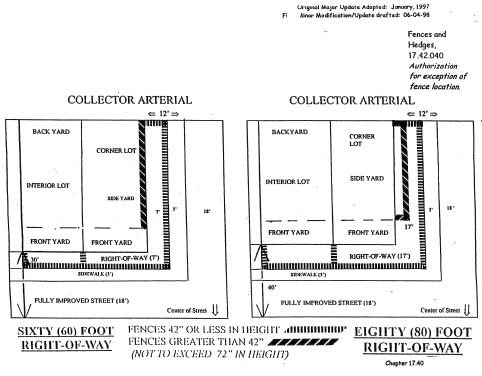
Fences or hedges abutting a street shall not exceed seventy-two inches in height, provided that they are a minimum of twelve feet back from the edge of the fully improved street or roadway. In all cases, any fence exceeding forty-two inches in height shall be a minimum of twelve feet back from the edge of the fully improved street or roadway.
(iv)
Rear lot line: Fences located along the rear lot line shall not exceed seventy-two inches in height. Fences or hedges along rear lot lines abutting alleys shall contain at least one access gate to the alley.
(Ord. 854 §3, 1998).
17.37.030 - Authorization for exception to height limitation.
A front yard fence height exception may be granted through a Type I Review with the planning official making the final decision. The exception is limited to a maximum of six feet. The Type I review process is found in MLMC Section 19.270.020, Type I reviews.
To be granted approval, the following criteria must be met:
(1)
The exception is necessary due to special circumstances relating to size, shape, topography, location or surrounding of the subject property;
(2)
Construction of the fence pursuant to the exception will not create a traffic vision hazard;
(3)
Construction of the fence pursuant to the exception will not be detrimental to the public welfare, nor injurious to property or improvements located in the vicinity of the subject property.
(Ord. 854 §4, 1998).
(Ord. No. 1130, § 56, 11-19-2024)
17.37.040 - Authorization for exception of fence location.
Fences may be placed on city rights-of-way only when the following conditions have been satisfied as determined by the city planning director:
(1)
Fencing shall not be placed beyond an imaginary extension of property encroaching into city right-of-way to a point not greater than that adjacent to the sidewalk (or where one would be) of a fully improved right-of-way (street).
(2)
Fencing shall only be placed upon a city owned right-of-way designated a local access street, minor arterial or a collector arterial.
(3)
Prior to any construction of fencing on right-of-way, the property owner shall fire a "title notice" to run with the land at the Spokane County Auditor's Office as provided by the Medical Lake planning department. Said title notice shall include provision whereby the owner(s) and all successors indemnify and hold the city, its employees, officers and agents harmless from all liability and/or claims which may arise from the placement of the fence, including, but not limited, to snow removal, utility maintenance and/or repairs of any type, the owners shall acknowledge that the city shall continue to have the right to remove or have removed any portion of fencing located on a city right-of-way at anytime necessary as determined by the city and further that the property owner is responsible for maintaining the fence.
(4)
Fencing located on the right-of-way opposite a "front yard" shall adhere to the height limitations as set forth in this chapter for fencing located within the applicable front yard.
(5)
Fencing located on the right-of-way opposite a "corner lot, side lot line abutting a street" shall adhere to the height limitations as set forth in this chapter for fencing located on a corner lot, within the side yard, abutting a right-of-way described in subsection (a) of this section.
(6)
Fencing located on a right-of-way opposite a "rear yard" shall adhere to the height limitations as set forth in this chapter for fencing located within the applicable rear yard.
(7)
The construction of fencing located on right-of-way shall not create a traffic vision hazard.
(Ord. 854 §5, 1998).
(Ord. No. 1027, § 32, 4-16-2013)
17.37.050 - Commercial, industrial and institutional uses.
Fences placed anywhere on the lot shall not exceed ninety-six inches in height and shall not be placed in or in front of any required landscaping. This limitation shall not apply to fences which surround and enclose public safety installations, state institutions, school grounds, public playgrounds, private or public swimming pools and similar installations and improvements. Where a traffic vision hazard is created, the city may require modification of the height and location of the fence or hedge to the degree necessary to eliminate the hazard.
(Ord. 854 §6, 1998).
17.37.060 - Barbed wire fences.
Barbed wire fences are prohibited within the city, except under the following circumstances:
(1)
Barbed wire may be used only on top of fences at least seventy-two inches in height for commercial, industrial, utility or public uses.
(2)
From and after the effective date of the ordinance codified in this section barbed wire fences shall be permitted on those properties identified on Attachment A to the ordinance codified in this section, a copy of which is on file in the office of the city clerk, and shall be permitted to continue in use under the terms applicable to nonconforming use, MLMC Chapter 17.43.
(Ord. 854 §7, 1998).
(Ord. No. 1027, § 33, 4-16-2013)
Exhibit 17.37
AUTHORIZATION FOR EXCEPTION TO FENCE LOCATION
"Typical Residential Neighborhood"