
Medina City Zoning Code
CHAPTER 16
22. - LOT DEVELOPMENT STANDARDS
16.22.010. - Purpose.
This chapter establishes development standards applicable to lots and setbacks.
(Code 1988 § 20.22.010; Ord. No. 969 § 3 (Exh. A), 2019; Ord. No. 900 § 4 (Att. A), 2013)
16.22.020. - Lot development standards.
A.
The pertinent requirements for minimum net lot area, minimum lot width, and minimum street frontage applicable to each lot is determined by the zoning district in which the lot is located and the corresponding standards in Table 16.22.020.
Table 16.22.020: Lot Development Standards
B.
The lot width is determined by calculating the average horizontal distance between the side lot lines where the building envelope is located. If a lot has an irregular shape (i.e., less than two side property lines) or is a corner lot, lot width is determined by calculating the average horizontal distance between the longer dimensional lot lines where the building envelope is located.
C.
The street frontage is determined by measuring the distance of the property line adjoining a street subject to the following conditions:
1.
Where a lot lies outside the curve of a street or private lane in such a manner as to have a property line curved inward such as a cul-de-sac, the street frontage is determined by calculating the average width of the lot measured parallel to the chord of the arc of such frontage over the depth of such lot or the first 150 feet thereof, whichever is less (see Figure 16.22.020);
Figure 16.22.020: Curved Street Frontage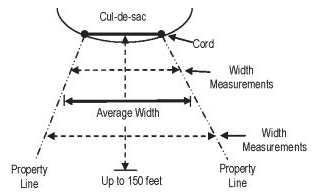
2.
Where a lot has a property line adjoining more than one street, the street frontage is determined using the property line adjoining the greater street length;
3.
The requirements for street frontage shall not apply to flag lots, or lots located at the terminal end of a street or private lane provided emergency vehicle access and turnaround requirements are met; and
4.
The requirements for street frontage for lots fronting on a private lane are prescribed in Chapter 16.91 MMC.
D.
In the R-20 and R-30 zones, where a single lot contains high bank steep slopes and has more than the minimum net lot area required in Table 16.22.020, the lot may be divided to create two lots with one or both lots having less than the required minimum net lot area provided:
1.
Lots adjoining the single lot being divided are owned and/or controlled by a person or entity different than the owner of the subject single lot being divided;
2.
No more than two lots result from the division;
3.
Each lot has at least the greater between 85 percent of the minimum net lot area required by the zoning district in which the lot is located, or 16,000 square feet;
4.
There is a difference in elevation of at least 25 feet between the average elevations of the area within the building envelope of each lot;
5.
Restrictive covenants are recorded on each lot that state:
a.
No structure or building on (insert legal description of the lot with the higher average elevation here) shall be placed in a manner where the elevation of the lowest point of the foundation above the ground surface is less than the elevation of the highest point of an existing or future structure or building on the lot with the lower average elevation; and
b.
No structure or building on (insert legal description of the lot with the lower average elevation here) shall be placed in a manner where the elevation of the highest point of an existing or permitted future structure exceeds the elevation of the lowest point of the foundation above the ground surface on the building or structure on the lot with the higher average elevation; and
6.
A nonadministrative variance is approved pursuant to MMC 16.72.030, except the conditions set forth in subsections (D)(1) through (5) of this section shall be used in deciding the variance.
(Code 1988 § 20.22.020; Ord. No. 969 § 3 (Exh. A), 2019; Ord. No. 900 § 4 (Att. A), 2013)
16.22.030. - Building and structure setbacks.
A.
Table 16.22.030 establishes the minimum distance required for any part of any building or structure to be set back from the pertinent property line. The minimum setback requirements are applied to each lot by the square footage of the lot area and the corresponding setback standards in the table. (See definition of "lot area" and the definitions of "property lines" in Chapter 16.12 MMC and Figures 16.22.030(B) and (C) for establishing and delineating setbacks.)
_____
Table 16.22.030: Minimum Building/Structure Setbacks
B.
Setbacks are measured as the distance between the property line and the closest point of any part of the building or structure to the property line, including but not limited to architectural elements, roof eaves, gutters and mechanical equipment. (See Figure 16.22.030(A).)
C.
To determine compliance with the setback standards in Table 16.22.030, the setback is measured along a horizontal plane consistent with subsection (B) of this section.
D.
Where a lot adjoins a private lane and has less than 30 feet of public street frontage, the front, rear and side property lines shall be determined as follows, except as provided in subsection (E) of this section:
1.
The side property lines shall generally correspond to the long dimension of the lot;
2.
The front and rear property lines shall generally correspond to the shorter dimensions of the lot;
3.
If the dimensions of the lot form a square, the applicant may elect to designate the front property line with the rear and side property lines designated consistent with the definitions in Chapter 16.12 MMC.
E.
Where a lot adjoining a private lane or at the terminal end of the street has a condition where the orientation of the dwelling on the lot, or the orientation of dwellings on adjacent properties, logically suggests setbacks that do not correspond to the longer and shorter dimensions of the lot, the setbacks shall be established using the logical orientation rather than the dimensions of the lot.
F.
In addition to the setbacks prescribed by this section, if a lot adjoins a private lane, a setback from the private lane easement is required pursuant to MMC 16.91.060.
_____
Figure 16.22.030(A): Measuring Setbacks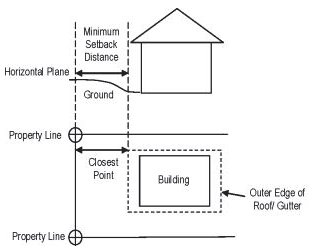
Figure 16.22.030(B):
Setback Property Line Designations
(See "property Line" definitions in Chapter 16.12 MMC)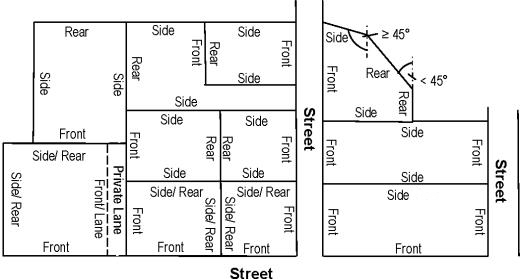
Figure 16.22.030(C): Setbacks at Step Shaped
Property Line Intersections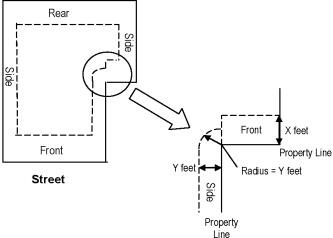
(Code 1988 § 20.22.030; Ord. No. 969 § 3 (Exh. A), 2019; Ord. No. 906 § 11, 2014; Ord. No. 900 § 4 (Att. A), 2013; Ord. No. 1001, § 2, 6-14-2021)
_____
16.22.040. - Protrusions into setback areas.
The following structures may be located within a setback area, except setbacks from Lake Washington, which are subject to Chapter 16.63 MMC:
A.
Utilities which are located underground and accessory to a principal use, except the requirement for undergrounding is not required if the limitation in MMC 16.50.090(I)(6) applies.
B.
Walkways, stairs and steps, and driveways, not including parking spaces, which do not exceed 30 inches above the existing or finished grade, whichever grade is lower.
C.
Uncovered decks and patios, provided:
1.
No part of the structure exceeds 30 inches in height above the existing or finished grade, whichever grade is lower; and
2.
The following setbacks are maintained:
a.
A minimum 15-foot setback is maintained from the front property line;
b.
A minimum 10-foot setback is maintained from the rear property line; and
c.
A minimum side-yard setback equal to one-half the required distance pursuant to Table 16.22.030.
D.
Window wells that do not project more than six inches above the ground level and do not protrude more than four feet into the setback area.
E.
Fences and freestanding walls which comply with the requirements set forth in MMC 16.30.010.
F.
Irrigation systems at or below finished grade, including yard hydrants, sprinkler heads and similar features that do not exceed 36 inches above the finished grade.
G.
Ramps and similar structures installed to a single-family dwelling to provide ADA access .
H.
Foundation footings where the footing structure does not protrude more than two feet into the setback area and is located entirely below the ground surface.
I.
Improved surface areas for off-street parking provided:
1.
The protrusion is limited to the front setback area and a minimum 15-setback is maintained from a front property line; and
2.
The parking area is designed in a manner that is clearly distinguishable from the driveway; and
3.
The top of the parking surface does not exceed 30 inches above the existing or finished grade, whichever is lower.
J.
A chimney provided:
1.
The protrusion is limited to the side setback area and does not exceed more than two feet into the setback area ;
2.
The maximum horizontal width of the chimney inside the setback area is five feet.
K.
Accessory structures and outdoor mechanical equipment provided:
1.
The protrusion is limited to the rear setback area and a minimum 15-foot setback from the rear property line is maintained; and
2.
The highest point of the accessory structure or outdoor mechanical equipment does not exceed eight feet in height above the finished grade; and
3.
The accessory structure or outdoor mechanical equipment does not occupy a footprint greater than 100 square feet; and
4.
Solid landscape screening pursuant to MMC 16.30.070 is planted that screens the structure or mechanical equipment from adjoining properties; and
5.
For outdoor mechanical equipment, the following shall apply:
a.
An existing unit may be replaced with a new unit in the same location regardless of setback requirements;
b.
For existing legally nonconforming residences that do not conform to the current side yard setback requirements, a new unit may be installed in the side yard setback provided a minimum five-foot setback is maintained from the side property line; and
6.
All mechanical equipment shall meet the sound requirements set forth in chapter 8.06 MMC.
L.
Open play structures without roofs or walls provided:
1.
The protrusion is limited to rear setback areas and a minimum 10 foot setback from a rear property line is maintained; and
2.
The maximum height of the play structure does not exceed ten feet above the finished grade; and
3.
The play structure does not occupy a footprint greater than 100 square feet.
M.
Swimming pools, spas and hot tubs as provided for in MMC 16.34.040.
N.
Raised planting bed boxes, which do not exceed 30 inches above the existing or finished grade, whichever grade is lower.
O.
Low impact development best management practices or treatment best management practices provided:
1.
The best management practice shall be designed, constructed, and maintained in accordance with the stormwater manual adopted under MMC 13.06.020.
2.
Best management practices, including associated vegetation, shall be located entirely on private property.
3.
The maximum height of any structural element associated with the best management practice shall not exceed 30 inches above the existing or finished grade, whichever grade is lower.
4.
The best management practice shall be designed to manage or treat stormwater runoff solely from the building site and from less than 5,000 square feet of impervious surface.
5.
Examples of acceptable best management practices, as those practices are defined in Chapter 16.12 MMC, include but are not limited to the following:
a.
Rain garden;
b.
Bioretention;
c.
Dispersion; and
d.
Biofiltration treatment.
(Code 1988 § 20.22.040; Ord. No. 969 § 3 (Exh. A), 2019; Ord. No. 932 § 8, 2016; Ord. No. 900 § 4 (Att. A), 2013; Ord. No. 1001, § 3, 6-14-2021; Ord. No. 1017, § 7, 2022)
16.22.050. - Corner lot optional setback.
On a corner lot, in lieu of the setback for a front property line set forth in Table 16.22.030, a property owner may elect to apply a minimum 20-foot setback from one of the front property lines and a minimum 30-foot setback from other front property lines; provided, however, that:
A.
This option is not available for:
1.
Lots with SR-30 zoning for which special requirements are elaborated;
2.
Lots adjoining Evergreen Point Road between the SR 520 highway and Overlake Drive West;
3.
Lots adjoining Overlake Drive East and West between Evergreen Point Road and the Medina-Bellevue city limits; and
B.
The other setback requirements in Table 16.22.030 shall continue to apply.
(Code 1988 § 20.22.050; Ord. No. 969 § 3 (Exh. A), 2019; Ord. No. 900 § 4 (Att. A), 2013)
16.22.060. - Property lines defined as rear and side.
Where a property line can be defined both as a rear and a side property line, the property owner may elect which definition to apply for purposes of setback requirements, provided election of the side or rear property line does not create a new nonconformity or increase an existing nonconformity.
(Code 1988 § 20.22.060; Ord. No. 969 § 3 (Exh. A), 2019; Ord. No. 900 § 4 (Att. A), 2013)
16.22.070. - Curved property lines.
Where a curved property line exists, a straight line segment shall be established that intersects each of the two end points of the curved property line. The straight line segment shall be used in forming parallels or intersecting angles with other property lines used to apply the definitions of front, rear and side property lines set forth in MMC 16.12.170 to the property lines of the lot. See Figure 16.22.070.
Figure 16.22.070: Curved Property Line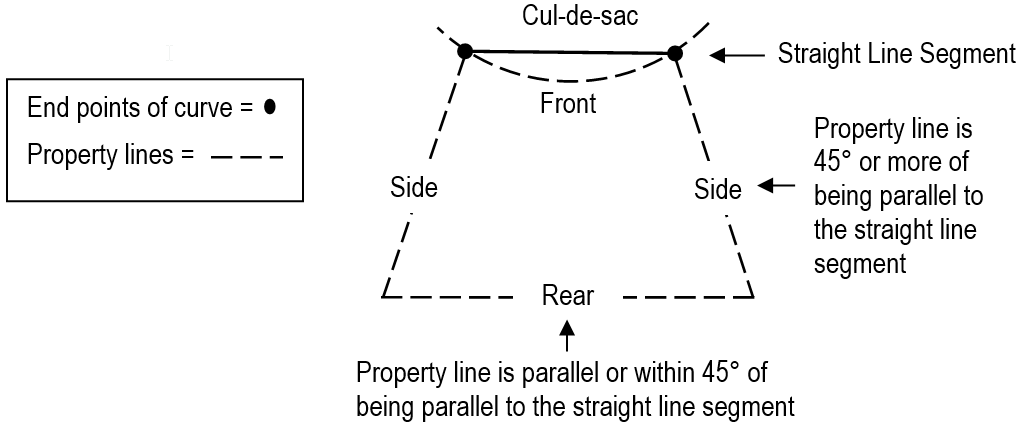
(Code 1988 § 20.22.070; Ord. No. 969 § 3 (Exh. A), 2019; Ord. No. 932 § 9, 2016)

