- SUPPLEMENTAL REGULATIONS4
Editor's note— Within Section 5 of this Appendix are various references to page numbers, these references are referring to Ordinance No. 3131 page numbering.
The purpose of this section is to supplement the regulations of the individual districts. Specific references have been made to this section for greater clarification, amplification, and specification. A violation of these supplemental regulations shall be a violation of the regulations of the zoning district in which the use is located.
(Ord. No. 3131, § 2, 10-26-10)
5.2.1. General. The purpose of this provision is to provide visual separation along city streets and between residential areas and areas of higher intensity land uses. The development regulations in individual zoning districts indicate sight-proof screening and landscaping requirements subject to the provisions of this section.
5.2.2. Definitions and Standards. For the purposes of this section the following words and phrases shall have the definitions as prescribed below:
(A)
Sight-proof screening. Sight-proof screening shall be:
(1)
Sight-proof fencing or sight-proof landscaping, including decorative fencing, evergreen vegetation, or landscaped earthen berms maintained for the purpose of concealing from view the property or structure behind such fence, evergreen vegetation or berm; and
(2)
Strategic placement of buildings to restrict view of items required to be screened by this Ordinance. Such buildings can be used for screening individually or in combination with fences or landscaping elements.
(B)
Sight-proof fence. A sight-proof fence is a fence or wall that conforms to the following standards:
(1)
A minimum of six (6) feet but not more than eight (8) feet in height;
(2)
Made of wood, masonry, metal poles, metal or other suitable material which serves to beautify, decorate or adorn the property;
(3)
Stockade (i.e., wood) poles are not permitted;
(4)
Sufficiently stable to withstand wind force at fifteen (15) pounds of pressure per square foot;
(5)
Permanently anchored to the ground by a base situated entirely upon its subject property;
(6)
Obscures vision from one property to another. Note: If a chain link fence is used, metal, plastic, or wooden inserts must be used to obscure vision; and
(7)
Kept in an attractive state and in good repair at all times by the property owner.
(C)
Sight-proof landscaping. Sight-proof landscaping shall conform to the following standards:
(1)
Consisting of an evergreen vegetation or landscaped earth berm;
(2)
A minimum of three (3) feet in height at planting and must grow to a height of at least six (6) feet within a three-year period;
(3)
Must be planted in such a manner so that its growth pattern will obscure vision from one property to another within three (3) years; and
(4)
Be kept in an attractive state and in good health at all times by the property owner.
(D)
General landscaping. The aesthetic improvement of land by adding trees, shrubs, lawns, groundcover, or flowers, frequently in combination with ornamental elements such as rock gardens, walkways, terraces or berms.
5.2.3. Fencing and Screening. Residential fences and walls may be erected in residential districts under the following provisions and regulations. A permit must first be obtained from the city before any residential fence is constructed.
(A)
Fencing and screening requirements for medium and high density residential districts with multifamily uses. Only properties zoned 2.9 R-MD, Medium Density Residential District and 2.10 R-HD, High Density Residential District are permitted to have fences and walls beyond or in front of the front building line. The properties must be developed with 4.2.4., Multifamily Residential. A fence may then be constructed to the front property line.
(1)
All fencing extending beyond or in front of a building line or extending to a side building line abutting a dedicated public street shall be wrought iron or wrought iron-like to allow visibility into the complex by a person standing on a ground level or sitting in a vehicle.
a.
Wrought iron or wrought iron-like fences shall be constructed so as to eliminate the possibility of a child becoming trapped between the wrought iron rails and shall not have any sharp points on top of or on any other portion of the fences that may cause bodily harm.
b.
Wrought iron or wrought iron-like fences may be installed with or without masonry pillars.
c.
If security gates are installed, provisions shall be made for emergency vehicle access such as: (1) security gate guard manning the gate whenever the gate is closed; or (2) an emergency system designed to allow entrance by emergency vehicles. Security gates must be approved by the city prior to installation. Provision shall be made for sanitation pick-up and water meter reading by the city if gates are to be installed that would not be manned by a twenty-four-hour security gate guard.
d.
If a gate is installed, the gate shall be located a distance of no less than fifty (50) feet from the back of the curb of the public street to the front of the gate so as to allow a minimum of three (3) automobiles to be located completely off the public street.
(B)
Fencing and screening requirements for two-family and single-family residential districts.
(1)
Fencing and screening, including hedges, are prohibited from extending into the street right-of-way.
(2)
Fences extending past front or side building lines including ornamental fences. Except as authorized in 5.2.3.(A), fencing and screening requirements for medium and high density residential districts with multifamily uses, properties are permitted to have ornamental fences up to four (4) feet in height located, placed, or erected to the front and side property lines of the residence. Such fences shall meet the following provisions and regulations:
a.
Maximum of four (4) feet in height as measured from the ground level;
b.
A minimum of fifty (50) percent of the total fence area must be open to allow visibility into the front or side yard (i.e. chain-link or picket fence);
c.
Any fence in front of the front or side building line in excess of four (4) feet must be approved, prior to its installation, by the Board of Adjustment pursuant to 7.8.2.(G), Provide for fencing in front of front and side setback building lines.
(3)
Fence material. Fencing material must be kept in an attractive state, void of rust, in good repair, and in safe and sanitary condition at all times by the property owner. The owner shall provide material and dimension information as part of the permit application.
a.
Approved fence materials in two-family and single-family districts include:
1.
Wood, vinyl, and metal slats with a depth of at least five-eighths (⅝) of an inch;
2.
Wrought iron or aluminum wrought iron-like fences;
3.
Brick/stone;
4.
Chain-link;
5.
Ribbed steel panel fencing that meets the following standards:
a)
Ribbed sheet panels shall have the following dimensions: Rib depth of one (1) to one and one-half (1½) inches by a width of two and one-half (2½) to three and one-half (3½) inches with six (6) to twelve (12) inches between rib centers.
b)
Ribbed steel panels must be twenty-two (22) or twenty-four (24) gauge steel.
c)
Ribbed steel panels must be properly primed and coated with a powder coating, Polyvinylidene fluoride (PVDF), factory thermal set silicone polyester base finish, or other factory applied coating as approved by staff.
d)
The tops of ribbed steel panels must be capped and level following the lay of the land.
e)
Poles must not extend past the top of the ribbed sheet panels.
f)
The requirements for ribbed steel panel fencing must be presented with a fence permit application.
6.
All metal fencing must have a factory applied coating. Acceptable coatings include: powder coated, Polyvinylidene fluoride (PVDF) coating, thermal set silicone polyester base finish, or other factory applied coating as approved by staff.
b.
Prohibited fence materials in two-family and single-family districts include sheet metal, plastic, corrugated metal panels, or plywood. Stockade (i.e. wood) posts are prohibited. Only the caps of posts or poles may extend past the top of the fence line.
(4)
Rear yard height limitation. In rear yards the height limitation shall be eight (8) feet from ground level.
(5)
Sight triangle. No fence, wall, or hedge or any portion thereof shall be located in the sight triangle in accordance with section 5.6.3., Sight Lines at Intersection.
(6)
Surface drainage. No fence or wall shall be constructed in such a manner as to impede the normal flow of surface drainage.
(7)
Safety. On lots smaller than one (1) acre, no electrified fence or wall or any fence containing barbed wire or other substances reasonably capable of causing bodily harm shall be permitted.
(8)
Permit fee. Refer to the adopted Zoning Ordinance Fee Schedule for fees.
(9)
Construction prior to occupancy. Where a fence is constructed on a property within any zoning district prior to occupancy, no use or conversion of use shall be made of the property until the owner or occupant has met the requirements of this Code.
(C)
Fencing and screening requirements for all commercial and industrial districts.
(1)
Fencing and screening are prohibited from extending into the street right-of-way.
(2)
Surface drainage. No fence or wall shall be constructed in such a manner as to impede the normal flow of surface drainage.
(3)
Fence material. Fencing material must be kept in an attractive state, void of rust, in good repair, and in safe and sanitary condition at all times by the property owner.
a.
Approved fencing and screening materials for the O-1, O-2, C-1, C-2, and C-3 zoning districts shall be the same as those listed as approved under Section 5.2.3(B)(3)(a) of Appendix A.
b.
Prohibited fencing and screening materials for the O-1, O-2, C-1, C-2, and C-3 zoning districts include: sheet metal, plastic, corrugated metal panels, or plywood sheets. Stockade (i.e. wood) posts are prohibited. Only the caps of posts or poles may extend past the top of the fence line.
c.
Approved fencing and screening materials for the C-4, I-1, I-2, and I-3 zoning districts include wood, wrought iron, vinyl, brick/stone and ribbed steel panel fencing that meets the following standards:
1.
Ribbed sheet panels shall have the following dimensions: Rib depth of one (1) to one and one-half (1½) inches by a width of two and one-half (2½) to three and one-half (3½) inches with six (6) to twelve (12) inches between rib centers.
2.
Ribbed steel panels must be properly primed and coated with a powder coating, Polyvinylidene fluoride (PVDF), factory thermal set silicone polyester base finish, or other factory applied coating as approved by staff.
3.
The tops of ribbed steel panels must be capped and level following the lay of the land.
4.
Poles must not extend past the top of the ribbed sheet panels.
5.
The requirements for ribbed steel panel fencing must be presented with a fence permit application.
(4)
Permit fee. The fee for a fence permit in all office, commercial, and industrial zoning districts shall be thirty-five dollars ($35.00).
(5)
Construction prior to occupancy. Where a fence is constructed on a property within any zoning district prior to occupancy, no use or conversion of use shall be made of the property until the owner or occupant has met the requirements of this Code.
(6)
Sight triangle. No fence, wall or hedge or any portion thereof shall be located in the sight triangle in accordance with Section 5.6.3, Sight Lines at Intersections.
(7)
Rear yard height limitation. In rear yards, the height limitation shall be eight (8) feet from ground level.
5.2.4. Sight-Proof Screening Requirements
(A)
Construction prior to occupancy. Where property within any zoning district is required by the development regulations section of that district to have sight-proof screening, no use or conversion of use shall be made of the property until the owner or occupant has erected sight-proof screening in conformance with the requirements of this Ordinance.
(B)
Sight-proof screening between residential and commercial, industrial and office. When a property zoned commercial, industrial, or office, lies adjacent to property zoned residential, the property owner or occupant must erect sight-proof screening along the side and rear property lines of the property prior to any commercial, industrial, or office use of the property.
(C)
Sight-proof fence plan. All required sight-proof fencing shall be shown on the site plan accompanying the application for a building permit or remodeling permit.
(D)
Sight-proof landscaping plan. A landscaping plan shall be submitted as part of the site plan submitted for a building permit when the applicant chooses to use evergreen vegetation or landscaped earth berms to meet screening requirements.
(E)
Sight-proof screening along local residential streets. When property within an industrial zoning district is separated by a local residential street from a residential zoning district, no industrial use shall be made of the industrial property until the owner or occupant has erected sight-proof screening along the side or rear property lines or along the front building or property line provided that required sight triangles at access points and street intersections must not be encumbered. If there is any outdoor work, sales, display, or storage areas in the front yard, sight-proof screening shall be erected along the front property line.
(F)
Sight-proof screening between residential and arterial streets. Sight-proof screening of residential developments is required where the development abuts an arterial street. In these cases, wood stockade fences shall be prohibited.
(G)
Sight-proof screening of outdoor storage. Sight-proof screening of outdoor storage areas shall be required. No outdoor storage of materials, commodities or equipment may exceed the height of the sight-proof screening. Outdoor storage exceeding eight (8) feet shall require a Special Use Permit.
(H)
Sight-proof screening between medium density residential, high density residential, manufactured home park and manufactured home subdivision and single and two-family residential. When a property zoned medium density residential, high density residential, manufactured home park or manufactured home subdivision lies adjacent to property zoned single- or two-family residential, the owner of the property zoned medium density residential, high density residential, manufactured home park or manufactured home subdivision must erect sight-proof screening along all sides of the property abutting single or two-family residential prior to multi-family or manufactured home use of the property.
5.2.5. General Landscaping Requirements
(A)
Landscaping required.
(1)
For a new building or the enlargement of an existing building that installs additional parking, the property owner in all zoning districts must landscape the area within the street right-of-way line to the curb line. Right-of-way landscaping on arterials shall conform to the master tree plan where applicable. This area shall not be hard surfaced, other than a permitted driveway or sidewalk. Parking on right-of-way is prohibited.
(2)
Landscaping shall be required in all zoning districts except for residential developments that require fewer than six (6) parking spaces, unless regulations specifically indicated that a residential development must comply, such as 5.2.5.(E) (Page 89).
(B)
Landscaping requirements.
(1)
In all zoning districts except for residential developments requiring fewer than six (6) parking spaces the following elements will be required:
a.
A base landscaping of six (6) trees and twelve (12) shrubs is required for a new building.
b.
Two (2) trees and two (2) shrubs are required for every ten (10) parking spaces installed.
c.
Trees planted pursuant to this section shall meet the standards contained in Chapter 42 (Tree Ordinance) of the Midwest City Code of Ordinances.
d.
A minimum of ten (10) percent of the net land area being developed must be dedicated to landscape/open space area.
e.
Street right-of-way dedicated for public use shall not be counted as part of the landscape/open space area or island(s).
f.
Trees planted within street right-of-way may be counted as part of the number of trees required.
g.
No more than twenty-five (25) percent of the total required trees may be located in the right-of-way.
h.
All requirements pertaining to size and separation from utilities shall meet the regulations as specified in Chapter 42 (Tree Ordinance) of the Midwest City Code of Ordinances.
i.
Existing trees that meet the requirements of Chapter 42 (Tree Ordinance) of the Midwest City Code of Ordinances and 5.2.5.(B)(2) (Page 86) of this Ordinance may be counted to meet required landscaping.
j.
No less than seventy-five (75) percent of the landscaping installed shall be in the front yard of the property.
k.
Street trees shall be required along the frontage of all arterials and conform to the standards for spacing and tree type as set forth in the latest version of the Midwest City Landscape Plan.
(2)
For expansions of existing buildings that install additional parking or for off-street parking as prescribed in 4.4.57. Off-Street Parking: Accessory Parking (Page 67), 4.4.58. Off-Street Parking: Commercial Parking (Page 67), or 4.4.59. Off-Street Parking: Personal Vehicle Storage (Page 67) of this Ordinance the following requirements will apply.
a.
Any parking installed with thirty (30) or fewer spaces must have one (1) tree for every five (5) parking spaces.
b.
For thirty-one (31) or more parking spaces, there must be one (1) tree for every five (5) parking spaces; and no parking space shall be more than one hundred (100) feet from a landscaped/open space area or island.
c.
Landscaping within street right-of-way shall be limited to trees.
d.
The ten (10) percent landscaped/open space area and base landscaping requirement shall be excluded from expansions to existing buildings or for off-street parking 4.4.57. Off-Street Parking: Accessory Parking (Page 67), 4.4.58. Off-Street Parking: Commercial Parking (Page 67), or 4.4.59. Off-Street Parking: Personal Vehicle Storage (Page 67).
(3)
For developments located together in a common building, shopping center or other integrated building complex that have an approved joint parking facility as provided in 5.3.2. Off-Street Parking Standards (Page 93), the landscaping requirement may be satisfied by providing evidence of a permanent legal instrument that:
a.
Guarantees the total landscaping required to be installed shall be located upon the property being developed or receiving a certificate of occupancy; and
b.
Indicates the responsible person(s) to contact should the landscaping die and need to be replaced as prescribed in this Ordinance.
(4)
The size of trees and shrubs shall be as follows:
a.
Trees shall be no less than two and one-half (2½) inch caliper, measured twelve (12) inches above ground level when planted, five (5) feet tall for deciduous trees and four (4) feet tall for evergreens.
1.
The caliper of trees with multiple trunks, such as Crape Myrtle, shall be calculated by measuring all trunks. The combined measurement of the largest trunk plus half the total of all other trunks shall be the caliper of a multiple trunk tree.
b.
Shrubs shall be in no less than two-gallon containers and concentrated in planting beds bordered by concrete, wood, brick or steel edging.
(5)
Landscaped/open space areas shall have the following requirements or standards:
a.
The parent soil shall be saved to place within the landscaped/open space areas. The soil shall extend above the border of the landscaped area to provide for adequate drainage.
b.
Landscaped/open space areas shall be defined as those areas kept free of hard-surfacing and used for the installation of grass, decorative rock, or wood chips, shrubs or trees and other means to provide open spaces and landscaped areas within the development.
c.
Large trees shall be classified as any tree with a mature height of forty-one (41) feet or more and be selected from a list of large trees in Chapter 42 (Tree Ordinance) of the Midwest City Code of Ordinances.
d.
Medium trees shall be classified as any tree with a mature height of thirty-one (31) to forty (40) feet and be selected from a list of medium trees in Chapter 42 (Tree Ordinance) of the Midwest City Code of Ordinances.
e.
Small trees shall be classified as any tree with a mature height of thirty (30) feet and be selected from a list of small trees in Chapter 42 (Tree Ordinance) of the Midwest City Code of Ordinances.
(6)
Should island(s) be installed in lieu of landscaped/open space areas and planted with tree(s), the following standards apply to said island(s):
a.
For small trees, the island(s) shall be no less than five (5) to six (6) feet wide and with no less than ten-foot spacings between the trees.
b.
For medium trees, the island(s) shall be no less than seven (7) to ten (10) feet wide and with no less than twenty-foot spacing between trees.
c.
For large trees, the island(s) shall be no less than eleven (11) feet or more and with no less than thirty-foot spacing between trees.
d.
All landscaped islands shall be designed and built with an eight-inch crown. Islands shall be defined as a median or an outer separation. The primary functions of islands are:
1.
To control and direct traffic movement;
2.
To divide opposing or same direction traffic streams;
3.
To provide refuge for pedestrians;
4.
To separate driving aisles from parking areas; and
5.
To separate between parking spaces.
(7)
For developments installing thirty (30) or more parking spaces, no parking space shall be less than one hundred (100) feet from a landscaped/open space area or island.
a.
In calculating this distance, measuring through a building shall not be permitted.
b.
Landscaped/open space areas or islands on adjacent properties that are not a part of the development shall not be used in calculating the one hundred-foot distance requirement from parking spaces.
c.
Each individual development must be responsible to meet the distance requirement solely on its property unless the development is a simplified planned unit development (SPUD) or planned unit development (PUD) with a total development plan.
(8)
When constructing new buildings requiring a new parking area(s) or additional parking area(s), a landscaping strip three (3) feet in depth shall be located between the abutting right-of-way and the parking lot, driving lanes and/or parking aisles.
a.
A hedge, landscaped berm or masonry wall of at least three (3) feet in height shall extend the entire length of the landscape strip.
b.
The hedge, berm or wall may not extend into the sight triangle; however, the sight triangle area shall be covered with sod or groundcover.
c.
The hedge shall consist of two-gallon evergreen shrubs planted three (3) feet on center.
d.
The hedge must grow to a height of at least three (3) feet within a three-year period.
e.
In lieu of a hedge, a decorative masonry wall or landscaped berm may be installed within the required landscaping strip. Such wall or berm shall be a minimum of three (3) feet in height and shall have trees planted at a separation as specified in Chapter 42 (Tree Ordinance) of the Midwest City Code of Ordinances.
(9)
Ten (10) percent of the parking area shall contain landscaping.
(C)
Landscaping plan. A landscaping plan must be submitted as part of the site plan submitted for a building permit for a new building or the expansion of an existing building (when additional parking is installed) and off-street parking as prescribed in 4.4.57. Off-Street Parking: Accessory Parking (Page 67), 4.4.58. Off-Street Parking: Commercial Parking (Page 67), or 4.4.59. Off-Street Parking: Personal Vehicle Storage (Page 67).
(1)
Landscape plans shall include the following information:
a.
North arrow and scale;
b.
The location of existing property lines and dimensions of the tract drawn to scale;
c.
Exact locations of existing right-of-way;
d.
The location of existing and proposed buildings and parking areas, including the exact number of parking spaces provided;
e.
The location and size of any permanent fixture or structure, including but not limited to, sidewalks, walls, fences, trash enclosures, lighting fixtures, signs and benches;
f.
The location, size, and type of all above ground and underground public utilities with notation, where appropriate, as to any safety hazards to avoid during installation of landscaping. Alternately, a letter of no objection provided by the utility company may be provided;
g.
The location, size, type, spacing (on center), and quantity of all proposed plant materials and existing plant materials credited as part of the required landscaping, shall be graphically represented and referenced on the plan by common name and/or scientific name;
h.
Detailed irrigation plan showing coverage and location of hardware associated with irrigation system shall be shown;
i.
All screening required by these regulations; and
j.
Type and treatment of the area within the street right-of-way between the right-of-way line and the curb as well as any existing shrubs or trees to be used to meet landscaping requirements.
(2)
Landscape plans shall be prepared by any of the following persons:
a.
A landscape architect registered in the State of Oklahoma;
b.
A licensed architect or professional engineer licensed in the State of Oklahoma, provided the services are incidental to the performance of his or her normal practice; or
c.
A landscape designer, as defined by Oklahoma State Architectural Act (59 O.S. § 46.1 et seq.) may submit a planting plan that is limited to plant specification only.
(3)
If landscaping is to be used for sight-proof screening, the entire plan may be contained in one submission. No building permits shall be issued for the construction of a new building or the expansion of an existing building or off-street parking when landscaping is required until the landscape plan has been submitted and approved by the city.
(D)
Completion requirements.
(1)
A certificate of occupancy for any use shall not be issued until the landscaping has been installed in accordance with the landscape plan.
(2)
It shall be unlawful and an offense for any person, firm, or corporation to occupy or operate a business in any new structure for which landscaping, as shown by the plans, is not provided; except that if a structure and all site improvements are complete except for these landscaping requirements and the season of the year will not permit the planting and growing of plants, temporary occupancy may be permitted by the Community Development Director until a date certain in the growing season.
(3)
If the landscaping has not been completed by specified date, the property owner shall be in violation of this section and subject to the penalties contained of the Midwest City Code of Ordinances.
(E)
Minimum landscaping requirements within new single-family, two-family (Duplex), and manufactured home developments. The following are minimum landscaping requirements for new single-family, two-family, and manufactured home lots and developments. These requirements apply within all single-family, two-family, and manufactured home zoning districts.
(1)
Tree by lot requirements. Each single-family lot shall have two (2) large shade trees placed in front of the front building line with a minimum two and one-half (2½) caliper, measured at twelve (12) inches above ground, and a minimum six (6) feet in height at the time of planting.
a.
The caliper of trees with multiple trunks, such as Crape Myrtle, shall be calculated by measuring all trunks. The combined measurement of the largest trunk plus half the total of all other trunks shall be the caliper of a multiple trunk tree.
(2)
Tree selection. Trees shall be selected from the approved list in Section 42-5 of the Municipal Code of Midwest City.
5.2.6. Landscape Maintenance and Enforcement.
(A)
Property owner responsibility.
(1)
It shall be the responsibility of the property owner to maintain in good condition all of the landscaped/open space and island(s) improvements required by this Ordinance. All required landscaping installed must be served by an underground irrigation system that must be operable by the time of the issuance and throughout the term of the certificate of occupancy. The hardware for any irrigation system shall be located in any right-of-way. The type and placement of the irrigation system must be indicated on the landscape plan required in 5.2.5.(C) Landscaping plan (Page 88) of this Ordinance.
(2)
It shall be the responsibility of the property owner to repair any required fence that is damaged and to replace any vegetation that dies no later than the following planting season (spring or fall). Landscaping that is being replaced shall comply with the size and height requirements as prescribed in 5.2 Screening and Landscaping (Page 81) of this Ordinance.
(B)
Enforcement and appeal. When it is determined by the city that improvements required by this Ordinance are not being maintained, the city shall give notice in writing to the property owner. Such notice shall specify in what manner the improvements are in need of maintenance and a date by which compliance must be completed. The property owner shall have not less than thirty (30) days to comply with the notice. Any person aggrieved by any such notice or disagreeing with any administrative decision or requirements of a notice, may file an appeal with the Board of Adjustment within thirty (30) days of receiving the notice.
(C)
Failure to comply. Failure to provide the improvements required by this Ordinance or failure to maintain required improvements in the manner prescribed by this Ordinance shall constitute an offense and violation of this Ordinance.
(Ord. No. 3131, § 2, 10-26-10; Ord. No. 3244, § 1, 9-8-15; Ord. No. 3260, § 1, 1-26-16; Ord. No. 3557, § 1, 4-23-24)
5.3.1. General. These regulations provide that adequate parking, loading, and maneuvering facilities will be a part of all land uses within the city. These regulations establish standards and review procedures intended to assure that the demand created by each land use will be satisfied by facilities which are functionally adequate and aesthetically pleasing.
(A)
Off-street parking required.
(1)
Compliance. Permanent off-street parking in the amount specified by this section for each use shall be provided at the time any main building is enlarged or increased, or before conversion from one type of use to another that requires additional parking. This must be done in the amount required for the enlargement or increase in capacity by the adding of dwelling units, guest rooms, seats, or floor area.
(2)
Parking lots. Off-street parking lots for more than six (6) vehicles shall comply with the following provisions:
a.
All sides of a parking lot abutting a residential district shall conform to 5.2.2.(C) Sight-proof landscaping (Page 82) and 5.2.4. Sight-Proof Screening Requirements (Page 84).
b.
Parking lots shall meet the provisions of Chapter 15 (Fire Protection and Prevention Ordinance) of the Midwest City Code of Ordinances.
(3)
Churches; waiver to off-street parking. Churches may apply by written request to the City Council for a waiver to the off-street parking requirements for a period not to exceed two (2) years, at which time the requirements of this 5.3 Parking and Loading shall be complied with. If the waiver to off-street parking is approved by the City Council, the area used for parking shall be gravel or crushed limestone to maintain a dust-free surface.
(B)
Use of public right-of-way prohibited.
(1)
No portion of any required off-street space shall occupy or use any public street, right-of-way, alley, or other public property.
(2)
Parking spaces which use any street, or public right-of-way as a direct means of access without the intermediate use of service aisles and entrances of at least the minimum standards specified by this section shall be prohibited.
(3)
A public alley shall be the only public right-of-way area permitted for maneuvering space to reach a required parking stall.
(C)
Minimum standards and property owner responsibility. The standards contained herein represent minimum requirements.
(1)
It shall be the responsibility of the property owner to certify at the time he applies for a building permit that his plan will provide sufficient parking spaces and facilities to accommodate his use.
(2)
Any use developed after the date of adoption of these regulations which fails to provide for its off-street parking, loading, and access needs according to this provision shall be in violation of this Zoning Ordinance.
(3)
Upon determination by the Community Development Director that a property owner has not provided adequate parking or loading space pursuant to the requirements contained herein to serve his operation, said property owner shall be required to either develop additional parking or loading space or reduce the size of the operation to fit the space available.
(D)
Ownership or control. The land on which the off-street parking or loading facility is located shall be owned or controlled by the same entity that owns or controls the land on which the principal use is located.
(E)
Approval procedure for off-street parking, loading, and access.
(1)
New construction/enlargement/change of use.
a.
No building permit shall be approved until a plan has been reviewed and approved by the Community Development Director as a part of the building and site plan review process.
b.
No certificate of occupancy shall be issued until all off-street parking and loading facilities have been constructed in accordance with the approved building permit.
(2)
Plan and information required.
a.
The applicant for a building permit of new construction, expansion, change in use resulting in an increase in this parking requirement or new striping arrangement of an existing parking area shall submit a plan (this may be a part of the site plan) showing the number, location, size, and type of parking spaces and circulation pattern.
b.
The applicant shall submit information regarding the projected number of employees, seating capacities, gross floor area, gross leasable area, number of dwelling units, and any other appropriate data necessary to verify compliance with these regulations.
(3)
Plans for surfacing of parking areas.
a.
Plans for surfacing of all off-street parking areas, aisles, and access driveways, including detailed drainage plans, shall be reviewed and approved by the city engineer for compliance with city specifications.
(F)
Interpretation and appeal. If questions of interpretation or application of these requirements to particular uses or structures arise, the Community Development Director shall, based on findings of fact, make a determination of the off-street parking, loading or access requirements. Any aggrieved property owner may appeal such determination to the Board of Adjustment.
5.3.2. Off-Street Parking Standards.
(A)
Remote parking permitted. The off-street parking lot shall be located within two hundred (200) feet, exclusive of street and alley widths, of the principal use and shall have direct access to a street or alley, except as otherwise provided herein.
(B)
Joint parking facilities. The required parking space for any number of separate uses may be combined in a joint parking facility under the following conditions:
(1)
Joint parking facilities permitted.
a.
Whenever two (2) or more uses are located together in a common building, shopping center, or other integrated building complex, the parking requirements may be complied with by providing a permanent common parking facility cooperatively established and operated, which contains the requisite number of spaces for each use.
b.
The joint parking facility shall be located within the required distance defined in 5.3.2.(A) Remote parking permitted (above) and the joint parking lot shall not be separated by major streets as defined in the subdivision regulations.
c.
The total number of spaces provided shall not be less than the sum of the individual requirements unless otherwise permitted in this section.
d.
Spaces provided for permanent residents of dwellings shall be clearly designated and separated from spaces provided for employees, customers, and service.
(2)
Multiple ownerships or structures.
a.
Where there are multiple ownerships or structures, each owner shall provide evidence of a permanent legal instrument provided by the city which guarantees right to use of the parking facility with the city being a part of any creation or vacation of said agreement.
b.
The owner shall notify the city any time such agreements are terminated or amended.
(3)
Churches.
a.
Churches may establish joint parking facilities with public institutions and agencies that do not have a time conflict in parking demand. However, only fifty (50) percent of the required space may be provided this way.
b.
The joint parking facility shall be located not to exceed four hundred (400) feet from the church sanctuary.
(4)
Specific uses in shopping or office complexes.
a.
The required parking spaces for the use units specifically listed below shall be permitted to be reduced by one-half, provided they are part of a shopping or office complex of one or more buildings totaling forty-eight thousand (48,000) square feet or more of gross leasable area and which share joint access and parking facilities as described in 5.3.2.(B)(1) Joint parking facilities permitted. (Page 93); and provided further that the gross leasable area of all of these uses listed below in the building or complex shall not exceed twenty (20) percent of the total gross leasable area of the building or complex.
Any gross leasable area in excess of said twenty (20) percent shall require parking spaces to be provided according to the regular standards contained herein. The use units subject to this provision are:
1.
4.4.22. Drinking Establishments: Sit-Down, Alcoholic Beverages and Low-Point Beer Permitted (Page 60).
2.
4.4.24. Eating Establishments: Fast-Foods (Page 61).
3.
4.4.25. Eating Establishments: Fast-Foods, Low-Point Beer Permitted (Page 61).
4.
4.4.26. Eating Establishments: Sit-Down, Alcoholic Beverages not Permitted (Page 61).
5.
4.4.27. Eating Establishments: Sit-Down, Low-Point Beer Permitted (Page 61).
6.
4.4.28. Eating Establishments: Sit-Down, Alcoholic Beverages and Low-Point Beer Permitted (Page 62).
7.
4.4.41. Participant Recreation and Entertainment: Indoor, Low-Point Beer Permitted (Page 64).
8.
4.4.42. Participant Recreation and Entertainment: Indoor, Alcoholic Beverages and Low-Point Beer Permitted (Page 64).
9.
4.4.52. Spectator Sports and Entertainment: Restricted (Page 66).
(5)
Shared parking - Cumulative effect.
a.
Where more than one (1) facility shows evidence of joint use agreements for common access and a cross parking arrangement resulting in reduced street access points, parking requirements will be based upon the cumulative gross floor area of all structures.
(C)
Parking area construction.
(1)
Paving.
a.
All off-street parking areas, aisles, and access driveways shall be permanently paved with hard surface pavement. Provided, however, that driveways leading to one (1) single-family residence or one (1) two-family residence which exceed fifty (50) feet in length, measured from the street property line to the front of the house, shall be at least eight (8) feet wide and four (4) inches thick of compacted limestone rock, provided that the driveway approved is concreted as described in Article 2, Paving Cuts, Chapter 37 (reference Chapter 32-24 of 1972 Code) and that the parking area of two (2) parking spaces for family units as described by this Ordinance is hard surfaced.
b.
All portions of access driveways on public right-of-way connected to paved streets for which the grade has been established must be permanently paved with hard-surfaced pavement and comply with all Midwest City Codes relating to driveway construction.
c.
Permanent hard surface pavement shall mean a surface covering over earth, gravel or other natural or artificial base or foundation which shall meet or exceed the following minimum standards:
1.
Two (2) inches of hot asphaltic concrete or double bituminous seal on a four (4) inch base of stabilized aggregate or the equivalent thereto, which has been approved by the city engineer; or
2.
Four (4) inches of Portland cement concrete; or
3.
All portions of access driveways on public right-of-way: Six (6) inches of portland cement concrete.
(2)
Striping.
a.
Off-street parking areas shall be designed to provide systematic and orderly circulation, traffic separation devices, and parking spaces in accordance with this section and with sound traffic engineering practices.
1.
All off-street parking spaces and means of ingress and egress shall be laid out on the parking surface with paint or plastic striping which provide a permanent delineation between spaces, aisles, and surrounding structures and land.
2.
No striping shall be required on lots having only single-family detached, two-family attached, or townhouse residential structures.
(3)
Separation from public right-of-way.
a.
All off-street parking areas, aisles, and access driveways that abut public street right-of-way shall be separated by a six-inch Portland cement concrete header curb, bumper or landscape timbers and shall be designed so that vehicles do not overhang public rights-of-way or adjacent property.
(4)
Lighting. Refer to 5.11 Outdoor Lighting and Glare Prevention (Page 127).
(5)
Clearance.
a.
There shall be a minimum vertical clearance free of all obstructions to a height of eight (8) feet for all portions of any off-street parking space, except when off-street parking spaces are provided in a parking structure, a residential garage or carport. No obstruction shall project into this minimum clearance.
b.
There shall be no obstruction within or near the bounds of any required off-street parking space which would interfere with the normal availability and use thereof.
(D)
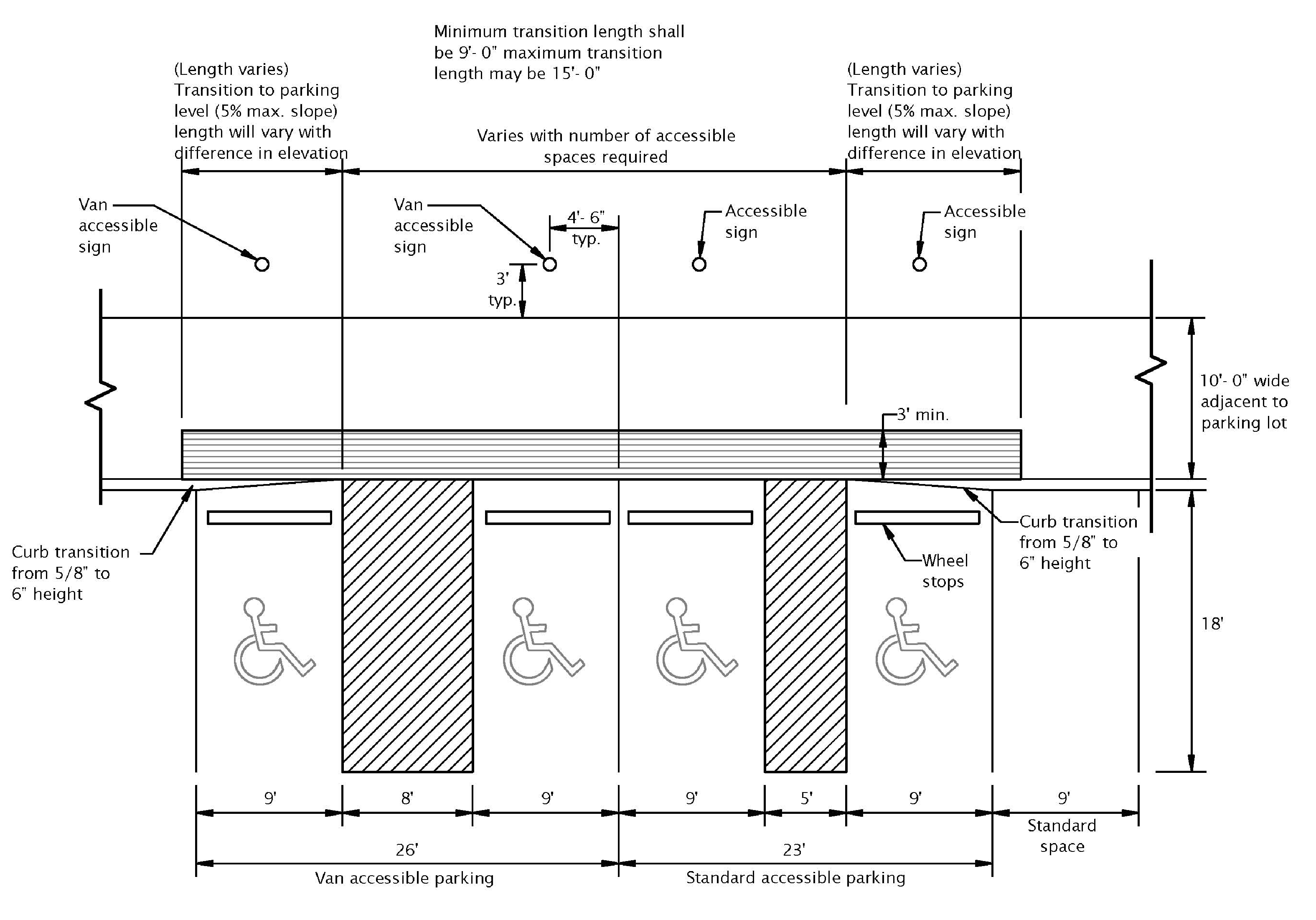
Handicapped parking. Handicapped parking spaces shall be provided in accordance with Table 5.3-1: Required Number of Handicapped Parking Spaces (below) for construction of new buildings (this includes additions to existing buildings). 5.3.2.(D)(1) Handicapped parking space design. (Page 97) and 5.3.2.(D)(2) Handicapped curb ramp design. (Page 97) shall be used the design of handicapped spaces and curb ramps for sidewalks. Said spaces shall be included in the computation of required spaces as specified by this section.
Table 5.3-1: Required Number of Handicapped Parking Spaces
(1)
Handicapped parking space design. Handicapped parking spaces shall be designed according to Figure 5.3.2.1: Handicapped Parking Space Design or an approved Oklahoma Department of Transportation design.
(2)
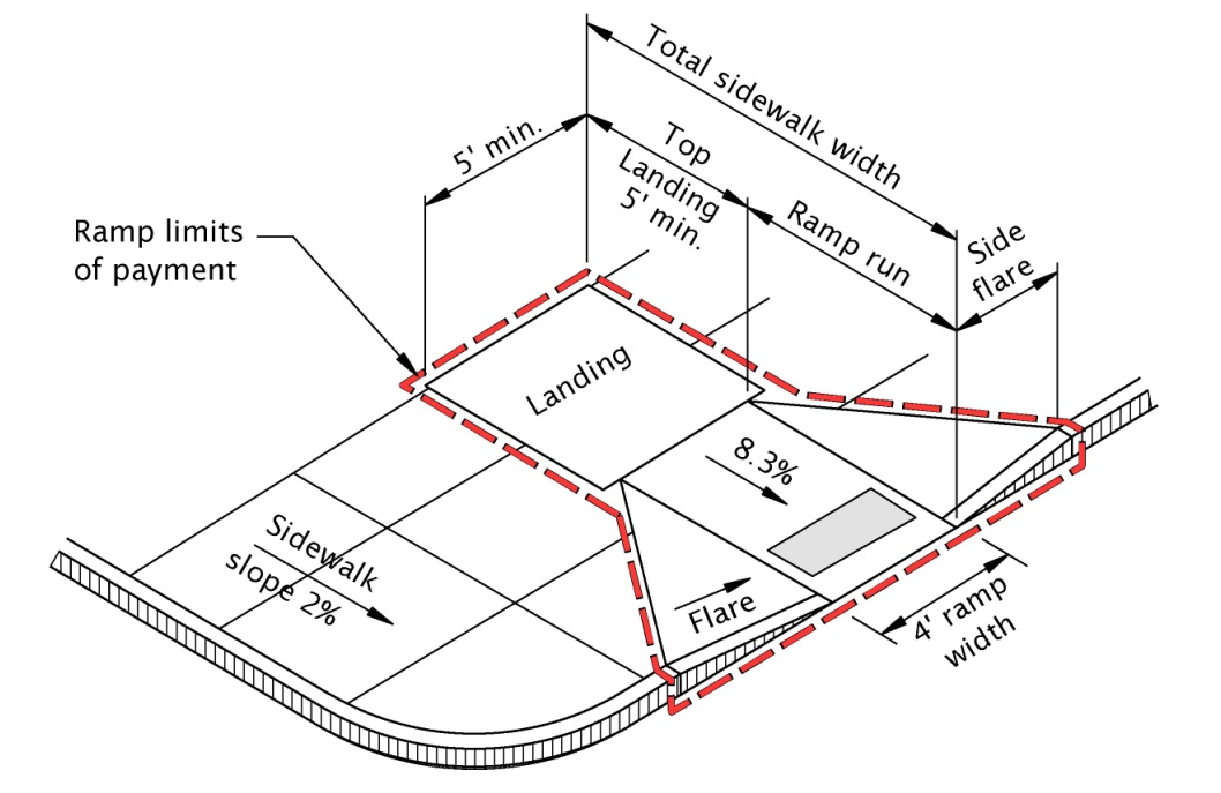
Handicapped curb ramp design. Handicapped curb ramps shall be designed according to Figure 5.3.2.2: Handicapped Curb Ramp Design or an approved Oklahoma Department of Transportation design.
(E)
Specific Parking Requirements. The specific parking requirement for each use is listed in Table 5.3-2: Specific Parking Requirements (below). In cases where a use unit has no specific standard determined in advance by these regulations, the Community Development Director shall make a determination of need after review of the site plan. Any disagreements with the decision of the Community Development Director may be appealed to the Board of Adjustment.
(F)
Minimum Parking Standards for Retail, Office, Manufacturing and Industrial, and Warehousing. The following parking standards apply to retail, office, manufacturing and industrial and warehousing uses. These standards are cumulative and parking spaces shall be provided based on the requirements in each applicable parking tier, as shown below.
Table 5.3-3: Minimum Parking Standards for Retail, Office, Manufacturing and Industrial, and Warehousing
(1)
For mixed uses containing any combination of retail, office, manufacturing and industrial, or warehousing activity, parking requirements shall be tabulated separately for each use within the development using the list of specific standards or Table 5.3-3: Minimum Parking Standards for Retail, Office, Manufacturing and Industrial, and Warehousing (above).
a.
When types of uses are not known at the time of development, then the Community Development Director shall make the determination as to the type of parking, i.e., retail, which will be required.
b.
Mixed uses regulated under separate parking requirements shall not be combined to achieve a larger square footage total that would result in a reduced parking requirement.
(2)
Where any part of a mixed use is converted to another use category then the parking requirements shall be recalculated based on the new square footage figure.
(3)
Where a manufacturing and industrial use has more than one working shift of employees, parking facilities shall be adequate to accommodate overlap requirements during transition periods.
(4)
Where a multiple purpose retail or industrial building is proposed to be occupied by a use which can be demonstrated by the occupant to require less parking than the standards contained herein, the Community Development Director may permit paving of a smaller parking area to meet the estimated need; provided, however, that the balance of the land required by these regulations shall be held in reserve as an unpaved area to meet future needs generated by an expansion of the business or a change in land use.
(G)
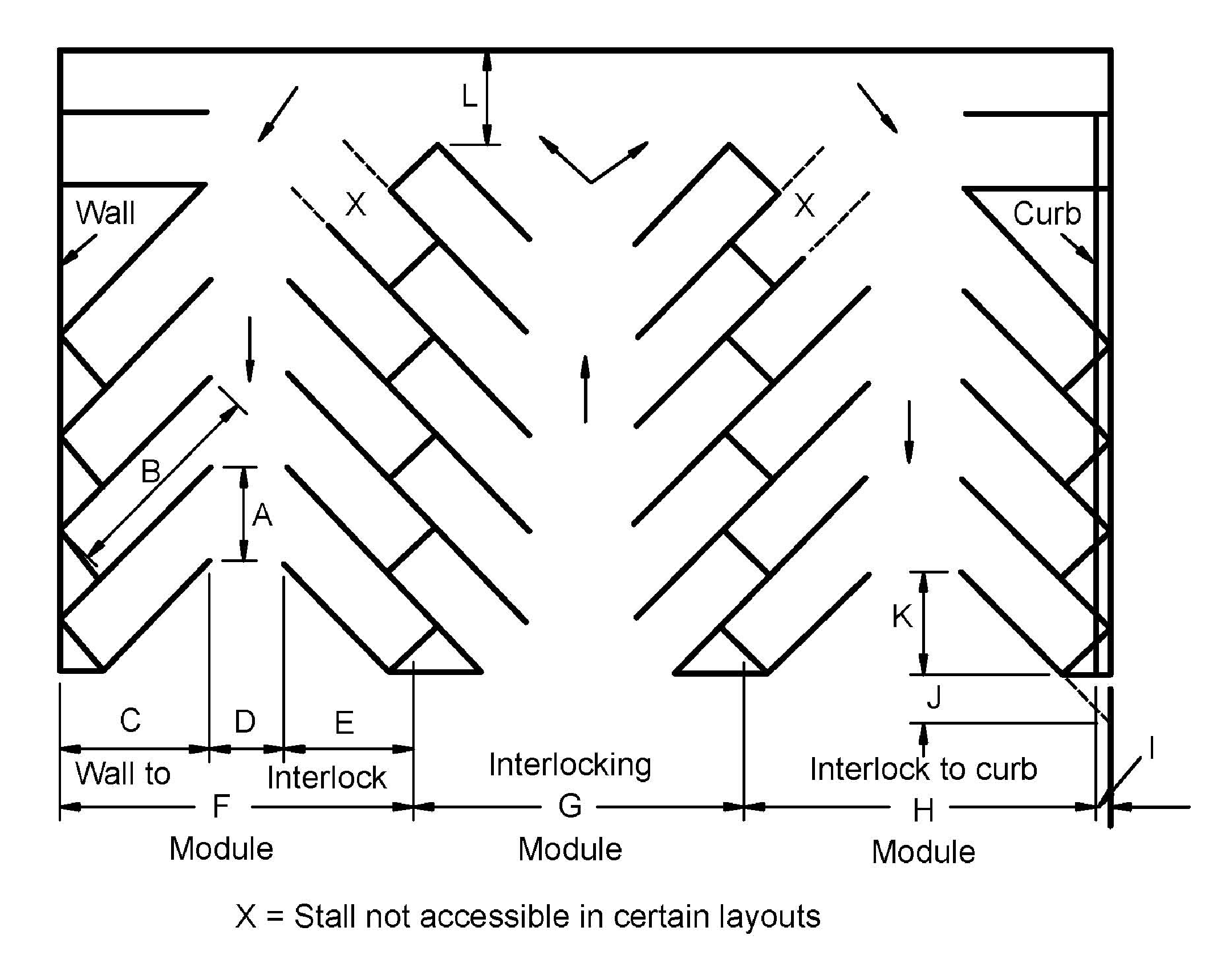
Typical Parking Dimensions in Feet. Table 5.3-4: Typical Parking Dimensions in Feet (below) and Figure 5.3.2.3: Parking Dimensions (Page 104) shall be used in conjunction with each other.
(H)
Parking area design standards.
(1)
Basic design standards.
a.
The basic parking stall shall be eight and one-half (8.5) feet in width and 18.5 feet in length.
b.
The minimum design standards for the basic parking stall as well as the dimensions to be followed if the optional parking stall size of 9.0 or 9.5 feet is used are shown in Table 5.3-4: Typical Parking Dimensions in Feet (Page 103).
c.
Nothing in these standards shall prohibit an owner/applicant from providing larger aisle widths or stall dimensions in excess of these minimum standards in order to better suit his development requirements.
(2)
Alternate design standard. While Table 5.3-4: Typical Parking Dimensions in Feet (Page 103) has design standards for angles of 0°, 45°, 60°, 75°, and 90°, the Community Development Director shall be permitted to approve an alternate design using different angles, provided the property owner submits such a design with calculations for stalls and aisles based upon the standards contained herein.
(3)
Small car parking design standard. Where a parking lot is required to contain twenty (20) or more spaces, the Community Development Director shall be permitted to approve an alternate design for spaces to specifically accommodate compact automobiles. Said design shall conform to the following minimum basic standards:
a.
Up to twenty (20) percent of the required spaces may be allocated for compact cars.
b.
Dimensions for a compact car space shall be eight (8) feet wide and seventeen (17) feet long.
c.
Compact car spaces should be designed and striped at ninety (90) degree angles or an equivalent, which will eliminate access and use by large cars.
(I)
Queuing spaces. Where queuing spaces are provided, they shall conform to the following standards:
(1)
No queuing space may occupy any portion of a public right-of-way.
(2)
Queuing spaces shall be a minimum of nine (9) feet in width and eighteen (18) feet in length.
(3)
Queuing spaces may not be used to satisfy the off-street parking or loading requirements of this section.
(4)
Queuing spaces may be provided in the primary access aisle leading to a drive-in or drive-through facility.
(J)
Aisle standards.
(1)
Aisles providing access to off-street parking areas, but not immediately adjacent to or providing direct access to an off-street parking space, shall be at least twenty-four (24) feet in width if designed for two-way traffic and at least fourteen (14) feet in width if designed for one-way traffic.
(2)
Aisles located immediately adjacent to buildings or structures shall be separated by one of the following methods:
a.
A planted or landscaped strip not less than two (2) feet in width, excluding curb, protected by a six-inch concrete curb;
b.
A sidewalk of not less than four (4) feet in width, excluding curb, protected by a six-inch concrete curb;
c.
A twenty-four-inch aisle guardrail which shall be standard Oklahoma Department of Transportation guardrail with type I or IA terminal (metal end sections) on wooden posts eight (8) feet, four (4) inches on centers, or provide plans and specifications which will provide sufficient information for an alternatively designed guardrail to be approved by the City Engineer. This shall apply only to aisles constructed after the adoption of Ordinance 2053, July 1985.
(3)
Parking may be located immediately adjacent to buildings or structures without a planted or landscaped strip or a sidewalk or without a bumper guard.
(4)
A drive-in window shall not project more than one (1) foot into an aisle.
5.3.3. Off-Street Loading
(A)
Off-street loading space required. Every new industrial, commercial, office and civic building hereafter erected or expanded shall provide space, as indicated herein, for loading and unloading of vehicles for goods and services. The number of off-street loading spaces required by this section shall be considered as the absolute minimum, and the owner/applicant shall evaluate his own needs to determine if they are greater than the minimum specified by this section.
(B)
Size of off-street loading spaces. All off-street loading spaces shall have the minimum dimensions of twelve (12) feet by sixty (60) feet and fifteen (15) feet overhead clearance. In no case shall required off-street loading space encroach upon off-street parking space required under this Ordinance, or on public right-of-way. No maneuvering shall be permitted on public right-of-way.
(C)
Number of off-street loading spaces required. The number of required loading spaces required by use category according to floor
area are shown in Table 5.3-5: Minimum Number of Required
Off-Street Loading Spaces (below):
(D)
Design of loading space.
(1)
Maneuvering. Off-street loading spaces shall be designed so that vehicles shall maneuver entirely within the property lines of the premises and not on public right-of-way. Unenclosed off-street loading areas shall be permanently paved with hard surfaced pavement. A six-inch header curb must also be constructed to separate a loading area from public right-of-way.
(2)
Location and screening. Off-street loading spaces shall be positioned such that they do not face onto and are not visible from any major arterial. Loading areas should generally be located to the rear of nonresidential buildings. Service doors or bays shall be placed to the side or rear of the structure. If loading areas are adjacent to residential uses, then they should be screened.
(3)
Distance. Loading area shall be set back fifty (50) feet from an arterial street.
(Ord. No. 3131, § 2, 10-26-10; Ord. No. 3245, § 1, 9-8-15)
5.4.1. Exceptions. Chimneys, elevators, poles, spires, tanks, towers, penthouses for elevators and HVAC, parapets, and other projections not used for human occupancy shall not extend fifteen (15) feet above the maximum height allowable of the district in which it is located without the prior approval of the City Council.
Public and quasi-public buildings may exceed the height limitation of the district if the minimum depth of rear yards and the minimum width of the side yards required in the district are increased one (1) foot for each two (2) feet by which the height of such public or quasi-public structure exceeds the prescribed height limit.
5.4.2. Maximum Building Height within the MIX, HOS, C-3, C-4, I-2, and I-3 Districts. There are no building height restrictions, unless there is a residential zoning district within one hundred fifty (150) feet of the proposed building, whereupon the building height shall be limited as follows:
(A)
First seventy-five (75) feet of distance. For the first seventy-five (75) feet of distance from said zoning district boundary, building height shall not exceed thirty-five (35) feet.
(B)
From seventy-five (75) feet to one hundred fifty (150) feet of distance. From seventy-five (75) feet to one hundred fifty (150) feet of distance from said zoning district boundary, building height may be increased above thirty-five (35) feet to a maximum height of six (6) stories within a diagonal line representing two (2) feet of additional building setback for every one (1) foot of additional height.
(C)
For the balance of the parcel. For the balance of the parcel, building height may be increased above six (6) stories within a diagonal line representing one (1) foot of additional building setback for every two (2) feet of additional height.
5.4.3. Conflictions. Where an area is restricted by more than one (1) height limitation, such as the airport zoning regulations, the more restrictive limitation shall prevail.
(Ord. No. 3131, § 2, 10-26-10)
The side yard setback may be zero on one (1) side of the lot provided it meets all of the following:
5.5.1. Ownership or a Letter of Concurrence. The lot adjacent to that side setback is held under the same ownership or a letter of concurrence from the adjacent property owner is provided at the time of initial construction and the minimum side setback for such adjacent lot is not less than ten (10) feet; and
5.5.2. Opposite Side Setback. The opposite side setback is not less than ten (10) feet and is perpetually maintained free and clear from any obstructions other than a two-foot eave encroachment, and normal landscaping; and
5.5.3. Projections Across any Property Line. No portion of the dwelling or architectural features, except eaves, may project more than two (2) feet across any property line (eaves may project two [2] feet or less over the property line); and
5.5.4. Public or Private Right-of-Way. The zero side setback is not adjacent to a public or private right-of-way; and
5.5.5. Site Plan. A site plan is prepared in accordance with 7.5 Site Plan (Page 183) at the time of building permit application; and
5.5.6. Maintenance/Access Easement. A recorded five-foot maintenance/access easement is provided on the property adjacent to the zero lot line.
(Ord. No. 3131, § 2, 10-26-10)
The following requirements are intended to provide exceptions or supplement, as the case may be, the specific district regulations set forth in Section 2 Zoning Districts (Page 9).
5.6.1. Open Space to Serve One Building. No open space or lot area required for a building or structure shall, during its life, be occupied by, or counted as open space for, any other building or structure.
5.6.2. Projections into Required Setbacks.
(A)
Elements. Open eaves and porches, cornices, window sills, belt courses, and fireplace chimneys may project into any required setback a distance not to exceed two (2) feet.
(B)
Porches.
(1)
Open porches may project into a front setback a distance not to exceed eight (8) feet.
(2)
Open porches shall not project within ten (10) feet of the rear property line and shall not encroach on any easement.
(C)
Carports. For carports see 5.17 Carports (Page 141).
5.6.3. Sight Lines at Intersections. The following statements are definitions of the sight distance area:
(A)
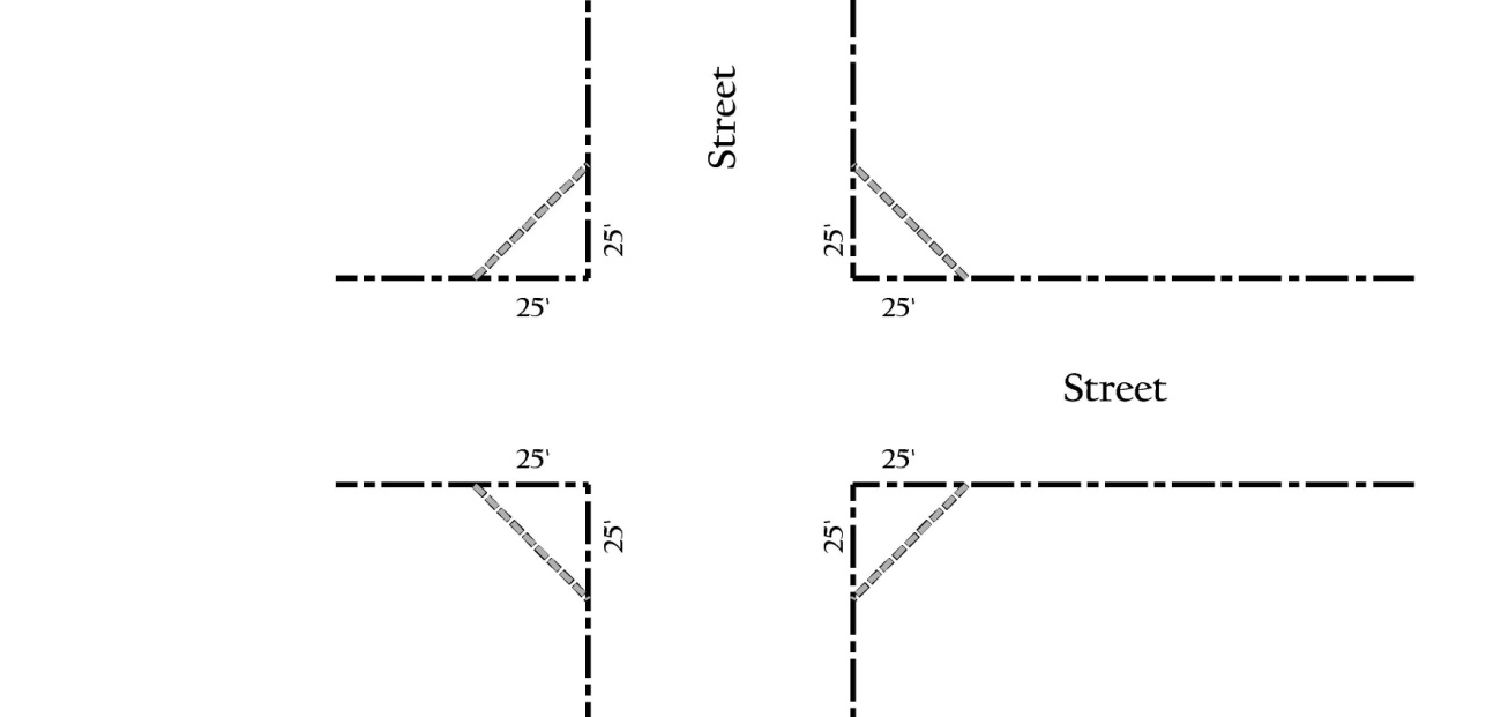
Sight distance area at intersection of two (2) public streets. On any corner lot, a triangle formed by measuring from the point of intersection of the front and exterior lot lines a distance of twenty-five (25) feet along said front and side lot lines and extending the hypotenuse to the curb and connecting the points so established to form a sight triangle on the area adjacent to the street intersection.
(B)
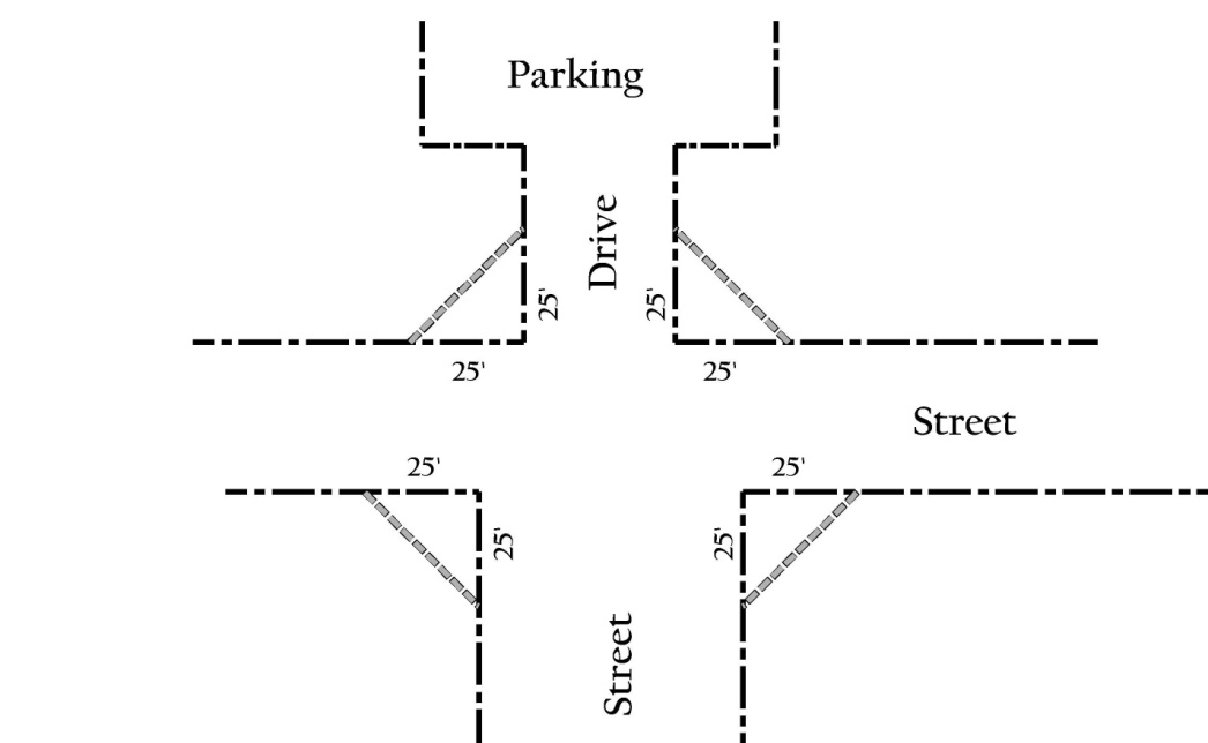
Sight distance area at an intersection of a public street and private driveway leading to a parking lot of six (6) or more vehicles. Triangle formed by measuring from the points of the front lot line and the exterior edges of the pavement of the driveway approach from the private property to the public thoroughfare a distance of twenty-five (25) feet along said front line and said edges of pavement and connecting the points so established by extending the hypotenuse to the curb to form a sight area adjacent to the driveway intersection, and including the area of the driveway between the two (2) triangles.
(C)
Right-of-way. No parking wall, fence, sign, structure or any plant growth other than grasses shall be placed or maintained within any portion of the right-of-way included in the sight triangle.
(D)
Sight distance area.
(1)
No parking wall, fence, sign, or structure shall be placed or maintained within the remaining sight distance area, herein defined from ground elevation to a height of ten (10) feet, except for traffic directional signs not to exceed thirty (30) inches.
(2)
No plant growth shall be placed or maintained which would exceed a mature height of thirty (30) inches.
(3)
The height will be based on the elevation of the adjacent public street or private driveway, whichever is greater, excepting for traffic control signs and lighting standards and except for private sign poles not exceeding one (1) foot in diameter.
(E)
Sign pole. Only one (1) sign pole may be located within the sight distance triangle.
(F)
Parking in the driveways. Parking in the driveways of single-family and two-family dwellings is excluded from the provisions of this Ordinance.
(G)
One-way streets and streets which have divided medians. On one-way streets and streets which have divided medians, the site distance triangle will only apply on the side which has oncoming traffic.
5.6.4. Court Requirements for Multifamily Dwellings. Whenever a multifamily dwelling or group of multifamily dwellings is designed with an inner or outer court, the following requirements shall be complied with:
(A)
Outer court width. The width of an outer court upon which windows open shall be not less than ten (10) feet, or equal to the height of the opposing wall, whichever is greater; and in no case shall an outer court be less than five (5) feet in width or equal to seventy (70) percent of the height of the opposing wall, whichever is greater.
(B)
Inner court width. The width of an inner court of a multifamily dwelling shall be not less than two (2) times the height of the lowest wall forming the court, but in no case shall it be less than twenty (20) feet.
(C)
Passageway for inner court. An open unobstructed passageway shall be provided at the grade of each inner court. Such passageway shall be not less than twelve (12) feet in width, shall have a clearance of not less than twelve (12) feet in height, and shall provide a straight and continuous passage from the inner court to a yard or open space having a direct connection with a street.
(Ord. No. 3131, § 2, 10-26-10)
The purpose of this section is to establish development standards for uses and structures which are accessory to the main use or structure.
5.7.1. Home Occupations.
(A)
Home occupations are permitted subject to the following provisions.
(1)
With the exception of outdoor play activity associated with in-home child care centers, home occupations shall be conducted entirely within the main or accessory buildings. There shall be no outdoor storage associated with any home occupation;
(2)
There shall be no trading of merchandise and there shall be no display of any merchandise or sign associated with any home occupation;
(3)
No mechanical equipment shall be used or activity conducted that creates excessive traffic, noise, dust, odor or electrical disturbance beyond the confines of the lot on which the home occupation is conducted;
(4)
Home occupations are permitted within zoning districts according to Table 4.9-1: Use Chart (Page 75); and
(5)
Home occupations shall comply with the regulations of this Ordinance.
(B)
Non-home occupations. The following shall not be deemed a home occupation.
(1)
Barber shop;
(2)
Tea room or restaurant;
(3)
Rest or nursing home;
(4)
Clinic;
(5)
Doctor or dentist office;
(6)
Child care center for eight (8) or more children under the age of eighteen (18);
(7)
Inn or tourist home; and
(8)
Cabinet, metal or auto repair shop.
(C)
Violation. Any person, firm or corporation convicted of operating a home occupation in violation of this section shall be deemed guilty of an offense and shall be punished as prescribed in 7.10 Administrative and Enforcement Procedures (Page 195).
5.7.2. Trash Dumpster(s) and Enclosure.
(A)
Dumpster Requirements.
(1)
All new commercial buildings shall be served by a minimum of one (1) eight-yard capacity dumpster provided by the City, unless other arrangements are approved by the City's Environmental Services Director in compliance with code.
(2)
All dumpsters shall be screened/enclosed on three (3) sides by a minimum of eight-foot tall masonry walls.
(3)
Such enclosures shall have inside dimensions of no less than twelve (12) feet in width and fourteen (14) feet in length.
(4)
Gates shall be incorporated into the design of the enclosure and shall provide a twelve-foot wide clear space when open.
(5)
A locking device shall be installed on the gates.
(6)
Keeper latches shall be installed to allow gates to remain open during the servicing of the refuse container.
(B)
Dumpster Site Location.
(1)
At the time of preparing plans for new commercial buildings, land area on the site shall be designated as a location for the required dumpster(s) and enclosure, which shall be indicated on those plans.
a.
Such location shall not occupy any designated parking space, dedicated right-of-way, easement and/or create any traffic sight hazard.
(2)
An unobstructed approach shall be provided to allow refuse collection trucks to maneuver on the property without the backing onto a public street.
5.7.3. Use of Residential Structures or Dwellings for Commercial or Industrial Purposes. Residential structures or dwellings can be used for commercial or industrial purposes only under the following conditions:
(A)
Neighborhood compatibility and compliance with standards. No structure or building designed for, intended for, or previously or presently used for residential purposes or dwellings shall:
(1)
Be used for or occupied by any commercial or industrial use or district unless it is harmonious with the existing neighborhood;
(2)
Comply with setback requirements, parking requirements, landscaping and screening requirements, National Building Code, National Fire Code, Lift Safety Code, Fire Prevention Code, National Electrical Code and all other city codes currently adopted and enforced by the City Council.
(B)
Site plan and architectural plans. Included with the building permit application shall be a site plan and architectural plans showing four (4) elevations. If there are no proposed changes to the exterior elevations, pictures may be submitted. The planning department shall coordinate the application with the appropriate departments.
(C)
Use of structure. Whenever a building or structure designed for residential or dwelling purposes is located in a commercial or industrial district, no additional commercial or industrial use shall be permitted on the same lot until the structure of building is removed. Provided, however, that the residential structure or building is not less than two hundred (200) feet from the front property line and is no closer than fifty (50) feet from the nearest commercial or industrial structure or buildings, the residential structure or building need not be removed but may be used only for residential purposes.
5.7.4. Satellite Dish Antennas Greater than Three (3) Feet in Diameter. Satellite dish antennas greater than three (3) feet in diameter shall be defined as those structures constructed, erected, or placed, which intercept television, radio, or other signals transmitted from satellites and measure greater than three (3) feet in diameter. These satellite dish antennas shall be subordinated to the principal use of the property upon which it is located and shall be permitted in any zoning district only if the following rules and regulations are met.
(A)
Building permit required. Any person constructing, erecting, or placing a satellite dish antenna, in whole or in part, shall obtain a building permit.
(B)
Residential/Agricultural/Institutional (personal). No satellite dish antenna shall violate a required front setback, front building line, or side setback nor shall said antenna or any part thereof be located upon or over any dedicated easement or street right-of-way.
(C)
Commercial/Office/Industrial (personal). Satellite dish antennas for personal use with no wholesale or retail activity shall be permitted within the front setback, front building line, or side setback, but said antenna or any part thereof shall not be located upon or over any dedicated easement, street right-of-way, or located within a sight triangle.
(D)
Commercial/Industrial (wholesale/retail). Satellite dish antennas for the purpose of wholesale or retail sales of said satellite dish antennas with outside display shall be permitted only in those districts which allow limited special and open display commercial. No satellite dish antennas or any part thereof shall be permitted to locate upon or over any dedicated easement, street right-of-way or located within a sight triangle.
(E)
Safety. All satellite dish antennas and the grounds surrounding the antenna shall be maintained in safe condition.
(F)
Inspections. The building inspection department shall inspect at such times as it deems necessary each satellite dish regulated by this division for the purpose of ascertaining whether the same is secure or insecure, and whether it is in need or removal or repair.
(G)
Ingress to or egress. No satellite dish shall be erected, relocated, or maintained so as to prevent free ingress to or egress from any door, window or fire escape. No satellite dish of any kind shall be attached to a standpipe or fire escape.
(H)
Attached to the ground. All satellite dishes located outside of main or accessory buildings shall be so constructed, erected, or placed so as to attach to the ground on a permanent location with two (2) ground mobile home augers. Any deviation from using two (2) ground augers requires approval by the building office of Midwest City.
(I)
Height restrictions. No satellite dish antenna shall violate the height restrictions of the zoning district in which said antenna is located.
(J)
Permit fee. Refer to the adopted Zoning Ordinance Fee Schedule for fees.
5.7.5. Wind Energy Conversion Systems. Wind energy conversion systems (WECS) shall be defined as any device such as a wind charger, windmill, or wind turbine, which converts wind energy to a form of useable energy.
(A)
Special Use Permit (SUP) required. A WECS structure shall be permitted by special use permit within any zoning district provided that it is located upon a single tract of land.
(B)
Conformity. All WECS towers/structures shall be designed and constructed so as to conform to the adopted building codes of Midwest City.
(C)
Speed controls. All WECS shall be equipped with manual and automatic over speed controls which are defined as mechanisms to limit the speed of the blade rotation to below the design limits of the WECS.
(D)
Electrical. All electrical compartments, electrical storage facilities, and electrical interconnections with utility companies shall be in conformance with the adopted city electrical codes.
(E)
Sign. At least one sign shall be posted at the base of the WECS structure and shall contain the following information:
(1)
Warning high voltage;
(2)
Emergency phone number; and
(3)
Emergency shutdown procedure.
(F)
Safety. WECS structures of lattice design that are capable of being climbed shall be enclosed by a locked, protective fence six (6) feet in height. Other types of WECS structures shall either:
(1)
Have a tower climbing apparatus located not closer than twelve (12) feet to the ground; or
(2)
Be unclimbable by design for the first twelve (12) feet; or
(3)
Be enclosed by a six-foot high locked protective fence.
(G)
Fence. The anchor points of the guy wires supporting a WECS structure shall be enclosed by a six-foot high fence or shall be located within the confines of a yard which is completely fenced.
(H)
Blade arcs. The lowest point of the blade arcs of a WECS shall be a minimum of fifteen (15) feet above the ground.
(I)
Distance separation. The distance from one WECS tower to a second WECS tower shall be no less than one hundred (100) feet.
(J)
Roof location. WECS structures may be located upon the roof of existing structures only when the following conditions apply:
(1)
The applicant submits an engineer's certificate stating the structure will support the weight and wind loading pressure of the proposed WECS structure, and
(2)
All guy wires supporting the WECS structure will have its anchor points upon the confines of the roof of the structures upon which said WECS structure is located.
(K)
Prohibited location. No part of a WECS (including guy wires) shall be located within or over any drainage, utility, or other dedicated easement, street right-of-way and/or minimum required front or side setback in any zoning district.
(L)
Height.
(1)
The height of a WECS structure shall be measured from the ground level base to the farthest extension of the tower or the tip of the rotor blade at its highest point, whichever is greater.
(2)
The maximum overall height of the WECS structure shall not be regulated; however, a required setback of a distance from any exterior property lines shall be designated.
a.
This designated distance shall not be less than one and one-half (1½) times the total height of the WECS structure.
b.
Example: If the height of the WECS structure is seventy-two (72) feet, then the structure must be a minimum of one hundred eight (108) feet from any exterior property line of the property on which the structure is located.
(M)
Variances. Applications for variances shall be made in writing, including fee, to the Board of Adjustment.
(N)
Permit fee. Refer to the adopted Zoning Ordinance Fee Schedule for fees.
5.7.6. Provisions for Mining and Processing: Oil and Gas.
(A)
Mining and processing.
4.8.2. Mining and Processing: Oil and Gas (Page 73) shall be prohibited in all zoning districts unless specifically authorized by the Board of Adjustment as provided in 6.3 Board of Adjustment (Page 156) and 7.1 Universal Procedures (Page 163) and compliance with Chapter 29, Oil and Gas Wells.
5.7.7. Accessory Structures in Residential Zoning Districts.
(A)
Tract, parcel, or lot with a gross area of one-half acre or less.
(1)
Accessory structures when located, constructed or otherwise erected on a tract, parcel, or lot with a gross area of one-half acre or less, shall:
a.
Not exceed seven hundred fifty (750) square feet in size.
b.
Not exceed the height or size of the main structure on the tract, parcel or lot.
c.
Be limited to total of seven hundred fifty (750) square feet of storage buildings per lot.
(2)
Barns in the A-1, Agricultural District shall be exempt from the size requirements.
(3)
The accessory structures shall not be within five (5) feet from the side property line.
a.
At no time, except as provided in 5.7.7.(E) Small accessory structures on easements (below), shall any portion of the accessory structure be located upon a dedicated easement.
(B)
Tract, parcel, or lot with a gross area over one-half acre and less than one (1) acre.
(1)
Accessory structures located, constructed or otherwise erected on a tract, parcel or lot with a gross area over one-half acre and less than one (1) acre shall:
a.
Not exceed one thousand five hundred (1,500) square feet.
b.
Not exceed the height or size of the main structure on the tract, parcel or lot.
c.
Be limited to total of one thousand five hundred (1,500) square feet of storage buildings per lot.
(2)
Barns in the A-1, Agricultural District shall be exempt from the size requirements.
(3)
All accessory structures over fifteen (15) feet in height shall be located at least ten (10) feet from the side property line and fifteen (15) feet from the rear property line.
a.
At no time, except as provided in 5.7.7.(E) Small accessory structures on easements below, shall any portion of the accessory structure be located upon a dedicated easement.
(C)
Tract, parcel, or lot with a gross area one (1) acre or greater.
(1)
Accessory structures located, constructed or otherwise erected on a tract, parcel or lot with a gross area over one (1) acre shall:
a.
Not exceed twenty (20) percent coverage of the rear yard.
b.
Be limited to a total twenty (20) percent coverage of the rear yard of storage buildings per lot.
(2)
Barns in the A-1, Agricultural District shall be exempt from the size requirements.
(3)
All accessory structures over fifteen (15) feet in height shall be located at least ten (10) feet from the side property line and fifteen (15) feet from the rear property line.
a.
At no time, except as provided in 5.7.7.(E) Small accessory structures on easements below, shall any portion of the accessory structure be located upon a dedicated easement.
(D)
Building Coverage. Main and accessory buildings shall not exceed the allowable coverage percentage of the zoning district in which they are located.
(E)
Small accessory structures on easements.
(1)
Only accessory structures under one hundred (100) square feet in area, under fifteen (15) feet in height, and constructed on skids may be located upon a dedicated easement.
(2)
Owners or occupants of the land upon which the accessory structure is located shall be responsible for relocating the portable or temporary building in the event the city or any franchised public utility needs access to the easement.
(3)
Unless an emergency exists, the property owner shall have seventy-two (72) hours to relocate the building after notice by the city or franchised public utility.
(4)
If the property owner cannot or refuses to relocate the building, or in the event of an emergency, the city or franchised public utility may have the building relocated at the owner's expense.
(5)
The city or franchised public utility shall not be responsible for any damages to said building or property due to the required relocation.
(F)
Location of accessory structures within rear yards. Accessory structures shall be located in the rear yard of the residential lot.
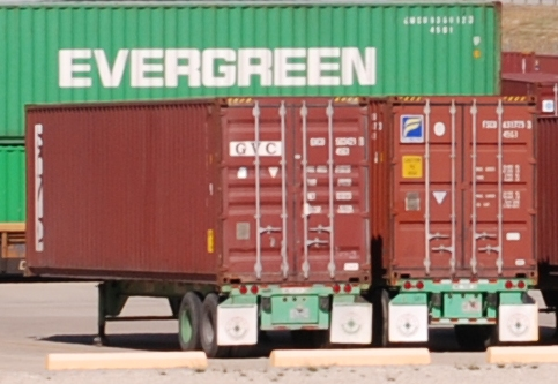
5.7.8. Steel Shipping Containers/Personal Storage Units.
(A)
Prohibited in single-family and two-family residential zoning districts. Steel shipping containers shall not be used for storage in the single-family and two-family residential zoning districts. Such steel shipping containers, as defined below, may be used for storage in the office, commercial, industrial and multifamily zoning districts unless prohibited by a planned unit development or other special zoning requirement.
(B)
Steel shipping containers. Steel shipping containers consist primarily of a steel exterior, are manufactured to transport goods, and have external measurements of twenty (20) or forty (40) feet in length by eight (8) feet six (6) inches in height by eight (8) feet in width.
(1)
Illustrative example of steel shipping containers.
Shipping Containers
(C)
Personal storage units.
(1)
Personal storage units defined. For the purpose of this section, personal storage unit shall mean any container designed for the temporary storage of property. Such temporary storage units are typically rented to occupants of property for their storage use, and are typically delivered and removed by truck and/or trailer.
(2)
Permit required (residential).
a.
When a personal storage unit is placed on residential property for a time period not to exceed seven (7) days, no permit is required. The personal storage unit may be located in front of the required setback.
b.
When a personal storage unit is placed on residential property for a time period of greater than seven (7) days and a building permit for construction, remodel and/or repair of the main structure is in effect, the personal storage unit may remain as long as the building permit is in effect for the property. The personal storage unit may not be delivered until the building permit is issued. The personal storage unit must be removed when the work for which the building permit was issued is complete or when the building permit becomes no longer valid, whichever first occurs.
c.
No more than one (1) personal storage unit per dwelling unit shall be permitted to be placed on a single-family or two-family residential property.
d.
Stacking of personal storage units is not permitted.
e.
Personal storage units shall not be placed on right-of-way or in any manner that creates a traffic visibility obstruction.
f.
Personal storage units shall be placed on asphalt or concrete surfaces only.
(3)
Permit required (commercial, multifamily, office and industrial).
a.
When a personal storage unit is placed on commercial, multifamily, office or industrial property for outdoor storage and there is no building permit in effect for construction, remodel and/or repair of a structure on the property, the following requirements must be complied with:
1.
A permit must be obtained, the application for which must include a site plan indicating the placement of such personal storage unit and the distances from the existing building(s) and property lines.
2.
The personal storage unit must be placed at least fifteen (15) feet away from any fire hydrant, shall not block any fire lane and shall not block any means of egress of any building.
3.
The personal storage unit shall not occupy any required parking space and shall not block any driving lane which would interfere with the flow of traffic.
4.
A personal storage unit shall not be placed in front of a building. If the personal storage unit can be seen from the abutting right-of-way, the personal storage unit must be screened with a sight-proof fence a minimum of six (6) feet in height.
5.
The personal storage unit shall be located only upon an improved surface of asphalt or concrete.
6.
No personal storage unit shall be placed on/over any dedicated drainage and/or utility easement.
7.
A permit fee of fifty dollars ($50.00) for each personal storage unit must be submitted with the permit application.
b.
When a personal storage unit is placed upon commercial, multifamily, office or industrial property for which a building permit has been granted and the proposed work is ongoing, the personal storage unit must be placed in accordance with the setbacks of the zoning district in which it is located. The personal storage unit shall be located only upon an improved surface of asphalt or concrete, shall not occupy any required parking space and must be placed at least fifteen (15) feet away from any fire hydrant. A permit for the personal storage unit is required; however, no fee is required. The personal storage unit must be removed when the approved work is completed.
(4)
Penalties. When it is determined that any of the requirements contained in this section are not being met, the personal storage unit must be removed from the location within ten (10) days of receiving written notice from the city. If the personal storage unit is not removed as directed by the city, citations may be issued to the property owner, tenant and/or applicant as listed on the building permit.
5.7.9. Accessory Structures in Commercial Districts.
(A)
Accessory building/structures shall be required to observe the regulations of the district in which they are located, including the building line setbacks, the required parking and screening, etc.
(B)
Accessory buildings/structures shall not be located over/on any utility easement.
(C)
Main and accessory buildings/structures shall not exceed the maximum percentage of coverage permitted in the district in which they are located.
(D)
Only one (1) accessory building shall be permitted per property.
(E)
Accessory buildings/structures of less than two hundred ten (210) square feet in area are not required to meet the exterior construction and design requirements of section 5.12. of this Code. Those of two hundred ten (210) square feet or greater are required to comply with the requirements of section 5.12 of this Code.
(F)
The selling of food stuffs from an accessory building/structure shall be required the appropriate approval from the city-county health department.
(G)
Accessory buildings/structures shall not exceed forty-five (45) percent of the area of the main building/structure on the property.
(Ord. No. 3131, § 2, 10-26-10; Ord. No. 3192, § 1, 2-26-13; Ord. No. 3201, § 1, 7-9-13; Ord. No. 3427, § 1, 10-29-20)
5.8.1. General. Within the districts established by this Ordinance or amendments that may later be adopted, there are uses, structures, and lots which were lawful before this Ordinance was adopted or amended, but which become prohibited under the terms of this Ordinance or future amendment to this Ordinance. Such uses, structures, and lots are regulated by this section.
5.8.3. Nonconforming Uses of Land without a Building or Structure (below) is for nonconforming uses of land where there are no buildings or structures.
5.8.4. Nonconforming Uses of Conforming Buildings (Page 122) is for when the building or structure is conforming but the use is nonconforming.
5.8.5. Nonconforming Buildings and Structures that have Conforming Uses (Page 122) is for nonconforming buildings or structures that have conforming uses.
5.8.2. Defining a Nonconforming Uses. Any use of land is a nonconforming use if such use is not permitted within Table 4.9-1: Use Chart (Page 75) or written text of this Ordinance.
(A)
Timing for compliance. The owner has five (5) years from the date of the city's service of notice of nonconformity to bring the land into compliance with the current ordinances. Service shall be by personal service or certified mail, return receipt requested, to the landowner and the occupant, if other than the landowner.
(B)
Discontinuance and compliance. If during the five-year notice time period the nonconforming use or any portion thereof is discontinued for a period of six (6) months, or changed, any future use of such land, or change in use, shall be in conformity with the provisions of the district in which said land is located.
(C)
Expansions prohibited. During the five-year notice time period, the nonconforming use shall not be expanded or moved in whole or in part to any other portion of the lot or parcel on which it is located.
5.8.3. Nonconforming Uses of Land without a Building or Structure. The lawful use of land existing at the time of the passage of this Ordinance, even though such use does not conform to the provisions hereof, may continue subject to the following provisions:
(A)
Discontinuance. If said nonconforming use or any portion thereof is discontinued for a period of six (6) months, or changed, any future use of such land, or change in use, shall be in conformity with the provisions of the district in which said land is located.
(B)
Expansion or movement. A nonconforming use shall not be expanded or moved in whole or in part to any other portion of the lot or parcel on which it is located.
5.8.4. Nonconforming Uses of Conforming Buildings. If a lawful use, involving conforming individual buildings or structures existing at the effective date of adoption of or amendment to this Ordinance, becomes nonconforming under the terms of this Ordinance, said use may continue, subject to the following provisions:
(A)
Change of nonconforming uses. A building use may be changed to another nonconforming use of an equal or a more restrictive classification or to a conforming use. However, the use shall not thereafter be changed to a less restricted use. A building permit is required for any structural alterations.
(B)
Effect of discontinuance. In the event that a nonconforming use of any building or premises is discontinued for a period of one (1) year, the use of the building or premises shall thereafter conform to the use regulations of the district.
(C)
Expansion of a nonconforming use. No nonconforming use, except when required by law, shall be enlarged, extended, or reconstructed, unless such change is to a use permitted in the district.
(D)
Restoration of a damaged use. When a nonconforming use of a building is damaged by fire, explosion, natural cause, or public enemy, by more than fifty (50) percent of its true value, said building shall be restored only if it conforms with the district regulations.
(E)
Remodeling. Improvements or remodeling which do not increase the size or intensity of use shall be permitted.
5.8.5. Nonconforming Buildings and Structures that have Conforming Uses. Although a structure or building does not conform to the district regulations of this Ordinance for a minimum lot size, lot width, setback requirements, height, coverage, parking, other characteristics of the structure, or its location on the lot, the lawful existence of a structure or building at the effective date of adoption of this Ordinance may continue, subject to the following provisions:
(A)
Alteration or enlargement of buildings and structures. A nonconforming building or structure shall not be enlarged in any manner unless said building or structure, including additions and enlargements, is made to conform to all of the regulations of the district in which it is located.
(1)
Exceptions. If a building or structure is conforming as to use, but nonconforming as to setbacks or height or off-street parking space, the building or structure may be enlarged or added to provided that the enlargement or addition complies with the setback or height requirements and the existing building and the addition complies with the off-street parking requirements of the district in which said building or structure is located.
(B)
Restoration of a damaged building. When a nonconforming building is damaged by fire, explosion, natural causes, or a public enemy, by more than fifty (50) percent of its true value, it shall be restored only if it is done in a manner that conforms with the district regulations.
(C)
Relocation. No such building shall be moved for any reason for any distance whatever, unless it hereafter conforms to all provisions of the zoning district in its new location.
(D)
Remodeling. Improvements or remodeling which do not increase the size or intensity of use shall be permitted.
5.8.6. Violation not Authorized. Nothing in this section shall be interpreted as authorizing approval of a building or premises in violation of zoning regulations in effect at the time of the effective date of this section.
5.8.7. Screening Nonconforming Commercial Uses of Property. Within one (1) year from the time any property is annexed to the city, all nonconforming commercial uses of property abutting residentially zoned property shall be adequately screened from view in accordance with the regulations of 5.2 Screening and Landscaping (Page 81).
(Ord. No. 3131, § 2, 10-26-10)
5.9.1. Group Residential and Group Care Facilities. Prior to the establishment of a new private or quasi-public facility as defined by § 4.2.8. Group Residential or § 4.3.14. Group Care Facility or when operations have ceased at existing private or quasi-public or group care facilities for more than twelve (12) consecutive months, in any residential district an application shall be filed with the City.
(A)
Application requirements. Such application shall include:
(1)
Legal description of the property and the street address or approximate location of the facility;
(2)
Names and addresses of all those persons or organizations intending to sponsor or operate such facility;
(3)
The maximum number of staff and residents at the facility;
(4)
The location of any other group care facility operated by the applicant; and
(5)
Copy of approved license by the State Department of Health, if applicable.
(B)
Notice requirements. Notice and hearing requirements shall conform to the procedure in Section 2.2 of this Zoning Code and, upon submission of the proper permit application, shall be conducted as follows. The City shall send written notice to all real property owners within three hundred (300) feet of the exterior boundary of the property on which the facility is to be located. The notice shall contain:
(1)
Legal description of the property and the street address or approximate location of the facility;
(2)
The date and time when the matter will be presented to the Planning Commission and City Council for hearing.
(C)
The City Council determination shall take into consideration the recommendations of the Planning Commission. The City Council shall consider the Special Use Permit based upon the following criteria:
(1)
The recommendation of the Planning Commission and matters presented before the Planning Commission at the hearing on the application;
(2)
Whether the facility is physically suitable for the residential area;
(3)
Whether the facility will meet the zoning ordinances of the area;
(4)
Whether the establishment of such facility in the residential area would be within good zoning practices.
(D)
Separation requirement. Except as allowed in 2.9 R-MD, Medium Density Residential District and 2.10 R-HD, High Density Residential District, no private or quasi-public facility shall be located nearer than one thousand two hundred (1,200) feet to another facility or similar community residential facilities serving persons in drug, alcohol, juvenile, child, parole, and other programs of treatment, care, supervision or rehabilitation in a community setting.
(E)
Notification fee. Refer to the adopted Zoning Ordinance Fee Schedule for fees.
(Ord. No. 3131, § 2, 10-26-10; Ord. No. 3241, § 4, 8-11-15; Ord. No. 3315, § 1, 7-25-17)
5.10.1. Compliance with Standard Engineering Practices and the Subdivision Ordinance. All retaining walls must comply with standard engineering practices and the subdivision ordinance, Chapter 43 of the Midwest City Code of Ordinances.
5.10.2. Retaining Wall Height. Any wall higher than two (2) feet shall either comply with Midwest City Standards or be designed by a professional engineer and have the engineer's seal.
5.10.3. Retaining Wall Measurement. The wall shall be measured from the top of the footing to the top of the wall.
5.10.4. Retaining Wall Permit. A permit must be applied for and approved before construction on any retaining wall is started. A retaining wall will not require a permit if shown and approved on a site plan.
5.10.5. Compliance with Standard Engineering Practices. Failure to comply with this section may result in legal action and/or removal of the wall.
(Ord. No. 3131, § 2, 10-26-10)
5.11.1. Purpose and Application.
(A)
Purpose. Standards for controlling lighting and glare are set forth to reduce annoyance and inconvenience to property owners and traffic hazards to motorists. These standards are intended to allow reasonable enjoyment of adjacent and nearby properties by their owners and occupants while requiring adequate levels of lighting for nonresidential areas, such as parking lots.
(B)
Applicability. All nonresidential developments shall submit a lighting plan. The lighting plan shall show how the proposed development will comply with the regulation within this 5.11 Outdoor Lighting and Glare Prevention.
5.11.2. Lighting Plan.
(A)
Lighting plan application submittal. An application for a lighting plan shall be submitted and approved or denied by the Community Development Director as part of a site plan, 7.5 Site Plan (Page 183).
(1)
Elements of a lighting plan.
a.
The type of illuminating devices, fixtures, lamps, supports, reflectors and other devices, and their respective location on the site;
b.
A description of the illuminating devices, fixtures, lamps, supports, reflectors and other devices (such as catalog cuts by manufactures and drawings); and
c.
Photometric data, such as furnished by manufactures, or similar data showing the angle of cut off or light emissions.
(2)
The lighting plan shall show such information in sufficient detail to enable the Community Development Director to readily determine whether the lighting plan is in compliance with the requirements within this Ordinance.
a.
If the Community Development Director cannot readily make this determination, then the applicant shall be required to submit reports of tests performed and certified by a recognized testing laboratory. Such reports must provide sufficient evidence such that the Community Development Director is thereby able to ensure compliance.
5.11.3. General Regulations.
(A)
Maintenance.
(1)
Structure. Piers for light poles taller than eight (8) feet shall be designed by a licensed engineer competent in structural engineering. Soil condition and wind loading shall be accounted for in the pier design.
(2)
Quality and Appearance. All fixtures and supports shall be painted or otherwise treated to resist rust and corrosion and shall be maintained in an attractive condition and in a manner consistent with the surrounding architecture.
(3)
Condition. All fixtures and lamps shall be maintained in a working, serviceable condition at all times.
(B)
Glare - direction and intensity.
(1)
Glare. Any use shall be operated so as not to produce obnoxious and intense glare or direct illumination across the bounding property line from a visible source of illumination of such intensity as to create a nuisance or detract from the use or enjoyment of adjacent properties.
(2)
Height across property lines. All outside lights shall be made up of a light source and reflector that acting together the light beam is controlled and not directed across any bounding property line above a height of three (3) feet.
(3)
Maximum intensity. The allowable maximum intensity measured at the property line of a residential use in a residential district shall be 0.5 foot candles, except as may be otherwise specified for specific lighting situations.
(C)
Lighting Units.
(1)
General. Light sources shall be of a down-light, indirect, diffused, or shield type or so installed and maintained as to reduce glare effect and consequent interference with the use of adjacent properties and boundary streets.
(2)
Temporary holiday lighting. Bare bulbs above fifteen (15) watts or strings of lamps are prohibited except for temporary holiday lighting not exceeding forty-five (45) days per year.
(3)
Appearance and height. Standards, poles, and fixtures shall be of a single color compatible with the architecture of the building(s) served. The height of such standards, poles, and fixtures, excluding those mounted on a building, shall not exceed the height of the highest roofline of the building(s) within the site, except as provided in 5.11.3.(D) Recreational area lighting (Page 129) and in Table 5.11-1: Mounting Heights for Lighting in Parking Areas (Page 130).
(D)
Recreational area lighting.
(1)
Height. Lighting for recreational uses (which include athletic courts and fields) may employ standards, poles, and fixtures in excess of the heights prescribed in 5.11.4. Nonresidential and Mixed Use Regulations (below).
(2)
Living screen required. Where recreational uses are adjacent to residential uses, separation by streets notwithstanding, and such recreational use is illuminated in such a manner as to produce a light intensity in excess of 0.5 foot candles at the property line of the residential use, a living screen shall be required in accordance with the following:
a.
A variety of trees which normally grow to or in excess of a height of forty (40) feet shall be provided.
b.
Trees shall be planted no more than thirty (30) feet on center along the property line abutting the residential use.
c.
The tree variety shall maintain a crown width sufficient to form a continuous screen at height between ten (10) feet and thirty (30) feet above grade.
d.
Such trees shall be a minimum of one-third the required height at the time of planting.
(E)
Thoroughfare lighting.
(1)
Exemption. Lighting provided by governmental entities for safe travel upon public thoroughfares is expressly empted from compliance with this 5.11 Outdoor Lighting and Glare Prevention.
5.11.4. Nonresidential and Mixed Use Regulations.
(A)
Site lighting.
(1)
General requirement. All off-street parking areas for nonresidential and mixed uses that are used after dark shall be illuminated beginning thirty (30) minutes after sunset.
(B)
Parking and loading lighting.
(1)
General requirement.
a.
Nonresidential uses which abut residential districts shall be required to cease illumination of parking areas at the termination of hours of use. In case only a portion of a parking area is offered for use after dark, only that part is required to be illuminated in accordance with these standards. However, the portion offered for use shall be clearly designated.
b.
Illumination of parking areas shall be sufficient to ensure the visibility of pedestrians and the safe movement of traffic within the site.
(2)
Intensity. The level of intensity of illumination, measured at a height of three (3) feet above the pavement surface, shall be a minimum average of two (2.0) foot candles, and a minimum level at any point of at least 0.66 foot candles.
(3)
Mounting height. The mounting height of lighting fixtures shall not exceed the heights specified in Table 5.11-1: Mounting Heights for Lighting in Parking Areas (below).
Table 5.11-1: Mounting Heights for Lighting in Parking Areas
(4)
Appearance. Standards, poles, and fixtures shall be of a single color, compatible with the architecture of the building.
(5)
Type of fixtures.
a.
All lighting fixtures shall be restricted to down-light or cut-off types.
b.
Low-pressure sodium lighting or lighting of similar color shall not be used.
(C)
Walkway Lighting.
(1)
Intensity. All outdoor pedestrian areas and uncovered walkways, separate from parking areas or buildings but essential to the to the nighttime operation of nonresidential uses within nonresidential districts, shall be continually illuminated between sunset and sunrise.
a.
The level of intensity of illumination, measured at the walkway surface, shall be a minimum average of 0.8 foot candles.
(2)
Mounting height. The mounting height of lighting fixtures shall not exceed twelve (12) feet.
(3)
Type of fixtures. Pole-mounted and wall-mounted fixtures mounted above six (6) feet shall be of a down-light or cut-off type.
(D)
Accent and security lighting.
(1)
Accent lighting. Up-lighting shall be concealed or otherwise positioned in such a manner that the light source cannot be seen from any property line of the site on which the light is located.
(2)
Security lighting.
a.
Pole-mounted and wall-mounted fixtures mounted above six (6) feet shall be of a down-light or cut-off type.
b.
If a rear yard security light is mounted higher than ten (10) feet, it shall be directed away from adjacent properties.
5.11.5. Approval of Alternatives.
(A)
Approval of alternative lighting plan. An application for administrative approval of an alternative lighting plan shall be submitted and acted upon in accordance with this 5.11 Outdoor Lighting and Glare Prevention. The Community Development Director may approve an alternative lighting plan, based upon a finding that the proposed alternative meets the spirit and intent of this 5.11 Outdoor Lighting and Glare Prevention.
(Ord. No. 3131, § 2, 10-26-10)
5.12.1. Exterior Construction Requirements and Standards.
(A)
Masonry requirement for residential uses.
(1)
All single and two-family homes shall have one hundred (100) percent masonry materials on the sides of ground floors (facades) facing a public street.
a.
Exceptions: Masonry requirements do not apply above the plate line or trim work, such as gables and soffits. The masonry coverage calculation does not include doors, windows, window box-outs, eaves, or bay windows that do not extend to the foundation.
(2)
All single, two-family, and multifamily developments shall consist of eighty-five (85) percent masonry materials.
(3)
Prohibited: Concrete masonry units, concrete panel construction, vinyl siding, wood engineered or manufactured wood, medium density fiberboard, particle board, or Masonite shall be prohibited in the construction of residential units.
(4)
Approved masonry materials for residential construction include: brick, rock, stone, stucco, cementitious fiberboard and other materials as approved by staff.
(B)
Masonry requirement for nonresidential uses.
(1)
Office and Commercial Districts: Buildings shall consist of eighty (80) percent masonry materials.
(2)
Industrial Districts: Buildings shall consist of sixty (60) percent masonry materials.
(3)
Nonresidential Uses within Residential Districts: Buildings shall consist of eighty (80) percent masonry materials.
(4)
Approved masonry materials for nonresidential construction include: brick, rock, stone, stucco, cementitious fiberboard and other materials as approved by staff.
(C)
Temporary construction buildings. Temporary buildings and temporary building material storage areas to be used for construction purposes may be permitted for a specific period of time in accordance with a permit issued by the city and subject to periodic renewal.
(D)
Wall facade articulation. In order to ensure the aesthetic value and visual appeal of nonresidential land uses and structures, facade articulation shall be required.
(1)
Wall facade articulation of at least three (3) feet in depth or offset shall be required for every twenty-five (25) feet in horizontal surface length.
(2)
Wall facade offsets shall be shown, along with calculations verifying that the building elevations meet the above requirement, on a building facade (elevation) plan, and shall be submitted for Planning Commission review along with the site plan.
(3)
Buildings smaller that fifteen thousand (15,000) square feet shall be exempt from wall facade articulation.
(Ord. No. 3131, § 2, 10-26-10; Ord. No. 3348, § 1, 9-11-18; Ord. No. 3558, § 1, 4-23-24)
5.13.1. Infill Definition. Infill/redevelopment housing is defined as new housing construction on existing lots that are less than one acre in size. Furthermore, at least eighty (80) percent of the land within a three hundred (300) foot radius of the infill/redevelopment site must be developed and water, sewer, streets, schools and fire protection must be provided/available.
5.13.2. Infill Minimum House Size. New homes shall have a minimum house size equal to the average house size of the five (5) closest single-family homes.
5.13.3. Infill Roof Pitch. If the subdivision was platted prior to 2010, there shall be no minimum roof pitch.
(Ord. No. 3131, § 2, 10-26-10; Ord. No. 3339, § 1, 6-26-18)
5.14.1. Lot Variety Required. In order to promote housing diversification within neighborhoods, single-family residential development within the residential zoning districts shall provide for lot size variety.
(A)
Applicability.
(1)
Single-family residential development five (5) acres or larger within the following zoning districts.
a.
2.6 R-8, Single-Family Detached Residential District (Page 12).
b.
2.7 R-6, Single-Family Detached Residential District (Page 12).
(B)
Lot size requirements.
(1)
Fifteen (15) percent of lots within a development shall be larger than the minimum lot size.
a.
Lots sizes shall be increased at least twenty (20) percent of the minimum lot size.
(2)
Fifteen (15) percent of lots within a development may be smaller than the minimum lot size.
a.
Lots sizes shall not be reduced greater than twenty (20) percent of the minimum lot size.
(C)
Minimum lot size for all single-family lots.
(1)
Single-family lots shall not be smaller than 6,000 square feet.
(D)
Lot distribution.
(1)
Lots of various sizes shall be evenly distributed throughout a development.
(E)
Minimum house size adjustment.
(1)
The minimum house size shall be adjusted at the same percentage of minimum lot size.
(Ord. No. 3131, § 2, 10-26-10)
5.15.1. Standards for Garages for Single-Family Units. The placement of garages in a neighborhood can have a substantial impact on a neighborhood's visual appearance. If alleys are not used in the design of a neighborhood, then driveways must be attached to the street. As a result, little space is available for on-street parking in smaller lot subdivisions. Typically, when no alley is present, a common design layout is for the garage to be placed facing the street. This design layout generally establishes the garage as the most dominant visual feature from the view of the street, and it generally does not contribute to the visual appeal of a neighborhood and does not conform to the image of quality neighborhoods established in the comprehensive plan.
(A)
Applicability
(1)
Thirty-five (35) percent of all single-family units within a residential development without alleys (i.e., driveways are connected to a street).
(2)
Single-family residential developments within the following zoning districts:
a.
2.6 R-8, Single-Family Detached Residential District.
b.
2.7 R-6, Single-Family Detached Residential District.
(3)
Infill lot development as defined in 5.13 Infill Housing Exception to Minimum House Size shall be exempt from this section.
(4)
Individual lots ten thousand (10,000) square feet in size or greater shall be exempt from this section.
_____
(B)
Garage and driveway design option. All applicable single-family units shall have one of the following driveway and garage configurations:
(1)
The driveway shall be designed in a letter "J" formation and connected to a garage with a side entrance as shown below.
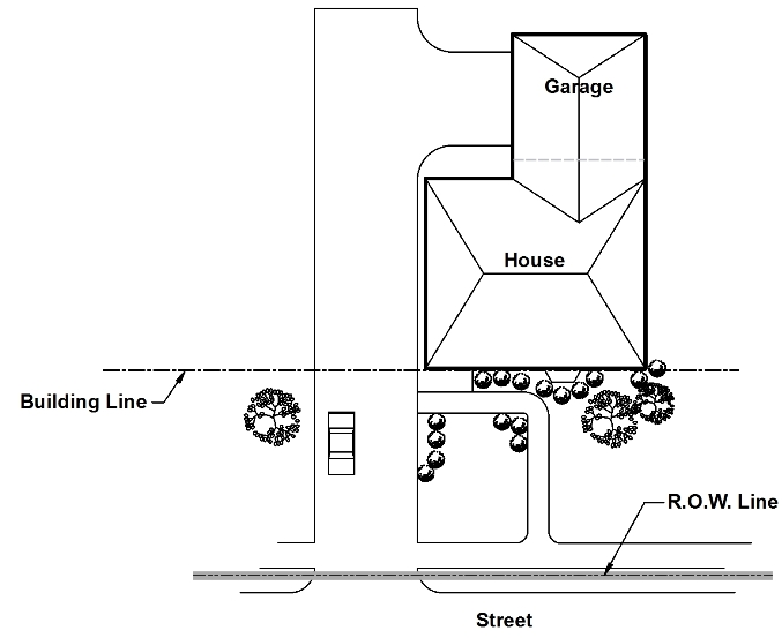
(2)
The driveway is designed straight to a garage that is set back fifteen (15) feet from the front building line; or
(3)
The driveway is designed and connected to a detached garage and is located in the rear yard of the property.
(C)
Enclosed spaces and driveway width. Each single-family unit shall have a minimum of two (2) enclosed parking spaces with a minimum driveway width of sixteen (16) feet.
(D)
J-drive turning radius and backing space. Each j-drive shall have one of the following combinations of turning radius and backing space:
(Ord. No. 3131, § 2, 10-26-10; Ord. No. 3392, § 1, 10-22-19)
Uniqueness of a neighborhood is developed by all the homes not being the same, in regards to building materials, size, floor plans, front facades, etc. In an effort to help promote ownership, neighborhood pride, and encourage long-term commitment, homes should be individual and definable rather than replicas of the adjacent homes.
5.16.1. Applicability.
(A)
Zoning districts.
(1)
Single-family residential development within the following zoning districts.
a.
2.6 R-8, Single-Family Detached Residential District (Page 12).
b.
2.7 R-6, Single-Family Detached Residential District (Page 12).
(B)
Exemptions.
(1)
Individual lots 10,000 square feet in size or greater shall be exempt from this section.
5.16.2. Exterior Construction Requirements and Standards. All new single-family residential developments shall have at least four (4) of the following six (6) elements:
(A)
Front facades or elevations. No single front facade of a home may be duplicated within six (6) lots as measured along the curb line.
(B)
Front wall massing. There shall be no uninterrupted wall length for fifteen (15) feet along any front facade of the dwelling unit.
(C)
Varying front setbacks. Variations of the front setback of at least five (5) feet shall be required, building shall not be within the required front setback established within Table 3.2-1: Residential Area Regulations and Standards Chart (Page 47).
(D)
Covered front porch.
(1)
Percent of single-family units. No less than thirty-five (35) percent of the total number of single-family units in any platted block should contain a front covered porch that is permanently attached to and an integral part of the primary structure constructed of like and similar materials to those of the primary structure.
(2)
Front setback encroachment. The front porch can be allowed to encroach into the minimum required front setback by eight (8) feet.
(3)
Minimum dimensions. Each covered front porch shall be a minimum eighty (80) square feet and have a minimum depth from the primary structure of eight (8) feet.
(E)
Architectural Relief Required. Two-story, single-family structures shall not have more than one side with fewer than four (4) outside corners. Outside corners shall be defined according to the following illustration:
(1)
Illustration of prohibited design.
(2)
Illustration of allowed design.
(F)
Architectural focal point. One of the following architectural focal points should be incorporated into each housing unit.
(1)
Chimney. The exterior veneer of a chimney constructed as part of or an extension to the exterior wall of a residential structure must be constructed of like or similar brick or other masonry material to that of the primary structure. The exterior veneer of chimneys shall not be constructed of wood or lumber products.
(2)
Window Enhancements. The use of transoms, bay windows, stained glass, or other similar window enhancements.
5.16.3. Minimum Roof Pitch. A minimum 5:12 roof pitch shall be required for each primary structure.
(Ord. No. 3131, § 2, 10-26-10)
5.17.1. Carport Requirements. Carports are permitted to be added to residential structures and are subject to the following conditions and regulations:
(A)
Building permit. Any person erecting or constructing a carport, in whole or in part, shall obtain a building permit.
(B)
Number of carports allowed. No more than one (1) carport shall be permitted for each dwelling unit.
(C)
Carport condition and maintenance. All carports shall be kept in an attractive state, in good repair, and in a safe and sanitary condition.
(D)
Side setbacks and exceptions. No portion of a carport shall violate a required side setback as prescribed within this Ordinance with the exception that open eaves may extend two (2) feet into the side setback as prescribed in 5.6.2. Projections into Required Setbacks (Page 110) and with the exception that carports may be located abutting or less than five (5) feet from the side property line under the following conditions:
(1)
The abutting owner(s) of the property immediately adjacent to the proposed construction must sign an agreement stating his/her name, and address, and that they give permission for the carport to be located abutting or less than five (5) feet from the side property line;
(2)
The eave of the carport shall in no instance overhang the adjacent property;
(3)
Guttering shall be installed and maintained in a manner to prohibit any increase of water runoff onto the adjacent property;
(4)
If the proposed carport is to be located over a utility easement paralleling the side property line, the following provision must be agreed to by the applicant for the building permit and the property owner, if different from the applicant:
a.
In the event access is required to the dedicated easement by the city or any franchised public utility, the property owner shall be responsible for relocating the carport structure in a manner to allow such access.
b.
The property owner shall be notified of the need to relocate said carport and from that point in time have seventy-two (72) hours to do so. If the property owner cannot or refuses to relocate said carport, the city or franchised public utility may have said carport relocated at the owner's expense.
c.
The property owner shall not hold the city or franchised public utility responsible for any damages to said carport or property due to the required relocation.
(E)
Front setbacks and exceptions.
(1)
All carports shall comply with front setback requirements of this Ordinance, provided carports used in conjunction with single-family dwellings or two-family dwellings shall be permitted to extend into the required front setback area.
(2)
However, no portion of a carport shall be permitted closer than five (5) feet from the right-of-way line of a public street except as provided in 5.17.1.(F) Corner lots and extensions into the right-of-way (below) of this section.
(F)
Corner lots and extensions into the right-of-way.
(1)
For corner lots only, a carport may extend into the right-of-way of only a local street if the garage is so situated because of the building setback line that a carport cannot be constructed without extending into the right-of-way.
(2)
In this situation a carport may extend into the right-of-way; however, no carport shall be permitted closer than six (6) feet to the curb line and shall not be more than twenty (20) feet in length measured from the structure to which it is attached.
(3)
The carport must be constructed in such a manner as not to obstruct sight distance at the intersection. Damage to any public utility associated with the carport shall be the responsibility of the property owner.
(4)
In the event that the city shall determine that street widening is necessary or the installation, repair, replacement, or maintenance of existing or future public utilities is necessary, the city or any public utility shall have the right to remove said carport.
(5)
Cost of removal and reinstallation, if allowed, shall be at the owner's expense.
(6)
If the owner refuses to remove the carport, the city or public utility may have the carport removed and reinstalled at the owner's expense with the cost being included on the ad valorem tax rolls as a lien. Other provisions of the Midwest City Code which would prohibit structures within the right-of-way shall not apply to this exception.
(G)
Paved hard-surfaced drive.
(1)
All carports shall be located only over a paved hard-surfaced drive. Provided, however, a gravel driveway may be used to satisfy the requirement if the property owner can demonstrate through dated photographs, or dated negatives, that the gravel driveway existed prior to January 1, 1985.
(2)
Dated photographs/negatives shall mean those photos or negatives dated on the front or back through a development process. Handwritten, typed, or other means of dating photographs/negatives other than those dated through the development process shall not be accepted as proof.
(3)
Those properties currently approved with a residential building permit, whether for a new home, addition, remodel, or house move-in that have been required to install a paved driveway as part of their permit approval, or any other regulations pertinent to the approved building permit shall not be exempt from the requirement to install paved driveways.
(H)
Carport width.
(1)
Except upon application to the community development department, no carport shall exceed twenty-four (24) feet in width.
(2)
The Community Development Director may approve an application for a width greater than twenty-four (24) feet if the carport will be architecturally integrated with the residence and no protest is received after notice by the community development department to all property owners whose property abuts the sides or front of the property of the applicant.
a.
If a protest is received or if the Community Development Director determines that the carport in excess of twenty-four (24) feet in width is not architecturally integrated with the home, the application may be appealed to the City Council for final determination.
(3)
An example of architectural integrity would be where a property owner wishes to match his carport with the existing house eaves and the total width exceeds twenty-four (24) feet.
(I)
Standards for constructing carports.
(1)
Metal carports shall be constructed of 26 gauge steel or 0.25 aluminum decking with a baked-on enamel finish to be compatible with the exterior finish of the structure.
(2)
Poles supporting the carport shall be wrought iron or of a metal material compatible with the exterior finish of the structure.
(3)
Exposed eaves shall have rain guttering directing water flow to the street and away from adjacent properties.
(4)
Wooden construction of carports shall be permitted with the following provisions:
a.
Roof slopes shall exceed two (2) inches in twelve (12) inch pitch;
b.
All eaves shall be enclosed and have rain guttering installed to divert water to the street and/or away from adjacent properties unless the pitch of the roof diverts the flow of rainwater to the street;
c.
Finishes shall be compatible with the exterior of the primary structure;
d.
The underside of the carport shall be enclosed with an approved material.
(J)
Carport design: open sides and latticework required.
(1)
All carports, observing the required front setback, shall be permanently open on two (2) sides from grade surface to eaves line.
(2)
All carports that extend into the required front setback shall be permanently open on three (3) sides from grade surface to eaves line, except that such carports extending beyond the front setback may install latticework along one side of the carport.
a.
Such latticework, when installed, shall be a framework of ornamental design made of strips of wood, plastic, nylon or other material as approved by the chief building official. Such latticework shall be of a design so as not to impair the vision of the operator of the vehicle exiting the carport from any vehicular/pedestrian traffic along the abutting sidewalk and/or roadway.
b.
Also, such lattice work shall be of a design to permit the continued circulation of air and light within the carport.
(K)
Fees.
(1)
Refer to the adopted Zoning Ordinance Fee Schedule for fees.
(2)
If a protest is received or if the applicant desires to appeal the decision of the Community Development Director before the application shall be placed on the agenda for the City Council, a further fee per the adopted Zoning Ordinance Fee Schedule shall be paid to the Community Development Department for the processing of the application.
(3)
The city shall notify the applicant and abutting property owners of the application at least five (5) days prior to the Board of Adjustment's consideration of the appeal.
5.17.2. Documentation.
(A)
Proof of building permit. It shall be unlawful for any person being the current owner of property which has a carport to fail to have proof of a building permit issued by Midwest City for the carport.
(B)
Location of proof. The proof can be the permit in his possession or in the address files of the community development department.
(C)
Application required when lack of proof. If the property owner fails to provide proof of such permit, or if no permit was previously requested on the carport, the property owner shall make application as required within 5.17.1. Carport Requirements (Page 141)
(D)
Carport removal required. If after application and inspection it is found that the subject carport is not in compliance, no permit shall be issued and the owner/applicant shall cause the nonconforming carport to be removed. If the owner/applicant fails to make the corrections or have the nonconforming structure removed, the city may proceed as required by law.
(Ord. No. 3131, § 2, 10-26-10)
Cluster development is intended to provide open space, accessible to the public, for residential development by allowing reductions to the minimum lot size to either maintain or increase overall density. For a visual example of a residential cluster development, refer to 8.3.109. Residential Cluster Development (Page 213).
Cluster developments can concentrate dwelling units on a site's prime developable areas and thus can provide more land for preserving drainage areas, slopes, soils, and natural vegetation to help manage stormwater runoff and soil erosion. Additionally, development costs can be reduced by the reduction amount of roadway and utility infrastructure needed to service the neighborhood.
Cluster development is an incentive based approach to encourage livable neighborhoods and is not a requirement. This approach promotes the creation or preservation of open space in exchange for increasing the amount design options through reduced or eliminated minimum lot sizes. Cluster development can either be designed to maintain the original development density or to increase development density.
5.18.1. Applicability.
(A)
All new single-family residential development. All new single-family residential developments may utilize a cluster development option.
5.18.2. Minimum Required Area for a Cluster Development.
(A)
Five-acre minimum. The minimum area of a cluster development shall be five (5) acres.
5.18.3. Development Requirements.
(A)
Principal and accessory uses. All principal and accessory uses authorized with the applicable zoning district shall be allowed in the cluster development.
(B)
Requirements applying to entire site rather than any lot. Maximum coverage and parking requirements shall be applied to the entire site rather than to any individual lot.
(C)
No minimum lot size, lot width, lot depth, house size, or side or rear setback. No minimum measurement shall apply to the following standards:
(1)
Lot size.
(2)
Lot width.
(3)
Lot depth.
(4)
House size.
(5)
Side or rear setbacks.
(D)
Minimum setback required adjacent to street right-of-way. A minimum setback adjacent to a street right-of-way shall be twenty-five (25) feet. If rear alleys are provided, then the setback shall be reduced to ten (10) feet.
(E)
Minimum building separation. A minimum building separation between that principal building and all structures shall be ten (10) feet.
(F)
Minimum street frontage per lot. Each lot shall have a minimum twelve (12) feet of street frontage.
5.18.4. Site Plan Required, Additional Site Plan Contents, and Review.
(A)
Site plan required. A site plan as outlined in 7.5 Site Plan (Page 183) shall be required for all cluster developments.
(B)
Additional site plan contents. The following contents shall be included on a site plan, in addition to the requirements in 7.5 Site Plan (Page 183):
(1)
The maximum number and type of dwelling units proposed.
(2)
The area of the site on which dwelling units will be constructed.
(3)
The calculation of the permitted number of dwelling units (see 5.18.7. Calculating the Permitted Number of Dwelling Units (Page 147)).
(4)
The area of the site on which other principal or accessory uses will be constructed.
(5)
The areas of the site designated for open space and their size.
(6)
The number of acres proposed to be conveyed as open space.
(C)
City Council approval of cluster development site plans required. The City Council shall review and approve a residential cluster development in the manner provided for in 7.5 Site Plan (Page 183).
5.18.5. Amount of Open Space Required for Cluster Development.
(A)
Minimum amount of open space required. A cluster development shall have twenty-five (25) percent of the site conveyed as open space.
5.18.6. Amount of Permitted Dwelling Units for Cluster Development.
(A)
Number of clustered dwelling units equal the number of permitted dwelling units under the base zoning district. Except as provided in 5.18.8. Density Bonus for Additional Open Space (Page 147), the maximum number of dwelling units proposed for a residential cluster development shall not exceed the number of dwelling units permitted for the residential zoning district in which the parcel is located.
5.18.7. Calculating the Permitted Number of Dwelling Units.
(A)
Measure the gross area of the development site. The gross land area of the entire site shall be measured to the tenth of an acre.
(B)
Apply base zoning districts gross dwelling unit per acre (DUA). The gross land area shall be multiplied by the gross dwelling unit per acre as described within each district in Section 2 Zoning Districts (Page 9). The resulting number of dwelling units shall be rounded to the nearest whole number.
5.18.8. Density Bonus for Additional Open Space.
(A)
Density bonus may be approved by the City Council. The City Council may approve a density bonus up to fifteen (15) percent of permitted number of dwelling units under the following conditions:
(1)
The amount of open space is at least thirty-three (33) percent of the gross land area.
(2)
Open space is conveyed to the pursuant to 5.18.11. Conveyance of Open Space (Page 148).
(3)
Open space is accessible to the public.
5.18.9. City Council Review Criteria.
(A)
Satisfies the requirement of this section. The site plan satisfies the requirements of this section.
(B)
Twenty-five (25) percent open space requirement is met. Buildings and structures are adequately grouped so at least twenty-five (25) percent of the total area of the site is set aside as open space. To the greatest degree practicable, common open space shall be designated as a single block and not divided into unconnected small parcels located in various parts of the development.
(C)
Pedestrian access. Pedestrians can easily access common open space.
(D)
Minimization of land alternation. Individual lots, buildings, structures, streets, and parking areas are situated to minimize the alteration of natural features, natural vegetation, and topography.
(E)
Scenic views. Existing scenic views or vistas are permitted to remain unobstructed, especially from public streets.
(F)
Historic preservation. The site plan accommodates and preserves any features of historic, cultural, or archaeological value.
(G)
Preserving environmentally sensitive areas. Floodplains, wetlands, and areas with slopes in excess of ten (10) percent are protected from development.
(H)
Consistent with intent of this Ordinance and the comprehensive plan. The cluster development advances the purposes of this Ordinance and the comprehensive plan.
5.18.10. City Council Decision.
(A)
Approval of cluster development. If the City Council finds that the requirements in 5.18.9. City Council Review Criteria (Page 147) are satisfied, it may approve the residential cluster development, subject to any special conditions.
(B)
Special conditions to residential cluster development. The City Council may, in its opinion, apply such special conditions to its approval of a residential cluster development as may be required to maintain harmony with neighboring uses and to promote the objectives and purposes of this Ordinance, subdivision ordinance, and/or the comprehensive plan.
5.18.11. Conveyance of Open Space.
(A)
Procedures. Open space provided by a residential cluster development shall be conveyed as follows:
(1)
City of Midwest City. To the City of Midwest City and accepted by it for park, open space, agricultural, or other specified use or uses, provided that the conveyance is approved by the City Council and is in a form approved by the city attorney.
(2)
Nonprofit. To a nonprofit organization whose principal purpose is the conservation of open space, to a corporation or trust owned or to be owned by the owners of lots or dwelling units within the residential cluster development, or to owners of shares within a cooperative development. If such a corporation or trust is used, ownership shall pass with the conveyances of the lots or dwelling units. The conveyance shall be approved by the City Council and shall be in a form approved by the city attorney.
a.
In any case, where the common open space in a residential cluster development is conveyed, a deed restriction enforceable by the City of Midwest City shall be recorded that provides that the open space shall:
1.
Be kept in the authorized conditions(s); and
2.
Not be developed for principal uses, accessory uses (e.g., parking), or roadways.
(Ord. No. 3131, § 2, 10-26-10)
- SUPPLEMENTAL REGULATIONS4
Editor's note— Within Section 5 of this Appendix are various references to page numbers, these references are referring to Ordinance No. 3131 page numbering.
The purpose of this section is to supplement the regulations of the individual districts. Specific references have been made to this section for greater clarification, amplification, and specification. A violation of these supplemental regulations shall be a violation of the regulations of the zoning district in which the use is located.
(Ord. No. 3131, § 2, 10-26-10)
5.2.1. General. The purpose of this provision is to provide visual separation along city streets and between residential areas and areas of higher intensity land uses. The development regulations in individual zoning districts indicate sight-proof screening and landscaping requirements subject to the provisions of this section.
5.2.2. Definitions and Standards. For the purposes of this section the following words and phrases shall have the definitions as prescribed below:
(A)
Sight-proof screening. Sight-proof screening shall be:
(1)
Sight-proof fencing or sight-proof landscaping, including decorative fencing, evergreen vegetation, or landscaped earthen berms maintained for the purpose of concealing from view the property or structure behind such fence, evergreen vegetation or berm; and
(2)
Strategic placement of buildings to restrict view of items required to be screened by this Ordinance. Such buildings can be used for screening individually or in combination with fences or landscaping elements.
(B)
Sight-proof fence. A sight-proof fence is a fence or wall that conforms to the following standards:
(1)
A minimum of six (6) feet but not more than eight (8) feet in height;
(2)
Made of wood, masonry, metal poles, metal or other suitable material which serves to beautify, decorate or adorn the property;
(3)
Stockade (i.e., wood) poles are not permitted;
(4)
Sufficiently stable to withstand wind force at fifteen (15) pounds of pressure per square foot;
(5)
Permanently anchored to the ground by a base situated entirely upon its subject property;
(6)
Obscures vision from one property to another. Note: If a chain link fence is used, metal, plastic, or wooden inserts must be used to obscure vision; and
(7)
Kept in an attractive state and in good repair at all times by the property owner.
(C)
Sight-proof landscaping. Sight-proof landscaping shall conform to the following standards:
(1)
Consisting of an evergreen vegetation or landscaped earth berm;
(2)
A minimum of three (3) feet in height at planting and must grow to a height of at least six (6) feet within a three-year period;
(3)
Must be planted in such a manner so that its growth pattern will obscure vision from one property to another within three (3) years; and
(4)
Be kept in an attractive state and in good health at all times by the property owner.
(D)
General landscaping. The aesthetic improvement of land by adding trees, shrubs, lawns, groundcover, or flowers, frequently in combination with ornamental elements such as rock gardens, walkways, terraces or berms.
5.2.3. Fencing and Screening. Residential fences and walls may be erected in residential districts under the following provisions and regulations. A permit must first be obtained from the city before any residential fence is constructed.
(A)
Fencing and screening requirements for medium and high density residential districts with multifamily uses. Only properties zoned 2.9 R-MD, Medium Density Residential District and 2.10 R-HD, High Density Residential District are permitted to have fences and walls beyond or in front of the front building line. The properties must be developed with 4.2.4., Multifamily Residential. A fence may then be constructed to the front property line.
(1)
All fencing extending beyond or in front of a building line or extending to a side building line abutting a dedicated public street shall be wrought iron or wrought iron-like to allow visibility into the complex by a person standing on a ground level or sitting in a vehicle.
a.
Wrought iron or wrought iron-like fences shall be constructed so as to eliminate the possibility of a child becoming trapped between the wrought iron rails and shall not have any sharp points on top of or on any other portion of the fences that may cause bodily harm.
b.
Wrought iron or wrought iron-like fences may be installed with or without masonry pillars.
c.
If security gates are installed, provisions shall be made for emergency vehicle access such as: (1) security gate guard manning the gate whenever the gate is closed; or (2) an emergency system designed to allow entrance by emergency vehicles. Security gates must be approved by the city prior to installation. Provision shall be made for sanitation pick-up and water meter reading by the city if gates are to be installed that would not be manned by a twenty-four-hour security gate guard.
d.
If a gate is installed, the gate shall be located a distance of no less than fifty (50) feet from the back of the curb of the public street to the front of the gate so as to allow a minimum of three (3) automobiles to be located completely off the public street.
(B)
Fencing and screening requirements for two-family and single-family residential districts.
(1)
Fencing and screening, including hedges, are prohibited from extending into the street right-of-way.
(2)
Fences extending past front or side building lines including ornamental fences. Except as authorized in 5.2.3.(A), fencing and screening requirements for medium and high density residential districts with multifamily uses, properties are permitted to have ornamental fences up to four (4) feet in height located, placed, or erected to the front and side property lines of the residence. Such fences shall meet the following provisions and regulations:
a.
Maximum of four (4) feet in height as measured from the ground level;
b.
A minimum of fifty (50) percent of the total fence area must be open to allow visibility into the front or side yard (i.e. chain-link or picket fence);
c.
Any fence in front of the front or side building line in excess of four (4) feet must be approved, prior to its installation, by the Board of Adjustment pursuant to 7.8.2.(G), Provide for fencing in front of front and side setback building lines.
(3)
Fence material. Fencing material must be kept in an attractive state, void of rust, in good repair, and in safe and sanitary condition at all times by the property owner. The owner shall provide material and dimension information as part of the permit application.
a.
Approved fence materials in two-family and single-family districts include:
1.
Wood, vinyl, and metal slats with a depth of at least five-eighths (⅝) of an inch;
2.
Wrought iron or aluminum wrought iron-like fences;
3.
Brick/stone;
4.
Chain-link;
5.
Ribbed steel panel fencing that meets the following standards:
a)
Ribbed sheet panels shall have the following dimensions: Rib depth of one (1) to one and one-half (1½) inches by a width of two and one-half (2½) to three and one-half (3½) inches with six (6) to twelve (12) inches between rib centers.
b)
Ribbed steel panels must be twenty-two (22) or twenty-four (24) gauge steel.
c)
Ribbed steel panels must be properly primed and coated with a powder coating, Polyvinylidene fluoride (PVDF), factory thermal set silicone polyester base finish, or other factory applied coating as approved by staff.
d)
The tops of ribbed steel panels must be capped and level following the lay of the land.
e)
Poles must not extend past the top of the ribbed sheet panels.
f)
The requirements for ribbed steel panel fencing must be presented with a fence permit application.
6.
All metal fencing must have a factory applied coating. Acceptable coatings include: powder coated, Polyvinylidene fluoride (PVDF) coating, thermal set silicone polyester base finish, or other factory applied coating as approved by staff.
b.
Prohibited fence materials in two-family and single-family districts include sheet metal, plastic, corrugated metal panels, or plywood. Stockade (i.e. wood) posts are prohibited. Only the caps of posts or poles may extend past the top of the fence line.
(4)
Rear yard height limitation. In rear yards the height limitation shall be eight (8) feet from ground level.
(5)
Sight triangle. No fence, wall, or hedge or any portion thereof shall be located in the sight triangle in accordance with section 5.6.3., Sight Lines at Intersection.
(6)
Surface drainage. No fence or wall shall be constructed in such a manner as to impede the normal flow of surface drainage.
(7)
Safety. On lots smaller than one (1) acre, no electrified fence or wall or any fence containing barbed wire or other substances reasonably capable of causing bodily harm shall be permitted.
(8)
Permit fee. Refer to the adopted Zoning Ordinance Fee Schedule for fees.
(9)
Construction prior to occupancy. Where a fence is constructed on a property within any zoning district prior to occupancy, no use or conversion of use shall be made of the property until the owner or occupant has met the requirements of this Code.
(C)
Fencing and screening requirements for all commercial and industrial districts.
(1)
Fencing and screening are prohibited from extending into the street right-of-way.
(2)
Surface drainage. No fence or wall shall be constructed in such a manner as to impede the normal flow of surface drainage.
(3)
Fence material. Fencing material must be kept in an attractive state, void of rust, in good repair, and in safe and sanitary condition at all times by the property owner.
a.
Approved fencing and screening materials for the O-1, O-2, C-1, C-2, and C-3 zoning districts shall be the same as those listed as approved under Section 5.2.3(B)(3)(a) of Appendix A.
b.
Prohibited fencing and screening materials for the O-1, O-2, C-1, C-2, and C-3 zoning districts include: sheet metal, plastic, corrugated metal panels, or plywood sheets. Stockade (i.e. wood) posts are prohibited. Only the caps of posts or poles may extend past the top of the fence line.
c.
Approved fencing and screening materials for the C-4, I-1, I-2, and I-3 zoning districts include wood, wrought iron, vinyl, brick/stone and ribbed steel panel fencing that meets the following standards:
1.
Ribbed sheet panels shall have the following dimensions: Rib depth of one (1) to one and one-half (1½) inches by a width of two and one-half (2½) to three and one-half (3½) inches with six (6) to twelve (12) inches between rib centers.
2.
Ribbed steel panels must be properly primed and coated with a powder coating, Polyvinylidene fluoride (PVDF), factory thermal set silicone polyester base finish, or other factory applied coating as approved by staff.
3.
The tops of ribbed steel panels must be capped and level following the lay of the land.
4.
Poles must not extend past the top of the ribbed sheet panels.
5.
The requirements for ribbed steel panel fencing must be presented with a fence permit application.
(4)
Permit fee. The fee for a fence permit in all office, commercial, and industrial zoning districts shall be thirty-five dollars ($35.00).
(5)
Construction prior to occupancy. Where a fence is constructed on a property within any zoning district prior to occupancy, no use or conversion of use shall be made of the property until the owner or occupant has met the requirements of this Code.
(6)
Sight triangle. No fence, wall or hedge or any portion thereof shall be located in the sight triangle in accordance with Section 5.6.3, Sight Lines at Intersections.
(7)
Rear yard height limitation. In rear yards, the height limitation shall be eight (8) feet from ground level.
5.2.4. Sight-Proof Screening Requirements
(A)
Construction prior to occupancy. Where property within any zoning district is required by the development regulations section of that district to have sight-proof screening, no use or conversion of use shall be made of the property until the owner or occupant has erected sight-proof screening in conformance with the requirements of this Ordinance.
(B)
Sight-proof screening between residential and commercial, industrial and office. When a property zoned commercial, industrial, or office, lies adjacent to property zoned residential, the property owner or occupant must erect sight-proof screening along the side and rear property lines of the property prior to any commercial, industrial, or office use of the property.
(C)
Sight-proof fence plan. All required sight-proof fencing shall be shown on the site plan accompanying the application for a building permit or remodeling permit.
(D)
Sight-proof landscaping plan. A landscaping plan shall be submitted as part of the site plan submitted for a building permit when the applicant chooses to use evergreen vegetation or landscaped earth berms to meet screening requirements.
(E)
Sight-proof screening along local residential streets. When property within an industrial zoning district is separated by a local residential street from a residential zoning district, no industrial use shall be made of the industrial property until the owner or occupant has erected sight-proof screening along the side or rear property lines or along the front building or property line provided that required sight triangles at access points and street intersections must not be encumbered. If there is any outdoor work, sales, display, or storage areas in the front yard, sight-proof screening shall be erected along the front property line.
(F)
Sight-proof screening between residential and arterial streets. Sight-proof screening of residential developments is required where the development abuts an arterial street. In these cases, wood stockade fences shall be prohibited.
(G)
Sight-proof screening of outdoor storage. Sight-proof screening of outdoor storage areas shall be required. No outdoor storage of materials, commodities or equipment may exceed the height of the sight-proof screening. Outdoor storage exceeding eight (8) feet shall require a Special Use Permit.
(H)
Sight-proof screening between medium density residential, high density residential, manufactured home park and manufactured home subdivision and single and two-family residential. When a property zoned medium density residential, high density residential, manufactured home park or manufactured home subdivision lies adjacent to property zoned single- or two-family residential, the owner of the property zoned medium density residential, high density residential, manufactured home park or manufactured home subdivision must erect sight-proof screening along all sides of the property abutting single or two-family residential prior to multi-family or manufactured home use of the property.
5.2.5. General Landscaping Requirements
(A)
Landscaping required.
(1)
For a new building or the enlargement of an existing building that installs additional parking, the property owner in all zoning districts must landscape the area within the street right-of-way line to the curb line. Right-of-way landscaping on arterials shall conform to the master tree plan where applicable. This area shall not be hard surfaced, other than a permitted driveway or sidewalk. Parking on right-of-way is prohibited.
(2)
Landscaping shall be required in all zoning districts except for residential developments that require fewer than six (6) parking spaces, unless regulations specifically indicated that a residential development must comply, such as 5.2.5.(E) (Page 89).
(B)
Landscaping requirements.
(1)
In all zoning districts except for residential developments requiring fewer than six (6) parking spaces the following elements will be required:
a.
A base landscaping of six (6) trees and twelve (12) shrubs is required for a new building.
b.
Two (2) trees and two (2) shrubs are required for every ten (10) parking spaces installed.
c.
Trees planted pursuant to this section shall meet the standards contained in Chapter 42 (Tree Ordinance) of the Midwest City Code of Ordinances.
d.
A minimum of ten (10) percent of the net land area being developed must be dedicated to landscape/open space area.
e.
Street right-of-way dedicated for public use shall not be counted as part of the landscape/open space area or island(s).
f.
Trees planted within street right-of-way may be counted as part of the number of trees required.
g.
No more than twenty-five (25) percent of the total required trees may be located in the right-of-way.
h.
All requirements pertaining to size and separation from utilities shall meet the regulations as specified in Chapter 42 (Tree Ordinance) of the Midwest City Code of Ordinances.
i.
Existing trees that meet the requirements of Chapter 42 (Tree Ordinance) of the Midwest City Code of Ordinances and 5.2.5.(B)(2) (Page 86) of this Ordinance may be counted to meet required landscaping.
j.
No less than seventy-five (75) percent of the landscaping installed shall be in the front yard of the property.
k.
Street trees shall be required along the frontage of all arterials and conform to the standards for spacing and tree type as set forth in the latest version of the Midwest City Landscape Plan.
(2)
For expansions of existing buildings that install additional parking or for off-street parking as prescribed in 4.4.57. Off-Street Parking: Accessory Parking (Page 67), 4.4.58. Off-Street Parking: Commercial Parking (Page 67), or 4.4.59. Off-Street Parking: Personal Vehicle Storage (Page 67) of this Ordinance the following requirements will apply.
a.
Any parking installed with thirty (30) or fewer spaces must have one (1) tree for every five (5) parking spaces.
b.
For thirty-one (31) or more parking spaces, there must be one (1) tree for every five (5) parking spaces; and no parking space shall be more than one hundred (100) feet from a landscaped/open space area or island.
c.
Landscaping within street right-of-way shall be limited to trees.
d.
The ten (10) percent landscaped/open space area and base landscaping requirement shall be excluded from expansions to existing buildings or for off-street parking 4.4.57. Off-Street Parking: Accessory Parking (Page 67), 4.4.58. Off-Street Parking: Commercial Parking (Page 67), or 4.4.59. Off-Street Parking: Personal Vehicle Storage (Page 67).
(3)
For developments located together in a common building, shopping center or other integrated building complex that have an approved joint parking facility as provided in 5.3.2. Off-Street Parking Standards (Page 93), the landscaping requirement may be satisfied by providing evidence of a permanent legal instrument that:
a.
Guarantees the total landscaping required to be installed shall be located upon the property being developed or receiving a certificate of occupancy; and
b.
Indicates the responsible person(s) to contact should the landscaping die and need to be replaced as prescribed in this Ordinance.
(4)
The size of trees and shrubs shall be as follows:
a.
Trees shall be no less than two and one-half (2½) inch caliper, measured twelve (12) inches above ground level when planted, five (5) feet tall for deciduous trees and four (4) feet tall for evergreens.
1.
The caliper of trees with multiple trunks, such as Crape Myrtle, shall be calculated by measuring all trunks. The combined measurement of the largest trunk plus half the total of all other trunks shall be the caliper of a multiple trunk tree.
b.
Shrubs shall be in no less than two-gallon containers and concentrated in planting beds bordered by concrete, wood, brick or steel edging.
(5)
Landscaped/open space areas shall have the following requirements or standards:
a.
The parent soil shall be saved to place within the landscaped/open space areas. The soil shall extend above the border of the landscaped area to provide for adequate drainage.
b.
Landscaped/open space areas shall be defined as those areas kept free of hard-surfacing and used for the installation of grass, decorative rock, or wood chips, shrubs or trees and other means to provide open spaces and landscaped areas within the development.
c.
Large trees shall be classified as any tree with a mature height of forty-one (41) feet or more and be selected from a list of large trees in Chapter 42 (Tree Ordinance) of the Midwest City Code of Ordinances.
d.
Medium trees shall be classified as any tree with a mature height of thirty-one (31) to forty (40) feet and be selected from a list of medium trees in Chapter 42 (Tree Ordinance) of the Midwest City Code of Ordinances.
e.
Small trees shall be classified as any tree with a mature height of thirty (30) feet and be selected from a list of small trees in Chapter 42 (Tree Ordinance) of the Midwest City Code of Ordinances.
(6)
Should island(s) be installed in lieu of landscaped/open space areas and planted with tree(s), the following standards apply to said island(s):
a.
For small trees, the island(s) shall be no less than five (5) to six (6) feet wide and with no less than ten-foot spacings between the trees.
b.
For medium trees, the island(s) shall be no less than seven (7) to ten (10) feet wide and with no less than twenty-foot spacing between trees.
c.
For large trees, the island(s) shall be no less than eleven (11) feet or more and with no less than thirty-foot spacing between trees.
d.
All landscaped islands shall be designed and built with an eight-inch crown. Islands shall be defined as a median or an outer separation. The primary functions of islands are:
1.
To control and direct traffic movement;
2.
To divide opposing or same direction traffic streams;
3.
To provide refuge for pedestrians;
4.
To separate driving aisles from parking areas; and
5.
To separate between parking spaces.
(7)
For developments installing thirty (30) or more parking spaces, no parking space shall be less than one hundred (100) feet from a landscaped/open space area or island.
a.
In calculating this distance, measuring through a building shall not be permitted.
b.
Landscaped/open space areas or islands on adjacent properties that are not a part of the development shall not be used in calculating the one hundred-foot distance requirement from parking spaces.
c.
Each individual development must be responsible to meet the distance requirement solely on its property unless the development is a simplified planned unit development (SPUD) or planned unit development (PUD) with a total development plan.
(8)
When constructing new buildings requiring a new parking area(s) or additional parking area(s), a landscaping strip three (3) feet in depth shall be located between the abutting right-of-way and the parking lot, driving lanes and/or parking aisles.
a.
A hedge, landscaped berm or masonry wall of at least three (3) feet in height shall extend the entire length of the landscape strip.
b.
The hedge, berm or wall may not extend into the sight triangle; however, the sight triangle area shall be covered with sod or groundcover.
c.
The hedge shall consist of two-gallon evergreen shrubs planted three (3) feet on center.
d.
The hedge must grow to a height of at least three (3) feet within a three-year period.
e.
In lieu of a hedge, a decorative masonry wall or landscaped berm may be installed within the required landscaping strip. Such wall or berm shall be a minimum of three (3) feet in height and shall have trees planted at a separation as specified in Chapter 42 (Tree Ordinance) of the Midwest City Code of Ordinances.
(9)
Ten (10) percent of the parking area shall contain landscaping.
(C)
Landscaping plan. A landscaping plan must be submitted as part of the site plan submitted for a building permit for a new building or the expansion of an existing building (when additional parking is installed) and off-street parking as prescribed in 4.4.57. Off-Street Parking: Accessory Parking (Page 67), 4.4.58. Off-Street Parking: Commercial Parking (Page 67), or 4.4.59. Off-Street Parking: Personal Vehicle Storage (Page 67).
(1)
Landscape plans shall include the following information:
a.
North arrow and scale;
b.
The location of existing property lines and dimensions of the tract drawn to scale;
c.
Exact locations of existing right-of-way;
d.
The location of existing and proposed buildings and parking areas, including the exact number of parking spaces provided;
e.
The location and size of any permanent fixture or structure, including but not limited to, sidewalks, walls, fences, trash enclosures, lighting fixtures, signs and benches;
f.
The location, size, and type of all above ground and underground public utilities with notation, where appropriate, as to any safety hazards to avoid during installation of landscaping. Alternately, a letter of no objection provided by the utility company may be provided;
g.
The location, size, type, spacing (on center), and quantity of all proposed plant materials and existing plant materials credited as part of the required landscaping, shall be graphically represented and referenced on the plan by common name and/or scientific name;
h.
Detailed irrigation plan showing coverage and location of hardware associated with irrigation system shall be shown;
i.
All screening required by these regulations; and
j.
Type and treatment of the area within the street right-of-way between the right-of-way line and the curb as well as any existing shrubs or trees to be used to meet landscaping requirements.
(2)
Landscape plans shall be prepared by any of the following persons:
a.
A landscape architect registered in the State of Oklahoma;
b.
A licensed architect or professional engineer licensed in the State of Oklahoma, provided the services are incidental to the performance of his or her normal practice; or
c.
A landscape designer, as defined by Oklahoma State Architectural Act (59 O.S. § 46.1 et seq.) may submit a planting plan that is limited to plant specification only.
(3)
If landscaping is to be used for sight-proof screening, the entire plan may be contained in one submission. No building permits shall be issued for the construction of a new building or the expansion of an existing building or off-street parking when landscaping is required until the landscape plan has been submitted and approved by the city.
(D)
Completion requirements.
(1)
A certificate of occupancy for any use shall not be issued until the landscaping has been installed in accordance with the landscape plan.
(2)
It shall be unlawful and an offense for any person, firm, or corporation to occupy or operate a business in any new structure for which landscaping, as shown by the plans, is not provided; except that if a structure and all site improvements are complete except for these landscaping requirements and the season of the year will not permit the planting and growing of plants, temporary occupancy may be permitted by the Community Development Director until a date certain in the growing season.
(3)
If the landscaping has not been completed by specified date, the property owner shall be in violation of this section and subject to the penalties contained of the Midwest City Code of Ordinances.
(E)
Minimum landscaping requirements within new single-family, two-family (Duplex), and manufactured home developments. The following are minimum landscaping requirements for new single-family, two-family, and manufactured home lots and developments. These requirements apply within all single-family, two-family, and manufactured home zoning districts.
(1)
Tree by lot requirements. Each single-family lot shall have two (2) large shade trees placed in front of the front building line with a minimum two and one-half (2½) caliper, measured at twelve (12) inches above ground, and a minimum six (6) feet in height at the time of planting.
a.
The caliper of trees with multiple trunks, such as Crape Myrtle, shall be calculated by measuring all trunks. The combined measurement of the largest trunk plus half the total of all other trunks shall be the caliper of a multiple trunk tree.
(2)
Tree selection. Trees shall be selected from the approved list in Section 42-5 of the Municipal Code of Midwest City.
5.2.6. Landscape Maintenance and Enforcement.
(A)
Property owner responsibility.
(1)
It shall be the responsibility of the property owner to maintain in good condition all of the landscaped/open space and island(s) improvements required by this Ordinance. All required landscaping installed must be served by an underground irrigation system that must be operable by the time of the issuance and throughout the term of the certificate of occupancy. The hardware for any irrigation system shall be located in any right-of-way. The type and placement of the irrigation system must be indicated on the landscape plan required in 5.2.5.(C) Landscaping plan (Page 88) of this Ordinance.
(2)
It shall be the responsibility of the property owner to repair any required fence that is damaged and to replace any vegetation that dies no later than the following planting season (spring or fall). Landscaping that is being replaced shall comply with the size and height requirements as prescribed in 5.2 Screening and Landscaping (Page 81) of this Ordinance.
(B)
Enforcement and appeal. When it is determined by the city that improvements required by this Ordinance are not being maintained, the city shall give notice in writing to the property owner. Such notice shall specify in what manner the improvements are in need of maintenance and a date by which compliance must be completed. The property owner shall have not less than thirty (30) days to comply with the notice. Any person aggrieved by any such notice or disagreeing with any administrative decision or requirements of a notice, may file an appeal with the Board of Adjustment within thirty (30) days of receiving the notice.
(C)
Failure to comply. Failure to provide the improvements required by this Ordinance or failure to maintain required improvements in the manner prescribed by this Ordinance shall constitute an offense and violation of this Ordinance.
(Ord. No. 3131, § 2, 10-26-10; Ord. No. 3244, § 1, 9-8-15; Ord. No. 3260, § 1, 1-26-16; Ord. No. 3557, § 1, 4-23-24)
5.3.1. General. These regulations provide that adequate parking, loading, and maneuvering facilities will be a part of all land uses within the city. These regulations establish standards and review procedures intended to assure that the demand created by each land use will be satisfied by facilities which are functionally adequate and aesthetically pleasing.
(A)
Off-street parking required.
(1)
Compliance. Permanent off-street parking in the amount specified by this section for each use shall be provided at the time any main building is enlarged or increased, or before conversion from one type of use to another that requires additional parking. This must be done in the amount required for the enlargement or increase in capacity by the adding of dwelling units, guest rooms, seats, or floor area.
(2)
Parking lots. Off-street parking lots for more than six (6) vehicles shall comply with the following provisions:
a.
All sides of a parking lot abutting a residential district shall conform to 5.2.2.(C) Sight-proof landscaping (Page 82) and 5.2.4. Sight-Proof Screening Requirements (Page 84).
b.
Parking lots shall meet the provisions of Chapter 15 (Fire Protection and Prevention Ordinance) of the Midwest City Code of Ordinances.
(3)
Churches; waiver to off-street parking. Churches may apply by written request to the City Council for a waiver to the off-street parking requirements for a period not to exceed two (2) years, at which time the requirements of this 5.3 Parking and Loading shall be complied with. If the waiver to off-street parking is approved by the City Council, the area used for parking shall be gravel or crushed limestone to maintain a dust-free surface.
(B)
Use of public right-of-way prohibited.
(1)
No portion of any required off-street space shall occupy or use any public street, right-of-way, alley, or other public property.
(2)
Parking spaces which use any street, or public right-of-way as a direct means of access without the intermediate use of service aisles and entrances of at least the minimum standards specified by this section shall be prohibited.
(3)
A public alley shall be the only public right-of-way area permitted for maneuvering space to reach a required parking stall.
(C)
Minimum standards and property owner responsibility. The standards contained herein represent minimum requirements.
(1)
It shall be the responsibility of the property owner to certify at the time he applies for a building permit that his plan will provide sufficient parking spaces and facilities to accommodate his use.
(2)
Any use developed after the date of adoption of these regulations which fails to provide for its off-street parking, loading, and access needs according to this provision shall be in violation of this Zoning Ordinance.
(3)
Upon determination by the Community Development Director that a property owner has not provided adequate parking or loading space pursuant to the requirements contained herein to serve his operation, said property owner shall be required to either develop additional parking or loading space or reduce the size of the operation to fit the space available.
(D)
Ownership or control. The land on which the off-street parking or loading facility is located shall be owned or controlled by the same entity that owns or controls the land on which the principal use is located.
(E)
Approval procedure for off-street parking, loading, and access.
(1)
New construction/enlargement/change of use.
a.
No building permit shall be approved until a plan has been reviewed and approved by the Community Development Director as a part of the building and site plan review process.
b.
No certificate of occupancy shall be issued until all off-street parking and loading facilities have been constructed in accordance with the approved building permit.
(2)
Plan and information required.
a.
The applicant for a building permit of new construction, expansion, change in use resulting in an increase in this parking requirement or new striping arrangement of an existing parking area shall submit a plan (this may be a part of the site plan) showing the number, location, size, and type of parking spaces and circulation pattern.
b.
The applicant shall submit information regarding the projected number of employees, seating capacities, gross floor area, gross leasable area, number of dwelling units, and any other appropriate data necessary to verify compliance with these regulations.
(3)
Plans for surfacing of parking areas.
a.
Plans for surfacing of all off-street parking areas, aisles, and access driveways, including detailed drainage plans, shall be reviewed and approved by the city engineer for compliance with city specifications.
(F)
Interpretation and appeal. If questions of interpretation or application of these requirements to particular uses or structures arise, the Community Development Director shall, based on findings of fact, make a determination of the off-street parking, loading or access requirements. Any aggrieved property owner may appeal such determination to the Board of Adjustment.
5.3.2. Off-Street Parking Standards.
(A)
Remote parking permitted. The off-street parking lot shall be located within two hundred (200) feet, exclusive of street and alley widths, of the principal use and shall have direct access to a street or alley, except as otherwise provided herein.
(B)
Joint parking facilities. The required parking space for any number of separate uses may be combined in a joint parking facility under the following conditions:
(1)
Joint parking facilities permitted.
a.
Whenever two (2) or more uses are located together in a common building, shopping center, or other integrated building complex, the parking requirements may be complied with by providing a permanent common parking facility cooperatively established and operated, which contains the requisite number of spaces for each use.
b.
The joint parking facility shall be located within the required distance defined in 5.3.2.(A) Remote parking permitted (above) and the joint parking lot shall not be separated by major streets as defined in the subdivision regulations.
c.
The total number of spaces provided shall not be less than the sum of the individual requirements unless otherwise permitted in this section.
d.
Spaces provided for permanent residents of dwellings shall be clearly designated and separated from spaces provided for employees, customers, and service.
(2)
Multiple ownerships or structures.
a.
Where there are multiple ownerships or structures, each owner shall provide evidence of a permanent legal instrument provided by the city which guarantees right to use of the parking facility with the city being a part of any creation or vacation of said agreement.
b.
The owner shall notify the city any time such agreements are terminated or amended.
(3)
Churches.
a.
Churches may establish joint parking facilities with public institutions and agencies that do not have a time conflict in parking demand. However, only fifty (50) percent of the required space may be provided this way.
b.
The joint parking facility shall be located not to exceed four hundred (400) feet from the church sanctuary.
(4)
Specific uses in shopping or office complexes.
a.
The required parking spaces for the use units specifically listed below shall be permitted to be reduced by one-half, provided they are part of a shopping or office complex of one or more buildings totaling forty-eight thousand (48,000) square feet or more of gross leasable area and which share joint access and parking facilities as described in 5.3.2.(B)(1) Joint parking facilities permitted. (Page 93); and provided further that the gross leasable area of all of these uses listed below in the building or complex shall not exceed twenty (20) percent of the total gross leasable area of the building or complex.
Any gross leasable area in excess of said twenty (20) percent shall require parking spaces to be provided according to the regular standards contained herein. The use units subject to this provision are:
1.
4.4.22. Drinking Establishments: Sit-Down, Alcoholic Beverages and Low-Point Beer Permitted (Page 60).
2.
4.4.24. Eating Establishments: Fast-Foods (Page 61).
3.
4.4.25. Eating Establishments: Fast-Foods, Low-Point Beer Permitted (Page 61).
4.
4.4.26. Eating Establishments: Sit-Down, Alcoholic Beverages not Permitted (Page 61).
5.
4.4.27. Eating Establishments: Sit-Down, Low-Point Beer Permitted (Page 61).
6.
4.4.28. Eating Establishments: Sit-Down, Alcoholic Beverages and Low-Point Beer Permitted (Page 62).
7.
4.4.41. Participant Recreation and Entertainment: Indoor, Low-Point Beer Permitted (Page 64).
8.
4.4.42. Participant Recreation and Entertainment: Indoor, Alcoholic Beverages and Low-Point Beer Permitted (Page 64).
9.
4.4.52. Spectator Sports and Entertainment: Restricted (Page 66).
(5)
Shared parking - Cumulative effect.
a.
Where more than one (1) facility shows evidence of joint use agreements for common access and a cross parking arrangement resulting in reduced street access points, parking requirements will be based upon the cumulative gross floor area of all structures.
(C)
Parking area construction.
(1)
Paving.
a.
All off-street parking areas, aisles, and access driveways shall be permanently paved with hard surface pavement. Provided, however, that driveways leading to one (1) single-family residence or one (1) two-family residence which exceed fifty (50) feet in length, measured from the street property line to the front of the house, shall be at least eight (8) feet wide and four (4) inches thick of compacted limestone rock, provided that the driveway approved is concreted as described in Article 2, Paving Cuts, Chapter 37 (reference Chapter 32-24 of 1972 Code) and that the parking area of two (2) parking spaces for family units as described by this Ordinance is hard surfaced.
b.
All portions of access driveways on public right-of-way connected to paved streets for which the grade has been established must be permanently paved with hard-surfaced pavement and comply with all Midwest City Codes relating to driveway construction.
c.
Permanent hard surface pavement shall mean a surface covering over earth, gravel or other natural or artificial base or foundation which shall meet or exceed the following minimum standards:
1.
Two (2) inches of hot asphaltic concrete or double bituminous seal on a four (4) inch base of stabilized aggregate or the equivalent thereto, which has been approved by the city engineer; or
2.
Four (4) inches of Portland cement concrete; or
3.
All portions of access driveways on public right-of-way: Six (6) inches of portland cement concrete.
(2)
Striping.
a.
Off-street parking areas shall be designed to provide systematic and orderly circulation, traffic separation devices, and parking spaces in accordance with this section and with sound traffic engineering practices.
1.
All off-street parking spaces and means of ingress and egress shall be laid out on the parking surface with paint or plastic striping which provide a permanent delineation between spaces, aisles, and surrounding structures and land.
2.
No striping shall be required on lots having only single-family detached, two-family attached, or townhouse residential structures.
(3)
Separation from public right-of-way.
a.
All off-street parking areas, aisles, and access driveways that abut public street right-of-way shall be separated by a six-inch Portland cement concrete header curb, bumper or landscape timbers and shall be designed so that vehicles do not overhang public rights-of-way or adjacent property.
(4)
Lighting. Refer to 5.11 Outdoor Lighting and Glare Prevention (Page 127).
(5)
Clearance.
a.
There shall be a minimum vertical clearance free of all obstructions to a height of eight (8) feet for all portions of any off-street parking space, except when off-street parking spaces are provided in a parking structure, a residential garage or carport. No obstruction shall project into this minimum clearance.
b.
There shall be no obstruction within or near the bounds of any required off-street parking space which would interfere with the normal availability and use thereof.
(D)
Handicapped parking. Handicapped parking spaces shall be provided in accordance with Table 5.3-1: Required Number of Handicapped Parking Spaces (below) for construction of new buildings (this includes additions to existing buildings). 5.3.2.(D)(1) Handicapped parking space design. (Page 97) and 5.3.2.(D)(2) Handicapped curb ramp design. (Page 97) shall be used the design of handicapped spaces and curb ramps for sidewalks. Said spaces shall be included in the computation of required spaces as specified by this section.
Table 5.3-1: Required Number of Handicapped Parking Spaces
(1)
Handicapped parking space design. Handicapped parking spaces shall be designed according to Figure 5.3.2.1: Handicapped Parking Space Design or an approved Oklahoma Department of Transportation design.
(2)
Handicapped curb ramp design. Handicapped curb ramps shall be designed according to Figure 5.3.2.2: Handicapped Curb Ramp Design or an approved Oklahoma Department of Transportation design.
(E)
Specific Parking Requirements. The specific parking requirement for each use is listed in Table 5.3-2: Specific Parking Requirements (below). In cases where a use unit has no specific standard determined in advance by these regulations, the Community Development Director shall make a determination of need after review of the site plan. Any disagreements with the decision of the Community Development Director may be appealed to the Board of Adjustment.
(F)
Minimum Parking Standards for Retail, Office, Manufacturing and Industrial, and Warehousing. The following parking standards apply to retail, office, manufacturing and industrial and warehousing uses. These standards are cumulative and parking spaces shall be provided based on the requirements in each applicable parking tier, as shown below.
Table 5.3-3: Minimum Parking Standards for Retail, Office, Manufacturing and Industrial, and Warehousing
(1)
For mixed uses containing any combination of retail, office, manufacturing and industrial, or warehousing activity, parking requirements shall be tabulated separately for each use within the development using the list of specific standards or Table 5.3-3: Minimum Parking Standards for Retail, Office, Manufacturing and Industrial, and Warehousing (above).
a.
When types of uses are not known at the time of development, then the Community Development Director shall make the determination as to the type of parking, i.e., retail, which will be required.
b.
Mixed uses regulated under separate parking requirements shall not be combined to achieve a larger square footage total that would result in a reduced parking requirement.
(2)
Where any part of a mixed use is converted to another use category then the parking requirements shall be recalculated based on the new square footage figure.
(3)
Where a manufacturing and industrial use has more than one working shift of employees, parking facilities shall be adequate to accommodate overlap requirements during transition periods.
(4)
Where a multiple purpose retail or industrial building is proposed to be occupied by a use which can be demonstrated by the occupant to require less parking than the standards contained herein, the Community Development Director may permit paving of a smaller parking area to meet the estimated need; provided, however, that the balance of the land required by these regulations shall be held in reserve as an unpaved area to meet future needs generated by an expansion of the business or a change in land use.
(G)
Typical Parking Dimensions in Feet. Table 5.3-4: Typical Parking Dimensions in Feet (below) and Figure 5.3.2.3: Parking Dimensions (Page 104) shall be used in conjunction with each other.
(H)
Parking area design standards.
(1)
Basic design standards.
a.
The basic parking stall shall be eight and one-half (8.5) feet in width and 18.5 feet in length.
b.
The minimum design standards for the basic parking stall as well as the dimensions to be followed if the optional parking stall size of 9.0 or 9.5 feet is used are shown in Table 5.3-4: Typical Parking Dimensions in Feet (Page 103).
c.
Nothing in these standards shall prohibit an owner/applicant from providing larger aisle widths or stall dimensions in excess of these minimum standards in order to better suit his development requirements.
(2)
Alternate design standard. While Table 5.3-4: Typical Parking Dimensions in Feet (Page 103) has design standards for angles of 0°, 45°, 60°, 75°, and 90°, the Community Development Director shall be permitted to approve an alternate design using different angles, provided the property owner submits such a design with calculations for stalls and aisles based upon the standards contained herein.
(3)
Small car parking design standard. Where a parking lot is required to contain twenty (20) or more spaces, the Community Development Director shall be permitted to approve an alternate design for spaces to specifically accommodate compact automobiles. Said design shall conform to the following minimum basic standards:
a.
Up to twenty (20) percent of the required spaces may be allocated for compact cars.
b.
Dimensions for a compact car space shall be eight (8) feet wide and seventeen (17) feet long.
c.
Compact car spaces should be designed and striped at ninety (90) degree angles or an equivalent, which will eliminate access and use by large cars.
(I)
Queuing spaces. Where queuing spaces are provided, they shall conform to the following standards:
(1)
No queuing space may occupy any portion of a public right-of-way.
(2)
Queuing spaces shall be a minimum of nine (9) feet in width and eighteen (18) feet in length.
(3)
Queuing spaces may not be used to satisfy the off-street parking or loading requirements of this section.
(4)
Queuing spaces may be provided in the primary access aisle leading to a drive-in or drive-through facility.
(J)
Aisle standards.
(1)
Aisles providing access to off-street parking areas, but not immediately adjacent to or providing direct access to an off-street parking space, shall be at least twenty-four (24) feet in width if designed for two-way traffic and at least fourteen (14) feet in width if designed for one-way traffic.
(2)
Aisles located immediately adjacent to buildings or structures shall be separated by one of the following methods:
a.
A planted or landscaped strip not less than two (2) feet in width, excluding curb, protected by a six-inch concrete curb;
b.
A sidewalk of not less than four (4) feet in width, excluding curb, protected by a six-inch concrete curb;
c.
A twenty-four-inch aisle guardrail which shall be standard Oklahoma Department of Transportation guardrail with type I or IA terminal (metal end sections) on wooden posts eight (8) feet, four (4) inches on centers, or provide plans and specifications which will provide sufficient information for an alternatively designed guardrail to be approved by the City Engineer. This shall apply only to aisles constructed after the adoption of Ordinance 2053, July 1985.
(3)
Parking may be located immediately adjacent to buildings or structures without a planted or landscaped strip or a sidewalk or without a bumper guard.
(4)
A drive-in window shall not project more than one (1) foot into an aisle.
5.3.3. Off-Street Loading
(A)
Off-street loading space required. Every new industrial, commercial, office and civic building hereafter erected or expanded shall provide space, as indicated herein, for loading and unloading of vehicles for goods and services. The number of off-street loading spaces required by this section shall be considered as the absolute minimum, and the owner/applicant shall evaluate his own needs to determine if they are greater than the minimum specified by this section.
(B)
Size of off-street loading spaces. All off-street loading spaces shall have the minimum dimensions of twelve (12) feet by sixty (60) feet and fifteen (15) feet overhead clearance. In no case shall required off-street loading space encroach upon off-street parking space required under this Ordinance, or on public right-of-way. No maneuvering shall be permitted on public right-of-way.
(C)
Number of off-street loading spaces required. The number of required loading spaces required by use category according to floor
area are shown in Table 5.3-5: Minimum Number of Required
Off-Street Loading Spaces (below):
(D)
Design of loading space.
(1)
Maneuvering. Off-street loading spaces shall be designed so that vehicles shall maneuver entirely within the property lines of the premises and not on public right-of-way. Unenclosed off-street loading areas shall be permanently paved with hard surfaced pavement. A six-inch header curb must also be constructed to separate a loading area from public right-of-way.
(2)
Location and screening. Off-street loading spaces shall be positioned such that they do not face onto and are not visible from any major arterial. Loading areas should generally be located to the rear of nonresidential buildings. Service doors or bays shall be placed to the side or rear of the structure. If loading areas are adjacent to residential uses, then they should be screened.
(3)
Distance. Loading area shall be set back fifty (50) feet from an arterial street.
(Ord. No. 3131, § 2, 10-26-10; Ord. No. 3245, § 1, 9-8-15)
5.4.1. Exceptions. Chimneys, elevators, poles, spires, tanks, towers, penthouses for elevators and HVAC, parapets, and other projections not used for human occupancy shall not extend fifteen (15) feet above the maximum height allowable of the district in which it is located without the prior approval of the City Council.
Public and quasi-public buildings may exceed the height limitation of the district if the minimum depth of rear yards and the minimum width of the side yards required in the district are increased one (1) foot for each two (2) feet by which the height of such public or quasi-public structure exceeds the prescribed height limit.
5.4.2. Maximum Building Height within the MIX, HOS, C-3, C-4, I-2, and I-3 Districts. There are no building height restrictions, unless there is a residential zoning district within one hundred fifty (150) feet of the proposed building, whereupon the building height shall be limited as follows:
(A)
First seventy-five (75) feet of distance. For the first seventy-five (75) feet of distance from said zoning district boundary, building height shall not exceed thirty-five (35) feet.
(B)
From seventy-five (75) feet to one hundred fifty (150) feet of distance. From seventy-five (75) feet to one hundred fifty (150) feet of distance from said zoning district boundary, building height may be increased above thirty-five (35) feet to a maximum height of six (6) stories within a diagonal line representing two (2) feet of additional building setback for every one (1) foot of additional height.
(C)
For the balance of the parcel. For the balance of the parcel, building height may be increased above six (6) stories within a diagonal line representing one (1) foot of additional building setback for every two (2) feet of additional height.
5.4.3. Conflictions. Where an area is restricted by more than one (1) height limitation, such as the airport zoning regulations, the more restrictive limitation shall prevail.
(Ord. No. 3131, § 2, 10-26-10)
The side yard setback may be zero on one (1) side of the lot provided it meets all of the following:
5.5.1. Ownership or a Letter of Concurrence. The lot adjacent to that side setback is held under the same ownership or a letter of concurrence from the adjacent property owner is provided at the time of initial construction and the minimum side setback for such adjacent lot is not less than ten (10) feet; and
5.5.2. Opposite Side Setback. The opposite side setback is not less than ten (10) feet and is perpetually maintained free and clear from any obstructions other than a two-foot eave encroachment, and normal landscaping; and
5.5.3. Projections Across any Property Line. No portion of the dwelling or architectural features, except eaves, may project more than two (2) feet across any property line (eaves may project two [2] feet or less over the property line); and
5.5.4. Public or Private Right-of-Way. The zero side setback is not adjacent to a public or private right-of-way; and
5.5.5. Site Plan. A site plan is prepared in accordance with 7.5 Site Plan (Page 183) at the time of building permit application; and
5.5.6. Maintenance/Access Easement. A recorded five-foot maintenance/access easement is provided on the property adjacent to the zero lot line.
(Ord. No. 3131, § 2, 10-26-10)
The following requirements are intended to provide exceptions or supplement, as the case may be, the specific district regulations set forth in Section 2 Zoning Districts (Page 9).
5.6.1. Open Space to Serve One Building. No open space or lot area required for a building or structure shall, during its life, be occupied by, or counted as open space for, any other building or structure.
5.6.2. Projections into Required Setbacks.
(A)
Elements. Open eaves and porches, cornices, window sills, belt courses, and fireplace chimneys may project into any required setback a distance not to exceed two (2) feet.
(B)
Porches.
(1)
Open porches may project into a front setback a distance not to exceed eight (8) feet.
(2)
Open porches shall not project within ten (10) feet of the rear property line and shall not encroach on any easement.
(C)
Carports. For carports see 5.17 Carports (Page 141).
5.6.3. Sight Lines at Intersections. The following statements are definitions of the sight distance area:
(A)
Sight distance area at intersection of two (2) public streets. On any corner lot, a triangle formed by measuring from the point of intersection of the front and exterior lot lines a distance of twenty-five (25) feet along said front and side lot lines and extending the hypotenuse to the curb and connecting the points so established to form a sight triangle on the area adjacent to the street intersection.
(B)
Sight distance area at an intersection of a public street and private driveway leading to a parking lot of six (6) or more vehicles. Triangle formed by measuring from the points of the front lot line and the exterior edges of the pavement of the driveway approach from the private property to the public thoroughfare a distance of twenty-five (25) feet along said front line and said edges of pavement and connecting the points so established by extending the hypotenuse to the curb to form a sight area adjacent to the driveway intersection, and including the area of the driveway between the two (2) triangles.
(C)
Right-of-way. No parking wall, fence, sign, structure or any plant growth other than grasses shall be placed or maintained within any portion of the right-of-way included in the sight triangle.
(D)
Sight distance area.
(1)
No parking wall, fence, sign, or structure shall be placed or maintained within the remaining sight distance area, herein defined from ground elevation to a height of ten (10) feet, except for traffic directional signs not to exceed thirty (30) inches.
(2)
No plant growth shall be placed or maintained which would exceed a mature height of thirty (30) inches.
(3)
The height will be based on the elevation of the adjacent public street or private driveway, whichever is greater, excepting for traffic control signs and lighting standards and except for private sign poles not exceeding one (1) foot in diameter.
(E)
Sign pole. Only one (1) sign pole may be located within the sight distance triangle.
(F)
Parking in the driveways. Parking in the driveways of single-family and two-family dwellings is excluded from the provisions of this Ordinance.
(G)
One-way streets and streets which have divided medians. On one-way streets and streets which have divided medians, the site distance triangle will only apply on the side which has oncoming traffic.
5.6.4. Court Requirements for Multifamily Dwellings. Whenever a multifamily dwelling or group of multifamily dwellings is designed with an inner or outer court, the following requirements shall be complied with:
(A)
Outer court width. The width of an outer court upon which windows open shall be not less than ten (10) feet, or equal to the height of the opposing wall, whichever is greater; and in no case shall an outer court be less than five (5) feet in width or equal to seventy (70) percent of the height of the opposing wall, whichever is greater.
(B)
Inner court width. The width of an inner court of a multifamily dwelling shall be not less than two (2) times the height of the lowest wall forming the court, but in no case shall it be less than twenty (20) feet.
(C)
Passageway for inner court. An open unobstructed passageway shall be provided at the grade of each inner court. Such passageway shall be not less than twelve (12) feet in width, shall have a clearance of not less than twelve (12) feet in height, and shall provide a straight and continuous passage from the inner court to a yard or open space having a direct connection with a street.
(Ord. No. 3131, § 2, 10-26-10)
The purpose of this section is to establish development standards for uses and structures which are accessory to the main use or structure.
5.7.1. Home Occupations.
(A)
Home occupations are permitted subject to the following provisions.
(1)
With the exception of outdoor play activity associated with in-home child care centers, home occupations shall be conducted entirely within the main or accessory buildings. There shall be no outdoor storage associated with any home occupation;
(2)
There shall be no trading of merchandise and there shall be no display of any merchandise or sign associated with any home occupation;
(3)
No mechanical equipment shall be used or activity conducted that creates excessive traffic, noise, dust, odor or electrical disturbance beyond the confines of the lot on which the home occupation is conducted;
(4)
Home occupations are permitted within zoning districts according to Table 4.9-1: Use Chart (Page 75); and
(5)
Home occupations shall comply with the regulations of this Ordinance.
(B)
Non-home occupations. The following shall not be deemed a home occupation.
(1)
Barber shop;
(2)
Tea room or restaurant;
(3)
Rest or nursing home;
(4)
Clinic;
(5)
Doctor or dentist office;
(6)
Child care center for eight (8) or more children under the age of eighteen (18);
(7)
Inn or tourist home; and
(8)
Cabinet, metal or auto repair shop.
(C)
Violation. Any person, firm or corporation convicted of operating a home occupation in violation of this section shall be deemed guilty of an offense and shall be punished as prescribed in 7.10 Administrative and Enforcement Procedures (Page 195).
5.7.2. Trash Dumpster(s) and Enclosure.
(A)
Dumpster Requirements.
(1)
All new commercial buildings shall be served by a minimum of one (1) eight-yard capacity dumpster provided by the City, unless other arrangements are approved by the City's Environmental Services Director in compliance with code.
(2)
All dumpsters shall be screened/enclosed on three (3) sides by a minimum of eight-foot tall masonry walls.
(3)
Such enclosures shall have inside dimensions of no less than twelve (12) feet in width and fourteen (14) feet in length.
(4)
Gates shall be incorporated into the design of the enclosure and shall provide a twelve-foot wide clear space when open.
(5)
A locking device shall be installed on the gates.
(6)
Keeper latches shall be installed to allow gates to remain open during the servicing of the refuse container.
(B)
Dumpster Site Location.
(1)
At the time of preparing plans for new commercial buildings, land area on the site shall be designated as a location for the required dumpster(s) and enclosure, which shall be indicated on those plans.
a.
Such location shall not occupy any designated parking space, dedicated right-of-way, easement and/or create any traffic sight hazard.
(2)
An unobstructed approach shall be provided to allow refuse collection trucks to maneuver on the property without the backing onto a public street.
5.7.3. Use of Residential Structures or Dwellings for Commercial or Industrial Purposes. Residential structures or dwellings can be used for commercial or industrial purposes only under the following conditions:
(A)
Neighborhood compatibility and compliance with standards. No structure or building designed for, intended for, or previously or presently used for residential purposes or dwellings shall:
(1)
Be used for or occupied by any commercial or industrial use or district unless it is harmonious with the existing neighborhood;
(2)
Comply with setback requirements, parking requirements, landscaping and screening requirements, National Building Code, National Fire Code, Lift Safety Code, Fire Prevention Code, National Electrical Code and all other city codes currently adopted and enforced by the City Council.
(B)
Site plan and architectural plans. Included with the building permit application shall be a site plan and architectural plans showing four (4) elevations. If there are no proposed changes to the exterior elevations, pictures may be submitted. The planning department shall coordinate the application with the appropriate departments.
(C)
Use of structure. Whenever a building or structure designed for residential or dwelling purposes is located in a commercial or industrial district, no additional commercial or industrial use shall be permitted on the same lot until the structure of building is removed. Provided, however, that the residential structure or building is not less than two hundred (200) feet from the front property line and is no closer than fifty (50) feet from the nearest commercial or industrial structure or buildings, the residential structure or building need not be removed but may be used only for residential purposes.
5.7.4. Satellite Dish Antennas Greater than Three (3) Feet in Diameter. Satellite dish antennas greater than three (3) feet in diameter shall be defined as those structures constructed, erected, or placed, which intercept television, radio, or other signals transmitted from satellites and measure greater than three (3) feet in diameter. These satellite dish antennas shall be subordinated to the principal use of the property upon which it is located and shall be permitted in any zoning district only if the following rules and regulations are met.
(A)
Building permit required. Any person constructing, erecting, or placing a satellite dish antenna, in whole or in part, shall obtain a building permit.
(B)
Residential/Agricultural/Institutional (personal). No satellite dish antenna shall violate a required front setback, front building line, or side setback nor shall said antenna or any part thereof be located upon or over any dedicated easement or street right-of-way.
(C)
Commercial/Office/Industrial (personal). Satellite dish antennas for personal use with no wholesale or retail activity shall be permitted within the front setback, front building line, or side setback, but said antenna or any part thereof shall not be located upon or over any dedicated easement, street right-of-way, or located within a sight triangle.
(D)
Commercial/Industrial (wholesale/retail). Satellite dish antennas for the purpose of wholesale or retail sales of said satellite dish antennas with outside display shall be permitted only in those districts which allow limited special and open display commercial. No satellite dish antennas or any part thereof shall be permitted to locate upon or over any dedicated easement, street right-of-way or located within a sight triangle.
(E)
Safety. All satellite dish antennas and the grounds surrounding the antenna shall be maintained in safe condition.
(F)
Inspections. The building inspection department shall inspect at such times as it deems necessary each satellite dish regulated by this division for the purpose of ascertaining whether the same is secure or insecure, and whether it is in need or removal or repair.
(G)
Ingress to or egress. No satellite dish shall be erected, relocated, or maintained so as to prevent free ingress to or egress from any door, window or fire escape. No satellite dish of any kind shall be attached to a standpipe or fire escape.
(H)
Attached to the ground. All satellite dishes located outside of main or accessory buildings shall be so constructed, erected, or placed so as to attach to the ground on a permanent location with two (2) ground mobile home augers. Any deviation from using two (2) ground augers requires approval by the building office of Midwest City.
(I)
Height restrictions. No satellite dish antenna shall violate the height restrictions of the zoning district in which said antenna is located.
(J)
Permit fee. Refer to the adopted Zoning Ordinance Fee Schedule for fees.
5.7.5. Wind Energy Conversion Systems. Wind energy conversion systems (WECS) shall be defined as any device such as a wind charger, windmill, or wind turbine, which converts wind energy to a form of useable energy.
(A)
Special Use Permit (SUP) required. A WECS structure shall be permitted by special use permit within any zoning district provided that it is located upon a single tract of land.
(B)
Conformity. All WECS towers/structures shall be designed and constructed so as to conform to the adopted building codes of Midwest City.
(C)
Speed controls. All WECS shall be equipped with manual and automatic over speed controls which are defined as mechanisms to limit the speed of the blade rotation to below the design limits of the WECS.
(D)
Electrical. All electrical compartments, electrical storage facilities, and electrical interconnections with utility companies shall be in conformance with the adopted city electrical codes.
(E)
Sign. At least one sign shall be posted at the base of the WECS structure and shall contain the following information:
(1)
Warning high voltage;
(2)
Emergency phone number; and
(3)
Emergency shutdown procedure.
(F)
Safety. WECS structures of lattice design that are capable of being climbed shall be enclosed by a locked, protective fence six (6) feet in height. Other types of WECS structures shall either:
(1)
Have a tower climbing apparatus located not closer than twelve (12) feet to the ground; or
(2)
Be unclimbable by design for the first twelve (12) feet; or
(3)
Be enclosed by a six-foot high locked protective fence.
(G)
Fence. The anchor points of the guy wires supporting a WECS structure shall be enclosed by a six-foot high fence or shall be located within the confines of a yard which is completely fenced.
(H)
Blade arcs. The lowest point of the blade arcs of a WECS shall be a minimum of fifteen (15) feet above the ground.
(I)
Distance separation. The distance from one WECS tower to a second WECS tower shall be no less than one hundred (100) feet.
(J)
Roof location. WECS structures may be located upon the roof of existing structures only when the following conditions apply:
(1)
The applicant submits an engineer's certificate stating the structure will support the weight and wind loading pressure of the proposed WECS structure, and
(2)
All guy wires supporting the WECS structure will have its anchor points upon the confines of the roof of the structures upon which said WECS structure is located.
(K)
Prohibited location. No part of a WECS (including guy wires) shall be located within or over any drainage, utility, or other dedicated easement, street right-of-way and/or minimum required front or side setback in any zoning district.
(L)
Height.
(1)
The height of a WECS structure shall be measured from the ground level base to the farthest extension of the tower or the tip of the rotor blade at its highest point, whichever is greater.
(2)
The maximum overall height of the WECS structure shall not be regulated; however, a required setback of a distance from any exterior property lines shall be designated.
a.
This designated distance shall not be less than one and one-half (1½) times the total height of the WECS structure.
b.
Example: If the height of the WECS structure is seventy-two (72) feet, then the structure must be a minimum of one hundred eight (108) feet from any exterior property line of the property on which the structure is located.
(M)
Variances. Applications for variances shall be made in writing, including fee, to the Board of Adjustment.
(N)
Permit fee. Refer to the adopted Zoning Ordinance Fee Schedule for fees.
5.7.6. Provisions for Mining and Processing: Oil and Gas.
(A)
Mining and processing.
4.8.2. Mining and Processing: Oil and Gas (Page 73) shall be prohibited in all zoning districts unless specifically authorized by the Board of Adjustment as provided in 6.3 Board of Adjustment (Page 156) and 7.1 Universal Procedures (Page 163) and compliance with Chapter 29, Oil and Gas Wells.
5.7.7. Accessory Structures in Residential Zoning Districts.
(A)
Tract, parcel, or lot with a gross area of one-half acre or less.
(1)
Accessory structures when located, constructed or otherwise erected on a tract, parcel, or lot with a gross area of one-half acre or less, shall:
a.
Not exceed seven hundred fifty (750) square feet in size.
b.
Not exceed the height or size of the main structure on the tract, parcel or lot.
c.
Be limited to total of seven hundred fifty (750) square feet of storage buildings per lot.
(2)
Barns in the A-1, Agricultural District shall be exempt from the size requirements.
(3)
The accessory structures shall not be within five (5) feet from the side property line.
a.
At no time, except as provided in 5.7.7.(E) Small accessory structures on easements (below), shall any portion of the accessory structure be located upon a dedicated easement.
(B)
Tract, parcel, or lot with a gross area over one-half acre and less than one (1) acre.
(1)
Accessory structures located, constructed or otherwise erected on a tract, parcel or lot with a gross area over one-half acre and less than one (1) acre shall:
a.
Not exceed one thousand five hundred (1,500) square feet.
b.
Not exceed the height or size of the main structure on the tract, parcel or lot.
c.
Be limited to total of one thousand five hundred (1,500) square feet of storage buildings per lot.
(2)
Barns in the A-1, Agricultural District shall be exempt from the size requirements.
(3)
All accessory structures over fifteen (15) feet in height shall be located at least ten (10) feet from the side property line and fifteen (15) feet from the rear property line.
a.
At no time, except as provided in 5.7.7.(E) Small accessory structures on easements below, shall any portion of the accessory structure be located upon a dedicated easement.
(C)
Tract, parcel, or lot with a gross area one (1) acre or greater.
(1)
Accessory structures located, constructed or otherwise erected on a tract, parcel or lot with a gross area over one (1) acre shall:
a.
Not exceed twenty (20) percent coverage of the rear yard.
b.
Be limited to a total twenty (20) percent coverage of the rear yard of storage buildings per lot.
(2)
Barns in the A-1, Agricultural District shall be exempt from the size requirements.
(3)
All accessory structures over fifteen (15) feet in height shall be located at least ten (10) feet from the side property line and fifteen (15) feet from the rear property line.
a.
At no time, except as provided in 5.7.7.(E) Small accessory structures on easements below, shall any portion of the accessory structure be located upon a dedicated easement.
(D)
Building Coverage. Main and accessory buildings shall not exceed the allowable coverage percentage of the zoning district in which they are located.
(E)
Small accessory structures on easements.
(1)
Only accessory structures under one hundred (100) square feet in area, under fifteen (15) feet in height, and constructed on skids may be located upon a dedicated easement.
(2)
Owners or occupants of the land upon which the accessory structure is located shall be responsible for relocating the portable or temporary building in the event the city or any franchised public utility needs access to the easement.
(3)
Unless an emergency exists, the property owner shall have seventy-two (72) hours to relocate the building after notice by the city or franchised public utility.
(4)
If the property owner cannot or refuses to relocate the building, or in the event of an emergency, the city or franchised public utility may have the building relocated at the owner's expense.
(5)
The city or franchised public utility shall not be responsible for any damages to said building or property due to the required relocation.
(F)
Location of accessory structures within rear yards. Accessory structures shall be located in the rear yard of the residential lot.
5.7.8. Steel Shipping Containers/Personal Storage Units.
(A)
Prohibited in single-family and two-family residential zoning districts. Steel shipping containers shall not be used for storage in the single-family and two-family residential zoning districts. Such steel shipping containers, as defined below, may be used for storage in the office, commercial, industrial and multifamily zoning districts unless prohibited by a planned unit development or other special zoning requirement.
(B)
Steel shipping containers. Steel shipping containers consist primarily of a steel exterior, are manufactured to transport goods, and have external measurements of twenty (20) or forty (40) feet in length by eight (8) feet six (6) inches in height by eight (8) feet in width.
(1)
Illustrative example of steel shipping containers.
Shipping Containers
(C)
Personal storage units.
(1)
Personal storage units defined. For the purpose of this section, personal storage unit shall mean any container designed for the temporary storage of property. Such temporary storage units are typically rented to occupants of property for their storage use, and are typically delivered and removed by truck and/or trailer.
(2)
Permit required (residential).
a.
When a personal storage unit is placed on residential property for a time period not to exceed seven (7) days, no permit is required. The personal storage unit may be located in front of the required setback.
b.
When a personal storage unit is placed on residential property for a time period of greater than seven (7) days and a building permit for construction, remodel and/or repair of the main structure is in effect, the personal storage unit may remain as long as the building permit is in effect for the property. The personal storage unit may not be delivered until the building permit is issued. The personal storage unit must be removed when the work for which the building permit was issued is complete or when the building permit becomes no longer valid, whichever first occurs.
c.
No more than one (1) personal storage unit per dwelling unit shall be permitted to be placed on a single-family or two-family residential property.
d.
Stacking of personal storage units is not permitted.
e.
Personal storage units shall not be placed on right-of-way or in any manner that creates a traffic visibility obstruction.
f.
Personal storage units shall be placed on asphalt or concrete surfaces only.
(3)
Permit required (commercial, multifamily, office and industrial).
a.
When a personal storage unit is placed on commercial, multifamily, office or industrial property for outdoor storage and there is no building permit in effect for construction, remodel and/or repair of a structure on the property, the following requirements must be complied with:
1.
A permit must be obtained, the application for which must include a site plan indicating the placement of such personal storage unit and the distances from the existing building(s) and property lines.
2.
The personal storage unit must be placed at least fifteen (15) feet away from any fire hydrant, shall not block any fire lane and shall not block any means of egress of any building.
3.
The personal storage unit shall not occupy any required parking space and shall not block any driving lane which would interfere with the flow of traffic.
4.
A personal storage unit shall not be placed in front of a building. If the personal storage unit can be seen from the abutting right-of-way, the personal storage unit must be screened with a sight-proof fence a minimum of six (6) feet in height.
5.
The personal storage unit shall be located only upon an improved surface of asphalt or concrete.
6.
No personal storage unit shall be placed on/over any dedicated drainage and/or utility easement.
7.
A permit fee of fifty dollars ($50.00) for each personal storage unit must be submitted with the permit application.
b.
When a personal storage unit is placed upon commercial, multifamily, office or industrial property for which a building permit has been granted and the proposed work is ongoing, the personal storage unit must be placed in accordance with the setbacks of the zoning district in which it is located. The personal storage unit shall be located only upon an improved surface of asphalt or concrete, shall not occupy any required parking space and must be placed at least fifteen (15) feet away from any fire hydrant. A permit for the personal storage unit is required; however, no fee is required. The personal storage unit must be removed when the approved work is completed.
(4)
Penalties. When it is determined that any of the requirements contained in this section are not being met, the personal storage unit must be removed from the location within ten (10) days of receiving written notice from the city. If the personal storage unit is not removed as directed by the city, citations may be issued to the property owner, tenant and/or applicant as listed on the building permit.
5.7.9. Accessory Structures in Commercial Districts.
(A)
Accessory building/structures shall be required to observe the regulations of the district in which they are located, including the building line setbacks, the required parking and screening, etc.
(B)
Accessory buildings/structures shall not be located over/on any utility easement.
(C)
Main and accessory buildings/structures shall not exceed the maximum percentage of coverage permitted in the district in which they are located.
(D)
Only one (1) accessory building shall be permitted per property.
(E)
Accessory buildings/structures of less than two hundred ten (210) square feet in area are not required to meet the exterior construction and design requirements of section 5.12. of this Code. Those of two hundred ten (210) square feet or greater are required to comply with the requirements of section 5.12 of this Code.
(F)
The selling of food stuffs from an accessory building/structure shall be required the appropriate approval from the city-county health department.
(G)
Accessory buildings/structures shall not exceed forty-five (45) percent of the area of the main building/structure on the property.
(Ord. No. 3131, § 2, 10-26-10; Ord. No. 3192, § 1, 2-26-13; Ord. No. 3201, § 1, 7-9-13; Ord. No. 3427, § 1, 10-29-20)
5.8.1. General. Within the districts established by this Ordinance or amendments that may later be adopted, there are uses, structures, and lots which were lawful before this Ordinance was adopted or amended, but which become prohibited under the terms of this Ordinance or future amendment to this Ordinance. Such uses, structures, and lots are regulated by this section.
5.8.3. Nonconforming Uses of Land without a Building or Structure (below) is for nonconforming uses of land where there are no buildings or structures.
5.8.4. Nonconforming Uses of Conforming Buildings (Page 122) is for when the building or structure is conforming but the use is nonconforming.
5.8.5. Nonconforming Buildings and Structures that have Conforming Uses (Page 122) is for nonconforming buildings or structures that have conforming uses.
5.8.2. Defining a Nonconforming Uses. Any use of land is a nonconforming use if such use is not permitted within Table 4.9-1: Use Chart (Page 75) or written text of this Ordinance.
(A)
Timing for compliance. The owner has five (5) years from the date of the city's service of notice of nonconformity to bring the land into compliance with the current ordinances. Service shall be by personal service or certified mail, return receipt requested, to the landowner and the occupant, if other than the landowner.
(B)
Discontinuance and compliance. If during the five-year notice time period the nonconforming use or any portion thereof is discontinued for a period of six (6) months, or changed, any future use of such land, or change in use, shall be in conformity with the provisions of the district in which said land is located.
(C)
Expansions prohibited. During the five-year notice time period, the nonconforming use shall not be expanded or moved in whole or in part to any other portion of the lot or parcel on which it is located.
5.8.3. Nonconforming Uses of Land without a Building or Structure. The lawful use of land existing at the time of the passage of this Ordinance, even though such use does not conform to the provisions hereof, may continue subject to the following provisions:
(A)
Discontinuance. If said nonconforming use or any portion thereof is discontinued for a period of six (6) months, or changed, any future use of such land, or change in use, shall be in conformity with the provisions of the district in which said land is located.
(B)
Expansion or movement. A nonconforming use shall not be expanded or moved in whole or in part to any other portion of the lot or parcel on which it is located.
5.8.4. Nonconforming Uses of Conforming Buildings. If a lawful use, involving conforming individual buildings or structures existing at the effective date of adoption of or amendment to this Ordinance, becomes nonconforming under the terms of this Ordinance, said use may continue, subject to the following provisions:
(A)
Change of nonconforming uses. A building use may be changed to another nonconforming use of an equal or a more restrictive classification or to a conforming use. However, the use shall not thereafter be changed to a less restricted use. A building permit is required for any structural alterations.
(B)
Effect of discontinuance. In the event that a nonconforming use of any building or premises is discontinued for a period of one (1) year, the use of the building or premises shall thereafter conform to the use regulations of the district.
(C)
Expansion of a nonconforming use. No nonconforming use, except when required by law, shall be enlarged, extended, or reconstructed, unless such change is to a use permitted in the district.
(D)
Restoration of a damaged use. When a nonconforming use of a building is damaged by fire, explosion, natural cause, or public enemy, by more than fifty (50) percent of its true value, said building shall be restored only if it conforms with the district regulations.
(E)
Remodeling. Improvements or remodeling which do not increase the size or intensity of use shall be permitted.
5.8.5. Nonconforming Buildings and Structures that have Conforming Uses. Although a structure or building does not conform to the district regulations of this Ordinance for a minimum lot size, lot width, setback requirements, height, coverage, parking, other characteristics of the structure, or its location on the lot, the lawful existence of a structure or building at the effective date of adoption of this Ordinance may continue, subject to the following provisions:
(A)
Alteration or enlargement of buildings and structures. A nonconforming building or structure shall not be enlarged in any manner unless said building or structure, including additions and enlargements, is made to conform to all of the regulations of the district in which it is located.
(1)
Exceptions. If a building or structure is conforming as to use, but nonconforming as to setbacks or height or off-street parking space, the building or structure may be enlarged or added to provided that the enlargement or addition complies with the setback or height requirements and the existing building and the addition complies with the off-street parking requirements of the district in which said building or structure is located.
(B)
Restoration of a damaged building. When a nonconforming building is damaged by fire, explosion, natural causes, or a public enemy, by more than fifty (50) percent of its true value, it shall be restored only if it is done in a manner that conforms with the district regulations.
(C)
Relocation. No such building shall be moved for any reason for any distance whatever, unless it hereafter conforms to all provisions of the zoning district in its new location.
(D)
Remodeling. Improvements or remodeling which do not increase the size or intensity of use shall be permitted.
5.8.6. Violation not Authorized. Nothing in this section shall be interpreted as authorizing approval of a building or premises in violation of zoning regulations in effect at the time of the effective date of this section.
5.8.7. Screening Nonconforming Commercial Uses of Property. Within one (1) year from the time any property is annexed to the city, all nonconforming commercial uses of property abutting residentially zoned property shall be adequately screened from view in accordance with the regulations of 5.2 Screening and Landscaping (Page 81).
(Ord. No. 3131, § 2, 10-26-10)
5.9.1. Group Residential and Group Care Facilities. Prior to the establishment of a new private or quasi-public facility as defined by § 4.2.8. Group Residential or § 4.3.14. Group Care Facility or when operations have ceased at existing private or quasi-public or group care facilities for more than twelve (12) consecutive months, in any residential district an application shall be filed with the City.
(A)
Application requirements. Such application shall include:
(1)
Legal description of the property and the street address or approximate location of the facility;
(2)
Names and addresses of all those persons or organizations intending to sponsor or operate such facility;
(3)
The maximum number of staff and residents at the facility;
(4)
The location of any other group care facility operated by the applicant; and
(5)
Copy of approved license by the State Department of Health, if applicable.
(B)
Notice requirements. Notice and hearing requirements shall conform to the procedure in Section 2.2 of this Zoning Code and, upon submission of the proper permit application, shall be conducted as follows. The City shall send written notice to all real property owners within three hundred (300) feet of the exterior boundary of the property on which the facility is to be located. The notice shall contain:
(1)
Legal description of the property and the street address or approximate location of the facility;
(2)
The date and time when the matter will be presented to the Planning Commission and City Council for hearing.
(C)
The City Council determination shall take into consideration the recommendations of the Planning Commission. The City Council shall consider the Special Use Permit based upon the following criteria:
(1)
The recommendation of the Planning Commission and matters presented before the Planning Commission at the hearing on the application;
(2)
Whether the facility is physically suitable for the residential area;
(3)
Whether the facility will meet the zoning ordinances of the area;
(4)
Whether the establishment of such facility in the residential area would be within good zoning practices.
(D)
Separation requirement. Except as allowed in 2.9 R-MD, Medium Density Residential District and 2.10 R-HD, High Density Residential District, no private or quasi-public facility shall be located nearer than one thousand two hundred (1,200) feet to another facility or similar community residential facilities serving persons in drug, alcohol, juvenile, child, parole, and other programs of treatment, care, supervision or rehabilitation in a community setting.
(E)
Notification fee. Refer to the adopted Zoning Ordinance Fee Schedule for fees.
(Ord. No. 3131, § 2, 10-26-10; Ord. No. 3241, § 4, 8-11-15; Ord. No. 3315, § 1, 7-25-17)
5.10.1. Compliance with Standard Engineering Practices and the Subdivision Ordinance. All retaining walls must comply with standard engineering practices and the subdivision ordinance, Chapter 43 of the Midwest City Code of Ordinances.
5.10.2. Retaining Wall Height. Any wall higher than two (2) feet shall either comply with Midwest City Standards or be designed by a professional engineer and have the engineer's seal.
5.10.3. Retaining Wall Measurement. The wall shall be measured from the top of the footing to the top of the wall.
5.10.4. Retaining Wall Permit. A permit must be applied for and approved before construction on any retaining wall is started. A retaining wall will not require a permit if shown and approved on a site plan.
5.10.5. Compliance with Standard Engineering Practices. Failure to comply with this section may result in legal action and/or removal of the wall.
(Ord. No. 3131, § 2, 10-26-10)
5.11.1. Purpose and Application.
(A)
Purpose. Standards for controlling lighting and glare are set forth to reduce annoyance and inconvenience to property owners and traffic hazards to motorists. These standards are intended to allow reasonable enjoyment of adjacent and nearby properties by their owners and occupants while requiring adequate levels of lighting for nonresidential areas, such as parking lots.
(B)
Applicability. All nonresidential developments shall submit a lighting plan. The lighting plan shall show how the proposed development will comply with the regulation within this 5.11 Outdoor Lighting and Glare Prevention.
5.11.2. Lighting Plan.
(A)
Lighting plan application submittal. An application for a lighting plan shall be submitted and approved or denied by the Community Development Director as part of a site plan, 7.5 Site Plan (Page 183).
(1)
Elements of a lighting plan.
a.
The type of illuminating devices, fixtures, lamps, supports, reflectors and other devices, and their respective location on the site;
b.
A description of the illuminating devices, fixtures, lamps, supports, reflectors and other devices (such as catalog cuts by manufactures and drawings); and
c.
Photometric data, such as furnished by manufactures, or similar data showing the angle of cut off or light emissions.
(2)
The lighting plan shall show such information in sufficient detail to enable the Community Development Director to readily determine whether the lighting plan is in compliance with the requirements within this Ordinance.
a.
If the Community Development Director cannot readily make this determination, then the applicant shall be required to submit reports of tests performed and certified by a recognized testing laboratory. Such reports must provide sufficient evidence such that the Community Development Director is thereby able to ensure compliance.
5.11.3. General Regulations.
(A)
Maintenance.
(1)
Structure. Piers for light poles taller than eight (8) feet shall be designed by a licensed engineer competent in structural engineering. Soil condition and wind loading shall be accounted for in the pier design.
(2)
Quality and Appearance. All fixtures and supports shall be painted or otherwise treated to resist rust and corrosion and shall be maintained in an attractive condition and in a manner consistent with the surrounding architecture.
(3)
Condition. All fixtures and lamps shall be maintained in a working, serviceable condition at all times.
(B)
Glare - direction and intensity.
(1)
Glare. Any use shall be operated so as not to produce obnoxious and intense glare or direct illumination across the bounding property line from a visible source of illumination of such intensity as to create a nuisance or detract from the use or enjoyment of adjacent properties.
(2)
Height across property lines. All outside lights shall be made up of a light source and reflector that acting together the light beam is controlled and not directed across any bounding property line above a height of three (3) feet.
(3)
Maximum intensity. The allowable maximum intensity measured at the property line of a residential use in a residential district shall be 0.5 foot candles, except as may be otherwise specified for specific lighting situations.
(C)
Lighting Units.
(1)
General. Light sources shall be of a down-light, indirect, diffused, or shield type or so installed and maintained as to reduce glare effect and consequent interference with the use of adjacent properties and boundary streets.
(2)
Temporary holiday lighting. Bare bulbs above fifteen (15) watts or strings of lamps are prohibited except for temporary holiday lighting not exceeding forty-five (45) days per year.
(3)
Appearance and height. Standards, poles, and fixtures shall be of a single color compatible with the architecture of the building(s) served. The height of such standards, poles, and fixtures, excluding those mounted on a building, shall not exceed the height of the highest roofline of the building(s) within the site, except as provided in 5.11.3.(D) Recreational area lighting (Page 129) and in Table 5.11-1: Mounting Heights for Lighting in Parking Areas (Page 130).
(D)
Recreational area lighting.
(1)
Height. Lighting for recreational uses (which include athletic courts and fields) may employ standards, poles, and fixtures in excess of the heights prescribed in 5.11.4. Nonresidential and Mixed Use Regulations (below).
(2)
Living screen required. Where recreational uses are adjacent to residential uses, separation by streets notwithstanding, and such recreational use is illuminated in such a manner as to produce a light intensity in excess of 0.5 foot candles at the property line of the residential use, a living screen shall be required in accordance with the following:
a.
A variety of trees which normally grow to or in excess of a height of forty (40) feet shall be provided.
b.
Trees shall be planted no more than thirty (30) feet on center along the property line abutting the residential use.
c.
The tree variety shall maintain a crown width sufficient to form a continuous screen at height between ten (10) feet and thirty (30) feet above grade.
d.
Such trees shall be a minimum of one-third the required height at the time of planting.
(E)
Thoroughfare lighting.
(1)
Exemption. Lighting provided by governmental entities for safe travel upon public thoroughfares is expressly empted from compliance with this 5.11 Outdoor Lighting and Glare Prevention.
5.11.4. Nonresidential and Mixed Use Regulations.
(A)
Site lighting.
(1)
General requirement. All off-street parking areas for nonresidential and mixed uses that are used after dark shall be illuminated beginning thirty (30) minutes after sunset.
(B)
Parking and loading lighting.
(1)
General requirement.
a.
Nonresidential uses which abut residential districts shall be required to cease illumination of parking areas at the termination of hours of use. In case only a portion of a parking area is offered for use after dark, only that part is required to be illuminated in accordance with these standards. However, the portion offered for use shall be clearly designated.
b.
Illumination of parking areas shall be sufficient to ensure the visibility of pedestrians and the safe movement of traffic within the site.
(2)
Intensity. The level of intensity of illumination, measured at a height of three (3) feet above the pavement surface, shall be a minimum average of two (2.0) foot candles, and a minimum level at any point of at least 0.66 foot candles.
(3)
Mounting height. The mounting height of lighting fixtures shall not exceed the heights specified in Table 5.11-1: Mounting Heights for Lighting in Parking Areas (below).
Table 5.11-1: Mounting Heights for Lighting in Parking Areas
(4)
Appearance. Standards, poles, and fixtures shall be of a single color, compatible with the architecture of the building.
(5)
Type of fixtures.
a.
All lighting fixtures shall be restricted to down-light or cut-off types.
b.
Low-pressure sodium lighting or lighting of similar color shall not be used.
(C)
Walkway Lighting.
(1)
Intensity. All outdoor pedestrian areas and uncovered walkways, separate from parking areas or buildings but essential to the to the nighttime operation of nonresidential uses within nonresidential districts, shall be continually illuminated between sunset and sunrise.
a.
The level of intensity of illumination, measured at the walkway surface, shall be a minimum average of 0.8 foot candles.
(2)
Mounting height. The mounting height of lighting fixtures shall not exceed twelve (12) feet.
(3)
Type of fixtures. Pole-mounted and wall-mounted fixtures mounted above six (6) feet shall be of a down-light or cut-off type.
(D)
Accent and security lighting.
(1)
Accent lighting. Up-lighting shall be concealed or otherwise positioned in such a manner that the light source cannot be seen from any property line of the site on which the light is located.
(2)
Security lighting.
a.
Pole-mounted and wall-mounted fixtures mounted above six (6) feet shall be of a down-light or cut-off type.
b.
If a rear yard security light is mounted higher than ten (10) feet, it shall be directed away from adjacent properties.
5.11.5. Approval of Alternatives.
(A)
Approval of alternative lighting plan. An application for administrative approval of an alternative lighting plan shall be submitted and acted upon in accordance with this 5.11 Outdoor Lighting and Glare Prevention. The Community Development Director may approve an alternative lighting plan, based upon a finding that the proposed alternative meets the spirit and intent of this 5.11 Outdoor Lighting and Glare Prevention.
(Ord. No. 3131, § 2, 10-26-10)
5.12.1. Exterior Construction Requirements and Standards.
(A)
Masonry requirement for residential uses.
(1)
All single and two-family homes shall have one hundred (100) percent masonry materials on the sides of ground floors (facades) facing a public street.
a.
Exceptions: Masonry requirements do not apply above the plate line or trim work, such as gables and soffits. The masonry coverage calculation does not include doors, windows, window box-outs, eaves, or bay windows that do not extend to the foundation.
(2)
All single, two-family, and multifamily developments shall consist of eighty-five (85) percent masonry materials.
(3)
Prohibited: Concrete masonry units, concrete panel construction, vinyl siding, wood engineered or manufactured wood, medium density fiberboard, particle board, or Masonite shall be prohibited in the construction of residential units.
(4)
Approved masonry materials for residential construction include: brick, rock, stone, stucco, cementitious fiberboard and other materials as approved by staff.
(B)
Masonry requirement for nonresidential uses.
(1)
Office and Commercial Districts: Buildings shall consist of eighty (80) percent masonry materials.
(2)
Industrial Districts: Buildings shall consist of sixty (60) percent masonry materials.
(3)
Nonresidential Uses within Residential Districts: Buildings shall consist of eighty (80) percent masonry materials.
(4)
Approved masonry materials for nonresidential construction include: brick, rock, stone, stucco, cementitious fiberboard and other materials as approved by staff.
(C)
Temporary construction buildings. Temporary buildings and temporary building material storage areas to be used for construction purposes may be permitted for a specific period of time in accordance with a permit issued by the city and subject to periodic renewal.
(D)
Wall facade articulation. In order to ensure the aesthetic value and visual appeal of nonresidential land uses and structures, facade articulation shall be required.
(1)
Wall facade articulation of at least three (3) feet in depth or offset shall be required for every twenty-five (25) feet in horizontal surface length.
(2)
Wall facade offsets shall be shown, along with calculations verifying that the building elevations meet the above requirement, on a building facade (elevation) plan, and shall be submitted for Planning Commission review along with the site plan.
(3)
Buildings smaller that fifteen thousand (15,000) square feet shall be exempt from wall facade articulation.
(Ord. No. 3131, § 2, 10-26-10; Ord. No. 3348, § 1, 9-11-18; Ord. No. 3558, § 1, 4-23-24)
5.13.1. Infill Definition. Infill/redevelopment housing is defined as new housing construction on existing lots that are less than one acre in size. Furthermore, at least eighty (80) percent of the land within a three hundred (300) foot radius of the infill/redevelopment site must be developed and water, sewer, streets, schools and fire protection must be provided/available.
5.13.2. Infill Minimum House Size. New homes shall have a minimum house size equal to the average house size of the five (5) closest single-family homes.
5.13.3. Infill Roof Pitch. If the subdivision was platted prior to 2010, there shall be no minimum roof pitch.
(Ord. No. 3131, § 2, 10-26-10; Ord. No. 3339, § 1, 6-26-18)
5.14.1. Lot Variety Required. In order to promote housing diversification within neighborhoods, single-family residential development within the residential zoning districts shall provide for lot size variety.
(A)
Applicability.
(1)
Single-family residential development five (5) acres or larger within the following zoning districts.
a.
2.6 R-8, Single-Family Detached Residential District (Page 12).
b.
2.7 R-6, Single-Family Detached Residential District (Page 12).
(B)
Lot size requirements.
(1)
Fifteen (15) percent of lots within a development shall be larger than the minimum lot size.
a.
Lots sizes shall be increased at least twenty (20) percent of the minimum lot size.
(2)
Fifteen (15) percent of lots within a development may be smaller than the minimum lot size.
a.
Lots sizes shall not be reduced greater than twenty (20) percent of the minimum lot size.
(C)
Minimum lot size for all single-family lots.
(1)
Single-family lots shall not be smaller than 6,000 square feet.
(D)
Lot distribution.
(1)
Lots of various sizes shall be evenly distributed throughout a development.
(E)
Minimum house size adjustment.
(1)
The minimum house size shall be adjusted at the same percentage of minimum lot size.
(Ord. No. 3131, § 2, 10-26-10)
5.15.1. Standards for Garages for Single-Family Units. The placement of garages in a neighborhood can have a substantial impact on a neighborhood's visual appearance. If alleys are not used in the design of a neighborhood, then driveways must be attached to the street. As a result, little space is available for on-street parking in smaller lot subdivisions. Typically, when no alley is present, a common design layout is for the garage to be placed facing the street. This design layout generally establishes the garage as the most dominant visual feature from the view of the street, and it generally does not contribute to the visual appeal of a neighborhood and does not conform to the image of quality neighborhoods established in the comprehensive plan.
(A)
Applicability
(1)
Thirty-five (35) percent of all single-family units within a residential development without alleys (i.e., driveways are connected to a street).
(2)
Single-family residential developments within the following zoning districts:
a.
2.6 R-8, Single-Family Detached Residential District.
b.
2.7 R-6, Single-Family Detached Residential District.
(3)
Infill lot development as defined in 5.13 Infill Housing Exception to Minimum House Size shall be exempt from this section.
(4)
Individual lots ten thousand (10,000) square feet in size or greater shall be exempt from this section.
_____
(B)
Garage and driveway design option. All applicable single-family units shall have one of the following driveway and garage configurations:
(1)
The driveway shall be designed in a letter "J" formation and connected to a garage with a side entrance as shown below.
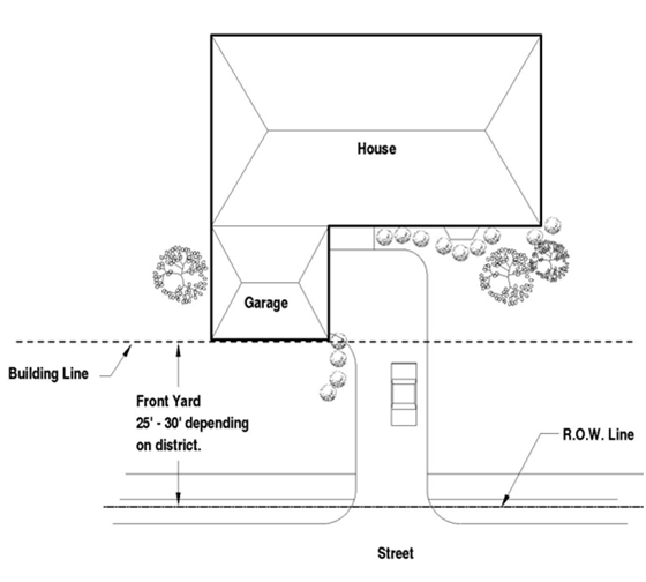
(2)
The driveway is designed straight to a garage that is set back fifteen (15) feet from the front building line; or
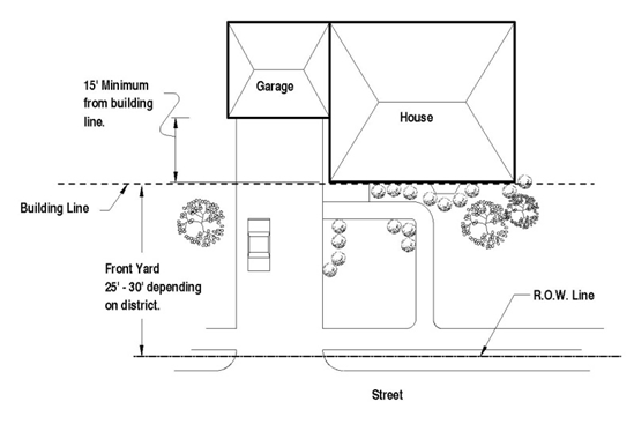
(3)
The driveway is designed and connected to a detached garage and is located in the rear yard of the property.
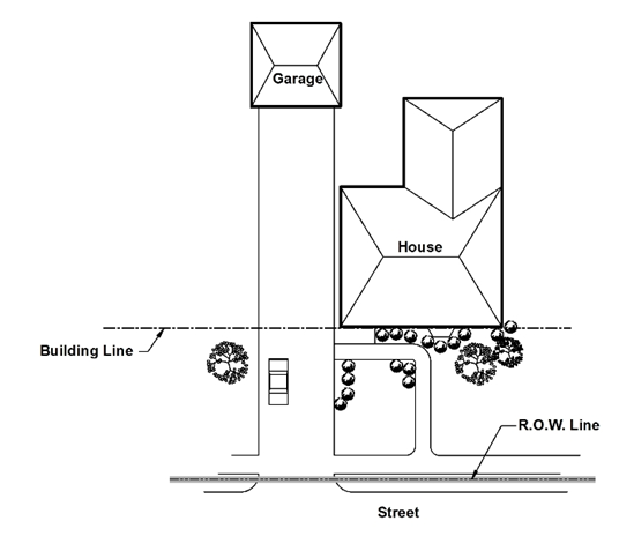
(C)
Enclosed spaces and driveway width. Each single-family unit shall have a minimum of two (2) enclosed parking spaces with a minimum driveway width of sixteen (16) feet.
(D)
J-drive turning radius and backing space. Each j-drive shall have one of the following combinations of turning radius and backing space:
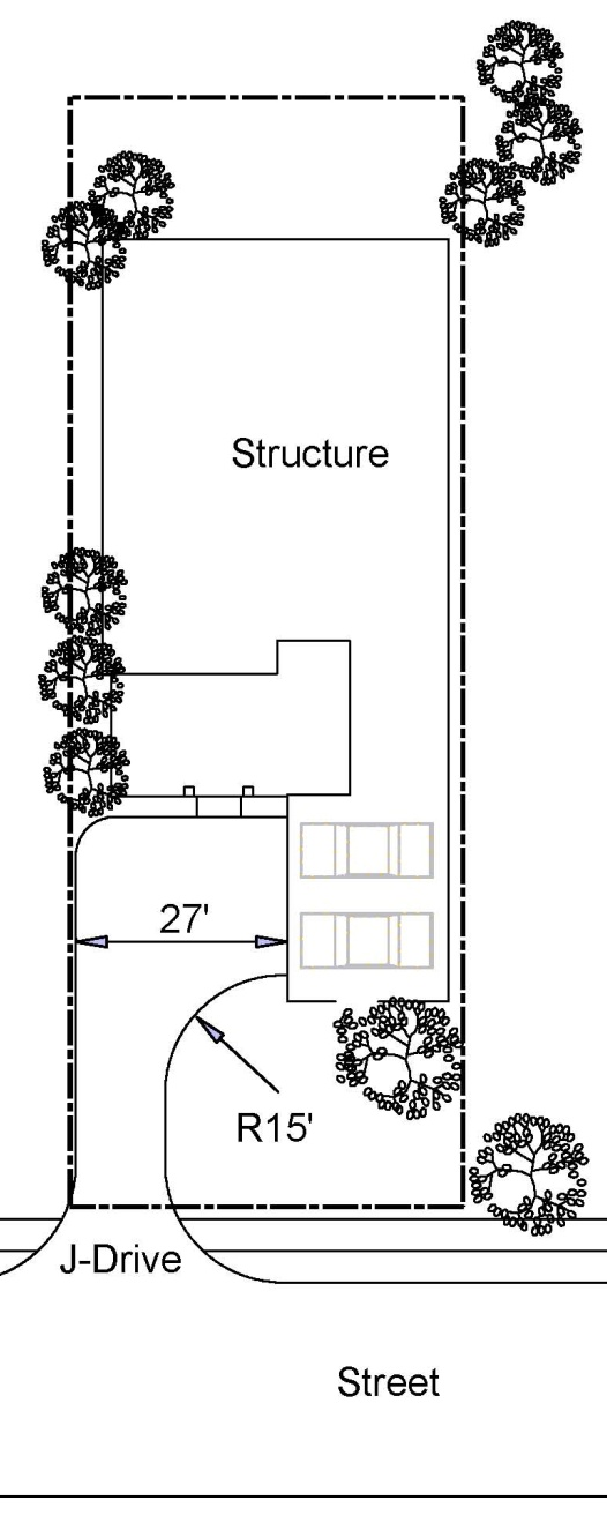
(Ord. No. 3131, § 2, 10-26-10; Ord. No. 3392, § 1, 10-22-19)
Uniqueness of a neighborhood is developed by all the homes not being the same, in regards to building materials, size, floor plans, front facades, etc. In an effort to help promote ownership, neighborhood pride, and encourage long-term commitment, homes should be individual and definable rather than replicas of the adjacent homes.
5.16.1. Applicability.
(A)
Zoning districts.
(1)
Single-family residential development within the following zoning districts.
a.
2.6 R-8, Single-Family Detached Residential District (Page 12).
b.
2.7 R-6, Single-Family Detached Residential District (Page 12).
(B)
Exemptions.
(1)
Individual lots 10,000 square feet in size or greater shall be exempt from this section.
5.16.2. Exterior Construction Requirements and Standards. All new single-family residential developments shall have at least four (4) of the following six (6) elements:
(A)
Front facades or elevations. No single front facade of a home may be duplicated within six (6) lots as measured along the curb line.
(B)
Front wall massing. There shall be no uninterrupted wall length for fifteen (15) feet along any front facade of the dwelling unit.
(C)
Varying front setbacks. Variations of the front setback of at least five (5) feet shall be required, building shall not be within the required front setback established within Table 3.2-1: Residential Area Regulations and Standards Chart (Page 47).
(D)
Covered front porch.
(1)
Percent of single-family units. No less than thirty-five (35) percent of the total number of single-family units in any platted block should contain a front covered porch that is permanently attached to and an integral part of the primary structure constructed of like and similar materials to those of the primary structure.
(2)
Front setback encroachment. The front porch can be allowed to encroach into the minimum required front setback by eight (8) feet.
(3)
Minimum dimensions. Each covered front porch shall be a minimum eighty (80) square feet and have a minimum depth from the primary structure of eight (8) feet.
(E)
Architectural Relief Required. Two-story, single-family structures shall not have more than one side with fewer than four (4) outside corners. Outside corners shall be defined according to the following illustration:
(1)
Illustration of prohibited design.
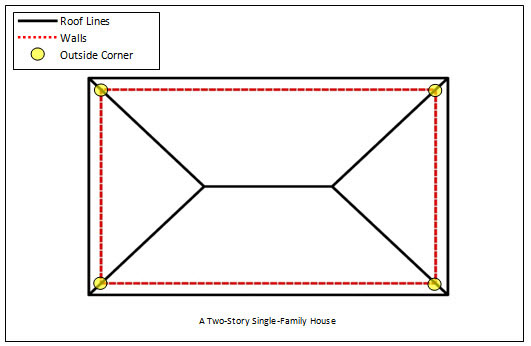
(2)
Illustration of allowed design.
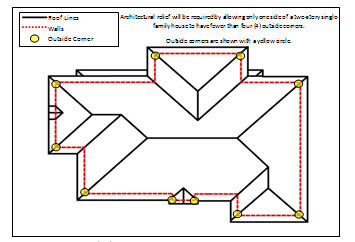
(F)
Architectural focal point. One of the following architectural focal points should be incorporated into each housing unit.
(1)
Chimney. The exterior veneer of a chimney constructed as part of or an extension to the exterior wall of a residential structure must be constructed of like or similar brick or other masonry material to that of the primary structure. The exterior veneer of chimneys shall not be constructed of wood or lumber products.
(2)
Window Enhancements. The use of transoms, bay windows, stained glass, or other similar window enhancements.
5.16.3. Minimum Roof Pitch. A minimum 5:12 roof pitch shall be required for each primary structure.
(Ord. No. 3131, § 2, 10-26-10)
5.17.1. Carport Requirements. Carports are permitted to be added to residential structures and are subject to the following conditions and regulations:
(A)
Building permit. Any person erecting or constructing a carport, in whole or in part, shall obtain a building permit.
(B)
Number of carports allowed. No more than one (1) carport shall be permitted for each dwelling unit.
(C)
Carport condition and maintenance. All carports shall be kept in an attractive state, in good repair, and in a safe and sanitary condition.
(D)
Side setbacks and exceptions. No portion of a carport shall violate a required side setback as prescribed within this Ordinance with the exception that open eaves may extend two (2) feet into the side setback as prescribed in 5.6.2. Projections into Required Setbacks (Page 110) and with the exception that carports may be located abutting or less than five (5) feet from the side property line under the following conditions:
(1)
The abutting owner(s) of the property immediately adjacent to the proposed construction must sign an agreement stating his/her name, and address, and that they give permission for the carport to be located abutting or less than five (5) feet from the side property line;
(2)
The eave of the carport shall in no instance overhang the adjacent property;
(3)
Guttering shall be installed and maintained in a manner to prohibit any increase of water runoff onto the adjacent property;
(4)
If the proposed carport is to be located over a utility easement paralleling the side property line, the following provision must be agreed to by the applicant for the building permit and the property owner, if different from the applicant:
a.
In the event access is required to the dedicated easement by the city or any franchised public utility, the property owner shall be responsible for relocating the carport structure in a manner to allow such access.
b.
The property owner shall be notified of the need to relocate said carport and from that point in time have seventy-two (72) hours to do so. If the property owner cannot or refuses to relocate said carport, the city or franchised public utility may have said carport relocated at the owner's expense.
c.
The property owner shall not hold the city or franchised public utility responsible for any damages to said carport or property due to the required relocation.
(E)
Front setbacks and exceptions.
(1)
All carports shall comply with front setback requirements of this Ordinance, provided carports used in conjunction with single-family dwellings or two-family dwellings shall be permitted to extend into the required front setback area.
(2)
However, no portion of a carport shall be permitted closer than five (5) feet from the right-of-way line of a public street except as provided in 5.17.1.(F) Corner lots and extensions into the right-of-way (below) of this section.
(F)
Corner lots and extensions into the right-of-way.
(1)
For corner lots only, a carport may extend into the right-of-way of only a local street if the garage is so situated because of the building setback line that a carport cannot be constructed without extending into the right-of-way.
(2)
In this situation a carport may extend into the right-of-way; however, no carport shall be permitted closer than six (6) feet to the curb line and shall not be more than twenty (20) feet in length measured from the structure to which it is attached.
(3)
The carport must be constructed in such a manner as not to obstruct sight distance at the intersection. Damage to any public utility associated with the carport shall be the responsibility of the property owner.
(4)
In the event that the city shall determine that street widening is necessary or the installation, repair, replacement, or maintenance of existing or future public utilities is necessary, the city or any public utility shall have the right to remove said carport.
(5)
Cost of removal and reinstallation, if allowed, shall be at the owner's expense.
(6)
If the owner refuses to remove the carport, the city or public utility may have the carport removed and reinstalled at the owner's expense with the cost being included on the ad valorem tax rolls as a lien. Other provisions of the Midwest City Code which would prohibit structures within the right-of-way shall not apply to this exception.
(G)
Paved hard-surfaced drive.
(1)
All carports shall be located only over a paved hard-surfaced drive. Provided, however, a gravel driveway may be used to satisfy the requirement if the property owner can demonstrate through dated photographs, or dated negatives, that the gravel driveway existed prior to January 1, 1985.
(2)
Dated photographs/negatives shall mean those photos or negatives dated on the front or back through a development process. Handwritten, typed, or other means of dating photographs/negatives other than those dated through the development process shall not be accepted as proof.
(3)
Those properties currently approved with a residential building permit, whether for a new home, addition, remodel, or house move-in that have been required to install a paved driveway as part of their permit approval, or any other regulations pertinent to the approved building permit shall not be exempt from the requirement to install paved driveways.
(H)
Carport width.
(1)
Except upon application to the community development department, no carport shall exceed twenty-four (24) feet in width.
(2)
The Community Development Director may approve an application for a width greater than twenty-four (24) feet if the carport will be architecturally integrated with the residence and no protest is received after notice by the community development department to all property owners whose property abuts the sides or front of the property of the applicant.
a.
If a protest is received or if the Community Development Director determines that the carport in excess of twenty-four (24) feet in width is not architecturally integrated with the home, the application may be appealed to the City Council for final determination.
(3)
An example of architectural integrity would be where a property owner wishes to match his carport with the existing house eaves and the total width exceeds twenty-four (24) feet.
(I)
Standards for constructing carports.
(1)
Metal carports shall be constructed of 26 gauge steel or 0.25 aluminum decking with a baked-on enamel finish to be compatible with the exterior finish of the structure.
(2)
Poles supporting the carport shall be wrought iron or of a metal material compatible with the exterior finish of the structure.
(3)
Exposed eaves shall have rain guttering directing water flow to the street and away from adjacent properties.
(4)
Wooden construction of carports shall be permitted with the following provisions:
a.
Roof slopes shall exceed two (2) inches in twelve (12) inch pitch;
b.
All eaves shall be enclosed and have rain guttering installed to divert water to the street and/or away from adjacent properties unless the pitch of the roof diverts the flow of rainwater to the street;
c.
Finishes shall be compatible with the exterior of the primary structure;
d.
The underside of the carport shall be enclosed with an approved material.
(J)
Carport design: open sides and latticework required.
(1)
All carports, observing the required front setback, shall be permanently open on two (2) sides from grade surface to eaves line.
(2)
All carports that extend into the required front setback shall be permanently open on three (3) sides from grade surface to eaves line, except that such carports extending beyond the front setback may install latticework along one side of the carport.
a.
Such latticework, when installed, shall be a framework of ornamental design made of strips of wood, plastic, nylon or other material as approved by the chief building official. Such latticework shall be of a design so as not to impair the vision of the operator of the vehicle exiting the carport from any vehicular/pedestrian traffic along the abutting sidewalk and/or roadway.
b.
Also, such lattice work shall be of a design to permit the continued circulation of air and light within the carport.
(K)
Fees.
(1)
Refer to the adopted Zoning Ordinance Fee Schedule for fees.
(2)
If a protest is received or if the applicant desires to appeal the decision of the Community Development Director before the application shall be placed on the agenda for the City Council, a further fee per the adopted Zoning Ordinance Fee Schedule shall be paid to the Community Development Department for the processing of the application.
(3)
The city shall notify the applicant and abutting property owners of the application at least five (5) days prior to the Board of Adjustment's consideration of the appeal.
5.17.2. Documentation.
(A)
Proof of building permit. It shall be unlawful for any person being the current owner of property which has a carport to fail to have proof of a building permit issued by Midwest City for the carport.
(B)
Location of proof. The proof can be the permit in his possession or in the address files of the community development department.
(C)
Application required when lack of proof. If the property owner fails to provide proof of such permit, or if no permit was previously requested on the carport, the property owner shall make application as required within 5.17.1. Carport Requirements (Page 141)
(D)
Carport removal required. If after application and inspection it is found that the subject carport is not in compliance, no permit shall be issued and the owner/applicant shall cause the nonconforming carport to be removed. If the owner/applicant fails to make the corrections or have the nonconforming structure removed, the city may proceed as required by law.
(Ord. No. 3131, § 2, 10-26-10)
Cluster development is intended to provide open space, accessible to the public, for residential development by allowing reductions to the minimum lot size to either maintain or increase overall density. For a visual example of a residential cluster development, refer to 8.3.109. Residential Cluster Development (Page 213).
Cluster developments can concentrate dwelling units on a site's prime developable areas and thus can provide more land for preserving drainage areas, slopes, soils, and natural vegetation to help manage stormwater runoff and soil erosion. Additionally, development costs can be reduced by the reduction amount of roadway and utility infrastructure needed to service the neighborhood.
Cluster development is an incentive based approach to encourage livable neighborhoods and is not a requirement. This approach promotes the creation or preservation of open space in exchange for increasing the amount design options through reduced or eliminated minimum lot sizes. Cluster development can either be designed to maintain the original development density or to increase development density.
5.18.1. Applicability.
(A)
All new single-family residential development. All new single-family residential developments may utilize a cluster development option.
5.18.2. Minimum Required Area for a Cluster Development.
(A)
Five-acre minimum. The minimum area of a cluster development shall be five (5) acres.
5.18.3. Development Requirements.
(A)
Principal and accessory uses. All principal and accessory uses authorized with the applicable zoning district shall be allowed in the cluster development.
(B)
Requirements applying to entire site rather than any lot. Maximum coverage and parking requirements shall be applied to the entire site rather than to any individual lot.
(C)
No minimum lot size, lot width, lot depth, house size, or side or rear setback. No minimum measurement shall apply to the following standards:
(1)
Lot size.
(2)
Lot width.
(3)
Lot depth.
(4)
House size.
(5)
Side or rear setbacks.
(D)
Minimum setback required adjacent to street right-of-way. A minimum setback adjacent to a street right-of-way shall be twenty-five (25) feet. If rear alleys are provided, then the setback shall be reduced to ten (10) feet.
(E)
Minimum building separation. A minimum building separation between that principal building and all structures shall be ten (10) feet.
(F)
Minimum street frontage per lot. Each lot shall have a minimum twelve (12) feet of street frontage.
5.18.4. Site Plan Required, Additional Site Plan Contents, and Review.
(A)
Site plan required. A site plan as outlined in 7.5 Site Plan (Page 183) shall be required for all cluster developments.
(B)
Additional site plan contents. The following contents shall be included on a site plan, in addition to the requirements in 7.5 Site Plan (Page 183):
(1)
The maximum number and type of dwelling units proposed.
(2)
The area of the site on which dwelling units will be constructed.
(3)
The calculation of the permitted number of dwelling units (see 5.18.7. Calculating the Permitted Number of Dwelling Units (Page 147)).
(4)
The area of the site on which other principal or accessory uses will be constructed.
(5)
The areas of the site designated for open space and their size.
(6)
The number of acres proposed to be conveyed as open space.
(C)
City Council approval of cluster development site plans required. The City Council shall review and approve a residential cluster development in the manner provided for in 7.5 Site Plan (Page 183).
5.18.5. Amount of Open Space Required for Cluster Development.
(A)
Minimum amount of open space required. A cluster development shall have twenty-five (25) percent of the site conveyed as open space.
5.18.6. Amount of Permitted Dwelling Units for Cluster Development.
(A)
Number of clustered dwelling units equal the number of permitted dwelling units under the base zoning district. Except as provided in 5.18.8. Density Bonus for Additional Open Space (Page 147), the maximum number of dwelling units proposed for a residential cluster development shall not exceed the number of dwelling units permitted for the residential zoning district in which the parcel is located.
5.18.7. Calculating the Permitted Number of Dwelling Units.
(A)
Measure the gross area of the development site. The gross land area of the entire site shall be measured to the tenth of an acre.
(B)
Apply base zoning districts gross dwelling unit per acre (DUA). The gross land area shall be multiplied by the gross dwelling unit per acre as described within each district in Section 2 Zoning Districts (Page 9). The resulting number of dwelling units shall be rounded to the nearest whole number.
5.18.8. Density Bonus for Additional Open Space.
(A)
Density bonus may be approved by the City Council. The City Council may approve a density bonus up to fifteen (15) percent of permitted number of dwelling units under the following conditions:
(1)
The amount of open space is at least thirty-three (33) percent of the gross land area.
(2)
Open space is conveyed to the pursuant to 5.18.11. Conveyance of Open Space (Page 148).
(3)
Open space is accessible to the public.
5.18.9. City Council Review Criteria.
(A)
Satisfies the requirement of this section. The site plan satisfies the requirements of this section.
(B)
Twenty-five (25) percent open space requirement is met. Buildings and structures are adequately grouped so at least twenty-five (25) percent of the total area of the site is set aside as open space. To the greatest degree practicable, common open space shall be designated as a single block and not divided into unconnected small parcels located in various parts of the development.
(C)
Pedestrian access. Pedestrians can easily access common open space.
(D)
Minimization of land alternation. Individual lots, buildings, structures, streets, and parking areas are situated to minimize the alteration of natural features, natural vegetation, and topography.
(E)
Scenic views. Existing scenic views or vistas are permitted to remain unobstructed, especially from public streets.
(F)
Historic preservation. The site plan accommodates and preserves any features of historic, cultural, or archaeological value.
(G)
Preserving environmentally sensitive areas. Floodplains, wetlands, and areas with slopes in excess of ten (10) percent are protected from development.
(H)
Consistent with intent of this Ordinance and the comprehensive plan. The cluster development advances the purposes of this Ordinance and the comprehensive plan.
5.18.10. City Council Decision.
(A)
Approval of cluster development. If the City Council finds that the requirements in 5.18.9. City Council Review Criteria (Page 147) are satisfied, it may approve the residential cluster development, subject to any special conditions.
(B)
Special conditions to residential cluster development. The City Council may, in its opinion, apply such special conditions to its approval of a residential cluster development as may be required to maintain harmony with neighboring uses and to promote the objectives and purposes of this Ordinance, subdivision ordinance, and/or the comprehensive plan.
5.18.11. Conveyance of Open Space.
(A)
Procedures. Open space provided by a residential cluster development shall be conveyed as follows:
(1)
City of Midwest City. To the City of Midwest City and accepted by it for park, open space, agricultural, or other specified use or uses, provided that the conveyance is approved by the City Council and is in a form approved by the city attorney.
(2)
Nonprofit. To a nonprofit organization whose principal purpose is the conservation of open space, to a corporation or trust owned or to be owned by the owners of lots or dwelling units within the residential cluster development, or to owners of shares within a cooperative development. If such a corporation or trust is used, ownership shall pass with the conveyances of the lots or dwelling units. The conveyance shall be approved by the City Council and shall be in a form approved by the city attorney.
a.
In any case, where the common open space in a residential cluster development is conveyed, a deed restriction enforceable by the City of Midwest City shall be recorded that provides that the open space shall:
1.
Be kept in the authorized conditions(s); and
2.
Not be developed for principal uses, accessory uses (e.g., parking), or roadways.
(Ord. No. 3131, § 2, 10-26-10)