
Milliken City Zoning Code
ARTICLE III
General Standards Applicable to all Districts
Sec. 16-3-100. - General Provisions.
(a)
Applicability. All development applications and building permit applications must comply with the applicable standards contained in this Article, unless the standards are specifically modified through an approved PUD by the Board of Trustees.
(b)
Relation to Zone District Standards (Article II). In the event of a conflict between a standard or requirement contained in Article II and this Article, the standard in Article II shall prevail.
(c)
This Article includes all standards related to how development is sited, designed, and serviced in order to create a vital, cohesive, and well-designed community that enhances Milliken's small-town character and implements the goals of the adopted Comprehensive Plan.
Sec. 16-3-105. - Address Numbering Requirement to Post.
The owner, occupant, or lessee of any residence, commercial or industrial structure, to which has been assigned a street address by the Town and/or U.S. Postal Service, must ensure that those assigned numerals are clearly, conspicuously, and permanently displayed in a fashion that those passing by, including emergency services personnel, along the street frontage can readily view the correct address.
Sec. 16-3-110. - Nonconforming Uses, Structures, Buildings, Lots, Sites and Parking.
(a)
Purpose. The purpose of these provisions is to govern nonconforming uses, improvement of a nonconforming lot, and the modification, expansion, reconstruction, alteration, abandonment, and continued occupancy of a nonconforming structure or building including non-conforming parking.
(b)
Nonconforming Uses. A use that was allowed by the Code in effect when it was established, but which is no longer permitted in the district in which it is located, shall be permitted to continue after it became nonconforming so long as it complies with all of the following requirements:
(1)
A nonconforming use shall not be physically enlarged, intensified, or extended, nor shall it displace a principal conforming use, except as provided in Subsection (c) below.
(2)
A nonconforming use shall not be moved to any other portion of a lot, building or structure.
(3)
A structure that does not conform to the requirements of this Code shall not be erected in connection with a nonconforming use.
(4)
A nonconforming use may be changed to another nonconforming use subject to a determination by the Community Development Director that the new use does not constitute an increased impact, as determined by the following criteria:
a.
The parking meets current requirements for the new use and does not create any increased parking impact or new parking areas; and
b.
The new use is not an expansion in size and the impact or effect upon the surrounding neighborhood is equal to or less than the existing impact or effect, including without limitation, glare, visual pollution, noise pollution, odor, air emissions, vehicular traffic, storage of equipment, materials and refuse, hours of operation, trips generated and number of employees and shall also conform to all other applicable provisions in this Title.
(5)
The decision of the Community Development Director shall be considered final unless appealed by the applicant or property owner to the Planning Commission or to the Board of Trustees under the provisions of Section 16-1-120(a)(b), "Appeals of enforcement actions."
(6)
If a lawful nonconforming use is reduced in intensity or abandoned for a continuous period of twelve (12) consecutive months, the property may not thereafter be used except at that lower intensity or as a conforming use.
(7)
(Single-family dwellings that are not in compliance with this Code may be enlarged or altered one (1) time by no more than twenty-five (25%) percent of the building footprint, including attached garage area, as long as it complies with the base standard setbacks in the R-1.
(c)
Nonconforming Lots/Sites, Buildings and Structures. A building or structure that was allowed by the Code in effect when it was established, but which is no longer permitted in the district in which it is located because it does not conform to existing height, setbacks, yard, coverage, area, architecture or signage requirements of the zoning district in which the land is located, or is on a site which is nonconforming, shall be permitted to continue so long as it complies with all of the following requirements:
(1)
The nonconforming building or structure is not enlarged, moved, or altered in a way that increases its nonconformity, but it may be altered to decrease its nonconformity.
(2)
If a nonconforming building or structure or portion of a nonconforming building or structure is destroyed by any means to an extent of more than fifty (50%) percent of its replacement value, it cannot be reconstructed except in conformity with the provisions of this Code, except for single-family dwellings in the commercial and industrial zoning districts.
(3)
On any nonconforming building or structure or portion of a building or structure containing a nonconforming use, ordinary repair is permitted if, in any consecutive twelve-month period, the work does not affect fifty (50%) percent or more of the replacement value of the nonconforming building or structure and is needed to maintain the building or structure in conformance with building codes.
(4)
Single-family dwellings which are within nonconforming buildings or structures may be enlarged or altered one (1) time by no more than twenty-five (25%) percent of the building footprint, including attached garage area, as long as the base standard setbacks in the R-1 District. In no event shall an existing nonconforming single-family dwelling in an industrial zoning district be removed from a lot or site and be rep/laced with another single-family dwelling.
(5)
If changes are proposed to nonconforming sites, buildings and structures, the Community Development Director shall determine, after considering recommendations from the Technical Advisory Committee, if the nonconforming feature or features of the building or structure will be worsened by the modifications in terms of the impact of the building or structure on the neighborhood.
(6)
One-time expansions for single-family dwellings as provided in this Chapter shall be processed with submission of a plot plan.
Sec. 16-3-200. - Intent.
Off-street parking, stacking, and loading requirements lessen congestion upon the public streets of the Town by requiring the owners and operators of land, buildings, and uses to provide parking on their own premises in accordance with the demand generated by such land, building, or use.
Sec. 16-3-205. - General Provisions.
(a)
Provide Off-Street Parking. In all zone districts, off-street parking facilities for the storage of vehicles for the use of occupants, employee, and patrons of the building or structure hereafter erected, altered or extended must be provided and maintained as herein prescribed.
(b)
Provide Adequate Parking. If the use contemplated is not described in the required parking tables, the applicant must demonstrate to the Community Development Director that the parking as planned will be adequate to serve the needs of the proposed development.
(c)
Provide Additional Parking. At the time a property changes use, the applicant must demonstrate that the existing parking is adequate to serve the proposed use. It shall be the responsibility of the new user to provide additional parking if the existing parking does not meet the needs of the proposed use.
(d)
Surface. All parking and driveway areas and primary access to parking facilities must be surfaced with asphalt, concrete, or similar materials. Except within the right-of-way, the site plan may include grass-crete or similar pervious pavement that is similar to the other materials listed in this section in terms of function, durability, maintenance, and appearance, as approved by the Planning Commission.
(e)
Integrate Parking Lots with Surroundings. Parking lots shall not dominate the frontage of pedestrian-oriented streets, interfere with designated pedestrian routes, or negatively impact surrounding neighborhoods. The pedestrian character of streets and buildings shall be maximized through continuity of buildings and landscape frontage.
(f)
Location. The required off-street parking area shall be located on the same legal lot as the principal use. The location of required off-street parking spaces for non-residential uses shall be within seven hundred (700) feet of the building they are intended to serve when measured from the nearest point of the building or structure.
(g)
Landscaping. Parking lots shall be landscaped, screened, and buffered as provided in Division 3 of this Article.
(h)
Shared Access. Where feasible, parking lots shall share access drives with adjacent property with similar land uses.
(i)
Parking Space Use. All off-street parking spaces shall be unobstructed and free of other uses.
(j)
Off-Street Parking Design. Any off-street parking area for commercial, industrial, or multi-family use must be designed so that vehicles may exist without backing onto a public street unless no other practical alternative is available. All off-street parking areas must be designed so that parked vehicles do not encroach upon or extend onto public rights-of-way or sidewalks or strike against or damage any wall, vegetation, utility, or other structure.
(k)
Circulation Area Design. Circulation areas must be designed to facilitate the safe movement of vehicles without posing a danger to pedestrians or impeding the function of the parking area.
(l)
Lighting. All parking area lighting must be full cut-off type fixtures. Any light used to illuminate parking areas or for any other purpose shall be so arranged as to reflect the light away from nearby residential properties and away from the vision of passing motorists. For additional lighting requirements, see Division 5 of this Article.
(m)
Maintenance. Parking spaces shall be marked and maintained on the pavement, and any other directional markings or signs shall be installed as permitted or required by the Town to ensure the approved utilization of space, direction of traffic flow and general safety.
(n)
Loading and Unloading Facilities shall be located in the rear or side of buildings and shall be screened from public view.
(o)
Adjacent On-Street Parking. In order to promote a pedestrian scale and encourage a perception of safety for commercial and industrial uses in the MU-C-D district, parking may be satisfied using adjacent on-street parking or shared rear-lot parking areas. A parking study and shared parking agreement(s) must be used to demonstrate the adequacy of the parking supply as a substitute for standard parking requirements as outlined in Section 16-3-220(c) "Shared Use."
(p)
Vehicles parked on residential zoned property shall be parked within or upon a paved or graveled driveway. The parking of vehicles within required front or side yard setbacks, yards or grass is prohibited. This requirement shall apply to all residential zone districts of the Town.
(q)
In residential zones, off-street parking facilities shall be provided and located on the same lot as the building they are intended to serve. Detached garages shall not be located in the front yard setback.
(r)
Except within a garage or in conjunction with an approved affordable housing project, tandem parking is not allowed to meet required off-street parking requirements.
Sec. 16-3-210. - Parking Lot Standards.
(a)
Parking Space and Access Drive Requirements. Parking space and access drives shall be in accordance with the Milliken Design Criteria and Construction Specifications.
Sec. 16-3-215. - Location and Design of Parking Areas.
(a)
All parking areas shall comply with the standards set in Division 3 of this Article, "Landscaping".
(b)
In all nonresidential areas and multi-family residential developments, all off-street parking areas must be accessed by a defined access lane off of the main public right-of-way. When parallel to the front property line, this access lane must be separated from the traveled portion of the roadway by at least a forty (40) feet setback.
(c)
All parking areas shall be provided with adequate drainage in accordance with the Milliken Design Criteria and Construction Specifications.
(d)
Access drives shall be in accordance with the Milliken Design Criteria and Construction Specifications.
(e)
Up to fifteen percent (15%) of spaces in parking areas in commercial, cultural, and civic uses in any district may be for compact cars. These spaces shall be properly marked and grouped within the overall parking plan. Space size shall be a minimum of eight (8) feet by sixteen (16) feet.
(f)
All parking areas shall be maintained in accordance with the approved development, including but not limited to striping, landscaping, and repair of potholes.
(g)
Parking areas shall not be used for the dismantling of vehicles, storage of nonworking vehicles or storage of commodities.
(h)
Access and circulation. Curb cuts shall be in accordance with the Design Criteria and Construction Specifications of the Town.
(i)
A concrete or otherwise permanent curb, bumper or wheel stop shall be installed to adequately protect public right-of-way, sidewalks and/or landscaped areas and islands.
(j)
Standard traffic control signs and devices shall be used to direct traffic where necessary within a parking lot.
(k)
Lighting.
(1)
All lights used to illuminate parking spaces, driveways or maneuvering areas shall be so designed, arranged, and screened so as to minimize light spillage on adjoining lots or streets.
(2)
All lighting fixtures, including security lighting facilities, shall be directed away from adjacent residential uses and public streets, shall not be of an intensity which unreasonably disturbs adjacent residential users or users of public streets and shall not be installed above a maximum height of sixteen (16) feet.
(3)
All lighting shall comply with Section 16-3-510 Lighting.
Sec. 16-3-220. - Requirements for Parking and Loading.
(a)
Minimum Parking Requirements. The minimum off-street parking requirements are listed in the following table. In no instance shall a parking space be used for the storage of vehicles. All parking spaces must be used for vehicles that can be driven unless otherwise noted in this Article. Additional stacking space requirements can be found in Section 16-3-225 "Stacking of parking spaces" below.
(b)
Table of Parking Requirements.
(c)
Calculation of Parking Space Requirements.
(1)
Number of Spaces. Separate off-site parking space shall be provided for each use.
a.
Where parking facilities are combined and shared by two (2) or more uses, the number of required off-street parking space shall be the sum of the required spaces for each use.
b.
Measurement of floor area. Floor areas used in calculating the required number of parking spaces shall as defined in Article 8, "Definitions."
c.
In mixed-use facilities calculations shall be based on gross square footage of each identifiable use within the building. Areas which serve more than one (1) of the uses, such as bathrooms, mechanical rooms, stairwells, circulation, airshafts, storage areas and elevators, shall be divided among each identifiable use.
(2)
Shared Use of Parking Facilities. When two (2) or more businesses and/or uses are served by the same parking area, the applicant may apply for special parking approval. The off-street parking area or shared parking facilities shall not exceed twenty (20%) percent ( of the required parking. Applicants wishing to utilize shared parking facilities or areas shall provide satisfactory legal evidence to the Community Development Department in the form of deeds, leases, or contracts to establish shared parking at the time of site plan application. Credit for shared parking shall be subject to the following criteria:
a.
The parking needs of the use will be adequately served.
b.
If a mix of residential uses with nonresidential is proposed, the parking needs of all uses will be accommodated through shared parking.
c.
If shared use of common parking areas is proposed, off-setting time periods of use will accommodate both parking needs.
(d)
Determination of Requirements for Uses Not Listed. Requirements for types of buildings and uses not specifically listed in this Chapter shall be determined by the Community Development Department and Town Engineer, after study and recommendation, which should include all relevant factors, including but not limited to:
(1)
Vehicle occupancy studies.
(2)
Requirements of comparable uses listed in this Chapter.
(3)
Suitable and adequate means for provision of public, community, group, or common facilities.
(4)
Provision of adequate loading facilities and for a system for distribution and pickup of goods.
(5)
The use is in the interest of the area to be affected and in the interests of the Town at large.
(6)
The use will not be detrimental to adjacent properties or improvements in the vicinity of the area.
(7)
The proposed use will not confer any special privilege or benefit on the properties or improvements in the area, which privilege or benefit is not conferred upon similarly situated properties elsewhere in the Town.
(e)
Accessible Parking Requirements. The required number of parking spaces for the disabled for all land uses shall be provided in accordance with federal and state law. Each parking space for the disabled shall be in conformance with applicable requirements of the Americans with Disabilities Act (ADA).
Sec. 16-3-225. - Stacking Space Requirements.
(a)
Intent of Stacking Space. A stacking space is an area for motor vehicles to line up while waiting to go through a drive-through facility, or within a designated drop-off or pickup zone. The purpose of stacking space requirements is to promote public safety by alleviating on-site and off-site traffic congestion that might otherwise result from the operation of a facility.
(b)
Submittal of Plans. The applicant's site plan shall show the location, size and dimensions of all facilities listed in Paragraph (3) below. The site plan shall follow the stacking space schedule. The site plan shall demonstrate that such facilities will not result in the stacking of vehicles on public rights-of-way and that an adequate area is reserved for the safe transfer of the motor vehicle between drivers. In no event shall drive-throughs, parking attendants, paid parking collection devices or areas associated with such uses be located in a public street or right-of-way or interfere with vehicular or pedestrian traffic on a public street, sidewalk, or other right-of-way.
(c)
Stacking Space Schedule:
Sec. 16-3-230. - Off-Street Loading Requirements.
(a)
Whenever the normal operation of any development requires that goods, merchandise, or equipment be routinely delivered to or shipped from that development, a sufficient off-street loading and unloading area must be provided in accordance with this Section to accommodate the delivery or shipment operation in a safe and convenient manner.
(b)
Space requirements and standards for loading berths.
(c)
Width and clearance: Each loading berth shall not be less than ten (10) feet in width and shall provide not less than fourteen (14) feet of vertical clearance.
(d)
Length: Each loading berth shall be at least forty-five (45) feet in length and shall not extend beyond the property line.
(e)
The loading and unloading area must be of sufficient size to accommodate the numbers and types of vehicles that are likely to use this area, given the nature of the development.
(f)
Number of loading spaces required for nonresidential uses:
(g)
Location. Loading and unloading areas shall be located and designed so vehicles intended to use them can maneuver safely and conveniently to and from the street right-of-way and complete their operations without interfering with any public rights-of-way, parking space or parking lot aisle.
Sec. 16-3-235. - Sidewalks, Multi-Use Pathways and Trails.
(a)
Intent. The intent of the standards for sidewalks, multi-use pathways and trails is to assure a safe, convenient, and attractive pedestrian/ bicycle system that minimizes conflicts between vehicles, bicycles, and pedestrians. All sidewalks, pathways and trails shall meet ADA requirements and standards set forth in the Milliken Design Criteria and Construction Specifications and Milliken Parks, Trails and Open Spaces Master Plan.
(1)
Sidewalks Required. In all zone districts, except for the, A, AE, CD, and R-1E Districts, sidewalks are required along both sides of a street. Within the AE, and R-1E Districts, sidewalks are required along one (1) side of the street.
(2)
Sidewalk Location. Sidewalks must be located within the right-of-way.
(3)
Sidewalk Materials.
a.
Sidewalks must be constructed to ADA requirements and in accordance with the Milliken Design Criteria and Construction Specifications.
b.
Sidewalks must be constructed of approved materials of sufficient strength to support light maintenance vehicles. If used as a secondary emergency access, sidewalks must also be able to support a fire truck (80,000 lbs.) as required by the latest adopted Fire Codes. Refer to the Milliken Design Criteria and Construction Specifications for additional sidewalk construction standards.
(4)
Sidewalk Installation. Sidewalks and related improvements must be installed or constructed by the developer in accordance with plans and specifications approved by the Town and, after installation or construction, they are subject to inspection and approval by the Town. All required improvements must be completed in accordance with the officially established grades.
(5)
Walkways. Walkways through a subdivision block must be as required in the Milliken Design Criteria and Construction Specifications.
(6)
Lighting. See the Milliken Design Criteria and Construction Specifications.
(7)
Multi-Use Pathways (Bikeways). Multi-use pathways shall be provided to link internal open space areas with peripheral open space areas and shall connect to multi-use pathway routes throughout the community. Multi-use pathway routes shall be designated between residential areas and commercial and employment centers and schools. Multi-use pathways on local streets may be delineated by painted "bicycle only" lanes. Sidewalks that may be used as a multi-use pathway are required on arterial and collector streets. All other multi-use pathways shall be a minimum of ten (10) feet wide and shall be of concrete construction or, where approved by the Board of Trustees, compressed gravel or other approved material. Bike racks shall be provided at the entry to internal and peripheral open space areas.
(8)
Trails. Trails shall be provided within and surrounding open space areas and connecting open space areas. Trails shall be a minimum of ten (10) feet in width and shall be of concrete construction or other materials approved by the Board of Trustees. Also refer to the Milliken Parks, Trails and Open Spaces Master Plan.
Sec. 16-3-300. - Purpose and Intent.
(a)
The purpose of this Division is to protect and enhance the community's environmental, economic, recreational, and aesthetic resources by promoting efficient use of water in the community's public and private landscape, reducing water waste and establishing procedures for the design, installation and maintenance of water-efficient landscapes throughout the jurisdiction.
(b)
Furthermore, these landscaping standards are intended to promote quality landscape design that:
(1)
Reinforces the identity of the community and each neighborhood;
(2)
Contributes to high-quality development by providing adequate site landscaping that ties into new and existing buildings;
(3)
Provides adequate buffers between potentially incompatible uses;
(4)
Reduces impervious coverage to improve water quality and reduce runoff;
(5)
Preserves existing trees and provides tree-lined streets where appropriate;
(6)
Improves air quality by preserving and providing adequate tree canopy;
(7)
Promotes efficient use of water and reduces water waste;
(8)
Conserves water resources by using sustainable design and maintenance techniques and plant species that are low water-use and regionally appropriate; and
(9)
Enhances and restores valuable habitat.
Sec. 16-3-303. - Nonfunctional Turf, Nonfunctional Artificial Turf and Invasive Plant, Tree, Shrub and Grass Species.
(a)
Definitions. For purposes of this section, the following terms shall have the meanings set forth in section 37-99-102, C.R.S., as it may be from time to time amended:
(1)
Commercial, institutional or industrial property;
(2)
Common interest community property;
(3)
Invasive plant species;
(4)
Multifamily residential housing premises property;
(5)
New development project;
(6)
Nonfunctional artificial turf;
(7)
Nonfunctional turf;
(8)
Redevelopment project; and
(9)
Transportation corridor.
(b)
Notwithstanding any other provision in this Code to the contrary, commencing on and after January 1, 2026, no person shall install, plant or place any nonfunctional turf, nonfunctional artificial turf, or invasive plant species as part of a new development project or redevelopment project on any:
(1)
Commercial, institutional, or industrial property;
(2)
Common interest community property;
(3)
Street right-of-way, parking lot, median, or transportation corridor; or
(4)
Multifamily residential housing premises property that includes more than twelve (12) dwelling units.
(Ord. 831, § 1, 12-22-2025)
Sec. 16-3-305. - Applicability.
(a)
The standards in this Division 3 apply to all new developments. New development includes construction of new structures on a currently vacant lot, reconstruction of structures that have been razed, and reconstruction of structures that have been damaged pursuant to Section 16-3-120(c).
(b)
Except for single-family and two-family dwellings, the standards in this Division 3 apply to renovations, additions, and expansions of any use or structure requiring an amended or new site plan, approval of a use by special review, or an amendment of an existing Planned Unit Development.
(c)
Existing detached single unit dwellings and two-family dwellings shall be exempt from the standards in this Division 3, except that landscaping for such dwellings shall comply with the prohibited plant species provisions in Section 16-3-345(f), the maintenance requirements in Section 16-3-375(c), and the fence and wall standards in Section 16-3-390.
Sec. 16-3-310. - Nonconforming Landscaping.
(a)
Except for detached single-unit dwellings and two-family dwellings, any legal nonconforming landscaping must comply with these regulations if changes are made to more than twenty-five (25%) percent of the total landscaped area of the subject property. Such twenty-five (25%) percent total landscaped area will be measured from the most recently approved site plan for the property.
(b)
Any subsequent request, application, or permit for such improvements to landscaped area on the same commercial, industrial, or multifamily property shall be cumulative to any prior request, application, or permit. See Sec. 16-3-315. - Landscaping evaluation procedures.
(c)
Landscaping submittal requirements and evaluation procedures are listed in Article 6 "Types of Approval Required."
Sec. 16-3-315. - Amount of Landscaping Required.
(a)
Existing landscaped areas that conform to the landscaping standards in this Division may be counted towards satisfying the landscaping requirements, except that preservation of existing trees must comply with Section 16-3-350.
(b)
Landscaped areas may count toward minimum open space requirements.
(c)
In addition to compliance with other applicable sections of this Division, landscaping for development must be provided as follows:
Notes:
The standards may be adjusted with approval by the Community Development Director
to accommodate development in the MU-C-D District, where zero setbacks are allowed
and there is no maximum hard-surfaced coverage area.
[2] Where spacing would result in a tree location in conflict with utilities or driveways, the spacing may be adjusted to accommodate such conditions provided the total number of required trees is provided on the site. (Refer to Section 16-3-325.)
Sec. 16-3-320. - Street Trees.
(a)
Except within rural subdivisions or other rural areas and along local roads, landscape improvements along street frontages must create an orderly, irrigated, managed landscape that includes tree-lined streets. Street trees must include a mix of species and be aligned in straight rows. Street trees must be placed within a public right-of-way tree lawn as indicated in the Design Criteria and Construction Standards. The spacing of street trees must allow for mature spread according to the species. Street trees installed along streets that will be widened in the future, pursuant to the Milliken Transportation Plan, must take into account plans for future widening of streets to reduce damages to established trees during future construction.
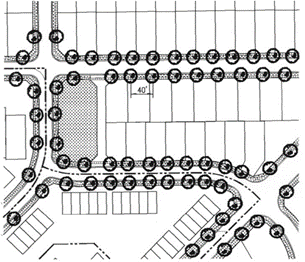
Figure 16-3-3-1.Example of one street tree provided every 40 feet on-center.
Sec. 16-3-325. - Soil Amendments and Mulch.
(a)
Soil Amendments.
(1)
Addition of proper and adequate soil amendments is required for all plantings.
(2)
Prior to the installation of turf grass and/or other plant materials in areas to be landscaped, the areas shall be thoroughly loosened, and organic industry-accepted, certified weed-free soil amendment (such as compost, peat or aged manure) shall be thoroughly incorporated into the soil at a rate of at least four (4) cubic yards of soil amendment per one thousand (1,000) square feet of turf grass and/or area to be planted, to a depth of at least six (6) inches. In addition, prior to installation of any turf grass and/or other planted area, all foreign waste materials, including concrete, plastic, wire, and the like, along with rocks larger than three (3) inches, shall be removed from the top six (6) inches of soil. The developer or applicant shall affirm and certify in writing, prior to issuance of a certificate of occupancy, that the turf grass and/or planted areas have been installed according to these standards or that legally binding commitments have been made to install such soil amendments prior to installation of such turf grass and/or other plant materials.
(b)
Mulch.
(1)
No more than thirty (30%) percent of the total required landscaped area shall be covered with mulch unless such mulched area includes live plant materials pursuant to Table 16-3-3-1.
(2)
All areas covered with mulch shall provide such mulch at a minimum depth of four (4) inches to retain water and inhibit weeds. Nonporous materials such as plastic shall not be placed under mulch.
(3)
Mulch materials may include wood-based materials, but shall not include gravel, grass clippings, straw, hay, or leaves.
Sec. 16-3-330. - Site Landscape Design.
Landscape improvements shall be an integral part of the overall site design for each property. Landscape improvements shall be designed to complement and enhance the character of neighborhoods and shall follow these standards:
(a)
Landscaped areas shall be configured to maximize their interconnectivity within the site, to natural areas and to landscaped areas in adjacent developments. Small, isolated islands of landscaping should be avoided except as required in parking lots and for screening along roadways.
(b)
Landscaped areas shall enhance functional open space through the creation of outdoor rooms appropriate to the location and purpose of the open space within the development. This can be accomplished through a combination of plantings, fencing, and berms and by using natural features on the site. (See Figure 16-3-3-2 below.)
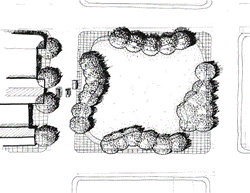
Figure 16-3-3-2.Example of plantings and berms used to create outdoor rooms
within a common open space area.
(c)
Landscape improvements in all developments shall be consistent with the character of the surrounding area to reinforce neighborhood identity. For example, if the prevailing character of the surrounding area and neighborhood is prairie grassland, then fewer trees will be required while more shrubs and grasses will be required for the proposed development.
(d)
Landscape design shall enhance natural features, drainage ways, and environmental resources.
(e)
All landscape improvements shall be designed for mature landscapes and shall provide appropriate visibility for cars and pedestrians. Landscaping shall be no more than thirty (30) inches high when located in an Intersection Sight Distance area as defined in the Design Criteria and Construction Specifications Manual.
(f)
Preserve and frame views both into and out of the neighborhood.
(g)
Comply with the International Fire Code, as adopted by the Town, requirements, including but not limited to three (3) foot clear distance from fire hydrants.
(h)
Incorporate the elements of gateway, path, and destination into the design of landscapes. Gateways are entries that provide transitions from one (1) space to another. Pathways are routes that lead to a destination. Destinations are focal points that can include anything from a garden bench at the end of a path to a civic building at the end of a street.
(i)
Any part of a site not used for buildings, parking, driveways, walkways, utilities, or other site improvements shall be landscaped with appropriate materials pursuant to Table 16-2.C below. For single-family and two-family dwelling, this standard only applies to the front yard. Landscape improvements in environmentally sensitive areas, and lower-density rural developments shall be natural, using native species planted in irregular clusters.
Sec. 16-3-335. - Water Efficiency in Landscape Design.
Landscape improvements shall be designed and installed with water efficiency as a primary goal. The following shall apply to the design of all landscaping subject to the standards in this Division.
(a)
Landscapes shall use the following xeriscape design principles to facilitate water conservation:
(1)
Well-planned planting schemes.
(2)
Use of mulch to maintain soil moisture and reduce evaporation.
(3)
Grouping of plant materials according to their microclimatic needs and water requirements.
(4)
Improvement of the soil with organic matter if needed.
(5)
Efficient and well-maintained irrigation systems.
(6)
Design of landscaping to help minimize steep grades and reduce water runoff.
(7)
In medians, use of native plants that require low amounts of water and maintenance.
(8)
Plants shall be selected appropriately based upon their adaptability to the climatic, geologic, and topographical conditions of the site. Protection and preservation of native species and natural areas is encouraged. The planting of trees is encouraged wherever it is consistent with the other provisions of this Division.
(b)
Turf grass shall be limited as follows:
(1)
Single-family and multifamily residential uses. The total amount of high-water turf grass shall not exceed more than fifty (50%) percent of the required landscaped area.
(2)
All other uses. The total amount of high-water turf grass shall not exceed more than twenty percent (20%) of the required landscaped area. Exemptions. Parks and open space shall be exempt from the turf grass limitations in paragraphs (1) and (2) above. High-water turf grass is discouraged in those areas.
(c)
Recirculating water shall be used for decorative water features.
(d)
Refer to Section 13-2-60 of this Code for the Town's watering restrictions.
Sec. 16-3-340 - Landscaping Environmental Standards.
(a)
All landscapes shall maximize the use of native species, pursuant to the Town Plant Species List.
(b)
Landscapes shall include a variety of species. No one (1) species may make up more than twenty-five (25%) percent of the total non-turf plant materials on the site.
(c)
Buildings and parking areas shall be located to preserve and promote the health of existing trees, environmental resources, and natural drainage ways.
(d)
A combination of plantings, berms, walls, and fences shall be used as appropriate to buffer sensitive environmental features such as stream banks, riparian areas, natural features, and/or wildlife habitat. (See Figure 16-3-3-3 below.)
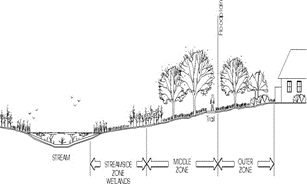
Figure 16-3-3-3.Use buffers to protect the physical integrity of riparian ecosystems. Try to preserve vegetation and trees in streamside zone and middle zone. Encourage native grasses and landscaping in outer zone to filter runoff from backyards, parking areas, roads, etc.
(e)
Plants shall be selected to blend with the native vegetation for projects at the interface between developed areas and non-irrigated and undeveloped land.
Sec. 16-3-345. - Plant Materials.
(a)
Minimum tree and shrub planting sizes shall be as follows:
(1)
Ornamental Trees: One-and-One-Half (1 ½") Inch caliper.
(2)
Deciduous Shade Trees: Two (2") Inch caliper.
(3)
Evergreen Trees: Six (6) foot height.
(4)
Shrubs: five-gallon.
(5)
Perennials: one-gallon
(b)
Shade trees shall be provided within and adjacent to paved areas.
(c)
Plant selection shall include those with low fuel volume and/or low flammability.
(d)
All plants shall conform to standards for measurements, grading, branching, quality, ball and burlapping as stated in the American Standard for Nursery Stock, American Association of Nurserymen, Inc. (AAN-ASNS), and the Colorado Nursery Act of 1965 (CNA), as amended.
(e)
Native grass seed mixes shall be certified as weed-free.
(f)
The following species are prohibited:
(1)
Russian Olive (an invasive species that threatens native trees in riparian ecosystems).
(2)
Lombardy Poplar (susceptible to canker-forming fungi for which there are no available controls).
(3)
Siberian Elm (can dominate native vegetation, especially in disturbed areas; is weak-wooded and subject to continuous dieback when large; can be devastated by the elm leaf beetle).
(4)
Boxelder Maple (primary host plant of the Boxelder bug).
(5)
Cotton-bearing Cottonwood. The Board of Trustees may consider cotton-bearing cottonwood on a case-by-case basis for restoration projects along riparian corridors (often considered a public nuisance).
(6)
Locally recognized invasive plant species.
(7)
All plant species on the Colorado State Invasive and Noxious Weed List.
Sec. 16-3-350. - Tree Preservation.
(a)
Purpose and Intent. The intent of these standards is to preserve the Town's mature trees and tree stands and to maintain an adequate tree canopy to reduce stormwater runoff, improve water quality, improve air quality, and reduce the potential of urban heat-island effects.
(b)
Existing trees may be credited toward required trees at a ratio of one-to-one unless the Community Development Department approves a higher ratio to encourage tree preservation on a particular site.
(c)
Trees eligible for credit shall comply with the materials standards in Section 16-3-345, above and the standards in the Milliken Municipal Code Chapter 7, Article IV "Trees."
(d)
Trees to be preserved shall be identified as such on the landscape plan, if applicable.
(e)
No grading shall occur within the tree canopy drip line of any tree intended to be preserved in a manner that would jeopardize the health or survival of the tree.
(f)
In the Downtown, existing trees shall be preserved to the maximum extent practicable and when the trees are in good health and of a desirable species. Prior approval by the Community Development Department is required for tree removal Downtown. When trees are removed from a site, replacement shall be at a ratio of one tree for every tree that was removed from the site or as approved by the Community Development Department.
Sec. 16-3-355. - Additional Landscaping Standards within Downtown.
Downtown landscaping is intended to provide an attractive environment for people to walk and shop. Refer to the streetscape in Figure 16-3-3-4 for illustrations of the character and quality of landscaping the Town is seeking. The following additional standards apply to landscaping in the Downtown area:
(a)
All improvements within the Downtown on properties fronting Highway 60 shall be subject to the approval of the Colorado Department of Transportation.
(b)
Landscaping Downtown for single-family and two-family uses shall comply with the landscaping standards in Table 16-3-3-1.
(c)
For multifamily and nonresidential uses:
(1)
Additional landscaping may be provided in the form of planters or window boxes which shall be constructed of the same or similar materials used in the adjacent building or of similar materials used in benches and trash receptacles and may be designed to include bench seating.
(2)
Street furniture, including benches and trash receptacles, shall be provided to serve the public and shall be constructed of a combination of wood and wrought iron or other similar metal. Planters may be constructed of the same or similar materials used in the adjacent building or of similar materials used in benches and trash receptacles and may be designed to include bench seating. All street furnishings in the Downtown area shall meet standards established by the Town.
(3)
Street lighting fixtures shall not exceed twelve and one-half (12½) feet in height and shall be single-acorn Victorian style and design.
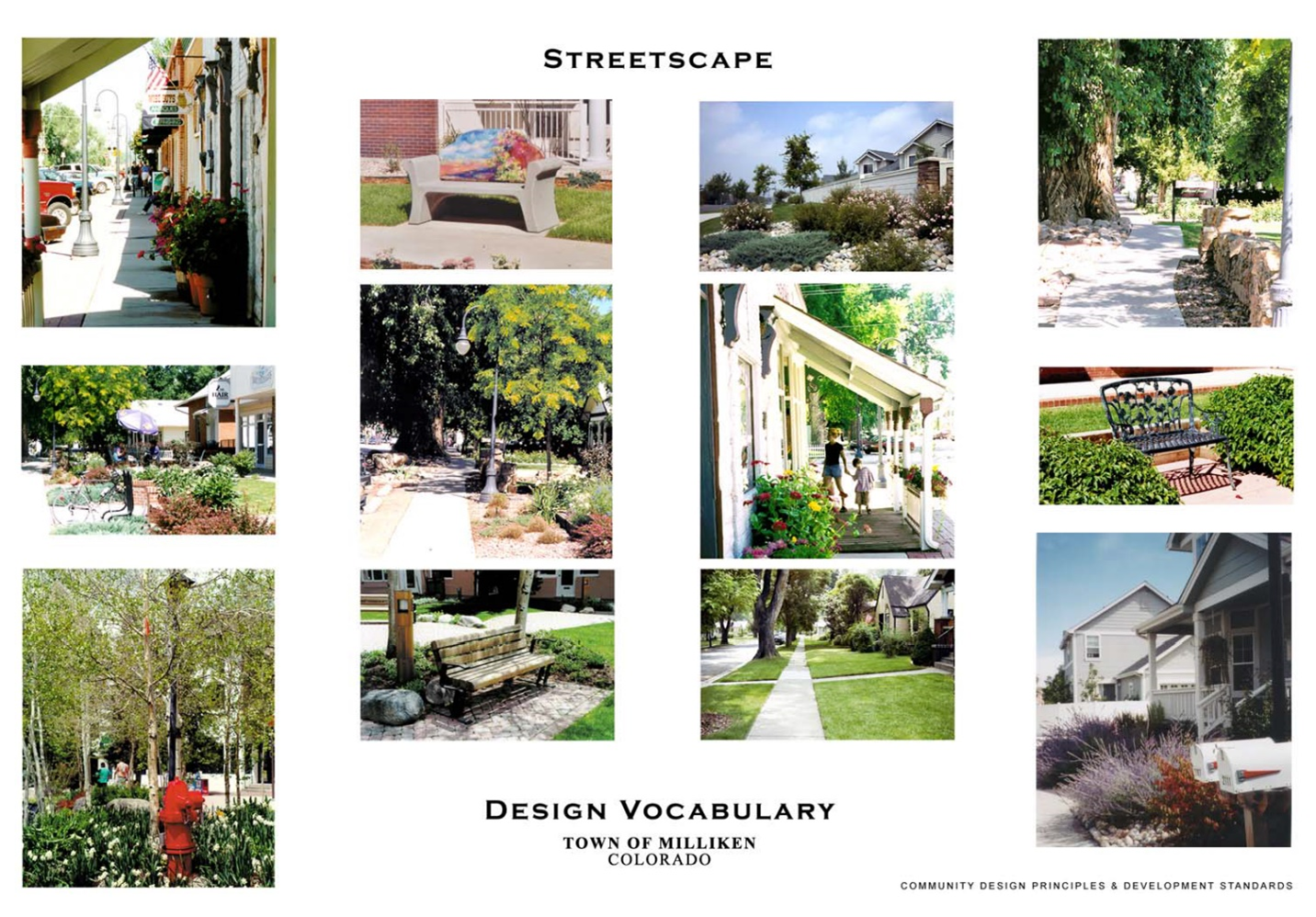
Figure 16-3-3-4
Sec. 16-3-360. - Landscaping for Required Common Open Space.
Landscaping within new multifamily developments or other developments that have common open space shall be provided as specified in Table 16-3-3-1. Landscape areas shall include common open space elements such as gardens, courtyards, squares, plazas, playgrounds, parks, and other shared gathering spaces. Additional open space standards, including dedicated common open space, may be required pursuant to parks and open space requirements in this Division 3 of Article III, the PUD regulations in Article II, or subdivision standards in Article V of this Code.
Sec. 16-3-365. - Parking Lot Landscaping Standards.
Parking lot landscaping is intended to break up large expanses of pavement, create shade to reduce heat island effect, buffer views of parking lots from adjacent streets and development, and enhance the overall appearance of each project.
(a)
Applicability. All parking lots with twenty-five (25) spaces or more shall be subject to these requirements. The Community Development Department may adjust parking lot landscaping standards for parking lots within the MU-C-D District provided that the applicant demonstrates that the additional parking is necessary and that additional alternative streetscape improvements will be provided to meet the intent of this Division.
(b)
Parking lots subject to these standards shall provide:
(1)
Site Trees: A minimum of one (1) tree per five (5) parking spaces. Trees shall be grouped in parking lot islands. (See Figure 16-3-3-5 below.)
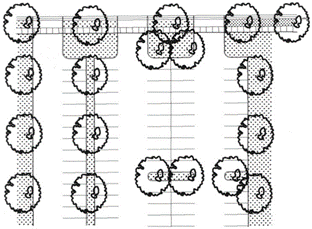
Figure 16-3-3-5.Trees grouped in parking lot islands.
(2)
Landscaped Islands. Parking lot islands shall be a minimum of eight (8) feet wide and shall be a minimum size of one hundred twenty-five (125) square feet. Low-impact development options, as described in Section 16-3-370(d), shall be used to the maximum extent practicable.
(3)
Shrubs. A minimum of five (5) shrubs or five (5) ornamental grasses per one hundred fifty (125) square feet of landscaped area shall be provided. Plantings shall be grouped in landscape islands.
(4)
Ground Cover. Irrigated turf grass shall be limited. Turf grass is prohibited in areas less than eight (8) feet wide. Landscaped areas shall be installed around the perimeter of the parking lot to filter runoff and improve water quality.
(5)
Buffer and Screening. A minimum parking area buffer shall be provided between parking lots abutting a property line or public right-of-way. Such buffer shall be a minimum of five (5) feet wide and shall be landscaped according to the standards above. Required parking lot buffers may be counted toward compliance with the general buffer requirements in Section 16-3-390. Additionally, parking lots shall be screened through the use of dense shrubbery, low walls, berms or a combination of these methods a minimum of three (3) feet in height, so that light from headlights of vehicles in the parking lot is screened from view beyond the parking lot.
Sec. 16-3-370. - Storm Drainage Facilities.
(a)
Intent. The intent of this Section is to promote innovative and effective land- and water- management techniques that protect and enhance water quality.
(b)
General Provisions:
(1)
Drainage improvements must comply with the Design Criteria and Construction Specifications.
(2)
Stormwater drainage facilities shall be designed, installed, and maintained to prevent erosion, minimize mosquito habitat, and improve water quality of stormwater runoff. (See Figure 16-3-3-6 below.)
(3)
Storm drainage facilities may be allowed to function as open space for active recreation, trail corridors, or habitat enhancement areas if they are designed appropriately pursuant to the Town Engineer and are approved through the applicable development review procedures. In making such determination, the decision maker of the applicable development review procedure shall consider the safety of end users of such facility, potential impacts to adjacent properties, and any recommendations provided by the Town Engineer.
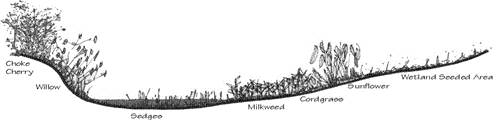
Figure 16-3-3-6.Develop storm drainage systems as landscape amenities.
(c)
Minimum Requirements.
(1)
All facilities shall be seeded with a type of grass appropriate to the function of the area. Areas to be used for active recreation shall be seeded to a turf-type grass and irrigated with a permanent irrigation system. Areas to be maintained for habitat enhancement shall be seeded with native grasses and wildflowers. The developer is responsible for establishment of a weed-free stand of grass. Trail corridors may be seeded to native grasses if appropriately integrated with adjacent on-site and off-site improvements.
(2)
Maximum slope on drainage facilities shall be 4:1 (25%), and the minimum slope of the bottom of a drainage facility shall be one-half (0.5%) percent.
(3)
Landscape improvements shall be designed to enhance the function of the facility. Areas designed for recreation shall include clusters of trees to provide shade, located so they do not impair the function of the facility or the tree.
(4)
Habitat and water quality enhancement, including wetland plantings in low wet areas, is encouraged.
(d)
Low-Impact Development (LID) Practices:
(1)
Purpose and Incentives.
a.
The Town encourages the use of low-impact development (LID) practices as part of an integrated water management strategy to promote infiltration, remove pollutants, regenerate groundwater supply, and encourage the use of native plants.
b.
Figure 16-3-3-7. Example of a bioswale within a parking area. Applicants proposing LID options as part of a development may be eligible for a reduction in the number of required parking spaces by up to ten (10%) percent, following a case-by-case review by the Community Development Department.
(2)
Disconnecting Drainage from Impervious Surface. Drainage from buildings (through gutters and downspouts) may be disconnected from piped infrastructure to prevent draining onto impervious surfaces without first passing through a green infrastructure option, as listed below.
(3)
Green Infrastructure Options.
a.
Bioswales. Bioswales are vegetated swales planted with wet tolerant species of plants or ornamental grasses. They transport, store, and allow infiltration of water, and can be designed as a landscape feature. Bioswales are not grassed but are planted with a variety of plant species that can withstand occasional water inundation for short periods of time. (See Figure 16-3-3-7 below.)
b.
Grassed Swales. Grassed swales are designed conveyance devices used to transport water over the surface of the ground to a point of disposal that may be a catch basin, ditch, water body that will filter, infiltrate, evaporate, and clean water of total suspended solids, and other pollutants. Swales are often appropriate along property lines, public streets, and around buildings. (See Figure 16-3-3-8 below.)
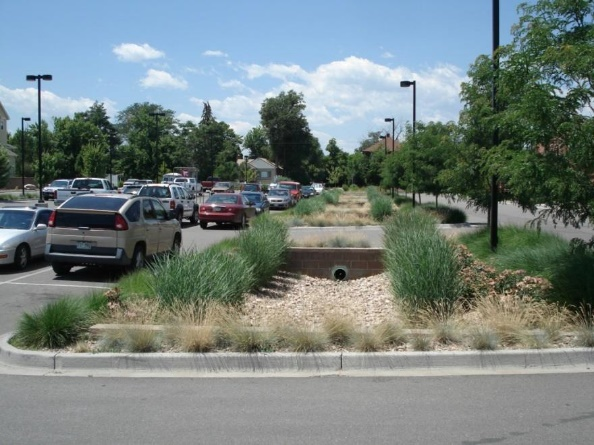
Figure 16-3-3-7.Examples of Bioswales
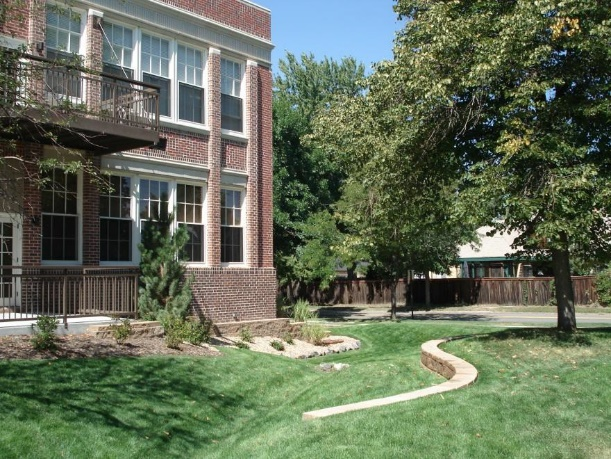
Figure 16-3-3-8.Example of a grassed swale
on a multifamily property.
c.
Rain Gardens. Rain gardens are small shallow depressions planted with a variety of native or ornamental plants that can treat small amounts of runoff to improve water quality. Rain gardens are generally small collections of water loving plants planted on a low site area to collect rainfall.
(4)
Sand filters.
(5)
Sand filters are filtering or infiltrating systems that consist of a surcharge zone underlain by a sand bed with an underdrain system (when necessary). Examples may include depressions, trenches, barriers, or sand lenses constructed of porous mineral matter that improve ground water recharge to filter, clean, and trap waterborne pollutants.
(6)
Other Options.
a.
In addition, other LID standards include extended detention basins that may be used in open space tracts to treat the runoff from multiple lots, roads, trails, and pathways.
b.
Other LID options may be allowed as approved by the Town.
(e)
Ownership and Maintenance. All on-site drainage facilities located outside public infrastructure such as municipal street rights-of-way shall be owned and maintained by the Homeowner's Association or Metro District, the landowner, or the occupant unless otherwise approved through an agreement executed by the Town.
Sec. 16-3-375. - Installation and Maintenance.
(a)
General Installation Standards.
(1)
Required landscape improvements shall be installed prior to issuance of a certificate of occupancy. If required installation falls outside the planting season, the Community Development Department may authorize a deferred landscaping installation to the next planting season with posting of a sufficient financial security for the improvements. Such financial security shall be released upon installation, inspection, and approval of the landscaping. All required landscaping shall be installed within one (1) year of issuance of a certificate of occupancy and shall comply with Section 13-2-60.
(2)
All landscaping shall be installed and maintained pursuant to the approved landscape plan submitted with a site plan, and the standards in this Division. Property owners of record shall be responsible for maintenance of landscaping within the portion of the public right-of-way between the back of the curb or street pavement and the adjacent property.
(3)
All landscaping shall be installed to comply with required Intersection Sight Distance areas, as defined in the Milliken Design Criteria and Construction Specifications.
(b)
Irrigation Standards.
(1)
All required landscaping shall be irrigated as required for plant establishment and maintenance. Irrigation shall be appropriate to the type and scope of the improvements.
a.
Use of nontreated water for irrigation is encouraged if a permanent suitable supply is available. In the event that nontreated water is not continually available, an alternative supply of treated water shall be available by means of a separate line with an appropriate backflow prevention device to avoid any possibility of cross-contamination.
b.
Required landscaping shall be irrigated with a permanent irrigation system.
c.
Irrigation for native grasses and vegetation shall be used for establishment and shall be available for maintenance, as necessary.
(2)
Irrigation system improvements shall be designed to achieve water efficiency as a goal. These standards shall apply to the irrigation system design for all regulated landscapes:
a.
Plant water requirements shall be considered in irrigation design schemes.
b.
Hydraulic principles shall be employed when designing the irrigation system.
1.
Separate landscape meters shall be installed for all regulated landscapes.
2.
A reduced pressure backflow preventer shall be used on all dual systems. The backflow preventer may be waived if the irrigation system uses non-potable water that is in no way connected to a domestic system. All irrigation systems shall be installed with a pressure vacuum breaker.
3.
Turf and grass areas irrigation shall be designed using the following principles:
(a)
No single zone shall mix head types, such as rotors and pop-up spray heads on the same zone.
(b)
Sprinklers shall be spaced for "head-to-head" coverage where the spray pattern from one (1) head will reach to the next head.
(c)
Check valves shall be included in heads or valves where low drainage will occur due to elevation changes.
4.
Shrub bed areas with plant material five (5) gallon in size or larger shall be irrigated with a drip or subsurface system.
5.
Where the water supplied will be from secondary or other non-potable water sources, the use of non-potable color indicators shall be used on the equipment. This includes purple handles on quick coupler valves and gate valves, caps for irrigation heads, valve box lids and marker tape buried above the mainline.
6.
All systems shall be equipped with an automatic rain shut-off device.
7.
All wire connections shall be made with watertight connectors and contained in a valve box.
8.
For common open space areas within residential developments, and for multifamily, mixed-use, and nonresidential developments:
(a)
The irrigation system shall be designed to provide irrigation per Section 13-2-60 of this Code.
(b)
The tap size shall be based on the water demand of the site and shall take into consideration the areas of each plant type (i.e., turf, native seed, perennials, annuals, and shrubs), the evapotranspiration for the site, the water demand of each plant type at peak season and the water window.
(c)
Irrigation control systems shall be employed that offer flexibility in programming.
(1)
All irrigation systems shall include an electric automatic controller with multiple programs and multiple repeat and rest cycle capabilities and a flexible calendar program.
(2)
The controller shall have the ability to adjust run times based on percentage of maximum evapotranspiration rate.
(3)
Each zone/valve shall have its own station on the controller.
(3)
Additional standards for common open space areas within residential developments, and for multifamily, mixed-use, and nonresidential developments.
a.
Irrigation plans that are accurate and stamped shall be provided.
b.
Installation of irrigation systems shall be per plan.
1.
Mainline shall be tested to ensure its ability to maintain required pressure for two (2) hours. Proof of test and compliance shall be submitted to the Town.
2.
Before acceptance, each zone shall be operated, and each valve box opened to verify accurate installation. Proof of test and compliance shall be submitted to the Town.
c.
"As-built" drawings of irrigation system may be required after the installation, with dimensions shown for irrigation components depending on the development as designated by the Town.
1.
The "as-built" drawings shall show all points of connection, including tap size, line size and static water pressure of service. Dimensions that will be used to locate components shall be shown on plans. Components to be located include meters, backflow preventers, all valves, including quick coupler, control, gate and manual drain valves, and controller locations.
2.
The drawings shall also show zone number, valve size and gallons per minute.
(c)
Maintenance and Replacement Standards.
(1)
The property owner shall maintain the yard and landscaping within the adjacent road right- of-way in accordance with Town regulations.
(2)
Replacement of dead or diseased plant material shall be of equivalent species or material as specified in the approved landscape plan or pursuant to this Division in the absence of an approved landscape plan. Replacement shall occur at the time of removal, unless such removal occurs outside the planting season, in which case the replacement shall occur during the next planting season.
(3)
All areas disturbed by construction shall be reseeded to prevent erosion. Erosion mats may be necessary under certain conditions. Native, noninvasive grasses shall be used for revegetation where practical. Weed control is the responsibility of the landowner on all reseeded areas and all preservation areas. See also the Design Criteria and Construction Specifications, Volume II, regarding erosion control.
Sec. 16-3-380. - Environmental Conditions.
(a)
Intent. The intent of this Section is to ensure that new development limits/mitigates its impact to wildlife and wildlife habitat and that it minimizes environmental impacts.
(b)
Protection of Wildlife and Natural Areas.
(1)
To the maximum extent practical, development shall be designed to ensure that disturbances which occur to any natural area as a result of development shall be minimized through the use of natural buffer zones. If any development materially disturbs a natural area, the development project shall mitigate such lost natural resource either on- or off-site. Any such mitigation shall be roughly proportional to the loss suffered as a result of the disturbance.
(2)
The natural areas shall include: floodplains and floodways, natural drainage and water ways, significant native trees and vegetation, wildlife travel corridors, special habitat features such as raptor nest sites, key nesting, breeding or feeding areas, and any wetland greater than one-quarter (¼) acre in size.
(3)
The natural area buffer zone shall be used between natural areas and proposed development to ensure that the proposed development does not degrade the natural area. The size of the buffer zone shall be determined in conjunction with the Colorado Division of Wildlife or a Town-approved wetland or wildlife ecologist. The Town may decrease this buffer when strict application of this Paragraph will impose an exceptional and undue hardship upon the property owner or developer.
(4)
Exceptions. The Board of Trustees may allow disturbance or construction activity within the natural area or natural area buffer zone for the following limited purposes: mitigation of development activities, restoration of previously degraded areas, emergency public safety activities and utility installations when such activities and installations cannot reasonably be contained within other nearby develop areas, construction of a trail that will provide public access for educational or recreational purposes, or the enhancement of the habitat value and/or other natural resource values of a natural area.
(5)
Wildlife Conflicts. Any impacts to wildlife must be referred to the Colorado Division of Wildlife and, in the case of threatened or endangered species, United States Fish and Wildlife Services.
(6)
Wetlands. If wetlands are identified in the proposed area of development, the boundary of wetlands and a description of the ecological functions and characteristics provided by those wetlands shall be provided to the Town. (See Section 16-6-450 and Article IV, Division 1 "Floodplain Areas.")
Sec. 16-3-385. - Buffering and Screening Techniques.
(a)
Intent. The intent of this Section is to integrate adjacent land uses and provide seamless transitions through the use of appropriate buffers and screening.
(b)
Buffer Standards.
(1)
Special consideration shall be given to adjacent land uses of different intensities. The responsibility for buffering shall rest with the proposed land use, rather than with existing land uses. The developer shall ensure that the transition from one use to another is functional and minimizes conflicts between existing and proposed uses.
(2)
Buffers shall be provided according to the following table:
Notes:
Determined by the application type - For example, administrative applications will
be reviewed by the Community Development Department, in which case the Community Development
Department also designates appropriate buffer widths.
(3)
Buffer Design.
a.
Buffers shall include a combination of landscaping, berms, fences, or walls. A fence shall not be the only screening material used to satisfy buffer requirements.
b.
Opaque screening shall only be used when necessary to mitigate the impact of noise, light, unattractive aesthetics, and traffic.
c.
Special consideration shall be given to the impact of aesthetics, noise, lighting, and traffic.
(c)
Screening of Loading and Service Areas.
(1)
Loading docks, solid waste facilities, recycling facilities and other service areas shall be placed to the rear or side of buildings in visually unobtrusive locations.
(2)
Screening and landscaping shall prevent direct views of the loading areas (including vehicles being loaded) and their driveways from adjacent properties or from the public right-of-way. Screening and landscaping shall also prevent spill-over glare, noise, or exhaust fumes. Screening and buffering shall be achieved through walls, architectural features, and landscaping and shall be opaque. Recesses in the building or depressed access ramps may be used.
(d)
Screening of Dumpsters.
(1)
Every development that is required to provide one (1) or more dumpsters for solid waste collection shall provide sites for such dumpsters that are:
a.
Located to facilitate collection and minimize any negative impact on persons occupying the development site, neighboring properties, or public rights-of-way; and
b.
Constructed to allow for collection without damage to the development site or the collection vehicle.
(2)
Dumpsters shall be screened to prevent them from being visible from:
(3)
The ground floor of any occupied building on site or on adjacent properties; and
(4)
Any public street, sidewalk, or other public ways.
Sec. 16-3-390. - Fences and Walls.
(a)
Intent. The intent of this Section is to ensure that walls and fences are attractive and in character with the neighborhood.
(b)
General Requirements.
(1)
A fence permit is required prior to the start of construction.
(2)
Compatibility.
a.
Walls and fences shall be architecturally compatible with the style, materials, and colors of the principal buildings on the same lot.
b.
Perimeter fences and walls along collector and arterial streets shall be made visually interesting by integrating architectural elements such as brick or stone columns, varying the alignment or setback of the fence, softening the appearance of fence lines with plantings or through similar techniques. A fence or wall may not consist of a solid, unbroken expanse for more than fifty (50) feet for every seventy-five (75) feet of length, or portion thereof without approval of the Planning Commission. Fence support posts should be constructed inside the fence and should not be visible from the outside of the fence. Exterior fences made of wood shall be finished with a clear seal or left in their natural state, painted a solid white or other earth tone colors, or stained with natural wood stains. Decorative or ornamental fence support structures may be visible if approved by the Planning Commission.
c.
Fences and walls shall be located outside of the Intersection Sight Distance Triangle as defined in the Milliken Design Criteria and Construction Specifications.
(3)
Materials.
a.
Stone walls, or brick walls with a stone or cast stone cap, cedar and vinyl fences, decorative metal, cast iron fences, stucco walls, and stone piers are encouraged. Solid walls and fences are permitted only in rear and side yards. Retaining walls are permitted where required for landscaping and approved with a final drainage plan. Hedges may be used in the same manner and for the same purposes as a fence or wall. See Figure 16-3-3-9 below for illustrations of fence styles that the Town is encouraging.
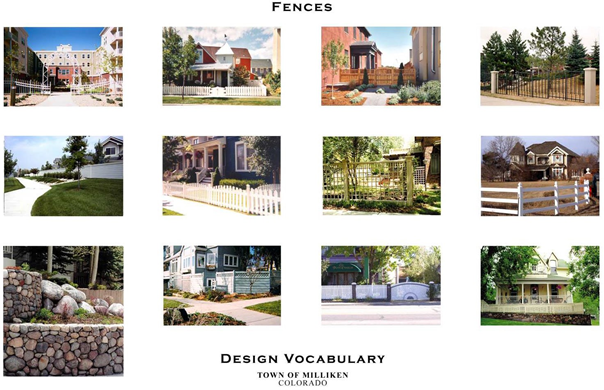
Figure 16-3-3-9.Types of fences the Town of Milliken encourages.
b.
Fences used in front yards and adjacent to public streets, open space, or parks along a side or rear yard shall be at least fifty (50%) percent open. Allowable fences are split rail, wrought iron, picket, or other standard residential fences of a similar nature approved by the Community Development Department.
c.
Solid fences shall be constructed to meet the wind design criteria of the adopted Building Code, using a basic wind speed of ninety-five (95) miles per hour.
d.
Other materials may be incorporated in fences and walls as may be approved by the Community Development Department.
(4)
Prohibited Materials. Security fencing such as concertina or razor wire, barbed wire, or electrically charged fences, is prohibited unless specifically allowed by the Board of Trustees. Chain-link fencing with or without slats shall be prohibited, except within an industrial zoning district pursuant to paragraph (6)(f) below, or as administratively approved for replacement or extension of existing chain-link fencing within the Plat of the Town of Milliken Subdivision on residential property in close proximity to existing chain-link fencing within the neighborhood. Chain-link fencing is prohibited in the Downtown area.
(5)
Retaining Walls. Retaining walls shall be designed to resist loads due to the lateral pressure of retained material in accordance with accepted engineering practice and shall not be unsightly or detrimental to abutting property. Any retaining wall greater than forty-eight (48) inches in height shall be engineered and allowed only with prior approval from the Town Engineer and Building Official.
(6)
Height Limitations. Fences or walls shall be:
a.
No more than forty-two (42) inches high between the front building line and the front property line. Walls shall not be solid except for retaining walls. For corner lots, front yard fence regulations shall apply to both street sides of the lot. The Community Development Department may approve an exception for demonstrated unique security purposes.
b.
No more than seven (7) feet high for an opaque privacy fence located on a rear property line or on a side yard line in the rear yard.
c.
No more than seven (7) feet high for opaque privacy fences that are located directly adjacent to and integrated with the architecture of the house or connected to a courtyard.
d.
No more than thirty (30) inches high when located within the sight distance triangle and fence shall not be solid. Properties with elevation changes from the right-of-way shall reduce the height of the fence or wall, as needed to remain clear of the sight distance triangle.
e.
Within an Industrial Zone district, a chain-link fence is permitted so long as it is not higher than ten (10) feet anywhere on the premises, and the visibility at the intersection shall be in accordance with site triangle regulations. Additional landscaping must be installed to minimize the visual impact of the chain-link fence. A building permit is required for any fence over seven (7) feet in height.
f.
Fences around a recreation court (e.g., tennis, squash racket, squash tennis or badminton) or around a publicly owned recreation area may exceed six (6) feet in height if the fence is at least fifty (50%) percent open.
(7)
Maintenance. Fencing shall be maintained in an acceptable appearance. Missing and broken segments of fence shall be repaired in a timely manner. Dilapidated, unsightly or dangerous fences shall be removed or repaired when so ordered by the Town. Hedges shall be maintained in a healthy condition, trimmed, and pruned as appropriate for the plant type. Dead plant material in hedges shall be removed or replaced as appropriate when so ordered by the Town. Hedges shall not encroach upon sidewalks or street rights-of-way. The Town may repair and/or replace fencing or plants and bill the owner if the owner does not make repairs as ordered by the Community Development Department.
(8)
Fences, walls, and hedges shall comply with International Fire Code requirements, as adopted by the Town, as they relate to maintaining unimpeded access to existing and proposed fire hydrants.
(c)
Warranty Period. The warranty period for perimeter fences along arterial and collector streets shall be two (2) years. Provision for compliance shall be as outlined in the warranty section of the subdivision or site plan agreement.
Sec. 16-3-400. - Applicability and Intent.
(a)
Applicability. The following properties are subject to these regulations: All single-family and two-family dwellings constructed and/or placed on land pursuant to issuance of a building permit subsequent to the effective date of the ordinance amending this Section.
(b)
Intent. This Division is intended to:
(1)
Enhance the visual character of the Town.
(2)
Strive to retain the Town's rural character as described in the Comprehensive Plan.
(3)
Foster quality building design that reinforces the identity of the community and each neighborhood and zone district.
(4)
Build upon the architectural traditions of the region yet allow for diversity of expression.
(5)
Encourage a variety of housing types, sizes, and prices in each neighborhood to allow people to remain in their neighborhoods, as their housing needs change.
(6)
Encourage single-household detached, single-household attached, and two-family dwellings that create diversity and variety along residential streets, and that reflect more modern designs.
Sec. 16-3-405. - Building Materials.
Exterior materials for all residential buildings shall only be constructed of wood, rock, brick, stucco, textured concrete, or natural-appearing siding.
Sec. 16-3-410. - Minimum Building Size.
(a)
The minimum floor area of a new single-family dwelling or two-family shall be one thousand one hundred (1,100) square feet per dwelling unit.
Sec. 16-3-415. - Model Diversity Plan.
(a)
Single-family detached and two-family building requirements are intended to ensure that an adequate mix of models and styles are offered within a neighborhood and within each block face.
(b)
Upon submittal of a building permit for single-family and two-family dwellings, , the applicant shall illustrate, through the use of a model diversity plan, how the development will comply with the requirements set forth in this Division. Developments of three (3) dwelling units or less are exempted from this provision.
(c)
There must be at least three (3) units between models with the same architectural style.
(d)
The same model with the same architectural style shall not be placed adjacent to each other or directly across the street from one another.
Sec. 16-3-420. - Enhancements at Corners.
(a)
At corners, buildings shall address the side street or open space. Corner lots shall be wide enough to allow for side elevation enhancements. At least one (1) of the following enhancements are required:
(1)
A side or wrap-around porch, or a bay window.
(2)
Windows or glazed doors that face the side street or open space.
(3)
A change in the vertical or horizontal wall plane.
Sec. 16-3-425. - Roof.
(a)
All dwelling roofs shall have the following minimum characteristics:
(1)
A minimum of five (5) roof planes per building, to add articulation. One of the five roof planes may be a porch roof.
Sec. 16-3-430. - Front Door.
Front doors shall face the street on which the address is designated by the address plat.
Sec. 16-3-435. - Exterior Embellishments.
Bays, projections, brackets, trim and material changes that are appropriate for the expression of the architectural style of a building are encouraged.
Sec. 16-3-440. - Decks.
All vertical elements (columns, beams, railing, stairs, supports), fascia's and overhead elements of elevated and walkout decks shall be painted or stained to match or complement the permanent colors of the main structure and not left to weather naturally.
Sec. 16-3-445. - Setback Encroachments.
Cornices, canopies, eaves, or similar architectural features may extend from the building into a required yard not more than two (2) feet. Open, unenclosed, uncovered porches at ground level may extend into a required yard setback not more than six (6) feet, excluding roof overhangs, but not beyond the property line.
Sec. 16-3-450. - Garages.
All single-family and two-family dwellings constructed or placed on land pursuant to issuance of a building permit subsequent to April 9, 2010, shall include a garage, one (1) car in size or larger, either attached or detached, as part of the new construction or placement and prior to the issuance of a certificate of occupancy or certificate of completion.
Requirements for Garages with Access from the Street (see Figure 16-3-3-10):
(a)
Variety of Garage Placement. Varying the placement of street-accessed garages on adjacent lots is encouraged to create diversity and avoid repetition.
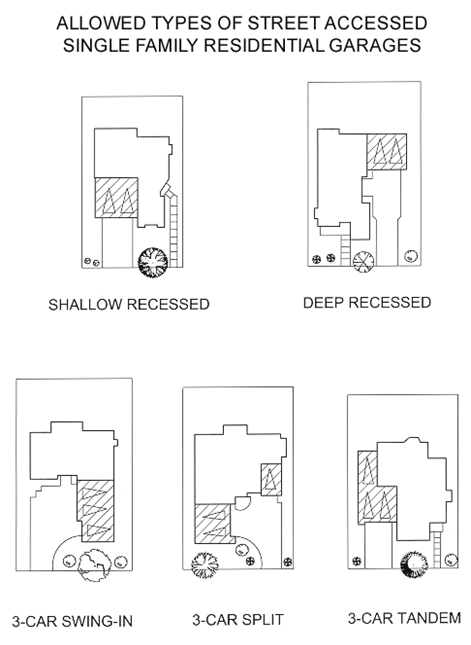
Figure 16-3-3-25
(b)
Swing-In (Side-Loaded Garages). Swing-in garages are permitted. However, such garage projections shall not become a dominant feature of the streetscape.
(c)
Three-Car Street-Accessed Garages. Three-car, front-facing garages are discouraged. Split garages and tandem garages are permitted.
Sec. 16-3-455. - Driveways.
(a)
Maximum Driveway Curb Cut Width. One (1) driveway with a maximum width of thirty-two (32) feet at the curb is permitted per single-family residential dwelling unit. The driveway may flare in width at a point behind the curb which is equal to at least one-third (1/3) of the driveway length (as measured from the curb) to provide an approach for one (1) additional parking area which shall not exceed ten (10) feet in width. Driveways must also conform to the Milliken Design Criteria and Construction Specifications for side setback from lot line, driveways on adjacent lots and Intersection Sight Distance.
Sec. 16-3-460. - Townhouses and Row Houses (Single-Family Dwelling and Attached Dwellings) Building Type.
(a)
Individual Dwelling Identity. Buildings shall have repeat principal architectural elements like entries, bays, cornices, and parapets, and vary other architectural elements such as the offsetting of building walls, choice of materials, parapet height and color to create visual interest and streetscape diversity.
(b)
Front Facade. Design the front facade of each row house so it is evident where the unit begins and ends.
(c)
Articulation. Row houses shall have front articulation through the use of such elements as changes in material, horizontal setback, projections or recesses, and architectural details.
(1)
Side elevations of row houses facing a street are subject to the same articulation requirements as the primary facade.
(2)
Row house groupings of six (6) units or more (or groupings over one hundred twenty (120) feet in length) require two (2) different articulation combinations.
Sec. 16-3-465. - Multi-Family Stacked Units, Including Condominiums and Apartments.
(a)
Each multi-unit dwelling building containing more than three (3) dwelling units shall feature a variety of massing proportions, wall plane proportions, roof proportions and other characteristics.
(b)
Individual Building Identity. For all developments of three (3) or more multi-family stacked buildings, a floor plan may be repeated; however, identical building facades must not be replicated more than twice within the development.
(c)
Articulation. Each multi-family dwelling or condominium shall be articulated with projections, recesses, covered doorways, balconies, box, or bay windows and/or other similar features, dividing large facades and walls into human-scaled proportions. Each multi-family building shall feature walls that are articulated by a least two (2) of any of the following elements within every thirty-six-foot length of the facade:
(1)
Recesses, projections, or significant offsets in the wall plane;
(2)
Distinct individualized entrances;
(3)
Chimneys that project from the wall plane;
(4)
Balconies and/or other outdoor living space; or
(5)
Bay or box windows.
(d)
Roofs. Each multi-family building shall feature a combination of primary and secondary roofs. Primary pitched roofs shall be articulated by at least one (1) of the following elements:
(1)
Changes in plane and elevations;
(2)
Dormers, gables, or clerestories; or
(3)
Transitions to secondary roofs over entrances, garages, porches, or bay windows.
(e)
Color. For all developments, there shall be no more than two (2) similarly colored structures placed next to each other along a street or major walkway spine.
(f)
Garages. No street-facing facade shall contain more than four (4) garage fronts.
Sec. 16-3-470. - Factory Built, Manufactured, and Mobile Homes Standards.
(a)
Factory built homes shall be constructed to the local wind and snow loads.
(b)
Mobile homes must be attached to natural or propane gas distribution piping, electrical distribution wiring and plumbing waste sewer lines on an approved mobile home site designed for such attachment points.
(c)
No factory-built home, manufactured home or mobile homes shall be converted or used, as a storage building.
(d)
Mobile homes constructed prior to June 15, 1976 which do not comply with the HUD Code are not allowed to be repaired beyond what is allowed through the non-conforming structure provisions of this Code, or to be brought into the Town of Milliken after adoption of this Code reference.
(e)
No factory-built home, manufactured home or mobile home shall be allowed to become in a dilapidated state which includes units that are partially or totally damaged by fire, earthquake, flood, wind or other natural causes, or is in a state of general dilapidation, deterioration or decay resulting from improper lack of maintenance, vandalism or infestation with insects or rodents. Any such dilapidated structure shall be returned to and maintained in the condition as originally established on site and as inspected by the Building Inspection Department, or it shall be removed from site. Repair of non-conforming structures or uses shall be in accordance with non-conforming structure provisions found in the Land Use Code.
Sec. 16-3-475. - Commercial and Industrial Building Types and Locations.
(a)
The Town has three (3) distinctly different commercial/industrial types of development within its Planning Area: mixed use; business/industrial; and business/commercial. They are different in character, purpose, and mixture of uses. The design considerations vary for each type, although there are many common design elements. Section 16-3-480 below outlines the common elements, and the specific design considerations are identified by type.
(b)
Business/Industrial. The business/industrial is a primary employment center for the community. This area is predominantly automobile accessible. Design should include pedestrian connections within the area and to the rest of the community.
(c)
Business/commercial. This type of area is intended to be integrated into the design of new neighborhoods to serve as focal points and meet convenience commercial needs of the residents.
Sec. 16-3-480. - General Provisions.
(a)
Connections. Commercial developments must be linked with surrounding areas by extending Town streets, sidewalks and/or paths directly into and through the development to provide convenient, direct pedestrian, bicycle, and vehicle access to and from the development. Site plans shall equally emphasize the following:
(1)
Pedestrian access to the site and buildings;
(2)
Gathering areas for people; and
(3)
Auto access and parking lots.
(b)
Walkways. Walkways must be located and aligned to directly and continuously connect areas or points of pedestrian origin and destination, and not be located and aligned solely based on the outline of a parking lot configuration that does not provide such direct pedestrian access.
(c)
On-Street Parking. Streets and other elements of the site plan shall be designed so that on-street parking is a functional part of the development (except along arterial streets).
(d)
Building Orientation. Buildings must front on and relate primarily to streets. Building setbacks from local and collector streets shall be minimized in order to establish a visually continuous, pedestrian-oriented street front. In the case of large buildings for employment, storage, or auto-related uses, where greater setbacks are needed, a minimum of thirty percent (30%) of the building shall be brought to the setback line. If a minimized setback is not maintained, the larger setback area shall have landscaping, low walls or fencing, a tree canopy and/or other site improvements along the sidewalk designed for pedestrian interest, scale, and comfort.
(e)
Pedestrian Scale. The establishment of buildings on isolated "pad sites" surrounded by parking lots and driveways, and that offer mainly auto-oriented signage to define entrances, is discouraged. Even relatively massive development can be configured into "blocks" or other spaces, proportioned on a human scale and city block scale; and need not be proportioned on a monolithic, auto-oriented scale.
(f)
Thematic Architectural Styles. Standardized "corporate" or strongly thematic architectural styles associated with chain-type restaurants and service stores are strongly discouraged unless they accommodate the desired image for the Town and are compatible with adjacent structures and uses.
(g)
Location of Parking Lots. Parking requirements shall be provided to the greatest extent possible by spaces at the rear or sides of the building. Refer to Division 3 "Parking, Loading, Vehicle, and Pedestrian Standards" and Division 4 "Landscaping, Buffering, Fences and Walls" of this Article for additional parking and landscaping requirements.
(h)
Blank Walls. Walls facing streets or pedestrian areas must contain door and/or window openings. Where the construction of a blank wall is necessary, the wall shall be articulated.
(i)
Wall Articulation.
(1)
Walls shall not have an uninterrupted length exceeding fifty (50) feet. Pilasters, texture transitions, windows and stepping of the wall plane are required.
(2)
All exterior elevations shall maintain the integrity of the adjacent dwellings architectural character and detailing.
(3)
Continuous cornice lines or eaves are encouraged between adjacent buildings.
(4)
Buildings with flat roofs shall provide a parapet with an articulated cornice.
(j)
Facade Treatment. The architectural treatment of the front facade shall be continued to all sides visible from the public right-of-way.
(k)
Windows. Windows shall be vertically proportioned wherever possible.
(l)
Awnings. Fixed or retractable awnings are permitted. Canvas is the preferred material, although other waterproofed fabrics may be used; metal or aluminum awnings shall not be used unless otherwise approved by the Board of Trustees. Awnings used as signage must conform to the Sign Code.
(m)
Screening. All building or ground mounted air-conditioning units, HVAC systems, exhaust pipes or stacks, elevator housing, satellite dishes and other telecommunications receiving devices shall be fully screened from view from the public right-of-way and from adjacent properties by using walls, fencing (except chain-link), roof elements and landscaping.
(n)
All trash facilities, loading and parking areas shall be properly screened.
(o)
Architectural Details. All materials, colors and architectural details used on the exterior of a building shall be compatible with the building's style and with each other.
Sec. 16-3-485. - Neighborhood Commercial Architectural Standards.
(a)
Neighborhood Center. The design of the commercial center needs to function as a focal point or activity center for the neighborhood. The design should include, where possible, outdoor space for pedestrians, such as a plaza, outdoor cafe, or seating area.
(b)
Setbacks. Building setbacks from local and collector streets must be minimized in order to establish a visually continuous, pedestrian-oriented street front. In the case of large buildings for employment, storage, or auto-related uses where greater setbacks are needed, a minimum of thirty percent (30%) of the building shall be brought to the setback line. If a minimized setback is not maintained, the larger setback area shall have landscaping, low walls or fencing, a tree canopy and/or other site improvements along the sidewalk designed for pedestrian interest, scale, and comfort.
(c)
Driveway Crossings. Driveway crossings must place priority on the pedestrian access, and the material and layout of the pedestrian access must be continuous as it crosses the driveways, with a break in the continuity of the driveway paving and not in the pedestrian access way. Continuous driveway aisles located directly in front and parallel to the front of a building are prohibited. Driveway cuts onto Broad Street are prohibited.
Sec. 16-3-490. - Community Commercial Architectural Standards.
(a)
Design of developments with internal orientation. In multiple-building developments, where setbacks are increased to accommodate independent development with internal orientation, all primary building entrances must face walkways, plazas, or courtyards that have direct, continuous linkage to the street without making people walk through parking lots. However, it may be necessary for such direct pedestrian access ways to cross drive aisles. Driveway crossings must place priority on the pedestrian access.
(b)
Requirement for Four-Sided Design. All sides of a building open to view by the public, whether viewed from public or private property, shall display a similar level of quality and architectural interest.
(c)
Building Form. The design of all buildings shall employ textured surfaces, projections, recesses, shadow lines, color, window patterns, overhangs, reveals, changes in parapet heights and similar architectural features to avoid monolithic shapes and surfaces and to emphasize building entries. Designs shall not contain unbroken flat walls of fifty (50) feet or greater in length.
(1)
Buildings having single walls exceeding fifty (50) feet in length shall incorporate one (1) or more of the following for every fifty (50) feet:
a.
Changes in color, graphical patterning, changes in texture or changes in material;
b.
Projections, recesses and reveals;
c.
Windows and fenestration;
d.
Arcades and pergolas;
e.
Towers;
f.
Gable projections;
g.
Horizontal/vertical breaks; and/or
h.
Other similar techniques.
(d)
Exterior Building Materials and Colors. Intense, bright, or fluorescent colors shall not be used as the predominant color on any wall or roof of any primary or accessory structure. These colors may be used as building accent colors.
(e)
Roof Materials. All sloping roof areas with a pitch of 3:12 or greater, and visible from any public or private right-of-way, shall be surfaced with attractive and durable materials.
(f)
Orientation of Pedestrian Entries. All office, hotel and motel structures shall be oriented so that pedestrian entries face the nearest adjacent street.
Sec. 16-3-495. - Industrial/business Park Architectural Standards.
The intent of the Industrial/Business Park architectural standards is to ensure that the quality of industrial/business park development enhances the overall well-being and image of the community.
(a)
Subsections (c) through (f) of Section 16-3-490 of this Article shall apply.
(b)
Building Massing and Form:
(1)
Office and entry spaces shall be distinguished from the building mass.
(2)
Large, square, "box-like" structures are not an acceptable form. Architectural elements with smaller forms stepping outwards and down shall be included.
(3)
Loading areas shall not front any street or public right-of way.
(4)
Parking requirements shall be provided to the extent possible at the rear or sides of the building.
(c)
Wall Articulation. Walls shall not have an uninterrupted length exceeding fifty (50) feet. Pilasters, texture transitions, windows and stepping of the wall plane are required.
(d)
Siting Structures.
(1)
Structures shall be sited to avoid a "wall" effect along public rights-of-way and along adjacent property lines. This can be achieved by varying the building setbacks and clustering buildings or enhanced landscape alternative.
(2)
Where multiple buildings are proposed on a development parcel, buildings shall be oriented to allow views into the project and shall preserve high-quality views through the project (e.g., views of the mountains).
Sec. 16-3-500. - Accessory Buildings and Structures.
(a)
Accessory buildings and structures which are not any larger than one hundred twenty (120) square feet in area, as measured around the perimeter of the building shall be permitted without a building permit.
(b)
Accessory buildings and structures, except fences, in the residential districts, shall be subject to the following provisions:
(1)
Attachment to Principal Building. An accessory building or structure shall not be attached to or have a common wall with the principal building. Covered (but otherwise unenclosed) walkways shall not be considered attachments for the purposes of this subsection except that a garage connected to the principal building with a covered walkway shall be considered a detached accessory building subject to the provisions of this section.
(2)
Time of Construction. No accessory building or structure shall be constructed on any lot prior to the time of construction of the principal building to which it is accessory, unless otherwise approved by the Community Development Department.
(3)
Building Design Standards. The architectural design and appearance of all accessory buildings and structures shall comply with the following standards. Each of the following standards shall be met in order for the Planning Commission to approve a use by conditional review use related to accessory buildings:
a.
All accessory buildings and structures of any size shall be constructed of durable, finished materials and shall be compatible in color to the principal building. All accessory buildings and structures greater than one hundred twenty (120) square feet in area shall match as closely as possible the exterior finish, architectural style, roof style and roof pitch of the principal building on the lot. Brick, stucco, and stone dwellings justify an exemption for required matched building exteriors. Alternate materials shall only be allowed in such cases by approval of the Planning Commission.
b.
All accessory buildings and structures are to be securely anchored to prevent uplifting due to wind.
c.
All accessory buildings and structures shall be sided or otherwise finished.
(4)
Temporary accessory buildings and structures such as portable carports, shelters, tarped coverings, and similar structures, as determined by the Community Development Department, shall be prohibited.
(5)
Exemptions for agricultural buildings and structures. Agricultural buildings and structures, when part of an agricultural use or limited agricultural use as defined in this Chapter, shall only be subject to the lot coverage and setback requirements set forth in Article II "Zoning Districts and Uses."
(6)
Conditional Review Uses. The Planning Commission may authorize additional accessory buildings or structures, a greater lot coverage and/or a greater height as a conditional review use in accordance with Article 4 of this Chapter. The following standards shall be considered:
a.
The area and/or height of the accessory buildings or structures is aesthetically appropriate in relation to the size of the lot and the corresponding uses in the neighborhood on which it is to be placed;
b.
The area and/or height of the accessory building or structures is appropriate in relation to the principal building on the lot on which it is to be placed;
c.
The location of the accessory building or structure is appropriate in relation to other buildings on the lot or adjoining lots and in relation to the principal building;
d.
Whether or not the accessory building or structure will affect light and air circulation of the adjoining property;
e.
The building or structure has been appropriately screened through fencing, buffering, berming, and/or landscaping from adjacent properties and the public view; and
f.
Impacts to adjacent land uses have been satisfactorily mitigated.
Sec. 16-3-505. - Water, Sewer, and Drainage Improvements.
Offsite and onsite water, sewer, and drainage improvements must comply with the Design Criteria and Construction Specifications..
Sec. 16-3-510. - Lighting.
(a)
Intent. All new development shall utilize lighting techniques that minimize the impact of lighting on adjacent properties. Exterior lighting shall be used for purposes of identification, security, safety, and illumination in areas of pedestrian circulation and vehicular traffic. These standards apply to all development within the Town. The purposes of the lighting standards are as follows:
(1)
Reduce the escalation of nighttime light pollution.
(2)
Reduce glaring and offensive light sources.
(3)
Provide clear guidance to builders and developers.
(4)
Encourage the use of improved technologies for lighting.
(5)
Conserve energy.
(6)
Prevent inappropriate and poorly designed or installed exterior lighting.
(7)
Minimize interference with use or enjoyment of property through unnecessary night-time illumination and the loss of scenic night sky views due to increased urban sky-glow.
(b)
General Standards.
(1)
Direct or reflected light from any light source may not create a traffic hazard to operators of motor vehicles on public roads including use of colored lights in such a way as to be confused or construed as traffic control devices.
(2)
Light sources shall be concealed or shielded to minimize glare and unnecessary diffusion onto adjacent property. Lighting shall be directed downward and equipped with "cut-off" devices that ensure ambient skyward light is eliminated.
(3)
Maximum on-site lighting levels shall not exceed ten (10) foot-candles, except for loading and unloading platforms. For reasons of security, a maximum of one and one-half (1.5) foot-candles at entrances, stairways and loading docks is permitted unless required by any federal, state, or local jurisdiction.
(4)
Hours of Lighting Operation. All parking lot lighting fixtures and exterior building lights, except those required for security purposes, shall be extinguished within one (1) hour after the end of business hours and remain extinguished until one (1) hour prior to the beginning of business hours. If a portion of a parking lot is used after dark, only that portion shall be lighted.
(5)
Height and Material Standards for Lighting.
a.
Residential Zoning Districts. Light fixtures shall be mounted on concrete, fiberglass, or painted metal poles no higher than sixteen (16) feet from the ground. Lighting mounted on a building or structure shall not exceed the height of the building or structure. Bollard-type lighting fixtures shall be between three (3) and four (4) feet high.
b.
Nonresidential Zoning Districts. Light fixtures shall be mounted on concrete, fiberglass or painted metal poles no higher than twenty-five (25) feet from the ground, unless a greater height, not to exceed the maximum building height in the applicable zone district, is approved by the Planning Commission or Board of Trustees through a development application review process. Lighting mounted on a building or structure shall not exceed the height of the building or structure. Bollard-type lighting fixtures shall be between three (3) and four (4) feet high.
(6)
Exemption for Outdoor Recreational Uses. Because of their limited hours of operation and their unique requirements for nighttime visibility, ball diamonds, playing fields, tennis courts and other similar outdoor recreational uses (both public and private), unless otherwise restricted by the Board of Trustees, shall be exempt from the general provisions of this Section. However, exterior lighting for such uses shall be extinguished no later than 11:00 p.m.
(7)
Blinking, flashing, or changing intensity lights are prohibited; except for temporary holiday displays or lighting required by the FAA.
(8)
Flagpole lighting shall be permitted to be directed upward as long as the light source is shielded.
Sec. 16-3-515. - Sanitary Sewer.
(a)
General Requirements. All residential, commercial, and industrial uses which have human occupancy shall have sanitary sewer. The sanitary sewer system shall be connected to an existing public sanitary sewer system and shall consist of a closed system of sanitary sewer mains and lateral branch connections to each structure or lot upon which a structure is to be built. Sanitary sewer lines are to be of sufficient size and design to collect all sewage from all proposed or portable structures within the subdivision or development. On a case-by-case basis, upon recommendation from the Town Engineer, the Board of Trustees may approve individual sewage disposal systems that receive a permit from the Weld County Department of Public Health and Environment. However, no new addition, upgrade or major repair to an individual sewage disposal system will be permitted if the property is located within four hundred (400) feet of a municipal or sanitation district collection line, measured through existing sewer easements or utility rights-of-way, except where such connection is not feasible or has been denied by the Town or district.
(b)
Construction Standards. Sanitary sewer systems and improvements must be designed and constructed in compliance with the Design Criteria and Construction Specifications.
Sec. 16-3-520. - Potable Water.
(a)
Construction Standards. Water systems and improvements must be designed and constructed in compliance with the Design Criteria and Construction Specifications and comply with requirements of Article II of Chapter 13 of this code.
Sec. 16-3-525. - Fire Hydrants.
(a)
The subdivider or developer shall install fire hydrants designed and constructed in compliance with the Design Criteria and Construction Specifications.
Sec. 16-3-530. - Easement and Utility Standards.
(a)
Utility Easement Width. In subdivisions, front lot line easements shall measure thirteen (13) feet in width. Easements may be more or less than widths stated if the specific utility indicates in writing a width other than those required by this Code. Utility easements shall be subject to the approval of the Town or applicable utility company.
(b)
Multiple Installations Within Easements. Easements shall be designed so as to provide efficient installation of utilities. Public utility installations shall be located as to permit multiple installations within the easements. The developer will establish final utility grades prior to utility installations.
(c)
Underground Utilities. Telephone lines, electric lines, cable television lines and other like utility services shall be placed underground. Pedestals and transformers shall not be located in the front yard setback adjacent to public streets unless they are underground and/or not visible to the traveling public. The subdivider or developer shall be responsible for complying with the requirements of this Section and shall make the necessary arrangements, including any construction or installation charges, with each utility provider for the installation of such facilities. Transformers, switching boxes, meter cabinets, pedestals, ducts, and other facilities necessarily appurtenant to such underground utilities shall be placed underground. Screening or fencing is required to the satisfaction of the Board of Trustees. Electric transmission and distribution feeder lines and necessary appurtenances thereto may not be placed above ground unless they are carrying greater than 115 kV. Such facilities shall be placed within easements or public streets, as therein provided, or upon private easements or rights-of-way provided for particular facilities. (Refer to Design Criteria and Construction Specifications.) Utility easements have been identified outside the right-of-way in order to accommodate the location of street trees.)
Sec. 16-3-600. - Purpose, Intent, and Interpretation.
(a)
Signs can obstruct views, distract motorists, displace alternative uses for land and pose other problems that legitimately call for regulation. The regulations in this Article are intended to coordinate the use, placement, physical dimensions, and design of all signs within the Town. The purpose of these regulations is to:
(1)
Recognize that signs are a necessary means of visual communication for the convenience of the public and provide flexibility within the sign review/approval process to allow for unique circumstances and creativity.
(2)
Recognize and ensure the right of those concerned to identify businesses, services, and other activities by the use of signs, and limit commercial signs to those which are accessory and incidental to the use on the premises where such signs are located.
(3)
Provide a reasonable balance between the right of an individual to identify his or her business and the right of the public to be protected against the visual discord resulting from the unrestricted proliferation of commercial signs and similar devices.
(4)
Protect the public from damage or injury caused by signs that are poorly designed or maintained and from distractions or hazards to pedestrians or motorists caused by the indiscriminate placement or use of signs.
(5)
Ensure signs are well designed and contribute in a positive way to the Town's visual environment, express local character, and help develop a distinctive image for the Town.
(6)
Encourage signs that are responsive to the aesthetics and character of their particular location, adjacent buildings and uses and the surrounding neighborhood and are compatible and integrated with the building's architectural design and with other signs on the property.
(7)
Ensure signs are appropriate for the type of street on which they are located.
(8)
Protect against signs detracting from the character of an architecturally significant or historic structure.
(9)
Bring nonconforming signs into compliance with these regulations when the use of the property changes or is discontinued, when a new business license is issued or as a condition of approval of a land use action approved by the Town, such as a rezoning, variance or other land use action.
(10)
Assist in wayfinding.
(11)
Regulate the size, color, illumination, movement, materials, location, height, and condition of all signs placed on private property for exterior observation, thus ensuring the protection of property values, the character of the various neighborhoods, the creation of a convenient, attractive and harmonious community, protection against destruction of or encroachment on historic convenience to citizens and encouraging economic development.
(12)
Promote efficient communication of messages.
(13)
Promote public welfare by reducing visual clutter.
(14)
Recognize that signs advertising discontinued commercial uses are misleading, unnecessarily contribute to visual clutter, and can unnecessarily obstruct views and distract motorists.
(b)
This Article allows adequate communication through signage while encouraging aesthetic quality in the design, location, size, and purpose of all signs. This Article must be interpreted in a manner consistent with the First Amendment guarantee of free speech.
(c)
A sign placed on land or on a building for the purpose of identification, protection or directing persons to a use conducted therein must be deemed to be an integral but accessory and subordinate part of the principal use of land or building. Therefore, the intent of this Article is to establish limitations on signs in order to ensure they are appropriate to the land, building or use to which they are appurtenant and are adequate for their intended purpose while balancing the individual and community interests identified in this Article.
(d)
This Article does not regulate every form and instance of visual communication that may be displayed anywhere within the jurisdictional limits of the Town. Rather, it is intended to regulate those forms and instances that are most likely to meaningfully affect one (1) or more of the purposes set forth above.
(e)
This Article does not entirely eliminate all of the harms that may be created by the installation and display of signs. Rather, it strikes an appropriate balance that preserves ample channels of communication by means of visual display while still reducing and mitigating the extent of the harms caused by signs.
(f)
This Article is not intended to and does not apply to signs erected, maintained, or otherwise posted, owned, or leased by the state, the federal government, or the Town. The inclusion of "government" in describing some signs does not intend to subject the government to regulation, but instead helps illustrate the type of sign that falls within the immunities of the government from regulation.
(g)
With respect to permitted hazard warning signs, the Board of Trustees finds that the dispersed nature of utility, oil and gas lines and other potential hazards throughout all the community does not lend itself to the property by property regulation otherwise used in this Code, and that warning of the location of utilities and of their hazards so that persons will not be injured thereby, so that fire, police, and other public emergency services may be conducted all expeditiously and safely, and so that the essential public functions served by such utilities will not be impaired constitutes a compelling governmental interest and requires a different form of regulation;
(h)
Except as this Article expressly provides, the Board of Trustees does not intend to regulate signs based upon the content of any sign's message.
Sec. 16-3-605. - Sign Permits and Administration.
(a)
Signs Permitted. Signs shall be permitted in the various zone districts as accessory uses in accordance with the regulations contained in this Section.
(b)
Sign Permit Required. To ensure compliance with the regulations of this Article, a sign permit shall be required in order to erect, move, alter, reconstruct or repair any permanent or temporary sign, except signs that are exempt from permits in compliance with Section 16-3-620 "Exempt signs" below. In multiple-occupant buildings, a separate permit shall be required for each business entity's sign. Separate building and electrical permits may be required for signs. Neither servicing and maintenance of existing signs nor changing or replacing the copy on an existing lawful sign shall require a permit.
(c)
Application for a Sign Permit.
(1)
Sign Permit Application Requirements. Applications for sign permits shall be made in writing on forms furnished by Staff. The application shall contain:
a.
Name, address, and telephone number of the applicant;
b.
Written consent of the property owner;
c.
Location of the building, structure, or lot where the sign is proposed or located;
d.
Legible site plan indicating the proposed location of the sign on the building and/or lot in relation to nearby buildings and other structures, including dimensions showing setbacks to adjacent property lines and buildings;
e.
A detailed drawing indicating the dimensions of the sign, materials, method of construction, support, weight, colors, and distance from doors, windows, fire escapes and driveways of the proposed sign structure. A certification by a structural engineer may be required by Staff for a freestanding or projecting sign;
f.
A graphic drawing or photograph of the sign copy;
g.
A description of the lighting to be used, if applicable;
h.
If the sign is to be located off the applicant's own premises, a written lease or permission from the property owner of the site on which the sign will be located; and
i.
Sign permit fee as established by the current fee schedule. The applicant shall pay all costs billed by the Town relative to the review of the application.
j.
Sufficient information to determine whether the proposed sign is allowed under this Article and other applicable laws, regulations, and ordinances.
k.
The date when the applicant intends to erect the sign.
l.
For a temporary sign, the dates intended for the erection and removal of the sign.
(d)
Sign Permit Application Certification of Completion. Staff will review application for completeness and either certify the application is in compliance of all submittal requirements or reject it as incomplete and notify the applicant in writing of any deficiencies.
(e)
Staff Review and Approval. Within seven (7) business days of determination of a complete application, Staff shall review the sign permit in accordance with the established review criteria and shall, approve, approve with conditions, or deny the sign permit. Staff must approve any application that complies with all provisions of this Article and other applicable laws, regulations, and ordinances. Upon Staff's approval of the sign permit, the sign permit and any building or electrical permits required for the sign shall be issued to the applicant. Upon denying an application the Staff shall provide the applicant with a written statement of the reasons for that action in writing.
(f)
Sign Permit Review Criteria. The following review criteria will be used by the Town Staff to evaluate all sign permit applications:
(1)
Sign meets the requirements of this Article;
(2)
Sign conforms to the requirements of the Building and Electrical Code as adopted by the Town;
(3)
Sign conforms to the size, height, material, and location requirements of the Zoning Code for the zoning district in which it is located;
(4)
Sign would not interfere with pedestrian or vehicular safety, and is not located within the Intersection Sight Distance area as defined in the Milliken Design Criteria and Construction Specifications;
(5)
Signs mounted on buildings would not obscure architecture;
(6)
Electrical signs must be approved by an independent testing laboratory.
(e)
Appeal of Sign Permit Denial or Approval with Conditions. Any appeal of Staff's denial of a sign permit or approval with conditions shall be made to the Board of Adjustment as provided in the Zoning Code. Except for delay caused by or with the consent of the applicant, Staff and the Board of Adjustment shall promptly process the appeal. At the next available Board of Trustees meeting after the applicant files its notice of appeal, the Board of Trustee shall conduct a hearing and issue a decision on that appeal. The hearing may be held no less than ten (10) days from the date of advertising.
Sec. 16-3-610. - Enforcement.
(a)
Illegal Signs.
(1)
Removal of Illegal Signs in the Public Right-of-Way. The Town may cause the removal of any sign within the public right-of-way or on property that is otherwise abandoned that has been placed there without first complying with the requirements of this Article.
(2)
Storage of Removed Signs. Signs removed in compliance with this Section shall be stored by the Town for thirty (30) days, during which [time] they may be recovered by the owner only upon payment to the Town for costs of removal and storage. If not recovered within the thirty-day period, the sign and supporting structure shall be declared abandoned and title shall vest with the Town. The costs of removal and storage (up to thirty (30) days) may be billed to the owner. If not paid, the applicable costs may be imposed as a tax lien against the property.
Sec. 16-3-615. - Authorized Signs.
(a)
Although this Article does not apply to signs erected, maintained, or posted by the state, federal or local government, this Section clarifies that signs are allowed in every zoning district that form the expression of the government, including the signs described and regulated in the following paragraphs of this Section when erected and maintained pursuant to law. The following signs are authorized in every district:
(1)
Traffic control devices.
(2)
Identification signs. Each property owner must identify their property using numerals that identify the address of the property so the public and public safety agencies can easily identify the address from the public street. Identification may be on an identification sign and, where required under this Code or other law, must also be on the curb.
(3)
Legally required signs. Where federal, state, or local law requires a property owner to post a sign on the owner's property to warn of a danger or to prohibit access to the property either generally or specifically, the owner must comply with the federal, state, or local law to exercise that authority by posting a sign on the property.
(4)
Government signs.
Sec. 16-3-620. - Exempt Signs.
The following types of signs are exempt from permit requirements of this Article and may be placed in any zoning district subject to the provisions of this Article. Such signs shall otherwise be in conformance with all applicable requirements contained in this Article. All such signs (except government signs) shall be located outside a street right-of-way. Signs shall not interfere with traffic control devices or the Intersection Sight Distance area. Evidence of owner's permission to install the sign may be required. All other signs shall be allowed only with permit and upon proof of compliance with this Article.
(a)
Address. Non-illuminated identification signs not to exceed two (2) square feet in area.
(b)
A-frames. See sandwich board signs.
(c)
Architectural Features. Integral decorative or architectural features of buildings so long as such features do not contain moving parts or lights.
(d)
Art. Works of art including murals, so long as such works do not contain moving parts or lights and is an approved design by the Planning Commission. Works of art and murals do not include graffiti tagging.
(e)
Banners. Banners, provided:
(1)
The banners are displayed for a period not to exceed thirty (30) days in any ninety-day (90) period, or
(2)
The banners are displayed no more than two (2) times per calendar year per lot or parcel.
(3)
The banner shall be securely attached to a wall, freestanding signs, or light poles on private property.
(4)
Banners shall not exceed one (1) banner per street frontage per lot or parcel.
(f)
Historical Markers. Government signs identifying the name of a building, date of erection or other historical information.
(g)
Construction. Temporary signs on a lot or parcel where construction activities of any type are being actively performed, provided that:
(1)
Signs on a residential use shall not exceed eight (8) square feet per face.
(2)
Signs on the site of a subdivision sales office shall not exceed ten (10) square feet per face.
(3)
All other temporary construction signs shall have a maximum area of sixty-four (64) square feet per face.
(4)
Only one (1) such sign per street front per premises shall be erected.
(5)
Such signs shall not be illuminated.
(6)
Such signs shall be removed within seven (7) days after completion of the project.
(h)
Courtesy Signs. Non-illuminated or indirectly illuminated signs limited to one (1) such sign for each use, not to exceed four (4) square feet per face or eight (8) square feet in total area. Such signs may be attached to the building as projecting or wall signs, suspended from a canopy or included as an integral part of a freestanding sign.
(i)
Directional and instructional private signs not exceeding six (6) square feet in area per face.
(j)
Doors. Signs affixed to a door, which do not exceed two (2) square feet per door.
(k)
Farm Products. Temporary commercial signs on or within one (1) mile of a lot on which farm products are offered for sale provided that:
(1)
One (1) on-premises sign may be used. Said sign shall be located off the street right-of-way and at least ten (10) feet away from any side lot line. Such sign shall have a maximum area of nine (9) square feet per face and may not be illuminated.
(2)
A maximum of two (2) off-premises signs shall be permitted. Said off-premises signs may be no greater than four (4) square feet per face apiece and shall not be illuminated. No such sign shall be allowed in the street right-of-way nor within ten (10) feet of a side lot line.
(l)
Flags. Flags and flagpoles.
(m)
Garage, Estate, Yard Sale or Farm Auction. Signs on the lot or parcel where a private garage, estate or yard sale or farm auction occurs; provided such signs are displayed no more than twice per year per lot or parcel for a period not to exceed three (3) days for each sale. Signs shall be no larger than a total of six (6) square feet per side and shall not be placed in such a manner or location that impedes visibility or public safety. No such sign shall be allowed in the street right-of-way.
(n)
Hazards. Temporary or permanent signs erected by the Town, public utility companies, oil and gas companies, construction companies or others as applicable to warn of danger or hazardous conditions, including signs indicating the presence of underground cables, gas lines and similar devices.
(o)
Plaques or markers, which are noncommercial in nature and incorporated into the building or paving surface, shall not exceed ten (10) square feet.
(p)
Merchandise. Merchandise, pictures or models of products or services, which are incorporated as an integral part of a window display.
(q)
Murals. See art.
(r)
Notice Boards. See sandwich boards.
(s)
Pedestal Flags (otherwise known as feather banners). Provided:
(1)
Sign location must not interfere with or block pedestrian or vehicular traffic.
(2)
Sign must be anchored to ground or weighted sufficiently to prevent movement by force of wind.
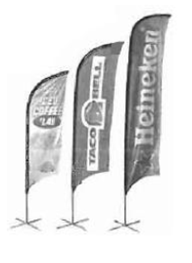
(t)
Election Season Signs. During an election season, as defined in this Article, temporary signs are allowed on an owner's private property in a number not exceeding the number of ballot issues and ballot candidates that will appear on a ballot of an election within the Town, provided:
(1)
Such signs shall not exceed six (6) square feet per face and shall comply with applicable height and setback restrictions in this Article.
(2)
Such signs shall be in addition to other temporary signs permitted under this Article.
(3)
The property owner upon whose land the sign is placed shall give written permission for the placement of said signs and will be responsible for violations.
(u)
Portable Human Signs. See sandwich boards.
(v)
Real Estate Signs. Temporary signs on an individual real estate parcel currently offered for sale, lease or rent, provided:
(1)
One (1) sign per street frontage not greater than eight (8) square feet in area in a residential district and thirty-two (32) square feet in area in nonresidential districts may be located on the offered property so long as said sign is located behind the street right-of-way line.
(2)
In addition to on-site real estate sign, a maximum of three (3) off-site signs, each not exceeding four (4) square feet in area, shall be permitted with permission of the owner of each such off-site location. Such signs must be placed outside all existing rights-of-way. All such temporary signs shall be removed within seven (7) days after the real estate closing or lease transaction for the subject parcel.
(3)
No sign allowed under this Subsection shall be lighted internally or externally.
(w)
Sandwich Board. Sandwich board signs (A-frame, sidewalk signs, notice signs, portable human signs), provided:
(1)
Maximum size is twelve (12) square feet per side.
(2)
Maximum height is five (5) feet.
(3)
Placed on sidewalk only during hours of operation.
(4)
Minimum separation of fifteen (15) feet between signs.
(5)
Sign location must not interfere with or block pedestrian or vehicular traffic.
(6)
Sign must be anchored to ground or weighted sufficiently to prevent movement by force of wind.
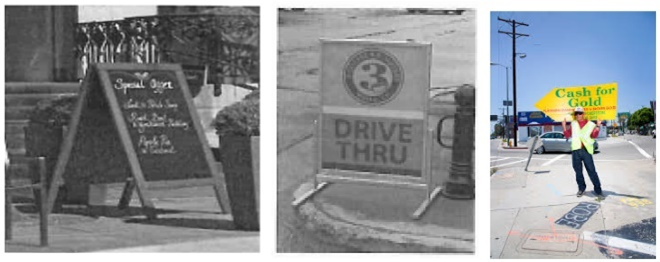
(x)
Athletic Fields Signs. Signs, not exceeding forty-eight (48) square feet and oriented to be visible to athletes and spectators at athletic fields.
(y)
Sidewalk Signs. See sandwich board signs.
(z)
Special Events. Temporary signs and banners on property where a noncommercial special event, occurs provided that:
(1)
Signs and banners shall be erected no sooner than thirty (30) days prior and removed no later than seven (7) days after the event.
(2)
No such sign or banner shall exceed thirty-two (32) square feet per face.
(3)
No such sign or banner shall be illuminated.
(4)
All such signs and banners shall be located off the street right-of-way, unless otherwise granted permission for such location by the Town or the Colorado Department of Transportation (CDOT). In no case may any such sign or banner impede the view or travel of any motorists or pedestrians or be attached to any structure within the right-of-way (government signs, telephone poles, etc.).
(aa)
Text. No permit shall be required for text or copy changes on conforming or legal nonconforming signs specifically designed to permit changes of the text or copy, provided that no structural changes are made to the sign.
(bb)
Traffic Control Devices and Government Signs. Traffic control devices and government signs.
(cc)
Vehicular Sales Signs. Signs on motor vehicles currently offered for sale provided there is only one (1) sign per vehicle, the sign does not exceed two (2) square feet.
(dd)
Vehicular Signs. Except as prohibited in Section 16-3-625, signs displayed on trucks, buses, trailers, or other motor vehicles which are regularly operated, provided the primary use of such vehicles is not the display of commercial signs.
(ee)
Vending Machine Signs. A sign permit shall not be required for a sign on a vending machine, provided that the sign does not extend beyond machine surface to which it is attached, advertisement upon the vending machine sign is limited to the product vended.
Sec. 16-3-625. - Prohibited Signs.
The following signs are inconsistent with the purposes and standards in this Article and are prohibited in all zoning districts:
(a)
Distracting Signs.
(1)
Flashing, rotating, blinking, or moving signs, animated signs, signs with moving, rotating, or flashing lights or signs that create the illusion of movement.
(2)
Signs with optical illusion of movement by means of a design that presents a pattern capable of reversible perspective, giving the illusion of motion or changing of copy.
(3)
Signs with mechanical or electrical appurtenances, such as "revolving beacons" and portable spotlights.
(4)
Rotating signs.
(5)
Searchlights.
(6)
Electronic message boards except government signs and school signs.
(7)
Roof signs and all other signs that project above the main roofline of a building.
(b)
Visual Obstructions.
(1)
Any sign that is erected in such a location as to cause visual obstruction or interference with motor vehicle traffic, pedestrian traffic, or traffic-control devices, including any sign that obstructs clear vision in any direction from any street intersection or driveway.
(2)
Any sign located in such a way as to substantially deny an adjoining property owner visual access to an existing sign.
(c)
Right-of-Way Signs.
(d)
Any sign other than traffic control devices erected, constructed, or maintained within, over or upon the right-of-way of any public road, street, or highway, except in the case of a sign for which a permit has been issued in accordance with the requirements of this Article.
(e)
Off-Premises Signs. Off-premises signs also known as off-site signs, except as this Article specifically permits.
(f)
Unsafe Signs.
(1)
Any sign which interferes with free passage from or obstructs any fire escape, downspout, window, door, stairway, ladder or opening intended as a means of ingress or egress or providing light or air.
(2)
Any sign or sign structure which:
a.
Is structurally unsafe;
b.
Constitutes a hazard to safety or health by reason of inadequate maintenance or dilapidation;
c.
Is not kept in good repair;
d.
Is not designed or constructed in a professional manner;
e.
Is capable of causing electrical shocks to persons likely to come in contact with it; or
f.
Presents a danger to the health, safety or welfare of the Town or its citizens.
(g)
Portable Signs.
(1)
Portable signs or signs not permanently affixed or attached to the ground or to any structure, except for real estate signs attached to posts driven into the ground, window signs and temporary barriers except as permitted in Section 16-3-615 above.
(2)
Vehicle-mounted commercial signs, including but not limited to signs painted on or attached to semi-trailers or cargo containers, when exhibited on private property adjacent to public right-of-way and advertising business or services offered on the property. Vehicle-mounted commercial signs on property used for special events are exempt from the requirements of this Section during the special event only. Upon the conclusion of the special event, such signs must be dismantled.
(h)
Inflatable freestanding signs or tethered balloons, except on a property during sales or special events on the property but not more than five (5) days per month.
(i)
Discontinued Commercial Use Signs. Whenever a business, industry, service, or other commercial use is discontinued, all signs advertising the discontinued use shall be removed or obscured within ninety (90) days after the discontinuance of such use. Signs advertising discontinued commercial uses are misleading, unnecessarily contribute to visual clutter, and can obstruct views and distract motorists.
(j)
Billboards. A permanent sign structure in a fixed location which meets anyone (1) or more of the following criteria:
(1)
It is used for the display of off-site commercial messages;
(2)
The message display area, or any part thereof, is made available to message sponsors other than the owner(s) or operator(s) of the sign, typically for a fee or other consideration, i.e., general advertising for hire;
(3)
The sign is a principal or secondary use of the land, rather than an appurtenant, accessory, or auxiliary use serving some other principal use of the land.
Sec. 16-3-630. - Measurement of Sign Area and Height.
(a)
Sign Surface Area. The area of a geometric shape enclosing any message, logo, symbol, name, photograph, or display face shall be measured using standard mathematical formulas. Regular geometric shapes shall include, but not be limited to, squares, rectangles, triangles, parallelograms, circles, ellipses, or combinations thereof. The total measured area of a sign shall include the area of all writing, representation, lines, emblems, or figures contained within all modules, together with any air space, material or color forming an integral part or background of the display if used to differentiate such sign from the backdrop or structure against which it is placed. The total surface area of all sign faces shall be counted and considered to be part of the maximum total sign area allowance.
(b)
Sign Support. Supporting framework or bracing that is clearly incidental to the display itself shall not be computed as sign area.
Back-to-Back (Double-Faced) Signs. Back-to-back signs shall be regarded as a single sign only if mounted on a single structure, and the distance between each sign face does not exceed two (2) feet at any point.
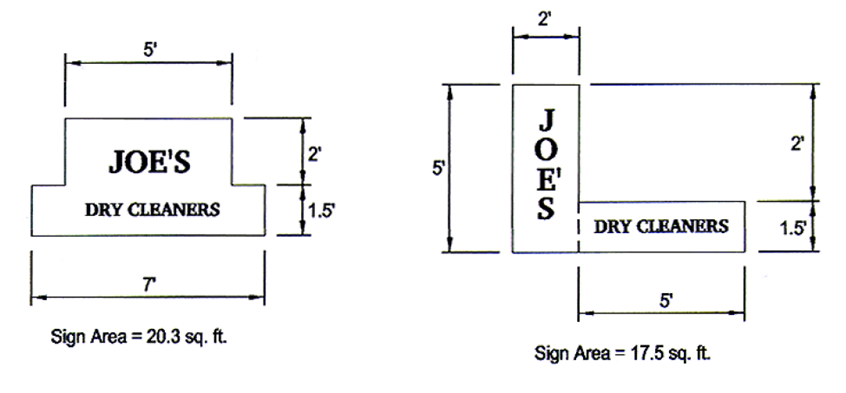
Figure 16-3-3-11: Sign Area Measurement
(c)
Three-Dimensional Signs. Where a sign consists of one (1) or more three-dimensional objects (i.e., balls, cubes, clusters of objects, sculpture), the sign area shall be measured as their maximum projection upon a vertical plane. Signs with three-dimensional objects that exceed a projection of six (6) inches from the sign face may be approved in compliance with Section 16-3-665 "Substitution" below.
(d)
Wall Signs. If a sign is attached to a wall, only that portion of the wall onto which the sign face or letters are placed shall be calculated in the sign area.
(e)
Sign Height. The height of a sign shall be measured from the highest point of a sign to the ground surface beneath it. The ground surface shall mean the average grade within five (5) feet of the base. When berms are used in conjunction with signage or there are significant changes in grade, the height of the sign shall be measured from the mean elevation of the fronting street.
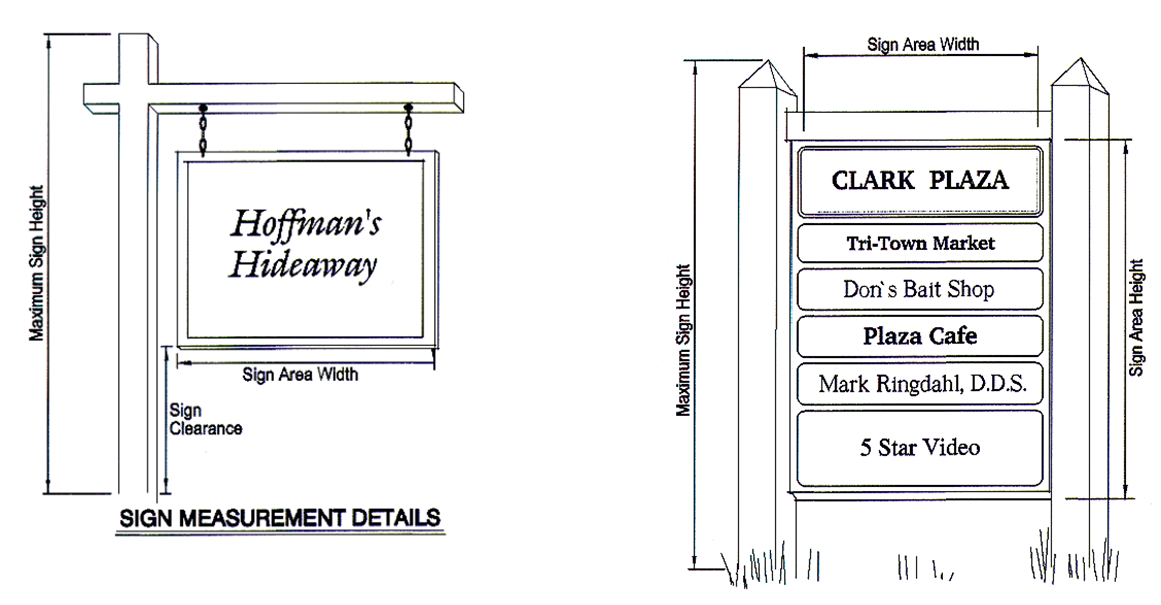
Figure 16-3-3-12: Sign Height
Sec. 16-3-635. - Sign Design.
(a)
Sign Location and Placement.
(1)
Visibility. Signs should not visually obscure architectural features. The following illustrations are examples of design that the Town is encouraging.
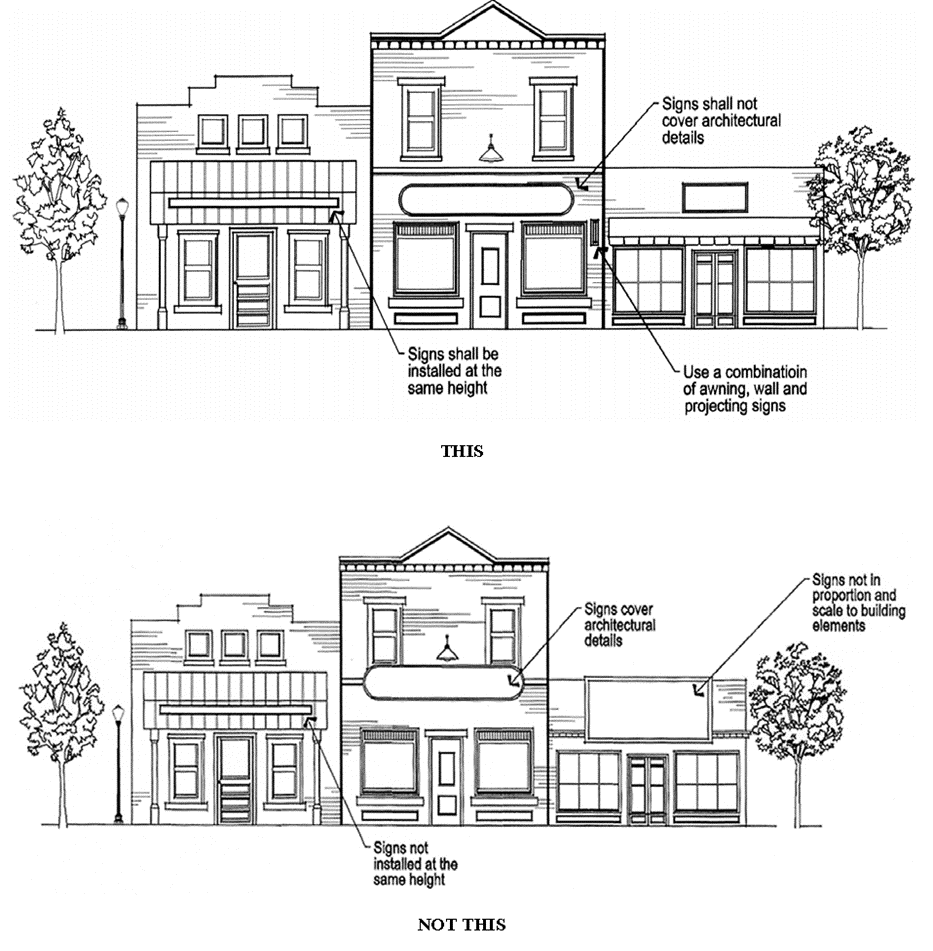
Figure 16-3-3-13 Visibility
(2)
Integrate signs with the building and landscaping — Signs should be carefully coordinated with the architectural design, overall color scheme and landscaping. Signs should be designed to complement or enhance the other signs for a building.
(3)
Unified sign band — Whenever possible, signs located on buildings with the same block-face should be placed at the same height, in order to create a unified sign band. Wall signs should be located at the first-floor level only for retail commercial uses.
(4)
Monument signs — Monument signs should be located in a planter setting within a landscaped area at the primary entries to residential, commercial, and industrial subdivisions to provide an overall project identity. A maximum of one (1) monument sign per entry shall be permitted.
(5)
Pedestrian-oriented signs — Pedestrian-oriented signs are encouraged. It is desirable to include a pedestrian-oriented sign as one (1) of the signs for a business. These signs should be designed for and physically directed toward pedestrians so they can easily and comfortably read the sign as they stand adjacent to the business.
(6)
Road right-of-way — No sign shall be erected within the road right-of-way or near the intersection of any roads or driveways in such a manner as to obstruct free and clear vision of motorists or pedestrians or at any location where, by reason of the position, shape or color, it may interfere with, obstruct the view of or be confused with any authorized traffic sign, signal or device.
(b)
Landscaping. Freestanding signs shall be landscaped at their base in a way harmonious with the landscape concept for the whole site. Landscaping shall form an attractive, dense cluster at the base of the sign that is equally attractive in winter and summer.
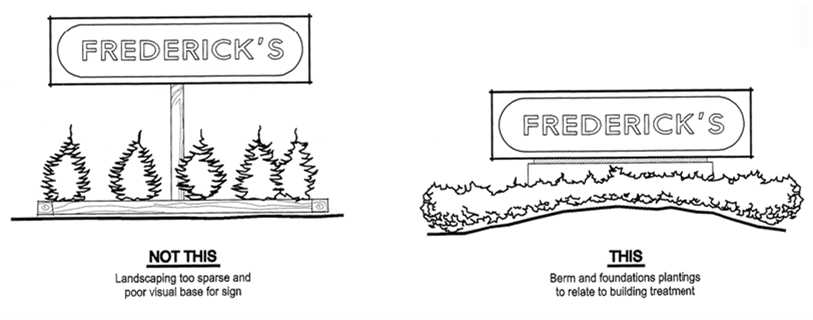
Figure 16-3-3-14 Landscaping
(c)
Reduce Sign Impact. Because residential and commercial uses generally exist in close proximity, signs shall be designed and located so that they have little or no impact on adjacent residential neighborhoods. Small-scale signs are encouraged.
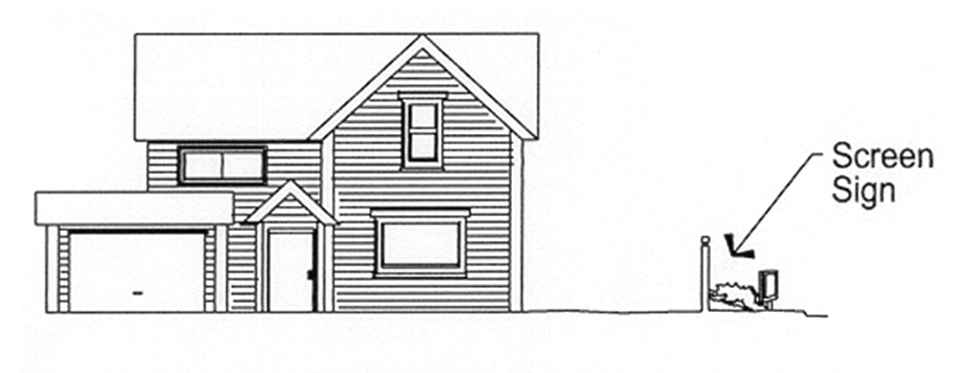
Figure 16-3-3-15: Sign Impact
(d)
Color.
(1)
Select Colors Carefully. Colors shall be selected to contribute to legibility and design integrity. Sign colors shall complement the colors used on the structures and the project as a whole. Colors or combinations of colors that are harsh and disrupt the visual harmony and order of the street are unacceptable.
(2)
Use Contrasting Colors. Signs shall provide a substantial contrast between the color and the material of the background and the letters or symbols to make the sign easier to read during both the day and night. Light letters on a dark background or dark letters on a light background are most legible.
(3)
Avoid Using Too Many Colors. Colors or color combinations that interfere with legibility of the sign copy or that interfere with viewer identification of other signs shall be avoided.
(e)
Materials. Signs shall be constructed of durable, high quality architectural materials. The sign package must use materials, colors, and designs that are compatible with the building façade. Sign materials must be of proven durability. Treated wood, painted metal, stone, brick, and stucco are the preferred materials for signs.
(f)
Legibility. Signs shall be adequately legible under the circumstances in which they are primarily seen. The legibility of signs is related to:
(1)
The speed at which they are viewed;
(2)
The context and surroundings in which they are seen; and
(3)
The design, colors and contrast of the sign copy and sign face.
(4)
The design of the sign including copy, lettering size and style and colors shall logically relate to the average speed of the traffic which will see it. Signs shall legibly convey their messages without being distracting or unsafe to motorists reading them. Symbols and logos can be used in place of words whenever appropriate.
Sec. 16-3-640. - Sign Illumination.
(a)
Signs shall have illumination only if necessary.
(b)
Sign illumination shall complement, not overpower, the overall composition of the site.
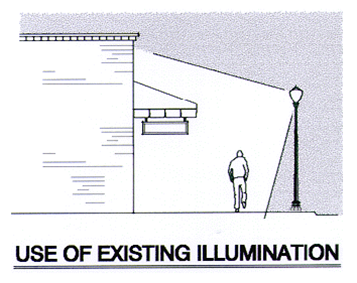
Figure 16-3-3-15.1: Existing Illumination
(c)
Use a direct light source. All lighted signs shall have their lighting directed in such a manner as to illuminate only the face of the sign. When external light sources are directed at the sign surface, the light source must be concealed from pedestrians' and motorists' "lines of sight."
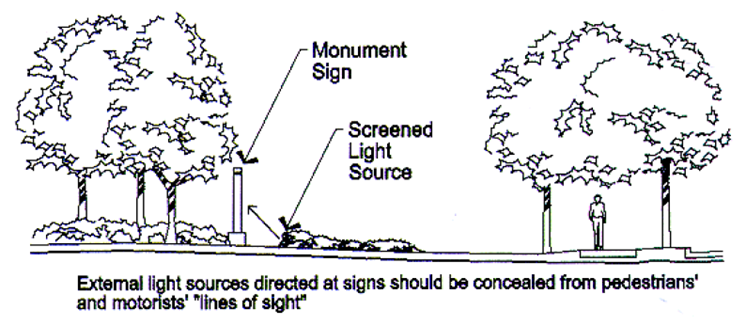
Figure 16-3-3-16: Direct Light Source
(d)
Signs must be illuminated in a way that does not cause glare onto the street and adjacent properties. Signs shall be lighted only to the intensity level of more than 0.3 foot-candles over ambient light as measured at a distance of one hundred fifty (150) feet and shall be equipped with a fully operational light sensor that automatically adjusts the intensity of the lighting according to the amount of ambient light;
(e)
Every electric sign shall have affixed thereon an approved Underwriters' Laboratories label. All lighted signs shall meet all applicable electrical codes and the electrical components used shall bear the label of an approval agency. Additionally, electrical permits shall be obtained for electric signs.
(f)
Flashing, moving, blinking, chasing or other animation effects shall be prohibited on all signs.
(g)
Neon tubing is an acceptable method of sign illumination for window signs in commercial districts.
(h)
The use of individually cut backlit letter signs is encouraged.
(i)
Lighting behind sign faces may only illuminate the symbol or message through a translucent material; the rest of the sign shall be opaque.
(j)
No commercial sign within three hundred (300) linear feet of any property which contains an existing or approved residential use or is zoned for residential use, may be illuminated between the hours of 11:00 p.m. and 6:00 a.m. This time limitation shall not apply to any lighting which is used primarily for the protection of the premises or for safety purposes or any signage which is separated from a residential use by an arterial street. For purposes of this Subsection, the term approved shall mean having final plat approval.
Sec. 16-3-645. - Sign Installation and Maintenance.
(a)
Installation.
(1)
All signs shall be mounted so that the method of installation is concealed to the maximum extent possible.
(2)
Projecting signs shall be mounted so they generally align with others in the block.
(3)
All signs and all components thereof, including sign structures and sign faces, shall be kept neatly painted, in a good state of repair and in compliance with all building and electrical codes. The Town may inspect any sign governed by this Article and shall have the authority to order the painting, repair, alteration, or removal of a sign which constitutes a hazard to safety, health, or public welfare by reason of inadequate maintenance, dilapidation, or obsolescence.
(4)
Owners of projecting signs extending over public right-of-way shall be required to maintain public liability insurance in an amount to be determined appropriate by the Town, in which the Town is named as an "other insured."
(b)
Maintenance.
(1)
The owner of a sign and the owner of the premises on which such sign is located shall be jointly and severally liable to maintain such sign, including any illumination sources, in neat and orderly condition and in a good working order at all times, and to prevent the development of any rust, corrosion, rotting or other deterioration in the physical appearance or safety of such sign. The sign must also be in compliance with all building and electrical codes.
(2)
The owner of any sign regulated by this Article shall be required to keep signs and supporting hardware, including temporary signs, structurally safe, clean, free of visible defects and functioning properly at all times. Repairs to signs shall be equal to or better in quality of materials and design than the original sign.
(3)
The Town may inspect any sign governed by this Article and shall have the authority to order the painting, repair, alteration, or removal of a sign which constitutes a hazard to safety, health or public welfare by reason of inadequate maintenance, dilapidation or obsolescence.
Sec. 16-3-650. - Standards for Specific Sign Structures.
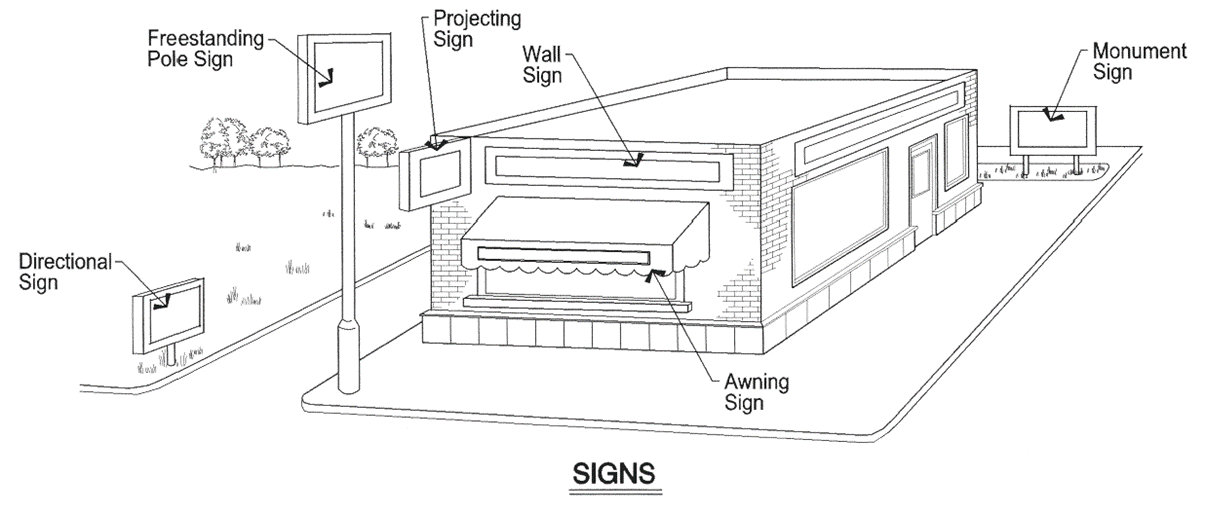
Figure 16-3-3-17: Specific Sign Standards
(a)
Awning Signs.
Example of Awning Sign
(1)
Location. Signs may be placed only on awnings that are located on first story building frontages, including those fronting a parking lot or pedestrian way. No awning sign shall project beyond, above or below the face of an awning.
(2)
Maximum area and height. No structural element of an awning shall be located less than eight (8) feet above finished grade. Awnings on which awning signs are mounted may extend over a public right-of-way no more than seven (7) feet from the face of a supporting building. No awning, with or without signage, shall extend above the roofline of any building.
(3)
Maximum signage. The amount of signage on an awning shall be limited to the lesser of thirty-five (35) square feet per individual tenant space or twenty-five (25%) percent of the total area of the awning. Awning signs shall not be allowed above the first story of a building.
(b)
Canopy Signs.
Examples of Canopy Signs
(1)
Maximum area and height. Sign area shall comply with the requirements established by Section 16-3-660 "Sign standards by zoning district" below. No canopy, with or without signage, shall extend above the roofline of any building. No canopy sign shall project above the top of the canopy upon which it is mounted. However, such signs may project horizontally from the face of a canopy the distance necessary to accommodate the letter thickness and required electrical equipment but not more than twelve (12) inches (measured from the bottom of the sign). Under-canopy signs, which are perpendicular to the face of the building, shall be deemed to be projecting wall signs. Under-canopy signs that are parallel to the face of the building shall be a minimum of eight (8) feet above grade and shall be deemed to be flush wall signs.
(c)
Freestanding Signs.
Example of Freestanding Sign
(1)
Location. The sign may be located only on a site frontage adjoining a public street.
a.
When a freestanding sign is placed on a lot with two (2) or more street frontages, such sign shall be said to be adjacent to a particular street frontage when it is located closer to that street frontage than any other street frontage.
b.
If a lot has more than one (1) street frontage, the freestanding sign permitted for each frontage must be located adjacent to the street frontage that is the basis for the allotment of such sign.
c.
No freestanding sign shall be built within fifteen (15) feet of any interior side lot line. The minimum horizontal distance between freestanding or monument signs located on the same lot shall be seventy-five (75) feet.
d.
The sign face of a single face sign must be most nearly parallel to the street frontage to which it is adjacent. The sign faces of a multifaced sign must be most nearly perpendicular to the street frontage to which they are adjacent.
(2)
Setback. The setback of any freestanding sign shall be measured from the street right-of-way line of the street frontage that is the basis for the allotment of such sign. Any such setback shall be measured perpendicularly from the street right-of-way line to the nearest portion of the sign face or structure.
(3)
Maximum Number of Signs. No more than one (1) freestanding or monument sign per street frontage shall be permitted for any property. A drive-in restaurant, when located on a lot with frontage on only one (1) street, shall be permitted one (1) additional freestanding or monument sign. Such sign shall not exceed five (5) feet in height, thirty-five (35) square feet in area and shall be limited to one (1) face. Fifty percent (50%) of the square footage of such sign shall be exempted from the total allowed for the property.
(4)
Maximum Area and Height. The sign shall comply with the height and area requirements established in Section 16-3-665 "Sign standards by zoning district" below.
a.
The maximum size for freestanding signs shall be one and one-half (1½) square feet for everyone (1) linear foot of building frontage. In no event shall the cumulative total allowable sign area exceed one hundred fifty (150) square feet per business.
b.
The maximum height for freestanding signs shall be eighteen (18) feet above grade in accordance with the setbacks below.
(5)
Electrical service. When electrical service is provided to freestanding signs or monument signs, all such electrical service shall be underground.
(6)
Supporting structure materials. All supporting structures of monument signs shall be of the same or similar materials or colors of the associated buildings which house the businesses or activities advertised on the sign.
(7)
Sign mounting. The sign shall be mounted on one (1) or more posts or have a solid monument-type base. Posts shall not have a diameter greater than twelve (12) inches.
(8)
Sign pole signs. Pole signs should not be so large as to obscure the patterns of front façades and yards.
(9)
Intersection site distance triangle. This requirement applies to freestanding and monument signs.
a.
Monument signs which exceed forty-two (42) inches in height, and freestanding signs which do not maintain free air space between a height of forty-two (42) inches and seventy-two (72) inches above the adjacent street elevation. A freestanding sign shall not be construed to have free air space if such sign has a base the width of which exceeds fifty percent (50%) of the width of its face or three (3) feet, whichever is smaller. In addition, freestanding and monument signs shall not be located closer to the right-of-way line than allowed in the tables below that apply to such signs.
(d)
Monument Signs.
Example of Monument Sign
(1)
Location. The sign may be located only along a site frontage adjoining a public street. The sign may not be located in the site distance triangle (refer to Subparagraphs 16-3-660(c)(9) "Site distance triangle" above for details).
(2)
Design. The design of a monument sign should be consistent with the overall scale of the building. The design and placement of the sign shall not obstruct traffic safety sight distance areas.
(3)
Landscaping requirements. Landscaping shall be provided at the base of the supporting structure equal to twice the area of one (1) face of the sign and supporting structure. For example, twenty (20) square feet of sign area equals forty (40) square feet of landscaped area. The Planning Commission may reduce or waive this requirement if it is determined that the additional landscaping would not contribute significantly to the overall aesthetic character of the project.
(4)
Setback. The setback of any freestanding sign shall be measured from the street right-of-way line of the street frontage that is the basis for the allotment of such sign. Any such setback shall be measured perpendicularly from the street right-of-way line to the nearest portion of the sign face or structure.
(5)
Maximum number of signs. No more than one (1) freestanding or monument sign per street frontage shall be permitted for any property. A drive-in restaurant, when located on a lot with frontage on only one (1) street, shall be permitted one (1) additional freestanding or ground sign. Such sign shall not exceed five (5) feet in height, thirty-five (35) square feet in area and shall be limited to one (1) face. Fifty percent (50%) of the square footage of such sign shall be exempted from the total allowed for the property.
(6)
Maximum area and height. The sign shall comply with the height and area requirements below.
(e)
Projecting Signs.
Example of Projecting Sign
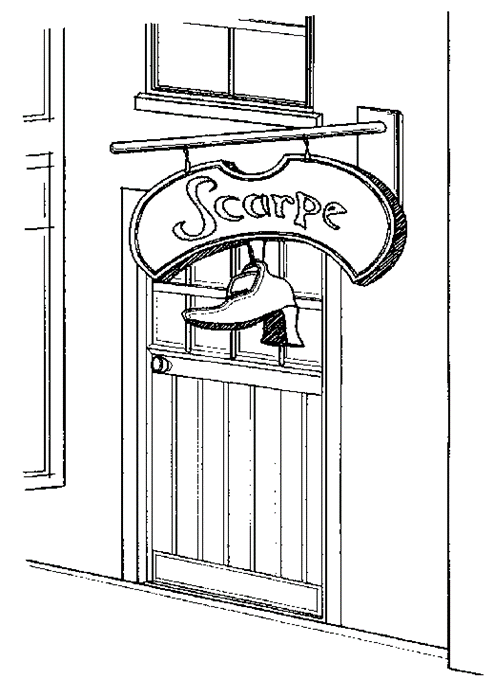
(1)
Location. Projecting signs shall be placed only on a ground floor façade, except for businesses located above the ground level with direct exterior pedestrian access. Mount projecting signs so they generally align with others in the block. This helps to create a "canopy line" that gives scale to the sidewalk.
(2)
Maximum area and height. Projecting signs shall not be higher than the wall from which the sign projects if attached to a single-story building or the height of the bottom of any second-story window if attached to a multistory building. Projecting signs must have eight (8) feet clearance and may not extend more than four (4) feet from the building wall, except where the sign is an integral part of an approved canopy or awning. The size of projecting signs is limited to sixteen (16) square feet.
(3)
Sign structure. Sign supports and brackets shall be compatible with the design and scale of the sign.
(4)
Quantity. The number of projecting signs is limited to one (1) per business tenant, to a maximum of two (2). Projecting signs are not permitted in conjunction with pole signs.
(f)
Wall Signs.
Example of a Wall Sign
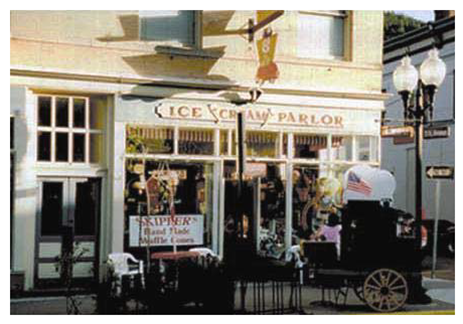
(1)
Location. The sign shall not be placed to obstruct any portion of a window, doorway, or other architectural detail. Locate wall signs on buildings at the first-floor level only for retail uses. No part of a wall sign shall be located more than twenty-five (25) feet above grade level.
(2)
Maximum Area and Height. Wall signs shall not be higher than the eave line of the principal building. Wall signs shall not exceed one (1) square foot per linear foot of building frontage at ground level and three-quarters (¾) square foot per linear foot of second-story building frontage. The sign shall comply with the height and area requirements established in Section 16-3-660 "Sign standards by zoning district" below.
(3)
Projection From Wall. No sign part, including cut-out letters, may project from the surface upon which it is attached more than required for construction purposes. Single-sided wall signs allowed when suspended from front porch.
(g)
Window Signs. A window sign is a sign that is painted on, applied, or attached to a window or that can be read through the window from the public right-of-way, placed at or below the second-floor level.
(1)
Maximum area. When a sign is displayed in a window and is visible beyond the boundaries of the lot upon which the sign is displayed, the total area of such sign shall not exceed forty percent (40%) of the window or door area at the ground floor level; and forty percent (40%) of the total allowable sign area for the premises.
(2)
Lighting. All illuminated window signs shall be included in the total allowable sign area for the premises. Temporary posters announcing or advertising events sponsored by noncommercial organizations shall be exempt from limitations for window signs.
Sec. 16-3-655. - Sign Standards by Zoning District.
(a)
Residential Zones. Signs for uses within residential zones, including A, AE, CD, E-1, R-1, R-2, R-3, R-M, R-MH, or for any residential use in a mixed-use district shall be limited to the following:
Residential Zone Sign Standards
(b)
Nonresidential Zones. Signs for uses within nonresidential zones, including C-1, C-2, C-3, C-4, I-1, I-2 or I-3, or for any institutional/civic/public, business, commercial or industrial use in a mixed-use district shall be limited to the following:
(1)
Total Allowable Sign Area. The total area of all signs on a lot or, in the case of a permitted use or uses occupying two (2) or more adjacent lots, the total area of all signs on all such adjacent lots shall not exceed one and one-half (1½) square feet per linear foot of building frontage at ground level and three-quarters (¾) square foot per linear foot of second-story building frontage. In no event, however, shall the cumulative total allowable sign area exceed one hundred fifty (150) square feet per business.
Nonresidential Zone Sign Standards
Sec. 16-3-660. - Substitution.
Subject to the landowner's consent, a non-commercial message of any type may be substituted for any duly permitted or allowed commercial message or any duly permitted or allowed non-commercial message; provided, that the sign structure or mounting device is legal without consideration of message content. Such substitution of message may be made without any additional approval or permitting. This provision prevails over any more specific provision to the contrary within this Article. The purpose of this provision is to prevent any inadvertent favoring of commercial speech over non-commercial speech or favoring of any particular non-commercial message over any other non-commercial message. This provision does not create a right to increase the total amount of signage on a parcel, nor does it affect the requirement that a sign structure or mounting device be properly permitted.

