
Mineral Wells City Zoning Code
ARTICLE 6
- SUPPLEMENTAL DISTRICT REGULATIONS
Section 6-1. - Site plan requirements.
A.
GENERALLY: Whenever a site plan is required by this ordinance, such site plan must conform to the requirements of this section. Site plans shall be reviewed by the administrative official, and comments shall be returned after the review by the administrative official. The submittal date of the site plan shall be the date upon which the site plan is found to be in compliance with the provisions of the site plan application by the administrative official.
B.
REQUIRED PRIOR TO BUILDING PERMIT: When required by this ordinance, a site plan must be approved prior to the issuance of a building permit by the city.
C.
CHANGES TO THE SITE PLAN:
1.
In general, changes to the site plan shall be processed in the same manner as the original approved site plan except as provided in subsection 2. and 3. below.
2.
Changes to the site plan which will affect the use of the land may require either an amendment to a planned development or a rezoning of property, whichever applies.
3.
Changes of details within a site plan which do not alter the basic physical relationship of the property to adjacent properties; do not alter the use permitted; and do not increase the density, floor area, height, or reduce the yards provided at the boundary of the site as indicated on the approved site plan, may be authorized by the administrative official. An aggrieved party may appeal the decision of the administrative official to the board of adjustment in accordance with the provisions of this ordinance.
D.
COUNCIL APPROVAL: Council approval of a site plan which is required by a SUP shall become part of the amending ordinance.
E.
SITE PLAN CONTENT: The site plan shall contain the information listed below, and any or all of the required features may be incorporated on a single drawing if the drawing is clear and capable of evaluation by the city council and the staff personnel required to enforce and interpret this ordinance.
1.
The boundary lines and dimensions of the property, existing subdivision lots, available utilities, fire hydrants, easements, roadways, sidewalks, emergency access easements, and public rights-of-way.
2.
Topography of the property proposed for development in contours of not less than two feet, together with any proposed grade elevations, if different from existing elevations.
3.
Flood plains, water courses, marshes, drainage areas, and other significant environmental features including, but not limited to, rock outcroppings and major tree groupings.
4.
The location and use of all existing and proposed buildings or structures, including all refuse storage areas, and the minimum distance between buildings. Where building complexes are proposed, the location of each building and the minimum distances between buildings, and between buildings and the property line, street line, and/or alley.
5.
Total number, location, and arrangement of off-street parking and loading spaces, where required.
6.
All points of vehicular ingress, egress, and circulation within the property and all special traffic regulation facilities proposed or required to assure the safe function of the circulation plan.
7.
Setbacks, lot coverage, and when relevant, the relationship of the setbacks provided and the height of any existing or proposed building or structure.
8.
The location, size, and arrangement of all outdoor signs, exterior auditory speakers, and lighting.
9.
The type, location, and quantity of all plant material used for landscaping, and the type, location, and height of fences or screening and the plantings around them.
10.
If multiple types of land uses are proposed, a delineation of the specific areas to be devoted to the various land uses.
11.
Vicinity map, north point, scale, name of development, name of owner, name of preparer, total acreage of project, and street address or common description of the property.
12.
Current land uses and zoning district of the property and current land uses and zoning districts of contiguous properties.
13.
Buildings on the exterior of the site and within 25 feet of all property lines.
14.
The location and size of existing and proposed surface and subsurface drainage facilities, including culverts, drains, and detention ponds, showing size and direction of flow.
15.
The number of square feet of the property after construction which will constitute impervious area or impervious surface and vegetated areas.
16.
Architectural drawings, such as elevations, concept sketches or renderings depicting building types and other significant proposed improvements including the treatment and use of open spaces, etc., where the submission of such drawings would more clearly portray the nature and character of the applicant's land use and development proposals.
17.
Legal description of the total site area proposed for rezoning, development or specific use permit.
18.
The submission date, signature and title of the applicant, at the conclusion of the written documents certifying the information presented in the plans, and supporting documents reflect a reasonably accurate portrayal of the general nature and character of the applicant's proposals.
19.
A development timetable if development is to be in phases.
20.
The percentage of the site that will be covered by buildings and structures.
Section 6-2. - Specific use permits.
A.
PURPOSE: The purpose of the specific use procedure is to allow for review of uses which would not be appropriate generally without certain restrictions throughout a zoning district, but which if controlled as to number, area, location or relation to the neighborhood would promote the health, safety and welfare of the community. Such uses include colleges and universities, institutions, community facilities, zoos, cemeteries, country clubs, show grounds, drive-in theaters and other land uses as specifically provided for in this ordinance. To provide for the proper handling and location of such specific uses, provision is made for amending this ordinance to grant a permit for a specific use in a specific location. This procedure for approval of a specific use permit includes public hearings before the planning and zoning commission and the city council. The amending ordinance may provide for certain restrictions and standards for operation. The indication that it is possible to grant a specific use permit as noted elsewhere in this ordinance does not constitute a grant of privilege for such use, nor is there any obligation to approve a specific use permit unless it is the finding of the planning and zoning commission and city council that such a specific use is compatible with adjacent property use and consistent with the character of the neighborhood.
B.
PERMIT REQUIRED: No specific use shall be erected, used, altered, occupied nor shall any person convert any land, building or structure to such a use unless a specific use permit has been issued by the city council. The granting of a specific use permit shall be done with notice and public hearings in accordance with the provisions for amendment of this zoning ordinance.
C.
APPLICATION PROCEDURE: An application for a specific use permit shall be filed with the administrative official on a form prepared by the city. The application shall be accompanied by the following:
1.
A completed application form signed by the property owner;
2.
An application fee as established by the city's latest adopted schedule of fees;
3.
A property description of the area where the specific use permit is proposed to apply;
4.
A site plan complying with the requirements stated in this section which will become a part of the specific use permit, if approved; and
5.
Any other material and/or information as may be required by the planning and zoning commission, the city council or the administrative official to fulfill the purpose of this subsection and to ensure that the application is in compliance with the ordinances of the city.
D.
SITE PLAN INFORMATION: A site plan shall contain, at a minimum the information required by section 6-1, site plan requirements.
E.
ADDITIONAL INFORMATION: The following additional information may also be required if deemed appropriate by the administrative official, the planning and zoning commission, or city council.
1.
Copies of studies or analyses showing the need or demand for the proposed facility.
2.
Description of the present use, assessed value and actual value of the land affected by the proposed facility.
3.
Description of the proposed use, anticipated assessed value and supporting documentation.
4.
A description of any long-term plans or master plan for the future use or development of the property.
5.
A description of the applicant's ability to obtain needed easements to serve the proposed use.
6.
A description of any special construction requirements that may be necessary for any construction or development on the subject property.
7.
A traffic impact analysis and forecast prepared by a qualified professional.
F.
CONDITIONS OF PERMIT APPROVAL: A specific use permit shall not be recommended for approval by the planning and zoning commission unless the commission finds that all of the following conditions have been found to exist:
1.
The proposed use complies with all the requirements of the zoning district in which the property is located.
2.
The proposed use as located and configured will contribute to or promote the general welfare and convenience of the city.
3.
The benefits that the city gains from the proposed use outweigh the loss of or damage to any homes, businesses, natural resources, agricultural lands, historical or cultural landmarks or sites, wildlife habitats, parks, or natural, scenic, or historical features of significance, and outweigh the personal and economic cost of any disruption to the lives, business and property of individuals affected by the proposed use.
4.
Adequate utilities, road access, drainage and other necessary supporting facilities have been or shall be provided for the proposed use.
5.
The design, location and arrangement of all public and private streets, driveways, parking spaces, entrances and exits shall provide for the safe and convenient movement of vehicular and pedestrian traffic without adversely affecting the general public or adjacent developments.
6.
The issuance of the specific use permit does not impede the normal and orderly development and improvement of neighboring vacant property.
7.
The location, nature and height of buildings, structures, walls and fences are not out of scale with the neighborhood.
8.
The proposed use will be compatible with and not injurious to the use and enjoyment of neighboring property, nor significantly diminish or impair property values within the vicinity.
9.
Adequate nuisance prevention measures have been or shall be taken to prevent or control offensive odors, fumes, dust, noise, vibration and visual blight.
10.
Sufficient on-site lighting shall be provided for adequate safety of patrons, employees and property, and such lighting shall be adequately shielded or directed so as not to disturb or adversely affect neighboring properties.
11.
There shall be sufficient landscaping and screening to ensure harmony and compatibility with adjacent properties.
12.
The proposed operation is consistent with the applicant's submitted plans, master plans, projections, or, where inconsistencies exist, the benefits to the community outweigh the costs.
13.
The proposed use is in accordance with the City of Mineral Wells Comprehensive Land Use Plan.
G.
ADDITIONAL CONDITIONS: In authorizing a specific use permit, the planning and zoning commission may recommend, and the city council may impose, additional reasonable conditions necessary to protect the public interest and the welfare of the community.
H.
REVOCATION OF PERMIT: A specific use permit may be revoked or modified, after notice and hearing, for either of the following reasons:
1.
The permit was obtained or extended by fraud or deception.
2.
One or more of the conditions imposed by the permit has not been met or has been violated.
I.
AMENDMENTS TO SPECIFIC USE PERMIT: The procedure for amending a specific use permit shall be the same as for a new application, provided the administrative official may approve minor variations from the original permit which do not change the permitted land uses, increase density, change traffic patterns, or result in an increase in external impacts on adjacent properties or neighborhoods.
Section 6-3. - Accessory building regulations.
A.
PERMANENT ACCESSORY BUILDINGS—RESIDENTIAL: Permanent accessory buildings which are placed on a permanent foundation shall be allowed in residential zoning districts subject to the following regulations:
1.
Shall not exceed one story in height, including one private garage or servants quarters, when located not less than 60 feet from the front lot line, nor less than the distance required for the main building from any side lot line.
2.
Area: Not more than 50 percent of the rear yard area.
3.
In the SF-E, SF-9, and SF-6 districts, a detached garage shall provide space for not more than one motor vehicle for each 3,000 square feet of lot area.
4.
In the MD and MF districts, a detached garage shall provide space for not more than one motor vehicle for each 3,000 square feet of lot area.
5.
Setback requirements:
(a)
Front yard—Such buildings must be located behind the primary structure.
(b)
Side yard—Same as the primary structure.
(c)
Rear yard—Minimum of five feet.
6.
In the MF district, private garages, storage garages, or servants quarters may be constructed as part of the main building.
7.
Servants' quarters shall be occupied only by servants employed on the premises.
8.
In the SF-E, SF-9, SF-6 districts, the utility services to servants' quarters shall be metered through the same meters as those serving the main building on the premises.
9.
Separation: No separate accessory building shall be erected within five feet of any other building.
10.
Easements: No such building shall be located within or encroaching upon any utility or drainage easement.
11.
Use: Unless otherwise provided herein, such buildings may not be used for commercial purposes and may not be rented or inhabited.
12.
An accessory building may be constructed as a part of the main building, in which case the regulations controlling the main building shall apply.
13.
No accessory building will be permitted without a primary structure being located on the premises.
14.
Occupancy: No accessory building shall be placed or constructed on a lot until construction of the principal building has commenced, and no accessory building shall be occupied until the principal building is completed and is being used or occupied.
B.
TEMPORARY AND PORTABLE TYPE ACCESSORY BUILDINGS—RESIDENTIAL: Temporary and portable accessory buildings which are not placed on a permanent foundation shall be allowed in any residential district subject to the following regulations:
1.
Height: Maximum of 16 feet.
2.
Area: Maximum floor area of 336 square feet.
3.
Number allowed: Two per lot. Total area of accessory buildings shall not exceed 50 percent of the area behind the rear building face.
4.
Setback requirements:
(a)
Front yard—Such buildings must be located behind the primary structure.
(b)
Side yard—Minimum of five feet.
(c)
Rear yard—Minimum of five feet.
(d)
No building may be located closer than five feet from any side or rear property line; and no closer than five feet from the principal building, nor in a dedicated easement.
C.
PERMANENT ACCESSORY BUILDINGS—NONRESIDENTIAL: The following accessory building and use regulations shall apply only to property carrying a nonresidential classification:
1.
Height: Same as the primary structure.
2.
Setback requirements:
(a)
Front yard—Same as the primary structure.
(b)
Side yard—Same as the primary structure.
(c)
Rear yard—Same as the primary structure.
3.
Separation: No separate accessory building shall be erected within five feet of any accessory building or 15 feet from any primary structure
4.
Easements: No permanent accessory building shall be located within or encroach upon any utility or drainage easement.
5.
Use: Any permitted accessory use allowed in the district in which the accessory building is located.
6.
No accessory building will be permitted without a primary structure being located on the premises.
7.
All permanent accessory buildings, regardless of size, shall require a building permit.
C.
TEMPORARY USES AND PORTABLE TYPE ACCESSORY BUILDINGS—NONRESIDENTIAL: In all nonresidential zoning districts, temporary buildings which are not placed on a permanent foundation shall be permitted for construction purposes only, provided the building shall be removed upon completion or abandonment of construction work or removed upon request of the city manager or his designee. Permits shall be issued for temporary buildings on construction sites for a period of six months only, with a renewal clause for a similar period.
Section 6-4. - General height and yard requirements.
A.
NONRESIDENTIAL STRUCTURES:
1.
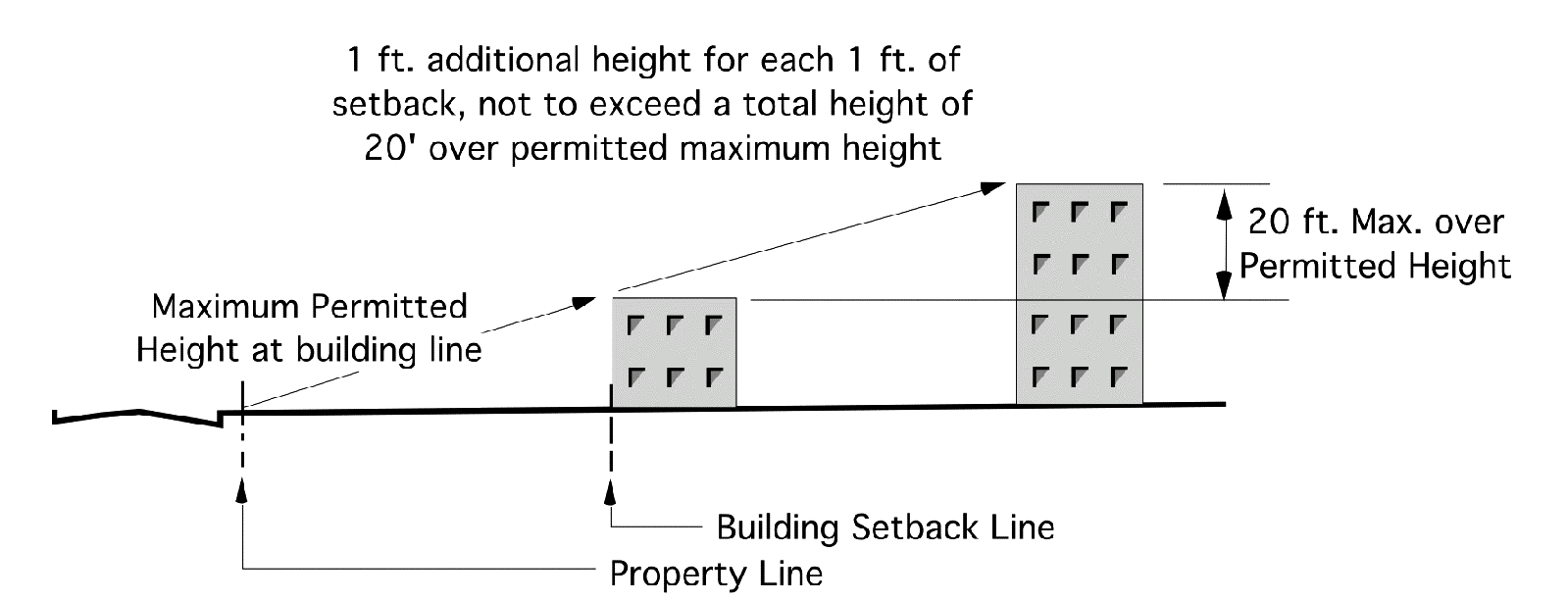
A nonresidential building may exceed the permitted height in a zoning district by 20 feet if the following conditions are met:
(a)
A site plan is provided; and
(b)
For every one foot exceeding the maximum permitted height, an additional one-foot of setback is provided on the front, side, and rear yards. The height of a building shall not exceed 20 feet over the maximum permitted height established in the zoning district.
(c)
A building may exceed the height described in item (b) above only upon approval of a special exception by the board of adjustment.
B.
EXCEPTIONS: Height regulations do not apply to steeples, domes, cupolas, or other architectural design elements usually required to be placed above the roof level and not intended for human occupancy.
C.
ANTENNAS: For antenna and tower height regulations see section 6-10, wireless communication facilities.
D.
PUBLIC, QUASI-PUBLIC BUILDINGS: Churches, schools and other public and quasi-public buildings may be erected to a height not to exceed 60 feet or five stories provided the required front, side and rear yards are each increased at least one foot for each foot of additional height above the height required by this ordinance.
E.
GENERAL YARD REQUIREMENTS: The following general requirements provide additional criteria which apply to yard requirements in all zoning districts.
1.
Depth of front yard: Depth of front yards shall be measured at right angles to a straight line joining the foremost points of the side lot lines. The foremost point of the side lot line, in the case of rounded property corners at street intersections, shall be assumed to be the point at which the side and front lot lines would have met without such rounding. Front and rear yard lines shall be approximately parallel.
2.
Front yard on through lots: Unless the prevailing front yard pattern on adjoining lots indicates otherwise, front yards shall be provided on all frontages of through lots. On occasion where one of the front yards that would normally be required on a through lot is not in keeping with the prevailing yard pattern, the administrative official shall waive the requirement for the normal front yard and substitute therefore a special yard requirement which shall not exceed the average of the yards provided on adjacent lots.
3.
Width of side yard: Side yard width shall be measured in such a manner that the yard established is measured from the nearest side wall surface to the side property line.
4.
Depth of rear yard: Rear yard depth shall be measured in such a manner that the yard established is measured from the nearest rear wall surface to the rear property line.
5.
Corner lots with three or more frontages: On corner lots with more than two frontages, the administrative official shall determine the front yard requirements subject to the following limitations:
a.
At least one front yard shall be provided having the full depth required generally in the district.
b.
No other front yard on such lot shall have less than half the full depth required generally.
6.
Reversed frontage lots: A front yard of the required depth shall be provided on either frontage of a reversed frontage lot, and a second front yard of half the depth required generally for front yards in the district shall be provided on the other frontage.
7.
Special yards: In those cases in which the above general rules do not apply the administrative official shall require a yard with minimum dimensions as generally equivalent to a side yard or a rear yard in the district, determining which shall apply by the relocation of the portion of the lot on which the yard is to be located to the adjoining lot or lots with due regard to the orientation and location of structures and buildable areas thereon.
F.
PROJECTIONS OF STRUCTURAL FEATURES:
1.
Ordinary sills, belt courses, cornices, chimneys, bay windows, buttresses and ornamental features may project not more than twelve inches into a required yard.
2.
Eaves may project not more than 36 inches into a required yard.
3.
Open or lattice enclosed fire escapes may project into a required yard not to exceed five feet.
G.
PORTE-COCHERE: A porte-cochere may project into a required side yard, provided every part of such porte-cochere is unenclosed except for necessary structural supports.
H.
DOUBLE FRONTAGE LOTS: Where lots have double frontage, running through from one street to another, a required front yard shall be provided on both streets unless otherwise established by plat or by ordinance, in which case only one required front yard need be provided.
I.
RAILROAD SIDING:
1.
Where the side yard abuts and is used for access to a railroad siding, the yard setback shall be zero feet.
2.
Where the rear yard abuts and is used for access to a railroad siding, the yard setback shall be zero feet.
Section 6-5. - Temporary uses and special events.
A.
GENERALLY: Certain temporary uses of land are essential to the full development and utilization of the land and are deemed to promote the health, safety, and general welfare of the city. The temporary uses and special events hereinafter enumerated shall not be deemed violations of this ordinance when conducted under the conditions herein provided.
B.
PERMITTED TEMPORARY USES: The permitted temporary uses, the conditions of use, the zoning districts wherein the same shall be permitted, and approvals required are as follows:
1.
Construction office. Temporary field or construction offices and temporary building material storage areas to be used solely for on-premise construction purposes in connection with the property on which they are erected, or within the same platted subdivision may be permitted in all zoning districts when approved by the administrative official. The application for a temporary use permit shall include a scale drawing showing the location and size of the building(s), all outside storage areas, and proposed construction fencing. Such permit shall be issued for temporary buildings on construction sites for a period of six months, with a renewal clause for a similar period. Such buildings must be removed within 30 days after substantial completion or abandonment of the new construction to which they are accessory or upon the request of the administrative official.
2.
No tent or similar structure shall be erected in any required setback or designated easement. Tents shall conform to the Uniform Fire Code and no tent shall be erected without first obtaining a permit. No outside use of property for sales will be allowed except by the existing occupants of the property. This includes parking of vehicles for a purpose other than conducting business on the premises.
3.
The temporary outdoor sale of Christmas trees may be permitted, on those nonresidentially used properties in LB, GR, C, CBD, BP, LI, HI, and WP-A districts, and in nonresidential planned developments, for a period of 40 days prior to Christmas Day. The administrative official shall issue a permit, with a refundable clean-up deposit of $500.00, for such sale when it is found that there is available an adequate off-street parking area, either improved or unimproved, as determined by the administrative official; and that the location and layout of drives, parking areas, lighting, and sale signs will not constitute a hazard to public travel on the abutting public streets. Trees, stands, equipment, trash, signs, lighting and shelters shall be removed by the permit holder no later than January 4 following the Christmas holiday.
4.
Carnivals and circuses may be allowed as a temporary use for a period not exceeding 14 consecutive days. Such events shall be on nonresidentially used properties in LB, GR, C, CBD, BP, LI, HI, and WP-A districts, and in nonresidential planned developments. Adequate off-street parking and sanitary facilities shall be made available to the satisfaction of the administrative official. No carnival or circus shall begin operation before 8:00 a.m. and operation shall cease before 11:00 p.m. on all nights except on Saturday when the event shall cease operation at midnight. The administrative official shall establish the terms and conditions for the temporary use at the time of approval. In the event that a sponsor is dissatisfied with the administrative official's decision, the sponsor may appeal the requested use to the city council.
5.
Refreshment stands (temporary and seasonal). Refreshment stands shall be exempt from the area and masonry requirements of the underlying zoning district; however, they are subject to setback requirements as may be required by the administrative official.
C.
PERMITTED SPECIAL EVENTS: For the purpose of this section, "special events" are defined as any activity or event meeting the following criteria:
1.
The event or activity is carried on for a period of time not exceeding three consecutive days;
2.
No retail sales are conducted except those incidental to the primary activity such as refreshment and souvenir sales. Charitable and nonprofit organizations may conduct retail sales for fund-raising purposes in any zoning district;
3.
The event or activity is carried on out-of-doors or in temporary shelters or tents.
D.
CONTENTS OF APPLICATION: An application for approval of a temporary use or special event shall include the following information:
1.
Detailed description of the event;
2.
Exact location;
3.
Expected attendance;
4.
Anticipated number of automobiles and proposed methods of providing parking for the same;
5.
Location and construction of any temporary signs to be used in connection with the event;
6.
Exact dates of commencement and termination of the event;
7.
Signed certification by the responsible party and the record owner of the land that all information provided is true and correct and that all schedules will be strictly adhered to; and
8.
A fee in accordance with the City of Mineral Wells fee schedule.
E.
APPROVAL BY THE ADMINISTRATIVE OFFICIAL: A permit for a temporary use or a special event must be approved by the administrative official. The administrative official may elect, at his/her discretion, to forward any such permit request to the city council.
Section 6-6. - Off-street parking and loading requirements.
Whenever any ordinance, regulation, or plan, enacted or adopted by the city council is for the purpose of providing off-street automobile parking spaces or establishing requirements that such spaces be provided in a particular area of the city, then such plan or requirements shall govern within such area. Otherwise off-street automobile parking spaces shall be provided in accordance with the section which shall apply to buildings hereafter erected and uses hereafter established, to such nonconforming uses as may be required to conform to the provisions hereof, and to extensions and enlargements of buildings and uses.
A.
PARKING TABLE: Except as otherwise provided in this section, off-street parking spaces shall be provided as follows:
B.
RULES FOR COMPUTING NUMBER OF PARKING SPACES: In computing the number of parking spaces required for each of the uses in this section, the following rules shall govern:
1.
"Floor area" shall mean the gross floor area of the specific use.
2.
Where fractional spaces result, the parking spaces required shall be rounded up to the nearest whole number.
3.
The parking space requirement for a use not specifically mentioned herein shall be the same as required for a use of similar nature.
4.
In the case of mixed uses, the parking spaces required shall equal the sum of the requirements of the various uses computed separately.
C.
GENERAL PARKING REGULATIONS:
1.
Reduction: Administrative approval of a request for a reduction in the number of required spaces may be allowed by the administrative official for requests for reductions of ten percent or less where the applicant can demonstrate that the necessary parking to serve the proposed land use is less than that number required by this ordinance. A request for a reduction in the number of required spaces may be allowed by special exception for requests for reductions of between 11 and 50 percent. The following procedure must be followed in order to apply for a reduction.
(a)
The application will be reviewed by the administrative official in cases where the reduction request is ten percent or less. The application will be reviewed by the zoning board of adjustment in cases where the reduction is greater than ten percent.
(b)
For requests of relief greater than ten percent of the required parking spaces, the applicant must provide a parking analysis done by a certified professional indicating the parking necessary to serve the proposed use.
2.
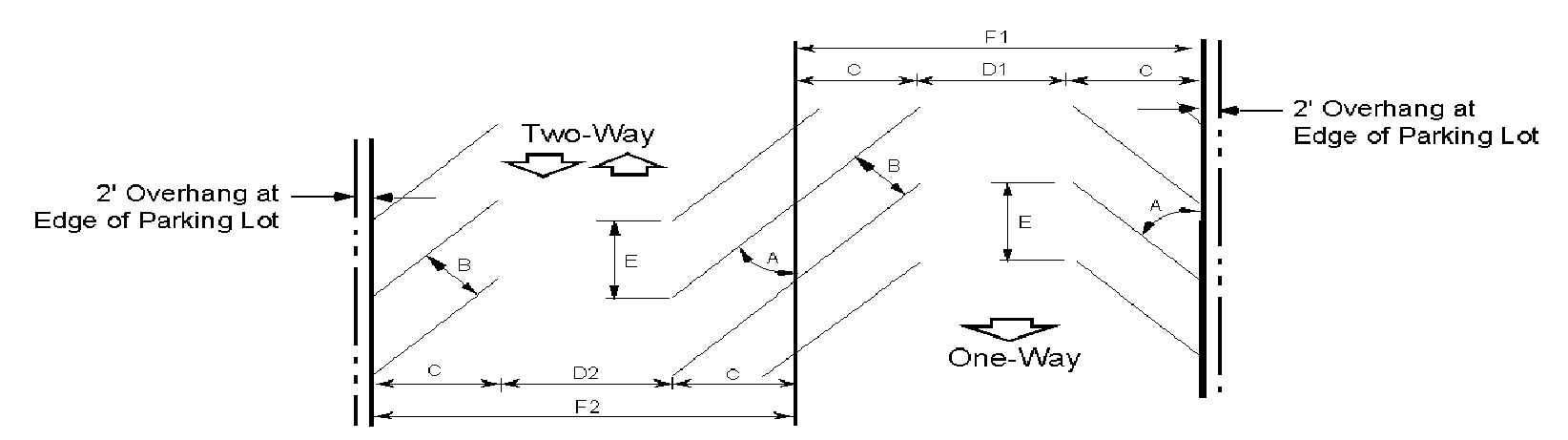
Drive lane widths and parking space sizes: Drive lanes and parking space sizes shall be required as shown in the following illustration. A driveway for access to any nonresidential, single parking space or to a parking lot shall not measure less than that shown in the parking layout illustration. All drive approach widths shall be no less than those indicated in the following graphic. All two-way drive lanes shall be a minimum of 24 feet in width. Parking spaces shall be nine feet wide by 18 feet deep for all 90 degree parking spaces. Angled spaces shall be as shown in the graphic.
3.
On-premise parking required: All required commercial and residential parking spaces shall be located on the premises to which such requirement applies or within an off-street space of which the distance is not more than 100 feet from such premises. Such parking spaces shall be owned by the owner of the premises to which the on-premise parking requirement applies.
4.
Residential parking development standards: The following regulations shall apply to all residential districts:
(a)
All automobiles and trucks which are parked or stored on private property and are located in the front yard shall be parked on a paved surface.
(b)
Vehicles, including RV's, campers, boats, and all terrain vehicles must be parked in the side or rear yard. Vehicles parked in the side or rear yard must be parked on a paved surface.
(c)
RV's may be parked in the front yard area on a paved surface or on the street for loading and unloading purposes only for no longer than 48 hours.
(d)
In instances where driveways exceed 100 feet in length, an alternative surface may be permitted upon approval of the designated city official.
(e)
Pavers are not to exceed one-half inch above the surface of the yard in which they are placed to allow them to be properly mowed and trimmed around.
(f)
Vehicles are to be completely resting on such surfaces from the point they leave the public streets to the point upon which they are parked or stored.
(g)
All vehicles shall be so parked in relation to the street and dwelling at right angles and not to extend over any walkway or be closer than eight inches from the back of the curb so they will not obstruct the pedestrian ways.
(h)
Any vehicle found in violation of this provision must be made operable or moved to an enclosed building within 30 days from the notification of such violation. All repeat violations which occur at the same address within any subsequent 30-day period shall be subject to immediate penalties and/or fines as allowed by law.
(i)
Parking spaces located on existing single-family residentially zoned lots that were deemed to conform at the effective date of this ordinance shall still be deemed to be legal. This includes parking spaces not located in enclosed garages, however, this section shall not be construed to authorize any enclosed garage to be eliminated.
5.
Nonresidential parking development standards: The off-street parking or loading facilities required for nonresidential uses shall consist of paved surfaces or alternative surfaces as approved by the designated city official.
6.
Maintenance requirements: To insure that all requirements set forth in this section are carried forward, it will be the responsibility of the owner to maintain the required off-street parking areas. All such off-street parking areas shall be kept free of trash, debris, vehicle repair operations or display and advertising uses. At no time after initial approval of the parking area layout can changes be made in the location and number of provided spaces without approval of the administrative official.
7.
All required off-street parking spaces shall be provided and maintained wholly within private property lines and not within any public highway, street or alley right-of-way. No head-in parking shall be permitted such that the driving lane accessing the parking spaces is not totally located on site.
D.
PARKING REGULATIONS FOR SPECIAL EVENTS AND OTHER ONE-TIME EVENTS:
1.
"Special event" means a festival, celebration, performance or other event which occurs no more frequently than once per year, and which will or should be reasonably anticipated to attract patrons or visitors in such numbers as to exceed the capacity of the required permanent parking spaces provided under other provisions of this section for the property upon which the special event is to be held. Events which are conducted more frequently than once per year are not considered "special events" under the provisions of this subsection, and the property upon which these events are conducted must conform to the other provisions of this section concerning parking requirements.
2.
The persons or entities conducting any special event shall submit to the administrative official at least 45 business days prior to such event a plan for the accommodation and parking of vehicles of persons reasonably expected to attend such event. The plan shall include, at a minimum, the following information:
(a)
A description and the address of the premises where the event is to be held;
(b)
A description and the address of any property, other than the premises described in (a) above, where parking is to be provided for patrons or visitors to the event;
(c)
The name and address of the owner of the premises upon which parking for the event is to be provided, and the terms and conditions of the agreement by which the owner of such premises has authorized their use for parking;
(d)
The dates and times that the event is to be held;
(e)
The measures which will be taken by the persons or entities conducting the special event to ensure safe and orderly traffic flow to and from the event site and any parking area;
(f)
A plan or diagram of the proposed layout of the parking scheme upon the property to be used for parking for such event.
(g)
All parking for any such special event shall be provided off-street and on an area and surface reasonably anticipated to be dry and safe for vehicular and pedestrian traffic. No public property or rights-of-way may be utilized or included in such parking areas except upon express, prior written permission by the city council.
3.
Subject to the above requirements, the surface of such parking areas need not be paved or otherwise surfaced as required by the other provisions of this section for permanent parking areas, but it must be suitable for the type and amount of vehicular and pedestrian traffic reasonably anticipated for the special event.
4.
Upon submittal of the required parking plan to the city, the administrative official shall review it and shall advise the applicants whether any changes or modifications to the plan are required. The administrative official has the sole discretion to approve or reject, or require modifications to, any parking plan required hereunder. No vehicles may be parked in any location not otherwise allowed under other subsections of this section, in connection with any special event, unless and until the administrative official has issued a written approval of the parking plan for the special event.
5.
Such written permission may be revoked at any time by the administrative official if it is found that false or misleading information was contained in the proposed parking plan.
E.
HANDICAPPED SPACES:
1.
All areas of newly designed or newly constructed buildings and facilities required to be accessible under federal and state law shall comply with the standards set forth in the Texas Accessibility Standards of the Architectural Barriers Act, Tex. Rev. Civ. Stat. Art. Ann. §9102 (Vernon Supp 2000.)
2.
The dimensions of each handicapped accessible parking space ("H" parking space) shall be 12 feet wide and 18 feet long.
3.
Each and every "H" parking space required by this section or by other applicable regulations shall be clearly identified as reserved for the handicapped.
4.
The number of "H" parking spaces required shall be determined by the following table:
F.
SINGLE-FAMILY ATTACHED AND MULTI-FAMILY PARKING FACILITIES: Common parking facilities for single-family attached and multi-family structures shall meet the following criteria:
1.
Each dwelling unit shall have its required parking spaces provided within 100 feet of a principal entrance to a single-family attached structure and 150 feet of a principal entrance to a multi-family structure.
2.
The parking facility shall be arranged so that a minimum of five feet shall separate any parked car from a solid building wall and 20 feet from a principal entrance.
3.
In any residential district off-street parking provided at the rear of the lot shall be permitted to occupy any paved portion of the rear yard except that a minimum distance of 20 feet shall separate the enclosed off-street parking spaces from an alley at the rear lot line.
G.
PARKING ACCESS REQUIREMENTS: Parking areas which would require the use of public right-of-ways for maneuvering shall not be acceptable for the furnishing of required off-street parking spaces other than for single-family detached and duplex dwelling structures. Parking parallel at the curb on a public street shall not be substituted for off-street requirements.
H.
NONRESIDENTIAL OFF-STREET LOADING REQUIREMENTS: Provisions for loading and unloading in nonresidential districts shall be provided on the site according to the following regulations:
1.
To facilitate the movement of traffic on the public streets, all retail, office and service buildings shall provide and maintain off-street facilities, including any maneuvering areas required to access the loading space, for the loading and unloading of merchandise and goods within the building or on the lot adjacent to a public alley or private service drive:
2.
Individual loading space dimensions shall at a minimum to be 35 feet in length, 12 feet width with a height clearance of 15 feet.
3.
The number of required off-street loading spaces shall be determined according to the following table:
I.
ADDITIONAL REGULATIONS: Nothing in this section shall require the furnishing of additional parking spaces for buildings existing and used on the date of adoption of this ordinance. However, no enlargement or addition to an existing building shall be approved unless such building and addition or enlargement is brought into full compliance with the provisions of this section.
When the occupancy of any building is changed to another use, parking shall be provided to meet the requirements for the new use.
J.
GENERAL DESIGN STANDARDS FOR PARKING STRUCTURES:
1.
In all districts, above grade parking structures shall conform to height restrictions for structures in the zoning districts in which they are located.
2.
The distance from parking structure entry and exit points to the corner of a street intersection shall conform to standards contained in the subdivision ordinance.
3.
Ramps shall not be constructed with slopes exceeding 15 percent and single lane entrances shall not be less than 16 feet wide at the street.
4.
A minimum of one car length shall be provided between an exit control gate and the inside edge of a sidewalk to minimize conflicts between exiting cars and pedestrians.
5.
Parking structure facades shall be left 50 percent open and interior light levels shall be maintained at ten foot-candles to enhance security and safety. All parking structure lighting shall be designed so as not to reflect or shine on adjacent properties.
6.
Full enclosure of any level of a parking structure may be permitted only if such structure is fully sprinklered and mechanically ventilated.
K.
STACKING REQUIREMENTS FOR DRIVE-THROUGH FACILITIES:
1.
A stacking space shall be an area on a site measuring eight feet by 20 feet with direct forward access to a service window or station of a drive-through facility which does not constitute space for any other circulation driveway, parking space, or maneuvering area.
2.
For financial institutions with drive-through facilities, each teller window or station, human or mechanical, shall be provided with a minimum of five stacking spaces (from the right-of-way line).
3.
For each service window of a drive-through restaurant, a minimum of seven stacking spaces shall be provided from the right-of-way line.
4.
For kiosks, a minimum of two stacking spaces for each service window shall be provided from the right-of-way line.
5.
For drive-in cleaners, three storage spaces for each drive-in window shall be provided from the right-of-way line.
L.
EXEMPTIONS: Commercial uses located in the CBD and the heritage overlay district, when the underlying zoning district is commercial, shall be exempt from this section.
(Ord. No. 2011-18, §§ 5, 6, 6-19-2011)
Cross reference— Parking, § 86-151 et seq.
Section 6-7. - Screening and buffer requirement.
A.
PURPOSE: Standards set forth in this section are intended to encourage the appropriate use of land and conserve and protect the privacy and value of adjacent permitted uses. This section establishes regulations for the location and type of various screening devices to be used when required in the various zoning districts or when required by this section.
B.
GENERALLY:
1.
When a boundary of a nonresidential zoning district sides or backs upon an SF-E, SF-9, SF-6, MD, MF, or MH district, a solid screening wall or fence of not less than six feet nor more than eight feet in height shall be erected on the property line separating these districts. The purpose of the screening wall or fence is to provide a visual barrier between the properties.
2.
Where a multi-family use abuts a one family or moderate density residential zoning district, the side and rear property lines of said multi-family district shall be suitably screened to a height of not less than six feet, nor more than eight feet, from any adjacent dissimilar residential dwelling or lot.
3.
The owner of the property where the less restrictive use is located shall be responsible for and shall build the required wall or fence on the property line dividing his/her property from the more restrictive zoning district.
4.
The entire area occupied by a junk yard or salvage yard shall be surrounded by a continuous screening wall or fence.
5.
Dumpsters and trash receptacles located on nonresidentially zoned property and on sites used for nonresidential purposes shall be located on a concrete pad constructed for that purpose. Such dumpsters and trash receptacles shall be screened on three sides by a masonry wall and shall contain a solid self-latching gate. The masonry wall shall be of similar construction to the principle building. Nondecorative concrete block shall not be permitted. A screening device shall be erected along side and rear property lines adjacent to residential districts. The screening device shall be a minimum height of six feet, unless otherwise approved by city council.
C.
SCREENING WALL OR FENCE CONSTRUCTION: Unless otherwise provided for herein, a screening wall or fence required under the provisions of this section shall be constructed of a permanent, solid masonry material. Such wall or fence shall not contain openings constituting more than 40 square inches in each one square foot of wall or fence surface, and the surface of such wall or fence shall constitute a visual barrier. Said screening wall or fence shall not be constructed of any type of sheet metal material.
1.
All wall or fence openings shall be equipped with gates compatible with the height and screening characteristics of the wall or fence.
2.
In cases where the administrative official finds this requirement can be better met by a screen of living, irrigated plant materials, a landscape plan may be submitted in lieu of a screening wall. Such landscape screening must be no less than four feet deep and must demonstrate screening characteristics equal to that of a masonry-screening wall.
3.
In cases where the administrative official finds the requirements of this subsection can be better met by a decorative fence or a combination of decorative fence and masonry screening wall and/or living plant materials, plans for the same may be submitted to the city for approval along with a landscape plan.
4.
All required screening walls shall be equally finished on both sides of the wall.
D.
PROHIBITED SCREENING WALLS AND FENCES:
1.
Required walls or fences shall not be constructed of chain link, barbed wire or other similar materials.
2.
With the exception of the A-agriculture district, electric fences are not permitted in any zoning district. Existing electric fences shall be removed at the time that property ownership is transferred.
3.
No screening element of solid construction such as brick, masonry, concrete or solid metal, shall be erected or placed in a location which would interfere with the installation or maintenance of any public utility line, service, or drainage-way within easements reserved therefore.
Section 6-8. - Masonry exterior requirements.
A.
RESIDENTIAL DISTRICTS: All principal buildings and structures located in the SF-E, SF-9, MD, and MF zoning districts shall be constructed of exterior fire resistant material having at least 80 percent of the total exterior walls to the top plate, excluding doors, windows, and porches, as masonry construction. Other materials, which are characteristic of recognized architectural styles such as Cape Cod, Victorian, Spanish, Prairie or Ranch, may be permitted by the city council upon recommendation of the planning and zoning commission.
B.
NONRESIDENTIAL DISTRICTS: Materials for exterior facades for the principal building or structure shall be of masonry construction as defined in section 3-3 of this ordinance.
1.
All principal buildings and structures located in the CF, LB, GR, CBD and C zoning districts shall be constructed of exterior fire resistant material having at least 80 percent of the total front exterior walls, excluding doors, windows, and porches, as masonry construction. All other sides shall have a minimum of 50 percent masonry construction. Other materials, which are characteristic of recognized architectural styles, or an accepted style of a franchise entity, may be permitted by the city council upon recommendation by the planning and zoning commission.
2.
Nonresidential buildings located in residentially zoned districts shall comply with item 1. of this section.
3.
Principal structures located in the BP, LI, WP-A and HI industrial district consisting of business and administrative offices shall be of 80 percent masonry construction on the front and 50 percent on the side. Structures that do not contain business and administrative offices shall be exempt from the masonry requirement. The intent of this ordinance is that the masonry material be applied to the exterior of the building proportional to the area containing administrative offices that is contained within that building.
4.
For architectural design or creativity or for compatibility with surrounding structures, other materials which are equivalent to the standards set forth in this ordinance may be permitted by the city council upon recommendation of the planning and zoning commission.
5.
Local, state, and federal buildings which are used primarily for service and storage uses shall be exempt from the masonry requirement.
6.
Expansions or modification to existing primary structures which expand the footprint of the building or modify the exterior walls by 50 percent must meet the 80 percent minimum masonry requirement of the total exterior walls, excluding doors, windows, and porches, as masonry construction prior to issuance of a new certificate of occupancy. Expansions or modifications less than 50 percent shall be consistent with the existing exterior construction of the structure.
C.
EXEMPTIONS: Any structure located in the CBD and the heritage overlay district (H) are exempt from these masonry requirements.
(Ord. No. 2015-05, 4-19-2015)
Section 6-9. - Landscape requirements.
A.
PURPOSE:
1.
It is the purpose of this section to establish regulations pertaining to landscaping within the city. These regulations provide standards and criteria for new landscaping and the retention of existing trees and are intended to:
(a)
Promote the value of property, enhance the welfare, and improve the physical appearance of the city;
(b)
Reduce the negative effects of glare, noise, erosion and sedimentation caused by expanses of impervious and un-vegetated surfaces within the urban environment; and
(c)
Preserve and improve the natural and urban environment by recognizing that the use of landscaping elements and retention of existing trees can contribute to the processes of air, purification, oxygen regeneration, groundwater recharge, abatement of noise, reduction in glare and heat, provision of habitats for wildlife, and enhance the overall beauty of the City of Mineral Wells.
2.
These landscape regulations establish landscape requirements in the CF, LB, GR, C, BP, LI, HI, and WP-A zoning districts or for any nonresidential use located in a residentially zoned district.
B.
LANDSCAPING DEFINITIONS: The following definitions shall apply:
Buffer yard. A buffer yard is a unit of land, together with a specified amount of planting thereon, and any structures which may be required between, land uses to eliminate or minimize conflicts between them.
Building footprint. The area of the building in contact with the ground.
Caliper. Diameter of the trunk measured one foot above ground level.
Canopy trees. Perennial woody plants with single or multiple trunks, contributing to the uppermost spreading branch layer of a forest and may be commonly referred to as shade trees.
Development. The changing of the existing topography to promote construction of structures or infrastructure to accommodate any improvements necessary to erect facilities for dwelling, commercial or industrial uses resulting in developed property.
Enhanced pavement. Any permeable or nonpermeable decorative pavement material intended for pedestrian or vehicular use. Enhanced pavement includes brick or stone pavers, grass pavers and stamped and stained concrete or asphalt.
Ground cover. Low growing, dense spreading plants typically planted from containers.
Interior lot area. The area of the lot remaining after subtracting the area of the buffer yards.
Landscape architect. A person registered as a landscape architect in the State of Texas pursuant to state law.
Landscape area. An area covered by natural grass, ground cover, or other natural plant materials.
Lawn grasses. Thin bladed surface growing plants typically planted from seed, sprigs, or plugs.
Licensed irrigator. A person duly licensed by the State of Texas to design and install irrigation systems.
Permeable pavement. A paving material that permits water penetration.
R.O.W. parkway. That area within the public right-of-way (R.O.W.) between the back of curb or edge of pavement and the right-of-way line.
Seasonal color. Landscape areas used for annual and perennial flowers intended to maintain year-round color accents.
Shrubs. Plants that grow vertically in a multi-branched growth pattern.
Understory/accent trees. Small evergreen or deciduous perennial woody plants, which would grow below the top layer of the forest and typically would have unique branching, textural or seasonal color characteristics.
C.
EVENTS CAUSING COMPLIANCE: Land uses not previously subject to landscaping requirements may be required to comply with this section upon the occurrence of one of the following events:
1.
A change in zoning;
2.
Requirement of landscaping as a condition of a specific use permit;
3.
Issuance of a building permit; or
4.
Loss of legal nonconforming status.
D.
LANDSCAPING GENERALLY: The following landscape installation is required:
1.
Twenty percent of the total lot shall be landscaped. Landscaping which includes the planting of new and the retention of existing shrubs, trees, and flowering plants, in addition to lawn grass, may reduce the landscape requirement to ten percent of the total lot area. Landscaping which consists of lawn grass only will require 20 percent of the total area to be landscaped.
2.
Twenty percent of the total land area in any lot upon which development or construction occurs for any use after the effective date of this ordinance shall be landscaped in accordance with this section.
3.
Where the construction is to be a single phase of a multi-phase development, only the area being constructed in the current phase shall be subject to the landscape regulations. However, each phase will be required to meet the landscaping regulations as that phase is developed.
E.
LANDSCAPE PLAN REQUIRED:
1.
The landscape plan may be prepared by the applicant. The landscape plan is not required to be prepared by a registered or certified professional.
2.
A landscape plan shall be submitted to the city for approval. The landscape plan may be submitted as a part of the site plan or as a separate submittal. However, a landscape plan meeting the requirements of this ordinance shall be provided and approved prior to the issuance of a building permit.
3.
The landscape plan shall be drawn to an appropriate scale and shall contain the following information:
a)
Location of all trees to be preserved, method of preservation during the construction phase of development shall be approved by the administrative official.
b)
Location of all plants and landscaping material to be used including paving, benches, screens, fountains, statues, or other landscape features;
c)
Species of all plant material to be used;
d)
Size of all plant material to be used;
e)
Spacing of plant material where appropriate;
f)
Layout and description of irrigation, sprinkler or water system, including placement of water sources;
g)
Description of maintenance provisions of the landscape plan;
h)
Persons responsible for the preparation of the landscape plan.
F.
LOCATIONAL CRITERIA:
1.
Not less than 40 percent of the total landscaping shall be located in the front yard.
2.
In the BP, LI, HI, and WP-A zoning districts only the front yard 40 percent of the total 20 percent shall be required. The rear and side yard landscape requirements may be waived by the administrative official upon submittal of a landscape plan meeting the other requirements of this section.
3.
Landscape buffer adjacent to residential districts: Nonresidential developments located in residentially zoned districts and developments located in CF, LB, GR, C, BP, LI, HI, and WP-A zoning districts, which abut districts zoned residential or multifamily, shall provide a minimum 20-foot wide green belt of "live plant material of the evergreen variety", a minimum of four feet in height at the time of installation and planted on six-foot centers, for the entire distance along which the development abuts the residential or multifamily districts. A planting mix of larger trees of evergreen variety is permitted with a reduction in "on center" planting requirements. Equal coverage must be maintained. However, any variation of the planting mix and/or the "on center" distance must be included on a landscape plan prepared by a landscape architect and/or landscape professional and approved by the building official. Where an emergency access easement is required, the green belt may be reduced to ten feet;
4.
All landscape material shall comply with visibility requirements of the subdivision ordinance.
G.
CREDITS TOWARD LANDSCAPING REQUIREMENTS:
1.
Lawn grass is an appropriate landscape material. However, a variety of plant material is recommended. Credits toward the landscaping requirements may be granted in accordance with the provisions of this subsection.
2.
Enhancement credit may be obtained by providing the following optional landscaping elements.
3.
In no instance shall the total amount of landscaping on a lot be reduced through credits by more than 50 percent of the landscaped area required by this ordinance.
4.
Xeriscaped area shall be clearly located and detailed on the landscape plan. In addition, the xeriscape methodology shall be detailed on the landscape plan.
5.
A flowering bed is any area where the soil has been specifically prepared for the planting of flowering plants. To be considered for credit calculations, at least 80 percent of the prepared area must be covered with flowering plant material at the time of peak growth.
6.
Caliper of trees is to be measured at a point one foot above top of ground.
7.
In order to receive credit for protecting and keeping existing trees, the area within the dripline of the trees must be protected by fencing during grading and construction.
8.
Area on the site which is used for retention and detention of stormwater shall not be used in the calculation to satisfy the landscape requirements.
H.
INSTALLATION AND MAINTENANCE:
1.
All required landscaped area shall be permanently landscaped with living plant material, and shall have an irrigation system installed appropriate to the material planted. Synthetic or artificial lawn or plant material shall not be used to satisfy the landscape requirements of this ordinance.
2.
Landscaped areas shall be kept free of trash, litter, weeds, and other such material or plants not a part of the landscaping.
3.
All plant materials shall be maintained in a healthy and growing condition as is appropriate for the season of the year. Maintenance shall include mowing, watering, trimming, pruning, and other steps necessary to maintain the plants in healthy and growing condition. Plant materials which die shall be replaced with plant material of similar variety and size within a 90 days period, with a one time extension not exceeding 90 days being provided upon approval of the administrative official.
I.
LANDSCAPING OF PARKING LOTS: It is the intent of these landscape regulations to encourage design and construction of parking areas so that areas within the parking lot which are unusable for parking or maneuvering space are landscaped. The following minimum requirements shall be observed:
1.
A minimum of ten percent of the gross parking area shall be devoted to living plant material. Gross parking area shall be measured from the edge of the parking and/or driveway paving and sidewalks.
2.
Landscaped areas within parking lots shall be located so as to best relieve the expanse of paving.
3.
Additional landscaped islands shall be placed throughout the parking area in a manner which best relieves large expanses of paving.
4.
Landscape material within the interior of a parking lot shall be surrounded by a curb four inches in height.
5.
Landscaping within a parking lot shall not create a visibility obstruction. A visibility obstruction within a parking lot is defined as landscaping between 30 inches and seven feet in height. No shrubs shall exceed 30 inches in height. Tree canopies shall be at least seven feet in height.
6.
For large existing trees in the parking area, which are being retained and incorporated into the landscaping plan, an appropriate aeration system or alternative method of protecting the trees must be provided and detailed in the landscape plan.
J.
LANDSCAPING AS RELATED TO CERTIFICATE OF OCCUPANCY:
1.
All landscaping shall be completed and installed in accordance with the approved landscape plan within 90 days of a certificate of occupancy being granted. A one-time extension not to exceed 90 days may be granted upon approval of the administrative official.
2.
If these landscaping requirements have not been satisfied within six months from the issuance of a certificate of occupancy, the property owner shall be considered in violation of this ordinance, and shall be subject to the penalties established herein. A one-time extension not to exceed six months may be granted upon approval of the administrative official.
K.
NONCONFORMING LANDSCAPING CONDITIONS: Developments, structures, and uses that are in existence at the time of the adoption of this ordinance, which do not meet the landscape requirements provided herein, will be considered as being legal nonconforming. These nonconforming uses/structures will be subject to article 2, nonconforming lots, structures and uses of this ordinance unless otherwise provided for in this section.
L.
RELIEF FROM LANDSCAPING REQUIREMENTS: A property owner may apply for, relief from landscaping requirements in situations where individual circumstances, such as the presence of existing facilities or unusual topography, limit the applicant's ability to comply with the landscaping requirements of this ordinance. The following procedures shall apply:
1.
The applicant shall provide the administrative official with an alternative landscape plan for review together with a written explanation of the circumstances which limit the applicant's ability to comply with the landscaping requirements of this ordinance. Said landscape plan will illustrate a plan to landscape area as available, provide for irrigation, and provide a phasing schedule for completing the plan.
2.
If the administrative official grants the requested relief, the applicant shall install the landscaping shown on the landscape plan approved by the administrative official.
M.
LANDSCAPING IN THE MF DISTRICT: The following minimum requirements shall be observed for development located within the MF district.
1.
A landscape buffer of 20 feet will be required along any property line abutting a SF-E, SF-9, SF-6, MD, or MH zoned district.
2.
Not less than 20 percent of the gross site area shall be devoted to open space, including required yards and buffer areas. Open space shall not include areas covered by structures, parking areas, driveways, and internal streets.
3.
Landscaping consisting of the planting of new or retention of existing shrubs, trees, and flowering plants shall be required in the yard facing any public roadway.
4.
The method of irrigation must be indicated on the landscape plan.
5.
All landscaping shall be permanently maintained. Should any plant material used in any landscaping required under this ordinance die, the owner of the property shall have ninety days after notification from the city to obtain and install a suitable replacement plant material. Landscaped areas shall be kept free of trash, litter, weeds, and other material or plants not a part of the landscaping.
N.
EXEMPTIONS: Commercial uses located in the CBD and the heritage overlay district, when the underlying zoning district is commercial, shall be exempt from this section.
Section 6-10. - Wireless communication facilities.
A.
PURPOSE: Certain radio equipment used in transmitting and receiving signal energy are essential and are deemed to promote the health, safety, and general welfare of the citizens of the city. Such equipment shall be located so that the health, safety, welfare, and aesthetic quality of the community shall not be compromised. The regulations governing the location of such equipment shall also consider the aesthetic quality of the city as a significant aspect of the health, safety, and general welfare of the community. The antennas, masts, and towers hereinafter enumerated shall be installed, constructed and maintained in accordance with the provisions of this section.
B.
WIRELESS COMMUNICATION FACILITIES DEFINITIONS: The following definitions shall apply:
Antenna. A device used in communications which transmits or receives electromagnetic waves.
Antenna, building attached. Antenna attached to existing structures in two general forms: (1) roof-mounted, in which antennas are placed on the roofs of buildings, or (2) building-mounted, in which antennas are mounted to the sides of buildings. These antennas can also be mounted on structures such as water tanks, billboards, church steeples, electrical transmission towers, etc.
Antenna facility. A building or independent support structure and the antennas mounted thereon, including any associated and necessary equipment building.
Antenna, microwave. Also known as "dish" antenna. A dish-shaped antenna used to link communications sites together by wireless transmission of voice or data, utilizing electromagnetic radiation frequencies from 3 GHz to 300 GHz; and using relatively low transmitter power levels when compared to other forms of transmission.
Antenna, panel. Also known as "directional" antenna. An antenna or array of antennas designed to concentrate a radio signal in a particular area. Panel antennas are typically flat, rectangular devices approximately six square feet in size.
Antenna, whip. Also known as an "omni-directional antenna". Shaped cylindrically, whip antennas have diameters between two and six inches, and measure between one and 18 feet in height. They are used to emit signals in a 360-degree horizontal plane and a compressed vertical plane.
Co-location. The act of locating wireless communications equipment from more than one provider on a single antenna facility.
Equipment storage. A small unmanned, single story equipment building less than 500 square feet in size used to house radio transmitters and related equipment.
Monopole. An antenna facility composed of a single spire used to support communications equipment. No guy wires are used or permitted.
Lattice tower. A tower having three or four support steel legs and holding a variety of antennas. These towers range from 60 to 200 feet in height and can accommodate a variety of users.
Satellite receive-only antenna. An antenna that enables the receipt of television signals transmitted directly from satellites to be viewed on a television monitor. Such antennas are commonly known as a satellite dish, television receive-only antenna, dish antenna, parabolic antenna, or satellite earth station antenna.
Stealth facility. An antenna facility that is virtually transparent or invisible to the surrounding neighborhood. Stealth facilities may include totally enclosed antennas, wireless facilities that replicate or duplicate the construction of common structures such as flagpoles, and camouflaged wireless facilities that are constructed to blend into the surrounding environment.
C.
RESIDENTIALLY ZONED DISTRICTS—AMATEUR RADIO EQUIPMENT AND TV ANTENNAS: Amateur radio equipment, including ham radio and CB equipment and personal use TV antennas, shall be allowed in the residential zoning districts if they comply with the following regulations:
1.
In the residential districts, a special exception must be obtained from the board of adjustment for any antenna facility which does not comply with the regulations in this section.
2.
Antenna facilities may be building attached, monopoles, or lattice towers;
3.
Up to three antenna facilities may be located on a lot of record, co-location is encouraged;
4.
An antenna facility, exclusive of the height of any antenna or mast, shall not exceed 65 feet in height. Provided, however, that an antenna facility shall be permitted additional height at the ratio of one added foot in height for each additional foot of setback beyond the minimum setback required of an accessory building in the zoning district regulations contained in section 6-3, accessory building regulations. Regardless of the above, the maximum height for a tower permitted in any residential district shall be 80 feet unless a special exception is approved by the board of adjustment;
5.
The height of an antenna, including the height of any antenna facility to which they may be fastened or attached shall not exceed 80 feet in height unless a special exception is approved by the board of adjustment;
6.
An antenna not fastened to an antenna facility shall not exceed 50 feet without a special exception approved by the board of adjustment, except for an antenna which does not extend more than eight feet above a building on which it is mounted;
7.
An antenna facility shall be limited to having the number and size of antennas attached to it that are allowed by the antenna facility manufacturer's designs and specifications for maximum wind load requirements;
8.
Setbacks:
(a)
Antennas and antenna facilities shall not be permitted in front or side yards. Guy wires are not permitted in front yards;
(b)
Guy wires are permitted in required side and rear yards;
(c)
Setback for antenna facilities shall be the same as those required for accessory buildings in residential districts;
9.
Separation: There shall be no minimum or maximum separation requirements for antenna facilities from other structures on the same lot of record;
10.
Prohibited in easements: Antenna facilities shall not be permitted in any easement;
11.
Lights: No auxiliary or outdoor lighting shall be allowed on antenna facilities located on residentially zoned property except such lights or lighting as may be required by the Federal Aviation Administration or the Federal Communications Commission;
12.
Construction standards: A building permit must be obtained prior to the construction and/or installation of an antenna facility. Antenna facilities must be installed in accordance with the manufacturers recommendations or under the seal of a registered professional engineer of the State of Texas. Regardless of the above, all such antenna facilities must meet the Electronic Industries Association Standard EIA-222-D, Structural Standards for Steel Antenna Towers and Antenna Supporting Structures and the Building Code;
13.
Maintenance: Antennas and/or antenna facilities obviously not in use or obviously in need of maintenance as determined by the building official, shall be removed or brought into compliance within 30 days following notice given by the building official. This shall not preclude immediate action by the city manager to safeguard life, limb, health, property, and public welfare;
14.
No extension beyond property lines: No part of an antenna facility or any attachment thereto may extend beyond the property lines of the owner of such antenna or antenna facility.
D.
RESIDENTIALLY ZONED DISTRICTS—COMMERCIAL RADIO EQUIPMENT AND TV ANTENNAS: Only building attached antennas shall be allowed in residentially zoned districts under the following conditions:
1.
Special exception: A special exception must be obtained from the board of adjustment.
2.
Attachment or enclosure: The proposed antenna must be attached to or enclosed in an existing structure currently or last occupied by a nonresidential use as listed in section 3-1, permitted use table, or attached to a power or telephone pole, water storage tower, or other utility structure;
3.
Height: The antenna must not exceed eight feet above the structure to which it is attached;
4.
Separation: A minimum of 1,500 feet of separation shall be required between antenna facilities;
5.
Attachment to exterior structure: If attached to the exterior of a structure or a power or telephone pole, water storage tower or other utility structure the antenna must be at least 75 feet above grade and painted to match the structure to which it is attached;
6.
Enclosed antennas: The antenna may be placed lower than 75 feet above grade if completely enclosed within existing architectural elements of a building so as not to be visible;
7.
Equipment storage buildings: Any associated equipment storage building shall be screened from public view by a decorative masonry wall, with landscaping for aesthetic purposes;
8.
Driveways: All driveways accessing any antenna facility site or equipment storage site shall be constructed of an all weather hard surface as approved by the director of public works;
9.
Lights: No auxiliary or outdoor lighting shall be allowed on antennas located on residentially zoned property except such lights or lighting as may be required by the Federal Aviation Administration or the Federal Communications Commission;
10.
Construction standards: A building permit must be obtained prior to the construction and/or installation of a tower, antenna or mast. Towers must be installed according to the manufacturers recommendations or under the seal of a registered professional engineer of the State of Texas. Regardless of the above, all such towers, antennas or masts must meet the current Electronic Industries Association Standard, Structural Standards for Steel Antenna Towers and Antenna Supporting Structures and the Building Code;
11.
Maintenance: Antennas, not in use or in need of maintenance as determined by the administrative official, shall be removed or brought into compliance within 30 days following notice given by the administrative official. This shall not preclude immediate action by the administrative official to safeguard life, limb, health, property, and public welfare;
12.
No extension beyond property lines: No part of an antenna, or any attachment thereto may extend beyond the property lines of the owner of such antenna;
13.
Property owner's permission required: No permit shall be issued for the installation of an antenna, on a structure or property unless a notarized statement of permission from the owner is presented to the administrative official.
E.
NONRESIDENTIAL DISTRICTS: Radio, television, microwave broadcast relay, receiving towers, transmission and re-transmission facilities, satellite receiving only earth stations (home dish antenna), and any electronic emission equipment of a commercial nature shall be allowed in the nonresidential zoning districts if it complies with the following regulations:
1.
Number of antennas per lot: One antenna facility may be located on a lot of record, co-location is encouraged;
2.
Antenna facilities limited: Antenna facilities shall be limited to building attached, stealth, and monopoles only;
3.
Height:
a)
With the exception of stealth facilities, an antenna facility, exclusive of the height of any attached antenna, shall not exceed 35 feet in height. Provided, however, that an antenna facility shall be permitted additional height at the ratio of one added foot in height for each additional foot of setback beyond the minimum setback required of an accessory building in the zoning district where the antenna facility is located. Regardless of the above, with the exception of stealth facilities, the maximum height for an antenna facility permitted without a special exception in any nonresidential district shall be 65 feet;
b)
With the exception of stealth facilities, the height of an antenna, including the height of any antenna facility to which they may be fastened or attached, shall not exceed 65 feet in height without a special exception;
c)
With the exception of stealth facilities, an antenna shall not extend more than eight feet above a building on which it is attached;
4.
Manufacturer's design and specifications: An antenna facility shall be limited to the number and size of antennas attached to it that are allowed by the antenna facility manufacturer's designs and specifications for maximum wind load requirements;
5.
Setbacks: With the exception of stealth facilities, antennas and antenna facilities shall not be permitted in front or side yards;
6.
Prohibited in easements: Antenna facilities shall not be permitted in any easement;
7.
Lights: No auxiliary or outdoor lighting shall be allowed on antennas located on residentially zoned property except such lights or lighting as may be required by the Federal Aviation Administration or the Federal Communications Commission;
8.
Construction standards: A building permit must be obtained prior to the construction and/or installation of a tower, antenna, or mast. Antenna facilities must be installed according to the manufacturers recommendations or under the seal of a registered professional engineer of the State of Texas. Regardless of the above, all such antenna facilities and antennas must meet the current Electronic Industries Association Standard, Structural Standards for Steel Antenna Towers and Antenna Supporting Structures and the Building Code;
9.
Maintenance: Antenna facilities and antennas obviously not in use or obviously in need of maintenance as determined by the administrative official, shall be removed or brought into compliance within 30 days following notice given by the administrative official. This shall not preclude immediate action by the administrative official to safeguard life, limb, health, property, and public welfare;
10.
No extension beyond property lines: No part of an antenna facility and antennas or any attachment thereto may extend beyond the property lines of the owner of such antenna or antenna facility;
11.
Special exceptions for noncomplying facilities: A special exception must be obtained from the board of adjustment for any antenna or tower, which is in a nonresidential zoning district and does not comply with the regulations in this section.
12.
Stealth facilities: Stealth facilities, as defined in section 6-10, wireless communication facilities definitions shall be exempt from the height and location requirements of this section. In addition, the administrative official shall be the final authority as to whether or not any facility meets the definition of a "stealth facility".
F.
SATELLITE RECEIVE-ONLY ANTENNAS:
1.
Generally: Satellite receive-only antennas assist individuals in the receipt of satellite transmitted television signals. Satellite receive-only antennas which comply with the regulations in this section shall be permitted. Such regulations are hereby found to be reasonable and clearly defined
2.
Small satellite receive-only antennas: A satellite receive only antenna shall be allowed if it complies with the following regulations:
(a)
The satellite receive-only antenna is two meters or less in diameter and is located or proposed to be located in any area where commercial or industrial uses are generally permitted by this ordinance or;
(b)
The satellite receive-only antenna is less than one meter in diameter and is located or proposed to be located in any residential zoning district.
3.
Large satellite receive-only antennas. Satellite receive-only antennas that are greater than one meter in diameter in residential districts or greater than two meters in diameter in nonresidential districts shall be allowed in any zoning district if they comply with the following regulations:
(a)
A special exception must be obtained from the board of adjustment for any satellite receive only antenna which does not comply with the regulations specified below.
(b)
Only one satellite receive-only antenna per lot of record;
(c)
A satellite receive-only antenna shall not exceed ten feet in height;
(d)
Setbacks:
(1)
Front and side: Satellite receive-only antennas shall not be permitted in front or side yards;
(2)
Rear: Satellite receive-only antennas shall be permitted in rear yards provided they meet the minimum setback as is required for accessory buildings in residential districts and as for all buildings in nonresidential districts;
(e)
Separation: There shall be no minimum or maximum separation requirements for satellite receive-only antennas from other structures on the same lot of record;
(f)
Not permitted in easements: Satellite receive-only antennas shall not be permitted in easements;
(g)
Lights: No auxiliary or outdoor lighting shall be allowed on satellite receive-only antennas except such lights or lighting as may be required by the Federal Aviation Administration or the Federal Communications Commission;
(h)
Construction standards: A building permit must be obtained prior to the construction and/or installation of a satellite receive-only antenna. Satellite receive-only antennas must be installed according to the manufacturers recommendations or under the seal of a registered professional engineer of the State of Texas;
(i)
Maintenance: Satellite receive-only antennas not in use or in need of maintenance as determined by the administrative official, shall be removed or brought into compliance within 30 days following notice given by the administrative official. This shall not preclude immediate action by the administrative official to safeguard life, limb, health, property, and public welfare;
(j)
No extension beyond property lines: No part of a satellite receive-only antenna or any attachment thereto may extend beyond the property lines of the owner of such satellite receive-only antenna;
(k)
Screening: All satellite receive-only antennas shall be screened from view from adjoining properties by fencing or evergreen plants. A satellite receive-only antenna located within a fence surrounding the yard in which the satellite receive-only antenna is located shall be considered to be screened.
G.
SPECIAL EXCEPTION RELIEF FROM REGULATIONS: A special exception must be obtained from the board of adjustments for any antenna, tower, and/or satellite receive-only antenna which does not comply with the regulations specified in this section. In considering whether to grant a special exception from the regulations specified above, the board of adjustment shall consider the following factors:
1.
The effect on the value of the surrounding property;
2.
The potential for interference with the enjoyment of surrounding properties;
3.
Aesthetics;
4.
The necessity of the special exception for the public health, safety, and welfare of the citizens or for governmental purposes;
5.
The zoning district and the adjoining zoning districts of the property for which the special exception is sought;
6.
The provisions of 47 C.F.R. § 25.104 which preempt local zoning or other regulations that differentiate between satellite receive-only antennas and other types of antenna facilities unless such regulations:
(a)
Have a clearly defined health, safety or aesthetic objective; and
(b)
Further the stated health, safety, or aesthetic objectives without unnecessarily burdening the federal interest in ensuring access to satellite services and in promoting fair and effective competition among competing communications service providers;
7.
The unique conditions that govern reasonable reception on any given lot;
8.
To properly evaluate all applications to locate commercial antennas or towers which do not comply with the regulations specified above, the following information must be provided by the applicant:
(a)
Describe the nature of the antenna site. Indicate whether the proposed structure is a monopole or mounted to a self-supporting structure. Indicate the proposed height;
(b)
Provide photos or drawings of all equipment, structures and antenna;
(c)
Describe why the antenna or tower is necessary;
(d)
State the name(s) of the telecommunications providers or other users of the antenna or tower and describe the use to be made by each user;
(e)
Indicate if the antenna or tower site is to be connected to other sites; and if so, describe how it will be connected and who will be the back haul provider;
(f)
Address whether or not the applicant has made an effort to co-locate the facilities proposed for this antenna or tower on existing towers or facilities in the same general area and, if so, identify the location of these existing sites. If yes, describe in detail these efforts and explain in detail why these existing sites were not feasible. Attach all studies or tests performed which demonstrate why the existing sites will not provide sufficient signal coverage. Provide written documentation from existing sites' owners and/or operators, which confirm the statements provided. Indicate whether or not the existing sites allow or promote co-location and, if not, describe why not;
(g)
Indicate whether or not co-location will be allowed to other telecommunications providers at the requested site. If they are not allowed, state every reason and the basis for each reason;
(h)
If the requested location is in a residential district the applicant shall address whether or not the applicant has made an effort to locate the facility in a commercial or industrial district and identify the location of these commercial and or industrial district sites. Describe in detail these efforts and explain in detail why these commercial or industrial district sites were not feasible. Attach all studies or tests performed which demonstrate why the commercial or industrial sites will not provide sufficient signal coverage. Provide written documentation from commercial or industrial district sites' owners and/or operators which confirm the statements provided;
(i)
Indicate the proposed provider's current coverage area for the city. Attach maps showing the areas the proposed provider's existing antennas currently cover, the areas the applicant's existing sites and other existing sites would cover, and the areas the applicant's existing sites and the requested site would cover;
(j)
Describe the applicant's master antenna and tower plan for the city. Attach maps and other related documentation. Provide information indicating each phase of the plan;
(k)
Describe the applicant's plan to minimize the number of telecommunications antenna and towers needed to cover the city;
(l)
The board of adjustment will approve a requested application subject to the finding that co-location of this facility with a nearby existing tower facility is technically not feasible and subject to the following conditions:
(1)
Applicant will permit co-location of others at the site;
(2)
Applicant will configure its antenna and other equipment to accommodate other providers;
(3)
Applicant will identify its backhaul provider connecting antenna sites; and
(4)
Applicant will give notice to the city identifying any providers who co-locate to the site and identify their backhaul provider.
H.
WRITTEN REPORT UPON DENIAL OF REQUEST: The administrative official and/or the board of adjustment shall document any denial of a request to place, construct, or modify an antenna facilities in writing. Such documentation shall be supported by substantial evidence within the written record.
Section 6-11. - On-site inside storage.
On-site inside storage, as a secondary and ancillary use only, is permitted under the following conditions.
A.
APPLICATION: The regulations contained in section 6-11, on-site inside storage shall not apply to uses located in the BP, LI, HI, and WP-A zoning districts.
B.
VISIBILITY: The storage is not visible from the public right-of-way or from a storefront window or entrance foyer.
C.
GROUND FLOOR COVERAGE: No more than 65 percent of the total ground floor area may be dedicated to the use of storage.
D.
ACCESSIBILITY: The storage area must be accessible only from a rear or side entrance that does not represent the primary entrance of the general public, unless only a front entrance is existing in the structure.
E.
NATURE OF CONTENT: The material stored in the facility must pertain or be related to the principal use of the structure.
F.
RELIEF: Relief from the regulations provided in item A. through D. of this section may be provided by special exception as outlined in this zoning ordinance.
Section 6-12. - Sale of alcoholic beverages.
(a)
Zoning compliance required. No permit shall be granted under the terms of the zoning ordinance unless the location at which the business is sought to be established and maintained is a permitted use under the comprehensive zoning ordinance of the city as of or after the effective date thereof.
(b)
Compliance required. Compliance with city codes and ordinances is required for sale of alcoholic beverages for off-premises and on-premises sale and consumption of alcoholic beverages as follows:
(1)
Alcoholic beverage sales for off-premises consumption (beer and wine only). A building utilized for the retail sale of beer and/or wine for off-premises consumption only shall be inspected and shall comply with all applicable local regulations, including but not limited to building codes, fire codes, plumbing codes, electrical codes and ordinances.
(2)
Alcoholic beverage establishment in conjunction with a restaurant use. A restaurant utilized for the retail sale of alcoholic beverages for on-premises consumption shall be inspected and shall comply with all applicable local regulations, including but not limited to building codes, fire codes, plumbing codes, electrical codes and ordinances.
(3)
Alcoholic beverages for on-premises consumption—Bar/tavern. A bar/tavern shall be inspected and shall comply with all applicable local regulations, including but not limited to building codes, fire codes, plumbing codes, electrical codes and ordinances. The following additional provisions shall be required for a bar or tavern:
a.
The city council shall have full discretion to approve or deny a SUP application for a bar or tavern and may impose any reasonable condition deemed necessary by the council, including SUP expiration provisions, business name and signage to ensure community health, safety and welfare in approving a bar or tavern.
(4)
Compliance with business regulations of the city. In addition to compliance with this article, all establishments at which alcoholic beverages are sold shall comply with the requirements contained in chapter 10, "Alcoholic Beverages" of the Code of Ordinances of the city, as may be amended from time to time, including without limitation distance requirements for location near public schools, private schools, churches, public hospitals, day care centers or child care facilities, as set forth therein or in accordance with the V.T.C.A., Alcoholic Beverage Code or other applicable state law or court ruling.
(c)
Procedures prior to issuance of permit. Before any certification from the Texas Alcoholic Beverage Commission or other documentation of approval is signed by the city representative, such certificate or documentation shall be submitted to the city clerk or designee to assure:
(1)
That the application complies with all provisions of this and all applicable ordinances;
(2)
That a SUP application (if SUP is required) is officially filed and approved by the city council with the payment of applicable fees;
(3)
That proof an application has been submitted for review to the Texas Alcoholic Beverage Commission for license;
(4)
That distance and other requirements of chapter 10 and other applicable city ordinances have been met; and
(5)
That the city manager or his/her designee has reviewed the SUP application.
(d)
Additional development conditions/waivers. The city council may attach additional development conditions, or grant specific waivers to applicable city code requirements, to the specific use permit that the council, in its discretion, determines are appropriate for buffering, safety, security, and compatibility for and to adjacent properties.
(e)
Specific use permit (SUP) for sale of alcoholic beverages.
(1)
SUP required. Except when permitted by right in section 3-1, no persons shall manufacture, sell, offer for sale, distribute or engage in any other activity for which a permit or license is required by the V.T.C.A., Alcoholic Beverage Code within the city without first obtaining a specific use permit to do so from the city. All of the provisions of the specific use permit procedure shall apply as per the city's comprehensive zoning ordinance, as amended. In the event of a conflict between the general regulations governing specific use permits and the provisions contained in this section, the provisions of this section shall control.
(2)
SUP application. In order for a person to engage in the sale of alcoholic beverages, a formal application for an SUP with appropriate fees shall be submitted and a SUP must be approved by the city council. The planning and zoning coordinator shall process the application by submitting to the planning and zoning commission for their review and recommendation to the city council for approval or disapproval following a public hearing, The city council will consider and approve or disapprove the granting of a SUP for the sale of alcoholic beverages by conducting a second public hearing.
(3)
Specific use permits and applications in existence as of December 4, 2018. Any existing SUP for the sale of alcoholic beverages for on-premises consumption for which the SUP was either issued, or for which an application was received, prior to December 4, 2018, or such application has not been approved by the city council, such establishment shall not sell alcoholic beverages such that the gross receipts from alcohol sales exceed 50 percent all gross receipts from all sales by the establishment. A new SUP must be granted by the city council in compliance with the requirements of this section in order to increase any alcohol-to-food-sales ratio for on-premises alcohol sales for any existing establishment and for any unapproved SUP where an active application has been submitted.
(f)
Criteria and processing of SUP. The following general conditions apply to all specific use permits (SUP) allowing the sale of any alcoholic beverages:
(1)
The applicant must design and operate the establishment for which an SUP is sought in such a manner that the proposed use or actual use of the premises shall not substantially increase traffic congestion or create overcrowding in the establishment or in the immediately surrounding area.
(2)
The applicant must comply with applicable licensing and permit provisions of the V.T.C.A., Alcoholic Beverage Code, as amended from the date of the issuance of the SUP by the city council.
(3)
As required, the applicant shall bear the burden of showing that the establishment does not exceed the limitation on gross receipts from the sales of alcoholic beverages applicable to its license and SUP. The applicant shall maintain accounting records of the sources of its gross revenue and allow the city to inspect such records during reasonable business hours.
(4)
The applicant shall demonstrate that the granting of the SUP would not be detrimental to the public health, safety and/or welfare of the citizens of the city.
(5)
The applicant shall, at all times, provide an adequate number of employees for security purposes to adequately control the establishment premises to prevent incidents of drunkenness, disorderly conduct and raucous behavior. The applicant shall consult with the chief of police/director of public safety who shall act in an advisory capacity to determine the number of qualified employees necessary to meet his/her obligation hereunder.
(6)
The establishment shall provide adequate parking spaces to accommodate its employees and patrons. Provided however, the number of parking spaces shall never be less than those required for similar uses in that zoning district where the establishment is located.
(7)
The applicant shall operate the establishment in such a manner as to prevent excessive noise, dirt, litter and odors in the establishment and in the surrounding area and operate the establishment in such a manner as to minimize disturbance to surrounding property owners and in compliance with all applicable city ordinances and state laws.
(8)
All specific use permits issued under this section shall be further conditioned that the same may be discontinued if the use for which the SUP was granted ceases to be operated at the permitted location for a minimum period of six continuous months, or as otherwise provided for the revocation of SUPs, as outlined in the zoning ordinance, as amended.
(g)
Denial of SUP. The city council may deny an SUP if it affirmatively determines that the issuance of such SUP:
(1)
Is incompatible with the surrounding uses or property; or
(2)
Is detrimental or offensive to the neighborhood or contrary to the health, safety, and general welfare of the city and its inhabitants; or
(3)
Is found to be in noncompliance with any city ordinances, including without limitation failure to comply with any one or more of the provisions of this section or with any applicable state law or court ruling.
(Ord. No. 2019-02, § 2, 2-5-2019)

