
Monroe City Zoning Code
13.3 Definitions
13.3.0 Definitions
Unless the context requires otherwise, the following definitions shall be used in the interpretation and construction of this title. Words used in this title but not defined herein shall have the meaning as defined in any other ordinance adopted by the City or as defined in state law.
ABANDON/ABANDONED: A use that has been discontinued for a minimum period of one (1) year or a building, structure, sign, or other objects that remains vacant or unused for a minimum period of one (1) year.
ABANDONMENT: Any act that results in abandonment.
ABUTTING PROPERTY: Property lying immediately adjacent to and sharing a common property line with other property.
ACCESS: The provision of vehicular and/or pedestrian ingress and egress to a lot, parcel, building or structure.
ACCESSORY BUILDING, UNOCCUPIED: A building on the same lot as the principal building and that is:
- Clearly incidental to, and customarily found in connection with such principal building;.
- Operated and maintained for the benefit of the principal use; and
- Not a dwelling unit.
ACCESSORY DWELLING UNIT (ADUs): A habitable living unit added to, created within, or detached from a primary single-family dwelling and contained on one (1) lot.
- Interior/Attached: Interior ADUs are located within the primary dwelling and are typically built through the conversion of existing space, such as an attic or basement. Attached ADUs are living spaces that are added on to the primary dwelling. The additional unit can be located to the side or rear of the primary structure, but can also be constructed on top of an attached garage.
- Detached: Detached ADUs are structurally separate from the primary dwelling. They can be constructed over existing detached accessory structures, such as a garage, or they can be built as units that are separate from accessory and residential structures.
ACCESSORY USE OR STRUCTURE: A detached subordinate structure or a use which is clearly incidental or subordinate to, and customarily found in connection with, the principal structure or use to which it is related, and which is located on the same lot as the principal structure or use. Accessory uses or structures may include, by way of example, but shall not be limited to the following: sports courts, swimming pools, detached garages, sheds, or similar.
ACT: Means the "Municipal Land Use, Development and Management Act," (LUDMA) as provided by §10-9a of Utah State Code (as amended).
ACTIVE OR VALID BUILDING PERMIT: A building permit that has not expired.
ADVERSELY AFFECTED PARTY: A person other than a land use applicant who owns real property adjoining the property that is the subject of a land use application or land use decision, or will suffer damage different in kind than, or an injury distinct from, that of the general community as a result of the land use decision.
ADJACENT PROPERTY/ADJACENT LANDOWNERS: A lot or parcel of property, or the owner of such, according to the records of the Sevier County Recorder that has a common boundary line with a lot or parcel of property that is the subject of action before the City.
AFFECTED ENTITY: A county, municipality, independent special district under Utah Title 10-9a-401, Independent Special Districts, local district under Utah Title 17B , Local Districts, school district, interlocal cooperation entity, specified public utility or the Utah Department of Transportation, if:
- The entity’s services or facilities are likely to require expansion or significant modification because of intended use of land.
- The entity has filed with the municipality a copy of the entity’s general or long-range plan; or
- The entity has filed with the municipality a request for notification during the same calendar year and before the municipality provides notice to an affected entity in compliance with a requirement imposed under the Act.
AFFORDABLE HOUSING: A dwelling unit for which a household spends no more than thirty percent (30%) of its gross income for housing costs. Rental housing costs include contract rent and utilities. Owner-occupied housing costs include mortgage principal and interest, property taxes, insurance, and, where applicable, homeowner's association fees.
AFFECTED OWNER: The owner of real property that is a single project; the subject of a land use approval that sponsors of a referendum timely challenged and determined to be legally referable under §20A-7-601 and 602.8 of Utah State Code (as amended).
AGENT: The person with proof of authorization to represent a property owner.
AGRICULTURE: The commercial use of land or structures for the tilling of soil; raising, cultivating, or harvesting of crops; horticulture; the keeping or raising of domestic animals; and the storage, handling, packing, warehousing, transshipment, or processing of agricultural products. May include cleaning, sorting , dehydrating, refining, bottling, canning, or similar treatments that alter an agricultural product from its natural state for commercial distribution, but shall not include food preparation for immediate consumption, food service activities, or family or household scale production intended primarily for personal use.
ALLEY: A public access-way less than twenty feet (20') wide that affords only secondary access to lots or abutting property. An alley shall not be considered a street or be counted toward frontage requirements for the purposes of this code.
ALTERATION, BUILDING: Any change in the structure which will increase the number of dwelling units, the floor area, or height of the structure.
ALTERNATIVE POWER: Another source or means of supplying energy such as solar, wind, etc. that can be considered an equivalent substitute for conventional commercial power.
ALTERATIONS, STRUCTURAL: Any change in the supporting members of a building such as bearing walls, beams, or girders.
ANIMAL HOSPITAL OR VETERINARY OFFICES: An establishment where animals are medically treated, lodged, or trained by a licensed veterinarian.
ANIMAL TRAINING FACILITY: The act of teaching animals specific responses to specific conditions or stimuli. Training may be for purposes such as companionship, detection, protection, and entertainment. Within municipal-code/13.7.11 limits.
ANTENNA: A transmitting or receiving device used in telecommunications that radiates or captures radio, television, or similar communication signals.
ANTENNA, FREESTANDING: An antenna mounted on the roof of or within a stand-alone support structure including but not limited to a wooden pole, steel pole, lattice tower, utility pole, lift tower, light standard, flag pole or other vertical support.
ANTENNA, ROOF-MOUNTED: An antenna or series of individual antennas mounted on the roof of a building.
ANTENNA, TEMPORARY: An antenna used for a time period of less than thirty (30) days.
ANTENNA, WALL MOUNTED: An antenna or series of individual antennas mounted fully against the exterior face of a building including on the face of a chimney. A wall or face of a building is defined as the entire area of all exposed vertical surfaces of a building that are above ground and facing approximately the same direction.
APARTMENT HOTEL: Any building that contains dwelling units and also satisfies the definition of a hotel as defined in this chapter.
APARTMENT HOUSE: A building that contains four or more dwelling units primarily for rent or lease or a building that contains an apartment or apartments and also contains other approved uses such as office or retail space.
APPEAL AUTHORITY: A person, board commission, agency, or other body designated by ordinance to decide an appeal of a decision of a land use application or a variance.
APPLICANT: The owner, or owner’s agent, of the property that is the subject of the application.
APPLICATION: A written request for a land use decision or legislative act including, but not limited to an alteration or revision to an approved Master Planned Development, Conditional Use Permit, zoning or rezoning, Subdivision, or Annexation.
ARCHITECTURAL PROJECTION: Any projection that is not intended for occupancy and that extends beyond the face of an exterior wall of a building (i.e. awnings, canopies), but does not include signs.
ARTIFICIAL LIGHT SOURCE: Any exterior source of light emanating from a man-made device, including but not limited to, incandescent, mercury vapor, metal halide or sodium lamps, spotlights, flood lights, landscaping lights, street lights, vehicular lights, construction or security lights.
ASSISTED LIVING CENTER: "Assisted Living Center" means residences that provide for semi-independent living. Such facilities may be:
- Equipped with studio or one-bedroom apartments with limited kitchen facilities, generally designed for single occupancy;
- Contain central dining facilities where prepared meals are served to the residents;
- Employ full-time nursing or medical assistance and supervision; and
- May provide other additional services to residents.
- Licensing and regulatory requirements set by the Utah Department of Health and Human Services.
AUTO WRECKING, SALVAGE YARD: The use of any lot, portion of lot, or tract of land for the storage and keeping of salvage, including scrap metals or other scrap material, unlicensed/inoperable vehicles or for the dismantling or demolition of obsolete automobiles or equipment, machinery, or parts thereof. This definition shall not be deemed to include such uses which are clearly accessory and incidental to any agricultural use permitted in the zone district. municipal-code/7.2.3
AUTOMATIC CAR/TRUCK WASH: A facility for automatic or self-service washing or cleaning of cars/trucks.
AUTOMOBILE SALES: An open area used for display, sale, or rental of new or used motor vehicles, motor homes, recreation coaches, or recreation vehicles in operable condition.
AUTOMOBILE REPAIR: General repair, building or reconditioning of engines, motor vehicles or trailers; collision service including body or frame repairs. Upholstering, replacement of parts and motor service to passenger cars or trucks not exceeding one and one-half (1 ½) tons capacity. A facility for the painting of automobiles, trucks, trailers, boats or other travel or recreation vehicles or units.
AUTOMOBILE SERVICE STATIONS: A place of business where gasoline or any other motor fuel or lubricating oil or grease for operating motor vehicles is offered for sale to the public and where deliveries are made directly into vehicles; and where services are performed which may include tire and tube repair, battery charging, storage of merchandise, lubricating of automobiles, automobile washing, and minor automobile repairs, but excluding major automobile repairs.
AVERAGE SLOPE: An expression of rises or fall in elevation along a line perpendicular to the contours of the land connecting the highest point of land to the lowest point of land within a lot or building area. A vertical rise of one hundred feet (100') between two (2) points one hundred feet (100') apart measured on a horizontal plane is one hundred percent (100%) slope.
BALCONY: A platform that projects from the wall of a building and is enclosed by a railing, parapet, or balustrade.
BANKING OR FINANCIAL SERVICE: A bank, credit union, savings and loan association, or other establishment with a primary purpose of receiving, lending, exchanging, or safeguarding money, or providing financial advisory service. This definition shall include outside drive-up facilities for service to customers in automobiles.
BASE FLOOD: The flood having one percent (1%) chance of being equaled or exceeded in any given year.
BASEMENT: A story whose floor is more than twelve inches (12”) below the average level of the adjoining ground, but where no more than one-half (½) of its floor-to-ceiling height is below the average contact level of the adjoining ground.
BED AND BREAKFAST: A single-family dwelling, occupied by a residing family and containing one (1) or more sleeping rooms intended for occupancy by persons unrelated to the residing family on a short-term basis (overnight and up to two (2) weeks). See Short Term Rental
BEGINNING OF CONSTRUCTION: The excavation or re-contouring of the site.
BILLBOARD: A freestanding ground sign located on industrial, commercial, or residential property if the sign is designed or intended to direct attention to a business, product, or service that is not sold, offered, or existing on the property where the sign is located.
BLOCK: The land surrounded by streets or other rights-of-way, other than an alley, or land which is designated as a block on any recorded subdivision plat.
BOND, PUBLIC IMPROVEMENT: A one (1) year guarantee to the City that all public improvements have been installed to City specifications and will operate properly.
BUFFER: An area of land including landscaping, berms, walls, fences and building setbacks which is located between land use of different characters and is intended to mitigate negative impacts of the more intense use of one land use on another.
BUILDING: Any structure having a roof supported by walls or columns, used, or intended to be used for the shelter or enclosure of persons, animals, chattels, or property of any kind.
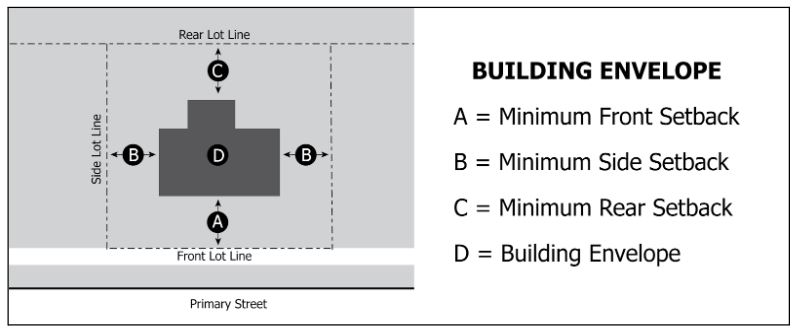
BUILDING ENVELOPE: The space remaining on a site for structures after all building setbacks, height limit, public access, driveway, and bulk requirements have been met.
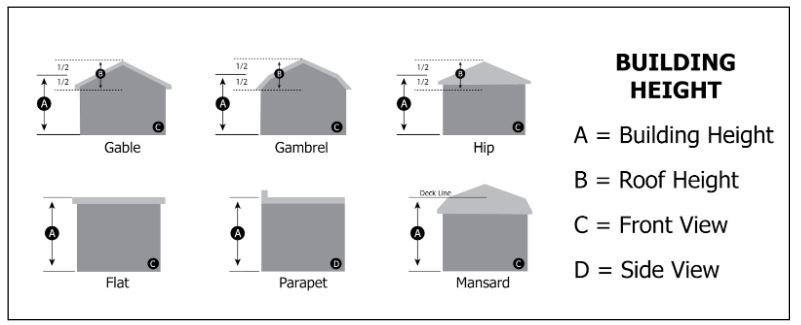
BUILDING HEIGHT: The vertical distance in feet to the peak of the roof or the highest point of the structure from the average finished grade immediately adjacent to the building.
BUILDING OFFICIAL OR INSPECTOR: The officer appointed by the City Council to review building permit applications, issue building permits, and inspect buildings under construction and upon their completion.
BUILDING, MAIN: a building in which is conducted the principal use of the building site on which it is situated. In any residential district, any dwelling shall be deemed to be the main building on the building site on which it is situated.
BUILDING PERMIT: An official document or certificate issued by the City or the Sevier County Building Department on behalf of the City, authorizing performance of a specified activity (i.e., the construction of any building, structure, or improvement, as required by applicable building, fire, and other safety codes and regulations.) Note: A building permit includes review of the application by the City for conformance with applicable land use ordinances, and includes a tie-down permit for a structure or building that does not require a building permit, such as a mobile home.
BUSINESS: Any activity carried on for the purpose of gain or economic profit. The acts of employees rendering service to employers are not included in the term business unless otherwise specifically prescribed. Business includes but is not limited to, the sale or rental of tangible personal or real property, the manufacturing of goods or property and the rendering of personal services for others for consideration by persons engaged in any profession, trade, craft, occupation, non-profit organization or other calling.
CAMPGROUND: An area of land upon which two (2) or more campsites are located, established, or maintained for occupancy for camping purposes for free or paying guests. Campgrounds are not intended to serve as residential areas or facilities.
CANOPY: A roof or awning constructed of fabric or other material and extending outward from a building to provide a protective shield for doors, windows or other openings with supports extended to the ground directly under the canopy or cantilevered from the building.
CARPORT: A private garage not completely enclosed by walls or doors. For the purpose of this title, a carport shall be subject to all of the regulations prescribed for a private garage.
CEMETERY, COLUMBARIUM, CREMATORY, MAUSOLEUM: Land or buildings used for the cremation, burial, or interment of the human dead but not including facilities for embalming.
CERTIFICATE OF OCCUPANCY: A certificate issued by the Building Official or inspector authorizing occupancy of a building or structure requiring a building permit.
CHARTER SCHOOL: An operating charter school; a charter school applicant that a charter school authorizer approves in accordance with §53G-5-3 of Utah State Code (as amended); or an entity that is working on behalf of a charter school or approved charter applicant to develop or construct a charter school building. Charter school does not include a therapeutic school. municipal-code/13.6.4
CHIEF EXECUTIVE OFFICER: The Mayor of the City or their designated appointee.
CHILD CARE: The care and/or instruction of five (5) or more children other than members of the family residing on the premises for compensation, conducted under the conditions and regulations associated in this title with a home occupation. State and Local licensing required.
CHURCH /RELIGIOUS INSTITUTIONS: A building set apart primarily for the purpose of worship in which religious services are held and which clergy is associated, the main body of which is kept for that use and not put to any other use inconsistent with its primary purpose, and which is tax-exempt under the laws of the State of Utah.
CITY COUNCIL OR COUNCIL: The City Council of Monroe City, Utah. A six-member body elected by the citizens comprised of five (5) council members and the Mayor. The City Council is designated by default as the City's Land Use Authority unless otherwise stated in this title. Three (3) voting members of the City Council shall constitute a quorum.
CITY ENGINEER: The City Engineer of the City or its authorized representative.
CLEAR VISION AREA: An area outlined by the sight distance triangle where solid fencing or natural vegetation is restricted to a height of three feet (3') and where all structures or other items that would obstruct vision are prohibited.
CLINIC: An establishment where patients are not lodged overnight but admitted for outpatient services.
CLUB: Building and facilities owned or operated by a corporation, association, person or persons for a social, educational or recreational purpose.
COAL YARD: The storage of coal in quantities in excess of ten (10) tons and/or the retail or wholesale sale of coal.
COMMERCIAL: A land use classification that permits facilities for the buying, selling, and provision of commodities and services.
COMMERCIAL DOG KENNEL: Means a place where five (5) or more dogs over six (6) months of age and or five (5) or more cats over six (6) months of age, irrespective of duration, are boarded, bred, bought, sold, exhibited or trained for compensation, but not including a pet shop, animal shelter veterinary clinic/hospital where boarding is incidental to treatment.
COMMERCIAL FEEDLOT: Any tract of land on which the principal use is the raising of, or the concentrated feeding of livestock, fowl, or other edible animals for the sale of such animals or the sale of products derived from such animals. Does not include dairies. Swine and mink operations are also not included or allowed as commercial feedlots.
COMMISSION: The Monroe City Planning Commission, who are appointed by the Mayor with the advice and consent of the City Council.
COMMISSION'S AUTHORIZED REPRESENTATIVE: The Planning Commission Chairman or other City employee or official who has been designated by the Commission to represent the City in enforcing or carrying out the functions of the Commission as set forth in this ordinance.
COMMON OPEN SPACE: The land area in a planned unit development (PUD) which is reserved and set aside for agricultural or recreational use, landscaping, open green areas, parking, and driveway areas for the common use and enjoyment of the residents of the PUD.
COMPLETE APPLICATION: A submission of a land use application, which includes all information requested on the appropriate form, and full payment of all applicable fees as outlined in the City's fee schedule.
COMPOSITING FACILITY: A facility that is designed and used for transforming, through biological decomposition, food, yard wastes and other organic material into soil or fertilizer. This use does not include backyard composting binds serving individual families.
CONDITIONAL USE: A use of land for which a conditional use permit is required pursuant to section 9.06 of this ordinance and §10-9a-507 of Utah State Code (as amended). A conditional use means a land use that because of its unique characteristics or potential impact on the City, surrounding neighbors, or adjacent land uses, may not be compatible in some areas or may be compatible only if certain conditions are required that mitigate or eliminate the detrimental impacts.
CONDOMINIUM: Any structure, lot, or parcel that has been submitted to fractionalize ownership under the provisions of the Utah Condominium Ownership Act and where there is an undivided interest in the common area and facilities. Condominium projects shall be reviewed, approved, and developed pursuant to the standards that apply for subdivisions, except where expressly preempted by the Utah Condominium Ownership Act.
CONSTITUTIONAL TAKING: Final action(s) by the City involving the physical taking or exaction of private real property that require compensation to a private real property owner because of the mandates of the fifth or fourteenth amendments to the Constitution of the United States, or of Article I, Section 22, of the Utah Constitution.
CONSTRUCTION - The placement, assembly, erection, substantial repair, alteration or demolition of a building or structure on land, the placement of concrete, asphalt, similar materials on land, or grading or earthwork of land.
CONSTRUCTION DRAWINGS: Plans prepared by a registered engineer, with a professional seal affixed thereto, showing all required improvements, including any proposed utilities.
CONTIGUOUS: Lands separated only by streets, easements, pipelines, power lines, conduits, rights-of-way under the ownership of the landowner of one (1) of the subject parcels, a property owners association or a governmental agency, or a public utility. For density purposes only, contiguous means lots that share a common border. (Lots that touch point-to-point, and lots that are separated by waterways, streets or major easements are not considered contiguous for density calculations.)
CONVENIENCE GOODS SALES AND SERVICES: A retail establishment selling consumer products including prepared, prepackaged food, drink, or similar and compatible products. A convenience store may also provide associated retail sale of gasoline and other petroleum products.
CORRAL: A pen or enclosure for confining animals.
COUNTY: The unincorporated area of Sevier County.
CRAWL SPACE: A shallow accessible area beneath the lowest occupied floor of a building, typically between the ground and the floor framing.
CUL-DE-SAC: A minor street having an open end and being terminated at the other end by a vehicle turnaround.
CULINARY WATER AUTHORITY: The department, agency, or public entity with the responsibility to review and approve the feasibility of the culinary water system and sources for the subject property.
CURB CUT: A ramp opening in a curb where vehicles or wheelchairs may enter or leave the roadway.
DAIRY: A commercial establishment for the manufacturing, processing, or packaging of dairy products and their sale; for purposes of this definition, the production of milk on a farm as a dairy.
DAYCARE CENTER: A building or structure where six (6) or more children are regularly cared for during the day for compensation for commercial use. State and Local licensing required.
DENSITY: The ratio of the number of dwelling units per acre of land.
DEVELOPER: Any person, firm, partnership, corporation, or association who causes improvements to be constructed and uses to be changed, or land to be subdivided for themselves or others. This includes an applicant for subdivision approval.
DEVELOPMENT ACTIVITY:
- Any construction or expansion of a building, structure, or use that creates additional demand and need for public facilities.
- Any change in use of a building or structure that creates additional demand and need for public facilities.
- Any changes in the use of land that creates additional demand and need for public facilities.
DEVELOPMENT AGREEMENT: A written agreement or amendments to a written agreement between the City and one (1) or more parties that regulates or controls the use or development of a specific area of land. Development agreement does not include an improvement completion assurance.
DEVELOPMENT (LAND): The conversion or alteration of use or physical characteristics of land; placing improvements on the land; or putting land to intensive use such as a subdivision, planned unit development, mobile home park, recreation vehicle park, shopping center, industrial park, excavation, etc.
DEVELOPMENT REVIEW COMMITTEE: Committee established and created by the City Council to assure that the proposed use, activity, building or structure is consistent with the City's General Plan and complies with the requirements of the land use and subdivision ordinances. Committee members may include representatives from City departments and other persons as may be designated by the City Council, who shall be responsible for reviewing and coordinating applications for any land use application approval, permit, or license.
DISABILITY: A physical or mental impairment that substantially limits one (1) or more of a person’s major life activities, including a person having a record of such an impairment or being regarded as having such an impairment. Disability does not include current illegal use of, or addiction to, any federally controlled substance, as defined in Section 102 of the Controlled Substances Act, 21 U.S.C. 802.
DISTRICT (ALSO ZONE OR ZONING DISTRICT): A portion of the territory of Monroe City established as a zoning district by this ordinance, within which certain uniform regulations and requirements or its various combinations thereof apply under the provisions of this ordinance.
DOMESTIC LIVESTOCK: Those fowl, cattle, dairy animals, swine, sheep, goats, and other animals such as horses which are kept or raised for use or for pleasure as part of the overall agricultural operation and which are not part of a commercial feedlot. See Family Food or Recreational Production municipal-code/13.7.11
DRAINAGE BASIN: A sub-area of a watershed which contributes storm water runoff to a watercourse tributary to the main receiving water.
DRAINAGE SYSTEM: One or more artificial ditches, tile drains, or similar devices which collect surface runoff or groundwater and convey it to a point of discharge.
DRIVEWAY: A private access way that provides vehicular connection from a public or private street or alley to a specific lot or building.
DRY CLEANER: An establishment which has as its sole purpose the cleaning of fabrics with substantially non- aqueous organic solvents. Laundry establishments with self-service, coin-operated dry-cleaning machines shall not be classified as a dry cleaner.
DUST CONTROL PLAN: A narrative plan that may include map exhibits prepared by the developer that establishes management practices to be employed and temporary facilities to be installed by the developer to control fugitive dust that is released into the air or onto public streets during development activities.
DWELLING: Any building, or portion thereof, which is designed for residential purposes and uses. Does not include hotels, motels, lodging houses, bed and breakfasts, and nursing homes. For the purposes of this definition travel trailers, park model trailers, recreational vehicles, motor homes or similar are not considered dwellings.
DWELLING, GROUP: Two (2) or more dwelling structures occupying the same lot and having yards and open spaces in common.
DWELLING, MULTI-FAMILY: A building containing more than two (2) dwelling units.
DWELLING, SINGLE FAMILY: A building containing only one (1) dwelling unit, designed to be occupied exclusively by one (1) family.
DWELLING, TWO-FAMILY: A building containing only two (2) dwelling units, designed to be occupied exclusively by two (2) families living independently of one another.
DWELLING UNIT: One or more rooms designed for use for or occupied by one (1) family for living or sleeping purposes and having kitchen facilities for the use of not more than one (1) family.
EASEMENT: A designated interest in the land of another which allows the easement holder specified uses or rights without actual ownership of the land. Authorization by a property owner for the use by another, and for a specified purpose, such as utilities and irrigation ditches, or any designated part of the owner's property. An easement may be for use under, on the surface, or above the owner's property.
EDUCATIONAL FACILITY:
- A school district’s building at which pupils assemble to receive instruction in a program for any combination of grades from preschool through grade twelve (12), including kindergarten and a program for children with disabilities.
- A structure or facility located on the same property as a building described above and used in support of the use of that building.
- A building to provide office and related space to a school district’s administrative personnel.
- Educational facility does not include:
- Land or a structure, including land or a structure for inventory storage, equipment storage, food processing or preparing, vehicle storage or maintenance, or similar use that is not located on the same property as a building described above and used in support of the purposes of a building described above.
- A therapeutic school.
- municipal-code/13.6.4 -Schools
EDUCATIONAL INSTITUTION: A public elementary or secondary school or a private educational institution having a curriculum like that ordinarily given in public schools. municipal-code/13.6.4 -Schools
EMINENT DOMAIN: The right of a public entity to acquire private property for public use upon the payment of just compensation.
ENCROACHMENT: Any obstruction or protrusion into a right of way or adjacent property, whether on the land or above it.
EQUIPMENT RENTAL AND LEASING: An industry, which provides machinery, tools, and recreational vehicles to rent/lease as temporary, short-term use.
ESSENTIAL SERVICES: Services provided by public and private utilities necessary for the exercise of the principal use or service of the principal structure. These services include surface, underground, or overhead gas, electrical, steam, water, sanitary sewage, storm water drainage, and communication systems and accessories thereto, such as poles, towers, wires, mains, drains, vaults, culverts, laterals, sewer pipes, catch basins, water storage tanks, conduits, cables, fire alarm boxes, police call boxes, traffic signals, pumps, lift stations, and hydrants, but not including buildings.
EXACTIONS: The act of demanding and obtaining something.
EXCAVATION: Either the removal of earth from its natural position or the cavity resulting from the removal of earth.
FAMILY: An individual, or two (2) or more persons related by blood, marriage, or adoption, or a group of not more than four (4) persons who are not related, living in a dwelling unit as a single housekeeping unit and using common cooking facilities.
FAMILY FOOD OR RECREATIONAL PRODUCTION: Domestic animals for pets or family food and/or recreational production. See section 13.7.11
FEE SCHEDULE: The schedule or any appendix of fees adopted periodically by resolution of the City Council setting forth various fees charged by the City.
FENCE: A physical barrier to delineate, contain or designate an area designed for a specific use, such as an enclosure for a dwelling unit, an area of storage, etc.
FENCE, WILDLIFE: Open fencing allowed a a height of six feet (6') or higher when a need is shown to protect animals from entering or leaving an area.
FILL: Earth materials used either as a manmade deposit or to raise the existing grade, or shall mean the depth or the volume of such materials.
FIRE AUTHORITY: The department, agency, or public entity with responsibility to review and approve the feasibility of fire protection and suppression services for the subject property.
FINAL ACTION: The latter of the final vote or the approved, written decision on a matter.
FLOOD PLAIN: Land that:
- Is within the one hundred (100) year flood plain designated by the Federal Emergency Management Agency (FEMA); or
- Has not been studied or designated by FEMA but presents a likelihood of experiencing chronic flooding or a catastrophic flood event because the land has characteristics that are similar to those of a one hundred (100) year flood plain designated by FEMA.
FRONTAGE: The length of the property line of the lot fronting on a street. A corner lot shall have two frontages.
GARAGE PRIVATE: An enclosed accessory structure or a portion of a principal building designed and used for the parking or storage of motor vehicles owned or operated by the occupants of the premises. A private garage is not open to the general public, contains no commercial vehicle repair or sales, and typically serves one household. It may be attached or detached.
GARAGE, PUBLIC: A structure or portion thereof other than a private garage, used for the storage, sale, care, repair, or refinishing of self-propelled vehicles, trailers, or boats.
GARAGE/YARD SALE: The occasional sale of used, household personal property by the occupants of a dwelling, conducted on the lot where they reside. Items are typically displayed in a garage, yard, driveway or porch and are not new merchandize acquired for resale. Garage/yard sales are temporary events of limited duration and frequency and as not the operation of a retail business.
GENERAL MERCHANDISE SALES AND SERVICES: Stores or shops intended for retail sales of goods and services are those generally needed for daily home consumption and for which locations near residential neighborhoods are considered desirable. This category includes a grocery store, drug store, variety store, hardware store, dry cleaning, electrical, carpenter, plumbing or heating shop, printing, publishing shop and uses considered similar and compatible.
GENERAL PLAN: A document the City adopts that sets forth general guidelines for proposed future development of the land as set forth in §10-9a-4 of Utah State Code (as amended).
GEOLOGIC HAZARD: A surface fault rupture, shallow groundwater, liquefaction, a landslide, a debris flow, unstable soil, a rock fall, or any other geologic condition that presents a risk to life, of substantial loss or damage to real property.
GEOTECHNICAL REPORT: A report prepared by and stamped by a licensed engineer in the State of Utah, practicing in the field of geotechnical engineering, that evaluates the existing soil conditions of the project site prior to new development. The geotechnical report should include descriptions of generalized site conditions, surface and subsurface conditions and recommendations for site preparation, excavation, grading, structural fill, foundation design, seismic considerations, concrete design, concrete and metal corrosion protection, pavement design, and soil moisture control. The report would also include exhibits and appendices showing a vicinity map, site plan, boring locations, boring logs, test results and any other information used by the geotechnical firm in determining their design recommendations.
GOVERNING BODY: The City Council of Monroe, Utah.
GRADING PLAN: A drawing showing the proposed grading in reference to the existing topography of the site.
- ROUGH GRADING PLAN: A drawing that shows existing contour topography overlaid with approximate proposed grading information including contour topography, retaining wall locations, and slopes for the subdivision area.
- FINAL GRADING PLAN: A drawing submitted with the construction drawings showing the proposed grading of a site by identifying contour topography, spot elevations, slopes, curb elevations, road grades, road profiles, building pad elevations, cross sections, retaining wall elevations, etc., to the hundredth of a foot for existing and proposed conditions.
GRAVEL PIT: All sites where gravel or minerals will be extracted by an open pit method; to all sites where such extracted earth products are stockpiled; and to sites where overburden and leftover earth materials are placed in waste dumps.
GREENHOUSE/NURSERY: An enclosed structure enclosed and used for the cultivation or protection of tender plants. If the product of the greenhouse/nursery is sold a business license will be required by the City.
GREENWAYS: Linear open spaces that link parks and neighborhoods within the community, such as paths or trails.
GROSS LAND AREA: The total area, including all public and private areas within the legal boundaries of a particular parcel of land or project.
GROUND FLOOR: A level of building, the floor of which is located not more than two feet (2') below nor more than six feet (6') above the finished grade.
HEALTH DEPARTMENT: The Utah State Division of Environmental Health or local health agency having jurisdiction. Includes Central Utah Public Health Department.
HOBBY KENNEL: Hobby Kennel- Owners having 4-5 dogs which are neutered or spayed are required to obtain a hobby kennel license. 6.16.7
HISTORIC PRESERVATION: The preservation of historically significant structures and neighborhoods to facilitate restoration and rehabilitation of the building(s) to a former condition.
HOME OCCUPATION: Any activity conducted entirely within the primary dwelling unit which is clearly incidental and secondary to the residential use of the building. A home occupation shall employ no one except members of the family who are residing in the dwelling, shall not physically change the building to the extent that it would alter the residential character of the building or the residential atmosphere of the local neighborhood, shall not generate unreasonable vehicular or pedestrian traffic for the primary, residential use, and shall not create a demand for municipal services or impact public facilities and infrastructure beyond that which is typical for the primary, residential use.
HOME OFFICE: A business office of a firm that conducts management and business functions from a home. Office-like setup in the home of a self-employed person. A conditional use permit will be required if any of the following apply: manufacturing, storing products, parking or storing vehicles or equipment.
HOSPITAL: An institution for the diagnosis, treatment and care of human illness or infirmity, including sanitariums and clinics.
HOTEL: A building or commercial establishment where people pay for lodging, and where meals and other facilities such as conference rooms are often available.
HOUSEHOLD: All those persons, related or unrelated, who occupy a single housing unit.
HOUSEHOLD PETS: Animals or fowl ordinarily permitted in the house and kept for company or pleasure, such as dogs, cats, and canaries, including not more than three (3) dogs or three (3) cats, over four (4) months of age, and not more than six (6) animals in total. Household pets do not include animals, fowl, or reptiles inherently or potentially dangerous.
municipal-code/6.16.6
HOUSING UNIT: A house, an apartment, mobile home or manufactured home, a group of rooms, or a single room that is occupied by a separate living quarters, or, if vacant, is intended for occupancy as a separate living quarters.
HYDROLOGY REPORT: A report prepared by a professional engineer licensed in the State of Utah, for the removal of excess water from proposed development sites. The report shall evaluate probable storm events that will generate excess water and compare the water discharges onto and from the site for pre development conditions. The report shall identify improvements and management practices to safely convey drainage and mitigate any impacts due to the proposed development activities, all prepared in accordance with the City's Construction Standards. A preliminary hydrology report shall be submitted with preliminary plans. A final hydrology report shall be submitted with the construction drawings, which shall include a storm water pollution prevention plan (SWPPP).
IMMEDIATE FAMILY: Consists of spouse, parent, children, grandparent or grandchildren and the spouse's parent, children, grandparent, or grandchildren.
IMPACT FEE: A payment of money imposed under §11-36a of Utah State Code (as amended).
IMPROVEMENT COMPLETION ASSURANCE: A surety bond, letter of credit, financial institution bond, cash, assignment of rights, lien, or other equivalent security required by the City to guaranty the proper completion of landscaping or an infrastructure improvement required as a condition precedent to recording a subdivision plat, or development of a commercial, industrial, mixed-use, or multi-family project.
IMPROVEMENT WARRANTY: A developer's unconditional warranty that the developer’s installed and accepted landscaping or infrastructure improvement:
- Complies with the City’s written standards for design, materials, and workmanship; and
- Will not fail in any material respect, as a result of poor workmanship or materials, within the improvement warranty period.
IMPROVEMENT WARRANTY PERIOD: A period:
- No later than one (1) year after the City’s acceptance of required landscaping; or
- No later than one (1) year after the City’s acceptance of required infrastructure, unless the City determines for good cause that a one (1) year period would be inadequate to protect the public health, safety, and welfare; and has substantial evidence on record of prior poor performance by the developer or that the area upon which the infrastructure will be constructed contains suspect soil and the City has not otherwise required the applicant to mitigate the suspect soil.
INDOOR RECREATION: A building or structure which contains sports or recreation facilities, including but not limited to indoor swimming pools, ice arenas, sport courts, exercise centers, climbing walls, roller rinks, bowling alleys, miniature golf, batting cages, billiard halls, video arcade, game arcade, and minor retail sales and services customarily associated with and accessory to such facilities.
INFRASTRUCTURE IMPROVEMENT: Permanent infrastructure that is essential for the public health and safety or that is required for human occupation; and a developer must install in accordance with published installation and inspection specifications for public improvements; and whether the improvement is public or private, as a condition of recording a subdivision plat, obtaining a building permit, or development of a commercial, industrial, mixed-use, condominium, or multi-family project.
INGRESS: An entrance subdivision street accessing an existing city street.
INSTRUCTIONAL STUDIO: An instructional studio is a dedicated learning space offering structured, instructor-led classes such as dance, gymnastics, and other similar activities (e.g., fitness, movement arts, creative enrichment).
INTERMITTENT USE: A temporary business of selling and delivering goods, wares, and merchandise within the City.
INTERNAL ACCESSORY DWELLING UNIT: Interior ADUs are located within the primary dwelling and are typically built through the conversion of existing space, such as an attic or basement. Attached ADUs are living spaces that are added on to the primary dwelling. The additional unit can be located to the side or rear of the primary structure, but can also be constructed on top of an attached garage.
JUNK: Old or scrap copper, brass, rope, rags, batteries, paper trash, rubber debris, or other waste or salvage material; junked, dismantled or wrecked automobiles or parts thereof; and old or scrap ferrous or non-ferrous metal materials.
JUNKYARD OR SALVAGE YARD: Anyplace, establishment, or business maintained, used, or operated for storing, keeping, buying, or selling junk or salvage-type materials. The term includes garbage and sanitary fills. municipal-code/7.2.3
KENNEL: Any premises where five (5) dogs older than four (4) months are kept.
LABORATORY: A building or group of buildings in which are located facilities for scientific research, investigation, testing, or experimentation, but not including facilities for manufacture of products for sale.
LANDMARK:
- A building, site, object, structure, or significant tree having historical, architectural, social, or cultural significance and marked for preservation by the local, state, or federal government.
- A visually prominent or outstanding structure or natural feature that functions as a point of orientation or identification.
LANDSCAPING: Any combination of living plants (such as grass, ground cover, shrubs, vines, hedges, or trees) or nonliving landscape material (such as rocks, pebbles, sand, mulch, walls, fences, or decorative paving materials). Landscaping may include the preservation and incorporation of existing trees, vegetation, or ecosystems into site development.
LAND USE APPLICANT: A property owner, or the property owner’s designee, who submits a land use application regarding the property owner’s land.
LAND USE APPLICATION: An application that is required by the City and submitted by a land use applicant to obtain a land use decision. A land use application is not an application to enact, amend, or repeal a land use regulation.
LAND USE AUTHORITY: A person, board, commission, agency, or other body designated by the City Council to act upon a land use application. Unless otherwise specified herein the City Council is designated as the Land Use Authority, with the Mayor and Planning Commission Chairman authorized to review and approve building permit applications.
LAND USE DECISION: An administrative decision of a Land Use Authority or Appeal Authority regarding a land use permit or a land use application.
LAND USE PERMIT: A permit issued by a Land Use Authority.
LAND USE REGULATION: A legislative decision enacted by ordinance, law, code, map, resolution, specification, fee, or rule that governs the use or development of land. Land use regulations include the adoption or amendment of a zoning map or the text of the zoning code. Land use regulation does not include a land use decision of the legislative body acting as the Land Use Authority, even if the decision is expressed in a resolution or ordinance; or a temporary revision to an engineering specification that does not materially increase a land use applicant’s cost of development compared to the existing specification or impact on a land use applicant’s use of land.
LAUNDROMAT: An establishment in which patrons wash, dry or dry-clean clothing and other fabrics in coin-operated, self-service machines.
LEAPFROG DEVELOPMENT: New development separated from existing development by substantial vacant land.
LEGISLATIVE BODY: The Monroe City Council.
LEVEL OF SERVICE (LOS): An indicator of the extent or degree of service provided by, or proposed to be provided by a public facility or service based on and related to the operational characteristics of the public facility or service.
LIQUOR STORE: A retail sales store authorized by the Utah State Liquor Commission to sell packaged alcoholic beverages for off-premises consumption.
LIVESTOCK: Large animals which may include horses, cattle, goats, sheep, llamas, ostriches, or other animals judged by the planning commission to be compatible with this category of large animal. For the purposes of this definition, hogs or pigs may not be considered livestock. See Family Food or Recreational Production municipal-code/13.7.11
LOCAL JURISDICTION: Monroe City.
LODGING HOUSE: A building where lodging only is provided for compensation to three (3) or more persons, but not including motels or hotels.
LOT: A tract of land, regardless of any label, that is created by and shown on a subdivision plat that has been recorded in the office of the county recorder.
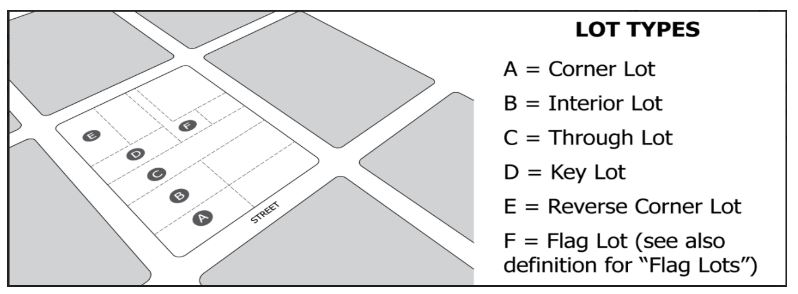
LOT, CORNER: A lot abutting upon two (2) or more streets at their intersection or upon two parts of the same street, such streets or parts of the same street forming an interior angle of less than one hundred thirty-five (135) degrees.
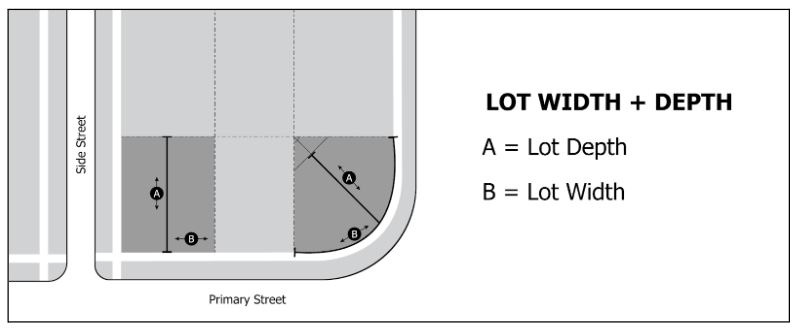
LOT, DEPTH: The horizontal distance between the front and rear lot lines is measured in the mean direction of the side lot lines.
LOT, DOUBLE FRONTAGE: A lot where the front line and back lot line both front on a street.
LOT, FLAG: A lot that has access to a public or private street by a narrow strip of land.
LOT, INTERIOR: A lot other than a corner lot.
LOT LINE ADJUSTMENT: A relocation of a lot line boundary between adjoining lots or between a lot and adjoining parcels in accordance with §10-9a-608 of Utah State Code (as amended) whether or not the lots are located in the same subdivision and with the consent of the owners of record. Lot line adjustment does not mean a new boundary line that creates an additional lot or constitutes a subdivision. Lot line adjustment does not include a boundary line adjustment made by the Utah Department of Transportation (UDOT).
LOT LINES: The property lines bounding the lot.
LOT, NONCONFORMING: A lot, created and shown on a recorded subdivision plat, does not conform to the requirements of this ordinance. New nonconforming lots are prohibited and shall not be created or permitted.
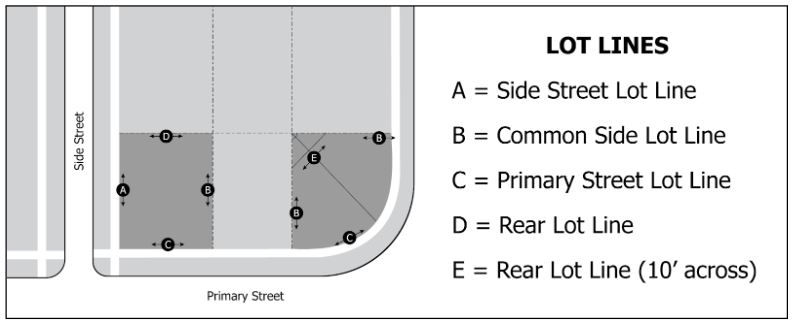
LOT LINE, FRONT: The line separating the lot from the street, in case a lot abuts on more than one (1) street, the lot owner may elect any street lot line, provided that such choice, in the opinion of the Zoning Administrator will not be injurious to adjacent properties. Where a lot does not abut on a street or where access is by means of a right-of-way, the lot line nearest to and most nearly parallel to the street line is the front lot line.
LOT LINE, REAR: Ordinarily that line of a lot which is opposite and most distant from the front line of the lot. In the case of a triangular or gore-shaped lot, a line ten feet (10') in length within the parcel parallel to and at a maximum distance from the front lot line. In cases where these definitions are not applicable, the Building Official or inspector shall designate the rear lot line.
LOT LINE, SIDE: Any lot boundary line not a front or rear lot line. A side lot line separating a lot from another lot or lots is an interior side lot line; a side lot line separating a lot from the street side lot line.
LOT, WIDTH: The average horizontal distance between the side lot lines, measured at right angles to the line followed in measuring lot depth.
LUMBER SALES AND STORAGE: The sale and display of lumber and building supplies, including the outside storage of lumber and related merchandise
MANUFACTURED HOME: Shall mean a transportable factory built housing unit constructed on or after June 15, 1976, according to the Federal Home Construction and Safety Standards Act of 1974 (HUD Code), in one (1) or more sections, which, in traveling mode, is eight (8) body feet or more in width or forty (40) body feet or more in length, or when erected on site, is four hundred (400) or more square feet, and which is built on a permanent chassis and is designed to be used as a dwelling with or without a permanent foundation when connected to the required utilities, and includes the plumbing, heating, air-conditioning, and electrical systems. All manufactured homes built after June 15, 1976, shall be identifiable by the manufacture's data plate bearing the date the unit was built and a HUD Label attached to the exterior of the home certifying the home was manufactured to HUD standards.
MANUFACTURING: The assembly, fabrication, processing, production, treatment, or packaging of goods, materials, or products, including the use of previously prepared, partially processed, raw, or bulk materials. Such activities may occur entirely within enclosed buildings or involve outdoor operations, equipment, or storage, and may generate noise, smoke, fumes, odors, glare, vibration, dust, traffic, or other potential impacts. Manufacturing uses shall be conducted in a manner that minimizes adverse effects on surrounding properties and the environment.
MEDICAL FACILITIES: Offices, clinics, and facilities devoted to treatment and care of human illness or injury; includes health, hospital, and dental facilities, but does not include assisted living centers, nursing homes, or residential facilities for the elderly or disabled.
MEZZANINE: A low-ceilinged story between two (2) main stories of a building. A mezzanine shall be counted as one (1) story if it covers more than one-third (1/3) of the area of the floor next below
MINING, DRILLING, DIGGING, QUARRYING: All or part of the process involved in the extraction and processing of mineral materials. Such activities shall normally be divided into four (4) distinct phases:
- EXPLORATION: Onsite, geologic examination from the surface of an area by seismic core, rotary, percussion or other drilling or testing for the purpose of searching for mineral deposits. Exploration includes associated activities such as clearing and preparing sites or constructing roads for drilling.
- PROSPECTING: Examination of an area for the purposes of determining the quality and quantity of minerals other than by exploration, but including the obtaining of samples by physical means;
- OPERATION: Mineral extraction and/or processing for commercial purposes, including such operations as aggregate or ready mix plants, mixing of asphalt, mining or drilling services, processing topsoil, washing, refining or processing of metallic, nonmetallic, or mineral fuel materials;
- RECLAMATION: Process by which an area physically or environmentally affected by mineral extraction activities is rehabilitated to either its original state or to a pre-agreed state of long-term environmental stability.
MIXED-USE: A group of different uses of land within a building for which applications for development permits are sought.
MOBILE HOME: Means a transportable factory-built housing unit built before June 15, 1976, in accordance with a state mobile home code that existed prior to the HUD Code This type of structure is only authorized to be located in a mobile home park.
MOBILE HOME PARK: Means any tract of land on which two (2) or more mobile home spaces are leased, or offered for lease or rent, to accommodate mobile homes for residential purposes.
MOBILE HOME SUBDIVISION: A subdivision designed and intended for residential use where the lots are to be occupied by mobile homes exclusively and are owned individually.
MODEL HOME: A residential structure that meets all residency occupancy requirements, used for sale purposes only. A subdivision may have up to a maximum of five (5) model homes in any subdivision. It is suggested that each should have a substantially different floor plan.
MODERATE INCOME HOUSING: Housing occupied or reserved for occupancy by households with a gross household income equal to or less than eighty percent (80%) of the median gross income for households of the same size in the country in which the City is located.
MODULAR UNIT: A structure built from sections which are manufactured in accordance with the construction standards adopted pursuant to uniform building codes and transported to a building site, the purpose of which is for human habitation, occupancy, or use.
MORTUARY, FUNERAL HOME: An establishment in which the human dead are prepared for burial or cremation. The facility may include a chapel for the conduct of funeral services, spaces for informal gatherings, and related accessory uses.
MOTEL: A building or group of buildings containing individual sleeping units designed and used primarily for the accommodation of transient automobile travelers and with automobile parking immediately accessible.
MOTOR HOTEL, MOTEL, HOTEL: A building or group of buildings for the accommodation of transient guests, comprising individual sleeping or living units.
MULTIPLE - BUSINESS COMPLEX: A group of structures housing at least two separate businesses or agencies, or a single structure containing more than one business with separating walls and at least one outside access for each business which shares a common lot, access and/or parking facility.
MUNICIPAL FACILITIES: Those improved properties owned by a municipality, or the public.
MUNICIPAL SERVICES: Services traditionally provided by local agencies, including water and sewer, roads, parks, schools, and police and fire protection.
NEW DEVELOPMENT: Any new construction activity.
NOISE DISTURBANCE: Is defined to include any sound which endangers or injures the health of humans or disturbs a reasonable person of normal sensitivities.
NON-COMMENCEMENT: The failure to begin, or the discontinuation of, construction activity that would make a material change in a structure as evidenced by the cancellation, lapsing, or revocation of a building permit; or the failure to begin, or the discontinuation of, any other land use activity that would make a material change in the use of land.
NON-COMPLYING STRUCTURE: A structure that:
- Legally existed before its current land use designation; and
- Because of one (1) or more subsequent land use ordinance changes, does not conform to setback, height restrictions, or other regulations, excluding those regulations that govern the use of land.
NON-CONFORMING USES: A use of land that:
- Legally existed before its current land use designation.
- Has been maintained continuously since the time the land use ordinance or regulation governing the land changed; and
- Because of one (1) or more subsequent land use ordinance changes, does not conform to the regulations that now govern the use of the land.
NOTICE (OF MEETING OR HEARING): A legal document announcing the opportunity for the public to present their views to an official representative or board of a public agency concerning an official action pending before the agency. Includes a “Class A” or “Class B” public notice as defined by §63G-30-101 and 102 of Utah State Code (as amended).
NURSERY: A business that grows, cultivates, and/or distributes and sells plants and other landscaping or horticulture-related items.
NURSING HOME: An institution providing residence and care for the aged or infirm.
OFFICIAL STREETS MASTER PLAN: As adopted by the City Council, the designation of each existing and planned street and right-of-way, and those located on approved and filed plats, for the purpose of providing for the development of the streets, highways, roads, and rights-of-way and for their future improvement, construction, realignment, and necessary widening, including provision for curbs and sidewalks. The classification of each street and right-of-way is based upon its location in the respective zoning district of the City, its present and estimated future traffic volume and its relative importance and function.
OFFICIAL ZONING MAP: The map adopted by the City Council pursuant to law showing the streets, zoning districts and City boundaries; and any amendments or additions thereto resulting from the approval of rezones, subdivisions or annexation plats and the subsequent filing of such approved plats.
OPEN SPACE: Land areas that are not occupied by buildings, structures, parking areas, streets or roads. Open space may be devoted to landscaping, preservation of natural features, and recreational areas and facilities. Those areas are reserved to meet the density requirements of planned unit development.
OPERATOR: Means and includes the owner, permit holder, custodian, manager, operator, or person in charge of any permitted or licensed premises.
OUTDOOR RECREATION, PARK OR PLAYGROUND (PUBLIC OR PRIVATE): An area free of buildings except for restrooms, dressing rooms, equipment storage and maintenance buildings, and open-air pavilions and used primarily for recreation activities not involving motor vehicles or overnight use.
OUTDOOR RECREATION, USES: Recreational, leisure-based activity designed for personal enjoyment. Activities may include hiking, camping, biking, swimming, off-highway vehicles and similar motorized vehicles for recreational activities. The Land Use Authority may also determine other outdoor recreation activities like those listed above that are consistent with this section.
OVERLAY: A land use designation on the General Plan Land Use Map, or a zoning designation on a zoning map, that modifies the basic underlying designation in some specific manner. The standards of both the underlying zoning designation and the overlay zoning designation apply, provided that in the case of a conflict between such standards, the standards of the overlay zone shall control.
OWNER: Any person, or group of persons, that is the record title-holder to property.
PACKAGE AGENCY: Any outlet authorized by the Utah Liquor Control Commission to sell original package liquor or wine for consumption off the premises.
PARCEL: Any real property that is not a lot.
PARCEL BOUNDARY ADJUSTMENT: A recorded agreement between owners of adjoining parcels adjusting the mutual boundary, either by deed or by a boundary line agreement in accordance with §10-9a-524 of Utah State Code (as amended) if no additional parcel is created and none of the property identified in the agreement is a lot, or the adjustment is to the boundaries of a single person’s parcels. Parcel boundary adjustment does not mean an adjustment of a parcel boundary line that creates an additional parcel or constitutes a subdivision. Parcel boundary adjustment does not include a boundary line adjustment made by the Utah Department of Transportation (UDOT).
PARCEL DELIVERY, DROP OFF and PICKUP SERVICE: A commercial establishment where parcels and packages are received, sorted, and dispatched for delivery. The use typically includes indoor package handling and associated office functions, along with the parking, staging, and dispatch of multiple delivery vehicles. Includes general retail customer service for package drop‑off and pick‑up.
PARK MODEL RECREATIONAL VEHICLE: A unit that is designed and marketed as temporary living quarters for recreational, camping, travel, or seasonal use; is not permanently affixed to real property for use as a permanent dwelling; requires a special highway movement permit for transit; and is built on a single chassis mounted on wheels with a gross trailer area not exceeding four hundred (400) square feet in the setup mode.
PARKING LOT - PUBLIC PARKING: Any place, structure or area owned or leased by the City and operated as an off-street parking facility, for motor vehicle parking of four (4) or more parking spaces.
PARKING SPACE: A permanent area, enclosed or unenclosed, for parking or a motor vehicle.
PAWN SHOPS: A business dealing in or collecting used or secondhand merchandise or personal property, which has been legitimately obtained.
PERMITTED PREMISES OR LICENSED PREMISES: Any premises that requires a license and/or permit such as a sexually-oriented business.
PERMITTED USE: An authorized use or use by right within a zoning district.
PERMITTEE OR LICENSEE: A person in whose name a permit and/or license to operate a business has been issued, as well as the individual listed as an applicant on the application for a permit and/or license.
PERSON: An individual, association, company, corporation, firm, organization, partnership, trust, and any other formal or informal association of individuals that acts as or is recognized to have a separate legal entity.
PERSONAL SERVICES: Establishments primarily involved in providing personal grooming and related services. This definition shall include aestheticians, barbershops, beauty parlors and other places where hairdressing, facials, and manicures are performed, tailors, and massage services, tattoo parlor, but not laundries, dry cleaners, or medical facilities. Health Department and/or State Permit/license required.
PHARMACY: the art, practice, or profession of preparing, preserving, compounding, and dispensing medical drugs.
PLAT: An instrument subdividing property into lots as depicted on a map or other graphical representation of lands that a licensed professional land surveyor licensed in the State of Utah makes and prepares in accordance with §10-9a-603 or §57-8-13 of Utah State Code (as amended).
POTENTIAL GEOLOGIC HAZARD AREA: An area that is designated by a Utah Geological Survey map, county geologist map, or other relevant map or report as needing further study to determine the area’s potential for geologic hazard; or has not been studied by the Utah Geological Survey or a county geologist but presents the potential of geologic hazard because the area has characteristics similar to those of a designated geologic hazard area.
POWER GENERATION (EXCLUDING SOALR AND WATER GENERATION); Signifies the process of creating electrical energy from other forms of energy.
PRESCHOOL: An educational or teaching facility designed for pre-kindergarten age children including kindergarten preparation, music lessons, etc.
PRIMARY DWELLING: A single-family dwelling that is detached and is occupied as the primary residence of the owner of record. Accessory buildings or structures located ten feet (10’) or closer to a primary dwelling or structure shall be considered a part of the primary dwelling or structure.
PRIMARY USE: A land use listed in the City’s land use matrix which occupies the greater portion of a lot or parcel or is the more intense use of two (2) uses on a lot or parcel.
PRIVATE DRIVE: A non-dedicated thoroughfare or road used exclusively for private access to and from private land or developments.
PROFESSIONAL OFFICE: A place intended for the conduct of a recognized learned business profession. Other professions so defined would include, but not be limited to accountants, architects, engineers, and lawyers. The definition does not allow for in-patient care facilities or sexually-oriented businesses.
PROPERTY: Any parcel, lot, or tract of land, including improvements thereon, in the possession of or owned by, or recorded as the real property of the same person or persons.
PROPERTY LINE: The boundary line of a parcel or lot. See also Lot Lines.
PUBLIC BUILDING: Any building owned, leased or held by the United States, the state, the county, the City, a special district, school district, or any other agency or political subdivision of the state or the United States, which building is used for governmental purposes.
PUBLIC HEARING: A hearing at which members of the public are provided a reasonable opportunity to comment on the subject of the hearing. Noticing requirements of a public hearing shall meet requirements addressed in §10-9a-205 of Utah State Code (as amended).
PUBLIC IMPROVEMENT: Any building, structure, culinary, secondary, or storm water system or facility, roadway, parkway, curb, sidewalk, gutter, pedestrian way, trail, landscaping, parking lot or space, or other infrastructure, improvement, or facility for which the City may ultimately assume ownership or responsibility for the benefit of the public, or which may affect city infrastructure, improvements, or facilities.
PUBLIC MEETING: A meeting that is required to be open to the public under §52-4 of Utah State Code, Open and Public Meetings (as amended).
PUBLIC PARK: Public land which has been designated for park or recreational activities, including, but not limited to, a park, playground, nature trails, swimming pool, reservoir, athletic field, basketball or tennis courts, pedestrian or bicycle paths, open space, wilderness areas, or similar public land within the city which is under the control, operation or management of the City.
PUBLIC RIGHT-OF-WAY: An area of land that is deeded or dedicated to the City or other governmental agency for the provision of public access.
PUBLIC STREET: A street, including the entire right-of-way, which has been deeded or dedicated to and accepted by the City or other governmental agency. Includes a public highway, public avenue, public boulevard, public parkway, public road, public lane, public alley, public viaduct, public subway, public tunnel, public bridge, public byway, other public transportation easements or other public ways.
PUBLIC USE: A use operated by or for a public body, such a use having the purpose of serving the public health, safety, or general welfare, and including such uses as public schools, parks, playgrounds, and other recreational facilities; administrative, service facilities, and public utilities.
PUBLIC UTILITY: A structure or other facility used by a public agency to store, distribute, generate, or chemically treat water, power, gas, sewage, equipment, or other service elements.
QUASI-PUBLIC USE: A use operated by a private non-profit, educational, religious, recreational, charitable or philanthropic institution, such a use having the purpose primarily of serving the general public, such as churches, playgrounds, private schools, and similar uses.
RECEPTION CENTER, RECEPTION HALLS. A facility for the holding of events including but not limited to weddings, weeding receptions, community meetings, and group gatherings.
RECORD OF SURVEY MAP: A map of a survey of land prepared in accordance with §10-9a-603, §17-23-17, and §57-8-13 of Utah State Code (as amended).
RECREATION, COMMERCIAL: Recreation facilities operated as a business on private or public property and open to the public for a fee, such as a golf course, ski lift, tennis court, etc, and support facilities customarily associated with the development.
RECREATIONAL, VEHICLE: A vehicular unit, other than a mobile home, primarily designed as a temporary dwelling for travel, recreational, or vacation use, which is either self-propelled or is mounted on or pulled by another vehicle, including but not limited to a travel trailer, a camping trailer, a truck camper, a motor home, a fifth-wheel trailer, and a van.
RECREATIONAL VEHICLE AND TRAVEL TRAILER PARK: Any area where one (1) or more lots or campsites are rented for relatively short-term occupancy to users of travel trailers, recreational vehicles, or tents.
RECYCLE CENTER: Any facility which is maintained and operated for the purpose of receiving, collecting and processing source-separated recyclable materials for resale or transfer. For the purposes of this definition, “processing” shall mean the modification of materials by baling, crushing, grinding, chipping or other means to prepare the materials for markets.
REGIONAL CAMPS AND RESORTS: A temporary establishment for temporary living facilities such as tents, or recreation vehicle(s) in which someone lives or stays for a period of time not to exceed thirty (30) consecutive days.
RELIGIOUS, EDUCATIONAL INSTITUTE: A 28 U.S.C. 501 © (3) non-profit organization engaged in teaching, community programs, or spiritual endeavors, which qualifies as a tax-exempt religious institution under Title 26 of the U.S. Code.
RELIGIOUS INSTITUTION: Any church, synagogue, mosque, temple or building which is used primarily for religious worship and related religious activities.
REPAIR SERVICES, SMALL APPLIANCE OR EQUIPMENT: An establishment for the repair of household or other small appliances or equipment. No such appliances or their parts shall be stored outdoors.
RESIDENTIAL: Land designated in the City's General Plan and zoning ordinance for buildings consisting primarily of dwelling units. May be improved, vacant, or unimproved land.
RESIDENTIAL DISTRICT OR RESIDENTIAL USE: Except with regard to caretaker residences in a commercial or manufacturing zone, a single-family, duplex, townhouse, multiple-family or mobile home park, development or subdivision and campgrounds, and single-family, duplex, townhouse, multiple-family, or mobile home uses, all as defined under city ordinances.
RESIDENTIAL FACILITY FOR PERSONS WITH A DISABILITY: A residence in which more than one (1) person with a disability resides and which is licensed or certified by the Department of Human Services under §26B of Utah State Code (as amended) or which is licensed or certified by the Department of Health under §57-21 of Utah State Code (as amended).
RESIDENTIAL FACILITY FOR ELDERLY PERSONS: A facility conforming with the applicable standards of the Utah Department of Human Services, including licensure and inspection.
RESTAURANT, CAFÉ: An establishment where food is prepared and served to customers for consumption on the premises.
RESTAURANT, CAFES, FAST FOOD, DRIVE-IN: An establishment distinguished from a traditional sit-down restaurant in that service is provided from a counter or window for consumption either off or on the premises.
RETAIL: The sale of consumer goods directly to the user of the product; may include storage of goods sold in sufficient quantities to meet daily needs. May include sale in large size packages used as pricing incentives.
RETAIL TOBACCO SPECIALITY BUSINESS: A commercial establishment in which:
- Sales of tobacco products, electronic cigarette products, and nicotine products account for more than thirty-five percent (35%) of the total quarterly gross receipts for the establishment;
- Twenty percent (20%) or more of the public retail floor space is allocated to the offer, display, or storage of tobacco products, electronic cigarette products, or nicotine products;
- Twenty percent (20%) or more of the total shelf space is allocated to the offer, display, or storage of tobacco products, electronic cigarette products, or nicotine products;
- The commercial establishment:
- Holds itself out as a retail tobacco specialty business; and
- Causes a reasonable person to believe the commercial establishment is a retail tobacco specialty business;
- Any flavored electronic cigarette product is sold; or
- The retail space features a self-service display for tobacco products, electronic cigarette products, or nicotine products as those terms are defined in §10-8-41.6 of Utah State Code (as amended).
REZONING: An amendment to the map and/or text of a zoning ordinance to effect a change in the nature, density, or intensity of uses allowed in a zoning district and/or on a designated parcel or land area.
RIGHT-OF-WAY: That portion of land dedicated to public use for street and/or utility purposes or maintained in private use for similar purposes.
ROAD, RIGHT-OF-WAY WIDTH: The distance between property lines measured at right angles to the centerline of the street.
ROOF: The building element, which covers the top of the structure as the walls enclose the sides.
SANITARY LANDFILLS: Locations where trash, garbage, organic materials are buried and maintained in accordance with local, state, and federal regulations.
SANITARY SEWER AUTHORITY: The department, agency, or public entity with responsibility to review and approve the feasibility of sanitary sewer services or onsite wastewater systems.
SCHOOL: Any public or private educational facility, including, but not limited to, child daycare facilities, nursery schools, preschools, kindergartens, elementary schools, primary schools, intermediate schools, junior high schools, middle schools, high schools, vocational schools, secondary schools, continuation schools, special education schools, junior colleges and universities. School includes the school grounds but does not include the facilities used primarily for another purpose and only incidentally as a school. municipal-code/13.6.4 -Schools
SCHOOL, PRIVATE OR QUASI-PUBLIC: A school operated by a private or quasi-public organization or individual, which has a program similar to that provided in any public school in the State of Utah, except that such curriculum may include religious instruction. A private school may be a profit making or nonprofit organization. This definition shall not include commercial schools. municipal-code/13.6.4 -Schools
SCREENING: Landscaping, berms, fences, walls or any combination thereof used to block or significantly obscure, in a continuous manner, the view from one area to another.
SECURITY AGREEMENT: An agreement to install improvements secured by cash bond, cash escrow, an irrevocable letter of credit, or any combination of the preceding as approved by the City Council.
SEMINUDE: A state of dress in which clothing covers no more than the genitals, pubic region, and areolae of the female breast, as well as portions of the body covered by supporting straps or devices.
SENIOR CITIZEN CENTER: A government-sponsored public building, other than a church or school, serving the social and recreational needs of the elderly. Such a center may include a meeting hall and cooking and dining facilities for large groups but shall not provide overnight lodging.
SETBACK: The required minimum distance between a building or structure and the closest of the following:
- Property line;
- Platted, deeded, or otherwise recorded street or public right of way; or
- Existing curb or edge of the street. The required portion of a yard over which no portion of a building or structure shall encroach unless otherwise permitted in this title.
SEXUALLY ORIENTED BUSINESS: A business at which any nude or partially denuded individual, regardless of whether the nude or partially denuded individual is an employee of the sexually oriented business or an independent contractor, performs any service for compensation. Sexually oriented business includes an escort service or an adult service as those terms are defined in §10-8-41.5 of Utah State Code (as amended).
SHORT-TERM RENTAL: A residential structure located on a legal lot and offering transient lodging accommodations in separate guest rooms and where meals may be provided. It is the rental of any house or part of a house for less than thirty (30) days. Applicants must meet all applicable requirements of the building code and this ordinance as adopted by the City. municipal-code/13.7.8
SIGHT DISTANCE: The extent of unobstructed vision in a horizontal and vertical plane.
SIGHT DISTANCE TRIANGLE: An area formed by the curb lines or edges of the roadway and a straight line from the driver’s eye on one street to an object on the other street. (Distances for different roadway types are calculated by AASHTO standards).
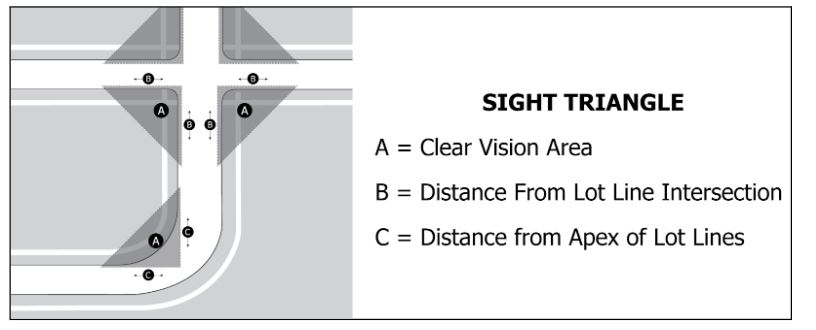
SIGN: Any writing, pictorial presentation, symbol, banner, or any other figure of a similar character of whatever material which is used to identify, announce, direct attention to or advertise, which is placed on the ground, on any bush, tree, rock, wall, post, fence, building, structure, vehicle or on any place whatsoever and which is visible from outside a building.
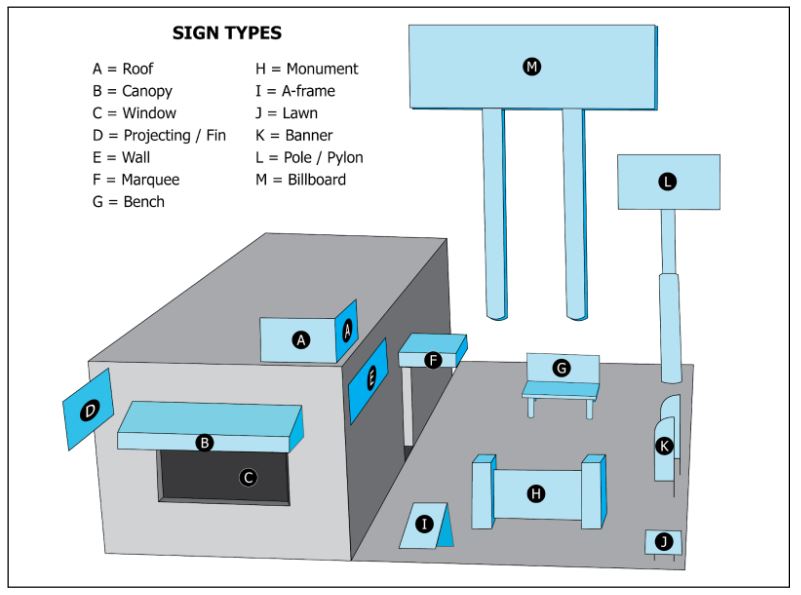
SITE DEVELOPMENT STANDARDS: Regulations unique to each zone concerning standards for development including, but not limited to lot areas, setbacks and building height.
SOLAR:
- BUILDING INTEGRATED SOLAR ENERGY SYSTEM: A solar energy system that consists of integrating photovoltaic devices into the building structure, such as the roof or the wall, and which does not alter the relief of the roof or wall.
- GROUND MOUNTED SOLAR ENERGY SYSTEM: A solar energy system that is directly installed in the ground and is not attached or affixed to an existing structure.
- ROOF MOUNTED SOLAR ENERGY SYSTEM: A solar energy system in which solar panels are mounted to the roof of a building, either as a flush-mounted system or as modules fixed to frames that can be tiled.
- SOLAR POWER PLANTS - LARGE: A utility-scale solar energy system intended to generate electric energy or other energy by converting sunlight, whether by solar devices or other conversion technology, for the sale, delivery, or consumption of the generated energy by more than one (1) end-user.
- SOLAR POWER PLANTS - SMALL: A solar energy system where the sole use is to generate electric energy or other energy by converting sunlight, whether photovoltaic deices or other conversion technology, primarily for consumption by a single end user at the same property upon which the solar energy system is located. The power output of the system shall not exceed one (1) megawatt. Small solar energy systems shall only be an accessory use to a principal use.
- WALL MOUNTED SOLAR ENERGY SYSTEM: A solar energy system that is mounted to a wall of a building, either as a flush-mounted system or as modules fixed to frames which can be tilted.
SOLAR POWER GENERATON: Energy generated by using energy that comes from the sun's light and heat.
SPECIAL DISTRICT: An entity established under the authority of §17B of Utah State Code, Special Districts (as amended), and any other governmental, or quasi-governmental entity that is not a county, municipality, school district, or unit of the state.
SPECIFIED PUBLIC AGENCY: The state, a school district, or a charter school.
SPECIFIED PUBLIC UTILITY: An electric corporation, gas corporation, or telephone corporation, as those terms are defined in §54-2-1 of Utah State Code (as amended).
SQUARE FOOTAGE: The gross constructed area of all buildings and structures covered by a solid or screened roof and totally or partially enclosed by walls or other material. Nonresidential outdoor areas covered or uncovered which functionally extend the primary use, such as open seating and open retail are included, except that uses which generally completely occur outdoors, such as vehicle or monument sales, nurseries, gasoline sales, salvage yards, and outdoor storage, are not included. Nonresidential canopies and screened enclosures which functionally extend the primary use are included. Decorative canopies or canopies designed to protect from weather are not included.
STABLE: A building in which domestic animals, such as horses, ponies, and cattle are sheltered and fed, having stalls or compartments. Within municipal-code/13.7.11 limits.
STANDARD SPECIFICATIONS FOR DESIGN AND CONSTRUCTION OR STANDARD SPECIFICATION: The standards, specifications and construction requirements adopted by the City for improvements including streets, water, sewer (wastewater), storm drainage, etc.
STATE: Includes any department, division, or agency of the State of Utah.
STORAGE (OUTDOOR): The use of open unenclosed area of the lot for the storage of recreational vehicles, automobiles and other equipment. This use category does not include or allow the storage of junk.
STORAGE, UNIT: The rental of storage space (such as rooms, lockers, containers, and/or outdoor space), to tenants, usually on a short-term basis (often month-to-month). Self-storage tenants include businesses and individuals
STORY: A habitable level within a building serving to define the building height. Basements that emerge less than four feet (4’) from grade or attics not exceeding four feet (4') at the kick wall shall not constitute an additional story.
STRUCTURAL ALTERATIONS: Any change in the supporting members of a building, such as bearing walls, columns, beams, or girders.
STRUCTURE: Anything constructed or erected which requires a fixed location on the ground or attached to something having a location on the ground, including signs and billboards. Definition includes “building”.
SUBDIVIDER: A person who, having an interest in land, causes it, directly or indirectly, to be subdivided.
SUBGRADE: Shall mean either the soil prepared and compacted to support a structure or a pavement system, or the elevation of the bottom of the trench in which utilities are laid.
SUBSTANDARD HOUSING: Residential dwellings that, because of their physical condition, do not provide safe and sanitary housing.
SUBSTANTIAL CHANGE IN LAND USE: Either:
- A change in land use or site design that increases the intensity of land use;
- A change in land use or site design that creates or increases incompatibility of adjacent land uses; or
- An increase in the total floor area of multiple-family dwellings or nonresidential buildings which results in increased traffic.
SUBSTANTIAL ENLARGEMENT OF A SEXUALLY ORIENTED BUSINESS: Increase in the floor area or wall area occupied by the business by more than fifteen percent (15%), as the floor area and wall area exist on the effective date hereof.
SUBSTANTIAL IMPROVEMENT: Any combination of repairs, reconstruction or improvement of a structure, where the improvement creates additional enclosed space that contains equipment or utilities relative to the primary structure, the cost of which equals or exceeds fifty percent (50%) of the market value of the structure either before the improvement or repair is started, or if the structure has been damaged and is being restored, before the damage occurred. For the purpose of this definition, substantial improvement is considered to occur when the first alteration of any wall, ceiling, floor, or other structural part of the building commences, whether or not that alteration affects the external dimensions of the structure. The term does not, however, include either any development for improvement of a structure to comply with existing state or local health, sanitary, or safety code specifications which are solely necessary to assure safe living conditions, or any alteration of a structure listed on the National Register of Historic Places or a State Inventory of Historic Place.
SUSPECT SOIL: Soil that has a high susceptibility for volumetric change, typically clay rich, having more than a three percent (3%) swell potential, bedrock units with high shrink or swell susceptibility or gypsiferous silt and clay, gypsum, or bedrock units containing abundant gypsum commonly associated with dissolution and collapse features.
TEMPORARY: A single period or an accumulation of periods not exceeding ninety (90) consecutive days in any one (1) year period unless further restricted.
THEATER: A theater is a place where people go to see plays and other performances.
THERAPEUTIC SCHOOL: A residential group living facility:
- For four (4) or more individuals who are not related to the owner of the facility or the primary service provider of the facility;
- That serves students who have a history of failing to function at home, in a public school or in a nonresidential private school; or
- That offers room and board and an academic education integrated with specialized structure and supervision or services or treatment related to a disability, an emotional development, a behavioral development, a familial development, or social development.
TINY HOUSE/HOME: A dwelling that is four hundred (400) square feet or less in floor area excluding lofts, installed on a permanent foundation, designed and intended as a permanent, year-round residence for one (1) single family. For the purposes of this definition “loft” shall be defined as a floor level located more than thirty inches (30”) above the main floor, open to the main floor on one (1) or more sides with a ceiling height of less than six feet eight inches (6’8”) and used as a living or sleeping surface.
TINY HOME COMMUNITY/VILLAGE: A single parcel of land, not organized as a subdivision, containing more than one (1) tiny home and no other type of dwelling unit.
TOPOGRAPHIC (TOPO) MAP: A graphic representation of natural and human-made features of a place or region in such a way as to show their relative positions and elevations.
TOWNHOUSE: A dwelling unit located on an individual lot and attached by at least one (1) but no more than two (2) party wall(s) along fifty percent (50%) of the maximum depth of the unit, to one (1) or more other dwelling units; has a continuous foundation; each on its own lot, with said party wall(s) being centered on the common property line(s) between adjacent lots.
TRADE SHOP: A building designed and equipped for carrying on the trades and uses of metalworking, woodworking, welding, plumbing, machine work, electrical work and glasswork and includes contracting in these trades.
TRANSFER OF OWNERSHIP OR CONTROL OF A SEXUALLY ORIENTED BUSINESS: Means and includes any of the following:
- The sale, lease, or sublease of the business.
- The transfer of securities which constitute a controlling interest in the business, whether by sale, exchange, or similar means.
- The establishment of a trust, gift or other similar legal device which transfers ownership or control of the business, except for transfer by bequest or other operation of law up to the death of a person possessing the ownership or control. (Ord. 11-5-1999, 11-18-1999, eff. 11-18-1999).
TRAVEL TRAILER: Means a camping trailer, or fifth-wheel trailer. A portable vehicle without motive power, designed as a temporary dwelling for travel, recreational and vacation uses that does not require a special highway movement permit from the State of Utah when drawn by a self-propelled motor vehicle.
UNDEVELOPABLE: Specific areas where topographic, geologic, and/or soil conditions indicate a significant danger to future occupants and a liability to the City and designated as "undevelopable" by the County.
UNINCORPORATED: The area outside of the incorporated area of the City.
UNNECESARY HARDSHIP: That circumstance where special conditions, which are not self-created or economic, affect a particular property, are not general to the surrounding neighborhood, and make strict conformity with land use regulations and restrictions unnecessarily burdensome or unreasonable in light of the purposes of this ordinance.
UTILITIES: Shall mean and include natural gas, electric power, cable television, telephone, storm system, sewer (future), culinary water and other services deemed to be of a public-utility nature by the City.
UTILITY BOARD: The review board, consisting of City officials and citizen volunteers, which meets at least monthly to assess utility needs and availability, review utility policies and contracts and conduct other recommendations to the City Council for utility department business.
UTILITY EASEMENT: The area designated for access to construct or maintain utilities on privately or publicly owned land.
VALID: A development order or other authorization which was legally issued, that has not expired, lapsed, or been abandoned, revoked, or canceled, and is not subject to such by the passage of time or the conduct of the owner or developer, and on which or for which all conditions of approval are satisfied that must be satisfied by the terms or conditions of approval.
VARIANCE: Relief from certain provisions of a zoning ordinance granted to a property owner when, because of the particular physical surroundings, shape, or topographical condition of the property, compliance would result in a particular hardship upon the owner, as distinguished from a mere inconvenience or a desire to make a development project more profitable. Variances must satisfy the standard set forth in §10-9a of Utah State Code (as amended) in order to be granted.
VESTED: Having an unquestionable right to the possession of property or a privilege. Rights to a use, structure, or proposed development shall vest only as permitted by this ordinance and §10-9a of Utah State Code (as amended).
VETERINARY CLINIC: A location for the treatment of small or large animals. Animals may be kept overnight or for short periods of time for treatment.
VICINITY MAP: A map showing project locations relative to the City's boundaries, major roads and minor roads that serve the property.
VIEWSHED: The area within view from a defined observation point.
WAREHOUSE: A building or premises in which goods, merchandise or equipment are stored for eventual distribution.
WATER SOURCE PROTECTION ZONE OR WELLHEAD PROTECTION ZONE: Minimum distances required by Central Utah Public Health Department or the City's Wellhead Protection Zone. (See figure below.)
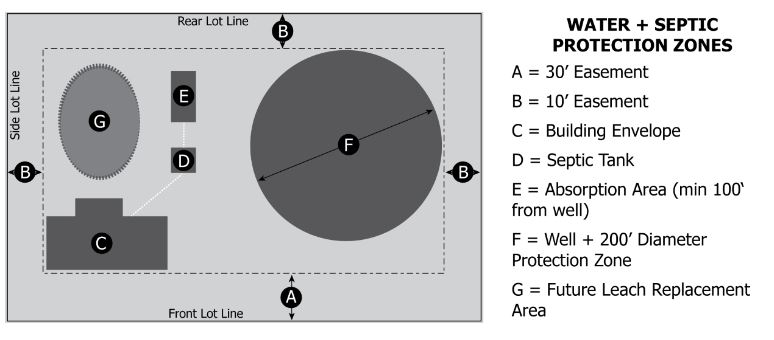
WATER SUPPLY SYSTEM, FACILITY OR WATER FACILITY: Any or all works and auxiliaries for collection, treatment, storage and distribution of water from the source or sources of supply to the consumer or processing plants.
WHOLESALE BUSINESS: The sale of goods to a person or company who may sell products to the ultimate consumer. Includes sale of products in bulk for further repackaging.
WORK: All required construction as shown on approved construction plans and specifications for all facilities and features of any kind which are required, related to the process of subdivision of land.
XERISCAPING: Landscaping with slow-growing, drought-tolerant plants to conserve water and reduce yard trimmings.
YARD: The open space between a lot line and the buildable area within which no structure may be located, except as provided in this ordinance.
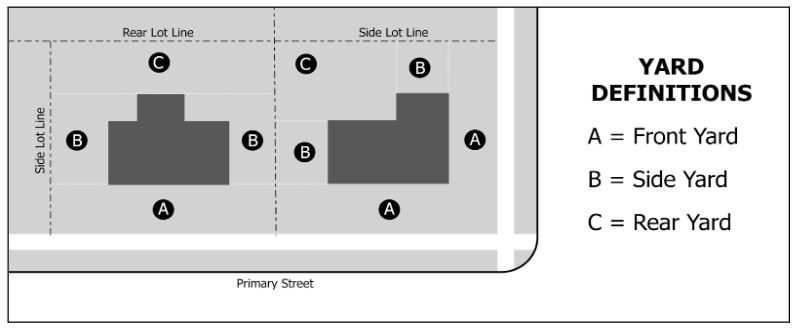
YARD, FRONT: An open space unobstructed from the ground upward extending along the full width of the lot measured between the building and the front lot line. The depth of the front yard is the minimum distance measured horizontally between the front lot line and the nearest front line of the building. Note: On a corner lot there are two (2) front yards.
YARD, REAR: An open space unobstructed from the ground upward between a building and the rear lot line. The depth of the rear yard is the shortest distance measured horizontally between the rear lot line and the closest part of the main building.
YARD, SIDE: An open space unobstructed from the ground upward extending from the front yard to the rear yard between a building and the nearest side lot line. The width of the side yard is the shortest distance measured horizontally between any part of the building and the nearest side lot line.
ZERO LOT LINE HOME: The use of a lot for one (1) detached dwelling unit with at least one (1) wall, but not more than two (2) walls or a portion thereof, located directly adjacent to a side lot line, excluding a mobile and manufactured home but including a modular building.
ZONING ADMINISTRATOR: The Mayor of the City, or the person designated by the Mayor with the consent of the City Council, to carry out the administrative responsibilities of this ordinance. It is the responsibility of the Zoning Administrator to ensure all procedures and other provisions of this ordinance are consistently and equitably applied.
ZONING DISTRICT: Any portion of the incorporated area of the City in which the same zoning regulations apply.
HISTORY:
Ord. 3-1-2024, 4/9/2024, 1/27/2026 , 3/24/2026

