
Mont Belvieu City Zoning Code
ARTICLE III
DISTRICT REGULATIONS
Sec. 42-163. - Districts established.
(a)
Generally. In order to implement the city comprehensive plan and promote the purposes of this chapter, the following zoning districts are established:
(b)
Applicable regulations. The following regulations shall apply to all districts:
(1)
Lot arrangement. The lot arrangement shall be such that there will be no foreseeable difficulties, for reasons of topography or other conditions, in securing building permits to build on all lots in compliance with all local regulations and in providing driveway access to buildings on the lots from an approved street.
(2)
Lot dimensions. Lot dimensions shall comply with the following minimum standards (see Figure D):
a.
Minimum lot dimensions.
1.
Width. 120 feet with curb and gutter, otherwise, 120 feet with open ditch; 75 feet at building lien for radial lots. Nonresidential lots shall be 100 feet.
2.
Depth. 275 feet. Lots adjacent to a major thoroughfare or major arterial shall be ten feet deeper than average interior lots in the block; lots backing on natural drainageway shall be at least 100 feet between the front lot line and the drainageway. Commercial lots shall be 100 feet minimum.
3.
Area. Three quarters acres (32,670 feet).
4.
Building lines.
(i)
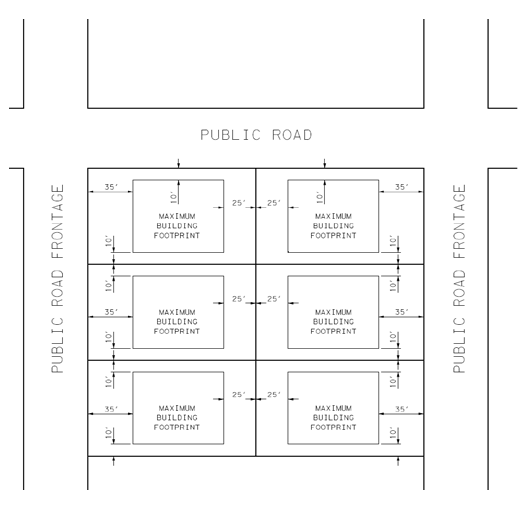
Residential: 75 feet on the front or 60 ft on front with attached side-load garage, ten feet on side, and 25 feet on the rear.
(ii)
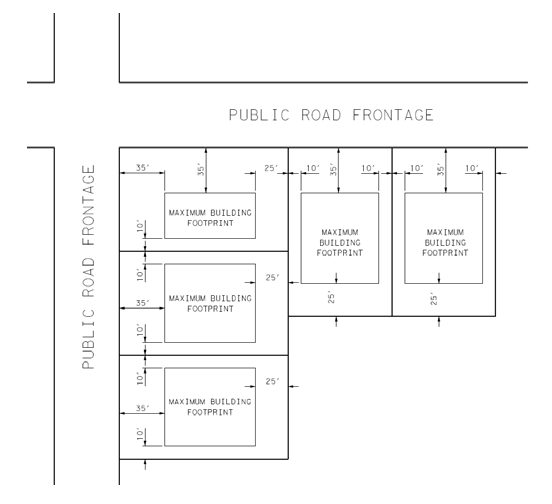
Where lots have double frontage and/or a corner lot, the required front yard setback shall be provided on both streets.
(iii)
In those instances where lots front on both intersecting streets within the same block, the corner lot shall maintain a front yard setback, as set out in (b)(2)a.4.(i), on both streets.
(iv)
In those instances where lots front on only one of the intersecting streets within the same block, the corner lot shall maintain a front yard setback, as set out in (b)(2)a.4.(i), on that street upon which other lots front, and the setback on the other intersecting street may be reduced to not less than ten feet.
(v)
The rear yard of a corner lot shall be considered as parallel to the street upon which the lot has the least amount of frontage.
(vi)
Eaves, overhangs, or architectural features of a single-family primary structure may encroach a maximum of 24-inches into the prescribed side-yard setback, as long as the structures foundation commences at the established building setback line.
(vii)
Covered patios and porches attached to the primary structure, shall be treated the same as an accessory structure and may be located within the rear building setback. This extension shall not encroach into any utility easement and remain a minimum of five feet from the rear property line.
(viii)
Permitted driveways shall remain a minimal of 18 inches from the prescribed side-yard setback, when no utility boxes or easements are present.
b.
Minimum townhouse lot dimensions.
1.
Width: 20 feet, except at the end unit which occupies a corner lot where an additional ten feet shall be required for the side yard.
2.
Area: 2,000 square feet.
3.
Building lines: 25 feet on front and rear, ten feet on side of corner lots, and ten feet on side of interior lots.
4.
Minimum number of units in a project: ten.
5.
Minimum number of units in a cluster: three.
6.
Maximum number of units in a cluster: six.
7.
Open space: not less than 400 square feet per dwelling unit, in addition to lots and parking areas, for recreational and/or court yard use. This will be measured on a per cluster basis whereby each cluster must meet this requirement, not just the development overall. For purposes of this section, open space shall not include any areas whose primary purpose is other than recreational or court yard use. This exclusion includes, but is not limited to, roads, rights-of-way, parking, drainageways, and drainage detention facilities.
8.
Density standard: no more than four units per acre.
9.
Cluster is defined as a grouping of townhouses/townhomes that are attached or connected and share common open space areas.
c.
Estate residential (ER) lot dimensions.
1.
Minimum lot area: 1.25 acres (54,450 square feet).
2.
Minimum lot width: 120 feet.
3.
Front setback: 75 ft or 60 ft on front with attached side-load garage.
4.
Side setbacks (primary structures): 20 feet.
5.
Side setbacks (accessory structures): Ten feet.
6.
Rear setback: 25 feet.
Figure D. — Minimum Lot Dimensions.
Notes:
Lot sizes are averaged over the entire project. Overall maximum density shall not
exceed four units per acre except as noted.
2
;hg;Townhomes shall have a minimum of ten units in each project, a minimum of three
units per cluster, and a maximum of six units per cluster.
3
;hg;Mobile/Manufactured Homes shall have a minimum of 20 lots per project. Refer
to chapter 20 for specific requirements relating to mobile/manufactured homes.
d.
Minimum multifamily and apartment lot dimensions.
1.
Maximum: 18 units per acre. This restriction shall be noted on the plat.
2.
Building lines: 25 feet on front, ten feet on side of corner lots. Generally, the front of the lot shall be defined as the side of the lot parallel to the main facade of the building or structure. Where there is a question, the front of a lot shall be defined as the side of the lot containing the driveway or front door.
e.
Minimum manufactured housing lot dimensions.
1.
A subdivider may either plat one master lot on which there may be located a mobile home as defined by state law, or a mobile home park, or several distinct lots wherein there is to be no common elements.
2.
Individual lots not part of a mobile home park or condominium:
(i)
Minimum width: 75 feet.
(ii)
Minimum depth: 100 feet.
(iii)
Minimum area: 8,400 square feet.
(3)
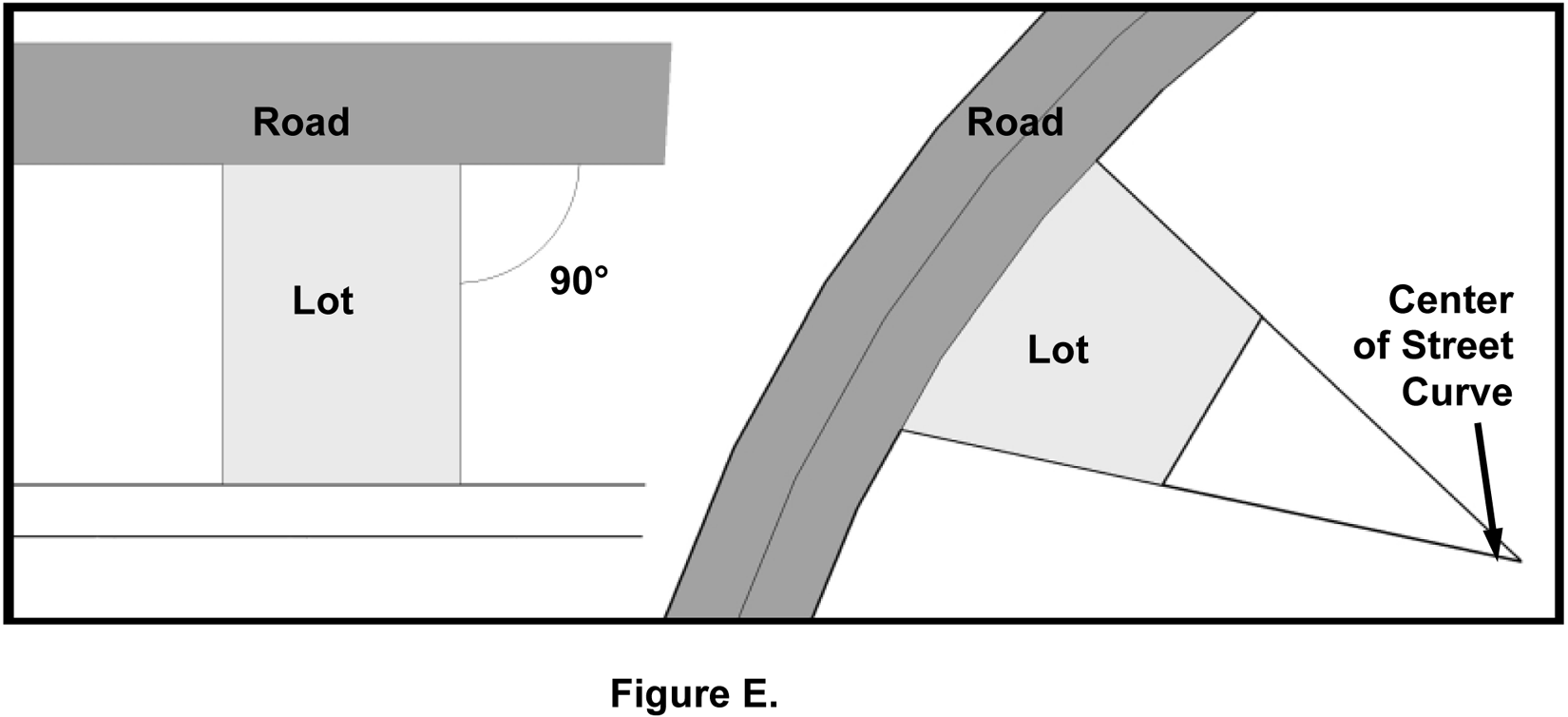
Lot orientation. The lot line common to the street right-of-way shall be the front line. All lots shall face the front line and a similar line across the street. Wherever feasible, lots shall be arranged so that the rear line does not abut the sideline of an adjacent lot.
(4)
Double frontage lots and access to lots.
a.
Double frontage lots. Double frontage shall be prohibited.
b.
Access from major and minor arterials. Lots shall not, in general, derive any access from a major thoroughfare. Where driveway access from a major thoroughfare may be necessary for several contiguous lots, the city council may require that such lots be served by a private combined access drive in order to limit possible traffic hazards on the street.
(5)
Soil preservation, grading, and seeding.
a.
Soil preservation and final grading. No certificate of occupancy shall be issued until final grading has been completed in accordance with the approved final subdivision plat and the lot precovered with soil with an average depth of at least six inches which shall contain no particles more that two inches in diameter over the entire area of the lot, except that portion covered by buildings or included in streets, or where the grade has not been changed or natural vegetation seriously damaged. Topsoil shall not be removed from residential lots or used as spoil, but shall be redistributed so as to provide at least six inches of cover on the lots and at least four inches of cover between the sidewalks and curbs, and shall be stabilized by seeding or planting. Sites where the natural vegetation is in place and sufficiently absorbs and distributes the drainage of the lots in the view of the city engineer need not be disturbed.
b.
Lot drainage. Lots shall be laid out so as to provide positive drainage away from all buildings, and individual lot drainage shall be coordinated with the general storm drainage pattern for the area. Drainage shall be designed so as to avoid draining into adjacent lots. The top of the slab or foundation on the lots shall be built to the higher of:
1.
24 inches over the base flood elevation (when lot is in a floodplain);
2.
18 inches over the average terrain;
3.
18 inches over elevation of the crown of the road when drainage is by an open ditch; or
4.
18 inches over elevation of the curb when drainage is by a curb and gutter. All drainage requirements shall meet the county criteria manual standards per the city engineer.
c.
Lawn, grass, seed and sod. Seeding and sod requirements should reflect local conditions. All lots shall be seeded from the roadside edge of the unpaved right-of-way back to a distance of 25 feet behind the principal residence on the lot. No certificate of occupancy shall be issued until regrading of soil and seeding of lawn has been completed; except when the subdivider or builder submits an agreement in writing signed by the subdivider or builder and the property owner, with a copy to the chief building official, city planner, and city engineer that regrading of soil and seeding of lawn will be done during the next planting season, and place on deposit with the city a cash escrow for performance in an amount determined by the chief building official. Sod may be used to comply with any requirement of seeding set forth herein.
(6)
Debris and waste. No cut trees, timber, debris, earth, rocks, stones, soil, junk, rubbish, or other waste materials of any kind shall be buried in any land, or left or deposited on any lot or street at the time of the issuance of a certificate of occupancy, and removal of those items and materials shall be required prior to issuance of any certificate of occupancy on a subdivision. No items and materials as described in the preceding sentence shall be left or deposited in any area of the subdivision at the time of expiration of any subdivision improvement agreement or dedication of public improvements.
(7)
Lot grading and elevation. No building shall be commenced until each lot in a subdivision is graded or configured in accordance with the subdivision's approved grading plan and in accordance with the minimum standards set forth in subsection (b)(5) of this section.
(Ord. No. 2008-021, § 2(25-60), 10-13-2008; Ord. No. 2014-014, § 2, 4-14-2014; Ord. No. 2014-033, §§ 2—4, 9-22-2014; Ord. No. 2014-034, § 5, 11-10-2014; Ord. No. 2017-015, § 1, 7-24-2017; Ord. No. 2017-030, § 1, 11-27-2017; Ord. No. 2020-021, § 3, 10-12-2020; Ord. No. 2022-009, § 3, 2-28-2022; Ord. No. 2022-019, § 2, 12-12-2022; Ord. No. 2023-007, § 2, 3-13-2023)
Sec. 42-164. - Off-street parking.
Off-street parking regulations. No new construction or expansion of an existing use shall be permitted without compliance with the following off-street parking regulations. Additionally, where existing parking areas are determined to be inadequate for use or occupation changes, these requirements shall be required.
Parking lot interior landscaping.
Landscape areas must consist of at least ten percent of the interior area of a parking lot. Landscaped islands may be clustered or evenly distributed.
Parking rows.
Landscape islands of at least 150 square feet must be placed at both ends of a parking row. Parking rows cannot extend for greater than ten spaces without an interrupting landscape island of at least 150 square feet and shall contain at least one native tall tree and four shrubs.
Paving materials.
• Parking and loading areas must have a permanent surface of, concrete, brick, paver blocks or a solid surface of similar or better durability and performance characteristics. Truegrid (or similar material) may be used in for temporary applications.
• Porous pavement and concrete may be used for individual parking spaces and lightly used drive aisles. Porous pavement and concrete are discouraged for busy drive aisles, service drives and truck/freight loading areas. Porous pavement cannot be used for handicapped parking spaces.
Bicycle parking.
At least one bicycle rack parking space must be provided for every 25 vehicle parking spaces required.
(1)
Dimensions. Required off-street parking shall meet the following off-street parking requirements:
(2)
Americans with Disabilities Act (ADA) requirements. The following regulations shall be the minimum standards for the installation of accessible parking stalls. The existence of this section shall in no way supersede any revisions of the federal ordinance governing these regulations and requirements. When there is conflict between the provisions, the more restrictive shall apply.
(3)
General parking requirements. Multifamily residential development must not be planned as "pods", isolated from surrounding development, but instead must be integrated into the larger grid of public streets and internal access driveways. Residential development with multifamily dwellings must have pedestrian and vehicular connections to adjacent residential and commercial development.
Off-street parking shall meet the following general requirements. All parking lots shall be of concrete construction. Any fraction of a parking space derived mathematically by the city planner shall be construed to mean one additional lot (i.e., 31.25 calculated spaces shall mean 32 spaces are required).
a.
Accesses to parking areas shall be coordinated with adjacent property owners and parking lots such that no more than one access shall be allowed for every 400 feet of frontage.
b.
In the event that two driveways are adjacent to one another, the total width of each driveway shall not exceed 16 feet.
c.
Single-family residential areas shall provide a minimum of two parking spaces enclosed in a garage. Garages should be accessed from the side or rear so as to avoid street-facing garages. At minimum, a two-car, attached garage shall be required for all single-family dwellings, and a one-car attached garage shall be required for each unit in a two-family dwelling. Front-loading garages shall not be located in front of the main living area of the dwelling by more than eight feet. These areas shall also provide a minimum of two off-street parking spaces per unit. These may be located in the driveway portion of the lot. This shall apply to manufactured homes (see chapter 20). Accessory dwelling units shall have one per accessory dwelling provided in addition to the principal dwelling.
d.
Multifamily residential areas, including townhomes, apartments, etc., shall provide a minimum of 1.5 spaces per one-bedroom unit, two spaces per two-bedroom unit, 0.5 space per each additional bedroom, 0.75 space per dwelling unit provided exclusively for low income elderly occupancy.
e.
Commercial uses shall generally be required to provide one parking space for every 250 square feet of aggregate finished floor space. The following are exceptions to this rule:
1.
Automobile repair, service, carwash, church, theaters, convenience store, and fitness centers shall have one space for every 200 square feet of finished floor space.
2.
Hotels, motels, etc., shall have a minimum of 1.5 parking spaces per bed.
3.
Day care, preschool, and similar uses shall provide a minimum of one stall per staff member plus one stall per five students, calculated based on the maximum capacity of the school or day care.
4.
Assisted living facility or elderly housing shall provide one space per four employees, one space per four patient beds, one space per staff doctor.
5.
Hospice residential care facility shall provide one space per four employees, one space per four patient beds, one space per staff doctor.
6.
Home occupation uses shall be required to provide one space per nonresident employee (if there is one) in addition to the required principle dwelling.
f.
Institutional, manufacturing, and other heavy and light industrial uses shall provide one stall per person employed on the highest use shift.
g.
Shared parking: The required number of spaces for non-residential uses may be further reduced by demonstrating the use of shared parking.
1.
If an office use and a retail sales and service use share parking, the parking requirement for the retail sales and service use may be reduced by 20 percent, provided that the reduction shall not exceed the minimum parking requirement for the office use.
2.
If a residential use shares parking with a retail and service use other than lodging uses, eating and drinking establishments or entertainment uses, the parking requirement for the residential use may be reduced by 30 percent, provided that the reduction does not exceed the minimum parking requirement for the retail and service use.
3.
If an office and a residential use share off-street (or other thoroughfare) parking, the parking requirement for the residential use may be reduced by 50 percent, provided that the reduction shall not exceed the minimum parking requirement for the office use.
h.
Landscaping requirements in off-street parking lots.
1.
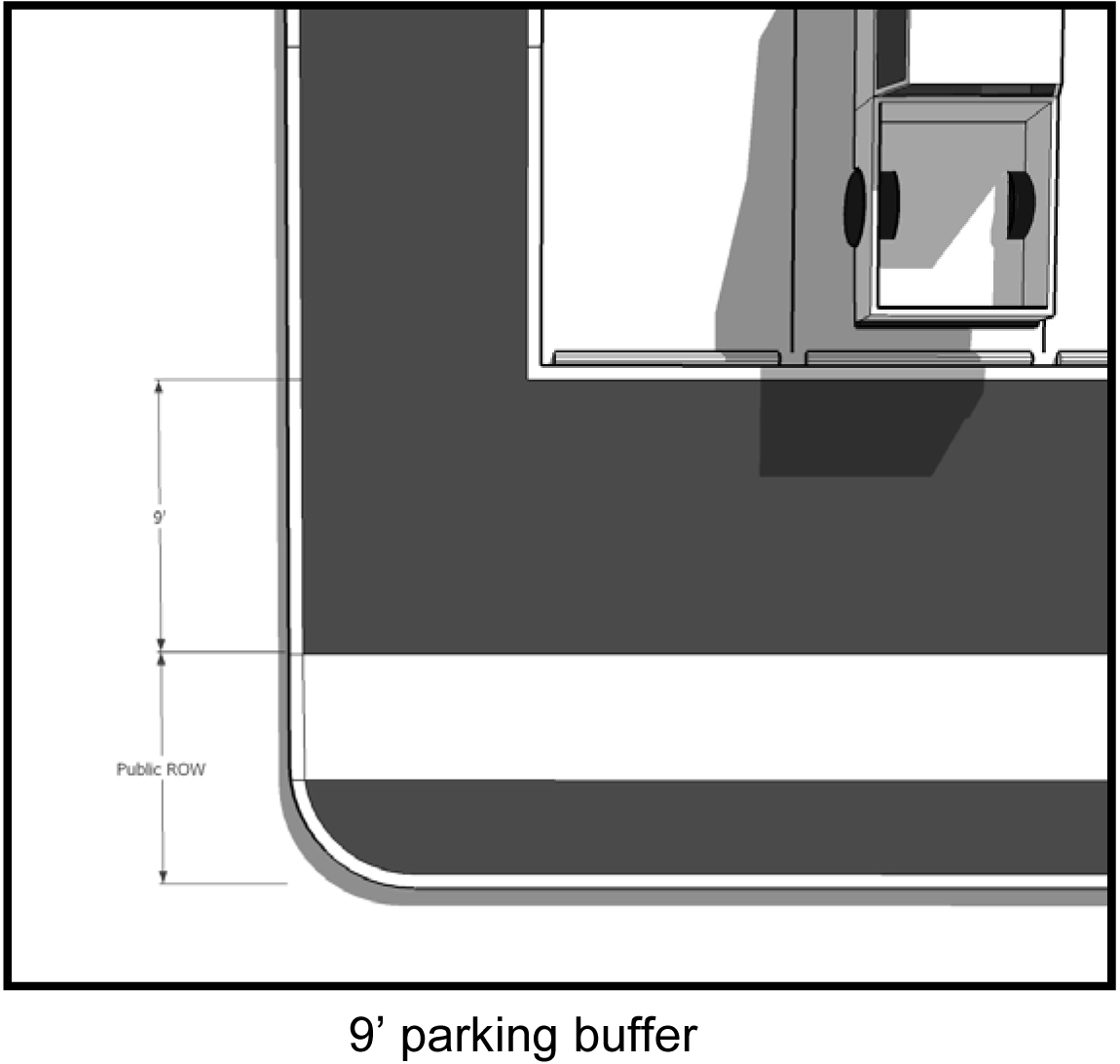
All parking areas adjacent to public streets shall incorporate a nine-foot minimum landscaped buffer area along the public right-of-way (see image below). The buffer area shall have continuous shrubbery of no less than eight shrubs per 30 linear feet. Shrubs shall be a minimum of one and one-half feet high. The buffer area shall include at least one small tree for every 30 linear feet. The owner of the property shall place and maintain the trees, shrubs, and other landscaping so as not to cause a visual obstruction. Any ditch or other landscaped drainage easement shall not be counted towards this requirement.
2.
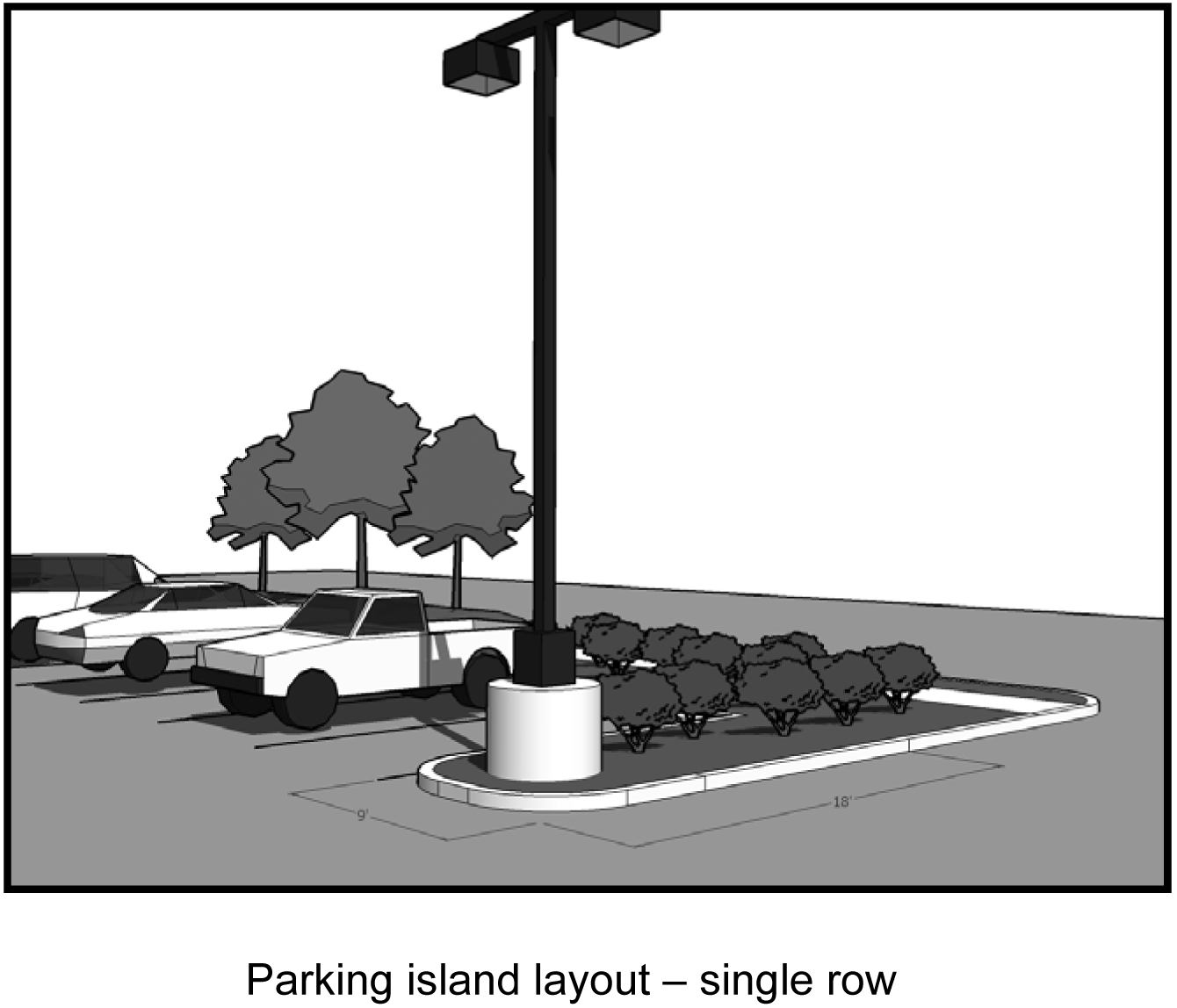
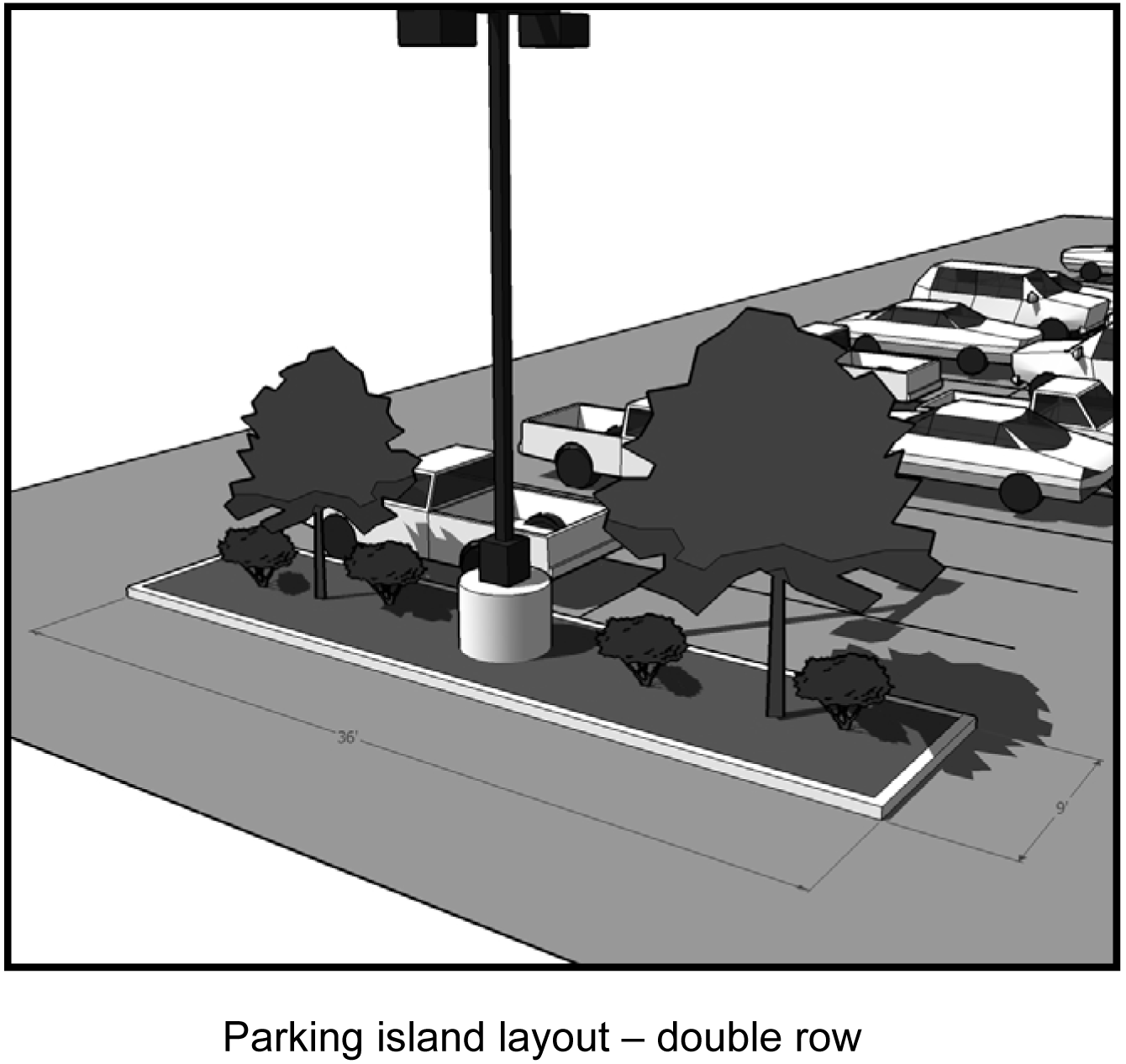
All parking rows are required to have landscaped islands at the ends of parking the parking rows, and no more than ten parking spaces in a row shall be allowed without a landscaped island. These islands shall contain parking lot lighting as required, and shall have a minimum of two trees and four shrubs. Single parking rows shall have islands that are a minimum overall dimension of nine feet by 18 feet, or the standard dimension of one parking stall. Double parking rows shall have islands that are a minimum overall dimension of nine feet by 36 feet. Angled parking shall meet the same dimensions as 90-degree parking. See the images below for general guidelines.
3.
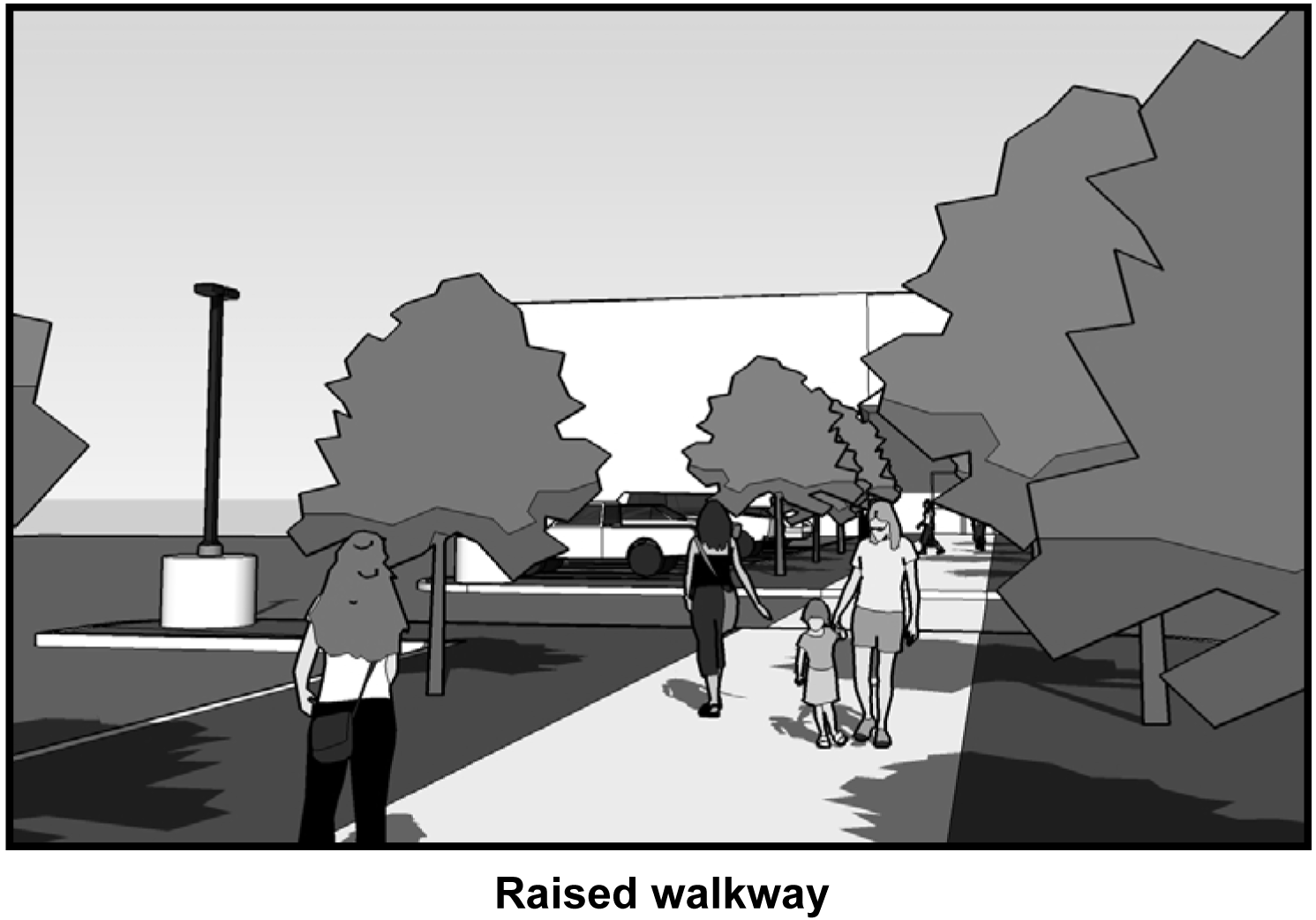
Raised sidewalks when required shall be constructed in a manner that is compliant with all applicable federal and state regulations. Sidewalks shall be placed such that easy access is allowed from all parts of the parking lot (usually in the center of the parking lot). Sidewalks shall be a minimum of ten feet wide and shall be raised a minimum of four inches above the finished parking lot grade. Disabled access points shall be provided at parking row ends in connection with the landscaped islands at the end of the parking rows. See the illustration below for an example.
(Ord. No. 2008-021, § 2(25-61), 10-13-2008; Ord. No. 2014-003, § 7, 1-13-2014; Ord. No. 2022-009, § 4, 2-28-2022)
Sec. 42-165. - Landscaping.
(a)
Purpose. The purpose of this section is to provide a standard throughout the city regarding minimum standards for landscaping and fencing. Landscaping and fencing are encouraged throughout the city as a buffer and screen against undesirable views and use separation.
(b)
Required landscaping improvements. The improvements listed and explained in this section shall be required of all new structures and any renovated structure, as well as public right-of-way dedications, HOA-maintained common areas and open spaces, and any other public or quasi-public area. The landscaping improvements are required to be maintained to the standards outlined in this section.
(c)
General provisions. The following provisions shall apply to each property and development:
(1)
Newly constructed buildings in commercial areas shall have automatic irrigation systems installed for watering landscaping, including parking lots, park strips, and areas near the building.
(2)
Landscaping shall be maintained by providing irrigation, removing weeds, trimming the lawn areas, and all other practical steps to ensure the health and aesthetics of the landscaped area. The topping of trees shall be strictly prohibited.
(3)
Trees projecting over any public right-of-way shall be trimmed and clear of the right-of-way to a height of 12 feet for the portion of the plant located in the proximity of the right-of-way.
(4)
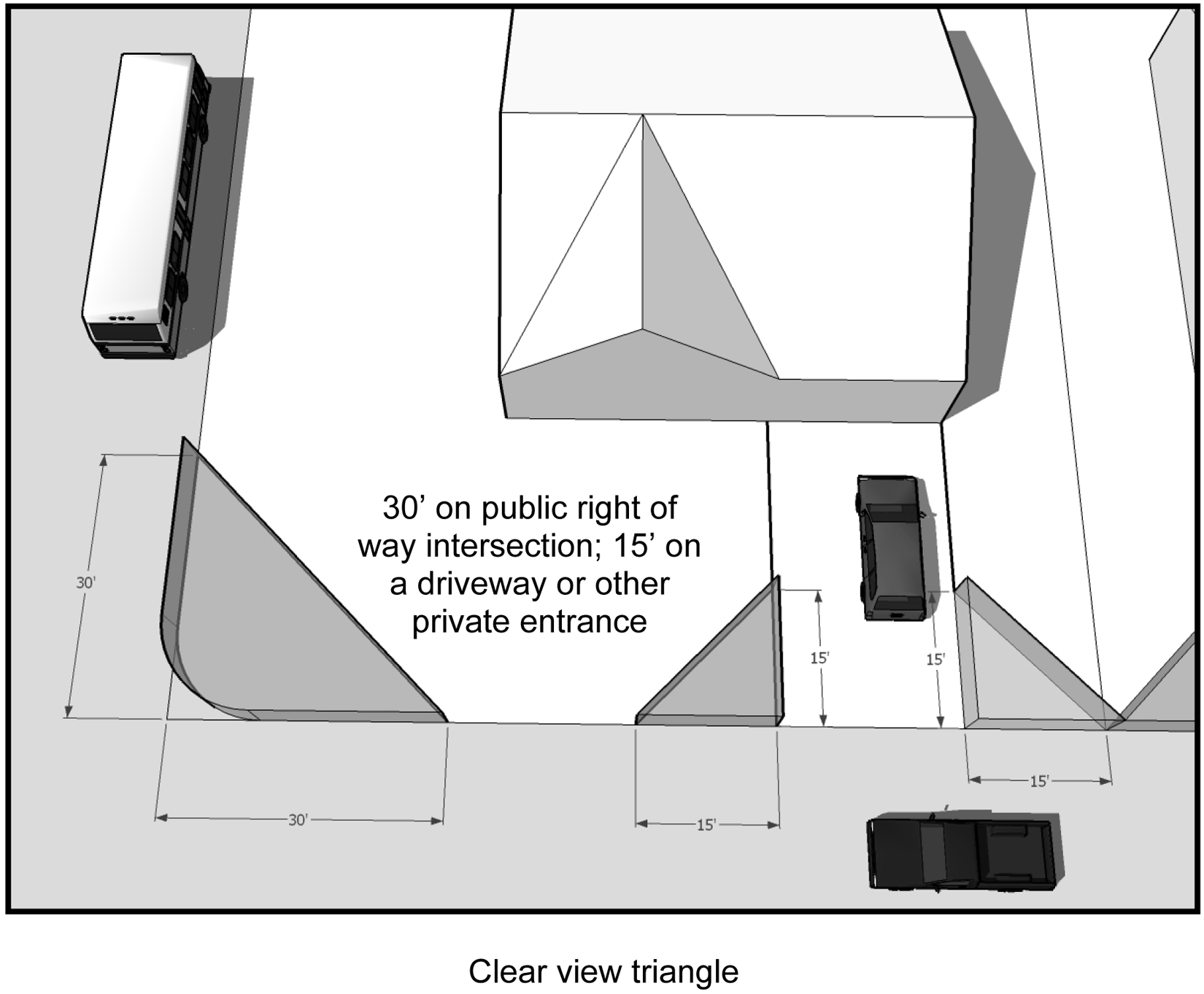
No landscaping or fencing over three feet high as measured from the crown of the road shall be allowed in the clear view triangle (see illustration below). In the case that a clear view triangle extends beyond a lot line, the clear view triangle shall remain clear of obstruction. Adjacent properties affected by another's clear view triangle may be eligible for compensation for adverse landscaping effects.
(5)
Lava rock or other crushed rock as a ground cover is generally prohibited, but may be allowed in paths and other accent locations. Large rocks (over 20 lbs.) as decorative elements are permitted in connection with an overall landscaping approval.
(6)
Trees shall not be planted on gas pipelines, drainage canals or ditches, or under overhead power lines. Trees may be planted along detention and retention basins and ponds as approved by the city engineer, planning and zoning commission, and city council.
(7)
Trees shall be preserved in situ to the extent possible. Some trees are less desirable due to the nature of the tree and the proposed use (e.g. disease-prone trees, invasive species, aggressive species, or messy fruit-bearing trees). These trees shall be removed at the discretion of the developer. The standards provided in chapter 10, article VI for trees shall be complied with.
(d)
Landscaping plans. All developments required to make landscaping improvements by this section shall submit a landscaping plan prepared by a licensed landscape architect or architect. Private residential areas shall be exempted from this requirement. City staff will review each landscaping plan submission for compliance with the Code for review by the planning and zoning commission and city council in connection with the remainder of the site plan submittal. Landscaping plans shall include at a minimum the following information:
(1)
The locations and dimensions of all existing and proposed structures, property lines, easements, parking lots, power lines, rights-of-way, ground signs, trash collection areas, and lighting. Landscaping plans in or adjacent to residential use areas shall include a photometric analysis of all exterior lighting, demonstrating light coverage and any spillover into adjacent properties. See section 42-249(c)(11)b.
(2)
The plant names (both botanical and common), locations, quantity, and size of all existing and proposed plants. See subsection (c)(7) of this section for additional information regarding trees in the development. The proposed plan should show the size of the plants at maturity.
(3)
The landscaping plans shall show all landscaping located within 20 feet of the property line.
(4)
Existing and proposed grading with six-inch-interval contour lines.
(5)
Irrigation plans shall be submitted showing fixtures, connection points, and irrigation lines.
(6)
Proposed and existing fences and identification of fencing materials.
(7)
A summary of the total percentage of landscaped areas, domestic turf grasses, drought tolerant plants, as well as an estimate of the costs associated with the landscaping improvements.
(e)
Completion of landscaping improvements.
(1)
All landscaping improvements shall be completed in compliance with the approved site plan, landscaping planting plan, and irrigation plan and must be completed prior to the issuance of a certificate of occupancy. Exceptions may be granted where weather factors prohibit the timely implementation of the schedule. In such cases, an extension not to exceed six months may be permitted. A surety bond of not less than 110 percent of the total value of the landscaping shall be in place before the exception is permitted. The bond will be held until the project is in full compliance with the approved landscape and site plans and the provisions in this section.
(2)
Provisions shall be made for maintenance of all required landscaping planted as part of a commercial development plan or residential subdivision so as to reasonably assure survival and normal growth in the condition when approved for the life of the project. Fiscal security shall be posted in the amount equal to the prevailing rate for installed trees with a five-year guarantee, plus 15 percent to cover administrative costs.
(f)
Planting standards and design guidelines. The following planting standards reflect the minimum that will be acceptable to the city for landscaping as required in this section. These design guidelines are an enumeration of specific preferences pertaining to landscaping encouraged by the city. These guidelines are to be used by the planning and zoning commission and city council in their review of acceptable landscaping plans.
(1)
Planting standards for new development. The following are planting standards that shall be followed for all new development (note: all caliper measurements reflect the diameter at breast height or dbh):
a.
Deciduous trees. All deciduous trees shall have a minimum trunk size of 2½ inches in caliper.
b.
Evergreen trees. All evergreen trees shall have an overall height of five feet.
c.
Ornamental trees. All ornamental trees shall have a minimum trunk size of 1½ inches in caliper.
d.
Shrubs. All shrubs shall have a minimum height or spread of 18 inches.
e.
Turf. No landscaping shall be of greater than 70 percent turf.
f.
Drought tolerant plants. Drought tolerant species of trees and plants shall make up no less than 50 percent of all trees and shrubs.
(2)
Guidelines for landscape plan review. The following guidelines shall be used when reviewing submitted landscaping plans:
a.
Selection of plants. Plants shall be selected for texture, form, color, pattern of growth, and adaptability to local conditions.
b.
Evergreens. Evergreens shall be incorporated into the landscape wherever screening and buffering are required.
c.
Softening of long walls, fences, or building facades. Plants shall be placed intermittently along long expanses of walls, fences, or building facades in order to create a softening effect.
d.
Planting beds. Planting beds are encouraged to be mulched with wood chips or other similar treatment. Planting beds may not be mulched with decorative rock, lava rock, crushed granite, or any other kind of rock unless the rock areas are under laid with a weed preventing barrier.
e.
Conservation of water. Required irrigation systems shall use the highest and best technology available in order to conserve water. This may include drip water systems, electronic timers, soil moisture detectors, etc.
f.
Energy conservation. Placement and selection of plants may help reduce energy consumption. Placing deciduous trees on the west and south sides of buildings provides shade in the summer months. Further, placement of evergreen trees along wind corridors shelters buildings from the effects of strong winds.
g.
Preservation of existing vegetation. Wherever feasible, existing vegetation shall be retained and incorporated into the new landscaping plan for the site.
h.
Berming. Landscaping along major thoroughfares shall incorporate earthen berms as a screen from traffic or other adjacent land uses.
i.
Landscape placement near buildings. Landscaping adjacent to buildings shall receive special scrutiny, particularly where there is a large expanse of unbroken facade.
(3)
Assessment of required landscaping. Areas of a development that are not covered by parking, structures, or other impervious surfaces shall be landscaped according to this section in all zones.
(4)
Single-family residential landscaping requirements.
a.
Each new single-family residential lot requires the minimum tree and shrub plantings:
1.
Two deciduous canopy trees with a height at maturity of 30 feet or greater.
2.
Two ornamental trees.
3.
Four evergreen shrubs, equal in size to at least a five-gallon-container-size shrub; or eight small shrubs, equal in size to at least a two-gallon-container-size shrub.
4.
Lots in excess of 10,000 square feet shall have one additional canopy tree and one additional ornamental tree. An additional canopy tree and ornamental tree are required for every additional 10,000 square feet lot size.
5.
Additional canopy, ornamental or evergreen trees are encouraged to be planted in excess of the minimum requirements, particularly on lots that will abut collector or arterial streets or non-residential uses.
b.
All single-family residential lot landscaping shall be installed prior to receiving a certificate of occupancy. All common areas in residential developments shall be landscaped prior to the issuance of a certificate of occupancy.
(Ord. No. 2008-021, § 2(25-62), 10-13-2008; Ord. No. 2014-003, §§ 2—5, 1-13-2014)
Sec. 42-166. - Fencing.
(a)
Generally.
(1)
All trash collection areas of commercial developments shall be screened by masonry (stone, brick, decorative block, or the appearance of stone or brick) fencing and landscaping.
(2)
Except as provided in this section, no barbed wire, concertina wire, razor wire, barbed tape, or similar wire-type fences shall be allowed in any zone. Barbed wire may be allowed in areas requiring security or on agricultural property if and only if (i) the barbed wire is located along the top of the fence, and (ii) the fence otherwise conforms to all height restrictions and other requirements of this section.
(b)
Screening and fencing regulations. The following provisions shall govern the height, materials, and styles of fences throughout the whole city. New fences and/or alterations to existing fencing and in any zoning, district shall be required to obtain approval through the building permit process. This includes all land uses listed in (Sec. 42-194)—Land Use Categories Table.
(1)
Generally.
a.
The maximum allowable height for new fences other than those defined in subsection 42-166(b)(2)a. is eight feet.
b.
The maximum height allowed for replacement fencing is eight ft. Where there are multiple property owners adjacent to the replacement fence and the fence line is in full view of the public right-of-way, the applicant shall be required to match the higher adjacent fence height. In no case shall the fence exceed eight feet.
c.
On new home construction, fencing plans must be included with the building permit submission.
d.
Fences will be constructed out of the following approved materials:
1.
Wood.
2.
Vinyl and/or black vinyl covered chain-link.
3.
Masonry materials that are either stone or brick or have the appearance of stone or brick.
4.
Stucco.
5.
Wrought iron.
e.
The use of other materials for fence construction other than those listed above will require approval from the director of planning and development or designee.
f.
The use of corrugated metals, corrugated plastics, used materials or Hardi plank will be specifically prohibited for fence construction.
g.
Fences exceeding three feet in height shall not extend into the front yard past the front projection of the home.
h.
Fences in the front of any property shall be of a semiprivate nature, not to exceed so percent total view blockage. Thus, the spaces between solid fencing must be at least as wide as the solid portions.
i.
All fencing proposed to be constructed in connection with multifamily, commercial, or industrial developments must receive approval with the site plan review from the planning and zoning commission and city council.
1.
The use of masonry fences (stone, brick, decorative block or the appearance of stone or brick) for screening purposes is required for trash receptacle area enclosures on three sides for commercial uses.
2.
The use of masonry fences for screening or property line delineation in all other circumstances is prohibited without the approval of the city council. In places where the city council deems appropriate (i.e., where the use is unsightly, noisy, or dangerous and a solid fence is required}, such fences shall have a landscaping border at least six feet high as a buffer to adjacent properties. This border shall follow the entire length of the property line where the fence is constructed.
j.
No chain-link fences shall be allowed in the front yard area of any lot.
k.
Fencing around utility substations and within 300 feet of Eagle Drive shall be of wrought iron or brick and shall require a permit.
l.
Wrought iron fences must be powder coated and galvanized.
m.
In the event that a lot has double frontage, fences exceeding three feet in height shall not extend into the either front yards and/or beyond the adjacent property owners front projection line of their home.
(2)
Masonry fence regulations. A masonry fence, also known as a neighborhood fence refers to a fence that is jointly owned or maintained by multiple property owners within a community or neighborhood. It is typically installed along perimeters of a neighborhood to provide cohesive aesthetics and adequate screening between land uses as a whole.
a.
General specifications.
1.
Residential properties which are adjacent to collector streets, thoroughfares, and highways, or commercial lots abutting residential lots shall have an eight-foot masonry fence along the shared property lines and designed in accordance with the city's engineering standards.
2.
Residential properties along on the outer edge of subdivisions which share a rear or side property line with a collector street right-of-way shall have a masonry fence along their shared rear or side property line with the collector street's right-of-way, wherever possible, and shall have a minimum height of eight feet and be designed in accordance with the city's engineering standards.
3.
No portion of a masonry fence shall be used as a retaining wall.
4.
With the approval of the director of planning and development or designee, a masonry fence may taper gradually towards the end of the fence, so long as it still meets the city's engineering standards, and still provides cohesive aesthetics and adequate screening between land uses as a whole.
5.
Landscaping along masonry fencing is required where applicable.
(3)
Vinyl and wood fence regulations.
a.
A minimum five-eighths-inch thickness will be required for fence planks.
b.
A 2x4 horizontal cross rail must be placed two feet from the base of the ground.
c.
A 2x4 horizontal cross rail must be placed eight inches from the top of the fence.
d.
The cross rails of the fence must be placed on the side facing away from major roadways.
e.
A 2x6 rot board will be required to be installed at grade at the bottom of the fence.
f.
The posts of the fence will be 4x4, spread out no further than six feet.
g.
Fence posts must have pressure treated wood (not applicable to vinyl fencing).
h.
Posts will be installed at a minimum of two feet into the ground.
i.
A layer of concrete must surround submerged posts, and have a radius equal to 1.5 x the width of the post.
j.
All metal components of the fence, such as nails, screws and fasteners, must be hot dipped and galvanized.
(Ord. No. 2008-021, § 2(25-63), 10-13-2008; Ord. No. 2015-028, § 1, 9-14-2015; Ord. No. 2019-004, § 2, 2-11-2019; Ord. No. 2024-022, § 2, 10-28-2024)
Sec. 42-167. - Buffering.
(a)
Purpose. These regulations are intended to require transitional buffer yards when necessary to enhance and preserve the value of buildings, reduce adverse effects of traffic, lighting, noise, dust and odor, and to protect building occupants' privacy by requiring spacing and screening between uses of different types of intensities. Such transitional buffer yards as required herein are intended to be tailored according to the intensity of the use and adjacent uses. The greater the difference in intensities, the deeper the transitional buffer yard which shall be required; and the less the difference in intensities, the shallower the transitional buffer yard which shall be required.
(b)
Buffers between new industrial uses and existing residential uses or zones.
(1)
A buffer of 100 feet is required between new industrial uses and existing residential uses or zones.
(2)
If the buffer area is forested, the area shall be retained in that condition.
(3)
The 50-foot area closest to the residential property shall be planted with canopy and understory trees.
(4)
The 50 feet nearest the industrial area shall be planted with a mixture of either canopy and understory trees or a mixture of understory trees and shrubs.
(5)
Fencing shall be required at the property line or at the inside edge of the vegetative buffer.
(c)
Buffers between commercial uses and existing residential lots or zones.
(1)
A buffer of 20 feet is required between commercial uses and existing residential lots or zones.
(2)
The buffer zone must be permeable. No impervious groundcover is permitted in the buffer.
(3)
The buffer area shall be planted with shrubbery at the edge of the parking area if the parking stalls face the residential lot or zone.
(4)
The buffer area shall be planted with understory trees at a spacing of 20 feet between shrubbery and the fence line. If sufficient space exists canopy trees shall be utilized instead.
(5)
Fast-growing evergreen trees shall be planted along the fencing at a spacing of six feet.
(6)
Opaque fencing is required when commercial uses directly abut residential lots. Masonry fencing should be used whenever possible. City staff may require masonry fencing.
(7)
Buffers are not required between adjacent commercial uses.
(d)
Residential subdivisions near major roads. If a subdivision is designed in a manner that results in residential lots abutting arterial streets or highways, an eight-foot masonry fence must be erected to mitigate the effects of the proximity to the increased noise and glare a major roadway creates. The area between the right-of-way of the major street and the fence shall be planted with canopy trees every 30 feet.
(Ord. No. 2014-003, § 6, 1-13-2014)
Sec. 42-186. - Rural use (RU) district regulations.
(a)
Purpose. The rural use (RU) district is intended to accommodate agricultural and very low-density single-family residential uses in areas within the city's planning jurisdiction or areas that are not yet suitable for more intense uses.
(b)
Uses permitted by right. In the rural use (RU) district, no building or land shall be used and no building erected except for one or more of the following specified uses, unless otherwise provided in this division:
(1)
Single-family detached dwellings on single lots no smaller than ¾ acre;
(2)
Manufactured housing or mobile home on single lots no smaller than one acre;
(3)
Safety services;
(4)
Public parks and recreational facilities; and
(5)
Agricultural uses.
Performance criteria in excess of existing subdivision regulations governing yards, lot size, and the like may be specified for certain uses. See section 32-86.
(c)
Special uses. The following uses of land and structure are permitted in this district if they meet the supplementary use standards outlined in section 42-225:
(1)
Church or place of worship;
(2)
School;
(3)
Home occupations;
(4)
Day care centers;
(5)
Public/private residential facilities and/or group homes;
(6)
Private kennel;
(7)
Private/quasi-public schools;
(8)
Stables;
(9)
Manufactured housing parks;
(10)
Preschool;
(11)
Private parks and recreational facilities;
(12)
Hospital; and
(13)
Library.
(d)
Permitted accessory uses. The following are permitted accessory uses:
(1)
Those accessory uses permitted under section 42-226;
(2)
Any structural or mechanical permitted use, and a use customarily incidental to the permitted use; and
(3)
Off-street parking attributable to the permitted use.
(Ord. No. 2008-021, § 2(25-64), 10-13-2008; Ord. No. 2022-019, § 3, 12-12-2022)
Sec. 42-187. - Suburban residential (SR) district regulations.
(a)
Purpose. The suburban residential (SR) district is intended to accommodate most of the anticipated single-family residential development in the city during the next 20 years. The SR district will provide for a residential environment dominated by single-family detached dwellings in platted subdivisions as well as alternative residential types, such as townhouses. Excluded are uses of nonresidential character including commercial and industrial uses.
(b)
Uses permitted by right. In the suburban residential (SR) district, no building or land shall be used and no building erected except for one or more of the following specified uses, unless otherwise provided in this division:
(1)
Single-family detached dwellings on single lots;
(2)
Church or place of worship;
(3)
Safety services; and
(4)
Parks and recreational facilities.
Performance criteria in excess of existing subdivision regulations governing yards, lot size, and the like may be specified for certain uses. Such provisions are noted.
(c)
Special uses. The following uses of land and structure are special uses in this district and must meet the supplementary use standards outlined in section 42-225:
(1)
School;
(2)
Day care centers;
(3)
Home occupation;
(4)
Library; and
(5)
Multifamily (as part of a PUD, may not exceed average density requirements and are limited to duplex type development, i.e., no row houses or stacked-unit developments, and must meet multifamily policy requirements).
(d)
Permitted accessory uses. The following are permitted accessory uses:
(1)
Those accessory uses permitted under section 42-226;
(2)
Any structural or mechanical use customarily incidental to the permitted use; and
(3)
Off-street parking attributable to the permitted use.
(Ord. No. 2008-021, § 2(25-65), 10-13-2008)
Sec. 42-188. - Village mixed use (VMU) district regulations.
(a)
Purpose. The village mixed use (VMU) district is intended to allow the development of a town center (a mixed use traditional small town core) as outlined in the city comprehensive plan. The district will incorporate existing commercial and institutional uses at the heart of the new town area and accommodate a variety of future neighborhood retail and community services, as well as housing. To ensure that future commercial development is consistent with the town center concept and does not detract from residential development within the district, site plan reviews are required for all commercial uses conditionally permitted in the district.
(b)
Uses permitted by right. In the village mixed use (VMU) district, no building or land shall be used and no building erected except for one or more of the following specified uses, unless otherwise provided in this division:
(1)
Single-family, detached dwellings on single lots;
(2)
Single-family townhouses on separate lots;
(3)
Safety services; and
(4)
Parks and recreational facilities (public).
Performance criteria in excess of existing subdivision regulations governing yards, lot size, and the like may be specified for certain uses. Such provisions are noted.
(c)
Special uses.
(1)
The following uses of land and structures are permitted in this district if they meet the supplementary use standards outlined in section 42-225:
a.
School;
b.
Convenience retail;
c.
Home occupations;
d.
Hospital; and
e.
Automobile repair facilities.
(2)
The following uses of land and structures are permitted in this district if they submit to a site plan review and meet the site design guidelines and performance criteria outlined in section 42-248:
a.
Multifamily dwellings;
b.
Eating and drinking places;
c.
Retail (including grocery stores and large-scale retail establishments);
d.
Office;
e.
Church or place of worship;
f.
Day care center; and
g.
Library.
(3)
Special use by numerical limitations. The intent of the numerical limitation is to provide for a variety of goods and services and to regulate saturation levels of uses within the Village Mixed Use District, (VMU). This does not apply to the Mont Belvieu Market Center (PUD). Where numerical limitations have been applied to certain uses, the intent is to hold constant and/or reduce the number of uses below to the prescribed saturation level.
a.
Uses.
1.
Gas/fill stations—Are subject to specific criteria outlined in section 42-225, Supplementary use standards, and also subject to the numerical limitation of two establishments in the Village Mixed Use District at any time.
2.
Banks/credit unions—Are subject to the numerical limitation of five establishments in the Village Mixed Use District at any time.
3.
Nail salons—Are subject to the numerical limitation of four establishments in the Village Mixed Use District at any time.
4.
Hair salons/barber shops—Are subject to the numerical limitation of six establishments in the Village Mixed Use District at any time.
5.
Discount variety/dollars stores—Retail stores that sell a wide range of inexpensive household goods and food. Does not sell fresh produce and/or meats. Is subject to the numerical limitation of two establishments in the Village Mixed Use District at any time.
6.
Commercial child care centers—Are subject to the numerical limitation of four establishments in the Village Mixed Use District at any time.
7.
Interactive teller machines (ITMs)—Are subject to specific criteria outlined in section 42-225, Supplementary use standards, and also are subject to the numerical limitation of one ITM in the Village Mixed Use District at any time.
8.
Automated teller machines (ATMs)—Are subject to specific criteria outlined in section 42-225, Supplementary use standards, and also subject to the numerical limitation of one ATM in the Village Mixed Use District at any time.
b.
Exceptions. An exception to exceed the numerical limitation for a use may be recommended by the plan commission and approved by the city council. In considering whether to grant an exception to the numerical limitation, plan commission and city council should consider the following criteria:
1.
The exception shall be consistent with planning goals and result in the positive enhancement of the purposes of the district as evidenced by support, marketing surveys, or other information indicating probably substantial patronage.
2.
Recognized as unique in its use category.
3.
Demonstrates community need through marketing survey and documented analysis.
4.
Promotes the purpose of the district and reinforces the goal of the comprehensive plan as a regional destination.
5.
Provide letter of recognition by the adjacent businesses or local chamber of commerce, with accompanying rationale relative to a waiver of numerical limitations.
(d)
Prohibited uses. The following uses of land and structure are expressly prohibited in this district:
(1)
Gambling halls, parlors, or other establishments for gaming (including 8-liners, card tables, slot machines for prizes, etc.).
(2)
Retail liquor establishments, except grocery stores.
(3)
Private clubs or establishments where alcoholic beverages are sold or consumed, and where more than 50 percent of revenue for the business comes from the sale of alcohol.
(4)
Tattoo parlors and body piercing establishments.
(5)
Palm readers, palmistry shops, psychics, and tarot card readers.
(6)
Head shops or any other kind of associated paraphernalia retail outlets.
(7)
Stores or shops where tobacco sales account for more than 50 percent of the retail sales.
(8)
Temporary use stands, such as fruit or vegetable stands, hot dog or taco stands, snow cone shacks, and other establishments of a similar nature. Exceptions may be permitted for special events (e.g., carnivals, parades, etc.), but such exceptions shall be for a maximum period of 72 hours (three operational days).
(9)
Outdoor storage, mini-storage, self-storage, or facilities requiring the storage of goods or equipment outside (e.g., truck or van rentals, heavy equipment rentals, outdoor nurseries, etc.).
(10)
Automobile repair facilities unless they meet the criteria supplementary use standards outlined in section 42-225, auto parts retail or wholesale facilities, tire repair or replacement facilities, and other automotive related establishments, including express lube shops.
(11)
Thrift shops and/or secondhand stores.
(12)
Pawnshops or shops containing remaindered goods.
(13)
Check cashing, title loan, shortterm loan, or payday loan offices.
(14)
Animal shelters or veterinary offices housing animals outdoors, kennels, stables, or any other use that keeps animals outdoors.
(15)
Other uses not conducive to the orderly and attractive function of the main street area of the city. These uses include those that affect the health, safety, and welfare, offend the morals and values, or create a nuisance to the community. The city council shall give a reasoned determination for the prohibition of any proposed use which must be approved by a unanimous vote of all council members.
This prohibition does not imply that these uses will be allowed in other districts.
(e)
Permitted accessory uses. The following are permitted accessory uses:
(1)
Those accessory uses permitted under section 42-226;
(2)
Any structural or mechanical use customarily incidental to the permitted use; and
(3)
Off-street parking attributable to the permitted use.
(Ord. No. 2008-021, § 2(25-66), 10-13-2008; Ord. No. 2014-015, §§ 2, 3, 4-14-2014; Ord. No. 2019-008, § 2, 2-11-2019; Ord. No. 2020-010, § 3, 6-22-2020)
Sec. 42-189. - Freeway commercial (FC) district regulations.
(a)
Purposes. The freeway commercial (FC) district is intended to incorporate existing commercial and residential uses and accommodate a wide variety of future highway-oriented commercial uses, as well as multifamily housing.
(b)
Uses permitted by right. In the freeway commercial (FC) district, no building or land shall be used and no building erected except for one or more of the following specified uses, unless otherwise provided in this division:
(1)
Eating and drinking places;
(2)
Retail;
(3)
Convenience retail;
(4)
Office;
(5)
RV park;
(6)
Automobile sales;
(7)
Light industry;
(8)
Church or place of worship;
(9)
School;
(10)
Day care center;
(11)
Safety services;
(12)
Hospital;
(13)
Library;
(14)
Parks and recreational facilities; and
(15)
Automobile repair—new and used parts and service, enclosed (not salvage yards or similar).
Performance criteria in excess of existing subdivision regulations governing yards, lot size, and the like may be specified for certain uses. Such provisions are noted.
(c)
Special uses. The following uses of land and structure may be permitted in this district if they meet the supplementary use standards outlined in section 42-225:
(1)
Truck stops;
(2)
Hotels, motels, and bed and breakfast locations;
(3)
Multifamily dwellings;
(4)
Sexually oriented businesses; and
(5)
Gas/fill stations.
(d)
Permitted accessory uses. The following are permitted accessory uses:
(1)
Those accessory uses permitted under section 42-225.
(2)
Any structural or mechanical use customarily incidental to the permitted use.
(3)
Off-street parking.
(Ord. No. 2008-021, § 2(25-67), 10-13-2008; Ord. No. 2019-008, § 3, 2-11-2019)
Sec. 42-190. - Hill mixed use (HMU) district regulations.
(a)
Purposes. The hill mixed use (HMU) district is intended to accommodate continued mixed use development in the hill and westside industrial district as described in the comprehensive plan. It is anticipated that residential uses in the district will continue to be transitioned to other uses. However, there is no requirement for residential uses to do so.
(b)
Uses permitted by right. In the hill mixed use (HMU) district, no building or land shall be used and no building erected except for one or more of the following specified uses, unless otherwise provided in this division:
(1)
Single-family residential;
(2)
Townhouse;
(3)
Manufactured housing;
(4)
Mobile homes;
(5)
Eating and drinking places;
(6)
Retail;
(7)
Convenience retail;
(8)
Office;
(9)
Automobile sales;
(10)
Light industry;
(11)
Safety services;
(12)
Parks and recreation; and
(13)
Agricultural.
Performance criteria in excess of existing subdivision regulations governing yards, lot size, and the like may be specified for certain uses. Such provisions are noted.
(c)
Special uses. The following uses of land and structures are permitted in this district if they meet the specified performance criteria outlined in section 42-225:
(1)
Gas/fill stations;
(2)
Automobile wrecking yard;
(3)
Truck stop;
(4)
Church or place of worship;
(5)
School;
(6)
Hospital;
(7)
Library;
(8)
RV park;
(9)
Multifamily dwellings;
(10)
Heavy industry; and
(11)
Automobile sales.
(d)
Permitted accessory uses. The following are permitted accessory uses:
(1)
Those accessory uses permitted under section 42-226.
(2)
Any structural or mechanical use customarily incidental to the permitted use; and off-street parking attributable to the permitted use.
(e)
Special exception permits. A special exception permit for either industrial or commercial uses are distinct from uses permitted by right, and special uses as set forth in this section, the application and approval process are set forth in section 42-284.
(Ord. No. 2008-021, § 2(25-68), 10-13-2008; Ord. No. 2019-008, § 4, 2-11-2019; Ord. No. 2019-013, §§ 2—4, 4-9-2019)
Sec. 42-191. - Planned unit development (PUD) district regulations.
(a)
Purpose. The intent of the planned unit development (PUD) district is to provide a flexible, alternative zoning procedure to encourage innovative design for the unified and planned development of large tracts of land. The PUD district is designed to allow the development of integral land use units, such as residential developments of mixed housing types, retail centers, office parks, light industrial parks, or any appropriate combination of these uses, in a planned environment and developed and/or operated as a unified development. All PUD development approvals shall be valid for a period of not more than two years from the date of approval unless a phasing plan is presented at the time of approval.
(b)
Uses permitted subject to planned unit development site plan. Deviation from the regulations established in this section applicable to particular uses may be permitted when the owner and developer demonstrate that adequate provisions have been made in the planned unit development for sufficient light and air, that the density of the development is compatible with surrounding land uses, that pedestrian and vehicular traffic circulation systems are safe and efficient, that the development will progress in orderly phases, and that the public health, safety and general welfare will be protected. However, higher and more restrictive specific standards for use, density, height, lot area, setback, visual screens, landscaping, parking, sign control and open space may be adopted as part of the development site plan by a PUD district amending ordinance.
(Ord. No. 2008-021, § 2(25-69), 10-13-2008)
Sec. 42-192. - Estate residential (ER) district regulations.
(a)
Purposes. The estate residential (ER) district is intended to encourage development of larger lot residential developments without imposing the infrastructure costs required of higher density residential development and to foster a full range of housing types and prices as the city experiences growth. In the estate residential (ER) district, curb and gutter road construction is not required, but sidewalks meeting city specifications outlined in section 32-91 are required. Open ditch drainage is allowed, but only to the rear of lots using the specifications outlined in section 32-88(e). The drainage ditches are to be created as separate reserve lots, and not as easements on the platted residential or accessory use lots.
(b)
Procedure. The process for the designation of the estate residential zone shall be the same as those provided for in the zoning amendment process as described in section 42-279. In addition, the estate residential zone is only permitted for property zoned suburban residential, rural use, or village mixed use at the time of application.
(c)
Uses permitted by right. In the estate residential (ER) district, no building or land shall be used and no building erected except for one or more of the following specified uses, unless otherwise provided in this division:
(1)
Single-family residential.
(2)
Parks and recreation (public or residential community-related facilities only).
(d)
Special uses. The following uses of land and structures are permitted in this district if they meet the specified performance criteria outlined in section 42-225:
(1)
Safety services.
(Ord. No. 2014-034, § 4, 11-10-2014)
Sec. 42-193. - Land use types summarized on land use table.
The use table of this section provides a tabular summary of the land use types permitted within each zoning district. The table is intended for reference only and does not necessarily reflect all of the regulations that may apply to a particular use or zoning district. In the event of conflict between the use table and the regulations found within the individual district sections of this article (sections 42-186 through 42-191), the more restrictive of the individual district regulations shall control.
(1)
Permitted by right. Uses identified with a "P" are permitted by right and shall be permitted in the corresponding district subject to all other applicable zoning standards in this chapter and City Code requirements.
(2)
Special use. Uses identified with an "SU" are not permitted by right but shall be permitted in the corresponding district only in compliance with the supplementary use standards referenced and identified in section 42-225 and subject to all applicable zoning standards in this chapter and City Code requirements. These uses require planning and zoning commission recommendation and city council approval.
(3)
Permitted by right with site plan review. Uses identified with an "SPR" are permitted by right but shall be permitted in the corresponding district only in compliance with the site development standards identified in section 42-248 and subject to all applicable zoning standards in this chapter and city Code requirements.
(4)
Conditionally permitted subject to PUD application and site plan review. Uses identified with a "PUD" are conditionally permitted subject to specific use restrictions and regulations approved as a part of an applicable development site plan and PUD district amending ordinance.
(5)
Not permitted. Uses not identified in a particular district column of the use table as permitted by right are not allowed in such district ("NP") unless otherwise expressly permitted by other regulations of this chapter.
(Ord. No. 2008-021, § 2(25-70), 10-13-2008; Ord. No. 2014-034, § 2, 11-10-2014)
Sec. 42-194. - Land use categories table.
1—Uses permitted by right if zoning requirements are met.
2—Uses not permitted in this zoning district.
3—Uses permitted by right if special use standards are met.
4—Uses permitted upon completion of a site plan review and meeting special use standards.
5—See PUD section.
6—Only public or residential community-related facilities are permitted in the estate residential (ER) district.
(Ord. No. 2008-021, § 2(25-70), 10-13-2008; Ord. No. 2014-012, § 3, 4-14-2014; Ord. No. 2014-034, §§ 3, 6, 11-10-2014; Ord. No. 2022-009, § 5, 2-28-2022)

