
Mont Belvieu City Zoning Code
ARTICLE V
- SPECIAL SITE DEVELOPMENT STANDARDS
Sec. 42-248.- Site plan review.
(a)
All projects located along Eagle Drive in the VMU district shall be subject to a site plan review in which compliance with the following standards shall be verified:
(1)
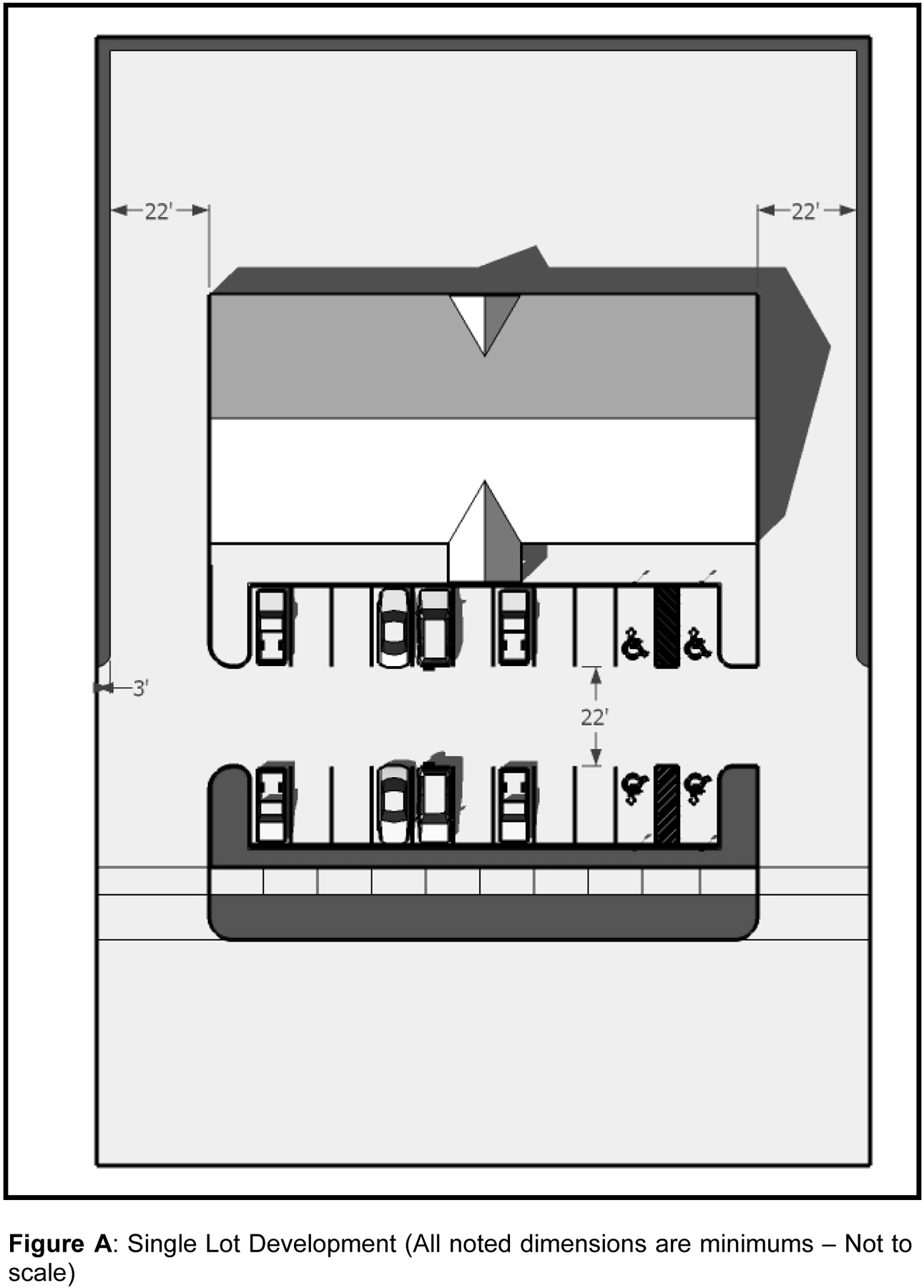
All projects shall provide an unpaved planting strip of a minimum width of ten feet along the lot lines fronting Eagle Drive and all other streets bounding the lot, and a planting strip of a minimum width of three feet along all other lot lines. The planting strips along streets shall be planted with trees in accordance with the standards established in chapter 32, subdivision regulations.
(2)
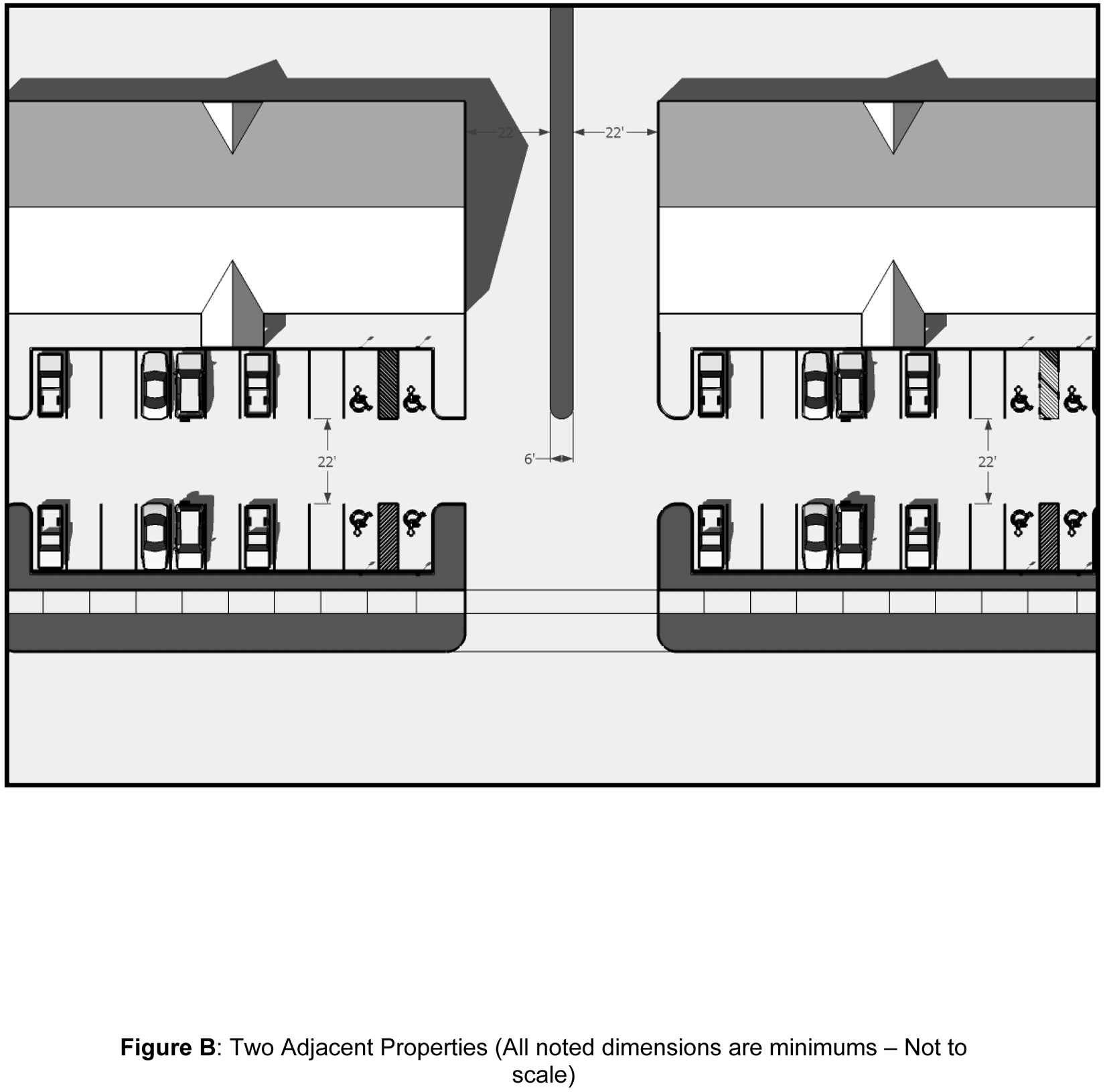
Not more than one driveway of a maximum of 24 feet in width per 400 feet of frontage shall be provided from Eagle Drive or any other street bounding the lot.
(3)
A maximum setback of 90 feet comprising, if applicable, no more than one driveway with two bays of parking shall be observed along all lot lines fronting any street throughout the zone with a greater than 60-foot dedicated right-of-way.
(4)
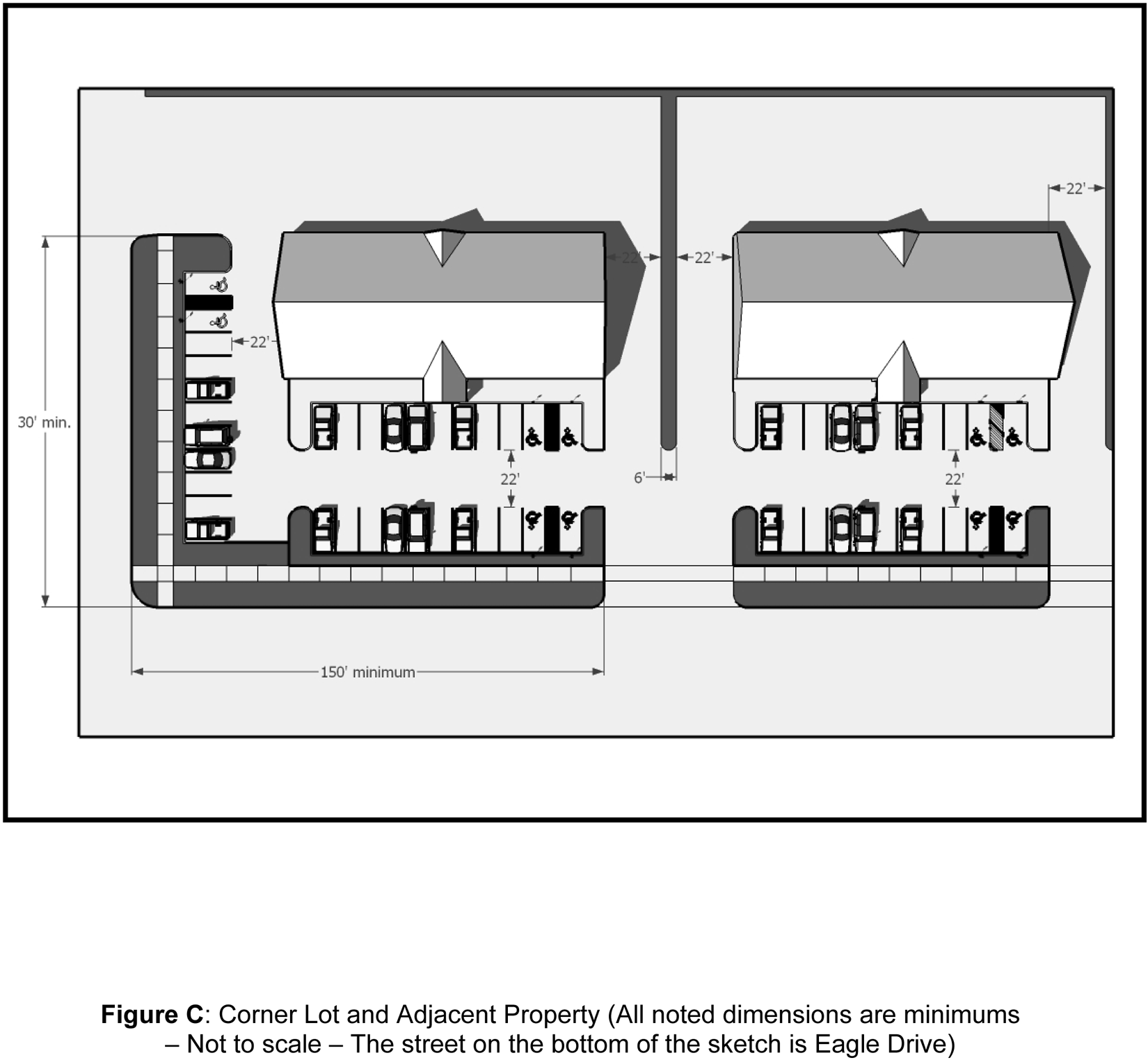
The outside dimension of a driveway shall not be closer than 30 feet to the corner of a street intersection measured at the right-of-way lines.
(5)
Different project parking lots along Eagle Drive or the back of lots shall be connected in order to minimize the need for curb cuts and diminish the interruption of traffic along Eagle Drive due to continuous entries and exits from different establishments or properties. Stub drives can be provided at an initial phase on each project pending connection with future adjoining projects. Curb cuts shall only be allowed at an approximate 400-foot interval.
(6)
All new buildings, uses, developments, and properties shall be subject to architectural review, considering such things as facade appearance, landscaping, etc., in order to foster a cohesive appearance along this street (see architectural standards below).
(b)
Site layout examples and graphic renditions of these standards are provided in Figures A, B and C.
(Ord. No. 2008-021, § 2(25-75), 10-13-2008)
Sec. 42-249. - Architectural standards.
(a)
Purpose. The purpose of establishing architectural standards within the city is to provide minimum guidelines that developers, architects, and builders will be expected to consider when proposing new construction in the city. Residential, multifamily and townhouses, and commercial and industrial construction shall meet the standards outlined within this section. Churches and schools, due to their distinguishable and quasi-public, nonprofit character, shall also be reviewed but may be allowed increased flexibility in application of the standards.
(b)
Residential areas.
(1)
Residential areas in the city shall generally be exempt from architectural review of individual residences. Care shall be taken to create areas of harmony in architectural style, considering aspects such as massing, color, fenestration, etc., in order to be conducive to an overall neighborhood feel. If a residential unit has brick, stone, or other masonry on any facade, it is required that all facades/sides (front, rear, and sides) incorporate a minimum of 50 percent brick per facade. Deed restrictions regarding architectural improvements of any kind may be placed on subdivisions where appropriate.
(2)
This exemption shall not extend, however, to include common areas, parks (whether public or private), park strips, clubhouses, and/or sales offices or other commercial-type areas within residential areas. These areas shall meet the off-street parking, landscaping, and architectural standards as required in this chapter. Where question exists regarding the specific nature of the use proposed, developers shall meet the minimum standards of this and other applicable sections. Lighting, landscaping, and parking layouts shall be submitted in connection with other submittals included in this chapter.
(c)
Nonresidential areas.
(1)
Minimum architectural standards. All nonresidential areas in the city shall comply with the minimum architectural standards delineated in this subsection. Developers, architects, and builders are encouraged to take cues from existing architecture in determining what is appropriate for their building. Buildings that are outside of the local vernacular of buildings shall be strictly avoided. Further, developers, architects, and builders are strongly encouraged to consult with city staff regarding concepts prior to significant investment being made.
(2)
Summary table. The following table summarizes the architectural standards that apply to nonresidential buildings:
(3)
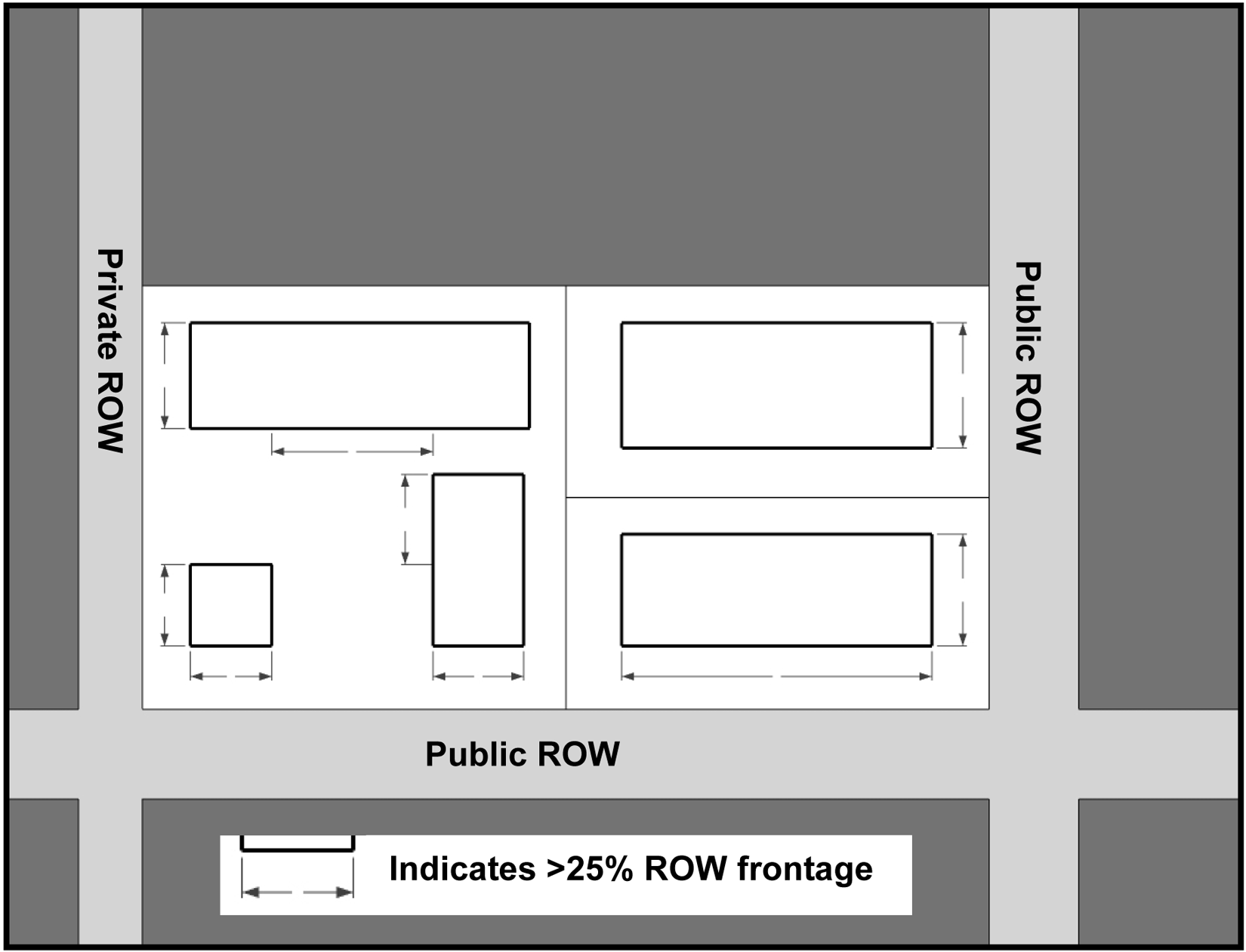
Façades. A façade is considered to be any wall, roof, or part of a structure that faces a right-of-way and/or contains the primary entrance to the building. For the purposes of this section, façade shall be applied to all surfaces that have at least 25 percent frontage facing a right-of-way. (See the illustration below.) All sides of the building shall meet the minimum standards of this section; façades, as defined in this subsection, shall meet the specific requirements listed below). Exception may be allowed to these standards in the case that the structure is located more than 300 feet from a right-of-way.
(4)
Screening required.
a.
All mechanical equipment shall be screened from view in such a manner that it is not visible from a public right-of-way or residential district that is within 150 feet of the subject lot's closest lot line. Screening shall match existing architecture in materials, colors, and scale to maintain a unified appearance. Parapet walls, partition screens, masonry, stone, or brick walls, encasement, or other fencing, as appropriate, are acceptable means of screening.
b.
Detention and retention ponds shall be landscaped and made a functional part of the overall landscape scheme. Detention ponds not designed to be part of the landscape are required to be screened using berms, shrubs, brick/stone/masonry walls, or a combination of these to create a three-foot-high visual perimeter above the finished grade of the lot.
(5)
Building mass and design.
a.
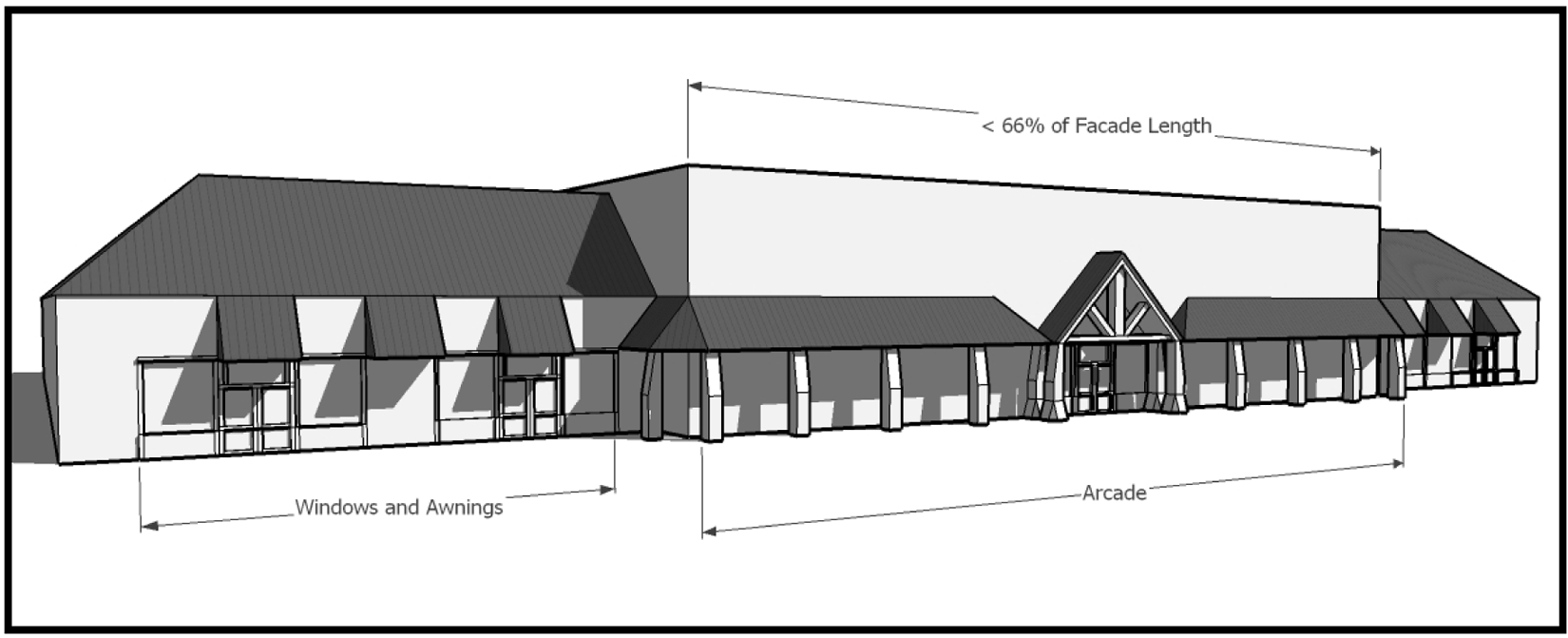
In order to provide visual interest, the first two stories of any facade facing a right-of-way shall use architectural relief every 45 horizontal feet by incorporating a minimum of two different design elements from the options listed below. All other facades shall incorporate a minimum of two different design elements every 60 feet. Facades of less than 45 feet shall provide two different design elements.
1.
Canopies, permanent decorative awnings, or windows with overhangs;
2.
Wall plane projections or recessions with a minimum of four feet of depth;
3.
Pillars or columns;
4.
Recessed entries, stoops, porches, colonnades, or arcades;
5.
Balconies extending from the building;
6.
Boxed or bay windows.
b.
As represented below, buildings three stories or less shall incorporate a parapet that varies by a minimum of two feet, such that no more than 66 percent of the roofline is at the same height.
(6)
Building materials.
a.
All buildings located on a single building lot shall have materials and colors that are similar and compliment each other architecturally. This applies to all stand alone and pad site buildings, regardless of use or size. All exterior facades of a pad site building must meet the same requirements for pad site buildings as all other buildings on the same site with regard to facades facing rights-of-way. All buildings shall employ architectural, site, and landscaping design elements that are integrated with and common to those used on the main/primary buildings or structures on the site. These common design elements shall include building materials associated with the main/primary structure. In the event that a pad site or non-primary building is developed prior to the primary/main building, then all other buildings shall have materials and colors that are similar and complement each other architecturally to the first constructed building.
b.
Existing buildings may continue to utilize materials other than those listed below provided that any material replacement is for maintenance purposes only and the existing material is continued. Any material change or replacement of more than 30 percent of the total area of all facades shall require that the building materials be brought into compliance with this subsection. This shall apply to buildings damaged by natural or manmade causes and accidents. All other materials are expressly prohibited unless a variance is granted by the city council. When determining the area of a facade, windows and doors are included.
1.
The following applies to the first two stories of all buildings. All building facades that are visible from a right-of-way shall have at least ten percent of the surface area of the facade consist of one or more of the following building materials:
(i)
Fired brick.
(ii)
Natural or cultured stone.
(iii)
Marble.
(iv)
Granite.
(v)
Matte finish tile.
(vi)
Any other concrete product provided that it has an integrated and integral color and is textured or patterned (not aggregate material) to simulate rock, stone, marble, granite, or tile.
2.
Stucco, EIFS (Exterior Insulation and Finish Systems), hardboard, concrete products as listed in subsection (c)(6)b.1 of this section, reflective glass, certain metal products described in this subsection, and cedar siding are allowed on all facades subject to the following limitations:
(i)
Stucco, EIFS, high build textured paint on concrete to simulate the appearance of EIFS, hardboard, or any material equivalent in appearance and quality as determined by the city council shall not cover more than 50 percent of any facade, including those not facing a right-of-way.
(ii)
Wood or cedar siding shall not cover more than 30 percent of any facade.
(iii)
Honed, kerfed, fluted, smooth or split face tinted concrete blocks shall not cover more than ten percent of any facade.
(iv)
Reflective glass (greater than 30 percent reflectivity) shall not cover more than 80 percent of any façade. Exemption may be allowed when a professionally licensed architect or professional engineer provides calculations verifying that energy code compliance cannot be achieved without a greater use of reflective glass. Such calculations shall be verified and approved by the chief building official and shall comply with the International Energy Code, as adopted and amended by the city.
(v)
Stainless steel, chrome, aluminum, standing seam metal, and premium grade architectural metal may be used as an architectural accent and shall not cover greater than 20 percent of any façade.
(vi)
Painted steel siding, aluminum, and/or galvanized steel may be used provided that the façade is not visible from a right-of-way, park area, public open space, or residential area. The use of these materials on any façade must be screened from adjacent properties. This screening may be done with landscaping elements, berming, or masonry, brick, or stone walls. Galvanized or painted steel is not allowed on doors including roll-up doors except in industrial uses and where required for security purposes.
(vii)
Architects, designers, and developers shall provide a table demonstrating compliance with these requirements, stating material used, percentage of the façade, and the overall square feet of the façade using that material (including windows and doors).
(7)
Building colors.
a.
All building façades and roofs shall consist of only colors as reviewed by city staff and approved by the planning and zoning commission and city council. Architects, designers, and developers shall present a sample color palate and materials board in connection with the preliminary site plan review. Colors shall be of tones generally found in natural settings and shall compliment the natural environment. Accent colors should compliment the main color scheme of the building.
b.
Neon, metallic (except copper and silver metallic colored roofs and accents) and fluorescent colors are prohibited on any façade or roof.
c.
When applying brick, colors normally found in manufactured fired brick are permitted. All colors of natural stone are permitted.
d.
Building and roof color requirements apply to all new buildings, redeveloped buildings, and façade work.
e.
Existing buildings may continue to utilize colors currently in use in the façades provided that repainting is done for maintenance purposes only. Any color change on existing buildings shall be brought into compliance with this subsection and color samples shall be submitted to the chief building official and city planner for review.
(8)
Pedestrian/bike circulation and facilities.
a.
Each building shall provide a facility capable of storing a minimum of eight bicycles per 5,000 square feet of aggregate finished floor space (with a maximum of 30). The area provided for this facility shall be approximately 100 square feet and shall be located in a secure, lighted place near the main facility entrance.
b.
Facilities shall be located in such a manner as to be apart from automobile and pedestrian traffic, with a minimum of three feet of separation.
c.
Bicycle facilities shall allow the securing of each bicycle to the bicycle rack by a wheel and the frame using either a U-lock or cable or chain-type lock. Facilities shall support the bicycle at two points and shall be anchored securely to the ground.
(9)
Traffic impact analysis (TIA). The TIA is intended to develop public/private partnerships to coordinate land use and transportation facility development. Both the city and the land developer share in the responsibility to consider all reasonable solutions to identified transportation problems.
a.
Purpose. This process is done simultaneously with the submittal of a site plan. The goal of this study is to look at a specific development of known size and use and to determine the effect of that use on the existing roadway system. It uses existing traffic volumes and assumes the existing roadway configuration to be used for analysis. This process should ensure that the roadway system is adequate to accommodate the proposed use and may recommend mitigation measures necessary to ensure efficient traffic flow around the proposed site (as based on intersection and roadway levels of service).
b.
Objective. A TIA is intended to define the immediate impacts of the proposed development and any necessary transportation improvements (public or private) required to ensure a satisfactory level of service on all affected thoroughfares. A TIA is designed to mitigate traffic impacts by optimizing roadway capacity, access design, and traffic control. A TIA may not be used to deny development permitted by zoning, nor shall it be used to modify road design contrary to the comprehensive plan. Specific improvements to the existing roadways consistent with the thoroughfare plan may be needed to gain approval of site plan proposals.
c.
Definitions. The following words, terms and phrases, when used in this subsection, shall have the meanings ascribed to them in this subsection, except where the context clearly indicates a different meaning:
Base volumes shall be based on current traffic counts adjusted to the expected date of project occupancy. When available, all base data shall be supplied by the city engineer. In all cases when ground counts are needed and are not available, the developer or the developer's agent shall be required to collect such data.
Design year means the point in time upon which assumptions pertaining to land use, population, employment, and transportation facilities are based. All TIAs shall use a design year based on the expected date of project occupancy.
Level of service (LOS) means a measure of the level of congestion experienced on roadways. The desirable minimum level of service of the city is a level of service C in the peak hour. Level of service shall be measured on of both link and intersection operations.
Trip generation rates means the city's criteria for trip generation for various categories of land use and density and shall be those set forth in the latest edition of the trip generation informational report published by the Institute of Transportation Engineers (ITE), unless the proposed use does not have a corresponding rate in the trip generation manual. Alternate trip generation rates shall not be accepted but shall instead be adopted for citywide use on the basis of a general study of local conditions.
d.
Applicability.
1.
All TIAs shall be performed by a consultant qualified to perform such studies. Requirements for mitigating negative traffic impacts shall apply to all cases. In certain cases, due to project phasing, a TIA might be required with a concept plan submittal. It is the responsibility of the applicant to demonstrate that a TIA is not required for a nonresidential site plan application. In cases where a TIA is required, the site plan application will be considered incomplete until the TIA is submitted.
2.
A TIA will be required for nonresidential site plans submitted for approval that generate an increase of five percent or more over the base volume. A TIA may be required for nonresidential site plans submitted for approval that generate less than five percent or more over the base volume, and where the peaking characteristics could have a detrimental impact on the transportation system as determined by the city planner, city engineer, or designee.
e.
Methodology. A pre-submission consultation with the city planner, city engineer, or designee is required. Details of the required analysis and the study area will be determined at this meeting. In certain instances, traffic from other approved but not built developments may have to be accounted for in traffic assignments. Staff may also require specific assumptions such as the percent trucks are altered to match local conditions. Peak hour analysis might be directed to reflect the peak 15 minutes for certain types of land uses. All of these types of issues will be addressed at the pre-submission consultation.
f.
Content. The following procedures shall be followed in preparing traffic impact studies submitted to the city:
1.
Study area. A map shall be included delineating the TIA study area and all existing and planned streets therein. The study area will be defined in the pre-submission consultation meeting with the city planner, city engineer, or designee;
2.
Existing zoning and development. Describe existing zoning including land area (gross and net) by zoning classification, square footage, numbers of hotel rooms, dwelling units, etc. Also, describe any existing development on site and how it will be affected by development proposals;
3.
Thoroughfare network. Describe existing thoroughfares, signals and signal phasing, and traffic volumes within the study area;
4.
Proposed development. Describe the proposed development including land area (gross and net), square footage, number of hotel rooms, dwelling units, etc. Also describe roadway conditions as expected by date of occupancy. Indicate roadway and intersection capacities at the study date;
5.
Impact determination. Determine the level of service for all thoroughfares and intersections in the study area. The analysis shall contain the following minimum information:
(i)
Proposed trip generation. Calculate total trip generation by use (assuming full development and occupancy) and report any reductions for passerby, mixed use, etc. Show trip generation by use in tabular form with land use trip generation rates and trips generated.
(ii)
Trip distribution and assignment. Trips generated by the proposed development are to be added to the base volumes projected for the design year. Peak hour volumes must be calculated. Distribution assumptions and assignment calculations must be provided.
(iii)
Level of service analysis. Show in tabular form 24-hour and peak hour volume-to-capacity (V/C) ratios for links and intersections within the study area. This analysis should be done for the following traffic conditions: existing traffic, background traffic, and background plus project traffic. Analyze all points of ingress and egress, median breaks, and turn lanes associated with the proposed site.
(iv)
Conclusions. Provide a summary of points of conflict and congestion. Identify all thoroughfare links or intersections exceeding a level of service D and the percent increase in total traffic produced by the proposed site plan. Identify any operational problems (e.g., drives, median openings, and signalization) within the study area.
g.
Mitigation. Traffic levels exceeding a level of service D, where the development is contributing five percent or more of the total trips, shall be mitigated to predevelopment levels. Problems demonstrated by the TIA can be corrected by:
1.
Access management relating to driveway and median opening spacing;
2.
Modifying density or intensity of use (e.g., reduction in square footage or percentage of commercial use);
3.
Phasing construction until additional roadway capacity becomes available;
4.
On-site improvements including access controls and site circulation adjustments; and/or
5.
Off-site improvements including the construction of additional lanes where the surrounding thoroughfares are not fully developed or intersection improvements, including signalization, where the surrounding area is approaching full development.
h.
Costs of mitigation. Mitigation improvements which are attributable to the proposed development shall be funded at the developer's expense. Any other improvements shown which are consistent with the thoroughfare plan may be repaid in a pro rata fashion by the city in accordance with its cost sharing policies.
(10)
Parking lots. These requirements are in addition to and not in lieu of the requirements established in section 42-164 for off-street parking.
a.
Where parking or drive aisles are located between the building and the public right-of-way, there shall be a minimum ten feet setback from the public right-of-way line to the parking area or drive aisle.
b.
Pedestrian walkways adjacent to the front of buildings are required for all commercial uses with more than 200 feet of continuous right-of-way frontage or that incorporate more than one unit. Raised pedestrian walkways are required within the parking area for parking lots which have more than 100 parking spaces. See section 42-164(3)g.3 for further information.
c.
In order to break up the parking lot area and minimize the visual impact of a large parking area on the cityscape, one of the following parking concepts is required, or a combination of any of these elements, to provide an aesthetically pleasing parking area in parking lots with more than 120 spaces. Pedestrian walkways shall be provided for in the areas described below:
1.
Every 120 spaces shall be a distinct parking area connected by driving lanes but separated by landscaping strips a minimum of eight feet wide and the full length of the parking row. Where pedestrian facilities are located within these landscaping strips, the sidewalk shall be a minimum of ten feet wide with a minimum of four feet of landscaped area on each side of the sidewalk.
2.
For every 120 parking spaces, an 1,800-square-foot landscaped island, or landscape pod, shall be installed. Such island shall be located internally to the parking lot and shall be located so as to visually break up each 120 spaces. The landscaping square footage for parking lots greater than 120 parking spaces shall be prorated at 15 square feet of landscaping per parking space. This landscaping may incorporate both vegetation and hardscape elements (pavers, stamped concrete, etc.). Landscape pods shall present a unified theme in design with the overall landscaping and public open space in the development, and shall have direct access to all other buildings and open spaces in the development.
3.
For every 120 parking spaces, an additional 1,800 square feet of landscaped area shall be added/distributed to the interior rows and end islands located closest to the right-of-way line (i.e., in conjunction with the minimum setback creating a double row of landscaping), but in no event shall the additional landscaped area be located farther than 100 feet from the right-of-way frontage. The landscaping square footage calculation for parking lots greater than 120 parking spaces shall be prorated at 15 square feet of landscaping per parking space.
d.
Interior island area requirements as required in section 42-164(3)g.2 shall not be consolidated into end islands, landscape strips, and/or landscape pods, but shall be constructed so as to be directly connected to landscape strips, raised walkways, and/or landscape pods.
e.
Shopping cart storage and collection spaces shall be clearly identified on the site plan. These spaces shall not be located in landscaped islands or in any areas designed for plantings or pedestrian or bike access.
(11)
Additional standards for complexes of 150,000 square feet or greater. In addition to the above standards, the following shall apply to buildings or combinations of buildings that are 150,000 square feet or greater, whether connected or not but part of a single building plot.
a.
Each development shall contain a common open space developed as an integral part of the development and not less than ten percent of the aggregate finished floor space of all buildings (or a minimum of 15,000 square feet). This open space shall not count toward required parking islands or area requirements of a parking lot. This area shall incorporate at least three of the following:
1.
Seating components (benches, amphitheaters, low seating walls, etc.).
2.
Structural or vegetative shading (pergolas, gazebos, trellises, etc.).
3.
Water features (fountains, ponds, waterfalls, etc). Note: Pond surface area may be counted toward the required plaza square footage.
4.
Decorative landscape planters.
5.
Public art.
6.
Outdoor eating accommodations.
7.
Hardscape elements at entrances and within the parking area, such as decorative pavers, low masonry walls, retaining walls, clock towers, directional and information kiosks, etc.
Pedestrian walkways in parking lots that are landscaped in a common theme as in the public plaza area will count toward the required public plaza area.
b.
All landscaping requirements as described in section 42-165 shall be followed in all landscaped areas.
c.
All parking areas shall be screened using berms along all rights-of-way.
d.
Ground floor detail. At ground pedestrian building entrances and individual yards directly accessible from the street and civic spaces shall be raised 18—35 inches above the level of the abutting street.
(12)
Outdoor lighting standards.
a.
Alternative conformance. At the request of the developer, community development staff may administratively approve an alternative lighting plan. Alternative lighting plans must clearly identify and discuss modifications, proposed alternatives, and how the alternative plan will meet the intent of this section better than a plan conforming to this section. Community development staff will consider whether the proposed alternative lighting design protects natural areas from light intrusion, enhances neighborhood continuity and connectivity, and shows innovative and creative design.
b.
Display levels and light pollution.
• Lighting must be designed to minimize light pollution and spillage on adjacent properties and adjacent rights-of-ways. Dark sky lighting that prevents or minimizes uplighting is encouraged to the greatest extent practical.
• Illumination at the property line must be no more than five lux for non-cut-off lights, and no more than 15 lux for cut-off lights. Streetlights are exempted.
• Illumination spillover onto adjacent residential used properties must be no more than five lux. Streetlights are excepted.
c.
Shielding: Outdoor lighting must be shielded. Shielding is achieved when light rays are not emitted above the horizontal plane of a fixture. The cone of illumination must be at least 30° downward from the horizontal plane to the greatest extent practical.
(13)
Outdoor storage and display.
a.
General. Outdoor storage and display is allowed in nonresidential districts in accordance with this section. Any merchandise, material, or equipment situated outdoors and visible from the public right-of-way or adjacent properties shall be subject to the requirements of this section. No outdoor storage or display shall be allowed to occur in required parking areas.
b.
Categories of outdoor storage and display. For the purpose of this section, outdoor storage, display, and sales shall be broken down into four types, as follows:
1.
Outdoor display. Outdoor display is display of items actively for sale. Outdoor display shall be allowed adjacent to a principal building wall and extending to a distance no greater than five feet from the wall. Such storage shall not be permitted to block windows, entrances, or exits, and shall not impair the ability of pedestrians to use the building or sidewalk.
2.
Permanent outdoor sales areas. Merchandise may be stored or displayed for sale to customers in areas contiguous to the principal building. Permanent outdoor sales areas shall be enclosed by a minimum six-foot screen or wall. Such areas shall not exceed 1,000 square feet or ten percent of the total site area, whichever is greater. Permanent outdoor sales areas must comply with setback requirements. Such areas may not interfere with parking and parking lot requirements. Permanent areas open to the public for the display and/or sale of merchandise shall be shown on a site plan and will be included in parking requirement calculations.
3.
Temporary outdoor sales and storage. Temporary outdoor sales areas, including sales tents, may be displayed for a two-week period in a calendar year. Such areas shall be clearly defined and shall not interfere with parking lot requirements. Christmas trees may be displayed for sale from November 15 to January 15.
4.
General outdoor storage. Outdoor storage consists of all remaining forms of outdoor storage not classified above. Outdoor storage visible to the public right-of-way or adjacent properties is allowed so long as it is completely screened from view outside the site by a solid wall or fence at least six feet but not more than eight feet in height. Outdoor storage shall not exceed the height of required screening. Outdoor storage shall not be allowed within a required front setback.
c.
Exceptions.
1.
Vehicles for sale as part of a properly permitted vehicle sales use (including boats and manufactured housing) shall not be considered merchandise, material, or equipment subject to the restrictions of this section. Such vehicles shall be located and displayed on a paved area that meets parking lot pavement standards and shall be screened under the same requirements for a parking lot.
2.
Waste generated on-site and deposited in ordinary refuse containers shall not be considered outdoor display or storage.
d.
Location of outdoor storage and display. Unless specifically authorized elsewhere in this Code, all outdoor storage, display, and sales shall be located outside the public right-of-way and must adhere to the required district setbacks. Chapter 28, signs, shall control all aspects of signage and display throughout all areas of the city.
(14)
Access management design. Driveways follow (standard driveway details from the City).
a.
All driveways are to be made of reinforced concrete with stabilized sand.
b.
Driveways and their associated openings should be located and designed to provide reasonable access between private property and the street right-of-way. The driveway should not create an unmanaged traffic hazard for drivers entering the street or for drivers on the through street, nor negatively impact normal use of street right-of-way.
c.
The proper location and design of a driveway should be consistent with the safety and convenience of the public and must take into account nature and volume of traffic on abutting streets, dimensions and construction of abutting streets, use of developed property, dimensions of the developed property, and type and locations of improvements to the developed property.
d.
Driveway design considers the effect of vehicles to/from developed property on the movement of traffic and the safety of traveling public on abutting streets.
e.
Driveways are based on two property classifications: single family residential and all others.
f.
Driveways to/from a property should include no more than the minimum number to provide reasonable access between the property and abutting street. The city engineer shall determine if a second driveway is allowed, based on size and location of property. A secondary driveway may be allowed based on the following:
1.
Residential lots with frontage of at least 1½ times the minimum front yard width for that zoning district.
2.
All corner lots.
3.
No more than two driveways are allowed per lot.
4.
Driveways, surfaced parking areas, and all impervious surfaces shall not occupy more than 50 percent of the accumulative square footage of both front yards of a corner lot.
5.
If there is an existing circle driveway located on the lot or premises, a secondary driveway is not allowed.
g.
Driveway width is measured at the beginning of the driveway radii tangents within the driveway (see Figure E below). Driveway radius is the rounded edge of a driveway that permits easier entry and exit by turning vehicles. Design standards for minimum driveway width and radius can be found in Table 1 Driveway Radius and Width.
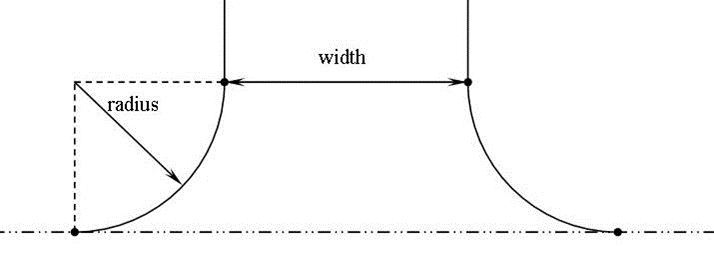
Figure E. Driveway Radius and Width.
h.
Notes on driveway design criteria:
1.
One-way driveways must intersect city streets between 45 and 90 degrees.
2.
Skewed, one-way drives are permitted only on one-way streets and divided streets with no median opening.
3.
Two-way driveways must intersect city streets at approximately 90 degrees.
4.
Where situations permit, AASHTO design vehicles may be used to justify (larger) driveway radii.
5.
Driveways shall be setback at minimal of 18 inches from the side-yard.
6.
No driveway radius shall encroach on abutting property (extension of property line) or corner radius.
7.
Driveways shall not flare out.
8.
Driveways shall not be permitted within limits of any intersection. (Design exception may be allowed for major arterial locations with existing esplanades and streets used for lower-volume residential access).
9.
For one-way driveways, the entry driveway shall precede exit driveways (in direction of adjacent travel lane).
10.
Driveway must remain tangential for a minimum of 20 feet past the property line.
11.
Where present or projected traffic operations indicate needs for alternative driveway geometrics, additional consideration may be given.
(15)
Industrialized housing and buildings. Notwithstanding other provisions in this section, the following shall apply to industrialized housing and buildings within all zones of the city:
a.
Definitions. The following words, terms and phrases, when used in this subsection (15), shall have the meanings ascribed to them in this subsection (15)a., except where the context clearly indicates a different meaning:
1.
Industrial buildings.
(i)
The term "industrial buildings" includes permanent commercial structures and other commercial structures designed to be transported from one commercial site to another commercial site.
(ii)
The term "industrial buildings" does not include structures more than three stories or 49 feet in height, structures not installed on a permanent foundation, and structures not open to the public, or that are less than 1,500 square feet in total area and are used as other than places of worship or schools.
2.
Industrialized building means a commercial or industrial use structure that is:
(i)
Constructed in one or more modules or constructed using one or more modular components built at a location other than the commercial site;
(ii)
Includes the structure's plumbing, heating, air conditioning, and electrical systems; and
(iii)
Designed to be used as a commercial building when the module of the modular component is transported to the commercial site and erected or installed.
3.
Industrialized housing.
(i)
The term "industrialized housing" means a residential structure that:
aa.
Is designed for the occupancy of one or more families;
bb.
Includes the structure's plumbing, heating, air conditioning, and electrical systems;
cc.
Is constructed in one or more modules or constructed using one or more modular components built at a location other than the permanent site; and
dd.
Is designed to be used as a permanent residential structure when the module or the modular component is transported to the permanent site and erected or installed on a permanent foundation system.
(ii)
The term "industrialized housing" does not include structures over three stories or 49 feet high, housing that utilizes sectional or panelized systems not using modular components, or manufactured homes.
b.
Permit required. All industrialized building, whether residential dwellings or commercial or industrial buildings, shall apply for a permit through the chief building official. All industrialized construction shall bear a certification placard or decal indicating inspection by the state department of licensing and regulation. Plans, designs, and specifications shall be properly sealed and approved by the state industrialized building code council. The chief building official shall have access to the site prior to and during construction of footings, foundations, utilities, and installation of the modules and industrialized components for the inspection of the facilities. All industrialized buildings for commercial and industrial use shall comply with architectural standards as outlined in this chapter, including landscaping and off-street parking requirements.
c.
Single-family or duplex industrial housing regulation. Single-family or duplex industrial housing shall be subject to the following regulation:
1.
Single-family or duplex industrial housing shall have a value equal to or greater than the median taxable value for each single-family dwelling located within 500 feet of the lot on which the industrialized housing is proposed to be located, as determined by the most recent certified tax appraisal roll for the county;
2.
Single-family or duplex industrial housing shall have exterior siding, roofing, roofing pitch, foundation fascia, and fenestration compatible with the single-family dwellings located within 500 feet of the lot on which the industrialized housing is proposed to be located;
3.
Single-family or duplex industrial housing shall comply with municipal aesthetic standards, building setbacks, side and rear yard offsets, subdivision control, architectural landscaping, square footage, and other site requirements applicable to single-family dwellings; and
4.
Single-family or duplex industrial housing shall be permanently and securely fixed to a permanent foundation.
For the purposes of this subsection, the term "value" shall mean the taxable value of the industrialized housing and the lot after the installation of the housing.
(16)
Conservation bond required. For large retail developments greater than 50,000 square feet of open plan, big-box-type warehouses, stores or shops, and including, but not limited to, car sales, used car lots, strip malls and parking structures, the developer shall be required to post a conservation bond equal to 20 cents per square foot, or 110 percent of the cost of demolition and removal of the structure and associated parking, whichever is greater. If the building is determined to be unoccupied, the city may order the demolition of the building and parking areas. This demolition will take place if 70 percent of the structure/lot is unoccupied for more than two years.
(Ord. No. 2008-021, § 2(25-76), 10-13-2008; Ord. No. 2017-029, § 1, 11-27-2017; Ord. No. 2022-009, § 8, 2-28-2022)
Sec. 42-250. - Drainage.
No drainage system installed, constructed, or used within the city limits shall allow water to flow through any open channel or ditch if the system flows into either the Hackberry Watershed or the Cotton Bayou Watershed. This section shall not apply to drainage systems in the estate residential (ER) zoning district.
(Ord. No. 2019-029, § 2, 8-26-2019)

