
Monument City Zoning Code
CHAPTER 18
05 - DEVELOPMENT STANDARDS
18.05.105 - Lots.
A.
Lot size, width (A), depth (B), shape and orientation and minimum building setback lines (C), as depicted on Figure 5.1, shall be appropriate for the location of the subdivision and for the type of development and use contemplated, and shall facilitate the placement of buildings with sufficient access, outdoor space, privacy and view.
Figure 5.1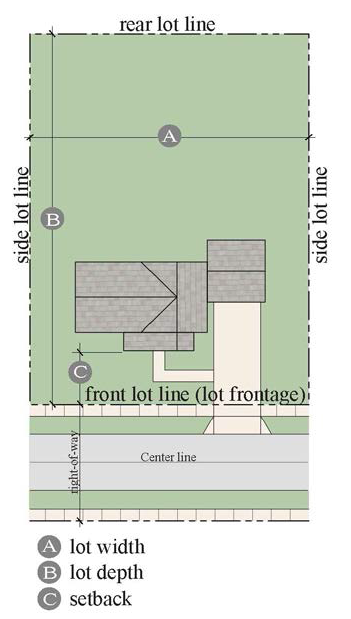
1.
Lot width and lot area shall not be less than that provided in Chapter 3 of this title for the zone district in which the subdivision is located.
2.
Generally, the depth of a lot shall not exceed three times the lot frontage. Some deviation from this provision may be permissible for topographical and drainage purposes, but not for the purpose of splitting a large tract into deeper than normal lots so that the provision of streets for proper access to lots can be avoided.
3.
Depth and width of properties reserved or laid out for commercial and industrial purposes shall be adequate to provide for off-street parking, landscaping or planting area, and loading areas required by the type of use and development contemplated.
4.
Side lot lines shall be at substantially right angles to streets, or radial to curved streets. Some variation from this rule is permissible, but pointed or very irregular lots shall be avoided.
5.
In the case of wedge-shaped or flag-shaped lots, no lot shall be less than thirty (30) feet in width at the front property lines. Residential lots with narrow frontages may be required to have additional area on the lot, and/or common parking areas for the parking of personal vehicles.
6.
Residential lots should front only on local streets; however, when necessary, residential lots designated to face a collector street shall provide adequate means for automobile turnaround within the lot.
7.
The building area of a lot should not face directly into the oncoming traffic of an intersecting street of a "T" intersection.
8.
No single lot shall be divided by a municipal or county boundary line, road, alley or other lot.
9.
All lots shall have direct access onto a public or private street.
B.
Double frontage and reverse frontage lots shall not be permitted except where they are essential to provide for the separation of residential development from a highway, an arterial street, a railroad, or to overcome specific disadvantages of topography or orientation.
1.
A planting and screening easement of at least ten (10) feet shall be provided along the portion of the rear lots abutting such a traffic artery or other use where screening is necessary.
2.
There shall be no right of access across a planting and screening easement. A statement precluding any access from individual lots to the arterial street shall be included as a note on the final plat.
(Ord. No. 25-2021, § 1(Exh. A), 6-7-2021)
18.05.110 - Blocks.
A.
Blocks shall not be less than two hundred and fifty (250) feet in length.
B.
The length of blocks shall be considered to be the distance from street centerline to opposite street centerline and shall be measured through adjacent rear property lot lines or through the center of the block.
C.
All blocks shall be abutted by one or more streets. Access to the interior of blocks may be permitted in certain instances, in which case such alleys must be indicated on the plat.
D.
Blocks shall be of sufficient width to permit two tiers of lots of appropriate depth, except where an interior street parallels a highway, an arterial street or railroad rights-of-way.
(Ord. No. 25-2021, § 1(Exh. A), 6-7-2021)
18.05.115 - Monuments and markers.
A.
Permanent reference monuments shall be set on the external boundary of a subdivision, pursuant to C.R.S. § 38-51-101.
B.
Block and lot monuments shall be set pursuant to C.R.S. § 38-51-101.
C.
At least one second order benchmark (Geodetic Survey Datum) shall be set (where practical to tie-in) within every subdivision or subsequent filing prior to submission of the final plat for recording.
D.
The surveyor shall certify on the final plat that it conforms to these regulations and to all applicable state laws and that the monuments described in it have been placed as described. He or she shall affix his or her name and seal.
(Ord. No. 25-2021, § 1(Exh. A), 6-7-2021)
18.05.120 - Easements.
A.
Easements shall be provided for all utility lines, including but not limited to water, sewer, storm water, gas, electric, telephone and cable television. The location and width of all utility easements shall be subject to the approval of the Director and of the utilities using the easement.
B.
Easements shall be located so as to provide efficient installation of utilities. Public utility installations shall be so located as to permit multiple installations within the easements to avoid cross-connections, minimize trenching and adequately separate incompatible systems.
C.
Where a development is traversed by a water course, drainageway or stream, there shall be provided a perpetual drainage easement conforming substantially with the lines of such watercourse, and of such width as necessary and adequate to carry off the predictable volume of storm water drainage from a twenty-five-year frequency storm as determined by the standard method for calculations used by the Army Corps of Engineers.
D.
A cross access easement shall be provided in non-residential developments to encourage shared parking and shared access points on public or private streets. Deviation from this provision may be permissible if deemed impractical by the Director on the basis of topography, the presence of natural features, or vehicular safety factors.
E.
To promote the efficient use of land, the Director may approve a single driveway to access multiple lots or dwelling units under separate ownership. In such event, a shared driveway easement shall be provided that complies with the following:
1.
A shared driveway easement must be set forth in a shared driveway easement agreement. The shared driveway easement agreement must be approved by the Director, and recorded with the El Paso County Clerk and Recorder. A shared driveway easement agreement must contain the following:
a.
A provision granting permanent, unimpeded access to the lots served by the shared driveway easement.
b.
A provision that addresses the year-round maintenance of the shared driveway, allocates the costs of maintenance among the property owners, and determines which property owner or owners shall decide when maintenance or repair is necessary.
c.
A provision prohibiting any modifications to the shared driveway easement agreement without the written preapproval of the Director.
(Ord. No. 25-2021, § 1(Exh. A), 6-7-2021)
18.05.125 - Streets and alleys.
A.
The arrangement, extent, width, type and location of all streets shall be designed in relation to existing or planned streets, to topographic conditions, to public convenience and safety and to the proposed use of land to be served.
B.
Certain proposed streets, where appropriate, shall be extended to the boundary of the tract to be subdivided so as to provide for future connection to adjacent undeveloped land.
C.
There shall be at least two points of access for all residential subdivisions with twenty-five (25) or more single-family dwelling units. Deviation from this provision may be permissible for topographical or other unique circumstances where a second access point is not feasible, upon approval by the Fire District.
D.
All streets and alleys shall be designed and constructed in accordance with the Town of Monument Roadway Design and Technical Criteria Manual.
(Ord. No. 25-2021, § 1(Exh. A), 6-7-2021)
18.05.130 - Sidewalks and trails.
A.
Sidewalks. The Town shall require sidewalks to be installed on each side of the street in all zone districts, except the Large Lot Residential and Light Industrial zones where sidewalks are only required on one side of the street with approval of the Director.
1.
All sidewalks shall be a minimum of five feet wide in all zone districts, and meet current ADA requirements. Replacement of existing sidewalks shall be to the width of the adjacent or connecting sidewalk.
2.
Where blocks exceed one thousand (1,000) feet in length, pedestrian rights-of-way of not less than fifteen (15) feet in width shall be provided through blocks where needed for adequate pedestrian circulation. Improved walks of not less than five feet in width shall be placed within the pedestrian rights-of-way.
3.
All sidewalks shall be designed and constructed in accordance with the Town of Monument Roadway Design and Criteria Manual.
B.
Trails. Trails shall be designed to provide adequate internal circulation and make appropriate external connections to schools, parks, employment centers, and transit. in accordance with the Town's Parks, Trails, and Open Space Master Plan and Section 18.02.330.F of these regulations.
1.
Trails shall have a minimum width of eight feet concrete surface with a four-foot wide crushed refined gravel path on one side.
2.
Trails with alternative surfaces and narrower widths may be approved by the Director in those instances where such trails are secondary to existing or proposed trails, and do not serve as connector to the Town's trail system.
(Ord. No. 25-2021, § 1(Exh. A), 6-7-2021)
18.05.135 - Natural features.
A.
The layout of lots and blocks should provide desirable settings for structures by making use of natural contours and maintaining existing views, affording privacy for the residents and protection from adverse noise and vehicular traffic.
B.
The system of roadways and the lot layout should be designed to take advantage of visual qualities of the area.
C.
The design and development of a site or subdivision shall preserve, insofar as it is possible, the natural terrain, natural drainage, existing topsoil, unusual rock formations, lakes, rivers, streams and trees.
D.
Significant vegetation, including large individual trees, tree masses and shrubs, shall be retained where possible, in accordance with the Town's Landscape Guidelines.
1.
When regenerating sites, replacement trees or shrubs shall be selected from indigenous species native to the region.
2.
Provisions shall be made to provide adequate hydration and appropriate soil for the replacement trees to ensure successful growth.
E.
Land subject to hazardous conditions such as mine subsidence, shallow water table, open quarries, floods, undermining, and polluted or non-potable water supply shall not be subdivided until the hazards have been eliminated or mitigated.
F.
No development, use, fill, construction, excavation, embankment, or alteration on or over any portion of a geologic hazard area shall be permitted which would result in dangers to life or property.
(Ord. No. 25-2021, § 1(Exh. A), 6-7-2021)
18.05.140 - Open space.
A.
Open space shall be provided:
1.
In conformance with the Town of Monument Land Dedication requirements as outlined in the Chapter 2, Article 3 of this title, and
2.
In conformance with the Town of Monument Parks, Trails, and Open Space Master Plan and the Town of Monument Comprehensive Plan as amended from time to time.
B.
Open space may include:
1.
Environmental preservation of significant natural areas such as buttes, bluffs, and other geologic formations, water bodies/resources, wildlife habitat areas, fragile ecosystems (wetlands), riparian areas, floodplains, native trees and shrubs and/or other significant vegetation.
2.
Preservation of lands which preserve significant views, provide transitions between different densities and uses (buffers), and otherwise serve to give shape and form to the proposed development and surrounding community.
3.
Land within Preble's Meadow Jumping Mouse Habitat, detention areas and other undevelopable areas such as steep slopes.
C.
In evaluating and determining open space areas within a proposed development, the following factors shall be considered:
1.
The environmental characteristics of the site including the preservation of significant natural features and resources such as wildlife habitat, native vegetation (especially trees and shrubs), rock formations, and areas unsuitable for development.
2.
The location, use, and relationship of the proposed open space areas to the development areas within the site. Access to public or private common-use open space areas by occupants of the proposed residential dwelling units and to employees and visitors of non-residential developments will be dependent on whether the open space area contains sensitive or fragile environmental features or wildlife habitat.
3.
Provision for adequate pedestrian and bicycle trail systems.
4.
The buffering needs of adjacent existing and planned land uses.
5.
View corridors within and through the property and other visual/scenic assets of the site.
6.
The degree to which the proposed open space areas contribute to the quality, livability and amenities of the development.
7.
Only the area that can be used for these purposes can be counted as open space. Detention facilities do not qualify as open space unless they are specifically designed to provide passive recreation features or wildlife habitat.
(Ord. No. 25-2021, § 1(Exh. A), 6-7-2021)
18.05.145 - Storm drainage and erosion control.
A.
Storm drainage and erosion control shall be provided for the development based on plans submitted by the applicant to the Town and approved by the Director.
B.
The applicant shall provide data prepared by a licensed Colorado Professional Engineer sufficient to indicate that the drainage from a proposed development will not adversely affect any downstream properties or the community as a whole.
1.
Lots shall be laid out so as to provide positive drainage away from all buildings, and individual lot drainage shall be coordinated with the general drainage pattern for the area and to maintain the individual lot drainage on the specific lot as much as possible.
2.
The drainage system shall be designed to accommodate not only runoff from the subdivision, but also historic runoff for those areas adjacent and upstream from the proposed subdivision, as well as its effect on lands downstream.
C.
Erosion and sediment control devices and revegetation shall be incorporated into all new developments.
1.
Erosion control plans are required for all developments.
2.
All drainage from the site during construction must go through an erosion control device.
D.
Applications for approval of storm drainage and erosion control under these regulations shall comply with the following regulations, as applicable, which are incorporated herein by this reference, and copies of which are available for inspection and copying at the Town offices:
1.
The City of Colorado Springs Engineering Division Standard Specifications;
2.
The City of Colorado Springs and El Paso County Drainage Criteria Manual—Volumes I and II;
3.
The Triview Metropolitan District Design Criteria and Construction Specification Manual for Residential Development; and
4.
The Town of Monument Roadway Design and Technical Criteria Manual.
(Ord. No. 25-2021, § 1(Exh. A), 6-7-2021)
18.05.150 - Flood damage prevention.
A.
Tracts of land or portions thereof lying within any area of special flood hazard shall not be subdivided except for open space until the subdivider has complied with requirements of the Floodplain Code of the Pikes Peak Regional Building Department.
B.
A floodplain development permit shall be obtained before construction or development begins within any area of special flood hazard established in the Floodplain Code of the Pikes Peak Regional Building Department.
(Ord. No. 25-2021, § 1(Exh. A), 6-7-2021)
18.05.155 - Irrigation ditches.
A.
Existing irrigation ditches shall be incorporated within a site plan in a manner such that their function is not impaired.
B.
The ditches shall be protected from encroachment and may be fenced in a manner acceptable to the ditch company.
(Ord. No. 25-2021, § 1(Exh. A), 6-7-2021)
18.05.160 - Water.
A.
All new structures with any plumbing fixtures requiring water, and/or any proposed landscaping requiring irrigation, shall be connected to the Town's and/or a district's central water and/or sewer systems in conformance with the applicable utility regulations.
B.
Applications for approval under these regulations shall comply with the Town of Monument/Triview Metropolitan District Water Utility Policies and Standards.
(Ord. No. 25-2021, § 1(Exh. A), 6-7-2021)
18.05.165 - Fire protection.
A.
Every development served by a public water system shall include a system of fire hydrants sufficient to provide adequate fire protection for the buildings located or intended to be located within such subdivision.
1.
Design standards shall conform to the National Fire Protection Association (NFPA) standards.
2.
The Director may authorize or require a deviation from these standards if another arrangement more satisfactorily complies with NFPA or local standards.
B.
Where the fire protection district identifies a specific wildland fire danger, a wildfire mitigation plan shall be prepared by a qualified professional.
1.
A wildfire mitigation plan shall address, at a minimum, the following:
a.
Access, ingress, egress, and evacuation;
b.
Fuel modification;
c.
Water supply;
d.
Construction, location, and design of structures; and
e.
Ignition potential.
2.
Wildfire mitigation plans shall be prepared in accordance with NFPA standards, as applicable. Landscape fire mitigation shall be done in accordance with Section 18.05.470 of this chapter.
3.
The Director may authorize or require a deviation from these standards if another arrangement more satisfactorily complies with NFPA or local standards.
(Ord. No. 25-2021, § 1(Exh. A), 6-7-2021)
18.05.170 - Sanitary sewer.
A.
All new structures with any plumbing fixtures requiring water, and/or any proposed landscaping requiring irrigation, shall be connected to the Town's and/or a district's central water and/or sewer systems in conformance with the applicable utility regulations.
B.
Applications for approval under these regulations shall comply with the Town of Monument Sanitary Sewer Collection System Specifications.
(Ord. No. 25-2021, § 1(Exh. A), 6-7-2021)
18.05.175 - Utilities.
Utilities (telephone, electric services and gas lines and cable television) shall be installed underground and shall be in place prior to street surfacing.
1.
Electric transmission lines of 69KV or greater capacity are exempt from this requirement due to the prohibitive cost of burying such facilities.
2.
Above ground or peripheral overhead electrical transmission and distribution feeder lines or other installation of either temporary or peripheral overhead communications, distance, trunk or feeder lines may be above ground with the permission of the Town.
(Ord. No. 25-2021, § 1(Exh. A), 6-7-2021)
18.05.180 - Buffers and screening.
A.
Where a proposed nonresidential use or a proposed expansion of a nonresidential use abuts a legal, conforming residential use located within a residential zone district, a physical barrier in the form of an opaque fence, wall, and/or landscape screen shall be provided to adequately buffer the residential use.
B.
In each instance where a nonresidential use abuts a residential use, a fifteen-foot buffer easement shall be provided, unless such use areas are separated by a roadway or other public land of at least fifteen (15) feet in width, subject to the following additional provisions:
1.
For zones in the Regency Park overlay district, a thirty-foot buffer easement shall be provided, unless such use areas are separated by a roadway or other public land of at least thirty (30) feet in width.
2.
The buffer easement shall be kept free of buildings or structures, other than those required by subsection A, and shall be landscaped, screened or protected by natural features, so that the adverse effects on abutting areas are minimized.
3.
Not more than fifteen (15) percent of such buffer area may be utilized for parking.
C.
Enclosure of Uses. Unless expressly exempted by this title, all uses shall be operated within a completely enclosed structure or screened area.
D.
Outdoor Storage Screening. Outdoor storage, where permitted by the zone district regulations, shall be enclosed by a fence, landscaping, and/or other appropriate treatment, which shall be adequate to conceal such facilities from adjacent properties and streets.
E.
Trash Receptacle and Service Area Screening. All outdoor service areas, service equipment, and trash receptacles including dumpsters shall be screened or concealed from the view of adjacent properties and streets, except for residential curb side trash service. Such screening may include fencing, landscaping, and/or other appropriate treatment adequate to conceal such facilities from adjacent properties and streets. Service areas and dumpsters shall be located away from the view of adjacent properties and streets whenever possible.
F.
Roof Top Equipment Screening. All roof top equipment shall be screened or concealed from view from adjacent properties and streets by the use of compatible and appropriate materials similar or complementary to the primary building materials. Solar panels in residential zone districts are exempt from this requirement.
G.
Special equipment such as silos, dust collectors, cooling towers, or other similar structures shall be sited away from the view from adjacent streets and properties and/or integrated into the building design with compatible and appropriate materials similar to the primary building materials.
(Ord. No. 25-2021, § 1(Exh. A), 6-7-2021)
18.05.185 - Fencing.
A.
Intent. It is the intent of this section to ensure that fences are erected in a safe manner that will not create safety hazards and for fencing to be aesthetically pleasing and be compatible with development on the lot on which the fencing is erected as well as with neighboring properties.
B.
Barbed wire fencing is not allowed to be used within any zone district within the Town, except that up to four strands may be allowed for public utilities or other similar uses.
C.
Electrified fences are not allowed to be used within any zone district within the Town, except that low amperage/low voltage commercially available invisible "pet" electric fences may be used in any district.
D.
Any fencing in a sight distance triangle (See Section 18.05.190) shall not exceed thirty-six (36) inches in height.
E.
Fences in a front yard shall not exceed forty-two (42) inches in height, except for fences in a commercial or industrial area determined by the Director to be necessary for securing merchandise such as for commercial garden shops, nurseries, greenhouses, automobile sales, or as is necessary for a day care or pre-school, or other similar uses.
F.
Fences adjacent to a street shall be set back twelve (12) inches from the property line.
G.
No fence shall exceed seventy-two (72) inches in height, except for fences for the following uses; public tennis courts, baseball fields, or other similar public recreational uses.
H.
For properties zoned or developed with industrial uses, fences may be eight feet, or ninety-six (96) inches, in height.
I.
All fencing shall be of a design and quality compatible with the site and adjacent uses and shall provide appropriate screening, visibility, security, and appearance as determined by the Director.
1.
The finished side of the fence shall face the public right-of way, common open space, or other public areas as applicable.
2.
Additional landscaping may be required to screen a solid fence.
J.
Any fencing within an easement or near a fire hydrant or other public improvement or utility shall not interfere with the purpose of the easement or improvement including access by the utility or service provider or easement holder. The Town, service provider, or utility holder may remove any improvement including fencing interfering with the use of the easement or public improvement and the property owner may be responsible for replacing any improvement at his own expense, and may be required to reimburse the Town or service or utility provider for removal costs.
K.
A fence shall not be constructed or erected until a construction permit has been issued by the Town.
L.
The property owner shall be responsible for proper installation of the fence, including determining the property boundaries and installing the fence on his or her property.
M.
Fences existing at the time this ordinance [title] is adopted shall be considered legally non-conforming providing they are not installed on public rights-of-way or other public property without the Town's express permission and provided they do not create a safety hazard.
N.
All fences shall be maintained by the property owner, including periodic staining and painting as necessary to keep the fence in good condition. In the event that a fence has not been maintained or has been damaged, the Town may require the owner to repair, paint, stain, or remove the fence within thirty (30) days of written notice or other reasonable time period as determined by the Town.
O.
Any applicant may appeal the decision or conditions of the Director in the application of this Article to the Board of Adjustment.
(Ord. No. 25-2021, § 1(Exh. A), 6-7-2021)
18.05.190 - Sight visibility.
A.
To allow for appropriate sight distance and vision clearance, no solid object exceeding eight inches in width and thirty-six inches (36) in height, including but not limited to fences, walls, and landscape plantings, shall be placed at a street intersection or intersection of a street and driveway within a triangular area described as follows:
1.
At the intersection of two private streets, or the intersection of a driveway with a private street, beginning at the point of intersection of the edges of the driving surface (pavement) then to points fifteen (15) feet along both intersecting edges, and then along a direct line connecting these points. See Figure 5.2.
Figure 5.2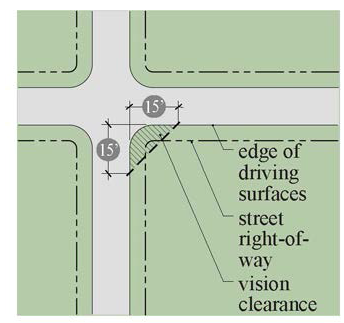
2.
At the intersection of a private or public street with a public street, beginning at the point of intersection of the edges of the driving surface (pavement) then to points twenty-five (25) feet along both intersecting edges, and then along a direct line connecting these points. See Figure 5.3.
Figure 5.3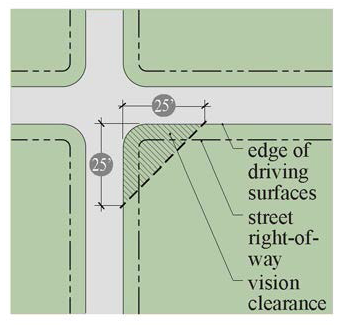
B.
All intersections shall comply with all other sight distance standards in the Town of Monument Roadway Design and Technical Criteria Manual, and specifically Detail DT 25 if more restrictive.
(Ord. No. 25-2021, § 1(Exh. A), 6-7-2021)
18.05.205 - Purpose.
The purpose of this article is to:
1.
To ensure that safe and convenient off-street parking in adequate numbers is provided to serve the requirements of all land uses in the Town;
2.
To avoid congestion in the streets; and
3.
To preclude the overuse of pavement on a site.
(Ord. No. 25-2021, § 1(Exh. A), 6-7-2021)
18.05.210 - General parking requirements.
A.
Applicability. The off-street parking requirements of this Article shall apply to new site developments and expanded uses. Parking requirements shall not apply to buildings lawfully repaired or improved where no change in use or increase in floor area results.
B.
Compliance. All persons shall comply at all times with all parking regulations promulgated by the Town by ordinance, or as found in Articles I and II, inclusive, of the most recent edition of the Model Traffic Code for Colorado Municipalities. If a conflict arises or additional standards are required, the stricter of the two shall apply.
C.
Minimum and Maximum Standards. The requirements of this article concerning off-street parking spaces and areas are typically minimum requirements.
1.
Since these parking standards are meant to preclude the overuse of pavement on a site, the owner or developer shall install facilities meeting the minimum standards in this article.
2.
The Director may consider variations to the minimum parking standards based upon the type of activity, intensity, number of employees and other factors associated with a particular use.
3.
The provisions concerning the maximum number of access ways to and from parking areas shall not be altered.
D.
Exclusive Use. No off-street parking space shall be used for any purpose other than parking of vehicles, seasonal snow storage, or an approved temporary use.
1.
No obstruction shall be placed on any off-street parking space which may interfere with its utility as a parking space.
2.
If an off-street parking space is converted to another use or can no longer be used for off-street parking space, it shall be replaced immediately by another off-street parking space meeting all of the requirements of this article.
(Ord. No. 25-2021, § 1(Exh. A), 6-7-2021)
18.05.215 - Off-street-parking space requirements.
A.
Unless specifically exempted or variations are permitted in accordance with this Title, all land uses in the Town shall include, at a minimum, the number of vehicle off-street parking spaces specified in Table 5.1.
B.
When one building or lot is planned to include a combination of different uses, including accessory uses, the minimum parking requirement will be determined by applying the above requirements and standards to each use and structure, resulting in a total parking requirement for the property.
1.
The minimum number of parking spaces required shall be the sum of the requirements for each separate use, except where appropriate for shared use consideration as described in Section 18.05.225.
2.
The appropriate combination of parking types for a particular development or use will be determined by the Director.
C.
When the computation for off-street parking spaces results in a fraction, the next highest integer shall apply, and off-street parking spaces shall be provided in a number equal to such integer.
D.
For specific uses not listed, the Director shall determine the appropriate number of parking spaces required based upon the type of activity, intensity, number of employees and similarity to listed uses.
E.
Off-street parking requirements for temporary uses, as specified in Section 18.03.250, will be determined by the Director on a case-by-case basis.
F.
Within the Downtown Business district (DB zone), the minimum parking requirements of this section may be satisfied in any one, or combination thereof, of the following ways:
1.
Off-street parking within the subject property boundaries to meet the requirements of Table 5.1.
2.
On-street parking within one-block radius of the subject property.
3.
Shared parking (joint use of parking spaces) within the subject property boundaries pursuant to the requirements of Section 18.05.225.
4.
Off-site parking, provided that the location of the off-site parking area is within a one-block radius of the property, and providing that a written agreement between the owner of the off-site parking facility property and the owner of the subject property is executed and presented to the Town prior to issuance of a certificate of occupancy for any use within the subject property.
(Ord. No. 25-2021, § 1(Exh. A), 6-7-2021)
18.05.220 - Truck and recreational vehicle parking.
A.
In residential districts no truck exceeding two and one-half ton capacity, no truck-tractor or semi-trailer, earth moving equipment or other similar vehicle, object or machine which conflicts with the residential character of a neighborhood shall be parked or stored on any subdivided lot or within the public rights-of-ways or roadway, or for living or housekeeping purposes. Exceptions to this section are vehicles which may temporarily be conducting business within residential districts.
B.
No person shall keep, maintain, store or park any recreational vehicle (defined, for the purposes of this Section as any trailer of any type, boat, or detached pickup camper) on public rights-of-ways or private roadway within any zone district for a period of more than twenty-four (24) hours.
C.
The on-site parking of recreational vehicles in a residential zone district is allowed subject to the following restrictions:
1.
No recreational vehicle may be stored or parked on the property closer than eighteen (18) inches to the sidewalk or other nearest public rights-of-ways line.
2.
No recreational vehicle shall be parked in the visibility triangle defined in Section 18.07.110.
3.
No parked recreational vehicle may be used for the conduct of business or for living or housekeeping purposes.
4.
The recreational vehicle must be secured such that the vehicle is not moved by high winds.
5.
No recreational vehicle shall be stored out-of-doors on a residential lot unless it is in a safe, working condition.
6.
A recreational vehicle is permitted only on a driveway or adjacent and parallel to a driveway on a single-family residential lot, or in the paved parking lot of a multifamily residential community.
a.
In a single-family residential district, the recreational vehicle must be parked on the side of the driveway closest to the property line, or close to the house within the side yard, space permitting.
b.
If parked in the side yard, the recreational vehicle shall not extend past the house's front building line, excluding porches and/or stairs.
7.
A recreational vehicle must be parked on a hard surface such as, but not limited to, asphalt, concrete, rock, gravel or pavers. The area must be specifically designed for parking use and must be properly maintained. Parking on any grass and/or dirt area is prohibited.
(Ord. No. 25-2021, § 1(Exh. A), 6-7-2021)
18.05.225 - Shared parking facilities.
A.
Where an owner or developer can document that two or more separate uses do not require the use of all parking spaces during the same hours, and that provisions have been made to ensure that all uses will have adequate parking, the Director may approve a shared use of parking spaces.
B.
The overall number of parking spaces serving multiple uses in close proximity to one another may be reduced through a shared parking arrangement, provided that:
1.
The parking spaces are within three hundred (300) feet of the property, except that the distance is extended to one thousand (1000) feet for employee parking;
2.
Based on information supplied by the applicant, the Director, or other sources, the aggregate parking demands at the highest use time is less than the total parking spaces required; and
3.
A copy of a recorded agreement by owners involved in such joint use is presented to the Director. Should the agreement expire or otherwise terminate, the use for which the shared parking was provided shall terminate and no owner shall maintain such use without 1) a substitute parking agreement, approved by the Director, or 2) the use is brought into compliance with the parking regulations of this article.
(Ord. No. 25-2021, § 1(Exh. A), 6-7-2021)
18.05.230 - Modification or deferral of parking requirements.
A.
The Director may consider deferral of parking requirements where the need for off-street parking is lessened due to unusual characteristics of use, and reliable data is available to establish that there is not a present need for additional parking.
1.
The Director may authorize the deferral of construction of not more than fifty (50) percent of the required off-street parking spaces and may set such conditions as necessary to guarantee provision of such deferred parking spaces at such time as the Director determines such additional parking spaces are needed.
2.
The land area required for provision of deferred parking spaces shall be maintained and reserved and shall be landscaped pursuant to a plan approved by the Director, which shall demonstrate that the deferred spaces, when improved, will meet all requirements of this article.
B.
The Director may increase or decrease the required number of off-street parking spaces in consideration of the following factors:
1.
Expected number of cars owned by occupants of dwellings in a planned unit development;
2.
Parking needs of any non-dwelling uses in a planned unit development; and
3.
Varying time period of use.
(Ord. No. 25-2021, § 1(Exh. A), 6-7-2021)
18.05.235 - Loading requirements.
A.
General Provisions.
1.
These loading requirements shall apply to those non-residential land uses which require that goods, merchandise or equipment be routinely delivered to or shipped from that land use.
2.
Off-street loading areas shall be required so that vehicles using such loading areas can maneuver safely and conveniently to and from a public rights-of-ways and complete loading and unloading operations.
3.
The number, size and other requirements for off-street loading spaces and berths shall be as specified below. Where the use of the premises is not specifically mentioned, loading requirements shall be determined by the Director based on requirements for similar uses, expected demand generated by the proposed use, and other information from appropriate traffic engineering and planning criteria.
4.
Off-street loading requirements for temporary uses, as specified in Section 18.03.250, will be determined by the Director on a case-by-case basis.
B.
Commercial and Institutional Use Standards.
1.
For commercial or institutional buildings greater than three thousand (3,000) square feet in area, an unloading area of at least twelve (12) feet by thirty (30) feet, with a minimum overhead clearance of fourteen (14) feet, shall be provided on the lot. This requirement may be waived by the Director if a portion of the off-street parking area is designed to function in a safe and attractive manner as the unloading area.
2.
An area used for unloading shall not be used to meet the off-street parking requirements.
C.
Industrial Use Standards.
1.
For industrial buildings greater than three thousand (3,000) square feet in area yet less than twelve thousand (12,000) square feet in area, an unloading area of at least twelve (12) feet by thirty (30) feet, with a minimum overhead clearance of fourteen (14) feet, shall be provided on the lot.
2.
For any industrial use in excess of twelve thousand (12,000) square feet in area, a loading berth of at least twelve (12) feet by thirty (30) feet, with a minimum overhead clearance of fourteen (14) feet, shall be provided on the lot. Depending on the specific building use and size, additional industrial loading berth requirements may be required in accordance with Table 5.2.
(Ord. No. 25-2021, § 1(Exh. A), 6-7-2021)
18.05.240 - Stacking requirements.
A.
The purpose of stacking space requirements is to promote public safety by alleviating on-site and off-site traffic congestion that might otherwise result from the operation of a drive-up or drive-through facility.
B.
For all applicable pickup, drop-off, drive-up or drive-through uses, the following off-street stacking requirements shall apply:
1.
Stacking spaces may be located anywhere on the building site, provided that traffic impacts on and off site are minimized and the location does not create negative impacts on adjacent properties due to noise, light or other factors.
a.
A stacking space at a drive-in or drive-through window, menu board, order station, designated drop-off and/or pick-up zone, car wash or vehicle service bay is considered to be a stacking space.
b.
An area reserved for stacking spaces may not double as an off-street parking space.
c.
Stacking areas shall not interfere with vehicle or pedestrian circulation.
2.
A stacking space shall be a minimum of eight feet wide and twenty (20) feet long.
3.
A driveway designed for continuous forward flow of passenger vehicles for the purpose of loading and unloading children shall be located on the site of any school or child care center.
4.
Minimum off-street stacking space standards shall be as specified in Table 5.3.
5.
Off-street stacking requirements for temporary uses, as specified in Section 18.03.250, will be determined by the Director on a case-by-case basis.
(Ord. No. 25-2021, § 1(Exh. A), 6-7-2021)
18.05.245 - Design requirements.
Parking, loading and stacking areas shall be designed and constructed in accordance with the following requirements and the requirements of the Town of Monument Roadway Design and Technical Criteria manual:
1.
Access. Unobstructed, direct and safe access for vehicles to and from a street shall be provided for all off-street parking spaces.
a.
Entry and exit points shall be located so as to provide the least number of access points and to maximize stacking space and distance from intersections and/or alleys.
b.
The location, spacing and design of all proposed curb cuts to the public rights-of-ways shall be approved by the Director.
2.
Surfaces. All access ways between a public street and off-street parking spaces or areas, and all off-street parking spaces, driveways and aisles shall be surfaced with asphalt or concrete.
3.
Location of Parking Spaces.
a.
All necessary accesses, driveways and other paved portions of parking areas shall not be located within required front yard setbacks except that driveways may cross setbacks by traversing the width of the setback but not generally traveling the length thereof.
b.
Off-street parking spaces may be located on any part of the lot occupied by the buildings or uses for which such parking space is required; however, no parking space or aisle shall be established in a minimum front yard setback except in the single-family, attached single-family, and multifamily residential use areas with two, three or four dwelling units.
c.
For single-family dwellings and multifamily dwellings with two, three or four dwelling units, off-street parking spaces shall be located on the same building lot as the dwelling. Parking of vehicles is permitted only on the driveway, parking area, or other paved surface on the property which is specifically designed for parking use.
4.
Parking Area Layout.
a.
Every parking area shall be designed according to Figure 5.4 and Table 5.4.
b.
Each standard off-street parking space shall cover an area not less than nine feet wide and eighteen (18) feet long except that up to thirty (30) percent of the number of off-street parking spaces provided may be eight feet wide and sixteen (16) feet long, which spaces shall be marked for use by compact cars, with the words "Compact Only" painted on the space.
c.
If motorcycle or LSV (low speed vehicle) parking spaces are proposed, designation of the space painted on the pavement and a parking space no smaller than four and one-half feet wide by ten (10) feet long shall be provided. Such designated spaces shall not count towards the total required off-street parking spaces.
d.
If electric vehicle (EV) charging station spaces are proposed, designation of the space with signage indicating the space is only for electric vehicle charging purposes and a parking space no smaller than nine feet wide and eighteen (18) feet long shall be provided. Such designated spaces shall count towards the total required off-street parking spaces.
5.
Garages and Carports. Off-street parking requirements may be met by garages and carports covering or enclosing spaces measuring nine feet by eighteen (18) feet or greater.
6.
Striping. All off-street parking spaces with the exception of single family and attached single family uses are required to be delineated by a four-inch-wide painted stripe.
7.
Wheel Stops. All parking spaces abutting sidewalks less than six feet wide shall provide bumper/wheel stops, unless otherwise exempted by the Director.
8.
Lighting. Security lighting shall be provided in all parking areas from sunset to sunrise. All lighting shall be in accordance with Article 3 of this Chapter.
9.
Drainage Plans. A drainage plan in conformance with the Town's regulations shall be submitted for review to the Town. Such drainage plan or system shall be approved by the Town prior to the construction of any off-street parking.
10.
Snow Storage. All off-street parking areas shall include space for snow storage and removal of snow.
a.
One square foot of snow storage space is required for each three square feet of parking, driveway, walkway and/or loading area to be cleared.
b.
Up to fifteen (15) percent of the required parking spaces (not including ADA accessible parking spaces) may be designed for snow storage and removal.
c.
Snow storage areas shall be designed so that snow is not stored in a manner where, when melting, it directly discharges into any watercourses, streets, pedestrian pathways and/or bicycle pathways.
d.
Snow storage shall not be located on or within twenty-five (25) feet of wetlands, or within thirty (30) feet of the high-water mark on each side of a watercourse.
11.
Parking Area Screening.
a.
A landscape screen shall be established between a parking area and adjacent roads. The screen shall be composed of plant materials, artificial structures, berms, or combinations thereof as approved by the Director.
b.
Where abutting a legal, conforming residential use or zoning district, commercial parking areas shall be screened from the residential use utilizing coniferous vegetation, opaque fencing, wall, berm or similar visual barrier of a minimum five feet in height. For residential uses that are developed after an adjacent, built commercial area that was not subject to this requirement, the required screening shall be installed by the residential developer.
12.
Parking Area Landscaping. In an outside, off-street parking area with ten (10) or more spaces, one tree shall be provided for every ten (10) vehicular parking spaces.
a.
Trees shall be located in planters or islands that are bounded on at least three sides by parking area paving. Only trees in parking area planters or landscaped islands can count towards the parking area tree requirement.
b.
Trees shall be located to divide and break up expanses of paving and long rows of parking spaces to create a canopy effect.
c.
Tree types shall be consistent with the Town of Monument Landscape Guidelines.
d.
Planters or landscape islands shall be a minimum of one hundred sixty-two (162) square feet, with a minimum width of nine feet, to accommodate the growth of trees and to prevent damage to the trees by vehicles. Trees must receive adequate irrigation to ensure survival.
e.
Protection of existing tree(s) may be accomplished by relocation to other areas of the parking area.
Figure 5.4
Parking Dimensions and Layout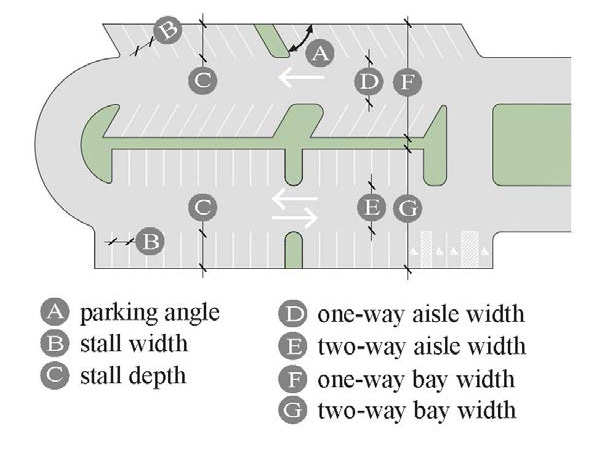
(Ord. No. 25-2021, § 1(Exh. A), 6-7-2021)
18.05.250 - ADA requirements.
A portion of the required off-street parking spaces shall be specifically designated, located and reserved for use by persons with physical disabilities in accordance with the requirements specified in the Americans with Disabilities Act (ADA).
1.
The minimum number of required ADA accessible parking spaces are listed in Table 5.5.
2.
Parking spaces for the physically disabled shall have a minimum space width of eight feet wide and eighteen (18) feet long, with an adjacent access aisle.
a.
Access aisles shall be a minimum of five feet wide and eighteen (18) feet long, extend the full length of the parking space(s) they serve and shall be marked.
b.
One in every eight spaces, but not less than one, shall be designated as "Van Accessible" and served by an access aisle eight feet in width.
c.
All such spaces should be designated with a raised standard ADA identification sign; both painted on the space pavement and indicated with a pole sign. "Van Accessible" spaces shall be designated in the same manner.
3.
A minimum overhead clearance of eight feet shall be provided.
4.
The maximum grades in the areas designated for handicap parking shall be two percent or less.
5.
If a curb ramp is located where pedestrians must walk across the ramp, or where it is not protected by handrails or guardrails, it shall have flared sides: the maximum slope of the flare shall be 1:10. Curb ramps with returned curbs may be used where pedestrians would not normally walk across the ramp.
6.
ADA accessible parking spaces shall otherwise meet all ADA standards for parking, access and ADA signage. Information on these requirements can be obtained at 1-800-514-0301 or at www.accessboard.gov.
(Ord. No. 25-2021, § 1(Exh. A), 6-7-2021)
18.05.255 - Enforcement of Chapter 18.05.
The provisions of this Chapter 18.05 shall be subject to enforcement under the provisions of Chapter 2.36 of the Monument Municipal Code. In the discretion of the Town Manager, Code Officer, or the police department, violations of this Chapter 18.05 shall also be subject to summons into Municipal Court as a violation of the Monument Municipal Code.
(Ord. No. 07-2024, § 2(Exh. A), 3-18-2024)
18.05.310 - Purpose.
The intent of these standards is to minimize the effects of lighting on the night sky in order to protect views of the night sky, to enhance safety, to minimize glare, and to minimize negative impacts of lighting, including light trespass, on adjacent properties.
1.
Exterior lighting shall be evaluated during the development review process to ensure that the functional and security needs of a project are met in a way that will not adversely affect the adjacent properties or the surrounding neighborhood.
2.
The degree to which exterior night lighting affects a property owner or neighborhood will be examined based upon the light source, level of illumination, hours of illumination and the need for illumination in relation to the effects of lighting on adjacent property owners and the neighborhood.
(Ord. No. 25-2021, § 1(Exh. A), 6-7-2021)
18.05.320 - Requirements.
All exterior lights and illuminated signs shall meet the following requirements:
1.
Be designed, located, installed and directed in such a manner to prevent objectionable light at and across the property lines and to prevent glare at any location on or off the property.
2.
Be of a white light, such as metal-halide, incandescent, or a lamp with a color rendering index above seventy (70).
3.
Not exceed the maintained horizontal illuminance recommendations set by the Illuminating Engineering Society of North America (IESNA) or an average illumination level of one and five-tenths foot candles for the illuminated area based on the initial illuminance level measured following one hundred (100) hours of operation. Undeveloped portions of lots such as open space tracts and/or unbuildable areas such as detention ponds shall not be included in the calculations for the average illuminance level. A uniformity ratio (average to minimum) of illuminance levels of 4:1 is recommended, with a maximum uniformity ratio of 10:1. Illuminance levels shall not exceed one-tenth foot candle as a direct result of the on-site lighting and interior building lighting measured twenty (20) feet beyond the property line of the development site.
4.
Be full cut-off style fixtures for all parking area lighting.
5.
Be illuminated with flush-mounted, flat lens light fixtures for all under-canopy areas.
6.
Be shielded to prevent glare and/or light trespass from all building, site, sign, and aesthetic lighting.
7.
Exclude up-lighting, which is prohibited for externally illuminated signs.
8.
Be full cut-off or a fully shielded type fixture (unshielded wall pack style fixtures are not acceptable) for all building lighting including lighting for security. The source of lighting shall be fully shielded from pedestrians and motorists. Fixtures may not be tilted or aimed in a manner that results in light distribution above the horizontal plane unless expressly authorized in this Article.
9.
Be required to be turned off one hour after business hours, leaving only the necessary lighting for site and building security for all nonessential lighting. For purposes of this subsection, nonessential lighting shall include display, aesthetic, and sign lighting. Security lighting at entrances, stairways and loading docks, as well as limited parking lot lighting, is permitted. The use of motion sensors for security lighting is strongly encouraged. Security lighting shall comply with all applicable provisions contained in this Article and may not exceed the maximum foot candle level permitted on the site. Outdoor display lots for vehicle sales and leasing shall also comply with the requirements of this subsection by reducing the light levels between 10:00 p.m. and 7:00 a.m. to illumination levels sufficient for security purposes only.
10.
Have the following maximum mounting height:
a.
Twenty-four (24) feet when the fixture is located within seventy-five (75) feet of the site's boundary; or
b.
Thirty-five (35) feet when the fixture is located beyond seventy-five (75) feet from the site's boundary.
11.
Poles supporting light fixtures designed to illuminate parking areas and drive entrances shall be round, unless an alternative is shown to be architecturally superior. The protective pole base may not exceed a height of thirty (30) inches from grade. If the pole is otherwise protected within a parking island or an intervening curb or walkway, no standard is required. A maximum of two light fixtures per pole is recommended for parking lots except for perimeter lighting, which should be limited to one fixture per pole. The fixtures shall not incorporate "basket" features or similar design elements that could deflect light horizontally or upward.
12.
Bollards, or other similar light fixtures that do not exceed four feet in height, intended to illuminate landscape features or walkways, may be permitted as part of the overall lighting plan as part of approval of the site plan or final PUD site plan. A maximum of two fixtures per bollard and one lamp per fixture is recommended.
13.
Illumination of a flagpole is permitted, provided that the source of illumination is shielded so the source of illumination is not visible to adjacent property, the lamp is aimed to only illuminate the top of the flagpole and the illumination complies with the provisions of this Article.
14.
Illuminance of a building facade to enhance architectural features is permitted provided that downlighted wall-mounted fixtures are used and illuminance is contained completely within the vertical face of the building and does not spill off the building edge. Up-lighting may be permitted, provided no illuminance escapes the facade.
(Ord. No. 25-2021, § 1(Exh. A), 6-7-2021)
18.05.330 - Approved fixtures.
The images in Figure 5.5 are examples of fixtures that have been approved by the International Dark-Sky Association. These fixtures minimize light pollution, glare, and light trespass.
Figure 5.5
IDA-Approved Fixtures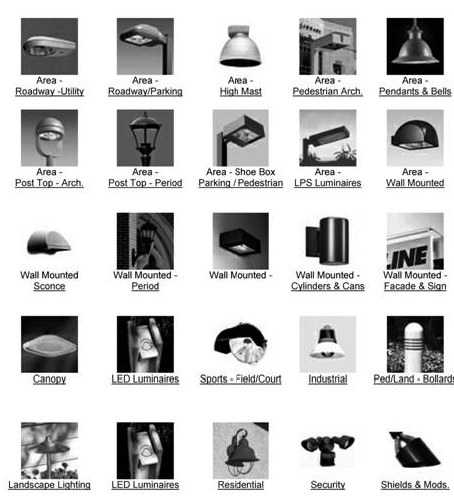
(Ord. No. 25-2021, § 1(Exh. A), 6-7-2021)
18.05.340 - Exemptions.
The following types of lighting are exempted from the requirements of this article:
1.
Outdoor lighting for sports and athletic fields. Outdoor lighting for sports and athletic fields shall:
a.
Be installed with internal louvers and be full cut-off or fully shielded fixtures to minimize sky glow;
b.
Not have floodlights aimed above sixty-two (62) degrees;
c.
Have poles used for aerial sports such as baseball or softball at least seventy (70) feet in height to minimize sky glow and the effect upon surrounding uses; and
d.
Be shut off within one hour after the game or event has ended and remain extinguished until one hour prior to the commencement of the next event.
2.
Incandescent lighting of one hundred fifty (150) watts or fewer for each light fixture, and/or fluorescent lights of twenty (20) watts or fewer per fixture.
3.
Temporary lighting for fire, police, emergency or repair workers.
4.
Temporary lighting for construction activity or periodic events (such as fairs, carnivals and similar temporary uses), provided they do not create disability glare and are approved in advance by the Director.
5.
Street lighting within public rights-of-way if in conformance with the Town's adopted Roadway Standards.
(Ord. No. 25-2021, § 1(Exh. A), 6-7-2021)
18.05.350 - Prohibited lighting.
The following types of lighting are prohibited:
1.
Lights that blink, flash, move, revolve, flicker, vary in intensity or color, and chase lighting, except lighting for temporary holiday displays and lighting for public safety.
2.
Lighting that could be confused with a traffic control device.
3.
Lighting of a type, style, or intensity determined to create disability glare which has a detrimental effect on motor vehicle traffic or otherwise creates a public hazard.
4.
Strobe lights, searchlights, beacons and laser light, or similar upward or outward oriented lighting except as provided in this section.
5.
High-intensity floodlighting except as approved for sports facility lighting.
6.
Wall pack light fixtures that are not classified as full cutoff.
(Ord. No. 25-2021, § 1(Exh. A), 6-7-2021)
18.05.410 - Purpose.
These landscaping regulations have been adopted for the primary purpose of conserving the need for water used for irrigation and also for the following reasons:
1.
To maximize drainage and erosion controls;
2.
To maximize energy efficiency by utilizing wind breaks, reducing heat reflection and absorption, and minimizing solar gain;
3.
To reduce noise and visual problems associated with incompatible land uses;
4.
To encourage the preservation of wildlife; and
5.
To encourage the beautification of Monument.
(Ord. No. 25-2021, § 1(Exh. A), 6-7-2021)
18.05.420 - Landscape plan required.
A.
A detailed landscape plan (including irrigation, plant and material specifications) for any development requiring site plan approval shall be prepared by a registered landscape architect and submitted to the Town prior to the issuance of building permits. A landscape plan is also required for any additions or changes in commercial/industrial uses which need a building permit, or rezoning of an existing developed parcel.
B.
The landscape plan shall include an irrigation plan pursuant to the Town's Landscape Guidelines, or in cases where a water source is not available to a site, a statement from the property owner that manual watering will be conducted until landscaping is established, along with a schedule for manual watering by the property owner.
C.
It shall be the responsibility of the Director to review all landscape plans. The Director shall also be responsible for monitoring the progress and completion of the approved landscaping plans.
1.
Except in the case of single-family residences, a certificate of occupancy will not be issued until a preliminary inspection indicates that all requirements of the landscaping standards have been met, or alternatively, that completion of such requirements has been assured by the provision of a security interest or surety acceptable to the Director in the amount of at least one hundred twenty-five (125) percent of the full replacement cost of the required landscaping materials, in which case a temporary certificate of occupancy may be issued on the condition that the security interest or surety not be released until final inspection.
2.
The inspecting official will be designated by the Director. Final inspection of the landscaping shall occur within one year after preliminary inspection. In the event the landscaping has not been completed pursuant to the approved plan, or has not survived and has not been replaced, the Director may either:
a.
Require the owner to replace the failed materials and extend the security and final inspection period for an additional growing season; or
b.
Call upon the security interest or surety to complete the requirements.
D.
Landscaping installed without a specific plan approval or landscape plans approved under the requirements of a previous version of the Town landscaping regulations can be brought within the requirements of this article by submitting a revised landscape plan to the Director. If the submitted landscape plan provides greater compliance with the current landscape regulations at the time of submittal, it may be approved by the Director.
(Ord. No. 25-2021, § 1(Exh. A), 6-7-2021)
18.05.430 - General site standards.
A.
Steep Slopes. Slopes over a ten-percent grade shall be landscaped with ground cover. For a listing of suggested ground cover types see the Town of Monument Landscaping Guidelines.
B.
Erosion Control. In development greater than two and one-half acres, removal of existing vegetation shall be limited as much as practicable by:
1.
Exposing as small an area of soil as possible;
2.
Exposing the area for as short a time as possible;
3.
Marking or erecting barriers to prevent damage from construction equipment; and
4.
Providing protection of barren areas with temporary vegetation or mulches during construction.
C.
Existing Trees. The removal of existing trees shall be prohibited unless approved by the Director. All healthy trees removed greater than six inches in diameter shall be replaced by trees of at least two inches in diameter. Trees that are listed as noxious by the United States Department of Agriculture or the Colorado Department of Agriculture can be removed without complying with the requirements of this section. Any tree removal required to implement an approved site plan or subdivision design is exempted from this section. Nothing in this section is intended to prevent the emergency removal of trees during a fire emergency or other natural disaster.
D.
Rights-of-way. The property owner of land abutting a constructed public rights-of-way is responsible for landscaping and maintenance of any rights-of-way area between the property line and the roadway, unless otherwise maintained by the Town, a Special District, or Homeowners' Association.
(Ord. No. 25-2021, § 1(Exh. A), 6-7-2021)
18.05.440 - Development type standards.
A.
For all residential developments, including assisted living and multifamily type uses, landscaping on an individual lot shall be installed according to the following requirements:
1.
A maximum of twenty-five (25) percent of a lot's pervious area may consist of an approved, drought-tolerant turf grass. Synthetic turf or other similar types of materials may substitute for all or a portion of this area upon approval of the Director.
2.
A minimum of one tree for every dwelling unit shall be planted in the front yard or one for every sixty (60) feet of lot frontage, whichever provides the largest amount.
3.
Pervious area not covered by turf grass shall be covered with a combination of natural colored cobble or gravel, wood mulches, and native grasses. Living plant material must account for at least sixty (60) percent of the entire pervious lot area (at plant maturity).
4.
All irrigation systems shall be designed with a drip or micro-spray system which uses a minimal amount of water.
5.
See Sections 18.05.245.11 and 12 for parking area screening and landscaping standards.
B.
For all nonresidential developments, landscaping shall be installed according to the following requirements:
1.
A minimum of ten (10) percent of the lot shall be landscaped area.
2.
A combination of deciduous, ornamental, and evergreen trees shall be installed at the ratio of one tree per nine hundred twenty-five (925) square feet of required landscaped area.
3.
No turf grasses of any kind are permitted unless approved by the Director for special circumstances or purposes of continuity with existing adjacent landscaping or accents. Synthetic turf or other similar types of materials may substitute for all or a portion of this area at the discretion of the Director.
4.
A maximum of fifty (50) percent of the required landscaped area may utilize non-irrigated native grasses. The actual allowable percentage may be limited and will be established by the approval of the Director as a part of the overall plan review. Open areas with the purpose of providing mandated drainage facilities will not be included in the fifty (50) percent area determination. Areas planted with non-irrigated native grasses must receive irrigation during establishment phase.
5.
The landscaped area not planted with native grasses will have wood mulch and/or decorative rock. Shrubs, ornamental grasses, and ground cover shall be installed in an aesthetic combination in these areas according to the minimum ratio of eight shrubs, ornamental grasses, or ground cover plants per one hundred (100) square feet of landscape area. Landscaped areas must have working irrigation at the time of planting or receive irrigation manually until irrigation systems have been installed.
6.
The number of plants may be reduced for each additional tree, above the required number, at the ratio of ten (10) plants for each additional tree, providing that in no case, shall the number of plants be reduced to less than five plants per one hundred (100) square feet of required landscape areas.
7.
See Sections 18.05.245.11 and 12 for parking area screening and landscaping standards.
(Ord. No. 25-2021, § 1(Exh. A), 6-7-2021)
18.05.450 - Landscape material specifications.
A.
Any combination of trees and two or more of the following plant materials shall be installed: shrubs, vines, ground cover, flowers or turf grass.
1.
The installed plant materials shall be selected from the Town of Monument Landscape Guidelines unless otherwise approved by the Director. Plant materials requiring the least water are recommended.
2.
Natural features such as rock, stone, bark or structural features including, but not limited to sidewalks, fountains, reflecting pools, art works, screen walls, fences or street furniture may be installed if the sight distance triangle is maintained.
3.
Artificial plants are prohibited.
B.
The minimum planting/installation size and characteristics of plant materials shall be as follows:
1.
Deciduous shade trees: One and one-half inch caliper measured six inches above the ground, balled and burlapped.
2.
Deciduous ornamental trees: One inch caliper measured six inches above ground, balled and burlapped.
3.
Evergreen trees: Six feet in height above ground, balled and burlapped.
4.
Evergreen and deciduous shrubs: One- or five-gallon size, depending on the spacing of the plants.
5.
Ground covers, ornamental grasses, and vines: One gallon, or five-gallon size, depending on the spacing of the plants.
6.
Equivalent sizes to those mentioned above may be used at the discretion of the Director.
(Ord. No. 25-2021, § 1(Exh. A), 6-7-2021)
18.05.460 - Landscape maintenance.
A.
The property owner shall be responsible for regular weeding, irrigating, fertilizing, pruning or other maintenance for all plantings, artificial structures, berms, swales or street furniture.
B.
Plant materials which exhibit evidence of insect pests, disease and/or damage shall be appropriately treated and dead plant materials shall be replaced.
C.
A penalty for not maintaining landscaping may be assessed upon recommendation of the Director, not to exceed ten (10) percent over the total cost of labor and materials to maintain the approved landscaping plan.
(Ord. No. 25-2021, § 1(Exh. A), 6-7-2021)
18.05.470 - Landscape fire mitigation.
A.
Purpose. The purpose of this section is to preserve and protect the public health, safety, and welfare of the citizens of Monument by allowing for the cutting or removal of existing vegetation.
1.
This action will help citizens and businesses with fire mitigation efforts within the incorporated areas of the Town of Monument.
2.
This action is necessary in order to prevent potential loss of property and lives due to uncontrolled fires, and due to the frequent dry weather in the area.
B.
Application. This section shall apply throughout the incorporated town limits of Monument including public and private lands.
C.
Definition. For purposes of this section, fire mitigation shall be limited to the removal of existing trees greater than two inches in diameter when done so in an effort to protect property and lives from the potential impacts of uncontrolled fires.
D.
Unlawful Acts. It shall be unlawful for any person to remove existing trees or vegetation greater than two inches in diameter when not done for fire mitigation or as allowed in Section 18.05.430.C.
E.
Site Plan. A site plan shall be submitted to the Director prior to removal of existing trees for fire mitigation showing existing trees and those trees proposed to be removed for fire mitigation. A schedule showing when the fire mitigation will be performed and when it will be completed, and a plan for disposal of the vegetation removed for fire mitigation.
(Ord. No. 25-2021, § 1(Exh. A), 6-7-2021)
18.05.480 - Prohibition of nonfunctional turf.
A.
Prohibition of nonfunctional turf. Nonfunctional turf grass, nonfunctional artificial turf, and invasive plant species are prohibited in new development and development that causes a disturbance of more than fifty (50) percent of the existing aggregate landscaping for the following principal uses:
1.
Common elements of condominiums and planned communities;
2.
Rights-of-way;
3.
Private streets, parking lots; and
4.
Nonresidential development.
B.
The following developments are exempt from this section:
1.
Single-family dwellings, single-family detached dwellings, and two-family dwellings;
2.
Multifamily dwellings, condominiums, planned communities, and other residential uses with twelve (12) dwelling units or less;
3.
Community facilities, community recreational facilities, and cultural facilities.
C.
Turf grass and artificial turf is not prohibited when such turf is:
1.
Installed in parks, playgrounds, picnic grounds, amphitheaters, athletic and sports fields, practice areas, event spaces, and other outdoor recreation and entertainment uses.
2.
Installed in the playing area of a golf course, such as a driving range, chipping and putting green, tee box, green fairway, and rough.
3.
A component of a professionally engineered design for civil infrastructure such as covers for solid waste facilities and brownfield sites, and revetments for slopes, channels, levees, and dams.
4.
Turf grass that is designated to be part of a water quality treatment solution required for compliance with federal, state, or local agency water quality putting requirements that is not irrigated and does not have herbicides applied.
5.
Repair, replacement or maintenance of any nonfunctional turf, nonfunctional artificial turf, artificial turf, or invasive plant species installed, planted, or placed before January 1, 2026.
6.
Related to the installation or preservation of urban trees.
7.
Turf grass that:
a.
Is a native plant;
b.
Has been hybridized for arid conditions; or
c.
Is a low-water grass.
8.
Turf grass and artificial turf that the Director determines will have a functional purpose.
(Ord. No. 25-2025, § 2(Exh. A), 12-1-2025)
18.05.510 - Second Street.
A.
Location. The design standards in this section apply to all uses on Second Street from Beacon Lite Road to Mitchell Avenue in the DB (Downtown Business) zone district. In the event of conflict between the standards in this article and a standard elsewhere in this chapter on the same subject, the standards in this title control.
B.
Design Objectives.
1.
All development and redevelopment shall contribute toward creating a vibrant and attractive "downtown" core, maintaining the traditional historic architecture character, providing an inviting physical entryway into the downtown and a smooth visual transition from primary commercial streets to the residential areas and maintaining a continuity of storefronts and outdoor seating areas along the sidewalk's edge that creates a pedestrian-oriented business and entertainment environment.
2.
The creation of attractive plazas and paseos (walkways) leading to stores on the alleys or that are placed back from the streets), where applicable, shall be encouraged.
C.
Structure Mass and Orientation.
1.
The outside building walls or improvements are encouraged to be located on the outmost parcel boundaries, with the exception that buildings on alleys shall be set back five feet from an alley to provide space for the landscaping and snow storage. Restaurants are encouraged to be set back from the property line with outdoor seating areas located next to sidewalks.
2.
A minimum 1:1 floor area ratio (building area equals the lot footprints) is encouraged.
3.
Minimum height is one and one-half stories or fifteen (15) feet, with a maximum height of thirty-five (35) feet or two stories. Buildings two and one-half to three stories can be considered if the upper stories are recessed and shadow and view studies demonstrate the building would not create significant shadows or have a significant negative impact on surrounding views.
4.
Buildings located on a corner are encouraged to have an entrance facing the corner.
D.
Exterior Architectural Design.
1.
All buildings adjoining a street, public walkway, parking lot, plaza, or other public space shall have an articulated and distinct facade and an identifiable, attractive entrance facing each street.
2.
Structures shall have varied fenestration patterns (location of doors and windows) that provide visual interest and a compatible transition of mass, scale, and articulation with adjacent uses.
a.
For commercial buildings, each facade shall incorporate traditional facade components including kick plates, large display windows, transom windows, recessed entries, sign panels, and parapet moldings or cornices. Windowsills shall be no more than twenty-four (24) inches above the floor level. Upper floors can be more solid with smaller openings.
b.
For residential buildings, the building floor shall be raised such that windows are above the pedestrian's eye level above the sidewalk. Large covered front porches or covered stoops shall be provided. An open style fence or wall and landscaping shall be provided to separate the residential building from the street and create a "defensible space". Residential uses are encouraged to be located on the "side streets", rather than on Second Street.
3.
A distinction between upper and lower floors shall be established through the use of predominantly horizontal trim materials and features such as balconies and awnings.
4.
Balconies may be provided on upper floors provided their design complements the building's architecture and otherwise complies with these recommendations.
5.
Large awnings are encouraged to provide depth to facades and to shade the storefront. Awnings may extend into setbacks over sidewalks. If the awnings are located within street rights-of-way or Town-owned property, a revocable permit is required from the Town.
6.
"Green" building design, such as the incorporation of features to conserve energy, is encouraged.
E.
Exterior Building Materials and Exterior Colors.
1.
Exterior building materials shall generally be composed of attractive materials native to the Monument area or Colorado's Front Range, such as brick and stone masonry, stucco, native flagstone, finished lumber, finished metal, ceramic tiles, and concrete used for lintels and columns.
a.
Materials and colors shall complement the adjoining buildings.
b.
Where brick is used as the predominant building material, brick shall not be painted. Murals, as defined in Chapter 7 of this title, are exempt from this provision.
c.
Where cement block is used, it shall be ground or split face or have a special finish.
d.
Realistic looking "faux" and cultured materials may be used. Vinyl siding, distinctly artificial appearing materials, and unfinished materials such as cinder blocks, are prohibited.
e.
The use of river rock is discouraged.
2.
A variety of trim materials must be used to provide articulation and visual interest. Building trim shall be of brick and stone masonry, stucco, finished lumber, finished metal, ceramic tiles, or concrete used as lintels and columns, and/or other similar materials.
3.
Colors shall be from an accepted commercial historic Colorado palette or a color palette approved by the Town.
F.
Roof Design. Roofs facing Second Street shall be flat, but hipped roofs will be considered on a case by case basis if they complement the historic buildings in the area.
G.
Illumination.
1.
Lighting that contributes to a traditional downtown ambience, including wall mounted sconces that complement the historic street lamps, is encouraged. All lighting or illumination of the exterior of the building shall comply with Article 3 of this Chapter.
2.
Illuminated building trim, such as neon lighting, is not allowed.
H.
Signs.
1.
Projecting signs shall be constructed of painted wood, wrought iron, or similar natural appearing materials.
2.
Wall signs shall be integrated into the building design and scale, and complement the architecture.
3.
Permanent window signs with individual lettering are encouraged.
4.
Signs shall not be internally illuminated.
5.
Pylon signs are prohibited.
6.
All signs shall comply with Chapter 6 of this title.
I.
Parking.
1.
If off-street parking is provided, it shall be located in the rear of the lot with access from the alley if possible. Parking areas or garages fronting Second Street are strongly discouraged unless a storefront or storefront appearance can be achieved which meets the Exterior Architectural Design and Exterior Building Materials and Exterior Colors criteria in these guidelines. See Article 2 of this Chapter for additional standards regarding shared, on-street, off-street, and off-site parking.
2.
Bicycle parking is strongly encouraged in locations where it will not block sidewalks.
J.
Landscaping.
1.
The developer/property owner is responsible for providing landscaping and/or landscaping/streetscape treatments between the curb and the property line, subject to the approval of a site plan by the Director.
2.
Any new buildings or substantial redevelopment shall provide street trees along the sidewalk adjacent to their business. Spacing of the trees shall be of consistent spacing as determined by the Director. Trees shall be provided in tree grates that are flush with the sidewalk and of a design consistent with the DB zone district.
3.
The following streetscape treatments may be provided in lieu of other landscape requirements in the Chapter:
a.
Accessory furniture such as benches, trash containers, and bicycle racks of a design consistent with the DB zone district.
b.
Window planters and/or pots for flowers and plants. If the pots will impede pedestrian traffic, window planters shall be provided for each window facing a street.
c.
Artwork and fountains with recycling water as long as they do not impede pedestrian traffic.
4.
Decorative paving for plazas, patios, in front of building entrances, and other paving on private property is encouraged as long as it complements paving materials in the area.
K.
Screening.
1.
All service facilities, including dumpsters and accessory buildings shall be completely screened with materials and colors that match or complement the main building.
2.
All roof top mechanical equipment shall be completely screened by the roof or a parapet wall or by utilizing features such as chimney chases, and shall be painted or colored to match or complement adjoining building colors. All other mechanical equipment shall either be screened from view or painted or colored to match or complement adjoining building colors.
L.
Fencing/Walls.
1.
Fences shall be of a traditional urban design with an open pattern such as wrought iron or painted wooden pickets, and be no taller than three feet along a street frontage.
2.
Walls shall be of a traditional urban design, constructed of stone, stucco, or brick masonry, and be no taller than three feet along any street frontage.
(Ord. No. 25-2021, § 1(Exh. A), 6-7-2021)
18.05.520 - Side streets.
A.
Location. The design standards in this section apply to all uses on side streets connecting with Second Street in the DB (Downtown Business) zone district.
B.
Design Objectives. All development and redevelopment shall contribute toward creating a vibrant and attractive "downtown", maintaining the traditional historic architectural character of the side streets, provide a smooth visual transition from primary commercial streets to the residential areas and maintain a continuity of storefronts and outdoor seating areas that creates a pedestrian-oriented environment.
C.
Structure Mass and Orientation.
1.
A minimum 0.5:1 floor area ratio (building area equals one-half the lot footprint) shall be provided.
2.
Minimum height is one and one-half stories or fifteen (15) feet, with a maximum height of thirty-five (35) feet or two stories.
3.
Buildings on alleys shall be set back five feet from an alley to provide space for the landscaping and snow storage.
4.
Garages for commercial uses shall be located behind the principal buildings unless they have a façade design which meets the architectural standards for the principal use.
5.
Garages for residential uses shall be located behind the residence or, if attached, shall be located at the rear of the building. If located in the front, the garage shall be side-loaded and incorporate architectural features such as front windows and trim, designed to appear as part of the main house, rather than appearing as a garage.
D.
Roof Design. Roofs can be flat or hipped, and must match or complement the historic buildings in the area.
E.
Parking.
1.
Off-street parking shall be located in the rear of the subdivided lot and be accessed from the alley if possible. If alley access is not available, drives shall be located on the side of the subdivided lot to provide access to the rear parking areas. The drives shall be shared by adjoining subdivided lots wherever possible.
a.
If parking cannot be located in the rear, it may be located on the side of the building.
b.
Off-street parking may be located in the front of the building only when the configuration of an existing building or subdivided lot is such that the parking cannot be reasonably located in the rear or side of the subdivided lot.
c.
Parking visible from the front street or adjoining properties on either side must be screened with landscaping and/or decorative fences not to exceed three feet in height. See Article 2 of this Chapter for additional standards regarding shared, on-street, off-street and off-site parking.
F.
Landscaping.
1.
The developer/property owner is responsible for providing landscaping between the curb and the property line, i.e., a "tree lawn" with street trees and ground cover such as sod, flower beds, and bushes in accordance with the Town's Landscape Guidelines.
a.
Street trees shall be provided by the developer/owner in locations determined in conjunction with approval of a landscape plan by the Town for a development or redevelopment.
b.
Detached sidewalks are encouraged.
2.
If the building is located on the front lot line, the project may follow the Second Street landscaping requirements, and the Director will determine whether paving or a tree lawn is appropriate based on the existing landscaping on the block.
G.
Accessory Uses and Buildings. Accessory buildings shall be consistent with the design of the main building, and shall use the same materials and colors.
(Ord. No. 25-2021, § 1(Exh. A), 6-7-2021)

