
Monument City Zoning Code
CHAPTER 18
06 - SIGNS
18.06.110 - Purpose.
These sign regulations are established to safeguard the health, safety, convenience, order and welfare of all residents of Monument, Colorado. The purpose of this chapter is to provide a balanced and fair legal framework for the design, construction, and placement of signs that:
1.
Promote the safety of persons and property by ensuring that signs do not create a hazard by:
a.
Confusing or distracting motorists;
b.
Impairing drivers' ability to see pedestrians, obstacles or other vehicles, or to read traffic signs; or
c.
Interfering with traffic safety, or otherwise endanger public safety.
2.
Promote the efficient communication of messages, and ensure that persons exposed to signs are not overwhelmed by the number of messages presented;
3.
Protect the public welfare, improve the visual environment, and enhance the appearance and economic value of the landscape by reducing and preventing sign clutter;
4.
Minimize incompatibility between signs and their surroundings, and prevent the construction of signs that are a nuisance to occupants of adjacent and contiguous property due to brightness, reflectivity, bulk, or height;
5.
Ensure that Town rights-of-way are used in a manner consistent with the public interest;
6.
Enhance property values and business opportunities;
7.
Foster economic development while providing adequate standards for the display of signs;
8.
Assist in wayfinding;
9.
Provide fair and consistent permitting and enforcement; and
10.
Provide citizens within the Town of Monument ample opportunity to exercise their rights to free speech.
(Ord. No. 25-2021, § 1(Exh. A), 6-7-2021)
18.06.120 - Intent.
It is the intent of these regulations to provide for the proper control of signs in a manner consistent with the First Amendment guarantee of free speech. It is not the intent of these regulations to regulate signs based on the content of their messages. Rather, this chapter advances important, substantial, and compelling governmental interests.
1.
The incidental restriction on the freedom of speech that may result from the regulation of signs hereunder is no greater than is essential to the furtherance of the important, substantial, and compelling interests that are advanced by this chapter.
2.
The Town has a substantial and compelling interest in preventing sign clutter (which is the proliferation of signs of increasing size and dimensions as a result of competition among property owners for the attention of passing motorists and pedestrians), because sign clutter:
a.
Creates visual distraction and obstructs views, potentially creating a public safety hazard for motorists, bicyclists, and pedestrians;
b.
May involve physical obstructions of streets or sidewalks, creating public safety hazards;
c.
Degrades the aesthetic and essential historic character of the Town, making the Town a less attractive place for tourism, commerce, and private investment; and
d.
Dilutes or obscures messages displayed along the Town's streets through the proliferation of distracting structures and competing messages.
3.
The Town has a substantial and compelling interest in preventing traffic accidents.
4.
The Town has a substantial and compelling interest in preventing negative impacts associated with temporary signs. Temporary signs may be degraded, damaged, moved, or destroyed by wind, rain, snow, ice, and sun, and after such degradation, damage, movement, or destruction, such signs harm the safety and aesthetics of the Town's streets if they are not removed.
5.
Certain types of speech are not constitutionally protected due to the harm that they cause to individuals or the community. The Board of Trustees finds the limited prohibitions on such signs in this chapter are the minimum restrictions necessary and appropriate to protect the public.
(Ord. No. 25-2021, § 1(Exh. A), 6-7-2021)
18.06.130 - Application.
The provisions of these regulations shall apply to the display, construction, erection, alteration, use, maintenance, and location of all signs within the Town of Monument.
1.
If any provision of this chapter conflicts with any other adopted Town Code that regulates signs, the more restrictive standard shall apply provided, however, to the extent an approved, unexpired and currently effective Planned Development (PD) as described in Section 18.03.430 includes specific sign allowances and/or restrictions that directly conflict with these regulations, the approved PD regulations shall apply to the extent of the conflict. In lieu thereof, the property owner may elect to fully comply with these regulations in the area of the conflict.
2.
The Town recognizes other regulations pertaining to signage (i.e., State of Colorado, Department of Highways, "Rules and Regulations Pertaining to Outdoor Advertising," effective January 1, 1984, and as may be amended). Where any provision of this chapter covers the same subject matter as other regulations, the more restrictive regulation shall apply.
3.
Nothing in this chapter shall be construed as a defense to a violation of applicable State or federal law.
4.
Signs shall be permitted in the various zoning districts as accessory structures in accordance with these regulations.
5.
All signs displayed, constructed, erected or altered on the effective date of this title (June 7, 2021) shall be in conformance with the provisions of these regulations. All signs that are existing at the time of the adoption of these regulations shall not be altered or enlarged without being brought into conformance with these regulations.
(Ord. No. 25-2021, § 1(Exh. A), 6-7-2021)
18.06.140 - Enforcement of Chapter 18.06.
The provisions of this Chapter 18.06 may be subject to enforcement under the provisions of Chapter 2.36 of the Monument Municipal Code. In the discretion of the Town Manager, Code Officer, or the police department, violations of this Chapter 18.06 shall also be subject to summons into Municipal Court as a violation of the Monument Municipal Code.
(Ord. No. 07-2024, § 2(Exh. A), 3-18-2024)
18.06.210 - Permit required.
A.
No sign may hereafter be erected, displayed or substantially altered or reconstructed except in conformance with this chapter and after a permit has been issued by the Town.
1.
An application for a sign permit shall be submitted to the Town.
2.
In addition to the required sign permit, a building permit may be required by the Director for signs incorporating structural elements or attached to buildings. Electrical permits will be required for illuminated signs or other signs with electrical components.
3.
Changing or replacing the copy on an existing sign shall not require a permit.
4.
No permit is required for routine maintenance, or for replacement or repair of a sign or sign structure that has been damaged from an act of God or an accident. The sign must conform to all of the applicable provisions of this chapter, with no change in the design or location of the sign.
B.
Upon receipt of a complete sign permit application, the Director shall review the same for compliance with this chapter, and approve, approve with conditions, or deny the application. A denial of a sign permit by the Director may be appealed to the Board of Adjustment. All appeals to the Board of Adjustment shall be in accordance with the procedures provided in Section 18.01.530.
C.
The Director shall have the right to inspect the proposed sign location prior to acting on the application, and to inspect the sign after construction to ensure compliance with this chapter and any conditions of approval.
D.
No person issued a sign permit under this chapter shall change, modify, alter or otherwise deviate from the terms or conditions of the permit without first requesting and obtaining approval to do so from the Planning Department.
E.
If the Town finds that work under any permit issued does not comply with the information supplied in the permit application or violates any provision of this chapter, any special condition or regulation placed thereon, or any other ordinance of the Town, the Code Enforcement Officer shall notify, in writing, the owner of the business to which the sign applies. If the violation is not corrected within thirty (30) days, the Planning Department shall revoke the permit and cause the sign to be removed in accordance with Section 18.06.450.
F.
The Director shall not refund any permit fees paid under this chapter if any permit is revoked or expires.
(Ord. No. 25-2021, § 1(Exh. A), 6-7-2021; Ord. No. 08-2023, § 2(Exh. B), 4-17-2023)
18.06.220 - Minor modifications to sign standards.
A.
The Director shall be authorized to grant minor modifications of any sign standard, including, but not limited to, sign area modifications of ten (10) percent or less, subject to the approval criteria noted in subsection (B) below. Such actions may be taken in order to encourage the implementation of alternative or innovative practices that provide equivalent benefits to the public.
B.
Approval Criteria. Minor modifications may be approved by the Director only upon a finding that all of the following criteria have been met:
1.
The requested modification eliminates an unnecessary inconvenience to the applicant and will have no significant adverse impact on the health, safety or general welfare of surrounding property owners or the general public;
2.
Any adverse impacts resulting from the minor modification will be mitigated to the maximum extent practical; and
3.
The requested minor modification is either:
a.
Of a technical nature and is required to compensate for some practical difficulty or unusual aspect of the site or the proposed sign; or
b.
An alternative or innovative design practice that achieves to the same or better degree the objective of the existing design standard sought to be modified.
C.
An applicant requesting a modification to the sign standards that does not qualify as a minor modification must obtain a variance per Section 18.01.530.
(Ord. No. 25-2021, § 1(Exh. A), 6-7-2021)
18.06.230 - Master sign plan.
A.
Master sign plans are required as a part of the site plan process for all commercial projects with multiple lots or buildings or multiple tenants. Master sign plans are also required for all new signs on multiple tenant buildings or centers with multiple lots. For any multi-tenant center, industrial park or other unified form of commercial site development or redevelopment, the applicant shall submit a master sign plan with a sign permit application that consists of coordinated and/or shared signage for the entire development.
B.
Approval Criteria. A master sign plan shall be in accordance with the following criteria:
1.
Signs shall meet the design criteria established in Section 18.06.410.
2.
In reviewing an applicant's submittal of a master sign plan, the Director may vary standards for area, height and number of individual signs.
3.
The Director may approve up to a twenty-percent change in one or more dimensional or numerical standards based on the applicant demonstrating the change is warranted by a master sign plan which represents exceptional design.
(Ord. No. 25-2021, § 1(Exh. A), 6-7-2021)
18.06.240 - Exempt signs.
A.
Generally, the following types of signs are exempt from the sign permit requirements of Section 18.06.210 above, subject to the provisions of this section. Exempt signs include:
1.
Signs erected by the Town or by any federal, State or county government agency. These signs may be illuminated for safety purposes.
2.
Any public purpose/safety sign and any other notice or warning required by a valid and applicable federal, state or local law, regulation or resolution. These signs may be illuminated for safety purposes.
3.
Signs displayed on motor vehicles that are being operated or stored in the normal course of a business; but only if such vehicles, which are used on a regular basis for the business, are parked or stored in areas appropriate to their use.
a.
Signs on vehicles shall not project beyond the surface of the vehicle in a manner which creates a hazard to pedestrians, cyclists, or other vehicles.
b.
It shall be unlawful to place or store a vehicle with a sign on it in such manner as to increase the permitted sign area or number of signs for a nonresidential use of property which, or adjacent to which, the vehicle is placed or stored.
4.
Flags that are affixed to permanent flagpoles or flagpoles that are mounted to buildings (either temporary or permanent) provided that such flag maintains a minimum clearance of eight feet from any travel surface and does not exceed sixty (60) square feet. Flagpoles shall not exceed a height of thirty-five (35) feet, and shall be set back a minimum of five feet from a public right-of way.
5.
Temporary decorations or displays may be of any type, number, area, height, location, illumination or animation provided that such decorations or displays:
a.
Are maintained and do not constitute a fire hazard; and
b.
Are located so as not to conflict with, interfere with or visually distract from traffic regulatory devices.
6.
Architectural features or permanent building decorations which are integral to the design of a building or provide an artistic accent, provided they comply with building height limits and setback requirements applicable to the property on which they are located.
7.
Handheld signs, as defined in Section 18.07.110 provided such signs are not set down or propped on objects.
8.
Incidental signs as defined in Section 18.07.110 which do not exceed two square feet in sign area.
9.
Sandwich board signs, as defined in Section 18.07.110 and subject to the standards in Section 18.06.330.
10.
Site signs, as defined in Section 18.07.110 and subject to the standards in Section 18.06.330.
11.
Wall-mounted display signs, as defined in Section 18.07.110, subject to the standards in Section 18.06.320.
12.
Window signs, as defined in Section 18.07.110, that are painted on, attached to or placed within four feet of the inside of a window. Window signs must comply with the lighting requirements of these regulations. Window signs shall not:
a.
Extend beyond the first story of the building on/in which they are located, or
b.
Cover over fifty (50) percent of the total window area for the entire wall of the use.
13.
Yard signs, as defined in Section 18.07.110 and subject to the standards in Section 18.06.330.
B.
All signs not listed in this section (and that are not prohibited under Section 18.06.250) require a sign permit pursuant to Section 18.06.210.
1.
Unless otherwise specifically provided in subsection (A) above, exempt signs may not be illuminated.
2.
Exempt signs shall otherwise be in conformance with all applicable requirements of this chapter, and the construction and safety standards of the Town.
(Ord. No. 25-2021, § 1(Exh. A), 6-7-2021)
18.06.250 - Prohibited signs.
A.
The following types of signs are prohibited except as noted:
1.
All signs not expressly permitted under this chapter or exempt from a sign permit in accordance with Section 18.06.240.
2.
Signs not meeting the requirements of the Pikes Peak Regional Building Code of the Pikes Peak Regional Building Department.
3.
Any sign that obstructs access to or impedes operation of any window, door, fire escape, stairway, ladder or opening intended to provide light, air, ingress or egress for any building or structure as may be required by law.
4.
Any sign or sign structure which is structurally unsafe, constitutes a hazard to safety or health by reason of inadequate maintenance, abandonment, dilapidation or obsolescence and/or is not kept in good repair.
5.
Any sign other than traffic control signs, that is erected, constructed or maintained within, over or upon a public right-of-way without an encroachment permit granted pursuant to Section 12.36.090, except awning signs, canopy signs, flags, projecting signs and sandwich board signs in conformance with this Chapter or other temporary signs otherwise granted permission for such location by the Town or the Colorado Department of Transportation.
6.
Any sign that impedes pedestrian or vehicular movement, or is erected in such a location as to cause visual obstruction or interference with motor vehicle traffic or traffic-control devices, including any sign that obstructs clear vision in any direction from any street intersection or driveway.
a.
No sign greater than thirty (30) inches in height may be permitted to locate within a visibility triangle, other than a sign for traffic control.
b.
Signs shall not be erected so as to interfere, visually or otherwise, with the effectiveness of any pedestrian sidewalk or way.
7.
Any sign attached to any utility pole or structure within any public right-of-way.
8.
Any sign that projects, overhangs or otherwise is located in the public right-of-way, except as specifically provided for in this chapter.
9.
Any sign attached to a tree or other plant materials.
10.
Any sign painted, erected and/or constructed upon, above or over the roof or roofline of any building.
11.
Any flashing, rotating or moving sign, animated sign, sign with moving lights or sign which create the illusion of movement, except for electronic message centers subject to the standards in Section 18.06.320.B.
12.
Any sign with mirrored surfaces.
13.
Bandit signs, as defined in Section 18.07.110.
14.
Cabinet signs, as defined in Section 18.07.110, unless approved as part of a master sign plan. See also Section 18.07.410.A.6.
15.
Inflatable signs, as defined in Section 18.07.110, placed on the ground or on buildings or tethered to other objects or structures.
16.
Portable signs, except as otherwise provided for sandwich board signs in Section 18.06.330.
17.
Wind signs, as defined in Section 18.07.110.
18.
Off-premises signs, as defined in Section 18.07.110, except:
a.
As expressly permitted elsewhere in this Code; or
b.
Outdoor advertising that was originally erected prior to October 1, 1975. The existence of a valid sign permit issued by the Colorado Department of Transportation shall be prima facie evidence of compliance with this provision. Such outdoor advertising must have been continuously maintained from October 1, 1975, excepting any periods of eighteen (18) months or less, during which periods the outdoor advertising was removed for reasons beyond the control of the owner of the outdoor advertising.
(Ord. No. 25-2021, § 1(Exh. A), 6-7-2021; Ord. No. 19-2025, § 2(Exh. A), 11-3-2025)
18.06.260 - Nonconforming signs.
A.
Existing signs which do not conform to the specific provisions of these regulations are designated as legal nonconforming signs.
B.
All nonconforming signs in existence at the time of the enactment of this chapter, except those prohibited in Section 18.06.250, may be continued if maintained in good condition provided:
1.
The sign is not structurally changed except to meet the safety requirements of this chapter or, with a permit, changed or altered to become a lawful permitted sign.
2.
The sign is not altered so as to increase the degree of nonconformity of the sign. This does not refer to change of copy or normal maintenance.
3.
The sign is not moved or expanded.
4.
The sign does not suffer more than fifty (50) percent appraised damage or deterioration.
(Ord. No. 25-2021, § 1(Exh. A), 6-7-2021)
18.06.310 - Sign standards by zoning district.
Signs in all zoning districts shall be subject to the standards set forth in this section. The number, types and sizes of signs set forth in Tables 6-1 and 6-2 shall also comply with the standards by sign type listed in Section 18.06.320 and 18.06.330.
1.
Standards for Residential Zoning Districts. Signs in the Large Lot Residential (LLR), Single-Family Detached Low Density (SFD-1), Single-Family Detached Medium Density (SFD-2), Residential Attached (RA), and Mobile Home Park (MHP) zoning districts, any residential district in the Regency Park Overlay (RPO), and on land designated for residential land uses in a Planned Unit Development (PUD) district shall be subject to the limitations and standards in Table 6-1.
| Table 6-1 Standards for Residential Zoning Districts | |||
|---|---|---|---|
| Sign Type | Max. Sign Number | Max. Sign Area | Max. Sign Height |
Monument Sign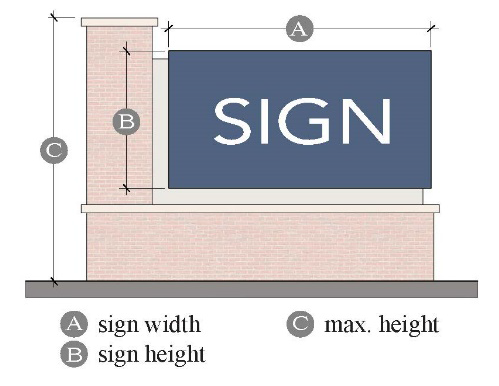 | 1 per entrance to a subdivision, multifamily housing complex, mobile home park or non-residential property |
32 square feet for non-residential property; 75 sq. ft. for subdivision, multifamily
housing complex, mobile home park entrance
(A x B) |
No higher than 8 feet if < 300 lineal feet of street frontage; 10 feet if > 300 lineal
feet of street frontage
(C) |
Site Sign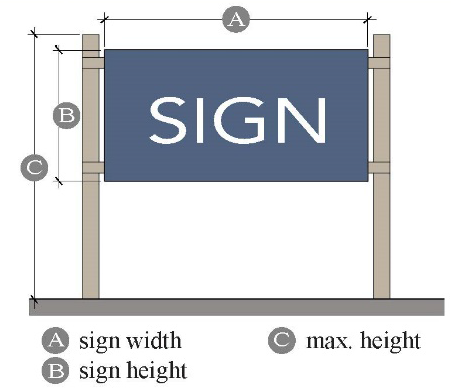 | 1 per street frontage |
32 square feet
(A x B) |
8 feet
(C) |
Wall Sign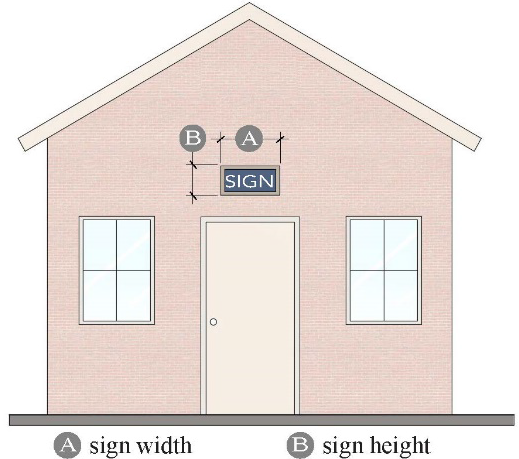 | 1 per detached dwelling with a home occupation or home business |
2 square feet
(A x B) | No higher than roofline |
Wall Sign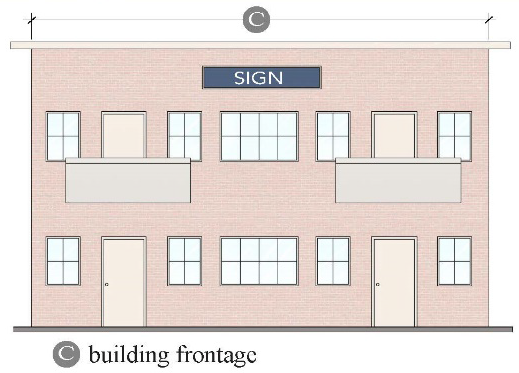 | 1 per principal multifamily building | .5 square feet x linear footage of building frontage (C) | No higher than roofline |
Wall Sign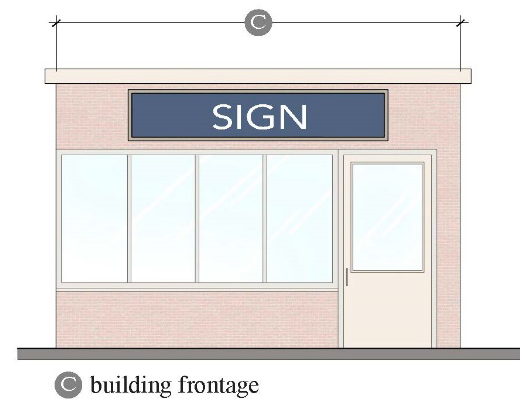 | 1 per non-residential use |
.5 square feet x linear footage of building frontage
(C) | No higher than roofline |
Yard Sign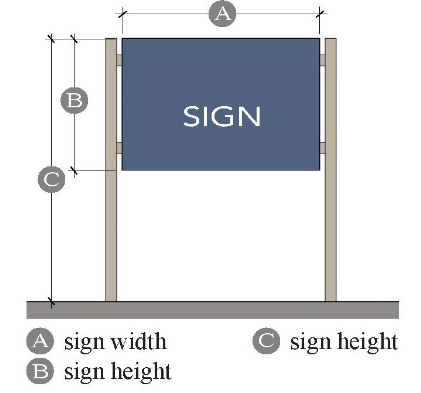 | 4 per street frontage |
8 square feet per sign
(A x B) |
No higher than 5.5 feet
(C) |
2.
Standards for nonresidential zoning districts and uses. Signs in the Downtown Business (DB), Commercial Center (CC), Business Campus (BC), Light Industrial (LI) and Public (P) zoning districts, any nonresidential district in the Regency Park Overlay (RPO), and on land designated for nonresidential uses in a Planned Unit Development (PUD) district, shall be subject to the limitations and standards in Table 6-2.
| Table 6-2 Standards for Nonresidential Zoning Districts | |||
|---|---|---|---|
| Sign Type | Max. Sign Number | Max. Sign Area | Sign Height and Clearance |
Awning Sign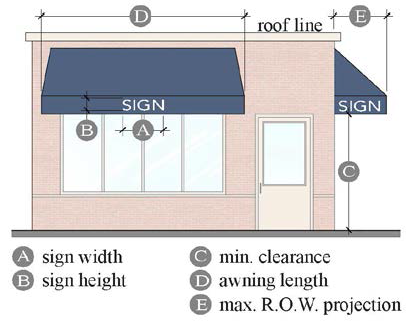 | Unlimited, within maximum area requirements |
0.5 square feet of signage for each linear foot of awning (D), up to a maximum of
32 square feet
(A x B) |
No higher than roofline
8 feet minimum height pedestrian clearance (C) 5-foot maximum right-of-way projection (E) |
Canopy Sign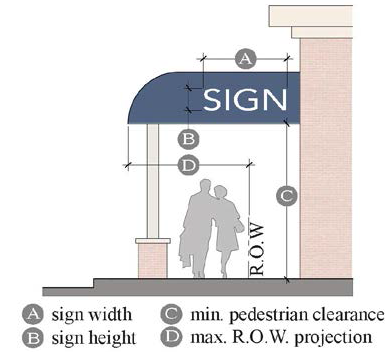 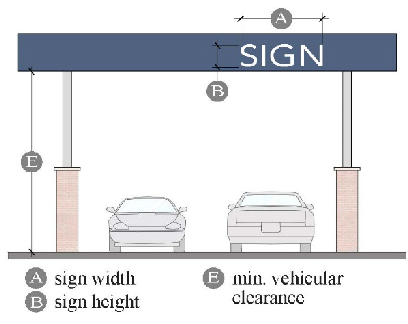 | Unlimited, within maximum area requirements |
0.5 square feet of signage for each linear foot of canopy, up to a maximum of 32 square
feet
(A x B) |
No higher than roofline
8 feet minimum height pedestrian clearance (C) 6-foot maximum right-of-way projection, or ⅔ width of walkway (D) 14 feet minimum height vehicular clearance (E) |
Display Sign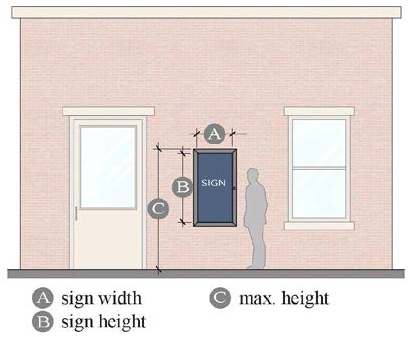 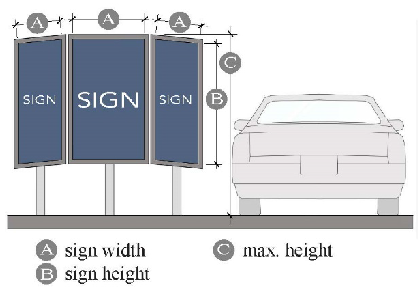 |
1 wall mounted per tenant
1 per drive-thru lane |
Wall-mounted: 8 square feet
(A x B) Drive-thru: 32 square feet (A x B) |
Wall-mounted: 6 feet (C)
Drive-thru: 7 feet (C) |
Fabric Sign - Wall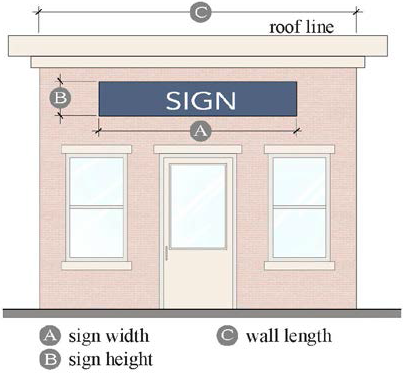 | 1 banner per use |
0.50 square feet for each linear foot of exterior wall (C) up to a maximum area of
30 square feet
(A x B) | No higher than roofline for wall banner |
Fabric Sign - Wave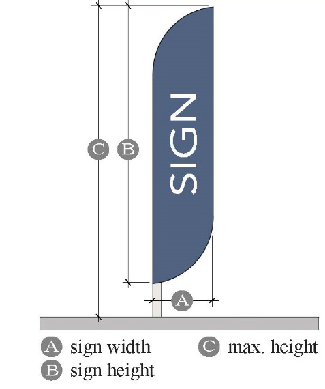 | 1 freestanding wave banner per street frontage |
30 square feet
(A x B) | No higher than 12 feet for wave banner (C) |
Marquee Sign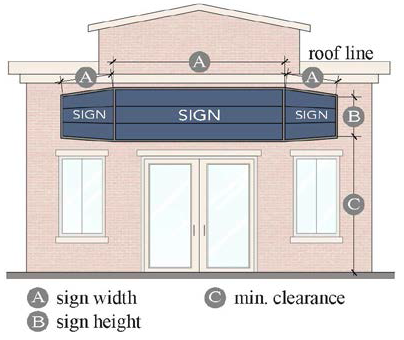 | 1 per principal building |
120 square feet per sign face, up to a maximum of 3 faces
(A x B) |
No higher than roofline; 8 feet minimum clearance height
(C) |
Monument Sign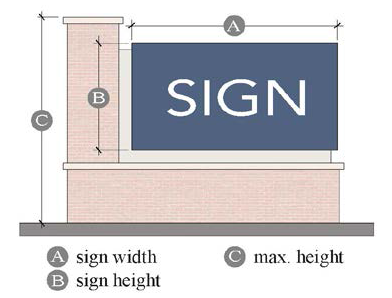 | 1 per street frontage |
80 square feet
(A x B) An electronic message center may be integrated up to 50% of allowed sign area |
No higher than 8 feet if < 300 lineal feet of street frontage; 10 feet if > 300 lineal
feet of street frontage
(C) |
Projecting Sign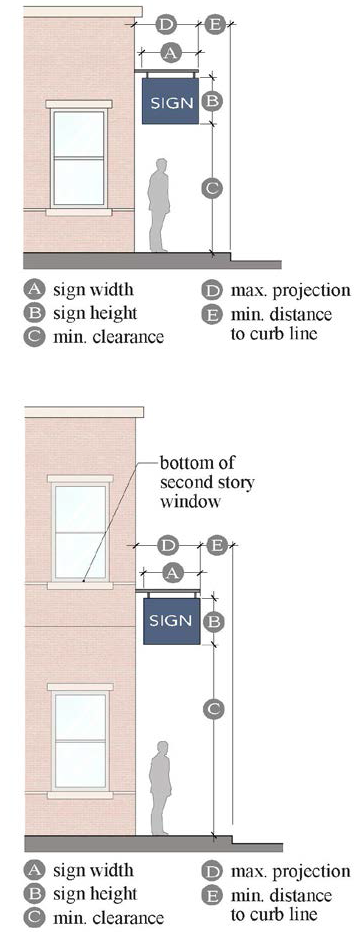 | 1 per use |
10 square feet
(A x B) |
No higher than wall (single story building)/bottom of second story window (multi-story
building)
8 feet minimum clearance height (C) 4 feet maximum right-of-way projection (D) 2 feet minimum distance to curb line (E) |
Pylon Sign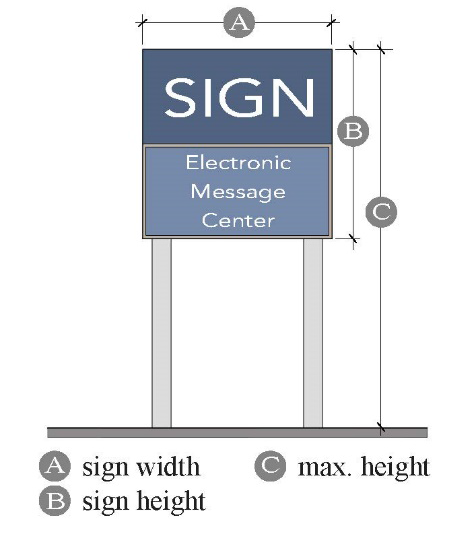 | 1 per street frontage of principal building/ commercial project with multiple lots or buildings or multiple tenants> |
100 square feet
(A x B) An electronic message center may be integrated up to 50% of allowed sign area. |
No higher than 20 feet
(C) |
Pylon Sign - Freeway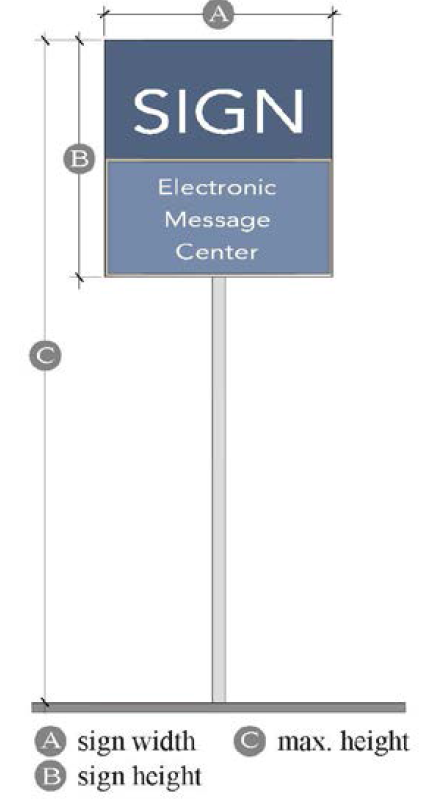 | 1 per freeway-oriented commercial project with multiple lots or buildings or multiple tenants |
150 square feet
(A x B) An electronic message center may be integrated up to 50% of allowed sign area. |
No higher than 35 feet
(C) |
Sandwich Board Sign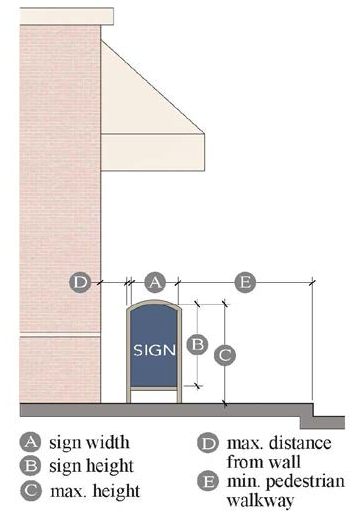 | 1 per use |
6 square feet
(A x B) |
No higher than 4 feet (C)
1 foot maximum distance from wall (D) 4 feet minimum walkway (E) |
Site Sign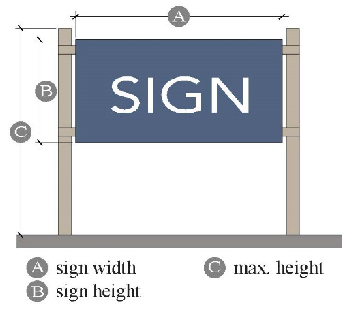 | 1 per street frontage |
32 square feet
(A x B) | No higher than 8 feet (C) |
Wall Sign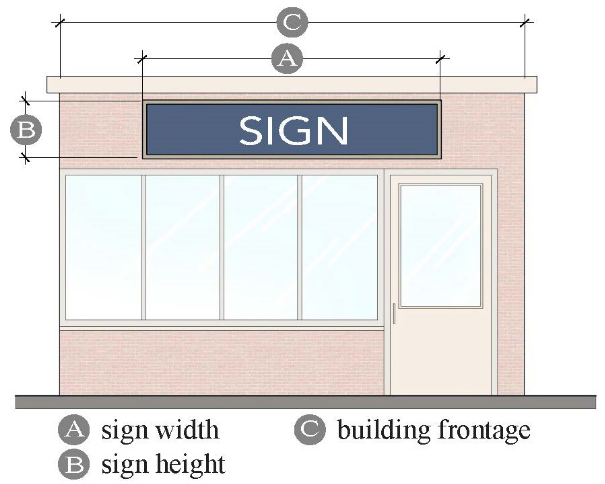 | Unlimited, within maximum area requirements | 1.5 square feet x linear footage of building frontage (C) | No higher than roofline |
Yard Sign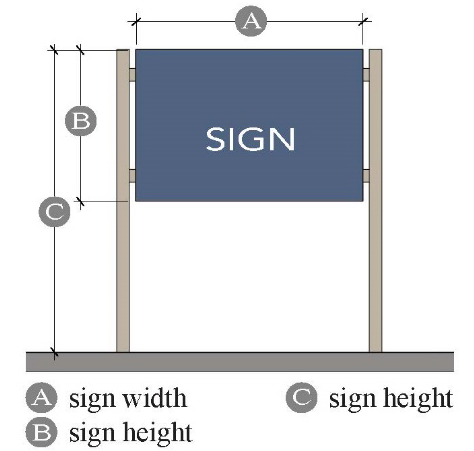 | 1 per street frontage |
16 square feet
(A x B) | No higher than 4 feet (C) |
(Ord. No. 25-2021, § 1(Exh. A), 6-7-2021)
18.06.320 - Permanent signs.
A.
General. The standards of this section apply to all permanent signs, unless otherwise exempted by Section 18.06.240. Permanent signs may be subject to additional standards set out elsewhere in this title.
1.
Owner Consent. No sign permit shall be issued for any permanent sign on private property without written consent of the property owner or the owner's authorized agent.
2.
Lighting.
a.
No illuminated signs are allowed in the residential zone districts.
b.
Unless otherwise specified by these regulations, all permanent signs in the nonresidential zone districts may be illuminated.
c.
The light from any light source intended to illuminate a permanent sign shall be so shaded, shielded or directed so that the light intensity or brightness shall not cause glare to affect surrounding properties, or cause glare to affect safe vision of pedestrians or operators of vehicles moving on public or private streets, driveways or parking areas.
B.
Electronic Message Centers.
1.
Location. Up to fifty (50) percent of the allowed sign area of a pylon or monument sign in a nonresidential zoning district (other than the Downtown Business zone district) may be occupied by an electronic message center.
a.
Existing signage proposed for conversion to the use of an electronic message center shall conform to the sign standards in this chapter prior to issuance of a sign permit.
b.
Nonconforming signs shall not be eligible for conversion to an electronic message center.
c.
Electronic message centers are not permitted in a residential zone district or in the Downtown Business (DB) zone district.
2.
Quantity, Area and Height. An electronic message center shall comply with the quantity, area and height requirements established for pylon or monument signs in Section 18.06.310.
3.
Lighting. Lighting from the electronic message center shall not exceed 0.3 foot candles between dusk to dawn as measured from the sign's face.
a.
The electronic message center shall have automatic dimmer software or solar sensors to control brightness for nighttime viewing.
b.
The intensity of the light source shall not produce glare, the effect of which constitutes a traffic hazard.
c.
Documentation shall be provided from the sign manufacturer which verifies compliance with auto dimming and brightness requirements.
4.
Transition Method. The electronic message center shall be limited to static messages, changed only through either dissolve or fade transitions, which may otherwise not have movement, or the appearance or optical illusion of movement, of any part of the sign structure, design, or pictorial segment of the sign, including the movement of any illumination or the flashing, scintillating or varying of light intensity.
5.
Transition Duration. The transition duration between messages shall not exceed one second.
6.
Message Hold Time. The message hold time shall be a minimum of eight seconds.
C.
Sign Types. Permitted permanent signs include the following types:
1.
Awning signs.
2.
Canopy signs.
3.
Display signs.
4.
Marquee signs.
5.
Monument signs.
6.
Projecting signs.
7.
Pylon signs.
8.
Wall signs.
D.
Awning Signs.
1.
Location. Signs may be placed only on awnings that are located on first- and second-story building frontages, including those fronting a street, parking lot or pedestrian way. An awning may include a printed or mounted sign.
a.
Awnings on which signs are printed or mounted shall not extend over a public right-of-way more than five feet from the face of a supporting building.
b.
No sign mounted to an awning shall project beyond, above or below the face of an awning.
c.
Awning signs are not permitted in a residential zone district.
2.
Quantity, Area and Height. An awning sign shall comply with the quantity, area and height requirements established in Section 18.06.310.
3.
Lighting. Awnings may be internally illuminated only.
E.
Canopy Signs.
1.
Location. Signs may be placed on canopies that front a street, parking lot or pedestrian way. A canopy may include a printed or mounted sign.
a.
Canopies on which signs are printed or mounted shall not extend over a public right-of-way more than seven feet from the face of a supporting building, and be no closer than two feet to a curb line.
b.
No sign mounted to a canopy shall project above or below the face of a canopy.
c.
A canopy sign may project horizontally from the face of a canopy the distance necessary to accommodate the letter thickness and required electrical equipment.
d.
Canopy signs are not permitted in a residential zone district.
2.
Quantity, Area and Height. A canopy sign shall comply with the quantity, area and height requirements established in Section 18.06.310.
3.
Lighting. Canopies may be internally illuminated only.
F.
Display Signs.
1.
Location. Display signs may be either 1) mounted on a building wall oriented to pedestrians, or 2) oriented to occupants of a vehicle in a drive-thru aisle.
a.
Display signs in a drive-thru aisle are not be permitted in the DB zone district.
b.
Display signs in a drive-thru aisle are permitted in other non-residential zone districts only if a drive through is expressly authorized in an approved Final PD or site plan.
c.
Display signs in a drive-thru aisle shall not be designed to be read from the public right-of-way nor to attract attention to the site from the right-of-way.
d.
No display signs are permitted in a residential zone district.
2.
Quantity, Area and Height. A display sign shall comply with the quantity, area and height requirements established in Section 18.06.310.
3.
Lighting.
a.
Display signs may be internally or externally illuminated.
b.
Non-illuminated wall-mounted display signs do not require a sign permit.
c.
Display signs in a drive-thru aisle may be an electronic message center that contains up to one hundred (100) percent of the sign area if the display changes no more than three times in a twenty-four-hour period, subject to all other standards for electronic message centers in Section 18.06.320.B.
G.
Marquee Signs.
1.
Location. A marquee sign may only be placed on a ground floor facade of a building.
a.
A marquee sign shall not extend over a public right-of-way more than eight feet from the face of a supporting building, and be no closer than two feet to a curb line.
b.
A marquee sign shall not obscure a building's windows, doors or ornamental features.
c.
Marquee signs are not permitted in a residential zone district.
2.
Quantity, Area and Height. A marquee sign shall comply with the quantity, area and height requirements established in Section 18.06.310.
3.
Lighting. Marquee signs may be internally or externally illuminated.
H.
Monument Signs.
1.
Location. A monument sign shall be located on a site frontage adjoining a public or private street, easement or right-of-way. The minimum horizontal spacing between monument signs shall be three hundred (300) feet.
2.
Quantity, Area and Height. A monument sign shall comply with the quantity, area and height requirements established in Section 18.06.310.
3.
Lighting. Monument signs may be internally or externally illuminated.
I.
Projecting Signs.
1.
Location. Projecting signs shall be placed on a ground floor facade, except for businesses located above the ground level with direct exterior pedestrian access.
a.
Projecting signs shall not extend more than four feet from the face of a supporting building, and be no closer than two feet to a curb line.
b.
Projecting signs are not permitted in a residential zone district.
2.
Quantity, Area and Height. A projecting sign shall comply with the quantity, area and height requirements established in Section 18.06.310.
3.
Lighting. Projecting signs shall not be illuminated.
J.
Pylon Signs.
1.
Location. A pylon sign shall be located on a site frontage adjoining a public or private street, easement or right-of-way.
a.
The setback from any property line for a pylon sign shall be one foot of setback per one foot of sign height, with a minimum setback of ten (10) feet for a freeway-oriented pylon sign; five-foot minimum setback for all other pylon signs.
b.
No portion of any pylon sign shall encroach or project into the public right-of-way.
c.
Pylon signs are not permitted in a residential zone district or in the DB Downtown Business zone district.
d.
Only one pylon sign shall be permitted in a commercial project with multiple lots or buildings or multiple tenants.
e.
The minimum horizontal spacing between pylon signs shall be three hundred (300) feet.
2.
Quantity, Area and Height. A pylon sign shall comply with the quantity, area and height requirements established in Section 18.06.310.
3.
Lighting. Pylon signs may be internally illuminated only.
K.
Wall Signs.
1.
Location.
a.
A wall sign shall not obstruct any portion of a window, doorway or other architectural detail.
b.
No sign part, including cut-out letters, may project from the building wall more than required for construction purposes and in no case more than twelve (12) inches.
2.
Quantity, Area and Height. A wall sign shall comply with the quantity, area and height requirements established in Section 18.06.310.
3.
Lighting. Wall signs may be internally or externally illuminated.
(Ord. No. 25-2021, § 1(Exh. A), 6-7-2021)
18.06.330 - Temporary signs.
A.
General. The following standards are applicable to all temporary signs:
1.
Owner Consent. All temporary signs must be located on private property and only with the consent of the property owner.
2.
Lighting. No temporary sign shall be illuminated.
3.
Duration. The purpose of temporary signs is to display messages for a temporary duration. Temporary signs shall not be used as a subterfuge to circumvent the regulations that apply to permanent signs or to add permanent signage in addition to that which is permitted by Section 18.06.310. Temporary signs shall be removed on or before ninety (90) days after first being placed, unless otherwise specified herein.
B.
Sign Types. Temporary signs include the following types:
1.
Fabric signs (banners).
2.
Sandwich board signs.
3.
Site signs.
4.
Yard signs.
C.
Fabric signs.
1.
Location. Fabric signs (banners) may be displayed in any non-residential zone district subject to the following location criteria.
a.
The banner shall not have a negative effect on neighboring businesses or property in that it shall not block their entrance(s) or impede vehicular or pedestrian traffic, or block signage of the neighboring property, or otherwise create a nuisance or safety hazard.
b.
The banners shall not be placed to obstruct any portion of a window, doorway or other architectural detail.
c.
A banner may be installed on a utility pole with the consent of the utility provider, provided that the banner is attached at the top and bottom by brackets that project no more than thirty (30) inches from the utility pole.
2.
Duration. Banners may be displayed for a maximum of thirty (30) days without a sign permit. Banners may be displayed for an additional maximum of sixty (60) days with a sign permit.
3.
Quantity, Area and Height. Banners and wave banners shall comply with the quantity, area and height requirements established in Section 18.06.310.
a.
Banners installed on utility poles in accordance with subsection 1. b. above shall not exceed twenty-four (24) inches in width and forty-eight (48) inches in height.
b.
The square footage of the banner shall count toward the maximum square footage allowed. If wall-mounted, the banner will count toward the maximum square footage for a wall mounted sign. If mounted on a display base or is a wave banner, it shall count toward the maximum square footage of the type of freestanding sign located on the property.
D.
Sandwich Board Signs.
1.
Location. Sandwich board signs may be displayed in the DB Downtown Business zone district or in pedestrian areas in the CC Commercial Center or CI Commercial Interchange zone districts subject to the following location criteria.
a.
The sign shall not have a negative effect on neighboring businesses or property in that it shall not block their entrance(s), impede vehicular or pedestrian traffic, block signage of the neighboring property, or otherwise create a nuisance or safety hazard.
b.
The sign shall be displayed within one hundred (100) feet of the building in which the business establishment is located, or within one hundred (100) feet of the property line of any outdoor business.
c.
The sign may not be located further than twenty (20) feet from a mobile vendor.
d.
The sign may not be located within a public street right-of-way, nor on public property, with the exception of a public sidewalk.
2.
Duration. Sandwich board signs must be removed each day at close of business.
3.
Quantity, Area and Height. A sandwich board sign shall comply with the quantity, area and height requirements established in Section 18.06.310.
E.
Site Signs.
1.
Location. Site signs are permitted only on vacant land parcels or lots under construction and are not permitted on parcels with existing residential or non-residential uses, and are subject to the following location criteria:
a.
The minimum horizontal spacing between site signs shall be three hundred (300) feet.
b.
The sign shall be setback a minimum of five feet from any property line.
2.
Duration. In the case of a multiple lot subdivision, site signs displayed on or after the date of official filing of the subdivision plat or final PD site plan must be removed within thirty (30) days of the issuance of a building permit for the last undeveloped lot.
3.
Quantity, Area and Height. A site sign shall comply with the quantity, area and height requirements established in Section 18.06.310.
F.
Yard Signs.
1.
Location. Yard signs are intended for improved land parcels with existing residential or non-residential uses and are not permitted on parcels or lots under construction, and are subject to the following location criteria:
a.
The sign shall be setback a minimum of five feet from any property line.
2.
Quantity, Area and Height. A yard sign shall comply with the quantity, area and height requirements established in Section 18.06.310.
(Ord. No. 25-2021, § 1(Exh. A), 6-7-2021)
18.06.340 - Sign measurement.
A.
General. Computation of sign area and height shall for individual permanent and temporary sign types shall be as indicated in Tables 6.1 and 6.2, and as more specifically described in the following subsections. Where a specific sign type is not indicated in either Table 6.1 or 6.2, the provisions in the following subsections shall apply.
B.
Computation of Sign Area.
1.
The area of a sign face shall be computed by means of the smallest square, circle, rectangle, triangle, or combination thereof that will encompass the extreme limits of the message, logo, symbol, name, photograph, writing, representation, emblem, artwork, figure or other display used to differentiate the sign from the backdrop or structure against which it is placed.
2.
Any supporting framework, bracing, poles, fence or wall, or architectural feature or landscape element that is clearly incidental to the sign display shall not be computed as sign area.
3.
Architectural treatments that aid in integrating the signage with the building design are encouraged, but any such treatment shall not be created for the purpose of visually enlarging the size of the sign. If more than ten (10) percent of any wall or roof surface of any nonresidential building or any accessory structure to a nonresidential use is painted, finished or surfaced in a distinctive color scheme that includes some or all of the same colors, shapes, symbols, images, patterns or textures used on any sign identifying an owner, tenant or user of the building, and the Director determines that such wall or roof surfaces serve as a sign for an owner, tenant or user of the building, such wall or roof area shall be counted as signage and shall be subject to the limitations on signage area in Table 6-2.
4.
All sign faces visible from one point shall be counted and considered part of the maximum total sign area allowance for a sign.
a.
When two identical sign faces are placed back-to-back so that both faces cannot be viewed from any point at the same time, and are part of the same sign structure, the sign area shall be computed by the measurement of one of the two sign faces.
b.
When the sign has more than two display surfaces, the area of the sign shall be the area of largest display surfaces that are visible from any single direction.
5.
The area of the sign shall be measured as follows whenever more than one sign is placed on a freestanding structure:
a.
The area around and enclosing the perimeter of each sign shall be summed and then totaled to determine total area.
b.
Pole covers, framing, decorative roofing, and other such embellishments shall not be included in the area of measurement if they do not bear sign copy.
6.
For the purpose of determining sign area and the allowable number of wall signs, a wall shall be considered the entire building side or elevation, and not each articulated wall face per building side or elevation.
C.
Computation of Sign Height.
1.
The height of any freestanding sign shall be determined by the distance between the topmost portion of the sign structure and the ground elevation at the base of the sign.
2.
The ground elevation at the base of a freestanding sign shall not be artificially changed solely to affect the sign height measurement.
(Ord. No. 25-2021, § 1(Exh. A), 6-7-2021)
18.06.410 - Sign design.
A.
In general, signs shall have mutually unifying elements which may include uniformity in materials, color, size, height, letter style, sign type, shape, lighting, location on buildings, and design motif.
1.
Materials and textures of signs shall be compatible with the architectural character of the site and building.
a.
Unifying sign design elements used to support a particular design theme and the architecture, colors, and materials within a particular site are required.
b.
Supporting sign structures of freestanding signs shall match the primary finish and colors of the associated building(s).
2.
All freestanding signs are required to have a pedestal base or be constructed with two substantial columns, except freeway-oriented pylon signs may be mounted on a single pole. Where possible, freestanding signs shall integrate tenant signs into a single sign structure.
3.
Wayfinding/directional signage systems shall be of a unified graphical system. Such signage shall be placed in consistent locations near site entries, key points on the internal automobile and pedestrian circulation system, building entries, seating areas, and sidewalk intersections.
4.
Logos of individual stores located in buildings within multi-tenant centers are exempt from the design criteria established for the multi-tenant center but must meet other requirements of this chapter. Nationally or state registered trademark lettering is also exempt, with the exception of lettering color.
5.
For multi-story buildings, individual signs shall be limited to the ground level.
6.
When an internally illuminated cabinet sign is considered as part of a master sign plan, the following standards shall apply:
a.
Only that portion of the sign face dedicated to the trademark or characters may be translucent. The balance of the sign face shall be opaque.
b.
All freestanding signs using an internally lit sign cabinet design shall have an architectural base and border on all sides that is consistent with and/or complements the building materials.
B.
Landscaping. Landscaping is required for freestanding monument and pylon signs in conformance with the following provisions:
1.
A minimum of a five-foot radius surrounding the sign base shall be landscaped. The Director may modify the type, configuration and/or amount of the landscaping if there are physical constraints to installing the landscaping or providing irrigation, or if the landscaping around the sign will not be readily visible to motorists and/or pedestrians.
2.
Freestanding signs in the DB Downtown Business zone are not required to provide landscaping adjacent to the zero-foot setback (outside of the visibility triangle) of a sign.
3.
Exempt signs are not required to provide landscaping.
C.
Lighting.
1.
Lighting shall conform to the outdoor lighting standards in Section 18.05.320 and shall minimize the effects of lighting on the night sky.
2.
Signs using indirect lighting shall have the light source so placed or shielded so as not to shine or glare directly onto any public street or into adjacent residential structures.
3.
Lighting should be of no greater wattage than is necessary to make the sign visible at night, and should not reflect unnecessarily onto adjacent properties. Lighting sources should not be directly visible to passing pedestrians or vehicles, and should be concealed in such a manner that direct light does not shine in a disturbing manner or create disability glare.
4.
Up-lighting is permitted for flagpoles and monument signs pursuant to the above criteria.
(Ord. No. 25-2021, § 1(Exh. A), 6-7-2021)
18.06.420 - Sign installation.
All signs shall be installed in conformance with this chapter.
1.
All permanent signs and all components thereof, including sign structures and sign faces, shall be installed in compliance with adopted building and electrical codes.
2.
Except for flags, window signs and temporary signs conforming to the requirements of this chapter, all signs shall be constructed of high-quality durable materials and shall be permanently attached to the ground, a building, or another structure by direct attachment to a rigid wall, frame, or structure. No plywood signs shall be permitted.
3.
No signs shall be installed so as to obstruct any fire escape, required exit, window or door opening used as a means of egress.
4.
No sign shall be installed in any form, shape, or manner which will interfere with any opening required for ventilation, except that signs may be erected in front of and may cover transom windows when not in violation of the provisions of the adopted building code.
5.
Signs shall be located in such a way as to maintain horizontal and vertical clearance of all overhead electrical conductors in accordance with adopted electrical code specifications, depending on voltages concerned. However, in no case shall a sign be installed closer than forty-eight (48) inches horizontally or vertically from any conductor or public utility guy wire, or as recommended by the local public utility company.
a.
Every illuminated sign, or sign containing electric components shall have affixed thereon an approved Underwriters' Laboratories label, or all wiring of such sign as approved by the State electrical inspector, and all wiring connected to such sign shall comply with all provisions of the applicable regulations of the Town relating to electrical installations.
6.
Any person installing, altering, or relocating a sign for which a sign permit has been issued shall notify the Director upon completion of the work.
a.
The Director may require that he be notified prior to the installation of certain signs.
b.
The Director may require a final inspection of any installed sign, including an electrical inspection and inspection of footings on freestanding signs.
(Ord. No. 25-2021, § 1(Exh. A), 6-7-2021)
18.06.430 - Sign maintenance.
All signs, both currently existing and constructed in the future, and all parts and components thereof, shall be maintained in a safe condition in compliance with adopted building and electrical codes, and in conformance with this chapter.
1.
All signs, including sign structures and sign faces, shall be kept in good repair so as not to be distracting, unattractive, dangerous or a public nuisance and effectively serve the purpose for which they are intended. For the purposes of this section, good repair shall mean that there are no loose, broken, torn or severely weathered portions of the sign structure or sign face.
2.
All signs shall be properly maintained. Exposed surfaces shall be clean and painted if paint is required. Defective parts shall be replaced.
3.
All electronic message centers shall be equipped with a malfunction display and the ability to automatically shut off if a malfunction occurs. An electronic message center under repair shall be shut off.
4.
The Director shall have the right under Section 18.06.450 to order the repair or removal of any sign which is defective, damaged or substantially deteriorated, as defined in the adopted building code.
(Ord. No. 25-2021, § 1(Exh. A), 6-7-2021)
18.06.440 - Sign alteration.
A.
Any alteration to an existing sign, other than for a change of copy or for maintenance, shall require a new sign permit pursuant to Section 18.06.210.
B.
Sign alterations shall include, without limitation:
1.
Changing the size of the sign.
2.
Changing the shape of the sign.
3.
Changing the material of which the sign is constructed.
4.
Changing or adding lighting to the sign.
5.
Changing the location of the sign.
6.
Changing the height of the sign.
C.
Existing nonconforming signs may be altered in any way that does not change the size, height, background, shape or location of the sign without bringing the entire sign into conformance, provided that the cost of the alteration is less than fifty (50) percent of the sign's replacement cost.
(Ord. No. 25-2021, § 1(Exh. A), 6-7-2021)
18.06.450 - Sign removal.
A.
Violations. In addition to any other remedies available under this Chapter, the Director may issue a written notice to sign owners of the need to remove or repair a sign, as follows:
1.
The Director may inspect any sign and shall have authority to order the painting, repair, alteration or removal of a sign and/or sign structure that is prohibited or constitutes a hazard to safety, health or public welfare by reason of abandonment or inadequate maintenance, dilapidation or obsolescence.
2.
When in the opinion of the Director, a violation of these regulations exists, the Director shall issue a written order to the alleged violator. The order shall specify those sections of these regulations of which the individual may be in violation and shall state that the individual has thirty (30) days from the date of the order in which to correct the alleged violation or to appeal to the Board of Adjustment.
B.
Removal of Prohibited or Noncompliant Signs. Any sign that does not meet the requirements set forth in this Chapter and does not qualify as a legal nonconforming sign under Section 18.06.260 shall be removed within fifteen (15) days of receipt of Director's written notice thereof. Failure by an owner to remove any sign after notice to do so has been served shall entitle the Town to remove such sign and to assess the owner thereof the full cost of such removal. All prohibited signs on public property or within public rights-of-way are subject to immediate removal without notice.
C.
Removal of Dangerous or Defective Signs. Any sign that endangers the health, safety or welfare of the public shall be removed within five (5) days of the Director's written notice thereof. In cases of emergency, the Town may cause the immediate removal of a dangerous or defective sign, without notice, and shall assess the sign, property, or business owner for the cost of such removal.
D.
Removal of Abandoned Signs. Any sign that is located on a property which becomes vacant and is unoccupied for a period of thirty (30) days or more, shall be deemed to have been abandoned and shall be removed by the owner of the sign or the owner of the property.
1.
Any sign deemed abandoned must be removed within thirty (30) days of the Director's written notice thereof. Failure by an owner to remove an abandoned sign after notice has been served shall entitle the Town to remove such sign and to assess the owner thereof the full cost of such removal.
2.
A sign structure conforming to this chapter may remain for up to one hundred eighty (180) days from when the property becomes vacant, if the property is being actively marketed, and if the sign has a replaceable face which can be used by a future business establishment.
E.
Removal by Town. The Director may cause the removal of an illegal sign in cases of emergency, or for failure to comply with the written orders of removal or repair. After removal or demolition of the sign, a notice shall be mailed to the sign owner stating the nature of the work and the date on which it was performed and demanding payment of the costs as certified by the Director together with an additional ten (10) percent for inspection and incidental costs.
1.
If the amount specified in the notice is not paid within thirty (30) days of the notice, it shall become an assessment upon a lien against the property of the sign owner, and will be certified as an assessment against the property for collection in the same manner as the real estate taxes.
2.
The owner of the property upon which the sign is located shall be presumed to be the owner of all signs thereon unless facts to the contrary are brought to the attention of the Director, as in the case of a leased sign.
(Ord. No. 25-2021, § 1(Exh. A), 6-7-2021)

