
Morgan City Zoning Code
CHAPTER 10
15 MIXED RESIDENTIAL OVERLAY MRO ZONE
10.15.010 PURPOSE
This residential overlay zone is intended for infill development. The MRO requires a mixture of housing types and creates smaller pocket neighborhoods. It is not intended for larger developments or as a standalone master-planned community, but may be part of larger developments. The dwelling types within the zone must vary according to the ordinance. The MRO is an overlay zone and is not preassigned to areas before the development application. The rezoning process to the MRO zone is in conjunction with the development application, site plan, open space plan, rezone application, Master Development Agreement, and final approval by the City Council. Construction plans and building plans are to be submitted with the plat and or building permit application.
Adopted by Ord. 23-04 Mixed Residential Overlay (MRO) Zone on 9/12/2023
10.15.020 LAND USES IN MRO
The allowed land uses in the MRO include residential and home businesses. See land use chart.
Adopted by Ord. 23-04 Mixed Residential Overlay (MRO) Zone on 9/12/2023
10.15.030 DEVELOPMENT SIZE AND LOCATION
This zone applies to a development project between four (4) to ten (10) acres in size, including all combined parcels. This gross acreage calculation includes residential parcels, open space or common space, trails, and street right-of-ways. As a stand-alone project, MRO must conform to the four (4) to ten (10) acres in size; however, as part of a larger subdivision, the MRO may be used for up to 25% of the gross acreage. For example, a 20-acre project could be MRO up to the first 10 acres, and the remaining 10 acres could be 75% base zoning (compatible R zone) and 25% MRO. The continuation of MRO after 10 acres shall be a maximum of a 4:1 ratio or less. For projects larger than ten (10) acres, the entire project must be designed at once for streets, trails, utilities, stormwater, parks, and open space. The usable open space requirement only applies to the gross MRO acreage; however, the amenities, trails, park, and open space shall be accessible and usable by the whole development and City. Requirements for architecture, landscaping, HOA management, and street trees apply to the whole development (including non-MRO). Architecture requirements include garage placement, materials, and unique architecture (see section 10.15.70). Landscape requirements include waterwise landscaping (see section 10.15.100). Larger developments should provide choices in housing sizes and types (from large to small). Careful consideration should be given if new MRO developments are proposed next to existing MRO developments. The MRO is allowed as an overlay in the following base zones: o R-1-12 o R-1-10 o R-1-8 o RM-7 o RM-15 o General Commercial (G-C) The MRO is not allowed in the following base zones: o Manufacturing and Distribution (M & D) o R-1-20 o R-R o Highway Commercial (C-H) o Agriculture (A) o Central Commercial (C-C) MRO developments shall not have frontage on key commercial corridors such as State Street (600 East to Young Street) and Commercial Street (300 North to 100 North). The applicant may apply for a base rezone and MRO zone simultaneously.
Adopted by Ord. 23-04 Mixed Residential Overlay (MRO) Zone on 9/12/2023
10.15.040 RESIDENTIAL DENSITY AND HOUSING TYPES MIXTURE
- Residential housing dwellings shall include a blend of housing types within the development plan. The variety of housing types will provide Morgan residents with options and establish neighborhoods with various architectural styles and Building Types. The residential dwellings should provide a range of housing costs.
- The maximum number of dwelling units is (10) ten gross per acre.
Adopted by Ord. 23-04 Mixed Residential Overlay (MRO) Zone on 9/12/2023
10.15.050 BUILDING TYPES AND DESIGN LIST
- In the MRO zone, developments shall have a minimum of two buildings/housing types. The housing types shall come from the two lists (below), with a minimum of one (1) housing type coming from each list. The minimum number of units from each list shall be 30%. The 30% can include all building types found in each list. For example, if the development plan had 30 dwellings, then a minimum of ten (10) units would be required from each list. Building types' variations should be mixed as groups throughout the project. Fractional numbers less than five round down to a whole number and five or greater round up to a whole number.
List 1 List 2 Small-Single Family Townhome Medium-Single Family Two-Family Home - All residential buildings shall be oriented in one of the two methods:
- Traditional street orientation. A building's front façade and front door are directly oriented toward the street. See the example in Figure 1.
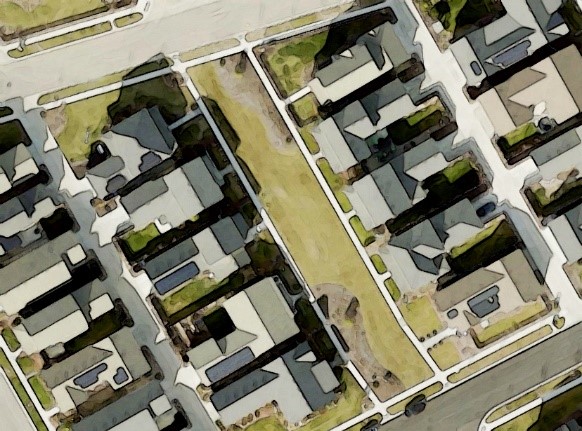
- Connecting common green: The buildings face onto a common green or park that is a minimum of 40' wide for the majority of the common area. The common green shall directly connect to the street. Each dwelling shall have a continuous sidewalk from the residential front door, facing the common green, to the street. See the example in Figure 2.
Figure 1 Traditional Street Orientation
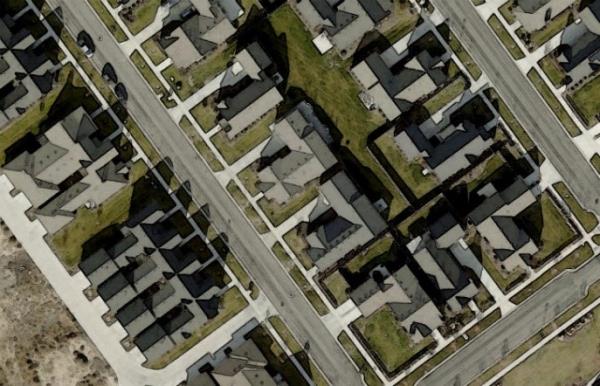
Figure 2 Buildings Facing Common Green
Adopted by Ord. 23-04 Mixed Residential Overlay (MRO) Zone on 9/12/2023
10.15.060 OPEN SPACE REQUIREMENTS
- Open Space is essential for creating healthy and happy communities. In general, Open Space includes a variety of landscape types such as improvements, common open space, common greens, trails, and civic greens. The MRO ordinance is intended to create Usable Open Space that is within walking distance from each dwelling.
- Usable Open Space
- In the MRO Zone, fifteen percent (15%) of the entire project land area must be dedicated to Usable Open Space.
- The Usable Open Space areas must be accessible to all development residents. The Usable Open Space must be designed for multiple purposes and not landscaping in between buildings. Usable Open Spaces for projects 7 acres or less are permitted to be divided into one (1) to three (3) areas. Projects over 7 acres shall have Usable Open Spaces in one (1) to five (5) areas. No Usable Open Space area shall be less than 5,000 square feet. The following open space features meet the Usable Open Space requirements: plazas, courtyards, common greens, parks, playing fields, gardens, shade structures, fountains, trails, play areas, sports courts, pools (including surrounding pool deck/pool house), splash pad, and playgrounds.
- The following do not qualify for Usable Open Space Requirements: buildings (excluding community pool or community buildings), sheds, garages, drives/alleys, roads/streets, parking areas, sidewalks in the public right of ways, landscaping on private property, and utility areas. This is not a comprehensive list; additional areas may not qualify per City review. Open Space features shall have a passive or active recreation function. Qualifying Usable Open Space shall be considered part of the application and rezone process.
- Stormwater infrastructure shall only count towards Usable Open Space when incorporated within designated open space, the stormwater function will have minimal effect on the usability and performance of the open space. Only one quarter (25%) of the Usable Open Space area may be used for stormwater detention/retention.
- The Usable Open Space Plan must include the following at a minimum: playground, open grass space for play and recreation, benches, sidewalks/trails, and landscaping. The Usable Open Space Plan should consider sports courts, natural or passive open spaces with walking/biking trails, pavilions, gathering places, and creative design. The grass may be synthetic grass or natural grass of a water conservation variety.
- The Developer shall provide a Usable Open Space maintenance plan as part of the Development Agreement and include details regarding landscape maintenance, recreation equipment maintenance, and Home Owner Association (HOA) Codes Covenants and Restrictions (CCRs) for maintenance.
- Trails are an essential component of the City's recreation plans. Developers shall review the City's Parks and Recreation Plan and implement/incorporate required trails according to the City's plan.
- All open spaces shall be privately owned and maintained by an HOA unless they are deeded to the City as a park of two acres or larger.
- Resident access and visibility to the Usable Open Spaces are essential for public safety and to encourage usability. A minimum of 25% of the perimeter or a street front of 40 feet (whichever is lesser) of the Usable Open Space shall be directly in front of a public or private street for access. The Usable Open Space Plan must show the perimeter and frontage access percentage.
- No off-street parking is required for the Usable Open Space. A minimum of two (2) on-street parking stalls is required for the Usable Open Space where the street and open space connect.
- Of the usable open space, 75% must be less than 10% slope.
Adopted by Ord. 23-04 Mixed Residential Overlay (MRO) Zone on 9/12/2023
Adopted by Ord. 24-02 Amendment to Mixed Residential Overlay (MRO) Zone on 2/27/2024
10.15.070 BUILDINGS
- Building Forms and Frontages:
- Buildings in the MRO Zone must have porches and a covered entry for each dwelling. Porches must be a minimum of 5' x 8', equaling 40 square feet or larger.
- The MRO zone developments should foster a majority of owner-occupied dwellings. A minimum of 50% of MRO dwellings/units shall be individually platted.
- The maximum number of units per building is five (5).
- Building Variety:
MRO developments shall utilize varying architectural elements throughout the community to create dynamic and interesting Centers and Neighborhoods.
- No buildings on the same block face (on both sides of the street) may be the same, within 400 feet minimum distance. Building design must distinctly vary in four (4) of the following eight (8) elements:
- architectural style
- colors of exterior materials and surfaces
- roofline articulation
- materials (brick, stone, stucco, hardy-board, etc)
- window locations and sizes
- door design, color, and location
- porch location or porch covering,
- building bump-outs or exterior wall changes
- No buildings on the same block face (on both sides of the street) may be the same, within 400 feet minimum distance. Building design must distinctly vary in four (4) of the following eight (8) elements:
- Differentiation Each townhome/twin home building is to be designed differently and varies from others. Individual units do not have to be designed differently, but together should represent a single building.
- Building Windows Building facades facing the street or common green shall have a minimum of 20% transparency (glass). Non-street-facing facades shall have a minimum of 10% transparency (glass). Garage sides, porches, and roofs are excluded from measurements and requirements. Glass may include windows and/or doors (with windows). Architectural plans shall show façade measures and square footage.
- Building Types
- Small Single-Family
- Small Single-family homes are situated on smaller lots, and garages per standards. Homes face streets or common greens.
- See MRO Design Standards for lot size, setbacks, and dimensions.
- Garages may be attached or detached from dwelling units.
- Small Single-family examples:
Figure 4. Small Single Family Home Examples. Pictures are representative examples. These homes face the street and common green. Examples are rear load loaded garages.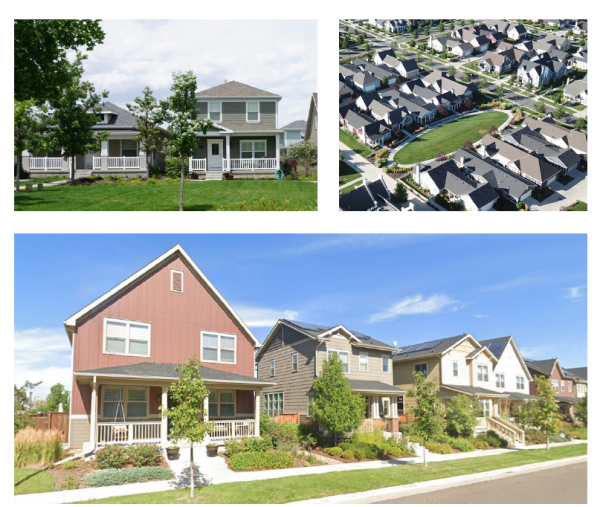
- Medium Single-Family
- a. Medium Single-family homes are located on smaller lots, and garages may be rear-loaded or front-loaded (per garage standards). Homes face public streets or common greens.
- See MRO Design Standards for lot size, setbacks, and dimensions.
- Garages may be attached or detached from dwelling units.
- Medium Single-family examples:
Figure 5. Medium Single Family Home Examples. Pictures are representative examples. These homes face the street and common green. Examples are both rear load and front-loaded garages.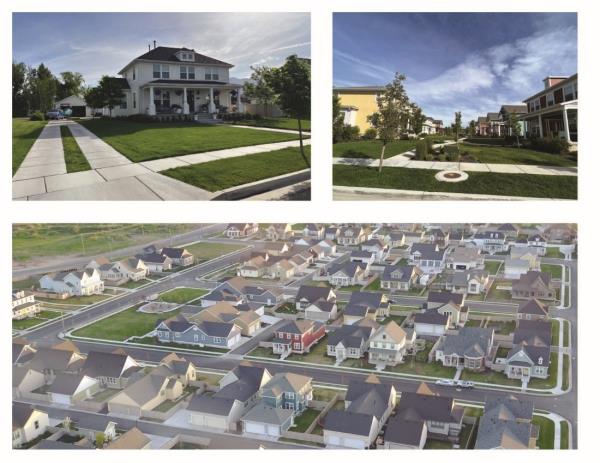
- Townhome
- Townhome dwellings are single-family attached and may be up to five (5) units per building.
- Garages must be rear-loaded (per garage standards). Dwellings face streets or common greens.
- Garages may be attached or detached from dwelling units.
- See MRO Design Standards for lot size, setbacks, and dimensions.
Figure 6. Townhome Examples. Pictures are representative examples. These homes face the street and have rear loaded garages.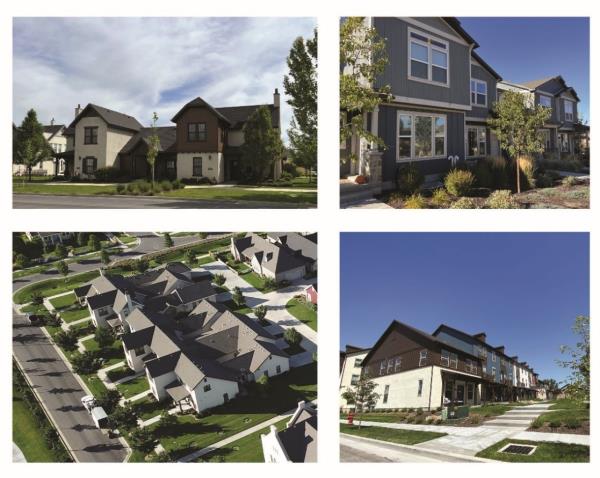
- Townhome dwellings are single-family attached and may be up to five (5) units per building.
- Twin home
- Twin home is two (2) single-family attached units per building (see building standards).
- Garages may be rear-loaded (per garage standards) or street-facing with shared driveways. Dwellings face streets or common greens.
- Garages may be attached or detached from dwelling units.
- See MRO Design Standards for lot size, setbacks, and dimensions.
Figure 7. Twin Home Examples. Pictures are representative examples. These homes face the street and have rear loaded garages.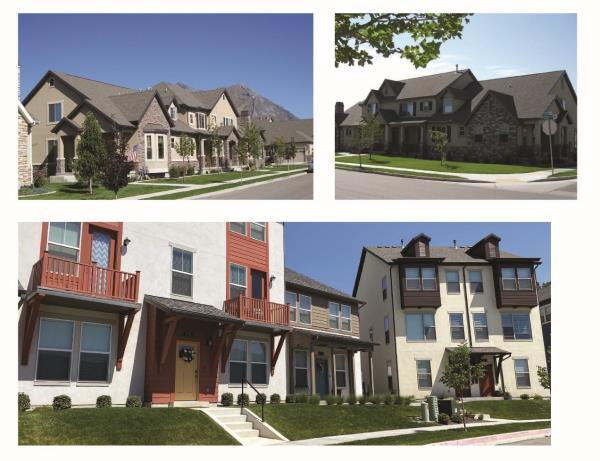
- Small Single-Family
- Building Materials:
Buildings in the MRO zone must have high-quality exterior finish materials on all sides. High-quality exterior finish materials are brick, fiber-cement board, or similar lap siding, glass, or stone. Fronts of the buildings must have brick, stone, fabricated stone, or fiber-cement boards on 30% minimum of all non-glass/window and door areas for each first-floor front facade. - Garages:
- Two types of methods are allowed, including parking access from the street and parking access from an alley.
- Parking Access via Street. The following standards apply to detached single-family units where the garage is accessed from the street in front of the house or from the side street on corner lots. Garage setback is per the standards table. Twin homes with front-loaded garages may have shared driveways (minimum 20’ wide).
- Parking Access via alley/driveway. The second method is parking access via Alley.
Garages must be set back from the alley right of way to accommodate trash and recycle bins, utilities, and other items. Setbacks per standards table.
Figure 8. Front Loaded Garage Layout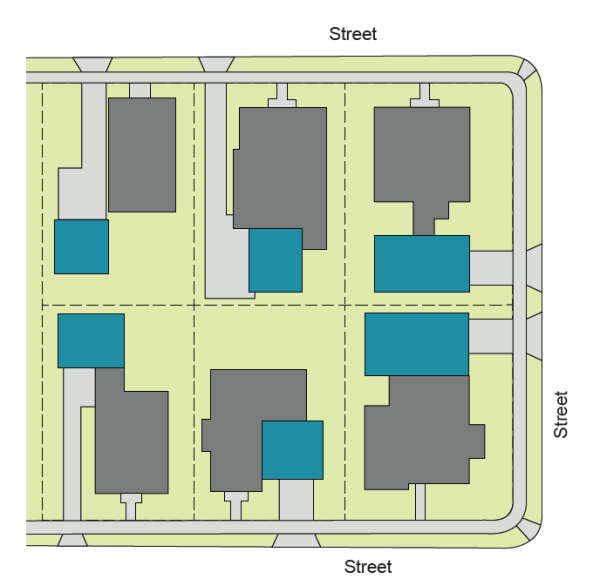
Figure 9. Rear Loaded Garage Layout (garages in the blue/green color)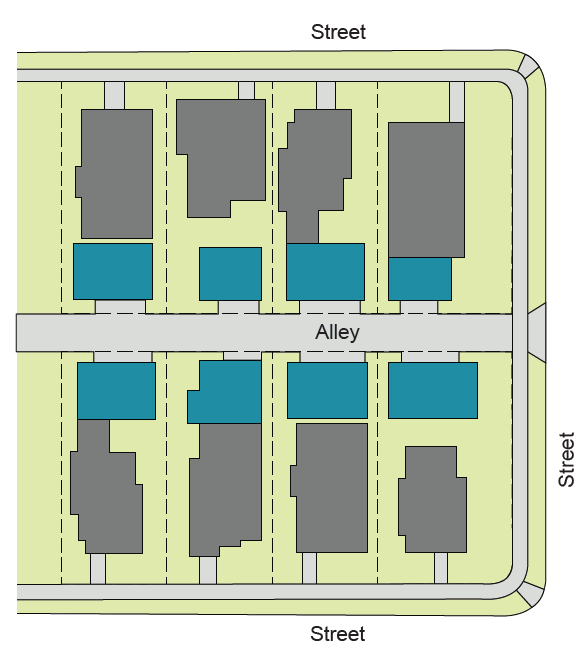
Figure 10. Rear Loaded Garage Layout (garages in the blue/green color)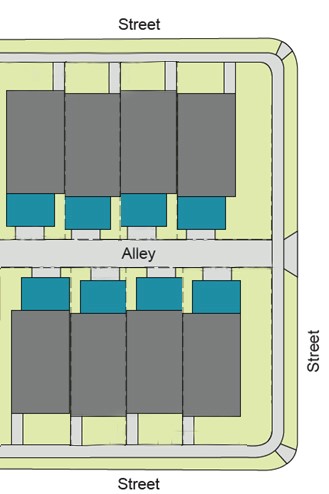
Figure 11. Front Loaded Garage Diagram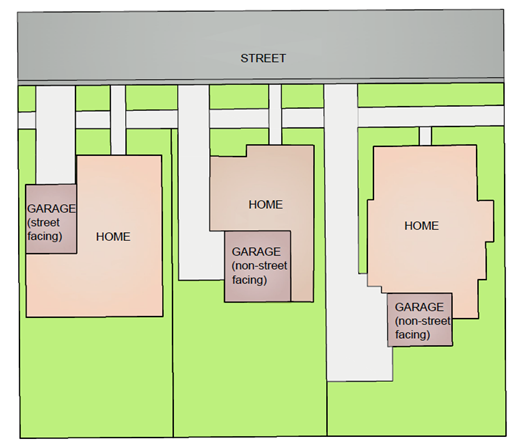
Adopted by Ord. 23-04 Mixed Residential Overlay (MRO) Zone on 9/12/2023
10.15.080 BUILDING SPATIAL STANDARDS
- Building Standards (all distances are in feet)
Building Type Small
Single-FamilyMedium
Single-FamilyTownhome Twin-Home
Min. Lot Size3,000 SF 4,500 SF 1,500 SF 2,200 SF
Min. Lot Width in Feet
(at setback)40 50 24 30
Min. Lot Depth60 70 60 60
Min. Front Setback7 7 7 7
Min. Garage Setback
(street facing garage)20 20 N/A N/A
Min. Garage Setback
(non street facing garage)11 11 N/A 11
Garage Setback From the Front of the Home4 4 N/A N/A
Min. Rear Setback
(alley)4 4 4 4 Min. Rear Setback
(non-alley)10 10 10 10
Min. Side Setback
(non-corner/non-attached)5 5 5 5
Min. Side Setback
(street corner lot)10 10 10 10
Building Height Max.
in Feet27 27 27 27
Parking Stalls Per Dwelling2.5 2.5 2.5 2.5 - Each unit must have a minimum of two dedicated stalls per unit located at the dwelling, one of which is required to be a garage stall. One half (1/2) visitor stall is required for each unit to be located within 150 feet of each dwelling unit.
Adopted by Ord. 23-04 Mixed Residential Overlay (MRO) Zone on 9/12/2023
10.15.090 STREET AND ALLEY REQUIREMENTS
- Street requirement will be per City engineering standards.
- The following Alley cross-section will be allowed for development. Construction standards will be approved by engineering.
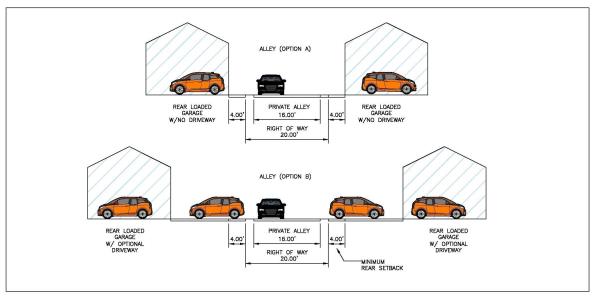
Adopted by Ord. 23-04 Mixed Residential Overlay (MRO) Zone on 9/12/2023
10.15.100 LANDSCAPE REQUIREMENTS
Street Tree Master Plan.
- A street tree master plan is required at the plat submittal. The street tree plan shall show trees per lot planted in the park strip.
- Park Strip Tree Spacing.
- Streets must be spaced at a minimum of 40 feet (excluding driveways). Trees species selection must be approved by City staff.
- Conifers are not permitted as street trees.
- Park Strip Tree Spacing.
- Landscape requirements
- Grass lawn areas in residential landscapes shall not exceed 50% of the total landscaped area.
- Lawn areas should be at least eight feet wide in all directions.
- Turf grass in front lawns should be minimized.
- Turf grass lawn is not permitted in the park strip unless it is synthetic.
- Landscape plans must show coverage of water-wise plants for 70% of non-grass area landscapes (excluding pathways and patios). This does not include tree canopies. Water wise plant coverage is for shrubs, ornamental grasses, perennials, and succulents. Coverage of plant areas shall be shown on landscape plans in the form of a table and plant sizes shall be shown at mature sizes.
- Landscape Plans
- All townhome and twin home projects must submit a landscape plan simultaneously as construction documents. Single-family homes are required to submit plans for front yards.
- The landscape plan must be stamped by a professional Landscape Architect.
- Each dwelling must have a minimum of one tree in the front yard (excluding park strip trees).
- The landscape plan must show:
- Foundation plantings around the base of dwellings.
- Trees and landscape for private areas. A minimum of 10 trees per acre and 20 shrubs/ornamental grasses, this to all landscapes.
- Trees on residential dwellings.
- Water wise conservation methods.
- Water efficient irrigation.
- Water wise plantings.
- Common Areas
- Landscape plans must be submitted for common areas.
- The landscape plan must be stamped by a Professional Landscape Architect.
- The landscape plan must include the following:
- Lawn areas should be at least eight feet wide in all directions.
- Foundation plantings around the base of buildings.
- Trees and landscape in common areas. A minimum, of 15 trees per acre.
- Water wise conservation methods.
- Water efficient irrigation.
- Water wise plantings.
- Grass lawn areas in residential landscapes shall not exceed 50% of the total landscaped area.
Adopted by Ord. 23-04 Mixed Residential Overlay (MRO) Zone on 9/12/2023
10.15.110 DOCUMENTS REQUIRED FOR APPLICATION
- Application and all typical documents required for rezone.
- Site plan: including building envelopes, streets, alleys, parking, storm water areas, open space amenities, trails, snow storage, and utility corridors.
- Open Space Plan: including Usable Open Space, trails, amenities, trees, and storm water.
- Street tree plan.
- Conceptual building elevations of proposed building types.
Adopted by Ord. 23-04 Mixed Residential Overlay (MRO) Zone on 9/12/2023
Adopted by Ord. 24-02 Amendment to Mixed Residential Overlay (MRO) Zone on 2/27/2024
10.15.120 DOCUMENTS REQUIRED FOR BUILDING PERMITS (IN ADDITION TO TYPICAL DOCUMENTS)
- Building Elevations with materials and colors to be reviewed by Planning Staff in addition to building officials.
- Landscape Plans
- Full landscape plans for Townhomes and Twin homes. Front yard plans for Single-family Homes (both small and medium).
- Full landscape plans for Townhomes and Twin homes. Front yard plans for Single-family Homes (both small and medium).
- Open Space Plan construction documents.
- Civil Construction Documents
- Plat
- HOA - Codes Covenants and Restrictions (CC&Rs)
- The HOA CC&Rs must include management and policies for parking, outdoor storage, recreational vehicles, and landscape maintenance. Visitor parking policies shall address the need for visitor parking to be available.
- The HOA must be managed by a third-party professional business that is independent of real estate ownership within the development and has no conflicts of interest with the real estate development.
- Property and landscape management plans.
- Master Development Agreement.
Adopted by Ord. 23-04 Mixed Residential Overlay (MRO) Zone on 9/12/2023
Adopted by Ord. 24-02 Amendment to Mixed Residential Overlay (MRO) Zone on 2/27/2024

