
Mountain House City Zoning Code
DIVISION 8
APPLICATION REGULATIONS
9-8-101 - Title and Intent.
Division 8 constitutes the Application Regulations. The intent of this Division is to prescribe regulations for the various types of permit applications that may be processed under this Title.
(Ord. 2024-18, § 1(Exh. A), 2024)
9-8-102 - Supplemental Information.
In addition to the information contained in the permit application form, the review authority may require supplemental information in order to evaluate the land use impacts of a project.
(Ord. 2024-18, § 1(Exh. A), 2024)
9-8-201 - Intent.
It is the intent of this Chapter to provide a method for amending the General Plan, as provided in the California Government Code.
(Ord. 2024-18, § 1(Exh. A), 2024)
9-8-202 - Requirements for Application.
Applications for General Plan Text Amendments may be initiated by any interested party. Applications shall be filed with the Community Development Department. A fee, as specified by resolution of the City Council, shall be required.
(Ord. 2024-18, § 1(Exh. A), 2024)
9-8-203 - Review Procedures.
General Plan Amendment Applications shall be reviewed using the Public Hearing Review Procedure in Chapter 5 of Division 2, with modifications as provided in this Section.
(a)
Planning Commission. At the conclusion of the Public Hearing, the Planning Commission shall recommend approval of the application or deny the application.
(1)
If the Planning Commission recommends approval, the application shall be reviewed by the City Council.
(2)
If the Planning Commission denies the General Plan Amendment Application, the action is final, unless appealed to the City Council.
(b)
City Council. The City Council shall hold a Public Hearing to take final action if the Planning Commission has recommended approval or if the Planning Commission's denial was appealed.
(Ord. 2024-18, § 1(Exh. A), 2024)
9-8-203.1 - Required Studies.
Prior to taking action on an application for a General Plan Amendment, the impact of the proposed General Plan Amendment on the jobs/housing program and on housing affordability shall be determined. In addition, the consistency with the policies of the Public Financing Plan shall be analyzed and the potential impact of the General Plan Amendment on the financial and fiscal resources of the community and the City shall be determined.
(a)
If the Director decides that private consulting services are required, the Director shall select a consultant.
(b)
The applicant shall be responsible for the cost of any consultant services plus an administrative fee as set by resolution of the Board of Supervisors.
(Ord. 2024-18, § 1(Exh. A), 2024)
9-8-204 - Approval.
Prior to approving an application for a General Plan Amendment, the Planning Commission and the City Council shall determine that all the following are true:
(a)
The internal consistency of the General Plan is maintained in the adoption of the General Plan Amendment;
(b)
The General Plan Amendment shall not adversely affect the jobs/housing program and housing affordability;
(c)
The General Plan Amendment shall not adversely affect the Public Financing Plan; and
(d)
All applicable provisions of the Mountain House Development Agreement have been met.
(Ord. 2024-18, § 1(Exh. A), 2024)
9-8-301 - Intent.
The intent of this Chapter is to provide for the adoption and amendment of Master Plans to facilitate implementation of the General Plan for new communities or substantial expansion of existing communities. The need for a Master Plan is defined by the policies or implementation measures of the General Plan.
(Ord. 2024-18, § 1(Exh. A), 2024)
9-8-302 - Requirements for Application.
Applications for Master Plans may be initiated by the City Council, Planning Commission, Director of Community Development, or the property owner or his or her authorized agent. To initiate the application, the applicant shall file a request for a preapplication conference with the Community Development Department. The Master Plan or Master Plan Amendment may be prepared by the City, its consultant, or by the applicant, as determined by the Director. A fee, as specified by resolution of the City Council, shall be required.
(Ord. 2024-18, § 1(Exh. A), 2024)
9-8-303 - Review Procedures.
Master Plan applications shall be reviewed using the Public Hearing Review Procedure in Chapter 5 of Division 2, with modifications as provided in this Section.
(a)
Planning Commission. At the conclusion of the Public Hearing the Planning Commission shall recommend approval of the application or deny the application.
(1)
If the Planning Commission recommends approval, the application shall be reviewed by the City Council.
(2)
If the Planning Commission denies the Master Plan Application, the action is final, unless appealed to the City Council.
(b)
Board of Supervisor. The City Council shall hold a Public Hearing to take final action if the Planning Commission has recommended approval or if the Planning Commission's denial was appealed.
(Ord. 2024-18, § 1(Exh. A), 2024)
9-8-303.1 - Required Studies.
Prior to taking action on an application for a Master Plan Amendment, the impact of the proposed Master Plan Amendment on the jobs/housing program and on housing affordability shall be determined. In addition, the consistency with the policies of the Public Financing Plan shall be analyzed and the potential impact of the Master Plan Amendment on the financial and fiscal resources of the community and the City shall be determined.
(a)
If the Director decides that private consulting services are required, the Director shall select a consultant.
(b)
The applicant shall be responsible for the cost of any consultant services plus an administrative fee as set by resolution of the City Council.
(Ord. 2024-18, § 1(Exh. A), 2024)
9-8-304 - Approval.
Prior to approving an application for a Master Plan Amendment, the Planning Commission and the City Council shall determine that the following are true:
(a)
The Master Plan Amendment is consistent with the General Plan and the Public Financing Plan;
(b)
The Master Plan Amendment shall not adversely affect the jobs/housing program and housing affordability; and
(c)
All applicable provisions of the Mountain House Development Agreement have been met.
(Ord. 2024-18, § 1(Exh. A), 2024)
9-8-305 - Recovery of Costs.
For a Master Plan or a Master Plan Amendment prepared at the City's expense, the City Council may impose a Master Plan fee. The fee shall be applied to persons seeking approvals for development within the area covered by the Master Plan or Master Plan Amendment. The fee charged shall be a prorated amount determined on the basis of the amount of land proposed for development expressed as a percentage of the total land included in the applicable Master Plan or Master Plan Amendment.
(Ord. 2024-18, § 1(Exh. A), 2024)
9-8-401 - Intent.
The intent of this Chapter is to provide for the adoption and amendment of Public Financing Plans to facilitate implementation of the General Plan for new communities or substantial expansion of existing communities. The need for a Public Financing Plan is defined by the policies or implementation measures of the General Plan.
(Ord. 2024-18, § 1(Exh. A), 2024)
9-8-402 - Requirements for Application.
Applications for Public Financing Plans may be initiated by the City Council, Planning Commission, Director of Community Development, or the property owner or his or her authorized agent. To initiate an application, the applicant shall file a request for a preapplication conference with the Community Development Department. The Public Financing Plan or the Public Financing Plan Amendment shall be prepared by the City or its consultant, with information provided by the applicant. A fee, as specified by resolution of the City Council, shall be required.
(Ord. 2024-18, § 1(Exh. A), 2024)
9-8-403 - Review Procedures.
Public Financing Plan applications shall be reviewed using the Public Hearing Review Procedure in Chapter 5 of Division 2, with modifications as provided in this Section.
(a)
Planning Commission. At the conclusion of the Public Hearing the Planning Commission shall recommend approval of the application or deny the application.
(1)
If the Planning Commission recommends approval, the application shall be reviewed by the City Council.
(2)
If the Planning Commission denies the Public Financing Plan Application, the action is final, unless appealed to the City Council.
(b)
City Council. The City Council shall hold a Public Hearing to take final action if the Planning Commission has recommended approval or if the Planning Commission's denial was appealed.
(Ord. 2024-18, § 1(Exh. A), 2024)
9-8-404 - Approval.
Prior to approving an application for a Public Financing Plan Amendment, the Planning Commission and the City Council shall determine that the following are true:
(a)
The Public Financing Plan Amendment is consistent with the General Plan and the Master Plan;
(b)
The Public Financing Plan Amendment shall not adversely affect the jobs/housing program and housing affordability; and
(c)
All applicable provisions of the Mountain House Development Agreement have been met.
(Ord. 2024-18, § 1(Exh. A), 2024)
9-8-404.1 - Required Studies.
Prior to taking action on an application for a Public Financing Plan Amendment, the impact of the proposed Public Financing Plan Amendment on the jobs/housing program and on housing affordability shall be determined. In addition, the potential impact of the Public Financing Plan Amendment on the financial and fiscal resources of the community and the City shall be determined.
(a)
If the Director decides that private consulting services are required, the Director shall select a consultant.
(b)
The applicant shall be responsible for the cost of any consultant services plus an administrative fee as set by resolution of the City Council.
(Ord. 2024-18, § 1(Exh. A), 2024)
9-8-405 - Recovery of Costs.
For a Public Financing Plan or a Public Financing Plan Amendment prepared at the City's expense, the City Council may impose a Public Financing Plan fee. The fee shall be applied to persons seeking approvals for development within the area covered by the Public Financing Plan or Public Financing Plan Amendment. The fee charged shall be a prorated amount determined on the basis of the amount of land proposed for development expressed as a percentage of the total land included in the applicable Pubic Financing Plan or Pubic Financing Plan Amendment.
(Ord. 2024-18, § 1(Exh. A), 2024)
9-8-501 - Intent.
The intent of this Chapter is to provide a method for adopting and amending Specific Plans, as provided in the California Government Code.
(Ord. 2024-18, § 1(Exh. A), 2024)
9-8-502 - Requirements for Application.
(a)
Applications for Specific Plans or Specific Plan Amendments may be initiated by the City Council, Planning Commission, Director of Community Development, or the property owner or the property owner's authorized agent.
(b)
Applications shall be filed with the Community Development Department. A fee, as specified by resolution of the City Council, shall be required.
(Ord. 2024-18, § 1(Exh. A), 2024)
9-8-503 - Review Procedures.
Specific Plan Applications shall be reviewed using the Public Hearing Review Procedure in Chapter 5 of Division 2, with modifications as provided in this Section.
(a)
Planning Commission. At the conclusion of the Public Hearing, the Planning Commission shall recommend approval of the application or deny the application.
(1)
If the Planning Commission recommends approval, the application shall be reviewed by the City Council.
(2)
If the Planning Commission denies the Specific Plan Application, the action is final, unless appealed to the City Council.
(b)
City Council. The City Council shall hold a Public Hearing to take final action if the Planning Commission has recommended approval or if the Planning Commission's denial was appealed.
(Ord. 2024-18, § 1(Exh. A), 2024)
9-8-503.1 - Required Studies.
Prior to taking action on an application for a Specific Plan or Specific Plan Amendment, the impact of the proposed Specific Plan or Specific Plan Amendment on the jobs/housing program and on housing affordability shall be determined. In addition, the consistency with the policies of the Public Financing Plan shall be analyzed and the potential impact of the Specific Plan or Specific Plan Amendment on the financial and fiscal resources of the community and the City shall be determined.
(a)
If the Director decides that private consulting services are required, the Director shall select a consultant.
(b)
The applicant shall be responsible for the cost of any consultant services plus an administrative fee as set by resolution of the City Council.
(Ord. 2024-18, § 1(Exh. A), 2024)
9-8-504 - Approval.
Prior to approving an application for a Specific Plan or Specific Plan Amendment, the Planning Commission and the City Council shall determine that the following are true:
(a)
The Specific Plan or Specific Plan Amendment is consistent with the General Plan the Master Plan and the Public Financing Plan;
(b)
The Specific Plan or Specific Plan Amendment shall not adversely affect the jobs/housing program and housing affordability; and
(c)
All applicable provisions of the Mountain House Development Agreement have been met.
(Ord. 2024-18, § 1(Exh. A), 2024)
9-8-505 - Recovery of Costs.
For a Specific Plan or a Specific Plan Amendment prepared at the City's expense, the City Council may impose a Specific Plan fee. The fee shall be applied to persons seeking approvals for development within the area covered by the Specific Plan or Specific Plan Amendment. The fee charged shall be a prorated amount determined on the basis of the amount of land proposed for development expressed as a percentage of the total land included in the applicable Specific Plan or Specific Plan Amendment.
(Ord. 2024-18, § 1(Exh. A), 2024)
9-8-601 - Intent.
It is the intent of this Chapter to provide for the method to amend this Title, as provided in the California Government Code.
(Ord. 2024-18, § 1(Exh. A), 2024)
9-8-602 - Requirements for Application.
Applications for Text Amendments may be initiated by any interested party. Applications shall be filed with the Community Development Department. A fee, as specified by resolution of the City Council, shall be required.
(Ord. 2024-18, § 1(Exh. A), 2024)
9-8-603 - Review Procedures.
Text Amendment Applications shall be reviewed using the Public Hearing Review Procedure in Chapter 5 of Division 2, with modifications as provided in this Section.
(a)
Planning Commission. At the conclusion of the Public Hearing, the Planning Commission shall recommend approval of the application or deny the application.
(1)
If the Planning Commission recommends approval, the application shall be reviewed by the City Council.
(2)
If the Planning Commission denies the Text Amendment Application, the action is final, unless appealed to the City Council.
(b)
City Council. The City Council shall hold a Public Hearing to take final action if the Planning Commission has recommended approval or if the Planning Commission's denial is appealed.
(Ord. 2024-18, § 1(Exh. A), 2024)
9-8-603.1 - Required Studies.
Prior to taking action on an application for a Mountain House Development Title Text Amendment (MHDTA), the impact of the proposed MHDTA on the jobs/housing program and on housing affordability shall be determined. In addition, the consistency with the policies of the Public Financing Plan shall be analyzed and the potential impact of the MHDTA on the financial and fiscal resources of the community and the City shall be determined.
(a)
If the Director decides that private consulting services are required, the Director shall select a consultant.
(b)
The applicant shall be responsible for the cost of any consultant services plus an administrative fee as set by resolution of the City Council.
(Ord. 2024-18, § 1(Exh. A), 2024)
9-8-604 - Approval.
Prior to approving an application for a MHDTA, the Planning Commission and the City Council shall determine that the following are true:
(a)
The MHDTA is consistent with the General Plan, the Master Plan and the Public Financing Plan;
(b)
The MHDTA shall not adversely affect the jobs/housing program and housing affordability; and
(c)
All applicable provisions of the Mountain House Development Agreement have been met.
(Ord. 2024-18, § 1(Exh. A), 2024)
9-8-701 - Intent.
It is the intent of this Chapter to provide a method for the reclassification of property from one zoning district to another, as provided in the California Government Code.
(Ord. 2024-18, § 1(Exh. A), 2024)
9-8-702 - Requirements for Application.
Applications for Zone Reclassification may be initiated by the City Council, Planning Commission, Director of Community Development, or the property owner or the property owner's authorized agent. Applications shall be filed with the Community Development Department. A fee, as specified by resolution of the City Council, shall be required.
(Ord. 2024-18, § 1(Exh. A), 2024)
9-8-703 - Review Procedures.
Zone Reclassification Applications shall be reviewed using the Public Hearing Review Procedure in Chapter 5 of Division 2, with modifications as provided in this Section.
(a)
Planning Commission. At the conclusion of the Public hearing, the Planning Commission shall recommend approval of the application of deny the application.
(1)
If the Planning Commission recommends approval, the application shall be reviewed by the City Council.
(2)
If the Planning Commission denies the Zone Reclassification Application, the action is final, unless appealed to the City Council.
(b)
City Council. The City Council shall hold a Public Hearing to take final action if the Planning Commission has recommended approval or if the Planning Commission's denial was appealed.
(Ord. 2024-18, § 1(Exh. A), 2024)
9-8-703.1 - Required Studies.
Prior to taking action on an application for a Zone Reclassification, the impact of the proposed Zone Reclassification on the jobs/housing program and on housing affordability shall be determined. In addition, the consistency with the policies of the Public Financing Plan shall be analyzed and the potential impact of the Zone Reclassification on the financial and fiscal resources of the community and the City shall be determined.
(a)
If the Director decides that private consulting services are required, the Director shall select a consultant.
(b)
The applicant shall be responsible for the cost of any consultant services plus an administrative fee as set by resolution of the City Council.
(Ord. 2024-18, § 1(Exh. A), 2024)
9-8-704 - Approval.
Prior to approving an application for a Zone Reclassification, the Planning Commission and the City Council shall determine that all of the following are true:
(a)
The zone district is consistent with the General Plan, the Master Plan, any applicable Specific Plan and the Public Financing Plan;
(b)
The zone district is reasonable and beneficial at the time;
(c)
The zone district shall not adversely affect the jobs/housing program and housing affordability; and
(d)
All applicable provisions of the Mountain House Development Agreement have been met.
(Ord. 2024-18, § 1(Exh. A), 2024)
9-8-705 - Conditional Zone Reclassification.
In order to reflect local conditions, ensure compatibility of uses, protect the public health and safety, and otherwise implement the General Plan, reclassifications may be initiated in which only certain specified uses of the regulating zone are allowed. Such reclassifications shall be referred to as Conditional Zone Reclassifications.
(a)
Process. Conditional Zone Reclassifications shall be subject to the same application requirements, the same review procedures, and the same determinations for approval as conventional reclassifications.
(b)
Designation. Conditional Zone Reclassifications shall be shown on the zoning map by the zone designation, followed by the letter "S," followed by a number which references a table. The table may specify what uses or use types are allowed or prohibited and/or impose a higher level of review on any underlying projects than that normally required by the regulating zone. The table shall be maintained by the Director.
(c)
Removal of Conditional Zoning. Upon completion of the terms and conditions of a Conditional Zone Reclassification Director may deem the terms and conditions of the Conditional Zone Reclassification fulfilled, if in the Director's judgment the following are true:
(1)
The reason for approving the Conditional Zone Reclassification no longer exists,
(2)
The compatibility of uses in the area is ensured,
(3)
Public health and safety is protected, and
(4)
The internal consistency of the General Plan is maintained.
If the Director determines the terms and conditions have been satisfied, the Conditional Zone designation shall be removed from the Zoning Map and any listing of Conditional Zone Reclassifications.
(Ord. 2024-18, § 1(Exh. A), 2024)
9-8-801 - Intent.
The intent of this Chapter is to provide for the adoption and amendment of Special Purpose Plans to facilitate implementation of the General Plan in portions of communities or larger areas. A Special Purpose Plan shall be used to provide a greater level of detail and more specific guidance than is contained in the General Plan. The need for a Special Purpose Plan typically would be identified during a pre-application conference or by other procedures initiated by the City.
(Ord. 2024-18, § 1(Exh. A), 2024)
9-8-802 - Typical Uses.
Typical uses for Special Purpose Plans shall include, but shall not be limited to, the following:
(a)
Commercial Recreation and Freeway Service Uses. Planning for areas designated as Commercial Recreation or Freeway Service in the General Plan;
(b)
Utilities. Planning for the provision or installation of utilities in specific areas;
(c)
Roadways. Establishing the location of roadways and roadway rights-of-way;
(d)
Improvements. Coordinating the provision of improvements such as noise barriers or fencing;
(e)
Aesthetics. Establishing aesthetic standards for specific areas; and
(f)
Parking. Providing comprehensive parking plans, consistent with Chapter 2 of Division 10, for specific commercial areas.
(Ord. 2024-18, § 1(Exh. A), 2024)
9-8-803 - Requirements for Application.
Applications for Special Purpose Plans and Special Purpose Plan Amendments may be initiated by the City Council, Planning Commission, Director of Community Development, or the property owner or his or her authorized agent. Applications shall be filed with the Community Development Department; applications for Special Purpose Plans in Commercial Recreation and Freeway Commercial Zones shall be submitted at the same time as the application for a Zone Reclassification. A fee, as specified by resolution of the City Council, shall be required.
(Ord. 2024-18, § 1(Exh. A), 2024)
9-8-804 - Review Procedures.
Each Special Purpose Plan application shall be reviewed using the Public Hearing Review Procedure in Chapter 5 of Division 2, with modifications as provided in this Section.
(a)
Planning Commission. At the conclusion of the Public Hearing, the Planning Commission shall recommend approval of the application or deny the application.
(1)
If the Planning Commission recommends approval, the application shall be reviewed by the City Council.
(2)
If the Planning Commission denies the Special Purpose Plan Application, the action is final, unless appealed to the City Council.
(b)
City Council. The City Council shall hold a Public Hearing to take final action if the Planning Commission has recommended approval or if the Planning Commission's denial was appealed.
(Ord. 2024-18, § 1(Exh. A), 2024)
9-8-805 - Required Studies.
Prior to taking action on an application for a Special Purpose Plan, the impact of the proposed Special Purpose Plan on the jobs/housing program and on housing affordability shall be determined. In addition, the consistency with the policies of the Public Financing Plan shall be analyzed and the potential impact of the Special Purpose Plan on the financial and fiscal resources of the community and the City shall be determined.
(a)
If the Director decides that private consulting services are required, the Director shall select a consultant.
(b)
The applicant shall be responsible for the cost of any consultant services plus an administrative fee as set by resolution of the City Council.
(Ord. 2024-18, § 1(Exh. A), 2024)
9-8-806 - Approval.
Prior to approving an application for a Special Purpose Plan, the Planning Commission and the City Council shall determine that the following are true:
(a)
The Special Purpose Plan is consistent with the General Plan, the Master Plan, any applicable Specific Plan, and the Public Financing Plan;
(b)
The Special Purpose Plan shall not adversely affect the jobs/housing program and housing affordability; and
(c)
All applicable provisions of the Mountain House Development Agreement have been met.
(Ord. 2024-18, § 1(Exh. A), 2024)
9-8-807 - Contents.
All Special Purpose Plans shall contain a map of the area to be affected by the plan and text which describes the plans for said area. The level of detail may be specific or conceptual as appropriate. In addition, plans may include any or all of the following:
(a)
Land Use and Standards. The location of, and standards for, land uses, structures, and facilities;
(b)
Transportation Standards. The location of, and standards for, streets, roads, and other transportation facilities;
(c)
Improvements and Standards. The phasing, financing, and location of, and standards for, sewage treatment, water, and storm drainage facilities or other improvements;
(d)
Natural Resource Standards. Standards for the conservation, development, and use of natural resources; and
(e)
Environmental Impact Mitigation. Standards and measures for mitigating environmental impacts of area development.
(Ord. 2024-18, § 1(Exh. A), 2024)
9-8-808 - Subsequent Applications.
(a)
Improvement Plan. If the Director determines that the uses and issues of a proposed application were addressed in an existing Special Purpose Plan and there is no expansion to the area covered by the project, an Improvement Plan may be used for the subsequent application.
(b)
Expansion of Special Purpose Plans. Expansion of a development, beyond the uses and issues addressed in an existing Special Purpose Plan, shall require an amended or new Special Purpose Plan.
(c)
Other Plans. For uses requiring a Special Purpose Plan that have an existing permit, the existing permit is valid for the purpose for which it was issued. Any expansion of such use shall require a Special Purpose Plan.
(Ord. 2024-18, § 1(Exh. A), 2024)
9-8-809 - Legal Effect of Adopted Plan.
All improvements and land uses shall be consistent with an adopted Special Purpose Plan. Once adopted, plans shall remain in effect until amended or rescinded by the City Council.
(Ord. 2024-18, § 1(Exh. A), 2024)
9-8-901 - Intent.
It is the intent of this Chapter to provide a method for reviewing proposed uses which possess characteristics that require special appraisal in order to determine if the uses have the potential to adversely affect other land uses, transportation, or facilities in the vicinity. The Review Authority may require conditions of approval necessary to eliminate, or minimize to an acceptable level, any potentially adverse effects of a use.
(Ord. 2024-18, § 1(Exh. A), 2024)
9-8-902 - Requirements for Application.
(a)
Applications for Site Approvals may be initiated by the property owner or the property owner's authorized agent.
(b)
Applications shall be filed with the Community Development Department. A request for Site Approval shall include a site plan which clearly delineates the location and characteristics of the proposed use. A fee, as specified by resolution of the City Council, shall be required.
(Ord. 2024-18, § 1(Exh. A), 2024)
9-8-903 - Review Procedures.
Site Approvals shall be reviewed by the Director using the Staff Review with Notice Procedure in Chapter Chapter 4 of Division 2.
(Ord. 2024-18, § 1(Exh. A), 2024)
9-8-904 - Development Requirements.
Site Approvals approved under the provisions of this Chapter shall be subject to those conditions which ensure that the proposed use meets the requirements of the City and any additional conditions necessary to make the findings for approval. Unless otherwise specified, the use cannot be established until all conditions have been complied with.
(Ord. 2024-18, § 1(Exh. A), 2024)
9-8-905 - Expansion of Existing Uses.
Existing uses subject to Site Approvals may be expanded pursuant to this Section.
(a)
Required Conditions. In those instances involving uses that require and have Site Approval, the Director of Community Development may approve plans for the expansion or adjustment of an existing development when the expansion complies with all of the following conditions:
(1)
The building or use expansion is incidental to an existing use;
(2)
The building or use expansion does not result in a change of use;
(3)
No building expansion involves more than a twenty-five percent (25%) increase in floor area covered by existing structures associated with the use;
(4)
No use expansion involves more than a ten percent (10%) increase in the overall site area covered by the existing use;
(5)
The building or use expansion, in the opinion of the Director of Community Development, would not have a substantial, adverse effect on adjacent property; and
(6)
The building or use expansion complies with existing requirements of agencies having jurisdiction and any other appropriate regulatory agency as determined by the Director of Community Development.
(b)
Conditions Not Met. If a proposed expansion does not comply with the above conditions in Subsection (a), a new Site Approval shall be required.
(Ord. 2024-18, § 1(Exh. A), 2024)
9-8-906 - Findings.
Prior to approving an application for a Site Approval, the Review Authority shall find that all of the following are true:
(a)
Consistency. The proposed use is consistent with the goals, policies, standards and maps of the General Plan, the Master Plan, any applicable Specific Plan, any applicable Special Purpose Plan, the Public Financing Plan and any other applicable plan adopted by the City;
(b)
Improvements. Adequate utilities, roadway improvements, sanitation, water supply, drainage and other necessary facilities have been provided, and the proposed improvements are properly related to existing and proposed roadways;
(c)
Site Suitability. The site is physically suitable for the type of development and for the intensity of development;
(d)
Issuance Not Detrimental. Issuance of the permit will not be significantly detrimental to the public health, safety or welfare, or be injurious to the property or improvements of adjacent properties;
(e)
Compatibility. The use is compatible with adjoining land uses; and
(f)
Development Agreement. All applicable provisions of the Mountain House Development Agreement have been met.
(Ord. 2024-18, § 1(Exh. A), 2024)
9-8-1001 - Intent.
It is the intent of this Chapter to provide a method of reviewing proposed uses which possess characteristics that require special appraisal in order to determine if the uses have the potential to adversely affect other land uses, transportation, or facilities in the vicinity. The Review Authority may require conditions of approval necessary to eliminate, or minimize to an acceptable level, any potential adverse effects of the use.
(Ord. 2024-18, § 1(Exh. A), 2024)
9-8-1002 - Requirements for Application.
Applications for Use Permits may be initiated by the property owner or the property owner's authorized agent. Applications shall be filed with the Community Development Department. A request for a Use Permit shall include a site plan which clearly delineates the location and characteristics of the proposed use. A fee, as specified by resolution of the City Council, shall be required.
(Ord. 2024-18, § 1(Exh. A), 2024)
9-8-1003 - Review Procedures.
Use Permit Applications shall be reviewed by the Planning Commission using the Public Hearing Review Procedure in Chapter 5 of Division 2.
(Ord. 2024-18, § 1(Exh. A), 2024)
9-8-1004 - Development Requirements.
Use Permits approved under the provisions of this Chapter may be subject to any reasonable conditions necessary to meet the intent of this Chapter or make necessary findings. Unless otherwise specified, no use shall be established until all conditions have been complied with.
(Ord. 2024-18, § 1(Exh. A), 2024)
9-8-1005 - Expansion of an Existing Use.
Existing uses subject to a Use Permit may be expanded pursuant to this Section.
(a)
Required Conditions. In those instances involving uses that require a Use Permit and a Use Permit has been approved, the Director of Community Development may approve plans for the expansion of the existing use when the expansion complies with all of the following conditions:
(1)
The building or use expansion is incidental to the existing use;
(2)
The building or use expansion does not result in a change of use;
(3)
No building expansion involves more than a twenty-five (25) percent increase in floor area covered by existing structures associated with the use;
(4)
No use expansion involves more than a ten (10) percent increase in the overall site area covered by the existing use;
(5)
The building or use expansion, in the opinion of the Director of Community Development, would not have a substantial adverse effect on adjacent property; and
(6)
The building or use expansion complies with existing requirements of agencies having jurisdiction and any other appropriate regulatory agency as determined by the Director of Community Development.
(b)
Conditions Not Met. If a proposed expansion does not comply with the above conditions in Subsection (a), a new Use Permit shall be required.
(Ord. 2024-18, § 1(Exh. A), 2024)
9-8-1006 - Findings.
Prior to approving an application for a Use Permit, the Review Authority shall find that all of the following are true:
(a)
Consistency. The proposed use is consistent with the goals, policies, standards and maps of the General Plan, the Master Plan, any applicable Specific Plan, any applicable Special Purpose Plan, the Public Financing Plan and any other applicable plan adopted by the City;
(b)
Improvements. Adequate utilities, roadway improvements, sanitation, water supply, drainage and other necessary facilities have been provided, and the proposed improvements are properly related to existing and proposed roadways;
(c)
Site Suitability. The site is physically suitable for the type of development and for the intensity of development;
(d)
Issuance Not Detrimental. Issuance of the permit will not be significantly detrimental to the public health, safety or welfare, or be injurious to the property or improvements of adjacent properties;
(e)
Compatibility. The use is compatible with adjoining land uses;
(f)
Development Agreement. All applicable provisions of the Mountain House Development Agreement have been met;
(g)
Issuance Not Detrimental. Issuance of the permit will not be significantly detrimental to the public health, safety, or welfare or be injurious to the property or improvements of adjacent properties; and
(h)
Compatibility. The use is compatible with adjoining land use.
(Ord. 2024-18, § 1(Exh. A), 2024)
9-8-1007 - Findings for Specific Uses.
Prior to approval of a Use Permit for specific uses, the Review Authority shall make the following findings for that use:
(a)
Recreational Vehicle Parks. The property is in a location which will either:
(1)
Serve users of existing freeways, or
(2)
Serve the users of an existing or proposed recreational area.
(Ord. 2024-18, § 1(Exh. A), 2024)
9-8-1101 - Intent.
It is the intent of this Chapter to establish exceptions to the regulations of this Title which may be used to ensure that property, because of special circumstances such as size, shape, topography, location, or surroundings, shall be accorded privileges commonly enjoyed by the other properties in the same zone in the vicinity.
(Ord. 2024-18, § 1(Exh. A), 2024)
9-8-1102 - Permitted Zone and Permitted Modifications.
Applications for Deviations may be accepted in all zones, unless otherwise specified. Applications for Deviations may be considered for the following modifications only:
(a)
Setback Requirements. Setback requirements may be altered as follows:
(1)
Up to forty (40) percent of the front yard setback requirement, but not closer to the property line than fifteen (15) feet;
(2)
Up to forty (40) percent of the side yard setback requirement, but no closer to the property line than three (3) feet; or
(3)
Up to thirty (30) percent of the rear yard setback requirement, but no closer to the property line than ten (10) feet.
(b)
Area, Width, and Intensity Requirements. Area, width, and intensity requirements may be altered as follows:
(1)
Up to thirty (30) percent of the area requirements for uses or use types; or
(2)
Up to ten (10) percent of the lot area, lot width, or intensity requirements.
(c)
Height Requirements. Height requirements may be altered up to thirty (30) percent in excess of height limits, but not to exceed five (5) feet.
(Ord. 2024-18, § 1(Exh. A), 2024)
9-8-1103 - Requirements for Application.
Applications for Deviations may be initiated by the property owner or the property owner's authorized agent. Applications shall be filed with the Community Development Department. A request for Deviation shall include a site plan which clearly delineates the location and extent of the regulation to be modified. A fee, as specified by resolution of the City Council, shall be required.
(Ord. 2024-18, § 1(Exh. A), 2024)
9-8-1104 - Review Procedures.
Deviation Applications shall be reviewed by the Director using the Staff Review with Notice Procedure in Chapter 4 of Division 2.
(Ord. 2024-18, § 1(Exh. A), 2024)
9-8-1105 - Findings.
Prior to approving an application for a deviation, the Review Authority shall find that all of the following are true:
(a)
Not Detrimental. The granting of the deviation will not be materially detrimental to other properties or land uses in the area;
(b)
Exceptional Circumstances. There are exceptional or extraordinary circumstances or conditions applicable to the property or to the intended uses that do not apply to other properties in the same zoning district in the vicinity;
(c)
Denial of Privileges. The strict application of the regulation deprives the property of privileges enjoyed by other properties in the vicinity;
(d)
Consistency. The proposed use is consistent with the goals, policies, standards and maps of the General Plan, the Master Plan, any applicable Specific Plan, any applicable Special Purpose Plan, the Public Financing Plan and any other applicable plan adopted by the City; and
(e)
Development Agreement. All applicable provisions of the Mountain House Development Agreement have been met.
(Ord. 2024-18, § 1(Exh. A), 2024)
9-8-1201 - Intent.
It is the intent of this Chapter to provide a means of altering the requirements of this Title in specific instances where the strict application of those requirements would deprive a property of privileges enjoyed by other properties in the vicinity and under identical zoning because of special circumstances applicable to the property involved.
(Ord. 2024-18, § 1(Exh. A), 2024)
9-8-1202 - Permitted Zones.
Applications for Variances may be accepted in all zones, unless otherwise specified.
(Ord. 2024-18, § 1(Exh. A), 2024)
9-8-1203 - Requirements for Application.
Applications for Variances may be initiated by the property owner or the owner's authorized agent. Applications shall be filed with the Community Development Department. A request for a Variance shall include a site plan which clearly delineates the location and extent of the regulation to be varied. A fee, as specified by resolution of the City Council, shall be required.
(Ord. 2024-18, § 1(Exh. A), 2024)
9-8-1204 - Review Procedures.
Variance applications shall be reviewed by the Planning Commission using the Public Hearing Review Procedure in Chapter 5 of Division 2.
(Ord. 2024-18, § 1(Exh. A), 2024)
9-8-1205 - Findings.
Prior to approving an application for a variance, the Review Authority shall find that all of the following are true:
(a)
Special Circumstances. Because of the special circumstances applicable to the property, including size, shape, topography, location or surroundings, the strict application of the regulation deprives the property of privileges enjoyed by other property in the vicinity and under identical zoning classification;
(b)
No Special Privileges. The granting of the variance will not constitute a grant of special privileges inconsistent with the limitations upon other properties in the vicinity and zone in which the property is situated;
(c)
Use Authorized. The variance will not authorize a use or activity which is not otherwise expressly authorized by the regulation governing the parcel of property; and
(d)
Development Agreement. All applicable provisions of the Mountain House Development Agreement have been met.
(Ord. 2024-18, § 1(Exh. A), 2024)
9-8-1301 - Intent.
The intent of this Chapter is to provide methods for approving accessory dwelling units (ADUs) and junior accessory dwelling units (JADUs) in the Mountain Home Development on lots with primary single-family dwellings in order to increase housing opportunities.
(Ord. 2024-18, § 1(Exh. A), 2024)
9-8-1301.1 - Permit Requirements.
An Accessory Dwelling Unit (ADU) Permit shall be required as follows for an ADU proposed on a lot that has not been designated on a parcel map or a final map to contain a second unit dwelling. For an ADU proposed on a lot that has been previously designated on a parcel map or a final map to contain a second unit dwelling, an ADU Permit shall not be required.
(a)
Detached and Attached ADUs. An ADU permit is required for the creation of an attached or detached ADU unless:
(1)
The ADU is a detached structure no more than sixteen (16) feet high that has a floor area no greater than eight hundred (800) square feet and maintains a minimum four-foot side and rear yard setback; or
(2)
The ADU is on a lot with an existing legal multi-family residential use;
(3)
Detached and attached ADUs that do not require an ADU permit must submit a building permit application and an ADU Checklist to the Community Development Department to ensure that the standards of this Chapter are met. The Department shall not issue a building permit without an approved ADU Checklist.
(b)
Interior ADUs and JADUs. An ADU permit is not required for an interior ADU JADU if the proposed unit meets the following requirements and the property owner obtains a building permit:
(1)
The interior ADU and JADU will be contained within an existing Single-family Dwelling Unit.
(2)
The JADU is not more than five hundred (500) square feet in size.
(3)
The interior ADU and JADU will have exterior access from a public right-of-way that is independent from the existing residence. This access may be provided through a front yard, side yard, or rear yard.
(4)
A kitchen or efficiency kitchen is provided.
(5)
Access to a bathroom is required, which in the case of a JADU may be part of the JADU or located in the existing primary dwelling. If provided as part of the primary dwelling, the JADU shall have direct access to the main living area of the primary dwelling so as not to need to go outside to access bathroom.
(6)
No additional parking is required for a JADU, but one (1) space must be provided for an interior ADU.
(7)
The owner of the JADU must occupy either the JADU or the remaining portion of the single-family residence.
(c)
Other Required Permits and Approvals. Projects that are exempt from obtaining an ADU Permit are still subject to applicable permit requirements and approvals including, but not limited to, building permits, grading permits, encroachment permits, home occupation permits, flood variances, if required, sanitation permits, well permits, and other construction-related permits and approvals. The County shall not issue final building permits for an ADU or JADU before it finals building permits for the primary dwelling.
(Ord. 2024-18, § 1(Exh. A), 2024)
9-8-1302 - Permitted Zones; General Requirements and Restrictions.
ADUs and JADUs shall be permitted in the R-VL, R L, R-M and R-MH zones. ADUs and JADUs may be permitted in the AU-20 zone, provided the underlying Master Plan designation is R/VL, R/L, R/M or R/MH.
(a)
Types of ADUs Allowed. An ADU may be either attached to, or located within, the proposed or existing primary dwelling, including attached garages, storage areas or similar uses, or an accessory structure or detached from the proposed or existing primary dwelling and located on the same lot as the proposed or existing primary dwelling.
(b)
Relation to Main Dwelling Unit. The accessory dwelling unit shall be clearly subordinate to the primary dwelling unit on the lot with regard to size, location and appearance. Detached or attached accessory dwelling units shall have exterior walls and roofs that are consistent with the primary dwelling unit and incorporate the same or similar building materials, colors, and exterior surfaces and finishes as those on the primary dwelling unit.
(c)
Relation to General Plan and Zoning Density Limits. An ADU that conforms to the standards of this Chapter shall be deemed to be an accessory use or an accessory building and shall not be considered to exceed the allowable density for the lot upon which it is located, and shall be deemed to be a residential use that is consistent with the General Plan and zoning designations for the lot. The ADU shall not be considered in the application of any County ordinance, policy, or program to limit residential growth.
(d)
Permanent Address. The property owner shall obtain an approved permanent address is for an ADU and JADU.
(e)
Water and Wastewater Disposal Service Availability. Prior to issuance of a building permit for an ADU, the property owner must provide confirmation that adequate water and wastewater disposal service is available, either from a service provider or from a well and on-site septic system, to the Zoning Administrator.
(f)
Fees. The property owner of an ADU or JADU shall be subject to the payment of all sewer, water, and other applicable fees, except as specifically provided in Government Code Sections 65852.2 and 65852.22. No impact fee shall be charged for development of an ADU less than seven hundred fifty (750) square feet in size. In this context, the term "impact fee" does not include any connection fee or capacity charge established by the City or other local agency, special district or water corporation.
(g)
ADUs Subject to Flood Hazards. All ADUs located in a floodplain designated pursuant to Chapter 2 of Division 16, Flood Hazards, shall comply with the provisions of that chapter.
(h)
Sprinklers. Fire sprinklers are not required for ADUs and JADUs if sprinklers are not required for the primary residence.
(i)
Restrictions. All ADUs and JADUs are subject to the following restrictions:
(1)
The development and use of the ADU or JADU shall only be valid and permitted based on the terms established in this Chapter.
(2)
Prior to issuance of a building permit for an ADU or JADU, the property owner shall record a deed restriction with the County Recorder's Office and provide a copy of the stamped deed restriction to the Community Development Department including the following restrictive covenants:
(A)
The ADU or JADU shall not be sold separately from the primary residence;
(B)
The ADU or JADU is restricted to the maximum size allowed by Chapter 14 of Division 8, Residential Accessory Dwelling Units, of this Title or as approved by an ADU Permit;
(C)
The property owner and all successors in interest in the property shall respond to the City's periodic surveys of owners of ADU and JADUs for reporting purposes to the State Department of Housing and Community Development.
(3)
If the ADU or JADU is rented, it shall not be rented for a period of less than thirty (30) consecutive days.
(Ord. 2024-18, § 1(Exh. A), 2024)
9-8-1303 - Requirements for ADU Permit Application.
An application for an ADU Permit may be initiated by the property owner or the property owner's authorized agent.
Applications shall be filed with the Community Development Department. A fee, as specified by resolution of the City Council, shall be required. The following minimum requirements shall be met when filing an application for an ADU Permit and shall replace those specified in the Development Title:
(a)
Existing Residence. There shall be no more than one (1) existing single-family dwelling on the property.
(b)
Number of Units. There shall be no more than one (1) ADU and one (1) JADU per parcel.
(Ord. 2024-18, § 1(Exh. A), 2024)
9-8-1305 - Development Requirements.
The development requirements provided by this Chapter shall be applicable to all ADUs and JADUs, including those designated on a Second Unit Dwelling Plan submitted with the subdivision map application. The following development requirements shall replace those specified in the Development Title.
(a)
Size of Unit.
(1)
In R-VL, R-L, R-M and R-MH zones an ADU shall not exceed eight hundred and fifty (850) square feet or one thousand (1,000) square feet of floor area if it provides more than one (1) bedroom.
(2)
If there is an existing primary dwelling, an attached ADU shall not exceed fifty percent (50%) of the gross floor area of the primary dwelling.
(3)
Within the AU-20 zone, ADUs are allowed if the underlying Master Plan designation is R/VL, R/L, R/M or R/MH and the ADU does not exceed five hundred (500) square feet of floor area.
(b)
Height. An attached ADU or detached ADU shall not exceed sixteen (16) feet in height, or when more than fifty percent (50%) of the floor area of an ADU is located above an existing or proposed garage, the entire combined structure (the garage plus the ADU) shall not exceed twenty-five (25) feet in height.
(c)
Location. Detached ADUs shall be separated from the primary dwelling and any accessory structures on the lot by a minimum of three (3) feet.
(d)
Off-Street Parking. The minimum parking requirement for an ADU shall be one (1) parking space. This space may be provided as tandem parking on an existing driveway or in a setback area. No parking shall be required for a JADU, and no additional parking shall be required if the ADU is located: (1) within one-half (½) mile of public transit; (2) in an historic district designated by the City; (3) in part of an existing primary residence or an existing accessory structure; (4) in an area requiring on-street parking permits but they are not offered to the occupant of the accessory dwelling unit; or (5) within one (1) block of a car-share pick up/drop-off location. When a garage, carport, or covered parking structure is demolished in conjunction with the construction of an ADU or converted to an ADU, the off-street parking provided by the garage, carport or covered parking structure does not have to be replaced.
(e)
Access. An ADU may be accessed by a common driveway serving both the ADU and the primary single-family dwelling, a second driveway when the ADU is located on a corner lot, or a rear alley, providing such access is in keeping with the character of the neighborhood.
(f)
Compatibility. The ADU shall be of the same architectural style and constructed of the same materials as the garage and the primary single-family dwelling. If attached to the primary single-family dwelling or to the garage, the second unit dwelling shall be visually and physically integrated into said primary single-family dwelling or garage.
(g)
Entries. The entry into an ADU shall be visually subordinate or secondary to the entry into the primary single-family dwelling.
(h)
Lot Characteristics. The lot upon which an ADU is located shall be appropriately located and sized to accommodate the ADU.
(i)
Lot Coverage. An ADU will not be required to conform to the lot coverage standard of the zone where the ADU will be located if application of the coverage standard would violate Government Code Section 65852.2(c)(2)(C) and not allow an 800-square foot ADU that is 16 feet in height with four-foot side and rear yard setbacks.
(j)
Building Plans.
(1)
An ADU shall include provisions for living, eating, cooking, sleeping, and sanitation, including a closet or other reasonable storage.
(2)
All exterior lighting, including landscape lighting, shall be shielded or directed so that it does not create glare off-site or illuminate the primary dwelling or adjacent property.
(3)
For privacy and security, windows in ADUs that are within fifteen (15) feet of a side or rear lot line shall be located to avoid line of sight to windows of habitable rooms on adjacent properties. Obscured glass and other techniques may be used to avoid line of sight.
(4)
An ADU shall have separate exterior access. The exterior access shall be a standard exterior door that is located where it preserves, to the greatest extent feasible, the privacy of the primary dwelling and adjoining residences.
(5)
A permanent foundation is required for all ADUs.
(k)
Building Permits. If an ADU is to be constructed on a lot that has been designated on a Second Unit Dwelling Plan to serve as a site for the ADU, or the ADU is integral to the structure of the primary residential unit, the building permit for said ADU shall be issued concurrently with the building permit for the primary dwelling on the lot. In such instances, the final inspection for the ADU shall take place concurrently with the final inspection for the primary dwelling.
(l)
Required Number of Lots. For a Second Unit Dwelling Plan, the number of lots upon which second unit dwellings will be located shall be at least six and one-half percent (6.5%) of the total number of residential lots depicted on the relevant tentative map, rounded to the nearest whole number, unless the required number of lots for second unit dwellings has been provided elsewhere in the neighborhood on previously approved tentative maps.
(m)
Setbacks. No setback shall be required for an interior ADU or converted ADU, and a setback of no more than four feet from the side and rear lot lines shall be required for an ADU that is not converted from an existing structure or a new structure. The ADU shall comply with all of the other yard requirements for a primary single-family dwelling in the zone as well as the following requirements:
(1)
Except as provided in Subsections (m)(2) and (m)(3), the ADU shall not extend beyond the front of the primary single-family dwelling.
(2)
In areas zoned AU, the ADU, if not a manufactured home, may extend beyond the front of the primary single-family dwelling, provided it does not extend into the front yard setback.
(3)
In areas zoned R-L or R-M, an ADU may extend beyond the front of the primary single-family dwelling.
(4)
For the purpose of this Section, the front of the primary single-family dwelling is defined as that part of the primary single-family dwelling that is nearest to the front yard setback.
(5)
Supplemental Standards for Attached ADUs.
(A)
An attached accessory dwelling unit must share at least one (1) common wall or roofline with the living area of the principal dwelling.
(B)
An attached accessory dwelling unit shall have a separate entrance, located on the side or the rear of the ADU; provided, however, that in no event shall any external stairwell be placed within the side yard setback.
(6)
Supplemental Standards for JADUs.
(A)
A JADU shall not contain more than five hundred (500) square feet of floor space and shall be contained entirely within an existing single-family or duplex dwelling. An efficiency unit (a single room that includes sleeping and kitchen function) shall not contain less than one hundred fifty (150) square feet of floor space, exclusive of a bathroom.
(B)
A junior accessory dwelling unit (JADU) must be created within the existing walls of an existing primary dwelling, which may be a single-family dwelling or a duplex and must include conversion of an existing bedroom or other space within the dwelling to habitable space.
(C)
A separate exterior entry shall be provided to serve a JADU.
(D)
A JADU shall include an efficiency kitchen with a sink, a cooking appliance and refrigeration facilities, a food preparation counter, and storage cabinets.
(E)
Access to a bathroom is required, which may be part of the JADU or located in the existing primary dwelling. If provided as part of the primary dwelling, the JADU shall have direct access to the main living area of the primary dwelling so as not to need to go outside to access bathroom.
(F)
No additional parking is required for a JADU.
(7)
Supplemental Standards for Detached ADUs.
(A)
The distance between the principal dwelling and a detached ADU must be at least ten (10) feet.
(B)
A detached accessory structure legally in existence prior to the effective date of this Section and located outside of the front yard setback, may be converted into an accessory dwelling unit, regardless of any existing nonconformity as to side setback, rear setback, or height if:
(i)
The existing structure is not modified or added to in any way that increases the level of nonconformity with all applicable regulations in Title 9;
(ii)
The floor area of the resulting ADU does not exceed one thousand two hundred (1,200) square feet; and
(iii)
The minimum parking requirements are met on-site.
(Ord. 2024-18, § 1(Exh. A), 2024)
9-8-1401 - Intent.
The intent of this Chapter is to provide a method for increasing affordable housing opportunities by providing opportunities for new Accessory Dwelling Units (ADUs) and Junior ADUs (JADUs) consistent with state law. ADUs and JADUs are intended to provide independent living units for family members, students, the elderly, in-home health and childcare providers, and others within existing residential neighborhoods. All new ADUs and JADUs must be located, developed, and operated in compliance with the Chapter and Division 3, Residential Zones.
(Ord. 2024-18, § 1(Exh. A), 2024)
9-8-1402 - Permitted Locations; General Requirements and Restrictions.
One (1) ADU may be constructed on a lot in any zone which allows a single-family dwelling as a permitted use. One (1) JADU may be constructed on a lot in any zone permitting a single-family residential use type. Multiple converted or detached ADUs may be constructed on a lot with an existing multi-family use, where consistent with Government Code Sections 65852.2(e)(1)(C) and (D).
(a)
Types of ADUs Allowed. The types of ADUs allowed include an attached ADU, detached ADU, converted ADU, interior ADUs, or junior ADU. They may be within existing dwelling units, garages, storage areas, or similar areas or an accessory structure attached or detached from the proposed or existing primary dwelling unit and located on the same lot as the proposed or existing primary dwelling.
(b)
Relation to Primary Dwelling Unit. The ADU shall be clearly subordinate to the primary dwelling unit on the lot with regard to size, location and appearance. Detached or attached accessory dwelling units shall have exterior walls and roofs that are consistent with the primary dwelling unit and incorporate the same or similar building materials, colors, and exterior surfaces and finishes as those on the primary dwelling unit.
(c)
Relation to General Plan and Zoning Density Limits. An ADU that conforms to the standards of this Chapter shall be deemed to be an accessory use or an accessory building and shall not be considered to exceed the allowable density for the lot upon which it is located and shall be deemed to be a residential use that is consistent with the General Plan and zoning designations for the lot. The ADU shall not be considered in the application of any County ordinance, policy, or program to limit residential growth except where water or sewer system capacity constraints have been identified by the Department of Public Works.
(d)
Permanent Address. The property owner shall obtain an approved permanent address for an ADU and JADU.
(e)
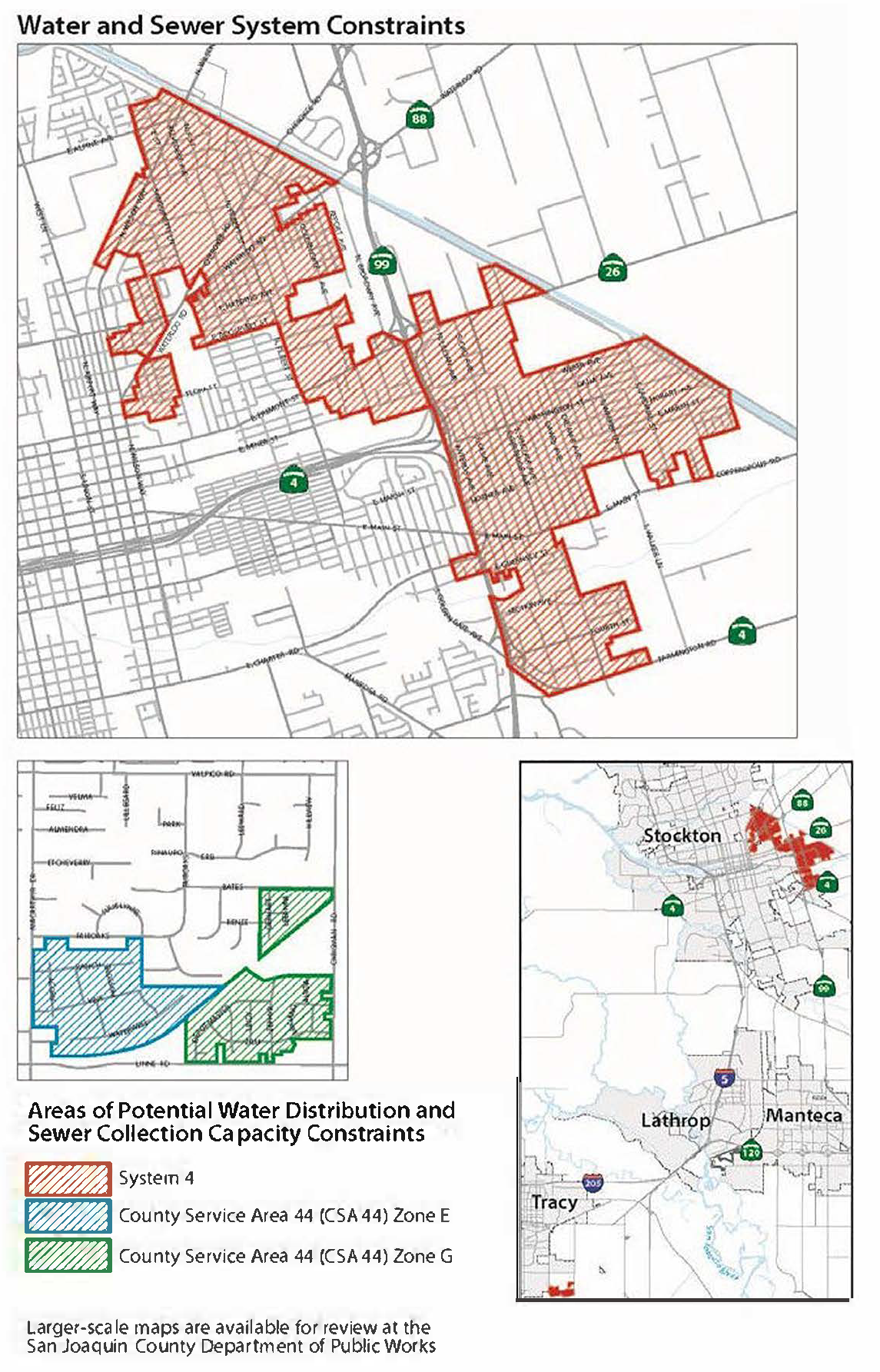
Availability of Water and Sewer Service. Prior to issuance of a building permit for an ADU, the property owner must confirmation that adequate water and wastewater disposal service is available, either from a service provider or from a well and on-site septic system, to the Director. The County has identified certain areas, shown in Figure 9-8-1401.2(e) where capacity constraints in the local sewer collection system. In these areas, a determination of adequate water and sew collection for the proposed ADU by the Department of Public Works is required.
FIGURE 9-8-1401.2(E)
(f)
Fees. The property owner of an ADU or JADU shall be subject to the payment of all sewer, water, and other applicable fees, except as specifically provided in Government Code Sections 65852.2 and 65852.22. No impact fee shall be charged for development of an ADU less than seven hundred fifty (750) square feet in size. In this context, the term "impact fee" does not include any connection fee or capacity charge established by the City or other local agency, special district, or water corporation.
(g)
ADUs Subject to Flood Hazards. All ADUs located in a floodplain designated pursuant to Chapter 2 of Division 16, Flood Haza comply with the provisions of that Chapter.
(h)
Sprinklers. ADUs are not required to provide fire sprinklers unless sprinklers are required for the primary residence.
(i)
Restrictions. All ADUs and JADUs are subject to the following restrictions:
(1)
The development and use of the ADU or JADU shall only be valid and permitted based on the terms established in this Chapter.
(2)
Prior to issuance of a building permit for an ADU or JADU, the property owner shall record a deed restriction with the County Recorder's Office and provide a copy of the stamped deed restriction to the Community Development Department, including the following restrictive covenants:
(A)
The ADU or JADU shall not be sold separately from the primary residence;
(B)
The ADU or JADU is restricted to the maximum size allowed by Chapter 14 of Division 8, Residential Accessory Dwelling Units or as approved by an ADU Permit;
(C)
The property owner and all successors in interest in the property shall respond to the City's periodic surveys of owners of ADU and JADUs for reporting purposes to the State Department of Housing and Community Development; and
(D)
If the ADU or JADU is rented, it shall not be rented for a period of less than thirty (30) consecutive days.
(Ord. 2024-18, § 1(Exh. A), 2024)
9-8-1403 - Permits Required.
(a)
Detached and Attached ADUs. An ADU permit is required for the construction of an attached or detached ADU unless:
(1)
The ADU is a detached structure no more than sixteen (16) feet high that has a floor area no greater than eight hundred (800) square feet and maintains a minimum four-foot side and rear yard setback; or
(2)
The ADU is on a lot with an existing legal multi-family residential use.
(3)
Detached and attached ADUs that do not require an ADU permit must submit a building permit application and an ADU Checklist to the Community Development Department to ensure that the standards of this Chapter are met. The Department shall not issue a building permit without an approved ADU Checklist.
(b)
Interior ADUs and JADUs. No ADU permit is required for an interior ADU and a JADU if the proposed unit meets the following requirements and the standards of this Chapter and a building permit is obtained:
(1)
The unit will be contained within an existing structure or if in an existing accessory structure, it does not require an increase in the floor area of more than twenty percent (20%) or one hundred fifty (150) square feet, whichever is greater.
(2)
The unit has exterior access from a public right-of-way that is independent from the existing residence. This access may be provided through a front yard, side yard, or rear yard.
(3)
JADUs Only: The owner of the JADU must occupy either the JADU or the remaining portion of the single-family residence.
(c)
Other Required Permits and Approvals. Projects that are exempt from obtaining an ADU Permit are still subject to applicable permit requirements and approvals, including, but not limited to, building permits, grading permits, encroachment permits, home occupation permits, flood variances, if required, sanitation permits, well permits, and other construction-related permits and approvals. The County shall not final building permits for an ADU or JADU before it finals building permits for the primary dwelling.
(Ord. 2024-18, § 1(Exh. A), 2024)
9-8-1404 - Requirements for ADU Permit Applications.
Applications for ADU Permits may be initiated by the property owner or the property owner's authorized agent by submitting a permit application and an ADU Checklist to the Community Development Department. Applications shall be filed with the Community Development Department, and the Director shall ministerially approve an ADU Permit application, provided the application is complete and demonstrates that the proposed ADU complies with all of the requirements in this Chapter. No public hearing is required. A fee, as specified by resolution of the City Council, shall be required. All of the following minimum requirements shall be met when filing an application for an ADU Permit:
(a)
Existing Residence. There shall be no more than one (1) existing single-family dwelling on the property.
(b)
Owner Occupancy—JADUs Only. The owner of the property shall occupy either the existing single-family dwelling or the proposed JADU for a period exceeding ninety (90) days per year.
(c)
Number of Units. There shall be no more than one (1) ADU and one (1) JADU per lot in the R-R, R-VL, and R-L Residential zones and in the AG, AL, and AU Agricultural zones.
(Ord. 2024-18, § 1(Exh. A), 2024)
9-8-1405 - Review Procedure.
ADU applications shall be reviewed ministerially by the Director using the Staff Review Procedure in Chapter 3 of Division 2.
(a)
The Director shall act on an ADU Permit application within sixty (60) calendar days from the date the City receives a complete application provided there is an existing single-family or multifamily dwelling on the lot.
(b)
If the permit application to create an ADU or a JADU is submitted with a permit application to create a new single-family dwelling on the lot, the City may delay acting on the permit application for the ADU until it acts on the permit application to create the new single-family dwelling, but the ADU Permit application shall still be considered ministerially without discretionary review or a public hearing.
(c)
If the applicant requests a delay, the 60-day time period shall be tolled for the period of the delay.
(d)
If the local agency has not acted upon the complete application within sixty (60) days, the application shall be deemed approved.
(Ord. 2024-18, § 1(Exh. A), 2024)
9-8-1406 - Development Standards.
All ADU Permits and building permits for ADUs approved under the provisions of this Chapter are subject to the following development standards:
(a)
Size of Unit. The ADU shall conform to the following requirements:
(1)
Except as provided in Subsection (a)(2), the ADU shall not exceed one thousand two hundred (1,200) square feet and have no more than two (2) bedrooms.
(2)
If there is an existing primary dwelling, an attached ADU shall not exceed fifty percent (50%) of the gross floor area of the primary dwelling.
(3)
An ADU with fewer than two bedrooms is limited to eight hundred and fifty (850) square feet of floor area.
(b)
Height. An attached ADU or detached ADU shall not exceed sixteen (16) feet in height, or when more than fifty percent (50%) of the floor area of an ADU is located above an existing or proposed garage, the entire combined structure (the garage plus the ADU) shall not exceed twenty-five (25) feet in height.
(c)
Location. Detached ADUs shall be separated from the primary dwelling and any accessory structures on the lot by the minimum distance required by the Building Code.
(d)
Setbacks. No setback shall be required for an interior ADU or converted ADU, and a setback of no more than four (4) feet from the side and rear lot lines shall be required for an ADU that is not converted from an existing structure or a new structure constructed. The ADU shall comply with all other yard requirements for an accessory building in the zone as well as the following requirements:
(1)
Except as provided in Subsection (d)(2), the ADU shall not extend beyond the front of the primary single-family dwelling.
(2)
In areas zoned R-R and in Agricultural zones where ADUs are allowed, the ADU may extend beyond the front of the primary single-family dwelling, provided it does not extend into the front yard setback.
(3)
For the purpose of this Section, the front of the primary single-family dwelling is defined as that part of the primary single-family dwelling that is nearest to the front yard setback.
(e)
Lot Coverage. An ADU will not be required to conform to the lot coverage standard of the zone where the ADU will be located if application of the coverage standard would violate Government Code Section 65852.2(c)(2)(C) and not allow an eight hundred (800) square foot ADU that is sixteen (16) feet in height with four-foot side and rear yard setbacks.
(f)
Building Plans.
(1)
An ADU shall include provisions for living, eating, cooking, sleeping, and sanitation including a closet or other reasonable storage.
(2)
All ADUs shall be designed to be similar in materials, color, style and form to the primary dwelling. Exterior architectural details, including windows, roof pitch, and trim, shall be similar to the primary dwelling.
(3)
All exterior lighting, including landscape lighting, shall be shielded or directed so that it does not create glare off-site or illuminate the primary dwelling or adjacent property.
(4)
For privacy and security, windows in ADUs that are within fifteen (15) feet of a side or rear lot line shall be located to avoid line of sight to windows of habitable rooms on adjacent properties. Obscured glass and other techniques may be used to avoid line of sight.
(5)
An ADU shall have separate exterior access. The exterior access shall be a standard exterior door that is located where it preserves, to the greatest extent feasible, the privacy of the primary dwelling and adjoining residences.
(6)
A permanent foundation is required for all ADUs.
(g)
Off-Street Parking. Off-street parking shall be provided as required by Chapter 2 of Division 10. The minimum parking requirement for an ADU shall be one (1) parking space. This space may be provided as tandem parking on an existing driveway or in area. No parking shall be required for a JADU, and no additional parking shall be required if the ADU is located: (1) one-half (½) mile of public transit; (2) in an historic district designated by the City; (3) in part of an existing primary res an existing accessory structure; (4) in an area requiring on-street parking permits but they are not offered to the accessory dwelling unit; or (5) within one (1) block of a car-share pick up/drop-off location. When a garage, carport, or covered parking structure is demolished in conjunction with the construction of an ADU or converted to an ADU, the parking provided by the garage, carport or covered parking structure does not have to be replaced.
(h)
Common Driveway. Except in Agricultural and R-R zones, the ADU shall be accessed by a common driveway serving both the ADU and the existing or proposed single-family residence and having a single access point or by a circular driveway with two (2) access points.
(i)
Sewer and Water.
(1)
Both the proposed ADU and the existing single-family dwelling shall have public sewage and water pservice.
(j)
Other Codes. The ADU shall conform with all the requirements of the Environmental Health Division that are applicable to residential units in the zone in which the property is located. All ADUs must satisfy building, fire, and safety standards, such as fire lane widths, minimum fire flows, and emergency egress, as established through State of California's Fire and Building Codes and as amended by the City.
(k)
Requirements for Manufactured Homes. If the ADU is a manufactured home, it shall be installed on a permanent foundation, and the following additional requirements shall apply:
(1)
No permanent room additions shall be allowed, but patio covers constructed of the same materials as the manufactured home shall be permitted; and
(2)
Skirting constructed of the same materials as the manufactured home shall be installed.
(l)
Supplemental Standards for Attached ADUs.
(1)
An attached ADU must share at least one (1) common wall or roofline with the living area of the principal dwelling.
(2)
An attached ADU shall have a separate entrance, located on the side or the rear of the ADU; provided, however, that in no event shall any external stairwell be placed within the side yard setback.
(m)
Supplemental Standards for JADUs.
(1)
No JADU shall contain more than five hundred (500) square feet of floor space. A JADU shall be contained entirely within an existing single-family dwelling. An efficiency unit (a single room that includes sleeping and kitchen function) shall not contain less than one hundred fifty (150) square feet of floor space, exclusive of a bathroom.
(A)
A JADU must be created within the existing walls of an existing single-family dwelling and must include conversion of an existing bedroom or other space within the dwelling to habitable space.
(B)
A separate exterior entry shall be provided to serve a JADU.
(C)
The JADU shall include an efficiency kitchen with a sink, a cooking appliance and refrigeration facilities, a food preparation counter, and storage cabinets.
(D)
Access to a bathroom is required, which may be part of the JADU or located in the existing primary dwelling. If provided as part of the primary dwelling, the JADU shall have direct access to the main living area of the primary dwelling so as not to need to go outside to access bathroom.
(E)
No additional parking is required for a JADU.
(2)
Supplemental Standards for Detached ADUs.
(A)
The distance between the principal dwelling and a detached ADU must be the minimum distance required by the Building Code.
(B)
A detached accessory structure legally in existence prior to the effective date of this Section and located outside of the front yard setback, may be converted into an accessory dwelling unit, regardless of any existing nonconformity as to side setback, rear setback, or height if:
(i)
The existing structure is not modified or added to in any way that increases the level of nonconformity with all applicable regulations in Title 9;
(ii)
The floor area of the resulting ADU does not exceed one thousand two hundred (1,200) square feet; and
(iii)
The minimum parking requirements are met on-site.
(Ord. 2024-18, § 1(Exh. A), 2024)
9-8-1501 - Intent.
The intent of this Chapter is to permit greater flexibility and innovation in the design and processing of projects than would otherwise be allowed under conventional zoning regulations in order to:
(a)
Encourage an efficient use of land, particularly for those parcels that are sufficiently unique in their physical characteristics or other circumstances to warrant special methods of development;
(b)
Simplify the processing of proposed projects by providing a method of concurrent review of land use, subdivision, public improvements, and siting considerations;
(c)
Allow mixed use projects, containing residential, commercial, and/or civic uses, that are desirable and compatible with surrounding uses;
(d)
Lower project costs by permitting increases in density beyond those normally allowed for standard projects and by reducing the costs associated with road and utility networks;
(e)
Encourage diversity in housing types, styles, and price ranges;
(f)
Encourage the use of common open areas and the inclusion of other amenities in project design; and
(g)
Provide for the development of sites while protecting open space resources.
(Ord. 2024-18, § 1(Exh. A), 2024)
9-8-1502 - Applicability.
The Planned Development (PD) zone may be applied to parcels carrying any General Plan designation, except the Commercial Recreation General Plan designation, and containing a minimum of four (4) contiguous acres. A PD zone may be applied to parcels containing less than four (4) contiguous acres, provided the applicant can show that a PD zone established on such parcels would meet the intent and the provisions set forth in this Chapter.
(Ord. 2024-18, § 1(Exh. A), 2024)
9-8-1503 - Uses Permitted.
The uses permitted in the PD zone shall be those uses approved by the Review Authority as part of the application approval process, provided such uses are consistent with General Plan policies.
(Ord. 2024-18, § 1(Exh. A), 2024)
9-8-1504 - Requirements for Application.
A PD zone may be initiated by the property owner or by the property owner's authorized agent. Two (2) separate applications shall be submitted: a Phase I Application and a Phase II Application, unless the Director of Community Development determines that only one (1) application, a Phase II Application, is required. If the Director authorizes the filing of only a Phase II Application, the application shall contain all relevant information required for both the Phase I and Phase II Applications. A fee, as specified by resolution of the City Council, shall be required.
(a)
Phase I Application, Contents. The Phase I Application shall contain the following:
(1)
A statement of the objectives to be achieved by the PD zone.
(2)
A statement concerning the provision of required infrastructure services and utilities.
(A)
The statement shall specify what infrastructure services and utilities will be needed by the planned development and what assurances will be made to secure their availability.
(B)
The statement shall be based on a preliminary study of the systems required (e.g., storm drainage, sanitary sewer, water, electricity).
(3)
A statement of the applicant's intentions regarding future sale or lease of all or portions of the property within the PD zone proposed for development.
(4)
A statement concerning provisions for the preservation or maintenance of the portions of the planned development to be held in common ownership.
(5)
A statement concerning protection of open space resources.
(6)
A Conceptual Site Plan and supporting maps containing, if applicable, the following:
(A)
Existing site conditions, including contours, vegetation, waterways, levees, and other natural and man-made features of the land;
(B)
Proposed street layout; off-street parking areas, including estimates of the number of off-street parking spaces; loading spaces; emergency access areas; points of access to public rights-of-way; pedestrian and bicycle ways; and transit facilities;
(C)
Proposed land uses, including areas proposed to be dedicated or reserved as common open spaces or for public or semi-public uses, with estimates of the acreage for each type of land use and preliminary computations of residential density;
(D)
Approximate arrangement of individual lots;
(E)
Approximate location and arrangement of all structures or outlines of areas within which buildings or structures may be located;
(F)
Preliminary elevations and/or perspective drawings of all proposed buildings or other structures;
(G)
A general landscaping plan; and
(H)
A general grading plan.
(7)
Information on land adjacent to the proposed PD zone, indicating important relationships between the planned development and surrounding land uses, circulation systems, public facilities, and natural features;
(8)
Such other information which may be required by the Director of Community Development to evaluate the character and impact of the proposed planned development.
(b)
Phase II Application, Contents. The Phase II Application shall contain the following:
(1)
A Detailed Site Plan containing, if applicable, the following:
(A)
A detailed plan for vehicular circulation, bicycle and pedestrian ways, transit facilities, access, and off-street parking, including road alignments and widths, finished grades, and computations of off-street parking spaces;
(B)
A detailed plan for infrastructure services and utilities, including the location and size of all utilities;
(C)
A detailed land use plan, specifying the areas within the PD zone for single-family/multi-family dwellings, commercial uses, industrial uses, off-street parking, recreational facilities, open space, and other uses, with land use acreage and residential density computations;
(D)
Arrangement and dimensions of individual lots;
(E)
Location and type of all buildings and structures, including dimensions of setbacks and yard areas;
(F)
A definitive landscaping plan, including a plan for automatic sprinklers; and
(G)
Elevations and/or perspective drawings as submitted with the Phase I Application.
(2)
A program for the installation and maintenance of parking areas, lighting, landscaping, infrastructure, utilities, and recreational facilities.
(3)
A program for the preservation/maintenance of common open space areas.
(4)
A program for the protection of open space resources.
(5)
A tentative map for a minor or major subdivision filed concurrently with the Phase II Application, if the subject property is proposed to be divided.
(6)
A development schedule indicating:
(A)
The approximate date for the start of construction; and
(B)
The phases, if any, in which the PD will be built and the approximate dates for the completion of each phase.
(c)
Professional Assistance. Preparation of the Phase I Application and the Phase II Application shall require, at a minimum, the services of a registered civil engineer (or licensed land surveyor) and a licensed architect. Depending on the complexity of the planned development, the services of a qualified urban planner and a registered landscape architect may also be required by the Director of Community Development.
(d)
Site Design Standards. The Conceptual Site Plan and the Detailed Site Plan shall be subject to the site design standards specified in Section 9-8-1511.
(Ord. 2024-18, § 1(Exh. A), 2024)
9-8-1505 - Review Procedures.
Except as modified by this Section, Phase I and Phase II Applications for a PD zone shall be reviewed by the Planning Commission using the Public Hearing Review Procedure specified in Chapter 5 of Division 2.
(a)
Review of Phase I Applications.
(1)
If the Planning Commission recommends approval of the Phase I Application, the City Council shall hold a public hearing to consider the Commission's recommendation.
(2)
If the Planning Commission denies the Phase I Application, that action shall be final unless appealed to the City Council.
(b)
Review of Phase II Applications.
(1)
If a Phase II Application is the only application required, the review of said application shall follow the same procedure as specified in Subsection (a).
(2)
If a Phase I Application and a Phase II Application are both required, the Planning Commission shall either approve or deny the Phase II Application. If the Planning Commission denies the Phase II Application, that action shall be final unless appealed to the City Council.
(Ord. 2024-18, § 1(Exh. A), 2024)
9-8-1506 - Findings.
In order to approve a Phase I Application, or a Phase II Application when said application is the only application required, the Review Authority shall determine that the following are true:
(a)
The PD zone, together with the Conceptual Site Plan or Detailed Site Plan, is consistent with the General Plan, any application Master Plan, Specific Plan, and Special Purpose Plan for the area; and any other applicable plan adopted by the City; and the intent of this Chapter.
(b)
The property is suitable for the planned development proposed.
(c)
The planned development will provide a resource protection or an amenity, above and beyond normal expectations.
(d)
The planned development will not have a significant adverse impact on surrounding properties or on external infrastructure, utility, and circulation systems on which the PD depends.
In order to approve a Phase II Application, when both a Phase I Application and Phase II Application are required, the Review Authority shall determine that the Phase II Application is in substantial conformity with the Phase I Application.
(Ord. 2024-18, § 1(Exh. A), 2024)
9-8-1507 - Effect of Approvals.
If a Phase I Application, or a Phase II Application when that is the only application required, is approved by the City Council, the zoning map of the City shall be amended to show the boundaries of the newly created PD zone. The ordinance creating the PD zone shall also approve the Conceptual Site Plan or the Detailed Site Plan, if appropriate. Under no circumstances shall development of the subject property be allowed to proceed until after the Review Authority has approved the Phase II Application.
(Ord. 2024-18, § 1(Exh. A), 2024)
9-8-1508 - Time Limit on Approvals.
(a)
Phase I Application. Within one (1) year from the date of approval of a Phase I Application by the City Council, the applicant shall submit a Phase II Application.
(1)
The applicant may request an extension of the one (1) year time limit from the City Council. Any request for extension shall be in writing, shall demonstrate good cause, and shall be filed with the Community Development Department at least thirty (30) days prior to the expiration date.
(2)
Failure to obtain an extension within the stated time period shall nullify the approval of the Conceptual Site Plan. Under such circumstances, the Community Development Department shall initiate proceedings to rezone the property affected by the PD zone back to the earlier zone designation.
(b)
Phase II Application. Within three (3) years from the date of approval of a Phase II Application, the applicant shall have commenced construction in good faith.
(1)
The applicant may request an extension of the three (3) year time limit from the Review Authority who approved the Phase II Application. The extension shall be for a period or periods not to exceed a total of three (3) years. Any request for an extension shall be in writing, shall demonstrate good cause, and shall be filed with the Community Development Department at least thirty (30) days prior to the expiration date.
(2)
Failure to commence construction in good faith or to obtain an extension within the stated time period shall nullify the approval of the Detailed Site Plan. Under such circumstances, the Community Development Department shall initiate proceedings to rezone the property affected by the PD zone back to the earlier zone designation.
(Ord. 2024-18, § 1(Exh. A), 2024)
9-8-1509 - Amendments.
Any changes or amendments to the Detailed Site Plan approved by the Review Authority shall be subject to the following provisions:
(a)
Administrative Amendments. Minor differences between the Detailed Site Plan and construction plans, minor circulation alignments, and changes in the size and siting of buildings and structures, landscape treatment, phasing, area and configuration of lots, and the like, may be authorized by the Director of Community Development if required by engineering or by other circumstances not foreseen at the time the Phase II Application was approved. Such administrative amendments shall not constitute subsequent discretionary approval subject to further CEQA review.
(b)
Nonadministrative Amendments. Changes regarding use, overall configuration of land uses and circulation features, and number of lots and increases in overall density shall not be permitted. Such nonadministrative amendments may only be secured by submitting a new PD Application.
(Ord. 2024-18, § 1(Exh. A), 2024)
9-8-1510 - Safeguards.
A Phase II Application shall not be approved by the Review Authority unless the following safeguards have been secured:
(a)
Common Open Areas. The applicant shall provide, or agree to provide, recorded land agreements, covenants, proprietary control, or other devices acceptable to the Review Authority to ensure maintenance and management of all common open areas and protection of all open space resources.
(b)
Public Facilities. The applicant shall install all public facilities and improvements, both on-site and off-site, required by the Review Authority for the PD. An agreement to secure such performance shall be in such form and executed in such manner as required by the Director of Public Works and as approved by the City Attorney.
(c)
The agreement shall be secured by a cash deposit, bond, letter of credit, or by other arrangement acceptable to the Director of Public Works and City Attorney.
(d)
The agreement may provide for improvements or facilities to be installed in units and include reasonable time limits placed upon any and all construction.
(e)
Other Facilities and Improvements. The applicant shall install all facilities and improvements, indicated in the Detailed Site Plan, that are not to be publicly owned and operated. An agreement containing safeguards satisfactory to the Review Authority and City Attorney shall be executed to secure such performance.
(Ord. 2024-18, § 1(Exh. A), 2024)
9-8-1511 - Site Design Standards.
The Conceptual Site Plan and the Detailed Site Plan shall, to the extent applicable, be subject to the following site design principles and standards:
(a)
Common Open Space.
(1)
Principles. Common open space shall be:
(A)
Designed as an essential or major element of the project;
(B)
Located to take advantage of and to help preserve existing natural amenities such as trees, topographic feat and views;
(C)
Clustered generally to create larger scale open spaces, but used also to buffer incompatible uses and to provide corridors of space around and within developed areas to achieve a spacious character and convenient linkage to all parts of the PD;
(D)
Conveniently situated for use by all residents, but primarily distributed so that the largest and most usable areas are in closest proximity to the highest density and highest intensity portions of the PD; and
(E)
Designed so that specific improvements, such as pools, play fields, court games, tot areas, and nature trails, are related to the general recreational needs of the residents or occupants of the PD.
(2)
Standards.
(A)
Common open areas shall compose a minimum of thirty (30) percent of the net land area of the PD; and
(B)
Common open areas shall be consolidated in units of at least ten thousand (10,000) square feet in area if such areas contain recreational facilities.
(b)
Private Open Space.
(1)
Principle. Private open space shall be provided which is adequate in area and usable in shape.
(2)
Standard. Private open space shall be at least four hundred (400) square feet in area for detached single-family dwellings; two hundred twenty-five (225) square feet in area for multi-family attached dwellings located on the ground floor; and sixty (60) square feet in balcony area for upper-story multi-family dwelling units.
(c)
Site and Structure Relationships. The height, bulk, intensity, and setback requirements of structures are regulated inasmuch as they meet General Plan building intensity requirements and the following principles and standards:
(1)
Principles. Buildings shall be:
(A)
Arranged so that, in general, the highest density portions of the PD are closest to existing and anticipated centers of activity, major transportation routes, transit facilities, and other public facilities;
(B)
Located in areas that permit optimum site utilization commensurate with the conservation of desirable topographic features;
(C)
Situated to provide natural light and ventilation, to protect privacy, to ensure convenient access to and around each building, and to enhance solar access;
(D)
Situated to assure a harmonious relationship with existing and anticipated land uses along peripheral boundaries;
(E)
Arranged so that spaces between buildings vary in accordance with building size and use in order to achieve a desirable visual and social relationship;
(F)
Arranged so that the distances between buildings and roads vary according to building size, use, and character of road traffic in order to provide a well planned streetscape and to assure protection from traffic noise and congestion;
(G)
Varied so that single-family dwellings avoid excessive repetition of identical floor plans;
(H)
Situated so that single-family dwellings have staggered dwelling setbacks;
(I)
Arranged so that each attached unit in multi-family structures is provided with its own identity and entry;
(J)
Situated so that buildings (except single-family dwellings), open spaces, and parking areas are grouped in or monotony of continuous rows of buildings and walls along a road;
(K)
Located on lots with various width dimensions;
(L)
Designed to incorporate in all building elevations the recesses, projections, and other features that provide rich shadow patterns and variety and visual relief;
(M)
Arranged whenever possible to take advantage of views and vistas; and
(N)
Sited and designed to provide a strong functional relationship to the site.
(2)
Standards.
(A)
For single-family dwellings, street-side building elevations on corner lots shall not exceed one (1) story in height. Split level units may be allowed, however, if the second story is stepped back from the street side yard;
(B)
For single-family dwellings, a minimum number of floor plans (and elevations for each floor plan) shall be provided, as specified below:
(C)
For PDs containing commercial uses, buildings shall occupy no more than forty (40) percent of the net land area; and
(D)
For buildings located along the boundaries of the PD, peripheral setbacks from said boundaries shall be no less than twenty (20) feet.
(d)
Vehicular Circulation.
(1)
Principles. The vehicular circulation system shall:
(A)
Provide adequate vehicular access to and within the PD and facilitate transit use;
(B)
Avoid adverse drainage conditions and grading, and conserve existing amenities of the site;
(C)
Be integrated with the natural landscape;
(D)
Accommodate water, sewer, electric, telephone, gas, cable TV, and drainage facilities whenever necessary;
(E)
Be designed to discourage through traffic within the PD;
(F)
Facilitate solar access by orienting roads along an east-west axis, except where such orientation is precluded by natural topography, resource protection, and drainage patterns;
(G)
Be designed to minimize road and utility networks; and
(H)
Reflect an informal street pattern with curvilinear or meandering roads, and cul-de-sacs.
(2)
Standards.
(A)
Unless otherwise specified, all roads within the PD, whether public or private, shall have a curb-to-curb pavement width of at least thirty-six (36) feet;
(B)
Special road cross-sections with a curb-to-curb pavement width of less than thirty-six (36) feet may be permitted for private roads by the Review Authority, provided accessibility and vehicular maneuverability is at least equivalent to a standard road;
(C)
The PD and each phase thereof shall have two (2) points of vehicular ingress and egress from surrounding roads, one (1) of which may be emergency only, except where this requirement is clearly unattainable because of topographical constraints; and
(D)
All roads, whether public or private, shall be improved in accordance with the standards of the Department of Public Works.
(e)
Pedestrian Circulation.
(1)
Principles. The pedestrian circulation system shall be:
(A)
Designed to provide safe and convenient access to dwellings, buildings, common open space, parking areas, recreational facilities, and other logical terminal points within the project;
(B)
Designed to include off-street, shared pedestrian/bicycle paths where appropriate;
(C)
Located and improved to protect the privacy of individual dwellings; and
(D)
Interconnected with the pedestrian circulation system surrounding the project.
(2)
Standards.
(A)
The walking distance from a dwelling unit or a building to the required parking space or spaces which serve it shall not exceed two hundred (200) feet as measured along a defined walkway;
(B)
The walking distance from dwelling units to guest parking spaces shall not exceed five hundred (500) feet as measured along defined walkways; and
(C)
Sidewalks serving as pedestrian ways shall not be less than four (4) feet in width.
(f)
Off-Street Parking.
(1)
Principles. Off-street parking areas shall:
(A)
Be adequate in terms of number of spaces to accommodate the needs of residents, guests, and occupants of the project; and
(B)
Generally exceed the number of spaces required by Chapter 4 of Division 10 (Parking and Loading) for specified uses to compensate for the reduction in on-street parking typically experienced with planned developments.
(2)
Standards.
(A)
The provisions of Chapter 2 of Division 10 shall apply, except as modified by this Chapter;
(B)
Two (2) parking spaces per dwelling unit shall be provided, unless otherwise allowed by the Review Authority;
(C)
Guest parking areas shall be located no further than five hundred (500) feet from the dwelling units they are intended to serve; and
(D)
Required off-street parking spaces shall be located no further than two hundred (200) feet from the dwelling units, buildings, or facilities they are intended to serve.
(g)
Landscaping Plans.
(1)
Principles. Landscaping plans shall:
(A)
Include provisions to retain and preserve existing trees, waterways, and other desirable site features that enhance the planned development; and
(B)
Include new plantings and fencing for privacy, shade, erosion control, screening, and variety.
(2)
Standards.
(A)
The provisions of Chapter 3 of Division 10 (Landscaping Regulations) shall apply, except as modified by this Chapter;
(B)
The extent and location of all plant materials and other landscape features shall be shown;
(C)
The proposed treatment of all ground surfaces shall be indicated (e.g., paving, turf, gravel);
(D)
A minimum of two (2) trees per dwelling unit shall be required, excluding street and erosion control trees;
(E)
All trees shall be fifteen (15) gallons minimum in size, unless otherwise allowed by the Review Authority; and
(F)
Fencing adjacent to major common open areas shall be open view type fencing (e.g., wrought iron) in order to increase visual open space perception.
(h)
Residential Density.
(1)
Principle. Density bonuses may be awarded to a PD, provided the PD meets the intent of this Chapter and conforms to General Plan policies.
(2)
Standards. The PD shall not exceed the maximum allowable residential densities specified below by the Residential General Plan land use designation:
du/ga = dwelling units/gross acre.
(Ord. 2024-18, § 1(Exh. A), 2024)
9-8-1601 - Intent.
The intent of this Chapter is to provide for business uses in association with residences in cases where such uses will clearly not alter the character or appearance of the residential environment.
(Ord. 2024-18, § 1(Exh. A), 2024)
9-8-1602 - Permitted Uses.
Any business use that satisfies the requirements of Section 9-8-1605 may be accepted as a home occupation, provided said business use is conducted within a legally established residence or within a building which is clearly accessory to a legally established residence.
(Ord. 2024-18, § 1(Exh. A), 2024)
9-8-1603 - Requirements for Application.
Applications for Home Occupation Permits may be initiated by the property owner or the property owner's authorized agent. Applications shall be filed with the Community Development Department. The property proposed to support the home occupation shall contain a minimum of one (1) dwelling unit. A fee, as specified by resolution of the City Council, shall be required.
(Ord. 2024-18, § 1(Exh. A), 2024)
9-8-1604 - Review Procedures.
For proposed home occupations which would not result in a change in the occupancy group of the structure, as defined by the Uniform Building Code, the review procedure for the Home Occupation Permit Application shall be the Staff Review Procedure in Chapter 3 of Division 2. For proposed home occupations which would result in a change in the occupancy group of the structure, or which would be required by State or Federal law to post business hours at the site of said home occupation and/or to be accessible to the public, the review procedure for the Home Occupation Permit Application shall be the Staff Review with Notice Procedure in Chapter 4 of Division 2.
(Ord. 2024-18, § 1(Exh. A), 2024)
9-8-1605 - Development Requirements.
In order to reduce the impact of a home occupation business to the degree that its affect on the neighborhood is undetectable from normal and usual residential activity, Home Occupation Permits approved pursuant to this Chapter shall comply with the provisions of this Section:
(a)
Permitted Home Occupations. Only home occupations subject to the Staff Review Procedure shall be permitted.
(b)
Home Occupations Subject to the Staff Review Procedure. Home Occupation Permit Applications that would not result in a change in the occupancy group of the structure as defined by the Uniform Building Code shall be subject to all of the following:
(1)
Appearance. The appearance of the structure shall not be altered, nor shall the occupation within the residence be conducted, in a manner which would cause the premises to differ from its residential character either by the use of colors, materials, construction, lighting, or signs, or by the emission of sounds, noises, or vibrations.
(2)
Employees. All employees shall be members of the resident family and shall reside on the premises.
(3)
Sale of Merchandise. There shall be no sale of merchandise on the premises, nor shall there be any customers or clients permitted on the premises.
(4)
Traffic. Pedestrian and vehicular traffic will be limited to that normally associated with residential districts.
(5)
Commercial Vehicle. The home occupation may involve the use of a commercial vehicle, not to exceed eleven thousand (11,000) pounds gross vehicle weight rating (GVWR), as defined in the California Vehicle Code, or a single-vehicle limousine service. Any commercial vehicle used in a home occupation business shall be parked within a garage or carport of the residence.
(6)
Size Limits. Up to four hundred (400) square feet and no more than one-third (⅓) of any residence, including a second unit dwelling, may be used for the home occupation.
(7)
Storage. There shall be no outdoor storage of materials or equipment; no storage of toxic or hazardous materials, including ammunition and gunpowder, except for those amounts which would normally be permitted by the Uniform Building Code or specifically approved as to type by the Director; nor shall merchandise be visible from outside the home.
(8)
Location. The home occupation shall be confined within a building. When conducted in a garage, the home occupation shall not eliminate the use of the garage as a parking space for a car.
(9)
Use of Facilities and Utilities. The use of utilities and community facilities shall be limited to that normally associated with the use of the property for residential purposes.
(10)
Advertising. There shall be no public advertising which calls attention to the fact that the home is being used for business purposes. Telephone listings shall not contain the address of the home occupation business.
(11)
Electromagnetic Interference. Electrical or mechanical equipment which creates audible interference in radio receivers or visual or audible interference in television receivers or causes fluctuations in line voltage outside the dwelling unit is prohibited.
(12)
Objectionable Impacts. Work that produces noise, vibration, glare, fumes, odors, dust or electrical interference outside of the residence or structure is prohibited.
(c)
Home Occupations Subject to the Staff Review with Notice Procedure. Proposed home occupations which would result in a change in the occupancy group of the structure as defined by the Uniform Building Code, or which would be required by State or Federal law to post business hours at the site of said home occupation and/or to be accessible to the public, shall be subject to all of the requirements of Subsection (a), with the following modifications:
(1)
Size Limits. The home occupation may be conducted in a building on the subject property that is accessory to the residence, provided said accessory building does not exceed four hundred (400) square feet of floor area.
(2)
Business Visitors/Clients. Business visitors or clients shall be permitted on the subject property, provided the number of such visits does not exceed two (2) per day.
(3)
Approval by Fire Marshall. The home occupation shall be subject to the approval of the Fire Marshall.
(Ord. 2024-18, § 1(Exh. A), 2024)
9-8-1606 - Noncompliance with Development Requirements.
The Review Authority may void any Home Occupation Permit for noncompliance with the development requirements set forth in approving the permit, and shall give notice of such action to the permittee, as provided in Chapter 7 of Division 2.
(Ord. 2024-18, § 1(Exh. A), 2024)
9-8-1607 - Prohibited Uses.
The following uses are expressly prohibited as home occupations:
(a)
Taxicab, limousine, ambulance services, tow truck services or other services involving the on-call dispatching of a vehicle parked at the residence by radio, telephone, or other means;
(b)
Storage, repair, or reconditioning of cars, boats, recreational vehicles, and other motorized vehicles;
(c)
Storage, repair or reconditioning of major household appliances or other such large mechanical equipment on-site;
(d)
Any use that is included in Group H Occupancies;
(e)
Such other uses as determined by the Director to be incompatible with residences, residential uses, or the residential character of the neighborhood.
(Ord. 2024-18, § 1(Exh. A), 2024)
9-8-1608 - Renewal of Home Occupation Permit Without Penalty.
A holder of a Home Occupation Permit who is in violation of the provisions under which it was originally issued may renew the Home Occupation Permit without penalty, provided the home occupation business is conducted in accordance with the provisions of this Chapter. The holder of such Home Occupation Permit shall have thirty (30) days from the date of receipt of written notification of required renewal by the City to renew said Home Occupation Permit.
(Ord. 2024-18, § 1(Exh. A), 2024)
9-8-1701 - Nature of Flood Variances.
(a)
The issuance of a Flood Variance is for floodplain management purposes only. Insurance premium rates are determined by statute according to actuarial risk and will not be modified by the granting of a Flood Variance.
(b)
The Flood Variance criteria set forth in this section of the ordinance are based on the general principle of zoning law that Flood Variances pertain to a piece of property and are not personal in nature. A Flood Variance may be granted for a parcel of property with physical characteristics so unusual that complying with the requirements of this ordinance would create an exceptional hardship to the applicant or the surrounding property owners. The characteristics must be unique to the property and not be shared by adjacent parcels. The unique characteristic must pertain to the land itself, not to the structure, its inhabitants, or the property owners.
(c)
It is the duty of the Community Development Department and the Department of Public Works to help protect its citizens from flooding. This need is so compelling and the implications of the cost of insuring a structure built below flood level are so serious that Flood Variances from the flood elevation or from other requirements in the flood ordinance are quite rare. The long term goal of preventing and reducing flood loss and damage can only be met if Flood Variances are strictly limited. Therefore, the Flood Variance guidelines provided in this ordinance are more detailed and contain multiple provisions that must be met before a Flood Variance can be properly granted. The criteria are designed to screen-out those situations in which alternatives other than a Flood Variance are more appropriate.
(Ord. 2024-18, § 1(Exh. A), 2024)
9-8-1702 - Conditions for Flood Variances.
(a)
Generally, Flood Variances may be issued for new construction, substantial improvement, and other proposed new development to be erected on a lot of one-half acre or less in size contiguous to and surrounded by lots with existing structures constructed below the base flood level, providing that the procedures of Division 16 of this ordinance have been fully considered. As the lot size increases beyond one-half acre, the technical justification required for issuing the Flood Variance increases.
(b)
Flood Variances may be issued for the repair or rehabilitation of "historic structures" upon a determination that the proposed repair or rehabilitation will not preclude the structure's continued designation as an historic structure and the Flood Variance is the minimum necessary to preserve the historic character and design of the structure.
(c)
Flood Variances shall not be issued within any mapped regulatory floodway if any increase in flood levels during the bas discharge would result.
(d)
Flood Variances shall only be issued upon a determination that the Flood Variance is the "minimum necessary" considering the flood hazard, to afford relief. "Minimum necessary" means to afford relief with a minimum of deviation from the requirements of this ordinance. For example, in the case of Flood Variances to an elevation requirement, this means the Community Development Department and the Department of Public Works need not grant permission for the applicant to build at grade, or even to whatever elevation the applicant proposes, but only to that elevation which the Community Development Department and the Department of Public Works believe will both provide relief and preserve the integrity of the local ordinance.
(e)
Any applicant to whom a Flood Variance is granted shall be given written notice over the signature of a community official that:
(1)
The issuance of a Flood Variance to construct a structure below the base flood level will result in increased premium rates for flood insurance up to amounts as high as twenty-five dollars ($25.00) for one hundred dollars ($100.00) of insurance coverage, and
(2)
Such construction below the base flood level increases risks to life and property. It is recommended that a copy of the notice shall be recorded by the Floodplain Administrator in the Office of the City of Mountain House Recorder and shall be recorded in a manner so that it appears in the chain of title of the affected parcel of land.
(f)
The Floodplain Administrator will maintain a record of all Flood Variance actions, including justification for their issuance, and report such Flood Variances issued in its biennial report submitted to the Federal Emergency Management Agency.
(Ord. 2024-18, § 1(Exh. A), 2024)
9-8-1703 - Appeal Board.
(a)
In passing upon requests for Flood Variances, the Community Development Department and the Department of Public Works shall consider all technical evaluations, all relevant factors, standards specified in other sections of this ordinance, and the:
(1)
Danger that materials may be swept onto other lands to the injury of others;
(2)
Danger of life and property due to flooding or erosion damage;
(3)
Susceptibility of the proposed facility and its contents to flood damage and the effect of such damage on the existing individual owner and future owners of the property;
(4)
Importance of the services provided by the proposed facility to the community;
(5)
Necessity to the facility of a waterfront location, where applicable;
(6)
Availability of alternative locations for the proposed use which are not subject to flooding or erosion damage;
(7)
Compatibility of the proposed use with existing and anticipated development;
(8)
Relationship of the proposed use to the comprehensive plan and floodplain management program for that area;
(9)
Safety of access to the property in time of flood for ordinary and emergency vehicles;
(10)
Expected heights, velocity, duration, rate of rise, and sediment transport of the flood waters expected at the site; and
(11)
Costs of providing governmental services during and after flood conditions, including maintenance and repair of public utilities and facilities such as sewer, gas, electrical, and water system, and streets and bridges.
(b)
Flood Variances shall only be issued upon a:
(1)
Showing of good and sufficient cause;
(2)
Determination that failure to grant the Flood Variance would result in exceptional "hardship" to the applicant; and
(3)
Determination that the granting of a Flood Variance will not result in increased flood heights, additional threats to public safety, or extraordinary public expense, create a nuisance (see "Public safety and nuisance"), cause "fraud and victimization" of the public, or conflict with existing local laws or ordinances.
(c)
Flood Variances may be issued for new construction, substantial improvement, and other proposed new development necessary for the conduct of a functionally dependent use provided that the provisions of 9-8-1703(a) through 9-8-1703(d) are satisfied and that the structure or other development is protected by methods that minimize flood damages during the base flood and does not result in additional threats to public safety and does not create a public nuisance.
(d)
Upon consideration of the factors of 9-8-1702(a) and the purposes of this ordinance, the Community Development Department and the Department of Public Works may attach such conditions to the granting of Flood Variances as it deems necessary to further the purposes of this ordinance.
(Ord. 2024-18, § 1(Exh. A), 2024)
9-8-1704 - Review Procedure.
The review procedure for a Flood Variance Application shall be a Public Hearing by the Planning Commission, as set forth in Chapter 5 of Division 2.
(Ord. 2024-18, § 1(Exh. A), 2024)
9-8-1705 - Exceptions and Exclusions.
The following provisions shall apply:
(a)
Flood Variances may be issued for the reconstruction, rehabilitation, or restoration of structures listed in the National Register of Historic Places or the State Inventory of Historic Places, without regard to the procedures set forth in the remainder of this Chapter; and
(b)
Flood Variances shall not be issued within a floodway if an increase in flood levels during the one hundred (100) year flood discharge would result.
(Ord. 2024-18, § 1(Exh. A), 2024)
9-8-1706 - Findings.
Prior to approving an application for a Flood Variance, the Review Authority shall find that all of the following are true:
(a)
There is good and sufficient cause for the Flood Variance;
(b)
Failure to grant the Flood Variance would result in exceptional hardship to the applicant;
(c)
The Flood Variance will not result in increased flood heights, create additional threats to public safety, produce extraordinary public expense, create nuisances, cause fraud on or victimization of the public, or conflict with existing local laws or ordinances;
(d)
The Flood Variance is the minimum necessary, considering the flood hazard, to afford relief; and
(e)
Granting of the Flood Variance will not constitute a grant of special privileges inconsistent with the limitations on similarly situated properties subject to the City's flood regulations.
(Ord. 2024-18, § 1(Exh. A), 2024)
9-8-1707 - Notice of Increased Risk.
Any applicant to whom a Flood Variance is granted shall be given written notice that the structure will be permitted to be built with the lowest floor elevation below the regulatory flood elevation and that the cost of insurance will be commensurate with the increased risk resulting from the reduced lowest floor elevation. The notice shall be prepared by the Community Development Department and recorded by the office of the City of Mountain House Recorder in such a manner to make it appear in the chain of title of the affected parcel of land.
(Ord. 2024-18, § 1(Exh. A), 2024)
9-8-1801 - Intent.
The intent of this Chapter is to provide a method for:
(a)
Allowing the removal of excess material from property in order to increase the property's agricultural potential, while protecting people, property, and the environment from impacts caused by the grading excavation; and
(b)
Ensuring the reclamation of excavation sites.
(Ord. 2024-18, § 1(Exh. A), 2024)
9-8-1802 - Permitted Zones.
Applications for Agricultural Excavation Permits may be accepted in the following zones:
(a)
AL zone;
(b)
AG zone;
(c)
AU zone.
(Ord. 2024-18, § 1(Exh. A), 2024)
9-8-1803 - Requirements for Application.
An application for an Agricultural Excavation Permit shall include the following:
(a)
A Certified Grading Plan prepared by a registered civil engineer;
(b)
An Operational Statement;
(c)
A soils report, prepared by a soil scientist qualified to analyze agricultural soils, shall be required for all proposals where the topsoil is not proposed to be replaced;
(d)
An Excavation/Reclamation Plan and schedule prepared by a registered civil engineer;
(e)
Proposed methods of financial guarantees of performance;
(f)
An Erosion, Sediment and Pollution Control Plan to minimize impacts on waterways and/or roadways during excavation; and
(g)
A fee as specified by resolution of the City Council.
(Ord. 2024-18, § 1(Exh. A), 2024)
9-8-1804 - Review Procedures.
The review procedure for an Agricultural Excavation Permit Application shall be the Staff Review With Notice procedure, as set forth in Chapter 4 of Division 2.
(Ord. 2024-18, § 1(Exh. A), 2024)
9-8-1805 - Findings.
Prior to approving an application for an Agricultural Excavation Permit, the Review Authority shall find that all of the following are true:
(a)
The amount of the material being removed is the least amount required to enhance the agricultural suitability of the property;
(b)
The excavation will not have a detrimental effect on any surrounding agricultural lands;
(c)
Issuance of the permit shall not be significantly detrimental to the public health, safety or welfare, or be injurious to the property or improvements in the vicinity; and
(d)
All applicable provisions of the Mountain House Development Agreement have been met.
(Ord. 2024-18, § 1(Exh. A), 2024)
9-8-1806 - Development Standards.
Approved Agricultural Excavation Permits shall be subjected to the development standards specified in Chapter 3 of Division 14.
(Ord. 2024-18, § 1(Exh. A), 2024)
9-8-1807 - Time Limit on Approvals.
If the excavation does not commence within eighteen (18) months after the date of approval of the Agricultural Excavation Permit, the permit shall lapse and become void.
(Ord. 2024-18, § 1(Exh. A), 2024)
9-8-1808 - Expansion.
A new Agricultural Excavation Permit shall not be required for the expansion of an existing or approved agricultural excavation, provided all of the following requirements are satisfied:
(a)
Any proposed expansion(s) may involve no more than a ten percent (10%) increase in the overall site area covered by the existing or approved agricultural excavation;
(b)
The proposed expansion, in the opinion of the Director, will not have a substantial, adverse effect on adjacent property or on significant biotic resources on the site;
(c)
The proposed expansion will comply with existing requirements of agencies having jurisdiction and any other appropriate regulatory agency; and
(d)
An Improvement Plan pursuant to Section 9-8-2801 is submitted to the City.
(Ord. 2024-18, § 1(Exh. A), 2024)
9-8-1809 - Surface Mining and Reclamation Act.
Approved Agricultural Excavation Permits shall be subject to the regulations adopted by the State Mining and Geology Board as authorized by the California Surface Mining and Reclamation Act (SMARA) of 1975 (Public Resource Code Section 2710 et seq.), as amended; Public Resource Code Section 2207; and the California Code of Regulations adopted pursuant thereto (Title 14, Section 3500 et seq.).
(Ord. 2024-18, § 1(Exh. A), 2024)
9-8-1901 - Intent.
The intent of this Chapter is to provide a method for reviewing and approving Major Subdivision Applications.
(Ord. 2024-18, § 1(Exh. A), 2024)
9-8-1902 - Requirements for Application.
A Major Subdivision Application may be initiated by the property owner or the property owner's authorized agent. The application shall include a Tentative Map or, at the option of the applicant, a Vesting Tentative Map and other maps or documents required by the Review Authority. A fee, as specified by resolution of the City Council, shall be required.
In addition to the application requirements specified in Section 9-8-1902 and Chapters 2 of Division 9 of the Development Title, the application requirements listed below shall be applicable. The Community Development Director may waive one or more of the application requirements if inapplicable to the project, or valid information has been previously submitted.
(a)
Reports. The following reports/documents shall be submitted with the Major Subdivision Application:
(1)
Cultural Resources Report, specifying the method of preserving significant architectural and/or historic cultural resources within the boundaries of the proposed subdivision;
(2)
Canal Report, evaluating the safety of open canals within one-half (½) mile of the boundaries of the proposed subdivision, and specifying the means to be taken to reduce the attractive nuisance of such canals to the future residents of the proposed subdivision;
(3)
Special Status Species Survey, consisting of a survey conducted by a qualified biologist of special status species within the boundaries of the proposed subdivision;
(4)
Tree Survey, specifying the location, species, and condition of all mature trees within the proposed subdivision;
(5)
Nesting Site Survey, consisting of a survey conducted by a qualified biologist of occupied raptor nests in trees and of burrowing owl nesting sites within the boundaries of the proposed subdivision;
(6)
Noise Study, conducted pursuant to Section 9-10-709, consisting of an assessment of existing and proposed noise contours, and proposed measures to control noise;
(7)
Farm Irrigation Drainage Report, consisting of a map of existing farm drains that traverse the proposed subdivision, identified by type, location and function; an analysis of the impacts of the proposed subdivision on the existing farm irrigation drainage system; a determination of the planned dispossession of the system, including the abandonment of specific pipes and drains; a determination of whether the farm irrigation drainage system could be integrated into the storm system for the proposed subdivision; and an estimate of the costs associated with reconstructing or rerouting irrigation waters caused by the proposed subdivision.
(b)
Attachments. The following attachments shall be submitted with the Major Subdivision Application:
(1)
Will Serve Letters for all public services and utilities from the CSD and other service providers;
(2)
If a Development Agreement has been executed for the subject area, letter acknowledging completion of all required plans and programs as specified in said Development Agreement;
(3)
Vehicle Circulation Plan and Roadway Improvement Plan;
(4)
Typical sections, including standards, for streets, alleys, bicycle paths/lanes, and pedestrian sidewalks/paths;
(5)
Pedestrian, Bicycle, and Transit Connections Plan;
(6)
Fencing and Edge Treatment Plan, showing community walls and community edge treatments and including community edge buffers;
(7)
Soundwall Plan;
(8)
Street Landscaping Plan, including neighborhood and community entries, showing implementation of CSD Roadway Landscaping Plan;
(9)
Street Lighting Plan;
(10)
Second Unit Dwelling Plan, showing the location of all required second unit dwellings on a lot by lot basis, in accordance with Section 9-8-1305;
(11)
Open Space, Recreation, and Trails Plan;
(12)
Sensitive Habitats Map, showing sensitive habitats, waterways, wetlands, and riparian areas;
(13)
Conceptual Site Design Plan, showing sidewalks, driveways, pathways, off-street parking, building footprints, setbacks and building coverage, landscaping, and internal circulation (for nonresidential uses), for each specific land use type; and
(14)
Neighborhood Center Special Purpose Plan, if applicable, with illustrative drawings and map of the Neighborhood Center showing land use and building types (including child care centers), sidewalks, driveways, pathways, internal circulation, off-street parking, building footprints, setbacks, building coverage, landscaping, recreational uses, activity areas, and transit stops; and including related documents, specifically, the School Facilities Plan, the Neighborhood Park Plan, and Joint Powers Agreement for joint use of school and park facilities.
(c)
Project Description. A project description shall be submitted with the Major Subdivision Application. The project description shall provide sufficiently detailed information, as identified on the application form, to provide for comprehensive consistency findings with the Master Plan, Specific Plan, Development Title, EIR mitigations and monitoring program, and any applicable Special Purpose Plans.
(Ord. 2024-18, § 1(Exh. A), 2024)
9-8-1903 - Review Procedures.
Major Subdivision Applications shall be reviewed using the Public Hearing Procedure specified in Chapter 5 of Division 2, with the following modifications:
(a)
Action with no EIR. If an Environmental Impact Report is not required, the final action on the application shall be rendered within fifty (50) calendar days after it is accepted as complete.
(b)
Action with EIR. If an Environmental Impact Report is required, the final action shall be rendered within forty-five (45) calendar days after certification of the Environmental Impact Report.
(c)
Appeals. Appeals of any Planning Commission decision shall be heard by the City Council within thirty (30) calendar days, or any mutually agreed upon extension thereof, after the date of filing the appeal. A final decision shall be rendered within ten (10) calendar days, or any authorized extension thereof, after the conclusion of the hearing before the City Council.
(d)
Notice of Hearing. Notification of any public hearing shall include publication in a newspaper of general circulation within the City at least ten (10) days prior to the hearing.
(e)
Notice of Multiple Final Maps. If the applicant intends to file multiple final maps, the applicant shall inform the Review Authority of such intention at the time of filing the Major Subdivision Application or prior to the public hearing on the Major Subdivision Application.
(Ord. 2024-18, § 1(Exh. A), 2024)
9-8-1904 - Findings.
Prior to approving an application for a major subdivision, the Review Authority shall find that all of the following are true:
(a)
Plan Consistency. The proposed subdivision is consistent with the General Plan, the Master Plan, any applicable Spe any applicable Special Purpose Plan, the Public Financing Plan, and any other applicable plan adopted by the City;
(b)
Design or Improvement. The design or improvement of the proposed subdivision is consistent with the General Plan, the Master Plan, any applicable Specific Plan and any applicable Special Purpose Plan;
(c)
Type of Improvement. The site is physically suitable for the type of development proposed;
(d)
Density of Development. The site is physically suitable for the proposed density of development;
(e)
Fish or Wildlife. Neither the design of the subdivision nor any proposed improvements are likely to cause substantial environmental damage or substantially and unavoidably injure fish or wildlife or their habitat;
(f)
Public Health. The design of the subdivision or type of improvement is not likely to cause significant public health problems;
(g)
Access. The design of the subdivision or the type of improvements will not conflict with easements acquired by the public at large for access through or use of property within the proposed subdivision;
(h)
Dedications. Any land or improvement to be dedicated to a public agency is consistent with the General Plan, the Master Plan, any applicable Specific Plan, any applicable Special Purpose Plan, and any other applicable plan adopted by the City;
(i)
Energy. The design of the subdivision provides, to the extent feasible, for future passive or natural heating or cooling opportunities in the subdivision, as required by Government Code Section 66473.1; and
(j)
Development Agreement. All applicable provisions of the Mountain House Development Agreement have been met.
(Ord. 2024-18, § 1(Exh. A), 2024)
9-8-1905 - Expiration Date.
A Major Subdivision Application which has been approved shall expire thirty-six (36) months after the date of its approval, unless otherwise specified in this Title.
(Ord. 2024-18, § 1(Exh. A), 2024)
9-8-1906 - Vested Rights.
An approved Major Subdivision Application that includes a Vesting Tentative Map shall confer rights as set forth in this section.
(a)
Vested Rights. The approval of the Major Subdivision Application shall confer a vested right to proceed with development in substantial compliance with the ordinances, policies, and standards described in Section 66498.1 of the Government Code.
(b)
Exceptions. Notwithstanding Subsection (a), a permit, approval, extension, or entitlement may be conditioned or denied if either of the following is determined:
(1)
Failure to do so would place the residents of the subdivision, the immediate community, or both in a condition dangerous to their health, safety, or both; or
(2)
Condition or denial is required in order to comply with state or federal law.
(c)
Time Periods. The vested rights referred to in Subsection (a) shall expire if a final map is not approved prior to the expiration of the approved Major Subdivision Application. If the final map is approved, vested rights shall continue as follows:
(1)
Vested rights shall remain in effect for an initial time period of one (1) year. Where several final maps are recorded on various phases of a project covered by a single Vesting Tentative Map, this one (1) year initial time period shall begin for each phase when the final map for that phase is recorded. All of said final maps must be recorded within the time period set forth in Section 9-8-1905, or the vested rights shall expire for those parcels for which final maps are not timely recorded.
(2)
The one (1) year initial time period set forth in Subsection (c)(1) shall be automatically extended by any time used for processing a complete application for a grading permit, if one (1) is required, or for any required design or architectural review, if such processing exceeds thirty (30) days from the date a complete application is filed.
(3)
If the subdivider submits a complete application for a building permit during the periods of time specified in Subsections (c)(1) and (c)(2) or during any approved time extensions of the initial one (1) year time period specified in Subsection (c)(1), the vested rights referred to in this section shall continue until the expiration of that building permit, or any extension of that building permit.
(d)
Subsequent Conditioning. Consistent with Subsection (a), an approved or conditionally approved Vesting Tentative not limit the Review Authority from imposing reasonable conditions on subsequent approvals or permits necessary development.
(Ord. 2024-18, § 1(Exh. A), 2024)
9-8-1907 - Preliminary Maps.
A Preliminary Map that is a Major Subdivision application may, at the discretion of the Director, be required to meet all or some of the requirements for tentative maps specified by the Mountain House Master Plan and the Development Title.
(Ord. 2024-18, § 1(Exh. A), 2024)
9-8-1908 - Major Subdivisions Not Within Master Plan Density Range.
A Major Subdivision Application in which the subdivision exceeds or falls below the density range for any given land use designation specified by the Mountain House Master Plan may be approved, provided the density of development for said land use designation is within the General Plan density range and the Mountain House Master Plan density range for that land use district will be maintained for the neighborhood.
(Ord. 2024-18, § 1(Exh. A), 2024)
9-8-1909 - Approval of Specified Major Subdivision Plan Attachments.
The following attachments to a Major Subdivision Application shall be approved using the Staff Review procedure specified in Chapter 3 of Division 2 of the Development Title:
(a)
Vehicle Circulation Plan and Roadway Improvement Plan;
(b)
Pedestrian, Bicycle, and Transit Connections Plan;
(c)
Fencing and Edge Treatment Plan;
(d)
Soundwall Plan;
(e)
Street Landscaping Plan;
(f)
Street Lighting Plan;
(g)
Second Unit Dwelling Plan; and
(h)
Open Space, Recreation and Trails Plan.
The Director shall approve or deny these attachments, based upon consistency with the Master Plan, and other applicable community plans and development standards.
(Ord. 2024-18, § 1(Exh. A), 2024)
9-8-1910 - Amendment of Second Unit Dwelling Plan.
An approved Second Unit Dwelling Plan may be amended using the Staff Review procedure specified in Chapter 3 of Division 2 of the Development Title, provided the following conditions are met:
(a)
For each second unit dwelling that is to be relocated from an original designated parcel on the Second Unit Dwelling Plan, a replacement parcel shall be designated to provide a site for said second unit dwelling;
(b)
All replacement parcels noted in Subsection (a) shall be clearly indicated on the revised Second Unit Dwelling Plan; and
(c)
The replacement parcels specified in Subsection (a) shall be within the same neighborhood.
(Ord. 2024-18, § 1(Exh. A), 2024)
9-8-2001 - Intent.
The intent of this Chapter is to provide a method for reviewing and approving Minor Subdivision Applications.
(Ord. 2024-18, § 1(Exh. A), 2024)
9-8-2002 - Requirements for Application.
In addition to the application requirements specified in Section 9-860.2 and Chapter 2 of Division 9 of the Development Title, the additional application requirements specified in Section 9-8-1902 for Major Subdivision Applications shall be required for Minor Subdivision Applications.
(Ord. 2024-18, § 1(Exh. A), 2024)
9-8-2003 - Review Procedures.
Minor Subdivision Applications shall be reviewed using the Staff Review With Notice procedure specified in Chapter 4 of Division 2, with the following modifications:
(a)
Action with No EIR. If an Environmental Impact Report is not required, the final action on the application shall be rendered within fifty (50) calendar days after it is accepted as complete.
(b)
Action with EIR. If an Environmental Impact Report is required, the final action shall be rendered within forty-five (45) calendar days after certification of the Environmental Impact Report.
(c)
Appeals. Appeals of any decision shall be heard by the appropriate Review Authority within thirty (30) calendar days, or any mutually agreed upon extension thereof, after the date of filing the appeal. A final decision shall be rendered within ten (10) calendar days, or any authorized extension thereof, after the conclusion of the hearing.
(d)
Notice of Hearing. Notification of any public hearing shall include publication in a newspaper of general circulation within the City at least ten (10) days prior to the hearing.
(Ord. 2024-18, § 1(Exh. A), 2024)
9-8-2004 - Findings.
Prior to approving an application for a Minor Subdivision, the Review Authority shall find that all of the following are true:
(a)
Plan Consistency. The proposed subdivision is consistent with the General Plan, the Master Plan, any applicable Specific Plan, any applicable Special Purpose Plan, the Public Financing Plan and any other applicable plan adopted by the City;
(b)
Design or Improvement. The design or improvement of the proposed subdivision is consistent with the General Plan, the Master Plan, any applicable Specific Plan and any applicable Special Purpose Plan;
(c)
Type of Improvement. The site is physically suitable for the type of development proposed;
(d)
Density of Development. The site is physically suitable for the proposed density of development;
(e)
Fish or Wildlife. Neither the design of the subdivision nor any proposed improvements are likely to cause substantial environmental damage or substantially and unavoidably injure fish or wildlife or their habitat;
(f)
Public Health. The design of the subdivision or type of improvement is not likely to cause significant public health problems;
(g)
Access. The design of the subdivision or the type of improvements will not conflict with easements acquired by the public at large for access through or use of property within the proposed subdivision;
(h)
Dedications. Any land or improvement to be dedicated to a public agency is consistent with the General Plan, the Master Plan, any applicable Specific Plan, any applicable Special Purpose Plan and any other applicable plan adopted by the City;
(i)
Energy. The design of the subdivision provides, to the extent feasible, for future passive or natural heating or cooling opportunities in the subdivision, as required by Government Code Section 66473.1; and
(j)
Development Agreement. All applicable provisions of the Mountain House Development Agreement have been met.
(Ord. 2024-18, § 1(Exh. A), 2024)
9-8-2005 - Expiration Date.
A Minor Subdivision Application which has been approved or conditionally approved shall expire thirty-six (36) months after the date of its approval or conditional approval, unless otherwise specified in this Title.
(Ord. 2024-18, § 1(Exh. A), 2024)
9-8-2006 - Vested Rights.
An approved Minor Subdivision Application that includes a Vesting Tentative Map shall confer rights as set forth in this section.
(a)
Vested Rights. The approval or conditional approval of the Minor Subdivision Application shall confer a vested right to proceed with development in substantial compliance with the ordinances, policies, and standards described in Section 66498.1 of the Government Code.
(b)
Exceptions. Notwithstanding Subsection (a), a permit, approval, extension, or entitlement may be conditioned or denied if either of the following is determined:
(1)
Failure to do so would place the residents of the subdivision, the immediate community, or both in a condition dangerous to their health, safety, or both; or
(2)
Condition or denial is required in order to comply with state or federal law.
(c)
Time Periods. The vested rights referred to in Subsection (a) shall expire if a parcel map is not approved prior to the expiration of the approved Minor Subdivision Application. If the parcel map is approved, vested rights shall continue as follows:
(1)
Vested rights shall remain in effect for an initial time period of one (1) year. A parcel map must be recorded within the time period set forth in Section 9-860.5, or the vested rights shall expire.
(2)
The one (1) year initial time period set forth in Subsection (c)(1) shall be automatically extended by any time used for processing a complete application for a grading permit, if one is required, or for any required design or architectural review, if such processing exceeds thirty (30) days from the date a complete application is filed.
(3)
If the subdivider submits a complete application for a building permit during the periods of time specified in Subsections (c)(1) and (c)(2) or during any approved time extensions of the initial one (1) year time period specified in Subsection (c)(1), the vested rights referred to in this section shall continue until the expiration of that building permit or any extension of that building permit.
(d)
Subsequent Conditioning. Consistent with Subsection (a), an approved or conditionally approved Vesting Tentative Map shall not limit the Review Authority from imposing reasonable conditions on subsequent approvals or permits necessary for the development.
(Ord. 2024-18, § 1(Exh. A), 2024)
9-8-2007 - Preliminary Maps.
A Preliminary Map that is a Minor Subdivision application may, at the discretion of the Director, be required to meet all or some of the requirements for tentative maps specified by the Mountain House Master Plan and the Development Title.
(Ord. 2024-18, § 1(Exh. A), 2024)
9-8-2008 - Minor Subdivisions Not Within Master Plan Density Range.
A Minor Subdivision Application in which the subdivision exceeds or falls below the density range for any given land use designation specified by the Mountain House Master Plan may be approved, provided the density of development for said land use designation is within the General Plan density range and the Mountain House Master Plan density range for that land use district will be maintained for the neighborhood.
(Ord. 2024-18, § 1(Exh. A), 2024)
9-8-2009 - Approval of Specified Minor Subdivision Plan Attachments.
The following attachments to a Minor Subdivision Application shall be approved using the Staff Review procedure specified in Chapter 3 of Division 2 of the Development Title:
(a)
Vehicle Circulation Plan and Roadway Improvement Plan;
(b)
Pedestrian, Bicycle, and Transit Connections Plan;
(c)
Fencing and Edge Treatment Plan;
(d)
Soundwall Plan;
(e)
Street Landscaping Plan;
(f)
Street Lighting Plan;
(g)
Second Unit Dwelling Plan; and
(h)
Open Space, Recreation, and Trails Plan.
The Director shall approve or deny these attachments, based upon consistency with the Master Plan, and other applicable community plans and development standards.
(Ord. 2024-18, § 1(Exh. A), 2024)
9-8-2010 - Amendment of Second Unit Dwelling Plan.
An approved Second Unit Dwelling Plan may be amended using the Staff Review procedure specified in Chapter 3 of Division 2 of the Development Title, provided the following conditions are met:
(a)
For each second unit dwelling that is to be relocated from an original designated parcel on the Second Unit Dwelling Plan, a replacement parcel shall be designated to provide a site for said second unit dwelling;
(b)
All replacement parcels noted in Subsection (a) shall be clearly indicated on the revised Second Unit Dwelling Plan; and
(c)
The replacement parcels specified in Subsection (a) shall be within the same neighborhood.
(Ord. 2024-18, § 1(Exh. A), 2024)
9-8-2101 - Intent.
The intent of this Chapter is to provide a method for the City to initiate the merger of two or more existing, contiguous parcels or units of land under the same ownership in order to achieve orderly development, protect new development, and implement the policies of the General Plan.
(Ord. 2024-18, § 1(Exh. A), 2024)
9-8-2102 - Requirements for Application.
Applications for County-Initiated Mergers may be initiated by the City Council, the Planning Commission, or the Director of the Community Development Department. A County-Initiated Merger may proceed only if the parcels are under the same ownership, one (1) of the parcels or units has less area than the minimum parcel area or lot area required for new parcels or lots by the regulating zone, and if the requirements of Subsections (a) and (b) are satisfied.
(a)
Development. At least one (1) of the affected parcels is: 1) undeveloped by any structure for which a building permit was issued, or for which a building permit was not required at the time of construction, 2) is developed only with an accessory structure or structures, or 3) is developed with a single structure, other than an accessory structure, that is also partially sited on a contiguous parcel or unit.
(b)
Substandard Conditions. With respect to any affected parcel, one (1) or more of the following conditions exists:
(1)
The parcel comprises less than five thousand (5,000) square feet in area at the time of the determination of merger;
(2)
The parcel was not created in compliance with applicable laws and ordinances in effect at the time of its creation;
(3)
The parcel does not meet current standards for sewage disposal and domestic water supply;
(4)
The parcel has no legal access which is adequate for vehicular and safety equipment access and maneuverability;
(5)
Development of the parcel would create health or safety hazards;
(6)
Existence of the parcel is inconsistent with the General Plan and any applicable Specific Plan or Special Purpose Plan, other than minimum lot size or density standards; or
(7)
The parcel does not meet slope stability standards.
(c)
Ownership. For purposes of determining whether contiguous parcels are held by the same owner, ownership shall be determined as of the date that the Notice of Intention to Determine Status is recorded pursuant to this Chapter.
(d)
Exceptions. This section shall not apply if any of the conditions stated in Sections 66451.11(b)(A), (B), (C), or (D) of the Subdivision Map Act exist.
(e)
Fee. A fee, as specified by resolution of the City Council, shall be required.
(Ord. 2024-18, § 1(Exh. A), 2024)
9-8-2103 - Review Procedures.
City-Initiated Merger Applications shall be reviewed by the Review Authority, cited in Section 9-8-2103, using the Staff Review With Notice procedure in Chapter 4 of Division 2, with the following modifications:
(a)
Notice of Intention to Determine Status. Prior to recording a Notice of Merger, the Director of Community Development shall mail, by certified mail, a Notice of Intention to Determine Status to the current recorded owner of the property.
(1)
The Notice of Intention to Determine Status shall state that the affected parcels may be merged pursuant to this Chapter and that the owner may request a hearing before the Director to present evidence that the property does not meet the criteria for merger.
(2)
The Notice of Intention to Determine Status shall be filed for record with the County Recorder on the date the notice is mailed to the property owner.
(b)
Hearing. The owner of the affected parcels may file a written request for a hearing to determine whether his parcels should or should not be merged. When a hearing is requested, the following procedures shall be followed:
(1)
Request for Hearing. At any time within thirty (30) calendar days after the recording of the Notice of Intention to Determine Status, the owner of the affected property may file a written request for a hearing with the Community Development Department.
(2)
Scheduling of Hearing. Upon receipt of the written request for a hearing, the Director shall set a time, date, and place for said hearing and notify the property owner of said information by certified mail. The hearing shall be conducted not more than sixty (60) days following the filing of the property owner's request for hearing, or the hearing may be postponed or continued by mutual consent of the Director and the property owner.
(3)
Presentation of Evidence. At the hearing, the property owner shall be given the opportunity to present any evidence that the affected property does not meet the requirements for merger specified in Section 9-8-2103, Subsections (a) and (b).
(4)
Decision. At the conclusion of the hearing, the Director shall make a determination that the parcels are to be merged or are not to be merged, based on the standards for merger specified in Section 9-8-2103, Subsections (a) and (b). The owner shall be notified of the Director's determination.
(5)
Appeal. The owner of the property may appeal the Director's determination pursuant to the procedures set forth in Chapter 4 of Division 2.
(c)
Notice of Merger. If it is decided that the parcels are to be merged, the Director shall file a Notice of Merger with the County Recorder within the following time limits:
(1)
Within thirty (30) days after the conclusion of the hearing specified by Subsection (b);
(2)
Within thirty (30) days after the conclusion of the hearing convened as a result of the appeal specified in Subsection (b).
(d)
Within ninety (90) days after the mailing of the Notice of Intention to Determine Status specified in Subsection (a) if the owner of the affected parcels has not filed a Request for Hearing within the time period specified in Subsection (b).
(e)
Release of Notice of Intention to Determine Status. If it is decided that the parcels are not to be merged, the Director shall file a Release of Notice of Intention to Determine Status with the County Recorder and shall mail a clearance letter to the recorded owner of the affected parcels.
(Ord. 2024-18, § 1(Exh. A), 2024)
9-8-2201 - Intent.
The intent of this Chapter is to provide for the owner-initiated merger of contiguous parcels under common ownership without reversion to acreage, pursuant to Section 66499.20 of the Government Code.
(Ord. 2024-18, § 1(Exh. A), 2024)
9-8-2202 - Requirements for Application.
Applications for Voluntary Mergers may be initiated by the owner of record of the subject parcels or by the authorized agent of the owner of record. The application shall include such documents and information as required by the Review Authority. A fee, as specified by resolution of the City Council, shall be required.
(Ord. 2024-18, § 1(Exh. A), 2024)
9-8-2203 - Review Procedure.
The review procedure for voluntary mergers shall be Staff Review as provided in Chapter 3 of Division 2. A Voluntary Merger may be approved if it is found that all of the properties involved in the merger are in common ownership.
(Ord. 2024-18, § 1(Exh. A), 2024)
9-8-2204 - Development Requirements.
Mergers approved under the provisions of this Chapter shall be subject only to those conditions which insure that the proposal meets the minimum area and width requirements of the regulating zone. All mergers shall be recorded with an instrument evidencing the merger.
(Ord. 2024-18, § 1(Exh. A), 2024)
9-8-2301 - Intent.
The intent of this Chapter is to specify the procedures under which subdivided property may be reverted to acreage.
(Ord. 2024-18, § 1(Exh. A), 2024)
9-8-2302 - Requirements for Application.
Applications for Reversion to Acreage may be initiated by petition of all of the owners of record of the subject parcels or by the owners' of record authorized agent, or by the City Council in a resolution initiating such proceedings. The application shall include a tentative map, evidence of title to the real property, and such other information as may be required by the review authority. A fee, as specified by resolution of the City Council, shall be required.
(Ord. 2024-18, § 1(Exh. A), 2024)
9-8-2303 - Review Procedures.
A Reversion to Acreage Application shall be reviewed using the Public Hearing Review Procedure as specified in Chapter 5 of Division 2, with modifications as provided in this Section.
(a)
Planning Commission. At the conclusion of the Public Hearing, the Planning Commission shall recommend approval of the application or deny the application.
(1)
If the Planning Commission recommends approval, the application shall be reviewed by the City Council.
(2)
If the Planning Commission denies the Reversion to Acreage Application, the action is final, unless appealed to the City Council.
(b)
City Council. The City Council shall hold a Public Hearing to take final action if the Planning Commission has recommended approval or if the Planning Commission's denial was appealed.
(Ord. 2024-18, § 1(Exh. A), 2024)
9-8-2304 - Findings.
The Board may approve a Reversion to Acreage Application only if it finds that dedications or offers of dedication to be vacated or abandoned by the reversion to acreage are unnecessary for present or prospective public purposes, based upon the policies and designations in the General Plan, and either:
(a)
Consent. All owners of an interest in the real property within the subdivision have consented to reversion;
(b)
Lack of Improvements. None of the improvements required to be made have been made within two (2) years from the date the final or parcel map was filed for record, or within the time allowed by agreement for completion of the improvements, whichever is later; or
(c)
Lack of Lot Sales. No lots shown on the final or parcel map have been sold within five (5) years from the date such map was filed for record.
(Ord. 2024-18, § 1(Exh. A), 2024)
9-8-2305 - Conditions.
The Board shall require as conditions of the reversion:
(a)
Dedications. Dedications or offer to dedicate streets or easements; and
(b)
Retentions. The retention of all or a portion of previously paid subdivision fees, deposits, or improvements securities if the same are necessary to accomplish any of the provisions of this Division.
(Ord. 2024-18, § 1(Exh. A), 2024)
9-8-2306 - Return of Fees and Deposits.
Except as provided in Section 9-8-2305, upon filing of the final map for Reversion of Acreage with the County Recorder, all fees and deposits shall be returned to the subdivider and all improvement securities shall be released by the City Council.
(Ord. 2024-18, § 1(Exh. A), 2024)
9-8-2307 - Effect of Filing Final Map.
Reversion shall be effective upon the filing of the final map for record by the County Recorder. Upon filing, all dedications and offers of dedication not shown on the final map for reversion shall be of no further force and effect and shall be shown as such on the assessment roll.
(Ord. 2024-18, § 1(Exh. A), 2024)
9-8-2308 - Effect of Filing Parcel Map.
If there are four (4) or fewer parcels under the same ownership to be reverted to acreage, the recording of a parcel map shall constitute a legal reversion to acreage of the land, abandonment of all streets and easements not shown on the parcel map, and a merger of the separate parcels into one (1) parcel, and these shall be shown as such on the assessment roll.
(Ord. 2024-18, § 1(Exh. A), 2024)
9-8-2401 - Intent.
It is the intent of this Chapter to provide for a method of reviewing applications for lot line adjustments.
(Ord. 2024-18, § 1(Exh. A), 2024)
9-8-2402 - Requirements for Application.
An application for a Lot Line Adjustment shall include a site plan and may be accepted only if the following apply:
(a)
Number of Lots. The Lot Line Adjustment is between four (4) or fewer existing adjoining parcels and the application approval will not result in more lots than currently exist. Successive Lot Line Adjustments of adjoining parcels under the same ownership are prohibited. This limitation on Lot Line Adjustments does not apply to Lot Line Adjustments between different landowners who are adjusting common boundaries;
(b)
Encroachment. The application approval will not result in an encroachment into, but not limited to, any public easement, right-of-way, required yard, or required areas for wells, septic tanks, or leach fields;
(c)
Frontage. Parcels that have frontage on a County, city, or state maintained roadway must continue to have such frontage after the adjustment, unless the Review Authority determines that the use of a private right-of-way, in accordance with Section 9-11-514, would create a better use of land that is consistent with this Title;
(d)
Public Services. Public Services as addressed by Division 11 of this Title are provided to all parcels reduced to less than 2 acres;
(e)
Zoning Minimum. All parcels shall conform to the zone minimum of the parcel area before and after adjustment, or at least not increase the number of existing, nonconforming parcels. Nonconforming parcels shall not be transferred from one zone classification to another zone classification;
(f)
Nonbuildable Parcels. The lot line adjustment shall not result in any new nonbuildable parcels;
(g)
Yards and Lot Widths. Adjusted parcels shall meet all minimum yard and lot width requirements, or at least not increase the degree of nonconformity;
(h)
Other Requirements. Building code requirements and all other requirements of the General Plan and zone in which the subject properties are located are met; and
(i)
Fee. A fee, as specified by resolution of the City Council, shall be required.
Applications for lot line adjustments must meet all of the above criteria. Applications not meeting all of the above criteria shall be processed as either a Major Subdivision or a Minor Subdivision Application, depending on the number of parcels being adjusted.
(Ord. 2024-18, § 1(Exh. A), 2024)
9-8-2403 - Review Procedures.
The review procedure for a Lot Line Adjustment Application shall be the Staff Review Procedure as specified in Chapter 3 of Division 2.
(Ord. 2024-18, § 1(Exh. A), 2024)
9-8-2404 - Development Requirements.
Lot line adjustments approved under the provisions of this Chapter shall be reviewed only for conformity with General Plan, zoning and building regulations of the City. Only those conditions or exactions that are necessary to conform to said General Plan, zoning and building regulations; or to require the prepayment of real property taxes prior to the approval of the lot line adjustment; or to facilitate the relocation of existing utilities, infrastructure, or easements; may be imposed by the review authority. Approved lot line adjustments shall require the recording of a Notice of Lot Line Adjustment or a Record of Survey, if required by the Business and Professions Code.
(Ord. 2024-18, § 1(Exh. A), 2024)
9-8-2501 - Intent.
The intent of this Chapter is to provide a method of reviewing requests to determine the compliance of property with the provisions of the Subdivision Map Act and this Title.
(Ord. 2024-18, § 1(Exh. A), 2024)
9-8-2502 - Requirements for Application.
An Application for a Certificate of Compliance may be made by any person owning real property subject to the provisions of this Division or a vendee of such person pursuant to a contract of sale of such property. Applications for Certificates of Compliance shall include a site plan and any other maps or documents required by the Review Authority. A fee, as specified by resolution of the City Council, shall be required.
(Ord. 2024-18, § 1(Exh. A), 2024)
9-8-2503 - Review Procedures.
The review procedure for a Certificate of Compliance shall be Staff Review as set forth in Chapter 3 of Division 2.
(Ord. 2024-18, § 1(Exh. A), 2024)
9-8-2504 - Determinations and Requirements for Issuance.
The Review Authority shall review the application for a Certificate of Compliance and shall make one of the following determinations based on that review:
(a)
Issuance. If the parcel is found to comply with all provisions of the Subdivision Map Act and the City, a Certificate of Compliance shall be issued pursuant to Section 66499.35(a) of the Government Code; or
(b)
Conditional Issuance. If the parcel does not comply with regulations in effect at the time of its creation or does not comply with current regulations, the parcel shall be found not to comply with state and County regulations and a Conditional Certificate of Compliance which states the conditions required to bring the parcel into compliance shall be issued, pursuant to Section 66499.35(b) of the Government Code. Only conditions that would have been applicable at the time the applicant acquired his or her interest in the property may be imposed. Conditions may not exceed the requirements at the time the parcel was created. However, if an applicant was the owner of record at the time of the initial violation of the Subdivision Map Act or of local ordinances enacted pursuant to the Act, conditions may be imposed which are applicable to a current division of property. Fulfillment of all conditions shall be required prior to subsequent issuance of any permit or grant of approval for development of the property.
(Ord. 2024-18, § 1(Exh. A), 2024)
9-8-2505 - Documents Constituting Certificates of Compliance.
A recorded final map or parcel map shall constitute a Certificate of Compliance declaring all parcels described therein to be in compliance with state and County regulations.
(Ord. 2024-18, § 1(Exh. A), 2024)
9-8-2506 - Real Property Approved for Development.
A Certificate of Compliance shall be issued for any "real property which has been approved for development," as defined in Government Code Section 66499.34, upon request by the owner(s) of the real property or vendees of such owner(s) pursuant to a contract of sale of the property.
(Ord. 2024-18, § 1(Exh. A), 2024)
9-8-2507 - Development of Parcels.
The granting of a Certificate of Compliance does not constitute a guarantee that the property may be built upon or developed.
(Ord. 2024-18, § 1(Exh. A), 2024)
9-8-2601 - Intent.
The intent of this Chapter is to provide a method for allowing amendments to recorded maps as provided for in Section 66472.1 of the Government Code and to conditions of approved applications.
(Ord. 2024-18, § 1(Exh. A), 2024)
9-8-2602 - Requirements for Application.
Applications for Revisions of Approved Actions may be initiated by the property owner or by the property owner's authorized agent. The application shall include such documents and other information required by the Review Authority. A fee, as specified by resolution of the City Council, shall be required.
(Ord. 2024-18, § 1(Exh. A), 2024)
9-8-2603 - Review Procedures.
Applications for Revisions of Approved Actions shall be reviewed by the Review Authority which imposed the condition to be considered for amendment. However, for requests to amend a parcel map or final map, the Review Authority shall be the Planning Commission. Applications shall be reviewed and acted upon using the review procedure specified below with modifications to said procedure as noted:
(a)
Minor Subdivision Applications. For amendments to conditions of a Tentative Map or a Vesting Tentative Map of an approved Minor Subdivision Application, the review procedure shall be the Staff Review With Notice Procedure, as specified in Chapter 4 of Division 2.
(b)
Major Subdivision Applications. For amendments to conditions of a Tentative Map or a Vesting Tentative Map of an approved Major Subdivision Application, the review procedure shall be the Public Hearing Review Procedure, as specified in Chapter 5 of Division 2.
(c)
Other Discretionary Applications. For amendments to conditions of all other approved discretionary applications, the review procedure shall be the Staff Review With Notice Procedure.
(d)
Parcel Maps or Final Maps. For amendments to a parcel map or a final map, the review procedure shall be the Public Hearing Review Procedure. The Review Authority shall confine its review to consideration of and action on the proposed amendment.
(Ord. 2024-18, § 1(Exh. A), 2024)
9-8-2604 - Findings.
Prior to approving an application for Revisions of Approved Actions, the Review Authority shall make the following findings:
(a)
Major or Minor Subdivisions. For amendments to conditions of a tentative map or a vesting tentative map of an approved Major or Minor Subdivision application, the Review Authority shall find the following are true:
(1)
There are changes in circumstances which make any or all of the conditions of the tentative map or the vesting tentative map no longer appropriate or necessary; and
(2)
The conditions of the tentative map or the vesting tentative map shall conform to the findings of Chapter 19 of Division 8, if a major subdivision, or to the findings of Chapter 20 of Division 8, if a minor subdivision.
(b)
Other Discretionary Applications. For amendments to conditions of all other approved discretionary applications, the Review Authority shall find that all the findings required for the discretionary application under consideration are true.
(c)
Parcel Maps or Final Maps. For amendments to a parcel map or a final map, the Review Authority shall find that all of the following are true:
(1)
There are changes in circumstances which make any or all of the conditions of such map no longer appropriate or necessary;
(2)
The amendments do not impose any additional burden on the present fee owner of the property; and
(3)
The amendments do not alter any right, title, or interest in the real property reflected on the recorded map.
(Ord. 2024-18, § 1(Exh. A), 2024)
9-8-2605 - Inapplicability.
This chapter shall not be applicable to amendments to the face of a Tentative Map or a Vesting Tentative Map of an approved Major or Minor Subdivision Application. For such changes, a new Major or Minor Subdivision Application shall be filed.
(Ord. 2024-18, § 1(Exh. A), 2024)
9-8-2701 - Intent.
The intent of this Chapter is to provide a method for allowing time extensions for approved applications.
(Ord. 2024-18, § 1(Exh. A), 2024)
9-8-2702 - Requirements for Application.
Applications for Time Extensions may be initiated by the property owner or the property owner's authorized agent. The application shall include such documents and other information as required by the Review Authority. The Time Extension Application shall be submitted to the Community Development Department prior to the expiration date of the original development application. A fee, as specified by resolution of the City Council, shall be required.
(Ord. 2024-18, § 1(Exh. A), 2024)
9-8-2703 - Review Procedures.
Applications for Time Extensions shall be reviewed and acted upon by the Review Authority that approved the original development application. Time Extension Applications shall be reviewed using the review procedure required for the original development application, except for the modifications specified below:
(a)
Major or Minor Subdivisions. If an application for an extension of the expiration date of an approved Major or Minor Subdivision Application is denied by the Review Authority, the applicant may appeal the decision within fifteen (15) calendar days of the denial.
(b)
Vested Rights. If an application for an extension of the expiration date of the vested rights in effect after the filing of a parcel map or final map is denied, the applicant may appeal the decision within fifteen (15) calendar days of the denial.
(Ord. 2024-18, § 1(Exh. A), 2024)
9-8-2704 - Time Extensions.
(a)
Automatic Time Extension. Upon receipt of an application for Time Extension from the landowner (or the landowner's successor in interest) submitted prior to the expiration of the landowner's approved development application, an automatic extension of the expiration date of said development application shall be granted by the Director for a period of not to exceed sixty (60) days, or until the application for Time Extension is approved, conditionally approved, or denied, whichever occurs first. The period of said automatic time extension shall be deducted from the period for the normal Time Extension application that is subsequently submitted by the landowner for the development application.
(b)
Time Extensions for Major or Minor Subdivisions. Time Extensions for Major or Minor Subdivision Applications may be granted as follows:
(1)
An extension of the expiration of an approved Major or Minor Subdivision Application may be granted by the Review Authority for a period or periods not to exceed six (6) years. Upon receipt of an application for Time Extension, the approved Major or Minor Subdivision Application shall be automatically extended for sixty (60) days, or until the application for extension is approved, conditionally approved, or denied, whichever occurs first.
(2)
An extension of the expiration date of the vested rights in effect after the filing of a parcel map or final map may be granted by the Review Authority for a period or periods not to exceed one (1) year.
(3)
An extension of the expiration date of an approved Major or Minor Subdivision application may be granted by the Director for period of time during which a lawsuit, involving the approval or conditional approval of the tentative map, is or was pending in a court of competent jurisdiction. The application for Time Extension shall include documentation of the dates from when the lawsuit was filed with the court and when the case was dismissed or a final judgment rendered by the court.
(c)
Time Extensions for Other Development Applications. Time Extensions for approved development applications may be granted by the Review Authority for a period or periods not to exceed one (1) year.
(Ord. 2024-18, § 1(Exh. A), 2024)
9-8-2801 - Intent.
It is the intent of this Chapter to provide a method for reviewing Improvement Plans for conformance with City of Mountain House Improvement Standards and conditions of approval for discretionary applications.
(Ord. 2024-18, § 1(Exh. A), 2024)
9-8-2802 - Improvement Plan Requirements.
Improvement Plans shall be prepared by a registered civil engineer, unless waived by the Director. Off-site and on-site improvements required by City of Mountain House Improvement Standards and conditions of approval for the application shall be incorporated into the Improvement Plans. The plans shall be reviewed and approved by the Director prior to the issuance of a building permit. A fee, as specified by resolution of the City Council, shall be required.
(Ord. 2024-18, § 1(Exh. A), 2024)
9-8-2803 - Review Procedures.
Improvement Plans shall be reviewed by the Director using the Staff Review Procedure as specified in Chapter 3 of Division 2.
(Ord. 2024-18, § 1(Exh. A), 2024)
9-8-2804 - Development Requirements.
Improvement Plans prepared under the provisions of this Chapter shall incorporate the information required by the conditions of approval and ordinance requirements of City of Mountain House to insure that off-site and on-site infrastructure meets the minimum requirements of the City. Unless otherwise specified in this Title, the use cannot be established until all conditions of approval have been complied with. Improvement Plans approved under this Title are approved for a period of eighteen (18) months from the date of approval.
(Ord. 2024-18, § 1(Exh. A), 2024)
9-8-2805 - Expansion of an Existing Use.
(a)
Requirements. In those instances involving a use that requires the preparation of Improvement Plans and the Improvement Plans have previously been approved, the Director may approve amendments to said Improvement Plans for the expansion or adjustment of an existing development if the expansion complies with all of the following requirements:
(1)
The existing Improvement Plans are adequate to determine the compliance of the proposed expansion with all required standards and conditions.
(2)
The building or use expansion is incidental to the existing use.
(3)
The building or use expansion does not result in a change of use.
(4)
The building expansion involves less than twenty-five percent (25%) increase in floor area covered by the existing structures associated with the use.
(5)
A use involves less than ten percent (10%) increase in the overall site area covered by the existing use.
(6)
The building or use expansion complies with the existing requirements of the agencies having jurisdiction and any other appropriate agencies as determined by the Director of the Community Development Department.
(b)
Requirements Not Met. If the proposed expansion does not meet with the above requirements in Subparagraph (a), a new set of Improvement Plans shall be required.
(Ord. 2024-18, § 1(Exh. A), 2024)
9-8-2901 - Intent.
It is the intent of this Chapter to provide a method for waiving a parcel map for a Minor Subdivision, as provided in the Subdivision Map Act Section 66428(a).
(Ord. 2024-18, § 1(Exh. A), 2024)
9-8-2902 - Requirements for Application.
Applications for Parcel Map Waivers may be initiated by the property owner or the property owner's authorized agent. Applications shall be filed with the Community Development Department. A fee, as specified by resolution of the City Council, shall be required.
(Ord. 2024-18, § 1(Exh. A), 2024)
9-8-2903 - Review Procedures.
Applications for Parcel Map Waivers shall be reviewed by the Director and City Engineer using the Staff Review Procedure in Chapter 3 of Division 2 with the following modification: Denial of a Parcel Map Waiver Application may be appealed to the Planning Commission.
(Ord. 2024-18, § 1(Exh. A), 2024)
9-8-2904 - Findings.
Prior to approving an application for a Parcel Map Waiver, the Review Authority shall find that all of the following are true:
(a)
Conformity with Laws. The proposed minor subdivision conforms with the Subdivision Map Act, the San Joaquin Development Title and the Mountain House Development Title;
(b)
Conformity with Regulations. The proposed minor subdivision:
(1)
Conforms to State and County requirements as to area, improvement and design, and flood water drainage control,
(2)
Has appropriate improved public roads available,
(3)
Has adequate sanitary disposal facilities available, and
(4)
Has adequate water supply available.
(c)
Environmental Effects. The proposed minor subdivision will not have an adverse effect on the environment;
(d)
Conformity with Plans. The proposed minor subdivision conforms to the General Plan, the Master Plan, any applicable Specific Plan, any applicable Special Purpose Plan and any other plans adopted by the City;
(e)
Conformity with Other Ordinances. The proposed minor subdivision conforms with all other County ordinances;
(f)
Lack of Need. A parcel map is not necessary to insure proper legal description of property, location of property lines and monumenting of property lines;
(g)
Size. The proposed minor subdivision shall result in all parcels being not less than forty (40) acres gross or a quarter of a quarter section;
(h)
Certificate of Compliance. A Certificate of Compliance has been obtained, or assurances have been given by the applicant that a Certificate of Compliance will be obtained;
(i)
Facilities. Appropriate improved public roads, adequate sanitary disposal facilities, and adequate water supplies are available; and
(j)
Development Agreement. All applicable provisions of the Mountain House Development Agreement have been met.
(Ord. 2024-18, § 1(Exh. A), 2024)
9-8-3001 - Intent.
The intent of this Chapter is to provide a method for the placement of mobile home(s) on individual lots. Uses approved under the provisions of this Chapter are to be considered transitory and are to be removed once the need for such a use no longer exists.
(Ord. 2024-18, § 1(Exh. A), 2024)
9-8-3002 - Permitted Zones.
Mobile homes are permitted in the following zones:
(a)
Residential zones in accordance with Table 9-3-2.1;
(b)
Commercial zones in accordance with Table 9-4-2.1;
(c)
Industrial zones in accordance with Table 9-5-2.1;
(d)
Agricultural zones in accordance with Table 9-6-2.1; and
(e)
Other zones in accordance with Table 9-7-2.1.
(Ord. 2024-18, § 1(Exh. A), 2024)
9-8-3003 - Requirements for Application.
Applications for Mobile Home Permits may be initiated by the property owner or the property owner's authorized agent. Applications shall be filed with the Community Development Department. A fee, as specified by resolution of the City Council, shall be required. The following minimum requirements shall be met prior to filing an application for a Mobile Home Permit:
(a)
Permits for Temporary Mobile Homes:
(1)
The mobile home is to be used as a residence during the construction of a permanent dwelling on the same property, and it shall be removed when the building permit for the residence is finaled; and
(2)
All required building, electrical, and plumbing permits shall be secured prior to the installation of the mobile home. All such permits shall remain in force as long as the mobile home remains on the property. These provisions can be waived for thirty (30) days, by the Director, for residences damaged by flood, fire, earthquake, or other natural disasters.
(b)
Permits for Caretaker Mobile Homes:
(1)
The mobile home shall be used only by an individual whose presence on the property is necessary to prevent vandalism, pilferage, damage, or destruction to property, structures, or equipment located on the same parcel; and
(2)
The parcel may not contain another residence unless the property to be protected is isolated from that residence.
(Ord. 2024-18, § 1(Exh. A), 2024)
9-8-3004 - Review Procedures.
Applications for Mobile Home Permits shall be reviewed by the Director using the Staff Review Procedure in Chapter 3 of Division 2.
(Ord. 2024-18, § 1(Exh. A), 2024)
9-8-3005 - Development Requirements.
Any Mobile Home Permit approved under the provisions of this Chapter shall comply with the following provisions:
(a)
Yards. The mobile home must meet the minimum yard requirements for a main structure specified by the zone in which it is located.
(b)
Additions. No permanent room additions shall be allowed.
(c)
Skirting. Skirting constructed of a suitable material shall be installed.
(d)
Rent. Except for mobile homes used for farm employee housing or second unit dwellings, the mobile home shall not be rented or leased.
(e)
Rezonings and Annexations. The mobile home shall be removed if the property is rezoned to a zone not allowing the use or if the property is annexed to a city and the city's zoning ordinance does not allow the use.
(f)
Off-Street Parking. One (1) off-street parking space shall be provided for each mobile home. Parking shall comply with all requirements for parking specified in this Title.
(g)
Repealed by Ord. 4006.
(h)
Construction Standards. The mobile unit or mobile home shall be constructed to meet the minimum standards of the National Manufactured Housing Construction and Safety Act of 1974. Mobile homes built prior to September 15, 1971, shall require a preinspection.
(Ord. 2024-18, § 1(Exh. A), 2024)

