
Muskegon Heights City Zoning Code
CHAPTER 2
RULES OF CONSTRUCTION AND DEFINITIONS
Sec. 2.01 - Rules applying to text.
If the meaning of a provision of this ordinance is unclear in a particular circumstance, then the individual or body charged with interpreting or applying the ordinance shall construe the provision to carry out the intent of the ordinance, if the intent can be discerned from other provisions of this ordinance or law.
A.
The word "shall" is always mandatory and not discretionary. The word "may" is permissive.
B.
Words or terms not herein defined shall have the meaning ordinarily and customarily assigned to them.
C.
The particular shall control the general. For terms used in this ordinance, the use of a general term shall not be taken to be the same as the use of any other specific term. For example, a "drug store," as used in this ordinance, shall not be interpreted to be the same as a "retail store," since each is listed as a separate and distinct use.
D.
Words used in the present tense shall include the future; and words used in the singular number shall include the plural; and the plural includes the singular, unless the context clearly indicates the contrary.
E.
A "building" or "structure" also includes any part thereof.
F.
The word "person" includes an individual, a firm, a corporation, a partnership, a limited liability company or corporation, an incorporated association, or any other similar entity. A masculine term shall include the feminine version of the term and vice versa.
G.
Unless the context clearly indicates to the contrary, the conjunctions noted below shall be interpreted as follows:
1.
"And" indicates that all connected items, conditions, provisions, or events shall apply.
2.
"Or," indicates that the connected items, conditions, provisions or events may apply singularly or in any combination.
3.
"Either ... or" indicates that the connected items, conditions, provisions or events shall apply singularly but not in combination.
H.
In computing the number of days, the first day is excluded and the last day is included. If the last day of any period during which an application, filing, or request is required to be made to the city or other governmental agency is a Saturday, Sunday, or legal holiday, the period is extended to include the next day that is not a Saturday, Sunday, or legal holiday.
(Ord. No. 19-635, 9-23-19)
Sec. 2.02 - Definitions - A.
Abutting (lot or parcel). A lot or parcel which shares a common border with the subject lot or parcel.
Abandonment. The surrender, relinquishment, or cession of activity on a property that includes both the intention to abandon and the effect of abandonment that may include, but is not necessarily limited to, cessation of business activity, lack of physical occupancy, lack of property maintenance or utility service, removal of structures, failure to pay taxes, etc.
Access management. A technique to improve traffic operations and safety along a major street through the control of driveway locations and design; consideration of the relationship of traffic activity for properties adjacent to and across from one another; and the promotion of alternatives to direct access.
A.
Cross access: A method whereby access to property crosses one or more contiguous or adjacent properties. These may include driveway or parking lot connections with cross easements.
B.
Alternative access: A means of access that is not directly to the highway including frontage streets, rear access streets and access to existing or proposed streets.
C.
Shared access: A method whereby adjoining property owners share a common access to a street or highway. These accesses are generally located at the common property line but may be located entirely on one property with access to another property by easement or other access agreement.
Accessory apartment. Residential apartment units or dwellings above the first floor of commercial buildings meeting the regulations of this ordinance.
Accessory building. Except as otherwise specified by this ordinance, a building or portion of a building supplementary and/or subordinate to a main building on the same lot occupied by, used, or devoted exclusively for an accessory use. When an accessory building is attached to a main building in a substantial manner, such as a wall or roof, the accessory building shall be considered a part of the main building. The accessory building can only be used for an accessory use.
Accessory use. A use naturally and normally incidental and subordinate to, and devoted exclusively to, the main use of the land or building.
Adult uses or adult-oriented businesses. Any use of land, whether vacant or combined with structures or vehicles thereon by which said property is devoted to displaying or exhibiting material for entertainment, a significant portion of which includes matter or actions depicting, describing or presenting "specified sexual activities" or "specified anatomical areas". The term shall include the following:
1.
Adult cabaret means a nightclub, restaurant, or other establishment which regularly features or displays:
a.
Live performances, displays, or dancing predominantly characterized by an emphasis on the exposure of any specified anatomical area or by any specified sexual activity; or
b.
Films, motion pictures, video cassettes, DVDs, slides, computer displays, other photographic reproductions or other visual media predominantly characterized by an emphasis on the depiction or description of any specified sexual activity or any specified anatomical area.
2.
Adult merchandise store means an establishment that emphasizes merchandise that is predominantly distinguished or characterized by its emphasis on matter depicting, describing or relating to any specified sexual activity or any specified anatomical area. An establishment emphasizes merchandise that is predominantly distinguished by its "emphasis on matter depicting, describing, or relating to any specified sexual activity or any specified anatomical area" if any one or more of the following applies to the establishment:
a.
Twenty-five percent or more of the establishment's retail display space (excluding bathrooms, office areas, fitting rooms, eating areas, storage areas, closets, and other nonpublic areas) is used for the sale of merchandise that is predominantly distinguished or characterized by its emphasis on matter depicting, describing or relating to any specified sexual activity or any specified anatomical area.
b.
Twenty-five percent or more of the establishment's visible inventory is comprised of merchandise that is predominantly distinguished or characterized by its emphasis on matter depicting, describing or relating to any specified sexual activity or any specified anatomical area.
c.
Twenty-five percent or more of the establishment's gross revenues are generated by the sale or rental of merchandise that is predominantly distinguished or characterized by its emphasis on matter depicting, describing or relating to any specified sexual activity or any specified anatomical area.
d.
The establishment is operated consistently with its being an adult-oriented business (e.g., advertising is directed to an "adults only" market; the establishment self-imposes, or imposes consistent with state or federal law, prohibitions on minors being present in the establishment, etc.).
3.
Adult motel means a hotel, motel or similar establishment that:
a.
Offers accommodation to the public for any form of consideration and provides patrons with close-circuit television (as distinguished from commercial cable services), transmissions, films, motion pictures, video cassettes, DVDs, slides, computer displays, other photographic reproductions or visual media that are characterized by an emphasis on the depiction or description of any specified sexual activity or any specified anatomical area; or
b.
Offers a sleeping room for rent, or allows a tenant or occupant of a sleeping room to sub-rent the room, for a period of time that is less than ten hours, if the rental of such rooms accounts for more than ten percent of the establishment's gross revenues.
4.
Adult-oriented business means a business or commercial establishment engaging in one or more of the following enterprises, uses, or activities:
a.
Adult cabaret;
b.
Adult merchandise store;
c.
Adult motel;
d.
Adult theater;
e.
Escort agency;
f.
Nude or semi-nude model studio; or
g.
Sexual encounter center.
5.
Adult theater means a theater, concert hall, auditorium, or similar establishment which regularly features live performances predominantly characterized by an emphasis on the exposure of any specified anatomical area or by any specified sexual activity or which regularly or primarily shows films, motion pictures, video cassettes, DVDs, slides, computer displays, other photographic reproductions or visual media predominantly characterized by an emphasis on the depiction or description of any specified sexual activity or any specified anatomical area. This definition includes, without limitation, establishments which offer individual viewing booths.
6.
Employee means a person who performs any service for any consideration on the premises of an adult-oriented business on a full-time, part-time, or contract basis, whether or not the person is denominated as an employee, independent contractor, agent, or otherwise, and whether or not said person is paid a salary, wage, or other compensation by the operator of said adult-oriented business. Employee does not include a person exclusively on the premises for repair or maintenance of the premises or equipment on the premises or for the delivery of goods to the premises.
7.
Escort means a person who, for any form of consideration and regardless of who pays that consideration, agrees to act or offers to act as a companion or date for another person, or who agrees or offers to privately model lingerie or to privately perform a striptease for another person.
8.
Escort agency means a person or entity which furnishes, offers to furnish, or advertises to furnish escorts as one of its primary business purposes for a fee, tip, or other consideration. An escort agency is deemed to be operated in the location where (a) a request for an escort is received, or (b) the escort and the person requesting the escort are together.
9.
Material means anything tangible, whether through the medium of reading, observation, viewing, sound, or in any other manner, including, but not limited to, anything printed or written, any book, magazine, newspaper, pamphlet, picture, drawing, pictorial representation, motion picture, photograph, video tape, video disk, DVD, film, computer display, transparency, slide, audiotape, audio disk, computer tape, holographic images, or any other medium used to electronically produce or reproduce images, or any mechanical, chemical, or electronic reproduction. Material includes undeveloped photographs, molds, printing plates, and other latent representational objects whether or not processing or other acts are required to make the content of the material apparent. This definition is intended to include material which is the product of any technology, whether that technology is available on the effective date of the ordinance that added this definition or becomes available after that date.
10.
Merchandise means material, products, and novelties.
11.
Novelty means any instrument, device, or paraphernalia which depicts or describes any specific anatomical area or any specific sexual act, or which is designed for use, or commonly used, in connection with specific sexual activities, excluding condoms and other birth control and disease prevention products.
12.
Nudity, nude, or state of nudity means the knowing or intentional live display of a human genital organ or anus with less than a fully opaque covering or a female's breast with less than a fully opaque covering of the nipple and areola. Nudity, as used in this section does not include a woman's breastfeeding of a baby whether or not the nipple or areola is exposed during or incidental to the feeding.
13.
Nude or semi-nude model studio means any place where a person who displays any specified anatomical area is provided to be observed, sketched, drawn, painted, sculpted, photographed, or similarly depicted by any other person who pays money or any form of consideration, but does not include the following:
a.
An educational institution funded, chartered, or recognized by the State of Michigan; or
b.
Any modeling session for a local, nonprofit organization, that is not open to the public or to any persons other than members of the organization, that is for the purpose of instruction in the artistic depiction in two-dimensional or three-dimensional media of the human form, during which no specified sexual activities occur and during which the model remains in a fixed pose.
14.
Operate or cause to operate means to cause to function or to put or keep in a state of doing business. Operator means any person on the premises of an adult-oriented business who exercises overall operational control of the business or a part of the business, who can open or close the business to the public, or who causes to function or who puts or keeps the business open or in operation. A person may be found to be operating or causing to be operated an adult-oriented business regardless of whether that person is an owner or part owner of the business.
15.
Patron means a customer of the adult-oriented business or a person from the general public, not an 'employee' of the business, who is on the premises to obtain, receive, or view the products, services, or performances offered by the business.
16.
Regularly means recurring, attending, or functioning at fixed or uniform intervals.
17.
Semi-nudity or semi-nude or in a semi-nude condition means the showing of the female breast below a horizontal line across the top of the areola and extending across the width of the breast at that point, or the showing of the male or female buttocks. This definition shall include the lower portion of the human female breast, but shall not include any portion of the cleavage of the human female breasts exhibited in a bikini, dress, blouse, shirt, leotard, or similar wearing apparel provided the areola is not exposed in whole or in part.
18.
Sexual encounter center means an establishment, except that which is part of the practice of and under the supervision and control of a physician, psychologist, or psychiatrist licensed to practice in Michigan, that offers:
a.
Activities between male and female persons and/or persons of the same sex when one or more of the persons exposes or displays any specified anatomical area; or
b.
The matching and/or exchanging of persons for any specified sexual activities.
19.
Specified anatomical area means any or more of the following:
a.
Less than completely and opaquely covered human genitals, pubic region, buttocks, anus, or female breast at or below the top of the areola; or
b.
Human male genitals in a discernibly turgid state, even if completely and opaquely covered.
20.
Specified sexual activity means any of the following:
a.
The fondling or other erotic touching of human genitals, pubic region, buttocks, anus, or female breast; or
b.
A sex act, actual or simulated, including intercourse, oral copulation, or sodomy; or
c.
Masturbation, actual or simulated; or
d.
Excretory functions as part of or in connection with any of activities set forth in (a), (b) or (c) above.
Animals, wild and exotic. Any living member of the animal kingdom, including those born or raised in captivity, except the following: Domestic dogs (excluding hybrids with wolves, coyotes, or jackals), domestic cats (excluding hybrids with ocelots or margays), ferrets, rodents, caged, nonvenomous snakes, and captive-bred species of common cage birds.
Alley. A public way or right-of-way not more than 30 feet in width that affords a secondary means of access to abutting property but not being intended for general traffic circulation.
Alterations. Any change, addition or modification to and in the construction or type of use of occupancy; any change in the supporting structural members of a building, such as walls, partitions, columns, beams, roofs, girders, or any change that may be referred to herein as "altered" or "reconstructed."
Appeal. A request for a hearing or review of facts in connection with the administration of this ordinance as provided by Public Act 110 of 2006 as amended.
Arcade. Any place of business or establishment containing more than three amusement devices.
Architectural features. Architectural features of a building include, but are not limited to, cornices, eaves, gutters, parapets, belt courses, sills, lintels, bay windows, chimneys and decorative ornaments.
Average grade. The average finished ground elevation at the center of all walls of a building established for the purpose of regulating the number of stories and the height of buildings. The building grade shall be the level of the ground adjacent to the walls of the building if the finished grade is level. If the ground is not entirely level, the grade shall be determined by averaging the elevation of the ground for each face of the building or structure being measured prior to filling or grading.
(Ord. No. 19-635, 9-23-19)
Sec. 2.03 - Definitions - B.
Balcony. A platform that projects from the wall of a building and is surrounded by a railing or parapet.
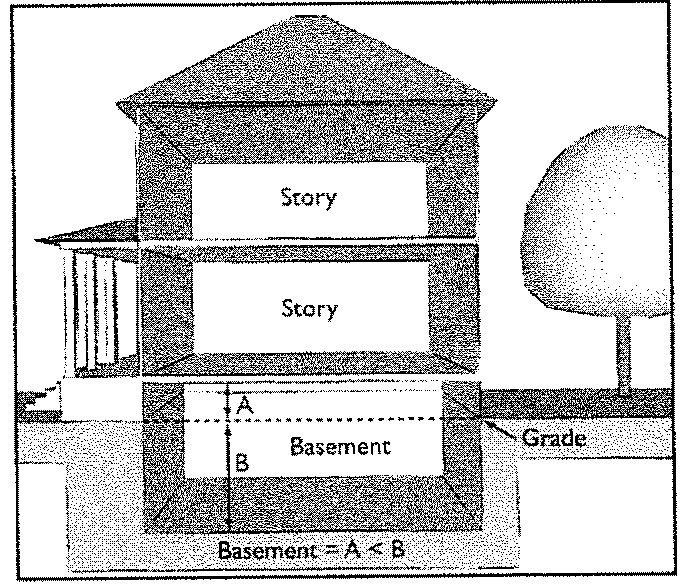
Basement or cellar. A portion of a building having more than one-half of its height below grade. See graphic.
Bed and breakfast establishment. A use within a detached single dwelling in which transient guests are provided a sleeping room, breakfast and access to bathing and lavatory facilities in return for payment.
Berm. A mound of soil less than three feet in height, graded, shaped and improved with landscaping in such a fashion as to be utilized for screening purposes.
Board of appeals. See "zoning board of appeals."
Boarding house or rooming house. A dwelling having one kitchen and used for the purpose of providing meals and lodging for compensation to more than two persons on a weekly or other long-term basis, other than members of the family occupying such dwelling.
Build-to line. The line on which a main building must be placed with respect to the front yard setback.
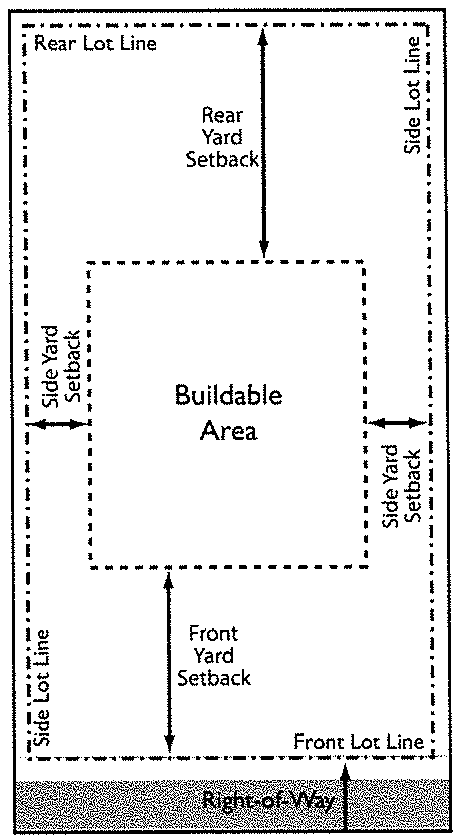
Buildable area. The buildable area of a lot is the space remaining after the minimum setback and open space requirements of this ordinance have been met. See graphic.
Building. An independent structure, either temporary or permanent, having a roof or canopy supported by columns, poles, posts, walls, or any other support used for the enclosure, covering, protection, or storage of persons, animals, objects, vehicles, or chattels, or carrying on business activities or other uses. When any portion thereof is completely separated from every other part thereof by division of walls from the ground up, and without openings, each portion of the building shall be deemed a separate building.
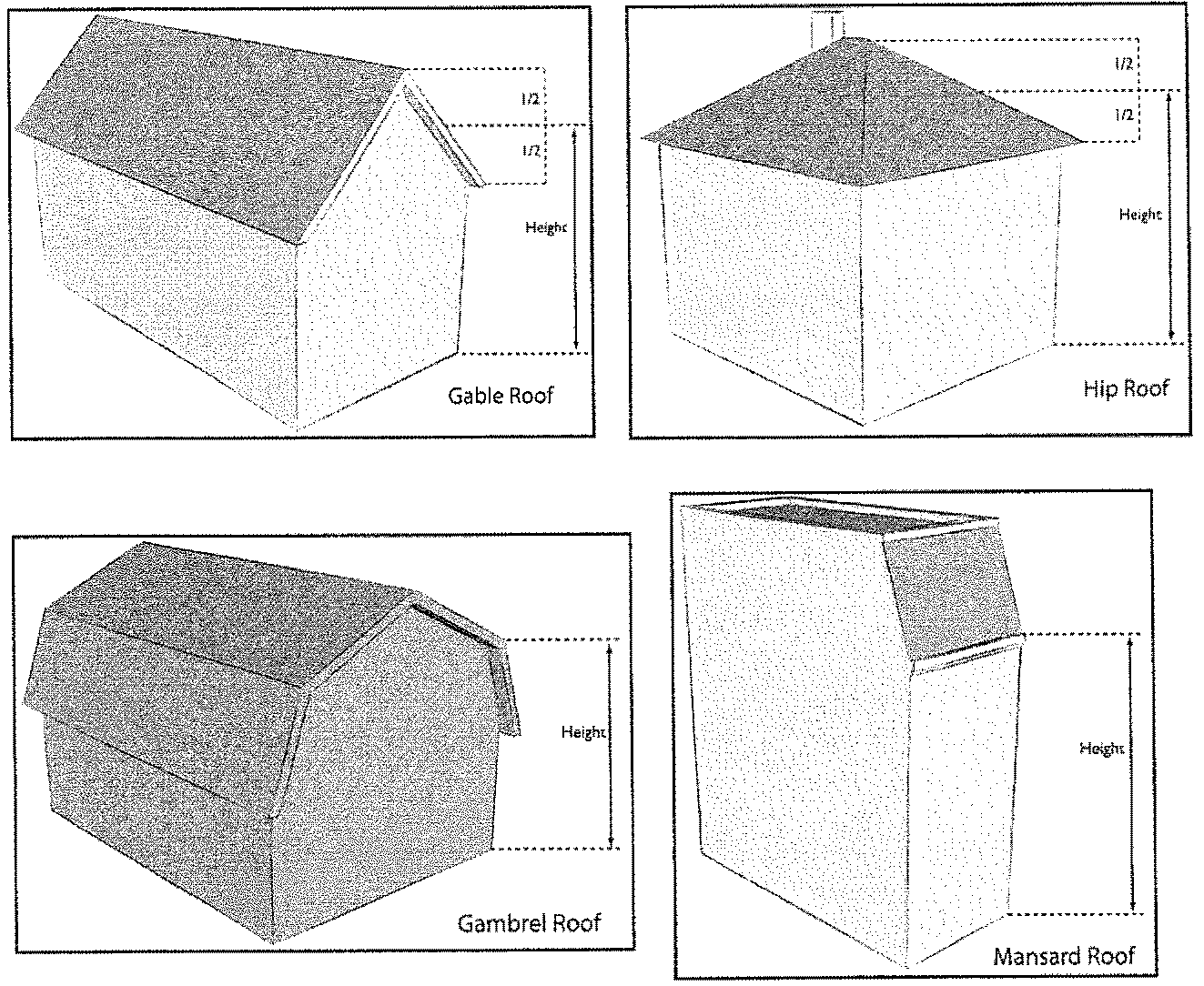
Building height. The building height is the vertical distance measured from the natural grade to the highest point of the roof surface if a flat roof; to the deck of mansard roofs; and to the mean height level between eaves and ridge of gable, hip and gambrel roofs. When the terrain is sloping, the height shall be measured at the average grade. See graphics.
Building, main. A building in which is conducted the main or principal use of the lot on which it is situated.
(Ord. No. 19-635, 9-23-19)
Sec. 2.04 - Definitions - C.
Canopy tree. A deciduous tree whose mature height and branch structure provide foliage primarily on the upper half of the tree. The purpose of a canopy tree is to provide shade to adjacent ground areas.
Carport. An open covered motor vehicle parking structure accessory to a main building. It may be free standing or attached to another structure, and may be permanent or temporary.
City. City of Muskegon Heights, Muskegon County, Michigan.
City attorney. The person or firm appointed by the city council as the attorney for City of Muskegon Heights.
City council. The elected city council for the City of Muskegon Heights.
City building inspector. The person or agency appointed by the city council as the building inspector for City of Muskegon Heights.
City engineer. The person or firm appointed by the city council as the Engineer for City of Muskegon Heights.
City planner. The person or firm appointed by the city council as the planner for City of Muskegon Heights.
Clearing of land. The removal of vegetation from any site, parcel or lot. Mowing, trimming, pruning or removal of vegetation to maintain it in a healthy, viable condition is not considered clearing.
Clinic. A building or group of buildings where human patients are admitted for examination and treatment by more than one health care professional, such as a physician, dentist, or the like, except that human patients are not lodged therein overnight.
Club. An organization or association of persons for special purposes or for the promulgation of sports, arts, sciences, literature, hobbies, politics, or the like, but not operated for profit.
Commercial. This term relates to the use of property in connection with the purchase, sale, barter, display, or exchange of goods, wares, merchandise or personal services or the maintenance of service offices or recreation or amusement. Business or "for profit" activities generally connotes commercial.
Common area. That part of a condominium or other development in which all members have an ownership interest, including, but not limited to, streets, alleys, walkways and open space.
Condominium Act. Public Act 59 of the Michigan Public Acts of 1978, as amended.
Condominium project, site. A division or development of land on the basis of condominium ownership in accordance with the Condominium Act, that is not subject to the provisions of the Land Division Act (P.A. 288 of 1967, as amended), and within which the individual units resemble lots.
Condominium unit. That portion of the condominium project designed and intended for separate ownership and use, as described in the master deed of the condominium project.
Conservation easement. A non-possessory, generally permanent interest in real property imposing limitations or affirmative obligations, the purposes of which include retaining or protecting natural, scenic or open space values of real property; assuring its availability for agricultural, forest, recreational or open space use; protecting natural resources; or maintaining air or water.
Communal dwelling unit. The use of a dwelling unit by more than two unrelated individuals who are not a functional family. Licensed, state residential facilities are not included in this definition.
Convalescent or nursing home. A home for the care of the aged or infirm, or a place of rest for those suffering bodily disorders, wherein persons are provided care for compensation. The convalescent or nursing home shall conform to, and qualify for, license under applicable state law.
Cul-de-sac. A dead end public or private street, generally short in distance, which terminates in a circular or semi-circular section of street which allows for vehicle turnaround.
(Ord. No. 19-635, 9-23-19)
Sec. 2.05 - Definitions - D.
Day care. A facility, other than a private residence, receiving minor children or adults for care for periods of less than 24 hours in a day, for more than two weeks in any calendar year. Childcare and supervision provided as an accessory use, while parents are engaged or involved in the main use of the property, such as a nursery operated during church services or public meetings, or by a fitness center or similar operation, shall not be considered a day care center.
A.
Day care home, family: A single-family residence, occupied as such, in which care is provided for more than one but less than seven minor children or adults for periods of less than 24 hours per day, unattended by a parent or legal guardian. Care for persons related by blood, marriage or adoption to a member of the family occupying the dwelling is excluded from this definition.
B.
Day care home, group: A single-family residence, occupied as such, in which care is provided for at least seven but not more than 12 minor children or adults for periods of less than 24 hours per day, unattended by a parent or legal guardian. Care for persons related by blood, marriage, or adoption to a member of the family occupying the dwelling is excluded from this definition.
C.
Day care center, commercial: A nonresidential facility where care is provided for any number of children or adults for periods of less than 24 hours per day, for more than two weeks in any calendar year. Childcare and supervision provided as an accessory use, while parents are engaged or involved in the main use of the property, such as a nursery operated during church services or public meetings, or by a fitness center or similar operation, shall not be considered a commercial day care.
Deceleration lane. An added roadway lane that permits vehicles to slow down and leave the main vehicle stream before turning.
Deck. An unroofed structure used for outdoor living purposes that may or may not be attached to a building and that protrudes more than four inches above the finished grade.
Deed restriction. A restriction on the use of a lot or parcel of land that is set forth in the deed (or equivalent document) and recorded with the Muskegon County Register of Deeds. It is binding on subsequent owners and is sometimes also known as a restrictive covenant.
Density. As applied in this ordinance, the number of dwelling units situated on or to be developed on a gross acre of land.
District. A zoning district pursuant to this ordinance.
Drive-in or drive-through facilities. A commercial or other establishment whose character is significantly dependent on providing a driveway approach and service windows or facilities in order to serve patrons while in or momentarily stepped away from the vehicle.
Driveway, private. An improved or unimproved path or street extending from a public right-of-way or private street easement to a single building, dwelling, or structure, intended to provide ingress and egress primarily for occupants thereof. A driveway is located entirely within one lot.
Dwelling or dwelling unit. A dwelling unit is any building or portion thereof having cooking facilities, that is occupied wholly as the home, residence or sleeping place of one family, either permanently or transiently, but in no case shall a motor home, trailer coach, automobile chassis, tent, or portable building be considered a dwelling. In case of mixed occupancy, where a building is occupied in part as a dwelling unit, the part so occupied shall be deemed to be a dwelling unit for the purpose of this ordinance and shall comply with the provisions thereof relative to dwellings.
A.
Dwelling, multiple family: A building or portion thereof, used or designed for use as a residence for three or more families living independently of each other and each doing their own cooking in the building. This definition includes three family buildings, four family buildings, and apartment houses.
B.
Dwelling, two-family: A detached building used or designed for use exclusively by two families living independently of each other and each doing their own cooking in the building. It may also be termed a duplex.
C.
Dwelling, single family (detached): A detached building used or designed for use exclusively by one family.
(Ord. No. 19-635, 9-23-19)
Sec. 2.06 - Definitions - E.
Easement. A right, distinct from ownership of the land, to cross property with facilities such as, but not limited to, private streets, utility corridors, sewer lines, water lines, and transmission lines, or the right, distinct from the ownership of the land, to reserve and hold an area for open space, recreation, drainage or access purposes.
Elderly housing. A building or group of buildings containing dwellings where the occupancy of dwellings is restricted to persons 55 years of age or older or couples where either the husband or wife is 55 years of age or older. This does not include a development that contains a convalescent or nursing home as licensed under Act No. 139 of the Public Acts of 1956, as amended, being sections 331.651 to 331.660 of the Compiled Laws of 1948; or a mental hospital for mental patients licensed under sections 51 and 52 of Act No. 151 of the Public Acts of 1923, as amended, being sections 330.61 and 330.62 of the Compiled Laws of 1948.
Erected. The word "erected" includes built, constructed, reconstructed, moved upon, or any physical operations on the premises required for the building. Excavations, fill, drainage, and the like, shall be considered a part of erection.
Essential public services. The phrase "essential public services" means the erection, construction, alteration, or maintenance by public utilities or municipal departments or commissions of underground, surface, or overhead gas, electrical, steam, or water transmission or distribution systems, collection, communication supply or disposal systems, including mains, drains, sewers, pipes, conduits, wires, cables, fire alarm boxes, traffic signals, hydrants, towers, poles, and other similar equipment, and accessory structures reasonably necessary for the furnishing of adequate service by public utilities or municipal departments or commissions or for the public health or general welfare, but not including cellular telephone or communications towers or buildings, nor including those buildings that are primarily enclosures or shelters of the above essential service equipment.
Escrow. An amount of money held by the city to pay the costs associated with reviewing and processing a zoning application or undertaking other city action under this ordinance. Escrow fees are for services or costs above what is covered by a fixed application or other fee.
Excavating. Excavating shall be the removal, digging, or moving of soil or earth below the average grade of the surrounding land and/or street grade, whichever shall be highest, except common household gardening.
(Ord. No. 19-635, 9-23-19)
Sec. 2.07 - Definitions - F.
Family. An individual or group of two or more persons related by blood, marriage, or adoption, together with foster children and servants of the principal occupants, who are domiciled together as a single housekeeping unit in a dwelling unit; or a collective number of individuals domiciled together in one dwelling unit whose relationship is of a continuing, non-transient domestic character and who are cooking and living as a single nonprofit housekeeping unit. This definition shall not include any society, club, fraternity, sorority, association, half-way house, lodge, coterie, organization, group of students, or other individual whose domestic relationship is of a transitory or seasonal nature, is for an anticipated limited duration of a school term or during a period of rehabilitation or treatment, or is otherwise not intended to be of a permanent nature.
Farm market. A temporary use within the city, which sells produce and other farm products.
Fence. Any permanent barrier, partition, wall, structure or gate erected as a dividing or screening structure or enclosure, and not part of a structure generally requiring a building permit.
Filling. The depositing or dumping of any matter onto or into the ground, except common household gardening and landscaping care.
Flea market. A temporary market, usually held outdoors, where antiques, used household goods, and curios are sold.
Floodplain and related terms.
A.
Base flood: The flood having a one-percent chance of being equaled or exceeded in any given year.
B.
Development: Any manmade change to improved or unimproved real estate, including, but not limited to, buildings, or other structures, mining, dredging, filling, grading, paving, excavating or drilling operations.
C.
Flood or flooding: A general and temporary condition of partial or complete inundation of normally dry land areas from:
1.
The overflow of inland waters.
2.
The unusual and rapid accumulation or runoff of surface waters from any source.
D.
Flood hazard area, special: The land within a community subject to a one-percent or greater chance of flooding in any given year. Also known as "area of 100-year flood," and shown on the flood insurance rate map (FIRM) as "Zone A."
E.
Flood insurance rate map (FIRM): An official map of a community, on which the Federal Insurance Administration has delineated both the special flood hazard areas and the risk premium zones applicable to the community.
F.
Flood insurance study: The official report for the City of Muskegon Heights provided by the Federal Insurance Administration containing flood profiles, the water surface elevation of the base flood, and the flood hazard boundary-floodway map.
G.
Floodplain: Land designated as special flood hazard area.
H.
Water and floodplain overlay district: The zone that overlays the existing zoning districts delineated on the official City of Muskegon Heights Zoning Map. The boundaries of the water and floodplain overlay district shall coincide with the boundaries of the special flood hazard area indicated on the flood insurance rate map.
I.
Floodway, designated regulatory: The channel of a river or other watercourse and the adjacent land areas designated in the flood insurance study that shall be reserved in order to discharge the base flood.
J.
Harmful increase: An unnaturally high stage on a river, stream or lake that causes or may cause damage to property, threat to life, personal injury, or damage to land or water resources.
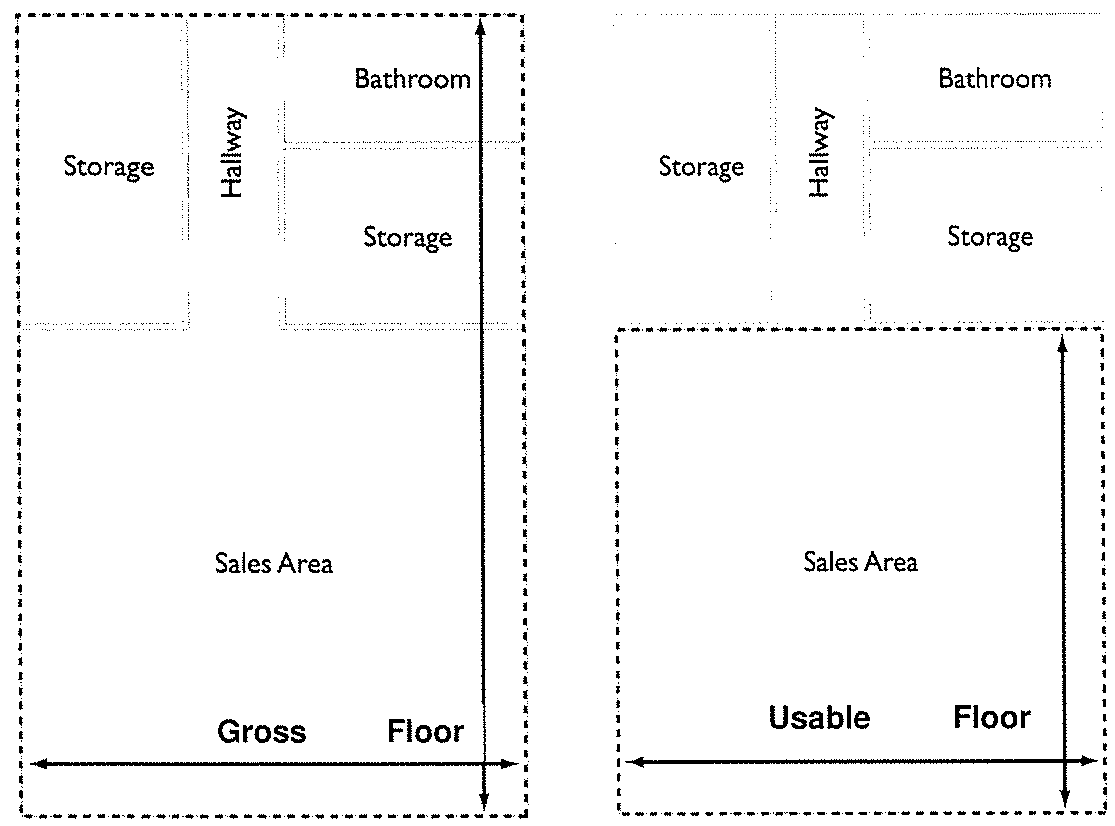
Floor area, gross (GFA) (as associated with commercial or industrial uses). The sum of the gross horizontal area of the several floors of the building measured from the exterior faces of the exterior walls or from the center line of walls separating two buildings. The gross floor area of a building shall include the basement floor area only if more than one-half of the basement height is above finish lot grade and the floor area is finished and improved as livable space. (See "basement".)
Gross floor area shall not include attic space having headroom of seven feet or less, or interior balconies or mezzanines. Any space devoted to off-street parking or loading shall not be included in floor area.
Floor area, usable (UFA) (as associated with commercial or industrial uses). That area used for or intended to be used for the sale of merchandise or services, or for use to serve patrons, clients, or customers. Floor area that is used or intended to be used principally for the storage or processing of merchandise, for hallways, or for utilities shall be excluded from the computation of usable floor area. See graphics on the following page.
Frontage. The portion of a lot abutting, adjoining, or having frontage on a street, or street. Please also see "lot width."
(Ord. No. 19-635, 9-23-19)
Sec. 2.08 - Definitions - G.
Garage. A building used primarily for the storage of self-propelled vehicles for the use of the occupants of a lot on which the building is located.
Greenbelt. A vegetative strip intended to provide physical separation and visual screening between potentially incompatible uses; be sufficient to screen or filter views of building walls, loading areas, parked vehicles, and outdoor storage areas; moderate harsh or unpleasant sounds; filter air pollutants; and/or slow the effects of storm water runoff.
Green space. A yard or landscaped area that may include a lawn, green belt, open space, or natural features.
(Ord. No. 19-635, 9-23-19)
Sec. 2.09 - Definitions - H.
Half-way house. A residential treatment facility that provides transitional living arrangements for individuals acclimating from institutional living back into the community. Facilities may serve former prison inmates, recovering addicts or alcoholics.
Home occupation. An occupation customarily conducted entirely within a dwelling unit that is clearly an incidental and secondary use of the dwelling. Without limiting the foregoing, a single-family detached residence used by an occupant of that residence to give instruction in a craft or fine art within the residence shall be considered a home occupation.
Hospital. An institution providing health services, primarily for in-patients and medical or surgical care, including as an integral part of the institution, related facilities such as laboratories, out-patient departments, training facilities, central service facilities and staff offices.
Hotel or motel. A series of attached, semi-attached, or detached rental units providing overnight lodging for transients, open to the traveling public for compensation.
Human service center. A center operated by a governmental or nonprofit entity designed to meet the material and physical needs of people, including, but not limited to: Food pantry, service kitchen, clothing donations, recreation, enrichment classes and day care.
(Ord. No. 19-635, 9-23-19)
Sec. 2.10 - Definitions - I.
Indoor recreation establishment. A privately owned facility designed and equipped for the conduct of sports, amusement or leisure time activities and other customary recreational activities indoors (within an enclosed building) and operated as a business and open for use by the public for a fee, such as a fitness centers, bowling alleys, billiard establishments, and racquetball and tennis clubs. Indoor recreation establishments shall not include arcades.
(Ord. No. 19-635, 9-23-19)
Sec. 2.11 - Definitions - J.
Junk. For the purpose of this ordinance, this term shall mean any motor vehicles, machinery, appliances, products, or merchandise with parts missing; or scrap metals or materials that are damaged or deteriorated; or vehicles or machines in a condition which precludes their use of the purpose for which they were manufactured.
Junk yard. Automobile wrecking yards and salvage areas and including any area of more than 2,000 square feet for the storage, sale, processing, keeping or abandonment of junk, including scrap metals, other scrap materials or reclaimed materials, or for the dismantling, demolition, or abandonment of automobiles or other vehicles or machinery or parts thereof for profit, but does not include lawful uses established entirely within enclosed buildings.
(Ord. No. 19-635, 9-23-19)
Sec. 2.12 - Definitions - K.
Kennel. Any lot or premises on which four or more dogs or cats, six months of age or older are kept temporarily or permanently for the purpose of breeding, boarding, being pets, or for sale.
(Ord. No. 19-635, 9-23-19)
Sec. 2.13 - Definitions - L.
Land Division Act. Public Act 288 of the Michigan Public Acts of 1967, as amended, commonly called the "Michigan Land Division Act."
Landmark tree. A tree with a diameter of over 28 inches four feet off the ground.
Lawn. Ground cover consisting of grass or sod kept closely mowed, commonly used as a primary ground cover.
Livestock. Those species of animals used for human food and fiber or those species of animals used for service to humans. Livestock includes, but is not limited to, cattle, sheep, new world camelids, goats, alpacas, bison, captive cervidae, ratites, swine, equine, poultry, aquaculture, and rabbits. Livestock does not include dogs or cats.
Living space (with respect to residential uses). That part of a dwelling that is normally occupied including bedroom, kitchen, bathroom and gathering areas it excludes storage areas such as closets, attics, basements and garages. In order for a basement to qualify as living space, it shall be finished for living purposes and each qualifying room shall have a second form of egress under the building code.
Loading space. An off-street space on the same lot with a building or group of buildings, for temporary parking for a commercial vehicle while loading or unloading merchandise or materials. Off-street loading space is not to be included as off-street parking space in computation of required off-street parking.
Lot. A parcel of land occupied (or intended to be occupied) or utilized for a use allowed in this ordinance, including one main building with its accessory buildings, and providing the open spaces, parking spaces, and loading spaces required by this ordinance. The word "lot" shall include a platted lot, plot or parcel. A lot need not be a "lot of record." A lot may also mean a portion of a condominium project, as regulated by Public Act 59 of 1978, as amended, designed and intended for separate or limited ownership and/or use (often called a "unit" or "site condominium unit").
Lot area. The total horizontal area within the lot lines of a lot excluding a public street right-of-way and any private street easement or right-of-way. Lot area does not include portions of a lot located under water.
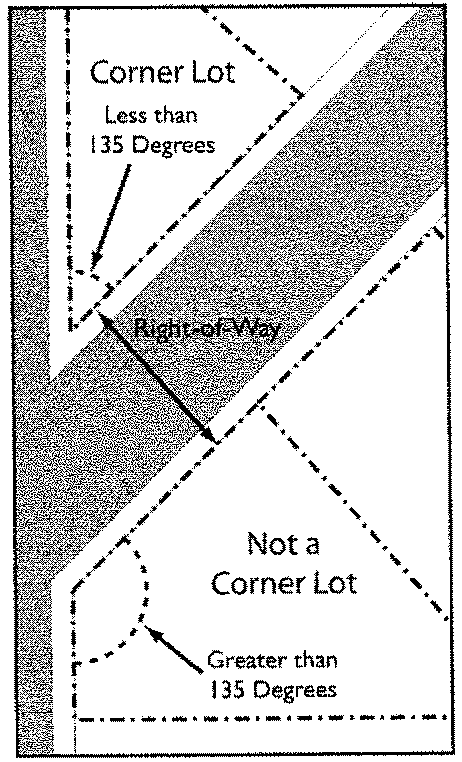
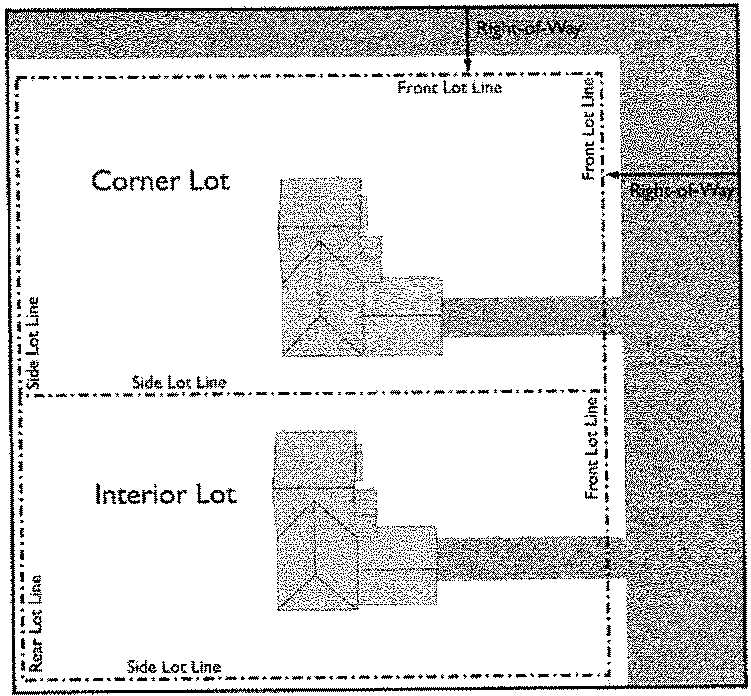
Lot, corner. A lot located at the intersection of two streets or a lot bounded on two sides by a curving street, any two cords of which form an angle of 135 degrees or less. See graphics.
Lot coverage. The part or percent of the lot occupied by buildings, impermeable surface areas, and structures, including pavement, accessory buildings or structures.
Lot depth. The mean horizontal distance from the front lot line to the rear lot line, or the two front lines of a through lot.
Lot, flag. A lot whose access to the public street is by a narrow, private right-of-way that is either a part of the lot or an easement across another property.
Lot, interior. A lot other than a corner lot with only one lot line fronting on a street.
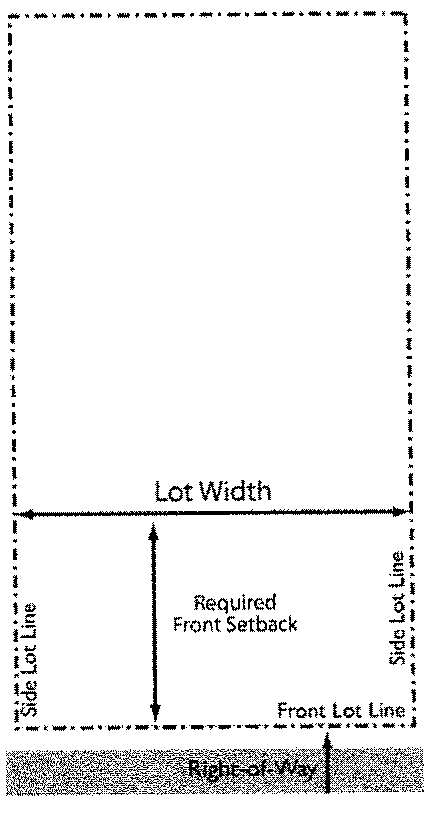
Lot lines. The property lines bounding the lot. See graphic.
A.
Front lot line. The line separating the lot from the abutting public or private street right-of-way. A corner or through lot shall have a front lot line abutting each adjacent public or private street right-of-way.
B.
Rear lot line. Ordinarily, that lot line that is opposite and most distant from the front lot line of the lot. In the case of an irregular or triangular-shaped lot, a line at least ten feet in length entirely within the lot parallel to and at the maximum distance from the front lot line of the lot shall be considered to be the rear lot line for the purpose of determining the depth of a rear yard. In cases where none of these definitions are applicable, the zoning administrator shall designate the rear lot line. (See double frontage lot).
C.
Side lot line. Any lot line not a front lot line or a rear lot line. A side lot line separating a lot from another lot or lots is an interior side lot line.
Lot of record. A lot that lawfully exists in a subdivision or plat as shown on the records of the Muskegon County Register of Deeds, or a lawful lot or parcel described by metes and bounds, that lawfully exists on record with the Muskegon County Register of Deeds.
Lot, through. A lot other than a corner lot having frontage on two more or less parallel streets. If there are existing structures in the same block fronting on one or both of the streets, the required front yard setback shall be observed on those streets where the structures presently front.
Lot width. The horizontal distance between the side lot lines, measured as nearly as possible at right angles to the side lot lines. See graphic.
(Ord. No. 19-635, 9-23-19)
Sec. 2.14 - Definitions - M.
Main building. The building or structure in which the main use of the lot or parcel is located. Storage buildings, garages, and other accessory uses and structures shall not be considered main buildings.
Manufactured home. A residential building, dwelling unit, dwelling room or rooms, or a building component that is designed for long-term occupancy as a dwelling unit or portion of a dwelling unit, and is wholly or substantially constructed at an off-site location, transported to a site and erected. A manufactured home is also commonly referred to as a mobile home or house trailer but it is not a modular home.
Manufactured home park. A parcel or tract of land under the control of an individual, corporation, limited liability company, the state or any political subdivision thereof, agency, business trust, estate, trust, partnership or association, two or more persons having a joint or common interest, and any other legal or commercial entity upon which three or more manufactured homes are located on a continual, nonrecreational basis and that is offered to the public for that purpose regardless of whether a charge is made therefore, together with any building, structure, enclosure, street, equipment, or facility used or intended for use incident to the occupancy of a manufactured home.
Manufactured home space. A plot of ground within a manufactured home park designed for the accommodation of one manufactured home.
Marina. A facility located adjacent to a body of water and operated as a commercial enterprise for the sale, storage, or servicing of boats or other watercraft; or a dock or mooring located within a body of water and intended to be used by four or more boats.
Master plan. The master plan as adopted by City of Muskegon Heights, including graphic and written materials, indicating the general location for streets, parks, schools, public buildings, and all physical development of the city, and includes any unit or part of the plan and any amendment to the plan.
Medical marihuana dispensary. Any business, facility, association, cooperative, location, or operation, whether fixed or mobile, where medical marihuana is made available to, sold, grown, processed, delivered, or distributed by or to one or more of the following:
A.
A primary caregiver (as defined by Michigan Initiated Law 1 of 2008, as amended, being MCL 333.26421 et seq., as amended).
B.
A qualifying patient (as defined by Initiated Law 1 of 2008, as amended, being MCL 333.26421 et seq., as amended.
C.
Members of the public.
A medical marihuana dispensary shall also include any place, location, facility, or operation, whether fixed or mobile, where medical marihuana is smoked or consumed where either three or more persons are present and smoking or consuming medical marihuana or such medical marihuana smoking or consumption is occurring on the property of a business, association, cooperative, or commercial operation or facility.
A medical marihuana dispensary shall not include the lawful dispensation of medical marihuana by a primary caregiver personally dispensing to not more than five qualified patients (as defined by Michigan Initiated Law 1 of 2008, as amended, being MCL 333.26421 et seq., as amended) so long as the primary caregiver personally delivers the lawful amount of medical marihuana to the qualifying patient where the qualifying patient resides and it is done in full compliance with not only this ordinance and any other applicable city ordinances, but also all applicable Michigan and federal laws and regulations.
Municipal civil infraction. An act or omission that is prohibited by a provision of the ordinances of the City of Muskegon Heights for which the penalty has been designated as a Municipal Civil Infraction. A municipal civil infraction is not a crime and is punishable by all of the civil remedies provided for in Act 12 of the Public Acts of 1994, as amended.
(Ord. No. 19-635, 9-23-19)
Sec. 2.15 - Definitions - N.
Natural feature. Includes, but is not limited to, soils, wetlands, woodlots, landmark and specimen trees, floodplains, water bodies, groundwater, topography, vegetative cover, and geologic formations.
Natural vegetative cover. Significant natural vegetation, including bushes, shrubs, groundcover, and trees, on a lot or parcel. A groomed lawn shall not qualify as natural vegetative cover.
Nonconforming building. A building or portion thereof lawfully existing at the effective date of this ordinance or amendments thereto, and that does not conform to the provisions of this ordinance or the district in which it is located. Also referred to as a lawful nonconforming building.
Nonconforming lot of record. A platted lot that conformed with all city zoning and other requirements at the time of recording of the plat, that no longer conforms to the zoning regulations and requirements for lot area or dimension, lot width, or both; or a lot outside a recorded plat that conformed with all city zoning and other requirements at one time, and that has not been subdivided or reduced in size subsequent to the time it did conform to the zoning ordinance, that no longer conforms with the zoning requirements for lot area or dimension, lot width, or other matters. Also referred to as a lawful nonconforming lot.
Nonconforming structure. A structure or portion thereof lawfully existing at the effective date of this ordinance or amendments thereto, and that does not conform to the provisions of this ordinance or the district in which it is located. Also referred to as a lawful nonconforming structure.
Nonconforming use. The lawful use of any land or premises exactly as it existed at the time of enactment of the zoning ordinance, or amendment thereto, may be continued although the use does not conform to the current provisions of the zoning ordinance. Also referred to as a lawful nonconforming use.
Nuisance. An offensive, annoying, unpleasant, or obnoxious thing or practice being a cause or source of annoyance.
(Ord. No. 19-635, 9-23-19)
Sec. 2.16 - Definitions - O.
Occupancy load. The number of individuals which may safely occupy a building or structure based on the building and fire code standards of the City of Muskegon Heights.
Occupied. Includes the terms arranged, designed, built, altered, converted to, rented, leased, or intended to be inhabited; not necessarily for dwelling purposes.
Open space. Undeveloped land not part of any required yard that is set aside in a natural state, for recreational purposes.
Open space, usable. That portion of the common open space that due to its slope, drainage characteristics and soil conditions can be used for active recreation.
Open air business. Uses operated for profit substantially in the open air, including, but not limited to:
A.
Utility truck or trailer, motor vehicle, boats, or home equipment sale, repair, rental, or storage services.
B.
Outdoor display and sale of garages, motor homes, manufactured homes, snowmobiles, swimming pools, and similar activities but not including farm implements or commercial construction equipment.
C.
Retail sale of trees, fruits, vegetables, shrubbery, plants, seeds, topsoil, humus, fertilizer, trellises, lawn furniture, playground equipment, and other home garden supplies and equipment, but not including lumberyards.
D.
Tennis courts, archery courts, shuffleboard, horseshoe courts, rifle ranges, miniature golf, golf driving ranges, children's amusement park or similar recreation uses (transient or permanent).
Ordinary high water mark. The line between upland and bottomland that persists through successive changes in water levels, below which the presence and action of the water is so common or recurrent that the character of the land is marked distinctly from the upland and is apparent in the soil itself, the configuration of the surface of the soil and the vegetation. Where the water levels vary for purposes of water level management, the ordinary high water mark shall be the higher of the levels generally present.
Outdoor furnace. Any device, appliance, and equipment apparatus or structure designed for heating a structure that:
A.
Is designed, intended and/or used to provide heat and/or hot water to any associated structure.
B.
Operates by burning wood or any other solid fuel including, but not limited to: coal, paper pellets, and agricultural products.
C.
Is not located within the structure to be heated.
D.
Includes, but is not limited to, devices referred to as outdoor furnaces, outdoor boilers, and outdoor stoves.
Outdoor recreational facility. Tennis courts, archery courts, shuffleboard, horseshoe courts, go-carts, miniature golf, golf driving ranges, amusement park or similar outdoor recreation uses (transient or permanent).
Outdoor storage. The keeping, in an unroofed area, of any goods, junk, material, merchandise or vehicles in the same place for more than 24 hours.
Overlay zone. An additional set of regulations that apply in conjunction with those in the underlying zoning district. A planned unit development is an example of an overlay zone.
(Ord. No. 19-635, 9-23-19)
Sec. 2.17 - Definitions - P.
Parapet wall. An extension of a building wall above the roof which may serve as an architectural feature and/or to screen roof-mounted mechanical equipment.
Parking lot. A facility providing vehicular parking spaces, along with adequate drives, aisles, and maneuvering space to allow unrestricted ingress and egress to at least two vehicles.
Parking space. An off-street space of at least ten feet by 18 feet in area exclusive of necessary driveways, aisles, or maneuvering areas, suitable to accommodate one motor vehicle and having direct unobstructed access to a street or alley.
Pawn shop. An establishment that receives any piece or item of personal property, or other valuable thing, by way of pledge, pawn, or purchase.
Personal service establishments. Any commercial business conducting services that are performed to individuals primarily on the premises including, but not limited to, cosmetology salons, barber shops and tanning facilities.
Performance guarantee. A financial guarantee to ensure that all improvements, facilities, or work required by this ordinance will be completed in compliance with the ordinance, regulations and the approved plans and specifications of a development. It can be a cash deposit, irrevocable letter of credit, or a bond.
Planned unit development (PUD). The use of a parcel of land that is planned and developed as a single entity containing the various uses, structures, open spaces, and other elements and that is designated and developed under one owner or organized group.
Planning commission. The City of Muskegon Heights Planning Commission.
Porch, enclosed. A covered entrance to a building or structure that is totally enclosed, and projects out from the main wall of the building or structure and has a separate roof or an integral roof with the main building or structure to which it is attached.
Porch, open. A covered entrance to a building or structure that is unenclosed except for columns, posts or poles supporting the porch roof, and projects out from the main wall of the building or structure and has a separate roof or an integral roof with the main building or structure to which it is attached.
Principal use. The main use to which the premises are devoted and the principal purpose for which the premises exist.
Private street. Any undedicated path, trail, street, access, or road that provides or is intended to provide the primary means of ingress and egress to two or more lots or two or more principal buildings, dwelling units, structures, or combination thereof, whether created by a private right-of-way agreement, a joint ownership, a license, a lease, or an easement.
Any and all extensions, additions, or branches of or to a private street shall be considered part of the private street that abuts the public road. A private street shall also include the following:
A.
An access serving one lot if that lot does not have the requisite amount of frontage on a public road as required by this ordinance.
B.
Where two or more lots or dwellings share or utilize a common access drive, even if each lot has the required frontage on a public road.
(Ord. No. 19-635, 9-23-19)
Sec. 2.18 - Definitions - Q.
(Reserved.)
(Ord. No. 19-635, 9-23-19)
Sec. 2.19 - Definitions - R.
Recreation vehicle or equipment. A vehicle or equipment used for recreational or leisure pursuits. Such vehicles shall include boats, airplanes, special purpose automobiles, floats, rafts, motorcycles, golf carts, ATVs, UTVs, four-wheelers, trailers, snowmobiles, camping or travel trailers, motorized homes, detachable travel equipment of the type adaptable to light trucks, and other equipment or vehicles of a similar nature.
Religious institution. A building where persons regularly assemble for religious worship that is maintained and controlled by a religious body organized to sustain public worship.
Retail store. Any building or structure in which goods, wares, or merchandise are sold to the consumer for direct consumption and/or use and not for resale.
Restaurant. A building in which food is prepared and sold for consumption within the building, as opposed to a drive-through restaurant where food may be taken outside of the building for consumption either on or off the premises.
Road commission. The Muskegon County Road Commission.
Rubbish. Any solid waste, except human excreta, but including garbage, refuse, trash, junk, ashes, street cleanings, dead animals, offal and solid agricultural, commercial, industrial, hazardous and institutional wastes and construction waste resulting from the operation of a contractor.
(Ord. No. 19-635, 9-23-19)
Sec. 2.20 - Definitions - S.
Salvage yard. See "junk yard."
Screen. A structure providing enclosure, such as a fence, and a visual barrier between the area enclosed and the adjacent property. A screen may also be a non-structure, consisting of shrubs or other growing materials.
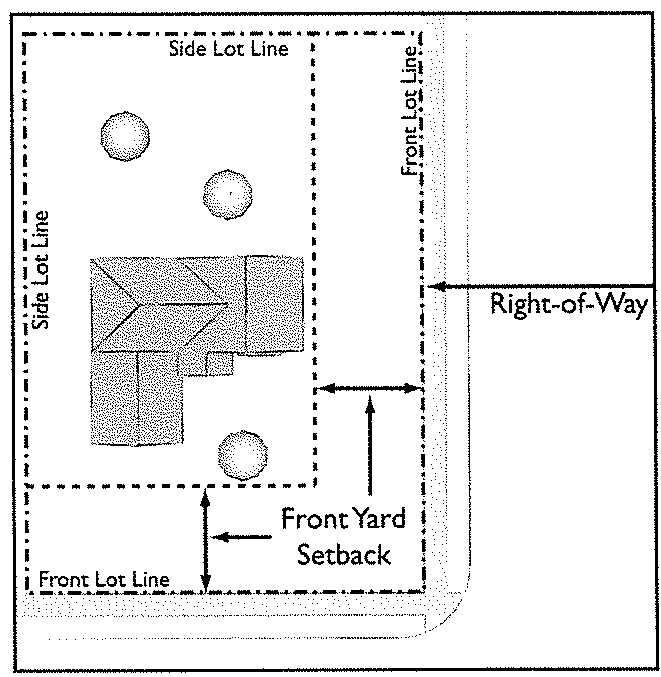
Setback. The minimum required horizontal distance from a structure or a building measured from the front, side, or rear lot line, as the case may be, that describes an area termed the required setback area or yard on a lot or parcel. No building or structure can be located within a setback area. Where a setback from a public road or private street is involved, the setback shall be measured from the edge of the public road right-of-way or easement or the private street right-of-way or easement.
A.
Front setback: The line marking the setback distance from the front right-of-way line that establishes the minimum front yard setback area, except for waterfront lots, where the front setback shall be measured from the ordinary high water mark to the building or structure and the street shall be the rear setback line.
B.
Rear setback: The line marking the setback distance from the rear lot line that establishes the minimum rear yard setback area. For waterfront lots, the rear yard setback shall be measured from the road or street right-of-way line.
C.
Side setback: The lines marking the setback distance from the side lot lines that establish the minimum side yard setback area.
Shoreline. See "ordinary high water mark."
Significant natural feature. Any natural area as designated by the planning commission, city council, or the Michigan Department of Natural Resources and the Environment, or other appropriate governmental agency, that exhibits unique topographic, ecological, hydrological, or historical characteristics such as a wetland, floodplain, water features, or other unique natural features.
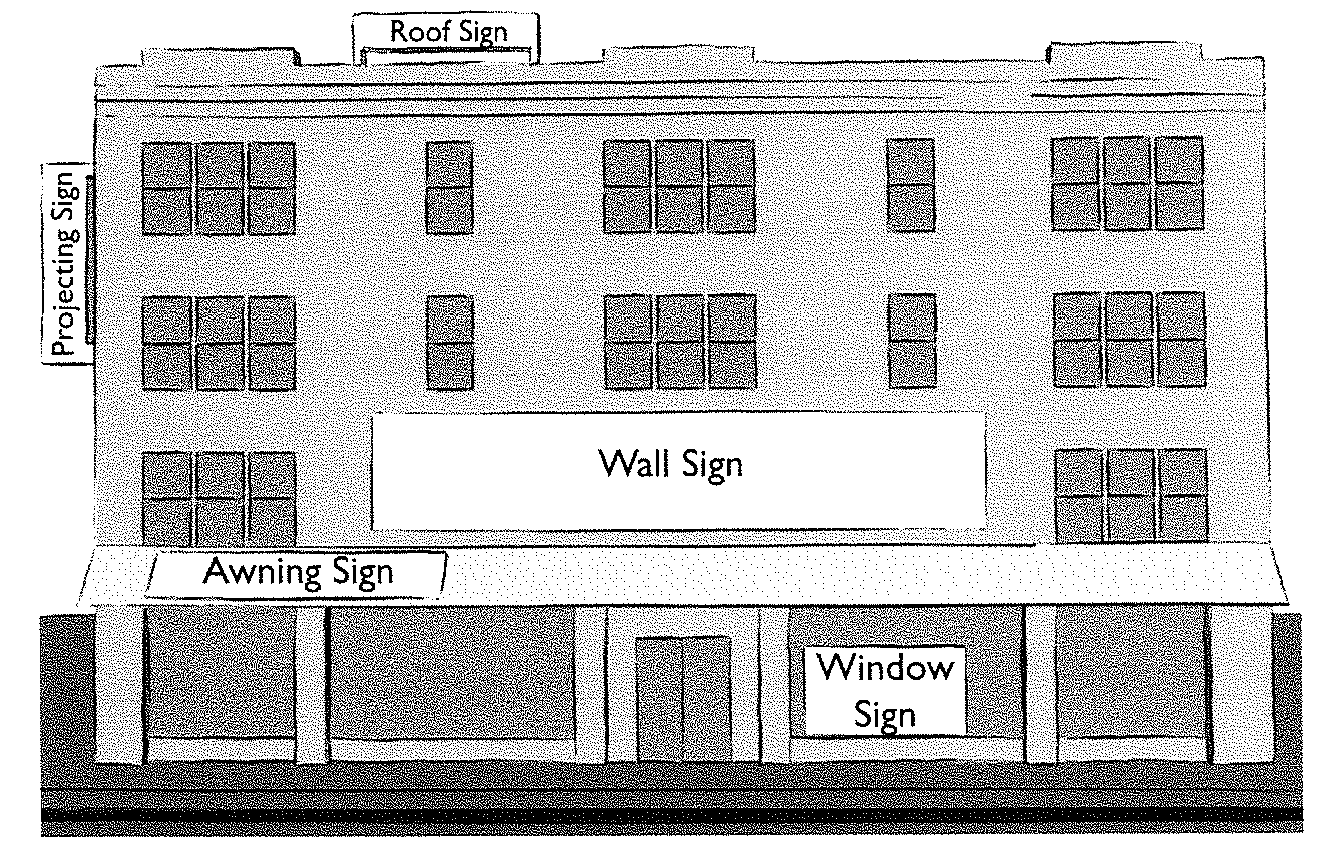
Signs (definitions relating to): A device, structure, fixture, or placard using graphics, symbols, and/or written copy designed specifically for the purpose of advertising or identifying an establishment, product, service, or activity. See also graphic following.
A.
Awning: A retractable or fixed shelter constructed of non-rigid materials on a supporting framework that project from the exterior wall of a building.
B.
Billboard: Any structure, on which lettered, figured, or pictorial matter is displayed for advertising either:
1.
A business, service, entertainment, activity or event that is not conducted on the land upon which the structure is located;
2.
A product that is not primarily sold, manufactured, processed or fabricated on the land upon which the structure is located;
3.
A second structure that is not located on the land upon which the first structure is located; or
4.
A geographical location or place that is not located on the land upon which the structure is located; or a person, however any structure that meets the definition of a directional sign shall not be considered to be a billboard.
C.
Business center sign: A freestanding or ground sign identifying the name of a business center and/or one or more individual businesses within the center.
D.
Balloon sign: A sign composed of a non-porous bag of material filled with air.
E.
Banner sign: A fabric, plastic, or other sign made of non-rigid material without an enclosing structural framework.
F.
Construction sign: A sign that identifies the owners, financiers, contractors, architects, and/or engineers of a project under construction.
G.
Directional sign: A sign that gives directions, instructions, or facility information for the use on the lot on which the sign is located, such as parking or exit and entrance signs. A directional sign is any structure erected adjacent to a street that identifies, points toward and gives the distance to any public or semi-public building, off-street parking area, recreation space, club, lodge, church, institution, business, service, entertainment, activity or event.
H.
Freestanding sign: A sign supported on poles not attached to a building or wall.
I.
Government sign: A temporary or permanent sign erected by the city, Muskegon County, or the state or federal government.
J.
Ground sign: A sign resting directly on the ground supported by a foundation not attached to a building or wall.
K.
Off-premises sign: A sign that relates to or advertises an establishment, product, merchandise, good, service or entertainment that is not located, sold, offered, produced or manufactured or furnished at the property on which the sign is located.
L.
On-premises sign: A sign that pertains solely to the use of the property on which it is located, such as to an establishment, product, merchandise, good, service or entertainment that is located, sold, offered, produced, manufactured or furnished at the property on which the sign is located.
M.
Political sign: A temporary sign used in connection with a noncommercial message or an official city, school district, county, state, or federal election or referendum.
N.
Portable sign: A sign designed to be moved easily and not permanently attached to the ground, a structure, or a building.
O.
Projecting sign: A double-faced sign attached to a building or wall that extends more than 18 inches but not more than 36 inches from the face of the building or wall.
P.
Roof line: The top edge of a roof or parapet wall, whichever is higher, but excluding any cupolas, chimneys, or other minor projections.
Q.
Real estate sign: A sign advertising the real estate upon which the sign is located as being for sale, rent, or lease.
R.
Roof sign: A sign erected above the roof line of a building.
S.
Temporary sign: A sign not permanently attached to the ground, a structure, or a building. Temporary signs may include banners, portable signs, and any other signs displayed for a limited period of time.
T.
Wall sign: A sign painted or attached directly to and parallel to the exterior wall of a building extending no greater than 18 inches from the exterior face of the wall to which it is attached.
U.
Window sign: A sign installed inside a window and intended to be viewed from the outside.
Site plan. The documents and drawings required by this ordinance to ensure that a proposed land use, structure, building, or activity is in compliance with this ordinance, other city ordinances and codes, and state and federal statutes.
Special land use. A use that, due to some characteristics of its operation, such as traffic, noise, odor, glare, or hours of operation, may be allowed in a district subject to special requirements different from those generally applicable to permitted uses within the zoning district in which the special land use is located.
Stacking space. An area designated for a line of vehicles waiting for drive-through service.
State licensed residential facility. A residential care facility licensed by the State of Michigan under Act 287 of 1972 of the Public Acts of Michigan, as amended, or Act 116 of 1973 of the Public Acts of Michigan, as amended, that provides resident care services under 24-hour supervision or care, but does not include facilities licensed by the State of Michigan for care and treatment of persons released from or assigned to correctional institutions.
A state licensed residential family facility includes a state licensed residential facility providing resident services to six or fewer persons.
A state licensed residential group facility includes a state licensed residential facility providing resident services to more than six persons.
A.
Adult foster care facility: A facility defined by the Adult Foster Care Facility Licensing Act (PA 218 of 1979), as amended, having as its principal function the receiving of adults for foster care. Such facility includes facilities and foster care family homes for adults who are aged, mentally ill, developmentally disabled, or physically handicapped who require supervision on an ongoing basis, but who do not require continuous nursing care.
B.
Adult foster care large group home: An adult foster care facility with the approved capacity to receive at least 13 but not more than 20 adults to be provided with foster care.
C.
Adult foster care small group home: An adult foster care facility with the approved capacity to receive 12 or fewer adults to be provided with foster care.
D.
Adult foster care family home: A private residence in which the licensee is a member of the household and an occupant, providing foster care for five or more days a week and for two or more consecutive weeks with the approved capacity to receive six or fewer adults.
E.
Foster family group home: A private residence in which more than four but fewer than seven minor children, who are not related to an adult member of the household by blood, marriage, or adoption, are provided care for 24 hours a day, for four or more days a week, for two or more consecutive weeks, unattended by a parent or legal guardian.
F.
Foster family home: A private residence in which one but not more than four minor children, who are not related to an adult member of the household by blood, marriage, or adoption, are provided care for 24 hours a day, for four or more days a week, for two or more consecutive weeks, unattended by a parent or legal guardian.
Stop work order. An administrative order which is either hand delivered, posted on the property, or mailed to the property owner which directs a person not to continue, or not to allow the continuation of an activity or use that is in violation of this ordinance.
Story. That portion of a building, other than a basement or mezzanine, included between the surface of any floor and the floor next above it, or if there is no floor above it, then the space between the floor and the ceiling next above it. For the purpose of this ordinance, a basement or cellar shall be counted as a story only if over 50 percent of its height is above the level from which the height of the building is measured, or if it is used for business purposes.
Story, half. That part of a building between a pitched roof and the uppermost full story having a floor area which does not exceed one-half the floor area of the full story, provided the area contains at least 200 square feet and which contains a clear height of at least seven feet, at its highest point.
Street.
A.
Private street: See the definition under "private street."
B.
Public street: A public thoroughfare located within a public street right-of-way which affords traffic circulation and principal means of access to abutting property, including avenue, place, way, drive, lane, boulevard, drive, court, highway, street, street, and other thoroughfare; except an alley. Also known as a "public road."
C.
Minor street: A local public roadway on which homes are located. Their primary purpose is to provide land access.
D.
Major street: A public roadway whose principal function is the movement of traffic into and through the city.
Structure. Anything constructed, installed, or erected, the use of which requires location on the ground or attachment to something on the ground. Also, any constructed, erected, or placed material or combination of materials in or upon the ground having a fixed location, including, but not limited to, buildings, radio towers, billboards, light posts, signs, swimming pools, animal enclosures (other than fences), garages, sheds, decks, platforms, portable or movable vehicle carports or enclosures, satellite dishes, towers, windmills, gazebos, tennis courts, signs, and storage bins.
The following are excluded from the definition of "structure":
A.
Lawful fences, sidewalks, and paving on streets, driveways, or parking areas.
B.
Decks or patios, no portion of which is located:
1.
More than one foot above the ground (natural grade); or
2.
Closer than five feet to any lot line.
Substantial improvement. Any repair, reconstruction or improvement of a structure, the cost of which equals or exceeds 50 percent of the true cash value of the structure either before improvement or repair is started, or if the structure has been damaged and is being restored, before the damage occurred. For the purposes of this ordinance, "substantial improvement" is considered to occur when the first alteration of any wall, ceiling, floor, or other structural part of the building commences, whether or not that alteration affects the external dimensions of the structure. The term does not, however, include either any project for improvement of a structure to comply with existing state or local health, sanitary or safety code specifications which are solely necessary to assure safe living conditions, or any alteration of a structure listed on the National Register of Historic Places or the Michigan Register of Historic Places.
(Ord. No. 19-635, 9-23-19)
Sec. 2.21 - Definitions - T.
Temporary building or use. A structure or use permitted by the zoning administrator to exist during periods of construction of the main building or for special events.
Temporary event. A use, activity, or event which is normally not allowed within a district, but may be allowed under certain circumstances pursuant to a temporary event permit issued under this ordinance.
Tent. A shelter of canvas, plastic, or the like supported by poles and fastened by cords or pegs driven into the ground.
Tattoo parlor. An establishment where an indelible mark is made upon the body of another individual by the insertion of a pigment under the skin or by the production of scars or by branding.
Townhouse. A row of three or more attached one-family dwellings, in which each dwelling has its own front entrance and rear entrance.
(Ord. No. 19-635, 9-23-19)
Sec. 2.22 - Definitions - U.
Use. The purpose for which land or a building is arranged, designed or intended, or for which land or a building is or may be occupied.
(Ord. No. 19-635, 9-23-19)
Sec. 2.23 - Definitions - V.
Variance, use. A modification of the literal provisions of the zoning ordinance which is authorized by the zoning board of appeals when strict enforcement of the ordinance would cause unnecessary hardship for the property owner due to circumstances unique to the property. A use variance permits a use of land that is otherwise not allowed in that district.
Variance, nonuse or dimensional. A modification of the literal provisions of the zoning ordinance granted when strict enforcement of the zoning ordinance would cause practical difficulty owing to circumstances unique to the individual property.
Vehicle repair. Any major or commercial activity involving the general repair, rebuilding or reconditioning of motor vehicles, engines, or trailers; collision services, such as body, frame, or fender straightening and repair; overall painting and vehicle rust-proofing; refinishing or steam cleaning.
Vehicle service station. A building designed or used for the retail sale of fuel (stored only in underground tanks), lubricants, air, water or other operating commodities for motor vehicles (including trucks, aircraft and boats) and including the customary space and facilities for the installation of the commodities on or in the vehicles and including space for storage, hand washing, minor repair, and servicing, but not including vehicle repair as defined in this chapter.
Vehicle wash establishment. A building, or portion thereof, the primary purpose of which is that of washing motor vehicles.
Veterinary clinic. Any activity involving the permanent or temporary keeping or treatment of animals operated as a business.
Violation. Violating, breaking, or dishonoring the law or this ordinance.
(Ord. No. 19-635, 9-23-19)
Sec. 2.24 - Definitions - W.
Wetland. Land characterized by the presence of water at a frequency and duration sufficient to support and that under normal circumstances does support wetland vegetation or aquatic life. Wetlands are regulated by Part 303, Wetlands Protection, of the Natural Resources and Environmental Protection Act, 1994 PA 451, as amended.
Wireless telecommunication services. Licensed telecommunication services including cellular, personal communication services (PCS), specialized mobilized radio (SMR), enhanced specialized mobilized radio (ESMR), paging, and similar services that are marketed to the general public.
Wind energy conversion system (WECS). A surface area, either variable or fixed, for utilizing the wind for electrical power; and a shaft, gearing, belt, or coupling utilized to convert the rotation of the surface area into a form suitable for driving a generator, alternator, or other electricity-producing device; and the generator, alternator, or other device to convert the mechanical energy of the surface area into electrical energy; and the tower, pylon, or other structure upon which any, all, or some combination of the above are mounted or any building or accessory equipment.
Wind energy conversion system shall also mean any combination of the following:
A.
A mill or machine operated by wind acting on oblique vanes, blades, or sails that radiate from a horizontal shaft.
B.
A surface area such as a blade, rotor, or similar device (either variable or fixed) for utilizing the wind for electrical or mechanical power.
C.
A shaft, gearing, belt, or coupling utilized to convert the rotation of the surface area into a form suitable for driving a generator, alternator, or other electricity-producing device.
D.
The generator, alternator, or other device used to convert the mechanical energy of the surface area into electrical energy.
E.
The tower, pylon, or other structure upon which any, all, or some combination of the above are mounted.
F.
A building or equipment accessory thereto.
WECS tower height. The distance between the ground and the highest point of the WECS.
(Ord. No. 19-635, 9-23-19)
Sec. 2.25 - Definitions - X.
Reserved.
Sec. 2.26 - Definitions - Y.
Yard. A yard is an open space on the same land with a structure, building, or group of buildings, which open space lies between the structure, foundation of the building, or group of buildings and the nearest lot line and is unoccupied and unobstructed from the ground upward, except as otherwise provided herein. Also the area within required setbacks.
A.
Front yard: An open space extending the full width of the lot, the uniform depth of which is measured at right angles to the front lot line. For lots with frontage on a body of water, the front yard is at the water.
B.
Rear yard: An open area extending across the full width of the lot, the uniform depth of which is measured at right angles to the rear lot line. For lots with frontage on a body of water, the rear yard is at the street.
C.
Side yard: An open unoccupied area between a main building and the side lot lines, extending from the front yard area to the rear yard area. The width of the side yard shall be measured horizontally from and at right angles to the nearest point of the side lot line.
(Ord. No. 19-635, 9-23-19)
Sec. 2.27 - Definitions - Z.
Zero lot line. The location of a building on a lot in such a manner that one or more of the buildings sides rests directly on a lot line, separated only by fire walls.
Zoning Act. The Michigan Zoning Enabling Act, Act 110 of 2006 of the Public Acts of Michigan, as amended.
Zoning administrator. The person designated by the city council to administer the provisions of this zoning ordinance.
Zoning board of appeals. The Zoning Board of Appeals of City of Muskegon Heights, sometimes also abbreviated in this ordinance as the "zoning board of appeals."
Zoning compliance permit. Also referred to as a "zoning permit." Such a permit shall be obtained before a use is commenced or a building or structure is constructed or expanded as provided in this ordinance.
Zoning district. See chapter 6 of this ordinance. Also referred to as a "district."
(Ord. No. 19-635, 9-23-19)

