
Napa County Unincorporated
City Zoning Code
City Zoning Code
CHAPTER 18
104 - ADDITIONAL ZONING DISTRICT REGULATIONS
18.104.010 - Schedule of zoning district regulations.
A.
The table presented in this section lists zoning districts in the first vertical column. Regulations are shown horizontally across the top of the table. The second and each succeeding vertical column shows the indicated minimum or maximum standard allowed for each listed regulation in the zoning district specified in the first vertical column.
B.
Notwithstanding subsection (A) of this section, the side yard setbacks for legal parcels that are two acres in size or less and are located in the agricultural preserve, agricultural watershed or residential country zoning districts shall be the side yard setbacks applicable within the residential single zoning district.
C.
Notwithstanding subsection (A) of this section, the side yard setback for a dwelling unit or accessory structure proposed on any lot with a lot width of less than sixty feet measured at the front yard setback line shall be five feet.
D.
Notwithstanding subsection (A) of this section, and except as provided in Section 18.104.295, the minimum parcel size in the AP and AW zoning districts shall be two acres for farmworker centers established pursuant to Section 18.104.305. Further division within any parcel created and maintained for farmworker centers is allowed to facilitate individual home ownership for farmworkers. The minimum parcel size for individual farmworker homes allowed under this section shall be 1,200 square feet.
E.
Notwithstanding subsection (A) of this section, the front yard setbacks for all parcels within the Berryessa Highlands Subdivision, Units I and II, shall be ten feet from the front property line.
Table 18.104.010
SCHEDULE OF ZONING DISTRICT REGULATIONS
A.
Notwithstanding Table 18.104.010, urban lot splits conforming to the requirements of Chapter 17.17 shall not be subject to minimum lot area requirements prescribed in this section.
B.
Plus two thousand square feet per unit.
C.
Three feet shall be added to each side yard for each story above the first story of any building. Minimum yard on the street side of a corner lot shall be ten feet.
D.
Up to fifty percent for certain uses.
E.
One-half acre if public water and sewer is available.
F.
Twenty thousand square feet if public water and sewer is available.
G.
In areas with general plan designations agricultural resource or agriculture, watershed and open space.
(Ord. 1234 § 12, 2004: Ord. 1212 § 1, 2001; Ord. 1191 § 2, 2002; Ord. 1058 § 2, 1994; Ord. 1024 § 10, 1992: Ord. 1022 § 4, 1992: Ord. 981 § 51, 1991: Ord. 938 § 12, 1989; Ord. 896 § 2, 1988; Ord. 845 § 5, 1987; Ord. 828 § 5, 1986; Ord. 813 § 2, 1986; Ord. 612 § 4, 1979; Ord. 610 § 3, 1979: Ord. 557 § 3, 1978: Ord. 551 § 15, 1977: Ord. 539 § 5, 1977: Ord. 538 § 15, 1977: Ord. 536 § 4, 1977: Ord. 527 § 4, 1977: Ord. 511 § 1 (part), 1976: prior code § 12400)
(Ord. No. 1323, § 19, 6-23-2009; Ord. No. 1370, § 32, 3-20-2012; Ord. No. 1495, § 36, 9-24-2024)
18.104.020 - Zoning district regulations—General applicability.
The regulations set forth in succeeding sections of this chapter are generally applicable to all zoning districts in the county.
(Ord. 511 § 1 (part), 1976: prior code § 12401)
18.104.030 - Commercial accessory dwelling unit.
Dwelling units which are accessory to a principal commercial use on the parcel may be constructed on any CL, CN, or MC zoned parcel pursuant to subsection (M) of Section 18.28.030, subsection (G) of Section 18.32.030, or subsection (K) of Section 18.34.030.
(Ord. 536 § 6, 1977: prior code § 12410)
(Ord. No. 1456, § 4, 2-11-2020)
18.104.040 - Accessory uses.
A.
Uses allowed without a use permit or uses permitted upon grant of a use permit shall include any accessory use.
B.
For golf courses located within one mile of the Airport Industrial Area boundaries and within an urban land use designation as defined by the General Plan, accessory uses may include use by the general public of any existing restaurant or banquet facilities approved by a use permit or use permit modification prior to October 1, 2011.
(Ord. 511 § 1 (part), 1976: prior code § 12405)
(Ord. No. 1371, § 1, 4-3-2012)
18.104.050 - Bed and breakfast establishment—Additional criteria for operation.
A.
Bed and breakfast establishments are prohibited as home occupations, but are a permitted use if the appropriate zoning district expressly permits bed and breakfasts and all of the requirements set forth in this section are met.
B.
All bed and breakfast establishments shall comply with all of the requirements set forth in Article 18 (commencing with Section 114375), Part 7 of Division 104 of the Health and Safety Code of the state of California.
C.
Guests of a bed and breakfast shall register upon arrival, stating their names, current residence addresses and the license plate number of the vehicle, other than a common carrier or charter bus, that is being used by the guest. The registration form shall be kept by the owner for a period of three years and shall be made available for examination by a representative of the Napa County treasurer/tax collector upon one-day notice.
D.
The operator of the bed and breakfast shall pay in a timely manner the transient occupancy tax imposed by Section 3.32.010.
(Ord. 1217 § 2, 2003: Ord. 974 § 5, 1990: Ord. 853 § 4, 1987: prior code § 12416)
18.104.060 - Development plans.
A.
A use permit approved for any use for which a development plan is required shall incorporate the approved development plan and shall provide that the use shall conform to both the use permit and the approved development plan.
B.
Revisions of approved development plans shall be governed by the following rules:
1.
Minor changes may be made prior to and during the construction of the project with the written consent of the director.
2.
No major change may be made without approval by the commission of a revised use permit.
3.
The director shall determine whether a proposed change is a minor change or a major change for purposes of this section.
C.
Following approval of the development plan and the issuance of a use permit by the commission, three copies of the development plan, revised to indicate any required conditions of approval, shall be filed by the applicant with the department.
(Ord. 551 § 18, 1977: prior code § 12411)
(Ord. No. 1370, § 33, 3-20-2012)
18.104.065 - Emergency shelters—Development standards and design criteria.
A.
Emergency shelters are allowed as a permitted use in the Industrial Zone and as a conditional use in the General Industrial Zone. The development standards listed in Table 1 below shall apply to emergency shelters in the Industrial and General Industrial zones. These development standards shall apply for all projects whether or not they require use permit approval. Where use permit approval is required in the General Industrial zone, Chapter 18.124 shall apply in addition to this section. Where use permit approval is required, the development standards may be modified if deemed appropriate by the commission.
B.
The following design guidelines shall apply to development of emergency shelters in the Industrial and General Industrial zoning districts. The design guidelines will be enforced through review and approval by the director, or the director's designee, in the cases where a use permit is not required, or by the commission in the event a use permit is required.
1.
Use must meet density requirements for similar uses as stated in the Airport Land Use Compatibility Plan, and an overflight easement must be recorded.
2.
A Phase I hazardous materials report shall be provided with the application, all recommendation of the report shall be implemented, and, if hazardous materials are found, either the State Department of Public Health, State Water Resources Control Board, Department of Toxic Substances Control, or a local agency must have determined that the site is suitable for residential use.
3.
Signage must meet standards for the applicable zoning district in which the emergency shelter is located.
4.
Laundry facilities shall be provided.
5.
Temporary shelter shall be provided for no more than three hundred thirty days per calendar year for each resident, and no more than one hundred eighty consecutive days.
6.
The provider shall have a written management plan including, as applicable, provisions for staff training, neighborhood outreach, security of indoor and outdoor facilities and parking, screening of residents to insure compatibility with services provided at the facility and for training, counseling and treatment programs for residents, and assistance to residents to obtain permanent shelter and income.
7.
The number of beds at any facility shall not exceed sixty.
8.
Projects shall connect to municipal providers for water and sewer services or demonstrate that they can comply with groundwater/wastewater requirements contained in Napa County Code Title 13.
9.
All exterior lighting, including landscape lighting, shall be shielded and directed downward and shall be located as low to the ground as possible, and shall incorporate the use of motion detection sensors. No flood lighting or sodium lighting of the building is permitted, including architectural highlighting and spotting. Low level lighting shall be utilized in parking areas as opposed to elevated high-intensity light standards.
10.
The shelter shall be subject to the county's Conservation Regulations (Chapter 18.108).
(Ord. No. 1323, § 20, 6-23-2009; Ord. No. 1379, § 156, 1-29-2013)
(Ord. No. 1495, § 37, 9-24-2024)
18.104.070 - Family day care homes (large)—Conditions applicable.
Notwithstanding any other provision of this code, a family day care home (large) shall be a permitted use only if:
A.
Another child day care center, family day care home or residential care facility is not located within three hundred feet of the proposed facility as measured from any point upon the outside walls of the existing or proposed structure that will house the children who will receive the care;
B.
Sufficient parking spaces exist that will provide at least one parking space for each nonresident employee plus one parking space for every six children or guests authorized to be cared for at the facility;
C.
The existing structure meets all applicable regulations of the State Fire Marshall found at Title 24, California Administrative Code, Part 2, Chapter 2-12; and
D.
The operation of the facility complies with all applicable laws and ordinances.
(Ord. 816 § 19, 1986: prior code § 12413)
18.104.080 - Guest cottage—Criteria for establishment.
When permitted by this title, a detached guest cottage may be developed upon issuance of a building permit if the following conditions are met:
A.
The lot contains an existing, legal single-family dwelling unit;
B.
The proposed building site complies with the requirements of Chapter 18.108 (Conservation Regulations);
C.
The square footage of the living area of the guest cottage does not exceed the square footage of the living area of the main dwelling unit. However, in no event shall the living area of the guest cottage exceed one thousand square feet as measured from the inside of the exterior walls. The guest cottage shall be a separate stand-alone structure, within five hundred feet of the main or secondary residence. The planning director may waive the five hundred foot limit if the applicant presents substantial evidence that an environmental or agricultural constraint prevents meeting this requirement and/or if a greater distance is required to meet the standards of the department relating to private water or sewer systems. The planning director may waive the requirement that the structure be stand alone if an alternative design (such as a single level to be built on top of an existing structure) provided by the applicant includes design features which preclude future expansion of the structure beyond the allowable living area of the unit. Examples of such features include: 1) use of external staircases rather than internal staircases to access a second floor unit; 2) exclusion of common walls which could be penetrated to create additional living space; or 3) exclusion of attached areas that can be easily converted to additional living space (such as substantially enclosed porches). Guest cottages legally constructed prior to the date of adoption of the ordinance codified in this chapter which are attached to other structures are to be considered legally conforming and may expand up to the one thousand square foot limit;
D.
Any construction shall conform to height, setback, lot coverage, site plan review, fees, charges and other zoning requirements applicable to residential construction in the zone in which the property is located;
E.
County building code requirements which apply to single-family dwellings shall also apply to the guest cottage;
F.
Approval by the county department of environmental health where either a private sewage or disposal system or private water system is to be used.
(Ord. 1268 § 4, 2005: Ord. 1233 § 8, 2004: Ord. 1206 § 25, 2002: Ord. 815 § 3, 1986: prior code § 12415)
(Ord. No. 1370, § 34, 3-20-2012; Ord. No. 1379, § 157, 1-29-2013)
18.104.090 - Home occupations.
The following rules and standards shall apply to each home occupation:
A.
No person other than those persons who are regular residents on the premises shall be engaged in such occupations.
B.
The use of the dwelling for the home occupation shall be clearly incidental and subordinate to its use for residential purposes by its occupants, and not more than twenty-five percent of the gross floor area of the dwelling unit shall be used in the conduct of the home occupation.
C.
There shall be no change in the outside appearance of the building or premises, or other visible evidence of the conduct of such home occupation.
D.
No home occupation shall be conducted in any accessory building.
E.
There shall be no sales in connection with such home occupation other than sales of merchandise produced on the premises or directly related to the services offered.
F.
No traffic shall be generated by such home occupation in greater volumes than would normally be expected in a residential neighborhood, and any need for parking generated by the conduct of such home occupation shall be met off the street and other than in a required front yard.
G.
No equipment or process shall be used in such home occupation which creates noise, vibration, glare, fumes, odors or electrical interference detectable off the lot to the normal senses. In the case of electrical interference, no equipment or process shall be used which creates visual or audible interference in any radio or television receivers off the premises, or causes fluctuations in line voltage off the premises.
H.
The nature or type of occupation for which a home occupation permit may be granted shall be a material part of such permit.
I.
Storage, warehousing or manufacturing of wine for sale on the premises is allowed only if the annual wine production, manufacturing and storage on the premises or within an accessory structure that is located within five hundred feet of the residence on the premises is less than two hundred gallons. The property owner shall submit a copy of their U.S. Department of the Treasury, Alcohol and Tobacco Tax and Trade Bureau (TTB) form annually to the department and on-site sales shall not be allowed.
J.
(Reserved).
K.
No home occupation shall be allowed unless an administrative permit has first been issued for such use pursuant to Chapter 18.126.
(Ord. 1275 § 3, 2006: Ord. 1206 § 26, 2002: Ord. 1101 § 7, 1996; Ord. 759 § 12, 1983: Ord. 511 § 1 (part), 1976: prior code § 12404)
18.104.095 - Cottage food operations.
The following rules and standards shall apply to each cottage food operation:
A.
The applicant for the cottage food operation permit shall be the individual who conducts the cottage food operation from his or her private dwelling unit and is the owner of the cottage food operation. The permit shall not be transferable to another operator, nor transferable to another site.
B.
No more than one cottage food employee, as defined by California Health and Safety Code Section 113758(b)(1), and not including a family member or household member of the cottage food operator, shall be permitted on the premises of the cottage food operation.
C.
The cottage food operation shall be registered or permitted by the County Health Officer in accordance with Section 114365 of the California Health and Safety Code. Cottage food operations shall comply with all California Health and Safety Code requirements.
D.
The use shall be conducted within the kitchen of the subject dwelling unit except for attached rooms within the dwelling that are used exclusively for storage or bookkeeping. No greater than twenty-five percent of the dwelling may be used for the cottage food operations, and it shall not be conducted within an accessory building.
E.
No signage or advertisement identifying the cottage food operation shall be permitted at the premises.
F.
There shall be no change in the outside appearance of the dwelling unit or premises, or other visible evidence of the conduct of such cottage food operation.
G.
Except for vehicle parking, no outdoor portions of the premises shall be utilized for cottage food operation including outdoor sales and visitation.
H.
Direct sales of products from the site of the cottage food operation shall be conducted by prior appointment only, and shall not exceed more than ten visitors in any single day. No customers of the cottage food operation shall be permitted to dine at the premises.
I.
No greater than one visitor's vehicle and one non-resident employee's vehicle shall be parked on site at any time. All on site vehicle parking shall be conducted in a manner consistent with county code.
J.
Direct sales and cottage food operation related deliveries shall not occur between the hours of eight p.m. and seven a.m.
K.
The use shall conform to the noise standards prescribed in Chapter 8.16.
L.
Gross annual sales shall not exceed the dollar amounts specified in California Health and Safety Code Section 113758.
M.
No cottage food operation shall be allowed unless an administrative permit has first been issued pursuant to Chapter 18.126.
(Ord. No. 1380, § 3, 2-26-2013, eff. 3-28-2013)
18.104.100 - Loading areas.
Off-street areas shall be provided as necessary for loading and unloading in connection with any use in any zoning district, but the stricter loading area standards set forth in Chapter 18.16 for some zoning districts shall prevail over this regulation. No loading area shall be located in any required front yard.
(Ord. 511 § 1 (part), 1976: prior code § 12407)
18.104.110 - Parcel design.
A.
Except as provided in subsection (E) of this section, no lot shall be created with less than four thousand square feet of buildable area after taking into account the restrictions imposed by this title.
B.
Except as provided in subsection (D) or (E) of this section, for lots zoned Residential Single or Residential Multiple, the minimum depth of a residential lot shall be eighty feet, minimum frontage shall be forty feet, and minimum width at building setback line shall be sixty feet.
C.
Except as provided in subsection (E) of this section, each proposed lot shall have at least one buildable site.
D.
Except as provided in subsection (E) of this section, the average depth of a parcel ten acres or less in size shall not exceed three times its average width and the average depth of a parcel greater than ten acres in size shall not exceed five times its average width, except that the unbuildable portion of the parcel may be deducted from the width-to-depth ratio by the advisory agency that approved the tentative map if a portion of the depth of the parcel will not be buildable due to:
1.
Unusual topography such as existence of steep slopes, floodway, soil instability or geologic hazards;
2.
The existence of dedicated easements.
E.
The requirements set forth in subsections (A) through (D) of this section shall not apply within the Planned Development zoning district or to the following lots:
1.
Those parcels dedicated or offered for dedication to the county or some other public entity or reserved by recorded restrictions for flood control purposes, natural resource preservation, common open space or other similar purposes;
2.
Parcels actively used for such purposes as landfills, mining operations, or other similar long-term uses which do not normally require a permanent on-site primary structure and which are subject to a discretionary permit issued by the county regulating such use.
F.
Side lot lines shall be at approximately right angles or radial to the street centerline, except where terrain or other restrictions make such design impractical.
G.
Lots less than two acres in size shall not have double street frontage unless the frontage and vehicular access from one of said streets is waived. This subsection is not intended to apply to corner lots.
H.
All lots created by subdivision or parcel map, and all lots affected by lot line adjustment other than those which are less than the minimum parcel size required by the zoning district both before and after the lot line adjustment or which are the result of a lot line adjustment which complied with subsection (C)(4) of Section 17.46.040 shall, unless dedicated or offered for dedication or reserved by permanent recorded restrictions for flood control, natural resource preservation, common open space or other similar purposes, conform to the minimum lot area requirements of the general plan and zoning district in which the property is located. In determining whether a proposed lot having a gross area, as defined in Section 17.02.340, of less than forty acres conforms to such minimum area requirements, only the net area of the lot, as defined in Section 17.02.350, shall be considered.
I.
No parcel shall be created in such a manner that the parcel is partly in the unincorporated area of the county and partly in a city or another county. Subject to Section 18.100.040, no parcel that is currently entirely within the unincorporated area of the county shall be adjusted in such a manner so that the reconfigured parcel is partly in the unincorporated area of the county and partly in a city or another county.
(Ord. 1260 § 2, 2005: Ord. 1104 § 29, 1996; Ord. 1082 §§ 6, 7, 1995; Ord. 981 § 52, 1991: prior code § 12423)
(Ord. No. 1331, § 5, 12-8-2009; Ord. No. 1370, § 35, 3-20-2012)
18.104.120 - Maximum building height.
A.
Except as otherwise provided elsewhere in this chapter, Section 18.104.010 or subsections of this section, no structure other than a telecommunication tower shall exceed thirty-five feet in height when measured from the mid-point of the cord of the roof to existing grade or to finished grade.
B.
Single-family residences shall not exceed three stories or thirty-five feet in height, whichever is less.
C.
Towers, spires, cupolas and similar architectural features not including roof structures themselves, chimneys, antennae, aerials, water tanks, utility structures, mechanical features and other similar appurtenances necessarily and normally attached to a structure may be constructed to a height of not more than fifteen feet above the maximum building height in the zoning district, but any additional space created shall not be habitable, used for eating or sleeping purposes, or employed for any commercial or advertising use.
D.
Freestanding towers, chimneys, antennae, aerials, and water tanks may extend to a maximum height of not more than fifteen feet above the maximum building height in the zoning district. No such structure shall contain habitable space nor be used for eating, sleeping, commercial, or advertising purposes.
E.
Structures necessary for the excavation or processing of nonorganic materials of any nature may extend to a maximum height of one hundred feet above the average grade at the area covered by the foundation of the structure, provided:
1.
A use permit and a surface mining permit are obtained;
2.
The commission determines as part of the permit procedure that the height of the structure will not adversely affect the public health, safety and welfare. The commission shall consider the visual impact of the structure upon surrounding properties.
(Ord. 1097 § 51, 1996; Ord. 752 § 1, 1983: Ord. 739 § 1, 1983: Ord. 511 § 1 (part), 1976: prior code § 12406)
(Ord. No. 1370, § 36, 3-20-2012)
18.104.130 - Off-street parking.
A.
Adequate off-street parking shall be provided for vehicles in connection with any use in any zoning district, but the stricter parking standards set forth in succeeding subsections of this section shall prevail where applicable.
B.
In any zoning district, two off-street parking spaces shall be provided for each dwelling unit, except where lesser standards are allowed by the County Code or state law, including but not limited to Sections 18.104.065 (Emergency Shelters), 18.104.170 (Residential Care Facilities), 18.104.180 (Accessory Dwelling Units), 18.104.440 (Two-Unit Developments), and 18.110.030 (Multi-Family Projects) and Chapter 17.17 (Urban Lot Splits).
C.
In connection with a use permit for which approval of a development plan is required, the parking requirements of this section may be modified by the commission upon a finding that, because of the type of occupancy or the location of the development, the normal standards will produce either more or fewer parking spaces than will be needed. Requests for reductions in the number of parking spaces for standard residential developments shall be based on information provided by the applicant, which may include but not be limited to a: parking study, Transportation Demand Management (TDM) plan, demonstration of adequate on-street parking, proximity to transit services, provision of on-site affordable or senior housing, or other evidence. In no event shall such modification increase or decrease the number of required parking spaces by more than forty percent of the stated standard.
D.
Notwithstanding any other provision of this code, temporary off-site parking shall be allowed in conjunction with county authorized events provided the off-site parking meets the criteria established in subdivisions 1 through 22 below, and an "off-site parking plan" which complies with the requirements of subsection (E) has been submitted and reviewed by the director, in conjunction with consultation with other departments.
1.
Temporary off-site parking is identified as an allowed use in the zoning district where parking will be located, (except in the case of temporary events which must provide for parking in conformance with the Temporary Events Manual) and shall occur only on parcels that have ingress and egress to a state highway, county arterial or collector roads.
2.
The area which the event sponsor designates for temporary off-site parking shall accommodate the maximum number of persons attending the authorized event. The area for parking shall be based on three people per vehicle, and shall comply with the layout and dimension requirements of Napa County's off-street parking standards identified in the department of public works road and street standards (as most recently revised). Fire lanes with a minimum clearance of fourteen feet between rows of parked cars and at the end of aisles around the perimeter of the parking lot shall be open at all times for emergency vehicle access.
3.
Parking at any off-site location shall occur only on the designated days of the authorized event and at any designated site for a maximum of ten days in one calendar year.
4.
Security shall be provided at each off-site parking location for as long as parking continues at that lot.
5.
Temporary parking signs and directional signs to parking locations, prepared at the expense of the event sponsor, shall be no larger than thirty-six inches by thirty-six inches, and shall be located to safely identify the parking locations. Such signs shall be placed no earlier than the day before the event and shall be removed no later than the day following the event. Such signs shall not be located on trees or utility poles.
6.
Reclaimed water shall be applied to each off-site parking location for dust suppression at a minimum of once on the day prior to the use of the lot for the parking and at least once in the morning each day before vehicles are parked and once in the afternoon of each day when vehicles are parked, or more often as necessary.
7.
Off-site parking locations shall be mowed to a maximum height of four inches to reduce fire hazard.
8.
"No Smoking" signs shall be readily visible from all points along the access driveway to each parking lot where visitors will be walking to reduce the risk of fire and shall be enforced by the parking attendants.
9.
Refuse containers shall be located at each off-site parking lot during the use of the lots, and shall be removed from the parking areas and surrounding neighborhood no later than five p.m. of the day following the event.
10.
Parking shall not be permitted where septic systems, including tanks and leachfields are located. These areas shall be temporarily fenced or flagged.
11.
Parked vehicles shall be set back from off-site residences (on adjacent parcels) by a minimum of fifty feet. Setbacks shall be temporarily fenced or flagged.
12.
Access driveways to off-site parking lots shall be maintained with a minimum access width of eighteen feet for two-way traffic. Any temporary improvements in the public right-of-way shall be in conformance with the agency with jurisdiction over the right-of-way.
13.
Streets shall be posted with "No Parking" signs at the expense of the event sponsor if determined to be necessary by the department of public works, California Highway Patrol, or the Napa County fire department. Event sponsor shall be responsible to provide adequate law enforcement personnel to assure compliance.
14.
Shuttle buses shall be provided for off-site parking lots located more than one-third mile from the event entrance, and shall be confined to travel on state highways, Silverado Trail, county arterial and collector roads, as specified in Sections 18.112.070 and 18.112.080 of the code. Shuttle buses shall load and unload passengers on each lot if possible, or shall load on a paved shoulder of the right-of-way, and shall not sit idling while waiting for passengers. Shuttle buses shall unload inside the event entrance, and a turnaround area for shuttles shall be located on the event site.
15.
Traffic controls, including circulation to, within and from each off-site parking location shall comply with the county public works department, sheriff's department, fire department, and California Highway Patrol. Temporary crosswalks shall be marked for pedestrian safety.
16.
No permanent improvements, including paving, shall be made or permanent lighting installed at off-site parking lots solely to accommodate temporary parking. Any temporary lighting shall be directed downward to prevent glare onto adjacent properties.
17.
Parking shall not be allowed on any site which is identified on the county's environmental resource maps as being in an area of hazardous or critical concern, high fire hazard, or environmentally sensitive.
18.
A minimum of three parking attendants shall be present at each lot used for temporary off-site parking to assist in parking vehicles as long as the parking lot is in use. Attendants shall be trained in enforcement of no smoking and emergency vehicle access requirements, emergency incident reporting and notification procedures, and the use of fire extinguisher.
19.
Public entity costs associated with assistance of the temporary parking and circulation shall be the responsibility of the event sponsor. "Public entity" shall include, but not be limited to, public works department, fire department, sheriff, California Highway Patrol, and Caltrans.
20.
Fire extinguisher(s) shall be maintained at each off-site parking lot whenever vehicles are in the lot. There shall be one fire extinguisher for each two hundred and fifty parking spaces (or fraction thereof). Fire extinguishers shall be foam-water type, two and one-half gallon size (class 3A).
21.
A telephone (cellular or wired) for reporting of emergencies shall be maintained at, or within one hundred yards of, a parking lot attendant for each off-site parking lot.
22.
One fire engine staffed with three uniformed firefighters shall be retained by the event sponsor for emergency standby at events with more than five hundred off-site parking spaces. This requirement may be modified based on factors such as fire department response time, fire hazard, and available staffing. The amount of on-site fire suppression resources (personnel, equipment, practices) will be increased during periods of extreme fire weather (e.g., National Weather Service "Red Flag Warning").
23.
The director may require a report of compliance with the above requirements after any event requiring off-site parking.
E.
The off-site parking plan shall be submitted to the conservation, development and planning department by the event sponsor at least ninety days prior to the commencement of the event, and shall be accompanied by a nonrefundable fee in that amount adopted by the board of supervisors, and shall include the following requirements:
1.
The type, place and duration (dates and times) of the event;
2.
The name and address of the event sponsor;
3.
The name and telephone number of the person to contact in case of any problems during the event;
4.
The name and address of properties where off-site parking will occur;
5.
Maximum number of people attending the event, and a summary indicating that the area proposed for parking can accommodate that number based on three people per vehicle;
6.
Number of personnel to assist in parking and traffic control for pedestrians and vehicles, and the methods of operation, including locations of temporary crosswalks for pedestrian safety;
7.
Method and rate of water application on lots for dust suppression, including source of reclaimed water;
8.
Event communication system and incident reporting and notification procedures to be used by parking lot attendants;
9.
Number of shuttle buses proposed for the event, the manner they will be used;
10.
A map at the scale of one-inch equals eight hundred feet identifying:
a.
Parking lot number and name the location of all off-site parking areas, the assessor parcel number and address of the property, and the street name and address of all houses adjoining the parking lot,
b.
Size of each lot, layout of parking rows, row dimensions, and number of vehicles each parking row can accommodate,
c.
Access driveways to off-site parking lots, parking lot aisles, and perimeter fire lanes, with required minimum widths clearly identified,
d.
Streets proposed to be closed to vehicular traffic,
e.
Location of "No Parking" signs, "No Smoking" signs, fire extinguishers, and phones,
f.
Shuttle routes, turnaround areas, and approximate number of trips during the event,
g.
Location of any septic systems and leachfields on proposed parking sites,
h.
Traffic control points for circulation to and from off-site parking locations,
i.
Locations of temporary crosswalks;
11.
A list of property owners contiguous to parcels where off-site parking will occur, as shown on the latest equalized assessment roll;
12.
All other on-site and remote areas to accommodate parking for the event shall be identified, and the number of vehicles that each area can accommodate shall be identified.
(Ord. 1104 § 30, 1996; Ord. 1090 § 1, 1995; Ord. 1042 § 2, 1993; Ord. 730 § 1, 1982; Ord. 551 § 17, 1977; Ord. 511 § 1 (part), 1976: prior code § 12408)
(Ord. No. 1495, § 38, 9-24-2024)
18.104.140 - Placement of detached garages and accessory buildings.
A.
The provisions of Section 18.104.260 to the contrary notwithstanding, a detached garage, accessory building, or solar panel system not exceeding fifteen feet in height at the ridgeline may occupy not more than fifty percent of the area of a rear yard. Such a structure shall not contain cooking or sleeping facilities or be used for either of such purposes. If such a structure is situated not less than seventy feet from any street it may be located not closer than five feet from the side and/or rear lot lines. Water tanks are not included in this provision, unless each tank is smaller than fifteen feet in height at its peak, less than ten thousand gallons of water is stored in the reduced setback area, and the tanks are screened from view of neighboring parcels. Mechanical equipment may be located not closer than five feet from the side and/or rear lot lines provided it does not generate noise in excess of county noise standards.
B.
A garage, carport or other accessory building may have a common wall with the main building, or may be connected thereto by a breezeway if placed on the lot as required by this title.
C.
A garage, carport or other accessory building not having a common wall with the main building shall not be placed closer than eight feet from the main building.
D.
No detached accessory building shall be placed on a corner lot so as to occupy any part of the front half of the lot.
E.
Notwithstanding any other provision of this chapter, structures in the residential country zoning district accessory to agriculture, other than fences, shall be located at least twenty feet from the side and rear property line and fifty feet from the front property line.
(Ord. 1268 § 5, 2005: Ord. 1233 § 9, 2004: Ord. 1104 § 31, 1996; Ord. 813 §§ 4, 5, 1986; Ord. 551 § 16, 1977; Ord. 511 § 1 (part), 1976: prior code § 12403)
18.104.150 - Placement of dwelling units—Additional requirements.
No structure containing dwelling units located within fifty feet of a public road or street shall be located on a parcel so that the rear of the building faces the public road or street.
(Ord. 813 § 3, 1986: prior code § 12402.5)
18.104.160 - Private school—Criteria for establishment and operation.
Notwithstanding any other provisions of this title, a private school shall meet the following criteria:
A.
Density Standards. No use permit shall be approved for a new private school (institutional) within three hundred feet of another private school, as measured from any point upon the outside walls of the existing or proposed structure that will house the students.
B.
Minimum Lot Area Standards. The lot on which a private school (institutional) is located shall contain not less than eight hundred square feet for each student served by the facility.
C.
Parking Standards.
1.
Parking spaces shall be provided on-site and shall meet the following standards:
a.
Elementary and junior high schools: one space per employee;
b.
High schools: one space per employee, one space per ten students.
2.
Off-street loading and delivery areas shall be provided for each facility which has a capacity to serve thirteen or more students.
D.
Distance to Airports.
1.
A new private school (institutional) shall not be located within two miles of an airport, as measured from the end of the closest runway, unless such school is approved by the State Department of Education and complies with the following conditions:
a.
Grants an avigation and hazard easement to the county of Napa;
b.
Complies with Napa County interior noise standards as administered by the department.
2.
Notwithstanding subsection (D)(1) of this section, in no case shall a school be located within one mile of an airport.
E.
Utilities. All private school facilities shall be connected to a private water and sewer system approved by the department.
F.
Other Agencies. All private schools shall comply with applicable laws and ordinances of state and local agencies.
G.
Additional Conditions. Additional conditions to those set forth in this section may be imposed by the planning commission on the use permit when deemed necessary by the commission to protect the public health, safety and welfare.
(Ord. 892 § 6, 1988: prior code § 12417)
(Ord. No. 1379, § 158, 1-29-2013)
18.104.170 - Residential care facilities.
Notwithstanding any other provisions of this title, a residential care facility (medium) or (large) shall meet the following criteria:
A.
Minimum Lot Area Standards. The lot on which a residential care facility (medium) or (large) is located shall meet the minimum lot area requirements of that district, and it shall contain not less than two thousand square feet for each person served by the facility.
B.
Parking Standards. Residential care facilities (medium) or (large) shall comply with the following parking and loading area requirements:
1.
One off-street parking space shall be provided for each two visitors based on the greatest number of visitors at any one time to the facility.
2.
One additional off-street parking space shall be provided for each full-time or part-time employee of the facility, based on the greatest number of employees on duty at any one time.
3.
Off-street loading and delivery areas shall be provided for each facility which has a capacity to serve thirteen or more persons, and an additional off-street loading and delivery area shall be provided for each additional one hundred persons or fraction thereof beyond the first one hundred persons.
C.
Large Residential Care Facilities Located in RS (Residential Single) Zoning Districts. The following additional criteria must be met:
1.
(Reserved).
2.
Not less than forty percent of the site shall be reserved for common use space and shall not be covered by buildings or parking improvements, but may be utilized as required setback, yard and septic system areas.
3.
Minimum parcel size shall be two acres.
4.
Public water and/or sewer services shall be provided to the site.
D.
Management Plan. The applicant shall provide a comprehensive management plan, which shall include, at a minimum, the following:
1.
Property management policies and operations, including maintenance and repair policies;
2.
An explanation of how the facility intends to meet the requirements of subdivision G.5 of Section G below;
3.
An explanation of how the facility intends to meet the requirements of subdivision G.6 of Section G below;
4.
A copy of the written resident intake procedures, including rental procedures;
5.
A copy of the written termination and eviction procedures;
6.
A copy of the resident and guest rules; and
7.
If applicable, the plan for disposing of medical waste or other bio-waste.
E.
Proof of any required licensing from the California Department of Social Services, the California Department of Health and Human Services, the California Department of Health Care Services, or other applicable regulatory agency, along with a license and permit history of the applicant(s), including whether such applicant(s), in previously operating a similar use in this or another city, county or state under license and/or permit, has had such license and/or permit revoked or suspended, and the reason therefore.
F.
A list of addresses of all other licensed or unlicensed facilities owned or operated by the applicant(s) within the past five years and whether such facilities have been found by state or local authorities to be operating in violation of state or local law.
G.
Additional Criteria: Residential care facilities (large) shall comply with all of the following:
1.
Development Standards. Unless otherwise indicated below, the facility shall conform to the development standards for the zoning district in which it is located.
2.
Accessory Dwelling Units. The facility shall not be located in an accessory dwelling unit or junior accessory dwelling unit unless the primary dwelling unit is used for the same purpose.
3.
Kitchens. The facility must provide either (i) congregate dining facilities or (ii) kitchens in individual units.
4.
Common Areas and Open Space. The facility shall include indoor or outdoor common areas or open space, at the discretion of the applicant. The common area(s) or open space shall be furnished. Appropriate furnishings for indoor spaces include, but are not limited to, such items as lounge chairs, couches, tables with chairs, writing desks, and televisions. Outdoor furnishings include but are not limited to such items as outdoor benches, tables with chairs, barbeques, and shade coverings like arbors, patio covers, garden shelters or trellises.
5.
Management. The facility shall have either (i) a manager who resides on-site or (ii) a number of persons acting as a manager who are either present at the facility on a twenty-four hour basis or who will be available twenty-four hours a day, seven days a week to physically respond within forty-five minutes notice and who are responsible for the day-to-day operation of the facility. The provisions of this section shall be superseded by any management requirements imposed on the facility pursuant to state law.
6.
Security. A designated area for on-site personnel shall be located near the main entrance to the facility for the purpose of controlling admittance to the facility and providing security. Emergency contact information shall be posted on the exterior of the facility adjacent to the main entrance, as well as on the interior in a location accessible to all residents.
7.
Personal Storage. Each resident of the residential care facility shall be provided with at least one private storage area or private closet, with a lock or other security mechanism, in which to store their personal belongings.
H.
Additional Conditions. Additional conditions to those set forth in this section may be imposed by the planning commission when deemed necessary by the commission to protect the public health, safety and welfare.
(Ord. No. 1323, § 21, 6-23-2009; Ord. 961 § 2, 1990: Ord. 816 § 20, 1986: prior code § 12414)
(Ord. No. 1379, § 159, 1-29-2013; Ord. No. 1495, § 39, 9-24-2024)
18.104.180 - Accessory dwelling units and junior accessory dwelling units.
A.
Pursuant to the provisions of Government Code Sections 66310 et seq., the following requirements apply to accessory dwelling units and junior accessory dwelling units, as specified:
1.
Zoning and Required Uses.
a.
Accessory Dwelling Units. Accessory dwelling units are allowed on a legal lot, as defined by Section 18.08.340 of this title, that is zoned RS, RM, RC, AP, AW or PD, or is developed under the provisions of the :AH overlay zone, and that contains an existing or proposed single family dwelling or an existing or proposed multifamily unit that is precluded from transient occupancy.
b.
Junior Accessory Dwelling Units. Only one junior accessory dwelling unit is permitted on a legal lot, as defined by Section 18.08.340 of this title, that is zoned RS, RM, RC, AP, AW or PD, or is developed under the provisions of the :AH overlay zone, and that contains an existing or proposed single family dwelling.
c.
Urban Lot Splits. No accessory dwelling unit or junior accessory dwelling unit shall be permitted if the lot was created by an urban lot split pursuant to Chapter 17.17, and the approval of the accessory dwelling unit or junior accessory dwelling unit would result in more than two dwelling units on the lot.
2.
Types of Accessory Dwelling Units. Accessory dwelling units may be attached to an existing or proposed primary structure or accessory structure (attached accessory dwelling unit), detached from an existing or proposed primary structure (detached accessory dwelling unit), or located within an existing primary structure or existing accessory building (interior accessory dwelling unit).
3.
Junior Accessory Dwelling Units. Junior accessory dwelling units must be created within the walls of an existing or proposed primary dwelling. An attached garage is part of the single-family dwelling unit for purposes of this Section 18.104.180. Junior accessory dwelling units are only permitted on a legal lot with no more than one existing or proposed single-family dwelling.
4.
Exempt Accessory Dwelling Units. The following are exempt from certain development and design standards, as specified in subsections B and C below, and are referred to as "exempt accessory dwelling units":
a.
One accessory dwelling unit on a legal lot with up to one junior accessory dwelling unit and a proposed or existing single-family dwelling if the accessory dwelling unit and junior accessory dwelling unit comply with the following:
i.
The accessory dwelling unit is within the proposed or existing space of a single-family dwelling or existing space of an accessory structure and may include an expansion of not more than one hundred and fifty square feet beyond the same physical dimensions as the existing accessory structure. An expansion beyond the physical dimensions of the existing accessory structure shall be limited to accommodating ingress and egress.
ii.
The accessory dwelling unit has separate exterior access from the proposed or existing single-family dwelling.
iii.
The side and rear setbacks are sufficient for fire and safety.
iv.
The junior accessory dwelling unit complies with the requirements of this subsection A and subsection D below.
b.
One detached, new construction accessory dwelling unit on a legal lot with a proposed or existing single-family dwelling if the accessory dwelling unit provides four-foot side and rear yard setbacks; does not exceed eight hundred square feet in floor area, and does not exceed the height described in subsection A.4.b.i or ii, as applicable.
i.
Eighteen feet on a legal lot with an existing or proposed single-family dwelling if the lot is within one-half mile walking distance of a major transit stop or a high-quality transit corridor, as those terms are defined in Public Resources Code Section 21155. An additional two feet in height may be permitted to accommodate a roof pitch on the accessory dwelling unit that is aligned with the roof pitch of the single-family dwelling;
ii.
Sixteen feet on all other legal lots with an existing or proposed single-family dwelling unit.
c.
Up to two detached accessory dwelling units on a legal lot with a proposed or existing multifamily dwelling if the accessory dwelling units provide at least four-foot side and rear yard setbacks. If the existing multifamily dwelling has a rear or side setback of less than four feet, no modification of the existing multifamily dwelling shall be required as a condition of approving the application to construct an accessory dwelling unit that satisfies the requirements of this subsection. The height of the accessory dwelling units shall not exceed the following:
i.
Eighteen feet on a legal lot with an existing or proposed multifamily dwelling unit if the lot is within one-half mile walking distance of a major transit stop or a high-quality transit corridor, as those terms are defined in Public Resources Code Section 21155. An additional two feet in height may be permitted to accommodate a roof pitch on the accessory dwelling unit that is aligned with the roof pitch of the multifamily dwelling;
ii.
Eighteen feet on a legal lot with an existing or proposed multistory multifamily dwelling;
iii.
Sixteen feet on all other legal lots with an existing or proposed multifamily dwelling;
d.
A legal lot with an existing multifamily dwelling may contain accessory dwelling units converted from portions of the building that are not used as livable space, if each unit complies with state building standards for dwellings. The number of accessory dwelling units permitted is equivalent to up to 25 percent of the number of existing, legally permitted units in the multifamily dwelling, or one, whichever is greater.
5.
Only one accessory dwelling unit shall be permitted on legal lots with proposed or existing single-family or multifamily dwellings unless all existing and proposed accessory dwelling units on the lot meet the requirements of subsection A.4 above.
6.
Building Code. Junior accessory dwelling units and accessory dwelling units shall comply with all applicable building code requirements, except as follows:
a.
Fire sprinklers shall not be required for an accessory dwelling unit if they are not required for the primary dwelling. Fire sprinklers may not be required for an existing primary dwelling unit as a condition of the approval of an accessory dwelling unit.
b.
The new construction of an accessory dwelling unit shall not constitute a Group R occupancy change under the local building code, as described in Section 310 of the California Building Code (Title 24 of the California Code of Regulations), unless the building official or enforcement agency makes a written finding based on substantial evidence in the record that the construction of the accessory dwelling unit could have a specific, adverse impact on public health and safety or the accessory dwelling unit is converted from unhabitable or nonresidential space.
7.
Owner Occupancy. On a property with a junior accessory dwelling unit, the owner must occupy as a principal residence either the primary dwelling or the junior accessory dwelling unit, unless the owner is another governmental agency, land trust, or housing organization. Owner occupancy is not required for the accessory dwelling unit.
8.
Prohibition on Separate Sale.
a.
Accessory Dwelling Unit. An accessory dwelling unit may not be sold separately from the single-family or multifamily dwelling, except that the accessory dwelling unit and primary unit may be owned by multiple owners as tenants in common if the single-family dwelling and accessory dwelling unit were developed by a qualified nonprofit, as that term is defined in Government Code Section 66340, and if all of the provisions of Government Code Section 66341 are met.
b.
Junior Accessory Dwelling Unit. A junior accessory dwelling unit may not be sold separately from the single-family dwelling.
9.
Covenants:
a.
Accessory Dwelling Units. At the time of application for an accessory dwelling unit, the property owner shall acknowledge in writing that neither the accessory dwelling unit nor the single-family dwelling or multifamily dwelling may be used for short-term residential rentals of less than thirty days. Prior to the issuance of a building permit for the accessory dwelling unit, the owner shall record a covenant with the Napa County Recorder's Office in a form approved by county counsel to prohibit renting the accessory dwelling unit for fewer than thirty consecutive calendar days.
b.
Junior Accessory Dwelling Units. Prior to issuance of a certificate of occupancy for a junior accessory dwelling unit, the owner shall record a covenant in a form prescribed by county counsel, which shall run with the land and provide for the following:
i.
A prohibition on the sale of the junior accessory dwelling unit separate from the sale of the single-family principal dwelling;
ii.
A restriction on the size and attributes of the junior accessory dwelling unit consistent with subsection D below;
iii.
A requirement that either the primary residence or the junior accessory dwelling unit be the owner's bona fide principal residence, unless the owner is a governmental agency, land trust, or housing organization.
c.
A copy of the recorded covenant shall be filed with county counsel.
B.
Development Standards - All Accessory Dwelling Units. The following development standards apply to all accessory dwelling units:
1.
Except as specified below, an accessory dwelling unit shall comply with the requirements of this Section 18.104.180, the underlying zoning district, and other provisions of the Napa County Code except:
a.
If the requirements of the underlying zoning district or other provisions of the Napa County Code are inconsistent with the provisions of this Section 18.104.180, the standards of this section shall apply. Exempt accessory dwelling units described in subsection A.4 need only comply with the applicable provisions of this Section 18.104.180, building code requirements, and health and safety requirements, such as those applicable to private water and sewer service.
b.
Limits on lot coverage, front yard setback, floor area ratio, open space, and size must permit or shall be waived to allow an eight hundred square foot detached or attached accessory dwelling unit with four-foot side and rear yard setbacks, if the proposed accessory dwelling unit is in compliance with all other applicable development standards.
c.
The county may not require as a condition of approval the correction of nonconforming zoning conditions.
d.
If the application is to legalize an unpermitted accessory dwelling unit that was constructed before January 1, 2018, the accessory dwelling unit does not need to conform with this section or building standards pursuant to Health & Safety Code Section 17960 et seq. However, the county may deny the application for an unpermitted accessory dwelling unit constructed before January 1, 2018 if the building official makes a finding that correcting the violation is necessary to protect the health and safety of the public or occupants of the structure.
e.
No setback is required for a new structure constructed in the same location and to the same dimensions as an existing structure.
2.
Entrance. An accessory dwelling unit shall have a separate entrance from the primary dwelling unit.
3.
Parking. Accessory dwelling units shall have one parking space per unit, except that studio units shall not require a parking space. These spaces may be provided as tandem parking on an existing driveway. Off-street parking is permitted in setback areas or through tandem parking, unless specific findings are made that parking in setback areas or tandem parking is not feasible based upon fire and life safety conditions. "Tandem parking" means that two or more automobiles are parked on a driveway or in any other location on a lot, lined up behind one another. Notwithstanding the foregoing, no parking shall be required in any of the following instances:
a.
The accessory dwelling unit is located within one-half mile of a public transit stop including, but not limited to, a bus stop or train station, where the public may access buses, trains, subways, and other forms of transportation that charge set fares, run on fixed routes, and are available to the public;
b.
The accessory dwelling unit is located within an architecturally and historically significant district;
c.
The accessory dwelling unit is an interior accessory dwelling unit;
d.
On-street parking permits are required but not offered to the occupant of the accessory dwelling unit; or
e.
There is a car share vehicle pick-up location within one block of the accessory dwelling unit.
4.
Demolition of Parking. If the construction of an accessory dwelling unit replaces an existing garage, carport, or covered parking structure, no replacement spaces need be provided. If the applicant applies for a demolition permit to demolish a detached garage and a building permit to construct a detached accessory dwelling unit, the demolition permit and building permit for the accessory dwelling unit shall be issued at the same time.
5.
Detached Accessory Dwelling Units:
a.
Maximum Height: The height of a detached accessory dwelling unit shall not exceed thirty-five feet except that exempt accessory dwelling units are subject to the height limits in subsection A.4.
b.
Maximum Size. The total floor space of a detached accessory dwelling unit shall not exceed one thousand two hundred square feet as measured from the inside of the exterior walls except the exempt accessory dwelling units are subject to limits on size contained in subsection A.4.
c.
Setbacks. A four feet setback is required from the rear and side property lines.
6.
Attached Accessory Dwelling:
a.
Maximum Height. The height of an attached accessory dwelling unit shall not exceed thirty-five feet or the height limitation that applies to the single-family dwelling or multifamily dwelling, whichever is lower. However, the accessory dwelling unit may not exceed two stories.
b.
Setbacks. A four feet setback is required from the rear and side property lines.
c.
Interior Access. An accessory dwelling unit attached to an accessory structure shall not have interior access connecting to the accessory structure.
C.
Design Standards - Non-Exempt Accessory Dwelling Units. The following design standards shall apply to all accessory dwelling units except exempt accessory dwelling units described in subsection A.4:
1.
Detached Units: Maximum Distance Between Units. The maximum distance that a detached accessory dwelling unit may be from the nearest portion of the living area of the existing legal single-family dwelling or multi-family dwelling on the same legal lot shall be five hundred feet, measured along a level, horizontal straight line, unless a greater distance is required to avoid an agricultural constraint or to meet the standards of the department relating to private water or sewer systems or to avoid an environmentally sensitive area as defined by Section 18.08.270 of this title.
2.
Attached Units: Maximum Distance Between Units.
a.
The accessory dwelling unit shall be located no more than twenty feet from the living area of the existing dwelling and shall be attached to the existing dwelling in the manner set forth in Section 18.08.070 of this title.
b.
Maximum size. The total floor space of an attached accessory dwelling unit shall not exceed one thousand two hundred square feet as measured from the inside of the exterior walls. If there is an existing primary dwelling, the total floor area of an attached accessory dwelling unit shall not exceed fifty percent of the existing primary dwelling or eight hundred square feet, whichever is greater.
D.
Design and Development Standards - Junior Accessory Dwelling Units. Pursuant to the provisions of Government Code Sections 66310 et seq., the following requirements apply to all junior accessory dwelling units:
1.
Size. The total floor space of a junior accessory dwelling unit shall not exceed five hundred square feet as measured from the inside of the exterior walls.
2.
Entrance. An exterior entry separate from the exterior entry for the single-family dwelling unit shall be provided to serve a junior accessory dwelling unit. However, if the junior accessory dwelling unit shares sanitation facilities with the single-family dwelling unit, there must also be an interior entry to the main living area of the single-family dwelling unit.
3.
Kitchen. The junior accessory dwelling unit shall include at least an efficiency kitchen which includes cooking appliances, a food preparation counter and storage cabinets that are of reasonable size in relation to the size of the junior accessory dwelling unit.
4.
Parking. Parking is not required for a junior accessory dwelling unit. If the construction of a junior accessory dwelling unit replaces an existing attached garage, replacement parking is required.
E.
Applications and Processing. All reviews of accessory dwelling units and junior accessory dwelling units shall be ministerial.
1.
In addition to other information requested in this section and the application form, for issuance of a building permit, the approval by the relevant department must be obtained where a private or individual sewage disposal system or water system is to be used.
2.
The director shall administratively review and approve or deny complete ministerial permit applications for accessory dwelling units and junior accessory dwelling units within sixty days from the date the county receives a completed application, except that applications for pre-approved accessory dwelling unit plans shall be approved or denied within thirty days from the date that the county receives a completed application. However, if the permit application is submitted with an application to construct a new single-family or multifamily dwelling, then the county may delay review of the permit application for the accessory dwelling unit or junior accessory dwelling unit until the county approves or denies the permit for the new dwelling. If the application is denied, the director will provide, within the review period, a complete list of the application's deficiencies and describe how the applicant can remedy the application.
F.
Utilities and Impact Fees.
1.
Fees and Utility Connections for Accessory Dwelling Units. All permit and mitigation fees and other charges applicable to primary dwellings in the zone in which the property is located shall apply to an accessory dwelling units except:
a.
Accessory dwelling units shall not be considered new residential uses for the purposes of calculating any connection fees or capacity charges for utilities, including water and sewer service, unless the accessory dwelling unit is constructed with a new single-family dwelling.
b.
Interior accessory dwelling units are exempt from any requirement to install a new or separate utility connection and to pay any associated connection or capacity fees or charges, unless the interior accessory dwelling unit was constructed with a new single-family dwelling. For other accessory dwelling units, new or separate utility connections are required between the accessory dwelling unit and the utility. Any connection or capacity charge shall be proportionate to the burden of the proposed accessory dwelling unit on the water or sewer system, based on either its square feet or the number of drainage fixture units.
c.
No impact fees shall be imposed upon the development of an accessory dwelling unit less than seven hundred fifty square feet. Any impact fees charged for an accessory dwelling unit of seven hundred fifty feet or more shall be charged proportionately in relation to the square footage of the primary dwelling unit. For purposes of this provision, an "impact fee" includes the fees specified in Government Code Sections 66000 and 66477. Impact fees do not include connection fees or capacity charges.
2.
Fees for Junior Accessory Dwelling Units.
a.
For the purposes of providing service for water, sewer, or power, a junior accessory dwelling unit is not considered a separate or new dwelling unit. No water, sewer, or power requirements may be applied to single-family dwellings containing a junior accessory dwelling unit unless they apply uniformly to all single-family dwellings in the zone regardless of whether or not they contain a junior accessory dwelling unit.
b.
Junior accessory dwelling units are exempt from any requirement to pay connection or capacity fees or charges.
3.
Utility Connections and Meters.
a.
Accessory dwelling units may be separately metered and shall Junior accessory dwelling units are exempt from any requirement to install a new or separate utility connection and to pay any associated connection or capacity fees or charges.
4.
Water Availability Standards. If the lot is located within the Groundwater Sustainability Plan (GSP) area and/or is located within a designated Groundwater Deficient Area, then the proposal must comply with the objective requirements of the Water Availability Analysis Guidance Document (WAA).
G.
No conflict with state law. If any provision of this section conflicts with Government Code Section 66310 et seq. or other applicable state law, state law shall supersede the provisions of this section.
(Ord. 1268 § 6, 2005: Ord. 1233 § 10, 2004: Ord. 980 § 1, 1991: Ord. 945 § 4, 1990: Ord. 916 § 5, 1989; Ord. 900 § 5, 1988; Ord. 867 § 14, 1988: Ord. 810 § 1, 1985; Ord. 800 § 1, 1985; Ord. 784 § 3, 1984: Ord. 766 § 2, 1984: prior code § 12412)
(Ord. No. 1323, § 22, 6-23-2009; Ord. No. 1370, § 37, 3-20-2012; Ord. No. 1379, § 160, 1-29-2013; Ord. No. 1423, § 5, 9-26-2017; Ord. No. 1456, § 5, 2-11-2020; Ord. No. 1495, § 40, 9-24-2024)
18.104.190 - Vehicular repair.
All vehicular repair operations at gasoline service stations and automobile repair facilities shall be carried on within a building.
(Ord. 536 § 5, 1977: prior code § 12409)
18.104.200 - Accessory structures related to wineries in AP/AW districts—Maximum square footage.
The maximum square footage of structures used for accessory uses that are related to a winery shall not exceed forty percent of the area of the production facility. "Production facility" for the purpose of this section means crushing, fermenting, bottling, bulk and bottle storage, shipping, receiving, laboratory, equipment storage and maintenance facilities, but shall not include wastewater treatment or disposal areas which cannot be used for agricultural purposes.
(Ord. 947 § 20, 1990: prior code § 12421)
18.104.210 - Wineries—Development area.
A.
The winery development area of a winery shall be contiguous to and shall not exceed one hundred percent of the winery area calculated according to subsection (B) of this section which is existing as of the date of adoption of the ordinance codified in this section.
B.
The winery area shall be the aggregate paved or impervious or semipermeable ground surface areas of the production facility, storage areas (except caves), offices, laboratories, kitchens, tasting rooms and paved parking areas for the exclusive use of winery employees.
C.
Construction of additional facilities beyond the winery development area without compliance with Section 18.104.250 may be permitted only if required by the director to correct emergency health and safety conditions not related to expansion of production.
(Ord. 947 § 15, 1990: prior code § 12422)
(Ord. No. 1379, § 161, 1-29-2013)
18.104.220 - Wineries located in open space areas—Coverage.
The maximum coverage of new or expanded wineries shall be twenty-five percent of the existing parcel or fifteen acres, whichever is less. Coverage for the purposes of this measure shall be the aggregate paved or impervious ground surface areas of the production facility, storage areas (except caves), offices, laboratories, kitchens, tasting rooms, paved areas and access roads to public or private roads or rights-of-way and aboveground sewage disposal systems.
Notwithstanding subsection (F)(2) of Section 18.08.040, the calculation of coverage for wineries shall not include farm management uses.
(Ord. 1285 § 4, 2006: Ord. 947 § 19, 1990: prior code § 12420.1)
(Ord. No. 1420, § 5, 5-9-2017)
18.104.230 - Wineries located in open space areas—Setbacks.
A.
The minimum setback for wineries shall be as follows:
1.
Wineries, or structures containing accessory uses allowed by Sections 18.16.030(G) and (H) and 18.20.030(I) and (J), shall meet a six hundred foot setback from the centerline of any state highway, Silverado Trail, or any arterial county road. Underground portions of caves are not subject to the winery or yard setback requirements. Cave portals shall be required to meet the setback if the portal is visible from the applicable road. If the associated entry pad outside of the cave portal is used for winery functions (such as, but not limited to, placement of winery equipment, crushing, visitation, etc.), then the pad is also required to meet the winery setback requirements.
2.
Wineries, or structures containing accessory uses allowed by Sections 18.16.030(G) and (H) and 18.20.030(I) and (J), which are located on parcels contiguous to any other public road or private road(s) used by the public: three hundred feet from the centerline of the road. For purposes of this section only, a private road is considered "used by the public" if it provides primary access to at least one parcel other than the parcel(s) on which the winery is located. Underground portions of caves are not subject to the winery or yard setback requirements. Cave portals shall be required to meet the setback if the portal is visible from the applicable road. If the associated entry pad outside of the cave portal is used for winery functions (such as, but not limited to, placement of winery equipment, crushing, visitation, etc.), then the pad is also required to meet the winery setback requirements.
B.
Any winery existing on the date of adoption of the ordinance codified in this section may expand within the minimum setback specified in subsection A of this section. Notwithstanding the previous sentence, expansions may be permitted within the minimum setback area only if the expansion is placed no closer to the centerline of the right-of-way than the nearest point of the existing structure to which the expansion is attached. Any new freestanding structure shall comply with the setback provisions of subsection A of this section.
C.
Legally constructed structures, existing prior to the enactment of the Winery Definition Ordinance (January 23, 1990), may be exempted from the setback provisions of subsection A of this section if it is found that use of this exemption will result in a more environmentally beneficial placement of the winery. The winery may not encompass or expand beyond the legally established footprint of the structure as it existed on the above stated date. Any expansion of such structure beyond the footprint that legally existed on the above date shall comply with the setback provisions of subsection A of this section.
D.
Excepting caves, nothing herein shall be construed as permitting construction or improvements within applicable setback or yard areas as specified by other sections of this title.
(Ord. 1233 § 11, 2004: Ord. 1227 § 2, 2003: Ord. 1101 § 8, 1996; Ord. 947 § 18, 1990: prior code § 12420)
18.104.235 - Exceptions to winery setback requirements for historical buildings and sites.
Notwithstanding Section 18.104.230(A)(1) of this chapter, wineries or structures containing accessory uses allowed by Sections 18.16.030(G) and (H) and 18.20.030(I) and (J), may be located a minimum of three hundred feet from a state highway, Silverado Trail, or any arterial county road, if the commission, or the board of supervisors on appeal, makes all of the following findings:
A.
The proposed site contains historic buildings, structures or landscapes which are either listed on or eligible for listing on the California or National Historic Register, and the proposed project will retain and incorporate such eligible or listed buildings, structures or landscapes into the final project design;
B.
The proposed winery or structure(s) will be located within an existing footprint or developed or disturbed portion(s) of the site such that the final project will be within the historical context and scale of the site;
C.
The proposed winery or structure is part of an overall historic preservation plan for the site which includes the preservation and enhancement of historical buildings and structures and old growth landscape including, but not limited to, old vines and mature trees and a certification that the project is in conformance with the Secretary of the Interior Standards and Guidelines for Historic Preservation Projects. Retention of these elements shall be made a condition of the approved permit; and
D.
The proposed winery or structure shall not be located closer to a state highway, Silverado Trail, any arterial county road, or any other public or private road used by the public than any existing historic structures or buildings on the site.
(Ord. 1153 § 1, 1999)
18.104.240 - Wineries—Minimum parcel size.
Wineries are permitted to be located or operated on parcels zoned AP or AW only if the single parcel on which it is located meets the following minimum parcel size:
A.
Wineries that were established in conformance with all applicable county regulations prior to the effective date of the ordinance codified in this section: one acre;
B.
Wineries that were established after the effective date of the ordinance codified in this section: ten acres.
(Ord. 947 § 16, 1990: prior code § 12418)
18.104.245 - Exceptions to winery setback and minimum parcel size for pre-prohibition wineries.
A.
Substantially intact buildings (i.e., four walls and a roof) used as wineries prior to Prohibition, but not being used as wineries as of the date of the addition of this section to the code, may, subject to the approval of a use permit, be used as wineries under all of the provisions of this code otherwise applicable to wineries except as modified by this section. For purposes of this section, such wineries are called pre-Prohibition wineries.
B.
The minimum parcel size for a pre-Prohibition winery shall be two acres. A parcel that is made substandard (i.e., reduced in size to less than ten acres) after the date of adoption of this ordinance is not eligible for the exceptions allowed by this section.
C.
The setback requirements of Section 18.104.235 shall not apply to pre-Prohibition wineries, but the findings required by Section 18.104.235 shall apply to pre-Prohibition wineries.
D.
No pre-Prohibition winery shall necessarily be entitled to the same annual production capacity or type or intensity of social or marketing activity it had prior to Prohibition. These matters shall be determined on a case by case basis in connection with consideration of the use permit for the pre-Prohibition winery, but in no case shall exceed twenty thousand gallons per year.
E.
For purposes of this section, Prohibition took effect on January 16, 1920.
F.
A winery located on a parcel less than five acres in size shall demonstrate compliance with all applicable water and sewage requirements and that the sewage disposal system shall be contained entirely within the subject parcel.
(Ord. 1205 § 1, 2002: Ord. 1198 § 1, 2002)
(Ord. No. 1330, § 1, 10-27-2009; Ord. No. 1379, § 162, 1-29-2013)
18.104.250 - Wineries—Production capacity.
A.
Wineries located or operated on parcels zoned AP or AW are subject to the following maximum annual production capacities:
1.
Wineries (commonly known as and hereafter referred to as "small wineries," the rules and regulations relating thereto having been adopted by the board by Resolution No. 80-21 and amended by Resolution No. 86-55) that were lawfully established subsequent to July 31, 1974 without first obtaining a use permit prior to the date of adoption of the ordinance codified in this section: the production limit established as a part of the issuance of the winery's certificate of exemption or twenty thousand gallons per year, whichever is less. Any expansion of production capacity of a small winery shall be prohibited unless a use permit is obtained;
2.
Wineries that were established prior to July 31, 1974 without obtaining a use permit because a use permit was not required, and which have not subsequently been issued a use permit specifying maximum annual production capacity: the production capacity existing as of July 31, 1974. Any expansion of the production capacity shall be prohibited unless a use permit is obtained;
3.
Wineries located on a single parcel which do not qualify under subsection (A)(1) or (2) of this section, but were established only after the issuance of a use permit and in conformance with all applicable county regulations prior to the effective date of the ordinance codified in this section: the production capacity authorized by the appropriate use permit. Any expansion of the production capacity shall be prohibited without the amendment of the use permit;
4.
Wineries that were established after the date of adoption of the ordinance codified in this section: maximum production capacity shall be as established by the applicable use permit.
B.
All wineries first established subsequent to the date of adoption of the ordinance codified in this section: at least seventy-five percent of the grapes used to make the winery's still wine, or the still wine used by the winery to make sparkling wine, shall be grown within the county of Napa.
C.
All existing wineries which expand beyond their winery development area shall be subject to the following additional limitations:
1.
At least seventy-five percent of the grapes used to make that portion of the winery's still wine which is produced as a result of the expansion shall be grown within the county of Napa.
2.
At least seventy-five percent of the grapes used to make the still wine used to make the sparkling wine that is produced as a result of the expansion shall be grown within the county of Napa.
(Ord. 947 § 17, 1990: prior code § 12419)
18.104.255 - Wineries approved prior to February 22, 1990, and used prior to February 23, 1991.
A.
Any winery use permit approved prior to February 22, 1990, and used on or before February 23, 1991, (hereafter 'permit') which is inconsistent with Sections 18.08.620 (tours and tastings) or 18.104.230 (setbacks), and all certificates of exemption regardless of the date of issuance (hereafter 'certificate'), shall be subject to the following additional requirements:
1.
If the permit or certificate authorizes the establishment of a new winery, whether in a new or existing structure, or authorizes the expansion or modification of an existing winery, whether in new freestanding building(s) or in addition(s) to existing structures, and certain of the new structures or additions are authorized by the permit or certificate to be used for tours and tastings, and when so used will be inconsistent with the definition of "tours and tastings" set forth in this title, and/or certain of the structure(s) or addition(s) authorized by the permit or certificate will be inconsistent with the setback requirements established by Section 18.104.230 of this title, said structure(s) must be completed and a certificate of occupancy obtained on or before December 31, 2000.
2.
If the permit or certificate authorizes the establishment of a new winery, whether in a new or existing structure, or authorizes the expansion or modification of an existing winery, whether in new freestanding building(s) or in addition(s) to existing structures, all of the uses authorized by said permit or certificate which are inconsistent with the definition of "tours and tastings" as set forth in this title must have commenced on or before December 31, 2000.
3.
In all cases (whether a permit or certificate is involved), wine must have been made on or before December 31, 2001, in an amount equal to the greater of the following:
a.
One thousand gallons; or
b.
In an amount equal to at least ten percent of the facility's annual approved production capacity during at least one of the years following the issuance of the permit or certificate but on or before December 31, 2001.
B.
If the requirements of subparagraphs (A)(1) and (A)(2) are met but the requirements of subparagraph (A)(3) are not met, the portion of the permit or certificate which authorizes structures and uses which are inconsistent with Section 18.08.620 ('tours and tastings') or Section 18.104.230 ('setback requirement') shall be of no further force and effect and that portion of the permit or certificate is subject to being formally revoked.
C.
If a structure is built that meets the requirements of subparagraphs (A)(1) and (A)(3) but not (A)(2), the portion of the permit or certificate which authorizes a use which is inconsistent with Section 18.08.620 ('tours and tastings') shall be of no further force and effect and that portion of the permit or certificate is subject to being formally revoked; provided, however, that any lawfully constructed structure may be used for any lawful winery purpose providing that authorization to engage in that use has been, or is, secured.
D.
If the requirements of subparagraph (A)(3) are met, and the requirements of subparagraph (A)(2) are met by virtue of temporarily commencing tours and tastings in a temporary authorized location within the winery, but the requirements of subparagraph (A)(1) are not met, the portion of the permit or certificate which authorizes the construction and/or use of a building which would be inconsistent with Section 18.08.620 ('tours and tastings'), shall remain in effect and the building may be constructed and so used so long as the building does not violate Section 18.104.230 ('setbacks'). In such event, the portion of any use permit or certificate that grants the right to build structure(s) which violates Section 18.104.230 ('setbacks') shall be of no further force and effect and that portion of the permit or certificate is subject to being formally revoked.
E.
Notwithstanding subparagraphs A through D of this section, if the permit or certificate of exemption violates coverage (Section 18.104.220) and the structure or other impervious surface which would violate Section 18.104.220 is not constructed in its entirety on or before December 31, 2000, then the portion of the permit or certificate which authorizes such construction shall be subject to revocation and no building permit for such construction shall be issued regardless of whether or not revocation proceedings have commenced.
(Ord. 1114 § 1, 1996: Ord. 1082 § 8, 1995)
18.104.260 - Required yards.
A.
Except as otherwise provided in this chapter, required yards are to be unobstructed by any building, structure or other improvement constructed on, over or under the ground. No part of a yard required by this title shall be included as part of a yard required for any other lot.
B.
Cornices, eaves, canopies, fireplaces and other similar architectural features, but not including any flatwall or window surface, may extend into any yard a distance not exceeding two feet.
C.
Uncovered porches or stairways, fire escapes or landing places may extend into any required front or rear yard a distance not exceeding six feet and into any required side yard a distance not exceeding one-half the width of the required side yard.
D.
In any district where fifty percent or more of the lots on one side of any block have been improved with buildings other than accessory structures, the required front yard for lots located on that side of the block shall be a depth equal to the average of the actual unobstructed front yards of the lots so improved, but not more than the minimum front yard specified for the district. When computing average depth, the actual unobstructed front yard of each lot shall be deemed to be equal to the minimum front yard specified for the zoning district unless a lesser depth has been recognized as lawful by the county by approval of a variance or through issuance of a certificate of present extent of legal nonconformity in accordance with the procedures set forth in Section 18.132.050. This subsection shall control over any other front yard requirements set forth in this code to the extent such other requirements are inconsistent with this subsection.
(Ord. 1003 § 2, 1992: Ord. 982 § 2, 1991; Ord. 867 § 10, 1988; Ord. 511 § 1 (part), 1976; prior code § 12402)
18.104.270 - Fences.
A.
Fence height standards for all districts, except as specified in subsections (C) and (D) below, are as follows:
1.
Fences up to a height of four feet are permitted in the designated front yard setback, except that see-through deer fencing up to eight feet is permitted to support agricultural uses. Fences up to eight feet in height are permitted in side and rear yard setbacks. Fences that exceed a height of six feet in a side or rear yard setback area shall be see-through in nature (e.g., deer or other wire fencing, lattice, or chain link) above the six foot level, unless a fence use permit is granted pursuant to subsection (A)(2) below.
2.
A fence permit consistent with the requirements of subsection (C) of Section 18.126.060 may be granted by the director to modify the requirements of this section of the ordinance, provided that a need can be demonstrated, due to the unique nature of the parcel or surrounding environment, for the proposed fence design.
3.
See-through fences outside of the combined road and yard setbacks may be up to twelve feet in height (this sub-section is to provide for agricultural fences, and special purpose uses, such as, but not limited to, tennis courts).
4.
At intersections and driveway entrances, solid fence height in all districts shall not exceed forty-two inches in height within a fifty-five foot corner vision triangle as shown in the diagram below.
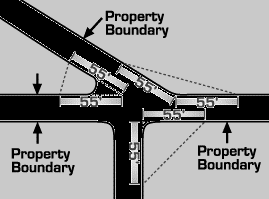
B.
No structure (i.e., a fence requiring a building permit) shall be located within the road setback unless a fence permit is obtained per subsection (A)(2) above.
C.
In any CN, CL, MC, and IP districts, all fencing must be specified by use permit or site plan approval, except fences associated with agricultural uses shall be in accordance with subsection (A) above.
D.
In any GI or I district, fencing shall be permitted in required yards as necessary to provide effective screening and security for permitted uses. All fencing shall be specified by use permit or site plan approval, except fences associated with agricultural uses shall be in accordance with subsection (A) above.
E.
For the purposes of this section, fence heights shall be measured from natural grade that exists prior to fence construction.
(Ord. 1227 § 3, 2003: Ord. 1206 § 27, 2002: Ord. 1107 § 4, 1996; Ord. 1003 § 3, 1992: prior code § 12402.1)
(Ord. No. 1370, § 38, 3-20-2012)
18.104.275 - Entry structures.
An entry structure is differentiated from a gate in that an entry structure is greater than six feet tall or contains supports greater than sixty-four inches around. The director may issue a building permit for one entry structure in connection with the primary vehicular entry to the property if it meets all the following standards:
A.
No portion of the entry structure may be constructed within the public road right-of-way unless encroachment permit is approved by the department of public works. No portion of the entry structure may be constructed within a public or private road setback unless a fence permit is obtained pursuant to subsection (A)(2) of Section 18.104.270.
B.
No part of an entry structure may exceed sixteen feet six inches in height.
C.
(Reserved).
D.
No newly constructed entry structure shall encroach upon the applicable "visibility requirements for typical intersections and driveways" of the department of public works.
E.
Open gates, and vehicles waiting for gates to open, may not physically obstruct any public road or private road used by the public. No entry structure shall be designed which causes a vehicle to back into the road way if the entry structure is closed. The turnaround area associated with an entry structure shall not include any part of a public right-of-way.
F.
Signs integral to an entry structure (e.g., lettering (other than a street number) built into a stone wall or driveway arch) shall also comply with the standards of Chapter 18.116 of this code (except for height), and shall be specifically identified as part of a use permit or sign permit.
G.
Within required yards and setbacks, other than the setback for wineries specified in Section 18.104.230, any solid portion of an entry structure that exceeds forty-two inches in height may be approved only if the director makes all of the following findings:
1.
The appearance of any solid portions above forty-two inches high would be compatible with the scenic corridor of candidate scenic highways or routes designated by the Napa County general plan;
2.
The architectural design of the entry structure as a whole would be improved by such height; and
3.
Each element of height that exceeds seventy-two inches (six feet) is harmonious with the balance of the structure.
(Ord. 1268 § 7, 2005: Ord. 1260 § 3, 2005: Ord. 1206 § 28, 2002: Ord. 1107 § 5, 1996)
(Ord. No. 1370, § 39, 3-20-2012)
18.104.280 - Miscellaneous improvements in yards.
In addition to the structures and improvements permitted in yards pursuant to Sections 18.104.260 and 18.104.270, the following improvements may be made in required yards:
A.
Water wells and sewage disposal systems if approved by the director;
B.
Decks, patios, parking pads, and/or driveways structurally supported entirely by earth at no higher than natural grade;
C.
Storage sheds less than one hundred twenty square feet in size if building permits are not required, but only if located in rear and side yards;
D.
Swimming pools, spas, trellises, arbors and gazebos, but only if located in rear and side yards and more than five feet away from any property line;
E.
(Reserved); and
F.
Ramps for access by handicapped persons from grade to a raised ground floor structural entry.
(Ord. 1056 § 1, 1994; Ord. 1003 § 4, 1992: prior code § 12402.2)
(Ord. No. 1370, § 40, 3-20-2012; Ord. No. 1379, § 163, 1-29-2013)
18.104.290 - Utility service centers.
The following special requirements shall apply if the proposed use is a utility service center which includes equipment yard functions:
A.
Screening.
1.
Equipment yard activities shall be screened from all streets and to the extent possible from adjacent uses, and may involve any combination of structures and landscaping acceptable to the director of planning.
2.
Notwithstanding subsection (A)(1), any screening must include a twenty-foot setback which is covered with a dense landscaping screen on the side and rear property lines of any utility service center that adjoins a parcel that is located within an IP zoning district.
3.
Notwithstanding subsection (A)(1), screening must include the landscaping required by subsection (D)(4) of Section 18.40.110 if the utility service center is located in the industrial park district adjoining a parcel located in a residential or agricultural zoning district.
B.
Noise Barrier. Construction of an effective masonry or other high-mass noise barrier at the setback between the equipment yard component of the facility, including access drives, and any adjacent parcels not located within an agricultural preserve, agricultural watershed, or general industrial zoning district shall be required.
(Ord. 1039 § 3, 1993: Ord. 845 § 1 (part), 1987: prior code § 12424)
18.104.295 - Employee housing.
Notwithstanding any regulations set forth in this chapter, nothing in this chapter shall be construed to require the grant of a use permit for employee housing (as defined in Health and Safety Code Section 17008) where the grant of a use permit is not so required under Health and Safety Code Sections 17021.5 or 17021.6 or successor provisions. If any provision in this chapter conflicts with the mandates of the Employee Housing Act (Part 1 commencing with Section 17000 of Division 13 of the Health and Safety Code) as it relates to employee housing, the provisions of the Employee Housing Act shall supersede the local zoning regulations.
(Ord. No. 1323, § 23, 6-23-2009; Ord. 1246 § 12, 2004)
18.104.300 - Farmworker housing.
Subject to the provisions of Section 18.104.295 where applicable, the following provisions shall apply to farmworker housing:
A.
Except as provided in subsection (D) of Section 18.104.010 and Section 18.104.305, the minimum parcel size for a use permit approved for farmworker housing, as defined by Section 18.08.294 of this code, shall be as follows:
1.
Any farmworker housing unit on a permanent foundation that is not part of a farmworker center, or any farmworker center containing permanent structures must be located on a parcel or parcels containing at least forty acres.
2.
Seasonal farmworker housing (i.e., occupied no more than one hundred twenty days in any calendar year) must be located on a parcel of at least twenty acres, provided that utilities are disconnected or such housing is removed from the site during the remainder of the year.
B.
An unmet need (for the income level and household size) must be demonstrated for housing one full-time qualified farmworker occupant per unit, permanently or seasonally, for the life of the unit. If agricultural employment need is demonstrated for at least one hundred eighty days in each of three successive calendar years, the unit shall be considered "permanent" or "full time" for the life of the unit.
C.
Farmworker housing shall be occupied solely by qualified farmworker occupants as defined by Section 18.08.294 of this code.
D.
Units must be located on the site of a qualifying agricultural employment; or on other lands owned or controlled by the agricultural employer; or if a public agency owns or manages the housing (under a long-term management agreement), within fifteen miles of an adequate amount of agricultural employment to provide full time agricultural employment for one qualified farmworker occupant per unit of farmworker housing.
E.
Farmworker housing may not exceed one thousand two hundred square feet per unit in size.
F.
A congregate farmworker lodging facility shall be deemed to contain one unit for each five beds, rounding up to the next whole unit.
G.
Rent, if any, including utility costs, does not exceed a level affordable to a household of the median income for Napa County.
H.
No more than ten farmworker housing units outside of a permitted farmworker center shall be located on any single parcel.
I.
A minimum of two parking spaces shall be provided per farmworker housing unit outside of farmworker centers, screened from all on- and off-site residences and public streets. Parking areas for temporary or seasonal units shall be surfaced with a pervious surface acceptable to the director of planning, building and environmental services.
J.
A deed restriction is required for all units of permanent farmworker housing constructed on agriculturally zoned parcels. Any division of the land on which the farmworker housing lies, or reduction through any means of the land below the minimum size established in subsection (A) of this section will be subject to review and removal of the unit(s) to ensure conformance with the applicable zoning classification.
K.
Farmworker housing is subject to removal if the agricultural employment upon which need for the unit(s) is based is eliminated. This section shall not apply if a showing is made that elimination of the agricultural use for no more than twenty-four months is related to the long-term functioning of agriculture on the site(s) used to establish the housing need (e.g., crop rotation, replanting, disease or the like).
L.
The owner on which the farmworker housing is located shall certify, on a continuing annual basis, the full name, location(s) of employment, and duration of tenancy of all qualified farmworker occupants pursuant to Section 18.08.294 of this code.
M.
A farmworker housing unit that ceases to be occupied in compliance with this code shall not be converted to another use or occupancy until each public housing authority operating within fifteen miles of the site has been notified of the intent to convert at least sixty days prior to the conversion and has had the opportunity to meet and confer with the property owner. A public housing authority, or another housing provider designated by the authority, may continue to operate the farmworker housing unit(s) for occupancy by persons employed in agriculture within fifteen miles of the housing site, upon submittal to the department of an occupancy agreement executed by the authority, its agent if any, and the owner. However, if such an agreement is not reached, the use shall be subject to review for revocation or modification pursuant to subsection (K) above to the extent it is occupied by persons who are not qualified farmworkers as defined by Section 18.08.294.
(Ord. 1246 § 13, 2004: Ord. 1195 § 4, 2002: Ord. 1191 § 1, 2002: Ord. 1104 § 32, 1996: Ord. 1099 § 2, 1996: Ord. 1040 § 7, 1993: prior code § 12426)*
(Ord. No. 1323, § 24, 6-23-2009; Ord. No. 1379, § 164, 1-29-2013)
* Editor's Note: Ord. 1099 contained two sections numbered 2.
18.104.305 - Farmworker centers—Owned or managed by local government agency or non-profit organizations.
Subject to the provisions of Section 18.104.295 where applicable, the following provisions shall apply to farmworker housing:
A.
Notwithstanding subsection (A) of Section 18.104.300, a farmworker center as described in subsection (A)(2) of Section 18.104.310, that is, a congregate housing facility occupied for no more than three hundred thirty days in a calendar year, comprised of permanent structures which are either owned or managed under a long term lease by a local government agency or non-profit organization may be located on a parcel of two or more acres, subject to all of the following conditions, together with applicable conditions in subsection (B), if any:
1.
The farmworker center may be occupied by no more than sixty farmworkers at any one time;
2.
No more than five new farmworker centers may be established pursuant to this section after March 7, 2002;
3.
The local government agency or non-profit organization shall operate the farmworker center in accordance with all applicable provisions of both this code and applicable state and federal law.
B.
If a newly created parcel is conveyed or leased to a local government agency or non-profit organization to operate a farmworker center pursuant to subsection (A), above, and the local government agency or non-profit organization ceases to use the parcel for a farmworker center, then all of the following conditions shall apply:
1.
The local government agency or non-profit organization shall, within six months, directly reconvey the parcel to the grantor or cancel the lease in such a manner as to merge it into the parcel from which it was divided;
2.
The local government agency or non-profit organization may not convey a parcel which does not satisfy the requirements of Section 18.104.300 to any third persons other than successors in interest of the grantor;
3.
The use permit for the farmworker center shall automatically expire;
4.
The parcel may thereafter be used only for purposes otherwise allowed by applicable zoning;
5.
The local government agency or non-profit organization shall submit a plan to the director describing the action it will take to ensure that future use of the structures conform to zoning applicable to the parcel at the time of reconveyance, including, but not limited to, demolition of the structures, modification of the structures to make them not habitable for residential use, or conversion of the structures to a use allowed by the zoning.
C.
No parcel shall be created for the purpose of establishing a farmworker center pursuant to this section and subsection (D) of Section 18.104.010 unless the local government agency or non-profit organization first agrees in writing to accept title to the parcel or to enter into a long-term lease.
D.
A use permit for a farmworker center issued pursuant to this section shall automatically expire if the parcel is not used as a farmworker center within three years after execution of the conveyance of the parcel.
E.
A use permit for a farmworker center issued pursuant to this section shall automatically expire if the farmworker center is not used for two consecutive growing seasons, provided that, if the director receives written notice that the farmworker center is temporarily closed for rehabilitation, growing seasons during which rehabilitation is taking place shall not be counted.
F.
To the extent it is legally permissible, language that ensures the conditions in subsections (A) and (B), above, shall be included in any deed or lease by which property is acquired by a local government agency or non-profit organization for use as a farmworker center pursuant to this section.
G.
Notwithstanding subsection (A)(3) of Section 18.104.330, a farmworker center established pursuant to this section may provide information regarding, and referral of farmworkers to, employment, social and community, and health services.
H.
For purposes of this section, long term lease means forty years or longer.
(Ord. No. 1323, § 25, 6-23-2009; Ord. 1246 § 14, 2004: Ord. 1227 § 4, 2003: Ord. 1191 § 3, 2002; Ord. No. 1495, § 41, 9-24-2024)
18.104.310 - Farmworker centers.
Subject to the provisions of Section 18.104.295 where applicable, the following provisions shall apply to farmworker housing:
A.
Farmworker centers, defined by Section 18.08.293 of this code, may consist of any of the following types of farmworker housing, or combination thereof, totaling two independent residential units or five beds or more:
1.
Permanent single-family dwelling units.
2.
Congregate housing facilities, such as dormitories, occupied for no more than two hundred seventy days in a calendar year, provided that publicly owned and operated congregate housing facilities may be occupied for no more than three hundred thirty days in a calendar year.
3.
Temporary trailers, occupied for no more than one hundred twenty days in a calendar year.
B.
Farmworker centers shall, in addition to the requirements of Section 18.104.300, meet the following standards:
1.
All farmworker center parking areas shall be screened from adjacent property boundaries and from public roads. All permanent farmworker centers, and all seasonal farmworker centers containing any permanent structures, shall be screened along the entire perimeter by landscaping, excluding driveways and farm service roads located more than one hundred yards from any residence on adjacent parcels. Seasonal farmworker centers without permanent structures shall, at a minimum, landscape any frontage on a public road.
2.
Exterior lighting of farmworker centers shall be low profile and limited to security needs only; all exterior lights shall be shielded from streets and any off-site residences.
3.
A farmworker center shall have an adequate management plan to demonstrate ability to comply with all requirements.
4.
A farmworker center shall comply with all health and safety and building codes, and requirements of state law.
5.
At least one (standard-sized) parking space per unit shall be provided, or one space per three beds, whichever is more, as well as one space per farmworker center employee (e.g., manager).
C.
Seasonal farmworker centers shall, in addition to the other requirements of this code, meet the following standards:
1.
A seasonal farmworker center may contain no more than twenty units/acre, or sixty beds total, whichever is less.
2.
Any permanent structures utilized as part of a seasonal farmworker center must either have existed on June 24, 1993, or be constructed within the farmworker housing development area as defined by Section 18.104.320.
3.
Where seasonal farmworker centers consist entirely of "farm labor trailers," as defined by Section 15.40.010 of this code, such trailers shall be removed for storage in non-agriculturally-zoned areas, or be placed within existing buildings or existing fully- screened enclosures, for the remaining two hundred forty or more days each year.
D.
Any beds occupied for more than one hundred twenty days in a farmworker center shall be located in permanent structures. Any use permit allowing a farmworker center is subject to revocation in accordance with the procedures set forth in Section 18.124.120 of this code if any part of the farmworker center is occupied for than two hundred seventy days in any calendar year, provided that publicly owned and operated congregate housing facilities may be occupied for three hundred thirty days in any calendar year.
(Ord. No. 1323, § 26, 6-23-2009; Ord. 1158 § 1, 1999: Ord. 1099 § 2, 1995: Ord. 1040 § 8, 1993: prior code § 12427)*
* Editor's Note: Ord. 1099 contained two sections numbered 2.
18.104.320 - Farmworker center development area.
A.
The farmworker center development area shall be a contiguous area consisting of the aggregate paved or impervious ground surface of the approved or recognized buildings, decks, patios, and exclusive driveways, and parking areas.
B.
Farmworker centers as defined by Section 18.08.293, which were permitted on or before the date of adoption of the ordinance codified in this chapter, shall not be expanded beyond the farmworker center development area; except that farmworker housing may be added if it complies with subsection (A) or (B) of Section 18.08.294 or if it is a permitted use in the zoning district.
(Ord. No. 1323, § 27, 6-23-2009; Ord. 1040 § 9, 1993: prior code § 12428)
18.104.330 - Accessory farmworker center uses.
A.
Any or all of the following uses, if included specifically in a use permit, may be permitted as an accessory use for residents of an authorized farmworker center. Such accessory uses must be located either in a single community building or in a permitted location outdoors, and such uses may not be advertised to the general public:
1.
Food service for residents of the farmworker center;
2.
Laundry facilities for residents of the farmworker center;
3.
At an authorized farmworker center which is operated by a public housing authority on January 1, 1995, and without the establishment of permanent facilities therefor:
a.
Information and referral to employment services for residents of the farmworker center.
b.
Information and referral to social and community services for residents of the farmworker center.
c.
Information and referral to health services for residents of the farmworker center.
(Ord. No. 1323, § 28, 6-23-2009; Ord. 1099 § 3, 1996: Ord. 1040 § 10, 1993: prior code § 12429)
18.104.340 - Outdoor recreation—General standards.
The following general standards shall apply to all permitted parks and recreation uses and facilities as defined by Section 18.08.428 and all campgrounds as defined by 18.08.118:
A.
Adequate water supply and sewage disposal consistent with the requirements of the department shall be provided.
B.
Adequate access for the intensity of use proposed and to accommodate access by emergency equipment as specified by the county public works department and the county fire department shall be provided.
C.
Adequate on-site parking, where needed to accommodate the proposed use, shall be provided on site.
D.
Garbage service and litter cleanup consistent with department standards shall be provided.
E.
Continuous management of the use shall be provided, through on-site supervision or an adopted state-of-the-art management plan that includes appropriate implementation.
F.
The recreational use shall fully provide for appropriate buffer zones and/or fencing to avoid adverse impacts to adjoining agricultural and residential activities.
G.
The recreational use shall fully provide for appropriate buffer zones and/or fencing for protection of adjoining habitats and erosion hazard areas.
H.
Impervious surfaces shall be minimized to the greatest feasible extent.
I.
Such use shall not result in the displacement of existing agricultural use, as defined in the Napa County Code.
(Ord. 1105 § 9, 1996)
(Ord. No. 1326, § 9, 9-22-2009; Ord. No. 1379, § 165, 1-29-2013)
18.104.350 - Outdoor recreation—Environmental performance standards.
In addition to the standards of Section 18.104.340, the following environmental performance standards shall apply to all permitted parks and recreational uses and facilities as defined by Section 18.08.428, all quasi-private recreation uses and facilities as defined by Section 18.08.494, and all campgrounds as defined by Section 18.08.118:
A.
Noise. No noise shall be produced which exceeds the standards set forth in the general plan noise element and Chapter 8.16 of the Napa County Code for adjacent residential uses.
B.
Odors. No obnoxious off-site odors shall be produced.
C.
Dust. Best management practices for dust control shall be utilized and no dust may travel off-site.
D.
Nighttime Lighting. Any exterior lighting shall be shielded and directed downward, shall be located as low to the ground as practicable, shall be the minimum necessary for security, safety, and/or operations, and shall be in keeping with the natural open space character of the site. Where visible, structures shall utilize non-reflective materials to the greatest extent practicable.
E.
Aesthetics. Landscaping and/or fencing shall be required as necessary to reduce adverse visual impacts to the public.
F.
Fire. The use shall result in minimal added fire hazard. The use shall meet all requirements of the applicable fire protection agency for fire prevention and suppression.
G.
Pests, including Weeds and Vectors. The use shall result in minimal added pest hazards. If necessary, appropriate suppression methods shall be provided.
H.
Safety. Facilities shall be designed and the use shall be conducted in a manner that minimizes safety hazards to users, adjacent residents, and adjacent livestock.
I.
Erosion. Facilities shall be designed to produce a minimum of soil erosion, and managed and maintained so as to promptly restore any damage from erosion.
(Ord. No. 1326, § 10, 9-22-2009; Ord. 1105 § 10, 1996)
18.104.360 - Outdoor recreation—Campgrounds.
In addition to the standards of Sections 18.104.340 and 18.104.350, the following special performance standards shall apply to campgrounds:
A.
The number and density of sites shall maintain the rural character and the environment of both the site and surrounding areas.
B.
Except for authorized caretakers, employees, agents and/or volunteers, the maximum continuous length of occupancy by the same person or vehicle within the campground shall be fourteen days.
C.
Where recreation vehicles or recreation vehicle facilities are proposed, the size of the allowed recreation vehicles shall be consistent with the rustic natural character of the site.
(Ord. No. 1326, § 11, 9-22-2009; Ord. 1105 § 11, 1996)
18.104.370 - Outdoor recreation—Gun ranges.
In addition to the standards of Sections 18.104.340 and 18.104.350, the following special performance standard shall apply to gun ranges:
A.
Target and practice ranges for firearms must be effectively managed, physically isolated, and noise-buffered from adjoining occupied uses and areas.
(Ord. 1105 § 12, 1996)
18.104.380 - Outdoor recreation—Hunting clubs (large).
In addition to the standards of Sections 18.104.340 and 18.104.350, the following standards shall apply to large hunting clubs:
A.
Hunting clubs must be effectively managed, geographically isolated, and noise-buffered from adjoining occupied uses and areas.
B.
All trash shall be hauled off site to an approved landfill facility.
C.
Sleeping structures shall be limited in size, character and number as follows:
1.
The number and size of sleeping structures on any one property shall be commensurate with the approved level of hunting activity.
2.
Sleeping structures shall not have permanent foundations, electrical facilities, or gas facilities.
3.
Sleeping structures shall be rustic in character and appearance.
4.
Any sleeping structure with a roof area greater than one hundred twenty square feet shall obtain a building permit.
(Ord. 1105 § 13, 1996)
18.104.390 - Outdoor recreation—Findings.
In addition to findings required by Section 18.124.070, the approving agency must make all the following findings prior to issuance of a use permit for parks or rural recreation uses and facilities or campgrounds:
A.
The use is shown by evidence in the record to be appropriately located.
B.
There is a demonstrated need for the use within the county.
C.
The use does not significantly affect the ability to conduct existing agriculture uses on site or nearby.
D.
The use does not significantly affect potential agricultural operations on site or nearby.
E.
The use itself would not be adversely affected by adjacent agricultural activities.
F.
The use is not growth-inducing.
G.
The use serves local needs.
(Ord. No. 1326, § 12, 9-22-2009; Ord. 1105 § 14, 1996)
18.104.400 - Hot air balloon launching site—Findings.
In addition to the findings required in Section 18.124.070, the approving agency must make all of the following findings prior to issuance of a use permit for a hot air balloon launching site:
A.
The proposed launch site is located more than five hundred feet from any off-site residence or if the launch site is proposed within five hundred feet of any off-site residence, the permittee has submitted written consent to the planning department from the owners or residents of any off-site residence within five hundred feet stating that they have no objection to the proposed launch site;
B.
The permittee has submitted a signed statement which acknowledges that the permittee: (1) has read the county's adopted code of conduct; (2) agrees that all users of the launch site will be bound by the county's adopted code of conduct; and (3) certifies that all activities within the last year at any other sites operated by the permittee have complied with the county's adopted code of conduct;
C.
The permittee has provided written authorization from either the property owner where the launch site is proposed or the property owner's authorized agent together with a statement from the property owner or the property owner's authorized agent confirming that balloon launchings will not interfere or conflict with any existing or planned agricultural uses on the property;
D.
The site is proposed for use only between the hours of five-thirty a.m. and nine-thirty a.m.;
E.
The permittee has provided the planning department with a certificate of insurance naming the county and the property owner as additional insureds on the personal injury/property damage insurance in an amount acceptable to the county's risk manager and which is consistent with the county's corporation yard license requirements currently existing or as amended;
F.
The permittee has provided a list of intended landing areas that are both reasonable given the launch location and prevailing winds and permitted or allowed; and
G.
The permittee and each balloon operator utilizing the permittee's launch site agree to conduct their operations so as to remain in good standing with the county. For purposes of this section, "in good standing with the county" means that within the last twelve-month period, the county has not received more than three verified complaints or a number of verified complaints equivalent to three percent of the total number of launches, whichever is greater. All complaints must be: (1) submitted on a form provided by the planning department for verification; and (2) submitted by a property owner or resident who has certified that the permittee or a balloon operator using the permittee's launch site has landed on the property owner's or resident's property without permission.
(Ord. 1276 § 1, 2006)
18.104.410 - Transient commercial occupancies of dwelling units prohibited.
A.
Transient commercial occupancies of dwelling units are prohibited in all residential and agricultural zoning districts within the county.
B.
Definitions. Unless otherwise defined in Chapter 18.08, the following definitions shall apply to this section:
1.
"Commercial use" shall have the same meaning as commercial use in Section 18.08.170, except it shall not include house exchanges, where owners or occupants swap homes for vacation purposes.
2.
"Occupancies" means the use or possession or the right to the use or possession of real property or a portion thereof, including any dwelling unit, single family dwelling unit, guest cottage, or accessory dwelling unit, for dwelling, lodging or sleeping purposes. The right to use or possession includes any nonrefundable deposit or guaranteed no-show fee paid by a person, whether or not the person making the deposit actually exercises the right to occupancy by using or possessing any property or portion thereof.
3.
"Transient commercial occupancies of dwelling units" means any commercial use of a dwelling unit for a period of time less than thirty consecutive days. It does not include occupancies associated with farm labor camps, residential care facilities, family day care homes, or legally permitted bed and breakfast establishments, hotels or motels.
C.
Liability and Enforcement.
1.
Any property owner, or authorized agent thereof, who uses or allows, or who knowingly arranges or negotiates for the use of, transient commercial occupancies of dwelling units in violation of this section shall be guilty of either an infraction or a misdemeanor.
2.
Any property owner, or authorized agent thereof, who prints, publishes, advertises or disseminates in any way, or causes to be printed, published, advertised or disseminated in any way, any notice or advertisement of the availability of transient commercial occupancies of dwelling units as prohibited by this section, shall be guilty of either an infraction or a misdemeanor.
3.
In addition to the penalties set forth in subsections (C)(1) and (2) above, violators of this section may be subject to a public nuisance abatement action brought under the provisions of Chapter 1.20 and the civil penalty provisions of up to one thousand dollars per violation per day as provided in subsection (B) of Section 1.20.155 and subject to an unfair competition action brought pursuant to Business and Professions Code Section 17200 et seq. and up to two thousand five hundred dollars per violation civil penalty allowed thereunder.
4.
Any person who uses, or allows the use of transient commercial occupancies of dwelling units prohibited by this section shall also be liable for the transient occupancy tax that would have been owed under Chapter 3.32 had the occupancy use been legal, including the penalty and interest provisions of Section 3.32.080.
5.
The civil remedies and penalties provided by this subsection are cumulative to each other.
(Ord. No. 1332, § 2, 12-15-2009, eff. 12-1-2010; Ord. No. 1495, § 42, 9-24-2024)
18.104.420 - Supportive and transitional housing.
Pursuant to Government Code Section 65583(c)(3), transitional and supportive housing are considered a residential use of property subject only to the same restrictions that apply to other residential dwellings of the same type in the same zone.
(Ord. No. 1323, § 29, 6-23-2009)
(Ord. No. 1495, § 43, 9-24-2024)
18.104.430 - Napa County Landmarks of Special Significance—Findings.
In addition to the findings required in Section 18.124.070, the approving agency must make all of the following findings prior to issuance of a use permit for reuse of the Landmarks of Special Significance identified in subsection (C) of Section 15.52.035:
A.
The reuse will support the long-term preservation of the Historical Resource and the applicant has agreed to rehabilitate and maintain the resource in conformance with the Secretary of the Interior's Standards for Preservation Projects.
B.
The reuse will enhance public understanding and appreciation for the county's cultural heritage.
C.
The reuse is compatible with agriculture because it does not displace an agricultural use, conflict with a Williamson Act contract, or increase the likelihood of conflicts between users of the site and nearby agricultural activities.
D.
The reuse does not constitute urbanization because it re-establishes one or more historic uses of the property in extant historic buildings and does not require inappropriate alterations or extensive additions to the buildings. For purposes of this section, inappropriate alterations are those that do not conform with the Secretary of the Interior's Standards, and extensive additions are those that exceed five hundred gross square feet.
E.
The reuse is supported by adequate off-street parking, adequate water supplies, and an adequate waste disposal system.
F.
The property owner has agreed to maintain the Historical Resource in accordance with the Secretary of the Interior's Standards, has provided a written maintenance plan prepared by a Qualified Preservation Professional, and shall reimburse the county for the cost of an annual inspection for the duration of the use permit.
(Ord. No. 1367, § 9, 12-6-2011)
18.104.440 - Two-unit developments.
This section provides objective zoning standards for two-unit developments within single-family residential zones to implement the provisions of Government Code Section 65852.21, to facilitate the development of new residential housing units consistent with the County's Housing Element, and to ensure sound standards of public health and safety.
A.
Definitions: As used in this chapter.
1.
A person "acting in concert with the owner," means a person that has common ownership or control of the subject parcel with the owner of the adjacent parcel, a person acting on behalf of, acting for the predominant benefit of, acting on the instructions of, or actively cooperating with, the owner of the parcel being subdivided.
2.
"Adjacent parcel" means any parcel of land that is (a) touching the parcel at any point; (b) separated from the parcel at any point only by a public right-of-way, private street or way, or public or private utility, service, or access easement; or (c) separated from another parcel only by other real property which is in common ownership or control of the applicant.
3.
"Car share vehicle" means a motor vehicle that is operated as part of a regional fleet by a public or private care sharing company or organization and provides hourly or daily service.
4.
"Common ownership or control" means property owned or controlled by the same person, persons, or entity, or by separate entities in which any shareholder, partner, member, or family member of an investor of the entity owns ten percent or more of the interest in the property.
5.
"Sufficient for separate conveyance," means that each attached or adjacent dwelling unit is constructed in a manner adequate to allow for the separate sale of each unit in a common interest development as defined in Civil Code Section 1351 (including a residential condominium, planned development, stock cooperative, or community apartment project), or into any other ownership type in which the dwelling units may be sold individually.
6.
"Two-unit development" means a development that proposes no more than two new units or proposes to add one new unit to one existing unit.
7.
"Urban lot split" means a subdivision of an existing parcel into no more than two separate parcels pursuant to Chapter 17.17.
B.
Location Requirements: As provided by Government Code Section 65852.21, and this section, the parcel proposed for a two-unit development must meet the following requirements:
1.
The parcel is zoned Residential Single or Residential Country and is located entirely within the boundaries of an urban area as defined by the United States Census Bureau's Urban-Rural Classification.
2.
The building site, as defined under Napa County Code Section 17.02.080, for a two-unit development, is not located within or includes any of the conditions listed in Government Code Section 65913.4(a)(6)(B) - (K) or the following:
a.
Land zoned or designated for agricultural protection or preservation by local ballot Measure J or Measure P approved by the voters of Napa County.
b.
Land designated as a Groundwater Deficient Area, as defined and mapped under Napa County Code Chapter 13.15, unless:
1.
The applicant is able to secure a groundwater permit, pursuant to Napa County Code 13.15 for the proposed two-unit development. or in the case of an urban lot split, the applicant is able to secure a groundwater permit for all potential future dwelling units allowed under this section.
2.
The applicant is able to provide documentation that the two-unit development or the future dwelling units from an urban lot split will be directly plumbed to receive potable water from a groundwater well outside of the Groundwater Deficient Area or from an approved public water system. Hauled water is not approved to serve the domestic use of a dwelling and cannot be approved in lieu or a directly plumbed potable source of water.
C.
Two-Unit Development: As provided by Government Code Section 65852.21 and this section, two-unit developments that meet the qualifying criteria for ministerial approval under this section shall be approved by the director without a hearing. The director shall determine if an application for a two-unit development meets the locational criteria prescribed in subsection B above and meets the follow requirements:
1.
The proposed two-unit development would not require the demolition or alteration of any of the following types of housing:
a.
Housing that is subject to a recorded covenant, ordinance, or law that restricts rents to levels affordable to persons and families of moderate-, low-, or very low-income.
b.
Housing that is subject to any form of rent or price control through a public entity's valid exercise of its police power.
c.
Housing that has been occupied by a tenant in the last three years.
2.
The parcel is not a parcel on which an owner of residential real property has exercised the owner's right under Chapter 12.75 (commencing with Section 7060) of Division 7 of Title 1 to withdraw accommodations from rent or lease within the last 15 years before the date that the development proponent submits an application.
3.
The two-unit development does not include the demolition of more than twenty-five percent of the existing exterior structural walls unless the site has not been occupied by a tenant in the last three years.
4.
The parcel is not located within a historic district or property included on the State Historic Resources Inventory, as defined in Section 5020.1 of the Public Resources Code, or within a site that is designated or listed as a Napa County landmark or historic property or historic district pursuant to a Napa County ordinance.
5.
The two-unit development complies with all objective zoning standards, objective subdivision standards, and objective design review standards applicable to the parcel as provided in the zoning district in which the parcel is located, and all applicable objective Napa County ordinances; provided, however, that:
a.
The application of such standards shall be modified if the standards would have the effect of physically precluding the construction of two units on the parcel or would result in a unit size of less than eight hundred square feet. Any modifications of development standards shall be the minimum modification necessary to avoid physically precluding two units of eight hundred square feet each on each parcel.
b.
Notwithstanding subsection (5)(a) above, required rear and side yard setbacks shall equal four feet, except that no setback shall be required for an existing legally created structure, or a structure constructed in the same location and to the same dimensions as an existing legally created structure.
c.
For a two-unit development connected to an onsite wastewater treatment system, the applicant must provide a percolation test completed within the last five years, or if the percolation test has been recertified, within the last ten years.
6.
Proposed adjacent or connected dwelling units shall be permitted if they meet building code safety standards and are designed sufficient to allow separate conveyance. The two-unit development shall provide a separate gas, electric and water utility connection directly between each dwelling unit and the utility.
7.
Parking. One parking space shall be required for each unit constructed on the site, except that no parking is required where:
a.
The parcel is located within one-half mile walking distance of either a stop located in a high-quality transit corridor, as defined in Public Resources Code Section 21155(b), or a major transit stop, as defined in Public Resources Code Section 21064.3; or
b.
There is a designated parking area for one or more car-share vehicles within one block of the parcel.
8.
Dwelling units created by a two-unit development may be used for residential uses only and may not be used for rentals of less than thirty days.
9.
No more than two dwelling units may be located on any lot created through an urban lot split pursuant to Chapter 17.17, including primary dwelling units, accessory dwelling units, junior accessory dwelling units, density bonus units, and units created as a two-unit development.
10.
If any existing dwelling unit is proposed to be demolished, the applicant must comply with the replacement housing provisions of Government Code Section 66300(d).
D.
Application Requirements. An application for a two-unit development shall include the following:
1.
Declaration of Prior Tenancies. If any existing housing is proposed to be altered or demolished, the owner of the property proposed for a two- unit development shall sign an affidavit, in a form approved by county counsel, stating that none of the conditions listed in Section 18.104.440.C.1 and 18.104.440.C.2 above exist and shall provide a comprehensive history of the occupancy of the units to be altered or demolished for the past three years (five years if an existing unit is to be demolished).
2.
No Subdivision. At the time of application for a two-unit development where there is no urban lot split, the property owner shall acknowledge in writing that neither of the two units may be sold separately unless a subdivision is recorded.
3.
Recorded Covenant. Prior to the issuance of a building permit for a two-unit development, the owner shall record a covenant in the form approved by county counsel to notify future owners of the prohibition on non-residential uses of any units constructed on the site, including a prohibition against renting or leasing the units for fewer than thirty consecutive calendar days. requirements of this subsection.
E.
Specific Adverse Impacts. In addition to the criteria listed in this section, a proposed two-unit development may be denied if the building official makes a written finding, based on a preponderance of the evidence, that the proposed housing development project would have a specific, adverse impact upon public health and safety or the physical environment, for which there is no feasible method to satisfactorily mitigate or avoid the specific, adverse impact. A "specific adverse impact" is a significant, quantifiable, direct, and unavoidable impact, based on objective, identified written public health or safety standards, policies, or conditions as they existed on the date the application was deemed complete. Inconsistency with the zoning ordinance or general plan land use designation and eligibility to claim a welfare exemption are not specific health or safety impacts.
F.
Enforcement. County counsel shall be authorized to abate violations of this chapter and to enforce the provisions of this chapter and all implementing agreements and affidavits by civil action, injunctive relief, and any other proceeding or method permitted by law. Remedies provided for in this chapter shall not preclude the county from any other remedy or relief to which it otherwise would be entitled under law or equity.
(Ord. No. 1495, § 44, 9-24-2024)

