
National City City Zoning Code
DIVISION 4
GENERAL DESIGN AND DEVELOPMENT REGULATIONS
18.40.010 - Purpose.
This chapter expands upon the standards of Division 2 by addressing details of site planning, building design, landscaping, parking and loading, outdoor lighting, and signs and outdoor advertising displays. These standards are intended to ensure that all development produces an environment of stable and desirable character, is compatible with existing and future development, and protects the use and enjoyment of neighboring properties, consistent with the General Plan.
(Ord. No. 2024-2529, 4-2-2024)
18.40.020 - Applicability.
The requirements of this chapter shall apply to existing and new development and land uses and shall be considered in combination with the standards for the applicable zone in Division 2 and Specific Use Regulations in Division 3. If there is conflict, the standards in Division 3 shall control.
(Ord. No. 2024-2529, 4-2-2024)
18.40.030 - Performance standards for all development and land uses.
A.
Purpose. This section provides performance standards that are designed to minimize various potential operational impacts of land uses and development within the city and promote compatibility with adjoining areas and land uses.
B.
Applicability. The provisions of this section apply to all new and existing land uses, in all zones, unless an exemption is specifically provided.
C.
Noise. No use shall be established nor any activity conducted which violates the standards of the Noise Control Ordinance—Title 12 of the Municipal Code.
D.
Air Emissions. Other than as permitted by the County of San Diego Air Pollution Control District, no visible dust, gasses, or smoke shall be emitted.
E.
Combustibles and Explosives. The use, handling, storage, and transportation of combustibles and explosives shall comply with the Uniform Fire Code and California Code of Regulations Title 19.
F.
Dust. Activities that may generate dust emissions (e.g., construction, grading, commercial gardening, and similar operations) shall be conducted to limit the emissions beyond the site boundary to the maximum extent feasible. Appropriate methods of dust management shall include the following, subject to approval by the building division.
1.
Water all active construction areas twice per day and use erosion control measures to prevent water runoff containing silt and debris from entering the streets and storm drain system;
2.
Cover trucks hauling soil, sand, and other loose material;
3.
Pave, water, or apply non-toxic soil stabilizers on unpaved access roads and parking areas;
4.
Sweep and collect (i.e., vacuum) paved access roads and parking areas daily; and
5.
Sweep and collect (i.e., vacuum) streets daily if visible material is carried onto adjacent public streets.
6.
Hydroseed or apply non-toxic soil stabilizers to inactive construction areas;
7.
Enclose, cover, water, or apply non-toxic soil binders to open materials stockpiles;
8.
Limit traffic speeds on unpaved roads to fifteen mph;
9.
Install sandbags or other erosion control measures to prevent silt runoff to public roadways;
10.
Replant vegetation in disturbed areas within ten days after project completion;
11.
Install wheel washers for all exiting trucks, or wash off the tires or tracks of all trucks and equipment leaving the site;
12.
Install wind breaks, or plant trees/vegetation at windward sides of construction areas, or avoid removing existing vegetation which acts as a windbreak;
13.
Suspend excavation and grading activity when winds (instantaneous gusts) exceed twenty mph or dust clouds cannot be prevented from extending beyond the site; and
14.
Limit area subject to excavation, grading, and other construction activities at any one time.
15.
Limit access to the construction sites, so tracking of mud or dirt on to public roadways can be prevented.
16.
Projects that have significant construction period exhaust emissions shall reduce fleet average emission rates. Developers or contractors shall provide a plan for approval by the city or SDAPCD demonstrating that the heavy-duty (< fifty horsepower) off-road vehicles to be used in the construction project for more than an accumulated forty hours, including owned, leased and subcontractor vehicles, will achieve emission standards similar to in-use equipment that meets CARB certified Tier II standards.
G.
Ground Vibration. No ground vibration shall be generated that is perceptible without instruments by a reasonable person at the property lines of the site, except for vibrations from temporary construction or demolition activities, and motor vehicle operations.
H.
Light and Glare.
1.
Outdoor lighting shall comply with the requirements of Chapter 18.46 (Outdoor Lighting).
2.
Any operation or activity producing glare shall be conducted or shielded so as not to cause illumination in residential zones in excess of five-tenths footcandles. Flickering or intrinsically bright sources of illumination shall be controlled so as not to be a nuisance in residential zones.
3.
Illumination levels shall be measured with a photoelectric photometer having a spectral response similar to that of the human eye, following the standard spectral luminous efficiency curve adopted by the Illuminating Engineering Society of North America (IESNA).
I.
Liquid Waste. No liquid shall be discharged into a public or private body of water, sewage system, watercourse, or into the ground, except in compliance with applicable regulations of the Regional Water Quality Control Board.
J.
Odor.
1.
No obnoxious odor or fumes shall be emitted that are perceptible without instruments by a reasonable person at the property line of the site. For mixed-use buildings, commercial uses that emit odors, such as restaurants and nail salons, shall be properly ventilated to as not to impact adjoining residential uses.
2.
No use shall be established nor any activity conducted which violates the standards of the Odor Control Ordinance—Title 7.08—Environmental Conditions of the Municipal Code.
K.
Radioactivity, Electrical Disturbance or Electromagnetic Interference. None of the following shall be emitted:
1.
Radioactivity, in a manner that does not comply with all applicable State and Federal regulations; or
2.
Electrical disturbance or electromagnetic interference that interferes with normal radio or television reception or with the function of other electronic equipment beyond the property line of the site; or that does not comply with all applicable Federal Communications Commission (FCC) and other applicable state and federal regulations.
(Ord. No. 2024-2529, 4-2-2024)
18.41.010 - Purpose.
The purpose of this chapter is to provide guidance and standards for site planning for nonresidential and multi-unit residential development in order to enhance safety, convenience and attractiveness for walking, transit use and bicycling; provide safe access to businesses and minimize pedestrian conflicts; and foster an attractive, quality environment to foster community pride and attract desired development and uses.
(Ord. No. 2024-2529, 4-2-2024)
18.41.020 - Nonresidential site planning standards.
These standards apply to those areas in the city that will be developed as commercial use without a residential component (mixed-use) or areas where only a commercial use is permitted. This section considers two basic types of development: freestanding buildings and multi-tenant strip developments including mini-malls.
A.
Shopping Center Development.
1.
When shopping centers are set back from the street with parking in front, thirty percent of the street frontage shall be lined with buildings.
2.
Parking lots for shopping centers should provide vehicular connections to adjacent commercial projects.
3.
Pedestrian walkways for shopping centers should provide pedestrian connections to adjacent uses.
4.
Access drives for commercial centers should be located at least two hundred feet apart and at least one hundred feet from any major intersection. Access drives should be located a minimum of ten feet from property lines unless a shared drive is provided.
5.
For neighborhood-serving and convenience retail centers and office and institutional developments, the first row of parking which is perpendicular to an access drive from a street shall be set back at least forty feet from the sidewalk to provide adequate queuing distance from the street and for pedestrian safety. Larger community or regional retail centers may require significantly more setback area as determined by the engineering division.
B.
Freestanding or "Pad" Buildings.
1.
Except for drive-through/drive-in establishments, parking for freestanding retail or "pad" buildings fronting a public street shall be located a maximum of twenty feet from the property line. Freestanding buildings adjacent to a public street are discouraged from being separated from the sidewalk with parking.
2.
The building entry shall be accentuated with architectural details and landscaping.
3.
Freestanding restaurants may provide outdoor seating at the building entry.
C.
Drive-Through Businesses.
1.
Minimum vehicular queuing distance shall be established through the conditional use permit process.
2.
Drive through business aisles shall have a minimum interior turning radius of twenty-five feet for any curves. A smaller radius may be established through the conditional use permit process with the approval of the city engineer.
3.
A drive-through window or lane shall not be placed between the right-of-way or internal drive and the associated building unless a ten-foot wide landscape strip extending the entire length of the drive-through queuing is installed and maintained with a minimum three-foot height continuous hedge and ornamental trees spaced a minimum of twenty feet on center.
D.
Industrial Site Planning Standards. Planning standards for industrial buildings and business parks include the following:
1.
Services areas shall be located at the sides or rear of buildings. Service areas located at the exterior side of buildings shall be screened from view by a combination of screen walls, landscaping, and/or portions of the building.
2.
Loading areas must be designed so that trucks will not need to back in from the public street onto the site.
3.
Parking for visitors shall be convenient to the main entrance.
4.
Emphasis shall be placed on the building entry.
5.
Buildings should be oriented so as to provide space for plazas and courtyards.
6.
Outdoor storage and equipment shall be screened from public rights-of-way.
E.
Pedestrian Walkways.
1.
A pedestrian walkway within a retail center, office, industrial or institutional development shall be a minimum of five feet wide. Pedestrian walkways immediately adjacent to and perpendicular to parking stalls shall be a minimum of six feet wide.
2.
Materials for pedestrian walkways may include concrete, concrete pavers, brick, stone or combination thereof or materials as approved by the planning division.
3.
A pedestrian walkway shall provide direct pedestrian access from peripheral sidewalks to the sidewalks that front on-site buildings and building entrances.
(Ord. No. 2024-2529, 4-2-2024)
18.41.030 - Multi-unit residential site planning standards.
A.
Pedestrian Access.
1.
Unit Entries Adjacent to a Street. Multi-unit projects should be designed with each unit adjacent to a street having its primary pedestrian entrance from the street sidewalk, or as forecourt projects with at least the primary building entrance having access to the street sidewalk. Where individual units have access to the street sidewalk, private "front yard" outdoor space may be differentiated from the public right-of-way by a porch, or small yard (i.e., patio) enclosed by a low wall or fence not to exceed forty-two inches in height.
2.
Pedestrian walkways shall be provided to every unit entry.
3.
Notwithstanding the provisions of Section 4450 et seq., of Chapter 7 of Title 1 of the Municipal Code, containing requirements for facilities necessary to assure access and usability for the physically handicapped, in all multi-unit residential projects the following provisions shall apply:
a.
Safe, convenient, well-drained pedestrian access to dwelling units, parking lots, and service areas, by provision of walks, steps or stepped ramps, so constructed as to assure reasonable durability and economy of maintenance, shall be required.
b.
Pedestrian walkways shall be a minimum of thirty-six inches in width.
c.
Pedestrian walkways shall be graded or ramped to no steeper than a one-to-twelve slope.
(Ord. No. 2024-2529, 4-2-2024)
18.41.040 - Common usable open space requirements.
A.
Purpose. The purpose of this section is to prescribe standards for the development of open space areas provided for the exclusive use of the occupants of a multi-unit residential building.
B.
Standards.
1.
For projects of three units or more, common usable open space shall be required in a minimum amount of three hundred square feet per dwelling unit.
2.
Private usable open space may be substituted for such common usable open space but may not exceed one hundred square feet per unit. Each square foot of private usable open space shall be considered equivalent to two square feet of required common usable open space, and may be so substituted, subject to the minimum requirements for actual common usable open space. All units shall be provided with at least sixty square feet of private usable open space.
3.
Both common and private usable open space provided at ground level may be provided in the interior side yard and rear yard setback areas, within courts, and within exterior side yard setback areas to within five feet of the property line.
4.
Private usable open space provided above the first floor may be located in the front setback area to within twelve feet of the front property line.
5.
A minimum of forty percent of the required common usable open space shall be provided outdoors.
a.
Up to twenty-five percent of required common usable open space shall be allowed to be a use other than recreational or leisure space
6.
Common usable open space areas used for recreational or leisure purposes shall have no dimension less than twenty feet.
7.
Private usable open space areas shall have no dimension less than five feet.
8.
See the Westside Specific Plan for other open space requirements related to the MCR-1 and MCR-2 zones.
(Ord. No. 2024-2529, 4-2-2024)
18.41.050 - Open space requirements for mixed-use development.
A.
Purpose. The purpose of this section is to prescribe standards for the development of open space areas provided for the exclusive use of the occupants of a mixed-use building.
B.
Common usable open space shall be provided in the amount of one hundred square feet per unit. A minimum of forty percent of the required common useable open space should be provided outdoors. Indoor common usable open space providing an amenity approved by the Planning Division for recreational or leisure purposes may be provided in lieu of areas outdoors.
C.
At least seventy-five percent of the units shall have a minimum of sixty square feet of private usable open space. Private usable open spaces shall have no dimension less than five feet.
(Ord. No. 2024-2529, 4-2-2024)
18.42.010 - Purpose.
The purpose of standards for building design and materials is to focus efforts on good design in order to create a quality image for the city, making new buildings and building additions compatible with their surroundings, encourage reinvestment, and improve the city's economic vitality.
(Ord. No. 2024-2529, 4-2-2024)
18.42.020 - Projections
Into setbacks and courts.
A.
Requirements—General. Every required front, side, and rear setback shall be open and unobstructed from the ground to the sky, unless otherwise provided. In addition to permitted accessory buildings and structures, the following structures may be erected or projected into any required setback:
1.
Fences and walls may be erected or projected into any required setback as provided in this section.
2.
Cornices, belt courses, sills, eaves, or other similar architectural features (other than bay windows or vertical projections) may project into a required interior side setback not more than two inches for each one foot of width of such side setback, and may project into any other required setback, passageway or other open space not more than thirty inches, provided the width of an exterior side setback is not reduced to less than three feet.
a.
Bay windows or other vertical projections may be permitted, subject to the limitations stated in Subsection (A)(2), provided that no floor area is added. This may be accomplished through a minimum thirty-six-inch gap between ground level and the lower limit of the projection, or some form of permanent interior physical limitation (cabinetry, counter, etc.). The projection may not be greater than thirty percent of the width of the elevation from which it projects.
3.
Eaves may project into a required interior side setback not more than four inches for each one foot of width of such side setback, provided the width of such side setback is not reduced to less than two and one-half feet. Eaves may also project into any other required setback, passageway or other open space not more than thirty inches, provided the width of an exterior side setback is not reduced to less than two and one-half feet.
4.
Chimneys may project into a required setback, passageway or other required open space not more than two feet, provided the width of any required side setback is not reduced to less than three feet.
5.
Fire escapes may project into any setback not more than four feet.
6.
Open unenclosed stairways or balconies, not covered by a roof or canopy, may project into a required rear setback not more than four feet, and into a required front setback, exterior side setback side or other required open space not more than thirty inches, provided the width of an exterior side setback is not reduced to less than two and one-half feet.
7.
Open, unenclosed porches, platforms or landing places, including access stairways, not covered by a roof or canopy, which do not extend above the level of the first floor of the building, may project into any required setback passageway or other open space not more than four feet, provided that in no event shall any such porch, platform or landing place be more than four feet above the adjacent natural ground level.
8.
A one-story unenclosed breezeway, not over five feet in width, extending from a main residential building to an accessory parking or other accessory structure, may project into a required rear or exterior side yard setback a distance not to exceed the required setback of the accessory structure.
9.
Awnings or canopies without enclosing walls or screening may be attached to the exterior walls of a residential structure provided that:
a.
Such awnings or canopies do not extend more than four feet into a required front setback and have no vertical support within the setback or space;
b.
Such awnings or canopies do not extend more than thirty inches into a required side setback, rear setback, or other required open space, but in no event nearer than thirty inches to an interior lot line;
c.
Where such awnings or canopies project into a required front or side setback or other required open space, they may extend only over the windows or doors to be protected and for twelve inches on each side thereof.
10.
Entry arbors, either freestanding or as part of a fence as provided for in this section.
11.
Air conditioning units, water heaters and required screens or enclosures.
(Ord. No. 2024-2529, 4-2-2024)
18.42.030 - Accessory structures.
A.
Conditions. Accessory structures and uses may be developed as permitted in this title, provided they are located on the same lot or parcel of land and are incidental to and do not substantially alter the character of the principal permitted use.
B.
Alteration. No accessory structure shall be structurally altered, converted, enlarged or maintained for the purpose of providing a second dwelling units unless such accessory structures are made to conform to all regulations of this title for new structures.
C.
Westside Specific Plan. Accessory structures in the RS-4 zone shall maintain a three-foot setback from the side lot line and the rear lot line and a minimum of six feet between structures but shall not be located in the front yard setback required except as provided by this title.
(Ord. No. 2024-2529, 4-2-2024)
18.42.040 - Screening mechanical equipment and elevator housing.
A.
Standards Applicable to All Zones.
1.
All mechanical equipment located at ground level shall be enclosed within a permanent noncombustible enclosure subject to the approval of the building official, and subject to all yard and setback regulations.
2.
All elevator housing and mechanical equipment located on the roof of any building shall be screened from adjacent views and contained within a completely enclosed penthouse or portion of the same building having walls and roofs with construction and appearance similar to the building served by the equipment and other appurtenances.
3.
All accessory equipment, including air conditioning systems, dryers, exhaust or make up air, and similar systems, shall be completely screened with a parapet wall and shall be colored/painted the same color as the surface on which it is mounted or adjacent to.
(Ord. No. 2024-2529, 4-2-2024)
18.42.050 - Commercial and institutional building design standards.
A.
Applicability. This section provides standards for commercial buildings including retail, service, office, and institutional buildings in any zone where they are permitted.
B.
Commercial Retail Buildings.
1.
Large Format Retail or Anchor Stores.
a.
Ground floor facades that face public streets shall have arcades, pergolas or galleries; display windows, accentuated entries or entry pavilions; awnings; raised planters; or special corner treatments such as towers, turrets, angled corners with parapets, or similar architectural treatments on at least sixty percent of the total facade length.
b.
Facades greater than one hundred twenty feet in length measured horizontally shall incorporate wall plane projections or recesses having a depth of at least two percent of the length of the facade and extending at least twenty-five percent of the length of the facade.
c.
A minimum of twenty-five percent transparency (clear vision glass) is required on the ground floor of a large format retail or anchor store.
2.
Freestanding or "Pad" Buildings.
a.
Freestanding retail buildings fronting a sidewalk shall be provided with sufficient display windows meeting the transparency requirements identified in Subsection (C)(3) below.
b.
Freestanding retail or "pad" buildings within centers (multi-tenant strip developments) that do not front on a public street shall exhibit a minimum of a fifty percent window to fifty percent wall on at least three building facades.
3.
Retail Shops/Multi-Tenant Development.
a.
Buildings facades within a multi-tenant development must provide a repeating pattern that shall include at least one of the following elements at horizontal intervals of no more than thirty feet:
i.
Color change;
ii.
Texture change;
iii.
Material change; or
iv.
Structural bay expression through a change in plane no less than twelve inches in width such as an offset, reveal, or project rib.
b.
Retail storefronts set back from a street with parking in front shall provide a minimum sixty percent transparency through the use of clear vision windows and doors when located along a sidewalk, building arcade or gallery.
c.
Doors and windows mounted flush with the wall surface shall not be used unless in conjunction with an arcade or covered walkway. Doors and windows shall be set back in their wall openings to reveal the thickness of the wall when an arcade or covered walkway is not provided.
C.
Building Aesthetics and Materials.
1.
Articulation is required to reduce the mass and scale of large monolithic commercial buildings. Articulation is required on at least three sides of a building's facade by use of color, changes in materials, arrangement of facade elements (such as insets, offsets or varying setbacks, canopies, window recesses, arches, arcades or colonnades, varied roof planes, vertical projections, and fenestration). The service side of a building's facade shall not require the same articulation unless it is visible from an adjacent street, park or open space or residential/residentially-zoned area.
2.
Any side of an office, commercial and institutional building visible from or adjacent to residential areas or residentially zoned lands shall be treated in the same manner as the street facing facade.
3.
For buildings that front on a public right-of-way, internal private street or private drive intended to function as a street, the following minimum standards for transparency or clear vision glass are required:
a.
Ground floor retail: Sixty percent.
b.
Upper story retail: Forty percent.
c.
Ground floor office or institutional: Fifty percent.
d.
Second floor office or institutional: Thirty-five percent.
4.
Rooflines.
a.
Both single and multi-tenant buildings shall have variations in the rooflines and roof features that are consistent with the buildings mass and scale. Roofs shall meet at least two of the following requirements:
i.
Decorative parapets that are a minimum of three feet in height.
ii.
A three-dimensional cornice treatment a minimum of twelve inches in height.
iii.
Overhanging eaves that extend at least two feet beyond the building facade.
iv.
Three or more roof planes.
v.
Any other treatment that in the opinion of the planning division, meets the intent of this section.
5.
Exterior facades of new buildings should be constructed of materials which will withstand the abuses of weathering and possible defacing due to vandalism. These materials should be easily maintained and attractive from any distance. In the commercial and mixed-use zones, the exteriors of all buildings or accessory structures shall be constructed of stucco, masonry, architectural concrete masonry units, pre-cast concrete, rock, and/or wood or wood simulated siding; provided, however, that all buildings or structures shall have an integrated color or painted exterior.
a.
Metal for use as a primary exterior building material is not permitted. The use of metal is permitted only as an accent material and may not exceed ten percent of each building facade face.
b.
Building fronts shall incorporate and present either a finished parapet or overhang to the street.
c.
All roof edges shall be finished with facia and/or combination fascia gutter.
d.
Finished soffits are required.
e.
The use of decorative materials to enhance the aesthetic appearance of the building or structure shall be required on any portion of the building or structure abutting upon a public street.
6.
The exterior walls of all buildings or structures constructed within the commercial and mixed-use zones shall be of new material; provided, however, that quality used materials such as rock, red brick, or decorative masonry may be permissible. Other forms of architectural treatment of used materials may be approved by the planning division.
7.
Color.
a.
The use of colors on the exterior of a building shall be limited to an appropriate and complementary palette.
b.
Large areas of intense white color shall be avoided except on rooftops.
c.
The color palette chosen for a building should be compatible with the colors of adjacent buildings except where existing buildings strongly diverge from these standards.
d.
Fluorescent or neon colors shall be avoided.
8.
Accessory structures shall have compatible architectural details, design elements, and roof designs as the primary structure.
9.
Trash and recycling enclosures.
a.
Standards are found in Title 7, Section 7.10.080 (Enclosures required).
b.
Enclosures shall be provided with receptacles for both rubbish and recyclable materials.
c.
Enclosures shall be constructed with a roof.
D.
Prohibited Exterior Wall Materials. The following materials are prohibited as a primary exterior wall material:
1.
Unfinished concrete and concrete block, except split-face concrete block or slump block.
2.
Corrugated metal, standing seam metal, or other metal wall materials.
3.
Reflective mirror-type glass.
4.
Plywood, including T-11 or similar wood products.
5.
Imitation "rock work" veneer.
6.
Corrugated fiberglass.
7.
Asphalt shingles.
8.
Plastic or plastic laminates.
E.
Prohibited Roofing Materials. The following materials are prohibited for use as a roofing material:
1.
Corrugated metal.
2.
High contrast or brightly colored glazed tile, except where desirable for accent purposes.
3.
Highly reflective surfaces.
4.
Aluminum sheet metal.
(Ord. No. 2024-2529, 4-2-2024)
18.42.060 - Industrial building design standards.
A.
Building Aesthetics and Materials.
1.
Long unbroken building facades shall be avoided. Facades with varied front setbacks shall be required.
2.
Warehouses shall avoid blank front and exterior side wall elevations on street frontages through the use of building indentations and architectural details.
3.
Building entrances to industrial use buildings shall be enhanced with architectural elements and landscaping for emphasis.
4.
Materials.
a.
All buildings and structures shall be constructed of metal, stucco, masonry, architectural concrete masonry units, pre-cast concrete, rock, and/or wood or wood simulated siding, and shall have an integrated color or painted exterior.
b.
Thirty percent, including doors, of the gross area, to a twelve-foot height, of any building or structure abutting on the front or exterior side yard of a lot shall be constructed of, or surfaced with, glass, stone, wood, brick, and/or decorative masonry as architectural treatment to increase the aesthetic appearance of the building. On a corner lot, if the treatment required on the exterior side yard is concentrated on the corner of the building or structure and is located nearest the corner of the intersecting streets, the percentage of required area for decorative purposes may be reduced on the exterior side yard to ten percent.
c.
Where the end use of any building or structure prohibits the use of decorative materials in either the front or exterior side of any building or structure or it is not economically feasible to use decorative materials, a color combination of the exterior surface of integrated or painted finish may be permitted, subject to site plan review.
d.
The exterior walls of all buildings or structures in the industrial zones shall be of new material; provided, however, that quality used materials such as rock, red brick, or decorative masonry may be permissible. Other forms of architectural treatment of used materials may be approved by the planning division.
e.
Metal buildings shall have the architectural appearance of conventionally built structures and an exterior surface that includes stucco, plaster, glass, stone, wood, brick, decorative masonry, or wood sheathing.
5.
Trash and recycling enclosures.
a.
Standards are found in Title 7, Section 7.10.080 (Enclosures required).
b.
Enclosures shall be provided with receptacles for both rubbish and recyclable materials.
c.
Enclosures shall be constructed with a roof.
(Ord. No. 2024-2529, 4-2-2024)
18.42.070 - Residential building design standards.
A.
Multi-Unit Residential Building Design Standards.
1.
The exterior design, height, and bulk of multi-unit projects should not negatively impact adjacent lower density residential areas.
2.
Facade and Roof Articulation. A structure with three or more attached units should incorporate wall and roof articulation to reduce apparent scale. Changes in wall planes and roof heights, and elements such as balconies, porches, arcades, dormers, and cross gables can avoid a barracks-like quality. Long flat walls and roofs shall be avoided. Secondary hipped or gabled roofs covering the entire mass of a building are preferred.
3.
Scale. Because multi-unit projects are usually taller than one story, their bulk can be imposing on surrounding uses. Structures with greater height may require additional setbacks at the ground floor level and/or upper levels.
4.
Balconies Porches or Patios as Part of Multi-unit Structures are Required. These elements shall be used to break up large wall masses, offset floor setbacks, and add human scale to structures, and increase neighborhood safety by providing opportunities for "eyes on the street." Individual unit entrances within a multi-unit project shall have individual covered porches.
5.
Trash and Recycling Enclosures.
a.
Standards are found in Title 7, Section 7.10.080 (Enclosures required).
b.
Enclosures shall be provided with receptacles for both rubbish and recyclable materials.
c.
Enclosures shall be constructed with a roof.
6.
Laundry Facilities. For multi-unit residential projects containing nine units or more that do not provide a washer and dryer for each unit, the following laundry facilities shall be provided: one washer and one dryer for each twenty dwelling units. The minimum requirement shall be one washer plus one dryer for multi-unit residential projects containing nine to twenty dwelling units.
7.
Storage Space. In all multi-unit residential projects, a storage space of not less than one hundred fifty cubic feet for each unit plus fifty cubic feet for each additional bedroom more than one. The cubic feet utilized by mechanical equipment (e.g., water heater, furnace, etc.) may not be included in the cubic footage requirement. A bedroom closet shall not be included in the cubic footage requirement.
B.
Mobile Homes/Factory-Built Housing.
1.
Definition. Factory-built housing includes modular housing and residential structures certified under the National Mobile Home Construction and Safety Standards Act of 1974 and as defined in 798.3 of the Civil Code. All factory-built housing and the lot on which it is placed shall comply with all applicable provisions of Title 18 of the National City Municipal Code and the Design Guidelines.
2.
Eligibility. A mobile home shall not be located on a permanent foundation, on a private lot, unless it:
a.
Was constructed after September 15, 1971, and was issued an insignia of approval by the California Department of Housing and Community Development or was constructed after July 1, 1976, and was issued an insignia of approval by the U.S. Department of Housing and Urban Development; and
b.
Has not been altered in violation of applicable codes.
3.
Criteria. Mobile homes placed on a permanent foundation system, on a private lot, shall:
a.
Be occupied only as a residential use type;
b.
Meet all requirements for the zone in which located;
c.
Be attached to a foundation system in compliance with all applicable building regulations and Section 18551 of the Health and Safety Code;
d.
Have a minimum width of twenty feet;
e.
Be covered with an exterior material customarily used on conventional dwellings and approved by the planning division pursuant to site plan review. The exterior covering material shall extend to the ground, except that when a solid concrete or masonry perimeter foundation is used, the exterior covering material need not extend below the top of the foundation;
f.
Have a roof consisting of shingles or other material customarily used on conventional dwellings;
g.
A mobile home may be required to have a porch, eaves or roof with eaves when it is determined, pursuant to site plan review, it is necessary to have it compatible with the dwellings in the area.
4.
Foundation System. The most recently adopted California Building Code specifies regulations for the mobile home foundation system. These regulations provide:
a.
Foundation system definition. A "foundation system" is an assembly of material constructed below, or partly below grade, not intended to be removed from its installation site, which is designed to support the structure and engineered to resist the imposition of external natural forces;
b.
That mobile home foundation systems be designed in accordance with the provisions of the most recently adopted California Building Code, and local soil conditions. Design conditions for roof, wind, and seismic loads applicable to permanent building foundations shall be applicable to the mobile home foundation system;
c.
The mobile home shall be installed in accordance with installation instructions provided by:
d.
The manufacturer of the mobile home; or
e.
A California-licensed architect or engineer for an individual mobile home where manufacturer's installation instructions are not available;
f.
That both the foundation system and connection of the mobile home to the foundation system shall be capable of withstanding the design loads and concentrated loads identified in the installation instructions;
g.
A foundation system plan shall be provided in addition to the installation instructions. The foundation system plan may be:
i.
Provided by the mobile home manufacturer either as a part of, or separate from, the installation instructions;
ii.
Provided by the installation contractor;
iii.
Required to be signed by a California-licensed architect or engineer;
iv.
A foundation system plan approved by the California Department of Housing and Community Development will be accepted.
5.
Utility Connections. The mobile home electrical, gas, water and drain connections shall be made permanent in a manner applicable to permanent buildings. Gas shut-off valves, meters and regulators shall not be located beneath the mobile homes.
6.
Surrender of Registration. Prior to occupancy, the owner shall request a certification from the planning division that a certificate of occupancy be issued pursuant to Section 18551(b)(2) of the California Health and Safety Code. Thereafter, for an existing mobile home, any vehicle license plate, certificate of ownership and certificate of registration issued by a state agency is to be surrendered to the appropriate state agencies.
7.
Park and School Fees. Mobile homes placed on a permanent foundation shall be subject to local park and school fees in the same manner as conventional single-family dwellings.
8.
Modification of Criteria. Modification of the criteria set forth in this section may be granted by the planning division if the site plan review finds that such modification will not be detrimental to the public interest or surrounding residents or properties. No such modification may be granted from Subsections (3)a, (3)b, and (3)c of this section.
9.
Additions. Additions to a mobile home placed on a permanent foundation shall be made in accordance with all applicable laws, codes, and ordinances enforced by the city, and installation instructions provided by (site plan review required):
a.
The manufacturer of the mobile home; or
b.
A California-licensed architect or engineer; or
c.
A building addition plan approved by the California Department of Housing and Community Development.
C.
Single-family Infill Standards.
1.
Architectural Considerations.
a.
New single-family projects should incorporate the distinctive architectural characteristics of surrounding development, for example: window and door detailing, decoration, materials, roof style and pitch, finished-floor height, porches, bay windows, dormers, chimneys, balconies, shutters, decorative molding, and similar architectural details.
b.
Rooflines of building additions shall be constructed to integrate the addition with the existing building. Contrasting rooflines which emphasize the separate construction of the addition, such as shed roofs extending from the wall of a structure with a hip or gable roof are prohibited.
c.
Exterior materials, window details, and colors of building additions should match those of existing structures.
d.
Roof pitches in common use in the residential neighborhood are gable and hip. New residential construction and additions should incorporate roofs which are compatible with the existing neighborhood style. Minimize the use of flat roofs unless the surrounding context suggests their use, or the structure being added on to has a flat roof.
e.
Walls should be of either wood or simulated wood clapboard or stucco where the style and context would allow it. Brick or stone is recommended as an accent material. Clay tile is also a very suitable material for roofs and accents, but very shiny glazed roof tile should be avoided.
f.
If concrete block is used for exterior wall construction, it shall receive a finish coat of stucco.
g.
While two-story construction is considered acceptable in single-story neighborhoods, the structure should incorporate both vertical and horizontal variations in the wall planes in order to reduce the overall bulk of the project and develop a smaller scale to be compatible with adjacent single-story structures.
h.
The use of any roof mounted equipment is highly discouraged for single-family units. If alternatives are not feasible, equipment must be screened from view in a manner which blends with the architectural style of the house, including use of materials and colors.
2.
Site Design Considerations.
a.
New development should continue the functional, on-site relationships of the surrounding neighborhood. For example, in many older neighborhoods, common patterns that should be continued are entries facing the street, front porches, and parking at the rear.
b.
Front setbacks for new single-family development in existing neighborhoods should be either:
i.
Equal to the average setback of all residences and buildings on both sides of public streets within one hundred feet of the property lines of the new project or
ii.
Equal to the average of the two immediate adjacent buildings.
c.
In cases where averaging between two adjacent existing buildings is chosen, the new building may be averaged in a stepping pattern.
d.
Side yard setbacks in the neighborhood create a certain rhythm along the street. New projects or additions should be respectful of the open space pattern created by these setbacks.
e.
Single-family residences located in non-residential and mixed-use zones shall maintain the same setbacks as the RS-2 zone. Lots with up to three single-family detached homes shall maintain the same setbacks as the RS-3 zone.
(Ord. No. 2024-2529, 4-2-2024)
18.43.010 - Purpose.
The purpose of this chapter is to establish regulations for fences and walls. The intent is to enhance the aesthetic appearance of property by providing standards relating to the quality of design materials; to create buffers between different land uses; and to protect the public health, safety, and welfare.
(Ord. No. 2024-2529, 4-2-2024)
18.43.020 - Screening requirements.
A.
Between Land Uses.
1.
Where the side or rear setback of a commercial or industrial use abuts a residential zone, those side or rear setbacks of the commercial or industrial use shall be screened from the residential zone by an opaque fence or wall with a minimum six feet and a maximum height not to exceed eight feet.
2.
Where the side or rear setback of a multi-family residential use abuts a single-family residential zone, those side or rear setbacks of the multi-family residential use shall be screened from the single-family residential zone by and opaque fence or wall with a minimum six feet and a maximum height not to exceed eight feet.
(Ord. No. 2024-2529, 4-2-2024)
18.43.030 - Parking lots.
A.
Screening.
1.
Parking lots shall be screened from adjacent residential zones and adjacent streets with a five- to six-foot-high fence or wall within a five-foot-wide landscape buffer.
2.
The screening requirements for parking lots may be waived when the parking lot serves the structure or use to which the parking is accessory.
3.
Required screening shall be continuous, broken only for access driveways and walkways.
(Ord. No. 2024-2529, 4-2-2024)
18.43.040 - Materials, construction, and maintenance.
A.
Fences and Walls.
1.
All fences and walls shall be constructed of new or good used material, and all fences and walls shall be kept in good repair and adequately maintained. Any dilapidated, dangerous, or unsightly fences or walls shall be removed, unless otherwise required, or repaired.
2.
All masonry walls shall conform to the requirements of the California Building Code. All masonry walls require a building permit.
3.
Wood fencing must be constructed using pressure-treated wood posts set in concrete footings.
4.
Vinyl fencing is permitted.
5.
Chain Link Fences. Chain link fencing of minimum nine-gauge wire and three and one-half inch by five-inch mesh with two and one-half inch by five-sixteenths inch redwood slats may be used in screening residential or industrial areas.
(Ord. No. 2024-2529, 4-2-2024)
18.43.050 - Maximum height.
A.
Fences and Walls.
1.
Fences and walls not exceeding eight feet in height and hedges may be located in setback areas; provided, that if located in any front setback or exterior side setback of any corner lot, they shall not exceed four feet in height, except that a residentially developed property in a residential zone may have a fence, wall or hedge not exceeding six feet in height within the exterior side setback of a corner lot.
2.
Fences, walls and hedges over four feet in height shall not be permitted in the rear setback area of a reversed corner lot where such reverse corner lot abuts a front setback of the key lot at the rear.
3.
The height of retaining walls contributes to the allowable height of fences and walls; provided, that within interior side setbacks and rear setbacks, the required height of screens or protective fences shall not be inhibited by the height of a retaining wall. The height of such protective fences shall be measured from the top of the retaining wall above or upon which the protective fence is placed.
a.
When a fence is constructed on top of or within one foot of the face of an above-ground retaining wall, and located in a required yard, the height of the fence shall be measured from the top of the fence to the midpoint height of the retaining wall.
4.
Masonry walls shall not exceed a height of eight feet. Masonry walls that include a retaining wall shall not exceed a maximum height of six feet for the masonry wall and two feet eight inches for the retaining wall.
5.
Up to thirty percent of the length of a fence may exceed the height limits specified in this section by up to six inches.
(Ord. No. 2024-2529, 4-2-2024)
18.43.060 - Prohibited fences.
A.
Materials.
1.
The use of barbed wire, electrified fence, concertina or razor wire fence in conjunction with any fence, wall, or hedge, or by itself within any zoning district, is prohibited in residential and commercial zones unless required by law or regulation of the city, the state, or the federal government.
2.
The use of barbed wire above six feet in height is only allowed in industrial zones.
3.
In the Westside Specific Plan area, the use of chain link, barbed wire and razor wire fencing shall be prohibited.
(Ord. No. 2024-2529, 4-2-2024)
18.43.070 - Entry arbors.
A.
Requirements. Arbors may be placed freestanding, or at entrances along fences within required front and exterior side setbacks, subject to the following standards:
1.
The height of the arbor shall not exceed ten feet.
2.
The width of the arbor shall not exceed six feet between centerlines of the supports.
3.
A maximum two-foot overhang is permitted on each side of the center of the supports.
4.
The depth of the arbor shall be no more than two feet six inches.
5.
A minimum six-foot eight-inch vertical clearance above grade is required.
6.
Supports shall not exceed six inches by six inches (horizontal dimensions).
7.
The arbor shall not be enclosed on any side other than where attached to a building or by an entry gate that is part of an allowed fence.
8.
Arbors may encroach into the entire width of the required front or exterior side setback.
(Ord. No. 2024-2529, 4-2-2024)
18.43.080 - Openings in view-obscuring fences.
A.
When Allowed.
1.
With the approval of a site plan, the planning division may allow view-obscuring fences to have visual openings, for security surveillance. Such openings shall not exceed twenty-four inches in width and the aggregate of openings shall not exceed fifteen percent of the linear length of the fence along any side of an enclosed area.
2.
Upon recommendation of the chief of police, the planning division or building division may require that security openings be provided in view-obscuring fences constructed after the effective date of the ordinance codified in this section.
(Ord. No. 2024-2529, 4-2-2024)
18.43.090 - Special fences.
A.
Conditions and Restrictions. Special fences are subject to review and approval by the planning division. Staff may impose reasonable conditions or restrictions including, but not limited to, neighbor notification, setbacks and landscape screening as staff deems necessary to secure the purpose of this title and to assure compatibility of the special fence with adjoining properties and those in the general vicinity, and may require guarantees and evidence that such conditions are being, or will be, complied with.
B.
Types. Special fences include, but are not limited to the following:
1.
Recreation Area Fence. Fences not to exceed twelve feet in height may be located near or around tennis courts, badminton courts, batting cages, golf courses/driving ranges, basketball or volleyball courts and similar play areas, providing that all parts of the fence over six feet are made of open-wire construction or other corrosion-resistant material;
2.
Security Fences. Fences not to exceed eight feet in height may be located near and around industrial, institutional, or research uses where required for security purposes, screening, or containing and protecting hazardous materials;
3.
Swimming Pool Fences. Fences required for swimming pools are governed by Chapter 15.40 of the Municipal Code. Swimming pool fences are subject to building official approval.
4.
Wood fence posts greater than eight inches in width or depth;
5.
Front yard fence posts with more than two attached lights. In no event shall such posts exceed four feet in height plus a two-foot-high light fixture;
6.
Chain link fencing in residential areas is permitted in the side and rear yards with vinyl-coating and landscape screening. Chain link fencing shall not exceed six feet in height in these areas. Chain link fencing in front yards in residential areas is not permitted;
7.
Gates exceeding four feet in width for pedestrian use or fourteen feet in width for driveway use;
8.
Other structures which in the opinion of the review authority are of a similar nature.
(Ord. No. 2024-2529, 4-2-2024)
18.43.100 - Traffic visibility triangles.
A.
Sight Requirements.
1.
Also known as a "sight visibility triangle," each corner or reversed corner lot in the commercial and industrial zones shall maintain a yard area conforming to the traffic visibility triangle requirements as defined in Table 18.43.100, except that a single supporting column, for a cantilevered roof or second story, having a diameter of eight inches or less may be located in the triangle area.
2.
A visibility triangle is the area encompassed by the triangle formed by projecting lines of a specified distance from the point of intersection of the front and side street edges of pavement and a straight line connecting the termini of said projected lines. Within the area comprising the triangle, no tree, fence, wall, shrub, or other physical obstruction higher than three feet above the official grade lot line grade shall be permitted.
3.
The following traffic visibility triangles shall be established for the following intersection types as identified in Table 18.43.100 below:
TABLE 18.43.100
Traffic Visibility Triangles
(Ord. No. 2024-2529, 4-2-2024)
18.44.010 - Purpose.
The purpose of this chapter is to provide property owners with standards in landscaping their properties. These standards will be used by the planning division, planning commission, and city council when reviewing plans for landscaped areas. These standards are also intended to provide direction for the design, installation, and maintenance of water efficient landscaping as directed by California state law.
(Ord. No. 2024-2529, 4-2-2024)
18.44.020 - Applicability.
These standards shall be used when preparing landscape and irrigation plans for all multi-family residential, commercial, industrial, and institutional projects. Projects with a total landscaped area of five hundred square feet or less, private yard areas for single-family dwellings, and registered historic sites shall be exempt from requirements for water efficiency identified in this chapter. These standards shall not apply to revegetation plans that will be reviewed individually by staff and all appropriate state and federal agencies. All required yards separating off-street parking areas from street lot lines shall be landscaped in accordance with this chapter, except multi-unit residential projects of eight units or less.
(Ord. No. 2024-2529, 4-2-2024)
18.44.030 - Definitions.
A.
Definitions Used in this Chapter.
1.
"Landscaping" means the use of architectural and horticultural materials to provide control of erosion, dust, weeds, and accumulation of litter in a manner complementary to the purpose of adding natural environmental quality to the premises. "Landscaping" includes the planting and maintenance of some combination of trees, shrubs, ground cover, vines, flowers, lawns or other planting materials, other than weeds, providing shade, visual screening, aesthetic enhancement, soil conservation, and the removal or reduction of fire hazards, rodent harborages, vermin, and disease-bearing creatures. In addition, the combination or design may include natural features such as rock and stone and structural features such as pools, artwork, screens, walls, fences, and benches. See also "fence," defined in the glossary, and "screening," defined in the glossary.
2.
"Landscaping maintenance" includes sufficient irrigation, fertilization, pruning, trimming and training, and all other reasonable acts necessary to keep plants in a healthy vigorous condition. "Maintenance" also includes removal of weeds, dead materials and accumulated litter, rubble or other foreign substances; and reseeding, and replacement of dead plants and planting where necessary to restore a landscaped area to the level of coverage required of a new installation.
(Ord. No. 2024-2529, 4-2-2024)
18.44.040 - Landscape plan.
A.
Requirements. A detailed landscape plan shall be submitted as part of a site plan review. The landscape plan shall include, but not be limited to, the following items:
1.
The landscape plan shall be drawn at the same scale as the plot or site plan or at a minimum scale of one inch to twenty feet.
2.
The landscape plan shall locate and identify existing and proposed buildings, walls, fences, walks, drives, utilities, etc.
3.
Proposed plant location, spacing, size, species (common and botanical name).
4.
Existing and proposed contours on-site and one hundred feet beyond the site at intervals not to exceed two feet.
5.
Height and type of construction of wall or fence, including footings.
6.
Provide the types and amounts of soil amendments (additives mixed with the soil) used per one thousand square feet.
7.
Significant site details to resolve specific site conditions, such as tree wells to preserve existing trees or culverts to maintain existing natural drainage patterns.
8.
Planting and staking details in drawing form to ensure proper installation and establishment of proposed materials.
9.
Identification of existing trees proposed to be saved including individual tree caliper size and species. Clearly reference on the plan the total number of trees proposed to be preserved, caliper of tree saved, and number of trees requested for credit consideration.
10.
Identification of tree protection method for trees proposed to be preserved.
11.
Identification of existing trees over two and one-half inch caliper proposed to be removed.
12.
Identification of grass and other groundcover or proposed seed mix and the amount in pounds to be used per one thousand square feet and method of planting.
13.
Prepare calculations for the total number of parking spaces and number of parking lot shade canopy trees required to be placed within the interior of the parking area.
14.
Prepare calculations for the square footage of the twenty percent landscape area requirement. The twenty percent required landscape area shall be clearly denoted on the landscape plan.
15.
For sites with existing buildings and parking that are proposed for expansion, label the net percent increase and calculated landscape requirement.
16.
An irrigation and planting plan shall be submitted that meets the requirements of the water efficient landscape regulations of this chapter.
17.
Each landscape plan shall be prepared by a California licensed landscape architect, licensed landscape contractor, certified nurseryman, or other professional determined by the city to be qualified.
(Ord. No. 2024-2529, 4-2-2024)
18.44.050 - Requirements.
A.
General.
1.
Where on-site landscaping is required by this chapter as part of a project, all landscaping work shall be included in such permit. Such landscaping shall not be considered complete until approved by the planning division.
2.
Notwithstanding other provisions of this title requiring on-site landscaping, all buildings erected hereafter shall have the surrounding courts, yard areas, open-space areas, and public street parkways, that are otherwise unimproved, landscaped in accordance with Section 18.54.030. This shall include centrally controlled mechanical irrigation systems.
3.
New single-family and two-family residences shall be landscaped with a minimum of:
a.
Complete landscaping of all slopes steeper than 3:1;
b.
Turf or suitable ground cover on all other ground area lying between the curb, or edge of roadway, within adjoining streets and the rear line of the rearmost main building and the area between the main building and the rear property line on reversed corner lots;
c.
This required landscaping shall include irrigation systems meeting the guidelines of this chapter. All street parkways and slopes more than three feet in height shall have permanent centrally controlled mechanical irrigation systems.
4.
All street parkways and slopes more than three feet in height shall have permanent centrally controlled mechanical irrigation systems.
5.
Street trees shall be installed within the parkway of public streets at a ratio of one per thirty linear feet of frontage and may not interfere with effective street lighting. Tree selection and tree location shall be approved by the planning division.
(Ord. No. 2024-2529, 4-2-2024)
18.44.060 - Plant materials.
A.
Requirements.
1.
Landscaping shall include a variety of trees, shrubs, and groundcover.
2.
Plant materials shall conform to or exceed the plant quality standards of the latest edition of American Standard for Nursery Stock published by the American Association of Nurserymen, or the equivalent.
3.
Plant materials shall be sized and spaced to achieve immediate effect and shall not be less than a fifteen-gallon container for trees, five-gallon container for specimen shrubs, and six-inch pots for mass planting, unless otherwise approved by the regulating authority.
4.
Plant materials shall be selected for low water demand and drought tolerance; use of appropriate native species; adaptability to the National City environment; the geological and topographical conditions of the site; ability to provide shade; and, soil retention capability.
5.
Plants having similar water use shall be grouped together in distinct hydrozones.
6.
Deciduous trees shall be used to shade buildings and parking lots in summer and allow for passive solar heating of buildings in winter.
7.
Street trees shall be planted at a rate of one tree for every thirty linear feet of right-of-way. The review authority may modify this requirement depending on the chosen tree species and its typical spread at maturity.
8.
Shrubs. A minimum of two five-gallon shrubs shall be provided for every six feet of distance along street frontages.
(Ord. No. 2024-2529, 4-2-2024)
18.44.070 - Turf lawn.
A.
Restrictions.
1.
Turf lawn is the landscape element which requires the most water and maintenance; therefore, the use of turf must be limited to functional areas such as playgrounds, entertainment areas, picnic areas, employee areas, play areas, etc.
2.
Turf shall not exceed twenty percent of the total landscaped area. Decorative cool season turf shall not exceed fifteen percent of the landscaped area.
3.
Turf shall not be used in parking lot islands or strips.
4.
Turf may not be planted in areas with a width of less than six feet.
(Ord. No. 2024-2529, 4-2-2024)
18.44.080 - Soils and mulching.
A.
Requirements.
1.
A minimum of one foot depth of uncompacted soil shall be provided for water absorption and root growth in each planted area.
2.
Soil shall be prepared and/or amended to be suitable for the landscaping to be installed.
3.
A minimum of two to three inches of mulch such as ground bark or other composted organic material shall be added in each non-turf area to the soil surface after planting. Any plant type that is intolerant to mulch shall be excluded from this requirement.
4.
If a weed control barrier is needed, only porous fabrics shall be used under mulches.
5.
Gravel or crushed rock for use as mulching is not permitted.
(Ord. No. 2024-2529, 4-2-2024)
18.44.090 - Minimum percentage of net lot area to be landscaped.
The minimum area of each site to be landscaped with trees, shrubs, groundcover, or turf lawn shall be twenty percent of the net site area, except for a reduction approved by the city manager or his/her designee due to lot size, sites with existing development, or for lots with zero setback requirements.
(Ord. No. 2024-2529, 4-2-2024)
18.44.100 - Statuary structures and other lawn art.
Statuary structures and other lawn art shall be limited to a maximum of three structures and shall not exceed four feet in height and two feet in depth unless otherwise determined by the planning division. Staff may impose reasonable conditions or restrictions including, but not limited to, neighbor notification, setbacks and landscape screening as staff deems necessary to secure the purpose of this title and to assure compatibility of the statuary structures and other lawn art with adjoining properties and those in the general vicinity, and may require guarantees and evidence that such conditions are being, or will be, complied with.
(Ord. No. 2024-2529, 4-2-2024)
18.44.110 - Landscape location requirements.
A.
Provisions. Landscaping shall be provided in all areas of a site subject to development with structures, grading, or the removal of natural vegetation, as follows:
1.
Setbacks. The setback and open space areas required by this Land Use Code, and easements for utilities and drainage courses shall be landscaped except where:
a.
Occupied by approved structures;
b.
Occupied by required paved areas;
c.
A required single-family dwelling residential setback is screened from public view; or
d.
They are retained in their natural state, and the review authority determines that landscaping is not necessary to achieve the purposes of this chapter.
2.
Unused Areas. Any area of a project site not intended for a specific use, including a commercial pad site intended for future development, shall be landscaped unless retained in the natural state, and the review authority determines that landscaping is not necessary to achieve the purposes of this chapter.
3.
Areas Adjacent to Side or Rear Property Lines. A parking area for a nonresidential use or multi-unit residential project shall provide a perimeter landscape strip at least eight feet wide where the parking area adjoins a side or rear property line. The requirement for a landscape strip may be satisfied by a setback or buffer area that is otherwise required to be eight feet or greater. Trees shall be provided within the landscape strip at the rate of one for each thirty linear feet of landscaped area.
4.
Areas Adjacent to Buildings. When a parking area is located adjacent to a nonresidential structure, a minimum eight-foot-wide landscape strip shall be provided adjacent to the structure, exclusive of any building entries, or areas immediately adjacent to the wall of the structure that serves as pedestrian accessways. Landscape strips shall be planted with a combination of canopy trees, ornamental trees, shrubs, perennials, ornamental grasses, and groundcover.
5.
Areas Adjacent to Residential Use. A parking area for a nonresidential use or multi-unit residential project adjoining a residential use in an RS zone shall provide a landscaped buffer with a minimum ten-foot width between the parking area and the common property line bordering the residential use. A solid, continuous decorative masonry wall or fence and landscape buffer shall be provided along the property line, except for approved access points, to address land use compatibility issues (e.g., nuisance noise and light/glare), as determined by the review authority to be necessary. Trees shall be provided at the rate of one for each thirty linear feet of landscaped area.
6.
Parking Lot Landscape Requirements.
a.
A minimum of one shade canopy tree shall be required for every seven parking spaces in a parking lot for all zones.
b.
All of the required parking lot trees shall be placed within the parking lot envelope, described as the area including the parking lot surface and extending a minimum of eight to ten feet from the edge of the parking lot.
c.
Landscape areas within the parking lot island shall be planted with a combination of required canopy trees, ornamental trees, shrubs, perennials, ornamental grasses, and groundcover.
d.
A minimum of two-thirds of the required trees shall be placed within the interior of the parking area. A maximum of one-third may be placed within the ten-foot landscape area that surrounds a parking lot.
e.
A parking area for a nonresidential use adjacent to a public street shall be designed to provide a minimum ten-foot-wide landscape planting strip between the street right-of-way and the parking lot.
f.
A parking area for a residential use except for dwelling or duplex, shall be designed to provide a landscaped planting strip between the street right-of-way and parking area equal in depth to the setback required by the applicable zoning district.
g.
The landscaping shall be designed and maintained to screen vehicles from view from the street to a minimum height of three feet, but shall not exceed any applicable height limit for landscaping within a setback or traffic visibility triangle. Screening materials may include a combination of plant materials, earth berms, solid decorative masonry walls, raised planters, or other screening devices which meet the intent of this requirement.
h.
All landscaping including canopy tree placement shall be dispersed throughout the parking lot in order to balance and soften the large areas of pavement and help direct traffic flow within the lot.
i.
A permanent underground irrigation system shall be provided for all landscaped areas.
7.
Paved Areas. Paving within the required front and exterior setbacks in the residential zones is prohibited, except for driveways, walkways, and porches approved through site plan review or as part of a landscaping plan.
(Ord. No. 2024-2529, 4-2-2024)
18.44.120 - Tree preservation.
A.
Site Plan Requirements, Maintenance, and Credits.
1.
All trees over eight inches caliper shall be identified on the site plan and landscape plan with notations of trees to be preserved and trees to be removed.
2.
Trees intended to be preserved shall be noted with a unique symbol on the site plan and be protected during construction through the use of construction fencing at or beyond the drip line of the tree or trees to be preserved.
3.
Trees to be preserved shall be considered for credit only if they are located on the developed portion of the site. To obtain credit consideration, the preserved trees shall be of a high quality and at least two and one-half inches caliper.
4.
The following credits will be considered for high quality trees that are preserved:
a.
Two and one-half to 7.99 inches: One tree.
b.
Eight inches to 11.99 inches: Two trees.
c.
Twelve inches and over: Three trees.
5.
To protect and encourage the continued health and vitality of the preserved trees, the ground within the drip line shall be maintained in the existing natural state. Storage of soils, construction equipment or other materials during or after construction within the tree dripline is prohibited.
6.
If preserved trees die within three years after construction, the property owner shall replace with the number of trees that would have been required had the tree preservation credit not been provided. Said trees shall be replaced within thirty days of written notice from the city or within an extended time period as specified in said notice.
7.
The minimum number of required trees shall not be reduced by less than fifty percent through the use of approved tree credits, unless the planning commission determines that during the site plan review existing vegetation intended to be preserved would provide adequate landscaping, shading, buffering or screening comparable to that required under this chapter.
(Ord. No. 2024-2529, 4-2-2024)
18.44.130 - Landscaping work included in building permit inspections.
Where on-site landscaping is required by this title as part of a project for which a building permit is also required, all landscaping work shall be included in such permit. Such landscaping shall not be considered complete until inspected, certified for compliance, and approved by the planning division. The city fire department is authorized to annually inspect all properties for adequacy of landscaping maintenance as a part of its annual weed abatement program. Conditions of inadequate landscaping maintenance that cannot be abated pursuant to the weed abatement provisions of the California Health and Safety Code, which nonetheless constitute unsightly or otherwise detrimental conditions, shall be reported to code enforcement for enforcement under this title.
(Ord. No. 2024-2529, 4-2-2024)
18.44.140 - Traffic visibility triangle.
Refer to Table 18.43.100, Traffic Visibility Triangle, for regulations on landscaping.
(Ord. No. 2024-2529, 4-2-2024)
18.44.150 - Maintenance required.
A.
Property Owner Responsibilities.
1.
It shall be the responsibility of each property owner to adequately maintain the landscaping of private property and the adjoining public street parkway landscaped, except street trees. All landscaping shall be properly maintained. Trees located within public street parkways will be pruned and trimmed by city forces and not by private property owners.
2.
All trees, shrubs, plants, and other landscaping of parking lots, including interior landscaped areas, setbacks, and parkways shall be periodically and systematically watered, weeded, fertilized, and maintained in a healthy, growing condition. Dead growth should be promptly replaced so as to maintain the designed planting scheme.
3.
Landscaping—Pruning or Trimming. All growth in landscaped areas should be controlled by pruning, trimming or otherwise so that:
a.
It will not interfere with the maintenance or repair of any public utility;
b.
It will not restrict pedestrian or vehicular access;
c.
It will not constitute a traffic hazard because of reduced visibility.
(Ord. No. 2024-2529, 4-2-2024)
18.44.160 - Certain trees a public nuisance.
Any tree or shrub growing or standing on private property in such a manner that any portion thereof interferes with utility poles, lines, wires or electroliers lawfully erected, constructed or maintained along any public street, sidewalk, or intersection or with any person or persons lawfully using the same, or any such tree which has become diseased or weakened in such a manner as to be dangerous to persons lawfully using the streets or sidewalks, or any such tree which has roots that pose a hazard to pedestrians using a sidewalk constitutes a public nuisance. The public works department shall cause notice to be served upon such property owner directing that such public nuisance be abated or removed within seven days after said notice is served. The public works department is authorized to abate or cause to be abated such public nuisance by trimming, pruning, cutting or removing all or such portion of such tree, shrub or plant as may be necessary to eliminate such interference, obstruction or condition. Whenever it is necessary for the public works department to direct the use of city employees to abate, remove, or cause to be abated or removed, public nuisances as contained in this section, he/she shall determine the cost of the work performed by city employees and bill the property owner the cost of the work performed.
(Ord. No. 2024-2529, 4-2-2024)
18.44.170 - Nonconforming landscaping.
All properties, now landscaped, which are inadequately maintained shall be brought into compliance with this chapter upon not less than ninety days' from the date of a written notice from the city. All properties not now landscaped shall be landscaped whenever a building permit for structures valued ten thousand dollars or more is issued for the site. All other properties or portions of properties, not landscaped shall be kept free of rubbish, litter, debris, unused merchandise, unused building materials, machinery or vehicular paraphernalia not essential to the occupancy of the premises.
(Ord. No. 2024-2529, 4-2-2024)
18.44.180 - Public utilities.
No species of trees or large shrubs shall be planted under overhead lines or over underground utilities if its growth might interfere with the installation or maintenance of any public utilities.
(Ord. No. 2024-2529, 4-2-2024)
18.44.190 - Water efficient landscape regulations.
A.
Purpose. The purpose of this section is to provide property owners with standards in landscaping their properties. These standards will be used by the planning division, planning commission, and director or parks and recreation when reviewing plans for landscaped areas. These standards are also intended to provide direction for the design, installation, and maintenance of water efficient landscaping as directed by California state law.
1.
Promote the values and benefits of landscapes while recognizing the need to utilize water and other resources as efficiently as possible.
2.
Establish a structure for planning, designing, installing, maintaining, and managing water efficient landscapes.
3.
Promote the use, when available, of tertiary treated recycled water, for irrigating landscaping.
4.
Use water efficiently without waste by setting a maximum applied water allowance (MAWA) as an upper limit for water use and reduce water use to the lowest practical amount.
5.
Encourage water users of existing landscapes to use water efficiently and without waste.
B.
Definitions. The following definitions shall apply to this section:
1.
"Automatic irrigation controller" means an automatic timing device used to remotely control valves that operate an irrigation system. Automatic irrigation controllers shall schedule irrigation events using either evapotranspiration (ETo) (weather-based) or moisture sensor data.
2.
"Building permit" means a permit to engage in a certain type of construction at a specific location.
3.
"Certified landscape irrigation auditor" means a person certified to perform landscape irrigation audits by an accredited academic institution, a professional trade organization, or other accredited certification program.
4.
"Developer" means a person who seeks or receives permits for or who undertakes land development activities who is not a single-family homeowner. Developer includes a developer's partner, associate, employee, consultant, trustee, or agent.
5.
"Director" means the development services director or anyone to whom the director has designated or hired to administer or enforce this section.
6.
"Discretionary permit" means any permit requiring a decision-making body to exercise judgment prior to its approval, conditional approval, or denial.
7.
"Estimated total water use" (ETWU) means the estimated total water use in gallons per year for a landscaped area.
8.
"ET adjustment factor" (ETAF) means a factor that when applied to reference ETo, adjusts for plant water requirements and irrigation efficiency, two major influences on the amount of water that is required for a healthy landscape.
9.
"Evapotranspiration" (ETo) means the quantity of water evaporated from adjacent soil and other surfaces, and transpired by plants during a specified time period.
10.
"Reference evapotranspiration" means a standard measurement of environmental parameters which affect the water use of plants. ETo is given in inches per day, month, or year and is an estimate of the ETo of a large field of four inches to seven inches tall, cool season turf that is well watered. Reference ETo is used as the basis of determining the MAWA so that regional differences in climate can be accommodated.
11.
"Grading" means any importation, excavation, movement, loosening, or compaction of soil or rock.
12.
"Hardscape" means any durable surface material, pervious, or non-pervious.
13.
"Homeowner-provided landscaping" means landscaping installed either by a private individual for a single-family residence or installed by a California licensed contractor hired by a homeowner.
14.
"Hydrozone" means a portion of the landscape area having plants with similar water needs. A hydrozone may be irrigated or non-irrigated.
15.
"Invasive plant species" means species of plants not historically found in California that spread outside cultivated areas and may damage environmental or economic resources.
16.
"Irrigation audit" includes an in depth evaluation of the performance of an irrigation system conducted by a certified landscape irrigation auditor. An irrigation audit may include, but is not limited to, inspection, system tune up, system test with distribution uniformity or emission uniformity, reporting overspray or runoff that causes overland flow, and preparation of an irrigation schedule.
17.
"Irrigation efficiency" means the measurement of the amount of water beneficially used divided by the water applied. Irrigation efficiency is derived from measurements and estimates of irrigation system characteristics and management practices.
18.
"Landscaped area" means an area with outdoor plants, turf, and other vegetation. A landscaped area may include a water feature either in an area with vegetation or that stands alone. A landscaped area may also include design features adjacent to an area with vegetation. A landscaped area does not include the footprint of a building, decks, patio, sidewalk, driveway, parking lot, or other hardscape. A landscaped area also does not include an area without irrigation designated for non-development such as designated open space or area with existing native vegetation and areas dedicated for food production.
19.
"Landscape manual" means the Water Efficient Landscape Design Manual, approved by the city of National City that establishes specific design criteria and guidance to implement the requirements of this section.
20.
"Low head drainage" means a sprinkler head or other irrigation device that continues to emit water after the water to the zone in which the device is located has shut off.
21.
"Low volume irrigation" means the application of irrigation water at low pressure through a system of tubing or lateral lines and low volume emitters such as drip lines or bubblers.
22.
"Maximum applied water allowance" (MAWA) means the maximum allowed annual water use for a specific landscaped area based on the square footage of the area, the ETAF, and the reference ETo.
23.
"Mulch" means an organic material such as leaves, bark, straw, or inorganic mineral materials such as rocks, gravel, or decomposed granite left loose and applied to the soil surface to reduce evaporation, suppress weeds, moderate soil temperature, or prevent soil erosion.
24.
"Overspray" means the water from irrigation that is delivered outside an area targeted for the irrigation and makes contact with a surface not intended to be irrigated.
25.
"Pervious" means any surface or material that allows the passage of water through the material and into underlying soil.
26.
"Plant factor" means a factor when multiplied by the ETo, estimates the amount of water a plant needs.
27.
"Recycled water" means waste water that has been treated at the highest level required by the California Department of Public Health for water not intended for human consumption.
28.
"Recreational areas" means areas of active play or recreation, such as parks, playgrounds, sports fields, golf courses, school yards, picnic grounds, or other areas where turf provides a playing surface or serves other recreational purposes.
29.
"Runoff" means water that is not absorbed by the soil or landscape to which it is applied and flows from the landscaped area.
30.
"Special landscaped area" means an area of the landscape dedicated to edible plants, an area irrigated with recycled water, or an area dedicated as turf area within a park, sports field, or golf course where turf provides a passive or active recreational surface.
31.
"Standard urban storm water mitigation plan" (SUSMP) means a plan designed to reduce pollutants and runoff flows from new development and significant redevelopment.
32.
"SUSMP manual" means the manual prepared for implementation of SUSMP requirements, and available for reference at the city's development services department and on the city's website.
33.
"Storm water management and discharge control" means regulations contained in Chapter 14.22 of the Municipal Code enacted to reduce the effects of polluted discharge on water of the state, to secure benefits from the use of storm water as a resource, to ensure compliance with the San Diego Regional Water Quality Control Board (RWQCB) and applicable state and federal law.
34.
"Subsurface irrigation" means an irrigation device with a delivery line and water emitters installed below the soil surface that slowly and frequently emit small amounts of water into the soil to irrigate plant roots.
35.
"Tertiary treated recycled water" means water that has been through three levels of wastewater treatment including filtration and disinfection, but not intended for human consumption.
36.
"Transitional area" means a portion of a landscaped area that is adjacent to a natural or undisturbed area and is designated to ensure that the natural area remains unaffected by plantings and irrigation installed on the property.
37.
"Turf" means a groundcover surface of mowed grass.
38.
"Water feature" means a design element where open water performs an aesthetic or recreational function. A water feature includes a pond, lake, waterfall, fountain, artificial streams, spa, and swimming pool. Constructed wetlands used for on-site wastewater treatment or storm water best management practices are not water features.
39.
"WUCOLS III" means Water Use Classification of Landscape Species and refers to the Department of Water Resources 1999 publication or the most current version.
C.
Applicability.
1.
All new industrial, commercial, institutional, or multi-family residential development with a total landscaped area less than two thousand five hundred square feet shall provide the following:
a.
Install on-site landscaping and below grade automatic irrigation system in accordance with the landscape manual.
b.
Landscaping shall be installed in all areas not utilized for structures, parking, drainage, and hardscape.
c.
Drought tolerant landscaping and water efficiency in accordance with this section and the landscape manual is encouraged.
d.
Parkways, between the curb and the sidewalk, bordering the development shall be provided with ground cover, shrubs, and at a minimum one fifteen-gallon street tree every forty linear feet.
2.
All new single-family and two-family residences with a total landscaped area less than five thousand square feet shall provide the following:
a.
Install on-site landscaping and below grade automatic irrigation systems in accordance with the landscape manual.
b.
Landscaping shall be installed on all areas not used for structures, driveways, drainage, and hardscape.
c.
Drought tolerant landscaping and water efficiency for all new landscaping consistent with this section is encouraged.
d.
Parkways, between the curb and the sidewalk, bordering the development shall be provided with groundcover, shrubs, and at a minimum one fifteen-gallon street tree every forty linear feet.
3.
For all other projects that exceed the landscape area identified in Section 18.44.190(C)(1) and (C)(2) of this section shall apply to the following projects when a building permit or a discretionary permit is required:
a.
A project for an industrial, commercial, institutional, or multi-family residential use with a total landscaped area equal to or greater than two thousand five hundred square feet.
b.
Developer installed residential and common area landscapes where the total landscaped area for the development is equal to or greater than two thousand five hundred square feet.
c.
A new single-family residence with homeowner provided landscaping, where the landscaped area is equal to or greater than five thousand square feet.
d.
A model home that includes a landscaped area.
e.
A public agency project that contains a landscaped area equal to or greater than two thousand five hundred square feet.
f.
A rehabilitated landscape for an existing industrial, commercial, institutional, public agency, or multi-family use where a building permit or discretionary permit is being issued, and the applicant is installing or modifying two thousand five hundred square feet or more of landscaping.
4.
This section shall not apply to the following:
a.
A registered local, state, or federal historical site.
b.
An ecological restoration project that does not require a permanent irrigation system.
c.
A mined land reclamation project that does not require a permanent irrigation system.
d.
A botanical garden or arboretum, open to the public.
e.
Any single-family residence that is being rebuilt after it was destroyed due to a natural disaster, such as a fire, earthquake, or hurricane.
D.
Administration and Enforcement.
1.
The director shall administer and enforce this section.
2.
The director shall provide guidance to applicants on how to comply with the requirements of this section.
E.
Landscape Documentation Package.
1.
Building permit applications for projects shall submit and have approved a landscape documentation package to the development services department prior to issuance of a building permit. A minimum of three percent of the construction cost to install the landscaping and irrigation improvements shall be submitted as a deposit to review the landscape documentation package. The developer shall be billed for actual costs incurred by the city, including actual labor charges and consultant fees, less the amount of the deposit. In addition to the fee, the landscape documentation package shall contain the following.
a.
A soils management report and plan that complies with Subsection (F).
b.
Planting and irrigation plans that comply with Subsection (G).
c.
A water efficient landscape worksheet that complies with Subsection H.
d.
A grading plan that complies with Subsection (I) below, and Chapters 14.22 (Storm Water Management and Discharge Control) and 15.70 (Grading) of the Municipal Code.
F.
Soils Management Report.
1.
The soils management report as required by Section 18.44.190(E)(1)a, above shall be prepared by a licensed landscape architect, licensed civil engineer, licensed architect, or other landscape professional appropriately licensed by the state, and shall contain the following information:
a.
An analysis of the soil for the proposed landscaped areas of the project that includes information about the soil texture, soil infiltration rate, pH, total soluble salts, sodium, and percent organic matter.
b.
Recommendations about soil amendments that may be necessary to foster plant growth and plant survival in the landscaped area using efficient irrigation techniques.
c.
Proposed soil amendments and mulch as follows:
i.
The report shall identify the type and amount of mulch for each area where mulch is applied. Mulch shall be used as follows:
• A minimum two-inch layer of mulch shall be applied on all exposed soil surfaces in each landscaped area except in turf areas, creeping or rooting ground covers or direct seeding applications where mulch is contraindicated.
• Stabilizing mulch shall be applied on slopes.
• The mulching portion of seed/mulch slurry in hydro-seeded applications shall comply with Subsection (F)(1), above.
• Highly flammable mulch material shall not be used.
• The report shall identify any soil amendments and their type and quantity.
2.
When a project involves mass grading of a site, the soils report shall be submitted with the certificate of completion required by Subsection (S).
G.
Planting and Irrigation Plan.
1.
The planting and irrigation plans required shall be prepared by a licensed landscape architect, licensed civil engineer, licensed architect, or other landscape professional appropriately licensed by the state. The plans shall:
a.
Include the MAWA for the plans, including the calculations used to determine the MAWA. The calculations shall be based on the formula in Subsection (K).
b.
Include the ETWU for the plans, including the calculations used to determine the ETWU. The calculations shall be based on the formula in Subsection (L).
c.
Include a statement signed under penalty of perjury by the person who prepared the plan that provides, "I am familiar with the requirements for landscape and irrigation plans contained in the city of National City Water Efficient Landscape Regulations (LUC Chapter 4 Section 18.44.190). I have prepared this plan in compliance with those regulations. I certify that the plan implements those regulations to provide efficient use of water."
d.
Demonstrate compliance with best management practices identified in Municipal Code Chapter 14.22, including the storm water management, discharge control ordinance and standard urban stormwater mitigation plan (SUSMP).
e.
Demonstrate compliance with state and city requirements for defensible space around buildings and structures, and avoid the use of fire prone vegetation.
2.
The planting plan shall meet the following requirements:
a.
The plan shall include a list of all vegetation by common and botanical plant name, which exists in the proposed landscaped area. The plan shall state what vegetation will be retained and what will be removed.
b.
The plan shall include a list of all vegetation by common and botanical plant name which will be added to each landscaped area. Invasive plant species shall not be added to a landscaped area. The plan shall include the total quantities by container size and species. If the applicant intends to plant seeds, the plan shall describe the seed mixes and applicable purity and germination specifications.
c.
The plan shall include a detailed description of each water feature, including the type and surface area of all water features that will be included in the landscaped area. The water feature shall utilize a recirculating water system.
d.
The plan shall be accompanied by a drawing showing the specific location of all vegetation, retained or planted, the plant spacing and plant size, natural features, water features, and hardscape areas. The drawing shall include a legend listing the common and botanical plant name of each plant shown on the drawing.
e.
All plants shall be grouped in hydrozones, and the irrigation shall be designed to deliver water to hydrozones based on the moisture requirements of the plant grouping. A hydrozone may mix plants of moderate and low water use or mix plants of high water use with plants of moderate water use. No high water use plants shall be allowed in a low water use hydrozone. The plan shall also demonstrate how the plant groupings accomplish the most efficient use of water.
f.
The plan shall identify areas permanently and solely dedicated to edible plants.
g.
The plan shall demonstrate that landscaping when installed and at maturity will be positioned to avoid obstructing motorists' views of pedestrian crossings, driveways, roadways, and other vehicular travel ways. If the landscaping will require maintenance to avoid obstructing motorist's views, the plan shall describe the maintenance and the frequency of the proposed maintenance.
h.
The plan shall avoid the use of landscaping with known surface root problems adjacent to a paved area, unless the plan provides for installation of root control barriers or other appropriate devices to control surface roots.
i.
Plants in a transitional area shall consist of a combination of site adaptive and compatible native and/or non-native species. Invasive species shall not be introduced or tolerated in a transitional area. The irrigation in a transitional area shall be designed so that no overspray or runoff shall enter an adjacent area that is not irrigated.
j.
Where applicable, the plan shall identify passive and active recreational areas.
k.
Parkways, between the curb and the sidewalk, bordering the development shall be provided with ground cover, shrubs, and at a minimum one fifteen-gallon street tree every forty linear feet.
3.
The irrigation plan shall meet the following requirements:
a.
The plan shall show the location, type, and size of all components of the irrigation system that will provide water to the landscaped area, including the controller, water lines, valves, sprinkler heads, moisture sensing devices, rain switches, quick couplers, pressure regulators, and backflow prevention devices.
b.
The plan shall show the static water pressure at the point of connection to the public water supply and the flow rate in gallons, the application rate in inches per hour, and the design operating pressure in pressure per square inch for each station.
c.
The irrigation system shall be designed to prevent runoff, overspray, low-head drainage and other similar conditions where irrigation water flows or sprays onto areas not intended for irrigation. The plan shall also demonstrate how grading and drainage techniques promote healthy plant growth and prevent erosion and runoff.
d.
The plan shall identify each area irrigated with recycled water.
e.
The plan shall provide that any slope greater than twenty-five percent will be irrigated with an irrigation system with a precipitation rate of seventy-five hundredths inches per hour or less to prevent runoff and erosion. As used in this section, twenty-five percent grade means one foot of vertical elevation change for every four feet of horizontal length. An applicant may employ an alternative design if the plan demonstrates that no runoff or erosion will occur.
f.
The plan shall provide that all wiring and piping under a paved area that a vehicle may use, such as a parking area, driveway or roadway, will be installed inside a PVC conduit.
g.
The plan shall provide that irrigation piping and irrigation devices that deliver water, such as sprinkler heads, shall be installed below grade if they are within twenty-four inches of a vehicle or pedestrian use area. The director may allow on-grade piping where landform constraints make below grade piping infeasible.
h.
The plan shall provide that only low volume irrigation shall be used to irrigate any vegetation within twenty-four inches of an impermeable surface unless the adjacent impermeable surfaces are designed and constructed to cause water to drain entirely into a landscaped area.
i.
The irrigation system shall provide for the installation of a manual shutoff valve as close as possible to the water supply. Additional manual shutoff valves shall be installed between each zone of the irrigation system and the water supply.
j.
The irrigation system shall provide that irrigation for any landscaped area will be regulated by an automatic irrigation controller using either evapotranspiration or soil moisture sensor data.
k.
The irrigation system shall be designed with a landscape irrigation efficiency necessary to meet the MAWA.
l.
The plan shall describe each automatic irrigation controller the system uses to regulate the irrigation schedule, and whether it is a weather-based system or moisture detection system. The plan shall depict the location of electrical service for the automatic irrigation controller or describe the use of batteries or solar power that will power valves or an irrigation controller.
m.
Parkways, between the curb and the sidewalk, bordering the development shall be provided below grade irrigation.
H.
Water Efficient Landscape Worksheet. The water efficient landscape worksheet required by Section 18.44.190(E)(1)(c) shall be prepared by a licensed landscape architect, licensed civil engineer, licensed architect, or other landscape professional appropriately licensed by the state, and shall contain the following:
1.
A hydrozone information table that contains a list of each hydrozone in the landscaped area of the project and complies with the following requirements:
a.
For each hydrozone listed, the table shall identify the plant types and water features in the hydrozone, the irrigation methods used, the square footage, and the percentage of the total landscaped area of the project that the hydrozone represents.
b.
The plant types shall be categorized as turf, high water use, moderate water use, or low water use.
2.
Water budget calculations, which shall meet the following requirements:
a.
The plant factor used shall be from WUCOLS III. A plan that mixes plants in a hydrozone that requires a different amount of water shall use the plant factor for the highest water using plant in the hydrozone.
b.
Temporarily irrigated areas shall be included in the low water use hydrozone. Temporarily irrigated as used in this section means the period of time when plantings only receive water until they become established.
c.
The surface area of a water feature, including swimming pools, shall be included in a high water use hydrozone.
d.
The calculations shall use the formula for the MAWA in Subsection (K) and for the ETWU in Subsection (L).
e.
Each special landscaped area shall be identified on the worksheet and the area's water use calculated using an ETAF of 1.0.
I.
Grading Plan. The required grading plan shall comply with the Municipal Code Chapters 14.22 (Storm Water Management and Discharge Control) and 15.70 (Grading). See the SUSMP Manual for implementation guidelines for Chapter 14.22 to reduce runoff and the discharge of pollutants. The grading plan shall be prepared by a California licensed civil engineer, and shall comply with following requirements:
1.
The grading on the project site shall be designed for the efficient use of water by minimizing soil erosion, runoff, and water waste, resulting from precipitation and irrigation.
2.
The plan shall show the finished configurations and elevations of each landscaped area including the height of graded slopes, the drainage pattern, pad elevations, finish grade, and any storm water retention improvements.
J.
Irrigation Schedule. The irrigation schedule shall be prepared by a licensed landscape architect, licensed civil engineer, licensed architect or other landscape professional appropriately licensed by the state, and shall provide the following information:
1.
A description of the automatic irrigation system that will be used for the project.
2.
The irrigation schedule shall consider irrigation run times, emission device, flow rate, and current reference evapotranspiration so that applied water meets the estimated total water use. Total annual applied water shall be less than or equal to maximum applied water allowance (MAWA). Actual irrigation schedules shall be regulated by automatic irrigation controllers using current reference evapotranspiration data or soil moisture sensor data.
3.
Overhead irrigation will be scheduled between four p.m. and nine a.m., unless weather conditions prevent it. Operation of the irrigation system outside the normal watering window is allowed for auditing and system maintenance.
4.
The parameters used for setting the irrigation system controller for watering times for:
a.
The plant establishment period.
b.
Different seasons during the year.
c.
Established landscaping and temporarily irrigated areas.
d.
Irrigation uniformity or efficiency setting.
5.
The consideration used for each station based on the following factors:
a.
The days between irrigation.
b.
Stations run time in minutes for each irrigation event, designed to avoid runoff.
c.
Number of cycle starts required for each irrigation event, designed to avoid runoff.
d.
Amount of water to be applied on a monthly basis.
e.
The root depth setting.
f.
The plant type setting.
g.
The soil type.
h.
The slope factor.
i.
The shade factor.
j.
Application rate setting.
k.
Irrigation uniformity or efficiency setting.
K.
Maximum Applied Water Use.
1.
A landscape project subject to this section shall not exceed the MAWA. The MAWA for a landscape project shall be determined by the following calculation: MAWA = (ETo)(0.62)[0.7 x LA + 0.3 x SLA].
2.
The abbreviations used in the equation have the following meanings:
a.
MAWA = Maximum applied water allowance in gallons per year.
b.
ETo = Evapotranspiration in inches per year.
c.
0.62 = Conversion factor to gallons per square foot.
d.
0.7 = ET adjustment factor for plant factors and irrigation efficiency.
e.
LA = Landscaped area includes special landscaped area in square feet.
f.
0.3 = the additional ET adjustment factor for a special landscaped area (1.0 - 0.7 = 0.3).
g.
SLA = Portion of the landscaped area identified as a special landscaped area in square feet.
L.
Estimated Total Water Use.
1.
An applicant for a project subject to Section 18.44.190 shall calculate the ETWU for each landscaped area and the entire project using the following equation: ETWU = (ETo)(0.62)(PF x HA/IE + SLA).
2.
The abbreviations used in the equation have the following meanings:
a.
ETWU = Estimated total water use in gallons per year.
b.
ETo = Evapotranspiration in inches per year.
c.
0.62 = Conversion factor to gallons per square foot.
d.
PF = Plant factor from WUCOLS.
e.
HA = Hydrozone area in square feet. Each HA shall be classified based upon the data included in the landscape and irrigation plan as high, medium, or low water use.
f.
IE = Irrigation efficiency of the irrigation method used in the hydrozone.
g.
SLA = Special landscaped area in square feet.
3.
The ETWU for a proposed project shall not exceed the MAWA.
M.
Adjustment to Landscaped Area for Non-Vegetated Area. Rock and stone or pervious design features, such as decomposed granite ground cover that are adjacent to a vegetated area may be included in the calculation of the MAWA and ETWU provided the features are integrated into the design of the landscape area and the primary purpose of the feature is decorative.
N.
Regulations Applicable to Use of Turf on Landscaped Areas. The following regulations shall apply to the use of turf on a project subject to Section 18.44.190:
1.
Only low volume or subsurface irrigation shall be used for turf in a landscaped area when either of the following occurs:
a.
On a slope greater than twenty-five percent grade where the toe of the slope is adjacent to an impermeable hardscape.
b.
Where any dimension of the landscaped area is less than eight feet wide.
2.
On a roadway improvement project, commercial, industrial, institutional, or multi-family project, no turf shall be allowed on a center island median strip or on a parking lot island.
3.
A ball field, park, golf course, cemetery, and other similar use shall be designed to limit turf in any portion of a landscaped area not essential for the operation of the facility.
4.
No turf shall be allowed in a landscaped area that cannot be efficiently irrigated to avoid runoff or overspray.
O.
Projects with Model Homes. A person who obtains a permit to construct a single-family residential development that contains a model home or homes shall provide a summary of this section to each adult visitor that visits a model home. If an adult visitor is accompanied by one or more adults during the visit only one set of written materials is required to be provided. Each model home shall provide an educational sign in the front yard of the model home visible and readable from the roadway that the home faces that states in capital black lettering at least two inches high on a white sign, "THIS MODEL HOME USES WATER EFFICIENT LANDSCAPING AND IRRIGATION."
P.
Recycled Water.
1.
A person who obtains a permit for a project that is subject to this section shall use recycled water for irrigation and decorative water features when tertiary treated recycled water is available from the water purveyor who supplies water to the property.
2.
A person using recycled water shall install a dual distribution system for water received from the water purveyor. Pipes carrying recycled water shall be purple.
3.
A person who uses recycled water under this section shall be entitled to an ETAF of 1.0.
4.
This section does not excuse a person using recycled water from complying with all state and local laws and regulations related to recycled water use.
Q.
Landscaping and Irrigation Installation. A person issued a landscape approval for a project shall install the approved landscaping and irrigation system before final inspection of the project.
R.
Landscaping and Irrigation Maintenance.
1.
A property owner using water on property subject to a landscape approval shall prepare a maintenance schedule for the landscaping and irrigation system on the project. The schedule shall provide for (1) routine inspection to guard against runoff and erosion and detect plant or irrigation system failure; (2) replacement of dead, dying and diseased vegetation; (3) eradication of invasive species; (4) repairing the irrigation system and its components; (5) replenishing mulch; (6) soil amendment when necessary to support and maintain healthy plant growth; (7) fertilizing, pruning, and weeding and maintaining turf areas; and (8) maintenance to avoid obstruction of motorists' view. The schedule shall also identify who will be responsible for maintenance.
2.
After approval of a landscape plan, the owner is required to:
a.
Maintain and operate the landscaping and irrigation system on the property consistent with the MAWA.
b.
Maintain the irrigation system to achieve efficiency that meets or exceeds the MAWA.
c.
Replace broken or malfunctioning irrigation system components with components of the same materials and specifications, their equivalent or better.
d.
Ensure that when vegetation is replaced, replacement plantings are representative of the hydrozone in which the plants were removed and are typical of the water use requirements of the plants removed, provided that the replaced vegetation does not result in mixing high-water use plants with low-water use plants in the same hydrozone.
S.
Certificate of Completion. Each person issued a landscape approval shall submit:
1.
A signed certificate of completion, under penalty of perjury, on a form provided by the city of National City within ten days after installation, that includes the following:
a.
A statement verifying that the landscaping and irrigation were installed as allowed in the approved landscape and irrigation plan, all recommended approved soil amendments identified in the soil management report were implemented, the installed irrigation system is functioning as designed and approved, the irrigation control system was properly programmed in accordance with the irrigation schedule, and the person operating the system has received all required maintenance and irrigation plans.
b.
"As-built" plans submitted by the landscape design professional of record showing the changes when there have been significant changes to the landscape plan during the installation of landscaping or irrigation devices or irrigation system components.
c.
Signature by the landscape design professional of record.
2.
An irrigation schedule that complies with Subsection (J) that describes the irrigation times and water usage for the project.
3.
A landscaping and irrigation system maintenance schedule that complies with Subsection (R).
4.
A soil management report that complies with Subsection (F) if the applicant did not submit the report with the landscape documentation package.
T.
Waste Water Prevention. No person shall use water for irrigation that results in runoff, low head drainage, overspray or other similar condition, water flows onto adjacent property, non-irrigated areas, structures, walkways, roadways, or other paved areas.
(Ord. No. 2024-2529, 4-2-2024)
18.45.010 - Purpose.
A.
Intent of this Chapter.
1.
Provide for the establishment of accessory off-street parking and loading facilities incidental to new uses and to major alterations and enlargements of existing uses, in order to prevent or to progressively alleviate traffic congestion and shortage of curb space;
2.
Prescribe minimum off-street parking and loading requirements for the various structures and uses irrespective of the districts in which they occur;
3.
Ensure that off-street parking and loading facilities are designed, developed and maintained in a manner that will assure their usefulness, provide for public safety, and, where appropriate, insulate surrounding uses from their impact.
(Ord. No. 2024-2529, 4-2-2024)
18.45.020 - Requirements—General.
For any structure or use hereafter constructed, established, substantially altered, increased in intensity of use, or changed in, off-street parking and loading facilities conforming to the requirements of this chapter shall be provided on the same lot as the main building or structure or on contiguous property.
A.
Required for New or Moved Structures. Parking and loading facilities shall be provided for all structures and uses hereafter constructed, established, or moved to new sites.
B.
Additional Facilities for Altered Structures—Requirements.
1.
Additional parking and loading facilities need not be provided where any structure is renovated or repaired, provided said structure is not increased in intensity of use or changed to a use requiring additional facilities.
2.
Parking and loading facilities shall be provided in accordance with the requirements for an equivalent new structure where any such structure is in any way structurally altered to the extent of more than twice the latest assessed valuation prior to the alteration. (This provision applies to existing structures which, upon the effective date of the National City Land Use Code, are nonconforming as to parking and loading. The "latest assessed valuation" requirement is identical to the requirement for all nonconforming structures under the nonconforming provisions.)
C.
Increase in Intensity of Use.
1.
For the purpose of this chapter, an increase in the intensity of use of any structure or premises shall mean the addition of dwelling units, employees, gross floor area, seating capacity, or any other unit of measurement specified in this title as a basis for determining required parking and loading facilities.
2.
When the intensity of use of any structure or premises, excluding single-family detached dwellings, is increased by less than fifty percent, parking and loading facilities shall be provided for the increase but not for any existing deficiency in such facilities.
3.
When the intensity of use is increased by more than fifty percent, excluding single-family detached dwellings, parking and loading facilities shall be provided for the entire structure or premises.
4.
When consecutive increases in intensity of use amount to a total increase of more than fifty percent, parking and loading facilities shall be provided for the entire structure or premises. Consecutive increases shall be figured from the effective date of the National City Land Use Code or from the time of the initial construction or establishment, whichever is more recent.
5.
When a single-family detached dwelling is increased or expanded to more than two thousand five hundred square feet of floor area and/or more than four bedrooms, off-street parking facilities shall be provided for the increase but not for any existing deficiency in such facilities. Parking facilities required as a result of this chapter may be provided in a garage, carport, or surface space.
D.
Change in Use. When the use of any structure or premises is changed to a different use, parking and loading facilities shall be provided for the different use, in compliance with the provisions of this section for increase in intensity of use.
E.
Permitted Facilities. Any off-street parking or loading facility which is permitted but not required by this title shall comply with all regulations in this chapter governing the location, design, improvement, operation and maintenance of such facilities.
F.
Reduction of Existing Facilities. Accessory parking and loading facilities in existence on the effective date of the National City Land Use Code, or authorized and subsequently established under a building permit issued prior to said effective date, shall not be reduced below, or if already less than, shall not be further reduced below, the requirements for an equivalent new structure or use. All such facilities shall be continued for as long as the structure or use served is continued, or until equivalent facilities are substituted in conformance with the requirements of this title. In no case, however, shall it be necessary to continue parking or loading facilities in excess of those required by this title for equivalent new structures or uses.
(Ord. No. 2024-2529, 4-2-2024)
18.45.030 - Off-site facilities.
A.
Off-site Facilities—Recorded Agreements.
1.
Where required parking or loading facilities are provided on a lot other than the lot on which the structure or use served is located, as a prerequisite to the issuance of a building permit or certificate of occupancy, the property owners for which the facilities are required to be provided shall record an agreement, approved by the city attorney as to form and content, in the office of the county recorder as a covenant running with the land for the benefit of the city. The agreement shall provide that said facilities shall be continued so long as the structure or use they intended to serve is continued.
2.
Said agreement shall remain in effect until satisfactory evidence has been submitted to the planning division either that other parking or loading facilities meeting the requirements of this title have been provided or that the structure or use served has been removed or changed so as to no longer require said facilities. Upon submission of such evidence, the planning division shall remove the restriction from the property.
B.
Off-site Facilities—Certificate of Occupancy for Building or Structure Being Served.
1.
Any certificate of occupancy for the structure or use referred to in Section 18.43.030(A) shall be valid only while such parking facilities are continued and shall bear a notation to that effect.
2.
Each such certificate shall be continuously displayed in a conspicuous place in the building, or, if there is no building, on the premises. The city manager or his/her designee shall keep a record of each off-site parking or loading facility and shall periodically inspect such facilities to ensure their continuation.
3.
If such facilities are not continued, the certificate of occupancy for the structure or use served by the facilities shall be automatically canceled. The building official shall notify the person having custody of said structure or use of the cancellation of the certificate and the reasons therefore. The structure or use shall not thereafter be occupied or used until the required facilities are again provided in accordance with the provisions of this title and a new certificate is issued.
C.
Requirements—General. Where there is a combination of structures or uses on a lot, the total number of parking stalls and loading facilities required shall be the sum of the individual requirements of the various structures or uses on the premises.
D.
Unspecified Uses—Determination of Parking Requirements. Parking requirements for structures and uses not specified in Section 18.45.050 shall be determined by the planning commission based on the requirements for the most comparable structure or use specified.
(Ord. No. 2024-2529, 4-2-2024)
18.45.040 - Site plan review required.
All parking facility improvements shall comply with the provisions of Section 18.12.070 (Site Plan Review). Improvements subject to review include, but are not limited to, driveways, access to streets and alleys, arrangement of parking stalls, aisles and maneuvering areas, signs and traffic-control devices, striping, surfacing, lighting, landscaping, screening, pedestrian walkways, fire access ways, obstructions, traffic flow and protective barriers.
(Ord. No. 2024-2529, 4-2-2024)
18.45.050 - Off-street parking requirements by land use.
The off-street parking and loading spaces as required by this section shall be completed and made available for use, including curb break and driveway installed to the established grade of the street, prior to the occupancy of the building served.
A.
Off-Street Parking Schedule. Each land use shall be provided the number of parking spaces required as determined in Table 18.45.050. In addition, the following information shall be used to determine off-street parking requirements.
1.
Floor Area. Where Table 18.45.050 establishes a parking requirement based on the floor area of a use in a specified number of square feet (e.g., one space per two hundred fifty square feet), the floor area shall be construed to mean gross floor area.
2.
Fractions. Where application of the requirements in Table 18.45.050 results in a fractional requirement, a fraction of 0.5 or greater shall be increased to the next higher number and a fraction of less than 0.5 shall be reduced to the next lower number.
TABLE 18.45.050
Schedule of Off-Street Parking
Requirements by Land Use
_____
_____
(Ord. No. 2024-2529, 4-2-2024)
18.45.055 - Tandem parking.
A.
Tandem parking shall be permitted only in multi-family or mixed-use development for units of three bedrooms or more.
B.
Tandem spaces shall only be permitted in an enclosed parking garage.
C.
Each tandem space shall be reserved for the exclusive use of a three-or-more-bedroom unit and may not be split between units.
D.
A maximum of twenty-five percent of said multi-family or mixed-use development may be provided with tandem parking spaces.
E.
Tandem parking is permitted when a mechanical lift parking device is used. See Section 18.45.100 G.
(Ord. No. 2024-2529, 4-2-2024)
18.45.060 - Westside specific area plan parking requirements.
A.
Shared Parking for Mixed Use in MCR-1 and MCR-2 Zones. Shared parking may be considered where fifty percent of the parking may be shared between daytime uses (commercial and office) and nighttime uses (residential).
B.
Joint Parking Arrangements. Joint parking arrangements may be developed on-site or within an off-site parking lot or parking structure located within five hundred feet of the property line of the development.
C.
Tandem Parking.
1.
Two-car tandem garages are permitted within the RS-4 zone. A two-car tandem garage shall measure a minimum of ten feet wide by thirty-eight feet long. A tandem parking space within a parking structure shall be a minimum of eight and one-half feet wide by thirty-six feet long.
2.
A maximum of twenty-five percent of multi-family development may be provided with tandem parking spaces.
3.
Tandem parking is permitted when a mechanical lift parking device is used. See Section 18.45.100.G.
(Ord. No. 2024-2529, 4-2-2024)
18.45.070 - Parking for commercial vehicles.
In addition to the parking spaces required by Table 18.45.050, for owners, occupants, employees, customers, or visitors of structures and uses, one parking space shall be provided for each commercial vehicle used in connection with the operation of any structure or use. Parking spaces for accessory vehicles shall be provided within an open or enclosed parking facility on the same lot as the structure or use to which the vehicles are accessory.
(Ord. No. 2024-2529, 4-2-2024)
18.45.080 - Opportunities for reduced parking.
A.
Transportation Demand Management Program (TDM). The planning commission, appealable to city council, may approve a reduction in off-street parking spaces otherwise required by the strict application of this section, subject to conditions it deems appropriate, when the applicant has demonstrated to the City's satisfaction that, due to the TDM program, that the spaces proposed to be eliminated for the subject development are unnecessary and that the reduction will not adversely affect the site or the adjacent area. A TDM program shall include, at a minimum, the following components:
1.
A projected reduction in parking demand expressed as a percentage of overall parking demand and the basis for such reduction;
2.
The TDM program actions to be taken by the applicant to reduce the parking demand;
3.
A requirement by the applicant to periodically monitor whether the projected reductions are being achieved; and
4.
A commitment and plan whereby the applicant shall provide additional parking spaces in an amount equivalent to the reduction should the TDM program not result in the projected reduction in parking demand.
B.
Proximity to Transit. The planning commission, appealable to city council, may approve a reduction in off-street parking spaces otherwise required by the strict application of this section, subject to conditions that it deems appropriate, when the subject development is conveniently accessible to a transit station. The transit station must either exist or is programmed for completion within the same time frame as the completion of the subject development. In addition, the subject development shall be located within a quarter-mile radius (one thousand three hundred twenty feet) of the transit station. Such reduction may be approved when the applicant has proven that the parking spaces proposed to be eliminated are unnecessary based on the projected parking demand resulting from the proximity to the transit station and such reduction in parking spaces will not adversely affect the site or the adjacent area. Parking may be reduced to no more than two parking spaces per one thousand square feet of commercial floor area and multi-unit residential parking requirements may be reduced to no more than one space for studio, one-bedroom, and two-bedroom units and two spaces for three-bedroom units. The subject development may be exempt from minimum parking requirements are per Assembly Bill 2097 (AB 2097).
C.
Shared Parking. The planning commission, appealable to city council, encourages parking lots for different structures or uses, or for mixed-uses, to be shared. At the applicant's request, a reduction in off-street parking spaces otherwise required by the strict application of this section, subject to conditions it deems appropriate, when the applicant has demonstrated to the review authority's satisfaction that, due to the shared parking approach, that the spaces proposed to be eliminated for the subject development are unnecessary and that the reduction will not adversely affect the site or the adjacent area. Uses that are sharing the parking facility shall be a maximum of five hundred feet from the closest parking space in a lot providing the shared spaces.
D.
Adjacent On-Street Parking. The planning commission, appealable to city council, may approve a reduction in off-street parking spaces otherwise required by the strict application of this section, subject to conditions it deems appropriate, when the applicant has demonstrated to the city's satisfaction that the spaces proposed to be eliminated for the subject development are unnecessary and that the reduction will not adversely affect the site or the adjacent area. A reduction in parking spaces will only be allowed for adjacent on-street parking when said spaces are located along the public street frontage shared with the building's facade. For example, if a building fronting a public street measures one hundred linear feet and four parking spaces are located adjacent to the one hundred linear feet of frontage, the parking reduction may be four spaces. Fractions of spaces will not be permitted to count towards the reduction allowance.
E.
Car-Sharing. The planning commission, appealable to city council, may approve a reduction in off-street parking spaces otherwise required by the strict application of this section, subject to conditions it deems appropriate, when the applicant has demonstrated to the city's satisfaction that the spaces proposed to be eliminated for the subject development are unnecessary and that the reduction will not adversely affect the site or the adjacent area. A reduction of one parking space for each car sharing vehicle space leased by a car sharing program may be allowed for every sixty dwelling units in a multi-unit residential development.
F.
Motorcycle Parking Spaces. Parking lots with forty or more spaces may replace regular spaces with motorcycle spaces. One regular space may be replaced for each forty required spaces. Motorcycle spaces shall be a minimum size of four feet by eight feet. Although more spaces may be provided, a maximum of two and one-half percent of the total parking space requirement based on the strict application of this section may be motorcycle parking spaces provided in lieu of automobile parking space. Motorcycle parking spaces shall be located within one hundred feet of a building entry.
(Ord. No. 2024-2529, 4-2-2024)
18.45.090 - Parking for disabled persons.
A.
California Vehicle Code. Properly posted and identified off-street parking stalls reserved for disabled persons shall be provided pursuant to California Vehicle Code Section 21107.8 et seq. or the most recently adopted Chapter 11 of the California Building Code. Such parking stalls shall be included in the minimum number of parking stalls required by this chapter.
(Ord. No. 2024-2529, 4-2-2024)
18.45.100 - Parking design standards.
A.
Setbacks.
1.
Parking facilities may occupy any portion of a lot, except and as provided by this section.
2.
Parking facilities shall not extend into any required yard that adjoins a street lot line.
3.
Where a parking facility is on a lot not in a residential zone but which adjoins a residential zone along the same street, the parking facility shall not be located closer to the street lot line than would be permitted on the adjoining residential zone lot or twenty feet, whichever is less. The street setback provided by this provision shall extend for a distance of at least fifty feet from the adjoining residential zone.
4.
All parking stalls in an open parking facility shall be setback from any dwelling unit wall on the same lot if the wall contains doors or windows which are on the same or approximately the same level as the parking facility. The setback shall be at least ten feet in width, at least one-half the width of which shall be unpaved.
B.
Minimum Dimensions. Stalls, Back-Up Areas, and Aisles. All parking stalls for a standard size car shall measure no less than nine feet wide and eighteen feet long, except for parallel parking spaces, which shall measure no less than nine feet wide and twenty-three feet long. All two-way aisles providing access to parking stalls, including compact parking spaces, shall provide a minimum back-up and maneuvering distance of twelve feet for each space. In no instance may a two-way aisle measure less than eighteen feet in width. All one-way aisles providing access to parking stalls, including compact parking spaces, shall provide a minimum back-up and maneuvering distance of twelve feet for each space, but in no instance may a one-way aisle measure less than twelve feet width. The following diagrams illustrate the minimum layout of parking stalls, back-up space, and drive aisles. The minimum back-up area for two-way aisles is twenty-four feet. All aisles shall be adequate to provide safe and efficient access to and from parking spaces, based on minimum standards administered by the city traffic engineer. One foot shall be added to the width of the stall for each side of a stall abutting a building, fence, or other obstruction.
Parking Lot Design Standards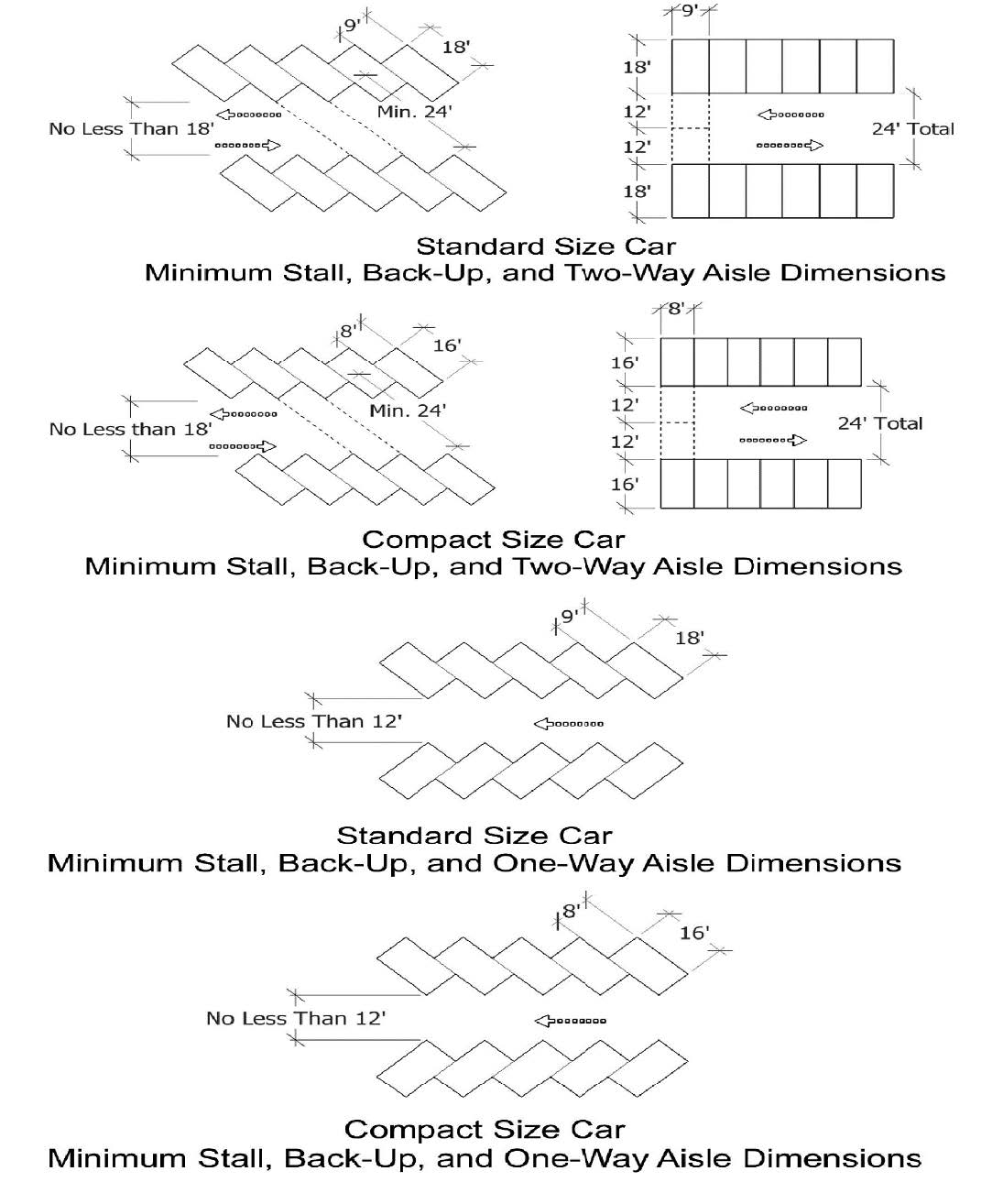
C.
Parking Stalls—General Provisions.
1.
Parking Stalls—Openings. All parking stalls shall open directly on a maneuvering or turnaround area, an access driveway, or an aisle leading to an access driveway, and shall be individually and continuously accessible.
2.
Parking Stalls—Location. All parking stalls shall be so located and free of obstructions that parking can be accomplished in a continuous forward movement and unparking can be accomplished with not more than one backing movement and one forward movement.
3.
Vertical Clearance. Each parking space shall have a vertical clearance of at least seven feet.
D.
Driveways and Aisles—General Provisions.
1.
Access to Streets or Alleys.
a.
Access driveways shall be provided between each parking facility and a public street or alley. Lots should not have access from predominantly residential streets, except when the lot is serving a residential use. Residential driveways shall be permitted only on an arterial street where no other access to the property exists.
b.
One-way driveways and driveways serving a single-family residence shall have a minimum width of twelve feet; except for driveways leading to a single car garage or parking space where the city manager or his/her designee may authorize a lesser width.
c.
Two-way driveways between a street and private parking facilities shall have a minimum width of eighteen feet. Two-way driveways between a street and public parking facilities shall have a minimum width of twenty-four feet. Two-way driveways within a parking facility connecting separated areas of parking spaces shall have a minimum width of eighteen feet, or as otherwise required by this section.
d.
Where access is available from any adjoining or abutting alley to any lot proposed for residential or mixed use development in the commercial zones, access to the required residential parking facility shall be from that alley when appropriate to avoid access to commercial collector or arterial streets.
2.
Internal Circulation—Generally. All parking facilities, except those serving not more than two dwelling units, shall be arranged so that:
a.
Any vehicle entering a public street can do so traveling in a forward motion;
b.
A vehicle entering the parking facility shall not be required to enter a street to move from one location to any other location within the parking facility or premises.
3.
Internal Circulation—Serving Not More than Two Dwelling Units. Parking facilities serving not more than two dwelling units shall be arranged so that any vehicle entering a street can do so traveling in a forward motion where:
a.
The parking facility is served by a single access driveway that is less than twenty feet in width and more than one hundred feet in length;
b.
The access driveway opens upon an arterial street.
4.
Vehicle Maneuver Restrictions. All parking facilities, except those serving not more than two dwelling units, shall be arranged so that parking maneuvers can be accomplished without driving, maneuvering, or encroaching into or upon any public right-of-way, walkway, or unpaved landscaped area within or adjoining the parking facility.
5.
Parking Facilities—Driveway Vertical Clearance. The minimum vertical clearance for driveways shall be thirteen feet six inches to allow for the passage of emergency vehicles, or as required by the city fire department, whichever is greater.
6.
Parking Facilities—Aisles, Approach Lanes, and Maneuvering Areas for Two-Way Traffic. For two-way traffic within parking facilities, all aisles, approach lanes and maneuvering areas shall have a minimum width as specified in this section or as required by the city fire department for emergency access, whichever is greater.
7.
Parking Facilities—One-Way Aisles—Width. One-way aisles shall have a minimum width of twelve feet or as specified in this section, whichever is greater.
8.
Parking Facilities—One-Way Aisles—Directional Markings. One-way aisles shall have directional markings to indicate one-way circulation.
9.
Parking Facilities—Entrances and Exits.
a.
The location and design of all street or alley entrances and exits for off-street parking facilities shall be subject to the approval of the city engineer, to insure traffic safety.
b.
Each exit to a parking lot shall be constructed and maintained so that any vehicle leaving the parking lot shall be clearly visible to a person reaching a point ten feet from the edge of the approach to the driveway nearest to him, when the vehicle is at a point distant ten feet from the property line within the parking lot. Exits from parking lots shall be clearly posted with stop signs. Appropriate bumper guards, entrance and exit signs, and directional signs shall be maintained where needed. Upon a finding that parking facilities cause imminent hazard upon adjoining public streets, the city engineer may order the placement and maintenance of such guards and signs. Failure to comply with any such order may be grounds for a finding of a public nuisance.
10.
Vertical Clearance. The minimum vertical clearance for driveways shall be thirteen feet six inches to allow for the passage of emergency vehicles, or as required by the city fire department, whichever is greater.
E.
Compact Car Parking.
1.
In the industrial, institutional zones, commercial, and mixed-use zones (except retail uses) twenty-five percent of the parking stalls required by the schedules set out in this section may be allocated to compact car spaces. No compact parking spaces shall be permitted for retail uses and guest and visitor parking.
2.
For residential multifamily use, one parking space may be compact in size for every ten parking spaces required.
3.
All parking spaces provided in excess of the number required by Table 18.45.050 set out in this section may be allocated to compact car spaces.
4.
All parking facilities constructed, installed or modified to incorporate compact car spaces shall comply with the provisions of this section. Design features subject to review shall include, but are not limited to, specific findings of good circulation, adaptability to balance of parking lot, easy identification and adequate signs and pavement markings. The design of such signs and markings shall be subject to approval of the planning division.
5.
Maintenance of parking facilities pursuant to this section shall also include maintenance of all special compact car signs and pavement markings shown on approved site plans or otherwise required by this section.
6.
The dimensions of compact car parking stalls, back-up areas, and drive aisles shall be as indicated in the diagrams in Section 18.45.100(B).
F.
Dimensions for Garage or Carport Areas and Openings.
1.
A one-car garage or carport shall contain an unobstructed interior parking area of a minimum of eleven feet wide by nineteen feet deep. A two-car garage or carport shall contain an unobstructed interior parking area of a minimum of twenty feet wide by nineteen feet deep.
2.
A garage for more than two cars shall contain a minimum area of nine feet by eighteen feet for each additional car.
3.
A single-car garage door or opening to a single space carport shall be a minimum of eight feet wide; a two-car garage door or opening to a two-space carport shall be a minimum of sixteen feet wide. For larger parking garages or carports serving multifamily residential or nonresidential development, openings shall be increased in width by at least one foot if a column, post, or similar obstruction is located within at least three and one-half feet of the opening to the stall.
G.
Mechanical Lift Parking. Mechanical lifts for vertical storage of vehicles are permitted in the Downtown and Westside Specific Plan areas. Each vertically stacked space shall count as one space. Mechanical lifts shall be completely enclosed or fully screened from street view and adjacent residential zones. Vertically stacked vehicles are exempt from the seven-foot vertical clearance requirement. All mechanical parking equipment must be designed, installed, constructed, and maintained so as to be reasonably safe to life, limb, and adjoining property and must be reviewed by the city manager or his/her designee prior to installation or construction.
H.
Motorcycle Parking. Each motorcycle parking space shall measure at least four feet wide and thirty-two square feet in total area. Motorcycle parking spaces shall be located within one hundred feet of a building entry.
I.
Pedestrian Walkways.
1.
All parking facilities shall have safe, unobstructed, convenient, well-drained pedestrian access by provision of walks, steps or stepped ramps, so constructed as to assure reasonable durability and economy of maintenance.
2.
Pedestrian walkways shall be a minimum of five feet in width. Pedestrian walkways located immediately adjacent to and perpendicular to a parking stall shall be a minimum of six feet.
3.
The preferred gradient for pedestrian walkways is no greater than five percent. Pedestrian walkways shall not exceed a gradient of twelve percent. Pedestrian walkways between five percent and twelve percent gradients shall be provided with handrails.
(Ord. No. 2024-2529, 4-2-2024)
18.45.110 - Loading requirements.
A.
General Provisions.
1.
On the same premises with every building, structure or part erected and occupied in the commercial or industrial zones, there shall be provided and maintained, on the lot, adequate space for standing, loading and unloading services, in order to avoid undue interference with public use of the streets or alleys.
2.
Such space, unless otherwise adequately provided for, shall include one twelve-foot by fifty-foot loading space with a fourteen-foot height clearance for every twenty thousand square feet or fraction thereof of building floor area, or for every twenty thousand square feet or fraction thereof of land use.
3.
All loading facilities shall be improved in accordance with the requirements established for parking facilities by this section.
4.
Required loading facilities shall be used exclusively for the loading and unloading of vehicles concerned with the transportation of goods or materials. Loading facilities shall not be used to satisfy the stall requirements for parking facilities, nor shall they be used for the sale, display, rental or repair of motor vehicles.
5.
Loading facilities shall be screened as provided in this section except that all loading berths exceeding twenty-five feet in length which are located within fifty feet of a residential zone shall be enclosed or screened from the residential zone by a solid masonry wall not less than six feet nor more than eight feet in height.
6.
No interior landscaping of loading areas shall be required.
7.
All loading facilities shall be arranged so that any vehicle utilizing the facility may enter a street traveling in a forward motion.
8.
Each loading berth shall open directly upon a maneuvering or turnaround area, an access driveway, an aisle leading to an access driveway, or an alley, and shall be easily accessible.
9.
All access driveways serving loading facilities shall conform to the requirements established in this section for parking facility access driveways, but in addition shall be located so that any street entrance or exit to or from the loading facility is at a point at least fifty feet from the nearest point of intersection of any two streets and at least thirty feet from any lot in a residential district.
B.
Number of Spaces Required. The following loading and unloading spaces shall be provided and maintained as specified below for the use to which the property is devoted. Fractional requirements are omitted. Encroachment of the loading space on a public right-of-way is not permitted.
1.
Retail and wholesale markets, warehouses, hotels, hospitals, laundry and dry cleaning establishments and other places where large amounts of goods are received and shipped, no loading space is required for a building less than ten thousand square feet in gross floor area.
2.
For such buildings with ten thousand to forty thousand square feet in gross floor area, one off-street loading space shall be required.
3.
For such buildings with greater than forty thousand square feet in gross floor area, one off-street loading space is required for each forty thousand square feet in total gross floor area.
(Ord. No. 2024-2529, 4-2-2024)
18.45.120 - Bicycle parking.
A.
Number of Spaces Required. The following minimum off-street bicycle parking facilities shall be required for all new or expanded developments. Calculation of bicycle parking facilities shall be based on the off-street vehicle parking spaces required prior to consideration of any vehicle parking reduction measures. Fractional requirements up to one-half shall be omitted. One-half or over shall require one space. Calculation of bicycle parking facilities for mixed use land uses shall be based on the individual use as identified in Table 18.45.120A, below.
_____
TABLE 18.45.120A
Bicycle Parking Requirements by Land Use
_____
B.
Bicycle Parking Design.
1.
Bicycle parking facilities shall be installed in a manner which allows adequate spacing for access to the bicycle and the locking device when the facilities are occupied. Space allowances shall be thirty inches wide and six feet long per bicycle and include a five -foot maneuvering space behind the bicycle. At least seven feet of vertical clearance is required.
2.
The facilities shall be located on a hard dust-free surface, such as asphalt or a concrete slab.
3.
Bicycle parking facilities shall be located in view of building entrances or in view of windows and/or security personnel stations. At least fifty percent of required bicycle parking must be located within fifty feet of a customer entrance, and the remainder must be located within one hundred feet of any entrance.
4.
Bicycle spaces shall be separated from sidewalks, motor vehicle parking spaces or aisles by a fence, wall, or curb, or by at least five feet of open area, marked to prohibit motor vehicle parking.
C.
Required Shower Facilities. All news buildings and additions to existing buildings that result in a total floor area as shown in the following table are encouraged to provide employee showers and dressing areas for each gender as shown in the following Table 18.45.120B.
_____
TABLE 18.45.120B
Required Number of Showers
(Ord. No. 2024-2529, 4-2-2024)
_____
18.46.010 - Purpose.
A.
Intent and Purpose of this Chapter.
1.
To provide reasonable restrictions and limitations upon the use of lighting in or near the residential zones of the city so as to prevent lighting from creating a nuisance to residents within said residential zones. It is recognized that lighting is widely used in commercial or industrial zones for the purpose of advertising and security and that such lighting is essential to the conduct of many commercial or industrial enterprises.
2.
The city acknowledges that protective security lighting in residential zones constitutes a deterrent to crime and an aid in law enforcement and contributes generally to the safety of those persons residing in such residential zones. It is further accepted that properly controlled lighting in residential areas used for landscaping and highlighting of architectural features of buildings and structures enhances and promotes the aesthetic condition of the property and the general welfare of the area.
3.
It is equally recognized that lighting, by virtue of its intensity, brightness, direction, duration and hours of operation, can constitute a nuisance to adjacent residential dwellers. The purpose and intent of this section is to establish outdoor lighting standards that reduce the impacts of glare, light trespass, overlighting, skyglow, and poorly shielded or inappropriately directed lighting fixtures and that promote safety and energy conservation.
4.
It is the intent of the city to adopt this section to encourage the continued and appropriate use of lighting for the purposes set forth in this section, but to require that said lighting be regulated and controlled in a manner so as to avoid the creation of a public nuisance in residential areas. All outdoor lighting in National City shall be regulated by this Land Use Code and by the State of California Title 24 Energy Efficiency Standards for outdoor lighting requirements.
(Ord. No. 2024-2529, 4-2-2024)
18.46.020 - Applicability.
A.
New Uses, Buildings, and Additions. Unless specifically exempted elsewhere in this chapter, the provisions of this chapter shall apply to all outdoor lighting for proposed new land uses, developments, buildings, structures, or building additions that require a permit.
B.
Nonconforming Uses, Structures, or Lots. Whenever a nonconforming use, structure or lot is abandoned for a period of one year and then recommenced or changed to a new use, then any existing outdoor lighting shall be reviewed and brought into compliance with the provisions of this chapter as necessary for the entire building, structure or premises, to the maximum extent possible as determined by the planning division.
(Ord. No. 2024-2529, 4-2-2024)
18.46.030 - General standards.
A.
Outdoor Lighting Fixtures. All outdoor lighting fixtures shall be designed, shielded, aimed, located, and maintained to shield adjacent properties and to not produce glare onto adjacent properties or roadways. Parking lot light fixtures and light fixtures on buildings shall be full cut-off fixtures.
B.
Street Lighting. Street lighting shall be provided in accordance with the requirements of the National City Standards Manual.
C.
Prohibited Lighting. Flashing, revolving, intermittent exterior lighting or internally illuminated signs are prohibited. High intensity light beams, such as, but not limited to, outdoor searchlights, lasers, or strobe lights shall be prohibited.
D.
Lighting for Safety. In all multiple family residential, commercial, or industrial developments, all sites shall be well lit so as to provide safe pedestrian and vehicular access and to eliminate dark areas.
(Ord. No. 2024-2529, 4-2-2024)
18.46.040 - Lighting plan requirements.
A.
Exterior Lighting Plan. The applicant shall submit to the planning division sufficient information, in the form of an overall exterior lighting plan, to enable the director to determine that the applicable provisions will be satisfied. The exterior lighting plan shall include, at a minimum, the following information:
1.
Manufacturer specification sheets, cut sheets or other manufacturer provided information for all proposed lighting fixtures.
2.
The proposed location, mounting height, and aiming point of all exterior lighting fixtures.
3.
If building elevations are proposed for illumination, drawings shall be provided for all relevant building elevations showing the fixtures, the portions of the elevations to be illuminated, the luminance levels of the elevations, and the aiming point for any remote light fixture. If only architectural lighting below five foot-candles is proposed, this section or any portion of it may be waived by the director.
4.
A brief written narrative which describes the objectives of the lighting.
5.
Photometric data, Color Rendering Index (CRI) of all lamps (bulbs), and other descriptive information of the fixtures, and, if applicable or required, designation as Illuminating Engineering Society of North America (IESNA) "cut-off" fixtures.
6.
A computer generated photometric grid showing foot-candle readings every ten feet within the property or site, and ten feet beyond the property lines at a scale specified by the director. Iso foot-candle contour line style plans may be substituted for the photometric grid.
7.
For exterior lighting installations within fifty feet of upper level living units, horizontal and vertical projection of photometric data is required.
8.
If needed to review proposed exterior lighting installations, the director may require additional information following the initial lighting plan submittal, including but not limited to:
a.
Landscaping information that indicates mature tree size;
b.
Shrubbery and other vegetation in order to evaluate the long-term and seasonal effectiveness of lighting or screening of lighting.
(Ord. No. 2024-2529, 4-2-2024)
18.46.050 - Security lighting.
A.
Defined. For the purposes of this section, security lighting is defined to include the following: lighting intended to reduce the risk (real or perceived) of personal attack and lighting intended to discourage intruders, vandals, or burglars, and to protect property.
B.
Shielded and Aimed. All security lighting fixtures shall be shielded and aimed so that illumination is directed only within the owner's property boundaries and not cast on other areas. In no case shall lighting be directed above a horizontal plane through the top of the lighting fixture, and the fixture shall include shields that prevent the light source or lens from being visible from adjacent properties and roadways. The use of general floodlighting fixtures shall be prohibited unless it meets the shielding requirements of this section.
C.
Vertical Surfaces. Security lighting may illuminate vertical surfaces (e.g. building facades and walls) up to a level eight feet above grade or eight feet above the bottoms of doorways or entries, whichever is greater.
D.
Pole-Mounted. Security lighting fixtures may be mounted on poles located no less than ten feet from the perimeter of the property boundary.
E.
Site Perimeters. Security lights intended to illuminate a perimeter (such as a fence line) shall include motion sensors and be designed to be off unless triggered by an intruder located within five feet of the perimeter. The zone of activation sensors must be within the property boundaries of the property wishing to be illuminated.
F.
Timers and Photocells. Security lights shall combine timers with dusk-to-dawn photocells to ensure lights are on only when it is dark.
G.
Requirements. In addition to the application materials set forth in the general provisions of this section, applications for security lighting installations shall include a written description of the need for and purposes of the security lighting, a site plan showing the area to be secured and the location of all security lighting fixtures, specifications of all fixtures, the horizontal and vertical angles in which light will be directed, and adequate cross-sections showing how light will be directed only onto the area to be secured.
(Ord. No. 2024-2529, 4-2-2024)
18.46.060 - Accent lighting.
Architectural features may be illuminated by uplighting, provided that the light is effectively contained by the structure, the lamps are low intensity to produce a subtle lighting effect, and no glare or light trespass is produced. For national flags, statues, public art, or other objects that cannot be illuminated with down lighting, upward lighting may only be used in the form of two narrow-cone spotlights that confine the illumination to the object of interest.
(Ord. No. 2024-2529, 4-2-2024)
18.46.070 - Lighting standards for uses within fifty feet of residential zones.
A.
For Uses Within Fifty Feet of Residential Zones.
1.
Lighting poles shall be no taller than twenty feet.
2.
Lighting fixtures shall be aimed and shielded in a manner that shall not direct illumination on adjacent residential zones. Fixtures shall be of a type or adequately shielded to prevent glare from normal viewing angles.
3.
At the discretion of the review authority and, where feasible, additional landscaping may be used to provide light screening between commercial zones and residential zones to help prevent light trespass. Where landscaping is used for light screening, the director shall take into consideration the applicable landscaping standards, the design standards, the creation of excessive shadows or dark spaces, and views into and out of a site.
(Ord. No. 2024-2529, 4-2-2024)
18.46.080 - Parking lot lighting.
A.
Standards.
1.
Parking lots shall comply with the standards of this chapter in addition to the other requirements of this title.
2.
Parking lot lighting shall be designed to provide for uniform lighting throughout the facility with no dark patches or pockets.
3.
Parking lot lighting shall be designed to provide sufficient lighting to identify parking features and provide pedestrian safety.
4.
In order to direct light downward and minimize the amount of light spilled into the dark night sky, all lighting fixtures serving parking lots, shall be full cut-off fixtures as defined by the Illuminating Engineering Society of North America (IESNA).
5.
The maximum permissible mounting height of all parking lot lighting shall be thirty feet unless otherwise specified in this chapter.
(Ord. No. 2024-2529, 4-2-2024)
18.46.090 - Lighting of outdoor performance, sport and recreational facilities.
A.
Events and Special Activities.
1.
Lighting levels and pole heights for outdoor performance, sports, and recreation facilities shall not exceed by more than five percent of the Illuminating Engineering Society of North America published standards for the proposed activity.
2.
Where playing fields or other special activity areas are to be illuminated, lighting fixtures shall be specified, mounted, aimed and shielded so that their beams fall within the primary playing area and immediate surroundings, and so that no direct illumination is directed off the site.
3.
The main lighting shall be turned off as soon as possible following the end of the event. The main lighting shall not remain on longer than thirty minutes following the end of the event. Where feasible, a low level lighting system shall be used to facilitate patrons leaving the facility, cleanup, nighttime maintenance and other closing activities. The low level lighting system shall provide a horizontal illumination level at grade of no more than four foot-candles.
(Ord. No. 2024-2529, 4-2-2024)
18.46.100 - Lighting for multi-unit attached residential projects.
In all multi-unit attached residential developments, light fixtures for walks, steps, parking areas, driveways, on-site streets, and other facilities shall be provided in keeping with the type of development and at locations to assure safe and convenient nighttime use. Fixtures shall be designed in keeping with the project and shall be properly shaded to screen the windows of habitable rooms from the direct rays of light. All outdoor lighting shall be so shielded and adjusted that the light is directed to fall only on the same premises upon which the light source is located. All outdoor security and safety lighting shall be installed in accordance with the standards in this chapter.
(Ord. No. 2024-2529, 4-2-2024)
18.46.110 - Standards for single-family residential uses.
A.
Standards.
1.
Protective security lighting, landscape lighting or architectural highlighting, properly directed and shielded, may be operated at all hours of the night.
2.
Luminaires providing outdoor lighting and permanently mounted to a residential building or to other buildings on the same lot are allowed.
3.
Motion sensors with integral photo-control area and high-efficacy dust-to-dawn lighting are encouraged.
4.
Permanently installed luminaires in or around swimming pools, water features, or other locations subject to Article 680 of the California Electrical Code need not be high-efficacy luminaires.
5.
Lighting for single-family residential uses shall be directed to fall only on the same premises upon which the light source is located.
6.
Floodlighting is discouraged, and if used, must be shielded to prevent:
a.
Disability glare for drivers or pedestrians;
b.
Light trespass beyond the property line; and
c.
Light above a horizontal plane. "Wallpack" type fixtures are not permitted.
(Ord. No. 2024-2529, 4-2-2024)
18.47.010 - Title.
This chapter shall be known as the Regulatory Sign Ordinance of the city of National City, California.
(Ord. No. 2024-2529, 4-2-2024)
18.47.020 - Authority, scope, intent, purposes.
A.
Authority. This chapter is enacted pursuant to the city's general and police powers, California Constitution Article XI, Section 7; California Government Code Sections 65000 et seq., 65850(b), 38774, and 38775; Business and Professions Code Sections 5200 et seq., 5230, 5490 et seq., 13530 et seq. and 13540; Penal Code Section 556 et seq.; and other applicable state laws.
B.
Scope. This chapter regulates signs, as defined herein, which are located within the corporate limits of the city of National City and over which the city has land use regulatory authority, but not on city owned land. Signs on city land are subject to Chapter 13.28. Signs used in conjunction with parades, protests, demonstrations and outdoor public assemblies are regulated as temporary uses under Chapter 15.60.
C.
Intent. By adoption of this chapter, the city council intends to create and implement a comprehensive system for the regulation of signs within the scope of this chapter, with a regulation system that: 1) accommodates the expression rights of the First Amendment to the U.S. Constitution and the corollary provisions of the California Constitution; 2) comports with all applicable principles of federal and state constitutional, statutory and administrative law.
D.
Purposes and Interests Served. The purposes of this chapter include, but are not limited to: 1) serving the governmental and public interests in controlling visual clutter, community esthetics, and safety of drivers, passengers, and pedestrians; 2) aiding in the identification of properties, land uses, enterprises and other establishments; 3) enhancing the general appearance and esthetics of the urban environment; and 4) protecting the natural beauty of the city's open space.
(Ord. No. 2024-2529, 4-2-2024)
18.47.030 - Basic principles.
A.
Message Neutrality Policy. It is the policy of National City to regulate signs in a manner that does not favor commercial speech over noncommercial speech and does not regulate protected noncommercial speech by message content.
B.
Message Substitution Policy. A constitutionally protected noncommercial message may be substituted, in whole or in part, for any allowed commercial message or any other protected noncommercial message, provided that the sign structure or mounting device is legal. Any substitution shall require the private property owner's consent. The purpose of this provision is to prevent any favoring of commercial speech over non-commercial speech, or favoring of any particular protected noncommercial message over any other protected noncommercial message. The message substitution policy does not: 1) create a right to increase the total amount of sign display area on a site or parcel; 2) create a right to substitute an off-site commercial message in place of an onsite commercial message or in place of a noncommercial message; 3) affect the requirement that a sign structure or mounting device must be properly permitted; 4) authorize changing the physical method of image presentation (such as digital or neon) display without a permit; or 5) authorize a physical change to the sign structure without compliance with applicable building codes, safety codes, and neutrally-applicable rules for sign size, height, orientation, setback, separation or illumination.
C.
Enforcement Authority. The director is authorized and directed to administer and enforce this chapter.
D.
Administrative Interpretations. Interpretations of this chapter are to be made initially by the director in consultation with the city attorney. The director may refer an interpretation question to the planning commission. All interpretations of this chapter are to be exercised in light of the message neutrality and message substitution policies. Where a particular type of sign is proposed, and the type is neither expressly allowed nor prohibited by this chapter, or whenever a sign does not qualify as a "structure" as defined in the building code, as adopted by the city, then the planning commission or director, as applicable, shall approve, conditionally approve or disapprove the application based on the most similar sign type, using physical and structural similarity, that is expressly regulated by this chapter.
E.
Responsibility for Compliance. The responsibility for compliance with this chapter rests jointly and severally upon the sign owner, the permit holder, all parties holding the present right of possession and control of the property whereon a sign is located, mounted or installed, and the legal owner of the lot or parcel, even if the sign was mounted, installed, erected or displayed without the consent or knowledge of the owner and/or other parties holding the legal right to immediate possession and control.
F.
Onsite-Offsite Distinction. Within this chapter, the distinction between onsite signs and offsite signs applies only to commercial messages. It does not apply to non-commercial messages.
(Ord. No. 2024-2529, 4-2-2024)
18.47.040 - Definitions.
The following definitions apply to this chapter, and to other chapters when cross-referenced by such other chapters.
"Banner" means any flexible material, such as cloth, plastic, vinyl, paper, cardboard or thin metal, with or without a message, attached outdoors to a building, structure or mounting device, or attached indoors to a building, structure or mounting device so as to be visible from the exterior of a building, or structure. The term "banner" includes a pennant, flag, or bunting.
"Billboard" means a permanent sign structure in a fixed location which meets any one or more of the following criteria: (1) it is used for the display of off-site commercial messages; (2) the message display area, or any part thereof, is made available to message sponsors other than the owner(s) or operator(s) of the sign, typically for a fee or other consideration, i.e., it is general advertising for hire; (3) the sign is a principal or secondary use of the land, rather than appurtenant or accessory to some other principal use of the land.
"Bunting" means a form of banner that is typically presented and displayed in a folded or gathered fashion or combination. It may include a display in combination with a flag or banner. Depending on the format of the display, the term may be synonymous with banner.
"Changeable copy sign" means a sign displaying a message that is changed by means of moveable letters, slats, lights, light emitting diodes, or moveable background material. "Digital signs," "dynamic signs," and CEVMS (changeable electronic variable message signs) are all within this definition.
"City" means the city of National City California.
"City property" means any parcel of land or separately leasable space over which the city or any of its related entities, holds the present right of possession and control, regardless of who may hold legal fee title, or that is within the public right-of-way.
"Commercial mascot" means a person or animal attired or decorated with commercial insignia, images, costumes, masks, or symbols, and/or holding signs displaying commercial messages, when a principal purpose is to draw attention to or advertise a commercial enterprise. This definition includes "sign twirlers," "sign clowns," "sign spinners," "sign twirlers," and "human sandwich board" signs. Also known as "living signs."
"Commercial message" means a message that proposes a commercial transaction or pertains primarily to the economic and commercial interests of the message sponsor and/or the sign audience.
"Construction site sign" means a sign that is displayed on the site of a construction development project during the period of time of actual construction.
"Digital display" means display methods utilizing LED (light emitting diode), LCD (liquid crystal display), plasma display, projected images, or any functionally equivalent technology, and which is capable of automated, remote or computer control to change the image, either in a "slide show" manner (series of still images), or full motion animation, or any combination of them.
"Director" means the city manager or designee.
"Directional sign" is a sign used to provide directions to pedestrians and vehicular traffic.
"Election period" means that period of time which begins sixty days before a special, general, or primary election in which at least some registered voters in the city are eligible to vote, and ends ten days after such election.
"Establishment" means any legal use of land, other than long-term residential, which involves the use of structures subject to the building code. By way of example and not limitation, this definition includes businesses, factories, farms, schools, hospitals, hotels and motels, offices and libraries, but does not include single-family homes, mobile homes, residential apartments, residential care facilities, or residential condominiums. Multi-unit housing developments are considered establishments during the time of construction; individual units are not within the meaning of establishment once a certificate of occupancy has been issued or once a full-time residency begins.
"Establishment premises" means a specific occupancy within a building or upon a parcel of land, typically having a specific address and discrete entrance(s) and exit(s) so as to maintain a specific identity and location.
"Flag" means a piece of fabric or other flexible material, usually rectangular, of distinctive design, used as a symbol.
"Freestanding sign" means a sign which is principally supported on the ground by one or more uprights, braces, poles, pylons or other similar structural components. This category includes both monument and pole signs.
"Frontage" when used as a measurement reference of a building or establishment premises, shall refer to the distance between the two most distant corners of a building measured in a straight line along the building face bordering the adjoining street. See glossary pertaining to frontage when made applicable to a parcel of land. The term also refers to the elevation of a building that abuts or adjoins a private or public right-of-way or parking lot.
"Garage sale sign" means a sign whose message concerns short-term rummage, estate, boutique, or garage sales of used or handmade common household items from a residential property.
"General advertising," also known as "general advertising for hire," means the enterprise of advertising or promoting other businesses or causes using methods of advertising, in contrast to self-promotion or on-site advertising.
"Height" means the distance measured vertically from grade to the highest point or portion of the object to be measured or height limited.
"Illegal sign" means a sign that was installed without proper city or other required approvals and/or permits at the time it was initially installed, and which has not been legalized by later action. This definition also includes a sign that was erected in conformance with all applicable laws, rules, and regulations in effect at the time of installation, but which was subsequently altered so as to be out of compliance with applicable law, including the terms of permits which authorized construction. All signs described in Business and Professions Code Section 5499.1 and defined therein as an "illegal on-premises advertising display" are also within this definition.
"Illuminated sign" means a sign whose message is made readable by internal or external lights or light emitting diodes (or functionally equivalent technology), typically (but not necessarily) during hours of darkness.
"Install" or "installation" includes but is not limited to the act by which a sign is constructed or placed on land or a structure, or the act of attaching, painting, printing, producing, or reproducing, or using any other method or process by which a visual message is presented or placed upon a surface.
"Legal nonconforming sign" means a sign that complied with all applicable laws, rules and policies at the time of installation, and which has not been expanded beyond the originally applicable rules, but which does not conform to currently applicable law and rules.
"Mobile billboard" means a sign on a wheeled conveyance (whether motorized or not) or water craft, including those which carry, convey, pull or transport any sign used for general advertising for hire. The term does not include vehicles and vessels that display identification information concerning the usual business or regular work of the vehicle/vessel owner (not including general advertising).
"Motor fuel price sign" means a sign of the type described and required by Business and Professions Code section 13530 et seq.
"Monument sign" means a low-profile freestanding sign supported by a structural base or other solid structural features other than support poles, which may contain copy on more than one side.
"Mural-type sign" means a sign painted on the exterior wall of a building consisting of graphics or images, either alone or in combination with letters. Mural-type signs shall be treated as any other sign subject to the signage area requirements.
"Non-commercial message" means a constitutionally protected message that addresses topics of public concern or controversy such as, by way of example and not limitation, politics, religion, philosophy, science, art or social commentary.
"Offsite sign" means a sign that advertises commercial products, accommodations, services, or activities not provided in or on the property or premises upon which it is located. The on-site/off-site distinction does not apply to non-commercial messages.
"Onsite sign" means a sign that advertises the commercial business, accommodation, services, or activities provided on the premises on which the sign is located or is expected to be provided in the near future, such as "coming soon" movie posters. In the case of developments subject to a master sign program, all establishments subject to the program are considered on-site whenever located within any location subject to the program. All establishments within a shopping center are on-site as to any sign(s) also located within that shopping center. The on-site/off-site distinction does not apply to non-commercial messages.
"Outdoors" means a location on undeveloped property or the exterior of a building or structure.
"Parcels" or "property" or similar references or descriptions mean parcels defined or delineated by assessor parcel numbers maintained by the County tax assessor or as defined in the glossary of this code.
"Pennant" is a banner with three sides, or swallow-tail form.
"Permanent sign" means a sign that is solidly attached to a building, structure, or the ground by means of mounting brackets, bolts, welds, or other combination of attachment methods, thereby rendering the sign non-moveable or difficult to reposition without the use of machinery, cutting devices, or mechanical devices. See also "temporary sign."
"Pole sign" means a permanently mounted, freestanding sign which is supported above the ground by one or more uprights, braces, poles, or other similar structural components.
"Projecting sign" is any sign which projects beyond a building face and uses a wall or vertical element of a building as its main source of support. The term includes a double-faced sign that is installed more or less perpendicular to the face of a building so as to allow a message to be viewable from either side. The term does not include signs that are installed along the face of a building and that are completely attached to the face of a building.
"Real estate sign" means any sign whose message concerns a proposed economic transaction involving real estate, including all signs described in Civil Code 713.
"Residential sign" means a sign displayed on a legal, individual dwelling unit. The term does not apply to management offices of apartment complexes or mobile home parks, or to hotels, motels, inns or other places of transient occupancy.
"Responsible party" means the permittee, property owner, or owner or person in charge of the sign.
"Rooftop sign" or "roof-mounted sign" means a sign that extends above the ridgeline of the roof of a building or a sign attached to any portion of the roof of a building.
"Safety codes" refers to the building, electrical, plumbing, grading, and similar codes which ensure safe construction.
"Shopping center" shall mean a group of commercial buildings as defined in the glossary.
"Sign" as used in this chapter, generally means the public display of any visually communicative image placed on public display and visible from the exterior of any portion of the public right-of-way or place open to passage by the public. Notwithstanding the generality of the foregoing, the term "sign" does not include:
1.
Aerial banners towed behind aircraft;
2.
Architectural features—Decorative or architectural features of buildings (not including lettering, trademarks or moving parts), which do not perform a communicative function (examples include color stripes around an office building or retail store);
3.
Automated teller machines (ATMs), when not used for general advertising;
4.
Cornerstones and foundation stones;
5.
The legal use of fireworks, candles and artificial lighting not otherwise regulated by this chapter;
6.
Grave markers, gravestones, headstones, mausoleums, shrines, and other markers of the deceased;
7.
Historical monuments, plaques and tablets;
8.
Holiday and cultural observance decorations displayed in season, including inflatable objects, on private residential property which are on display for not more than forty-five calendar days per year (cumulative, per dwelling unit) and which do not include commercial messages;
9.
Inflatable gymnasiums associated with legal residential uses—Inflatable, temporary, moveable, gymnasium devices commonly used for children's birthday parties, and similar devices (also called "party jumps" or "bounce houses");
10.
Interior graphics—Visual communicative devices that are located entirely within a building or other enclosed structure and are not visible from the exterior thereof;
11.
Manufacturers' marks—Marks on tangible products, which identify the maker, seller, provider or product, and which customarily remain attached to the product even after sale;
12.
Mass transit graphics—Graphic images mounted on duly licensed and authorized mass transit vehicles that legally pass through the city;
13.
News racks, newspaper vending devices and newsstands;
14.
Personal appearance: makeup, masks, wigs, costumes, jewelry, apparel and the like, unless it constitutes a commercial mascot;
15.
Safety warnings on motorized or electrified equipment;
16.
Searchlights used as part of a search and rescue or other emergency service operation (this exclusion does not apply to searchlights used as attention attracting devices for commercial or special events);
17.
Shopping carts, golf carts, horse drawn carriages, and similar devices (any motorized vehicle which may be legally operated upon a public right-of-way is not within this exclusion);
18.
Symbols embedded in architecture—Symbols of non-commercial organizations or concepts including, but not limited to, religious or political symbols, when such are permanently integrated into the structure of a permanent building which is otherwise legal, by way of example and not limitation, such symbols include stained glass windows on churches, carved or bas relief doors or walls, bells and religious statuary;
19.
Vehicle and vessel insignia—On street legal vehicles and properly licensed watercraft: license plates, license plate frames, registration insignia, non-commercial messages, messages relating to the business of which the vehicle or vessel is an instrument or tool (not including general advertising) and messages relating to the proposed sale, lease or exchange of the vehicle or vessel.
20.
Vending machines, automated intake devices and product dispensing devices which do not display off-site commercial messages or general advertising messages;
21.
Window displays—The display of merchandise in a store window, when such merchandise is immediately available for purchase.
"Signage" is the collective noun for all signs on a given parcel, lot or location, or within a stated classification;
"Sign area" means that portion of a sign which consists of visually communicative copy, including the advertising surface and any framing, trim, or molding but not including the supporting structure, measured one side only, provided that the angle between faces for two-sided signs does not exceed thirty degrees.
"Sign copy" means the visually communicative elements, including but not limited to words, letters, numbers, designs, figures, or other symbolic presentation incorporated into a sign with the purpose of attracting attention to the subject matter or message.
"Sign face" means the portion of a sign that is available for displaying sign copy, together with any frame, color, panel, ornamental molding, or condition which forms an integral part of the sign copy and which is used to differentiate such sign copy from any wall or background against which it may be placed. Those portions of the supports, uprights, or base of a sign that do not function as a sign shall not be considered as part of a sign face.
"Sign height" means the vertical distance of a sign from the uppermost point used in measuring the sign area to the ground immediately below such point or to the level of the upper surface of the nearest curb of a street or alley (other than a structurally elevated roadway), whichever measurement permits the greater elevation of the sign.
"Special event" means an activity or event that occurs rarely or irregularly, is open to the public, and is of a duration not exceeding seven days. Any event that is subject to a temporary use permit will be considered within this definition. By way of example and not limitation, special events include circus or carnival runs, 4 th of July Festival, Easter Egg Hunt, Relay for Life, Christmas Tree Lighting, parking lot sales at shopping centers and malls, holiday celebrations, Auto Heritage Day, etc.
"Temporary message" means a message that pertains exclusively to an event which occurs on, or ends on, a particular day.
"Temporary sign" means a sign that is constructed of lightweight or flimsy material, and is easily installed and removed using ordinary hand tools. Any sign that qualifies as a "structure" under the Building Code is not within this definition.
"Visibility triangle" means at the intersection of any two or more streets, that area extending horizontally fifty feet from the corner of the intersection and vertically, from a height of three feet to a height of eight feet.
"Visible to the exterior" refers to the placement of a sign or banner within the interior first eight feet of a commercial or industrial building or structure in such a manner so that it or its message is readily visible on an immediately contiguous public right-of-way, parking lot, or parcel. To be visible does not require that the message be understandable or readable.
"Wall sign" means a sign that is attached to, erected against or painted on the wall of a building or other vertical structure.
"Warning sign" means a sign that is posted to provide notice of danger, such as "Beware of Dog," "Railroad Crossing," "Danger High Voltage" or noting the location of underground utilities.
"Window sign" means a sign that is painted or mounted on a window pane, or that is mounted within five feet of a window and oriented for viewing by exterior passersby.
"Zone" refers both to the zone classifications given in Section 18.20.020, and to the specific areas or districts to which a given zoning classification applies.
(Ord. No. 2024-2529, 4-2-2024)
18.47.050 - Sign permits, other sign-related decisions, appeals.
A.
Sign Permit Generally Required. Unless exempted from the sign permit requirement, all signs regulated by this chapter may be installed, maintained, erected, or displayed only pursuant to sign permit pursuant to this chapter, and a finding of compliance is made by the planning division, using the design criteria identified in this chapter and other applicable regulations. A sign permit may be approved subject to conditions, so long as those conditions are required by this chapter or some other applicable law, rule or regulation.
B.
Compliance Required. No permit shall be issued for any sign or sign structure except in compliance with the provisions of this chapter. A sign permit may be subject to compliance with permitting requirements imposed by other sources of law, including the safety codes for building, electrical, plumbing, grading, etc. Where there is a conflict between the provision of this chapter and other applicable regulations, the more restrictive shall apply.
C.
Right to Permit or Display. When any sign permit application is complete and fully complies with all applicable provisions of this chapter, and all other applicable laws, rules and regulations, the permit shall be approved and issued within the required time. In the case of signs which are exempt from the sign permit requirement, there is a right to erect, display, and maintain such signs as are authorized by this chapter, subject to the applicable rules. This "right to permit" provision does not apply when the relevant city law is under active consideration for amendment at the time the application for a sign permit is submitted, or when the rules or regulations relevant to the application are changed prior to the expiration of the time for decision.
D.
Legally Existing Signs; Alterations. Signs legally existing prior to the effective date of this chapter shall be exempt from the sign permit requirement unless a structural alteration is made, the sign area or any other point of nonconformity is enlarged or expanded, or there is some other change in the structural elements of the sign. Structural alterations and expansions require a sign permit.
E.
Review. All sign permit applications shall be initially reviewed by the director. In the case of any discretionary permit in which signage is included, such as a master sign program, a specific plan including signs, a variance, or an appeal, the director shall prepare a report for the body which shall hear the matter, the planning commission or city council. The report may, but is not required, to include recommendations.
F.
Application for a Sign Permit. Any person seeking a sign permit for a sign shall submit to the director a written application for such. The director shall prepare a sign permit application form and provide it to any person on request, along with such other materials and information as applicants need to submit for a permit. The same form may be used for both the application and the decision thereon. A single form may be used for multiple signs on the same site; however, the director may make separate decisions as to each sign. A sign permit application is complete only when it is accompanied by the appropriate application fee, in an amount set by resolution of the city council.
G.
Application Contents. The sign permit application form may call for the following information:
1.
Name, address and telephone number of the applicant and, if applicable, the name, address, and telephone number; when the applicant is not the holder of legal title to the property, consent to the installation of the sign by the person(s) or entities who hold legal title and the present right of possession and control of the property; when the sign is proposed to be installed by a sign contractor, the name, address, contact information, and the license number, if any, of the contractor;
2.
As to the proposed location for the sign, multiple sets of a fully dimensioned site plan (drawn to scale) indicating the street address, assessor's parcel number, zone classification, all property lines, public and private street lines (including center lines), structures, easements, utility poles and wires, and the location and size (in square feet) of all existing and proposed signs;
3.
As to existing signs already on parcel, information as to whether each is permitted or exempt from permitting;
4.
Accurate and scaled building elevation showing existing and proposed building signs; including existing and proposed sign area of each individual sign and the combined area of all signs (including those already existing or previously permitted) in relation to the maximum allowed sign area;
5.
A statement as to whether the sign is intended to be used in whole or in part for off-site commercial messages, advertising for hire or general advertising;
6.
A statement or graphical description as to whether the proposed sign, or any part of it, is proposed to utilize any of the following physical methods of message presentation: sound; odor, smoke, fumes or steam; rotating, moving or animated elements; activation by wind or forced air; neon or other fluorescing gases; fluorescent or day-glow type colors; flashing or strobe lighting; light emitting diodes, liquid crystal displays or other video-like methods; digital display technology; use of live animals or living persons as part of the display; mannequins or statuary;
7.
A statement as to whether the property or parcel on which the sign is proposed to be erected or displayed, or any currently existing sign thereon, is the subject of any outstanding notice of zoning violation or notice to correct, including whether any such deficiencies are to be remedied by the proposed application;
8.
Photographs of the existing property, parcel and/or building on which the sign is proposed to be erected or displayed;
9.
In the case of any proposed sign which is subject to a discretionary process, such as a variance, conditional use permit, or sign program, all information required by such process(es);
10.
The director is authorized to modify the list of information to be provided on a sign permit application; however, additions may be made only after thirty days public notice. The director is also authorized to request, require, or accept application materials, in whole or in part, in electronic form, and to specify the acceptable computer formats for such submissions.
H.
Completeness. As the first step in processing a sign permit application, the director shall determine whether the application is complete. If the application is not complete, the applicant shall be so notified in person or in writing initially within thirty days of the date of receipt of the application; the notice of incompleteness shall state the points of deficiency and identify any additional information necessary. The applicant shall then have thirty calendar days, to submit additional information to render the application complete.
I.
Disqualification. No sign permit application will be approved if:
1.
The applicant has installed a sign in violation of the provisions of this chapter and, at the time of submission of the application, each illegal or non-permitted sign has not been legalized, removed or a cure included in the application;
2.
There is any other existing Code violation located on the site of the proposed sign(s) (other than an illegal or nonconforming sign that is not owned or controlled by the applicant and is located at a different establishment) which has not been cured at the time of the application, unless the noncompliance is proposed to be cured as part of the application;
3.
The sign application is substantially the same as an application previously denied, unless: (i) twelve months have elapsed since the date of the last application, or (ii) new evidence or proof of changed conditions is furnished in the new application;
4.
The applicant has not obtained any applicable required use permit or conditional use permit. However, applications for such permits may be processed simultaneously with a sign permit application.
J.
Applications for Multiple Signs. When an application proposes two or more signs, the application may be granted either in whole or in part, with separate decisions as to each proposed sign. When a multiple sign application is denied in whole or in part, the director's written notice of determination shall specify the grounds for such denial.
K.
Discretion. When discretion is authorized for a master sign program or site plan review, that discretion may be exercised only as to location, structural and safety factors, and not as to message content, graphic design or artistic merit. Permissible factors for consideration include: style or character of existing improvements upon the site and lots adjacent to the site; construction materials; number and spacing of signs in the area; the sign's height, design, and location in relation to its proposed use; form, proportion, scale, overall sign size; potential effect of the proposed sign on driver and pedestrian safety; potential blocking of view (whole or partial) of a structure or facade or public view of historical or architectural significance; potential obstruction of views of users of adjacent buildings.
L.
Master Sign Programs. Permit applications for master sign programs as part of planned commercial, office-professional and industrial development shall include the above information as part of a site development plan or specific plan. When approval is sought for a development that includes one or more signs, then the sign aspects of the proposed development must satisfy the applicable provisions of this chapter. In addition, when a development project will have six or more leased spaces, it must also comply with the master sign program requirements set forth in Section 18.47.130. Such proposals may be reviewed by the director and shall be decided by the planning commission. In preparing a report for the planning commission, the director may, but is not required to, make recommendations.
M.
Revocation or Cancellation. The director may revoke any approval or permit upon refusal or failure of the permittee to comply with the provisions of the permit and the requirements of this chapter, after written notice of noncompliance and at least fifteen calendar days opportunity to cure. However, opportunity to cure does not apply when a sign, by virtue of its physical condition, constitutes an immediate and significant threat to public safety.
N.
Permits Issued in Error. Any approval or permit issued in error may be summarily revoked by the director upon written notice to the permittee, stating the reason for the revocation. "Issued in error" means that the permit should not have been issued in the first place and includes but is not limited to omissions, errors or misrepresentations in the application materials, and oversights or errors in the processing thereof.
O.
Inspections. All signs subject to one or more safety permits (building, plumbing, electrical, grading, etc.) require final inspection and approval by the Building Official.
P.
Sign-Related Decisions. Challenges or objections to sign-related decisions, notices and orders, other than approval or denial of a sign permit, do not require a particular form, but must be in writing, signed by the applicant or challenger, and particularly state the matter challenged and the grounds therefore. Challenges shall be made to the director within thirty days of the date of the decision, notice, and/or order. Challenges and objections to sign-related decisions not made in accordance with these procedures shall not be eligible for appeal.
Q.
Levels of Review; Order of Review. Except for signs subject to initial review by the planning commission, initial review and decisions on all sign permit applications shall be by the director unless otherwise stated herein; appeal is first to the planning commission and then to city council.
R.
Safety Codes. When a proposed sign, by virtue of its physical, structural, location, and other non-message factors, is subject to any permits or requirements under the safety codes, then satisfaction of such requirements shall be a condition of the sign permit.
S.
Permit Denial. When a sign permit application is denied, the denial shall be in writing and sent or delivered to the address shown on the applicant's application form and shall specifically state the grounds for denial.
T.
Timely Decision. At each level of review or appeal, the decision shall be rendered in writing within thirty calendar days. The time period begins running when an appeal, challenge, or objection is received, the application is complete (or is deemed complete because no notice of incompleteness has been given), an amendment is received, or the notice of appeal has been filed, whichever applies. The timely decision requirement may be waived by the applicant or appellant. If a decision is not rendered within the required time, then the application or appeal shall be deemed denied; in the case of an appeal, the lower-level decision shall be deemed affirmed.
U.
Appeal. Any decision regarding a sign permit application or other sign-related decision may be appealed by any affected person. Notices of appeal and challenges and objections to sign-related decisions must be filed with the city clerk within thirty calendar days of the decision; if city offices are not open on the thirtieth day, then the time period is extended to the next day city offices are open to the public. Appeals shall be heard by the planning commission. The decision of the planning commission may be appealed to the city council pursuant to Section 18.12.060, as augmented by this chapter. The appeal right arises at the earliest of: a) the date of the written decision that is delivered to the applicant, or b) the time for decision has run without a written decision. The notice of appeal, objection, or challenge must state specifically the matter appealed from and the grounds for appeal. Notices of appeal must be signed by the appellant or their authorized agent, representative, or attorney.
V.
Status Quo. During the pendency of review or appeal, the status quo of the subject sign(s) shall be maintained. This does not apply whenever a sign, by virtue of its physical condition, constitutes an immediate threat to public safety.
W.
Judicial Review. Following final decision by the city council, any affected person may seek judicial review of the final decision on a sign permit application or other sign-related decision pursuant to the applicable provisions of the California Code of Civil Procedure.
X.
Notices. Written notices by the city, required within this chapter, shall be deemed given on the earliest of the following: when personally delivered, when publicly posted, or on the day of mailing. Notices are deemed effective when sent to the last known address of the addressee.
(Ord. No. 2024-2529, 4-2-2024)
18.47.060 - Signs exempt from sign permit requirement.
The signs listed in this section are exempt from the requirement of prior approval (either by sign permit or site plan review), but still subject to the rules stated in this chapter. When any residential sign meets the definition of "structure" in the building code, or is electrified, then compliance with all safety codes (building permits, electrical permits, etc.) is required. Signs may also be exempted from the sign permit requirement by other sections of this chapter, other chapters of this code, or other bodies of law.
A.
Residential Signs. All legal residential dwelling units are allowed a defined maximum cumulative display area, which is available at all times, subject to:
1.
Physical types: residential signs may be free standing or mounted on doors, walls, or fences; flag poles not exceeding twenty-five feet cumulative of linear footage; roof-mounted signs are prohibited;
2.
Permissible message types: any variety or combination of constitutionally protected noncommercial speech (including but not limited to political/election signs); real estate signs (must be removed not more than five days after the proposed economic transaction is completed, or the property goes off the market); garage sale signs compliant with the other provisions in the Municipal Code addressing garage sales which is currently set forth at Section 7.21.060; construction site signs;
3.
Prohibited message types: commercial messages other than those specified in the preceding subsection; general advertising for hire; any message whose public display is illegal;
4.
Maximum display area: sixteen square feet per parcel per frontage at all times; except that during the election period, when there shall be no limit on the maximum display area. The maximum display area is the cumulative total of all signs that are subject to the area limit. Not included within with the cumulative total: indicators of street address and occupants' name(s), visual images mounted on the ground (i.e., door mats);
5.
Maximum sign size: six square feet per sign at all times. The maximum sign size is the maximum square footage allowed for an individual sign.
6.
Illumination: special illumination of residential signs is prohibited; residential signs may be illuminated only by natural and legal ambient lighting;
B.
Construction Site Signs, subject to:
1.
On single-family residential properties, construction site signs shall be no larger than twenty square feet per street frontage;
2.
For all other construction projects: maximum display area for signs shall be no greater than fifty square feet per frontage;
3.
Construction site signs must be removed prior to final inspection or before issuance of a certificate of completion or certificate of occupancy, as applicable;
4.
Illumination: prohibited.
C.
Signs required or authorized by other bodies of law or court orders;
D.
Signs required by the fire department to designate fire lanes;
E.
Nameplate identification signs and combination name plates and address signs with letters that do not exceed three inches in height, are not illuminated, and do not exceed four square feet in area;
F.
Window signs that do not exceed fifteen percent of the area of a window or twelve square feet, whichever is less;
G.
Warning signs such as "no parking," "watch dogs," "private property," and "security service" that are not illuminated, do not exceed one square foot in area each, and do not project over a public right-of-way. No more than three of these signs shall be allowed per premises;
H.
Bulletin boards, provided they do not exceed sixteen square feet in area, do not project over a public right-of-way, and are not illuminated.
(Ord. No. 2024-2529, 4-2-2024)
18.47.070 - Prohibited signs.
The signs listed in this section are prohibited in all zones and at all times unless explicitly authorized or allowed by another provision of this chapter, another chapter of the Code, or other applicable law.
1.
New billboards, conversion of existing billboards to digital or dynamic or tri-vision display, expansion of the display face of any existing billboard (except as authorized by state law), and the installation of an additional display face to an existing billboard structure;
2.
Mobile billboards, but not including taxis or shuttle vehicles or public transportation vehicles that legally pass through the city;
3.
Signs mounted on roofs, water towers, radio, television, or cell phone towers;
4.
Signs mounted on fences;
5.
Signs mounted on trees, bushes, or vegetation;
6.
Signs placed on property (public or private) without consent of the property owner or other party holding the present right of possession and control;
7.
Signs that obstruct any window, door, gate or opening used or required as a means of regular ingress or egress, legal light or ventilation, as a fire escape or other emergency access or escape;
8.
Signs displayed on vacant or undeveloped lots;
9.
Signs whose intensity of illumination or size, shape or location interferes with the safe operation of a vehicle or creates distraction to the operator of a wheeled vehicle on adjoining public streets;
10.
Signs mounted in such a manner as to obstruct the free flow of vehicular or pedestrian traffic;
11.
Signs that are confusingly similar to authorized, official traffic and pedestrian control signs, even though they are in fact not traffic control signs;
12.
Signs using animation, flashing, blinking, or intermittent light exceeding any of these operational parameters:
a.
Illumination equivalent to incandescent light bulbs of sixty watts maximum per bulb;
b.
Flashes or blinks more than fifteen times per minute;
c.
Chaser lights;
d.
High intensity neon lights, tubes and flashing lights are prohibited on animated and flashing signs;
e.
Rotating beacon lighting elements.
13.
Advertising or attention-getting devices that are inflatable, float in air or water, or are activated by wind or forced air;
14.
Temporary signs displaying off-site commercial messages or used for general advertising for hire, unless required by state law;
15.
Signs placed in the public right-of-way, unless explicitly allowed by Chapter 13.28.
16.
Signs mounted on motor vehicles parked in the public right-of-way.
(Ord. No. 2024-2529, 4-2-2024)
18.47.080 - Permanent signs.
Unless specifically exempted herein, all permanent signs require a sign permit. The following three types of signs are categorically exempt from this sign permit requirement: 1) signs installed and displayed pursuant to court order, statutory requirement or authorization; 2) signs on residential properties; 3) signs posted by any governmental entity in the execution of its official duties.
A.
Signs less than six square feet. The display on any non-residential parcel of any single sign or banner that is less than six square feet in area is allowed and is exempt from obtaining a sign permit.
B.
Directional Signs. Directional signs that do not exceed a total of three square feet in size per sign, and total area combined does not exceed nine square feet per parcel, are allowed, and are exempt from obtaining a sign permit.
C.
Freestanding Signs. A maximum of two freestanding or monument signs, not to exceed a total of one hundred square feet, are allowed, subject to a sign permit, for single-family subdivisions, multi-family developments, and mobile home parks.
D.
Flags. On residential land uses, a total of twenty-four square feet of flag area may be displayed at any and all times; on non-residential land uses, there shall be no limit to the allowable flag area that may be displayed at any and all times. On residential lots, the number of flag poles is limited to a cumulative linear footage of twenty-five feet; on non-residential lots, the cumulative linear footage shall be limited to the maximum height allowed in the zone in which the property is located. Flag poles intended for permanent use are subject to appropriate building permits.
E.
Permanent Signs in Commercial, Industrial, Mixed-Use, and Institutional Zones. Except in shopping centers (where special rules, stated in the next subsection, apply) and public assembly uses (to which special rules, stated below, apply), permanent signs may be installed on or along the face of a building in commercial zones and commercial uses in a mixed-use zone, and industrial or institutional zones, subject to the following:
1.
Signs exceeding twenty-five square feet in display area:
a.
Maximum number: one sign per establishment premises per frontage along a street, freeway, or parking lot;
b.
Sign area on the primary frontage shall not exceed thirty percent of the area of the building face or four square feet of sign for each linear foot of building face along that frontage, whichever is greater;
c.
Sign area on a secondary frontage shall not exceed fifteen percent of the area of the building face or two square feet per linear foot of secondary frontage, whichever is greater;
d.
The sign face shall not be located, such as by a cabinet, deep lettering, or architectural feature, more than eighteen inches from a building face.
2.
Permanent signs with twenty-five square feet or less of display area in commercial, industrial, institutional, mixed-use and multi-family zones:
a.
Location: only in windows or along the face of a building;
b.
Maximum total cumulative area: not exceeding ten percent of the wall or elevation on which the sign is placed;
F.
Permanent Signs in Shopping Centers. Permanent signs for establishments within a shopping center shall be limited to one per establishment premises per frontage on a common walkway, parking lot, driveway, alleyway, street, or freeway. The size and placement of these signs shall conform with the standards specified for permanent signs in commercial, industrial, mixed-use and institutional zones (Subsection 18.47.080(E)) as well as standards that may be applied through any required city council or planning commission approval, including but not limited to a conditional use permit, planned development permit, specific plan, or variance.
G.
Public Assembly Uses. On property used for public assembly, with periodically changing programs, the following signs may be installed and displayed, subject to a sign permit:
1.
Wall sign: one wall mounted sign not to exceed twenty square feet in area per street frontage or parking lot frontage; and
2.
One freestanding changeable copy directory sign not to exceed six feet in height and twelve square feet in area per street frontage or parking lot frontage shall be allowed;
3.
Provided, however, that the signs shall be architecturally related to the structure to which they are appurtenant;
4.
Number Limit: No more than two wall-mounted signs plus no more than two freestanding signs.
H.
Pole or Monument Signs in Commercial, Industrial, Mixed-Use, and Institutional Zones. Pole-mounted or freestanding signs are allowed subject to a sign permit in the commercial and industrial zones and non-residential uses in a mixed-use zone, subject to:
1.
Number Limit: Pole signs or monument signs shall be limited to one sign per frontage on street, freeway, or parking lot, and may include a cluster sign identifying individual businesses on the parcel(s);
2.
Display Area Limit:
a.
The total area of any sign installed along the primary frontage shall not exceed four square feet per lineal foot of property on the primary frontage;
b.
The total area of any sign installed along each secondary frontage shall not exceed two square feet per lineal foot of property on the secondary frontage;
3.
Location: Sign structures shall not be placed within the required setback area applicable to that zone, except that projecting signs may protrude into or overhang a maximum distance of one-half of the setback.
4.
Height Limit: Pole signs may be one-half feet high for each one foot away from the centerline of the street on which the sign is located, but in no case exceeding:
a.
MXC 1 and MXD 1 zones—Fifty feet;
b.
MXC 2 and MXD 2 zones—Fifty feet. Signs exceeding fifty feet may be allowed if located near a freeway and approved by the Planning Commission as compatible with the other uses near the site;
c.
CA and CS zones—Fifty feet. Signs exceeding fifty feet may be allowed, up to a maximum of seventy-five feet, if located near a freeway and approved by the Planning Commission as compatible with the other uses near the site;
d.
Industrial zones—Seventy feet.
e.
Institutional zones—Fifty feet.
I.
Rotating Signs in Commercial and Industrial Zones. Signs that rotate are restricted to no more than eight revolutions per minute. Rotating signs are allowable only in commercial and industrial zones.
J.
Projecting Signs in Commercial, Industrial, Mixed-Use, and Institutional Zones. Projecting signs may be installed and displayed, subject to a sign permit, in all commercial, industrial, mixed-use, and institutional zones, subject to:
1.
Projecting signs shall not project over any public right-of-way, including streets or alleys, except as provided in Subsection D, below;
2.
The maximum height of any projecting sign shall be twelve feet, and may project above any eave or parapet of less than twelve feet in height, but may not project inward over any such eave or parapet.
3.
Maximum display area for all sides: thirty-two square feet.
4.
Projecting signs may project over street parkways and required setback areas a maximum of one-half of the street parkway or setback width. For the purpose of this section, "street parkway" is defined as that part of the public street right-of-way lying between the front property line and the edge of the roadway.
5.
Number limit: No more than one projecting sign shall be placed on each street frontage per business premises.
6.
Qualification: A projecting sign shall be permitted only in lieu of a freestanding or marquee sign, and may not be utilized in addition to a freestanding or marquee sign.
7.
Design: Projecting signs shall be supported so as to appear to be an architectural and integral part of the building. The sign shall be free of any extra bracing, angle iron, guy wires, or cables.
K.
Digital Display Signs. Signs using digital display are allowed in the following zones: industrial, commercial, and mixed-use districts, subject to a sign permit, and subject to:
1.
Maximum height: the same rule that would apply to the same sign if it were not using digital display;
2.
Minimum requirement: digital display must be part of a master sign program;
3.
Maximum display area:
a.
For properties that front on arterial roadways, the digital display portion of the sign structure shall not exceed twenty-five percent of the allowable display area;
b.
For properties that front on highways, the digital display portion of a sign shall not exceed fifty percent of the allowable display area;
c.
Maximum Number: No more than one sign using digital display may be permitted on a site. The electronic message display may be single-faced or double-faced.
d.
Signs using digital display may not project moving images or images that appear to move; each still image must be on display a minimum of eight seconds; transitions between still images shall not exceed one second.
e.
Light Intensity: each sign using digital display shall include a photometric sensor that will adjust the intensity of the sign for daytime and nighttime viewing. The nighttime intensity shall be limited to 0.3 foot-candles (over ambient levels) as measured at a preset distance as established by the Lewin Report as prepared for the Outdoor Advertising Association of America (OAAA). The city may modify or further restrict the intensity of any DAD display should the lighting create a distraction to drivers or an adverse effect on nearby residential property.
f.
Operational Hours: the digital display portion of any sign shall not be operated between the hours of 10:00 p.m. and 7:00 a.m.
g.
Signs using digital display shall be shielded or the light intensity reduced as necessary to prevent annoying glare impacting surrounding properties.
h.
All new signs using digital display, which are not attached to a building, shall be mounted on one support column only.
i.
Signs using digital display may be located on the wall of a building, provided the sign does not obscure any of the building's windows, architectural features, or other architectural details.
j.
No sign using digital display may be placed within one mile of another sign using digital display on the same side of a highway. No sign using digital display may be placed within one thousand feet of another digital display on any street.
k.
Signs using digital display are limited to noncommercial messages and onsite commercial messages; such signs may not be used as billboards or for purposes of general advertising for hire.
(Ord. No. 2024-2529, 4-2-2024)
18.47.090 - Temporary signs.
All temporary signs must have attached to them contact information for the persons and/or entities placing the signs on public display. Such information must include, at a minimum, the name of the person(s) and/or entities, and currently valid contact information such as phone number, mailing address, or email address. The purpose of this requirement is to give the city a way to contact persons who exceeded the time limit or other rules regarding display of certain signs, and give them an opportunity to cure the violation. The contact information must be in an easily readable, common typeface, such as Times New Roman, Garamond, Helvetica, Arial, or similar. Type size much be at least ten point.
A.
Construction Site Signs. Temporary signs may be installed and displayed on construction sites without permit, subject to:
1.
The maximum total area for signs at single-family residential construction projects shall be twenty square feet per street frontage;
2.
The maximum area of signage at other construction projects shall be fifty square feet per street frontage;
3.
For any request for square-footage exceeding the limits set forth in Subsections A.1. and A.2., a temporary use permit is required, the granting or denial of which shall be based solely on objective criteria such as time, location, and size;
4.
All signs must be removed prior to and as a condition of the final inspection and approval of the project.
B.
Temporary Signs Regarding Real Property Offered For Sale or Lease. Temporary signs may be installed and displayed on real property that is currently offered for sale or lease, or otherwise pursuant to Civil Code 713, without a sign permit, subject to:
1.
A maximum of two temporary signs may be installed on developed or undeveloped property, with the following requirements and specifications for the sign:
a.
The maximum area of signage allowed by this section per parcel per street frontage in commercial, industrial, mixed-use, multi-family, or institutional zones shall be fifty square feet;
b.
These signs shall not be specially illuminated;
c.
Such signs shall be removed within ten days following the lease or sale of the premises on which the sign is displayed.
C.
Temporary Signs for Special Events. Temporary signs may be installed and displayed when related to and for the duration of thirty days prior and five days after a special event, subject to:
1.
Special Event Signs in Commercial, Industrial, Multi-family, Mixed-use and Institutional zones.
a.
Temporary signs which do not cumulatively exceed thirty-two square feet in display area per street frontage, are allowed subject to a special event permit;
b.
Temporary signs, except flags and banners, shall not be fastened directly to the exterior wall or face of any building. Temporary signs may be displayed in windows or on display boards, provided the combined total area of all signs does not exceed ten percent of the area of the building face upon which the signs are mounted. (See Section 18.47.120 for restrictions on flags and banners.)
D.
Temporary Signs in Residential Zones. Refer to Section 18.47.060 for signs in residential zones.
(Ord. No. 2024-2529, 4-2-2024)
18.47.100 - Vehicle signs.
Buses and taxis that legally traverse the public streets may display advertising; however, mobile billboards are prohibited on public streets and parking spaces.
(Ord. No. 2024-2529, 4-2-2024)
18.47.110 - Mural-type signs.
Mural-type signs shall be treated as any other sign subject to signage area requirements.
(Ord. No. 2024-2529, 4-2-2024)
18.47.120 - Flags, banners, and pennants.
Permit required: All banners require the approval of the planning division. In order to obtain approval, see application and drawings required at the city planning division.
A.
Auto Sales Lots. These provisions apply to all motor vehicle sales. Flags, banners, and pennants may be displayed on automobile sales lots without time limitation or site plan review, provided that:
1.
The displays are properly maintained;
2.
Displays are limited to the perimeter of the lot;
3.
Displays do not exceed a height of twenty-five feet above the ground;
4.
Displays may not be used in place of a permanent sign.
B.
Other Commercial and Industrial Uses. Flags, banners, and pennants may be displayed on other commercial and industrial uses for a cumulative period of sixty days within each calendar year. The time limit commences when a banner permit is issued by the planning director. The sixty-day period may be divided into two occasions per calendar year, provided the total display time does not exceed sixty days per calendar year. A banner permit fee and an administrative fee in an amount representing the anticipated city enforcement costs in causing the applicant to remove flags or banners shall be paid to the city treasurer at the time of application for site plan review. The administrative fee shall be refunded upon the verified removal of the flag or banner by the specified deadline.
C.
The following shall apply to all displays of commercial flags, banners, and pennants, except for displays on auto sales lots:
1.
Must be removed by the owner or occupant within fifteen days after a determination by the city manager or that the display is improperly maintained or the flag, banner or pennant is tattered or worn;
2.
Shall not be larger than forty square feet (cumulative of all visible copy/image areas);
3.
Shall not be displayed in lieu of a permanent sign;
4.
Shall not be placed on a roof, placed in required yard areas, or landscaped areas;
5.
Must be compatible with the primary building's appearance;
6.
Violation of the time limits shall render the site ineligible for issuance of a permit for display of a flag, banner or pennant for a period of one year from the date that the violation is abated;
7.
The restrictions of this section shall also apply to signs and banners located within the first eight feet of the interior of commercial or industrial premises when such sign or banner is visible to the exterior.
(Ord. No. 2024-2529, 4-2-2024)
18.47.130 - Master sign programs.
Purpose and Applicability. The purpose of the master sign program provisions is to provide a coordinated approach to signage for National City's business districts, which include but not limited to the Harbor District, Downtown, Mile of Cars, and Plaza Bonita. Whenever a development project will have six or more separately leased spaces, then a master sign program is required.
A.
Approval. A master sign program shall require the approval of the planning commission and the city council, after considering the proposed design standards.
B.
Design Standards. Master sign programs shall feature a unified and coordinated approach to the materials, color, size, type, placement, and general design of signs proposed for a project or property.
C.
Effect of Master Sign Program. All subsequent signs proposed for a development or property subject to an approved master sign program shall comply with the standards and specifications included in the master sign program.
(Ord. No. 2024-2529, 4-2-2024)
18.47.140 - Nonconforming signs; abandoned uses.
Signs that were legal when first installed, and which have not been modified or expanded in a manner that was illegal at the time of modification or expansion, may continue in use, so long as there is no modification or expansion which violates the regulations of this chapter. If the size or configuration of a parcel or building is changed by the subdivision or splitting of the property or alterations to the building or parcel, property identification signs and outdoor advertising signs on the resulting properties shall be required to conform to the sign regulations applicable to the newly created parcel or parcels, at the time such change becomes effective.
Nonconforming signs shall be removed or made conforming when the business or property changes occupancy or ownership.
A.
Change of Land Use/Nonconforming Signs. When there is a change in the use of land upon which are located signs that do not conform to this chapter, then all signs on the parcel, lot, or leasable space must be brought into conformance with this chapter and all other applicable laws, rules, regulations and policies.
B.
Abandoned Site or Building. When the use of any parcel or building is vacated, terminated, or abandoned for any reason for a period of more than ninety consecutive days, the owner or person in possession of the property shall be responsible for the physical removal of all signs on the property, building or wall(s), and for painting over the surface so as to obliterate any painted or printed signs on the building so that the copy is not visible, within thirty days following notice from the city. Removal, painting out, or obliteration shall be performed in a manner that does not create a blighting influence. Any sign that relates or pertains to an establishment that is not actually operating on the same site for a period of ninety or more consecutive calendar days shall be considered abandoned. Legal nonconforming use rights are extinguished when a sign qualifies as abandoned.
(Ord. No. 2024-2529, 4-2-2024)
18.47.150 - Safety, maintenance, and refacing.
A.
Safety Codes—Compliance Required. All signs must comply with the applicable Uniform Building, Mechanical, Electrical Codes, and other safety codes adopted by the city. Safety Code permits for installation shall be obtained, when required, prior to any installation, from the director of building and safety.
B.
Maintenance. All signs and their supporting structures and components shall be maintained in a state of safe condition and good repair. Signs shall be "face washed" at least once a year. Electrically energized components must bear the seal of approval of an approved testing laboratory. Broken faces and burned-out lamps, bulbs, or tubes must be replaced within thirty days from the date of notification from the city. All permanent signs shall be "face washed" at least once a year. Electrically energized components must bear the seal of approval of an approved testing laboratory. Broken faces and burned-out lamps, bulbs, or tubes must be replaced within fifteen days from the date of notification from the city.
C.
Refacing. Changing the copy or refacing of a sign shall require a sign reface permit. No consideration of message content shall occur. The purpose is to maintain an inventory of signs.
(Ord. No. 2024-2529, 4-2-2024)
18.47.160 - Enforcement and removal.
A.
Public Nuisance. All violations of this chapter are declared to constitute public nuisances which may be abated by any method provided by law.
B.
Enforcement. Each day of violation or non-compliance with these regulations shall be deemed as a separate offense and subject to all remedies available at law. Legal procedures and penalties shall be in accordance with the enforcement procedures established by the municipal Code or state law.
C.
Illegal Signs. Illegal signs may be abated by the city in accordance with its Municipal Code, state law, including but not limited to Business and Professions Code 5499.1 et seq., or state law on abatement of public nuisances, or as otherwise provided by law.
D.
Summary Abatement—Safety Hazards. If any sign is an immediate threat to the public health and safety by virtue of the physical condition of the sign structure, said sign may be immediately and summarily removed with the cost of such removal charged to the property owner in accordance with this chapter.
E.
Notice of Violation. Whenever any sign or part thereof, other than those causing an immediate threat to the public health and safety, constitutes an illegal sign and/or is erected or maintained in violation of this chapter, the director shall give written notice to all responsible parties to remove the sign or to bring it into compliance. The notice shall specify the nature of the violation, and give directions for a cure, which may include complete removal or replacement by a specific date. The notice shall advise the permittee, owner, or person in charge of the sign of the hearing rights established by this chapter. The date for removal specified in the written notice shall not be less than ten days from the date of the mailing of the notice for permanent signs; and, the date for removal specified in the written notice for temporary signs shall not be less than seven days from date of the mailing of the notice. The responsible party receiving notice may request a hearing as detailed in Section 18.47.050.
F.
Removal of Uncured Violations. Whenever the responsible parties fail to comply with an order of the director made pursuant to this section, and the time for cure has elapsed without the cure being effected, the director may remove the sign, or order it removed, either by the city's own force or by a private party under contract. The expense of the removal may be charged, jointly and severally, to any and all responsible parties. Such amount shall constitute a debt owed to the city. No permit shall thereafter be issued to any permittee, owner, or person in charge of a sign who fails to pay such costs. Any costs, including attorney's fees, incurred by the city in collection of the costs shall be added to the amount of the debt.
G.
Cumulative Remedies. The provisions of this section are alternative and additional remedies for the enforcement of this chapter. Nothing in this section shall preclude the city from enforcing the provisions of this chapter by any other criminal, civil, or administrative proceeding.
(Ord. No. 2024-2529, 4-2-2024)
18.47.170 - Severability.
The city council declares that the judicial invalidity of any subsection or portion of this chapter shall not affect the validity of any other remaining section or portion; that the city council would have adopted each of those remaining portions, notwithstanding any later declared invalidity. If any provision determined invalid under the preceding sentence can either be judicially severed or interpreted in a way that could harmonize it with the remaining provisions, then it may be severed or interpreted and applied so as to give full purpose, meaning, and effect to the remaining provisions of this chapter.
(Ord. No. 2024-2529, 4-2-2024)
18.48.010 - Purpose.
A.
Intent and Purposes of Section. The intent and purposes of this chapter are to:
1.
Implement the policies of the general plan's housing element for developing affordable housing for households with very low, low, and moderate incomes.
2.
Encourage affordable housing units to be developed citywide and designed to be consistent with the surrounding neighborhood.
3.
Implement the provisions of State Government Code Section 65915, 65915.5, 65915.7, and 65917 ("State Density Bonus Law") and any subsequent amendments thereto It is intended that density bonuses and concessions provided pursuant to this chapter are consistent with State Density Bonus Law.
(Ord. No. 2024-2529, 4-2-2024)
18.48.020 - Definitions.
A.
Section Definitions. Within this chapter, the following definitions shall apply:
1.
"Additional incentives" means any regulatory concessions or incentives which would result in identifiable cost avoidance or reductions that are offered in addition to a density bonus, as also specified in California Government Code Subsections 65915.
2.
"Density bonus" means a density increase of up to thirty-five percent over the otherwise maximum residential density allowable by the applicable zoning designation, pursuant to State Government Code Section 65915, as amended from time to time.
3.
"Density bonus units" means those residential units granted pursuant to the provisions of this chapter that exceed the otherwise allowable maximum residential density for the development site.
4.
"Development standard" shall have the meaning given that term by Government Code Section 65915.
5.
"Financial pro forma" means a financial report for density bonus projects that shall include identifiable, financially sufficient, and actual cost reductions achieved through any requested incentives or concessions, as well as evidence that the cost reduction allows the developer to provide affordable rents or affordable sales prices.
6.
"Housing development" for the purpose of this chapter means construction projects consisting of five or more residential units, including single-family, multi-family, and mobile homes for sale or rent.
7.
"Lower income household" means households whose income is no more than eighty percent of the area median income of San Diego County, as established and amended time to time by Section 8 of the United States Housing Act of 1937, pursuant to Section 50079.5 of the California Health and Safety Code.
8.
"Maximum residential density" means the maximum number of residential units permitted by the city's General Plan Land Use Element and Land Use Code at the time of application, excluding the provisions of this chapter. In calculating the required number of dwelling units affordable to moderate, lower, or very low-income households, any decimal fraction resulting from the applicable percent of the total units shall be rounded to the next larger whole number.
9.
"Moderate income household" means households whose income does not exceed one hundred twenty percent of the area median income of San Diego County, as established and amended time to time by Section 8 of the United States Housing Act of 1937, pursuant to Section 50093 of the California Health and Safety Code.
10.
"Non-restricted unit" means all units within a housing development as defined in this section, excluding the target units.
11.
"Target unit" means a dwelling unit within a housing development that will be reserved for sale to or rent to, and affordable to, very low, or moderate income households, or qualifying residents.
12.
"Very low-income household" means households whose income is no more than fifty percent of the area median income of San Diego County, as established and amended time to time by Section 8 of the United States Housing Act of 1937, pursuant to Section 50105 of the California Health and Safety Code.
(Ord. No. 2024-2529, 4-2-2024)
18.48.030 - Applicability and eligibility
A.
Applicants seeking a density bonus shall be subject to the eligibility requirements listed in this section. To be eligible for a density bonus, incentive or concession, waiver or reduction in development standards, and reduced parking ratios, a planned housing development shall contain at least one of the following:
1.
Ten percent of the total units of a housing development for lower income households.
2.
Five percent of the total units of a housing development for very low-income households.
3.
A senior citizen housing development, as defined in Sections 51.3 and 51.12 of the California Civil Code, or a mobile home park that limits residency based on age requirements for housing for older persons pursuant to the California Civil Code.
4.
Ten percent of the total dwelling units in a housing development are sold to persons and families of moderate income, as defined in Section 50093 of the Health and Safety Code, provided that all units in the development are offered to the public for purchase.
5.
Ten percent of the total units of a housing development for transitional foster youth, as defined in Section 66025.9 of the California Education Code, disabled veterans, as defined in Section 18541, or homeless persons, as defined in the federal McKinney-Vento Homeless Assistance Act (42 U.S.C. Sec. 11301 et seq.). These units shall be subject to a recorded affordability restriction of fifty-five years and shall be provided at the same affordability level as very low-income units.
6.
Twenty percent of the total units for lower income students in a student housing development that meets the following requirements. The units described in this subparagraph shall be subject to a recorded affordability restriction of fifty-five years:
a.
All units in the student housing development will be used exclusively for undergraduate, graduate, or professional students enrolled full time at an institution of higher education accredited by the Western Associate of Schools and Colleges or the Accrediting Commission for Community and Junior Colleges. In order to be eligible under this subclause, the developer shall, as a condition of receiving a certificate of occupancy, provide evidence to the city that the developer has entered into an operating agreement or master lease with one or more institutions of higher education for the institution or institutions to occupy all units of the student housing development with students from that institution or institutions.
b.
The applicable twenty percent units will be used for lower income students. For purposes of this clause, "lower income students" means students who have a household income and asset level that does not exceed the level for Cal Grant A or Cal Grant B award recipients.
c.
The rent provided in the applicable units of the development for lower income students shall be calculated at thirty percent of sixty-five percent of the area median income for a single-room occupancy unit type.
d.
The housing development will provide priority for the applicable affordable units for lower income students experiencing homelessness. A homeless service provider, as defined in paragraph (3) of subdivision (e) of Section 103577 of the Health and Safety Code, or institution of higher education that has knowledge of a person's homeless status may certify a person's status as homeless for purposes of this subclause.
7.
One hundred percent of all units in the housing development, including total units and density bonus units, but exclusive of a manager's unit or units, are for lower income households, except that up to twenty percent of the units in the development, including total units and density bonus units, may be for moderate-income households.
B.
An applicant shall be ineligible for a density bonus or any other incentives or concessions under this section if the housing development is proposed on any property that includes a parcel or parcels on which rental dwelling units are or, if the dwelling units have been vacated or demolished in the five-year period preceding the application, have been subject to a recorded covenant, ordinance, or law that restricts rents to levels affordable to persons and families of lower or very low income; subject to any other form of rent or price control through a public entity's valid exercise of its police power; or occupied by lower or very low income households, unless the proposed housing development replaces those units, and either of the following applies:
1.
The proposed housing development, inclusive of the units replaced pursuant to this paragraph, contains affordable units at the percentages set forth in subdivision 18.48.040.
2.
Each unit in the development, exclusive of a manager's unit or units, is affordable to, and occupied by, either a lower or very low-income household.
(Ord. No. 2024-2529, 4-2-2024)
18.48.040 - Density bonus.
A.
In applications for projects meeting the minimum threshold of five units or more, the density bonus provisions set forth in Government Code Section 65915, as amended from time to time, shall apply.
B.
It is the intent of this chapter to ensure that all projects applying for the concessions and incentives of this chapter provide for affordable housing units that are comparable in size, design, and quality to the market units in the same project. The city manager or his/her designee, unless otherwise specified, shall have the discretion and authority to enforce this provision during the application process.
C.
An applicant shall agree to, and the city shall ensure, the continued affordability of all very low- and low-income rental units that qualified the applicant for the award of the density bonus for fifty-five years, or longer if required by the construction or mortgage financing assistance program, mortgage insurance program, or rental subsidy program.
(Ord. No. 2024-2529, 4-2-2024)
18.48.050 - Concessions, incentives, and development standards.
A.
Requests for Incentives and Concessions. In applications for projects meeting the minimum threshold of five units or more, concessions and incentives including reductions in site development standards, modifications of zoning code or architectural design requirements, and other incentives or concessions defined in Government Code Section 65915(1) may be requested, consistent with the parameters enumerated below.
B.
Development Standards. Applicants may seek a waiver or modification of development standards that will have the effect of precluding the construction of a residential development meeting the criteria of Government Code Section 65915 at the densities or with the incentives or concessions permitted by that section.
C.
Financial Incentives. Nothing in this section requires the city to provide direct financial incentives for the residential development, including but not limited to the provision of publicly owned land, waiver of fees, off-site improvements, or dedication requirements.
D.
Density Calculations. All density calculations resulting in fractional units shall be rounded up to the next whole number. A general plan amendment, local coastal plan amendment, zoning change, or other discretionary approval shall not be required.
E.
Concessions and Incentives.
1.
An applicant for a density bonus may submit to the City a proposal for the specific incentives or concessions that the applicant requests pursuant to this section, and may request a meeting with the City. The City shall grant the concession or incentive requested by the applicant unless the City makes a written finding, based upon substantial evidence, of any of the following:
a.
The concession or incentive does not result in identifiable and actual cost reductions to provide for affordable housing costs, as defined in Section 50052.5 of the Health and Safety Code, or for rents for the targeted units to be set as specified in subdivision 18.48.030.
b.
The concession or incentive would have a specific adverse impact upon public health and safety, or the physical environment, and there is no feasible method to satisfactorily mitigate or avoid the specific adverse impact.
c.
The concession or incentive would have a specific, adverse impact, as defined in paragraph (2) of subdivision (d) of Section 65589.5, upon public health and safety or on any real property that is listed in the California Register of Historical Resources and for which there is no feasible method to satisfactorily mitigate or avoid the specific, adverse impact without rendering the development unaffordable to low-income and moderate-income households.
d.
The concession or incentive would be contrary to state or federal law.
2.
The applicant shall receive the following number of incentives or concessions:
a.
One incentive or concession for planned housing developments that include at least ten percent of the total units for lower income households, at least five percent for very low-income households, or at least ten percent for persons and families of moderate income in a development for which the units are for sale.
b.
Two incentives or concessions for planned housing developments that include at least seventeen percent of the total units for lower income households, at least ten percent for very low-income households, or at least twenty percent for persons and families of moderate income in a development for which the units are for sale.
c.
Three incentives or concessions for planned housing developments that include at least twenty-four percent of the total units for lower income households, at least fifteen percent for very low-income households, or at least thirty percent for persons and families of moderate income in a development for which the units are for sale.
d.
Five incentives or concessions for planned housing developments meeting the criteria of subparagraph (7) of paragraph (A) of subdivision 18.48.030. If the planned housing development is located within one-half mile of a major transit stop, the applicant shall also receive a height increase of up to three additional stories, or thirty-three feet.
e.
One incentive or concession for projects that include at least twenty percent of the total units for lower income students in a student housing development.
f.
Four incentives or concessions for projects that include at least sixteen percent of the units for very low income households or at least forty-five percent for persons and families of moderate income in a development in which the units are for sale.
F.
Waivers of Development Standards that Physically Preclude Construction.
1.
An applicant may submit to the City a proposal for the waiver or reduction of development standards that will have the effect of physically precluding the construction of a housing development that meets the criteria of subdivision 18.48.030.
2.
A proposal for the waiver or reduction of development standards pursuant to this section shall neither reduce nor increase the number of incentives or concessions to which the applicant is entitled pursuant to subparagraph (E) of subdivision 18.48.050.
G.
Density Bonus Amount. The City shall grant one Density Bonus, the amount of which is specified in this subsection, when an Applicant seeks and agrees to construct a housing development that meets the standards and criteria of the following specified housing unit types, detailed in subdivision 18.48.030.
1.
Common Interest Development.
a.
A common interest development in which ten percent of the total dwelling units are restricted for persons and families of moderate income, provided that all units in the development are offered to the public for purchase, shall be eligible for the following density bonus:
2.
A housing development in which ten percent of the total units are restricted for lower income households.
3.
A development in which five percent of the total units are restricted for very low-income households.
4.
For housing developments consistent with Section 18.48.030 (A)(3), a senior citizen housing development or a mobilehome park that limits residency based on age, the density bonus shall be twenty percent of the number of senior housing units.
5.
For housing developments consistent with Section 18.48.030 (A)(5),a development with units that are restricted for transitional foster youth, disabled veterans, or homeless persons,, the density bonus shall be twenty percent of the number of the type of units giving rise to a density bonus under that subparagraph.
6.
For housing developments consistent with Section 18.48.030 (A)(6), student housing developments, the density bonus shall be thirty-five percent of the student housing units.
7.
For housing development consistent with Section 18.48.030 (A)(7), the following shall apply:
a.
Except as otherwise provided in clause (b), the density bonus shall be eighty percent of the number of units for lower income households.
b.
No maximum density controls shall be placed if the development is located within one-half mile of a major transit stop.
8.
Land donation.
a.
When an applicant for a tentative subdivision map, parcel map, or other residential development approval donates land to the City in accordance with this subdivision, the applicant shall be entitled to a fifteen percent increase above the otherwise maximum allowable residential density for the entire development, as follows:
b.
This density bonus increase shall be in addition to any increase in density mandated by Section 18.48.030 (A), up to a maximum combined mandated density increase of thirty-five percent if an applicant seeks an increase pursuant to both this subparagraph and Section 18.48.030(A). All density calculations resulting in fractional units shall be rounded up to the next whole number. An applicant shall be eligible for the increased density bonus described in this subparagraph if all of the following conditions are met:
i.
The applicant donates and transfers the land no later than the date of approval of the final subdivision map, parcel map, or residential development application.
ii.
The developable acreage and zoning classification of the land being transferred are sufficient to permit construction of units affordable to very low-income households in an amount not less than ten percent of the number of residential units of the planned housing development.
iii.
The transferred land is at least one acre in size or of sufficient size to permit development of at least forty units, has the appropriate general plan designation, is appropriately zoned with appropriate development standards for development at the density described in paragraph (3) of subdivision (c) of Section 65583.2 of the California Government Code, and is or will be served by adequate public facilities and infrastructure.
iv.
The transferred land shall have all of the permits and approvals, other than building permits, necessary for the development of the very low-income housing units on the transferred land, not later than the date of approval of the final subdivision map, parcel map, or residential development application.
v.
The transferred land and the affordable units shall be subject to a deed restriction ensuring continued affordability of the units consistent with California Government Code Section 65915 (c)(1) and (2), which shall be recorded on the property at the time of the transfer.
vi.
The land is transferred to the local agency or to a housing developer approved by the Housing Authority. The local agency may require the applicant to identify and transfer the land to the developer.
vii.
The transferred land shall be within the boundary of the planned housing development or, if the Housing Authority agrees, within one-quarter mile of the boundary of the planned housing development.
viii.
A proposed source of funding for the very low-income units shall be identified not later than the date of approval of the final subdivision map, parcel map, or residential development application.
9.
Childcare Facility.
a.
When an applicant proposes to construct a housing development that conforms to the requirements of subdivision 18.48.030 and includes a childcare facility that will be located on the premises of, as part of, or adjacent to, the project, either of the following shall be granted:
1.
An additional density bonus that is an amount of square feet of residential space that is equal to or greater than the amount of square feet in the childcare facility.
2.
An additional concession or incentive that contributes significantly to the economic feasibility of the construction of the childcare facility.
b.
As a condition of approving the housing development that includes a childcare facility, the following shall occur:
1.
The childcare facility shall remain in operation for a period of time that is as long as or longer than the period of time during which the density bonus units are required to remain affordable pursuant to California Government Code Section 65915 (c).
2.
Of the children who attend the childcare facility, the children of very low-income households, lower income households, or families of moderate income shall equal a percentage that is equal to or greater than the percentage of dwelling units that are required for very low-income households, lower income households, or families of moderate income pursuant to Section 18.48.030 (A).
H.
Parking.
1.
Except as provided in Subsections (2), (3), and (4), upon the request of the developer, a vehicular parking ratio, inclusive of parking for persons with a disability and guests, shall not be required of a housing development that exceeds the following ratios:
a.
Zero to one bedroom: one onsite parking space.
b.
Two to three bedrooms: one and one-half onsite parking spaces.
c.
Four and more bedrooms: two and one-half parking spaces.
2.
Notwithstanding subparagraph (1), if a housing development includes at least twenty percent low-income units for housing developments meeting the requirements of Section 18.48.030 (A)(1), or at least 11 percent very low-income units for housing developments meeting the criteria of Section 18.48.030(A)(2),, is located within one-half mile of a major transit stop, and there is unobstructed access to the major transit stop from the housing development, then, upon the request of the developer, the city shall not impose a vehicular parking ratio, inclusive of parking for persons with a disability and guests, that exceeds 0.5 spaces per unit. Notwithstanding subparagraph (1), if a development includes at least forty percent moderate-income units for housing development meeting the criteria of Section 18.48.030 (A)(4), is located within one-half mile of a major transit stop, as defined in subdivision (b) of Section 21155 of the Public Resources Code, and the residents of the development have unobstructed access to the major transit stop from the development then, upon the request of the developer, the city shall not impose a vehicular parking ration, inclusive of parking for persons with disability and guests, that exceeds 0.5 spaces per bedroom.
3.
Notwithstanding subparagraph (1), if a development meets the criteria of Section 18.48.030 (A)(7), then, upon the request of the developer, the city shall not impose vehicular parking standards if the development meets any of the following criteria:
a.
The housing development is located within one-half mile of a major transit stop and there is unobstructed access to the major transit stop from the housing development.
b.
The housing development is a for-rent housing development for individuals who are fifty-five years of age or older that complies with Section 51.2 and 51.3 of the Civil Code and the housing development has either paratransit service or unobstructed access, within one-half mile, to fixed bus route service that operates at least eight times per day.
c.
The development is either a special needs housing development, as defined in Section 51312 of the Health and Safety Code, or a supportive housing development, as defined in Section 50675.14 of the Health and Safety Code. A development that is a special needs housing development shall have either paratransit service or unobstructed access, within one-half mile, to fixed bus route service that operates at least eight times a day.
4.
If the total number of parking spaces required for a housing development is other than a whole number, the number shall be rounded up to the next whole number. For purposes of this subdivision, a housing development may provide onsite parking through tandem parking or uncovered parking, but not through on-street parking.
(Ord. No. 2024-2529, 4-2-2024)
18.48.060 - Application requirements and review.
A.
Application Conference. Prior to submitting an application, an applicant proposing a housing development pursuant to this section shall schedule a pre-application conference with appropriate planning and/or housing division staff. The applicant should provide the following information:
1.
A brief description of the proposed development, including at a minimum the total number of units, total number of target units, and total number of density bonus units proposed.
2.
The combined general plan/zoning designations and assessor parcel number(s) of the project site.
3.
A vicinity map and preliminary site plan, drawn to scale, including building footprints, driveway and parking layout.
4.
If an additional incentive(s) is requested, the application should describe why the additional incentive(s) is necessary to ensure affordability of the target units and density bonus units proposed.
B.
Application/Processing. Requests for a density bonus and/or additional incentive(s) pursuant to this section shall be submitted to the planning division and processed pursuant to procedures in Division 1 for approval of a conditional use permit and concurrently with any other application(s) required for the development. In addition, applications shall include the following:
1.
A description of any requested density bonuses, incentives, concessions, waivers or modifications of development standards, or modified parking standards.
2.
Identification of all affordable units qualifying for the project for a density bonus, and level of affordability of all affordable units.
3.
For waivers or modifications of development standards: evidence that the imposition of the development standards for which a waiver is requested will have the effect of precluding the construction of the residential development at the densities or with the incentives or concessions permitted by Government Code Section 65915.
C.
Findings for Approval. Before any density bonus and/or additional incentive is granted, the approving authority shall make the following findings:
1.
The residential development is eligible for a density bonus and any concessions, incentives, waivers, modifications, or reduced parking standards requested.
2.
The residential development conforms to all standards for affordability included in this chapter.
3.
If a waiver or modification is requested, the applicant has shown that the imposition of the development standards sought to be waived or modified will have the effect of physically precluding the construction of the development at the densities or with the incentives or concessions otherwise permitted by this chapter.
D.
Findings for Denial—Concessions, Incentives, Waivers, Modifications.
1.
Concessions or Incentives. The city may deny one or more requested concessions or incentives if, based on substantial evidence, the city makes either of the following findings:
a.
The concession or incentive is not required in order to provide for affordable housing costs, as defined in Section 50052.5 of the Health and Safety Code, or for rents for the targeted units to be set as specified in Section 65915(c); or
b.
The concession or incentive would have a specific adverse impact, as defined in Government Code Section 65598.5(d)(2), upon public health and safety or the physical environment, or on any real property that is listed in the California Register of Historical Resources, and for which there is no feasible method to satisfactorily mitigate or avoid the specific adverse impact without rending the development unaffordable to very low, low, and moderate income households.
2.
Waivers and Modifications. The city may deny one or more requested waivers or modifications if the city makes either of the following findings:
a.
The waiver or modification would have a specific adverse impact, as defined in Government Code Section 65598.5(d)(2), upon public health and safety, or the physical environment, and for which there is no feasible method to satisfactorily mitigate or avoid the specific adverse impact; or
b.
The waiver or modification would have a specific adverse impact on any real property that is listed in the California Register of Historical Resources.
E.
Deed Covenant. Approval of a density bonus and/or additional incentive(s) pursuant to this section shall require the recordation of a deed covenant recorded against the property to ensure the target unit(s) is maintained for affordability for the time period required prior to final map recordation or prior to the issuance of a building permit, if no subdivision of property is involved.
F.
Appeal Procedure. The decision of the planning commission to approve or deny a request for a density bonus, additional incentive(s), and/or waivers or modifications of development standards pursuant to this section may be appealed to the city council pursuant to procedures for appeal of other discretionary permit applications that are concurrently considered, or if no other discretionary permit applications are concurrently considered, the decision of the planning commission may be appealed pursuant to procedures specified in Section 18.12.110 (Conditional Use Permits) of the Land Use Code.
(Ord. No. 2024-2529, 4-2-2024)
18.48.070 - Density bonus housing agreement.
A.
Agreement with the City. Applicants/developers requesting a density bonus shall enter into a density bonus housing agreement with the city. The terms of the draft agreement shall be approved by the executive director of the community development commission of the city of National City or his designee.
B.
Recordation. Following execution of the agreement by all parties, the completed density bonus housing agreement, or memorandum thereof, shall be recorded with the County of San Diego Recorders Office, and the conditions therefore filed and recorded on the parcel or parcels designated for construction of target units and a copy of the recorded document shall be provided to the city. Recordation of the agreement shall occur prior to recordation of a final map or prior to issuance of building permits, whichever occurs first. The density bonus housing agreement shall be binding to all future owners and successors in interest during the term of the agreement, unless rescinded by the city upon completion of terms of the agreement.
C.
Provisions of Agreement. The density bonus housing agreement shall include at least the following:
1.
The total number of units approved for the housing development, including the number of target units.
2.
A description of the household income group to be accommodated by the housing development, as outlined in Section 18.48.060 of this chapter, and the standards for determining the corresponding affordable rent or affordable sales price and housing cost.
3.
The location, unit sizes (square feet), and number of bedrooms of target units.
4.
Tenure of use restrictions for target units of at least ten or thirty years, in accordance with Section 18.48.060 of this chapter.
5.
A schedule for completion and occupancy of target units.
6.
A description of the density bonus, additional incentive(s) or equivalent financial incentives being provided by the city.
7.
A requirement to submit to the executive director of the community development commission of the city of National City or his designee for review and approval of an affirmative marketing plan, which details the actions the developer/applicant shall take to provide information and otherwise attract eligible persons to the available housing units without regard to race, sex, sexual orientation, marital status, familial status, color, religion, national origin, ancestry, handicap, age, or any other category which may be defined by law now or in the future.
8.
A description of remedies for breach of the agreement by either party. The city may identify tenants or qualified purchasers as third party beneficiaries under the agreement.
9.
Other provisions to ensure implementation and compliance with this section.
10.
Provision allowing payment of fee by applicant to the city to recover their administrative expenses.
D.
For-Sale Housing Developments. In the case of for-sale housing developments, the density bonus housing agreement shall provide for the following conditions governing the initial sale and use of target units during the applicable use restriction period:
1.
Target units shall, upon initial sale, be sold to eligible very low, low, or moderate income households at an affordable sales price and housing cost, or to qualified residents (i.e., maintained as senior citizen housing) as defined by this chapter.
2.
Target units shall be initially owner-occupied by eligible very low, low, or moderate households, or by qualified residents in the case of senior citizen housing.
3.
Target units, if later rented by the owner, shall be made available to eligible very low, low, or moderate income households at an affordable rent or to qualified residents (i.e., senior citizens) as defined by this chapter.
4.
The initial purchaser of each target unit shall execute an instrument or agreement approved by the city restricting the sale or rental of the target unit in accordance with this title during the applicable use restriction period. Such instrument or agreement shall be recorded against the parcel containing the target unit and shall contain such provisions as the city may require to ensure continued compliance with this chapter and the state density bonus law.
E.
Rental Housing Developments. In the case of rental housing developments, the density bonus housing agreement shall provide for the following conditions governing the use of target units during the use restriction period:
1.
The rules and procedures for qualifying tenants, establishing affordable rent, filling vacancies, and maintaining target units for qualified tenants;
2.
Property owners shall be required to verify tenant incomes on an annual basis and maintain books and records to demonstrate compliance with this chapter.
3.
Property owners shall be required to submit an annual report to the city, which includes the name, address, household size, and income of each household occupying target units, and which identifies the bedroom size and monthly rent or cost of each target unit.
4.
Property owners shall be required to allow a city representative to inspect each unit annually at a minimum to ensure that units are being maintained to local Code and the Department of Housing and Urban Development (HUD) Housing Quality Standards.
(Ord. No. 2024-2529, 4-2-2024)
18.49.010 - Purpose.
A.
The purpose of the Objective Design Standards is to provide architectural and design requirements aimed at streamlining the approval process for qualifying multi-unit residential developments. The Objective Design Standards are intended to support a high-quality and desirable character for National City.
(Ord. No. 2024-2529, 4-2-2024)
18.49.020 - Applicability.
A.
The Objective Design Standards apply to:
1.
Qualifying multi-family projects located on a site that is zoned for residential use or residential mixed-use development or on a site that has a general plan designation allowing residential use or a mix of residential and non-residential uses; or
2.
Qualifying mixed-use projects in a mixed-use zone that designates at least two-thirds of the square footage of the development for residential use.
B.
These standards serve as the minimum requirements and are mandatory for any eligible project for which a streamlined approval process is requested pursuant to state law provisions that reference objective design standards, found in Section 18.12.030 (Ministerial decision process). All projects must comply with provisions established by National City's Zoning Ordinance (Municipal Code, Title 18) and the goals, policies, and actions established in the General Plan that help ensure the city and its neighborhoods remain great places to live.
(Ord. No. 2024-2529, 4-2-2024)
18.49.030 - Definitions.
A.
Definitions used in this chapter
1.
Downtown Specific Plan area: Planning area bounded by Division Street, Roosevelt Avenue, 16th Street, D Avenue, Plaza Boulevard, Kimball Park, and Interstate 5.
2.
Long-term bicycle parking: Bicycle parking designed for residents, employees, students, public transit users, and others that need to park their bicycles for several hours or more that provides security and weather protection.
3.
Mixed-use zones: Zones that support residential, commercial, and recreational uses that intend to create vibrant dynamic districts. Mixed-use zoning designations include MCR-1, MCR-2, MXC-1, MXC-2, MXD-1, and MXD-2.
4.
Project: Multi-family or mixed-use development with at least two-thirds of the square footage of the development designated for residential use.
5.
Residential zones: Zones that allow residential uses including high-rise, mid-rise, low-rise, multi-family attached or single-family detached. Residential zoning designations include RS-1, RS-2, RS-3, RM-1, RM-2, and RM-3.
6.
Short-term bicycle parking: Bicycle parking where bicycles are left for two hours or less, such as bicycle racks.
(Ord. No. 2024-2529, 4-2-2024)
18.49.040 - Site design.
A.
Neighborhood compatibility.
1.
Projects located across single-family residential areas shall orient entrances, patios, and landscaping to the street. Residential uses and activities may be located near other residential uses.
2.
Projects adjacent to single-family residential areas shall install solid masonry walls and landscaping at the adjoining property line within the required setbacks found in Sections 18.21.040, 18.23.30, and 18.24.30. The landscaped setback shall not be less than five feet.
3.
Uses that may generate noise levels over sixty Db shall have primary entries, window openings, and permitted outdoor uses front commercial streets and away from residential uses.
4.
Projects located in mixed-use zones or within the Downtown Specific Plan area shall orient all ground floor commercial and residential uses to the street, plazas, or parks to encourage public activity.
B.
Transit connections.
1.
Driveways shall not be located directly adjacent to bus stops to avoid conflicts between buses and vehicles entering or exiting the parking.
2.
Projects adjacent to a transit stop shall provide a direct connection between the transit stop and any pedestrian and bicycle entrances via walkways, paseos, sidewalks, or any other path of travel uninterrupted by a driveway or parking area.
C.
Air quality.
1.
Projects located within five hundred feet of Interstate 5 shall require a health risk assessment to determine air quality impacts on sensitive uses.
(Ord. No. 2024-2529, 4-2-2024)
18.49.050 - Building design.
A.
Massing.
1.
Residential projects shall have massing breaks at least every thirty feet along any street frontage using varying setbacks, vertical recesses up to three feet deep and four feet wide, or recessed building entrances. Massing breaks shall be at least two feet deep and extend the full height of the building.
2.
Mixed-use projects must distinguish non-residential uses at the ground floor from the upper stories by having massing breaks at least every sixty feet along any street frontage above the podium level using varying setbacks, vertical recesses up to three feet deep and four feet wide, or recessed building entrances. Massing breaks shall be at least two feet deep and extend the full height of the building.
B.
Setbacks.
1.
Setback requirements are found in Sections 18.21.040, 18.23.30, and 18.24.30, which are not part of the objective design standards.
2.
Setbacks for ground-floor residential units along street frontages shall not exceed ten feet. The setback area shall include street trees and understory plantings.
3.
Projects located in mixed-use zones with ground-floor non-residential uses shall have a minimum of seventy percent of building frontage constructed to the front property line with a zero-foot front yard setback.
4.
Projects within the Downtown Specific Plan area shall have at least eighty percent of building frontages with non-residential uses constructed to the setback line with a zero-foot front yard setback to activate the street and improve the pedestrian environment.
C.
Ground floor residential features.
1.
Residential units located on the ground floor shall be elevated between two and three feet above grade to provide adequate separation from the public street while preserving a visual connection. Accessibility requirements may be met with unit entries from the building interior.
2.
A three-foot deep transition space must be provided between ground floor private residential unit entries and the street using features such as stoops, porches, and landscaping. At-grade entry with an internal stair to the elevated floor level may be provided as an alternative to stoops.
D.
Ground floor mixed-use features.
1.
Mixed-use projects in mixed-use zones and the Downtown Specific Plan area shall support a strong pedestrian-scale experience at the ground level by including features such as concertina doors, large pivot doors, and large operable windows to avoid blank facades.
E.
Materials.
1.
Exterior building facades shall be constructed of stucco, fiber cement, masonry, architectural concrete masonry units, pre-cast concrete, rock, wood, or simulated wood siding. All buildings shall have an integrated color or painted exterior.
2.
For projects that have a mix of affordable units and market-rate units, exterior materials and details shall be the same for both such that the units are not distinguishable.
(Ord. No. 2024-2529, 4-2-2024)
18.49.060 - Facade and articulation.
A.
Articulation.
1.
Residential projects with street-facing facades greater than fifty feet shall incorporate two or more of the following variations in the building frontage:
a.
Changes in material or color every thirty feet or less. Upper stories shall exhibit a lighter character than the base.
b.
Cornices that project no more than three feet into the public right-of-way.
c.
Window bays or other projecting windows that encroach no more than three feet into the public right-of-way every thirty feet or less.
d.
Above-ground balconies that encroach no more than three feet into the public right-of-way every thirty feet or less.
e.
Projections or recesses, such as porches, steps, entryway doors, or similar architectural elements, that may project up to six feet into the minimum front yard setback area to define the primary entrances of the building.
f.
Changes in height of the building of at least four feet for projects with two or more stories.
2.
Mixed-use projects in mixed-use zones and the Downtown Specific Plan area shall have articulated street-facing facades for at least eighty percent of each facade length. Other facades shall be articulated for at least sixty percent of the facade length. Street-facing facades should include at least one of the following variations:
a.
Changes in material from the remainder of the facade.
b.
Horizontal design features, such as water tables, belt courses, or belly bands to transition to the upper stories.
B.
Ground floor height.
1.
Mixed-use projects in mixed-use zones with ground floor non-residential uses shall have a minimum ground floor ceiling height of fourteen feet.
2.
Projects within the Downtown Specific Plan area with ground floor residential uses shall have a minimum ground floor ceiling height of twelve feet.
3.
Mixed-use projects in the Downtown Specific Plan area with ground floor non-residential uses shall have a minimum ground floor ceiling height of fifteen feet.
C.
Windows.
1.
Projects with residential uses along street frontages, including residential units over non-residential uses, shall provide clear glass windows or doors of at least thirty percent transparency.
2.
Mixed-use projects with retail and office uses along street frontages within a mixed-use zone or the Downtown Specific Plan area shall have transparent windows and doors of a minimum of sixty percent transparency to provide views into the building. Views into the building shall not be blocked by shelving or displays.
3.
Projects shall provide double-glazed windows for all residential units.
D.
Accessory structures.
1.
Accessory structures shall match the residential development by using the same roof form, overhangs, trims, windows, and colors.
(Ord. No. 2024-2529, 4-2-2024)
18.49.070 - Building equipment and service areas.
A.
Mechanical equipment.
1.
Screening for both ground-level and roof-mounted mechanical equipment shall be consistent with the design of the building.
2.
All mechanical equipment, including heating/air conditioning units, transformer, terminal boxes, meter cabinets, pedestals, and ducts, located at ground level shall be screened from view from streets, parks, gathering areas, and building entries using noncombustible screenings. Screenings are subject to all yard and setback regulations and shall exceed all mechanical equipment by one foot in height.
3.
Elevator housing and mechanical equipment located on the roof of the building shall be screened from view behind a full or partial penthouse with walls and roofs that have the same construction and appearance of the building served by the equipment.
4.
All Heating, Ventilation and Air-Conditioning (HVAC) system air intakes shall be located as far away as possible from sources of air contaminants, including freeways, freeway on-ramps, roadways, and parking areas.
5.
Projects within five hundred feet of Interstate 5 shall install and maintain air filters on the air handling units of the HVAC system meeting or exceeding the AHSRAE Standard 52.2 Minimum Efficiency Reporting Value (MERV) of 13.
B.
Utility connections.
1.
All utility connections shall be designed to be consistent with the architectural elements of the site so as not to be exposed except where necessary. Pad-mounted transformers and/or meter box locations shall be included in the site plan and must be screened from view.
2.
All new and existing utility connections within the boundaries of the project shall be placed underground.
C.
Trash and recycling enclosures.
1.
Standards for trash enclosures are found in Section 7.10.080 (Enclosures required) and Section 18.42.070.5 (Trash and recycling enclosures).
D.
Laundry facilities.
1.
Standards for laundry facilities for multi-unit projects are found in Section 18.42.070.6 (Laundry facilities).
E.
Storage facilities.
1.
Multi-family units shall be provided with a minimum of one hundred and fifty-cubic feet for storage space per dwelling unit plus fifty-cubic feet for each additional bedroom more than one. Bedroom closets and cubic feet utilized by mechanical equipment shall not be included in the cubic feet requirement.
2.
Outdoor storage areas shall be located to the rear of a building and enclosed by solid decorative masonry walls and view-obstructing gates, both to be not less than six feet in height to adequately screen such areas from view.
(Ord. No. 2024-2529, 4-2-2024)
18.49.080 - Fence and walls.
A.
Standards.
1.
Fence and walls standards are found in Section 18.43 (Fences and walls).
B.
Height.
1.
Standards for fence and wall heights are found in Section 18.43.050 (Maximum height).
C.
Materials.
1.
Fences shall be constructed of wood, vinyl, decorative iron, or welded steel. If wood is used, it shall consist of pressure-treated wood posts set in concrete footings, barbwire, electrified fence, chain link, and razor wire are prohibited.
2.
All fences along a public street shall be constructed of decorative iron or welded steel.
3.
Masonry walls are allowed and shall conform to the requirements of the California Building Code and will require a building permit.
(Ord. No. 2024-2529, 4-2-2024)
18.49.090 - Pedestrian access.
A.
Orientation and dimensions.
1.
Building frontages shall be oriented towards the street with clearly defined entrances. Residential and commercial entrances must be clearly differentiated.
2.
Pedestrian walkways with a minimum width of thirty-six inches and a grade no steeper than a one-to-twelve slope shall be provided to every multi-unit unit entry.
3.
Projects located along street corners shall include a primary entry within thirty feet of a street corner whether for residential or commercial uses, measured from the back of the curb.
4.
Projects in mixed-use zones and the Downtown Specific Plan area with ground floor commercial and retail shall provide direct access from and to the street.
B.
Residential access.
1.
For buildings with ground floor residential units with street frontage, entrances shall be clearly defined and directly accessible from the public sidewalk. For units that do not face the street, entrances may face a forecourt with at least the primary building entrance having access to the public sidewalk.
(Ord. No. 2024-2529, 4-2-2024)
18.49.100 - Outdoor common spaces.
A.
Common space requirements.
1.
Common usable open space shall be provided for all multi-unit projects with three or more units. Required open space may be a combination of open space amenities accessible to all project residents. Depending on their location, projects shall provide open space as follows:
a.
Residential zones: minimum two hundred square feet per unit.
b.
Mixed-use zones: minimum one hundred and twenty-five square feet per unit.
c.
Downtown Specific Plan area: minimum seventy-five square feet per unit.
B.
Dimensions.
1.
At least seventy-five percent of the units shall be provided a minimum of sixty square feet of private usable space. Balconies, porches, and rooftop gardens can apply towards this requirement, but driveways and services areas shall not be counted as applying.
2.
Up to a maximum of forty percent of the required common usable open space may be provided indoors.
3.
Common usable open space areas shall be provided with minimum length and width dimensions of twenty feet.
C.
Amenities.
1.
Projects with twenty-five or more units shall include at least one amenity from the following options:
a.
Active recreational facilities, such as sports fields, sports courts, or areas for recreational/exercise equipment, with a minimum area of four hundred square feet.
b.
Passive recreational facilities, such as paseos, plazas, or shaded gathering areas, with a minimum area of four hundred square feet.
c.
Community or rooftop gardens with a minimum area of four hundred square feet.
d.
Playgrounds or tot lots with a minimum of three structured play modules and a seating area.
e.
Lounge or reading area with a minimum area of four hundred square feet.
f.
Video screening room with a minimum area of four hundred square feet.
(Ord. No. 2024-2529, 4-2-2024)
18.49.110 - Landscaping.
A.
Landscaping.
1.
The landscape plan, plant materials, turf lawn, and both soil and mulching shall comply with standards held within Section 18.44 (Landscaping).
B.
Location.
1.
All common space areas, building entries, and pedestrian walkways shall be landscaped with defined edges.
2.
Projects in residential zones shall have landscaped pedestrian walkways with shade trees at intervals of thirty feet. At least fifty percent of street trees shall be deciduous trees to shade walkways in summer and allow for the sun in winter.
3.
Projects with residential uses on the ground floor shall provide landscaping along the street frontage to create a buffer between the sidewalk and the residential units. The landscaped setback shall not be less than three feet.
4.
For projects in mixed-use zones and the Downtown Specific Plan area, a tree canopy shall be provided along the street frontage by installing shade trees at intervals of thirty feet or less. A minimum distance of twelve feet shall be provided between the center of the tree and the edges of the building.
C.
Trees.
1.
Tree species for projects located in residential and mixed-use zones shall be selected in accordance with the National City Urban Forest Management Plan.
2.
Tree species for projects within the Downtown Specific Plan area shall be selected following Section 7.7.10.1 (Street trees guidelines) of the National City Downtown Specific Plan.
(Ord. No. 2024-2529, 4-2-2024)
18.49.120 - Parking.
A.
Parking requirements.
1.
Parking requirements for multi-unit and mixed-use projects shall conform with the standards established in 18.45.050 (Off-street parking requirements by land use) and Table 18.45.050 (Schedule of off-street parking requirements by land use).
B.
Location and access.
1.
Parking spaces (including structures) shall not occupy more than twenty-five percent of the site frontage and shall be integrated into the design of the development. Parking may be placed behind buildings and/or on the interior of blocks to reduce visual prominence.
2.
Parking areas along side or private streets shall occupy less than forty percent of the site frontage.
3.
If multiple driveways are provided along the street frontage, they shall be at least fifty feet apart measured from the internal edges to reduce impacts of on-street parking capacity and minimize pedestrian and vehicular conflicts.
4.
Projects in mixed-use zones and the Downtown Specific Plan area shall have parking and garage entrances with an architectural style that is consistent with the rest of the project.
5.
Clearly defined pedestrian and bicycle access shall be provided and shall be accessible from the public street. All access points shall be a minimum of five feet in width and shall be unobstructed and conveniently accessible by walks, steps, or stepped ramps.
C.
Screening.
1.
Parking shall be integrated into the design of new developments and shall be screened from street frontage by building placement, architectural elements, landscaping, planted fence, topography, or some combination of these elements. Landscaping used for screening purposes shall be no more than five feet wide and no more than six feet tall.
2.
Parking behind buildings shall be screened on all sides from adjacent residential zones and adjacent streets by a six-foot-high wall or wood privacy fence to avoid headlight impacts to adjoining properties. A five-foot-wide landscape buffer (from the back of the sidewalk or street curb to the parking lot paving) may be used for screening purposes.
3.
Parking screening shall be continuous, broken only for access driveways and walkways.
4.
Architectural elements used for screening purposes shall be three feet tall and shall utilize the same materials, colors, and lighting fixtures as the site or building, or include a mural.
5.
For mixed-use developments, parking along the frontage street shall be wrapped with a linear space for retail, commercial, or residential uses.
D.
Landscaping.
1.
Landscaping shall be included in all parking lots and include drought-tolerant plantings that can thrive in an urban setting and be resilient to changing climate conditions, permeable pavers, and permanent water-efficient irrigation systems.
2.
One shade canopy tree shall be included for every seven parking spaces and shall be placed within the parking lot envelope. The trees shall be dispersed throughout the parking lot to soften large areas of pavement.
3.
Landscaped areas within parking lot islands shall be planted with a combination of canopy trees, ornamental trees, shrubs, perennials, ornamental grasses, and groundcover and shall comply with the requirements established in Section 18.44.060 (Plant materials).
4.
Living ground cover shall be designed and maintained to screen vehicles from view from the street to a minimum height of three feet. Screening materials shall include a combination of plant materials, earth berms, solid decorative masonry walls, or raised planters.
E.
Vehicle Parking.
1.
Parking structures shall be integrated into the design of the multi-unit project and shall be consistent with the articulation and design of the building facade. Parking shall incorporate screening elements including faux building facades and/or artistic elements along the full length of the facade.
2.
Glare-free, dark-sky compliant fixtures shall be utilized to prevent uneven light distribution and trespass or glare outside the structure or property line.
(Ord. No. 2024-2529, 4-2-2024)
18.49.130 - Bicycle parking.
A.
Long-term bicycle parking.
1.
Multi-unit projects shall provide one long-term bicycle parking/storage space for every two units.
2.
Long-term bicycle parking shall be located on the ground floor or first level of the parking structure in a secured location within proximity to the public street.
3.
Bicycle spaces shall not be located within required storage areas for the building; however, they may be located in common areas with direct access to the street.
4.
Each required bicycle parking space shall be accessible without moving another bicycle.
B.
Short-term bicycle parking.
1.
Standards for short-term bicycle parking are found in Section 18.45.120 (Bicycle parking).
2.
Projects shall provide one short-term bicycle parking space for every ten parking spaces.
3.
Bicycle parking facilities shall be placed so the full length of the rack remains clear of pedestrian/wheeled user and vehicular access.
4.
Each required bicycle parking space shall be accessible without moving another bicycle.
5.
Bicycle parking facilities shall be in well-lit and convenient areas on private property within fifty feet of the main entrance to the building.
(Ord. No. 2024-2529, 4-2-2024)
18.49.140 - Lighting.
A.
General standards.
1.
All outdoor lighting shall comply with the standards held within Section 18.46 (Outdoor lighting).
B.
Lighting for multi-unit attached residential projects.
1.
All walkways, steps, parking areas, driveways, onsite streets, and other facilities shall be illuminated to ensure safe and convenient nighttime use.
2.
All fixtures shall be fully shielded and directed downward to direct light to fall on the same premises upon which the light is located and prevent light from entering habitable rooms and enclosures.
3.
All bicycle parking and storage areas shall be illuminated.
(Ord. No. 2024-2529, 4-2-2024)
18.50.010 - Purpose.
A.
The purpose of these regulations is to provide a floor area ratio-based density bonus incentive program for development within areas served by transit that provides housing for very low-income or low-income households and other community benefits. These regulations are intended to materially assist in providing adequate housing for the community, to provide a balance of housing opportunities within the city of National City with an emphasis on housing near transit, and to provide community benefits that assist with uplifting the quality of life for residents and reducing the impacts of gentrification and tenant displacement, including those displaced by government declared state of emergencies. For purposes of this opt-in program, two floor area ratio (FAR) tiers (FAR Tier 1 and FAR Tier 2, as described below) would apply and would supersede the dwelling unit per acre maximums allowed by the base zones. The following base zones are included as part of this program: MCR-1; MCR-2; MXC-1; MXC-2; MXD-1; MXD-2; RM-1; RM-2; RM-3; MXT. New development shall comply with the underlying development standards of the zone in which the property is located, unless otherwise waived by this chapter.
These regulations do not implement California Government Code Section 65915 (State Density Bonus Law), which is implemented through Chapter 18.48 (Density Bonus and Affordable Housing Incentives).
(Ord. No. 2024-2529, 4-2-2024)
18.50.020 - Definitions.
A.
For purposes of this Division, the following definitions shall apply:
1.
FAR Tier 1 means any premises where any portion of the premises is outside the Downtown Specific Plan area.
a.
Tier 1: 2.5 FAR Bonus Zones: MCR-1; MCR-2/TOD; RM-1; and MXT.
b.
Tier 1: 4.0 FAR Bonus Zones: MXC-1; MXD-1; RM-2; RM-3; and MXD-2.
2.
FAR Tier 2 means any premises located on Plaza Bonita Road, within the Hospital District, and along Sweetwater Road/East 30th Street, as well as the area along 4th Avenue, located south of SR-54.
a.
Tier 2: 4.0 FAR Bonus Zone: MXC-2.
3.
Affordable dwelling units are defined as:
a.
Subject to a recorded covenant, ordinance or law that restricts rents to levels affordable to very low income or low-income households during the five year period preceding the development application.
b.
Dwelling units that are or were occupied by very low income or low-income households during the five year period preceding the development application.
4.
Transit Priority Areas (TPA): Transit priority area means the area defined in California Public Resources Code Section 21099, as may be amended, or an area within one-half mile of a major transit stop that is existing or planned, if the planned major transit stop is scheduled to be completed within the planning horizon included in a Transportation Improvement Program.
(Ord. No. 2024-2529, 4-2-2024)
18.50.030 - Application of floor area ratio bonus regulations.
A.
At the request of the applicant, the regulations in this Division shall apply to any development within the areas defined as FAR Tier 1 or 2. Parcels shall be zoned for twenty dwelling units per acre or higher. A land use designation that is residential or mixed-use or a residential or mixed-use overlay zone shall be required. Furthermore, all of the following requirements shall be met in order to utilize the Floor Area Ratio Bonus provisions:
1.
The development includes dwelling units affordable to very low-income or low-income households, in accordance with Municipal Code Section 18.48.020 and the following criteria:
a.
Within the categories of very low-income or low-income households, affordable dwelling units may be further targeted or restricted for senior citizens, as defined in California Civil Code Sections 51.3 and 51.11.
b.
Within the very low-income category, affordable dwelling units may be further targeted or restricted for transitional foster youth, as defined in Section 66025 of the California Education Code; disabled veterans as defined in Section 18541 of the California Government Code; or homeless persons as defined in the McKinney-Vento Homeless Assistance Act.
c.
A portion of the total dwelling units in the development shall be reserved for very low-income or low-income households, in accordance with Municipal Code Section 18.48.020.
2.
The dwelling units within the development shall not be used for a rental term of less than thirty consecutive days.
3.
The development shall comply with the height limit prescribed by the base zone.
B.
The regulations in this Division shall not apply to the following types of development:
1.
Development that proposes to concurrently utilize the density bonus provided in Chapter 18.48 (Affordable Housing Regulations). Existing development that was constructed in accordance with the Affordable Housing Regulations situations in which and an applicant proposes to construct additional dwelling units through a new development application may utilize this Division to add gross floor area and density if the existing development was constructed using the maximum density bonus available based on the affordability level of the development.
2.
Development that includes visitor accommodations, except a single room occupancy (SRO) hotel.
C.
The regulations in this Division may be utilized to add gross floor area (GFA) to an existing development through the construction of additional dwelling units. The additional gross floor area allowed shall be determined as follows:
1.
The additional GFA is determined by multiplying the remaining lot area by the applicable FAR. The remaining lot area is the difference between the lot coverage of the existing development and the lot area.
2.
The minimum number of dwelling units is determined by multiplying the maximum number of dwelling units that could be constructed on the remaining lot area by 0.80.
a.
For this calculation, the maximum number of pre-density bonus dwelling units that could be constructed on the remaining lot area is calculated by dividing the remaining lot area by the maximum permitted density under the base zone.
b.
If the number calculated for the minimum number of dwelling units exceeds a whole number by more than 0.50, the minimum number of dwelling units shall be rounded up to the next whole number.
D.
The regulations in this Division may be utilized to add GFA for residential development to an existing non-residential development through the conversion of existing non-residential space to permanent rental or for-sale dwelling units.
E.
The required number of affordable dwelling units shall be calculated in accordance with Section 18.49.070. To calculate the required number of affordable dwelling units, all density calculations resulting in fractional units shall be rounded up to the next whole number. Existing covenant-restricted affordable dwelling units shall not be counted towards the affordable housing requirement in this Division.
F.
The regulations in this Division shall not supersede the regulations of any other Municipal Code Section unless specified.
(Ord. No. 2024-2529, 4-2-2024)
18.50.040 - Required replacement of existing affordable units.
A.
An applicant is ineligible for any incentive under this Division if the premises on which the development is proposed contains, or during the seven years preceding the application, contained, rental dwelling units that have had the rent-restricted by law or covenant to persons and families of low income or very low income, or have been occupied by persons and families of low income or very low income unless the proposed development replaces the affordable dwelling units, and either:
1.
Provides affordable dwelling units at the percentages set forth in Section 18.48.020 (inclusive of the replacement dwelling units), or
2.
Provides all of the dwelling units in the development as affordable to low-income or very low-income households, excluding any manager's unit(s).
B.
The number and type of required replacement affordable dwelling units shall be determined as follows:
1.
The development shall replace all existing and demolished affordable dwelling units on the premises. Affordable dwelling units are defined as:
a.
Subject to a recorded covenant, ordinance or law that restricts rents to levels affordable to very low income or low-income households during the five year period preceding the development application.
b.
Dwelling units that are or were occupied by very low income or low-income households during the five year period preceding the development application.
2.
The affordable dwelling units shall be replaced as follows:
a.
For a development containing any occupied affordable dwelling units, the development must:
b.
Contain at least the same number of replacement affordable dwelling units, of equivalent size and bedrooms, and must be made affordable to and occupied by persons and families in the same or a lower income category as the occupied affordable dwelling units.
c.
For unoccupied affordable dwelling units in the development, the replacement affordable dwelling units shall be made affordable to and occupied by persons and families in the same or lower income category as the last household in occupancy.
d.
If the income category of the last household is unknown, it is presumed that the affordable dwelling units were occupied by very low-income and low-income renter households in the same proportion of very low-income and low-income renter households to all renter households within the city of National City, as determined by the most recently available data from the United States Department of Housing and Urban Development's Comprehensive Housing Affordability Strategy database, and replacement affordable dwelling units shall be provided in that same percentage.
e.
If all of the affordable dwelling units are vacant or have been demolished within the last seven years preceding the application, the development must:
f.
Contain at least the same number of replacement affordable dwelling units, of equivalent size and bedrooms, as existed at the high point of those units in the seven-year period preceding the application and must be made affordable to and occupied by persons and families in the same or a lower income category as those in occupancy at that same time.
g.
If all of the affordable dwelling units are vacant or have been demolished within the seven years preceding the application, the development must contain at least the same number of replacements affordable dwelling units, of equivalent size and bedrooms, as existed at the high point of those units in the seven-year period preceding the application and must be made affordable to and occupied by persons and families in the same.
h.
If the income categories are unknown for the high point, it is presumed that the dwelling units were occupied by very low-income and low-income renter households in the same proportion of very low-income and low-income renter households to all renter households within the city of National City, as determined by the most recently available data from the United States Department of Housing and Urban Development's Comprehensive Housing Affordability Strategy database, and replacement dwelling units shall be provided in that same percentage.
3.
All replacement affordable dwelling unit calculations resulting in fractional units shall be rounded up to the next whole number.
4.
All rental replacement affordable dwelling units shall be affordable for at least fifty-five years through a recorded affordability restriction documented by written agreement, and a deed of trust securing the agreement, entered into by the applicant and the National City Housing Authority.
5.
Any existing residents will be allowed to occupy their dwelling units until six months before the start of construction activities with proper notice, which shall occur at least twelve months prior to the anticipated date of termination. The property owner shall deliver a written notice of intent to terminate to the Housing Authority and to each tenant household as part of the development permit application.
6.
The applicant agrees to provide relocation benefits to the occupants of those affordable residential dwelling units, and the right of first refusal for a comparable dwelling unit available in the new housing development at a rent affordable to very low- or low-income households.
a.
The displaced occupants are entitled to payment for actual moving and related expenses that the Housing Authority determines to be reasonable and necessary.
b.
For any very low- or low-income household displaced by conversion, the applicant shall pay to such household an amount in accordance with Chapter 16 (commencing with Section 7260) of Division 7 of Title 1 of the California Government Code.
c.
For a development, seventy-five percent of the affordable dwelling units in the development that are reserved for very low-income or low-income households, shall give priority: first to National City residents that may have been displaced in the preceding ten year time frame from their rental units located in the jurisdictional boundary limits of National City and can demonstrate proof of National City residency from those ten years and second to residents living in the jurisdictional boundary limits of National City at the time of application.
7.
All for-sale replacement affordable dwelling units shall be subject to the following provisions:
a.
The initial occupant of all for-sale affordable dwelling units shall be a very low-income or low-income household.
b.
Prior to, or concurrent with, the sale of each affordable dwelling unit, the applicant shall require the buyer to execute and deliver a promissory note in favor of the National City Housing Authority so that the repayment of any initial subsidy is ensured.
c.
Each for-sale affordable dwelling unit shall be occupied by the initial owner at all times until the resale of the affordable dwelling unit.
d.
Upon the first resale of an affordable dwelling unit, the seller shall comply with all conditions regarding the sale of a dwelling unit, as applied by the National City Housing Authority, and as set forth in California Government Code Section 65915(c)(2).
8.
Development shall comply with the California Department of Housing and Community Development Tenant Preference policies contained within Government Code Section 7061. Furthermore, development shall comply with the city of National City Preference Policy as stipulated in Resolution 2016-38.
C.
The applicant shall provide existing residents of affordable dwelling units with all of the following:
1.
The ability to occupy their existing units until six months before the start of construction activities with proper notice, pursuant to California Government Code Sections 7260 through 7277. Any existing residents will be allowed to occupy their existing dwelling units until six months before the start of construction activities with proper notice, which shall occur at least twelve months prior to the anticipated date of termination of tenancy. The property owner shall deliver a written notice of intent to terminate tenancy to the National City Housing Authority and to each tenant household as part of the development permit application.
2.
To those households that remain in a protected affordable dwelling unit, the applicant shall provide:
a.
Relocation benefits pursuant with the requirements of California Government Code Sections 7260 through 7277 for public agencies. The applicant or applicant's agent shall engage a qualified third-party contractor or consultant to oversee the provision of the required relocation benefits. The third-party contractor or consultant shall provide a letter to the National City Housing Authority certifying compliance with the relocation benefits requirements after completion of the relocation process.
b.
A right of first refusal for a comparable dwelling unit available in the new development affordable to the household at an affordable rent or affordable housing cost based on household income in accordance with Table 143-12A.
c.
Residents living within one mile of the development at the time of application shall receive priority for seventy-five percent of the affordable dwelling units in the development that are reserved for very low-income or low-income households. For National City residents who resided in National City for a period of three months or longer and who may have been displaced from their rental units in the preceding ten year time frame and can demonstrate proof of National City residency from those ten years, those residents shall be eligible to receive priority for seventy-five percent of the new affordable dwelling units.
(Ord. No. 2024-2529, 4-2-2024)
18.50.050 - Tenant benefits, rights, and obligations.
A.
The subdivider of a condominium conversion project shall provide the benefits specified in Section 18.30.090 (C) to persons whose tenancy in very low- and low-income units is in a project the subdivider terminates due to the condominium conversion.
B.
The applicant shall provide a relocation assistance payment to all tenants of the project including:
1.
A relocation payment of three months' rent based on the current National City "fair market rent" for apartment size, as established by the U.S. Department of Housing and Urban Development. The relocation payment shall be paid no later than the day on which the applicant gives notice to the tenant to vacate the premises and shall be based upon the fair market rent at the time of the notice.
2.
The applicant shall provide relocation benefits pursuant to California Government Code Sections 7260 through 7277 for public agencies.
3.
The applicant or applicant's agent shall engage a qualified third-party contractor or consultant to oversee the provision of the required relocation benefits.
4.
The third-party contractor or consultant shall provide a letter to the National City Housing Authority certifying compliance with the relocation benefits requirements after completion of the relocation process.
C.
Any existing tenants in the project will be allowed to occupy their existing dwelling units until six months before the start of construction activities with proper notice, which shall occur at least twelve months prior to the anticipated date of termination of tenancy. The property owner shall deliver a written notice of intent to terminate tenancy to the National City Housing Authority and to each tenant household as part of the submission of a development permit.
D.
Displaced residents may relocate to a dwelling unit in National City or outside of the city's jurisdiction and remain eligible to apply for affordable housing opportunities within a ten-year period of vacating the affordable dwelling unit in which the resident established residency for a period of at least three months in National City.
(Ord. No. 2024-2529, 4-2-2024)
18.50.060 - Incentives in exchange for transit priority area affordable housing.
An applicant proposing development that is consistent with the criteria in Section 18.49.030(A)(C) shall be entitled to the following incentives:
A.
Waiver of the existing FAR, and implementation of a new FAR based upon whether the development is located in FAR Tier 1 or FAR Tier 2 as specified in Section 18.49.020.
B.
Waiver of the maximum permitted residential density of the land use designation(s) in the applicable land use plan. Density shall be limited by the allowable floor area ratio of the affordable density bonus in FAR Tier 1 and FAR Tier 2 and the requirements of the California Building Code as adopted and amended by the city of National City, unless otherwise specified.
C.
Waiver of Development Impact Fees for all covenant-restricted affordable units and units exceeding eight hundred SF.
D.
Waiver of the following applicable base zone regulations:
1.
Minimum lot area if a qualifying development is proposed in a lot with an area of five thousand square feet or less.
2.
Street frontage requirements, if safe and adequate access to the premises can be provided to the satisfaction of the Fire Department.
3.
Maximum lot coverage if a qualifying development is proposed in a lot with a maximum lot coverage of seventy-five percent or less.
4.
Floor Area Ratio (FAR) Bonus for Residential Mixed-Use. Development utilizing the regulations in this Division shall not be eligible for other FAR or density bonuses.
5.
Maximum front setback or street side setback if the maximum is twenty feet or less.
E.
Waiver of the personal storage area requirement in Section 18.42.070 (A)(7) and the private exterior open space requirement in Section 18.41.040 for all dwelling units in the development.
F.
Use of up to four Affordable Housing Incentives. An applicant utilizing the regulations in this Division shall be entitled to incentives for any development for which a written agreement and a deed of trust securing the agreement is entered into by the applicant and the National City Housing Authority.
1.
An incentive means any of the following:
a.
A deviation to a development regulation, with the exception of any regulations or requirements of this Division;
b.
Any other incentive proposed by the applicant that results in identifiable, actual cost reductions.
2.
Items not considered incentives by the city of National City include, but are not limited to the following:
a.
A waiver of any required permit;
b.
A waiver of fees or dedication requirements with the exception of Development Impact Fees and TDIF for restricted affordable units and units exceeding eight hundred square feet;
c.
A direct financial incentive;
d.
A waiver of any of the requirements, regulations, or standards of this Division;
e.
A waiver of the height limit.
3.
An incentive requested as part of a development meeting the requirements of this Division shall be processed according to the following:
a.
Upon an applicant's request, a development that meets the applicable requirements of this Division shall be entitled to incentives unless the City makes a written finding of denial based upon substantial evidence, of any of the following:
b.
The incentive is not required in order to provide for affordable housing costs, as defined in California Health and Safety Code Sections 50052.5 and 50053;
c.
The incentive would have a specific adverse impact upon public health and safety as defined in Government Code Section 65589.5, the physical environment, including environmentally sensitive lands for which there is no feasible method to satisfactorily mitigate or avoid the specific adverse impact without rendering the development unaffordable to very low-income and low-income households;
d.
The incentive would be contrary to state or federal law. Requested incentives shall be analyzed in compliance with the California Environmental Quality Act (CEQA) and no incentive shall be granted without such compliance.
e.
The granting of an incentive shall not require a General Plan amendment, zoning change, a development permit, or other discretionary approval.
f.
When a development permit is otherwise required, the decision to deny a requested incentive shall be made by City staff responsible for processing the development permit.
4.
The number of incentives available is as follows:
a.
Three incentives for a development that includes at least ten percent of the post-density dwelling units for very low-income households at or below fifty percent area median income (AMI).
b.
Four incentives for a development in which at least ten percent of the post-density bonus covenant-restricted dwelling units are three bedrooms at or below eighty percent AMI.
G.
Affordable Housing waivers may be granted, except that waivers cannot be used to deviate from the requirements of this Division. An applicant utilizing the regulations in this Division shall be entitled to a waiver for any development for which a written agreement and a deed of trust securing the agreement is entered into by the applicant and the National City Housing Authority.
1.
A waiver means a request by an applicant to waive or reduce a development standard that physically precludes construction of development meeting the criteria of this Division.
2.
Upon an applicant's request, a development that meets the applicable requirements of this Division shall be entitled to a waiver unless the City staff responsible for processing the development permit makes a written finding of denial based upon substantial evidence that is in compliance with State of California Affordable Housing Density Bonus Government Code, of any of the following:
a.
The waiver would have a significant, quantifiable, direct, and unavoidable impact upon health, safety, or the physical environment for which there is no feasible method to mitigate or avoid the impact;
b.
The waiver would be contrary to state or federal law. Requested waivers shall be analyzed in compliance with CEQA as set forth in Chapter 12, Article 8, and no waiver shall be granted without such compliance; or,
3.
The granting of a waiver shall not require a General Plan amendment, zoning change, development permit, or other discretionary approval.
4.
There is no limit on the number of waivers an applicant may request.
(Ord. No. 2024-2529, 4-2-2024)
18.50.070 - Required provision of affordable dwelling units.
A.
A. An applicant requesting the application of the regulations in this Division shall agree to the city of National City's written agreement to provide affordable dwelling units, entered into by the applicant and the National City Housing Authority and secured by a deed of trust, that meets the following requirements:
1.
Provides at least ten percent of the post-density bonus rental dwelling units in the development, excluding any additional dwelling units allowed under a floor area ratio bonus, for rent by very low-income households at a cost, including an allowance for utilities, which does not exceed thirty percent of fifty percent of the AMI, as adjusted for household size.
2.
Provides at least ten percent of the post-density bonus rental dwelling units in the development as three-bedroom units, excluding any additional dwelling units allowed under the FAR bonus, for rent by low-income households, including an allowance for utilities, which does not exceed thirty percent of eighty percent of the AMI, as adjusted for household size.
3.
For rental dwelling units to be counted as affordable and meet the requirements of this Division, the following qualifying criteria shall be met:
a.
The affordable dwelling units shall be comparable in bedroom mix and amenities to the market-rate dwelling units in the development, as determined by the National City Housing Authority, except that the affordable dwelling units shall not be required to exceed three bedrooms per dwelling unit. The affordable dwelling units shall have access to all common areas and amenities provided by the development. The square footage and interior features of the affordable units shall be good quality and consistent with current building standards for new housing in the city of National City.
b.
The affordable dwelling units shall remain available and affordable for a period of at least fifty-five years, unless one hundred percent of the dwelling units in the development are affordable and the development is owned and operated by an institution of higher education, including a community or junior college, college or university, or a religious institution-affiliated housing development project, as defined in California Government Code Section 65913.6, in which case the affordable dwelling units shall remain available and affordable for a period of at least twenty-five years.
B.
Nothing in this Division shall preclude an applicant from using affordable dwelling units constructed by another applicant to satisfy the requirements of this Division, including contracting with an affordable housing developer with experience obtaining tax-exempt bonds, low-income housing tax credits, and other competitive sources of financing, upon approval by the National City Housing Authority.
(Ord. No. 2024-2529, 4-2-2024)
18.50.080 - Supplemental development regulations.
Development utilizing the regulations in this Division must comply with the following Supplemental Development Regulations and may not utilize incentives or waivers provided in Section 18.49.060 to deviate from the requirements in Section 18.48.080.
A.
Pedestrian Circulation Space. All development shall include the following pedestrian circulation improvements:
1.
Sidewalk Widening. A sidewalk widening enlarges a pre-existing or required sidewalk to a minimum of ten feet in width measured perpendicular to the street. For a premise that is less than twenty-five thousand square feet, an applicant may elect to provide public seating and pedestrian-oriented lighting, in lieu of a sidewalk widening.
2.
At least one, twenty-four inch box canopy tree is required for each twenty-five feet of street frontage on each side of the required sidewalk. See National City Street Tree guidelines for list of approved street trees.
3.
Above-ground utility placement within the sidewalk and/or pedestrian path is prohibited.
4.
Gated entryways and street yard fencing are prohibited.
5.
Green or cool roofs are defined as a roof with high reflectivity and emissivity that improves the energy efficiency of a building that has minimum reflectance of 0.70 and a minimum emittance of 0.75.
B.
Buffer from Adjacent Freeways. Development on premises within one hundred feet of a freeway shall comply with the following:
1.
A ten-foot minimum landscaped buffer shall be provided between the residential and commercial uses and any freeway; and
2.
Outdoor areas such as balconies, patios, parks, plazas, and other spaces occupied by residents, customers, or members of the public shall be oriented away from the freeway.
C.
Transition to Adjacent Residential Single-Unit Zones. Development on premises directly adjacent to a Residential Single-zoned parcel, including RS-1; RS-2; RS-3, and RS-4, where an existing dwelling unit is located on the adjacent premises, shall comply with the following criteria:
1.
Incorporate a transition plane in the development that does not exceed a sixty-five degree angle.
a.
The transition plane for the development shall start from the shared property line with the RS zone and extend 1/3 of the lot depth.
(Ord. No. 2024-2529, 4-2-2024)

