
New Brunswick City Zoning Code
CHAPTER 17
02 - DEFINITIONS
Sections:
17.02.010 - Purpose.
For the purpose of this title, unless otherwise expressly stated, the following terms are to be used and interpreted as defined below. The term "shall" indicates a mandatory requirement, and the term "may" indicates a permissive action. Words used in the present tense include the future tense; words in the singular number include the plural number and vice versa; except where the natural construction of the writing indicates otherwise. All words, phrases and/or terms defined in the following documents, as amended, are adopted and included by reference in this title unless specifically defined otherwise in this article:
A.
The Municipal Land Use Law (N.J.S.A. 40:55D-1 et seq.).
B.
The Residential Site Improvement Standards (N.J.A.C. 5:21 et seq.).
C.
The Substantive Rules of the New Jersey Council on Affordable Housing (N.J.A.C. 5:95-1 et seq.).
D.
The Procedural Rules of the New Jersey Council on Affordable Housing (N.J.A.C. 5:95-1 et seq.).
E.
The Regulations of the New Jersey Uniform Construction Code (N.J.A.C. 5:23-1 et seq.).
(Ord. No. O-050703, 6-6-07)
17.02.020 - List of definitions.
"Abandonment" means the relinquishment of property, or a cessation of the use of property, without the intention to resume by the owner or lessee without any intention of transferring rights to the property to another owner or of resuming the use of the property, in concurrence with some overt act or some franchise to act which carries the implication that the owner neither claims nor retains any interest in the subject site. While the mere non-use of a nonconforming right does not constitute abandonment, the property owner rears the burden of proof to show that the non-usage did not manifest an intent to abandon.
"Abut" means to physically touch, boarder on, adjoin or be directly across from; or not being separated from a common border by a right-of-way or easement.
"Accessory structure" or "accessory use" means an accessory building or use which:
1.
Is subordinate to and serves an ancillary, customary or incidental purpose to a permitted principal structure or the principal use of land;
2.
Is subordinate in area, extent, or purpose to the permitted principal structure or the principal use of land;
3.
Contributes to the comfort, convenience or necessity of occupants of the principal building or principal use served;
4.
Is located on the same lot as the permitted principal structure or the principal use of land served.
"Addition" means any construction which increases the size of the original structure such as a porch, attached garage or carport, or a new room or wing.
"Adult bookstore," "video store" and/or "sex shop" means an establishment having a substantial portion of its stock-in-trade, floor area and/or display area used for the sale and/or rental and/or viewing of books, devices, magazines, publications, tapes, films, compact discs, computer discs; goods, toys, novelties and/or paraphernalia marketed or presented in a context to suggest their use for sexual activities or are distinguished or characterized by the emphases on sexually-oriented material depicting, describing or relating to sexual activities or anatomical genital areas.
"Adult cabaret" means an establishment that features topless dancers, go-go dancers, strippers, male or female impersonators, or similar entertainers for observation by patrons, devoted to adult entertainment, presenting material distinguished or characterized by an emphasis on matter depicting, describing, or relating to sexual activities or anatomical genital areas. See go-go bar and juice bar.
"Adult motion picture theater" means an enclosed building used for presenting material distinguished or characterized by an emphases on matter depicting, describing or relating to specified sexual activities or specified anatomical genital areas.
Alcohol-free entertainment establishment. See "juice bar."
"Alteration" means any change in or rearrangement in the structural parts or existing facilities as applied to an existing building or structure, except such change as may be required by the city for safety. Also, an enlargement or addition to any building by extension of any side, or by increasing its height, or by any change in use, conversion, or removal of a building, structure or a part thereof, from one location or position to another. Alteration shall also mean to change the appearance of exterior elements of a structure, or to change the materials used. A change in the exterior color of a structure shall be considered an alteration within the terms of this definition only with respect to properties within the downtown commercial/office (C-4) district or with historic preservation potential and/or only if the change in color entails the application of paint to a surface which has not been painted before. Ordinary maintenance shall not be considered an alteration within this definition.
"Amusement arcade" means a building or part of a building or place of business in which three or more automatic coin-operated games, pinball machines, videogames and/or other similar player-operated amusement devices are maintained and operated per every five thousand (5,000) square feet of floor space.
"Assisted living residence/facility" means a facility licensed by the state of New Jersey to provide apartment-style housing and congregate dining and to assure that assisted living services are available when needed for four or more adult persons unrelated to the proprietor. Apartment units offer, at a minimum, one unfurnished room, a private bathroom, a kitchenette and a lockable door on the unit entrance.
"Attic" means that part of a building which is immediately below and, wholly or partly within the roof framing.
"Auto body repair facility" means any establishment servicing the bodies of any automotive vehicles, including, but not limited to: Body work, fender work and/or painting.
"Automobile" or "trailer sales" means the use of land, other than a street, for the purpose of display and storage of new or used motor vehicles in operable condition for sale or rental to the general public. Such use shall not include the storage of vehicles which have been towed, abandoned, damaged, planned to be used in auction or which are in need of repair. This includes light trucks or vans, trailers, or recreational vehicles, and any vehicle preparation, warranty, or repair work conducted as an accessory use.
"Automotive repair service" means an area of land or place of business, including the structures or portions thereof built thereon, that is used or designed or designated to be used for the repair of motor vehicles including, but not limited to, rebuilding, or reconditioning of engines, welding, replacement or repair of automobile parts, equipping, servicing, repairing, storing or parking motor vehicles. Storage of wrecked or junked vehicles shall be limited to vehicles being repaired or to be repaired at the site. Auto repair service does not include auto body repair.
"Average setback alignment" means a distance which is the total setback distance of all buildings within two hundred (200) feet on each side of the lot and within the same block and on the same side of the street, divided by the total number of dwellings included within that distance.
"Bank" means a building, with or without a drive-up window, for the custody, loan, or exchange of money; for the extension of credit; and for facilitating the transmission of funds; main or branch offices of a state or federally chartered banking institution that is open to the public and engaged in deposit banking, and that performs closely related functions such as making loans, investments, and fiduciary activities. "Bank" does not include a "check cashing establishment."
Bank, drive-in. "Drive-in bank" means buildings, or portion thereof, which encourages or permits customers to conduct personal financial transactions while remaining in their motor vehicles.
Bar. See tavern.
"Basement" means a level of a building that has its floor surface below the adjoining ground level. A habitable basement must have a ceiling height complying with the UCC ceiling height standard for habitable spaces.
"Billboard" means a commercial sign that directs attention to, identifies, communicates, or advertises a commercial or non-commercial message related to an activity conducted, a service rendered, or a commodity sold at a location other than upon the property on which the sign is located.
"Block" means a piece of land usually bounded on all sides by streets or other rights-of-way, or by physical barriers such as water bodies or public open space, and not traversed by a through street. Blocks are further divided into lots for building purposes.
"Boarding house" means any building, together with any related structure, accessory building, any land appurtenant thereto, and any part thereof, which contains two or more units of dwelling space arranged or intended for single room occupancy, exclusive of any such unit occupied by an owner or operator, and wherein personal or financial services are provided to the residents, including any residential hotel or congregate living arrangement, but excluding any hotel, motel or established guest house wherein a minimum of eighty-five (85) percent of the units of dwelling space are offered for limited tenure only, any resource family home as defined in Section 1 of P.L. 1962, c.137 (C. 30:4C-26.1), any community residence for the developmentally disabled and any community residence for the mentally ill as defined in Section 2 of P.L. 1977, c. 448 (C. 30:11B-2), any adult family care home as defined in Section 3 of P.L. 2001, c.304 (C. 26:2Y-3), any dormitory owned or operated on behalf of any nonprofit institution of primary, secondary or higher education for the use of its students, any building arranged for single room occupancy wherein the units of dwelling space are occupied exclusively by students enrolled in a full-time course of study at an institution of higher education approved by the New Jersey Commission on Higher Education, any facility or living arrangement operated by, or under contract with, any state department or agency, upon the written authorization of the commissioner, and any owner-occupied, one-family residential dwelling made available for occupancy by not more than six guests, where the primary purpose of the occupancy is to provide charitable assistance to the guests and where the owner derives no income from the occupancy.
"Body art" means the practice of physical body adornment in permitted establishments by operators utilizing, but not limited to, the following techniques:
1.
Body piercing;
2.
Tattooing; and
3.
Permanent cosmetics.
"Body art establishment" means any place or premises, whether public or private, temporary or permanent in nature or location, where the practices of body art, whether or not for profit, are performed.
"Body piercing" means puncturing or penetration of the skin of a person using pre-sterilized single use needles and the insertion of pre-sterilized or disinfected jewelry or other adornments thereto in the opening.
"Buffer area" means an open, unoccupied area of land in which no building, parking area or other improvement is located (except for a driveway to provide access to the property or a traffic directional sign) and if necessary, consisting of a dense and continuous landscaped screening area comprised of maintained fences, planted massed trees and shrubs of such species and size which will produce a sufficient density to restrict, or confine automobile headlight glare, site noise, wind-blown debris and other typical and frequent nuisance problems throughout all four seasons as well as create an aesthetically pleasing and attractive view to mask or obscure the use, function or structure located upon the site.
"Buffer" or "transition zone" means a strip of land, required in this title, established to protect one type of land use from another with which it is incompatible, and which acts to soften or mitigate the effects of one land use on the other.
"Build-to line" or BTL means a set building line on a lot, measured parallel from the front and/or corner side lot line, where the structure must be located. The building facade must be located on the build-to line. Facade articulation, such as window or wall recesses and projections are not counted as the building facade line, which begins at the applicable façade wall.
"Build-to zone" or BTZ means the area on a lot, measured parallel from the front and/or corner side lot line, where a structure must locate within the minimum and maximum range of setback provided. The building facade must be located within the build-to zone. Facade articulation, such as window or wall recesses and projections are not counted as the building façade line, which begins at the applicable facade wall.
"Build-to percentage" or BTP specifies the percentage of the building facade that must be located within a build-to line or build-to zone. Facade articulation, such as window or wall recesses and projections, do not count against the required build-to percentage.
"Buildable area" means the space remaining on a zoning lot after the minimum open space requirements of this title (coverage, yards, setbacks) have been met.
"Building" means a combination of materials to form a construction adapted to permanent, temporary, or continuous occupancy and having a roof.
"Building area" means the total area enclosed by the exterior dimensions of the principal building and all accessory buildings on a horizontal plane at ground level, exclusive of unroofed porches, terraces, or steps having a vertical face of less than three feet above the level of the ground from which the height of the building is measured.
"Building component" means any subsystem, sub-assembly or other system of closed construction that is designed for use in, or as part of, a structure. "Building component" may include structural, electrical, mechanical, plumbing and fire protection systems and other systems affecting health and safety.
"Building coverage" means the amount of land covered or permitted to be covered by a building, measured from the exterior surface of the exterior walls of the ground floor, of all principal and accessory buildings on a lot.
"Building height" means the vertical distance measured from the average elevation of the proposed finished grade at the front of the building to the highest point of the roof, excluding chimneys and other similar accessory features.
"Building line" means a line, formed by the intersection of a horizontal plane (at average grade level) and a vertical plane (that coincides with the exterior surface of the building on any side), beyond which a building can not extend under the terms of this title. In case of a cantilevered or projected section of a building, the vertical plane shall coincide with the most projected surface. All yard requirements are measured to the building line.
"Building, principal. "Principal building" means a building in which the primary use of the lot is conducted.
"Bulk envelope" means the three-dimensional space within which a structure is permitted to be built on a zoning lot and which is defined with respect to such bulk regulations as height, yards, building coverage, floor area ratio, bulk plane, and land use intensity ratings.
"Bulk regulations" means the term used to describe the size and mutual relationship of buildings and other structures to a lot and includes: (1) the size of buildings and other structures; (2) the shape of buildings and other structures; (3) the location of exterior walls of buildings and other structures in relation to lot lines, to the centerline of streets, to other walls of the same building, and to other buildings or structures; and to all open spaces relating to a building or structure.
"Bulkhead" means a retaining wall behind which fill is placed, created along a body of water, constructed to separate land and water and establish a permanent shoreline.
"Business day" means any day of the year, exclusive of Saturdays, Sundays, and legal holidays.
"Business office" means a room or group of rooms used primarily for conducting the affairs for purpose of profit or improvement of an occupation, non-professional, service or non-tradesman activity on a fee or contract basis. See professional office.
Café. See coffee house.
"Caliper" means the diameter of a tree measured in inches and measured thirty-six (36) inches above ground level for all deciduous tree species.
"Cartway" means the actual road surface area from curbline to curbline which may include travel lanes, parking lanes, and deceleration and acceleration lanes. Where there are no curbs, the cartway is that portion between the edges of the paved, or hard surface, width.
"Certificate of approval" means a certificate issued pursuant to N.J.A.C. 5:23-2 upon completion of work that requires a construction permit but not a certificate of occupancy.
"Certificate of occupancy" means certificate issued by the building and/or zoning inspector upon completion of the construction of a new building or upon a change in the use of the occupancy of a building which certifies that all requirements of this title, such adjustments thereof which have been granted, and all other applicable requirements have been complied with, pursuant to the New Jersey Uniform Construction Code Act.
"Change of use" means any conversion of a building, heretofore existing, to a new use which is subject to other requirements of this title or other special provisions of law governing building construction, equipment or means of egress as established within the UCC and/or the property maintenance code of the city. See increase of intensity of use.
"Check cashing establishment" means an office or other establishment used for the operation of a check cashing business licensed pursuant to C. 383 P.L. 1993. The term "check" shall include a check, draft, money order, negotiable order of withdrawal or any other similar type of negotiable instrument. Not included within this definition are automatic teller machines and main or branch offices of a state or federally chartered banking institution.
"Child care center" means a private establishment enrolling six or more children and where tuition, fees, or other forms of compensation for the care of children is charged for providing for the care, supervision, and protection of children, whether or not licensed or approved to operate as a child care center by the New Jersey Division of Youth and Family Services. This term, includes family day care centers, nursery schools, preschools, and similar uses, but excludes, public educational facilities.
Church. See place of worship.
"Coffee house" means an establishment or place of business which serves non-alcoholic beverages and food which is not classified as a restaurant under the provisions of the Revised General Ordinances of the city of New Brunswick. Further, a coffee house specifically excludes any establishment wherein alcoholic beverages are consumed by patrons who obtain such beverages elsewhere and carry same into the establishment.
"Community residence for the developmentally disabled" means any community residential facility licensed pursuant to P.L. 1977, c. 448 (C. 30:11B-1 et seq.) providing food, shelter and personal guidance, under such supervision as required, to not more than fifteen (15) developmentally disabled or mentally ill persons, who require assistance, temporarily or permanently, in order to live in the community, and shall include, but not be limited to: Group homes, halfway houses, intermediate care facilities, supervised apartment living arrangements, and hostels. Such a residence shall not be considered a health care facility within the meaning of the "Health Care Facilities Planning Act," P.L. 1971, c. 136 (C. 26:2H-1 et al.). In the case of such a community residence housing mentally ill persons, such residence shall have been approved for a purchase of service contract or an affiliation agreement pursuant to such procedures as shall be established by regulation of the division of mental health and hospitals of the department of human services. As used in this act, "developmentally disabled person" means a person who is developmentally disabled as defined in Section 2 of P.L. 1977, c. 448 (C. 30:11B-2), and "mentally ill person" means a person who is afflicted with a mental illness as defined in R.S. 30:4-23, but shall not include a person who has been committed after having been found not guilty of a criminal offense by reason of insanity or having been found unfit to be tried on a criminal charge.
"Community shelter for victims of domestic violence" means any shelter approved for a purchase of service contract and certified pursuant to standards and procedures established by regulation of the department of human services pursuant to P.L. 1979, c. 337 (C. 30:14-1 et seq.), providing food, shelter, medical care, legal assistance, personal guidance, and other services to not more than fifteen (15) persons who have been victims of domestic violence, including any children of such victims, who temporarily require shelter and assistance in order to protect their physical or psychological welfare.
"Complete application" means an application form completed as specified by ordinance and the rules and regulations of the reviewing board, and all accompanying documents required by ordinance for approval of the application for development. An application shall be certified as complete by the administrative officer upon meeting of all requirements specified in the ordinance and in the rules and regulations of the reviewing board, and shall be deemed complete as of the day it is so certified for purpose of the commencement of the time period for action by the planning board or board of adjustment.
"Concept plan" means a preliminary presentation and attendant documentation of a proposed use variance, subdivision or site plan of sufficient accuracy to be used for the purpose of discussion and classification, and prepared for non-binding informal review to alert applicants to problems and requirements before the submission of a formal development application.
"Condominium" means ownership of real property, combining ownership in fee simple of a dwelling unit and undivided ownership in common with other purchasers of the common elements in the structure and including the land and its appurtenances, formed under the Condominium Act.
"Congregate care facility/living arrangement" means residential housing that consists of private dwelling units with an individual bathroom and an optional individual food preparation area, in addition to central dining facilities, and within which congregate housing supportive services such as meals, housekeeping, laundering, and personal care are provided.
"Conservation development" mean a tract of land of at least five acres or more which conforms to the definition as set forth in this title.
"Conservation easement" means a nonpossessory easement granting a right or interest in real property that is appropriate to retaining land or water areas predominately in their natural, scenic, open, or wooded condition; retaining such areas as suitable habitat for fish, plants, or wildlife; or maintaining existing land uses, and requiring that the described land will remain in its existing natural state in perpetuity.
"Conservation land" means environmentally sensitive and valuable lands, required to be set aside in accordance with the provisions of this title, which are intended to be protected from any activity that would significantly alter their ecological integrity, balance or character, except in cases of overriding public interest. Conservation areas include freshwater marshes, shallow grassy ponds, hardwood swamps, cypress swamps, natural shorelines, sand pine-scrub communities, and other areas of significant biological productivity or uniqueness.
"Construction" means any act that adds an addition into an existing building or erects a new principal or accessory structure on a lot which is subject to the design standards for the district in which the property is located, and including the construction, erection, reconstruction, alteration, conversion, demolition, removal, repair or equipping of buildings or structures.
"Construction code official" means that person designated by salary guide title in the municipality pursuant to the Uniform Construction Code of the state of New Jersey.
"Construction permit" means an authorization to begin work subject to the conditions of the city of New Brunswick, and the state of New Jersey as established in Subchapter 2 of the New Jersey Uniform Construction Code.
"Convenience store" means a store with less than five thousand (5,000) square feet of gross floor area primarily engaged in the retail sale of a limited range of household products including, but not limited to, dry goods, canned goods, dairy and other food products.
"Conversion" means a change in the use of land or structures thereon.
"Corner lot" means a parcel that adjoins the point of intersection of two or more streets; it is also a zoning lot bounded entirely by streets. Front yard setback requirements shall be provided for all street frontages of a corner lot.
"Corner store" means a freestanding building with over fifty (50) percent of the ground floor serving a retail function, not exceeding three thousand (3,000) square feet, for the primary purpose of serving neighborhood residents within a quarter mile radius, sited on a corner lot.
"Covenant" mean a private legal restriction on the use of land, contained in the deed to the property or otherwise formally recorded.
"Curb level" means the officially established grade of the curb top in front of a lot.
Dance hall. See discotheque/dance hall.
"Day care center" means any facility operated for the purpose of providing care, protection and guidance to ten (10) or more individuals of any age group during only part of a 24-hour day. This term includes nursery schools, preschools, day care centers for individuals, and other similar uses but excludes public and private educational facilities or any facility offering care to adults for a full 24-hour period.
"Demolition" means the destruction and removal of a building, or part of a building, without intent to renovate, repair, or replace.
"Dormitory" means any building, or portion thereof, designed or converted to contain living quarters which are provided as residences or for overnight sleeping for individuals or groups not living as a housekeeping unit, operated as an accessory use to a non-profit college, university, boarding school, convent, monastery, non-profit educational institution, religious order, or other; but does not include those residences utilized by fraternities or sororities which are associated with a school or institution of higher education, and does not include those residences or multiple dwellings utilized by students which are not recognized or owned by a school or institution of higher education.
"Drayage" means overland transport of goods over a short distance from a trucking, drayage, railway, etc. terminal or port to another such facility. These goods are taken from a loading dock to a warehouse or storage facility from where they are transported to inland locations such as distribution centers, stores etc.
"Drayage terminal" or "truck, trailer and shipping container storage yard" means a facility where empty shipping containers and truck-trailers, including trucks, truck chassis and similar vehicles and equipment for transporting bulk goods are temporarily located between uses and without any freight or cargo. In this definition, drayage terminals do not include warehouses, truck terminals, fulfillment centers or parcel distribution centers, or similar uses where container storage and/or trailer storage is ancillary to the primary use. Container storage within a warehouse or similar walled and roofed structure shall be considered a warehouse and not a drayage terminal.
"Drive-in restaurant" means a building, or portion thereof, where food and/or beverages are sold in a form ready for consumption and where a portion of the consumption takes place or is designed to take place outside the confines of the building, often in a motor vehicle on the site, or is designed for the transferal of food and/or beverages without leaving the vehicle.
"Driveway" means a private paved or unpaved surface providing vehicular access to the property and parking spaces from a street and which is accessory to the use served. A driveway does not include any dedicated right-of-way.
"Dwelling" means a structure or portion thereof that is used exclusively for human habitation.
Dwelling, attached single-family/townhouse. "Attached single-family/townhouse dwelling" means a one family dwelling in a row of at least three such attached dwellings in which each dwelling has its own front and rear access to the outside, no dwelling is located over another dwelling and each dwelling is separated from all other attached dwellings by one or more vertical common fire-resistant walls.
Dwelling, detached single-family. "Detached single-family dwelling" means a dwelling that is not attached to any other dwelling or commercial/industrial structure by any means and designed and intended for occupancy for one household.
Dwelling, efficiency/studio. "Efficiency/studio dwelling" means a dwelling unit consisting of not more than one habitable room and having a kitchen or kitchenette and sanitary facilities.
Dwelling, mixed residential development. "Mixed residential development dwelling" means a single development consisting of a mixture of two or more of the following types of dwellings: Single-family dwellings, two-family dwellings, townhouses, garden apartment buildings, or apartment buildings.
Dwelling, mobile. "Mobile dwelling" means a structure constructed as a vehicle, containing living quarters with accommodations for sleeping, and which may or may not have built-in sanitary and cooking facilities. It may either move from place to place under its own power or be towed by any other vehicle. It may also be immobilized without changing its character. This term includes habitable trailers, camping trailers and similar habitable devices.
Dwelling, multi-family. "Multi-family dwelling" means a building which is used or designed as a residence for three or more families or households living independent of each other except that rooming houses, boarding houses, hostels, lodging houses, college fraternity houses, hotels, motels, and dormitories are specifically excluded by this definition as multi-family structures.
Dwelling, multi-family, high-rise. "High-rise multi-family dwelling" means a multi-family dwelling structure containing ten (10) or more dwelling units with direct access to common hallways, foyers, or corridors and which structure shall have no less than seven habitable stories.
Dwelling, multi-family, low-rise. "Low-rise multi-family dwelling" means a multiple family dwelling structure containing three or more separate dwelling units per structure, having three habitable stories.
Dwelling, multi-family, mid-rise. "Mid-rise multi-family dwelling" means a multiple-family dwelling structure containing three or more dwelling units with common hallways, foyers, or corridors and which structure consists of not less than four habitable stories and not more then six habitable stories.
Dwelling, multi-family, townhouse. See attached single-family townhouse.
Dwelling, two family. "Two family dwelling" means a building on a single lot containing two dwelling units, each of which is separated from the other by an unpierced wall extending from ground to roof, or an unpierced ceiling and floor extending from exterior wall to exterior wall, except for a common stairwell to both dwelling units.
"Educational facility" means all buildings and structures or parts thereof, (both public or private) which are under the ownership or control of an educational institution and which are used for student residences, educational purposes or learning experiences, dining facilities, libraries, or support facilities. Educational institutions include schools, colleges, universities, academies, child day care centers and nurseries.
"Electric vehicle charging equipment" means the physical connection that provides a connection from a power source to an electric vehicle.
"Electric vehicle charging station" means a public or private space that is served by electric vehicle charging equipment that has as its primary purpose the transfer of electricity to a battery or other energy storage device in an electric vehicle. EVCS may be used interchangeably.
"Elevator" means a hoisting and lowering device equipped with a car or platform which moves in guides for the transportation of individuals or freight in a substantially vertical direction through successive floors or levels of a building or structure. This includes, but is not limited to, elevators, escalators, moving walks, dumbwaiters, wheelchair lifts, man lifts, stairway chairlifts, and any similar device.
"Eminent domain" means the inherent legal right and power of a government entity to take or acquire privately owned property, land and convert it to public use or public purpose, subject to reasonable and just compensation for the taking.
"Employment agency, transportation" means an establishment or place of business primarily engaged in the business of providing employment to persons at other locations and which provides, or arranges to provide, transportation for clients to their places of employment, whether contracted to other businesses or done on the premises.
"Environmentally sensitive area" means areas which include, but are not limited to stream corridors and floodplains, streams, bodies of water, wetlands (as defined by NJDEP), slopes greater than ten (10) percent, shallow depth to bedrock (less than two feet), high acid or erodible soils (as defined by the SCS), mature stands of trees, aquifer recharge area, aquifer discharge areas, unique natural features and wildlife habitats or such areas as may be so designated by federal, state or county agencies of jurisdiction.
"Erect" means to build, construct, attach, alter, relocate or affix and includes the painting of signs or displays on the exterior surface of a building. Excavations, fill, drainage and the like shall be considered a part of erection.
"Escrow" means money delivered to a third person to be delivered by that person to the grantee only upon fulfillment of a condition.
"Extended care facility" means a long-term facility or a distinct part of a facility licensed or approved as a nursing home, infirmary unit of a home for the aged, or a governmental medical institution.
"Façade" means the exterior walls of a building exposed to public view or that will be viewed by persons not within the building; that portion of any exterior elevation on the building extending from grade to top of the parapet, wall, or eaves and the entire width of the building.
"Family day care" means an organization approved by the division of youth and family services wherein child care services are regularly provided to no less than three and no more than five children for no less than fifteen (15) hours per week. A child being cared for under the following circumstances is not included in the total number of children receiving child care services:
1.
The child being cared for is legally related to the provider; or
2.
The child being cared for as part of a cooperative agreement between parents for the care of their children by one or more of the parents, where no payment for the care is being provided.
"Fence" means an artificially constructed barrier of wood, masonry, stone, wire, metal, or any other manufactured material or combination of materials, for the enclosure of yard areas.
"Final plat" means the final map of all, or a portion of, the subdivision which is presented to the respective board for final approval in accordance with these regulations, and which, if approved, shall be filed with the proper county recording office, and, in the case of subdivision, in accordance with the Map Filing Law of New Jersey.
"Finance, insurance and real estate offices" means professional offices for the purpose of conducting business related to the sale of insurance, real estate and other financial services, such as financial planning, investment counseling and other similar services. This definition specifically excludes check cashing establishments.
"Finding" means a determination or conclusion based upon the evidence presented and prepared by a hearing body in support of its decision.
"Flea market" means a place of business wherein goods are bought, sold, or traded by individual vendors or groups of vendors. The term "flea market" specifically excludes shopping centers and department stores.
"Floor area" means the sum of all floors of a building or buildings, measured from the exterior faces of exterior walls or from the center line of walls separating two buildings. The floor area for a building or buildings shall include but not be limited to the following:
1.
Floor space used for heating, ventilating and air conditioning equipment with structural headroom of seven feet or more;
2.
Attic space and basement space where a floor has actually been laid, providing structural headroom of seven feet or more;
3.
Hallways and stairways;
4.
Interior balconies and mezzanines;
5.
Attached enclosed accessory structures with a structural headroom of seven feet or more; and
6.
Enclosed porches.
However, the floor area of a building shall not include:
1.
Elevator shafts and stairwells, accessory water tanks and cooling towers;
2.
Uncovered steps;
3.
Open porches;
4.
Detached accessory structures (i.e. garages, carports, greenhouses, gazebos, etc.) provided no dwelling unit(s) exist or are proposed above the garage/carport; and
5.
Attached carports provided they are open all sides, except the attached side, and a minimum of three sides are open;
6.
Parking areas, except that attached garages on one- and two-family homes shall be included.
"Floor area ratio" means the sum of the area of all floors of buildings or structures compared to the total area of the site.
"Form-based code" means a methodology of land use regulation where the relationship between building facades and the public realm, the form and mass of buildings in relation to one another, and the scale and types of streets and blocks. The regulations and standards in form-based codes are presented in both words and clearly drawn diagrams and other visuals. They are keyed to a regulating plan that designates the appropriate form and scale of development, rather than only distinctions in land-use types.
"Fortune teller/palm reader" means a use involving the foretelling of the future or providing advice in exchange for financial or other valuable consideration. Fortune telling shall be limited to uses where the fortune is told through astrology, augury, card or tea reading, cartomancy, clairvoyance, clairaudience, crystal gazing, divination, magic mediumship, necromancy, palmistry, psychometry, phrenology, prophecy, spiritual reading or any similar means.
"Fraternity/sorority house" means a building rented, occupied, or owned by a national or local chapter of a chartered college fraternity or on its behalf, by a building corporation or association composed of members or alumni thereof, and occupied by members of the local chapter of such organization as a place of residence. Said use shall be a chartered adjunct of an academic or professional college or university.
"Fraternal organization" means a group of people formally organized for a common interest, usually service, cultural, religious, or entertainment, with regular meetings, rituals, and formal written membership requirements.
"Front lot line" means the line separating the lot from a street and/or street right-of-way.
"Frontage" means the side of a lot abutting the street. For corner lots and through lots, all sides of a lot adjacent to streets shall be considered frontage.
"Fueling station" means an area of land or place of business, including the structures built thereon, that is used or designated to be used for the retail sale of any fuel (inclusive of gasoline, diesel, electricity, charging stations, battery swapping, hydrogen, natural gas, and future legal fuels) for motor vehicles as well as, the sale of vehicle accessories and the facilities required for the repairing, servicing, or cleaning of such vehicles.
"Fueling station mini-mart" means a facility located on the same lot and as an accessory to a fueling station, that also offers for sale prepackaged food items and tangible consumer goods, primarily for self-service by the consumer. Hot beverages, fountain-type beverages, pastries and a limited menu of prepared foods may be included in the food items offered for sale.
"Fulfillment center" means a warehouse where goods are received, stored, packed, and loaded onto local delivery vehicles to fulfill orders from retail end-users, especially those orders made online. Also known as a fulfillment warehouse, general storage warehouses, parcel distribution centers, fulfillment centers shall be considered separate and distinct uses from trucking terminals.
"Garage, public" or "public garage" means any building, land or part thereof, other than a private garage, used for the storage, care or repair of motor vehicles for profit, or where vehicles are kept for hire.
"Gasoline filling station." Please see "Fueling station".
"Go-go bar" means any building or place of business which offers alcoholic beverages, beer or wine for sale, and allows consumption of alcoholic beverages, beer or wine on the premises, and which also provides entertainment wherein a male or female dances on a stage, bar or platform, while clad in a minimal amount of clothing, for the entertainment of patrons of a sexually oriented nature.
"Go-go bar, alcohol-free" or "alcohol-free go-go bar" means any building or place of business which does not offer alcoholic beverages, beer or wine for sale, and which also provides entertainment wherein a male or female dances on a stage, bar or platform, while clad in a minimal amount of clothing, for the entertainment of patrons of a sexually oriented nature.
"Grade, finished" or "finished grade" means the completed elevation of ground surfaces for lawns, walks, floors, and pavement as shown on official plans or designs.
"Grocery store" means a store primarily engaged in the retail sale of a wide range of household products including, but not limited to: dry goods, canned goods, dairy products, fresh fruits and vegetables, fresh and prepared meats, fish and poultry. Grocery store includes a market and supermarket as long as fresh produce and meats are sold.
"Habitable space" means the space in a structure for living, sleeping, eating or cooking. Bathrooms, toilet compartments, closets, halls, storage or utility spaces and similar areas are not considered habitable spaces.
"Health care facility" means the facility or institution, whether public or private, engaged principally in providing services for health maintenance organizations, diagnosis or treatment of human disease, pain, injury, deformity or physical condition, including but not limited to a general hospital, special hospital, mental hospital, public health center, diagnostic center, treatment center, rehabilitation center, extended care facility, skilled nursing home, nursing home, intermediate care facility, tuberculosis hospital, chronic disease hospital, maternity hospital, outpatient clinic, dispensary, home health care agency, home for the sheltered care of adult persons, and bioanalytical laboratory or central services facility serving one or more such institutions, but excluding institutions that provide healing solely by prayer. This definition shall not be deemed to include nurses, doctors, or other staff housing not attached in accordance with minimum fire separation standards in the building subcode; administrative offices not attached in accordance with minimum fire separation standards in the building subcode; parking garages or other such facilities for which the federal government does not impose standards as a condition of funding.
"Hedge" means a row of closely planted shrubs, bushes, or any kind of plant forming a boundary or fence.
"Height development regulations" means zoning regulations that limit the maximum height of buildings within particular zones. Height is measured from the highest point of a building, excluding chimneys, antennas, and other appurtenances.
"Height of building" means the vertical distance measured from the average elevation of the proposed finished grade at the front of the building to the highest point of the roof, excluding chimneys, and/or other similar accessory structures.
"Home occupation" means any activity carried out for financial gain by a resident conducted in the resident's dwelling, provided there is no display of goods visible from the street, and such occupation is conducted in the main building by a person residing therein and does not occupy more than one-half of the area of one floor thereof. Provided further that no non-resident help is employed for that purpose, that no trading of merchandise is carried on, that only customary home equipment is used and that the use not alter the exterior of the property or affect the residential character of the neighborhood. Said use shall terminate upon abandonment of home occupation by the person residing therein.
"Home professional office" means the office servicing the home occupation of a resident practitioner of a recognized profession.
"Homeowners association" means a community association other than a condominium association, that is organized in a development in which individual owners share common interests and responsibilities for costs and upkeep of common open space or facilities.
"Hospital" means an institution, licensed by the state department of health, providing primary health services and medical or surgical care under the supervision of licensed physicians to persons, primarily inpatients, suffering from illness, disease, injury, deformity, and other abnormal physical or mental conditions, and including as an integral part of the institution related facilities, such as laboratories, outpatient facilities, training facilities, offices, etc.
"Hotel" means a commercial establishment offering to the public daily, six or more individual sleeping room accommodations available for reservation on a walk-in basis, with a resident proprietor or on-site manager, an identifiable main entrance and lobby, a staffed desk or office for the registration of guests, staff to provide daily housekeeping services, and exterior signage identifying the establishment as a hotel.
"Household" means one or more persons who live together in one housekeeping unit on a non-seasonal basis and who share living, sleeping, cooking and sanitary facilities on a non-profit basis, and who intend to be considered and who in fact consider themselves as a family. Nothing herein shall permit any housekeeping unit to exceed or violate any lawful limits on the number of persons permitted to reside in a particular dwelling.
"Impervious coverage" means the area which is improved and overlain by structures and/or materials which results in the reduction and/or prevention of absorption of water into the ground. This includes: (1) Any material that substantially reduces or prevents the infiltration of stormwater into previously undeveloped land; and (2) A surface that has been compacted or covered with a layer of material so that it is highly resistant to infiltration by water. It includes surfaces such as conventionally surfaced streets, roofs, sidewalks, driveways, parking lots, and other similar structures.
"Impervious lot coverage" means a ratio between the area which is improved and overlain by structures and/or materials which results in the reduction and/or prevention of absorption of water into the ground, which does not allow for percolation and/or drainage, and the lot area expressed in terms of a percentage of the total area.
"Industrial park" means a planned, coordinated development of a tract of land developed according to a comprehensive plan to provide two or more separate industrial buildings. Such development is planned, designed, constructed, and managed on an integrated and coordinated basis with special attention given to on-site vehicular circulation, parking, utility needs, building design and orientation, and open space.
"Industrialized/modular building" means any building of closed construction, including, but not limited to, modular housing that is factory-built single-family and multi-family housing (including closed wall panelized housing) and other modular nonresidential buildings.
"Interior lot" means a lot bounded by a street on one side; any lot other than a corner lot.
"Junk yard" means an area, lot, structure, or part thereof, used primarily for the collecting, storage, sale, buying, trading, or abandonment of any refuse and/or discarded materials, or the collecting, auctioning dismantling, demolition, salvaging, cannibalizing, abandonment or processing of structures, automobiles, or other vehicle equipment and machinery, or parts thereof, with the deposit of domestic, commercial, industrial or sanitary waste water or garbage excluded. For purpose of this title, the use of more than four hundred (400) square feet of the area of any lot for storage, keeping or abandonment of junk, scrap metals or other scrap materials, or for the dismantling, demolition or abandonment of automobiles not in operating conditions or other vehicles or machinery or parts thereof, which is not accessory to a permitted use, shall be classified as a junk yard.
"Kennel" means any building, structure and/or premises in which animals are kept, boarded, bred, groomed or trained for commercial gain.
"Laboratory" means a structure with rooms equipped for conducting scientific experiments, analysis, examinations, research, testing, and/or other experimental technical work; or a facility for investigation into the natural, physical or social sciences, which may include engineering and product development.
Land, improved. "Improved land" means raw land which has been provided with basic utilities such as water and sewerage, streets, and, if required, sidewalks; such improvements normally precede residential or other construction.
Land, raw. "Raw land" means vacant land, unsubdivided and unimproved with no utility improvements.
"Landscaping" means changing, rearranging, or adding to the original vegetation or scenery of a piece of land to produce an aesthetic effect appropriate for the use to which the land is put. It may include reshaping the land by moving the earth, as well as preserving the original vegetation or adding vegetation. The term includes lawns, trees, plants, and other natural materials, such as rock and wood chips, and decorative features, including sculpture, patterned walks, fountains, and pools.
"Lot area" means the total horizontal area of a parcel of land which is determined by the limits of the lot lines bounding that area and expressed in terms of square feet or acres. Any portion of a lot included in a public right-of-way shall not be listed in calculating the lot area.
"Lot coverage" means the ratio between the building area and the lot area expressed in terms of a percentage of the total lot area.
"Lot coverage calculation" is determined by dividing that area of a lot which is occupied or covered by the total horizontal projected surface of all buildings, including covered porches and accessory buildings, by the gross area of that lot. See building coverage.
"Lot depth" means the mean horizontal distance between the mean front lot line and the mean rear lot line measured at right angle to the front property line.
"Lot frontage" means the portion of the lot nearest the street coexistent with a street right-of-way line. The front yard requirements for corner lots and through lots, and yard setback requirements shall be provided as indicated under Section 17.03.020 in this title.
Lot, through. "Through lot" means a lot having a pair of opposite lot lines along two more or less parallel public streets and which is not a corner lot. On a through lot, both street lines shall be deemed front lot lines.
"Lot line" means a line designating the boundaries of a parcel of land. See property line.
Lot line, front. "Front lot line" means any line sharing commonality and coexistent with a street right-of-way line. All lot lines coincident with street right-of-way lines shall be considered front lot lines.
Lot line, side. "Side lot line" means any lot line other than a front or rear lot line.
Lot line, rear. "Rear lot line" means any lot line, other then a street line, which is parallel to the front line or within forty-five (45) degrees of being parallel to the front lot line. A rear lot line shall also include any lot lines on an offset to a through lot which constitutes the rear lot line of an adjacent zoning lot.
"Lot width" means the distance between the side lines of a lot measured at and along a line parallel to the front lot line drawn at the required depth of the front yard.
"Maintenance" means the replacement or mending of existing work with equivalent materials or the provision of additional work or material for the purpose of the safety, healthfulness, and upkeep of the structure and the adherence to such other standards of upkeep as are required in the interest of public safety, health and welfare.
"Manufactured home" mean a unit of housing which: (1) consists of one or more transportable sections which are substantially constructed off site and, if more than one section, are joined together on site; (2) may be built on a permanent chassis; (3) is designed to be used, when connected to utilities, as a dwelling unit with a permanent foundation; and (4) is manufactured in accordance with the standard promulgated for a manufacture home pursuant to the "National Manufactured Housing Construction and Safety Standards Act of 1974," Pub. L. 93-383 (42 U.S.C. 5401 et seq.) and the standards promulgated for a manufactured mobile home by the Commissioner of the New Jersey Department of Community Affairs.
"Module" means a closed wall structure or substantial part of a closed wall structure incorporating one or more rooms used as a habitable, occupiable or mechanical/equipment space.
"Massage parlor" means an establishment or place of business primarily engaged in providing body massage by persons who are not licensed by the state of New Jersey as physical therapists or other similar professions.
"Member of the immediate family" mean a parent, grandparent, guardian, child, sibling, ward, or the spouse, or sibling of a parent, grandparent, guardian, child, sibling or ward.
"Mini-mart" means a convenience store located on the same lot with a fueling station.
"Mini-warehouse" or "self-service storage facility" mean a building or group of buildings that have controlled access and security within a compound containing various sizes of structures which are compartmentalized, and/or controlled access stalls, and/or locker areas for lease to or rent to individuals for storage of goods within a building or buildings.
"Mixed use" means a building with a combination of residential, retail, office and/or industrial uses.
Mosque. See place of worship.
"Motel" means a commercial establishment offering to the public daily, six or more individual sleeping room accommodations available for reservation on a walk in basis, with a resident proprietor or on site manager, an identifiable main entrance and lobby, a staffed desk or office for the registration of guests, staff to provide daily housekeeping services, access to and from each room or unit through an exterior door, and exterior signage identifying the establishment as a motel.
"Mural" means a large image, such as a painting or photograph applied to a wall on private property and visible to the public right-of-way that is not intended to identify or advertise a product, service or business. The mural content does not demonstrate any relationship to a business. Mural content having a relationship to a business shall be considered to be a sign. Mural normally does not include landscaping, or architectural ornamentation.
"Natural resource inventory" means a complete physiographic portrait of an area, including geography, topography, hydrology, soils, vegetation, flora and fauna, as well as manmade factors which influence the environment.
"Nightclub" mean any place of business serving alcoholic beverages for consumption on premises wherein people assemble for the main purpose of being entertained, whether such entertainment consists of dancing or other activities.
"Nuisance" means anything that interferes with the use or enjoyment of property, endangers personal health or safety, or is offensive to the senses.
"Nursing," "rest," or "convalescent home" means an extended or intermediate care facility licensed or approved by the state of New Jersey to provide full-time convalescent or chronic care to individuals who, by reason of advanced age, chronic illness or infirmity, are unable to care for themselves, in which such persons not of the immediate family are provided with food and shelter or care for compensation, but not including hospitals, clinics, or similar institutions devoted primarily to the diagnosis and treatment of the sick or injured.
"Occupancy" means:
1.
The specific purpose for which land, buildings or structures are used, designed or maintained; or
2.
The residing of an individual overnight in a dwelling unit or the installation, storage, or use of equipment, merchandise, or machinery in any public, commercial or industrial building.
"Occupancy regulations" means regulations limiting the number of people who are allowed to live in a housing unit or the kinds of activity on other premises.
Occupancy, transient. "Transient occupancy" means a residential occupancy where no more than twenty (20) percent of the residents occupy the residency for more than two hundred ten (210) days.
"Occupied building" mean a building or structure where occupancy is permitted.
"Open area" means areas of the lot not dedicated to the building footprint or parking lot.
Open space, public. "Public open space" means an area of land, other than a public street or right-of-way, owned by a public agency and maintained by it for the use and enjoyment of the general public.
"Open porch" means a roofed plaza, deck, porch, or porte-cochere which projects beyond the main wall of a building into a yard for which the columns supporting the roof shall present a minimum of obstruction to the view and the circulation of air.
"Ordinary maintenance" means restoration or improvements of a routine or usual nature which is done by replacing a part of, or putting together, something that is worn or broken in a building, electrical, plumbing, heating, ventilation or air conditioning system and meeting the definition set forth in N.J.A.C. 5:23-2.7.
"Overlay zone" mean a set of zoning requirements that is described in the ordinance text, is mapped, and is imposed in addition to those of the underlying district.
"Owner" means any person, agent, firm, corporation, or partnership that alone, jointly or severally with the others: (1) has legal or equitable title to any premises, dwelling, or dwelling unit, with or without accompanying actual possession thereof; or (2) has charge, care or control or any premises, dwelling or dwelling unit, as agent of the owner or as executor, administrator, trustee, or guardian of the estate of the beneficial owner. The person shown on the records of the recorder of deeds of the county to be the owner of a particular property shall be presumed to be the person in control of the property.
"Parcel" mean a piece or area of contiguous land formally described and recorded with block and lot numbers, by metes and bounds, or in such a manner as to specifically identify the dimensions and/or boundaries.
"Parcel distribution center" means a light-industrial facility designed to receive, sort and load parcels onto local delivery vehicles, which typically deliver to end-users within a geographic route or territory, or onto another parcel distribution center. Also known as a parcel distribution warehouse or hub, although no goods are stored at the facility. General storage warehouses, parcel distribution centers, fulfillment centers shall be considered separate and distinct uses from trucking terminals.
"Parking lot" means a ground level, generally open area that provides storage for motor vehicles that may provide access to dwelling units or other uses situated on the property and which has aisles that carry traffic with destination or origin in the lot itself.
"Peak period" means the period of time during which the maximum amount of demand occurs; generally the measurement is based on one hour.
"Performance standards" means a minimum, or maximum, requirement or allowable limit on the effects or characteristics of a use, usually written in the form of regulatory language or set of criteria.
"Permitted use" mean a use by right which is specifically authorized in a particular zoning district, subject to the restrictions applicable to the zoning district and without the need for special administrative review, but which requires zoning permit review.
"Personal services business" means an establishment or business which provides services of a personal nature, such as hair care, nail and skin care, tanning salons, and other similar types of services. The term "personal services business" specifically excludes body art establishments, massage parlors and check cashing establishments.
"Philanthropic use" means those active services or functions exclusively devoted to the active effort to promote human welfare, maintained or supported by act or gift or organized distribution of funds.
"Place of worship" means a structure, building or group of buildings owned and/or used by a religious organization for public worship, religious training, or education and may include, in addition to the principal structure, accessory structures and/or dwelling units for religious organization personnel located within an accessory structure that is used primarily for religious training or educational purposes. This definition includes the terms church, synagogue, temple, mosque, or other facility that is used for religious services or public prayer by persons of similar beliefs.
"Plot" means an indefinite term usually referring to a piece of usable property, often used synonymously with parcel or site.
"Police power" means the authority of government to exercise controls to protect the public's health, safety, morals, and general welfare.
"Pre-application conference" means discussions held between developers and public officials, usually members of the municipal engineering and planning staff, before formal submission of an application for a permit of subdivision or site plan approval at a workshop meeting having no public comment or input.
"Pre-manufactured system" or "pre-manufactured construction" means an assembly of materials or products that is intended to comprise all or part of a building or structure and that is assembled off site by a repetitive process under circumstances intended to insure uniformity of quality and material content. The term shall include, but not be limited to, manufactured and industrialized/modular buildings.
"Principal use" means the main use of land or structures as distinguished from a secondary, ancillary, or accessory use.
"Professional office" means the office or studio of a member of a recognized profession including the offices of physicians, dentists, ministers, lawyers, architects, accountants, professional planners, professional engineers, and similar professional non trade occupation, maintained for the conduct of that profession." The issuance of a state or local license for regulations of any gainful occupation is not to be deemed solely indicative of professional standing.
Professional office, home. "Home professional office" means the offices of a member of a recognized profession, including the offices of physicians, dentists, lawyers, architects, accountants, professional planners, professional engineers, and other similar professions, which occupies not more than one floor of a single-family dwelling.
"Property line" means a lot or parcel line that defines the limits of ownership for a piece of property.
"Public areas, public parks and playgrounds" means areas of land specifically used for the following purposes:
1.
Public parks, playgrounds, trails, paths, and other recreational areas;
2.
Other public open space;
3.
Scenic and historic sites;
4.
Sites for schools and other public buildings and structures, including the uses of all municipal, county, state, regional and federal government agencies; and
5.
Public rights-of-way, cartways and easements.
"Quasi-public" means facilities utilized by members of nonprofit organizations which are open to the general public, such as but not limited to: religious organizations, veteran's organizations, fraternal organizations and other institutions or organizations of similar type but not necessarily belonging to the aforementioned categories.
"Reconstruction" means any project where the extent and nature of the work is such that the work area cannot be occupied while the work is in progress and where a new certificate of occupancy is required before the work area can be reoccupied. Reconstruction may include repair, renovation, alteration or any combination thereof, and where the cost exceeds fifty (50) percent of the physical value of the unit or structure, or where the electrical, plumbing and heating systems of the unit or structure must be totally replaced to meet municipal or other applicable housing codes standards. Reconstruction shall not include projects comprised only of floor finish replacement, painting or wallpapering, or the replacement of equipment or furnishings.
Recreation, active. "Active recreation" means leisure time activities, usually of a more formal nature and performed with others, often requiring equipment and taking place at prescribed places, sites or fields.
Recreation, passive. "Passive recreation" means any leisure time activity not considered active.
"Recreation use" means the use of land for leisure time activities; more specifically, the following land uses:
1.
Recreation, commercial. Recreation facilities operated as a business and open to the general public for a fee;
2.
Recreation, private. Non-commercial clubs or recreation facilities operated by non-profit organizations and open only to bona fide members of such non-profit organizations; and
3.
Recreation, public. Recreation facilities operated as a non-profit enterprise by the city of New Brunswick, other governmental entity or any non-profit organization and open to the general public.
"Rehabilitation" means the repair, renovation, alteration or reconstruction of any building or structure to meet municipal or other applicable code standards.
"Removal" means to partially or completely move a structure substantially intact.
"Renovation" means the removal and replacement or covering of existing interior or exterior finish, trim, doors, windows, or other materials with new materials that serve the same purpose and do not change the configuration of space. Renovation shall include the replacement of equipment or fixtures.
"Repair" means the restoration to a good or sound condition of materials, systems, and/or components that are deteriorated or broken, using materials or components identical to or closely similar to the existing.
"Restaurant" means an establishment regularly and primarily used for the purpose of providing meals to the public, having an adequate kitchen and dining room equipped for the preparing, cooking and serving of foods for its customers and in which no other business except such as is incidental to such establishment is conducted, wherein the food and drink are consumed within the principal building. Such uses shall not be interpreted to include and are hereby defined to exclude drive-in, drive-through, take-out, and fast food restaurants or other similar uses where customers and patrons are served food, soft drinks and/or ice cream for their immediate consumption outside the confines of the building or structure in which the business is conducted. Restaurant establishments shall provide for traditional services for made to order food.
Restaurant, drive-in. "Drive-in restaurant" means an establishment where patrons are served food, soft drink, ice cream, and similar confections inclusive of refreshment stands, commonly called snack bars, dairy bars, hamburger stands or similar uses where customers and patrons are served food, soft drinks, or ice cream primarily for their immediate consumption outside the confines of the building or structure in which the business is conducted thereto, seats or other accommodations as provided for their patrons.
Restaurant, drive-through. "Drive-through restaurant" means an establishment that by design, physical facilities, service, and/or packaging procedures encourages and permits customers, being located in a designated drive-through lane, to receive quick food service using a window or series of windows while remaining in their motor vehicles. This is accomplished through a limited menu of items prepared and held for service or prepared quickly, and generally served in disposable wrapping or containers.
Restaurant, fast-food. "Fast-food restaurant" means an establishment that offers quick food service, which is accomplished through a limited menu of items already prepared and held for service, or prepared, fried, or griddled quickly, or heated in a device such as a microwave oven. Orders are not generally taken at the customers tables, and food is generally served in disposable wrapping or containers.
Restaurant, take-out. "Take-out restaurant" means an establishment where food and/or beverages are sold in a form ready for consumption, where all or a significant part of the consumption takes place outside the confines of the restaurant, and where ordering and pickup of food may take place from an automobile.
"Right-of-way" means a strip of land occupied or intended to be occupied by a street, crosswalk, railroad, road, electric transmission line, gas pipeline, water main, sanitary or storm sewer main, shade tree, or for another special use.
"Rooming house" means a boarding house wherein no personal or financial services are provided to the residents.
"Rooming unit" means any room or group of rooms forming a single habitable unit to be occupied by no more than two persons and used or intended to be used for living and sleeping purposes but not for cooking or eating purposes where no meals or personal or financial services are provided to the residents.
"School" means a public or private non-profit organization providing regular instruction of a normal school year; offering a diploma, degree or certificate subject to regulations prescribed by the state of New Jersey, Department of Education, supported in whole or part by public funds and/or non-profit quasi-public agencies, but not a school or college giving special or limited instruction such as but not limited to business, art, music, dancing or nursery school.
School, proprietory. "Proprietory school" means a person or corporation engaged in the instruction of children or adults for personal profit and not as an integral part of the public school system, of a college or similar institution of higher learning, or of an established religious or charitable organization.
Self storage facility. See mini-warehouse.
Self-storage warehouse. See mini-warehouse.
"Setback" means the minimum horizontal distance between the street, rear or side lines of the lot and front, rear, or side setback lines respectively. When two or more lots under one ownership are used, the exterior property lines so grouped shall be used in determining setbacks. The setback distance shall be equal to the required yard depth.
"Setback line" means a line established within any building lot that is parallel to any street line or property line, on the horizontal plane, and perpendicular to any street line or property line on the vertical plane, between which no building or portion thereof, may be erected.
Setback, front. "Front setback" means a setback extending across the full width of the lot between a front lot line and the foremost point of any structure, excluding steps.
Setback, side. "Side setback" means the minimum required horizontal distance between the required front setback to the required rear setback.
Setback, rear. "Rear setback" extends across the full required width of a site, the depth of which is the minimum horizontal distance between the rear property line and the building line, except that on a corner lot the rear yard shall extend only to the required front setback line offset dimension to the street line.
"Sidewalk café" as defined by Section 6-5.2e of the General Police Regulations of the Revised General Ordinances of the City.
"Sight triangle" means a triangular-shaped portion of land established at street intersections in which nothing is erected, placed, planted, or allowed to grow between a height of thirty (30) inches and ten (10) feet above the ground elevation in such a manner as to limit or obstruct the sight distance of motorists entering or leaving the intersection.
"Sign" means any structure or part thereof, or any device attached to a structure which shall display or include any letter, work, model, banner, pennant, flag, insignia, device, or representation used as, or which is in the nature of an announcement, direction or advertisement. A sign includes every billboard, ground sign, wall sign, roof sign, sign painted on the exterior surface of a building structure, illuminated sign, projecting sign, temporary sign, awning and canopy sign, and any announcement, declaration, demonstration, display, illustration or insignia use to advertise or promote the interests of any person, firm, or corporation when the same is placed out of doors in view of the general public. A sign does not include the flag, pennant, or insignia of any nation, group of nations, or of any state, city, or political unit, or any temporary political, educational, charitable, philanthropic, civic, religious or like campaign, drive, movement, or event sign.
Sign, advertising and/or commercial. "Advertising sign" and/or "commercial sign" means any sign which is owned and operated by any person, firm, or corporation engaged in the business of outdoor advertising for direct profit gained from the rental of such signs, or any sign advertising a commodity not sold or produced on the premises. This shall include billboards and off-street premise signs indicating the direction to a particular place, as well as any interior message or display with greater than twelve (12) inches letter/logo which is visible from the exterior of the building structure.
Sign, advertising on-site. "Advertising on-site sign" means a sign that has its purpose to promote, advertise, or sell a product or service obtainable on the premises upon which the sign is located, and not to identify the premises.
Sign, advertising off-site. "Advertising off-site sign" means a sign which directs attention to a business, commodity, service or entertainment conducted, sold or offered at a location other than the premise on which the sign is located.
Sign, direction. "Direction sign" means signs limited to directional messages such as "one way," "entrance," and "exit," and upon which no logo, advertisement or other identification is placed.
Sign, directory. "Directory sign" means a sign, other than an identification sign, listing the names, uses, tenants, occupants, or locations of the various businesses or activities conducted within a building or group of buildings, that is centrally located and intended to provide on-site directions.
Sign, freestanding. "Freestanding sign" means any non-movable sign not affixed to a building which is accessory to the principal use upon the lot it is located.
Sign, illuminated. "Illuminated sign" means a sign designed to give artificial light directly or through a transparent or translucent material from a source of light within this sign or a sign illuminated by external light directed primarily towards the sign and so shielded so that no direct rays from the light are visible elsewhere than on the lot where the illumination occurs.
Sign, nameplate. "Nameplate sign" means a sign, located on the premises, giving the name and/or address of the owner or occupant of a building or premises.
Sign, political. "Political sign" means a temporary sign announcing or supporting political candidates or issues in connection with national, state or local election.
Sign, portable. "Portable sign" means a sign that is not permanent or affixed to a building, structure or the ground and may be easily move or relocated for reuse. Portable signs shall include, but are not limited to, signs mounted upon a trailer, bench, wheeled carrier, or other mobile structure with or without wheels.
Sign, projecting. "Projection sign" means a sign that is wholly or partly dependent upon a building for support and that projects more than twelve (12) inches from such building.
Sign, pylon. "Pylon sign" means an elevated sign supported by either a monopole or by multiple pole supports and having its bottom edge above ground level.
Sign, real estate. "Real estate sign" means a temporary sign that relates to the sale, lease, or rental of property or premises or buildings, or to construction activities on site.
Sign, roof. "Roof sign" means a sign that is mounted on the roof of a building or that is wholly dependent upon a building for support and that projects above the top edge or roof line of a building with a gambrel, gable, or hip roof, or the deck line of a building with a mansard roof.
Sign, temporary. "Temporary sign" means a sign of cloth, paper or other combustible material, with or without a frame, which may be attached to the outside of a building on a wall or store front or within the window area including decorative displays for holidays or public demonstrations, or a string of pennants or banners.
Sign, wall. "Wall sign" means a sign mounted flat against and projecting less than four inches from, or painted on the wall of a building or structure with the exposed face of the sign in a plane parallel to the face of the wall. This does not include window signs.
Sign, window. "Window sign" means a permanent sign that is painted or mounted onto a windowpane, or that is hung directly inside a window solely for the purpose or effect of identifying any premises from the sidewalk or street or exterior of the structure, or a temporary sign advertising special sales, events, or products.
"Site" means a plot of land intended or suitable for development; also the ground or area on which a building has been built.
"Site plan review" means the process whereby local officials, usually the planning and engineering staff, review the site plans and maps of a developer to assure that they meet the stated purpose and standards of the zone, provide for the necessary public facilities such as roads and schools, and protect and preserve topographical features and adjacent properties through appropriate siting of structures and landscaping.
"Sky exposure plane" means a sky exposure (building setback) plane is a virtual sloping plane that begins at a specified height above the street line and rises inward over the zoning lot at a ratio of vertical distance to horizontal distance set forth in district regulations. A building may not penetrate the sky exposure (building setback) plane which is designed to provide light and air at street level, primarily in medium- and higher-density districts.
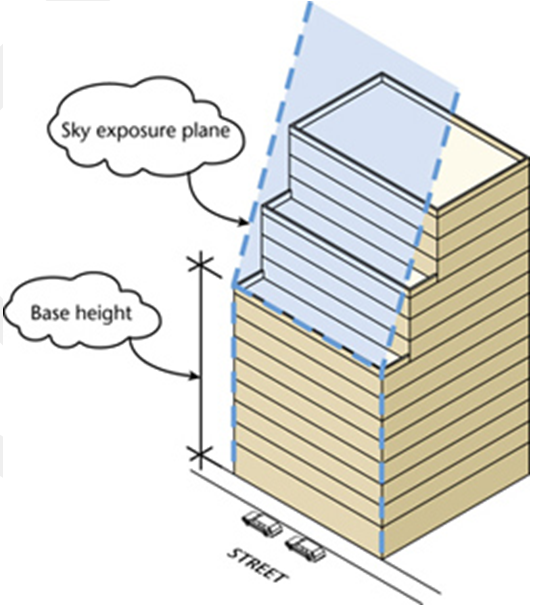
"Small wind energy system" means an energy system which converts wind energy by means of a rotor into electrical power for the primary purpose of meeting all or a part of a dwelling's energy requirements. As used in these regulations, the primary application of a wind energy system is the conversion of wind by a machine with turbine apparatus (includes base, rotor blades, nacelle, tower, inverter, batteries, or other component used in the system) capable of producing electricity by converting the kinetic energy of wind into electrical energy. The term does not include electrical distribution or transmission lines, or electrical substations. The term is limited to systems that have a nameplate capacity of one hundred (100) kilowatts or less; and should not exceed one hundred twenty (120) feet in total height.
"Solar farm" means a site in which the principal use is a large number of solar panels that are installed at or near ground level for purposes of energy generation that is connected to the power grid.
"Special district" means a district established to accommodate a narrow or special set of uses or for special purposes. The term can signify any district beyond the conventional residential, commercial, industrial, and agricultural districts.
"Special use" means a use as of right where the permit can be issued on the basis of the application alone, and the applicant can proceed under the permit without further referrals or reviews, other than normal inspections, or a use other than a use by (or as of) right.
"Stop construction order" means a written document issued by an enforcement official, which requires the cessation of an activity, usually construction; or the order provided for in the Uniform Construction Code of the state of New Jersey, including any portion thereof, and any modification of or amendment thereto.
"Street line" means the dividing line between the street and lots as shown on the records of the city of New Brunswick, New Jersey or as otherwise legally established, or between a lot and a private street, road, or way over which the owners or tenants have the right-of-way.
"Structural alteration" means any change in either the supporting members of a building, such as bearing walls, columns, beams, and girders, or in the dimensions or configurations of the roof or exterior walls.
"Subdivision regulations" means local ordinances that regulate the conversion of raw land into building lots for residential or other purposes. The regulations establish requirements for streets, utilities, site design, and procedures for dedicating land for open space or other public purposes to the local government or for fees in lieu of dedication, and prescribe procedures for plan review and payment of fees.
"Support facility" means a facility ancillary to a facility. Facilities primarily housing mechanical equipment or exclusively used for storage area not included in this definition.
Swimming pool, private. "Private swimming pool" means any body of water, tank or receptacle for water, whether artificially or semi-artificially constructed, or portable, having a depth at any point greater than eighteen (18) inches or having over one hundred twenty (120) square feet of area or larger than twelve (12) feet in diameter used or intended to be used for swimming or bathing solely by the owner, his or her family and guests of the household, and constructed, installed, established or maintained inside or outside any building in or above the ground upon any premises as an accessory use to the residence.
Synagogue. See place of worship.
"System" means the primary structural, mechanical, plumbing, electrical, fire protection, or occupant service components of a building including any equipment, fixtures, connections, conduits, wires, pipes, ducts, as well as any associated sensors, controls, distribution or safety elements.
"Taking" means the appropriation by government of private land for which compensation must be paid.
"Tavern" means a place where the principal use or function is the selling of alcoholic beverages and incident thereto may be the retail sale or consumption of food as a permitted use, consistent with N.J.S.A. 33:12 et seq.
"Teen dance club" means an enclosed or unenclosed structure open to persons under twenty-one (21) years of age assemble unaccompanied by adults, and where music is furnished for the purpose of dancing or other entertainment purposes, and at which a person pays an admission, membership dues, or a minimum fee or cover charge, whether or not admission is limited to members only.
Temple. See place of worship.
"Temporary structure" means a structure without any foundation or footings and which is removed when the designated time period, activity, or use for which the temporary structure was erected has ceased.
"Temporary use" means a use established for a fixed and limited duration with the intent to discontinue such use upon the expiration of the time period.
"Tenancy" means that portion of a building or story which is or is intended to be under the control of a single owner or tenant.
Theatre, indoor. "Indoor theatre" means a building or part of a building used to show motion pictures or for drama, concerts, plays, dance, musical, or other live performances for public viewing.
"Therapeutic residence" means a residence for adults, each of whom is capable of prompt evacuation as defined by Section 22-1.3 of NFPA 101-97, referenced in UCC Chapter 35, and who live within a single dwelling unit for therapeutic purposes, without a resident landlord or operator, but with some government or private social service provider oversight.
"Trailer recreational vehicle" means a recreational vehicle, travel trailer, camper, or other transportable, with or without its own motor power, designed and constructed for travel and recreational purposes intended to be used for temporary sleeping or shelter during periods of travel and recreation.
"Transitional uses" and "transitional structures" means uses or structures permitted in this title, which, by their nature or level of scale or activity, act as a transition or buffer between two or more incompatible uses.
"Trucking terminal" means a facility where the sole principal use involves the loading and unloading of bulk cargo and/or freight for transfer from trucks onto other trucks, onto delivery vehicles, onto other modes of transportation, or into intermediate storage areas to await further transport. Truck(ing) terminals contain onsite personnel operating out of an on-site building to manage the dispatch and logistics of the facility, which may include the separation or aggregation of freight. This use may include only short-term, on-site parking, storage, or incidental maintenance of trucks, trailers, railcars and shipping containers awaiting transport to/from this facility as an accessory use. General storage warehouses, parcel distribution centers, fulfillment centers shall be considered separate and distinct uses from trucking terminals.
"Use" means the specific purpose or activity for which a piece of land or its buildings is designed, arranged, or intended, or for which it is or may be occupied or maintained; a portion of a building or tenancy which is designed, intended, or devoted to a single use or occupancy.
"Visual screening" means any fence, wall, tree, hedge, or shrub, or a combination of them which limits visibility or provides screening from adjacent use.
"Wading pool" means any artificially constructed pool, not designed or used for swimming, with a maximum depth of eighteen (18) inches.
"Wall" means the vertical exterior surface of a building; one of the vertical interior surfaces that divide a building's space into rooms.
"Warehouse" means facilities characterized by extensive storage of goods, frequent heavy trucking activity, storage of material, but not involved in manufacturing or production.
"Yard" means an open space on the same lot with a building or building group lying between the front, rear, or side wall of a building and the nearest lot line, unoccupied except for projections and the specific minor uses or structures allowed in such open space under the provisions of this title.
Yard, front. "Front yard" means an open, unoccupied space on the same lot with the principal building, extending the full width of the lot and situated between the street line and the front line of the building exclusive of bay windows, steps, overhanging eaves or cornices. Front setback line shall be synonymous with the front yard line. Front yard requirements shall apply to all street frontage of a corner lot. The front yard area shall be measured at right angles to the street line.
Yard, side. "Side yard" means an open, unoccupied space between the side line of the lot and nearest line of a building and extending from the required front yard line to the required rear yard line, or in the absence of either such yards, to the street or rear lot lines as the case may be. The width of a side yard will be measured at right angles to the side line of the lot.
Yard, rear. "Rear yard" means the open space extending across the full width of the lot and lying between the rear line of the lot and the nearest line of any building. The depth of a rear yard shall be measured at right angles to the rear lot line.
Yard, setback line, front. A line located parallel to the front line of a lot and drawn at a depth equal to the minimum front yard depth beyond which no building shall be located unless otherwise provided herein.
"Zoning" means a police power measure, enacted primarily by general purpose units of local government, in which the community is divided into districts or zones within which permitted and special uses are established as are regulations governing lot size, building bulk, placement, and other developmental standards. Requirements vary from district to district, but they must be uniform within districts. The zoning ordinance consists of two parts: A text and a map.
"Zoning district" means a section of the city designated in the zoning ordinance text and delineated on the zoning map, in which requirements for the use of land and building and development standards are prescribed. Within each district, all requirements must be uniform.
"Zoning map" means the map delineating the boundaries of districts which, along with the zoning text, comprises the zoning ordinance.
"Zoning enforcement officer" means the agent of the city of New Brunswick designated to enforce this title and pursuant to that duty to investigate any violation or alleged violation of this article coming to his/her attention, whether by complaint of third persons or from his/her own personal knowledge or observation. When any building or structure is erected, constructed, altered, repaired, converted or maintained, or any building, structure or land is used in violation of any provision of this title, it shall be the duty of the zoning enforcement officer to proceed with the enforcement of this title and the penalties for hereunder. He/she may also grant zoning permits and pursue such other statutory method or methods, heretofore or hereafter provided, as may be open to him/her.
(Ord. No. O-112502, §§ I, II, 12-17-25; Ord. No. O-012301, § I, 2-15-23; Ord. No. O-112205, § I, 12-21-22; Ord. No. O-022201, §§ I, II, 2-16-22; Ord. No. O-032103, § I, 3-17-21; Ord. No. O-022002, § I, 2-19-20; Ord. No. O-091107, § 1, 10-5-11; Ord. No. O-050703, 6-6-07)

