Newport City Zoning Code
CHAPTER 17
80 - HISTORIC DISTRICT ZONING1
Sections:
Editor's note— Ord. No. 2010-28, adopted Aug. 25, 2010, amended Ch. 17.80 in its entirety to read as herein set out. Former Ch. 17.80 consisted of §§ 17.80.010—17.80.090, pertained to the same subject matter and derived from the prior code; Ord. 65-94, 1994; Ord. 99-6, 1999; Ord. 99-24, 1999; Ord. 2000-4, 2000; Ord. 2005-20, 2005; Ord. 2006-36, 2006; and Ord. No. 2010-01, adopted Jan. 13, 2010.
17.80.010.- Purpose.
The purpose of historic district zoning in the City of Newport is to protect our historic assets and to guide new growth in ways that enrich and maintain Newport's sense of place and authentic historic character, for now and for future generations.
Newport has a remarkable built environment recognized as unique among American cities, including the most extensive collection of extant 17th and 18th century colonial structures in the nation; a broad array of mid-19th century resort architecture, much of it designed by the leading architects of that era; an unparalleled set of elaborate gilded age "cottage" mansions and numerous residential, commercial, military, industrial and institutional buildings reflecting the city's long maritime history. Even more significant is that this environment reflects architectural and social values over centuries of historical development unequalled by any other city in the country.
Newport's architectural vitality is dependent on the context within districts including streetscapes, neighborhoods, and vistas as well as the quality and character of individual buildings that make up its districts.
The preservation of structures of historic and architectural value and historic cemeteries, wherever located within the City of Newport, are declared to be a public purpose and the city council, by this Chapter, does hereby regulate the construction, alteration, repair, moving, and demolition of these structures within the limits of the designated historic districts of the City of Newport. It is recognized that the purpose of this Chapter is to:
1.
Safeguard the heritage of the City of Newport by preserving districts in the City of Newport which reflect elements of its cultural, social, economic, political and architectural history;
2.
Stabilize and improve property values in those districts;
3.
Foster civic beauty;
4.
Strengthen the local economy; and
5.
Promote the use of the historic districts for the education, pleasure, and welfare of the citizens of the City of Newport.
(Ord. No. 2010-28, § 1, 8-25-2010)
17.80.020. - Definitions.
The following terms shall have the following meanings:
"Alteration" means an act that changes one or more of the exterior architectural features of a structure or its appurtenances, including, but not limited to, the erection, construction, reconstruction, or removal of any structure or appurtenance.
"Appropriate" - see "Certificate of appropriateness".
"Appurtenances" means features other than primary or secondary structures which contribute to the exterior historic appearance of a property, including, but not limited to, paving, doors, windows, signs, materials, decorative accessories, fences, and historic landscape features.
"Certificate of appropriateness" means a certificate issued by the Newport historic district commission indicating approval of plans for alteration, construction, repair, removal, or demolition of a structure or appurtenances of structure within a historic district. Appropriate for the purpose of passing upon an application for a certificate of appropriateness means not incongruous with those aspects of the structure, appurtenances, or the district which the commission has determined to be historically or architecturally significant.
"Complete application" means an application for certificate of appropriateness that is deemed to contain all of the required and necessary information in order for the commission to render a decision.
"Conceptual approval" means a preliminary and limited approval by the commission of the location, size, scale and massing of proposed new construction or major alteration.
"Construction" means the act of adding to an existing structure or erecting a new principal or accessory structure or appurtenances to a structure, including, but not limited to, buildings, extensions, outbuildings, fire escapes, and retaining walls.
"Contributing structure" means a structure designated contributing based on application of the Newport Historic Structures Inventory Standards or one which the commission has determined to be contributing because it adds to the local district's sense of time, place, character, or historical development by location, design, setting, materials, workmanship, or association. To be so designated the structure should conform to the character of the local district as defined in that district's "nominating papers". The rationale for such designation should be explicit and provided to the homeowner upon request by the commission or designated staff. Newport's historic district is currently composed of eight unique local districts each with its own distinct character. These districts are: Bellevue Avenue, Bellevue Avenue-Casino, Fort Adams, Kay-Catherine-Old Beach, Newport National Landmark District (Easton's Point-Washington Square-Historic Hill and Harbor), Ocean Avenue, Ochre Point-Cliffs, and Rose Island. A substantially deteriorated structure may still be deemed a contributing structure.
"Demolition" means an act or process that destroys a structure or its appurtenances in part or in whole.
"Historic designed landscape" means a landscape that was consciously designed or laid out by a landscape architect, master gardener, architect, or horticulturist according to design principles or a gardener working in a recognized style or tradition. The landscape may be associated with significant person(s), trend, or event in landscape architecture; or illustrate an important development in the theory and practice of landscape architecture. Aesthetic values play a significant role in designed landscapes. Examples include parks, campuses, walking trails and estates. Importantly, Newport has a number of nationally significant landscapes, now exempted from review; the commission should recognize and encourage the preservation of such historic designed landscapes.
"Historic district," is as defined in Section 17.08.010 and 17.80.030 of this zoning code. A historic district may include one or more structures.
"Historic landscape features" means features which characterize the historic and designed character of a property's setting, including, but not limited to, decorative or retaining walls, gates, fences, statuary or other objects of art, seating or other furnishings, arbors, trellises, fountains, paths, walkways, driveways, curbing, the contour and elevations of landforms and designed grades, and under certain circumstances, trees.
"In-kind replacement" means replacement of an architectural feature, damaged or deteriorated beyond repair, where the new feature will match the feature being replaced in dimensions, design, configuration, texture and visual appearance, and match materials as closely as possible. Replacement which differs from the existing in material, design, configuration, texture, dimensions and other visual qualities is an alteration and not an in-kind replacement.
"Major alteration" means an alteration which significantly affects the historic, cultural, or architectural integrity, interpretability, or character of a building, structure, site or district. Generally includes the kind of work which is normally done with the aid of a professional drafter or professional quality plans.
"Minor alteration" means an alteration which does not significantly affect the historic, cultural, or architectural integrity, interpretability, or character of a building, structure, site or district. Generally it includes the kind of work which is normally done without the aid of a professional drafter or professional quality plans.
"Minor modification" means a revision to approved plans that is deemed to be minor in nature and not incongruous with all other approved elements of that plan.
"New construction" means a new principal or accessory freestanding structure which does not alter character-defining historic materials.
"Newport historic structures inventory" means an inventory of structures within the historic district, identified as contributing or noncontributing, as adopted and approved by the Newport City Council. In the absence of inclusion in a completed inventory, the designation of a structure as contributing or noncontributing will be based on application of the "Newport historic structures inventory standards."
"Newport historic structures inventory standards" means standards defined by the City of Newport Historic Planner and adopted and approved by the Newport City Council that are used in determining if a structure located within a designated historic district is contributing or noncontributing.
"Newport standards for the treatment of historic properties" or "Newport standards," is as defined in Section 17.80.040 of this zoning chapter.
"Noncontributing structure" means a structure that is designated noncontributing based on application of the Newport historic structures inventory standards, or one that the commission has determined to be noncontributing because it does not add to the local district's sense of time, place, character or historical development as defined in that district's "nominating papers." Even for those structures that retain certain features which reflect the character of the district, the structure may still be considered noncontributing if it has lost its integrity due to substantial changes in location, design, setting, materials or workmanship.
"Ordinary maintenance" means work, other than replacement, meant to remedy damage or deterioration of a structure or its appurtenances, involving no change in materials, dimensions, design, configuration, texture or visual appearance.
"Reconstruction" means the act or process of depicting, by means of new construction, the form, features, and detailing of a documented nonsurviving site, landscape, building, structure, or portion thereof for the purpose of replicating its appearance at a specific period of time and in its historic location.
"Removal" means a relocation of a structure on its site or to another site.
"Repair" means a change intended to remedy damage or deterioration of a structure or its appurtenances.
"Standards for maintenance of properties" means documented maintenance criteria as developed by the City of Newport and approved and adopted by the city council for existing properties.
"Structure" means anything constructed or erected, the use of which requires permanent or temporary location on or in the ground, including, but not limited to, buildings, gazebos, billboards, outbuildings, decorative and retaining walls, and swimming pools.
(Ord. No. 2010-28, § 1, 8-25-2010)
17.80.030. - Designation of historic districts.
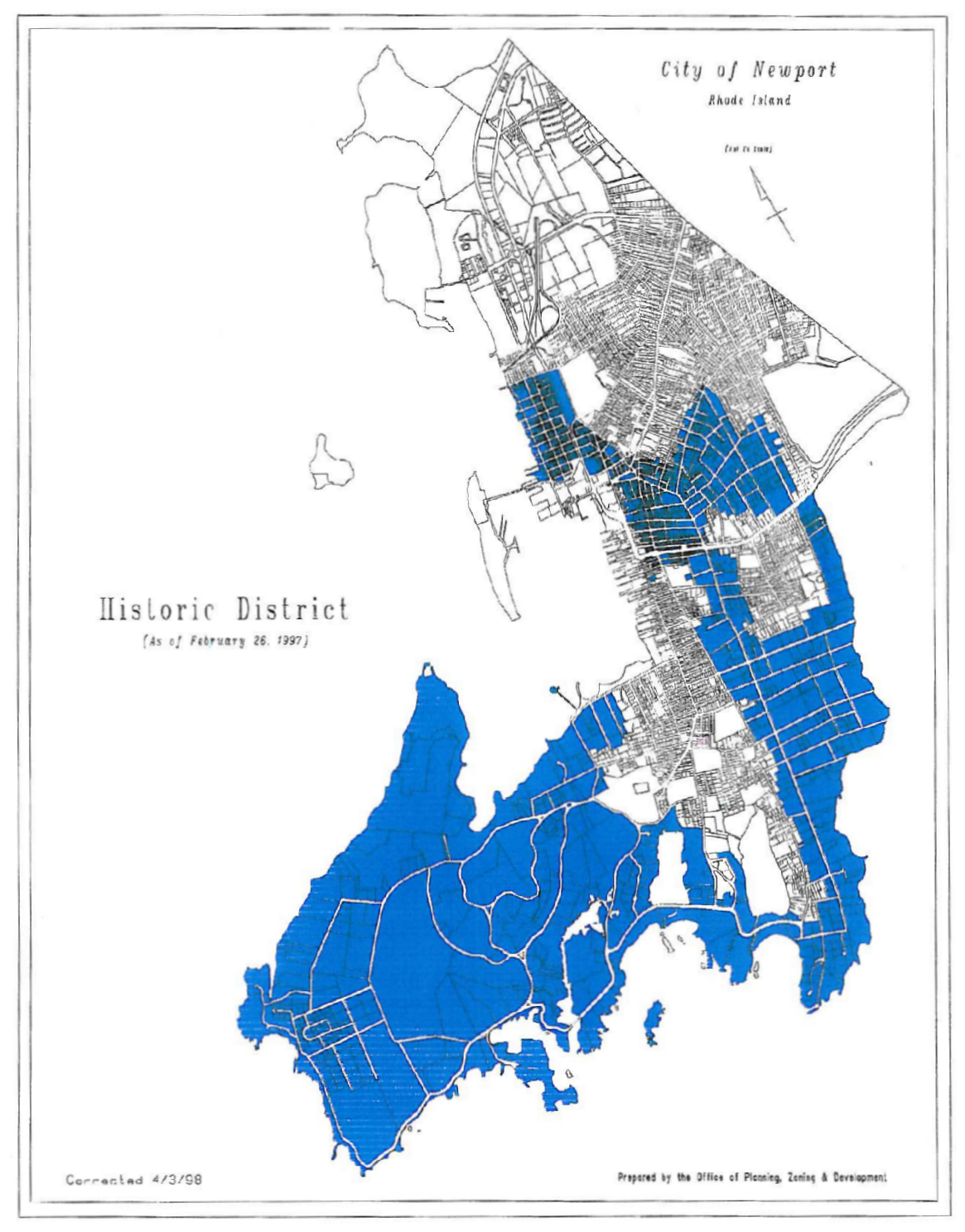
For the purposes of this chapter, the boundaries of historic districts are established as shown on a map entitled "Historic District Zoning Map," which map is filed in the office of the city clerk. Such map is hereby incorporated as a part of this Chapter.
(Ord. No. 2010-28, § 1, 8-25-2010)
17.80.040. - Historic district commission.
A.
There is hereby established a historic district commission to carry out the purpose of this Chapter.
B.
Membership and Appointment.
1.
The commission shall consist of seven qualified members, residents of the City of Newport, to be appointed by the mayor of the City of Newport with the consent of the city council. Members shall be appointed for three-year terms, except that the initial appointments of some of the members shall be for less than three years to the end that the initial appointments shall not reoccur at the same time. Members shall be eligible for reappointment and, upon expiration of their terms, shall continue to serve until replaced unless otherwise provided for in the ordinances of the City of Newport or its Charter.
2.
Members of the commission shall have a demonstrated interest in historic preservation. Duly organized and existing preservation societies may present to the mayor lists of qualified citizens to be considered for appointment.
3.
The mayor of the City of Newport shall have the right, with the consent of the council, to name two auxiliary members to the commission in addition to the regular members. An auxiliary member shall sit as an active member, upon the request of the chairman of the commission, when and if a regular member of the commission is unable to serve at any meeting of the commission.
4.
In the event of a vacancy on the commission, the mayor shall promptly make an interim appointment, with the consent of the city council, for the remainder of the unexpired term. Vacancies on the commission shall be filled within ninety (90) days.
5.
Members of the commission shall serve without compensation.
C.
Organization of the Commission.
1.
The commission shall organize annually and, by election, shall select from its membership a chairman, vice-chairman and a secretary.
2.
The commission shall:
a.
Adopt and publish all rules, regulations and procedures necessary to carry out its functions under the provisions of this chapter; and
b.
Adopt and publish standards which shall be in harmony with the Newport standards for the treatment of historic properties to inform historic district residents, property owners, and the general public of those criteria by which the commission shall determine whether to issue a certificate of appropriateness. The commission may, from time to time, amend these standards as reasonably necessary, and it shall publish all such amendments. Such amendments shall be in harmony with the Newport standards for the treatment of historic properties.
c.
The commission may delegate to the director of planning, zoning, development and inspections for the City of Newport, or his/her designee, authority to issue a certificate of appropriateness for: (1) Minor alterations; (2) Major alterations to noncontributing structures; and (3) In-kind replacement. The commission may also authorize said department or officer to approve [1] extensions to already approved certificates of appropriateness; [2] minor modifications to plans previously approved by the commission; [3] waiver of application fees for demonstrated financial hardship; and [4] such other alterations and administrative matters that it may delegate to said department or officer pursuant to Chapter 24.1 of Title 45, General Laws of Rhode Island 1956, as amended. However, at no time may said department or officer deny a certificate of appropriateness but shall refer such action to the commission for consideration and decision.
3.
Conduct of Business.
a.
The chairman shall preside over all commission meetings and shall have the right to vote.
b.
The vice-chairman shall, in the case of absence or disability of the chairman, perform the duties of the chairman.
c.
All meetings of the commission shall be open to the public and any person or his duly constituted representative shall be entitled to appear and be heard on any matter before the commission reaches its decision.
d.
The commission shall keep a record of all resolutions, proceedings, finding of fact, decisions and actions and such record shall be on file for public view in the department of planning, zoning, development and inspections.
e.
The commission shall provide notice of its meetings and comply in all respects with the requirements of the open meetings law. Notice of the commission meetings shall appear in a newspaper of general circulation in the city seven days prior to such meetings.
f.
Five members shall constitute a quorum and the concurring vote of a majority, but not less than four members present shall be necessary for the approval of any plans before the commission for review, certificate of appropriateness and for establishing or amending commission rules, regulations, procedures and standards.
(Ord. No. 2010-28, § 1, 8-25-2010)
17.80.050. - Powers and procedures of the commission.
A.
Certificate of Appropriateness Required.
1.
Before a property owner may commence construction, alteration, repair, removal or demolition affecting the exterior appearance of a structure or its appurtenances within any designated historic district, or affecting an historic cemetery located in the City of Newport, the owner must apply for and receive a certificate of appropriateness from the commission approving such construction, alteration, repair, removal or demolition.
2.
In applying for a certificate of appropriateness, a property owner must comply with the application procedures as established by the commission pursuant to Chapter 45-24.1 of the General Laws, as amended, and the provisions of this Chapter.
3.
A certificate of appropriateness is necessary whether or not state law requires a permit from the building official. The building official shall not issue a building permit until the commission has issued a certificate of appropriateness.
B.
Application for Certificate of Appropriateness.
1.
Applications for certificates of appropriateness shall be filed with the office of planning, zoning, development and inspections. The director or his/her designee shall determine if such application is complete and shall forward complete applications, together with all maps, plans, and other data to the commission. Incomplete applications shall be returned to the applicant within seven working days of receipt by the department of planning, zoning, development and inspections.
2.
The commission shall require the applicant to submit information which is reasonably necessary to evaluate the proposed construction, alteration, repair, removal or demolition including, but not limited to, site plans, elevation drawings, photographs or other information deemed appropriate by the commission and set forth in the commission's rules, regulations, procedures and standards, adopted pursuant to this Chapter, which information may be submitted in digital format acceptable to the commission.
3.
In the case of a historic cemetery, the owners must comply with all provisions of law and make suitable and appropriate provisions for the reinternment of any human remains in an established cemetery. Original or existing headstones and markers shall be preserved and installed at the site of the reinternment.
C.
The Commission's Review of Applications for Certificate of Appropriateness.
1.
In deciding whether to issue a certificate of appropriateness, and in making the determination that the proposed alteration is not incongruous with those aspects of the structure, appurtenances, or the district that the commission has determined to be historically or architecturally significant, the commission shall give consideration to:
a.
The historic and architectural significance of the structure and its appurtenances;
b.
The way in which the structure and its appurtenances contribute to the historical and architectural significance of the district; and
c.
The appropriateness of the general design, arrangement, texture, materials, and siting proposed in the plans.
The commission shall also apply the Newport standards for treatment of historic properties (the Newport standards). The Newport standards, adapted from the Secretary of the Interior's Standards and Guidelines for Rehabilitating Historic Buildings, 36 CFR 671, as amended, are basic principles to be applied in a reasonable manner to preserve historic districts and structures, while allowing for reasonable change, architectural variety, innovation and imagination. The Newport standards are intended to insure that properties in Newport's historic districts are not altered improperly. The goal is to set up clear rules that everyone will understand.
2.
In conducting its review, the commission shall apply the Newport Standards and shall also take into account the relative architectural and historic significance of structures: the integrity and condition of historic fabric; the reasonableness of the proposed alteration; and the practical realities of alternatives that minimize harm to the historic district.
3.
The commission shall pass only on exterior features of a structure and its appurtenances and shall not consider interior arrangements. Doors, window sash and frames covered by storm doors or windows shall be considered exterior features.
4.
The commission may give conceptual approval for proposed new construction or major alterations. Conceptual approval does not assure that the commission will issue a certificate of appropriateness. Final approval is contingent upon acceptance of all stylistic and historic details including, but not limited to, window choice, siding choice, trim choice and materials.
5.
Decisions of the commission. All decisions of the commission shall be in writing. The commission shall articulate and explain the reasons and basis of each decision on a record and in the case of a decision not to issue a certificate of appropriateness, the commission shall include the basis for its conclusion that the proposed activity would be incongruous with those aspects of the structure, appurtenances, or the district which the commission has determined to be historically or architecturally significant. In addition, the commission may, upon request of the applicant, include an outline of reasonable alternatives, methods, materials or other conditions under which the activity would likely be approved. The commission shall send a copy of the written decision to the applicant.
(Ord. No. 2010-28, § 1, 8-25-2010)
17.80.060. - The Newport standards for treatment of historic properties.
The Newport standards for treatment of historic properties are:
A.
For Contributing Structures. The commission shall apply the following standard of review to contributing structures:
1.
Retain Historic Character. Retain and preserve the historic character of a contributing structure. The removal of historic materials or alteration of features and spaces that characterize a contributing structure should not be undertaken.
2.
Avoid Conjecture. The buildings of Newport are a physical record of their time, place and use. Avoid changes that create a false sense of historical development, such as adding a conjectural feature or architectural elements from other buildings.
3.
Maintain Significant Alterations. Retain and preserve changes to a contributing structure that have acquired historic significance in their own right.
4.
Preserve Character, Defining Features and Workmanship. Preserve distinctive features, finishes and construction techniques or examples of craftsmanship that characterize a contributing structure.
5.
Repair before Replacement. The historic materials out of which contributing structures buildings are constructed are significant and once lost, they cannot be recovered. Every effort should be made to repair rather than replace deteriorated historic fabric and features. When the severity of deterioration requires replacement of features or fabric, the replacement should match the old in materials, dimensions, design, configuration, texture and visual appearance.
6.
Avoid Damaging Treatments. Do not use chemical or physical treatments, such as sandblasting, that cause damage to historic materials.
7.
Minimize Harm from Alterations. Undertake exterior alterations, including new additions, in such a manner that minimizes harm to historic materials and that if removed will not change the essential form and integrity of a contributing structure. Make proposed additions or exterior alterations to a contributing structure compatible with the existing materials, features, size, visual relationships and massing to protect the integrity and scale of the original historic structure or site. Make new alterations or additions clearly discernible from the old. The differentiations may or may not be stylistic, and may be as subtle as a change in footprint or material.
B.
For Noncontributing Structures and Existing Walls, Gates, Gateposts and Fences Made Subject to Review by Section 17.80.100(6) of this Chapter. The commission shall apply the following standard of review to noncontributing structures:
1.
Compatibility. The alteration of a noncontributing structure or existing walls, gates, gateposts and fences made subject to review pursuant to Section 17.80.100(6) of this Chapter shall be generally of such size, scale, siting, massing, setback, materials, and detail as will be compatible with other structures in the surrounding historic district.
2.
Preserving Character Defining Features. The commission may encourage but shall not require owners to preserve distinctive features, finishes, construction techniques or examples of craftsmanship that are present in a noncontributing structure or existing walls, gates, gateposts and fences made subject to review pursuant to Section 17.80.100(6) of this Chapter which add to the character of the surrounding district.
C.
For New Construction, Reconstruction and New Walls, Gates, Gateposts and Fences Made Subject to Review Pursuant to Section 17.80.100(6) of this Chapter. The commission shall apply the following standard of review to new construction or reconstruction:
1.
Compatibility. New construction, reconstruction and new walls, gates, gateposts and fences made subject to review pursuant to Section 17.80.100(6) of this Chapter shall be compatible with the surrounding historic area in terms of size, scale, siting, massing, setback, materials and details.
2.
Architectural Quality. New construction, reconstruction and new walls, gates, gateposts and fences made subject to review pursuant to Section 17.80.100(6) of this Chapter should be of thoughtful and considered architectural design.
3.
Appearance. New construction, reconstruction and new walls, gates, gateposts and fences made subject to review pursuant to Section 17.80.100(6) of this Chapter may clearly read as such and need not present a false historic appearance.
D.
For Demolition:
1.
Demolition shall be deemed by the commission to be a major alteration.
2.
The commission shall not approve the demolition of contributing historic structures that retain integrity of condition. If a request for demolition is based on structural instability or advanced deterioration, a technical report prepared by a professional engineer or architect that details the nature and extent of specific problems shall be submitted. A standard condition of approval for demolition of a contributing historic structure shall be the documentation of the existing building's elevations, including details and architectural features.
(Ord. No. 2010-28, § 1, 8-25-2010)
17.80.070. - Special considerations regarding valuable historic resources and demolition.
A.
In the case of an application for construction, repair, or alteration, removal, or demolition affecting the exterior appearance of a structure or its appurtenances, which the commission deems so valuable to the city, state or nation that the loss thereof will be a great loss to the city, state or nation, the commission shall endeavor to work out with the applicant an economically feasible plan for the preservation of such structure.
B.
Unless the commission is satisfied that the retention of such structure constitutes a hazard to public safety, which hazard cannot be eliminated by economic means available to the applicant, including the sale of the structure to any purchaser willing to preserve such structure or unless the commission votes to issue a certificate of appropriateness for the proposed construction, alteration, repair, removal, or demolition, the commission shall file with the building official its rejection of such application.
C.
In the absence of change in such structure arising from casualty, no new application for the same or similar work shall be filed within one year after such rejection.
D.
In the case of any structure deemed to be valuable for the period of architecture it represents and important to the neighborhood within which it exists, the commission may file with the building official its certificate of appropriateness for such application if any of the circumstances under which a certificate of appropriateness might have been given under the proceeding paragraphs are in existence, or if:
1.
Preservation of such structure is a deterrent to a major improvement program which will be of substantial benefit to the community;
2.
Preservation of such structure would cause undue or unreasonable financial hardship to the applicant, taking into account the financial resources available to the applicant including sale of the structure to any purchaser willing to preserve such structure; or
3.
Preservation of such structure would not be in the interest of the majority of the community.
E.
When considering an application to demolish or remove a structure of historic or architectural value, the commission shall assist the applicant in identifying and evaluating alternatives to demolition, including sale of the structure and its present site. In addition to any other criteria, the commission also shall consider whether there is a reasonable likelihood that some person or group other than the applicant is willing to purchase, move and preserve such structure and whether the applicant has made continuing bona fide and reasonable efforts to sell the structure to any such purchaser willing to move and preserve such structure.
F.
Demolition Through Owner Neglect. The city council, in consultation with the historic district commission, may identify structures of historical or architectural value whose deteriorated physical condition endangers the preservation of the structure or its appurtenances. The City of Newport shall publish standards for maintenance of properties within the historic district. Upon the petition of the historic district commission that the historic structure is so deteriorated that its preservation is endangered, the council may establish a reasonable time not less than thirty (30) days within which the owner must begin repairs. If the owner has not begun repairs within the allowed time, the council shall hold a hearing at which the owner may appear and state his or her reasons for not commencing repairs. If the owner does not appear at the hearing or does not comply with the council's orders, the council may cause the required repairs to be made at the expense of the city and cause a lien to be placed against the property for repayments.
G.
No less than fifteen (15) days after receiving an application to demolish or to remove an historic cemetery, the commission shall forward the application to the commission to study historic cemeteries. The commission shall also immediately forward to the commission to study historic cemeteries its finding of fact, if any, together with its action on the application.
(Ord. No. 2010-28, § 1, 8-25-2010)
17.80.080. - Failure of the commission to act.
The commission shall file with the building official its certificate of appropriateness or rejection of all plans submitted to it for review. No work shall begin until the certificate has been filed but, in the case of rejection, such decision is binding upon the building official and no permit shall be issued in such a case. The failure of the commission to act within forty-five (45) days from the date of an application filed with it, unless an extension is agreed upon mutually by the applicant and the commission is deemed to constitute approval. In the event, however, that the historic district commission makes a finding of fact that the circumstances of a particular application require further time for additional study and information than can be obtained within the period of forty-five (45) days, then the commission has a period of up to ninety (90) days within which to act upon the application.
(Ord. No. 2010-28, § 1, 8-25-2010)
17.80.090. - Advisory role.
In order to assist the city, its agencies, boards, commissions, staff, mayor and council on matters of historic preservation, the commission shall provide its expertise and advice, as appropriate, at the request of any of said agencies, boards, commissions, staff or elected officials.
(Ord. No. 2010-28, § 1, 8-25-2010)
17.80.100. - Exceptions.
Nothing in this chapter shall be construed to prevent painting or ordinary maintenance and repair of any structure or appurtenance within a historic district, provided that such painting or ordinary maintenance and repair does not result in any change of design, type of material, or appearance of the structure or appurtenance; nor shall anything in this chapter be construed to prevent the construction, alteration, repair, moving, or demolition of any structure under a permit issued by the building official prior to the passage of this chapter. The following are actions or items which are exempt from commission review:
1.
Paint colors, surface preparation or paint composition;
2.
Decorating—holiday or other;
3.
Landscaping, including shrubs, trees, flowers, window flower boxes, and other plantings, exterior lighting, flags and flagpoles, lawn furniture, park benches and birdbaths;
4.
Window air conditioning units;
5.
Ground-mounted air conditioning units generators (one hundred (100) amps or less), if not visible from any public way, in compliance with zoning setback requirements, and if screened by fencing or shrubbery;
6.
Fences, gates, gateposts and walls, except historic stone walls as provided for in Chapter 17.74.
7.
Historic designed landscapes;
8.
All ordinary maintenance and repair of any existing exterior features of a structure or appurtenance that does not result in any change of design, type of material, or appearance of the structure or appurtenance;
9.
Temporary structures or signs that are temporary and whose duration will not exceed any guidelines established by the commission;
10.
Storm windows and storm doors;
11.
Paving, patios and driveways;
12.
The reconstruction in the same design of a building, structure or exterior architectural feature damaged or destroyed by fire, storm or other disaster, provided such reconstruction is begun within one year and is continued to completion without substantial interruption and provided that sufficient and reliable evidence exists, such as from detailed as-built drawings or reasonable photo documentation, of the exterior features of the building, structure or architectural feature prior to the casualty causing the damage or destruction.
(Ord. No. 2010-28, § 1, 8-25-2010; Ord. No. 2014-021, § 1, 8-27-2014)
17.80.110. - Appeals.
An aggrieved party with respect to a decision of the historic district commission shall have the right to appeal such decision to the zoning board of review. When hearing appeals from the commission decisions, the zoning board of review shall not substitute its own judgment for that of the commission, but must consider the issue upon the findings and the record of the commission. The zoning board of review shall not reverse a commission decision except on a finding of prejudicial procedural error, clear error or lack of support by the weight of the evidence in the record. The zoning board of review shall articulate and explain the reasons and basis of each decision of the record and the zoning board of review shall send a copy of the decision to the aggrieved party, to the historic district commission, and to all parties entering an appearance. An aggrieved party may appeal the decision of the zoning board of review on a matter appealed under this chapter to the superior court of Newport County.
(Ord. No. 2010-28, § 1, 8-25-2010)
17.80.120. - Enforcement.
Where there is a violation of any of the provisions of this chapter or of any section taken thereunder, the zoning officer or building official may institute an appropriate action to prevent, enjoin, abate or remove such violation. The zoning officer may bring an action against any property owner who fails to comply with the requirements of the chapter. Such actions shall be brought in the municipal court or other court of competent jurisdiction. The City of Newport may seek restraining orders and injunctive relief to restrain and enjoin violations or threatened violations of this Chapter.
(Ord. No. 2010-28, § 1, 8-25-2010)