
Nichols Hills City Zoning Code
ARTICLE I
- IN GENERAL
Sec. 50-1. - Purpose of the Zoning regulations.
This Chapter is intended to promote the public health, safety, morals, comfort, convenience, order, and general welfare; lessen danger and congestion of transportation and travel; prevent overcrowding of land; avoid undue concentration of population; provide adequate light, air, open space, and public facilities; prevent undue encroachments; conserve the value of Property and encourage the most appropriate uses of land; and promote the conservation and rational development of the City in accordance with the Comprehensive Plan.
(Code 1992, § 25-2; Code 2013, § 50-1; Ord. No. 803, § 2, 11-17-1998)
Sec. 50-2. - Scope and jurisdiction.
(a)
Uniform application. The interpretation and application of this Chapter shall be applied to all areas within the corporate limits of the City. The use of all land and any Buildings or Structures located on the land; and the construction, reconstruction, Alteration, expansion, relocation, removal, or demolition of any Buildings or Structures upon the land shall conform to all regulations applicable to the zone in which the land is located, except as otherwise provided in this Chapter.
(b)
Interpretation of provisions. In interpreting and applying the provisions of this Chapter, they shall be held to be the minimum requirements for the promotion of the public health, safety, and general welfare. It is not intended by this Chapter to repeal, abrogate, annul, or in any way to impair or interfere with any existing provisions of Law or Ordinance or any rules or regulations previously adopted pursuant to Law relating to the Use of Buildings or premises; nor is it intended by this Chapter to interfere with, abrogate, or annul any Easements or covenants between parties; provided, however, that where this Chapter imposes greater restrictions upon the Use of Buildings or premises than are imposed by such existing provisions of Law or Ordinance or by such rules or regulations or by such Easements, covenants, or agreements, the provisions of this Chapter shall control; and where the provision of such Easements, covenants, or laws impose greater restrictions upon the Use of Buildings or premises than this Chapter, such provision of Easements, covenants, or laws shall control.
(c)
Ambiguity. If ambiguity arises concerning the content or application of this Chapter, it shall be the duty of the Board of Adjustment to ascertain all pertinent facts and set forth its findings and interpretation by formal Resolution.
(d)
Effect on public lands. All Property owned, leased, or operated by the City, or any other public or governmental body or agency, shall be subject to the terms of this Chapter.
(Code 1992, § 25-3; Code 2013, § 50-2; Ord. No. 803, § 2, 11-17-1998)
Sec. 50-3. - Definitions.
The following words, terms and phrases, when used in this Chapter, shall have the meanings ascribed to them in this Section, except where the context clearly indicates a different meaning:
Accessory Building means a Building that is less than 650 square feet and that is incidental, appropriate, and subordinate to the principal Building located on the same Lot.
Accessory Structure means a Structure that is less than 650 square feet and that is incidental, appropriate, and subordinate to the principal use of the Building or land located on the same Lot.
Accessory Use means an activity or use in connection with or in a Building or Structure that is incidental, appropriate, and subordinate to the principal use of the Building, Structure or land on the same Lot.
Addition, when used in reference to Buildings and construction, means an extension or increase in Floor Area or height of an existing Building.
Alcoholic Beverage means alcohol, spirits, beer, and wine, and also includes every liquid or solid, patented or not, containing alcohol, spirits, wine or beer and capable of being consumed as a beverage by human beings, but does not include nonintoxicating beverages, as that term is defined in State Law.
Alley means a narrow passage or way, not intended for general traffic, located between or behind Buildings, which affords a secondary means of vehicular access to abutting Property.
Alteration (when used in this Chapter in reference to Buildings and construction) means any construction or renovation to an existing Building that requires a Building Permit and that is not a Repair or an Addition.
Attic means the space in a Building that is directly below the roof Structure and that is unfinished, uninhabitable, and not air conditioned. The only permitted use of an Attic is storage. Attics are not included in Floor Area calculations.
Automobile. See Motor Vehicle.
Automobile Service Station means any area of land, including Structures thereon, that is used for the sale of gasoline, other refined products, and other Automobile accessories. The Automobile Service Station may or may not include facilities for lubricating, washing, cleaning or otherwise servicing Automobiles, or facilities for the sale of propane, butane, or compressed natural gas.
Basement means the lowest Story of a Building that is either partially or wholly below ground level. In order to be a Basement, the Story must have no more than 35 percent of its exterior perimeter wall above surrounding ground level. Basements are not included in Floor Area calculations.
Basement Sketch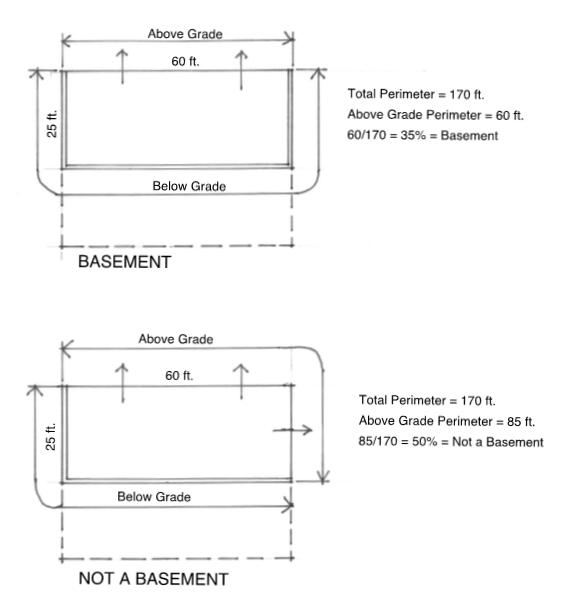
Buildable Area means that portion of a single parcel of land available to be occupied or intended to be occupied by a Building or Structure, determined as follows:
(1)
Buildable Area in the R-1-75 and R-1-60 Residential Districts. For Buildings in the R-1-75 and R-1-60 Residential Districts, the Buildable Area for Main Buildings is that area between the Front Yard Setback line, the Side Yard Setback lines, and a measured line of ten feet zero inches parallel to the rear Property Lines.
(2)
Buildable Area in all other Zoning Districts. In all Zoning Districts other than the R-1-75 and R-1-60 Residential Districts, the Buildable Area for Main Buildings is that area between the Front Yard Setback line, the Side Yard Setback lines, and the Rear Yard Setback line.
Building means any Structure intended for the shelter, housing or enclosure of Persons, animals or movable or transferrable Personal Property. When separated by dividing walls without openings, each portion of such Structure so separated shall be deemed a separate Structure.
Building Coverage. See Building Lot Coverage.
Building Height means the vertical distance from the Centroid of the Lot, to the horizontal plane intersected by the highest point of the Building. Chimneys and antennas shall not be considered as structural elements for the purpose of measuring Building Height. For Additions and renovations to an existing Main Building, the maximum allowable Building Height is measured from the existing entry floor level as accepted by the Code Official.
Building Lot Coverage means the percentage of the Buildable Area of a Lot which is covered by a roof or other Structure and is not open to the sky, calculated from outside face of frame to outside face of frame. The term "Building Lot Coverage" includes, but is not necessarily limited to, the Main Building, Secondary Buildings, Accessory Buildings, Accessory Structures, and Accessory Uses. The calculation of Building Lot Coverage must include roof overhang exceeding two feet beyond the supporting frame line.
Building, Main, means a Building in which is conducted the principal Use of the Lot on which it is situated. In Single-Family and Two-Family Residential Districts, a Dwelling shall be deemed to be the Main Building, and only one Main Building shall be permitted on a Lot. In Church, Office, commercial, or Planned Unit Development Districts, multiple Buildings shall be permitted on one Lot, but the Zoning District's Use and Development Regulations for Main Buildings shall apply to all such Structures.
Building, Portable, means a movable Accessory Building or Accessory Structure which is not connected to utility services, and does not exceed 12 feet in height and 144 square feet in Gross Floor Area.
Building, Secondary.
(1)
The term "Secondary Building" means any Structure containing the same uses and located on the same Lot as the Main Building as follows:
a.
In Estate and Single-Family Residential districts, the term "Secondary Building" means an integrated architectural design including more than one Structure, all of which are intended for occupancy by the immediate Family or household staff as permitted. A detached garage which exceeds a 650-square-foot Building footprint shall be considered a Secondary Building. Note that, effective December 24, 2010, Secondary Buildings are not allowed in any residential district. Some Secondary Buildings exist in the E-1-Estate and E-2 Urban Estate Districts that were built prior to that date.
b.
In Multiple-Family Residential districts, the term "Secondary Building" means an architecturally compatible complex of two or more Buildings on a parcel under one ownership, with all Buildings providing the same type of permitted occupancy as the Main Building.
c.
In Office and Retail commercial districts, the term "Secondary Building" means a parcel under one ownership with more than one Structure and having shared Parking and access.
(2)
All applicable Zoning and construction code requirements must be met. Secondary Buildings shall be included with the Main Building in the application of all Development Regulations of the Zoning District.
Building Setbacks/Lines means the required open space between the Property Lines and the exterior of the Structure. Building Setbacks/Lines are established by plat restrictions, private covenants, and City Ordinances.
Carport means a permanent roofed Structure permanently open on at least two sides, designed for or occupied by private passenger vehicles. See also Porte Cochere.
Centroid means a point located in three dimensions at the center point of the Lot, with the center point of the Lot and the elevation of the Centroid determined as follows and as depicted below, using the Property Lines for the Main Building.
(1)
Determining the center point of the Lot. The center point of the Lot is determined by the intersection of Line A-B drawn from the median of the front Property Line to the median of the rear Property Line and of Line C-D drawn from the median of each of the side Property Lines.
(2)
Determining the elevation. The elevation of the Centroid is the lower elevation of Line A-B and Line C-D as they cross over the center point. The center point elevation of Line A-B is one-half of the sum of the natural grades, as determined by survey, at the front Property Line and the rear Property Line. The center point elevation of Line C-D is one-half of the sum of the natural grades, as determined by survey, at the two side Property Lines.
Centroid Calculation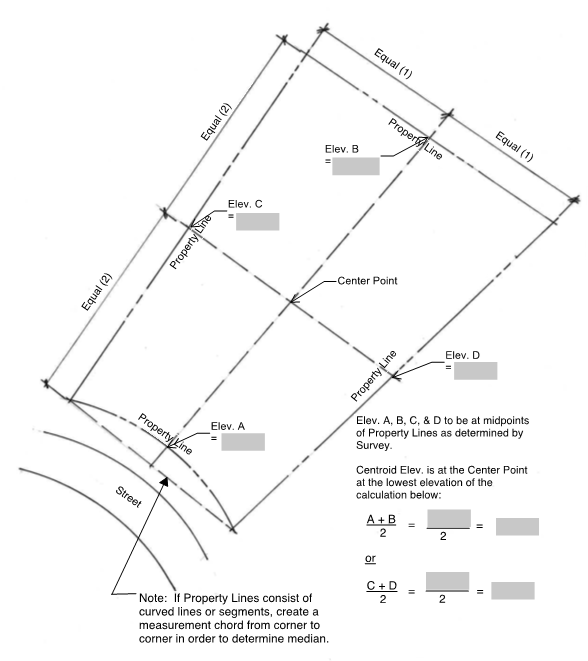
Certificate of Occupancy means official certification, issued by the City, which permits the Use of a Building in accordance with the approved plans and specifications, and which certifies compliance with the provisions of Law for the Use and occupancy of the Building in its several parts, together with any special stipulations or conditions of the Building Permit.
Commercial Dumpster means a large scale receptacle (as defined in Section 36-26(b)) that is a metal receptacle, used for commercial garbage collection purposes, designed to be lifted and emptied mechanically for use primarily at multiple-Family developments and commercial Properties.
Comprehensive Plan means the official statement of a municipal legislative body which sets forth its policies concerning desirable community development.
Conditional Use means a use set out in the District Regulations for the respective Zoning Districts as a Conditional Use and which requires a Conditional Use Permit before such use is permitted to exist.
Conditional Use Permit means a type of Permit granted by the City upon application, after review and approval by the Code Official as set out in this Chapter.
Convalescent, Rest, or Nursing Home/Extended Care Facility means a health facility where elderly or chronically ill Persons, with medical problems such as Alzheimer's disease, stroke, or the infirmities of age, are housed and furnished with meals and continuing nursing care for compensation.
Court means an open unoccupied space, other than a Yard, on the same Lot with a Building or group of Buildings and which is bordered on two or more sides by such Buildings.
Detached Emergency Shelter means a Structure that is not attached to or part of another Building and that is designed and intended for temporary human habitation during periods of violent storms and emergency situations. An emergency shelter that is located below ground inside a garage is not a Detached Emergency Shelter.
Dwelling means any Building, or portion thereof, which is designed or used as living quarters for one or more families, but not including Mobile Homes or Travel Trailers.
Dwelling, Detached, means a Dwelling having open space on all sides.
Dwelling, Single-Family, means a Detached Dwelling designed to be occupied by one Family.
Dwelling, Two-Family, means a Dwelling designed to be occupied by two families living independently of each other.
Dwelling Unit means any Building or portion thereof which is designed or used as living quarters for one Family.
Family means one or more Persons related to each other by blood or marriage, including adopted children, or a group of not to exceed five Persons. A Family shall be deemed to include domestic servants employed by the Family and living on the premises.
Fence means an artificially constructed barrier of any material or combination of materials erected to enclose a piece of land, or to divide a piece of land into distinct portions, or to separate two contiguous pieces of land, connected together and designed for use in a fixed position, erected upon the ground for decorative or functional purposes. A Fence is not an Accessory Building, Accessory Structure, or Accessory Use, as those terms are defined in this Section.
Floor Area means the sum of the horizontal areas of all floors of a Building, measured from the outside face of frame to the outside face of frame or from the centerline of walls separating the two Buildings, and including, but not limited to, the following spaces unless specifically excluded herein:
(1)
Elevator shafts and stairwells at each floor, to be calculated only once at ground level;
(2)
Habitable penthouses;
(3)
Interior balconies, mezzanines, and enclosed covered Porches and enclosed steps;
(4)
Accessory Uses in enclosed covered space, but not including uncovered space used for off-Street parking;
(5)
The following spaces are excluded from the calculation of Floor Area:
a.
Basements;
b.
Attics;
c.
Garages except for Attached Garages in the R-1-75 Single-Family Residential District and the R-1-60 Single-Family Residential District as set out in Section 8-241, Construction requirements for Attached Garages.
d.
Mechanical spaces.
Floor Area Ratio means a mathematical expression determined by dividing the Floor Area of a Building by the Buildable Area of the Lot on which the Building is located. (Floor Area ÷ Buildable Lot Area = Floor Area Ratio.)
Homeowners Association. See Property Owners Association.
Kennel means premises where five or more dogs, cats or other household pets more than six months of age are bred, trained, boarded, or kept.
Landscape Structure means any Structure erected or installed outside and separated from the Main Building that is affixed to the ground and associated with Landscaping or used in association with outdoor activities. The term "Landscape Structure" includes greenhouses, storage sheds, gazebos, pergolas, artwork, statuary, and fountains.
Landscaping means the aesthetic improvement of land by adding live plants such as trees, shrubs, lawns, ground cover or flowers, frequently in combination with ornamental construction elements (Fences, screens, grills, decorative paving or mulches, stones, etc.) and art forms (sculpture, mosaics, water features, etc.). Lighting may be incorporated into the Landscaping.
Lot means any plot of land occupied or intended to be occupied by one Building, or a group of Buildings, Secondary Buildings, Accessory Buildings, Accessory Structures, and/or Accessory Uses, including such open spaces as required by this Chapter and other Laws or Ordinances, and having its principal frontage on a Street. The term "Lot" includes, but is not limited to, a measured plot of land having fixed boundaries and designated on a plat and of at least sufficient size to meet the requirements in this Chapter and the subdivision regulations in Chapter 40.
Lot Area means the total horizontal area included within Property Lines. Lot Area calculations shall not include portions of Streets and Alleys.
Lot, Aggregate, means two or more contiguous Lots, Building Sites, and/or unplatted pieces of land owned by the same Owner, that have not been approved as a Combined Lot as provided in Chapter 40, Article IV, Division 5.
Lot, Combined, means one Lot that is created by combining the entirety of two or more contiguous Lots, Building Sites, and/or unplatted pieces of land, as provided in Chapter 40, Article IV, Division 5.
Lot, Corner, means a Lot where at least two adjacent sides abut Intersecting Streets, provided that the interior angle at the intersection of such two sides is less than 135 degrees.
Lot Depth means the average distance of the side Property Lines, measured from the front Property Line to its rear Property Line.
Lot, Double Frontage, means a Lot having a frontage on two non-Intersecting Streets, as distinguished from a Corner Lot.
Lot Frontage means that dimension of a Lot or portion of a Lot abutting a Street, excluding the side dimension of a Corner Lot.
Lot Width means the distance between side Property Lines, measured at the Front Yard Setback Line. In the situation where the front Property Line is composed of arcs and/or segmented lines, the Lot Width is measured as a chord from the intersection of the side Property Lines and those arcs or segments when offset by the dimension of the Front Yard Setback Line.
Mobile Home means a nonmotorized transportable vehicle designed primarily for use as a permanent Dwelling place for human beings. Mobile Homes are not permitted to be located in the City on either a temporary or permanent basis.
Motor Vehicle means a self-propelled mechanical vehicle designed for use on Streets and Highways for the conveyance of goods and people, including, but not limited to, passenger cars, trucks, buses, motor scooters and motorcycles.
No-Build Vertical Envelope means that portion of a Building adjacent to the Side Yard Property Line where construction is not permitted by the District Regulations applicable for the Building. The No-Build Vertical Envelope for each of the E-1 Estate District, the E-2 Urban Estate District, the R-1-75 Single-Family Residential District, and the R-1-60 Single-Family Residential District is set out in the District Regulations applicable to each district.
Noncompliance means a condition of a Structure or land which does not comply with the regulations of the Zoning District in which it is situated, including, but not limited to, the failure to comply with use, height, area, coverage, or off-Street parking requirements.
Nonconforming Use means a Structure or land lawfully occupied by a Use that does not conform to the regulations of the district in which it is situated by reason of a condition that pre-exists the adoption of the regulations to which it does not conform.
Parking Space means a permanently surfaced area, enclosed or unenclosed, sufficient in size to store one Automobile, together with a permanently surfaced maneuvering area and driveway connecting the Parking Space with a Street or Alley to permit ingress or egress of the Automobile. A Parking Space for one vehicle shall be rectangular in shape and shall be a minimum of nine feet in width and 18 feet in length, exclusive of driveway and necessary maneuvering area.
Planned Unit Development means a Zoning District that permits development in accordance with the policies of the Comprehensive Plan while providing for flexibility in applying conventional land use, area, and Subdivision requirements in response to creative and high-quality design by the Property Owner.
Porch means a gallery or veranda on the outside of a Building, projecting from the wall, having a separate roof or uncovered, and open to the Front and Side Yards. A Porch permitted to extend into Front Yard areas has no vehicle access on, through, or under it.
Porte Cochere means a kind of Porch roof projecting over a driveway at an entrance, as of a house.
Private Club means an organization, the policies of which are determined by its members, and the facilities and services of which are available only to members and their bona fide guests, and which is exempt from federal income taxation pursuant to the United States Internal Revenue Service Codes.
Property Line means the line marking the boundary between any Street and the Lots or Property abutting thereon as determined by the legal description of the Property and the records of the County Clerk.
Property Owners Association means an incorporated nonprofit organization operating under recorded land agreements through which:
(1)
Each Lot Owner or Homeowner is automatically a member;
(2)
Each Lot is automatically subject to a charge for a proportionate share of the expenses for the organization's activities, such as maintaining a common Property; and
(3)
The charge, if unpaid, becomes a lien against the Property.
Recreational Vehicle means a vehicular unit which is primarily designed as temporary living quarters for recreational, camping, or travel use. It either has its own motive power or is designed to be mounted on or drawn by an automotive vehicle. The terms "Fifth Wheeler," "Motor Home Truck Camper" and "Travel or Camping Trailer" shall be considered to be the same as a Recreational Vehicle.
Repair (when used in this Code in reference to Buildings and construction) means the reconstruction or renewal of any part of an existing Building for the purpose of its maintenance or to correct damage.
Residential, Multiple-Family, means a Dwelling designed for occupancy by three or more families living independently of each other, exclusive of auto or trailer Courts or camps, Hotels or Motels.
Restaurant means an establishment open to the general public selling full meals commonly ordered at breakfast, lunch, or dinner, substantially all of which are cooked on the premises and require the use of dining implements for consumption; and shall not include an establishment which serves only food such as appetizers, sandwiches, salads, or desserts. A Restaurant may also be a catering establishment.
Setback means the distance between the Property Line and the Building Line established in the Development Regulations of each Zoning District and in private plat restrictions and covenants.
Site Plan or Site Development Plan means a plan, drawn to scale, which shows:
(1)
The topographic characteristics of the site at a contour interval of not less than one foot;
(2)
The location and dimensions of existing and proposed Buildings, Yards, Courts, Landscaping, pedestrian and vehicular circulation, Parking, Fences and screening; service areas and Courts, and other features;
(3)
The use of each Building and area;
(4)
The height of Buildings, adjacent Streets, Alleys, utility drainage and other easements;
(5)
The relationship of the development to adjacent areas which it may affect;
(6)
A certified boundary line survey.
Special Events Licensee means the holder of a Special Events License issued by the State Alcoholic Beverage Laws Enforcement Commission.
Special Use Permit means a permit granted by the City upon application, after notice and public hearing before the Planning Commission and City Council as set out in this Chapter.
Sports Court means any outdoor uncovered surface area designed for athletic or recreational purposes, including tennis, basketball, handball, pickleball, paddleball, badminton, bocce ball, volleyball, and racquetball Courts. The term "Sports Courts" includes any slabs, Fences, and lighting accessory to the Sports Court. The term "Sports Court" does not include driveways or parking areas that are used for athletic or recreational purposes (such as a single basketball goal installed on a residential driveway). Swimming Pools are not Sports Courts.
Story means that portion of a Building, other than a Basement, included between the surface of any floor and the surface of the floor next above it, or, if there is no floor above it, then the space between the floor and the ceiling next above it.
Street means any City-approved public or private thoroughfare which affords the principal means of access to adjoining Property.
Street, Intersecting, means any Street which joins another Street at an angle, whether or not it crosses the other.
Structural Alterations means any change in the supporting members of a Building, such as bearing walls or partitions, columns, beams or girders, or any substantial change in the roof or in the exterior walls.
Structure means anything constructed or erected, the use of which requires location on the ground; or attached to something having a location on the ground, including, but not necessarily limited to, Buildings, swimming pools, spas, flagpoles, signs, antennas, etc.
Tavern means any Business concern whose total Gross Receipts (based upon total retail value as determined by State Law) from sale or distribution of Alcoholic Beverages in the City for on-premises consumption for a period of any three consecutive calendar months exceeds 40 percent of that concern's Gross Revenues derived from the activities in the City from all sources. The term "Tavern" includes, but is not limited to, any Restaurant which satisfies the terms of this definition.
Use Subject to Review means a use set out in the District Regulations for the respective Zoning Districts in the City as a "Use Subject to Review" and which requires a Special Use Permit before such use is permitted to exist.
Yard means an open space at grade, other than a Court or plaza, between a Building and the adjacent Property Lines, unoccupied and unobstructed by any portion of a Structure from the ground upward, except where otherwise specifically provided in this Chapter.
Yard, Front, means a Yard located in front of the front elevation of a Building, extending across a Lot between the Side Yard lines, and being the minimum horizontal distance between the front Property Line and the Main Building.
Yard, Rear, means a Yard extending across the rear of a Lot measured between side Property Lines and being the minimum horizontal distance between the rear Property Line and the rear of the Main Building. On both Corner Lots and interior Lots, the Rear Yard shall in all cases be at the opposite end of the Lot from the Front Yard.
Yard Setback means the required distance between the Building or Structure located on a Lot and the Property Line.
Yard, Side, means a Yard between the Building and the side Property Line, extending from the front Property Line to the rear Property Line, and being the minimum horizontal distance between a side Property Line and the side of the Main Building or any projections other than steps.
Zoning means rules set by Ordinance for the specific Use of a Building or the premises.
Zoning District means the sections of the City for which requirements governing the location and Use of Buildings and premises are grouped.
Zoning Districts Map, Official, means the official certified map upon which the boundaries of the various Zoning Districts are drawn, and which is an integral part of the Zoning Ordinance set forth in this Chapter.
(Code 1992, § 25-20; Code 2013, § 50-3; Ord. No. 803, § 2, 11-17-1998; Ord. No. 807, § 1, 4-13-1999; Ord. No. 892, § 1, 12-12-2006; Ord. No. 902, §§ 1, 2, 11-13-2007; Ord. No. 908, § 2, 5-13-2008; Ord. No. 1096, § 1, 4-11-2017; Ord. No. 1100, § 1, 5-9-2017; Ord. No. 1149, § 1, 10-9-2018; Ord. No. 1200, § 1, 12-14-2021; Ord. No. 1224, § 1, 2-14-2023; Ord. No. 1225, § 1, 2-14-2023; Ord. No. 1226, § 1, 3-14-2023; Ord. No. 1234, §§ 2, 3, 8-8-2023; Ord. No. 1251, § 1, 5-14-2024; Ord. No. 1272, § 1, 2-11-2025)

