
Nichols Hills City Zoning Code
ARTICLE II
- DISTRICT REGULATIONS
Sec. 50-25. - Zoning District classifications.
All Property within the City is divided into Zoning Districts as follows:
(Code 1992, § 25-4; Code 2013, § 50-25; Ord. No. 803, § 2, 11-17-1998; Ord. No. 900, § 1, 8-14-2007; Ord. No. 901, § 1, 9-11-2007)
Sec. 50-26. - Official Zoning Map.
(a)
A map, prepared by the City's consulting engineer and consulting City planner, which shows the location and boundaries of the various Zoning Districts and classifications, as defined herein, is hereby approved and adopted as the Official Zoning Districts Map of the City, and is incorporated by reference as a part of this Chapter. A copy of said Official Zoning Districts Map is available in the office of the City Clerk. The Official Zoning Districts Map shall be executed by the Mayor and attested by the City Clerk. The City Clerk shall maintain the Official Zoning Districts Map in its original state as a permanent Record of the status of Zoning Districts at the time of adoption of the Ordinance from which these regulations are derived.
(b)
All alterations, amendments, or changes hereafter to any district or district line shall be adopted by Ordinance as amendments to the Official Zoning Districts Map. The City Clerk shall maintain a duplicate of the Official Zoning Districts Map for the purpose of posting all such Alterations, amendments, or changes together with a proper explanatory legend giving the date and Ordinance reference for each action.
(Code 1992, § 25-5; Code 2013, § 50-26; Ord. No. 803, § 2, 11-17-1998)
Sec. 50-27. - Boundary interpretation.
Where uncertainty exists with respect to the boundaries of any of the Districts as shown on the Official Zoning Districts Map, the following rules shall apply:
(1)
Where District boundaries are indicated as approximately following Property Lines, such lines shall be construed to be the District boundaries.
(2)
Where District boundaries are indicated as approximately parallel to the centerlines of Streets, the Street right-of-way line shall be considered the District boundary.
(Code 1992, § 25-6; Code 2013, § 50-27; Ord. No. 803, § 2, 11-17-1998)
Sec. 50-28. - Establishment of classification of vacated Property.
Whenever any Street, Alley, or other public Easement is vacated, such vacated Property shall assume the Zoning District designation of the land to which it has become a part.
(Code 1992, § 25-7; Code 2013, § 50-28; Ord. No. 803, § 2, 11-17-1998)
Sec. 50-60. - E-1 Estate District.
(a)
General description. The E-1 Estate District is an exclusive residential district of large Single-Family homes constructed on large Lots with considerable private open space and Landscaping. The Development Regulations in this district are intended to protect these homes from encroachment by higher residential densities and incompatible land uses, while making provision for such requirements as accommodations for caretakers or service Persons employed at the residence. Since these residential areas represent a significant contribution to the character and stability of the community, they merit more strict regulations for their protection.
(b)
Permitted uses. The following are permitted uses in the E-1 Estate District:
(1)
Single-Family Dwelling.
(2)
Attached quarters for household employees.
(3)
Park or open space owned by the City.
(c)
Conditional Uses.
(1)
The following are Conditional Uses in the E-1 Estate District:
a.
Accessory Buildings, Accessory Structures, and Accessory Uses which are subject to Division 6 of this Article and the following:
1.
No Accessory Building, Accessory Structure, or Accessory Use shall be located in front of the Main Building, except Fences, walls, flag poles, guard shack associated with a private country club or golf course, and other types of Accessory Structures that are allowed to be located in the Front Yard as permitted in this Chapter; provided that, where a Lot with a Main Building has been combined with an abutting or adjacent vacant Lot, in no case shall any Accessory Building, Accessory Structure or Accessory Use on what was the vacant Lot be located in front of the Main Building on any abutting or adjacent Lot.
2.
No Accessory Building, Accessory Structure or Accessory Use shall exceed the height of the Main Building.
3.
Accessory Buildings, Accessory Structures, and Accessory Uses shall be included in the Building Lot Coverage calculations, unless expressly excluded by Division 6 of this Article, and are subject to the development regulations of this District.
4.
Accessory Buildings, Accessory Structures, and Accessory Uses shall be a minimum of six feet from the Main Building.
b.
Accessory Structure to be used as a guard shack and gate associated with a private country club or golf course.
c.
Accessory signs are subject to Division 10 of this Article and City sign regulations.
(2)
Secondary Buildings are not permitted in E-1 districts.
(d)
Uses Subject to Review. The following are uses subject to review in the E-1 Estate District:
(1)
Private Club, which includes a country club and golf course, and all associated Buildings and Structures used in connection with such Private Club, including Sports Courts.
(e)
Development Regulations.
(1)
General.
a.
In no case shall a Main Building, Secondary Building, Accessory Building, Accessory Structure or Accessory Use be located over a utility Easement.
b.
Roofs shall be permitted to overhang two feet into required Yard Setback areas.
(2)
Front Yard Setback: 70 feet from the front Property Line, or a Front Yard Setback established in a Deed restriction, plat restriction, or private covenant, whichever is greater, provided that:
a.
A Porch, as defined in this Chapter, shall be permitted to extend not more than 12 feet in front of the required Front Yard Setback Line.
b.
A Porte Cochere which does not exceed 15 feet in height shall be permitted to extend not more than 15 feet in front of the Front Yard Setback Line.
c.
An otherwise permitted guard shack associated with a private country club or golf course may be located at the right-of-way line of the abutting Street but in any event shall be set back a sufficient distance to prevent vehicles awaiting entry from blocking the right-of-way.
(3)
Side Yard Setback.
a.
Main Building: 20 feet, or ten percent of Lot Frontage, whichever is greater; however, notwithstanding the foregoing:
1.
A portion of a Building which is at least 20 feet from the side Property Line shall be permitted, provided that its wall plate does not exceed ten feet in height; and
2.
A Building shall be permitted to be constructed to the maximum Building Height as otherwise permitted by this Code beginning at a distance from the side Property Line equal to or greater than ten percent of its Lot Frontage.
Lots abutting a Street shall have a Setback of 15 feet on the side abutting the Street;
b.
Accessory Buildings, Accessory Structures or Accessory Uses less than 14 feet in height: six feet;
c.
Accessory Buildings, Accessory Structures or Accessory Uses 14 feet or more in height: six feet, plus one foot for each full foot of additional Building Height greater than 14 feet;
d.
Chimneys or fireplaces shall be permitted to encroach two feet into the required Side Yard on one side of the Building only.
(4)
Rear Yard Setback.
a.
Main Building: 40 feet.
b.
Accessory Buildings, Accessory Structures or Accessory Uses less than 14 feet in height: ten feet.
c.
Accessory Buildings, Accessory Structures or Accessory Uses 14 feet or more in height: ten feet, plus one foot for each full foot of additional Height greater than 14 feet.
d.
Chimneys or fireplaces shall be permitted to encroach two feet into the required Rear Yard.
(5)
Minimum Lot size: 70,000 square feet.
(6)
Minimum Lot Width at front Property Line: 200 feet.
(7)
Building Lot Coverage and Floor Area Ratio. Maximum size and bulk of all permitted Structures shall be based on the following two criteria, neither of which shall be exceeded; provided, however, that for the purposes of calculating Building Lot Coverage and Floor Area Ratio, a 70-foot Front Yard Setback and a ten-foot Rear Yard Setback shall be utilized notwithstanding any other provision of this Code to the contrary:
a.
Building Lot Coverage: Shall cover no more than 30 percent of the Lot Area within the Setback Lines established in this District.
b.
Floor Area Ratio: Shall not exceed 0.35.
(8)
Maximum Height.
a.
Accessory Buildings, Accessory Structures or Accessory Uses: 25 feet.
b.
Maximum Main Building Height: 45 feet.
(Code 1992, § 25-21; Code 2013, § 50-47; Ord. No. 803, § 2, 11-17-1998; Ord. No. 807, § 2, 4-13-1999; Ord. No. 861, § 1, 3-11-2003; Ord. No. 871, § 1, 12-9-2003; Ord. No. 904, § 2, 2-12-2008; Ord. No. 945, § 1, 12-14-2010; Ord. No. 991, § 1, 8-13-2013; Ord. No. 1026, § 1, 11-12-2014; Ord. No. 1073, § 1, 5-10-2016; Ord. No. 1096, § 2, 4-11-2017; Ord. No. 1200, § 2, 12-14-2021; Ord. No. 1224, § 2, 2-14-2023; Ord. No. 1225, § 2, 2-14-2023; Ord. No. 1226, § 4, 3-14-2023; Ord. No. 1244, § 1, 2-13-2024; Ord. No. 1251, § 2(50-47), 5-14-2024)
Sec. 50-61. - E-2 Urban Estate District.
(a)
General description. The E-2 Urban Estate District is an exclusive Residential District that contains larger Single-Family homes constructed on Lots which are above average size and have considerable private open space in the form of Building Setbacks and Rear Yard area. The Development Regulations in this District are intended to protect these homes from encroachment by higher Residential densities and incompatible land uses. These Residential areas contain old and new homes, and it is important to protect the existing Property investment and character from incompatible Developments.
(b)
Permitted uses. The following are permitted uses in the E-2 Urban Estate District:
(1)
Single-Family Dwelling.
(2)
Park or open space owned by the City.
(c)
Conditional Uses.
(1)
The following are Conditional Uses in the E-2 Urban Estate District:
a.
Accessory Buildings, Accessory Structures, and Accessory Uses which are subject to Division 6 of this Article and the following:
1.
No Accessory Building, Accessory Structure or Accessory Use shall be located in front of the Main Building, except Fences, walls, flag poles, and other types of Accessory Structures that are allowed to be located in the Front Yard as permitted in this Chapter; provided that, where a Lot with a Main Building has been combined with an abutting or adjacent vacant Lot, in no case shall any Accessory Building, Accessory Structure or Accessory Use on what was the vacant Lot be located in front of the Main Building on any abutting or adjacent Lot.
2.
No Accessory Building, Accessory Structure or Accessory Use shall exceed the height of the Main Building.
3.
Accessory Buildings, Accessory Structures, and Accessory Uses shall be included in the Building Lot Coverage calculations, unless expressly excluded by Division 6 of this Article, and are subject to the development regulations of this District.
4.
Accessory Buildings, Accessory Structures and Accessory Uses shall be a minimum of six feet from Main Building.
b.
Accessory signs are subject to Division 10 of this Article and City sign regulations.
(2)
Secondary Buildings are not permitted in the E-2 district.
(d)
Uses Subject to Review. The following are uses subject to review in the E-2 Urban Estate District: None.
(e)
Development Regulations.
(1)
General.
a.
In no case shall a Main Building, Secondary Building, Accessory Building, Accessory Structure or Accessory Use be located over a utility easement.
b.
Roofs shall be permitted to overhang two feet into required Yard Setback areas.
(2)
Front Yard Setback: 40 feet from the front Property Line or a Front Yard Setback established in a Deed restriction, plat restriction, or private covenant, whichever is greater, provided that:
a.
A Porch as defined in this Chapter shall be permitted to extend not more than 12 feet in front of the required Front Yard Setback Line.
b.
A Porte Cochere which does not exceed 15 feet in height shall be permitted to extend not more than 15 feet in front of the Front Yard Setback Line.
(3)
Side Yard Setback.
a.
Main Building: Ten feet, or ten percent of Lot Frontage, whichever is greater; however, notwithstanding the foregoing:
1.
A portion of a Building which is at least ten feet from the side Property Line shall be permitted, provided that its wall plate does not exceed ten feet in height; and
2.
A Building shall be permitted to be constructed to the maximum Building Height as otherwise permitted by this Code beginning at a distance from the side Property Line equal to or greater than ten percent of its Lot Frontage.
Lots abutting a Street shall have a Setback of 15 feet on the side abutting the Street.
b.
Accessory Buildings, Accessory Structures and Accessory Uses less than 14 feet in height: six feet.
c.
Accessory Buildings, Accessory Structures and Accessory Uses 14 feet or more in height: six feet, plus one foot for each full foot of additional Building Height greater than 14 feet.
d.
Chimneys or fireplaces shall be permitted to encroach two feet into the required Side Yard on one side of the Building only.
(4)
Rear Yard Setback.
a.
Main Building: 30 feet on the first floor, and 40 feet on the second floor.
b.
Accessory Buildings, Accessory Structures and Accessory Uses less than 14 feet in height: ten feet.
c.
Accessory Buildings, Accessory Structures and Accessory Uses 14 feet or more in height: ten feet, plus one foot for each full foot of additional height greater than 14 feet.
d.
Chimneys or fireplaces shall be permitted to encroach two feet into the required Rear Yard.
(5)
Minimum Lot size: 30,000 square feet.
(6)
Minimum Lot Width at front Property Line: 125 feet.
(7)
Building Lot Coverage and Floor Area Ratio. Maximum size and bulk of all permitted Structures shall be based on the following two criteria, neither of which shall be exceeded; provided however that for purposes of calculating Building Lot Coverage and Floor Area Ratio, a 40-foot Front Yard Setback and a ten-foot Rear Yard Setback shall be utilized notwithstanding any other provision of the Code to the contrary:
a.
Building Lot Coverage. Building Lot Coverage shall cover no more than 30 percent of the Lot Area within the Setback Lines established in this District.
b.
Floor Area Ratio. Floor Area Ratio shall not exceed 0.35 or 110 percent of the Floor Area of the Main Building existing on October 1, 2010, as determined by the Records of the County Assessor as of October 1, 2010, whichever is greater, provided that this 110 percent Floor Area provision shall only be applicable to the eight Lots located at the following addresses:
1.
6805 Avondale Drive;
2.
1505 Buttram Road;
3.
1500 and 1503 Dorchester Drive;
4.
1506 Drury Lane;
5.
1600 Elmhurst Ave;
6.
7103 Nichols Road;
7.
6905 N.W. Grand Blvd.
(8)
Maximum Height.
a.
Accessory Buildings, Accessory Structures and Accessory Uses: 25 feet.
b.
Maximum Main Building Height: 35 feet.
(9)
No-Build Vertical Envelopes.
a.
No step-back required where Main Building is set back 20 feet or more. Where the Main Building is set back 20 feet or more from the side Property Line, a No-Build Vertical Envelope is not required.
b.
Single step-back required where Main Building is set back less than 20 feet. Where the Main Building is set back less than 20 feet from the side Property Line, the Main Building must have a single step-back No Build Vertical Envelope.
1.
Determining the No-Build Vertical Envelope. Where the Main Building is set back less than 20 feet from the side Property Line, no portion of a Main Building is permitted within a No-Build Vertical Envelope. Specifically, that side of a Building must have a single step-back No-Build Vertical Envelope, the size and location of which are determined as follows:
(i)
Establish the point at which the Building is set back, at the Centroid level, then move vertically up 22 feet to point "A."
(ii)
At point "A," a 45-degree angle will be drawn to the point where it intersects a horizontal line drawn at the maximum Building Height. This point will be point "B."
(iii)
Connect points "A" and "B" to delineate a No-Build Vertical Envelope on that side of the Building.
2.
Exceptions for Side Yard gables and dormers. On a sidewall or roof section that faces a Side Yard, a gable or dormers may be added that do not exceed 20 percent of the length of the sidewall measured at finished floor level. The dormer or gable length will be measured at the 22-foot plate height level.
Example: a 60-foot-long side wall may have a dormer or gable that measures 12 feet long at the 22-foot plate height level.
3.
Depiction. The single step-back No-Build Vertical Envelope required where the Main Building is set back less than 20 feet from the side Property Line in the E-2 Urban Estate District and the exceptions to it are depicted as follows:
Single Step-Back No Build Vertical Envelope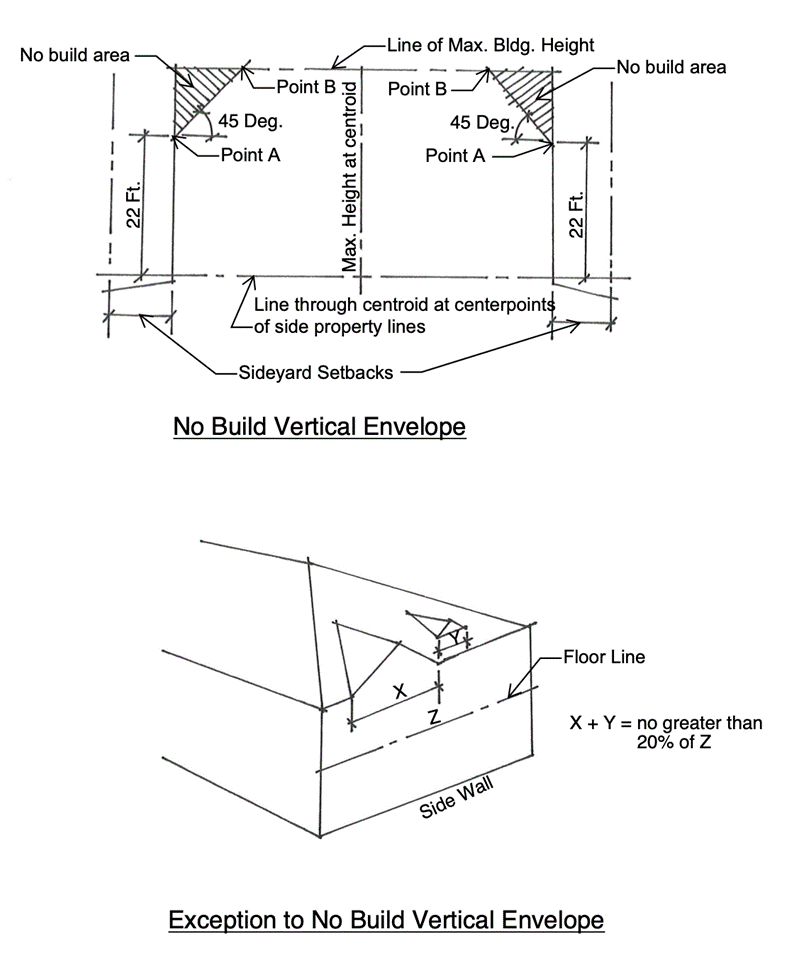
(Code 1992, § 25-22; Code 2013, § 50-48; Ord. No. 803, § 2, 11-17-1998; Ord. No. 807, § 3, 4-13-1999; Ord. No. 861, § 2, 3-11-2003; Ord. No. 871, § 2, 12-9-2003; Ord. No. 945, § 1, 12-14-2010; Ord. No. 991, § 2, 8-13-2013; Ord. No. 1026, § 2, 11-12-2014; Ord. No. 1073, § 2, 5-10-2016; Ord. No. 1096, § 3, 4-11-2017; Ord. No. 1200, § 3, 12-14-2021; Ord. No. 1224, § 3, 2-14-2023; Ord. No. 1226, § 5, 3-14-2023; Ord. No. 1244, § 2, 2-13-2024; Ord. No. 1251, § 3(50-48), 5-14-2024)
Sec. 50-62. - R-1-75 Single-Family Residential District.
(a)
General description. The R-1-75 Single-Family Residential District is intended to protect the character and integrity of established Single-Family Residential areas. The principal permitted Use is the Single-Family home on a moderately-sized Lot. The standards in this Section reflect the existing pattern, style, and quality of Development in the Zoning District and should be an aid in protecting the area from encroachment of large homes with minimal open space being constructed on small Lots.
(b)
Permitted uses. The following are permitted uses in the R-1-75 Single-Family Residential District:
(1)
Single-Family Dwelling.
(2)
Park or open space owned by the City.
(c)
Conditional Uses.
(1)
The following are Conditional Uses in the R-1-75 Single-Family Residential District:
a.
Accessory Buildings, Accessory Structures, and Accessory Uses which are subject to Division 6 of this Article and the following:
1.
No Accessory Building, Accessory Structure or Accessory Use shall be located in front of the Main Building, except Fences, walls, flag poles, fountains not exceeding 56 inches in height, and other types of Accessory Structures that are allowed to be located in the Front Yard, as permitted in this Chapter; provided that, where a Lot with a Main Building has been combined with an abutting or adjacent vacant Lot, in no case shall any Accessory Building, Accessory Structure or Accessory Use on what was the vacant Lot be located in front of the Main Building on any abutting or adjacent Lot.
2.
No Accessory Building, Accessory Structure or Accessory Use shall exceed the height of the Main Building.
3.
Accessory Buildings, Accessory Structures, and Accessory Uses shall be included in the Building Lot Coverage calculations, unless expressly excluded by Division 6 of this Article, and are subject to the development regulations of this District.
4.
No Accessory Building, Accessory Structure or Accessory Use shall have living or conditioned space above the ten-foot plate height.
b.
Accessory signs are subject to Division 10 of this Article and City sign regulations.
(2)
Secondary Buildings are not permitted in the R-1-75 district.
(d)
Uses Subject to Review. The following are uses subject to review in the R-1-75 Single-Family Residential District: None.
(e)
Development Regulations.
(1)
General.
a.
In no case shall a Main Building, Accessory Building, Accessory Structure or Accessory Use be located over a utility Easement.
b.
Roofs shall be permitted to overhang two feet into required Yard Setback areas.
(2)
Front Yard Setback: 25 feet from the front Property Line or Building Setback Line established on the Subdivision plat filed of Record, whichever is greater, provided that:
a.
Where a Building Setback Line greater than the Setback required above has been established by existing Structures occupying 60 percent or more of the frontage on a block, all new construction shall be within this existing Setback Line, regardless of the Code requirement or private Subdivision requirements that differ from said existing Setback.
b.
A Porch or Porte Cochere as defined in this Chapter shall be permitted to extend not more than ten feet in front of the required Front Yard Setback Line.
(3)
Side Yard Setback.
a.
The Main Building shall have a minimum Setback from all side Property Lines as follows:
1.
A minimum of six feet or ten percent of the Lot Width, whichever is greater.
2.
Lots abutting a Street shall have a Setback of 15 feet on the side abutting the Street.
b.
Accessory Buildings, Accessory Structures or Accessory Uses less than 14 feet in height: six feet.
c.
Accessory Buildings, Accessory Structures or Accessory Uses 14 feet or more in height: six feet, plus one foot for each full foot of additional height greater than 14 feet.
d.
Chimneys or fireplaces shall be permitted to encroach two feet into the required Side Yard on one side of the Building only.
(4)
Rear Yard Setback.
a.
The Main Building shall be set back from the rear Property Line as follows: The first floor of the Main Building shall have a minimum Rear Yard Setback of 25 feet, and the second floor of the Main Building shall have a minimum Rear Yard Setback of 40 feet.
b.
Accessory Buildings, Accessory Structures or Accessory Uses shall be set back as follows:
1.
Accessory Buildings, Accessory Structures and Accessory Uses less than 14 feet in height: ten feet;
2.
Accessory Buildings, Accessory Structures and Accessory Uses 14 feet or more in height: ten feet, plus two feet for each full foot of additional height greater than 14 feet.
c.
Chimneys or fireplaces shall be permitted to encroach two feet into the required Rear Yard.
(5)
Minimum Lot size: None.
(6)
Minimum Lot Width at front Building Line: 60 feet.
(7)
Building Lot Coverage and Floor Area Ratio. Maximum size and bulk of all permitted Structures shall be based on the following two criteria, neither of which shall be exceeded:
a.
Building Lot Coverage. Defined Structures shall cover no more than 65 percent of the Lot Area within the Setback Lines established in this District;
b.
Floor Area Ratio. Shall not exceed 0.6.
(8)
Maximum Height.
a.
Accessory Buildings, Accessory Structures or Accessory Uses: 22 feet.
1.
Accessory Buildings will have a ten-foot maximum plate height measured from finished floor.
2.
The finished floor shall be permitted to be one foot above undisturbed surrounding grade. Anything higher than one foot shall be subtracted from the ten-foot plate height.
b.
Maximum Building Height is determined by the width of the Lot at the front Setback Lines as follows:
1.
Lots with less than 100-foot frontage at the front Setback Line will have a 31-foot maximum height level.
2.
Lots with 100-foot frontage or greater but less than or equal to 125 feet at the front Setback Line will have a 32-foot maximum height level.
3.
Lots greater than 125 feet at the front of the Setback Line will have a 33-foot maximum height level.
4.
No Main Building shall exceed 16 feet in height within 40 feet of the Rear Property Line except on Corner Lots.
(9)
No-Build Vertical Envelopes.
a.
Single step-back required where Main Building is set back 15 feet or more. Where the Main Building is set back 15 feet or more from the side Property Line, the Main Building must have a single step-back No Build Vertical Envelope.
1.
Determining the No-Build Vertical Envelope. Where the Main Building is set back 15 feet or more from the side Property Line, no portion of a Main Building is permitted within a No-Build Vertical Envelope. Specifically, that side of a Building must have a single step-back No-Build Vertical Envelope, the size and location of which are determined as follows:
(i)
Establish the point at which the Building is set back, at the Centroid level, then move vertically up 22 feet to point "A."
(ii)
At point "A," a 45-degree angle will be drawn to the point where it intersects a horizontal line drawn at the maximum Building Height. This point will be point "B."
(iii)
Connect points "A" and "B" to delineate a No-Build Vertical Envelope on that side of the Building.
2.
Exceptions for Side Yard gables and dormers. On a sidewall or roof section that faces a Side Yard, a gable or dormers may be added that do not exceed 20 percent of the length of the sidewall measured at finished floor level. The dormer or gable length will be measured at the 22-foot plate height level.
Example: a 60-foot-long side wall may have a dormer or gable that measures 12 feet long at the 22-foot plate height level.
3.
Depiction. The single step-back No-Build Vertical Envelope required where the Main Building is set back 15 feet or more from the side Property Line in the R-1-75 Residential District and the exceptions to it are depicted in subsection (e)(9)c of this Section.
b.
Double step-back required where Main Building is set back less than 15 feet. Where the Main Building is set back less than 15 feet from the side Property Line, the Main Building must have a double step-back No Build Vertical Envelope.
1.
Determining the No-Build Vertical Envelope. Where the Main Building is set back less than 15 feet from the side Property Line, no portion of a Main Building is permitted within a No-Build Vertical Envelope. Specifically, that side of a Building must have a double step-back No-Build Vertical Envelope, the size and location of which are determined as follows:
(i)
Establish the point at which the Building is set back, at the Centroid level, then move vertically up 12 feet to point "A."
(ii)
At point "A," a 45-degree angle will be drawn to the point where it intersects a vertical line offset from the point at which the Building is set back, a distance of six feet. This point will be point "B."
(iii)
From point "B," extend vertically four feet. This point will be point "C."
(iv)
At point "C," a 45-degree angle will be drawn to the point where it intersects with the maximum Building Height, which will be point "D."
(v)
Connect points "A," "B," "C," and "D" to delineate a No-Build Vertical Envelope on that side of the Building.
2.
Exceptions for Side Yard gables and dormers. On a sidewall or roof section that faces a Side Yard, the No-Build Vertical Envelope does not limit the length of wall that:
(i)
Does not exceed 20 percent of the length of the sidewall where the Building is constructed not less than seven feet six inches from the side Property Line;
(ii)
Does not exceed 30 percent of the length of the sidewall where the Building is constructed not less than ten feet from the side Property Line; or
(iii)
Does not exceed 40 percent of the length of the sidewall where the Building is constructed not less than 12 feet from the side Property Line.
The length of the sidewall will be measured at the finished floor level.
Example: A 60-foot-long side wall may have a length of wall with no limit from the No-Build Vertical Envelope that measures 18 feet long if the Building is ten feet from the Property Line.
3.
Exception for single-Story gable walls. There will not be a No-Build Vertical Envelope on a single-Story gable wall with a maximum plate line height of 12 feet.
4.
Depiction. The double step-back No-Build Vertical Envelope required where the Main Building is set back less than 15 feet from the side Property Line in the R-1-75 Single Family Residential District and the exceptions to it are depicted in subsection (e)(9)c of this Section.
c.
The No-Build Vertical Envelope requirements in the R-1-75 Single Family Residential District and the exceptions to them are depicted as follows:
Double Step-Back No Build Vertical Envelope
R-1-75 District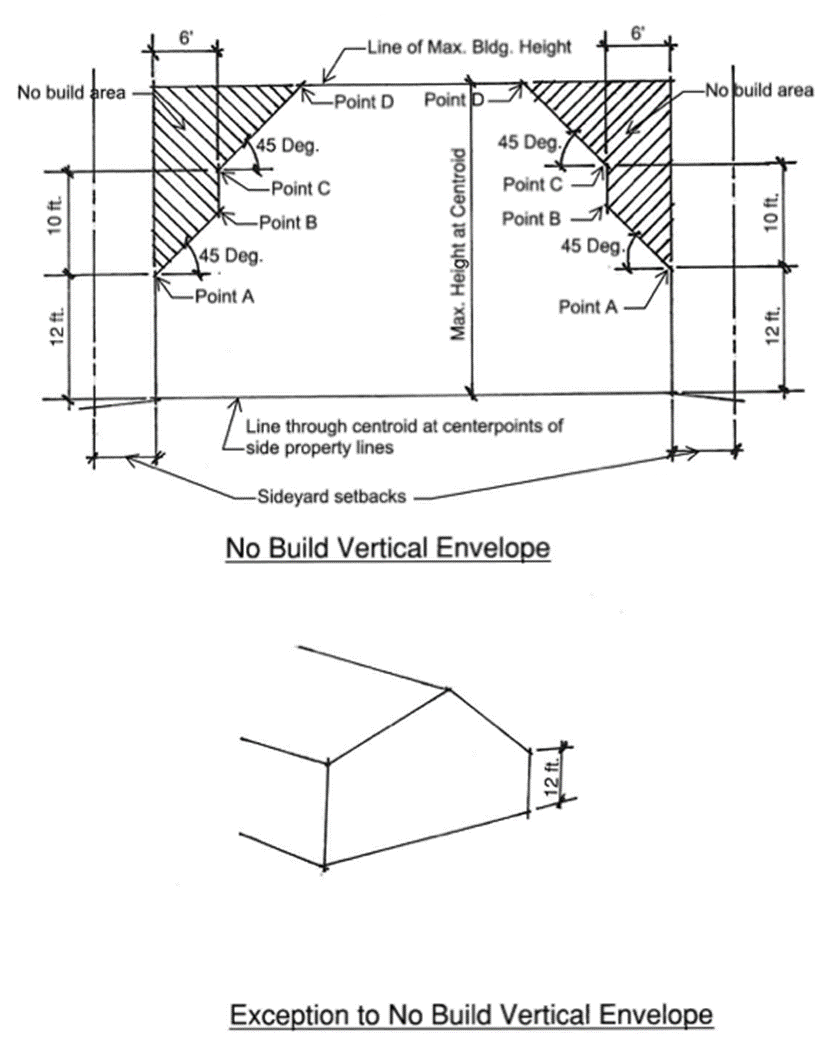
R-1-75 Setback Depictions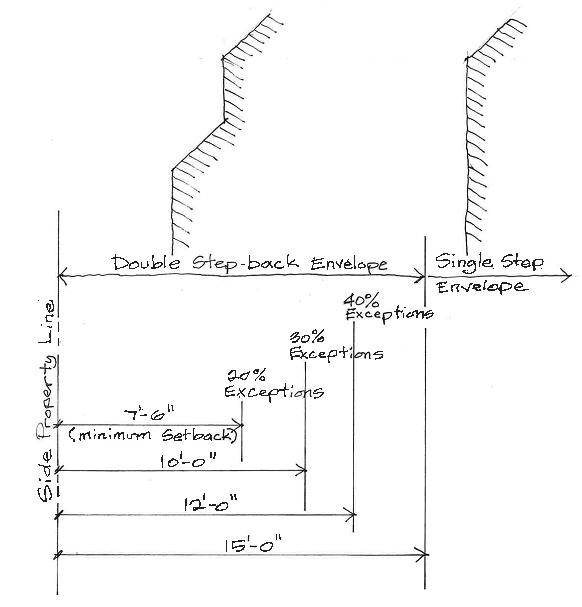
(10)
Second Story decks or patios. All second Story decks or patios are subject to second Story Main Building regulations.
(11)
Combined Lots. When two Lots are combined the Side Yard Setbacks are doubled, except when Lots are no more than 20 feet in width, and except where the City Manager has approved a Deed for Combined Lot pursuant to the Nichols Hills Subdivision Regulations.
(12)
Separation of Accessory Buildings, Accessory Structures, and Accessory Uses from Main Building. Accessory Buildings, Accessory Structures, and Accessory Uses must have a minimum separation of six feet from the Main Building.
(13)
Attached garages. Attached Garages are subject to the requirements in Chapter 8, Article IV, Division 6.
(Code 1992, § 25-23; Code 2013, § 50-49; Ord. No. 803, § 2, 11-17-1998; Ord. No. 807, § 4, 4-13-1999; Ord. No. 858, § 3, 3-11-2003; Ord. No. 861, § 3, 3-11-2003; Ord. No. 871, § 3, 12-9-2003; Ord. No. 892, § 2, 12-12-2006; Ord. No. 911, § 1, 6-10-2008; Ord. No. 912, § 1, 8-12-2008; Ord. No. 921, § 1, 4-14-2009; Ord. No. 947, § 1, 6-14-2011; Ord. No. 1026, § 3, 11-12-2014; Ord. No. 1073, § 3, 5-10-2016; Ord. No. 1096, § 4, 4-11-2017; Ord. No. 1123, § 1, 3-13-2018; Ord. No. 1200, § 4, 12-14-2021; Ord. No. 1224, § 4, 2-14-2023; Ord. No. 1226, § 6, 3-14-2023; Ord. No. 1244, § 3, 2-13-2024; Ord. No. 1251, § 4(50-49), 5-14-2024; Ord. No. 1253, § 2(50-49), 5-14-2024; Ord. No. 1272, § 2, 2-11-2025)
Sec. 50-63. - R-1-60 Single-Family Residential District.
(a)
General description. The R-1-60 Single-Family Residential District is intended to protect the character and integrity of established Single-Family Residential areas with moderate Residential densities. The principal permitted uses are Single-Family homes on smaller to a moderately-sized Lots. In order to further protect the quality and character of residences from encroachment by incompatible redevelopment, a maximum Lot Width is also established to protect the established pattern of Lot Development.
(b)
Permitted uses. The following are permitted uses in the R-1-60 Single-Family Residential District:
(1)
Single-Family Dwelling.
(2)
Park or open space owned by the City.
(c)
Conditional Uses.
(1)
The following are Conditional Uses in the R-1-60 Single-Family Residential District:
a.
Accessory Buildings, Accessory Structures, and Accessory Uses which are subject to Division 6 of this Article and the following:
1.
No Accessory Building, Accessory Structure or Accessory Use shall be located in front of the Main Building, except Fences, walls, flag poles, fountains not exceeding 56 inches in height, and other types of Accessory Structures that are allowed to be located in the Front Yard as permitted in this Chapter; provided that, where a Lot with a Main Building has been combined with an abutting or adjacent vacant Lot, in no case shall any Accessory Building, Accessory Structure or Accessory Use on what was the vacant Lot be located in front of the Main Building on any abutting or adjacent Lot.
2.
No Accessory Building, Accessory Structure or Accessory Use shall exceed the height of the Main Building.
3.
Accessory Buildings, Accessory Structures, and Accessory Uses shall be included in the Building Lot Coverage calculations, unless expressly excluded by Division 6 of this Article, and are subject to the development regulations of this District.
4.
No Accessory Building, Accessory Structure or Accessory Use shall have living or conditioned space above the ten-foot plate height.
b.
Accessory signs are subject to Division 10 of this Article and City sign regulations.
(2)
Secondary Buildings are not permitted in the R-1-60 district.
(d)
Uses Subject to Review. The following are uses subject to review in the R-1-60 Single-Family Residential District: None.
(e)
Development Regulations.
(1)
General.
a.
In no case shall a Main Building, Accessory Building, Accessory Structure or Accessory Use be located over a utility Easement.
b.
Roofs shall be permitted to overhang two feet into required Yard Setback areas.
(2)
Front Yard Setback: 25 feet from the front Property Line or Building Setback Line established on the Subdivision plat filed of Record, whichever is greater, provided that:
a.
Where a Building Setback Line greater than the Setback required above has been established by existing Structures occupying 60 percent or more of the frontage on a block, all new construction shall be within this existing Setback Line, regardless of the Code requirement or private Subdivision requirements that differ from said existing Setback.
b.
A Porch or Porte Cochere as defined in this Chapter shall be permitted to extend not more than ten feet in front of the required Front Yard Setback Line.
(3)
Side Yard Setback.
a.
The Main Building shall have a minimum Setback from all side Property Lines of six feet or ten percent of the Lot Width, whichever is greater, provided Lots abutting a Street shall have a Setback of 15 feet on the side abutting the Street.
b.
Accessory Buildings, Accessory Structures or Accessory Uses less than 14 feet in height: six feet.
c.
Accessory Buildings, Accessory Structures or Accessory Uses 14 feet or more in height: six feet, plus one foot for each full foot of additional height greater than 14 feet.
d.
Chimneys or fireplaces shall be permitted to encroach two feet into the required Side Yard on one side of the Building only.
(4)
Rear Yard Setback.
a.
The Main Building shall be set back from the rear Property Line as follows:
1.
The first floor of the Main Building shall have a minimum Rear Yard Setback of 25 feet.
2.
The second floor of the Main Building shall have a minimum Rear Yard Setback of 40 feet.
b.
Accessory Buildings, Accessory Structures or Accessory Uses shall be set back as follows:
1.
Accessory Buildings, Accessory Structures and Accessory Uses less than 14 feet in height: ten feet;
2.
Accessory Buildings, Accessory Structures and Accessory Uses 14 feet or more in height: ten feet, plus two feet for each full foot of additional height greater than 14 feet.
c.
Chimneys or fireplaces shall be permitted to encroach two feet into the required Rear Yard.
(5)
Minimum Lot size. None.
(6)
Lot Width.
a.
Minimum Lot Width at front Building Line: 60 feet.
b.
Maximum Lot Width at front Property Line: 100 feet.
(7)
Building Lot Coverage and Floor Area Ratio. Maximum size and bulk of all permitted Structures shall be based on the following two criteria, neither of which shall be exceeded:
a.
Building Lot Coverage. Defined Structures shall cover no more than 65 percent of the Lot Area within the Setback Lines established in this District;
b.
Floor Area Ratio. Shall not exceed 0.7.
(8)
Maximum Height.
a.
Accessory Buildings, Accessory Structures and Accessory Uses: 22 feet.
1.
Accessory Buildings will have a ten-foot maximum plate height measured from finished floor.
2.
The finished floor shall be permitted to be one foot above undisturbed surrounding grade. Anything higher than one foot shall be subtracted from the ten-foot plate height.
b.
Main Building.
1.
Maximum Main Building Height is 30 feet.
2.
No Main Building shall exceed 16 feet in height within 40 feet of the Rear Property Line except on Corner Lots.
(9)
No-Build Vertical Envelopes.
a.
Single step-back required where Main Building is set back 12 feet or more. Where the Main Building is set back 12 feet or more from the side Property Line, the Main Building must have a single step-back No Build Vertical Envelope.
1.
Determining the No-Build Vertical Envelope. Where the Main Building is set back 12 feet or more from the side Property Line, no portion of a Main Building is permitted within a No-Build Vertical Envelope. Specifically, that side of a Building must have a single step-back No-Build Vertical Envelope, the size and location of which are determined as follows:
(i)
Establish the point at which the Building is set back from the side Property Line, at the Centroid level, then move vertically up 22 feet to point "A."
(ii)
At point "A," a 45-degree angle will be drawn to the point where it intersects a horizontal line drawn at the maximum Building Height. This point will be point "B."
(iii)
Connect points "A" and "B" to delineate a No-Build Vertical Envelope on that side of the Building.
2.
Exceptions for Side Yard gables and dormers. On a sidewall or roof section that faces a Side Yard, a gable or dormers may be added that do not exceed 20 percent of the length of the sidewall measured at finished floor level. The dormer or gable length will be measured at the 22-foot plate height level.
Example: a 60-foot-long side wall may have a dormer or gable that measures 12 feet long at the 22-foot plate height level.
3.
Depiction. The single step-back No-Build Vertical Envelope required where the Main Building is set back 12 feet or more from the side Property Line in the R-1-60 Residential District and the exceptions to it are depicted in subsection (e)(9)c of this Section.
b.
Double step-back required where Main Building is set back less than 12 feet. Where the Main Building is set back less than 12 feet from a Side Property Line, the Main Building must have a double step-back No Build Vertical Envelope.
1.
Determining the No-Build Vertical Envelope. Where the Main Building is set back less than 12 feet from the side Property Line, no portion of a Main Building is permitted within a No-Build Vertical Envelope. Specifically, that side of a Building must have a double step-back No-Build Vertical Envelope, the size and location of which are determined as follows:
(i)
Establish the point at which the Building is set back, at the Centroid level, then move vertically up 12 feet to point "A."
(ii)
At point "A," a 45-degree angle will be drawn to the point where it intersects a vertical line offset from the point at which the Building is set back, a distance of six feet. This point will be point "B."
(iii)
From point "B," extend vertically four feet. This point will be point "C."
(iv)
At point "C," a 45-degree angle will be drawn to the point where it intersects with the maximum Building Height, which will be point "D."
(v)
Connect points "A," "B," "C," and "D" to delineate a No-Build Vertical Envelope on that side of the Building.
2.
Exceptions for Side Yard gables and dormers. On a sidewall or roof section that faces a Side Yard, the No-Build Vertical Envelope does not limit the length of wall that:
(i)
Does not exceed 20 percent of the length of the sidewall where the Building is constructed not less than six feet from the side Property Line;
(ii)
Does not exceed 30 percent of the length of the sidewall where the Building is constructed not less than seven feet from the side Property Line; or
(iii)
Does not exceed 40 percent of the length of the sidewall where the Building is constructed not less than eight feet from the side Property Line.
The length of the sidewall will be measured at the finished floor level.
Example: A 60-foot-long side wall may have a length of wall with no limit from the No-Build Vertical Envelope that measures 18 feet if the Building is seven feet from the Property Line.
3.
Exception for single-Story gable walls. There will not be a No-Build Vertical Envelope on a single-Story gable wall with a maximum plate line height of 12 feet.
4.
Depiction. The double step-back No-Build Vertical Envelope required where the Main Building is set back less than 12 feet from the side Property Line in the R-1-60 Single Family Residential District and the exceptions to it are depicted in subsection (e)(9)c of this Section.
c.
The No-Build Vertical Envelope requirements in the R-1-75 Single Family Residential District and the exceptions to them are depicted as follows:
Double Step-Back No Build Vertical Envelope
R-1-60 District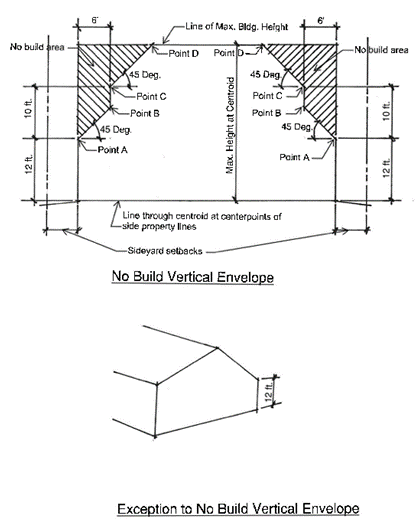
R-1-60 Setback Depictions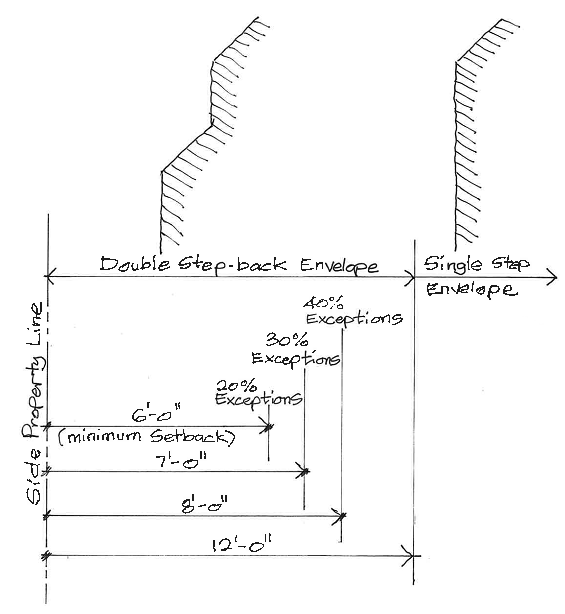
(10)
Second Story decks or patios. All second Story decks or patios are subject to second Story Main Building regulations.
(11)
Combined Lots. When two Lots are combined the Side Yard Setbacks are doubled, except when Lots are no more than 20 feet in width, and except where the City Manager has approved a Deed for Combined Lot pursuant to the Nichols Hills Subdivision Regulations.
(12)
Separation of Accessory Buildings, Accessory Structures, and Accessory Uses from Main Building. Accessory Buildings, Accessory Structures, and Accessory Uses must have a minimum separation of six feet from the Main Building.
(13)
Attached garages. Attached garages are subject to the requirements in Chapter 8, Article IV, Division 6.
(Code 1992, § 25-24; Code 2013, § 50-50; Ord. No. 803, § 2, 11-17-1998; Ord. No. 807, § 5, 4-13-1999; Ord. No. 858, § 4, 3-11-2003; Ord. No. 861, § 4, 3-11-2003; Ord. No. 871, § 4, 12-9-2003; Ord. No. 892, § 3, 12-12-2006; Ord. No. 911, § 1, 6-10-2008; Ord. No. 912, § 1, 8-12-2008; Ord. No. 921, § 2, 4-14-2009; Ord. No. 947, § 2, 6-14-2011; Ord. No. 1026, § 4, 11-12-2014; Ord. No. 1073, § 4, 5-10-2016; Ord. No. 1096, § 5, 4-11-2017; Ord. No. 1123, § 2, 3-13-2018; Ord. No. 1200, § 5, 12-14-2021; Ord. No. 1224, § 5, 2-14-2023; Ord. No. 1226, § 7, 3-14-2023; Ord. No. 1244, § 4, 2-13-2024; Ord. No. 1251, § 5(50-50), 5-14-2024; Ord. No. 1253, § 3(50-50), 5-14-2024; Ord. No. 1272, § 3, 2-11-2025)
Sec. 50-64. - R-2 Two-Family Residential District.
(a)
General description. The R-2 Two-Family Residential District is a Residential District with Development standards similar to Single-Family Districts. The principal Use is the duplex, which provides a higher density of Development that is suitable for use as a transition between Single-Family neighborhoods and commercial areas or arterial Streets. Minimum Lot size, Building Setback, and coverage standards provide for a high standard of light, air, and open space for all homes in the District.
(b)
Permitted uses. The following are permitted uses in the R-2 Two-Family Residential District:
(1)
Single-Family Dwelling.
(2)
Two-Family Dwelling.
(3)
Park or open space owned by the City.
(c)
Conditional Uses. The following are Conditional Uses in the R-2 Two-Family Residential District:
(1)
Accessory Buildings, Accessory Structures, and Accessory Uses which are subject to Division 6 of this Article and the following:
a.
No Accessory Building, Accessory Structure or Accessory Use shall be located in front of the Main Building, except Fences, walls, flag poles, and other types of Accessory Structures that are allowed to be located in the Front Yard as permitted in this Chapter; provided that, where a Lot with a Main Building has been combined with an abutting or adjacent vacant Lot, in no case shall any Accessory Building, Accessory Structure or Accessory Use on what was the vacant Lot be located in front of the Main Building on any abutting or adjacent Lot.
b.
No Accessory Building, Accessory Structure or Accessory Use shall exceed the height of the Main Building.
c.
Accessory Buildings, Accessory Structures, and Accessory Uses shall be included in the Building Lot Coverage calculations, unless expressly excluded by Division 6 of this Article, and are subject to the development regulations of this District.
(2)
Accessory signs are subject to Division 10 of this Article and City sign regulations.
(d)
Uses Subject to Review. The following are uses subject to review in the R-2 Two-Family Residential District:
(1)
Public or private recreation facilities.
(2)
Secondary Buildings, subject to the following:
a.
A detached garage that exceeds a 450-square-foot Building footprint or a 20-foot Building Height shall be considered a Secondary Building.
b.
Secondary Buildings shall be subject to the development regulations for Main Buildings.
(e)
Development Regulations.
(1)
General.
a.
In no case shall a Main Building, Secondary Building, Accessory Building, Accessory Structure or Accessory Use be located over a utility Easement.
b.
Roofs shall be permitted to overhang two feet into required Yard Setback areas.
(2)
Front Yard Setback: 25 feet from the front Property Line or Building Setback Line established on the Subdivision plat filed of Record, whichever is greater, provided that, where a Building Setback Line greater than the Setback required above has been established by existing Structures occupying 60 percent or more of the frontage on a block, all new construction shall be within this existing Setback Line, regardless of the Code requirement or private Subdivision requirements that differ from said existing Setback.
(3)
Side Yard Setback. The Main Building, Secondary Buildings, Accessory Buildings, Accessory Structures, and Accessory Uses shall have a minimum Setback of six feet from all side Property Lines except as follows:
a.
Lots abutting a Street shall have a Setback of 15 feet on the side abutting the Street.
b.
Chimneys or fireplaces shall be permitted to encroach two feet into the required Side Yard on one side of the Building only.
(4)
Rear Yard Setback.
a.
The Main Building shall be set back from the rear Property a distance of not less than 25 feet.
b.
On Corner Lots, the Rear Yard Setback may be decreased to 15 feet for a depth of 25 feet from the side Property Line that abuts a Street.
c.
Accessory Buildings, Accessory Structures, and Accessory Uses shall be set back from the rear Property Line a distance of not less than ten feet, provided that, where an Alley or drive along the rear of the Lot at least 20 feet in width provides access to the Accessory Building, Accessory Structure or Accessory Use, there shall be no Rear Yard Setback requirement for the Accessory Building, Accessory Structure or Accessory Use.
d.
Chimneys or fireplaces shall be permitted to encroach two feet into the required Rear Yard.
(5)
Intensity of use.
a.
Single-Family Dwellings: 9,000 square feet of Lot Area per Dwelling Unit.
b.
Two-Family Dwellings: 4,500 square feet of Lot Area per Dwelling Unit.
(6)
Minimum Lot Width at front Property Line: 60 feet.
(7)
Building Lot Coverage and Floor Area Ratio. Maximum size and bulk of all permitted Structures shall be based on the following two criteria, neither of which shall be exceeded:
a.
Building Lot Coverage. Defined Structures shall cover no more than 80 percent of the Lot Area within the Setback Lines established in this District.
b.
Floor Area Ratio. Floor Area Ratio shall not exceed 0.8.
(8)
Maximum Building Height: 35 feet.
(Code 1992, § 25-26; Code 2013, § 50-51; Ord. No. 803, § 2, 11-17-1998; Ord. No. 807, § 6, 4-13-1999; Ord. No. 861, § 5, 3-11-2003; Ord. No. 921, § 3, 4-14-2009; Ord. No. 1026, § 5, 11-12-2014; Ord. No. 1073, § 5, 5-10-2016; Ord. No. 1096, § 6, 4-11-2017; Ord. No. 1226, § 8, 3-14-2023; Ord. No. 1251, § 6(50-51), 5-14-2024)
Sec. 50-65. - R-3 Multiple-Family Residential District.
(a)
General description. The R-3 Multiple-Family Residential District is a higher density Residential District with Development standards permitting a broader range of housing types and densities represented in existing Developments within the City. The principal Use is the apartment Building that may house either rental or Owner-occupied units in close proximity to City services. The higher density of Development permitted in this District can provide a transition between Single-Family neighborhoods, commercial areas, or transportation corridors. Minimum Lot size, Building Setback, and coverage standards provide for a high standard of light, air, and open space for all Developments in the District.
(b)
Permitted uses. The following are permitted uses in the R-3 Multiple-Family Residential District:
(1)
Two- to Four-Family Dwellings.
(2)
Multiple-Family Residential Structures or complexes.
(3)
Park or open space owned by the City.
(c)
Conditional Uses. The following are Conditional Uses in the R-3 Multiple-Family Residential District:
(1)
Accessory Buildings, Accessory Structures, and Accessory Uses which are subject to Division 6 of this Article and the following:
a.
No Accessory Building, Accessory Structure or Accessory Use shall be located in front of the Main Building, except Fences, walls, flag poles, and other types of Accessory Structures that are allowed to be located in the Front Yard as permitted in this Chapter; provided that, where a Lot with a Main Building has been combined with an abutting or adjacent vacant Lot, in no case shall any Accessory Building, Accessory Structure or Accessory Use on what was the vacant Lot be located in front of the Main Building on any abutting or adjacent Lot.
b.
No Accessory Building, Accessory Structure or Accessory Use shall exceed the height of the Main Building.
c.
Accessory Buildings, Accessory Structures, and Accessory Uses shall be included in the Building Lot Coverage calculations, unless expressly excluded by Division 6 of this Article, and are subject to the Development Regulations of this District.
(2)
Accessory signs are subject to Division 10 of this Article and City sign regulations.
(d)
Uses Subject to Review. The following are uses subject to review in the R-3 Multiple-Family Residential District:
(1)
Private recreation facilities related to a permitted project, when such facilities are located outside of the envelope created by the existing primary and secondary Structures.
(2)
Congregate Care Housing or Convalescent Homes, provided that such proposed project sites shall have direct access to an arterial Street.
(3)
Gated communities with controlled access through a security checkpoint or remote-controlled gates.
(4)
Secondary Buildings which are subject to the following:
a.
A detached garage that exceeds a 450-square-foot Building footprint or a 20-foot Building Height shall be considered a Secondary Building.
b.
Secondary Buildings shall be subject to the Development Regulations for Main Buildings.
(e)
Development Regulations.
(1)
General. Building Setback and coverage requirements shall conform to all platted Setback and Building Lines as specified in Section 8-99 or as follows, whichever is greater, provided that in no case shall a Main Building, Secondary Building, Accessory Building, Accessory Structure or Accessory Use be located over a utility Easement.
(2)
Front Yard Setback: 25 feet from the front Property Line, provided that a Porch or Porte Cochere as defined in this Chapter shall be permitted to extend not more than ten feet in front of the required Front Yard Setback Line.
(3)
Side Yard Setback. The Main Building, Secondary Buildings, Accessory Buildings, Accessory Structures and Accessory Uses shall have a minimum Setback of ten feet from all side Property Lines, except as follows: a Lot abutting a Street shall have a Setback of 15 feet on the side abutting the Street.
(4)
Rear Yard Setback.
a.
The Main Building shall be set back from the rear Property Line a distance of not less than 25 feet.
b.
Accessory Buildings, Accessory Structures, and Accessory Uses shall be set back from the rear Property Line a distance of not less than ten feet, provided that, where an Alley or drive along the rear of the Lot of at least 20 feet in width provides access to the Accessory Building, Accessory Structure, or Accessory Use, there shall be no Rear Yard Setback requirement for the Accessory Building, Accessory Structure, or Accessory Use.
(5)
Intensity of use.
a.
Two-Family Dwellings: 4,500 square feet of Lot Area per Dwelling Unit.
b.
Multiple-Family residences: 2,500 square feet of Lot Area per Dwelling Unit.
(6)
Minimum Lot Width of the entire project at front Property Line: 60 feet.
(7)
Coverage. Main Buildings, Secondary Buildings, Accessory Buildings, Accessory Structures, and Accessory Uses shall cover no more than 80 percent of the Lot Area within the platted or City-required Setback Lines, whichever Setback is greater.
(8)
Maximum Building Height: 45 feet.
(Code 1992, § 25-27; Code 2013, § 50-52; Ord. No. 900, § 2, 8-14-2007; Ord. No. 1026, § 6, 11-12-2014; Ord. No. 1073, § 6, 5-10-2016; Ord. No. 1096, § 7, 4-11-2017; Ord. No. 1226, § 9, 3-14-2023; Ord. No. 1251, § 7, 5-14-2024)
Sec. 50-89. - U-4 Church District.
(a)
General description. The U-4 Church District is intended to provide standards for the location of churches within the community in a manner that will promote a harmonious relationship between the church and the surrounding neighborhood. Consideration is given to adequate Lot size to accommodate the church, location on Streets that provide good access without disrupting the stability of the neighborhood, and development standards that reduce the potential impacts of this nonresidential activity within neighborhoods.
(b)
Permitted uses. The following are permitted uses in the U-4 Church District:
(1)
Church sanctuary.
(2)
Parish house for pastor.
(3)
Fences, walls, and flag poles, as permitted in this Chapter, may be erected in front of the Main Building.
(c)
Conditional Uses. The following are Conditional Uses in the U-4 Church District:
(1)
Accessory signs are subject to the accessory sign regulations in Division 10 of this Article and other City sign regulations.
(2)
Accessory Buildings, Accessory Structures, and Accessory Uses which are subject to Division 6 of this Article and the following:
a.
Accessory Buildings, Accessory Structures, and Accessory Uses shall be included in the Building Lot Coverage calculations, unless expressly excluded by Division 6 of this Article, and are subject to the Development Regulations of this District.
(d)
Uses Subject to Review. The following are uses subject to review in the U-4 Church District:
(1)
Administrative offices.
(2)
Parochial school or education Building.
(3)
Church recreation facilities, indoor and outdoor.
(4)
Secondary Buildings subject to the following:
a.
Secondary Buildings shall be subject to the Development Regulations for Main Buildings.
b.
A Building which exceeds 650 square feet in Floor Area shall be considered a Secondary Building.
(5)
Any Use, including, but not limited to, a steeple, bell tower, or perimeter Fence that would exceed the height regulations of this District.
(e)
Development Regulations.
(1)
General.
a.
In no case shall a Main Building, Secondary Building, Accessory Building, Accessory Structure or Accessory Use be located over a utility Easement.
b.
Roofs shall be permitted to overhang two feet into required Yard Setback areas.
(2)
Front Yard Setback: 25 feet from the front Property Line.
(3)
Side Yard Setback.
a.
The Main Building shall have a minimum Setback of 25 feet from all side Property Lines.
b.
The parish house shall be subject to the R-1-60 Zoning District Development Regulations.
c.
Church Building standards where the Side Yard line abuts a Residentially zoned and developed District not under church ownership:
1.
Secondary Buildings, Accessory Buildings Accessory Structures, and Accessory Uses 25 feet or less in height shall have a ten-foot Setback;
2.
Secondary Buildings, Accessory Buildings, Accessory Structures, and Accessory Uses over 25 feet in height shall have a 20-foot Setback.
d.
Where the Side Yard abuts another church or a Property in a commercial Zoning District, Secondary Buildings, Accessory Buildings, Accessory Structures, and Accessory Uses shall have a ten-foot Setback.
(4)
Rear Yard Setback. All Main Buildings, Secondary Buildings, Accessory Buildings, Accessory Structures, and Accessory Uses shall be set back from the rear Property Line a distance of not less than 25 feet.
(5)
Minimum Lot size: 125,000 square feet.
(6)
Minimum Lot Width at front Property Line: 150 feet.
(7)
Maximum Building Height: 45 feet, provided that a steeple or bell tower shall have a maximum height of 60 feet.
(8)
Landscaping. A minimum of six percent of the Lot Area, plus the right-of-way shall be landscaped in accordance with the requirements of this Chapter.
(9)
Double Frontage Lots. Where a Lot or Combined Lot has double frontage, the Property Owner shall designate the Rear Property Line for the purposes of constructing a perimeter Fence and Accessory Structures. The designated Rear Yard shall be subject to the Development Regulations of this District; provided, however, that platted Building Lines shall take precedence if greater than the requirements of this District.
(10)
Perimeter Fences and walls. Perimeter Fences and walls shall be subject to provisions of Chapter 8, Article IV, Division 3.
(11)
Sight-proof screening and lighting.
a.
Where a U-4 district adjoins the side or rear line of a residential zoned Lot, including a Residential Planned Unit Development, a sight-proof ornamental screen, not less than six feet nor more than eight feet in height shall be constructed and maintained in good condition along the Rear Property Line and along the Side Property Line to the point of the Residential Building's Front Yard Setback.
b.
Parking facilities shall be lighted. All lighting of the church Development, including Parking facilities, shall be arranged so that no annoying glare is directed or reflected towards residential Property.
(Code 1992, § 25-31; Code 2013, § 50-78; Ord. No. 803, § 2, 11-17-1998; Ord. No. 807, § 7, 4-13-1999; Ord. No. 861, § 6, 3-11-2003; Ord. No. 1096, § 8, 4-11-2017; Ord. No. 1200, § 6, 12-14-2021; Ord. No. 1226, § 10, 3-14-2023; Ord. No. 1251, § 8, 5-14-2024)
Sec. 50-90. - C-1 Office District.
(a)
General description. The C-1 Office District is intended to provide a location for those administrative and professional offices which can occupy smaller Structures in a landscaped setting. This type of Development can serve as a buffer between more intense retail Business Uses and established Residential neighborhoods. Emphasis is placed on smaller, individual freestanding Buildings, Landscaping, Setbacks, sign control, and restricted Building Height in order to establish protection for nearby residences.
(b)
Permitted uses. The following are permitted uses in the C-1 Office District:
(1)
Office Building and related professional, administrative, corporate, financial and service uses; but no retail trade activities shall be permitted.
(2)
Automobile Parking Lot related to a C-1 or C-2 Commercial Use.
(c)
Conditional Uses. The following are Conditional Uses in the C-1 Office District:
(1)
Accessory signs are subject to the accessory sign regulations in Division 10 of this Article and other City sign regulations.
(2)
Accessory Buildings, Accessory Structures, and Accessory uses which are subject to Division 6 of this Article.
(d)
Uses Subject to Review. The following are uses subject to review in the C-1 Office District:
(1)
Covered Carport in the Rear Yard Setback area.
(2)
Perimeter Fence that would exceed the height regulations of this Chapter or other City codes.
(3)
Secondary Buildings, which are subject to the development Regulations for Main Buildings.
(e)
Development Regulations.
(1)
General.
a.
In no case shall a Main Building, Secondary Building, Accessory Building, Accessory Structure or Accessory Use be located over a utility Easement.
b.
Roofs shall be permitted to overhang two feet into required Yard Setback areas.
(2)
Front Yard Setback: 25 feet from the front Property Line.
(3)
Side Yard Setback: Six feet, provided:
a.
A Building developed for multiple ownerships with common walls shall be subject to Side Yard requirements only on the exterior Property Lines of the Building Lot.
b.
Where a Building is located on a Corner Lot:
1.
The Side Yard Setback for the Property Line abutting a Minor Street: 15 feet.
2.
The Side Yard Setback for the Property Line abutting an arterial Street: 25 feet.
(4)
Rear Yard Setback.
a.
Where the Rear Property Line abuts a U-4, C-1, or C-2 District: Ten feet.
b.
Where the Rear Property Line abuts a Residential District: 20 feet.
(5)
Minimum Lot size: 9,000 square feet for a Building site. Once constructed, a Building may be divided into two or more ownerships or tenancies less than 9,000 square feet in area.
(6)
Minimum Lot Width at front Property Line: 60 feet for a Building site, subject to subsection (e)(5) of this Section.
(7)
Maximum Building Height: 35 feet.
(8)
Landscaping. A minimum of six percent of the Lot Area, plus the right-of-way, shall be landscaped in accordance with the requirements of Division 8 of this Article.
(9)
Double Frontage Lots. Where a Lot or Combined Lot has double frontage, the Property Owner shall designate the Rear Property Line for the purposes of constructing a perimeter Fence and Accessory Structures. The designated Rear Yard shall be subject to the Development Regulations of this District; provided, however, that platted Building Lines shall take precedence if greater than the requirements of this District.
(10)
Perimeter Fences and walls. Perimeter Fences and walls shall be subject to provisions of Chapter 8, Article IV, Division 3.
(11)
Sight-proof screening and lighting.
a.
Where a C-1 District abuts the side or rear line of a residential zoned Lot, including a Residential Planned Unit Development, a sight-proof ornamental screen, not less than six feet or more than eight feet in height, shall be constructed on the commercial Lot and maintained in good condition as follows:
1.
Along an abutting Rear Property Line of the abutting Residential Lot; and
2.
Along an abutting Side Property Line of the abutting Residential Lot to the point of the Residential Building's required Front Yard Setback.
b.
Parking facilities shall be lighted. All lighting, including Parking facilities, shall be arranged so that no annoying glare is directed or reflected towards residential Property.
(Code 1992, § 25-32; Code 2013, § 50-79; Ord. No. 803, § 2, 11-17-1998; Ord. No. 807, § 8, 4-13-1999; Ord. No. 861, § 7, 3-11-2003; Ord. No. 1096, § 9, 4-11-2017; Ord. No. 1226, § 11, 3-14-2023)
Sec. 50-91. - C-2 Retail Business District.
(a)
General description. The C-2 Retail Business District is intended for the conduct of retail trade and personal services to meet the needs of Residents of the surrounding area. Because these shops, Restaurants and offices may be designed as an integral part of the community and are in close proximity to residences, the requirements for light, air, and open space, as well as control over signs, Landscaping, and aesthetics, are important elements in the quality of life of the community.
(b)
Permitted uses. The following are permitted uses in the C-2 Retail Business District:
(1)
Office Building, and related professional, administrative, corporate, financial, and service uses.
(2)
Store or shop for the following retail sales and services, and other similar uses, provided there shall be no permanent outside display or sale of merchandise; however, Temporary outside display and sales of merchandise shall be permitted in accordance with subsection (b)(2)w of this Section:
a.
Art gallery;
b.
Bakery;
c.
Books or magazines;
d.
Clothing;
e.
Dry goods;
f.
Gifts and greeting cards;
g.
Grocery;
h.
Home or interior decorating;
i.
Home electronics, including radio, television, computers and sound systems;
j.
Kitchen, bath, furniture, and other home furnishings;
k.
Optician;
l.
Pharmacy;
m.
Sporting goods;
n.
Beauty shop or barbershop;
o.
Parking Lot for customers or employees;
p.
Security and Alarm System sales;
q.
Shoe Repair;
r.
Locksmith;
s.
Laundry and dry cleaning pick-up station;
t.
Tailor;
u.
Retail liquor sales;
v.
Physical fitness facility;
w.
Temporary outside display and sale of merchandise, limited as follows: an Owner or Tenant may conduct shopping center promotions on the Sidewalks of common areas, provided that all such promotions shall be conducted:
1.
In a manner adhering to the standards of a first-class shopping center;
2.
So as not to materially interfere with the use of, access to, or the visibility of the entrance to a Building of any other Owner or Tenant;
3.
So as not to materially impede or interfere with the circulation of pedestrians within common areas or ingress and egress to store entrances; and
4.
Shall not occur more than twice per Year with each occurrence not to exceed 48 hours.
(3)
Restaurant or cafe, to include Restaurant and cafe sales and service outside the confines of an enclosed Building.
Unless otherwise specified, all Business activities shall take place within the confines of an enclosed Building.
(c)
Conditional Uses. The following are Conditional Uses in the C-2 Retail Business District:
(1)
Accessory Buildings, Accessory Structures, and Accessory Uses customarily incidental to the uses listed in this Section when located on the same Lot.
(2)
Accessory signs are subject to the accessory sign regulations in Division 10 of this Article and other City sign regulations.
(3)
Walk-up automated teller machines (ATMs) and drive-up ATMs, subject to the Development Regulations for ATMs.
(d)
Uses Subject to Review. The following are uses subject to review in the C-2 Retail Business District:
(1)
Automobile Service Station, including a convenience grocery with fuel pumps, and any Business providing automotive service, or sale, or installation of auto parts.
(2)
Restaurant with outside Service Area.
(3)
Commercial recreation facility, indoor or outdoor.
(4)
Perimeter wall or Fence that would exceed the height requirements of this Chapter or other City codes.
(5)
Secondary Buildings, which are subject to the Development Regulations for Main Buildings.
(e)
Closing hours for C-2 Retail Business District. All Business establishments located in the C-2 Use District shall be closed for the purpose of conducting ordinary and regular retail Business between the hours of 1:00 a.m. and 5:00 a.m. This closing requirement shall not apply to any Business in existence on June 11, 1985, that remained open on such date between 1:00 a.m. and 5:00 a.m. but shall apply to any other successor Business at any such location.
(f)
Development Regulations.
(1)
General. Building Setback and coverage requirements shall conform to all platted Setback and Building Lines as specified in Section 8-99 or as follows, whichever is greater, provided that:
a.
In no case shall a Main Building, Secondary Building, Accessory Building, Accessory Structure or Accessory Use be located over a utility easement.
b.
Roofs shall be permitted to overhang two feet into required Yard Setback areas.
(2)
Front Yard Setback: 25 feet from the front Property Line.
(3)
Side Yard Setback.
a.
A Building developed for multiple ownerships with common walls shall be subject to Side Yard requirements only on the exterior Property Lines of the Building Lot.
b.
Where a Building is located on a Corner Lot:
1.
The Side Yard Setback for the Property Line abutting a Minor Street: 15 feet.
2.
The Side Yard Setback for the Property Line abutting an arterial Street: 25 feet.
c.
Where Properties zoned C-2 are adjoining, there shall be no Side Yard requirement, provided all Building Code requirements are met.
(4)
Rear Yard Setback.
a.
Where the Rear Property Line abuts a C-1 or C-2 District: Ten feet.
b.
Where the Rear Property Line abuts a Residential District: 20 feet.
(5)
Minimum Lot size: 10,000 square feet for a Building site. Once constructed, a Building may be divided into two or more ownerships or tenancies less than 10,000 square feet in area.
(6)
Minimum Lot Width at front Property Line: No minimum width.
(7)
Maximum Building Height: 40 feet.
(8)
Landscaping. A minimum of six percent of the Lot Area, plus the right-of-way shall be landscaped in accordance with the requirements of Division 8 of this Article.
(9)
Double Frontage Lots. Where a Lot or Combined Lot has double frontage, the Property Owner shall designate the Rear Property Line for the purposes of constructing a perimeter Fence and Accessory Structures. The designated Rear Yard shall be subject to the Development Regulations of this District; provided, however, that platted Building Lines shall take precedence if greater than the requirements of this District.
(10)
Perimeter Fences and walls. Perimeter Fences and walls shall be subject to Chapter 8, Article IV, Division 3.
(11)
Sight-proof screening and lighting.
a.
Where a C-2 District abuts the side or Rear Property Line of a residential zoned Lot, including a Residential Planned Unit Development, a sight-proof ornamental screen, not less than six feet or more than eight feet in height, shall be constructed on the commercial Lot and maintained in good condition as follows:
1.
Along an abutting Rear Property Line of the abutting Residential Lot; and
2.
Along an abutting Side Property Line of the abutting Residential Lot to the point of the Residential Building's required Front Yard Setback.
b.
Rezoning Property so a residential Property faces a Commercial District from the opposite side of the Street is not desirable. Should this situation occur, the Planning Commission shall recommend, and the City Council shall determine, appropriate sight-proof screening requirements for the Commercial District Property.
c.
Parking facilities shall be lighted. All lighting of the Development, including Parking facilities, shall be arranged so that no annoying glare is directed or reflected towards residential Property.
(12)
Automated teller machines (ATMs). Where allowed by this Chapter, walk-up automated teller machines (ATMs) and drive-up ATMs shall comply with the requirements of this Section.
a.
Location requirements. A walk-up ATM or a drive-up ATM shall be:
1.
Set back from an adjacent Street Curb by a minimum of eight feet;
2.
Located a minimum of 30 feet from the nearest Property Line corner of all Street intersections;
3.
Located to not eliminate or substantially reduce any existing landscape area;
4.
Located to not result in undue traffic congestion; and
5.
Located in a visible area for patron safety.
b.
Architectural design. All construction and modifications to the exterior of the Structure housing an ATM shall be completed in a manner consistent with the architectural design of the Structure and in compliance with all applicable City design standards and guidelines.
c.
Parking. An ATM located away from a bank shall be provided a minimum of two Off-Street Parking Spaces except where the City Code Official determines that no Parking is necessary because the ATM is to be located in a primarily pedestrian-oriented area.
d.
Trash disposal. Each walk-up or drive-up ATM shall be provided with a receptacle sufficient in size to accommodate Trash and any Smoking materials discarded by ATM users. The owner of the ATM shall be responsible for the proper storage, removal, transport and disposal of the solid waste in the ATM Trash receptacle.
e.
Lighting. Each walk-up ATM or drive-up ATM shall be provided with lighting in compliance with the lighting requirements of this Article.
(Code 1992, § 25-33; Code 2013, § 50-80; Ord. No. 803, § 2, 11-17-1998; Ord. No. 807, § 9, 4-13-1999; Ord. No. 861, § 8, 3-11-2003; Ord. No. 914, § 1, 11-12-2008; Ord. No. 915, § 1, 12-9-2008; Ord. No. 1035, §§ 1, 2, 6-9-2015; Ord. No. 1096, § 10, 4-11-2017; Ord. No. 1226, § 12, 3-14-2023)
Sec. 50-111. - ABC-O Alcoholic Beverage Overlay District.
(a)
General description. The ABC-O Alcoholic Beverage Overlay District is an overlay District to permit and regulate the on-premises consumption of Alcoholic Beverages. It is not applicable to private Residential premises. The intent of this District is to provide a location for consumption of Alcoholic Beverages in certain Businesses and at Special Events Licensed by the City Council, but not at Taverns.
(b)
District created. A Zoning District, to be known as the ABC-O Alcoholic Beverage Overlay District, is hereby created.
(1)
On-premises consumption of Alcoholic Beverages shall be permitted only as provided for in this District in Restaurants, Private Clubs having Restaurant facilities, and premises described in a Special Events License, but not in Taverns.
(2)
Except for holders of Special Events Licenses, no special permit for a Restaurant or for any establishment where on-premises consumption of Alcoholic Beverages is allowed, including, but not limited to, a Tavern shall be issued under the special permit provisions of this Chapter.
(c)
Procedure for including Property within the ABC-O overlay District. Specific Property shall be included within the ABC-O District only after public hearings have been held thereon by the Planning Commission and the City Council. Notice of such hearings shall be given in the manner required by Law for any other proposed Zoning change or reclassification.
(d)
Parking requirements. Establishments which serve Alcoholic Beverages for on-premises consumption shall comply with the Parking requirements applicable to the C-2 Retail Business District, and no Variance of such requirements shall be given in the manner required by Law for any other proposed Zoning change or reclassification.
(e)
Nonconforming status. The serving of Alcoholic Beverages for on-premises consumption by any bona fide Private Club having Restaurant facilities that was in operation in any Zoning District as a lawful Nonconforming Use prior to March 14, 1985, shall be considered a legal Nonconforming Use.
(Code 1992, § 25-41; Code 2013, § 50-104; Ord. No. 803, § 2, 11-17-1998)
Sec. 50-112. - PUD Planned Unit Development District.
(a)
General description. The PUD Planned Unit Development District is a special Zoning District category that provides an alternate approach to conventional land Use controls. The PUD process offers an opportunity for more creative solutions to redevelopment issues while at the same time requiring a proposal that conforms to the goals and policies of the City Comprehensive Plan. The PUD is subject to special review procedures, and once approved by the City Council it becomes a special Zoning classification for the Property it represents.
(b)
Intent and purpose. The intent and purpose of the PUD Planned Unit Development District is to:
(1)
Encourage innovative land development while maintaining appropriate limitations on the character and intensity of Use of the project to ensure compatibility with adjoining and neighborhood Properties.
(2)
Permit flexibility within the development to maximize the unique physical features of the particular site.
(3)
Encourage efficient use and re-use of land and facilitate economic arrangement of Buildings and circulation systems.
(4)
Achieve a continuity of function and design within the development that results in an economically feasible project which conforms to the Comprehensive Plan and is compatible with development patterns in the surrounding neighborhood.
(5)
Provide a tool for negotiating modifications in standard Zoning District Regulations in order to achieve innovative design solutions that will protect the health, safety, and general welfare of the citizens.
(c)
Planned Unit Development authorized. A PUD may be authorized by an amendment to the Official Zoning Districts Map after public hearings by the Planning Commission and City Council, provided it complies with the requirements contained herein.
(d)
Location and uses. A PUD shall be considered a special Zoning District, and it may be authorized for any Use or combination of uses permitted in this Chapter. The PUD may include uses not otherwise permitted in this Chapter, such as apartments or Townhouses, provided the location and Development of such uses conform to the policies of the Comprehensive Plan.
(e)
Planned Unit Development master plan required. The basis for review and approval of a PUD is the Master Development Plan, which shall be adopted as a part of the Ordinance of rezoning. The PUD master plan shall contain a design statement and a Master Development Plan map which shall include, at a minimum, the following information:
(1)
PUD design statement. The PUD design statement shall be a written report containing the following elements:
a.
Title of the PUD;
b.
List of the Property owners and proposed Developers;
c.
Specific location of the proposal and a legal description of the Property;
d.
Reference to the Comprehensive Plan policy for the subject Property, including a map showing Zoning and land uses within a minimum of 300 feet of the subject;
e.
A description of the Development proposal including:
1.
Existing and proposed land uses;
2.
Existing and proposed densities where housing is involved;
3.
Existing and proposed points of access;
4.
Drainage information, including a topographic map of the Property with five-foot contours;
5.
A description of Building Use types, proposed private restrictions, and typical site layouts;
6.
A list of all special Development Regulations requested or the conventional Zoning District Regulations which will be applicable;
7.
A specific timetable for the Development.
(2)
Planned Unit Development Master Development Plan map. The Master Development Plan map shall be a graphic representation of the plan for the PUD area prepared at a scale of one inch equals 100 feet. It shall show, at a minimum, the following:
a.
The subject Property and sufficient surrounding area to demonstrate the relationship of the PUD to adjoining Uses, including Structures, Streets, and other physical features;
b.
Specific siting of planned Buildings, Parking, driveways, Landscaping and open space, utility Easements, Setbacks, and other specific information about the project;
c.
Detailed Landscaping plans showing treatment of a minimum of six percent of the Lot Area, plus Street right-of-way;
d.
Any other pertinent information necessary for review, approval, and administration of the PUD.
(f)
Review and approval.
(1)
The PUD application will be considered by the Planning Commission and City Council at public hearings in accordance with established review procedures for consideration of applications for rezoning. As a part of the City review, the Planning Commission or City Council may require additional information, including, but not limited to, the following: Evidence of a market feasibility study; drainage study or other engineering data and plans; infrastructure improvements or Dedication of necessary Easements and rights-of-way; Developer meetings with surrounding Property owners; replatting; Building elevations; specific plat restrictions, covenants, height, use, Setback, or coverage requirements; creation of a Property Owners Association; Performance Bond or other surety for required Public Improvements.
(2)
Upon final approval by the City Council of the PUD master plan and the appropriate Ordinance of rezoning, these elements shall become a part of the Official Zoning Districts Map. The Ordinance of rezoning shall adopt the PUD master plan and all supporting documentation by reference, and it shall become a part of the official records of the City.
(3)
The PUD master plan shall control the Development of the Property, and all Building Permits shall be in accordance with said plan until it is otherwise amended by the City Council. The Developer shall furnish a reproducible copy of the master plan map at a scale of one inch equals 100 feet for Signature by the chair of the Planning Commission and the Mayor, with acknowledgment by the City Clerk. The PUD master plan, including the signed map and all supporting data, shall be made a part of the permanent file and maintained by the City Clerk.
(4)
No Building Permit shall be issued by the City for the PUD area until these requirements have been met.
(g)
Reversion.
(1)
Property Owner request. If the Property Owner determines to abandon the PUD Zoning, the Owner shall make application for rezoning either to the original status or to a new classification. Said application shall be heard according to regular procedures by the Planning Commission and City Council.
(2)
Continuing review by the City. If Development of the PUD has not been started within three Years of the date of approval of the PUD rezoning, the City Manager shall request a report from the applicant/Owner to determine the status of the project. The City Manager shall present a report of findings to the Planning Commission which shall determine the appropriateness of holding a public hearing to consider rezoning the Property to its original District status. Additional three-Year reviews shall be held as required.
(3)
An application for rezoning to change part of the area of a PUD to a different Zoning District classification shall be considered an amendment of the original PUD. The Planning Commission shall review the commitments and provisions of the original PUD as approved to determine the impact of the new application on the PUD.
(h)
Requirements and procedures for amending a Planned Unit Development. The requirements and procedures for making any amendment to an existing Planned Unit Development shall be the same as the requirements and procedures for new PUDs as provided in this Section.
(Code 1992, § 25-42; Code 2013, § 50-105; Ord. No. 803, § 2, 11-17-1998; Ord. No. 1042, § 1, 8-11-2015)
Sec. 50-113. - TC Town Center Overlay District.
(a)
District created. A special Zoning District, to be known as the TC Town Center Overlay District (the "TC District"), is hereby created. The TC District boundaries and regulations shall overlay, and be in addition to, an underlying Zoning District or Districts.
(b)
Implementation of district. The TC District is intended to establish standards, including, but not limited to, land use, subdivision, maintenance, or redevelopment of those areas hereafter included within the TC District by ordinance. This Section does not include any specific property within the TC District.
(c)
District purpose. This Section is intended to facilitate orderly growth and redevelopment in a manner that will protect and enhance the quality of life in the community. The Town Center Overlay District is intended:
(1)
To utilize physical, social, and economic resources within the TC District that are worthy of conservation, enhancement, or redevelopment that will be compatible with the character of the existing community.
(2)
To maintain community character and integrity by focusing special attention on the maintenance of the physical environment, the enhancement of physical, social, and economic resources, and the accommodation of desirable change.
(3)
To prevent economic obsolescence and to promote re-investment by fostering stable property values, by promoting a high level of economic activity, and by maintaining or improving essential urban services.
(4)
To promote the use of urban lands, including the encouragement of compatible mixed-use development on economically obsolete parcels.
(5)
To encourage and to support rehabilitation of the physical environment including community infrastructure.
(6)
To foster the harmonious, orderly, and efficient growth, development, and redevelopment of this area.
(d)
General provisions.
(1)
The overlay district requirements shall be in addition to the provisions of the underlying Zoning District applicable to the subject parcel.
(2)
The TC designation shall be placed on every parcel of land in this Overlay Zoning District as described herein. All property owners within the TC District shall be subject to these regulations and guidelines regardless of property size or use.
(3)
Zoning district classification of areas, tracts, or sites within the TC District shall be identified on the City Zoning Map and in other official writings by the suffix TC.
(4)
When a conflicting requirement exists in the underlying Zoning District, the requirements created under this Section and the ordinance creating the TC District shall apply.
(5)
An individual Zoning District change within the TC District shall not alter the TC zoning classification or overlay requirements.
(6)
Amendments to the TC District boundaries or requirements shall only be permitted through appropriate city zoning ordinance amendment procedures.
(7)
The public review requirements of the TC District shall not be applied to properties requiring routine maintenance, exterior painting, or change in tenancy where there is no outside structural alteration of the Building. No public review requirement shall exist for installation or replacement of a permitted Accessory Sign related to a tenant.
(e)
Applicability. The following activities within the TC District shall require formal City review under the provisions of subsection (f) of this Section:
(1)
Application for zoning change.
(2)
Application for subdivision plat or re-plat approval.
(3)
Application to dedicate or vacate a street, alley, or right-of-way easement.
(4)
Application to expand, decrease, or relocate any parking facilities located within the portion of the TC District north of Avondale Drive.
(5)
Application for demolition of a Structure, provided that an emergency declaration and Demolition Permit may be issued by the Fire Chief, City Manager, or City Council.
(6)
Application for addition to, alteration or reconstruction of a Structure that increases the gross square footage of the Structure by ten percent or more or when the proposed improvements exceed 30 percent of the existing Structure's appraisal value.
(7)
Application for permit for a new Building.
(f)
Redevelopment requirements and review; Planned Unit Development rezoning required. All redevelopment and new development proposals meeting the criteria described in subsection (e) of this Section shall require submittal of a Planned Unit Development rezoning application; provided:
(1)
Upon request of an applicant, the Planning Commission shall recommend, and the City Council shall make a determination, on the impact of the proposal on the TC District. If the impact is determined to be minor after consideration at a public meeting or if the project meets the parameters of a Minor Addition as defined by Section 50-673, the City Council may approve the proposal without requiring a Planned Unit Development application at that time.
(2)
With the exception of emergency demolition as provided in subsection (e) of this Section, building demolition proposals in the TC District must be accompanied by reconstruction plans for the affected property. Said plans must be formally approved by the City as provided in subsection (f) of this Section and a Certificate of Approval issued by the Building Commission before the City will issue a Demolition Permit and Building Permit .
(3)
In no case shall over 35 percent of the gross retail Floor Area as defined in Section 50-3 contained in the TC District be approved for demolition at one time unless specifically approved in a Planned Unit Development rezoning as described in this Section.
(g)
Planned Unit Development (PUD) guidelines for the Town Center Overlay District. Listed below are specific requirements and general guidelines for development in the TC District.
(1)
Exterior boundaries. A PUD shall show detailed treatment of all exterior boundaries of the TC District, including, but not limited to:
a.
Grand Boulevard landscape buffer. There shall be a landscape buffer or visual separation along the Grand Boulevard frontage.
b.
Western Avenue and NW 63rdStreet frontages. Western Avenue and Northwest 63rd Street frontages shall show, at a minimum:
1.
Commitments for specific improvements, including sidewalks or pedestrian ways, along the entirety of both frontages, and commitment to appropriate landscaping, to be installed by the developer at time of new construction, addition or alteration;
2.
Access points to the TC District, including streets and driveways;
3.
Proposed Building Sites with a relationship to these arterial streets.
c.
Approach to residential areas. Buildings and activities should be designed to be scaled down in intensity of use, building height, and traffic impacts as the development approaches the residential area bordering the TC District.
(2)
Interior considerations.
a.
Landscaping. General landscape concepts for the development area shall be submitted at time of initial consideration of the PUD, and specific Landscape Plans as contemplated by Division 8, Article II, Chapter 50 shall be submitted for approval with Site Development Plans at the Building Commission review stage. The Planned Unit Development ordinance and Division 8, Article II, Chapter 50 establish these review procedures.
b.
Pedestrian movement. The PUD shall provide improvements for pedestrian movement, including sidewalks along all streets and adjacent to Buildings that are separated from a street by a parking lot or structure.
c.
Front yard setbacks. Adjustment of front yard setback from the standard 25 feet will be considered to encourage creative parking solutions and increase the pedestrian scale of the area.
d.
Building height. The PUD may provide for an increase in building heights from the C-2 Retail Business District maximum height of 40 feet, based on a design that provides for added setback for that part of the Structure exceeding 40 feet, when the parcel on which the Structure is located is abutting or separated by a public street, alley, right-of-way or easement from any R-1 or R-2 Residential Zoning Districts.
e.
Interior traffic circulation. The PUD Master Plan shall establish a basic traffic circulation system including access points by street and driveway from the exterior. The plan must minimize the potential for nonresidential traffic to use local residential streets to enter or leave the TC District. When individual areas are submitted for development after adoption of a PUD, the required Site Development Plans may have to be expanded to reflect relationship to off-site streets.
(h)
Building Commission review required. After a redevelopment or new development proposal is approved by the City Council as required by this Section, the applicant must then obtain a Certificate of Approval from the Building Commission (as provided for in Article V, Chapter 50) as to the construction of any Main Building, Secondary Building, and/or Addition that are part of the project before the City will issue any Building Permits or related permits for the project.
(Code 1992, § 25-43; Code 2013, § 50-106; Ord. No. 901, § 2, 9-11-2007; Ord. No. 1044, § 1, 8-11-2015; Ord. No. 1149, § 5, 10-9-2018; Ord. No. 1252, § 1(50-106), 5-14-2024)
Sec. 50-114. - South Plaza Commercial Sign District.
(a)
General description. The South Plaza Commercial Sign District is a geographical area within the "C-2" Retail Business District which is bounded on the south by NW 63rd Street; bounded on the east by Western Avenue; bounded on the northeast by Avondale Drive; bounded on the north by Sherwood Lane; and bounded on the west by the following line: Beginning at the southwest corner of Lot 19 in Block 26 of the Amended Plat of Blocks A-B-C-D-E-1-2-3 and 26, Nichols Hills, according to the plat recorded in Book 23 of Plats, page 49, in Oklahoma County, Oklahoma; thence north to the northeast corner of said Lot 19; thence east 125 feet; thence north to Sherwood Lane.
(b)
District created. The South Plaza Commercial Sign District is hereby created.
(c)
Sign regulations. Signs in the South Plaza Commercial Sign District shall only be permitted as provided in Section 50-336.
(Code 2013, § 50-107; Ord. No. 1028, § 1, 11-12-2014)
Sec. 50-115. - South Plaza Commercial Parking District.
(a)
General description. The South Plaza Commercial Parking District is a geographical area within the C-2 Retail Business District which is bounded on the south by NW 63rd Street; bounded on the east by Western Avenue; bounded on the northeast by Avondale Drive; bounded on the north by Sherwood Lane; and bounded on the west by the following line: Beginning at the southwest corner of Lot 19 in Block 26 of the Amended Plat of Blocks A-B-C-D-E-1-2-3 and 26, Nichols Hills, according to the plat recorded in Book 23 of Plats, page 49, in Oklahoma County, Oklahoma; thence north to the northeast corner of said Lot 19; thence east 125 feet; thence north to Sherwood Lane.
(b)
District created. The South Plaza Commercial Parking District is hereby created.
(c)
Parking regulations. Parking regulations in the South Plaza Commercial Parking District shall be as provided in Section 50-146(a).
(Code 2013, § 50-108; Ord. No. 1027, § 1, 11-12-2014)
Sec. 50-116. - North Plaza Commercial Sign District.
(a)
Legal description. The North Plaza Commercial Sign District is a geographical area within the C-2 Retail Business District within the following described boundary:
A tract of land being a portion of Block 4 of the Business section of Nichols Hills, Oklahoma County, Oklahoma, according to the plat recorded in Book 23 of Plats, page 72 and a portion of Block 3 as shown on the Amended Plat of Blocks A-B-C-D-E-1-2-3 & 26 Nichols Hills, Oklahoma County, Oklahoma, according to the plat recorded in Book 23 of Plats, page 49, said tract being more particularly described as follows:
The point of beginning being the northwest corner of Lot 12, Block 4 of said Business section of Nichols Hills;
Thence north 89 degrees 38 minutes 00 seconds east along the north line of Lots 12 and 19 through 32 of Block 4, a distance of 655.10 feet to a point on the west right-of-way line of Western Avenue as shown on the recorded plat of Business section of Nichols Hills, said point being the S.E. corner of Lot 1 Block 4;
Thence south 00 degrees 00 minutes 00 seconds west along and with the said west right-of-way line of Western Avenue a distance of 184.48 feet to the intersection of the west right-of-way line of Western Avenue and the centerline of Kings Court as shown on the recorded plat of Business section of Nichols Hills;
Thence south 89 degrees 38 minutes 00 seconds west, along and with the said centerline of Kings Court, a distance of 12.00 feet;
Thence south 00 degrees 00 minutes 00 seconds west, departing said centerline of Kings Court and along and with the west right-of-way line of Western Avenue as shown on the recorded plat of Business section of Nichols Hills, a distance of 61.00 feet;
Thence south 89 degrees 38 minutes 00 seconds west, departing said west right-of-way line of Western Avenue, a distance of 166.00 feet;
Thence south 00 degrees 00 minutes 00 seconds west a distance of 16.36 feet;
Thence south 40 degrees 00 minutes 00 seconds west a distance of 185.75 feet to a point on the north right-of-way line of Avondale Drive (platted as The Strand as shown on the Amended Plat of Blocks A, B, C, D, E, 1, 2, 3 and 26 Nichols Hills and Business section of Nichols Hills);
Thence north 50 degrees 00 minutes 00 seconds west, along and with said north right-of-way line of Avondale Drive, a distance of 270.87 feet to the south corner of Lot 18 of Block 14 as shown on the recorded plat of Business section of Nichols Hills;
Thence continuing northwesterly along and with the north right-of-way line of Avondale Drive, on a non-tangent curve to the right, having a radius of 789.00 feet, a chord bearing of north 33 degrees 29 minutes 33 seconds west, a chord length of 272.16 feet, and an arc length of 273.52 feet to the point of beginning.
(b)
District created. The North Plaza Commercial Sign District is hereby created.
(c)
Sign regulations. Signs in the North Plaza Commercial Sign District shall only be permitted as provided in Section 50-337.
(Code 2013, § 50-109; Ord. No. 1060, § 1, 12-8-2015)
Sec. 50-146. - Off-Street Parking regulations.
(a)
Parking Spaces required.
(1)
Permanent Off-Street Parking Areas in the amount specified herein for each use or District shall be provided at any time a Building is constructed, or at the time a Building is enlarged or increased in capacity by adding Dwelling Units, seats, Floor Area, or before conversion from one use to another.
a.
Single-Family Residential: Two spaces.
b.
Residential, two units or more: Two spaces per unit.
c.
Church: One space for every two seats in the church or assembly Building.
1.
The Parking Spaces shall be located on the same Lot, piece, or parcel of land on which the church is constructed, or on another Lot contiguous thereto.
2.
For multiple-activity church complexes, including, but not necessarily limited to permitted schools, meeting rooms, or offices, the Planning Commission shall recommend, and the City Council shall determine, if additional Parking Spaces shall be required.
d.
Office uses: One Parking Space for each 200 square feet of Floor Area.
e.
Retail Business uses: One space for each 100 square feet of Floor Area, except in the South Plaza Commercial Parking District, where there will be no space requirements. All other Parking requirements will remain in effect.
f.
Places of public assembly: One space for every two seats in the place of public assembly, including theaters, assembly halls, and auditoriums whether in separate Buildings or a part of another Building, provided the Parking Spaces shall be located on the same Lot, piece, or parcel of land on which the place of public assembly is located, or on another Lot contiguous thereto.
(2)
Where a use is proposed and there is no provision in the City Code for a Parking standard, the Planning Commission shall recommend, and the City Council shall determine, the number of required Parking Spaces.
(b)
Regulations governing the Parking of certain vehicles on private Property in the E-1, E-2, R-1-75, R-1-60, and R-2 Residential Districts.
(1)
Definitions. The following words, terms and phrases, when used in this subsection (b), shall have the meanings ascribed to them in this subsection, except where the context clearly indicates a different meaning:
Commercial Vehicle means a motorized, self-propelled vehicle either designed for or used for transporting commercial goods, merchandise, tools, machinery, Business, or liquids, including, but not limited to, a bus, truck, pickup truck, utility vehicle, a vehicle with an open or a flat bed or equipment rack behind the driver or Passenger seat, or any vehicle which by its design, number of wheels, or special equipment, puts it in a class other than Private Passenger Automobile or Recreational Vehicle.
Private Passenger Vehicle means any three- or four-wheeled motorized self-propelled vehicle primarily designed for and used as an all-weather transporter of Persons on public Streets and Highways, which is not used to transport passengers for hire, and which is commonly considered a sedan, coupe, convertible, station wagon, passenger van, personal utility vehicle, or sports vehicle, and which is used for personal use and is not identified with a commercial or recreational use by sign, symbol, logo, or words other than by commercial licensing and the words "Commercial Vehicle" in letters not exceeding 2½ inches by 2½ inches on the rear bumper of the vehicle, or by modification to suspension or attached equipment, and which is maintained free of visible cargo of any nature. The term "Private Passenger Vehicle" shall not include pickup trucks.
Recreational Vehicle means any vehicle other than a Private Passenger Vehicle or Commercial Vehicle, as defined herein, or taxicab, as defined elsewhere by the Ordinances of the City, whether motorized or not, but excluding Mobile Homes. The term "Recreational Vehicle" shall include, without limitation, boats, trailers, and any vehicular unit primarily designed as a living quarters for recreational, camping or travel use. The term "trailer" means every vehicle without motive power designed or used for carrying Property or Passengers wholly on its own Structure and to be drawn by a Motor Vehicle.
(2)
It shall be unlawful and an offense for any Person, firm, or corporation to Park any Commercial Vehicle, Recreational Vehicle, trailer, taxicab, or any vehicle of any kind except a Passenger vehicle on private Property located within an Estate, Single-Family, or Two-Family Residential Zoning District, between the hours of 2:00 a.m. and 5:00 a.m. unless such vehicle is Parked on a permanently hard-surfaced area or driveway completely to the rear of the front wall of the Main Building located on the Property, and unless such vehicle is stored so that such vehicle is not visible from any Street upon which the Property abuts or from the ground level of any abutting Property; provided, however, that pickup trucks having no sign, logo, or markings, other than by commercial licensing and the words "Commercial Vehicle" in letters not exceeding 2½ inches by 2½ inches on the rear bumper, and no visible load or cargo, shall be exempt from the screening requirements only of this subsection. Covering a Commercial Vehicle, Recreational Vehicle, trailer, taxicab, or any vehicle of any kind with a tarp or cover shall not meet the requirements of this subsection.
(3)
It shall be unlawful and an offense for any Person, firm, or corporation to Park any vehicle defined in subsection (b)(1) of this Section or any motorized two-wheeled vehicle on private Property, located within a Residential Zoning District, unless such vehicle is Parked on a permanently paved hard-surfaced area or driveway.
(4)
Parking permits for certain vehicles:
a.
The requirements of subsection (b)(2) of this Section that a vehicle must be Parked completely to the rear of the front wall of the Main Building located on private Property shall not apply to any pickup truck whose owner has obtained a permit issued pursuant to subsection (b)(4)b of this Section or to vehicles for which a Temporary permit has been obtained pursuant to subsection (b)(4)b or c of this Section.
b.
The requirement of subsection (b)(2) of this Section that all vehicles of any kind except a Private Passenger Vehicle must be Parked completely to the rear of the front wall of the Main Building on private Property shall not apply to a pickup truck not exceeding 20 feet in length owned by the Owner or Lessee of a Lot or Building site containing a residence having no attached or unattached garage, or having a garage that is not large enough to accommodate such pickup truck, and having no hard-surfaced areas or driveway extending to the rear of the front wall of the Main Building. The exemption provided for in this subsection shall not apply to a pickup truck having a visible load or identified with commercial use by sign, logo, or words, other than by commercial licensing and the words "Commercial Vehicle" in letters not exceeding 2½ inches by 2½ inches on the rear bumper. Such exemption shall apply to no more than one vehicle, and the owner of the vehicle shall first obtain a permit to be issued by the director of public works, who shall first verify that the requirements of this subsection have been satisfied. The applicant for such permit shall be required to pay the City Treasurer a fee as established in the City Fee Schedule. Such permit shall be for a period of one Year and must be renewed annually.
c.
Residents of the City may obtain a permit to temporarily Park their Recreational Vehicles for loading and unloading purposes by notifying the director of public works of such requests. Such notification may be made in Person or by telephone, and there shall be no charge for such permit. Such Temporary permits shall not be issued for consecutive 24-hour periods, and no more than four permits shall be issued for the same address during any calendar Month.
d.
The director of public works shall have the authority to issue a Temporary permit for the Parking of a Recreational Vehicle or a pickup truck owned by a nonresident visitor upon application made by the Owner of the private Property upon which such Recreational Vehicle or pickup truck is to be Parked. Such permit shall be for a period of not to exceed five days. The applicant for such permit shall be required to pay the City Treasurer a fee as established in the City Fee Schedule for each day the permit shall be in effect. Such permits shall not be issued for consecutive periods, and no more than two permits shall be issued for the same address during any six-Month period of time.
e.
Any vehicle for which a Temporary permit is obtained, pursuant to subsection (b)(4)b, c, or d of this Section shall be Parked only on a driveway or other paved hard surfaced Parking Area on private Property and shall not be Parked on a public Street. The Temporary permit issued for a pickup truck or Recreational Vehicle owned by a nonresident visitor shall be affixed to the vehicle so that it can be seen from the public Street that is adjacent to the private Property on which such vehicle is to be Parked.
(5)
Any Variance to the terms of this Section granted by the Board of Adjustment shall be personal to the applicant and shall not run with the land.
(Code 1992, § 25-53; Code 2013, § 50-128; Ord. No. 803, § 2, 11-17-1998; Ord. No. 992, § 1, 8-13-2013; Ord. No. 1027, § 2, 11-12-2014; Ord. No. 1200, § 7, 12-14-2021)
Sec. 50-147. - Perimeter Fences and walls.
Perimeter Fences and walls in the Residential Zoning Districts shall be subject to provisions of Chapter 8, Article IV, Division 3.
Sec. 50-148. - Nonconforming Uses.
(a)
Authorization. A nonconforming Building or Structure, existing at the time of adoption of the Ordinance from which this Chapter is derived, may be continued and maintained except as otherwise provided for in this Chapter.
(b)
Alteration or enlargement. A nonconforming Building or Structure shall not be added to or enlarged in any manner unless the Building or Structure, including Additions and enlargements, is made to conform to all of the requirements of the District in which it is located; provided, however, that if a Building or Structure is conforming as to use, but nonconforming as to Yards, height, or Off-Street Parking place, the Building or Structure may be enlarged or added to, provided the enlargement or Addition complies with the Yard or height requirements, and the existing Building, plus the Addition comply with the Off-Street Parking requirements. No nonconforming Building or Structure shall be moved in whole or in part to another location on the Lot unless every Building or Structure is made to conform to all of the requirements of the District in which it is located.
(c)
Change in use.
(1)
A Nonconforming Use of a conforming Building or Structure shall not be expanded or extended into any other portion of such nonconforming Building or Structure or changed except to a conforming use. In such a Nonconforming Use, any future use of such Building, Structure, or portion thereof shall be in conformity with the regulations of the District in which such Building or Structure is located.
(2)
A vacant or partially vacant nonconforming Building or Structure may be occupied by a use for which the Building or Structure was designed or intended if occupied within a period of one Year after the adoption of the Ordinance from which this Chapter is derived, but otherwise it shall be used in conformity with the regulations of the District in which it is located.
(3)
The use of a nonconforming Building or Structure may be changed to a use of a more restrictive District classification, provided that such change in use conforms to the provisions of the District in which it is located; but where the use of nonconforming Building or Structure is changed to a use of a more restrictive Zoning District classification it thereafter shall not be changed to a use of a less restrictive Zoning District classification.
(d)
Rebuilding of certain Buildings in the event of damage or destruction. Notwithstanding any conflicting provision of this Code, Buildings existing on December 1, 2006, shall be permitted to be rebuilt as such Buildings existed on December 1, 2006, without compliance with Sections 8-101, 50-62, 50-63 and this Section, in the event such Buildings are damaged or destroyed by fire, Flood, snow, ice, wind, tornado, earthquake or other similar occurrences. Such rebuilt Buildings shall otherwise comply with all other provisions of this Code.
(Code 1992, § 25-58; Code 2013, § 50-134; Ord. No. 803, § 2, 11-17-1998; Ord. No. 892, § 5, 12-12-2006)
State Law reference— Nonconforming Uses, 11 O.S. § 44-107.1.
Sec. 50-149. - Moved houses and Mobile Homes prohibited.
(a)
Prohibited housing types. Construction, location, or occupancy within the corporate limits of the City of any of the following housing types is prohibited:
(1)
Any Structure that is being moved from another location, whether in or out of the City limits;
(2)
Any Structure constructed off site and designed to be transported in one or more modules to a Lot for occupancy as a residence, including, but not limited to, Structures commonly referred to as Mobile Home, manufactured home, modular home, trailer home, provided that this restriction shall not prohibit the off-site construction of such structural elements as roof trusses or individual wall panels for transport to a Building site for installation.
(b)
Occupancy prohibited. No travel trailer, motor home, or other Motor Vehicle shall be occupied, on either a permanent or temporary basis.
(Code 1992, § 25-61; Code 2013, § 50-137; Ord. No. 919, § 1, 2-10-2009)
Sec. 50-150. - Combined Lots.
(a)
Any action taken with respect to land as though a Combined Lot was approved and recorded pursuant to Chapter 40, Article IV, Division 5, is unlawful. Specifically, in the case of Aggregate Lots, all requirements for Deed approval of a Combined Lot must be met before such Lots will be deemed to be a Combined Lot for Development purposes.
(b)
A Combined Lot is created only when the requirements provided in Chapter 40, Article IV, Division 5, have been met.
(c)
Notwithstanding anything contained in this Code to the contrary, the portions of Combined Lots abutting a Street are hereby declared to be Front Yards, irrespective of the location of the front elevation of Buildings.
(d)
The following regulations shall be applicable to the Front Yards of Combined Lots:
(1)
Front Yard Setback requirements of the Zoning District in which the land is located shall be observed and enforced; and
(2)
No Fences shall be erected, irrespective of height, except that a Fence meeting the requirements of Section 8-166 shall be allowed, but only within one Front Yard abutting a Street.
(e)
This Section shall not be applicable to Corner Lots, provided that Corner Lot Setback requirements of this Code are observed.
(f)
As stated in the Development Guidelines for the R-1-75, and R-1-60 Residential Districts, when two Lots are combined, the Side Yard Setbacks are doubled, except when Lots are no more than 20 feet in width.
(g)
The location of Accessory Structures on Combined Lots in the Residential Districts is subject to Division 6 of this Article.
(h)
Combined Lots with frontage on two non-Intersecting Streets in the Residential Districts are subject to this Section.
(i)
Fences and walls on Combined Lots must comply with Section 8-172.
(Code 2013, § 50-139; Ord. No. 978, § 1(25-62), 10-9-2012; Ord. No. 1096, § 11, 4-11-2017)
Sec. 50-151. - Aggregate Lots and Combined Lots with frontage on two non-Intersecting Streets in the Residential Districts.
In the Residential Districts, in the case of Aggregate Lots and Combined Lots with frontage on two non-Intersecting Streets composed of a primary Lot and a secondary Lot, the primary Lot being the Lot on which a residence fronts, no Development whatsoever shall be permitted on the secondary Lot other than a separate and distinct Single-Family home which fronts to the Street on the frontage of the secondary Lot. The prohibition on Development on the secondary Lot includes, but is not limited to, any Accessory Buildings, Fences, outbuildings, driveways or pathways, additional Accessory Structures, swimming pools, tennis Courts and other similar recreational uses requiring construction of permanent Structures for such recreational use. It is the intent of this Section that each of the constituent Lots, namely the primary Lot and the secondary Lot, shall retain all separate attributes, restrictions and other requirements for Development under the Nichols Hills City Code despite the single ownership of the constituent Lots.
Sec. 50-152. - Setback requirements for Corner Lots.
(a)
Front Yard Setbacks for Corner Lots. The Front Yard Setback for a Corner Lot shall be the Front Yard Setback established in a recorded plat restriction for the Corner Lot or the Front Yard Setback established by this Code for the applicable Zoning District, whichever is greater.
(b)
Rear Yard Setbacks for Corner Lots. The Rear Yard Setback for a Corner Lot shall be the Rear Yard Setback established in a recorded plat restriction for the Corner Lot or the Rear Yard Setback established by this Code for the applicable Zoning District, whichever is greater.
(c)
Side Yard Setbacks for Corner Lots. The Side Yard Setback for the Street-facing side of a Corner Lot shall be the Side Yard Setback for such Street-facing side established in a recorded plat restriction for the Corner Lot or the Side Yard Setback established by this Code for the applicable Zoning District, whichever is greater. The Side Yard Setback for the side of the Corner Lot that does not face the Street shall be the Side Yard Setback established by this Code for the applicable Zoning District.
(d)
Notwithstanding anything to the contrary contained in this Code:
(1)
Corner Lots shall also comply with the Building Setback Requirements for the applicable Zoning District, including the minimum Rear Yard Setbacks for second floors of Main Buildings required the R-1-75 Single-Family Residential District, the R-1-60 Single-Family Residential District, the R-2 Two-Family Residential District, and the E-2 Urban Estate District.
(2)
A change to the historic front elevation of a Dwelling is prohibited.
(3)
Accessory Buildings, Accessory Structures, and Accessory Uses less than 14 feet in height shall comply with the Setback requirements of this Section, and Accessory Buildings, Accessory Structures, and Accessory Uses 14 feet or greater in height shall comply with the Setback requirements of this Section, plus one foot of additional Setback for each full foot of additional Building Height greater than 14 feet.
(Code 2013, § 50-29; Ord. No. 958, § 1, 2-14-2012; Ord. No. 994, § 1, 8-13-2013; Ord. No. 1226, § 3, 3-14-2023; Ord. No. 1238, § 1, 11-14-2023; Ord. No. 1271, § 2, 1-14-2025)
Sec. 50-153. - Additional Rear Yard Setback requirements.
(a)
For calculating Rear Yard Setbacks, the rear Property Line used in such calculation shall be the more restrictive of the following:
(1)
The subject Lot's rear Property Line in existence on May 12, 2015; or
(2)
The more restrictive of any adjustments to the rear Property Line made by previous or current owners of the Lot after May 12, 2015.
(b)
When seeking approvals from the City for any action on a Lot which would require calculation of Rear Yard Setbacks, it shall be the responsibility of the current Property Owner of the Lot to provide the City the location of the rear Property Line of the Lot in existence on May 12, 2015, and also the location of the rear Property Line following any adjustments made to the rear Property Line by previous or current owners of the Lot after May 12, 2015, if any.
(c)
The provisions of this Section shall not apply to Corner Lots.
(d)
The provisions of this Section shall apply to the following Zoning Districts:
(1)
R-1-75 Single-Family Residential District;
(2)
R-1-60 Single-Family Residential District;
(3)
R-2 Two-Family Residential District;
(4)
E-1 Estate District; and
(5)
E-2 Urban Estate District.
(Code 2013, § 50-30; Ord. No. 1034, § 1, 5-12-2015)
Sec. 50-175. - Generally.
Except as otherwise set out in this Division, all Accessory Buildings, Accessory Structures, and Accessory Uses are subject to the following:
(1)
Permit required. Unless exempted by this Division or otherwise stated, a Conditional Use Permit is required for all Accessory Buildings, Accessory Structures, and Accessory Uses as set out in Article IV, Division 2, of this Chapter.
(2)
Principal use required. Accessory Buildings, Accessory Structures, and Accessory Uses are allowed only in connection with lawfully established principal uses.
(3)
Compliance with Zoning District Regulations. Each permitted Accessory Building, Accessory Structure, and Accessory Use is subject to the Development Regulations for the applicable the Zoning District, including regulations as to Setbacks, height, location, and separation from Main Buildings, all as set out for the City's Zoning Districts in Divisions 2 and 3 of this Article.
(4)
Allowed Accessory Buildings, Accessory Structures, and Accessory Uses. Allowed Accessory Buildings, Accessory Structures, and Accessory Uses are limited to those set out in this Division and those Buildings, Structures, and uses that satisfy the following criteria, as determined by the Code Official:
a.
Buildings, Structures, and uses that are customarily found in conjunction with the subject principal use or Main Building on the premises;
b.
Buildings, Structures, and uses that are subordinate to and clearly incident to the principal use or Main Building on the premises; and
c.
Buildings, Structures, and uses that serve a necessary function for or contribute to the comfort, safety or convenience of the Occupants of the Main Building.
(5)
Time of construction and establishment. Accessory Uses may be established only after the principal use of the Property is in place. Accessory Buildings and Accessory Structures may be established only in conjunction with construction of the Main Building or after that construction is complete.
(6)
Code Official authority to impose conditions on issuance of permits. As set out in Article IV of this Chapter, the Code Official is authorized to impose conditions on issuance of Conditional Use Permits for Accessory Buildings, Accessory Structures, and Accessory Uses, including:
a.
Conditions to address drainage issues attributable to the increase in impervious surface area resulting from a proposed Accessory Building, Accessory Structure or Accessory Use;
b.
Conditions to require Privacy Landscaping to address privacy concerns resulting from a proposed Accessory Building, Accessory Structure or Accessory Use;
c.
Conditions to address health and safety concerns. Compliance with all such conditions is mandatory;
d.
Conditions to address noise issues and to provide noise buffers;
e.
Conditions to address Light Trespass; and
f.
Other reasonable conditions necessary to protect the public health, safety, comfort, and welfare.
(7)
Changing use after approval is prohibited. Except for minor revisions as discussed in subsection (8) of this Section, once a Conditional Use Permit is issued for an Accessory Building, Accessory Structure or Accessory Use, such Building, Structure or use may not be enlarged, extended, increased in intensity, or relocated unless the City issues a new Conditional Use Permit.
(8)
Minor revisions to approved Accessory Buildings, Accessory Structures or Accessory Uses. Minor revisions to Accessory Buildings, Accessory Structures, and Accessory Uses for which the Code Official has issued a Conditional Use Permit (or other applicable Permit) do not require a new Permit but must be approved by an amendment to the original Permit issued by the Code Official. Minor revisions are revisions to the Accessory Building, Accessory Structure or Accessory Use that:
a.
Modify no more than five percent of the project from the original Permit;
b.
Are consistent with any conditions associated with the original Permit;
c.
Do not significantly alter the project previously approved; and
d.
Are in conformance with this Code and the intent of the Building Commission's Building demolition, design, and construction guidelines.
(9)
Building Lot Coverage implications. Accessory Buildings, Accessory Structures, and Accessory Uses are included in the Building Lot Coverage calculations except the following when located outdoors and uncovered by a permanent roof Structure:
a.
In-ground swimming pools and above-ground swimming pools that do not exceed five feet in height above ground;
b.
Decks or hard surfaced terraces at or within five feet of grade; and
c.
Sports Courts.
(Ord. No. 1226, § 2(50-158), 3-14-2023; Ord. No. 1251, § 9, 5-14-2024)
Sec. 50-176. - Cabanas and Pool Houses.
Cabanas and pool houses without kitchen facilities are Accessory Structures that are allowed in the Residential Zoning Districts by Conditional Use Permit. Where allowed, cabanas and pool houses are subject to Section 50-175 and the following:
(1)
Cabanas and pool houses may only be used in connection with swimming pools and recreational activities. They may not be used for household occupancy or for any commercial purpose as prohibited by Section 50-182.
(Ord. No. 1226, § 2(50-159), 3-14-2023)
Sec. 50-177. - Carports.
Carports are Accessory Structures that are allowed by Conditional Use Permit. Carports are subject to Section 50-175 and the following:
(1)
Use. Carports may be used only for use for parking operable Motor Vehicles. Carports may not be used for storage of Personal Property or inoperable vehicles.
(2)
Located on hard surface. Carports must be located over a permanent hard surface.
(3)
Number. There may be no more than one Carport per Dwelling.
(4)
Design. Carports must have an architectural design and appearance compatible with the Main Building, including roof type and pitch, colors, structural design, texture, and materials.
(5)
Maintenance. Carports must be kept in an attractive state in good repair, and in a safe and sanitary condition.
(6)
Existing Carports. Once constructed, Carports may not be enlarged or altered in any way.
(Ord. No. 1226, § 2(50-160), 3-14-2023)
Sec. 50-178. - Detached Emergency Shelters.
Detached Emergency Shelters are Accessory Buildings that are allowed by Conditional Use Permit. Detached Emergency Shelters are subject to Section 50-175 and the following:
(1)
Detached Emergency Shelters may not be located in a Front Yard or Side Yard unless it is not physically feasible to install in the Rear Yard, in which case no part of the Shelter may exceed 18 inches in height above ground level except for Detached Emergency Shelters built to be handicapped accessible.
(2)
Any part of a Detached Emergency Shelter that is in a Front Yard or Side Yard that is visible from a Street or a public way must be screened. Such screening must consist of a combination of stone or masonry walls and evergreen Landscaping or other methods approved by the Code Official.
(Ord. No. 1226, § 2(50-161), 3-14-2023)
Sec. 50-179. - Detached Garages.
Detached Garages are Accessory Buildings that are allowed in the Residential Zoning Districts by Conditional Use Permit. Detached Garages are subject to the requirements of Section 50-175 and the following:
(1)
As set out in Section 50-3, Detached Garages that exceed a 650-square-foot Building footprint in the E-1 Estate District, the E-2 Urban Estate District, the R-1-75 Single-Family Residential District, and the R-1-60 Single-Family Residential District are considered Secondary Buildings and are prohibited. And as set out in Sections 50-64 and 50-65, Detached Garages that exceed a 450-square-foot Building footprint or 20-foot Building Height in the R-2 Two-Family Residential District or the R-3 Multiple-Family Residential District are considered Secondary Buildings and require a Special Use Permit.
(2)
Garage doors are subject to the residential high-wind construction requirements set out in Section 8-90.
(3)
Detached Garages may be constructed only in the Rear Yard or Side Yard of a Lot.
(Ord. No. 1226, § 2(50-162), 3-14-2023)
Sec. 50-180. - Commercial Dumpsters.
(a)
Commercial Dumpsters are Accessory Structures that are allowed only in the R-3 Multiple-Family Residential District, the U-4 Church District, the C-1 Office District, and the C-2 Retail Business District by Conditional Use Permits. Commercial Dumpsters are prohibited in all other Zoning Districts.
(b)
This Section does not apply to Large Scale Receptacles used on a temporary basis or used in connection with permitted construction and demolition purposes which are addressed in Section 36-26(b). Where allowed, Commercial Dumpsters are subject to Section 50-175 and the following:
(1)
Dumpsters must be comprised of rigid metal construction.
(2)
Dumpsters must be located on a dustless, all-weather surface.
(3)
Dumpsters may not:
a.
Obstruct traffic (whether motorized or non-motorized).
b.
Reduce any sideway or walkway designed for the passage of pedestrians to less than five feet in width.
c.
Be located within ten feet of a fire hydrant or fire suppression connection.
d.
Be located in a required Parking Space or required landscape area.
e.
Be located in a Street Setback or side Setback.
(4)
The site surrounding the Dumpster must be maintained free of litter, debris, and other materials.
(5)
Commercial Dumpsters must be screened from view of all Streets and public ways. Screening of Commercial Dumpsters in Alleys is not required. Signs are not allowed on the exterior of a screening Fence or wall. Such screening must be at least six feet in height and must consist of a combination of stone or masonry walls and evergreen Landscaping, berms or other methods approved by the Code Official.
(6)
Where the use of a Commercial Dumpster is proposed, the location and intended screening demonstrating compliance with this Section must be included with the submittal of a Site Plan for a Building Permit or Certificate of Occupancy.
(Ord. No. 1226, § 2(50-163), 3-14-2023)
Sec. 50-181. - Electric Vehicle Charging Stations and Electric Vehicle Parking Spaces.
Electric Vehicle Charging Stations and Electric Vehicle Parking Spaces are Accessory Structures that are allowed in all Zoning Districts by Electric Vehicle Charging Station Permit. Requirements applicable to Electric Vehicle Charging Stations and Electric Vehicle Parking Spaces are set out in Division 11 of this Article.
(Ord. No. 1226, § 2(50-164), 3-14-2023)
Sec. 50-182. - Permitted home office use; prohibited business and commercial uses of Property in the Residential Zoning Districts; timeshares prohibited.
Use of a Dwelling as a home office is an Accessory Use that is allowed in the Residential Zoning Districts, subject to compliance with this Section. A Conditional Use Permit is not required.
(1)
Prohibition on business and commercial use. Any business or commercial use of Property within any residential Zoning District is prohibited unless such use is a permitted home office use, as defined in subsection (2) of this Section or the casual and occasional use by resident minors under age 16 Years selling lemonade, cookies or other similar items.
(2)
Permitted home office use allowed as Accessory Use and defined. Permitted home office use shall be a permitted Accessory Use in any residential Zoning District in this Chapter. For purposes of this Section, permitted home office use shall mean an office activity in the main residential Dwelling area and not in an outbuilding, carried on for gain by a resident, or an office activity for charitable, private foundation or other similar nonprofit purposes, provided:
a.
The use is limited solely to office use and, at all times, incidental and secondary to residential uses of the Property;
b.
The use carried on for gain is operated by or employs in the residence only a resident or residents who are permanent full-time residents of the Dwelling Unit, and no other Persons; or the use for charitable, private foundation or other similar nonprofit purposes is operated by or employs in the residence only a resident or residents who are permanent full-time residents of the Dwelling Unit, and no more than one nonresident of the Dwelling Unit;
c.
No nonresident employees, customers, or business invitees or guests shall visit the Dwelling Unit for business purposes, except:
1.
Customers or business invitees or guests may visit on an infrequent and nonrecurrent basis for any permitted activity; or
2.
If the business purposes involves teaching or instruction of arts, music, physical fitness, or academics, customers or business invitees or guests may visit in groups of no more than two such Persons at any one time with a maximum of six such Persons per day;
d.
The use shall be located in no more than two rooms of the Dwelling Unit, which shall not be served by an entrance separate from the residence and such total office use shall be no more than 20 percent of the Floor Area of the residence excluding outbuildings from the calculation of Floor Area;
e.
Interior storage of materials shall only consist of office supplies;
f.
There shall be no change to the exterior of Buildings or Structures because of the use, and no outside appearance of a business use, including, but not limited to, parking, storage of business materials or equipment, signs, or lights;
g.
The use involves no equipment or process that creates noise, vibration, glare, fumes, odors, or electrical or electronic interference, including interference with telephone, Internet or wireless communication, radio or television reception, detectable by neighboring residents;
h.
The use is not for any of the following:
1.
The care for infants or children;
2.
The boarding or breeding Kennels for animals;
3.
Barbershop/beauty salon;
4.
Massage parlor;
5.
Restaurant and other retail food service at the Dwelling Unit;
6.
Nursing facility or other health-related care serving patients at the Dwelling Unit;
7.
Hotel, bed and breakfast, timeshare or other similar uses serving transient guests for compensation at the Dwelling or Dwelling Unit, including occupancy of a Dwelling (or any Dwelling Unit comprising that Dwelling) for a term that is less than 30 days, including, but not limited to:
(i)
Renting or otherwise allowing occupancy of a Dwelling (or any Dwelling Unit comprising that Dwelling) to anyone who is not a member of the Dwelling Owner's immediate Family for a term that is less than 30 days, whether pursuant to a written or oral agreement or not and whether requiring payment of consideration by the Occupant or not; and
(ii)
Use of a Dwelling (or any Dwelling Unit comprising that Dwelling) as a timeshare facility whereby any Person receives the right for a specific period of time to the recurrent use or occupancy of the Dwelling or Dwelling Unit for a period of time, whether coupled with an estate in the Real Property or a license, contract, membership or other right of occupancy not coupled with an estate in the Real Property; or
8.
Church business office;
i.
All vehicular traffic to and from the office use shall be limited in volume, type and frequency to what is normally associated with other residential uses in the residential zone district and business guests or invitees parking shall be restricted to on-site use of the driveway or on the same side of the Street directly in front of the residential Dwelling; and
j.
The Dwelling Unit is occupied by a resident as a residential Dwelling Unit during non-business hours on the same day that the Dwelling Unit is used as an office as permitted under this Section.
(3)
Administration and enforcement; penalties and violations.
a.
Responsibility for the administration and enforcement of the provisions of this Section are assigned to the City Manager or his Designee.
b.
The City Manager or his Designee in the exercise of reasonable discretion may inspect the premises if he deems it necessary in light of the documentation submitted or other information gathered about business or commercial use of Property in residential Zoning Districts. If the City Manager should determine or believe that any use may be in violation of the provisions of this Section, the City Manager or his Designee shall conduct such investigation as may be warranted by the circumstances including an inspection of the premises, and upon finding of a violation may direct that the violations be corrected by issuing one warning citation requiring correction within a period of 15 days. If such violations remain uncorrected upon the expiration of such 15 days, City Manager or his Designee may file a complaint to be prosecuted by the City in Municipal Court.
c.
Any Person, firm or corporation who shall knowingly violate any provision of this Section shall, upon conviction, be subject to a fine of not more than $450.00 plus costs. Each day that a violation exists shall constitute a separate and distinct offense.
(Ord. No. 1226, § 2(50-165), 3-14-2023)
Sec. 50-183. - Landscape Structures.
Landscape Structures are Accessory Structures that are allowed by in all Zoning Districts Conditional Use Permit. Landscape Structures are subject to the requirements of Section 50-175 and the following:
(1)
Greenhouses and storage sheds. Greenhouses and storage sheds may be constructed only in the Rear Yard or Side Yard, provided that any greenhouse or storage shed located in a Side Yard must not be visible from a Street or public way. The maximum height for a greenhouse or storage shed is 18 feet. Greenhouses and storage sheds must be located a minimum of 10 feet from the Main Building.
(2)
Height and maximum dimension. The allowed height and maximum dimension for each Landscape Structures will be based on its proposed location relative to the Setbacks applicable to the Main Building. Without the City's specific approval, Landscape Structures generally may not exceed 10 feet in height and may have no other dimension greater than 20 feet.
(3)
Total area covered. The total area of a Lot covered by Landscape Structures on a Lot may not exceed 500 square feet or 20 percent of the total Floor Area of the Structures on the Lot, whichever is greater.
(4)
Exclusions from definition of Landscape Structure. Architectural and landscape elements that are not affixed to the ground, that are easily movable, and that are used for decorative purposes, such as trellises, arbors, floor bed edging, bird feeders, bird baths, flowerpots, ornamental Porch items, benches, and lawn library boxes generally do not require a Permit from the City provided that in each case, the architectural design and material used harmonize with the Main Building.
(5)
Code Official determination. The Code Official is authorized to determine whether any particular Structure is a Landscape Structure requiring a Conditional Use Permit.
(Ord. No. 1226, § 2(50-166), 3-14-2023)
Sec. 50-184. - Playground Equipment and tree houses.
Playground Equipment and tree houses are Accessory Structures that are allowed in the Residential Zoning Districts by Conditional Use Permit. Playground Equipment and tree houses are subject to Sections 8-173 and 50-175, and the following:
(1)
Where a Lot with a Main Building has been combined with an abutting or adjacent vacant Lot, the following additional regulations apply for playground equipment and tree houses:
a.
Additional Setback requirements for Playground Equipment and tree houses.
1.
For platted Lots, Playground Equipment and tree houses must be located behind the outbuilding limit line, or the Building limit line closest to the rear wall of the Main Building, established on the recorded plat containing the Lot where such Playground Equipment or tree house is to be located, and a distance from the side Property Line equal to the applicable Main Building Side Yard Setback requirement.
2.
For unplatted parcels and platted parcels with no outbuilding limit line or Building limit line, Playground Equipment and tree houses must be located behind a line running parallel to the rear Property Line, which line shall be located a distance equal to 25 percent of the average distance from the rear Property Line to the front Property Line. Such Playground Equipment must also be located a distance from the side Property Line equal to the applicable Main Building Side Yard Setback requirement.
b.
Screening for Playground Equipment. Playground Equipment shall be screened from view from the public Street to achieve a complete visual barrier to the height provided herein. Such screening shall be at least six feet in height, and shall consist of a combination of stone or masonry walls and evergreen Landscaping, berms or other methods approved by the Code Official. Any Playground Equipment exceeding eight feet in height must be completely screened with evergreen Landscaping to the height of the Playground Equipment, in addition to any walls that may be used to screen the Playground Equipment. Evergreen Landscaping or other methods approved by the Code Official shall also be installed between the Playground Equipment and any adjacent or abutting Property owners to provide a noise barrier. Except where Sidewalks, evergreen Landscaping, or other Landscaping approved by the code official exist, lawn quality natural grass must cover the entire Property between the public Street and the wall facing the Street.
c.
Additional requirements for tree houses.
1.
Developmental regulations. Tree houses may not exceed 14 feet in height and may not exceed 100 square feet in area.
2.
Screening requirements. Tree houses shall be screened from view from the public Street to achieve a visual barrier to the height provided herein. Such screening shall be at least six feet in height and shall consist of a combination of stone or masonry walls and evergreen Landscaping, berms or other methods approved by the City code official. Any tree houses exceeding eight feet in height must be completely screened with evergreen Landscaping to the height of the tree house, in addition to any walls that may be used to screen the tree house. Evergreen Landscaping or other methods approved by the City code official shall also be installed between the tree house and any adjacent or abutting Property owners to provide a noise barrier. Except where Sidewalks, evergreen Landscaping, or other Landscaping approved by the code official exist, lawn quality natural grass must cover the entire Property between the public Street and the wall facing the Street.
(Ord. No. 1226, § 2(50-167), 3-14-2023)
Sec. 50-185. - Portable Buildings.
Portable Buildings are Accessory Buildings that are allowed in all Zoning Districts and that do not require a Permit. Portable Buildings are subject Section 50-175 (except that they do not require a Permit) and the following:
(1)
Portable Buildings may not be located in a Front Yard. Portable Buildings may be located only in a Rear Yard or Side Yard.
(2)
Portable Storage Buildings and portable storage containers for temporary storage purposes are addressed in Section 8-93.
(3)
Any Building that is moveable but that is larger than a Portable Building requires a Conditional Use Permit.
(Ord. No. 1226, § 2(50-168), 3-14-2023)
Sec. 50-186. - Solar Energy Systems.
Solar Energy Systems are Accessory Structures that are allowed in all Zoning Districts by Solar Energy System Permits. Requirements applicable to Solar Energy Systems are set out in Division 12 of this Article.
Sec. 50-187. - Sports Courts.
(a)
Sports Courts are Accessory Structures that are allowed only in the E-1 Estate District, the E-2 Urban Estate District, and the U-4 Church District by Conditional Use Permit. Sports Courts are prohibited in all other Zoning Districts.
(b)
Where allowed, Sports Courts are subject to Section 50-175 and the following:
(1)
Building Permit required. In addition to the Conditional Use Permit required by Section 50-175, the applicable Permit must be obtained for any hard surface area, slab, wall, Fence, enclosure or other Structure, as required by this Chapter.
(2)
Landscaping required; Planting Plan. Sports Courts must be screened from view from the Street or any public way by Landscaping. For installation of a Sports Court, the application for a Building Permit must be accompanied by a Planting Plan, as defined by Section 50-244, which includes graphic and written criteria of plant placement, plant specification of type, sizing, and spacing and other features to comply with the provisions of this Section. The Planting Plan will be reviewed as part of the Building Permit review processes. A Building Permit will not be issued until the Planting Plan has been reviewed, approved, and made a part of the Building Permit file. The Planting Plan may be included in a Site Plan or other construction document.
(3)
Location. Sports Courts may be constructed only in the Rear Yard or Side Yard of a Lot.
(4)
Fencing. Any Fence enclosing a Sports Court must comply with the requirements set out in Chapter 8, Article IV, Division 3, as to height and appearance. Notwithstanding such requirements, the portion of any Fence that exceed six feet in height must be open fencing.
(5)
Lighting.
a.
General. Sports Court lighting must comply with the requirements set out in Division 9 of this Article.
b.
Hours of illumination. Sports Courts lights may not be on at any time on any given day from one-half hour after sunset to one-half hour before sunrise.
(6)
No commercial use. A Conditional Use Permit issued by the City for a Sports Court is for the sole use and enjoyment of the Property Owner, such Owner's Tenants and guests. A Sports Court may not be used for any commercial purpose.
(Ord. No. 1226, § 2(50-169), 3-14-2023)
Sec. 50-188. - Swimming Pools.
Swimming Pools are Accessory Structures that are allowed by Swimming Pool Permits in the Residential Zoning Districts. Where required by this Code, a Certificate of Approval from the Building Commission may also be required. Swimming Pools are subject to Section 50-175 and the requirements set out in Chapter 8, Article IV, Division 4.
(Ord. No. 1226, § 2(50-170), 3-14-2023)
Sec. 50-189. - Enforcement.
The provisions of this Division shall be enforced by the Code Official, and it shall be unlawful for any Person to interfere with or hinder the Code Official and the Code Official's duly appointed representatives in the exercise of their duties under this Chapter. Notwithstanding any provisions contained herein to the contrary, the Code Official and the Code Official's duly appointed representatives are hereby granted the authority to issue citations to Persons violating any provision of this Division.
(Ord. No. 1226, § 2(50-171), 3-14-2023)
Sec. 50-190. - Nuisance declared; violation.
Any Accessory Building, Accessory Structure or Accessory Use maintained or existing in a condition that is prohibited by this Division is hereby declared to constitute a nuisance. Any Person who shall violate any of the provisions of this Division shall also be guilty of an offense, and upon conviction thereof, shall be pushed as provided in Section 1-16. The imposition of penalties hereby proscribed shall not preclude the City from instituting appropriate action to restrain, correct or abate a violation of this Section as provided for in this Code.
(Ord. No. 1226, § 2(50-172), 3-14-2023)
Sec. 50-191. - Walkways, passageways, covered corridors, and Breezeways.
Walkways, covered corridors, and breezeways (collectively referred to as "Breezeways") are Accessory Structures that are allowed in the Residential Zoning Districts by Conditional Use Permit. Where allowed, Breezeways are subject to Section 50-158 and the following:
(1)
Definition. Breezeways are roofed passageways that connect a Main Building to an Accessory Building (such as a Detached Garage) or an Accessory Structure (such as a cabana or pool house).
(2)
Construction. Breezeways are not required to be physically attached to the Main Building or to the applicable Accessory Building or Accessory Structure. A Breezeway must be open on at least two of its sides except for structural support columns. A Breezeway may not exceed a height of 12 feet (measured to the finished grade directly below it) or the height of the Accessory Building or Accessory Structure to which it connects, whichever is less. The Breezeway must be six feet in width or less, measured from the outside edge of its supporting columns. Walkways on the Breezeway's roof are prohibited.
(3)
Setback implications. The setback requirements for Accessory Buildings and Accessory Structures (and not the setback requirement for Main Buildings) for the applicable Zoning District apply to all Accessory Buildings and Accessory Structures connected to a Main Building by a Breezeway.
(4)
Design. Breezeways must have an architectural design and appearance compatible with the Main Building, including roof type, colors, structural design, texture, and materials.
(5)
Maintenance. Breezeways must be kept in an attractive state, in good repair, and in a safe condition.
(6)
Existing Breezeways. Once constructed, Breezeways may not be enlarged or altered in any way.
(Ord. No. 1244, § 5(50-173), 2-13-2024)
Sec. 50-219. - Generally.
(a)
It is the intent of this Division to establish minimum standards for location, siting, and regulation of Communications Towers, Small Wireless Facilities and Antennas in order to:
(1)
Minimize adverse visual effects of towers, Antennas, and other communications and utility infrastructure through careful design, siting, and vegetative screening;
(2)
Avoid potential damage to Property from tower failure, falling objects, and attachments through engineering and careful siting of tower Structures and Small Wireless Facilities;
(3)
Allow for reasonable location and use for Communications Towers, Antennas, and other communications facilities.
(b)
These regulations shall be applied and interpreted in a nondiscriminatory manner to facilitate the development of communications services for the benefit of the citizens of the community. All portions of these regulations and other provisions of this Code affecting the deployment and operation of Small Wireless Facilities as defined in Section 50-220 shall be construed to comply with the requirements of the Oklahoma Small Wireless Facilities Deployment Act (11 O.S. § 36-501 et seq.).
(c)
As specified herein, certain facilities shall require a permit or Special Use Permit prior to installation.
Sec. 50-220. - Definitions.
The following words, terms, and phrases, when used in this Division, shall have the meanings ascribed to them in this Section, except where the context clearly indicates a different meaning:
Antenna means communications equipment that transmits and/or receives over-the-air electromagnetic signals used in the provision of wireless services. This definition excludes lightning rods and Whip Antennas which do not exceed five inches in diameter.
Antenna Array means a Structure attached to a Communications Tower that supports one or more Antennas.
At-Grade Dish Antenna means a Non-Whip Antenna anchored to a pedestal that is anchored to a concrete footing or a slab situated at the grade level of the Lot on which it is placed; not attached to a Building.
Communications Tower means a Structure equal to or exceeding 35 feet in height that is designed and constructed primarily for the purpose of supporting one or more wireless telephone Antennas, except a Utility Pole or Decorative Pole.
Decorative Pole means a pole owned, managed or operated on behalf of the City, utilized for lighting and/or other City purposes, and which is of a similar design, style and height as other poles owned or utilized by the City and intended to create a uniform aesthetic throughout the City, and meets the definition of a "Decorative Pole" pursuant to 11 O.S. § 36-502.
Dish Antenna means a dish-like Antenna used to link communications sites together by wireless transmission of voice or data. Also called microwave Antenna, microwave Dish Antenna, or satellite Dish Antenna, and classified as a Non-Whip Antenna for the purpose of these regulations.
Monopole, also known as self-supporting tower, means a Communications Tower consisting of a single pole, with no guy wire support or exposed anchors, tapering from base to top, more than 35 feet in height, and designed to support communications equipment.
Non-Whip Antenna means any Antenna which is not a Whip Antenna, such as a Dish Antenna, Panel Antenna, etc.
Panel Antenna, also known as sector Antenna, means an Antenna that transmits signals in specific directions, is typically square or rectangular in shape, and is classified as a Non-Whip Antenna for the purpose of these regulations.
Roof- and/or Building-Mounted Facility means a low power wireless communications facility in which Antennas are mounted to an existing Structure on the roof, including rooftop appurtenances, and a Building face.
Small Wireless Facility means an Antenna, Antenna system and associated equipment and appurtenances that meets the definition of "Small Wireless Facility" under 11 O.S. § 36-502(20).
Special Use Permit is as defined in Section 50-3.
Utility Pole has the meaning given it at 11 O.S. § 36-502(22).
Whip Antenna means an omni-directional dipole Antenna of cylindrical shape which is no more than six inches in diameter.
Sec. 50-221. - Communications devices subject to a Special Use Permit.
(a)
It is the intent of this Division to establish Special Use Permit requirements for the location of Communications Towers and Antennas which provide service for wireless telephones; provide for the needs of commercial broadcasters; and establish standards for large private communications devices serving as an accessory to a business located on the same Property as the primary use. Because the City is an almost fully developed residential community, it is essential to promote public safety and preserve public and private neighborhood assets by limiting the height and location of these facilities to minimize their impact on adjacent land uses. Therefore, wireless telephone systems and commercial broadcasters are encouraged to locate communications devices on existing towers and nonresidential Structures; and other location requirements are established to serve as minimum standards for consideration during the Special Use Permit review process.
(b)
The following Communications Towers, Antennas, and/or Small Wireless Facilities are permitted subject to the Special Use Permit regulations of this Chapter and the specific requirements listed in this Section.
(1)
Communications Towers requirements. Communication Towers are subject to the following requirements:
a.
Location requirements. To be eligible for a Special Use Permit for construction of a Communications Tower, a site must be located on Property that is:
1.
Classified in a Retail Commercial Zoning District;
2.
In a Residential Zoning District where there are no residential uses with a Property Line within 300 feet of the base of the tower; or
3.
Owned by the City.
b.
Height requirements.
1.
Retail Commercial Zoning District: Maximum height of 120 feet.
2.
All other Zoning Districts: Maximum height of 80 feet.
c.
Spacing requirements.
1.
A site for a new Communications Tower taller than 80 feet in height shall be located a minimum distance of one-half mile from another Communications Tower, including towers located outside the corporate limits of the City.
2.
A site for a new Communications Tower between 35 and 80 feet in height shall be located a minimum distance of one-fourth mile from another Communications Tower, including towers located outside the corporate limits of City.
d.
Setbacks.
1.
Except as provided in subsection (b)(l)a of this Section, all Communications Towers shall be located so as to provide a minimum distance equal to 125 percent of the height of the tower from the tower base to the nearest Property Line of a residential use.
2.
All Communications Tower sites shall observe a minimum Setback from their boundary Fence to any abutting Street right-of-way of 25 feet.
e.
Co-location.
1.
All towers over a height of 70 feet shall be designed and constructed so they may be utilized by two or more wireless communications providers.
2.
An applicant for a Special Use Permit for a new tower shall provide evidence of a good faith effort to negotiate location of his communications device on an existing tower or eligible Structure and evidence that all such possibilities have been exhausted.
f.
Monopole tower required. All towers shall be of Monopole construction. Guy and lattice towers are prohibited.
g.
Fencing. A Fence, eight feet in height from finished grade, shall be installed around the Communications Tower site with access through a locked gate.
h.
Landscaping. All Communications Tower sites shall be landscaped to minimize their visual impact. The Special Use Permit review process shall include a Planning Commission recommendation and City Council determination that the Landscape Plan is appropriate for the site. The following minimum Landscaping requirements shall be met:
1.
A detailed Landscape plan shall be submitted as a part of the Special Use Permit application.
2.
Priority should be given to sites which can be hidden within a grove of established trees. In addition, or where such a location is not possible, the site shall be landscaped as follows:
(i)
Retail commercial zoned areas: The required Fence shall be covered with evergreen vines or shrubs.
(ii)
All other Zoning Districts: Non-deciduous trees, at least six feet in height, shall be planted on ten-foot centers on the outside of the Fence on all sides of the Communications Tower site.
3.
In addition, the entire Communications Tower site, including parking and access drive, shall be included in the Landscaping plan and improvements.
i.
Signals, warning lights. No signals or warning lights shall be permitted on any Communications Tower unless required by the City or a State, or Federal agency.
j.
Commercial advertising, signage. No commercial advertising or signage shall be allowed on any Communications Tower or fencing surrounding a Communications Tower site.
(2)
At-Grade Dish Antenna or Antennas Requirements. At-Grade Dish Antenna or Antennas with a diameter exceeding two meters, may be permitted subject to the following requirements:
a.
Location requirements. Properties eligible for consideration for a Special Use Permit for location of these Antennas shall include appropriately zoned Retail commercial, Office, and institutional or not-for-profit developments. Because of the lower height profile possible with these devices, City-owned Properties may also be considered suitable for location of one or more of these Antennas.
b.
Height requirements. Maximum height of equipment and Antennas: ten feet.
c.
Setbacks.
1.
All Antenna sites in this category shall observe a minimum Setback of 25 feet from the site boundary Fence to any abutting Street right-of-way; and
2.
No Antenna site shall be located within a Setback area established by plat, deed restrictions, or Zoning regulations.
d.
Fencing. A Fence, eight feet in height from finished grade, shall be installed around the Antenna site with access through a locked gate. In addition, sight-proof screening as described below shall be installed and maintained.
e.
Sight-proof screening and Landscaping.
1.
All At-Grade Antennas shall be screened by an opaque Fence and decorative planting so the equipment is not visible from any Street or pedestrian way.
2.
In addition, the entire Antenna site, including parking, shall be included in the Landscaping plan for the installation, to be presented as a part of the Special Use Permit application.
(3)
Antenna or Antenna Array located within a Structure as an architectural element. Antenna Array located within a Structure as an architectural element are subject to the following requirements.
a.
Location requirements.
1.
Properties eligible for consideration for a Special Use Permit for location of such Antenna or Antenna Array shall include City-owned sites and appropriately zoned Retail commercial, Office, and institutional or not-for-profit developments.
2.
Antenna placement shall be within the framework of an architectural element of an existing or proposed Structure, including, but not necessarily limited to, church steeple, bell tower, arch or clock tower.
b.
Design. Consideration should be given to the ability of the applicant to integrate the design and location of the device into the design of the existing Structure with the objective of rendering the device indistinguishable as an Antenna.
c.
Height and overall size. No element of the Antenna shall be extended above the height, or outside the confines, of the Structure of which it is a part.
(4)
Installation and replacement of Antennas and Antenna Arrays on existing Communications Towers, and City water towers. Installation and replacement of Antennas and Antenna Arrays on existing Communications Towers, and City water towers are subject to the following requirements.
a.
It is desirable to install additional Antennas and Antenna Arrays on existing towers or suitable facilities rather than add new sites, provided all of the following requirements are met:
1.
Construction or modification of the Communications Tower or City water tower is not necessary to enable the tower to support the load of the new Antenna.
2.
There is no increase in the overall height of the Communications Tower or City water tower, including the height of the new Antennas.
3.
There is no increase in the size of the site.
4.
There is no reduction in original required landscape improvements.
5.
There is no addition in land area, Structures, ground equipment, or parking.
b.
Any structural change or modification shall be subject to City Building Permit requirements. In addition, the Public Works Director shall have the authority to require a certification letter, signed and sealed by a registered professional engineer, confirming that the Addition, change, or modification conforms to structural wind load and all other requirements of applicable City codes.
(5)
Small Wireless Facilities. Operators of Small Wireless Facilities shall obtain a permit or permits prior to installing Small Wireless Facilities on existing Utility Poles, Decorative Poles or other Structures, prior to placing new poles for the purpose of installing Small Wireless Facilities, prior to installing Small Wireless Facilities on streetlights or Decorative Poles, and prior to installing associated cabinets, vaults or other hardware supporting Small Wireless Facilities. The Small Wireless Facility permit fee is set forth in the City Fee Schedule. In addition, operators of Small Wireless Facilities are required to enter into a pole attachment agreement, right-of way agreement or other agreement with the City on substantially similar terms and conditions as other Occupants of City right-of-way or City poles. At least 60 days prior to filing an application for a permit to install and/or operate Small Wireless Facilities, the operator proposing to install such facilities shall submit a preliminary siting and engineering plan to the City for review for compliance with this Section and conflict with existing facilities in the right-of-way. All Small Wireless Facilities, poles and supporting infrastructure located in City right-of-way are subject to payment of annual communications right-of-way use fees set out in the City Fee Schedule, subject to applicable limitations of 11 O.S. § 36-501 et seq. The placement of Small Wireless Facilities shall be subject to the following regulations:
a.
No Small Wireless Facility or new pole erected for the purpose of installing Small Wireless Facilities thereon, may obstruct or hinder the safe travel of the public in the right-of-way, obstruct the use of such right-of-way by other legal Occupants of such right-of-way, or obstruct or impair the view of vehicular traffic.
b.
Small Wireless Facilities may not be located on poles which exceed the height limitations under State or Federal Law.
c.
Small Wireless Facilities, including, but not limited to, Antenna Arrays, cables and other appurtenances used for providing wireless communications service, shall not be obtrusive or noticeably visible from adjacent Properties or adjacent rights-of-way. Any equipment or other appurtenances mounted onto a utility or light pole or other Structure shall not project greater than one foot, as measured horizontally from the surface of the pole or Structure and shall be painted or screened with materials that are a complimentary color as the pole or Structure. All cabling used in the operation of a Small Wireless Facility and attached to Utility Poles shall be contained within conduit painted to match or coordinate with the color of the pole or Structure. No bare PVC or metal conduit shall be permitted.
d.
Small Wireless Facilities located on Decorative Poles shall not cause the Decorative Pole, including the existing use of such pole to exceed the design loadbearing and bending moment limits consistent with a minimum safety factor of two. All applications to place Small Wireless Facilities on Decorative Poles shall state the maximum additional load and bending moment to be contributed by the proposed installation of the Small Wireless Facility. Small Wireless Facilities mounted on Decorative Poles shall be disguised and incorporated into the design and style of the Decorative Pole. All cabling used in connection with a Small Wireless Facility mounted on a Decorative Pole shall be fully contained within the interior of the Decorative Pole. Each point of cable entry and exit to such Decorative Pole shall be sealed with rubber grommets to prevent moisture from entering the interior of the pole. No drilling of Decorative Poles shall be permitted other than for cable entry and exit points. No more than one Small Wireless Facility may be located on any single City Decorative Pole.
e.
1.
A Small Wireless Facility shall comply with nondiscriminatory City undergrounding requirements that are in place prior to the date of initial filing of the permit application and prohibit electric, telecommunications, and cable providers from installing above-ground horizontal cables, Utility Poles or equivalent vertical Structures in the public right-of-way.
2.
In all areas of the City, operators of Small Wireless Facilities and other communications facilities requiring vertical Structures shall first seek existing vertical Structure locations, if technically feasible for the deployment of Small Wireless Facilities. To the degree technically feasible vertical Structures are not available, and upon receiving an approved permit, the applicant may place poles as necessary to provide the wireless service in the area using poles of the same type, material and height as other poles in the located within public rights-of-way in the immediate vicinity; provided that any new poles placed within 30 feet of paved portions of Street rights-of-way or within or closer to the Street than the required Front Yard Setbacks of Lots zoned for residential uses, shall be of the same type, material and height as the closest Decorative Pole.
3.
In portions of rights-of-way where existing utilities, excluding Decorative Poles, are underground, all electrical and transmission equipment used with Small Wireless Facilities shall be placed in underground cases or vaults at or near the base of the pole, and shall be flush with ground level. In those portions of rights-of-way where existing utilities are at or above ground level, such transmission and electrical equipment may be placed at ground level; provided that such facilities are contained in a lockable metal cabinet on a concrete base and painted with a color to coordinate with surrounding foliage and/or Structures; provided, further, the size and visual impact of any such ground-level facilities located within 30 feet of paved portions of Street rights-of-way or within or closer to the Street than the required Front Yard Setbacks of Lots zoned for residential uses, shall be minimized to the extent reasonably practicable.
f.
The electrical disconnect installed in conjunction with the individual Small Wireless Facility locations shall be painted to match the surrounding conditions and located as low to the ground as possible. Electrical disconnect equipment shall comply with City Building code requirements to protect the safety and welfare of the public.
g.
Any vaults or other underground Structures containing Small Wireless Facilities or other communications equipment shall be flush with the ground level.
h.
Each Small Wireless Facility cabinet located at ground level shall be shrouded by Landscaping in order to not create a nuisance or distraction from overall City aesthetics or pose a risk to public safety or the free flow of foot traffic in the right-of-way.
i.
The Small Wireless Facilities shall meet the current FCC RF guidelines including any amendments thereto. If FCC RF guidelines are amended, the Small Wireless Facility shall be brought into compliance with such revised guidelines within the time period provided by FCC rules or if no time is prescribed by FCC guidelines, within 60 days of the effective date of such FCC guidelines.
j.
Each operator of a Small Wireless Facility shall install an eight-inch by 12-inch "RF Caution" metal plate on the vault hatch or cabinet door at each Antenna location.
k.
Each operator of a Small Wireless Facility shall provide the City with any agreements with pole owners to ensure that each operator of a Small Wireless Facility is providing nondiscriminatory access to the pole by multiple carriers.
l.
Upon compliance with generally applicable requirements for work in public rights-of way and upon advance notice by electronic mail to the electronic mail address or addresses specified on the face of the existing Small Wireless Facilities permit, no additional permit shall be required for routine maintenance or the replacement of Small Wireless Facilities that are substantially similar or the same size or smaller than existing Small Wireless Facilities. Such advance notice shall specify, at a minimum, the:
1.
Dates upon which the work may be performed;
2
Location of work to be performed;
3.
Identity of the contractor performing such work;
4.
Identity of the operator of the Small Wireless Facility; and
5.
Any other information reasonably required to enable the City to maintain a log of work performed in the public rights-of-way, prevent unauthorized uses of the public rights-of-way and prevent, remediate and assign responsibility for damage to utilities and improvements in the right-of-way.
m.
Any operator or proposed operator of Small Wireless Facilities may seek obtain a waiver of one or more requirements of this Section for specific Small Wireless Facilities by application to the Board of Adjustment and payment of the Small Wireless Facility waiver fee set forth in Section 3-50-29 of the City Fee Schedule set forth in Section 3-3 of this Code. At a minimum, such application shall include:
(1)
Specifications of the proposed Small Wireless Facility, including height, design and other specifications of new Decorative Poles or Utility Poles to be installed;
(2)
A certification, by an officer of the operator or a licensed engineer, that it is technically unfeasible to provide appropriate level of service without such waiver and that the height of any proposed new pole is no more than five feet in excess of the minimum required for technical feasibility; and
(3)
Proposed concealment and other measures to minimize the aesthetic impact of the Small Wireless Facility and any new supporting poles and other infrastructure.
In granting a waiver pursuant to this subsection, the Board of Adjustment may impose reasonable conditions consistent with technical feasibility.
Sec. 50-222. - Notice requirements for Communication Towers, Antennas, and Small Wireless Facilities.
(a)
At least 15 days' notice of the date, time, and place of a hearing shall be published in a legal newspaper having general circulation within the City regarding applications for Special Use Permits for installation of Communication Towers or Antenna on municipal-owned Property; installation and replacement of Antennas and Antenna Arrays on existing Communication Towers and municipal water towers; and installation of Small Wireless Facilities. In addition, the City shall give at least 20 days' notice of public hearings for:
(1)
Applications for Special Use Permits for installation of Small Wireless Facilities by mailing notice to those Property owners on whose Lot Frontage the applicant proposes to install facilities; and
(2)
Applications for Special Use Permits for the installation of Communication Towers or Antenna on municipal-owned Property by mailing notice to those Property owners whose Property abuts the subject municipal-owned Property.
(b)
Notice of applications for Special Use Permits for new Communication Towers and new Antenna on other than municipal-owned sites shall be as provided for in Article IV, Division 5, of this Chapter.
Sec. 50-223. - Communication devices permitted by right.
The following communications devices do not require a Special Use Permit and may be installed if they meet all requirements of this Section and Chapter; provided that a Building Permit shall be required when there are structural modifications required for the installation of the device.
(1)
Communications devices on Lots developed with a residence. These are intended solely for the non-commercial use of a residential Property Owner, including, but not necessarily limited to, a Monopole, Dish Antenna two meters or less in diameter, and Whip Antenna. These devices shall be considered as Accessory Uses subject to plat and deed restrictions and the following requirements:
a.
Maximum height.
1.
Free-standing Antenna: The height limit of the Zoning District or the plat restrictions, whichever is the lesser.
2.
Building mounted whip or Dish Antenna: The height limit of the Zoning District or the plat restrictions, whichever is the lesser.
3.
At-Grade Dish Antenna: Eight feet.
4.
Such devices shall be of Monopole or Whip Antenna design. No such devices shall require guys or guy wires for their support and safe operation.
b.
Setbacks. The communications device, shall be located within the Buildable Area of the Lot as follows:
1.
No communications device shall be located in front of the Main Building.
2.
No communications device shall be located within in the required Front, Side, or Rear Yard Setbacks, and no closer than five feet to any Property Line, whichever is greater.
c.
Building Permit. Installation of a Monopole and any At-Grade Antenna on a residential Lot shall require a Building Permit. Whip and Non-Whip Antennas attached to a Building shall not require a Building Permit unless there is a structural modification or Alteration making the installation subject to Building Code requirements.
d.
Number. No more than one such device shall be permitted on a residential Property by right. Additional devices shall require application and public hearing procedures for a Special Use Permit.
e.
Federal, State regulations. All devices shall be subject to all Federal and State communications regulations.
(2)
Communication devices on nonresidential Structures and multiple-Family residential Structures. Placement of Roof and/or Building-Mounted Whip Antennas, Dish Antennas of two meters or less in diameter; and other Non-Whip Antennas, on nonresidential Structures and multiple-Family residential Structures is subject to the following:
a.
The Structure on which the device is to be placed shall have a minimum height of 35 feet.
b.
A Non-Whip Antenna shall not exceed the height of the Building by more than ten feet and shall not intrude into any required Building Setback area.
c.
A Whip Antenna shall not exceed the height of the Building by more than 20 feet and shall be located no closer than five feet to the perimeter of the Building.
d.
Regardless of Special Use Permit application requirements, any structural change or modification shall be subject to City Building Permit requirements. In addition, the Public Works Director shall have the authority to require a certification letter, signed and sealed by a registered professional engineer, confirming that the Addition, change, or modification conforms to structural wind load and all other requirements of applicable City codes.
Sec. 50-224. - Undergrounding requirement; prohibition of new Utility Poles.
Installation of new Utility Poles is prohibited in all public parks and is further prohibited within rights-of-way or portions thereof that are contiguous and parallel to public Streets; within public parks; or located in areas zoned for residential uses and closer to a Street than minimum Building Setbacks pursuant to the City Code, and which on June 11, 2019, contained no Utility Poles or above-ground horizontal cables, subject to the following:
(1)
This Section shall not be deemed to impair or otherwise restrict the rights of any entity described within 11 O.S. 36-507 or rights of the City or the Nichols Hills Municipal Authority.
(2)
Where an installation prohibited by this Section is required for technical feasibility and is in compliance with applicable requirements of City Building Codes, an entity generally authorized to install Utility Poles in the City's rights-of-way pursuant to 11 O.S. § 36-501 et seq., or other applicable Law, may apply to the Board of Adjustment for a waiver and payment of the Small Wireless Facility waiver fee set forth in Section 3-50-29 of the City Fee Schedule set forth in Section 3-3 of this Code. Such application to the Board of Adjustment shall include, at a minimum:
a.
Specifications of the proposed installation, including Structures, attachments and other infrastructure;
b.
A certification, by an officer of the operator or a licensed engineer, that it is technically unfeasible to provide an appropriate level of service without such a waiver and that the height of any proposed new pole including attachments is no more than five feet in excess of the minimum required for technical feasibility; and
c.
Proposed concealment and other technically feasible measures to minimize the aesthetic impact of the proposed installation, to include color, style and other aesthetic coordination with the nearest Decorative Pole.
Such application shall be considered at a public hearing in compliance with the notice requirements of the City Code. The Board of Adjustment shall make findings whether all prerequisite and other requirements of this Section have been satisfied. Each failure to meet a prerequisite or requirement of this Section shall be specifically stated contemporaneously with any action denying a waiver. Upon a finding that all prerequisites and requirements of this Section have been satisfied, the Board of Adjustment shall grant a waiver. In granting such a waiver, the Board of Adjustment may impose reasonable conditions, consistent with technical feasibility, to preserve public safety and welfare, including further aesthetic and concealment measures.
Sec. 50-225. - Inspection, removal, and identification of Communication Towers and Small Wireless Facilities.
(a)
Inspection requirements.
(1)
The owner of the Communications Tower or Small Wireless Facility location shall inspect the location at least once every 36 months for compliance with all applicable Federal Communications Commission and Federal Aviation Administration regulations and provide a summary report to the Public Works Director.
(2)
Compliance records shall be kept by the owners of all communications devices except residential accessory Antennas and made available upon request to the Public Works Director, or the director's Designee, during regular business hours.
(3)
Any notice of violation shall be provided to the Public Works Director within seven days of receipt by the tower owner.
(4)
The City may, at its discretion or by complaint, inspect any communications device within its jurisdiction; require an inspection if there is visible damage to a tower or Antenna that appears to be significant; or, when an inspection has been conducted, significant questions remain about the structural integrity of the tower or Antenna.
(b)
Removal of structurally unsafe or unused towers, Antennas and Small Wireless Facilities.
(1)
Failure to maintain and operate a Communications Tower, Antenna or Small Wireless Facility in compliance with all rules and regulations of local, State, and Federal jurisdictions shall be grounds for declaration of the Structure as a nuisance by the City.
(2)
Any Communications Tower or Antenna that is no longer used and maintained as a communications device for a period of 36 months, or which has no current required licenses, shall be subject to declaration as a nuisance by the City and removed by the owner.
(3)
Any Small Wireless Facilities located within the public right-of-way, including associated Antenna systems, poles and supporting equipment and infrastructure installed pursuant to this Section, shall be considered abandoned upon the occurrence of a continuance period of non-operation equal to or exceeding 12 months. The owner of such Small Wireless Facility shall remove the Small Wireless Facility within 90 days after receipt of written notice from the City notifying the owner of such abandonment as provided by 11 O.S. § 36-503(L). If, within the 90-day period, the owner fails to remove the Small Wireless Facility and fails to provide written notice to the City that the Small Wireless Facility has not been out of operation for a continuous period of 12 months, the City may remove and take ownership of the Small Wireless Facility and assess the cost of removal to the owner.
(c)
Identification signs required. Appropriate signs shall be posted at all Communications Tower sites requiring security fencing to indicate that trespassing or vandalism to the Property may be punishable under local, State, or Federal statutes.
Sec. 50-244. - Definitions.
The following words, terms and phrases, when used in this Chapter, shall have the meanings ascribed to them in this Section, except where the context clearly indicates a different meaning:
Caliper means diameter of a Tree trunk. The term "Caliper" is used for Trees less than 12 inches in diameter. For Trees less than four inches in diameter, it is measured six inches from the ground. For Trees between four inches and 12 inches in diameter, it is measured 12 inches from the ground. For Trees greater than 12 inches in diameter, it is measured at DBH (diameter at breast height which is 4½ feet from the ground.
Developed Area means the area of a Lot that is disturbed for the purpose of developing Structures, parking facilities, loading or storage areas, paved access to off-Street parking or loading areas or other areas paved with an all-weather material, or Landscaped Areas.
Developer means the legal or beneficial Owner of a Lot or parcel or any land proposed for development or inclusion in a development.
Evergreen means a plant with foliage that persists and remains green Year-round.
Groundcover means an Evergreen or deciduous planting 24 inches or less in height. Groundcover, for purposes of this Chapter, does not include sod.
Irrigation System means a permanent underground piping and sprinkler head system designed using industry standard methods to provide uniform irrigation coverage over a Landscaped Area.
Landscape means the part of a Building's grounds consisting of Structures, including patios, retaining walls, and walkways.
Landscape Plan means the preparation of graphic and written criteria, specifications, and detailed plans to arrange and modify the effects of natural and man-made features such as plantings, ground and water forms, circulation, walks, Structures, and other features to comply with the provisions of this Division.
Landscaped Area means any area containing Trees, Shrubs, or Groundcover that are intended to meet the requirements of these regulations.
Mulch means an organic material such as seed hulls, pine needles or Tree bark used to control weed growth, reduce soil erosion, and reduce water loss.
Planting Plan means the preparation of graphic and written criteria of plant placement, plant specification of type, size and spacing, and other features to comply with the provisions of this Division for certain driveway and hardscape changes as provided for in Section 50-255 and for certain Accessory Buildings, Accessory Structures, and Accessory Uses as provided for in Section 50-256. The Planting Plan may be included in a Site Plan or other construction document.
Privacy Landscaping means Evergreen Landscaping that is at least 12 feet in height at the time of planting and sufficiently spaced to provide effective privacy or such other Landscaping that sufficiently addresses privacy concerns as determined by the Building Commission or the Code Official, as applicable.
Shrub means a living self-supporting woody deciduous or Evergreen species no less than eight inches in height, and no greater than 15 feet in height, that is ornamental and is full and attractive throughout the Year.
Sight Triangle means the area of clear visibility required on a corner to allow for the safe operation of vehicles, pedestrians, and cyclists in the proximity of Intersecting Streets, driveways, Alleys, Sidewalks, and bicycle paths. For purposes of determining the required Site Triangle, all distances are to be measured using the curb or if none, along the pavement line. Sight Triangles are calculated by drawing a line along the curb or pavement edge to a point where said line intersects with a similar line on the Intersecting Street or drive; measuring from that point the required distance for the minimum Sight Triangle; and connecting the two lines at such point to create the base of the triangle.
Significant Tree means any existing Tree with a Caliper of six inches or greater, and in good health. Trees that are materially damaged or diseased will not be deemed to be Significant Trees.
Tree means a living self-supporting woody or Evergreen plant that normally grows to a minimum height of 15 feet, and which has one or several self-supporting stems or trunks and numerous branches.
(Ord. No. 1222, § 1(50-300), 1-10-2023; Ord. No. 1263, § 1, 8-13-2024; Ord. No. 1288, § 1, 8-12-2025)
Sec. 50-245. - Purpose of the Landscaping and Screening Regulations.
(a)
The purpose of this Division is to establish definitions for Landscaping regulations, establish general requirements applicable to all Properties in the City, establish specific standards for One- and Two-Family Residential Properties, and establish specific standards for all other residential and nonresidential uses in the City.
(b)
The City recognizes the values of Landscaping in achieving the following goals:
(1)
Promote the enhancement of the City's urban forest;
(2)
Promote the reestablishment of Vegetation in urban areas for health, ecological, and aesthetic benefits;
(3)
Provide new planting in concert with natural vegetation and careful grading;
(4)
Encourage the preservation of existing Trees, and especially Significant Trees;
(5)
Establish and enhance a pleasant visual character and structure to the built environment, which is sensitive to safety and aesthetics issues;
(6)
Promote compatibility between land uses by reducing the visual, noise, and lighting impacts of specific development on users of the site and abutting Properties;
(7)
Unify development, enhance and define public and private places;
(8)
Provide an overall planting scheme that will:
a.
Reduce soil erosion and the volume and rate of discharge of stormwater runoff;
b.
Aid in energy conservation by shading and sheltering Structures from energy losses caused by weather and wind;
c.
Mitigate the loss of natural resources;
d.
Provide visual screens and buffers that mitigate the impact of conflicting land uses to preserve the appearance, character, and value of existing neighborhoods;
e.
Provide shade, comfort, and seasonal color; and
f.
Reduce glare, noise, and heat.
(c)
It is further recognized that good Landscaping increases Property values, attracts potential residents and businesses to the City, and creates a safer, more attractive, and more pleasant living and working environment for all residents and visitors of the City.
(d)
These regulations are intended as minimum standards for Landscaping treatment. Owners and Developers are encouraged to exceed this standard in seeking more creative solutions, both for the enhanced value of their land and for the collective health and enjoyment of all citizens of the City.
(Ord. No. 1222, § 1(50-301), 1-10-2023)
Sec. 50-246. - General Landscaping and restrictions for all Zoning Districts.
All Properties within the City must comply with the requirements in this Section regardless of Zoning District classification.
(1)
Landscaping is required in all Front Yards. All Front Yards must be landscaped, except walkways, parking, pertinent equipment, drainage utilities, and other allowed hardscape. Such Landscaping must consist of a combination of living vegetation, such as Trees, Shrubs, grasses or Groundcover materials, planted and maintained or preserved as existing natural vegetation areas.
(2)
Landscape is required in all visible Side Yards. Side Yards that are visible from a Street or any public way must be landscaped. Not only do they have a visual responsibility to the Street, but they are the place where impacts on neighbors must be managed. When designing projects, consideration should be given to neighboring residences and their use of outdoor spaces. Landscaping should be placed to help create a sense of separation and privacy. Equal care should be given to consideration of sunlight and views. Placement of Landscaping elements should not substantially disrupt existing patterns.
(3)
Landscape of the public right-of-way is required. Property owners in all Zoning Districts are responsible for Landscaping the area within the Street right-of-way between the curb-line and the Property Line. The type and location of vegetation must not interfere with utilities and the safe and efficient flow of Street traffic. No vegetation, except Groundcover and turf, may be planted within three feet of a fire hydrant or above-ground traffic control box.
(4)
Non-paved areas and non-built Developed Areas must be covered with vegetation. Lawn-quality sod, Evergreen or deciduous Groundcovers, beds with plantings or Mulch must cover all non-paved and non-built Developed Areas.
(5)
Hardscape restrictions. Hardscape installed in the Landscape must meet the restrictions set out in Section 50-248.
(6)
City Tree List. The City Tree List of suggested Tree species and discouraged Tree species for planting in the City is set out in Section 48-2.
(7)
Prohibited Trees. Planting certain Trees is prohibited as set out in Section 48-3.
(8)
Artificial turf and synthetic plants. Artificial turf and all forms of synthetic fibers meant to look like natural grass and all synthetic plants are prohibited in the Front Yards of Dwellings in the Residential Zoning Districts. Artificial grass and all forms of synthetic plants are prohibited in all landscapes in the Church District, the Office District, and the Retail Business District. This restriction does not apply to manholes which may be covered with artificial turf or other synthetic fibers meant to look like natural grass.
(9)
Minimum Sight Triangles may not be reduced. Nothing in this Division permits reduction of required Minimum Sight Triangles. The minimum Sight Triangles are 25 feet for Street intersections and 20 feet for all driveways and Alley access points. Plantings within a required Site Triangle may not exceed a height of 24 inches.
(10)
Distances from curbs and Sidewalks; Street corners and fire hydrants. Trees must be planted no closer than the permitted distances to curbs, Sidewalks, Street corners, and fire hydrants, as set out in Sections 48-39 and 48-40.
(11)
Significant Trees should be preserved and protected. The City encourages the preservation of Significant Trees. Property owners should take all steps necessary to reasonably preserve and protect Significant Trees.
(12)
Standards for Landscape Service. Landscape Servicemen must perform work in compliance with the Standards for Landscape Service set out in Chapter 48 which include standards for Tree and Vegetation care. All Owners are further encouraged to utilize such standards when caring for their Trees and Vegetation.
(13)
Privacy Landscaping. In addition to the requirements for Privacy Landscaping that may be required by the Building Commission in its review process, the Code Official is authorized to require Privacy Landscaping to address privacy concerns raised by adjoining Property owners.
(14)
Required sod after Building removal or demolition. Lawn-quality sod must be installed, watered, and maintained after removal or demolition of a Building in compliance with Section 8-360 or Division 6 of this Article, as applicable.
(Ord. No. 1222, § 1(50-302), 1-10-2023)
Sec. 50-247. - Screening requirements for outdoor storage and service areas.
Outdoor storage and service areas that are visible from a Street or any public way must be screened with Landscaping or fencing. Screening must consist of one or both of the following methods:
(1)
Evergreen Shrubs that will reach a mature height of at least five feet and spaced in a manner to achieve a consistent visual screen.
(2)
An opaque wall or Fence.
(Ord. No. 1222, § 1(50-303), 1-10-2023)
Sec. 50-248. - Hardscape restrictions.
(a)
Front Yard hardscape. No hardscape is permitted in the Front Yard of a Dwelling other than a maximum of two entrance drives, Sidewalks, parking Courts, Courtyards, and if applicable, a City-provided Sidewalk. A circular drive may not encroach on the right-of-way except at the two Street access points.
(b)
Hardscape in the rights-of-way. The public right-of-way may not be hardscape surfaced, other than a permitted driveway or Sidewalk; and these areas may not be used for parking, including inset parking (meaning a vehicle parking area created by removal of a curb or extending the width of the Street surface along the frontage of a Property to permit parking or standing of vehicles, including parallel, perpendicular and angled configurations) or display in any Zoning District.
(Ord. No. 1222, § 1(50-304), 1-10-2023)
Sec. 50-249. - Landscape maintenance requirements for all Zoning Districts.
All Properties within the City must comply with the requirements in this Section regardless of Zoning District classification. In addition to the applicable requirements regarding Property maintenance set out in Chapter 8, it shall be the responsibility of the Property Owner to:
(1)
Maintain Trees and Vegetation as set out in Chapter 48, including keeping traffic ways clear and keeping Trees and Vegetation from overhanging Streets and interfering with light and visibility as set out in Sections 48-35 and 48-36.
(2)
Cause all Landscape Service to be performed by Landscape Servicemen in compliance with the Standards for Landscape Service and other requirements set out in Chapter 48.
(3)
Remove all dead, diseased or dangerous Trees or Shrubs within 30 days and remove all storm-destroyed Trees within 30 days of the storm occurrence in accordance with Section 48-37.
(4)
Treat all diseased or insect infested vegetation, as required by Section 48-38.
(5)
Keep all Trees and other vegetation free of bagworms, as required by Section 48-41.
(6)
Maintain and keep all sight-proof screening and fencing in good repair at all times.
(7)
Maintain Landscaping by keeping lawns mowed, all plants properly groomed and maintained as disease-free, and all planting beds groomed.
(8)
Maintain all plant material in compliance with the minimum requirements of this Division, in a healthy condition at the time of planting.
(9)
Replace any plantings that were necessary to meet the requirements for a Certificate of Approval from the Building Commission or a Building Permit that are removed, diseased, or are no longer living, within one Year or in the first planting season from the City's issuance of the Certificate of Occupancy, whichever occurs first, except those in naturally occurring dense growths of Shrubs or undergrowth that were not disturbed during construction.
(10)
Maintain lawn-quality sod, other Groundcovers, and/or planting beds with all planting installed and/or Mulch on all non-paved and non-built Developed Areas. Turf grass must be planted, seeded or re-seeded as necessary, watered and maintained in such a manner as to completely cover all exposed areas of soil after one full growing season.
(11)
Maintain all required Privacy Landscaping installed to address privacy concerns as to adjoining Properties.
(12)
Replace any Significant Trees that were claimed for Landscape Points for a Certificate of Approval from the Building Commission that die during construction or as a result of construction or that are removed, diseased, or are no longer living within one Year or in the first planting season from the City's issuance of the Certificate of Occupancy, whichever occurs first. Any such Significant Tree must be replaced with a Tree(s) to equal or exceed the point of value of the lost Tree.
(Ord. No. 1222, § 1(50-305), 1-10-2023; Ord. No. 1288, § 2, 8-12-2025)
Sec. 50-250. - Rights of Public Utility Companies and the City.
Nothing in this Division affects in any way the rights of, or exercise by, any Public Utility or City department of its present and future acquired rights to clear Trees and other growth from lands used by the public utility or the City. The utility shall cooperate and coordinate with the Property Owner when clearing or pruning in the rights-of-way or easements on or adjacent to the Property.
(Ord. No. 1222, § 1(50-306), 1-10-2023)
Sec. 50-251. - Landscaping requirements for construction in the One- and Two-Family Residential Zoning Districts.
Construction in the E-1 Estate District, the E-2 Urban Estate District, the R-1-75 Single-Family Residential District, the R-1-60 Single-Family Residential District, and the R-2 Two-Family Residential District that requires a Certificate of Approval from the Building Commission must meet the applicable requirements and restrictions set out in this Chapter and the provisions applicable for the project set out below.
(1)
Requirements related to construction of new Main Buildings and Secondary Buildings. All construction of new Main Buildings and new Secondary Buildings must include Landscaping in the Front Yard and Side Yards as an integral part of its design set out in a Landscape Plan meeting the requirements of Section 50-254. Privacy Landscaping may also be required in the Rear Yard to address privacy concerns. All such projects must be landscaped with Trees, Shrubs, and green areas meeting the requirements set out in this Division. Applicants are advised that: (1) any plantings that are necessary to meet the requirements of a Certificate of Approval that are moved, become diseased or that die within one Year or in the first planting season from the City's issuance of the Certificate of Occupancy, whichever occurs first, must be replaced; (2) any Significant Tree claimed for Landscape Points that dies during construction or as a result of construction or that is removed, diseased, or is no longer living within one Year or in the first planting season from the City's issuance of the Certificate of Occupancy, whichever occurs first, must be replaced with a Tree(s) to equal or exceed the point of value of the lost Tree; and (3) any required Privacy Landscaping must be maintained on an ongoing basis, all in accordance with Section 50-249.
(2)
Requirements related to construction of Additions. When an Addition is constructed, the Landscaping in the Front Yard and Side Yards must then meet or exceed the required Landscape Point Values for the property as set out in subsection (4) of this Section. If it does not, additional landscaping will be required as follows.
a.
Additions in Front and Side Yards. All construction of Additions in the Front Yard and Side Yard must include Landscaping in the Front Yard and Side Yards as an integral part of its design that, when combined with existing Landscaping, meets the Landscape Point requirements of subsection (4) of this Section; provided, however, such additional Landscaping for an Addition will not be required if the Property then meets or exceeds the required Landscape Points. In order to make a recommendation whether additional Landscaping and a Landscape Plan will be required for such projects, the Code Official will coordinate a meeting with two Building Commissioners, at which meeting the Commissioners will offer a recommendation as to whether the City should require additional Landscaping for the proposed Addition to be set out in a Landscape Plan. The Code Official will consider such recommendation in making a determination and instruct the applicant accordingly.
b.
Additions in Rear Yards. All construction of Additions in the Rear Yard must include Landscaping in the Front Yard and Side Yards as an integral part of its design that, when combined with existing Landscaping in the Front and Side Yards, meets the Landscape Point requirements of subsection (4) of this Section; provided, however, such additional Landscaping will not be required if the Property then meets or exceeds the required Landscape Points. In order to make a recommendation whether additional Landscaping and a Landscape Plan will be required for such projects, the Code Official will coordinate a meeting with two Building Commissioners, at which meeting the Commissioners will offer a recommendation as to whether the City should require additional Landscaping for the proposed Addition to be set out in a Landscape Plan. The Code Official will consider such recommendation in making a determination and instruct the applicant accordingly.
(3)
Requirements related to façade Alterations. All façade Alterations must include Landscaping in the Front Yard and Side Yards as an integral part of its design that, when combined with existing Landscaping, meets the Landscape Point requirements of subsection (4) of this Section; provided however, such additional Landscaping for a façade Alteration will not be required if the Property then meets or exceeds the required Landscape Points. In order to make a recommendation whether additional Landscaping and a Landscape Plan will be required for such projects, the Code Official will coordinate a meeting with two Building Commissioners, at which meeting the Commissioners will offer a recommendation as to whether the City should require additional Landscaping to be set out in a Landscape Plan for the proposed façade Alteration. The Code Official will consider such recommendation in making a determination and instruct the applicant accordingly.
(4)
Required Landscape Points. The Landscape Plan required by this Section must meet or exceed 33 Landscape Points for every 1,000 square feet of Front Yard and Side Yard, with a minimum of 300 Landscape Points. Landscape Point values are set out in Section 50-252. For the purpose of determining the required number of Landscape Points, the following apply for calculations:
a.
The Front Yard and Side Yard square footage includes all paving and hardscape.
b.
The area between the curb and the Property Line is treated as Landscaped Area.
In creating the Landscape Plan, the applicant should calculate the required Landscape Points for the project; determine the percentages and location of plantings, quantity, type, and size of plant materials needed to meet the Landscape Point requirements; develop a Landscape Plan that meets the Landscape Point requirements and that shows the calculation of those Landscape Points on it. The City provides a Residential Landscape Plan Landscape Point Calculation Form to be used in calculating Landscape Points. In addition, the Nichols Hills Building Commission Building Demolition, Design, and Construction guidelines contain several examples of Landscape Points for the Single-Family and Two-Family Residential Districts.
(5)
Number of new Trees required. A minimum of one new Tree with a minimum Caliper of three inches is required for every 2,000 square feet of Front Yard and Side Yard. Such Trees will count toward the required number of Landscape Points.
(6)
Existing Significant Trees. Significant Trees should generally be preserved and protected. The Developer will be required to provide an acceptable rationale for the proposed removal of any Significant Trees on the Property.
a.
Landscape Points available. In order to encourage the preservation of the City's older Trees, credits toward the required Landscape Points may be claimed for any Significant Tree located in the Front Yard or Side Yard that will be preserved through protection from possible impacts of construction. No more than 50 percent of the required Landscape Points may be attributed to Significant Trees. Significant Trees in the Rear Yard may not be counted toward Landscape Points. However, efforts should be made to retain any Significant Trees in the Rear Yard and to maintain their health during any construction, as required by this Section.
b.
Significant Tree health. In its discretion, the Building Commission may require a report from a qualified professional (i.e., Urban Forester, Certified Arborist) following guidelines established by the International Society of Arboriculture that any Significant Tree claimed for credits toward the required Landscape Points is in good health.
c.
Significant Trees in the Right-of-Way. No more than 25 percent of the total points for Significant Trees may be located within the public rights-of-way.
d.
Site Plan and Significant Tree protection requirements. All Site Plans must clearly show any Significant Trees in the Front Yard and Side Yards that are intended to be preserved . The Building Commission may require that any Significant Trees be preserved and protected during the construction process.
e.
Significant Trees that later die. Any Significant Tree claimed for Landscape Points that dies during construction or as a result of construction, or that is removed, diseased, or is no longer living within one Year or in the first planting season, whichever occurs first, from the City's issuance of the Certificate of Occupancy must be replaced with a Tree(s) to equal or exceed the point of value of the lost Tree.
(7)
Privacy Landscaping to address privacy concerns. The Building Commission may require Privacy Landscaping in all parts of a project, including the Rear Yard, to address privacy concerns. Privacy Landscaping required by the Building Commission will not be counted toward the required number of Landscape Points. Applicants are advised that Privacy Landscaping must be maintained on an ongoing basis in accordance with Section 50-249(11).
(8)
Irrigation Systems. Irrigation Systems in compliance with Chapter 48 are required for all construction of Main and Secondary Buildings and Additions to Main and Secondary Buildings (except Minor Additions).
(9)
Combination of plantings. Most any combination of plantings may be used to obtain the necessary number of Landscape Points provided that such combination otherwise complies with this Division. Different Lots and landscapes will lend themselves to different types of plantings. The Building Commission encourages creativity and diversity in Landscaping.
(10)
Landscaping installation required for occupancy. The City will not issue a Certificate of Occupancy for a Structure until Landscaping and the Irrigation System have been installed in accordance with the filed Landscape Plan; provided, however, that if a Structure and all its site improvements are complete except for the Landscaping requirements and the season of the Year will not permit planting, temporary occupancy may be permitted until a date certain in the growing season. In such case, the City will set a future inspection date to determine that the Landscaping has been installed for issuance of a permanent Certificate of Occupancy.
(Ord. No. 1222, § 1(50-307), 1-10-2023; Ord. No. 1262, § 1, 8-13-2024; Ord. No. 1263, § 2, 8-13-2024; Ord. No. 1288, § 3, 8-12-2025)
Sec. 50-252. - Landscape Point values for new construction in the One- and Two-Family Residential Zoning Districts.
(a)
Following are the Landscape Point Values for various plantings. The City Tree List, set out in Section 48-2, provides a list of small, medium, and large Trees suggested for planting in the City.
Landscape Point Values for Various Plantings
(1)
A minimum of 25 percent of required Landscape Points must be used for Evergreen plantings.
(2)
A maximum of 15 percent of required Landscape Points may be used for perennial plantings.
(3)
A maximum of 50 percent of required Landscape Points may be attributed to Significant Trees in the Developed Area.
(b)
Landscape points may be applied for each existing Significant Tree of the following sizes:
Points for Existing Significant Trees
DBH = diameter at breast height
(Ord. No. 1222, § 1(50-308), 1-10-2023)
Sec. 50-253. - Landscaping Requirements for new construction in the Multiple-Family Residential, Church, Office, and Retail Zoning Districts.
In addition to meeting the applicable requirements and restrictions set out in this Chapter, all construction in the R-3 Multiple-Family Residential Zoning District, the U-4 Church District, the C-1 Office District, and the C-2 Retail Business District that requires a Certificate of Approval from the Building Commission must include Landscaping as an integral part of its design. Privacy Landscaping may also be required in the Rear Yard to address privacy concerns. All such projects must be landscaped with Trees, Shrubs, and green areas according to the following standards:
(1)
Required area to be landscaped. The public right-of-way between the Property Line and the curb and not less than six percent of the total area of the Lot must be landscaped. At least 75 percent of the required Landscaped Area must be in the Front Yard or Side Yards and visible from a Street or any public way providing access to the Property.
(2)
Landscape Plans required. Each application for a Certificate of Approval from the Building Commission and for a Building Permit must be accompanied by a Landscape Plan meeting the applicable requirements of Section 50-254.
(3)
Required Landscape Points. The Landscape Plan must meet The City of Oklahoma City's planting requirements (including frontage Tree requirements) and the required number of points (including site points and parking lot points, as applicable).
(4)
Existing Significant Trees. Significant Trees should generally be preserved and protected. All Site Plans must clearly show any Significant Trees that are intended to be preserved . The Developer will be required to provide an acceptable rationale for the proposed removal of any Significant Trees on the Property. The Building Commission may require that any Significant Trees be preserved and protected during the construction process.
(5)
Privacy Landscaping to address privacy concerns. The Building Commission may require Privacy Landscaping in all parts of a project, including the Rear Yard, to address privacy concerns. Privacy Landscaping required by the Building Commission will not be counted toward the required number of Landscape Points.
(6)
Irrigation Systems. Irrigation Systems in compliance with Chapter 48 are required for all construction of Main and Secondary Buildings and Additions to Main and Secondary Buildings (except Minor Additions).
(7)
Landscaping installation required for occupancy. The City will not issue a Certificate of Occupancy for a Structure until Landscaping and the Irrigation System have been installed in accordance with the filed Landscape Plan; provided, however, that if a Structure and all its site improvements are complete except for the Landscaping requirements and the season of the Year will not permit planting, temporary occupancy may be permitted until a date certain in the growing season. In such case, the City will set a future inspection date to determine that the Landscaping has been installed for issuance of a permanent Certificate of Occupancy.
(Ord. No. 1222, § 1(50-309), 1-10-2023; Ord. No. 1288, § 4, 8-12-2025)
Sec. 50-254. - Specifications for Landscape Plans.
Landscape Plans must be prepared by a qualified Landscape architect or Landscape designer and must meet the applicable required number of Landscape Points. Landscape Plans must include the following information:
(1)
The address of the Property and its Owner.
(2)
The name, address, and contact information of the Landscape architect or Landscape designer that prepared the Landscape Plan.
(3)
North arrow and scale.
(4)
The location of existing Property Lines and dimensions of the tract, accurately drawn to scale.
(5)
Exact locations and outline of all rights-of-way.
(6)
The location of all existing and proposed Buildings, and parking areas, if any, including the exact number of Parking Spaces provided.
(7)
The location and size of any permanent fixture or Structure including Sidewalks, walls, Fences, trash enclosures, project storage, lighting fixtures, signs, and benches, that are relevant to the Landscape Plan.
(8)
The location, size, and type of all above-ground and underground public utilities with notation, where appropriate, as to any safety hazards to avoid during installation of Landscaping. Alternatively, a letter of no objection provided by the utility company may be required.
(9)
The location, size, type, spacing (on center), and quantity of all proposed plant materials and existing plant materials credited for points must be graphically represented and referenced on the plan by a common name and/or scientific name or an appropriate key of all plant species.
(10)
The method of irrigation and area of coverage must be indicated.
(11)
All screening required by this Code.
(12)
A table listing the square footage of the front and Side Yards and all plant materials by scientific and common name, size, type, quantity, and point value and totals.
(13)
Identification of any Sight Triangles at intersections and all other elements related to traffic control required by this Code.
(14)
Calculation of required Landscape Points.
(Ord. No. 1222, § 1(50-310), 1-10-2023)
Sec. 50-255. - Planting Plans required for certain driveway and hardscape changes.
For construction of an Addition to or modification of a driveway or hardscape on that part of a Lot that abuts a Street, the application for a Building Permit must be accompanied by a Planting Plan which includes graphic and written criteria of plant placement, plant specification of type, size and spacing, and other features to comply with the provisions of this Division. The Planting Plan will be reviewed as part of the Building Permit review processes. A Building Permit will not be issued until the Planting Plan has been reviewed, approved, and made a part of the Building Permit file.
(Ord. No. 1222, § 1(50-311), 1-10-2023)
Sec. 50-256. - Planting Plan required for certain Accessory Buildings, Accessory Structures, and Accessory Uses.
For construction of Accessory Buildings, Accessory Structures or Accessory Uses when such Accessory Building, Accessory Structure or Accessory Use is proposed to be located in the Rear Yard such that it will be visible from a Street or any public way, the application for a Building Permit must be accompanied by a Planting Plan for the area between the Structure and the abutting Property Lines showing Landscape treatment of the Structure that will buffer and mitigate its visual impact on the abutting Properties. The Code Official may require additional Privacy Landscaping to address privacy concerns related to construction of the Accessory Building, Accessory Structure or Accessory Use.
(Ord. No. 1222, § 1(50-312), 1-10-2023)
Sec. 50-257. - Landscape Plans required for residential Planned Unit Developments and developments containing two or more Single-Family Dwellings or duplexes.
A Landscape Plan is required for all new residential Planned Unit Developments and any development, subdivision or Lot split that creates Building sites for two or more Single-Family or Two-Family Dwellings. The Landscape Plan may be divided into a master plan for the total area plus submittal of specific Landscape Plans for individual Properties with the application for a Building Permit.
(Ord. No. 1222, § 1(50-313), 1-10-2023)
Sec. 50-258. - Enforcement of Landscaping regulations.
The provisions of this Division shall be enforced by the Code Official, and it shall be unlawful for any Person to interfere with or hinder the Code Official and the Code Official's duly appointed representatives in the exercise of their duties under this Division. Notwithstanding any provisions contained herein to the contrary, the Code Official and the Code Official's duly appointed representatives are hereby granted the authority to issue immediate citations to Persons violating any provision of this Division.
(Ord. No. 1222, § 1(50-314), 1-10-2023)
Sec. 50-259. - Nuisance declared; violation.
Any Landscape maintained in a manner that is prohibited by this Division is hereby declared to constitute a nuisance. Any Person who shall violate any of the provisions of this Division shall also be guilty of an offense, and upon conviction thereof, shall be punished as provided in Section 1-16. The imposition of penalties hereby proscribed shall not preclude the City from instituting appropriate action to restrain, correct or abate a violation of this Section as provided for in this Code.
(Ord. No. 1222, § 1(50-315), 1-10-2023)
Sec. 50-282. - Definitions.
The following words, terms and phrases, when used in this Division, shall have the meanings ascribed to them in this Section, except where the context clearly indicates a different meaning:
Backlight means for an outdoor Luminaire, Lumens emitted in the quarter sphere below horizontal and in the opposite direction of the intended orientation of the Luminaire. For Luminaires with symmetric distribution, Backlight will be the same as front light.
Footcandle means the unit of measure expressing the quantity of light received on a surface. One Footcandle is the illuminance produced by a candle on the surface of one foot square from a distance of one foot.
Fully Shielded Luminaire means a Luminaire constructed and installed in such a manner that all light emitted by the Luminaire, either directly from the Lamp or a diffusing element, or indirectly by reflection or refraction from any part of the Luminaire, is projected below the horizontal plane through the Luminaire's lowest light-emitting part.
Glare means Lighting entering the eye directly from Luminaires or indirectly from reflective surfaces that causes visual discomfort or reduced visibility.
Lamp means a generic term for a source of optical radiation (i.e., light), often called a "bulb" or "tube." Examples include incandescent, fluorescent, high-intensity discharge (HID) lamps, low pressure sodium (LPS) Lamps, and light-emitting diode (LED) modules and arrays.
Landscape Lighting means Lighting of trees, shrubs, or other plant material and other landscape features.
LED means light emitting diode.
Light Source means a device, which, when activated (electronically or otherwise), emits light. Light Sources include incandescent filament bulbs, electric discharge bulbs, light emitting diodes (LEDs), halogen bulbs, fluorescent bulbs, compact fluorescent bulbs (CFL), and metal halide bulbs.
Light Trespass means light that falls beyond the Property it is intended to illuminate. The term "Light Trespass" includes unwanted spillage of light onto adjacent areas that may affect sensitive receptions, particularly residential Properties and ecological sites.
Lighting means "electric" or "man-made" or "artificial" light.
Lighting Controls means a control device or system designed to control the time a Luminaire is lit, such as a timer; motion detector; a photoelectric switch (a control device employing a photocell or photodiode to detect daylight and automatically switch lights off when sufficient daylight is available); an astronomic time switch (an automatic Lighting control device that switches Outdoor Lighting relative to time of solar day within time of Year correction); or equivalent functions from a programmable Lighting controller, Building automation system or Lighting energy management system, all with battery or similar backup power or device.
Low Voltage Landscape Lighting means Landscape Lighting powered at less than 15 volts and limited to Luminaires having a rated initial Luminaire Lumen output of 525 Lumens or less.
Lumen means the unit of measure used to quantify the amount of light produced by a Lamp or emitted from a Luminaire (as distinct from "Watt" which is a measure of power consumption).
Luminaire means the complete Lighting unit (fixture), consisting of a Lamp and ballast, together with the parts designed to distribute the light (reflector, lens, diffuser) to position and protect the Lamps, and to connect the Lamps to the power supply.
Luminaire Lumens means, for Luminaires with relative photometry per IES, the sum of the initial Lamp Lumens for all Lamps within an individual Luminaire, multiplied by the Luminaire efficiency. If the efficiency is not known for a Single-Family or Two-Family Residence, assume 70 percent. For Luminaires with absolute photometry per IES LM-79, it is the total Luminaire Lumens. The Lumen rating of a Luminaire assumes the Lamp or Luminaire is new and has not depreciated in light output.
Mounting Height means the height of the photometric center of a Luminaire above grade level.
New Lighting means Lighting for areas not previously illuminated; newly installed Lighting of any type except for Replacement Lighting or Lighting Repairs.
Outdoor Lighting means Lighting equipment installed within the Property Line and outside the Building envelopes, whether attached to Buildings or Structures, poles, the earth or any other location and associated Lighting Controls.
Preexisting Luminaire means a Luminaire existing as of the effective date of the Ordinance from which this Division is derived that was permitted and installed in accordance with the adopted codes and regulations applicable at the time of installation of the Luminaire.
Repair [of a Luminaire] means the reconstruction or renewal of any part of an existing Luminaire for the purpose of its ongoing operation, other than re-lamping or replacement of components including capacitor, ballast or photocell. Note that retrofitting a Luminaire with a new lamp and/or ballast technology is not considered a Repair and for the purposes of this Division, the Luminaire will be treated as if new. Repair does not include normal re-lamping or replacement of components, including capacitors, ballasts, drivers or photocells.
Replacement Lighting means lighting installed specifically to replace existing lighting that is sufficiently broken to be beyond repair.
Shielded means a Luminaire has had Shielding used to block the transmission of light.
Shielding means an opaque material that blocks the transmission of light.
Unshielded Luminaire means a Luminaire capable of emitting light in any direction, including downwards.
Uplight means for an exterior Luminaire, flux radiated in the hemisphere at or above the horizontal plane.
Watt means measure of power consumption.
(Ord. No. 1229, § 1(50-400), 4-11-2023)
Sec. 50-283. - Purpose of the Outdoor Lighting regulations; dark sky principles.
(a)
The purpose of this Division is to meet the standards for Outdoor Lighting set out in the Nichols Hills Building Commission Building, Demolition, Design, and Construction Guidelines regarding privacy and Lighting and to provide regulations that support the following "dark sky" principles for responsible Outdoor Lighting stated by the International Dark Sky Association:
(1)
Use light only if it is needed. All Outdoor Lighting should be useful and have a clear purpose.
(2)
Direct light so it falls only where it is needed. Use Shielding and careful aiming to target the direction of the outdoor light beam so that it points downward and does not trespass beyond where it is needed.
(3)
Light should be no brighter than necessary. Use the lowest light level required. Be mindful of surface conditions, as some conditions may reflect more light into the night sky than intended.
(4)
Use light only when it is needed. Use Lighting Controls to ensure that Outdoor Lighting is available when it is needed, dimmed when possible, and turned off when not needed.
(5)
Use warmer color lights. Limit the amount of shorter wavelength (blue-violet) light to the least amount needed.
(b)
The City has based most of its Outdoor Lighting regulations on those regulations for Lighting Zone 1 "Low Ambient Lighting" zone as determined by the International Dark Sky Association. The City evaluates Outdoor Lighting in its review processes to ensure that the functional and security needs of each Property are met in a way that does not adversely affect the adjacent Properties or neighborhood. The degree to which Outdoor Lighting at Night (LAN) affects a Property Owner or neighborhood will be examined by considering the Light Source, Luminaire type, Mounting Height, location, Lumen output, level of illumination (Footcandles), hours of illumination (Lighting Controls), and need for illumination in relation to the effects of the Lighting on the adjacent Property owners and the neighborhood.
(Ord. No. 1229, § 1(50-401), 4-11-2023)
Sec. 50-284. - Permits required to install Outdoor Lighting when Electrical Code Permit is required.
When the City Code requires an Electrical Permit, as set out in Chapter 8, Article IV, Division 2, New Lighting and Replacement Lighting may not be installed in any Zoning District until an Outdoor Lighting Permit for such Lighting has been issued by the Code Official or his Designee in accordance with this Division.
(Ord. No. 1229, § 1(50-402), 4-11-2023)
Sec. 50-285. - Application for Outdoor Lighting Permit.
Persons wishing to install New Lighting and/or Replacement Lighting for which a Permit is required pursuant to Section 50-284 shall file a written application for an Outdoor Lighting Permit to do so on an application form supplied by the City Clerk. Applications must be certified by the Owner of the Property. An Outdoor Lighting Plan meeting the requirements set out in Section 50-294 and all other information required by the application form, must accompany the application. The application will be considered officially submitted and filed only after it is examined by the Code Official or his Designee and found to be complete. Installation of the Outdoor Lighting may not be commenced until an Outdoor Lighting Permit has been issued by the City.
(Ord. No. 1229, § 1(50-403), 4-11-2023)
Sec. 50-286. - Application fee for Outdoor Lighting Permit.
A nonrefundable fee in the amount established in the City Fee Schedule must be paid to the City by the applicant with submission of the application for an Outdoor Lighting Permit.
(Ord. No. 1229, § 1(50-404), 4-11-2023)
Sec. 50-287. - Code Official review; issuance of Outdoor Lighting Permit.
The Code Official or his Designee shall examine or cause to be examined all applications for Outdoor Lighting Permits within a reasonable period of time after filing. If the application or required documents do not meet the requirements of the City, the application shall be rejected, in writing, stating the reasons therefor. If the City requirements have been met, the City shall issue the applicable Permit as soon as practicable. The Permit will be valid for six months from the date of issuance.
(Ord. No. 1229, § 1(50-405), 4-11-2023)
Sec. 50-288. - Revocation of Outdoor Lighting Permit.
The Code Official shall have the power to revoke any Outdoor Lighting Permit upon determination by the City of any material departure from compliance the plans and specifications submitted to the City with the application or of any false statements or representations as to material fact relating to the installation of the Outdoor Lighting.
(Ord. No. 1229, § 1(50-406), 4-11-2023)
Sec. 50-289. - Conformance with applicable Codes.
All Outdoor Lighting must be installed in conformance with the provisions of this Code, including the National Electrical Code, as adopted by the City, and other applicable provisions of Chapter 8 regarding the City's Electrical and Building Codes.
(Ord. No. 1229, § 1(50-407), 4-11-2023)
Sec. 50-290. - Applicability; exemptions; nonconforming Luminaires (grandfathering).
(a)
Applicability. Except as otherwise specified in this Section, all Outdoor Lighting installed after the effective date of the Ordinance from which this Division is derived must comply with this Division, whether attached to Buildings or Structures, poles, the earth or any other location. Compliance is required regardless of whether an Outdoor Lighting Permit is required by this Division or not.
(b)
Repairs. Repairs to existing Luminaires (including Preexisting Luminaires) are not regulated by this Division, provided such Repairs do not exceed 30 percent of total installed Luminaires. Repairs comprising more than 30 percent of total installed Luminaires require an Outdoor Lighting Permit as set out in Section 50-284.
(c)
Exemptions. The following are not regulated by this Division:
(1)
Any City-owned and operated Lighting, including Lighting within public right-of-way for the principal purpose of illuminating Streets, traffic control signals and devices, and Lighting for public monuments and statuary.
(2)
Lighting solely for signs or self-illuminated signage.
(3)
Underwater Lighting in swimming pools and other water features.
(4)
Decorative seasonal Lighting from October 30 to February 1, provided that individual Lamps are less than ten Watts and 70 Lumens.
(5)
Low Voltage Landscape Lighting provided that it is aimed away from adjacent Properties.
(6)
Downward aimed and Shielded Lighting of the United States and State of Oklahoma flags with no more than two Luminaires per flag.
(7)
Gas flame lanterns produced directly or indirectly by the combustion of natural gas or other utility-type fossil fuels.
(8)
Outdoor Lighting used exclusively during public special events conducted by the City or for which the City has granted a Permit.
(9)
Residential party lights illuminated only for temporary social gatherings, including string lights and lanterns, provided that such Lighting does not cause Light Trespass or Glare.
(10)
Lighting that is used by federal, State, County or local authorities and their authorized representatives under emergency conditions or as road hazard warnings.
(d)
Preexisting Luminaires. Outdoor Lighting installed prior to the effective date of the Ordinance from which this Division is derived must comply with the following:
(1)
New or changed use of Property. Whenever there is a new use of a Property (through a Zoning or Variance change) or the use on the Property is changed, all Outlook Lighting on the Property must be brought into compliance with this Division before the new or changed use commences.
(2)
Additions to Dwellings. If an Addition is made to a Dwelling that adds 30 percent or more of the square footage of the air-conditioned space then existing in the Dwelling and that Property has Preexisting Luminaires, all of the Outdoor Lighting must be brought into compliance with this Division for New Lighting before the City will issue a Certificate of Occupancy.
(3)
Major Additions in the Multiple-Family Residential, Church, Office, and Retail Zoning Districts. If a major Addition occurs on a Property in the R-3 Multiple-Family Residential District, the U-4 Church District, the C-1 Office District, or the C-2 Retail Business District, the Outdoor Lighting for the entire Property must be brought into compliance with this Division for New Lighting. For purposes of this subsection, a major Addition means an Addition of 30 percent or more in terms of additional Dwelling Units, Gross Floor Area or Parking Spaces, either with a single Addition or with cumulative Additions after the effective date of the Ordinance from which this Division is derived.
(4)
Addition, modification and replacement of Preexisting Luminaires. Once modifications or replacement of Luminaires on a Property exceeds 30 percent of installed Preexisting Luminaires (through single or cumulative additions), all of the Outdoor Lighting must be brought into compliance with this Division for New Lighting.
(e)
Resumption of use after abandonment. If a Property with nonconforming Outdoor Lighting is abandoned or remains vacant for a period of 12 months or more, all Outdoor Lighting on the Property must be brought into compliance with this Division for New Lighting before any further use of the Property occurs or before the City will issue a Certificate of Occupancy.
(Ord. No. 1229, § 1(50-408), 4-11-2023)
Sec. 50-291. - General standards for Outdoor Lighting in all Zoning Districts.
(a)
Light Trespass. Lighting emanating from any Lot that unnecessarily illuminates any other Lot and substantially interferes with the use or enjoyment of such other Lot is prohibited. Lighting unnecessarily illuminates another Lot if it clearly exceeds the standards set forth in this Division, if the light shines directly into or toward a residence, or if the standards set forth in this Division could reasonably be achieved in a manner that would not substantially interfere with the use or enjoyment of neighboring Properties. All Luminaires must be located, aimed or Shielded so as to minimize Light Trespass.
(b)
Maximum vertical light levels at any point in plane of Property Lines. Light Trespass is measured by vertical readings in Footcandles at the brightest point on the Property Line. In order to minimize Light Trespass onto neighboring Properties, the maximum light level at a Property Line may not exceed the following:
(1)
0.2 Footcandle for the Single-Family and Two-Family Residential Zoning Districts and for the Multiple-Family Residential, Church, Office, and Retail Zoning Districts bordering the Single-Family and Two-Family Residential Zoning Districts.
(2)
Properties within the Multiple-Family Residential, Church, Office, and Retail Zoning Districts must also reduce Light Trespass at the Property Line to a maximum of 0.3 Footcandle; provided that such Properties may have Light Trespass onto public rights-of-way at main entrances or exists to a level not to exceed 0.5 Footcandle and to a level not to exceed 0.4 Footcandle at other portions of the right-of-way.
(c)
Glare. All Outdoor Lighting must be designed such that the (bulb) point Light Source is not directly visible from adjoining Properties or the adjacent public rights-of-way. Luminaires must be placed so as not to cause Glare beyond the Property boundary and must be Shielded such that Glare from the Light Source is not directly visible from normal viewing angles on any other residential Property Line.
(d)
Light Sources must be concealed or Shielded. Light Sources must be concealed or Shielded to mask the surface of the bulb or light-emitting element from adjacent Properties or adjoining rights-of-way. All lights must be directed downward.
(e)
Lighting Controls required. Lighting Controls are required to automatically extinguish all Outdoor Lighting when sufficient daylight is available.
(f)
Lighting style. The style of lights must be consistent with the style and character of architecture of the applicable Building.
(g)
Lighting color. Outdoor Light Sources must produce accurate color rendition. Warmer color lights must be used, with a minimum of Correlated Color Temperature (CCT) rating of 2600 Kelvin and a maximum of 3200 Kelvin, and a minimum Color Rendering Index (CRI) rating of 80, each as provided by the manufacturer's specifications.
(h)
Architectural and Landscaping Lighting. Outdoor Lighting used to illuminate flags, statues, signs or other objects mounted on a pole, pedestal or platform, spotlighting or floodlighting used for architectural or landscape purposes, must use full cutoff or directionally Shielded Lighting fixtures that are aimed and controlled so that the directed light is substantially confined to the object intended to be illuminated.
(Ord. No. 1229, § 1(50-409), 4-11-2023)
Sec. 50-292. - Additional standards for Outdoor Lighting in Single-Family and Two-Family Residential Zoning Districts.
In addition to the standards set out in Section 50-291, all Outdoor Lighting installed in the E-1 Estate District, the E-2 Urban Estate District, the R-1-75 Single-Family Residential District, the R-1-60 Single-Family Residential District, and the R-2 Two-Family Residential District, must meet the following standards and requirements:
(1)
Shielding and Lumen output. All outdoor Luminaires must be fully Shielded and may not exceed an allowed Lumen output of 1260 Lumens, with the following exceptions:
a.
One partly Shielded or Unshielded Luminaire at the main entry of a Dwelling, not to exceed an allowed Lumen output of 420 Lumens for such Luminaire.
b.
Any other partly Shielded or Unshielded Luminaires (excluding the main entry), not to exceed an allowed Lumen output of 315 Lumens.
c.
Shielded directional flood Lighting aimed so that direct Glare is not visible from the adjacent Properties and not exceeding an allowed Lumen output of 1260 Lumens.
d.
Open flame gas lights.
e.
Lighting installed with a vacancy sensor, where the sensor extinguishes the lights no more than 15 minutes after the area is vacated.
f.
Lighting exempt pursuant to Section 50-290.
(2)
Height. Luminaires installed within 25 feet of any Property Line or public right-of-way may not be located at a Mounting Height greater than 20 feet. All other Luminaires may not be located at a Mounting Height great than 30 feet. Second floor balconies and outdoor stairways may be lit with downward-directed fully-Shielded Luminaires.
(3)
Landscape Lighting. In addition to the restrictions for Low Voltage Landscape Lighting, Uplighting is permitted only if the light distribution from the Luminaire is effectively contained by an overhanging architectural or Landscaping element. Such elements may include awnings, dense shrubs or tree canopies, which can functionally reflect illumination back to the ground.
(4)
Flood light restrictions. In addition to the restrictions set out in this Section, flood lights must be focused on the task, fully Shielded, down directed, and screened from adjacent Properties in a manner that prevents Light Trespass.
(Ord. No. 1229, § 1(50-410), 4-11-2023)
Sec. 50-293. - Additional standards for Outdoor Lighting in Multiple-Family Residential, Church, Office, and Retail Zoning Districts.
In addition to the standards set out in Section 50-291, all Outdoor Lighting installed in the R-3 Multiple-Family Residential District, the U-4 Church District, the C-1 Office District, and the C-2 Retail Business District must meet the following standards and requirements:
(1)
Total Site Lumen limit. The total installed initial Luminaire Lumens of all Outdoor Lighting on a Building Site may not exceed a total site Lumen limit which is determined using either the Parking Space Method or the Hardscape Area Method, each described below. Only one method may be used per Permit application. For sites with existing Outdoor Lighting, such existing Lighting may be included in the calculation of total installed Lumens. The total installed initial Luminaire Lumens in calculated as the sum of the initial Luminaire Lumens for all Luminaires. The Parking Space method and the Hardscape Area Method are described as follows:
a.
The Parking Space method may only be applied to Properties with up to ten Parking Spaces (including handicapped accessible spaces. The allowed total initial Luminaire Lumens per Building Site is 630 Lumens per Parking Space.
b.
The Hardscape Area method may be used for any project. The allowed total initial Luminaire Lumens per Building Site is 2.5 Lumens per square foot of hardscape.
(2)
Parking Lot Illumination. All parking lot Lighting must have no light emitted above 90 degrees. Parking lots must be illuminated as unobtrusively as possible to meet the functional needs of safe circulation and protecting people and Property. Outdoor Lighting used to illuminate Parking Spaces, driveways, and maneuvering areas must be designed, arranged, and Shielded so that the point Light Source is not visible from adjoining Lots or Streets.
(3)
Height. Outdoor Lighting (except parking lot Lighting) must be located at a Mounting Height that is 16 feet or less in height unless it is:
a.
Building-mounted Lighting fully Shielded, directed downward at a sign or Building façade; or
b.
Lighting on above-grade decks or balconies that is fully Shielded.
(4)
Material and color. Concrete or wood poles must be used for the support of freestanding Luminaires. Poles must be low reflectance, subtle, neutral or earth tone colors or original factory metal finish.
(Ord. No. 1229, § 1(50-411), 4-11-2023)
Sec. 50-294. - Outdoor Lighting Plans; requirements and specifications.
When an Outdoor Lighting Permit is required pursuant to Section 50-284, the installation of New Lighting and the installation of Replacement Lighting requires submission of an Outdoor Lighting Plan with the Electrical Permit Application or with the Building Commission Certificate of Approval Application, as applicable. Outdoor Lighting Plans must be prepared by a certified electrical engineer, architect, landscape designer, landscape architect or lighting designer, and must meet the applicable requirements set out in this Division. Outdoor Lighting Plans must include the following information:
(1)
The address of the Property and its Owner.
(2)
The name, address, and contact information of the party who prepared the Outdoor Lighting Plan.
(3)
North arrow and scale.
(4)
The location of existing Property Lines and dimensions of the tract, accurately drawn to scale.
(5)
Exact locations and outline of all rights-of-way.
(6)
The location of all existing and proposed Buildings, and parking areas, if any, including the exact number of Parking Spaces provided.
(7)
The location and size of any permanent Luminaires or Structures including Sidewalks, walls, Fences, trash enclosures, existing Lighting fixtures, signs, and benches, that are relevant to the Outdoor Lighting Plan.
(8)
The location, size, and type of all existing above-ground and underground public utilities with notations, where appropriate, as to any safety hazards to avoid during installation of Outdoor Lighting. Alternatively, a letter of no objection provided by the utility company may be required.
(9)
The proposed location, size, Mounting Height, type, spacing (on center), and quantity of all proposed Outdoor Lighting devices, Luminaires, Lamps, supports, reflectors, and other devices. The description may include catalog cuts by manufacturers and drawings. The Mounting Height of all Luminaires must be included. The Light Source type, rated Lumens and Wattage of each Light Source must be included.
(10)
The type of compliant Luminaire (such as full cutoff, partial cutoff, lantern, wall pack).
(11)
The Backlight, light, and Glare rating for each proposed Luminaire.
(12)
Calculations for site illumination resulting from the proposed Lighting, measured in Footcandles, including minimum, maximum, and average Footcandles and uniformity ratios.
(13)
If Building walls are to be illuminated or if façade-mounted Luminaires are to be used, dimensioned drawings to scale of all relevant Building elevations showing the Luminaires and the portions of the walls to be illuminated with calculated point-by-point light levels.
(14)
Photometric plan showing the angle of cut off or light emissions in Footcandles across the entire Property and at the Property Lines.
(15)
Luminaire data sheets. A waiver of the photometric plan requirement may be granted by the Code Official upon request for certain small-scale, low-impact developments so long as the other submittal requirements of this Section are met.
(16)
A statement from the Owner or party who prepared the Outdoor Lighting Plan that the Outdoor Lighting depicted on the plan will comply with the requirements of this Division after installation.
(17)
Other information deemed necessary by the applicant to document compliance with this Division.
(Ord. No. 1229, § 1(50-412), 4-11-2023)
Sec. 50-295. - Prohibited Outdoor Lighting.
The following types of Outdoor Lighting are prohibited:
(1)
Use of laser source lights, searchlights, flashing or rotating lights or any similar high intensity lights for outdoor advertising or entertainment, when projected above the horizontal.
(2)
Lights of high intensity, primary or fluorescent colors.
(3)
"Cobra head" type Lighting fixtures having dished or "drop" lenses or refractors that house other than incandescent Light Sources.
(4)
Roof lights (Light Sources affixed to the top of a roof), except where required by the applicable Building Code.
(5)
Unshielded Light Sources, except as specifically allowed by this Division in the Single-Family and Two-Family Residential Zoning Districts.
(6)
Flood illumination of Buildings from the ground or on pole-mounted lights or by lights mounted on adjoining Structures. Buildings with symbolic or historical significance, such as churches or other public Buildings, may request exemptions to this prohibition.
(7)
Lights that flash, move, revolve, blink, flicker, vary in intensity, change color or use intermittent electrical pulsation (unless such Lighting is included within an exception listed in Section 50-290.
(8)
Mercury vapor and low-pressure sodium Lighting.
(9)
Lighting that emulates or could be confused with warning, emergency or traffic signals.
(Ord. No. 1229, § 1(50-413), 4-11-2023)
Sec. 50-296. - Enforcement of Outdoor Lighting regulations.
The provisions of this Division shall be enforced by the Code Official, and it shall be unlawful for any Person to interfere with or hinder the Code Official and the Code Official's duly appointed representatives in the exercise of their duties under this Division. Notwithstanding any provisions contained herein to the contrary, the Code Official and the Code Official's duly appointed representatives are hereby granted the authority to issue immediate citations to Persons violating any provision of this Division.
(Ord. No. 1229, § 1(50-414), 4-11-2023)
Sec. 50-297. - Nuisance declared; violation.
Any Outdoor Lighting installed or maintained in a manner that is prohibited by this Division is hereby declared to constitute a nuisance. Any Person who shall violate any of the provisions of this Division shall also be guilty of an offense and may be dealt with and abated as such. Any Person maintaining any such nuisance is guilty of an offense, and each day upon which such nuisance continues is a separate offense, and, upon conviction thereof, shall be punished as provided in Section 1-16.
(Ord. No. 1229, § 1(50-415), 4-11-2023)
Sec. 50-328. - Definitions.
The following words, terms, and phrases, when used in this Division, shall have the meanings ascribed to them in this Section, except where the context clearly indicates a different meaning:
Accessory Sign means any advertising device which identifies or displays information concerning the proprietor of a business conducted on the premises.
Display Surface means the surface of the Sign upon, against or through which the message is displayed or illustrated.
Display Surface Area means the net geometrical area enclosed by the Display Surface of the Sign including the outer extremities of all letters, figures, characters, colors and delineations or any attention-attracting element of the Sign; provided, however, Display Surface Area shall not include the structural supports for Freestanding Signs if the structural supports are so arranged as not to become a part of the attention-attracting aspect of the Sign.
Freestanding Sign means an Accessory Sign which is attached to or a part of a completely self-supporting Structure. The supporting Structure is not attached to any Building or any other Structure and is anchored firmly to or below the ground surface. This Sign is intended to identify an aggregate use of Property or a primary use which is the sole Occupant of a Building or Property, including the identity of businesses located within the North Plaza Commercial Sign District or the South Plaza Commercial Sign District.
Ground Sign means a freestanding Accessory Sign of limited height which is independent of any Building or Structure on the Property and is placed upon the ground or supported by a base that is a minimum of 50 percent of the width of the Sign at its widest point. A Ground Sign may identify a business located within the North Plaza Commercial Sign District.
Identification Name Plate Sign means an Accessory Sign which is attached to and flat against the wall of a Building or suspended from a canopy or marquee or applied to the vertical leading edge of an awning that is mounted to a Building
Parapet Sign means an attached Accessory Sign erected on a parapet which extends through or above the roofline.
Roof Sign means an attached Accessory Sign designed to permit, but not necessarily be limited to, the erection of a shield, symbol, or similar trademark or brand name. Such Sign shall be located immediately and entirely over the roof of a Building and attached to a wall or pylon or similar physical support that is part of the physical and architectural design of the Building.
Sign means any Structure or part thereof or any device, permanently or temporarily attached to, painted on, supported by, or represented on a Building, Fence, post or other Structure which is used or intended to be used to attract attention. The term "Sign" shall not include a flag, pennant, or insignia of any nation, association of nations, State, City or other political unit.
Walkway Sign means an Accessory Sign of limited size that is installed immediately below the ceiling of a canopy above any walkway that is located in front of the storefront entry of a business located in the North Plaza Commercial Sign District. Walkway Signs are to be installed perpendicular to the business storefronts and are primarily intended to be visible to pedestrians utilizing the walkway.
Wall Sign means an attached Accessory Sign painted on or attached to the wall or surface of a Building or Display Surface which is parallel to the supporting surface.
Sec. 50-329. - Sign regulations for Estate and Residential Zoning Districts.
(a)
Signs prohibited; exceptions. Signs that are visible from the street or a public way are prohibited in the E-1 Estate District, the E-2 Urban Estate District, the R-1-75 Single-Family Residential District, the R-1-60 Single-Family Residential District, the R-2 Two-Family Residential District, or the R-3 Multiple Family Residential Zoning District except the following types of Signs, which do not require a Sign Permit:
(1)
Political Signs related to elections. Signs advertising, endorsing, or opposing a candidate for public office or a public question to be voted on at an election to be held pursuant to the election laws of the State or the City Charter.
(2)
Signs related to public issues. Signs expressing a view or opinion on a public issue.
(3)
For sale or rent Signs; general contractor Signs; Family event Signs; holiday, athletic or school spirit Signs. A maximum of two Signs per Property from the following categories:
a.
One "for sale" or "for rent" Sign, which must be removed as provided for in subsection (e).
b.
One Sign identifying the contractor who has obtained a Building Permit for the construction, repair, or alteration of or addition to a Building, which sign may not be placed on the property until the City has issued a Building Permit and which must be removed as provided for in subsection (e). Signs displaying the names of other contractors working on a project, such as trade contractors, are not permitted.
c.
Sign recognizing a significant family event such as a birth, homecoming, graduation, or wedding, said Sign to be removed no later than after 48 hours after being erected.
d.
Temporary holiday, athletic or school spirit Signs.
(4)
Open house Signs. One "open house" Sign on Real Property that is being offered for sale, which Sign may not be placed on the Real Property until after 3:00 p.m. on Thursday and must be removed before noon on the following Monday. No "open house" Sign may be placed on Property other than where the open house is to be held, and no flags, banners or streamer are permitted.
(5)
Garage sale Signs. One "garage sale" Sign as set out in Division 3 of Article III of Chapter 10 of this Code. Such Signs may be displayed only on the day before and the day of the garage sale.
(6)
House number Signs. Two house number Signs. House number Signs painted on curbs are subject to the requirements set out in Section 38-4.
(b)
Maximum Display Surface Area for allowed Signs. The maximum Display Surface Area for allowed Signs is five square feet.
(c)
Maximum height for allowed Signs. The maximum height for allowed Signs is 44 inches.
(d)
Location for allowed Signs. All such Signs must be wholly confined to private Property by or with the permission of the Property Owner and shall be set back at least ten feet from the curbline or the nearest edge of the Street paving if there is no curb. As prohibited by Section 50-330, all such Signs are prohibited on public Property and Street right-of-way.
(e)
Removal of allowed Signs.
(1)
Any "for sale" or "for rent" Sign shall be removed within three days after the closing on the sale or execution of the lease of the Property.
(2)
Any contractor's Sign shall be removed immediately upon completion of the construction, repair, addition or alteration work being performed by the contractor and no later than the issuance of a Certificate of Occupancy for the project or final inspection by the City.
(3)
Removal of such Signs shall be the responsibility of both the Owner of the premises on which such Sign has been placed and the Owner of the Sign.
(f)
Signs in violation subject to removal. Any Sign erected or placed in violation of this Section may be removed by the City and then held by the City for ten calendar days, during which time the Sign may be retrieved by the owner of it, subject to payment to the City of a storage fee of $1.00 per Sign. After the ten-day period, the City may dispose of the Sign.
(Ord. No. 1260, § 1, 8-13-2024)
Sec. 50-330. - Signs on public Property and Street right-of-way prohibited.
No Sign, except those placed by the City, shall be located on public property or on or extending over street right-of-way, and all Ground Signs shall only be permitted where they will not interfere with traffic sight lines as determined by the City. Street right-of-way includes utility poles and sidewalks. Signs painted onto or fastened to trees in public places are prohibited. Any Sign erected or placed in violation of this Section may be removed by the City and then held by the City for ten calendar days, during which time the Sign may be retrieved by the owner of it, subject to payment to the City of a storage fee of $1.00 per Sign. After the ten-day period, the City may dispose of the Sign.
(Ord. No. 1260, § 1, 8-13-2024)
Sec. 50-331. - Signs for Sidewalk sales and business-sponsored events on Sidewalks and other public ways.
Signs for sidewalk sales and business-sponsored events in the City's Retail Business District are subject to Section 10-33 of this Code.
(Ord. No. 1260, § 1, 8-13-2024)
Sec. 50-332. - Accessory Sign regulations in general; Sign Permits.
Accessory Signs are a Conditional Use allowed in the R-3 Multiple-Family Residential District, the U-4 Church District, the C-1 Office District, and the C-2 Retail Business District pursuant to a Sign Permit (which is a Conditional Use Permit as set out in Section 50-498) issued by the City pursuant to Division 2, Article IV of this Chapter. Specific regulations for the Commercial Zoning Districts follow. In reviewing applications for Sign Permits for Accessory Signs, the Code Official may refer such applications to the Planning Commission and City Council for public hearings prior to granting the Sign Permit. The Code Official is authorized to impose conditions on the issuance of Sign Permits as set out in Section 50-498.
(Ord. No. 1260, § 1, 8-13-2024)
Sec. 50-333. - Accessory Sign regulations for the U-4 Church District.
(a)
Signs prohibited. No billboard, signboard, portable Sign, inflatable Sign, flashing Sign, trailer-mounted Sign, flag Sign, banners, or streamers shall be permitted.
(b)
Signs permitted. One Sign shall be permitted per Street frontage as follows:
(1)
A Wall or Ground Sign, indirectly illuminated or illuminated from within, not to exceed a size of 24 square feet.
(2)
Ground Signs shall be mounted in a landscaped planter and have a maximum height of six feet.
(c)
Electronic message display Signs, internally illuminated Signs, and neon Signs prohibited.
(1)
Notwithstanding any other provision of this Code, no electronic message display Signs, internally illuminated Signs, or neon Signs shall be permitted.
(2)
Definitions. The following words, terms and phrases, when used in this Section, shall have the meanings ascribed to them in this subsection, except where the context clearly indicates a different meaning:
Animated means a sequence of frames that, when played in order at sufficient speed, presents a smoothly moving image like a film or video. An animated graphic can be digitized video, computer-generated graphics, or a combination thereof.
Dissolve means a mode of message transition on an electronic message display accomplished by varying the light intensity or pattern, where the first message gradually appears to dissipate and lose legibility simultaneously with the gradual appearance and legibility of the second message.
Electronic Message Display means a Sign capable of displaying words, symbols, figures or images that can be either electronically or mechanically changed by remote or automatic means, including, but not limited to:
1.
Animated graphics and video;
2.
The appearance or optical illusion of movement of any part of the Sign Structure, design, or pictorial segment of the Sign, including the movement of any illumination or the flashing or varying of light intensity;
3.
Static messages;
4.
Static messages which can change through dissolve, fade, travel or scroll transitions;
5.
Transitions and frame effect that have text, graphics or images that appear to move or change in size, or be revealed sequentially rather than all at once;
6.
Any displays where the messages or lighting flashes on and off;
7.
Displays using any flashing of lights in a chasing or alternating fashion around the Sign perimeter; or
8.
Projection image Signs.
Fade means a mode of message transition on an electronic message display accomplished by varying the light intensity, where the first message gradually reduces intensity to the point of not being legible and the subsequent message gradually increases intensity to the point of legibility.
Frame means a complete, static display screen on an electronic message display.
Frame Effect means a visual effect on an electronic message display applied to a single frame to attract the attention of viewers. Examples include words or symbols with intermittent lighting, zooming, chasing lights, and font or color changes.
Internally Illuminated means a Sign with letters, symbols, figures or images which are internally illuminated, either electrically, electronically or otherwise.
Projection Image Sign means a static or moving image electronically projected onto a Structure or other stationary surface.
Scroll means a mode of message transition on an electronic message display where the message appears to move vertically across the Display Surface.
Sign means any Structure or part thereof or any device, permanently or temporarily attached to, painted on, supported by, or represented on a Building, Fence, post or other Structure which is used or intended to be used to attract attention.
Static means having no motion; being at rest, fixed or stationary.
Transition means a visual effect used on an electronic message display to change from one message to another.
Travel means a mode of message transition on an electronic message display where the message appears to move horizontally across the Display Surface.
(3)
The provisions of this Section shall not be construed to permit electronic message display Signs in any other Zoning District.
Sec. 50-334. - Accessory Sign regulations for the C-1 Office District.
(a)
Signs prohibited. No billboard, signboard, portable Sign, inflatable Sign, flashing Sign, trailer-mounted Sign, flag Sign, banners, or streamers shall be permitted.
(b)
Signs permitted.
(1)
For Lots with less than 100 feet of frontage. One wall-mounted Sign per Street frontage, indirectly illuminated or illuminated from within, not to exceed a size based on one square foot of Sign area for each three feet of Building width.
(2)
An office Building with 100 feet or more of Street frontage may have a Wall Sign as permitted in subsection (b)(1) of this Section or one Ground Sign on that frontage. The Ground Sign shall conform to the following standards:
a.
Mounted in a landscaped planter.
b.
Maximum height of Sign: six feet.
c.
Maximum display area: one square foot of Sign for each four feet of frontage.
d.
Lighting: Indirect only. No flashing or intermittent lighting shall be permitted.
(3)
On a Corner Lot or other multiple frontage Lot, each frontage shall be calculated separately.
(4)
In a Building with multiple Occupants, each Occupant having direct access to the exterior shall be permitted an additional Wall Sign, not exceeding six square feet, at its entrance.
Sec. 50-335. - Accessory Sign regulations for the C-2 Retail Business District.
(a)
Signs prohibited. No billboard, signboard, portable Sign, inflatable Sign, flashing Sign, or trailer-mounted Sign, flag Sign, banners, or streamers shall be permitted.
(b)
Signs permitted. Signs shall be permitted for each Street frontage as follows:
(1)
Where Street frontage is less than 100 feet. One wall or canopy-mounted Sign for each Occupant with Street frontage, indirectly illuminated or illuminated from within. Each Sign shall not exceed a size based on one square foot of Sign area for each 2½ feet of Occupant Building frontage width, or ten square feet, whichever is greater.
(2)
Where Street frontage is 100 feet or more. A Building with 100 feet or more of Street frontage may have a wall or canopy Sign for each Occupant as permitted in subsection (b)(1) of this Section plus one Ground Sign for the entire complex on that frontage. The Ground Sign shall conform to the following standards:
a.
One Ground Sign per frontage ownership for each 200 feet of frontage or portion thereof.
b.
Mounted in a landscaped planter.
c.
Maximum height of Sign: six feet.
d.
Maximum display area: one square foot of Sign for each two feet of frontage, up to a maximum of 40 square feet.
e.
Lighting: No flashing or intermittent lighting shall be permitted.
Sec. 50-336. - Accessory Sign regulations for the South Plaza Commercial Sign District.
Accessory Signs in the South Plaza Commercial Sign District shall be permitted as follows:
(1)
Wall Signs. Wall Signs shall be permitted as follows:
a.
Sign size.
b.
Height. The Wall Sign shall not exceed the height of the surface to which it is attached.
c.
Width. The Wall Sign shall not exceed the width of the surface to which it is attached.
d.
Location.
1.
When the bottom of the Sign is less than 14 feet above the level of the ground below it, the Sign may extend 13 inches from the wall.
2.
When the bottom of the Sign is between 14 and 30 feet above the level of the ground below it the Sign may extend 22 inches from the wall.
3.
When the bottom of the Sign is over 30 feet above the level of the ground below it the Sign may extend 30 inches from the wall.
e.
Clearance. The clearance above ground shall be not less than nine feet or 14 feet if there will be vehicular access below them. Where there is no pedestrian access below a Wall Sign there shall be no clearance requirement.
f.
Number. One Wall Sign location per lineal foot of Street frontage. If a proprietor of a business displays a Wall Sign on one particular frontage, that same proprietor shall not display a Roof Sign on that same frontage.
(2)
Roof Signs. Roof Signs shall be permitted as follows:
a.
Sign size.
b.
Height. The Roof Sign shall not exceed highest point of the roof to which it is attached.
c.
Width. The Roof Sign shall not exceed the width of the surface to which it is attached.
d.
Number. One Roof Sign location per lineal foot of Street frontage. If a proprietor of a business displays a Roof Sign on one particular frontage, that same proprietor shall not display a Wall Sign on that same frontage. No Roof Signs shall be permitted on any second floor roof in the South Plaza Commercial Sign District.
(3)
Freestanding Signs. Freestanding Signs shall be permitted as follows:
a.
Sign size. Display Surface Area shall be permitted on the basis of one square foot of Sign for each one lineal foot of site frontage. A maximum Display Surface Area of 700 square feet shall be allowed.
b.
Height.
1.
A minimum clearance of 14 feet above any driveway, service drive, or trafficway; and as follows:
(i)
Lineal foot frontage from zero to 100 feet: Maximum height 20 feet above grade level.
(ii)
Lineal foot frontage from 101 to 200 feet: Maximum height 30 feet above grade level.
(iii)
Lineal foot frontage from 201 to 300 feet: Maximum height 40 feet above grade level.
(iv)
Lineal foot frontage above 300 feet: One additional foot for each 40 additional feet of lineal frontage to a maximum height of 50 feet above grade level.
c.
Location.
1.
Signs may be located on NW 63rd Street from Western Avenue to 150 feet east of Grand Boulevard.
2.
Signs may be located on Western Avenue between NW 63rd Street and Avondale Drive.
d.
Number. One Freestanding Sign location per lineal foot of Street frontage.
e.
Landscape. All freestanding Accessory Signs shall provide a landscaped area located within ten feet of the base of the Sign. Turf grass shall not be used to satisfy this requirement.
f.
Unused Sign Display Surface Area. Unused Sign Display Surface Area on Avondale Drive for Freestanding Signs may be transferred and used on the portions of NW 63rd Street and Western Avenue within the South Plaza Commercial Sign District.
(4)
Ground Signs. Ground Signs shall be permitted as follows:
a.
Landscaped planter required. All Ground Signs must be mounted in a landscaped planter.
b.
Sign size.
1.
Display Surface of 60 square feet per side on the west end of the Plaza beginning 575 feet west of the intersection of Avondale Drive and Western Avenue to the intersection of Sherwood and Avondale Drive on the south side of Avondale Drive.
2.
Display Surface of 128 square feet per side on the east end of the Plaza beginning at the intersection of Western Avenue and Avondale Drive then west for 575 feet along the south side of Avondale Drive.
c.
Height. Maximum height for Ground Signs shall be eight feet above grade level.
d.
Location.
1.
Ground Signs shall be permitted on NW 63rd Street from Western Avenue west to a point 150 feet east of the intersection of NW 63rd Street and Grand Boulevard.
2.
On Avondale Drive from Western Avenue west to Sherwood Lane.
3.
On Western Avenue between NW 63rd Street and Avondale Drive.
e.
Number.
1.
There shall be no more than four Ground Signs on the south side of Avondale Drive.
2.
There shall be no more than four Ground Signs along NW 63rd Street.
3.
There shall be no more than one Ground Sign along Western Avenue between NW 63rd Street and Avondale Drive.
(5)
Parapet Signs. Parapet Signs shall be permitted as follows:
a.
Sign size. A maximum Display Surface Area of 700 square feet shall be allowed.
b.
Height. A maximum height of 30 feet above grade level.
c.
Location. Parapet Signs may be located on Buildings fronting on NW 63rd Street starting at a point 250 feet west from the intersection of NW 63rd Street and Western Avenue and ending at a point 450 feet west from the intersection of NW 63rd Street and Western Avenue.
(6)
Identification Name Plate Sign. Identification Name Plate Signs shall permitted as follows:
a.
Sign size.
1.
Retail establishments not to exceed ten square feet.
2.
Non-retail establishments not to exceed four square feet.
Sec. 50-337. - Accessory Sign regulations for the North Plaza Commercial Sign District.
Accessory Signs in the North Plaza Commercial Sign District shall be permitted as follows:
(1)
Freestanding Signs. Freestanding Signs shall be permitted as follows:
a.
Sign size. A maximum Display Surface Area of 175 square feet per side per Freestanding Sign shall be allowed.
b.
Height. A minimum clearance of 14 feet above any driveway, service drive, or traffic way; and as follows: The height of a Freestanding Sign shall not exceed 25 feet above grade level.
c.
Location. One Freestanding Sign may be located on Western Avenue between 150 feet and 185 feet south of the Northeast corner of the North Plaza Commercial Sign District.
d.
Number. There shall be no more than one Freestanding Sign in the North Plaza Commercial Sign District.
(2)
Ground Signs. Ground Signs shall be permitted as follows:
a.
Landscaped planter required. All Ground Signs must be mounted in a landscaped planter.
b.
Sign size. Maximum Display Surface size shall be 128 square feet per side per Sign.
c.
Height. Maximum height for Ground Signs shall be eight feet above grade level.
d.
Location. Ground Signs shall be permitted on the North side of Avondale Drive only within the boundary of the North Plaza Commercial Sign District. Such Signs shall not be located closer than 150 feet to the Northwest corner of the North Plaza Commercial Sign District.
e.
Number. There shall be no more than two Ground Signs on the North side of Avondale Drive.
(3)
Identification Name Plate Sign. Identification Name Plate Signs shall be permitted as follows:
a.
Sign size.
1.
Each Sign for retail and food service establishments shall not exceed ten square feet.
2.
Each Sign for non-retail or non-food-service establishments shall not exceed four square feet.
(4)
Wall Sign. Wall Signs shall be permitted as follows:
a.
Applicability. Wall Signs for establishments or businesses shall be allowed only for retail or Restaurant establishments that are operating in the first floor space of a Building containing two or more Stories. Additionally, Wall Signs shall be allowed to identify the name of the overall shopping center that is located within the North Plaza Commercial Sign District.
b.
Sign size. For Wall Signs for retail or Restaurant establishments, the maximum Display Surface Area shall be based on the exterior wall frontage of the establishment. For frontage that is less than or equal to 25 feet in width, the maximum Display Surface Area shall be 30 square feet, and for frontage that is greater than 25 feet in width, the maximum Display Surface Area shall be 50 square feet. For shopping center identification Wall Signs, the maximum Display Surface shall be 70 square feet. No Wall Sign shall project out from the wall surface more than eight inches.
c.
Height. Mounting height for a Wall Sign shall not exceed the height of surface to which it is mounted.
d.
Number.
1.
A maximum of two Wall Signs that identify the name of the overall shopping center shall be allowed.
2.
One Wall Sign location shall be allowed for each distinct elevation for retail or Restaurant establishments. For example, if the establishment occupies a corner space, one Wall Sign shall be allowed on each of the two distinct elevations.
(5)
Walkway Signs. Walkway Signs shall permitted as follows:
a.
Sign size. Walkway Signs shall not exceed five square feet per side.
Sec. 50-338. - Accessory Sign Use and Maintenance.
(a)
Required use and maintenance of Accessory Signs. Accessory Signs must be properly used and maintained in good repair and in a safe, presentable, and sound structural condition at all times. Proper use requires that the Accessory Sign's sign panel be in use as provided for in the applicable Sign Permit. Proper maintenance includes maintenance and repair of the Accessory Sign's panels, framing, and poles.
(b)
Damaged signs; dilapidated or unsafe signs. If an Accessory Sign or its panel, framing or poles (or any part thereof) are damaged by fire, wind, explosion, accident or other casualty, the Sign and all of its parts must be either repaired and brought into compliance with this Division or removed within a reasonable time, not to exceed 60 days. Accessory Signs that are determined by the Code Official to be dilapidated or unsafe and dangerous or hazardous to the public safety or welfare must either be repaired or removed by the owner thereof within ten days after notice from the Code Official.
(c)
Graffiti. Graffiti on an Accessory Sign must be removed within a reasonable time, not to exceed ten days.
(Ord. No. 1260, § 1, 8-13-2024)
Sec. 50-339. - Abandoned Accessory Signs; Terminated Businesses.
(a)
Abandoned Accessory Signs. Any Accessory Sign that: (1) is located on property that has failed to maintain a bona fide business or that becomes vacant and unoccupied for a period of three months or more; or (2) that identifies a time, event or purpose that has passed or is no longer imminent, pending or available on the property will be deemed by the City to be abandoned. Abandoned signs, including the sign panels, framing, and poles and must be removed or the Accessory Sign brought into compliance within ten days after notice to do so from the Code Official, all at the Sign owner's expense.
(b)
Accessory Signs for terminated businesses. At the time of termination of a business or commercial enterprise, all Accessory Signs pertaining to such use must be removed from public view within a reasonable time, not to exceed 30 days. Provided, however, that the Code Official has authority to allow the Accessory Sign's panel to be replaced with a blank panel for a reasonable period of time if a bona fide business or commercial enterprise intends to use the Accessory Sign within a reasonable time. After an Accessory Sign is removed from a Structure, all holes and blank spots in the Structure's paint must be remedied as soon as reasonably possible.
(Ord. No. 1260, § 1, 8-13-2024)
Sec. 50-340. - Violation of these Sign regulations.
It shall be a violation and an offense for any Person to erect and maintain a Sign in violation of this Division or in violation of any applicable provision of Section 50-634, including installing or using a Sign in any way not consistent with this Chapter; installing an Accessory Sign without obtaining a Sign Permit; installing or using a Sign in any way inconsistent with the applicable Sign Permit; or violating the terms of the Sign Permit.
(Ord. No. 1260, § 1, 8-13-2024)
Sec. 50-341. - Enforcement of Sign regulations.
The provisions of this Division shall be enforced by the Code Official, and it shall be unlawful for any Person to interfere with or hinder the Code Official and his/her duly appointed representatives in the exercise of their duties under this Division. Notwithstanding any provisions contained herein to the contrary, the Code Official and his/her duly appointed representatives are hereby granted the authority to issue immediate citations to Persons violating any provision of this Division. In enforcing the provisions of this Division, the Code Official may revoke Sign Permits, seek injunctive or other equitable relief, and cause the removal and impoundment of any Accessory Sign erected or maintained in violation of this Division pursuant to the enforcement procedures set out in Section 50-641.
(Ord. No. 1260, § 1, 8-13-2024)
Sec. 50-342. - Nuisance declared; violation.
Any Accessory Sign that is not used or that is installed or maintained in a manner that is prohibited by this Division is hereby declared to constitute a nuisance. Any Person who shall violate any of the provisions of this Division shall also be guilty of an offense and may be dealt with and abated as such. Any Person maintaining any such nuisance is guilty of an offense, and each day upon which such nuisance continues is a separate offense, and, upon conviction thereof, shall be punished as provided in Section 1-16.
(Ord. No. 1260, § 1, 8-13-2024)
Sec. 50-363. - Definitions.
The following words, terms and phrases, when used in this Division, shall have the meanings ascribed to them in this Section, except where the context clearly indicates a different meaning:
Charging means that an Electric Vehicle is parked at an Electric Vehicle Charging Station and is connected to the battery Charging station equipment and is actively Charging.
Electric Vehicle means any Motor Vehicle registered to operate on public roadways that operates either partially or exclusively on electric energy. Electric Vehicles include battery-powered electric vehicles, plug-in hybrid electric vehicles, electric motorcycles, and electric fuel cell vehicles.
Electric Vehicle Charging Level means the electrical force, or voltage, at which an Electric Vehicle's battery is recharged. Levels 1, 2, 3 Electric Vehicle Charging Levels include the following specifications:
(1)
Level 1 is slow Charging, providing voltage ranging from zero to 120 volts;
(2)
Level 2 is medium Charging, providing voltage greater than 120 volts and up to 240 volts; and
(3)
Level 3 is fast or rapid Charging, providing voltage greater than 240 volts, also referred to as Direct Current Fast Charging (DCFC).
Electric Vehicle Charging Station means a public or private Parking Space that is served by battery Charging equipment that has as its primary purpose the transfer of electric energy (by conductive or inductive means) to a battery or other energy storage device in an Electric Vehicle. Electric Vehicle Charging Stations are Accessory Structures.
Electric Vehicle Parking Space means any marked Parking Space in the Multiple-Family and Commercial Zoning Districts that identifies the use to be exclusively for an Electric Vehicle and that provides an Electric Vehicle Charging Station. Electric Vehicle Charging Stations are Accessory Uses.
EV-Ready Parking Space means a designated Parking Space for a future dedicated Electric Vehicle Charging Station.
(Ord. No. 1219, § 1(50-600), 12-13-2022)
Sec. 50-364. - Permits required to install Electric Vehicle Charging Stations.
Electric Vehicle Charging Stations may not be installed in any Zoning District until a permit therefor has been issued by the City Manager or his Designee in accordance with this Division.
(Ord. No. 1219, § 1(50-601), 12-13-2022)
Sec. 50-365. - Application for permit to install Electric Vehicle Charging Station.
Persons wishing to install an Electric Vehicle Charging Station shall file a written application for a permit to do so on an application form supplied by the City Clerk. Applications must be certified by the Owner of the Property. The following attachments (the details of which are stated in the application form) and all other information required by the application form, must accompany the application:
(1)
For installation of all Electric Vehicle Charging Stations:
a.
A Site Plan showing the project address, scope of work, Property Lines, location of the proposed Electric Vehicle Charging Station, and location of electrical meter panel.
b.
Construction documents showing the size (height, width, and depth) of the proposed Electric Vehicle Charging Station with an electrical plan showing the location of new and existing meter or sub meter, charge controller, wire sizing, and routing.
c.
Information stating the existing panel rating (if any) and the proposed charging load.
(2)
For installation of Electric Vehicle Charging Stations in the Single-Family and Two-Family Residential Zoning Districts:
a.
All of the information required by subsection (1) of this Section.
b.
A Site Plan as required by subsection (1) of this Section that also indicates the footprint of the subject residence with the location of garage and proposed parking spot for use with the Electric Vehicle Charging Station identified.
c.
A screening plan showing how the Electric Vehicle Charging Station will be screened from view if proposed for placement outside.
(3)
For installation of Electric Vehicle Charging Stations in the Multiple-Family Residential Zoning Districts and Commercial Zoning Districts:
a.
All of the information required by subsection (1) of this Section.
b.
A Site Plan as required by subsection (1) of this Section that also indicates the proposed location of Electric Vehicle Parking Space and proposed Electric Vehicle Charging Station and location of accessible parking spots.
The application will be considered officially submitted and filed only after it is examined by the Code Official or his Designee and found to be complete. Installation of the Electric Vehicle Charging Station may not be commenced until an Electric Vehicle Charging Station Permit has been issued by the City.
(Ord. No. 1219, § 1(50-602), 12-13-2022)
Sec. 50-366. - Application fee for Electric Vehicle Charging Station Permit.
A nonrefundable fee in the amount established in the City Fee Schedule must be paid to the City by the applicant with submission of the application for an Electric Vehicle Charging Station Permit.
(Ord. No. 1219, § 1(50-603), 12-13-2022)
Sec. 50-367. - Code Official review; issuance of Electric Vehicle Charging Station Permit.
The Code Official or his Designee shall assess the application. An Electric Vehicle Charging Station Permit shall be issued by the Code Official or his Designee if he finds that the applicant has complied with all of the applicable provisions of this Division. The permit will be valid for six months from the date of issuance.
(Ord. No. 1219, § 1(50-604), 12-13-2022)
Sec. 50-368. - Revocation of Electric Vehicle Charging Station Permit.
The Code Official shall have the power to revoke any Electric Vehicle Charging Station Permit upon determination by the City of any material departure from compliance the plans and specifications submitted to the City with the Application or of any false statements or representations as to material fact relating to the installation of the Electric Vehicle Charging Station.
(Ord. No. 1219, § 1(50-605), 12-13-2022)
Sec. 50-369. - Construction standards for Electric Vehicle Charging Stations in all Zoning Districts.
Electric Vehicle Charging Stations installed on any Property within the City must comply with the installation standards and requirements in this Section regardless of Zoning District classification, as follows:
(1)
Installation must comply with applicable laws and standards. All Electric Vehicle Charging Stations must comply with and be installed in accordance with applicable Law, including the National Electric Code, the International Codes as adopted by the City, and the then-current Standard for Installing and Maintaining Electric Vehicle Supply Equipment, as published by the National Electrical Contractors Association. Further, each Electric Vehicle Charging Station and all of its component parts must meet applicable health and safety standards imposed by the State and the City. The City recognizes that new technologies may be developed in the future related to Electric Vehicles. It is the City's intent that installation of all Electric Vehicle Charging Stations in the City and the manufacture of such stations installed in the City comply with the highest and best installation standards then in effect as stated in applicable Law and published standards.
(2)
Signage. All Electric Vehicle Charging Stations must be readily identifiable with appropriate safety warning signage as required by applicable Law and as approved by the Code Official, including a statement of the voltage and amperage levels.
(3)
Waterproofing of electric lines. All electric lines associated with an Electric Charging Stations must be waterproofed as required by the Code Official.
(4)
Depth of electric lines. All electric lines associated with an Electric Charging Stations must be buried to a sufficient depth to protect them from interference with surface digging or landscape maintenance, with a minimum depth of 24 inches.
(5)
Identification of circuit breakers. The circuit breakers or circuit breaker spaces for all Electric Vehicle Parking Spaces must be clearly identified in the panelboard director and the termination point for the space.
(6)
Service source capacity. The source for service to the Electric Vehicle Charging Stations must provide an adequate capacity for the load served. For Electric Vehicle Charging Level 3 and greater, the applicant must provide proof satisfactory to the Code Official that the capacity is adequate for the proposed service, which may include a letter from the electric company that the proposed Electric Vehicle Charging Station will not negatively impact the electric supply to neighboring Properties.
(7)
Conditions on issuance of permits. The Code Official is authorized to impose conditions on issuance of Electric Vehicle Charging Station Permits to address health and safety concerns.
(8)
Inspection. All construction or work for an Electric Vehicle Charging Station for which a permit is required shall be subject to inspection by the Code Official. Such work must remain accessible and exposed for inspection purposes until approved by the Code Official.
(Ord. No. 1219, § 1(50-606), 12-13-2022)
Sec. 50-370. - Additional construction standards and requirements for Electric Vehicle Charging Stations in the Single-Family and Two-Family Residential Zoning Districts.
In addition to meeting the applicable construction standards and requirements set out in Section 50-369, all Electric Vehicle Charging Stations installed in the E-1 Estate District, the E-2 Urban Estate District, the R-1-75 Single-Family Residential District, the R-1-60 Single-Family Residential District, and the R-2 Two-Family Residential District, must meet the following standards and requirements:
(1)
Private use; permitted Charging Levels. Electric Vehicle Charging Stations must be designed so as to serve only the Occupants of the Dwelling and only at the Level 1 or Level 2 Charging Levels. Electric Vehicle Charging Stations at the Level 3 Charging Level or greater are prohibited.
(2)
Screening requirements. All equipment associated with Electric Vehicle Charging Stations located outside a garage must be screened from view from the public Street and from the view of abutting Property owners. Such screening may consist of a combination of stone or masonry walls, evergreen Landscaping, landscape rocks or other methods approved by the Code Official.
(3)
Recommended location. While not required, it is recommended that Electric Vehicle Charging Stations located inside a garage be appropriately insulated. Location of the Electric Vehicle Charging Station in air-conditioned space is preferrable for the life of the equipment.
(Ord. No. 1219, § 1(50-607), 12-13-2022)
Sec. 50-371. - Additional construction standards and requirements for Electric Vehicle Charging Stations and Electric Vehicle Parking Spaces in the Multiple-Family Residential Zoning District and the Commercial Zoning Districts.
In addition to meeting the applicable construction standards and requirements set out in Section 50-369, all Electric Vehicle Charging Stations and the associated Electric Vehicle Parking Spaces installed in the R-3 Multiple-Family Residential District, the U-4 Church District, the C-1 Office District, and the C-2 Retail Business District must meet the following standards and requirements:
(1)
Charging Level. Electric Vehicle Parking Spaces must, at a minimum, be equipped with an Electric Vehicle Charging Station rated at Electric Vehicle Charging Level 2.
(2)
No impediments or safety hazards. Electric Vehicle Parking Spaces must be designed and located so as not to impede pedestrian and bicycle movement and so as not to create safety hazards on Sidewalks. Equipment mounted on pedestals, lighting posts, bollards or other devices must be designed and located as to not impede pedestrian travel or create trip hazards on Sidewalks.
(3)
Signage. Signage must be installed for each Electric Vehicle Charging Station stating:
a.
Any time of use restrictions and fees for use payable to the Property Owner; and
b.
That the Parking Space is reserved for parking and charging of Electric Vehicles.
(4)
Accessibility; ADA compliance. Electric Vehicle Parking Spaces must be designed and located so as not to interfere with accessibility. A minimum of one Electric Vehicle Parking Space must be located adjacent to a required accessible Parking Space, such that the Electric Vehicle Charging Station can be shared between an accessible Parking Space and the Electric Vehicle Parking Space. A minimum of a five-foot wide accessway must be provided by the accessible Electric Vehicle Parking Space if the accessway is not already provided as part of the planned accessible Parking Space.
(5)
Equipment standards and protection. Battery Charging station outlets and connector devices may be no less than 36 inches and no higher than 48 inches from the surface where mounted. Adequate battery Charging station protection, such as concrete-filled steel bollards, shall be used. Curbing may be used in lieu of bollards, if the Charging station is set back a minimum of 24 inches from the face of the curb.
(6)
Size. Electric Vehicle Parking Spaces must be standard size parking stalls.
(Ord. No. 1219, § 1(50-608), 12-13-2022)
Sec. 50-372. - Required maintenance of Electric Vehicle Charging Stations.
Electric Vehicle Charging Stations must be maintained in good condition in all respects, including the functioning of the equipment, by the Property Owner. Removal of any required Electric Vehicle Charging Stations is prohibited. A phone number or other contact information must be provided on the equipment for reporting when the equipment is not functioning, or other problems are encountered.
(Ord. No. 1219, § 1(50-609), 12-13-2022)
Sec. 50-373. - Requirements for Electric Vehicle readiness for new development in the Multiple-Family Residential Zoning District and the Commercial Zoning Districts.
New construction in the R-3 Multiple-Family Residential District, the U-4 Church District, the C-1 Office District, and the C-2 Retail Business District that includes new parking associated with the construction may be required to provide EV-Ready Parking Spaces if so determined by the Code Official, in which case the Code Official will determine the number of required spaces. If required, such spaces will be counted toward meeting the overall parking requirement for the project.
(Ord. No. 1219, § 1(50-610), 12-13-2022)
Sec. 50-405. - Definitions.
The following words, terms and phrases, when used in this Division, shall have the meanings ascribed to them in this Section, except where the context clearly indicates a different meaning:
Ground-Mounted Solar Energy System means a Solar Energy System mounted on the ground and not attached to any other Structure other than structural supports.
Roof-Mounted Solar Energy System means a Solar Energy System that is structurally mounted to the roof of a Building or Structure.
Solar Energy System means a system intended to convert solar energy into thermal, mechanical or electrical energy. Solar Energy Systems may be Ground-Mounted or Roof-Mounted and may be comprised of Solar Panels or Solar Tiles. Solar power systems that provide energy to heat swimming pools or Accessory Structures are not Solar Energy Systems for purposes of this Division.
Solar Panel means a group of photovoltaic cells assembled on a panel and which are assembled on-site into solar arrays.
Solar Tile means photovoltaic roof tiles designed to look like and function as conventional roofing materials, such as asphalt shingles or slate.
(Ord. No. 1228, § 1(50-700), 4-11-2023)
Sec. 50-406. - Solar Energy System Permits required to install Solar Energy Systems.
Solar Energy Systems may not be installed in any Zoning District until a Solar Energy System Permit therefor has been issued by the Code Official or his Designee in accordance with this Division.
(Ord. No. 1228, § 1(50-701), 4-11-2023)
Sec. 50-407. - Application for permit to install Solar Energy Systems.
Persons wishing to install a Solar Energy System shall file a written application for a Solar Energy System Permit to do so on an application form supplied by the City Clerk. Applications must be certified by the Owner of the Property. The following attachments (the details of which are stated in the application form) and all other information required by the application form, must accompany the application:
(1)
A Site Plan showing the project address, scope of work, Property Lines, footprint of the Buildings and Structures on the Property, and location of the proposed Solar Energy System.
(2)
Blueprints or drawings of the Solar Energy System showing the proposed layout of the system, the distance between the proposed system and all Property Lines, and the tallest finished height of the proposed system.
(3)
Name, address, and contact information for proposed system installer.
(4)
Documentation that the Owner has submitted notification to the utility company of the customer's intent to install an interconnected customer-owned generator. Off-grid systems are exempt from this requirement.
The application will be considered officially submitted and filed only after it is examined by the Code Official or his Designee and found to be complete. Installation of the Solar Energy System may not be commenced until a Solar Energy System Permit has been issued by the City.
(Ord. No. 1228, § 1(50-702), 4-11-2023)
Sec. 50-408. - Application fee for Solar Energy System Permit.
A nonrefundable fee in the amount established in the City Fee Schedule must be paid to the City by the applicant with submission of the application for a Solar Energy System Permit.
(Ord. No. 1228, § 1(50-703), 4-11-2023)
Sec. 50-409. - Code Official review; issuance of Solar Energy System Permit.
The Code Official or his Designee shall assess the application. A Solar Energy System Permit shall be issued by the Code Official or his Designee if he finds that the applicant has complied with all of the applicable provisions of this Division. The permit will be valid for six months from the date of issuance.
(Ord. No. 1228, § 1(50-704), 4-11-2023)
Sec. 50-410. - Revocation of Solar Energy System Permit.
The Code Official shall have the power to revoke any Solar Energy System Permit upon determination by the City of any material departure from compliance the documents submitted to the City with the application or of any false statements or representations as to material fact relating to the design, construction, installation, Alteration or Repair of the Solar Energy System.
(Ord. No. 1228, § 1(50-705), 4-11-2023)
Sec. 50-411. - Standards for Solar Energy Systems in all Zoning Districts.
Solar Energy Systems installed on any Property within the City must comply with the standards and requirements in this Section regardless of Zoning District classification, as follows.
(1)
Design, construction, installation, Alteration and Repair of Solar Energy Systems must comply with applicable laws and standards. All Solar Energy Systems must comply with and be designed, constructed, installed, altered, and repaired in accordance with applicable Law, including the applicable provisions of the National Electric Code and the International Codes as adopted by the City, and the International Code Committee's 2021 Solar Energy Provisions. The City recognizes that new technologies may be developed in the future related to Solar Energy Systems. It is the City's intent that installation of all Solar Energy Systems in the City and the manufacture of such systems to be installed in the City comply with the highest and best installation standards then in effect as stated in applicable Law and published standards.
(2)
Installer accreditation. Solar Energy Systems must be installed and serviced by a company with at least one NABCEP Board Certified PV Installation Professional (PVIP) on staff.
(3)
Conditions on issuance of permits. The Code Official is authorized to impose conditions on issuance of Solar Energy System Permits to address health and safety concerns.
(4)
Inspection. All installation work for a Solar Energy System for which a permit is required shall be subject to inspection by the Code Official.
(Ord. No. 1228, § 1(50-706), 4-11-2023)
Sec. 50-412. - Additional standards and requirements for Roof-Mounted Solar Energy Systems.
In addition to meeting the applicable standards and requirements set out in Section 50-411, all Roof-Mounted Solar Energy Systems must meet the following standards and requirements:
(1)
Location. Roof-Mounted Solar Energy Systems may be located on any roof face of a Main Building, a Secondary Building or Accessory Building or Accessory Structure. However, Solar Panels may not be located on a Street-facing side of the roof except for Dwellings located on Corner Lots for which Solar Panels may be located on a Street-facing side of the roof that does not immediately abut the Street. In the Residential Zoning Districts, Solar Panels may be located only on the portion of the roof facing the Rear Yard or on the portion of the roof facing a Side Yard that faces south. Solar Tiles may be installed on any part of a roof.
(2)
Flush Mount. Solar Panels must be flush mounted whenever possible.
(3)
Height. Roof-Mounted Solar Energy Systems may not extend beyond:
a.
12 inches parallel to the roof surface in the Single-Family and Two-Family Residential Zoning Districts; and
b.
36 inches parallel to the roof Structure in the R-3 Multiple-Family Residential District, the U-4 Church District, the C-1 Office District, and the C-2 Retail Business District.
(4)
Extension. A Roof-Mounted Solar Energy System may not extend beyond the exterior perimeter of the Building or Structure on which it is mounted.
(5)
Materials. All materials used for racking, mounts, mounting clamps, and flashings must be of a color consistent with the color of the roof surface to minimize visibility.
(6)
Emergency access. Roof-mounted Solar Energy Systems must be located in such a manner as to ensure emergency access to the roof, provide pathways to specific areas of the roof, provide for smoke ventilation opportunities, and provide emergency egress from the roof.
(Ord. No. 1228, § 1(50-707), 4-11-2023)
Sec. 50-413. - Additional standards and requirements for Ground-Mounted Solar Energy Systems.
In addition to meeting the applicable standards and requirements set out in Section 50-411, all Ground-Mounted Solar Energy Systems must meet the following standards and requirements:
(1)
Location. Ground-Mounted Solar Energy Systems may be located only in the Rear Yard or a Side Yard that does not face the Street. Ground-Mounted Solar Energy Systems that are visible from a Street or any public way must be screened with Landscaping or fencing.
(2)
System surface area. In the Single-Family and Two-Family Residential Zoning Districts, the area of the system surface may not exceed ten percent of the Lot Area.
(3)
Maximum height. The maximum height of a Ground-Mounted Solar Energy System may not exceed 12 feet when oriented at maximum tilt, measured from the grade at the base of the pole to the highest edge of the system.
(4)
Minimum clearance. The minimum clearance between the lowest point of the system and the surface on which the system is mounted is 12 inches.
(5)
Building Lot Coverage calculation. The area covered by the system is not included in the calculations for Building Lot Coverage.
(Ord. No. 1228, § 1(50-708), 4-11-2023; Ord. No. 1251, § 10, 5-14-2024)
Sec. 50-414. - Required maintenance of Solar Energy Systems.
Solar Energy Systems must be maintained in good condition in all respects, including the functioning of the equipment, by the Property Owner.
(Ord. No. 1228, § 1(50-709), 4-11-2023)

