
North Bay Village City Zoning Code
DIVISION 4
SUPPLEMENTAL DEVELOPMENT STANDARDS
§ 8.17 - Supplemental Development Standards.[1]
A.
Awnings and canopies in non-residential development.
1.
Pedestrian-related concerns are a priority in the creation of a successful development. Overhead protection from rain and sun should be provided for pedestrians. Awnings have an impact on the appearance of the storefront and Building and tend to bring pedestrians closer to shop windows and entrances. Consideration shall be given to the following where applicable:
a.
Buildings/storefronts should have awnings or other means to provide pedestrians with sun/rain protection unless physically unsuited.
b.
Continuous awnings over several stores are prohibited.
c.
Individual awnings should be distinct from their adjacent neighbor. When multiple awnings are attached to one Building, awnings shall be of identical height and depth.
d.
High gloss vinyl (plastic) awnings, backlit, and metal awnings are prohibited. These awnings, because of their high visibility, become attention-getting devices - such as a Sign, rather than means to provide comfort and protection for the pedestrian. Such awnings overwhelm the appearance of the buildings they are attached to, detracting from architectural qualities. Awnings that incorporate subtle down-lighting in a manner which creates a discreet peripheral washing of the awning, may be appropriate in some instances.
e.
Metal awnings should be contemporary in design and shall be subject to the same restrictions and guidelines as other awning materials.
f.
Awnings shall be maintained in good repair, free from tears, fading or peeling.
g.
Awnings may be supported by poles and connected to the building underneath.
h.
Awnings needing vertical support columns are prohibited in the setback area.
i.
The awnings on corner buildings shall continue around the corner for compatibility with building form and pedestrian patterns, wherever possible.
j.
Awnings shall not to be used where there is an existing projecting concrete sunscreen, except that a vertical awning valance may be suspended below the sunscreen with a clear height of eight feet above the sidewalk.
k.
Awnings should utilize color schemes that blend with those of neighboring developments as well as consistency in color schemes for the site. Accent colors should be chosen to enhance architectural details. Solid color and broad striped fabric patterns are preferred.
2.
Awnings and Canopies in the T6-24 and T6-30 District see Chapter 15, Section 15.2.E.9.
B.
Boats, docks, and piers. Dockage space and facilities for the mooring of pleasure boats, yachts and other noncommercial watercraft may be permitted in any Residential District on any waterway as an Accessory Use, provided that:
1.
No boat may be used or maintained for overnight sleeping or living purposes or as a place of residence.
2.
No boat may be used for any commercial purpose.
3.
Docks shall be constructed and permitted according to Section 9.12.
4.
All the regulations, standards, and requirements of Chapter 150 and Section 9.12 of the Village Code shall be complied with.
5.
Barges and vessels shall be permitted in residential districts only for loading, unloading and on-site construction, in compliance with Chapter 150 and Section 9.12.
6.
Floating vessel platforms, floating boat lifts, floating docks, or similar temporary moorings may be installed and maintained in accordance with Miami-Dade County Section 24-48 Class 1 permit requirements, if required.
7.
Unencapsulated expanded polystyrene floating docks, floating platforms, and 65 buoys are prohibited to be used or placed in any of the waters and waterways 66 within the jurisdiction of the Village. This provision shall not apply to county, State, 67 or federal government entities.
8.
Floating vessel platforms, floating boat lifts, floating docks, or similar temporary moorings shall not be maintained in an unsightly appearance, badly deteriorated condition, in a condition which is likely to cause damage to public or private property, or in a manner which may be a menace to navigation.
C.
Clotheslines. Clotheslines are regulated according to Section 8.30. No clotheslines, drying racks, poles, railings, or other similar devices for hanging clothes, rags, or other fabrics shall be erected or maintained in a front or corner side yard.
D.
Construction materials on premises before permit issued, removal of materials.
1.
Construction materials and equipment shall not be deposited on any premises, lot, or proposed building site in any district prior to the obtaining of a building permit as required herein.
2.
Surplus materials and construction equipment shall be removed from the premises if the job is abandoned, and before occupancy of the completed structure will be permitted.
E.
Dumpster enclosures.
1.
Mechanical equipment is necessary to the function of the Buildings, which comprise a successful development. Unfortunately, space must be found for components that are sometimes large, noisy, and unsightly. Mechanical equipment, particularly when added after the building is in use, can interrupt the streetscape and public views, decreasing the comfort and livability throughout the area. Enclosures and mechanical rooms shall conform to the following criteria:
a.
When associated with new construction or rehabilitation valued at more than 30 percent of the building value as determined by the Building Official.
(1)
Restaurant and/or Drinking Uses, trash and garbage facilities shall be within an enclosed, air-conditioned garbage room; and
(2)
Commercial, office or multifamily uses, trash and garbage facilities shall be within an enclosed, cross-ventilated garbage room.
b.
When located outside of the Building, the trash and garbage facilities shall be enclosed within a decorative CBS, wood, metal or recycled products material, opaque structure. The Structure (including opaque gates) shall be painted or finished to match the building's appearance. No such containers shall be kept, utilized, left stored or maintained in front of any Principal Structure, except on collection day.
c.
Dumpster enclosures shall be located in visually obscure areas of the site and shall be designed in a manner as to visually screen the dumpster from adjacent view and shall include a dumpster locking device on containers that include food waste to prevent access to the dumpster by birds or rodents.
d.
Dumpster enclosures shall be placed in such a manner as to allow sanitation trucks to pick up garbage in a manner they are designed for.
e.
Roof-mounted mechanical equipment and elevator shafts shall be screened by a parapet wall or grilles and shall be painted in muted colors or match the Building and shall not be visible from the Street.
f.
All service bays, mechanical (HVAC) equipment and delivery areas should be located away from and not visible from the streets, waterways, sidewalks, and adjacent properties.
g.
Service bays, ground-mounted air conditioning units, and other mechanical equipment shall be screened from public and on-site pedestrian view and buffered.
h.
Exterior service bays and delivery areas should not be used for the storage of vehicles or materials.
F.
Fences, walls, and hedges.
1.
When required.
a.
An eight-foot high wall, hedge, or Fence shall be required along all side and rear commercial property lines which are contiguous to a residential zoned property, subject to vision clearance requirements established elsewhere in this section. For additional fence, wall, hedge and street screening requirements in the T6-24 and T6-30 transect zone, refer to Chapter 15, Section 15.3.
b.
All permitted outdoor storage areas in multifamily residential and commercial zones shall be visually screened from public view by an eight-foot-high solid wood or masonry fence or wall.
c.
Fences or walls to be built in connection with other permitted recreational uses such as baseball backstops, tennis courts, handball courts, and the like shall be permitted at the height necessary for the particular use.
d.
Concrete Block Walls. No fence, solid contiguous wall or ledge consisting of blocks or concrete shall be erected, constructed, installed, or maintained in any manner parallel to the 79th Street Causeway.
2.
Prohibitions.
a.
No fence, wall, or hedge may be constructed, installed, or maintained within six feet of any fire hydrant or other emergency apparatus.
b.
No fence, wall, or hedge may be constructed, installed, or maintained which in any manner creates a visual obstruction to vehicular traffic. In no event shall any fence which obstructs or obscures vision, or any wall or hedge exceed four feet in height within 30 feet of the intersection of official Right-of-Way lines.
c.
No wall or fence shall exceed five (5) feet in height within any required front yard setback, provided such fence or wall does not create a visual obstruction to pedestrian or vehicular traffic. For fences on corner lots, both street frontages shall be considered Front Yards. Additionally:
(1)
Landscaping shall be required on the street side of any such wall or fence and the entire width of the landscape bed shall be at least 24 inches for the entire length of the fence of wall, excluding gated sections.
(2)
Any concrete wall or concrete block wall shall be sustained in a finished condition.
d.
Hedge heights shall not exceed twelve (12) feet in height in the front, rear and side setbacks in the RS-1 and RS-2 Districts, provided that:
(1)
Such hedges do not interfere with vehicular traffic or visibility on public Right-of-Way;
(2)
Such hedges are neatly trimmed;
(3)
Hedge planting is strictly prohibited within the Village right-of-way or Easement area.
e.
Walls and fences in the rear and side Setbacks shall not exceed a height of six feet.
f.
No chain link, wire or cable fencing or fences similar in appearance to any of the foregoing, will be permitted within Front Setbacks. (This includes all areas past the front edge of the house running towards the Street).
(1)
There shall be no grandfathering of chain link fencing within the Front Yard, Street Side Yard or visible from the Right-of-Way for any property.
g.
Ornamental entrances, fountains, plant containers, and similar architectural features exceeding the wall height restriction will be permitted, provided that:
(1)
No such feature shall exceed in height the wall height restriction for that district plus three feet; and
(2)
There shall be only one such feature in any front, side, or rear Yard, except that there may be two entrance gates.
h.
Planting of vegetation in Easement areas shall conform to the following:
(1)
No trees may be planted within any easement or public right-of-way area as shown on the recorded Plats of the various subdivisions of the Village ("easement areas").
(a)
Nothing in this section shall be construed to prohibit the planting of low growth landscaping in the easement or right-of-way areas ("easement landscaping").
(b)
Easement or right-of-way landscaping is subject to removal by the Village without notice in the event that this landscaping impedes access to these areas. The Village shall not be responsible for damage to the removed landscaping.
(c)
Prior to planting such easement landscaping in easement areas, the property owner shall execute a permission for removal, release and indemnification agreement, in a form acceptable to the Village, pertaining to such easement.
(d)
Street trees may be placed on private property.
3.
General requirements.
a.
Construction and materials.
(1)
No fence or wall may be constructed of materials which will be hazardous to the health, safety, or welfare of persons or animals.
(2)
Fences which are erected with sheathing, pickets, or slats on one side only shall have such materials placed on the side of the fence facing the adjacent property in such a manner as to conceal the structural elements of the fence from off premises view.
(3)
Walls or fences constructed of concrete block shall be constructed so that the side facing away from the property on which the wall or fence is located shall be finished with stucco or some other approved material.
b.
Maintenance. All fences, walls, and hedges shall be maintained in a safe, attractive, and non-hazardous condition.
(1)
Hedges shall not extend over or into the public Right-of-Way for the full height of the hedge.
(2)
Maximum height.
(a)
No fence or wall shall exceed six (6) feet in height and no hedge shall exceed six feet except as may be permitted or further restricted elsewhere in this Section.
(b)
The height of a wall, fence, or hedge shall be the vertical distance measured from the average elevation of the finished Building site to the top of the Wall, Fence, or hedge.
(c)
The average elevation shall be measured along the wall, fence, or hedge line that the same is to be placed.
(d)
The Land within the area which the wall, fence, or hedge is to be placed may not be increased or decreased to affect the permitted height unless the entire building site is to be graded to level off this area.
4.
Temporary fence around construction site. Nothing in this Section shall be deemed to prohibit the erection and maintenance of a temporary fence around construction sites on which actual construction activity is taking place pursuant to a valid active building permit.
a.
The temporary fence shall be chain link, mesh, aluminum, or such other material as may be approved by the Village Manager or a designee and the Building Permit. The temporary fence must provide screening with the applicable approved design for the specific zoning district which was approved by the Village Manager or [a] designee. Screening material may be made of mesh, aluminum, or such other material as may be approved by the Village Manager or a designee and the Building Official. Material shall not be affixed to a temporary fence which can easily separate or detach from the fence due to a weather or nonweather event.
b.
In the RS-1 and RS-2 zoning districts, temporary fences shall be six feet in height. In all other districts, including transect zones governed by Chapter 15, temporary fences shall not exceed eight (8) feet in height. Notwithstanding the foregoing, where a property fronts Kennedy Causeway, the temporary fence shall be six (6) feet in height on the portion of the site facing Kennedy Causeway.
c.
In all zoning districts except the RS-1 and RS-2 districts, screening material used on temporary fences may contain advertising signage on those portions of the fence facing a street frontage to identify the nature of the property's development, contractor information, leasing information, corporate logos, and renditions of the future development, with no more than fifty percent (50%) of the total screening on each frontage used for advertising. The remainder 50% of the screen shall contain the branded design approved by the Village for the specific zoning district.
d.
Temporary fence and screening plans must be submitted to the Building Department and reviewed by the Planning and Zoning Department. The Village Manager or a designee shall have the authority to approve designs providing artistic variations of the Village's brand and waive any requirements pertaining to temporary construction fences and screening in this section.
e.
Properties shall have forty-five (45) days to comply with the requirements in this Section. Violations of this section shall be enforced in accordance with Chapter 153 of the Village Code.
f.
These regulations shall also be applicable to properties located within the transect zones, which are otherwise governed by Chapter 15.
5.
Existing nonconforming fences and/or walls; removal.
a.
Intent. It is the intent of this division to recognize that the eventual elimination of existing fences, that do not conform with the provisions of this Chapter, in as expeditious a manner as is reasonable, is as much a subject of the health, safety, and welfare of the citizens of the Village as is the prohibition of new fences that would violate the provisions of these regulations. It is also the intent of this division that there shall not be any unreasonable burden upon established private property rights.
b.
Continuance. Subject to the amortization schedule below, a nonconforming fence may be continued and shall be maintained in good condition, but shall not be:
(1)
Enlarged or changed to another nonconforming fence.
(2)
Reestablished after its removal.
(3)
Reestablished after being damaged or deteriorated whereby the estimated expense of reconstruction exceeds 50 percent of the appraised replacement cost.
c.
It shall be the responsibility of the Code Enforcement Officer to make an inventory and a record of all nonconforming fences and to serve notice on the owners or users of such fences within 30 days after the adoption of these regulations. The period of nonconformity shall nonetheless begin as of the date of the passing of this division. The inventory shall include the following:
(1)
Owner.
(2)
Type of fence.
(3)
Location.
(4)
Reason for classification as nonconforming.
(5)
Date fence was erected.
6.
Fences, privacy walls, and hedges for government uses and facilities.
a.
Applicability. This Section applies to fences, privacy walls and hedges erected by a governmental entity for a governmental use including, but not limited to, parks, recreation areas, government offices, utility facilities, parking, or storage sites.
b.
Approval. Governmental entities other than North Bay Village may only be approved for fences, privacy walls and hedges according to this Section by the Village Commission at public hearing, following a recommendation by the Village Planning and Zoning Board.
c.
Location. Fences, privacy walls, and hedges installed in any location on the subject property as necessary to ensure safety and compatibility.
d.
Height. Fences, privacy walls, and hedges may be installed at heights necessary to ensure safety and compatibility.
e.
Materials. Fences and privacy walls may be constructed with materials which are necessary to ensure safety and compatibility, including, but not limited to, chain link, wood, masonry, and vinyl.
7.
Vacant lot fencing.
a.
All vacant lots shall be fenced and have the following requirements:
(1)
The fence shall be chain link and must provide mesh screening with the applicable approved design for the specific zoning district which was approved by the Village Manager or designee. In no event shall the fence exceed six (6) feet in height. The Village Manager has the authority to waive any requirements pertaining to vacant lots in this Section.
(2)
Vacant lots shall be inspected every calendar year by Code Enforcement or the Building Department to ensure the fence remains structurally sound and in good repair. Vacant lot property owners shall be required to pay a $250.00 yearly fee for the inspection.
G.
Height exceptions.
1.
House of Worship steeples, bell towers, chimneys, tanks, decorative features, roof access stairway or elevator not to exceed 100 square feet of enclosed area, elevator lift housing, air conditioning units, or other mechanical or functional features may exceed zoning district height requirements, except as may be otherwise stipulated herein. Stairway and elevator bulkheads shall be located as close to the center of the roof as possible and be visually recessive such that they do not become vertical extensions of exterior building elevations.
2.
Rooftop Solar Photovoltaic or Solar Water Heater systems may exceed the permissible height limit in any district by not more than five (5) feet. Rooftop solar photovoltaic or solar water heater systems are not required to be screened.
3.
The structural components of a Green Roof (non-vegetative components) may exceed the permissible height limit in any district by not more than five (5) feet. The external perimeters of green roof systems are required to be aesthetically compatible with the building exterior and screening may be required and will be determined on a case-by-case basis by the Public Works Director or designee.
4.
The top of a wind turbine may exceed the permissible height limit in any district by not more than ten (10) feet. Wind Turbines are not required to be screened. Wind turbines exceeding this height will require an approval through the variance process established in Chapter 7.
5.
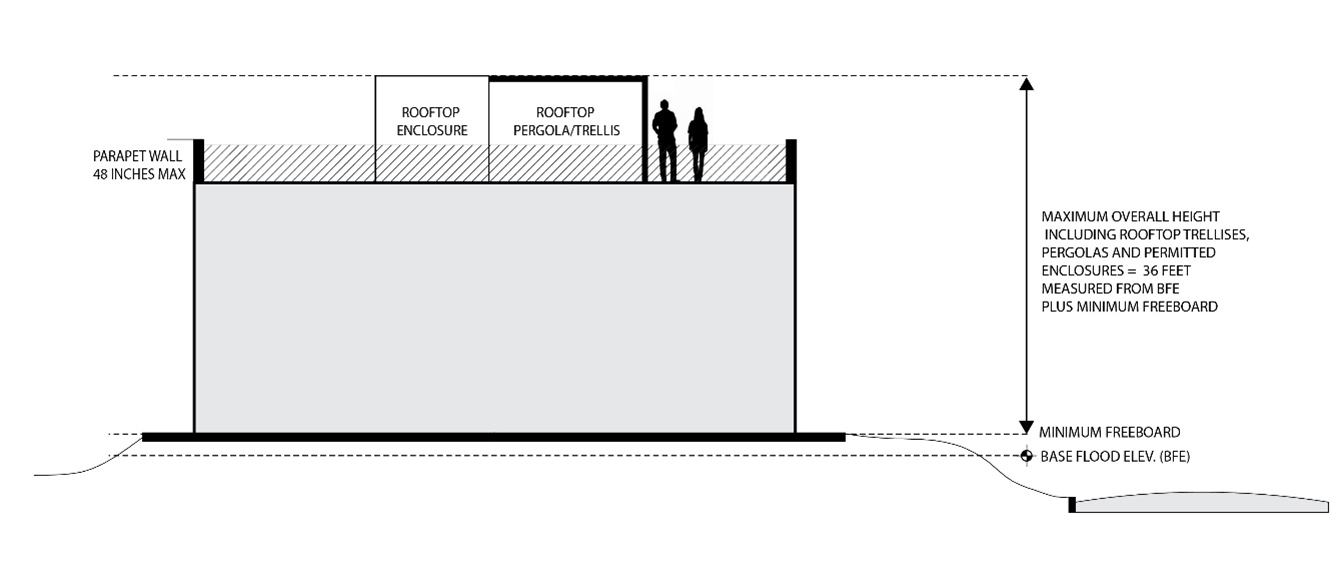
Parapet wall railings associated with a roof deck or terrace, not to exceed 48 inches above the finished roof deck height.
6.
Rooftop decks and terraces, not to exceed six (6) inches above the main roofline. Built in planters, gardens, or similar landscaping areas, not to exceed 3.5 feet above the finished roof deck height, may be permitted immediately abutting the roof deck area. All landscape material shall be appropriately secured.
7.
Rooftop trellises or pergolas, provided such structures have a roof of cross rafters or latticework and the area covered is no more than 50% of the terrace or deck area allowed in Subsection 8.16.A.1.a.(5)(a). Trellises and pergolas shall be appropriately secured against an elevator or staircase or as required by the Florida Building Code.
8.
In the RS-1 district, the following shall apply:
a.
The overall height of a Building and any rooftop structures including trellises, pergolas, stairway/elevator bulkheads, or rooftop enclosures permitted in accordance with Subsection 8.16.A.1.a.5.(b), shall not exceed 36 feet measured from BFE plus required freeboard.
H.
Outdoor dining and sidewalk cafes.
1.
Cafe tables in the Right-of-Way can bring activity to the Street. They can provide a wonderful means of people-watching for diners and pedestrians. Consideration should be given to unification of these elements within a block from street to street.
2.
Restaurants and Bars are also encouraged to provide outdoor service in courtyards or arcades.
3.
Sidewalk cafes on the public right-of-way may be allowed upon approval by the Village Commission.
4.
Outdoor restaurants, bars or sidewalk cafes must be associated with an adjacent licensed restaurant and comply with all other zoning regulations and conform to the following criteria:
a.
An application for a warrant pursuant to Section 15.1.H.4. must be filed with the Village Manager, or a designee, for administrative review and approval, which shall include:
(1)
Layout of all tables, chairs, benches, and other furniture;
(2)
Pedestrian ingress and egress; and
(3)
Location of refuse containers; and other elements necessary to illustrate the proposed outdoor seating/dining use and area (all drawings must be titled, indicate orientation, and be at an acceptable scale).
b.
Outdoor seating/dining areas and uses of the public Right-of-Way and/or any private property may be approved, denied, or approved with conditions, modifications, safeguards, or stipulations appropriately and reasonably related to the intent, purposes, standards, and requirements of the related regulations by the Village Manager.
(1)
Such permit shall not be transferable in any manner and is strictly a warrant permit, valid for a period of one year, renewable annually via payment of the annual occupational license fee for such outdoor seating/dining uses.
(2)
The fee for outdoor dining/seating use and area will be charged annually in accordance with the Village's adopted Fee Schedule, as may be amended from time to time; the permit fee shall be added to the occupational license fee for the main business.
c.
The applicant shall provide an indemnity agreement that is acceptable to the Village Manager. This agreement will include specification of liability insurance to be provided.
d.
The warrant permitting of outdoor seating/dining use and area may be revoked by the Village Manager or designee, upon finding that:
(1)
One or more conditions of these regulations have been violated; or
(2)
That the outdoor seating/dining area and use are being operated in a manner that constitutes a public nuisance, or in any way that constitutes a reasonable risk of potential liability to the Village.
e.
Outdoor seating/dining use and area may be temporarily suspended by the Village for public use/purpose, utility, sidewalk or road repairs, emergency situations, or violations of provisions contained herein.
f.
The length of suspension shall be determined by the Village Manager as necessary.
g.
Removal of all street furniture and related obstructions shall be the responsibility of the owner/operator of the outdoor seating/dining.
h.
Outdoor seating/dining area shall be kept in a neat and orderly appearance and shall be kept free from refuse and debris. The applicant shall be responsible for daily cleaning and sweeping of the outdoor seating/dining area and for the cleanliness and maintenance of any outdoor planters immediately adjacent to the outdoor seating/dining area.
i.
Use of Village sidewalks for trash and garbage removal shall be prohibited.
j.
Outdoor seating/dining use and area shall not interfere with the free and unobstructed pedestrian or vehicular circulation of traffic, public access to any Street intersections, crosswalks, public seating areas and conveniences, bus stops, Alleys, service Easements, handicap facilities, or access to any other commercial establishments.
k.
If there is seating on one side of the sidewalk, a minimum of five (5) feet of sidewalk must remain clear and unobstructed for pedestrian passage.
l.
Outdoor seating/dining area on the public Rights-of-Way shall be open and unenclosed. No building structures of any kind shall be allowed in and over any portion of the outdoor seating/dining area located on public property.
m.
Tables, chairs, and all other furniture used in the operation of an outdoor seating/dining area shall not be anchored or restrained in any manner.
n.
Individual table umbrellas, planters, or other such non-stationary elements may be permitted within the outdoor seating/dining area and where applicable, shall have a minimum clearance height of seven (7) feet above Grade.
o.
Outdoor seating/dining use and area shall be restricted to the length of the sidewalk or public right-of-way immediately fronting the cafe or other establishment.
p.
Outdoor seating/dining area shall be at the same elevation as the adjoining sidewalk or public right-of-way.
q.
Carts and trays for serving food are permitted in the outdoor seating/dining area.
r.
Outdoor seating/dining use and area shall not be provided with amplified sound of any kind.
s.
Outdoor seating/dining areas may serve Alcoholic Beverages where such service is strictly incidental to the service of food and from a service bar only; provided:
(1)
No entertainment of any kind is furnished.
(2)
No sign of any type or character shall be exhibited or displayed to the outside denoting that alcoholic beverages are obtainable within.
t.
Any administrative decision may be appealed to the Village Commission in accordance with the requirements of this Code.
u.
The hours of operation shall coincide with those of the primary Restaurant.
v.
Placement of tables, chairs, and related equipment shall be situated to ensure that a minimum of five feet straight pathway on the sidewalk is maintained at all times as an unobstructed pedestrian path.
w.
Serving through windows is not permitted.
x.
Food preparation shall only occur in the enclosed Restaurant.
y.
Because tables provide sufficient advertisement, no additional Signs for sidewalk cafe are permitted.
z.
Outdoor furniture shall be substantial enough not to blow over with normal winds.
aa.
All outdoor furniture and fixtures shall be tastefully compatible and approved by the Planning and Zoning Official.
bb.
All disposable table materials such as plates, glasses, and napkins shall be imprinted with the name of the cafe (stickers may be used). This regulation is to control litter.
cc.
Sidewalk cafes shall receive a revocable permit subject to the procedures established by the Village.
I.
Recreational and camping equipment. Recreational and camping equipment in the form of travel and camping trailers, truck trailers, and motor travel homes, designed and used as temporary living quarters for recreation, camping, or travel use may be parked in the open on sites containing single-family residences, subject to the following conditions:
1.
No more than one piece of recreation or camping equipment shall be parked on the site.
2.
Such parking shall be limited to the equipment owned or leased by the owner-occupant or occupant-lessee of the site concerned, or owned or leased by a bona fide out-of-Miami-Dade County house guest of the occupant of the site concerned, with the parking of such equipment by the guest not to exceed 14 days.
3.
The location for such parked equipment shall be to the rear of the front building line and behind the side street building line, in each case the building line referred to being that portion furthest from the Street.
4.
Such equipment and the area of parking shall be maintained in a clean, neat, and presentable manner and the equipment shall be in a usable condition at all times.
5.
Such equipment shall, at all times, have attached a current vehicle registration license tag.
6.
No major repairs or overhaul work on such equipment shall be made or performed on the site or any other work performed thereon which would constitute a nuisance under existing ordinances.
7.
When parked on the site, such equipment shall not:
a.
Be used for living or sleeping quarters; or
b.
Be used for housekeeping or storage purposes; and
c.
Shall not have attached thereto any service connection lines, except as may periodically be required to maintain the equipment.
8.
The maximum length permitted for such equipment shall not exceed 30 feet and the maximum height shall not exceed 10 feet.
9.
Such equipment shall be so secured that it will not be a hazard or menace during high winds or a hurricane.
J.
Safe and sanitary dwelling unit standards. The following shall be the minimum standards to be enforced in North Bay Village relative to the safe and sanitary maintenance of Dwellings and Dwelling Units:
1.
All foundation walls shall be structurally sound, reasonably rodent-proof, and maintained in good repair.
2.
Foundation walls shall be considered to be sound if they are capable of bearing imposed loads and are not deteriorated.
3.
Every dwelling unit shall be reasonably weathertight, watertight, and rodent-proof.
a.
Floors, walls, ceilings, and roofs shall be capable of affording adequate shelter and privacy and shall be kept in good repair.
b.
Windows and exterior doors shall be reasonably weathertight, watertight, and rodent proof, and shall be maintained in good working condition.
c.
All parts of the structure that show evidence of rot or other deterioration shall be repaired or replaced.
4.
Every inside and outside stairway, porch, and every appurtenance thereto, shall be maintained in a safe condition and be capable of supporting loads which normal use may impose.
5.
Every chimney and smoke pipe, and all flue and vent attachments thereto, shall be maintained in such condition that there will be no leakage or backing up of smoke and noxious gases into the Dwelling.
6.
All exterior surfaces subject to deterioration shall be properly maintained and protected from the elements by paint or other approved protective coating applied in a professional fashion.
7.
Every plumbing fixture, water pipe, waste pipe, and drain shall be maintained in good sanitary working condition, free from defects, leaks, and obstructions.
8.
The floor surface of every water closet compartment, bathroom, and shower room shall be maintained so as to be reasonably impervious to water and so as to permit such floor to be easily kept in a clean and sanitary condition.
9.
Every supplied facility, piece of equipment, or utility shall be maintained in a safe and satisfactory working condition.
10.
No owner or occupant shall cause any service, facility, equipment, or utility required to be removed from or discontinued for any occupied Dwellings and Dwelling Units except for such temporary interruption as may be necessary while actual repairs, replacement, or alterations are in process.
11.
For these purposes, every owner of a Building containing three or more Dwelling Units, shall provide the continuing service of a person or persons solely to assure that the minimum requirements of maintenance and sanitation, as provided herein are maintained on the premises at all times.
12.
The provisions of the Miami-Dade County Minimum Housing Code shall apply as a minimum standard for Village enforcement.
K.
Security guards.
1.
Definitions: The term security guards shall be synonymous with burglar guards and shall refer to steel bars commonly installed on the exterior or interior of doors or entryways and windows or breezeways or private residences, including free standing as well as multifamily residences and commercial and industrial Buildings.
2.
No security guards may be installed on the exterior of doors and entryways, windows and breezeways on front and side elevations of buildings which face a Street or Public Right-of-Way.
3.
Continuance and removal of nonconforming security guards.
a.
A nonconforming security guard (one which is in existence at the effective date of this section) may be maintained and continued in use as a legal nonconforming use.
b.
However, no such security guard may be enlarged or replaced by another nonconforming device.
c.
At such time as title to the property changes, all nonconforming security guards shall be removed.
d.
Title change shall be defined to mean any change of record ownership, other than by survival or by inheritance of a tenant by the entreaties.
L.
Setback encroachments. Every part of every required front, side, and rear Yard Setback shall be open and unobstructed from the ground to the sky except as herein provided. For additional regulations specific to the T6-24 and T6-30 transect zone, see Chapter 15, Section 15.3.2., Section 15.7.B. and C. The impervious surface area of any encroachment permitted herein shall be included in the calculation of maximum lot coverage, unless specified otherwise in this ULDC.
1.
Cornices, roof overhangs, window air conditioning units, Awnings, chimneys, and sills may extend into a required side or rear yard, provided any such extension does not exceed 36 inches into the required yard.
2.
Balconies shall be permitted to project to a maximum distance of 48 inches into the required Yard, provided there is a minimum clearance of eight (8) feet from the bottom of the balcony to the ground.
3.
Fences and privacy walls as provided in Section 8.17.F.
4.
Swimming pool, spa, hot tubs, and associated decking as provided in Section 8.17.M.
5.
Signs as provided in Chapter 11.
6.
Landscaping retaining Walls, parking curbs/bumpers, and other similar features, provided they do not exceed 6 inches in height. Pedestrian walkways, footpaths, and steps shall be set back a minimum of two (2) feet from any property line.
7.
Light poles and flag poles as provided in Section 8.13.N.
8.
Patios and terraces at the ground level may extend into a side or rear yard setback area a maximum of eighteen (18) inches, provided they do not exceed 6 inches in height from grade.
9.
In single family districts only, the following additional setback encroachments are allowed:
a.
Ground mounted mechanical equipment, including air conditioning equipment, pool equipment, heat pumps, water heaters, generators, and other similar equipment, may be placed in a side Yard Setback area; provided the unobstructed side setback area is not reduced by more than 50 percent of what is required in the Zoning District regulations and provided the equipment placed in the setback area does not operate above 70 decibels.
b.
A garden window for the cultivation of small plants may extend into the Setback area not more than 24 inches.
c.
Tiki huts, pergolas, trellises and sheds, where allowed, may extend into the Setback area a maximum of eighteen (18) inches, provided they not exceed a maximum height of ten (10) feet above grade.
10.
In all zoning districts other than Single Family, the following additional setback encroachments are allowed:
a.
A canopy shall be permitted to extend from the entrance door to the Front Property Line provided:
(1)
The canopy does not exceed 12 feet in height or be screened or enclosed in any manner; and
(2)
The canopy shall be required to be removed during hurricane warning periods.
(3)
A clear space is provided between the grade and the bottom of the valance of at least six and one-half feet.
(4)
Additional awning/canopy requirements of Section 8.13.A. shall be complied with.
b.
An entrance feature/port cochere may extend from the entrance door into the Front Setback area provided:
(1)
Support columns may not be placed closer than 7 feet to the Property Line.
(2)
At least 14.5 feet of vertical clearance shall be provided.
(3)
The width of the entry feature/port cochere shall not exceed twenty-five (25) feet or twenty percent (20%) of the subject Property Frontage width, whichever is greater.
(4)
The entrance feature/port cochere may extend from the entrance door to the front property line, or a distance of 35 feet, whichever is more restrictive.
c.
Tiki huts, pergolas, trellises located at ground level may extend into a side or rear Setback area a maximum of twenty-four (24) inches, provided they do not encroach onto a required Island Walk or View Corridor easement, nor exceed a maximum height of twelve (12) feet above grade.
M.
Swimming pools, spas and hot tubs.
1.
Purpose and intent. The Legislature finds that drowning is the leading cause of death of young children in this State and is also a significant cause of death for medically frail elderly persons in this State, that constant adult supervision is the key to accomplishing the objective of reducing the number of submersion incidents, and that when lapses in supervision occur a pool safety feature designed to deny, delay, or detect unsupervised entry to the swimming pool, spa or hot tub will reduce drowning and near-drowning incident[s].
In addition to the incalculable human cost of the submersion incidents, the health care costs, loss of lifetime productivity, and legal and administrative expenses associated with drowning of young children and medically frail elderly persons in this State each year and the lifetime costs for the care and treatment of young children who have suffered brain disability due to near-drowning incident each year is enormous.
2.
Standards and requirements.
a.
Any Swimming Pool, spa or hot tub operated by a residential homeowner, condominium association, or by the resident of a Single-Family Dwelling shall be permitted as an Accessory Use and shall exist only in conjunction with the Principal Use on the same Lot, subject to the regulations stated herein.
b.
Swimming pools, spas and hot tubs shall have minimum Setbacks, which shall be measured from the waterline to the property line, as follows:
c.
Decking surrounding a swimming pool, spa or hot tub shall provide a minimum setback of 2.5 feet from any property line.
d.
Screen enclosures. Screen enclosures shall be limited in height to twelve (12) feet from finished grade and shall be subject to the following setbacks:
e.
Drainage. If a patio is provided adjacent to or surrounding a swimming pool, spa or hot tub, it shall be designed so as to be self-draining away from the structure.
f.
Lighting. Artificial lighting used to illuminate the premises shall be shielded and directed away from adjacent properties and streets, shining only on the subject site.
g.
Height. Swimming pools, spas, hot tubs, and appurtenances shall not exceed a height of two (2) feet above finished Grade.
h.
Additional requirements. In addition to the foregoing requirements, all regulations and standards of Sections 151.01 through 151.18 of the Village's Code of Ordinances, and the Florida Building Code shall be complied with.
3.
Safety features and barriers.
a.
All residential swimming pools, spas and hot tubs must meet the following:
(1)
At least one of the requirements relating to pool safety features required by Section 515.27, as amended.
(2)
All the barrier requirements of Section 515.29, Florida Statutes.
b.
Access to swimming pools, spas, and hot tubs. Access gates, when provided, shall be self-closing and shall be equipped with a self-latching locking device located on the pool, spa, or hot tub side of the gate.
(1)
Where the device release is located no less than 54 inches from the bottom of the gate, the device release mechanism may be located on either side of the gate and so placed that it cannot be reached by a young child over the top or through any opening or gap from the outside.
(2)
Gates that provide access to the swimming pool, spa, or hot tub must open outward away from the pool, spa, or hot tub.
(3)
The gates and barrier shall have no opening greater than ½ inch within 18 inches of the release mechanism.
c.
Adjacent waterways as barriers.
(1)
Permanent natural or permanent human-made features such as Bulkheads, canals, lakes, navigable waterways, etc., adjacent to a public or private swimming pool, spa, or hot tub may be permitted as a barrier when approved by the authority having jurisdiction.
(2)
When evaluating such barrier features, the authority may perform on-site inspections and review evidence such as surveys, aerial photographs, water management agency standards and specifications, and any other similar documentation to verify, at a minimum, the following:
(a)
The barrier feature is not subject to natural changes, deviations, or alterations and is capable of providing an equivalent level of protection as provided by the Code.
(b)
The barrier feature clearly impedes, prohibits, or restricts access to the swimming pool, spa, or hot tub.
d.
Schedule of penalties. Failure to comply with the requirements of any Section of this Chapter may result in a penalty as provided in Section 153 of the North Bay Village Code.
N.
Towers, antennas, poles, and masts.
1.
Generally. Prior to the erection of a water tower, standpipe, windmill, tower, aerial, antenna, pole, mast, or other vertical structure over ten feet in height above the roof of a permitted structure, or over twenty (20) feet in height if erected at Grade, the requirements of this section and the Florida Building Code shall be observed.
a.
Plans and specification required. Plans and specifications for the structures listed above shall be submitted to the Building Official showing:
(1)
All dimensions, size, and kind of members, footings, and guy wires;
(2)
The location, depth, and type of guy anchors and footings;
(3)
The type and weight of the antenna, apparatus, or Structure to be attached to or supported by the structure; and
(4)
An application made for a permit.
b.
Maximum height.
(1)
The vertical height of any of the above structures shall not be greater than 90 percent of the horizontal distance from its base to the nearest property line.
(2)
Radio towers, where incidental to a business use in the commercial district, may extend to a height of 150 feet measured from ground elevation.
(3)
Poles, masts, and towers for supporting antenna used in the operation of amateur radio stations, citizen band radio stations, and citizen band radio stations licensed by the Federal Communications Commission shall be excepted from the above regulations and shall be governed by the following requirements:
(a)
All poles, masts, towers, and beam array antennas shall be placed not less than five feet from a public Right-of-Way line or adjacent property line, or nearer than one foot from any Easement.
(b)
All such installations shall conform to the requirements of the National Electrical Code and current radio frequency emission standards and other applicable FCC regulations, and be located not less than eight feet from any power line over 250 volts, including the beam elements or any part thereof.
(c)
Permits shall be required for the installation of any poles, masts, or towers over 20 feet above the roof of any structure to which they may be attached, and for any installation over 35 feet in height when erected from grade. Applications for permits shall be accompanied by three copies of plans and specifications showing:
i.
All dimensions, size, and kind of members;
ii.
Footings and guy wires;
iii.
The location, depth, and type of guy anchors and footings; and
iv.
The type and weight of the antenna, apparatus, or Structure to be attached to or supported by the structure.
(d)
Poles shall be of an approved creosoted type or treated or painted with a chemical preservative and an outer coat of oil base paint before installation. The color shall match the surrounding development.
(e)
The recommended depth of holes for various type poles shall be subject to acceptable engineering standards:
(f)
If the earth is damp or soggy, the depth of hole is to be increased by one foot.
(g)
If carrying a beam, poles must be properly guyed, as is the case where the pulling effect of the wire antenna or weight of other installations will require guying.
(h)
Wood masts shall be chemically treated, painted with an outside coat of oil base paint, and suitably guyed at the top and middle in at least three different directions.
(i)
Masts to support a beam, whether of wood or metal pipe, shall comply with all the applicable regulations in regard to the location, guying and the like, and the maximum allowable weight of antenna, rotator, and components shall not exceed 150 pounds.
(j)
Towers of steel, iron or aluminum, whether of the rigid non-demountable type or the rigid, demountable type with the crank-up, crank-down and either the hinged base or swivel crank-over features shall carry no more weight on the top than specified by the manufacturer's specifications.
(k)
In calculating the height of demountable type towers, the top of the lower rigid section shall be considered the top for the purpose of this Section.
(l)
Beam array antennas shall be mounted so as to provide easy servicing and easy access for the removal at approach of hurricanes or provide for the lowering of such beam.
(m)
All telecommunication tower sites must comply with the landscaping requirements of the Village in force at the time of application.
(n)
An eight-foot (8-foot) fence or wall constructed in accordance with these land development regulations, as measured from the finished grade of the site, shall be required around the base of any tower and may be required around any accessory building or structures.
(o)
Depending on the height and location, telecommunication towers or antennas shall be approved by the FAA, Miami-Dade County Aviation Authority or other appropriate agency prior to issuance of a building permit by the Village.
(p)
Prior to the issuance of a building permit by the building division and/or planning and zoning division, the applicant shall provide evidence that the telecommunication towers or antennas are in compliance with FAA regulations.
2.
Dish antennas.
a.
Application. This Section shall apply only to private noncommercial dish antennas as defined in subsection B.2. below. This section shall supplement and not repeal or modify the requirements of Section 8.10.E.5.
b.
Definitions:
(1)
Dish antenna means a dish antenna intended for the purpose of receiving communications from orbiting satellites and other extraterrestrial sources, a low noise amplifier (L.N.A) which is situated at the focal point of the receiving component for the purpose of magnifying and transferring signals, a coaxial cable for the purpose of carrying signals to the interior of a Building.
(2)
A private noncommercial dish antenna is a dish antenna for a single-family residence which is erected solely for the use of its owners. Said antenna shall not be used for the purpose of obtaining revenue.
c.
Placement. Private noncommercial dish antennae may be permitted in North Bay Village provided:
(1)
They are located in the Rear Yard.
(2)
They are placed no closer to any property boundary line than a distance equal to their height as measured from ground level to the top of the antenna but in no event closer than ten feet to said Property Lines.
(3)
On corner properties, no portion of the apparatus may extend beyond the imaginary extension of the line of the house Structure.
(4)
Roof-mounted dish antennae shall not be permitted except on two-story Buildings with a flat roof, provided the antenna cannot be viewed from ground level, and in no instance is to exceed in height 15 [feet] above the roof.
d.
Dimensions. The height of dish antennas, on the ground, shall not exceed 15 feet from ground level nor shall their diameter exceed 12 feet.
e.
Number allowed; color. Only one dish antenna shall be allowed per single-family house, and antennas shall be neutral in color, and one color only.
f.
Anchorage. All dish antennae shall be anchored securely to the ground or structure in compliance with the requirements of the Florida Building Code relative to structures.
g.
Permit required. No dish antenna shall be erected until a permit has been issued by North Bay Village. All applications for a permit shall be accompanied by a site plan showing the proposed location of the antenna, the type, color, height and diameter of the antenna and the proposed landscaping.
h.
Screening. A private noncommercial dish antenna shall be screened by landscaping on its sides so as to obscure its visibility from the abutting properties' ground view.
i.
Once installed, dish antennas and related appurtenances must be maintained in good and operable condition, and the surrounding landscaping shall likewise be continuously maintained for the intended screening purpose.
j.
Nonconforming uses. All dish antennas that are legally existing on October 23, 1990, shall be allowed to remain until such time that they may be replaced, or the cost of repairs exceeds 50 percent of the replacement at which time they shall conform in all respects to this Section.
3.
Screening of mechanical equipment. Lack of, or inadequate screening of mechanical equipment can have negative visual impacts on the Village's streetscape, ambient landscape, and community image. Such impacts shall be minimized through compliance with the following requirements:
a.
Mechanical equipment located on the ground, such as air conditioning units, heating units, satellite dishes, irrigation pumps, propane tank displays and refilling areas, utilities lift stations, and the like shall be screened from public view. Screening shall, at a minimum, be at the same height as the equipment. Structural screening shall be architecturally integrated into the overall project design and shall be compatible, in terms of style, construction materials, colors, and finish, with the Principal Structure(s). Landscaping may be substituted for structural screening if plantings are compatible with the landscape plan for the project and are of such size and maturity as to be able to provide a fully opaque screen at time of planting.
b.
Equipment and appurtenances mounted on roof tops shall be kept to a minimum. All exposed roof top mounted equipment and appurtenances shall be fully screened from view from any public Right-of-Way. All screening shall, at a minimum, be at the same height as the equipment and appurtenances. Screening shall be an integral part of the design of the Building(s) and shall be architecturally consistent with the style, colors, construction materials and finish of the building(s).
c.
Painting of exposed appurtenances to blend with the color of adjacent materials of the building may be approved where utilization of approved roof designs precludes full screening of exposed surfaces.
O.
Island Walk Standards.
1.
Except as otherwise provided in these regulations, all waterfront properties on Harbor Island and properties zoned either RM-70 or T6 and located along the north, south, and east shorelines of Treasure Island, upon and as part of their development or substantial redevelopment, shall be required to design and construct the respective portion of the Island Walk according to design criteria and standards established in the Island Walk Design Criteria Project Memorandum, dated October 19, 2020, prepared by EAC Consulting Inc. and Moffat & Nichol for the Village, as may be updated from time to time, which is incorporated into the Code as Appendix "A" and made a part hereof by reference.
(Ord. No. 2018-006, § 2(Att. A), 3-13-18; Ord. No. 2019-001A, § 2(Exh. A), 2-28-19; Ord. No. 2019-008, § 2, 7-22-19; Ord. No. 2019-009, § 2, 7-22-19; Ord. No. 2020-011, § 2, 10-13-20; Ord. No. 2021-007, § 3(Exh. B), 3-9-21; Ord. No. 2021-009, § 2, 6-8-21; Ord. No. 2021-012, § 3, 6-30-21; Ord. No. 2022-05, § 2, 3-8-22; Ord. No. 2022-006, § 2, 3-8-22; Ord. No. 2023-009, § 2, 6-13-23; Ord. No. 2023-011, § 3(Exh. B), 9-28-23; Ord. No. 2024-004, § 2(Exh. A), 3-12-24)
Editor's note— Ord. No 2019-001A was adopted Feb. 28, 2019, but was not executed by the Mayor, Clerk, and Village Attorney until Feb. 28, 2023.
Note— See editor's note at § 8.15.
Editor's note— For additional standards specific to the T6 Transect Zones, see Chapter 15, Section 15.3.]

