
North Crows Nest City Zoning Code
CHAPTER 741
SUBDIVISION REGULATIONS1
Editor's note— Ord. No. 64, 2015, § 1(Exhibit), passed September 28, 2015, effective April 1, 2016, repealed the former Chs. 730—735, and enacted new Chs. 740—744 as set out herein. The former Chs. 730—735 pertained to Zoning—General Provisions, Dwelling Zoning Districts; Zoning—Commercial Districts, Zoning—Industrial Commercial Districts, Sign Regulations, Zoning—Other Districts. See Code Comparative Table for complete derivation.
ARTICLE IV. - REPLATS
A.
The resubdivision of an already approved secondary plat, or portion of such secondary plat, shall obtain approval for the resubdivision in accordance with the same procedures required for the subdivision of land.
B.
Resubdivision or replat includes:
1.
Any change in any street layout;
2.
Any change in any lot line, not including transfers between adjoining lot owners that do not create additional buildable sites;
3.
Any change in the amount of land reserved for public use or the common use of lot owners;
4.
Any change in any easements shown on the approved plat.
C.
Primary approval, secondary approval of the plat resubdividing the land and subsequent recordation eliminates all easements and covenants previously encumbered upon the land, unless specifically restated and declared on the plat of the resubdivided land.
D.
The procedures in this subsection shall not apply to recording of engineers "certificates of error" or "certificates of correction."
(G.O. 64, 2015, § 2)
ARTICLE VII. - REQUIRED COVENANTS
The following covenants shall be included on the recorded plat:
Sec. 741-101. - Title and jurisdiction.
These regulations (hereinafter "these regulations") shall officially be known as the Subdivision Control Ordinance for Marion County, Indiana. These regulations shall apply to all lands within Marion County, Indiana.
(G.O. 64, 2015, § 2)
Sec. 741-102. - Purpose.
The purpose of these regulations is to ensure that the division of land will serve the public interest and to protect and provide for the public health, safety, comfort, morals and general welfare of Marion County. Land to be subdivided shall be of such character that it can be used safely for building purposes without danger to health or peril from fire, flood, or other menace, and land shall not be subdivided until the provision has been made for adequate public facilities, drainage, water, sewerage, and capital improvements such as schools, parks, recreational facilities, transportation facilities and accessories. Since the allocation and arrangement of parcels of land for both private uses and public uses influences the health, safety, economy, livability, and amenities of an area, these regulations are adopted, designed, intended and should be administered to:
A.
Protect and provide for conditions conducive to the public health, safety, comfort, morals, aesthetics, convenience, prosperity, efficiency, and general welfare of Marion County.
B.
Secure adequate light, air, and convenience of access; to secure safety from fire, flood, and other danger; and to prevent overcrowding of the land and undue congestion of population.
C.
Protect the character and the social and economic stability of all parts of the county by assuring: the timing and sequencing of development; the promotion of infill development in existing neighborhoods; the promotion of adequate public facilities; proper urban form and open space separation of urban areas; to protect environmentally critical areas and areas premature for urban development.
D.
Protect and conserve property values throughout the county and the value of buildings and improvements upon the land.
E.
Minimize the impact upon and protect the water quality of the county's watercourses, reservoirs, lakes, and other significant water resources by balancing the judicious use of impervious surfaces with the utilization of low-impact development techniques to manage run-off and reduce urban heat island effects.
F.
Coordinate the development of each parcel of land with the existing community and facilitate adequate and efficient transportation, water, sewerage, and other public requirements and facilities with adjoining land;
G.
Provide a beneficial relationship between the uses of land and buildings and the circulation of traffic throughout the county, having particular regard to the avoidance of congestion and support multimodal transportation design standards in a manner that supports multi-modal transportation.
H.
Establish reasonable standards of design and procedures for subdivisions and resubdivisions in order to further the orderly layout and use of land, and to ensure proper legal descriptions and monumentation of subdivided land.
I.
Ensure that off-site and on-site public facilities and services are provided to sufficiently serve the land being developed in a manner that is orderly and efficient for the area, through requiring the developer to pay fees, furnish land, or establish mitigation measures to ensure that the development provides its share of capital facilities' needs generated by the development.
J.
Prevent the pollution of air, streams, and ponds; to protect the streams, wetlands, floodplains, riparian and aquatic ecosystems; to assure the adequacy of drainage facilities; to safeguard the water table, and to provide for the conservation and protection of human and natural resources throughout the county in order to preserve the integrity, stability, and beauty of the community and the value of the land and to provide for the environmentally sound use of Marion County's land resources.
K.
Ensure that subdivisions are designed and developed in a manner that is consistent with all applicable flood protection and storm water management regulations and other applicable land use and development regulations.
L.
Assist in the preservation of the natural beauty and topography of the county and to ensure appropriate development with regard to these natural features.
M.
Provide for open spaces through the most efficient design and layout of the land, while preserving the density of development as established in the Zoning Ordinance of Indianapolis-Marion County, Indiana.
N.
Provide adequate, accurate and reliable records of all land divisions; remedy the problems associated with inappropriately subdivided lands, including partial or incomplete subdivision, and inferior subdivision.
(G.O. 64, 2015, § 2)
Sec. 741-103. - Authority.
A.
The applicable Indiana Planning and Zoning Laws pertaining to this article are:
1.
IC 36-7-4-700. 700 Series - Subdivision Control;
2.
IC 36-7-3-11 (as referenced by the 700 Series noted above);
3.
IC 36-7-3. Chapter 3. Platting and Vacation of Real Property; and
4.
IC 36-7.
B.
The Commission, or its appointed Plat Committee, per IC 36-7-4-701(e) (referred to in this Chapter as the "Committee"), is vested with the authority to review, approve, conditionally approve and disapprove applications for the subdivision of land, including primary and secondary plats. As a condition of primary approval of a plat, the Commission or Committee may specify:
1.
The manner in which public ways shall be laid out, graded, and improved;
2.
A provision for water, sewage, and other utility services;
3.
A provision for lot size, number, and location;
4.
A provision for drainage design; and
5.
A provision for other standards as specified in these regulations.
C.
The Committee may grant waivers from these regulations pursuant to the provisions of these regulations and their Rules of Procedure.
D.
Applications for the vacation of plats or parts of plats, and applications for the vacation of public ways, easements or public places are under the exclusive control of the Committee, per IC 36-7-4-712.
(G.O. 64, 2015, § 2)
Sec. 741-104. - Committee action.
A.
Rules of Procedure. The Commission shall establish and adopt Rules of Procedure governing the Plat Committee and prescribing the application requirements and procedures for the conduct of the hearing in accordance with IC 36-7-4, IC 36-7-3, IC 5-3-1 and these regulations. Such rules shall address filing fees, notice, findings, and appeals. The Commission shall prescribe, in the Rules of Procedure of the Plat Committee, or through petition forms prescribed by those rules of procedure and adopted by the Commission, the specifications for documents to be submitted in the subdivision, replat (resubdivision), and vacation of lands.
B.
Fees.
1.
In order to compensate for the administrative expenses associated with applications, procedures and processing, fees shall be paid by the applicant as prescribed by the Commission in its Rules of Procedure, in accordance with IC 36-7-4-411, IC 36-7-3, and Chapter 740.
2.
Regardless of the outcome of any particular request, an owner or applicant will have no right to a refund of any monies, fees, or charges paid to the municipality nor to the return of any property or consideration dedicated or delivered to the municipality, except as may have previously been agreed to by the Committee.
(G.O. 64, 2015, § 2)
Sec. 741-105. - Applicability.
A.
Districts. In accordance with IC 36-7-4-701, Section 742-102 (Districts) of the zoning ordinance portion of the Zoning Ordinance states in which Zoning Districts and under what circumstances the approval of subdivision plats is required. In accordance with IC 36-7-4-711 and 712, the approval of subdivision plats, when required by the Zoning Ordinance, shall be done in compliance with the provisions of these regulations and in compliance with the Rules of Procedure of the Commission.
B.
Exemptions. No land required by the Zoning Ordinance to be approved as a subdivision plat may be subdivided through the use of any means other than in accordance with these regulations, except for the following instances:
1.
The sale, gift or exchange of residentially or agriculturally zoned parcels between adjacent landowners that does not create additional building sites.
2.
The division of residentially or agriculturally zoned land into parcels of three acres or greater in size for exclusively residential or agricultural uses, not involving any new streets or easements of access.
3.
A division used exclusively for cemetery purposes and accessory uses associated therewith.
4.
A division occurring through the transfer of land for use as a right-of-way for widening a road or railroad or as an easement for public purposes or public utilities, when no new street/road or easement of access is involved.
5.
A correction of a description in a prior conveyance provided that the correcting instrument (commonly called a certificate of error or scriveners error used to make a boundary line adjustment between existing parcels) contains a reference to the original instrument of conveyance by date, book and page, or other description.
6.
Condominium development governed by IC 32-25 is not regulated by these regulations.
7.
A court-ordered division of land.
C.
Attached dwellings.
1.
Approval of a plat for the division of land to allow for the sale of individual single-family attached dwelling units in a residential development or an individual unit in a two-family dwelling shall be granted by the Administrator if the following conditions are met:
a.
The land has been developed with and is occupied by a single-family attached dwelling or two-family dwelling;
b.
The total number of dwelling units permitted and remaining to be platted on the entire tract are the same; and
c.
The land being divided or transferred under this exemption is covered by a recorded declaration of covenants subjecting the land and Improvements thereon to procedures and conditions regulating the manner in which improvements may be expanded, reconstructed and maintained.
D.
Lot of record or non-conforming lots/parcels.
1.
A lot of record or parcel lawfully created before August 8, 1966 that has been maintained in individual ownership, may be used for residential purposes for a dwelling or may continue to be used for another use that is allowed in the Zoning District without further review under this Chapter 741, until such lot of record or parcel is further subdivided.
(G.O. 64, 2015, § 2; G.O. 37, 2018, § 4)
Sec. 741-201. - Classification of subdivisions.
Before any land is subdivided, the owner of the property proposed to be subdivided, or his authorized agent, shall apply for and secure approval of the proposed subdivision in accordance with the provisions and procedures of these regulations. Subdivisions are classified into two types:
A.
Minor subdivision, defined as any subdivision that:
1.
Contains no more than three lots;
2.
Contains only lots fronting on an existing, improved street;
3.
Does not involve the construction of a new street or extension of an existing street;
4.
Does not necessitate the extension of public facilities or the creation of any public improvements, excluding sidewalks; and
5.
Does not adversely affect the remainder of the parent tract or adjoining property.
Further, to be classified as a minor subdivision, the land shall be platted into developable lots, as required by the applicable District, and the parent tract of land from which any part of the lots are platted shall not have been a part of three or more previous minor subdivision platting requests.
B.
Major subdivision, defined as all subdivisions not classified as minor subdivisions, including but not limited to subdivisions of four or more lots, or any size subdivision requiring any new street or extension of the public facilities or the creation of any public improvements.
(G.O. 64, 2015, § 2)
Sec. 741-202. - Authority to file applications.
A.
Applications for review and approval under these regulations may be initiated by all the owners of the land that is the subject of the application; or the owners' authorized agent.
B.
The Commission shall prescribe, in the Rules of Procedure of the Plat Committee, or through petition forms prescribed by those rules of procedure and adopted by the Commission, the specifications for documents to be submitted in the subdivision of land and the vacation of plats, parts of plats, public ways, easements or public places or parts thereof.
(G.O. 64, 2015, § 2)
Sec. 741-203. - Documents submitted for primary approval.
The primary plat, area map, topographic map, natural infrastructure plan and requisite fee, all in prescribed quantities, shall be provided in addition to the documentation required by the Rules of Procedure. A traffic control plan shall be provided for a subdivision and for other applications proposing a new street or alley. For minor subdivisions, the traffic control plan and the natural infrastructure plan may be omitted.
A.
Primary plat. The primary plat shall be prepared by a professional surveyor at a convenient scale of not more than one inch equals 100 feet, and the sheets shall be numbered in sequence if more than one sheet is used with the current page number and total page numbers appearing on each sheet. The plat shall be of such size as is acceptable for filing in the Office of the Marion County Recorder, but shall not be larger than 42 by 48 inches in dimension. The primary plat shall show the following:
1.
Proposed name of the subdivision, to be placed at the top of each sheet, and must clearly reference any existing subdivisions or sections (with recorded instrument number) that it abuts.
2.
Location by section, township and range, and by other legal description. For verification of plat closure, the text legal description and the annotation shall match exactly.
3.
The plat shall be prepared with the permitted tolerances listed in Table 741-203-1:
4.
Name, address, signature, seal and certification of the professional surveyor who prepared the primary plat.
5.
Scale, noted in writing and graphically, of the primary plat, including graphic scale, north arrow and date.
6.
Boundary lines of the proposed subdivision indicated by solid, heavy lines, based upon a traverse with angular and lineal dimensions shown on the plan.
7.
Radii, central angles, tangents, lengths of arcs, curvatures, angles at street intersections and a complete street traverse of each street within and on the perimeter of the plat.
8.
Locations, dimensions and names of all existing streets or other public ways, railroad and utility rights-of-way or easements, parks and other public open spaces, permanent buildings or structures, and section and municipal corporation boundary lines within 100 feet of the area proposed to be platted.
9.
In the case of a replat, all descriptive lines of the original plat being vacated, shown as dotted lines in relationship to the lines of the new plat, the new plat being shown clearly in solid lines. A copy of the original plat shall be filed with the proposed replat.
10.
Boundary lines of adjoining and adjacent unsubdivided and subdivided land, showing owners' names within 100 feet of the area proposed to be platted, indicating the recorded name, date and number of any such subdivided land.
11.
Existing zoning of the area proposed to be platted and of land adjoining and adjacent thereto. If the subdivision is in a dwelling district and utilizing the cluster or zero-lot line option, it shall be clearly noted as such.
12.
Layout of all streets, indicating the names, widths (pavement and rights-of-way), classifications thereof, and indicating whether public or private.
13.
Layout of all access easements, vehicular and non-vehicular, indicating the dimensions and purpose thereof, and indicating whether public or private.
14.
Layout and numbers of lots, including accurate dimensions (in acreage or square feet), of lots. The number of lots and range of lot numbers shall clearly be stated. In new developments, lot numbers shall be consecutive within each section or phase, and may not be repeated in subsequent sections or phases within a subdivision.
15.
Areas to be allocated for park, school, recreational, and other public and semipublic uses, with the purpose proposed for each such area to be indicated on the primary plat. The size of each such area shall clearly be stated. All areas to be dedicated or reserved for public use shall further be noted in the applicable dedication, deed or covenant.
16.
Areas to be allocated as common area or common open space, with the purpose proposed for each such area to be indicated on the primary plat. All areas to be reserved by deed or covenant for common use by owners of land contained in the proposed plat shall further be noted in the applicable dedication, deed or covenant.
17.
Areas to be allocated for public service or utility easements, showing accurate dimensions and indicating the type of facility.
18.
If the primary plat is to be divided into sections for platting, an indication of the boundaries and numbers of such sections.
19.
Floodway or floodway fringe delineation, as established by Section 742-203 (Flood Control Zoning District).
20.
Drainage covenant and sanitary sewer covenant, as established by Chapter 561 and Chapter 671 of the Revised Code of the Consolidated City and County.
B.
Area map. The area map shall be at an appropriate scale (not greater than one inch equals 1,000 feet) and shall indicate the following:
1.
The name and location of the proposed subdivision.
2.
The scale of the area map, north arrow, and date.
3.
Street, lot and tract lines of parcels of land and subdivisions within 1,000 feet of the area proposed to be platted and between such area and the nearest thoroughfare.
4.
The zoning of adjoining and adjacent land within the boundaries of the area map.
5.
Existing or proposed park, school, recreational and other public or semipublic use within the boundaries of the area map.
C.
Topographic map. The topographic map shall be drawn upon a copy of the primary plat and shall indicate:
1.
The name and location of the proposed subdivision.
2.
The scale of the topographic map, north arrow, and date.
3.
Contours based upon the U.S. Coast and Geodetic Datum or U.S. Geological Survey Datum bench marks at one-foot vertical intervals, showing clearly by flow lines and arrows the drainage pattern of surface water, both natural and proposed, within and through the area proposed to be platted, the location and elevation of such bench marks to be shown thereon. The Administrator may permit two-foot or five-foot vertical contour intervals in areas of very steep slopes, such as ravines.
4.
A diagram of the proposed course of surface water drainage from the point where water leaves the proposed plat to a legal ditch, natural stream or public storm sewer, to be shown by flow lines, arrows and descriptive notes.
5.
Existing sewers, water mains, culverts and other underground facilities within or adjacent to the tract indicating pipe size, grades and exact location as obtained from public records, together with a sketch plan of any group sewage disposal system, if proposed, that has been approved in writing by the Marion County Public Health Department.
6.
If private disposal systems are proposed, the location and results of an on-site soil survey, including a determination of soil load rate, glacial till depth and other drainage characteristics to determine feasibility of an absorption field. This shall be performed for each lot in the location of the proposed absorption field. Such testing shall be conducted by a certified soil scientist, as required by the Marion County Public Health Department.
7.
Other significant conditions of the area proposed to be platted, such as watercourses, wetlands, land subject to flooding (both floodway and floodway fringe areas), rock outcrops, wooded areas, wells, houses, and any other structures.
D.
Traffic control plan. A traffic control plan shall be required in the case of major subdivisions and developments that will include one or more new streets. The traffic control plan shall be drawn upon a copy of the primary plat and shall indicate the placement of the following:
1.
Traffic control street signs and devices;
2.
Traffic calming devices;
3.
Bicycle facilities;
4.
Sidewalks and pedestrian walkways;
5.
Transit facilities, such as bus stop pads or shelter; and
6.
Street lighting.
E.
Natural infrastructure plan. A Natural Infrastructure Plan shall be required in the case of major subdivisions containing more than 20 residential lots and in the case of other developments including more than 15 acres. The natural infrastructure plan shall be drawn upon a copy of the primary plat and shall indicate:
1.
Placement of all proposed drainage facilities for the subdivision, indicating type of facility and if the facility is to be designed to be wet or dry;
2.
Location of open space areas of the open space common area, indicating size and general improvements.
3.
Location of any stream protection corridors in accordance with Section 744-205 (Stream Protection Corridors).
(G.O. 64, 2015, § 2)
Sec. 741-204. - Documents submitted for secondary approval.
The secondary plat, final natural infrastructure plan, final traffic control plan, and an engineer's cost estimate of each improvement and installation, all in prescribed quantities, shall be provided in addition to the documentation required by the Rules of Procedure. A final traffic control plan shall be provided for a subdivision and for other applications proposing a new street or alley. For minor subdivisions, the traffic control plan, natural infrastructure plan and engineer's cost estimate may be omitted.
A.
Secondary plat. The secondary plat shall be prepared by a professional surveyor. The secondary plat shall be presented on reproducible mylar or other format approved by the Administrator at the same scale and containing the same information, except for any changes or additions required by the Committee, as shown on the primary plat. All certifications shall be made in permanent black ink with each signature accompanied by the printed name. The primary plat may be used as a secondary plat if it meets these requirements and is revised in accordance with the Committee's disposition and provided that that the Boundary lines of adjoining and adjacent unsubdivided and subdivided land, showing owners' names, recorded name, date and number, shall be removed. All revision dates must be shown as well as the following:
1.
A correct and accurate legal description of the land platted, indicating any changes from the description appearing in the last record transfer of such land.
2.
Notation of any self-imposed restrictions, and restrictions that may have been placed upon the property through rezoning, approval or variance petitions, referencing petition numbers and instrument numbers, as applicable.
3.
Endorsement on the plat of every person having a security interest in the subdivision property that they are subordinating their liens to all covenants, servitudes, and easements imposed on the property by the plat.
4.
Lots numbered as approved by the Administrator.
5.
Addresses, as assigned and approved by the Administrator.
6.
All monuments erected, corners, and other points established in the field in their proper places. The material of which monuments, corners, or other points are made shall be noted at the representation thereof or by legend, except that lot corners need not be shown. The legend for metal monuments shall indicate the kind of metal, the diameter, length, and weight per lineal foot of the monuments.
B.
Final traffic control plan. The final traffic control plan shall be drawn upon a copy of the plat and shall indicate the placement of the elements listed below. The final traffic control plan should reflect the information as shown on the plans submitted with the primary plat, except for any changes or additions required by the Committee. The plans submitted with the primary plat may be used if the plans are in accordance with the Committee's disposition.
1.
Street name signs for the subdivision, with specifications;
2.
Traffic control street signs, with specifications;
3.
Traffic calming devices and markings, with specifications;
4.
Bicycle facilities and markings, including specifications of the facility;
5.
Sidewalks and pedestrian walkways, indicating dimensions and materials;
6.
Traffic control devices along access easements;
7.
Transit facilities, such as bus stop pads or shelters, with specifications; and
8.
Street lighting with specification details.
C.
Final natural infrastructure plan. The final natural infrastructure plan shall be drawn upon a copy of the plat and shall indicate the placement of the elements listed below. The final natural infrastructure plan should reflect the information as shown on the plans submitted with the primary plat, except for any changes or additions required by the Committee. The plans submitted with the primary plat may be used if the plans are in accordance with the Committee's disposition.
1.
Placement of lot trees, indicating type and size;
2.
Placement of all proposed drainage facilities for the subdivision, indicating type and size of facility and if the facility is to be designed to be wet or dry;
3.
Water depth, treatment of edge and profile detail for infrastructure designed to be wet;
4.
Planting plan indicating species, size, and quantities, for any Best Management Practices (BMPs) requiring live vegetation; and
5.
Location of primary and secondary open space areas of the open space common area, indicating size, included features and any improvements.
D.
Other documents.
1.
If connections are not provided to a public or semipublic water system or public or semipublic sewage system, evidence that the applicant has notified the Marion County Public Health Department and requested that Department's endorsement of the application.
2.
Engineer's cost estimate of each improvement and installation required by the subdivision regulations.
3.
Surety as required by the subdivision regulations.
(G.O. 64, 2015, § 2)
Sec. 741-205. - Waiver of standards and specifications.
A.
Findings.
1.
The standards in Article III of these regulations may be waived by the Commission or Committee as indicated below; however, to be approved, the plat must still meet all applicable standards prescribed in the Zoning Ordinance other than any standard modified by variance.
2.
Where the Committee finds that extraordinary practical difficulties may result from strict compliance with these regulations or that the purposes of these regulations may be served to a greater extent by an alternative proposal, it may approve waivers or modifications to the standards in Article III of these regulations so that substantial justice may be done and the public interest served. The waiver or modification shall not have the effect of nullifying the intent and purpose of these regulations. The Committee shall not approve waivers or modifications unless it finds based upon the evidence presented to it in each specific case that:
a.
The granting of the waiver or modification will not be detrimental to the public health, safety, or welfare or injurious to other property;
b.
The conditions upon which the request is based are individual to the property for which the relief is sought and are not applicable generally to other property;
c.
Because of the particular physical surroundings, shape, or topographical conditions of the specific property involved, a particular hardship would result, as distinguished from a mere inconvenience, if the strict letter of these regulations is carried out;
d.
The resulting subdivision fulfills the purpose and intent of these regulations at an equal or higher standard than what would have been possible without the deviation; and
e.
The relief sought shall not in any manner vary from the provisions of the Zoning Ordinance, or official zoning base maps, except as those documents may be amended in the manner prescribed by law.
B.
Deferral or waiver of required improvements.
1.
The Committee may defer or waive at the time of primary approval, subject to appropriate conditions, the provision of any or all public improvements that, in its judgment, do not further the interests of the public health, safety, and general welfare, or that are inappropriate because such provision produces an unsafe or unhealthy situation. Any determination to defer or waive the provision of any public improvement must be made on the record, and the reasons for the deferral or waiver also shall be expressly made on the record.
2.
Whenever it is deemed necessary by the Committee to defer the construction of any improvement required under these regulations because of incompatible grades, topography, future planning, inadequate or nonexistent connecting facilities, or for other reasons, the subdivider shall pay his fair share of the costs of the future improvements to the local government prior to signing of the secondary subdivision plat by the Administrator, or a separate subdivision improvement agreement may be executed and secured by a letter of credit guaranteeing completion of the deferred improvements upon demand of the local government.
C.
Commitments and conditions. As a condition of granting a waiver under this subsection, the commission or committee may allow or require a commitment to be made.
D.
Procedures.
1.
The request for a waiver or modification of the standards fixed in these regulations must be submitted in writing by the applicant at the time when the primary plat is filed for the consideration of the Committee. The request and support documentation shall state fully the grounds for the waiver or modification and all of the facts relied upon to reach such a conclusion.
2.
Any waiver not specifically requested shall not be considered approved even if the plat is approved.
(G.O. 64, 2015, § 2)
Sec. 741-206. - Effective period of primary plat approval.
The approval of a primary plat shall be effective for a period of two years after the date of the Committee's conditional approval of the primary plat. The applicant shall have submitted a secondary plat for approval prior to the end of such time. Plats that are not recorded within such two-year period shall, at the expiration of such two-year period, become invalid and shall not be entitled to recording without reapproval by the Committee. The Committee shall determine if the approval shall be in accordance with the same standards, requirements and procedures specified by these regulations for original plat approval, or if in the event that standards or requirements have changed, what standards shall apply.
(G.O. 64, 2015, § 2)
Sec. 741-207. - Secondary approval.
A.
After the time period for appeal of a Committee decision on a primary approval has lapsed, the secondary approval may be granted. The Administrator, as authorized by IC 36-7-4-710, has the authority to grant secondary approval on behalf of the Commission and Committee. The Administrator shall not grant secondary approval unless:
1.
All conditions of primary plat approval are met;
2.
All zoning requirements are met;
3.
The secondary plat is in substantial compliance with the approved primary plat; and
4.
The plat has been stamped by the county assessor.
B.
A secondary plat may be filed for all or a part of the land included in an approved primary plat, provided that all infrastructure required for full services to lots included in the secondary plat have been provided, and provided that all lots and open spaces included in the secondary plat have access onto a public street or an approved private street. If the subdivision contains common open space, that open space may not be included in the last secondary plat of remaining lands in an approved primary plat, but must be included in one or more earlier secondary plats.
C.
Secondary approval may be granted to a plat for a subdivision in which the improvements and installations have not been completed if the applicant provides satisfactory assurance that the installations and improvements will be installed or extended in compliance with these regulations.
D.
At the time of secondary plat approval, the full right-of-way for all streets along the boundary of the subdivision under the applicant's ownership control shall be dedicated to the City of Indianapolis or the jurisdiction thereof having legal responsibility for the improvement, free and clear of all liens and encumbrances.
E.
A plat of a subdivision may not be filed with the Auditor, and the Recorder may not record it, unless it has been granted secondary approval and has been signed and certified with the Commission seal by the Administrator. The filing and recording of the plat is without legal effect unless secondary approval has been granted by the Administrator.
(G.O. 64, 2015, § 2)
Sec. 741-208. - Recording of plats.
A.
Plat contents. A plat shall not be recorded unless the plat is in accordance with the Committee approval and bears all the following:
1.
The seal of the Commission;
2.
Stamp of the County Assessor;
3.
Stamp by the professional surveyor;
4.
Stamp of the County Auditor;
5.
All owners' consent signatures, notarized;
6.
Dedication statement for streets and public utility easements;
7.
Addresses and street names as approved by the Administrator;
8.
Delineation of floodway and floodway fringe, as required by these regulations;
9.
All restrictive covenants, if proposed;
10.
Sight distance covenant (See Section 741-702);
11.
Enforcement covenant (See Section 741-701);
12.
Storm drainage covenant (See Section 741-703);
13.
Storm Water Best Management Practices covenant (See Section 741-705);
14.
Sanitary sewer covenant (See Section 741-704); and
15.
All other item as prescribed by the Committee or these regulations.
B.
Ratification of the plat.
1.
The recorded plat shall be ratified by the Committee.
2.
Once the plat has been recorded, copies of the recorded plat and covenant document (the instrument number clearly appearing on each) shall be delivered to the Administrator prior to the issuance of Improvement Location Permits. The Administrator shall determine the applicable number of copies and format of each document required.
(G.O. 64, 2015, § 2)
Sec. 741-209. - Completion and maintenance of improvements.
A.
All applicants shall be required to complete, in accordance with the Committee's decision and to the satisfaction of the municipality, all the street, sanitary sewer and storm drainage, sidewalks, street signs, monuments, erosion control, street lights, and other required improvements, including lot improvements on the individual lots of the subdivision, as required in these regulations, specified in the secondary plat and as approved by the Committee, and to dedicate those public improvements to the municipality, free and clear of all liens and encumbrances on the dedicated property and public improvements.
B.
Secondary plat. Before the secondary plat is signed by the Administrator, the applicant shall provide a maintenance bond and a copy of the written completion and compliance affidavit from the agency that has jurisdiction over the required improvements that the improvements have been completed in accordance with these regulations; or, at the discretion of the Committee, provide a subdivision improvement agreement and performance surety in which:
1.
The applicant shall covenant to complete all required sanitary sewer, street base, binder and curbs, street topcoat, storm drainage, street signs, monuments, erosion control, sidewalks, street lights and other required improvements no later than two years following the date on which the Administrator signs the secondary plat.
2.
The applicant shall covenant to maintain each required improvement for a period of three years after the date of acceptance of the improvement by the City, and also shall warrant the governing body of the dedication of the last completed improvement. The subdivision improvement agreement shall contain such other terms and conditions agreed to by the applicant and the Commission.
3.
A performance bond or letter of credit shall be provided before the seal of the Commission, the approval of its officers, and the certificate that public notice of the hearing was published, are affixed and attached to the plat.
C.
A subdivision improvement agreement and performance surety are not required for minor subdivisions unless specifically required as a condition of approval by the Committee.
(G.O. 64, 2015, § 2)
Sec. 741-210. - Performance surety.
A.
The performance surety must be a performance bond or letter of credit on the approved Department of Metropolitan Development forms titled "Bond for Subdivision Improvements," and "Irrevocable Standby Letter of Credit." Performance surety may be provided as a single performance bond or letter of credit guaranteeing all improvements and installations, or individual performance bonds or letters of credit may be provided for each type of improvement or installations.
B.
Performance surety is required unless the improvements and installations have been constructed, installed and completed in compliance with these regulations, as evidenced by the submittal of the completion and compliance affidavit and a maintenance bond as required by these regulations.
C.
The performance surety must be in the following amounts of the cost, as determined by the Administrator, of all improvements and installations as required by these regulations that have not been constructed, installed and completed in compliance with these regulations and the maintenance bond and completion and compliance affidavit provided to the Administrator:
1.
110% of the costs of all improvements except the final coat of street paving; and
2.
125% of the costs of the final coat of street paving.
D.
For projects not within the jurisdiction of an excluded city or town (Beech Grove, Lawrence, Southport, and Speedway), the beneficiary of the surety shall be jointly and severally the City of Indianapolis and any other governmental unit or regulated utility having a legal responsibility for the construction and completion of such improvements and installations required by these regulations. For projects within the jurisdiction of an excluded city or town (Beech Grove, Lawrence, Southport, Speedway), the beneficiary of the surety shall be jointly and severally the City of Indianapolis and the excluded city or town.
E.
When said performance surety has been provided previously to the other governmental unit or regulated utility, a certified copy, issued by the surety, shall be accepted by the Commission, provided all other provisions of these regulations are met.
F.
To obtain the release of a performance surety, a completion and compliance affidavit and, if required, a maintenance bond must be provided to the Commission. Within 90 days of receipt, the Administrator shall determine if all requirements of these regulations have been met. If the regulations have not been met, notification shall be provided by at least first class mail to the applicant requesting release of the surety. Until such release is approved, the surety shall continue to run and the improvements and installations shall not be accepted until all relevant standards are met.
G.
The subdivision name, and section number if applicable, and all required improvements and installations for the subdivision shall be specified in the performance surety and specified to be completed in accordance with the requirements and specifications of these regulations prior to the time that houses or dwelling units have been built upon 81% or more of the lots shown upon such plat, or prior to the time that 51% or more of the nonresidential lots have been constructed upon, or within three years after the date of the Commission's affixing its approval to such plat, whichever event first occurs.
H.
The performance surety must provide that upon completion of such required improvements and installations, but prior to the acceptance thereof for public maintenance by the appropriate public agency or release of any performance surety, the applicant shall provide a three-year maintenance bond as required by these regulations.
I.
All funds received from the performance bonds or maintenance bonds required by these regulations shall be used only for the purpose of making the improvements, installations or repair for which such bonds were provided, in accordance with the standards, specifications and requirements of these regulations.
(G.O. 64, 2015, § 2)
Sec. 741-211. - Completion and compliance.
A.
Upon the completion of all improvements and installations as required by these regulations, the applicant shall furnish the applicable agency having jurisdiction, and any other appropriate governmental unit or regulated utility having a legal responsibility for the completion of such improvements and installations, with sufficient written proof, including any required as-built drawings, that the improvements and installations have been constructed, installed and completed in compliance with the requirements of these regulations.
B.
Upon the satisfaction of the appropriate governmental unit or regulated utility that the required improvements have been completed in accordance with these regulations, the applicant shall obtain a completion affidavit from such governmental unit or regulated utility having jurisdiction, stating that the required improvements and installations have been accepted for maintenance by the governmental unit or regulated utility, subject to the terms of a maintenance bond provided by the applicant.
C.
A maintenance bond and completion affidavit shall be provided to the Administrator.
D.
A copy of the operations and maintenance manual for each of the best management practices constructed on site shall be provided to the Administrator.
E.
Improvements and installations shall not be considered complete or in compliance if junk, rubbish, or other waste materials of any kind, whether natural, such as cut trees, timber, rock, or construction-related, such as concrete, are buried in any part of the subdivision. All construction materials, whether excess, surplus or waste, shall be removed from the subdivision prior to the dedication of public improvements and the expiration of the maintenance bond.
(G.O. 64, 2015, § 2)
Sec. 741-212. - Maintenance bond.
A.
Upon completion of the following types of improvements, but prior to the acceptance of those improvements for maintenance by the appropriate governmental unit or regulated utility, the applicant shall provide a three-year bond for the following improvements and installations: streets, sanitary sewer, storm drainage including associated landscaping, sidewalks and pedestrian walkways, street signs, and other improvements as required by the Committee. Unless specifically required by the Committee, maintenance bonds shall not be required for the following improvements: monuments, erosion control, or street lights.
B.
The maintenance bond shall be with the applicant or some other person satisfactory to the Commission as principal, and shall run jointly and severally to Marion County, Indiana, the Commission, and, if applicable, any other governmental unit or regulated utility having a legal responsibility for the construction, completion or maintenance of such improvements and installations. For projects not within the jurisdiction of an excluded city or town (Beech Grove, Lawrence, Southport, and Speedway), the beneficiary shall be the City of Indianapolis. For projects within the jurisdiction of an excluded city or town (Beech Grove, Lawrence, Speedway, etc.), the beneficiaries shall be jointly the City of Indianapolis and the excluded city or town.
C.
The maintenance bond shall be in an amount equal to 20% of the cost, as determined by the Administrator, of all improvements and installations as required by these regulations and the cost of any improvement or installation for which an equivalent bond has previously been provided to such other governmental unit or regulated utility.
D.
The maintenance bond shall provide surety satisfactory to the Commission.
E.
The maintenance bond shall warrant the workmanship and all materials used in the construction, installation and completion of such improvements and installations to be of good quality and constructed and completed in a workman-like manner in accordance with the standards, specifications and requirements of these regulations and the satisfactory plans and specifications for such improvements submitted to the Administrator.
F.
The maintenance bond shall provide that for a period of three years after formal acceptance, the applicant shall at its own expense make all repairs to such improvements and installations, or the foundations of those improvements, that may become necessary by reason of improper workmanship or materials, but not including any damage to such improvements and installations resulting from forces or circumstances beyond the control of the applicant or occasioned by the inadequacy of the standards, specifications or requirements of these regulations.
G.
Maintenance bonds shall be filed on the approved Department form titled "Maintenance Bond." All funds received from the maintenance bonds required by these regulations shall be used only for the purpose of making the improvements, installations or repair for which such bonds were provided, in accordance with the standards, specifications and requirements of these regulations.
(G.O. 64, 2015, § 2)
Sec. 741-213. - Minor amendments to secondary plats.
An administrative procedure is hereby established for the approval of an amendment to a recorded secondary plat to address minor corrections or adjustments to a recorded secondary plat where such corrections or adjustments are consistent with the intent, terms and conditions of the original primary plan as approved by the Plan Commission.
A.
Approval of an amendment to a secondary plat. Approval of a minor amendment to a secondary plat is hereby delegated to the Director, provided that:
1.
Any and all conditions imposed by the Plan Commission on the primary plat have been fully complied with by the subdivider; and
2.
The nature of the minor amendment is consistent with the determination of minor amendments set forth below.
B.
Procedures. Amendments authorized by this Section 741-213 shall be filed in the same manner as a secondary plat, including but not limited to:
1.
Secondary plat application;
2.
Filing fees; and
3.
Consent of all owners of the land included in the proposed amendment.
C.
Determination of minor amendments. The following corrections and adjustments to a secondary plat shall be considered minor amendments and may be approved through the use of the special provisions of this Section 741-213:
1.
Correction of a typographical error in a legal description.
2.
Correction of a bearing, distance or curve data, provided such correction does not alter the location or boundary of any lot or easement.
3.
Correction of a misspelling.
4.
Correction of an incorrect or missing signatures.
5.
Correction or change of an address assigned to a lot.
6.
Correction or change of an assigned street name.
7.
Addition, deletion or modification of a note on a secondary plat that does not affect the use or enjoyment of a lot.
8.
Addition, deletion or modification of the delineation of a feature (e.g., notations regarding areas subject to the National Flood Insurance Program).
9.
The name of a recorded subdivision.
10.
Modification of the function of an easement to increase the use of the easement (e.g., change of a "Sewer Easement" to a general "Drainage and Utility Easement").
11.
The combination of two or more lots to create one or more lots that are all larger than the original lots being joined.
D.
Scope of minor amendments. Minor amendments to a recorded secondary plat may apply to an entire recorded secondary plat or only that portion of a recorded secondary plat which is impacted by the amendment.
E.
Limitations on amendments. The provisions of this Section 741-213 shall not be applicable to any of the following changes to a recorded secondary plat:
1.
The vacation of a plat or portion of a plat, including plat covenants required by the Commission.
2.
The vacation of a public place.
3.
The vacation of a platted easement.
4.
The vacation of a public way or platted right-of-way.
5.
The vacation of any public lands or public places.
F.
Duration of approval. The applicant shall record an amendment of a secondary plat within 60 days of approval. If the amended secondary plat is not recorded within the prescribed period, the approval shall be considered null and void.
(G.O. 64, 2015, § 2; G.O. 37, 2018, § 5)
Sec. 741-301. - General.
All proposed plats submitted for Committee approval under the provisions of these regulations shall meet these standards to the satisfaction of the Committee unless waived by the Committee.
(G.O. 64, 2015, § 2)
Sec. 741-302. - Lots and blocks.
A.
Design of lots.
1.
Lots shall be laid out and designed to comply with all applicable Zoning District regulations as shown in Chapter 744, Article II (Lot and Building Dimensions) or per zoning commitment, condition of a variance grant, cluster plat approval, or approval grant. The size, width, depth, shape, and orientation of each lot in a subdivision shall also take into consideration topography (steepness of slope and gradient), physical features, type of use contemplated and effect on adjacent lots.
2.
Lots shall be laid out so as to provide positive drainage away from all buildings, and individual lot drainage shall be coordinated with the general storm drainage pattern for the area. Each lot owner shall maintain the grade level of the lot as it relates to stormwater drainage, in compliance with the approved construction plans.
3.
No more than 25% of the minimum lot area required under the applicable Zoning District may be satisfied by land that is under permanent or seasonal water.
4.
Side lot lines shall be at right angles to street lines, or radial to curving street lines, whenever possible. Whenever feasible, lots shall be arranged so that the rear lot line does not abut the side lot line of an adjacent lot.
5.
No strip or area of land shall be reserved along any portion of a right-of-way where the effect of that strip or area prevents access to the right-of-way from adjacent properties or circumvents development standards of the District.
6.
Lots for commercial and industrial use shall be of size and arrangement to allow for required off-street parking and loading facilities, unless loading facilities are located on a private street or recorded easement noted and shown on the plat.
7.
Minimum building setback lines are regulated by the Zoning District in which the property is located. Larger setbacks may be platted at the subdivider's discretion, however, such excessive platted setbacks will not be enforced by the Commission unless such setbacks were required as a part of a commitment, condition, approval, or site plan tied to an approved land use petition.
B.
Frontage and access.
1.
Through lots must be avoided except where they are necessary to provide for the separation of residential development from arterial streets and expressways or to overcome challenges of steep topography and orientation.
2.
Triple frontage lots (those lots that have frontage on three streets) are prohibited except at the entrances to a subdivision from an abutting street that is an expressway, freeway, primary arterial or secondary arterial.
3.
If a lot abuts an improved public or private alley, vehicle access to that lot shall be exclusively from that alley.
4.
Lots shall not, in general, derive direct access exclusively from a primary or secondary arterial. If the area proposed to be platted abuts upon or contains an existing or proposed arterial street, the street plan must limit direct access to the arterial to one access point per 500 feet of frontage along the arterial; vehicular access must be provided to each lot by one of the following means:
a.
An alley;
b.
A combined interior access drive easement; or
c.
If located outside of the Compact Context Area, a marginal access street (the marginal access street and the thoroughfare travel land parking lanes must be separated from one another by a landscaped area of land at least 15 feet in width, which may include right-of-way not currently used for travel or parking lanes).
5.
Nonresidential subdivisions shall provide cross-access easements that facilitate vehicular access between lots and resulting in no more than one access point to the existing street network for each 500 feet of frontage on a primary or secondary arterial.
C.
Blocks.
1.
The lengths, widths, and shapes of blocks shall be determined with due regard to: limitations and opportunities of topography and other physical features such as utilities, floodplains, jurisdictional wetlands and natural storm drainage patterns; provision of building sites adequate for the uses contemplated; zoning requirements as to lot sizes and dimensions; and need for convenient access, circulation, and control of multi-modal traffic for safety, walkability and efficiency.
2.
Maximum block lengths shall not exceed the distances shown in Table 741-302-1 (measured centerline to centerline of streets at either end of the block) unless the subdivider demonstrates to the satisfaction of the Committee that:
a.
There are pedestrian ways, provided as an improved pedestrian easement, at intervals of 400 feet or less, bisecting the block from street to street; and
b.
Adequate traffic calming provisions are made; and
c.
The proposed block must be greater than that shown in Table 741-302-1 because of physical conditions of the land including, but not limited to, topography or the existence of natural resource areas such as jurisdictional wetlands, floodways, wildlife habitat areas, steep slopes or woodlands.
(G.O. 64, 2015, § 2)
Sec. 741-303. - Streets and connectivity.
A.
General. All proposed plats shall allocate adequate areas for streets in conformity with the Comprehensive Plan and Official Thoroughfare Plan for Marion County, Indiana, and these regulations.
1.
Subdivisions shall provide a logical street layout in relation to topographical conditions, public convenience, safety, multi-modal use and the proposed use of the land to be served by such streets.
2.
Street layout shall be in accordance with Chapter 744, Article III (Access and Connectivity).
3.
Streets shall intersect as nearly as possible at right angles. No street shall intersect another at an angle of less than 75 degrees.
4.
Not more than two streets shall intersect at any one point.
5.
Bicycle lanes meeting the Indiana Manual on Uniform Traffic Control Devices (IMUTCD) for location, width, and marking shall be provided along collector streets.
6.
All streets shall be dedicated to the public. Alleys may be private.
7.
All streets shall meet all applicable engineering standards of the Department of Public Works, and the designs shall be approved by that Department.
8.
The subdivider shall add turn lanes or other improvements recommended by the Department of Public Works to the existing street system to minimize the impact of the connection upon the existing street system.
B.
Through connectivity.
1.
In the Metro Context Area.
a.
Primary arterials shall be located at approximately one mile intervals both in an east-west direction, and a north-south direction. Secondary arterials shall align and connect across arterial streets to distribute traffic and to provide continuity on bicycle routes.
b.
Within each one square mile of land defined by primary arterials, secondary arterials shall divide the segment east-west, and north-south at approximately the half-mile points (or from 550 feet to 660 feet on either side of the half-mile points), into four approximately quarter-mile square (160 acres) areas.
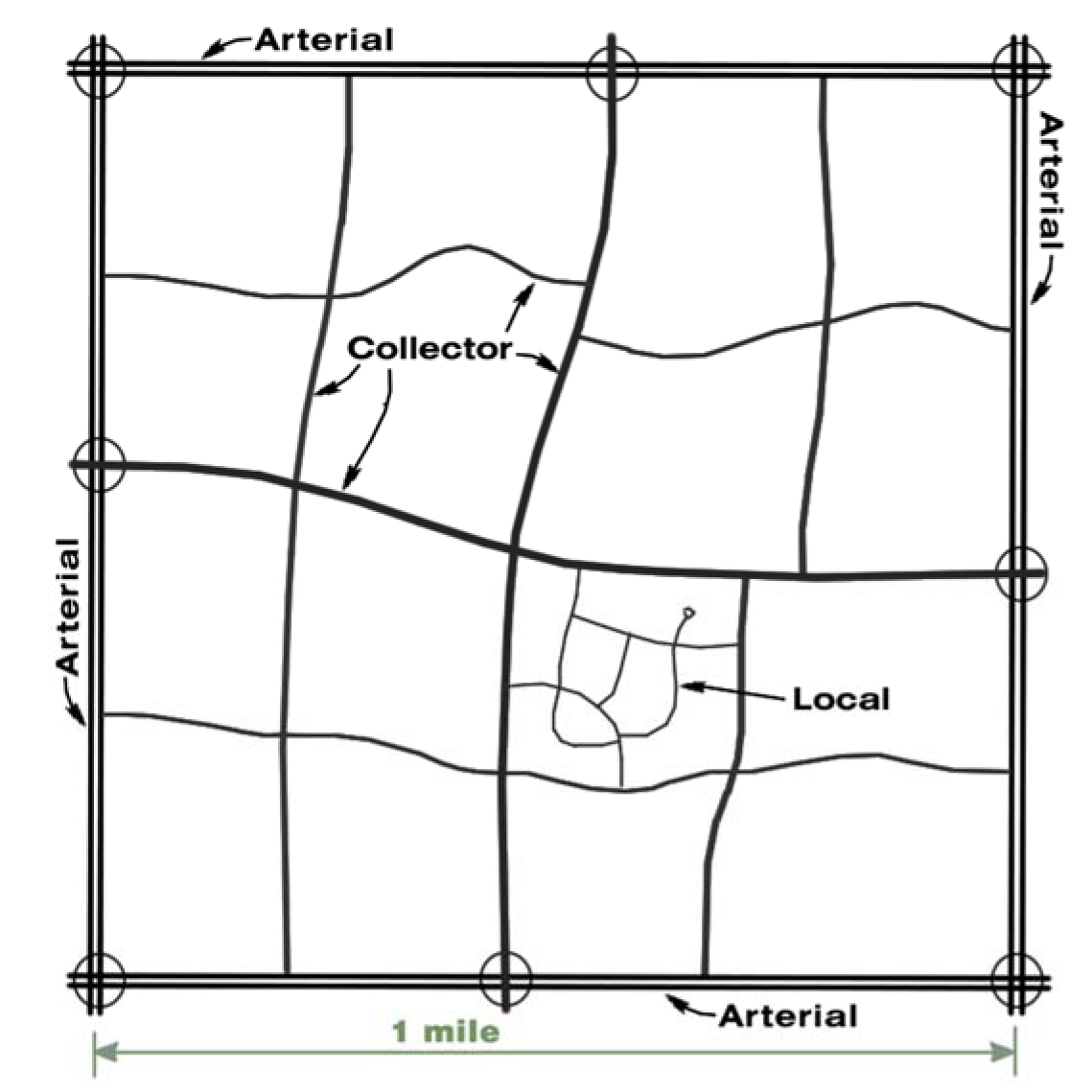
Diagram A Concept of Roadway Network at One-Mile section scale
c.
Within each approximately 160 acre segment defined by secondary arterials, at least one continuous collector street must connect a major arterial or a major collector, in both the north-south and the east-west directions.
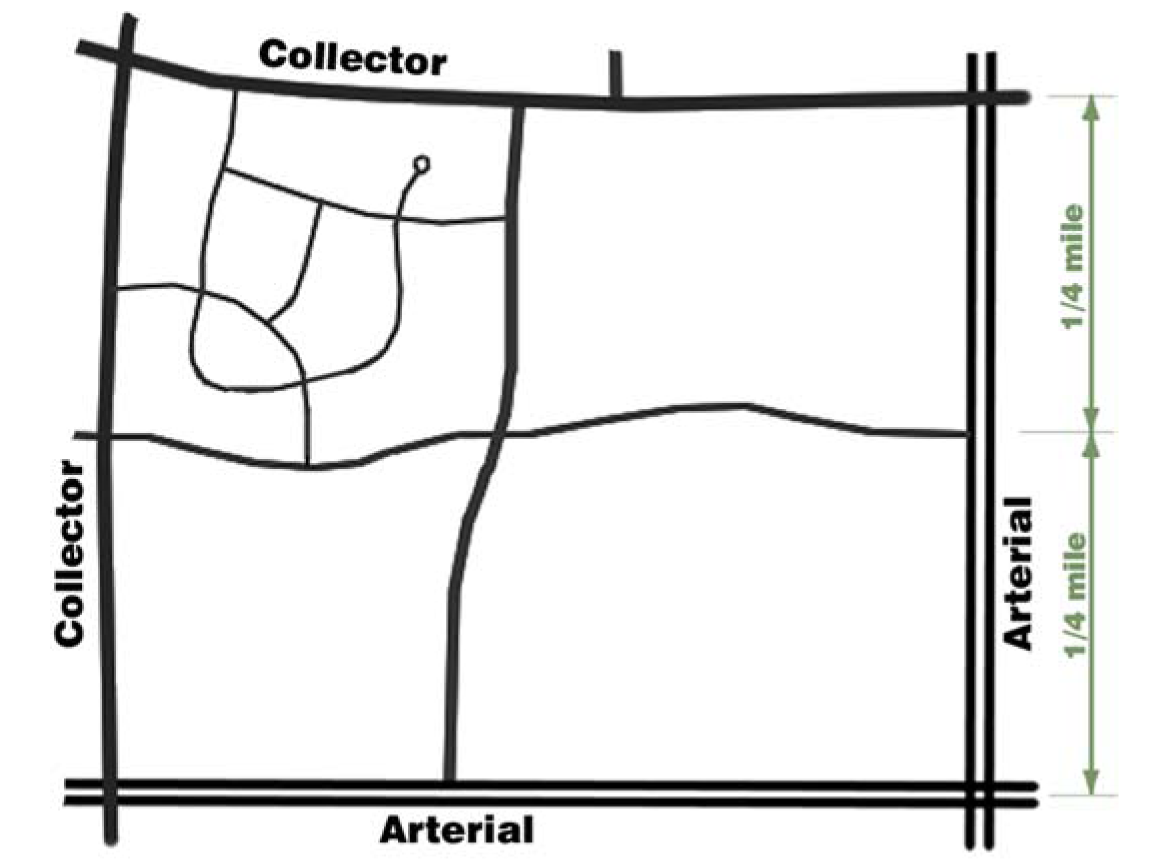
Diagram B Concept of Roadway network at Quarter Section scale
d.
For each approximately 40-acre area generally defined by the collector street network described in subsection 3. above, at least one local street or connection giving access to its interior shall be provided on every perimeter street of the area unless prevented by a geologic or topographic obstacle. Local streets shall connect across collector streets to the degree practicable.
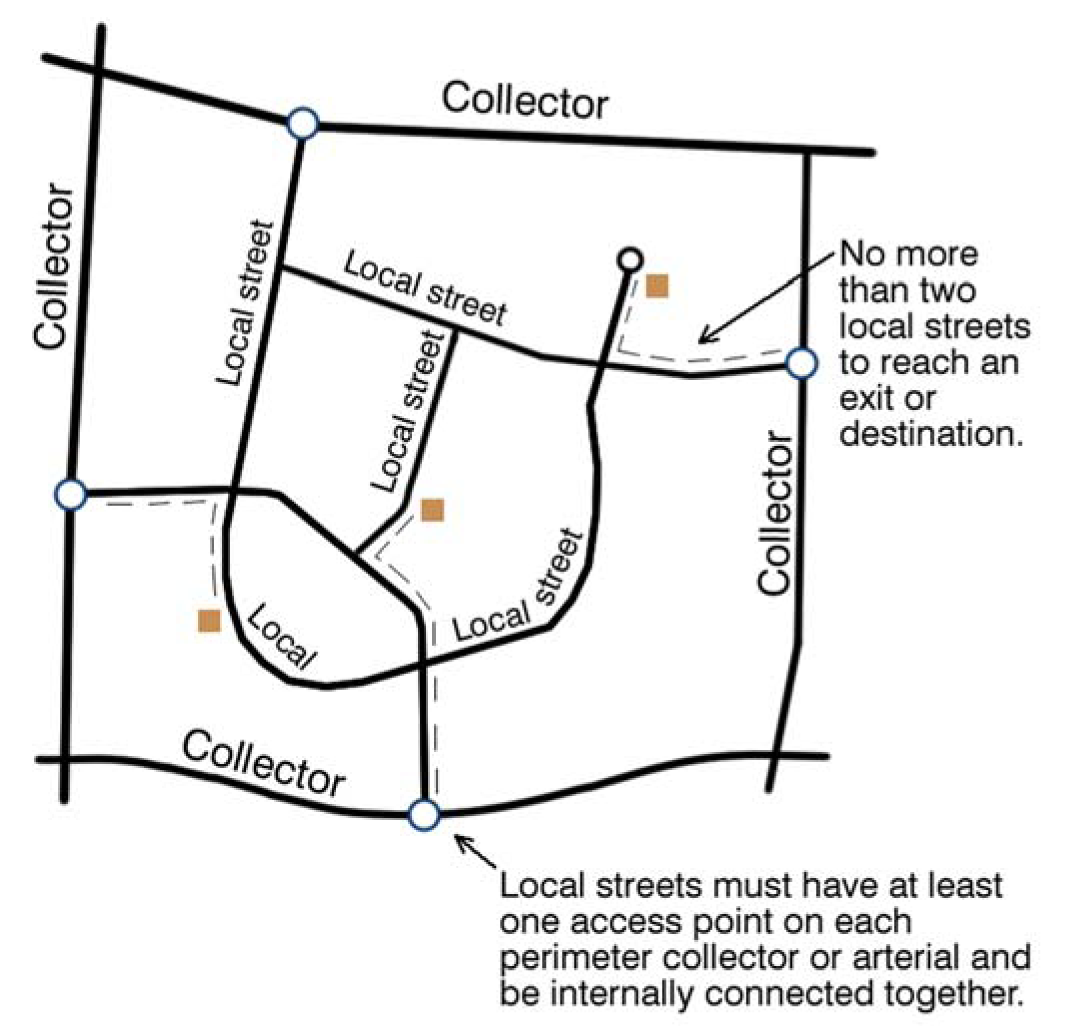
Diagram C Concept of Roadway Network at 40-acre scale
e.
Emergency vehicles must not have to use more than two different local streets (any street other than a primary arterial, a secondary arterial or a collector street) to reach their destination.
f.
Access from primary and secondary arterials. Lots shall not, in general, derive direct access exclusively from a primary or secondary arterial. If the area proposed to be platted abuts upon or contains an existing or proposed arterial, the street plan must limit direct access to the arterial to one access point per 500 feet of frontage along the arterial; vehicular access must be provided to each lot abutting the arterial by a combined interior access drive easement; or a marginal access street (the marginal access street and the thoroughfare must be separated from one another by a landscaped median of land at least 15 feet in width).
2.
In the Compact Context Area.
a.
The existing street grid shall be continued through each development to the degree practicable unless the Administrator determines that extension of the street grid is not practicable due to site, utility, or topography constraints or that the extension would compromise public health or safety.
b.
Where the existing street grid cannot be extended through a development parcel for reasons stated in subsection 1., the development parcel shall incorporate streets north-south and east-west access through the parcel on approximately a one-eighth mile spacing. The resulting streets shall align with streets of the same classification across parcel perimeter streets unless the Administrator determines that alignment is not practicable due to site, utility, or topography constraints or that the alignment would compromise public health or safety.
c.
Emergency vehicles must not have to use more than two different local streets (any street other than a primary arterial, a secondary arterial or a collector street) to reach their destination.
3.
Additional connection requirements.
a.
Each major subdivision that constructs or proposes a new street shall provide for at least one street connection to each adjacent subdivision or future adjacent subdivision.
b.
Each nonresidential subdivision shall provide for vehicle connections to each adjacent subdivision or future adjacent subdivision.
c.
All existing or platted streets that terminate at the property boundary line of a proposed subdivision shall be continued into the proposed subdivision to provide street connections to adjoining lands and streets within the proposed subdivision, provided, however, that internal local streets may terminate in a cul-de-sac if the Plat Committee determines that an existing environmental feature severely limits or inhibits connectivity.
d.
Permanently dead-ended streets and alleys, except for cul-de-sac streets, are prohibited.
e.
Streets longer than one lot that terminate at the property boundary line of undeveloped land shall provide an improved temporary turnaround. The right-of-way of a temporarily dead-ended street shall extend to the property line of the plat. An adequate easement for a turnaround shall be provided with a temporary cul-de-sac provided. A notation on the plat shall state that land outside the normal street right-of-way shall revert to abutting property owners when the street is continued.
f.
Subdivisions proposing 30 or more lots shall have more than one access to the existing street network. Subdivisions that propose access to the existing street network by a single outlet shall provide a landscaped median at the intersection of the existing street dividing the two directions of traffic, with the median extending back to the next intersecting street.
g.
Streets entering opposite sides of another street shall be laid out either directly opposite one another or with a minimum offset of 125 feet between their centerlines.
h.
Whenever cul-de-sac streets are created, a 15-foot wide pedestrian access/public utility easement shall be provided between the cul-de-sac head or street turnaround and the sidewalk system of the closest adjacent street or pedestrian sidewalk or pathway, unless the Administrator determines that public access in that location is not practicable due to site, utility or topography constraints.
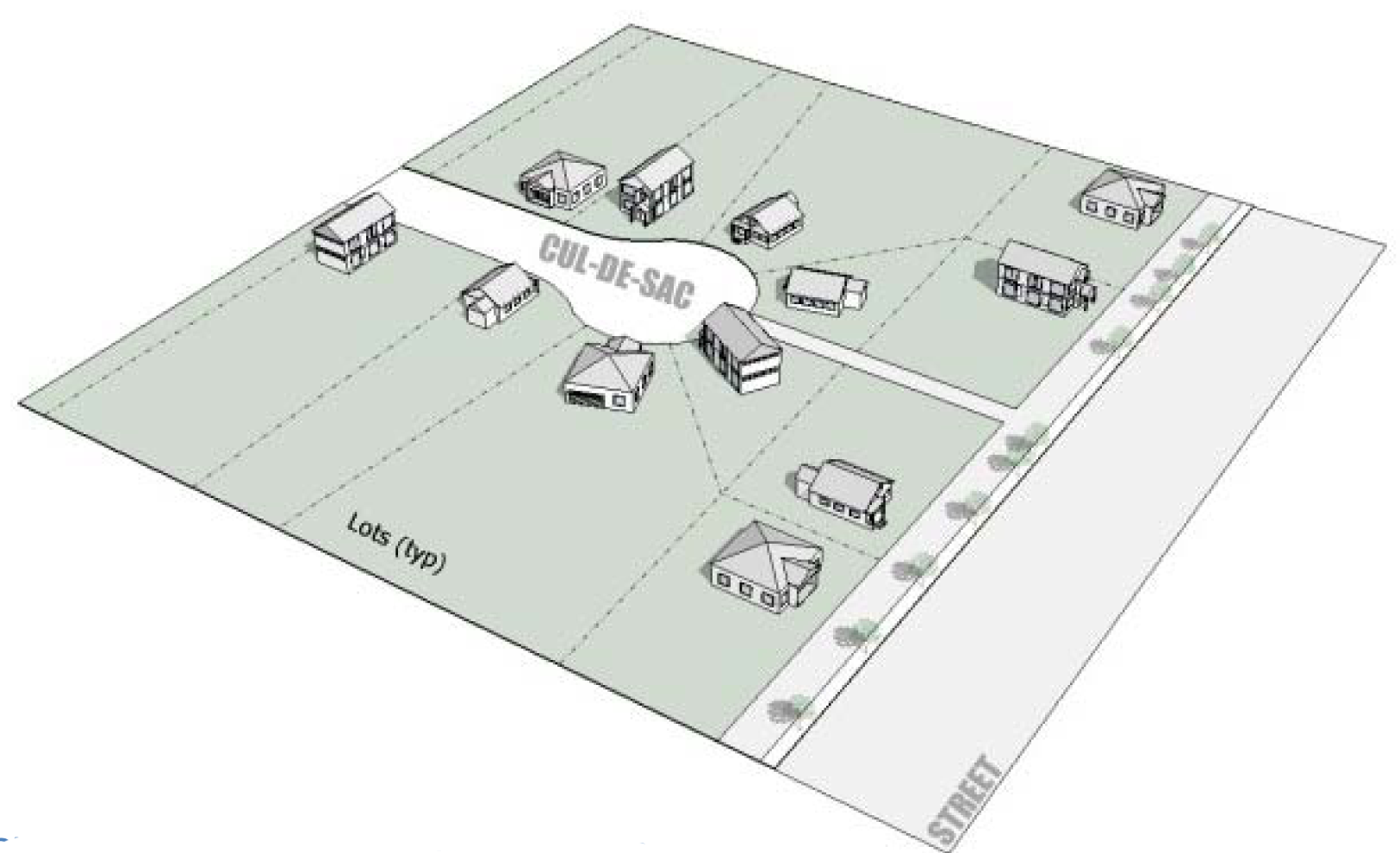
Diagram D Pedestrian access at end of cul-de-sac
C.
Cross-section and right-of-way. All subdivisions shall provide right-of-way and cross-sections in accordance with the Official Thoroughfare Plan. If the Official Thoroughfare Plan does not indicate the street, the cross-section standards in Table 741-303-1: Minimum Street Cross-Section Standards shall be provided.
D.
Cul-de-sacs.
1.
In the Metro Context Area, cul-de-sac lengths shall not exceed 500 feet or serve more than 20 dwelling units. In the Compact Context Area, cul-de-sac lengths shall not exceed 300 feet or serve more than 20 dwelling units. A cul-de-sac's length shall be measured from the center point of the cul-de-sac bulb or turn-around to the centerline of the right-of-way of the nearest intersecting through street.
2.
Maximum cul-de-sac length may be increased by an additional 50 feet up to a maximum of 550 feet if the Committee determines that it is impractical to connect the street to another street or to provide a looped street or other means of access that would avoid the cul-de-sac or allow the cul-de-sac to meet the length limit because:
a.
The area is separated from other parts of the subdivision or a possible street connection by floodways, jurisdictional wetlands, or steep slopes greater than 10% or other natural resource areas; and
b.
Other properties adjoining the area have already been subdivided or developed in a manner that precludes connecting the cul-de-sac to an existing or proposed street.
E.
Alleys.
1.
Alleys shall be provided in Commercial and Industrial Districts in the Compact Context Area. However, this requirement may be waived if the Committee determines that the existing alley and street network will not be disrupted, and other assured provisions are made for service access, off-street loading and unloading, and parking spaces consistent with and adequate for the uses proposed.
2.
In the Compact Context Area, alleys in Dwelling and Mixed-Use Districts must be installed or retained if alleys exist on any block adjacent to the proposed plat.
3.
In Dwelling Districts, alleys may intersect; however, the intersecting alleys may not result in a hammer head ("T") or an ell ("L") shaped intersection.
4.
Alleys that serve dock areas shall be designed with adequate turnaround facilities with a hammer head ("T") or an ell ("L") shaped turnaround provided.
F.
Installation and construction of streets and alleys.
1.
The finished elevation for all streets shall be at or above the base flood elevation.
2.
Public streets. All streets that are to be dedicated to, and accepted for maintenance by, the applicable municipality shall be graded, constructed and surfaced in accordance with these regulations, the Standards for Street and Bridge Design and Construction (Standards for Acceptance of Streets and Bridges; G.O. 49, 1972 of the City-County Council of Indianapolis and Marion County, Indiana) and Chapter 691 of the Revised Code of the Consolidated City and County, both documents are incorporated into these regulations by reference.
3.
Private streets. All development that is allowed the use of private streets (streets that are not be dedicated to or accepted for maintenance by the applicable municipality), through the grant or approval of an appropriate land use petition, shall comply with the minimum standards set forth in Chapter 744, Article III Access and Connectivity relative to the design and construction of private streets.
4.
Alleys. All alleys shall be graded, constructed and surfaced in accordance with Section 691-104.
(G.O. 64, 2015, § 2)
Sec. 741-304. - Traffic control devices.
A.
Street signs.
1.
All street signs shall be designed and built to the standards in the Indiana Manual on Uniform Traffic Control Devices (IMUTCD) and Chapter 691 of the Revised Code of the Consolidated City and County.
2.
Street signs for the subdivision shall be provided in accordance with the Traffic Control Plan. At least the following signs shall be provided:
a.
Street name signs on the northeast corner of each street intersection, and at any juncture at which the name of the street changes.
b.
Stop signs at any intersection of streets that are of differing street classifications.
c.
Speed limit signs displaying the limit established by law located within the subdivision and within 125 feet of the entrance/exit of the subdivision.
d.
Bicycle route signs and selective exclusion signs along any designated bike route, if the subdivision adjoins or creates a bicycle or multipurpose path as identified on the regional bikeways plan, or if the subdivision provides bicycle routes or multipurpose paths.
B.
Traffic calming devices. Local streets and collector streets in residential subdivisions that exceed 900 feet in length shall include traffic calming devices as described in Recommended Practices for Traffic Calming in Subdivisions, as adopted by the Commission.
C.
Bicycle facilities. For residential subdivisions in which a collector street will serve more than 100 dwelling units, bicycle facilities shall be provided for connection throughout the subdivision. Such facilities may be in the form of an on-street bike lane, or an off-street multi-purpose pathway, or a combination of those types of facilities, and may include bike parking at common or public use spaces. Facilities shall be designed and built to the standards in the Indiana Manual on Uniform Traffic Control Devices (IMUTCD).
(G.O. 64, 2015, § 2)
Sec. 741-305. - Numbering and naming.
A.
In accordance with IC 36-7-4-405 and Chapter 431, Article III of the Revised Code of the Consolidated City and County, street numbers must be approved and assigned in accordance with the addressing guidelines and standards adopted by the Commission. Street names must be recommended for approval in accordance with the addressing guidelines and standards.
B.
Streets that are extensions or continuation of, or obviously in alignment with, any existing streets, either constructed or appearing on any validly recorded plat or survey, or valid plat previously approved by the Commission, must bear the names of such existing streets.
(G.O. 64, 2015, § 2)
Sec. 741-306. - Sidewalks.
Sidewalks shall be provided along both sides of all streets internal to the subdivision, as well as along any existing or proposed perimeter streets that border the subdivision. Sidewalks and other pedestrian facilities shall be provided in accordance with the requirements of Chapter 744, Article III (Access and Connectivity).
(G.O. 64, 2015, § 2)
Sec. 741-307. - Easements.
All easements shall be indicated on the plat indicating the dimension and purpose. Easements are not required to be exclusive.
A.
Utility easements. Generally, utility easements shall be located along a lot line. If the lot line is common to more than one lot, then the easement shall be located along both sides of the lot line. The total width of any utility easement, combined or otherwise, shall be a minimum of 10 feet, unless an alternative size is required by the applicable utility or city agency.
B.
Drainage easements. All BMPs and drainage facilities must be located within an easement. The easement must accommodate adequate access for maintenance.
C.
Pedestrian easements. Generally, pedestrian easements shall be 15 feet in width and be considered open to the public unless specifically declared otherwise.
D.
Maintenance easements. Generally, maintenance easements for structures near or on a lot line shall be at least three feet in width and extend along the entire structure that is near or on a lot line. A means of reasonable access shall also be included in the easement.
(G.O. 64, 2015, § 2)
Sec. 741-308. - Utilities.
All utility facilities, including but not limited to gas, electric power, telephone, data transmission lines, and cable television cables, shall be located underground throughout the subdivision in accordance with Chapter 744, Article VIII (Underground Utilities). Underground service connections to the street property line of each platted lot shall be installed at the subdivider's expense.
(G.O. 64, 2015, § 2)
Sec. 741-309. - Stream protection corridors.
All subdivisions must be designed and constructed in accordance with the stream protection corridor requirements of Section 744-205 (Stream Protection Corridors).
(G.O. 64, 2015, § 2)
Sec. 741-310. - Common areas, open space and public sites.
A.
Common area.
1.
Access easements shall be provided to connect all common areas to a public street right-of-way. The minimum width of such access must be at least 15 feet.
2.
In the Metro Context Area, whenever a common area for a major subdivision perimeter abuts a secondary or primary arterial, the width of that common area must be a minimum of 15 feet along and paralleling the arterial that the common area abuts.
B.
Open space common area.
1.
Any residential major subdivision with at least 20 dwelling units must minimally provide open space in the form of a multipurpose path, natural landscaping area, and entrance landscaping in accordance with Table 741-310-1: Basic Open Space Components and Minimum Standards for Residential Subdivisions.
2.
Any residential major subdivision with more than 20 dwelling units, an additional open space component shall be provided for every 30 dwelling units (or portion thereof) over the initial 20 dwelling units in accordance with Table 741-310-2: Additional Open Space Components and Minimum Standards for Residential Subdivisions. However within the same subdivision only one sport field component and one swimming pool or water play component may be counted to fulfill this open space common area requirement. Further, the sport field component may only be counted to fulfill this open space common area requirement in the Metro Context Area, and the Plaza component may only be counted to fulfill this open space common area requirement in the Compact Context Area.
3.
Stormwater facilities constructed using low-impact development techniques may be adjacent or abutting or in conjunction with a required open space common area component as indicated in Table 741-310-2, however such facilities shall only be counted with one open space common area component.
C.
Common area for public site. A subdivision may allocate adequate areas for park, school, and other public and semipublic use, wherever necessary in conformity with the comprehensive plan and as required by the Commission. The location, shape, extent and orientation of such areas shall be consistent with existing and proposed topographical and other conditions, including, but not limited to, the park, school, and other public and semipublic needs of the proposed subdivision. Such areas shall be made available by one of the following methods:
1.
Dedication to public use;
2.
Reservation for the use of owners of land contained in the plat, by deed restriction or covenants that specify how and under what circumstances the area or areas shall be developed and maintained; or
3.
The reservation of a public site may be released for private use to the owners of the plat upon filing of a revised secondary plat.
a.
In the event that no governmental unit or regulated utility proceeds with such acquisition within 18 months of the date of the recording of the plat; or
b.
If released by such governmental unit or regulated utility prior to the expiration of the 18-month period; and
c.
The primary plat indicated two options for development and the Committee approved both options.
(G.O. 64, 2015, § 2)
Sec. 741-311. - Stormwater.
A.
Stormwater drainage facilities are to be designed and constructed to meet the stormwater quality and quantity standards established in the Stormwater Design and Construction Specifications Manual. The drainage facilities in the excluded cities of Lawrence, Speedway, and Southport are to be designed and constructed to meet the standards established for each of these jurisdictions.
B.
Major subdivisions in the Metro Context Area shall meet the stormwater quality and quantity standards using low-impact development techniques. However, residential subdivisions shall not use sand filters as a BMP.
C.
For projects where LID techniques are technically infeasible to meet stormwater quantity standards, the applicant shall provide a justification demonstrating why the use of LID techniques is not possible. Documentation of technical infeasibility shall include engineering calculations, geologic reports, hydrologic analyses, and site maps. In such case, LID stormwater management techniques shall still be used to meet water quality standards.
D.
All BMPs must be located within an easement. The easement must include access to the BMP for maintenance. The purpose of each easement shall be specified in the maintenance agreement. A copy of the easement should be included in the BMP operations and maintenance manual required by the Stormwater Design and Construction Specifications Manual.
E.
Maintenance improvements. Facilities providing for the proper on-going maintenance of any stormwater drainage facility shall be provided. Signs indicating no-mow areas, fence demarcating boundaries of natural areas, species and informational markers, and grate markings are examples of such improvements.
F.
The responsibility of maintenance of stormwater facilities shall be as set forth by Section 561-21. "Maintenance of drainage facilities" of the Revised Code of the Consolidated City and County. Maintenance access shall be provided to stormwater facility as set forth to assure continuous operational capacity of the stormwater facility. Inspections and maintenance is the responsibility of the owner. Specific guidelines for maintenance can be found in the Stormwater Design and Construction Specifications Manual Chapter 100 Policy and Procedures and Chapter 700 Stormwater Quality.
G.
Erosion control provisions shall be provided in accordance with Chapter 561 of the Revised Code of the Consolidated City and County and Chapter 600 Erosion and Sediment Control of Stormwater Design and Construction Specifications Manual.
(G.O. 64, 2015, § 2; G.O. 17, 2022, § 1; G.O. 33, 2023, § 12)
Sec. 741-312. - Monuments.
A.
Permanent reference monuments shall be placed in the subdivision by a Professional Surveyor. Where no existing permanent monuments are found, monuments must be installed no more than 600 feet apart in any straight line and in accordance with the schedule in Table 741-312-1.
B.
Monuments shall be a five-eighths inch or larger diameter metal rod having a metal cap on top showing either the responsible professional surveyor's surname and professional license number or the Indiana firm/agency's identification number in accordance with 865 IAC 1-12-18. Monuments for street centerline demarcation shall be a length equal to or greater of the thickness of the pavement. Other required monuments shall be a length of at least 36 inches.
C.
Each monument shall be installed so the cross mark shall coincide with the point being marked, set flush with grade level, detectable by a magnetic locator, and installed in such a manner that they will not be dislodged or removed by frost heave.
D.
The retracement survey of the parent tract containing the proposed subdivision, or of that part of such tract controlling the location thereof, shall be executed and recorded in the office of the Marion County Recorder before the secondary plat is submitted to the Commission for approval in accordance with 865 IAC 1-12.
E.
All required monuments that are installed subsequent to plat recordation shall be set by a professional surveyor in compliance with these regulations, the recorded subdivision plat, and the monumentation shown on the previously recorded retracement survey (of the tract containing such plat). The location and detailed description of and reference ties to such subsequent monuments shall be shown on a copy of the recorded plat. Such copy shall be newly certified regarding such monuments by the professional surveyor, recorded in the office of the Marion County Recorder, and cross-referenced to the original plat. The new certificate regarding these monuments set after plat recordation shall be affixed with the Registrant's Seal and shall read as follows:
"I, the undersigned Indiana Land Surveyor, hereby certify that the new survey monuments shown on this copy of the previously recorded plat herein were set by me subsequent to the recordation of said plat in accordance with Chapter 741 of the Revised Code of the City of Indianapolis and Marion County, Indiana.
Dated: _______
Signed (name): _______
PLS Registration No. _______"
(G.O. 64, 2015, § 2)
Sec. 741-313. - Flood control.
A.
All development shall comply with all provisions of Section 742-203 (Flood Control Zoning District).
B.
Floodway and Floodway Fringe zones shall be delineated and labeled on the primary plat and the plat to be recorded.
C.
For Zone AE areas, the plat must show the BFE topographic line.
D.
For Zone A areas, the plat must show the delineation study with the floodway and floodway fringe lines shown on the FIRM maps.
(G.O. 64, 2015, § 2)
Sec. 741-314. - Water supply system.
A.
Subdivisions in the Compact Context Area shall be connected to a public water supply system in accordance with the "Standard Practice and Engineering Requirements for the Installation of Water Mains, Service Lines, Meters and Appurtenances" as maintained by Citizens Energy Group or its successors or assigns as owner or operator of the water supply system.
B.
All public and semipublic water supply systems shall be designed and constructed to the standards of the applicable water utility serving the site. In the case where private wells are permitted by the applicable Zoning District, or through a variance grant or grant of an approval petition, such systems shall be designed and constructed to the standards of the Marion County Public Health Department and the Indiana State Board of Health.
(G.O. 64, 2015, § 2)
Sec. 741-315. - Sewage disposal system.
A.
Subdivisions in the Compact Context Area shall be connected to public or semipublic sanitary sewer facilities.
B.
Subdivisions located within a Flood Control Zoning District or a Wellfield Protection District shall be connected to public or semipublic sanitary sewer facilities.
C.
All sewage disposal systems are to be designed and constructed to the "Indianapolis Sanitary District Standards" current edition as maintained by Citizens Energy Group or its successors or assigns as owner or operator of the sanitary sewer system. In the instance where septic systems are permitted by the applicable Code, or through a variance grant, or grant of an approval petition, such systems shall be reviewed and approved by and designed and constructed to the standards of the Marion County Public Health Department, and the Indiana State Board of Health.
(G.O. 64, 2015, § 2)
Sec. 741-316. - Street lighting.
All subdivisions must be designed and constructed in accordance with the street lighting requirements of Chapter 744, Article VI (Street and Exterior Lighting).
(G.O. 64, 2015, § 2)
Sec. 741-501. - General requirements.
A.
Engineers' "certificates of error" or "certificates of correction," reciting and correcting subsequently discovered engineering or surveying errors of measurements or typographical errors in recording plats, replats, or vacations, shall not be required to follow the procedures outlined in Article II of these regulations but shall require approval by the Administrator prior to the recording of such corrections.
B.
A platted lot may be combined with another platted lot or a portion of a platted lot or an unplatted parcel and not be required to follow the procedures outlined in Article II of these regulations but shall require approval by the Administrator prior to the recording of such newly created land combination provided the following:
1.
The resulting land combination creates only one developable lot.
2.
A survey of the land combination is recorded.
3.
All land covered by the survey is owned by the same person or persons.
4.
The owner requests in writing that the land combination constitutes one lot for tax parcel purposes.
5.
All easements and other encumbrances for the individual lots and land shall remain intact and valid upon the land combination.
(G.O. 64, 2015, § 2)
Sec. 741-601. - Vacation of plats or parts of plats.
A.
The owner or owners of lots in any approved subdivision may petition the Committee to vacate the plat or part of the plat with respect to their properties.
B.
Approval. If, after the public hearing, the Committee determines that the plat or part of the plat should be vacated, the Committee shall make written findings per the statutory criteria that set forth its reasons in a decision approving the petition. The Committee may impose reasonable conditions as a part of its approval. The decision shall be signed by the Administrator. The Committee shall further furnish a copy of its decision to the Marion County Recorder for recording.
C.
Disapproval. If, after the public hearing, the Committee disapproves the petition for vacation, it shall make written findings per the statutory criteria that set forth its reasons in a decision denying the petition and shall provide the applicant with a copy. The decision shall be signed by the Administrator.
D.
Recourse/Appeal (IC-36-7-4-712 and IC-36-7-4-708). The approval, disapproval or imposition of a condition on the approval of the vacation of all or part of a plat is a final decision of the Committee. The applicant or an aggrieved party may appeal by following the procedures set forth in the Rules of Procedure.
E.
Upon approval of any petition for vacation of any part of a plat less than the entire plat, the applicant shall provide a revised secondary subdivision plat of the remaining portions of the plat in accordance with these regulations and the Committee's decision and any conditions. The revised secondary plat may be recorded only after having been signed by the Administrator in accordance with these regulations and IC 36-7-4-710.
F.
Failure to provide and record a revised secondary plat as required by subsection E. within two years after the date of the Committee's decision of approval, shall result in the decision of approval becoming invalid and shall not be entitled to recording without reapproval by the Committee.
(G.O. 64, 2015, § 2)
Sec. 741-602. - Vacation of easements or public places.
In addition to the specifications for documents to be submitted in the vacation of easement, or public place or parts thereof prescribed by rule, the following documents shall also be provided:
A.
A list of the names, addresses and known contact information of all parties to whom the easement or part thereof to be vacated runs in favor of.
B.
Consent of all parties to whom the easement or part thereof to be vacated runs in favor of.
C.
A list of the names, addresses and known contact information of all owners of property abutting the easement, or public place or part thereof to be vacated.
D.
Documentation indicating that all owners of property abutting the easement or public place or part thereof to be vacated have been notified by first-class mail and certified mail what is intended to be vacated.
E.
Legal description or survey of the area to be vacated or other drawing suitable for recording. The number of copies of this document required shall be as prescribed by the Committee.
(G.O. 64, 2015, § 2)
Sec. 741-603. - Vacation of public ways.
A.
In addition to the specifications for documents to be submitted in the vacation of public ways or parts thereof prescribed by rule, the following documents shall also be provided:
1.
A list of the names and addresses of all owners of property abutting the public way or part thereof to be vacated.
2.
Consent of all owners of property abutting the public way, easement, or public place or part thereof to be vacated.
3.
Legal description or survey of the area to be vacated or other drawing suitable for recording. For street vacations, and alley right-of-way vacations, subterranean and air rights vacations, an original or retracement survey shall be completed by a professional surveyor. The number of copies of this document required shall be as prescribed by the Committee.
B.
Prior to the vacation of any thoroughfare, as noted in the Official Thoroughfare Plan for Marion County, Indiana, the Commission shall consider and adopt an amendment as necessary to remove such thoroughfare from the Official Thoroughfare Plan.
(G.O. 64, 2015, § 2)
Sec. 741-701. - Enforcement covenant.
"Metropolitan Development Commission: The Metropolitan Development Commission, its successors and assigns shall have no right, power or authority to enforce any covenants, restrictions or other limitations contained herein other than those covenants, restrictions or limitations that expressly run in favor of the Metropolitan Development Commission; provided that nothing herein shall be construed to prevent the Metropolitan Development Commission from enforcing any provision of this article, or any conditions attached to approval of this plat by the Plat Committee."
(G.O. 64, 2015, § 2)
Sec. 741-702. - Sight distance covenant.
"Sight obstruction: No fence, wall, hedge or shrub planting that obstructs sight lines at elevations between two and one-half (2.5) and nine (9) feet above the street shall be placed or permitted to remain on any corner lot within the triangular area formed by the street right-of-way lines and a line connecting points 25 feet from the intersection of such street right-of-way lines, or in the case of a rounded property corner, from the intersection of the street right-of-way lines extended. The same sight line limitations shall apply to any lot within 10 feet from the intersection of a street right-of-way line with the edge of the driveway pavement or alley line. No tree shall be permitted to remain within such distances of such intersections unless the foliage is maintained at a sufficient height to prevent obstruction of the sight lines."
(G.O. 64, 2015, § 2)
Sec. 741-703. - Storm drainage covenant.
"It shall be the responsibility of the owner of any lot or parcel of land within the area of this plat to comply at all times with the provisions of the drainage plan as approved for this plat by the City of Indianapolis and the requirements of all drainage permits issued for this plat."
(G.O. 64, 2015, § 2)
Sec. 741-704. - Sanitary sewer covenant.
"It shall be the responsibility of the owner of any lot or parcel of land within the area of this plat to comply at all times with the provisions of the sanitary sewer construction approved by the municipality and the requirements of all sanitary sewer construction permits issued for this plat. Owner further covenants that no building, structure, tree or other obstruction shall be erected, maintained, or allowed to continue on the portion of the owner's real estate in which the easement is granted without express written permission, that is then duly recorded, and shall run with the real estate. The municipality and its agents shall have the right to ingress and egress, for temporary periods only, over the owner's real estate adjoining such easement and right-of-way, when necessary to construct, repair or maintain sanitary sewer facilities."
(G.O. 64, 2015, § 2)
Sec. 741-705. - Stormwater best management practices covenant.
This subdivision has been designed to include stormwater quality and/or quantity stormwater facilities that must be inspected and maintained by the owner. An Operations and Maintenance Manual is available for the stormwater facilities. Upon activation of the homeowner's association, it shall be the responsibility in perpetuity of the homeowner's association and the individual owners of any lot or parcel of land within the area of this plat, jointly and separately, to comply with the Operations and Maintenance Manual, fees and inspection and maintenance requirements.
(G.O. 64, 2015, § 2; G.O. 17, 2022, § 2)

