North Kingstown City Zoning Code
ARTICLE XXIII
TRANSFER OF DEVELOPMENT RIGHTS TDR
Sec. 21-620.- Purpose.
The purposes of this article are as follows:
(1)
To provide developers and property owners the ability to establish, certify, purchase, sell and land development rights;
(2)
To preserve sensitive resource areas such as groundwater reserves, wildlife habitat, agricultural lands, and public access to surface waters;
(3)
To direct development away from sensitive resource areas to places better suited to increased levels of development such as established or proposed mixed use, commercial or residential centers; and
(4)
To direct development to areas served by existing infrastructure such as established roadways, public water supply system, centralized sewer collection system, public transit and other utilities.
(Ord. No. 08-26, § 3, 10-20-2008; Ord. No. 11-02, § 2, 1-10-2011)
Sec. 21-621. - Authority.
A person or party proposing only to determine the development rights and vest those rights in a certificate of development rights shall apply for TDR sending area land development project approval with the planning commission in accordance with section 21-623.
(1)
A person or party purchasing development rights already vested in a certificate of development rights without landing said rights in a receiving area shall record the purchase with the director of planning and receive an updated certificate of development rights reflecting the change in ownership. Parties may purchase all or a portion of the development rights vested in a certificate of development rights.
(2)
At the time of an application qualifying as a major land development project or a major subdivision, an applicant proposing to land development rights shall appear before the planning commission.
(3)
Any sale, conveyance or transfer of development rights shall apply to whole development rights and not fractions thereof. Fractions of development rights remaining after the landing of development rights has occurred shall be extinguished.
(Ord. No. 08-26, § 3, 10-20-2008)
Sec. 21-622. - Applicability.
(1)
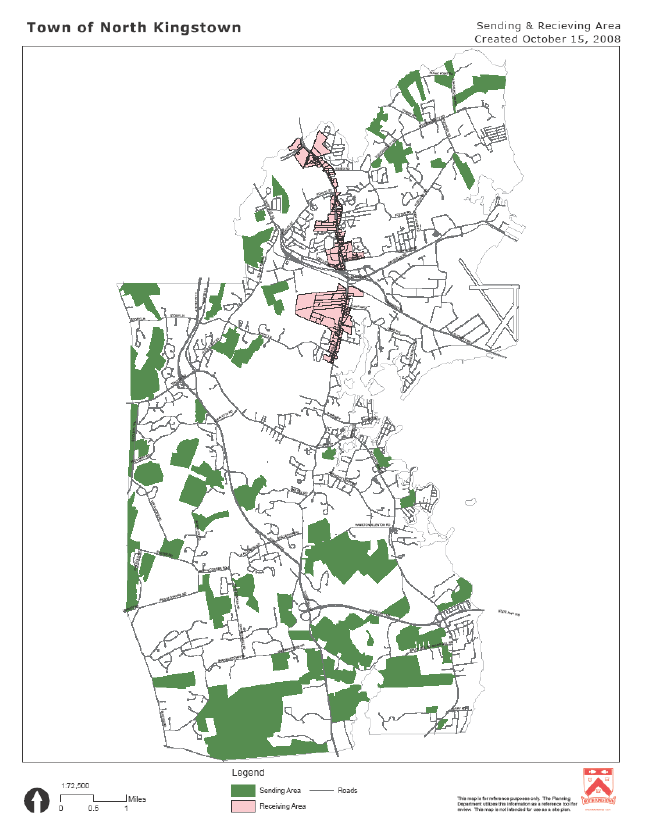
Areas that qualify as sending areas are delineated by the sending area overlay district pursuant to section 21-190 of the zoning ordinance;
(2)
Districts that qualify as potential receiving districts for development rights include:
(a)
Post Road district.
(b)
Compact Village Development District as provided for in section 21-95.
(c)
Wickford Junction District.
(3)
Where a lot is partially contained within either the sending area overlay district or the receiving area district, only the portion of the lot contained in such area may be used for the purposes of establishing or landing development rights respectively.
(Ord. No. 08-26, § 3, 10-20-2008; Ord. No. 11-02, § 3, 1-10-2011; Ord. No. 12-03, § 6, 2-27-2012; Ord. No. 13-19, § 6, 12-9-2013)
Sec. 21-623. - Determining and certifying development rights.
(1)
General. Development rights may be approved by the planning commission as part of a TDR sending area land development project. Master plan approval is required to officially determine the number of development rights associated with a parcel(s) of land and authorize certification from the director of planning.
(2)
Identifying the TDR-parcel. TDR-parcel(s) shall be included in the sending area overlay district pursuant to section 21-190. An applicant may choose to establish development rights for a portion of any tract of land in the sending area overlay district in accordance with the limitations established in the subdivisions and land development regulations.
(3)
Establishing yield. The development rights that may be created on a given parcel of land are determined by either the maximum number of detached single family dwelling units in residential districts or the gross floor area of office space in non-residential districts that could reasonably be expected to be developed on the site as determined by the planning commission. The applicant shall have the burden of proof with regard to the reasonableness and feasibility of the design and engineering specifications for the development plan; provided, however, that the planning commission's determination of the number of development rights, which is based on the review of submitted plans and materials, shall be conclusive. The site yield shall not include the use of any density bonuses or development increases that may be offered elsewhere in the zoning ordinance including, but not limited to, inclusionary zoning or conservation developments. Site plans developed as part of a comprehensive permit application shall not be considered viable yield plans for the purposes of a TDR sending area land development application.
(4)
Submittal requirements. Applicants for a TDR sending area land development project shall be required to submit plans to the planning commission in accordance with the TDR sending area pre-application checklist and TDR sending area master plan checklist in the subdivisions and land development regulations.
(5)
Wetland limitations. Neither the pre-application nor the master plan require field-verified wetlands but, in the absence of field verified wetlands, the applicant shall use digital wetland data layers available from the town to depict the location and extent of on-site wetlands. Where an applicant believes (s)he can provide more accurate data relative to the location and extent of wetland areas, said data shall be developed through field reconnaissance by a qualified wetland biologist and verified through a site visit by the planning commission or its designee.
(6)
On-site wastewater treatment systems (OWTS). For sites that would be served by OWTS, density shall be further determined by evaluating the amount of development that could be supported by these systems. No development shall be shown that would require a variance from the state department of environmental management. The planning commission shall determine the suitability of the parcel for wastewater disposal based on the soils information provided by the applicant, upon observations made during any site visit to the property, and/or other evidence available to the commission at any time during the review process.
(7)
Transferable and retained development rights. Within the initial application for a sending area land development project, applicants may petition for all development rights associated with a TDR-parcel(s) to be transferable or, instead, may petition to retain a portion of their development rights as buildable on that site.
(8)
Area for future landing of retained development rights. Where an applicant proposes to retain development rights, the application for a TDR sending area land development project shall include the delineation of a conceptual building envelope showing the general location where the retained development rights may be constructed.
(a)
The applicant shall bear the burden of proof as to whether the retained development rights can be developed within the designated area. The planning commission shall have the discretion to request further information as is reasonable and necessary to demonstrate the feasibility of future development of retained rights. Information requested by the planning commission shall not exceed those requirements set forth in the sending area land development plan, master plan review checklist.
(b)
Approval by the planning commission of an area for future development of retained development rights by the planning commission in no way guarantees approval of future plan submittals for this site. Additional information and unforeseen circumstances related to the site may further limit the amount of development that can actually occur.
(9)
Criteria for retained development rights for non-agricultural restrictions. In the case of proposed non-agricultural lands, the preserved area shall be contiguous and shall be connected with open space on the subject parcel and adjacent parcels to the greatest extent practicable.
(10)
Criteria for retained development rights for agricultural restrictions. In the case of proposed agricultural lands, the RAV score for the entire site shall not exceed the weighted average RAV score for the proposed retained tract by more than ten percent based on a review of existing soils maps.
(11)
Certificates of development rights. Upon the approval of a master plan, the planning commission shall authorize the issuance of a certificate of development rights from the director of planning barring any appeals during the appropriate appeal period. The director of planning shall not issue any certificates of development rights until the applicant demonstrates that the appropriate deed restrictions have been placed on the subject property. Where an applicant has received approval for both transferable and retained development rights, the planning director shall issue a certificate for each separate set of development rights. Issuance and maintenance of the certificate(s) shall follow the rules and procedures in the subdivisions and land development regulations.
(12)
Vesting of development rights. The original number of development rights vested in a certificate of development rights shall be based on the plans approved by the planning commission as described in this section of the zoning ordinance. Changes to the zoning ordinance or any other federal, state or local regulation that occur after the vesting of those rights shall not increase or decrease the number of rights originally approved by the planning commission, unless state or federal law specifically preempts the town's authority in this matter. Development rights shall be considered viable as long as the easement that was established as part of their approval remains intact. However, development rights are the property of the bearer of the certificate and the town bears no responsibility as to the market value of these rights, the feasibility of landing those rights in a receiving area, or the feasibility of developing any retained development rights.
(13)
In the case of properties in the sending area, as defined in section 21-190, that are located in the Town of Exeter per the memorandum of agreement between the Town of North Kingstown and the Town of Exeter for the "retained ten acre parcel" adopted on December 6, 2010 and December 13, 2010 by the Towns of Exeter and North Kingstown respectively, said property shall receive master plan approval or the equivalent level of approval from the adjacent municipality. A master plan or the equivalent level of approval shall be certified in writing to the town planning commission determining the established yield of buildable lots or commercial square footage in a commercial zone per the zoning designation. The town planning commission will review said approval letter and apply the criteria in this ordinance, specifically article XXIII to determine and certify development rights, to determine the criteria for retaining and landing development rights, and preserving the sending area parcels. A certificate of development rights will be issued by the administrative officer after review by the planning commission and all other rights and requirements of this ordinance and of the subdivisions and land development regulations shall be applicable to said certificates.
(Ord. No. 08-26, § 3, 10-20-2008; Ord. No. 10-06, § 8, 4-26-2010; Ord. No. 11-02, § 4, 1-10-2011)
Sec. 21-624. - Criteria for retaining and landing development rights.
(1)
Future building of retained development rights in the sending area. Once an applicant has received a certificate of retained development rights for a parcel, the rights may only be developed on that parcel, and before construction may commence, the applicant shall submit a new application to the planning commission. The planning commission may combine the master plan and preliminary plan phases of the application process where an applicant proposes to develop fewer than ten (10) development rights. In addition to all applicable zoning ordinance standards and standards within the subdivisions and land development regulations, the planning commission or director of planning and development shall use the following criteria for approving the building of retained development rights:
(a)
The preserved area that was identified as part of the TDR sending area land development application is not encroached upon by the proposed development.
(b)
The location of new structures and impervious surfaces shall preserve on site resources to the maximum extent practicable. These resources may include wetland areas, buffers, habitat, mature forest, soils suitable for agricultural use, historic resources, and scenic vistas.
(c)
Final plan approval shall not be granted until all deed restrictions are in place for designated preservation areas.
(2)
Approved subdivision or land development plans. Any party that has received master, preliminary or final plan approval for a parcel in the sending area overlay district and has not commenced construction may apply to the director of planning and development for a certificate of development rights to convert the approved property yield into transferable and/or retained development rights under the following conditions.
(a)
The approved development plan shall only include single family detached homes in a residential district or office space in a commercial district.
(b)
Where the applicant proposes to retain a portion of the development rights, he or she shall provide a development plan showing the delineation of a conceptual building envelope including the general location of where the retained development rights will be constructed. The applicant shall bear the burden of proof as to whether the retained development rights can be developed within the designated area. The director of planning and development shall have the discretion to request further information as is reasonable and necessary to demonstrate the feasibility of future development of retained rights. Information requested by the director of planning and development shall not exceed those requirements set forth in the sending area land development plan, master plan review checklist.
(c)
Approval of an area for future development of retained development rights by the director of planning and development in no way guarantees approval of future plan submittals for this site. Additional information and unforeseen circumstances related to the site may further limit the amount of development that can actually occur.
(d)
Preserved non-agricultural lands shall be contiguous and shall be connected with open space on the subject parcel and adjacent parcels to the greatest extent practicable.
(e)
In the case of proposed agricultural lands, the RAV score for the entire site shall not exceed the weighted average RAV score for the proposed retained tract by more than ten percent based on a review of existing soils maps.
(f)
Development of any retained development rights shall follow the procedures outlined in subsection (1) of this section.
(3)
Criteria for amending the restrictions associated with retained development rights. The planning commission may allow for amendments to the originally approved plans associated with retained development rights including, but not limited to, the proposed location for future development of those retained development rights only if the proposed amendment:
(a)
Is in the interest of the residents of the town;
(b)
Will not result in any degradation to significant viewsheds;
(c)
Will not result in the degradation of sensitive wildlife habitat;
(d)
Will not result in the degradation of areas in the groundwater recharge and wellhead protection overlay district;
(e)
Will not result in the loss of prime agricultural lands that have historically been used for agricultural activities;
(f)
Will not fragment existing tracts of forested lands; and
(g)
Is consistent with applicable local, state and federal regulations.
(4)
Receiving area bonuses. Once the number of development rights has been approved by the planning commission and certified by the director of planning and development, the development rights may be transferred to a receiving area. The planning commission shall determine the relationship between the number of certified development rights and the receiving area yield according to the transfer of development rights schedule provided in the subdivisions and land development regulations. Applicants may propose to use density bonuses exclusively for additional residential or commercial development or for a combination of the two uses. The maximum density bonuses allowable for receiving areas are listed in the provisions for each receiving area zoning district as applicable (e.g., Post Road district, etc.).
(5)
Units in the receiving area that require TDR. The number of units that require a development right transfer shall not include the number of units that may already be allowed by-right, that may already exist on site in a manner that conforms with current building regulations, or any units that may be required to be affordable as defined in section 21-22 and specified in section 21-94.C.(1)(c).
Sample calculation for one acre of land:
Allowable number of units in PR district (receiving area) with TDR = 30 units
Requirements for affordability in PR district utilizing TDRs = 4.5 (rounded to 5) units (15%)
By-right allowance in PR district = 4 units
Number of pre-existing units on site = 2 units
Number of units requiring TDR: 30 - 5 - 4 - 2 = 19 units
(Ord. No. 10-06, § 9, 4-26-2010; Ord. No. 11-02, § 5, 1-10-2011)
Sec. 21-625. - Preserving sending area parcels.
(1)
Existing agricultural lands. Lands identified for preservation in the sending area that are in agricultural production or are otherwise identified for agricultural activities by the applicant when development rights are purchased may be preserved as conservation lands or for agricultural activities;
(2)
Existing natural lands. Lands identified for preservation in the sending area that are not in agricultural production or otherwise identified for agricultural activities by the applicant when development rights are purchased shall be preserved as conservation areas;
(3)
Restrictions on sending area parcels. Restrictions on sending area parcels shall be recorded as deed restrictions upon approval of a TDR sending area land development application. Conservation or agricultural lands preserved through TDR shall either:
(a)
Remain in private (non-common) ownership if the use is limited to those approved by the planning commission through a binding deed restriction that runs with the land. With agreement of the property owner through the land development or subdivision process, the planning commission may limit the amount of space that remains in private ownership to ensure the protection of natural resources or the maintenance of an established greenway;
(b)
Be conveyed to and accepted by the town for park, open space, agricultural or other permitted use or uses;
(c)
Be conveyed to a nonprofit organization the principal purpose of which is the conservation of open space or resource protection; or
(d)
Be conveyed to a corporation or trust whose principal purpose is the stewardship of said land for uses approved by the planning commission.
(4)
Deed restrictions for non-agricultural lands. All non-agricultural land preserved through the TDR permit process shall be protected in perpetuity against further development and unauthorized alteration by appropriate deed restrictions, and by the grant of a conservation or preservation restriction to the town, pursuant to RIGL 34-39, as amended. In addition, the perpetual maintenance of open space and any authorized uses shall be guaranteed by appropriate deed restrictions and by grant of a conservation or preservation restriction to the town, pursuant to RIGL 34-39, as amended. Every deed restriction shall require approval by the director of planning before any development rights are sold, landed or otherwise extinguished. Every deed restriction shall contain the following provision:
"If the owners, or their successors or assigns fail to maintain conservation lands in accordance with those restrictions placed upon the property, the town may perform any necessary maintenance and enforce the payment for such costs, including reasonable attorneys' fees, by an action at law or in equity against the owners or their successors or assigns."
(5)
Deed restrictions for agricultural lands. All land designated for conservation as agricultural land shall be protected in perpetuity against non-agricultural development and shall allow agricultural use in accordance with this ordinance by appropriate deed restrictions. Said restrictions shall be imposed via conservation restrictions for farming and agricultural uses (pursuant to RIGL Title 34, Chapter 39 as amended) to the state agricultural land preservation commission with the division of agriculture chief acting as advisor (pursuant to the Farmland Preservation Act, RIGL Title 42, Chapter 82 as amended) which shall serve as the principal steward and enforcer for any period of time; and to the town which shall serve as the secondary steward and enforcer. Notwithstanding the foregoing, if the agricultural land preservation commission does not agree or fails to serve as principal steward and enforcer, the planning commission may allow, for such period of time, other non-profit entities to hold various stewardship and enforcement rights to supplement those rights held by the town. Said entities shall have missions dedicated to agricultural preservation and a commitment to continuing allowable agriculture use. Any rules or enforcement enacted by said entity shall be consistent with any applicable rules of the department of environmental management, division of agriculture. No restrictions shall be placed upon the property that would preclude agricultural lands that have been left fallow to be cleared, re-cultivated and returned to an active agricultural operation subject to applicable state laws.
(6)
Allowable uses on conservation lands. Consistent with any applicable local, state or federal regulations, the planning commission shall regulate allowable uses for conservation lands in accordance with the land use table (article III) for the open space and public lands districts, unless specific deed restrictions preclude the allowance of any of those uses. Where a use is allowed by special use permit, the planning commission may approve such use through the TDR sending area land development process.
(7)
Allowable uses on agricultural lands. Consistent with any applicable local, state or federal regulations, the planning commission shall regulate allowable uses for agricultural lands in accordance with the land use table (article III) for the appropriate underlying district on lands preserved for agricultural use. Where a use is allowed by special use permit, the planning commission may approve such use through the TDR sending area land development process.
(Ord. No. 08-26, § 3, 10-20-2008; Ord. No. 10-06, § 10, 4-26-2010)
Editor's note— Ord. No. 10-06, § 10, adopted April 26, 2010, amended the Code by renumbering and amending former § 21-624 as a new § 21-625.
Sec. 21-626. - Procedures for landing development rights in a receiving area.
(1)
General. All applications for landing development rights in a receiving area shall come before the planning commission as a major land development or major subdivision as applicable. At the master plan stage of review, applicants must demonstrate to the planning commission that the bearer of the certificate of development rights is in agreement with the terms of the proposed application and understands the number of development rights that will be extinguished after the landing process is complete. Documentation of this assurance shall be provided in a letter signed by the bearer of the certificate of development rights or his/her representative at the time of the application to land the development rights. In the event that the applicant does not own a certificate of development rights, a letter of understanding between the applicant and a bearer of a certificate of development rights or a property owner eligible to send development rights from their property, shall be presented to the planning commission at the master plan stage of review.
(2)
Materials. In addition to the materials customarily required as part of an application for a major land development or major subdivision, an applicant proposing to land development rights shall submit the appropriate number of copies of his/her certificate of development rights to the planning commission. The validity of these development rights shall be verified by the director of planning or his/her designee during the preliminary or final plan review, as determined by the planning commission.
(3)
Final approval. No building permit or certificate of occupancy shall be issued for development that utilizes the landing of development rights until all necessary deed restrictions are recorded in the land evidence records and said development rights are formally extinguished by the director of planning through the issuance of a revised certificate of development rights.
(Ord. No. 08-26, § 3, 10-20-2008; Ord. No. 10-06, § 11, 4-26-2010)
Editor's note— Ord. No. 10-06, § 11, adopted April 26, 2010, amended the Code by renumbering and amending former § 21-625 as a new § 21-626.
Transfer of Development Rights (TDR) Map