
North Miami Beach City Zoning Code
ARTICLE IX
OFF-STREET PARKING AND LOADING
Sec. 24-91 - Purpose and Intent.
It is the purpose and intent of this article to establish minimum space and design requirements for off-street parking and loading facilities to serve all uses. Vehicles generated from and attracted to residential, commercial and public activities require adequate parking and loading facilities, which permit safe and efficient vehicle and pedestrian movement, and are provided in order to protect the health, safety, and welfare of North Miami Beach.
Sec. 24-92 - Off-Street Parking Requirements.
(A)
General Requirements.
(1)
Timing: Every use or structure shall provide off-street parking facilities for the use of occupants, employees, visitors, or patrons. The provision of off-street parking spaces in conjunction with all land or building uses shall be completed prior to the issuance of a certificate of occupancy and such parking facilities shall be maintained as long as such use is continued.
(2)
Discontinuance: No owner or operator of any use or structure shall discontinue or cause a discontinuance or reduction in required off-street parking facilities required by the applicable Code provisions existing at the time of construction, use or occupancy without establishing alternate parking facilities which meet the requirements of this article.
(3)
Change of use or expansion: Whenever there is a change in the use occupancy or an alteration or enlargement of a structure, the number of off-street parking spaces required shall be calculated according to the Code provisions in effect at the time of the change, alteration or enlargement. The calculation shall be based on the overall dimensions of the existing structure together with the proposed change, use, alteration or enlargement. If additional spaces are required, a revised site plan shall be submitted for review and approval. The requisite spaces shall then be provided.
(4)
Alteration: When any use or structure is altered or enlarged, with a resultant increase in floor area, capacity, or space occupied, whatever necessary additional off-street parking that may be required shall be provided, and a revised site plan shall be submitted for review and approval.
(5)
Change of use: Where a use or structure which existed at the effective date of this article is changed in use or occupancy to a category of use or occupancy that required more off-street parking facilities, the increased amount of those facilities shall be provided.
(B)
Joint and Shared Use Facilities. Under no circumstances shall joint or shared use parking facilities be farther than five hundred (500) feet away from the buildings using these facilities.
(1)
Joint usage: Two (2) or more adjacent structures or uses under the same ownership or management may collectively provide their required off-street parking, provided that the total number of parking spaces provided shall not be less than the sum of the requirements for the several individual uses if computed separately. The reservation or assignment of required off-street parking spaces for use by specific individuals or commercial establishments located within that structure or premise shall not be permitted. This provision shall not prohibit the designation of handicapped or emergency spaces.
(2)
Shared usage: Notwithstanding any other parking requirements set forth in this article for individual land uses, when any land or building is used for two (2) or more distinguishable purposes (as listed in the Shared Parking Credit Table), the minimum total number of parking spaces required to serve the combination of all uses may be determined as follows:
(a)
Multiply the minimum parking requirement for each individual land use (as set forth in the Off-Street Parking Requirement Table) by the appropriate percentage (as set forth in the Shared Parking Table) for each of the five (5) designated time periods.
(b)
Sum all five (5) vertical columns. The column having the highest total value is the minimum shared parking space requirement for that combination of land uses.
(c)
Recordable covenants, with correct legal descriptions, shall be submitted by the owners of the property and the businesses, in a form acceptable to the City Attorney, and those covenants shall be recorded by the City at the applicant's expense, and shall run with the land. These covenants shall provide that the use, or portion of a use, that requires the shared parking in order to obtain the necessary permits or licenses, shall cease and terminate upon any change in their respective schedules of operation that results in conflicting or overlapping usage of the parking facilities. The covenant shall also provide that the City may collect costs and attorney fees if litigation is necessary.
(C)
Restrictions. The storage, sale or repair of merchandise or vehicles or the display of signs or advertising devices on vehicles, structures, or land shall not be permitted in any off-street parking areas, excluding that which is permitted as a mobile vendor. This provision shall not prohibit persons from parking vehicles in such areas that contain information that is required by any applicable laws, ordinances, or regulations, if such information is provided only to the extent and in the manner required by such laws, ordinances, or regulations.
(D)
Location of Parking.
(1)
Residential: Required parking for all residential uses shall be located on the same parcel of property that they are intended to serve.
(2)
New nonresidential: Required parking for all new nonresidential uses shall be located on the same parcel of property that they are intended to serve except where shared use is authorized in accordance with (B) above.
(3)
Existing nonresidential uses: Such uses which need to add spaces to accommodate proposed expansion, may provide for such additional parking on a separate nonresidentially zoned parcel, provided that such parcel shall be located not more than two hundred (200) feet by legal pedestrian route from the use or structure intended to be served, and shall be accessible without the necessity of crossing an arterial street, railroad, or waterway. Said distance shall be measured from the nearest actual remote parking space to the nearest entrance of the structure of the use being served. All parcels used for remote parking purposes shall be joined with the parcel on which the principal use is located by a unity of title declaration, which shall be approved by the City attorney. Those parties having any right, title or interest in and to the parcel being served by the remote parking shall execute and place in the public records of Miami-Dade County, Florida at their expense, a covenant, approved by the City commission, that the nonresidential use, or portion thereof, that requires the remote parking in order to obtain the necessary permits or licenses, shall cease and terminate upon the loss and elimination of the remote parking, and that no nonresidential use may be made of the portion of the property requiring remote parking until the required parking facilities are available and provided. This covenant shall run with the land and be binding on the heirs, successors, assigns and lessees, and shall contain a provision that the City may collect costs and attorney's fees if litigation is necessary to enforce this covenant.
(E)
Two-Family/Three-Family and Four-Family Dwellings.
(1)
Uncovered parking and driveways:
(a)
On-site driveways for two-family, three-family and four-family dwellings in residential districts shall be considered as off-street parking spaces provided sufficient space is available on such driveways to meet the requirements of this article and said driveways are paved with concrete, asphalt, or pavers of brick , or similar material authorized by the Director.
(b)
Parking on the grass is prohibited except parking on the swale.
(c)
Landscape buffer strips.
1.
After October 15, 2000, driveway or sidewalk pavement may not be installed within five (5) feet of an interior side lot line or ten (10) feet of a corner side lot line.
2.
After October 15, 2000, driveway pavement may not be installed within five (5) feet of the wall of any structure located on the property, except for an active carport or garage. In the case of new garage or carport conversions or enclosures permitted and/or constructed after October 15, 2000, the driveway pavement shall be removed from the front of the carport or garage for a minimum distance of five (5) feet and landscaping be installed there.
(2)
Carports: All carports shall have a roof that is adequately maintained.
(3)
[Reserved.]
(F)
Nonresidential Driveways. Adjacent nonresidential uses of less than ten thousand (10,000) square feet of gross floor area shall share on-site driveways to the extent possible.
(G)
Parking of Commercial Vehicles or Commercial Equipment in Residential Areas. It shall be unlawful to park a commercial vehicle or commercial equipment on any lot in a residential zoning district unless one of the following conditions exists:
(1)
The vehicle and/or equipment is engaged in a construction or service operation on the site where it is parked. The vehicle or equipment must be removed as soon as the construction or service activity has been completed.
(2)
The vehicle and/or equipment is parked in a garage or fully enclosed structure and cannot be seen from adjacent properties or the street serving the lot.
(3)
The vehicle is parked in the rear of the main structure and is enclosed within a vegetative screening which conceals the vehicle from the view of neighbors.
(4)
Automobiles; passenger type vans; and pickup trucks having a rate load capacity of one (1) ton or less, all of which do not exceed seven and one-half (7½) feet in height, nor seven (7) feet in width, nor twenty-five (25) feet in length shall be exempted from this section unless otherwise prohibited.
(5)
Exempted from this section is small commercial equipment such as ladders and pipes which cannot be contained in the vehicle. Said equipment shall be secured to the vehicle and shall not extend beyond the length of the vehicle.
(6)
Parking of commercial vehicles or commercial equipment on vacant residential lots is prohibited.
(7)
These exceptions shall not apply in the RS-1 district and all provisions of Section 24-41 of this Code shall remain in full force and effect.
(8)
The restrictions in this section are in addition to and not in place of any and all other parking and/or other restrictions in this Code.
(Ord. No. 92-14, § 2, 7/21/92; Ord. No. 2006-1 § 13, 2/21/06; Ord. No. 2013-6, § 3, 6-18-13; Ord. No. 2024-01, § 4, 3-19-24)
Sec. 24-92.1 - Single-Family Residential Driveway Design Standards.
(A)
Setbacks.
(1)
Side Property Line: Driveway or sidewalk pavement may not be installed within five (5) feet of an interior side lot line or ten (10) feet of a corner side lot line, except in the MH-1 and RS-5 Zoning Districts where the minimum distance shall be three (3) feet from an interior side lot line and five (5) feet from a corner side lot line.
(2)
Structure: Driveway pavement may not be installed within five (5) feet of the wall of any structure located on the property, except for an active carport or garage. In the case of new garage or carport conversions or enclosures the driveway pavement shall be removed from the front of the carport or garage for a minimum distance of five (5) feet and landscaping be installed there.
(3)
Front Property Line: Driveway pavement may not be installed within five (5) feet of a front lot line unless it is connected to the street.
(B)
Size.
(1)
Minimum driveway width of nine (9) feet.
(2)
Minimum driveway depth of eighteen (18) feet.
(3)
Maximum driveway width of twelve (12) feet per parking space, with a total maximum thirty-six (36) feet:
(a)
One car back-out driveway width twelve (12) feet.
(b)
Two car back-out driveway width twenty-four (24) feet.
(c)
Three car back-out driveway width thirty-six (36) feet.
(d)
Semi-circular or arcing driveway width twelve (12) feet.
(C)
Driveway Approach.
(1)
Driveway must be connected to a street or alley by a paved approach.
(2)
No more than two (2) driveway approaches shall be located in the front yard.
(3)
The material of the driveway approach must match the material of the driveway.
(4)
A three (3) foot flare shall be required on each side of the driveway approach at its connection to the street or alley.
(5)
Sidewalks shall be continuous and may not be interrupted by driveways or driveway approaches.
(D)
[Parking on Grass.] Parking on the grass is prohibited except for parking on the swale.
Sec. 24-93 - Parking Lot Design Standards.
(A)
Paving and Drainage.
(1)
All off-street parking lots shall be surfaced with a minimum of a rolled six (6) inch rock base and a one (1) inch durable weatherproof asphaltic pavement. The occupancy or use of a given structure or premises shall be prohibited until the required off-street parking area has been improved, inspected and approved.
(2)
All required off-street parking lots shall be properly drained so that no nuisance will be caused to adjacent or nearby properties. All construction shall comply with design standards as established by all applicable laws, ordinances and regulations.
(B)
Traffic Control. Traffic-control signs and pavement markings shall be used as necessary to insure safe and efficient circulation within off-street parking areas. All traffic control measures shall be approved by the Director and be based upon the Manual on Traffic Control Devices.
(C)
Parking Requirements for the Handicapped.
(1)
Parking space requirement: A minimum of one (1) parking space specifically designated for automobiles occupied by handicapped persons shall be provided for each twenty five (25) spaces up to one hundred (100) spaces and an additional one (1) space shall be provided for each additional one hundred (100) or any part thereof, required parking spaces in all developments of commercial, recreational, institutional, or a community facilities nature regardless of the zoning district in which these uses may occur plus multifamily residential where deemed appropriate at site plan review.
(2)
Parking space design standards: All parking spaces provided for in this section shall be designed in accordance with the following criteria:
(a)
Size: A parking space designated for handicapped persons shall be a minimum of twelve (12) feet in width and eighteen (18) feet in length.
(b)
Location: All spaces provided for in this section shall be located at the closest point to the entrance of the building for which the parking is required and linked with a sixty (60) inch access aisle. One (1) such aisle may serve two (2) spaces.
(c)
Ramp requirement: All spaces provided for in this section shall be accessible by a ramp or curb cut when necessary to allow access to the building served, and shall be located such that users will not be compelled to wheel behind parked vehicles. Ramps for wheelchairs shall also be provided at the entrances and exits of all buildings to facilitate movement from the parking areas; the pitch shall not exceed one (1) in twelve (12).
(d)
Space identification: All parking spaces provided for in this section shall be conspicuously outlined in blue paint and by placing an above-grade sign in front of each space not less than four (4) feet nor more than five (5) feet in height, clearly marked with the international wheelchair symbol or marked "Parking By Disabled Permit Only."
(3)
All state requirements shall also apply with the more restrictive provision applicable.
(D)
Space Dimensions. Required and permitted off-street parking spaces shall have the following minimum dimensions:
(E)
Space Markings. All off-street parking spaces shall be marked by solid stripes of at least four (4) inches in width along each side of the space, excepting those sides which permit vehicle entry or abut curbs.
(F)
Wheel Stops. Wheel stops or continuous curbing shall be placed two (2) feet from the front of all parking spaces, except those in a parallel configuration. Wheel stops shall be at least six (6) feet in width and be of a design and material approved by the Director.
(G)
Illumination. All off-street parking facilities, except those which serve single-family or two-family residential dwellings, shall be illuminated according to the standards contained herein.
(1)
For the purpose herein, open off-street parking facilities shall include the surface of open-to-the-sky parking spaces, driveways and accessways. Enclosed off-street parking facilities shall include multilevel parking garages and covered grade-level parking facilities.
(2)
Intensity of illumination:
(a)
Open parking facilities shall provide an average illumination intensity of one (1) foot candle equal to one (1) lumen per square foot, and shall be well distributed on the pavement areas.
(b)
Enclosed parking facilities shall provide an average illumination intensity of fifty (50) foot candles at the entrance, ten (10) foot candles in traffic lanes and five (5) foot candles in vehicle storage areas.
(c)
The latest edition of the IES Lighting Handbook, published by the Illumination Engineers Society, shall be used as a standard for the design and testing of parking facility lighting.
(3)
All site plans shall include a parking facility illumination plan. That plan shall be certified by a registered architect or registered engineer as providing illumination in accordance with the applicable minimum standards set forth above. Subsequent construction must comply with that lighting plan. If there exists a question concerning whether the work was done in accordance with specifications, the Director may require, as a prerequisite to the issuance of a certificate of occupancy, that the architect or engineer who prepared the plans certify that all work was done in accordance with specifications.
(4)
All required illumination shall be controlled by automatic devices.
(a)
For commercial uses with open or enclosed parking facilities, the required illumination shall be provided at least thirty (30) minutes after the closing time of any establishment served by the parking facility.
(b)
Any parking facility that serves a residential use must maintain the minimum level of illumination established by this article through the use of natural or artificial light twenty-four (24) hours per day.
(5)
All lighting shall be shaded or screened and positioned in such a manner as to minimize offensiveness to any neighboring property.
(6)
All property owners and lessees shall be responsible for the replacement or repair of any light that becomes nonfunctional and reduces the illumination below the required standard.
(H)
Landscaping. All off-street parking facilities shall be designed to include landscaping elements as required in Article XI.
(I)
Right-of-Way Setback. A minimum setback of ten (10) feet shall be required between a public street right-of-way line, exclusive of alleys, and the entrance to the nearest parking space.
(J)
Parking Facility Design Standards. Minimum dimensions for all parking facilities shall be determined by the design angle of spaces as depicted on Figure IX-1
(K)
Back-Out Parking Prohibited. All off-street parking spaces, except those relating to single-family and two-family residential dwellings, shall be designed so that no vehicle shall be required to back into a public street right-of-way, exclusive of alleys, to obtain egress.
(Ord. No. 2023-10, § 2, 3-19-24)
Sec. 24-94 - Site Plan Review Requirements.
(A)
Whenever site plan review is otherwise required in conjunction with a specific use, that review shall satisfy the requirements of this section. Site plans shall include the following:
(1)
All off-street parking facilities shall be designed with consideration given to surrounding street patterns, adjacent properties, and other neighborhood improvements. Consideration shall be given to the number of vehicles to be accommodated, hours of operation, and types of uses served.
(2)
All site plans shall show the location, size, dimensions and design of:
(a)
On-site buildings and structures;
(b)
Parking spaces, loading spaces, driveways and accessways;
(c)
Directional markings, traffic-control devices and signs;
(d)
Walls, fences, pervious areas, berms, changes of grade and planting materials;
(e)
Number of parking spaces required and number provided, amount of landscaping required and amount of landscaping provided;
(f)
Any other related information that may be reasonably required by the Director.
(3)
When off-street parking facilities are located within an enclosed structure or upon the roof of a building, the site plan shall also include interior circulation patterns, slope of ramps, and location of interior structural columns.
Sec. 24-95 - Minimum Space Requirements.
All uses shall be subject to the following minimum space requirements unless additional spaces may be required as a condition for securing a permitted conditional use. All fractional space requirements shall be rounded off to the next highest number. For uses not specified, the Director shall determine the space requirements; a parking study may be required.
(A)
Residential Uses.
(Ord. No. 2008-4 § 2, 3/4/08)
(B)
Commercial and Industrial Uses.
(C)
Community Facilities.
(D)
Supplemental Requirements.
(1)
Off-street parking requirements for those uses not enumerated but which are closely related and similar to the uses listed above shall be determined by the Director in accordance with the requirements for the listed similar use.
(2)
In stadiums, sports arenas, churches and other places of public assembly in which occupants utilize benches, pews or other similar seating arrangements, each eighteen (18) lineal inches of such seating facilities shall be counted as one (1) seat for the purpose of computing off-street parking requirements.
Figure IX-1. Parking Lot Dimensions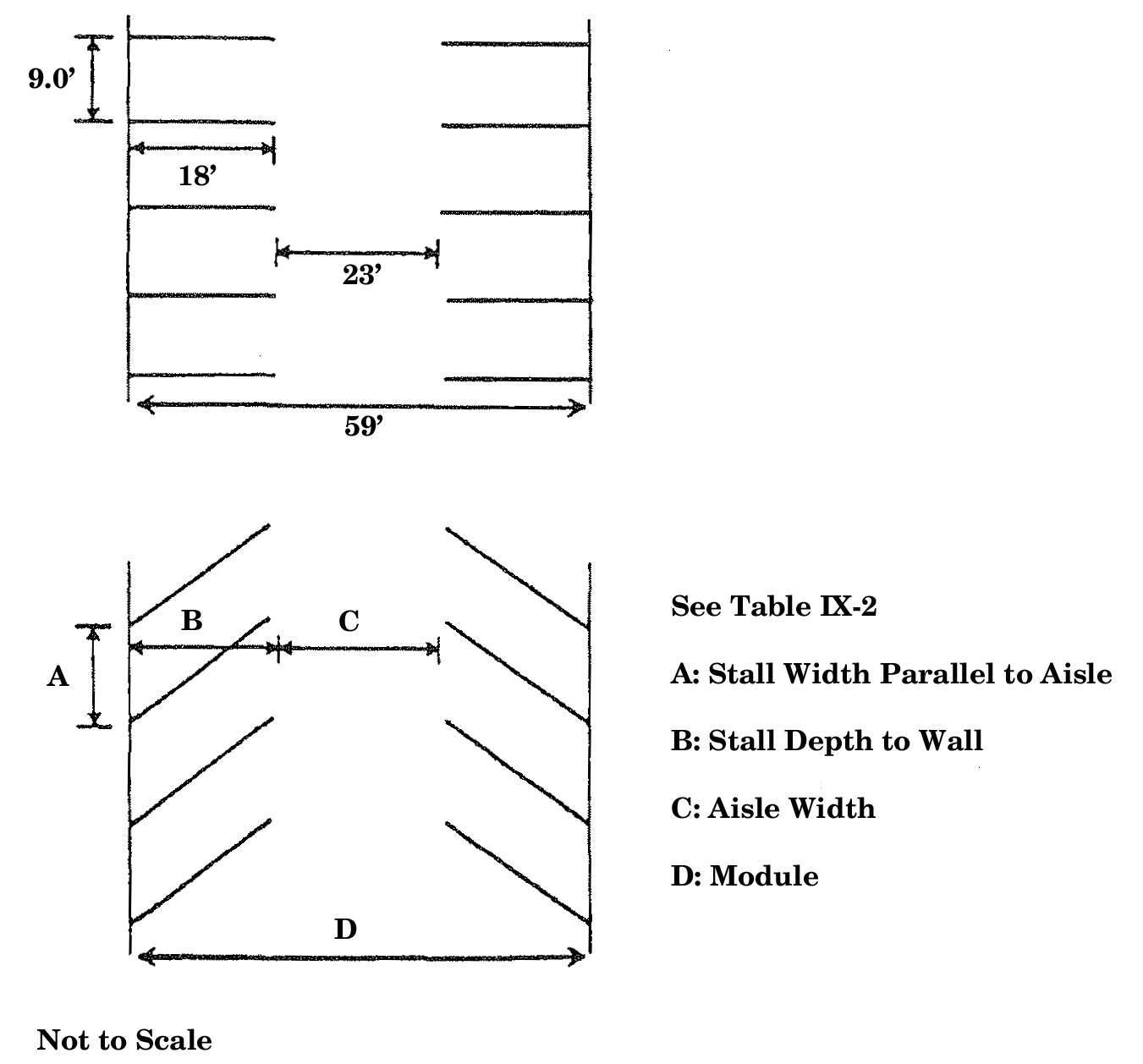
* Two-way aisle
Note: All dimensions in feet.
Letters refer to Figure IX-1
(Ord. No. 2017-12, § 4, 1-16-18)
Sec. 24-96 - Off-Street Loading Requirements.
(A)
General Regulations.
(1)
At the time of the erection of any multifamily use of fifty (50) dwelling units or more, mixed uses, nonresidential use or, at the time any nonresidential use is altered, enlarged or increased in capacity by adding floor area, there shall be space provided and maintained for the loading and unloading of materials, goods, or supplies, and for delivery and shipping so that vehicles for these services may use this space without encroaching on or interfering with the public use of streets, parking facilities and alleys by pedestrians and other vehicles.
(2)
No owner or operator of any structure or use shall discontinue, dispense with, or cause a discontinuance or reduction in required loading facilities required herein and existing at the time of construction, use or occupancy without establishing alternate loading facilities which meet the requirements of this article.
(3)
When any use or structure is modernized, altered or enlarged with a resultant increase in floor area, additional off-street loading spaces that may be required shall be provided, and a revised site plan shall be submitted for review and approval.
(B)
Space Dimensions. An off-street loading space shall include an area of at least twelve (12) feet wide by thirty (30) feet long with fourteen and one-half (14½) feet vertical clearance. Each off-street loading space shall be easily accessible and arranged for convenient and safe ingress and egress by motor truck or trailer combination.
(C)
Joint Usage. Combined or joint off-street loading spaces for two (2) or more uses may be collectively provided if off-street loading facilities are equal in size and capacity to the combined requirements of the several uses and are so located and arranged as to be useable by all.
(D)
Paving and Drainage. Proposed grading and drainage for off-street loading facilities shall be approved by the Director. All loading areas shall be surfaced with a minimum of a rolled six (6) inch rock base and one (1) inch durable weatherproof asphaltic pavement. Loading areas shall be maintained in a manner as to not create a hazard or nuisance.
(E)
Restrictions. No areas supplied to meet required off-street parking facilities shall be utilized for or deemed to meet the requirements for off-street loading facilities.
Sec. 24-97 - Minimum Loading Space Requirements.
Mixed use buildings shall provide the number of loading spaces as determined by the combined calculation of dwelling units and gross floor area as listed above.
Sec. 24-98 - Access Points.
All proposed development shall meet the following standards for vehicular access and circulation:
(A)
Number of Access Points.
(1)
All projects shall have access to a public right-of-way. The number of access points shall be as follows:
(2)
Notwithstanding the provisions in (1) above, a nonresidential development, or a multifamily residential development, on a corner lot may be allowed two (2) points of access. However, no more than one (1) access shall be onto an arterial.
Sec. 24-99 - Shared Parking.
NOTE: Uses not specifically listed are subject to a parking accumulation study, at the discretion of the Director, in order to obtain shared parking credit. All costs associated with the parking accumulation study shall be paid by the applicant. When any land or building is used for two or more distinguishable purposes (as listed in the Shared Parking Credit Table), the minimum total number of parking spaces required to serve the combination of all uses may be determined as follows:
(1)
Multiply the minimum parking requirement for each individual land use (as set forth in Section 24-95) by the appropriate percentage (as set forth in the Shared Parking Credit Table IX-3) for each of the five (5) designated time periods.
(2)
Sum all five (5) vertical columns. The column having the highest total value is the minimum shared parking space requirement for that combination of land uses.
Sec. 24-100 - Purpose.
(A)
The purpose of this section is to provide effective electric vehicle parking and charging abilities throughout the City, prepare for emerging electric vehicle technologies, safeguard public health, and serve public mobility needs. Where any other provisions of the Code of Ordinances of the City of North Miami Beach, Florida directly conflict with this section, this section shall control. All operations of electric vehicle parking and charging stations shall comply with applicable federal, state, and local laws, rules, and regulations. As electric vehicle technology continues to evolve, the City's Community Development Director or their designee will review new systems and other adaptions as may be required.
(Ord. No. 2024-03, § 3, 3-19-24)
Sec. 24-101 - Definitions.
For the purpose of enforcing and administering this section, the following words shall have the definitions and meanings herein ascribed.
Amenity means a service that is free of charge that promotes, benefits, and helps provide comfort, convenience, or enjoyment to a location.
Electric vehicle (EV) means any vehicle using electricity as their primary fuel; or any vehicle using electricity to improve the efficiency of conventional vehicle design. This includes all battery electric vehicles (BEVs) and all plug-in hybrid electric vehicles (PHEVs).
Electric vehicle charging station (EVCS) or electric vehicle supply equipment (EVSE) or charging station (CS) means an electric vehicle supply equipment station in a private or public parking space that delivers electricity or transfers electric energy to a battery or other energy storage device in an electric vehicle and is classified based on the following levels:
Level 1 operates on a fifteen (15) to twenty (20) amp breaker on a one hundred twenty (120) volt AC circuit. Level 1 EVSE is found in common low-density residential single-family or duplex homes.
Level 2 operates on a forty (40) to one hundred (100) amp breaker on a two hundred eight (208) or two hundred forty (240) volt AC circuit. Level 2 chargers offer a faster rate of charging and are common in homes, workplaces, and public parking lots.
Level 3 operates on a sixty (60) amp or higher breaker on a four hundred eighty (480) volt or higher three-phase circuit with special grounding equipment. Level 3 operates on a direct current as opposed to an alternating current and offers the fastest charging capabilities.
EVCS, or EVSE, or CS include the electrical conductors, related equipment, software, and communications protocols that deliver energy efficiently and safely to the vehicle.
Operator means the auto manufacturer representative of an auto manufacturer, representative of an auto manufacturer, developer, shopping center property management company, free-standing building owner, or lessee, responsible for the installation, management, and operation of electric vehicle service and charging stations.
(Ord. No. 2024-03, § 3, 3-19-24)
Sec. 24-102 - Applicability.
(A)
The requirements of this part shall apply to new development, redevelopment, infill development or substantial enlargement and/or alteration of structures requiring a public hearing. Only new parking spaces added as part of a substantial enlargement or alteration are subject to the requirements of this section.
(B)
EV charging stations may be located within new or existing enclosed parking garages or within new or existing surface parking areas.
(C)
EV charging stations will be considered an amenity when the service is offered free of charge and for private use. The use of the electric vehicle charging stations as an amenity is permitted within all residential, non-residential, and mixed-use zoning districts. As an amenity, the EVSE located at an owner-occupied single family home residential property shall not be subject to a business tax receipt.
(D)
EV charging stations will be considered an accessory use when the service is offered at a cost. The use of the electric vehicle charging stations as an accessory use is permitted within all districts.
(1)
Operators of electric vehicle charging stations must apply for a business tax receipt in compliance with the City's Code of Ordinance Chapter XII unless restricted for private use to employees at no cost to the employee or if the charging station is located at an owner-occupied single family residential property.
(2)
All electric vehicle charging stations are required to obtain a building permit for the installation of the charging station.
(E)
For the purposes of minimum parking space calculations, electric vehicle spaces shall only count towards meeting a maximum of ten (10%) percent of the minimum parking requirements, rounded down. This shall not apply to freestanding single-family structure.
(F)
All charging stations considered an Accessory Use shall comply with the Business Tax Receipt Section 12-1.14 of the City of North Miami Beach Code of Ordinance.
(Ord. No. 2024-03, § 3, 3-19-24)
Sec. 24-103 - General Requirements.
Electric vehicle parking spaces shall meet all performance standards of this subsection.
(A)
Electrical vehicle supply equipment (EVSE) shall be located in parking spaces clearly marked for EV charging and shall be installed per the requirements of the current National Electrical Code as adopted and amended by the State of Florida.
(B)
Where parking is the primary use of the property, electric vehicles charging stations shall be permitted. For all other uses, electric vehicle charging shall be deemed accessory to the primary use.
(C)
Accessory use electric vehicle charging station parking spaces shall be specifically designated for charging an electric vehicle with a sign referencing Section 366.94(3)(a) of the Florida Statutes, as may be later amended. One (1) exclusive use parking space per charging station shall be required adjacent to each charging unit. Under Section 366.94(3)(a) Florida Statutes, it is unlawful for a person to stop, stand, or park a vehicle that is not capable of using an electrical recharging station within any parking space specifically designated as an accessory use electric vehicle charging stations.
(D)
Enforcement of the Provisions of This Section. Any person violating the provisions of this section shall be subject to a fine as referenced in the City's Code of Ordinance Chapter X, Section 10-4.1 (c).
(E)
An electric vehicle charging station sign shall be posted at the electric vehicle charging station stating, "Electric Vehicle Charging Station." Signs shall be no less than twenty-four (24) inches wide by eighteen (18) inches high. Color and letter size specifications shall meet the Manual on Uniform Traffic Control Devices (MUTCD) requirements for sign designation (electric vehicle charging). Single-family and duplex stations are not required to meet the MUTCD standards.
(F)
All electric vehicles charging stations (EVCS) shall be subject to the current Florida Building, Fire and Electrical code to ensure installation safety as reference per Section 24-102 of this Code.
(Ord. No. 2024-03, § 3, 3-19-24)
Sec. 24-104 - Electric Vehicle Charging Station Minimum Requirements.
(A)
Electric Vehicle Charging Station as an Amenity Use—Level 1 and 2.
(1)
Level 1 and 2 electric vehicle charging stations will be considered an amenity when the service is offered free of charge.
(2)
Level 1 and 2 electric vehicle charging stations, as an amenity shall be permitted in all zoning district and subject to the following requirements:
(a)
EVSE in a single-family district shall be concealed from the right-of-way.
(b)
All equipment components shall be always maintained in good working order.
(c)
Current contact information, including, but not limited to, a telephone number for a representative or department of the operator of the charging station shall be posted on each station as a contact to report all issues relating to the station.
(B)
Electric Vehicle Charging Station as an Accessory Use—Level 2.
(1)
Electric vehicle charging stations will be considered an accessory use when there is a monetary transaction or subscription associated with the service.
(2)
Level 2 electric vehicle charging stations Level 2 shall be permitted as an accessory use in all zoning district and shall be subject to the following requirements:
(a)
Accessory use of electric vehicle charging stations shall be permitted based on the availability of surplus parking at the discretion of the Director of the City's Community Development Department.
(b)
EVSE must be concealed from the road right-of-way by landscape or other means and maybe permitted in landscape and utility buffers, subject to prior approval of City staff.
(c)
All equipment components shall be always maintained in good working order.
(d)
Current contact information, including, but not limited to, a telephone number for a representative or department of the operator of the charging station shall be posted on each station as a contact to report all issues relating to the station.
(C)
Electric Vehicle Service Stations as an Accessory/Principal Use—Level 3.
(1)
Electric vehicle service stations shall be the principal use which shall include but is not limited to the following services: Charging, repair, retail, and maintenance.
(a)
Permitted operations, including charging stations with an output of greater than or equal to four hundred eighty (480) volts, lithium-ion car battery replacement, and electric vehicle maintenance.
(b)
Operators of electric vehicle charging stations must apply for a business tax receipt in compliance with Chapter XII of the City Code of Ordinances.
(c)
All equipment components shall be always maintained in good working order.
(d)
All principal operators must have a lithium-ion battery fire safety plan during the routine annual inspection.
(e)
An electric vehicle charging station sign shall be posted at the electric vehicle charging station stating, "Electric Vehicle Charging Station." Signs shall be no less than twenty-four (24) inches wide by eighteen (18) inches high. Color and letter size specifications shall meet the Manual on Uniform Traffic Control Devices (MUTCD) requirements for sign designation (electric vehicle charging). Single-family and duplex stations are not required to meet the MUTCD standards.
*Battery Electric Vehicle
**Plug-in Hybrid Electric Vehicle
(Ord. No. 2024-03, § 3, 3-19-24)
Sec. 24-105 - Location.
(A)
Placement or installation of electric vehicle charging equipment (EVSE) in future spaces must be identified during the site plan approval process.
(B)
EV charging stations shall not interfere with vehicle, bicycle or pedestrian access and circulation, or with required landscaping, above ground, or underground infrastructure.
(C)
EV charging stations shall not be located within dedicated drainage or utility easements.
(D)
EV charging stations for single family locations shall not be permitted in the front of the building.
(E)
EV charging stations shall be permitted in each zoning district according to the following table:
(Ord. No. 2024-03, § 3, 3-19-24)
Sec. 24-105.1 - Design Standards.
(A)
Charging equipment must be mounted on the wall or on a structure at the end of the electric vehicle parking space provided.
(B)
Charging devices may not be placed within the dimensions of a space or entrance to a space. Electric vehicle parking spaces for non-single family residential use shall be marked by green lines, symbols, or curbs.
(C)
When cords and connectors are not in use, retraction devices and locations for storage shall be located sufficiently above the pedestrian surface and the parking lot to reduce conflicts with pedestrians and vehicle maneuvering. They shall be concealed from view when not in use.
(D)
Cords, cables, and connector equipment shall not extend across the path of travel on any sidewalk or walkway.
(E)
Equipment mounted on structures such as pedestals, lighting posts, bollards, or other protective devices shall be located in a manner that does not impede pedestrian, bicycle, or transit travel.
(F)
For EV charging stations installed on surface parking lots, all cabinets, switchgear, and other transmission equipment (other than charging posts or connectors) related to the station shall be completely enclosed. For EV charging stations installed in enclosed parking garages, all equipment (other than charging posts or connectors) related to the station shall have safety screens around the equipment.
(G)
EV charging stations in residential and mixed-use zoned areas shall be constructed in a manner harmonious with surrounding aesthetics.
(H)
Additional landscape screening may be required for mechanical equipment such as transformers associated with charging equipment, consistent with mechanical equipment screening requirements and the current edition of the Florida Building Code.
(I)
Setback requirements for EV stations in Single Family Residential shall follow Section 24-81 (5) of Article VIII "Supplemental Regulations."
(Ord. No. 2024-03, § 3, 3-19-24)
Editor's note— Ord. No. 2024-03, § 3, adopted March 19, 2024, set out provisions intended for use as 24-106. For purposes of classification, and at the editor's discretion, these provisions have been included as 24-105.1.

