
North Ridgeville City Zoning Code
TITLE SIX
ZONING
CHAPTER 1240 GENERAL PROVISIONS AND DEFINITIONS
CROSS REFERENCES
Division of municipal corporations into zones - see Ohio R.C. 713.06
Restrictions on buildings, structures, lots and setbacks - see Ohio R.C. 713.07 et seq.
Restrictions on height of buildings and structures - see Ohio R.C. 713.08
Restrictions on bulk and location of buildings and structures, percentage of lot occupancy and setback building lines - see Ohio R.C. 713.09
Basis of districting or zoning; classification of buildings and structures - see Ohio R.C. 713.10
Notice and hearing on zoning regulations - see Ohio R.C. 713.12
CHAPTER 1242 ADMINISTRATION, ENFORCEMENT AND PENALTY
CROSS REFERENCES
Board of Zoning and Building Appeals - see CHTR. Sec. 9.2 et seq.; P. & Z. Ch. 1244
Planning Commission - see CHTR. Art. VIII; P. & Z. Ch. 1210
Chief Building Official - see B. & H. Ch. 1440.01 et seq.
Administrative board; powers and duties - see Ohio R.C. 713.11
Notice and hearing on municipal zoning regulations - see Ohio R.C. 713.12
Violation of zoning ordinance may be enjoined - see Ohio R.C. 713.13
Part-time Zoning Inspector - see B. & H. 1440.04
Full-time Zoning Inspector - see B. & H. 1440.05
CHAPTER 1244 BOARD OF ZONING AND BUILDING APPEALS
CROSS REFERENCES
Board of Zoning and Building Appeals - see CHTR. Sec. 9.2 et seq.
Administrative board; powers and duties - see Ohio R.C. 713.11
Notice and hearing on municipal zoning regulations - see Ohio R.C. 713.12
Duties of Clerk of Council re Board - see ADM. 220.03
Decisions re home occupations - see B.R. & T. 830.07
Secretary of the Board of Zoning and Building Appeals - see P. & Z. 1210.01
Hearings re Use and Occupancy Housing Code - see B. & H. 1480.10
CHAPTER 1246 AMENDMENTS
CROSS REFERENCES
Zoning and building amendments generally - see CHTR. Art. IX
Restrictions on buildings, structures, lots and setbacks - see Ohio R.C. 713.07 et seq.
Restrictions on height of buildings and structures - see Ohio R.C. 713.08
Restrictions on bulk and location of buildings and structures, percentage of lot occupancy and setback building lines - see Ohio R.C. 713.09
Basis of districting or zoning; classification of buildings and structures - see Ohio R.C. 713.10
Notice and hearing on zoning regulations - see Ohio R.C. 713.12
Ordinances and resolutions generally - see ADM. Ch. 222
CHAPTER 1248 DISTRICTS GENERALLY AND ZONING MAP
CROSS REFERENCES
Division of municipal corporations into zones - see Ohio R.C. 713.06
Restrictions on buildings, structures, lots and setbacks - see Ohio R.C. 713.07 et seq.
Restrictions on height of buildings and structures - see Ohio R.C. 713.08
Restrictions on bulk and location of buildings and structures, percentage of lot occupancy and setback building lines - see Ohio R.C. 713.09
Basis of districting or zoning; classification of buildings and structures - see Ohio R.C. 713.10
Notice and hearing on zoning regulations - see Ohio R.C. 713.12
Agricultural districts - see B.R. & T. 804.01
CHAPTER 1250 RESIDENCE DISTRICT
CROSS REFERENCES
Night parking of commercial and heavy vehicles in residential districts - see TRAF. 440.20
Bed and breakfast inns as conditional uses in the R-1 District - see B.R. & T. 812.03
Trees within residential districts - see S.U. & P.S. 1032.06(d)
Signs in residential districts - see P. & Z. 1286.03
Buffer strips in residential districts - see P. & Z. 1288.03 et seq.
Parking and storage of recreational equipment on residential property - see P. & Z. 1294.02
CHAPTER 1252 R-2 MULTIPLE RESIDENCE DISTRICT
CROSS REFERENCES
Night parking of commercial and heavy vehicles in residential districts - see TRAF. 440.20
Bed and breakfast inns as conditional uses in the R-1 District - see B.R. & T. 812.03
Trees within residential districts - see S.U. & P.S. 1032.06(d)
Signs in residential districts - see P. & Z. 1286.03
Buffer strips in residential districts - see P. & Z. 1288.03 et seq.
Buffer strips for R-2 Districts abutting residential districts - see P. & Z. 1288.06
Parking and storage of recreational equipment on residential property - see P. & Z. 1294.02
CHAPTER 1254 R-3 MULTIPLE FAMILY RESIDENCE DISTRICT
CROSS REFERENCES
Night parking of commercial and heavy vehicles in residential districts - see TRAF. 440.20
Trees within residential districts - see S.U. & P.S. 1032.06(d)
Signs in residential districts - see P. & Z. 1286.03
Buffer strips in residential districts - see P. & Z. 1288.03 et seq.
Buffer strips for R-3 Districts abutting residential districts - see P. & Z. 1288.06
Parking and storage of recreational equipment on residential property - see P. & Z. 1294.02
CHAPTER 1256 R-4 MULTIPLE FAMILY RESIDENCE DISTRICT
CROSS REFERENCES
Night parking of commercial and heavy vehicles in residential districts - see TRAF. 440.20
Trees within residential districts - see S.U. & P.S. 1032.06(d)
Signs in residential districts - see P. & Z. 1286.03
Buffer strips in residential districts - see P. & Z. 1288.03 et seq.
Buffer strips in R-4 Districts abutting residential districts -see P. & Z. 1288.06
Parking and storage of recreational equipment on residential property - see P. & Z. 1294.02
CHAPTER 1258 R-5 ESTATE RESIDENCE DISTRICT
CROSS REFERENCES
Night parking of commercial and heavy vehicles in residential districts - see TRAF. 440.20
Trees within residential districts - see S.U. & P.S. 1032.06(d)
Signs in residential districts - see P. & Z. 1286.03
Buffer strips in residential districts - see P. & Z. 1288.03 et seq.
Parking and storage of recreational equipment on residential property - see P. & Z. 1294.02
CHAPTER 1260 RS-1 SPECIAL RESIDENCE DISTRICT
CROSS REFERENCES
Night parking of commercial and heavy vehicles in residential districts - see TRAF. 440.20
Trees within residential districts - see S.U. & P.S. 1032.06(d)
Signs in residential districts - see P. & Z. 1286.03
Buffer strips in residential districts - see P. & Z. 1288.03 et seq.
Parking and storage of recreational equipment on residential property - see P. & Z. 1294.02
CHAPTER 1262 RS-2 GENERAL RESIDENCE DISTRICT
CROSS REFERENCES
Parcels within an RS-2 District - see CHTR. Sec. 9.10
Night parking of commercial and heavy vehicles in residential districts - see TRAF. 440.20
Trees within residential districts - see S.U. & P.S. 1032.06(d)
Signs in residential districts - see P. & Z. 1286.03
Buffer strips in residential districts - see P. & Z. 1288.03 et seq.
Parking and storage of recreational equipment on residential property - see P. & Z. 1286.03
CHAPTER 1264 B-1 NEIGHBORHOOD BUSINESS DISTRICT
CROSS REFERENCES
Trees in business districts - see S.U. & P.S. 1032.06(b)
Signs in business and commercial districts - see P. & Z. 1286.04
Buffer strips for business and commercial districts abutting residential districts - see P. & Z. 1288.05
Additions, alterations, etc., to residential uses in business districts - see P. & Z. 1294.05
CHAPTER 1266 B-2 CENTRAL BUSINESS DISTRICT
CROSS REFERENCES
Trees in business districts - see S.U. & P.S. 1032.06(b)
Signs in business and commercial districts - see P. & Z. 1286.04
Buffer strips for business and commercial districts abutting residential districts - see P. & Z. 1288.05
Additions, alterations, etc., to residential uses in business districts - see P. & Z. 1294.05
CHAPTER 1268 B-3 HIGHWAY COMMERCIAL DISTRICT
CROSS REFERENCES
Trees in business districts - see S.U. & P.S. 1032.06(b)
Signs in business and commercial districts - see P. & Z. 1286.04
Buffer strips for business and commercial districts abutting residential districts - see P. & Z. 1288.05
Additions, alterations, etc., to residential uses in business districts - see P. & Z. 1294.05
CHAPTER 1270 B-4 COMMERCIAL PARKWAY DISTRICT
CROSS REFERENCES
Trees in business districts - see S.U. & P.S. 1032.06(b)
Signs in business and commercial districts - see P. & Z. 1286.04
Buffer strips for business and commercial districts abutting residential districts - see P. & Z. 1288.05
Additions, alterations, etc., to residential uses in business districts - see P. & Z. 1294.05
CHAPTER 1272 B-5 ARCHITECTURAL BUSINESS DISTRICT
CROSS REFERENCES
Bed and breakfast inns as conditional uses in the B-5 District - see B.R. & T. 812.03
Trees in business districts - see S.U. & P.S. 1032.06(b)
Signs in business and commercial districts - see P. & Z. 1286.04
Buffer strips for business and commercial districts abutting residential districts - see P. & Z. 1288.05
Additions, alterations, etc., to residential uses in business districts - see P. & Z. 1294.05
CHAPTER 1273 SPECIAL DEVELOPMENT DISTRICT
CROSS REFERENCES
Application fees; fee for special meetings - see P. & Z. 1210.03
Plats and data for final approval of subdivision plats - see P. & Z. 1224.02
Amendments - see P. & Z. 1246.03
Signs - see P. & Z. Ch. 1286
Nonconforming uses - see P. & Z. 1292.02
CHAPTER 1274 I-1 INDUSTRIAL PARK DISTRICT
CROSS REFERENCES
Signs in industrial districts - see P. & Z. 1286.08
Buffer strips for industrial districts abutting residential districts - see P. & Z. 1288.04
Additions, alterations, etc. to residential uses in industrial districts - see P. & Z. 1294.05
Review of commercial and industrial plans by registered architect or engineer - see B. & H. 1468.01
CHAPTER 1276 I-2 LIGHT INDUSTRIAL DISTRICT
CROSS REFERENCES
Signs in industrial districts - see P. & Z. 1286.08
Buffer strips for industrial districts abutting residential districts - see P. & Z. 1288.04
Additions, alterations, etc. to residential uses in industrial districts - see P. & Z. 1294.05
Review of commercial and industrial plans by registered architect or engineer - see B. & H. 1468.01
CHAPTER 1278 I-3 HEAVY INDUSTRIAL DISTRICT
CROSS REFERENCES
Signs in industrial districts - see P. & Z. 1286.08
Buffer strips for industrial districts abutting residential districts - see P. & Z. 1288.04
Additions, alterations, etc. to residential uses in industrial districts - see P. & Z. 1294.05
Review of commercial and industrial plans by registered architect or engineer - see B. & H. 1468.01
CHAPTER 1279 PCD PLANNED COMMUNITY DEVELOPMENT DISTRICT
EDITOR’S NOTE: Effective upon the date of adoption of Ordinance No. 4637-2009, no application for the development and rezoning of any parcel or parcels of land within the City of North Ridgeville for a Planned Community Development District (PCD) shall be accepted, reviewed or approved, nor may any parcel or parcels within the City of North Ridgevillle not currently zoned as PCD on the effective date of the referenced Ordinance be re-zoned to PCD. This legislation shall not be interpreted to affect the continued development of those lands within the City which are noted as PCD on the municipal Zoning Map on the effective date of referenced ordinance, said lands which may be constructed and completed pursuant to the approved plans and the terms of Chapter 1279.
CROSS REFERENCES
Division of municipal corporations into zones - see Ohio R.C. 713.06
Restrictions on buildings, structures, lots and setbacks - see Ohio R.C. 713.07 et seq.
Restrictions on height of buildings and structures - see Ohio R.C. 713.08
Restrictions on bulk and location of buildings and structures, percentage of lot occupancy and setback building lines - see Ohio R.C. 713.09
Basis of districting or zoning; classification of buildings and structures - see Ohio R.C. 713.10
Neighborhood unit-type developments - see P. & Z. 1226.12
Cluster subdivisions - see P. & Z. Ch. 1280
Single-Family Detached and Cluster Development - see P. & Z. Ch. 1282
Planned community development fees - see B. & H. 1444.27
CHAPTER 1280 CLUSTER SUBDIVISIONS
CROSS REFERENCES
Division of municipal corporations into zones - see Ohio R.C. 713.06
Restrictions on buildings, structures, lots and setbacks - see Ohio R.C. 713.07 et seq.
Restrictions on height of buildings and structures - see Ohio R.C. 713.08
Restrictions on bulk and location of buildings and structures, percentage of lot occupancy and setback building lines - see Ohio R.C. 713.09
Basis of districting or zoning; classification of buildings and structures - see Ohio R.C. 713.10
Neighborhood unit-type developments - see P. & Z. 1226.12
Single-family detached and cluster development - see P. & Z. Ch. 1282
CHAPTER 1282 SINGLE-FAMILY DETACHED AND CLUSTER DEVELOPMENT
CROSS REFERENCES
Division of municipal corporations into zones - see Ohio R.C. 713.06
Restrictions on buildings, structures, lots and setbacks - see Ohio R.C. 713.07 et seq.
Restrictions on height of buildings and structures - see Ohio R.C. 713.08
Restrictions on bulk and location of buildings and structures, percentage of lot occupancy and setback building lines - see Ohio R.C. 713.09
Basis of districting or zoning; classification of buildings and structures - see Ohio R.C. 713.10
Neighborhood unit-type developments - see P. & Z. 1226.12
Cluster subdivisions - see P. & Z. Ch. 1280
CHAPTER 1286 SIGNS
CROSS REFERENCES
Advertising on junk yard fences - see B.R. & T. 840.05
Rummage sale signs - see B.R. & T. 858.05
Signs in the B-5 District - see P. & Z. 1272.03(e)
Fees for outdoor advertising signs - see B. & H. 1444.01
CHAPTER 1288 BUFFER STRIPS
CROSS REFERENCES
Injuring vegetation - see GEN. OFF. 642.06
Street trees - see S.U. & P.S. Ch. 1030; P. & Z. 1226.03
Master Tree Plan - see S.U. & P.S. 1030.03, Ch. 1032
Obstruction of view at intersections by vegetation - see S.U. & P.S. 1030.06(d)
Trees in the B-5 District - see P. & Z. 1272.03(d)
Buffer strips in the I-2 District - see P. & Z. 1274.06(a)
CHAPTER 1292 NONCONFORMING STRUCTURES AND USES
CROSS REFERENCES
Nonconforming parcels in subdivisions - see P. & Z. 1220.07
Nonconforming uses in the B-5 District - see P. & Z. 1272.01
Nonconforming parking - see P & Z. 1285.02
Nonconforming signs - see P. & Z. 1286.13
CHAPTER 1294 SUPPLEMENTARY REGULATIONS
CROSS REFERENCES
Division of municipal corporations into zones - see Ohio R.C. 713.06
Restrictions on buildings, structures, lots and setbacks - see Ohio R.C. 713.07 et seq.
Restrictions on height of buildings and structures - see Ohio R.C. 713.08
Restrictions on bulk and location of buildings and structures, percentage of lot occupancy and setback building lines - see Ohio R.C. 713.09
Basis of districting or zoning; classification of buildings and structures - see Ohio R.C. 713.10
Notice and hearing on zoning regulations - see Ohio R.C. 713.12
6016-2022
6051-2023
6087-2023
6055-2023
6088-2023
1240.01 TITLE
This Title Six of Part Twelve of these Codified Ordinances shall be known and may be cited as the Zoning Code, and when the words "Zoning Code" are used hereafter the same shall be deemed to mean the Zoning Code of the City of North Ridgeville and all texts and maps which are now and hereafter may be made a part thereof.
(Ord. 335-66. Passed 7-5-66.)
1240.02 PURPOSES
This Zoning Code is enacted to preserve and promote the public health, convenience, morals, safety, comfort, prosperity and general welfare, and for the following more particular specified purposes:
- To protect the character and stability of residential, commercial, industrial and recreational areas within the City, and to promote the orderly development of such areas;
- To avoid undue concentrations of population and to lessen congestion on the streets;
- To facilitate the adequate but economical provision of public improvements;
- To regulate the location, height and bulk of buildings and the use of buildings and land within the City; and
- To guide and regulate future growth and development of the City for the benefit of its citizens.
(Ord. 335-66. Passed 7-5-66.)
1240.03 INTERPRETATION; APPLICATION; CONFLICTS
In interpreting and applying the provisions of this Zoning Code, they shall be held to be the minimum requirements for the promotion of the public health, safety or general welfare. Where this Zoning Code imposes greater restrictions upon the use of a building or land or upon the height, bulk or size of a building or structure, or requires larger open spaces, than are imposed or required by other ordinances, rules, regulations or permits, or by easements, covenants or agreements, the provisions of this Zoning Code shall govern. Where any other ordinances, rules, regulations or permits, or any easements, covenants or agreements, impose greater restrictions upon the use of a building or land, or upon the height, bulk or size of a building or structure, or require larger open spaces than are required under the provisions of this Zoning Code, such other provision shall govern.
(Ord. 335-66. Passed 7-5-66.)
1240.04 COMPLIANCE REQUIRED
- Buildings That Are Moved, Erected, Altered, Etc. Except as hereinafter provided, no building or part thereof shall be moved, erected, located, converted, enlarged, reconstructed or altered unless the same is in conformity with the regulations specified in this Zoning Code for the district in which it is located.
- Height, Occupancy, Etc., of Buildings. No building shall hereafter be erected or altered to exceed a height, to accommodate or house a greater number of families, to occupy a greater percentage of lot area, or to have narrower or smaller rear yards, front yards, side yards or inner or outer courts, than are specified in this Zoning Code for the district in which such building is located.
(Ord. 2748-93. Passed 4-19-93.)
1240.05 COMPUTATION OF REQUIRED YARD AREA
No part of a yard or other open space about any building required for the purpose of complying with the provisions of this Zoning Code shall be included as a part of a yard or other open space similarly required for another building.
(Ord. 2748-93. Passed 4-19-93.)
1240.06 LOCATION OF BUILDINGS ON LOTS
Every building hereafter erected or structurally altered shall be located on a lot as defined in Section 1240.10(64).
(Ord. 2748-93. Passed 4-19-93.)
1240.07 EXEMPTION OF CITY
The City is exempt from limitations and restrictions imposed by this Zoning Code on the use of any land or structure.
(Ord. 2748-93. Passed 4-19-93.)
1240.08 EXEMPTION OF ESSENTIAL SERVICES
The erection, construction, alteration or maintenance by public utilities or Municipal departments or commissions, of overhead or underground gas, electrical, steam or water distribution or transmission systems, and collection, communication, supply or disposal systems, including mains, drains, sewers, pipes, conduits, wires, cables, fire alarm boxes, police call boxes, traffic signals, hydrants, towers, poles, electrical substations, gas regulator stations, telephone exchange buildings, public utility or Municipal buildings and other similar equipment and accessories in connection therewith, reasonably necessary for the furnishing of adequate service by such public utility or Municipal department or for the public health, safety or general welfare, shall be permitted as authorized or regulated by law and other ordinances of the City in any use district, it being the intention hereof to except such erection, construction, alteration and maintenance from the application of this Zoning Code, provided that such erection, construction, alteration and maintenance are approved by the Planning Commission, the City Engineer or other appropriate Municipal authorities.
(Ord. 2748-93. Passed 4-19-93.)
1240.09 SEPARABILITY
If any section, clause, provision or portion of this Zoning Code shall be held to be invalid or unconstitutional by any court of competent jurisdiction, such holding shall not affect or impair any other section, clause, provision or portion of this Zoning Code.
(Ord. 335-66. Passed 7-5-66.)
1240.10 DEFINITIONS
For purposes of this Zoning Code, certain terms and words are hereinafter defined. Words used in the present tense shall include the future; the singular number shall include the plural and the plural the singular; the words "individual" or "person" shall include a firm, association, corporation, trust or any other legal entity, including his, her or its agents; the word "lot" shall include the word "plot" or "parcel"; the word "used" or "occupied", as applied to any land or building, shall be construed to include the words "intended, arranged or designed to be used or occupied"; the word "building" shall include the word "structure"; and the word "shall" is mandatory and not directory. In addition:
- "Accessory use or building" means a subordinate use or building on the same lot customarily incidental to the main use of the land or buildings.
- "Administrative Officer" means the Chief Building Official of the City, who shall enforce the provisions of this Zoning Code.
- "Agriculture" means the cultivation of the land for the production of crops and the keeping of such livestock thereon as is generally customary to farm operations in the County, and for these purposes includes the terms "farming," "dairying," "pasturage," "horticulture," "floriculture," "viticulture," "apiculture" and "animal and poultry husbandry", on a lot of not less than one acre, at least one-half of which is used for agricultural activity as enumerated, such activities being engaged in to produce in excess of family needs and for the purpose of producing products of agriculture for sale. However, the term "agriculture," as used herein is not intended to mean or include, or at any time authorize or permit, the keeping for commercial purposes of mink, ferrets, fox, skunk or rats, whose chief value lies in the marketability of the living animals for experimental purposes or for the pelts, clippings or flesh therefrom. The keeping of more than two of any such animals at any one place or location shall be held to be keeping the same for commercial purposes in violation of the provisions of this Zoning Code. The term "agriculture" shall include the processing and storage of the products of a farm and shall include the sale of such products in their natural or processed form with the necessary ingredients and containers on the farm where such are produced.
The operation of a kennel shall not be considered as an agricultural use. - "Airport" and "aircraft landing field" mean any landing area, runway or other facility designed, used or intended to be used either publicly, privately or by any person, for the landing or taking off of any type of aircraft, whether powered by motors, jet air or other means, including all necessary taxiways, aircraft storage areas, tie-down areas, hangars, passenger stations, machine shops, stores, restaurants and other necessary buildings, open spaces or operations, created as a result of the use of aircraft in the immediate area.
- "Alley" means any road or public way providing a secondary means of access to abutting properties, or any road or public way of twenty feet or less in width.
- "Alteration," as applied to a building or structure, means a change or rearrangement in the structural parts or in the exit facilities of a building or structure, an enlargement, whether by extending on a side or by increasing in height, of a building or structure, or the moving of a building or structure from one location or position to another.
- "Alteration, structural" means any change or replacement of the supporting members of a building, such as bearing walls, columns, beams or girders.
- "Apartment house or apartment building" means a building arranged, intended or designed to be occupied by three or more families living independently of each other.
- "Area, building" means the total of areas taken on a horizontal plane at the main grade level of the principal building and all accessory buildings, exclusive of uncovered porches, terraces and steps.
- "Area, lot" means the total area within the property lines of any parcel of land, excluding streets, alleys or other public ways.
- "Auto court" means the same as "motel."
- "Automobile repair, major" means and includes the general repair, rebuilding or reconditioning of engines, motor vehicles or trailers, collision service, including body repair and frame straightening, painting, upholstering, vehicle steam cleaning and undercoating.
- "Automobile repair, minor" means and includes minor repairs, incidental replacement of parts and motor service to passenger vehicles and trucks. The term "minor automobile repair" does not include any operation specified under the definition of "major automobile repair."
- "Automobile service station" and "gasoline station" mean any premises primarily used for supplying gasoline and oil, at retail, directly to the customer, including minor accessories and minor services for automobiles.
- "Automobile wrecking" means the dismantling or wrecking of used motor vehicles or trailers, or the storage, sale or dumping of dismantled, partially dismantled, obsolete or wrecked vehicles, or their parts.
- "Automotive sales" means the sale or rental of new or used motor vehicles or trailers.
- "Basement" means a story partly underground but having at least one-half of its height above the average level of the adjoining ground. A basement shall be counted as a story for the purpose of height measurement if the vertical distance between the ceiling and the average level of the adjoining ground is more than five feet or if the same is used for business or dwelling purposes.
- "Billboard" and "signboard" mean any sign situated on private premises with an area greater than thirty square feet on which the written or pictorial information is not directly related to the principal use of the land on which such sign is located.
- "Board of Zoning and Building Appeals" means the Board of Zoning and Building Appeals of the City.
- "Boarding house" means a building, other than a hotel, where, for compensation and by arrangement, meals or lodging and meals are provided for three or more persons, but not exceeding nine persons.
- "Building" means any structure having a roof supported by columns or by walls and intended for shelter, housing or enclosure of persons, animals or chattels.
- "Building, front line of" means the line of that face of the building nearest the front line of the lot. This face shall include sun parlors and covered porches, but shall not include steps.
- "Building, height of" means the vertical distance measured from the average elevation of the proposed finished grade along the front line of the building to the highest point of the roof for flat roofs, to the deck line for mansard roofs, and to the mean height between eaves and ridge for gable, hip and gambrel roofs.
- "Building line" means the theoretical line between which line and the street line or lot line, no building or other structure, or portion thereof, may be erected, except as provided in this Zoning Code.
- "Building permit" means a written approval by the Administrative Officer or his or her agent authorizing the construction, alteration or repair of a building or structure at a specific location and under definite regulations which the owner of the property, building or structure, and/or the contractor or builder of the same, agrees to follow exactly.
- "Building, principal" means a building in which is conducted the main or principal use of the lot on which such building is situated.
- "Camp" means any one or more of the following, other than a hospital, place of detention or school offering general instruction:
- Any area of land or water on which are located two or more cabins, tents, trailers, shelters, houseboats or other accommodations of a design or character suitable for seasonable or other more or less temporary living purposes, regardless of whether such structure or other accommodations actually are occupied seasonally or otherwise; or
- Any land, including any building thereon, used for any assembly of persons for what is commonly known as "day camp" purposes, and any of the foregoing establishments, whether or not conducted for profit and whether or not occupied by adults or by children, either as individuals, families or groups.
- "Certificate of occupancy" means a statement signed by the Administrative Officer setting forth either that a building or structure complies with the Zoning Code or that a building, structure or parcel of land may lawfully be employed for specified uses, or both.
- "Clinic" means an establishment where patients who are not lodged overnight are admitted for examination and treatment by a group of physicians.
- "Club" means a building, or a portion thereof, or premises owned or operated by a corporation, association, person or persons for a social, educational or recreational purpose, but not primarily for profit or to render a service which is customarily carried on as a business.
- "Commercial entertainment facilities" means any activity conducted for gain which is generally related to the entertainment field, such as motion picture theaters, carnivals, night clubs and similar entertainment activities.
- "Commercial recreational facilities" means any activity conducted for gain which is generally related to recreation, such as bowling alleys, roller skating rinks, miniature golf courses, golf driving ranges, commercial swimming pools and similar recreational activities.
- "Country club" means any property operated either for profit or for the benefit of a defined membership and offering facilities for outdoor recreation, including, but not limited to, golf, tennis, swimming and archery, and providing meals or entertainment.
- "Commission" means the Planning Commission of the City.
- "Common land" means land in a development area not owned as private land or occupied by dwellings, and which is held for the use and benefit in common by or for the owners or occupants of the dwellings in the subdivision, and including interests and rights in private land in such development area which are created for common usage by deed restrictions, easements, covenants or other conditions running with the land.
- "Court" means an open unoccupied space, other than a yard, on the same lot with a building, unobstructed from the ground to the sky and bounded on two or more sides by the exterior walls of a building, or by exterior walls and lot lines.
- "Court, inner" means a court, no part of which extends to a street or alley or to a front or rear yard.
- "Court, outer" means a court, a part of which extends to a street or alley or to a front or rear yard.
- "Court, width of" means the least horizontal dimension of a court at its lowest level.
- "Cluster subdivision" means a special type of residential subdivision in which lot sizes and other requirements may be reduced without raising the population density of the district in which it is located through the provision of common open spaces and land for recreational use.
- "Curb" means a vertical or near vertical member along the edge of a pavement to form part of a gutter.
- "Curb level" and "grade level" mean the elevation of the top of the curb or the established curb grade opposite the center of the building or portion thereof under consideration. Where no curb level has been established, the elevation of the ground at the center of the traveled portion of the street in front thereof shall be considered the equivalent of the curb level; and where the building does not adjoin the street, the average elevation of the proposed grade line of the ground immediately adjacent to the building, as shown on the building plans, shall be considered as the curb level.
- "District" means any section of the City for which uniform zoning regulations as provided in this Zoning Code govern the use of land, structures and premises, the permitted height and area of structures, and the area or open spaces about buildings and structures.
- "Dwelling" means a building designed or used as living quarters for one or more families.
- "Dwelling, multiple" means a dwelling designed or occupied otherwise than as a one-family dwelling or a two-family dwelling, including apartment houses, row houses, garden apartments and all other family dwellings of similar character, where apartments or suites are designed for use as separate, complete living units, but excluding hotels, motels or apartment hotels.
- "Dwelling, single-family" means a separate detached building designed for and occupied exclusively as a residence by one family.
- "Dwelling, two-family" means a separate detached building designed for or occupied exclusively as a residence by two families.
- "Essential services" means the erection, construction, alteration or maintenance, by public utilities or Municipal or other governmental agencies, of underground or overhead gas, electrical, steam or water transmission or distribution systems, and collection, communication, supply or disposal systems, including poles, wires, mains, drains, sewers, pipes, conduit cables, fire alarm boxes, police call boxes, traffic signals, hydrants and other similar equipment and accessories in connection therewith, reasonably necessary for the furnishing of adequate service by such public utilities or Municipal or other governmental agencies or for the public health, safety or general welfare, but not including buildings.
- "Family" means an individual or a group of individuals, related or not related, residing in a dwelling in compliance with the occupancy ordinance of the City.
- "Garage" means a building, structure or any portion thereof used for the housing or repairing of motor vehicles, excluding rooms for storing, exhibiting or showing new or used cars for sale.
- "Garage, community" means a group of private garages, one story in height, arranged in a row or surrounding a common means of access, and erected for the use of adjacent property owners who have no private garage on their individual lots.
- "Garage, private" means a building or structure intended primarily for the housing of motor vehicles belonging to the occupants of the premises.
- "Garage, public" means any garage not included within the definition of a "private garage" or a "community garage."
- "Home, convalescent homes for aged, children's nurseries or rest homes" mean a building used for the care of the semi-sick, aged, pensioners, babies and children, except those for correctional or mental cases.
- (EDITOR'S NOTE: Section 1240.10(55) was repealed by Ordinance 3626-00, passed October 16, 2000.)
- "Hospital" means a building in which is maintained an establishment for medical or surgical care of bed patients for a continuous period longer than twenty-four hours, which is open to the general public twenty-four hours each day, which has separate facilities for emergency care and which has on duty at least one registered nurse twenty-four hours each day.
- "Hotel" means a building in which lodging or boarding and lodging are provided and offered to the public for compensation and in which egress and ingress to and from all rooms is made through an inside lobby or office supervised by a person in charge at all hours. As such, it is open to the public in contradistinction to a boarding house or an apartment house, which terms are herein separately defined.
- "House trailer" means any self-propelled or otherwise propelled vehicle so designed, constructed, reconstructed or added to by means of accessories in such a manner as will permit the use and occupancy thereof for human habitation, whether resting on wheels, jacks or other temporary or permanent foundation, and used or so constructed as to permit its being used as a conveyance upon the public streets or highways.
- "House trailer park" means any site, lot, field or tract of land upon which one or more house trailers used for habitation are parked either free of charge or for revenue purposes, and includes any roadway, building, structure, vehicle or enclosure used or intended for use as part of the facilities of such house trailer park. The term "house trailer park", also known as a mobile home park, must have 4,000 square feet per mobile unit and each unit must be no less than forty feet wide and 100 feet in depth.
- "Institution" means a building or premises occupied by a nonprofit corporation or a nonprofit establishment for public use.
- "Junk" means any worn out, cast off or discarded article or material which is or may be salvaged for re-use, resale, reduction or similar disposition, or which is possessed, transported, owned, collected, accumulated, dismantled or assorted for the aforesaid purposes. Any article or material which, unaltered or unchanged and without further reconditioning, can be used for its original purpose as readily as when new shall not be considered junk.
- "Junk buildings," "junk shops" and "junk yards" mean any land, property, structure, building or combination of the same, on which junk is stored or processed.
- "Junk vehicle" means any motorized passenger car, motorized truck, recreational vehicle or other transportation device which is either inoperable or, if a license is normally required for such vehicle to be operated on public thoroughfares, is unlicensed.
- "Lot" means a parcel of land occupied or intended to be occupied by a principal building or a group of such buildings and accessory buildings, or utilized for a principal use and uses accessory thereto, together with such open spaces as are required by this Zoning Code and having frontage on a public street or upon an officially approved place.
- "Lot area" means the area of a lot computed exclusive of any portion of the right of way of any public thoroughfare.
- "Lot, corner" means a lot situated at the junction of two or more streets.
- "Lot depth" means the mean horizontal distance between the front and rear lot line.
- "Lot, double frontage" and "through lot" mean an interior lot having frontage on two streets.
- "Lot, interior" means a lot, the side lines of which do not abut on a street.
- "Lot lines" means the property lines between two established parcels of land or one parcel and public property.
- "Lot width" means the shortest distance between side lines of the lot measured at the building line.
- "Mixed occupancy" means occupancy of a building or land for more than one use.
- "Motel" means a building or group of buildings on the same lot, whether detached or in connected rows, containing sleeping or dwelling units which may or may not be independently accessible from the outside, with garage or parking space located on the lot and designed for, or occupied by, transient guests. The term "motel" includes any buildings or building groups designated as motor hotels, motor lodges, motor inns, auto courts, or any other title intended to identify such buildings as providing lodging, with or without meals, for compensation.
- "Nonconforming use" means the use of land or a building, or a portion thereof, which does not conform with the provisions of this Zoning Code for the district in which it is situated.
- "Nursery school" means a school designed to provide daytime care or instruction for two or more children from two to five years of age, inclusive, and operated on a regular basis.
- "Nursing home" means a building and premises used to provide meals and resident care and services for persons who are generally admitted for periods of time exceeding thirty days. Such service includes custodial or attendant care, but may or may not provide for routine and regular medical services. The term "nursing home" includes homes for the aged and convalescent and rest homes.
- "Off-street" means off the right of way of a public street or place.
- "Open space" means an unoccupied space open to the sky of the same lot with a building.
- "Parking space" means an off-street space available for the parking of one motor vehicle and having an area of not less than 200 square feet, exclusive of passageways and driveways appurtenant thereto, and giving access thereto, and having direct access to street or alley.
- "Porch" means a roofed, open structure projecting from the front side or rear wall of a building, and having no enclosed features of glass, wood or other material more than thirty inches above the floor thereof, except the necessary columns to support the roof.
- "Profession" means an occupation which is licensed or registered by the State.
- "Professional person" means a person who is licensed or registered by the State to practice his or her occupation in this State.
- "Public uses" means public parks, schools or administrative, cultural and service buildings, not including public lands or buildings devoted solely to the storage and maintenance of equipment and material.
- "Public utility" and "public service facility" mean any person, firm, corporation, Municipal department or board duly authorized to furnish and furnishing, under Federal, State or Municipal regulations, to the public, electricity, gas, steam, communications, telegraph, transportation, public water or public sewage collection treatment or disposal services.
- "Residential district" means any parcel or parcels of land where a residential dwelling is located, regardless of its zoning classification.
- "Semi-public uses" means churches, Sunday schools, parochial schools, colleges, hospitals and other institutions of an educational, religious, charitable or philanthropic nature.
- "Setback" means the minimum distance from the street line or front property line to the building line measured along a line perpendicular to the street line or front property line, or, in the case of an arc street, measured along the radius of such arc.
- "Sign" means a structure, or part thereof, or any device attached to or painted directly or indirectly on a structure or parcel of land, and which displays or includes any letter, model, banner, pennant, insignia, device or other representation to direct attention to a person, institution, organization, activity, place, object, product or business. The term "sign" includes any billboard, but does not include the flag, pennant or insignia of any nation or group of nations, of any state, city or other political unit, or of any educational, charitable, civic, religious or like campaign or event.
- "Stable" means any building or structure or portion thereof which is used for the shelter or care of horses, cattle or other similar animals, either permanently or transiently.
- "Stable, private" means a structure with a total capacity for not more than four animals.
- "Stable, public" means a structure with a capacity for more than four animals.
- "Story" means that portion of a building, other than a cellar, included between the surface of any floor and the surface of the floor next above it, or, if there is no floor above it, then the space between the floor and the ceiling next above it.
- "Story, half" means a story under a gabled, hipped or gambrel roof, the wall plates of which on at least two opposite exterior walls are not more than two feet above the finished floor of such story.
- "Street" means a roadway or public way dedicated to public use.
- "Structure" means anything constructed or erected other than a building, the use of which requires permanent location on the ground, or attached to something having a permanent location on the ground, including, but not limited to, advertising signs, billboards, backstops for tennis courts and pergolas.
- "Telephone exchange building" means a building with its equipment used or to be used for the purpose of facilitating transmission and exchange of telephone messages between subscribers and other business of the telephone company. However, in a residential district, the term "telephone exchange building" does not include public business facilities, storage of plant materials or spare parts other than those carried for the particular building, equipment, trucks or repair facilities, or housing or quarters for installation, repair or trouble crews.
- "Terrace" means a natural or artificial embankment between a building and its lot lines.
- "Terrace, height of" means the difference in elevation between the curb level and the top of the terrace at the center of the building wall.
- "Theater, moving picture" means a building or part of a building devoted to the showing of moving pictures on a paid-admission basis.
- "Theater, outdoor drive-in" means an open lot, or part thereof, with its appurtenant facilities, devoted primarily to the showing of moving pictures or theatrical productions on a paid admission basis to patrons seated in automobiles or outdoor seats.
- "Tourist home" means a dwelling in which overnight accommodations are provided or offered for transient guests for compensation.
- "Use" means the specific purpose for which land or a building is designed, arranged or intended, or for which it is or may be occupied or maintained. The term "permitted use" or its equivalent does not include any nonconforming use.
- "Use, accessory" means the same as "accessory use or building."
- "Use, conditional" means a use permitted within certain zoning districts of such a nature that the City has reserved the right to approve its exact location, subject to such conditions as are stated in this Zoning Code and to any special conditions imposed by the Board of Zoning and Building Appeals to protect other uses and properties in the neighborhood.
- "Variance" means a modification of the terms of this Zoning Code where such variance will not be contrary to the public interest and where, owing to conditions peculiar to the property and not the result of the actions of the applicant, a literal enforcement of this Zoning Code would result in unnecessary and undue hardship. As used in this Zoning Code, a variance is authorized only for height, area and size requirements for structures or size requirements for yards and open spaces. The establishment of a use otherwise prohibited shall not be allowed by variance, nor shall a variance be granted because of the presence of nonconformities in the zoning district or adjoining zoning districts.
- "Yard" means an open, unoccupied space, other than a court, on the same lot with a building, unobstructed from the ground to the sky, except as otherwise provided herein.
- "Yard, front" means a yard extending across the front of a lot between the side lot lines and being the minimum horizontal distance between the street right of way line and the main building, or any projection thereof, other than the projections of uncovered steps, uncovered balconies or uncovered porches. On corner lots, the front yard shall be considered as parallel to the street upon which the lot has its least dimension.
- "Yard, rear" means a yard extending across the full width of a lot between the rear lot line and the rear of the main building, or any projection thereof, other than the projections of uncovered steps, unenclosed balconies or unenclosed porches.
- "Yard, side" means a yard between the side line of a building and the adjacent side line of the lot, extending from the front yard to the rear yard. If there is no front yard, the side yard shall be considered as extending to the front line of the lot; and if there is no rear yard, the side yard shall be considered as extending to the rear line of the lot.
(Ord. 335-66. Passed 7-5-66; Ord. 2378-89. Passed 7-17-89; Ord. 2577-91. Passed 7-15-91; Ord. 3260-97. Passed 10-6-97; Ord. 3415-99. Passed 3-1-99; Ord. 3625-00. Passed 10-16-00.)
1242.01 ADMINISTRATION
The duty of administering the provisions of the Zoning Code is hereby conferred upon the Planning and Economic Development Director.
- In carrying out the administrative duties of this Zoning Code, the Planning and Economic Development Director shall also act in accordance with the requirements of any other City regulations regarding code enforcement, and shall cooperate with the Chief Building Official in the enforcement of the requirements of this chapter.
- The Planning and Economic Development Director shall interpret the terms, requirements and processes of this Code. The interpretation of the text shall be narrow and based on common understanding of terms. Any determination of the Director may be appealed to the Board of Zoning and Building Appeals, in accordance with Chapter 1244.
- In the absence of the Planning and Economic Development Director, the Chief Building Official shall serve as his or her designee.
(Ord. 5979-2022. Passed 8-1-22.)
1242.02 ENFORCEMENT
The duty of enforcing the provisions of the Zoning Code is hereby conferred upon the Chief Building Official.
- The Chief Building Official may promulgate such rules and regulations as he or she may determine as necessary to supplement or aid in the interpretation of the requirements of the Zoning Code. Rules of the Chief Building Official shall have the same force and effect as provisions of the Zoning Code.
- In addition to any other power given to the Chief Building Official or his designee by law or ordinance, the Chief Building Official is empowered and authorized to investigate any reported violation of the provisions of the Zoning Code.
- The Chief Building Official shall keep, or cause to be kept, in accordance with applicable records retention requirements, a record of the Building Department in regard to any decision, determination or conclusion reached by him or her in connection with the enforcement of the Zoning Code.
(Ord. 5979-2022. Passed 8-1-22.)
1242.03 SCHEDULE OF FEES
- Council shall, by ordinance, establish a schedule of fees, charges and deposits for zoning reviews, appeals, conditional use permits, variances, development plan reviews, rezoning applications and other matters pertaining to this Zoning Code.
- An appropriate fee established by the Council shall accompany any application. Additionally, a separate deposit may be collected from the applicant and used to reimburse another party retained by the City to provide expert consultation and advice including, but not limited to, legal, planning and engineering professionals regarding the application. The amount of the deposit shall be based on a reasonable estimate to provide such services; however, the Council may, by ordinance, adopt a minimum deposit. Any unused portions of this fee shall be returned to the applicant after the City has paid all costs for consultant services.
- Fees for the issuance of a building permit shall be as provided in Chapter 1444 of the Building and Housing Code.
(Ord. 5979-2022. Passed 8-1-22.)
1242.99 PENALTY; OTHER REMEDIES
- Criminal Penalty. Except as otherwise provided in this Zoning Code, the owner or owners of any building or premises, or part thereof, where anything in violation of this Zoning Code is placed or exists, and any architect, builder or contractor who assists or participates in the commission of any such violation, and all persons or corporations who violate any of the provisions of this Zoning Code or who fail to comply therewith, or any requirement thereof, or who build in violation of any plans submitted and approved thereunder, shall, for each and every violation or noncompliance, be guilty of a misdemeanor and shall be fined not more than one hundred fifty dollars ($150.00). A separate offense shall be deemed committed each day during or on which a violation occurs or continues from the date of the notice of violation.
- Civil Action. In addition to the penalty provided in subsection (a) hereof, whenever any person neglects or refuses to comply with any order of the Chief Building Official issued pursuant to the authority vested in him or her, or whenever any land or building is being used or built so as to be in violation of, or not in conformity with, any provision of this Zoning Code, the Chief Building Official may, at his or her discretion, request the Director of Law to institute and maintain, in the name of the City, an appropriate action at law or in equity to restrain such person from the further building or use of land or buildings which are in violation of this Zoning Code, and/or to obtain an order to terminate any violation of this Zoning Code.
- Remedies Cumulative.
- The general lien procedures contained in Chapter 215 shall apply to the Zoning Code where appropriate.
- No person shall fail to comply with any notice or citation of violation as required herein. Where a subsequent violation of the same or substantially similar nature occurs on the same property with the same ownership within two years of the prior similar violation, the owner, tenant or person in charge of the property may be cited to the appropriate court for the violation without receipt of additional prior notice provided that the original written notice of violation for the offense detailed the right of appeal process and indicated that a property lien could result if the violation was not corrected or otherwise made to comply.
- Where a subsequent violation of the same or a substantially similar violation occurs on the same property with the same ownership as the prior violation, each subsequent violation shall be a misdemeanor of the fourth degree and shall be subject to a fine of up to two hundred fifty dollars ($250.00) and a jail sentence of up to thirty days or both. A separate offense shall be deemed committed each day during or on which a violation occurs or continues.
- The exercise of the rights and remedies granted in this section shall in no way preclude or limit the City or any other person from exercising any other right or remedy now or hereafter granted to them or either of them under the laws of the state or the ordinances of the City.
(Ord. 5979-2022. Passed 8-1-22.)
1243.01 BUILDING PERMITS REQUIRED
- No excavation, erection, construction, addition, alteration or change of use of any structure or part of a structure, and no occupancy of any street with building material or temporary structures for construction purposes, shall be undertaken until a building permit has been issued by the Chief Building Official.
- All applications for a building permit shall be accompanied by plot drawing, drawn to scale, showing actual dimensions of the lot to be built upon, the size and location of each building to be erected on each lot and such other information as may be necessary to enable the Chief Building Official to determine that the proposed structure and use will conform to the provisions of the Zoning Code, the Ohio Building Code and Residential Code of Ohio, as applicable.
(Ord. 5980-2022. Passed 8-1-22.)
1243.02 CERTIFICATES OF OCCUPANCY AND ZONING COMPLIANCE
- Certificate of Occupancy.
- When Required. Upon completion and final approved inspection of construction, alterations, additions and new construction including development projects requiring approval under this chapter, a certificate of occupancy shall be issued.
- Application. The application for building permit filed with the Chief Building Official shall constitute the application for a certificate of occupancy.
- Issuance. A certificate of occupancy, either for the whole or a part of a new building, additions, alterations or change of use of an existing building shall be issued within ten days after the completion of the new building, addition, alteration or prior to a change of use of an existing building, in conformity with the building permit.
- Certificate of Zoning Compliance.
- When Required.
- Change in Use or New Business. Regardless of whether or not a building permit is required for construction activities, any change of use, establishment of a new use or new business occupancy must be reviewed and issued a certificate of zoning compliance.
- Development Plan. Upon completion of construction, all alterations, additions and new construction for development projects requiring approval under this chapter must be reviewed and issued a certificate of zoning compliance.
- Application.
- Change in Use or New Business. In the event the owner or occupant of an existing building or building unit desires to change the use or business of the same, he or she shall file an application for a certificate of zoning compliance which shall set forth a description of the land and buildings, the present use and the proposed new use.
- Development Plan. In the event the owner or occupant proposes changes to property or buildings that constitute a development plan under this chapter, the application for building permit shall constitute the application for a certificate of zoning compliance.
- Issuance. A certificate of zoning compliance shall be issued within ten days after the application has been made or the improvements related to the approved development plan under this chapter have been completed, provided such proposed use is in conformity with the provisions of this Zoning Code and any conditions imposed by Council on the development plan have been met.
- Revocation. If a use, occupancy or operation should at any time fail to comply with the zoning ordinances of the City or conditions of the certificate of zoning compliance, and if any such failure to comply continues beyond a time fixed by the Chief Building Official to correct such default, the certificate of zoning compliance shall become void, all rights thereunder shall terminate and the continuance of the use, occupancy or operation under such certificate shall cease.
- When Required.
(Ord. 5980-2022. Passed 8-1-22.)
1243.03 DEVELOPMENT PLAN REQUIRED
- Applicability. Development plan review shall be required for any permitted use involving development or improvement of property and any conditional use, other than a one-family or two-family residential dwelling or residential accessory structure, as provided in this section. Development plan review is not required where a proposal would otherwise be governed by the City's Subdivision Regulations. Alternative review procedures shall be used if specifically provided for elsewhere in this Zoning Code. For all other proposals, the reviewing authority shall be as follows:
- Administrative Review. The Planning and Economic Development Director shall review and act upon development plans involving:
- Building additions less than 500 square feet and accessory structures;
- Exterior alterations to buildings that are substantially consistent with the existing building design;
- Changes in use of any existing building, provided the use is permitted in the district and does not require the submittal of a traffic impact study; or
- Site changes to landscaping, lighting or parking areas that are zoning compliant.
- In lieu of administrative review, the Planning and Economic Development Director, at his or her discretion, may refer projects to the Planning Commission and Council for review and approval.
- Council Review. Council shall, after receiving a recommendation from the Planning Commission, review and act upon all development plans, other than those provided for in paragraphs (a)(1)A. through D., involving:
- Any new principal structure or any building additions 500 square feet or greater;
- Substantial exterior alterations;
- Any conditional use in any district;
- Any proposal involving a rezoning request;
- Any proposal involving zoning variances other than signage;
- Any change in use, addition or alteration requiring the submittal of a traffic impact study; or
- As otherwise required by this Zoning Code.
- Administrative Review. The Planning and Economic Development Director shall review and act upon development plans involving:
- Compliance with Approved Plans. No site development, improvement or construction activities shall be commenced or permitted that fail to comply with approved development plans, including all conditions imposed or variances issued, except upon amendment as approved pursuant to Section 1243.07(a). Any deviation from final approved development plans shall be subject to an immediate stop work order and penalties provided in Section 1242.99.
(Ord. 5980-2022. Passed 8-1-22.)
1243.04 APPLICATION PROCEDURE
- Pre-Application. Prior to submitting an application, it is highly recommended that an interested developer contact the City administration to discuss the proposed development project as it relates to City requirements, review standards and review schedule.
- Application and Pre-Hearing Review. Any development plan application shall include all required exhibits as set forth in Section 1243.05 and be submitted to the Building Department, along with the required fees and deposits. Upon receipt of a complete application, the Chief Building Official shall provide the application and associated materials to the Planning Commission Secretary, who shall distribute said materials to all appropriate City departments for review. The applicant shall attend a pre-hearing review meeting to discuss the proposed project, zoning requirements and related standards. The applicant may be required to submit revised exhibits, as determined in the meeting.
- Variances. Should the development plan necessitate a variance, the applicant shall make separate application to the Board of Zoning and Building Appeals, which shall review the request at a public hearing held in accordance with the requirements of Chapter 1244.
- Action by Planning Commission. Where Council approval is required, any development plan shall first be reviewed and recommended by the Planning Commission. The Planning Commission shall review the development plan at a public hearing held in accordance with the requirements of Chapter 1210. The Commission shall consider the criteria in Section 1243.06, along with any comments received from City departments and the public. The Planning Commission shall make a recommendation to Council on the application. If the Planning Commission fails to act within 60 days from the date of referral, which is defined as the date upon which the matter first appears on a Planning Commission agenda, the development plan shall be deemed approved.
- Decision. The reviewing authority, as identified in Section 1243.03(a), shall consider the development plan against the requirements of the Zoning Code, the review standards of this chapter and the standards for conditional use permits, as applicable.
- For administrative review projects, the Planning and Economic Development Director shall review the application and staff comments received and shall either approve the development plan as submitted; approve the development plan with conditions or reject the development plan, if applicable requirements and standards have not been met.
- For Council review projects, Council shall review the application, staff report and comments by the Planning Commission and public and make a final decision on the application.
- Appeals. Appeals of administrative reviews shall be made by an applicant's request for referral to the Planning Commission. Any decision of Council shall be final and may only be reviewed by a Court of Common Pleas, pursuant to the provisions of R.C. Chapter 2506.
(Ord. 5980-2022. Passed 8-1-22.)
1243.05 DEVELOPMENT PLAN REQUIREMENTS
Any development plan, prepared by a licensed design professional, shall contain the information set forth below, as applicable.
- A topographical survey of the property, showing land owned and proposed for development, surrounding streets, adjoining streets, adjoining lots and their use and ownership.
- A grading plan.
- A site plan drawn to scale and designed in accordance with the planning standards, regulations and criteria established in this Zoning Code, to include:
- Adjacent streets and adjoining properties within 100 feet of the site including zoning classifications, lot lines, buildings, parking and drives;
- The location, size and use of all existing and proposed buildings and structures, including accessory buildings and uses, other site improvements and open space, along with notations of setbacks and lot coverage;
- The location and configuration of off-street parking and loading areas, the arrangement of access roads and drives, location of pedestrian walks, proposed traffic regulatory signs and pavement markings and type of pavement;
- Calculations for required parking;
- The proposed location and design of streets, including the location of existing utilities to be maintained or added and the location, details for all utility installations and connections to present or proposed facilities; and
- A summary table showing total acres of the proposed development, the number of acres devoted to each type of land use including streets and open space.
- A detailed landscape plan, to include:
- An existing conditions plan showing natural features and tree cover, with identification of trees to be removed and trees to be preserved;
- A planting plan including number, location, type and size of all proposed shrubs, trees and other plant material with planting details, and noting any required open space areas, setbacks, buffer strips or required screening; and
- The location, setbacks, height and specifications of any proposed fencing or screen walls.
- Building details, to include:
- Location, setbacks, height and exterior dimensions of all existing and proposed buildings or structures;
- Preliminary architectural plans for all proposed buildings and structures, exterior elevations, building floor plans with dimensions, building materials and colors; and
- Location, setbacks, height, dimensions and screening of any outdoor storage areas and facilities, dumpsters and service areas.
- A site lighting plan, including a photometric plan, lighting locations and fixture details.
- Dimensions and locations of all permanent signs along with detail of any sign base for signs requiring a permit.
- Existing or proposed covenants running with the land, deed restrictions, shared facilities agreements, restrictions or easements, etc., if any.
- Phasing schedule, if applicable.
(Ord. 5980-2022. Passed 8-1-22.)
1243.06 REVIEW CRITERIA
Any application shall be evaluated to determine if the development plan complies with the review criteria outlined below.
- The plan is consistent with any plan or goals for the orderly development of the City and will result in a harmonious grouping of buildings and necessary site improvements within the proposed development and in relationship to existing and proposed uses on adjacent property;
- The development is designed so as to reasonably minimize hazards to adjacent property and to reasonably reduce the negative effects of traffic, noise, smoke, fumes and glare to the maximum extent possible;
- Lighting is provided for safe and convenient use of streets, walkways, driveways and parking areas in a manner designed to minimize direct light, glare and excessive glow, which unreasonably interferes with the use and enjoyment of adjacent property;
- Adequate provision is made for emergency vehicle access and circulation, fire hydrants and water supply;
- Points of ingress and egress and internal vehicular and pedestrian circulation routes are designed to promote safe and efficient access to and from the development and circulation within the development, including cross access between properties where feasible;
- The landscape is preserved in its natural state, as far as practicable, by minimizing unnecessary tree and soil removal, and any grade changes are in keeping with the general appearance of neighboring developed areas;
- Where non-residential uses abut residential uses, appropriate buffering and screening is provided;
- Storm water is managed within and through the site so as to maintain, as far as practicable, existing swales, water courses and drainage areas, and shall comply with any other design criteria established by the City Engineer or other governmental entity with jurisdiction over such matters;
- Water and sewer installations comply with all City specifications and requirements and all interior utility service is underground; and
- Any proposed signs are of an appropriate size, scale and design in relationship with the proposed structures and are located to maintain vehicle and pedestrian safety.
(Ord. 5980-2022. Passed 8-1-22.)
1243.07 AMENDMENTS, EXPIRATION AND EXTENSIONS
- Amendments to Development Plans. Proposed changes to a development plan approved administratively may be approved by the Planning and Economic Development Director in consultation with the City Engineer, Chief Building Official and/or any other City official having jurisdiction over the subject of the proposed change. Minor changes to a development plan approved by Council may likewise be approved by the Planning and Economic Development Director upon determining that the proposed revision(s) will not alter the basic design and character of the development plan, nor any specified conditions imposed as part of the original approval. Major changes to a development plan approved by Council shall be reviewed in the same manner as the original application, including review by the Planning Commission and Council.
- Expiration.
- Development Plans. Building permits must be obtained within one year of the date of final plan approval or the approval expires, along with the approval of any related variances. Upon expiration, no person shall acquire any vested property interest in or upon the land whatsoever, nor otherwise acquire any vested right to proceed with construction based upon such expired final development plan approval. Upon expiration, any variances from this Zoning Code that may have been issued in support thereof shall likewise expire, shall not vest any property right, and shall not run with the land.
- Permits. Any approval for a permit issued shall become invalid if the work authorized by it is not commenced within twelve months after its issuance; however one extension is allowed for an additional twelve months provided the extension is requested ten days before the twelve month approval expires, or if the work authorized by such permit is delayed or suspended for a period of six months after the work is started, the approval becomes invalid.
- Extensions. Upon request from the approval holder, the Chief Building Official may grant one extension of up to one additional year provided that a written request for an extension is made prior to the date of expiration of the original development plan approval, there are no changes in the project and the zoning of the property is the same as when the project was approved.
(Ord. 5980-2022. Passed 8-1-22.)
1244.01 SECRETARY
The Secretary of the Board of Zoning and Building Appeals shall be appointed by the Board as required in Section 9.3 of the North Ridgeville Charter. The Secretary shall keep a complete record of the proceedings of the Board, keep minutes of all meetings of the Board and perform such other duties as may be required.
(Ord. 5981-2022. Passed 8-1-22.)
1244.02 MEETINGS; QUORUM
- All meetings of the Board of Zoning and Building Appeals shall be open to the public. Meetings of the board shall be held at least once a month when there is business to transact and at such other times as the Board may determine, or upon call of the Chairperson.
- A majority of the members of the Board shall constitute a quorum for the transaction of business.
(Ord. 5981-2022. Passed 8-1-22.)
1244.03 ADOPTION OF RULES, REGULATIONS AND BYLAWS; RECORDS
The Board of Zoning and Building Appeals shall adopt rules, regulations and bylaws for the transaction of its business and shall keep a record of its proceedings, showing the vote of each member upon each question, or, if absent or failing to vote, indicating such fact. The Board shall keep a record of its examinations and other official actions. Every rule and regulation, and the amendment or repeal thereof, and every order, requirement, decision or determination of the Board, shall immediately be filed in the office of the Board and become a public record.
(Ord. 5981-2022. Passed 8-1-22.)
1244.04 PUBLIC HEARINGS; NOTICE
The Board shall fix a reasonable time for the hearing of an appeal, which shall be within the time specified by its rules. It shall give public notice as well as due notice to the parties in interest, including owners of adjoining properties. For purposes of this section, "adjoining properties" means all real properties the borders of which are shared in part or in whole with that of the subject property, or that would be shared in part or in whole with that of the subject property but for a street, road or other public thoroughfare separating them. The owner(s), applicant(s) or their authorized agent shall appear at the public hearing in accordance with the requirements established in the Board's bylaws.
(Ord. 5981-2022. Passed 8-1-22.)
1244.05 POWERS AND DUTIES
The duties of the Board of Zoning and Building Appeals shall be to:
- Review and determine appeals de novo from decisions of any administrative officer in the enforcement of the provisions of the Zoning Code and the Residential Code of Ohio. Upon such appeal, the Board may reverse or affirm, wholly or partly, or may modify, any such order, requirement, decision or determination.
- Make variances from the provisions of the Zoning Code in cases where the strict application of the provisions of the Zoning Code would result in practical difficulty or unnecessary hardship. No variance from the provisions or requirements of the Zoning Code shall be authorized by the Board unless the Board finds that all of the following facts and conditions exist:
- That there are exceptional or extraordinary conditions applying to the property that do not apply to other properties or classes of uses in the same zoning district.
- That such variance is necessary for the preservation and enjoyment of substantial property rights possessed by other properties in the same zoning district and in the same vicinity.
- That the authorization of such variance will not be of substantial detriment to adjacent property and will not impair the purposes of this Zoning Code or the public interest.
- Perform such other duties and functions as may from time to time be imposed upon it by ordinance or resolution or the general laws of Ohio.
(Ord. 5981-2022. Passed 8-1-22.)
1244.06 AUTHORITY TO ADMINISTER OATHS, COMPEL THE ATTENDANCE OF WITNESSES AND THE PRODUCTION OF EVIDENCE
The Chairperson of the Board, or in his or her absence, the Vice-Chairperson, may administer oaths and compel the attendance of witnesses and the production of books, papers and other evidence pertinent to any issue before the Board.
(Ord. 5981-2022. Passed 8-1-22.)
1244.07 LIMITATION OF POWERS REGARDING LEGISLATIVE MATTERS
Nothing in this Zoning Code shall give the Board of Zoning and Building Appeals the power to act for Council in legislative matters.
(Ord. 5981-2022. Passed 8-1-22.)
1246.01 AMENDMENT BY ORDINANCE
Council may, by ordinance, after public notice and hearings as provided in Section 9.1 of the City Charter, amend the regulations, district boundaries or classification of property now or hereafter established by this Zoning Code or by amendments thereof.
(Ord. 5982-2022. Passed 8-1-22.)
1246.02 INITIATION
Any proposed amendments of this Zoning Code may be initiated by any property owner or their authorized agent by filing a petition, by recommendation of the Planning Commission or by the introduction of an ordinance by Council.
(Ord. 5982-2022. Passed 8-1-22.)
1246.03 PROCEDURE
- Initiation by Petition. Any property owner desiring a change in the zoning classification of a property or proposing a change in the text of this Zoning Code shall file with the Clerk of Council an application accompanied by all required exhibits. Any complete application shall be forwarded to the Law Director to be prepared in ordinance form for introduction in Council.
- Zoning Map Amendment. Required exhibits include:
- A plat of the property drawn to scale with dimensions;
- A map showing the location of the property within the City;
- A legal description of the property;
- The name(s) of all property owners within the area proposed to be rezoned;
- A statement of the applicant's rationale for the proposed rezoning including existing and proposed zoning classifications; and
- The required fee, as established by Council.
- Zoning Text Amendment. Required exhibits include:
- Proposed text amendment;
- A statement of the applicant's rationale for the proposed text amendment; and
- The required fee, as established by Council.
- Zoning Map Amendment. Required exhibits include:
- Initiation by Ordinance. Planning Commission or Council may initiate amendments to this Zoning Code or the Zoning Map.
- If an amendment is initiated by action of the Planning Commission, such amendment shall be prepared in ordinance form for introduction in Council. Upon its introduction, Council shall set a date for a public hearing of the same and shall provide for the proper notice thereof, all as provided by the City Charter and this Zoning Code.
- If the amendment is initiated by its introduction as an ordinance in Council, the ordinance shall forthwith be referred to the Planning Commission for action thereon.
- Consideration by Planning Commission. The Planning Commission shall consider any amendment referred to it by Council and shall act upon the matter, as is provided by the City Charter, within sixty days from the date of referral, unless a different period of time is provided by Council. If the Planning Commission fails to act within the time allotted, it shall be deemed to have approved such matter.
- Date and Notice for Public Hearing. Upon receipt of a notice of an action from the Planning Commission regarding a proposed ordinance amending this Zoning Code or the Zoning Map, Council shall establish a date for a public hearing of such ordinance. The Clerk of Council shall give notice of such public hearing as required by the City Charter and such additional notice as may be directed by the Council at the time the date of the public hearing is established. Any notice given shall set forth the time and place of the public hearing and a summary of the proposed amendment. A copy of the proposed ordinance or amended Zoning Map and all reports in connection therewith shall be on file for public inspection in the office of the Clerk of Council.
- Procedure at Public Hearing. At the public hearing provided for in subsection (d) hereof, any interested person shall be heard who desires to present reasons for and/or against the adoption of a proposed amendment, subject, however, to reasonable regulations of Council or rulings from the presiding officer. Council, by motion, may recess from time to time the public hearing, but no further notice by mail or advertisement shall be given for the time or place of any subsequent recessed public hearing of such proposed amendment. Council need not take final action on such proposed amendment at the time of the public hearing.
- Action by Council. At any time after the conclusion of the public hearing required by this chapter, Council may adopt the proposed ordinance by the affirmative vote of at least a majority of its members eligible to vote, provided that the proposed ordinance was initiated by the Planning Commission or had received approval by the Planning Commission. If the proposed ordinance or any part thereof has been disapproved by the Planning Commission, it shall be adopted only if it receives the affirmative vote of two-thirds of all members of Council eligible to vote.
(Ord. 5982-2022. Passed 8-1-22.)
1247.01 INTENT
Certain uses more intensely affect the surrounding area in which they are located than permitted uses in the same zoning district. If properly controlled and regulated, these uses can be compatible within the zoning district. To provide this necessary control, such uses shall be designated as conditional uses and allowable only upon review and approval of a conditional use permit by Planning Commission and Council. Because of the uniqueness or special nature of a conditional use with respect to location, design, size and impact, each use that comes under review shall be considered individually.
(Ord. 5983-2022. Passed 8-1-22.)
1247.02 APPLICATION
Requests for approval of a conditional use shall be submitted to the Building Department on an application form for that purpose along with the associated fee and the following attachments:
- A complete development plan containing all the applicable data required by Chapter 1243.
- Supporting statements, evidence, data, information and exhibits that address the standards for evaluating conditional use applications.
- Any additional information deemed necessary by the City to determine the impact of the proposed conditional use on adjacent properties, public infrastructure and the community as a whole. Information may include, but is not limited to traffic impact analyses, environmental impact assessments, market studies, fiscal impact analyses or reports and/or testimony by officials representing state, county or local departments of public safety, health, highways or roads and/or environment. Any additional studies deemed necessary by the City may be completed by an individual or firm of the City's choosing, but at the applicant's expense, as provided for in Section 1242.03(b).
(Ord. 5983-2022. Passed 8-1-22.)
1247.03 REVIEW PROCEDURES
Any application for a conditional use permit shall follow the procedures for development plan review in accordance with the requirements of Sections 1243.03 and 1243.04.
(Ord. 5983-2022. Passed 8-1-22.)
1247.04 STANDARDS OF APPROVAL
Planning Commission and Council shall review the particular circumstances and facts applicable to each proposed conditional use with respect to the following general standards:
- The proposed use is physically and operationally compatible with the surrounding neighborhood and adjoining uses.
- The proposed use will not involve uses, activities, processes, materials, equipment and conditions of operations that will be detrimental to any persons, property or the general welfare by reason of excessive production of traffic, noise, smoke, fumes, glare, odor or other characteristic not comparable to the uses permitted in the base zoning district. A use which produces smoke, fumes, glare or odor shall be considered detrimental to other persons or property if it is objectionable to a reasonable person of ordinary sensibilities.
- The use can be accommodated on the site consistent with all applicable design standards and in conformance with all development regulations for the district in which it will be located.
- The proposed use will not impede the normal and orderly development and improvement of the surrounding property for uses permitted in the district.
- On-site and off-site traffic generation and circulation patterns shall not adversely impact adjacent uses or result in hazardous conditions for pedestrians or vehicles in or adjacent to the site.
- The use will be adequately served by public facilities and services including, but not limited to, water, sewer, electric, gas, schools, streets, fire and police protection, storm drainage and public parks and trails.
- Additional Conditions. During their review, Planning Commission and Council may impose requirements on a proposed conditional use to ensure that potential significant adverse impacts on surrounding existing uses will be reduced to the maximum extent feasible, including, but not limited to, conditions or measures addressing:
- Location of activities that generate potential adverse impacts such as noise, odor and glare;
- Vehicular access, on-site parking and circulation;
- Hours of operation and deliveries;
- Location of loading and delivery zones;
- Light intensity and hours of full illumination;
- Litter control and placement of trash receptacles; and
- Privacy concerns of adjacent uses.
(Ord. 5983-2022. Passed 8-1-22.)
1247.05 EXPIRATION AND REVOCATION
- Expiration of Permit. A conditional use permit shall be valid for so long as all of Council's final conditions of approval are observed. A conditional use permit shall expire where the construction of a building or related site improvements are not started within one year following the date of approval or where the normal operation of the use has been discontinued for twelve or more months. Time shall be calculated as beginning on the day following the last day in which the use was in normal operation and shall run continuously thereafter.
- Revocation of Permit. Upon determination by the Chief Building Official that there are reasonable grounds for revocation of a conditional use permit, a hearing shall be set before Council or before the Buildings and Lands Committee of Council, if so referred.
- Notice and Hearing. Notice shall be given by the Clerk of Council in the same manner required for a public meeting to consider approval as specified in Chapter 1210. At the public hearing, Council shall hear testimony of City staff and the owner of the use or structure for which the permit was granted, or the owner's representative. At the public hearing, the testimony of any other interested person shall also be heard.
- Findings and Decision. Council may revoke the permit upon making the finding that the permit was issued on the basis of erroneous or misleading information or misrepresentation, the terms or conditions of approval of the permit have been violated and/or that other laws or provisions have been violated. Any decision of Council shall be final and may only be reviewed by a court of common pleas, pursuant to the provisions of R.C. Chapter 2506.
(Ord. 5983-2022. Passed 8-1-22.)
1248.01 ESTABLISHMENT OF DISTRICTS
For purposes of this Zoning Code, the City is hereby divided into the following zoning districts:
| R-1 | Residence District |
| R-2 | Multiple Residence District |
| R-3 | Multiple Family Residence District |
| R-4 | Multiple Family Residence District |
| R-5 | Estate Residence District |
| RS-1 | Special Residence District |
| RS-2 | General Residence District |
| B-1 | Neighborhood Business District |
| B-2 | Central Business District |
| B-3 | Highway Commercial District |
| B-4 | Commercial Parkway District |
| B-5 | Architectural Business District |
| I-1 | Industrial Park District |
| I-2 | Light Industrial District |
| I-3 | Heavy Industrial District |
| PCD | Planned Community Development District |
| SDD | Special Development District |
(Ord. 2748-93. Passed 4-19-93; Ord. 2827-94. Passed 2-22-94; Ord. 3491-99. Passed 9-20-99; Ord. 3993-2004. Passed 1-20-04.)
1248.02 ZONING MAP
The districts provided in Section 1248.01 are bounded as shown on a map entitled "Zoning Map of the City of North Ridgeville, Ohio," adopted by Ordinance 335-66, passed July 5, 1966, as amended, and certified by the Clerk of Council, which map, with all explanatory matters thereon, is hereby made a part of this Zoning Code by reference.
(Ord. 2748-93. Passed 4-19-93.)
1248.03 INTERPRETATION OF DISTRICT BOUNDARIES
Where uncertainty exists with respect to the boundaries of any of the districts as shown on the Zoning Map, the following rules shall apply:
- Where district boundaries are indicated as approximately following the centerlines of streets or highways, street lines or highway right of way lines, such centerlines, street lines or highway right of way lines shall be construed to be such boundaries.
- Where district boundaries are so indicated that they approximately follow the lot lines, such lot lines shall be so construed to be such boundaries.
- Where district boundaries are so indicated that they are approximately parallel to the centerlines or street lines of streets, or the centerlines or right of way lines of highways, such district boundaries shall be construed as being parallel thereto and at such distance therefrom as indicated on the Zoning Map. If no distance is given, such dimension shall be determined by the use of the scale shown on the Zoning Map.
- Where the boundary of a district follows a railroad line, such boundary shall be deemed to be located midway between the main tracks of such railroad line.
- In unsubdivided property, the district boundary lines on the Zoning Map shall be determined by dimensions, notes on the Map or the use of the scale appearing on the Map.
- Where a district boundary cannot be reasonably established using the methods described in subsections (a) to (e) hereof, the Planning Commission shall determine the exact district boundary location.
(Ord. 2748-93. Passed 4-19-93.)
1250.01 INTENT
It is the intent of the City in the establishment of the R-1 Residence District to provide for areas of low residential density and to stabilize and protect those areas where such low residential densities exist. Cluster subdivisions are permitted in this District for use where it is desired to avoid the expense of large lot development and to preserve natural open spaces and low population density.
(Ord. 2748-93. Passed 4-19-93.)
1250.02 PERMITTED AND CONDITIONAL USES
- In an R-1 Residence District, no building or land shall be used or changed in use, and no building shall be located, erected or structurally altered, unless otherwise provided herein, except for one or more of the following uses:
- Farms and agricultural uses.
- Single-family residences.
- Schools and other public uses.
- Churches and other semi-public uses.
- Customary accessory uses.
- The following uses shall be deemed conditional uses in an R-1 District:
- Two-family residences.
- Cemeteries, including mausoleums, provided that any new cemetery shall contain an area of not less than ten acres.
- Golf courses, except miniature courses and practice driving ranges operated for commercial purposes.
- Customary home occupations.
- Private clubs and grounds for games and sports, provided that no mechanical amusement is permitted which is normally incidental to a commercial use. Swimming pools and fishing lakes are also conditional uses.
- Institutions. (Ord. 2748-93. Passed 4-19-93; Ord. 2855-94. Passed 4-4-94.)
- Senior Citizen Planned Residential Developments.
- Project Development Requirements for Senior Citizen Planned Residential Developments. No application for a Senior Citizen Planned Residential Development as an R-1 Conditional use which includes plans for the development of a project that does not strictly comply with the following requirements shall be approved:
- Intent of Development.
- The Development will occur in a unified manner and in a way that is compatible with the surrounding land uses and harmonious with abutting single family neighborhoods;
- Provides for a substantially maintenance free residential environment designed to ensure that aesthetically pleasing environments are created;
- Is designed for, reserved for, maintained as and marketed as a residential community for persons who are at least 55 years of age in compliance with the Housing for Older Persons Act of 1955;
- The Developer has presented a plan which adequately ensures that all phases of development are and shall remain consistent with the requirements and conditions of all ordinances pertaining to Senior Citizen Planned Residential Developments.
- Development Design Criteria.
- Required Amenities. Each Senior Citizen Planned Residential Development shall provide a clubhouse or other community building that includes meeting/assembly space for use by residents of the development.
- Private Streets and Shared Drives. A Senior Citizen Planned Residential Development may include private streets and shared drives, provided that:
- Construction methods, standards and materials for private streets and shared drives meet accepted engineering practices and are approved by the City Engineer.
- The location, design and construction of all utilities on private or common land are approved by the City Engineer.
- The preservation and maintenance of all private streets and shared drives and utilities on private land is assured according to the requirements set forth in Subsection (b)(7)A.ii.3.(b) below.
- Common Areas. Common areas, including the clubhouse, private streets, and landscaping shall be maintained and controlled according to the following:
- A homeowners association shall be created so that such association is responsible for the maintenance and control of common areas, including the clubhouse, private streets, shared drives, landscaping and snow removal.
- The Law Director shall determine that, based on documents which shall be submitted with the development plan, the association's bylaws or code of regulations ensure that the Association be responsible for maintenance, control, and insurance of all common areas, including clubhouse, private streets, shared drives, landscaping.
- Required Utilities. Each use and all dwelling units in a Senior Citizen Planned Residential Development shall be served by central water, sanitary sewer facilities and underground utilities.
- Physical Project Development Requirements.
- Minimum Project Area. The gross area of a tract of land proposed to be developed as a Senior Citizen Planned Residential Development (SCRD) shall not be less than 15 acres nor greater than 50 acres. The project area of a SCRD shall be in one ownership, or if in several ownerships, the application shall be filed jointly by all owners of the properties included in the proposed SCRD boundaries.
- Access. A Senior Citizen Planned Residential Development shall have direct access onto a major roadway (which is a major, primary or secondary arterial) and shall avoid access on local residential streets.
- Maximum Project Area Coverage. Impervious surfaces, including areas devoted to buildings and pavement within a Senior Citizen Planned Residential Development shall not occupy more than 50% of the project area.
- Maximum Density. For independent dwelling units, the density shall not exceed four units per acre, subject to the approval of Planning Commission pursuant to subsection (b)(7)C. below.
- Building Arrangements and Setbacks. In order to ensure that a Senior Citizen Planned Residential Development is compatible with the existing residential environment of North Ridgeville, such development shall comply with the following:
- Dwelling units may be arranged in various groups, courts, sequences or clusters with open spaces organized and related to the dwelling units so as to provide privacy and to form a unified composition of buildings and space, provided all buildings are located on the development site in compliance with the building setbacks set forth below.
- Schedule of Minimum Setbacks:*Measured from the right of way of a public street and from the edge of the pavement for a private street.
Schedule of Min. Setbacks Building Parking Setback from existing public street right-of-way 35 ft. Not permitted in front of building Setback from proposed internal street 25 ft.* Parking permitted Setback from project boundary, other than a public street: - Abutting a lot in Nonresidential District 20 ft. 10 ft. - Abutting a lot in a Residential District 20 ft. 20 ft.
- Required Perimeter Buffer. Whenever an SCRD abuts another lot in a Residential District, a buffer area with a minimum width of 20 feet shall be located adjacent to the project boundary line, within the required setback from the project boundary specified in the Schedule of Minimum Setbacks above.
- Such buffer may be located in a common area or on individual lots.
- The buffer area shall include landscaping and/or screening to a minimum height of six feet by use of hedges, planting, fence or other screening as may be determined by the Planning Commission.
- Minimum Unit Sizes. The minimum floor area for independent dwelling units shall be as follows:
- Each one-bedroom unit shall include a minimum of 1,000 square feet.
- Each two-bedroom unit shall include a minimum of 1,000 square feet.
- Each three-bedroom unit shall include a minimum of 1,200 square feet.
- Parking. The following off-street parking regulations shall be required:
- Independent dwelling units shall provide off-street parking spaces at the rate of two spaces per dwelling unit. All required spaces shall be enclosed. In addition, one guest parking space shall be provided for every five dwelling units.
- The community recreation facilities shall provide one off-street parking space per each 200 square feet of floor area.
- Intent of Development.
- Permitted Buildings and Uses. No application for a Senior Citizen Planned Residential Development as an R-1 Conditional use which includes plans for the erection, existence or maintenance of buildings, or for uses other than the following, shall be approved:
- Main Buildings and Uses.
- Independent dwelling units, which may include single-family units and attached two-family units.
- Common open space.
- Club House.
- The construction of the clubhouse facility must be commenced prior to the point at which the total Senior Citizen Planned Residential Development is 50% complete.
- Accessory Uses.
- Private garages and parking areas;
- Signs;
- Supporting recreational uses/facilities such as but not limited to: Tennis courts, picnic areas, gazebos, garden plots, and parking for recreational vehicles.
- Main Buildings and Uses.
- Density in Senior Citizen Planned Residential Developments. Where Senior Citizen Planned Residential Development is approved as a conditional use in an R-1 residential district, the density requirement may be modified by the Planning Commission to a density no greater than 4.0 families per acre for that conditional use only after a regular public meeting of the Planning Commission and upon consideration of the following factors:
- The degree of benefit/detriment the development could bring to the community and/or the City; and
- How well the project fits or does not fit into the existing site and community, and
- The size of the proposed density change; and
- Any other traffic or safety issues presented by the proposed development; and
- All project development requirements and permitted building uses contained in ordinances regulating Senior Citizen Planned Residential Developments.
- Planning Commission Review. No application for approval of a Senior Citizen Planned Residential Development which includes plans for the development of a project that do not strictly comply with the provisions of this section shall be approved by the Planning Commission.
- Project Development Requirements for Senior Citizen Planned Residential Developments. No application for a Senior Citizen Planned Residential Development as an R-1 Conditional use which includes plans for the development of a project that does not strictly comply with the following requirements shall be approved:
(Ord. 4090-2004. Passed 12-20-04; Ord. 5983-2022. Passed 8-1-22.)
1250.03 BUILDING HEIGHT
No building or structure in an R-1 Residence District shall exceed thirty-five feet in height, except as otherwise provided in this Zoning Code.
(Ord. 2748-93. Passed 4-19-93.)
1250.04 LOT AND YARD REQUIREMENTS
- Required Lot Area, Depth and Width. In an R-1 Residence District, lot area, depth and width shall be as follows:
- Each single-family dwelling or other building permitted as provided in this chapter shall be located on a lot having an area of not less than 21,150 square feet, a width of not less than ninety feet and a depth of not less than 200 feet, unless otherwise permitted by this Zoning Code. Notwithstanding the foregoing lot width requirement for each single-family dwelling or other permitted building, all corner lots in residential areas for single-family or other permitted buildings shall have a minimum width of not less than 110 feet.
- Each single-family dwelling or other building permitted as provided in this chapter that is furnished with Municipal water and sewer services or a comparable improved system of water and sewer utilities, shall be located on a lot having an area of not less than 16,200 square feet, a width of not less than ninety feet and a depth of not less than 150 feet, unless otherwise permitted in this Zoning Code. Notwithstanding the foregoing lot width requirement for each single-family dwelling or other permitted building, all corner lots in residential areas for single-family or other permitted buildings shall have a minimum width of not less than 110 feet.
Notwithstanding anything set forth in paragraph (a)(1) or (2) hereof to the contrary, the provisions relating to the minimum width of corner lots shall not apply to any single-family dwelling or other permitted structure in residential areas which has been constructed or approved for construction prior to the effective date of Ordinance 3414-99, passed March 1, 1999. - Each two-family dwelling permitted as provided in this chapter shall be located on a lot having an area of not less than 29,375 square feet, a width of not less than 125 feet and a depth of not less than 200 feet, unless otherwise permitted by this Zoning Code.
- Each two-family dwelling permitted as provided in this chapter that is furnished with Municipal water and sewer services or a comparable improved system of water and sewer utilities, shall be located on a lot having an area of not less than 22,500 square feet, a width of not less than 125 feet and a depth of not less than 150 feet, unless otherwise permitted in this Zoning Code.
- Required Yards. Yards of the following minimum depths or widths shall be provided for all lots in an R-1 District, unless otherwise permitted by this Zoning Code:
- Front Yards. The depth of the front yard shall be not less than fifty feet.
- Rear Yards. The depth of the rear yard shall be not less than fifty feet.
- Side Yards. Each lot or parcel of land shall be provided with two side yards as follows:
- The sum of the side yards for a single-family residence shall be not less than twenty feet, and neither side yard shall be less than ten feet.
- The sum of the side yards for a two-family dwelling shall be not less than forty feet, and neither side yard shall be less than twenty feet. (Ord. 2748-93. Passed 4-19-93; Ord. 3414-99. Passed 3-1-99.)
- Frontage. No dwelling shall be erected on a lot having frontage of less than sixty feet at the right-of-way line, unless such lot was designated on a recorded plat or separately owned on the effective date of this Zoning Code (Ordinance 335-66, passed July 5, 1966) and cannot be practically enlarged to comply with this requirement. Further, said lot shall not diminish to less than sixty feet from the right-of-way line to the building.
(Ord. 2854-94. Passed 4-4-94.)
1250.05 SIGNS
Provisions relating to signs in an R-1 Residence District shall be as provided in Chapter 1286.
(Ord. 2748-93. Passed 4-19-93.)
1250.06 OFF-STREET PARKING AND LOADING
Provisions relating to off-street parking and loading in an R-1 Residence District shall be as provided in Chapter 1285.
(Ord. 2748-93. Passed 4-19-93.)
1250.07 DENSITY
The gross residential density in an R-1 Residence District shall be 2.3 families per acre.
(Ord. 2748-93. Passed 4-19-93.)
1252.01 INTENT
It is the intent of the City in the establishment of the R-2 Multiple Residence District to provide for areas of very high residential density where such areas exist at the time of the enactment of this Zoning Code (Ordinance 335-66, passed July 5, 1966), or where such areas may be considered both desirable and feasible thereafter.
(Ord. 2748-93. Passed 4-19-93; Ord. 2855-94. Passed 4-4-94.)
1252.02 PERMITTED AND CONDITIONAL USES
- In an R-2 Multiple Residence District, no building or land shall be used or changed in use, and no building shall be located, erected or structurally altered, unless otherwise provided herein, except for one or more of the following uses:
- Two-family residences.
- Multifamily (three to eight) residences within this District.
- Schools and other public uses.
- Churches and other semi-public uses.
- Customary accessory uses.
- The following uses shall be deemed conditional uses in an R-2 District:
- Single-family dwellings.
- Customary home occupations.
- Swimming pools (commercially operated).
- Institutions.
(Ord. 2748-93. Passed 4-19-93; Ord. 2855-94. Passed 4-4-94; Ord. 5983-2022. Passed 8-1-22.)
1252.03 BUILDING HEIGHT
- No single-family residential dwelling in an R-2 Multiple Residence District shall exceed thirty-five feet in height, except as otherwise provided in this Zoning Code.
- No two-family dwelling, multifamily dwelling or other building or structure in an R-2 District shall exceed thirty-five feet in height, except as otherwise provided in this Zoning Code.
(Ord. 2748-93. Passed 4-19-93.)
1252.04 LOT AND YARD REQUIREMENTS
- Required Lot Area, Depth and Width. In an R-2 Multiple Residence District, lot area, depth and width shall be as follows:
- Each single-family dwelling or other building permitted as provided in this chapter shall be located on a lot having an area of not less than 16,200 square feet, a width of not less than ninety feet and a depth of not less than 150 feet, unless otherwise provided in this Zoning Code. Notwithstanding the foregoing lot width requirement for each single-family dwelling or other permitted building, all corner lots in residential areas for single-family or other permitted buildings shall have a minimum width of not less than 110 feet. Notwithstanding anything set forth in this paragraph to the contrary, the provisions of this paragraph relating to the minimum width of corner lots shall not apply to any single-family dwelling or other permitted structure in residential areas which has been constructed or approved for construction prior to the effective date of Ordinance 3414-99, passed March 1, 1999.
- Each two-family dwelling shall be located on a lot having an area of not less than 22,500 square feet, a width of not less than 125 feet and a depth of not less than 180 feet, unless as otherwise provided in this Zoning Code.
- Each multifamily dwelling shall be located on a lot having an area of not less than 43,560 square feet (one acre), a width of not less than 180 feet and a depth of not less than 180 feet, unless otherwise provided in this Zoning Code.
- Required Yards. Yards of the following minimum depths or widths shall be provided for all lots in an R-2 District, unless otherwise permitted by this Zoning Code.
- Front Yards.
- The depth of the front yard for single-family dwellings and other buildings shall be not less than fifty feet, unless otherwise provided in this Zoning Code.
- The depth of the front yard for two-family dwellings shall be not less than fifty feet.
- The depth of the front yard for multifamily dwellings shall be not less than sixty-five feet.
- Rear Yards.
- The depth of the rear yard for single-family dwellings and other buildings shall be not less than thirty-five feet, unless otherwise provided in this Zoning Code.
- The depth of the rear yard for two-family or multifamily dwellings shall be not less than fifty feet.
- Side Yards. Each lot or parcel of land shall be provided with two side yards as follows:
- The sum of the side yards for a single-family dwelling shall be not less than twenty feet, and neither side yard shall be less than ten feet.
- The sum of the side yards for a two-family or multifamily dwelling shall be not less than forty feet, and neither side yard shall be less than twenty feet.
- Front Yards.
(Ord. 2748-93. Passed 4-19-93; Ord. 3414-99. Passed 3-1-99.)
1252.05 SIGNS
Provisions relating to signs in an R-2 Multiple Residence District shall be as provided in Chapter 1286.
(Ord. 2748-93. Passed 4-19-93.)
1252.06 OFF-STREET PARKING AND LOADING
Provisions relating to off-street parking and loading in an R-2 Multiple Residence District shall be as provided in Chapter 1285.
(Ord. 2748-93. Passed 4-19-93.)
1252.07 DENSITY
- The gross residential density for single-family dwellings in an R-2 Multiple Residence District shall be 4.2 families per acre.
- The gross residential density for two-family or multifamily dwellings in an R-2 District shall be eight families per acre.
- In the event that cluster subdivisions of mixed-type residential uses are established, the provisions of this section shall apply for each residential-type of use permitted.
(Ord. 2748-93. Passed 4-19-93.)
1252.08 MUNICIPAL WATER AND SEWER SERVICE REQUIRED
An R-2 Multiple Residence District must be served by Municipal water and sewers.
(Ord. 2748-93. Passed 4-19-93.)
1252.09 LOT COVERAGE
No principal building in an R-2 Multiple Residence District shall occupy more than thirty-three percent of the area of a lot.
(Ord. 3252-97. Passed 9-2-97.)
1254.01 INTENT; LOCATION OF DISTRICT IN RELATION TO COMPREHENSIVE PLAN
It is the intent of the City in the establishment of the R-3 Multiple Family Residence District to provide medium density apartment developments to fulfill the need for variety and choice of housing accommodations within the City. The R-3 District shall be located in relation to the Comprehensive Plan so as not to create:
- Excessive demands on sewerage and water systems;
- Congestion of traffic on streets and highways; and
- The overcrowding of school and other urban facilities.
Lot sizes and other provisions contained herein are based on the necessary minimum standards to provide for the preservation of health, safety, general welfare and morals of all the residents of the City.
(Ord. 2748-93. Passed 4-19-93.)
1254.02 PERMITTED USES
In an R-3 Multiple Family Residence District, no land shall be used or occupied or structurally altered, except for one or more of the following permitted uses and accessory uses thereto:
- Multiple apartment-type dwellings, including apartment hotels.
- Public libraries.
- Public community centers.
- Public parks.
- Open spaces.
- Accessory Uses. The following accessory uses shall be permitted, provided that they are accessory to the apartment development only: garages, laundry buildings and other uses or structures clearly incidental and customary to the operation of the permitted uses.
(Ord. 2748-93. Passed 4-19-93.)
1254.03 CONDITIONALLY PERMITTED USES
In an R-3 Multiple Family Residence District, the following uses shall be classified as conditionally permitted uses:
- Private swimming pools accessory to principal permitted uses.
- Community or club swimming pools accessory to a principal permitted use.
- Nursery schools and child day-care centers with four or more children, provided that the amount of floor space per child shall be not less than seventy-five square feet. An outdoor play area maintained in connection with the school or center shall be completely and securely fenced and, if closer than fifty feet to any property line, shall be screened by a solid wall or a chain link fence and a compact evergreen hedge of not less than six feet in height, and there shall be not less than 1,000 square feet of play area available to each day-care center.
(Ord. 2748-93. Passed 4-19-93; Ord. 5983-2022. Passed 8-1-22.)
1254.04 BUILDING HEIGHT
No building hereafter erected or structurally altered in an R-3 Multiple Family Residence District shall have a maximum height greater than thirty-five feet.
(Ord. 2748-93. Passed 4-19-93.)
1254.05 LOT AND YARD REQUIREMENTS
In an R-3 Multiple Family Residence District, lot and yard requirements shall be as follows:
- Lot Area. A lot area of 5,500 square feet shall be provided for each dwelling unit; however, a site of 22,000 square feet shall be the minimum lot size required for any development.
- Lot Width. A minimum lot width of 125 feet shall be provided at the building lot line.
- Lot Depth. A minimum lot depth of 176 feet shall be provided.
- Front Yard. Every lot in an R-3 District shall be provided with a front yard of not less than fifty feet.
- Side Yard. Every lot in an R-3 District shall be provided with a side yard of twenty feet on each side of the principal building for a total of forty feet for both side yards.
- Rear Yard. Every lot in an R-3 District shall be provided with a rear yard of not less than fifty feet.
- Maximum Lot Coverage. No principal building in an R-3 District shall occupy more than thirty percent of the area of the lot.
(Ord. 2748-93. Passed 4-19-93.)
1254.06 SIGNS
Provisions relating to signs in an R-3 Multiple Family Residence District shall be as provided in Chapter 1286.
(Ord. 2748-93. Passed 4-19-93.)
1254.07 OFF-STREET PARKING AND LOADING
Provisions relating to off-street parking and loading in an R-3 Multiple Family Residence District shall be as provided in Chapter 1285.
(Ord. 2748-93. Passed 4-19-93.)
1254.08 DENSITY
The gross residential density for multifamily dwelling units in an R-3 Multiple Family Residence District shall be eight dwelling units per acre.
(Ord. 2748-93. Passed 4-19-93.)
1256.01 INTENT; LOCATION OF DISTRICT IN RELATION TO COMPREHENSIVE PLAN
It is the intent of the City in the establishment of the R-4 Multiple Family Residence District to permit apartment development. The R-4 District shall be located in relation to the adopted Comprehensive Plan so as not to create:
- Excessive demands on sewerage and water systems;
- Congestion of traffic on streets and highways; and
- The overcrowding of school and other urban facilities.
Lot sizes and other provisions contained herein are based on the necessary minimum standards to provide for the preservation of health, safety and general welfare of all the residents of the City.
(Ord. 2748-93. Passed 4-19-93.)
1256.02 PERMITTED USES
In an R-4 Multiple Family Residence District, no land shall be used or occupied or structurally altered except for one or more of the following permitted uses and accessory uses thereto:
- Multiple apartment-type dwellings, including apartment hotels.
- Public libraries.
- Public community centers (not including swimming pools).
- Public parks.
- Open spaces.
- Accessory Uses. The following accessory uses shall be permitted, provided that they are accessory to, and part of, the apartment development only: garages, laundry buildings, private swimming pools and other uses or structures clearly incidental and customary to the operation of the permitted uses.
(Ord. 2748-93. Passed 4-19-93.)
1256.03 CONDITIONAL USES
In an R-4 Multiple Family Residence District, the following uses shall be classified as conditionally permitted uses:
- Community or club swimming pools accessory to a principal permitted use.
- Nursery schools and child day-care centers with four or more children, provided that the amount of floor space per child shall be not less than seventy-five square feet. An outdoor play area maintained in connection with the school or center shall be completely and securely fenced and, if closer than fifty feet to any property line, shall be screened by a solid wall or a chain link fence and a compact evergreen hedge of not less than six feet in height, and there shall be not less than 1,000 square feet of play area available to each day-care center.
(Ord. 2748-93. Passed 4-19-93; Ord. 5983-2022. Passed 8-1-22.)
1256.04 BUILDING HEIGHT
No building hereafter erected or structurally altered shall have a maximum height greater than sixty-five feet.
(Ord. 2748-93. Passed 4-19-93.)
1256.05 LOT AND YARD REQUIREMENTS
In an R-4 Multiple Family Residence District, lot and yard requirements shall be as follows:
- Lot Area. The minimum lot size required for any development is 43,560 square feet (one acre).
- Lot Width. A minimum lot width of 180 feet shall be provided at the building lot line.
- Lot Depth. A minimum lot depth of 180 feet shall be provided.
- Front Yard. Every lot in an R-4 District shall be provided with a front yard of not less than fifty feet.
- Side Yard. Every lot in an R-4 District shall be provided with a side yard of thirty feet on each side of the principal building for a total of sixty feet for both side yards.
- Rear Yard. Every lot in an R-4 District shall be provided with a rear yard of not less than fifty feet.
- Maximum Lot Coverage. No principal building in an R-4 District shall occupy more than thirty-three percent of the area of the lot.
(Ord. 2748-93. Passed 4-19-93.)
1256.06 SIGNS
Provisions relating to signs in an R-4 Multiple Family Residence District shall be as provided in Chapter 1286.
(Ord. 2748-93. Passed 4-19-93.)
1256.07 OFF-STREET PARKING AND LOADING
Provisions relating to off-street parking and loading in an R-4 Multiple Family Residence District shall be as provided in Chapter 1285.
(Ord. 2748-93. Passed 4-19-93.)
1256.08 DENSITY
The gross residential density for multifamily dwelling units in an R-4 Multiple Family Residence District shall not exceed thirty-two dwelling units per acre.
(Ord. 2748-93. Passed 4-19-93.)
1256.09 STORM AND SANITARY SEWERS AND MUNICIPAL WATER SERVICE REQUIRED
Before development, properties within an R-4 Multiple Family Residence District must have operable storm and sanitary sewers and must be served by Municipal water.
(Ord. 2748-93. Passed 4-19-93.)
1258.01 INTENT
It is the intent of the City in the establishment of the R-5 Estate Residence District to provide areas that will retain the country character of the original community. The R-5 District is to be used where it is desired to preserve a rural character and maintain an extremely low population density that requires a minimal of City services.
(Ord. 2827-94. Passed 2-22-94.)
1258.02 PERMITTED AND CONDITIONAL USES
- In an R-5 Estate Residence District, no building or land shall be used or changed in use, and no building shall be located, erected or structurally altered, unless otherwise provided herein, except for one or more of the following uses:
- Farms and agricultural uses.
- Single-family residences.
- Schools and other public uses.
- Churches.
- Customary accessory uses.
- A home occupation use shall be deemed a conditional use in an R-5 District.
(Ord. 2827-94. Passed 2-22-94; Ord. 5983-2022. Passed 8-1-22.)
1258.03 BUILDING HEIGHT
No building or structure in an R-5 Estate Residence District shall exceed thirty-five feet in height, except as otherwise provided in this Zoning Code.
(Ord. 2827-94. Passed 2-22-94.)
1258.04 MINIMUM DWELLING AREA REQUIREMENTS
No dwelling in an R-5 Estate Residence District shall be constructed with less than a minimum size of 2,800 square feet, not including garages.
(Ord. 2827-94. Passed 2-22-94.)
1258.05 LOT AND YARD REQUIREMENTS
- Required Lot Area, Depth and Width. In an R-5 Estate Residence District, each single-family dwelling or other building permitted as provided in this chapter shall be located on a lot having an area of not less than 174,240 square feet (four acres), a width of not less than 150 feet and a depth of not less than 300 feet, and the ratio of the lot depth to the lot width, at the building line, shall not exceed four to one, unless otherwise permitted by this Zoning Code.
- Required Yards. Yards of the following minimum depths or widths shall be provided for all lots in an R-5 District, unless otherwise permitted by this Zoning Code:
- Front Yards. The depth of the front yard shall be not less than 100 feet from the road right of way.
- Rear Yards. The depth of the rear yard shall be not less than 100 feet.
- Side Yards. The sum of the side yards for a single-family residence shall be not less than forty feet, and neither side yard shall be less than twenty feet.
(Ord. 2827-94. Passed 2-22-94.)
1258.06 SIGNS
Provisions relating to signs in an R-5 Estate Residence District shall be as provided in Chapter 1286.
(Ord. 2827-94. Passed 2-22-94.)
1258.07 OFF-STREET PARKING AND LOADING
Provisions relating to off-street parking and loading in an R-5 Estate Residence District shall be as provided in Chapter 1285.
(Ord. 2827-94. Passed 2-22-94.)
1258.08 DENSITY
The gross residential density in an R-5 Estate Residence District shall be 0.25 families per acre, one family per lot.
(Ord. 2827-94. Passed 2-22-94.)
1258.09 SIDEWALKS
Sidewalks are optional in an R-5 Estate Residence District.
(Ord. 2827-94. Passed 2-22-94.)
1258.10 STREET LIGHTS
Street lights in an R-5 Estate Residence District shall be provided at intersections only.
(Ord. 2827-94. Passed 2-22-94.)
1258.11 STREET STANDARDS
In an R-5 Estate Residence District, provided in Chapter 1228, Appendix I, shall apply with the following exceptions:
- All streets must be twenty-two feet wide, not including curbs.
- Curbing is optional. If no curbs are provided, then the street must have an additional four-foot minimum of berm on each side.
- The pavement and berm are to meet standards of the Ohio Department of Transportation (ODOT).
(Ord. 2827-94. Passed 2-22-94.)
1258.12 MINIMUM AREA REQUIRED FOR REZONING
No land shall be rezoned as an R-5 Estate Residence District with a total land area of less than thirty-two contiguous acres.
(Ord. 2827-94. Passed 2-22-94.)
1258.13 STORM DRAINAGE SYSTEMS REQUIRED
In an R-5 Estate Residence District, a storm drainage system shall be provided which, at a minimum, shall consist of a ditch and storm sewer with catch basins and/or farmers tile or a similar type of source of material to achieve the best results as recommended by the City Engineer and approved by Council. Such system can be used in conjunction with swales if recommended by the City Engineer and/or Council, and the design of such swales will be approved by the City Engineer and/or Council. A catch basin located in the middle of the ditch shall be provided between drive aprons. The ditch and storm sewer system shall provide drainage for a five-year storm event. The minimum size for the storm sewer shall be twelve inches, and such shall comply with the City Engineer's comments, directives and specifications.
(Ord. 2866-94. Passed 5-2-94.)
1260.01 INTENT; APPLICATION OF CHAPTER TO MEADOWS NO 1 AND CLEVELAND ROAD HOMESITE
In the establishment of the RS-1 Special Residence District, it is the intent of the City to provide reasonable regulations for the development of those areas in which substandard lot sizes exist at the time of the enactment of this Zoning Code (Ordinance 335-66, passed July 5, 1966). Lot sizes and other provisions contained in this chapter are based upon the existing lot sizes in the subdivisions to which this chapter is applicable and upon current health and subdivision practices. The RS-1 District shall apply only to the entire area of subdivisions known as the Meadows No. 1 and Cleveland Road Homesite.
(Ord. 2748-93. Passed 4-19-93.)
1260.02 PERMITTED AND CONDITIONAL USES
- In the RS-1 Special Residence District, no building or land shall be used or changed in use, and no building shall be located, erected or structurally altered, unless otherwise provided herein, except for one or more of the following uses:
- Single-family residences.
- Schools and other public uses.
- Churches and other semi-public uses.
- Customary accessory uses.
- The following uses shall be deemed conditional uses in an RS-1 District:
- Customary home occupations.
- Institutions.
(Ord. 2748-93. Passed 4-19-93; Ord. 5983-2022. Passed 8-1-22.)
1260.03 BUILDING HEIGHT
No building or structure in an RS-1 Special Residence District shall exceed thirty feet in height, except as otherwise provided in this Zoning Code.
(Ord. 2748-93. Passed 4-19-93.)
1260.04 LOT AND YARD REQUIREMENTS
- Required Lot Area, Depth and Width. In an RS-1 Special Residence District, each single-family dwelling or other building permitted herein shall be located on a lot having an area of not less than 7,200 square feet, a width of not less than sixty feet and a depth of not less than 120 feet, unless otherwise provided in this Zoning Code.
- Required Yards. Yards of the following depths or widths shall be provided for all lots in an R-S1 District, unless otherwise permitted by this Zoning Code:
- Front Yards. The depth of the front yard shall be not less than thirty feet.
- Rear Yards. The depth of the rear yard shall be not less than thirty feet.
- Side Yards. Each lot or parcel of land shall be provided with two side yards. The sum of the side yards for a single-family dwelling or other building shall be not less than eighteen feet, and neither side yard shall be less than five feet. The sum of the side yards may be reduced to twelve feet where there is an attached garage.
(Ord. 2748-93. Passed 4-19-93.)
1260.05 SIGNS
Provisions relating to signs in an RS-1 Special Residence District shall be as provided in Chapter 1286.
(Ord. 2748-93. Passed 4-19-93.)
1260.06 OFF-STREET PARKING AND LOADING
Provisions relating to off-street parking and loading in an RS-1 Special Residence District shall be as provided in Chapter 1285.
(Ord. 2748-93. Passed 4-19-93.)
1260.07 DENSITY
The gross residential density in an RS-1 Special Residence District shall be 5.0 families per acre.
(Ord. 2748-93. Passed 4-19-93.)
1262.01 INTENT
In the establishment of the RS-2 General Residence District, it is the intent of the City to provide reasonable regulations for the development of those areas in which substandard lot sizes exist at the time of the enactment of this Zoning Code (Ordinance 335-66, passed July 5, 1966). Lot sizes and other provisions contained in this chapter are based upon the existing lot sizes in the subdivisions to which this chapter is applicable and upon current health and subdivision practices.
(Ord. 2748-93. Passed 4-19-93.)
1262.02 PERMITTED AND CONDITIONAL USES
- In the RS-2 General Residence District, no building or land shall be used or changed in use, and no building shall be located, erected or structurally altered, unless otherwise provided herein, except for one or more of the following uses:
- Single-family residences.
- Schools and other public uses.
- Churches and other semi-public uses.
- Customary accessory uses.
- The following uses shall be deemed conditional uses in an RS-2 District:
- Customary home occupations.
- Institutions.
(Ord. 2748-93. Passed 4-19-93; Ord. 5983-2022. Passed 8-1-22.)
1262.03 BUILDING HEIGHT
No building or structure in an RS-2 General Residence District shall exceed thirty feet in height, except as otherwise provided in this Zoning Code.
(Ord. 2748-93. Passed 4-19-93.)
1262.04 LOT AND YARD REQUIREMENTS
- Required Lot Area, Depth and Width. In an RS-2 General Residence District, each single-family dwelling or other building permitted herein shall be located on a lot having an area of not less than 6,000 square feet, a width of not less than sixty feet and a depth of not less than 100 feet, unless otherwise provided in this Zoning Code.
- Required Yards. Yards of the following widths or depths shall be provided for all lots in an RS-2 District, unless otherwise permitted in this Zoning Code.
- Front Yards. The depth of the front yard shall be not less than thirty feet.
- Rear Yards. The depth of the rear yard for a single-family dwelling shall be not less than twenty-five feet.
- Side Yards. Each lot or parcel of land shall be provided with two side yards. The sum of the side yards for a single-family dwelling or other building shall be not less than fifteen feet, except that where there is an attached garage, such sum may not be less than eleven feet and neither side yard shall be less than five feet.
(Ord. 2748-93. Passed 4-19-93.)
1262.05 SIGNS
Provisions relating to signs in an RS-2 General Residence District shall be as provided in Chapter 1286.
(Ord. 2748-93. Passed 4-19-93.)
1262.06 OFF-STREET PARKING AND LOADING
Provisions relating to off-street parking and loading in an RS-2 General Residence District shall be as provided in Chapter 1285.
(Ord. 2748-93. Passed 4-19-93.)
1262.07 DENSITY
The gross residential density in an RS-2 General Residence District shall be seven families per acre.
(Ord. 2748-93. Passed 4-19-93.)
1264.01 INTENT
In the adoption of the B-1 Neighborhood Business District, it is the intent of the City to provide for the retailing of convenience goods and the furnishing of certain personal services, thus satisfying the daily and weekly household and personal needs of abutting residential neighborhoods. The B-1 District shall be limited in size in order to protect the surrounding residential areas against infiltration of these uses and services.
(Ord. 2657-92. Passed 7-6-92.)
1264.02 PERMITTED AND CONDITIONAL USES
- A building or premises may be used for any of the following in a B-1 Neighborhood Business District:
- Banks (branch office).
- Barber and beauty shops.
- Bakeries (goods for sale on premises only).
- Bed and breakfast inns.
- Bicycle repair shops.
- Bookstores.
- Cleaners and laundries (collection and distribution only, custom and self-service).
- Churches and other semi-public uses.
- Dairy products store (no bottling or drive-in types permitted).
- Day-care.
- Delicatessens.
- Drugstores.
- Florists.
- Food and grocery stores.
- Hardware stores.
- Locksmith, lawnmower services.
- Offices, including professional offices.
- Tailor shops, including pressing.
- Real estate offices.
- Restaurants (excluding the sale of liquor and drive-ins).
- Similar uses as determined in accordance with Chapter 1210.
- The following uses shall be deemed to be conditional uses in this district.
- Fix-it shops.
- Home occupations.
- Institutions.
- Recreational activities.
- (EDITOR'S NOTE: Former subsection (b)(5) was repealed by Ordinance 5174-2014, passed October 6, 2014.)
- Public uses.
- Public service facilities.
- Parking lots (subject to Chapter 1292).
(Ord. 2657-92. Passed 7-6-92; Ord. 3818-02. Passed 7-1-02; Ord. 5978-2022. Passed 8-1-22; Ord. 5983-2022. Passed 8-1-22.)
1264.03 BUILDING HEIGHT
In a B-1 Neighborhood Business District, no building shall exceed forty-five feet in height, except as provided in Chapter 1294.
(Ord. 2657-92. Passed 7-6-92.)
1264.04 LOT AND YARD REQUIREMENTS
In a B-1 Neighborhood Business District, lot and yard requirements shall be as follows:
- Lot Area. There shall be no requirements for lot area except that any building used for residence purposes shall have a lot area equal to that required by the Board of Zoning and Building Appeals, and in no case shall it be less than that required in an R-2 Multiple Residence District.
- Lot Width. The minimum width of a lot in a B-1 District shall be sixty feet.
- Required Yards. Yards of the following minimum depths or widths shall be provided for all lots in a B-1 District, unless otherwise permitted by this Zoning Code:
- Front Yards. The depth of the front yard shall not be less than fifty feet, with parking surfaces permitted no closer than ten feet to the right of way.
- Rear Yards. The depth of the rear yard shall be not less than fifteen feet, unless it abuts a residential district, in which case it shall be not less than twenty-five feet.
- Side Yards. There shall be no side yard requirements for lots in a B-1 District, except as follows:
- When the side of a lot in a B-1 District adjoins any residential district, then there shall be a side yard on the side so adjoining of not less than twenty-five feet.
- A corner lot in a B-1 District shall have a side yard on the street side equal to the yard requirements of such street.
(Ord. 2657-92. Passed 7-6-92.)
1264.05 LOT COVERAGE
- Buildings in a B-1 Neighborhood Business District shall not cover more than thirty percent of the area of the lot, except as otherwise provided herein.
- Buildings used for residence purposes, including accessory buildings, shall not cover more than fifty percent of the area of the lot.
- The total impervious area of a lot cannot be more than fifty percent of the lot size.
(Ord. 2657-92. Passed 7-6-92.)
1264.06 SIGNS
Provisions relating to signs in a B-1 Neighborhood Business District shall be as provided in Chapter 1286.
(Ord. 2657-92. Passed 7-6-92.)
1264.07 OFF-STREET PARKING AND LOADING
Provisions relating to off-street parking and loading in a B-1 Neighborhood Business District shall be as provided in Chapter 1285.
(Ord. 2657-92. Passed 7-6-92.)
1266.01 INTENT
It is the intent of the City in the establishment of the B-2 Central Business District and its appurtenant regulations to provide retailing, parking, personal and business services of all kinds to satisfy the needs of the residents of the entire City and its trade area.
(Ord. 2657-92. Passed 7-6-92.)
1266.02 PERMITTED AND CONDITIONAL USES
No land shall be used or occupied, and no structure shall be designed, erected, altered or used, except for either one or several of the following permitted uses or for one or several of the following conditional uses:
- Permitted Uses.
- Ambulance service.
- Antique store.
- Apparel and accessories store.
- Appliances (household).
- Automobile accessory store and auto lube center.
- Automobile, truck and trailer display, hire, sale and repair.
- Bakery.
- Banks (see also loan and finance offices).
- Barber shop.
- Barber and beauty shop supply store.
- Beauty shop.
- Blueprinting.
- Bicycle shop.
- Book store.
- Bowling alley.
- Business equipment and supply.
- Business or trade school.
- Bus station.
- Camera and photographic equipment store.
- Churches and temples.
- Candy, nut and confectionery store.
- Clinic (dental or medical).
- Dairy bar.
- Dairy products store (bottling operations excluded).
- Dance studio.
- Delicatessen.
- Department store.
- Diaper, linen and towel supply service.
- Discount center and store.
- Driving range.
- Drug store.
- Dry cleaning (custom and self-service).
- Dry goods store.
- Eating place; grill; bar; cocktail lounge.
- Egg and poultry store, provided that no slaughtering, eviscerating or dressing of poultry is conducted outside of an enclosed structure.
- Floor covering.
- Florist; gift shop.
- Funeral home; ambulance service.
- Furniture; household furnishings.
- Garden and lawn supplies store.
- Grocery store and meat market (supermarkets).
- Hardware and sporting goods.
- Hobby shop.
- Hotel and motel.
- Health salon.
- Hospital and rest home other than for the insane, for persons with contagious diseases, or for drug or liquor addicts.
- Jewelry store.
- Laboratory (dental and medical).
- Laundry (custom and self-service).
- Lighting fixture sales.
- Liquor store (sale by package only).
- Libraries.
- Loan and finance offices (see also banks).
- Locksmith.
- Luggage store.
- License bureau.
- Museum.
- Music store; pianos, radio and television.
- Newspaper publishing sales and service.
- Newsstand.
- Novelty shop.
- Office (any office in which chattels or goods, wares or merchandise are not commercially created, exchanged or sold).
- Office supply store.
- Night club.
- Optician and optometrist shops.
- Paint and wallpaper store; art supplies.
- Parking lot and/or structure, either publicly or privately owned and operated.
- Post office.
- Plumbing and heating shop and supplies (enclosed storage only).
- Professional services.
- Pressing, altering and repair of wearing apparel.
- Printing and publishing, including processes related thereto.
- Private clubs and lodges; YMCA; commercial recreation; fraternal societies.
- Public utility offices and salesrooms.
- Radio and television broadcasting studios, including transmitter.
- Repair, rental and servicing of any product, the sale of which is permitted in this District.
- Restaurant.
- Resale shop; used clothing and furniture.
- Shoe store (sales and repair).
- Sign painting shop.
- Skating rink.
- Surgical supplies store.
- Surplus store.
- Taxi stand.
- Telephone exchange and office.
- Theater and theatrical studio.
- Tire and battery shop.
- Toy store.
- Travel agency.
- Variety and notions store.
- Wall and floor coverings store.
- Any other retail business or service establishment or use which is determined by the Board of Zoning and Building Appeals to be of the same general character as the above permitted uses. Similar uses as determined in accordance with Chapter 1210.
- The sale as wholesale or warehousing of any commodity, the use or processing of which is permitted in this District.
- Any non-residential use permitted in a B-1 Neighborhood Business District.
- Conditional Uses. The following uses shall be deemed to be conditional uses in this district.
- Automobile service station and/or public parking garage, provided that:
- Premises used for such purposes shall not have an entrance or exit for motor vehicles within 200 feet from any place of public assembly, including any hospital, sanitarium or institution. Such measurement shall be along the usual line of street travel.
- The building used for such purposes shall not be nearer than fifty feet from any residential district.
- Any minor automobile repair work, as defined in Section 1240.10(13), shall be done within the principal building on the premises.
- No overnight or weekend outside storage of trucks, trailers and/or tractors shall be permitted on the premises, and no partially dismantled, wrecked or junked vehicles shall be stored for more than a total of eight hours outside the buildings on the premises.
- When such use abuts the side and/or rear line of a lot in any residential district, a compact evergreen hedge, solid wall or painted board fence not less than five feet high shall be maintained at the property line.
- (EDITOR'S NOTE: Former subsection (b)(2) was repealed by Ordinance 5174-2014, passed October 6, 2014.)
- Accessory uses, provided that such uses are clearly incidental and customary to, and commonly associated with, the operation of the permitted use.
- Crating and packing service.
- Landing and take-off areas for roto-craft.
- (EDITOR'S NOTE: Paragraph (b)(6) hereof was repealed by Ordinance 3251-97, passed September 2, 1997.)
- Automobile service station and/or public parking garage, provided that:
(Ord. 2657-92. Passed 7-6-92; Ord. 2855-94. Passed 4-4-94; Ord. 3251-97. Passed 9-2-97; Ord. 3818-02. Passed 7-1-02; Ord. 5174-2014. Passed 10-6-14; Ord. 5978-2022. Passed 8-1-22; Ord. 5983-2022. Passed 8-1-22.)
1266.03 BUILDING HEIGHT
No permitted building or structure in a B-2 Central Business District hereafter erected or structurally altered shall exceed sixty-five feet in height.
(Ord. 335-66. Passed 7-5-66.)
1266.04 LOT AND YARD REQUIREMENTS
In a B-2 Central Business District, lot and yard requirements shall be as follows:
- Lot Area and Width.
- No minimum lot area shall be required; however, no lot may be less than ninety feet in width.
- Required Yards. Yards of the following depths or widths shall be provided for all permitted uses in a B-2 District, unless otherwise permitted by this Zoning Code:
- Front Yards. The depth of the front yard shall not be less than fifty feet.
- Rear Yards. The depth of the rear yard shall not be less than fifty feet.
- Side Yards. There shall be no side yard requirements for lots in a B-2 District, except as otherwise provided herein:
- Where any side lot line adjoins a residential district, the side yard adjacent to that lot line shall be not less than twenty feet.
- A side yard shall be provided for a corner lot equal to the depth of the front yard requirements of the side street.
(Ord. 335-66. Passed 7-5-66.)
1266.05 LOT COVERAGE
There shall be no percentage of lot coverage requirements for buildings or uses in a B-2 Central Business District, except such requirements as may be provided by the Board of Zoning and Building Appeals for buildings housing residential uses.
(Ord. 335-66. Passed 7-5-66.)
1266.06 SIGNS
Provisions relating to signs in a B-2 Central Business District shall be as provided in Chapter 1286.
(Ord. 335-66. Passed 7-5-66.)
1266.07 OFF-STREET PARKING AND LOADING
Provisions relating to off-street parking and loading in a B-2 Central Business District shall be as provided in Chapter 1285.
(Ord. 335-66. Passed 7-5-66.)
1266.08 STORM AND SANITARY SEWERS REQUIRED
Before development, properties within a B-2 Central Business District must have operable storm and sanitary sewers.
(Ord. 335-66. Passed 7-5-66.)
1268.01 INTENT
In the establishment of the B-3 Highway Commercial District and its appurtenant regulations, it is the intent of the City that the needs of the motoring public shall be met, that provision shall be made for highway-oriented commercial uses and that the primary traffic-carrying function of the major highways shall be maintained. The B-3 District shall be located only along State, Federal or other highways designated as major thoroughfares.
(Ord. 2657-92. Passed 7-6-92.)
1268.02 PERMITTED AND CONDITIONAL USES
- Permitted Uses. A building or premises may be used for the following purposes in a B-3 Highway Commercial District:
- Animal hospital and clinic.
- Antique shop.
- Appliance store (major appliances, e.g. T.V., washing machine and radio sales).
- Automobile service station.
- Automobile repair and accessory sales.
- Boat and marine sales.
- Camping trailer sales and service.
- Cemetery (minimum of ten acres); mortuary; crematory.
- Church and professional building.
- Clinic and professional building.
- Drive-in bank.
- Drive-in ice cream and soda sales.
- Drive-in restaurant.
- Drive-in theater.
- Farm, fruit and produce stand (adequate off-street parking shall be provided to take care of all customers).
- Florist shop and retail sales.
- Food locker.
- Funeral home.
- Furniture store.
- Garden and nursery center.
- Gift and novelty shop.
- Greenhouse.
- Grocery and meat market.
- Heating and plumbing materials (sales, yard).
- Heavy equipment sales.
- Laboratory (medical or dental).
- Lumber yard; builders materials and supplies.
- Monument sales.
- Motel and hotel.
- Office building.
- Parking lot (subject to the provisions of Chapter 1285).
- Pet store.
- Customary accessory uses.
- Any permitted use in a B-2 Central Business District.
- Conditional Uses. The following uses shall be deemed to be conditional uses in this district.
- Bars and taverns.
- Bowling alleys, provided that the building used for such purposes shall be not less than 100 feet from any residential district.
- Swimming clubs and other commercial recreation and amusements.
- Truck terminals.
- Kennels.
- Car washes, provided that there shall be a separation distance of one (1) mile between car wash businesses where the car wash is the primary use. Separation distances shall be measured by a straight line connecting the closest distance between the lots. The separation requirement shall have no application where a car wash is an accessory use.
- Similar uses as determined in accordance with Chapter 1210, except for the following uses which are expressly prohibited:
- Self-storage facilities.
(Ord. 2657-92. Passed 7-6-92; Ord. 2855-94. Passed 4-4-94; Ord. 3229-97. Passed 6-16-97; Ord. 3818-02. Passed 7-1-02; Ord. 3821-02. Passed 7-1-02; Ord. 4214-2005. Passed 12-19-05; Ord. 5978-22. Passed 8-1-22; Ord. 5983-2022. Passed 8-1-22.)
1268.03 BUILDING HEIGHT
No building or structure in a B-3 Highway Commercial District shall exceed sixty-five feet in height, except as otherwise provided in this Zoning Code.
(Ord. 2657-92. Passed 7-6-92.)
1268.04 LOT AND YARD REQUIREMENTS
- Required Lot Area and Width. Each building, use or structure permitted in a B-3 Highway Commercial District shall be located on a lot having an area of not less than one acre and a width of not less than 150 feet, unless otherwise permitted by this Zoning Code.
- Required Yards. Yards of the following widths or depths shall be provided for all permitted uses, unless otherwise permitted by this Zoning Code:
- Front Yards. The depth of the front yard shall be not less than fifty feet. Within this front yard and adjacent to the street right of way line, there shall be an open and unobstructed buffer strip of ten feet in depth. Parking of vehicles in this buffer strip shall be prohibited. Except for accessways permitted below, such buffer strip shall contain a curb or other suitable barrier against unchanneled motor vehicle ingress and egress and shall be continuous for the entire width of the lot adjoining the street or highway right of way line.
- Where a kennel is located on the premises, the depth of the front yard shall be not less than 150 feet, measured from the right-of-way line of the road.
- (EDITOR'S NOTE: Former subsection (b)(1)B was repealed by Ordinance 4776-2010, passed September 7, 2010.)
- Rear Yards. The depth of the rear yard shall be not less than forty feet.
- Side Yards.
- There shall be two side yards for each lot in a B-3 District, the sum of which shall be not less than thirty-five feet, and each side yard shall be not less than fifteen feet, except as otherwise provided in this Zoning Code. Where any side lot line adjoins a residential district, the side yard adjacent to that lot line shall be not less than twenty feet.
- Front Yards. The depth of the front yard shall be not less than fifty feet. Within this front yard and adjacent to the street right of way line, there shall be an open and unobstructed buffer strip of ten feet in depth. Parking of vehicles in this buffer strip shall be prohibited. Except for accessways permitted below, such buffer strip shall contain a curb or other suitable barrier against unchanneled motor vehicle ingress and egress and shall be continuous for the entire width of the lot adjoining the street or highway right of way line.
(Ord. 2657-92. Passed 7-6-92.)
1268.05 LOT COVERAGE
Buildings, together with their accessory uses, in a B-3 Highway Commercial District, shall cover not more than twenty-five percent of the area of the lot, except as otherwise provided in this Zoning Code.
(Ord. 2657-92. Passed 7-6-92.)
1268.06 PERMITTED SIGNS
Provisions relating to signs in a B-3 Highway Commercial District shall be as provided in Chapter 1286.
(Ord. 2657-92. Passed 7-6-92.)
1268.07 OFF-STREET PARKING AND LOADING
Provisions relating to off-street parking and loading in a B-3 Highway Commercial District shall be as provided in Chapter 1284.
(Ord. 2657-92. Passed 7-6-92.)
1270.01 INTENT
In the establishment of the B-4 Commercial Parkway District and its appurtenant regulations, it is the intent of the City to provide for the planned development of land in high-value locations adjacent to the major interchanges of Federal and State roads, to meet the needs of the motoring public through the provision of services and goods at such locations and to maintain the traffic-carrying function of the road system. This District shall be limited in location to areas in the immediate vicinity of major interchanges between Federal and State routes.
(Ord. 2657-92. Passed 7-6-92.)
1270.02 PERMITTED AND CONDITIONAL USES
- A building or premises may be used for the following purposes in a B-4 Commercial Parkway District:
- Automotive center (sales and service).
- Automobile service stations.
- Automobile repairs (minor and major).
- Clinics and professional office buildings.
- Convention halls, auditoriums, assembly halls.
- Gifts and novelties sale.
- Hotels.
- Laboratories (medical and dental).
- Motels.
- Night clubs, including sale of alcoholic beverages.
- Restaurants, including drive-ins.
- Cabins and campground rentals.
- Other similar uses which serve the long-distance motoring public.
- The following uses shall be deemed to be conditional uses in this district.
- Boat and marine sales; construction equipment (sales and service).
- Camping trailers and mobile homes (sales only).
- Car wash, provided that there shall be a separation distance of one (1) mile between car wash businesses where the car wash is the primary use. Separation distances shall be measured by a straight line connecting the closest distance between the lots. The separation requirement shall have no application where a car wash is an accessory use.
- Farm implements (sales and service).
- Heavy equipment sales.
- Truck service.
- Truck terminals.
- Single-family residential uses shall be specifically prohibited in the B-4 District, except for the dwellings of resident watchman and hotel and motel operators whose work requires their continual presence on the premises.
- Similar uses as determined in accordance with Chapter 1210, except for the following uses which are expressly prohibited:
- Self-storage facilities.
(Ord. 2657-92. Passed 7-6-92; Ord. 3818-02. Passed 7-1-02; Ord. 3821-02. Passed 7-1-02; Ord. 4214-2005. Passed 12-19-05; Ord. 5978-2022. Passed 8-1-22; Ord. 5983-2022. Passed 8-1-22.)
1270.03 BUILDING HEIGHT
No building or structure in a B-4 Commercial Parkway District shall exceed sixty-five feet in height, except as otherwise provided in this Zoning Code.
(Ord. 2657-92. Passed 7-6-92.)
1270.04 LOT AND YARD REQUIREMENTS
- Required Lot Area and Width. Each building use or structure permitted in a B-4 Commercial Parkway District shall be located on a lot having an area of not less than one acre and a width of not less than 150 feet, unless otherwise permitted by this Zoning Code.
- Required Yards. Yards of the following widths or depths shall be provided for all permitted uses, unless otherwise permitted by this Zoning Code:
- Front Yards. The depth of the front yard shall be not less than fifty feet. Within this front yard and adjacent to the street right-of-way line, there shall be an open and unobstructed buffer strip of ten feet in depth. Parking of vehicles in this buffer strip shall be prohibited. Such buffer strip shall contain a curb or other suitable barrier against unchanneled motor vehicle ingress or egress, and shall be continuous for the entire width of the lot adjoining the street or highway right-of-way line.
(EDITOR'S NOTE: The second paragraph of subsection (b)(1) was repealed by Ordinance 4776-2010, passed September 7, 2010.) - Rear Yards. The depth of the rear yard shall be not less than forty feet.
- Side Yards.
- There shall be two side yards for each lot in a B-4 District, the sum of which shall be not less than thirty-five feet, and neither side yard shall be less than fifteen feet, except as otherwise provided in this Zoning Code.
- For each lot in a B-4 District which abuts any residential district, the sum of the two side yards shall be not less than fifty feet, and neither side yard shall be less than twenty-five feet. Placement of landscaping shall be in accordance with Chapter 1288.
- Front Yards. The depth of the front yard shall be not less than fifty feet. Within this front yard and adjacent to the street right-of-way line, there shall be an open and unobstructed buffer strip of ten feet in depth. Parking of vehicles in this buffer strip shall be prohibited. Such buffer strip shall contain a curb or other suitable barrier against unchanneled motor vehicle ingress or egress, and shall be continuous for the entire width of the lot adjoining the street or highway right-of-way line.
(Ord. 2657-92. Passed 7-6-92.)
1270.05 LOT COVERAGE
Buildings, together with their accessory uses, in a B-4 Commercial Parkway District, shall cover not more than twenty-five percent of the area of the lot, except as otherwise provided in this Zoning Code.
(Ord. 2657-92. Passed 7-6-92.)
1270.06 PERMITTED SIGNS
Provisions relating to signs in a B-4 Commercial Parkway District shall be as provided in Chapter 1286.
(Ord. 2657-92. Passed 7-6-92.)
1270.07 OFF-STREET PARKING AND LOADING
Provisions relating to off-street parking and loading in a B-4 Commercial Parkway District shall be as provided in Chapter 1285.
(Ord. 2657-92. Passed 7-6-92.)
1272.01 INTENT; NONCONFORMING USES
- In the establishment of B-5 Architectural Business District, it is the intent of the City to establish an architectural theme business district along Center Ridge Road, a major thoroughfare, between Route 83 westward to Race Road. By implementation of this chapter, the City has a window of opportunity to control the future development of a large area of Center Ridge Road, thereby eliminating future spot zoning and haphazard development. The City also realizes the opportunity to create an architectural theme district to enhance the area and serve as a guide for future development in this District without jeopardizing or restricting the existing residential atmosphere.
- The lawful use of any building, structure or land existing at the time of the enactment of this chapter may continue, subject to the provisions of Section 1292.02.
(Ord. 2657-92. Passed 7-6-92.)
1272.02 REZONING RESTRICTIONS
The rezoning of property to the B-5 Architectural Business District shall be limited to a maximum depth of 500 feet from the centerline of Center Ridge Road. All rezoned property shall front Center Ridge Road. This chapter only rezones R-1 Residence District property to B-5 District, and does not affect previously zoned properties as shown on the Zoning Map.
(Ord. 2657-92. Passed 7-6-92.)
1272.03 REQUIREMENTS
- Architectural Theme. Each new structure or change of use of an existing structure in a B-5 Architectural Business District shall require Western Reserve "Georgian" Architecture.
- Street Lighting. In addition to the existing street lighting, post-type street lighting shall be installed in accordance with Section 1228.06. Lighting shall be installed on the outer edge of the proposed sidewalk area on the side nearest the building. On smaller lots where only one lamp is required, the lamp shall be located near the access driveway.
- Utilities. Any new structure or remodeling which takes place due to a change in use shall require the abandonment of overhead utility service and the installation of underground wiring from the road to the structure. This provision shall also apply to any utility company's overhead wires to residents of subdivisions behind this District. This provision also applies to utility company overhead wiring with respect to planned unit developments of a business or residential nature. This subsection shall apply at the time the utility company has its power lines underground.
- Trees. Tree planting and removal shall be governed by Chapter 1030 of the Streets, Utilities and Public Services Code, and shall conform to the Master Tree Plan provided in Chapter 1032. In addition, if it becomes necessary to remove any existing tree due to construction or change of use, the property owner shall be responsible for replacing the removed tree.
- Signs. Signs shall conform to Chapter 1286.
- Area Lighting. The exterior lighting of any buildings, structures and surrounding grounds shall provide illumination for safety purposes, as well as enhancement. However, such lighting shall be placed and screened in such a manner that it does not show directly or reflect into any adjoining residential or business properties or streets.
- Bikeways and Sidewalks.
- The City shall accept a ten-foot easement offered by property owners for bikeways and pedestrian walkways.
- Sidewalks shall be installed in accordance with Chapter 1024 of the Streets, Utilities and Public Services Code; however, all sidewalks shall be five-feet wide to allow for wheelchair access.
- The cost of sidewalk installation shall be as provided in Chapter 1024, where applicable.
- When fifty percent of the frontage of the area has had sidewalks installed, the City shall cause the balance of such area to have sidewalks installed.
- The complete cost of sidewalk installation shall be divided by the number of feet installed. The cost per foot shall be documented and attached to each lot. As the lots are sold, or the use of the lot changes, the cost of the sidewalk installation shall then be paid to the City by the abutting property owner.
- The City Engineer shall keep in mind the possibility of bikeway transportation when laying out the sidewalks.
- Off-Street Parking. Off-street parking shall not extend beyond the front line of any building or structure. It is preferred that all parking be kept to the rear. However, side-yard parking is permitted, and the side-yard parking areas, when visible from Center Ridge Road, should be screened from view by a buffer strip, as defined in Section 1288.01.
(Ord. 2657-92. Passed 7-6-92; Ord. 3823-02. Passed 7-1-02.)
1272.04 PERMITTED AND CONDITIONAL USES
- A building or premises may be used for the following purposes in a B-5 Architectural Business District:
- Ambulance service.
- Antique store.
- Apparel and accessories store.
- Appliances (household).
- Art gallery.
- Automobile accessory store, sales and service.
- Bakery.
- Banks (see also loan and finance offices).
- Barber shop.
- Barber and beauty shop supply store.
- Beauty shop.
- Bed and breakfast inns.
- Blueprinting.
- Bicycle shop.
- Book store.
- Business equipment and supply.
- Business or trade school.
- Camera and photographic equipment supply store.
- Child care center.
- Churches and temples.
- Candy, nut and confectionary store.
- Clinic (dental or medical).
- Dairy bar.
- Dairy products store (bottling operations excluded).
- Dance studio.
- Delicatessen.
- Department store.
- Discount center and store.
- Drug store.
- Dry cleaning (custom and self-service).
- Dry goods store.
- Eating place, grill.
- Egg and poultry store.
- Floor covering.
- Florist; gift shop.
- Funeral home and cemetery.
- Furniture; household furnishings.
- Garden and lawn supplies store.
- Grocery store and meat market (supermarket).
- Hardware and sporting goods.
- Hobby shop.
- Motel.
- Health salon.
- Rest home.
- Jewelry store.
- Laboratory (dental and medical).
- Laundry (custom and self-service).
- Lighting fixture sales.
- Liquor store (sale by package only).
- Libraries.
- Loan and finance offices (see also banks).
- Locksmith.
- Luggage store.
- License bureau.
- Museum.
- Music store; pianos, radio and television.
- Newspaper publishing sales and service.
- Novelty shop.
- Office (any office in which chattels or goods, wares or merchandise are not commercially created, exchanged or sold).
- Office supply store.
- Night club.
- Optician and optometrist shops.
- Paint and wallpaper store; art supplies.
- Parking lot, either publicly or privately owned and operated.
- Post office.
- Plumbing and heating shop and supplies (enclosed storage only).
- Professional services.
- Pressing, altering and repair of wearing apparel.
- Printing and publishing, including processes related thereto.
- Private clubs and lodges; YMCA; commercial recreation; fraternal societies.
- Public utility offices and salesrooms.
- Repair, rental and servicing of any product, the sale of which is permitted in this District.
- Restaurant.
- Resale shop; used clothing and furniture.
- Shoe store (sales and repair).
- Sign painting shop.
- Surgical supplies store.
- Surplus store.
- Telephone exchange and office.
- Theater and theatrical studio.
- Toy store.
- Travel agency.
- Variety and notions store.
- Wall and floor coverings store.
- Cemetery.
- Drive-in bank.
- Drive-in ice cream.
- Drive-in restaurant.
- Farm, fruit and produce stand.
- Gift and novelty shop.
- Office building.
- Pet store, pet cemetery with flat markers only.
- Customary accessory uses.
- Assisted living for the elderly.
- Planned unit development.
- Animal clinic or animal hospital.
- The following uses shall be deemed to be conditional uses in this district.
- Bowling alleys shall be deleted, except as part of a larger planned unit commercial development (PUD), with buffer strip.
- Swimming clubs and other commercial recreation and amusements, with buffer strip.
- Automobile service station, with buffer strip.
- Residences can co-exist at the same location when living quarters are maintained with a minimum of 1,040 square feet.
- Existing structures converted to a business shall be grandfathered with regard to setback, side yard and rear yard requirements, but must have "Theme Design" on three prominent sides of the building to respect the architectural theme of the District.
- Similar uses as determined in accordance with Chapter 1210, except for the following uses which are expressly prohibited:
- Self-storage facilities.
(Ord. 2657-92. Passed 7-6-92; Ord. 3818-02. Passed 7-1-02; Ord. 3821-02. Passed 7-1-02; Ord. 4213-2005. Passed 12-19-05; Ord. 4214-2005. Passed 12-19-05; Ord. 5978-2022. Passed 8-1-22; Ord. 5983-2022. Passed 8-1-22.)
1272.05 BUILDING HEIGHT
No building or structure in a B-5 Architectural Business District shall exceed forty feet in height, except as otherwise provided in this Zoning Code.
(Ord. 2657-92. Passed 7-6-92.)
1272.06 LOT AND YARD REQUIREMENTS
- Required Lot Width. Each building, use or structure permitted in a B-5 Architectural Business District shall be located on a lot having a width of not less than fifty feet, unless otherwise permitted by this Zoning Code.
- Required Yards. Yards of the following widths or depths shall be provided for all permitted uses, unless otherwise permitted by this Zoning Code:
- Front Yards. The depth of the front yard shall not be less than seventy-five feet from the right-of-way.
- Rear Yards. The depth of the rear yard shall not be less than fifty feet. However, in this District the rear yard shall meet the off-street parking provisions provided in Chapter 1285.
- Side Yards. There shall be two side yards for each lot in a B-5 District, the sum of which shall not be less than thirty-five feet, and each side yard shall be not less than fifteen feet, except as otherwise provided in the Zoning Code.
(Ord. 2657-92. Passed 7-6-92; Ord. 3937-03. Passed 7-21-03; Ord. 4500-2008. Passed 2-19-08.)
1272.07 LOT COVERAGE
Buildings, together with their accessory uses, in a B-5 Architectural Business District, shall not cover more than twenty-five percent of the area of the lot, except as otherwise provided in this Zoning Code.
(Ord. 2657-92. Passed 7-6-92.)
1274.01 INTENT
It is the intention of the City in the establishment of the I-1 Industrial Park District and its appurtenant regulations to encourage, in appropriate locations, the development of industrial subdivisions which will be characterized by a park-like openness, stressing green foliage and attractive, modern buildings set in a landscaped environment. Industries located therein shall be harmoniously integrated with each other and compatible to that portion of the community within which the industrial park is located. Area requirements for the District are designed to promote the concentration of these desirable industries so that necessary common facilities may be provided and used and so that problems of utilities, access, traffic control and other services may be more easily solved.
(Ord. 2620-92. Passed 2-18-92.)
1274.02 PERMITTED USES
A building or premises may be used for the following purposes in an I-1 Industrial Park District:
- Public utilities, whether Municipally or privately owned and operated.
- Research laboratories.
- Heliports.
- The assembly, manufacturing, compounding, processing, packaging, treatment, fabrication, warehousing and distribution of baked goods, candy, ceramics, cosmetics, clothing, electrical and electronic equipment, jewelry, instruments, plastics, optical goods, pharmaceuticals, toiletries and food products, except fish and meat products, sauerkraut, vinegar, yeast and rendering or refining of fats and oils.
- The manufacturing, compounding, assembling, treatment, warehousing and distribution of articles of merchandise from the following prepared materials: bone, cellophane, canvas, cloth, cork, feathers, felt, fiber, fur, glass, hair, horn, leather, paper, plastics, precious or semiprecious metals or stones, shell, textiles, tobacco, wood (except planning mills), yarns, and those substances or compounds which are not combustible, inflammable, explosive or likely to create fire, radiation or explosive hazards to surrounding property. Other articles, substances or compounds may be stored and used in reasonable quantities, provided that such storage and use are permitted by the Board of Zoning and Building Appeals after recommendation therefor by the Planning Commission and subject to such conditions as the Board may deem necessary in the interests of public safety.
- Customary accessory uses to any of the foregoing, not in conflict with any other provisions of this Zoning Code.
- Office buildings.
- Special Permitted Uses. The following special uses shall be permitted in an I-1 District, provided that buildings and accessory buildings and uses comply with all requirements of this District and that all such uses not involving buildings or accessory buildings have the approval of the Planning Commission:
- Cafeterias or restaurants specifically designed and intended for use by those employees and management of uses permitted in this District, but not necessarily exclusively for their use.
- Bowling alleys, auditoriums, meeting rooms or other buildings primarily intended for the mutual use of the permitted uses located within this District, for meetings, programs, displays, recreation and other such uses as the industrial users of this District may deem necessary.
- Outdoor recreational facilities designed and intended for use by employees and management of those industries within this District. These facilities and associated uses shall comply with the requirements of this chapter with respect to front yard, side yard and rear yard clearances. These facilities, if lighted, must be shielded away from any thoroughfares and residential districts.
- Day-care facilities, branch banks and other industrial facilities to meet the needs of industrial employees.
- Similar uses as determined in accordance with Chapter 1210.
(Ord. 2620-92. Passed 2-18-92; Ord. 3822-02. Passed 7-1-02; Ord. 5978-2022. Passed 8-1-22.)
1274.03 PROHIBITED USES (REPEALED)
(EDITOR’S NOTE: Section 1274.03 was repealed in its entirety by Ordinance No. 3938-03, passed July 1, 2003.)
1274.04 BUILDING HEIGHT
The maximum height of any building at each of the building lines in an I-1 Industrial Park District shall be forty-five feet.
(Ord. 2620-92. Passed 2-18-92.)
1274.05 MINIMUM LOT AREA
- An I-1 Industrial Park District shall be required to contain a minimum of fifty acres of land area.
- If the industrial park has one building with one or multiple tenants, the acreage of this property may be a minimum of ten acres.
(Ord. 2620-92. Passed 2-18-92.)
1274.06 YARDS
- Front Yards. The depth of the front yard shall be not less than seventy-five feet on all minor streets. For lots fronting on streets shown as major thoroughfares on the Official Thoroughfare Plan, the depth of front yards shall be seventy-five feet plus one-half of the proposed right of way for such major thoroughfares as shown on the Official Thoroughfare Plan.
- Buffer Strips. Within the front yard required by this subsection and adjacent to the street right of way line, there shall be an open and unobstructed buffer strip of thirty feet in depth. Parking of vehicles in this buffer strip shall be prohibited. Except for accessways permitted below, such buffer strip shall contain a curb or other suitable barrier against unchanneled motor vehicle ingress or egress and shall be continuous for the entire width of the lot adjoining the street or highway right of way line.
- (EDITOR'S NOTE: Former subsection (a)(2) was repealed by Ordinance 4776-2010, passed September 7, 2010.)
- Rear Yards. There shall be a rear yard of not less than fifty feet. Such yards shall be appropriately landscaped and maintained. For those lots with rear lot lines abutting a residential district, there shall be a rear yard of not less than 100 feet. The first fifty feet abutting a residential district shall be appropriately landscaped and maintained. Such space shall remain open and unoccupied by any principal or accessory building or use.
- Side Yards. There shall be two side yards, each having a width of not less than twenty-five feet. Such yards shall be appropriately landscaped and maintained. For lots abutting a residential district, there shall be a side yard clearance for the side abutting such District of not less than 100 feet. The first fifty feet abutting a residential district shall be appropriately landscaped and maintained. Such space shall remain open and unoccupied by any principal or accessory building or use.
- Heliports; Yards Required. In addition to the yards provided herein, any heliport or part thereof lying wholly within an I-1 District shall provide peripheral strips, no less than 100 feet wide, interior from all building lines, and no structures above surface yard improvements or vegetation above a level of eight inches above ground shall be permitted thereon. The interior lines of such peripheral strip shall constitute the building lines of such heliports. All approach strips, landing pads and other facilities shall meet minimum requirements specified by the Federal Aviation Administration (FAA) or other applicable agencies governing safe operation and procedure for aircraft.
(Ord. 2620-92. Passed 2-18-92.)
1274.07 LOT COVERAGE; STORM WATER RETENTION
- In an I-1 Industrial Park District, not more than fifty percent of the lot area shall be covered by any main and accessory buildings.
- All industrial park subdistricts shall retain storm water equal to or greater than a fifty-year storm.
(Ord. 2620-92. Passed 2-18-92; Ord. 4040-2004. Passed 6-7-04.)
1274.08 OFF-STREET PARKING
Space for all street parking of employees, customers and visitors shall be required in the following manner and in accordance with Chapter 1285:
- Off-street parking space shall herein be interpreted to be an accessory use and shall conform to all requirements as to side yard and rear yard clearances as specified in this Zoning Code.
- All parking spaces provided in this District shall be located on the same lot with the building.
- Parking spaces for employees shall not be permitted beyond the setback building line or to the front of any main building.
- Additional space sufficient to accommodate customers and visitors shall also be provided. Such space shall not be permitted within areas specified for required yards.
- Space shall also be provided for the parking of freight and delivery trucks during any time in which the off-street loading facilities prescribed in this Zoning Code are insufficient to handle all such trucks waiting to use such facilities.
(Ord. 2620-92. Passed 2-18-92.)
1274.09 OFF-STREET LOADING AND STORAGE
Space for off-street loading and storage shall be required in the following manner and in accordance with Chapter 1285:
- Off-street loading and storage spaces shall herein be interpreted to be an accessory use and shall conform to all requirements as to side yard and rear yard clearances as specified in this Zoning Code.
- All loading and storage spaces shall be located on the same lot with the building.
- All open areas used for storage of any type shall be enclosed by a solid wall or fence approved by the Planning Commission. All such solid walls or fences shall be a minimum of seven feet in height, and in no case shall storage of materials be permitted in excess of this height.
- In no case shall loading and storage spaces be permitted to the front of any main building.
- All loading facilities shall be located a minimum of 300 feet from any residential district boundary, if operated between the hours of 6:00 p.m. and 7:00 a.m.
- There shall be provided sufficient area for loading and unloading and storage of motor vehicles used in the conduct of the business or industrial activity.
(Ord. 2620-92. Passed 2-18-92.)
1274.10 SIGNS
Provisions relating to signs in an I-1 Industrial Park District shall be as provided in Chapter 1286.
(Ord. 2620-92. Passed 2-18-92.)
1274.11 LIGHTING
In an I-1 Industrial Park District, lighting, including spotlights, floodlights, electrical reflectors and other means of illumination for signs, structures, landscaping, parking areas, loading and unloading areas and the like, shall be focused, directed and so arranged as to prevent glare or direct illumination on streets or adjoining property.
(Ord. 2620-92. Passed 2-18-92.)
1274.12 CERTIFICATES OF OCCUPANCY; BUILDING PERMITS (REPEALED)
(EDITOR’S NOTE: Section 1274.12 was repealed in its entirety by Ordinance No. 3939-03, passed July 21, 2003.)
1274.13 STREETS; INSTALLATION OF CURBS AND GUTTERS (REPEALED)
(EDITOR’S NOTE: Section 1274.13 was repealed in its entirety by Ordinance No. 3940-03, passed July 21, 2003.)
1276.01 INTENT
The I-2 Light Industrial District is established for use in those areas of the community where it is deemed desirable to locate industry which has a minimum of noxious effects on the surrounding area and the community as a whole. The provisions of this chapter are for use only in those areas shown on the Zoning Map as I-2 Districts.
(Ord 2620-92. Passed 2-18-92.)
1276.02 PERMITTED USES
- A building or premises may be used for any of the following uses or purposes in an I-2 Light Industrial District:
- Acoustical material storage; advertising display manufacturing; agriculture; agricultural implements (repair and service); agricultural tillage (contractors); air express service warehouse; airplane (repair and storage); animal boarding; animal breeding (pets or farm use); animal hospitals and kennels; art needle work; asphalt siding, shingles, roofing, storage; automobiles (assembly of bodies, new and used sales, parts and supplies, repair, brakes, electrical, painting, radiators, upholstering, etc.; warehouse and storage facilities).
- Bakers and baked goods manufacturing; balls and bearing storage; barbecue (bulk preparation and sales); beer and ale distribution (wholesale) and storage; belting (repairing); beverages (bottling); beverages (wholesale and storage); bicycles (repair); biscuit companies (manufacturing); biscuits (wholesale and storage); blacksmiths; boats (pleasure, storage); boilers (repairing); boilers (storage); bookbinders; book publishing (printing); bottles (wholesale); boxes (sales); brick storage yard; brooms (manufacturing); building contractors (equipment and material storage); burglar alarm systems (installation); bus line shops (garage, repair); business machines (manufacturing, repair service, storage and wholesale); button covering (fabrics).
- Cabinet makers; candy (wholesale distribution); canvas goods (fabrication); carpenters' shops and power woodworking; carpet and rug cleaners and storage; carpets and rugs (warehouse); carpets and rugs (wholesale); caskets (wood manufacturing); cement, cement products manufacturing (pipe, blocks, etc.); cement storage; cesspool builders and service equipment yard; chemicals and drugs (storage and distribution); cigarette manufacturing; cigarette service; cigar manufacturing (machine rolled); cigars (wholesale and storage); cleaning compounds storage; cleaning and dyeing processing; clock factory; clothing manufacturing; coffee (wholesale and storage); coin machine manufacturing; coin machines (rental and service); cold storage; concrete contractors (storage yards); concrete products (pipe, beam manufacturing); concrete products (storage); concrete transit mixed; confectioners (wholesale); contractors' equipment and supplies (storage); corsets and brassieres manufacturing; cotton seed products (storage); cranes (storage yard); crop dusting equipment yards.
- Dairies (distribution, commercial); dairies (pasteurization, commercial); decoration (workshop and equipment yard); department store warehouses; desk manufacturing; diaper supply service; diesel engines service, equipment and supplies (not manufacturing); disinfectants (storage and wholesale); display designers' and builders' shops; distillers (distribution, warehouse); doors, sash and trim, wood manufacturing; draperies manufacturing; drilling company equipment yards; drugs (wholesale storage); dry cleaning establishment (bulk processing); dry goods (wholesale and storage).
- Eggs (storage and processing); electric contractors' shops; electric equipment assembly; electric plating; electric refrigeration lockers; electrical appliances manufacturing; electrical appliances repair; enameling and painting (custom); engravers and electro-platers; express company warehouses; exterminating and fumigating (commercial shops).
- Farm implements and machinery assembly; feed (wholesale and storage); fences (wholesale and storage); fertilizers (processed, storage only); filters fabrication; fire escape contractors; firewood (storage); fish (wholesale); flags and banners manufacturing; floor refinishing (contractor's shop); food processing (general, see under product listing); food products (brokers and distributors, wholesale); food products (warehouse); freight forwarders' warehouses; frozen foods processing; frozen foods (wholesale, storage and distribution); fruit and vegetable juice processing; fruit and vegetable market (wholesale); fruit and vegetable processing (general, see under product listing); fur warehouse; furnaces (cleaning and repairing shops); furniture cleaners; furniture (repairing and refinishing); furniture (wholesale and storage); furs manufacturing (cutting and assembly).
- Garment factory; glass blowing; grocers (warehouse); grocers (wholesale); gunsmith (repairs).
- Harness repair; hat manufacturing; hay and straw (sales, storage); heating and ventilating apparatus (fabrication and storage); hoists (equipment storage); horse shoeing; hosiery manufacturing; hotel equipment (assembly and custom fabrication); house movers (equipment storage yards).
- Ice cream manufacturing; imported goods (warehouse); insecticides (storage and distribution); insulation (contractors' equipment yards, storage and wholesale); interior decorators (workshops); iron (custom decorative wrought iron shops); irrigation companies and equipment.
- Janitors' supplies (storage and warehouse); jewelers (bulk manufacturing); jobbers (bulk materials).
- Kennels; knit goods manufacturing.
- Laboratories (commercial, analytical, chemical, experimental and research); ladies' wear manufacturing; laundries (processing); laundry equipment and supplies (storage); leather goods (manufacturing, fabrication); limb manufacturing (artificial); lime storage; line supply laundry service; linoleum storage; liquor (storage and wholesale); lithographers; livestock (supplies, storage and wholesale); lockers (food storage); locksmiths' repair shops; loft buildings; lubricating compounds (storage); lumber (cabinet working); lumber (storage yard); lumber (used and wholesale).
- Macaroni manufacturing; machine shops; machine tools (storage); machinery rental; machinery (used, storage); markets (exchanges of goods); meat (storage and wholesale); men's clothing manufacturing; metals (heavy castings-primary, processing, light fabrication from standard shapes, machine shop operations, products fabrication and assembly); meters manufacturing; milk bottling plant (other than farm); milk pasteurization; milliners (wholesale and manufacturing); millinery and artificial flower making; mill work (sales and storage); mineral water (distillation and bottling); mining machinery (wholesale, storage); mirrors (resilvering, custom work); model construction supplies and manufacturing; mortar (bulk preparation and sales); motion picture equipment (storage and manufacturing); motion picture studios; motor freight company warehouses; motorcycles (repairing and sales); movers (warehouses).
- Newspaper printing; noodle manufacturing; notions (manufacturing and wholesale); novelties (manufacturing and wholesale); nuts (edible, processing).
- Office equipment manufacturing (see also business machines); office furniture (storage and warehouse); oil burners (installation and repair); optical goods manufacturing; ornamental metal work (custom hand fabrication); orthopedic appliances manufacturing; overall manufacturing.
- Packing, crating service fabrication; painters' equipment and supplies (shops, wholesale and storage); paper products (wholesale and storage); paper storage; pattern shop; paving contractors' equipment and storage; paving materials storage yards; photo-engraving company; pickles (processed, wholesale and storage); pies (bulk, commercial bakery); pipe (used, storage and sales); pipe covering contractors' shops; pipe fitting (storage and wholesale); pipe (concrete, manufacturing and storage); pipe (metal, storage); plasterer (wholesale and storage); plating works (precious metals); plumbers' shops; plumbing fixtures and supplies (wholesale and storage); popcorn processing; potato chip processing; poultry supplies (wholesale and storage); printers; printers' equipment and supplies; wholesale produce (garden); wholesale produce (warehouse); public warehousing; pumps (repairing and rental).
- Quick freeze plant; quilt (manufacturing).
- Radio equipment assembling; radio repair shops; refrigeration equipment (custom installation); refrigeration (servicing); refrigerators (wholesale, storage); restaurant equipment (installation and repair); road building equipment (storage yard); rubber stamps manufacturing; rug cleaners.
- Saddle factory; safes (opening and repairing); sail manufacturing; scaffolds (equipment and storage); scales (commercial weighing); school equipment and supplies (wholesale); screen, door and window manufacturing; screw and bolt manufacturing; seed (wholesale); septic tanks (contractor's, construction); service station equipment (wholesale); sewer pipe manufacturing; sewer pipe storage; sheet metal work (custom fabrication); shirt factory; shoe repairing equipment and supplies (wholesale); shoe manufacturing; sign erectors (contractors' shops); sign painters' shop; sign maintenance service shops; signs (neon and metal, fabrication); skylights (custom manufacturing); slip covers (custom manufacturing); soaps (wholesale and storage); sporting goods manufacturing; soda water manufacturing; sound systems (rental and service); specialties (see coin machines); spices (wholesale and storage); spraying supplies equipment yard; springs (replacement and repairs); stair builders (wood); steel awnings (custom manufacturing); steel erectors' equipment yards; steel fabricators (light sections); storage shops; store and office fixtures (contractors' shops); stoves and ranges (wholesale and storage); surgical supplies (wholesale distributors).
- Tank coating equipment yard; tanks (erection, contractors' yard); taxidermists; tent and awning manufacturing; termite control contractor shops; terrazzo contractor shops; thermometer manufacturing; tile contractors (storage); tin shops (fabrication); tobacco, cigarette manufacturing (wholesale and storage); tool grinding and sharpening; tools (wholesale and distribution); towels (supply and service); tractors (rentals); trailers (repairing); transfer business; truck freight movers (see also express company warehouses); trunk manufacturing.
- Underwear (wholesale manufacturing); upholstering (custom).
- Wagon shop (repairs); wall board (wholesale and storage); wallpaper manufacturing; warehouses; watch manufacturing; water (distilled, processing); water (mineral, drinking or curative, bottling and distribution); water coolers (drinking fountains, repair and service); water heaters (service and repairing); water softening equipment (service and repairing); water supply systems (contractors' shops); waterproofing (materials, storage); weighers (commercial); welding (commercial); welding (equipment and supplies, storage); welding shops; well drilling (equipment yard); wholesale produce storage or market; commercial winches (equipment rentals); window cleaners service; window display (installations, studio and shops); wines (storage, bottling and wholesale); wood (storage yard); woodworking (cabinet and custom millwork); woodworking (equipment, wholesale); woven goods (fabrication and assembly).
- Any use permitted in an I-1 Industrial Park District.
- The following uses shall be deemed conditional uses in an I-2 District: Airplane landing fields, airstrips, airplane hangars and customary accessory uses thereto, excluding, however, the mass assembly and manufacture of aircraft.
- Similar uses as determined in accordance with Chapter 1210.
(Ord. 2620-92. Passed 2-18-92; Ord. 3822-02. Passed 7-1-02; Ord. 5978-2022. Passed 8-1-22; Ord. 5983-2022. Passed 8-1-22.)
1276.03 BUILDING HEIGHT
No building or structure shall exceed sixty feet in height in an I-2 Light Industrial District, unless otherwise specified in this Zoning Code.
(Ord. 2620-92. Passed 2-18-92.)
1276.04 LOT AND YARD REQUIREMENTS
- Lot Area and Width. There shall be no overall requirements for lot area or width in an I-2 Light Industrial District.
- Required Yards. Yards of the following widths or depths shall be provided for all permitted uses, unless otherwise permitted by this Zoning Code:
- Front Yards. The depth of the front yard shall be not less than seventy-five feet.
- Side Yards. There shall be a minimum side yard on each side of any building or structure of twenty-five feet, measured from the side lot line to the nearest building or structure. Where such use abuts any residential district, there shall be a side yard clearance on the side abutting the residential district of seventy-five feet. Such space shall remain open and unoccupied by any building or accessory building or use.
- Rear Yards. A rear yard shall be required only where such yard abuts any residential district. In such cases rear yards shall be a minimum of seventy-five feet. Such space shall remain open and unoccupied by any building or accessory building.
(Ord. 2620-92. Passed 2-18-92.)
1276.05 SIGNS
Provisions relating to signs in an I-2 Light Industrial District shall be as provided in Chapter 1286.
(Ord. 2620-92. Passed 2-18-92.)
1276.06 OFF-STREET PARKING AND LOADING
Provisions relating to off-street parking and loading in an I-2 Light Industrial District shall be as provided in Chapter 1285.
(Ord. 2620-92. Passed 2-18-92.)
1276.07 LOT COVERAGE
Buildings, together with their accessory buildings, in an I-2 Light Industrial District, shall cover not more than sixty percent of the area of any lot.
(Ord. 2620-92. Passed 2-18-92.)
1276.08 IMPROVEMENTS TO STORM DRAINAGE SYSTEM
Any improvements, such as culverts, bridges, storm sewers and ditches, made to the storm drainage system within an I-2 Light Industrial District, that are or will become public facilities, shall be designed to carry a twenty-five year design storm and so that the storm drainage system for the improvement of land within the District retains the difference between the unimproved fifty-year design storm and the improved fifty-year design storm.
(Ord. 2620-92. Passed 2-18-92; Ord. 4040-2004. Passed 6-7-04.)
1278.01 INTENT
The I-3 Heavy Industrial District is established for use in those areas of the community where it is deemed desirable to locate the following types of industry which normally require larger land area, create more traffic volume and contain other conditions which are not as compatible with other types of uses. The provisions of this chapter are for use only in those areas designated on the official Zoning Map as I-3 Districts.
(Ord. 2620-92. Passed 2-18-92.)
1278.02 PERMITTED USES
- A building or premises may be used for the following purposes in an I-3 Heavy Industrial District:
- Any use permitted in an I-2 Light Industrial District.
- Abrasives manufacturing; acetylene manufacturing; acetylene storage; acoustical material manufacturing; agricultural implements manufacturing; air conditioning equipment (mass-unit production); airplane manufacturing; aniline color or dye manufacturing; automobiles manufacturing.
- Bag cleaning; bag jobbers (burlap); bags (burlap, manufacturing); bags (paper, manufacturing); balls and bearings manufacturing; barrel manufacturing (wood); bathroom accessories manufacturing; beer (brewing); beet sugar manufacturing; belting manufacturing; blast furnaces; bleacheries (cloth processing); bleaching compound manufacturing; bluing manufacturing; boat manufacturing; boiler manufacturing; bottle manufacturing; bottlecap and seal manufacturing; bottled gas manufacturing; bottled gas (storage and distribution); boxes (paper, manufacturing); boxes (wood, manufacturing); brake lining manufacturing; breweries; brick kilns; brush manufacturing; burlap processing; business machine manufacturing; butane distributors; butter and cheese manufacturing; button manufacturing (metal, plastics).
- Candy manufacturing; candle manufacturing; cannery; canvas manufacturing; car manufacturing (railroad); carbide manufacturing; carbide sales and distribution; carpet manufacturing; carriage and wagon manufacturing; carton manufacturing; casein manufacturing; cash register manufacturing; casket (metal); cast iron pipe manufacturing; cattle shed; chalk manufacturing; charcoal manufacturing and pulverizing; cheese manufacturing; chocolate and cocoa products manufacturing; cider and vinegar manufacturing; clay product manufacturing; cleaning compound manufacturing; cloth (weaving and spinning); coal and coke yards; coffee roasting; coke ovens manufacturing; concrete (bulk) manufacturing; condensed milk manufacturing; confectioners manufacturing; container (paper, manufacturing); cooperage works; cordage mill: cosmetic manufacturing; cotton seed product manufacturing; cotton spinning and weaving; crockery manufacturing.
- Dairy equipment and supplies manufacturing; dairy product manufacturing; detergent manufacturing; diesel engine manufacturing; disinfectant manufacturing; distillers; doors (metal, manufacturing); drug manufacturing; dyeing (commercial bulk); dyestuff manufacturing.
- Electric equipment manufacturing (casting and molding); elevators (grain); elevators manufacturing; emery cloth and sandpaper manufacturing; enameling and painting (bulk production); engine manufacturing; envelope manufacturing; excelsior manufacturing; excelsior (storing and distribution, bulk); extrusion of metals.
- Fabrics (weaving and spinning); feed (grains, manufacturing); felt (fabric processing); felt (building insulation manufacturing); felt (fabric manufacturing); fences (metal, fabrication and manufacturing); firebrick manufacturing; fire clay product manufacturing; fireproofing manufacturing; fish curing, packing or storage; floor material (linoleum) manufacturing; floor polish and wax manufacturing; flour and grain (storage and elevators); flour mill forge plants; foundries; furniture (bulk manufacturing, metal, wood).
- Gas tanks (illuminating); gasoline (bulk storage tanks); gasoline refineries; glass blowing (bulk processing); glass manufacturing (window and plate); glucose manufacturing; grain elevators; graphite manufacturing; grist mill; gums (wholesale processing); gutta-percha manufacturing.
- Hair product factory; hat manufacturing; heavy castings manufacturing; horseradish manufacturing; hose manufacturing; ice manufacturing; industrial truck body manufacturing; insulation material manufacturing; iron foundry, japanning and shellacking works; jute mills; kerosene manufacturing or storage; kindling factory.
- Lampblack manufacturing; lath manufacturing; lead manufacturing (see metals); lead (white) and oil manufacturing; leather manufacturing; leather findings; linen goods manufacturing (spinning, weaving); linoleum manufacturing; linseed oil manufacturing; liquor distilleries; locomotive manufacturing; lubricating compound manufacturing; lubricating oil manufacturing; luggage manufacturing; lumber (bulk processing).
- Machine tool manufacturing; malleable castings manufacturing; malt extract manufacturing; marble (quarry processing); match manufacturing (wholesale and storage); mattress manufacturing; metal polish manufacturing; mills (flour and grain); mills (jute); millwork (woodworking) manufacturing; mirrors (bulk manufacturing); molasses manufacturing; monument manufacturing.
- Office furniture manufacturing; oil (fuel, storage); oil (vegetable, manufacturing and processing); oil burner manufacturing; oil refinery; oilcloth manufacturing; oil rubber or synthetic leather goods manufacturing; oleomargarine manufacturing; olives (processing); ore (storage and elevators); organ manufacturing; ornamental metal work (mass production); oxygen production.
- Packing and crating service (sawmill operations); paint shops, automobile (see auto repairs); paint and varnish manufacturing; paper manufacturing; paper product manufacturing (cartons, containers); pencil factory; perfumery manufacturing; petroleum storage (wholesale); pharmaceutical products; phonograph record manufacturing; piano manufacturing; pickles (processing); pipe (metal, manufacturing); planning mill; plating works, bulk galvanizing; poultry feed manufacturing; printers' ink manufacturing; pumice manufacturing.
- Rags (bulk collection and storage); rags (processing); rolling mills; rope manufacturing (rope walk); rubber product manufacturing; rubber product salvage; rubbish removal (private equipment and storage); rug manufacturing.
- Salt manufacturing; sand and gravel (processing and storage); sandpaper manufacturing; sauerkraut manufacturing; sausage manufacturing; sawdust manufacturing; sawmill; seed treatment (processing, extraction of oil); septic tank (servicing and cleaning equipment yard); sewer pipe manufacturing (tile and terra cotta); sewer service (equipment yard); shell grinding; shellac manufacturing; shingle manufacturing; shoddy manufacturing; shoe blackening manufacturing; silk manufacturing; size manufacturing; snuff manufacturing; soap manufacturing; soda ash manufacturing; soda compound manufacturing; soot blower manufacturing; soy bean oil manufacturing; spices (processing); spinning mill; springs (metal, manufacturing); stair builders (metal); steel fabrication (heavy sections); steel manufacturing (rolling mills, etc.); steel tank manufacturing; stone crushing; stone cutting and screening; stove polish manufacturing; stove and range manufacturing; structural steel manufacturing; sugar refining; sweeping compound manufacturing; syrup and preserve manufacturing.
- Tank fabrication; tea and spice packing; terra cotta manufacturing; textile mills; tile manufacturing (decorative); tile manufacturing (structural); time record machine manufacturing; tin product manufacturing; tinfoil manufacturing; tire manufacturing; tobacco (chewing, manufacturing or treatment); tombstone manufacturing; turpentine manufacturing; varnish manufacturing; vinegar manufacturing.
- Wagon manufacturing; wall board manufacturing; washing powder manufacturing; washing soda manufacturing; waste paper product manufacturing; waterproofing material manufacturing; waterproofing treatment and manufacturing; wax processing; waxed containers manufacturing; weaving mills; white lead manufacturing; wine (distillation); wire rope and fencing fabrication; wood product manufacturing (bulk); woodworking (sawmill, bulk, processing); wool processing, wool scouring or pulling; wool spinning and weaving; worsted goods manufacturing; woven goods manufacturing (mills); wrecking contractors ' yards; yeast cultivation (bulk).
- The following uses shall be deemed conditional uses in an I-3 District:
- The slaughtering and packing of animals and meat products.
- Distilling of bones, fat or glue or gelatin manufacturing.
- Junkyards, automobile graveyards.
- Explosive or gunpowder manufacturing storage (including fireworks manufacturing).
- Fertilizer manufacturing.
- Airplane landing fields, hangars and accessory uses.
- Insecticide manufacturing.
- Similar uses as determined in accordance with Chapter 1210.
(Ord. 2620-92. Passed 2-18-92; Ord. 3822-02. Passed 7-1-02; Ord. 5978-2022. Passed 8-1-22; Ord. 5983-2022. Passed 8-1-22.)
1278.03 BUILDING HEIGHT
No building or structure shall exceed sixty feet in height in an I-3 Heavy Industrial District, unless otherwise permitted in this Zoning Code.
(Ord. 2620-92. Passed 2-18-92.)
1278.04 LOT AND YARD REQUIREMENTS
- Lot Area and Width. There shall be no requirements for lot area or width in an I-3 Heavy Industrial District.
- Required Yards. Yards of the following widths or depths shall be provided for all uses unless otherwise permitted by this Zoning Code.
- Front Yards. The depth of the front yard shall be seventy-five feet, except as otherwise provided by this Zoning Code.
- Side Yards. There shall be a minimum side yard on each side of any building or structure of twenty-five feet, measured from the side lot line to the nearest building or structure. Where such use abuts any residential district, there shall be side yard clearance on the side abutting the residential district of 150 feet. Such space shall remain open and unoccupied by any building or accessory building or use.
- Rear Yards. Rear yards shall only be required where such yard abuts any residential district. In such cases rear yards shall be a minimum of 150 feet. Such space shall remain open and unoccupied by any building or accessory building.
(Ord. 2620-92. Passed 2-18-92.)
1278.05 SIGNS
Provisions relating to signs in an I-3 Heavy Industrial District shall be as provided in Chapter 1286.
(Ord. 2620-92. Passed 2-18-92.)
1278.06 OFF-STREET PARKING AND LOADING REQUIREMENTS
Provisions relating to off-street parking and loading in an I-3 Heavy Industrial District shall be as provided in Chapter 1285.
(Ord. 2620-92. Passed 2-18-92.)
1278.07 LOT COVERAGE
Buildings, together with their accessory buildings, in an I-3 Heavy Industrial District shall cover not more than sixty-five percent of the area of the lot.
(Ord. 2620-92. Passed 2-18-92.)
1278.08 IMPROVEMENTS TO STORM DRAINAGE SYSTEM
Any improvements, such as culverts, bridges, storm sewers and ditches, made to the storm drainage system within an I-3 Heavy Industrial District that are or will become public facilities, shall be designed to carry a twenty-five year design storm and so that the storm drainage system for the improvement of land within the District retains the difference between the unimproved fifty-year design storm and the improved fifty-year design storm.
(Ord. 2620-92. Passed 2-18-92; Ord. 4040-2004. Passed 6-7-04.)
1280.01 INTENT
In permitting cluster subdivisions, it is the intent of the City to make reasonable provisions through which, during the subdivision of land, natural elements of the landscape and population density within districts may be maintained, development costs may be lessened and physical living conditions within the City improved. The provisions of this chapter are set forth to provide extra amenities for the City and not as an automatic reduction of lot size requirements.
(Ord. 335-66. Passed 7-5-66.)
1280.02 REQUIREMENTS
A cluster subdivision may be permitted in R-1 and R-2 Districts if the following conditions are met:
- The development contains a minimum of twenty dwelling units.
- The gross residential density (families per acre) is no greater than if the tract were developed with minimum lot sizes as specified in this Zoning Code for the appropriate type of residential use within the district. To compute the gross residential density of a given subdivision, the total number of buildable acres is divided into the total number of dwelling units proposed, the answer being in dwelling units or families per acre. Unbuildable area, such as lakes, ponds, streams, swamps, hazardous topography or soils and land that are not available to the owner for development because of easements, shall not be considered as part of the gross acreage in computing the maximum number of dwelling units that may be created under this procedure, unless otherwise determined by the Planning Commission and Council.
- The location, shape, size, intended use and legal responsibility for the tenure and maintenance of common land is approved by the Planning Commission and Council and meets the following requirement: The common land is publicly dedicated to the City or a property ownership corporation, or is reserved by deed for use in common by the residents of the subdivision, each property owner receiving an undivided proportionate share in such common land.
- Reductions in lot width, area and yard requirements are approved by the Planning Commission and Council and do not exceed fifteen percent of the district requirements. For purposes of this subsection, the reduction is not a variance as defined in Section 1294.01(g)(1).
- The proposed development is designed to produce an environment of stable and desirable character and is approved by the Planning Commission and Council.
(Ord. 335-66. Passed 7-5-66; Ord. 2216-87. Passed 11-2-87.)
1280.03 APPROVAL PROCEDURE
- A person, firm or corporation desiring to create a cluster subdivision shall apply to the Administrative Officer for a building permit and a certificate of occupancy for such subdivision. The application shall be accompanied by a map or plat of the proposed cluster subdivision showing:
- The dimensions and location of all existing and proposed buildings, driveways, off-street parking areas, topography, abutting streets, highways and other features within 200 feet of the property lines of the parcel.
- Architectural plans for all proposed buildings, walls and fences.
- Plans or reports showing the proposed collection, treatment and disposal of sewage produced on the area of the cluster subdivision.
- Additional data which may be required by the Planning Commission and Council to judge the subdivision and its effect upon the surrounding area and the City.
- The Administrative Officer shall convey such plans and reports presented by the applicant to the Planning Commission, which shall make a study thereof and present its findings thereon to Council.
- Upon the receipt of the findings of the Planning Commission, Council shall study the same and, if concurring therewith, shall direct the Administrative Officer to issue the building permit and the certificate of occupancy to the applicant. Such certificate of occupancy may contain conditions attached thereto by Council as it deems necessary in the best interest of the City and such certificate shall be revoked if such conditions are not followed. (Ord. 335-66. Passed 7-5-66.)
- Dedication of Land for Public Use; Easements; Acceptance of Streets and Utilities. If the final plat indicates land for public use, the Planning Commission’s approval of the plat and Council’s formal approval of Planning Commission’s action shall constitute the acceptance of any land dedicated for public use and acceptance of any easement. Following approval, the City shall sign the plat for recording with the County. The acceptance of any street, improvement or utility for public use and maintenance by the municipality shall be by separate action of Council.
(Ord. 5495-2017. Passed 11-20-17.)
1282.01 INTENT
In order to encourage greater attractiveness, flexibility and utilization of space to obtain a more desirable environment than may be possible through the strict application of minimum requirements of the conventional single-family district, contiguous one-family dwellings may be clustered in accordance with the regulations of this Zoning Code to permit the flexible spacing of lots and buildings in order to encourage:
- The creation of functional and interesting residential areas;
- The provision of readily accessible recreation areas and open spaces;
- The conservation of the natural amenities of the landscape; and
- The separation of pedestrian and vehicular circulation.
(Ord. 2886-94. Passed 7-18-94.)
1282.02 DEFINITIONS
As used in this chapter:
- "Cluster area", "cluster use", "cluster dwelling" and "cluster portion of the development area" mean that part of the development area designed and intended for the construction of single-family dwelling units in a unified and harmonious arrangement as reflected on a plan indicating all dwelling units within a specific portion of the development area.
- "Detached single-family unit", "detached single-family dwelling" and "detached single-family portion of the development area" mean that part of the development area designed and intended for the construction of single-family dwelling units to be located upon separate individual lots.
(Ord. 2873-94. Passed 6-6-94.)
1282.03 APPLICATION; SCOPE
The provisions of this chapter shall apply whenever an owner or developer elects to submit plans in accordance with the provisions of this chapter and whenever the Planning Commission finds and determines that the application of the planning standards and regulations of this chapter are required in order to:
- Preserve or protect natural features or environmental conditions of a land area proposed to be developed;
- Meet the open space or recreational needs of future residents of a land area proposed to be developed;
- Provide for the safety of those utilizing pedestrian and vehicular circulation routes in and near a land area proposed to be developed through the separation of pedestrian circulation from vehicular circulation routes which, for any reason, present an above-average risk to pedestrian traffic; or
- Assure an arrangement or placement of improvements and/or dwelling units on the land area proposed to be developed which will be functional and serviceable in all respects.
Further, this chapter shall apply when the Planning Commission finds and determines that the application of the planning standards and regulations of this chapter will not significantly affect the use of the land area proposed to be developed when considered as a whole for the purposes and to the extent permitted under this Zoning Code.
(Ord. 2873-94. Passed 6-6-94.)
1282.04 PRELIMINARY DEVELOPMENT PLAN REQUIRED; CONTENTS
An owner or developer shall submit to the Planning Commission a preliminary plan of a single-family detached and cluster development thereof as specified in Section 1224.02(a) with written application to the Commission. (Ord. 5389-2016. Passed 7-18-16.)
The preliminary plan shall include:
- Topography, at two-foot contour intervals, of the proposed development area, including property lines, easements, street rights of way and structures, trees and landscape features existing thereon, together with a certificate, by a registered engineer or surveyor, of the gross area of the development in acres and square feet;
- The proposed vehicular and pedestrian traffic patterns, including the proposed location of public and private streets and the location of off-street parking and service areas;
- The proposed assignment of use, including detached single-family lots and single-family cluster areas, and subdivisions of all land, including private land and common land, with a certificate by a registered engineer or surveyor of the gross area of each use of the development area in acres and square feet;
- The proposed forms of covenants running with the land, deed restrictions (including those with respect to the use of the common land), restrictions or easements proposed to be recorded; covenants proposed for maintenance; and homeowners' association bylaws; and
- Such other relevant information as the Commission may require.
(Ord. 2873-94. Passed 6-6-94.)
1282.05 REFERRAL OF PRELIMINARY DEVELOPMENT PLAN FOR REVIEW AND REPORT
The Planning Commission shall transmit a copy of the preliminary plan to the City Engineer for review, report and recommendation.
A copy of all covenants, restrictions and easements to be recorded, covenants for maintenance of common areas, and homeowners' bylaws, shall be submitted to the Law Director for his or her review and recommendation.
(Ord. 2873-94. Passed 6-6-94.)
1282.06 ACTION BY PLANNING COMMISSION ON PRELIMINARY DEVELOPMENT PLAN
The Planning Commission shall evaluate the preliminary plan and reports provided for in this chapter and shall make a finding that the preliminary plan complies with the regulations, standards and criteria prescribed by this Zoning Code for a single-family detached and cluster development, or a finding of any failure of such compliance, and shall act to approve, disapprove or modify such preliminary plan.
(Ord. 2873-94. Passed 6-6-94.)
1282.07 FINAL SUBDIVISION PLAN; CONTENTS
The developer of any parcel of land for which a preliminary plan has been approved by the Planning Commission may prepare and submit a final subdivision plan of the single-family detached and cluster development. The final subdivision plan shall contain and be accompanied by the following:
- A written application for approval upon compliance with the formal provisions of this chapter, the application form to be provided by the Commission.
- A plat of the development area showing the street right of way, subdivided and common land, areas reserved for single-family cluster use, and easements, in accordance with the requirements of the Subdivision Regulations, which shall be in form for recording;
- Detailed plans and specifications for all streets, sidewalks, storm and sanitary sewers, water mains, street illumination, grading and other site features of the development area, or that portion of the development area to be developed and designed in accordance with the Subdivision Regulations and other applicable laws and regulations;
- A detailed landscape plan showing all existing site features to remain, recreation facilities and the landscape treatment of all common open space areas within the development area; and
- The final form of covenants running with the land, deed restrictions (including the use of common land), covenants, restrictions or easements to be recorded, declaration of covenants, restrictions and bylaws of a homeowners' association and its incorporation, declaration of condominium ownership and other covenants, if any, for maintenance.
(Ord. 2873-94. Passed 6-6-94.)
1282.08 ACTION BY PLANNING COMMISSION ON FINAL SUBDIVISION PLAN
- If the Planning Commission finds that the final subdivision plan of the single-family detached and cluster development is in substantial compliance with and represents a detailed expansion of the approved preliminary plan, that it complies with all of the conditions which may have been imposed in the approval of such preliminary plan, that all agreements, contracts, deed restrictions, dedications, declarations of ownership and other required documents are in acceptable form and have been executed, that all fees have been provided and all payments made, and that the applicable provisions of the Subdivision Regulations have been complied with and certified by the City Engineer, the Commission shall then approve such final subdivision plan of single-family detached and cluster development.
- Following approval of the final subdivision plan by the Commission, if the final plat indicates land for public use, the plat shall be submitted to Council for acceptance of any public land and of any easement before it is recorded. The acceptance of any street or utility for public use and maintenance shall be by separate action of Council. (Ord. 2873-94. Passed 6-6-94.)
- Dedication of Land for Public Use; Easements; Acceptance of Streets and Utilities. If the final plat indicates land for public use, the Planning Commission’s approval of the plat and Council’s formal approval of Planning Commission’s action shall constitute the acceptance of any land dedicated for public use and acceptance of any easement. Following approval, the City shall sign the plat for recording with the County. The acceptance of any street, improvement or utility for public use and maintenance by the municipality shall be by separate action of Council.
(Ord. 5495-2017. Passed 11-20-17.)
1282.09 CLUSTER AREA DESIGN AND APPROVAL
The developer of any parcel of land previously approved for cluster single-family use in a single-family detached and cluster development shall prepare a detailed site plan of the cluster area proposed for development.
The site plan of each cluster single-family area shall include the following:
- The number, location, arrangement and architectural design of all dwelling units;
- The proposed use of all private and common land;
- The location and arrangement of all dedicated and private vehicular and pedestrian accessways;
- The number and arrangement of all open parking and service areas;
- The location of all utilities; and
- The landscape treatment of the cluster area.
The cluster site plan shall be transmitted to the City Engineer for review, report and recommendation.
A copy of all covenants, restrictions and easements to be recorded, covenants for the maintenance of common areas, and homeowners' association bylaws, shall be submitted to the Law Director for his or her approval.
The Commission shall evaluate the reports of the City Engineer and the Law Director and shall act to approve, disapprove or modify the cluster area site plan.
(Ord. 2873-94. Passed 6-6-94.)
1282.10 PERMITTED BUILDINGS AND USES
Buildings and land shall be used, and buildings shall be erected, altered, moved and maintained, in a single-family detached and cluster development only in accordance with the following:
- Main Buildings and Uses.
- One-family dwellings; and
- Common open spaces, recreation areas and public facilities.
- Accessory Buildings and Uses. Gardens, fences, walls, pools and other recreation facilities on private and common land.
(Ord. 2873-94. Passed 6-6-94.)
1282.11 LAND PLANNING CRITERIA
The following planning criteria are established to guide and control the planning, development and use of land in a single-family detached and cluster development:
- Area and Density Regulations.
- Minimum Development Area. The minimum area to qualify for single-family detached and cluster development shall be twenty-five contiguous acres. The Planning Commission may, however, allow areas of less than twenty-five acres if it finds and determines that the single-family detached and cluster development as proposed can adequately meet the intent of this chapter.
- Development Area Density. The residential density of the entire development area shall not exceed 2.3 dwelling units per acre.
- Required Open Space. In any single-family detached and cluster development, the total public or common open space area shall be not less than twenty percent of the gross acreage of the entire development area.
- Building Arrangement and Dwelling Unit Size. The design criteria set forth in this section are intended to provide considerable latitude and freedom to encourage variety in the arrangement of the bulk and shape of buildings, open space and landscape features. The dwellings may be arranged in various groups, courts, sequences or clusters with open spaces organized and related to the dwelling so as to provide privacy and to form a unified composition of buildings and space. Although latitude in design is provided and encouraged, the following design conditions shall be met:
- Distribution of Cluster Single-Family Dwellings. Not more than thirty-five percent of the total allowable dwelling units within any single-family detached and cluster development may be allocated to cluster areas.
- Cluster Area Building Spacing. Dwelling units in an approved cluster area shall be set back not less than fifteen feet from any common open space area and thirty-five feet from a detached single-family side and rear property line. The Commission may, however, allow lesser distances if it determines that the intent of this chapter will be adequately met.
- Yard and Height Regulations.
- Lot Area. The minimum lot area for each dwelling unit in the detached single-family portion of the development area shall be 12,800 square feet.
- Lot Width. Dwelling units in the detached single-family portion of the development area shall vary between eighty and 100 feet, provided that an average width of eighty-five feet is achieved and maintained throughout the development area. In the detached single-family portion of the development area, corner lots shall have a minimum lot width of not less than ninety-five, feet measured at the front building setback line.
- Front Yard Depth. The front yard depth for each dwelling unit in the detached single-family portion of the development area shall be varied from thirty feet to forty feet, with an average minimum setback of thirty-five feet maintained throughout the detached single-family portion of the development area. The front yard depth for each dwelling unit within any cluster single-family portion of the development area shall be no less than twenty-two feet, measured from the nearest edge of the street or the sidewalk pavement.
- Side Yard and Building Spacing. In the detached single-family portion of the development area, side-yard width and the separation between adjacent dwellings shall be as follows:
- Each dwelling shall have a minimum side-yard depth of not less than five feet: and
- The minimum separation between adjacent dwellings shall be no less than fifteen feet.
- Rear Yard. The rear yard depth for dwellings in the detached single-family portion of the development area shall not be less than thirty feet.
- Building Height. The height of any single-family dwelling shall not exceed thirty-five feet.
- Access and Vehicular Circulation. Each cluster area of single-family dwelling units shall be served by a dedicated street. However, individual dwelling units within such cluster area need not abut the same, provided that:
- Each dwelling unit is accessible, by means of a private drive, to service and emergency vehicles in a manner acceptable to the City Engineer.
- Construction methods, standards and materials for private drives meet accepted engineering practice and are approved by the City Engineer.
- The location, design and construction of all utilities on private or common land is approved by the City Engineer.
- The preservation and maintenance of all private drives and utilities on private land is assured by firm commitment of the abutting owners through documents recorded in the office of the County Recorder or in such other form as is approved by the Director of Law. Each dwelling unit in the detached single-family portion of the development area shall abut upon a dedicated street.
- Parking. Two enclosed parking spaces shall be provided for each dwelling unit in a single-family detached and cluster development outside the street right of way or private drive. Additional off-street parking areas may be required by the Commission if it determines that such additional parking is necessary to adequately serve the needs of the cluster area.
(Ord. 2873-94. Passed 6-6-94; Ord. 3664-01. Passed 3-19-01; Ord. 3672-01. Passed 4-2-01; Ord. 3898-03. Passed 5-5-03.)
1282.12 CLUSTER AREA IMPROVEMENTS
- The developer of a cluster area shall submit to the City Engineer for his or her approval, the detailed design of all improvements of a cluster area, including the pavement, storm sewers, sanitary sewers, water mains, sidewalks, gas lines, electric lines and telephone lines. This submission shall conform to the requirements of the City Engineer and Council for plans and specifications with respect to the construction and material standards for all pavement and utility installations within the City.
- Utility improvements in a cluster area, if approved by the Planning Commission and the City Engineer, need not be installed in a dedicated right of way. In all instances where such improvements are not installed in a dedicated right of way, and the operation and maintenance of such utilities are to be performed by the City or other public utility, the owner shall grant permanent easements to the City and/or other public utility, in a form satisfactory to the Law Director and the City Engineer, providing for access to the utilities by the City and/or other utility companies.
- All streets in the single-family detached portion of the development must be offered for dedication to the City. The Planning Commission may, however, permit rights of way and pavement dimensions of less than the minimum requirements set forth in the City's Subdivision Regulations, if approved by the City Engineer and Council. The procedures and requirements for the dedication of streets in a single-family detached and cluster development shall meet all other standards set forth in the Subdivision Regulations.
(Ord. 2873-94. Passed 6-6-94.)
1282.13 PERMITTED SIGNS
Provisions relating to signs in a single-family detached cluster development shall be as provided in Chapter 1286.
(Ord. 2873-94. Passed 6-6-94.
1282.14 TEMPORARY STRUCTURES AS CONDITIONAL USES
Temporary structures shall be deemed a conditional use in a single-family detached and cluster development and shall be permitted if such structures are deemed necessary for construction operations of the dwellings of the area, provided that:
- Such structures shall be limited to offices, yards and buildings for the storage of lumber, equipment and other building material, and to workshops for prefabricating building components.
- The operations and activities carried on within such structures shall not adversely affect the use of nearby dwellings by reason of noise, smoke, dust, odor, fumes, vibration, electrical disturbance or glare to a greater extent than normal in the district that is being developed.
- The hours of operation shall be 7:00 a.m. to 6:00 p.m., and the concentration of vehicles attracted to the premises in connection with such use shall not be more hazardous than normal traffic in the district being developed.
- All temporary structures, when constructed, shall be located at least 100 feet from the nearest occupied residential dwelling.
- All structures and yard storage areas are to be enclosed by a fence.
- A conditional use permit for such temporary structures has been applied for and approved.
(Ord. 2873-94. Passed 6-6-94; Ord. 3903-03. Passed 5-5-03; Ord. 5983-2022. Passed 8-1-22.)
1285.01 PURPOSE
The purpose of this chapter is to prescribe regulations for off-street parking in all zoning districts; to ensure that adequate parking, access and connectivity are provided in a safe and convenient manner; and to afford reasonable protection to adjacent land uses from light, noise, water runoff and other effects of parking lot proximity.
1285.02 GENERAL REQUIREMENTS
- Applicability. For all new buildings and uses, accessory off-street parking shall be provided as required by this chapter. In addition, the following shall also apply:
- Whenever the use of a building or lot is changed to another classification of use, off-street parking facilities shall be provided for that use.
- If the parking demand of any use is increased through the addition of floor area, increase in seating capacity, or by other means, additional off-street parking shall be provided.
- Existing off-street parking facilities shall not be reduced below the requirements of this chapter, nor shall existing nonconforming parking facilities be further reduced or made more non-conforming.
- An area designated as required off-street parking including areas reserved for landbanked parking shall not be changed to another use unless sufficient parking is provided elsewhere in accordance with the provisions of this chapter.
- Location.
- Off-street parking facilities for one and two-family dwellings shall be located on the same lot as the building(s) they are intended to serve.
- Off-street parking facilities for all other uses shall be located on the lot where the parking is required, except as provided in Section 1225.02(c). In the event that required parking is proposed on a lot in common ownership or leasehold with the lot where the parking is required, the applicant must present and record a permanent easement and parking agreement for access and parking.
- Shared Parking.
- Two or more buildings or uses may share parking facilities, provided the number of parking spaces available equals the required number of spaces for all the uses computed separately. Total required parking may be reduced by the Planning Commission where it can be determined that one or more of the factors listed in Section 1285.02(d) applies.
- Parking facilities for a place of worship or similar sporadically used facility may be used to meet up to 50% of the off-street parking for theaters, stadiums, and other places of public assembly, stores, offices, and industrial buildings within 300 feet of the facility, as measured from the nearest edge of the parking area to the nearest public entry point of the building or use provided that the facility makes the spaces available and there is no conflict between peak times when the uses are in need of the parking facilities.
- A shared parking plan shall be enforced through written agreement among all owners of record and shall be included in the development plan filed with the City. The owner of the shared parking area shall enter into a written agreement including access and parking easements, with authorization for enforcement by the City.
- Modification of Parking Requirements. The Planning Commission may reduce the parking space requirements of this chapter for any use, based upon finding that one or more of the following conditions exist:
- Other forms of travel (such as transit, bicycle, or pedestrian) are available and likely to be used and, in particular, the site design will incorporate bicycle parking facilities and pedestrian connections.
- Shared parking is available to multiple uses where there will be a high proportion of multipurpose visits or where uses have peak parking demands during differing times of the day or days of the week and a shred parking agreement is in place.
- The applicant has provided a parking study, conducted by a qualified transportation engineer, demonstrating that another standard would be more appropriate based on actual number of employees, expected level of customer traffic, or actual counts at a similar establishment.
- Landbanked Parking. Where an applicant demonstrates that the parking requirements for a proposed use would be excessive, the Planning Commission may defer the construction of a portion of the required parking. The development plan shall designate areas of the site for future construction of the required parking spaces, meeting the design and dimensional requirements of this chapter. Any area so designated shall be maintained in a landscaped appearance and not occupy required open space or buffer strips or be used for any other purpose. Construction of the additional parking spaces within the landbanked parking area may be initiated by the owner or required by the City, based on parking needs or observation, and shall require approval of an amended development plan which may be approved administratively.
1285.03 REQUIRED PARKING SPACES
- Minimum Required Parking. The minimum number of required off-street parking spaces shall be provided and maintained in accordance with Table 1285.03-1.
- When units or measurements determining the number of required parking spaces result in a fraction, the number of spaces required shall be rounded up to the nearest whole number.
- Each 24 inches of bench, pew, or similar seating facilities shall be counted as one (1) seat.
- Where parking requirements are based upon maximum seating or occupancy capacity, the capacity shall be as determined by the building code and fire code.
- In the case of a use not specifically listed, the requirement for off-street parking for a specified use which is most similar shall apply.
- Unless otherwise indicated, floor area shall be gross floor area of the structure.
- All required parking spaces per employee shall be calculated based on the maximum on duty at any given time, not the total employed by the organization.
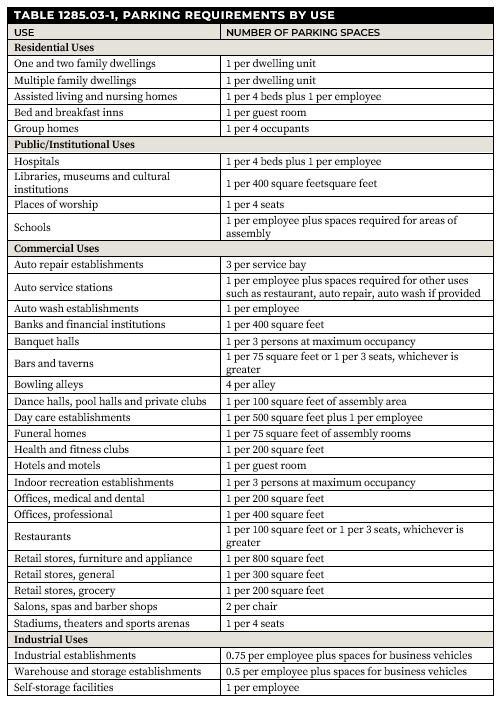
- Electric Vehicle Parking. Parking spaces that are dedicated to and provided with equipment solely for the purpose of charging electric vehicles shall count toward the total number of required off-street parking spaces on a space-for-space basis.
- Bicycle Parking. All public/institutional and commercial uses shall provide bicycle racks or other facilities for the temporary storage of bicycles within reasonable proximity to a pedestrian entrance into the building. The Planning Commission may waive this requirement if the applicant can provide justification as to why this standard is not appropriate for the use or development.
1285.04 PARKING DESIGN
- Materials. All parking lots and vehicle and equipment storage areas shall be paved with asphalt or concrete, and shall be graded and drained to remove surface water which might accumulate. The Planning Commission may approve alternative paving materials, such as permeable pavement, for all or a portion of the parking areas, based upon credible evidence of the durability and appearance of the proposed materials.
- Dimensions. Parking space and aisle dimensions shall meet the following requirements and as specified in Table 1285.04-1.
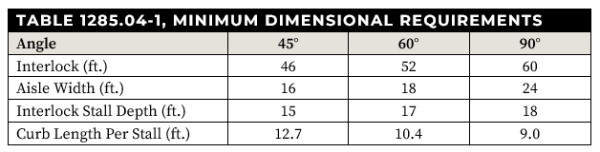
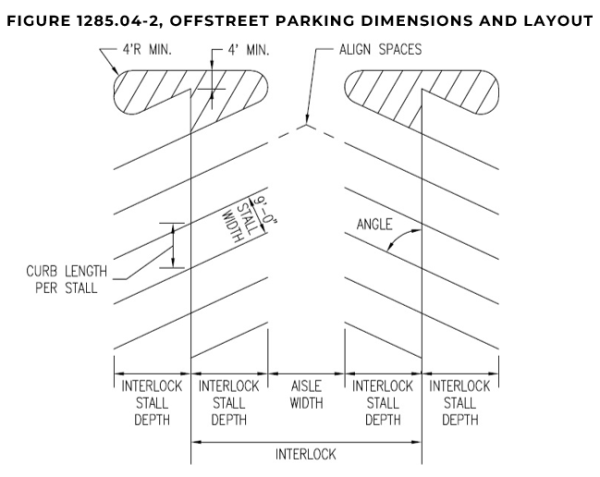
- Stacking Spaces. In addition to required off-street parking, stacking spaces for drive-through uses shall be provided in accordance with Table 1285.04-3, unless the Planning Commission determines that use-specific factors justify a different requirement. Stacking spaces shall be at least 20 feet long and nine (9) feet wide and shall not block required parking spaces. Where the drive-through waiting lane consists of a single lane for five (5) or more vehicles, site layout shall be designed to allow vehicles to exit the waiting lane. No stacking is permitted within any public right-of-way.
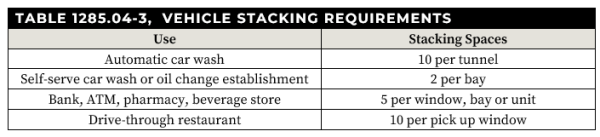
- Ingress and Egress. Vehicular ingress and egress to the parking area shall be provided by means of clearly limited and defined drives. All parking lots shall provide interior access and circulation aisles for all parking spaces. The use of public streets for maneuvering into or out of parking spaces shall be prohibited. Ingress and egress to a parking lot in a non-residential zoning district shall not be through a residential district.
- Curbing. A six (6) inch cast-in-place, continuous concrete curb or alternative, as determined by the City Engineer, shall be provided around all sides of any parking lot to protect landscaped areas, sidewalks, buildings, or adjacent property from vehicles that might otherwise extend beyond the edge of the parking lot. Curb openings are allowed for storm water drainage and accessibility.
- Fire Lanes. Fire lanes shall be designated on the site and posted with signage prior to occupancy. Vehicle circulation shall meet turning radius requirements established by the Engineering and/or Fire Departments.
- Crosswalks. Pedestrian pathways and crosswalks in parking areas shall be distinguished from driving surfaces through the use of striping or durable, low-maintenance, surface materials such as pavers, bricks, or scored, stamped, or colored concrete.
- Accessible Parking. Within each parking lot, signed and marked barrier-free spaces shall be provided in accordance with the applicable requirements of federal, state, and local codes.
1285.05 LOADING
- Uses Requiring Loading Area. On the same premises with every building used for manufacturing, storage, warehouse, retail sales, consumer services, or other uses similarly involving the receipt or distribution of vehicles, materials or merchandise, there shall be provided and maintained on the lot adequate space for standing, loading and unloading in order to avoid undue interference with public use of the streets and parking spaces.
- Loading Area Requirements. Loading and unloading spaces shall be paved and, unless otherwise adequately provided for, shall be 12 feet by 50 feet, with 15-foot height clearance. One loading space shall be provided for every 40,000 square feet of floor area or fraction thereof. This requirement shall not apply to retail sales and consumer service uses of less than 10,000 square feet.
- Orientation of Overhead Doors. Access and loading bays facing any street, adjacent residential use, or residential zoning district, shall have the doors closed at all times, except during the movement of products into and out of the building.
1285.06 DRIVEWAYS
- Functional Classification. The roadways listed in Table 1285.6-1 have been designated by the Northeast Ohio Areawide Coordinating Agency (NOACA) as having a functional classification of principal arterial, minor arterial, or major collector. NOACA’s most current list of roadway functional classifications shall govern the regulations of this Zoning Code.
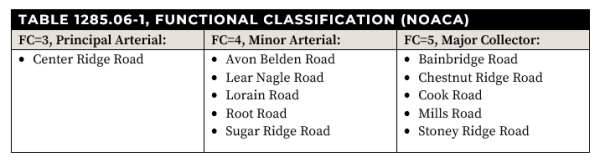
- Number of Curb Cuts. The number of driveways serving a property in any non-residential zoning district shall be the minimum number necessary to provide reasonable access while preserving traffic operations and safety along the public street. Adjacent parcels in common ownership fronting on the same street shall be considered as one parcel when determining permitted driveways.
- Driveways shall be limited to one (1) per lot or parcel of land per road frontage.
- One (1) additional driveway may be allowed for properties with a continuous frontage greater than 400 feet or if the Planning Commission determines additional access is justified without compromising traffic operations along the public street.
- Driveway Spacing Standards. The following minimum spacing requirements shall apply to all curb cuts and driveways within any non-residential zoning district, as well as spacing between driveways and street intersections.
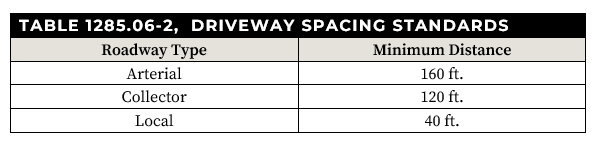
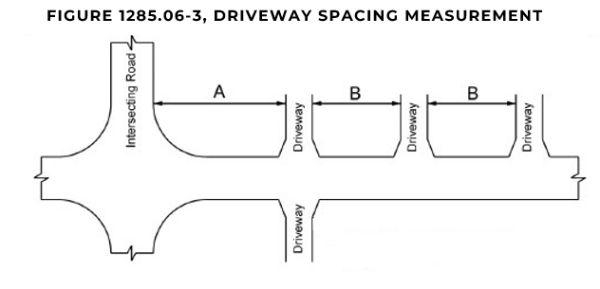
- Measurements are from the near edge of the proposed driveway, measured at the throat edge of pavement perpendicular to the street to the near lane curb or pavement edge of the intersecting street (see A in Figure 1285.06-3) or near edge of the next driveway (see B in Figure 1285.06-3).
- These driveway spacing standards are guidelines and will be required if such distances can be achieved given the property limits and site layout. However, in some cases, these distances may not be feasible given the existing lot configuration. In these instances, the Planning Commission will make a determination as to what spacing will be required, and whether or not a driveway will be required to be directionally restricted in lieu of not meeting the required spacing.
- Driveway Width. For any driveway serving a non-residential zoning district, the minimum width of a one-way driveway shall be 15 feet and the minimum width of a two-way driveway shall be 24 feet. The maximum width of any non-residential driveway shall be 35 feet. Width shall be measured along a line parallel to the centerline of the street at the street right-of-way line. The City Engineer may alter width requirements based on the type of vehicle traffic the use is expected to generate.
- Cross Access Encouraged. Cross access between adjacent non-residential properties is encouraged for convenience, safety, and efficient circulation of vehicles. A mutual access agreement, recorded with Lorain County, shall be executed where cross-access is provided.
- Construction Requirements. All driveways shall be constructed in accordance with the requirements established by the City Engineer.
1285.07 SIDEWALKS
Sidewalks shall be constructed as required in Chapter 1024. Where sidewalks are not located within the right-of-way, but proposed to be located on private property, a public access easement shall be provided to the City and recorded as a condition of development plan approval.
1285.08 ILLUMINATION OF PARKING AREAS
- Applicability. The Planning Commission shall review plans for illumination of parking areas for any development plan subject to its review under Chapter 1243 involving new lighting or changes to existing lighting as provided in this Section.
- Exterior Lighting Plan Required. A lighting plan shall include the following elements:
- A site plan to scale showing location of all exterior light fixtures. Include property boundaries, building location(s), parking lot layout, pedestrian paths, adjacent rights-of-way, north arrow, and scale.
- Specifications, cut sheets, and/or drawings for all exterior light fixtures and poles, along with a description of any dimming systems or other proposed lighting controls.
- A photometric plan defining the limits of each lighting calculation area where illumination is proposed plotting the light levels in footcandles on the ground. The limits of each lighting calculation area shall be clearly indicated. Maximum illuminance levels should be expressed in footcandle measurements to the nearest 0.1 footcandle on a grid of the site showing footcandle readings at no greater than a 10-foot square. The grid shall include light contributions from all sources on the site and show footcandle readings five (5) feet beyond the property lines.
- A calculation summary indicating footcandle levels on the photometric plan, noting the minimum, maximum, and average footcandles, light loss factor, and uniformity ratios for each lighting calculation area. Include in the summary lamp wattages of all proposed luminaires and mounting heights of fixtures.
- Fixtures. Exterior lighting fixtures shall be installed in a manner to prevent light pollution in the forms of light trespass and glare and to preserve, protect and enhance the character of the City.
- Full Cut-off Required. All exterior pole lighting fixtures used to illuminate off-street parking areas shall be full cut-off and shall be arranged to deflect the light away from adjoining properties and adjacent streets. Exterior building lighting fixtures used to illuminate sidewalks, entrances, and service areas shall also be full-cut off fixtures.
- Canopy Lighting. Light fixtures mounted under canopies shall be recessed with flat lenses so that the lens cover is flush with the bottom surface of the canopy. Alternately, indirect lighting may be used where light is reflected down from the bottom of the canopy.
- Nonessential Lighting. Nonessential lighting for other areas may be installed upon approval of the Planning Commission. This shall include landscape lighting, accent lighting of the structure, decorative lighting, and lighting for similar purposes. Light fixtures used to illuminate flags, statues or any other objects mounted on a pole, pedestal or platform shall use a light that will not extend beyond the illuminated object. For upward architectural, landscape, and decorative lighting, direct light emission shall not be visible above the building roof line.
- Prohibited Lighting. No flickering or flashing light shall be permitted, except for temporary holiday decorations. The installation of any light fixture not specifically approved as part of a development plan is prohibited.
- Luminaire Height. The height of any parking lot light fixture shall not exceed 30 feet above grade in industrial districts and 25 feet above grade in all other non-residential districts. When located within 50 feet of a residential zoning district, the height of a parking lot light fixture shall not exceed 16 feet above grade. The Planning Commission may require lower mounting heights if the adjoining grade is lower than developed grade.
- Illumination Levels. The average and maximum illumination levels shall not exceed that permitted for each lighting calculation area type. A lighting calculation area shall be defined as any area where the illumination level equals or exceeds 0.2 footcandle.
- Light Trespass. Lighting intensity shall not exceed zero (0) foot candles at the property line when abutting residential zoning districts. All on-site lighting of buildings, lawns and parking areas shall be designed so that no light source will be visible at the ground level of any adjacent residential property or building. No on-site lighting may cause glare onto any public street or vehicle thereon.
- Required Illumination Levels. Lighting shall be designed to provide even distribution of illumination and to avoid creating hot spots. Maximum average illumination levels are provided in Table 1285.08-1:
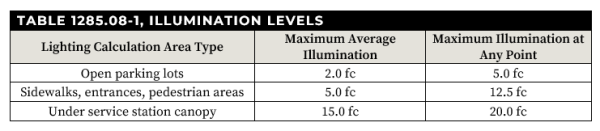
- Exemptions. Because of their unique requirements for providing greater night-time visibility, their need to ensure public safety, and their limited hours of operation, stadiums (which include ball diamonds, playing fields, and tennis courts), amphitheaters, and similar uses are exempted from the exterior lighting standards as specified above. A lighting plan for these uses shall be established at the time that the request for exterior lighting is made and shall be subject to Planning Commission approval.
- Lighting Essential to Safety. Lighting not essential to safety of the public and employees shall be terminated when the site is not occupied. For facilities that are occupied overnight, the lighting shall be reduced to the minimum level necessary.
1286.01 INTENT
Sign regulations, including provisions to control the type, design, size, location, motion, illumination, enforcement, and maintenance thereof, are established in order to achieve, among others, the following purposes:
- To maintain high-quality districts of all land uses, and attractive public and private facilities of all types, by permitting only signs appropriate to their environs;
- To provide for reasonable and appropriate methods for locating goods, services, and facilities in all zoning districts by relating the size, type, and design of signs to the size, type, and design of the uses and districts;
- To promote traffic safety by preventing obstructions within public rights-of-way, minimizing visual distractions to motorists, ensuring that sign size and height are appropriate to their location and preventing conflicts with public safety signs and police and fire protection; and
- To control the design and size of all signs so that their appearance will be aesthetically harmonious with an overall design for the area, in accordance with commonly accepted community planning and design practices, and the City's Master Plan.
The City does not intend to infringe on the rights of free speech as protected by the First Amendment to the United States Constitution and Article I, §11 of the Ohio Constitution.
1286.02 SEVERABILITY
If any provision of this chapter is found by a court of competent jurisdiction to be invalid, such finding shall not affect the validity of other provisions of this chapter that can be given effect without the invalid provision.
1286.03 DEFINITIONS
For purposes of this chapter, certain terms and words are defined as follows in this section. All other words shall have their customary meanings as defined in the Merriam-Webster Dictionary.
- CHIEF BUILDING OFFICIAL means the official, or his authorized representative, charged with the enforcement of this chapter and other ordinances, laws, rules, and regulations relating to the use, erection, construction, alteration, and repair of any sign within the City.
- ELECTRONIC MESSAGE CENTER means a sign designed so that the characters, letters, or illustrations can be changed or rearranged remotely or automatically on a fixed display screen (e.g. electronic or digital signs).
- FAÇADE means that portion of any exterior elevation on the building extending from grade to the top of the parapet, wall, or eaves and the entire width of the building elevation.
- FLAG means any sign of cloth or similar material, anchored along one side, displayed from a single pole, either freestanding or attached to a building.
- FRONTAGE means the distance between the side lot lines measured at the street right-of-way.
- FRONTAGE, BUILDING means the linear dimension of the width of the widest portion of the building face including all appurtenant overhangs or other structures closest to parallel to the principal street.
- MESSAGE, COMMERCIAL means any sign, wording, logo, or other representation that, directly or indirectly, names, advertises, or calls attention to a business, product, service, or other commercial activity.
- MESSAGE, NONCOMMERCIAL means any sign, wording, or logo that does not represent a commercial message or commercial speech. Such signs may express messages that include but are not limited to, free speech opinions, ideological messages, religious messages, political messages, etc.
- RACEWAY means a form of mounting structure for signs that are a narrow structure attached to a wall where electrical conduit can run within and where the sign structure itself is mounted to it.
- SIGN means any object, device, display or structure, or part thereof, visible from a public place, a public right-of-way, any parking area or right-of-way open to use by the general public, or any navigable body of water which is designed and used to attract attention to an institution, organization, business, product, service, event or location by any means involving words, letters, figures, designs, symbols, fixtures, logos, colors, illumination or projected images. The term "sign" does not include the display of merchandise for sale on the site of the display
- BANNER SIGN means a temporary sign constructed of canvas, plastic, fabric, or similar lightweight, non-rigid material that can be mounted to a structure with cord, rope, cable or a similar method.
- BUILDING SIGN means a sign that is attached to the building including wall signs, projecting signs, and canopy signs.
- CANOPY SIGN means a sign attached to the soffit or fascia of a canopy, marquee, awning, covered entrance, covered walkway, arbor, pergola, or other similar structure.
- CHANGEABLE COPY SIGN means a sign designed so that the characters, letters, or illustrations can be changed or rearranged manually or electronically without altering the sign display surface.
- DRIVEWAY SIGN means a small freestanding sign located near driveway access points.
- DRIVE-THROUGH SIGN means a sign that is located along the path or aisle utilized for a drive-through facility.
- ENTRANCE SIGN means a sign identifying a vehicular entrance to a residential subdivision, residential complex, or a non-residential development park.
- FEATHER SIGN means a freestanding temporary sign made of fabric or nylon affixed to a lightweight pole.
- FREESTANDING SIGN means a sign anchored directly to the ground or supported by one or more posts, columns, or other vertical structures or supports, and not attached to or dependent on support from any building.
- MONUMENT SIGN means a freestanding sign that contains a support structure that is a solid-appearing base constructed of permanent material.
- NONCONFORMING SIGN means a sign which was erected legally prior to the adoption of this code, or amendment thereto, but which does not comply with subsequently enacted sign restrictions and regulations or a sign which does not conform to the sign code requirements.
- PERMANENT SIGN means a sign permitted by this code to be located on the premises for an unlimited period of time and designed to be permanently attached to a structure or the ground.
- POLE SIGN means a freestanding sign that is supported by a pole, poles, columns, or other base or structure, where the bottom edge of the sign face is eight feet or more above grade.
- PROJECTING SIGN means a sign that is affixed perpendicular to a building or wall extending more than 18 inches beyond the face of such a building or wall.
- SIDEWALK SIGN means an A-frame, T-frame, or other temporary self-supporting sign which may be easily moved or relocated for re-use.
- TEMPORARY SIGN means a sign that is neither permanently anchored to the ground, nor permanently affixed to a structure, nor mounted on a chassis and/or is intended for a limited period of display.
- WALL SIGN means a sign attached directly to an exterior wall of a building with the exposed face of the sign in a plane parallel to the building wall. Wall signs shall not include signs that are painted directly onto a wall.
- WINDOW SIGN means a sign attached to, in contact with, placed upon, painted on, or otherwise viewable through the window or door of a building that is intended for viewing from the outside of such building. This does not include merchandise. A structure that would be considered a sign if mounted on the exterior of the building, but which is mounted inside the building and oriented to be visible through the window by a person outside of the window shall be considered a window sign for the purposes of this chapter.
- YARD SIGN means any temporary sign placed on the ground or attached to a supporting structure, posts, or poles, that is not attached to any building.
- SIGN AREA means the entire display area of sign copy including the messaging surface located on one or more sign faces, but not including the supporting structure.
- SIGN COPY means those letters, numerals, figures, symbols, logos, and graphic elements comprising the content or message of a sign.
- SIGN FACE means the surface of the sign upon, against, or through which the message of the sign is exhibited.
- SIGN HEIGHT means the vertical distance to the top of the sign structure.
- STATIC OR INSTANT MESSAGE CHANGE means on electronic message centers when one message changes to another message instantly without scrolling, flashing, or other movement of the message.
- WINDBLOWN DEVICES means objects and signs designed to inform or attract attention, all or part of which is set in motion by or remains inflated by the wind, mechanical, electrical, or any other means and may include, but are not limited to pennants, ribbons, streamers, balloons, and hot or cold air inflatable devices, spinners or similar objects.
1286.04 GENERAL APPLICABILITY
- It shall hereafter be unlawful for any person to erect, place, relocate, expand, modify, maintain, or otherwise alter a sign in the City except in accordance with the provisions of this chapter.
- Unless otherwise provided, this chapter shall apply to any sign in any zoning district that is visible from a public right-of-way or from an adjacent property.
- Any sign legally established prior to the effective date of this chapter, which is rendered nonconforming by the provisions herein, shall be subject to the nonconforming sign regulations of Section 1286.13.
1286.05 PROHIBITED SIGNS
The following types of signs are specifically prohibited within the City of North Ridgeville:
- Signs that interfere with, obstruct the view of, or are similar in appearance to any legally authorized traffic sign, signal, or device because of its position, shape, or color;
- Signs that constitute a hazard to safety or health due to inadequate or inappropriate design, construction, repair, or maintenance, as determined by the Chief Building Official;
- Any sign that copies or imitates signs that are installed by the City or any other governmental agencies or falsely purports to have been authorized by the City or other governmental agency;
- Signs that are accessory to an abandoned use of property. A use shall be determined to be abandoned if it has voluntarily ceased operations for a period of six (6) consecutive months unless the use is determined to be seasonal in nature;
- Signs that are placed on trees, utility poles, benches, trash receptacles, or any other unapproved supporting structure, or otherwise placed in the public right-of-way except as provided for in Section 1286.08(f);
- Off-premise signs, including billboards;
- Pole signs;
- Signs mounted on or above the roofline of any building;
- Signs that employ any parts or elements which revolve, rotate, whirl, spin, use moving or flashing lights, or otherwise make use of motion to attract attention;
- Pennants, streamers, windblown devices, and signs that flutter with the exception of flags and feather signs as permitted in this chapter;
- Signs which are not securely affixed in a permanent manner to an approved supporting structure unless specifically permitted as a temporary sign;
- Vehicle signs viewable from a public road if the vehicle or trailer has signage attached to it and either fails to display current license plates and registration or is inoperable. Furthermore, vehicles or trailers shall not be parked continuously in one location to be used primarily as additional signage. These regulations do not apply to fleet and delivery vehicles that are actively used as part of a local business establishment or vehicles that are painted or otherwise covered with signage that are used by persons as a personal means of transportation or are actively used as part of a local business establishment; and
- Any sign not specifically allowed or addressed by this chapter shall be prohibited.
1286.06 SIGN PERMIT REQUIREMENT AND EXEMPTIONS
- Sign Permit Required. Unless otherwise stated in this chapter, all signs shall require a sign permit.
- Exemptions. The following signs do not require a sign permit and do not require zoning approval. Permit-exempt signs may still be subject to building code or other applicable code requirements.
- Sign face changes where the sign structure is designed with interchangeable panels and one of the panels is replaced without changing the structure, total sign face area, height, or the sign cabinet (except that a copy of the sign face change should be filed with the Building Department for informational purposes);
- Changes of copy on signs with changeable copy;
- Any sign that is located completely inside a building that is not visible from the exterior (see also the definition of window sign);
- Signs installed or required by a governmental agency including the City of North Ridgeville, Lorain County, State of Ohio, and the United States;
- Signs and/or notices issued by any court, officer, or other person in performance of a public duty;
- Signs which are an integral part of the historic character of a structure that has been designated an official landmark or historic structure by a governmental agency;
- Monuments, markers, and signage within a cemetery;
- One wall sign not exceeding two square feet mounted flush to the façade of a single or two-family dwelling unit;
- Signs that are an integral part of the original construction of vending or similar machines, fuel pumps, automated teller machines, or similar devices that are not of a size or design as to be visible from a street or by any person other than those using the machine or device;
- Any signs located on umbrellas, seating, or similar patio furniture provided they are located outside of the right-of-way and comply with any other applicable standards of this chapter;
- Parking space signs not exceeding two square feet in area;
- Signs that are located within a stadium, open-air theater, park, arena, or other outdoor use that are not visible from a public right-of-way or adjacent property, and can be viewed only by persons within such stadium, open-air theater, park, arena or other outdoor use;
- Flags that do not contain a commercial message provided there shall be no more than three such flags on any lot and the size of each flag does not exceed 40 square feet;
- Certain temporary signs as established in Section 1286.12;
- Any signs, including illuminated signs or related decorations erected in observance of religious, national, or state holidays which are not intended to be permanent in nature and which do not contain a commercial message;
- Public art approved by the North Ridgeville Planning Commission; and
- General maintenance, painting, cleaning and other normal maintenance and repair of a sign or any sign structure unless a structural change is made.
1286.07 SIGN PERMIT APPLICATION AND PROCEDURES
- Application Requirements. Each sign permit application submitted shall contain the following:
- Name, address, phone number, and email address of the applicant, property owner, and person erecting the sign;
- Location of building, structure, or lot to which or upon which the sign is to be installed;
- Scaled drawings depicting the position of the sign in relation to any buildings and structures on the site and adjacent sites and adjacent streets or drives;
- Scaled drawings, plans, and specifications, including method of construction and attachment of the sign to the building or ground;
- Signature of the owner of the building, structure, or land to which or on which the sign is to be erected;
- Any information, calculations, or documentation required by or to determine compliance with the Ohio Building Code or the Codified Ordinances of the City of North Ridgeville; and
- Any applicable fees, as established by separate ordinance.
- Permit Review and Issuance.
- Upon receipt of a complete application for a sign permit, the Chief Building Official shall examine the plans and specifications, and, within 30 days, determine if the signs proposed in the application are in compliance with this chapter.
- In the event of a variance request or other delay caused by the applicant, the time for making a determination of sign compliance under this section shall be extended for a period of time equal to the time period during which the variance application is pending, or to the period of time of other delay caused by the applicant, as applicable.
- If the proposed sign complies with this chapter, all other applicable laws and ordinances of the City and the Ohio Building Code, the Chief Building Official shall forthwith issue the requested permit upon receipt of the appropriate fees. If the Chief Building Official determines that the application should be denied, he shall issue a written statement with his decision, explaining the reason(s) for the denial.
- If the work authorized under any sign permit is not completed within six (6) months after the date of issuance, the permit shall become null and void.
- Violation and Revocation of Sign Permit. The Chief Building Official may revoke a sign permit where there has been a violation of the provisions of this chapter or a misrepresentation of fact on the permit application. The Chief Building Official shall issue a written statement with his decision, explaining the reasons for revocation.
- Appeals.
- If the applicant is dissatisfied with any determination made by the Chief Building Official during the application process related to the requirements of this chapter or the Residential Code of Ohio, including the denial or revocation of a permit, the applicant may, within ten (10) business days following that determination, file an appeal by making application to the Board of Zoning and Building Appeals.
- The Board of Zoning and Building Appeals shall hear the applicant's appeal at the next available meeting after the filing of the application per the requirements of Chapter 1244. The Board may decide to affirm, modify, reverse, or vacate the Chief Building Official’s decision, and shall render its decision and any order necessary to effectuate its decision within five (5) business days following its hearing of the applicant’s appeal. The decision of the Board of Zoning and Building Appeals shall be final.
- If the applicant is dissatisfied with any determination of the Chief Building Official related to a decision based on the requirements of the Ohio Building Code, the applicant may appeal such decision to the Ohio Board of Building Appeals in a manner established in the Ohio Building Code.
1286.08 GENERAL REGULATIONS FOR ALL SIGNS
Unless otherwise stated, the following regulations shall apply to all signs within the City:
- Permanent signs are considered accessory uses and shall only be accessory to a principal use provided for by the North Ridgeville Zoning Code. Temporary signs may be permitted on all lots, regardless of the presence of a principal use, provided the temporary signs are in compliance with this chapter.
- All signs shall be constructed in compliance with the applicable building and electrical codes as well as any other City regulations.
- No sign shall obstruct or interfere with fire ingress or egress from any door, window or fire escape; block any light or ventilation openings; obstruct or interfere with traffic or vehicular or pedestrian traffic visibility or resemble or imitate signs or signals erected by the City or other governmental agency for the regulation of traffic or parking.
- All permanent signs shall be secured in such a manner as to prevent swinging or other significant noticeable physical movement.
- Signs supported by or suspended from a building shall hang so as to maintain a minimum clear height of eight (8) feet above a pedestrian path and 15 feet above a vehicular path.
- Signs in Rights-of-Way. No sign shall be installed in or project over the right-of-way, nor shall any sign be installed on public property with the exception of signs installed or authorized by the City of North Ridgeville, Lorain County, State of Ohio, or United States. The Chief Building Official may immediately remove or cause to be removed any unlawful sign in the public right-of-way.
- Vision Clearance Requirements. To promote traffic safety, no sign shall exceed 36 inches in height, measured from the top of the curb, within any vision clearance triangle area. See Figure A.
- For intersections of streets with other streets, the vision clearance triangle area, which may include private property and/or public right-of-way, is the triangular area defined by measuring 30 feet from the intersection of the extension of the front and side street curb lines (or edge-of-pavement lines where there is no curb) and connecting the lines across the property. See A and B in Figure A below.
- For intersections of streets with driveways, the vision clearance triangle area shall be defined by measuring 25 feet from the edge of the driveway along the street and 20 feet along the driveway from the street and connecting the lines across the property
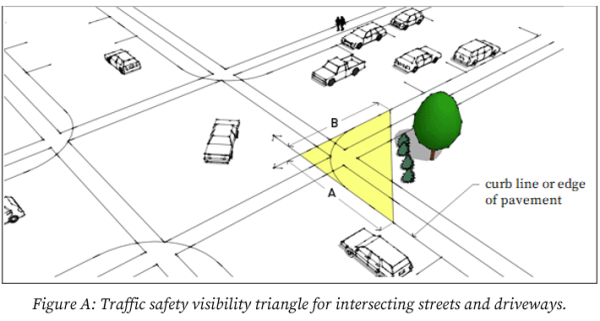
- Maintenance and Removal of Signs.
- Every sign shall be maintained in a safe, presentable, and good structural condition at all times, including replacement of defective parts, painting, cleaning, and other acts required for the maintenance of the sign so as not to show evidence of deterioration, including peeling, rust, dirt, fading, damage, discoloration or holes.
- Whenever a sign is removed, all parts of the sign and supporting structure (e.g., pole, foundation, cabinet structure, etc.), excluding buildings, shall be removed in their entirety. This section shall not require the removal of a raceway if mounted to such structure on a building in a secure and safe manner.
- The Chief Building Official is authorized to order the removal, repair, or maintenance of any sign in violation of any code or for which the required permit has not been obtained. Every such order shall be served upon the owner and person in possession of the sign by personal service or by regular first-class U.S. mail addressed to the occupant of such property and to the owner of the property.
- Whenever the removal, repair, or maintenance of any permanent sign has been ordered by the Chief Building Official, the owner or person in possession of such sign shall comply with such order within 30 days after the notice is served upon him. Whenever the removal, repair, or maintenance of a temporary or portable sign has been ordered by the Chief Building Official, the owner or person in possession of such sign shall comply with the order immediately after notice is served upon him.
- In the event of non-compliance, the Chief Building Official may seek an order of removal from a court of competent jurisdiction or may pursue criminal action against the owner and/or person in possession of the sign in accordance with the appropriate provisions of this Zoning Code relating to the violations.
- If, following an inspection, the Chief Building Official determines that any sign constitutes an immediate danger to the public safety, the Chief Building Official may affect the immediate removal of said sign without regard to the time intervals for compliance cited above, at the sign owner's expense in accordance with the procedures described in Chapter 215. Removal of a sign shall include the sign face, enclosing frame, all sign supporting members, and base unless otherwise specified in the order to remove.
1286.09 SIGN ILLUMINATION
- All signs, unless otherwise stated in this chapter, may be illuminated by internal or external light sources, provided that such illumination complies with the following:
- Light sources shall be shielded from all adjacent buildings and streets.
- Lights shall not be of such brightness so as to cause glare that is hazardous to pedestrians or motorists or cause reasonable objection from adjacent residential districts.
- No colored lights shall be used in a location or manner in which they might be confused with traffic control devices or emergency vehicles.
- Sign illumination shall not increase the light levels within 40 feet of all points of any sign face by more than 0.3-foot candle (~3.23 lumens) above the ambient lighting level.
- Illuminated signs on lots in non-residential districts within 150 feet and visible from a residential district may not be illuminated between 11:00 p.m. and 7:00 a.m. except at the time the establishment is in operation during this period.
- An illuminated sign or lighting device shall employ only light of constant intensity.
- No outline lighting shall be permitted.
1286.10 MEASUREMENTS AND CALCULATIONS
- Sign Setback. All required setbacks for signs shall be measured as the distance in feet from the lot line or right-of-way, as applicable, to the closest point of the sign structure.
- Sign Height. The height of a sign shall be computed as the distance from the base of the sign at normal grade to the top of the highest attached component of the sign. Normal grade shall be construed to be the newly established grade after construction, exclusive of any filling, berming, mounding or excavating solely undertaken for the purpose of locating or increasing the height of the sign.
- Sign Area. Sign area shall be calculated as established in this section, using one of the following shapes: circle, ellipse, triangle, square, rectangle, trapezoid, pentagon or hexagon.
- The calculation of sign area shall not include any supporting framework, bracing or decorative fence or wall unless such structural support is determined to constitute an integral part of the sign design by means of text or other message. See Figure B.
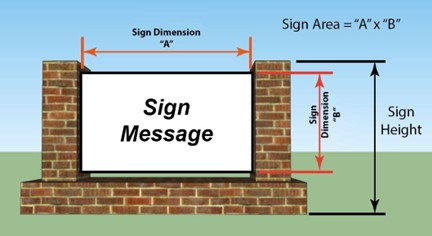
Figure B: Illustration of sign area calculation for a ground sign with a copy on a distinct, rectangular cabinet. The brick structural support is not included in the sign area calculation. - For sign copy mounted or painted on a background panel, cabinet, or surface distinctively painted, textured, lighted, or constructed to serve as the background for the sign copy, the sign area shall be computed by means of the smallest permitted shape that encompasses the extreme limits of the background panel, cabinet or surface. See Figure C.Figure C: Illustration of computing the sign area for wall signs with a background panel or cabinet.
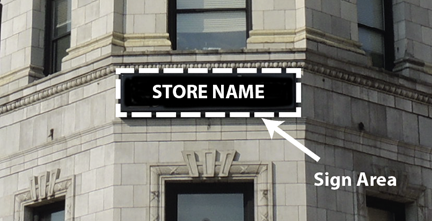
- For sign copy where individual letters or elements are mounted on a building façade or window where there is no background panel, cabinet, or surface distinctively painted, textured, lighted, or constructed to serve as the background for the sign copy, the sign area shall be computed by means of the smallest permitted shape that encloses all the letters or elements associated with the sign. See Figure D.Figure D: Illustration of sign area calculation for wall signs with individual letters.
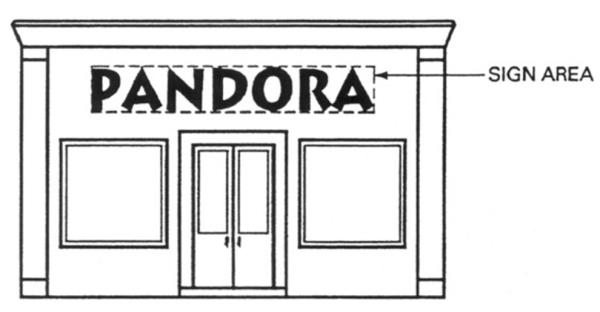
- In cases where there are multiple sign elements of sign copy on the same surface, any areas of sign copy that are within two (2) feet of one another shall be calculated as a single sign area that shall be computed by means of the smallest permitted shape that encloses all sign copy within two (2) feet of one another, otherwise, the sign area shall be computed for each separate piece of sign copy. See Figure E.
- Decorative edging or other window treatments that are not an integral part of the sign copy shall not be considered a part of the sign.
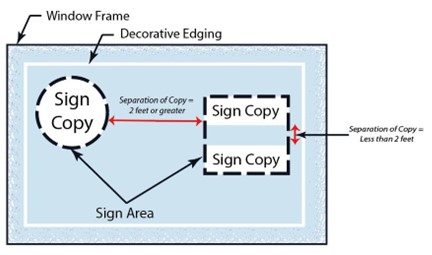
Figure E: Illustration of sign area calculations for multiple sign areas on a window sign. - When two identically sized, flat sign faces are placed back-to-back or at angles of 45 degrees or less, so that both faces cannot be viewed from any one point at the same time, the sign area of the multi-faced sign shall be computed by the measurement of one of the sign faces. If the two faces are unequal, the sign area shall be calculated based on the larger of the two faces. When a multi-faced sign has an interior angle greater than 45 degrees, the sign area shall be computed by adding together the area of all sign faces.
- In the case of a three-dimensional sign, the sign area shall be calculated by the smallest permitted shape that encompasses the profile of the sign message. The profile used shall be the largest area of the sign message visible from any point.
- The calculation of sign area shall not include any supporting framework, bracing or decorative fence or wall unless such structural support is determined to constitute an integral part of the sign design by means of text or other message. See Figure B.
- Façade Measurements.
- When calculating the permitted sign area based on the width of any façade, such calculation shall be based on viewing the façade from a 90-degree angle (i.e., straight on), regardless of façade insets, offsets, or angles. See Figure F.
- For multi-tenant buildings, the portion of a building that is owned or leased by a single occupant or tenant shall be considered a building unit. The façade width for a building unit shall be measured from the centerline of the party walls defining the building unit.Figure F: Illustration of façade width measurement on varied façade shapes.
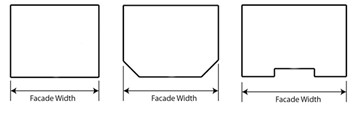
1286.11 PERMANENT SIGN ALLOWANCES
The following are the types of permanent signs allowed in the City of North Ridgeville and the applicable regulations for each sign type.
- Building Signs. Building signs shall not be permitted as accessory to single-family or two-family dwellings. In residential districts, building signs may be accessory to nonresidential permitted or conditional uses. In all other districts, building signs are permitted on principal structures in accordance with the following:
- Building Sign Allowance. The building sign area allowed in this section shall include the total amount of all wall, canopy, and projecting signs on each façade.
- Maximum permitted building sign area for a single tenant building shall be two (2) square feet per lineal foot of the façade width of the principal building.
- Maximum permitted building sign area for a building unit in a multi-tenant building shall be two (2) square feet per lineal foot of the façade width of the individual building unit, provided that the building unit has an exterior entrance.
- For buildings or building units on lots with frontage on more than one public street, maximum permitted building sign area shall be 1.5 square feet per lineal foot of the sum of the façade widths that face a public street.
- Building signs may contain up to 25 percent changeable copy in sign area; however, building signs shall not include electronic message centers.
- Wall Signs. Any wall sign shall comply with the following standards:
- A wall sign shall be mounted on or flush with a wall and shall not project more than 24 inches from the wall of the building to which it is attached.
- A wall sign may be mounted on the façade wall or mounted on a raceway.
- No wall sign shall be painted directly on a building.
- No wall sign shall extend above the parapet of the main building to which it is attached, nor beyond the vertical limits of such building.
- A wall sign shall maintain a minimum six-inch clearance from the top and side edges of the surface or wall to which it is attached.
- Signs attached to roofed structures over fueling stations shall be considered wall signs.
- Wall signs may be internally or externally illuminated.
- Canopy Signs. Any canopy sign shall comply with the following standards:
- Signage shall not cover more than 50 percent of any individual awning, canopy, or marquee.
- Signage may be mounted above any canopy provided that the sign does not extend above the top of the roofline of the building.
- Canopy signs may be internally or externally illuminated.
- Projecting Signs. Any projecting sign shall comply with the following standards:
- Only one projecting sign shall be permitted for each building unit.
- The maximum sign area for a projecting sign shall be six (6) square feet.
- Decorative supporting structures for projecting signs shall not count toward the maximum square footage of signs allowed, however, in no case shall the supporting structure exceed six (6) square feet.
- A projecting sign shall be perpendicular to the wall of the building to which it is attached and shall not extend more than four (4) feet from the façade wall to which it is attached. Such a sign shall maintain a minimum six (6) inch clearance from the façade of any building.
- Projecting signs shall not encroach into any right-of-way.
- Projecting signs may be internally or externally illuminated.
- Building Sign Allowance. The building sign area allowed in this section shall include the total amount of all wall, canopy, and projecting signs on each façade.
- Window Signs. No sign permit shall be required for window signs provided that any such sign complies with the following standards:
- Window signs shall not occupy more than 50 percent of the window area. The sign area is based on the total window area. Window areas separated by piers, architectural elements, or similar features that are not glass or window framing or support shall be considered separate and distinct window areas.
- Window signs may be temporarily or permanently attached to the window surface.
- Window signs are not permitted in any window of a space used for residential uses or purposes unless allowed as a temporary sign in accordance with Section 1286.12.
- Monument Signs. Monument signs shall not be permitted as accessory to single-family or two-family dwellings. In residential districts, monument signs may be accessory to nonresidential permitted or conditional uses. In all other districts, monument signs are permitted on lots in accordance with the following:
- One monument sign shall be permitted per lot with the exception of lots having either a total area in excess of five (5) acres or total street frontage in excess of 500 linear feet, in which case two (2) monument signs are permitted provided each sign complies with the standards of this section.
- The maximum sign area of an individual monument sign shall be 65 square feet if the sign does not exceed a height of eight (8) feet or a maximum sign area of 50 square feet if the sign does not exceed a height of ten (10) feet. In no case shall a monument sign exceed ten (10) feet in height.
- Monument signs shall be set back a minimum of five (5) feet from every right-of-way line and a minimum of 20 feet from any side or rear lot line.
- The base of any monument sign shall be composed of stone, brick, or other decorative material complementary to the building material used for the principal structure.
- Monument signs shall be located in a landscaped area equal to or larger than the total sign area of the applicable sign. The landscaped area shall include all points where the sign’s structural supports attach to the ground.
- Monument signs may be internally or externally illuminated.
- Monument signs may contain up to 50 percent changeable copy in sign area.
- Electronic Message Centers.
- Only one monument sign per lot may have an electronic message center.
- No additional changeable copy sign area shall be permitted on a monument sign if there is an electronic message center.
- Messages can only change once every ten (10) minutes.
- Any message change shall be a static, instant message change.
- Only Light Emitting Diodes (LED) technology or similar quality signs shall be permitted for electronic message centers.
- The electronic message center shall come equipped with an automatic dimming photocell, which automatically adjusts the display’s brightness based on ambient light conditions.
- Drive-Through Signs.
- Drive-through signs shall only be permitted in Business Districts, accessory to a nonresidential use containing a drive-through facility.
- One primary drive-through sign not to exceed 36 square feet in area or eight (8) feet in height is allowed per order station, up to a maximum of two (2) primary drive-through signs per lot. One secondary drive-through sign not to exceed 15 square feet in area or six (6) feet in height is allowed per order station, up to a maximum of two (2) secondary drive-through signs per lot.
- Such signs shall be oriented so as to only be visible to occupants of vehicles in the stacking lanes of the drive-through facility.
- Drive-through signs may be internally or externally illuminated. Up to 100 percent of each sign may be changeable copy, including an electronic message center in compliance with Section 1286.11(c)(8)(D) through (F), above. Further, such an electronic message center shall be turned off during the hours when the related establishment is closed.
- Driveway Signs.
- Driveway signs shall only be permitted at driveway entrances to a public street where there is limited access ingress or egress (e.g., enter-only or exit-only driveways) or where the driveway provides access to a drive-through facility. Driveway signs shall not be permitted as accessory to single-family or two-family dwellings.
- Only one driveway sign is permitted per individual driveway.
- Driveway signs shall be set back at least five feet from all lot lines but in no case shall the sign be set back more than ten (10) feet from the edge of the driveway.
- Each driveway sign shall not exceed six (6) square feet in area and three (3) feet in height.
- Driveway signs may be internally or externally illuminated but shall not include changeable copy.
- Entrance Signs.
- For residential subdivisions, residential complexes, and non-residential development parks that contain a minimum of ten (10) units/lots, such subdivision, complex, or park may install one (1) entrance sign within 150 feet of an entrance point from a public street into the subdivision, complex or park.
- The proposed placement of any entrance sign either on private property or within the right-of-way (i.e., landscaped median) shall ensure safety and traffic visibility and must be approved by Planning Commission.
- Entrance signs shall be designed as monument signs with a maximum sign area of 32 square feet and maximum height of six (6) feet.
- Any entrance sign shall be in addition to the signage allowed in this chapter.
- Entrance signs may be internally or externally illuminated but shall not include changeable copy.
1286.12 TEMPORARY SIGNS
The following are the types of temporary signs allowed in the City of North Ridgeville and the applicable regulations for each type of sign.
- Standards Applicable to All Temporary Signs.
- Temporary signs shall not be mounted, attached, affixed, installed, or otherwise secured in a manner that will make the sign a permanent sign.
- No temporary sign shall be displayed continuously for a period of time greater than six (6) months unless a more limited period of time is established in this Section.
- No temporary sign shall be mounted, attached, affixed, installed, or otherwise secured so as to extend above the roofline of a structure.
- Temporary signs shall not be posted in any place or in any manner that is destructive to public property including, but not limited to, rights-of-way, utility poles, and public trees.
- All temporary signs shall be secured in such a manner as to prevent swinging or other significantly noticeable movement resulting from the wind that could pose a danger to people, vehicles, or structures.
- Temporary signs shall be required to comply with vision clearance requirements and shall be set back a minimum of five (5) feet from any public right-of-way.
- No temporary sign shall require a foundation, support, wiring, fittings, or elements that would traditionally require a building permit or electrical permit.
- Temporary signs shall not be illuminated.
- Temporary signs shall not be affixed to any permanent sign or permanent structure except when a banner sign is permitted to cover a permanent sign in accordance with Section 1286.12(e)(3) or when such sign is attached to the principal building as permitted in this chapter.
- No streamers, spinning, flashing, windblown devices or similarly moving devices shall be allowed as part of or attachments to temporary signs.
- Mobile signs on wheels, runners, casters, parked trailers, or parked vehicles shall not be permitted.
- Because of the nature of materials typically used to construct temporary signs and to avoid the unsightliness of deteriorating signs and all safety concerns which accompany such a condition, temporary signs shall be removed or replaced when such sign is deteriorated.
- Standards for Temporary Sign Types.
- Yard Signs.
- Where permitted, there shall be no maximum number of yard signs provided the aggregate total square footage of all temporary signs does not exceed the maximum sign area allowed in this chapter.
- There shall be a maximum of two (2) faces to any yard sign, mounted back-to-back.
- Yard signs in residential districts shall be no more than four (4) feet in height. Yard signs in non-residential districts shall be no more than six (6) feet in height.
- Window Signs.
- Where permitted, there shall be no maximum number of window signs provided the aggregate total square footage of all temporary signs does not exceed the maximum sign area allowed in this chapter.
- Temporary window signs shall be attached to the inside of the window.
- Banner Signs.
- Where permitted, the maximum number of banner signs per lot is two (2).
- Banner signs may be attached to a building, fence, or other similar structure. A banner sign attached to posts and mounted in a yard or landscaped area shall be regulated as a temporary yard sign.
- The maximum height standard for temporary signs shall not apply to a banner sign but such signs shall not be mounted in a manner that extends above the roofline of a building or the top of the structure on which it is mounted.
- Sidewalk Signs.
- Where permitted, the maximum number of sidewalk signs per business unit is one (1).
- Sidewalk signs shall only be placed outside during the establishment’s hours of operation.
- Any sidewalk sign shall be located within ten (10) feet of the establishment’s entrance on a private sidewalk, walkway, or landscaped area, but may not obstruct pedestrian traffic or interfere with the use of parking and loading facilities. Sidewalk signs may not be placed in the public right-of-way.
- No sidewalk sign shall exceed six (6) square feet in area or three (3) feet in height.
- Feather Signs.
- Where permitted, the maximum number of feather signs per building unit is one (1).
- No feather sign shall exceed ten (10) feet in height.
- Yard Signs.
- Temporary Signs with a Noncommercial Message.
- In all zoning districts, temporary signs with a noncommercial message shall be permitted on any lot. No permit shall be required.
- Permitted sign types include yard, window, and banner.
- Total area of temporary signs with a noncommercial message shall not exceed 64 square feet per lot. No individual yard sign shall exceed 24 square feet.
- Temporary Signs with a Commercial Message in Residential Zoning Districts.
- In residential zoning districts, one (1) yard or window sign with a commercial message shall be permitted on any single lot. No permit shall be required.
- No individual sign shall exceed eight (8) square feet.
- In lieu of the regulations in this Section, any nonresidential use located in a residential zoning district shall be permitted the same amount of temporary signage with a commercial message as allowed in (e) below.
- Temporary Signs with a Commercial Message in Nonresidential Zoning Districts.
- Signs Allowed without a Permit. No permit shall be required for the following temporary signs:
- A maximum of 12 square feet of temporary signs with a commercial message shall be permitted for every 100 lineal feet of street frontage per lot.
- Permitted sign types include yard, banner, and sidewalk.
- No individual sign shall exceed 12 square feet.
- Signs Allowed with a Permit. In addition to the temporary signs allowed in (e)(1), the following temporary signs are allowed by permit:
- A maximum of 36 square feet of temporary signs with a commercial message per building unit shall be permitted for up to 15 consecutive days, four (4) calendar times per year.
- Permitted sign types include yard, banner, and feather.
- Signs for New Uses. For zoning permit applications related to the establishment of a new use within an existing building where there is either no sign or an existing permanent sign, a banner sign may be approved for up to 90 consecutive days. Such banner sign shall not exceed the allowable building sign area or the sign area of the permanent sign to be covered, as applicable, and shall require a sign permit.
- Signs Allowed without a Permit. No permit shall be required for the following temporary signs:
1286.13 NONCONFORMING SIGNS SIGNS
- Any sign that was lawfully in existence at the time of the effective date of this ordinance, or amendment thereto, that does not conform to the provisions herein, shall be deemed a legal nonconforming sign and may remain except as qualified below. Minor repairs and maintenance of legal nonconforming signs shall be permitted. However, no legal nonconforming sign shall be enlarged, extended, structurally altered, or reconstructed in any manner, except to bring it into full compliance with these regulations. These regulations shall not prohibit the replacement of the content of a sign without the structural modification of its size, location, or configuration.
- A sign shall lose its legal nonconforming status if any of the following occurs:
- If such sign is damaged to an amount exceeding 50 percent of the sign's replacement value, not including the cost or value related to the foundation or work below grade, as determined by at least two sign companies requested to provide a quote by the City;
- The structure of the sign is altered in any form;
- The sign is relocated;
- The principal use of the property is voluntarily discontinued for a period of at least six (6) months; or
- The nonconforming sign or its structure (including support frame and panel) is determined by the Chief Building Official to be unsafe or in violation of this code and is declared a nuisance.
- Any sign that loses its legal nonconforming status must be brought into compliance with the provisions of this chapter and any other City laws and ordinances by an application for, and issuance of, a sign permit or by complete removal.
- Failure to bring a sign into compliance after the loss of a legal nonconformity status shall cause the sign to be considered an illegal sign.
1286.99 PENALTY
- Penalty and other remedies for violations of this Chapter are as set forth in Section 124.
1288.01 DEFINITIONS
As used in this chapter:
- "Buffer strip" means a visual barrier composed of shrubs, trees or hedges.
- "Landscape" and "landscaped" mean a living fence, i.e. shrubs, trees, hedges or a combination thereof.
- "Shrubs" means self-supporting, deciduous or evergreen species, normally branched near the base, of bushy composition, less than fifteen feet in height as normally grown in the County.
- "Trees" means self-supporting woody, deciduous or evergreen plants with a well defined central stem of a species which normally grows to a height of fifteen feet or more in the County.
(Ord. 1222-76. Passed 10-18-76.)
1288.02 PURPOSES
The purposes of providing a buffer strip are to screen undesirable views from one district to the other; to increase soil water retention through landscaping requirements; in the case of buildings in residential districts, to preserve the appearance and protect property values from the adverse effect of adjoining nonresidential or multifamily residential uses; and to supplement land use planning.
(Ord. 1222-76. Passed 10-18-76.)
1288.03 REQUIRED; RESIDENTIAL DISTRICT DEFINED
- A buffer strip, as defined herein, shall be provided in cases where the side or rear yard of a property in a B, I, R-2, R-3 or R-4 District abuts a residential district or a lot in any other zoning classification which has on it a residence unit used for a residence, except that if a single-family unit is located on a B, I, R-2, R-3 or R-4 District lot, then no buffer strip need be provided.
- The buffer strip shall be situated on the lot with the lower zoning classification. Districts are classified from residential to industrial, with the R-1 District being the highest zoning classification, then other types of residential districts, then all B Districts, then all I Districts, with I-3 being the lowest zoning classification.
- The term "residential district", as used in Sections 1288.04 to 1288.06, inclusive, includes not only a district with a residence zoning classification, as defined in this Zoning Code, but also a lot, irrespective of its zoning classification, which has on it a residential unit being used for residential purposes.
(Ord. 1289-77. Passed 4-18-77.)
1288.04 INDUSTRIAL DISTRICTS ABUTTING RESIDENTIAL DISTRICTS
A buffer strip, in the case of an I-1, I-2 or I-3 District abutting any residential district, shall be thirty-five feet of the setback nearest the district boundary line, which shall be landscaped with a row of deciduous or evergreen trees, or a mixture of each, spaced not more than forty feet apart, and not less than one row of shrubs spaced not more than five feet apart and which grow at least five feet wide and five feet or more in height after one full growing season, to be planted and maintained in a healthy growing condition by the property owner, subject to the limitations provided in Section 1288.07.
(Ord. 1222-76. Passed 10-18-76.)
1288.05 BUSINESS AND COMMERCIAL DISTRICTS ABUTTING RESIDENTIAL DISTRICTS
A buffer strip, in the case of a B-1, B-2, B-3, B-4 or B-5 District abutting a residential district, shall be the ten feet nearest the district boundary line, which shall be landscaped with a row of trees, spaced not more than forty feet apart, and not less than one row of shrubs, spaced not more than five feet apart and which grow at least five feet wide and five feet or more in height after one full growing season, planted and maintained in a healthy growing condition by the owner of the property, subject to the limitations provided in Section 1288.07.
(Ord. 1222-76. Passed 10-18-76; Ord. 3819-02. Passed 7-1-02.)
1288.06 R-2, R-3 OR R-4 DISTRICTS ABUTTING RESIDENTIAL DISTRICTS
A buffer strip, in the case of an R-2, R-3 or R-4 District abutting any other residential district, shall be the ten feet nearest the district boundary line, which shall be landscaped with a row of deciduous or evergreen trees or a mixture of each, spaced not more than forty feet apart, and not less than one row of shrubs, spaced not more than five feet apart and which grow at least five feet wide and five feet or more in height after one full growing season, planted and maintained in a healthy growing condition by the owner of the property, subject to the limitation provided in Section 1288.07. No other use can be made of the buffer strip except use for sidewalks and necessary accessways.
(Ord. 1222-76. Passed 10-18-76.)
1288.07 GROWTH SETBACK FROM STREET LINE
In no case shall the growth in the buffer strip grow closer than thirty feet from the right-of-way line of a street or road.
(Ord. 1222-76. Passed 10-18-76; Ord. 3829-02. Passed 7-15-02.)
1288.08 COMPLIANCE WITH REGULATIONS
Any building not covered under the provisions of this chapter, upon the sale or change of use or upon substantial exterior alterations and/or additions as determined by the Planning Commission shall, as of the effective date of this section, comply with the provisions of this chapter.
(Ord. 3828-02. Passed 7-15-02.)
1292.01 INTENT
It is the intent of this chapter to provide reasonable regulations for the use of structures and land which do not conform to the use regulations or development requirements of this zoning code and to provide for the conversion of such structures and land into conforming uses as soon as is reasonably possible.
1292.02 AUTHORITY TO CONTINUE NONCONFORMITIES
Any nonconforming use, structure, lot, or parcel that legally existed at the effective date of this zoning code or that becomes nonconforming upon the adoption of any amendments thereto, may be continued in its zoning district so long as it remains otherwise in compliance with the provisions of this chapter. This chapter shall not be interpreted as authorizing the continuation of any use of a structure or land that did not lawfully exist on the effective date of this zoning code or any of its amendments.
1292.03 LIMITS TO MODIFICATIONS OF NONCONFORMING STRUCTURES
A nonconforming structure may not be moved, repaired, maintained, altered, or enlarged except as allowed by this chapter or required by law.
- Repair, Maintenance, Alterations, and Additions. A nonconforming structure with a conforming use may be repaired, maintained, altered, or enlarged, provided that no such repair, maintenance, alteration, or enlargement shall either create any new condition of noncompliance to any standard of this zoning code, or otherwise increase the degree of the existing nonconformity of all, or any part, of such structure.
- Moving. A nonconforming structure may not be moved, in whole or in part, for any distance whatsoever, to any other location on the same parcel or to any other parcel unless the entire structure conforms to all applicable standards of this zoning code after being moved.
- Removal or Reconstruction. Once a nonconforming structure is damaged to the extent that 50 percent or more of the existing total floor area is destroyed, or is removed from a site for any reason or by any means, any new or reconstructed structure on the site shall comply with all applicable standards of this zoning code. Reconstruction of a nonconforming structure having no floor area shall be limited to 50 percent of the structure's replacement value. Once brought into compliance, neither that structure nor any future replacement structure may revert to a nonconforming configuration or location.
1292.04 NONCONFORMING USES
A legal nonconforming use of a structure or land may be continued subject to the provisions of this chapter.
- Changes in Use. Whenever a nonconforming use has been changed to a more restrictive or conforming use, such use shall not thereafter be changed to a less restrictive or more nonconforming use.
- Voluntarily Discontinued Uses. Voluntary discontinuance means the cessation of the active or productive operations of a use on the land or within a structure. Voluntary discontinuance terminates a nonconforming use. A nonconforming use that is voluntarily discontinued shall not be resumed or reestablished. Any subsequent use or occupancy of the land or structure must conform to the current regulations for the zoning district in which it is located. A use shall be considered voluntarily discontinued when any of the following occurs:
- When a nonconforming use has been replaced by a conforming use, or
- When the owner of the nonconforming use voluntarily discontinues the use for a period of 12 months or more. Examples of voluntary discontinuance include but are not limited to, vacancy, disconnection of essential utilities, or removal without replacement of equipment and furnishings characteristic of the nonconforming use.
- Accessory Uses. No nonconforming accessory use shall continue after the principal use to which it is accessory has been discontinued.
1294.01 INTERPRETATIONS AND EXCEPTIONS IN GENERAL
The regulations specified in this Zoning Code shall be subject to the following interpretations and exceptions:
- Essential Services. Essential services shall be permitted in all districts.
- Basement Dwellings. No basement shall be used as a temporary dwelling.
- House Trailers. Unless otherwise provided in this Zoning Code, the parking of a house trailer in any district is hereby prohibited, except that one trailer may be parked or stored on a lot, provided that no living quarters shall be maintained or any business practiced therein, and further provided that such trailer shall conform to the setback (yard) requirements of the district in which it is placed.
- Construction Trailers. A trailer used for construction headquarters or for the storage of materials used during construction may be parked at a construction site for a period not to exceed six months. Such trailer need not meet the setback requirements of the district in which it is placed.
- Private Swimming Pools. A swimming pool located outside of a completely enclosed building and normally capable of containing water to a depth at any point greater than one and one-half feet, exclusive of portable swimming pools with a diameter of less than twelve feet or with an area of less than 100 square feet, shall not be allowed in any residential district, except as an accessory use and unless it complies with the following conditions and requirements:
- The pool is intended and is to be used solely for the enjoyment of the occupants of the principal use of the property on which it is located.
- It is not located, including any walks or paved areas or accessory structures adjacent thereto, closer than five feet to any property line of the property on which located.
- A fence of at least four feet in height and of a strength compatible with its intended use, shall be erected around the pool and be maintained at all times while the pool is filled. The fence shall have a gate which has its own lock or is capable of being secured by a lock, and it shall be kept securely locked at all times when the pool is not in use or attended by the owner or anyone using the pool with the owner's permission.
In the case of a pool elevated to a height of four feet or more, access to which is gained by a ladder or stairway, such access shall be removed or it shall be secured in such a way that no one may make entry to the pool when the pool is not in use. - Electric for all swimming pools shall conform to the most current edition of National Electric Code (N.E.C.) (NFPA 70) at the time of permit application.
- In the case of above-ground swimming pools, any permanent structure or ground elevation within five feet of the swimming pool shall maintain a clear height of four feet. The clear height shall be a measure of distance from the top of the swimming pool or approved safety guard to the top of the adjacent permanent structure or ground elevation below.
- Building Height Limitations. The building height limitations of this Zoning Code shall not apply to churches, synagogues and other places of worship, parish houses, convents, Sunday schools, college buildings, school buildings, libraries, museums, art galleries, sororities, fraternities, clubhouses, recreation buildings, community buildings, hospitals, sanitariums, public buildings, railroad stations, bus stations, air travel stations and buildings specifically designed for watershed protection or conservation of soil or water, provided that such buildings shall be set back from all lot lines, in addition to any other required setback imposed in the district in which they are proposed to be located, one foot for each one foot of height in excess of thirty-five feet, measured from the grade at the front of the building to the line of the eaves of such building.
- Area and Yard Requirements; Projections.
- No lot, yard, parking area or other open space shall be reduced in area or dimension so as to make such area or dimension less than the minimum required by this Zoning Code, and, if already less than the minimum required by this Zoning Code, such area or dimension shall not be further reduced.
For purposes of this subsection, the variance is not a reduction as defined in Section 1280.02(d). - Except as may be otherwise specified in this Zoning Code, yards and courts required by this Zoning Code shall be open and unobstructed to the sky.
- Cornices and eaves may project not more than three feet over any minimum required yard, provided that any such projection shall be at least five feet from any lot line.
- Sills, leaders, belt courses and similar ornamental structures may project six inches over any minimum yard or court. An open fire balcony, fire escape or fire tower may project five feet over any yard.
- In residential districts, any bay window, oriel, entrance, vestibule or balcony, which is not more than ten feet in width, may project not more than three feet into any front or rear yard. An open porch or stoop may extend into any side yard in residential districts, provided that it does not come nearer to the side lot line than five feet (except on a corner lot, in which it shall not come nearer than fifteen feet to the side street line), and may extend ten feet into any rear yard, provided that it does not come nearer to the rear lot line than fifteen feet in business, commercial and industrial districts. No show window or projection shall project beyond the building line. Uncovered porches may extend five feet into any required front yard.
- In any business, commercial or industrial districts, a chimney, smokestack flue or elevator shaft may project into any rear yard, provided that the horizontal section of the projection does not exceed twenty square feet.
- Walks and driveways may occupy any yard area.
- Lots having frontage on two intersecting streets shall contain the required front yards on both streets.
- The minimum lot frontage on cul-de-sacs and curves resembling cul-de-sacs shall be regulated by obtaining the required lot width at the required front setback requiring radial lines.
- Accessory uses shall be permitted only in a side yard or in a rear yard in residential districts. The provisions of this section shall not apply to detached garages.
- No lot, yard, parking area or other open space shall be reduced in area or dimension so as to make such area or dimension less than the minimum required by this Zoning Code, and, if already less than the minimum required by this Zoning Code, such area or dimension shall not be further reduced.
- Fences. A fence may be erected or maintained upon a lot subject to the requirements of this section.
- General Regulations for All Fences.
- No fence shall be constructed until a permit has been issued by the Chief Building Official.
- Any fence is subject to the provisions of Section 1468.03(a) regarding lot line verification. The property owner is the responsible party for any legal verification of fence placement.
- Except for a fence that is the same on both sides, fences shall be installed so that no exposed posts or supporting cross-elements face the right-of-way or any lot other than the lot on which the fence is to be constructed.
- Fence height shall be measured from a point not more than four inches from grade.
- Fences shall be installed plumb and the top finish shall be uniform. Fences shall follow the contour of the ground as far as is practical.
- Fences may be erected adjacent to the property line, except that no living fence shall be permitted within three feet of any property line, road right-of-way, or sidewalk and no living fence in a front yard shall exceed thirty inches in height. For the purposes of this Zoning Code, "living fence" means any living plant including hedges, shrubs, bushes, trees, or plants so arranged or growing in such manner as to enclose or partially enclose a yard or part of a yard.
- No fence may be located to impede or restrict the visibility of vehicles or pedestrians at any right-of-way.
- Fences placed on utility easements shall provide access to manholes, utility boxes, cleanouts, or other service areas that may be used for maintenance of the utility. The property owner shall be responsible for seeking any required approval for fence placement from the utility. Fences in drainage easements shall require prior approval of the City Engineer to ensure the proper flow of water.
- No electrically-charged fence shall be erected or maintained in any district.
- Fences in Residential Districts.
- A fence not exceeding six feet in height may be placed along any side or rear property line, subject to the requirements in subsection B. below, providing it does not extend closer to the street than the front building line. From the building line to the street line, a fence may be installed so long as it has a maximum height of four feet and at least fifty percent of the face is open.
- In order for a fence to be constructed along a property line, the property owner proposing the fence shall meet one of the following conditions, otherwise the fence shall be placed a minimum of three feet from the property line:
- Construct the fence of maintenance-free materials as determined by the Chief Building Official.
- Construct the fence so it can be easily dismantled from its owner's side for the purpose of maintaining it entirely within the owner's property; or
- Enter into a written agreement with the neighboring property owner stating that the owner of the fence has free access to the neighboring property for the purpose of maintaining the fence and land beneath. A copy of this agreement must be submitted with the application for a fence permit and recorded with the City.
- Where a solid or privacy fence is proposed that is connected to a dwelling, there shall be a gate or opening at least four feet in width within ten feet of the dwelling.
- Barbed wire fences are prohibited in residential districts.
- Fences in Non-Residential Districts.
- Fences in non-residential districts shall be not greater than eight feet in height. Any fence proposed in a front yard must be set back a minimum of twelve feet from the right-of-way.
- Not more than two strands of barbed wire may be placed on top of a fence, provided such strands are not less than six feet from the ground.
- General Regulations for All Fences.
(Ord. 335-66. Passed 7-5-66; Ord. 549-69. Passed 7-21-69; Ord. 1173-76. Passed 6-7-76; Ord. 2217-87. Passed 11-2-87; Ord. 2863-94. Passed 4-18-94; Ord. 3624-00. Passed 10-16-00; Ord. 3814-02. Passed 6-17-02; Ord. 3830-02. Passed 7-15-02; Ord. 3831-02. Passed 7-15-02; Ord. 3868-02. Passed 12-16-02; Ord. 5112-2014. Passed 3-17-14; Ord. 5761-2020. Passed 8-3-20; Ord. 5958-2022. Passed 6-6-22.)
1294.02 PARKING AND STORAGE OF RECREATIONAL EQUIPMENT AND TRAILERS ON RESIDENTIAL PROPERTY
- For the purpose of this section, recreational equipment means and includes the following:
- "Boats" and "boat trailers", which mean boats, floats and rafts, plus the normal equipment to transport the same on the highway. All boats, floats and rafts, while being stored, shall remain secured on trailers.
- "Folding tent trailer", which means a canvas folding structure, mounted on wheels and designed for travel and vacation uses.
- "Motorized home", which means a portable dwelling designed and constructed as an integral part of a self-propelled vehicle.
- "Pickup camper", which means a structure designed primarily to be mounted on a pickup or truck chassis and with sufficient equipment to render it suitable for use as a temporary dwelling for travel, recreational or vacation uses. Trucks with fixed caps and commercial plates shall be excluded from this definition.
- "Travel trailer", which means a vehicular, portable structure built on a chassis designed to be used as a temporary dwelling for travel, recreational and vacation uses, and which shall not exceed thirty feet in length.
- Trailers not addressed elsewhere in this Zoning Code.
- Any owner, operator or custodian of camping and recreational equipment may park or store such equipment on any residential property, subject to the following conditions:
- Recreational equipment and trailers not addressed elsewhere in this Zoning Code, parked and stored shall not be connected to gas or sanitary sewer facilities, and at no time shall this equipment be used for living or housekeeping purposes. Water and electricity shall be allowed and permitted only for cleaning and repair purposes. Canvas awnings shall be rolled up, except for the loading or unloading period, which is forty-eight hours as hereinafter provided.
- If the camping, recreational equipment, and trailer not addressed elsewhere in this Zoning Code, is parked or stored outside of a garage, it shall be parked or stored to the rear of the front building line. The setback requirement in the side or rear yard shall be a minimum of four feet.
- Notwithstanding the provisions of paragraph (b)(2) hereof, camping, recreational equipment, and trailers not addressed elsewhere in this Zoning Code, may be parked forward of the front building line, but as close to the building line as possible, for loading or unloading purposes only, for a period of not more than forty-eight hours.
- All recreational equipment and trailers not addressed elsewhere in this Zoning Code must be kept in good repair.
- There shall be no more than one boat, one camping vehicle, or trailer not addressed elsewhere in this Zoning Code stored on any premises at one time.
- The provisions of this section are specifically intended to regulate the parking and storage of recreational equipment and trailers not addressed elsewhere in this Zoning Code, on residential property. In the event that any of the provisions herein are inconsistent with any of the other provisions of these Codified Ordinances, these provisions shall govern.
- Any violation of this section shall be penalized in accordance with Section 1242.99, and any and all remedies authorized therein shall be applicable to any violation of this section.
(Ord. 1020-74. Passed 12-23-74; Ord. 3832-02. Passed 7-15-02.)
1294.03 DETACHED PRIVATE GARAGES
- As used in this section, "detached private garages" means garages which are not attached to single-family or two-family dwellings and are of frame construction or of construction similar to single-family or two-family dwellings. Detached private garages shall be located not less than five feet from the side and rear yard lot lines and not less than ten feet from other buildings located upon the same lot with a detached private garage.
- All detached private garages must be drained by either an interior floor drain or by properly sloping the floor to drain to the exterior.
- Notwithstanding anything to the contrary, wherever, under this Zoning Code, a single-family or two-family dwelling is permitted, one detached private garage shall be permitted to occupy the rear yard according to the terms of this section, in spite of any yard requirements provided in any other provision of this Zoning Code.
- In all residential districts, no detached private garage shall exceed one story or fifteen feet in height for a single-family or two-family residential structure. No detached private garage shall exceed twenty-six feet in length or width or be over 676 square feet in area in any residential district zone with one-half acre or less.
- Each dwelling may have both private detached garage and an outbuilding. Agriculturally zoned districts or lots greater than one-half acre are not regulated as to the number of outbuildings but cannot exceed lot coverage of ten percent. (Ord. 3963-2003. Passed 11-17-03.)
- Outbuilding.
- As used in this section "outbuilding" means storage buildings for purposes other than for the parking of motor vehicles such as cars or trucks or similar vehicles. Outbuildings shall be located on the property in the same manner as detached private garages in subsection (a) hereof.
- An outbuilding may be no larger than twenty-six feet by twenty-six feet or a total of 676 square feet. The outbuilding must be of conventional framing and finish with vertical walls and an appropriately pitched roof. No building shall be more than one story tall or fifteen feet in height.
- In agriculturally zoned districts or property greater than one-half acre, outbuildings are not limited in size but, shall not exceed thirty-five feet in height.
- Each dwelling may have both a private detached garage and an outbuilding. Agriculturally zoned districts or lots greater than one-half acre are not regulated as to the number of outbuildings but cannot exceed lot coverage of ten percent.
(Ord. 1127-76. Passed 1-19-76; Ord. 1132-76. Passed 2-2-76; Ord. 3739-01. Passed 11-19-01; Ord. 3807-01. Passed 6-3-02; Ord. 4170-2005. Passed 7-5-05.)
1294.04 HEIGHT LIMITATIONS FOR ANTENNAS
- As used in this section, "antenna" means a device for radiating and/or receiving radio waves.
- The following height limitations shall apply to all broadcast receiving and communication antenna structures erected in all areas of the City to be used with citizens band and/or amateur radio equipment:
- The height of all antenna structures to be used with citizens band radio equipment shall be governed by Chapter 95 of the Federal Communications Commissions Regulations; and
- The height of all antenna structures to be used with amateur radio stations shall be governed by Chapter 97 of the Federal Communications Commission Regulations.
(Ord. 1157-76. Passed 4-19-76.)
1294.05 ADDITIONS, ALTERATIONS, ETC., TO RESIDENTIAL USES IN BUSINESS, COMMERCIAL AND INDUSTRIAL DISTRICTS
It shall be permissible to add accessory uses and residential additions to residential uses in business, commercial and industrial districts existing at the time of the adoption of this section (Ordinance 2852-94, passed April 4, 1994) without applying for pre-approval to the Board of Zoning and Building Appeals or the Planning Commission. Building permits, where applicable, shall still be required, and this section shall not be considered to be a waiver of building standards or inspection requirements.
(Ord. 2852-94. Passed 4-4-94.)
1294.07 OUTDOOR BULK STORAGE OR DISPLAY
- Outdoor storage or display shall not interfere with parking or the safe and unobstructed view of pedestrian or vehicular traffic.
- Outdoor storage or display shall allow signage not greater than six square feet, affixed on or near the storage or display. No banners, pennants or attraction devices shall be allowed.
- Outdoor storage or display shall not diminish the required parking.
(Ord. 3965-2003. Passed 11-17-03.)
1294.09 SETBACK REQUIREMENTS FOR CENTER RIDGE ROAD
- An additional 15-foot front yard setback shall be added to all existing required front yard setbacks from the north right-of-way of Center Ridge Road/Rte. 20 from the Western municipal corporation boundary to the Eastern municipal corporation boundary.
- An additional 20-foot front yard setback shall be added to all existing required front yard setbacks from the south right-of-way of Center Ridge Road/Rte. 20 from the Western municipal corporation boundary to the Eastern municipal corporation boundary.
(Ord. 4501-2008. Passed 2-19-08.)
1294.10 FRONT YARD SETBACK EXEMPTIONS
This Chapter 1294, Supplemental Regulations, is hereby amended to provide that service stations and other similar commercial or business-use canopy structures are exempt from front yard setback requirements conditioned upon the finding by the CBO or the CBO's designee that all of the following apply:
- The canopy is an open structure without walls and whose supporting structure does not obstruct any views or sightlines for safety purposes; and
- The canopy does not materially alter the character of the neighborhood or surrounding area to the degree that the predominate character of the area is changed; and
- Safety services are not negatively impacted; and
- No part of the canopy shall exist in or over the right-of-way boundaries of any adjacent road or street.
(Ord. 5260-2015. Passed 6-15-15.)
1294.11 CALL FOR BUILDING INSPECTION; PENALTY FOR NONCOMPLIANCE
- No person, company, corporation or other responsible entity shall fail to call for or cause to be called for required, appropriate, and timely inspections for either permitted or non-permitted building structures and/or building systems, including but not limited to HVAC, plumbing, electrical and so forth, as set forth in the applicable Building Codes and the North Ridgeville Codified Ordinances.
- Because the duty to request appropriate building inspections falls to the person or to the entity and not to the City of North Ridgeville, no notice of violation from the City is required before issuance of a citation of violation.
- The requirement for inspections has always been part of the City's adopted Ordinances and by the Building Codes and the necessity to ensure safe structures is vital for the health, safety and general welfare of the community; therefore, this section applies equally to existing structures, additions to existing structures, to new structures and additions to new structures.
- “Structure” is defined broadly to encompass the several definitions contained in the North Ridgeville Codified Ordinances and in the applicable Building Codes. Structures for which permits have been obtained and structures for which the person or entity failed to obtain proper permits are covered equally by this section.
- Violation of this section is a misdemeanor of the fourth degree punishable by a fine of up to two hundred fifty dollars ($250.00) and/or imprisonment of up to thirty days. A citation may be issued for failure to call for a single required inspection or may encompass multiple inspections as a single violation. If any inspection for which a person or entity has been cited is not called for within thirty days, the person or entity may receive an additional citation as a continuing violation. (Ord. 5297-2015. Passed 11-2-15.)
APPENDIX I SUMMARY OF REQUIREMENTS FOR ALL DISTRICTS
| District | Minimum Lot Depth (Ft.) | Minimum Lot Width (Ft.) | Minimum Lot Area (Sq. Ft.) | Minimum Depth of Front Yard (Ft.) | Minimum Depth of Rear Yard (Ft.) | Minimum Either Side Yard (Ft.) | Sum of Sides (Ft.) | Minimum Lot Area Per Family (Sq. Ft.) | Gross Res. Density (Families Per acre) | Maximum Height of Building (Ft.) |
| R-1 | Rural Residence District | |||||||||
| 1-Family | 200 | 90 | 21,150 | 50 | 50 | 10 | 20 | 21,150 | 2.3 | 35 |
| 150 (d) | 90 | 16,200(d) | 50 | 50 | 10 | 20 | 16,200 | 2.3 | 35 | |
| 2-Family(a) | 200 | 125 | 29,375 | 50 | 50 | 20 | 40 | 14,688 | 2.3 | 35 |
| 150 (d) | 125 | 22,500(d) | 50 | 50 | 20 | 40 | 11,250 | 2.3 | 35 | |
| R-2 | Multiple Residence District | |||||||||
| 1-Family(a) | 150 | 90 | 16,200 | 50 | 35 | 10 | 20 | 16,200 | 4.2 | 35 |
| 2-Family | 180 | 125 | 22,500 | 50 | 50 | 20 | 40 | 11,225 | 8.0 | 35 |
| More than 2-Family | 180 | 180 | 43,560 | 65 | 50 | 20 | 40 | 5,445 | 8.0 | 35 |
| R-3 | Multiple Family Residence District | |||||||||
| 176 | 125 | 22,000 | 50 | 50 | 20 | 40 | 5,500 | 8.0 | 35 | |
| R-4 | Multiple Family Residence District | |||||||||
| 180 | 180 | 43,560 | 50 | 50 | 30 | 60 | 1361.25 | 32.0 | 65 | |
| R-5 | Estate Residence District | |||||||||
| 300 | 150 | 174,240 | 100 | 100 | 20 | 40 | 174,240 | .25 | 35 | |
| RS-1 | Special Residence District | |||||||||
| 1-Family | 120 | 60 | 7,200 | 30 | 30 | 5 | 18(b) | 7,200 | 5.0 | 30 |
| RS-2 | Special Residence District | |||||||||
| 100 | 50 | 5,000 | 30 | 25 | 5 | 15(b) | 5,000 | 7.0 | 30 | |
| B-1(e) | Neighborhood Business District | |||||||||
| None | 60 | None | 50 | 15(c) | None(c) | None(c) | Coverage 30% | 45 | ||
| B-2(e) | Central Business District | |||||||||
| None | 90 | None | 50 | 50 | None(c) | None(c) | None | 65 | ||
| B-3(e) | Highway Commercial District | |||||||||
| None | 150 | 1 Acre | 50 | 40 | 15C | 35(c) | 25% | 65 | ||
| B-4 | Commercial Parkway District | |||||||||
| None | 150 | 1 Acre | 50 | 40 | 15(c) | 35(c) | 25% | 65 | ||
| B-5 | Architectural Business District | |||||||||
| None | 50 | None | 75 (future R/W)
85 (exist. R/W) | 50 | 15 | 35 | 25% | 40 | ||
| I-1 | Industrial Park District | |||||||||
| None | None | 50 Acres Min. | 75 | 50(c) | 25(c) | 50(c) | 50% | 45 | ||
| One Bldg. - 10 Acre Min. | ||||||||||
| I-2 | Light Industrial District | |||||||||
| None | None | None | 75 | None(c) | 25(c) | 50(c) | 60% | 60 | ||
| I-3 | Heavy Industrial District | |||||||||
| None | None | None | 75 | None(c) | 25(c) | 50(c) | 65% | 60 | ||
| Cluster Subdivision # 2 Requirements | ||||||||||
| 80
(85 Average) | 12,800 | (Single)
30 (Family) | (Single)
30 (Family) | 5 | 10 | 12,800 | 2.3 | 35 | ||
| (90 Corner Lots) | 22 (Cluster) | 35 (Cluster) | ||||||||
| Cluster Subdivision #1 Requirements | ||||||||||
| Allowed in R-1 & R-2 Zones up to 15% lot reductions 20 House minimum subdivision size | ||||||||||
| (a) Conditional use requiring Planning Commission approval. (b) Except for attached garages. (c) Except when adjoining a residential district. - B-1 25 Ft. Side Yard B-2 20 Ft. Side Yard B-3 25 Ft. Side Yard B-4 25 Ft. Side Yard I-1 100 Ft. Side & Rear Yard I-2 75 Ft. Side & Rear Yard I-3 150 Ft. Side & Rear Yard (d) Permitted where Municipal water and sewer (or comparable services) are available. (e) Residential use not less than R-2 requirements. | ||||||||||
| MINIMUM HOUSE SIZES: | ||||||||||
| Ranch minimum house size 1,040 Sq. Ft. Split level size 1,260 Sq. Ft. 1 1/2-story, 900 Sq. Ft.; total 1,200 Sq. Ft. 2-story, 624 Sq. Ft. and 624 Sq. Ft.; total 1,248 Sq. Ft. R-5 Zone - Minimum house size, 2,800 Sq. Ft. | ||||||||||
1273.01 PURPOSE AND INTENT
- To encourage skillful planning of parts of the community; to provide for the utilization of design criteria in the arrangements of buildings related to open space; and to utilize topography and other site features to best achieve creative and coordinated designs, it is necessary to expand the scope of land planning and development from a concept of individual lots and structures thereon to the planning and development of areas with groups of structures erected thereon as a coordinated entity. Therefore, procedures, supplementary to those applicable in standard zoning districts created by this Zoning Code, are established under which the City or a developer may prepare development plans to meet these objectives. Procedures are also established for review of such development plans, action thereon by the City and the implementation thereof.
- It is the further intent of these regulations that the specific relationships of building and parking to one another and to adjacent properties and streets are to be predicated upon the ingenuity and quality of the project's land planning and building design.
- The lawful use of any buildings, structure or land existing at the time of the enactment of this chapter may continue subject to the same provisions as described in Chapter 1292 Section 1292.02 of the North Ridgeville Codified Ordinances.
- With these regulations it is also intended that designers of individual projects be given freedom in terms of arranging the spatial relationships of uses, buildings, parking and landscaping in order to achieve a more pleasant and inviting urban environment than can be achieved though the more conventional specification zoning approach.
- Any person(s) desiring a change in zoning to a Special Development District shall file a petition with the Clerk of Council in accordance with Section 1246.03 of the North Ridgeville Codified Ordinances and in accordance with these procedures for Special Development Districts.
(Ord. 3993-2004. Passed 1-20-04.)
1273.02 SCOPE
- The City may prepare, or a developer may submit development area plans in accordance with the provisions of this chapter and other applicable parts of this Zoning Code. In addition, the Planning Commission may require developers to prepare and submit development area plans whenever it determines that such planning is essential to assure improved and unified design within the development area and coordination with surrounding areas.
- The Planning Commission may adopt area plans for the construction, completion or rehabilitation of special development areas or for coordinating the proposed development with surrounding areas. Such designs may include, but are not limited to, the Planning Commission's recommendations on the use, location, bulk and general design of buildings; the relationship of buildings to each other and to yards and other open spaces; the location and width of streets and access ways to major streets and parking, loading areas; and pedestrian ways; landscaped planting, exterior lighting, signs, street furniture; and the location and design of other exterior site features.
- Such areas shall be developed in accordance with criteria set forth in this chapter and any other applicable provisions of the Zoning Code. After such plans are duly adopted by the Planning Commission and Council, they shall be construed as being a part of this Zoning Code, and any new construction, addition to, or rebuilding of, such an area, or parts thereof, shall be in substantial compliance therewith.
- Land in a standard zoning district being planned for transfer to a Special Development District shall be subject to all provisions of the North Ridgeville Codified Ordinances as applicable. The Special Development District shall be noted for change on the zoning map upon final approval.
(Ord. 3993-2004. Passed 1-20-04.)
1273.03 PRELIMINARY PLAN OF DEVELOPMENT AREA
- The preliminary plan shall indicate all uses proposed, the location and arrangement of all uses and, unless waived by the Planning Commission as not being applicable, the following:
- Topography at two-foot contour interval, including property lines, easements, street right of ways, structures, trees and landscape features existing thereon;
- The proposed vehicular and pedestrian traffic patterns, including the proposed location and design of public and private streets, the directional flow and location of proposed storm and sanitary sewers and sewers connecting with existing or proposed sewers outside of the development area, the proposed storm water management program, the location and design of parking and service areas and an estimate of traffic volumes to be generated, including the assignment of traffic to proposed entrances and exits;
- The location of all proposed uses in the development area and all structures lying outside of the boundaries of the development area, located within 200 feet thereof;
- Such other relevant information as the Planning Commission may require; and
- Subdividers or developers of shopping centers and other commercial and industrial uses must comply with the same requirements as residential developers, with the exception of plans or written and signed statements regarding planted areas, parks and playgrounds, where applicable. Plans or written and signed statements regarding planted or open areas may be required where applicable.
- The preliminary plan of a development. area shall be prepared by professional persons qualified in the planning of land development, traffic engineering, building and landscape design.
- Drawings for subdivisions and commercial and industrial properties must have the seals of a licensed professional engineer or of a registered surveyor. Building plans should be stamped by a registered architect or a licensed professional engineer.
(Ord. 3993-2004. Passed 1-20-04.)
1273.04 REFERRAL FOR REVIEW AND REPORTS
Upon receipt of a preliminary plan of a development area, the Secretary of the Planning Commission shall transmit a copy of the preliminary plan to the City Engineer, City Planner (or Planning Consultant) and Chief Building Official for their review, report and recommendation. The Secretary shall also transmit a copy of all covenants, restrictions and easements to be recorded and covenants for maintenance to the Law Director for his review, report and recommendation. The Law Director, Engineer, Planner and Chief Building Official shall each, within 60 days from the date of receiving a preliminary plan of the development area, provide and furnish to the Planning Commission a report upon their respective jurisdictions. Copies of each such report shall be filed with the Planning Commission and one copy shall be filed with the Council Clerk.
(Ord. 3993-2004. Passed 1-20-04.)
1273.05 REPORT TO COUNCIL
Within 120 days after a preliminary plan has been filed with the Secretary, the Planning Commission shall evaluate the plan and reports required under Section 1273.04 and shall furnish to Council its detailed report and recommendations with respect thereto. The report of the Planning Commission shall include a finding either that the preliminary plan complies with the design standards and criteria prescribed by this Zoning Code for a Special Development District applicable to the proposal, or a finding of any failure of such compliance and a recommendation that the preliminary plan be approved, disapproved or modified. If, in any such evaluation, the Planning Commission finds that any standard or criteria prescribed by this Zoning Code is inapplicable because of unusual conditions of the development area or the nature and quality of the proposed design, it may recommend to Council that an adjustment in such standards or criteria be made, provided, however, that such adjustment will not be in conflict with the promotion of the public health and safety and the general welfare of the City.
(Ord. 3993-2004. Passed 1-20-04.)
1273.06 ACTION BY COUNCIL
Council shall either approve, disapprove or modify the preliminary plan. Council may affirm any report of the Planning Commission or disapprove a favorable report of the Planning Commission by a majority vote of its members. If Council reverses a report of the Commission recommending disapproval of a preliminary plan, it shall only do so by the affirmative vote of not less than two-thirds of its members.
(Ord. 3993-2004. Passed 1-20-04; Ord. 4107-2005. Passed 2-7-05.)
1273.07 AUTHORITY TO PROCEED
Following approval by Council, the Clerk shall notify the developer of such action, by registered or certified mail, and authorize him to proceed with the preparation of the final plan of a development area, in accordance with the procedures and criteria set forth in this Zoning Code and any special conditions under which this authorization was granted. If the developer does not submit a final plan of a phase of the development area within one year from the date of such notice, the approval of the preliminary plan shall lapse.
(Ord. 3993-2004. Passed 1-20-04.)
1273.08 FINAL PLAN OF DEVELOPMENT AREA
- The developer of any parcel or parcels of land for which a preliminary plan has been approved by Council shall submit a final plan of the development area to the Planning Commission.
- The final plan of the development area shall contain and be accompanied by the following:
- A site plan, including all proposed uses, parking areas and drives, the proposed public and private street system with rights-of-way and easements, and the use of all land including common and private land;
- Detailed plans and specifications for all streets, sidewalks, storm and sanitary sewers, water mains, street illumination, parking areas and drives, storm water management, and all other site features of the development area or that portion of the development to be developed, designed in accordance with the applicable municipal codes;
- A grading and landscape plan showing all site features, and facilities and finished grading for land within the development area;
- The final form of covenants running with the land, deed restrictions, including the use of common land, covenants, restrictions or easements to be recorded, if applicable.
- The Planning Commission may require additional drawings to supplement the above when more information is needed or special conditions occur and in compliance with Section 1224.02.
(Ord. 3993-2004. Passed 1-20-04.)
1273.09 CONDITIONS FOR APPROVAL BY COMMISSION
If the Planning Commission finds that a proposed final plan of a development area is in accordance with and represents a detailed expansion of the preliminary plan heretofore approved by Council, that it complies with all of the conditions which may have been imposed in the approval of such preliminary plan, that it is in accordance with the design criteria and provisions of this Zoning Code which apply particularly to any plan of a development area, that all agreements, contracts, deed restrictions, dedications, declarations of ownership and other required documents are in acceptable form and have been executed the Commission shall then approve such final plan and certify its approval to the Clerk of Council.
(Ord. 3993-2004. Passed 1-20-04.)
1273.10 ACTION BY COUNCIL ON FINAL DEVELOPMENT
- Council, at its next regular meeting following receipt of the Planning Commission report, shall, in compliance with all requirements of Section 9.1 of the City Charter and Section 1246.03(d) of the Codified Ordinances, set a date for a public hearing of the final development plan, including the report of the Commission thereon, and give at least 15 days notice of the time, place and purpose of such hearing in accordance with the requirements of Section 9.1 of the City Charter.
- Following Council's receipt of the Planning Commission's report and recommendation and the public hearing, Council shall either approve, disapprove or modify the final development plan. Council may affirm any report of the Planning Commission or disapprove a favorable report of the Planning Commission by a majority of its members. If Council reverses a report of the Planning Commission recommending disapproval of a preliminary plan, it shall only do so by the affirmative vote of not less than two-thirds of its members. (Ord. 3993-2004. Passed 1-20-04.)
- Dedication of Land for Public Use; Easements; Acceptance of Streets and Utilities. If the final plat indicates land for public use, the Planning Commission’s approval of the plat and Council’s formal approval of Planning Commission’s action shall constitute the acceptance of any land dedicated for public use and acceptance of any easement. Following approval, the City shall sign the plat for recording with the County. The acceptance of any street, improvement or utility for public use and maintenance by the municipality shall be by separate action of Council.
(Ord. 5495-2017. Passed 11-20-17.)
1273.11 BUILDING PERMITS
- Following the approval of a final plan of a development area, the Chief Building Official shall be so notified and building and other permits may be issued following approval of building, engineering and landscape, construction plans and payment of all required fees and in compliance with Section 1224.02.
- If a final plat is required and approved for a Special Development District area, a permit or permits will be issued after the plat is recorded with the office of the Lorain County Recorder.
(Ord. 3993-2004. Passed 1-20-04.)
1273.12 PROGRESSIVE DEVELOPMENT
- A developer, having obtained final approval of any preliminary plan of a development area, may accomplish the development in progressive stages as may be approved by the Planning Commission and Council.
- When the final plan of the development area provides for partial development of the total area for which a preliminary plan has been approved, the Planning Commission may require detailed plans for all improvements in the development area to permit evaluation of the development of the entire parcel before development in progressive stages may be approved.
(Ord. 3993-2004. Passed 1-20-04.)
1273.13 AMENDMENT TO PLANS
At any time after the approval of a preliminary plan or a final plan of a development area, the owner or owners may request an amendment of their plans. The request for such amendment shall be filed with the Planning Commission and one copy filed with the Clerk of Council. If such amendment is in substantial agreement, as determined by the Chief Building Official, with the approval of a preliminary or final plan, it shall be approved by the Planning Commission and Council. Should such amendment represent a departure from the intent of a prior approval, as determined by the Chief Building Official, such amendment shall then be subject to the same procedure and conditions as the original application.
(Ord. 3993-2004. Passed 1-20-04.)
1273.14 PROCESSING FEES
- All applicants for development in a proposed Special Development District area shall reimburse the City in full for all expenses incurred in connection the proposed plans and/or modifications to such plans, including without limitation the cost of professional, legal, and consulting services, fees and expenses engaged in reviewing the plan, the preparation of departmental reports and plan reviews, inspections, the publication and mailing of public notices, and any other reasonable expenses directly attributable thereto.
- At the time of submitting a proposed development plan to the Clerk of Council's office for consideration, the applicant shall deposit the amount of five thousand dollars ($5,000.00).
- Failure to pay the above costs within 30 days of invoice shall stop all processing and review of the site development plans, or shall cause suspension of all development activities on the site.
- In addition to the deposit to the Clerk's office set forth above, the applicant shall pay all standard application fees for Planning Commission consideration as set forth in Section 1210.03 of the Codified Ordinances.
(Ord. 3993-2004. Passed 1-20-04.)
1273.15 INTENT
- Uses, criteria and standards are established in this subchapter with respect to the planning of land and the arrangements of buildings and open spaces for those areas which are covered by preliminary and final plans for their development. The application of the criteria, uses and standards set forth in this chapter are intended to result in the optimum development and use of land in the City. They are intended to ensure full consideration of every planning element pertinent to the objective of sound urban design in order that all improvement values and planning objectives will be fully explored.
- The Special Development District (SDD) shall only be considered for rezoning in the areas as shown on a map entitled "Special Development District Areas of the City of North Ridgeville, Ohio" adopted as part of this subchapter by reference and certified by the Clerk of Council, which accompanies and which, with all explanatory matters thereon, is hereby made a part of this subchapter.
- It is the further intent of these regulations that the specific relationships of building and parking to one another, to adjacent properties and streets are to be predicated upon the ingenuity and quality of the project's land planning and building design.
- Any person(s) desiring a change in zoning to a Special Development District shall file a petition with the Clerk of Council in accordance with Section 1246.03 of the North Ridgeville Codified Ordinances and the additional procedures for Special Development District, as set forth in Sections 1273.01 through 1273.14 of this chapter.
(Ord. 3994-2004. Passed 1-20-04.)
1273.16 DEFINITIONS
For the purpose of this subchapter the following definitions shall apply unless the context indicates or clearly requires a different meaning.
- "Owner" shall mean and refer to the record owner, whether one or more persons, partnerships, corporations, or associations, of the fee simple title to any lot situated within the development.
- "Zoning Code" shall mean the Zoning Code of the City of North Ridgeville, Lorain County, Ohio, as the same may be amended from time to time.
(Ord. 3994-2004. Passed 1-20-04.)
1273.17 PERMITTED BUILDINGS AND USES
Buildings and land shall be used, and buildings shall be erected, altered, moved and maintained, in a SDD District, only in accordance with the following uses:
- Suburban Commercial Corridor Area.
- Main Buildings and Uses.
- Restaurants.
- Business/professional offices.
- Retail sales and service.
- Theaters.
- Hotels/Motels.
- Commercial Recreation.
- Any compatible or complimentary use approved by the Planning Commission and Council.
- Ancillary Uses. Any use ancillary to a permitted main use approved by the Planning Commission and Council.
- Main Buildings and Uses.
- Regional Hospitality, Entertainment and Commercial Area.
- Main Buildings and Uses.
- Uses permitted in Suburban Commercial Area.
- Convention centers.
- Auto service stations.
- Warehouse/distribution.
- Any compatible or complimentary use approved by the Planning Commission and Council.
- Ancillary Uses. Any use ancillary to a permitted main use approved by the Planning Commission and Council.
- Main Buildings and Uses.
- Limited Industrial Area.
- Main Buildings and Uses.
- Research and development facilities.
- Offices: professional, business, financial, sales and governmental.
- Office/warehouse facilities.
- Full-service restaurants.
- Day care facility.
- Any compatible or complimentary use approved by the Planning Commission and Council.
- Ancillary Uses. Any use ancillary to a permitted main use approved by the Planning Commission and Council.
- Main Buildings and Uses.
(Ord. 3994-2004. Passed 1-20-04.)
1273.18 LAND PLANNING CRITERIA
The following planning criteria are established to guide and control the planning, development and use of land in a SDD District.
- Building Arrangements. The design criteria set forth in this section are intended to provide considerable latitude and freedom to encourage variety in the arrangement of the bulk and shape of buildings, open space and landscape features. Uses shall be arranged with open spaces so as to provide a unified composition of buildings and space. Although latitude in design is provided and encouraged, the following design conditions shall be achieved:
- Adjoining properties shall be protected from loss of light, air and view considering the proximity and bulk or shape of a neighboring building.
- Through skillful design, usability and accessibility of space within the development area shall be achieved.
- Yards and setbacks shall appropriate for landscaped features and other supporting uses.
- The latitude in design shall also apply to the planning of landscape features, such as walls, fences, hedges and other features, to create a variety of common open spaces and private areas.
- Local Circulation System. Each use shall be served by a street or drive, planned so as to exclude through traffic. The vehicular circulation system and parking facilities shall be designed to fully accommodate the automobile with safety and efficiency without allowing it to dominate and destroy the form of the area. Driveways for group developments and streets shall be connected to collector streets at locations where the traffic can be controlled and operated effectively with minimum interference to the capacity of the collector streets.
- Topography and Site Appearance. It is a requirement of this chapter that developments shall be designed to take advantage of the topography of the land in order to utilize the natural contours, to economize in the construction of utilities, to reduce the amount of grading and to maximize the conservation of natural areas. The natural features and other distinctive characteristics of the site shall be integrated into the plan to create functional variations in the arrangements of buildings, open spaces, site features, and storm water management.
- Unified Boundary. The design at the development area boundaries shall be sensitive to adjoining development. Within the development area, extensive parking areas, service areas and other features likely to have adverse effects on surrounding property shall be screened against viewing from outside the development. Screening shall also be provided against adverse views from within the development and surrounding properties against lights, noise or other undesirable conditions in the surroundings.
- Building Material. Materials for exterior construction of any building or structures shall be as follows:
- Brick shall be hard-burned clay.
- Concrete shall be poured in place, tilt-up or pre-cast. All concrete shall have textured finishes, unless otherwise approved. Pre-cast structures shall be color impregnated.
- Concrete masonry shall be decorative exterior concrete block masonry units with either a glazed or broken face and integral color.
- Crystallized glass panels.
- Architectural panels shall be stainless steel, porcelain, enamel or painted steel/aluminum insulated sandwich panels.
- Stone shall have weathered face or shall be polished, fluted or broken faced.
- Architectural terra-cotta shall be hard burnt glazed clay units which are either machine extruded or hard molded.
- Synthetic plaster shall be wall systems utilizing insulation board, synthetic reinforced fabric or a fabric with a synthetic plaster finish coat.
- Outdoor Storage. No outdoor storage is permitted on any lot. Trucks or other motor vehicles used in the operation of the business may not be parked in front of the building or adjacent to any residential district.
(Ord. 3994-2004. Passed 1-20-04.)
1273.19 MINIMUM DEVELOPMENT AREA
- The minimum development area in an SDD District shall be not less than the following contiguous acres:
(1) Suburban Commercial Corridor Area 10 acres (2) Regional Hospitality, Entertainment and Commercial Area 10 acres (3) Limited Industrial Area 50 acres - Contiguous property of less than specified above may be added to a previously established SDD District.
(Ord. 3994-2004. Passed 1-20-04.)
1273.20 MINIMUM USE AREA
- In any SDD District, the following minimum area requirements shall be met.
(1) Restaurants 2 acres (2) Offices 3 acres (3) Retail sales/service 3 acres (4) Theaters 5 acres (5) Hotel/Motel 3 acres (6) Commercial recreation 10 acres (7) Convention centers 10 acres (8) Auto service station 2 acres (9) Office/warehouse 2 acres (10) Day care facility 2 acres (11) Research/development facility 2 acres - The minimum lot width for a permitted use within any approved development area in an SDD District shall be as approved by the Planning Commission and Council.
- The minimum lot area for a permitted similar use shall be as approved by the Planning Commission and Council.
- The building size of any full service restaurant shall be not less than 5,000 sq. ft. All utility lines shall be located underground.
(Ord. 3994-2004. Passed 1-20-04.)
1273.21 BUILDING AND PARKING ARRANGEMENTS
- Buildings within the development area shall be set back not less than 100 feet from adjacent streets; with setback requirements appropriate to its' use from adjacent property outside the development area.
- Building spacing within the development area shall be predicated upon the bulk and heights of said buildings and the provisions of access for emergency services.
- Off-street parking and service areas shall be arranged to serve the development in a convenient and safe manner. Parking shall be set back not less than 25 feet from any street right-of-way.
- Truck loading and receiving areas shall occur in the rear of any buildings or structure on any lot. Truck loading and receiving areas shall be permitted on the side of such buildings if sufficient visual screening is installed to screen the dock area from the street. Truck loading and receiving is not permitted in the front of such buildings.
(Ord. 3994-2004. Passed 1-20-04.)
1273.22 OFF-STREET PARKING
Off-street parking for uses in an SDD District shall comply with the following requirements:
- Spaces.
(1) Retail sales/service 5.5 spaces per 1,000 SF Gross Floor Area (GFA) (2) Theaters 0.3 spaces per seat (3) Hotel/motel 1 space per guest room (4) Day care facility 4 spaces per 1,000 SF GFA (5) Office uses (professional, business, financial, sales and government) 3.5 spaces per 1,000 SF GFA (6) Restaurant/lounge within office building or hotel 10 spaces per 1,000 SF GFA (7) Restaurant/lounge free-standing building 18 spaces per 1,000 SF GFA (8) Office/warehouse 1 space per employee on the two largest successive shifts (9) Research/development 1 space per employee on the two largest successive shifts - Parking Dimensions (90°, angle).
(1) Stall width 9.0 feet (2) Stall length 18.0 feet (3) Aisle width 22.0 feet - Off-Street Parking. Required off-street parking for a permitted similar use shall be as approved by the Planning Commission and Council.
- Parking Areas. Parking areas shall be improved in accordance with applicable provisions of this Zoning Code.
- View of Parking Areas. The view of parking areas from the public streets shall be screened by landscaped earthen berms or other suitable landscape screening. Chain link fences and other unattractive lot line enclosures are not permitted. No parking shall be permitted on any public street or private drive.
(Ord. 3994-2004. Passed 1-20-04.)
1273.23 YARD SCREENING AND LANDSCAPING
- All open areas shall be appropriately landscaped. The entire area of any lot shall be landscaped except for that portion occupied by buildings or other structures, paved walks, parking areas and driveways. If the lot is wooded, the owner is encouraged to preserve natural vegetative cover wherever possible. Incorporation of irrigation systems and landscaped parking islands is required within the landscape design. All landscaping to be provided on any lot shall be complete within 60 days after the substantial completion of construction of the buildings on the lot, subject to time delays as a result of adverse weather conditions.
- Buildings and parking areas shall be screened from adjacent properties and streets by a combination of landscaped berms and fencing to reduce the visual encroachment of buildings, illumination and site activity.
- All air conditioning and heating systems, auxiliary power stations, transformers, or other similar installations not situated on the roof of a building shall be located at the rear of any buildings or structures erected on the lot; provided, however, that such may be located in the side yard of any buildings or structures erected on the lot if such are screened by building material walls and landscaping. Any rooftop utility and/or system installations visible from public streets or rights-of-way shall be screened from view by parapet walls or other architectural screening.
- All trash, refuse and garbage containers shall be screened from view by either a masonry or a board-on-board enclosure and maintained in a clean and sanitary condition.
(Ord. 3994-2004. Passed 1-20-04.)
1273.24 SIGNAGE
Signs shall be permitted in accordance with Chapter 1286.
1273.25 STORM WATER MANAGEMENT
The rate of downstream storm water discharge from any developed area in an SDD District shall not exceed the pre-development conditions.
(Ord. 3994-2004. Passed 1-20-04.)
1273.26 MAINTENANCE
- The owner of each lot shall maintain (and require any tenant or other person in possession thereof to maintain) the exterior of every building or other structure, in good condition and repair, free from the accumulation of rubbish, debris or other waste materials.
- Prior to construction on a lot, the owner shall keep such lot free of rubbish, debris, refuse and any other unsightly condition.
(Ord. 3994-2004. Passed 1-20-04.)
1279.01 PURPOSE AND INTENT
To encourage skillful planning of parts of the community in accordance with the objectives of the Master Plan; to provide for the utilization of design criteria in the arrangements of buildings related to open space; and to utilize topography and other site features to their best advantage to obtain creative and coordinated designs, it is necessary to expand the scope of land planning and development from a concept of individual lots and structures thereon to the planning and development of areas with permanent open space and various housing types arranged as a total coordinated entity.
Therefore, procedures, supplementary to those applicable in standard zoning districts created by this Zoning Code, are established under which a developer may prepare development plans particularly designed to meet these objectives. Procedures are also established for the review of such development plans, action thereon by the City and the implementation thereof. Unless specifically stated herein, the development of PCD Districts shall be governed by the terms and conditions of this chapter only.
The provisions relating to the PCD District are also intended to enhance the City's growth in a unified manner by:
- The preservation of natural site amenities;
- Providing varying housing types which address the functional and social needs of the residents; and
- The coordination of such planning with neighboring development.
It is the further intent of these regulations that the specific relationships of buildings to one another, to adjacent properties and to streets, are to be predicated upon the ingenuity and quality of the project's land planning and building design.
(Ord. 3491-99. Passed 9-20-99.)
1279.02 SCOPE OF PCD DISTRICTS
- A developer seeking to develop a parcel or parcels of land as a PCD District shall submit development area plans, including preliminary and final development applications, in accordance with the provisions of this chapter and other applicable parts of this Zoning Code in order to insure a unified design within the development area and coordination with surrounding areas.
- Development area plans designed in accordance with the standards and design criteria set forth herein and in other applicable sections of this Zoning Code may include the following uses:
- Single-family dwellings.
- Cluster single-family dwellings (attached and detached).
- Neighborhood business uses as permitted in the B-1 Zoning District.
- Other uses deemed appropriate and compatible by the Planning Commission and Council.
(Ord. 3491-99. Passed 9-20-99.)
1279.03 PRELIMINARY PLAN OF DEVELOPMENT AREA
- An application for preliminary PCD approval shall be filed with the Clerk of Council by the owner(s) of the property for which the PCD is proposed. The application shall comply with the requirements of Section 1246.03(a) of this Zoning Code. The application shall further include a preliminary development plan indicating the location and arrangement of all uses proposed and, unless waived by the Planning Commission as not being applicable, the following:
- Topography at two-foot contour intervals, including property lines, easements, street right of ways structures, and landscape features existing thereon;
- The proposed vehicular traffic patterns, including the proposed location and design of public streets, the directional flow and location of proposed storm and sanitary sewers and sewers connecting with existing or proposed sewers outside of the development area, the proposed storm water management program, the location and design of parking and service areas and an estimate of traffic volumes to be generated, including the assignment of traffic to proposed entrances and exits;
- The location of all proposed uses in the development area and all structures lying outside of the boundaries of the development area, located within 200 feet thereof; and
- Such other relevant information as the Planning Commission may require.
- The preliminary plan of a development area shall be prepared by professional persons qualified in the planning of land development. The engineering services required for the preparation of the preliminary plan shall be rendered by licensed professional persons.
(Ord. 3491-99. Passed 9-20-99.)
1279.04 REFERRAL FOR REVIEW AND REPORTS
Upon receipt of an application for preliminary PCD approval, the Clerk of Council shall transmit and refer a copy of the application to the Planning Commission, the City Engineer and the City Planner (or Planning Consultant) for their review, report and recommendation. The Clerk of Council shall also transmit a draft copy of all covenants, restrictions and easements to be recorded and covenants for maintenance to the Law Director for his or her review, report and recommendation.
The Law Director, the City Engineer and the City Planner shall each, within fifteen days from the date of receiving a preliminary plan of the development area, provide and furnish to the Planning Commission a report upon his or her respective jurisdiction. Copies of each such report shall be filed with the Planning Commission. One copy shall be submitted to the Mayor and one copy shall be filed with the Clerk of Council.
(Ord. 3491-99. Passed 9-20-99.)
1279.05 REPORT TO COUNCIL
Within sixty days after an application has been filed with the Clerk of Council, the Planning Commission shall evaluate the application and reports issued by the City Engineer, the City Planner (or Planning Consultant) and the Law Director and issue its own report to City Council. The report of the Planning Commission shall include a finding either that the application complies with the design standards and criteria prescribed by this Zoning Code for a PCD District or a finding of any failure of such compliance and a recommendation that the application be approved, disapproved or modified. If, in any such evaluation, the Planning Commission finds that any standard or criteria prescribed by this Zoning Code is inapplicable because of unusual conditions of the development area or the nature and quality of the proposed design, it may recommend to Council that an adjustment in such standards or criteria be made, provided, however, that such adjustment will not be in conflict with the promotion of the public health and safety and the general welfare of the City.
If the Planning Commission does not act on the application within sixty days from the date of referral, it shall be deemed approved. (See Section 8.8 of the City Charter.)
(Ord. 3491-99. Passed 9-20-99.)
1279.06 ACTION BY COUNCIL
Council, at its next regular meeting following receipt of the Planning Commission report, shall, in compliance with all requirements of Section 9.1 of the City Charter and Section 1246.03(d) of this Zoning Code, set a date for a public hearing on the preliminary plan of the development area, including the report of the Commission thereon, and give at least thirty days notice of the time, place and purpose of such hearing by publication in a newspaper of general circulation in the City.
Following Council's receipt of the Planning Commission's report and recommendation and the public hearing, Council shall either approve, disapprove or modify the preliminary plan. Council may affirm any report of the Planning Commission or disapprove a favorable report of the Planning Commission by a majority vote of its members. If Council reverses a report of the Commission recommending disapproval of a preliminary plan, it shall only do so by the affirmative vote of not less than two-thirds of its members.
(Ord. 3491-99. Passed 9-20-99.)
1279.07 AUTHORITY TO PROCEED
Following approval by Council, the Clerk shall notify the applicant of such action, by registered or certified mail, and authorize said applicant to proceed with the preparation of the final plan of the development area, in accordance with the procedures and criteria set forth in this Zoning Code and any special conditions under which the application was approved.
(Ord. 3491-99. Passed 9-20-99.)
1279.08 CHANGE IN ZONING MAP
Following approval of the application by Council, the Clerk shall cause a notation to be made on the Zoning Map to reflect the area which is included in the approved preliminary plan in a PCD District. If the developer does not complete and file a final plan of a phase of the development area within one year, the approval of the preliminary plan shall lapse and the notation of such approval shall be removed from the Zoning Map.
Following approval of the application by Council and the notation on the Zoning Map, the legislative process for rezoning the PCD District shall be complete. Review and approval by Council of the PCD District's final development application shall be solely administrative in nature.
(Ord. 3491-99. Passed 9-20-99.)
1279.09 FINAL PLAN OF DEVELOPMENT AREA
The developer of any parcel or parcels of land for which a preliminary plan has been approved by Council shall submit a final development plan of a phase or area to be developed within the PCD District to the Planning Commission.
The final plan of the development area shall conform to Section 1224.02 of the Subdivision Regulations and contain and be accompanied by the following:
- A site plan, including all proposed uses, parking areas and drives, the proposed public and private street system with rights of way and easements, and the use of all land, including common and private land;
- Detailed plans and specifications for all streets, sidewalks, storm and sanitary sewers, water mains, street illumination, parking areas and drives, storm water management, and all other site features of the development area or that portion of the development to be developed, designed in accordance with applicable Municipal codes;
- A grading and landscape plan showing all site features, and facilities; and
- All covenants running with the land, deed restrictions, (including the use of common land), covenants, restrictions or easements to be recorded, declaration of covenants, restrictions and by-laws of a homeowners' association and its incorporation, declaration of condominium ownership and other covenants, if any, for maintenance.
The Planning Commission may require additional drawings to supplement the above when more information is needed or special conditions occur.
(Ord. 3491-99. Passed 9-20-99.)
1279.10 CONDITIONS FOR APPROVAL BY PLANNING COMMISSION
If the Planning Commission finds that a proposed final plan of a development area is in accordance with and represents a detailed expansion of the preliminary plan heretofore approved by Council, that it complies with all of the conditions which may have been imposed in the approval of such preliminary plan, that it is in accordance with the design criteria and provisions of this Zoning Code which apply particularly to any plan of a development area, that all agreements, contracts, deed restrictions, dedications, declarations of ownership and other required documents are in acceptable form and have been executed, the Planning Commission shall then approve such final plan and certify its approval to the Clerk of Council.
If the Planning Commission determines that the final development plan is not in compliance with the specifications of this Zoning Code and the criteria set forth in Section 1224.02 of the Subdivision Regulations, the Planning Commission shall disapprove the final development plan.
If the Planning Commission does not act on the application within sixty days from the date of referral, it shall be deemed approved. (See Section 8.8 of the City Charter.)
(Ord. 3491-99. Passed 9-20-99.)
1279.11 ACTION BY COUNCIL ON FINAL DEVELOPMENT
- Council, at its next regular meeting following receipt of the Planning Commission report, shall, in compliance with all requirements of Section 9.1 of the City Charter and Section 1246.03(d) of this Zoning Code, set a date for a public hearing on the final development plan, including the report of the Planning Commission thereon, and give at least thirty days notice of the time, place and purpose of such hearing by publication in a newspaper of general circulation in the City.
- Following Council's receipt of the Planning Commission's report and recommendation and the public hearing, Council shall either approve, disapprove or modify the final development plan. Council may affirm any report of the Planning Commission or disapprove a favorable report of the Planning Commission by a majority vote of its members. If Council reverses a report of the Planning Commission recommending disapproval of a preliminary plan, it shall only do so by the affirmative vote of not less than two-thirds of its members. (Ord. 3491-99. Passed 9-20-99.)
- Dedication of Land for Public Use; Easements; Acceptance of Streets and Utilities. If the final plat indicates land for public use, the Planning Commission’s approval of the plat and Council’s formal approval of Planning Commission’s action shall constitute the acceptance of any land dedicated for public use and acceptance of any easement. Following approval, the City shall sign the plat for recording with the County. The acceptance of any street, improvement or utility for public use and maintenance by the municipality shall be by separate action of Council.
(Ord. 5495-2017. Passed 11-20-17.)
1279.12 BUILDING PERMITS
Following the approval of a final plan of a development area, the Building Commissioner shall be so notified and building and other permits may be issued following approval of building construction plans and payment of all required fees.
(Ord. 3491-99. Passed 9-20-99.)
1279.13 PROGRESSIVE DEVELOPMENT
A developer, having obtained final approval of any preliminary plan of a development area, may accomplish the development in progressive phases as may be approved by the Planning Commission.
(Ord. 3491-99. Passed 9-20-99.)
1279.14 AMENDMENTS TO PLANS
At any time after the approval of a preliminary plan or a final plan of a development area, the owner or owners may apply for an amendment to said plan.
If the application for an amendment seeks to add contiguous property of less than 200 acres to a previously established PCD District or depart from the intent of the previously approved PCD District, it shall conform to the requirements of Section 1279.03 and be filed with the Clerk of Council. The City shall then process the application in accordance with the procedures set out in Sections 1279.04 et seq.
If the application seeks a change or modification consistent with the intent of the previously established PCD District, it shall conform to the requirements of Section 1279.09 and be filed with the Planning Commission. The City shall then process the application in accordance with Sections 1279.10 and 1279.11.
(Ord. 3491-99. Passed 9-20-99.)
1279.15 TRANSFER OF LAND FROM STANDARD ZONING DISTRICT TO PCD DISTRICT
Land in a standard zoning district being planned for transfer to a PCD District shall be subject to all provisions of this Zoning Code applicable in such standard zoning district until a notation is made on the Zoning Map reflecting the area as in a PCD District.
(Ord. 3491-99. Passed 9-20-99.)
1279.16 INTENT
Uses, criteria and standards are established in this chapter with respect to the planning of land and the arrangements of buildings and open spaces for those areas which are covered by preliminary and final plans for their development. The application of the criteria, uses and standards set forth in this chapter are intended to result in the optimum development and use of land in the City. They are intended to ensure full consideration of every planning element pertinent to the objective of sound urban design in order that all improvement values and planning objectives will be fully explored.
It is the further intent of these regulations that the specific relationships of buildings and parking to one another, to adjacent properties, and to streets are to be predicated upon the ingenuity and quality of the project's land planning and building design.
(Ord. 3491-99. Passed 9-20-99.)
1279.17 DEFINITIONS
As used in this chapter.
- "Single-family dwelling" means a dwelling unit located on an individual lot meeting the width and area requirements of this chapter.
- "Cluster single-family dwelling" means a separate dwelling located in a planned arrangement with other similar dwellings and adjoining open adjacent areas.
- "Attached cluster single-family dwelling" means a dwelling unit attached to an adjoining dwelling unit by a common wall(s) and roof and having two separate entrances.
- "Open space area" means an area substantially open to the sky which may be on the same lot with a building. The area may include, along with natural environmental features, water areas, swimming pools, tennis courts, golf courses and other recreational uses and facilities, including club houses and parking lots used exclusively therefor. The area may also include other uses as deemed permissible by the City Planning Commission and Council. Streets, structures for habitation and parking for those structures and the like shall not be included.
- "Neighborhood business use" means those uses permitted in Section 1264.02 of this Zoning Code.
(Ord. 3491-99. Passed 9-20-99.)
1279.18 PERMITTED BUILDINGS AND USES
Buildings and land shall be used, and buildings shall be erected, altered, moved and maintained in a PCD District, only in accordance with the following uses:
- Main Buildings and Uses.
- Single-family dwellings.
- Cluster single-family dwellings (detached and attached).
- Neighborhood business uses (as permitted in Section 1264.02).
- Open space uses, such as natural environmental features, tennis courts, club houses, swimming pools, golf courses and other recreational facilities and parking lots used therefor, and such other uses as deemed appropriate by the Planning Commission and Council. Such uses are part of the required open space uses within the PCD District. Such facilities shall be commonly owned by a homeowner's association or privately owned and maintained.
- Ancillary Uses.
- Active and passive recreation areas.
- Off-street parking areas.
- Storm water management elements.
(Ord. 3491-99. Passed 9-20-99.)
1279.19 LAND PLANNING CRITERIA
The following planning criteria are established to guide and control the planning, development and use of land in a PCD District:
- Building Arrangements. The design criteria set forth in this section are intended to provide considerable latitude and freedom to encourage variety in the arrangement of the bulk and shape of buildings, open space and landscape features. Uses shall be arranged with open spaces so as to provide a unified composition of buildings and space.
Although latitude in design is provided and encouraged, the following design conditions shall be achieved:- Adjoining properties shall be protected from loss of light, air and view considering the proximity and bulk or shape of a neighboring building;
- Usability and accessibility of open space within the development area shall be achieved through skillful planning and design;
- Required yards and setbacks shall not be excessive so as to prevent the reasonable development of open land for landscaped features or other supporting uses; and
- The latitude in design shall apply to the planning of landscape features, such as walls, fences, hedges and other features, to create a variety of open space areas.
- Local Circulation System. Each use shall be served by a street or drive, planned so as to exclude through traffic to the greatest extent possible. The vehicular circulation system and parking facilities shall be designed to fully accommodate the automobile and emergency vehicles with safety and efficiency without allowing it to dominate and destroy the form of the area. Driveways for group developments and streets shall be connected to collector streets at locations where the traffic can be controlled and operated effectively with minimum interference to the capacity of the collector streets.
- Topography and Site Appearance. It is a requirement of this chapter that developments shall be designed to take advantage of the topography of the land in order to utilize the natural contours, to economize in the construction of utilities, to reduce the amount of grading and to maximize the conservation of natural areas. The natural features and other distinctive characteristics of the site shall be integrated into the plan to create functional variations in the arrangements of buildings, open spaces, site features, and storm water management.
- Unified Boundary. The design at the development area boundaries shall be unified with adjoining development. Within the development area, extensive parking areas, service areas and other features likely to have adverse effects on surrounding property shall be screened against viewing from outside the development. Screening shall also be provided against adverse views from within the development against lights, noise or other undesirable conditions in the surroundings.
- Utilities. Underground utilities, including cable television, telephone and electrical systems, are required within the limits of a PCD District and shall conform to the requirements set forth in Chapter 1228 of this Planning and Zoning Code.
(Ord. 3491-99. Passed 9-20-99.)
1279.20 MINIMUM DEVELOPMENT AREA
The minimum area to qualify as a development area shall be not less than 200 contiguous acres. Contiguous property of less than 200 acres may be added to a previously established PCD District in accordance with the provisions of Section 1279.14.
(Ord. 3491-99. Passed 9-20-99.)
1279.21 OPEN SPACE REQUIREMENTS
The configuration of open space area(s) shall be appropriate considering their proposed active or passive use as determined by the Planning Commission. Whenever possible, open space shall consist of interconnected areas throughout the development and shall be adjacent to, or accessible to, the maximum number of dwelling units practicable. The highest priority shall be given to including as open space those areas of the site which best preserve the natural landscape and/or unique natural features. Other open space areas shall be large enough to be suitable for the intended purposes of the area and shall otherwise comply with the following:
- A minimum of twenty percent of the entire PCD District shall be reserved in perpetuity for open space and recreational uses. If the open space and recreational uses are not held in common ownership by the PCD District owners, then environmental easements shall be granted in perpetuity to each owner, specifying the manner of use and development restrictions for the open space.
- In determining if the proposed open space is in compliance with this section, the Planning Commission shall consider the following criteria:
- The open space should not solely include land areas merely because they have a shape or natural characteristics which make them unsuitable for conventional development.
- The open space should not include private yards, streets, private drives, center island of streets, private parking areas, required setbacks between the project boundary lines and buildings or parking areas, minimum spacing between buildings, landscaping in parking lots and areas required for accessory uses other than open space.
- The open space shall include retention or detention basins.
- Prior to PCD approval, the developer shall submit legal instruments describing the plan and methods for care and maintenance of the common open space and recreation facilities. The City Planning Commission's recommendation to approve shall be based on the following standards:
- Instruments shall guarantee that open spaces shown on the final development plan shall remain as such.
- Common open space and recreation areas, other than areas subject to environmental easements, shall be deeded to a homeowners' association.
- Environmental easements and other restrictions of record shall be granted to each owner for those open space and recreational uses not under common ownership.
- Costs for necessary legal instruments shall be paid by the developer.
- The type of ownership and land dedicated for common open space purposes shall be selected by the owner, developer or subdivider, subject to the approval of the City Planning Commission and City Council. Type of ownership may include, but is not necessarily limited to, the following:
- Homeowner or cooperative associations or organizations;
- Shared, undivided interest by all property owners in the subdivision; or
- Privately owned land subject to environmental easements or restrictive covenants.
- If the open space is held in common by all of the residential planned community development property owners, all subdivision property owners shall be jointly and severally liable for the maintenance of the open spaces.
- It such maintenance is not performed adequately, the Director of Service may, at his or her option, perform the necessary maintenance after serving a five day notice in the same manner as set forth in Section 660 of the General Offenses Code. The reasonable costs thereof shall be paid to the City and, if not paid, such costs shall be assessed. The City is not bound by such alternative and if the owner or owners fails to comply with the requirements that the common open spaces be maintained as required, an action at law by the City may be commenced against him or her or them for the purpose of enforcing compliance. If an action at law is required, at the discretion of the Mayor, reasonable attorney's fees and other costs and expenses incurred in such action by the City shall be paid by the property owners.
(Ord. 3491-99. Passed 9-20-99.)
1279.22 MAXIMUM DEVELOPMENT AREA DENSITY
In any PCD District development, the maximum density shall not exceed 3.24 dwelling units per acre for the entire development area (defined as median density in the N.R. Master Plan).
Neighborhood business uses shall not exceed ten percent of the entire development area. Open space uses, including golf courses and other identified recreational facilities, shall not be counted in determining the percentage of a PCD District developed as Neighborhood Business.
(Ord. 3491-99. Passed 9-20-99.)
1279.23 AREA, YARD AND HEIGHT REGULATIONS
In any PCD District development, land and buildings shall be erected, altered and maintained only in accordance with the following regulations:
- Single-Family Dwelling.
Lot Area 10,500 sq. ft. Lot Width 70 feet (at front building setback line). Front Building Setback 30 feet with an average minimum setback of 35 feet maintained throughout the single-family dwelling portion of the development area. Side Yard Setback All side yards shall be minimum 7.5 feet setbacks. Rear Yard Setback 20 feet. Building Height Maximum 35 feet measured from ground to outside wall/roof meeting joint. - Cluster Single-Family.
Front Building Setback Not less than 20 feet measured from the nearest edge of street or sidewalk pavement. Cluster Single Family Dwelling, Setback and Spacing Shall be 15 feet from common open space (unless approved by Planning Commission) and maintain 35 feet from single family property line.
The minimum building separation between adjacent detached cluster buildings shall be not less than 6 feet.Building Height Maximum 35 feet measured from ground to outside wall/roof meeting joint. - Neighborhood Business.
Maximum Building Coverage 25 percent Front Building Setback 65 feet from street right-of-way. Front Parking Setback 10 feet from street right-of-way. Side and Rear Yard Setback: Building 35 feet abutting residential and 15 inches abutting non-residential property. Parking 20 feet abutting residential and 10 feet abutting non-residential property. Height Maximum 45 feet.
(Ord. 3491-99. Passed 9-20-99; Ord. 3812-02. Passed 6-17-02; Ord. 3813-02. Passed 6-17-02.)
1279.24 DWELLING UNIT AREA
Dwelling units within a PCD District development shall be not less than the following, minimum livable floor areas:
Single-family residential:
| One-story | 1,200 sq. ft. |
| Two-story | 1,600 sq. ft |
| Cluster-single family | 1,100 sq. ft. |
(Ord. 3491-99. Passed 9-20-99.)
1279.25 VEHICLE STORAGE AND OFF-STREET PARKING
In any PCD District development, vehicle storage and off-street parking shall be provided as follows:
| Single-family dwelling | Two enclosed spaces |
| Cluster single-family | Two per unit (including one enclosed), plus one guest space for each five units. |
| Neighborhood business: | As required in Chapter 1285 of this Zoning Code. |
(Ord. 3491-99. Passed 9-20-99.)
1279.26 CLUSTER AREA SITE DESIGN AND APPROVAL
The developer of any parcel of land approved for cluster single-family use shall prepare a detailed site plan of the cluster area proposed for development.
The site plan of each cluster single-family area shall include the following:
- The number, location, arrangement and architectural design of all dwelling units;
- The proposed use of all private and common land;
- The location and arrangement of all dedicated and private vehicular and pedestrian accessways;
- The number and arrangement of all open parking and service areas;
- The location of all utilities; and
- The landscape treatment of the cluster area.
The cluster site plan shall be transmitted to the City Engineer and the City Planner (or the Planning Consultant) for their review, report and recommendation.
A copy of all covenants, restrictions and easements to be recorded and covenants for maintenance of common areas, and homeowners' association by-laws shall be submitted to the Law Director for his or her approval.
The Planning Commission shall evaluate the reports of the Engineer, the City Planner (or the Planning Consultant) and the Law Director and shall act to approve, disapprove or modify the cluster area site plan.
(Ord. 3491-99. Passed 9-20-99.)
1279.27 CLUSTER AREA ACCESS AND VEHICULAR CIRCULATION
Each cluster area shall be served by a dedicated street; however, individual dwelling units within such cluster need not so abut, provided that:
- Each dwelling unit is accessible by means of a private drive, to service motor vehicles and emergency vehicles in a manner acceptable to the City Engineer.
- Construction methods, standards and materials for private drives meet accepted engineering practices and are approved by the City Engineer.
- The location, design and construction of all utilities on private or common land is approved by the City Engineer.
- The preservation and maintenance of all private drives and utilities on private land is assured by a firm commitment of the abutting owners through documents recorded in the Office of the Lorain County Recorder or in such other form as is approved by the Director of Law.
(Ord. 3491-99. Passed 9-20-99.)
1279.28 CLUSTER AREA IMPROVEMENTS
The developer of a cluster area shall submit to the City Engineer, for his or her approval, the detailed design of all improvements of a cluster area, to include the pavement, storm sewers, sanitary sewers, water mains, sidewalks and electric power and telephone service. This submission shall conform to the requirements of the City Engineer and Council for plans and specifications with respect to the construction and material standards for all pavement and utility installations within the City. Utility improvements in a cluster area, if approved by the Planning Commission and the City Engineer, need not be installed in a dedicated right of way. In all instances where such improvements are not installed in a dedicated right of way and the operation and maintenance of such utilities are to be performed by the City or other public utility, the owner shall grant permanent easements to the City and/or the appropriate public utility, in a form satisfactory to the Law Department and the City Engineer, providing for access to the utilities by the City and/or other utility companies.
(Ord. 3491-99. Passed 9-20-99.)
1279.29 STREETS IN PCD DISTRICTS
All streets in a PCD District development must be offered for dedication to the City, except as provided in Section 1279.27.
(Ord. 3491-99. Passed 9-20-99.)

