
Nucla City Zoning Code
ARTICLE IV
SITE DESIGN STANDARDS
Sec. 9-4-101. - Purpose and application.
(a)
Generally. Review pursuant to this Division is intended to ensure quality design.
(b)
Modifications to Plans. The Town may require modifications to proposed site plans or subdivision plats that otherwise conform to the standards of the LUDC in order to enhance the quality of the design in accordance with the qualitative principles of this Division. The standards of this Division shall be applied and interpreted in the context of the other applicable standards that are set out in other parts of this LUDC.
(Ord. No. 2023-006, 6-14-2023)
Sec. 9-4-102. - General site design principles.
(a)
Generally. Sites should be planned and developed to provide functional and desirable settings for the buildings that are to be constructed, to mitigate impacts on adjacent properties, and to enhance connectivity to other areas of the Town for motor vehicles, pedestrians, and bicyclists, as provided in this Section.
(b)
Compatibility. The proposed site plan, preliminary subdivision plat, or final subdivision plat shall be designed in a way that:
(1)
Provides appropriate space for buffers and transitions between incompatible land uses or obvious changes in density or intensity along-side or rear lot lines;
(2)
Protects downstream property and public infrastructure from flooding, erosion, or sedimentation from stormwater runoff that exceeds that occurring from the pre-development condition of the Subject Property;
(3)
Appropriately addresses natural hazards, if present;
(4)
Minimizes interference with existing access to adjacent and nearby properties, unless new and improved access to nearby properties is provided by the proposed development;
(5)
Does not materially reduce the level of service of public services or utilities that are provided to surrounding development.
(c)
Future Adjacent Development. The proposed development shall be designed in a way that shows how future development of adjacent parcels under common ownership (if any) will relate to the Subject Property in terms of streets, utilities, and drainage.
(d)
Flood Damage Prevention. Development within a special flood hazard area is restricted as provided in Town of Nucla Code of Ordinances, Chapter 12, Flood Damage Prevention.
(Ord. No. 2023-006, 6-14-2023)
Sec. 9-4-103. - Circulation and connectivity.
(a)
Generally. The principal objective of this Section is to ensure that streets, access points, and internal circulation systems are appropriately designed to promote public health and safety, mobility, and the efficient use of land.
(b)
Internal Circulation.
(1)
Internal streets shall be interconnected such that motor vehicles, pedestrians, and bicyclists can get from place to place within the development using internal streets.
(2)
Pedestrian routes shall be located along (or visible from) all streets, except that where street connections are not feasible, off-street trails and paths may be used instead to provide pedestrian connections among buildings and land uses, and between abutting properties.
(3)
If proposed development includes more than one street or more than 100 parking spaces, then the proposed development shall be designed to provide a minimum of two separate points of vehicular access from the proposed development to streets outside of the proposed development.
(c)
Cul-de-sacs. No cul-de-sac shall be longer than 600 feet from the point of connection to the street to the middle of the cul-de-sac end, and the turnaround right-of-way diameter shall be at least 100 feet.
(d)
Access. For multifamily, nonresidential, and mixed-use buildings, the following access standards apply:
(1)
Access to off-street parking lots or parking structures shall be designed and constructed to facilitate the flow of traffic, provide maximum safety of traffic ingress and egress, and maximum safety for pedestrians and vehicular traffic on the site.
(2)
The number of access points shall be limited to the minimum that will allow the property to accommodate the anticipated traffic and to provide reasonable emergency access.
(3)
Access points shall not be more than 24 feet in width (exclusive of curb returns) unless the Administrator determines that a wider access is necessary.
(4)
Access points shall not be located closer than 5 feet to a side lot line, except that a common access to two adjoining properties may be provided at the shared lot line.
(e)
External Connections. Proposed development shall connect to existing and planned streets where necessary to complete planned street networks.
(Ord. No. 2023-006, 6-14-2023)
Sec. 9-4-104. - Street, alley, and pedestrian way design.
(a)
Generally. Streets shall be designed in accordance with the standards of this Section.
(b)
Right-of-Way Dimensions.
(1)
Minimum way right-of-way widths shall meet the standards of Table 9-4-104A, Minimum Right-of-Way Specifications:
(c)
Pedestrian Circulation Facilities. Sidewalks that are at least four feet in width shall be provided along all public streets that are constructed or reconstructed as part of a development or redevelopment. Sidewalks shall be constructed within the street right-of-way, parallel to the street.
(d)
Exception. The Administrator may allow exceptions to subsection (c) above if the following are met:
(1)
An alternative pedestrian circulation system will provide safe and convenient circulation; and
(2)
The applicant provides for the perpetual maintenance of the alternative pedestrian circulation system through a homeowners' association, special district, or appropriate easements that allocate maintenance responsibilities.
(e)
Sidewalks Required on Main Street. All development and redevelopment of lots abutting Main Street shall include the installation of sidewalks that are at least four feet in width and/or ensure that existing sidewalks are at least four feet in width and will remain in-tact and functional upon completion of the development or redevelopment.
(f)
Integration.
(1)
Except where interruptions of the street network are necessary due to significant features such as ditches, railroads, parks, or limited access roadways, new streets shall integrate into the existing street pattern so as to:
a.
Address the new development's access and circulation needs;
b.
Provide a pattern of streets that facilitates mobility and provides a choice of routes and travel modes, in that existing and planned streets (including streets that are shown on pending applications for development approval on adjacent property) are continued in a similar alignment on the subject property and at a comparable right-of-way and pavement width, except where:
i.
There is a demonstrated need to change the street cross-section in order to improve the safety of the traveling public, or to provide on-street parking in areas where it is appropriate;
ii.
The right-of-way or pavement section of the existing street is substandard; or
iii.
Conditions of topography or geology make the continuation of the right-of-way alignment infeasible or undesirable in terms of initial construction or continuing operations and maintenance.
(2)
When a parcel of land is subdivided into lot(s) or parcel(s) with an average size of 5 or more acres, such lot(s) or parcel(s) shall be so arranged as to permit the logical location and opening of future streets and appropriate resubdivision, with provision for adequate utility easements.
(3)
Where the Subject Property is adjacent to land that is likely to be developed or redeveloped in the future, streets, bicycle paths, sidewalks, trails, and access ways in the development's proposed transportation system shall continue through to the boundary lines of the Subject Property to provide for the orderly subdivision and development of the adjoining land, or the transportation and access needs of the Town.
(g)
Intersections. Streets shall intersect as nearly at right angles as possible.
(h)
Curb Radii. Intersection curb radii shall be sufficient to allow vehicles to turn safely and to maximize pedestrian safety.
(i)
Offsets. Street jogs may be allowed only if it is demonstrated that the physical conditions of the Subject Property require the offset, and the design will not compromise public safety.
(j)
Transitions. Where a new street in a proposed development will intersect with an existing street with a cross section that is different from the proposed new street, the transition area shall be designed to provide maximum safety for vehicles, pedestrians, and bicyclists.
(k)
Interim Turnarounds. Where a street will eventually be extended beyond the boundaries of the Subject Property, but is temporarily dead-ended, the Town may require an interim turnaround.
(l)
Reserve Strips. Reserve strips in private ownership that purport to control access to streets are prohibited. Reserve strips that are dedicated to the Town are allowed.
(m)
Natural Resources. New streets shall be located with appropriate regard for topography, vegetation, waterways, ditches, open spaces, and comparable resources that are environmentally sensitive, legally protected, or potential amenities.
(n)
Engineering Specifications. New streets shall have such dimensions, curbs, gutters, sidewalks, and pavements as may be required by Town engineering specifications as may be promulgated by the Public Works Director from time to time, and rights-of-way shall be sufficient to accommodate underground utility lines.
(Ord. No. 2023-006, 6-14-2023)
Sec. 9-4-105. - Blocks.
(a)
Generally. Block lengths and widths shall be suitable for the uses or lot sizes that are contemplated, and shall be adequate for requirements pertaining to minimum lot areas, dimensions, and setbacks.
(b)
Intersection Spacing. Blocks shall be at least 400 feet and not more than 1,100 feet in length between street intersections unless adjacent to a park, natural area, ditch, or similar feature that makes street intersections impractical.
(Ord. No. 2023-006, 6-14-2023)
Sec. 9-4-106. - Lots.
(a)
Size and Shape. Lots shall meet all applicable requirements in Division 3-1, Housing Palette or Division 3-2, Nonresidential and Mixed-Use Lot and Building Standards.
(b)
Floodplains. New lots shall not be created that include portions of the floodplain unless a reasonable building envelope exists on a portion of the lot that is outside of the floodplain.
(c)
Access. All lots shall take access from a public street or from a paved alley at least 20 feet wide.
(Ord. No. 2023-006, 6-14-2023)
Sec. 9-4-107. - Design standards for Main Street between Third Avenue and Fifth Avenue.
(a)
Generally. The purpose of the design standards in this section is to promote safe and convenient pedestrian circulation and development that respects the existing character and historic qualities of the Town's historic commercial blocks.
(b)
Build to Front Property Line. The entire width of buildings that are located on both sides of Main Street between Third Avenue and Fifth Avenue shall be built to the property line along Main Street except at recessed building entries, upper stories or outdoor dining and beverage service areas that are permanently integrated into the design of a new building or redeveloped building.
(c)
Location of On-Site Parking. Where parking is provided on-site and in conjunction with a building, all parking shall be located at the rear or to one side of the building.
(d)
Sidewalks. Sidewalks shall meet the standards provided in Section 9-4-104(e), Sidewalks Required on Main Street.
(Ord. No. 2023-006, 6-14-2023)
Sec. 9-4-201. - Purpose and application of division.
(a)
Purpose. The purpose of this Division is to ensure that:
(1)
Adequate off-street motor vehicle parking is provided for uses that are approved pursuant to this LUDC, in order to:
a.
Promote business-friendly and convenient parking; and
b.
Protect the character and quality of life in residential neighborhoods.
(2)
Appropriate parking areas and accessible routes will be provided for persons with disabilities when parking lots or structures are developed, expanded, or reconfigured;
(3)
Adequate loading areas are provided that do not interfere with the function of adjoining streets or on-site vehicular use areas.
(b)
Application.
(1)
Number of Required Parking and Loading Spaces.
a.
Section 9-4-202, Calculation of Required Parking Spaces, establishes the methodology for calculating the number of required parking spaces, including measurement of independent variables and application of available credits and reductions.
b.
Section 9-4-203, Parking Tables, sets out the number of required parking spaces for each land use set out in the use tables, based on the parking district in which the use is located.
c.
Section 9-4-204, Required Accessible Parking Spaces, sets out the number of parking spaces that must be designed, located, and configured as accessible parking spaces to meet the requirements of the Americans with Disabilities Act.
d.
Section 9-4-205, Special Studies, sets out the requirements for special parking studies, which are generally used to determine parking requirements for certain land uses.
(2)
Parking and Loading Design.
a.
Section 9-4-206, Parking Lot Design Standards, sets out requirements for parking lot design, including the minimum dimensions for parking spaces and drive aisles.
b.
Section 9-4-207, Parking Space Markings, Traffic Control Devices, and Parking Stops, sets out the standards for how parking spaces must be delineated, and cross-references standards for traffic control devices.
c.
Section 9-4-208, Required Truck Loading Areas, sets out standards for the design of truck loading areas.
d.
Section 9-4-209, Parking Lot Landscaping, sets out requirements for parking lot landscaping.
(c)
Relationship to Certificate of Occupancy. Required parking spaces shall be improved as required and made available for use before the final inspection is completed by the building inspector.
(Ord. No. 2023-006, 6-14-2023)
Sec. 9-4-202. - Calculation of required parking spaces.
(a)
Generally.Section 9-4-203, Parking Tables, sets out the number of parking spaces that are required for each land use that is listed in Division 2-2. The number of parking spaces is based on one or more independent variables, which are measured as provided in this Section.
(b)
Independent Variables. The independent variables for parking calculations are measured as follows:
(1)
Floor Area. Where the independent variable is square feet ("sf."), the number of parking spaces is based on the number of square feet occupied by the use (or occupied by a component of the use that is specified in the table).
(2)
Dwelling Unit. Where the independent variable is a dwelling unit ("U"), the number of parking spaces is calculated based on the number of dwelling units. In some cases, the parking requirements are based on the number of bedrooms (per "#" BRU) in each dwelling unit.
(3)
Bed. Where the independent variable is "bed," the number of parking spaces is based on the number of beds in the facility instead of the number of bedrooms or some other measure. Per-bed calculations are typically applied to uses that offer residential care or overnight accommodations with shared rooms.
(4)
Employee. The phrase "per employee" means that the number of parking spaces is based on the number of employees (full-time and part-time equivalent) on the maximum shift, that is, the work shift in which the maximum number of employees are present.
(5)
Seat/Seat Design Capacity. If the independent variable is "seat," the number of parking spaces is based on the number of seats that are provided to guests (patrons, members, etc.). If the independent variable is "seat design capacity," the number of parking spaces is based on the maximum seating capacity of the use as established by applicable fire code.
(6)
Maximum Capacity. If the independent variable is "maximum capacity," the number of parking spaces is based on the lesser of:
a.
The maximum number of people who may occupy the use pursuant to applicable fire code; or
b.
The maximum number of people who may occupy the use pursuant to other applicable regulatory or operational standards.
(7)
Others. Other independent variables are measured according to their common meanings.
(c)
Rounding. When the calculation of required parking spaces results in a fractional parking space, the result of the parking calculation shall be rounded to the nearest whole number using standard rounding techniques.
(Ord. No. 2023-006, 6-14-2023)
Sec. 9-4-203. - Parking tables.
(a)
Generally. Parking requirements for individual land uses shall be as set out in this Section.
(b)
Residential and Special Residential Parking Standards. The Residential and Special Residential Land Use parking standards are set out in Table 9-4-203A, Residential and Special Residential Parking Standards.
(c)
Civic, Education, and Health Care Parking Standards. The civic, education, and health care parking standards are set out in Table 9-4-203B, Civic, Education, and Health Care Parking Standards.
(d)
General Commercial and Motor Vehicle Parking Standards. The general commercial and motor vehicle parking standards are set out in Table 9-4-203C, General Commercial and Motor Vehicle Parking Standards.
(e)
Hospitality, Recreation, and Entertainment Parking Standards. The hospitality, recreation, and entertainment parking standards are set out in Table 9-4-203D, Hospitality, Recreation, and Entertainment Parking Standards.
(f)
Industry, Transportation, Storage, and Disposal Parking Standards. The industry, transportation, storage, and disposal parking standards are set out in Table 9-4-203E, Industry, Transportation, Storage, and Disposal Parking Standards.
(g)
Utility and Communications Parking Standards. The utility and communications parking standards are set out in Table 9-4-203F, Utility and Communications Parking Standards.
(h)
Agricultural Parking Standards. The agricultural parking standards are set out in Table 9-4-203G, Agricultural Parking Standards.
(Ord. No. 2023-006, 6-14-2023)
Sec. 9-4-204. - Required accessible parking spaces.
(a)
Generally. Parking spaces that are accessible to persons with disabilities ("ACCESSIBLE PARKING SPACES") shall be provided as set out in this Section. Such spaces shall be counted toward the total number of spaces that are provided for the purposes of compliance Section 9-4-203, Parking Tables, after applicable reductions.
(b)
Number of Required Spaces. Accessible parking spaces shall be provided as set out in Table 9-4-204A, Number of Accessible Parking Spaces, or as required by the most current revision of the ADA Standards for Accessible Design, Section 208 (as may be amended or re-titled from time to time), whichever requires more parking spaces for disabled persons.
(Ord. No. 2023-006, 6-14-2023)
Sec. 9-4-205. - Special studies.
(a)
Generally.
(1)
Some of the uses that are listed in the tables set out in Section 9-4-203, Parking Tables, have nonlinear or widely varying parking demand characteristics. Accordingly, their parking requirements are listed in the tables as "special study." Required parking for these uses shall be established according to the standards of this Section.
(2)
Special studies may also be submitted to support a request to reduce the number of required parking spaces to less than that set out in Section 9-4-203, Parking Tables, due to the nature of the operations or specific location of a proposed use. Such special studies shall include and support all requested reductions in parking.
(b)
Special Study Requirements.
(1)
A special study shall be conducted by a qualified transportation planner or traffic engineer at the Applicant's expense.
(2)
The special study shall provide:
a.
A peak parking analysis of at least three functionally comparable uses.
b.
Documentation regarding the comparability of the referenced uses, including: name, function, location, gross floor area, parking availability, access to transportation network (including vehicular, bicycle, pedestrian, and transit), use restrictions, and other factors that could affect the parking demand.
(c)
Approval of Special Study.
(1)
The Town may rely upon the special study or may request additional information or analysis, including, but not limited to alternative or new data points, or consideration of additional or alternative factors related to comparability or peak demand, as supported by sound engineering principles.
(Ord. No. 2023-006, 6-14-2023)
Sec. 9-4-206. - Parking lot design standards.
(a)
Parking Lot Design.
(1)
Parking spaces for nonresidential uses shall be sufficiently separated from existing or planned sidewalks, pathways or trails so as not to interfere with safe and unimpeded pedestrian movement along the sidewalk.
(2)
Parking spaces for nonresidential uses shall be so located and served by a driveway that their use will require no backing movements within a street right-of-way other than an alley.
(b)
Relationship to Buildings. The location of parking lots in relation to buildings in other zones or for certain development types may be subject to requirements set out in Sec. 9-4-108, Design Standards for Main Street between Third Avenue and Fifth Avenue.
(c)
Standard Parking Space Dimensions. Standard parking spaces shall have the following dimensions:
(1)
Parallel parking spaces: 8 ft. stall width × 25 ft. stall length.
(2)
Angled parking spaces (30 to 90 degrees from centerline in the direction of travel): 9 ft. stall width × 18 ft. stall length.
(d)
Accessible Parking Space Dimensions, Design, and Location.
(1)
The design and location of disabled parking spaces shall be as required by the 2010 ADA Standards for Accessible Design, Section 502 (as may be amended or subsequently titled or numbered from time to time, "ADA 502"), at the time the parking space is striped;
(2)
Accessible routes to and from accessible parking spaces shall be provided as required by ADA 502, at the time the parking spaces are striped; and
(3)
Accessible routes shall be graded according to the standards of ADA 502, at the time the parking lot is developed or any time it is re-graded.
(e)
Vertical Clearance. A vertical clearance of not less than eight feet shall be provided over all parking spaces. Additional clearance shall be provided for larger vans, sport utility vehicles, and light trucks that require such clearance if parking demand from such vehicles is anticipated. All parking structure entrances shall include an overhead bar to alert oversized vehicles regarding vertical clearance.
(f)
Parking Aisle Widths. Parking aisles shall be dimensioned as shown in Table 9-4-206A, Minimum Parking Aisle Width.
(g)
Parking Lot and Loading Area Surface. Areas used for parking, standing, and maneuvering of vehicles for non-residential uses and mixed use shall be surfaced with flexible pavement or concrete. Areas used for parking for residential uses shall be surfaced with a durable all-weather driving surface, including road base and gravel except that required accessible parking spaces shall comply with 2010 ADA Standards for Accessible Design (as may be amended, re-titled or renumbered from time to time).
(Ord. No. 2023-006, 6-14-2023)
Sec. 9-4-207. - Parking space markings, traffic control devices, and parking stops.
(a)
Generally. All parking spaces shall be marked and maintained on the pavement and any directional markings or signs shall be installed and maintained as required by the approved parking plan.
(b)
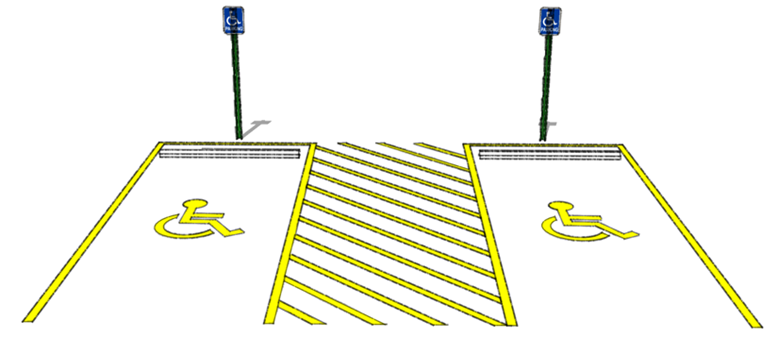
Accessible Parking Spaces. Each accessible parking space shall be marked with a freestanding or wall mounted sign using the standard symbol that signifies the space as designed to be accessible to persons with disabilities, along with the phrase "ACCESSIBLE PARKING." In addition, the standard symbol shall be painted on the pavement within the parking space. (See Figure 9-4-207A, Illustrative Accessible Parking Spaces.) This requirement shall automatically change to conform to any amendments to the 2010 ADA Standards for Accessible Design (as may be amended, re-titled or renumbered from time to time) that are in effect at the time the parking space is striped.
| Figure 9-4-207A Illustrative Accessible Parking Spaces |
|---|
 |
(c)
Traffic Control Devices. All traffic control devices (signs, markings, and signals) shall conform to the Manual on Uniform Traffic Control Devices (MUTCD), latest edition.
(d)
Parking Stops.
(1)
Parking stops, curbs, or bumper rails shall be installed in all ADA-accessible parking spaces (except parallel parking spaces).
(2)
The Town may require the installation of parking stops, curbs, or bumper rails in other locations if they are needed for safe traffic circulation and pedestrian safety.
(Ord. No. 2023-006, 6-14-2023)
Sec. 9-4-208. - Truck loading areas.
(a)
Generally.
(1)
Buildings or structures to be built or substantially altered, which are anticipated to receive and distribute material or merchandise by truck, shall be designed to provide and maintain off-street loading berths in sufficient numbers and size to adequately handle the needs of the particular use.
(2)
If loading space has been provided in connection with an existing use or is added to an existing use, the loading space shall not be eliminated if elimination would result in less space than is required to adequately handle the needs of the particular use.
(3)
Off-street parking areas used to fulfill the requirements of this Section shall not be used for loading and unloading operations except during off-peak parking periods.
(b)
CCC and MU Exception. In the CCC Zone and MU Zone, over-the-curb loading from local streets or alleys is allowed in lieu of the off-street loading requirements of this Section, provided that the loading occurs during off-peak hours and the areas that are used for loading are approved by the Administrator.
(c)
Loading Space Dimensions.
(1)
Minimum width of loading bay (side to side): 12 feet.
(2)
Minimum length of loading bay (front to back):
a.
For semi-trailers: 60 feet.
b.
All other loading spaces: 25 feet.
(3)
Minimum vertical clearance: 14 feet.
(d)
Use of Rights-of-Way. Where off-street loading areas are required, at no time shall any part of a truck or van be allowed to extend into a public right-of-way while the truck or van is being loaded or unloaded.
(e)
Maneuvering Space. Adequate off-street truck maneuvering space shall be provided on-site (and not within any public street right-of-way or other public land) so that trucks can maneuver to the loading area.
(f)
Location. All loading areas are required to be located on the same lot as the building or lot served by the loading area.
(g)
Design. Off-street loading facilities shall be designed so that they do not interfere with fire exits or emergency access routes.
(Ord. No. 2023-006, 6-14-2023)
Sec. 9-4-209. - Parking lot landscaping.
(a)
Generally. Parking lot landscaping is required as set out in this Section.
(b)
Applicability. The standards of this Section apply to surface parking lots associated with all nonresidential uses, except parking lots that contain fewer than 16 parking spaces, and except in the CCC Zone.
(c)
Parking Bufferyards. Surface parking lots for multifamily and nonresidential land uses shall be buffered from adjoining streets. Unless another type of bufferyard is required along the same boundary of the subject property, the minimum bufferyard for this purpose shall be a Class A Bufferyard as specified in Table 9-4-302C.
(d)
Alternative to Parking Bufferyards. The Administrator may allow interior landscaping in lieu of subsection (c) Parking Bufferyards, subject to the following:
(1)
Landscaping at the ends of parking aisles, planted in endcap islands that are not less than nine feet wide and 36 feet long (18 feet where the parking module does not adjoin another parking module), with 10-foot curb radii on the side that faces outward from the parking aisle.
(2)
Landscaping between the endcaps of parking rows, either:
a.
Planted in interior islands that are not less than nine feet wide and 36 feet long (18 feet where the parking module does not adjoin another parking module), with 5-foot curb radii at both ends; or
b.
Planted in interior landscape strips that are at least five feet wide that are located between parking modules, or at the edges of parking modules where parking modules do not adjoin each other.
(3)
At the corners of parking lots, planted in corner islands, which are the area defined by the extension of the outer edges of intersecting parking modules.
(4)
Planting Requirements.
a.
Each endcap island, interior island, and corner shall be planted with a minimum of one canopy tree or two understory trees.
b.
Each landscape strip shall be planted with not less than one canopy tree or two understory trees per 100 linear feet. Formal arrangement of the trees in the landscape strip is not required.
(Ord. No. 2023-006, 6-14-2023)
Sec. 9-4-301. - Purpose and application of division.
(a)
Generally. This Division includes standards for required bufferyard landscaping. Bufferyards are required (or not) based on the development type, or right-of-way type that adjoins the subject property.
(b)
Applicability of Standards; General Exceptions.
(1)
Except as provided in Subsection (b)(2), the standards of this Division apply to all new development, redevelopment, or substantial improvements to the uses which are required to have a buffer yard under Division 2-2 of this LUDC.
(2)
The standards of this Division do not apply to modifications to nonresidential buildings where the redevelopment does not expand the floor area of the use by more than 10 percent.
(Ord. No. 2023-006, 6-14-2023)
Sec. 9-4-302. - Landscaping specifications.
(a)
Generally. This Section includes specifications for bufferyard landscaping.
(b)
Plant Spacing. Plant spacing shall allow for adequate growth of plants at maturity and for street intersection visibility.
(c)
Species Selection.
(1)
Plants that are identified as noxious, invasive, or prohibited by the United States or the State of Colorado shall not be planted in the Town.
(d)
Minimum Size of Landscape Materials. The minimum sizes of landscape materials used to satisfy the requirements of this Division are set out in Table 9-4-302A, Minimum Size of Landscape Materials.
(e)
Tree Preservation Credits.
(1)
Existing living trees that are preserved on a subject property count towards the planting requirements of this Division, provided that:
a.
They are not:
i.
Identified as noxious, invasive, or prohibited by the United States or the State of Colorado; or
ii.
Damaging public sidewalks and streets; or
iii.
Impacting utilities.
(2)
Preserved trees may count as more than one tree for the purposes of the landscaping requirements, as set out in Table 9-4-302B, Tree Preservation Credits.
(f)
Bufferyard Classifications. For the purposes of this LUDC, there are three classifications of bufferyards, as set out in Table 9-4-302C, Bufferyard Classifications.
(g)
Waiver or Reduction of Tree Planting Requirements. The Administrator may waive or decrease planting requirements if the total number of trees that are required exceeds the number that can be reasonably planted on the subject property without materially increasing fire risk, compromising the health of the trees, or diminishing the use of the property.
(h)
Landscape Design. The tree planting requirements are not spacing requirements. Trees may be planted in formal or informal arrangements. Trees that reach a mature height of more than 25 feet shall not be planted within 20 feet of an overhead utility line.
(i)
Groundcovers. Groundcovers shall be planted as necessary to stabilize soil and prevent erosion.
(Ord. No. 2023-006, 6-14-2023)
Sec. 9-4-401. - Utilities.
(a)
Generally. Development shall be designed so that each lot can connect to water, sewer electric and other utilities as needed.
(b)
Utility Easement Widths.
(1)
Utility easements shall be provided along lot lines in new subdivisions as follows:
a.
Boundary lot lines (any lot line that is also a boundary of the subject property): at least 10 ft.
b.
Rear lot lines: 5 ft.
c.
Side lot lines (where necessary): 5 ft.
(2)
If the location of utility easements along lot lines is unsuitable for the use of the utility companies due to drainage, irrigation ditches, timbered area, or other obstructions, easements of appropriate width shall be provided adjacent to the areas of obstruction.
(c)
Underground Installation Required; Exceptions.
(1)
The applicant shall underground all electric, gas, and communications lines (collectively, "UTILITIES") within the boundaries of the subject property or subdivision plat, and that are required to be relocated pursuant to this LUDC or as a condition of approval of the development.
(2)
Transformers, switching boxes, terminal boxes, meter cabinets, pedestals, ducts, street lighting, or other facilities necessarily appurtenant to such underground utilities may be installed or placed above ground.
(3)
High-voltage electric transmission and distribution feeder lines and necessary appurtenances thereto may be installed or placed above ground.
(4)
The Administrator may waive the underground requirement with regard to power and communications lines if:
a.
The Subject Property has existing service via overhead lines on the date of application;
b.
No new utility poles will be installed as a result of the proposed development; and
c.
The Subject Property has less than 200 feet of frontage, or the scale of the proposed development does not justify the cost of undergrounding the existing lines.
(d)
All utilities that serve proposed development shall be located within dedicated and platted public utility easements or public street rights-of-way, which shall be approved and thereafter subject to acceptance by the Town with respect to those utilities that are municipally operated. The applicant shall be responsible for arranging connections from the Subject Property to existing utility systems.
(Ord. No. 2023-006, 6-14-2023)
Sec. 9-4-501. - Intent and liability.
(a)
Generally. Colorado follows the modified civil law rule that the owner of upstream property possesses a natural easement on land downstream for drainage of surface water flowing in its natural course. Natural drainage conditions may be altered by the owner of the upstream land, provided that the water in the post-development condition is not sent down in a manner or quantity to do more harm to the downstream land prior to development. Development proposals that would result in drainage volumes or patterns that would likely violate the modified civil law rule will not be approved unless the applicant obtains appropriate approvals and/or easements from the affected property owner(s).
(b)
Stormwater Management Plans. Site plans and preliminary plats shall be accompanied by a stormwater management plan, sealed by a Professional Engineer that certifies compliance with the requirements of subsection (a), above. Stormwater Management Plans shall include the following:
(1)
Identification of the major drainage basin, sub basins, and drainageways; and
(2)
Calculation of pre-development and post-development stormwater discharge rates for the five-year and 100-year storm events;
(3)
An evaluation of the impacts of proposed development on adjacent and downstream properties; and
(4)
Proposed mitigation measures and temporary, permanent, structural, and non-structural best management practices ("BMPs"), as appropriate, to ensure that stormwater runoff from the post-development condition does not affect adjacent or downstream properties in a manner or quantity that does more harm than the pre-development condition. The description of BMPs shall include information regarding the use, design, installation, maintenance, and removal of the BMP.
(c)
Exceptions. Subsection (b) of this Division does not apply to development that does not require a site plan or preliminary subdivision plat. However, this LUDC does not (and cannot) exempt any development from the modified civil law rule cited in subsection (a), above.
(d)
State Permits. A Colorado Discharge Permit System ("CDPS") permit shall be obtained if required by state law.
(Ord. No. 2023-006, 6-14-2023)
Sec. 9-4-601. - Public improvements and site improvements.
(a)
Generally.
(1)
Public Improvements. Depending upon the nature of the application for development approval, public improvements that must be constructed, installed, or otherwise provided by the applicant may include, but are not limited to:
a.
Permanent survey monuments, range points and lot pins;
b.
Streets, alleys, acceleration or deceleration lanes, sidewalks, and curb and gutter;
c.
Street name signs and traffic-control signs or other street control devices;
d.
Bridges, culverts, or open drainage channels;
e.
Street lights;
f.
Water lines and fire hydrants;
g.
Sanitary sewer lines; and
h.
Storm drainage improvements.
The public improvements contemplated by this Section are intended to provide services to the subject property or to offset the impacts of the development of the subject property.
(2)
Landscaping. Depending upon the nature of the application for development approval, the Town may require collateral and warranties for landscaping.
(b)
Engineering Specifications. Public improvements shall comply with Town engineering specifications as may be promulgated by the Public Works Director from time to time.
(c)
Improvements Agreement. All applicants whose development applications involve the construction, installation, or provision of public improvements or installation of required landscaping in order to meet the standards of this LUDC, shall be required to execute an improvements agreement.
(d)
Standards for Public Improvements. All public improvements and required landscaping shall be constructed to comply with all applicable Town standards, regulations, and specifications. No development for which public improvements or required landscaping are required in order to meet the standards of this LUDC proposed shall be finally approved or recorded without the execution of the improvements agreement, along with the required financial security, in a form approved by the Town.
(e)
Improvements Construction Plans. All applicants whose development applications require construction, installation, or provision of public improvements shall be required to submit construction plans including civil construction drawings for all required public infrastructure improvements for review and approval by the Administrator or her/his designee. Similarly, all applicants whose development applications involve the installation of landscaping in order to meet the standards of this LUDC shall submit landscaping plans detailing the design of required landscaping for review and approval by the Administrator or her/his designee.
(f)
Dedications of Right-of-Way. Dedications of right-of-way for public streets, drainage easements, utility easements, or other public purposes shall be required and shall be made by the applicant on the plat, or, in the case of a site plan, by separate instrument approved by the Administrator and approved as to form by the Town Attorney.
(g)
Cost of Processing. Applicants are required to pay the costs of processing the development application and improvements agreement, including all consultant costs, legal fees, and other fees incurred by the Town. The Town may require the applicant to execute a reimbursement agreement to effectuate this provision.
(h)
Collateral for Improvements.
(1)
Prior to the recordation of any final plat or issuance of any permits for development of a subdivision or other development for which public improvements or required landscaping are proposed, the applicant shall provide to the Town collateral in the amount of 125% of the total estimated cost of construction of the improvements, in the form of either:
a.
A cash deposit; or
b.
A letter of credit in a form approved by the Town Attorney, issued by a financial institution authorized to do business in the State of Colorado.
(2)
The applicant shall ensure that the collateral remains unencumbered and free from claims of others so that any requests of the Town for payment or enforcement may be immediately and unequivocally honored without cost to the Town.
(3)
The applicant shall provide a report of the status of the improvements every six months during construction.
(4)
Such collateral shall be maintained, in the amount required by the agreement, through the warranty period as set forth herein.
(5)
If, at any time prior to final acceptance and expiration of the warranty period, the Town determines that the collateral is not sufficient to cover all costs of construction of the improvements and provides the applicant with a written basis for the requested increase to collateral, the applicant shall be required to post additional or supplemental collateral in an amount deemed reasonably sufficient and approved by Town to pay for all costs of construction, including any administrative costs and contingency amount.
(6)
After preliminary acceptance, the Town may reduce the amount of required collateral during the warranty period to an amount reasonably determined by the Administrator, based on the potential cost of repair or restoration of the improvements.
(i)
Completion and Acceptance of Improvements.
(1)
The applicant shall complete construction of the improvements within a period of time that is set out in the improvements agreement.
(2)
The Town will perform periodic inspections of the public improvements and landscaping, and the applicant shall promptly modify, alter, or repair, at its own cost and expense, any improvements or landscaping that are not constructed or installed in accordance with the approved plans, such that the improvements conform to the approved plans.
(3)
Upon completion of construction of the improvements and landscaping according to the approved plans, the applicant shall make a written request for preliminary acceptance of such improvements and landscaping ("Preliminary Acceptance"). With said request, the applicant shall:
a.
File with the Town an original and digital copy (in a form approved by the Administrator) of the as-built construction plans of public improvement(s), stamped and certified by the Engineer of Record who shall also be a state-registered professional engineer; and
b.
Submit to the Town a sworn affidavit and documentary evidence that there exists no lien or encumbrance upon or against the public improvements resulting from unpaid amounts owing to contractors, subcontractors, material persons or other persons involved or engaged in the construction or installation of the public improvements.
(4)
Upon request for preliminary acceptance, the Town shall determine whether the improvements and landscaping are installed according to approved plans. If so, the Town shall issue to the applicant a certificate of preliminary acceptance, granting preliminary acceptance of the public improvements and approval of the landscaping, and setting the terms of the warranty period. The warranty period ("Warranty Period") shall terminate two years from the date of preliminary acceptance.
(5)
Upon expiration of the Warranty Period:
a.
The Town shall re-inspect the improvements and landscaping and require correction of all defects and failures of the improvements prior to the issuance of final acceptance of the improvements and the release of any remaining collateral.
b.
Upon completion of any required warranty repairs, reconstruction, or replacement, public improvements shall become the property of the Town (and thereby the Town's maintenance responsibility) by final acceptance of the public improvements by the Town.
(j)
Timing of Certificates of Occupancy. No certificates of occupancy shall be issued for any building permits until such time as the Town has issued (at a minimum) preliminary acceptance of the public improvements and landscaping that are identified in the improvements agreement. A conditional certificate of occupancy may be issued if installation of landscaping is delayed due to season or adverse weather conditions, and the amount and duration of the security identified in the improvements agreement is sufficient to cover the cost of installation.
(Ord. No. 2023-006, 6-14-2023)
Sec. 9-4-701. - Purpose and application of division.
(a)
Purpose. The purpose of this Division is to set out requirements for operations plans that ensure that the operational impacts of certain uses are anticipated and mitigated.
(b)
Application. This Division applies when the requirements for approval of a land use include one or both of the plans set out in Section 9-4-702 or Section 9-4-703, or where the Town determines that such plans are necessary to mitigate the projected impacts of a land use that involves unusual amounts of heavy truck traffic.
(Ord. No. 2023-006, 6-14-2023)
Sec. 9-4-702. - Heavy truck routing plan.
(a)
Generally. A heavy truck routing plan is required for uses as specifically identified in this LUDC and for uses that the Administrator determines will involve the use of semi-trailers, dump trucks, trash hauling trucks, or comparable heavy vehicles at a frequency of more than 10 heavy vehicle trips per week.
(b)
When Required. For the uses that require heavy truck routing plans, such plans shall be submitted with site plans.
(c)
Updates. Heavy truck routing plans shall be updated when:
(1)
New routes are proposed by the applicant.
(2)
The applicant proposes to increase heavy truck traffic by more than 20 percent compared to that set out in the approved heavy truck routing plan.
(3)
Routes are changed by the Town or other relevant transportation authority in a manner that affects the approved heavy truck routing plan.
(d)
Contents. The heavy truck routing plan shall include, at a minimum:
(1)
The type or class of heavy trucks that will be used by the applicant's proposed land use;
(2)
The anticipated frequency of delivery and departures of heavy trucks;
(3)
The hours of heavy truck traffic;
(4)
A map illustrating the route(s) to and from a state highway (or to and from anticipated destinations in the Town), of all heavy trucks used by the proposed land use; and
(5)
A map illustrating the routing and flow of heavy trucks within the subject property.
(Ord. No. 2023-006, 6-14-2023)
Sec. 9-4-703. - Master plan for extraction.
(a)
Generally. Minerals shall not be extracted except according to a Master Plan for Extraction prepared by the applicant.
(b)
Contents of Master Plan for Extraction. The Master Plan for Extraction shall address:
(1)
The quality of life of the residents in and around areas which contain commercial mineral deposits;
(2)
The ability to reclaim the area pursuant to the provisions of C.R.S. § 34-32-101 et seq., Colorado Mined Land Reclamation Act; and
(3)
The ability to reclaim an area owned by the Town or other governmental authority, pursuant to an adopted plan, to be used for public purposes by the Town or governmental authority consistent with such proposed use.
(Ord. No. 2023-006, 6-14-2023)

