
Oak Park City Zoning Code
ARTICLE III
GENERAL PROVISIONS
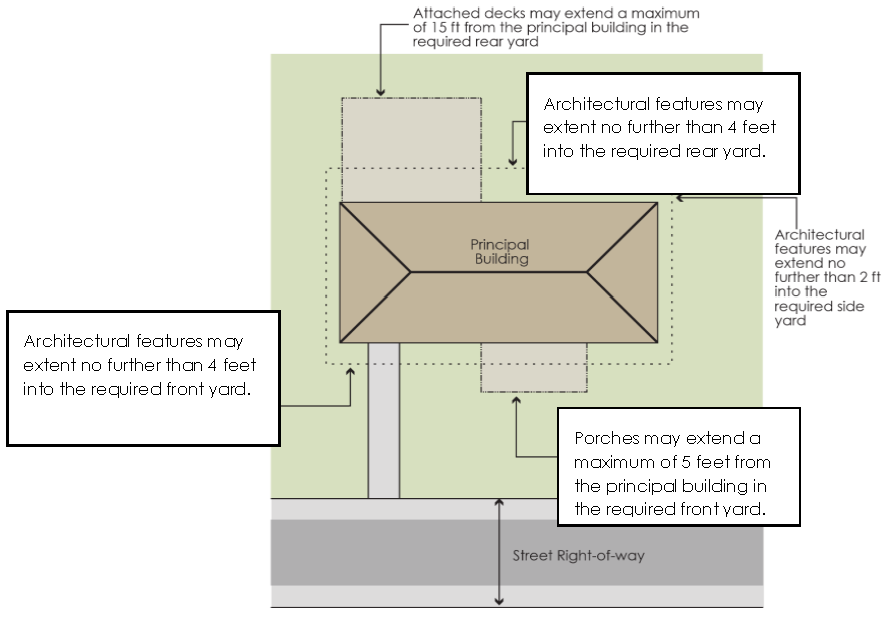
Sec. 300. - Accessory buildings, structures, and uses (see figure 3.1 accessory buildings and structures location standards).
Accessory buildings, except as otherwise permitted in this title, shall be subject to the following regulations.
a.
Relation to principal building.
1.
Accessory buildings, structures, and uses are permitted only in connection with, incidental to and on the same lot with, a principal building that is occupied by a use permitted in the particular zoning district.
2.
No accessory building, structure, or use shall be occupied or utilized unless the principal structure to which it is accessory is occupied or utilized.
3.
Detached accessory buildings shall be set back a minimum of ten feet from the principal building.
b.
Locations for detached accessory buildings.
1.
Detached accessory buildings and structures shall only be located in the yards listed in table 3.1.
2.
Accessory buildings shall not be located within a dedicated easement or right-of-way.
Figure 3.1 Accessory buildings and structures location standards
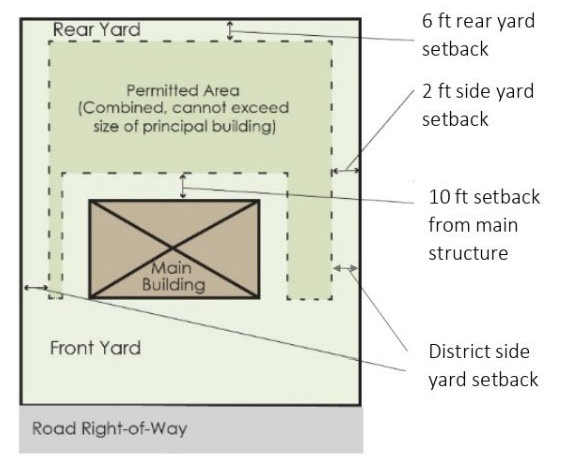
Table 3.1 Accessory Building Locations and Setbacks
c.
Rear yard lot coverage limit. A total of the combined buildings accessory to a residential building shall not exceed the ground floor area of the principal building. The total area of all structures on the lot shall not exceed the lot coverage limits of the district, found in article 2 and shall not exceed 35 percent of the required rear yard.
d.
Number of accessory structures. In the R-1 and R-2 districts a maximum of one accessory structure or building, not including detached garages, are permitted subject to the size, setback, and additional criteria in this article. Detached garages cannot exceed 600 square feet.
e.
Height limitations. The maximum height of detached accessory buildings shall be one story but not to exceed 13 feet in all residential zoning districts, 30 feet in light industrial and industrial flex and 25 feet in all other zoning districts subject to site plan review and approval.
f.
Use. Accessory buildings shall not be occupied for dwelling purposes unless otherwise provided in this ordinance.
g.
Appearance. The design and building materials of any accessory building shall generally be consistent with the character of the principal building on the property (e.g. material, color), as determined by the building official.
h.
Attached garages. Garages that are structurally attached to a principal building by connection of walls or a roof shall be subject to, and must conform to, all regulations of this ordinance applicable to the principal building, including setbacks and lot coverage, and not the regulations of this section. Attached garages shall not exceed the height of the living portion of the dwelling.
i.
Carports and garages in non-single-family developments shall have a maximum height of 13 feet, measured from the grade to the midpoint of the roof. Carports shall be enclosed or obscured at least 25 percent along sides visible from public streets, residential districts or vehicular drives within the site. All details must be provided on the site plan and reviewed and approved by the planning commission.
(Ord. No. O-22-719, § 4, 3-7-22; Ord. No. O-23-728, § 4, 3-8-23; Ord. No. O-25-739, § 5, 5-19-25)
Sec. 301. - Adult and child care facilities.
a.
Adult and child care facilities, as defined in article I, division 2, definitions, are allowed only as provided for in the following table. Applicable conditions are listed as footnotes to the table.
Footnotes:
1. The use shall be registered with the city clerk's office and shall continually have on file with the city documentation of a valid license as required by the state.
2. Since the state law preempts in this area; the facility shall be brought into compliance with all State building and fire codes pursuant to State Licensing Rules R400.1831-R400.1835.
3. Documentation of such compliance with state requirements shall be provided.
4. The site shall comply with the sign provisions of article IV, division 4, signs.
5. Off-street parking shall comply with parking space numerical requirement per article IV, division 1.
6. The building shall have an appearance which is non-intrusive and consistent in color, materials, roof-line, and architecture with the single-family or multiple-family residential district in which it is located, as determined by the planning commission.
7. Documentation of sufficient indoor classroom, crib, or play area meeting state requirements shall be provided. Documentation of approved areas, as licensed by the state, shall be provided.
8. There shall be sufficient outdoor play area to meet State regulations. All required outdoor play areas shall be fenced with a four-foot tall fence, provided that no fenced outdoor play area shall be located in a front yard.
9. There shall be sufficient drop-off parking spaces to allow maneuvers without creating a hazard to traffic flow.
10. The lot shall be at least 1,500 feet from another group day care home or similar facility. This may be reduced by the planning commission upon a finding by the planning commission that the proposed facility will not contribute to an excessive concentration of state licensed residential care facilities in the area.
11. The dropping off and picking up of children shall not be allowed prior to 6:00 a.m. or after 10:00 p.m.
12. Convalescent and nursing home and assisted living:
a. All vehicular ingress and egress shall be directly onto a major or secondary thoroughfare as designated on the city's adopted master plan.
b. The minimum site size shall be two acres.
c. ;hg;All buildings shall be set back at least 50 feet from all property lines.
d. There shall be minimum of 25 square feet of outdoor recreation space per resident cared for, in such areas as gardens, patios, decks, and the like. Recreation space must be fully accessible and barrier-free.
(Ord. No. O-25-739, § 5, 5-19-25)
Sec. 302. - Reserved.
Editor's note— Ord. No. O-23-728, § 4, adopted March 8, 2023, repealed § 302 which pertained to antennas and towers and derived from the 2021 zoning ordinance.
Sec. 303. - Application procedures in general.
a.
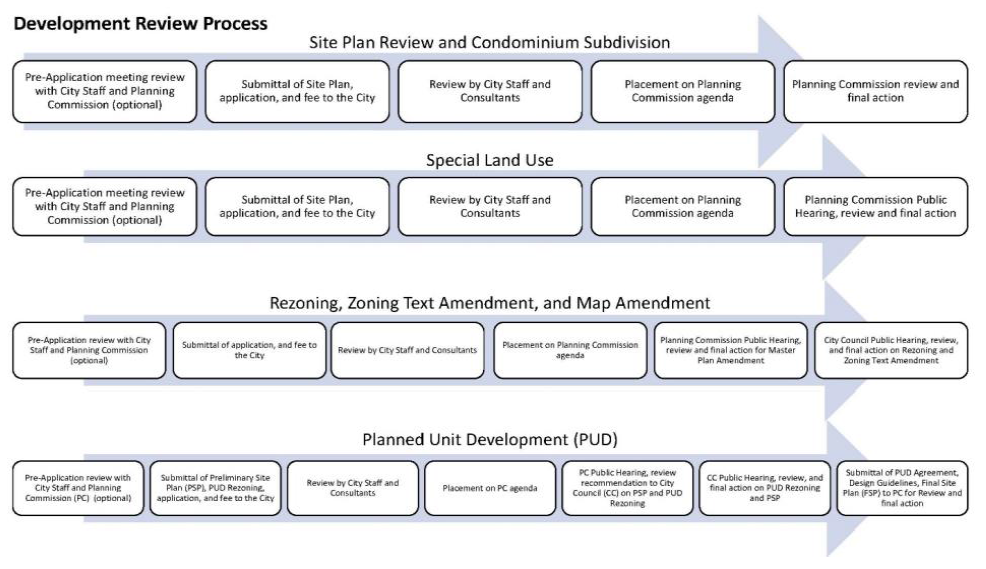
The process for application and review by the city for site plan review, special land use approvals, conditional land use approvals, planned unit developments (PUDs), condominium developments, text amendments to this ordinance, and rezonings of land is shown on figure 2.2 development approval process. Submittal dates, application forms, and information on fee requirements are available at the city offices.
b.
The planning commission, zoning board of appeals (ZBA), or city council may withhold granting approval of any use, site plan, PUD plan, or other approval required by this zoning ordinance pending approvals which may be required by county, state, or federal agencies or departments.
Sec. 304. - Building grades.
All new buildings and structures constructed on vacant lots adjacent to and in between existing buildings shall be constructed at the elevation of the average grade unless otherwise approved by the building official and city engineer. New grades shall not be established that would permit an increase in the runoff or surface water onto adjacent properties.
Any buildings shall be located at such an elevation that a sloping grade shall be maintained to cause the flow of surface water to run away from the walls of the building. Yards shall be graded in such manner to prevent the accumulation of surface water on the property and not increase the natural flow or run-off of surface water onto adjacent properties.
Sec. 305. - Determination of similar use.
Since every type of potential use cannot be addressed in this ordinance, each district provides for similar uses, referencing this section. All requests for a use not specifically addressed in any zoning district shall be submitted to the zoning administrator for review and decision, based on the following standards. The zoning administrator may refer the review and decision to the planning commission.
a.
A finding is made that the proposed use is not listed as a named permitted or special land use in any zoning district.
b.
If the use is not addressed in this ordinance, the zoning administrator or planning commission may attempt to select a named use listed in this ordinance which most closely resembles the proposed use. Such named use shall be determined using criteria such as potential impact on property values, nature of use, traffic generated, aesthetics, noise, vibration, dust, smoke, odor, glare, and other objectionable impacts on the health, safety, and welfare in the city.
c.
If a use is determined to be similar to a named use, the proposed use shall comply with any special land use standards or other ordinance requirements that apply to the named use.
d.
Where the zoning administrator or planning commission determines a proposed use is not similar to any named use addressed in this ordinance, the applicant may request for an amendment to this ordinance.
e.
The determination as to whether a proposed use is similar in nature and class to another named permitted or special land use within a district shall be considered as an interpretation of the use regulations, and not as a use variance. Any use determined by the zoning administrator planning commission to be similar shall thereafter be deemed to be included in the enumeration of the uses.
Sec. 306. - Donation boxes.
In all nonresidential districts, one donation box shall be allowed with the following conditions:
a.
Approval must be obtained from the zoning administrator or other official designated by the city through an application and permit fees.
b.
Donation boxes can only be located to the rear of a building.
c.
They cannot cause the elimination of required parking spaces.
d.
They cannot impede the orderly flow of traffic in the site.
e.
In those instances where donation boxes cannot be located in the rear of the building, a location in the side yard may be allowed but cannot be visible to any abutting residential district or from a public street.
f.
There must be proof that unique circumstances exist that make compliance with items a through d above impractical.
g.
Contact information for organization and applicant must be provided.
h.
The donation box must be maintained in a clean, safe condition and free of bags, donation items, or trash outside of the donation box.
Sec. 307. - Electric distribution and service lines.
The electric distribution system for new residential developments shall be placed underground in accordance with the rules of the Michigan Public Service Commission (Michigan Administrative Code Rules 460.511—460.512). Electric lines servicing new office, commercial, and industrial developments shall be located underground in accordance with the rules of the Michigan Public Service Commission (Michigan Administrative Code Rule 460.513) unless the practical difficulty associated with such action shall result in an undue burden to the customer as determined by the municipal services director.
(Ord. No. O-22-727, § 1, 12-5-22)
Sec. 308. - Fences, walls, and other protective barriers.
All fences of any kind shall conform with the following provisions:
a.
General provisions. In all districts the following standards apply:
1.
The erection, construction or substantial rebuilding of any fence shall be constructed within all municipal codes and shall require a building permit. Substantial rebuilding is reconstruction of more than 50 percent of the fence within a 12-month period.
2.
No fence shall extend toward the front of the lot farther than the front building line. Landscape treatments which are no longer than 50 percent of the width of the lot at the front lot line, and are 30 inches in height or less, may be erected within the front yard.
3.
No portion of the fence shall project beyond the property line.
4.
It shall be the duty of each property owner to ensure that all fences on the property are installed and maintained plumb, with adequate support and footings, and in a safe and sightly manner, and to remove or repair any fence, wall or privacy screen that is dangerous, damaged, dilapidated, or otherwise in violation of this Code.
5.
Bumper stops curbing or guard posts/rails in multiple family residential developments shall be provided where any fence or wall abuts a drive or parking area.
6.
If because of the design or construction, one side of a privacy or decorative fence has a more finished appearance than the other, the side with the more finished appearance shall face away from the fence owner's property.
b.
Residential provisions. In addition to the standards in subsection a. above, the following provisions shall apply to residential districts:
1.
No chain link fence shall be erected in excess of four feet, or less than 30 inches, in height above the grade of the surrounding land. Decorative wrought iron fences and privacy fences, which are 50 percent opaque or more, and do not include chain link fences which have been altered to be 50 percent opaque or more, shall not exceed a height of six feet. This provision does not alter any screening requirements between single-family zones and other more intensive districts. Other than as provided herein, no fence shall be in excess of four feet, or less than 30 inches, in height above the grade of the surrounding land.
2.
A fence may be erected in a side or rear yard setback. The fence must be designed or located so as to permit the cutting of vegetation which grows between the lot line and an existing fence or between an existing fence and a new fence. A new fence may be erected on a property lot line if the permit application is signed by both property owners. For fences which are erected on a property lot line, both property owners will be responsible for the repair, maintenance, and upkeep of the side of the fence which faces their property.
3.
Any person, firm, or corporation that owns or leases property upon which a fence is located shall be responsible for the repair, upkeep, maintenance, and reconstruction of any such fence and any area adjacent thereto. Routine maintenance and repair must be able to be completed from the property on which the fence is located. If ownership of a fence located upon a property line cannot be determined, then each party owning or leasing property adjacent to the fence shall be responsible for its upkeep, maintenance and reconstruction.
4.
Any privacy fence which is allowed to be constructed on the property line adjoining a public street shall be subject to the provisions of the residential driveway clear vision area in section 314, intersection visibility. If because of the design or construction, one side of the fence has a more finished appearance than the other, the side of the privacy fence with the more finished appearance shall face the street.
5.
Fences containing barbed wire, razor wire, spikes, nails, sharp points, or electric current or charge are prohibited.
c.
Commercial, office and institutional provisions. In addition to the standards in subsection a. above, the following provisions shall apply to commercial and office districts and institutional uses:
1.
No fence shall be erected in excess of six feet (unless otherwise required by this ordinance), or less than three feet in height above the grade of the surrounding land.
2.
Fences containing barbed wire, razor wire, spikes, nails, sharp points, or electric current or charge are prohibited; however, barbed wire in cradles may be placed on top of fences enclosing public utility facilities.
d.
Industrial provisions. In addition to the above general provisions, no fence shall be erected in excess of eight feet, or less than three feet in height above the grade of the surrounding land in any industrial district.
e.
Screen walls. Wherever a nonresidential use adjoins a residential district, and wherever a parking lot of eight or more spaces adjoins a single-family residential district, a screen wall shall be provided by the nonresidential use. (For purposes of this section, a parking lot of eight or more spaces shall be considered a nonresidential use).
1.
All required screen walls shall be six feet in height, unless otherwise specified, and shall be placed on an approved footing along the lot line of the nonresidential use.
2.
Where a public alley separates the nonresidential use from the residential use, the planning commission and/or the city planner; in the case of administrative approval review procedure, shall determine the location of the wall so as to best protect the residential district.
3.
Required screen walls shall not be extended into a required front setback area to ensure proper visibility of pedestrians and vehicles by drivers exiting the nonresidential site.
4.
Required screen walls shall be of masonry construction, decorative in nature, of either face brick, poured concrete with a brick pattern, or cement block with a facing of decorative brick.
5.
The planning commission may:
(a)
Approve a partial or complete substitution of the wall(s) using existing or proposed topography, dense vegetation, or other natural or man-made features that would produce substantially equivalent results of screening and durability;
(b)
Approve reduction or increase in wall height where a greater or lesser height is found appropriate based on consideration of topography, sight lines, and distances;
(c)
Approve variations in design standards for reasons of topography or characteristics peculiar to the site, its usage and environs, or in an area abutting residential—at the request of the homeowner(s).
In taking such actions, the planning commission shall take into account the principal purpose of the wall(s) is to screen nonresidential activities, including parking, loading and noise, from nearby residential districts. In such cases where the planning commission finds that there would be no substantial need for a screen wall, the requirements may be reduced or substituted in accordance with the table in subsection 309c above. The basis for such decision shall be recorded in the minutes of the planning commission.
(Ord. No. O-22-719, § 4, 3-7-22)
Sec. 309. - Flags and flagpoles.
a.
The maximum height of flagpoles shall not exceed 40 feet, except in residential district where the maximum height shall not exceed 20 feet, measured from the average surrounding grade.
b.
A maximum of one flagpole per property is allowed in single-family residential districts and three flagpoles are allowed per site in all other zoning districts.
c.
Flagpoles shall be set back a minimum of ten feet from any public right-of-way, private road access easement, access drive, or property line.
d.
A maximum of two flags per flagpole shall be permitted.
Sec. 310. - Front yard requirements.
a.
Front yard requirements along rights-of-way shall be measured from the public road right-of-way line, private road access easement line, or the curb of any access road, drive, or internal driveway where no right-of-way or easement exists.
b.
Through lots in all zoning districts must provide the required front yard setback on each side of the lot which abuts a public street, private road, or access drive.
c.
On curvilinear streets, the minimum front yard setback is measured along a curve parallel to the front lot line.
Sec. 311. - Grading, excavation, filling, soil removal, creation of ponds, and clearing of trees.
a.
Refer to chapter 78, trees, of this Code.
b.
Excavation required for swimming pools is excepted from excavating provisions of this ordinance provided that all necessary permits are obtained, and the pool is completely constructed within six months of the excavation.
Sec. 312. - Height exceptions and limitations.
a.
The height limits of this ordinance shall not apply to the following:
1.
Roof structures for the housing of elevators, stairways, tanks, ventilating fans and air conditioners or other similar equipment which is necessary or customarily incidental to the operation or maintenance of the building;
2.
Fire or parapet walls;
3.
Skylights;
4.
Chimneys and smokestacks;
5.
Towers and steeples;
6.
Wireless signal receiving antennae for domestic use only;
7.
Similar structures or appurtenances necessary and customarily incidental to the permitted uses in the district in which they are located.
b.
No structure or part of any structure listed above as an exception shall exceed by more than 15 feet the height limitation of the district in which it is located. In addition, no structure listed above as an exception shall have a total area greater than 25 percent of the roof area to which it is attached.
Sec. 313. - Home occupations.
a.
All home occupations must comply, and remain in continuous compliance with, the following standards:
1.
No person, other than members of the family or occupants residing in the dwelling, shall be engaged in the conduct of the home occupation.
2.
The use of the dwelling for the home occupation shall be clearly accessory, incidental, and subordinate to its use for residential purposes, and not more than 25 percent of the gross floor area of the dwelling shall be used for the conduct of the home occupation.
3.
There shall be no change in the outside appearance of the dwelling or any other visible evidence of the conduct of the home occupation.
4.
There shall be no signs on any structure, in the windows or anywhere on the property.
5.
Traffic generated by the home occupation shall not be greater than would normally be expected in a residential neighborhood, or no more than an average of ten vehicular trips per day.
6.
The home occupation shall be conducted entirely within the confines of the dwelling and shall not take place in a garage or accessory structure.
7.
There shall be no sale of products or service on the premises where the home occupation is located. A retail showroom, sales area, outlet, or similar facility is prohibited as is outdoor display of goods.
8.
Any necessary parking spaces for vehicles generated by the conduct of the home occupation shall be provided on the site in a normal driveway, but not within any required yard.
9.
No equipment or process shall be used in the home occupation which creates noise, vibration, glare, fumes, or odors detectable to the normal senses off the premises on which the home occupation is located. In addition, no equipment or process shall be used in the home occupation which causes visual or audible interference in any radio or television receivers off the premises or causes fluctuation in the line voltage off the premises.
10.
The home occupation shall be conducted entirely within the confines of the dwelling.
11.
The home occupation shall not involve the use of commercial vehicles for delivery of material to or from the premises.
12.
The use shall not involve the sale, storage or use of any firearms or any ignitable, toxic, or explosive material.
13.
There shall be no use of utilities or community facilities beyond that typical to the use of the property for residential purposes.
14.
Home occupations shall not include being a primary caregiver under the Michigan Medical Marihuana Act of 2008.
(Ord. No. O-22-719, § 4, 3-7-22)
Sec. 314. - Intersection visibility.
a.
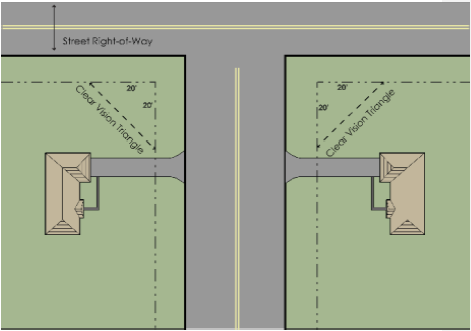
No fence, wall, sign, hedge, screen, or any planting shall be erected or maintained to obstruct vision between a height of 30 inches and eight feet within the triangular area formed by the intersection of the street right-of-way lines and a line connecting two points which are located on those intersecting right-of-way lines 20 feet from the point of intersection of the right-of-way lines. If the road is an access drive, these dimensions shall be measured from the pavement edge.
b.
The 30 inches and eight foot height limit shall be measured from the lowest elevation of the segment of the intersecting roads centerline which lies between the point of the intersection of the other centerline and the extension of the line drawn through the points 20 feet from the intersection of the right-of-way lines.
(Ord. No. O-22-719, § 4, 3-7-22)
Sec. 315. - Keeping of animals.
a.
Pets. The keeping of household pets, including dogs, cats, rabbits, fish, birds, hamsters, certain reptiles, and other animals generally regarded as household pets is permitted as an accessory use in any residential district. The keeping of animals not normally considered domesticated including, but not limited to, pigs, horses, sheep, cattle and wild, vicious and exotic animals, is prohibited in all zoning districts except the temporary keeping of live poultry by any lawfully established live poultry market incidental to the normal course of business, or as permitted by section 14-7 of this Code. However, no more than three dogs or cats, or any combination thereof of six months of age or over without first obtaining a kennel license. No person shall in any combination (not including domestic chicken), have a total of more than three animals, to be kept or housed in or at one dwelling unit.
b.
Kennels. The keeping of more than three dogs on one premises shall be deemed to be a kennel and must follow the regulations set forth in article 5, division 4, special land uses.
c.
Domestic chicken. Any person residing in a single-family detached dwelling on residential zoned one family dwelling district property (R-1), after obtaining an annual permit from the city, may keep, per household, not more than three hen (female) chickens for personal use only and not for any business or commercial use. Chickens may be kept as family pets or to lay eggs for personal consumption only, as permitted by section 14-7 of this Code. Slaughtering of any chickens on the property is prohibited.
(Ord. No. O-22-719, § 4, 3-7-22)
Sec. 316. - Lot area allocation.
a.
No portion of a lot can be used more than once for determining compliance with the provisions for lot area and yard dimensions for construction or alteration of buildings.
b.
No lot, adjacent lots in common ownership, required yard, parking area, or other required open space shall be created, divided, or reduced in dimensions or area below the minimum requirements of this ordinance. If already less than the minimum requirements of this ordinance, a lot, adjacent lots in common ownership, required yard, parking area, or other open space shall not be divided or reduced in dimensions or area so as to increase its noncompliance with the minimum requirements of this ordinance. Lots or yards created after the effective date of this ordinance shall comply with the requirements of this ordinance.
c.
In calculating the area of a lot that adjoins a dedicated alley or lane, for the purpose of applying lot area requirements of this ordinance, one-half the width of such alley abutting the lot shall be considered as part of the lot.
Sec. 317. - Lot width/depth ratio.
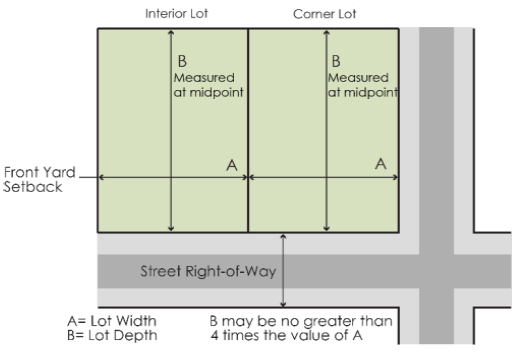
Lots created after the effective date of this Ordinance having a lot area of less than ten acres shall have a lot width which is equal to, or greater than, one-fourth the depth of the lot.
Sec. 318. - Mechanical equipment and utilities.
a.
Ground mounted mechanical equipment, such as blowers, ventilating fans, and air conditioning units are permitted only in non-required side yards and in any rear yard, as determined by the zoning administrator.
b.
Mechanical equipment shall be placed no closer than three feet to any lot line in the commercial and industrial districts.
c.
Any ground, building, or roof mounted mechanical equipment or utilities, including water and gas meters, utility boxes, transformers, elevator housings, stairways, tanks, heating, ventilation and air conditioning equipment (HVAC), and other similar equipment, shall comply with the following standards:
1.
All such equipment shall be screened by a solid wall, fence, landscaping, and/or architectural features that are compatible in appearance with the principal building. If such equipment is located in the rear yard and not visible from the roadway screening is not required.
2.
Screening shall be no less than the height of the equipment.
3.
For all commercial and industrial buildings, roof-mounted equipment shall not exceed a height of ten feet above the surrounding roof surface and shall occupy no more than 15 percent of the total roof area. All roof-mounted mechanical units must be screened so they are not visible from a street or adjacent property at ground level, measured 25 feet from the building wall, even if not specifically addressed as part of site plan review.
4.
A parapet, extension of the building façade is the preferred method of rooftop screening.
5.
All screening must be installed before a final certificate of occupancy is issued.
(Ord. No. O-22-719, § 4, 3-7-22)
Sec. 319. - Outdoor dining.
Outdoor dining areas are permitted as an accessory use for restaurants subject to the following:
a.
Approval process.
1.
Outdoor dining areas proposed as part of a new restaurant use, an addition to an existing restaurant, a restaurant that serves alcoholic liquor or a dining area on a public sidewalk or right-of-way, shall require administrative plan review and approval by the city planner.
2.
Outdoor dining areas proposed to be added to an existing restaurant with no other building or significant site modifications, shall submit a site development plan to the department of economic development and planning for review and administrative approval.
a.
The following information is required on the site development plan:
i.
A completed application.
ii.
A detailed plan showing the design, relevant details and location of all permanent and temporary structures such as decks, awnings, planters, landscaping, railings, tables, chairs, umbrellas, electrical outlets or appliances, hydrants, all ingress and egress, lighting and other equipment. The site development plan shall be submitted on a sheet no smaller than 11 inches x 17 inches at a scale showing detail sufficient for proper review.
iii.
The applicant's entire property and adjacent properties on a location map with streets for a distance of at least 25 feet.
b.
General standards.
1.
Outdoor dining shall only be permitted between March 1 and November 30 with all furniture and fixtures including, but not limited to, tables, chairs and waste receptacles removed from the exterior premises after November 30.
2.
The hours of operation for the outside dining area shall be consistent with the hours of operation inside the restaurant.
3.
For plans showing more than 20 occupants within the outdoor dining area, additional off-street parking shall be provided as required in article IV, division 1, off-street parking, section 403, restaurants—sit down.
4.
Tables, chairs, umbrellas and any other objects provided with outdoor dining areas shall be of good quality and of a durable material such as wood or metal. The design, materials and workmanship of these items should ensure the safety and convenience of the users and enhance the visual and aesthetic quality of the outdoor area.
5.
No table umbrella or other outdoor fixture in the outdoor dining area shall contain any sign or advertising matter.
6.
The planning commission may approve decorative or accent lighting as an alternative to shielded light fixtures when it can be demonstrated that there will be no off-site glare and the proposed lighting method is necessary to preserve the intended character of the site.
7.
The restaurant shall clean the entire outdoor dining area and all other adjacent landscaped and sidewalk areas by removing debris, trash, sweeping and washing down the area each day. The cleaning shall be conducted as frequently each day as necessary to prevent debris and trash from being blown or scattered onto other properties. A thorough sweeping and cleaning shall be conducted at the close of business each day.
8.
Outdoor dining areas shall be enclosed in instances where there is alcoholic liquors service. Enclosures shall consist of metal railing, wood railing, brick walls or other suitable materials approved by the planning commission, city council or administratively, as applicable.
9.
No food preparation, preparation equipment or bars shall be permitted in the outside dining area, including heating or cooking on open flames.
c.
Additional requirements for outdoor dining areas located on a public sidewalk.
1.
Outdoor dining areas, on a public sidewalk, shall be located in a manner to maintain a minimum pathway width of five feet (clear of structures such as light poles, trees and hydrants) so as not to interfere with pedestrian traffic moving around the outdoor dining area.
2.
Outside dining areas located on a public sidewalk or within any public right-of-way requires approval by the corresponding jurisdiction (City of Oak Park, MDOT, Road Commission of Oakland County). A license agreement in a form deemed acceptable to the city attorney's office shall also be required.
3.
Any restaurant approved to operate an outdoor dining area on a public sidewalk shall pay to the city treasurer a license fee in the amount established by resolution of the city council.
4.
Outdoor dining areas located on a public sidewalk are required to provide a policy or certificate of insurance, in an amount acceptable to the city, including workers compensation, naming the city as additionally insured. Establishments serving alcoholic liquors shall provide a liquor liability policy or certificate of insurance naming the city as additionally insured. A company authorized to do business in the state shall issue such insurance. Required insurance amounts shall be set by resolution of city council. The policy or certificate shall contain a clause requiring the insuring company to give 15 days' written notice to the city manager prior to cancelling the policy. The required insurance certificate shall be in effect for any period during which the outdoor dining area is in operation. No establishment shall operate an outdoor dining area on a public sidewalk without filing proof of proper insurance. Failure to provide a current insurance certificate shall be cause for immediate discontinuation of use of sidewalk for an outdoor dining area.
5.
The owner of the restaurant with the outdoor dining area on a public sidewalk assumes full responsibility for damage to public property caused by the placement and operation of the outside dining area. The restaurant will also repair any damage to public property at their own expense.
(Ord. No. O-22-719, § 4, 3-7-22)
Sec. 320. - Performance standards.
No land use otherwise allowed shall be permitted within a zoning district that does not conform to the following standards of use, occupancy, and operation. These performance standards are hereby established as the minimum requirements to be maintained.
a.
Smoke.
1.
Generally. United States Bureau of Mines "Ringelmann Smoke Chart," is used to measure smoke density. It shall be unlawful for any person to permit the emission of any smoke from any source, excepting smoke from a chimney for a fireplace or wood/coal burning stove in a residential structure, to a density greater than that density described as No. 1 of the Ringelmann Chart; provided that the following exceptions shall be permitted: smoke, the shade or appearance of which is equal to, but not darker than No. 2 of the Ringelmann Chart, for a period, or periods, aggregating four minutes in any 30 minute period.
2.
Method of measurement. For the purpose of grading the density of smoke, the Ringelmann Chart, as now published and used by the United States Bureau of Mines, which is hereby made a part of this Ordinance, shall be the standard. However, the umbra scope readings of smoke densities may be used when correlated with the Ringelmann's Chart.
b.
Radioactive, toxic and hazardous materials. Radioactive materials and wastes, including electromagnetic radiation such as X-ray machine operation, shall not be emitted in excess of quantities established as safe by the American National Standards Institute, when measured at the property line. All transportation, including by rail, of radioactive materials, hazardous waste, and toxic waste shall be within permissible standards set by the federal government.
c.
Noise. At no point on the lot line shall the sound pressure level of any operation on the lot exceed 70 dB(A). Operations or activities which exceed the maximum sound intensity level shall be prohibited. A sound level meter and an octave band analyzer shall be used to measure the intensity and frequency of the sound or noise levels. Sounds with very short duration, which cannot be accurately measured with a sound level meter, shall be measured by an impact noise analyzer. The following sources of noise are exempt:
a)
Occasionally used safety signals, warning devices and emergency pressure-relief valves.
b)
Temporary construction activity between 7:00 a.m. and 7:00 p.m. Monday through Saturday.
c)
Warning or alarm devices that have the purpose of signaling unsafe or dangerous situations or calling for police.
d)
Noises resulting from authorized public activities such as parades, fireworks display, sports events, musical productions, and other activities that have the approval of the city council or its designee.
d.
Dust, dirt, and fly ash.
1.
Generally. No person, firm, or corporation shall operate or maintain any process, furnace, or combustion device for the burning of coal or other fuels, unless such processes or devices are equipped with recognized and approved equipment, methods, or technology to effectively reduce the quantity of gas-borne or airborne solids or fumes emitted into the open air, which is operated in conjunction with the process, furnace, or combustion device so that the quantity of gas-borne or air-borne solids shall not exceed 0.20 grains per cubic foot of carrying medium at a temperature of 500 degrees Fahrenheit. These standards are not intended to apply to residential uses, such as chimneys for a fireplace or wood/coal burning stove.
2.
Method of measurement. For the purpose of determining the adequacy of such devices, these conditions are to be conformed to when the percentage of excess air in the stack does not exceed 50 percent at full load. The foregoing requirement shall be measured by the A.S.M.E. Test Code for dust-separating apparatus. All other forms of dust, dirt, and fly ash shall be completely eliminated insofar as escape or emission into the open air is concerned. The zoning administrator may require such additional data as is deemed necessary to show that adequate and approved provisions for the prevention and elimination of dust, dirt, and fly ash have been made.
3.
Drifted and blown material. The drifting or airborne transmission beyond the lot line of dust particles, or debris from any open stockpile shall be unlawful and may be summarily cased to be abated.
e.
Fire and explosive hazards. The storage, utilization, or manufacture of materials, goods, or products ranging from free or active burning to intense burning, as determined by the fire marshal, is permitted subject to compliance with these performance standards and all other standards of this ordinance, and providing that the following conditions are met:
1.
Such materials or products shall be stored, utilized, or produced within completely enclosed buildings or structures having incombustible exterior walls, which meet the requirements of the building code.
2.
All such buildings or structures shall be set back at least 40 feet from lot lines and all buildings or structures shall be protected throughout by an automatic sprinkler system complying with installation standards prescribed by NFiPA prevention codes.
3.
The storage and handling of flammable liquids, liquefied petroleum, gases, and explosives shall comply with the state rules and regulations as established by the Michigan Zoning Enabling Act (Public Act 110 of 2006), as amended, and the NFiPA.
f.
Light. Exterior lighting shall be shielded downward and away from adjacent property, and installed so that the surface of the source of light shall not be visible from any bedroom window. Lighting shall be arranged as far as practical to reflect light away from any residential use, and in no case shall more than one foot candle power of light cross a lot line five feet above the ground in a residential district.
g.
Vibration. All machinery shall be so mounted and operated as to prevent transmission of ground vibration exceeding a displacement of 0.003 of one inch measured at any lot line of its source, or ground vibration which can be readily perceived by a person standing at any such lot line. No stamping machine, punch press, press break, or similar machines shall be located closer than 300 feet to a residential district without written certification by the zoning administrator that a nuisance is not thereby caused to the residential district.
h.
Odor. The emission of noxious, odorous matter in such quantities as to be readily detectable at any point along lot lines or to produce a public nuisance or hazard beyond lot lines is prohibited.
i.
Gases. The escape or emission of any gas which is injurious, destructive, or explosive shall be unlawful and may be summarily caused to be abated.
j.
Glare and heat. Any operation producing intense glare or heat shall be performed within an enclosure so as to completely obscure and shield such operation from direct view from any point along the lot line, except during the period of construction of the facilities to be used and occupied.
k.
Water supply and sewage disposal. Every building used or intended to be used for human habitation or human occupancy, including but not limited to dwelling, industrial, commercial, office, and institutional uses, shall be furnished with water supply and sewage disposal as provided for in the building code ordinance. Accessory buildings, such as garages or storage buildings, intended and used for incidental or no human occupancy are excluded from this requirement, except that if water supply and/or sewage disposal is required and/or furnished to such building, it shall comply with the standards of the building code.
(Ord. No. O-22-719, § 4, 3-7-22)
Sec. 321. - Principal buildings, structures, and uses.
a.
No lot may contain more than one principal building, structure, or use.
b.
Groups of multiple-family dwellings, site condominiums, retail business buildings, or other groups of buildings contained within a single, integrated complex, sharing parking, signs, access, and other similar features which together form a unified function and appearance may be deemed a principal use collectively, by the zoning administrator.
c.
In cases where there is more than one use, the use comprising the greatest floor area shall generally be considered the principal use, except in cases where a use comprising a secondary amount of floor area is considered to have greater impact in terms of traffic generated, noise levels, disruption of views, and similar impacts, as determined by the zoning administrator.
Sec. 322. - Projections into yards (see also figure 2.1 accessory buildings and structures location standards).
a.
Certain architectural features, such as cornices, eaves, gutters, chimneys, pilasters, and similar features may project no farther than:
1.
Four feet into a required front yard.
2.
Four feet into a required rear yard.
3.
Two feet into a required side yard.
b.
Projection of building appurtenances such as unenclosed porches, patios, decks, balconies, stoops, window awnings, or similar features which are elevated six inches or more above grade, into a required side yard shall be prohibited. An unenclosed porch, patio, deck, stoop, balcony, or window awning may project no farther than:
1.
Five feet into a required front yard.
2.
At-grade patios can extend into required side and rear yards but must meet the accessory structure setback
3.
Attached decks may extend a maximum of 15 feet from the principal building in the required rear yard.
Sec. 323. - Recreational equipment and vehicle parking and storing.
a.
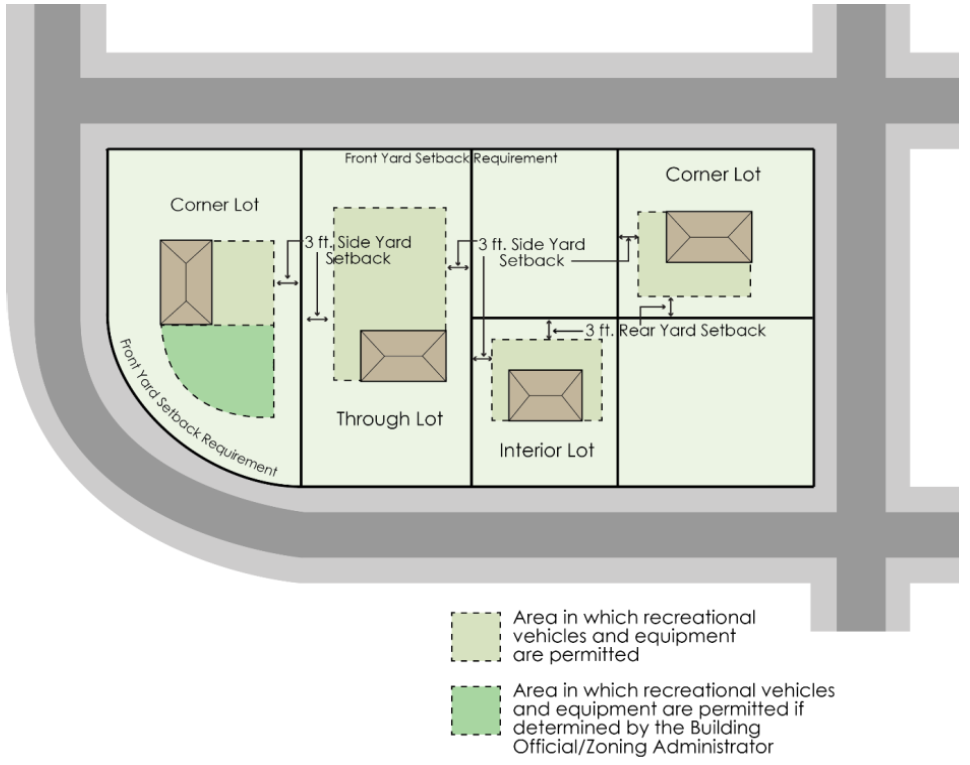
The purpose of these standards is to regulate and control the parking and storage of recreational vehicles and equipment on private property in the R-1 and R-2 districts to promote the public health, safety, and welfare and to preserve property values.
b.
Location standards (see also figure 2.1 accessory buildings and structures location standards).
1.
Generally. Recreational vehicles and/or recreational equipment shall be prohibited in the front yard unless otherwise permitted in this section. Recreational vehicles or equipment shall be placed or parked in the rear yard or side yard behind the front building line, on a hard paved surface, except as provided in paragraphs 2 through 6 below.
2.
Time limits. Where it is physically impossible to locate a recreational vehicle or camping equipment behind the front building line the recreational vehicle or camping equipment may be parked on the driveway in the front yard for a period not exceeding 48 hours in a two week period, but only for the purpose of loading and unloading such recreational vehicles or camping equipment and subject to the visibility limitations in section 314.
3.
Corner lots. In the case of corner lots, as defined in this ordinance, the regulations of this section shall apply to both the front yard and the exterior side yard.
4.
Through lots. In the case of through lots, as defined in this ordinance, parking and storage shall be permitted in the rear yard, as determined by the zoning administrator, provided the parked vehicle meets the front and side yard principal building setback requirements of the zoning district.
5.
Through corner lots. In the case of through lots on a corner (i.e. lots with frontage along three streets), parking shall be allowed only in the side yard. The zoning administrator may permit parking in the rear yard, as noted in paragraph 4 above, upon determination that such parking is allowed on the adjacent lot.
c.
Owner or legal tenant. The owner of any recreational vehicle or equipment placed or parked on a lot shall be the owner of the lot or the legal tenant.
d.
Condition and licensing requirements. All recreational vehicles and/or recreational equipment stored or parked in any residential district shall be in an operable condition, as determined by the zoning administrator. Recreational vehicles and camping equipment must be currently registered and/or licensed for use.
e.
Detachable camper tops. Detachable camper tops shall not be stored in any residential district except in accordance with above guidelines. Further, camper tops that are not installed on a licensed and operable vehicle must be placed on the ground and stabilized.
f.
Occupation of stored recreational vehicles. At no time, except in conformance with subsection g below, shall any stored, parked, or placed recreational vehicles and/or recreational equipment be occupied or used for living purposes. At no time shall any such recreational vehicle and/or equipment have fixed connections to water, gas, or a sanitary sewer. At no time shall any such recreational vehicles and/or equipment be stored, parked, or occupied or used for living purposes other than those granted a temporary use permit in conformance with subsection g below.
g.
Permanent special exceptions. A recreational vehicle and/or recreational equipment which is officially licensed as a vehicle for a disabled person in accordance with state law and which is used as the regular means of transportation by or for a disabled person may be parked within the required setback area. Appropriate landscaping must be provided to screen the recreational vehicle from adjacent residential structures.
(Ord. No. O-22-719, § 4, 3-7-22)
Sec. 324. - Regulations applicable to manufactured single-family dwellings outside of manufactured housing developments.
Any manufactured single-family dwelling, constructed and erected on a lot outside a manufactured housing development, shall be permitted only if it complies with all of the following requirements:
a.
If the dwelling unit is a manufactured home, it must either be:
1.
New and certified by the manufacturer and/or appropriate inspection agency as meeting the Manufactured Home Construction and Safety Standards of the U.S. Department of Housing and Urban Development, as amended, or any similar successor or replacement standards which may be promulgated.
2.
Used and certified by the manufacturer and/or appropriate inspection agency as meeting the standards referenced in subsection 1 above, and found, on inspection by the zoning administrator or his designee, to be in excellent condition and safe and fit for residential occupancy.
b.
If the dwelling unit is a manufactured home, the manufactured home shall be installed with the wheels and tongue removed.
c.
If the dwelling unit is a manufactured home, it shall be installed pursuant to the manufacturer's setup instructions and shall be secured to the building site by an anchoring system or device complying with the rules and regulations, as amended, of the Michigan Manufactured Home Commission, or any similar or successor agency having regulatory responsibility for manufactured home parks or manufactured housing communities.
d.
The dwelling unit shall comply with all applicable building, electrical, plumbing, fire, energy, and other similar codes adopted by the city, provided, that where a dwelling unit is required by law to comply with any federal or state standards or regulations for construction, and where such standards or regulations for construction are stricter than those imposed by city codes, then and such federal or state standards or regulations shall apply. Appropriate evidence of compliance with such standards or regulations shall be provided to the zoning administrator.
e.
The dwelling unit shall comply with all restrictions and requirements of this ordinance, including, without limitation, the minimum lot area, minimum lot width, minimum residential floor area, yard requirements, lot percent coverage and maximum building height requirements of the zoning district in which it is located.
f.
The dwelling unit shall have a minimum horizontal dimension across any side or rear elevation of 20 feet.
g.
The dwelling unit shall be placed on the lot so that the portions nearest the principal street frontage are at least 30 feet in dimension parallel to the street.
h.
The dwelling unit shall be firmly attached to a permanent continuous foundation constructed on the building site. Such foundation must have a wall of the same perimeter dimensions as the dwelling unit and be constructed of such materials and type as required by the building code for on-site constructed single-family dwellings. If the dwelling unit is a manufactured home, its foundation and skirting shall fully enclose the chassis, undercarriage, and towing mechanism.
i.
A storage area within a building not less than 120 square feet in an area shall be provided. This storage area may consist of a basement, closet area, attic, or attached garage in a principal building, or in a detached accessory building which is in compliance with all other applicable provisions of this ordinance pertaining to accessory buildings.
j.
Permanently attached steps or porch areas at least three feet in width shall be provided where there is an elevation difference greater than eight inches between the first-floor entry of the dwelling unit and the adjacent grade. Railings shall be provided in accordance with the city building code.
k.
The main roof of the dwelling unit shall have a minimum pitch of four feet of rise for each 12 feet of horizontal run.
l.
The exterior finish of the dwelling unit shall not cause glare or reflection that is greater than that from siding coated with clean, white, gloss exterior enamel and uses similar materials to the surrounding neighborhood.
m.
The dwelling unit shall not contain any additions of rooms or other areas which are not permitted and constructed with similar quality workmanship and materials as the original structure, including permanent attachment to the principal structure and construction of a foundation as required herein.
n.
The above standards may be modified by the zoning administrator upon determination that the proposed design is consistent with the predominant standard in the surrounding area.
Sec. 325. - Residential recreational area.
a.
Any residential subdivision, condominium, or multiple-family development comprising twenty or more lots or dwelling units, either as a single development or as a group of adjacent developments offered by a single proprietor, shall provide an active recreational area which shall contain an area equal in size to 1,500 square feet for each lot or dwelling unit in the subdivision, condominium project, or multiple-family development. The planning commission may modify this requirement when it is determined that alternate recreation facilities are provided nearby.
b.
The recreational area shall be well-drained, graded, seeded or sodded, safe from hazard, accessible to all dwellings, and the location shall be approved by the planning commission as part of the site plan review.
c.
Preservation of the recreational area shall be achieved through deed restrictions or dedication to a subdivision homeowner's association.
Sec. 326. - Sidewalks, bikepaths, and walkways.
Any development shall provide pedestrian pathways meeting the following requirements:
a.
Sidewalks. Sidewalks shall be required on both sides of the street or road in accordance with this Code.
1.
All sidewalks shall be a minimum five feet wide and constructed of concrete to the specifications of the American Society of Highway and Transportation Officials (ASHTO).
2.
Sidewalks abutting parking areas shall be a minimum of seven feet wide to accommodate vehicle overhang.
3.
In lieu of concrete sidewalks, the planning commission may permit asphalt, stone or wood chip paths, or wooden boardwalks in open space areas or areas with sensitive environmental features such as wetlands. The path or boardwalk shall provide direct access to all lots where the planning commission waives the requirement for concrete sidewalks.
b.
Bikepaths. Bikepaths shall be at least eight feet wide and constructed of concrete or asphalt in accordance with the specifications of the ASHTO.
c.
Walkways from the sidewalk to building entrances.
1.
A continuous pedestrian walkway shall be provided from any adjacent street sidewalk to building entrances.
2.
The walkways shall incorporate a mix of landscaping, benches, drop-off bays, and bicycle facilities for at least 50 percent of the length of the walkways.
3.
Walkways shall be connected to adjacent sites wherever practical and connect to other pedestrian systems.
d.
Walkways from parking areas to building entrances.
1.
Internal pedestrian walkways shall be developed for persons who need access to the building(s) from internal parking areas. The walkways shall be located within the parking areas and shall be designed to provide safe, guided access from these areas to the entrances of the building(s).
2.
The walkways shall be designed to separate people from moving vehicles as much as possible.
3.
The walkways must be designed for disabled access according to the adopted city building code and other applicable laws.
4.
The walkways shall be distinguished from the parking and driving areas by use of any of the following materials: special pavers, bricks, raised elevation, scored concrete, or pavement markings. Other materials may be approved by the planning commission if appropriate to the overall design of the site and building.
e.
General. Unless otherwise permitted by this ordinance, sidewalks, bikepaths, and walkways shall be installed by the developer or property owner within the dedicated street right-of-way or private road access easement. A special easement may be provided where grades or other factors prevent placement within the right-of-way or access easement.
f.
Marking and signs. Crosswalk pavement markings and signs may be required in areas of potential vehicular and pedestrian conflict.
Sec. 327. - Solar panel energy systems.
Freestanding solar panels shall be considered an accessory building and shall be subject to the following requirements for such, together with all other applicable building codes and ordinances:
a.
Solar energy systems are a permitted use in all zoning districts except solar energy commercial operations, which are prohibited as a principle use except in the I-2 industrial district. (These are systems whose main purpose is to generate energy for sale back into the energy grid system, rather than being consumed on site.)
b.
Solar energy systems are subject to the following:
1.
Roof mounted systems on the principal building shall not exceed the height limits in the district, nor be more than three feet higher than the finished roof to which it is mounted, whichever is less. In no instance shall any part of the system extend beyond the edge of the roof.
2.
Ground mounted systems and systems attached to accessory buildings shall adhere to the setback requirements in the district.
3.
Solar energy systems are prohibited in front yards and shall not be located past the front wall of the principle building.
4.
The number of solar panels and supporting equipment shall be considered as one system.
5.
If solar energy systems are attached to accessory buildings the number of accessory buildings allowed shall be regulated in accordance with the provisions set forth in article III, division 1, section 86-130, accessory buildings, structures, and uses.
6.
The height of ground mounted solar energy systems and systems included on accessory buildings shall not exceed ten feet in height.
7.
No more than 20 percent of a lot may be covered with a solar energy system.
8.
Ground mounted systems shall be located on lots of one-half acre or more.
9.
Electrical and construction permits are required.
(Ord. No. O-22-719, § 4, 3-7-22)
Sec. 328. - Storage and repair of commercial vehicles.
a.
The parking of commercial vehicles, as defined in article I, division 2, definitions, shall be prohibited in all zoning districts except commercial and industrial districts, unless otherwise permitted.
b.
Commercial vehicles, as defined in section 123, may be parked on an R-1 or R-2 zoned lot subject to the following:
1.
A maximum of one commercial vehicle, with a maximum height of nine feet and length of 23 feet, may be parked on an R-1 or R-2 lot.
2.
The commercial vehicle must be located inside a garage or on a driveway. A commercial vehicle which is a pickup truck, panel van, or sedan may be parked in the front yard. All other commercial vehicles, within the size limitations of this section and not excluded by subsection 3 below, must be parked behind the front building line.
3.
No tow trucks, garbage trucks, septic tank haulers/pumpers or vehicles with platform, commercial hauling trucks, truck tractor, tank, overhead rack, stake or dump bodies are permitted.
4.
The commercial vehicle must be currently registered and licensed for use.
5.
The commercial vehicle must be owned or operated by a member of the family that resides in the home.
c.
The repair, restoration, and maintenance of vehicles in any residential district, when such work is not conducted entirely within the interior of the vehicle, shall be subject to the following limitations:
1.
Procedures exceeding 48 hours in duration or which require the vehicle to be immobile or inoperable in excess of 48 hours shall be carried out within an enclosed building.
2.
Inoperable vehicles and vehicle parts shall be stored inside an enclosed building.
d.
In any multiple-family residential district, the property owner or the controlling association shall provide a designated area, approved by the planning commission, to park or store commercial vehicles. Parking spaces required to meet the parking requirements of this ordinance shall not be used for the parking or storage of commercial vehicles.
e.
The parking or storage of essential public service vehicles where the vehicle is operated by the homeowner or the occupant is exempt from these provisions.
f.
Commercial vehicles which are employed in conjunction within a non-residential district shall be parked or stored in compliance with the following provisions:
1.
For sites with a site plan approved subsequent to the effective date of this section, such vehicles shall be parked or stored in parking or loading spaces designated for that purpose on the site plan and per site plan approval.
2.
For situations not covered under subsection 1 above, commercial vehicles shall not be parked or stored in the front yard.
3.
The parking or storage of commercial vehicles for residential, office, or storage purposes shall not be permitted.
g.
The outdoor storage of inoperable and/or unregistered vehicles shall be prohibited, as regulated in this Code.
Sec. 329. - Street access and design.
a.
Any lot created after the effective date of this ordinance shall have frontage upon a public street right-of-way, at least 50 feet in width, unless a private road of lesser width has been approved by the city council.
b.
A building permit shall not be issued for the construction of any principal building unless said lot has the minimum frontage required on an improved public street, at least 50 feet in width, unless a private road of lesser width has been approved by the city council.
c.
Access driveways shall be surfaced with a durable pavement having an asphalt or cement binder and be constructed to the city standards.
d.
All street access shall meet the standards of article IV, division 2, access management and driveway standards.
e.
All streets shall be constructed in accordance with this Code.
f.
All streets shall be constructed with curb and gutter unless waived by the city council.
Sec. 330. - Swimming pools.
a.
Swimming pools, spas, hot tubs, and similar devices shall be built in accordance with any applicable swimming pool and spa codes.
b.
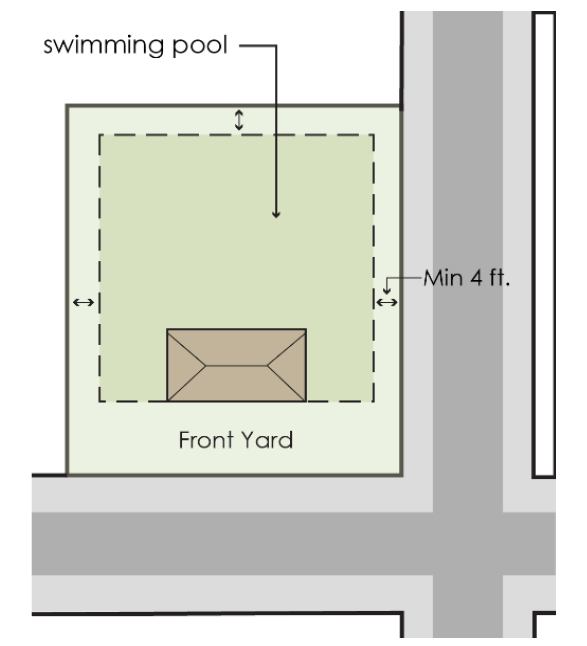
Swimming pools, spas, hot tubs, and similar devices shall not be located in any front yard.
c.
Swimming pools, spas, hot tubs, and similar devices shall not be located less than four feet from any lot line.
d.
Swimming pools shall be considered in computing impervious surface calculations.
e.
All swimming pools, spas, hot tubs, and similar devices shall be enclosed by a barrier (i.e. fence or other enclosure) where required by state law and as approved by the building official.
f.
The construction, erection, or substantial rebuilding of 50 percent or more of an existing swimming pool shall be constructed within all municipal codes and shall require a building permit.
(Ord. No. O-25-739, § 5, 5-19-25)
Sec. 331. - Temporary buildings, structures, and uses.
Temporary or portable buildings, structures, and uses may be permitted, subject to the following conditions:
1.
Construction sites:
a.
Temporary construction, buildings, and structures/office, which are necessary to facilitate construction on any site, shall be permitted and conform with all applicable provisions of this ordinance. Temporary buildings and construction structures may only be used for the storage of construction materials, tools, supplies and equipment, for construction management and supervision offices, and for temporary on-site sanitation, solid waste, or fuel facilities, related to construction activity on the same lot.
b.
Temporary construction buildings and structures shall be removed from the lot within 15 days after an occupancy permit is issued by the building official or zoning administrator for the permanent structure on such lot, or within 15 days after the expiration of a building permit issued for construction on such lot.
c.
The placement of temporary construction buildings and structures shall be in conformance with the requirements of article 5, division 1: site plan review and any necessary permits required for the completion of the project.
2.
Commercial and industrial zoning districts:
a.
Portable storage containers or moving pods used for a seasonal or temporary use are allowed in the B-2, general business and industrial zoning districts for up to 30 days, once per year. A zoning permit is required with a sketch plan detailing the loading/unloading area and the dedicated parking space to ensure safe vehicular circulation is provided within the site. Extensions can be granted by the zoning administrator upon submitting a written extension request provided a good cause is shown and demonstrated. Extensions may be permitted up to two times, not to exceed 30 days for each time. Portable storage containers or moving pods are permitted with a permit including extensions for a maximum of 90 days per year. The storing or parking of storage containers or moving pods shall be on a paved surface, in the rear or non-required side yards, not visible from a public street; unless otherwise approved by the zoning administrator.
b.
Portable storage containers used for long-term, on-site outdoor storage shall be permitted in the LI, light industrial zoning districts in conformance with the requirements of article 5, division 5, conditional land use review procedure, and any necessary permits required for erection of the project. Approval must be obtained from the zoning administrator or other official designated by the city through an application and permit fees.
c.
Sukkots shall be permitted in the B-2, general business and o, office zoning districts for up to 30 consecutive days in the observance of religious festivals and holidays. A zoning permit is required as described above in subsection 331.2(a).
d.
No temporary or portable building or structure shall be used for dwelling purposes.
3.
Residential zoning districts:
a.
Moving pods are allowed without a permit for up to 30 days. Moving pods must be placed upon a hard surface such as a driveway. Moving pods are prohibited in the right-of-way.
b.
Portable or temporary auto carports or garages are prohibited including portable weather-resistance auto structures made of aluminum structure and canvas covering or any similar materials.
c.
Portable tents or canopies (under 400 square feet) are permitted, without a permit, in the rear yards and non-required side yards for a period not to exceed seven consecutive days. Sukkots (also known as a Sukkah or Succah) are permitted for 30 consecutive days in observance of religious festivals or holidays.
d.
Outdoor patio gazebos made of durable weather-resistance materials are permitted, without a permit, in the rear yards and non-required side yard.
Table 331a Types of Temporary or Portable Buildings or Structures
| Use | Zoning district | Example of illustrations | Notes |
|---|---|---|---|
| Temporary construction, buildings, and structure/office | All zoning districts | 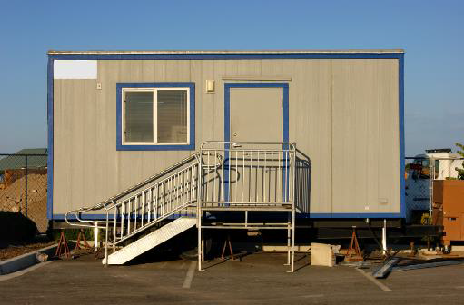 | Permitted with a site plan review approval and any necessary permits required for the construction of the project. |
| Moving pods for temporary use | Residential zoning districts | 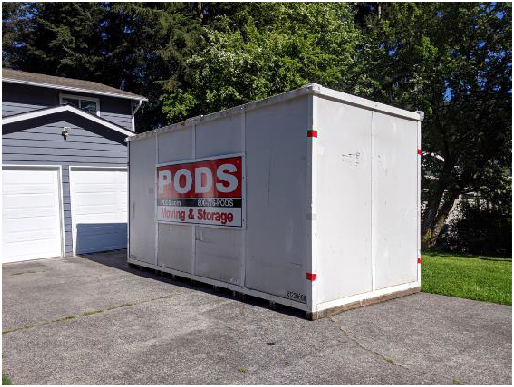 | Permitted for 30 days. No permit is required. |
| Outdoor storage containers; short-term, seasonal, temporary use | B-2 and industrial zoning districts | Permitted for 30 days. A zoning permit is required. Extensions may be granted up to two times for 30 days each. | |
| Outdoor storage containers; on-site, long-term | LI, light industrial zoning district | Permitted with conditional land use approval and any necessary permits required for the erection of the project. | |
| Seasonal and temporary auto carports or garages | Residential districts | 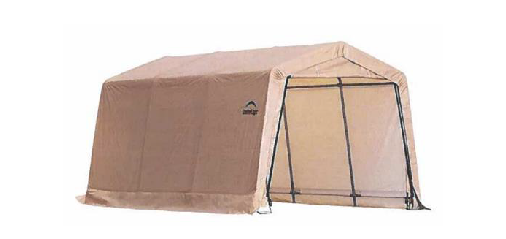 | Not permitted |
| Tents or canopies; under 400 sq. ft. | Residential districts | 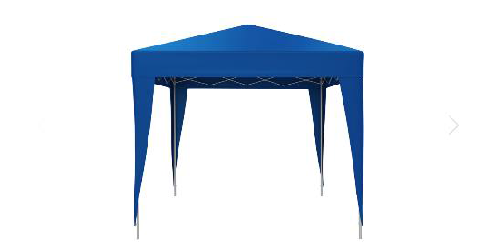 | Permitted in the rear yard and non-required side yard for up to seven consecutive days. No permit is required. |
| Sukkot; during religious festivals and holidays | Residential, B-2, and O, zoning districts | 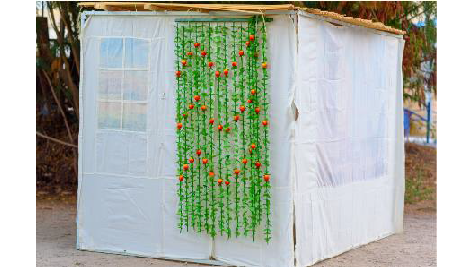 | Permitted for 30 consecutive days. Zoning permit is required in the B-2 and O districts. No permit is required in the residential zoning districts. |
| Patio gazebos | Residential zoning districts | 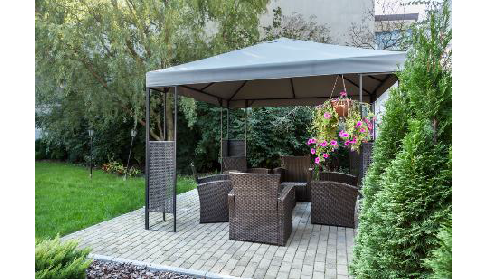 | Permitted in the rear yards or non-required side yards. No permit is required. |
(Ord. No. O-22-719, § 4, 3-7-22; Ord. No. O-25-739, § 5, 5-19-25)
Sec. 332. - Voting place.
The provisions of this ordinance shall not be construed as to interfere with the temporary use of any property as a voting place in connection with a municipal or other public election.
Sec. 333. - Waste receptacles and enclosures.
a.
Waste receptacles, including dumpsters or compactors, shall be required for all nonresidential uses unless interior facilities are provided. Waste receptacles and enclosures shall not be permitted as accessory to any single-family residential use.
b.
All outdoor waste receptacles shall be enclosed on three sides and screened. The enclosure shall be constructed of brick or decorative concrete block material, consistent with the building materials of the principal building.
c.
The enclosure shall also include a gate, made of wood or other high-quality material, as determined by the planning commission or zoning administrator, on the fourth side. The gates shall remain closed when not being emptied and must always be maintained as approved. If the waste receptacle is a dumpster it must have an enclosing lid or cover.
d.
The enclosure shall have a minimum height of six feet or one foot above the height of the waste receptacle, whichever is greater.
e.
Waste receptacles and enclosures shall be located in the rear yard, not closer than three feet from the rear and side lot lines, or non-required side yard, unless otherwise approved by the planning commission and/or the city planner; in the case of administration approval review procedure, and shall be as far as practical, but in no case be less than 20 feet, from any residential district. If practical, the back side of the waste receptacle enclosure should be placed against the building. In this circumstance the wall may act as one side of the enclosure; the wall shall be of non-combustible material, meet the fire code, and not located on a neighboring property.
f.
Waste receptacles shall be easily accessed by refuse vehicles without potential to damage automobiles parked in designated parking spaces or interfering with the normal movement of vehicles on or off the site. If possible, the opening shall not directly face the driveway.
g.
The waste receptacle base shall be constructed of six inches of reinforced concrete pavement. The base shall extend six feet beyond the waste receptacle pad or gate to support the front axle of a refuse vehicle.
h.
The unloading of waste receptacles shall only occur between the hours of 7:00 a.m. and 11:00 p.m.
i.
The shared use of receptacles shall be allowed by adjoining businesses where sharing will not create a health or safety concern and where it does not result in the accumulation of visibly excessive quantities of waste. Necessary shared use agreements are required.
(Ord. No. O-22-719, § 4, 3-7-22)
Sec. 350. - Introduction.
This division sets forth the architectural standards applicable to the various character districts in the city. These standards supplement those stated for each zoning district. These standards are intended to result in construction and development that reinforces the urban form and character of development as well as use and intensity of use established in the city master plan.
Sec. 351. - Applicability.
a.
Residential, commercial, industrial, and accessory uses. The requirements of this division shall apply to all proposed development with residential, service, retail, accessory, and industry, manufacturing and processing uses and shall be considered in combination with the standards for the applicable zoning district and the rest of the zoning ordinance.
The building types regulated in sections 355, 357, and 358 are permitted in districts according to the table below.
Table 351.2 Applicable Building Types by District
b.
Recreation, education, public assembly, transportation, communications, and infrastructure uses. Development with public recreation, public education, public assembly, transportation, public communications and/or infrastructure uses shall comply with the standards for the applicable zoning district but shall not be required to meet the standards in this division.
c.
Additions or modifications to existing buildings. Building additions to buildings built prior to the adoption of this ordinance shall apply the architectural standards that most closely match the existing building, as determined by the zoning administrator.
d.
The requirements of this division shall not apply to:
1.
Continuation of a permitted use within an existing structure.
2.
Normal repair and maintenance of existing structures that do not increase its footprint.
3.
Continuation of a legal non-conforming use, building, and/or structure, in accordance with article VI, division 1.
(Ord. No. O-22-719, § 5, 3-7-22)
Sec. 352. - Modifications.
a.
Modifications to the standards established in this article may be approved during site plan review. In an R1 District, single family homes do not require site plan review. Any such modification shall require an application that includes a site plan and a front elevation drawing of the proposed building superimposed on a color drawing or photograph of the entire block showing the relationship of the proposed building to other buildings on the block. The application shall be reviewed by the city based upon the following criteria:
1.
The design of the building shall be in keeping with the desired architectural character as articulated in the master plan, the intent of the district, and by example of new buildings designed following the standards of this code. This shall not prevent innovation and creativity in design that is in keeping with the master plan, as determined by the planning commission.
2.
The design shall meet district height and setback requirements.
3.
The exterior finish materials shall be of equal or better quality, in terms of durability and appearance/texture similar to brick, stone, metal, or wood, as those permitted in the district. The intent is to accommodate new technologies and building material while maintaining the desired character of the districts.
Sec. 353. - General architectural standards.
a.
Awnings and overhangs.
1.
Awning and canopies may project over the sidewalk, provided the awning or canopy is at least eight feet above the sidewalk and does not project closer than two feet from the back of the street curb.
2.
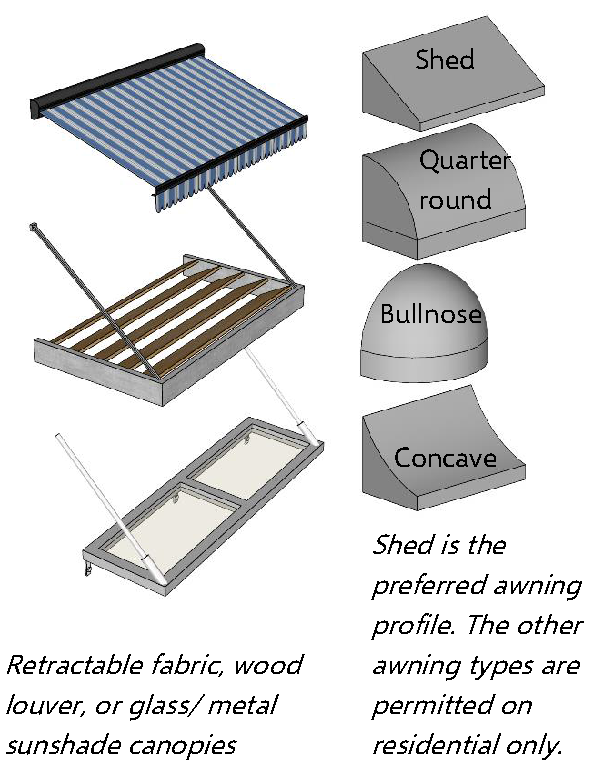
Awnings shall be of traditional, shed design and shall be made from fabric or metal materials and not from plastic, vinyl, or fiberglass.
3.
Architectural horizontal canopies or sunshades are permitted and shall be made from metal, glass, or wood materials.
4.
No internal illumination is permitted through the awning or overhang.
5.
Quarter round, bullnose, concave configurations are permitted only on residential buildings.
b.
Balconies.
1.
Balconies shall not be located within five feet of any common lot line and shall not encroach into the public right-of-way.
2.
Balconies may be a single level or multiple balconies stacked vertically for multiple stories.
3.
The balcony support structure shall be integrated with the building façade; separate columns or posts supporting any balcony from the ground are prohibited.
4.
The balcony design and material shall be compatible with the overall architectural style and color palette of the building.
5.
Fire suppression is sometimes required per building residential code.
c.
Fenestration.
1.
Reflective, mirrored, or heavily tinted glass shall not be permitted.
2.
In non-residential buildings, ground floor windows may not be obstructed by display cases, furniture, or stock (excepting operable sunscreen devices).
3.
For multiple tenant buildings, the minimum ground floor transparency requirement must be met by each suite or tenant.
d.
Materials and color.
1.
Durable building materials which provide an attractive, quality appearance shall be utilized.
2.
For existing buildings, material replacement shall closely match or complement the character of the existing or original materials used on the structure.
3.
The following materials are not acceptable:
a)
Unfinished plywood.
b)
Sheet metal.
c)
EIFS.
d)
Stucco
4.
Preferred materials to reflect a mid-twentieth century time period include:
a)
Roman brick; stacked bond or ⅓ running bond brick.
b)
Ashlar stone.
c)
Glass block (not to exceed 25 percent of façade).
d)
Concrete; decorative cast concrete screens.
e)
Concrete; pebble aggregate.
f)
Aluminum accent features and trim.
5.
In commercial and industrial districts, primary exterior building materials shall be of subtle, neutral, or earth tone colors.
6.
The use of high intensity colors such as neon or fluorescent for the window and door trim, façade and roof of the building are prohibited except as approved by the zoning administrator.
7.
Mechanical and service features such as gutters, ductwork, and service doors that cannot be screened must be of a color that blends in with the color of the building exterior.
8.
For non-residential buildings, non-commercial art or graphic design of sufficient scale and orientation to be perceived from the public right-of-way and rendered in materials or media appropriate to an exterior, urban environment and permanently integrated into the building shall be approved by city council.
(Ord. No. O-22-719, § 5, 3-7-22; Ord. No. O-25-739, § 6, 5-19-25)
Sec. 354. - Residential architectural standards.
a.
The general standards in table 354.1 apply to all residential buildings.
Table 354.1 Residential General Building Standards
(Ord. No. O-22-719, § 5, 3-7-22)
Sec. 355. - Residential design standards by building type.
In addition to the general standards in table 354.1, the following building standards apply to specific residential building types.
Table 355.A One-Family and Two-Family
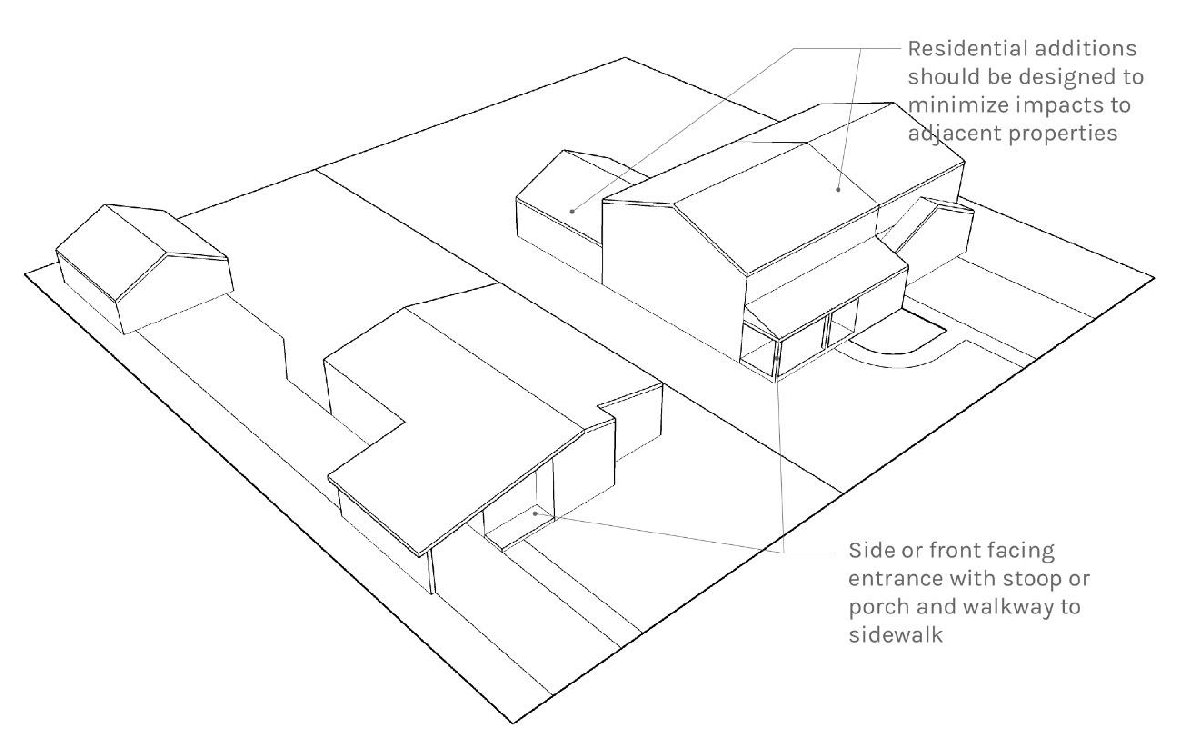 | |
| Description | This section covers attached and detached homes for one or two families. This includes detached single-family homes, attached two-family homes, and duplexes. |
| Building entrance orientation |
All buildings shall provide at least one primary entrance facing the front lot line.
A door may face a side lot line when the porch or stoop faces the front lot line.
Garages, carports, and overheard doors may not count as the primary entrance. A walkway must extend from each dwelling primary entry to the sidewalk or driveway |
| Roof types |
Pitched (gabled or hip), 4:12—12:12 slope
Low slung (gabled or hip), 2:12—4:12 slope Flat, sloped min ¼-inch per 1 foot Rooftop equipment is not permitted. |
| Parking access and location |
Driveways may be located adjacent to the building.
Attached two-family homes may have one driveway per dwelling unit. Parking may be provided on-street or on a driveway, garage, or carport in the rear or side yard. |
| Permitted districts | R-1, R-2 (two-family only permitted in R-2) |
Table 355.B Attached Residential/Townhomes
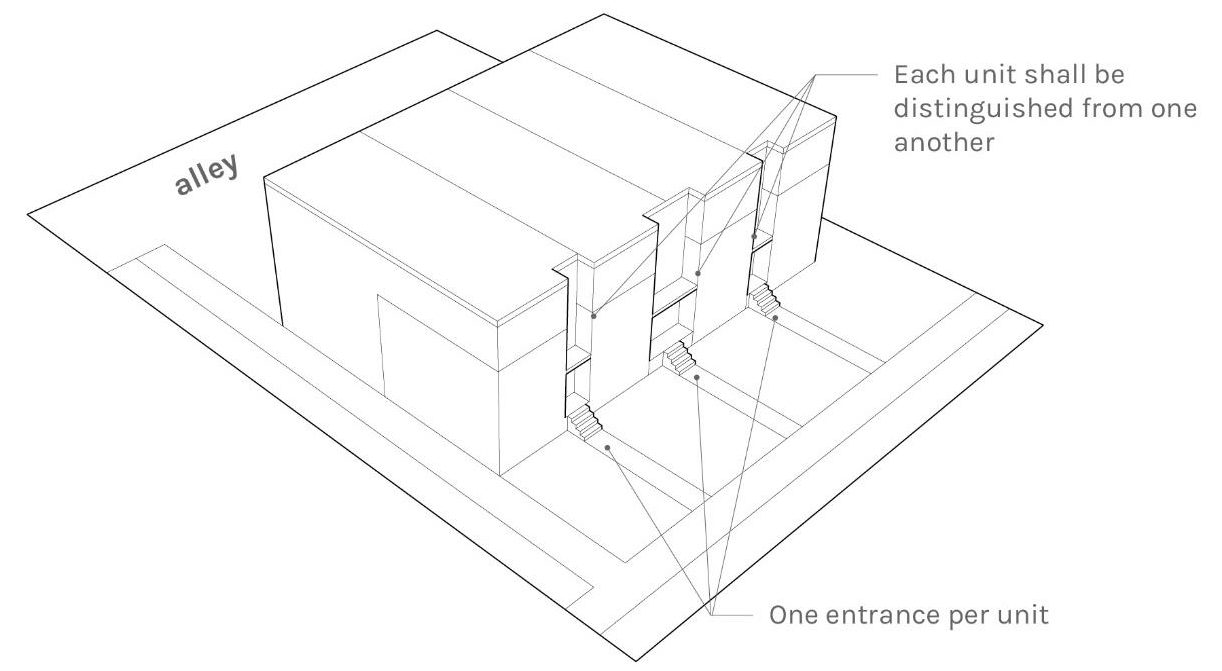 | |
| Description | This section covers single family homes continuously adjoined at side walls. |
| Articulation | Adjoined dwelling units shall be distinguishable through a change in plane, change in material, or architectural expression. |
| Building entrance orientation |
Each dwelling unit shall provide one primary entrance facing the front lot line with
direct access to the outdoors at ground level by way of front porch or stoop.
A walkway must extend from each dwelling primary entry to the sidewalk. |
| Roof types |
Pitched (gabled), 4:12—12:12 slope
Flat, sloped min ¼-inch per 1 foot Buildings with a flat roof shall have a defined cornice. Any rooftop mounted equipment shall not be visible from the street or neighboring buildings. |
| Parking access and location |
Garages or carports must be accessed from the rear yard via an alley.
Parking may be provided on a driveway, garage, parking lot, or carport located in the rear yard. |
| Permitted districts | RM-1; IF |
Table 355.C Multiple-Family Dwellings
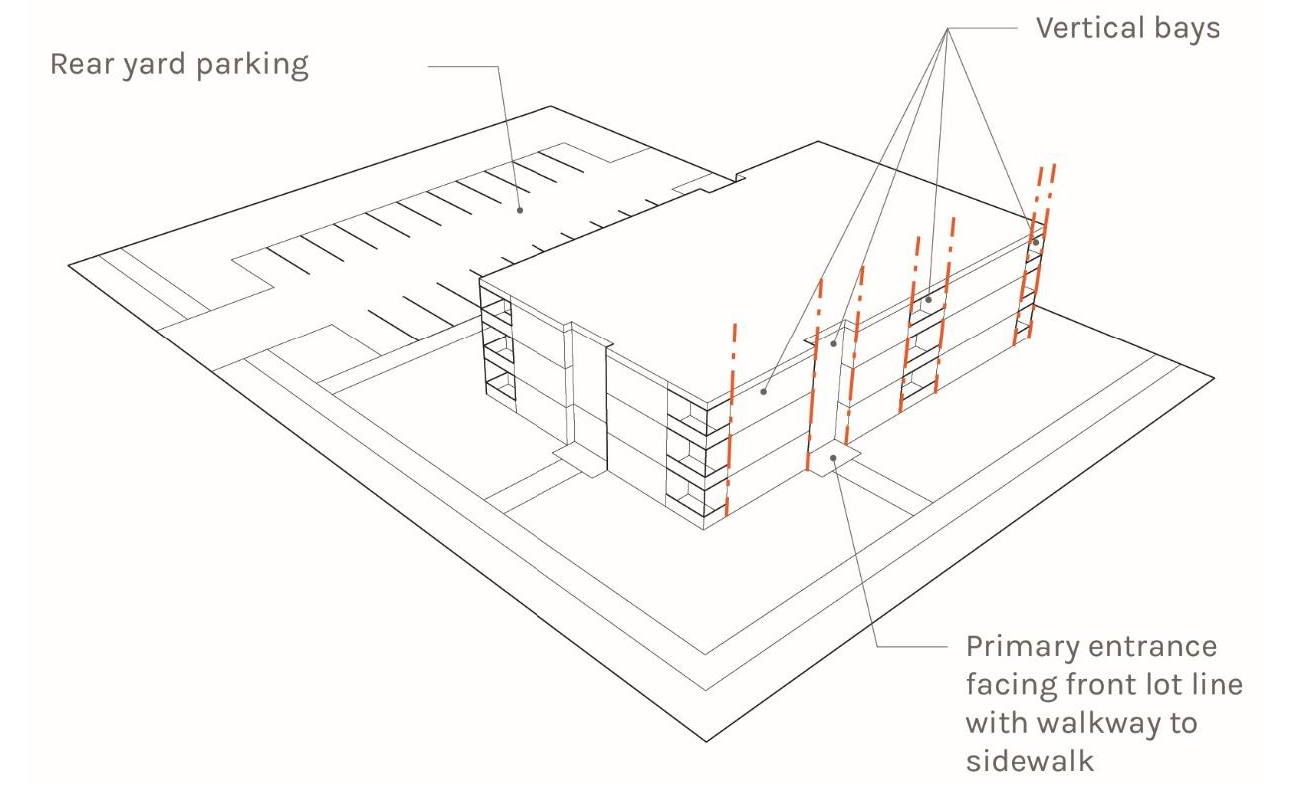 | |
| Description | This section covers exclusively multiple family residential buildings containing three or more dwelling units. |
| Articulation | Employ vertical bays—through change in material, transparency, or plane—to distinguish building entrance, dwelling units, or unit layouts. |
| Building entrance orientation |
All buildings shall provide at least one primary entrance facing the front lot line.
A walkway must extend from each primary entry to the sidewalk. Primary entrances shall be designed to be visually prominent and easily recognizable as the entrance. |
| Roof type |
Pitched (gabled or hip), 4:12—12:12 slope
Flat, sloped min ¼-inch per 1 foot Buildings with a flat roof shall have a defined cornice. Any rooftop mounted equipment shall be screened from view. |
| Parking access and location |
Driveways must be located in the side or rear yard.
Parking may be provided on a driveway, garage, parking lot or carport located in the rear yard. |
| Open space | At least 200 square feet of usable open space shall be provided for each apartment dwelling unit. Examples of usable open space include balconies with direct access to the dwelling unit, courts and yards which are open to the sky, or a roof which is developed exclusively for recreational use. |
| Permitted districts | RM-1; RM-2; IF |
Table 355.D Upper Floor Residential Dwellings
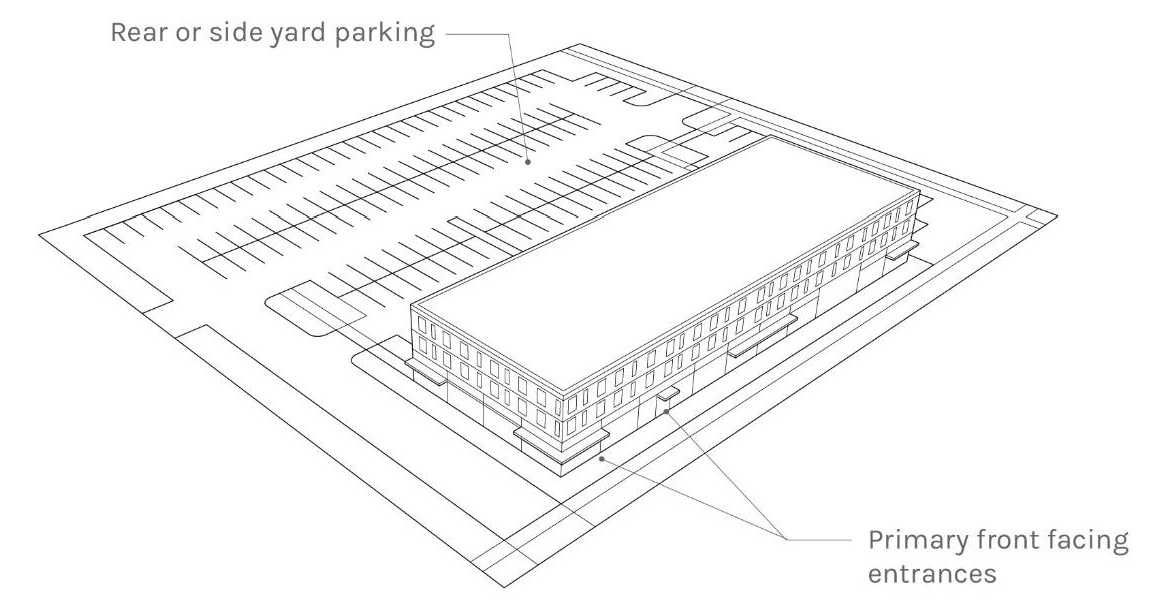 | |
| Description | This section covers residential uses when included above a storefront or other building type. |
| Articulation | Employ vertical bays—through change in material, transparency, or plane—to distinguish building entrance, dwelling units, or unit layouts. |
| Roof type |
Pitched (gabled or hip), 4:12—12:12 slope
Flat, sloped min ¼-inch per 1 foot Buildings with a flat roof shall have a defined cornice. Any rooftop mounted equipment shall be screened from view. |
| Parking access and location |
Driveways must be located in the side or rear yard.
Parking may be provided on a driveway, garage, parking lot or carport located in the rear yard. |
| Open space | At least 200 square feet of usable open space shall be provided for each apartment dwelling unit. Examples of usable open space include balconies with direct access to the dwelling unit, courts and yards which are open to the sky, or a roof which is developed exclusively for recreational use. |
| Permitted districts | B-1, MX-1, MX-2, IF |
Sec. 356. - Commercial and mixed-use architectural standards.
a.
The general standards in table 356.1 apply to all commercial and mixed-use buildings.
Table 356.1 Commercial and Mixed-Use Buildings General Standards
(Ord. No. O-22-719, § 5, 3-7-22; Ord. No. O-25-739, § 6, 5-19-25)
Sec. 357. - Commercial building types.
In addition to the general standards in table 236.1, the following building standards apply to specific commercial/mixed-use building types.
Table 357.A Offices
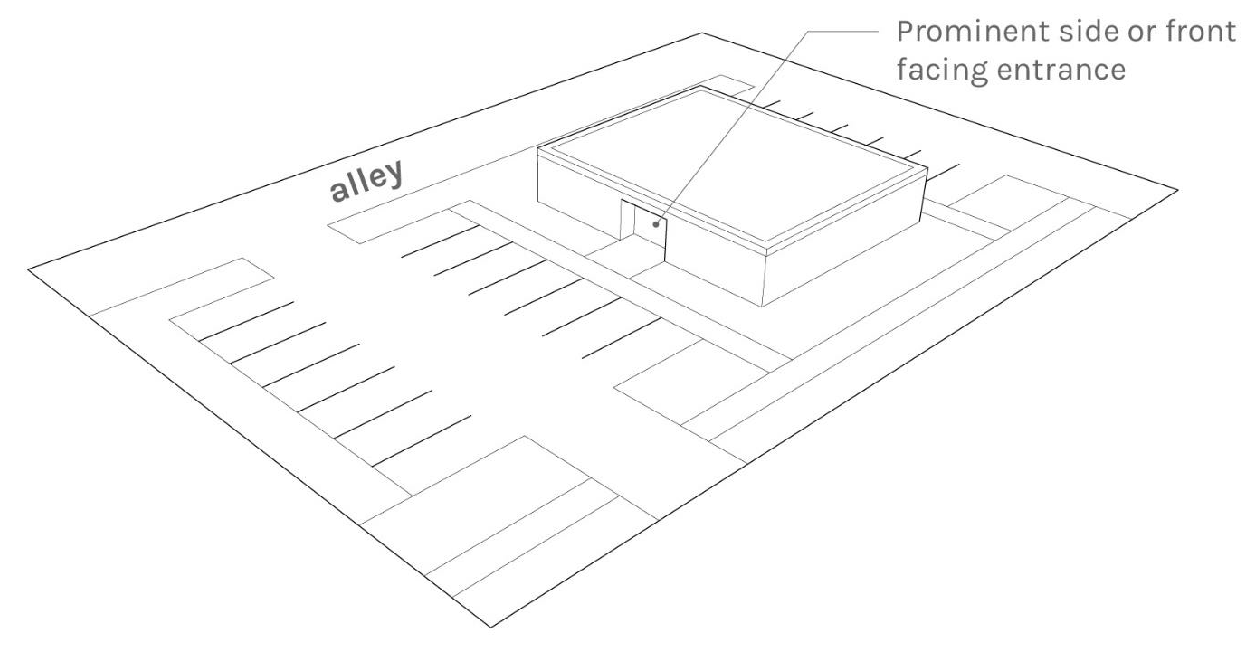 | |
| Description | Offices typical to Oak Park vary stylistically from other commercial buildings primarily in their orientation to the street and window composition. While the uses may extend beyond their original office use, the form is a typical mid-century contemporary design. |
| Articulation | Windows shall be primary architectural features. |
| Building entrance orientation |
All buildings shall provide at least one primary entrance facing the front or side
lot line.
A walkway must extend from each primary entry to the sidewalk. If the primary entrance faces the side lot line a visually prominent pedestrian walkway shall connect to the public sidewalk. Primary entrances shall be designed to be visually prominent and easily recognizable as the entrance. |
| Roof type |
Flat, sloped min ¼-inch per 1 foot
Any rooftop mounted equipment shall be screened from view. Simple cornice design. |
| Parking access and location |
Parking must be located in the side or rear yard.
Parking may be provided in garages or lots. |
| Permitted districts | B-1, IF, O, PTRED |
Table 357.B Storefronts
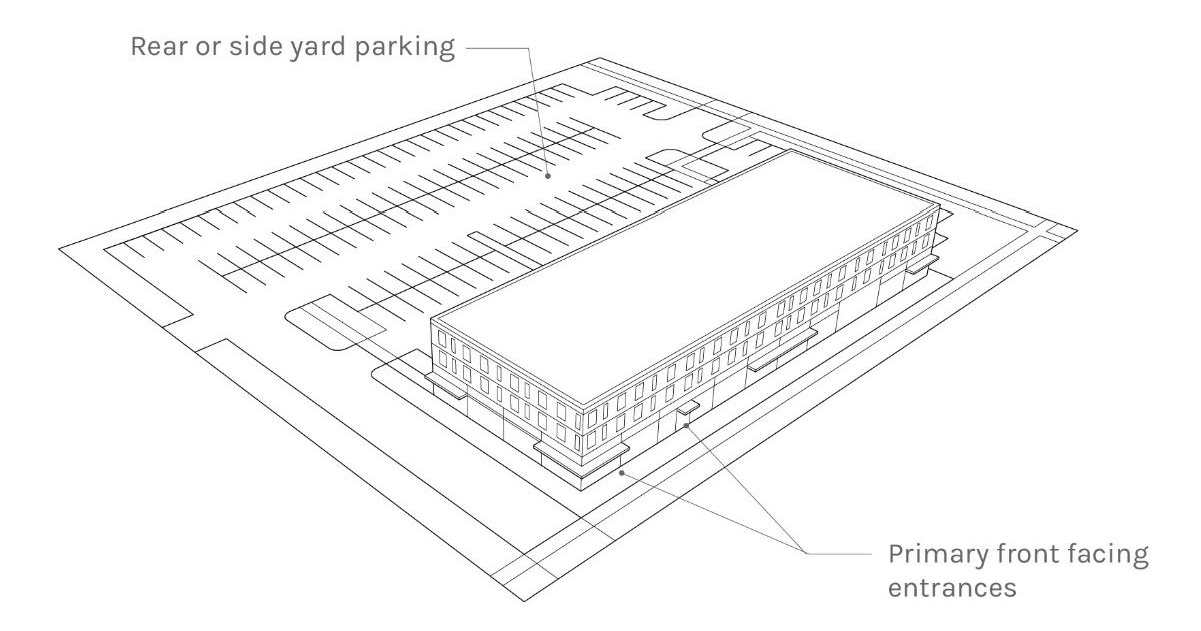 | |
| Description | Storefronts are oriented to the street with active first floor uses such as retail to emphasize the pedestrian experience. Where applicable, upper floors may consist of residential or office uses depending on the zoning district. |
| Articulation |
Ground floor primary façade shall be a minimum of 40% windows and doorways.
Ground floor fenestration on the primary façade shall have a sill no higher than 24" above the interior finish floor elevation. |
| Building entrance orientation |
Each business tenant of the ground floor shall provide at least one primary entrance
facing the front lot line.
A primary entrance for upper floor tenants shall be provided facing the front lot line and designed to be visually prominent and easily recognizable as the entrance. Where the building is separated from the public sidewalk, at least one clear and direct connection shall be made between the two. |
| Roof type |
Flat, sloped min ¼-inch per 1 foot.
Buildings with a flat roof shall have a defined cornice. Simple cornice design. Any rooftop mounted equipment shall be screened from view. |
| Parking access and location | On-site parking must be located in the side or rear yard. Existing on-street parking is provided in many areas. |
| Permitted districts | B-1, B-2, PCD, MX-1, MX-2, IF |
Table 357.C Shopping Centers
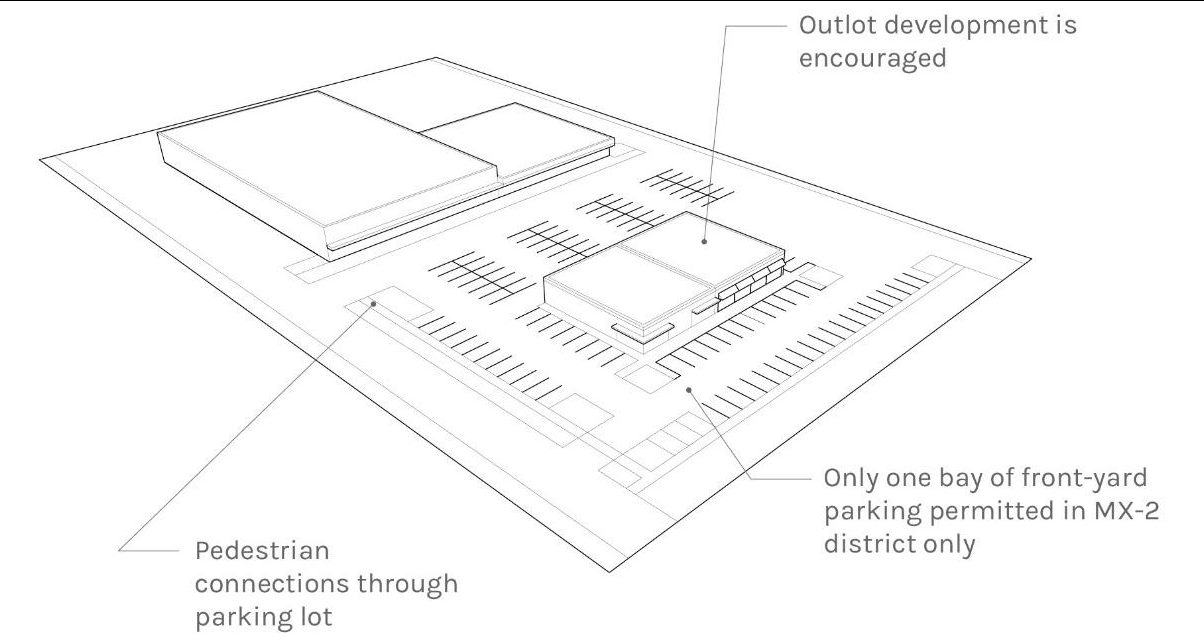 | |
| Description | Shopping centers are typically planned development sites with one or more buildings housing multiple tenants with more of an auto-oriented focus than storefronts. |
| Articulation | Blank walls are permitted on façades not visible from a street. |
| Building entrance orientation |
Each business tenant of the ground floor shall provide at least one primary entrance
facing the front lot line.
A primary entrance for upper floor tenants shall be provided facing the front lot line and designed to be visually prominent and easily recognizable as the entrance. Each entry shall connect directly to the pedestrian sidewalk. Where the building is separated from the street sidewalk, at least one clear and direct connection shall be made between the two. |
| Roof type |
Pitched (gabled or hip), 4:12—12:12 slope
Flat, sloped min ¼-inch per 1 foot Buildings with a flat roof shall have a defined cornice. Any rooftop mounted equipment shall be screened from view. |
| Parking access and location |
Parking is permitted in the front, side, and rear yards but shall be screened per
sec. 446, specifications for screen walls, berms, and landscape improvements.
Access easements are required where feasible. Provide a pedestrian connection through the parking lot. |
| Permitted districts | B-2, PCD, MX-2 |
Table 357.D Drive-Through
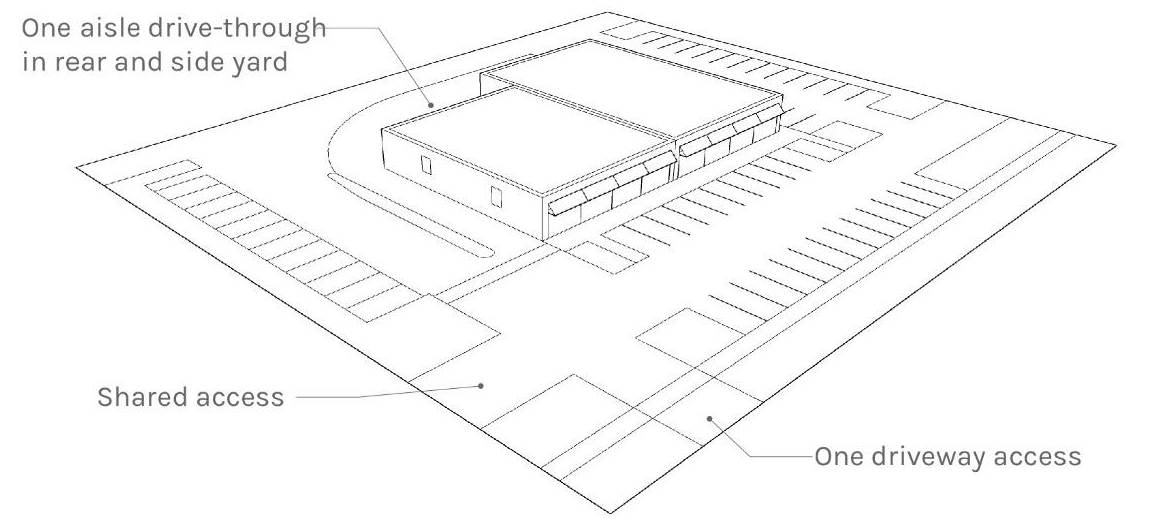 | |
| Description | This section covers businesses that have drive-through service windows, such as banks, restaurants, or pharmacies. |
| Building entrance orientation |
The building shall meet all requirements of a storefront building.
The drive-through shall be attached to the rear or side of the building where it is not visible from the street and should include a bypass lane. |
| Access |
No more than one driveway shall be provided to a public street.
The driveway shall be shared with an adjacent use or easements provided to allow future shared use. Ingress and egress to drive-through facilities shall be part of the internal circulation of the site and integrated with the overall site design. Clear identification and delineation between the drive-through facility and the parking lot shall be provided. Drive-through facilities shall be designed in a manner which promotes pedestrian and vehicular safety. Each drive-through facility shall provide stacking space meeting the following standards: sec. 557d. |
| Permitted districts | B-2 |
(Ord. No. O-25-739, § 6, 5-19-25)
Sec. 358. - Industrial architectural standards.
a.
The general standards in table 358.1 apply to all industrial buildings.
Table 358.1 Industrial Building Standards
(Ord. No. O-25-739, § 6, 5-19-25)

