
Oak Park City Zoning Code
ARTICLE IV
SITE DEVELOPMENT STANDARDS
Sec. 400. - Purpose.
The purpose of this article is to ensure adequate and well-designed parking and loading areas are provided in all districts at the time of erection, enlargement or change in use, of any principal building or lot. Off-street parking and loading areas are to be designed, maintained and operated in a manner that will ensure their efficient use, promote public safety, improve aesthetics and, where appropriate, protect surrounding uses from undesirable impacts. Off-street parking spaces, in conjunction with all land or building uses, shall be provided prior to the issuance of a certificate of occupancy as hereinafter prescribed.
Sec. 401. - General requirements.
a.
Residential parking.
1.
Single-family residential off-street parking spaces shall consist of a parking strip, driveway, carport, garage, or combination thereof, and shall be located on the premises they are intended to serve.
2.
No parking shall be permitted in yards on lawns or other unpaved areas on residential lots.
3.
Commercial and recreational vehicle parking in residential districts shall comply with the standards in article III, division 1, general provisions.
b.
Location.
1.
Off-street parking for nonresidential uses shall be either on the same lot or within lots under the same ownership and control within 300 feet of the building it is intended to serve, measured from the nearest point of the building or use entrance to the nearest point of the off-street parking lot, except as otherwise permitted in this chapter. See also subsection f, shared parking, below.
2.
Off-street parking shall be either on the same lot, lot(s) under the same ownership and control, open public parking lots, within 500 feet of the building it is intended to serve, measured from the nearest point of the building entrance to the nearest point of the off-street parking lot. The planning commission may, however, require that some or all of the parking required by section 403, parking space numerical requirements, be provided outside of municipal parking lots or on-street if it is determined that sufficient capacity is unavailable within the municipal parking lot(s) or on-street. The planning commission can require a parking supply and demand study if necessary, to make this determination.
3.
Existing off-street parking facilities provided at the effective date of this ordinance, actually being used at that date for the parking of automobiles in connection with the operation of an existing building or use shall not be reduced to an amount less than hereinafter required under this chapter for a similar new building or new use except as provided elsewhere in this ordinance.
4.
Not more than 50 percent of the off-street parking required by this chapter may be supplied by off-street parking provided for other kinds of buildings or uses, not normally open, used or operated during the principal operating hours of such uses. A written agreement must be executed by the parties concerned for the joint use of the off-street parking facilities. A copy of the agreement shall be filed with the application for a building permit.
c.
Change in use or intensity.
1.
Whenever the use of a building or lot is changed, parking facilities shall be provided as required by this article for the new use.
2.
If any building, structure, or lot is increased through the addition of dwelling units, increase in floor area, increase in seating capacity, or through other means, additional off-street parking shall be provided to bring the site into compliance.
3.
Any area once designated as required off-street parking shall not be changed to any other use unless and until equal facilities meeting the standards of this article are provided elsewhere, or the parking requirements of the site change as determined by the city planner.
d.
Storage and repair.
1.
The use of required parking, drives and loading areas for material storage, refuse storage stations/dumpsters, storage or display of vehicles, trailers and/or merchandise, or for vehicle or machinery repair or maintenance is expressly prohibited.
e.
Control of off-site parking. It shall be unlawful to park or store any motor vehicle on private property without the expressed or implied consent of the owner, holder, occupant, lessee, agent, or trustee of such property.
f.
Shared parking. The provision for shared off-street parking for two or more buildings or uses is permitted subject to the following:
1.
The total number of spaces provided collectively shall not be less than the sum of spaces required for each separate use. However, the planning commission may reduce the total number of spaces by up to 25 percent if they determine that the operating hours of the buildings or uses do not overlap.
2.
Where shared parking between two or more lots is utilized, provisions for pedestrian connection(s) must be provided.
g.
Parking lot deferment.
1.
Where the property owner can demonstrate that the required amount of parking is excessive, the planning commission may approve a smaller parking area, provided that the parking area required to meet parking space requirements of this article is retained and set aside as landscaped or grass-covered open space, and the owner agrees in writing to construct the additional parking based on observed usage within six months of being informed of such request in writing by the city planner.
2.
The site plan shall note the area where parking is being deferred, including dimensions and dotted parking lot layout.
3.
Stormwater calculations shall be provided based on the required amount of parking to verify adequate capacity if an expansion is necessary.
h.
Additional parking. To minimize excessive areas of pavement which depreciate aesthetic standards and contribute to high rates of stormwater runoff, the number of spaces provided shall not exceed 20 percent beyond the number required by this article, except as approved by the planning commission. In granting such additional space, the planning commission shall determine that such parking will be required, based on documented evidence of actual use and demand provided by the applicant.
i.
Construction. During construction, off-street parking shall be provided on-site for all construction vehicles and employees. Gravel surfacing may be permitted by the building official for such temporary parking.
j.
Carports and garages. Carports and garages for multiple-family dwellings and other non-single-family residential uses shall be calculated as parking spaces on a one-to-one (1:1) basis.
k.
Stacking space requirements.
1.
Stacking spaces, as required by section 403, parking space numerical requirements, which block access to parking spaces shall not be included in calculating the required number of spaces.
2.
Each required stacking space shall be a minimum of 20 feet long and nine feet wide.
3.
Stacking space shall be designed so that an efficient circulation pattern is maintained on the site and a sufficient width is available to allow a vehicle to maneuver around another vehicle waiting in line.
l.
Uses not cited. For uses not specifically listed in section 403, parking space numerical requirements, the requirements for off-street parking facilities shall be in accordance with a similar use as determined by the city planner based on documentation regarding the specific parking needs for the particular use, as determined by the planning commission.
m.
Parking reduction. The planning commission or city planner may reduce the total number of spaces by up to 20 percent than the number required to meet the standards of section 403, parking space numerical requirements. If a greater parking reduction is requested, the planning commission may approve fewer parking spaces based on a professionally prepared parking study. However, in no case shall the total parking spaces be reduced by more than 50 percent.
(Ord. No. O-22-719, § 6, 3-7-22; Ord. No. O-23-728, § 5, 3-8-23)
Sec. 402. - Parking units of measurement.
The following standards shall be used in determining the required number of parking spaces:
a.
Floor area.
1.
Where floor area is the unit for determining the required number of off-street parking and loading spaces, such unit shall mean the gross floor area (GFA), unless otherwise noted.
2.
For the purposes of determining the off-street parking requirements, gross floor area (GFA) shall apply to all internal building areas excluding the floor area used for incidental service, storage, mechanical equipment rooms, heating/cooling systems and similar uses, and other areas not intended for use by the general public. Where these areas are not yet defined, floor area shall be considered to be 85 percent of the gross floor area (GFA).
b.
Bench seating. In calculating bench seating for places of assembly, each 24 inches of benches, pews or other such seating, shall be counted as one seat.
c.
Employees. Where the number of spaces required is based on the number of employees, calculations shall be based upon the maximum number of employees likely to be on the premises during the peak shift.
d.
Fractional spaces. When units of measurements determining the number of required parking or loading spaces result in a fractional space, any fraction—equal to or greater than one-half—shall be counted as one additional space.
(Ord. No. O-23-728, § 5, 3-8-23)
Sec. 403. - Parking space numerical requirements.
The minimum number of off-street parking spaces shall be determined by the type of use in accordance with the following schedule:
(Ord. No. O-23-728, § 5, 3-8-23)
Sec. 404. - Barrier-free parking requirements.
Each parking lot that serves a building or use, with the exception of single and two-family dwelling units, shall provide barrier free spaces in compliance with the state building code and the 2010 ADA Standards for Accessible Design. Compliance is mandatory whenever a business, state or local government restripes parking spaces in a parking lot or parking structure. The required number of accessible parking spaces must be calculated separately for each parking facility, not calculated based on the total number of parking spaces provided on a site. One of six (or fraction of six) accessible parking spaces, but always at least one, must be van accessible (see 2010 Standards 208.2).
(Ord. No. O-22-719, § 6, 3-7-22)
Sec. 405. - Off-street parking space design and setback requirements.
Where required, off-street parking facilities containing more than five parking spaces shall be designed, constructed, and maintained according to the following standards and regulations:
a.
Ingress and egress.
1.
Adequate ingress and egress to the parking facility shall be provided by clearly defined driveways in accordance with article IV, division 2, access management and driveway standards.
2.
All spaces shall be provided adequate access by means of maneuvering lanes.
3.
Spaces backing directly onto a street use of the street for maneuvering between parking rows shall be prohibited.
4.
Access to off-street parking which serves a nonresidential use shall not be permitted across land that is zoned or used for residential purposes.
b.
Surfacing, drainage, and grading.
1.
Grading, surfacing, and drainage plans shall comply with city engineering specifications and subject to the review and approval of the city engineer. All driveways, parking lots, access lanes and other vehicle maneuvering areas shall be hard-surfaced with concrete or plant-mixed bituminous material, in accordance with specifications of the city.
2.
Off-street parking areas, access lanes, and driveways shall be graded and drained so as to dispose of surface waters. Surface water shall not be permitted to drain onto adjoining property, unless in accordance with an approved drainage plan.
3.
All driveways, parking lots, and loading-unloading areas shall not be less than one percent and not exceed a grade differentiation of four percent.
c.
Curbs. A raised or rolled concrete curb a least six inches in height shall be installed with the construction of all driveways, parking lots, access lanes and other vehicle maneuvering areas to prevent motor vehicle conflicts with abutting landscape areas, sidewalks, streets, buildings or adjoining property.
d.
Dimensions. All spaces shall be designed and marked with dimensions described below and shown in off-street parking design standards below:
e.
Parking lot marking. All parking spaces must be properly striped.
f.
Walkways. In accordance with article III, division 1, section 326, sidewalks, bikepaths, and other pedestrian pathways, walkways shall be located within the parking areas and provide access to the entrances of the building(s).
(Ord. No. O-25-739, § 7, 5-19-25)
Sec. 406. - Parking lot construction and maintenance.
a.
Plans and specifications for parking and loading areas shall be submitted to the city in accordance with section 18.356-358, land improvement, of this Code.
b.
Required parking lots shall be installed and completed within six months of receipt of a building permit and before issuance of an occupancy permit. The city manager may grant a single extension for an additional six months in the event of adverse weather conditions or unusual delays beyond the control of the property owner.
c.
All parking areas shall be maintained free of dust, trash, and debris. Surfacing, curbing, lighting fixtures, signs, and related appurtenances shall be maintained in good condition.
d.
The visibility of pavement markings delineating parking spaces and directional control shall be maintained.
e.
All off-street parking and loading facilities required by this article shall be maintained free of accumulated snow or standing water which prevent full use and occupancy of such facilities, except for temporary periods of no more than five days in the event of heavy rainfall or snowfall.
f.
Vegetated stormwater control measures.
1.
The design and installation of vegetated stormwater control measures, which may be incorporated into required parking lot, buffer strip and right-of-way plantings, is encouraged and shall be subject to review and approval by the city engineer and city planner. Required parking lot, buffer strip, and right-of-way plantings may incorporate vegetated stormwater control measures so long as the aesthetic objectives and the minimum dimensional requirements of the planting area are, in the judgment of the city planner, satisfied by the combination of landscaping, fencing, walls and other measures proposed.
2.
Applicants shall utilize the design guidance from the Southeast Michigan Council of Governments (SEMCOG) in the selection, sizing and design of these areas. For any such vegetated stormwater control measures proposed, the landscape or stormwater management plan submitted to the city shall include:
a)
A plan indicating the contributing drainage area, land use, slope, and seasonal high groundwater elevation in areas where the practices are proposed.
b)
Design calculations.
c)
Detailed planting plan.
d)
Construction detail and sequencing plan.
e)
Maintenance plan.
Sec. 407. - Off-street loading and unloading requirements.
a.
General applicability. On-premises space for standing, loading and unloading vehicles shall be provided for each use involving the receipt or distribution of goods by commercially licensed vehicles. Compliance with the loading space regulations set forth herein shall be required in order to avoid interference with the public use of streets, alleys, parking areas, driveways, sidewalks, and other public areas.
b.
Change in use and intensity. Whenever use of a building, structure, or lot is changed, loading space shall be provided as required by this article for the new use, regardless of any variance which may have been in effect prior to change of use.
c.
Location.
1.
Loading/unloading areas and docks shall be prohibited in the front yard or on any building side facing and directly visible from a public street. Unless otherwise approved by the planning commission and/or the city planner; in the case of administrative approval review procedure.
2.
Loading/unloading operations shall not interfere with traffic on public streets or off-street parking.
3.
The vehicular path and turning radii to the loading area must be shown on the site plan to verify truck maneuverability for the largest truck intended to serve the use.
d.
Size. The size of all required loading/unloading spaces shall be at least ten feet by 50. Unless otherwise approved by the planning commission or the city planner; in the case of administrative approval review procedure.
e.
Surfacing and drainage. Surface drainage shall be approved by the city engineer.
f.
Storage and repair. The storage of merchandise, sale of motor vehicles, storage of inoperable vehicles, or repair of vehicles is prohibited in required loading space.
g.
Central loading. Central loading facilities may be substituted for individual loading spaces serving businesses on separate lots provided that all of the following conditions are fulfilled:
1.
Each business served shall have direct access to the central loading area without crossing streets or alleys.
2.
Total loading space provided shall meet the minimum requirements specified herein, in consideration of total floor area of all businesses served by the central loading space.
3.
No building served shall be more than 300 feet from the central loading area.
h.
Loading space requirements. The minimum number of loading spaces shall be provided in accordance with the following table. The planning commission may modify these requirements upon making the determination that another standard would be more appropriate because of the number or type of deliveries experienced by a particular business or use.
i.
Screening. When required off-street loading in a nonresidential district is visible from public view or abuts a residential district, the off-street loading shall be screened by a solid, ornamental masonry wall at least six feet in height above the grade elevation at the residential district line, in addition to the landscape requirements of article IV, division 3, landscape standards and tree replacement.
j.
Calculations. Required loading areas shall not be included in calculations for off-street parking space requirements.
(Ord. No. O-22-719, § 6, 3-7-22)
Sec. 408. - Bicycle parking.
a.
For all new development the amount of bicycle parking shall be determined in accordance with the following table. Unless otherwise noted in the following table, bicycle parking shall be provided at a rate of one bicycle for each ten vehicle parking spaces provided.
b.
All bike parking spaces will have a rack to safely secure the bicycle to. The rack must meet the following standards:
1.
Support the bicycle upright by its frame in two places.
2.
Prevent the wheel of the bicycle from tipping over.
3.
Enable the frame and one or both wheels to be secured.
4.
Support bicycles without a diamond-shaped frame with a horizontal top tube.
(Ord. No. O-23-728, § 5, 3-8-23)
Sec. 415. - Statement of purpose.
The purpose of this article is to provide access standards which will facilitate through traffic operations, ensure public safety along roadways, and protect the public investment in the street system; while providing property owners with reasonable, though not always direct, access. The standards are specifically designed for streets whose primary function is the movement of through traffic, as opposed to local streets whose primary function is access to adjacent properties.
Sec. 416. - Application of standards.
a.
The standards of this article shall be applied to the following major traffic routes (arterials) in the city master plan:
1.
Eight Mile.
2.
Nine Mile.
3.
Ten Mile.
4.
Eleven Mile.
5.
Coolidge.
6.
Greenfield.
b.
The access standards contained herein shall be required in addition to, and where permissible shall supersede, the requirements of the Oakland County Road Commission and the Michigan Department of Transportation (MDOT).
c.
The standards contained in this article shall apply to all uses, except permitted single-family and two-family dwelling units.
d.
For expansion and/or redevelopment of existing sites where the planning commission determines that compliance with all the standards of this article is unreasonable, the standards shall be applied to the maximum extent possible. In such situations, suitable alternatives which substantially achieve the purpose of this article may be accepted by the planning commission, provided that the applicant demonstrates all of the following apply:
1.
Size of the parcel is insufficient to meet the dimensional standards.
2.
The spacing of existing, adjacent driveways or environmental constraints prohibit adherence to the access standards at a reasonable cost.
3.
The use will generate less than 500 total vehicle trips per day or less than 75 total vehicle trips in the peak hour of travel on the adjacent street, based on the most recent rates developed by the Institute of Transportation Engineers (ITE).
4.
There are no other reasonable means of access.
Sec. 417. - Number of driveways.
a.
Access to a parcel shall consist of either a single, two-way driveway or a pair of one-way driveways wherein one driveway is designed and appropriately signed to accommodate ingress movements and the other egress movements.
b.
Where parcel frontage is insufficient to provide a driveway meeting the minimum driveway width and radii, a shared driveway or other means of access may be required.
c.
Where parcels of at least two acres in area, have frontage along two streets, access should be provided only along the street with the lower average daily traffic volume, unless the planning commission determines this would negatively affect traffic operations or surrounding land uses.
d.
Where the property has continuous frontage of 300 feet or more and the applicant can demonstrate, using the Institute of Transportation Engineers Trip Generation Manual or another accepted reference, that a second access is warranted, the planning commission may allow an additional access point. Where possible, this access should be spaced accordingly to the standards contained herein, located on a side street, shared with an adjacent property, and/or be constructed to restrict one or both left turn movements.
e.
Where the property has continuous frontage of over 600 feet, a maximum of three driveways may be allowed, with at least one such driveway being constructed and signed for right-turns-in, right-turns-out only.
(Ord. No. O-25-739, § 8, 5-19-25)
Sec. 418. - Shared access-joint driveways, frontage roads, parking lot connections, and rear service drives.
a.
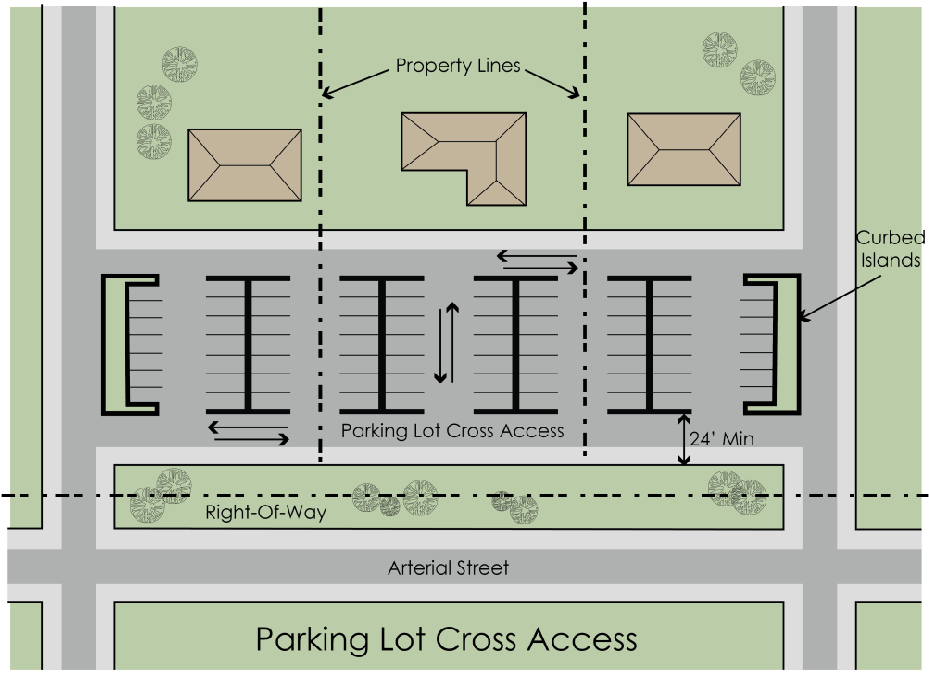
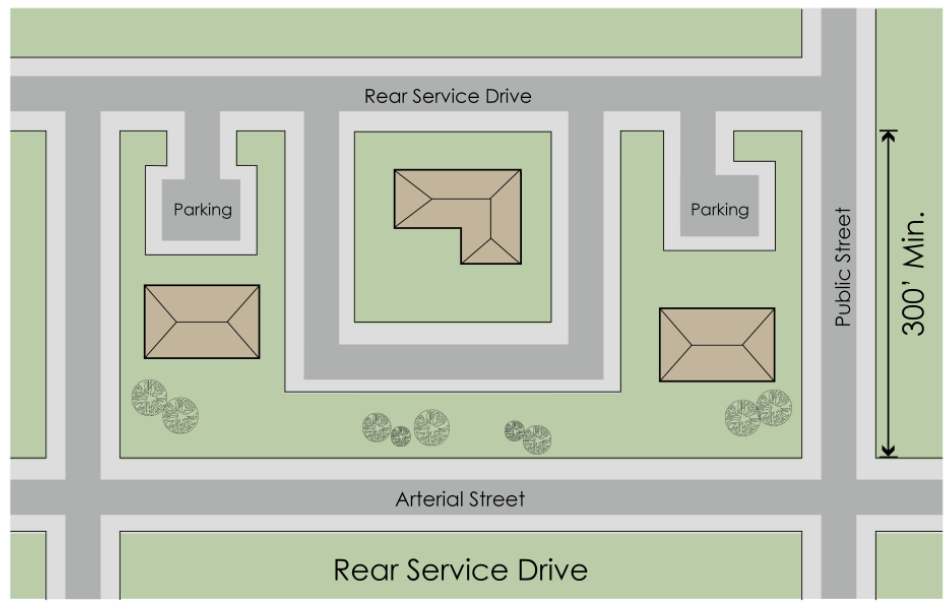
Shared use of access between two or more property owners should be encouraged through use of driveways constructed along property lines, connecting parking lots and construction on-site of frontage roads and rear service drives; particularly within one-quarter mile of major intersections, for sites having frontage on two or more streets, where frontage dimensions are less than 300 feet, at locations with sight distance problems, and/or along roadway segments experiencing congestion or accidents. In such cases, shared access of some type may be the only access design allowed.
b.
In cases where a site is adjacent to an existing frontage road, parking lot of a compatible use, or rear service drive, a connection to the adjacent facility may be required by the planning commission.
c.
In cases where a site is adjacent to undeveloped property, the site should be designed to accommodate a future frontage road, parking lot connection or rear service drive.
d.
The applicant shall provide the city with letters of agreement or access easements from all affected property owners.
Sec. 419. - Adequate sight distance.
a.
Requirements for minimum intersection or corner sight distance for driveways shall be in accordance with the American Association of State Highway and Transportation Officials (AASHTO) guidelines defined in Chapter 9 of A Policy on Geometric Design of Highways and Streets, 1994.
b.
The planning commission may adjust driveway location where there is inadequate sight distance.
c.
Residential driveway clear vision area.
1.
Nothing shall be erected, placed or allowed to grow in such a manner that impedes or obstructs vision between a height of 30 inches and six feet within the clear vision area next to a residential driveway with the exception of a chain link fence that is less than 50 percent opaque.
2.
The residential driveway clear vision area next to a residential driveway is the triangular area formed at the corner intersection of a property line adjoining a public street and a residential driveway, one side of the triangular area being six feet in length measured along the property line adjoining a public street and starting at the residential driveway, the second side five feet in length measured along the side of the residential driveway starting at the property line, and the third side being a line connecting the end points of the first two sides.
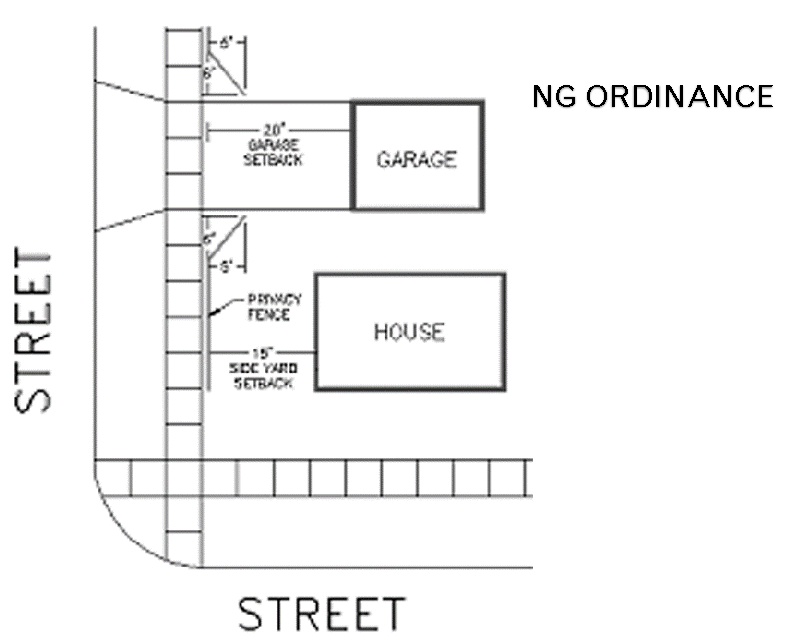
Residential Driveway Clear Vision Area
Sec. 420. - Driveway spacing from intersections.
a.
Driveway spacing from intersections shall be measured from the centerline of the driveway to the extended edge of the intersecting street's right-of-way line.
b.
In order to preserve intersection operations and safety, the minimum distance between a driveway and an intersecting street right-of-way shall be based on the following:
1.
For locations in the vicinity of intersections experiencing congestion (peak hour operations below level of service 'C' for one or more movements) and/or a significant number of traffic accidents (five or more annually), the planning commission may require that access be constructed along the property line furthest from the intersection.
2.
For locations within 200 feet of any signalized or four-way stop intersection, driveways shall be spaced a minimum of 150 feet from the intersection. Where this spacing cannot be provided, driveways designed for right-turn in, right-turn out only movements may be allowed, with a minimum spacing of 75 feet from the intersecting street right-of-way.
3.
For locations not addressed by paragraph 2. above, not including single-family parcels, driveways shall be spaced 100 feet from the intersection.
Sec. 421. - Driveway spacing from other driveways.
a.
Driveway spacing from other driveways shall be measured from the centerline of each driveway at the point where it crosses the street right-of-way line.
b.
Where feasible. Minimum driveway spacing from other driveways along the same side of the street shall be determined based on posted speed limits along the parcel for each particular frontage, as follows:
c.
Driveways shall be directly aligned with those across the street or, where offset, the minimum driveway spacing from driveways across the street shall be a minimum of 150 feet, as determined by the planning commission, excluding when one or both driveways are designed and signed for right-turn-in, right-turn-out only.
d.
The planning commission may waive the driveway spacing standards for infill development or a proposed new use within existing building that necessitates modifications to the site. The proposed driveway location and design will not create safety hazards for vehicular or pedestrian traffic.
(Ord. No. O-25-739, § 8, 5-19-25)
Sec. 422. - Driveway design, channelized driveways, deceleration lanes and tapers, and bypass lanes.
a.
Standards. Driveways shall be designed to the standards of the county road commission, except where stricter standards are included herein.
b.
Driveway width and radii:
1.
The typical driveway design shall include one ingress and one egress lane, with a combined maximum throat width of 30 feet, measured from face to face of curb.
2.
Wherever the planning commission determines that traffic volumes or conditions may cause significant delays for traffic exiting left, two exit lanes may be required.
3.
For one-way paired driveway systems, each driveway shall be 16 feet wide, measured perpendicularly.
4.
In areas with pedestrian traffic, the exit and enter lanes may be separated by a median with a maximum width of ten feet.
5.
Driveways shall be designed with a 25-foot radii; 30-foot radii where daily semi truck traffic is expected.
c.
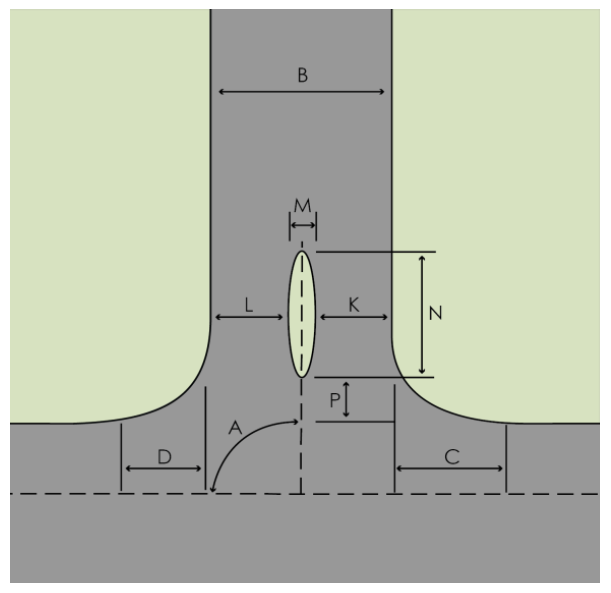
Directional driveways, divided driveways, and deceleration tapers and/or by-pass lanes. Directional driveways, divided driveways, and deceleration tapers and/or by-pass lanes may be required by the planning commission where they are necessary to reduce congestion and accident potential for vehicles accessing the proposed use or site. Right-turn tapers shall be a minimum of 75 feet in length and at least 11 feet wide. Design of direction and divided driveways shall be in accordance with the designs in figures directional driveway standards and divided commercial driveway standards.
* The "required dimension shall be used unless the city specifies, or the applicant demonstrates technical justification for a different value. The range in dimensions indicate the working values for each design feature.
Sec. 423. - Design of frontage roads, rear service drives and parking lot connections.
Frontage roads, rear service drives and drives connecting two or more parking lots shall be constructed in accordance with the following requirements:
a.
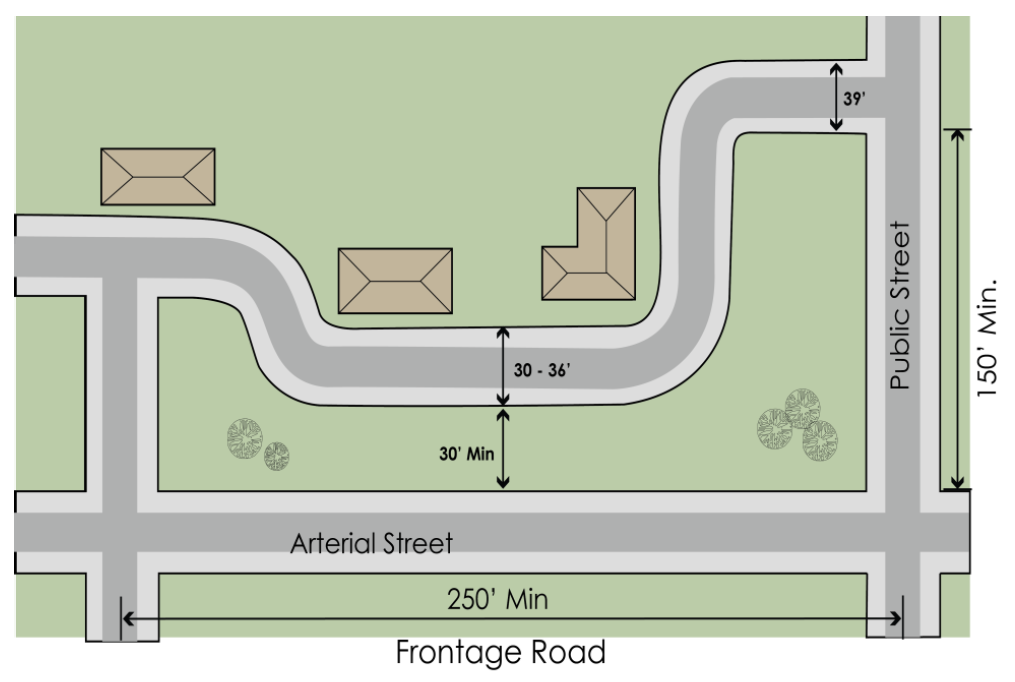
Pavement width shall be a maximum of 30 feet, measured face of curb to face of curb; intersection approaches may be widened to 39 feet for a left turn lane.
b.
Frontage road access to public streets shall be spaced according to the standards of section 420, driveway spacing from intersections and section 421, driveway spacing from other driveways.
c.
Frontage roads shall have a minimum setback of 30 feet between the outer edge of pavement and the right-of-way line, with a minimum 60 feet of uninterrupted queuing (stacking) space at the intersections.
d.
Parking along or which backs into a frontage road shall be prohibited.
e.
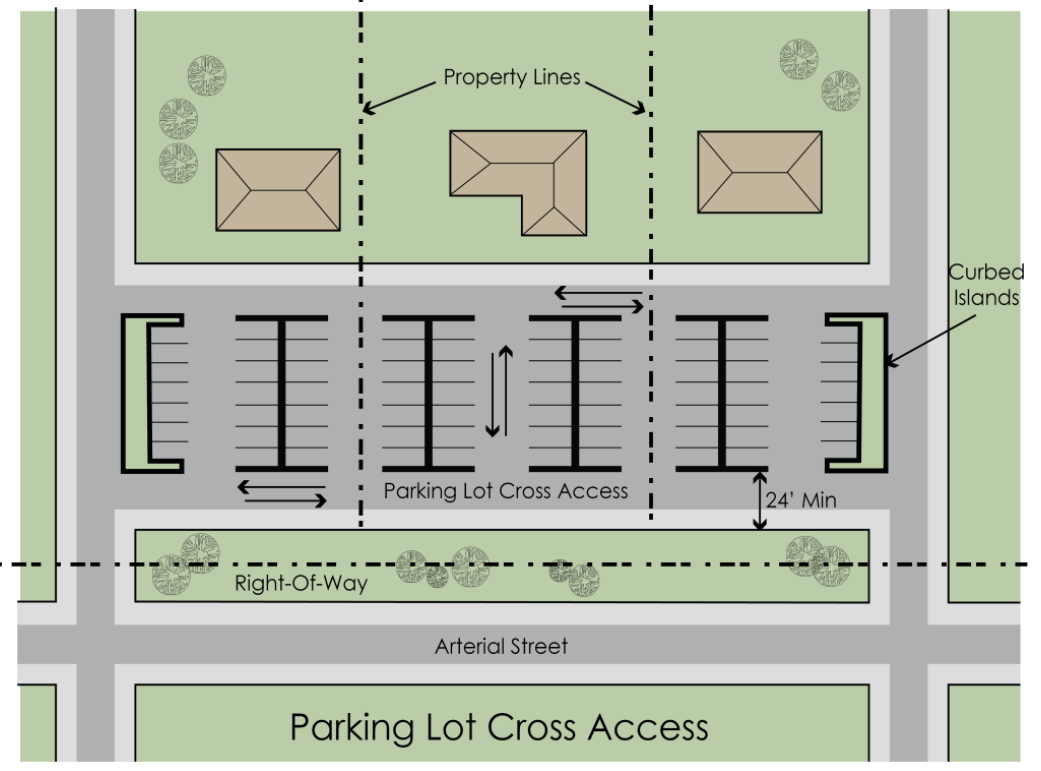
For properties which are currently developed or adjacent to developed uses, and the standards of paragraphs a. through d. above are determined by the planning commission to be too restrictive, frontage roads can be defined through parking lots by a raised curb and/or painted islands, as shown, provided that at least every third island at the end of the parking row is a raised curbed island.
(Ord. No. O-25-739, § 8, 5-19-25)
Sec. 441. - Purpose.
The intent of this division is to promote the public health, safety and welfare by establishing minimum standards for the design, installation and maintenance of landscape improvements. Landscaping is viewed as a critical element contributing to the aesthetics, development quality, stability of property values, and the overall character of the city. The standards of this division are intended to help achieve a number of functional and environmental objectives such as:
a.
Promoting the implementation of the city master plan and subarea studies.
b.
Defining and articulating outdoor spaces and architectural elements.
c.
Obscuring, integrating and complementing various site elements.
d.
Assisting in directing safe and efficient movement of vehicular and pedestrian circulation.
e.
Screening headlights to reduce glare and incidental pollution.
f.
Reducing the physical impact between adjacent land uses.
g.
Providing landscape treatments that are consistent with adjacent sites and parcels within the surrounding area.
h.
Providing incentives to preserve quality existing plant material and trees.
i.
Providing reasonable standards to bring developed sites, which existed prior to the adoption of these standards, into compliance with the requirements contained herein.
j.
Encourage drought-resistant species and/ or species native to southeast Michigan.
k.
The standards contained in this division are considered the minimum necessary to achieve the objectives identified above. In several instances these standards are intentionally flexible to encourage flexibility and creative design. Additional landscaping beyond the minimum specified is encouraged to further improve the function, appearance and value of the property.
l.
The intent of the tree protection removal requirements set forth in this section is to protect to the extent practical, the existing tree cover in the city and when trees must be removed, to sustain tree cover in the city by replacing trees in the community that are removed.
(Ord. No. O-23-728, § 6, 3-8-23)
Sec. 442. - Replacement of removed trees.
A landscape plan shall be submitted with any site plan for new development. New development includes the construction of a building, expansion of an existing building, expansion of a parking lot, or any other structure requiring a building permit. The site plan shall identify the location, species and size of existing trees greater than eight-inch caliper width on the proposed site that are to be removed, or are within ten feet of the removal area. Existing landmark trees that are planned to be removed shall be replaced on the site in accordance with the following standards:
a.
Removed landmark trees between eight and 18 caliper inches shall be replaced at a rate of 50 percent of the total diameter breast height (dbh).
b.
Removed landmark trees greater than 18 caliper inches shall be replaced at a rate of 75 percent of the total dbh.
c.
Removed landmark trees greater than 30 caliper inches shall be replaced at a rate of 100 percent of the total dbh.
d.
Landmark trees that are dead or diseased, with no visible growth, as determined by the zoning administrator, are exempt from replacement requirements.
e.
A summary table of existing trees shall be provided, indicating those trees that will be removed.
f.
Landmark trees are defined by size and species, as listed in the table below:
(Ord. No. O-25-739, § 9, 5-19-25)
Sec. 443. - Incentives to preserve existing trees.
The standards listed below are intended to encourage the preservation of quality and mature landmark trees by providing credits toward required landscape components:
a.
Trees intended to be preserved shall be indicated on the site plan.
b.
To obtain credit, the preserved trees shall be arranged to meet the intent of this division, be of high-quality, as confirmed by the city, and at least two and one-half inch caliper in size for deciduous trees, six feet in height for evergreen trees.
c.
Each deciduous tree preserved that is between two and one-half inch to seven and nine-tenths inch caliper in size and evergreen tree that is between six feet to 19 feet shall be calculated as one required tree, two credits for deciduous trees with a caliper of eight inches or greater and evergreen trees greater than 19 feet.
d.
The landscape plan shall include a matrix that lists required trees and credits for preserved trees.
e.
During construction, tree protection fencing shall be placed ten feet beyond the drip-line of the tree. The ground area within the fence line shall be maintained with vegetative landscape material or pervious surface cover. The planning commission may allow pedestrian pathways, driveways or parking within the dripline upon determination that the setback from the trunk of the tree is suitable to reasonably ensure protection of the tree and the public. Storage of soils or other materials within the dripline is prohibited.
f.
If trees are lost within three years after completion of the construction, the property owner shall replace with new trees equal to the number of tree credits granted.
g.
Tree credits may account for up to 50 percent of the required trees and be applied anywhere on the site.
Sec. 444. - Landscape plan specifications.
a.
A separate detailed landscape plan, prepared by a licensed/registered design professional, shall be submitted as part of the site plan review process.
b.
The landscape plan shall demonstrate that all requirements of this division are met and shall:
1.
Illustrate location, spacing, species, and size of proposed plant material.
2.
Separately identify compliance with the minimum numeric requirements for greenbelts, buffer zones, parking lot trees, detention ponds, and interior landscaping; required trees or materials cannot be double counted.
3.
If applicable, identify compliance with the numeric requirements for tree replacement and preservation.
4.
Identify trees and other landscape elements to be preserved.
5.
Provide details to ensure proper installation and establishment of proposed plant material.
6.
Identify grass areas and other methods of ground cover.
7.
Identify a landscape maintenance program including a statement that all diseased, damaged or dead materials shall be replaced in accordance with standards of this division.
Sec. 445. - Design standards.
a.
Greenbelts. The greenbelt is intended to provide a transition between the roadway and an existing or proposed land use. Greenbelts shall be provided in accordance with the following requirements:
1.
The width of the greenbelt shall be ten feet.
2.
Greenbelts shall include only living materials and planting beds, except for approved sidewalks, bike paths, signs, driveways, and essential services.
3.
Where sidewalks are located within the greenbelt, plant material shall be provided on each side of the pathway to provide visual and physical separation between the vehicular and pedestrian circulation.
4.
The greenbelt shall contain a minimum of one canopy tree and six upright shrubs per 30 linear feet, or fraction thereof, of street frontage including any openings for driveways, pathways, or easements. The planning commission may approve the substitution of evergreen trees for up to 50 percent of the required canopy trees when appropriate in consideration of the land use and existing character of adjacent uses.
5.
Ornamental trees may be used to diversify greenbelt planting requirements, provided two ornamental trees shall be provided for each one required canopy tree.
6.
Greenbelts shall be designed to ensure adequate sight visibility for motorists, adequate clearance for pedestrians and vehicles, clearance from overhead utility lines, adequate separation from underground utilities, and accessibility to fire hydrants. Where such conditions prohibit full compliance, the planning commission may adjust the location of the required materials so as long as the design intent is met.
7.
Greenbelts are not required in the B1 and MX1 districts.
8.
In the commercial and industrial districts, in cases where existing conditions do not permit the provision of a ten-foot wide greenbelt. the city manager may permit the greenbelt requirements to be met through the provision of street trees and shrubs within the public right-of-way curbline in compliance with chapter 78 of this Code.
b.
Parking lot landscaping. Within every parking area containing ten or more spaces there shall be parking lot landscaping in accordance with this section. These landscaping areas shall be located so as to divide and break up the parking area and to better define the parking area. All required parking lot landscaping shall conform with the following:
1.
Any off-street parking areas containing ten or more parking spaces shall have parking lot landscaping according to the following schedule:
2.
All required parking lot landscaping shall be designed to conform with the following requirements, subject to planning commission approval:
a)
One two-inch caliper deciduous tree shall be required for every 100 square feet of required parking lot landscaping area.
b)
Parking lot landscaping areas shall be curbed with six-inch concrete or asphalt curbing.
c.
Detention/retention pond landscaping. Ponds shall be designed to provide a natural appearance. Detention and retention ponds shall be provided in accordance with the following standards:
1.
Side slopes shall be such that the perimeter of the pond shall not need to be fenced. However, if the circumstance makes it not possible the fence must be decorative.
2.
The sides of the pond must be undulating to avoid an "engineered" appearance.
3.
One canopy or evergreen tree and ten shrubs are required per 50 feet of pond perimeter, as measured along the top of the bank elevation. The required landscaping shall be planted in a random pattern, not limited to the top of the pond bank.
4.
Wild grasses and wetland plantings should be utilized on the side slopes and bottom of the pond to give it a more natural appearance, minimize on-going maintenance, and provide improved filtering of sediments.
5.
Where a natural landscape is found not to be particular or desirable the planning commission may require some type of decorative fencing.
6.
We encourage detention and retention ponds be located in the rear of property when possible.
d.
Interior site landscaping. For any development that requires a building permit from the city, except in R-1 and R-2 residential districts, interior landscaping areas shall be provided, equal to at least at least ten percent of the total lot area (inclusive of the greenbelt and parking lot landscaping). These landscaped areas may be grouped near building entrances, building foundations, pedestrian walkways, service areas or adjacent to fences, walls, or rights-of-way. All interior landscaping shall be designed to the following general design standards, subject to planning commission approval:
1.
One two-inch caliper deciduous tree, or one five-foot high evergreen tree, for every 400 square feet of required interior landscaping area.
2.
Two 18-inch high or wide shrubs shall be required for every 400 square feet of required interior landscaping area.
3.
The interior landscaping area shall be covered with grass, ground cover, wood chips, mulch, or any combination of the above.
e.
Residential and site condominium developments. Landscaping for single-family and multiple- family residential developments shall be provided in accordance with the following requirements:
1.
Street trees shall be provided at a rate of one tree per 40 linear feet of frontage, or thereof, along all interior roads. The planning commission may determine that existing trees preserved within ten feet of the road edge may fulfill the street tree requirement for that portion of the road. Trees should generally be planted between the sidewalk and road curb, in consideration of intersection sight distance.
2.
The landscape plan shall also include details of the cul-de-sac islands, project entrances, accessory buildings and common open space areas.
f.
Reserved.
g.
Accessory site components. In addition to required screens or walls, site elements such as dumpsters, air conditioner units, utility boxes and other similar components shall be appropriately screened with plant material.
(Ord. No. O-22-719, § 7, 3-7-22)
Sec. 446. - Specifications for screen walls, berms, and landscape improvements.
This section is intended to define the various types of screening and landscaping required in specific instances by this ordinance. These standards are applicable wherever they are specifically required in this ordinance.
a.
Required minimum screening and landscaping. The following table specifies the minimum required screening and landscaping between a subject parcel and adjacent properties.
A) Landscaped berm (See section 446.c)
B) Landscaped buffer (See section 446.d)
C) Screen wall or fence (See section 446.b)
D) Greenbelt (See subsection 445.a)
b.
Screen walls. Wherever a nonresidential use adjoins a residential district, and wherever a parking lot of eight or more spaces adjoins a single-family residential district, a screen wall shall be provided by the nonresidential use. (For purposes of this section, a parking lot of eight or more spaces shall be considered a nonresidential use).
1.
All required screen walls shall be six feet in height, unless otherwise specified, and shall be placed along the lot line of the nonresidential use.
2.
Where a public alley separates the nonresidential use from the residential use, the planning commission and/or city planner shall determine the location of the wall so as to best protect the residential district.
3.
Required screen walls shall not be extended into a required front setback area to ensure proper visibility of pedestrians and vehicles by drivers exiting the nonresidential site.
4.
Required screen walls shall be of masonry construction, decorative in nature, of either face brick, poured concrete with a brick pattern, or cement block with a facing of decorative brick.
5.
The planning commission may:
a.
Approve a partial or complete substitution of the wall(s) using existing or proposed topography, dense vegetation, or other natural or man-made features that would produce substantially equivalent results of screening and durability;
b.
Approve reduction or increase in wall height where a greater or lesser height is found appropriate based on consideration of topography, sight lines, and distances;
c.
Approve variations in design standards for reasons of topography or characteristics peculiar to the site, its usage and environs, or in an area abutting residential—at the request of the homeowner(s).
d.
In taking such actions, the planning commission shall take into account the principal purpose of the wall(s) is to screen nonresidential activities, including parking, loading and noise, from nearby residential districts.
e.
In such cases where the planning commission finds that there would be no substantial need for a screen wall, the requirements may be reduced or substituted in accordance with the table in subsection 446a above. The basis for such decision shall be recorded in the minutes of the planning commission.
6.
Walls shall be continuous except for openings for pedestrian connections as approved by the planning commission.
c.
Berm standards. A landscaped berm is any combination of a raised earthen berm and plantings which forms a visual barrier that is a minimum five feet above the surrounding grade. All landform buffers shall also conform with the following:
a)
The berm shall be comprised of soil and shall be a minimum of two feet in height and a minimum of 12 feet in width.
b)
The berm shall be a minimum 12 feet wide with a maximum side slope of 3:1.
c)
The berm shall be covered with grass or other living or natural cover.
d)
Plantings shall be a mixture of evergreen and deciduous trees, shrubs and groundcover.
d.
Buffer standards. A landscaped buffer is a landscaped area of trees, shrubs and groundcover forming a visual barrier of a minimum five feet in height. All buffer strips shall conform with the following:
1.
The landscaped buffer shall be a minimum of 15 feet wide.
2.
The landscaped buffer shall be covered with grass, living or natural groundcover, wood chips, natural mulch, or any combination of the above.
3.
Plantings shall be a mixture of evergreen and deciduous trees, shrubs and groundcover.
e.
Plant material. All plant material shall be hardy to the city, be free of disease and insects and conform to the American Standard for Nursery Stock of the American Nurserymen. Landscaped areas shall include only living plant materials and planting beds.
f.
Minimum sizes and spacing. The minimum plant sizes and spacing shall be provided in accordance with the following:
1.
Screening. Wherever screening is required, screening shall consist of closely spaced evergreen plantings which can be reasonably expected to form a complete visual barrier. Deciduous plant material may be used for variety to supplement evergreen plantings.
2.
Mixing of species. The overall landscape plan shall not contain more than 33 percent of any one plant species. The use of native species and mixture of trees from the same species association is strongly encouraged.
3.
Trees not permitted. The following trees are not permitted as they split easily, their wood is brittle, their roots clog drains and sewers, and they are unusually susceptible to disease or insects. The planning commission may however allow trees from this list when associated with an appropriate ecosystem. Trees not permitted are as follows: Box Elder, Elms, Tree of Heaven, Willows, Soft Maples (silver), Poplars, Horse Chestnut (nut bearing), Ash, Ginkgo (female), Cottonwood, Mulberry, Black Locust, Honey Locust (with thorns).
4.
Topsoil. Top soil shall consist of a four-inch base for lawn areas and an eight- to 12-inch base within planting beds.
5.
Proximity to utilities. Plant material shall not be located in a manner that will interfere with or cause damage to underground utility lines, public roads or other public facilities.
6.
Lawn grasses. Lawn grasses shall be planted in species normally grown as permanent lawns in the county. Grasses may be plugged, sprigged, seeded or sodded except that rolled sod, erosion reducing net or suitable mulch shall be used in swales or other areas susceptible to erosion and shall be staked where necessary for stabilization. When complete sodding or seeding is not used, nurse grass seed shall be sown and mulched for immediate protection until permanent coverage is achieved. Grass sod and seed shall be free of weeds and noxious pests or disease.
g.
Modification of screening and landscape requirements. Recognizing that a wide variety of land uses and the relationship between them can exist, and that varying circumstances can mitigate the need for screening and landscaping, the planning commission may reduce or waive the screening and landscaping requirements of this section and approve an alternative screening and landscape plan upon finding that compliance with this section would not otherwise be feasible. The planning commission shall find that the following standards have been met whenever it modifies any screening or landscaping requirements:
1.
The screening and landscaping plan shall protect the character of new and existing residential neighborhoods against negative impacts such as noise, glare, light, air pollution, trash and debris, and hazardous activities.
2.
The alternate width and type of buffer zone and screening provided therein will ensure compatibility with surrounding and nearby land uses because:
a)
The development is compatible with and sensitive to the immediate environment of the site and neighborhood relative to architectural design, scale, bulk, building height, identified historical character, disposition and orientation of buildings on the lot and visual integrity.
b)
The site has natural existing vegetation and/or topography, natural bodies of water or wetland areas or other existing conditions which offer screening consistent with the standards set forth in this article. The planning commission shall require the preservation of these natural features as a condition of site plan approval.
c)
The arrangement, design and orientation of buildings on the site maximize privacy and isolate adjacent and nearby land uses from any potential negative impacts of the project.
(Ord. No. O-22-719, § 7, 3-7-22; Ord. No. O-25-739, § 9, 5-19-25)
Sec. 447. - Minimum standards for installation, irrigation and maintenance.
a.
Timing of planting. All required plant material shall be planted prior to issuing a final certificate of occupancy. In the event that the project is completed during a time of year when planting is impractical, a financial guarantee in the amount of the remaining improvements shall be provided in a form of payment acceptable to the city.
b.
Completion of improvements. Tree stakes, guy wires and tree wrap shall be removed after completion of the initial growing season.
c.
Irrigation. All landscaped areas shall be provided with functional underground irrigation system. If the landscape materials used may survive without irrigation, the applicant must demonstrate or provide data to confirm that irrigation is not needed for survival.
d.
Maintenance. Landscaped areas and plant materials required by this chapter shall be kept free from refuse and debris. Plant materials, including lawn, shall be maintained in a healthy growing condition, neat and orderly in appearance in accordance with the approved site plan. If any plant material dies or becomes diseased, it shall be replaced within 30 days written notice from the city or within an extended time period as specified in said notice.
Sec. 448. - Standards for compliance for existing sites.
In any case where the building and/or parking area is being increased by at least 40 percent over the originally approved site plan or is being changed to a more intense use as determined by the planning commission and/or city planner, the site shall be brought into full compliance with the landscape standards herein, unless the site conditions prevent full compliance. In cases where the increase is less than 40 percent the site shall be brought into greater conformity with the landscape standards.
The planning commission and/or city planner shall determine the extent of new landscaping by evaluating the following:
1.
Size of the land.
2.
Configuration and size of the existing buildings.
3.
Relationship to the proposed buildings and uses of land.
4.
Relationship to adjacent land uses.
5.
Relationship to existing and proposed thoroughfares.
6.
The new landscaping shall protect the character of any adjacent and nearby residential neighborhoods and/or non-residential land uses against any potential negative impact of the project.
(Ord. No. O-22-719, § 7, 3-7-22; Ord. No. O-23-728, § 6, 3-8-23)
Sec. 465. - Findings and purpose.
a.
The purpose of this division is to permit and regulate signs within the city so as to protect public safety, health and welfare; minimize abundance and size of signs to reduce visual clutter, motorist distraction, and loss of sight distance; promote public convenience; preserve property values; support and complement land use objectives as set forth in the city master plan and this appendix; and enhance the aesthetic appearance and quality of life within the city. The standards contained herein are intended to be content neutral. This division must be interpreted in a manner consistent with the First Amendment guarantee of free speech. If any provision of this division is found by a court of competent jurisdiction to be invalid, such finding must not affect the validity of other provisions of this division which can be given effect without the invalid provision.
b.
It is hereby determined that proliferation of signs in the city is unduly distracting to motorists and pedestrians, creates a traffic hazard, and reduces the effectiveness of signs needed to direct and warn the public. Too many signs can overwhelm the senses, impair sightlines and vistas, create feelings of anxiety and dismay, affect the tranquility of residential areas, impair aesthetics and degrade the quality of a community.
c.
It is also determined that the appearance of the city is marred by proliferation of signs.
d.
It is also determined that proliferation of signs negatively affects property values. This division promotes safe, well-maintained, vibrant and attractive residential and business neighborhoods while accommodating the need for signs to function for the purposes for which they are intended.
e.
It is also determined that the individual user's rights to convey a message must be balanced against the public's right to be free of signs which unreasonably compete with one another, distract drivers and pedestrians, and create safety concerns and confusion. This division is intended to balance the individual user's desire to attract attention with the citizens' right to be free of unreasonable distractions.
f.
It is also determined that proliferation of signs results in an inappropriate use of land. The purpose of this division is to control the occurrence and size of signs in order to reduce the aforementioned negative effects.
g.
It is further determined that off-premise signs are unduly distracting to motorists and residents because of the periodic changing of the message on such signs and because such signs are generally larger and are predominantly located along busy highways where several businesses are located in close proximity to each other, thereby posing a greater risk to the city's interest in traffic safety and aesthetics. Additionally, off-premises signs can also deter the redevelopment of a parcel or limit the redevelopment potential of a site due to extended lease periods for off-premises signs.
h.
It is further determined a proliferation of off-premise signs creates confusion and the perception of visual clutter in conflict with one of the goals and themes of this division.
i.
These objectives are accomplished by establishing the minimum number of regulations necessary concerning the size, placement, construction, illumination, and other aspects of signs in the city to:
1.
Recognize that the proliferation of signs is unduly distracting to motorists and non-motorized travelers, reduces the effectiveness of signs directing and warning the public, causes confusion, reduces desired uniform traffic flow, and creates potential for accidents.
2.
Prevent signs that are potentially dangerous to the public due to structural deficiencies or disrepair.
3.
Reduce visual pollution and physical obstructions caused by a proliferation of signs which would diminish the city's image, property values and quality of life.
4.
Assist the public to locate goods, services and facilities without excessive difficulty and confusion by restricting the size and placement of signs.
5.
Prevent placement of signs which will conceal or obscure signs of adjacent uses.
6.
Prevent off-premise signs from conflicting with other allowed land uses.
7.
Maintain and improve the image of the city by encouraging signs of consistent size which are compatible with and complementary to related buildings and uses, and harmonious with their surroundings. This includes preventing light trespass onto adjacent properties.
8.
Prohibit all portable signs on public property, including, but not limited to, city-owned property, in recognition of their significant negative impact on traffic safety and aesthetics.
9.
Preserve and enhance the image of the city.
(Ord. No. O-23-728, § 7, 3-8-23)
Sec. 466. - Sign definitions.
The following words, terms and phrases, when used in this division, shall have the meanings ascribed to them in this division, except where the context clearly indicates a different meaning.
Animated sign. A sign which uses lights, moving parts, or other means to depict movement, motion, action, the impression or appearance thereof, or create an image of a living creature or person.
Awning sign: That angled portion of an awning other than 90 degrees.
Awning valance: That portion of an awning consisting of short strips or bands of material hung at the lower edge of the awning.
Blade sign. A sign which is oriented perpendicular to the building façade and which is suspended under a bracket, armature, or other mounting device.
Business center. A grouping of two or more business establishments on one or more parcels of property which may share parking and access and are linked architecturally or otherwise present the appearance of a unified grouping of businesses. A business center shall be considered one use for the purposes of determining the maximum number of freestanding signs. An automobile or vehicle dealership shall be considered a business center regardless of the number or type of models or makes available, however, used vehicle sales shall be considered a separate use in determining the maximum number of signs, provided that the used vehicle sales section of the lot includes at least 25 percent of the available sales area.
Canopy sign. A structure other than an awning affixed to a building and carried by a frame which is supported by the ground.
Device sign. Permanent signs on vending machines, gas pumps, ice containers and similar items indicating only the contents of such devices.
Directional sign. A sign which assists motorists in determining or confirming a correct route such as, enter, exit and parking signs.
Electronic messaging sign. A sign, or portion thereof, that displays electronic, static images, static graphics or static pictures, with or without textual information. Such a sign can be changed or altered by electronic means on a fixed display screen composed of a series of lights including light emitting diodes (LEDs), fiber optics, light bulbs, or other illumination devices within the display area where the message is displayed. Electronic messaging signs include computer programmable microprocessor controlled electronic or digital displays, and shall not include animated images or graphics, audio components, scrolling messages, or video moving images similar to television images.
Entranceway sign. A sign which marks the entrance to an apartment complex, condominium development, senior housing complexes, manufactured housing communities, office and industrial parks and similar uses.
Flashing sign. A sign which contains an intermittent or sequential flashing light source including color and intensity.
Freestanding sign. A sign supported by one or more uprights, poles or braces placed in the ground surface and not attached to any building or other structure. Freestanding signs may include monument, pylon, and pole-type signs.
Government sign. A government sign is a sign that is constructed, placed or maintained by the federal, state or local government or a sign that is required to be constructed, placed or maintained by the federal, state or local government either directly or to enforce a property owner's rights.
Human sign. A sign held by or attached to a human for the purposes of advertising or otherwise drawing attention to an individual, business, commodity, service or product. This can also include a person dressed in costume for the purpose of advertising or drawing attention to an individual, business, commodity, service or product.
Illegal sign. A sign which does not meet the requirements of this division and does not have legal non-conforming status.
Incidental sign. A small sign, emblem, or decal informing the public of goods, facilities, or services available on the premises. Examples of incidental signs include credit card signs, signs indicating the hours of business, no smoking signs, signs used to designate bathrooms, and signs providing information on credit cards and business affiliations.
Mansard. A sloped roof or roof-like façade. Signs mounted on the face of a mansard roof shall be considered wall signs.
Marquee. A permanent roof-like structure or canopy, supported by and extending from the face of the building.
Memorial sign or tablet. A sign having the name of the building and/or the date of erection and cut, cast or engraved into a masonry or metal surface and made an integral part of the structure.
Moving sign. A sign, in which the sign itself or any portion of the sign moves or revolves. "Rotating signs" and "feather signs" are types of moving signs. This definition does not include "electronic message" or "animated" signs.
Mural (art). A design or representation which does not contain promotional or commercial advertising painted or drawn on a wall.
Mural (limited reference art mural). An original, one-of-a-kind unique design or representation which contains limited references to the establishment, product, or service provided on the site which is painted or drawn on a wall on that site.
Nameplate. A non-electric, on premise identification sign.
Non-conforming sign. A sign that does not comply with the size, placement, construction or other standards or regulations of this division, but were lawfully established prior to its adoption. Signs for which the zoning board of appeals has granted a variance are exempt and shall not be defined as non-conforming.
Obsolete sign. A sign for a business or use that has closed.
Off-premise sign. A sign which identifies a use, directs travelers, provides a message or advertises products and services not available on the site or parcel on which the sign is located.
Portable sign. A sign designed to be moved from place to place, whether or not it is permanently attached to the ground or structure. This includes hot-air and gas-filled balloons, pennants, streamers, festoons, ribbons, tinsel, pinwheels, non-government flags, and searchlights and signs mounted on a portable structure including those with wheels.
Regulatory sign. A sign installed by a public agency to direct traffic flow, regulate traffic operations and provide information in conformance with the Michigan Manual of Uniform Traffic Control Devices.
Roof sign. Any sign that extends above the roofline or is erected over the surface of the roof.
Sandwich board sign. Also known as a poster panel or "A" frame sign. A moveable nonpermanent sign placed within the pedestrian public right-of-way of a public sidewalk during regular business hours consisting of an "A" frame or "inverted T" frame or other temporary style, with not more than two flat surfaces containing messages, and not permanently affixed to any structure or to the sidewalk itself.
Sign. Any device, structure, fixture, figure, symbol, banner, pennant, flag, balloon, logo, or placard consisting of written copy, symbols, logos and/or graphics, designed for the purpose of conveying, bringing attention to, identifying or advertising an establishment, product, goods, services, or other message to the general public. Unless otherwise indicated, the definition of "sign" includes interior and exterior signs which are visible from any public street, sidewalk, alley, park, or public property, but not signs which are primarily visible to and directed at persons within the premises upon which the sign is located.
Snipe sign. A sign made on any material and attached to any object and having no application to the premises where located.
Temporary sign. A sign not constructed or intended for long-term or permanent use. A banner, pennant, poster or advertising display constructed of paper, cloth, canvas, plastic sheet, cardboard, wallboard, plywood or other like materials and that appears to be intended or is determined by the city to be displayed for a limited time.
Vehicle sign. Signs affixed to a parked vehicle or truck trailer which is being used principally for displaying a message, rather than for transportation purposes.
Wall sign. A sign attached parallel to and extending not more than 12 inches from the wall of a building. Painted signs, signs which consist of individual letters, cabinet signs, and signs on the face of a mansard roof, awning or canopy shall be considered wall signs. Permanent signs which are not affixed directly to a window or are positioned next to a window so that they are visible from the outside shall also be considered wall signs.
Window display. Shall include any window area designated to permit customers outside the building to view merchandise inside a store or that displays store merchandise in a specially designed area immediately inside the window glass, whether or not the rest of the store interior is visible. Window displays are not considered signs.
Window graphics. A type of window sign that is attached to a window and does not block visibility from inside the window but displays an image outside the window.
Window sign. A sign located in or on a window which is intended to be viewed from the outside. Permanent window signs which are directly affixed or not affixed directly to a window or are positioned next to a window so that they are visible from the outside shall be considered wall signs.
(Ord. No. O-23-728, § 7, 3-8-23)
Sec. 467. - Sign permit required.
Except as expressly provided in section 470, it shall be unlawful for any person to erect, alter, relocate, construct, display, install, change or cause to be constructed, displayed, installed, or changed, any sign or other structure designed to display a message within the city without first obtaining a sign permit from the city and payment of a fee provided for in this section.
Sec. 468. - Permits and application procedure.
a.
Application. Applications for permits to erect, construct, maintain, use, display, alter, convert, repair a sign shall be made upon forms provided for by the city. The applicant must provide sufficient information to determine if the proposed sign is allowed under this Code and other applicable laws, regulations and ordinances. An application shall contain or have attached thereto the following information:
1.
Name and telephone number of the applicant, property owner(s), and if applicable, the tenant(s) and occupant(s);
2.
Location of building, structure, or lot to which the sign is to be attached or erected;
3.
Three drawings of the plans and specifications and method of construction and attachment to the building or in the ground;
4.
Name and address of the person erecting the structure and any applicable licenses;
5.
Any electrical permit required and issued for such sign;
6.
Such other information as the building official, or his or her designee, may require showing full compliance with this [article] and all other applicable laws of the city and the state.
b.
Fees. A non-refundable application, permit, review and inspection fee shall be paid to the city for each permit and each temporary permit required by this division as shall be set by resolution of the council from time to time.
c.
Timing. The building official or designee shall promptly process the sign permit application and approve the application, reject the application, or notify the applicant of deficiencies in the application within 21 days after receipt. If the application is rejected, the building official shall provide a list of the reasons for the rejection in writing.
Sec. 469. - Applicability of state construction code.
Except as otherwise indicated in this division, the regulations of the state construction code as adopted by the city shall apply to signs. Where the provisions of this division are more restrictive in respect to location, setback, use, size or height of signs, the limitations of this division shall take precedence over the regulations of the state construction code.
Sec. 470. - Exemptions to permitting.
a.
The following signs shall not require a permit provided such signs are outside of the public street right-of-way, are located to ensure adequate sight distance, and meet the requirements of this section:
1.
Address signs. In all single-family zoning districts, such sign shall not exceed two square feet in area. In all other zoning districts, such signs shall not exceed six square feet in area.
2.
Signs erected, maintained or otherwise posted, owned or leased by the federal government, the state or the city.
3.
Construction signs meeting the size requirements for temporary signs under subsection 472.b.
4.
Directory signs. A building with business occupants on the upper floors or the interior space on the first floor of a building may have a directory sign plaque not to exceed ten square feet in area at the street entryway.
5.
Essential service signs denoting utility lines, hazards and precautions or other similar information.
6.
Flags:
a)
Not to exceed three per business premise; and
b)
Not to exceed four feet by six feet.
b.
Historic markers.
c.
Incidental and device signs shall not exceed a total of two square feet, a total of two signs per business indicating acceptance of credit cards, the location of public telephones, restrooms, restrictions on smoking and restrictions on building entrances or describing business affiliations and are attached to a permitted sign, exterior wall, building entrance, or window.
d.
Interior signs, including any sign which is located completely within an enclosed building, and which is not visible from outside the building or which is primarily directed at persons within the premises upon which the sign is located.
e.
Memorial signs or tablets not exceeding four square feet in area, having the name of the building and/or the date of erection and cut, cast or engraved into a masonry or metal surface and made an integral part of the structure.
f.
Nameplates.
g.
Real estate signs and real estate open house signs meeting the requirements of section 472.
h.
Real estate development signs meeting the requirements of section 472, conditioned upon removal when the building or development is completed.
i.
Regulatory signs including traffic control and street identification signs.
j.
Vehicle signs.
k.
Warning signs that are publicly authorized, such as no trespassing, warning of electrical currents or animals provided such signs do not exceed two square feet in area.
Sec. 471. - General standards for permitted signs.
a.
Setbacks.
1.
All signs, unless otherwise provided for in this article, shall be set back a minimum of five feet from any public or private street right-of-way line, access drive, or sidewalks in all zoning districts. This distance shall be measured from the nearest edge of the sign, measured at a vertical line perpendicular to the ground to the right-of-way, access drive, or sidewalk.
2.
All nonresidential signs shall be set back at least 100 feet from any residential district.
b.
Design and construction. Signs, as permitted in the various zoning districts, shall be designed to be compatible with the character of building materials and landscaping to promote an overall unified and aesthetic effect in accordance with the standards set forth herein.
c.
Illumination.
1.
Signs may be illuminated, but only by steady, stationary, shielded light sources directed solely at the sign or internal to it.
2.
Use of glaring undiffused lights, including bare bulbs, neon, or flames, is prohibited.
3.
Lighting shall be shielded and/or pointed downward so as not to project onto adjoining properties or thoroughfares.
d.
Maintenance and construction. Every sign shall always be constructed and maintained in a manner consistent with the building code provisions and maintained in good structural condition. All signs shall be kept neatly painted, stained, sealed or preserved including all metal, wood or other materials used for parts and supports.
e.
Clearance. All signs, including any cables, guy wires, or supports shall have a minimum clearance of four feet from any electric fixture, street light, or other public utility pole or standard.
f.
Sign area. Measurement of allowable sign area is as follows:
1.
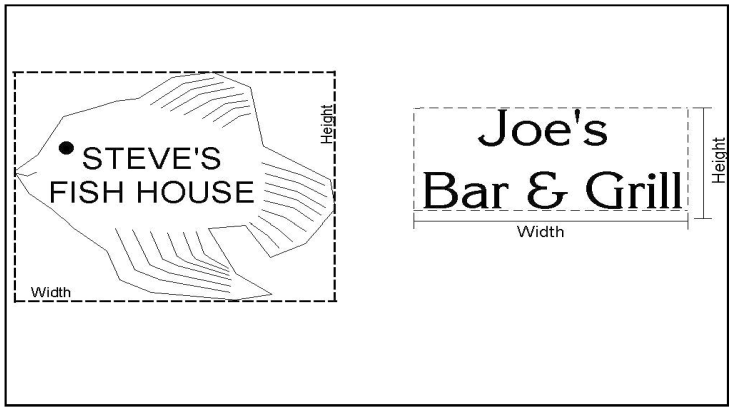
The allowable area for signs shall be measured by calculating the square footage of the sign face and any frame or base of other material or color forming an integral part of the display or used to differentiate it from the background against which it is placed as measured by enclosing the most protruding points or edges of a sign within a parallelogram or rectangle.
2.
When a sign has two or more faces, the area of all faces shall be included in calculating the area of the sign except that where two such faces are placed back to back, only larger face shall be considered, provided that both faces are part of the same structure and are separated by no more than two feet.
3.
For purposes of calculating sign area allowed as a wall sign, the wall sign square footage shall be determined by measuring a parallelogram (box) which includes the portion of the awning or canopy which contains a message, symbol and/or logo.
4.
When a sign consists solely of lettering or other sign elements printed, painted or mounted on a wall of a building without any distinguishing border, panel or background, the calculation for sign area shall be measured by enclosing the most protruding edges of the sign elements within a parallelogram or rectangle.
g.
Sign height.
1.
The permitted height of all signs supported by the ground shall be measured from the average ground level within two feet of the base of the sign.
2.
Sign height shall not be measured from an area of the ground that has been built-up or constructed in a manner that would have the effect of allowing a higher sign height than permitted by these regulations (e.g. the height of signs erected on a berm shall be measured from the average ground level within two feet of the base of the sign).
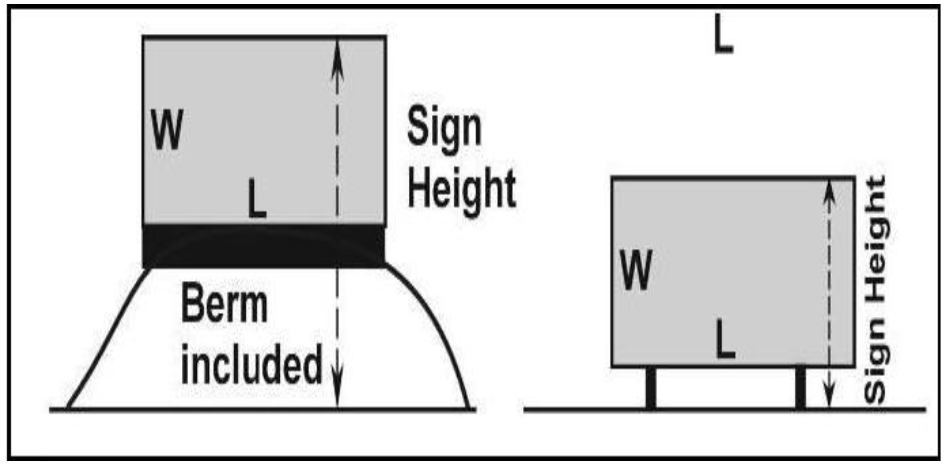
h.
Replacement signs. When a sign is to be replaced, it shall thereafter conform to all requirements of this appendix. This shall not prevent the lawful continuance of nonconforming signs that were legally established prior to the current requirements of this appendix. The following provisions shall apply to replacement of panels and signs intended to update nonconforming signs:
1.
The owner of a nonconforming sign may replace a panel or face of the sign in order to update the nonconforming sign or identify a new tenant or occupant from the same use category provided the sign is not enlarged or otherwise made more nonconforming. Approval of replacement panels may be granted by the building official.
2.
The replacement of a nonconforming sign or signs with a sign that conforms to the current requirements of this appendix may be approved by the building official.
(Ord. No. O-22-719, § 8, 3-7-22)
Sec. 472. - Specific sign standards.
a.
The number, display area, and height of signs within the various zoning districts are provided in the sign dimensional standards and regulations table [below] and its accompanying footnotes. Additional standards for specific types of signs are given below.
Sign Dimensional Standards and Regulations
Footnotes:
(1)
Businesses located on a corner lot or in an MX-1 District shall be allowed up to one additional wall sign on the second front façade with an area not to exceed 30 square feet. As a substitution for a freestanding sign, one additional wall sign with an area not to exceed 30 square feet, may be displayed on one side of the building. When a business occupies two or more buildings on the same parcel or adjacent parcels, one additional wall sign per building is permitted. The additional wall sign shall not exceed 30 square feet and may be displayed on one side of the building.
(2)
Businesses fronting roadways in excess of 35 m.p.h., the maximum allowable size is increased to 40 square feet.
(3)
For a commercial structure containing one use or business establishment the size of the wall sign may be increased up to the maximum square footage as follows:
(6)
Office district—In office districts one sign per building is allowed. However, businesses located on the ground floor with a dedicated exterior entrance may be allowed one additional awning sign. The awning shall be constructed of durable material, maintained to continue its original appearance and provide proper safety to the persons and property it may affect. Awnings shall be coordinated to be compatible with the overall architectural integrity of the building to which it is attached. Awning signs are not permitted above the first floor. Awnings may not extend from the wall at a height of less than ten feet above a public right-of-way. The awning signage shall be only permitted on the awning directly located above the storefront entrance and shall not exceed 20 percent of the awning face or valance area. Texts or graphics on a valance shall not be more than eight inches in height; providing at least one inch gap between the text and the top and bottom of a valance.
Table of Maximum Allowable Wall Sign Area, in Square Feet*
* In no instance shall the above table cause any wall sign to exceed 15 percent of the building front wall surface area.
(4)
Freestanding signs in business centers:
(5)
For business centers freestanding signs shall be permitted in accordance with the following table:
Table of Maximum Allowable Freestanding Sign Area Per Business Center
b.
Temporary signs.
1.
All temporary signs must comply with the sign size and height standards as specified in the sign dimensional standards and regulations table.
2.
Location of temporary signs shall comply with the following:
a)
Temporary signs shall not be attached to any utility pole, tree, fence, or be located within any public right-of-way or on city-owned property.
b)
Temporary signs shall not be erected in such a manner than they will or may reasonably be expected to interfere with, obstruct, confuse or mislead traffic.
c)
Temporary signs cannot be placed or constructed to create a hazard of any kind.
d)
Temporary signs may not be posted on private property without first obtaining the permission of the property owner.
e)
Signs shall not be located within any clear vision triangle, as described in section 314.
f)
Each temporary commercial sign requires a permit. Not more than two temporary commercial sign permits may be issued to a business in a calendar year. Each temporary commercial sign permit is valid for no more than 60 days.
g)
Notwithstanding any other provision of this article, each parcel of property shall be allowed, without a permit, temporary non-commercial signage, not to exceed four signs at any one time, no larger than six square feet and no taller than four feet in height per sign for a period not to exceed 90 days per calendar year.
c.
Window signs. Window signs shall be permitted not to exceed 25 percent of the window area of the façade, including window graphics.
d.
No wall sign shall extend above the roof or parapet of the structure to which it is attached.
(Ord. No. O-22-719, § 8, 3-7-22; Ord. No. O-23-728, § 7, 3-8-23)
Sec. 473. - Additional sign standards.
a.
Directional signs. No more than one directional sign shall be permitted for each approved driveway, with a maximum sign area of four square-feet per sign, and a maximum height of four feet. Any directional sign which includes a business name, symbol or logo shall be calculated as part of the allowable wall or freestanding sign square footage, as specified in the sign dimensional standards and regulations table.
b.
Awning and canopy signs. Awnings and canopy signs may be used as an alternative to wall signs listed in the sign dimensional standards and regulations table, if they meet the following standards:
1.
Any sign area on awnings and canopy signs shall be included in calculations of maximum wall sign square footage.
2.
Awnings and canopy signs in the B-1 neighborhood business district shall be set back at least two feet from any street curb line, shall not extend more than six feet over the public right-of-way, and shall leave a minimum clearance of eight feet above the ground.
3.
Awning and canopy signs, other than those in the B-1 district, shall have a minimum ground clearance of ten feet, shall be set back at least six feet from any public right-of-way, nor project over an alley or private access lane. A sign shall not extend for more than two feet from the building to which it is attached.
4.
No awning or canopy sign shall extend above the roof or parapet of the structure to which it is attached.
5.
Wood posts or supporting arms shall not be used in conjunction with any awning or canopy sign, unless it is decorative in nature and part of the character of the sign.
6.
Canopy signs shall not be internally illuminated and must be blackened out on the underside.
c.
Blade sign. One non-illuminated blade sign oriented perpendicular to the building, no greater than four square feet in size, extending no more than four feet from the façade of the building and no lower than eight feet above ground level. Blade signs shall be placed below the roofline of a single-story building or below the second floor of a multi-story building.
d.
Entranceway signs. One permanent sign per vehicular entrance identifying uses such as subdivisions, apartment complexes, condominium communities, senior housing complexes, manufactured housing communities, office and industrial parks and similar uses, provided that the sign is set back a minimum of 15 feet from any property line or public right-of-way is permitted.
e.
Electronic messaging signs. Electronic messaging signs shall meet the following standards:
1.
An electronic messaging sign shall be permitted only as a portion of a freestanding sign. Electronic messaging signs are prohibited as wall, window and temporary signs.
2.
The area of the electronic messaging display shall not exceed 20 square feet of the total sign face of a freestanding sign.
3.
Messages on electronic messaging signs shall be displayed for a minimum of eight seconds before changing.
4.
The electronic display background color tones, lettering, logos, pictures, illustrations, symbols, and other electronic graphic or video display shall not blink, flash, rotate, scroll, change in illumination intensity, or otherwise change in outward appearance except when the electronic message or display is changed to another message or display. When an electronic message changes, the prior message shall disappear simultaneously with the appearance of the new message. Electronic displays with white backgrounds are prohibited.
5.
An electronic messaging sign shall be equipped with an automatic dimmer control capable of providing a distinct illumination change from a higher illumination level to a lower illumination level. The illumination level of the sign shall be reduced during the time period from one-half hour before sunset to one-half hour after sunrise.
6.
Audio speakers are not permitted on any electronic messaging sign.
7.
A malfunctioning electronic messaging sign shall be turned off or shall display a blank screen until repaired.
8.
No electronic messaging sign shall be allowed within 100 feet of a residential zone from which it is visible. An electronic messaging sign which is visible from a residential district may operate only between the hours of 6:00 a.m. and 10:00 p.m.
f.
Sandwich board signs. Sandwich board or portable A-frame signs are permitted, after issuance of an annual permit, in the B-1, B-2, PCD and MX-1 Districts at the customer building entrances to businesses subject to the following requirements:
1.
One sign per customer entrance shall be permitted regardless of the number of tenants on the premises.
2.
The sign is permitted only during operating business hours and must be stored inside when the establishment is not open to the general public.
3.
Each sign shall not exceed an overall height of 42 inches and an overall width of 24 inches.
4.
The sign must be located adjacent to the building; no more than ten feet from the customer entrance to the business, be a minimum of two feet from the edge of the curb, and be located so that at least a five foot wide sidewalk is maintained.
5.
No sign shall be located in such a manner as to interfere with vehicular or pedestrian traffic flow or visibility.
6.
All signs must be constructed or weather-proof, durable material and kept in good repair.
7.
The sign shall not be illuminated in any manner.
8.
Sandwich board signs within the public right-of-way and/or placed on city owned property may be moved/removed by the city.
(Ord. No. O-22-719, § 8, 3-7-22; Ord. No. O-25-739, § 10, 5-19-25)
Sec. 474. - Prohibited signs.
a.
The following signs are prohibited in all districts:
1.
Signs which obstruct free access or egress from any building, including those that obstruct any fire escape, required exit way, window, or door opening or that prevent free access to the roof by firefighters.
2.
Any sign within the clear vision area as specified in section 314.
3.
Moving signs.
4.
Animated signs.
5.
Pennants, strings of flags, feather banners, spinners, streamers, balloons, and inflatable signs.
6.
Human signs.
7.
Signs which in any way simulate or could be confused with the lighting of emergency vehicles or traffic signals; there shall be no flashing, oscillating or intermittent, or red, yellow, or green illumination on any sign located in the same line of vision as a traffic control system, nor interference with vision clearance along any highway, street, or road or at any intersection of two or more streets.
8.
Signs which obstruct or impair the vision of motorists or non-motorized travelers on any roadway or at any intersection, driveway, within a parking lot or loading area.
9.
Snipe signs, including non-regulatory signs placed in any public right-of-way, as well as those attached to a utility pole, affixed to a tree, street furniture, fences, or waste receptacle.
10.
Roof signs.
11.
Portable signs.
12.
Obsolete signs and any sign or sign structure which is structurally or electrically unsafe.
13.
Constitutes a hazard to safety or health by reason of inadequate maintenance, dilapidation, or abandonment.
14.
Is not kept in good repair, such that it has broken parts, missing letters, or non-operational lights.
15.
Flashing signs which incorporate in any manner or are illuminated by any flashing or moving lights.
16.
Any sign which makes use of the words "stop", "look", or "danger," or any other words, phrases, symbols, or characters, in such a manner as to interfere with, mislead, or confuse traffic.
17.
Exterior string lights used in connection with a commercial premise, other than holiday decorations associated with a nationally recognized holiday.
18.
Any sign not expressly permitted.
19.
Any sign placed on city owned property, unless placed by the city itself.
(Ord. No. O-22-719, § 8, 3-7-22; Ord. No. O-25-739, § 10, 5-19-25)
Sec. 475. - Non-conforming signs.
a.
It is the intent of this division to bring about, in an expeditious and timely manner, the eventual elimination of signs and their supporting structures that are not in conformity with the provisions of this division. Nonconforming signs are those signs that do not comply with the size, placement, construction or other standards or regulations of this division, but were lawfully established prior to its adoption. Signs for which the zoning board of appeals has granted a variance are exempt and shall not be defined as nonconforming. The following provisions apply to nonconforming signs, including the replacement of nonconforming signs with less nonconforming signs to encourage a quicker upgrade. A nonconforming sign may be continued and shall be maintained in good condition as described elsewhere in this division, however, the following alterations are regulated:
1.
A nonconforming sign shall not be structurally altered so as to prolong the life of the sign or to change the shape, size, type or design of the sign unless the change shall make the sign conforming.
2.
A nonconforming sign shall not be replaced by another nonconforming sign.
3.
A nonconforming sign shall not be re-established after damage or destruction if the estimated expense of reconstruction exceeds 50 percent of the appraised replacement cost as determined by the building official or if 50 percent or more of the face of the sign is damaged or destroyed.
4.
A nonconforming sign shall not be re-established after the activity, business or usage to which it relates has been discontinued for a period of 90 days or longer as defined in section 476.
Sec. 476. - Dangerous, unsafe, abandoned, and illegally erected signs.
a.
Dangerous signs. Any sign constituting an immediate hazard to health or safety shall be deemed a nuisance per se and may be immediately removed by the city without notice and the cost thereof charged against the owner of the property on which it was installed.
b.
Unsafe signs. Any sign that becomes insecure, in danger of falling, or otherwise unsafe but not considered an immediate danger by the building official to the health or safety of the public shall be removed or repaired within 30 days after written notice from the city building official.
c.
Obsolete or abandoned signs. Permanent signs applicable to a business suspended by a change in ownership or management shall not be deemed abandoned unless the structure remains vacant for at least 30 consecutive days. An abandoned sign shall be removed by the owner or lessee of the premises within ten days after written notice from the city building official.
d.
Illegally erected signs. Any sign erected or displayed illegally in violation of this section shall be removed or made to comply with this section within ten days after written notice from the city building official.
(Ord. No. O-22-719, § 8, 3-7-22)
Sec. 477. - License and insurance.
Every person who engages in the business of erecting, altering or dismantling signs in the city shall first submit a liability insurance policy that indemnifies the city and its prior, present and future officials, representatives and employees from all damage suits or actions of every nature brought or claimed against the erector for injuries or damages to persons or property sustained by any person or persons through any act of omission or negligence of said erector, his servants, agents or employees. Said policy shall contain a clause whereby it cannot be canceled or changed until after written notice has been filed with the city building department at least 30 days prior to the date of cancellation. The building official shall issue a permit for the sign upon determining that the proposed sign meets the provisions, standards and regulations of this article and any other applicable city ordinance and after payment of the prescribed fees and deposit.
(Ord. No. O-22-719, § 8, 3-7-22)
Sec. 478. - Administration, enforcement, violations, and penalties.
a.
Generally. The regulations of this article shall be administered and enforced by the building official.
b.
Violations. It shall be unlawful for any person to erect, construct, maintain, use, display, enlarge, alter, convert, repair, or move, any sign in the city, or cause or permit the same to be done, contrary to or in violation of any of the provisions, standards and regulations of this article. Each act of violation, and on each day upon which any such violation shall occur, shall constitute separate offense.
c.
Public nuisance per se. Any sign erected, constructed, maintained, used, displayed, enlarged, altered, converted, repaired, or moved in violation of any of the provisions, standards, and regulations of this article, including the failure to remove a sign when directed under the authority of this article, is hereby declared to be a public nuisance per se, and may be abated by order of any court of competent jurisdiction,
d.
Municipal civil infraction. Any person, firm or corporation determined to have violated or been in violation of the provisions, standards or regulations of this article shall be responsible for a municipal civil infraction and subject to the penalties and provisions contained in this Code.
e.
Other relief.
1.
In addition to the remedies otherwise provided for, the city may remove and dispose of an unlawful sign on public property.
2.
In addition to ordering the defendant determined to be responsible for a municipal civil infraction to pay a civil fine, costs, damages and expenses, the judge or magistrate shall be authorized to issue any judgment, writ or order necessary to enforce or enjoin violation of this article.
3.
In addition to any remedies provided for by this Code, any equitable or other remedies available may be sought and granted.
(Ord. No. O-22-719, § 8, 3-7-22)
Sec. [479]. - Variances.
a.
Appeals. Appeal from the ruling of any officer, department, board or bureau of the city, including the building official, concerning the enforcement of the provisions, standards and regulations of this division may be made by any aggrieved party within 30 days of the ruling to the zoning board of appeals, sitting as an administrative appeal board under this division.
b.
Variances. The zoning board of appeals shall have the authority to grant variances from the requirements of this division according to the criteria in [subsection c. below]. In deciding on whether a practical difficulty exists, the board may also consider the following for sign variance requests.
c.
In determining whether a variance is appropriate, the zoning board of appeals shall study the sign proposal, consider conformity with the provisions of this division, including its purpose as set forth in section 465, and considering any extraordinary circumstances, such as those listed below, that would cause practical difficulty in complying with the sign standards.
d.
In granting a variance the zoning board of appeals may attach such conditions regarding the location, character, and other features of the proposed sign as it may deem reasonable. In granting or denying a variance, the zoning board of appeals shall state the grounds and findings upon which it justifies granting or denying the variance based on the following criteria.
e.
Construction of a conforming sign would require removal or severe alteration to natural features on the parcel, such as but not limited to removal of trees, alteration of the natural topography, filling of wetlands, or obstruction of a natural drainage course.
f.
Construction of a conforming sign would obstruct the vision of motorists or otherwise endanger the health or safety of passers-by.
Sec. [480]. - Substitution clause.
Notwithstanding any provision, standard, or regulation in this division to the contrary, a noncommercial message may be substituted, in whole or in part, for any commercial message on any sign permitted pursuant to this division. If a noncommercial message is substituted, the sign must still comply with the provisions, standards, and regulations of this division applicable to the original sign prior to any substitution. The purpose of this provision is to prevent any inadvertent favoring of commercial speech or messages over noncommercial speech or messages.
Sec. 490. - Purpose.
The purpose of this division is to protect the health, safety and welfare of the public by recognizing that buildings and sites need to be illuminated for safety, security and visibility for pedestrians and motorists. To do so, this division provides standards for various forms of lighting that will: minimize light pollution; maintain safe nighttime driver performance on public roadways; preserve the restful quality of nighttime by eliminating intrusive artificial light and lighting that unnecessarily contributes to "sky glow"; reduce light pollution and light trespass from light sources onto adjacent properties; conservation of electrical energy; and curtail the degradation of the nighttime visual environment.
Sec. 491. - Applicability.
The standards in this division shall apply to any light source that is visible from any property line, or beyond, for the site from which the light is emanating. The zoning administrator (or their designee) may review any building or site to determine compliance with the requirements under this division. Whenever a person is required to obtain a building permit, electrical permit for outdoor lighting or signage, a special land use approval, subdivision approval or site plan approval from the city, the applicant shall submit sufficient information to enable the zoning administrator to determine whether the proposed lighting will comply with this division.
Sec. 492. - Lighting definitions.
a.
The following words, terms and phrases, when used in this division, shall have the meanings ascribed to them in this section, except where the context clearly indicates a different meaning:
1.
Canopy structure. Any overhead protective structure which is constructed in such a manner as to allow pedestrians/vehicles to pass under.
2.
Flood or spot light. Any light fixture or lamp that incorporates a reflector or refractor to concentrate the light output into a directed beam in a particular direction.
3.
Glare. Direct light emitted by a lamp, luminous tube lighting or other light source.
4.
Lamp. The component of the luminaire that produces the actual light including luminous tube lighting.
5.
Light fixture. The assembly that holds a lamp and may include an assembly housing, a mounting bracket or pole socket, a lamp holder, a ballast, a reflector or mirror, and a refractor or lens. A light fixture also includes the assembly for luminous tube and fluorescent lighting.
6.
Light pollution. Artificial light which causes a detrimental effect on the environment, enjoyment of the night sky or causes undesirable glare or unnecessary illumination of adjacent properties.
7.
Light trespass. The shining of light produced by a luminaire beyond the boundaries of the property on which it is located.
8.
Luminaire. The complete lighting system including the lamp and light fixture.
9.
Luminous tube lighting. Gas filled tubing which, when subjected to high voltage, becomes luminescent in a color characteristic of the particular gas used, e.g. neon, argon, etc.
10.
Outdoor light fixtures. Outdoor artificial illuminating devices, outdoor fixtures, lamps and other similar devices, permanently installed or portable, used for flood lighting, general illumination or advertisement.
Shielded fixture. Outdoor light fixtures shielded or constructed so that light rays emitted by the fixture are projected below the horizontal plane passing through the lowest point on the fixture from which light is emitted, e.g. "shoebox-type" fixtures. A luminaire mounted in a recessed fashion under a canopy or other structure such that the surrounding structure effectively shields the light in the same manner is also considered fully shielded for the purposes of this division
11.
Wall pack. An unshielded fixture that is typically wall-mounted and used to illuminate a large area.
Sec. 493. - Submittal requirements.
a.
The following information must be included for all site plan submissions and where full site plan approval is not required, some or all of the items may be required by the zoning administrator:
1.
Location of all freestanding, building-mounted and canopy light fixtures on the site plan.
2.
Photometric grid overlaid on the proposed site plan indicating the overall light intensity throughout the site (in footcandles), is required when the zoning administrator determines the size or scope of the project deems it necessary.
3.
Specifications and details for the type of fixture being proposed including the total lumen output, type of lamp, and method of shielding.
4.
Any other information deemed necessary by the city planner to determine compliance with provisions of this division.
Sec. 494. - Lighting standards.
Unless exempted under section 495, exemptions, all lighting must comply with the following standards:
a.
Freestanding pole lighting.
1.
Lighting shall be fully shielded and directed downward to prevent off-site glare. Fixed (not adjustable), downward directed, metal halide or LED, shoebox fixtures shall be used in an effort to maintain a unified lighting standard throughout the city and prevent "sky glow.
2.
The intensity of light within a site shall not exceed one footcandle at any property line, except where it abuts a service drive or other public right-of-way.
3.
The planning commission may approve decorative light fixtures as an alternative to shielded fixtures when it can be proven that there will be no off-site glare and the proposed fixtures are necessary to preserve the intended character of the site.
4.
The maximum height of parking lot light fixtures shall be 20 feet, except that the planning commission may permit a maximum height of 30 feet within commercial, industrial, and office zoning districts and for institutional uses in residential districts when the poles are no closer than 150 feet to a residential district or use.
5.
Parking lot poles shall be located in parking lot islands or in the periphery parking lot area. Light poles shall be prohibited in parking spaces.
b.
Building-mounted lighting.
1.
Building-mounted lighting shall be fully shielded and directed downward to prevent off-site glare. Fixed, not adjustable, downward directed metal halide fixtures shall be used in an effort to maintain a unified lighting standard throughout the city and prevent "sky glow."
2.
The intensity of light within a site shall not exceed one footcandle at any property line, except where it abuts a service drive or other public right-of-way.
3.
The planning commission may approve decorative light fixtures as an alternative to shielded fixtures when it can be proven that there will be no off-site glare and the proposed fixtures will improve the appearance of the site or is necessary for security purposes.
4.
The intensity of lighting under roof eaves, awnings, porticos, or other structural projections shall not exceed ten footcandles. The internal illumination of building-mounted awnings is prohibited.
5.
Luminous tube, LED, and exposed bulb lighting is prohibited as an architectural detail on all buildings, e.g. along the roof line and eaves, around windows, etc.
c.
Window lighting.
1.
Any light fixtures visible through a window must be shielded to prevent glare at the property line.
2.
Luminous tube, LED, and exposed bulb lighting (visible from the property line) is prohibited in the windows of a building unless it is part of a sign that meets the requirements of article IV, division 4, signs.
d.
Gas station canopy lighting.
1.
The intensity of lighting under gas station canopies shall not exceed 32 footcandles or have an average intensity greater than 22 footcandles for LED fixtures. Any other fixtures shall not have an intensity greater than 20 footcandles.
2.
All fixtures must be recessed into the canopy and the lens shall not extend below the lowest part of the fixture.
e.
Other lighting.
1.
Internal illumination of building-mounted canopies is prohibited.
2.
Indirect illumination of signs and buildings is permitted provided there is no off-site glare.
3.
The use of laser light source, search lights or any similar high intensity light for outdoor advertisement or entertainment is prohibited.
4.
Lighting shall not be of a flashing, moving, or intermittent type.
5.
Outdoor patio lighting.
Sec. 495. - Exemptions.
a.
The following are exempt from the lighting requirements of this division, except that the zoning administrator may take steps to eliminate the impact of the exempted items when deemed necessary to protect the health, safety and welfare of the public:
1.
Sports field lighting, in use no later than 10:00 p.m., provided they are located at least 1,000 feet away from any existing residential zone or use. Other sports field lighting may be approved by the planning commission after a determination that compliance with the standards in section 494 have been met to the greatest extent possible, and that all efforts possible were made to minimize any negative impacts to surrounding uses.
2.
Swimming pools.
3.
Holiday decorations, erected no more than 30 days prior of said holiday and when removed within 45 days of said holiday.
4.
Window displays without glare.
5.
Shielded pedestrian walkway lighting.
6.
Residential lighting with no off-site glare.
7.
Street lights.
8.
Search lights may be approved by the zoning administrator, under the following conditions:
a)
Such lighting must be associated with a public or private special event or annual sale.
b)
Search lights for private events may be approved for a maximum of two such events per business, person or organization, per calendar year. The zoning administrator may grant exceptions to this maximum for community-wide events or for those that serve a general public purpose or that benefit the public.
c)
Search lights may not be used for a duration exceeding seven consecutive calendar days.
d)
Location of all search lights must be in a non-residential district, and must be placed in such a way as to minimize any nuisance or glare onto any nearby residential property.
e)
Search lights may not be run by any power supply that creates noise or vibration that can be heard or felt by nearby residences at a level that is greater than 75 decibels, or roughly equivalent to the noise generated by city traffic.
f)
If it is determined necessary by the zoning administrator, a limit to the hours of search light usage may be imposed to prevent night glare.
Sec. 496. - Lamp or fixture substitution.
Should any light fixture regulated under this division, or the type of light source therein, be changed after the permit has been issued, a change request must be submitted to the zoning administrator for approval, together with adequate information to assure compliance with this division, which must be received prior to substitution.

