
Obetz City Zoning Code
CHAPTER 1175
Signs
1175.01 PURPOSE.
The purpose of this Chapter is to provide standards for signs to safeguard life, health, property, safety, and public welfare, while encouraging creativity, variety and compatibility, and enhancement of the Municipality’s image. Signs shall be regulated relative to time, place, and manner. The individual user’s right to convey a message must be balanced with the public’s right to be free of signs which unreasonably distract drivers and pedestrians. This Chapter is based on the premise that signs are subject to control as much as noise, odor, debris, and other similar characteristics of land use, and that if not regulated, can become a nuisance to adjacent properties or the community in general, or depreciate the value of other properties within the community. The provisions of this Chapter are intended to:
(a) Encourage creative and well-designed signs that contribute in a positive way to the Municipality’s visual environment, express local character, and help develop a distinctive image for the Municipality;
(b) Encourage signs that are responsive to the aesthetics and character of their particular location, adjacent buildings and uses, and the surrounding neighborhood. Signs should be compatible and integrated with the building's architectural design and with other signs on the property;
(c) Prevent or limit traffic or pedestrian accidents, injuries, deaths, and property damages resulting from obstructed vision, distraction, or confusion to the public due to the undue proliferation of signs;
(d) Encourage a healthful economic and business environment in the community;
(e) Limit the height and size of signs to those that are appropriate in scale to the community; and,
(f) Provide adequate way finding signage for motorists and pedestrians.
(g) Reduce visual clutter.
(h) Minimize the risk of damage and injuries from signs that are structurally unsafe.
(i) Prevent blight characterized by oversized, overcrowded, abandoned, obsolete, and/or dilapidated signs.
(j) Protect the public’s right to receive information protected by the First Amendment of the United States Constitution.
(Ord. 24-08. Passed 6-9-08.)
1175.02 APPLICABILITY.
(a) Generally. Except as otherwise provided in this Section, all signs placed, erected, installed, painted, modified or altered in Obetz shall conform to the standards set forth in this Chapter and shall require permits in accordance with Section 1175.09 of this Chapter. Erection, modification, alteration, placement, replacement or other action involving a sign that is in any way inconsistent with this Chapter 1175 shall be a violation of the Zoning Code and subject to penalties and remedies set forth in Chapter 1183 of the Codified Ordinances.
(b) Sign Standards. The sign standards provided in this Chapter are intended to apply to signs in each zoning district in the Municipality. Only signs authorized by this Chapter shall be allowed.
(c) Existing Signs; Continuance. Except as otherwise specifically provided, nothing in this Chapter shall require removal or discontinuance of an existing on-premises or existing off- premises sign. No existing signs shall be enlarged or extended without a Sign Permit. Such nonconforming signs shall not be enlarged or extended and these signs shall be deemed a nonconforming sign under the terms of the Zoning Code.
(d) Nonconforming Signs.
(1) Any legal nonconforming sign, as defined in Section 1175.03, may be continued in use if maintained in accordance with this sub-section. Temporary signs shall not be considered legal, non-conforming signs.
(2) All pre-existing illegal nonconforming signs must be removed in accordance with this sub-section. The Zoning Inspector shall issue an order for the sign to be removed within fifteen (15) days. The cost of removal will be assessed to the property owner. If the property owner refuses to pay for removal of the sign, the cost of such removal shall be assessed to the property owner’s tax records.
(3) Any nonconforming sign displayed on the premises shall be removed or brought into conformance with the provision of this Chapter before a permit for a new sign may be issued.
(4) A legal nonconforming sign shall immediately lose its legal nonconforming designation and shall be immediately brought into compliance with this Chapter and a new permit is required, or shall be removed upon any of the following occurrences:
A. The nonconforming sign is structurally altered, enlarged, relocated, or replaced.
B. The nonconforming sign is determined by the Zoning Inspector or the Chief Building Official to be in a dangerous or defective condition; to fail to conform to health and fire codes; a public nuisance; or abandoned, deteriorated; or in need of repair or replacement.
C. The nonconforming sign face and/or supportive structure is destroyed or damaged in excess of fifty percent (50%) of the combined replacement value of the sign and supportive structure, by any cause.
D. Upon the discontinuance of the present use of property for which the sign was intended for a period of more than six (6) months.
(5) A nonconforming sign shall not be moved in whole or in part to any other location unless such sign is made to conform to this Chapter. If an owner is forced to move a nonconforming sign by Municipal, state, or federal officials for any reason other than enforcement, such sign shall maintain its nonconforming status, but must still adhere to the setback requirements.
(6) Nothing in this section shall prevent the ordinary repair, maintenance, and non-structural alteration of nonconforming signs. Maintaining the nonconforming sign to the exact legal nonconforming design shall be allowed; however, any proposed changes to a nonconforming sign, except for refacing an existing sign, shall require that the sign be made to conform to the requirements of this Chapter. Refacing an existing nonconforming sign shall not be considered an alteration as long as the refacing constitutes an exact replica of the existing sign face. The design, color scheme, translucency, graphics and text must exactly match those existing. No structural alterations shall be made in, to, or upon such nonconforming sign, except those required by law to make the sign conform to the requirements of this Chapter.
(7) Nonconforming signs are also subject to the provisions of Chapter 1179 in addition to this Chapter. (Ord. 24-08. Passed 6-9-08.)
1175.03 DEFINITIONS.
The following are definitions of specialized terms and phrases used in this Chapter and not previously defined in Chapter 1133. The definitions are organized in alphabetical order.
(1) "Abandoned sign" means any sign that advertises a business, leaser, owner, product, service or activity that is no longer located on the premises where the sign is displayed.
(2) "Alteration" means any change of copy, sign face, color, size, shape, illumination, position, location, construction, or supporting structure of any sign.
(3) "Animated or moving sign" means a sign that uses movement, lighting, or special materials to depict action or create a special effect to imitate movement.
(4) "Awnings and canopies" means roof-like covers that project from the wall of a building for the purpose of shielding a doorway or window from the elements.
(5) "Awning sign" means any sign copy or logo attached to or painted on an awning.
(6) "Banner or pennant" means any non-rigid cloth, canvas, bunting, plastic, paper, or similar material that is mounted to any structure, staff, pole, line, or framing by a string, rope, wire, or frame at one or more edges. Such signs are typically related to a public demonstration or for the promotion of civic, welfare or charitable enterprises. National, State or municipal flags and the official flag of any institution or business shall not be considered a banner or pennant.
(7) "Blade sign" means a small, pedestrian-oriented sign mounted so that the sign face is perpendicular to the face of the building. A blade sign may be hung beneath a canopy or awning.
(8) "Building frontage, primary" means that portion of the building frontage that faces the street. In cases where a building has more than one street frontage, the longest of the street frontages shall be considered the primary building frontage. In cases where a business has no building frontage facing a street, the building frontage with the primary business entrance shall be considered the primary building frontage. A single multi-tenant building has one primary frontage, the allowable sign area for which may be distributed at the discretion of the owner; however, in no event shall the combined sign area for all tenants exceed the allowable sign area for the building.
(9) "Changeable copy sign" means a sign which displays words, lines, logos, or symbols that can change to provide different information. Changeable copy signs include computer signs, reader boards with changeable letters, and time and temperature signs.
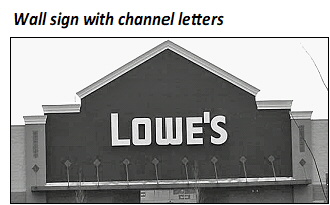
(10) "Channel letters" means three-dimensional individually cut letters or figures whether or not illuminated, affixed to a structure.
(11) "Copy" means words, letters, numbers, figures, designs, or other symbolic representations incorporated into a sign.
(12) "Double-faced sign" means a sign constructed to display its message on the outer surfaces of two (2) identical and opposite parallel planes.
(13) "Edge of roof" means on a pitched roof, the lowest portion of the facia board covering the roof rafters, or if no facia board exists, the lowest point of the roof rafters. On a flat roof, the top of the parapet wall or three (3) feet above the roof deck, whichever is less.
(14) "Electronic reader board sign or electronic graphics sign" means a sign with a fixed or changing display/message composed of a series of lights that may be changed through electronic means.
(15) "External illumination" means the lighting of an object from a light source located a distance from the object.
(16) "Footcandle (FC)" means a quantitative unit measuring the amount of light (illumination) falling onto a given point. One footcandle equals one lumen per square foot.
(17) "Flashing sign" means a sign that contains an intermittent or sequential flashing light source.
(18) "Freestanding sign" means any sign not affixed to a building. Freestanding signs may be permanent or temporary.
(19) "Gasoline pump sign" means a temporary sign affixed to a gasoline pump. The sign may be affixed to the top or side of the pump itself or to the structure surrounding the pump. The signage may also be attached to the gasoline hose.
(20) "Inflatable device" means an object that is blown up with air or gas.
(21) "Internally illuminated sign" means a sign whose light source is located in the interior of the sign so that the rays go through the face of the sign, or light source which is attached to the face of the sign and is perceived as a design element of the sign.
(22) "Joint identification sign" means a sign which serves as a common or collective identification for two or more uses located within the same building, or which share a common wall, or for two or more buildings located within a jointly used area, provided the buildings are in close proximity to one another.
(23) "Monument sign" means a permanent, freestanding sign where the entire bottom of the sign is affixed to the ground, not to a building.
(24) "Multiple tenant building" means a development consisting of two or more separate uses or tenancies that share either the same parcel or structure and use common access and parking facilities.
(25) "Neon sign" means a glass tube lighting in which a gas and phosphors are used in combination to create a colored light.
(26) "Nonconforming sign" means any sign lawfully erected and maintained prior to the effective date of this Chapter, constructed in conformance with the ordinances and other applicable laws in effect on the date of its construction, but by reason of its size, height, location, design, or construction is no longer in conformance with the regulations of this Chapter.
(27) "Nonresidential district" means any of the following zoning districts: Neighborhood Commercial District (NC), General Commercial District (GC), Restricted Industrial District (RI), Limited Industrial District (LI), Suburban Office and Institutional District (SO), Community Facilities District (CF), Planned Commercial District (PCD), Planned Industrial District (PID), and non-residential areas of a Planned Unit Development District (PUD).
(28) "Off-premise sign" means a sign which directs attention to a business, commodity, service, or entertainment conducted, sold, or offered at a location other than the lot or premises on which the sign is located.
(29) "On-premise sign" means a sign which directs attention to a business, commodity, service, or entertainment conducted, sold, or offered on the lot or premises on which the sign is located.
(30) "Permanent sign" means a sign constructed of durable materials and intended to exist for the duration of time that the use or occupant is located on the premises.
(31) "Pole sign" means a sign mounted on a free-standing pole or other support so that the bottom edge of the sign face is ten feet or more above finished grade.
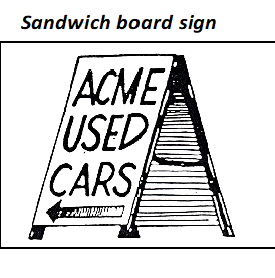
(32) "Portable sign” means a sign of any material, with or without changeable lettering which is designed to be or is portable and self supporting, or a sign designed to be transported, including, but not limited to, signs designed to be transported by means of wheels; signs converted to A or T-frames; menu and sandwich board signs; and signs attached to or painted on vehicles parked and visible from a public right-of-way, unless said vehicle is used in the normal day-to-day operations of the business.
 |
(33) "Projecting sign" means a sign that protrudes in a V-shape from the top of the ground floor over the sidewalk, like a traditional theater marquee.
(34) "Residential district" means any of the following zoning districts: Suburban Residential District (SR), Low Density Residential District (R-1), Medium Density Residential District (R-2), Old Town Residential District (R-3), Multi-Family Residential District (R-12), Planned Residential District (PRD), and residential areas of a Planned Unit Development District (PUD).
(35) "Roof sign" means a sign that is mounted on the roof of a building or which is wholly dependent upon a building for support and which projects above the highest point of a building with a flat roof, the eave line of a building with gambrel, gable, or hip roof, or the deck line of a building with a mansard roof.
(36) "Sign" means an object, device display or structure, or part thereof, situated outdoors or indoors, which is used to identify, display, or direct or attract attention to an object, person, institution, organization, business, product, service, event or location by any means, including words, letters, figures, design symbols, fixtures, colors, illumination, or projected image. Unless otherwise noted, the term "sign" includes both on-premises and off-premises signs.
(37) "Sign area" means the entire area within a perimeter defined by a continuous line composed of right angles which enclose the extreme limits of lettering, logo, trademark, or other graphic representation, together with any frame or structural trim forming an integral part of the display used to differentiate the sign from the background against which it is placed.
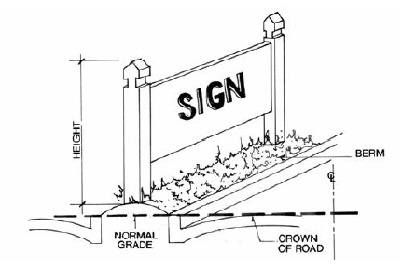
(38) "Sign height" means the vertical distance from the uppermost point of the sign to the finished grade immediately below the base of the sign, including all base and/or other mounting material.
(39) "Temporary sign" means any sign which meets any one or more of the following:
A. Is typically made of cloth, canvas, fabric, plywood, corrugated plastic or coroplast, or other light or non rigid material;
B. Is not permanently installed in the ground with an adhesive such as concrete or affixed to any structure or building;
C. Is installed less than 12 inches in the ground;
D. Does not require a Building Permit; and,
E. Is designed to be displayed for a limited period of time.
Examples of temporary signs include but are not limited to banners, pennants, window signs, portable signs, gasoline pump signs, political signs, and signage associated with sales including real estate, specials, promotions, business grand openings, the lease or rental of real estate, auctions, and holidays. Symbols, figures, balloons, and other similar items shall also be considered temporary signs.
(40) "Three-dimensional signs" means signs that have a depth or relief on their surface greater than six inches.
(41) "Vehicle sign" means a sign that is attached to or painted on a vehicle that is parked on or adjacent to any property, the principal purpose of which is to attract attention to a product sold or business located on the property.
(42) "Wall sign" means a sign that is attached to or painted on the exterior wall of a structure with the display surface of the sign approximately parallel to the building wall.
 |
(43) "Window area" means the area computed by calculating each window pane or panel. The area shall be separate for each building face, and for each window. A group of window panes or panels may be considered one window if they are adjoining on the building face and are less than six (6) inches apart.
(44) "Window sign" means a sign (temporary or permanent), poster, symbol, numerals, or letters, posted, painted, placed, or affixed in or on a window exposed to public view. An interior sign that faces a window exposed to public view that is located within three feet of the window is considered a window sign for the purpose of calculating the total area of all window signs. (Ord. 11-10. Passed 5-10-10.)
1175.04 GENERAL REQUIREMENTS FOR ALL SIGNS AND DISTRICTS.
(a) Signs in Public Rights-of-Way. Except as provided, no sign shall be placed or deposited within any public right-of-way or on any tree, pole, post, meter, or similar object located within the public right-of-way. Under no circumstance may any signs that are permitted in the right-of-way interfere with vehicular or pedestrian visibility. Signs interfering with visibility will be removed.
(1) The following signs may be installed in the public rights-of-way without a Sign Permit:
A. Signs conforming to the Manual of Uniform Traffic Control Devices;
B. Signs required by a state or federal statute;
C. Signs required by an order of a court of competent jurisdiction;
D. Public directional and safety signs.
(2) Blade signs attached to a building may project a maximum of forty inches over a public right-of-way provided the lowest part of the sign is at least eight feet but no more than fifteen feet above the pedestrian thoroughfare and provided said sign has received a Sign Permit from the Zoning Inspector.
(b) Colors. Not more than three (3) colors may be used per sign. For purposes of this Section, white shall not be considered a color. Neon and fluorescent colors are prohibited.
(c) Lettering Styles and Sign Coverage. No more than two letter styles or more than three sizes of letters are permitted per sign. Letters may not occupy more than seventy-five percent (75%) of any sign panel.
(d) Measurement of Sign Area.
(1) The surface area of a sign shall be calculated by enclosing the extreme limits of all lettering, background, emblem, logo, representation, or other display within a single continuous perimeter composed of squares or rectangles with no more than eight lines drawn at right angles.
(2) Supporting framework or bracing that is clearly incidental to the display itself shall not be computed as sign area.
(3) Double-faced (back-to-back) signs shall be regarded as a single sign only if mounted on a single structure, and the distance between each sign face does not exceed two (2) feet at any point. Only one face of an identical double-faced sign shall be measured when determining maximum allowable area.
(4) Where a sign consists of one or more three-dimensional objects (i.e., balls, cubes, clusters of objects, sculpture, or statue-like trademarks), the sign area shall be measured as their maximum projection upon a vertical plane.
(5) Regardless of their spacing, the letters forming a word or name shall be considered a single sign. The area of such a sign shall be measured as provided in this Chapter.
(e) Measurement of Sign Height. The height of a sign shall be computed as the distance from the base of the sign at a computed grade to the top of the highest attached component of the sign (including the sign face, sign structure, or any other appurtenance). The computed grade shall be the elevation of the nearest point to the proposed sign location of the crown of the nearest public street providing access; or the grade of the land at the principal entrance to the principal structure on the lot, whichever is higher.
 |
(f) Alterations. No sign shall hereafter be altered, rebuilt, enlarged, extended or relocated except in conformity with the provisions of this Chapter. The repainting of signs shall not be deemed to be an alteration within the meaning of this Chapter.
(g) Sign Maintenance. Signs and supporting hardware shall be structurally safe, clean, free of visible defects, and functioning properly at all times. Visible rot or rust, exposed lighting sources or wires, falling parts, or broken and missing parts are prima facia evidence that a sign is in a state of disrepair. Repairs to signs shall be equal to or better in quality of materials and design than the original sign.
(h) Notice to Repair. When the Zoning Inspector determines that such a sign exists in a state of disrepair, the Zoning Inspector shall issue to the owner of the sign and the owner of the real estate a notice of such disrepair and the need for corrective action. Any party receiving such notice may appeal the notice to the Planning and Zoning Commission in accordance with Section 1175.15. If such an appeal is not filed within fifteen (15) days of the date on which the notice is sent, persons receiving the notice shall be responsible for repairing the sign or otherwise bringing it into conformance with this Chapter. The repair work shall be accomplished within thirty (30) days of the date of the notice, unless the person undertaking the work files a request with the Zoning Inspector for an extension. If such request shows diligence and good faith such as ordering materials or signing a contract with a licensed contractor, the Zoning Inspector shall grant an extension of thirty days for completion of the work. If an appeal is filed in accordance with Section 1175.15, the time for performance shall be delayed until resolution of the appeal. If the Zoning Inspector finds that the lack of repair constitutes a danger to persons or to property other than that of those persons receiving the notice, the Zoning Inspector shall so state in the notice and the Municipality may seek immediate relief under the Building Code or under the laws of public nuisance.
(i) Sign Removal or Replacement. When a sign is removed or replaced, all brackets, poles, and other structural elements that supported the sign shall also be removed. Affected building surfaces shall be restored to match the adjacent portion of the structure.
(j) Sign Attachment and Support. No sign shall be attached to or supported by a tree, utility pole, light pole, trash receptacle, bench, vending machine, gasoline pump or hose, or public shelter, nor shall such sign be painted or drawn upon rocks or other natural features.
(k) Changeable Copy Signs. Manual changeable copy signs shall be permitted on permanent freestanding signs only. Manual copy signs shall comprise no more than twenty percent (20%) of the total area of the sign per side or ten (10) square feet per side, whichever is more restrictive. The changeable copy portion of the sign will contribute toward the maximum sign area. (Ord. 24-08. Passed 6-9-08.)
1175.05 PERMANENT SIGNS.
(a) Residential Districts. Permanent signs in residential districts shall conform to the following standards as well as the other applicable standards of the Codified Ordinances:
(1) Number. No more than one (1) such sign may be located on a lot.
(2) Type. Unless otherwise stated, wall signs are the only types of signs permitted.
(3) Off-premises signs. Off-premises signs are prohibited.
(4) Maximum area and height. Signs may not exceed four (4) square feet in area or be more than two (2) feet in height.
(5) Illumination. Signs shall not be separately illuminated. This standard is not intended to prohibit the installation of such a sign near a porch light or yard light, which may incidentally illuminate the sign.
(b) Non-residential Districts. Permanent signs in non-residential districts shall conform to the following standards and all other applicable standards of the Codified Ordinances:
(1) Number.
A. Wall signs. No more than one (1) wall sign shall be permitted. A secondary wall sign no more than 75 percent of the size of the primary wall sign shall be permitted if the property fronts two (2) or more public streets. No more than one (1) secondary wall sign shall be permitted. Blade and awning and canopy signs shall be considered wall signs.
B. Freestanding signs. No more than one (1) sign shall be permitted per site.
C. Joint identification signs. No more than one (1) sign shall be permitted. A secondary joint identification sign shall be permitted if the property fronts two (2) or more public streets and is located on a lot more than two (2) acres. No more than one (1) secondary joint identification sign shall be permitted per development.
(3) Maximum area and height.
A. Wall signs. The total area shall not exceed one (1) square foot per one (1) lineal foot of the length of the wall on which the sign is to be attached or one hundred and forty-four (144) square feet, whichever is most restrictive. The maximum height permitted shall be twelve (12) feet.
B. Freestanding signs. The total area shall not exceed sixty-four (64) square feet or six (6) feet in height.
C. Joint identification signs. On lots less than ten (10) acres, primary joint identification signs may not exceed sixty-four (64) feet in area or be more than six (6) feet in height. Secondary joint identification signs shall not exceed forty-eight (48) square feet in area or be more than four (4) feet in height. On lots ten (10) acres or greater primary joint identification signs may not exceed one hundred (100) square feet in area or be more than ten (10) feet in height and secondary joint identification signs may not exceed sixty-four (64) square feet or be more than six (6) feet in height.
(4) Illumination.
A. Unless otherwise stated, signs may be illuminated from within or from an external source, but such illumination shall be in a manner which avoids glare or reflection which in any way interferes with traffic safety.
B. Internally illuminated signs shall have an opaque background and translucent copy.
C. External lighting fixtures shall be aimed and shielded so that direct illumination is focused exclusively on the sign.
D. Fixtures shall be mounted on the top of the sign and aimed downward with the exception of signs not taller than seven feet above grade which may be illuminated by ground mounted uplighting not exceeding 100 lamp watts per sign face.
E. The maximum watts permitted to illuminate a sign shall be two watts per sign face square foot provided at no point on the face of the sign and at no time shall the illumination exceed 30 vertical footcandles during hours of darkness.
F. Rotating, traveling, pulsing, flashing, blinking, or oscillating light sources, lasers, beacons, search lights, or strobe lighting are prohibited.
G. Colored lights shall not be used at a location or in a manner so as to be confused or construed as traffic control devices.
H. Light sources shall utilize energy efficient fixtures to the greatest extent possible.
I. Neon lights are prohibited.
(c) Permit Required. Unless otherwise stated, all permanent signs in residential and nonresidential districts require a Sign Permit.
(Ord. 24-08. Passed 6-9-08.)
1175.06 TEMPORARY SIGNS.
(a) Residential Districts. Temporary signs in residential districts shall conform to the following standards as well as the other applicable standards of the Codified Ordinances:
(1) Type. Temporary freestanding and wall signs are the only type of temporary signs permitted.
(2) Number. No more than four (4) such signs may be located on a lot.
(3) Maximum area and height. Signs may not exceed eight (8) square feet in area or be more than four (4) feet in height, unless otherwise indicated (Section 1175.07 (c)(2)).
(4) Display period. Each temporary sign may be displayed for no more than 90 days in a calendar year. Temporary signs shall be removed within 3 days of termination of the dated activity, service, project, sale, or event to which the sign pertains.
(5) Off-premises signs. Off-premises signs are prohibited.
(6) Illumination. Signs shall not be separately illuminated. This standard is not intended to prohibit the installation of such a sign near a porch light or yard light, which may incidentally illuminate the sign.
(7) Mounting brackets and posts. All materials used to anchor the sign including mounting brackets and posts shall be removed when the temporary sign is removed.
(8) Permit requirements. Temporary signs in residential districts do not require a permit.
(b) Non-residential Districts. Unless otherwise stated in Section 1175.08, temporary signs in non-residential districts shall conform to the following standards as well as the other applicable standards of the Codified Ordinances:
(1) Type. Temporary freestanding and wall signs are permitted.
(2) Maximum area and height. Signs shall not exceed twelve (12) square feet in area or be more than four (4) feet in height.
(3) Number.
A. On lots of five (5) acres or less, no more than two (2) signs are permitted at once.
B. On lots of five (5) acres or more, no more than three (3) signs are permitted at once.
(4) Display period. Each temporary sign may be displayed for no more than 90 days in a calendar year. Temporary signs shall be removed within 3 days of termination of the dated activity, service, project, sale, or event to which the sign pertains.
(5) Setbacks. Temporary signs shall be located no closer than twenty-five (25) feet from the public right-of-way line.
(6) Mounting brackets and posts. All materials used to anchor the sign including mounting brackets and posts shall be removed when the temporary sign is removed.
(7) Illumination. Signs shall not be separately illuminated.
(8) Permit requirements. Unless otherwise indicated, all temporary signs in nonresidential districts require a Temporary Sign Permit. No more than 6 Temporary Sign Permits shall be issued per year.
(c) Time Period Exceptions. There shall be a suspension each year during the period of October 1st through the end of the first full week of November of the effectiveness and application of the provisions regarding the number of signs set forth above in subsection (a)(2) and the maximum area and height of, number of, setbacks for, and permit requirements for signs set forth above in subsections (b)(2), (b)(3), (b)(5) and (b)(8).
(Ord. 11-10. Passed 5-10-10.)
1175.07 STANDARDS FOR SPECIFIC SIGN TYPES.
(a) Awning and Canopy Signs. Awning and canopy signs may be permitted only as an integral part of the awning or canopy to which they are attached or applied and shall meet the following conditions:
(1) Location. Signs may be placed only on awnings that are located on first- and second-story building frontages, including those fronting a parking lot or pedestrian way.
(2) Extension. Such signs shall not extend more than three (3) feet from the face of the building to which they are attached.
(3) Minimum clearance. A minimum clearance of ten (10) feet shall be maintained above sidewalks.
(4) Setbacks. The awning shall comply with the same setbacks established for the building.
(5) Copy. The copy on an awning sign shall not exceed fifty (50) percent of the sign's total area.
(6) Illumination. Internal illumination is prohibited.
(b) Blade Signs.
(1) Location. Blade signs shall be placed only on a ground floor façade, except for businesses located above the ground level with direct exterior pedestrian access.
(2) Height above finished grade. The lowest point of a blade sign shall be at least eight (8) feet, but no more than fifteen (15) feet above finished grade. Blade signs shall not extend beyond the roof line.
(3) Sign structure. Sign supports and brackets shall be compatible with the design and scale of the sign. Brackets and/or hardware for the sign may not extend more than four inches from the outside face of the sign.
(4) Square footage. A maximum of six (6) square feet will be allowed.
(5) Illumination. Internal illumination is prohibited.
(c) Banner Signs. Banner signs are temporary signs subject to the following conditions:
(1) Number. No more than one (1) banner may be displayed on the property at any one time.
(2) Maximum area and height. Banners shall not exceed forty (40) square feet in area or be more than four (4) feet in height.
(3) The banner sign shall not be displayed above the roof line of any structure.
(4) The banner sign shall be safely secured to a building, structure, or stake. If a stake or structure is used, the stake or structure must be removed at the time the banner is removed.
(5) The banner sign shall have ventilated faces to reduce wind load if the banner is more than five (5) feet in length.
(6) Time Period Exceptions. There shall be a suspension each year during the period of October 1st through the end of the first full week of November of the effectiveness and application of the provisions regarding the number of, maximum area and height of, and permits each year for banners as set forth above in subsections (c)(1) and (c)(2) above.
(d) Freestanding Signs.
(1) Posts. Pylon signs shall not have posts with a diameter greater than twelve (12) inches. Posts may not be higher than two (2) feet above finished grade and no more than two (2) posts may be used. The height of the posts will be included in the maximum height permitted for the sign.
(2) Base material of monument signs. The base of monument signs shall be brick, stone, or stucco. The exposed base of a monument sign may not exceed two (2) feet in height. The height of the base will be included when calculating the height of the sign.
(3) Cantilever signs. The post used to anchor cantilever signs shall be wood or another natural material such as brick or stone.
(4) Landscaping. Landscaping shall be provided at the base of the supporting structure equal to twice the area of one face of the sign. Landscaping is not required on temporary, freestanding signs.
(5) Location. The sign must be located along frontage adjoining to a public street.
(6) Setbacks. The front setback for freestanding signs shall be twenty-five (25) feet from the public right-of-way line unless otherwise stated. The sign must also meet the side yard setback for the applicable zoning district unless otherwise stated.
(e) Joint Identification Signs.
(1) Type. Primary and secondary freestanding joint identification signs must be monument signs.
(2) Setbacks. The front setback for freestanding joint identification signs shall be fifty (50) feet from the public right-of-way. The sign must also meet the side yard setback for the applicable zoning district unless otherwise stated.
(f) Portable Signs.
(1) Zoning districts where permitted. Portable signs are only permitted in Neighborhood Commercial and General Commercial zoning districts or commercial areas of a Planned Commercial, Planned Industrial, or Planned Unit Development zoning districts.
(2) Number. No more than 1 portable sign may be displayed per business or occupant.
(3) Maximum area and height. Such signs shall be not more than four (4) feet high and three (3) feet in width. There shall be no more than two (2) sides to such sign.
(4) Illumination. Portable signs shall not be illuminated.
(5) Use during operating hours. The sign shall be taken inside the establishment when the business closes each night and shall not be placed outside again until the business opens each morning. Three (3) or more violations of this provision during any sixty day (60) day period shall be grounds for the Municipality to suspend or revoke the right of the violator to have a portable sign.
(6) Placement. The sign shall be located directly in front of the business establishment and within ten (10) feet of the principal public entrance to the establishment.
(7) Changeable copy. Changeable copy shall consist of a chalkboard or whiteboard only. Changeable copy signs on wheels are not permitted.
(8) Permit requirements. An annual Temporary Sign Permit shall be required. before a portable sign may be erected. All annual sign permits expire on the first of January.
(g) Wall Signs.
(1) Location. All wall signs shall be mounted on the building which houses the establishment advertised by such signs, except as otherwise specifically authorized by this Zoning Code. Such signs shall be located on or along a wall of such a building which faces a street, parking lot, or service drive, and shall not project above the roof line or the cap of parapets of such building, whichever is higher.
(2) Projection from wall. All wall signs shall be parallel to the wall on which they are installed. The sign shall not project above the edge of the roof of the structure and from the surface upon which it is attached more than twelve (12) inches in a non-residential district. In a residential district, a wall sign shall not project more than three (3) inches.
(h) Window Signs. Window signs are permitted in any zoning district and do not require a Sign Permit. However, all window signs shall meet the following conditions:
(1) Number. No more than one (1) permanent or temporary window sign is permitted per window.
(2) Surface coverage. Window signs may not be larger than twenty-five percent (25%) of the aggregate window area.
(3) Illumination. Window signs shall not be illuminated.
(Ord. 11-10. Passed 5-10-10.)
1175.08 PROHIBITED SIGNS.
(a) Prohibited Signs. The following signs and types of signs are inconsistent with the purposes and standards of this Chapter and are prohibited in all zoning districts:
(2) Flashing, moving, rotating, intermittently lighted signs or other mechanical devices.
(3) Air actuated attraction devices.
(4) Roof signs.
(5) Pole signs.
(6) Portable changeable copy signs.
(7) Electronic variable message signs, reader boards, and changeable copy signs except as authorized under Section 1175.04(k).
(Ord. 24-08. Passed 6-9-08.)
1175.09 SIGN PERMITS.
(a) Sign Permits Required. To ensure compliance with the regulations of this Chapter, a Sign Permit shall be required in order to apply, erect, move, alter, reconstruct, or repair any permanent or temporary sign, except signs that are do not require permits consistent with the requirements of Sections 1175.04(a)(1) and 1175.10. A Sign Permit is also required for the lighting of new or the relighting of existing signs. Granting of a Sign Permit from the Zoning Inspector does not constitute a building permit.
(b) Review Authority. The Zoning Inspector will review all Sign Permit applications within the Municipality. The Zoning Inspector has fourteen (14) days from the date of submittal to review all Sign Permit applications and either grant, grant with conditions, or deny the Sign Permit application. If the Zoning Inspector grants a Sign Permit with conditions, the Zoning Inspector shall state the conditions in writing, with citations to relevant sections of this Chapter. The applicant shall sign a statement acknowledging the conditions set forth by the Zoning Inspector. If the Zoning Inspector denies a permit application, the Inspector shall do so in writing and state in writing the reason for denial, with citations to relevant sections of this Chapter or other provisions of the Codified Ordinances. The applicant may appeal the decision of the Zoning Inspector as outlined in Section 1175.15.
(c) Preparation. Applicants for a Sign Permit must submit the following information. Incomplete applications will be denied.
(1) Color sign rendering.
(2) Site plan and elevations.
(3) Sign dimensions and dimensions of sign mounting material, where applicable.
(4) Building façade dimensions, where applicable.
(5) Distance of sign from all public rights-of-way.
(6) Style, type, wattage, and location of all lighting.
(7) Landscaping plan for freestanding signs.
(8) List of construction materials, including sign mounting material, where applicable.
(d) Criteria for Approval. The Zoning Inspector shall approve a Sign Permit if the proposed sign conforms to all applicable requirements of this Chapter.
(Ord. 24-08. Passed 6-9-08.)
1175.10 SIGNS NOT REQUIRING PERMITS.
(a) Signs Exempt from Regulations. Any sign located entirely inside a building and not visible from the public right-of-way or from private property other than the property on which such sign is located shall be entirely exempt from regulation under this Chapter.
(b) Permanent Signs Allowed in Any District without a Permit and Not Included in Dimensional Limitations. Sign Permits shall not be required for the signs listed herein. These signs shall not be included in the determination of the total allowable number of signs or total allowable sign area for a site.
(1) Signs conforming to the Ohio Manual of Uniform Traffic Control Devices;
(2) Signs required by a state or federal statute or agency;
(3) Signs required by an order of a court of competent jurisdiction;
(4) One (1) wall sign on or over a window or door not exceeding three (3) square feet in area.
(c) Temporary Signs Allowed without a Permit.
(1) Official and legal notices required by a court or governmental agency.
(2) Temporary signs in residential areas.
(Ord. 24-08. Passed 6-9-08.)
1175.11 COMPREHENSIVE SIGN PROGRAM.
(a) Purpose. A Comprehensive Sign Program is intended to integrate the design of the signs proposed for a development project with the design of the structures, into a unified architectural statement. A Comprehensive Sign Program provides a means for defining common sign regulations for multi-tenant projects, to encourage maximum incentive and latitude in the design and display of multiple signs and to achieve, not circumvent, the intent of this Chapter.
(b) Applicability. The approval of a Comprehensive Sign Program shall be required when two (2) or more non-exempt signs are proposed for a new or existing development or if a joint identification sign is proposed.
(c) Approval Authority. The Planning and Zoning Commission must approve a Comprehensive Sign Program prior to issuance of a Sign Permit by the Zoning Inspector.
(d) Application Requirements. An application for a Comprehensive Sign Program shall include all information and materials required in Section 1175.09 and the filing fee set by Council.
(e) Standards. A Comprehensive Sign Program shall comply with the following standards:
(1) The program shall comply with the purpose of this Chapter and the overall intent of this Section;
(2) The signs shall enhance the overall development, be in harmony with, and relate visually to other signs included in the comprehensive sign program, to the structures and/or developments they identify, and to surrounding development;
(3) The Program shall accommodate future revisions that may be required because of changes in use or tenants; and
(4) The Program shall comply with the standards of this Chapter.
(f) Revisions to Comprehensive Sign Programs. The Zoning Inspector may approve the substitution of sign panels provided the panels meet the all the requirements of Chapter 1175. If additional signage is proposed or if any aspect of the original Comprehensive Sign Program is modified with the exception of sign panels, approval from the Planning and Zoning Commission is required. (Ord. 24-08. Passed 6-9-08.)
1175.12 ABANDONED SIGNS.
(a) Abandonment Defined. If any sign shall become abandoned, in a manner defined herein, such sign is declared a public nuisance by reason that continued lack of use results in lack of reasonable and adequate maintenance, thereby causing deterioration and creating a blighting influence on nearby properties. An abandoned sign shall be any sign that meets any of the following conditions:
(1) Any sign associated with the abandoned nonconforming use.
(2) Any sign that remains after the termination of a business. A business shall be considered terminated if it has ceased operations for at least one hundred and twenty (120) consecutive days.
(b) Determination of Abandonment. When the Zoning Inspector finds, upon investigation, that a sign has been abandoned, the Zoning Inspector shall notify the owner of said sign and the owner of the property upon which such sign is located, of any findings. Such notice shall advise the owner of the sign that said sign has been declared abandoned and must be removed within thirty (30) days from the date of mailing of said notice. The owner of the sign or the owner of the property may appeal such decision as provided in Section 1175.15.
(c) Right to Remove. If the sign is not removed as ordered, the sign may be removed by the Municipality at the expense of the lessee or owner. If the Municipality is not reimbursed for the cost of removal within thirty (30) days of such removal, the amount thereof shall be certified to the County Auditor for collection as a special assessment against the property upon which such sign is located.
(Ord. 24-08. Passed 6-9-08.)
1175.13 SUBSTITUTION OF MESSAGES.
Any sign allowed herein may contain, in lieu of any other message or copy, any lawful noncommercial message that does not direct attention to a business operated for profit, or to a product, commodity, or service for sale or lease, or to any other commercial interest or activity, so long as said sign complies with the size, height, area, and other requirements of this Chapter.
(Ord. 24-08. Passed 6-9-08.)
1175.14 SEVERABILITY.
(a) Generally. If any part, section, subsection, paragraph, subparagraph, sentence, phrase, clause, term, or word of this Chapter is declared unconstitutional by the valid judgment or decree of any court of competent jurisdiction, the declaration of such unconstitutionality shall not affect any other part, section, subsection, paragraph, subparagraph, sentence, phrase, clause, term or word of this Chapter. It is intended that if any part, section, subsection, paragraph, subparagraph, sentence, phrase, clause, term, or word of this Chapter is severed, the remaining parts, sections, subsections, paragraphs, subparagraphs, sentences, phrases, clauses, terms, or words of this Chapter shall be considered independent, valid, and enforceable.
(b) Severability Where less Speech Results. Without diminishing or limiting in any way the declaration of severability set forth in Section 1175.14(a), or elsewhere in this Chapter, if any part, section, subsection, paragraph, subparagraph, sentence, phrase, clause, term or word of this Chapter is declared unconstitutional shall not affect any other part, section, subsection, paragraph, subparagraph, sentence, phrase, clause, term or word of this Chapter, even if such severability would result in a situation where there would be less speech, whether by subjecting previously exempt signs to permitting or otherwise. It is intended that if any part, section, subsection, paragraph, subparagraph, sentence, phrase, clause, term, or word of this Chapter is severed, the remaining parts, sections, subsections, paragraphs, subparagraphs, sentences, phrases, clauses, terms, or words of this Chapter shall be considered independent, valid, and enforceable.
(c) Severability of Provisions Pertaining to Prohibited Signs. Without diminishing or limiting in any way the declaration of severability set forth in Section 1175.14(a) and (b), or elsewhere in this Chapter, if any part, section, subsection, paragraph, subparagraph, sentence, phrase, clause, term or word of this article or any other laws declared unconstitutional by valid judgment or decree of any court of competent jurisdiction, the declaration of such unconstitutionality shall not affect any other part, section, subsection, paragraph, subparagraph, sentence, phrase, clause, term or word of this Chapter that pertains to prohibited signs, including specifically those signs and sign types prohibited and not allowed under Section 1175.08 of this Chapter. Furthermore, if any part, section, subsection, paragraph, subparagraph, sentence, phrase, clause, term or word of Chapter 1175 is declared unconstitutional by the valid judgment or decree of any court of competent jurisdiction, the declaration of such unconstitutionality shall not affect any other part, section, subsection, paragraph, subparagraph, sentence, phrase, clause, term or word of Chapter 1175. It is intended that if any part, section, subsection, paragraph, subparagraph, sentence, phrase, clause, term, or word of this Chapter is severed, the remaining parts, sections, subsections, paragraphs, subparagraphs, sentences, phrases, clauses, terms, or words of this Chapter shall be considered independent, valid, and enforceable.
(d) Severability of Prohibition on Signs Bearing Off-premise Commercial Messages. If any part section, subsection, paragraph, subparagraph, sentence, phrase, clause, term or word of this Chapter and/or any other provisions of the Zoning Code or the Codified Ordinances are declared invalid or unconstitutional by the valid judgment or decree of any court of competent jurisdiction, the declaration of such unconstitutionality shall not affect the prohibition on signs bearing off-premises commercial messages as contained herein. It is intended that if any part, section, subsection, paragraph, subparagraph, sentence, phrase, clause, term, or word of this Chapter is severed, the remaining parts, sections, subsections, paragraphs, subparagraphs, sentences, phrases, clauses, terms, or words of this Chapter shall be considered independent, valid, and enforceable. (Ord. 24-08. Passed 6-9-08.)
1175.15 APPEALS.
(a) The decision of the Zoning Inspector regarding issuance of a Sign Permit, notice to repair, or determination of abandonment may be appealed to the Planning and Zoning Commission. A written appeal shall be filed within fifteen (15) days of receipt of notification from the Zoning Inspector regarding the Sign Permit, notice to repair, or determination of abandonment. The Planning and Zoning Commission shall have a maximum of sixty (60) days for a public hearing, deliberation, and a decision on the appeal unless the decision is tabled at the applicant’s request. Denial of the appeal by the Planning and Zoning Commission may be appealed to Council or the Franklin County Court of Common Pleas as provided under the Ohio Revised Code.
(b) If appealing to Council, the appeal shall be filed in writing with the Council Clerk no later than fifteen (15) days after the decision of the Commission. Council shall have a maximum of ninety (90) days from receipt of an appeal for a public hearing, deliberation, and a decision on the appeal. Recourse from the decision of Council shall be the Franklin County Court of Common Pleas as provided under the Ohio Revised Code.
(Ord. 24-08. Passed 6-9-08.)
1175.99 VIOLATIONS, PENALTIES, AND REMEDIES.
Any person, firm or corporation violating any requirement or prohibition of this Chapter shall be considered in violation of this Code. Failure to comply within thirty (30) days of receipt of notification of violation, unless extended by the Zoning Inspector, shall render such person, firm or corporation subject to the penalties provided in Chapter 1183.
(Ord. 24-08. Passed 6-9-08.)

