
Okeechobee County Unincorporated
City Zoning Code
City Zoning Code
ARTICLE VII
DEVELOPMENT DESIGN AND IMPROVEMENT STANDARDS
Exhibit A.
7.03.00. - TRANSPORTATION SYSTEMS[1]
Cross reference— Streets, sidewalks and other public places, ch. 58.
7.06.00. - STORMWATER MANAGEMENT[2]
Cross reference— Utilities, ch. 70.
7.00.01. - Purpose.
The purpose of this article is to provide development design and improvement standards applicable to all development activity within Okeechobee County.
7.00.02. - Responsibility for improvements.
All improvement required by this article shall be designed, installed, and paid for by the developer.
7.00.03. - Principles of development design.
The provisions of this article are intended to ensure functional and attractive development. Development design shall first take into account the protection of natural resources as prescribed in article VI of this Code. All development shall be designed to avoid unnecessary impervious surface cover; to provide adequate access to lots and sites; and to avoid adverse effects of shadow, glare, noise, odor, traffic, drainage, and utilities on surrounding properties.
7.01.00. - Block area and design.
A.
Where a tract of land is bounded by streets forming a block, said block shall have sufficient width to provide for two tiers of lots of appropriate depths.
B.
The lengths, widths, and shapes of blocks shall be consistent with adjacent areas. In no case shall block lengths in residential areas exceed 1,500 feet nor be less than 400 feet in length except waterfront blocks, unless special approval is given by the planning board.
7.02.01. - Generally.
Subdivision design should be adapted to the peculiarities and opportunities of the site and use contemporary design philosophies. Size, shape and orientation of lots and blocks should be carefully considered with relations to future use of the various lots to be created. The term lot as used in this part shall refer to spaces, sites, units or legally permitted parcels, as the case or context requires. Except as otherwise indicated, the minimum design criteria below shall apply to any lot or parcel under 40 acres in area created by platting, deminimus development or other lawful means established by this Code.
in addition to the following minimum design criteria all lot requirements of Okeechobee County regulations shall be adhered to.
A.
Corner lots shall have an additional width to meet the required regulations.
B.
Restricted easements and restricted vehicular ingress and egress shall be contiguous to a public right-of-way.
C.
Side lot lines shall be substantially at right-angles or radii to street lines.
D.
In new subdivision plats including replats and condominium plats where applicable, adequate drainage and utility easements shall be provided in substantially the following manner: easements of ten feet in width along each front and rear lot line are hereby created and provided for the purpose of accommodating overhead, surface and underground utilities and drainage. Where the required front or rear yard is less than ten feet, the easement described in this subsection shall be the width of the required yard. Easements shall be created along side lot lines where determined to be necessary by the Department.
E.
Lots or parcels shall not have a length/depth that is more than five times the average width/frontage of the lot or parcel.
F.
Lots or parcels shall not include a notch, tab or a cutout area that represents less than 15 percent of the area of the lot or parcel except to accommodate natural features of the site.
G.
Flag lots shall be subject to the following:
1.
The flagpole (or stem) shall maintain a minimum width of 50 feet;
2.
The area of the flagpole shall not be less than 20 percent of the area of the total lot or parcel;
3.
No more than one lot or parcel shall be to the rear of another lot or parcel;
4.
The minimum area of the flag lot shall be one acre;
5.
Not more than ten percent of the lots in a new subdivision may be flag lots, except in new subdivisions of nine or fewer lots, not more than one lot may be a flag lot; and
6.
All requirements for minimum lot area, width and access including minimum separation of driveway connections shall be met.
7.
A lot or parcel where the pole or stem maintains a minimum width of 200 feet is not presumed to be a flag lot.
8.
Flag lots are subject to the requirements of sections 7.03.04.B.1. and 7.03.04.E.1. that lots in a proposed subdivision shall have direct access from a street that is located within the interior of the proposed subdivision and meets the requirements of this Code.
(Ord. No. 97-02, § 1, 2-27-97; Ord. No. 2005-12, § 2(Exh. A), 7-28-05; Ord. No. 2023-0002, § 2(Exh. A), 4-13-23)
7.02.02. - Minimum lot area requirements.
A.
Requirements for all developments. All developments shall have a total land area sufficient to meet all development design standards in this Code including, but not limited to, setbacks, buffers, stormwater management, off street parking and circulation and protection of environmentally sensitive lands.
B.
Specific requirements for residential development. There is no minimum lot area for individual lots within a residential development that will be served by both a public supply water and public supply sewer system, provided that all of the following requirements are met:
1.
The land area for the total project is sufficient to meet standards of this Code as stated in paragraph A of this Section.
2.
Gross density of the area shall not exceed that specified in section 2.01.04, Table of Density and Dwelling Unit Types for Residential Uses.
3.
Land, exclusive of individual lots to be conveyed in fee simple ownership, shall be controlled and maintained through a condominium association, property owners' association, or other similar provision, or may be conveyed to governmental or not-for-profit organizations.
Recordable instruments providing for these common-ownership lands shall be submitted for review with the application for development plan review.
_____
C.
Specific requirements for areas without public central utilities. All proposed development in areas that will not be served by public central water and public central sewer shall have the minimum lot areas shown on the table of minimum lot areas:
TABLE OF MINIMUM LOT AREAS
(without public utility supply
5
)
NOTES:
1 All uses are subject to other limitations and requirements specified in this Code. See also: Floor area ratios, section 2.01.05; Clustering, section 4.02; Impervious surface ratios, section 7.02.03; Table of density and unit types, section 2.01.04.
2 These uses must have public central water and sewer facilities.
3 Only permitted within the properly zoned areas of the urban residential mixed use, commercial corridor mixed use, commercial activity center and resort activity center future land use categories.
4 Industrial uses producing non-domestic waste must be on a public sewer facility.
5 Connection to public supply water and/or sewer facilities may be required in accordance with section 7.02.01.
6 Minimum area of an individual lot may be less than ten acres when part of a platted subdivision with a maximum density of one unit per 10 gross acres.
7 To be considered a lot of record when determining the minimum lot area for two family, three family and four or more family structures, the lot or parcel must be zoned residential general on or before August 15, 2005.
(Ord. No. 94-8, § 1 (7.02.02C), 10-5-94; Ord. No. 97-02, § 1, 2-27-97; Ord. No. 2002-04, § 1(Exh. A), 9-26-02; Ord. No. 2005-12, § 2(Exh. A), 7-28-05)
_____
7.02.03. - Impervious surface coverage.
A.
Generally. Impervious surface on a development site shall not exceed the ratios provided in the table in paragraph E of this section.
B.
Ratio calculation. The impervious surface ratio is calculated by dividing the total impervious surface by the gross site area. Water bodies, including wet retention areas, shall be excluded from the gross site area and from the total impervious surface area when calculating the impervious surface ratio.
C.
Treatment of cluster development. Cluster development or other site design alternatives shall be planned in such a manner that no individual lot within a development project exceeds the applicable impervious surface ratio. The developer may request a variance from this provision as described in article XI of this Code. Upon review, the board of adjustment may require, as a condition of approval, deed restrictions or covenants that guarantee the maintenance of necessary open space in perpetuity.
D.
Alternative paving materials. If porous paving materials are approved for use by the county engineer, then the area covered with porous paving materials shall not be counted as impervious surface.
E.
Table of impervious surface ratios.
1 The maximum impervious surface ratio is given for each district, regardless of the type of use proposed and allowable pursuant to article II. Ratios shown are maximums and development specific review may reduce the ratio in a particular case. See comprehensive plan for any further limitations on specific uses and land use categories.
2 Where a lot is 8,000 square feet or less, an ISR of 0.50 should be substituted.
3 An ISR of 0.90 may be granted by special exception for certain uses in the NC-2 zoning district.
4 An ISR of 0.90 is established for the C, C-1, C-2 and I-1 zoning districts when located in the commercial corridor mixed use and commercial activity center future land use classifications, provided that an ISR of 0.90 does not exceed the ISR as established by the Okeechobee County Comprehensive Plan as adopted or amended. For C, C-1 or C-2 zoning districts located in a rural activity center future land use classification, the ISR shall be as for neighborhood commercial.
5 When in the commercial corridor, resort corridor or a commercial activity center, an ISR of 0.80 should be substituted.
6 Specific impervious surface ratios are not established for planned development districts, but development in such districts should approximate the ISR as established for the that type of development in other zoning districts.
(Ord. No. 94-8, § 1 (7.02.03A, E), 10-5-94; Ord. No. 95-1, § 1 (7.02.03), 6-8-95; Ord. No. 97-02, § 1, 2-27-97; Ord. No. 2002-04, § 1(Exh. A), 9-26-02; Ord. No. 2005-12, § 2(Exh. A), 7-28-05)
7.02.04. - Building setback, yard and height requirements.
A.
Minimum setbacks between buildings.
1.
The minimum distance between adjacent principal buildings shall be fifteen (15) feet. The minimum distance between a principal building and its accessory building shall be six (6) feet.
2.
Distance shall be measured at the narrowest space between structures, whether a main living unit, principal structure, an allowable attachment, or an accessory use, and shall not include roof overhang (eave).
_____
B.
Table of required yards.
Table of Required Yards 1
[Amended By Ordinance 94-8, 95-1, 97-2, and 2025-0008]
Notes:
1. Where any special exception or variance is granted, additional yard requirements may be imposed by the board of adjustments and appeals. This table establishes the minimum yards within a particular zone. Larger yards may be necessary to meet other requirements of this code depending upon the particular use, structure or lot type. See definitions of yards and lots in appendix B.
Rear setbacks may be reduced to 0′ in residential zoning districts when the rear property line abuts a water body or water body right-of-way. A 0′ rear setback is established only to accommodate a structure such as a boat house that is adjacent to or extends beyond the rear property line. Appropriate state agency permits may be necessary in order to erect a structure adjacent to or within a water body or water body right-of-way.
In all other instances where a water body or water body right-of-way abuts a property line, any footer or load bearing component of a structure shall be set back not less than ten feet from the top of bank of the water body or water body right-of-way.
2. Recreational vehicle parks and subdivisions are permitted only in the urban residential mixed use, commercial corridor mixed use, commercial activity center and resort activity center future land use categories.
_____
C.
Yard encroachments. Every part of every required yard shall be open and unobstructed from the ground to the sky except as hereinafter provided or as otherwise permitted in this Code:
1.
Roof eaves may project into a required side yard not more than three feet where the required side yard is eight feet or more in width. Roof eaves may project into a required side yard not more than one foot where the required side yard is less than eight feet in width.
2.
Sills and belt courses may project not over 12 inches into a required yard.
3.
Movable awnings may project not over three feet into a required yard, provided that where the yard is less than five feet in width the projection shall not exceed one-half the width of the yard.
4.
Chimneys, fireplaces, or pilasters may project not over two feet into a required yard.
5.
Fire escapes, stairways, and balconies which are unroofed and unenclosed may project not over five feet into a required rear yard, or not over three feet into a required side yard of a multiple-family dwelling, hotel, or motel.
6.
Hoods, canopies, or marquees may project not over three feet into a required yard, but shall not come closer than one foot to the lot line.
7.
Fences, walls, and hedges are permitted in required yards, subject to the provisions of this Code.
8.
Except as provided in part 7.03.03E, nothing in this Code shall be so construed as to prohibit any type of landscaping or private, nonprofit gardening on any lot.
9.
Except as may be specifically provided in the schedule of district regulations for the particular district involved, uncovered accessory automotive parking may encroach into a required rear yard or side yard, provided that, for any type of development other than a single-family dwelling, any such encroachment maintains a minimum setback of five feet from side or rear property lines and provided that the remainder of the minimum five-foot side or rear yard is sodded. This provision is not intended to conflict with section 7.03.04(B) of this Code and shall not be construed to prohibit shared or connecting access, driveways or parking areas.
10.
For any type of development other than a single-family dwelling, uncovered accessory automotive parking may encroach into a required front yard or second front yard provided that any such encroachment maintains a minimum setback of ten feet from a front or second front property line and provided that the remainder of the minimum ten-foot front yard or second front yard is sodded and landscaped. This provision shall not be construed to supersede requirements for a clear visibility triangle when applicable pursuant to section 7.03.03(E).
D.
Table of maximum structure heights. [Amended by Ordinance 94-8]
Notes:
1. Heights provided are maximums and may be exceeded by grant of a special exception. Further restrictions may be placed upon height by other provisions of this Code. See also article III, Airport Overlay Zone.
E.
Exclusions from height limits. The height limitations contained in the subsection D above do not apply to spires, belfries, cupolas, flagpoles, antennas, water tanks, ventilators, chimneys, or to other appurtenances usually required to be placed above the roof level and not intended for human occupancy; provided, however, the heights of these structures or appurtenances thereto shall not exceed any height limitations prescribed by the Federal Aviation Administration or airport regulations within the flight-approach zone of airports. See article III, Airport Overlay Zone and "Building, height of," in glossary.)
(Ord. No. 94-8, § 1 (7.02.04D), 10-5-94; Ord. No. 95-1, § 1 (7.02.04B), 6-8-95; Ord. No. 97-02, § 1, 2-27-97; Ord. No. 98-07, § 1, 10-8-98; Ord. No. 2002-04, § 1(Exh. A), 9-26-02; Ord. No. 2005-12, § 2(Exh. A), 7-28-05; Ord. No. 2025-0008, § 2(Exh. A), 9-26-25)
7.03.01. - Street Construction requirements.
Subdivisions consisting of lots having an area of 40 acres or less shall have all collector, arterial, commercials, industrial, residential, minor, and private streets or roads paved and constructed in accordance with this section and in accordance with Okeechobee County Engineering Department specifications.
When part of a planned development, the planning board may recommend, and the board of county commissioners may approve, equivalent alternatives to the minimum requirements and specifications established in this section.
Subsections 7.03.01.A through 7.03.01.I of this Code may be replaced, in whole or in part, by a technical standards manual. Upon completion of a technical standards manual, said manual may be incorporated into this Code by resolution of the board of county commissioners. Until that time, the technical standards below shall govern. Standards not incorporated into the technical standards manual shall be as below.
A.
For all roads and streets, the entire width of right-of-way shall be cleared of all trees, vegetation and other obstacles, except such trees and shrubbery outside the limits of actual construction which are of value as landscaping and which do not interfere with drainage or roads.
B.
Within area cleared, all stumps, roots or other deleterious material shall be removed.
C.
Ditches shall be cleared and grubbed to lines three feet outside the top of back slope, except permitted trees.
D.
Where poor foundation material for the roadbed or for any structure exists, it shall be excavated and backfilled with suitable material; and constructed with acceptable engineering practices.
E.
Embankments shall be placed and compacted in successive layers, approximately six inches in thickness, for the entire width of the embankment. Any material deposited in water shall be dumped successively in uniformly distributed area until the fill is thick enough to support the hauling equipment while subsequent layers are placed.
F.
All subgrade shall be stabilized to, and extended 12 inches beyond the proposed edge of pavement. The entire width of public right-of-way shall be demucked in accordance with FDOT Standard Specification for Road and Bridge Construction before construction of the roadbed begins. No material of FDOT Class A-5, A-7 or A-8 shall be allowed. All material supporting the roadway and shoulders shall have a minimum Load Bearing Ratio (LBR) of 40. The top 12 inches of the undisturbed soil shall be compacted to 100 percent of maximum dry density as per AASHTO T-99-C. Subgrade shall be checked for conformance with approved plans. Certified compaction tests shall be submitted to the county engineer prior to subgrade approval.
G.
All road bases shall consist of a minimum of eight inches compacted shell rock compacted to 98 percent maximum density as per AASHTO T-180 and extended six inches beyond the proposed edge of payment. Certified compaction tests shall be submitted to the county engineer prior to road base approval.
H.
All road shoulders shall be seeded, grassed or mulched and maintained to the point that survival of the planting is assured. All roads shall be sodded two foot [feet] beyond edge of pavement and sod shall be laid in a manner so as not to impede storm water flow.
I.
On slopes or ditches which are too steep for the use of grassing, suitable erosion protection shall be provided by ditch or slope pavement, adequate for permanent protection. In no case will any area which is subject to detrimental erosion be acceptable unless such protection is provided.
(Ord. No. 94-8, § 1 (7.03.01), 10-5-94; Ord. No. 2008-02, § 2(Exh. B), 5-22-08)
7.03.02. - Street design standards.
Subsections 7.03.02.B through 7.03.01.N of this Code may be replaced, in whole or in part, by a technical standards manual. Upon completion of a technical standards manual, said manual may be incorporated into this Code by resolution of the board of county commissioners. Until that time, the technical standards below shall govern. Standards not incorporated into the technical standards manual shall be as below.
A.
Pavement widths are measured from front to front of curb, or edge to edge of travelway if there is no curb. These minimums standards do not include widths for on-street parking.
1.
Arterial streets—24 feet (off-set centerline).
2.
Commercial or industrial streets—24 feet.
3.
Collector streets—24 feet.
4.
Minor or residential streets—20 feet.
5.
One-way collector, minor or residential streets—12 feet.
6.
Cul-de-sac pavement shall connect the outside diameter of the cul-de-sac with a straight line 20 feet back from the edge of the approaching road. Pavement shall be 80-foot diameter in each cul-de-sac with eight feet of swale.
7.
Alleys, commercial; industrial or public service—20 feet.
8.
Alleys, residential—16 feet.
9.
Private roads shall meet county road specifications as set forth in this Code. Any private roads in new subdivisions approved under this Code shall meet all standards and specifications set forth in this Code.
B.
Bases for arterial, collector, commercial or industrial streets shall be minimum of ten inches of compacted shell or lime rock and compacted to 98 percent maximum density as per AASTO T-180. All other bases eight inches approved compacted shell or lime rock as compacted above.
C.
Paved surfaces for minor streets, residential streets and alleys as mentioned in this section shall be a minimum one and one-half-inch thick FDOT Type S-III asphaltic concrete. Paved surfaces for arterial, commercial or collector streets as mentioned in this section shall be a minimum two inches thick FDOT Type SP-12.5 asphaltic concrete. The county engineer may approve alternative surfaces that meet FDOT specifications or that are otherwise demonstrated to be equivalent.
D.
Pavement crown shall be one-quarter-inch per foot with no inverted crowns permitted. Finish pavement shall be one-quarter-inch higher than the lip of any concrete gutter.
E.
Ground slope from back of curb to right-of-way shall be five percent minimum.
F.
Lots, one and one-fourth acres or less exclusive of road rights-of-way shall slope toward streets or other adequate outfalls. Drainage systems shall be installed at rear and side yards of residential lots where proposed slopes do not equal or exceed 0.2 percent toward the right-of-way.
G.
All lots requiring fill shall have fill of good clean acceptable material. No muck, or other such materials shall be used for fill except in the top six inches for green areas only.
H.
Sidewalks, where required, shall be a minimum of five feet wide and shall be six inches thick, Class 1 3000 PSI concrete. Unless otherwise approved by the county engineer, sidewalks shall be uninterrupted by poles, utility boxes and the like. Sidewalk grades and slope shall conform to design standards. There shall be a minimum four-foot separation between a sidewalk and an uncurbed travel lane. The minimum four-foot separation area shall be sodded unless an alternate ground cover is approved by the county engineer. Sidewalk construction shall be completed prior to request for final inspection and release of security. If no security is posted, sidewalks shall be completed as a prerequisite for final plat approval.
I.
Subgrades for arterial streets shall be stabilized 12 inches compacted thickness, extend 12 inches beyond base, and the material shall have 75 pounds per square inch Florida Bearing Value and LBR of 40. Base for all streets shall be constructed six inches beyond edge of pavement. All other streets shall be stabilized 12 inches beyond the base and material shall have 50 pounds per square inch Florida Bearing Value.
J.
Subbases for sidewalks shall be compacted to 100 percent of maximum density as per AASHTO—T99.
K.
Arterial streets shall be designed to meet FDOT requirements.
L.
Traffic control signs within subdivision shall be designed and installed to meet all the requirements of the FDOT Manual on Uniform Traffic Control Devices.
M.
Stabilization shall extend six inches beyond back of curb where applicable.
N.
Street name signs shall be placed at each street intersection on metal posts erected in concrete (or any other approved method) by the subdivider. Top of sign shall be seven feet above centerline grade of road. Signs shall be located midway between edge of pavement and sidewalk. All street signs shall be uniform and conform to following specifications: Green reflectorized background, backed on six inches wide aluminum blanks. Name letters shall be four inches silver reflectorized letters, abbreviations are permissible. "Dead End" signs shall be required for all culs-de-sac exceeding 400 feet in length.
(Ord. No. 94-8, § 1 (7.03.02), 10-5-94; Ord. No. 2008-02, § 2(Exh. B), 5-22-08)
7.03.03. - Rights-of-way.
A.
Generally. Right-of-way requirements for road construction shall be as specified below and shall be measured from lot line to lot line.
B.
Future rights-of-way. Future right-of-way requirements are identified in the traffic circulation element of the county comprehensive plan. Where roadway construction, improvement, or reconstruction is not required to serve the needs of the proposed development project, future rights-of-way shall nevertheless be reserved for future use. No part of the reserved area shall be used to satisfy minimum requirements of this Code.
C.
Protection and use of rights-of-way.
1.
No encroachment shall be permitted into existing rights-of-way, except as authorized by the county.
2.
Use of the right-of-way for public or private utilities, including, but not limited to, sanitary sewer, potable water, telephone wires, cable television wires, gas lines, or electricity transmission, shall be allowed subject to the placement specifications provided by the county engineer.
3.
Where a road right-of-way is 70 feet or more in width, the required front yards in a district, as set out in this Code, shall be measured from such road right-of-way; if the regulations for the particular district do not require a front yard, then the building to be erected shall not intrude streetward in any fashion beyond the road right-of-way.
4.
Where a road right-of-way is less than 70 feet in width, the required front yards, as set out in this Code, shall be measured from a point from the centerline of such road equal to one-half of the right-of-way width established for that classification of road in this Code.
D.
Right-of-way widths and lengths.
1.
Right-of-way requirements shall be as follows:
a.
Arterial street segments with curb and gutter shall have a minimum 120 feet of right-of-way with an additional 12 feet where a right turn lane is to be provided at an access connection including roadway intersections and shall be consistent with FDOT specifications.
b.
Arterial street segments with swale drainage shall have a minimum 200 feet of right-of-way and shall be consistent with FDOT specifications.
c.
Collector streets shall have a minimum of 90 feet of right-of-way.
d.
Local streets shall have a minimum of 70 feet of right-of-way when constructed with swale drainage.
e.
Local streets shall have a minimum of 50 feet of right-of-way when constructed with curb and gutter drainage.
f.
Where a street will be restricted to one-way travel, the minimum right-of-way shall be 30 feet.
g.
Culs-de-sac shall have 70 feet of right-of-way approach to a 100-foot diameter right-of-way turn-around circle when constructed with swale drainage. Culs-de-sac with curb and gutter shall have 40-foot right-of-way approach to a 80-foot diameter right-of-way turn-around circle.
2.
Subdivisions bounded by an arterial street shall be planned with widely spaced collector streets as main subdivision entryways from the arterial street. Local subdivision streets, other than collector streets, shall avoid intersection with arterial streets where possible.
3.
Local subdivision streets shall be planned so that residential lots will not have driveways entering directly onto arterial streets, except where such a restriction does not allow reasonable use of land.
4.
Culs-de-sac shall have a maximum length of 1,500 feet except when written authorization of the county planning board permits a longer cul-de-sac.
5.
Alleys shall be permitted only by authorization of the planning board.
6.
Collector streets shall have a minimum center-line curve radius based on a 40 mile-per-hour design speed.
7.
Local streets shall have a minimum center-line curve radius of 75 feet.
8.
The radii of the returns on all intersections shall be at least 35 feet.
9.
Intersections shall be designed to meet at right angles to arterial and collector streets. Intersections designed to meet at right angles are desirable on other streets. Deviations must be authorized by the county engineer.
10.
Intersections shall be a minimum of 200 feet from one another.
11.
No subdivision will be approved unless its street system is connected to a county or state road.
12.
Maximum degree of curvature shall correspond to criteria set by the FDOT Roadway and Traffic Design Standards. All horizontal curves shall be computed as highway curves.
E.
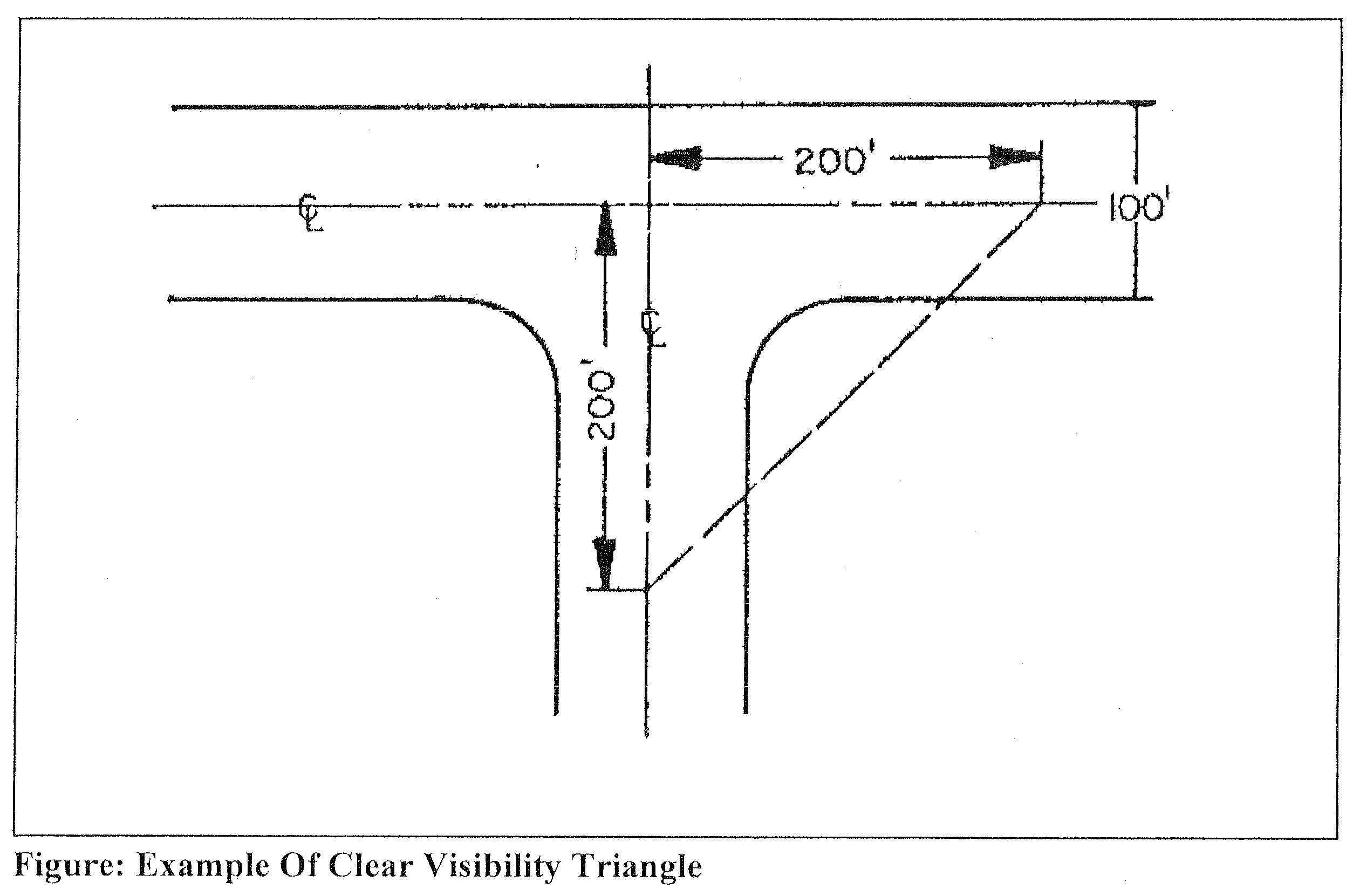
Clear visibility triangle. In order to provide a clear view of intersecting streets to the motorist, there shall be a triangular area of clear visibility formed by two intersecting streets or the intersection of a driveway and a street. The following standards shall be met:
1.
Nothing shall be erected, placed, parked, planted, or allowed to grow in such a manner as to materially impede vision between a height of two feet and ten feet above the grade, measured at the centerline of the intersection.
2.
The clear visibility triangle shall be formed by connecting a point on each street centerline, to be located at the distance from the intersection of the street centerlines indicated below, and a third line connecting the two points.
3.
The distance from the intersection of the street centerlines for the various road classifications shall be as follows:
(Ord. No. 94-8, § 1 (7.03.03D), 10-5-94; Ord. No. 2008-02, § 2(Exh. B), 5-22-08)
7.03.04. - Access.
All proposed development shall meet the standards for vehicular access and circulation as established by this section. Every building hereafter erected, or moved from one lot to another lot, shall be located on a lot adjacent to a public street or on a lot adjacent to an approved private street, except as otherwise provided by this section.
A.
Separation of access points.
1.
The separation between access points onto arterial, collector and local roadways, shall meet the minimum standards identified be as shown in the following table:
2.
Driveways that deviate from the minimum requirements identified in the table above must be authorized by the county engineer.
3.
The distance between access points shall be measured from the centerline of the proposed driveway or roadway to the centerline of the nearest adjacent roadway or driveway.
4.
A development that cannot meet the access requirements of this section and has no reasonable alternative means of access to the public road system shall be issued a temporary connection permit. When adjoining parcels develop which can provide joint or cross access, the temporary permit shall be rescinded and an application for a connection permit consistent with the requirements of this section shall be required. Conditions may be in the temporary permit including, but not limited to, a limitation on development intensity of the site until adjoining parcels develop which can provide joint and/or cross access consistent with the requirements of this section.
5.
The county may, by resolution approved by a super majority of the board, establish specific access criteria or access separation criteria for a road or road segment.
B.
Shared access and common driveways.
1.
Proposed multi-unit commercial, industrial, institutional, and other non-single family residential projects shall require shared access to the existing roadway network. Such access shall conform to FDOT standards. This access requirement may be met through the use of interconnecting parking lots which abut the existing roadway network. All lots in a proposed commercial, industrial, institutional, or other non-single family residential subdivision shall have direct access from a street that is located within the interior of the proposed subdivision and that meets the requirements of this Code.
2.
Adjacent uses are encouraged to share a common driveway provided that appropriate access easements are granted between or among the property owners.
3.
Residential projects proposed on arterials and collectors shall, where feasible, include service roads, and shall take access from the service road rather than the arterial or collector.
4.
Proposed industrial projects shall not have access from a local road that provides primary access to a residential neighborhood. This provision shall not prohibit emergency services access via such a local road.
C.
Reserved.
D.
Requirements for unified access and circulation.
1.
In the interest of promoting unified access and circulation systems, development sites under the same ownership or consolidated for the purposes of development and comprised of more than one building site shall be considered unified parcels for the purposes of this section. This shall also apply to phased development plans. Accordingly, the following requirements shall apply:
a.
The number of connections permitted shall be the minimum number necessary to provide reasonable access to the overall site and not the maximum available for that frontage ([section] 7.03.04.A.1).
b.
All easements and agreements required under section 7.03.04.B. shall be provided.
c.
Access to outparcels shall be internalized using the shared circulation system and designed to avoid excessive movement across parking aisles or queuing across surrounding parking and driving aisles.
2.
Where abutting properties are in different ownership and not part of an overall development plan, cooperation between the various owners in development of a unified access and circulation system is encouraged. Only the building site(s) under consideration for development approval shall be subject to the requirements of this section. Abutting properties shall not be required to provide unified access and circulation until they are developed or are redeveloped.
E.
Access to residential lots and dwellings.
1.
All lots in a proposed residential subdivision shall have direct access from a street that is located within the interior of the proposed residential subdivision and that meets the requirements of this Code. Lots or parcels that are 40 acres or larger shall be deemed to meet the requirements of this subsection where the owner of such land can demonstrate to the director of planning and development that he has legal access from such lands to a public or private street meeting the requirements of this section.
2.
Access to all lots in a proposed residential subdivision shall be by way of a residential access or residential subcollector street that is located within the interior of the proposed residential subdivision.
3.
No dwelling shall be erected on a lot or portion of a lot which does not front on at least one public street, or one approved private street as herein defined, for at least 50 feet. In the case of lots or parcels of 40 acres or more in size the frontage requirements of this subsection shall be deemed to be met where the owner of such land can demonstrate to the director of planning and development that he has legal access from such lands to a public or private street meeting the requirements of this section.
4.
Publicly maintained streets and rights-of-way including the edge of payment shall be protected from the impacts of construction or other development activity on residential lots or parcels.
a.
Culvert required. Where a dwelling is proposed to be constructed, installed or erected on a lot or parcel that fronts a publicly maintained street, a culvert, when determined by the county to be required, shall be installed by the developer/homeowner and approved by the county prior to the issuance of a building permit.
b.
Culvert specifications. Where a culvert is installed in a county right-of-way:
1)
The culvert shall be no less than 15 inches in diameter (or elliptical equivalent), shall not be less than 30 feet in length at the top, shall be constructed of concrete or an alternate material approved by the county, shall have mitered end sections and shall have concrete collars.
2)
The county public works director or designee may require a larger culvert or may approve a smaller culvert as warranted, and may approve alternate construction materials or end sections as warranted.
3)
A temporary culvert may be approved by the county in association with a construction activity but a permanent culvert as described above shall be installed prior to the issuance of a certificate of occupancy or other county acknowledgment of the completion of construction activity.
c.
Paved driveway apron required. Where a dwelling is proposed to be constructed, installed or erected on a lot or parcel that fronts a publicly maintained paved street, a paved driveway apron not less than 12 feet in width with a minimum five-foot radius extending from the edge of pavement of the publicly maintained paved street to one foot beyond the edge of the right-of-way is required prior to the commencement of construction activity. Alternative means of protecting the edge of pavement during construction activity may be approved by the county but the paved apron shall be completed prior to the issuance of a certificate of occupancy or other county acknowledgment of the completion of construction activity.
d.
Paved driveway required on streets with curb and gutter. Where a dwelling is proposed to be constructed, installed or erected on a lot or parcel that fronts a publicly maintained paved street with curb and gutter, the driveway pavement shall be extended to the garage, carport or other defined parking area at or beyond the front of the dwelling prior to the issuance of a certificate of occupancy or other county acknowledgment of the completion of construction activity. In no event shall this provision require a driveway to extend more than 50 feet from the edge of the right-of-way of the publicly maintained paved street with curb and gutter.
e.
Paved driveway required where dwelling is set back 30 feet or less. Where a dwelling is proposed to be constructed, installed or erected on a lot or parcel that fronts any type of publicly maintained paved street, and where the dwelling or any attached appurtenance is set back 30 feet or less from the edge of right-of-way regardless of the width or area of the lot or parcel, the driveway pavement shall be extended to the garage, carport or other defined parking area at or beyond the front of the dwelling prior to the issuance of a certificate of occupancy or other county acknowledgment of the completion of construction activity.
f.
Paved driveway required where lot width is 200 feet or less. Where a dwelling is proposed to be constructed, installed or erected on a lot or parcel that fronts any type of publicly maintained paved street, and where the lot or parcel is 200 feet or less in width at the edge of right-of-way, the driveway pavement shall be extended to the garage, carport or other defined parking area at or beyond the front of the dwelling prior to the issuance of a certificate of occupancy or other county acknowledgment of the completion of construction activity. In no event shall this provision require a driveway to extend more than 50 feet from the edge of the right-of-way of the publicly maintained paved street.
g.
Paving materials. For purposes of the section, the paved driveway may consist of concrete, asphalt, concrete pavers or other similar surfaces approved by the county.
h.
Effective date. The provisions of paragraphs c., d., e. and f. above shall apply to any dwelling for which a complete permit application to construct, install or erect such dwelling is submitted to the department after January 1, 2006. This provision shall not be construed to relieve the ongoing requirement to install temporary or permanent culverts as necessary and to employ methods to protect the integrity of an adjoining street, including swales and the edge of asphalt, during the course of construction, installation or erection of a dwelling.
i.
Replacement dwellings. This provision shall not apply where the proposed dwelling is replacing a dwelling that lawfully exists or has existed on the lot or parcel within the preceding six months.
j.
Paved driveways serving dwellings on arterial or collector streets. Paved driveways serving dwellings on arterial or collector streets shall provide paved accommodation for vehicular turnaround, such as a circular drive, T-turnaround, or a ten-foot by 20-foot paved turn-around area contiguous to the paved driveway.
F.
Approved private streets. For the purpose of this regulation, an "approved private street" is a street:
1.
Which is approved by the board of county commissioners as an approved private street; and
2.
Which the county commission has stated in its public records it will not accept for maintenance or improvement; and
3.
For which provision is made in the instrument of county commission approval for private future maintenance of such approved private street; and
4.
Which meets the minimum width and surface requirements as specified below, and for which legal provision is made for the future continuation and preservation of that width:
a.
Twenty-five feet when providing access to three or fewer parcels, surface is not required to be paved but must be able to support emergency vehicles.
b.
Fifty feet when providing access for four or five lots, surface is not required to be paved but must be able to support emergency vehicles.
c.
Fifty feet when providing access for six or seven lots, surface must be paved and pavement must be maintained at a minimum width of 18 feet.
d.
When providing access for eight or more lots, the street or road must meet minimum county specifications, including minimum overall width and minimum pavement width.
e.
When the proposed private street is 450 feet in length or less, and cannot reasonably be extended further because of physical impediments or other limiting factors, the minimum total width as established in paragraphs b. or c. above may be reduced to not less than one-tenth the length of the road, but in no event may the road be less than 30 feet in width.
f.
The minimum widths specified shall be completely unobstructed and available for use for the purpose intended by this section. Where not required to be paved, an approved private street shall include a minimum 20-foot width of an all-weather driving surface, with a minimum vertical clearance of 13 feet. The all-weather driving surface shall be composed of no less than six inches of compacted shell, or other comparable material as may be approved by the county engineer.
5.
Nothing herein shall be construed to provide relief from any and all requirements of section 7.03 and other provisions of this Code regarding the minimum specifications for a road or street when part of a plat or when providing road frontage for a platted lot.
All structures shall be so located on a lot as to provide safe and convenient access for servicing, fire protection, and required off-street parking and off-street loading.
G.
Development on county-maintained roads. There are county-maintained roads that would not meet today's standards for right-of-way widths, travel ways, base or surfacing if they had not already been built and/or accepted by the county. As to these roads, subject to concurrency requirements as well as all other applicable county ordinances, rules and regulations:
1.
A boundary adjustment between two adjoining parcels which does not create additional building sites and will not increase residential density shall not be prohibited by subsection.
2.
Individual vested lots of record as defined by the LDRs shall be permitted to develop if they abut a county-maintained road even if such road does not meet current right-of-way, travel lane, and surfacing standards.
3.
Persons wishing to subdivide (by deminimus or full plat) thereby increasing the number of existing vested lots of record abutting a county-maintained road shall be required to bring that portion of the road which fronts the parcels created or altered to current county standards. Provided however, a platted subdivision establishing an internal road system and through enforceable covenants prohibits direct access from the abutting lots to such road may be exempted from the provisions of this subsection provided abutting or connecting road improvements are not otherwise made a condition of the development by the site plan review process due to concurrency or traffic safety considerations.
H.
Development on private roads and easements. Within the county there are currently undeveloped lots within platted and unplatted subdivisions without publically dedicated rights-of-way and where the only access is by means of private agreements or easements (herein referred to as "existing private subdivisions"). Where there existed as of November 9, 2006, an all weather road servicing such existing private subdivision lots, residential development of these lots shall be governed by the following:
1.
The roads and easements within existing private subdivisions shall not be accepted by the county unless dedicated by all owners of the easements or roads.
2.
Any roads dedicated shall not be accepted for maintenance by the county unless they have been brought up to current county road standards.
3.
Once dedicated, any such road is eligible to be considered for the imposition of a special assessment to improve the road to current county road standards. Such special assessment shall, to the fullest extent practicable, bring the subject road to a condition that meets all current county road standards.
4.
Subject to the marshaling requirements of section 11.01.03, LDRs, owners of vested lots of record (as defined by the LDRs) may seek residential building permits however, the owners of such lots shall execute a recordable acknowledgment that access is not by means of a county right-of-way and there may be limited availability for emergency services and the county will likely never accept, maintain or improve the road.
5.
Further lot splits or deminimus development on such easements or roads is prohibited unless the access is an approved private street under the LDRs.
6.
Lots within an existing private subdivision abutting (by the minimum frontage established by the LDRs) an all weather road existing as of November, 9, 2006 shall be permitted to residentially develop upon approval of the road as an approved private street as defined by Section 7.03.04.F. of the Okeechobee County Code however such road shall not be required to comply with the minimum construction standards provided in that section.
7.
Where any lot to be developed is less than ten acres in size, a drainage plan shall be provided for review by the county to ensure that off-site impacts will conform to the requirements of the Okeechobee County Code and state regulations. In such cases, an approval from the applicable water management district may be required.
8.
This section shall not be construed to allow or encourage the commercial development of paper plats or build out of subdivisions or areas of subdivisions containing little or no road and drainage infrastructure. This section is intended only to allow residential development in the limited circumstance where there currently exists an adequate all weather road servicing vested lots and will generally present itself as an incident to in-fill where other residential development has already occurred on the access road.
I.
New plats accessed by private roads and easements. Platting of property serviced only by private roads or easements is prohibited unless such roads or easements are improved to current county standards and either dedicated to the county or a recordable perpetual maintenance document (approved by the county) is executed by all affected landowners.
J.
In-fill waivers. Given the practical inability of the county to evaluate, engineer, implement special assessment districts, and construct road and drainage improvements for subdivisions county-wide at the same time, the following "transition rules" are hereby adopted to permit certain in-fill development of platted subdivisions where substandard roads exist within county rights-of-way:
1.
The lot must be within a platted subdivision and must abut a public right-of-way.
2.
The road providing access must be reasonably passable in its current state without the necessity of public or private interim improvements.
3.
Owner must sign and record in the public records a statement acknowledging the fact the access to the property is not currently county-maintained and that there may be limited availability for emergency services. Further that when, if ever, improvements are made they will be by means of a special assessment to be paid by the benefitted properties.
4.
If a home is built for resale, the statement must be signed by the ultimate purchaser. An ultimate purchaser is a natural person or persons who takes title to the property within six months of issuance of the certificate of occupancy. Failure of the builder to have the statement signed may result in a denial of further in-fill waivers being granted to that builder.
5.
In-fill waivers shall not be available to developers. A developer is a person or entity owning four or more lots in the subdivision as of the effective date of this amendment to this Code. In calculating the number of lots owned, multiple lots that have been declared to be a single building site shall count as one lot. Where multiple lots are combined to create a single building site, a unified building site declaration must be provided to the building department.
6.
In-fill waivers shall be permitted where all of the following criteria is met:
(a)
The proposed residence will be located between two existing residences on either side of the same road segment. A road segment is the portion of a road servicing a group of lots or such smaller portion uninterrupted by road intersections; and
(b)
The proposed residence is separated from the two existing residences by no more than:
(i)
Three platted lots (or building sites) if the lots are one acre or less; or
(ii)
Two platted lots (or building sites) if the lots are over one acre but less than five acres; or
(iii)
One platted lot (or building site) if the lots are over five acres.
(c)
Where a road segment or the plat legally terminates so that it is impossible to meet the requirements of subsection 6.(a), above, a lot is not disqualified if it is able to meet the criteria on one side.
7.
The in-fill determination shall be made as a part of the review process upon application for a building permit. Where a person wishes an In-fill waiver in advance of applying for a building permit, a written determination letter may be provided by the planning department upon payment of a fee of $100.00 plus recording cost for up to four contiguous lots/building sites. This fee may be modified by resolution of the board of county commissioners.
8.
Where lots or parcels of record abut a public right-of-way but are not in a platted subdivision, an infill waiver may also be granted in accordance with the criteria established in this section.
(Ord. No. 95-1, § 1 (7.03.04A—D), 6-8-95; Ord. No. 96-03, § 1, 4-11-96; Ord. No. 2003-04, § 1(Exh. A), 4-10-03; Ord. No. 2005-12, § 2(Exh. A), 7-28-05; Ord. No. 2008-02, § 2(Exh. B), 5-22-08; Ord. No. 2023-0002, § 2(Exh. A), 4-13-23)
7.03.05. - Sidewalks.
A.
When required.
1.
Projects abutting collector or arterial facilities shall provide sidewalks adjacent to the collector or arterial roadway. Location of sidewalks shall be consistent with planned roadway improvements.
2.
Sidewalks shall be provided on both sides of all residential streets internal to the project where the average lot width at the street is less than 100 feet and on one side of the street where the average lot width at the street is 100 feet or more but less than 150 feet. Where the average lot width at the street is 150 or more, sidewalks are not required. Provided, however, subdivision lots abutting an existing street need only provide sidewalks on the side of the street where the lots are located.
3.
Where a proposed development includes improvements or new construction of collector or arterial facilities, facility designs shall include provision for sidewalks and bikeways within the right-of-way.
4.
Pedestrian ways or crosswalks, not less than ten feet wide with a sidewalk meeting the requirements of this Code, may be required by the department or planning board to be placed in the center of blocks more than 800 feet long where deemed necessary to provide circulation or access to schools, playgrounds, shopping centers, transportation and other community facilities.
B.
Design and construction standards. Design and construction of sidewalks, bikeways, or other footpaths shall conform to the requirements of the engineering department including provisions for access by physically handicapped persons.
C.
Special subdivision exemption. It is recognized that there may be proposed special purpose subdivisions that, given the small number of lots, the site's physical configuration or nonresidential nature of the project, the construction of sidewalks would be superfluous or located in a manner that they would not receive pedestrian use. An exemption from the requirements of this section may be requested from the technical review committee. Cost shall not be the determining factor in granting an exemption. A decision of the technical review committee may be appealed by any interested party to the board of adjustments and appeals.
(Ord. No. 94-8, § 1 (7.03.05), 10-5-94)
7.04.01. - Parking, generally.
A.
Nonconforming buildings and uses. Off-street parking and off-street loading facilities shall be provided as set out in this Code. Conforming buildings and uses existing as of the effective date of this Code may be modernized, altered, or repaired without providing additional off-street parking or off-street loading facilities, providing there is no increase in floor area or capacity.
Where a conforming building or use existed as of the effective date of this Code and such building or use is enlarged in floor area, volume, capacity, or space occupied, off-street parking and off-street loading as herein specified shall be provided for the additional floor area, volume, capacity, or space so created or used.
Change in use of a building or use existing as of the effective date of this Code shall require additional off-street parking and off-street loading facilities to the extent of the difference between the previous use and the new use as set out in this Code and as though this Code had been applicable thereto.
B.
Facilities: Identification, drainage, access. The required off-street parking facilities shall be:
(1)
Identified as to purpose and location when not clearly evident;
(2)
Drained so as not to cause any nuisance on adjacent property;
(3)
Arranged for convenient access and safety of pedestrians and vehicles.
C.
Location. The required off-street parking facilities shall be located on the same lot or parcel of land they are intended to serve; provided, however, that the board of county commissioners may allow the establishment of such off-street parking facilities within 300 feet of the premises they are intended to serve when:
(1)
Practical difficulties prevent the placing of the facilities on the same lot as the premises they are designed to serve;
(2)
The owner of the said parking area shall enter into a written agreement with the county with enforcement running to the county providing that the land comprising the parking area shall never be disposed of except in conjunction with the sale of the building which the parking area serves so long as the facilities are required; and
(3)
The owner agrees to bear the expense of recording the agreement and agrees that the agreement shall bind his heirs, successors, and assigns. The written agreement shall be voided by the county if other off-street facilities are provided in accord with this Code.
D.
Plans required. A plan shall be submitted with every application for a building permit for any building or use that is required to provide off-street parking. The plan shall accurately designate the required parking spaces, access aisles, and driveways, and the relation of the off-street parking facilities to the use or structures such facilities are designed to serve. Design and construction of off-street parking shall conform to the requirements of the engineering department which shall include paving and provisions for access by physically handicapped persons. See section 7.04.02G for handicap requirements and section 7.02.03D for alternate paving methods.
E.
Combined off-street parking. Two or more owners or operators of buildings or uses requiring off-street parking facilities may make collective provision for such facilities, provided that the total of such parking spaces when combined or used together shall not be less than the sum of the requirements computed separately.
No part of an off-street parking area required for any building or use shall be included as a part of an off-street parking area similarly required for another building or use unless the planning board shall find that the type of use indicates that the period of usage will not overlap or be concurrent with each other.
F.
Employee parking. Where off-street parking facilities are specified on the basis of number of employees, such parking shall be clearly marked and reserved for use of such employees. Where a use is required to provide and reserve a certain number of spaces for employees and the number of employees increases after the building is occupied, then the amount of off-street parking provided shall be increased in ratio to the increases in the number of employees.
G.
Fractional measurements. When units or measurements determining number of required off-street parking spaces result in requirement of a fractional space, then such fraction equal or greater than one-half shall require a full off-street parking space.
H.
Mixed uses. In the case of mixed uses, the total requirements for off-street parking shall be the sum of the requirements of the various uses computed separately, and off-street parking space for one use shall not be considered as providing the required off-street parking for any other use.
I.
Measurement. Floor area shall mean the gross floor area inside the exterior walls, where floor area is indicated on the schedule of district regulations as a basis for determining the amount of off-street parking required. In hospitals, bassinets shall not count as beds. In stadiums, sports arenas, houses of worship, and other places of public assembly in which occupants utilize benches, pews, or other similar seating arrangements, each 24 lineal inches of such seating facilities shall be counted as one seat for the purpose of computing off-street parking requirements.
J.
Minimum requirement. Regardless of any other requirement of this Code, each and every separate individual store, office, or other business shall be provided with at least one off-street parking space, unless specific provision to the contrary is made herein.
7.04.02. - Number of parking spaces required.
A.
Requirements in table. The table below specifies the required minimum number of off-street automobile and bicycle parking spaces, the percentage of automobile spaces that must be allotted for compact vehicles, and, in the notes, any special requirements that may apply. For uses that require a high number of parking spaces, but when the use for such spaces is occasional, such as for a church or fairgrounds, the following provisions shall apply: 1) all spaces required for handicap parking and all spaces used on a regular basis, such as for daily employees or visitors, shall be paved, along with any travelways; 2) remaining required parking spaces shall consist of a stabilized surface, such as gravel, shell or stabilized grass; travelways to all required parking spaces shall be paved; and individual spaces shall be defined or otherwise be identifiable. For facilities such as fairgrounds, individual spaces may be defined by personnel who direct visitors to specific parking spaces.
B.
Uses not specifically listed in table. The number of parking spaces required for uses not specifically listed in the table shall be determined by the department. The department of planning and development shall consider requirements for similar uses and appropriate traffic engineering and planning data, and shall establish a minimum number of parking spaces based upon the principles of this Code.
C.
When parking study required. For several uses listed in the table the parking requirement is to be determined by the site plan technical review committee. These uses have a large variability in parking demand, making it impossible to specify a single parking requirement. A developer proposing to develop or expand one of these uses must submit four copies of a parking study, as described at section 7.03.01.C of this part, to the department that provides justification for the requirement proposed. The site plan technical review committee will review this study along with any traffic engineering and planning data that are appropriate to the establishment of a parking requirement for the use proposed.
D.
Treatment of mixed uses. Where a combination of uses is developed, parking shall be provided for each of the uses as prescribed by the table, unless a reduction is granted pursuant to section 7.04.02.I of this part.
E.
Tandem parking spaces. The term "tandem parking space" used in the table means a parking space that abuts a second parking space in such a manner that vehicular access to the second space can be made only through the abutting (tandem) space.
_____
F.
Table of off-street parking.
G.
Handicapped parking spaces. Any parking area to be used by the general public shall provide suitable, marked parking spaces for handicapped persons. The number, design, and location of these spaces shall be consistent with the requirements of F.S. §§ 316.1955, 316.1956, or succeeding provisions. No parking space required for the handicapped shall be counted as a parking space in determining compliance with this article, but optional spaces for the handicapped shall be counted. All spaces for the handicapped shall be paved.
H.
Parking deferral.
1.
To avoid requiring more parking spaces than actually needed to serve a development, the planning board may defer the provision of some portion of the off-street parking spaces required by this Code if the conditions and requirements of this section are satisfied.
2.
As a condition precedent to obtaining a partial deferral by the planning board, the developer must show any one or more of the following:
a.
A parking study as described in section 7.04.02C of this part indicates that there is not a present need for the deferred parking.
b.
Public transportation satisfies transportation demands for a portion of the users of the facility that corresponds to the amount of parking sought to be deferred.
c.
The developer has established or will establish an alternative means of access to the use that will justify deferring the number of parking spaces sought to be deferred. Alternative programs that may be considered by the planning board include, but are not limited to:
(1)
Private and public carpools and vanpools.
(2)
Charging for parking.
(3)
Subscription bus services.
(4)
Flexible work-hour scheduling.
(5)
Capital improvement for transit services.
(6)
Ridesharing.
(7)
Establishment of a transportation coordinator position to implement carpool, vanpool, and transit programs.
d.
The percentage of parking spaces sought to be deferred corresponds to the percentage of residents, employees, and customers who regularly walk, use bicycles and other nonmotorized forms of transportation, or use mass transportation to come to the facility.
e.
Transportation system management.
f.
Transportation demand management.
3.
If the developer satisfies one or more of the criteria in 2., the planning board may approve a deferred parking plan submitted by the developer. The number of parking spaces deferred shall correspond to the estimated number of parking spaces that will not be needed because of the condition or conditions established.
4.
A deferred parking plan:
a.
Shall be designed to contain sufficient space to meet the full parking requirements of this Code, shall illustrate the layout for the full number of parking spaces, and shall designate which are to be deferred.
b.
Shall not assign deferred spaces to areas required for landscaping, buffer zones, setbacks, or areas that would otherwise be unsuitable for parking spaces because of the physical characteristics of the land or other requirements of this Code.
c.
Shall include a landscaping plan for the deferred parking area.
d.
Shall include a written agreement with the county that, one year from the date of issuance of the certificate of occupancy, the deferred spaces will be converted to parking spaces that conform to this Code at the developer's expense should the planning board determine from experience that the additional parking spaces are needed.
e.
Shall include a written agreement that the developer will cover the expense of a traffic study to be undertaken by the county transportation engineer to determine the advisability of providing the full parking requirement.
5.
When authorized by the planning board upon a preliminary finding that the parking is inadequate, but not sooner than one year after the date of issuance of the certificate of occupancy for the development, the department shall undertake a study to determine the need of providing the full parking requirement to satisfy the proven demand for parking.
6.
Based upon the study and the recommendations of the transportation engineer and the director of planning and development, the planning board shall determine if the deferred spaces shall be converted to operable parking spaces by the developer or retained as deferred parking area.
7.
The developer may at any time request that the planning board approve a revised development plan to allow converting the deferred spaces to operable parking spaces.
I.
Reduction for mixed or joint use of parking spaces. The planning board shall authorize a reduction in the total number of required parking spaces for two or more uses jointly providing off-street parking when their respective hours of need of maximum parking do not normally overlap. Reduction of parking requirements because of joint use shall be approved if the following conditions are met:
1.
The developer submits sufficient data to demonstrate that hours of maximum demand for parking at the respective uses do not normally overlap.
2.
The developer submits a legal agreement approved by the county attorney guaranteeing the joint use of the off-street parking spaces as long as the uses requiring parking are in existence or until the required parking is provided elsewhere in accordance with the provisions of this Code.
J.
Reduction for low percentage of leasable space. The requirements of section 7.04.02A of this part assume an average percentage of gross leasable building to total gross building area (approximately 85%). If a use has a much lower percentage of leasable space because of cafeterias, athletic facilities or covered patios; multiple stairways and elevator shafts; atriums; conversion of historic residential structures to commercial use; or for other reasons; the planning board may reduce the parking requirements if the following conditions are met:
1.
The developer submits a detailed floor plan describing how all of the floor area in the building will be used.
2.
The developer agrees in writing that the usage of the square footage identified as not leasable shall remain as identified, unless and until additional parking spaces are provided to conform fully with this Code.
(Ord. No. 94-8, § 1 (7.04.02A—C, F), 10-5-94)
7.04.03. - Off-street loading.
A.
Specifications, amounts. Off-street loading facilities are required by this Code so that vehicles engaged in unloading will not encroach on or interfere with the public use of streets and alleys by pedestrians and so that adequate space is available for the unloading and loading of goods, materials, or things for delivery and shipping. Off-street loading facilities supplied to meet the needs of one use may not be considered as meeting the needs of another use. Off-street parking facilities may not be used or counted as meeting off-street loading requirements.
When the use of a structure or land or any part thereof is changed to a use requiring off-street loading facilities, the full amount of off-street loading space required shall be supplied and maintained. When any structure is enlarged or any use extended so that the size of the resulting occupancy requires off-street loading space, the full amount of such space shall be supplied and maintained for the structure or use in its enlarged or extended size.
Each off-street loading space shall be directly accessible from a street or alley without crossing or entering any other required off-street loading space. Such loading space shall be accessible from the interior of the building it serves and shall be arranged for convenient and safe ingress and egress by motor truck and/or trailer combination.
B.
Plans required. A plan shall be submitted with every application for a building permit for any use or structure required to provide off-street loading facilities. The plan shall accurately designate the required off-street loading spaces, access thereto, dimensions, and clearance.
C.
Combined off-street loading. Collective, joint, or combined provisions for off-street loading facilities for two or more buildings or uses may be made, provided that such off-street loading facilities are equal in size and capacity to the combined requirements of the several buildings or uses and are designed, located, and arranged to be usable thereby.
D.
Loading requirements. Off-street spaces shall be provided and maintained as follows:
1.
Each retail store, storage warehouse, wholesale establishment, industrial plant, factory, freight terminal, market, restaurant, mortuary, laundry, dry cleaning establishment, or similar use which has an aggregate floor area of:
Plus one additional off-street loading space for each additional 90,000 square feet over 290,000 square feet or major fraction thereof.
2.
For each multiple dwelling or apartment hotel having at least 20 dwelling units but not over 50 dwelling units: one space.
For each multiple dwelling unit having over 50 dwelling units: one space, plus one space for each additional 50 dwelling units, or major fraction thereof.
3.
For each auditorium, convention hall, exhibition hall, museum, motel, hotel, office building, sports arena, stadium, hospital, sanitarium, welfare institution, or similar use which has an aggregate floor area of:
Over 10,000 square feet but not over 40,000 square feet: one space; plus for each additional 60,000 square feet over 40,000 square feet or major fraction thereof: one space.
4.
For any use not specifically mentioned, the requirements for off-street loading facilities for a use which is so mentioned and to which the unmentioned use is similar shall apply.
7.05.00. - Minimum drainage requirements and standards.
The following minimum drainage requirements and standards shall apply to development within the unincorporated areas of Okeechobee County. Subsection 7.05.00(A) of this Code may be replaced, in whole or in part, by a technical standards manual incorporated into this Code by resolution of the board of county commissioners. Until that time, the technical standards below shall govern. Standards not incorporated into the technical standards manual shall be as below.
A.
Hydraulic design criteria.
1.
Rainfall and runoff criteria. The system shall be designed for "design floods" resulting from rainstorms of the following expected frequencies or greater:
a.
Twenty-five-year three-day rainfall interval for allowable discharge from project-development, however discharge from development shall not exceed predevelopment discharge.
b.
Twenty-five-year frequency storm, 24-hour duration rainfall interval for major drainageways (over one square mile drainage area).
c.
Five-year one-day rainfall interval for underground drainage utilizing storm sewers.
d.
Ten-year one-day rainfall interval for all road crowns and all others. Rainfall intensity factors shall come from accepted meteorological and rainfall sources as applicable to Okeechobee County. Ultimate land usage shall be assumed for selection of proper runoff coefficients within the basins involved, whether within the subdivision or not. Weighted runoff coefficients shall be applied where different coefficients apply within the areas comprising the basins.
2.
Hydraulics of curb and gutter construction. The minimum grade for curb and gutter road construction shall be 0.3 percent, unless written authorization is given by the county engineer.
3.
Hydraulics of underground drainage. Underground drainage through storm sewers, where employed, shall conform to good accepted engineering practice. Coefficients of friction suitable for the type of pipe or structure shall be applied. Minimum pipe diameter shall be 18 inches or equivalent for side drains and 18 inches or equivalent for cross drains for swale drainage, 18-inch minimum pipe diameter or equivalent for closed hydraulic design. Inverted siphons shall not be accepted.
4.
Hydraulics of drained structures. Drainage structures such as bridges, box culverts, headwalls, dams, weirs, spillways, bulkheads and other structures shall be designed hydraulically and structurally in accordance with good accepted engineering practice. The effects on adjacent channels and structures shall be considered. Foundations or other supports or anchoring methods shall be adequate.
5.
Drainage outfalls. Natural runoff to and ultimate runoff generated within developments shall be conducted to positive outfalls that can be permanently, practicably and legally maintained. Outfalls to existing waterways, canals, lakes or storm sewer systems shall be designed in accordance with, as appropriate, South Florida Water Management District standards or St. Johns River Water Management District standards.
If the above receiving system does not have such capacity, then developer shall include in his plans measures for adequately increasing said capacity and shall bear the responsibility and expense of construction, provided that where major waterways are involved, improvements of such may be taken as individual cases to be considered specifically.
Side ditches along public roads may not be accepted as suitable positive outfalls unless as specifically accepted by the county engineer. Drainage walls or underdrains shall not be accepted as positive outfalls except as specifically accepted by the county engineer.
6.
Hydraulics of minor streams, canals, ditches, and swales. Open channels other than major waterways may be defined as minor streams, canals, ditches, and swales. Such open channels shall be designed in accordance with good accepted engineering practice adapted to local conditions. The design shall provide that the channels will not overflow their banks at design flood conditions.
Cross-sectional areas and hydraulic gradients shall be such that design velocities shall not result in scouring of the soil and/or turf conditions reasonably anticipated. Mean velocities greater than three ft./sec. shall be considered excessive unless permanent channel lining or other suitable protection is employed.
7.
Major waterways. Improvement or establishment of major canals is of such significance to the county that the design of each such improvement or establishment proposed shall be developed as a separate hydraulic problem. Engineering data, criteria and suitable calculations shall be submitted to the county engineer prior to approval of construction plans.
8.
Drainage connection and intersections. Drainage connections to drainageways, and intersecting and converting drainageways shall be suitably designed and aligned to provide effective erosion and silting control, subject to the approval of the county engineer. Where necessary, control structures shall be installed.
9.
Lakes. Where lakes are included as a part of the drainage system, detention time in these lakes may be considered in computing discharge by presentation of hydrographs based on accepted engineering practice approved by the county engineer.
B.
Minimum building elevations and adjoining grades.
1.
The minimum elevation for all residential structures, non-residential structures and substantial improvements or additions located in a flood hazard area shall be at or above the base flood elevation or otherwise shall meet the minimum building elevation established by the NFIP. All electrical, heating, ventilation, plumbing, air conditioning equipment, ductwork and other service facilities also shall be located at or above the base flood elevation, or shall be designed or located to prevent water from entering or accumulating within the components during conditions of flooding.
2.
In addition to meeting the requirements of paragraph 1 above, when applicable, minimum building elevations shall be at least 18 inches above the crown of adjacent roadway and shall be at or above the 100 year three-day storm event, zero discharge, except that:
(a)
When included with an engineered site plan that demonstrates compliance with drainage and runoff regulations, the minimum elevation for a principal structure within 200 feet of the adjacent roadway may be ten inches above the crown of the adjacent roadway, and shall be at or above the 100-year three-day storm event, zero discharge.
(b)
When included with an engineered site plan that demonstrates compliance with drainage and runoff regulations, the minimum elevation of all structures that are 200 feet or more from the adjacent roadway shall be at least 24 inches above natural grade and shall be at or above the 100 year three-day storm event, zero discharge.
(c)
When not included with an engineered site plan, the minimum elevation of all principal structures that are 200 feet or more from the adjacent roadway may shall be at least 30 inches above natural grade and shall be at or above the 100-year three-day storm event, zero discharge.
(d)
The county engineer may grant a reduction in the minimum floor elevation otherwise required upon demonstration that the proposed finished floor elevation meets all drainage requirements, is at or above the base flood elevation when in a flood hazard area, and that a hardship exists which would cause undue burden by being required to meet minimum finished floor criteria, such as extreme inconsistency when applied to infill structures between existing developments, or when the elevation of the crown of the adjoining roadway is more than three feet above natural grade of the proposed development site.
3.
Except where supported by a retaining wall, the ground adjacent to a structure shall have a slope not to exceed a ratio of four feet horizontal to one foot vertical from the structure's finished floor elevation to the natural ground elevation or property line.
(a)
The ground adjoining the structure may be level with the structure's finished floor elevation for any distance from the structure before beginning to slope toward natural grade.
(b)
The proposed finished floor elevation and a cross-section drawing illustrating the proposed slope from a proposed structure to natural grade shall be submitted with a permit application. Swales or other improvements or features necessary to contain runoff shall also be illustrated on the drawing.
(c)
Where a structure is proposed to be located 12 feet or less from a property line, or where the maximum permissible ground slope from the proposed structure to natural grade would result in a ground elevation that remains higher than natural grade when within one foot of a property line, the cross-section drawing required in paragraph (b) above shall also include the elevation and distance from the property line of all structures on the adjoining property that are within 12 feet of the common property line.
4.
Post-development runoff shall equal or approximate pre-development conditions, except as otherwise provided. No new or existing development shall cause or result in an increase in runoff rate or volume, or otherwise alter the flow or direction of runoff in a manner that adversely impacts an adjoining property.
(Ord. No. 94-8, § 1 (7.05.00), 10-5-94; Ord. No. 2003-04, § 1(Exh. A), 4-10-03)
7.06.00. - Stormwater management.
Okeechobee County hereby adopts by reference the stormwater management rules of the South Florida Water Management District, chapter 40E-4, FAC, for those areas of Okeechobee County lying within the jurisdiction of the South Florida Water Management District. Okeechobee County also adopts by reference the stormwater management rules of the St. Johns River Water Management District, chapter 40C-42, FAC, for those areas of Okeechobee County lying within the jurisdiction of the St. Johns River Water Management District. Part 7.06.00 of this Code may be replaced, in whole or in part, by a technical standards manual incorporated into this Code by resolution of the board of county commissioners. Until that time, the technical standards below shall govern. Standards not incorporated into the technical standards manual shall be as below.
(Ord. No. 94-8, § 1 (7.06.00), 10-5-94)
7.06.01. - Local review and approval of stormwater management system.
The water management districts provide exemptions for the need to obtain permits for development projects and land parcels below their respective minimum area thresholds. Specifically, a request for exemption for a project with less than ten acres of total land area must, at a minimum, contain paving and drainage plans and calculations of the project signed and sealed by a professional engineer, which denotes the total land area, the total area of impervious surface, the location of any on-site wetlands, the location and details of the surface water management system including, but not limited to, any lakes, culverts, pipes, exfiltration trench, discharge structures, pumps and related facilities. In addition, an entity requesting an exemption must provide local government approval of the project and an affidavit of ownership, along with the underlying documentation.
Therefore, regardless of whether or not stormwater management permits are required by the water management districts, notwithstanding other exemptions cited in section 7.06.04, all applications for development are required to submit stormwater management plans for review and approval by the county engineer. Those plans are to be based on the standards and criteria of the appropriate water management district, be it the South Florida Water Management District or the St. Johns River Water Management District.
7.06.02. - Specialized definitions.
The following definitions shall apply to section 7.06.00 and all subsections thereto.
Alter or alteration. Work done on a stormwater management system other than that necessary to maintain the system's original design and function.
Detention. The collection and storage of surface water for subsequent gradual discharge.
Existing. For purposes of the stormwater management provisions of this Code, the average condition immediately before development or redevelopment commences.
Impervious surface. A surface that has been compacted or covered with a layer of material so that it is highly resistant to infiltration by water. It includes, but is not limited to, semi-impervious surfaces such as compacted clay, as well as most conventionally surfaced streets, roofs, sidewalks, parking lots and other similar structures.
Maintenance. That action taken to restore or preserve the original design and function of any stormwater management system.
Natural systems. Systems which predominantly consist of or are used by those communities of plants, animals, bacteria and other flora and fauna which occur indigenously on the land, in the soil or in the water.
Rate. Volume per unit of time.
Retention. The collection and storage of runoff without subsequent discharge to surface waters.
Runoff coefficient. Ratio of the amount of rain which runs off a surface to that which falls on it; a factor from which runoff can be calculated.
Sediment. The mineral or organic particulate material that is in suspension or has settled in surface or ground waters.
Site. Generally, any tract, lot or parcel of land or combination of tracts, lots, or parcels of land that are in one ownership, or in diverse ownership but contiguous, and which are to be developed as a single unit, subdivision, or project.
Stormwater. The flow of water which results from, and that occurs immediately following, a rainfall.
Stormwater management system. The system, or combination of systems, designed to treat stormwater, or collect, convey, channel, hold, inhibit, or divert the movement of stormwater on, through and from a site.
Stormwater runoff. That portion of the stormwater that flows from the land surface of a site either naturally, in manmade ditches, or in a closed conduit system.
Surface water. Water above the surface of the ground whether or not flowing through definite channels, including the following:
1.
Any natural or artificial pond, lake, reservoir, or other area which contains water and which has a discernible shoreline; or
2.
Any natural or artificial stream, river, creek, channel, ditch, canal, conduit, culvert, drain, waterway, gully, ravine, street, roadway, swale or wash in which water flows in a definite direction and which has a definite flow route; or
3.
Any wetland.
Wetland. Land that is inundated or saturated by surface water or groundwater at a frequency and duration sufficient to support, and that under normal circumstances do or would support, a prevalence of vegetation typically adapted for life in saturated soil conditions. The term includes, but is not limited to, swamp hammocks, hardwood swamps, riverine cypress, cypress ponds, bayheads and bogs, wet prairies, and freshwater marshes.
7.06.03. - Relationship to other stormwater management requirements.
In addition to meeting the requirements of this Code, the design and performance of all stormwater management systems shall comply with applicable state regulations regarding stormwater quality (chapter 17-25 and chapter 17-302, Florida Administrative Code) or rules of the South Florida Water Management District or the St. Johns River Water Management District, as appropriate.
7.06.04. - Exemptions.
The following development activities are exempt from these stormwater management requirements, except that steps to control erosion and sedimentation must be taken for all development.
A.
The construction of a single-family or duplex residential dwelling unit and accessory structures on a single parcel of land.
B.
Any development within a subdivision if each of the following conditions have been met:
1.
Stormwater management provisions for the subdivision were previously approved and remain valid as part of a final plat or development plan; and
2.
The development is conducted in accordance with the stormwater management provisions submitted with the final plat or development plan.
C.
Bona fide agricultural activity, including forestry, provided farming activities are conducted in accordance with the requirements set forth in an approved soil conservation service conservation plan and forestry activities are conducted in accordance with the Silviculture Best Management Practices (BMP) Manual (1979) published by the Florida division of forestry. If the conservation plan and forestry BMPs are not implemented accordingly, this exemption shall become void and a stormwater permit shall be required.
D.
Maintenance activity that does not adversely affect the quality, rate, volume or location of stormwater flows on the site or of stormwater runoff.
E.
Action taken under emergency conditions to prevent imminent harm or danger to persons, or to protect property from imminent fire, violent storms, hurricanes or other hazards.
7.06.05. - Stormwater management requirements.
A.
Performance standards. All development must be designed, constructed and maintained to meet the following performance standards:
1.
While development activity is underway and after it is completed, the characteristics of stormwater runoff shall approximate the rate, volume, quality, and timing of stormwater runoff that occurred under the site's natural unimproved or existing state, except that the first one inch or the total runoff of 2.5 times the percentage impervious, whichever is greater, of stormwater runoff shall be retained in an off-line dry or wet retention system or according to other best management practices.
2.
The proposed development and development activity shall not violate the water quality standards as set forth in chapter 17-3, Florida Administrative Code.
3.
All commercial or industrial development shall provide 0.5 inches of stormwater pretreatment in a dry retention area in addition to subsection 1, above.
4.
Dry retention and detention systems shall be designed with the wet season water table at least one foot below the bottom surface of the treatment area.
5.
Wet detention systems shall have water depths no more than ten feet, unless specifically accepted by the county engineer, and side slopes of 4:1 from proposed finished grade to two feet below the control elevation.
B.
Design standards, systemwide. To comply with the foregoing performance standards the proposed stormwater management system shall conform to the following design standards:
1.
Detention and retention systems shall be designed to comply with the appropriate standards set out in the South Florida Water Management District's Permit Information Manual, Volume IV, Management and Storage of Surface Waters.
2.
The proposed stormwater management system shall be designed to accommodate the stormwater that originates within the development and stormwater that flows onto or across the development from adjacent lands.
3.
The proposed stormwater management system shall be designed to function indefinitely if properly maintained and shall comply with subsections 7.06.06(A) and 7.06.06(B) of this Code.
4.
The design and construction of the proposed stormwater management system shall be certified as meeting the requirements of this Code by a professional engineer registered in the State of Florida.
5.
No surface water may be channelled or directed into a sanitary sewer.
6.
The proposed stormwater management system shall be compatible with the stormwater management facilities on surrounding properties or streets, taking into account the possibility that substandard systems may be improved in the future.
7.
The banks of detention and retention areas should be sloped to accommodate, and should be planted with appropriate vegetation.
8.
Natural surface waters shall not be used as sediment traps during or after development.
9.
For aesthetic reasons and to increase shoreline habitat, the shorelines of detention and retention areas shall be sinuous rather than straight.
10.
Water reuse and conservation shall, to the maximum extent practicable, be achieved by incorporating the stormwater management system into irrigation systems serving the development.
11.
Vegetated buffers of sufficient width to prevent erosion shall be retained or created along the shores, banks or edges of all natural or manmade surface waters.
12.
In phased developments the stormwater management system for each integrated stage of completion shall be capable of functioning independently as required by this Code.
13.
All detention and retention basins, except natural water bodies used for this purpose, shall be accessible for maintenance from streets or public rights-of-way.
14.
All drainage systems will provide best management practices (BMP) for water quality.
C.
Design standards, streets and swales.
1.
Valley curb. Valley curb shall be 24 inches wide with a minimum thickness of six inches at the center, with a three-inch rise to the back of the curb and one inch to the pavement edge, 3,000 psi concrete used throughout. Design to be submitted to the county engineer for approval.
2.
Curb and gutter. Curb shall be 12 inches deep, five-inch top width with a six-inch-deep, one-inch-wide reveal on the face. Gutter shall be six inches deep, 18 inches wide with a slope of one inch to one foot, 3,000 psi concrete used throughout. Design to be submitted to the county engineer for approval.
3.
Vertical curb. Vertical curb without gutters shall be six inches wide, 18 inches deep with six-inch curb above pavement, 3,000 psi concrete used throughout. Design to be submitted to the county engineer for approval.
4.
Culvert pipe. Culvert pipe shall be reinforced concrete pipe, asphalt coated corrugated metal pipe, aluminum pipe, or approved equivalent. Culvert pipe not subjected to wheel traffic loads may be of nonreinforced concrete, asphalt coated corrugated metal pipe or such aluminum pipe conforming to specifications of AASHTO.
5.
Headwalls. All culverts under roadways shall have headwalls made of reinforced concrete or concrete block with reinforcement, or other approved structures. Where shallow swale ditches intersect deeper drainage ditches, erosion control shall be provided by use of culvert pipes, concrete swales, sandbag riprap, headwalls with spillways, or other suitable means approved to by the county engineer.
a.
Sandbag riprap. The sandbag riprap mixture shall contain at least one part cement to five parts of clean sand. Construction methods shall comply with FDOT standards until such time as Okeechobee County adopts engineering specifications.
b.
The proposed design of reinforced concrete headwalls shall be submitted for approval of the county engineer.
c.
The proposed design of reinforced concrete block headwalls shall be submitted for approval of the county engineer.
6.
Manholes and junction boxes. All manholes or junction boxes shall be a minimum of four feet inside diameter at the base with straight walls or corbelled a maximum of four inches in one foot, with steps and suitable cover for access. All inverts are to be formed to a minimum of one-half the pipe diameter. Proposed designs shall be submitted for approval of the county engineer.
7.
Catchbasins. All catchbasins shall have a minimum inside area of ten square feet with straight walls and suitable access either through removable grates or manhole covers. Proposed designs shall be submitted for approval of the county engineer.
8.
Valley crossings in streets. Valley crossings in streets shall not be permitted.
9.
Underdrains.
a.
Underdrains for curb and gutter construction. Where road construction incorporates curbs and gutters, underdrains shall be installed if the bottom of the curb is less than 24 inches above the existing water table unless the lack of such underdrains is demonstrated to meet the standard specifications on subsurface drainage of the Okeechobee County department of engineering. The underdrains shall be 18 inches outside of the street line or curb and a minimum of 18 inches below the bottom of the base or curb with a slope to a positive outfall.
b.
Underdrains for roadside swale construction. Where road construction incorporates swale construction, underdrains shall be installed if the water table is less than 24 inches below the invert of the swale unless the lack of such underdrains is demonstrated to meet standard specifications on subsurface drainage of the Okeechobee County department of engineering.
c.
Underdrain specifications. Pipe used for underdrains shall have a minimum diameter of four inches. Suitable plastic, vitrified clay, bituminous fiber, concrete, asphalt coated metal, or other pipes approved by the county engineer. Underdrain pipe construction shall be suitable for the purpose and the rock, slag or other materials used for pipe beds shall be as approved by the county engineer.
10.
Swale ditches.
a.
Swale ditch geometry. Swale drainage will have a maximum side slope of one to four. The minimum shoulder width shall be five ft. on both sides. Ditches shall be located within the rights-of-way, except that provided a backslope of one to four has been allowed for in the right-of-way, a flatter backslope extending beyond the right-of-way may be permitted. Minimum bottom width of swale shall be one foot, minimum depth of swale shall be eight inches.
b.
The minimum road right-of-way where roadside swale drainage is to be employed may be computed by the following formula:
W = P + 2(8D + 1) + 2B
Where:
c.
Swale ditch erosion protection. Swale ditches shall be provided with permanent erosion protection. Such protection may be turf, using an approved type grass, or approved type of pavement liner may be utilized. When turf, using an approved type protection is used, the swale ditches shall be sodded, sprigged or seeded a lateral distance extending from within one foot of the road pavement to the top of the swale ditch backslope. Mulching in accordance with the Okeechobee County department of engineering standards shall be acceptable.
d.
Driveways across swale ditches. Driveways across swale ditches shall be constructed to conform to the swale profile.
e.
Swales for drainage in subdivisions shall have bottoms two feet above high water table.
(Ord. No. 94-8, § 1 (7.06.05), 10-5-94)
7.06.06. - Dedication or maintenance of stormwater management systems.
A.
Dedication. If a stormwater management system approved under this Code will function as an integral part of the county-maintained regional system, as determined by the county engineer, the county shall have the option of requiring that the facilities be dedicated to the county. In no event shall any stormwater management system, including lakes, canals, and waterways, be granted, conveyed or dedicated to the county without the consent of the board of county commissioners, and any such purported grant, conveyance, or dedication to the county without the consent of the board of county commissioners shall be void and of no force or effect.
B.
Maintenance by an acceptable entity.
1.
All stormwater management systems that are not dedicated to the county shall be operated and maintained by one of the following entities:
a.
A local governmental unit including a municipality, or municipal service taxing unit, special district or other governmental unit.
b.
An active water control district created pursuant to F.S. ch. 298 or drainage district created by special act, or community development district created pursuant to F.S. ch. 190, or special assessment district created pursuant to F.S. ch. 170.
c.
A state or federal agency.
d.
An officially franchised, licensed or approved communication, water, sewer, electrical or other public utility.
e.
The property owner or developer if:
(1)
Written proof is submitted in the appropriate form by either letter or resolution, that a governmental entity or such other acceptable entity, as set forth in paragraphs a—d above, will accept the operation and maintenance of the stormwater management and discharge facility at a time certain in the future.
(2)
A bond or other assurance of continued financial capacity to operate and maintain the system is submitted.
f.
For-profit or nonprofit corporations including homeowners' associations, property owners' associations, condominium owners' associations or master associations if:
(1)
The owner or developer submits documents constituting legal capacity and a binding legal obligation between the entity and the county affirmatively taking responsibility for the operation and maintenance of the stormwater management facility.
(2)
The association has sufficient powers reflected in its organizational or operational documents to:
(a)
Operate and maintain the stormwater management system as permitted by the county.
(b)
Establish rules and regulations.
(c)
Assess members in a manner sufficient to satisfy its obligations.
(d)
Contract for goods and services in a manner sufficient to satisfy its obligations.
(e)
Enforce its rules, regulations, and assessments.
(f)
Exist perpetually, subject to the requirements of Florida law, with the articles of incorporation or declaration providing that if the association is dissolved, the stormwater management system will be maintained by an acceptable entity as described above.
2.
If a project is to be constructed in phases, and subsequent phases will use the same stormwater management facilities as the initial phase or phases, the operation/maintenance entity shall have the ability to accept responsibility for the operation and maintenance of the stormwater management systems of future phases of the project. In any event, the backbone stormwater management system shall be constructed for the entire project.
3.
In phased developments that have an integrated stormwater management system, but employ independent operation/maintenance entities for different phases, the operation/maintenance entities, either separately or collectively, shall have the responsibility and authority to operate and maintain the stormwater management system for the entire project. That authority shall include cross easements for stormwater management and the authority and ability of each entity to enter and maintain all facilities, should any entity fail to maintain a portion of the stormwater management system within the project.
4.
The applicant shall be an acceptable entity and shall be responsible for the operation and maintenance of the stormwater management system from the time construction begins until the stormwater management system is dedicated to and accepted by another acceptable entity.
C.
Off-site stormwater conveyance systems. Where a private off-site stormwater management or conveyance system is required to obtain a final development order pursuant to the provisions of this Code, perpetual easements shall be obtained by the developer. The easements required by this subsection shall provide the county with the right, but not the obligation to maintain the conveyance or stormwater management system located thereon.
(Ord. No. 2023-0002, § 2(Exh. A), 4-13-23)
7.06.07. - Utilities.
A.
Public central potable water and/or sewage system.
1.
Where it is proposed to install a public central water and/or sewage disposal system, the following shall be required in addition to all other provisions of this Code:
a.
Submission to the Florida Department of Environmental Protection (FDEP) and Health Department (HRS) of acceptable plans of the water and/or sewage disposal system which shall include the method of disposal of sewage effluent.
b.
Final plan approval and approval number of the water and/or sewage disposal system by the FDEP and HRS.
c.
Construction in accordance with plans approved by the county engineer to be consistent with any present or intended public water or sewage disposal system.
d.
Dedication of such easements as will allow access for maintenance and operation of such system in the event the county assumes operation or control.
e.
An agreement to dedicate the system to the county upon request by the county.
2.
Connection of a residence or establishment to a public supply potable water system and/or a public supply sewer system shall be required when such system is available. A system is available when it is capable of being connected to the plumbing of a residence or establishment, is not under a moratorium, has adequate permitted capacity to provide the service, and
a.
For a residential subdivision lot, a single-family residence, or an establishment, with an estimated flow of 1,000 gallons per day or less, a potable water line (as to water availability), or a gravity sewer line to maintain gravity flow from the property's drain to the sewer line, or a low pressure or vacuum sewage collection line in those areas approved for low pressure or vacuum sewage collection (as to sewer availability), exists in a public easement or right-of-way that abuts the property line of the lot, residence, or establishment;
b.
For an establishment with an estimated flow exceeding 1,000 gallons per day, a potable water line (as to water availability), or a sewer line, force main, or lift station (as to sewer availability) exists in a public easement or right-of-way that abuts the property line of the establishment or is within 100 feet of the property line of the establishment as accessed via existing rights-of-way or easements;
c.
For proposed residential subdivisions with more than 50 lots, for proposed commercial subdivisions with more than five lots, and for areas zoned or used for an industrial or manufacturing purpose or its equivalent, a potable water line (as to water availability), or a sewerage system (as to sewer availability) exists within one-fourth mile of the development as measured and accessed via existing easements or rights-of-way.
d.
For repairs or modifications within areas zoned or used for an industrial or manufacturing purpose or its equivalent, a water or sewerage system exists within 500 feet of an establishment's or residence's stub-out as measured and accessed via existing rights-of-way or easements.
3.
Connection of existing onsite sewage treatment and disposal systems to central sewerage system.
a.
The owner of a properly functioning onsite sewage treatment and disposal system, excluding an approved onsite graywater system, must connect the system or the building's plumbing to an available publicly owned or investor-owned sewerage system within 365 days after written notification by the owner of the publicly owned or investor-owned sewerage system that the system is available for connection. The publicly owned or investor-owned sewerage system must notify the owner of the onsite sewage treatment and disposal system of the availability of the central sewerage system. No less than one year prior to the date the sewerage system will become available, the publicly owned or investor-owned sewerage system shall notify the affected owner of the onsite sewage treatment and disposal system of the anticipated availability of the sewerage system and shall also notify the owner that the owner will be required to connect to the sewerage system within one year of the actual availability. The owner shall have the option of prepaying the amortized value of required connection charges in equal monthly installments over a period not to exceed two years from the date of the initial notification of anticipated availability.
b.
The owner of an onsite sewage treatment and disposal system that needs repair or modification to function in a sanitary manner or to comply with the requirements of F.S. §§ 381.0065—381.0067, or rules adopted under those sections must connect to an available publicly owned or investor-owned sewerage system within 90 days after written notification from the Florida Department of Health, in accordance with F.S. § 381.00655(1)(b).
c.
Paragraphs A.2 and A.3 of this section are intended to implement, with respect to sewer availability, the existing requirements of F.S. §§ 381.0065 and 381.00655, Florida Statutes, and as such, notices provided, time elapsed, and standards applied pursuant to or in accordance with such statutes prior to the adoption of paragraph A.2, as revised, and paragraph A.3 of this section, shall be deemed to satisfy the notice and time requirements in such paragraphs.
4.
Connection of existing potable water system to public supply potable water system. The owner of a residence or establishment must connect the building's plumbing to an available publicly owned or investor-owned potable water system within 365 days after written notification by the owner of the publicly owned or investor-owned potable water system that the system is available for connection. The publicly owned or investor-owned potable water system system must notify the owner of the availability of the potable water system. No less than one year prior to the date the potable water system will become available, the publicly owned or investor-owned potable water system shall notify the affected owner of the anticipated availability of the potable water system and shall also notify the owner that the owner will be required to connect to the potable water system within one year of the actual availability. The owner shall have the option of prepaying the amortized value of required connection charges in equal monthly installments over a period not to exceed two years from the date of the initial notification of anticipated availability.
B.
Electricity, telephone, cable and other utilities. In new subdivisions, electric and telephone utilities shall be installed and electric, telephone, cable and other utilities that are installed shall be located underground.
C.
Essential services. Essential services shall be permitted in any district. Essential services are hereby defined to include and be limited to water, sewer, gas, telephone, and electrical systems, including sub-stations, lift stations, and similar installations necessary for the performance of these services; provided, however, that this subsection shall not be deemed to permit the location in a district of such establishments as electric or gas generating plants, sewage treatment plants, or water pumping or water aeration facilities from which they would otherwise be barred; and provided further that this subsection shall not be deemed to include the erection of structures for commercial activities such as sales or the collection of bills in districts from which such activities would be otherwise barred. Under this subsection, where structures are involved, such structures shall conform insofar as possible to the character of the district as to architecture and landscaping.
(Ord. No. 2005-12, § 2(Exh. A), 7-28-05; Ord. No. 2023-0001, § 1(Att. 1), 2-23-23)
7.07.00. - Mobile home-recreational vehicle parks and subdivisions.
It is the intent of this Code that any mobile home park, mobile home subdivision, manufactured home park or any recreational vehicle parks or subdivisions constructed after the effective date of this Code shall meet the standards for such developments as set out below. (See section 2.04.05 for limitations in RMH zone and article XI for requirement of a special exception.)
(Ord. No. 96-03, § 1, 4-11-96)
7.07.01. - Development standards for mobile home and manufactured home parks.
The following development standards are to apply to the development of mobile home and manufactured home parks:
A.
Minimum park area. Fifteen acres, provided that the minimum park area is not less than the minimum area as established by the Okeechobee County comprehensive plan, with access from the mobile home or manufactured home park to a county or state-maintained road. This minimum area applies to all new parks. Existing parks may expand where such an expansion would result in a park that is less than the required minimum park area, provided that all zoning and other applicable regulations are met.
B.
Maximum density of units per gross acre. Eleven units per acre.
C.
Minimum number of spaces completed and ready for occupancy before first occupancy is permitted. Twenty units. Provided, however, the slabs required by subsection L below, may be constructed concurrent with the installation of the first unit on the site.
D.
Streets. Streets may be private streets but shall be constructed in accordance with the standards contained in this article as for public streets.
E.
Access. Access shall be designed for safe and convenient movement of traffic into and out of the park, with minimization of marginal friction with free movement of traffic on adjacent streets. All vehicular traffic into and out of the park shall be through such designated entrances and exits. Access management provisions of this article shall apply.
F.
Hurricane facilities. All new mobile home or manufactured home parks shall provide adequate on-site hurricane shelter space or the developer may opt to pay a hurricane shelter space impact fee. Any expansion of an existing mobile home or manufactured home park shall provide adequate on-site hurricane shelter space or the developer may opt to pay a hurricane shelter space impact fee as if it were a new park for existing as well as new residents. Prior to receipt of a final development order as described in article XIII of this Code, the developer shall provide the director of planning and development a certification by a professional engineer licensed in the State of Florida that the design of the required hurricane shelter is adequate to meet the needs of existing as well as new park residents. No permit shall be issued for a mobile home or manufactured home to be placed in a new mobile home or manufactured home park or the new area of an existing mobile home or manufactured home park unless the hurricane facilities required by this subsection are in place.
G.
Utilities.
1.
Overhead or low level street lighting shall be installed.
2.
Each mobile home space shall be provided with an approved type 115-230 volt electric supply outlet or outlets.
3.
Each mobile home space shall be connected to public central water and sewer. No individual water supply or sewage disposal system shall be permitted in any mobile home park.
H.
Utilities easements. Landscaped utilities easements may be provided along the rear of mobile home or manufactured home spaces. Such easements, where provided, shall not be less than ten feet in width. No permanent structures other than pedestrian ways, benches, recreational facilities, picnic areas, and lighting systems shall be located within such utilities easements and permitted structures shall be located so as not to impede maintenance of the underground utilities facilities. All utilities shall be located within such easements, if provided, or in easements adjacent to street pavements or in buffer areas as set out in section 7.06.01J.
I.
Storage areas. Storage areas may be provided for major recreational equipment, defined to include boats and boat trailers, recreational vehicles, pickup campers or coaches (designed to be mounted on automotive vehicles), motorized dwellings, tent trailers, houseboats, and the like; such equipment shall be permitted only in such designated areas of the mobile home park, and the use of such storage areas is limited to residents of the mobile home park. No piece of major recreational equipment parked in such storage areas shall be used for human habitation.
J.
Buffer. A buffer of not less than 25 feet in width shall be provided along streets abutting a mobile home or manufactured home park, and a buffer area not less than 15 feet in depth along other property lines of the mobile home or manufactured home park. Such buffer strips may be used for drainage structures and utilities easements but shall not be used for any other purpose other than landscaping and fences. The buffer shall be in addition to any required yards of spaces within the park.
K.
Reserved.
L.
Mobile home or manufactured home spaces. Each mobile home or manufactured home space shall contain a concrete slab not less than ten by 20 feet in dimension. No part of a mobile home, manufactured home, carport, or other structure placed or constructed on a mobile home or manufactured home space shall intrude into the required yards described in table 7.02.04B. The total structural coverage of all impervious surfaces shall not exceed 40 percent of the area of the space. Where the area of the space is less than 8,000 square feet, the structural coverage shall increase to 50 percent. See also limitations contained in section 7.09.01.
M.
Mobile home and manufactured home foundation and tiedown. Mobile homes and manufactured homes shall be placed and tied down as required by this Code. See part 7.08.00.
N.
Procedures. Development shall proceed in accordance with article XIII of this Code.
(Ord. No. 95-1, § 1 (7.07.01A), 6-8-95; Ord. No. 96-03, § 1, 4-11-96; Ord. No. 98-05, § 1, 6-25-98)
7.07.02. - Development standards for mobile home subdivisions.
A mobile home subdivision shall meet the standards and procedures set out in this Code for subdivisions in general, except as specifically set out in this subsection. See definition in appendix B of this Code. The following additional development standards for mobile home subdivisions are hereby set:
A.
Minimum mobile home subdivision area. Thirty acres, provided that the minimum subdivision area is not less than the minimum area as established by the Okeechobee County comprehensive plan. This minimum area applies to all new mobile home subdivisions. Existing platted mobile home subdivisions may expand where such an expansion would result in a subdivision that is less than the required minimum subdivision area, provided that all zoning and other applicable regulations are met.
B.
Buffer. A buffer of not less than 25 feet in width shall be provided along streets abutting a mobile home subdivision, and a buffer area not less than 15 feet in depth along other property lines of the mobile home subdivision. Such buffer strips may be used for drainage structures, utilities easements, landscaping and fences but shall not be used for any other purpose. The buffer shall be in addition to any required yards of [or] lots within the subdivision.
C.
Hurricane facilities. All new mobile home subdivisions shall provide adequate on-site hurricane shelter space or the developer may opt to pay a hurricane shelter space impact fee. Any expansion of an existing mobile home subdivision shall provide adequate on-site hurricane shelter space or the developer may opt to pay a hurricane shelter space impact fee as if it were a new subdivision for existing as well as new residents. No permit shall be issued for a mobile home to be placed in a new mobile home subdivision or the new area of an existing mobile home subdivision unless the hurricane facilities required by this subsection are in place. Prior to receipt of a final development order as described in article XIII of this Code, the developer shall provide the director of planning and development a certification by a professional engineer licensed in the State of Florida that the design of the required hurricane shelter is adequate to meet the needs of existing as well as new subdivision residents.
D.
Mobile home foundation and tiedown. Mobile homes shall be placed and tied down as required by this Code. See part 7.08.00.
E.
Procedure. Development shall proceed in accordance with article XIII of this Code.
(Ord. No. 95-1, § 1 (7.07.02A), 6-8-95; Ord. No. 96-03, § 1, 4-11-96; Ord. No. 98-05, § 1, 6-25-98)
7.07.03. - Standards for recreational vehicle parks and campgrounds.
Sites in recreational vehicle parks and campgrounds shall be occupied only by recreational vehicles, pickup coaches, park model recreational vehicles, motor homes, camping trailers and other vehicular accommodations suitable for temporary habitation and used for travel, vacation, and recreation purposes. Recreational vehicle parks are commercial enterprises and must comply with all other provisions of this Code relative to nonresidential activities.
A.
Minimum park area. Fifteen acres, provided that the minimum park area is not less than the minimum area as established by the Okeechobee County comprehensive plan, with access from the recreational vehicle park to a county, or state-maintained road. This minimum area applies to all new parks. Existing parks may expand where such an expansion would result in a park that is less than the required minimum park area, provided that all zoning and other applicable regulations are met.
B.
Maximum density of units per gross acre. Fifteen units per acre.
C.
Minimum number of spaces completed and ready for occupancy before first occupancy is permitted. Twenty units.
D.
Streets. Streets may be private streets but shall be constructed in accordance with the standards contained in this article as for public streets.
E.
Access. Entrances and exits to recreational vehicle parks and campgrounds shall be designed for safe and convenient movement of traffic into and out of the park, and to minimize marginal friction with free movement of traffic on adjacent streets. All traffic into or out of the park shall be through such entrances and exits. No entrance or exit shall require a turn at an acute angle for vehicles moving in the direction intended, and radii of curbs and pavements at intersections shall be such as to facilitate easy turning movements for vehicles with trailers attached. No material impediment to visibility shall be created or maintained which obscures the view of an approaching driver in the right lane of the street within (a) 100 feet where speed limit is less than 45 mph or (b) 150 feet where speed limit is 45 mph or more, of any portion of the approach lane of the accessway within 25 feet of its intersection with the righthand lane of the street.
A recreational vehicle park or campground shall be located so that no entrance or exit from a park shall discharge traffic into any residential district, nor require movement or [of] traffic from the park through a residential district. A recreational vehicle park or campground shall have a minimum of 60 feet of frontage on a public street.
F.
Hurricane facilities. All new recreational vehicle parks shall provide adequate on-site hurricane shelter space for all hurricane season residents or the developer may opt to pay a hurricane shelter space impact fee. Any expansion of an existing recreational vehicle park shall provide adequate on-site hurricane shelter space or the developer may opt to pay a hurricane shelter space impact fee as if it were a new park for existing as well as new hurricane season tenants. Prior to receipt of a final development order as described in article XIII of this Code, the developer shall provide the director of planning and development a certification by a professional engineer licensed in the State of Florida that the design of the required hurricane shelter is adequate to meet the needs of existing as well as new park tenants. No permit shall be issued for a recreational vehicle to be placed in a new recreational vehicle park, campground, or subdivision or the new area of an existing recreational vehicle park, campground, or subdivision unless the hurricane facilities required by this subsection are in place.
G.
Utilities.
1.
Overhead or low level street lighting shall be installed.
2.
Each recreational vehicle site shall be provided with an approved type 115-230 volt electric supply outlet or outlets.
3.
Each recreational vehicle site shall be connected to public central water and sewer. No individual water supply or sewage disposal system shall be permitted in any recreational vehicle park.
H.
Utilities easements. Landscaped utilities easements may be provided along the rear of recreational vehicle sites. Such easements, where provided, shall not be less than ten feet in width. No permanent structures other than pedestrian ways, benches, recreational facilities, picnic areas, and lighting systems shall be located within such utilities easements and permitted structures shall be located so as not to impede maintenance of the underground utilities facilities. All utilities shall be located within such easements, if provided, or in easements adjacent to street pavements or in buffer areas as set out in section 7.07.03J.
I.
Accessory uses. Management headquarters, recreational facilities, toilets, showers, coin-operated laundry facilities and other uses and structures customarily incidental to operation of a recreational vehicle park or campground are permitted as accessory uses to the park. In addition, stores, restaurants, laundry and dry cleaning agencies, beauty parlors, barbershops, and other convenience establishments shall be permitted as accessory uses in recreational vehicle parks and campgrounds in districts where such uses are not allowed as principal uses; provided such establishments and the parking areas primarily related to their operations shall not occupy more than five percent of the gross area of the park.
J.
Buffer. A buffer of not less than 25 feet in width shall be provided along streets abutting a recreational vehicle park, and a buffer area not less than 15 feet in depth along other property lines of the recreational vehicle park. Such buffer strips may be used for drainage structures, utilities easements, landscaping and fences but shall not be used for any other purpose. The buffer shall be in addition to any required yards of [or] sites within the park.
K.
Recreational vehicle sites. Each recreational vehicle site or space shall be at least 1,500 square feet in area. Each site or space shall contain at least a four-inch thick stabilized vehicular parking pad of shell, marl, paving, or other suitable material. No part of a recreational vehicle or other unit placed on a recreational vehicle site shall be closer than five feet to a site line. The total structural coverage of a site or space shall not exceed 60 percent of the area of the site. All impervious surfaces shall not exceed 70 percent of the area of the site. See also limitations contained in section 7.08.05.
L.
Procedures. Development shall proceed in accordance with article XIII of this Code.
(Ord. No. 95-1, § 1 (7.07.03A), 6-8-95; Ord. No. 96-03, § 1, 4-11-96; Ord. No. 98-05, § 1, 6-25-98)
7.07.04. - Standards for recreational vehicle subdivisions.
A.
General. Sites in recreational vehicle subdivisions shall be occupied only by recreational vehicles, pickup coaches, motor homes, park model recreational vehicles, camping trailers and other vehicular accommodations suitable for temporary habitation and used for travel, vacation, and recreation purposes. Recreational vehicle subdivisions, like recreational vehicle parks, are commercial enterprises and must comply with all other provisions of this Code relative to nonresidential activities. It is the intent of this Code to allow ownership of recreational vehicle sites but not to encourage or permit such ownership for recreational purposes to evolve into permanent residential housing that would not otherwise meet the minimum housing standards set forth in this Code. See part 7.08.00 including section 7.08.05.
B.
Procedures for parks and subdivisions. A recreational vehicle subdivision shall meet the standards and procedures for recreational vehicle parks set forth in section 7.07.03 as well as requirements of article XIII for platting of real property.
C.
Coach port. For the purposes of this Code, a coach port is a freestanding structure built to the standard building codes incorporated by article VIII of this Code, which contains no plumbing or cooking facilities and is designed to permit a motor home or private motorcoach to be placed under the shelter of the structure to provide such cooking and bath facilities. Coach ports shall only be permitted as follows:
1.
In recreational vehicle subdivisions.
2.
On lots/sites of 3,000 square feet and above in size.
3.
Where the motor home or private motorcoach is in no way attached or connected to the structure.
4.
Lots/sites shall not exceed a 40-percent structural coverage.
5.
Design and use shall comply with all applicable fire safety codes with regard to flammable petroleum products.
D.
Build-overs. For the purposes of this Code, a build-over is a structure that substantially surrounds a recreational vehicle. Such structure may or may not also cover the roof of the RV. Unless considered a coach port as defined in subsection C above, build-overs are hereby prohibited.
(Ord. No. 94-8, § 1(7.07.04), 10-5-94)
7.07.05. - Combined mobile home and recreational vehicle uses.
Combined mobile home parks and recreational vehicle parks or subdivisions are hereby prohibited. Combined mobile home subdivisions and recreational vehicle parks or subdivisions are hereby prohibited.
7.08.00. - Standards for single-family dwelling units.
This part sets forth the minimum standards for residential single-fam dwellings. Townhomes, trailers, mobile homes, and manufactured housing as defined in appendix B shall be subject to this part. Except as specifically set out in this Code, no mobile home, manufactured home, trailer, travel trailer, recreational vehicle (RV), park model recreational vehicle, building, or other structure shall be used for sleeping or dwelling purposes in the unincorporated area of the county. See flowchart in section 7.08.06.
(Ord. No. 97-02, § 1, 2-27-97; Ord. No. 2005-12, § 2(Exh. A), 7-28-05)
7.08.01. - Dwelling foundations.
Properly designed and constructed foundations are essential for the public safety and welfare. Regardless of the method of housing construction, securely anchored and installed dwelling units serve not only to reduce the likelihood of widespread hurricane or storm damage but contribute to architectural and aesthetic compatibility important to the long term value and viability of neighborhood communities. The following foundation and onsite installation requirements are intended to be reasonable, uniformly applied and enforced without distinction as to the type of dwelling unit.
A.
Foundation requirements for single-fam dwellings in all zoning classifications except residential mobile home (RMH) and agriculture (A) zoned parcels ten or more acres in area.
1.
Foundation requirement. All dwelling units shall be placed on a foundation in accordance with the Standard Building Code, or for manufactured homes shall be set up in accordance with the Permanent Foundations Guide for Manufactured Housing issued by the U.S. Department of Housing and Urban Development (Handbook 4930.3 1989), the provisions of Chapter 15C-1, F.A.C. or the manufacturer's specifications provided they meet or exceed the requirements of the F.A.C. Prior to the pouring of any concrete or the placement of concrete blocks or footings, the area under which concrete or the unit will be placed shall be cleared of all organic material and shall be prepared to ensure drainage away from the unit.
2.
Compaction under concrete slab. Where a concrete slab is utilized, the entire area under the concrete slab shall be compacted as follows:
a.
Remove any organic topsoil and other deleterious materials to their horizontal and vertical extremities to three feet beyond concrete slab lines.
b.
Compact the entire area under the concrete slab as needed to achieve a compaction of at least 95 percent of ASTM D1557 maximum density. Place fill as needed in not greater than 12 inches compacted thickness layers. Minimum compaction density shall be 2,000 psf.
3.
Perimeter footer. A perimeter footer, where required by the standard building code, shall be in accordance with the standard building code.
4.
Piers and blocking. Where piers or blocking are utilized to elevate the structure from the slab, poured concrete runners or finished grade, support and anchoring/tie-down of the structure shall be in accordance with the standard building code requirements incorporated by Article VIII into this Code, the Permanent Foundations Guide for Manufactured Housing issued by the U.S. Department of Housing and Urban Development (Handbook 4930.3 1989), the provisions of chapter 15C-1.010, Florida Administrative Code (F.A.C.) or the manufacturer's specifications provided they meet or exceed the requirements of the F.A.C. Stabilizing plates or collars shall be required where auger anchors are used. Where piers and blocking are utilized, the following shall be required:
a.
The site shall be graded to ensure adequate drainage away from the unit;
b.
All piers must have the top course filled with concrete or have a solid cap block;
c.
The maximum proposed pier height and the maximum pier height beyond which the manufacturer requires or recommends that an engineer design the foundation shall be indicated on the development permit application;
d.
Where a concrete slab or interior poured runners are not used, the development permit application shall indicated the bearing capacity of the soil and the methodology used to determine that bearing capacity;
e.
The development permit application shall include the calculations used to determine the sizing and spacing of footers required based on the soil bearing capacity and based on other criteria of the manufacturer, such as piers required to support sidewall openings, heavy appliances or other load bearing points. The relevant pages from the manufacturer's specifications shall be included with the application, with the appropriate calculations and guidelines highlighted. A plot plan or site plan shall indicate the number, location and construction of proposed piers and footings;
f.
The development permit application shall indicate the type and model of anchor to be used, the gauge and model of the strap to be used, the soil type, and the methodology used to determine the soil type; and
g.
The development permit application shall include all relevant pages from the manufacturer's specifications and highlight the specific methods to be used to assemble double-wide or larger units, and to connect utility systems.
5.
Crawl space and stem wall. A crawl space shall be defined as the area between the slab, or finished grade where there is no slab, and the base of any structure elevated above that slab or finished grade. Any crawl space as well as all piers, blocking and exposed tie-downs shall be screened on all sides by a stem wall. The stem wall shall consist of a masonry wall with a suitable foundation in accordance with the Florida Building Code. The stem wall shall have an aesthetically compatible finish and extend from ground level to the base of the structure. Exterior steps if any, must be permanently affixed to the foundation or stem wall.
Dwelling units to be installed or constructed with a crawl space of seven feet or greater in height shall submit to the director of planning and development engineering plans demonstrating compensating design features and that the proposed dwelling will be compatible and harmonious with existing structures in the vicinity. The determination of the director may be appealed to the board of adjustments and appeals as provided in article XIII of this Code.
6.
Standard codes. All foundation types shall meet the standard building code requirements incorporated by article VIII into this Code.
B.
Foundation Requirements for Residential Mobile Home (RMH) Zones and Agriculture (A) zoned parcels ten or more acres in area.
1.
All dwelling units shall be placed either on a permanent reinforced concrete slab as described in subsection A of this section, or on poured concrete strip footers with blocking and tie-down as provided in subparagraph 3. below, or may be set up according to the manufacturer's specifications. In the absence of manufacturer's specifications, units may be set up in accordance with Chapter 15C-1, F.A.C. Prior to the pouring of any concrete or the placement of concrete blocks or footings, the area under which concrete or the unit will be placed shall be cleared of all organic material.
2.
Either foundation type shall meet the standard building code requirements incorporated by article VIII into this Code.
3.
Blocking and tie-down shall be in accordance with the provisions of the standard building code requirements incorporated by article VIII into this Code for conventional construction; chapter 15C-1.010, Florida Administrative Code (or the manufacturer's specifications provided they meet or exceed the minimum requirements set forth in the Florida Administrative Code) for manufactured housing. Stabilizing plates or collars shall be required where auger anchors are used. In addition, the requirements of 7.08.01(A)(4)(a.—g.) above must also be met.
4.
Where a crawl space exists, the crawl space shall be enclosed by a bearing or non-bearing perimeter concrete, lathe and stucco, masonry or architecturally compatible skirting/enclosure. Extending the unit siding to the ground as described in section 7.08.02D. shall be a permitted skirting/enclosure provided it is securely fastened to the ground.
C.
Foundation requirements for mobile home and manufactured home parks. Regardless of zone, mobile home parks are designed for transitory use by mobile and manufactured homes. Accordingly, the requirements of subsections A. and B. above to the contrary notwithstanding, where a manufactured home or mobile home is to be located inside a mobile home or manufactured home park as defined in appendix B, mobile home or manufactured home blocking and tie-down shall be in accordance with the provisions of chapter 15C-1.010, Florida Administrative Code (or the manufacturer's specifications provided they meet or exceed the minimum requirements set forth in the Florida Administrative Code). All such units shall be fully skirted. Stabilizing plates or collars shall be required where auger anchors are used. Prior to the pouring of any concrete or the placement of concrete blocks or footings, the area under which concrete will be placed shall be cleared of all organic material. In addition, the requirements of 7.08.01(A)(4)(a.—g.) above must also be met.
D.
Foundation requirements for miscellaneous dwellings. Foundation requirements for miscellaneous dwellings units not classified by subparagraphs A. through C. above shall be as described in subparagraph A. above regardless of zone, provided however, owners of mobile homes or manufactured homes as defined by section 320.01(2), Florida Statutes, may select the alternative closure wall methods and construction described in section 7.08.01B.4 of this Code.
E.
Foundation requirements for agricultural labor. Due to the predominance of agricultural activities in the county which make the continued viability of such activities a critical county concern, the minimum foundation requirements for the use of bona fide agricultural labor for on-premises employment shall be as provided in subsection B. above, provided the dwelling units are located in the agricultural (A) zoning classification. Such dwelling units shall be at least 200 feet from any public road right-of-way.
(Ord. No. 93-10, § 7 (7.08.01A), 7-22-93; Ord. No. 93-17, §§ 1—3 (7.08.01A—C), 12-16-93; Ord. No. 96-03, § 1, 4-11-96; Ord. No. 97-02, § 1, 2-27-97; Ord. No. 2004-02, § 3, 5-27-04; Ord. No. 2004-06, § 3, 11-8-04; Ord. No. 2005-12, § 2(Exh. A), 7-28-05)
7.08.02. - Appearance and design standards.
Any single-family dwelling located in an agriculture (A), residential single-family (RSF), residential general (RG), residential mixed (RM), or rural residential (RR) zoning district shall comply with the following appearance and design standards.
A.
Minimum floor area. The minimum floor area shall be 1,000 square feet, including the area of an attached garage (but excluding carport, screened porch or Florida room) except as provided in subsection 7.08.02J of this article. To be eligible for calculation as minimum floor area, such square footage shall be contained under a single integrated roof system. A roof system designed by the manufacturer to be a single structure shall be considered an integrated roof system under this subsection even if delivered in more than one part and assembled on site.
B.
Roof overhang. All main buildings shall have a pitched roof with a minimum 12-inch roof overhang on two sides of the dwelling's perimeter walls and a minimum of six-inch roof overhang on the remaining two sides such that the overhang is architecturally integrated into the design of the dwelling. Where the design of the dwelling is such that there are more or less than four sides, the director of planning and development shall determine the overhang necessary for each side pursuant to subsection 7.08.02I.
C.
Roofing material. All main buildings and all garages or carports shall have a roof surface of wood shakes, asphalt, composition or wood shingles, clay, concrete tiles, slate, or built-up gravel materials.
D.
Siding materials. All main buildings and all garages shall have exterior siding material consisting of either wood, masonry, concrete, stucco, masonite, fiberglass, vinyl or metal lap and shall exclude smooth, ribbed or corrugated metal or plastic parts. The exterior siding cannot have a high-gloss finish and must be residential in appearance. The exterior siding material shall extend to ground level, except that when a solid concrete or masonry perimeter foundation is used, the siding material need not extend below the top of the foundation.
E.
[Transferred to section 7.08.01.]
F.
Minimum width. The minimum width and depth of a dwelling located on a lot outside of a mobile home park or subdivision shall be 20 feet.
G.
Wheels and axles. All mobile home, manufactured home, or trailer tow bars, wheels and axles shall be removed when the dwelling is installed outside of a mobile home park or subdivision. Trailer tow bars and wheels shall be removed when the dwelling is installed within a mobile home subdivision.
H.
Relocation and installation of used dwelling units. Any used dwelling unit built and remaining in compliance with the standard building codes incorporated by article VIII into this Code or the Manufactured Home Construction and Safety Standards of the U.S. Department of Housing and Urban Development, as well as the requirements of section 7.08.03 of this Code, shall be eligible for relocation and/or placement, replacement, installation, or reinstallation in any residential zoning district in accord with regulations as established by the schedule of district regulations upon demonstration of continued compliance with the applicable building codes and standards as well as compliance with the appearance and design standards of this section and with the provisions of section 7.08.03 of this Code. There shall be a rebuttable presumption that a unit that is five (5) years of age or less as of the date of application meets the appearance and design standards of the county as well as the minimum applicable building codes. There shall be a rebuttable presumption that a unit that is more than five (5) years of age as of the date of application does not meet the appearance and design standards of the county or the minimum applicable building codes. Except as otherwise permitted by this subsection, no used dwelling unit shall be placed, replaced, located, relocated, installed or reinstalled from the site upon which it was first placed, constructed or installed.
1.
An application shall be submitted which contains the following:
a.
The applicant's name and address and a statement of ownership.
b.
Legal description, street address, lot number and subdivision name, if any, of the property upon which the dwelling is to be located.
c.
Size of subject property in square feet and acres.
d.
Statement describing the type and dimensions of the dwelling proposed to be relocated onto the property.
e.
Elevations and photographs of all sides of the dwelling proposed to be relocated onto the property.
f.
A statement describing the exterior dimensions and roof slope of the dwelling proposed to be relocated onto the property.
g.
A description of the exterior finish of the dwelling, including exterior walls and roof.
h.
A description of the dimensions of the dwelling.
i.
Proof that the dwelling continues to meet either the standard building codes incorporated by article VIII into this Code or the Manufactured Home Construction and Safety Standards of the U.S. Department of Housing and Urban Development.
j.
A site plan drawn to scale illustrating the proposed use and including the following:
i.
Location of the property by lot number, block number and street address, if any.
ii.
The dimensions of the lot or parcel of land on which the manufactured home is to be located.
iii.
The proposed location of the dwelling on the property, including all setback information.
k.
A schematic design of the dwelling showing the roof, siding, and other improvements.
l.
An engineering or architectural plan of the foundation to be utilized.
m.
Such other plans, surveys and documentation as may be required pursuant to article XIII of this Code.
n.
For purposes of notification, the names and addresses of property owners, as they appear on the latest tax roll of Okeechobee County, within 150 feet of the subject property.
2.
Procedure for review of application for used units that were constructed or manufactured more than five years from the date that a complete permit application is submitted.
a.
Within ten days after an application has been submitted, the director of planning and development shall determine whether the application is complete. If the director determines the application is not complete, he shall send a written statement specifying the application's deficiencies to the applicant by mail. The director shall take no further action on the application unless the deficiencies are remedied.
b.
Within 30 days after the director of planning and development determines the application is complete, he shall review the application, and shall determine whether the proposal complies with the appearance and design standards of this section and whether the unit is consistent with and compatible with surrounding units at the proposed relocation site and whether the unit is consistent with and compatible with the general character of the neighborhood or community.
c.
Following the determination of compliance, the director of planning and development shall place the application for the determination of suitability for dwelling unit relocation on the agenda of the next available regular meeting of the board of adjustments and appeals in accordance with the procedures contained in this Code. Notice of the public hearing shall be given by publication in a newspaper of general circulation not less than 15 days prior to the date of the meeting.
d.
The board of adjustments and appeals shall determine whether the dwelling unit continues to meet the standard building codes incorporated by article VIII into this Code or the Manufactured Home Construction and Safety Standards of the U.S. Department of Housing and Urban Development, as well as the requirements of section 7.08.03 of this Code and the appearance and design standards of this section, and whether the unit is consistent with and compatible with surrounding units and whether the unit is consistent with and compatible with the general character of the neighborhood or community. Within a reasonable time of the conclusion of the public hearing, the board of adjustments and appeals shall make a determination as to whether the dwelling unit meets the standards described in this section. Appeals of the board's determination shall be in accordance with the provisions of article XIII of this Code.
e.
Notification of the board's decision shall be mailed to the petitioner and filed with the director of planning and development.
f.
A final determination in favor of compliance shall permit the relocation and replacement/reinstallation of the dwelling unit on the requested site provided all other provisions of this Code, or any code by reference incorporated into this Code, are met, and subject to any conditions that the board of adjustments and appeals may impose. Where such conditions require repairs, renovations, construction or other like activity in order to meet appearance and design standards or minimum code compliance, security shall be required. The security shall be required prior to issuance of any building or construction permit, and shall be 110 percent of the costs necessary to demolish, remove and dispose of the unit and appurtenances, including all clean-up, administrative, overhead and other expenses associated with or incidental to restoring the lot to a conforming condition. If the building, construction or development activity is not completed pursuant to conditions placed by the board, including any established timeframe for their completion, the applicant shall forfeit the security and the county may initiate action to demolish, remove and dispose of the unit and appurtenances.
g.
A final determination not in favor of compliance shall prohibit relocation if the reason for a finding of noncompliance was the failure to meet the standard building codes incorporated by article VIII into this Code or the Manufactured Home Construction and Safety Standards of the U.S. Department of Housing and Urban Development. If the reason for a finding of noncompliance was the failure to meet the appearance and design standards of this section or the failure to be determined to be consistent with and compatible with surrounding units or the failure to be consistent with or compatible with the general character of the neighborhood or community, the relocation and replacement/reinstallation of the dwelling unit shall be limited to an otherwise conforming site located in a residential mobile home (RMH) zoning district subject to applicable codes and regulations. The failure of a used unit to meet age standards as established by this Code for the location, relocation, placement, replacement, installation or reinstallation of a used unit shall not authorize the relocation, replacement or reinstallation of the unit in a residential mobile home (RMH) district.
3.
Procedure for review of application for used units that were constructed or manufactured five years or less from the date that a complete permit application is submitted.
a.
Within ten days after an application has been submitted, the director of planning and development shall determine whether the application is complete. If the director determines the application is not complete, he shall send a written statement specifying the application's deficiencies to the applicant by mail. The director shall take no further action on the application unless the deficiencies are remedied.
b.
Within 30 days after the director of planning and development determines the application is complete, he shall review the application and shall determine whether the dwelling unit continues to meet the standard building codes incorporated by article VIII into this Code or the Manufactured Home Construction and Safety Standards of the U.S. Department of Housing and Urban Development, as well as the requirements of section 7.08.03 of this Code and the appearance and design standards of this section, and whether the unit is consistent with and compatible with surrounding units and whether the unit is consistent with and compatible with the general character of the neighborhood or community.
c.
A final determination in favor of compliance shall permit the relocation and replacement/reinstallation of the dwelling unit on the requested site provided all other provisions of this Code, or any code by reference incorporated into this Code, are met, and subject to any conditions that may be imposed to ensure compliance with applicable county regulations. Where such conditions require repairs, renovations, construction or other like activity in order to meet appearance and design standards or minimum code compliance, security shall be required. The security shall be required prior to issuance of any building or construction permit, and shall be 110 percent of the costs necessary to demolish, remove and dispose of the unit and appurtenances, including all clean-up, administrative, overhead and other expenses associated with or incidental to restoring the lot to a conforming condition. If the building, construction or development activity is not completed pursuant to conditions placed, including any established timeframe for their completion, the applicant shall forfeit the security and the county may initiate action to demolish, remove and dispose of the unit and appurtenances.
d.
A final determination not in favor of compliance shall prohibit relocation if the reason for a finding of noncompliance was the failure to meet the standard building codes incorporated by article VIII into this Code or the Manufactured Home Construction and Safety Standards of the U.S. Department of Housing and Urban Development. If the reason for a finding of noncompliance was the failure to meet the appearance and design standards of this section or the failure to be determined to be consistent with and compatible with surrounding units or the failure to be consistent with and compatible with the general character of the neighborhood or community, the relocation and replacement/reinstallation of the dwelling unit shall be limited to an otherwise conforming site located in a residential mobile home (RMH) zoning district subject to applicable codes and regulations. The failure of a used unit to meet age standards as established by this Code for the location, relocation, placement, replacement, installation or reinstallation of a used unit shall not authorize the relocation, replacement or reinstallation of the unit in a residential mobile home (RMH) district.
e.
An affected party may file an appeal of a final determination to the board of adjustments and appeals as established by section 13.07.01 of this Code.
I.
Deviations. The director of planning and development may approve deviations from one or more of the appearance and design standards on the basis of a finding that the architectural style proposed provides compensating design features and that the proposed dwelling will be compatible and harmonious with existing structures in the vicinity. The determination of the director may be appealed to the board of adjustments and appeals as provided in article XIII of this Code.
J.
Minimum floor area exemptions.
1.
Due to the predominance of agricultural activities in the county which make the continued viability of such activities a critical county concern, the minimum floor area of dwelling units described in subsection 7.08.02A of this article shall be reduced from 1,000 square feet to 800 square feet for the use of bona fide agricultural labor for on-premises employment. In addition, standards established by subsections 7.08.02(B—H) of this article shall not apply to such units. Such dwelling units shall be at least 200 feet from any public road right-of-way.
2.
The county is periodically the recipient of federal and state community development block grants that are a great benefit to the county and its citizens. The maximization of the impact of these and other similar funds is in the best interest of the citizens of the county. As such, the minimum floor area of dwelling units described in subsection 7.08.02A of this article shall be reduced from 1,000 square feet to 800 square feet in the case of construction funded or assisted by a community development block grant or similar federal or state grant.
3.
As a transitional measure to lessen the immediate cost and disruption to conforming sites, any existing single-family dwelling, mobile home, manufactured home, or trailer having less than 1,000 square feet that was lawfully placed upon a conforming lot or parcel in accordance with this Code or Ordinance 74-1 as amended, prior to December 30, 1992, may be replaced with an otherwise conforming dwelling unit of not less than 800 square feet. For the purpose of this section only, the roof overhang requirement of section 7.08.02B shall be reduced to a minimum of 12 inches on two sides and zero inches on the remaining two sides and the minimum width requirement of section 7.08.02F shall be reduced to 12 feet.
K.
Exemptions. Lots of record existing as of January 1, 1997, that are zoned agriculture (A) and that are greater than ten acres in area are exempt from meeting the appearance and design standards as established by this section, except that the minimum floor area for any unit located, placed or installed on such a lot shall be no less than 800 square feet. Such dwelling units shall be at least 200 feet from any public road right-of-way. This section shall not be construed to be an exemption from minimum code standards as established by section 7.08.03 of this Code.
(Ord. No. 93-10, § 8, 7-22-93; Ord. No. 96-03, § 1, 4-11-96; Ord. No. 97-02, § 1, 2-27-97)
7.08.03. - Minimum code compliance review.
A.
Generally. All mobile homes, manufactured homes, trailers, buildings, or other structures used or intended to be used for human habitation or the storage of materials associated with human habitation in the unincorporated area of the county should be reviewed to ensure that they provide the basic minimum housing and building construction standards essential for safe and healthful living. To facilitate such a review, no mobile home, manufactured home, trailer or building shall be located, placed, deposited, installed or connected or reconnected to utilities in the unincorporated areas of Okeechobee County unless and until said mobile home, manufactured home, trailer or building has been either inspected or exempted in accordance with the provisions of this section. Any person or corporation transporting, installing or connecting to utilities a mobile home, manufactured home, trailer or building in violation of this section shall be subject to fine or imprisonment in accordance with article XIII of this Code.
B.
New dwelling units. All new manufactured homes built in compliance with the Manufactured Home Construction and Safety Standards (HUD code), F.S. ch. 320, and provisions of the Florida Administrative Code pertaining thereto shall be presumed to comply with the minimum standards of this Code upon written certification by a mobile home or manufactured home dealer licensed under F.S. ch. 320 that the mobile home or manufactured home was constructed and remains in compliance with said statutes and codes. Additionally, any permit application intending or proposing to place, replace, construct, reconstruct, locate, relocate, install or reinstall a new manufactured home or building in Okeechobee County must demonstrate that the unit was constructed to and remains in compliance with structural design requirements and windstorm protection provisions for Wind Zone II as established by HUD regulations CFR part 3280, sections 3280.305 and 3280.306, or the equivalent code, statute or regulation to which the construction of the particular building or structure is subject.
C.
Used dwelling units. This section applies to trailers, mobile homes, and used manufactured homes and buildings and shall ensure safe and livable housing. The provisions of this section shall not be construed to be more stringent than those standards required to be met in the manufacture or construction of new dwelling units.
1.
All trailers, mobile homes, and used manufactured homes and buildings located within Okeechobee County on the effective date of this Code shall be inspected by the county department of planning and development prior to being transported, reinstalled or relocated in the county. The person transporting or relocating the structure shall make application with the building department and pay the fee described in appendix A including mileage, in full, for the off-site inspection. The off-site inspection shall ensure that trailers, mobile homes, or used manufactured homes and buildings will meet the requirements of this Code or any code incorporated by reference into this Code but said requirements shall not be construed to be more stringent than the code to which the unit was originally constructed.
2.
All used trailers, mobile homes and used manufactured homes and buildings prior to being transported into the county for the purpose of installation, use as a dwelling or resale within the county shall have an architect or professional engineer registered in the state certify that the trailer, mobile home or used manufactured home or building is in compliance with this Code or any code incorporated by reference into this Code and affix his impression-type seal and registration number, telephone number and address. Any permit application intending or proposing to import into the county from outside of the county a trailer, mobile home, or used manufactured home or building must demonstrate that the unit was constructed to and remains in compliance with structural design requirements and windstorm protection provisions for Wind Zone II as established by HUD regulations CFR part 3280, sections 3280.305 and 3280.306, or the equivalent code, statute or regulation to which the construction of the particular building is subject. Upon meeting applicable requirements and subsequent relocation to the county, the provisions of paragraph 1. above shall apply. Upon county inspection, failure to meet the requirements of this Code shall require the immediate disposal of the unit or removal of the unit from Okeechobee County.
3.
The director of planning and development may establish agreements of reciprocity with other counties and municipalities within this state to conduct the inspections required by this section.
4.
Due to the lack of federal building and safety standards for transportable structures manufactured prior to June 15, 1976, as well as the adoption of local standard building codes (see article VIII) that for the most part would prohibit such structures, any mobile home as defined in appendix B manufactured prior to June 15, 1976 is declared to be a substandard mobile home. Following the effective date of this Code, no mobile home manufactured prior to June 15, 1976 shall be imported into Okeechobee County for use or resale as a dwelling either temporarily or permanently, nor shall any mobile home manufactured prior to June 15, 1976 be installed, reinstalled, located, relocated, placed or replaced within Okeechobee County, or moved from one location in the county to another location in the county. The sale, resale, installation or transportation of a mobile home in violation of this subsection is strictly prohibited. The director of planning and development may grant limited waivers for the sole purpose of transporting a substandard mobile home out of Okeechobee County or to a permitted site for demolition and disposal.
D.
Standards for review.
1.
Trailers, mobile homes and used manufactured homes and buildings shall meet the following standards for safety and structural adequacy:
a.
Exterior exit doors, including sliding glass doors, shall be in good and safe working order.
b.
Exterior doors shall have safe and operable locks.
c.
If constructed after January 1, 1974, shall have operable egress windows or an exterior egress door located in each sleeping room.
d.
All windows and operators shall be safe and operable and all glass in place.
e.
Screens shall be on each window.
f.
All floors shall be of solid decking. All holes or damaged floors caused by leaks or broken decking shall be replaced or repaired, as needed.
g.
All interior wall coverings shall be in place.
h.
The bottom board covering the underside of the floor joist shall be insectproof and rodentproof throughout, and securely sealed.
i.
The roof shall be in good condition with no apparent leaks.
j.
There shall be at least three over-the-roof tie down straps, properly spaced and in good condition, on every single-wide mobile home. All double-wide mobile homes that were factory equipped with over-the-roof tie down straps must meet manufacturer's specifications.
k.
All running gear such as axles, wheels and springs shall be in good and safe working order.
l.
Chassis and hitch assemblies shall be in a safe, undamaged condition.
m.
The exterior wall covering shall be as necessary to prevent the entrance of water.
2.
Trailers, mobile homes or used manufactured homes and buildings shall meet the following standards for plumbing adequacy:
a.
All plumbing fixtures shall be in place and in good workable condition.
b.
The relief valve on the water heater shall have unthreaded ¾-inch drain pipe extended beneath the mobile home.
3.
Trailers, mobile homes or used manufactured homes and buildings shall meet the following standards for heating system adequacy:
a.
All heating appliances shall be in place and in good and safe workable condition.
b.
All duct systems shall be in place and in good workable condition.
4.
Trailers, mobile homes or used manufactured homes and buildings shall meet the following standards for electrical system adequacy:
a.
All shall comply with the provisions of article 550 of the National Electrical Code.
b.
Distribution panel boards shall be properly installed, complete with required breakers or fuses, with all unused openings properly covered.
c.
All electrical fixtures shall be safe and properly installed.
5.
All electrical outlets shall be of the grounded type.
6.
All trailers, mobile homes or used manufactured homes and buildings shall have approved smoke detectors located outside of each sleeping area.
E.
Certificate of inspection. Upon satisfactory completion of the inspection described in this section, receipt of a satisfactory written inspection report from a county or municipality of this state, satisfactory written certification from an engineer in accordance with subsection C.2., above, or the satisfactory written certification from a licensed mobile home dealer, the director of planning and development shall issue a permit authorizing transportation and installation of the trailer, mobile home, manufactured home or used manufactured home or building. Provided however no such permit shall be issued until the site on which the unit is to be placed is determined by the director to be in compliance with all provisions of this Code. All permits shall be valid only for the site inspected. Any subsequent relocation of the trailer, mobile home, manufactured home or used manufactured home or building shall require another inspection and permit prior to removal or transportation.
F.
Minimum code review required. Any building or structure used or intended to be used for human habitation or the storage of materials associated with human habitation not otherwise reviewed in accordance with this section shall be inspected to ensure that they comply with basic minimum standards prior to the installation, connecting or provision of utilities in accordance with the provisions of the Standard Housing Code. See article VIII F. A certificate of inspection shall be issued as provided in subsection 7.08.03 E. prior to occupation or use, and the provisions of section 7.08.03 C., as well as other applicable provisions of this Code shall apply.
(Ord. No. 97-02, § 1, 2-27-97; Ord. No. 98-07, § 1, 10-8-98)
7.08.04. - Governmental use.
Any agency of municipal, county, state, or federal government may utilize a mobile home, manufactured home, recreational vehicle, or other type of trailer for temporary purposes in any of the unincorporated areas in Okeechobee County, providing such uses shall not be or include a residential or dwelling use. On governmentally owned land within the unincorporated area of the county, municipal, county, state, or federal government may utilize a mobile home, manufactured home or recreational vehicle for residential uses, subject to a showing that all other applicable regulations, such as those on health and sanitation, have been met.
7.08.05. - Recreational vehicles.
A.
Use as a dwelling. No recreational vehicle, as defined in appendix B, shall be used for dwelling purposes within Okeechobee County unless located within a licensed recreational vehicle park, subdivision, or campground.
B.
Appurtenances to recreation vehicles. Upon application and receipt of a permit from the department of planning and development, appurtenances such as garages, carports, Florida rooms, screened rooms, sunrooms, greenhouses, cabanas, or patios (excluding kitchen and cooking facilities) may be placed along with any recreational vehicle unless specifically prohibited in subsection C below.
In no event shall the combined square footage of all structures, including the recreational vehicle, exceed 2,100 square feet or a 60 percent lot coverage, whichever is less, nor shall the total of all impervious surfaces exceed 70 percent lot coverage.
Unless prohibited by subsection C below, recreational vehicles may be placed on a foundation and tied down as provided in the Florida Administrative Code provided they are fully skirted.
C.
Exception to appurtenances and foundation. No foundations or external appurtenances shall be constructed or placed along with any camping trailer, truck camper, motor home, private motorcoach or van conversion as defined in appendix B of this Code.
D.
Tiedown of recreational vehicles. Any recreational vehicle stored or remaining on a site for longer than six months shall obtain a permit and be tied down utilizing approved straps and anchors. This subparagraph shall not be deemed to authorize the use of such vehicle for yearround occupancy in violation of this Code. The director of planning and development may require tiedown of recreational vehicles that have not yet been located on a site for six months where:
1.
The nature and extent of appurtenances would indicate a likelihood that the recreational vehicle will remain for greater than six months, or
2.
The recreational vehicle is moved or relocated in such a manner that the intent of this subsection to provide for the public safety is evaded.
E.
Use as a permanent residence. No recreational vehicle, regardless of size, extent or appurtenances or the fact that it is placed on a foundation, shall be used within Okeechobee County as a permanent residence as defined by F.S. § 196.012.
(Ord. No. 95-1, § 1 (7.08.05), 6-8-95; Ord. No. 96-03, § 1, 4-11-96)
7.08.06. - Flowchart of housing review process.
[Reserved.]
7.09.01. - Accessory structures and buildings.
A.
Fences, walls, and hedges. Notwithstanding other provisions of this Code, fences, walls, and hedges may be permitted in any required yard, or along the edge of any yard; provided, that no fence, wall, or hedge shall constitute obstruction to visibility within the Clear visibility triangle described in section 7.03.03E. of this article.
B.
Definition of accessory structures and buildings. Accessory structures and buildings are of a nature customarily incidental and subordinate to the principal use or structure of a property and, unless otherwise provided, on the same premises. Generally, structures or buildings not originally intended or constructed for a proposed or intended accessory use, such as shipping containers, portable classrooms, office or construction trailers, manufactured homes, mobile homes and the like, shall not be considered an accessory structure or building and shall not be permitted or authorized in any district as an accessory structure or building. This provision shall not be construed to prohibit the temporary placement of portable classrooms and office or construction trailers in accordance with provisions for temporary uses, nor shall it be construed to prohibit the permanent placement of such structures or buildings when constructed or installed as a permitted principal use in accordance with this Code and the applicable district.
C.
Location, number and size of accessory structures and buildings. In residential districts, and in agriculture districts where a lot or parcel is less than five acres in area, accessory buildings shall:
1.
Not be located in front or side yards but may be located in rear yards not less than ten feet of the rear lot line; provided, however that
a.
Accessory structures for housing of persons, such as guest houses, shall not be located in any required yard;
b.
A detached garage may be not be located in a front yard but may be located in a side or rear yard;
c.
An accessory structure may be located in a side or front yard when the structure is set back at least 200 feet from the front property line.
In residential districts on double frontage lots, through lots or corner lots, accessory structures shall not be located in either of the required front yards, but may be located in one but not both side yards. In all other districts no separate accessory building shall be located within six feet of any other building.
2.
Not exceed two such accessory buildings for each currently permitted residential lot or site.
3.
In a residential single-fam (RSF) zone, residential (RM) zone, residential general (RG) zone, residential mobile home (RMH) zone, or in an agriculture district where a lot or parcel is less than five acres in area, the total combined square footage of all accessory buildings shall not exceed 100 percent of the square footage of the principal residential structure. In a residential single-fam-estate (RSF-E) zone, the total combined square footage of all accessory buildings shall not exceed 150 percent of the square footage of the principal residential structure. In a rural residential (RR) zone, the total combined square footage of all accessory buildings shall not exceed 200 percent of the square footage of the principal residential structure. See appendix B and article II for definition of each zone.
4.
In agriculture districts where a lot or parcel is less than five acres in area, and on all lots or parcels in any residential zoning district, outdoor cages excluding kennels for domestic cats or dogs shall not exceed three and one-half feet in height. All outdoor cages including kennels for domestic cats or dogs shall not be located in front or side yards but may be located in a rear yard, shall be set back at least 25 feet from any property line except the setback from any property line shall be at least 50 feet for parcels two and one-half acres or larger in area; and shall not be considered as one of the permitted accessory buildings, provided, however, that there shall be no more than two outdoor cages or kennels per lot or parcel.
5.
In agriculture districts where a lot or parcel is less than five acres in area, and any lot or parcel in any residential zoning district that is developed with a one or two family residence and that is less than four acres in area, dumpsters are prohibited except in association with permitted construction activity, temporary clean up activities or other similar and temporary activities. On lots or parcels in any residential zoning district developed with a one or two family residence and that is four acres or more in area, dumpsters may be placed provided they are not in a front yard, shall not encroach into required side or rear yards, and shall be screened from any adjoining street and from adjoining properties.
D.
Miscellaneous structures.
1.
School bus shelters and bicycle racks may be located in any district. District setbacks are waived.
2.
Telephone booths may be located in any district. District setbacks are waived.
3.
Mail (and newspaper) delivery boxes may be placed in accord with the U.S. Post Office Regulations, and are exempt from district setbacks.
(Ord. No. 2002-04, § 1(Exh. A), 9-26-02; Ord. No. 2005-12,§ 2(Exh. A), 7-28-05)
7.09.02. - Special development.
The design and improvement standards set forth in this article are primarily geared to typical development needs. Certain types of commercial and industrial development and subdivisions may need peculiar design requirements. Planned developments and condominiums may also be quite different from typical residential and commercial development and subdivisions, and, as such, their design and improvement needs may vary to some degree. In the case of commercial and industrial development/subdivisions, planned developments, condominiums, aviation-oriented subdivisions, and other nontypical development, the technical review committee may recommend, and the planning board approve, the modification of such portions of these design criteria as they determine to be inapplicable. In granting such modifications, the planning board will require such conditions and safeguards as will secure substantially the objective of the standards and requirements so modified, and in no case reduce the minimum requirements set forth in this Code. This section describes the minimum requirements for a few specific types of special development and is not intended to be all inclusive.
A.
Junkyards and automotive wrecking yards. All of the regulations of this subsection shall apply to all automotive wrecking yards or junkyards created after the effective date of this Code, and paragraphs 3 and 4 shall apply to automotive wrecking yards and junkyards existing at the effective date of this Code, whether such automotive wrecking yards or junkyards are in conforming or nonconforming status at the effective date of this Code:
1.
The area of land to be so used shall not be less than 20,000 square feet nor more than 100,000 square feet.
2.
No automotive vehicle not in condition to be operated on the roads of the State of Florida, nor machinery or other junk or scrap shall be located for storage or dismantling within 500 feet of any residential district, within 50 feet of the front street line, or within 30 feet of any side street line or other property line of the plot to be so used.
3.
The entire area occupied by a junkyard shall be surrounded by a substantial, continuous masonry, wooden, or metal fence or wall eight feet in height without openings of any type except for entrance or exit; gates at entrance or exit shall be unpierced. The required fence shall be constructed of the same type of material throughout the entire fence. The fence shall be constructed on the basis of the setback requirements set out in paragraph (2) immediately preceding and no storage or dismantling shall be permitted outside the required fence.
4.
Automotive wrecking yards or junkyards containing or storing more than 100 used internal combustion engines shall maintain said engines on an impervious surface with an approved gasoline and oil catchment/collection system or shall install groundwater monitoring wells sufficient to assess and monitor the effect, if any of the engine storage. Should contamination be indicated, the owner shall submit within 60 days a plan for containment and removal acceptable to the county engineer. Within 180 days from the adoption of this Code, all automotive wrecking yards or junkyards shall submit to the county engineer a statement of whether the threshold number of engines are present, and if so, a site plan for either the catchment/collection system or monitoring wells required by this subsection.
5.
In the case of existing automotive wrecking yards or junkyards, the requirements of subsections 2 and 3 preceding shall be met not less than one year after the effective date of this Code. The requirements of subsection 4 shall be as described in that subsection with the final construction or installation completed within one year after the effective date of this Code.
B.
Landfills. The many and varied issues relative to landfills and solid waste management in the county have placed an enormous burden on local government to efficiently and economically provide these vital services to the community. It is in the best interests of the citizens of Okeechobee County to establish standards for the construction and operation of landfills within the county. For the purposes of this section, the term "developer" shall include the owner and the operator of the landfill.
1.
Design standards.
a.
The design, construction and monitoring of construction of the landfill shall be in conformance with all applicable local, state and federal regulations and the terms of this subsection. The design, construction and monitoring of construction shall at a minimum comply with any requirements in this Code and chapter 17-701, Florida Administrative Code which addresses solid waste management disposal facilities and specifically rule 17-701.050.
b.
A duplicate copy of any landfill design, specifications and construction plans shall be filed with the county 30 days prior to commencement of any construction.
2.
Liner system and cell construction.
a.
At a minimum, the developer shall use the double composite lining system design, as illustrated in appendix C [which is on file in the county clerk's office].
b.
Except for a landfill which exclusively receives yard trash and construction and demolition debris all cell construction shall include, at a minimum, a bottom or secondary composite liner, a monitoring zone, a top or primary composite liner, protective layer zone and leachate collection system designed to allow identification of the segmented portion of the landfill from which leachate is collected. Additionally, all landfill construction shall include leak and gas detection systems and storm and surface water controls.
c.
Recognizing that all landfill construction, particularly cell construction, is critical to protect the environment and the health, safety and welfare of the citizens of the county, the developer shall provide third party quality assurance to the county in the form of construction inspection, monitoring and observation for each liner system. Such liner system construction monitoring and observation shall be constant and at a minimum provide for photographs or videotape recordings of significant aspects of the liner system installation or cell construction procedures together with daily logs, weekly reports and immediate notification of the developer, the contractor installing the liner system and the county whenever construction plans or specifications are not followed.
3.
As-built drawings. Within 60 days of final completion of a liner system or any other landfill or cell construction, the developer shall file with the county a duplicate copy of as-built drawings reflecting completion of construction. Such as-built drawings shall be certified by a professional engineer authorized to practice in the state.
4.
Security and buffering.
a.
Any working landfill site shall be entirely enclosed and secured from unauthorized entry by a six-foot high standard link fence.
b.
The perimeter area of a landfill shall provide for vegetative screening within a buffer area of not less than 200 feet from the property line, public right-of-way or other natural barrier. This buffering system shall be designed and, if need be, replanted with natural vegetation having a minimum height at maturity of ten feet, which will serve to buffer or shield from sight activities occurring within the landfill. Whenever the buffer area is near a residence or a public right-of-way, the developer shall use berming techniques together with the vegetative buffering required herein to disrupt the line of sight into the landfill facility from outside its perimeter. The buffering requirement of any landfill existing as of the date of this agreement shall be governed by existing contractual agreements between the county and such landfill developer.
5.
Inspection, audit and monitoring.
a.
Any landfill shall be at all times open to inspection, audit and monitoring activities during normal business hours by any authorized local, state or federal official or employee. No notice need be given of any such inspection. However, the county shall make a reasonable effort to avoid undue disruption of the developer's activities in undertaking any inspection, audit or monitoring activity.
b.
The developer shall regularly monitor and inspect the landfill facility of the facility's impact upon surrounding air and water and the facility's generation of noise. A log of all inspections undertaken by the developer, together with any results, shall be maintained in the developer's administrative offices located in the county.
c.
The developer shall keep on site a daily log for any of its landfill facility operations. This daily log shall include, but not be limited to, a record of observed climatic conditions, as well as a notation of the general activities including any significant or extraordinary events. At the end of each calendar quarter, the daily log shall be filed with the county.
d.
The developer shall, no less than monthly, regularly test and monitor leachate of generally accepted basic water quality parameters. The developer shall use its best efforts to prevent the escape of leachate from the landfill facility areas into the surface or ground water of the county.
e.
The developer shall construct and provide monitoring devices around the perimeter of the landfill. Access to monitoring devices shall be by and through the developer's agents employing split sampling techniques. Such monitoring devices may be constructed within any buffer areas, provided the monitoring devices do not substantially impair the effectiveness or purpose of the buffer area. The location and frequency of monitoring devices shall, at a minimum, be that required by state and federal regulatory agencies. All drilling logs shall be retained by the developer and made available to the county at the county's request. Water samples shall be taken as required by state and federal regulatory agencies and analyzed for parameters required by those agencies. This information and the results of any water samples shall be provided to the county. In no event shall water samples be taken less often than quarterly.
f.
Whenever it is determined that a water sample indicates a significant change in background data previously reported, the developer shall use its best efforts to perform additional analysis to reasonably identify why the parameters have changed and identify the source of any such pollutants.
g.
The developer shall establish a methane gas monitoring system in the landfill. Methane gas measurements will be made no less often than monthly around the perimeter of the landfill. Indications of the presence of explosive gas equal to or greater than 90 percent of that gas' lower explosive limit shall require the developer to initiate investigations to determine the source and timely develop corrective solutions.
[6.
Reserved.]
7.
Mitigation requirement. In addition to the mitigation, remediation or cleanup obligations imposed upon the developer by any state or federal law, statute, rule, regulation or requirement, the developer shall, at its expense, timely take the actions referred to in this subsection that are necessary to mitigate adverse environmental impacts resulting directly from the operation of a solid waste disposal facility.
8.
Local mitigation fund. In addition to any governmentally required proof of financial responsibility for the closure, monitoring and maintenance of the landfill, including, but not limited to, the proof of financial responsibility addressed in Florida Administrative Code, rule 17-701.076, the developer shall establish a local mitigation fund to mitigate any adverse environmental impacts which result directly from the operation of a the landfill facility. The local mitigation fund shall be established prior to operation of the landfill. The purpose of the local mitigation fund is to provide for mitigation of adverse environmental impacts resulting directly from the operation of a the [sic] landfill facility, but not to address claims based upon diminishing property value by virtue of proximity to the landfill.
9.
Claims.
a.
In the event a landowner notifies the developer and the county that the operation of the landfill facility has damaged the landowner's groundwater or well, or otherwise polluted the land, the developer and the county will immediately investigate the allegation. If the developer and the county are unable to agree on the existence of environmental damage, causation or the nature of the mitigation required, the issues in dispute shall be referred to a hydrologist, groundwater or other consultant acceptable to the county and the developer.
b.
If the developer or the county are unable to determine the validity of any claim immediately, the developer shall take any or all of the following emergency steps, as necessary, to provide an immediate alternative potable water supply to the affected landowner: transporting water in bulk for human and livestock consumption; interconnection with public central water system; provision of temporary substitute housing; or other emergency steps or a combination thereof which will ensure that the landowner will not be required to go without water for normal human or livestock use for more than 48 hours.
c.
In the case of an adversely affected well, one or more of the following alternatives for mitigation may be applied as appropriate: lowering of pumps, installation of new pumps, lowering of wells, drilling of new wells or connection to a public central water system.
d.
In addition to the developer's other obligations in this subsection, the developer shall bear all costs incurred by the county in reasonably addressing and acting to mitigate claims of pollution or local groundwater degradation abused by the developer.
e.
Any landowner who, of necessity after providing written notice to the developer and the county and upon failure by the developer to investigate the problem within a reasonable time, has undertaken reasonable self-help to mitigate adverse groundwater conditions directly caused by operation of the landfill facility shall be reimbursed by the developer for the reasonable cost of such self-help measures upon presentation of appropriate documentation to the developer and the county. If the developer and the county are unable to agree that it was necessary to implement the measures undertaken as self-help or upon the existence of environmental damage, causation or the nature of the mitigation required, the issues in dispute shall be referred to a hydrologist, groundwater or other consultant acceptable to the county and the developer.
f.
The developer shall act to mitigate, pay for mitigation or reimburse a landowner for necessary self-help as soon as the necessity of mitigation is determined by the developer and the county or, if the determination of the necessity is referred to a consultant, as soon as the consultant determines mitigation is necessary. If the developer fails to act to mitigate, pay for mitigation or reimburse a landowner for necessary self-help within 15 days after it is determined mitigation is necessary, the county shall be authorized to draw on the letter of credit available pursuant to this article for such amount or amounts necessary to address, act to mitigate, pay for mitigation or reimburse a landowner for necessary self-help.
10.
Letter of credit.
a.
The local mitigation fund shall be partially comprised of and backed by an irrevocable standby letter of credit from an issuer acceptable to the county. The amount of the letter of credit shall be $1,000,000.00 and the letter of credit shall remain in effect for not less than 20 years from the last closure of a landfill. The amount of the letter of credit shall be adjusted on each anniversary after establishment to reflect changes in the Consumer Price Index-Southeastern Region, as issued by the U.S. Department of Labor. However, once the adjustment of the amount of letter of credit reaches $3,000,000.00, no further adjustments shall be required.
b.
Upon any payment of claims made against this fund resulting in a partial or complete draw against the letter of credit, the developer shall amend or otherwise reinstate the original amount of the letter of credit within 45 days of the county's written demand to do so. Failure to reinstate the original amount of the letter of credit, as required herein, shall, in addition to other remedies available to the county, authorize a complete draw against all available funds under the letter of credit. The county shall return these funds to the developer with interest earned and available to the county, less any proper claims, at such time as the developer provides another letter of credit meeting the requirements of this section.
c.
In the event that any state or federal agency or authority shall require the developer to maintain a similar fund for the landfill facility after the effective date of this Code, the developer shall be permitted to reduce or terminate the letter of credit as may be necessary to establish the alternate fund, provided the balance, if any, of the community solid waste trust fund referred to in subsection 7.09.02B11, below then exceeds principal amount of $3,000,000.00. If such state or federal authority or agency ever removes such requirement, the developer shall within 30 days thereafter then again be required to provide a letter of credit pursuant to subsection 7.09.02B10a., above.
11.
Community solid waste trust fund.
a.
Establishment and purpose.
(1)
The county shall establish a community solid waste trust fund to be administered and controlled by the board of county commissioners. The community solid waste trust fund shall be created to provide financial security to the county and its citizens by setting aside funds to absorb or defray expenses or unforeseen cost necessitated by or reasonably related to the operation of the landfill facilities or any other facilities required to serve the solid waste disposal needs of the citizenry of the county. Additionally, this fund may be used for the purposes of mitigation or remediation, in the sole discretion of the board, if other financial guarantees, obligations or responsibilities are not met by the developer, or the state or federal government, and funding through the local mitigation fund is not available. The county shall, from time to time and in its sole discretion, be free to use these funds for any lawful expenditure whether that expenditure be related to solid waste disposal needs or not.
b.
Funding.
(1)
The community solid waste trust fund shall be funded from the proceeds of a surcharge of $1.00 per ton of solid waste deposited in the landfill. These funds shall be collected by the developer, remitted and paid to the county on a calendar quarterly basis and shall be paid within 20 days after the end of each calendar quarter. The above-stated dollar amount to be paid to the community solid waste trust fund shall be subject to adjustment on every anniversary date of the effective date of this Code to reflect changes in the Consumer Price Index—Southeastern Region as issued by the U.S. Department of Labor. That should the county have entered into an agreement prior to the effective date of this Code to calculate the adjustment based upon a different date, the date contained in such agreement shall prevail.
(2)
For the purpose of funding the community solid waste trust fund, yard trash which is mulched, chipped or similarly processed in a manner so as not to take up air space in any landfill, other than for cover purposes, shall not be subject to the surcharge described in this subsection.
(3)
For the purpose of funding the community solid waste trust fund, on-site disposal of waste ash generated on site by a power generation plant shall not be subject to the surcharge described in this subsection.
(4)
Once collected by the developer, neither the developer nor any third party shall have any claim to any right, title or interest whatsoever in these community solid waste trust funds or their application and these funds shall be solely the property of the county.
12.
Existing agreements. Nothing in this section shall be deemed or interpreted to modify, waive or impair any of the provisions of a preexisting agreement between Okeechobee County and any third party.
C.
Automotive service stations. The following regulations shall apply to the location, design, construction, operation, and maintenance of automotive service stations:
1.
Lot dimensions and area. An automotive service station lot shall be of adequate width and depth to meet any setback requirements, but in no case shall a corner lot have less than 150 feet of frontage on each street side, and an interior lot shall have a minimum width of at least 150 feet. A corner lot shall have a minimum area of not less than 20,000 square feet and an interior lot shall have a minimum area of not less than 15,000 square feet.
2.
Storage tanks. Storage tanks shall be located below grade and shall conform to all applicable setback requirements.
3.
Lighting. All lights and lighting for an automotive service station shall be so designed and arranged that no source of light shall be visible from any residential district. No part of any light structure shall protrude beyond property lines.
4.
Location of structures, pumps, etc. No main or accessory building, no sign of any type, and no gasoline pump, tank, vent, pump island, or pump island canopy shall be located within 25 feet of any residentially zoned property.
The main building of an automotive service station shall conform to all street frontage setbacks required for the district in which the service station is located.
Gasoline pumps, tanks, vents, pump islands, and pump island canopies shall not be located closer than 20 feet to any side or rear property line.
Gasoline pumps, vents, tanks, pump islands, and pump island canopies may be located no closer than 15 feet to the street property line.
5.
Curb breaks. Clearance for curb breaks or access shall be obtained from the Florida department of transportation for any proposed station to be located on a road under department of transportation jurisdiction before a building permit will be granted.
D.
Cemeteries. The indiscriminate burial of human remains throughout the county must be discouraged due to the difficulty of ensuring the longterm preservation and dignity of the burial site. No human remains shall be buried or interred other than in a cemetery owned by Okeechobee County or in a cemetery established and maintained so as not to be exempt from the provisions and jurisdiction of F.S. ch. 497. An existing family cemetery shall be permitted pursuant to section 2.05.04 of this Code.
E.
Airports. See article III of this Code.
F.
Boatyards and ways. Boatyards and ways containing or storing more than 100 used internal combustion engines shall maintain said engines on an impervious surface with an approved gasoline and oil catchment/collection system or shall install groundwater monitoring wells sufficient to assess and monitor the effect, if any, of the engine storage. Should contamination be indicated, the owner shall submit within 60 days a plan for containment and removal acceptable to the county engineer. Within 180 days from the adoption of this Code, all boatyards and ways shall submit to the county engineer a statement of whether the threshold number of engines are present, and if so, a site plan for either the catchment/collection system or monitoring wells required by this subsection.
Cross reference— Boats, § 74-26 et seq.
G.
Multi-family structures for farmworker housing in residential mixed districts. Within the residential mixed zoning district, there exist non-conforming mobile home parks which have been licensed by the State of Florida as migrant labor camps. To allow for the improvement of these neighborhoods, the provision of quality yet affordable housing, the provision of farmworker housing, and a relaxation of standards as enabled by Section 381.00896, F.S., such non-conforming mobile home parks in the residential mixed district may be replaced with multi-family structures for occupancy by farmworkers if the property is vested as a lawfully non-conforming mobile home park and if the property has been licensed by the State of Florida as a migrant labor camp continuously since January 1, 1999. The permitted capacity of all multi-family structures shall not exceed 125 percent of the licensed capacity of the migrant labor camp as shown on the State of Florida permit in effect on January 1, 1999.
When a property meets the criteria above, the standards for a multi-family development may be relaxed as follows:
1.
Setbacks for multi-family and accessory structures may be reduced to 20 feet in front, 15 feet for a second front yard if applicable, eight feet on each side and 15 feet in the rear. Provided, however, where a side or rear property line adjoins a conforming single-family residence, the side or rear setback shall remain at 20 feet and an opaque privacy fence or wall of not less than six feet in height shall be installed;
2.
The impervious surface ratio may be increased by 60 percent, including required and deferred parking; and
3.
All required visitor parking and one-half the required resident parking may be deferred. One-half of the required residential parking must be constructed and paved. Adequate land area providing for all deferred parking must be demonstrated to be available on-site and must meet applicable parking regulations. If at any time 20 percent or more of the units are rented or used for any purpose other than migrant farmworker housing, all deferred parking shall be constructed and paved.
The replacement of mobile homes with multifamily structures may be phased over a two-year period. Upon completion and certification of occupancy of a multifamily structure, the corresponding mobile homes being replaced by the multifamily structure shall be removed within 30 days. All mobile homes on the property and any related pads, utilities and the like must be removed within two years of commencement of construction of the first multifamily structure.
Except for the standards and regulations specifically addressed in this section, all other applicable regulations, standards and codes for residential structures and multifamily residential structures shall apply, including the site plan review process.
For purposes of this section, a multifamily structure shall be defined as follows: a two-family dwelling or a multiple-family dwelling, both as defined in Appendix B, where each dwelling unit does not exceed 1,000 square feet in area and contains no more than three bedrooms. The combined square footage of the bedrooms shall not exceed 600 square feet in area and no single bedroom shall exceed 200 square feet in area. It is the intent of this provision to prohibit dormitory style or commercial housing in favor of multifamily structures that have a residential apartment or townhome nature and appearance in recognition of the structures' location in a residentially zoned area and structures' potential use for other than migrant farmworker housing.
H.
Medical marijuana treatment center.[3]
1.
Definition. Medical marijuana treatment center shall have the meaning provided in Article X, Section 29, Florida Constitution and are subject to licensure by the Florida Department of Health, pursuant to F.S. § 381.986, and implementing regulations. "Medical marijuana treatment center cultivation facilities", "medical marijuana treatment center processing facilities" and "medical marijuana treatment center dispensing facilities", shall each be a component of said definition.
2.
Siting. A medical marijuana treatment center dispensing facility may only be sited in a zoning or land use classification that would permit a pharmacy to be so located. All setbacks, landscaping, water retention, drainage, off-street parking and loading requirements applicable to a pharmacy shall likewise be applied to a medical marijuana treatment center dispensing facility in addition to the minimum requirements for such facilities as set forth in applicable Florida statutes and administrative regulations.
3.
Separation from certain uses. No medical marijuana treatment center may be located within 500 feet of the real property that comprises a public or private elementary school, middle school, or secondary school. The separation requirement shall be measured by a straight line from the closest real property line of the medical marijuana treatment center to the closest real property line of the public or private elementary, middle, or secondary school.
4.
Survey. Prior to site plan approval or issuance of a building permit or business tax receipt for a medical marijuana treatment center, the applicant shall furnish a certified specific use survey from a Florida registered engineer or surveyor. The survey shall be performed within 30 days prior to application submittal and shall demonstrate the separation required by this section.
(Ord. No. 2000-01, § 1, 3-9-00; Ord. No. 2017-0005, § 1(Att. 1), 10-26-17)
Editor's note— Ord. No. 2017-0005, § 1(Att. 1), adopted Oct. 26, 2017, set out provisions intended for use as subsection D. Inasmuch as there were provisions so designated, and at the editor's discretion, these provisions have been included as subsection H.
7.09.03. - Exterior lighting standards.
A.
Findings. In 2016, Kissimmee Prairie Preserve State Park was designated as Florida's first Dark Sky Park by DarkSky International, a nonprofit that works to raise awareness about the negative impacts of light pollution and preserve the nighttime environment. The board of county commissioners finds that the establishment of exterior lighting standards and regulations in a buffer area of the county adjacent to Kissimmee Prairie Preserve State Park will further mitigate light pollution and preserve the nighttime environment in the area.
B.
Applicability. This section shall apply only in that portion of the county lying west of US 441 and north of the section/township line along which County Road 724 runs (hereinafter, the "Dark Sky Buffer Area"). Subject to the allowances of part 11.01.00 (Existing Nonconforming Development), this section shall apply to all development within the Dark Sky Buffer Area, and to the replacement of exterior lighting fixtures within the Dark Sky Buffer Area.
C.
Generally. Exterior lighting shall be controlled to not adversely affect adjacent properties, neighboring areas and motorists. Exterior lighting intensities shall be controlled to ensure that light spillage and glare are not directed onto adjacent properties or streets and all direct illumination is kept within property boundaries.
D.
Fixtures. Exterior lighting shall be architecturally integrated with the character of the building. Full cut-off type lighting fixtures shall be used to illuminate all site areas, including pedestrian, parking, and circulation.
E.
Type and shielding standards. Exterior lighting shall be fully-shielded to prevent glare. Any bright light shining onto adjacent property or streets which results in nuisance glare or disabling glare shall not be permitted. The shield or hood must mask the direct horizontal surface of the light source. The light must be aimed to ensure the illumination is only pointing downward onto the ground surface, without any upward light permitted that contributes to sky glow.
F.
Height. Exterior lighting not attached to structures shall be designed, located and mounted at heights no greater than 25 feet above grade.
G.
Illumination levels.
1.
Nonresidential. Maximum illumination at the property line shall not exceed 0.3 footcandles and 0.01 footcandles, ten feet beyond the property line. The intensity of illumination for exterior lighting across the site shall not exceed an average of six footcandles measured at grade.
2.
Fixtures shall be placed to provide uniform distribution of light and to avoid excessive glare. Lighting fixtures in scale with pedestrian activities shall provide for uniform distribution of lighting to produce minimal shadows.
H.
Multi-family residential.
1.
Open parking lots and access thereto shall be provided with a maintained minimum of 1.0 footcandle on the parking surface from dusk until dawn. The uniformity ratio shall not exceed a 12:1 ratio maximum to minimum footcandles.
2.
Alleys shall be provided with a maintained minimum of 0.3 footcandle on the alley surface from dusk to dawn.
I.
Parking and unenclosed areas. Parking and unenclosed areas under or within buildings shall be provided with a maintained minimum of 1.0 footcandle of light on the walking and parking surfaces from dusk until dawn, and the ratio of maximum to minimum illumination in footcandles shall not exceed 12:1.
J.
Flood or spot lamps. Flood or spot lamps shall be aimed no higher than 45 degrees from the point directly below it, when the source is visible from any off-site residential property or public roadway. Depending upon the fixture selected, these flood or spot lamps shall be required to include a glare shield to prevent glare. Any lamp installed on a residential property must be fully shielded such that the lamp itself is not directly visible from any other residential property.
K.
Security lighting. Exterior lighting for nonresidential areas shall be a maximum of 1.0 footcandle from dusk until dawn. This level may be reduced to 0.5 footcandle on non-business days.
L.
Landscape and accent lighting. Uplighting may be utilized for landscape lighting so long as direct light emissions shall not be visible above the roofline or beyond the building edge. Accent lighting shall be directed downward onto the building or object and not toward the sky or onto adjacent properties.
M.
Prohibitions. The use of laser source light or any similar high intensity light for point of sale or entertainment and the operation of searchlights for advertising purposes are prohibited.
N.
Exemptions. Outdoor lighting fixtures on, in or in connection with the following facilities and land use types are exempt from the standards of this section, but voluntary compliance with the intent and provisions is encouraged:
1.
Land owned or operated by the government of the United States of America, the state, the county or any other governmental entity.
2.
Lights used by law enforcement, firefighting, or medical personnel.
3.
Residential and commercial seasonal decorations using typical unshielded low-wattage incandescent lamps shall be allowed.
4.
Flag poles.
5.
Lighting of radio, communication and navigation towers, provided that the owner or occupant demonstrates that the Federal Aviation Administration (FAA) regulations can only be met through the use of lighting that does not comply with this section.
6.
Publicly owned sports field lighting.
7.
Bona fide agricultural uses consistent with sections 193.461, 604.50, and 823.14, Florida Statutes.
(Ord. No. 2025-0003, § 2(Exh. A), 3-13-25)
7.10.01. - Intent.
The regulations and requirements of this article are intended to:
A.
Promote the health, safety and general welfare of the citizens by regulating the siting of wireless communication facilities;
B.
Accommodate the growing need and demand for wireless communication services;
C.
Provide for the appropriate location and development of wireless communication facilities within the county;
D.
Recognize that the provision of wireless services may be an essential service within such land use categories as may be provided for under the comprehensive plan, subject to the limitations set forth in this article;
E.
Minimize adverse visual effects of wireless communication facilities through careful design, siting, landscape screening and innovative camouflaging techniques;
F.
Encourage the location and collocation of antennas on existing structures thereby minimizing new visual impacts and reducing the need for additional antenna support structures; and
G.
Further the balance between the need to provide for certainty to the communications industry in the placement of wireless communication facilities and the need to provide certainty to the residents and citizens of the county that the aesthetic integrity of the county will be protected from the proliferation of unnecessary antenna support structures.
(Ord. No. 99-09, § 1, 8-12-99)
7.10.02. - Definitions.
A.
Accessory equipment building. Any building, cabinet or equipment enclosure constructed for the primary purpose of housing the electronics, backup power, power generators and other free standing equipment associated with the operation of antennas.
B.
Alternative site. One or more separate locations within the search ring at which a provider could place its antenna to serve substantially all of the area intended to be served by the site requiring a special exception. Alternative sites must be available to the provider on commercially reasonable terms.
C.
Antennas. Any apparatus designed for the transmitting and/or receiving of electromagnetic waves which includes but is not limited to telephonic, radio or television communications. Types of antennas include, but are not limited to, ship antennas, panel antennas, and dish antennas. As used herein the term antenna includes all antennas integrated and used as single unit, such as an antenna array. For purposes of this ordinance, the following shall not be considered antennas and shall not be regulated by this ordinance:
1.
Privately owned amateur radio and citizens band antennas irrespective of height and diameter;
2.
Privately owned single- or two-family residential antennas irrespective of height and diameter;
3.
Antennas with a total diameter or width, including all parts of the antenna arrays, of two meters (6 feet 6 inches) or less in commercial or industrial areas, or one meter (3 feet 3 inches) or less in all areas if mounted no greater than 2.5 meters (8 feet 2 inches) above the roofline; and
4.
Antennas located on exempt antenna support structures as defined in paragraph D. below.
D.
Antenna support structure. A facility that is constructed and designed primarily for the support of antennas, which include the following types:
1.
Guyed tower. A tower that is supported in whole or in part by guy wires and ground anchors or other means of support in addition to the superstructure of the tower itself;
2.
Lattice tower. A tower that consists of vertical and horizontal supports and crossed metal braces, which is usually triangular or square in a cross section;
3.
Monopole. A tower of a single pole design; and
4.
Camouflaged structure. A structure designed to support antenna and designed to blend into the existing surroundings.
Privately owned amateur radio and citizens band antenna support structures and privately owned and operated single- or two-family residential antenna support structures shall be exempt from this ordinance.
Antenna support structures erected on property owned by or leased to the county shall be exempt from this ordinance.
E.
Collocation. When one more than one FCC licensed provider uses an antenna support structure to attach antennas.
F.
Existing structures. Any lawfully constructed man-made structure including, but not limited to, antenna support structures, buildings, utility structures, light poles, clock towers, bell towers, steeples, water towers and the like, which allow for the attachment of antennas.
G.
FAA. The Federal Aviation Administration.
H.
FCC. The Federal Communications Commission.
I.
Provider. An FCC licensed communications company.
J.
Temporary antenna support facility. A facility that is designed and constructed to serve, on a temporary basis, as a means of supporting antennas and is used typically to provide emergency wireless communications service or to provide wireless communications service to special events.
K.
Search ring. A geographic area in which a provider's antenna is intended to be located to serve the provider's coverage area.
(Ord. No. 99-09, § 1, 8-12-99; Ord. No. 2009-07(Revised), § 1(Attch. 1), 7-15-10)
7.10.03. - Antennas.
A.
Where permitted. Antennas attached to existing structures shall be permitted in all zoning districts subject to the requirements of this section.
B.
Requirements. All antenna installations shall meet the following requirements:
1.
Antennas may be located on existing structures with a height of 30 feet or greater, so long as the antennas do not exceed more than 15 feet above the highest point of the existing structure, and as limited by subsection 3., below;
2.
Antennas may be located on existing structures with a height of less than 30 feet, so long as the antennas do not extend more than five feet above the highest point of the existing structure, and as limited by subsection 3., below;
3.
Notwithstanding subsections 1. and 2. above, antennas, as defined in 7.10.02, shall not be located on single-fam structures.
4.
Antennas to be located on existing structures in public road right of way may only be located in collector, arterial or limited access road right-of-way;
5.
No advertising shall be allowed on an antenna;
6.
No signals, lights, or illumination shall be permitted on an antenna, unless required by any applicable federal, state or local rule, regulation or law;
7.
Antennas shall comply with all applicable Federal Communications Commission emission standards;
8.
Design, construction, and installation of antennas shall comply with all applicable local building codes;
9.
Accessory equipment buildings used in conjunction with antennas, if located on the ground, shall comply with the minimum accessory building setback requirements of the zoning district in which they are located. Where antennas or antenna support structures are located on a leased portion of a larger parcel, setbacks for the antenna support structure and for accessory equipment buildings shall be based on the boundary of the leased portion, or a "no build zone" equaling the district setbacks and surrounding the leased portion shall be established. An instrument establishing the "no build zone" shall be recorded in the public records of Okeechobee County, Florida.
C.
Approvals. All Antenna installations shall require a plot plan. All such site plans which comply with the requirements of this ordinance shall be approved administratively.
D.
Nonconforming antennas. All antennas legally installed at the time of initial installation may be repaired, replaced and/or relocated at an equal or lower height on the existing structure.
7.10.04. - Antenna support structure.
A.
Where permitted. Antenna support structures shall be permitted in all nonresidential zoning districts subject to the requirements of this section.
B.
Requirements. All antenna support structure installations shall meet the general requirements as established in section 7.10.05.
C.
Approval process. The approval process shall be divided into those requests which can be reviewed administratively and those which, due to the zoning district in which it would be located or the surrounding uses, shall be reviewed as a special exception.
1.
Monopoles.
a.
Monopoles meeting the following criteria shall be approved administratively and shall submit a site plan for review by the site plan technical review committee:
i.
Do not exceed 200 feet in height, and
ii.
Are proposed to be located in industrial (I-1 and I-2) or heavy commercial (C and C-2) zoning districts, and
iii.
Are located a distance from the nearest residentially zoned property line equal to 200 percent or greater than the height of the monopole, and
iv.
Are located a distance greater than 1,500 feet from any licensed or permitted public or private airport or airstrip.
b.
Monopoles meeting the following criteria shall be approved administratively and shall submit a site plan for review by the site plan technical review committee:
i.
Do not exceed 200 feet in height, and
ii.
Are proposed to be located in agriculture (A) or public service (PS) zoning districts or in a right-of-way that is not zoned, and
iii.
Are located a distance from the nearest residentially zoned property line equal to 300 percent or greater than the height of the monopole, and
iv.
Are located a distance from the nearest property line under separate ownership equal to 150 percent or greater than the height of the monopole, and
v.
Are located a distance greater than 1,500 feet from any licensed or permitted public or private airport or airstrip.
c.
Distances shall be measured from the closest point at the base of the monopole to the nearest point of the applicable property line or airstrip.
d.
Requests for monopoles in non-residential zoning districts that cannot be approved administratively in accordance with provisions a. or b. above shall be reviewed as a special exception.
2.
Lattice or guyed towers.
a.
Lattice or guyed towers meeting the following criteria shall be approved administratively and shall submit a site plan for review by the site plan technical review committee:
i.
Do not exceed 200 feet in height, and
ii.
Are proposed to be located in industrial (I-1 and I-2) or heavy commercial (C and C-2) zoning districts, and
iii.
Are located a distance from the nearest residentially zoned property line equal to 200 percent or greater than the height of the tower, and
iv.
Are located a distance greater than 1,500 feet from any licensed or permitted public or private airport or airstrip.
b.
Lattice and guyed towers meeting the following criteria shall be approved administratively and shall submit a site plan for review by the site plan technical review committee:
i.
Do not exceed 300 feet in height, and
ii.
Are proposed to be located in agricultural (A) or public service (PS) zoning districts or in a right-of-way that is not zoned, and
iii.
Are located a distance from the nearest residentially zoned property line equal to 300 percent or greater than the height of the tower, and
iv.
Are located a distance from the nearest property line under separate ownership equal to 150 percent or greater than the height of the tower, and
v.
Are located a distance greater than 2,000 feet from any licensed or permitted public or private airport or airstrip.
c.
Distances shall be measured from the closest point at the base of the lattice or guyed tower to the nearest point of the applicable property line or airstrip.
d.
Requests for lattice or guyed towers that cannot be approved administratively in accordance with the provisions a. or b. above, shall be reviewed as a special exception.
3.
Existing structures take precedent. To minimize adverse visual impacts associated with the unnecessary proliferation of antenna support structures, the location of antennas on an existing structure shall take precedent over the construction of new antenna support structures. Therefore as a condition of approval for all new antenna support structures, a provider shall demonstrate that it is unable to locate its antenna on suitable and available existing structures within the search ring on commercially reasonable terms.
D.
Criteria for antenna support structures that require special exception approval.
1.
Intent and purpose. The intent and purpose of this subsection is to address and balance the concerns about antenna support structures that do not meet the requirements for administrative approval under C.1. or C.2. above and the recognized need of the provider to serve the entire community, These issues shall be reviewed on a case-by-case basis for each special exception request in accordance with the existing standards set forth in the Okeechobee County Code, in sections 11.04.00, 13.04.00. and the provisions of this subsection. The board of adjustments and appeals shall consider and weigh the aesthetic impact and compatibility issues of the proposed antenna support structure with the public benefit derived from having an efficient and reliable wireless communications system when determining whether or not to grant special exception approval. To assist the board of adjustments and appeals in reaching such determination, the application shall provide the information set forth below:
a.
All criteria as established in C.1. and C.2. above that the proposed antenna support structure does not meet;
b.
Design of the antenna support structure with particular reference to design characteristics, including type of structure and whether and how the structure will be camouflaged, that have the effect of reducing visual obtrusiveness;
c.
Nature of principal uses on the site, with preference being given to the use of sites which are already developed with non-single-fam uses and which are currently visually impacted by tall structures, utility facilities, light poles, or other similar improvements;
d.
Nature of uses on adjacent and nearby properties and the proximity of the antenna support structure to all adjacent land uses, with preference being given to sites adjacent to non residential uses or non-dwelling aspects of residential properties, such as open space areas, parks, retention ponds, golf courses, wetland areas, etc. The application shall indicate the distance to the nearest on-site and to the nearest off-site residential property or use, defined as the existence of residential zoning or of a residential structure;
e.
On-site and surrounding tree coverage and foliage, with preference being given to sites which can provide heavy vegetative screening of an antenna support structure; and
f.
The lack of suitable existing structures within the search ring.
2.
Special exception criteria. In determining a special exception request for an antenna support structure in addition to those criteria set forth in the Okeechobee County Code, Section 11.04.03, the board of adjustments and appeals shall take into consideration whether or not the proposed antenna support structure will have substantial and adverse aesthetic impact on neighboring residential lands. The board of adjustments and appeals determination shall be based on relevant and competent evidence, documentation, and testimony received at the public hearing from the staff, the applicant and any party in support or opposition, or their respective representative. The board of adjustments and appeals shall utilize the following criteria in determining if a special exception is deemed approvable:
a.
Aesthetic impact: Aesthetic impact shall take into consideration, but not be limited to, the amount of the antenna support structure that can be viewed from surrounding residential zones in conjunction with the antenna support structure's proximity (distance) to the residential zone, mitigation, landscaping or intervening visual buffers, existing character of surrounding area, whether and how the structure will be camouflaged, or other visual option proposed by the applicant.
b.
Compatibility. Compatibility shall take into consideration the degree to which an antenna support structure is designed and located to be compatible with the nature and character of other land uses and/or with the environment within which the antenna support structure proposes to locate. The antenna support structure may be placed or designed to assist with mitigating the overall aesthetic impact of an antenna support structure.
c.
Proximity to residential property or uses. Compatibility shall also take into consideration the proximity of residential property, zoning or structures, and the manner in which aesthetic impacts and compatibility are addressed or mitigated with respect to nearby residential property, zoning or structures.
d.
Availability of alternative sites. This means the board of adjustments and appeals must consider whether there is a suitable and available alternative site. If the applicant demonstrates that an alternative site does not exist and this demonstration is not rebutted by competent and substantial evidence, the board of adjustments and appeals shall issue special exception approval.
e.
Camouflaged structures. Criteria to be considered in determining whether an antenna support structure qualifies as a camouflaged structure:
i.
Does the antenna support structure:
(a)
Resemble a natural object or a man-made structure; (Example of a natural object is a tree; examples of a man-made structure are bell and clock towers, church steeple, detached or attached sign structure or a lookout station); or
(b)
Serve a purpose other than supporting antennas, for example lighting of sports facilities, transmission of electrical and/or telephone lines; flag poles; and
ii.
Is the antenna support structure designed to be compatible with the architectural elements, such as bulk, massing, and scale of the surrounding properties; and
iii.
Is the antenna support structure designed to blend with the principal use structure, if any.
(Ord. No. 99-09, § 1, 8-12-99)
7.10.05. - General requirements for all antenna support structures.
A.
Antenna support structures shall be constructed in compliance with all applicable construction building codes, which shall include electronic and technological industry association standards, as amended.
B.
An antenna support structure may be located on a zoning lot containing other principal uses and may be located within an area smaller than the minimum lot size of the applicable zoning district if the zoning lot within which the antenna support structure is located complies with the applicable minimum lot size for the existing principal use or is a legal non-conforming or grandfathered lot.
C.
Unless another section of this article indicates otherwise, the area within which the antenna support structure is located shall be the area subject to the requirements of this article, rather than the entire zoning lot, except for the establishment of a "no build zone", if required, as referenced in section 7.10.03B.9.
D.
Antenna support structures shall comply with the minimum setback requirements of the underlying zoning district, except additional setbacks due to height shall not apply other than as established for a fall zone as indicated below. Ground anchors for guyed towers shall meet the minimum setbacks for accessory structures in the underlying zoning district.
E.
Prior to the issuance of a building permit, the applicant shall provide evidence that the antenna support structure is in compliance with F.A.A. and local aviation administration regulation. An antenna or antenna support structure may not obstruct the clear zone of a licensed or permitted public or private airport or airstrip.
F.
No advertising shall be allowed on the antenna support structure.
G.
No signals, lights, or illumination shall be permitted on the antenna support structure, unless required by any federal, state or local agency, or such lighting or illumination is part of the design of a camouflage structure.
H.
The antenna support structure site (exclusive of guyed anchors where applicable) shall be enclosed within a metal/wood fence or a wall no less than six feet in height. Guyed anchors, where applicable, shall likewise be enclosed. The requirement shall not apply to camouflaged structures and may be waived in association with a request for a special exception for other antenna support structures if the structure is made unclimable up to a height of above 20 feet.
I.
The fall zone radius for an antenna support structure shall be determined by a registered engineer licensed by the State of Florida and submitted with the site plan, special exception and building permit applications.
J.
The fall zone must be within the boundary of the subject property or within the boundary of the portion of a parcel leased for the installation of an antenna support structure, or an instrument of acknowledgment signed by the affected adjoining property owners shall be recorded in the public records of Okeechobee County, Florida, even if the affected adjoining property owner also owns the property on which the antenna support structure is proposed to be located.
K.
Landscaping shall be provided between an antenna support structure or accessory equipment building and public streets or residential parcels. The landscaping shall completely screen the security fence or wall.
1.
If the antenna support structure or accessory equipment building abuts the public right-of-way or residential development or zoned property or is within 200 feet of another parcel under separate ownership, the antenna support structure and guy points or accessory equipment building shall be screened from such abutting use or property by placing the landscaping along the security fence or wall.
2.
If the antenna support structure or accessory equipment building is not immediately abutting a public right-of-way or residentially developed or zoned property or is not within 200 feet of another parcel under separate ownership, landscaping shall be provided and may be placed:
a.
Along the boundaries of the zoning lot between the antenna support structure and guy points or accessory equipment building and the public right-of-way or residentially developed or zoned property or
b.
Along the security fence or wall between the antenna support structure and guy points or accessory equipment building and the public right-of-way or residentially developed or zoned property.
3.
Existing landscaping, vegetation or intervening buildings or permanent structures which provide the equivalent screening may be substituted.
L.
The only signage that may be permanently attached to the fence or wall shall be for the purpose of identifying the party responsible for the operation and maintenance of the facility, its address, and telephone number, and security or safety signs.
M.
Mobile or immobile equipment not used in direct support of the wireless facility shall not be stored or parked on the site, unless repairs to the antennas and related equipment and/or to the antenna support structure are being made,
N.
A temporary antenna support facility may be used by a provider in any zoning district for the purpose of providing temporary wireless service for special short-term events such as political events, sporting events, or entertainment events; to allow for modification, replacement, and/or repairs to a permanent facility; or as necessary to aid in post disaster relief efforts.
(Ord. No. 99-09, § 1, 8-12-99)
7.10.06. - Accessory equipment building
Accessory equipment buildings used in conjunction with the operation and maintenance of antennas shall be permitted subject to the following requirements:
A.
Shall not exceed 750 square feet of gross floor area per provider;
B.
If ground constructed or mounted, shall not exceed 20 feet in height;
C.
Shall be located within close proximity, as is reasonably possible, to the structure upon which the antennas are attached;
D.
If ground constructed or mounted, shall meet the underlying zoning district setback requirements for accessory structures;
E.
Shall be designed, constructed, and installed in compliance with all applicable local building codes. If pre-fabricated, shall be certified by the State of Florida under all applicable state laws;
F.
Shall be of a material and color which matches the exterior of the existing structure, if any, where the antennas are located; and
G.
If ground constructed or mounted shall meet the landscaping requirements of section 7.10.05.I of this article.
(Ord. No. 99-09, § 1, 8-12-99)
7.10.07. - Collocation.
To encourage a reduction in the number of antenna support structures that may be required to site antenna in order to meet the county's increasing demand for wireless service, antenna support structures shall be structurally designed to accommodate the collocation of antenna as follows:
A.
All antenna support structures, except camouflaged structures, over 80 feet and up to and including 150 feet in height shall be structurally designed to accommodate at least two providers.
B.
All antenna support structures, except camouflaged structures, exceeding 150 feet in height shall be structurally designed to accommodate at least three providers.
(Ord. No. 99-09, § 1, 8-12-99)
7.10.08. - Removal of abandoned antenna support structures.
A.
At time of building permit the applicant shall enter into a contractually enforceable agreement with the county that requires the applicant or the owner of the antenna support structure to remove the antenna support structure upon its abandonment.
B.
In the event all legally approved use of any antenna support structure has been discontinued for a period of 180 consecutive days, the antenna support structure shall be deemed to be abandoned. Determination of the date of abandonment shall be made by the code compliance director who shall have the right to request documentation and/or affidavits from the antenna support structure owner regarding the issue of antenna support structure usage.
C.
At such time as the code compliance director reasonably determines that an antenna support structure is abandoned, the code compliance director shall provide the antenna support structure owner with written notice of an abandonment determination by certified mail. Failure or refusal by the owner to respond within 60 days of receipt of such notice, shall constitute prima facie evidence that the antenna support structure has been abandoned.
D.
If the owner of the antenna support structure fails to respond or fails to demonstrate that the antenna support structure is not abandoned, the antenna support structure shall be considered abandoned and the owner of the antenna support structure shall have an additional 120 days within which to:
1.
Reactivate the use of the antenna support structure or transfer the antenna support structure to another owner who makes actual use of the antenna support structure within the 120 day period, or
2.
Dismantle and remove the antenna support structure. At the earlier of 121 days from the date of abandonment without reactivation or upon completion of dismantling and removal, any special exception, any special exception approval for the antenna support structure shall automatically expire.
E.
Failure to reactivate use of or dismantle and remove an abandoned antenna support structure in accord with the provisions above, whether such structure was constructed prior to or subsequent to the effective date of this article, shall be a violation of the Code of Ordinances of Okeechobee County, and shall subject the property owner and owner of the antenna support structure to fines and penalties as allowed by law.
(Ord. No. 99-09, § 1, 8-12-99)
7.10.09. - Nonconforming antenna support structures, replacements and modifications of existing structures.
To encourage the use of sites which already have an existing structure that creates a visual or height impact, modifications to or replacement of such facilities may occur subject to the following conditions:
A.
Nonconforming antenna support structures: All antenna support structures legally installed at the time of initial construction, which, because of changes to the Code, no longer conform to the requirements of the Code, shall be considered legally permitted nonconforming uses. Such facilities may be used or repaired and, may be replaced or modified in accordance with this section.
B.
Modification or replacement of existing structures to accommodate collocation:
1.
Modification or replacement of existing antenna support structures. An existing antenna support structure may be modified or replaced to accommodate the collocation of antenna(s) as follows:
a.
Antenna support structures which, when modified or replaced, will conform to the requirements of the Code, may be modified or relocated on the same zoning lot up to the requirements of the Code.
b.
Antenna support structures which, when modified or replaced, will not conform to the requirements of the Code, may be increased in height, one time, up to 40 feet above the approved height and/or may be relocated on the same zoning lot, one time, within 75 feet of the existing location, with administrative review and without conformance with any other setbacks, or height related requirements.
c.
After the antenna support structure is replaced, as provided herein, the existing antenna support structure shall be removed within 90 days.
d.
An antenna support structure which is modified or replaced to accommodate the collocation of additional antenna(s) shall be either of the same type as the existing antenna support structure or a monopole.
2.
Utilization of existing structures, other than antenna support structures. An existing structure, other than an antenna support structure, may be modified or replaced to accommodate both its prior function and antenna(s) as follows:
a.
Such existing structures which, when modified or replaced, will conform to the requirements of the Code for antenna support structures, may be modified or relocated on the same zoning lot up to requirements of the Code.
b.
Such existing structures which, when modified or replaced, will not conform to the requirements of the Code for antenna support structures, may be:
i.
Increased in height, one time,
(a)
of a distance greater than 110 percent of the height of the modified existing structure from any single-family residential structure, up to 50 percent of the height of the existing structure or 40 feet, whichever is less; or
(b)
If the distance is less than 110 percent of the height of the modified existing structure from any single-family residential structure, up to 25 percent of the height of the existing structure or 40 feet, whichever is less.
ii.
Relocated on the same zoning lot, one time, within 50 feet of the existing location, with administrative review and without conformance with any other setbacks, separations or height related requirements contained herein.
c.
The modified or relocated pole-type structure shall comply with all applicable FCC and FAA regulations and applicable building codes.
(Ord. No. 99-09, § 1, 8-12-99)
7.11.01. - Purpose and intent.
The purpose of this section is to ensure a healthful, safe and attractive community through landscaping regulations for certain development sites in accordance with sound site and land planning principals as well as accepted design and development standards.
(Ord. No. 2008-09, § 1(Attch. 1), 11-6-08)
7.11.02. - Applicability.
The standards established in this article are to be considered the minimum requirements for the design, plant selection, installation and maintenance of landscape elements and site improvements. The regulations set forth in this section shall apply to the indicated land development activities for which a development and/or building permit is required. However, the landscaping requirements need not be met for the existing portion of a structure proposed to be expanded unless the expansion measures 50 percent or more of the existing floor area, in which case the entire site shall meet the requirements of this section. Nonresidential farm buildings exempt from the Florida Building Code pursuant to F.S. § 604.50, are exempt from the requirements of this article.
(Ord. No. 2008-09, § 1(Attch. 1), 11-6-08)
7.11.03. - Landscape requirements and layout objectives.
A.
Residential.
1.
Landscape regulations for detached single-family residences (including manufactured homes not located in a mobile home park) and two-family and three-family residences shall be as follows:
a.
Prior to issuance of a certificate of occupancy for a dwelling as referenced on an individual lot the following requirements must be met:
i.
Sod shall be placed around the perimeter of the new dwelling, or addition where applicable, and shall extend a minimum of 15 feet from the structure. Any remaining slope shall be seeded and mulched. Landscape beds and the like may be located within the required 15-foot sodded area.
ii.
Any remaining disturbed surface on the residential lot or parcel shall be sodded, mulched and seeded or otherwise surfaced in a manner which prevents wind and rain erosion but which allows water to penetrate the ground surface.
iii.
One tree shall be preserved or planted for every 1,000 square feet or fractional portion thereof for a new dwelling or addition where applicable.
2.
Landscape regulations for multiple-family uses consisting of four or more attached or detached dwelling units, but not detached single-family units within a single-family residential plat, shall be as follows:
a.
Prior to issuance of a certificate of occupancy for a new multifamily dwelling or expansion thereof, each lot or parcel used for such residential purpose shall contain a minimum of one tree and five shrubs per 1,000 square feet of impervious surface. One tree and five shrubs is required for every 5,000 square feet of impervious surface after the first 40,000 square feet of impervious surface. At least 50 percent of the total required landscaping for the development shall be placed in that portion of the lot or parcel between the principal building or buildings and an adjacent street. All pervious areas shall be mulched and seeded, sodded or otherwise surfaced in a manner which prevents wind and rain erosion but which allows water to penetrate the ground surface.
b.
Common areas such as but not limited to maintenance and service areas, refuse storage and compaction facilities, shall be effectively screened from view of any residential units onsite, an adjacent parcel and from any adjacent public or private street right-of-way by the use of opaque screening which may include a combination of fences and shrubs which shall be not less than six feet in height at time of installation.
c.
Common areas such as but not limited to playgrounds, clubhouses, pavilions, mailboxes, walking trails, ponds and other such amenities shall be landscaped with appropriate conforming landscaping for the amenity type.
d.
Perimeter buffer strips shall be provided as follows:
i.
A pervious buffer strip planted with grass or other natural/organic ground cover and one tree and five shrubs at least every 30 linear feet, shall be provided between the vehicular use area and all adjacent public street rights-of-way. Such a buffer strip shall have a width of five feet along rights-of-way of less than 60 feet in width, and ten feet along rights-of-way having a width greater than 60 feet.
ii.
A pervious buffer strip planted with grass or other natural/organic ground cover and one tree and three shrubs at least every 50 linear feet shall be provided along a property line when the property line is adjacent to a lot or parcel in single-family use or in a single-family zoning district. Such a buffer strip shall have a width of not less then five feet.
B.
Nonresidential uses. Landscaping requirements for nonresidential uses shall be as follows:
1.
Prior to issuance of a certificate of occupancy for a new structure each lot or parcel shall contain a minimum of one tree and five shrubs per 1,000 square feet of impervious surface. One tree and five shrubs is required for every 5,000 square feet of impervious surface after the first 40,000 square feet of impervious surface. At least 50 percent of the total required landscaping for the development shall placed in that portion of the lot or parcel between the principal building or buildings and an adjacent street. All pervious areas shall be mulched and seeded, sodded or otherwise surfaced in a manner which prevents wind and rain erosion but which allows water to penetrate the ground surface.
2.
Service areas, such as but not limited to loading docks, maintenance and service areas, including refuse storage and compaction facilities, shall be effectively screened from view from an adjoining lot in a more restrictive district and from an adjoining public street right-of-way by the use of opaque fences and/or a combination of fences and shrubs which shall be not less than six feet in height at time of installation.
3.
Perimeter buffer strips shall be provided as follows:
a.
A pervious buffer strip planted with grass or other natural/organic ground cover and one tree and five shrubs at least every 30 linear feet, shall be provided between the vehicular use area and all adjacent public street rights-of-way. Such a buffer strip shall have a width of five feet along rights-of-way of less than 60 feet in width, and ten feet along rights-of-way having a width greater than 60 feet.
b.
A pervious buffer strip planted with grass or other natural/organic ground cover and one tree and three shrubs at least every 50 linear feet shall be provided along a property line when the property line is adjacent to a lot or parcel in single-family use or in a single-family zoning district. Such a buffer strip shall have a width of not less then five feet.
(Ord. No. 2008-09, § 1(Attch. 1), 11-6-08)
7.11.04. - Design principals in all districts.
A.
Landscape and planting plan objectives. All landscaped areas required by this article should conform to the following general design principals:
1.
Promote water conservation through xeriscaping.
2.
Preservation of the natural environment to the greatest extent possible and continuity with on-site and off-site open space and green way systems.
3.
Landscaping should be used to minimize potential erosion through the use of ground covers or any other type of landscape material that aids in soil stabilization.
4.
Existing native vegetation in a healthy condition should be preserved and used to meet landscape requirements to the maximum extent feasible in conjunction with appropriate soils and moisture regimes.
5.
Landscaping should enhance the visual environment through the use of materials that achieve variety with respect to seasonal changes, species of living material selected, textures, and colors. Landscaping design should also consider the aesthetic and functional aspects of vegetation, both when initially installed and when the vegetation has reached maturity. Newly installed plants should be placed at intervals appropriate to the size of the plant at maturity.
6.
Landscape improvements should be coordinated with the site lighting design to ensure clear visibility of building entrances, avoidance of unsafe areas during nighttime hours and should enhance public safety and minimize nuisances.
7.
Landscape requirements contained in this article are intended to achieve the objectives set forth in the land use element of the comprehensive plan and implementation should be accomplished accordingly.
8.
Whenever possible integrate the functional systems, particularly the drainage systems and internal circulation systems, with the landscape or planting plan.
9.
Minimize the impact on utility services from mature plants and trees. See also Section 7.11.06, Utility Corridors.
10.
Address visual privacy, acoustical privacy, noise attenuation and the maintenance of important views relative to adjacent developed properties.
11.
Credit is permitted for existing plant material provided such material meets the minimum standards of this article. Credit shall be allocated on a one-for-one basis.
B.
Use of required buffer strips.
1.
Project boundary buffers shall be located along the outer perimeter of the parcel to be developed extending inward from the parcel boundaries. The site plan technical review committee has the authority to approve the placement of a buffer at an adequate distance from the parcel boundary when it can be shown that a conflict exists with an existing utility easement.
2.
Buffers on residential developments shall be designated as common areas and shall not be included within lots.
3.
Buffers on nonresidential sites may be included within parcels and counted toward setback requirements.
4.
No structures are permitted in buffers except fire hydrants, concrete valve markers, underground utility markers, switches, bus shelters or benches, incidental signs not exceeding two square feet in area, and screening. No accessory structures, garbage or trash collection points or receptacles, parking or other functional use contrary to the intent and purpose of this Code shall be permitted in a required buffer strip. This requirement does not prohibit the combining of compatible functions such as landscaping and drainage facilities.
5.
No parking is permitted within a buffer area.
6.
Buffer areas may include portions of the storm water management system if the applicant demonstrates that the character and intent of the buffer is not diminished and that the integrity and function of the storm water management system is maintained.
7.
Pedestrian access through a buffer to adjacent uses may be permitted.
8.
Utility lines may cross the buffer provided that the amount of buffer compromised is minimized.
9.
Trails within a buffer may be permitted provided the character and intent of the buffer is not diminished.
10.
The site plan technical review committee may reduce the required buffer width by up to 50 percent where it can be shown by the applicant that the reduction is warranted by unique site features or characteristics. This would include, but is not limited to, situations where the buffer area would be located adjacent to a water body or open space area or if a permanent buffer exists on the adjacent property.
11.
Walls and fences shall be landscaped along the entire exterior side so that one-third or more of the vertical face of the fence or wall is screened by plants. The applicant shall be required to demonstrate provision for access and maintenance of landscaping at the time of landscape or planting plan approval.
12.
When a berm is used to form a visual screen in lieu of or in conjunction with a hedge or wall, such berm shall have a stabilized slope of one to three rise/run and shall be completely covered with sod or other landscape quality living ground cover.
13.
Existing noninvasive vegetation may be used to fulfill buffering and screening requirements where such existing natural vegetation is of sufficient height or can be augmented to reach a sufficient height and opacity to provide an effective visual and acoustical buffer giving consideration to the existing and proposed uses.
C.
Prohibited plants.
1.
Certain plants are considered a nuisance and are prohibited from being planted within the county. Such plants are identified in Exhibit A of this article.
2.
The list of prohibited plants as identified in Exhibit A of this article may be periodically amended by resolution of the board of county commissioners.
D.
Removal of certain oak trees prohibited.
1.
No oak tree with a circumference greater than 48 inches measured at a point four and one-half feet above the base of the tree shall be removed.
a.
Single-family residential uses and principal agricultural uses on agriculturally zoned tracts larger than ten acres are exempt from this provision.
2.
Where warranted, a variance may be requested in accordance with the provisions of Section 7.11.05 E.
(Ord. No. 2008-09, § 1(Attch. 1), 11-6-08)
7.11.05. - Installation and maintenance of landscape material.
A.
Installation of landscape material. Installation of landscape material shall be as follows:
1.
The owner or tenant shall install the landscaped areas according to accepted planting procedures. The owner or tenant shall be jointly and severally responsible for the maintenance of all landscaped areas. These areas shall be kept in a neat and orderly appearance and kept free of weeds, refuse, and debris.
2.
All landscaping shall be healthy and free of diseases and pests.
3.
The landscaping shall not interfere, at or before maturity, with power, cable television, or telephone lines, sewer or water pipes, or any other existing or proposed overhead or underground utility service.
4.
The developer shall provide sufficient soil and water to sustain healthy growth of all landscape planting materials.
5.
Trees shall not be less then eight inches in circumference measured from four and one-half feet from the base of the tree at the time of planting.
a.
A tree is defined as any self-supporting woody plant having one well-defined stem and which normally grows to a minimum average height of 20 feet.
6.
Mulches where required shall be a minimum of three inches in depth. Mulches shall consist of organic material or rocks.
B.
Maintenance and irrigation of landscape material.
1.
All landscaped areas required as part of a development plan, including buffers, whether in common or private ownership, shall be the perpetual responsibility of that development's property owner or perpetual maintenance entity.
2.
All trees may be pruned to maintain shape and promote their shade-giving qualities. They should be pruned to remove diseased or dying portions in areas where falling limbs could be a hazard to people or property. Lower limbs may be removed to provide clearance for pedestrians. In addition, trees located in association with vehicular use areas shall also be pruned to allow a seven-foot clearance from ground level to avoid potential for damage or injury to both pedestrians and vehicles, after they have adapted to the site. Mature trees overgrowing driveways shall be pruned to allow the passage of emergency vehicles.
3.
All plants required to be planted in accordance with this article shall be maintained in a healthy, pest-free condition.
4.
Within six months of a determination by the county that a required plant is dead, severely damaged or diseased, the plant shall be replaced by the owner/tenant in accordance with the standards specified in this article.
5.
Irrigation systems, where installed, shall promote water conservation by such methods as drip irrigation or efficient sprinkler zoning. The irrigation system shall be designed and located to minimize the watering of impervious surfaces.
6.
Moisture sensor or rain gauge equipment shall be required on automatic irrigation systems to avoid irrigation during periods of sufficient rainfall.
7.
Prior to the installation of any irrigation systems within a public right-of-way, a right-of-way use permit shall be obtained from the county. Such system installation shall meet county construction and inspection standards.
8.
Alternative xeriscape plan. Temporary or minimal irrigation systems acceptable to xeriscape practices may be used when an alternative xeriscape plan has been approved by the site plan technical review committee. An alternative xeriscape plan may be approved by the site plan technical review committee when the applicant can assure the health and survivability of all landscaping plant materials.
C.
Visibility at intersections. The following restrictions apply to landscaping within any clear visibility triangle:
1.
No landscaping except ground covers shall be located closer than three feet to a driveway.
2.
No plant shall be permitted within the heights of 24 inches and ten feet above ground level, including limbs and foliage of trees and shrubs planted outside of, but not extending into, the visibility triangle.
D.
Landscape plan and permit procedure. Whenever the provisions of this section are applicable in accordance with the subsection indicated by applicability, a building permit shall be required.
1.
Submission of landscape plan. A landscape plan shall be submitted where required for site plan review and upon application for a building permit. The landscape plan shall include sufficient information for the county to determine whether the proposed landscape improvements are in conformance with the landscape standards and other requirements of this section. General areas of native vegetation to be preserved shall be shown on the plan. Landscape plans for commercial developments of more than 10,000 square feet of total floor area, for industrial developments of more than 15,000 square feet of total floor area, and for all multifamily developments consisting of four or more units shall be submitted and prepared by a state registered landscape architect.
2.
Contents of landscape plan. Prior to the approval of any improvement plan or final site plan or issuance of a final development order, an applicant whose development is covered by the requirements of this article shall submit a landscape plan to the site plan technical review committee for approval. The landscape plan shall:
a.
Be drawn to scale on sheet size 24 inches by 36 inches, unless otherwise approved in advance by the county engineer, and include dimensions, north arrow, date, title, and project owner's name;
b.
Delineate the existing and proposed parking, vehicular surface areas, buildings, access points, and roadways;
c.
Show all utility lines and easements;
d.
Show the location of existing and proposed planting areas and vegetation communities and designate them by species name;
e.
Show the location of permanent vegetation protection devices, such as barricades, curbing, and tree wells;
f.
Show the landscaping required by this article and any additional landscaping and irrigation system;
g.
Show location of any water bodies or watercourses;
h.
Include a chart indicating graphic plant symbol, botanical and common name, quantity, height, spread, spacing, native status, drought tolerance rating, and type of mulch that will be used;
i.
Include calculations showing how the requirements for the vehicular surface areas and transitional protective yards have been determined;
j.
Show the zoning classification of all adjoining property;
k.
Include a dimensioned cross section of any proposed transitional protective yard showing proposed trees, shrubs, walls, berms, and any ground cover or erosion control;
l.
Include a dimensioned cross section of any proposed vehicular surface planting area when a berm is used, showing slope, height, and crown width;
m.
Show slope, height and crown width on berm cross sections, and show complete construction details on wall and fence cross sections; and
n.
Contain the following certificate: I hereby certify that the landscaping plan shown hereon is in compliance with the Okeechobee County Land Development Regulations pertaining to landscaping.
3.
Permit procedures. The following procedures and requirements shall be followed by the applicant and the county:
a.
Applications for approval of landscape plans shall be made to the county at the time an application is submitted to the county for a building permit and/or site plan review;
b.
Prior to the installation of any landscaping within public rights-of-way a right-of-way use permit shall be obtained from the county;
c.
No building permit, if required, shall be issued unless and until the county has approved the application for a landscape plan;
d.
A certificate of occupancy may be issued when the county has determined that required site improvements have been installed according to the approved plan;
e.
A copy of the approved permit and plan shall be available on site until landscape improvements have been inspected and approved; and
f.
If landscaping is not installed in accordance with the approved permit, then prior to the issuance of certificate of occupancy or occupancy of the building, an amended site plan must be filed and approved by the county reflecting the final landscaping plan actually installed.
E.
Variances and exceptions.
1.
Variances. The planning board is hereby designated as the landscape and buffer yard board of adjustments for major developments and is authorized to consider variances in specific cases where such variances will not be contrary to the public interest and where, owing to special conditions a literal enforcement of the provisions of this section would result in unnecessary hardship. The site plan technical review committee is hereby designated as the landscape and buffer yard board of adjustments for minor developments and is authorized to consider variances in specific cases where such variances will not be contrary to the public interest and where, owing to special conditions a literal enforcement of the provisions of this section would result in unnecessary hardship. Such variances may be granted by the planning board or the site plan technical review committee at the time of approval of the site development plan for which landscaping is required and may include additional onsite or offsite trees or other landscaping to mitigate the loss of required plants.
2.
Exceptions. In applications for the planned development classification as described in the county land development regulations, or any amendments thereto, the following provisions shall apply:
a.
The landscape buffer requirements between uncomplimentary land uses or zones existing within the planned development itself do not apply.
b.
Where a planned development would be required to construct and maintain a buffer adjacent to other properties as provided in this Code, said requirements may be waived by the county provided the intent of this provision has been achieved through the design of the planned development.
F.
Alternative compliance.
1.
The provisions of this article shall be liberally construed to effectively carry out the purpose and the intent of the Okeechobee County Comprehensive Plan and of this article in the interest of the health, safety and welfare of the residents of the county.
2.
An applicant may submit a landscape or planting plan which varies from the strict application of the requirements of this article in order to accommodate unique site features or characteristics or to utilize innovative design.
3.
An alternative compliance landscape or planting plan may be approved only upon a finding that it fulfills the purpose and intent of the Okeechobee County Comprehensive Plan and of this article as well as or more effectively than would adherence to the strict requirements.
4.
In evaluating proposed alternative compliance landscape or planting plans, considerations shall be given to proposals which preserve native vegetation and use xeriscape and other low water use landscape design principals and where the design ensures the maximum preservation of existing vegetation on the site.
G.
Certificate of compliance.
1.
No final certificate of occupancy or comparable notice of construction completion shall be issued until the county has granted final approval and acceptance of the installed landscape as well as the protection of existing native vegetation.
2.
A temporary certificate of occupancy or comparable notice of construction completion may be issued in those instances where all other site improvements except landscape have been completed, and when weather conditions are not conducive to planting. Such temporary issuance is subject to the developer certifying in writing and posting of an appropriate surety in the amount of 125 percent of the certified estimated cost of completion that the required landscaping, as depicted on the approved plan, will be installed within a time period acceptable to the county.
(Ord. No. 2008-09, § 1(Attch. 1), 11-6-08)
7.11.06. - Utility corridors.
A.
Utility corridor requirements.
1.
Existing overhead or underground utility service facilities shall be considered in the design of the landscaping to provide clearance from the mature height of trees and landscaping.
2.
Any vegetation within a public utility easement shall conform to the maintenance and irrigation of landscape material provisions of this Code. In all cases the minimum requirements of this Code shall be met.
3.
Tree species and placement shall be selected so as to minimize conflicts with existing or proposed utilities. As set forth below no tree shall be planted where it could, at mature height, conflict with overhead power lines.
a.
Large trees (height at maturity of more than 30 feet) shall be planted no closer than a horizontal distance of 30 feet from the nearest overhead power line.
b.
Medium height trees (height at maturity between 20 and 30 feet) shall be offset at least 20 feet from the nearest overhead power line.
c.
Small trees (height at maturity of less than 20 feet) shall be offset at least ten feet from the nearest overhead power line. No trees shall be planted directly under overhead power line.
d.
No tree, shrubs, hedges or vines shall be planted within five feet of any existing or proposed utility pole or guy wire or within eight feet of the front or three feet of all other sides of a pad mounted transformer.
e.
Palms should be planted at a distance equal to or greater than the maximum frond length plus three feet from power lines.
EXHIBIT A
The following plants are considered to be a nuisance within the county and are prohibited from being planted anywhere in the county:
1.
Melaleuca (Melaleuca leucadendron);
2.
Brazilian pepper (Schinus terebinthifolius);
3.
Australian pine (Casuarina);
4.
Carrotwood (Cupaniopsis anacardiodes);
5.
Catclaw mimosa (Mimosa pigra);
6.
Earleaf acacia (Acacia auriculaefornis);
7.
Eucalyptus species (except Eucalyptus torelliana, Eucalyptus camaldulensis and Eucalyptus cinerea);
8.
Silk oak (Grevillea robusta); [and]
9.
Ficus trees within 50 feet of public street right-of-way, street pavement, utility easement or septic tank drain field.
10.
Those plants listed in Section 62C-52.011, F.A.C., Prohibited Aquatic Plants, by the Florida Department of Environmental Protection and those plants listed in Section 5B-57.007, F.A.C., State Noxious Weed List, by the Florida Department of Agriculture and Consumer Services.
(Ord. No. 2008-09, § 1(Attch. 1), 11-6-08)

