
Orange City City Zoning Code
SECTION 8
7. - Supplementary regulations.
8.7.1.
Accessory uses and structures. Accessory uses and structures shall be permitted which comply with the following criteria:
A.
Are customarily accessory and clearly incidental and subordinate to principle permitted uses and structures in terms of mass, size and height.
B.
Are located on the same lot as the principal use or structure, or on a contiguous lot in the same ownership.
C.
Are not of a nature likely to attract visitors in larger numbers than would normally be expected in a residential neighborhood if located in a residentially zoned area.
D.
Are in keeping with the character of the area and consistent with the structural design of the principle building. Accessory structures that are 201 square feet or greater in size must use construction materials and design elements, including roof and wall materials, pitch, and window treatments that resemble the primary structure for those elevations that are visible from the right-of-way.
E.
Accessory structures that are 200 square feet in size or less do not have to match the primary structure's materials and design as long as the structure is screened from view of the right-of-way by placing it behind the principal structure or by using fences, walls or hedges in accordance with section 8.7.4, or other similar screening methods. Any accessory structure that matches the primary structure exterior façade is not required to meet these screening standards.
F.
Signs are not considered to be accessory structures but shall be regulated by location as per chapter 9 of this Code.
G.
On residential zoned property that is less than one acre in area, the cumulative size of all accessory structures cannot exceed 75 percent of the size of the principal structure. On residential zoned property that is one acre or more, the cumulative size of all accessory structures cannot exceed 100 percent of the size of the principal structure.
8.7.2.
Access control. To promote the safety of vehicular traffic and pedestrians and to minimize traffic congestion and conflict by reducing the number of points of access, the following regulations shall apply with respect to all streets in Orange City.
A.
Driveways. Except in the R-1, R-2 and OT zoning districts, a driveway or other private opening for vehicles onto a city-maintained street shall have a minimum width of not less than 20 or more than 30 feet at the right-of-way line. Where a point of access is divided by a median to separate vehicular traffic, the access width may be increased by the width of the median up to 34 feet. In the R-1, R-2 and OT zoning districts, the minimum width shall be not less than 12 feet or more than 20 feet.
B.
Maximum number of points of access. Except for automobile service stations, the maximum number of points of access to any city-maintained street shall be as follows:
C.
Minimum distance between points of access. There shall be a minimum distance of 12 feet between any two points of access to the same city-maintained street.
D.
Proximity of points of access to intersections. No point of access shall be permitted within 15 feet of the point of intersection of the right-of-way lines of any city-maintained street. If in the opinion of the DSD that this standard creates a hazard, said standard may be modified by the DSD.
E.
Use permit required for point of access. No point of access for vehicles onto a city-maintained street shall be established without a prior use permit issued by the DSD as required by chapter 16. No point of access onto a county or state maintained street shall be established without a county or state permit.
F.
All points of access shall be constructed in compliance with the Design Standards Manual.
G.
In all zoning districts, driveways shall be no closer to the side property line than five feet, and no less than five feet from objects such as utility poles, fire hydrants, streetlights, etc.
H.
The driveway shall be constructed in such a way so as to not block the drainage of water in the right-of-way. For typical roadside swales, the driveway must conform to the swale shape and/or provide for continued positive drainage.
I.
The driveway width shall flare a minimum total of five feet starting at a point a minimum of eight feet from the road edge.
8.7.3.
Exceptions to minimum yard, lot coverage or height requirements. Every part of every yard shall be open and unobstructed from the ground up, except as follows:
A.
In all zoning districts, detached accessory structures shall not be located forward of the principal structure's front plane that is furthest from the front property line.
B.
Swimming pools, associated pool decks and pool screen enclosures may be located no closer than five feet to any side or rear lot line, but outside any easement.
C.
Accessory dwelling units, guesthouses, garage apartments and attached accessory structures must be located outside any required yard and must not exceed the zoning district height limit.
D.
Utility sheds, detached garages, or storage buildings that do not exceed 200 square feet and 15 feet in height may be located up to five feet of any side or rear lot line, but outside any easement.
E.
Utility sheds, detached garages, or storage buildings that exceed 201 square feet may be located no closer than ten feet to any side lot line and 15 feet to any rear lot line. The height of any utility shed or storage building that exceeds 200 square feet must not exceed 15 feet in height.
F.
Portable on demand storage units (PODS) or similar types of units may be located within residential and commercial zoning districts for a time period not to exceed 15 days. Provided however, if said units are located within commercial zoning districts and are not visible from any street or adjoining property than the unit may remain on the property for a longer period of time provided it is subject to approval of the DSD.
G.
Detached accessory structures in the R-1, R-2 and OT zoning districts on double-frontage or corner lots. On double-frontage lots or corner lots, detached accessory structures shall not be located in any yard abutting a street or forward of the principal building's plane that is furthest from the front property line, but may be located not less than five feet from any side lot line.
H.
Off-street parking lots. In all zoning districts, off-street parking lots may be located in yards to the extent permitted by section 8.7.7. of this chapter.
I.
Movable awnings. Movable awnings may project into any yard for either two feet or half of the yard, whichever is less.
J.
Projections. Chimneys, fireplaces, pilasters, roof overhangs, unenclosed balconies, unenclosed stairways, and mechanical equipment, such as A/C units, tanks, and generators may project into any yard for three and one-half feet or half of the yard, whichever is less.
K.
Automobile service station exceptions. Those exceptions permitted in section 8.7.14. of this chapter pertaining to automobile service stations.
L.
Minimum front yard. In all residential and OT zoning districts, where a lot is situated between two lots, each having an existing principal building which projects into the minimum front yard requirements for its district, the minimum front yard requirement shall be the average of the distance between the front lot lines and the fronts of the principal buildings on the adjacent properties.
M.
Minimum side yard. On any nonconforming lot not more than 50 feet in width, the minimum side yard may be decreased to seven feet.
N.
Spires, belfries, cupolas, antennas, water tanks, ventilators, chimneys, or other similar accessory or appurtenant structures customarily required to extend above the roof level may extend for an additional 20 feet above the maximum building height prescribed for the district in which they are located.
O.
A building height exceeding 35 feet may be allowed within any zoning district with a PUD rezoning subject to consideration by the city council.
P.
A satellite dish and ground-mounted solar panels shall be considered to be an accessory structure and shall comply with the requirements of section 8.7.21. of this chapter. However, no portion of the structure shall project into an area less than ten feet from the side and rear lot lines or in platted easements.
Type of Yards on City Lots: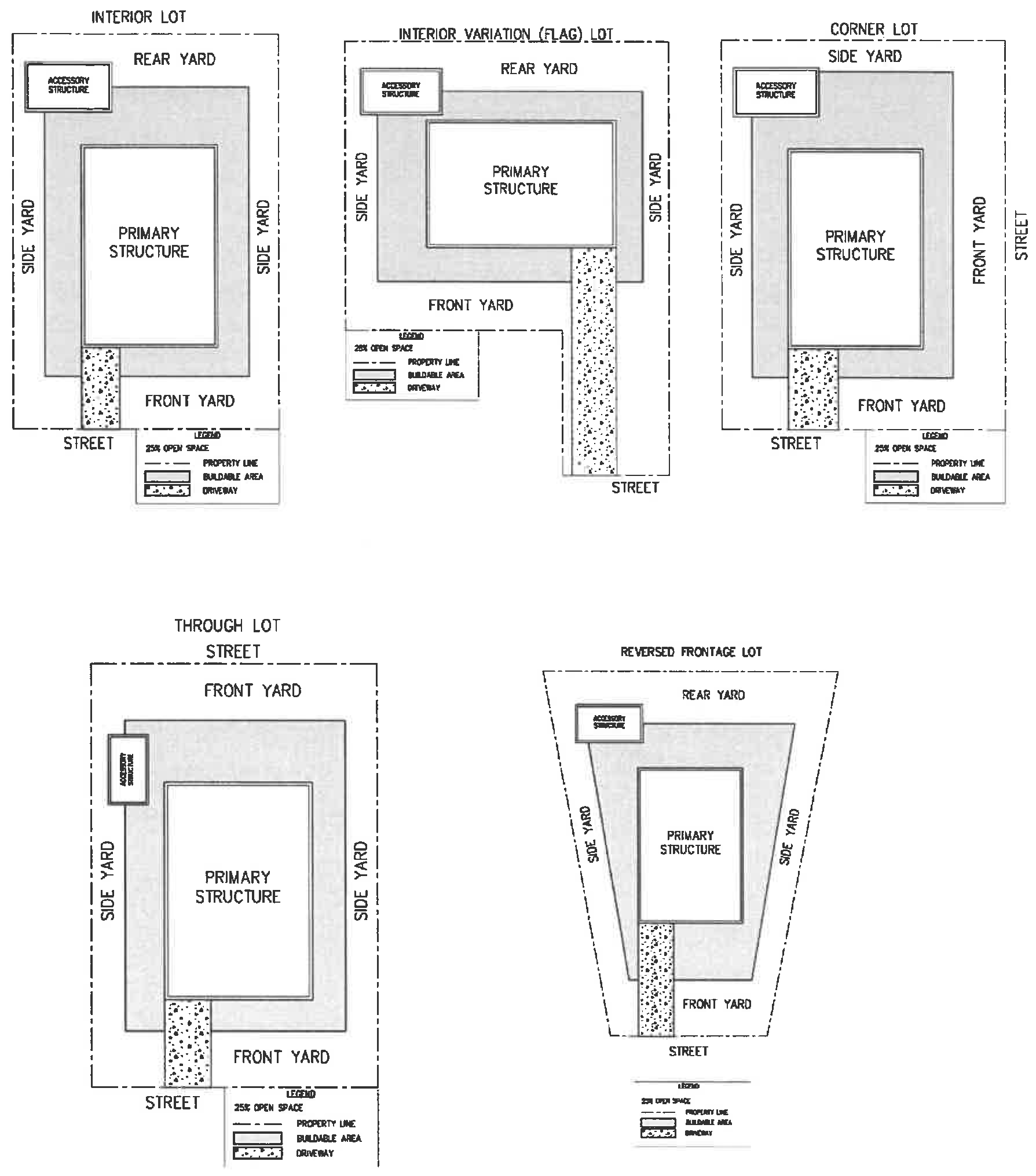
8.7.4.
Fences, walls and hedges. Fences, walls and hedges may be permitted in any yard area provided they meet the following requirements:
A.
Rear and side yards. Fences and walls in all rear and side yards shall not exceed six feet in height.
B.
Front yard. Fences, walls or hedges in a front yard shall not exceed four feet in height. On corner lots refer to section 8.7.4.F. of this code.
C.
Whenever possible, fences shall be erected with its good side facing the abutting property.
D.
Height of retaining walls. Retaining walls shall not exceed the above height limitations as measured from the existing grade of any adjoining property at the lot line.
E.
Exceptions for commercial and industrial districts. Section 8.7.4. shall not be applied to any commercial or industrial districts. It is intended that there be no wall, fence, hedge or visual screen height limitations on CG-1, CG-2, I-1 I-2, BPUD and IPUD zoned properties except on corner lots or arterial or collector streets.
F.
On any corner lot, no fence, wall, hedge, or structure of any kind shall cause any obstruction to vision between three and ten feet above the centerline grades of intersecting streets within a triangular area formed by the street right-of-way lines of the corner lot and a straight line joining those right-of-way lines at points located 25 feet from the intersection of those right-of-way lines.
8.7.5.
Erection of more than one principal building on a lot. In the R-3, MH-1, CG-1, CG-2, MX-1, MX-2, I-1 and I-2 and PUD zoning districts, except for single-family use areas within a RPUD more than one principal building may be erected on a lot, provided that the spacing between principal structures shall not be less than 20 feet (ten feet in the MH-1 district) or consistent with the Florida Building and Fire Codes whichever is greater. In R-1, R-2 and OT zoning districts, only one principal building may be erected on a lot.
8.7.6.
Landscape buffers. Landscape buffers shall comply with the requirements of chapter 10 of this code.
8.7.7.
Off-street parking, loading and unloading. Where required by this code, every use or structure shall have an adequate number of off-street parking and loading and unloading spaces for the use of occupants, employees, visitors, customers, patrons or suppliers. The following regulations shall apply to the design and construction of all required off-street parking and loading and unloading areas. However, each developer should evaluate his own particular off-street parking and loading and unloading spaces in conjunction with the DSD to determine if they are greater than the minimum specified below:
A.
Surface, drainage, lighting and access.
1.
Any required off-street parking and loading and unloading areas shall be surfaced with brick, asphalt, bituminous concrete, Portland concrete, or paving blocks, and maintained in a smooth, well-graded condition, and in compliance with chapter 12 of this code. Where light duty or infrequent use of the parking lot may make it desirable, the approving body may approve a grass or gravel surface. Such grassed or gravel surface, if allowed, shall delineate on the site plan standard parking space locations by using wheel stops, retaining curbs, timbers or a combination of these materials sufficient to ensure the provision of the minimum required parking spaces. Drive aisles may be required to be stabilized or paved for grassed parking areas on a case-by-case basis. Should the use of this lot change appreciably, however, such that a grass or gravel surface is no longer adequate, the DSD may require the lot to be resurfaced with brick, asphalt, and bituminous concrete Portland concrete or paving blocks. All such approvals of grass or gravel surface parking shall be made conditioned upon acceptance of an agreement from the property owner recognizing this obligation. Where advisable, a formal agreement may be required to be filed in the public records.
2.
If lighted, no artificial lighting shall be directed upon adjacent property.
3.
All areas shall be designed for the safety and convenient access of pedestrians and vehicles.
B.
Location. Required off-street parking or loading and unloading spaces shall be located no less than ten feet from any front lot line and five feet from any side or rear lot lines on the same lot they are intended to serve. If the required off-street parking spaces cannot reasonably be provided on the same lot on which the principal building or use is located, such required off-street parking spaces may be located on another lot, owned or leased by the owner of the lot on which the principal structure or use is located, provided that the parking area is located within 200 feet of the premises to be served.
C.
Plan requirement. An off-street parking and loading and unloading space plan shall be submitted for all developments for which site plan review is required under chapter 6 of this code. The plan shall accurately illustrate the number and location of parking spaces, access aisles, driveways, vehicle turnarounds and backup areas, areas designated for trash collection, off-street loading and unloading spaces, if required, and any required landscaped buffer areas.
_____
D.
Dimensional requirements for off-street parking areas. Off-street parking areas shall be designed according to the table below.
Note: Maneuvering areas shall be designed to permit vehicles to enter and leave the parking area in a forward direction. Vehicle backup areas shall be 15 feet wide and have a 15-foot turning radius.
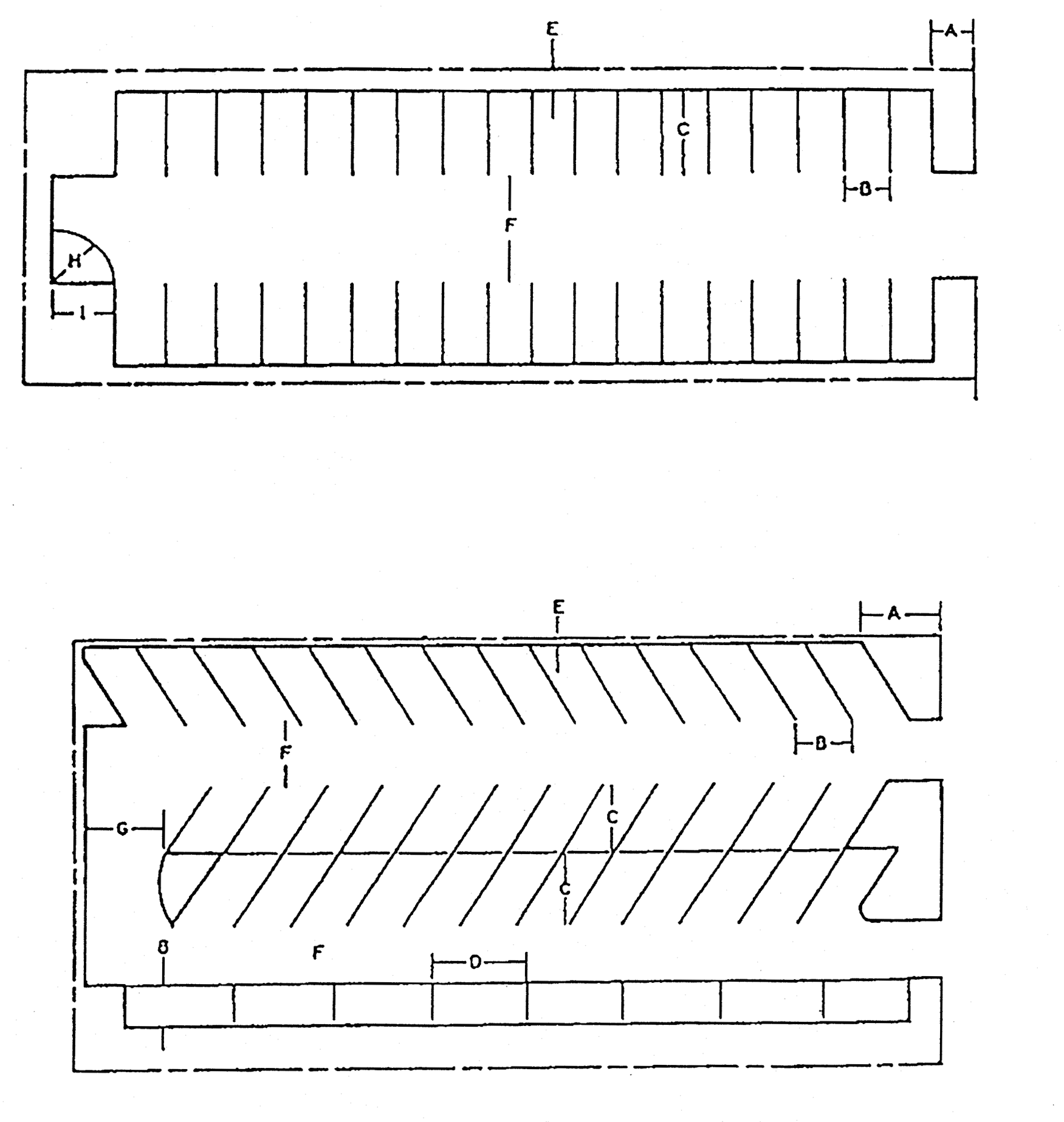
Off-Street Parking Diagram
E.
Minimum off-street parking spaces. The minimum number of off-street parking spaces shall be determined as specified below. However, each applicant shall evaluate the projects particular parking needs to determine if said needs are greater than the minimums specified below. Numbers for any use not specifically mentioned shall be the same as for the use most similar to the one sought. Fractional spaces shall be rounded to the closest number. In stadiums, houses of worship, sports arenas, or other places of assembly where occupants sit on seats without dividing arms, each 18 linear inches of such seat shall be counted as one seat.
Amusement centers (arcades, skating rinks, miniature golf and similar uses): One per each 200 square feet of area within enclosed buildings, plus one space for three persons the outdoor facilities are designed for, at maximum capacity.
Automotive, boat, motorcycle, mobile home and recreational vehicle sales: One per 500 square feet of FA*; one per each employee; two per service bay.
Ball park or stadium (other than Little League): One for each three seats, or one for each 300 square feet of floor area, whichever is greater.
Banks and similar financial institutions: One per 250 square feet of FA.*
Barber and beauty shops: Three per station or chair.
Baseball/softball: Thirty-eight spaces per field.
Basketball court: Five spaces per court.
Bed and breakfast: One for each guest room plus two per dwelling unit.
Bowling alleys: Four for each alley, in addition to spaces required for consumption of food and beverages or other recreational uses.
Commercial uses not listed: One per 200 square feet of FA.*
Community center or recreation center: One space per 200 square feet of FA.*
Concession building: One space per concessionaire or employee.
Day care center: One per five clients, plus one space per employee.
Duplex and multifamily dwelling: Two per dwelling unit with two or more bedroom units; 1.5 per each one-bedroom unit.
Equipped playground: Ten spaces per site.
Furniture and flooring store: One per 1,000 square feet of FA.*
General, nonmedical, offices: One per 200 square feet of FA.*
Golf or country clubs: Three spaces per golf hole, one for each three seats, or one for each 200 square feet of FA*, whichever is greater.
Group homes: One for each five persons plus one for each employee on the largest shift.
Handball/racquetball court: Two spaces per court.
Hardware store and home improvement stores: One per 350 square feet of FA.*
Health club: Seven spaces, per 1,000 square feet of FA.*
Hospital: One for each employee on the largest shift, plus one-half for each bed, and one-half for each staff doctor.
House of worship, auditoriums, funeral homes and other places of assembly not listed: One for each three seats in the principal place of assembly or one space for every 40 square feet of seating area where there are no fixed seats.
Jogging/fitness trail: Two spaces per trail head.
Library, art gallery: One for each 300 square feet of FA.*
Manufacturing industries: One for each employee on the largest shift.
Medical offices, clinics and laboratories: One per 150 square feet of FA.*
Mini-warehouses: One for every ten storage cubicles.
Mobile home dwellings: Two per dwelling unit.
Mobile home parks: Two per dwelling unit, plus any additional spaces reasonably required for accessory buildings or structures.
Motels or hotels: One for each unit, plus one for each five employees, in addition to spaces required for accessory uses.
Motor vehicle repair: One per 250 square feet of FA* and three spaces per service bay.
Multipurpose court: Five spaces per court.
Multipurpose field: Eight spaces per acre.
Municipal, county, state, federal and community buildings: Four spaces for each 1,000 square feet of FA.*
Nursing homes: One for each four beds, and one for each employee on the largest shift.
Open "free play" area: Eight spaces per acre.
Picnic area: One space per table.
Pool halls and billiard parlors: Two for each pool or billiard table.
Restaurants, types A and B, nightclubs or bars: One per two seats or one for each 200 square feet of FA.* for take-outs.
Retail sales and service establishments: One per 200 square feet of FA.*
Rooming houses, boarding housing (dormitories): One and one-half for each bedroom or unit rented.
Schools; private elementary schools: One for each faculty member, plus one for each employee.
Schools; private high school: One for each faculty member, plus one for each employee, plus one space for each ten students.
Schools; colleges or other institutions of higher learning, trade/vocational: one for each staff member and employee, plus one for each three students.
Service stations, types A and B: One for each gas pump, plus three for each grease rack or other working bay.
Shopping centers: Five spaces for each 1,000 square feet of FA.*
Shuffleboard court: Two spaces per court.
Single-family dwellings: Two per dwelling unit.
Swimming pool (50 m): One per 200 square feet of pool surface area, plus one space for each 200 square feet of building area in accessory structures in excess of 1,000 square feet.
Tennis court: Two spaces per court.
Theaters: One for each four seats, one for each employee.
Transportation centers: One for each four estimated average daily passengers.
Volleyball: Six spaces per court.
Warehousing (commercial and industrial): One for each employee, plus one for each 1,500 square feet of storage area.
*FA - Floor area.
F.
Required off-street loading and unloading spaces. Off-street loading and unloading areas are required in order to provide adequate space for the loading and unloading of goods, without interfering with the public use of streets or off-street parking spaces. Off-street parking spaces may not be used to meet off-street loading or unloading requirements. Each off-street loading or unloading space shall be directly accessible from a street without crossing or entering any other required off-street loading or unloading space and may not extend into any street.
G.
Off-street loading and unloading space dimensional requirements. Each required off-street loading and unloading space shall have a minimum dimension of 12 feet by 40 feet and a minimum overhead clearance of 14 feet above the paving grade.
_____
H.
Minimum off-street loading and unloading spaces. The minimum numbers of off-street loading and unloading spaces shall be determined from the following table.
_____
I.
Modification of requirements. The technical review committee, planning commission or city council, as the case may be, may permit modifications of these minimums off-street parking and loading and unloading requirements where said body determines one or more of the following:
1.
Adequate facilities have been provided either off-site or through shared parking arrangements with other land uses.
2.
The operating characteristics of a particular use are such that a greater or lesser amount of off-street parking, loading and/or unloading facilities are needed. The operating characteristics shall be substantiated by a parking study prepared by a Florida Certified Engineer.
3.
Paved impervious surface which totals less than these minimum requirements are appropriate to the protection of native vegetation and open space on the site.
J.
Mixed uses. The off-street parking and off-street loading and unloading spaces for one use shall not be considered as providing the required off-street parking and/or off-street loading and unloading space for any other use.
_____
8.7.8.
Minimum requirements for off-street handicapped parking. Except for standard and manufactured single-family dwellings, mobile homes, and two-family standard or manufactured dwellings, where off-street parking spaces are required by this code, the number to be reserved for the handicapped shall be determined as follows:
8.7.9.
Bicycle and Motorcycle Parking.
A.
Bicycle parking. Each of the following uses shall be required to provide parking spaces for bicycles; parks/recreation areas, convenience stores, restaurants (types A and B), game rooms, pharmacies, shopping centers (regional, community and neighborhood), and any employment facility (i.e., office, industrial) with at least 50 employees. The minimum number of bicycle spaces to be provided shall be as follows:
All bicycle racks shall be located so as to not conflict with automobile or pedestrian traffic flow.
_____
B.
Motorcycle parking. Developments with more than 100 spaces may substitute motorcycle parking for automobile parking at a rate of three percent of required parking. Areas delineated for use by motorcycles shall meet standards consisting of an area of four feet by ten feet and shall be identified as a motorcycle parking area by signs or pavement delineation.
8.7.10.
Mass transit requirements. Community and regional shopping centers shall be designed to accommodate buses for convenient and safe boarding and unloading of passengers as well as maintaining a safe traffic pattern. Commercial centers of greater than 100,000 square feet of gross leasable floor area shall provide a passenger shelter or covered benches.
8.7.11.
Parking and storage of vehicles or watercraft.
A.
No commercial motor vehicle shall be parked overnight in the R-1, R-2, R-3, MH-1, OT, MX-1 and RPUD zoning districts or within 100 feet of said districts. In the MX-2, CG-1, CG-2, I-1, I-2, BPUD and IPUD zoning districts no commercial motor vehicle shall be parked overnight that are not used in conjunction with the premises where said vehicle parks overnight.
B.
Recreational vehicles, trailers, boats and the like, belonging to the occupants of the property, may be stored in the R-1, R-2 and OT zoning districts provided the following conditions are met:
1.
They shall have a current license plate or validation sticker, and shall be parked or stored in full compliance with all yard requirements for accessory structures. The ground area beneath such vehicles shall be kept free from debris, including excessive weed growth.
2.
They may be temporarily parked in the driveway of the principal structure for a maximum 24-hour period for trip preparation, loading, unloading and cleanup.
3.
They shall not be parked either within a street or within that portion of the lot lying across the full width of the lot between the front lot line and the frontmost part of the principal structure.
4.
No sewage shall be permitted to escape from such vehicles onto a lot or street.
5.
They shall not be connected to water, sewer or electric lines or be used for residential purposes.
C.
Residential parking. In the R-1, R-2, R-3, MH-1 and OT zoning districts, motor vehicles shall not be parked in front yard areas except on driveways designed for off-street parking.
8.7.12.
Environmental standards. These environmental standards shall apply in all zoning districts:
A.
Air pollution. There shall be no emission of fumes, odors, vapors, gases, chemicals, smoke, dust, dirt, fly ash, or any particulate matter in violation of applicable state standards.
B.
Water pollution. There shall be no discharge of liquid or solid wastes into any public or private sewage disposal system, or into or on the ground, or into any stream, waterway, water body or drainage canal, nor any accumulation of any liquid or solid wastes, in violation of applicable state standards.
C.
Other nuisances. No use or activity shall be permitted which shall produce noise, vibration, glare, electrical interference, or heat in excess of normal background levels beyond the property line of the lot on which such use or activity is proposed or located.
8.7.13.
Home-based business. The intent of this section is [to] regulate a home-based business operating from a residential property in accordance with F.S. § 559.955.
A.
Standards for home-based business. A home-based business shall meet the following standards:
1.
The employees of the business who work at the residential dwelling must also reside in the residential dwelling, except that up to a total of two employees or independent contractors who do not reside at the residential dwelling may work at the business. The business may have additional remote employees that do not work at the residential dwelling.
2.
Parking related to the business activities of the home-based business must comply with section 8.7.11 of this Code. The need for parking generated by the business may not be greater in volume than would normally be expected at a similar residence where no business is conducted. Parking within the public right-of-way may be permitted in accordance with chapter 16, traffic, Orange City Code of Ordinance.
3.
As viewed from the street, the use of the residential property is consistent with the uses of the residential areas that surround the property. External modifications made to a residential dwelling to accommodate a home-based business must conform to the residential character and architectural aesthetics of the neighborhood.
4.
The home-based business may not conduct retail transactions at a structure other than the residential dwelling. However, incidental business uses and activities may be conducted at the residential property.
5.
The activities of the home-based business are secondary to the property's use as a residential dwelling.
6.
Signage is permitted in accordance with chapter 9 of this Code. Permanent ground signs are not allowed on any size residential property with less than four units. A two-square foot wall plaque is exempt from the city's sign code provisions.
7.
A home-based business shall be subject to the city and county business taxes.
8.
Environmental standards in section 8.7.12 of this Code and chapter 9, property maintenance and chapter 10, noise offenses, Orange City Code of Ordinances applies to all home-based business, but no more stringently than those that apply to a residence where no business is conducted.
8.7.14.
Automobile service stations. The following regulations shall apply to automobile service stations:
A.
Principal or accessory structures shall not be erected within 35 feet of any property zoned for residential use.
B.
No accessory structures shall be erected closer than ten feet to a street. If accessory structures are erected within any front yard, they shall be removed before the property is converted to use other than an automobile service station.
C.
The number of points of access for one automobile service station shall not exceed one for each 75 feet of street frontage. Each point of access shall be no more than 30 feet wide and be located no less than 25 feet from the intersection of a street right-of-way. Each point of access shall be located no less than 15 feet from any other property line. On state and county maintained roads, clearance for additional points of access shall first be obtained from the state department of transportation or Volusia County.
D.
Where lots to be used for service stations abut any property zoned for residential use, a landscaped buffer area meeting the requirements of chapter 10 of this code shall be provided.
E.
All materials, merchandise and equipment, other than motor vehicle fuels, shall be stored within the principal building.
F.
Adequate, enclosed trash storage facilities shall be provided on the site.
G.
Wreckers and service or customer vehicles, may be parked on the premises but shall be parked in a manner that will not create a traffic hazard or interfere with any vehicular maneuvering area necessary for gasoline pump areas, service bays or within any required off-street parking spaces.
8.7.15.
Package sewage treatment plants. Package treatment plants shall with the following standards and all applicable state requirements:
A.
Package sewage treatment plant structures shall not be located closer than 25 feet to adjoining lot lines.
B.
Evaporation/percolation ponds shall not be located within 100 feet of adjoining lot lines, street rights-of-way, the mean high-water mark of water bodies or bulkhead lines.
C.
Subsurface drainfields shall not be located within 50 feet of bulkhead lines or the mean high-water mark of the water bodies.
D.
When spray irrigation fields are used, the minimum distance between said fields and adjoining lot lines, street rights-of-way, the mean high-water mark of water bodies, or bulkhead lines shall be determined on a case-by-case basis after due consideration of prevailing wind direction, average wind velocity or other conditions that might carry sprayed effluent onto adjoining premises.
E.
The package plant structures shall, in the absence of an appropriate natural vegetation screen, be visually screened from adjoining properties or street rights-of-way with an appropriate fence, decorative masonry wall or plant materials.
8.7.16.
Temporary uses and structures.
A.
Dwelling unit, model. Any new dwelling unit may be used as a model dwelling unit provided that:
1.
It shall have received a temporary certificate of occupancy for a model dwelling unit.
2.
The model dwelling unit shall not be used as a residence or for a storage area for building materials or equipment.
3.
Prior to being occupied as a family residence, it shall have received a certificate of occupancy.
B.
Mobile offices. Mobile offices or mobile units designed as offices shall be permitted for only the initial builder/developer as temporary on-site construction offices, on-site sales offices or on-site security offices, providing:
1.
Mobile offices shall be secured with a temporary perimeter construction fence that contains a windscreen and maintained in good condition for the duration of the project.
2.
Mobile offices shall have a minimum setback of 35 feet measured from any property line abutting an existing single family residential dwelling, unless a special permit is authorized by the city council.
3.
Such mobile offices may only be used in conjunction with the development of approved subdivisions, mobile home parks, or in conjunction with the construction of commercial, multifamily or industrial buildings.
4.
A mobile office may be used in conjunction with the rental or sale of mobile homes from licensed mobile home sales lots.
5.
Such mobile office shall not be used as a residence. The use shall be limited to on-site construction, sales or security purposes in connection with the project on which the structure is located.
6.
The person responsible for the development on which the mobile office is to be located shall obtain the proper permits from all applicable governmental agencies, including but not limited to electrical, plumbing and building permits.
7.
Permits for mobile offices shall be issued only as follows:
a.
For the construction of approved subdivisions, only after preliminary plat approval.
b.
For the development of mobile home parks and mobile recreation vehicle shelter parks, only at the same time or after any applicable building permits for the installation of improvements are issued.
c.
For commercial, industrial or multifamily projects, only after the site development plan has been approved.
8.7.17.
Innovative residential development.
A.
Zero lot line subdivisions. Where permitted, these subdivisions shall meet the following requirements:
1.
Side yards on an individual lot shall total ten feet in width. One side yard may be zero feet, but the spacing between principal buildings on adjacent lots shall be ten feet.
2.
Where a dwelling unit is located on a lot line but is not constructed against a common wall of an adjacent dwelling unit, a legal provision acceptable to the city attorney shall be made for permanent access to maintain the exterior portion of the dwelling unit wall along the zero lot line.
3.
Doors or other access openings not including windows are prohibited on the zero lot line side of the dwelling unit.
4.
All other requirements of the applicable zoning district shall be met.
B.
Cluster subdivisions. Where permitted, cluster subdivisions shall meet the following requirements:
1.
No cluster subdivision lot shall be reduced in area to less than 6,000 square feet and in width of less than 50 feet.
2.
All other dimensional requirements of the district in which the lots are located shall be met.
3.
The area that the lots are reduced below their district's minimum lot area shall be dedicated as common open space of the cluster subdivision in which the lots are located.
4.
All cluster subdivision lots shall have access to a public road either directly or by private easement.
8.7.18.
Internet cafes. Internet cafes are establishments offering onsite internet or computer access, or phone card sales, the primary activity or business of which is the sale of internet, computer or phone access or time for compensation or value whether for profit or not; including game rooms, arcades, internet cafes, sweepstake redemption centers, or establishments using slot machine like equipment.
Allowable hours of operation shall only be from 10:00 a.m. to 10:00 p.m. In addition, the sale of computer access for the use of sweepstakes or phone card activities as an accessory or ancillary use is prohibited in all zoning districts except in I-2 zoning district.
8.7.19.
Assisted living facilities. Assisted living facilities (ALFs) are intended to meet a need for facilities that provide housing and some personal services for persons who do not require nursing home or hospital care. Qualifying facilities shall be licensed and regulated by the state.
A.
Basic use standards.
1.
Area, width, depth, yard and land coverage specifications shall meet the requirements of this code for multifamily developments.
2.
Maximum residential densities shall not exceed the level that the planning commission determines is consistent with the comprehensive plan. The commission shall consider the number and size of bedrooms, projected age of the residents, projected number of residents per dwelling unit, traffic impact, public facility and service needs and capacity and compatibility with nearby development.
3.
No building shall be located closer than 25 feet to any street or street right-of-way. Additional setback requirements may be imposed by the planning commission to provide adequate light, ventilation, privacy and other appropriate standards.
B.
Uses. Within an ALF, the following uses are permitted providing that all such uses are located within the principal structure and the area of the individual businesses does not comprise more than ten percent of the total floor area of the project.
1.
Personal service establishments such as a beauty parlor, barbershop, tailor and other similar uses provided not more than three persons are employed in any one establishment.
2.
Retail sales establishments primarily for the use of the tenants, provided that any one establishment does not exceed 800 square feet.
3.
Doctor's offices and medical clinics primarily for the use of the tenants provided that any one establishment does not exceed 1,200 square feet.
8.7.20.
Communication towers and communication antennas. All communication towers and antennas shall be subject to these regulations and all other applicable regulations. For purposes of measurement, communication tower and antenna setbacks and separation distances as listed in section 8.7.20.G. of this chapter shall be calculated and applied irrespective of municipal and County jurisdictional boundaries.
A.
All communication towers and antennas legally existing on the effective date of this code shall be considered permitted uses, allowed to continue their usage as they presently exist; provided however, anything other than routine maintenance, including without limitation, structural modifications including provisions for additional antennas or additional providers and/or new construction on an existing communication tower and antennas, shall comply with the requirement of this section, with the exception of separation distances. Routine maintenance shall be permitted on such existing tower or antenna.
B.
All government towers with public safety systems or equipment shall be exempt from the requirements of this section.
C.
All new communication antennas which are not attached to communication towers shall comply with section 8.7.20.G. of this code.
D.
Communication towers and/or communication antennas located on existing towers or buildings shall comply with the following requirements:
1.
Said towers and/or antennas shall be located on towers or buildings which are at least 35 feet in height.
2.
If located on top of buildings said towers and/or antennas shall be set back at least ten feet from the edge of the buildings (water towers shall not be considered to be buildings subject to this setback requirement).
3.
Said towers and/or antennas shall not exceed greater than 40 percent over the building height.
4.
Said towers and/or antennas shall not be subject to this chapter's performance and construction standards for freestanding towers pertaining to separation distances, fencing, landscaping, and co-location.
E.
Utility poles and transmission towers shall not be considered existing towers or buildings upon which antennas and/or towers are permitted to be located.
F.
New freestanding communication towers/communication antennas shall not be allowed unless the applicant:
1.
Secures approval from the technical review committee upon showing:
a.
That existing towers and buildings do not technologically afford the applicant the ability to provide service to the service area of the applicant or service provider; and
b.
That the geographical boundaries of the proposed service area cannot technologically be bifurcated to avoid the necessity for a freestanding tower/antenna.
2.
Secures a conditional use approval, pursuant to chapter 3 of this code, to place the communication tower and/or communication antenna, within one of the following zoning categories:
a.
I-1 Light industrial.
b.
I-2 Heavy industrial.
G.
Performance and construction standards.
1.
Structural design. New communication towers and antennas and modifications to existing structures including, without limitation, the addition of height, antennas or providers, shall be constructed in accordance with all city building codes.
2.
Setbacks. Communication tower/antenna setbacks shall be measured from the base of the tower/antenna, or protruding building structure at the base of the tower, whichever is closest to the property line, to the property line of the parcel on which it is located. Communication towers/antennas and their accessory structures shall comply with the minimum yard setback requirements of the zoning district in which they are located. In cases where there is a conflict between the minimum yard setback requirements and the separation distance of section 8.7.20.G.4. and 5., the greater distance shall apply. In addition, where there is a principal building housing a principal use located on the site, the communication tower/antenna and accessory structures to the tower/antenna shall be located behind the main building line. All communication tower/antenna supports and peripheral anchors shall be located entirely within the boundaries of the development site and shall be set back from the development site perimeter a minimum distance of five feet, or the minimum yard setback of the zoning district in which the communication tower/antenna is located, whichever is greater.
3.
Measurement of tower separation distance from off-site uses. Communication tower separation shall be measured from the base of the tower to the closest point of off-site uses and/or designated areas as specified in section 8.7.20.G.4. and 5. of this chapter. For purposes of this requirement, global positioning system (GPS) coordinates for the center of the tower(s) may be used.
4.
Separation of communication towers from residential uses and zoning districts. Separation requirements for monopole, camouflaged or lattice communication towers from residentially zoned lands or residential uses shall be 300 percent of the towers height.
5.
Separation distances between communication towers.
a.
Separation distances between communication towers shall be applicable for and measured between the proposed tower and those towers that are existing and/or have received land use or building permit approval from the city or adjoining jurisdictions.
b.
The separation distances shall be measured by drawing or following a straight line between the base of the existing tower and the proposed base, pursuant to a site plan, of the proposed tower. For purposes of this requirement, GPS coordinates for the tower(s) may be used.
_____
c.
The separation distances (listed in linear feet) shall be as follows:
Existing Towers-Types (Including Extra Jurisdictional Area)
H.
Waivers. A waiver from the minimum separation distances set forth in Sections 8.7.20.G.4. and 5. of this chapter may be approved through the conditional use process in accordance with the procedures set forth in chapter 3 of this code when the proposed communication tower conforms to two or more of the following criteria:
1.
Camouflaging techniques approved by the city are incorporated into the design of the communication tower.
2.
Two or more communication service providers agree to co-locate communication antennas on the same tower.
3.
The tower or towers within the required separation distance are all located in an industrial zoning district as a conditional use.
4.
The proposed location will minimize the visual impact of the proposed communication tower due to the bulk height, use, or appearance of the adjacent structures and surrounding area.
I.
Fencing. A black vinyl or decorative wrought iron fence or wall not less than eight feet in height from finished grade shall be provided around each communication tower. Access to the tower shall be through a locked gate.
J.
Landscaping. The visual impacts of a communication tower shall be mitigated for nearby viewers through landscaping or other screening materials at the base of the tower and ancillary structures. The following landscaping and buffering of communication towers shall be required around the perimeter of the tower and accessory structures. Landscaping shall be installed on the outside of fences or walls. Further, the use of existing vegetation shall be preserved to the maximum extent practicable and may be used as a substitute of or in supplement towards meeting landscaping requirements.
1.
A row of trees a minimum of three inches at DBH and a minimum of eight feet tall and a maximum of 25 feet apart shall be planted around the perimeter of the fence; and
2.
A continuous hedge at least 30 inches high at planting capable of growing to at least 36 inches in height within 18 months shall be planted in front of the tree line referenced above; and
3.
All landscaping shall be of the evergreen variety.
K.
Height.
1.
No freestanding communication tower/antenna shall exceed 200 feet in height from ground level.
2.
Where installed on top of a building, no communication tower/antenna shall extend greater than 40 percent over the building height.
3.
An existing communication tower may be modified to a taller height not to exceed 20 feet over the tower's existing height to accommodate the co-location of an additional communication antenna(s). Said height change may only occur one time per communication tower and shall not require an additional distance separation. The communication towers premodification height shall be used to calculate distance separations and the additional height shall not require an additional distance separation.
L.
Type of construction. Communication towers shall be monopole or lattice construction; provided, however, camouflaged construction may be approved as a conditional use consideration of the following factors in addition to those set forth chapter 3 of this code:
1.
Compatibility with adjacent properties;
2.
Architectural consistency with adjacent properties;
3.
Visual impact on adjacent properties, including visual access of adjacent properties to sunlight; and
4.
Design of accessory structures in order to be architecturally consistent with the existing structures on the site. A variance/waiver from the fencing and landscaping requirements of this section may be requested for such accessory structures.
M.
Development criteria. Communication towers/antennas shall comply with the minimum development criteria of the zoning district in which they are located, pertaining to minimum lot size and open space.
N.
Illumination. Communication towers/antennas shall not be artificially lighted except to assure human safety or as required by the Federal Aviation Administration (FAA). At time of construction in cases where there are residential uses within a distance 300 percent of the height of the tower, dual lighting shall be requested from the FAA.
O.
Co-location.
1.
Monopole communication towers shall be engineered and constructed to accommodate a minimum of one additional communication service provider.
2.
Lattice communication towers shall be engineered and constructed to accommodate a minimum of two additional communication service providers.
3.
Camouflaged communication towers may be engineered and constructed without accommodating additional communication service providers.
4.
Communication towers located within electrical substations may be engineered and constructed without accommodating additional communication service providers. Such towers shall be monopole construction and shall be subject to all of the requirements of this section. The substation shall only be located within the I-1 and I-2 industrial zoning district. All such supports and anchors shall also observe a minimum horizontal setback from any overhead utility lines of not less than ten feet.
5.
Proposed communication antennas may, and are encouraged to, co-locate onto existing communication towers, provided such co-location is accomplished in a manner consistent with this section. Such co-location shall be permitted and new or additional special exception approval may not be required.
6.
If determined by the city that the proposed tower is situated in a location which will benefit the city's telecommunication systems, then the tower shall be engineered and constructed to accommodate the additional telecommunication equipment beneficial to the public system at a cost to the city no greater than the actual expense of the provider in engineering and constructing the tower to meet the city's needs.
7.
Onsite location. A communication tower that is being rebuilt to accommodate the co-location of an additional communication antenna may be moved onsite within 50 feet of its existing location; however, the antenna shall meet the greater of the yard setback or separation distance setback requirements in section 8.7.20.G.4. of this chapter. After the communication tower is rebuilt to accommodate co-location, only one tower may remain on the site.
8.
A relocated onsite communication tower shall continue to be measured from the original tower location for purposes of calculating separation distances between towers. Relocation of a tower in accordance with this section shall in no way be deemed to cause a violation of this section. The onsite relocation of a communication tower which does not comply with the separation distances specified in section 8.7.20.G.4. of this chapter shall require variance approved by the planning commission.
9.
The modification or reconstruction of an existing communication tower to accommodate the co-location of two or more communication antennas shall be permitted without new or additional conditional use permit approvals, provided that the communication antennas are owned or operated by more than one communication service provider and the co-location does not change the communication tower from one type tower to another except that any type of communication tower may be reconstructed as a monopole tower.
P.
Noninterference. No communication tower or antenna shall interfere with public safety communication. Frequency coordination is required to ensure noninterference with public safety system and/or public safety entities.
Q.
Documentation. Documentation to demonstrate conformance with the requirement of this section shall be submitted by the applicant with all requests to construct, locate or modify a communication tower/antenna. A statement by the applicant as to how construction of the communication tower will accommodate co-location of additional antennas for future users shall be included with the documentation.
R.
Signs and advertising. The use of any portion of a tower for sign or advertising purposes including, without limitation, company name, banner, or streamer is prohibited.
S.
Abandonment. In the event the use of any communication tower has been discontinued for a period of 180 consecutive days, the tower shall be deemed to have been abandoned. Determination of the date of abandonment shall be made by the development services director who shall have the right to request documentation and/or affidavits from the communication tower owner/operator regarding the active use of the tower. Upon such abandonment, the owner/operator of the tower shall have an additional 180 days within which to:
1.
Reactivate the use of the tower or transfer the tower to another owner/operator who makes actual use of the tower; or
2.
Dismantle and remove the tower. The owner of the real property shall be ultimately responsible for all costs of dismantling and removal, and in the event the tower is not removed within 180 days of abandonment, the city may proceed to do so and assess the costs against the real property. The lien of such assessment shall bear interest, have priority and be collectable, at the same rate and in like manner as provided for special assessments by state law. At the earlier of 181 days from the date of abandonment without reactivation or upon completion of dismantling and removal, prior approval for the tower shall automatically expire.
T.
Finished color. Communication towers not requiring FAA painting/marking shall have either a galvanized finish or be painted a noncontrasting blue, gray or black finish. The color should be selected so as to minimize the equipment's visibility.
U.
Bird nesting. New freestanding communication towers shall incorporate a design that provides an integral nesting platform to direct the most likely site for bird nesting to a location on the tower which will reduce the risk of interference with tower equipment and maintenance.
V.
Certification of compliance with Federal Communication Commission (FCC) certification of compliance with current FCC nonionizing electromagnetic radiation (NIER) shall be submitted prior to receiving final inspection by the chief building official.
W.
Communication antennas. Any communication antenna which is not attached to a communication tower shall be a permitted ancillary use to any commercial, industrial, office, institution, multifamily or public utility structure, provided that:
1.
The communication antenna does not exceed 20 feet above the highest point of the structure;
2.
The communication antenna complies with all applicable FCC and FAA regulations; and
3.
The communication antenna complies with all applicable city building codes and other applicable provisions of this chapter.
8.7.21.
Customer-end communication antennas. Antennas that receive or transmit signals, which service only the occupants or residents within a parcel, shall be subject to the standards set forth below unless otherwise exempt. No personal communication antenna shall function to serve radio transmission or reception from a wireless communication service provider on a broader service basis than the customer located on that site.
A.
Exemptions. Reception-only, customer-end antennas meeting the following criteria do not require a building permit but shall comply with the minimum requirements set forth in section 8.7.21.B. of this chapter.
1.
A dish antenna that is one meter (39.97 inches) or less in diameter and designed to receive direct broadcast satellite service, including direct-to-home satellite service, or to receive fixed wireless signals via satellite;
2.
An antenna that is one meter or less in diameter or diagonal measurement and is designed to receive video programming services via MDS (wireless cable) or to receive fixed wireless signals other than via satellite;
3.
An antenna that is designed to receive local television broadcast signals and the combined height of the antenna is less than 12 feet above the roofline.
B.
Standards for antennas exempt from building permits.
1.
An antenna shall not be placed within five feet of any public sidewalk or public passageway.
2.
Distance between an antenna, including any mast therewith supporting, and power lines shall avoid potential contact should the antenna and/or support mast fall.
3.
Any antenna placed in a manner or location that is a clear threat to public safety or to inhabitants or occupants within a property or adjacent property, as determined by the enforcement official, shall be deemed code violation subject to the provisions of chapter 3.
4.
The preferred location for a dish antenna is recommended according to the following priorities: locations not visible from the street, the rear yard or wall, or the side yard or wall.
5.
Dish or panel antenna affixed to nonresidential buildings shall have a similar color as the building unless demonstrated by the communication service provider that painting the antenna impairs quality of reception.
C.
Transmitting fixed wireless signal antenna. For antennas that do not qualify as exempt under section 8.7.21.A. of this chapter and that function to transmit fixed wireless signals, either as a transmit-only or a receive and transmit antenna, a city building permit is necessary prior to installing any such antenna. To minimize and avoid any threat to public safety resulting from radio frequency radiation, such antenna shall only be installed by a qualified professional business holding a local business tax receipt to install such antenna within the city. Upon receipt of application fees, a certification that the antenna meets all FCC regulations for radio frequency transmission and all other applicable regulations the chief building official shall issue a building permit to the licensed installer.
D.
Non-exempt satellite dish. Customer-end dish antennas that do not qualify as exempt under section 8.7.21.A. of this chapter shall comply with the following standards. A conditional use permit, approved by the planning board, is required prior to installation of a non-exempt satellite dish antenna.
1.
Setbacks. No portion of any satellite dish antenna shall be located in any required setback area for a principal use.
2.
Number. No more than one satellite dish antenna shall be permitted on a residential lot, parcel, or building. Up to three satellite dish antennas may be placed on a nonresidential property provided said antennas are screened from adjacent properties.
3.
Color. All satellite dish antennas not screened shall be painted in a manner compatible with the structures on the site.
4.
Sign. No sign of any kind shall be posted or displayed on any satellite dish antenna.
5.
Ground mounted satellite dish antennas.
a.
Size. The diameter of a ground-mounted dish antenna shall not exceed ten feet.
b.
Height. The height of any portion of a ground-mounted dish antenna shall not exceed 12 feet from the ground in residentially zoned property or 15 feet from the ground in all other zoning districts.
c.
Location. In all residential zoning districts a ground-mounted dish antenna shall be located on the rear one-half of the lot, provided, however, if a lot borders a public street and any waterfront or park, the satellite dish antenna shall be located in the middle one-third of the lot measured from the property line adjacent to the public street to the rear property line, whichever is closest to the property line adjacent to the public street. In any zoning district, non-exempt satellite dishes shall not be allowed in any yard abutting a waterfront area unless completely screened by vegetation, fencing, or both.
d.
Visual screen. All satellite dishes shall be screened from view from adjacent properties or public right-of-way by landscaping planted at a minimum height of three feet and reaching a height of six feet.
e.
Other requirements. Ground mounted dish antennas shall not reduce area required, by provisions of this code, for parking, internal circulation, landscaping or other development standard criteria.
f.
Permanent mounting. All dish antennas shall be permanently mounted and no antenna may be installed on a portable or movable structure. All installation shall comply with the Florida Building Codes.
6.
Roof mounted antennas.
a.
Size. The diameter of any roof mounted satellite dish antenna shall not exceed ten feet.
b.
Height. Roof mounted antennas shall not exceed 12 feet above the roofline or the height limit for the zoning district, whichever is less.
c.
Location. Roof mounted dish antennas shall be mounted on the rear one-half of the building furthest from the primary access to the lot, provided, however, if a lot borders a public street and any waterfront or park, the satellite dish antenna shall be located in the middle one-third of the building measured from the property line adjacent to the public street to the rear property line, whichever is closest to the property line adjacent to the public street. The dish shall be located at least ten feet from any roof edge. Roof mounted non-exempt antennas are not allowed on building roofs that are pitched.
d.
Wiring. All electrical and antenna wiring shall be placed underground or otherwise screened from view.
e.
Screening. All roof-mounted antenna shall be visually screened from view from ground level areas on adjacent property or from public rights-of-way.
8.7.22.
Planned unit development (PUD). The following regulations apply to all planned unit developments PUDs.
A.
Unified control. All land included for purpose of development as a PUD shall be under the legal control of the applicant, whether that applicant be an individual, partnership or corporation or group of individuals, partnerships or corporations. Applicants requesting approval of a PUD shall present firm evidence of unified control of the entire area within the proposed PUD together with a certificate of apparent ownership and encumbrance with the opinion of counsel representing the developer establishing that the developer has the unrestricted right to impose all of the covenants and conditions upon the land as are contemplated by the provisions of these regulations.
The applicant shall state agreement to:
1.
proceed with the proposed development according to the provisions of these regulations and such conditions as may be attached to the approved PUD;
2.
provide agreements, contracts, deed restrictions and sureties acceptable to the city council for completion of the development according to the approved plans, and maintenance of such areas, functions and facilities as are not to be provided, operated, or maintained at public expense; and
3.
bind their successors in title to any commitments made under section 8.7.22.A.1. and 2. All such agreements and evidence of unified control shall be examined by the city attorney and no PUD shall be approved without a certification by the city attorney that such agreements and evidence of unified control meet the requirements of this code.
B.
Commercial uses in an MPUD. Commercial uses and structures shall be located and designed primarily to serve the needs of the MPUD residents. Commercial areas should normally be located in an area accessible only from streets within the MPUD. When commercial uses or structures are approved as part of an MPUD, the commercial operation shall not begin until certificates of occupancy have been issued for all dwelling units in the total project, unless otherwise provided in the development agreement.
C.
Common open space requirements. There shall be a minimum common open space requirement of 30 percent of the total gross acreage of the PUD. Common open space shall include active and passive recreation areas, with residents having physical access to the space, such as playgrounds, golf course, waterways, floodplains, nature trails and other similar open spaces. Passive facilities such as picnic tables and nature trails shall be placed in a manner that functions with the site's natural amenities or recreational needs of future residents. Examples of active recreational common space are playgrounds, free play areas, golf courses, swimming pools, and tennis courts. Open water bodies beyond the perimeter of the site; fenced retention areas; yards and spacing between buildings and street rights-of-way, driveways and parking areas shall not be included in determining the amount of common open space. Provisions for maintenance of the common open space shall be provided in the development agreement. Land designated as common open space shall be dedicated by plat, deed or other appropriate legal instrument satisfactory to the city attorney and usable by all residents of the PUD. Such instrument shall be binding upon the developer, its successors and assigns, and shall constitute a covenant running with the land and be in recordable form.
D.
Underground utilities. Within a PUD, all utility distribution lines, including telephone, television cable and electrical systems, shall be installed underground. However, appurtenances to said utilities requiring above ground installation may be exempted by the city council.
E.
Procedure for rezoning to PUD.
1.
Preapplication stage. A preapplication meeting is required before a PUD rezoning application can be accepted. After the preapplication meeting, a sketch plan may be submitted for review and comment prior to filing the application for rezoning.
2.
Preapplication meeting. The preapplication meeting is intended to provide an opportunity for the applicant to obtain comments and recommendations from the development services department. No fee shall be charged. The applicant need not submit any plans or other information; however, the more information, such as sketch plans, proposed land uses, site information, adjacent land uses, and proposed density, that the applicant does submit, the more complete comments or recommendations may be obtained from the staff. As a minimum, the applicant will be advised of the required procedures and requirements.
3.
Sketch plan. After the preapplication meeting, a sketch plan may be submitted to the development services department. If submitted, written comments on the sketch plan shall be made by the department and any other interested departments within 30 days. The development services department shall coordinate this review. If submitted, a sketch plan shall indicate general land use categories and the approximate height, location, architectural character and density of dwellings, and other buildings and structures. The sketch plan shall also show the tentative major street layout, approximate street widths, school sites, open space areas and parks, existing structures, waterways, wooded areas, wetlands, floodplain areas (if applicable), total amount of common open space and the total amount of commercial and industrial acreage if applicable. Finally, it shall include a vicinity map, and any other information deemed appropriate by the applicant. Written comments on the sketch plan are informational only and are subject to change after a more detailed review of the rezoning application.
4.
PUD rezoning application stage. An application for rezoning to a PUD, together with a master development plan (MDP) and such application fees as established by resolution of the city council shall be submitted to the development services department. If a rezoning applicant desires concurrent review under this code, the applicant shall so state at the time of application, and shall submit any additional information required by this code. The master development plan shall consist of a preliminary plan and a written development agreement. Those documents shall include the following information.
5.
Preliminary plan exhibits. The preliminary plan shall consist of the following:
a.
Name of project, street and email address, telephone and fax number of the developer and all professional project engineers, architects and planners.
b.
The date the plan was drawn, its scale, and a north arrow.
c.
Names and location of adjoining streets and names of abutting property owners.
d.
Legal description of property, boundary survey and the location of all existing streets, buildings, railroads, bulkhead lines, easements, and other important features in or adjoining the property.
e.
The general topography and physical conditions of the site, including natural areas of vegetation and type, wetland areas, 100-year floodplain areas, watercourses, water bodies, and natural drainage patterns.
f.
Conceptual configuration of proposed streets, which depict access into and traffic flow within the development, with particular reference to the separation of vehicular traffic from pedestrian or other types of traffic.
g.
General feasibility plans for potable water, sewage disposal, and stormwater drainage.
h.
Approximate location and area encompassed for each proposed land use within the development.
i.
Approximate location and size of common open space.
j.
A vicinity map showing the location of the proposed planned unit development, relationship to surrounding streets and thoroughfares, existing zoning on the site and surrounding areas, and existing land use on the site and surrounding areas within 500 feet.
k.
A topographic survey including floodprone delineations. The most recent USGS topographical survey and USGS floodprone mapping may be utilized.
l.
A soils survey, which may be based on the most recent Volusia County soils survey, drawn to the same scale as the preliminary plan, clearly identifying all soil types, especially those areas which are apparently not suitable for buildings or major structures due to soils limitations.
m.
A proposed utility service concept plan, including sanitary sewers, storm drainage, potable water supply, and water supplies for fire protection.
n.
A statement indicating that legal instruments will be created providing for the management of common areas and facilities.
o.
An analysis of the impact of the proposed planned unit development on roads, utilities, and other public facilities and services.
p.
Such additional material, maps, studies, or reports subsequently deemed necessary by any reviewing department or agency.
6.
Written development agreement. In addition to a preliminary plan, a written development agreement shall be prepared, following a general format supplied by the development services department at the preapplication meeting. The development agreement, along with the preliminary plan, shall govern the development of the PUD and shall regulate the future use of the land. The development agreement shall include any statements or information requested by any reviewing department or agency at the preapplication meeting, such as:
a.
Firm evidence of unified control of the entire area within the proposed PUD, including a certificate of apparent ownership and encumbrance with the opinion of counsel representing the applicant establishing that the applicant has the unrestricted right to impose all of the covenants and conditions upon the land as are contemplated by the provisions of these regulations.
b.
Statement agreeing to proceed with the proposed development according to all regulations; provide appropriate performance and maintenance guarantees; and follow all other provisions of this code to the extent not expressly inconsistent with the written development agreement, and bind the applicant's successors in title to his commitments.
c.
The acreage and percentage of the total land area devoted to each of the proposed land uses.
d.
Maximum density for each type of dwelling.
e.
Maximum building heights.
f.
Minimum building spacing and floor areas.
g.
Lot sizes, yard areas and buffer areas, including perimeter buffers.
h.
Statement regarding the disposition of sewage and storm water, and arrangements for potable water.
i.
When the PUD is planned for phase development, a schedule of the phases.
j.
A table showing acreage for each category of land use including roads, open space, and recreation, and a table of proposed maximum and average gross and net residential densities for residential land uses.
k.
A definitive statement regarding the disposal of sewage effluent and stormwater drainage.
l.
The proposed language of any covenants, easements or other restrictions.
7.
Site plan approval. After the MDP is recorded, a site plan shall be prepared and submitted in the manner required by this chapter. If the PUD includes a subdivision required to comply with this code, preliminary and final plats of the subdivision portion may be submitted in lieu of the final site plan, for review and approval as required by this code.
8.
Construction. During construction, the enforcement official shall enforce compliance with the approved preliminary site plan or the final plats.
9.
Amendments. Minor amendments not altering the intent and purpose of the approved master development plan may be approved by the DSD. All other amendments shall require an application for PUD rezoning and a finding that any such change or changes are in accord with all regulations in effect when change is requested and the general intent and purpose of the comprehensive plan in effect at the time of the proposed change.
8.7.23.
Restoration of historic properties. In the event that any property designated as a historic property or for which a historic preservation easement has been granted to the city, pursuant to sections 2-91 throuth 2-109 of the Orange City Code of Ordinances, is damaged or destroyed by fire, wind, flood, or other disaster, the provisions of this chapter shall be abated to the extent necessary to return the property to its condition before said disaster.
8.7.24.
Recovered materials processing facilities. The following standards apply to all recovered materials processing facilities:
A.
Recovered materials operations are limited to recoverable/recyclable material previously separated or extracted from household waste streams. Household waste is solid waste including garbage, and trash derived from households, including single and multifamily residences, hotels and motels, bunkhouses, ranger stations, crew quarters, campgrounds, picnic grounds and day-use recreational areas.
1.
Types of recovered materials include old newspaper, old corrugated containers, high grade/office paper, mixed paper, plastic bottles, all other plastic, aluminum cans, other non-ferrous, steel cans, other ferrous (other than used oil filters), glass, rubber (other than waste tires) and textiles.
2.
Registration and reporting requirements shall be in accordance with Chapter 62.722 of the Florida Administrative Code and all local laws and/or conditions.
3.
Operations shall comply with the conditions of all required permits from any local, state or federal agency and all applicable local, state and federals laws.
B.
Recovered materials operations are limited to weighing C & D debris brought to the site; separating and/or processing the waste materials; selling/transferring the recovered/recycled materials; and transporting rejected waste to an appropriate, permitted waste disposal facility.
1.
C & D debris are materials generally considered to be not water soluble and non-hazardous in nature, including, but not limited to steel, glass, brick, concrete, asphalt material, pipe, gypsum wallboard, plastics and lumber from the construction or destruction of a structure as part of a construction or demolition project or from the renovation of a structure. The term also includes rocks, soils, tree remains, trees and other vegetative matter which normally results from land clearing or land development operations for a construction project.
2.
Operations shall not include Class I waste, hazardous waste, PCBs, household waste, industrial solid waste and byproducts, biomedical waste, automotive or automotive parts, automotive batteries, used oils and tires.
3.
Operations shall comply with the conditions of all required permits from any local, state or federal agency and all applicable local, state and federal laws.
8.7.25.
Collection bins. One collection bin is allowed on each developed nonresidential property located in the CG-1, CG-2, I-1, I-2, or MX-2 zoning districts in compliance with the following regulations:
A.
Permit required. A collection bin operator must obtain a permit from the city prior to placing a collection bin on a developed property within the City.
1.
The permit is valid for a duration not to exceed 12 months and can be renewed on a yearly basis. Each renewal requires a new permit application and fee.
2.
The permit at minimum shall include the operator's contact information, proof of registration with the State of Florida Charitable Solicitation Division, site plan showing the location of the bin and all other structures, driveways, parking areas, and any other existing or proposed improvements on the property, and notarized written consent from property owner.
3.
The assigned permit number, permittee's name, logo, telephone number, email address, and name of the benefitting organization must be prominently displayed on the collection bin so as to provide a means of contact in case the collection bin is at capacity and unable to take any further items, for maintenance concerns, notice or for any other issue that may arise with the collection bin.
4.
Following issuance of the permit, the collection bin is prohibited from being relocated within the property without application and city approval of a new permit.
B.
Development standards.
1.
Location. The following location restrictions apply to all collection bins.
a.
Not within front yard area.
b.
Not within ten feet from side or rear lot lines.
c.
Not within any required parking space or landscape area.
d.
Not cause interference with vehicular or pedestrian traffic.
e.
Not cause safety hazard with regard to designated fire lane or building exit.
f.
Placed and secured on an improved impervious surface.
g.
Placed in an area that allows for truck access for unloading and maintenance of the collection bin.
2.
The collection bin shall not exceed six feet in height and 25 square feet base.
3.
Each collection bin must be enclosed by utilizing a receiving door or safety chute to prevent vandalism and locked so that the contents of the bin cannot be accessed by anyone other than those responsible for the retrieval of the contents.
C.
Maintenance.
1.
The collection bin shall be maintained in good condition and appearance with no structural damage, noticeable odors, holes or visible rust, free of graffiti or faded signs and shall be repaired or repainted in the event it is damaged or vandalized within five days of discovery or notice by the city, whichever occurs first.
2.
The area surrounding the donation bin shall be free of donated items, garbage, trash, junk, debris or other materials and shall be maintained by the collection bin operator.
3.
All items or materials left outside of the collection bin shall be removed within 24 hours of discovery or notice by the city, whichever occurs first.
D.
Penalties and enforcement.
1.
The owner or operator of the collection bin, the permittee, and/or the owner of the private property upon which a violation of these regulations occur may be held individually and severally responsible and liable for such violation.
2.
The city may consider prior permit revocations, prior notices of violation and fraudulent application information when granting or denying a new permit for a collection bin.
3.
Violations of these provisions may be punished and enforced in accordance with chapter 2, administration, article IV, code enforcement.
4.
Any person may appeal a decision of the DSD in the enforcement or interpretation of any of the terms or provisions of this section as provided for by chapter 3, section 3.11 of this code.
8.7.26.
Mobile food dispensing vehicles. This section applies to mobile food vendors operating as food trucks, and does not apply to food tents or hot dog carts. Food tents and hot dog carts are allowed in conjunction with a special event permit issued by the city. Food trucks, defined as mobile food dispensing vehicles in Florida Statute and herein are allowed to operate in compliance with the following requirements:
A.
Provide copies of the following documents to the development services department:
1.
The department of business and professional regulation (DBPR) mobile food dispensing vehicle license.
2.
A completed inspection report from the city's fire department.
3.
A notarized authorization of owner form permitting the operation of a food truck on private property.
B.
Location standards. Food trucks may operate within Orange City if located as follows:
1.
On developed, private property.
2.
Within the OT, CG-1, CG-2, I-1, I-2, MX-1 or MX-2 zoning districts.
3.
Placed on a paved surface and not within any public right-of-way.
4.
Not within 150 feet of a brick-and-mortar restaurant, measured from the property line of the parcel containing the restaurant.
C.
Duration. Any one particular food truck may operate from the same property for up to eight days per calendar month. Hours of operation are limited to 8:00 a.m. to 10:00 p.m. No more than two food trucks may operate on the same property at the same time and overnight parking is prohibited.
D.
Temporary signs are allowed in accordance with the city's sign code.
E.
Public nuisance is prohibited and operators must remove food trucks from property immediately upon notice from the city manager. Public nuisance includes any hazardous or unsafe condition, or activity which otherwise produces noise, vibration, glare, electronic interference, or heat in excess of normal background levels beyond the property line.
F.
Food trucks operating under an approved special event permit are exempt from these requirements.
(Ord. No. 210, Exh. A, 8-24-04; Ord. No. 261, § 1, 1-24-06; Ord. No. 284, §§ 22—24, 11-14-06; Ord. No. 351, § 3, 7-8-08; Ord. No. 569, § 2(Exh. A), 4-25-17; Ord. No. 571, § 2(Exh. A), 4-25-17; Ord. No. 581, § 3, 10-24-17; Ord. No. 612, § 3, 5-14-19; Ord. No. 645, § 3, 4-26-22; Ord. No. 652, § 3, 12-14-21; Ord. No. 653, § 3, 4-26-22; Ord. No. 671, § 2(Exh. C), 8-22-23)

