
Orono City Zoning Code
ARTICLE II
DEFINITIONS AND WORD USAGE
Sec. 18-31.- Definitions.
The following words, terms and phrases, when used in this Land Use Ordinance, shall have the meanings ascribed to them in this article, except where the context clearly indicates a different meaning. Unless specifically defined in this article, words and phrases used in this Land Use Ordinance shall have their customary dictionary meanings. Words used in the present tense include the future, the singular number includes the plural, and the plural number includes the singular. The word "may" is permissive; the word "shall" is mandatory and not discretionary.
Abutter means the owner of property bordering a subject lot or parcel of land or structure including land or structure across a road, street, right-of-way or waterway. Waterways are limited to distance of 500 feet. Owners will be as listed in the Town's assessing records.
Accessory structure means a small detached structure that is incidental and subordinate to the principal structure.
Accessory structure or use shall mean a use or structure which is incidental and/or subordinate to the principal use or structure. Accessory uses, when aggregated (formed by collection into a mass or sum), shall not subordinate the principal use of the lot. A deck or similar extension of the principal structure or garage attached to the principal structure by a roof or a common wall is considered part of the principal structure.
Accessory use and accessory structure shall mean a use or structure on the same lot with, and of a nature customarily incidental and subordinate to, the principal use or structure.
Adjacent grade means the natural elevation of the ground surface prior to construction next to the proposed walls of a structure.
Adult business establishment means a use consisting of one or more of the following uses:
(1)
Adult book store means an establishment having a substantial or significant portion of its stock-in-trade, books, magazines, and other periodicals that are distinguished or characterized by their emphasis on matter depicting, describing or related to "specified sexual activities" or "specified anatomical areas."
(2)
Adult motion picture theater means an enclosed building, or any portion thereof, used for presenting material distinguished or characterized by an emphasis on matter depicting, describing or related to "specified sexual activities" or "specified anatomical areas" for observation by patrons therein.
(3)
Cabaret shall mean an adult club, restaurant, theater, hall or similar place that features topless dancers, go-go dancers, exotic dancers, strippers or similar entertainers exhibiting "specified anatomical areas" or performing or simulating "specified sexual activities."
(4)
Adult video store shall mean an establishment having a substantial or significant portion of its stock-in-trade, videos or other visual production materials that are distinguished or characterized by their emphasis on matter depicting, describing or related to "specified sexual activities" or "specified anatomical area."
For the purposes hereof, the following terms used in the foregoing definition shall have the following meanings:
Specified anatomical areas shall mean:
(1)
Less than completely and opaquely covered:
a.
Human genital and/or pubic region,
b.
Buttocks, or
c.
Female breasts below a point immediately above the top of the areola.
(2)
Human male genitals in a discernibly turgid state, even if completely and opaquely covered.
Specified sexual activities:
(1)
Human genitals in a state of sexual stimulation or arousal,
(2)
Acts of human masturbation, sexual intercourse or sodomy, or
(3)
Fondling or other erotic touching of human genitals, pubic region, buttocks or female breasts.
Substantial or significant portion means when 30 percent or more of the inventory, display area, or gross revenues of a book store or video store are dedicated to or derived from the materials set forth in the foregoing definitions of adult book store or adult video store.
Affordable housing development means
(1)
For rental housing, a development in which a household whose income does not exceed 80% of the median income for the area as defined by the United States Department of Housing and Urban Development under the United States Housing Act of 1937, Public Law 75-412, 50 Stat. 888, Section 8, as amended, can afford 51% or more of the units in the development without spending more than 30% of the household's monthly income on housing costs; and
(2)
For owned housing, a development in which a household whose income does not exceed 120% of the median income for the area as defined by the United States Department of Housing and Urban Development under the United States Housing Act of 1937, Public Law 75-412, 50 Stat. 888, Section 8, as amended, can afford 51% or more of the units in the development without spending more than 30% of the household's monthly income on housing costs.
(3)
For purposes of this definition, "housing costs" include, but are not limited to:
a.
For a rental unit, the cost of rent and any utilities (electric, heat, water, sewer, and/or trash) that the household pays separately from the rent; and
b.
For an ownership unit, the cost of mortgage principal and interest, real estate taxes (including assessments), private mortgage insurance, homeowner's insurance, condominium fees, and homeowners' association fees.
Aggrieved party means a person whose land is directly or indirectly affected by the granting or denial of a permit or variance under this ordinance; or a person whose land abuts or is across a road or street or body of water from land for which a permit or variance has been granted; or any other person or group of persons who have suffered particularized injury as a result of the granting or denial of such permit or variance; municipal officers; planning board or code enforcement officer.
Agriculture means the production, keeping or maintenance for sale or lease, of plants and/or animals, including but not limited to: forages and sod crops; grains and seed crops; dairy animals and dairy products; poultry and poultry products; livestock; fruits and vegetables; and ornamental and green-house products. Agriculture does not include forest management and timber harvesting activities.
Animal unit means the following equivalencies: (a) A horse, cow, donkey, llama or other animal within a similar large size range shall be considered one animal unit; (b) A goat, sheep, pig, ostrich or other animal within a similar medium size range shall be considered one-quarter of an animal unit; (c) A chicken, turkey, goose, peacock or other animal of similar small size shall be considered one-tenth of an animal unit. See also "barnyard animals."
Antenna height means the vertical distance measured from the base of the antenna support structure at grade to the highest point of the structure, even if said highest point is an antenna. Measurement of tower height shall include antenna, base pad, and other appurtenances and shall be measured from the finished grade of the facility site. If the support structure is on a sloped grade, then the average between the highest and lowest grades shall be used in calculating the antenna height.
Aquaculture means the growing or propagation of harvestable fresh or salt water, estuarine or marine plant or animal species.
Area of special flood hazard means the land in the floodplain having a one percent or greater chance of flooding in any given year, as specifically identified in the Flood Insurance Study cited in article VIII, section 18-231 of this chapter.
Artisan manufacturing means on-site production of goods by hand and/or involving the use of small-scale, light mechanical equipment. The term is distinct from industry and light industry, which typically use standardized design and mechanized processes for large-volume output. Artisan manufacturing shall meet the standards of section 18-148.
Assisted living facility means an "adult day services home or facility" or a "residential care facility," which are separately defined as follows:
Adult day services home or facility means a house or other facility licensed by the State of Maine under 10-144 CMR Ch. 117 and that, for consideration, provides a group program of care, therapeutic activities and supervision on a regular basis for any part of a day for more than two adults 19 years old or older, who are not blood relatives of the owner of the home or facility, are not residents of the home or facility, and are coming to the home or facility for up to seven days a week for the purpose of participating in the program and/or for respite care; and that may provide health monitoring and personal care services. This term is distinct from a residential care facility as defined herein. This term shall not include a substance abuse treatment facility or program.
Residential care facility means a house or other facility licensed by the State of Maine under 10-144 CMR Ch. 113 and that, for consideration, is maintained wholly or partly for the purpose of providing residents with assistance in carrying out activities of daily living, such as bed mobility, transfers, locomotion, dressing, eating, toileting, bathing and personal hygiene; and may also include assistance in the administration of medicine and services provided by licensed, professional nurses; and whose residents are provided with private or semi-private bedrooms, common living areas, and dining areas. This term is distinct from a nursing home and community living facility as defined in this section. This term shall not include a substance abuse treatment facility or program. For the purpose of this ordinance, residential care facilities are divided into two categories:
(1)
Levels I through III, as defined by the State of Maine, with a licensed capacity of up to six residents; and
(2)
Level IV, as defined by the State of Maine, with a licensed capacity of more than six residents.
Atmospheric pollution. For the purposes of an application, discharge from stacks, chimneys, exhausts, vents, ducts, openings, buildings, structures, premises, open fires, portable boilers, vehicles, processes or any other source of any smoke, soot, fly ash, dust, cinders, dirt, noxious or obnoxious acids, fumes, oxides, gases, vapors, odors, toxic or radioactive substances, waste, particulate, solid, liquid or gaseous matter, or any other materials in such place, manner or concentration as to cause injury, detriment, nuisance or annoyance to the public, or to endanger the health, comfort, repose, safety or welfare of the public, or in such a manner to cause or have a natural tendency to cause injury or damage to business or property.
Barnyard animals means domestic animals kept for either consumption, sales, pleasure or as work animals such as cattle, horses, pigs, sheep, chickens, ducks, geese, turkeys, goats, mules, hogs and other like animals. See also "animal unit."
Basal area means the area of cross-section of a tree stem at 4½ feet above ground level and inclusive of bark.
Base density means the maximum number of units allowed on a lot not used for affordable housing based on dimensional requirements in this ordinance. This does not include local density bonuses, transferable development rights, or other similar means that could increase the density of lots not used for affordable housing.
Base flood means the flood having a one percent chance of being equaled or exceeded in any given year, commonly called the 100-year flood.
Basement, floodplain areas means any area of the building having its floor subgrade (below ground level) on all sides.
Basement means any portion of a structure with a floor-to-ceiling height of six feet or more and having more than 50 percent of its volume below the existing ground level.
Bed and breakfast. See "Travelers' accommodations."
Billboard. See "Sign."
Boat launching facility means a facility designed primarily for the launching and landing of watercraft, and which may include an access ramp, docking area and parking spaces for vehicles and trailers.
Buffer area means a part of a property or an entire property, which is not built upon and is specifically intended to separate and thus minimize the effects of a land use activity (e.g. noise, dust, visibility, glare, etc.) on adjacent properties or on sensitive natural resources.
Building shall mean any structure for the shelter, support or enclosure of persons, animals, chattels or property of any kind.
Building floodplain areas. See "Structure."
Bureau means the State of Maine Department of Conservation's Bureau of Forestry.
Camper. See "Travel trailer."
Campground means any area, tract or parcel of land used to accommodate two or more parties in temporary living quarters, including, but not limited to, tents, recreational vehicles, camper trailers or other camping outfits or shelters.
Canopy means the more or less continuous cover formed by tree crowns in a wooded area.
Cellar means that portion of a building located partly or entirely underground but having half or more than half of its clear floor-to-ceiling height below the average grade of the adjoining ground.
Cemetery means land used or intended to be used for the burial of dead human beings or animals and dedicated for such purpose, including mausoleums and mortuaries when operated as part of a cemetery and within its boundaries, but excluding crematoria.
Certificate of compliance means a document signed by the Code Enforcement Officer stating that a structure is in compliance with all of the provisions of this article.
Child care center means a building or buildings in which a person or persons maintains or otherwise carries out a program, for any part of the day, providing care and protection. Child care facilities, with or without consideration for the services rendered, may be operated as a service business or within a church or community building.
Church shall mean a house of worship. It is designed so as to provide a place for people to meet and to conduct the business associated with a church. (A synagogue and/or mosque shall be synonymous with this definition).
Civic service facility shall mean a nonprofit charitable institution, not to include private clubs, the primary function of which is serving the public health or social welfare of the community.
Club means an association of persons for social, fraternal, educational, political, athletic, literary or for other like purposes so long as any such purpose is not for profit.
Clubhouse means a building or structure which is used by a club for meetings, carrying on functions and other necessary uses which are associated with a club and its workings.
Clustered development means a subdivision consisting primarily of residences and only such other uses as may be allowed in the district in which the land is located and in which, in return for the provision of permanent open space, lots or buildings may not conform to the dimensional requirements of the district in which the lots or buildings are located. Such modifications of dimensional requirements shall not be construed as granting variances to relieve hardship.
Code Enforcement Officer means person certified under 30-A M.R.S.A., § 4451 (including exceptions in subsection 4451, paragraph 1) and employed by a municipality to enforce all applicable comprehensive planning and land use laws and ordinances.
Colocation means the use of a wireless communications facility by more than one wireless communications provider.
Commercial use means the use of lands, buildings or structures, other than a "home occupation" defined below, the intent and result of which activity is the production of income from the buying and selling of goods and/or services, exclusive of rental of residential buildings and/or dwelling units.
Commercial firewood processing means a place where firewood is delivered, cut and split, and from which it is sold for commercial purposes.
Communications tower means a structure used for transmitting and receiving radio, microwave, or similar electromagnetic signals, not including antennae and satellite dishes designed for ordinary home or farm use. Communications tower shall not mean a utility pole that supports electric or telephone transmission lines, and which is owned by a public utility.
Community living facility means a housing facility for eight or fewer mentally handicapped or developmentally disabled persons which is approved, authorized, certified or licensed by the State. A community living facility may include a group home, foster home or intermediate care facility.
Community open space means the area of open space remaining after green space has been designated.
Completed application means all information has been submitted/answers provided; the reviewing authority is satisfied that the information submitted is sufficient to commit the applicant to a documented course of development/construction; the information submitted is sufficient for each Board Member to make a decision to approve or disapprove the request/application.
Conditional zoning means the process by which the Town Council may rezone property to permit the use of property subject to conditions not generally applicable to other properties similarly zoned.
Condominium and condominium apartments shall mean real estate and structures, portions of which are designed for separate ownership and the remainder of which is designed for common ownership solely by the owners of those portions under a declaration, or amendment to a declaration, duly recorded pursuant to the Maine Condominium Act, 33 M.R.S.A. Ch. 31.
Conference center shall mean a facility composed of one or more buildings dedicated to educational and cultural meetings and related activities. These meetings would be held in auditoriums or small conference rooms. The facility may provide meals and lodging for people participating in the activities.
Conforming means a building, structure, use of land or portion thereof which complies with all the applicable provisions of this Land Use Ordinance.
Contract zoning means the process by which the property owner, in consideration of the rezoning of that person's property, agrees to the imposition of certain conditions or restrictions not imposed on other similarly zoned properties.
Cross-sectional area means the cross-sectional area of a stream or tributary stream channel is determined by multiplying the stream or tributary stream channel width by the average stream or tributary stream channel depth. The stream or tributary stream channel width is the straight line distance from the normal high-water line on one side of the channel to the normal high-water line on the opposite side of the channel. The average stream or tributary stream channel depth is the average of the vertical distances from a straight line between the normal high-water lines of the stream or tributary stream channel to the bottom of the channel.
Cultural facility means a commercial or nonprofit building or site open to the public suitable for presentation of the arts, ideas, customs, and achievements of society, including performing arts, visual arts, museums, nature and science centers, historical exhibitions, aquariums, and similar uses. Facilities owned, leased or operated by a governmental body or public entity are included under "public facility" (major or minor); see also "movie theater."
Curb cut means that part of the driveway to be used for motor vehicles for ingress or egress connecting a lot to the street.
DBH means the diameter of a standing tree measured 4.5 feet from ground level.
Density means the number of dwelling units per acre of land.
Designated third party conservation organization means a conservation organization which has a formal agreement with the Town of Orono to carry out vernal pool conservation in accordance with the provisions of the Vernal Pool Overlay District and the Town's Vernal Pools Special Area Management Plan (SAMP) and the conservation priorities of the SAMP.
Development means any manmade change caused by individuals or entities to improved or unimproved real estate, including but not limited to the construction of buildings or other structures, mining, dredging, filling, grading, paving, excavation, drilling operations or storage of equipment or materials; alteration of the land, water or vegetation; and the storage, deposition, or extraction of materials, public or private sewage disposal systems or water supply facilities, or other construction not naturally occurring.
Dimensional requirements. Numerical standards relating to spatial relationships, including, but not limited to, setback, lot area, shore frontage and height.
Direct watershed of a great pond means that portion of the watershed which drains directly to the great pond without first passing through an upstream great pond. For the purposes of these regulations, the watershed boundaries shall be as delineated in the Comprehensive Plan. Due to the scale of the map in the Comprehensive Plan there may be small inaccuracies in the delineation of the watershed boundary. Where there is a dispute as to exact location of a watershed boundary, the Board or its designee and the applicant shall conduct an on-site investigation to determine where the drainage divide lies. If the board and the applicant can not agree on the location of the drainage divide based on the on-site investigation, the burden of proof shall lie with the applicant to provide the Board with information from a registered land surveyor showing where the drainage divide lies.
Disability. Any disability, infirmity, malformation, disfigurement, congenital defect or mental condition caused by bodily injury, accident, disease, birth defect, environmental conditions or illness; and also includes the physical or mental condition of a person which constitutes a substantial handicap as determined by a physician or in the case of mental handicap, by a psychiatrist or psychologist, as well as any other health or sensory impairment which requires special education, vocational rehabilitation or related services.
Disruption of shoreline integrity means the alteration of the physical shape, properties, or condition of a shoreline at any location by timber harvesting and related activities. A shoreline where shoreline integrity has been disrupted is recognized by compacted, scarified and/or rutted soil, an abnormal channel or shoreline cross-section, and in the case of flowing waters, a profile and character altered from natural conditions.
Dormitory means a building or portion thereof used to provide sleeping and living accommodations for a number of people as an accessory use to a college or university.
Drive-in restaurant or refreshment stand means any place or premises used for sale, dispensing or serving of food, refreshments or beverages to drive-in customers in automobiles, including those establishments where customers may service themselves and may eat or drink the food, refreshments or beverages on the premises.
Driveway means a vehicular accessway with a "curb cut" along a "street," which accessway connects one or more buildings, parking lots or other interior elements of a property to the "street". For shoreland zoning purposes, "driveway" means a vehicular accessway less than 500 feet in length serving two single-family dwellings or one two-family dwelling, or less.
Dwelling, multifamily shall mean a residential building designed for or occupied by three or more families, with the number of families in residence not exceeding the number of dwelling units provided.
Dwelling, seasonal. See "Seasonal dwelling."
Dwelling, single-family attached means a dwelling unit that is attached at a wall to one or more other dwelling units, with no dwelling either above or below it, and each of which is designed for occupancy and occupied by one family only and has independent access to the outside. A structure containing only two single-family attached units may be referred to as a duplex.
Dwelling, single-family detached shall mean a freestanding residential dwelling unit designed for and occupied by one family only.
Dwelling, two-family shall mean a detached residential building containing two dwelling units other than single-family attached units designed for occupancy by not more than two families.
Dwelling unit means one room, or rooms connected together, constituting a separate independent housekeeping establishment for owner occupancy, rental or lease, and physically separated from any other rooms or dwelling units which may be in the same structure, and containing independent cooking and sleeping facilities. For properties in the shoreland zone, see "Residential Dwelling Unit."
Earth-moving activity means any filling, grading, lagooning, removal, excavation, depositing, processing or storage of soil, loam, sand, gravel, rock, topsoil, garbage, rubbish or other wastes, byproducts or earth materials.
Efficiency apartment means a dwelling unit in which sleeping and living facilities are provided for in one principal room.
Elevated building means a nonbasement building:
(1)
Built, in the case of a building in Zones A1—30, to have the top of the elevated floor elevated above the ground level by means of pilings, columns, post, piers, or "stilts"; and
(2)
Adequately anchored so as not to impair the structural integrity of the building during a flood of up to one foot above the magnitude of the base flood.
In the case of Zones A1—30, elevated building also includes a building elevated by means of fill or solid foundation perimeter walls with hydraulic openings sufficient to facilitate the unimpeded movement of floodwaters, as required in subsection 18-236(12).
Elevation certificate means an official form (FEMA Form 81-31, 02/06, as amended) that:
(1)
Is used to verify compliance with the floodplain management regulations of the National Flood Insurance Program; and,
(2)
Is required for purchasing flood insurance.
Emergency operations means operations conducted for the public health, safety or general welfare, such as protection of resources from immediate destruction or loss, law enforcement, and operations to rescue human beings, property and livestock from the threat of destruction or injury.
Essential services means gas, electrical, or communication facilities; steam, fuel, electric power or water transmission or distribution lines, towers and related equipment; telephone cables or lines, poles and related equipment; gas, oil, water, slurry or other similar pipelines; municipal sewage lines, collection or supply systems; and associated storage tanks. Such systems may include towers, poles, wires, mains, drains, pipe, conduits, cables, fire alarms and police call boxes, traffic signals, hydrants and similar accessories, but shall not include service drops or buildings which are necessary for the furnishing of such services.
Existing dwelling unit means a residential dwelling unit in existence on a lot at the time of submission of a permit application to build additional units on that lot.
Expansion of a structure means an increase in the floor area, height or volume of a structure, including all extensions, such as but not limited to attached: decks, garages, porches and greenhouses.
Expansion of a use means the addition of one or more months to a use's operating season; or the use of more floor or ground area volume or height devoted to a particular use.
FAA means the Federal Aviation Administration, or its lawful successor.
Family:
(1)
One or more legally related persons occupying a single dwelling; or
(2)
Two unrelated people and any children legally related to either of them occupying a single dwelling; or
(3)
In a zoning district in which multifamily dwellings are not a permitted use: A group of unrelated individuals, not to exceed three persons, occupying a single dwelling unit; such group to be distinguished from a group occupying a community living facility, dormitory, group home, hotel, rooming house or social, fraternal organization. Notwithstanding section 302 of Title 1, Maine Revised Statutes Annotated, and regardless of the effective date of this article, no dwelling unit subject to this paragraph that is not a nonconforming use as of June 18, 2007, may be occupied by more than three unrelated individuals. A dwelling unit subject to this paragraph that, as of June 18, 2007, lawfully contained more than three but not more than five unrelated individuals may continue in this use, subject to the standards in section 18-304 of this chapter.
(4)
In a zoning district in which multifamily dwellings are a permitted use: A group of unrelated individuals, not to exceed five persons, occupying a single dwelling unit, such a group to be distinguished from a group occupying a community living facility, dormitory, group home, hotel, rooming house or social, fraternal organization.
(5)
In paragraphs (3) and (4) above, if a dwelling unit contains two or more related persons as well as unrelated persons, the number of unrelated persons shall be counted as follows: The related persons plus an unrelated person shall be considered to constitute a total of two unrelated persons; each additional unrelated person adds to the total of unrelated persons in the dwelling unit. By way of example, two or more related persons in a dwelling unit combined with two unrelated persons yields a total of three unrelated persons.
(6)
See also the definition of "house guest" in this section.
FCC means the Federal Communications Commission, or its lawful successor.
Financial institution means banks, savings and loan institutions, and credit unions.
Finished grade means the surface of the ground as it exists or will exist after completion of grading.
Flag lot shall mean a lot (parcel of land) that is located to the rear of another lot or lots which front on an improved public street and is not able to be developed solely because it lacks the necessary minimum footage on said improved public street. A flag lot shall consist of an access strip and a rear lot as shown in Figure A.
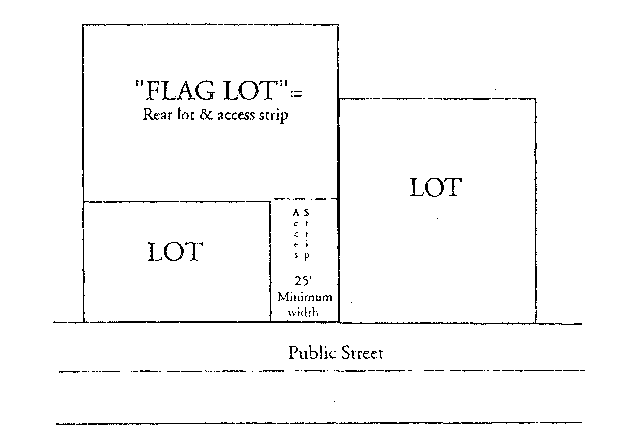
Figure A
Flood, 100-year. See "Base flood."
Flooding, area of shallow means designated AO and AH zone(s) on a community's flood insurance rate map (FIRM) with a one percent or greater annual chance of flooding to an average depth of one to three feet, where a clearly defined channel does not exist, and where velocity flow may be evident. Such flooding is characterized by ponding or sheet flow.
Flood or flooding means:
(1)
A general and temporary condition of partial or complete inundation of normally dry land areas from:
a.
The overflow of inland or tidal waters.
b.
The unusual and rapid accumulation or runoff of surface waters from any source.
(2)
The collapse or subsidence of land along the shore of a lake or other body of water as a result of erosion or undermining caused by waves or currents of water exceeding anticipated cyclical levels or suddenly caused by an unusually high water level in a natural body of water, accompanied by a severe storm, or by an unanticipated force of nature, such as flash flood or an abnormal tidal surge, or by some similarly unusual and unforeseeable event which results in flooding as defined in paragraph (1)a. of this definition.
Flood elevation study means an examination, evaluation and determination of flood hazards and, if appropriate, corresponding water surface elevations.
Flood insurance rate map (FIRM) means an official map of a community, on which the Federal Insurance Administrator has delineated both the special hazard areas and the risk premium zones applicable to the community.
Flood insurance study. See "Flood elevation study."
Floodplain or flood-prone area means any land area susceptible to being inundated by water from any source (see "flooding").
Floodplain management means the operation of an overall program of corrective and preventive measures for reducing flood damage, including, but not limited to, emergency preparedness plans, flood control works, and floodplain management regulations.
Floodplain management regulations means zoning ordinances, subdivision regulations, building codes, health regulations, special purpose ordinances (such as a floodplain ordinance, grading ordinance, and erosion control ordinance) and other applications of police power. The term describes such State or local regulations, in any combination thereof, which provide standards for the purpose of flood damage prevention and reduction.
Floodproofing means any combination of structural and nonstructural additions, changes, or adjustments to structures which reduce or eliminate flood damage to real estate or improved real property, water and sanitary facilities, structures and contents.
Floodway. See "Regulatory floodway."
Floodway encroachment lines means the lines marking the limits of floodways on federal, state and local floodplain maps.
Floor area means the sum of the horizontal area of the floor(s) of a structure enclosed by exterior walls, plus the horizontal area of any unenclosed portions of a structure such as porches and decks.
Forest management activities shall mean timber cruising and other forest resource evaluation activities, pesticide or fertilizer application, management planning activities, timber stand improvement, pruning, regeneration of forest stands, fire lanes and other similar or associated activities, exclusive of timber harvesting and the construction, creation or maintenance of roads.
Forest stand means a contiguous group of trees sufficiently uniform in age class distribution, composition, and structure, and growing on a site of sufficiently uniform quality, to be a distinguishable unit.
Forested wetland means a freshwater wetland dominated by woody vegetation that is six meters tall (approximately 20 feet) or taller.
Foundation means the supporting substructure of a building or other structure, excluding wooden sills and post supports, but including basements, slabs, frostwalls, or other base consisting of concrete, block, brick or similar material.
Fraternity/sorority house means a building used to provide lodging facilities for a group of University of Maine students and support staff who are associated together in a fraternity or sorority recognized by the University of Maine. When the University of Maine is not in session, the building may also be used to provide lodging facilities for groups of people taking part in University-sponsored events or programs so long as the group serves a common interest, a lease is signed, and the structure passes an inspection by the Code Enforcement Officer and Life Safety Inspector prior to the group occupying the building.
Freeboard means a factor of safety usually expressed in feet above a flood level for purposes of floodplain management. Freeboard tends to compensate for the many unknown factors, such as wave action, bridge openings, and the hydrological effect of urbanization of the watershed, that could contribute to flood heights greater than the height calculated for a selected size flood and floodway conditions.
Freshwater wetlands means freshwater swamps, marshes, bogs and similar areas, other than forested wetlands, which are:
(1)
Ten or more contiguous acres; or of less than ten contiguous acres and adjacent to a surface water body; excluding any river, stream or brook, such that in a natural state, the combined surface area is in excess of ten acres; and
(2)
Inundated or saturated by surface or groundwater at a frequency and duration sufficient to support, and which under normal circumstances do support, a prevalence of vegetation typically adapted for life in saturated soils.
Freshwater wetlands may contain small stream channels or inclusions of land which do not conform to the criteria of this definition.
Front lot line shall mean the line separating the lot from the street line. For the purposes hereof, the street line for public streets in which the Town or State holds a right-of-way interest instead of a fee ownership shall be the edge of the right-of-way, and the street line for private roads shall be the edge of the private road as shown on the plan approved by the Planning Board or the edge of the right-of-way for a private road existing on January 1, 1978.
Functionally dependent use for floodplain management purposes means a use which cannot perform its intended purpose unless it is located or carried out in close proximity to water. The term includes only docking facilities, port facilities that are necessary for the loading and unloading of cargo or passengers, and ship building and ship repair facilities, but does not include long-term storage or related manufacturing facilities.
Functionally water-dependent uses means those uses that require, for their primary purpose, location on submerged lands or that require direct access to, or location in inland waters and which cannot be located away from these waters. The uses include, but are not limited to commercial and recreational fishing and boating facilities, excluding recreational boat storage buildings, finfish and shellfish processing, fish storage, retail and wholesale fish marketing facilities, waterfront dock and port facilities, shipyards, boat building facilities, marinas, navigation aides, basins and channels, industrial uses dependent upon waterborne transportation or requiring large volumes of cooling or processing water and which cannot reasonably be located or operated at an inland site, and uses which primarily provide general public access to waters.
Great pond means any inland body of water which in a natural state has a surface area in excess of ten acres, and any inland body of water artificially formed or increased which has a surface area in excess of 30 acres except for the purposes of this chapter where the artificially formed or increased inland body of water is completely surrounded by land held by a single owner.
Great pond classified GPA means any great pond classified GPA, pursuant to 38 M.R.S.A. art. 4-A § 465-A. This classification includes some, but not all impoundments of rivers that are defined as great ponds.
Green space means open space maintained in a natural, undisturbed or revegetated condition.
Ground cover means small plants, fallen leaves, needles and twigs, and the partially decayed organic matter of the forest floor.
Group development shall mean (a) two or more principal structures located either on one lot of record, or on a combination of lots of record under the same ownership; (b) two or more principal structures on contiguous lots of record in separate ownership where the owners have agreed in writing to jointly design, apply for permits, and implement the joint design to make efficient use of infrastructure or reduce impacts on natural resources; or (c) a non-residential subdivision in which individual lots are grouped in order to make efficient use of infrastructure or reduce impacts on natural resources. A group development is distinct from "clustered development" and "shopping center," as defined in this ordinance.
Group home means a housing facility for eight or fewer mentally handicapped or developmentally disabled persons which is approved, authorized, certified or licensed by the State (see community living facility).
Gross leasable area means the total floor area designed for tenant occupancy and exclusive use, including basements, mezzanines and upper floors, if any, expressed in square feet and measured from the centerline of joint partitions and from outside wall faces.
Gymnasium, fitness center means a building which contains facilities and equipment for exercising, physical training, and sports activities.
Habitable floor area means space occupied by one or more persons for living, sleeping, eating or cooking. Unless authoritative information is provided to the Code Enforcement Officer to the contrary, habitable floor area shall be considered to be 80 percent of floor area.
Habitable space means space occupied by one or more persons for living, sleeping, eating or cooking.
Harvest area means the area where timber harvesting and related activities, including the cutting of trees, skidding, yarding, and associated road construction take place. The area affected by a harvest encompasses the area within the outer boundaries of these activities, excepting unharvested areas greater than ten acres within the area affected by a harvest.
Hazardous materials shall mean without limitation any flammable explosives, radioactive materials, hazardous materials, hazardous waste, petroleum or petroleum based products or byproducts, hazardous matter, hazardous or toxic substances, or toxic pollutants, oil or waste oil defined in the Comprehensive Environmental Response, Compensation and Liability Act of 1980, as amended (42 U.S.C. ss. 9601, et seq.), the Hazardous Materials Transportation Act, as amended (49 U.S.C. ss. 801, et seq.), the Resource Conservation and Recovery Act, as amended (42 U.S.C. ss. 6901, et seq.), Toxic Substances Control Act, as amended (15 U.S.C. ss. 2601, et seq.), State of Maine's Hazardous Matter and Hazardous Waste Control Laws and others, as amended in 38 M.R.S.A., § 1317 et seq., applicable Maine Statutes or local law, or in the regulations adopted and publications promulgated pursuant thereto, including all amendments to such laws and regulations and all supplements or successors thereto or any other pollutants, contaminants, substances or materials that may constitute a hazard, peril or threat to the health of persons, animals, plant life or the environment; excepting, however, "Hazardous Materials" shall not for the purposes hereof include any materials or substances in amounts or concentrations insufficient to require any remedial action under any applicable law, order, rule or regulation of the federal, state or local government.
Heavy industry means an industry that does not meet one or more of the criteria of a light industry.
Height of building/structure means the vertical distance between the mean original (prior to construction) grade at the downhill side of the structure and the highest point of the structure, excluding chimneys, steeples, antennas, and similar appurtenances which have no floor area.
High intensity soil survey means a map prepared by a certified soil scientist, identifying the soil types down to one-eighth acre or less at a scale equivalent to the subdivision plan submitted. The soils shall be identified in accordance with the National Cooperative Soil Survey. The map shall show the location of all test pits used to identify the soils, and shall be accompanied by a log of each sample point identifying the textural classification and the depth to seasonal high water table or bedrock at that location. Single soil test pits and their evaluation for suitability for subsurface waste water disposal systems shall not be considered to constitute high intensity soil surveys.
Historic or archaeological resources shall mean areas identified by the Maine Historic Preservation Commission as having significant value as a historic or archaeological resource and any areas identified in the comprehensive plan. Historic resources include structures.
Historical structure means any structure that is:
(1)
Listed individually in the National Register of Historic Places (a listing maintained by the Department of the Interior) or preliminarily determined by the Secretary of the Interior as meeting the requirements for individual listing on the National Register;
(2)
Certified or preliminarily determined by the Secretary of the Interior as contributing to the historical significance of a registered historic district or a district preliminarily determined by the Secretary of the Interior to qualify as a registered historic district;
(3)
Individually listed on a State Inventory of Historic Places which has been approved by the Secretary of the Interior; or
(4)
Individually listed on a local inventory of historic places that has been certified either
a.
By an approved state program determined by the Secretary of the Interior;
b.
Directly by the Secretary of the Interior; or
c.
Areas identified by a governmental agency such as the Maine Historic Preservation Commission as having significant value as a historic or archaeological resource and any areas identified in the Comprehensive Plan, which have been listed or are eligible to be listed on the National Register of Historic Places.
Home occupation means an accessory use of a dwelling unit or accessory structure for gainful employment by the occupants, meeting all of the standards set forth in Article V of this ordinance. "Home occupation" includes:
(1)
Home office, which is a type of home occupation consisting primarily of office-based activity that does not require customers, clients, or service or delivery vehicles to regularly visit the premises;
(2)
Home workshop, which is a type of home occupation that creates or manufactures an item for sale at locations other than the home or through the Internet, including, by way of example only, dressmaking, knitting, woodworking, drawing, painting, sculpting, artisanal foods preparation, or the manufacture of crafts, and that does not require customers, clients, or service or delivery vehicles to regularly visit the premises;
(3)
Home business, which is any other home occupation that is not a home office or a home workshop; or that would otherwise be a home office or a home workshop but does not meet the limitations, as set forth in section 18-131 of this ordinance, governing home offices and home workshops but would comply with all other standards that apply to home occupations generally and to home businesses specifically. Home businesses include, but are not limited to, any home occupation that involves sales or services to customers or clients who regularly come to the home for such sales or services.
(4)
Homestays, as defined under "Travelers' accommodations."
Homeowners' association developments. Real estate, portions of which are designed for separate ownership by a nonprofit corporation formed under the provisions of 13B M.R.S.A., the members of which are the owners of the real estate held in separate ownership, which real estate is subject to covenants and restrictions as to use.
Homestay. See "Travelers' accommodations."
Hospice means a building or structure which is used for the housing and care of terminally ill human beings. It shall also include accessory uses which are directly associated with the housing and care of terminally ill human beings such as kitchen facilities, solariums, physicians' office, etc.
Hospital means a building or structure which is used for the housing and care of sick, hurt or incapacitated human beings. It shall also include accessory uses which are directly associated with the housing and care of sick, hurt or incapacitated human beings such as kitchen facilities, solariums, dormitories, physicians' offices, etc.
Hotel. See "Travelers' accommodations."
House guest means a person who has no written ownership, lease, sub-lease, rental, or similar rights with the owner, lessee, sub-lessee, or renter of a dwelling unit and who stays overnight in the dwelling unit for no more than 14 nights in any 120-day period. A person who stays more than 14 nights in any 120-day period shall be considered a resident of the dwelling unit for purposes of the Land Use Ordinance; and, if not legally related to the owner, lessee, sub-lessee or renter or a member of the owner's, lessee's, sub-lessee's, or renter's "family" as defined in this section shall be counted among the residents of the dwelling unit in determining whether the dwelling unit meets the standard for unrelated individuals as specified in the definition of "family" in this Ordinance.
Increase in nonconformity of a structure means any change in a structure or property which causes further deviation from the dimensional standard(s) creating the nonconformity such as, but not limited to, reduction in water body, tributary stream or wetland, property line, setback distance, increase in lot coverage, or increase in height of a structure. Property changes or structure expansions which either meet the dimensional standard or which cause no further increase in the linear extent of nonconformance of the existing structure shall not be considered to increase nonconformity. For example, there is no increase in nonconformity with the setback requirement for water bodies, wetlands, tributary streams or property lines if the expansion extends no further into the required setback area than does any portion of the existing nonconforming structure. Hence, a structure may be expanded laterally provided that the expansion extends no closer to the water body, tributary stream, or wetland than the closest portion of the existing structure from that water body, tributary stream, wetland or property line. Included in this allowance are expansions which in-fill irregularly shaped structures.
Individual private campsite means an area of land which is not associated with a campground, but which is developed for repeated camping by only one group not to exceed ten individuals and which involves site improvements which may include, but not be limited to, a gravel pad, a parking area, a fireplace, or a tent platform.
Industrial means the assembling, fabrication, finishing, manufacturing or processing of goods, or the extraction of minerals.
Industry means an establishment engaged in the mechanical or chemical transformation of materials or substances into new products which may include the assembly of component parts, the manufacturing of products, and/or the blending of materials such as lubricating oils, plastics or resins.
Institutional means a nonprofit or quasi-public use, or institution such as a church, library, public or private school, hospital, or municipally owned or operated building, structure or land used for public purposes.
Kennel means any place, building, tract of land or abode in or on which privately owned dogs or other pets, or both, are kept.
Kitchen means space used for cooking or preparation of food.
Land management road means a route or track consisting of a bed of exposed mineral soil, gravel, or other surfacing materials constructed for, or created by, the passage of motorized vehicles and used primarily for timber harvesting and related activities, including associated log yards, but not including skid trails or skid roads.
Landscaped and landscaping means the addition of lawns, trees, plants and other natural and decorative features to land which creates an expanse of natural scenery. Plant materials shall be selected, installed and maintained in accordance with current State Department of Transportation "Standard Specifications for Highways and Bridges for Class A Plantings." This is a book containing specifications for highway construction.
Licensed forester means a forester licensed under 32 M.R.S.A., ch. 76.
Light industry means an industry which meets the following performance criteria:
(1)
All aspects of the industrial process are carried on within the industrial structure
(2)
Noise level of the industrial process does not exceed 70 decibels at any property line.
(3)
Exterior storage of materials occupies no larger than 2,000 square feet of contiguous land area.
(4)
The discharge of water and air emissions shall meet all Maine Statutes as set forth in 38 M.R.S.A. and applicable federal and local laws, regulations, rules and ordinance as the same may be amended from time to time.
(5)
The number of trucks requiring a class one or two license does not typically exceed ten per day.
(6)
There is no manufacture or handling of hazardous materials in quantities large enough to cause a public health hazard in case of accidental release.
Light industry includes industry support services, such as, by way of example only, climate-controlled storage, testing facilities, and packaging services, but excludes "wholesale business," which is separately defined.
Locally established datum means, for purposes of this chapter, an elevation established for a specific site to which all other elevations at the site are referenced. This elevation is generally not referenced to the National Geodetic Vertical Datum (NGVD) or any other established datum and is used in areas where mean sea level data is too far from a specific site to be practically used.
Lodginghouse. See "Roominghouse."
Lot means a parcel of land occupied or to be occupied by one main building and accessory buildings or uses customarily incident to it, except for those clustered developments in which the land is owned in common and other specific areas identified in this ordinance where multiple detached principal structures are allowed. A lot shall be of sufficient size to meet minimum zoning requirements for use, coverage and areas, and to provide such yards and other open spaces as are required in this Land Use Ordinance.
Lot area means the area of land enclosed within the boundary lines of a lot except that the following shall not be counted toward the lot area calculation:
(1)
Land areas beneath roads serving more than two lots, and
(2)
Land areas in any shoreland zoned district that are below the normal high-water line of a water body or upland edge of a wetland.
Lot coverage means the area of a lot covered by buildings, parking areas, and other impervious or unvegetated area, divided by the total area of the lot.
Lot frontage. Except as expressly provided in this Land Use Ordinance, all lots shall have frontage on a public street or on a private street in a subdivision which has been approved by the Planning Board. The minimum frontage shall be equal to the required width of a lot as set forth in the table titled "Schedule of Dimensional Requirements" contained in this ordinance, measured where the lot lines intersect with said public street or private street, except lots that front on the turning radius of a cul-de-sac. Provided however, that a lot having the minimum frontage on:
(1)
A private road existing on January 1, 1978; or
(2)
A private road approved by the Planning Board may be used for a single-family dwelling and accessory structure.
Lot measurements means depth of a lot shall be considered to be the distance between the midpoints of straight lines connecting the foremost points of the side lot lines in the front and the rear. Width of a lot shall be considered to be the distance between straight lines connecting the front and rear lot lines at each side of the lot, measured across the rear of the required front yard. Lot measurements in the shoreland zone also include "minimum lot width" as defined.
Lot of record means a lot which is part of a subdivision recorded in the office of the County Registry of Deeds, or a lot or parcel described by metes and bounds, the description of which has been so recorded.
Lot, seasonal residential means a parcel of land occupied or to be occupied by one main building and accessory buildings. Such lot shall have frontage on a public street, on a private road existing on January 1, 1978, or on a private road which has been approved by the Planning Board.
Lowest floor means the lowest floor of the lowest enclosed area (including basement). An unfinished or flood-resistant enclosure, usable solely for parking of vehicles, building access or storage in an area other than a basement area is not considered a building's lowest floor, provided that such enclosure is not built so as to render the structure in violation of the applicable nonelevation design requirements described in article VIII, subsection 18-236(12) of this chapter.
Low-impact non-residential use means a non-residential use that complies with the standards of article IV, section 18-111(c) of this ordinance.
Major subdivision means a subdivision of five or more lots or which involves the construction of roads.
Manufactured home means a structure, transportable in one or more sections, which is built on a permanent chassis and is designed for use with or without a permanent foundation when connected to the required utilities. For floodplain management purposes, the term "manufactured home" also includes park trailers, travel trailers and other similar vehicles placed on a site for greater than 180 consecutive days.
Manufactured home park or subdivision means a parcel (or contiguous parcels) of land divided into two or more manufactured home lots for rent or sale.
Manufactured home subdivision or development means a parcel of land approved by the municipal reviewing authority under 30-A M.R.S.A. § 4401 et seq. (the Subdivision Law) for the placement of manufactured houses on individually owned lots.
Manufactured housing means a structural unit or units designed for occupancy, and constructed in a manufacturing facility and then transported by the use of its own chassis, or placed on an independent chassis, to a building site. The term includes any type of building which is constructed at a manufacturing facility and then transported to a building site where it is utilized for housing and which may be purchased or sold by a dealer in the interim. For purposes of this definition, two types of manufactured housing are included. They are:
(1)
Those units constructed after June 15, 1976, commonly called "newer mobile homes," which the manufacturer certifies are constructed in compliance with the United States Department of Housing and Urban Development standards, meaning structures, transportable in one or more sections, which, in the traveling mode, are 14 body feet or more in width and are 750 or more square feet, and which are built on a permanent chassis and designed to be used as dwellings, with or without permanent foundations, when connected to the required utilities, including the plumbing, heating, air conditioning and electrical systems contained therein; except that the term shall include any structure which meets all the requirements of this subsection except the size requirements and with respect to which the manufacturer voluntarily files a certification required by the Secretary of the United States Department of Housing and Urban Development and complies with the standards established under the National Manufactured Housing Construction and Safety Standards Act of 1974, 42 USC 5401 et seq.; and
(2)
Those units commonly called "modular homes," which the manufacturer certifies are constructed in compliance with the State's Manufactured Housing Act and regulations, meaning structures, transportable in one or more sections, which are not constructed on a permanent chassis and are designed to be used as dwellings on foundations which connected to required utilities, including the plumbing, heating, air conditioning or electrical systems contained therein.
Marijuana establishment means any adult use or medical marijuana cultivation facility, marijuana products manufacturing facility, marijuana testing facility, or marijuana retail store.
Marijuana cultivation facility means a facility licensed by the State to cultivate, prepare and package adult use marijuana and to sell adult use marijuana to marijuana establishments, or any cultivation area used or occupied by one or more medical marijuana registered caregivers or a registered dispensary. A cultivation facility includes a nursery cultivation facility in which licensees that cultivate marijuana in a nursery cultivation facility may sell an unlimited number of marijuana seeds and a sum total of 12 seedlings and immature plants to a consumer 21 years of age or older.
Marijuana products manufacturing facility means a facility licensed by the State to purchase marijuana from a cultivation facility or another products manufacturing facility; to manufacture, label and package marijuana and marijuana products; and to sell marijuana and marijuana products to marijuana stores and to other products manufacturing facilities.
Marijuana retail store means any adult use retail store licensed by the State to sell adult use marijuana products to consumers, or any registered caregiver retail store or registered dispensary that sells medical marijuana to qualifying patients or caregivers.
Marijuana testing facility means a facility licensed by the State to develop, research and test marijuana, marijuana products and other substances.
Marina means a business establishment having frontage on navigable water and, as its principal use, providing for hire offshore moorings or docking facilities for boats, and which may also provide accessory services such as boat and related sales, boat repair and construction, indoor and outdoor storage of boats and marine equipment, bait and tackle sales, and marine fuel service facilities and watercraft rental.
Market value means the estimated price a property will bring in the open market and under prevailing market conditions in a sale between a willing seller and a willing buyer, both conversant with the property and with prevailing general price levels.
Mean sea level means, for purposes of the National Flood Insurance Program, the National Geodetic Vertical Datum (NGVD) of 1929, or other datum, to which base flood elevations shown on the Flood Insurance Rate Map are referenced.
Medical office building means an establishment where patients are admitted for examination and treatment by professional licensed health care providers.
Mineral exploration means hand sampling, test boring or other methods of determining the nature or extent of mineral resources which create minimal disturbance to the land and which include reasonable measures to restore the land to its original condition.
Mineral extraction means any operation within any 12-month period which removes or displaces more than 100 cubic yards of soil, topsoil, loam, sand, gravel, clay, rock, peat or other like material from its natural location and to transport the product removed away from the extraction site.
Minimum lot width means the closest distance between the side lot lines of a lot. When only two lot lines extend into the shoreland zone, both lot lines shall be considered to be side lot lines.
Minor development means all development that is not new construction or a substantial improvement, such as repairs, maintenance, renovations, or additions, whose value is less than 50 percent of the market value of the structure. It also includes, but is not limited to: Accessory structures as provided for in subsection 18-236(10), mining, dredging, filling, grading, paving, excavation, drilling operations, storage of equipment or materials, deposition or extraction of materials, public or private sewage disposal systems or water supply facilities that do not involve structures; and nonstructural projects such as bridges, dams, towers, fencing, pipelines, wharves and piers.
Minor subdivision means a subdivision with less than five lots which does not involve the construction or reconstruction of a new street or the extension of public sewer lines or the extension of public water lines or the construction of a storm drainage system.
Mobile food vendor means any motorized vehicle or object towed by a motorized vehicle, including food trucks, trailers, carts, or wagons, that is equipped to prepare and/or sell food items.
Mobile home. See "Manufactured housing."
Mobile home park means a parcel of land under unified ownership approved by the municipality for the placement of three or more manufactured homes. Nothing in this definition shall be construed to apply the term "mobile home park" to any premises used solely for the storage or display of mobile homes.
Mobile home park lot means the area of land on which an individual home is situated within a mobile home park and which is reserved for use by the occupants of that home.
Mobile home stand means that part of an individual mobile home lot which has been constructed and reserved for the placement of a mobile home.
Modular home. See "Manufactured housing."
Motor vehicle body shop means a business establishment engaged in rebuilding or reconditioning of motor vehicles, or body, frame or fender straightening and repair, or painting and undercoating, but not the sale of gasoline, other motor fuels, or motor oil.
Motor vehicle fuel station means any area of land, including structures thereon, that is used for the supply of gasoline or oil or other fuel for the propulsion of motor vehicles and which may include facilities used or designed to be used for polishing, greasing, washing, spraying, dry cleaning or otherwise cleaning or servicing such motor vehicles. An automobile fuel station is not a sales, major repair or rental agency for autos, trucks, trailers or other motor vehicles.
Movie theater means a commercial facility with an auditorium for viewing films and motion pictures for public entertainment.
Multiple dwelling means any multifamily dwelling containing three or more dwelling units.
Municipal solid waste facility means any area of land, including structures thereon, owned by, and operated by, or under the supervision of, the Town for the disposal, processing, treatment, recycling and/or temporary storage of solid waste, including wood waste, construction/demolition debris, land clearing debris, inert fill, tires and white goods.
National Geodetic Vertical Datum (NGVD) means the National Vertical Datum, whose standard was established in 1929, which is used by the National Flood Insurance Program (NFIP). NGVD was based upon mean sea level in 1929 and also has been called "1929 Mean Sea Level (MSL)."
Native means indigenous to the local forests.
Net residential acreage means the total acreage available for the subdivision, as shown on the proposed subdivision plan, minus the area for streets or access and the areas that are unsuitable for development.
Net residential density means the average number of dwelling units per net residential acre.
New construction means structures for which the "start of construction" commenced on or after the effective date of floodplain management regulations adopted by the Town and includes any subsequent improvements to such structures.
Newer mobile home. See "Manufactured housing."
Nonconforming condition means nonconforming lot, structure or use which is allowed solely because it was in lawful existence at the time this chapter or subsequent amendment took effect.
Nonconforming lot means a single lot of record which, at the effective date of adoption or amendment of this Land Use Ordinance, does not meet the area, frontage, width or depth requirements of the district in which it is located.
Nonconforming structure means a structure that does not meet any one or more of the following dimensional requirements; setback, height, or lot coverage, but which is allowed solely because it was in lawful existence at the time this Land Use Ordinance or subsequent amendments took effect.
Nonconforming use means use of buildings, structures, premises, land or parts thereof which is not allowed in the district in which it is situated, but which is allowed to remain solely because it was in lawful existence at the time this chapter or subsequent amendments took effect.
Normal high-water line means that line on the shores and banks of waters which is apparent because of the contiguous different character of the soil or the vegetation due to the prolonged action of the water from visible markings, changes in the character of soils due to prolonged action of the water or changes in vegetation, and which distinguishes between predominantly aquatic and predominantly terrestrial land. Areas contiguous with rivers and great ponds that support nonforested wetland vegetation and hydric soils and that are at the same or lower elevation as the water level of the river or great pond during the period of normal high-water are considered part of the river or great pond. By way of illustration, aquatic vegetation includes, but is not limited to the following plants and plant groups: water lily, pond lily, pickerelweed, cattail, wild rice, sedges, rushes and marsh grasses; and terrestrial vegetation includes but is not limited to the following plants and plant groups: upland grasses, aster, lady slipper, wintergreen, partridge berry, sasparilla, pines, cedars, oaks, ashes, alders, elms and maples. In places where the shore or bank is of such character that the high-water line cannot be easily determined (rock slices, ledges, or rapidly eroding or slumping banks) the normal high-water line shall be estimated from places where it can be determined by the method described in this definition.
Nursing home means a facility which is operated in connection with a hospital or in which nursing care and medical services are prescribed by or performed under the general direction of persons licensed to practice medicine or surgery in the State, for the accommodation of convalescent or other persons who are acutely ill and not in need of hospital care, but who do require extended care and not in need of hospital care, but who do require extended care and related medical services. The term "nursing home" shall be restricted to those facilities, the purpose of which is to provide extended care and related medical services for a period of not less than 24 hours and related medical services for a period of not less than 24 hours per day to individuals admitted because of illness, disease or physical or mental infirmity and which provides a community service. Nursing home is distinct from Assisted living facility, as defined in this section.
Office means a place that serves as the headquarters or satellite facility of an enterprise or organization for the purpose of directing, managing or providing support services for the enterprise or organization; or a place in which a professional person (including, by way of example, lawyer, accountant, engineer, security or commodity broker, real estate agent, insurance agent, advertising or public relations professional, software developer, computer technician, architect, employment counselor, scientific or technical researcher or consultant, property manager, social worker, graphic artist or other professional of a similar nature) and/or supporting staff conducts business; or a place for the conduct of a business support service (including, by way of example, credit reporting, telemarketing, technical support, and document preparation, or other business support service of a similar nature). The term "office" does not include an activity that involves retail sales, on-site repair services, or personal services of a retail nature, such as those classified, for example, within the North American Industrial Classification System Code 812. The term "office" also does not include places where patients are admitted for examination and treatment by professional licensed health care providers. See "Medical office building," which is a separately defined term in this section.
Older mobile home means a mobile home constructed prior to June 15, 1976.
Open space means a portion of a development site that is permanently set aside for public or private use and will not be developed for residential, commercial, or industrial use. Open space shall be comprised of green space and community open space.
One hundred-year flood. See "Base flood."
Parabolic antenna. (For example: a satellite dish antenna). An antenna which is bowl-shaped, designed for the reception and/or transmission of radio frequency communication signals in a specific directional pattern.
Parking space, off-street. An off-street parking space shall consist of a space adequate for parking an automobile with room for opening doors on both sides.
Permittee-responsible mitigation activities means vernal pool conservation carried out by an applicant for a development approval or permit in accordance with the provisions of the Vernal Pool Overlay District as an alternative to paying a vernal pool mitigation fee to the Town of Orono.
Person means an individual, corporation, governmental agency, municipality, trust, estate, partnership, association, two or more individuals having a joint or common interest, or other legal entity.
Piers, docks, wharves, bridges and other structures and uses extending over or below the normal high-water line or within a wetland.
Temporary means structures which remain in or over the water for less than seven months in any period of 12 consecutive months.
Permanent means structures which remain in or over the water for seven months or more in any period of 12 consecutive months.
Police firing range. An organized area for governmental law enforcement officials to train and practice the use of firearms with live ammunition. For purposes of this ordinance a police firing range shall be deemed a "minor public facility."
Principal structure means a building other than one which is used for purposes wholly incidental or accessory to the use of another building on the same premises.
Principal use means a use other than one which is wholly incidental or accessory to another use on the same premises.
Public building or structure means a building owned by a unit or agency of local government, the State of Maine and any of its agencies or the United States Government and any of its agencies.
Public facility means any facility, including, but not limited to, buildings, property, recreation area and roads, which are owned, leased or otherwise operated, or funded by a governmental body or public entity.
Minor public facility. A facility that does not exceed 30,000 square feet of land area and/or a building greater than 150 square feet.
Major public facility. A facility that does not meet the definition of a minor public facility.
Public space shall mean that space used in common by the occupants of several units within a dwelling or roominghouse and by the public.
Recent floodplain soils. The following soil series as described and identified by the National Cooperative Soil Survey:
Recreational facility means a place designed and equipped for the conduct of sports, leisure time activities, and other customary and usual recreational activities, excluding boat launching facilities.
Recreational trail. A trail that is available for use by the public for recreational purposes (including, but not limited to snowmobiling, cross country skiing, jogging, hiking, or biking) that: (1) is to be reserved for and dedicated to such recreational use by the owner as part of a site plan or subdivision application or (2) exists by virtue or an instrument of record in the Penobscot Registry of Deeds.
Recreational vehicle means a vehicle or an attachment to a vehicle designed to be towed, and designed for temporary sleeping or living quarters for one or more persons, and which may include a pick-up camper, travel trailer, tent trailer, camp trailer, and motor home. In order to be considered as a vehicle and not as a structure, the unit must remain with its tires on the ground, and must be registered with the State Division of Motor Vehicles.
A recreational vehicle is a vehicle which is:
(1)
Built on a single chassis;
(2)
400 square feet or less when measured at the largest horizontal projection, not including slideouts;
(3)
Designed to be self-propelled or permanently towable by a motor vehicle; and
(4)
Designed primarily not for use as a permanent dwelling but as temporary living quarters for recreational, camping, travel, or seasonal use.
Recycling center means a facility that handles recycled solid materials and/or liquids that have been separated from the municipal solid waste prior to their receipt at the recycling facility, and are free from and will not produce putrescible or other solid wastes, liquid wastes, or any special or hazardous wastes. A recycling facility shall not include any facility which requires a permit for the operation of an automobile graveyard/junkyard and automobile recycling business as defined in this article. A recycling center may include a redemption center as an ancillary and subsidiary use.
Redemption center means a facility licensed by the Maine Department of Agriculture which collects beverage containers and refunds the statutory deposit pursuant to 32 M.R.S.A., § 1861 (1988 and Supp. 1991). The facility shall also store the beverage containers on-site for a period of time not to exceed 30 days and for the ultimate collection by the beverage distributor.
Regulatory floodway means:
(1)
The channel of a river or other watercourse and the adjacent land areas that must be reserved in order to discharge the base flood without cumulatively increasing the water surface elevation more than one foot; and
(2)
When not designated on the community's flood boundary and floodway map, it is considered to be the channel of a river or other watercourse and the adjacent land areas to a distance of one-half the width of the floodplain, as measured from the normal high water mark to the upland limit of the floodplain.
Replacement system means a system intended to replace:
(1)
An existing system which is either malfunctioning or being upgraded with no significant change of design flow or use of the structure; or
(2)
Any existing overboard wastewater discharge.
Residential dwelling unit means a room or group of rooms designed and equipped exclusively for use as permanent, seasonal, or temporary living quarters for only one family at a time, and containing cooking, sleeping and toilet facilities. The term shall include mobile homes and rental units that contain cooking, sleeping, and toilet facilities regardless of the time period rented. Recreational vehicles are not residential dwelling units.
Residual basal area means the average of the basal area of trees remaining on a harvested site.
Residual stand means a stand of trees remaining in the forest following timber harvesting and related activities
Restaurant means a business principally engaged in serving prepared foods and drinks to the public on the premises.
Riprap rocks shall mean irregularly shaped and at least six inches in diameter, used for erosion control and soil stabilization, typically used on ground slopes of two units horizontal to one unit vertical or less.
River means a free-flowing body of water including its associated floodplain wetlands from that point at which it provides drainage for a watershed of 25 square miles to its mouth.
NOTE: The portion of a river that is subject to tidal action is a coastal wetland.
Riverine means relating to, formed by, or resembling a river (including tributaries), stream, brook, etc.
Road means a route or track consisting of a bed of exposed mineral soil, gravel, asphalt or other surfacing material constructed for or created by the repeated passage of motorized vehicles excluding a driveway as defined herein.
Rooming unit means any room or rooms forming a single habitable unit used or intended to be used for living and sleeping but not for cooking or eating purposes. In single-family and two-family dwellings, a room is deemed a rooming unit only when it is rented out as a single habitable unit. In multifamily dwellings, all bedrooms are considered rooming units.
Roominghouse shall mean a residential use consisting of at least one owner-occupied dwelling unit together with more than two rooming units that are rented or are designed or intended to be rented but which rooming units, individually or collectively, do not constitute separate dwelling units.
Rural area means the portion of the Town of Orono designated as rural in the adopted comprehensive plan.
Self-storage facility means a facility that provides secure, fully enclosed spaces, rented or leased to clients or tenants for the storage and retrieval of clients' goods. A self-storage facility, which may also be referred to as a "mini-warehouse," involves primarily the storage of goods for the client's or tenant's own use, although there may be some small-scale distribution of commercial items out of the facility; does not provide for large-scale warehousing, trucking and distribution of commercial merchandise; does not serve as a retail sales facility or location for a client or tenant; does not involve outdoor storage or handling; and is distinct from "warehousing" and "wholesale business," which are separately defined. A self-storage facility in an accessory structure is considered under this Land Use Ordinance to be an "accessory use," provided:
a.
The structure is accessory to an owner-occupied dwelling; and
b.
The accessory structure is residential in appearance, with a roof with a minimum pitch of four vertical to 12 horizontal; has exterior siding that is residential in appearance, such as wood siding, wood shingles, aluminum or vinyl siding simulating a clapboard pattern, or hardboard siding; has no signage relating to the self-storage activity; and has lighting, if any, that complies with the standard of this ordinance; and
c.
The self-storage activity occupies no more than the following total floor area within the accessory structure (which itself may be larger and used for other allowed purposes) in the respective zoning districts:
Scenic resource means that specific location, view, or corridor, as may be identified in the Comprehensive Plan or by a state or federal agency, that consists of:
(1)
A three-dimensional area extending out from a particular viewpoint, focusing on a single object, such as a mountain, resulting in a narrow corridor, or a group of objects, such as downtown skyline or mountain range, resulting in a panoramic view corridor; or
(2)
A vehicular right-of-way or view point that contains lateral terrain features such as valley sides or woodland as observed to either side of the observer, constraining the view into a narrow or particular field, as seen as one travels along a roadway, waterway, or both.
Screening is either:
(1)
A hedge or buffer strip at least five feet wide consisting of densely planted shrubs or trees, at least four feet in height at the time of planting, and eventually reaching a mature height of at least six feet; or
(2)
A wall or fence at least six feet in height, but not exceeding eight feet, which provides an effective visual barrier.
Service business means any business or establishment which provides a service of a nonretail nature for hire by others, conducted through the application of some specialized knowledge, training, skill or talent, or through the employment of some special action or work. By definition, a service business does not entail outside storage of goods or equipment, nor utilize vehicles larger than 9,000 lbs. gross vehicle weight (GVW). A fuel service station shall not be considered a service establishment.
Service drop means any utility line extension which does not cross or run beneath any portion of a water body, provided that:
(1)
In the case of electric service:
a.
The placement of wires and/or the installation of utility poles is located entirely upon the premises of the customer requesting services or upon a roadway right-of-way; and
b.
The total length of the extension is less than 1,000 feet.
(2)
In the case of telephone service:
a.
The extension, regardless of length, will be made by the installation of telephone wires to existing utility poles; or
b.
The extension requiring the installation of new utility poles or placement underground is less than 1,000 feet in length.
Setback means the nearest horizontal distance from a lot line, right-of-way, road, normal high-water line of a water body or tributary stream, or upland edge of a wetland, or another structure to the nearest part of a structure, road, parking space or other regulated object or area.
Shared driveway means any "driveway" which is utilized to access more than one principal structure on a single lot.
Shopping center means a group of architecturally unified commercial establishments built on a site which is planned, developed, owned and managed as an operating unit related in its location, size, and type of shops to one trade area that the unit serves. The unit provides on-site parking in definite relationship to the types and total size of the stores.
Shore frontage means the length of a lot bordering on a water body or wetland measured in a straight line between the intersections of the lot lines with the shoreline.
Shoreland areas means all land area within 250 feet horizontal distance of the normal high-water mark of Pushaw Lake, Penobscot River, Stillwater River and freshwater wetlands.
Shoreland zone means the land area located within 250 feet, horizontal distance, of the normal high-water line of any great pond or river; within 250 feet, horizontal distance, from the upland edge of a freshwater wetland; or within 75 feet, horizontal distance, of the normal high-water line of a stream.
Shoreline means the normal high-water line, or upland edge of a freshwater wetland.
Significant river segments—38 M.R.S.A., § 437.
Significant wildlife habitat means habitat for species appearing on the official State or Federal lists of endangered or threatened species; high and moderate value deer wintering areas and travel corridors as defined by the Department of Inland Fisheries and Wildlife; high and moderate value waterfowl and wading bird habitats, including nesting and feeding areas as defined by the Department of Inland Fisheries and Wildlife; critical spawning and nursery areas for Atlantic Sea Run Salmon as defined by the Atlantic Sea Run Salmon Commission; and shorebird nesting, feeding and staging areas and seabird nesting islands as defined by the Department of Inland Fisheries and Wildlife.
Sign.
(1)
Generally. Any name, identification, description, display, illustration or device which is affixed to or represented directly or indirectly upon a building, structure or land in view of the general public, and which directs attention to a product, place, activity, persons, institution or business. A sign shall include writing, representation or other fixtures of similar character within a building only when illuminated and located in a window. The following shall not be included as signs for the purposes of this chapter:
a.
Flags, banners, and insignia of any government, having a surface area of 96 square feet or larger, which may be displayed only on state or national holidays or within 14 days of an event sponsored by the governmental entity, except they shall not be displayed in connection with commercial promotion; and light pole signs, as defined in and meeting the standards of this ordinance, installed by the Town for a public purpose on Town property or in public rights-of-way.
b.
Legal notices, identification information or directional signs erected by governmental bodies.
c.
Signs directing and guiding traffic and parking on private property but bearing no advertising matter.
d.
Integral decorative or architectural features of buildings. However, those features commonly associated with franchise or parent corporation, such as letters, trademarks, moving parts or moving lights are included as signs in this chapter.
(2)
Business awning. A rooflike covering/canopy extended out from the facade of a building which provides protection and which directs attention to a business where the awning is located.
(3)
Billboard. A freestanding or detached sign having one or more panels designed to contain informative messages or advertisements which are changed from time to time.
(4)
Business sign. A sign which directs attention to a business, profession, product, service, activity or entertainment sold or offered upon the premises where such sign is located.
(5)
Externally illuminated awning or business awning. A sign or business awning lit by an external source and directed at the sign or business awning.
(6)
Freestanding sign. A sign that is attached to, erected on or supported by some structure, such as a pole, mast, frame or other structure, that is not itself an integral part of or attached to a building or other structure whose principal function is something other than the support of a sign.
(7)
Internally illuminated sign/awning with a translucent background. A sign where the source of the illumination emanates through the message of the sign or business awning, rather than being reflected off the surface of the sign from an external source.
(8)
Light pole sign. A banner designed specifically for attachment to a free-standing light pole by a mounting structure that supports and secures, at a minimum, the entire top and the entire bottom of the banner. (See illustrative sketch.) Light pole signs shall not include flags or pennants.
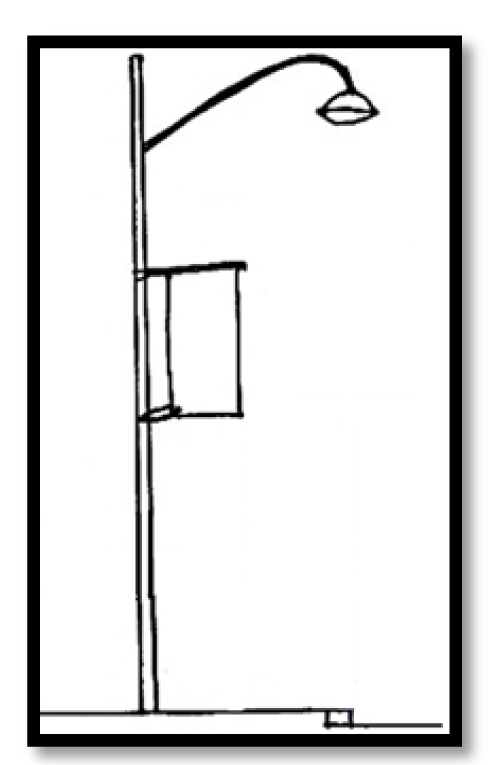
(9)
Neon sign. Signs that consist of or contain tubes that (i) are filled with neon or some other gas that flows when an electrical current passes through it and (ii) are intended to form or constitute all or part of the message of the sign, rather than merely providing illumination to other parts of the sign that contain the message.
(10)
Off-premises sign. A sign that draws attention to or communicates information about a business, service, commodity, accommodations, attraction or other enterprise or activity that exists or is conducted, sold, offered, maintained or provided at a location other than the premises on which the sign is located. A sign that draws attention to a cause or advocates or proclaims a political, religious or other noncommercial message shall also be an off-premises sign.
(11)
On-premises sign. A sign that draws attention to or communicates information about a business, service, commodity, accommodation, attraction or other enterprise or activity that exists or is conducted, sold, offered, maintained or provided on the premises where the sign is located.
(12)
Projecting sign. A sign fastened or attached to a building, in such a way as to protrude from the building.
(13)
Sandwich board sign. Two connected signboards that stand without other supporting elements, and shall also be considered a freestanding sign.
(14)
Surface area of sign. The entire area within a single continuous perimeter enclosing the extreme limits of the actual sign surface. It does not include any structural elements outside the limits of such sign and not forming an integrated part of the display. For projecting or double-faced signs, only one display face shall be measured in computing total surface area where the sign faces are parallel or where the interior angle formed by the faces is 60 degrees or less.
Site plan review means the review to be conducted by the Planning Board using the guidelines provided in this Land Use Code.
Sketch plan means conceptual maps, renderings, and supportive data describing the project proposed by the applicant for initial review prior to submitting an application for subdivision approval. The plans may include freehand drawings.
Skid road or skid trail means a route repeatedly used by forwarding machinery or animal to haul or drag forest products from the stump to the yard or landing, the construction of which requires minimal excavation.
Slash means the residue, e.g., treetops and branches, left on the ground after a timber harvest.
Social, fraternal organization means a group of people formally organized for a common interest, usually cultural, religious or entertainment, with regular meetings, rituals and formal written membership requirements.
Solar energy system means a solar energy system whose primary purpose is to harvest energy by transforming solar energy into another form of energy or transferring heat from a collector to another medium using mechanical, electrical, or chemical means. It may be roof-mounted or ground-mounted, and may be of any size as follows:
Small-scale solar energy system means a system in which the physical size based on total airspace over a roof or the ground is less than 1,500 square feet;
Medium-scale solar energy system means a system in which the physical size based on total airspace projected over a roof or the ground is equal to or greater than 1,500 square feet but less than 87,120 square feet (two acres);
Large-scale solar energy system means a system in which the physical size based on total airspace projected over a roof or the ground is equal to or greater 87,120 square feet (two acres).
Solar energy system, ground-mounted means a system that is structurally mounted to the ground and is not roof-mounted.
Solar energy system, roof-mounted means a system that is mounted on the roof of a building or structure.
Special flood hazard area. See "Area of special flood hazard."
Start of construction means the date the building permit was issued, provided the actual start of construction, repair, reconstruction, rehabilitation, addition, placement, substantial improvement or other improvement was within 180 days of the permit date. The actual start means either the first placement of permanent construction of a structure on a site, such as the pouring of slab or footings, the installation of piles, the construction of columns, or any work beyond the stage of excavation; or the placement of a manufactured home on a foundation. Permanent construction does not include land preparation, such as clearing, grading and filling; nor does it include the installation of streets and/or walkways; nor does it include excavation for basement, footings, piers, or foundations or the erection of temporary forms; nor does it include the installation on the property of accessory buildings, such as garages or sheds not occupied as dwelling units or not part of the main structure. For a substantial improvement, the actual start of construction means the first alteration of any wall, ceiling, floor, or other structural part of a building, or modification of any construction element, whether or not that alteration affects the external dimensions of the building.
Story means a portion of a building which is between one floor level and the next floor level or the roof. If a mezzanine floor area exceeds one-third of the area of the floor immediately below, it shall be deemed to be a story only when its ceiling is six or more feet above the finished floor.
Stream means a free-flowing body of water from the outlet of a pond or the confluence of two perennial streams as depicted on the most recent edition of a United States Geological Survey 7.5-minute series topographic map or if not available, a 15-minute series topographic map, to the point where the body of water becomes a river, or flows to another water body or wetland within the shoreland area.
Street means a right-of-way intended for use of motorized vehicles as well as non-motorized transportation and includes such ways as alleys, avenues, boulevards, highways, roads, and both public and private ways.
(1)
Arterial street. Major trafficways for travel between and through town.
(2)
Collector street. Feeders to arterial streets, collecting traffic from minor streets for circulation and access.
(3)
Cul-de-sac and dead end street. Any linear street or loop road or a complex of streets which has only a single blockable access path to the rest of the road and street network of the town. The blockable access point is the distinguishing characteristic; the physical design of the street beyond (internal to the access point) is not material. Distance measurements shall begin at the single access point at the existing road and street network of the town, and shall continue to the most distant street or street network point expected in the proposed development as measured along the street centerline following the longest path.
(4)
Industrial/commercial street. Streets primarily for access to abutting industrial and commercial properties.
(5)
Minor street. Streets used primarily for access to abutting residential properties.
(6)
Public street. A street which has been duly accepted by the Town Council or a street that is regularly maintained by the town after January 1, 1978.
(7)
Service road. A type of "minor street" that is typically, but not necessarily, privately owned and maintained; that runs generally parallel to a higher-speed through road, and is designed specifically to provide shared access to two or more commercial, industrial, or multi-family development properties in a manner that reduces the number of curb cuts onto the higher-speed road. A "service road" may be referred to as a frontage road or a rear access road.
Structure means anything built for the support, shelter or enclosure of persons, animals, goods or property of any kind, together with anything constructed or erected, with a fixed location on or in the ground, or an attachment to something having a fixed location on the ground, including buildings, commercial park rides and games, satellite receiving dishes, carports, decks, fences and other building features, but not including signs, sidewalks, patios, driveways and parking lots. For shoreland zoning purposes this term includes structures temporarily or permanently located, such as decks, patios, and satellite dishes, and excludes fences, poles, wiring and other aerial equipment normally associated with service drops as well as guying and guy anchors. For floodplain management purposes, a gas or liquid storage tank that is principally above ground is also a structure.
Student means, for the sole purpose of recognizing "student home" as a land use within this ordinance, an individual who attends or has accepted admission to an undergraduate program at a university, college, community college, technical college, trade school, commercial school, or similar institution, or is on a summer, semester or other scheduled break from the institution. An individual enrolled in a graduate program is not a "student" for the purpose of this ordinance unless he or she is living in a dwelling unit with two or more undergraduate students.
Student home means a single-family detached, single-family attached, two-family, or multifamily dwelling in which one or more of the dwelling units is occupied by three or more "students," as defined in this ordinance, at least one of whom is paying rent, lease fee, or a similar fee for the right to occupy the dwelling unit or portion thereof, whether or not the "students" are legally related; provided, however, that the following are not student homes:
• A single-family dwelling occupied by "students" but also occupied as a primary, year-round residence by the dwelling's owner of record and such owner is not a "student";
• A two-family or multifamily dwelling within which one or more of the dwelling units is occupied by "students" and one of the dwelling units is occupied as a primary, year-round residence by the dwelling's owner of record and such owner is not a "student";
Note: In cases where the dwelling is owned by an entity of record, a shareholder, member, or other principal of the entity shall be deemed the owner of record for the two foregoing primary, year-round, nonstudent residency requirements.
• A dwelling in which "students" are living with their parent or parents as a primary, year-round residence, or in which the parent is one of the "students";
• Community living facilities, dormitories, fraternities and sororities, and rooming houses, as these terms are defined or used in this ordinance;
• Dwellings owned and managed by the University of Maine, whether on campus or off campus.
Subdivision means the division of a tract or parcel of land into three or more lots within any five-year period, whether the division is accomplished by sale, lease, development, buildings, platting or otherwise. The term also includes the division of a new structure or structures on a tract or parcel of land into three or more dwelling units within a five-year period, the construction or placement of three or more dwelling units on a single tract or parcel of land and the division of an existing structure or structures into three or more dwelling units within a five-year period. A division accomplished by devise, condemnation, order of court, gift to a person related to the donor by blood, marriage or adoption, or gift to a municipality, or by the transfer of any interest in land to the owner of land abutting that land, does not create a lot for the purposes of this definition, unless the intent of the transferor in any such transfer or gift is to avoid the objectives of subdivision review. If the real estate exempt under this definition by reason of a gift to a person related to the donor by blood, marriage or adoption is transferred within five years prior to another person not related to the donor of the exempt real estate by blood, marriage or adoption, then the previously exempt division creates a lot or lots for the purposes of this Land Use Ordinance. Lots of 40 acres or more shall be counted as lots for the purposes of subdivision review.
Substantial damage means damage of any origin sustained by a structure whereby the cost of restoring the structure to its before-damaged condition would equal or exceed 50 percent of the market value of the structure before the damage occurred.
Substantial improvement means any reconstruction, rehabilitation, addition, or other improvement of a structure, the cost of which equals or exceeds 50 percent of the market value of the structure before the start of construction of the improvement. This term includes structures which have incurred substantial damage, regardless of the actual repair work performed. The term does not, however, include either:
(1)
Any project for improvement of a structure to correct existing violations of state or local health, sanitary, or safety code specifications which have been identified by the local code enforcement official and which are the minimum necessary to assure safe living conditions; or
(2)
Any alteration of a historic structure, provided that the alteration will not preclude the structure's continued designation as a historic structure, and a variance is obtained from the community's Board of Appeals.
Substantial start shall mean completion of 30 percent of a permitted structure or use measured as a percentage of estimated total cost.
Subsurface sewage disposal system means any system designed to dispose of waste or waste water on or beneath the surface of the earth; includes, but is not limited to: septic tanks; disposal fields; grandfathered cesspools; holding tanks; pretreatment filter, piping, or any other fixture, mechanism, or apparatus used for those purposes; does not include any discharge system licensed under 38 M.R.S.A., § 414, any surface waste water disposal system, or any municipal or quasi-municipal sewer or waste water treatment system.
Sustained slope means a change in elevation where the referenced percent grade is substantially maintained or exceeded throughout the measured area.
Targeted market coverage area means the area which is targeted to be served by a proposed communications facility.
Temporary market means any outdoor market, including farmers' markets, flea markets, and other similarly-styled markets, that occurs on an ongoing, regularly-scheduled basis for the sale of merchandise, produce, or other farm products composed of at least two vendors at a location in which the market is not the primary use. The term does not apply to the outside display of merchandise as an incidental part of retail activities conducted from a permanent structure. The term also does not apply to any Town-sanctioned special event or festival.
Temporary sawmill means a mill or machine for sawing logs which is designed to be and is transportable from one site to another, and which remains on a parcel of land for a period of time not to exceed 12 months.
Timber harvesting means the cutting and removal of timber for the primary purpose of selling or processing forest products. The cutting or removal of trees in the shoreland zone on a lot that has less than two acres within the shoreland zone shall not be considered timber harvesting. Such cutting or removal of trees shall be regulated pursuant to subsection 18-274(15). Timber harvesting does not include the clearing of land for approved construction.
Timber harvesting and related activities means timber harvesting, the construction and maintenance of roads used primarily for timber harvesting and other activities conducted to facilitate timber harvesting.
Tract or parcel of land means all contiguous land in the same ownership, provided that lands located on opposite sides of a public or private road shall be considered each a separate tract or parcel of land unless such road was established by the owner of land on both sides thereof.
Travel trailer means a vehicle designed to be moved on wheels and intended as a temporary dwelling for travel, recreation and vacation use. This term shall also include campers, camper-trailers and other short-term sheltered vehicles and devices.
Travel trailer park and campground means any parcel of land which contains or is designed, laid out or adapted to accommodate travel trailers or tents.
Travelers' accommodations means a place where travelers or other transient guests can for a fee sleep and receive other travelers' or visitors' services on a temporary basis. For the purpose of this ordinance, travelers' accommodations shall be categorized as follows:
Homestay, which is a type of home occupation that means the use of all or part of a legally-existing dwelling unit for rental to transient guests. The number of allowable transient guests in a homestay is determined by the definition of "family" in this ordinance. Homestays are divided into the following tiers:
Homestay-1, which means the rental of rooms in an owner-occupied single-family dwelling, the rental of one dwelling unit in a two-family dwelling in which the other dwelling unit is owner-occupied, or the rental of one dwelling unit in a multi-family dwelling in which one other dwelling unit is owner-occupied.
Homestay-2, which means the rental of a single-family dwelling that is not owner-occupied, the rental of one dwelling unit in a two-family dwelling in which the other unit is not owner-occupied, or the rental of one dwelling unit in a multi-family dwelling in which all other units are not owner-occupied.
Bed and breakfast, which means a type of lodging in an owner-occupied single-family dwelling in which the home owner or owners who reside permanently in the home rent no more than four furnished bedrooms to no more than eight transient guests on a temporary, night-by-night basis and may serve breakfast and/or an afternoon snack to guests only and otherwise do not provide dining services. Such bedrooms shall be considered rooming units as defined in this ordinance and shall not incorporate independent kitchen facilities that would enable the room to be used as a dwelling unit as defined in this ordinance.
Hotel or motel, which means a commercial building or group of buildings with units rented to transient guests on a temporary, night-by-night basis, providing the guests with sleeping rooms, each unit having its own private bathroom and its own separate entrance leading either to the outdoors or a common corridor or hallway. A hotel or motel may include restaurant facilities where food is prepared and meals are served to its guests and other customers, meeting rooms, recreational facilities and similar services.
For the purpose of the definitions of "homestay" and "bed and breakfast":
(a)
"Owner-occupied " means a dwelling in which the individual owner (meaning a human being) thereof maintains and occupies a true, fixed and permanent residence to which the individual owner, whenever absent, intends to return. Any owner shall be: the legal owner; a person who does not hold formal title but has legal documentation to show responsibility for the dwelling and is responsible for payment of taxes, maintenance of the dwelling, and pays no rent; or a person who has lifetime occupancy rights in the dwelling with formal title vested in another.
(b)
A "transient guest" in a "homestay" or "bed and breakfast" is a person or persons who occupies a guest room or dwelling unit for rent for no more than 30 consecutive days.
(c)
"Homestay" and "bed and breakfast" are distinct from "roominghouse," as defined in this ordinance. "Homestay" and "bed and breakfast" are types of short-term travelers' accommodations available by reservation for a nightly fee, while "roominghouse" is a residential use that accommodates long-term renters of rooms within an owner-occupied dwelling unit under a lease or similar rental agreement.
Tributary stream means a channel between defined banks created by the action of surface water, which is characterized by the lack of terrestrial vegetation or by the presence of a bed, devoid of topsoil, containing waterborne deposits or exposed soil, parent material or bedrock; and which is connected hydrologically with other water bodies. "Tributary stream" does not include rills or gullies forming because of accelerated erosion in disturbed soils where the natural vegetation cover has been removed by human activity.
This definition does not include the term "stream" as defined elsewhere in this article, and only applies to that portion of the tributary stream located within the shoreland zone of the receiving water body or wetland.
NOTE: Water setback requirements apply to tributary streams within the shoreland zone.
Unit. A "dwelling unit" under the definition given in this article.
Upland edge of a wetland means the boundary between upland and wetland. For purposes of a freshwater wetland, the upland edge is formed where the soils are not saturated for a duration sufficient to support wetland vegetation; or where the soils support the growth of wetland vegetation, but such vegetation is dominated by woody stems that are six meters (approximately 20 feet) tall or taller.
Urban plaza. A contiguous outdoor open space of at least 1,000 square feet, exclusive of required front, side, or rear yard setbacks or buffer areas, approved by the Planning Board as part of a site plan that (1) has frontage along a public sidewalk or a parking lot owned by the Town and is connected to a primary entrance into an adjacent building, (2) provides for pedestrian circulation between a public street or a public parking lot and a primary entrance to the building; (3) has dimensions and is of a configuration that allows space for seating and informal gatherings of visitors, business patrons and, if allowed, the general public; and (4) is clearly separated from parking and loading areas and does not allow for the parking or circulation of motorized vehicles.
Usable open space means that portion of the common open space which due to its slope, drainage characteristics and soil conditions can be used for active recreation, horticulture or agriculture. Parcels having surficial geology with any of the following characteristics shall be discounted by 50 percent in usable open space area:
Calculations:
(1)
Soils rated "very poorly drained";
(2)
Slopes of 20 percent or greater;
(3)
Land classified as "rock land" or "stony land" with 50 percent or more of the surface with stone cover.
Source of these criteria is Soils Suitability Guide, Misc. Publication 667 (REV), Maine Soil and Water Commission.
Variance means a relaxation of the terms of these Land Use Regulations where such variance would not be contrary to the public interest and where a literal enforcement of these land use regulations would result in undue hardship. For floodplain management purposes, "variance" means a grant of relief by a community from the terms of a floodplain management regulation.
Vegetation means all live trees, shrubs, and other plants, including, without limitation, trees both over and under four inches in diameter, measured at four and one-half feet above ground level.
Vernal pool means depressional wetland basins that typically go dry in most years and may contain inlets or outlets, typically of intermittent flow. Vernal pools range in both size and depth depending upon landscape position and parent material(s). Pools usually support one or more of the following indicator species: wood frog, spotted salamander, blue-spotted salamander complex and fairy shrimp. However, they should preclude sustainable populations of predatory fish.
Vernal pool mitigation fee means a fee paid by an applicant for a development approval or permit in accordance with the provisions of the Vernal Pool Overlay District.
Vernal pool special area management plan means a plan approved by the U.S. Army Corps of Engineers (USACE) and applicable in the State of Maine to provide for landscape-level protection of vernal pools while allowing economic growth within a municipally-designated development area. The Orono Vernal Pool Special Area Management Plan is this plan signed by signed by USACE, Maine Department of Environmental Protection, and Town of Orono for implementation in Orono.
Vernal pool suitability for conservation assessment means an evaluation of known vernal pools in the "Rural Area" of the Town resulting in a list and map of vernal pools developed by the Town and the "designated third party conservation organization" in accordance with the Vernal Pool Conservation Criteria in the Orono Vernal Pools Special Area Management Plan (SAMP). Such list and map may be updated from time to time as additional vernal pools are identified and assessed.
Veterinary clinic means a place animals or pets are given medical or surgical treatment and the boarding of animals is limited to short-term care incidental to treatment.
Viewpoint means that location which is easily identified, and from which the impacts on the scenic resource are determined, as identified by the entity that designates the scenic viewpoint, and which serves as the basis for the location and determination of the particular location or scenic corridor.
Violation means the failure of a building, structure, site development or use to fully comply with the regulations of this Land Use Ordinance.
Volume of a structure means the volume of all portions of a structure enclosed by roof and exterior walls as measured from the exterior faces of these walls and roof.
Warehousing means a business principally involved in the storage of stocks of raw materials, general merchandise, manufactured goods or similar merchandise, primarily for other businesses pending the distribution of the goods or merchandise by those businesses. "Warehousing" is distinct from a "self-storage facility" and "wholesale business," which are separately defined, although a warehouse may also house a wholesale business within it. Warehousing may provide related services to client businesses, such as packaging, light assembly, inventory control and logistics. A trucking terminal may be associated with warehousing or may be freestanding.
Water body means any great pond, river or stream.
Watercourse means a channel between defined banks including the floodway and associated floodplain wetlands where the channel is created by the action of the surface water and characterized by the lack of upland vegetation or presence of aquatic vegetation and by the presence of a bed devoid of topsoil containing waterborne deposits on exposed soil, parent material or bedrock.
Water crossing means any project extending from one bank to the opposite bank of a river, stream, tributary stream, or wetland whether under, through or over the water or wetland. Such projects include, but may not be limited to, roads, fords, bridges, culverts, water lines, sewer lines and cables, as well as maintenance work on these crossings. This definition includes crossings for timber harvesting equipment and related activities.
Water recreation means a public or private swimming pool and/or any beach, marina, pond or lake open for admission to the general public.
Wetland means a freshwater wetland.
Wetlands associated with great ponds and rivers means wetlands contiguous with or adjacent to a great pond or river and which, during high water, are connected by surface water to the great pond or river. Also included are wetlands which are separate from the great pond or river by a berm, causeway or similar feature less than 100 feet in width and which have a surface elevation at or below the high-water line of the great pond or river. Wetlands associated with great ponds or rivers are considered to be part of that great pond or river.
Wholesale business means a business engaged in the distribution of merchandise by acquiring and re-selling the merchandise to retail businesses or arranging for the purchase or sale of goods for re-sale. A wholesale business may have trucks or other delivery vehicles for its own use, but a wholesale business that is physically located with a warehouse or a trucking terminal is regarded as falling within the definition of "warehousing and trucking terminals."
Wildlife habitat, significant wildlife habitat. Areas identified by the Maine Department of Inland Fisheries and Wildlife as having significant value as habitat for animals and any areas identified in the municipality's comprehensive plan.
Windfirm means the ability of a forest stand to withstand strong winds and resist windthrow, wind rocking, and major breakage.
Wireless communications facility means any structure, antenna, tower, or other device which provides radio/television transmission, commercial mobile wireless services, unlicensed wireless services, cellular phone services, specialized mobile radio communications (SMR), common carrier wireless exchange phone services, common carrier wireless exchange access services, and personal communications service (PCS) or pager services.
Woody vegetation means live trees or woody, nonherbaceous shrubs.
Yard means an open area of a lot unoccupied by any structure or portion thereof, from the ground upward, except as may be expressly permitted in this Land Use Ordinance.
Yard, front means a yard extending across the full width of the lot between any structure and the front lot line.
Yard, side means a yard extending from the front yard to the rear yard between any structure and the side lot line.
Yard, rear means a yard extending across the full width of the lot between any structure and the rear lot line.
(Ord. No. 00-38, 3-13-00; Ord. No. 00-173, 7-10-00; Ord. No. 01-05, 1-8-01; Ord. No. 01-188, 10-15-01; Ord. No. 02-98, 6-10-02; Ord. No. 03-11, 1-13-03; Ord. No. 03-46, 4-14-03; Ord. No. 06-38, 3-13-06, 4-12-06; Ord. No. 08-09, 1-16-08; Ord. No. 08-74, 5-12-08; Ord. No. 08-178, 12-8-08; Ord. No. 09-82, 6-8-09; Ord. No. 09-113, 6-8-09; Ord. No. 10-45, 3-8-10; Ord. No. 11-51, 4-11-11; Ord. No. 12-243, 12-10-12; Ord. No. 16-82, 5-9-16; Ord. No. 16-128, 7-11-16; Ord. No. 16-193, 11-14-16; Ord. No. 16-194, 11-14-16; Ord. No. 16-195, 11-14-16; Ord. No. 16-207, 12-12-16; Ord. No. 17-77, 5-8-17; Ord. No. 17-78, 5-8-17; Ord. No. 17-169, 9-11-17; Ord. No. 17-204, 12-11-17; Ord. No. 17-205, 12-11-17; Ord. No. 18-167, § 1, 10-15-18; Ord. No. 19-25, § 3a., 2-11-19; Ord. No. 19-185, § 2, 10-21-19, eff. 11-20-19; Ord. No. 20-22, § 1, 2-10-20, eff. 3-11-20; Ord. No. 20-179, § 1, 3-9-21, eff. 4-8-21; Ord. No. 21-132, § 1, 7-12-21; Ord. No. 22-15, § 1, 1-10-22; Ord. No. 22-105, § 1, 6-13-22, eff. 7-13-22; Ord. No. 22-201, § 1, 10-17-22, eff. 11-16-22; Ord. No. 23-243, § 1, 12-11-23, eff. 1-10-24)

