
Orono City Zoning Code
ARTICLE X
- SUPPLEMENTARY REQUIREMENTS AND RESTRICTIONS
Sec. 6.12.6710. - Height of structures.
On any lot sloping downhill from the street, which has an average ground slope on that portion of the lot to be occupied by the main building of 25 percent or more (measured in the general direction of the side lot lines), an additional 12 feet of height may be permitted in such main building and the garage or parking space may be in the required front yard, provided a yard of ten feet or more is maintained.
(Code 1984, § 10.75(1)—(3); Code 2003, § 78-1366; Ord. No. 161(2nd series), § 12, 6-7-1997; Ord. No. 106(3rd series), § 20, 6-10-2013)
Sec. 6.12.6720. - Combination of separated parcels prohibited.
No lot or parcel of land which is divided by a public, private or platted road or road easement, which results in any segment's being less than the minimum acreage required for that zoning district, shall be allowed to be combined with any separated parcel of land across the road for purposes of qualifying under the minimum acreage, open space, required yard, setback or sanitary or septic system requirements; nor shall building or density credits be credited or transferred between such parcels under any provisions of this chapter. Each separate parcel must individually conform to the provisions of this chapter in connection with construction of improvements on each parcel.
(Code 1984, § 10.03(6)(B); Code 2003, § 78-1367)
Sec. 6.12.6730. - One principal building per lot.
Except in the case of planned residential developments, no more than one principal building shall be located on a lot; except that staff may issue a permit to use a manufactured home that shall meet all required setback standards for an existing dwelling while a new principal structure is being constructed. Such permit shall be issued for a period of three months, and any extensions must be approved by the city and shall expire upon issuance of a certificate of occupancy for the new structure and such structure removed.
(Code 1984, § 10.03(7); Code 2003, § 78-1368)
Sec. 6.12.6740. - Lots to face streets.
Each lot shall face on a public street or appropriate private easement.
(Code 1984, § 10.03(8); Code 2003, § 78-1369)
Sec. 6.12.6750. - Special standards for back lots created after January 1, 1994.
Back lots which were created as part of a subdivision that received preliminary subdivision approval after January 1, 1994, are subject to the following special requirements in addition to the standards required in section 6.20.1060:
(1)
Dimensional standards for back lots shall be as follows:
a.
Lot area shall be 150 percent of the zoning district requirement. Wetlands may be allowed as area credit for meeting the 150 percent back lot area requirement, as long as the back lot contains sufficient contiguous dry buildable land to satisfy the minimum acreage requirement of the underlying zoning district.
b.
Lot width measured parallel to the front or street lot line at the street yard setback line of a lakeshore back lot, or at the front yard setback line of a non-lakeshore back lot, shall meet the zoning district width requirement. The street yard or front yard for any back lot will be a yard starting where the narrow access outlot corridor ends and the lot begins. Lakeshore back lots shall meet the lot width standard at the shoreline, at the lakeshore setback line, and at the street yard setback line.
c.
The depth of the required street yard or front yard shall be 150 percent of the zoning district front yard requirement.
d.
The required side yard and rear yard depths for back lots shall be 150 percent of the zoning district yard requirements. The required lakeshore yard of a lakeshore back lot shall meet the zoning district lakeshore yard requirements.
(2)
A front lot created as part of a front/back lot division shall meet all zoning district area, width and setback standards; except that the required side yard of the front lot adjacent to the access outlot shall be equivalent to the side street yard requirement for that zoning district.
(3)
Access requirements shall be as follows:
a.
Access outlots shall be 30 feet minimum width, and shall be wide enough to accommodate drainage, snow removal and screening without encroaching on neighboring properties.
b.
In approving front/back lot divisions, the city may require that both front lot and back lot share a driveway access within the access outlot if the council determines that creating an additional access to the existing street will be a potential safety hazard.
c.
Driveways within a back lot shall be located at least ten feet from the side or rear lot lines of adjacent lots.
d.
No more than two residences may be served by a driveway located within an access outlot.
e.
No access outlot may be platted abutting an adjacent access outlot except when the intent is to combine the two access outlots for creation of a public or private road meeting city standards.
(4)
Screening requirements shall be as follows:
a.
Driveways constructed in access outlots shall be adequately screened by fencing or vegetation at the discretion of the city, at all points to the rear of the required street yard of the front lot, so as to eliminate intrusion of vehicle headlights into the side or rear yard of adjacent lots.
b.
The street yard of the back lot shall be adequately screened by fencing or vegetation at the discretion of the city, so as to eliminate intrusion of vehicle headlights into the side or rear yards of adjacent lots.
(5)
Accessory structures shall adhere to all requirements of this chapter, with the following additional requirements:
a.
Accessory structures within a back lot shall be allowed no closer than ten feet to a neighboring property's side or rear yard.
b.
Accessory structures shall not be allowed within the required street yard of a back lot nor within the required rear yard of a front lot which abuts the street yard of a back lot.
c.
No accessory structure shall be allowed within an access outlot.
(Code 2003, § 78-1370; Ord. No. 122(2nd series), § 2, 12-13-1993; Ord. No. 64(3rd series), § 1, 9-14-2009)
Sec. 6.12.6760. - Traffic visibility.
No fences, structures or planting more than three feet high in an R district on corner lots shall be permitted to obstruct traffic visibility within a triangular area defined as follows: beginning at the intersection of the projected curblines of two intersecting streets; thence 30 feet along one curbline; thence diagonally to a point 30 feet from the point of beginning on the other curbline; thence to the point of beginning.
(Code 1984, § 10.03(16); Code 2003, § 78-1371)
Sec. 6.12.6770. - Dwelling use prohibited.
No cellar, tent, trailer or accessory building shall at any time be used as an occupied dwelling unless otherwise approved as guest houses.
(1)
Minn. Stats. § 462.3593 authorizes and defines temporary family health care dwellings.
(2)
The state statute allows a municipality to opt out of the requirements of Minn. Stats. § 462.3593. Because temporary family health care dwellings are inconsistent with the density objectives of the comprehensive plan and the character established and protected by the city ordinances, the city hereby opts out of the temporary family health care dwelling section.
(Code 1984, § 10.03(11); Code 2003, § 78-1372; Ord. No. 175(3rd series), § 1, 7-11-2016)
Sec. 6.12.6780. - Gas stations.
Motor fuel stations in all districts shall be subject to the following performance standards:
(1)
Fencing. A fence, wall or landscaping of acceptable design not over six feet or less than five feet in height shall be constructed along the property line when the use abuts property residentially used or in an R district, and the fence shall be adequately maintained. Application of this provision shall not require a fence within the required front yard or within 15 feet of any street right-of-way line.
(2)
Surfacing. The entire site other than that taken up by a structure or planting shall be surfaced with a material to control dust and drainage.
(3)
Drainage. A drainage system subject to approval of the city engineer shall be installed.
(4)
Curbs. A box curb not less than six inches above grade shall separate the public right-of-way from the motor vehicle service areas, except at approved entrances and exits.
(5)
Lighting. The lighting shall be accomplished in such a way as to have no objectionable direct source of light visible from the public right-of-way or adjacent land in residential use.
(6)
Pumps. Pump islands shall be installed and conform to yard requirements.
(7)
Driveways. No driveway at a property line shall be less than 30 feet from the intersection of two street right-of-way lines.
(8)
Signs. Signs shall be as regulated in the city sign code.
(9)
Sales prohibited. No sales of motor vehicles shall be permitted except as an integral part of a new car agency.
(10)
Number limited. Two stations only will be permitted at the same intersection. Two such stations shall be permitted within each district without council approval.
(Code 1984, § 10.61(18); Code 2003, § 78-1373; Ord. No. 261(3rd series), § 9, 6-14-2021)
Sec. 6.12.6790. - Drive-ins.
Drive-in establishments in all districts shall be subject to the following performance standards:
(1)
Fencing. A screening fence not over six feet nor less than four feet in height, which is at least 50 percent opaque throughout its height, shall be constructed along the property line; or a planting strip not less than 15 feet in width reserved and planted along the property line shall be developed according to a submitted planting plan that meets the approval of the planning commission.
(2)
Lighting. The outside lighting, if installed, shall be in accordance with a plan approved by the council.
(Code 1984, § 10.61(19); Code 2003, § 78-1374)
Sec. 6.12.6800. - Fallout and blast shelters.
The purpose of this section is to establish provisions to permit the construction and maintenance of fallout and blast shelters. Fallout and blast shelters are permitted as principal or accessory uses and structures in any district, subject to the yard regulations of the district. Such shelters may contain or be contained in other structures or may be constructed separately, and in addition to shelter use, may be used for any principal or accessory use permitted in the district, subject to the district regulations on such use, but shall not be used for principal or accessory uses prohibited expressly or by implications in the district. The council may permit a fallout or blast shelter to be used for other purposes which are permitted, conditional or accessory uses in the district in which the shelter is located if the council finds that all of the general requirements of this chapter concerning such uses are satisfied, and in addition establishes that:
(1)
The use other than as a shelter is compatible with the shelter proposed;
(2)
The function as a shelter would not be materially impaired by the proposed use; and
(3)
If a conditional use permit is required, this permit would have been granted regardless of whether the shelter was involved.
(Code 1984, § 10.70; Code 2003, § 78-1375)
Sec. 6.12.6810. - Home occupations.
(a)
Purpose. Home occupation regulations are established to ensure that home occupations will not adversely affect the character and livability of the surrounding residential neighborhood. The home occupation shall function as an accessory and subordinate use to the principal use of the dwelling unit. In order to protect the public health, safety and welfare within residential neighborhood, home occupations shall be divided into two regulatory levels:
(1)
Level 1 home occupations are home occupations that comply with all standards of subsection (d) of this section and which have no potential neighborhood impacts. Level 1 home occupations may be operated without a license or permit.
(2)
Level 2 home occupations are home occupations that comply with all standards of subsection (d) of this section but which could have potential neighborhood impacts; and home occupations that do not comply with all standards of subsection (d) of this section and which are not prohibited home occupations under subsection (e) of this section. Level 2 home occupations are required to be licensed under the provisions of section 4.04.310. Level 2 home occupations may include, but are not strictly limited to:
a.
Those with employed persons other than occupants of the dwelling.
b.
Those carried out partially or wholly in an accessory structure, where allowed, including storage of materials, equipment or commercial vehicles in an accessory building.
c.
Those involving the use or parking of a commercial or nonpassenger vehicle, whether such use or parking is in a building or outside.
d.
Those which do not meet one or more of the specified performance standards.
e.
Those which generate excessive traffic under the standards of subsection (d)(13) of this section.
In cases where it is unclear whether a home occupation should be classified as Level 1 or Level 2, the zoning administrator shall make such a determination subject to city council confirmation if requested by the operator of the home occupation.
(b)
Conformance required. All existing home occupations shall be brought into conformity with this section within one year of the adoption of the ordinance from which this section is derived.
(c)
License required for Level 2 home occupations. An annual license shall be obtained by any person operating a Level 2 home occupation as defined in this chapter, under the provisions of section 4.04.310.
(d)
Home occupation regulations. The regulations recognize that many types of home occupations can be conducted with minimal or no effect on the surrounding neighborhood. Home occupations shall be subject to the following standards:
(1)
The home occupation shall be clearly incidental and secondary to the residential use of the premises, and shall result in no incompatibility with or disturbance to the surrounding area.
(2)
Employed persons. No one other than the occupants of the dwelling and one employee or associate shall be on the property at any given time in relation to the home occupation. No employee or associate or combination of either shall work on the premises for more than 40 hours in one week. The home occupation may employ additional nonresident employees only if their work activities are performed off the premises. Personal vehicles of employees working off the premises shall be parked within a building or shall be fully screened from the street and from adjoining properties. Domestic employees shall not be considered employees of the home occupation.
(3)
Exterior alterations or modifications that change the residential character or appearance of the dwelling unit or accessory structure to that of a commercial nature shall be prohibited.
(4)
Interior alterations or modifications that eliminate the kitchen, habitable areas for sleeping, and bathrooms shall be prohibited.
(5)
The home occupation shall be conducted within the enclosed area of the dwelling unit, with the exception of lessons or instruction for outdoor activities, such as equestrian training and riding, tennis and other court sports, gardening and swimming. In the RR-1A and RR-1B, one-family rural residential districts, home occupations or storage associated with the home occupation may be conducted within accessory structures subject to the following conditions:
a.
No home occupation conducted wholly or in part in an accessory structure shall produce noise, light and glare, odor, vibration or traffic that will in any way have a perceptible effect upon adjacent or nearby property.
b.
The home occupation shall conform with all other applicable zoning requirements.
c.
The property must be conforming in area, and the accessory structure must be conforming in location.
(6)
Outdoor storage prohibited. Outdoor storage or display of materials, goods, supplies or equipment related to the conduct of the home occupation shall be prohibited, except that licensed passenger vehicles used in the home occupation may be parked outside provided they are in compliance with all other requirements of this section.
(7)
Parking. All vehicle parking required for conduct of the home occupation shall be off-street. The off-street parking area required for the principal residential use shall be retained exclusively for the principal residential use and shall not be made unusable by the home occupation. Off-street parking areas providing more than two spaces for the home occupation shall be visually screened from adjacent residential lots.
(8)
Commercial or nonpassenger vehicles. Parking/storage of any commercial or nonpassenger vehicles used in the home occupation shall be within a fully enclosed building. Noise, odors or vibration from the operation of such vehicles shall not be discernible at the property line.
(9)
No equipment, machinery, or materials other than of a type normally found in or compatible with a dwelling unit shall be allowed.
(10)
No retail sales and delivery of products or merchandise to the public shall occur on the premises except when accessory to the services provided.
(11)
No home occupation activity of a nonresidential character shall be discernible from any private or public street. There shall be no exterior signage or display, or interior signs or display which are visible from outside the dwelling, except that a single nameplate sign of not more than two square feet in area per surface, nor more than two surfaces, may be placed on the property. Such sign, if displayed, shall include only the name of property owner and the site address, and shall not identify the type of business.
(12)
The hours of operation that a home occupation may be accessible to the public shall be limited to the hours between 8:00 a.m. and 7:00 p.m.
(13)
The home occupation shall not generate excessive traffic that is detrimental to the residential character of the surrounding properties or the neighborhood. For the purposes of this subsection, more than five customers or clients per day, or more than two customers at any given time, may be determined to be an excessive and detrimental level of traffic. The number shall apply to each dwelling unit, regardless of the number of home occupations conducted in the dwelling unit. The criteria used by the zoning administrator to determine impact shall include, but not be limited to:
a.
The characteristics of the neighborhood, including current land use, lot sizes, lot widths, parking availability, and screening.
b.
Type of street, width, and traffic volumes.
c.
The availability and location of off-street parking.
(14)
Shipment and delivery of products, merchandise, or supplies shall be limited to the hours of 8:00 a.m. to 7:00 p.m. and shall regularly occur only in single rear axle straight trucks or smaller vehicles typically used to serve residential areas.
(15)
No sound or noise created by the operation of the home occupation shall be audible at the property lines except between the hours of 8:00 a.m. and 7:00 p.m. Home occupations shall otherwise comply with all noise provisions of this chapter.
(16)
Any activity or event organized for the purpose of displaying or selling merchandise shall not be held more than six times per year. This section shall not be construed as requiring a license or permit for occasional garage sales or tag sales.
(e)
Prohibited home occupations. The following uses, by their nature of operation, have a pronounced tendency to increase beyond the limits permitted for home occupations. These uses have objectionable operational characteristics that adversely impact residential neighborhoods and shall be prohibited as home occupations:
(1)
Service, repair, or painting of any motorized vehicle, including, but not limited to, motor vehicles, trailers, boats, personal watercraft, recreational vehicles, and snowmobiles.
(2)
Hair styling establishments that serve more than one person at a time.
(3)
Adult uses, as defined in this Code. Adult uses are prohibited as a home occupation for the reasons set forth in section 6.12.6820, based on the effects and impacts of sexually oriented businesses as set forth in the state attorney general's Report of the Attorney General's Working Group on Regulation of Sexually Oriented Businesses, dated June 6, 1989, and in the Task Force Report on Sexually Oriented Businesses, authored by the Cities of Minnetonka, St. Louis Park and Shakopee, which considered relevant studies from six cities.
(4)
Dispatch centers where persons come to a site and are dispatched to other locations.
(5)
Medical or dental clinic.
(6)
Rental businesses.
(7)
Contracting, excavating, welding or machine shops.
(8)
Commercial kennels and veterinary clinics.
(9)
Tow truck services.
(10)
Ceramic studios with kilns of volume six cubic feet or more.
(11)
The sale, lease, trade or other transfer of firearms or ammunition by a firearms dealer, except when such dealer is federally licensed to conduct such activity.
(12)
Sale or use of hazardous materials in excess of consumer quantities which are packaged for consumption by individual households for personal care or household use.
(f)
Reasonable accommodation for disabled persons. Persons with physical or other legally recognized disabilities may request reasonable accommodation by requesting a waiver of one or more of the requirements of this section. The zoning administrator may only grant waivers on the basis of the applicant's physical limitations to function within such requirements.
(Code 2003, § 78-1376; Ord. No. 221(2nd series), § 4, 9-23-2002)
Sec. 6.12.6820. - Sexually oriented businesses.
(a)
Purpose. In order to protect the city's community image, property values, public health, safety, welfare, and business environment, the city has found it necessary, in light of the harmful and unwanted secondary effects that certain businesses generate, to restrict where such businesses may locate within the city and to regulate those businesses. Only those businesses with secondary effects on neighboring properties and the city are intended to be regulated. This section is not intended to restrict or regulate art.
(b)
Definitions. The following words, terms and phrases, when used in this section, shall have the meanings ascribed to them in this subsection, except where the context clearly indicates a different meaning:
Adult use means and includes every type and variety of bookstore, adult motion picture theater, adult motion picture sales/rental operation, adult mini-motion picture theater, massage parlor, steam room/bathhouse/sauna facility, companionship establishment, rap/conversation parlor, adult health/sport club, cabaret, adult gift or novelty business, motion picture arcade, adult modeling studio, adult hotel/motel, body painting studio, and any other premises, enterprise, establishment, business, operation, or place that is open to some or all members of the public, at, in, on, or from which materials, entertainment, or services are presented, displayed, depicted, described, distributed, sold, or rented that constitute or contain an emphasis on specified anatomical areas or specified sexual activities, and shall include each and every specified adult business. Any activity or material that is classified as obscene under Minn. Stats. § 617.241, as such statute may hereafter be amended, do not constitute an adult use and is specifically prohibited.
Adult use, accessory, means an adult use for which the presentation, display, depiction, description, distribution, sale, or rental of goods, services, entertainment, or materials that constitute or contain an emphasis on specified anatomical areas or specified sexual activities is not a dominant activity. An accessory adult use typically does not involve or include any activity except the sale or rental of merchandise.
Adult use, exempt, means an adult use wherein the presentation, display, depiction, description, distribution, sale, or rental of goods, services, entertainment, or materials that constitute or contain an emphasis on specified anatomical areas or specified sexual activities is conducted only on a diminutive scale, such that it is extremely incidental to any dominant activity and, individually or in combination, occupies or comprises less than five square feet of the total floor, wall, and shelf area of the adult use. Exempt adult uses shall not include or involve any activity except the sale or rental of merchandise, and no external or internal advertising of any adult or sexually oriented merchandise shall be permitted.
Adult use, principal, means an adult use in, on, or from which the sole or a dominant activity involves the presentation, display, depiction, description, distribution, sale, or rental of goods, services, entertainment, or materials that constitute or contain an emphasis on specified anatomical areas or specified sexual activities. For purposes of this definition, the term "dominant activity" means any activities that, individually or in combination, provide at least two percent of the gross receipts of the adult use's entire business operation at that site, and/or occupy or comprise up to ten percent or more of the total floor, wall, and shelf area within the site or 150 square feet or more of floor, wall, and shelf area within the site.
Protected use means and includes the following: licensed day care centers; public or private educational facilities classified as elementary, junior high, or senior high schools; public libraries; public parks; on-sale liquor establishments; churches and church-related facilities; and residential properties or uses.
Specified adult business means and includes the following:
(1)
Adult bookstore means a business or commercial enterprise that provides for barter, rental, or sale items consisting of printed matter, pictures, slides, records, audio tape, videotape, motion picture film, or other visual or aural media, from which minors are excluded by reason of age or where a substantial or significant portion of such items are distinguished or characterized by an emphasis on specified anatomical areas or specified sexual activities.
(2)
Adult gift or novelty business means a business or commercial enterprise that has as a principal activity the sale of devices, implements, equipment, or novelties that are designed, marketed, used, or sold for the primary purpose of stimulating human genitals or otherwise providing sexual stimulation.
(3)
Adult health club and adult sports club mean a business or commercial enterprise that is named, signed, advertised, or promoted as a facility or club providing health- or sports- related goods, services, or equipment, from which minors are excluded by reason of age or that is distinguished or characterized by an emphasis on specified anatomical areas or specified sexual activities.
(4)
Adult hotel or motel means a business or commercial enterprise that provides rooms, facilities, or lodging on a short-term basis and wherein material or entertainment is presented, displayed, provided, or otherwise made available that is distinguished or characterized by an emphasis on specified anatomical areas or specified sexual activities.
(5)
Adult mini-motion picture theater means a business or commercial enterprise operating in, on, or from a building or portion thereof that has a legal capacity of less than 50 persons, from which minors are excluded by reason of age or that is used for presenting visual media or materials that are distinguished or characterized by an emphasis on specified anatomical areas or specified sexual activities.
(6)
Adult modeling studio means a business or commercial enterprise the primary or dominant activity of which is to provide for its customers to observe, paint, paint upon, sketch, draw, sculpt, photograph, videograph, or otherwise depict or portray, with the intent of providing sexual stimulation or sexual gratification to such customers, specified anatomical areas of one or more models or subjects, or one or more models subjects who are engaging in specified sexual activities.
(7)
Adult motion picture arcade means any place to which the public is permitted or invited wherein coin, slug electronically or mechanically controlled or operated still or motion picture machines, projectors, or other image-producing devices are provided or maintained to show images to no more than one person per machine at any one time where the images so displayed are distinguished or characterized by an emphasis on specified anatomical areas or specified sexual activities, and the individual viewing areas are not screened, including, but not limited to, doors and curtains, in any way to obstruct the viewing areas from monitoring.
(8)
Adult motion picture theater means a business or commercial enterprise operating in, on, or from a building or portion thereof that has a legal capacity of 50 or more persons, from which minors are excluded by reason of age or that is used for presenting visual media or materials that are distinguished or characterized by an emphasis on specified anatomical areas or specified sexual activities.
(9)
Body painting studio means a business or commercial enterprise that provides the service of applying paint or other substance, whether transparent or nontransparent, to or on any specified anatomical area of any person.
(10)
Cabaret means a business or commercial enterprise that provides dancing or other live entertainment, from which minors are excluded by reason of age or where such entertainment is distinguished or characterized by an emphasis on the presentation, display, depiction, or description of specified anatomical areas or specified sexual activities.
(11)
Companion establishment means a business or commercial enterprise that provides the service of engaging in or listening to conversation, talk, or discussion between an owner, employee, or agent of the enterprise and a customer, if such service is distinguished or characterized by an emphasis on specified anatomical areas or specified sexual activities.
(12)
Conversation/rap parlor means a business or commercial enterprise that provides the service of engaging in or listening to conversation, talk, or discussion, from which minors are excluded by reason of age or where such service is distinguished or characterized by an emphasis on specified anatomical areas or specified sexual activities.
(13)
Massage parlor means a massage parlor or health club which restricts minors by reason of age, and which provides the services of massage, if such service is distinguished or characterized by an emphasis on specified anatomical areas or specified sexual activities.
(14)
Sauna, steam room, and bathhouse facility mean a business or commercial enterprise that provides one or more steam or heat bathing rooms or sauna or steam room facilities, where the services provided are distinguished or characterized by an emphasis on specified anatomical areas or specified sexual activities, or from which minors are excluded by reason of age.
(15)
Adult use, other, means any place to which the public is permitted, a business or commercial enterprise that is distinguished or characterized by an emphasis on specified anatomical areas or specified sexual activities.
Specified anatomical area means and includes the following:
(1)
Less than completely and opaquely covered human genitals, pubic region, buttocks, anus, or female breasts below a point immediately above the top of the areola; and
(2)
Human male genitals in a discernibly turgid state, even if completely and opaquely covered.
Specified sexual activity means and includes the following:
(1)
Actual or simulated sexual intercourse, oral copulation, anal intercourse, oral-anal copulation, bestiality, direct physical stimulation of unclothed genitals, flagellation or torture in the context of a sexual relationship, or the use of excretory functions in the context of a sexual relationship, and any of the following sexually oriented acts or conduct; anilingus, buggery, coprophagy, coprophilia, cunnilingus, fellatio, necrophilia, pederasty, pedophilia, piquerism, sapphism, zooerasty;
(2)
Clearly depicted human genitals in the state of sexual stimulation, arousal or tumescence;
(3)
Use of human or animal ejaculation, sodomy, oral copulations, coitus or masturbation;
(4)
Fondling or touching nude human genitals, pubic region, buttocks or female breast;
(5)
Situations involving a person or persons, any of whom are nude, clad in undergarments or in sexually revealing costumes, and who are engaged in activities involving the flagellation, torture, fettering, binding, or other physical restraint of any such persons;
(6)
Erotic or lewd touching, fondling or other sexually oriented conduct with an animal by a human being; or
(7)
Human excretion, urination, menstruation, vaginal or anal irrigation.
(c)
Regulations.
(1)
Adult uses, principal.
a.
All principal adult uses shall require a conditional use permit.
b.
All principal adult uses shall be located within the I Industrial district.
c.
All principal adult uses shall be located at least the following specified distances, measured radially in a straight line from the closest point of the building or actual leased space of the principal adult use to the property line of a protected use or other adult use, whether the protected use is located in the city or an adjoining community:
1.
A distance of at least 250 feet from the following:
(i)
Licensed day care centers.
(ii)
Public or private educational facilities classified as an elementary, junior high, or senior high schools.
(iii)
Public libraries.
(iv)
Public parks.
(v)
On-sale liquor establishments.
(vi)
Churches and church-related facilities.
2.
A distance of at least 1,000 feet from the following:
(i)
Other adult uses.
(ii)
Residential properties, unless separated from such residential properties by a railroad right-of-way or a state highway.
d.
No principal adult use shall locate in any building which is also utilized for any protected use.
e.
At the time of application for a conditional use permit, any property that is proposed to be occupied by a principal adult use must comply with all current zoning, health fire, and building regulations that apply to the site and building.
f.
No principal adult use may occupy a lot with a lot width of less than 200 feet. In addition, each principal adult use shall provide one parking space for each employee on duty, plus parking for customers according to the following schedule:
1.
Motion picture theater: one space per six seats actually provided or the maximum seating capacity of the theater.
2.
Motion picture arcade: one space per machine.
3.
All other principal adult uses: one space per 15 square feet of floor area that is open to or used by the public or customers of the principal adult use.
g.
Sign requirements. All principal adult uses shall comply with the following sign requirements:
1.
All signs shall be flat wall signs.
2.
The amount of allowable sign area shall be one square foot of sign area per foot of lot frontage on a street.
3.
No merchandise or pictures of the products or entertainment on the premises shall be displayed in window areas or any area where they can be viewed from the sidewalk in front of the building.
4.
Window areas shall not be covered or made opaque in any way. No signs shall be placed in any window. A one-square foot sign shall be placed on the door to state hours of operation and admittance is restricted to adults only.
h.
Hours of operation. Principal adult use businesses shall not be open between the hours of 1:00 a.m. and 8:00 a.m. on the days of Monday through Saturday, nor between 1:00 a.m. and 12:00 noon on Sunday.
(2)
Adult uses, accessory.
a.
All accessory adult uses shall require a conditional use permit.
b.
All accessory adult uses shall be located only within the B-1, B-3, B-4, B-5 and B-6 districts.
c.
All accessory adult uses shall be located at least the following specified distances, measured radially in a straight line from the closest point of the building or actual leased space of the accessory adult use to the property line of a protected use or other adult use, whether the protected use is located in the city or an adjoining community:
1.
A distance of at least 250 feet from the following:
(i)
Residential properties.
(ii)
Licensed day care centers.
(iii)
Public or private educational facilities classified as an elementary, junior high, or senior high schools.
(iv)
Public libraries.
(v)
Public parks.
(vi)
On-sale liquor establishments.
(vii)
Churches and church-related facilities.
2.
A distance of at least 500 feet from the following: Other adult uses.
d.
No accessory adult use shall locate in any building which is also utilized for any protected use.
e.
Accessory adult uses shall restrict and prohibit access to minors by the physical separation from areas of general access of items that are distinguished or characterized by an emphasis on specified anatomical areas or specified sexual activities.
1.
Movie rentals. Display areas for movies that are distinguished or characterized by an emphasis on specified anatomical areas or specified sexual activities shall be restricted from general view and shall be located within a separate room, the access or entrance to which is in clear view and under control of the persons responsible for the operation or controlled in some other effective manner which meets with the approval of the zoning administrator.
2.
Magazines. Magazines that are distinguished or characterized by an emphasis on specified anatomical areas or specified sexual activities shall not be accessible to minors and shall be covered with a wrapper or other means to prevent display of any material other than the publication title.
3.
Other adult materials or services. Accessory adult uses offering or providing items that are distinguished or characterized by an emphasis on specified anatomical areas or specified sexual activities and that are not specifically cited in subsections (c)(2)e.1 and 2 of this section shall comply with the intent of this section, subject to the final approval of the city council.
f.
Accessory adult uses shall be prohibited from external advertising and signing of items that are distinguished or characterized by an emphasis on specified anatomical areas or specified sexual activities.
g.
At the time of application for the conditional use permit, any property that is to be occupied by an accessory adult use must comply with all the current zoning, health, fire, and building regulations that apply to the site and building.
(Code 2003, § 78-1377; Ord. No. 193(2nd series), § 1, 11-8-1999)
Sec. 6.12.6830. - Communication reception/transmission devices.
(a)
Accessory antennas. Accessory antennas shall be limited to radio and television receiving antennas, satellite dishes, TVROs, and amateur shortwave radio transmitting and receiving antennas. Accessory antennas that are accessory to the principle use of property are permitted accessory uses in all zoning districts, provided that they meet the following conditions:
(1)
Height. A ground-mounted accessory antenna shall not exceed 20 feet in height from ground level.
(2)
Yards. Accessory antennas shall not be located within the required front yard setback, corner side yard setback or side yard setback abutting a street.
(3)
Roofs. If vegetation or obstructions interfere with satellite signals at a location in any allowable placement area, the accessory antenna may be placed on the roof of any authorized structure on the premises.
(4)
Location. Accessory antennas shall not be located within a required yard or setback area or within drainage or utility easements. Antenna towers shall be set back from adjacent property lines a horizontal distance no less than the maximum height of the antenna.
(5)
Building permits. A building permit shall be required for the installation of any accessory antenna requiring a conditional use permit. Building permit applications shall be accompanied by a site plan and structural component data for the accessory antenna, including details of anchoring. The building official must approve the plans before installation.
(6)
Lightning protection. Each accessory antenna shall be grounded to protect against natural lightning strikes in conformance with the National Electrical Code as adopted by the city.
(7)
Electrical code. Accessory antenna electrical equipment and connections shall be designed and installed in conformance with the National Electrical Code as adopted by the city.
(8)
Color/content. Accessory antennas shall be of a neutral color and shall not be used as signage.
(b)
Amateur shortwave radio antennas and towers. Amateur shortwave radio antennas and towers which do not meet the conditions for accessory antennas may be allowed with a conditional use permit in all zoning districts, provided they meet the following conditions:
(1)
Height. When an amateur shortwave radio antenna is mounted on an antenna tower, the total height of the antenna and tower shall not exceed 65 feet.
(2)
Yards. Amateur shortwave radio antennas and towers shall not be located within a front, corner side or side yard.
(3)
Setbacks. Amateur shortwave radio antennas and towers shall not be located within any required setback area and shall be located no less than the height of the antenna and tower from the property line.
(Code 2003, § 78-1378; Ord. No. 106(3rd series), § 29, 6-10-2013)
Sec. 6.12.6840. - Alternative energy systems.
(a)
Scope. This section applies to alternative energy systems in all zoning districts.
(b)
Purpose and intent. The purpose and intent of this section is to establish standards and procedures by which the installation and operation of alternative energy systems shall be regulated within the city. The city finds that it is in the public interest to encourage alternative energy systems that have a positive impact on energy production and conservation while not having an adverse impact on the community.
(c)
Definitions. The following words, terms and phrases, when used in this section, shall have the meanings ascribed to them in this subsection, except where the context clearly indicates a different meaning:
(1)
General definitions.
Accessory means a system designed as a secondary use to existing buildings or facilities, wherein the power generated is used primarily for on-site consumption.
Alternative energy system means a ground source heat pump, wind energy conversion system, hydronic furnace or solar energy system.
(2)
Ground source heat pump system definitions.
Closed loop ground source heat pump system means a system that circulated a heat transfer fluid, typically food-grade antifreeze, through pipes or coils buried beneath the land surface or anchored to the bottom of a body of water.
Ground source heat pump system means a system that uses the relatively constant temperature of the earth or a body of water to provide heating in the winter and cooling in the summer. System components include open or closed loops of pipe, coils or plates; fluid that absorbs and transfers heat; and a heat pump unit that processes heat for use or disperses heat for cooling; and an air distribution system. Also sometimes referred to as a geothermal system.
Heat transfer fluid means a non-toxic and food grade fluid such as potable water, aqueous solutions of propylene glycol not to exceed 20 percent by weight or aqueous solutions of potassium acetate not to exceed 20 percent by weight.
Horizontal ground source heat pump system means a closed loop ground source heat pump system where the loops or coils are installed horizontally in a trench or series of trenches no more than 20 feet below the land surface.
Open loop ground source heat pump system means a system that uses groundwater as a heat transfer fluid by drawing groundwater from a well to a heat pump and then discharging the water over land, directly in a water body or into an injection well.
Vertical ground source heat pump system means a closed loop ground source heat pump system where the loops or coils are installed vertically in one or more borings below the land surface.
(3)
Solar energy systems definitions.
Building-integrated solar energy system means a solar energy system that is an integral part of a principal or accessory building, rather than a separate mechanical device, replacing or substituting for an architectural or structural component of the building including, but not limited to, photovoltaic or hot water solar systems contained within roofing materials, windows, skylights and awnings.
Flush-mounted solar energy system means a roof-mounted system mounted directly abutting the roof. The pitch of the solar collector may exceed the pitch of the roof up to five percent but shall not be higher than ten inches above the roof.
Passive solar energy system means a system that captures solar light or heat without transforming it to another form of energy or transferring the energy via a heat exchanger.
Photovoltaic system means a solar energy system that converts solar energy directly into electricity.
Solar energy system means a device or structural design feature, a substantial purpose of which is to provide daylight for interior lighting or provide for the collection, storage and distribution of solar energy for space heating or cooling, electricity generation or water heating.
(4)
Wind energy conversion systems definitions.
Horizontal axis wind turbine means a wind turbine design in which the rotor shaft is parallel to the ground and the blades are perpendicular to the ground.
Hub means the center of a wind generator rotor, which holds the blades in place and attaches to the shaft.
Hub height means the distance measured from natural grade to the center of the turbine hub.
Monopole tower means a tower constructed of tapered tubes that fit together symmetrically and are stacked one section on top of another and bolted to a concrete foundation without support cables.
Small wind energy conversion system (SWECS) means a WECS of 5,000 kW nameplate generating capacity or less.
Total height means the highest point above natural grade reached by a rotor tip or any other part of a wind turbine.
Vertical axis wind turbine means a type of wind turbine where the main rotor shaft runs vertically.
Wind energy conversion system (WECS) means an electrical generating facility that consists of a wind turbine, feeder lines, associated controls and may include a tower.
Wind turbine means any piece of electrical generating equipment that converts the kinetic energy of blowing wind into electrical energy through the use of airfoils or similar devices to capture the wind.
Wind Turbine Configurations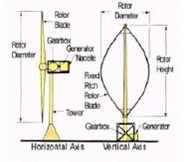
(5)
Hydronic furnace definitions.
Hydronic furnace means an outdoor wood boiler that provides heating or hot water using a firebox surrounded by a water jacket enclosed within an insulated shed. A fire is started inside the firebox, and the water temperature is controlled by a thermostatically actuated damper.
(d)
Ground source heat pump systems.
(1)
Zoning districts. Ground source heat pump systems in accordance with the standards in this section are allowed as a permitted accessory use in all zoning districts.
(2)
Standards.
a.
System requirements.
1.
Only closed loop ground source heat pump systems utilizing heat transfer fluids as defined in subsection (c) of this section are permitted. Open loop ground source heat pump systems are not permitted.
2.
Ground source heat pump systems in water bodies owned or managed by the city are not permitted.
3.
Ground source heat pump systems in private ponds constructed within uplands and that are not protected wetlands are permitted.
b.
Setbacks.
1.
All components of ground source heat pump systems, including pumps, borings and loops shall be set back at least five feet from interior side and rear lot lines, at least ten feet from front lot lines, and maintain all state-mandated isolation distances.
2.
Above-ground equipment associated with ground source heat pumps shall not be installed in the front yard of any lot or the side yard of a corner lot adjacent to a public right-of-way and shall meet all required accessory structure setbacks for the applicable zoning district.
c.
Construction.
1.
All access shall be over the owner's land and due care shall be taken to avoid hazard, inconvenience or damage to public streets and nearby public or private property.
2.
Necessary precautions shall be taken in stockpiling excavated materials to avoid erosion, dust or other infringements upon adjacent property.
3.
All wiring, installation of pipes, grading and all other installations and construction shall be subject to inspection.
4.
Disturbed land shall be restored to its prior condition after completion of construction.
d.
Easements. Ground source heat pump systems shall not encroach on public drainage, utility, roadway or trail easements.
e.
Noise. Ground source heat pump systems shall comply with state pollution control agency standards outlined in Minn. R. ch. 7030, as amended.
f.
Screening. Ground source heat pumps are considered mechanical equipment and are subject to the screening requirements of the applicable zoning district.
(3)
Safety. Ground source heat pumps shall be certified by Underwriters Laboratories, Inc. and meet the requirements of the state building code.
(4)
Abandonment. If the ground source heat pump system remains nonfunctional or inoperative for a continuous period of one year, the system shall be deemed to be abandoned and shall constitute a public nuisance. The owner shall remove the abandoned system at their expense after a demolition permit has been obtained in accordance with the following:
a.
The heat pump and any external mechanical equipment shall be removed.
b.
Pipes or coils below the land surface shall be filled with grout to displace the heat transfer fluid. The heat transfer fluid shall be captured and disposed of in accordance with applicable regulations. The top of the pipe, coil or boring shall be uncovered and grouted.
c.
Private pond ground source heat pump systems shall be completely removed from the bottom of the body of water.
(5)
Permits. A city building permit and any other required agency permits shall be obtained for any ground source heat pump system prior to installation. Borings for vertical systems are subject to approval from the state department of public health.
(e)
Solar energy systems.
(1)
Zoning districts. Solar energy systems in accordance with the standards in this section are allowed as a permitted accessory use in all zoning districts.
(2)
Standards.
a.
Exemption. Passive or building-integrated solar energy systems are exempt from the requirements of this section and shall be regulated as any other building element.
b.
Roof-mounted systems allowed. The only solar energy systems allowed in the city are those that are roof-mounted,
c.
Height. Roof-mounted solar energy systems shall comply with the maximum height requirements in the applicable zoning district.
d.
Setbacks. Roof-mounted solar energy systems shall comply with all building setbacks in the applicable zoning district and shall not extend beyond the exterior perimeter of the building on which the system is mounted.
e.
Roof mounting. Roof-mounted solar collectors shall be mounted parallel to the surface of the roof and within three feet of the roof surface, unless manufacturer's documentation is provided indicating that collectors must be angled to provide optimum performance. No portion of the collectors or their mounting system shall extend above the peak or ridge height of a pitched roof. On a flat roof, collectors and their mounting systems shall not extend more than five feet above the roof surface.
f.
Easements. Solar energy systems shall not encroach on public drainage, utility, roadway or trail easements.
g.
Screening. Solar energy systems shall be screened from view to the extent possible without impacting their function.
h.
Aesthetics. All solar panels shall be designed, installed, positioned and constructed of materials so as not to cause any glare or reflective sunlight onto neighboring properties or structures, nor toward vehicular traffic on land or on a lake, and so as to not obstruct views. Reflection angles from collector surfaces shall be oriented away from neighboring windows. Where necessary, screening may be required to address glare.
i.
Feeder lines. The electrical collection system shall be placed underground within the interior of each parcel. The collection system may be placed overhead near substations or points of interconnection to the electric grid.
(3)
Safety.
a.
Standards and certification.
1.
Certification. Solar energy systems shall be certified by Underwriters Laboratories, Inc. and the National Renewable Energy Laboratory, the Solar Rating and Certification Corporation or other body as determined by the building official. The city reserves the right to deny a building permit for proposed solar energy systems deemed to have inadequate certification.
2.
The equipment or device must be designed and constructed in compliance with all applicable building and electrical codes, and (if for co-generation) must be in compliance with all state and federal regulations regarding co-generation of energy.
b.
Utility connection. All grid connected systems shall have an agreement with the local utility prior to the issuance of a building permit. A visible external disconnect must be provided if required by the utility.
(4)
Abandonment. If the solar energy system remains nonfunctional or inoperative for a continuous period of one year, the system shall be deemed to be abandoned and shall constitute a public nuisance. The owner shall remove the abandoned system at their expense after a demolition permit has been obtained. Removal includes the entire structure including transmission equipment.
(5)
Permits. A building permit shall be obtained for any solar energy system prior to installation.
(f)
Wind energy conversion systems.
(1)
Zoning districts. Small wind energy conversion systems (SWECS) in accordance with the standards in this section are permitted accessory uses on lots at least ten acres in gross area within the RR-1A and RR-1B Rural Residential zoning districts. SWECS in accordance with the standards in this section are allowed as a conditional use on lots at least five acres in gross area and subject to conditional use permit approval in the following commercial or industrial districts: B-1 Retail Sales; B-4 Office and Professional; B-6 Highway Commercial; B-6 PUD; and I Industrial.
(2)
Standards for SWECS in residential zoning districts.
a.
Number. No more than one SWECS is permitted per parcel.
b.
Height. In the RR-1A and RR-1B zoning districts, a maximum hub height of 30 feet is allowed as a permitted accessory use.
c.
Blade length. A maximum blade length of 15 feet is permitted.
d.
Clearance. The minimum distance from the ground for the lowest point of a blade or any other moving part shall be 12 feet.
e.
Roof mounting. Roof or wall mounted SWECS are not permitted.
f.
Setbacks. The base of the SWECS tower shall be set back at least 100 feet from all property lines. SWECS shall not be installed in the front yard of any lot or in the side yard of a corner lot adjacent to a public right-of-way. SWECS shall not be located more than 100 feet from the principal structure on the property.
g.
Easements. SWECS shall not encroach on public drainage, utility, roadway or trail easements.
h.
Noise. SWECS shall comply with the state pollution control agency standards outlined in Minn. R. ch. 7030 at all property lines.
i.
Screening. SWECS are exempt from the screening requirements for the district in which they are located.
j.
Aesthetics. All portions of the SWECS shall be a nonreflective surface, subject to the approval of the city administrator or his/her designee. Only monopole towers are permitted. The appearance of the turbine, tower and any other related components shall be maintained throughout the life of the SWECS pursuant to industry standards. Systems shall not be used for displaying any advertising, nor for other uses, including, but not limited to, cell phone antennas, flags, ham radio antennas, etc. No components unnecessary to the operation of the SWECS shall be allowed. Systems shall not be illuminated.
k.
Feeder lines. The electrical collection system shall be placed underground within the interior of each parcel.
l.
Vibration. No wind energy conversion system shall produce vibrations through the ground that are perceptible beyond the property on which it is located.
m.
Location. No SWECS shall be allowed within the shoreland overlay district. SWECS shall be setback a distance at least equal to the height of the SWECS from a floodplain, pond or wetland.
(3)
Standards for SWECS in commercial and industrial zoning districts.
a.
Number. No more than one SWECS is permitted per parcel.
b.
Height. In commercial and industrial zoning districts, a maximum hub height of 30 feet is allowed.
c.
Blade length. A maximum blade length of 15 feet is permitted.
d.
Clearance. The minimum distance from the ground for the lowest point of a blade or any other moving part shall be 12 feet.
e.
Roof mounting. Roof or wall mounted SWECS are not permitted.
f.
Setbacks. The base of the SWECS tower shall be set back at least 100 feet from all property lines. SWECS shall not be installed in the front yard of any lot or in the side yard of a corner lot adjacent to a public right-of-way. SWECS shall not be located more than 100 feet from the principal structure on the property.
g.
Easements. SWECS shall not encroach on public drainage, utility, roadway or trail easements.
h.
Noise. SWECS shall comply with the state pollution control agency standards outlined in Minn. R. ch. 7030 at all property lines.
i.
Screening. SWECS are exempt from the screening requirements for the district in which they are located.
j.
Aesthetics. All portions of the SWECS shall be a nonreflective surface, subject to the approval of the city administrator or his/her designee. Only monopole towers are permitted. The appearance of the turbine, tower and any other related components shall be maintained throughout the life of the SWECS pursuant to industry standards. Systems shall not be used for displaying any advertising, nor for other uses, including, but not limited to, cell phone antennas, flags, ham radio antennas, etc. No components unnecessary to the operation of the SWECS shall be allowed. Systems shall not be illuminated.
k.
Feeder lines. The electrical collection system shall be placed underground within the interior of each parcel.
l.
Vibration. No SWECS shall produce vibrations through the ground that are humanly perceptible beyond the property on which it is located.
m.
Location. No SWECS shall be allowed within the shoreland overlay district. WECS shall be setback a distance equal to the height of the WECS from a floodplain, pond or wetland.
(4)
Safety.
a.
Standards and certification.
1.
Standards. SWECS shall meet minimum standards such as International Electrotechnical Commission (IEC) 61400-2 or the American Wind Energy Association's (AWEA) Small Wind Turbine Performance and Safety Standard or other standards as determined by the city administrator or his/her designee.
2.
Certification. SWECS shall be certified by Underwriters Laboratories, Inc. and the National Renewable Energy Laboratory, the Small Wind Certification Council or other body as determined by the city administrator or his/her designee. The city reserves the right to deny a building permit for proposed SWECS deemed to have inadequate certification or testing for operation in a severe winter climate.
3.
Maintenance. SWECS shall be maintained under an agreement or contract by the manufacturer or other qualified entity. The owner of the SWECS shall once every two years have the SWECS inspected by a licensed qualified professional and submit to the city a report on the status and condition of the SWECS.
b.
Utility connection. All grid connected systems shall have an agreement with the local utility prior to the issuance of a building permit. A visible external disconnect must be provided if required by the utility.
(5)
Abandonment. If the SWECS remains nonfunctional or inoperative for a continuous period of one year, the system shall be deemed to be abandoned and shall constitute a public nuisance. The owner shall remove the abandoned system at their expense after a demolition permit has been obtained. Removal includes the entire structure, including foundations to below natural grade and transmission equipment.
(6)
Permits. A building permit shall be obtained for any SWECS prior to installation.
(7)
Power distribution. The power produced from a SWECS shall only be used for on-site consumption except if connected to the local utility power grid per the provisions of this section.
(g)
Hydronic furnaces. Hydronic furnaces are not an allowed use or structure within any zoning districts in the city.
(Code 2003, § 78-1379; Ord. No. 119(3rd series), § 1, 12-9-2013; Ord. No. 142(3rd series), §§ 1, 2, 4-13-2015; Ord. No. 262(3rd series), § 1, 11-8-2021)
Sec. 6.12.6850. - Keeping of farm animals.
(a)
Purpose. Regulations are established for the keeping of animals to ensure that the character and livability of the surrounding residential neighborhood will not be adversely impacted. In order to protect the public health, safety and welfare within residential neighborhoods, the keeping of animals shall be permitted in all R, RR, and LR residential zoning districts under two categories: farm animals and domestic poultry.
(b)
Performance standards. No property within a single-family residential district shall be used for the keeping of farm animals, except as an accessory use or conditional use within the specified district and when the following requirements are met:
(1)
Farm animals may be kept on a residential property if the following conditions can be met:
a.
The property shall be a minimum of two acres in size.
b.
Any building or structure associated with farm animals must meet the principal building setbacks of the underlying zoning district.
c.
There must be at least one acre for the residence and one acre for each animal unit on the lot.
d.
For the keeping of horses, there must be at least one acre for the dwelling and two acres of open pasture for the first horse. For the keeping of more than one horse, the property must have one additional acre of open pasture for each additional horse.
(2)
Domestic poultry may be kept on a residential property if the following conditions can be met:
a.
The property shall be a minimum of one-half acre in size.
b.
Any building or structure associated with domestic poultry must meet the principal building setbacks of the underlying zoning district.
c.
Either a maximum of five hens; or 25 pigeons or doves can be kept on lots between one-half acre and two acres in size. Domestic poultry kept on properties greater than two acres in area are subject to the animal unit limits defined in section 6.12.010.
(Ord. No. 315, § 14, 7-14-2025)
Sec. 6.12.6910. - Reduction prohibited.
No yard or other open space shall be reduced in area or dimensions so as to make such yard or other open space less than the minimum required by this chapter; and if the existing yard or other open space as existing is less than the minimum required, it shall not be further reduced.
(Code 1984, § 10.03(14)(A); Code 2003, § 78-1401)
Sec. 6.12.6920. - Application to only one dwelling or group.
No required yard or other open space allocated to a building or dwelling group shall be used to satisfy yard, other open spaces, or minimum lot area requirements for any other building or dwelling group.
(Code 1984, § 10.03(14)(B); Code 2003, § 78-1402)
Sec. 6.12.6930. - Lot coverage and massing standards.
In all zoning districts other than the I Industrial district, all lots that have a gross acreage of less than two acres shall comply with the following massing standards for buildings:
(1)
Maximum total footprints allowed.
a.
On lots equal to or greater than 10,000 square feet in area, the total combined footprints of all principal and accessory buildings shall not exceed 20 percent of the gross lot area.
b.
On lots of less than 10,000 square feet in area, the total combined footprints of all principal and accessory buildings shall not exceed 2,000 square feet.
(2)
Calculation of massing. All buildings shall be included in the calculation of the total combined footprints by buildings.
(Code 1984, § 10.03(14)(C); Code 2003, § 78-1403; Ord. No. 215(2nd series), § 1, 3-11-2002; Ord. No. 99(3rd series), § 1, 1-28-2013; Ord. No. 170(3rd series), § 2, 6-13-2016; Ord. No. 187(3rd series), § 1, 3-13-2017; Ord. No. 222(3rd series), § 2, 12-10-2018)
Sec. 6.12.6940. - Permitted encroachments.
(a)
The following shall not be considered to be encroachments on yard setback requirements:
(1)
Chimneys, flues, belt courses, leaders, sills, pilasters, lintels, ornamental features, cornices, eaves, gutters, and similar building elements, provided they do not extend more than two feet into a required yard.
(2)
Nameplate signs for one-family dwellings subject to the provisions of article X, division 4 of this chapter; lights for illuminating parking areas, loading areas or yards for safety and security purposes, provided the direct source of light is not visible from the public right-of-way or adjacent residential property and is located at least five feet from the front lot line; public utility poles and overhead lines; mailboxes.
(3)
Steps, sidewalks, uncovered porches, stoops, or similar structures which do not extend above the height of the ground floor level of the principal building and extend to a distance of not less than two feet from any lot line.
(4)
Bays, cantilevers, and fire escapes. In side or rear yards only, the following encroachments are permitted:
a.
Bays and/or cantilevers which are not part of the defined building footprint, may extend up to two feet into the required side or rear yard, provided the aggregate area of the bays and/or cantilevers is not more than 20 square feet; and
b.
Fire escapes not exceeding a width of three feet and a depth of four feet.
(5)
Driveways and parking areas when constructed, located, and used in compliance with other provisions contained within this chapter. Driveways and parking areas may extend to within five feet of a side lot line.
(6)
Retaining walls, planters, and similar structures, subject to the following provisions:
a.
Retaining walls, planters and similar structures may be located in front, rear, or side yards when all of the following conditions are met:
1.
The structure is located at least ten feet from the edge of the traveled roadway;
2.
The structure is not located within a drainage, utility, or other easement, except upon approval in writing for an encroachment agreement by the city; or similar approval from another regulatory and/or utility agency;
3.
The structure creates no impacts to drainage direction, rate, or volume for adjacent properties.
4.
The structure is two feet in height or less above the existing grade.
b.
Retaining walls, planters, and similar structures exceeding two feet in height above existing ground level must be located five feet from a side property line.
c.
Retaining walls, planters and similar structures exceeding the allowed height of a fence shall be located to meet the required accessory structure setbacks established for that yard.
d.
Retaining walls exceeding 42 inches in height, as measured from existing grade, shall not be located lakeward of the average lakeshore setback as defined within subsection 6.12.6240(6).
(7)
Window wells including those for fire egress which do not extend more than five feet from the building, and are no closer than two feet to the property line.
(8)
Air conditioning or heating equipment may be located within a required yard but shall be located within five feet of the building it serves; shall not be located within an existing or required drainage and/or utility easement; and shall be located at least five feet from any lot line.
(9)
Fences erected in all zoning districts are considered a permitted encroachment when they conform to the standards listed below. A fence shall be located a minimum of ten feet from the edge of the paved, traveled roadway. The following words, terms and phrases, when used in this subsection (a)(9), shall have the meanings ascribed to them in this subsection, except where the context clearly indicates a different meaning:
Fence height means the measurement from the top of any part of the fence, including posts or other structural supports, lattice, ornate top design elements, and so forth measured to the existing ground level below the fence, as measured perpendicular to the slope (see Drawing: Fence Height Measurement on Sloped Site). Exception: Post finials extending above the top of the fence shall not be deemed as part of the fence for height determination purposes as long as they do not exceed ten inches in width per finial and do not extend above the top of the fence by more than six inches.
Fence monument means a fence monument is a permanent structure or object, with or without a footing, made with masonry or stone materials, used in place of, and functioning as a post that supports a fence.
Permanent fence means a fence that is installed in a fixed or enduring manner that is not intended for a seasonal or temporary purpose.
Temporary fence means a fence that is not permanently secured or anchored to the ground by posts or affixed footings, and is installed and removed on a limited term or seasonal basis such as: snow fences, garden fences, seasonal recreational fences such as hockey boards; fences installed for safety or access management purposes for special events; and fences installed for the duration of a construction project such as silt fences, erosion control bioretention logs, and septic drainfield site protection fences.
Drawing: Fence Height Measurement on Sloped Site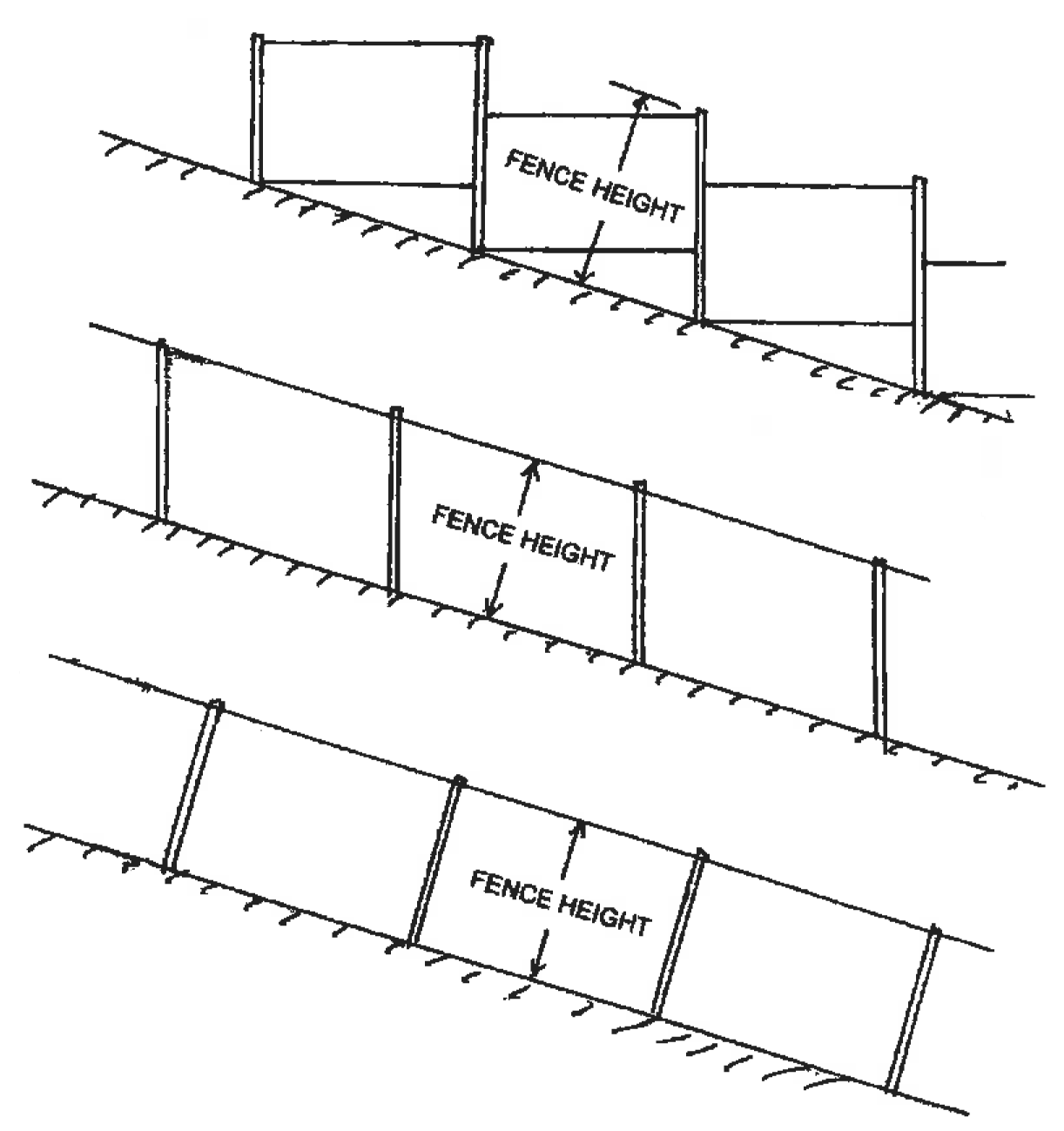
a.
Nonlakeshore lots.
1.
Fences and walls within a required front yard or side street yard shall not exceed a height of 42 inches above existing ground level.
2.
Fences and walls within a required rear or side yard shall not exceed a height of six feet above existing ground level.
b.
Lakeshore lots.
1.
Fences within the required street (rear) yard or side street yard of a lakeshore lot shall not exceed 42 inches above existing ground level. Exception: A fence not exceeding six feet in height may be located along the street lot line, and within the rear street setback of a lake frontage lot which abuts a major thoroughfare. A major thoroughfare for purposes of this section means any county road or state highway. If such fence involves fill or berming, the total combined height of both fence and fill shall not exceed six feet above the height of the crown of the major thoroughfare.
2.
Fences within the required side yard of a lakeshore lot shall not exceed six feet in height. Fences shall not exceed 42 inches in height for any portion located lakeward of the average lakeshore setback.
3.
Fences shall not be constructed within the defined lakeshore yard of a lakeshore lot, i.e., shall not be located within 75 feet of the shoreline for general development lakes, 100 feet for recreational lakes, or 150 feet for natural environment lakes.
4.
When the building site of a lakeshore lot is separated from the lakeshore by a public or private road, the following definitions will apply for fence location purposes subject to the provisions of this section: When the yard on the opposite side of the building site from the lake does not abut a street, such yard shall be considered as a standard rear yard. The yard between the building site and the street shall be considered as a standard front yard.
c.
Special provisions. Split rail fences of no more than three rails within a required front, street or side street yard may have a maximum top rail height of 48 inches above existing ground level. Board rail fences within a front, street or side street yard for the specific purpose of enclosing permitted domestic animals may have a top rail height of 60 inches and shall be no more than 50 percent opaque.
d.
Intersection sightline obstruction prohibited. No fence shall be installed so as to obstruct a required clear view at street intersections as required by section 6.12.6760.
e.
Fence construction and maintenance.
1.
The owner of a fence shall maintain it in a condition of reasonable repair and appearance and shall not allow it to become or remain in disrepair or in a dangerous condition.
2.
Fences shall be installed with the finished side facing neighboring properties or the street. The term "finished side" means that side having no structural supports.
3.
Fencing materials shall consist of permanent all weather products.
4.
Temporary fencing shall not be allowed to remain on the property following final inspection, or issuance of a certificate of occupancy for a permitted construction project, or protection of property during a similar project or winter conditions. The term "winter conditions" means October 15 through March 31 of the following year. Temporary fencing associated with a special event shall be removed within seven days of the end of such event. Temporary fencing materials shall not be allowed to remain on a permanent basis on a parcel.
5.
Existing fences that are legally nonconforming as to location, height, design, or other characteristics may be replaced in kind.
(10)
Fence monument, as part of a fence erected in all residential zoning districts are considered as a nonencroachment when it conforms to the following standards:
a.
Property corners shall be located and identified (staked);
b.
Fence monuments must be set back a minimum of five feet from all property boundaries and never fewer than ten feet from the edge of the paved, traveled roadway;
c.
An individual fence monument shall be limited to a maximum footprint of six square feet;
d.
Fence monuments may not exceed the maximum allowed height of the associated fence, including any appurtenances. Any fence monument exceeding the maximum height must meet accessory structure setbacks for the appropriate district;
e.
Building permit requirements:
1.
A building permit is required if footings are proposed;
2.
Construction plans with footing details are required to be submitted for permit approval;
3.
If the fence and/or fence monuments exceed six feet in height, a building permit is required.
(11)
Entrance monuments, defined for the purpose of this section as a nearly permanent physical structure or object, natural or artificial, used to depict an entrance to the property, erected in all residential zoning districts are considered nonencroachments when they conform with the following standards:
a.
Each monument, with a maximum of two per approved driveway access, shall be limited to a single pillar with a footprint measuring no larger than 25 square feet and no length to exceed five feet;
b.
The monument must be setback a minimum of five feet from all property boundaries and never fewer than ten feet from the edge of the paved, traveled roadway;
c.
Plans and/or elevation views of the proposed monuments are required to be submitted for approval by the planning director;
d.
All signage proposed for the monuments must comply with article X, division 4 of this chapter;
e.
The monuments are limited to eight feet in height, including any appurtenances. Any monument exceeding the maximum height must meet principal structure setback requirements;
f.
When more than one monument is proposed, and serving two or fewer residences, a minimum horizontal width of 16 feet is required between them;
g.
When more than one monument is proposed, and serving three or more residences, a minimum horizontal width of 22 feet is required between them;
h.
Lighting is allowed, in conformance with section 6.12.7780 and at the discretion of the planning director.
i.
A building permit is required for installation and the property corners must be located for inspection purposes.
(12)
Gates, when proposed, must meet the following requirements:
a.
The gate must open into the property not outward towards the right-of-way;
b.
Gates serving two or fewer residences shall have a minimum horizontal width of 14 feet in the full open position;
c.
Gates serving three or more residences shall have a minimum horizontal width of 20 feet in the full open position;
d.
For all properties, gate height may not exceed the height of the monument, measured from grade, unless principal structure setbacks are met (if monuments are not proposed then gate height shall be regulated in accordance with the fence height regulations of subsection (a)(9) of this section;
e.
For locked and/or secured gates, a Knox box meeting the standards set forth by the police and fire department must be provided for emergency access; and
f.
On major thoroughfares the monuments and gates must be located 40 feet from the paved, traveled road to allow for vehicle stacking. A major thoroughfare for the purposes of this section means any county road or state highway.
(13)
Lawn irrigation systems are permitted in any required yard. Non-pressurized lines for irrigation systems may be installed in the adjacent right-of-way, at the system owner's risk. The system owner shall relocate or remove the lawn irrigation system from the right-of-way at the system owner's expense in the event said relocation or removal is required by the city or other utility company authorized to use the city right-of-way. The system owner shall defend, indemnify, and hold harmless the city its officials, and employees from and against any and all claims, liability for loss, damage, or injury arising directly or indirectly from the lawn irrigation system or to the system that is in the right-of-way.
(b)
The following shall not be considered to be encroachments on structure height requirements:
(1)
Parapet walls that extend no more than three feet above the height of the building.
(2)
HVAC cooling towers.
(3)
Elevator penthouses.
(Code 1984, § 10.03(15); Code 2003, § 78-1405; Ord. No. 211(2nd series), §§ 1—5, 11-26-2001; Ord. No. 12(3rd series), § 1, 5-24-2004; Ord. No. 30(3rd series), § 1, 11-28-2005; Ord. No. 43(3rd series), § 1, 2-25-2008; Ord. No. 106(3rd series), § 22, 6-10-2013; Ord. No. 139(3rd series), § 1, 2-23-2015; Ord. No. 140(3rd series), § 1, 3-23-2015; Ord. No. 170(3rd series), §§ 3, 4, 6-13-2016; Ord. No. 188(3rd series), § 1, 3-22-2017; Ord. No. 189(3rd series), § 5, 4-10-2017; Ord. No. 209(3rd series), § 1, 6-11-2018; Ord. No. 222(3rd series), § 22, 12-10-2018; Ord. No. 272(3rd series), § 1, 6-13-2022; Ord. No. 299(3rd series), § 10, 3-11-2024; Ord. No. 319, § 4, 11-24-2025)
Sec. 6.12.6950. - Additional yard provisions.
Required yards in the districts specified shall be subject to the following additional requirements:
(1)
Through lots. Through lots in any district shall have a required front yard on each street.
(2)
B and I districts; adjacent lots. In the B and I districts, for lots that are nonconforming with respect to area, the minimum front yard setback for the principal building shall be equal to the average depth of the existing front yards on the adjacent nonresidential lots on each side of the nonconforming lot fronting on the same street. However, the depth of such front yard shall not be less than ten feet.
(Code 1984, § 10.75(4); Code 2003, § 78-1406; Ord. No. 199(3rd series), § 1, 6-12-2017; Ord. No. 222(3rd series), § 23, 12-10-2018)
Sec. 6.12.7010. - Accessory buildings and structures on through lots.
All accessory buildings on through lots located in R districts shall meet the principal building setbacks that are established for the appropriate district.
(Code 1984, § 10.03(10); Code 2003, § 78-1431; Ord. No. 15(3rd series), § 1, 6-28-2004; Ord. No. 222(3rd series), § 24, 12-10-2018; Ord. No. 299(3rd series), § 11, 3-11-2024)
Sec. 6.12.7020. - Time of construction.
No accessory building or structure shall be constructed on any lot prior to the time of construction of the principal building to which it is accessory.
(Code 1984, § 10.03(9)(A); Code 2003, § 78-1432; Ord. No. 13(3rd series), § 1, 5-24-2004; Ord. No. 222(3rd series), § 25, 12-10-2018)
Sec. 6.12.7030. - Accessory dwelling units.
The provisions for accessory dwelling units are as follows:
(1)
Purpose. The city recognizes the need to encourage alternate housing types based on current housing trends. There is an increased desire to support multigenerational housing. This provision is intended to accommodate single-family residential property owners who wish to invest in their homes and add value while providing alternative housing options within the city. The purpose of this subdivision is to permit and regulate permanent accessory dwelling units (ADUs) only as a permitted accessory use subject to the regulations set forth herein. By allowing only those accessory dwelling units that are in compliance with all of the performance standards of this subdivision, the character and quality of existing neighborhoods will be protected.
(2)
Performance standards. No property within a single-family residential district shall have more than one dwelling unit, except an ADU may be permitted as an accessory use to a single-family dwelling when the following requirements are met:
a.
The property must be located within the R-1A, R-1B, LR-1A, LR-1B, LR-1C, LR-1C-1, RR-1A, or RR-1B Zoning Districts.
b.
An ADU, attached or detached, shall only be permitted on lots one acre or greater in area.
c.
No more than one ADU shall be permitted on a lot or parcel.
d.
Total floor area of an ADU shall be no more than 50 percent of the primary dwelling unit's total floor area. The total floor area of an ADU shall not be less than 300 square feet.
e.
The ADU shall not have separate utility connections. The primary residence and ADU must be served by shared municipal water, sanitary sewer, gas, and electric utility services. If not served by municipal sewer and water, the primary residence and ADU shall meet the private well and septic requirements of this Code.
f.
An ADU shall be designed and maintained so as to be consistent with the architectural design, integrated materials, style, appearance, and character of the primary residence as a single-family residence.
g.
A minimum of two off-street parking spaces (enclosed or on a driveway) shall be required for the ADU.
h.
ADUs must be constructed on a permanent foundation with no wheels.
i.
The property shall only have one address. The ADU may not be addressed separately from the primary residence.
j.
The ADU may not be subdivided or otherwise segregated in ownership from the primary residence structure.
(3)
Permit requirements. It is unlawful for a property owner to construct or allow occupancy within an ADU which does not comply with all of the following requirements:
a.
Building permit required. An ADU, as permitted in this chapter, shall be constructed and maintained in accordance with all state laws and state building, plumbing, electrical, mechanical, and fire code regulations and city Code requirements.
b.
A rental license shall not be granted to an ADU. An ADU cannot be rented separately from the primary residence.
c.
The property owner must execute a covenant providing that the ADU will be maintained in compliance with the above performance standards and permit requirements.
(Code 2003, § 78-1433; Ord. No. 279(3rd series), § 26, 11-14-2022)
Sec. 6.12.7040. - Building size restrictions.
No accessory building shall exceed 1,000 square feet of footprint area, except that accessory buildings in excess of 1,000 square feet shall be considered oversized and will be allowed under the following conditions:
(1)
Not more than one oversized accessory building (OAB) shall be permitted on any property. An OAB is defined as an accessory building of footprint area in excess of 1,000 square feet.
(2)
An OAB is regulated by the following table:
(3)
Any OAB shall be subject to the following conditions:
a.
Principal building setbacks must be met. Further, no OAB shall be nearer the front lot line than the front line of the principal building on the property.
b.
The maximum height for such accessory building shall be 30 feet or the defined height of the principal residence building on the property, whichever is less.
(Code 1984, § 10.03(9)(C); Code 2003, § 78-1434; Ord. No. 106(3rd series), § 24, 6-10-2013; Ord. No. 222(3rd series), § 27, 12-10-2018; Ord. No. 232(3rd series), § 1, 10-14-2019; Ord. No. 278(3rd series), § 3, 10-10-2022; Ord. No. 299(3rd series), § 12, 3-11-2024)
Sec. 6.12.7050. - Garages on lake lots.
Accessory buildings on lake lots with garage doors facing a street shall meet the applicable principal building setbacks for the district; section 6.12.9120 shall apply.
(Code 1984, § 10.03(9)(D); Code 2003, § 78-1435; Ord. No. 52(3rd series), § 2, 11-24-2008; Ord. No. 106(3rd series), § 25, 6-10-2013; Ord. No. 222(3rd series), § 28, 12-10-2018)
Sec. 6.12.7060. - Plumbing.
Because the provision of plumbing fixtures and wastewater plumbing in accessory buildings has the potential to allow such buildings to be used as dwelling units, and because it is the policy of the city to limit residential development density to the allowed densities within the respective zoning districts, plumbing in accessory buildings shall be regulated as follows:
(1)
The provision of outside sillcocks and indoor water supply shall be allowed in any accessory building.
(2)
Installation of a toilet and/or sink in any accessory building shall be subject to the provision of municipal sanitary sewer or a conforming sewage treatment system designed to handle the anticipated flows from such fixtures.
(3)
Installation of any combination of fixtures which includes a bathtub or shower shall be subject to the property owners executing a covenant providing that the accessory building will not be:
a.
Used for a home occupation unless specifically approved by the city or if allowed by this Code.
b.
Rented, leased, or otherwise provided for use as a dwelling under any circumstances.
(Code 2003, § 78-1437; Ord. No. 179(2nd series), § 1, 10-12-1998; Ord. No. 45(3rd series), § 11, 2-25-2008; Ord. No. 222(3rd series), § 30, 12-10-2018; Ord. No. 257(3rd series), § 2, 5-10-2021; Ord. No. 299(3rd series), § 13(78-1437), 3-11-2024)
Sec. 6.12.7070. - Building placement.
(a)
All principal and accessory buildings on the same lot must be separated by a ten foot setback from other buildings.
(b)
Within RR-1A and RR-1B districts, an accessory building less than 1,000 square feet may be located streetward of the principal building provided principal building setbacks and the exterior materials provisions in 6.12.7080(b) are met.
(Code 1984, § 10.03(12); Code 2003, § 78-1438; Ord. No. 165(3rd series), § 1, 3-14-2016; Ord. No. 299(3rd series), § 13(78-1438), 3-11-2024)
Sec. 6.12.7080. - Exterior materials.
(a)
Accessory buildings and principal buildings shall be consistent in design and color. Except for accessory buildings that are less than 120 square feet in area or are located on lots two acres in area or larger.
(b)
All accessory buildings located streetward of the principal building within RR-1A and RR-1B districts shall be consistent in design, color, and exterior materials with the principal building.
(Code 2003, § 78-1440; Ord. No. 52(3rd series), § 3, 11-24-2008; Ord. No. 222(3rd series), § 32, 12-10-2018; Ord. No. 299(3rd series), § 13(78-1439), 3-11-2024)
Sec. 6.12.7110. - Recitals.
This division shall be known, cited and referred to as the "Orono Sign Code," except as referred to herein, where it shall be known as "this division."
(Code 2003, § 78-1465; Ord. No. 2015(3rd series), § 1, 9-10-2018)
Sec. 6.12.7120. - Purpose.
This division is intended to establish a comprehensive and balanced system of sign control that accommodates the need for a well-maintained, safe, and attractive community, and the need for effective communications, including business identification. It is the intent of these sign regulations, to promote the health, safety, general welfare, aesthetics, and image of the community by regulating signs that are intended to communicate to the public in all areas of the city. It is not the purpose or intent of this division to regulate the message displayed on any sign. The purpose of this division is to authorize:
(1)
Permanent signs which establish a high standard of aesthetics and are appropriate for the planned character in each sign district as established in section 6.12.7240;
(2)
Signs that are compatible with their surroundings;
(3)
Signs that are designed, constructed, installed, and maintained in a manner that does not adversely impact public safety or create a hazard to motorists, pedestrians, or cyclists;
(4)
Signs that are proportioned to the scale of, and are architecturally compatible with, principal structures;
(5)
Permanent signs which give preference to the on-premises owner or occupant;
(6)
Temporary commercial signs and advertising displays which provide an opportunity to advertise while restricting signs that create visual clutter and hazards at public right-of-way intersections;
(7)
Minimize adverse effects on nearby property; and
(8)
Provide for fair and consistent enforcement of the sign regulations set forth herein under the authority of the city.
(Code 2003, § 78-1466; Ord. No. 2015(3rd series), § 1, 9-10-2018)
Sec. 6.12.7130. - Findings.
The city finds it is necessary for the promotion and preservation of the public health, safety, welfare, and aesthetics of the community to control the construction, location, size, and maintenance of signs. Further, the city finds:
(1)
Permanent and temporary signs have a direct impact on and relationship to the image and aesthetic of the community;
(2)
The manner of installation, location, and maintenance of signs affects the public health, safety, welfare, and aesthetics of the community;
(3)
An opportunity for viable identification of community businesses, residences, and institutions must be established;
(4)
The safety of motorists, cyclists, pedestrians, and other users of public streets and property is affected by the number, size, location, and appearance of signs that create a hazard for drivers;
(5)
Installation of signs suspended from, projecting over, or placed on the tops of buildings, walks, or other structures may constitute a hazard during periods of high winds and an obstacle to effective firefighting and other emergency service;
(6)
Uncontrolled and unlimited signs and sign types adversely impact the image and aesthetic attractiveness of the community and thereby undermine economic value and growth;
(7)
Uncontrolled and unlimited signs, particularly temporary signs which are commonly located within or adjacent to public right-of-way or are located at driveway/street intersections, result in roadside clutter and obstruction of views of oncoming traffic. This creates a hazard to drivers and pedestrians and also adversely impacts a logical flow of information;
(8)
Commercial signs are generally incompatible with residential uses and should be strictly limited in residential zoning districts; and
(9)
The right to express noncommercial opinions in any zoning district must be protected, subject to reasonable restrictions on size, height, location, and number.
(Code 2003, § 78-1467; Ord. No. 2015(3rd series), § 1, 9-10-2018)
Sec. 6.12.7140. - Scope of regulations.
The sign regulations set forth in this division shall apply to all structures and land uses. This division describes the signage standards for the sign districts that overlay the zoning districts of the city. Specific additional regulations are established for signs which are unique in purpose and not easily addressed by district regulations. No person, property owner, or lessee shall place, erect, alter, modify, enhance, or change in any way a sign that does not conform to the requirements of this division and all other applicable regulations.
(Code 2003, § 78-1468; Ord. No. 2015(3rd series), § 1, 9-10-2018)
Sec. 6.12.7150. - Definitions.
The following words, terms and phrases, when used in this division, shall have the meanings ascribed to them in this section, except where the context clearly indicates a different meaning:
Auxiliary sign means a sign that provides direction for internal circulation, parking or entry, restrictions on parking, security warnings, or other similar primarily noncommercial signs that are directed at people that are entering, exiting, or on a particular property. Auxiliary signs do not include outdoor advertising signs.
Banner means any temporary sign of lightweight fabric or similar material mounted to a pole or a building at one or more edges.
Billboard. See Outdoor advertising sign.
Canopy/awning sign means a message or logo on an awning or canopy which is constructed according to the requirements of the building code, is an integral part of the building, and is consistent with the architecture and design of the building.
Clear vision area means an area within a triangle that is measured along the edge of the driving surface of the road starting at the intersection of two roads and driveways (public or private) and extending 30 feet in each direction from the intersection and then a line connecting these two end points.
Changeable message sign means a message that is not permanently attached to the sign face but is not a dynamic display. The message is changed manually.
Commercial message sign means any message which identifies a business or product or promotes the sale of any product or service.
Dynamic display means any characteristics of a sign that appear to have movement or that appear to change, caused by any method other than physically removing and replacing the sign or its components, whether the apparent movement or change is in the display, the sign structure itself, or any other component of the sign. The term "dynamic display" includes a display that incorporates a technology or method allowing the sign face to change the image without having to physically or mechanically replace the sign face or its components. The term "dynamic display" also includes, but is not limited to, any rotating, revolving, moving, flashing, blinking, projecting, or animated display and any display that incorporates rotating panels, LED lights manipulated through digital input, digital ink, or any other method or technology that allows the sign face to present a series of images or displays.
Freestanding sign means a self-supporting sign usually held up by uprights placed in the ground or any other base that is anchored to the ground.
Grand opening means commencement of operation of a new business. A grand opening is considered to occur if there is a new business, a business name change or change in type of business or activity.
Graphic sign means a sculpture attached to or sign painted directly on a wall that is primarily symbolic or representational in nature and not alpha or numeric in content or copy.
Illuminated sign means any sign, which has characters, letters, figures, designs or outlines which are illuminated by an artificial light source.
Incidental sign means any sign that is generally not readable from property other than where the sign is located, such as from adjacent property or a public street, as determined by the city administrator or their designee. Signs may include on-site wayfinding signs, gas pump signs, and menu boards.
Lighting, backlit means an illuminated sign where the light source which illuminates the wall behind individual sign letters is hidden from view. The sign letters are opaque and appear as a silhouette against the lighted surface.
Lighting, external, means the sign is illuminated by means of external light fixtures directed at the sign.
Lighting, internal, means an illuminated sign having the source of illumination located inside a translucent panel and is not directly visible.
Monument sign means a freestanding sign installed on the ground with the sign copy mounted on a base and at least as wide as the sign.
On-premises sign means a sign whose message is related to the property or the activity and use occurring on the property on which the sign is located. On-premises signs include multitenant identification signs that may advertise tenants on different property, provided such tenants are within the same approved PUD and parking is shared between properties.
Outdoor advertising sign means any sign that is located outdoors and that advertises a product, business, service, event, or any other matter that is not available, or does not take place, on the same premises as the sign. Outdoor advertising signs are commonly called billboards. An outdoor advertising sign does not include a sign that is not readily understandable or readable from property other than where the sign is located, such as from adjacent property or a public street, as determined by the city administrator or their designee.
Permanent sign means any sign that is not temporary.
Pole sign means a freestanding sign that is elevated off the ground by one or more poles.
Portable sign means a temporary sign whose principal supporting structure is intended, by design and construction, to be used by resting upon the ground for support and may be easily moved or relocated for reuse. Portable signs include, but are not limited to, A-frame or T-frame signs, sandwich signs, signs mounted on a trailer, bench, wheeled carrier, or other non-motorized mobile structure with or without wheels.
Projecting sign means a sign, other than a wall sign, that is attached to and projects more than 18 inches from the building façade.
Re-facing means the process of replacing the sign copy, message, logo, or graphic on a sign without altering or moving the structure to which the sign face is attached.
Regulatory or directional signs means a traffic control sign in state statutes; any identification sign installed on public property by a public authority; and any other identification, regulatory, or warning sign approved by the city for installation on public or private land.
Roof sign means a sign that is mounted on the roof of a building or on a parapet wall that is above the roof line.
Rotating sign means a sign or a portion of a sign which moves in a rotating, oscillating or similar manner other than changing signs.
Service area canopy means an open air roof-like structure that projects from the wall of a building or is freestanding and is for the purpose of shielding equipment and/or people from the elements; is often found covering service or gasoline station islands.
Sign means any written message, pictorial presentation, number, illustration, decoration, banner or other device that is used to announce, direct attention to, identify, advertise or otherwise make anything known. For purpose of maintenance or removal, the term "sign" shall also include frames and support structures.
Sign area means the area in square feet of the single smallest rectangle, circle, or triangle that contains the sign copy.
Sign height means the distance measured perpendicular from the highest point of the sign structure to the average grade at the base of the sign.
Temporary sign means a sign designed to be displayed for a limited period of time that is not permanently affixed to the land or to a structure.
Wall sign means a sign attached to or erected against an exterior wall surface of a building or structure.
Window sign means a sign mounted inside of a building within the window area that is applied or fastened to the window in a manner that is intended to be viewed from outside the building.
(Code 2003, § 78-1469; Ord. No. 2015(3rd series), § 1, 9-10-2018; Ord. No. 261(3rd series), § 1, 6-14-2021)
Sec. 6.12.7160. - Application process.
An application for a sign permit shall be made on the city's permit platform. The applicant shall provide all required information.
(Code 2003, § 78-1470; Ord. No. 2015(3rd series), § 1, 9-10-2018)
Sec. 6.12.7170. - Review process.
The city administrator or their designee shall approve or deny the sign permit application in an expedited manner, no more than 30 days from the receipt of the completed application, including applicable fees. All complete permit applications not reviewed within 30 days shall be deemed approved. Applicants shall be notified in writing if the application is denied, including the reasons for denial.
(Code 2003, § 78-1471; Ord. No. 2015(3rd series), § 1, 9-10-2018)
Sec. 6.12.7180. - Appeals process.
Appeals shall be made as outlined in sections 6.12.410 through 6.12.440 no later than ten days following the decision.
(Code 2003, § 78-1472; Ord. No. 2015(3rd series), § 1, 9-10-2018)
Sec. 6.12.7190. - Fees.
Sign permit fees and the impoundment fee shall be set by the city council by ordinance from time to time.
(Code 2003, § 78-1473; Ord. No. 2015(3rd series), § 1, 9-10-2018)
Sec. 6.12.7200. - Inspection and enforcement.
Provisions for sign inspection and enforcement are as follows:
(1)
Inspection authority. All signs shall be subject to inspection by the city administrator or their designee, who is hereby authorized to enter upon any property or premise to ascertain whether the provisions of this division are being obeyed. Such entrance shall be made during business hours unless an emergency exists.
(2)
Signs in disrepair. The city administrator or their designee may order the removal of any sign that is not maintained in accordance with the maintenance provisions of this ordinance. Upon failure to comply with such notice within the time specified in such order, the city council may declare the sign to be a public nuisance, impound it, and assess the cost of removal to the sign owner or the sign owner's agent.
(3)
Impoundment of signs on public property or within public right-of-way. The city administrator or their designee may, at any time and without notice, impound signs that have been installed on public property, within the public right-of-way, or within a public easement that are in violation of this division. The sign owner or their agent may retrieve an impounded sign subject to the following rules:
a.
Payment of an impoundment release fee. Any subsequent impoundments within one calendar year for a particular property or sign owner will require payment of double the initial impoundment release fee.
b.
Any impounded sign may be retrieved from the impounded area within three business days of the impoundment or the city administrator or their designee may dispose of it. The impoundment area can be located by contacting city hall. Any cost incurred by the city for disposal of an impounded sign may be assessed to the sign owner or the sign owner's agent.
c.
The city shall have no obligation to notify a property owner that it has impounded a sign.
d.
The city shall not be held liable for any damage to an impounded sign.
(Code 2003, § 78-1474; Ord. No. 2015(3rd series), § 1, 9-10-2018)
Sec. 6.12.7210. - Exempt signs.
All signs shall require an approved sign permit prior to placement except for the signs specifically noted in this section. Exempted signs shall not reduce the permitted signage for a property. These exemptions shall not relieve the owner of the sign from the responsibility of its maintenance and its compliance with the provisions of this division or any other law or ordinance regulation the same.
(1)
Regulatory or directional signs. All regulatory or directional signs, including, but not limited to, traffic control and other regulatory purpose signs, street signs, identification signs, informational signs, danger signs, and railroad crossing signs.
(2)
Non-commercial signs in an election year. Signs of any size containing non-commercial speech may be posted in any number beginning 46 days before the state primary in a state general election year until ten days following the general election and 13 weeks prior to any special election until ten days following the special election provided that the signs are in compliance with state statutes.
(3)
Address signs. Address identification signs not exceeding four square feet in area for each structure or portion of a structure with an assigned address. Street identification numbers are required in all sign districts and should be clearly visible from the street.
(4)
Exempt residential signs. Properties in sign district 1 shall be allowed up to eight square feet of signage provided that a single sign is no larger than six square feet, the signs are not illuminated, and freestanding signs are at least five feet from any property line.
(5)
Portable signs. Portable A-frame, T-frame, sandwich, or other similar signs that do not exceed six square feet in size, are not illuminated, are located within 15 feet of the primary entrance to a building, and are displayed only during the hours of business operation. No more than two of these signs shall be in place at any given time.
(6)
Incidental signs.
(7)
Window signs. Window signs that are inside of a building shall not require a permit but shall be in accordance with section 6.12.7240, Table 1.
(8)
Non-commercial signs. Any sign display or device allowed under this section may contain any otherwise lawful noncommercial message that does not direct attention to a business operated for profit, or to a commodity service for sale, and that complies with the size, height, and lighting requirements of this division.
(9)
Change of copy. No permit shall be required to change the text of a sign provided the sign structure and face is not otherwise enlarged, modified, enhanced or altered in any way.
(Code 2003, § 78-1475; Ord. No. 2015(3rd series), § 1, 9-10-2018; Ord. No. 261(3rd series), § 2, 6-14-2021)
Sec. 6.12.7220. - Prohibited signs.
The following signs shall be prohibited in all sign districts:
(1)
Signs with moving, swinging, revolving, or rotating parts.
(2)
Freestanding pole signs.
(3)
Roof signs.
(4)
Projecting signs.
(5)
Noncompliant signs. Any sign not constructed, wired, assembled, attached, or supported in conformance with applicable building or other codes and regulations.
(6)
Signs in the right-of-way. Signs in the public right-of-way except as provided for, by state statutes, or allowed by the agency regulating the right-of-way.
(7)
Outdoor advertising signs, including billboards.
(8)
Portable signs. Portable signs shall be prohibited, except for portable A-frame, T-frame, sandwich, or other similar signs that do not exceed six square feet in size.
(9)
Signs in the clear vision area.
(10)
Signs imitating traffic control signs. Signs that are designed to resemble official traffic signs except signs which are used to control traffic on private property.
(11)
Any sign, sign type, sign lighting, or sign technology not specifically listed as permitted in this division shall be prohibited.
(Code 2003, § 78-1476; Ord. No. 2015(3rd series), § 1, 9-10-2018; Ord. No. 261(3rd series), § 3, 6-14-2021)
Sec. 6.12.7230. - Regulation by sign district.
For the purpose of regulating signs, the following sign districts are adopted:
(Code 2003, § 78-1477; Ord. No. 2015(3rd series), § 1, 9-10-2018; Ord. No. 261(3rd series), § 4, 6-14-2021)
Sec. 6.12.7240. - Permitted sign type, area, height, and illumination by sign district.
All signs shall conform to the applicable standards in Table 1, Sign Standards by Sign District. The following provisions shall also apply:
(1)
Wall sign. Wall signs shall not extend more than 18 inches from the wall they are attached to.
(2)
Monument signs.
a.
No more than one monument sign shall be permitted on any site except in cases where properties front more than one public street. For properties that front more than one public street, one additional monument sign may be permitted provided that the additional monument sign does not exceed half the size of the maximum sign area allowed for a monument sign in the underlying district.
b.
The sign area of a monument sign shall only be calculated using one side of the sign. If the two sides are different sizes, the larger side shall be used for determining sign area.
c.
Monument signs shall be located at least five feet from any property line and shall not project over the property line. Clear vision shall be maintained from all streets and driveways.
d.
The total area of a monument sign shall not exceed 1.5 times the permitted sign copy area of a monument sign. The total sign area includes all sign copy, graphics, and structure.
(3)
Service area canopy. The street facing edge or face of a service area canopy is permitted up to 50 square feet of sign area in addition to all other sign areas permitted on site. Such street facing edge or face of a service area canopy may be illuminated externally, internally, or backlit, but no other part of the face of the canopy shall be illuminated.
(4)
Awnings and canopies. No part of an awning or sun canopy shall be less than eight feet or greater than 12 feet above grade. Any sign area on the awning, if illuminated, will be deducted from the permitted sign area. The fabric or material used for the awning or canopy must be opaque and no internal illumination is permitted.
(5)
Adult use signs. In addition to this division, all adult use oriented signs shall comply with the sign requirements in the sexually oriented business ordinance.
Table 1. Sign Standards by Sign District
E = External
I = Internal
B = Backlit
M = Monument
P = Pole (single pole support only)
(Code 2003, § 78-1478; Ord. No. 2015(3rd series), § 1, 9-10-2018; Ord. No. 261(3rd series), § 5, 6-14-2021)
Sec. 6.12.7250. - Changeable message sign.
(a)
No more than 35 percent of the actual sign area of a permitted sign in a nonresidential district shall be capable of displaying changing messages. The remainder of the sign area shall not have the capability to change messages even if not used.
(b)
Dynamic display that depicts time, temperature, or fuel prices only shall not be calculated as changeable copy for the purposes of determining the 35 percent limit.
(Code 2003, § 78-1479; Ord. No. 2015(3rd series), § 1, 9-10-2018; Ord. No. 261(3rd series), § 6, 6-14-2021)
Sec. 6.12.7260. - Allocation of permanent signs on multitenant development sites.
In multitenant buildings or sites, the permitted sign area and sign types, except for freestanding signs, may be installed by each individual business establishment that has exclusive use of some portion of the street or otherwise primary level of the building and direct access to the outside. Tenants located on the street or otherwise primary level in a center with a common mall or atrium shall be considered to have direct access to the outside for the purpose of this section. The management and ownership of any business establishment proposing to install signage must be separate and distinct from the management and ownership of any other establishment in the same building or on the same building lot.
(1)
Multitenant buildings and properties sign allocation. Signage for establishments occupying a multitenant building or site but not located on the street or primary level of the building must be provided from the allocation of sign area and type to the occupants of the street or primary level of the building as determined by the property owner.
(2)
Freestanding signs on multitenant buildings and properties. For freestanding signs, a multitenant parcel shall be considered one parcel and freestanding signs shall be permitted in accordance with section 6.12.7240, Table 1. In the case of multiple tenant sites, the permitted freestanding sign area shall be allocated by the property owner among its tenants.
(Code 2003, § 78-1480; Ord. No. 2015(3rd series), § 1, 9-10-2018)
Sec. 6.12.7270. - Temporary on-premises signs.
All temporary signs shall require an approved sign permit prior to placing the sign and shall conform to the following:
(1)
Temporary sign permit length. Temporary signs, including portable signs, streamers, pennants, banners, inflatables, or other similar objects with a commercial message may be displayed on four occasions per calendar year with a maximum of ten days for each occasion. The four occasions may be used consecutively with one permit. Temporary sign permits are nontransferable to other properties or establishments on the same property.
(2)
Single occupant parcels.
a.
No more than one permitted temporary sign shall be permitted at any given time. The area of the temporary signage shall not exceed one-half of the permitted sign area as allowed in section 6.12.7240, Table 1 for a particular sign type in the underlying sign district.
b.
Freestanding temporary signs shall only be permitted in districts where freestanding signs are permitted as allowed in section 6.12.7240, Table 1.
(3)
Multitenant parcels.
a.
Each individual business establishment that has exclusive use of some portion of the street or otherwise primary level of the building and direct access to the outside qualifies for the temporary signs permitted in subsection (1) of this section. Sign permits shall not be transferrable to other business establishments.
b.
Temporary wall signage may be permitted for each individual business establishment that has exclusive use of some portion of the street or otherwise primary level of the building and direct access to the outside. The total temporary wall sign area for each tenant shall not exceed one-half of the permitted permanent wall sign area as allowed in section 6.12.7240, Table 1. Each business shall not have more than one wall or freestanding temporary sign at a time.
c.
One temporary freestanding sign may be permitted for each individual business establishment that has exclusive use of some portion of the street or otherwise primary level of the building and direct access to the outside. The total area of all temporary freestanding signage for the parcel shall not exceed one-half of the permitted area of permanent freestanding signage for the parcel as allowed in section 6.12.7240, Table 1. The total permitted temporary freestanding sign area shall be allocated by the property owner or their designee among its tenants.
(4)
Grand openings. New businesses with grand openings are eligible for one additional temporary sign permit of any type permitted in the underlying sign district with an approved permit. The sign may be in place for up to 30 days provided all other requirements in this section are met and the required permits are obtained. This eligibility shall expire six months after the business opens.
(5)
Sale, rent, or lease space.
a.
Lots. Parcels for sale, rent, or lease, may obtain a temporary sign permit for one temporary freestanding sign per street frontage that does not expire until seven days after the parcel is leased or sold. A freestanding sign shall not exceed 32 square feet in size. All other provisions in this section 78-1481 shall apply.
b.
Space. Buildings with space for sale, rent or lease may obtain a temporary sign that does not expire until the space is leased or sold, provided that the sign is not illuminated or greater than 32 square feet in size.
(6)
Residential, commercial, industrial developments. For the purpose of selling or promoting a residential project, including its architect, engineer, developer, financer, or contractor of three or more dwelling units; a commercial area, or an industrial area, one sign not to exceed 48 feet of advertising surface may be erected upon the project site. Such sign shall not remain after 90 percent of the project is developed. One sign per street frontage may be permitted.
(7)
Temporary sign height. A temporary sign shall not exceed the height limits listed in section 6.12.7240, Table 1, for a permanent sign of a particular sign type in a given district, including inflatable signs and balloons.
(8)
Sign installation. A temporary sign shall be secured and well-constructed so as not to create a hazard to pedestrians or vehicles.
(9)
Illumination. A temporary sign shall not be illuminated.
(10)
Location. The permitted location of all temporary signs is subject to change as determined by the city administrator or their designee in order to protect the public health, safety, welfare, and aesthetics.
(Code 2003, § 78-1481; Ord. No. 2015(3rd series), § 1, 9-10-2018; Ord. No. 261(3rd series), § 7, 6-14-2021)
Sec. 6.12.7280. - Sign standard adjustments.
Adjustments to the requirements and standards for the height, number, type, lighting, area, and/or location of a sign or signs established by this division may be approved with a site plan review or planned unit development process as described in article II, division 4 and article VI of this chapter. In order to approve any sign standard adjustment, the following criteria of this section shall be satisfied:
(1)
There are site conditions that require a sign adjustment to allow the sign to be reasonably visible from a street immediately adjacent to the site.
(2)
The sign adjustment will allow a sign of exceptional design or style that will enhance the area or that is more consistent with the architecture and design of the site.
(3)
The sign adjustment will not result in a sign that is inconsistent with the purpose of the zoning district in which the property is located or the current land use.
(Code 2003, § 78-1482; Ord. No. 2015(3rd series), § 1, 9-10-2018)
Sec. 6.12.7290. - Maintenance and repair.
All signs shall be kept in good repair and free from peeling paint, rust, damaged or rotted support, framework or other material, broken or missing faces or missing letters. Any structure from which a sign has been moved or removed shall be repaired with materials and/or painted or stained to match the existing background.
(1)
Sign permit not required. Activities not requiring a sign or building permit shall include replacing or repairing lamps, ballasts, transformers, trim, sign fasteners, nuts, or washers; painting the pole or base of freestanding signs; and painting the cabinet of freestanding signs or building signs.
(2)
Sign permit required. For any sign that required a permit, the following activities shall not be considered normal maintenance and repair and a permit shall be required:
a.
Removing the sign for the repair of the cabinet or any part thereof.
b.
Changes made to a sign's size or illumination, including, but not limited to, height, width, area, adding or removing illumination.
c.
Changes in poles, structural supports, bases or shrouds, footings, or anchor bolts, moving the sign to a new location, or replacement of the interior or exterior cabinet frame, except the sign face.
(3)
Building permit. A building permit may be required for any signs involving the construction of or changes to a sign structure and/or electrical connections as determined by the building official.
(Code 2003, § 78-1483; Ord. No. 2015(3rd series), § 1, 9-10-2018; Ord. No. 261(3rd series), § 8, 6-14-2021)
Sec. 6.12.7300. - Nonconforming signs.
It is the intent of this division that nonconforming signs shall not be enlarged or expanded, nor be used as grounds for adding other signs or uses prohibited elsewhere in the same district. It is further the intent of this division to permit legal nonconforming signs to remain, provided that such signs are safe, maintained so as not be unsightly, and have not been abandoned or removed subject to the following provisions:
(1)
Nonconforming sign continuance. A legal nonconforming sign may be continued through repair, replacement, restoration, maintenance, or improvement but shall not be expanded or moved to a new location.
(2)
Nonconforming sign discontinuance. If the use of the nonconforming sign or sign structure is discontinued for a period of one year, the sign or sign structure shall not be reconstructed or used except in conformity with the provisions of this division.
(3)
Nonconforming sign damaged or destroyed. Should a nonconforming sign or sign structure be damaged or destroyed by any means to an extent greater than 50 percent of its market value and all required permits for its reconstruction have not been applied for within 180 days of when the sign or sign structure was damaged, it shall not be reconstructed or used except in conformity with the provisions of this division.
(4)
Sign regulation conformance. Should a nonconforming sign or sign structure be permanently moved for any reason for any distance, it shall thereafter conform to the regulations for the sign district in which it is located after it is moved.
(5)
Loss of nonconforming land use. An existing sign devoted to a use not permitted by article IV of this chapter in the zoning district in which it is located shall not be enlarged, expanded, or moved except in changing the sign to a sign permitted in the sign district in which it is located.
(6)
Loss of nonconforming status. When a building or use loses its nonconforming status, all signs devoted to the structure or use shall be removed and all signs painted directly on the structure shall be repainted in a neutral color or a color which will harmonize with the structure.
(Code 2003, § 78-1484; Ord. No. 2015(3rd series), § 1, 9-10-2018)
Sec. 6.12.7310. - Severability.
If any section, subsection, sentence, clause or phrase of this division is for any reason held to be invalid by any court of competent jurisdiction, such decision shall not affect the validity of the remaining portions of this division. The city council hereby declares that it would have adopted this division in each section, subsection, sentence, or phrase thereof, irrespective of the fact that any one or more sections, subsections, sentences, clauses, or phrases be declared invalid.
(Code 2003, § 78-1485; Ord. No. 2015(3rd series), § 1, 9-10-2018)
Sec. 6.12.7410. - General provisions.
(a)
Purpose of off-street parking and loading requirements. Regulation of off-street parking and loading spaces in this division is to alleviate or prevent congestion of the public right-of-way and so to promote the safety and general welfare of the public by establishing minimum requirements for off-street parking, loading and unloading from motor vehicles in accordance with the utilization of various parcels of land and structures. All applications for an occupancy certificate in all districts shall be accompanied by a site plan drawn to scale and dimensioned indicating the location of off-street parking and loading spaces in compliance with requirements of this division.
(b)
Application of parking rules in all districts. In addition to the regulations and requirements set forth elsewhere in this chapter, the provisions of this division regarding off-street parking shall apply to the required and nonrequired off-street parking facilities in all use districts.
(c)
Parking requirements waived for buildings under construction on September 14, 1967. Structures or uses for which a building permit has been issued prior to September 14, 1967, but for which work has not been completed shall be exempt from the parking requirements of this division if the structure is started within six months after September 16, 1967, and continues to completion.
(d)
Existing parking not to be reduced. Off-street parking spaces and loading spaces existing on September 14, 1967, shall not be reduced in number unless the number exceeds the requirements set forth in this division for a similar new use.
(e)
Floor area. The term "floor area" for the purpose of calculating the number of off-street parking spaces shall mean the net usable floor area of the various floors, devoted to retail sales, services, office spaces, processing and fabrication, exclusive of hallways, utility space and storage areas other than warehousing.
(f)
Seating facilities. In stadiums, churches and other places of public assembly in which patrons or spectators occupy benches, pews or other similar seating facilities, each 22 inches of such seating facility shall be counted as one seat for the purpose of determining required parking.
(g)
Size of parking spaces. Each parking space shall be not less than nine feet wide and 20 feet long, and each space shall be served adequately by access drives. For purposes of calculating parking space requirements, one parking space for one vehicle shall equal 300 square feet of storage and maneuvering area, including access drives.
(h)
Commercial vehicle parking. Off-street parking accessory to residential use shall be subject to the provisions of section 6.12.7820. Additionally, vehicles in excess of 14,000 pounds GVW shall be subject to the provisions of section 6.12.7820(3)b. and no trailer in excess of 10,000 pounds GVW shall be parked or stored in a residential district except when loading, unloading or rendering a service.
(i)
Location of parking. Required off-street parking in the R districts shall be on the same lot as the principal building.
(Code 1984, § 10.61(4); Code 2003, § 78-1491; Ord. No. 4(3rd series), § 1, 11-11-2003)
Sec. 6.12.7420. - Residential driveways, approaches and turnarounds.
(a)
A single driveway approach may not serve more than two single residential lots from the same road. Lots defined as through lots or corner lots shall only be allowed a driveway approach to one public road. There shall never be more than two driveway approaches on residential lots fronting on a local street.
(b)
Driveway turnarounds are required on all driveways or driveway approaches entering onto a state highway, county road, or collector roadway as determined in the comprehensive plan. Driveway turnarounds are required on all entrances to public roads within the city where deemed necessary by the city engineer. The city engineer shall make this determination, based on traffic counts, sight distances, street grades and other relevant factors. If a driveway turnaround is required by the city engineer, such requirement shall be stated on any permit issued by him pursuant to this article.
(c)
All driveway improvements must meet the driveway standards outlined in chapter 3.04, article III.
(Ord. No. 303(3rd series), § 4(78-1492), 4-8-2024)
Sec. 6.12.7430. - Business driveways, approaches and turnarounds.
(a)
One business driveway is allowed per development unless a greater number of driveways are approved by the city or are approved as part of the site plan review. The business driveway approach in a business or industrial district may not be wider than either the access road or 32 feet at the property line, whichever is less. The curb cut shall not exceed the width of the driveway approach at the property line by more than 20 feet, unless approved as part of a site plan.
(b)
Loading docks, ramps, and vehicular entrances must be located so that accessing such facilities will not require backing onto or maneuvering within the road right-of-way. Loading docks, ramps, and vehicular entrances must be located in such a manner that driveways wider than permitted by this article will not be necessary.
(c)
Driveway turnarounds shall be required on all driveways or driveway approaches entering onto a state highway, county road or a collector roadway. Driveway turnarounds shall be required on all entrances to roads within the city where deemed necessary by the city engineer, based upon traffic counts, sight distances, street grades and other relevant factors. Such requirements shall be stated on any permit issued by the city engineer pursuant to this article.
(d)
All driveways must be located at least ten feet from the side property line; however, a driveway that is shared by two parcels of land is exempt from this requirement.
(e)
All driveway improvements must meet the driveway standards outlined in chapter 3.04, article III.
(Ord. No. 303(3rd series), § 4(78-1493), 4-8-2024)
Sec. 6.12.7440. - Regulatory signs.
An address sign is required to be placed adjacent to any driveway serving two or more lots. The address sign must be visible when viewed from the right-of-way. The address sign shall conform to setback requirements within Orono's Sign Code.
(Ord. No. 303(3rd series), § 4(78-1494), 4-8-2024)
Sec. 6.12.7510. - Setbacks for parking.
Required off-street parking in all districts shall meet the following setback requirements:
(1)
R districts. Within all R districts, all vehicles must have a garage stall or open parking space on the same lot as the principal use served. Open parking spaces on lots must have a location other than a required yard, except that such parking may be located in a rear yard to within ten feet of an interior side lot line and to within five feet of a rear lot line. All vehicle parking must be on an approved hard surface.
(2)
B districts. Within the B-2 district parking shall not be allowed in a required yard or landscaping area. Within the B-1, B-3 and B-4 districts, parking spaces and/or garages shall be located in areas other than a required yard; except that open, off-street parking spaces may be located in a rear yard to within three feet of the rear or side lot line unless the rear or side lot line is in common with an R district; in which case the setback distance shall be the same as required for the R district. All vehicle parking must be on an approved hard surface.
(3)
I Industrial districts. All off-street parking spaces shall conform with the requirements of section 6.12.3960.
(Code 1984, § 10.61(5); Code 2003, § 78-1511; Ord. No. 32(3rd series), § 6, 3-27-2006; Ord. No. 299(3rd series), § 14, 3-11-2024)
Sec. 6.12.7520. - Joint parking.
(a)
Required parking facilities serving two or more uses in the B district may be located on the same lot, provided that the total number of parking spaces so furnished shall be not less than the sum total of the separate requirements for each use and provided:
(1)
The proposed joint parking space is within 300 feet of the use it will serve;
(2)
The applicants shall show that there is no substantial conflict in the principal operating hours of the two or more buildings or uses for which joint use of off-street parking facilities is proposed; and
(3)
A properly drawn legal instrument approved by the city attorney and executed by the parties concerned for joint use of off-street parking facilities shall be filed with the city clerk. This instrument may be a three or more party agreement, including the city.
(b)
Required parking facilities located within the I Industrial District shall conform with the requirements of section 6.12.3960.
(Code 1984, § 10.61(6); Code 2003, § 78-1512; Ord. No. 32(3rd series), § 7, 3-27-2006)
Sec. 6.12.7530. - Control of parking facilities.
When required accessory off-street parking facilities are provided elsewhere than on the lot on which the principal use served is located, written authority for using such property for off-street parking shall be filed with the city so as to maintain the required number of off-street parking spaces during the existence of the principal use. No such parking facilities at its closest point shall be located more than 100 feet from the premises nor more than 300 feet from the principal use or building served.
(Code 1984, § 10.61(7); Code 2003, § 78-1513)
Sec. 6.12.7540. - Storage prohibited.
Required off-street parking space in all districts shall not be utilized for open storage of goods or for the storage of vehicles which are inoperable, for lease, rent or sale.
(Code 1984, § 10.61(8); Code 2003, § 78-1514)
Sec. 6.12.7550. - Design and maintenance of parking areas.
(a)
Access. Parking areas shall be designed so as to provide an adequate means of access to a public alley or street. This driveway access shall not exceed 30 feet in width at the public walk centerline and shall be so located as to cause the least interference with traffic movement. All off-street parking spaces shall have access off driveways and not directly off a public street.
(b)
Fractional spaces. When the determining of the number of required off-street parking spaces results in a fraction, each fraction of one-half or more shall constitute another space.
(c)
Signs. Signs located in any parking area necessary for orderly operation of traffic movement shall be in addition to accessory signs otherwise permitted.
(d)
Surfacing. All of the area intended to be utilized for parking space and driveways for four or more vehicles shall be surfaced with material to control dust and drainage.
(e)
Lighting. If lighting is provided, it shall be accomplished in such a manner as to have no direct source of light visible from the public right-of-way or adjacent land.
(f)
Curbing. All open off-street parking areas designed to have head-in parking along any lot line shall provide a tire bumper or curb of adequate height and properly located to ensure that no part of any car will project beyond the required setbacks.
(Code 1984, § 10.61(9); Code 2003, § 78-1515)
Sec. 6.12.7560. - Required off-street parking.
Except within the I Industrial District, where the principal use of the structure served is as listed, the minimum parking facilities (open or enclosed) shall be as shown. Within the I Industrial District, minimum parking facilities (open or enclosed) shall conform to section 6.12.3960.
(1)
Single-family dwelling, two per dwelling unit.
(2)
Multiple dwelling, two per dwelling unit.
(3)
Motel, motor hotel, motor court or hotel, four, plus at least one for each guest room provided in the design of the building.
(4)
School, high school through college, at least one for each seven students based on design capacity, plus one for each three classrooms.
(5)
Churches, auditoriums, undertaking establishments, at least one for each four seats based on the design capacity of the main assembly hall.
(6)
Theater, athletic field, at least one for each six seats of design capacity.
(7)
Community center, post office, YMCA, YWCA, physical cultural studio, pool halls, libraries, private clubs, lodges, museums, ten, plus one for each 300 square feet of floor area in excess of 2,000 square feet of floor space in the principal structure.
(8)
Hospital, at least one for each three hospital beds.
(9)
Golf courses, country clubs, tennis clubs, public swimming pools, 20, plus one for each 300 square feet in excess of 1,000 square feet of floor space in the principal structure.
(10)
Day nurseries, four, plus one for each 500 square feet in excess of 1,000 square feet of floor space in the principal structure.
(11)
Office buildings and professional offices, banks, savings institutions, at least one for each 200 square feet of floor area.
(12)
Drive-in establishments, at least one for each 15 square feet of floor area in the building.
(13)
Bowling alley, at least six for each alley.
(14)
Motor service stations, at least three, plus two additional off-street parking spaces for each service stall.
(15)
Retail sales and service establishments, at least one for each 150 square feet of net floor area.
(16)
Restaurants, cafes, bars, taverns, nightclubs, at least one for each 80 square feet of public floor area.
(17)
Furniture store, appliance store, warehouse under 15,000 square feet of floor area, auto sales, grainhouses, kennels and studios, at least one for each 500 square feet in excess of the first 500 square feet of floor area in the principal structure.
(18)
Auto repair, major, bus terminals, taxi terminals, boat and marine sales and service, bottling companies, shop for trade (employing six people or less), garden supply stores, building materials sales, at least eight, plus one for each 800 square feet of floor area over 1,000 feet, including warehousing and all outside sales and storage area related to the sales and service functions.
(19)
Skating rinks, ski areas, dance halls, public auction houses, and similar recreational uses, at least 15, plus one for each 300 square feet of floor area over 1,000 square feet.
(20)
Manufacturing, fabrication or processing of a product or material, at least four, plus one for each 800 square feet of building. One additional off-street parking space shall be provided for each 2,500 square feet or fraction thereof of land devoted to outside storage.
(Code 1984, § 10.61(10); Code 2003, § 78-1516; Ord. No. 32(3rd series), § 8, 3-27-2006)
Sec. 6.12.7610. - Application of loading rules to all districts.
(a)
Except for buildings and uses within the I Industrial District, the regulations and requirements regarding off-street loading and unloading shall apply to the required and non-required loading and unloading facilities in all the districts. If in the application of these requirements a fractional number is obtained, one loading space shall be provided for a fraction of one-half or more, and no loading space shall be required for a fraction of less than one-half.
(b)
Loading requirements within the I Industrial District shall conform to section 6.12.3970.
(Code 1984, § 10.61(11); Code 2003, § 78-1536; Ord. No. 32(3rd series), § 9, 3-27-2006)
Sec. 6.12.7620. - Location of loading berths.
All loading berths shall be 25 feet or more from the intersection of two street right-of-way lines. Loading berths shall not occupy any yard requirement bordering a street.
(Code 1984, § 10.61(12); Code 2003, § 78-1537)
Sec. 6.12.7630. - Size of loading berths.
Unless otherwise specified, the first berth required shall not be less than 12 feet in width and 25 feet in length. Additional berths shall be as specified, but not less than 12 feet in width and 25 feet in length. All loading berths shall maintain a height of 14 feet or more.
(Code 1984, § 10.61(13); Code 2003, § 78-1538)
Sec. 6.12.7640. - Access to loading berths.
Each loading berth shall be located with appropriate means of access to a public street or alley in a manner which will least interfere with traffic.
(Code 1984, § 10.61(14); Code 2003, § 78-1539)
Sec. 6.12.7650. - Surfacing of loading berths.
All loading berths and accessways shall be improved with a durable material.
(Code 1984, § 10.61(15); Code 2003, § 78-1540)
Sec. 6.12.7660. - Storage prohibited.
Any area allocated as a required loading berth or access drive, so as to comply with the terms of this division, shall not be used for the storage of goods or inoperable vehicles nor be included as a part of the area necessary to meet the off-street parking area.
(Code 1984, § 10.61(16); Code 2003, § 78-1541)
Sec. 6.12.7670. - Required loading berths.
Where the principal use of the structure served is as listed, the minimum number of loading berths shall be as shown:
(1)
Auditoriums, convention hall, public building, hospital, school, hotel, sports arena, at least one loading berth 25 feet in length for each building having 1,000 to 10,000 square feet of floor area. For buildings having 10,000 to 100,000 square feet of floor area, one additional loading berth 50 feet in length.
(2)
Retail sales and service stores, offices, at least one loading berth 25 feet in length for each building having 6,000 square feet of floor area or more, plus one additional loading berth 50 feet in length for buildings over 25,000 square feet up to 100,000 square feet.
(3)
Manufacturing, fabrication, processing and warehousing, at least one loading berth 25 feet in length for each building having 3,000 square feet or fraction thereof, plus one loading berth 50 feet in length for each 25,000 square feet of floor area up to 100,000 square feet, plus one loading berth for each 50,000 square feet of floor area over the first 100,000 square feet of floor area. The operator of the business shall have the option to declare the length of the berths required for buildings above 100,000 square feet of floor area, except that half or more of the total number of berths required shall be 50 feet in length.
(4)
For other uses, there shall be provided adequate off-street loading space in connection with all structures which require receipt or distribution of materials by vehicles.
(Code 1984, § 10.61(17); Code 2003, § 78-1542)
Sec. 6.12.7710. - Standards for all districts.
The guiding of rural and suburban development so as to develop a compatible relationship of uses to achieve the purposes and guiding principles established by this chapter depends upon certain standards being maintained. Uses permitted in the various districts; conditional and accessory uses; and any use authorized by special permit, variance, the application of any credit, formula or special planning procedure, such as PRDs or PIDs or other provisions of this chapter, shall conform to the standards of this division. These standards shall apply in all districts.
(Code 1984, § 10.60(1); Code 2003, § 78-1566)
Sec. 6.12.7720. - Density.
Permitted uses or application of the various provisions of this chapter or other laws, including provisions relating to conditional and accessory use, uses authorized by special permit, variance, the application of any credit, formula, or special planning procedure, whether singly or in combination, shall not result in a density greater than four dwelling units per acre of dry buildable land or air space used for construction in any zoning district.
(Code 1984, § 10.60(2); Code 2003, § 78-1567)
Sec. 6.12.7730. - Noise.
Any use established shall be so operated that no noise resulting from that use is perceptible beyond the boundaries of the plat line of the site on which such use is located. This standard shall not apply to incidental traffic, parking, loading, construction or maintenance operations.
(Code 1984, § 10.60(3); Code 2003, § 78-1568)
Sec. 6.12.7740. - Smoke, particulate matter.
Any use established, enlarged or remodeled after September 14, 1967, shall be so operated as to control the emission of smoke or particulate matter to the degree that it is not detrimental to or shall endanger the public health, safety, comfort or general welfare of the public. For purpose of grading the density of smoke, the Ringelmann Chart published and used by the United States Bureau of Mines shall be employed. The emission of smoke shall not be of a density greater than No. 2 on the Ringelmann Chart.
(Code 1984, § 10.60(4); Code 2003, § 78-1569)
Sec. 6.12.7750. - Toxic or noxious matter.
Any use established shall be so operated as not to discharge across the boundaries of the lot or through percolation into the subsoil beyond the boundaries of the lot wherein such use is located, toxic or noxious matter in such concentration as to be detrimental to or endanger the public health, safety, comfort or welfare or cause injury or damage to property or business.
(Code 1984, § 10.60(5); Code 2003, § 78-1570)
Sec. 6.12.7760. - Odors, solid matter.
Any use established, enlarged or remodeled shall be so operated as to prevent the emission of odorous or solid matter of such quality and quantity as to be readily detectable at any point beyond the lot line of the site on which the use is located.
(Code 1984, § 10.60(6); Code 2003, § 78-1571)
Sec. 6.12.7770. - Vibration.
Any use creating periodic earth-shaking vibrations, such as may be created from a drop forge, shall be prohibited if such vibrations are perceptible beyond the lot line of the site on which the use is located. The standard shall not apply to vibrations created during the process of construction.
(Code 1984, § 10.60(7); Code 2003, § 78-1572)
Sec. 6.12.7780. - Glare or heat.
Any use requiring an operation producing an intense heat or light transmission shall be performed with the necessary shielding to prevent such heat or light from being detectable at the lot line of the site on which the use is located. Lighting in all instances shall be diffused or directed away from R districts and public streets.
(Code 1984, § 10.60(8); Code 2003, § 78-1573)
Sec. 6.12.7790. - Explosives.
Any use requiring the storage, utilization or manufacturing of products which could decompose by detonation shall be located not less than 400 feet from any R district line.
(Code 1984, § 10.60(9); Code 2003, § 78-1574)
Sec. 6.12.7800. - Screening.
(a)
Screening shall be required in residential zones where:
(1)
Any off-street parking area which contains more than four parking spaces and is within 30 feet of an adjoining residential lot line; and
(2)
Where the driveway to a parking area of more than six parking spaces is within 15 feet of an adjoining residential lot line.
(b)
The screening required in this section shall consist of a solid fence or wall at least 50 percent open, not less than four feet nor more than five feet in height, but shall not extend within 15 feet of any street or driveway opening onto a street. The screening shall be placed along the property lines or in case of screening along a street, 15 feet from the street right-of-way with landscaping (trees, shrubs, grass and other planting) between the screening and the pavement. A louvered fence shall be considered solid if it blocks direct vision. Planting of a type approved by the planning commission may also be required in addition to or in lieu of fencing.
(Code 1984, § 10.60(10), (11); Code 2003, § 78-1575)
Sec. 6.12.7810. - Maintenance.
In all districts, all structures, required landscaping and fences shall be maintained so as not to be unsightly or present harmful health or safety conditions.
(Code 1984, § 10.60(12); Code 2003, § 78-1576)
Sec. 6.12.7820. - Exterior storage in R districts.
In all R districts, it is the responsibility of the owner of any property, improved or unimproved, to maintain the outdoor areas; including courtyards and the like, of the property and adjacent rights-of-way in a manner that complies with the following requirements. All recreational vehicles, mobile homes, camping trailers, motor homes, pickup coaches, travel trailers, special mobile equipment, and utility trailers shall meet the requirements of this Code. Additionally, all exterior storage must comply with subsection (6) of this section.
(1)
Definitions. The following words, terms and phrases, when used in this section, shall have the meanings ascribed to them in this subsection, except where the context clearly indicates a different meaning:
Blight means a deteriorated condition, something that impairs or destroys.
Boat, for the purposes of this article, means any water craft required to be registered or licensed by the state, but excluding canoes, kayaks, paddle boards, or pedal boats.
Junk means any cast-off, damaged, discarded, junked, obsolete, salvage, scrapped, unusable, worn-out or wrecked object, thing or material composed in whole or in part of asphalt, brick, carbon, cement, plastic, or other synthetic substance, fiber, glass, metal, paper, plaster, plaster of paris, rubber, terra cotta, wool, cotton, cloth, canvas, organic matter or other substance, regardless of perceived market value or requiring reconditioning in order to be used for its original purpose.
Recreational vehicle and mobile home mean and include the following definitions, and shall not include any manufactured housing unit bearing a state-manufactured housing seal or certificate, for uses including, but not limited to, those listed below:
Camping trailer means a folding structure, mounted on wheels and designed for travel, recreation and vacation uses, also called a pop-up camper.
Motor home means a portable, temporary dwelling to be used for travel, recreation and vacation, constructed as an integral part of a self-propelled vehicle.
Pickup camper means a structure designed to be mounted on a truck chassis for use as a temporary dwelling for travel, recreation and vacation.
Travel trailer means a vehicular, portable structure built on a chassis, designed to be used as a temporary dwelling for travel, recreational and vacation uses, permanently identified as a travel trailer by the manufacturer of the trailer.
Special mobile equipment means every vehicle not designed or used primarily for the transportation of persons or property and only incidentally operated or moved over a highway, including, but not limited to, ditch digging equipment, moving dollies, pump hoists and other well-drilling equipment, street sweeping vehicles, and other machinery such as asphalt spreaders, bituminous mixers, bucket loaders, tractors other than truck-tractors, ditchers, leveling graders, finishing machines, motor graders, road rollers, scarifiers, earth-moving equipment. The term "special mobile equipment" does not include travel trailers, dump trucks, truck-mounted transit mixers, truck-mounted feed grinders, or other motor vehicles designed for the transportation of persons or property to which machinery has been attached.
Utility trailer means any motorless vehicle, other than a boat trailer or personal watercraft trailer, designed for carrying of snowmobiles, motorcycles, all-terrain vehicles, or property on its own structure and for being drawn by a motor vehicle but shall not include boat trailers, a trailer drawn by a truck-tractor semitrailer combination, or an auxiliary axle on a motor vehicle which carries a portion of the weight of the motor vehicle to which it is attached.
(2)
Parking regulated. Parking of recreational vehicles, motor homes and utility trailers shall be regulated as follows:
a.
It is unlawful for any person to park a motor home or recreational vehicle upon public property for human habitation
b.
It is unlawful for any person to park or store a utility trailer, motor home, recreational vehicle in any R district for more than 24 hours, except in a required side or rear yard at least five feet from any property line.
c.
It is unlawful to use a motor home or recreational vehicle for human habitation on any private property for more than 72 hours without a permit from the city.
(3)
Vehicle storage. All vehicles parked or stored on any property within the city shall be operable and currently licensed. The parking of vehicles, other than recreational vehicles, in R districts is regulated as follows:
a.
Parking of vehicles other than recreational vehicles, with a maximum gross vehicle weight (GVW) of 14,000 pounds or less is allowed in all R districts.
b.
Parking of vehicles in R districts in excess of 14,000 pounds GVW has the potential to create negative impacts on the surrounding neighborhood. These impacts may include noise (from operation as well as maintenance of vehicle); vibration; glare; odors; soil/water contamination (from dripping, washing, etc.); hazards to pedestrians by way of proximity, especially on private roads; wear and tear on local or private roads; propensity to offload remaining cargo on site at end of day; and visual incompatibility with the character of a neighborhood. Such use may be acceptable under certain conditions in zoning districts where lot areas are generally two acres or larger. Therefore, parking of such vehicles requires each of the following conditions be met:
1.
Property owner must be vehicle owner or operator.
2.
Vehicle must be set back 50 feet from property lines.
3.
Vehicle must not be visible from neighboring properties and public streets; vegetative screening is preferred.
4.
Maintenance of said vehicle shall occur within an enclosed building.
5.
The vehicle shall not constitute a nuisance at any time.
6.
In a shared driveway situation, the applicant shall demonstrate that the appropriate easement exists.
7.
Minimum lot size of five acres. For any property at least two acres but less than five acres in area, where it can be shown that prior to the effective date of the ordinance from which this section is derived such a vehicle was previously stored on a regular basis prior to and after January 1, 2004, a vehicle storage permit may be granted if the conditions of subsections (3)b.1 through 6 of this section are met, subject also to the following limitations:
(i)
A vehicle storage permit may only be issued for properties within the RR-1B, RR-1A, and LR-1A zoning districts.
(ii)
Such permit shall be granted only to the current property owner and only for the specific vehicle applied for. The current owner may replace the vehicle in kind, but shall not add other such vehicles. Any replacement vehicle must be registered with the city within 30 days to transfer its permitted status.
(iii)
This permit shall not apply to subsequent property owners, subsequent property owners shall not be considered as having a grandfathered permit by virtue of their predecessor's permit.
(iv)
This permit shall automatically and permanently expire if the vehicle storage is voluntarily discontinued for a period of one year.
(4)
Storage of boats and boat trailers. Boats, unoccupied boat trailers, and boats on trailers shall be subject to the following storage requirements when not stored for commercial purposes:
a.
Licensing, operability and restorations. All boats stored outside on a residential property shall be currently licensed to the owner or occupant of the property. All boats stored on a property shall be in operable condition. For the purposes of this section, the term "inoperable condition" means a boat lacking parts essential to operation, including, but not limited to, motor, propeller, battery; or having the interior, including the driver's position, used for storage in such a manner that no person can operate the vehicle.
b.
Principal residence required. No boat shall be stored on a property or on a group of contiguous commonly owned properties that does not contain a principle residence structure.
c.
Required setbacks. Boats, including trailered boats, and unoccupied boat trailers may be stored in any yard, provided that a five feet setback is provided.
d.
Screening. Screening is not required for outside boat storage when in conformance with this section. If boats are shrink wrapped, white is the preferred color but is not mandatory.
e.
Dispute resolution. Complaints regarding boats stored in lakeshore yards and potentially impacting a neighbor's views of the lake will be referred to a dispute resolution committee, consisting of the planning director, the building official, and a member of the planning and zoning staff.
(5)
Prohibited parking or storage. Outdoor parking or storage of special mobile equipment as defined in this section shall be prohibited in any R district.
(6)
Prohibited material storage. Any violation of this section is subject to abatement upon seven days' written notice to the owner of private premises on which such material is found or any conditions in violation of this code section exist. The owner of the property will be determined as shown by the records of the office of the county recorder. The city may remove such matter or correct any conditions in violation, and certify the cost of such removals or corrections as any other special assessment. Additionally, the city may also seek injunctive relief for violation of this section. Owners of private property shall remove and keep removed from all exterior areas of all residential properties the following items:
a.
Pest harborage. All exterior property shall be free from rodent harborage and infestation. Boxes, lumber, scrap metal, and similar materials shall not be allowed to accumulate outside a structure in a manner that attracts an infestation of pests. Materials permitted and approved for exterior storage shall be neatly stacked.
b.
Trash and debris.
1.
All household garbage, offal, dead animals, animal and human waste, and waste materials.
2.
Accumulations of litter, glass, scrap materials (such as wood, metal, paper, and plastics), junk, combustible materials, stagnant water, plastic bags or trash.
3.
Accumulations of clothing and any other items not designed for outdoor storage.
c.
Non-trash items.
1.
Accumulations of wood pallets.
2.
Accumulations of vehicle parts or tires.
3.
All construction and building materials unless such materials are being used at the time in the construction of a building, in which case such construction must be permitted and on a continuous, uninterrupted basis.
4.
All appliances or appliance parts.
5.
All indoor or upholstered furniture of a type or material which is deteriorated by exposure to outdoor elements.
6.
Brush piles exceeding 15 feet in diameter and six feet in height.
7.
All recycling materials except for reasonable accumulations, amounts consistent with a policy of regular removal, which are stored in a well-maintained manner according to chapters 5.12 and 5.20.
8.
All other non-trash items which:
(i)
Are of a type or quantity inconsistent with normal and usual use; or
(ii)
Are of a type or quantity inconsistent with the intended use of the property; or
(iii)
Are likely to obstruct or impede the necessary passage of fire or other emergency personnel.
d.
Fertilizer and burial of waste. No person shall leave, deposit, or cause to be placed on any private ground any garbage, sewage, waste, debris, carcass, or other substance or matter which is offensive or unhealthy by decomposition unless the same be buried at least three feet under the surface of the ground, provided that the use of manure and phosphorous free fertilizer in the normal course for agriculture or horticulture is permitted.
(Code 1984, § 10.60(13); Code 2003, § 78-1577; Ord. No. 206(2nd series), § 1, 9-10-2001; Ord. No. 4(3rd series), § 2, 11-11-2003; Ord. No. 21(3rd series), § 1, 11-8-2004; Ord. No. 29(3rd series), §§ 1—3, 10-24-2005; Ord. No. 256(3rd series), § 1, 5-10-2021; Ord. No. 303(3rd series), § 5, 4-8-2024)
Sec. 6.12.7830. - Waste materials.
Waste material shall not be washed into the public storm sewer system nor the sanitary sewerage system without first having received a permit to do so from the city. If the permit is not granted, a method of disposal shall be devised which will not require continuous land requisition for permanent operation and will not cause a detrimental effect to the adjacent land. Should the waste be of solid form rather than fluid, the storage area shall be so located and fenced as to be removed from public view. In all districts, all waste material, debris, refuse, garbage, materials not currently in use for construction or otherwise regulated in this section shall be kept in an enclosed building or properly contained in a closed container for such purposes. The owner of vacant land shall be responsible for keeping such vacant land free of waste material and noxious weeds.
(Code 1984, § 10.60(14); Code 2003, § 78-1578)
Sec. 6.12.7840. - Drainage.
No land shall be developed and no use shall be permitted that results in water runoff causing flooding, or erosion on adjacent properties. Such runoff shall be properly channeled into a storm drain, watercourse, ponding area or other suitable facility.
(Code 1984, § 10.60(15); Code 2003, § 78-1579)
Sec. 6.12.7850. - Traffic control.
The traffic generated by any use shall be channelized and controlled in a manner that will avoid congestion on public streets, safety hazards or excessive traffic through residential streets. Vehicles backing from a parking space shall not back into the public street. No access drive to any lot shall be located within 20 feet of any two intersecting street right-of-way lines.
(Code 1984, § 10.60(16); Code 2003, § 78-1580)
Sec. 6.12.7860. - Radiation, electrical disturbance.
No activities shall be permitted that emit dangerous radio activity beyond enclosed areas. There shall be no electrical disturbance adversely affecting the operation of any point of any equipment, including, but not limited to, radio and television reception other than that of the creator of the disturbance.
(Code 1984, § 10.60(17); Code 2003, § 78-1581)
Sec. 6.12.7900. - Purpose.
The purpose of this section is to promote the health, safety, and welfare of the community and to establish reasonable uniform limitations, standards, and controls for land alterations, excavating, filling and grading within the city. The regulations will allow the city to better manage stormwater discharge, ensuring drainage does not negatively impact neighboring properties, manage hauling traffic and noise, and prevent erosion issues onto adjacent properties, wetlands, lakes, and roads. It is the intent that development conform to the character of the land wherever practical, and the reconfiguration of the land necessary to support development be kept to the minimum amount necessary.
(Code 2003, § 78-1590; Ord. No. 243(3rd series), § 3, 4-13-2020)
Sec. 6.12.7910. - Information required.
All information required by the city shall be submitted for review. Required information may include, but is not limited to: Grading plans, cut/fill calculations, haul route proposals, erosion control plan, and watershed district comments.
(1)
Grading plans involving steep slopes, bluffs, or prepared for slope failure mitigation shall be prepared by a professional engineer licensed in the state. Grading plans shall show proper drainage and protection of adjoining properties.
(2)
The city engineer shall have the authority to refer any requests for land alteration permits to the city council for review and approval in instances where the land alteration appears to create negative impacts to the infrastructure network, length of time of the project, or be inconsistent with the goals and policies of the community management plan.
(Code 2003, § 78-1591; Ord. No. 243(3rd series), § 3, 4-13-2020)
Sec. 6.12.7920. - Permit required.
(a)
Unless approved as part of a project in which a permit has been issued, a separate land alteration permit shall be required for the following:
(b)
Within shoreland overlay district. All grading and filling activity as a part of approved permits for construction of structures, sewage treatment systems, and driveways shall adhere to the standards for issuance of this article.
(Code 2003, § 78-1592; Ord. No. 243(3rd series), § 3, 4-13-2020)
Sec. 6.12.7930. - Standards for issuance.
(a)
In addition to the rules, process, and procedures outlined with chapter 6.16, permits are issued based on the applicant's ability to meet and adhere to the following standards:
(1)
Grading or filling in any Type 1, 2, 3, 4, 5, 6, 7 or 8 wetland must be evaluated to determine how extensively the proposed activity would affect the following functional qualities of the wetland:
a.
Sediment and pollutant trapping and retention;
b.
Storage of surface runoff to prevent or reduce flood damage;
c.
Fish and wildlife habitat;
d.
Recreational use;
e.
Shoreline or bank stabilization; and
f.
Noteworthiness, including special qualities, such as historic significance, critical habitat for endangered plants and animals, or others.
This evaluation must also include a determination of whether the wetland alteration being proposed requires permits, reviews or approvals by other sections of city ordinances or by other local, state or federal agencies, including, but not limited to, watershed districts, state department of natural resources, or the United States Army Corps of Engineers.
(2)
Alteration activities shall be in accordance with section 6.16.090, including, but not limited to:
a.
Alterations must be designed and conducted in a manner that ensures only the smallest amount of bare ground is exposed for the shortest time possible.
b.
Mulches or similar materials must be used, where necessary, for temporary bare soil coverage, and a permanent vegetation cover must be established as soon as possible.
c.
Methods to minimize soil erosion and to trap sediments before they reach any surface water feature must be used.
d.
Altered areas must be stabilized to acceptable erosion control standards consistent with the field office technical guides of the local soil and water conservation districts and the United States Natural Resources Conservation Service.
(3)
Fill or excavated material must not be placed in a manner that creates an unstable slope.
(4)
Plans to place fill or excavated material on steep slopes must be reviewed by the city engineer for continued slope stability and shall not create finished slopes of 30 percent or greater.
(5)
Fill or excavated material shall not be placed in bluff impact zone, unless approved by the city engineer as part of a slope stabilization project.
(6)
Any alterations below the ordinary high-water level of public waters must first be authorized by the commissioner of the department of natural resources under Minn. Stats. § 103G.245.
(7)
Alterations of topography may only be permitted if they do not adversely affect adjacent or nearby property.
(8)
Any permit involving the import or export of material, the proposed haul route shall maximize use of county and state roads and be approved by the city engineer. In addition, the city engineer shall review the proposed haul route and document the condition of the city streets prior to import/export activity. The city may require an escrow deposit to guarantee repair of city streets damaged by the hauling activity.
(b)
Excavations where the intended purpose is connection to a public water, such as boat slips, canals, lagoons and harbors, are prohibited above the ordinary high-water level. Such excavations below the elevation or the ordinary high-water level are subject to approval of the department of natural resources and other agencies with concurrent jurisdiction.
(c)
Additional requirements for grading and land alterations may apply to projects within floodplain management areas under article VIII of this chapter.
(Code 2003, § 78-1593; Ord. No. 243(3rd series), § 3, 4-13-2020)
Sec. 6.12.7940. - Interim use permit requirements.
Interim use permits may be required for certain grading and land alterations projects outlined in city Code article XIV, division 1 of this chapter.
(Code 2003, § 78-1594; Ord. No. 243(3rd series), § 3, 4-13-2020)

