
Oxford City Zoning Code
ARTICLE XV
SIGNS
Sec. 40-925.- Purpose and intent.
Regulation of the location, size, placement and certain features of signs is necessary to enable the public to locate goods, services, and facilities in the City without difficulty and confusion, to encourage the general attractiveness of the community, and to protect property values therein. Accordingly, it is the intention of this article to establish regulations governing the display of signs which will:
(1)
Promote and protect the public health, safety, comfort, morals, convenience and aesthetics;
(2)
Enhance the economy and the business and industry of the City by promoting the reasonable, orderly, and effective display of signs, and thereby encourage increased communication with the public;
(3)
Restrict signs and lights which overload the public's capacity to receive information or which increase the probability of traffic congestion and accidents by distracting attention or obstructing vision;
(4)
Reduce conflict among signs and lights and between public and private environmental information systems; and
(5)
Promote signs which are compatible with their surroundings, are appropriate to the type of activity to which they pertain, and are expressive of the identity of proprietors and other persons displaying signs.
(Code 1997, § 40-1501; Ord. of 2-6-2012, § 1(40-1501))
Sec. 40-926. - Applicability.
All signs in the City that fall within the scope of this chapter shall be erected, constructed, or maintained in accordance with the provision of this article and applicable chapters of the International Building Code and only those signs that are permitted by these regulations shall be erected within the City.
(Code 1997, § 40-1502; Ord. of 2-6-2012, § 1(40-1502))
Sec. 40-927. - Definitions.
The following words, terms and phrases, when used in this chapter, shall have the meanings ascribed to them in this section, except where the context clearly indicates a different meaning:
Abandoned sign means a sign which was erected on property in conjunction with a particular use which has been discontinued for a period of 60 days or more, or a sign, the content of which pertains to a time, event, or purpose which no longer applies.
Banner means a sign or outside advertising display having the character, letters, illustrations, ornamentations, symbol, color, or visual representation applied to cloth, paper, vinyl, fabric, plastic, or like kind of flexible material with or without frame. The term "banner" includes flags, pennants, life rafts, ribbons, spinners, streamers, kites, balloons, or similar types of lighter-than-air objects, or any other material or outside advertising display fastened in such a manner as to move upon being subjected to movement of the atmosphere or any mechanical device.
Billboard means a sign identifying, advertising or directing the public to a business or merchandise or service or institution or residential area or entertainment which is located, sold, rented, leased, produced, manufactured or furnished at a place other than the real property on which the sign is located. Such signs are also known as off-premises or outdoor advertising display signs.
Building identification sign means a sign bearing only the name, numbers, letters, or symbols which identify a particular building or occupant.
Changeable copy sign means a sign on which message copy is changed manually in the field, through the utilization of attachable letters, numbers, symbols, and other similar characters of changeable pictorial panels.
Directional sign means a sign permanently erected or permitted in the public right-of-way or private property by the state, or other governmental agency to denote the name of any thoroughfare, the route to any city, town, village, educational institution, public building, historic place, shrine, or hospital, to direct and regulate traffic, to denote any railroad crossing, bridge, or other transportation or transmission company for the direction or safety of the public.
Directory sign means a sign listing the names or use, or location of more than one business, activity or professional office conducted within a building, group of buildings or commercial center. Such a sign contains no other identifying/advertising message than that listed herein.
Electronic message center means a type of sign that presents its message through internal illumination of flashing, intermittent, or moving lights forming the letters, numbers, or symbols of the message, whether or not the message appears to move across the sign face.
Fixed projecting sign means a sign, other than a parallel sign, which extends outward for more than six inches from the facade of any building and is rigidly affixed thereto.
Freestanding sign means a sign supported by a sign structure placed in the ground and which is wholly independent of any building, fence, vehicle or object other than the sign structure for support.
LED sign means a sign or portion thereof that displays electronic images, graphics, or text information using different combinations of light emitting diodes (LEDs).
Nonconforming sign means any sign, which was granted a permit and was erected or displayed prior to the effective date of this of the ordinance from which this chapter is derived or subsequent amendments thereto, which does not conform with the standards of this chapter.
Off-premises sign means a business sign which directs the attention of a public to a business, activity conducted, or a product sold or offered at a location not on the same premises where such business sign is located. For purposes of this article, easements and other appurtenances shall be considered to be outside such platted parcel of land and any sign located or proposed to be located in an easement or other appurtenance shall be considered an off-premises sign.
Political sign means a sign erected by a political candidate, group or agent thereof, for the purpose of advertising a candidate or stating a position regarding an issue upon which the voters of the City shall vote.
Portable sign means any sign designed or intended to be readily relocated whether or not it is permanently attached to a building, structure or on the ground. The term "portable sign" includes signs on wheels or on portable structures, tent signs, A-frame signs, sidewalk and sandwich signs and similar devices and any sign not secured or securely affixed to the ground or a permanent structure.
Real estate sign means a temporary sign erected by the owner or his agent, advertising the real property upon which the sign is located for rent, for lease, or for sale.
Special event sign means a sign which carries a message regarding a special event or function of general interest to the community.
Temporary sign means any sign or information transmitting structure intended to be erected or displayed for a limited period.
Time and temperature sign means an electrical sign utilizing lights going on and off periodically to display the current time and temperature in the community.
Vehicle sign means a permanent or temporary sign affixed, painted on, or placed in or upon any vehicle, trailer or other device capable of being towed, the primary purpose of which is to attract the attention of the public rather than to serve the business of the owner thereof in the manner which is customary for the vehicle, provided that the term "vehicle sign" does not include any signs which are required by any unit of government and does not include a single sign placed on a single vehicle or trailer at a residence of an individual which sign identifies the vehicle or trailer as being for sale.
Wall sign means any sign that shall be affixed parallel to the wall or printed on the wall of any building in such a manner as to read parallel to the wall on which it is mounted; provided however, the wall sign shall not project above the tip of the wall or beyond the end of the building. Any sign that is affixed to the face of a building marquee, building awning, or a building canopy shall be considered a wall sign.
Window sign means any sign which is painted on, applied to, or projected upon or within the exterior or interior of a building glass area, including doors, or located within 15 feet of the interior of a building glass area, including doors, whose identification, message, symbol, insignia, visual representation, logotype, or any form which communicates information, can be read from off-premises contiguous property or public right-of-way.
(Code 1997, § 40-1503; Ord. of 2-6-2012, § 1(40-1503))
Sec. 40-928. - Measurement of signs.
The sign area is calculated by determining the number of square feet of the smallest rectangles within which a sign face can be enclosed. In determining the area of an individual sign that has more than one face (e.g., a monument or projecting sign), the single sign face with the greatest area shall be used. The total sign area is the sum of all individual sign areas. The height of a sign shall be measured from the ground, adjacent to the sign, to the top of the sign and support structure. If the ground under the sign slopes, the height shall be measured from the average grade under the sign itself.
(Code 1997, § 40-1504; Ord. of 2-6-2012, § 1(40-1504))
Sec. 40-929. - Height of signs.
The maximum height of any sign is 15 feet above the adjacent grade. A sign may not be located above the highest point of the second story of any building, unless an exception is approved by the Planning Commission. All signs that are attached to a building must be located on a building face that has a public entrance. The Planning Commission may make exceptions to this requirement in circumstances where the purpose and intent of these regulations is maintained and where the orientation of the public entrance to a building is such that the sign would not have sufficient visibility from the public right-of-way to provide for adequate identification of the business or use.
(Code 1997, § 40-1505; Ord. of 2-6-2012, § 1(40-1505))
Sec. 40-930. - Setbacks.
Except as otherwise provided in this article, the location of signs shall conform with build-to lines or setbacks established in the zoning regulations.
(1)
With the Planning Commission's approval, traffic directional signs may be placed in the required setback, provided they do not interfere with visibility required for safe vehicular and pedestrian circulation, especially at street corners.
(2)
With the Planning Commission's approval, monument signs may be located in the required setback area, provided they are outside of the visibility triangle, provide adequate sight distance for driveways and meet applicable height and area limits established for the zoning district.
(3)
The Planning Commission may approve reduced setbacks for signs that they review, provided the sign does not interfere with visibility required for safe vehicular and pedestrian circulation and provided that the sign is architecturally compatible with the proposed location.
(Code 1997, § 40-1506; Ord. of 2-6-2012, § 1(40-1506))
Sec. 40-931. - Illumination.
Where illumination of signs is permitted, the following standards shall apply:
(1)
Lighting for signs shall not create a hazardous glare for pedestrians or vehicles either in a public street or on any private premises.
(2)
The light source, whether internal to the sign or external, shall be shielded from view. This requirement is not intended to preclude the use of diffused exposed neon.
(3)
Sign illumination for externally illuminated signs shall utilize focused light fixtures that do not allow light or glare to shine above the horizontal plane of the top of the sign or onto any public right-of-way or adjoining property.
(4)
Signs shall not be illuminated after 10:00 p.m. or close of business, whichever is later, unless specifically permitted by the Planning Commission. Signs that may warrant exception to this standard may include institutional signs used to identify the location beyond normal business hours (e.g., City Hall, Oxford College), or city limit signs erected and maintained by the City, provided the signs do not create a hazardous glare for pedestrians or vehicles, either in a public street or on any private premises, as stated in subsection (1) of this section.
(5)
Each sign shall be designed so that illumination does not exceed 100 luxes (ten foot-candles) measured at a distance of ten feet from the sign.
(6)
Signs located in residential zones may not be illuminated, except directory signs, which shall not exceed ten luxes (one foot-candle) measured at a distance of ten feet from the sign.
(Code 1997, § 40-1507; Ord. of 2-6-2012, § 1(40-1507))
Sec. 40-932. - Sign standards by districts.
The following standards shall be applied in each of the City's zoning districts, notwithstanding the standards for each sign type established in section 40-933:
TABLE 2. SIGN STANDARDS BY DISTRICT
(Code 1997, § 40-1508; Ord. of 2-6-2012, § 1(40-1508))
Sec. 40-933. - Types of signs.
(a)
Wall signs. Wall signs include most types of signage that are attached to the face of a building wall. These include channel letters made out of wood, metal or plastic. Wall signs may be painted on a wall, or on a board that is attached to a wall. Wall signs should be oriented to achieve balanced composition and harmony with other architectural elements of a building facade. Wall signs should be placed on a flat building surface and should not be placed over or otherwise obscure architectural building features.
(1)
Location and number permitted. Wall signs must be located on a building face that has a public entrance. The maximum number of wall signs permitted is two per tenant space.
(2)
Size. Wall signs may be a maximum of 50 square feet or 15 percent of the building face where the sign is attached, whichever is less. Wall signs with changeable copy are limited to six square feet.
(3)
Illumination. Wall signs may be illuminated by any means consistent with section 40-931.
(b)
Window signs. Window signs should be scaled to the pedestrian and oriented to window shoppers on the sidewalk, as opposed to vehicles passing by. Window signs should be limited to small graphics and text that serve to frame a window or to provide information. A window sign should not obscure the view into a store or place of business.
(1)
Location and number permitted. There is no specific location requirement or limit to the number of window signs allowed. A window sign is a sign that is painted on or attached to a window and located within 12 inches of the face of a window. Window signs do not include business hours of operation or open/closed signs. Window displays, including merchandise displays, graphics and text, that are located more than 12 inches from the face of a window are not considered signs.
(2)
Size. Window signs are limited to a maximum of 24 square feet. Window signs shall not exceed 20 percent of any individual window and 50 percent of glass panes of any door.
(3)
Illumination. Window signs may be illuminated by any means consistent with section 40-931.
(c)
Projecting signs. Projecting signs are attached to a building face and project out perpendicular to the building wall. Projecting signs are very effective when oriented to pedestrians on the sidewalk level. Appropriate materials include wood and metal with carved or applied lettering, or any other material that is architecturally compatible with the building that the sign is attached to. Multiple projecting signs should not be installed within ten feet of each other if on the same property and should be separated from projecting signs on adjacent properties by ten feet to ensure proper visibility.

(1)
Location and number permitted. Projecting signs must be attached to building facades that have a public entrance and must maintain a minimum clearance of eight feet above the public right-of-way or private sidewalk area. One projecting sign is allowed per tenant space.
(2)
Size. Projecting signs may have a maximum area of six square feet.
(3)
Illumination. Projecting signs may be illuminated by any means consistent with section 40-931.
(d)
Awning signs. Signs on awnings are appropriate if there are no good alternatives for wall signs, projecting signs or hanging and suspended signs. Signage should be limited to the skirt of the awning and should not be on the awning face. Signs should only be considered for the awning face if there is no other adequate location for signage on a given storefront or property.
(1)
Location and number permitted. Signs may be located on awnings subject to size criteria. One awning sign is permitted per tenant space and must maintain a minimum clearance of eight feet above any public right-of-way or private sidewalk area.
(2)
Size. Signs on awnings shall not cover more than 25 percent of the main area of the awning, or exceed 25 square feet in size, whichever is smaller.
(3)
Illumination. Awning signs may be illuminated by any means consistent with section 40-931.
(e)
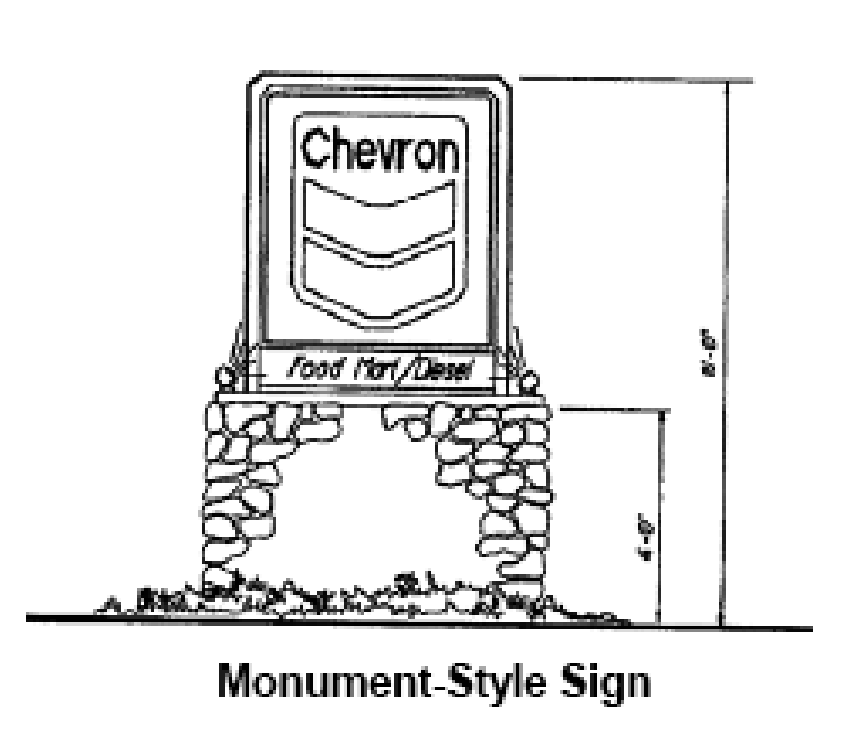
Monument signs. Monument signs are typically used where building setbacks, orientation or design make it difficult to provide other types of signage, such as wall signs, that are plainly visible to people that are trying to identify a use. Monument signs have a solid base that the sign face is installed upon. These signs should be designed so that the style of the sign and its base are consistent with the architecture of the buildings on the site. They are typically oriented perpendicular to the adjacent street and sidewalk and have a maximum of two parallel sign faces. Monument signs provide opportunities for landscaping to enhance their appearance.
(1)
Location and number permitted. Monument signs may be located in required street yards for any given zoning district, subject to the approval of the Planning Commission. Only one monument sign is permitted per premises, per street frontage.
(2)
Size. Monument signs may be a maximum of 24 square feet. The maximum height of a monument sign is six feet. In the town center district, the maximum size of a monument sign is 12 square feet and the maximum height is four feet. Where two or more uses are located on the same premises, the sign area for monument signs must be shared. The largest single sign face is used to calculate the area of monument signs.
(3)
Illumination. If illumination of monument signs is desired, then external illumination or halo lighting is preferred. Internally-illuminated cabinet signs must have a dark background with light lettering, per requirements set forth in section 40-931.
(4)
Design. The color of the base and the materials enclosing the base of a monument sign shall be consistent with the exterior color and materials of the buildings on the property. Monument signs having a base greater than 18 inches in height shall have a base that is constructed of the same materials and incorporates the same colors as the principle structures on the property. Monument sign bases that are 18 inches or less in height may have a base constructed of the same material as the exterior of the sign cabinet. Landscaping shall be installed around the base of the monument sign.
(f)
Freestanding post signs. Freestanding post signs are primarily used to identify office uses, especially where a former residence has been converted into an office or commercial use. They are similar to monument signs, except they do not have a base other than the support posts, they usually have a single sign face, and they are usually oriented parallel to the sidewalk instead of perpendicular. The colors and materials used for the sign must be compatible with the associated building design. Lettering should be carved, routed or applied as opposed to painted on a flat board.

(1)
Location and number permitted. Freestanding post signs may be located in required street yards for any given zone, subject to the approval of the Planning Commission, as provided for in section 40-930. Only one freestanding post sign is permitted per premises, per street frontage.
(2)
Size. The maximum sign area for freestanding post signs is 15 square feet. Freestanding post signs shall not be taller than five feet, measured from the ground to the top of the sign structure. Where two or more uses are located on the same premises, the sign area for freestanding post signs must be shared.
(3)
Illumination. Freestanding post signs may be externally illuminated consistent with section 40-931.
(g)
Directory signs. Directory signs are used for multi-tenant buildings to provide a directory of tenant locations within the building. They may also serve as the address sign for the property. Directory signs are small scale and are oriented to pedestrians.
(1)
Location and number. Directory signs may be freestanding, or may be fixed on an exterior wall if the building has no setback. One directory sign may be permitted per premises.
(2)
Size. Directory signs may be no larger than 12 square feet in area, and individual letters may not exceed six inches in height.
(3)
Illumination. Directory signs may be illuminated by any means consistent with section 40-931.
(h)
Electronic message center signs. Electronic message centers (EMCs) come in different shapes and sizes and typically have informational messages. Any messages shall consist of text which may change but shall not flash or scroll across the screen.
(1)
Location and number. EMCs may be incorporated into a monument-style sign. One EMC is permitted per premises.
(2)
Size. The electronic message center may only constitute ten percent of the overall sign area.
(3)
Illumination. EMCs may be illuminated using amber lighting and shall be consistent with section 40-931.
(4)
Zoning. EMCs may be located in institutional or institutional campus districts only.
(i)
Residential subdivision signs. The purpose of residential subdivision signs is to identify the name of a subdivision, provided the subdivision is not an in-fill project within an established neighborhood. They are usually monument signs or wall signs placed on a wall feature in a landscaped open space area at the entry of the development.
(1)
Location and number. One residential subdivision sign is allowed at each major street frontage of a subdivision. They must be located within a landscaped area that is maintained by a homeowners' association.
(2)
Size. Each sign may be up to 20 square feet and have a maximum height of four feet.
(3)
Illumination. Residential subdivision signs may be externally illuminated consistent with section 40-931.
(4)
Zoning. Residential subdivision signs are allowed in all residential zones, subject to the approval of the Planning Commission.
(j)
Sandwich board signs. Sandwich-board signs can be effective for certain types of uses, such as markets, restaurants or bakeries that have changing specials and menus. These signs may have re-writable surfaces, such as chalk boards or dry-erase boards.
(1)
Location and number. Sandwich-board signs must be placed on private property, except in the town center district. Signs shall not be located in parking areas or in roadways. Only one sandwich board sign is permitted per tenant space. Signs shall be located in front of the building entrance only, with location to be approved by the Planning Commission. There must be a five-foot distance to pass between the sign and building or an immobile street amenity such as benches, bike racks, trees, post boxes, stairs, etc., as the sign can become a hazard to the public right-of-way.
(2)
Size. Sandwich board signs may have a maximum area of six square feet and a maximum height of four feet, measured from the ground to the top of the sign.
(3)
Illumination. Sandwich board signs may not be illuminated.
(Code 1997, § 40-1509; Ord. of 2-6-2012, § 1(40-1509))
Sec. 40-934. - Temporary and special event signs.
(a)
Temporary signs. Temporary signs may be erected and maintained in the City only in accordance with the following provisions:
(1)
Temporary business signs and temporary event signs shall require a temporary sign permit from the Zoning Administrator, except for those signs regulated in section 8-124 (e.g., yard sales, vehicle sales, bazaars, etc., which require notification but not permitting). Temporary off-site subdivision signs (permitted only for subdivisions within city limits) shall require approval and a sign permit from the Zoning Administrator. Temporary political, real estate, subdivision and construction signs shall be exempt from temporary sign permit procedures provided all applicable requirements set forth herein are met.
(2)
The Zoning Administrator shall impose as a condition of approval such requirements as to the material, manner of construction, and method of erection of a sign as are reasonably necessary to ensure the health, safety, welfare, aesthetics, and convenience of the public.
(b)
Temporary business signs. Temporary business signs are signs identifying a special, unique, or limited activity, service, product, or sale of limited duration. Temporary business signs shall be subject to the following:
(1)
Number. There shall not be more than three permits for temporary business signs issued for the same business location within one calendar year.
(2)
Type of sign. Temporary business signs may include wall signs, freestanding signs, and banners.
(3)
Sign area. Temporary business signs shall not exceed 24 square feet in gross surface area.
(4)
Location. Temporary business signs shall be located only upon the zoning lot upon which the special, unique, or limited activity, service product, or sale is to occur. Such signs may be located in any yard or required yard (i.e., setback area between the building and property line), but shall not extend over any lot line.
(5)
Height. Temporary business signs shall not project higher than 15 feet.
(6)
Special conditions. Temporary business signs shall be erected and maintained for a period not to exceed ten consecutive days, and shall be removed within three days of the termination of the activity, service, project, or sale. The determination as to whether such special, unique, or limited activity, service, product, or sale of limited duration qualifies for a temporary business sign permit shall be at the discretion of the Planning Commission.
(c)
Temporary event signs. Temporary event signs may announce a campaign, drive, activity, or event of a civic, philanthropic, educational, or religious organization for non-commercial purposes. Temporary event signs may include wall signs, freestanding signs, banners, pennants and streamers. Temporary event signs may be erected and maintained for a period not to exceed 60 days prior to the date of which the campaign, drive, activity, or event advertised is scheduled to occur and shall be removed within seven days of the termination of such campaign, drive, activity, or event.
(1)
Number. The permitted number and construction of temporary event signs shall be with consideration given to public safety and the signage reasonable necessary and appropriate for the intended purpose.
(2)
Sign area. The permitted sign area of temporary event signs shall not exceed four square feet in surface area and may be double-sided.
(3)
Location. The permitted location of temporary event signs shall be with consideration given to public safety and the signage reasonably necessary and appropriate for the intended purpose. Temporary signs may be located in any yard or required yard, but shall not be located in any public rights-of-way.
(4)
Height. Temporary signs shall not exceed six feet in height, as measured from average grade of lot. Signs posted in the interior of a building window are not subject to the height requirements.
(Code 1997, § 40-1510; Ord. of 2-6-2012, § 1(40-1510))
Sec. 40-935. - Nonconforming signs.
(a)
Replacement. A nonconforming sign shall not be replaced by another nonconforming sign, except that the substitution or interchange of poster panels, painted boards or dismountable material on nonconforming signs shall be permitted.
(b)
Repairs and maintenance. No structural repairs, change in shape, or size of a nonconforming sign shall be permitted except to make the sign comply with the requirements of this article. Minor repairs and maintenance of nonconforming signs shall be permitted.
(c)
Duration and continuance. Signs which did not meet all requirements of this article when erected, or which do not meet provisions of this article at the time of its amendment, may stay in place until one of the following conditions occurs:
(1)
No structural changes to the support structure or changes to the sign face itself except message changes which do not renew or extend the life of the sign shall be allowed.
(2)
Maintenance to nonconforming signs shall be limited to painting and repair of the existing sign.
(3)
Once a nonconforming sign is removed, taken down, or destroyed (i.e., receiving damage to an extent of more than 50 percent of the replacement cost at the time of destruction), such sign shall not be replaced with another sign unless such sign is in conformance with this article. Such damaged sign shall not be expanded or relocated. Such sign shall not be reconstructed or moved without complying in all respects with the provisions of this article.
(d)
Signs within right-of-way. Notwithstanding the prohibitions in section 40-936(a)(8), the Planning Commission may, upon recommendation of the Zoning Administrator, permit signs, otherwise permitted by this chapter, within the street or highway right-of-way. The property owner will be responsible for removing or relocating the signs if the right-of-way is subsequently required by the local government for street, sidewalk, or streetscape improvements.
(Code 1997, § 40-1511; Ord. of 2-6-2012, § 1(40-1511); Ord. of 4-1-2013(1), § 1(40-1511))
Sec. 40-936. - Prohibited signs.
(a)
The following signs are hereby expressly prohibited from erection, construction, repair, alteration, or use within the City, except as otherwise permitted in this chapter:
(1)
Roof signs or signs where any portion of the sign extends above the roofline of the building where the sign is located.
(2)
Off-premises signs, including billboards.
(3)
Any vehicle sign where the sign projects beyond the manufacturer's profile of the vehicle and is displayed in public view under such circumstances as to indicate that the primary purpose of such display is to attract the attention of the public rather than to serve the business of the owner thereof in the manner which is customary for such vehicle.
(4)
Any sign that emits a sound, odor, or visible matter such as smoke or vapor.
(5)
Any sign that is portable or not securely attached to a building or to the ground.
(6)
Any sign that obstructs or otherwise restricts free ingress to or egress from a required door, window, fire escape or other required exit way; and any sign or advertising display attached to a fire escape.
(7)
Any sign or sign structure, other than freestanding, whereby any portion extends above the parapet, building roofline, or canopy against which the sign is located.
(8)
Any sign erected in a street or highway right-of-way except for signs of a governmental body used to convey legal notices, identify public property, convey public information, and direct or regulate pedestrian and vehicular traffic.
(9)
Signs which contain words, pictures or statements which are obscene, as defined by the O.C.G.A. § 16-12-80.
(10)
Signs of any material, including, but not limited to, paper, paint, cardboard, plastic, wood, and metal which are painted on or attached to trees, lampposts, parking meter posts, hydrants, traffic signs, stairways, benches, refuse containers, rocks or other natural features, telephone or utility poles.
(11)
Signs using the words "stop," "danger," or any other word, phrase, symbol, or character in a manner that misleads or confuses or distracts a vehicle driver.
(12)
A sign that involves motion or rotation of any part of the sign structure or sign face using intermittent flashing lights, animation, or automatically changed copy or design, except electronic message centers.
(13)
Real estate signs, temporary or permanent, for property outside the City.
(b)
No sign shall obstruct the view of motor vehicle operators entering a public roadway from any driveway, street or alley. There shall be no sign or obstruction to vision between the height of two feet and ten feet within the sight triangles established in section 40-869. No sign, sign structure or attention seizing device shall be shaped in the form of a statue of a human or animal figure, nor in the form of a three-dimensional model (e.g., dinner bucket, paint cans, Christmas trees, etc.).
(c)
No sign illumination system shall contain or utilize any beacon, spot, search or stroboscopic light, glaring light or reflector, which is visible from any public right-of-way or adjacent property, nor shall such lights be operated outside, under any circumstances, except by authorized public agencies. No sign shall display lights resembling by color and design or other characteristics customarily associated with danger or those used by police, fire, ambulance and other emergency vehicles or for navigation. Automotive warning or flashing signs shall not be utilized as commercial attention seizing devices.
(Code 1997, § 40-1512; Ord. of 2-6-2012, § 1(40-1512))
Sec. 40-937. - Permitting of signs.
(a)
Permits. Unless otherwise provided for in this chapter, no permanent sign or sign structure, regardless of its cost of construction, shall be erected, replaced, relocated, constructed, changed, or altered until such sign has been approved by the Planning Commission and a permit has been issued by the City.
(b)
Application. Application for a permit to erect, alter, or relocate a sign shall be made to the Planning Commission and shall include the following information:
(1)
Name, address, telephone number, and signature of the owner of premises (and occupant if different) granting permission for the construction, maintenance, or display of the proposed signage.
(2)
Name, address, telephone number, and signature of sign contractor, if any.
(3)
The approximate value of the sign to be installed, including the installation cost.
(4)
Two copies of a sketch or blueprint of the proposed signage drawn to scale, showing elevations of the sign as proposed on the building facade, awning, or canopy. In the case of a freestanding sign, a sketch plan of the property drawn to scale illustrating the proposed location of the sign.
(5)
Specifications and scaled drawings showing the materials, design, dimensions, structural supports, and electrical components of the proposed sign.
(6)
Any other information, specifications, photographs, or the like deemed necessary by the Planning Commission in order to ensure compliance with requirements set forth herein.
(c)
Process for issuing sign permits. The Planning Commission shall be authorized to issue sign permits according with the provisions of this article. The Planning Commission shall process all sign permit applications in an efficient manner during regularly scheduled meetings. For purposes of this section only, the term "process" means to make a decision on sign permit applications which can be administratively approved or denied.
(Code 1997, § 40-1513; Ord. of 2-6-2012, § 1(40-1513))
Sec. 40-938. - Exemptions from sign permit.
The following signs and sign alterations are hereby exempt from the standard permit procedures, provided such signs comply with all other applicable sections of this article. Signs exempt from permit procedure shall not be included in determining the allowable number or size of signs per premises:
(1)
Flags. Flags, emblems, and insignia of political, professional, religious, educational, or corporate organizations, provided that such flags, emblems, and insignia shall not be displayed for commercial purposes nor in such a manner as to act as attention-seizing devices.
(2)
Governmental signs. Governmental signs for control of traffic and other regulatory purposes, street signs, warning signs, railroad crossing signs, and signs of public service companies indicating danger and aids to service or safety which are erected by, or at the order of a public officer or employee in the performance of the officer's or employee's duties.
(3)
Holiday decorations. Signs or other materials temporarily displayed on traditionally accepted civic, patriotic, or religious holidays.
(4)
Memorial signs. Memorial plaques or tablets, grave markers, names of buildings, statutory, or other remembrances of persons or events that are noncommercial in nature.
(5)
Name and address plates. Signs, not exceeding two square feet in gross surface area for each exposed face nor exceeding an aggregate gross surface area of four square feet, indicating the name of the occupant, the address of the premises, and identification of any legal business or operation which may exist at the premises.
(6)
No trespassing, no dumping, no parking, towing, and other similar sign. No trespassing, no dumping, no parking, towing, and other similar signs not exceeding two square feet in gross surface area for each exposed face not exceeding an aggregate gross surface area of four square feet and not exceeding two in number per zoning lot in residential areas; and not exceeding four square feet in gross surface area for each exposed face nor exceeding an aggregate gross surface area of eight square feet and not exceeding four in number per zoning lot in nonresidential areas. However, under proven special circumstances, the Planning Commission may authorize additional such signs if determined to be warranted.
(7)
Public signs. Signs required by governmental bodies or specifically authorized for a public purpose by any law, statute, or ordinance. Such public signs may be of any type, number, area, height, location, or illumination as required by law, statute, or ordinance.
(Code 1997, § 40-1514; Ord. of 2-6-2012, § 1(40-1514))
Sec. 40-939. - Obsolete and abandoned signs.
(a)
Any sign which advertises or pertains to a business, product, service, activity, or purpose that is no longer conducted or that has not been in use for 60 days or that is no longer imminent, or any sign structure that no longer displays any sign copy shall be deemed to be an obsolete or abandoned sign.
(b)
When any sign is relocated, made inoperative, or removed for any reason, except for maintenance, all structural components, including the sign face and sign structure, shall be removed or relocated with the sign. All structural components of freestanding signs shall be removed to ground level. The structural components of all other signs, including painted wall signs, shall be removed back to the original building configuration.
(Code 1997, § 40-1515; Ord. of 2-6-2012, § 1(40-1515))
Sec. 40-940. - Display of property addresses.
All buildings, residences, and other structures located within the City shall be assigned a number in accordance with the following provisions:
(1)
Street address numbers shall be assigned by the Building Inspector or his agent. No certificate of occupancy shall be issued without addresses being placed on the structure where appropriate.
(2)
No building shall be assigned more than one number. A building with more than one entrance serving separate occupants shall be assigned only one number, and in addition to such number a letter designation such as A, B, C, shall be assigned to each principal entrance serving an occupant.
(3)
The cost of the numbers shall be paid for by the property owner. Residential numbers used shall not be less than three inches in height and business numbers shall not be less than four inches in height. These numbers shall be made of a durable and clearly visible material and shall be in a contrasting color from the building.
(4)
The numbers shall be conspicuously placed immediately above, on or at the side of the proper door of each building so that the number can be seen plainly from the street line. Whenever any building is situated more than 50 feet from the street line, the number must be placed near the walk, driveway or common entrance to such building and upon a mailbox, gatepost, fence, post, or other appropriate place so as to be easily discernible from the street line.
(5)
In zoning districts with multiple structures which may not front on city streets (e.g., institutional campus, institutional), location numbers of structures shall be in accordance with a property plan and map reviewed and approved by the City Planning Commission.
(Code 1997, § 40-1516; Ord. of 2-6-2012, § 1(40-1516))

